Design and prediction of high optical density photovoltaic polymers using machine learning-DFT studies
-
Mamduh J. Aljaafreh
 und
Abrar U. Hassan
und
Abrar U. Hassan

Abstract
This research provides a machine learning (ML) method to predict the optical density of photovoltaic (PV) polymers. The results show that extra gradient boosting regressor and random forest regressor are the best-performing models among all the tested ML models, whose good R-squared (R 2) values reveal their prediction accuracy. Furthermore, their SHapley Additive exPlanations analysis demonstrates that the polar surface area is the most impactful feature to influence its model outputs for highlighting its essential role in their design process. The results also reveal that the evaluated models exhibit consistent performance across different K values, with their mean squared error values spanning from 0.001 to 0.009 and R 2 values of 0.96–0.98. In addition, their synthetic accessibility likelihood index scores show a value as high as 15 for the top polymers to imply favorable conditions for their practical synthesis. The current study not only expands the understanding of polymer design but also furthers the field of PVs by establishing a good framework to design efficient solar energy materials.
1 Introduction
Clean photovoltaic (PV) systems are becoming important for shifting toward sustainable energy solutions, contributing directly to reducing greenhouse gas emissions [1]. Additionally, incorporating clean technology-related practices like biodegradable cleaning agents and water-efficient methods can support broader sustainability goals to minimize their ecological footprint of solar energy production [2]. As the demand for renewable energy sources is growing, the maintenance of such clean PV systems is becoming important for improving their reliability and efficiency, along with strengthening public trust as a sustainable alternative to fossil fuels [3]. Ultimately, the emphasis on clean PV systems is critical for harnessing the full potential of solar energy in addressing climate change, along with fostering energy independence and ecological balance [4]. The design/development of organic dyes for light harvesting is important to advancing in PV technologies and their applications [5]. Such dyes have gained considerable attention owing to their tunable optical characteristics, with potential for cost-effective production [6]. By engineering their molecular configurations, it is possible to obtain a wide absorption spectrum range to capture solar irradiance energy [7]. Optical density (OD) measures the amount of light absorbed by a dye solution and is important to evaluate its performance in light-harvesting applications [8]. Such organic dyes exhibit optimal OD to enhance light absorption and minimize transmission losses [9]. Their high OD signifies their capacity to absorb a substantial amount of incident light to result in enhanced exciton generation to convert that energy efficiently [10].
The machine learning (ML) technique is gaining a pivotal role in discovering and optimizing new organic dyes to significantly expedite their design process after forecasting their properties from the existing data [11]. By leveraging their large datasets, their algorithms identify patterns and relationships not readily detected through experimental methods [12] to swiftly screen and assess potential candidates for target applications. The objective of the current study is to assemble a dataset of organic dyes along with their corresponding features to predict their OD properties. This study also aims to form the basis for designing new polymers with their optimized optical properties to ultimately improve their light absorption efficiency (Figure 1).

Workflow of the current work analysis to design new polymers with targeted OD.
2 Theory
The OD quantifies the amount of light absorbed by a sample in its solution form, such as organic dyes [13], and it can be mathematically defined by Eq. (1):
where I 0 represents the intensity of the incident light before passing through the sample and I is the intensity of the transmitted light after it has passed through that sample. The relationship of OD with reference to its dye concentration is governed by the Beer–Lambert Law, which is expressed as Eq. (2):
where ε is the molar absorptivity of a dye (L/(mol cm)), c is its concentration, and l is the path length of the light through the sample (cm).
3 Methodology
The study collected and analyzed a dataset of 67,567 organic dyes from different sources. Their chemical structures were converted into a simplified molecular input line entry system to make their files machine-readable for further analysis. To train various regression models, its dataset was divided into training (75%) and test (25%) sub-datasets.
3.1 Descriptor design
The dataset set was fed to the RDKit toolkit [14] to design its different topological, electronic, and connectivity-related numeric descriptors. Among their most common descriptors, their examples are included as follows (Eq. (3)).
Here, m i is the atomic mass of an atom (i).
The topological polar surface area (TPSA) was calculated from the contribution of atom (A i ) to the polar surface area (PSA) and the polar contribution of atom i (P i ) (Eqs. (3)–(6)).
where A i is the contribution of its PSA and P i is the polar contribution of atom i.
In this, χ i indicates the EN of atom i i .
Their valence connectivity indices
Their δ v was calculated from their atomic number (Z) and valence electrons (Z v) attached to their hydrogen atoms (h) (Eq. (8)):
3.2 Correlation analysis
To quantify the linear relationship between variables like XX and YY, their Pearson correlation coefficients were quantified by Eq. (9):
Here, n shows the number of data points. Their feature importance scores [17] were calculated by following the equation for their evaluated models (Eq. (10)).
where FI represents their feature importance score for feature j, T is the total number of trees in the model, and
3.3 ML analysis
For ML-related calculations, the latest version of the Python programming language and its various libraries were imported to use. The machine-readable data files were imported by using Pandas [18], while the NumPy module [19] and RDKit [14] modules were imported to design their descriptors. All the calculations were visualized by importing the Matplotlib module, along with all of its scientific calculations to be performed by the Scikit-learn module [20].
All of the relevant quantum chemical calculations were performed by an open-source quantum chemical package, PSI4 [21]. It can perform various electronic structure calculations, including those needed to estimate TPSA values (Eq. (11)). The predicted target (y
∗) for new input
Their output was characterized by the mean of the posterior distribution, which incorporated their training data with a covariance structure, as defined by their kernel function.
3.4 Computational studies
For relevant density functional theory calculations, Gaussian 09 (Revision D.01) [23] software was used. Initially, their molecular geometries were optimized at their ground state energy minima by using the WB97XD [24] functional with LanL2DZ [25] basis sets. At the CAM-B3LYP/6-31G+(d,p) level of theory, their subsequent calculations of electronic spectra and density of states were performed, revealing valuable insights regarding their electronic properties. By using GaussView 6.1 software, their geometrical structures were visualized, leading to an understanding of their molecular features. Their global chemical reactivity parameters as calculated by Koopmans’ theorem [26], which included their ionization potential, EN (x), electron affinity, softness (σ), hardness (η), electrophilicity index (ω), and chemical potential (μ) (Eqs. (12)–(17)).
Their electrophilicity (ω) was calculated from [27] Eq. (18).
4 Results and discussion
The results summarized in Table 1 reflected the performance of various ML models in predicting the properties of organic dyes, based on distinct chemical tokens. The Random Forest [28] model notably achieved an exceptional R 2 value of 0.98 for both the amide and NH2 tokens, indicating exceptional prediction accuracy, with root mean squared error (RMSE) values recorded at 0.021 and 0.002, respectively. These findings suggested that the model effectively represented these particular chemical groups, ensuring reliable predictions of dye properties containing such functionalities. Likewise, the Random Forest model exhibited strong performance for the NHOH and halogen tokens, each yielding an R 2 value of 0.97, showcasing its robustness across diverse molecular structures. Conversely, the LightGBM model [29] delivered an R 2 value of 0.91 for the −OH token, which, though commendable, demonstrated a marginally lower predictive performance compared to the Random Forest model for this particular attribute (Figure 2).
A view of the model performance of the designed tokens for the collected dataset
| Tokens | Model | R 2 | RMSE |
|---|---|---|---|
| NHOH | Random Forst | 0.97 | 0.012 |
| NOC | xGBoost | 0.97 | 0.012 |
| −OH | LightGBM | 0.91 | 0.012 |
| COO− | Random Forest | 0.82 | 0.009 |
| COO2 | Random Forest | 0.67 | 0.012 |
| C_O | AdaBoost | 0.88 | 0.012 |
| NH2 | Random Forest | 0.98 | 0.021 |
| Amide | Random Forest | 0.98 | 0.002 |
| Bicyclic | Decision Tree | 0.78 | 0.012 |
| Halogen | Random Forest | 0.92 | 0.021 |
| Hydrazine | Random Forest | 0.81 | 0.041 |
| Thiophene | Random Forest | 0.89 | 0.021 |
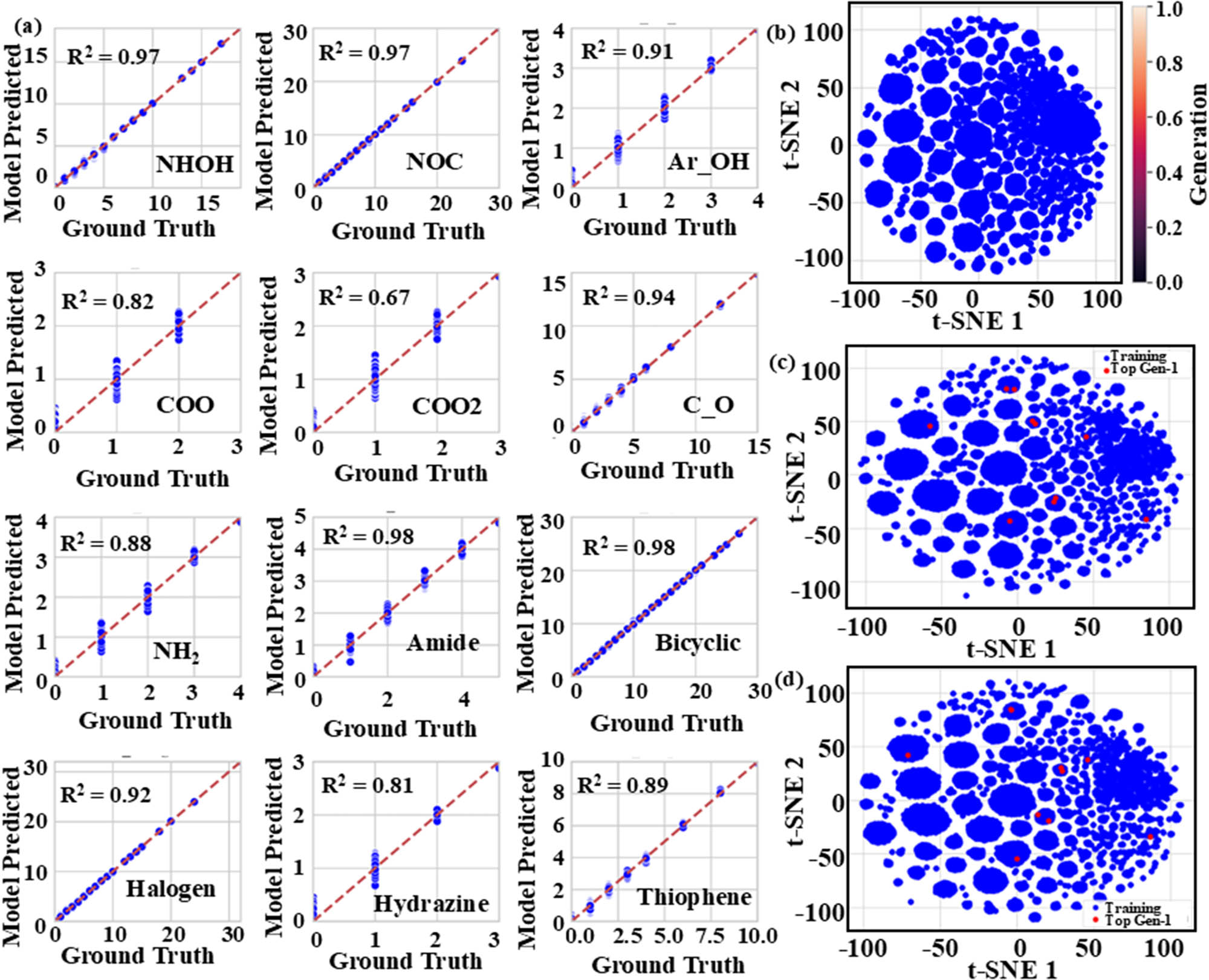
Evaluation of the (a) graph neural tokens, (b) their t-SNE map, (c) t-SNE map of top1 generation, and (d) top 10 generation.
Also, the xGBoost model [30] exhibited good performance for its NOC token, attaining an R 2 value of 0.97, which affirmed its effectiveness in capturing the dynamics associated with this particular chemical structure. However, tokens like COO2 and bicyclic displayed lower performance with R 2 values of 0.67 and 0.78, respectively, indicating difficulties in accurately modeling these intricate molecular features. Overall, the data emphasized the potential of utilizing ensemble methods such as Random Forest and xGBoost for predicting dye properties in organic synthesis, especially for well-characterized chemical groups (Table 1). Understanding the performance of these tokens in relation to different ML models not only aided in refining model selection but also directed future studies aimed at optimizing their design of new organic dyes with their desired properties. The results illustrated the significance of particular chemical functionalities in enhancing their predictive accuracy to setting the stage for more focused innovations in the field of organic photonics.
The t-distributed stochastic neighbor embedding (t-SNE) maps [31] for Generation 1 and Generation 10 offered valuable visual insights into the distribution and clustering of data [32]. In both generations, their maps depicted how their molecular features could have been represented by their tokens, had distributed spatially within their two-dimensional space, which spanned across −100 to 100. For Generation 1, the t-SNE map showed its broader and more scattered clusters to reflect greater variability in their properties. Their clustering patterns also revealed their distinct groupings based on their chemical functionalities, such as their close clustering, which was associated with their higher predictive R 2 values and lower RMSEs. This clustering suggested that data in these groups exhibit similar behavior regarding their light-harvesting properties, as indicated by the performance of the Random Forest model. When progressed to Generation 10, the t-SNE map revealed its more defined clustering, as the ML models became increasingly proficient to capture the relationships between chemical structures and their performance metrics. Their improved performance observed in later generations likely reflected the incorporation of additional data and model refinements to facilitate their deeper understanding, resulting in optimized polymer design. In general, their visual examination as t-SNE maps from Generation 1–10 clearly illustrated the influence of ML on feature extraction and modeling efficiency. The progression of clustering patterns also confirmed their increasing sophistication of the ML models to highlight the significance of clean, well-structured datasets in ensuring accurate predictions for the development of new organic dyes.
Furthermore, their Pearson correlation coefficients [33] of descriptors shown in the lower half of the correlation matrix revealed meaningful relationships between their descriptors associated with them. A positive correlation signified that an increase in one feature was generally accompanied by an increase in the other, whereas a negative correlation indicated an inverse relationship between two features. The correlation between NOCount and NHOHCount of 0.40 revealed a moderate positive correlation to imply an interdependence between the presence of nitrogen-containing groups and hydroxyl functional groups (Figure 3).
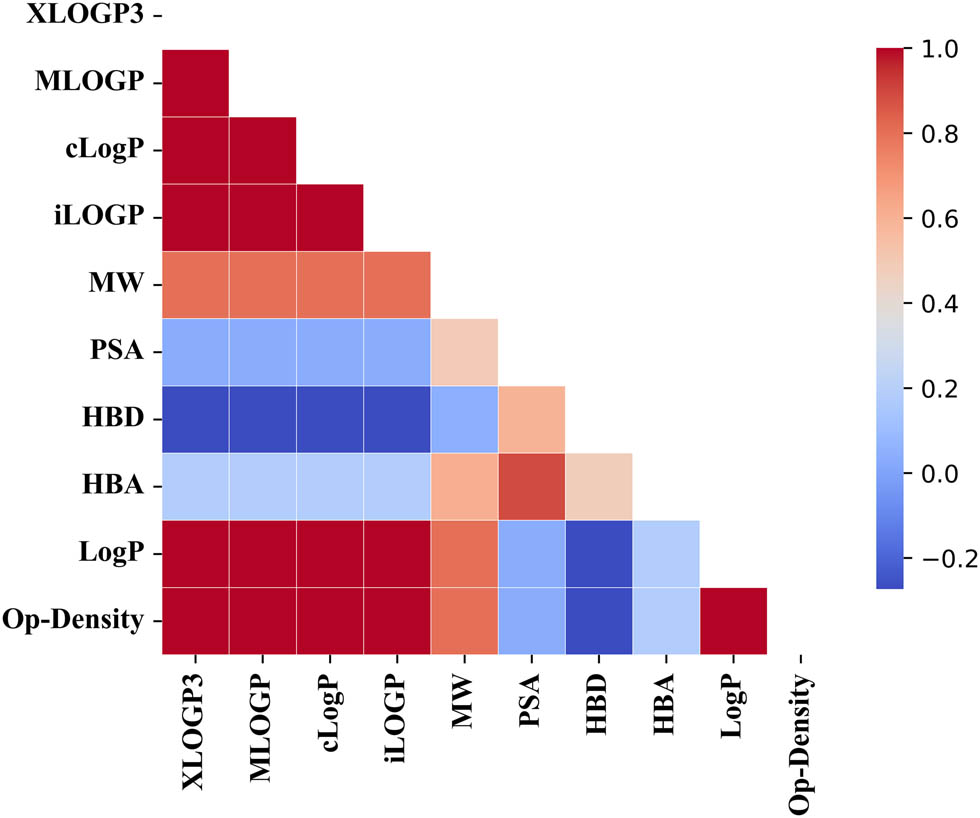
A correlation heatmap of the OD with top correlated RDKit based graph neural network descriptors.
This relationship suggested that polymers containing hydroxyl groups might also exhibit their higher count of nitrogen functionalities to influence their optical characteristics. The correlation between fr-Ar-OH and NHOHCount (0.23) revealed a weak positive association, indicating that although there was some relationship between these two features, it was not particularly strong. On the other hand, the correlation between fr-C-O and NOCount (0.74) stood out, demonstrating a strong positive correlation. This showed a close relationship between the presence of carbonyl functionalities and the number of nitrogen functionalities in the organic dyes, which could have influenced their performance as light-harvesting materials. Additionally, several features did not show strong correlations. For instance, the correlation between fr-COO and NHOHCount (0.12) and that between fr-COO and fr-Ar-OH (0.03) revealed weak relationships, indicating negligible interdependence among these features. Likewise, the correlation of 0.98 between fr-COO2 and fr-COO indicated an almost perfect positive relationship, demonstrating that these functionalities were likely to coexist closely within the molecular structures being investigated. The most significant relationships were observed with fr-NH2, which showed a strong correlation with NHOHCount (0.71) and a moderate correlation with fr-C-O (0.11). Additionally, the high correlation of fr-amide and NHOHCount (0.70) alongside its moderate correlation with NOCount (0.22) underscored the interplay between nitrogenous and hydroxyl groups in shaping the characteristics of dyes. Also, these correlations unveiled the complex network of interactions among functional groups, which likely had a substantial influence on the electronic and optical characteristics of the organic dyes. Understanding such relationships through analyzing their Pearson correlations provided important guidance for further study to aid in their design and optimization. This approach particularly highlighted the importance of specific functional group combinations that enhanced performance in light-harvesting applications.
A comparison of performance metrics proved that both the random forest and xGBoost regression models exhibited proficiency in predicting their OD. Specifically, the random forest model produced an R 2 value of 0.87 to suggest that it accounted for ∼87% of the variance in the target variable. Furthermore, it attained a notably low RMSE of 0.023, indicating that its predictions were both exceptionally consistent and accurate. However, the xGBoost model showed an R 2 of 0.84 to reflect its good performance for implying that it could have explained ∼84% of the variance in the target variable. Although its RMSE of 0.12 was slightly higher than that of the random forest model, it still represented a reproducible result. Both models surpassed other regression models in predicting OD, with the random forest model slightly outperforming the xGBoost model in terms of overall effectiveness (Figure 4). This could likely be due to its ability to manage complex feature interactions and its ability to manage noise/outliers.
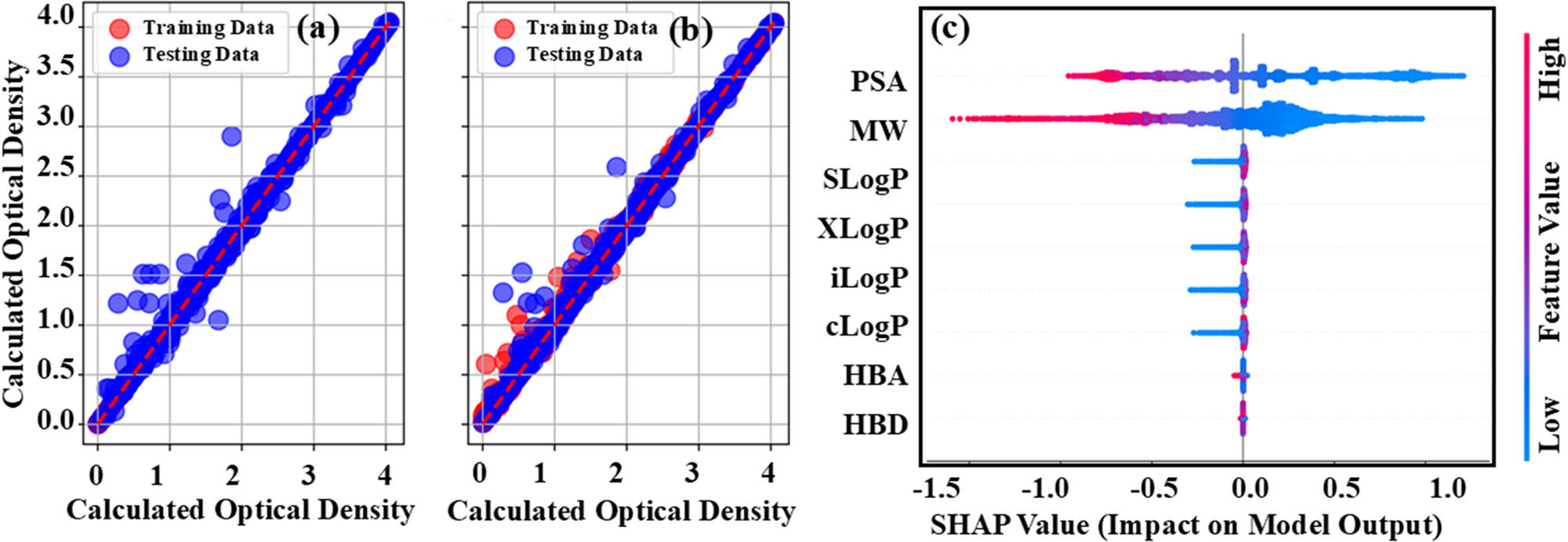
A view of the scatter plots of (a) xGBoost and (b) Random Forest and (c) xGBoost based SHapley Additive exPlanations (SHAP) value beeswarm plot.
To evaluate the impact of descriptors on model performance, their SHAP value [34] beeswarm plot showed that their physicochemical characteristics could be important to their model performance, with the PSA having the greatest influence on predicting OD. This was expected, as the PSA represented the molecular surface area accessible to solvent molecules, which could influence how light interacts with the molecule. The polymers with their high PSA values could typically exhibit a larger surface area exposed to the solvent, which could result in their increased light absorption, eventually influencing their OD. Their molecular weight ranked the second most influential factor affecting their model performance. This significance could be attributed to the tendency of larger molecules to exhibit more complex molecular structures, which, in turn, might alter their optical properties. Additionally, the logarithmic partition coefficients, such as SlogP, XLogP, and iLogP, significantly contributed to the model performance. These values signified the hydrophobicity of molecules, which can impact their interaction with light. Molecules with higher logP values were more lipophilic, potentially leading to increased light absorption and scattering, which in turn can affect their OD. The model also took into account the calculated log octanol–water partition coefficient (cLogP), which served as an additional indicator of their polymer hydrophobicity. Their hydrogen bond acceptors (HBA) and donors (HBD) also played a key role in determining the model performance. This was due to the fact that hydrogen bonding could alter the molecular structure, subsequently impacting its optical properties. The polymers with a greater number of HBA and HBD might exhibit different absorption and scattering patterns, which can affect their OD. Also, their Pearson correlations revealed a strong positive correlation between OD and several lipophilicity measures, such as LogP, XLogP3, cLogP, and MLogP. This suggested that an increase in the lipophilicity of their polymer could be associated with their increase in its OD. This correlation was likely attributed to the fact that more lipophilic molecules tend to exhibit a greater affinity for non-polar solvents, which could lead to alterations in their optical properties. The strong correlation with lipophilicity measures suggested that the model was capable of effectively capturing the relationships between these properties and OD, leading to more precise predictions (Figure 5). Conversely, the analysis also showed a negative correlation between OD and the number of HBD. This suggested that the polymers with their higher number of HBD were likely to exhibit lower optical densities.
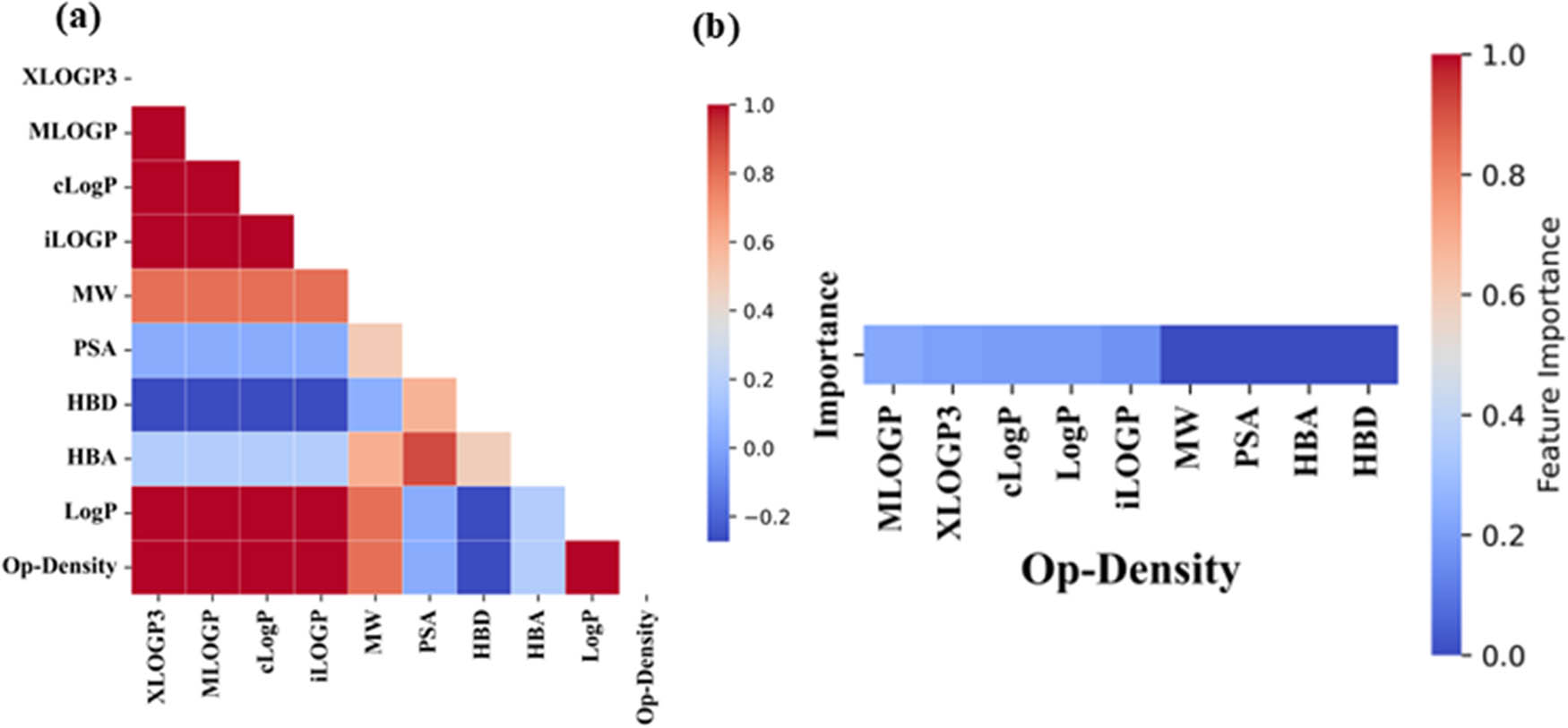
A view of the (a) Pearson correlation and (b) feature importance heatmaps of solubility-related top descriptors.
That negative correlation might be due to the ability of HBD to affect their molecular structure, which could alter how they interact with light to ultimately influence their OD. On the other hand, a weak correlation was observed between OD and PSA. This suggested that the effect of PSA on OD was less significant than that of the lipophilicity measures. Similarly, the correlation with HBA was weak, indicating that it might not be a reliable predictor of OD.
5 Model evaluation
The performance of the best applied models was also validated by using its two distinct cross-validation strategies of 5-Fold Cross-Validation (CV) [35] and Leave One Group Out (LOGO) CV [36]. Their outcomes were presented through mean squared error (MSE) and R 2 values. The 5-Fold CV results showed that the model performed exceptionally well, achieving a low MSE of 1.2 and a remarkable R 2 value of 0.96 (Figure 6).
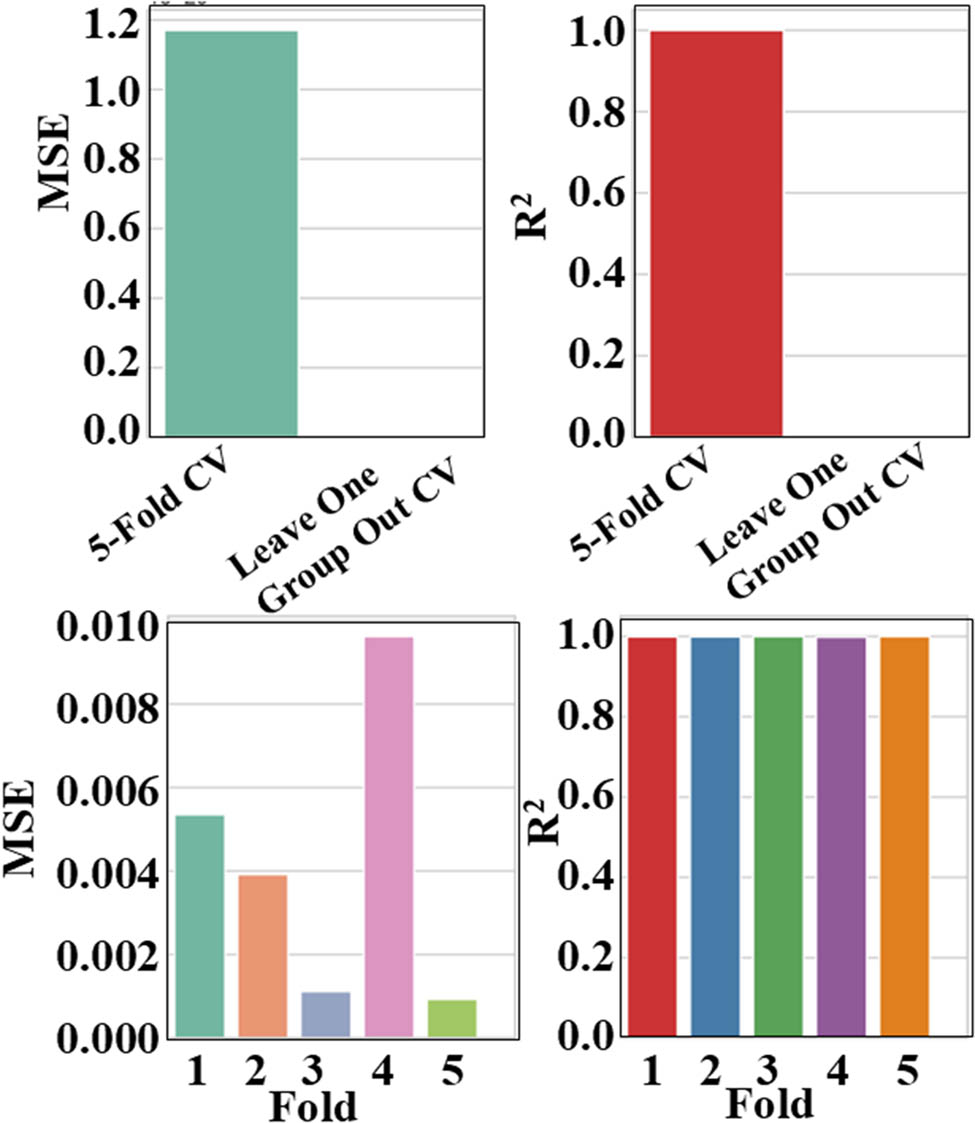
K-Fold CV and LOGO-based model evaluation results of the xGBoost regression model.
This indicated whether the model has successfully captured substantial amount of variance in the target variable to demonstrate the accuracy and precision. The low MSE value further suggested that the model predictions closely aligned with the actual values, with minimal discrepancies. In contrast, the LOGO CV results were quite unexpected, which yielded its MSE and R 2 of 0.0. It is important to note that the 5-Fold CV results could better represent its model performance, as that approach was less susceptible to overfitting and offered a robust evaluation of model generalizability. The K-Fold CV results also provided its more detailed and refined assessment of model performance. That approach consisted of dividing the data into K subsets, training the model using K – 1 subsets, and evaluating its performance on the remaining subset. This process was repeated K times, and the average performance metrics were then calculated and reported. The results demonstrated that the model performed consistently well across different K values, with MSE values spanning from 0.001 to 0.009 and R 2 values between 0.96 and 0.98. Among them, their lowest MSE value (0.001) was observed with K = 3 and K = 5 to suggest that the model could have exceptionally accurate predictions in these cases. The highest R 2 value of 0.98 was achieved with K = 2, indicating that the model successfully captured nearly all of the variance in the target variable. The consistency of the results across various K values indicated that the model was robust and generalized new data effectively. The low MSE values and high R 2 values suggested that the model can make accurate and reliable predictions, a finding further reinforced by the 5-Fold CV results.
5.1 Application of transformer assisted orientation
Leveraging transformer models to design new polymers could offer their structured framework to predict their material properties for encoding their molecular structures for enhancing their PV characteristics [37]. The mathematical formulations outlined below could serve as their foundation to apply their transformer-based architectures for their polymer design to explore their wide range of molecular architectures. In their transformer layer, their combination of attention and feed-forward transformations could be achieved through their residual connections and layer normalizations (Eq. (19)):
Considering their final output of the transformer model (H), which could encode their properties of their input polymer structures, their property predictions are given by Eq. (20):
In their transformer layer, the combination of attention and feed-forward transformations could be achieved by using their residual connections and layer normalization. So, the polymer density update could be achieved as follows (Eq. (21)):
Similarly, their predicted orientation was updated as follows (Eq. (22)):
The theory of transformer-assisted orientation in polymer design is marking an exciting convergence of advanced ML techniques. By employing such transformer architectures to analyze and predict polymer properties, the discovery and optimization of new materials can be optimized to drive innovations. The design of 50 new polymers with their OD range of 0.68–0.98 marked its significant advancement by incorporating their chemical composition and optical properties. Through their design and characterization, the goal is to design materials with their tailored optical properties to meet the needs of diverse high-tech applications. Such polymers with this OD could exhibit their broad and versatile significance. Their ability to interact with light could effectively make them suitable for a variety of applications in optoelectronics and other renewable energy technologies [38]. In its second round of polymer generation, the introduction of 100 new polymers with an OD range of 1.06–2.26 could signify a notable development compared to their previous range (Figure 7). This increased OD suggested that such polymers could be capable of absorbing more light. Their higher OD could also be correlated to enhance their mechanical properties, such as their increased strength/toughness to make them suitable for their challenging applications.
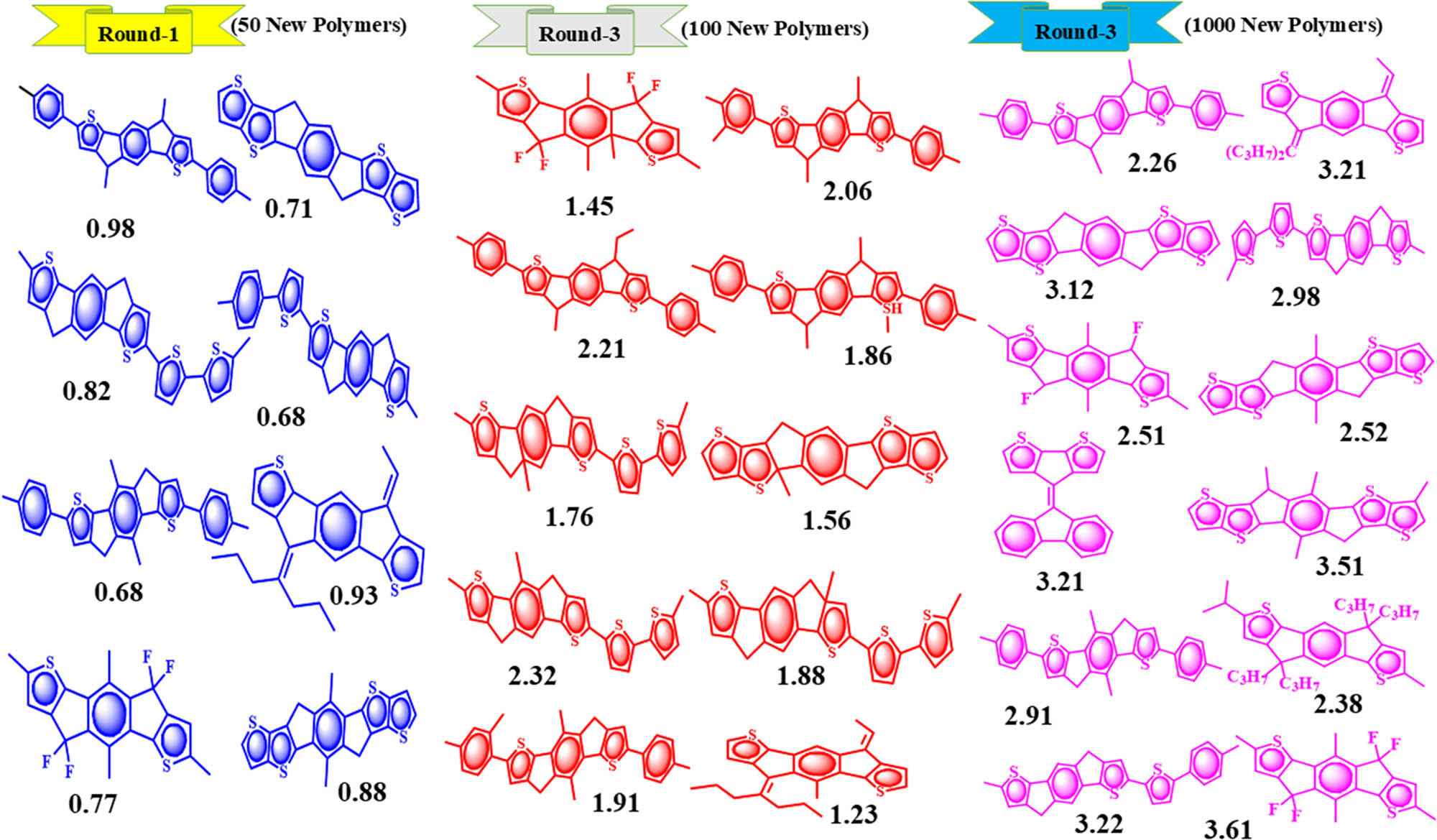
A view of different generations of polymers with their predicted OD.
Additionally, their improved optical characteristics could create new opportunities for their applications in optoelectronic devices, where their precise control over light transmission and reflection was essential for facilitating their advancements in organic light-emitting diodes (OLEDs) and display technologies. Moreover, their extended OD range could enable better tailoring of their sensing applications. The polymers from this second round were also expected to be suitable for advanced smart materials, such as electrochromic devices, promoting the development of energy-efficient windows and displays that can dynamically adjust heat and light. During their third round of polymer generation, their 1,000 new polymers with an OD range of 2.26–3.51 were developed to represent their notable advancement in their material performance and versatility over the previous rounds. This significant increase in their OD could show that such polymers exhibit enhanced light absorption abilities for making them ideal for their specific applications. Their increased OD range implied that these materials were capable of absorbing more light energy, which was essential for applications that required enhanced energy conversion efficiency, such as in solar cells. The ability to effectively capture sunlight resulted in improved power generation, supporting the development of more sustainable energy solutions. Moreover, polymers with ODs in this range might exhibit enhanced mechanical properties, such as increased strength and durability, making them ideal for use in challenging environments and applications. Along with enhanced absorption characteristics, the polymers produced in this round offered substantial benefits for optoelectronic devices. Focusing on higher ODs, these polymers were poised to drive advancements in technologies like solid-state lighting, OLEDs, and high-resolution displays where accurate light management was necessary. Additionally, the considerable rise in OD made these polymers highly suitable for photonic applications, such as waveguides and optical filters, where controlling light propagation was vital. Their polymer design could be significant to provide their valuable opportunity for their increase diversity in molecular designing and functional properties. This generated library could improve their ability to identify and select optimal candidates for tailoring their specific applications, including smart materials responsive to environmental changes and advanced coatings with improved performance against environmental stressors.
5.2 Charge density patterns
These selected polymers from the designed set demonstrated their distinctive features of charge distributions for their FMOs [39]. The HOMO charge density was specifically distributed unequally across the main moiety to suggest that certain regions of their molecular structure could play significant role in stabilizing their charge (Figure 8). This uneven distribution could also highlight the areas to have concentrated electronic clouds to direct potential sites of reactive interactions for promoting their localized charge transfer processes. Such factors could also collectively enhance their light absorption ability and its suitability for photonic applications. On the other hand, their LUMO charge density displayed a uniform distribution across their main moiety to suggest that the LUMOs could accommodate their electron delocalization over a large portion of their framework. Such feature could be beneficial for electron acceptor functions, as it enhances the efficiency of charge separation processes when the polymers were utilized in devices like organic PVs or sensors. The uniform distribution of the LUMO suggested that such polymers could be well suited for their diverse electronic transitions to enhance their photophysical properties. The distinct patterns observed for FMO charge densities also indicated that such polymers could be suitable for their particular functions. Their localized HOMO nature can be leveraged for their strong light absorption and electron donating abilities, whereas their uniform LUMO could prompt their efficient electron acceptance/transfer, which could be vital for applications involving their effective charge transfer [40].
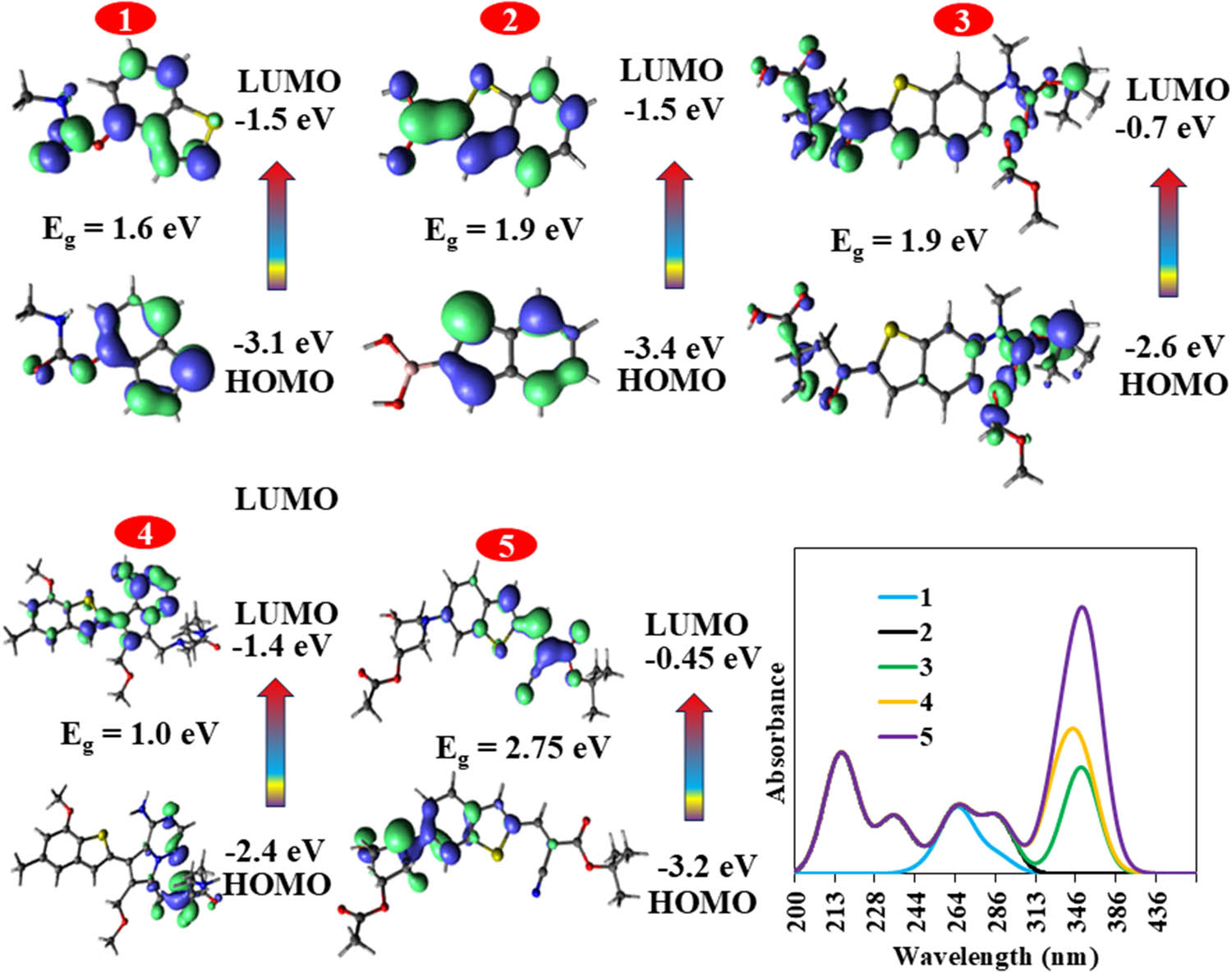
A view of the charge transfer patterns and their computed UV-vis spectra analysis of selected polymers from newly predicted designs.
Similarly, their energy levels offered important insights into their electronic properties for promising applications. For polymer 1, their HOMO energy had −3.1 eV value, while their LUMO energy value was at −1.5 eV, with an energy gap (E gap) of 1.6 eV. This E gap indicated their moderate charge transfer to make it appropriate for use in organic electronics that require efficient charge movement. For polymer 2, its E HOMO was −3.4 eV, with the E LUMO being −1.5 eV, resulting in their slightly larger E gap of 1.9 eV. This larger E gap indicated their lower conductivity as compared to polymer 1, which might have reduced its effectiveness in high-performance applications. Polymer 3 exhibited its E HOMO of −2.6 eV and a E LUMO of −0.7 eV, having an E gap of 1.9 eV. Its reduced E HOMO indicated their favorable alignment for their electron donation, whereas their higher E LUMO could facilitate their effective electron acceptance to act as positioning a promising candidate for their PV applications [41]. In contrast, polymer 4 showed an E HOMO of −2.4 eV and an E LUMO of −1.4 eV to result in their narrower E gap of 1.0 eV to suggest their improved conductivity, for potentially benefiting applications that require their rapid charge transfer patterns, such as certain organic field-effect transistors. Finally, polymer 5 presented a HOMO energy of −3.2 eV and a remarkably low LUMO of −0.45 eV, resulting in a significantly larger E gap of 2.75 eV.
5.3 Electron excitation analysis
For selected polymers, transition density matrix (TDM) analysis [42] provided notable insights into their electronic transitions and charge transfer properties to complement their FMO charge distributions. Additionally, the TDM offered a quantitative depiction of the spatial distribution of electronic transitions between the HOMO and LUMO of polymers to demonstrate how the charge density could shift during their excitation to impact their optical and electronic behavior. For example, polymers with a considerable overlap in the TDM between their HOMO and LUMO suggested efficient and localized electron movement, which could improve their charge mobility to lead to strong photophysical responses (Figure 9). For polymer 1, the localized nature of the HOMO charge density integrated with a more uniform LUMO distribution most probably resulted in a TDM that highlighted certain regions within the polymer where charge transfer was increased. This revealed that polymer 1 could effectively utilize light absorption, making it suitable for applications in OPVs where localized charge separation was essential. Similarly, polymer 3, with its lower HOMO energy and a relatively higher LUMO, might exhibit a TDM that encouraged efficient electron delocalization during transitions. This feature enhanced its suitability for applications requiring efficient charge transport, such as sensors and electronic devices. In contrast, the smaller E gap of 1.0 eV showed a narrower energy barrier for electron transitions, as further confirmed by the TDM analysis. Such a polymer likely demonstrates a significant charge migration, making it well-suited for applications that require fast charge transfer. In contrast, polymer 5 with its wider E gap of 2.75 eV might result in a TDM with fewer transitions between the HOMO and LUMO, suggesting reduced charge carrier mobility. This property might limit its application in high-performance electronics but could improve its stability and effectiveness in frameworks, where reduced electron transfer was required.
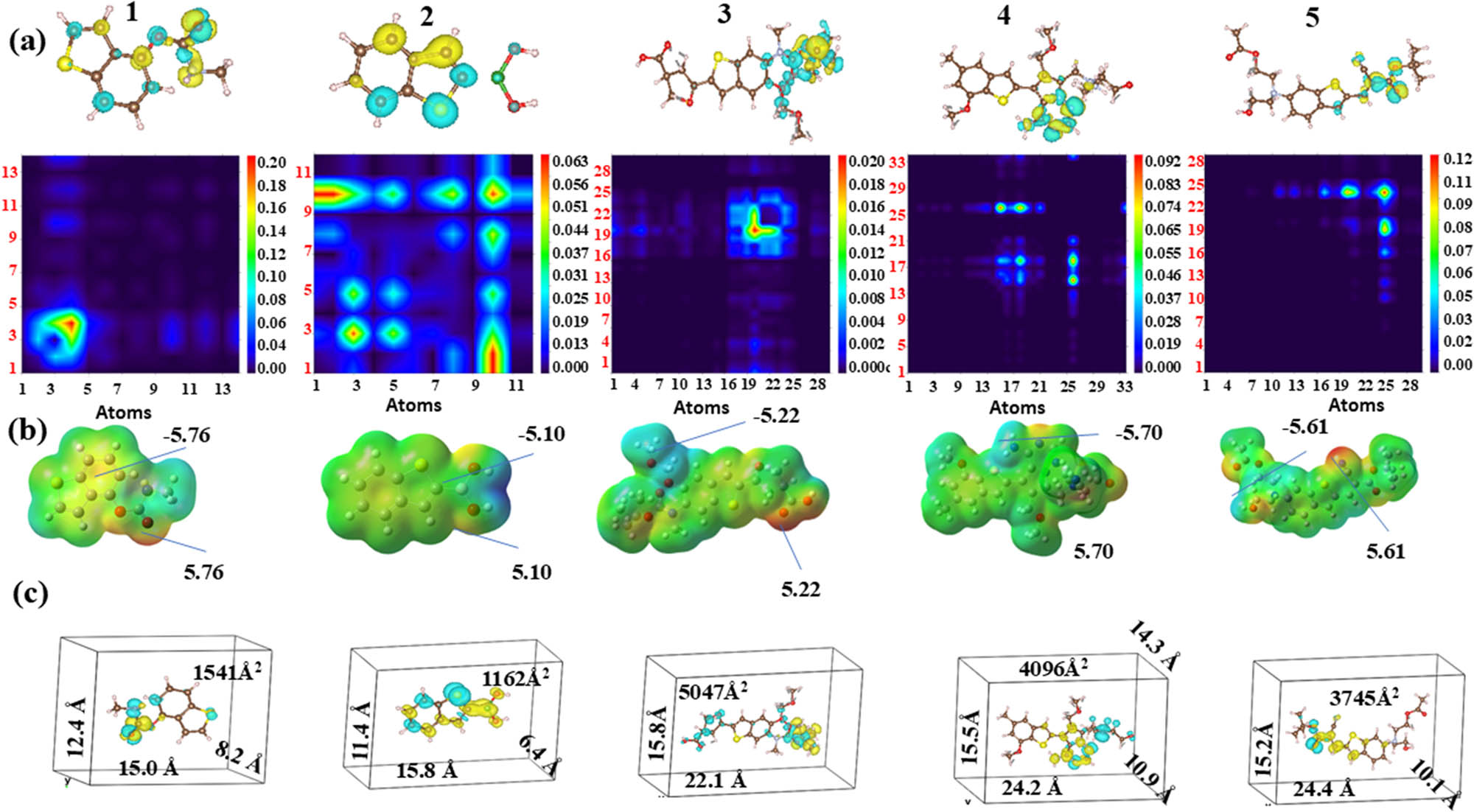
A view of the (a) TDM heatmaps and their orbital contributions, (b) molecule electrostatic potentials, and (c) charge density difference cubes of selected polymers.
5.4 Synthetic accessibility
In the current study, the synthetic accessibility of 973 chromophores, with a focus on their synthetic accessibility likelihood index (SALI) scores [43], was evaluated. Their highest SALI score was found to be as high as ∼15 to show their substantial potential for practical use in applications, like dye production, sensor development, and other fields where chromophores were vital. A high SALI score suggested that these chromophores can be manufactured with relative ease, making them promising candidates for further research and development (Figure 10). This finding highlighted the significance of synthetic accessibility in designing and selecting chromophores for practical use, as it directly influenced their feasibility for large-scale production and real-world applications. The high SALI score of 15 reflected both the structural simplicity and favorable properties of these chromophores, emphasizing their potential for integration into commercial products. Such information could assist in prioritizing chromophores for their further exploration to speed up the development of innovative materials and technologies. Analysis of the top 30 SALI scores among the 973 chromophores was done to reveal valuable insights into their synthetic accessibility and optical properties.
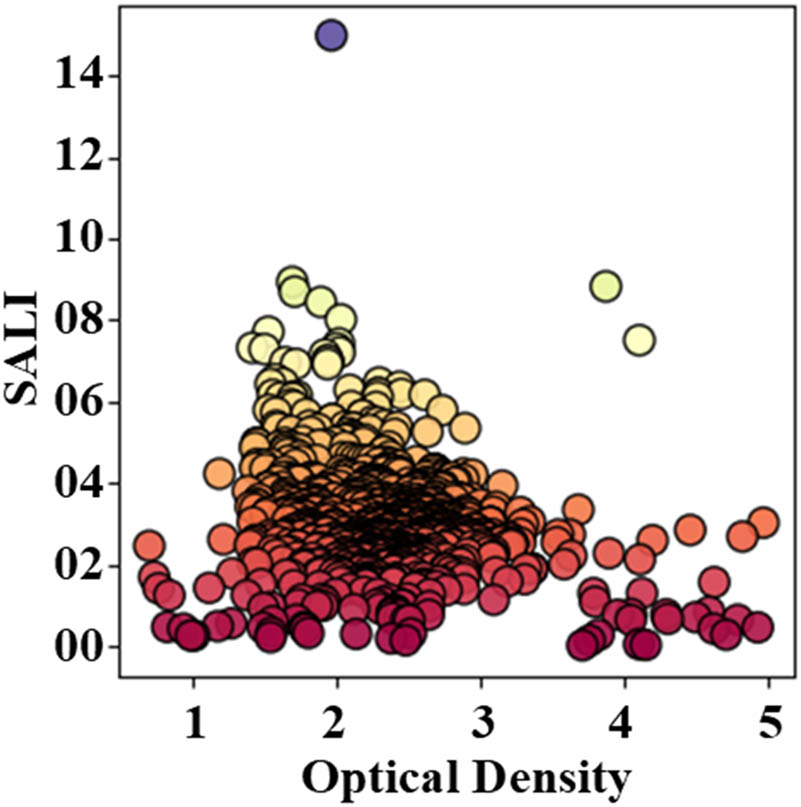
SALI score of newly predicted polymers.
The highest SALI score recorded was 14.9, indicating that this particular chromophore was not only easy to manufacture but also demonstrated a significant absorbance value of 0.39 (Table 2). This indicated a robust potential for practical applications in disciplines such as dye production and sensor development. The absorbance values of the top entries varied, with the eighth chromophore showing the highest value of 0.82 and a SALI score of 7.5. This showed that while many chromophores were accessible, only a few stood out notably in terms of both ease of synthesis and optical properties. The data revealed a sharp decline in SALI scores after the top few entries to suggest that there should be more focus on these high-scoring chromophores for their further advancement.
A comparison of SALI scores with their predicted ODs
| Chromophore | Absorbance | SALI score | Chromophore | Absorbance | SALI score |
|---|---|---|---|---|---|
| 1 | 2.39 | 14.9 | 16 | 3.39 | 7.0 |
| 2 | 1.34 | 8.9 | 17 | 2.33 | 6.9 |
| 3 | 3.77 | 8.8 | 18 | 3.34 | 6.9 |
| 4 | 2.34 | 8.7 | 19 | 3.39 | 6.9 |
| 5 | 1.38 | 8.4 | 20 | 2.32 | 6.5 |
| 6 | 3.41 | 8.0 | 21 | 3.46 | 6.5 |
| 7 | 2.31 | 7.7 | 22 | 2.33 | 6.4 |
| 8 | 2.82 | 7.5 | 23 | 2.31 | 6.4 |
| 9 | 2.40 | 7.4 | 24 | 3.49 | 6.4 |
| 10 | 2.28 | 7.3 | 25 | 3.42 | 6.3 |
| 11 | 3.40 | 7.3 | 26 | 2.46 | 6.2 |
| 12 | 1.30 | 7.3 | 27 | 3.46 | 6.2 |
| 13 | 1.40 | 7.2 | 28 | 3.49 | 6.2 |
| 14 | 3.38 | 7.1 | 29 | 2.31 | 6.2 |
| 15 | 1.38 | 7.0 | 30 | 2.52 | 6.2 |
6 Conclusions
In conclusion, this research has led to the successful development of ML-based good predictive models to predict the OD of a collected dataset of organic polymers. For this, their polymer transformer assisted orientation approach generated their library of new chemical structures. The evaluated ML models, particularly xGBoost and Random Forest Regression, demonstrated their good predictive accuracy, with their PSA emerging as an important feature for their design. Furthermore, the current study not only advances the understanding of polymer design but also can establish their reliable framework to discover new materials for PV applications. Also, its future research directions show great promise. Their experimental synthesis and characterization of the top-performing polymers can validate their PV performance. Additionally, exploring the integration of these polymers into functional devices, such as organic PV cells, can also be essential to uncover their full potential. Their evaluated models can be further expanded to generate a good polymer library to uncover their new materials with their improved properties. Moreover, their applicability to other energy-related applications, such as energy storage and fuel cells, warrant further investigation.
-
Funding information: This work was supported and funded by the Deanship of Scientific Research at Imam Mohammad Ibn Saud Islamic University (IMSIU) (grant number IMSIU-DDRSP2502).
-
Author contributions: A.U. Hassan and M.J. Aljaafreh: conceptualization, methodology, investigation, software, visualization, writing of the original draft, and review and editing of the manuscript. All authors have accepted responsibility for the entire content of this manuscript and approved its submission.
-
Conflict of interest: The authors state no conflict of interest.
-
Data availability statement: The datasets generated and/or analyzed during the current study are available from the corresponding author on reasonable request.
References
[1] Chen F, Yang Y, Zhou M, Huang X, Gao Y, Li K, et al. Short process recovery of silver and purification mechanism of crystalline silicon deep etching from end-of-life photovoltaic cells. Chem Eng J. 2025;510:161651.10.1016/j.cej.2025.161651Suche in Google Scholar
[2] Anthony JE. Small-molecule, nonfullerene acceptors for polymer bulk heterojunction organic photovoltaics. Chem Mater. 2011;23(3):583–90.10.1021/cm1023019Suche in Google Scholar
[3] Fthenakis V. Sustainability of photovoltaics: The case for thin-film solar cells. Renew Sustain Energy Rev. 2009;13(9):2746–50.10.1016/j.rser.2009.05.001Suche in Google Scholar
[4] Malla S. An outlook of end-use energy demand based on a clean energy and technology transformation of the household sector in Nepal. Energy. 2022;238:121810.10.1016/j.energy.2021.121810Suche in Google Scholar
[5] Fernandes RV, Urbano A, Duarte JL, Bristow N, Kettle J, Laureto E. Tuning the optical properties of luminescent down shifting layers based on organic dyes to increase the efficiency and lifetime of P3HT: PCBM photovoltaic devices. J Lumin. 2018;203:165–71.10.1016/j.jlumin.2018.06.053Suche in Google Scholar
[6] Ooyama Y, Harima Y. Photophysical and electrochemical properties, and molecular structures of organic dyes for dye-sensitized solar cells. ChemPhysChem. 2012;13(18):4032–80.10.1002/cphc.201200218Suche in Google Scholar PubMed
[7] Justin Thomas KR, Hsu YC, Lin JT, Lee KM, Ho KC, Lai CH, et al. 2, 3-Disubstituted thiophene-based organic dyes for solar cells. Chem Mater. 2008;20(5):1830–40.10.1021/cm702631rSuche in Google Scholar
[8] Pandey SS, Mizuno T, Das SK, Ogomi Y, Hayase S. Solution processable thin film organic photovoltaic cells based on far red sensitive soluble squaraine dyes. Thin Solid Films. 2012;522:401–6.10.1016/j.tsf.2012.08.043Suche in Google Scholar
[9] Hasan MA, Rahman IMM, Uddin J, Chowdhury FI. Study of photosensitizer dyes for high-performance dye-sensitized solar cells application: A computational investigation. Chem Phys Impact. 2024;9:100719.10.1016/j.chphi.2024.100719Suche in Google Scholar
[10] Amir-Al Zumahi SM, Arobi N, Mahbubur Rahman M, Kamal Hossain M, Ara Jahan Rozy M, Bashar M, et al. Understanding the optical behaviours and the power conversion efficiency of novel organic dye and nanostructured TiO2 based integrated DSSCs. Sol Energy. 2021;225:129–47.10.1016/j.solener.2021.07.024Suche in Google Scholar
[11] Isik N, Eskicioglu OC. Predictability of machine learning framework in cross-section data. Open Phys. 2023;21(1):20220261. 10.1515/phys-2022-0261/html.Suche in Google Scholar
[12] Tang Y, Li R, Guan H, Zhou D, Huang Y. Negation of permutation mass function in random permutation sets theory for uncertain information modeling. Complex Intell Syst. 2024;10(6):7697–709.10.1007/s40747-024-01569-ySuche in Google Scholar
[13] Masri A, Armanazi M, Inouye K, Geierhart DL, Davey PG, Vasudevan B. Macular pigment optical density as a measurable modifiable clinical biomarker. Nutrients. 2024;16(19):3273.10.3390/nu16193273Suche in Google Scholar PubMed PubMed Central
[14] Scalfani VF, Patel VD, Fernandez AM. Visualizing chemical space networks with RDKit and NetworkX. J Cheminformatics. 2022;14(1):87.10.1186/s13321-022-00664-xSuche in Google Scholar PubMed PubMed Central
[15] Li XH, Jalbout AF, Solimannejad M. Definition and application of a novel valence molecular connectivity index. J Mol Structure: THEOCHEM. 2003;663(1):81–5.10.1016/j.theochem.2003.08.093Suche in Google Scholar
[16] Müller M, Hansen A, Grimme S. An atom-in-molecule adaptive polarized valence single-ζ atomic orbital basis for electronic structure calculations. J Chem Phys. 2023;159(16):164108.10.1063/5.0172373Suche in Google Scholar PubMed
[17] Mirka S, Susanne J. Comparison of feature importance measures as explanations for classification models. Discov Appl Sci. 2021;3:272. 10.1007/s42452-021-04148-9.Suche in Google Scholar
[18] Álvaro JG, Alberto N. An open-source Python library for self-organizing-maps Author links open overlay panel. Softw Impacts. 2020;12:100280. 10.1016/j.simpa.2022.100280.Suche in Google Scholar
[19] Schäfer C. Extensions for Scientists: NumPy, SciPy, Matplotlib, Pandas. In: Schäfer C, editor. Quickstart python: An introduction to programming for STEM students. Vol. 2021, Wiesbaden: Springer Fachmedien; 2021. p. 45–53. 10.1007/978-3-658-33552-6_9.Suche in Google Scholar
[20] Pedregosa F, Varoquaux G, Gramfort A, Michel V, Thirion B, Grisel O, et al. Scikit-learn: Machine learning in Python. arXiv. 2018;2018:490, http://arxiv.org/abs/1201.0490.Suche in Google Scholar
[21] Smith DGA, Burns LA, Simmonett AC, Parrish RM, Schieber MC, Galvelis R, et al. PSI4 1.4: Open-source software for high-throughput quantum chemistry. J Chem Phys. 2020;152(18):184108.10.1063/5.0006002Suche in Google Scholar PubMed PubMed Central
[22] Zhao CZ, Zhu MM, Sun XD, Wang SS, Wang J. The band gap energy of the dilute nitride alloy GaNxAsyP1−x−y (0 ≤ x ≤ 0.07, 0 ≤ y ≤ 1) depending on content. Appl Phys A. 2018;124(2):216. 10.1007/s00339-018-1654-x.Suche in Google Scholar
[23] Frisch JM, Trucks WG, Schlegel BH, Scuseria GE, Robb MA, Cheeseman JR, et al. Gaussian 09, Revision D. 01, Gauss. Inc, Wallingford CT; 2013.Suche in Google Scholar
[24] Farrokhpour H, Jouypazadeh H. Description of adenine and cytosine on Au (111) nano surface using different DFT functionals (PW91PW91, wB97XD, M06-2X, M06-L and CAM-B3LYP) in the framework of ONIOM scheme: Non-periodic calculations. Chem Phys. 2017;488:1–10. 10.1016/j.chemphys.2017.03.001.Suche in Google Scholar
[25] Check CE, Faust TO, Bailey JM, Wright BJ, Gilbert TM, Sunderlin LS. Addition of polarization and diffuse functions to the LANL2DZ basis set for p-block elements. J Phys Chem A. 2001;105(34):8111–6. 10.1021/jp011945l.Suche in Google Scholar
[26] Luo J, Xue ZQ, Liu WM, Wu JL, Yang ZQ. Koopmans’ theorem for large molecular systems within density functional theory. J Phys Chem A. 2006;110(43):12005–9. 10.1063/1.3491272.Suche in Google Scholar PubMed
[27] Parr RG, Szentpály L, Liu S. Electrophilicity index. J Am Chem Soc. 1999;121(9):1922–4. 10.1021/ja983494x.Suche in Google Scholar
[28] Wu Y, Wang Y, Liu H, Xie L, Jiao L, Lu P. Risk assessment of bridge construction investigated using random forest algorithm. Sci Rep. 2024;14(1):20964. 10.1038/s41598-024-72051-5.Suche in Google Scholar PubMed PubMed Central
[29] Daniel C. A robust LightGBM model for concrete tensile strength forecast to aid in resilience-based structure strategies. Heliyon. 2024;10(20):e39679. 10.1016/j.heliyon.2024.e39679.Suche in Google Scholar PubMed PubMed Central
[30] Yang D, Wang L, Yuan P, An Q, Su B, Yu M, et al. Cocrystal virtual screening based on the XGBoost machine learning model. Chin Chem Lett. 2023;34(8):107964. 10.1016/j.cclet.2022.107964.Suche in Google Scholar
[31] Cess CG, Haghverdi L. Compound-SNE: comparative alignment of t-SNEs for multiple single-cell omics data visualization. Bioinformatics. 2024;40(7):471. 10.1093/bioinformatics/btae471.Suche in Google Scholar PubMed PubMed Central
[32] Tang Y, Fei Z, Huang L, Zhang W, Zhao B, Guan H, et al. Failure mode and effects analysis method on the air system of an aircraft turbofan engine in multi-criteria open group decision-making environment. Cybern Syst. 2025;1–32. 10.3390/e25050757.Suche in Google Scholar PubMed PubMed Central
[33] Okoye K, Hosseini S. Correlation tests in R: Pearson cor, kendall’s tau, and spearman’s rho. In: Okoye K, Hosseini S, editors. R programming: Statistical data analysis in research. Vol. 2024, Singapore: Springer Nature; 2024. p. 247–77. 10.1007/978-981-97-3385-9_12.Suche in Google Scholar
[34] Koushik A, Manoj M, Nezamuddin N. SHapley additive exPlanations for explaining artificial neural network based mode choice models. Transp Dev Econ. 2024;10(1):12.10.1007/s40890-024-00200-6Suche in Google Scholar
[35] Refaeilzadeh P, Tang L, Liu H. Cross-validation. In: Liu L, Özsu MT, editors. Encyclopedia of database systems. Vol. 2009, Boston, MA: Springer US; 2009. p. 532–8. 10.1007/978-0-387-39940-9_565.Suche in Google Scholar
[36] Auddy A, Zou H, Rad KR, Maleki A. Approximate Leave-one-out cross validation for regression with ℓ₁ regularizers. IEEE Trans Inf Theory. 2024;70(11):8040–71. 10.1109/TIT.2024.3450002.Suche in Google Scholar
[37] Xu C, Wang Y, Barati Farimani A. TransPolymer: a Transformer-based language model for polymer property predictions. npj Comput Mater. 2023;9(1):1–14. 10.1038/s41524-023-01016-5.Suche in Google Scholar
[38] Zhang J, Li H, Kong X, Zhou J, Shi G, Zang J, et al. A novel multiple-medium-AC-port power electronic transformer. IEEE Trans Ind Electron. 2024;71(7):6568–78. 10.1109/TIE.2023.3301550.Suche in Google Scholar
[39] Quiroz-Garcia B, Figueroa R, Cogordan JA, Delgado G. Photocyclodimers from Z-ligustilide. Experimental results and FMO analysis. Tetrahedron Lett. 2005;46(17):3003–6. 10.1016/j.tetlet.2005.03.024.Suche in Google Scholar
[40] Aljaafreh MJ, Hussein RK. Substituent effect on the electronic and optical properties of newly designed pyrrole derivatives using density functional theory. Open Phys. 2024;1:22. 10.1515/phys-2024-0012/html.Suche in Google Scholar
[41] Jia Y, Chen G, Zhao L. Defect detection of photovoltaic modules based on improved VarifocalNet. Sci Rep. 2024;14:15170. 10.1038/s41598-024-66234-3.Suche in Google Scholar PubMed PubMed Central
[42] Titov E. On the low-lying electronically excited states of azobenzene dimers: Transition density matrix analysis. Molecules. 2021;26(14):4245. 10.3390/molecules26144245.Suche in Google Scholar PubMed PubMed Central
[43] Ertl P, Schuffenhauer A. Estimation of synthetic accessibility score of drug-like molecules based on molecular complexity and fragment contributions. J Cheminform. 2009;1:8. 10.1186/1758-2946-1-8.Suche in Google Scholar PubMed PubMed Central
© 2025 the author(s), published by De Gruyter
This work is licensed under the Creative Commons Attribution 4.0 International License.
Artikel in diesem Heft
- Research Articles
- Single-step fabrication of Ag2S/poly-2-mercaptoaniline nanoribbon photocathodes for green hydrogen generation from artificial and natural red-sea water
- Abundant new interaction solutions and nonlinear dynamics for the (3+1)-dimensional Hirota–Satsuma–Ito-like equation
- A novel gold and SiO2 material based planar 5-element high HPBW end-fire antenna array for 300 GHz applications
- Explicit exact solutions and bifurcation analysis for the mZK equation with truncated M-fractional derivatives utilizing two reliable methods
- Optical and laser damage resistance: Role of periodic cylindrical surfaces
- Numerical study of flow and heat transfer in the air-side metal foam partially filled channels of panel-type radiator under forced convection
- Water-based hybrid nanofluid flow containing CNT nanoparticles over an extending surface with velocity slips, thermal convective, and zero-mass flux conditions
- Dynamical wave structures for some diffusion--reaction equations with quadratic and quartic nonlinearities
- Solving an isotropic grey matter tumour model via a heat transfer equation
- Study on the penetration protection of a fiber-reinforced composite structure with CNTs/GFP clip STF/3DKevlar
- Influence of Hall current and acoustic pressure on nanostructured DPL thermoelastic plates under ramp heating in a double-temperature model
- Applications of the Belousov–Zhabotinsky reaction–diffusion system: Analytical and numerical approaches
- AC electroosmotic flow of Maxwell fluid in a pH-regulated parallel-plate silica nanochannel
- Interpreting optical effects with relativistic transformations adopting one-way synchronization to conserve simultaneity and space–time continuity
- Modeling and analysis of quantum communication channel in airborne platforms with boundary layer effects
- Theoretical and numerical investigation of a memristor system with a piecewise memductance under fractal–fractional derivatives
- Tuning the structure and electro-optical properties of α-Cr2O3 films by heat treatment/La doping for optoelectronic applications
- High-speed multi-spectral explosion temperature measurement using golden-section accelerated Pearson correlation algorithm
- Dynamic behavior and modulation instability of the generalized coupled fractional nonlinear Helmholtz equation with cubic–quintic term
- Study on the duration of laser-induced air plasma flash near thin film surface
- Exploring the dynamics of fractional-order nonlinear dispersive wave system through homotopy technique
- The mechanism of carbon monoxide fluorescence inside a femtosecond laser-induced plasma
- Numerical solution of a nonconstant coefficient advection diffusion equation in an irregular domain and analyses of numerical dispersion and dissipation
- Numerical examination of the chemically reactive MHD flow of hybrid nanofluids over a two-dimensional stretching surface with the Cattaneo–Christov model and slip conditions
- Impacts of sinusoidal heat flux and embraced heated rectangular cavity on natural convection within a square enclosure partially filled with porous medium and Casson-hybrid nanofluid
- Stability analysis of unsteady ternary nanofluid flow past a stretching/shrinking wedge
- Solitonic wave solutions of a Hamiltonian nonlinear atom chain model through the Hirota bilinear transformation method
- Bilinear form and soltion solutions for (3+1)-dimensional negative-order KdV-CBS equation
- Solitary chirp pulses and soliton control for variable coefficients cubic–quintic nonlinear Schrödinger equation in nonuniform management system
- Influence of decaying heat source and temperature-dependent thermal conductivity on photo-hydro-elasto semiconductor media
- Dissipative disorder optimization in the radiative thin film flow of partially ionized non-Newtonian hybrid nanofluid with second-order slip condition
- Bifurcation, chaotic behavior, and traveling wave solutions for the fractional (4+1)-dimensional Davey–Stewartson–Kadomtsev–Petviashvili model
- New investigation on soliton solutions of two nonlinear PDEs in mathematical physics with a dynamical property: Bifurcation analysis
- Mathematical analysis of nanoparticle type and volume fraction on heat transfer efficiency of nanofluids
- Creation of single-wing Lorenz-like attractors via a ten-ninths-degree term
- Optical soliton solutions, bifurcation analysis, chaotic behaviors of nonlinear Schrödinger equation and modulation instability in optical fiber
- Chaotic dynamics and some solutions for the (n + 1)-dimensional modified Zakharov–Kuznetsov equation in plasma physics
- Fractal formation and chaotic soliton phenomena in nonlinear conformable Heisenberg ferromagnetic spin chain equation
- Single-step fabrication of Mn(iv) oxide-Mn(ii) sulfide/poly-2-mercaptoaniline porous network nanocomposite for pseudo-supercapacitors and charge storage
- Novel constructed dynamical analytical solutions and conserved quantities of the new (2+1)-dimensional KdV model describing acoustic wave propagation
- Tavis–Cummings model in the presence of a deformed field and time-dependent coupling
- Spinning dynamics of stress-dependent viscosity of generalized Cross-nonlinear materials affected by gravitationally swirling disk
- Design and prediction of high optical density photovoltaic polymers using machine learning-DFT studies
- Robust control and preservation of quantum steering, nonlocality, and coherence in open atomic systems
- Coating thickness and process efficiency of reverse roll coating using a magnetized hybrid nanomaterial flow
- Dynamic analysis, circuit realization, and its synchronization of a new chaotic hyperjerk system
- Decoherence of steerability and coherence dynamics induced by nonlinear qubit–cavity interactions
- Finite element analysis of turbulent thermal enhancement in grooved channels with flat- and plus-shaped fins
- Modulational instability and associated ion-acoustic modulated envelope solitons in a quantum plasma having ion beams
- Statistical inference of constant-stress partially accelerated life tests under type II generalized hybrid censored data from Burr III distribution
- On solutions of the Dirac equation for 1D hydrogenic atoms or ions
- Entropy optimization for chemically reactive magnetized unsteady thin film hybrid nanofluid flow on inclined surface subject to nonlinear mixed convection and variable temperature
- Stability analysis, circuit simulation, and color image encryption of a novel four-dimensional hyperchaotic model with hidden and self-excited attractors
- A high-accuracy exponential time integration scheme for the Darcy–Forchheimer Williamson fluid flow with temperature-dependent conductivity
- Novel analysis of fractional regularized long-wave equation in plasma dynamics
- Development of a photoelectrode based on a bismuth(iii) oxyiodide/intercalated iodide-poly(1H-pyrrole) rough spherical nanocomposite for green hydrogen generation
- Investigation of solar radiation effects on the energy performance of the (Al2O3–CuO–Cu)/H2O ternary nanofluidic system through a convectively heated cylinder
- Quantum resources for a system of two atoms interacting with a deformed field in the presence of intensity-dependent coupling
- Studying bifurcations and chaotic dynamics in the generalized hyperelastic-rod wave equation through Hamiltonian mechanics
- A new numerical technique for the solution of time-fractional nonlinear Klein–Gordon equation involving Atangana–Baleanu derivative using cubic B-spline functions
- Interaction solutions of high-order breathers and lumps for a (3+1)-dimensional conformable fractional potential-YTSF-like model
- Hydraulic fracturing radioactive source tracing technology based on hydraulic fracturing tracing mechanics model
- Numerical solution and stability analysis of non-Newtonian hybrid nanofluid flow subject to exponential heat source/sink over a Riga sheet
- Numerical investigation of mixed convection and viscous dissipation in couple stress nanofluid flow: A merged Adomian decomposition method and Mohand transform
- Effectual quintic B-spline functions for solving the time fractional coupled Boussinesq–Burgers equation arising in shallow water waves
- Analysis of MHD hybrid nanofluid flow over cone and wedge with exponential and thermal heat source and activation energy
- Solitons and travelling waves structure for M-fractional Kairat-II equation using three explicit methods
- Impact of nanoparticle shapes on the heat transfer properties of Cu and CuO nanofluids flowing over a stretching surface with slip effects: A computational study
- Computational simulation of heat transfer and nanofluid flow for two-sided lid-driven square cavity under the influence of magnetic field
- Irreversibility analysis of a bioconvective two-phase nanofluid in a Maxwell (non-Newtonian) flow induced by a rotating disk with thermal radiation
- Hydrodynamic and sensitivity analysis of a polymeric calendering process for non-Newtonian fluids with temperature-dependent viscosity
- Exploring the peakon solitons molecules and solitary wave structure to the nonlinear damped Kortewege–de Vries equation through efficient technique
- Modeling and heat transfer analysis of magnetized hybrid micropolar blood-based nanofluid flow in Darcy–Forchheimer porous stenosis narrow arteries
- Activation energy and cross-diffusion effects on 3D rotating nanofluid flow in a Darcy–Forchheimer porous medium with radiation and convective heating
- Insights into chemical reactions occurring in generalized nanomaterials due to spinning surface with melting constraints
- Influence of a magnetic field on double-porosity photo-thermoelastic materials under Lord–Shulman theory
- Soliton-like solutions for a nonlinear doubly dispersive equation in an elastic Murnaghan's rod via Hirota's bilinear method
- Analytical and numerical investigation of exact wave patterns and chaotic dynamics in the extended improved Boussinesq equation
- Nonclassical correlation dynamics of Heisenberg XYZ states with (x, y)-spin--orbit interaction, x-magnetic field, and intrinsic decoherence effects
- Exact traveling wave and soliton solutions for chemotaxis model and (3+1)-dimensional Boiti–Leon–Manna–Pempinelli equation
- Unveiling the transformative role of samarium in ZnO: Exploring structural and optical modifications for advanced functional applications
- On the derivation of solitary wave solutions for the time-fractional Rosenau equation through two analytical techniques
- Analyzing the role of length and radius of MWCNTs in a nanofluid flow influenced by variable thermal conductivity and viscosity considering Marangoni convection
- Advanced mathematical analysis of heat and mass transfer in oscillatory micropolar bio-nanofluid flows via peristaltic waves and electroosmotic effects
- Exact bound state solutions of the radial Schrödinger equation for the Coulomb potential by conformable Nikiforov–Uvarov approach
- Some anisotropic and perfect fluid plane symmetric solutions of Einstein's field equations using killing symmetries
- Nonlinear dynamics of the dissipative ion-acoustic solitary waves in anisotropic rotating magnetoplasmas
- Curves in multiplicative equiaffine plane
- Exact solution of the three-dimensional (3D) Z2 lattice gauge theory
- Propagation properties of Airyprime pulses in relaxing nonlinear media
- Symbolic computation: Analytical solutions and dynamics of a shallow water wave equation in coastal engineering
- Wave propagation in nonlocal piezo-photo-hygrothermoelastic semiconductors subjected to heat and moisture flux
- Comparative reaction dynamics in rotating nanofluid systems: Quartic and cubic kinetics under MHD influence
- Laplace transform technique and probabilistic analysis-based hypothesis testing in medical and engineering applications
- Physical properties of ternary chloro-perovskites KTCl3 (T = Ge, Al) for optoelectronic applications
- Gravitational length stretching: Curvature-induced modulation of quantum probability densities
- The search for the cosmological cold dark matter axion – A new refined narrow mass window and detection scheme
- A comparative study of quantum resources in bipartite Lipkin–Meshkov–Glick model under DM interaction and Zeeman splitting
- PbO-doped K2O–BaO–Al2O3–B2O3–TeO2-glasses: Mechanical and shielding efficacy
- Nanospherical arsenic(iii) oxoiodide/iodide-intercalated poly(N-methylpyrrole) composite synthesis for broad-spectrum optical detection
- Sine power Burr X distribution with estimation and applications in physics and other fields
- Numerical modeling of enhanced reactive oxygen plasma in pulsed laser deposition of metal oxide thin films
- Dynamical analyses and dispersive soliton solutions to the nonlinear fractional model in stratified fluids
- Computation of exact analytical soliton solutions and their dynamics in advanced optical system
- An innovative approximation concerning the diffusion and electrical conductivity tensor at critical altitudes within the F-region of ionospheric plasma at low latitudes
- An analytical investigation to the (3+1)-dimensional Yu–Toda–Sassa–Fukuyama equation with dynamical analysis: Bifurcation
- Swirling-annular-flow-induced instability of a micro shell considering Knudsen number and viscosity effects
- Numerical analysis of non-similar convection flows of a two-phase nanofluid past a semi-infinite vertical plate with thermal radiation
- MgO NPs reinforced PCL/PVC nanocomposite films with enhanced UV shielding and thermal stability for packaging applications
- Optimal conditions for indoor air purification using non-thermal Corona discharge electrostatic precipitator
- Investigation of thermal conductivity and Raman spectra for HfAlB, TaAlB, and WAlB based on first-principles calculations
- Tunable double plasmon-induced transparency based on monolayer patterned graphene metamaterial
- DSC: depth data quality optimization framework for RGBD camouflaged object detection
- A new family of Poisson-exponential distributions with applications to cancer data and glass fiber reliability
- Numerical investigation of couple stress under slip conditions via modified Adomian decomposition method
- Monitoring plateau lake area changes in Yunnan province, southwestern China using medium-resolution remote sensing imagery: applicability of water indices and environmental dependencies
- Heterodyne interferometric fiber-optic gyroscope
- Exact solutions of Einstein’s field equations via homothetic symmetries of non-static plane symmetric spacetime
- A widespread study of discrete entropic model and its distribution along with fluctuations of energy
- Empirical model integration for accurate charge carrier mobility simulation in silicon MOSFETs
- The influence of scattering correction effect based on optical path distribution on CO2 retrieval
- Anisotropic dissociation and spectral response of 1-Bromo-4-chlorobenzene under static directional electric fields
- Role of tungsten oxide (WO3) on thermal and optical properties of smart polymer composites
- Analysis of iterative deblurring: no explicit noise
- Review Article
- Examination of the gamma radiation shielding properties of different clay and sand materials in the Adrar region
- Erratum
- Erratum to “On Soliton structures in optical fiber communications with Kundu–Mukherjee–Naskar model (Open Physics 2021;19:679–682)”
- Special Issue on Fundamental Physics from Atoms to Cosmos - Part II
- Possible explanation for the neutron lifetime puzzle
- Special Issue on Nanomaterial utilization and structural optimization - Part III
- Numerical investigation on fluid-thermal-electric performance of a thermoelectric-integrated helically coiled tube heat exchanger for coal mine air cooling
- Special Issue on Nonlinear Dynamics and Chaos in Physical Systems
- Analysis of the fractional relativistic isothermal gas sphere with application to neutron stars
- Abundant wave symmetries in the (3+1)-dimensional Chafee–Infante equation through the Hirota bilinear transformation technique
- Successive midpoint method for fractional differential equations with nonlocal kernels: Error analysis, stability, and applications
- Novel exact solitons to the fractional modified mixed-Korteweg--de Vries model with a stability analysis
Artikel in diesem Heft
- Research Articles
- Single-step fabrication of Ag2S/poly-2-mercaptoaniline nanoribbon photocathodes for green hydrogen generation from artificial and natural red-sea water
- Abundant new interaction solutions and nonlinear dynamics for the (3+1)-dimensional Hirota–Satsuma–Ito-like equation
- A novel gold and SiO2 material based planar 5-element high HPBW end-fire antenna array for 300 GHz applications
- Explicit exact solutions and bifurcation analysis for the mZK equation with truncated M-fractional derivatives utilizing two reliable methods
- Optical and laser damage resistance: Role of periodic cylindrical surfaces
- Numerical study of flow and heat transfer in the air-side metal foam partially filled channels of panel-type radiator under forced convection
- Water-based hybrid nanofluid flow containing CNT nanoparticles over an extending surface with velocity slips, thermal convective, and zero-mass flux conditions
- Dynamical wave structures for some diffusion--reaction equations with quadratic and quartic nonlinearities
- Solving an isotropic grey matter tumour model via a heat transfer equation
- Study on the penetration protection of a fiber-reinforced composite structure with CNTs/GFP clip STF/3DKevlar
- Influence of Hall current and acoustic pressure on nanostructured DPL thermoelastic plates under ramp heating in a double-temperature model
- Applications of the Belousov–Zhabotinsky reaction–diffusion system: Analytical and numerical approaches
- AC electroosmotic flow of Maxwell fluid in a pH-regulated parallel-plate silica nanochannel
- Interpreting optical effects with relativistic transformations adopting one-way synchronization to conserve simultaneity and space–time continuity
- Modeling and analysis of quantum communication channel in airborne platforms with boundary layer effects
- Theoretical and numerical investigation of a memristor system with a piecewise memductance under fractal–fractional derivatives
- Tuning the structure and electro-optical properties of α-Cr2O3 films by heat treatment/La doping for optoelectronic applications
- High-speed multi-spectral explosion temperature measurement using golden-section accelerated Pearson correlation algorithm
- Dynamic behavior and modulation instability of the generalized coupled fractional nonlinear Helmholtz equation with cubic–quintic term
- Study on the duration of laser-induced air plasma flash near thin film surface
- Exploring the dynamics of fractional-order nonlinear dispersive wave system through homotopy technique
- The mechanism of carbon monoxide fluorescence inside a femtosecond laser-induced plasma
- Numerical solution of a nonconstant coefficient advection diffusion equation in an irregular domain and analyses of numerical dispersion and dissipation
- Numerical examination of the chemically reactive MHD flow of hybrid nanofluids over a two-dimensional stretching surface with the Cattaneo–Christov model and slip conditions
- Impacts of sinusoidal heat flux and embraced heated rectangular cavity on natural convection within a square enclosure partially filled with porous medium and Casson-hybrid nanofluid
- Stability analysis of unsteady ternary nanofluid flow past a stretching/shrinking wedge
- Solitonic wave solutions of a Hamiltonian nonlinear atom chain model through the Hirota bilinear transformation method
- Bilinear form and soltion solutions for (3+1)-dimensional negative-order KdV-CBS equation
- Solitary chirp pulses and soliton control for variable coefficients cubic–quintic nonlinear Schrödinger equation in nonuniform management system
- Influence of decaying heat source and temperature-dependent thermal conductivity on photo-hydro-elasto semiconductor media
- Dissipative disorder optimization in the radiative thin film flow of partially ionized non-Newtonian hybrid nanofluid with second-order slip condition
- Bifurcation, chaotic behavior, and traveling wave solutions for the fractional (4+1)-dimensional Davey–Stewartson–Kadomtsev–Petviashvili model
- New investigation on soliton solutions of two nonlinear PDEs in mathematical physics with a dynamical property: Bifurcation analysis
- Mathematical analysis of nanoparticle type and volume fraction on heat transfer efficiency of nanofluids
- Creation of single-wing Lorenz-like attractors via a ten-ninths-degree term
- Optical soliton solutions, bifurcation analysis, chaotic behaviors of nonlinear Schrödinger equation and modulation instability in optical fiber
- Chaotic dynamics and some solutions for the (n + 1)-dimensional modified Zakharov–Kuznetsov equation in plasma physics
- Fractal formation and chaotic soliton phenomena in nonlinear conformable Heisenberg ferromagnetic spin chain equation
- Single-step fabrication of Mn(iv) oxide-Mn(ii) sulfide/poly-2-mercaptoaniline porous network nanocomposite for pseudo-supercapacitors and charge storage
- Novel constructed dynamical analytical solutions and conserved quantities of the new (2+1)-dimensional KdV model describing acoustic wave propagation
- Tavis–Cummings model in the presence of a deformed field and time-dependent coupling
- Spinning dynamics of stress-dependent viscosity of generalized Cross-nonlinear materials affected by gravitationally swirling disk
- Design and prediction of high optical density photovoltaic polymers using machine learning-DFT studies
- Robust control and preservation of quantum steering, nonlocality, and coherence in open atomic systems
- Coating thickness and process efficiency of reverse roll coating using a magnetized hybrid nanomaterial flow
- Dynamic analysis, circuit realization, and its synchronization of a new chaotic hyperjerk system
- Decoherence of steerability and coherence dynamics induced by nonlinear qubit–cavity interactions
- Finite element analysis of turbulent thermal enhancement in grooved channels with flat- and plus-shaped fins
- Modulational instability and associated ion-acoustic modulated envelope solitons in a quantum plasma having ion beams
- Statistical inference of constant-stress partially accelerated life tests under type II generalized hybrid censored data from Burr III distribution
- On solutions of the Dirac equation for 1D hydrogenic atoms or ions
- Entropy optimization for chemically reactive magnetized unsteady thin film hybrid nanofluid flow on inclined surface subject to nonlinear mixed convection and variable temperature
- Stability analysis, circuit simulation, and color image encryption of a novel four-dimensional hyperchaotic model with hidden and self-excited attractors
- A high-accuracy exponential time integration scheme for the Darcy–Forchheimer Williamson fluid flow with temperature-dependent conductivity
- Novel analysis of fractional regularized long-wave equation in plasma dynamics
- Development of a photoelectrode based on a bismuth(iii) oxyiodide/intercalated iodide-poly(1H-pyrrole) rough spherical nanocomposite for green hydrogen generation
- Investigation of solar radiation effects on the energy performance of the (Al2O3–CuO–Cu)/H2O ternary nanofluidic system through a convectively heated cylinder
- Quantum resources for a system of two atoms interacting with a deformed field in the presence of intensity-dependent coupling
- Studying bifurcations and chaotic dynamics in the generalized hyperelastic-rod wave equation through Hamiltonian mechanics
- A new numerical technique for the solution of time-fractional nonlinear Klein–Gordon equation involving Atangana–Baleanu derivative using cubic B-spline functions
- Interaction solutions of high-order breathers and lumps for a (3+1)-dimensional conformable fractional potential-YTSF-like model
- Hydraulic fracturing radioactive source tracing technology based on hydraulic fracturing tracing mechanics model
- Numerical solution and stability analysis of non-Newtonian hybrid nanofluid flow subject to exponential heat source/sink over a Riga sheet
- Numerical investigation of mixed convection and viscous dissipation in couple stress nanofluid flow: A merged Adomian decomposition method and Mohand transform
- Effectual quintic B-spline functions for solving the time fractional coupled Boussinesq–Burgers equation arising in shallow water waves
- Analysis of MHD hybrid nanofluid flow over cone and wedge with exponential and thermal heat source and activation energy
- Solitons and travelling waves structure for M-fractional Kairat-II equation using three explicit methods
- Impact of nanoparticle shapes on the heat transfer properties of Cu and CuO nanofluids flowing over a stretching surface with slip effects: A computational study
- Computational simulation of heat transfer and nanofluid flow for two-sided lid-driven square cavity under the influence of magnetic field
- Irreversibility analysis of a bioconvective two-phase nanofluid in a Maxwell (non-Newtonian) flow induced by a rotating disk with thermal radiation
- Hydrodynamic and sensitivity analysis of a polymeric calendering process for non-Newtonian fluids with temperature-dependent viscosity
- Exploring the peakon solitons molecules and solitary wave structure to the nonlinear damped Kortewege–de Vries equation through efficient technique
- Modeling and heat transfer analysis of magnetized hybrid micropolar blood-based nanofluid flow in Darcy–Forchheimer porous stenosis narrow arteries
- Activation energy and cross-diffusion effects on 3D rotating nanofluid flow in a Darcy–Forchheimer porous medium with radiation and convective heating
- Insights into chemical reactions occurring in generalized nanomaterials due to spinning surface with melting constraints
- Influence of a magnetic field on double-porosity photo-thermoelastic materials under Lord–Shulman theory
- Soliton-like solutions for a nonlinear doubly dispersive equation in an elastic Murnaghan's rod via Hirota's bilinear method
- Analytical and numerical investigation of exact wave patterns and chaotic dynamics in the extended improved Boussinesq equation
- Nonclassical correlation dynamics of Heisenberg XYZ states with (x, y)-spin--orbit interaction, x-magnetic field, and intrinsic decoherence effects
- Exact traveling wave and soliton solutions for chemotaxis model and (3+1)-dimensional Boiti–Leon–Manna–Pempinelli equation
- Unveiling the transformative role of samarium in ZnO: Exploring structural and optical modifications for advanced functional applications
- On the derivation of solitary wave solutions for the time-fractional Rosenau equation through two analytical techniques
- Analyzing the role of length and radius of MWCNTs in a nanofluid flow influenced by variable thermal conductivity and viscosity considering Marangoni convection
- Advanced mathematical analysis of heat and mass transfer in oscillatory micropolar bio-nanofluid flows via peristaltic waves and electroosmotic effects
- Exact bound state solutions of the radial Schrödinger equation for the Coulomb potential by conformable Nikiforov–Uvarov approach
- Some anisotropic and perfect fluid plane symmetric solutions of Einstein's field equations using killing symmetries
- Nonlinear dynamics of the dissipative ion-acoustic solitary waves in anisotropic rotating magnetoplasmas
- Curves in multiplicative equiaffine plane
- Exact solution of the three-dimensional (3D) Z2 lattice gauge theory
- Propagation properties of Airyprime pulses in relaxing nonlinear media
- Symbolic computation: Analytical solutions and dynamics of a shallow water wave equation in coastal engineering
- Wave propagation in nonlocal piezo-photo-hygrothermoelastic semiconductors subjected to heat and moisture flux
- Comparative reaction dynamics in rotating nanofluid systems: Quartic and cubic kinetics under MHD influence
- Laplace transform technique and probabilistic analysis-based hypothesis testing in medical and engineering applications
- Physical properties of ternary chloro-perovskites KTCl3 (T = Ge, Al) for optoelectronic applications
- Gravitational length stretching: Curvature-induced modulation of quantum probability densities
- The search for the cosmological cold dark matter axion – A new refined narrow mass window and detection scheme
- A comparative study of quantum resources in bipartite Lipkin–Meshkov–Glick model under DM interaction and Zeeman splitting
- PbO-doped K2O–BaO–Al2O3–B2O3–TeO2-glasses: Mechanical and shielding efficacy
- Nanospherical arsenic(iii) oxoiodide/iodide-intercalated poly(N-methylpyrrole) composite synthesis for broad-spectrum optical detection
- Sine power Burr X distribution with estimation and applications in physics and other fields
- Numerical modeling of enhanced reactive oxygen plasma in pulsed laser deposition of metal oxide thin films
- Dynamical analyses and dispersive soliton solutions to the nonlinear fractional model in stratified fluids
- Computation of exact analytical soliton solutions and their dynamics in advanced optical system
- An innovative approximation concerning the diffusion and electrical conductivity tensor at critical altitudes within the F-region of ionospheric plasma at low latitudes
- An analytical investigation to the (3+1)-dimensional Yu–Toda–Sassa–Fukuyama equation with dynamical analysis: Bifurcation
- Swirling-annular-flow-induced instability of a micro shell considering Knudsen number and viscosity effects
- Numerical analysis of non-similar convection flows of a two-phase nanofluid past a semi-infinite vertical plate with thermal radiation
- MgO NPs reinforced PCL/PVC nanocomposite films with enhanced UV shielding and thermal stability for packaging applications
- Optimal conditions for indoor air purification using non-thermal Corona discharge electrostatic precipitator
- Investigation of thermal conductivity and Raman spectra for HfAlB, TaAlB, and WAlB based on first-principles calculations
- Tunable double plasmon-induced transparency based on monolayer patterned graphene metamaterial
- DSC: depth data quality optimization framework for RGBD camouflaged object detection
- A new family of Poisson-exponential distributions with applications to cancer data and glass fiber reliability
- Numerical investigation of couple stress under slip conditions via modified Adomian decomposition method
- Monitoring plateau lake area changes in Yunnan province, southwestern China using medium-resolution remote sensing imagery: applicability of water indices and environmental dependencies
- Heterodyne interferometric fiber-optic gyroscope
- Exact solutions of Einstein’s field equations via homothetic symmetries of non-static plane symmetric spacetime
- A widespread study of discrete entropic model and its distribution along with fluctuations of energy
- Empirical model integration for accurate charge carrier mobility simulation in silicon MOSFETs
- The influence of scattering correction effect based on optical path distribution on CO2 retrieval
- Anisotropic dissociation and spectral response of 1-Bromo-4-chlorobenzene under static directional electric fields
- Role of tungsten oxide (WO3) on thermal and optical properties of smart polymer composites
- Analysis of iterative deblurring: no explicit noise
- Review Article
- Examination of the gamma radiation shielding properties of different clay and sand materials in the Adrar region
- Erratum
- Erratum to “On Soliton structures in optical fiber communications with Kundu–Mukherjee–Naskar model (Open Physics 2021;19:679–682)”
- Special Issue on Fundamental Physics from Atoms to Cosmos - Part II
- Possible explanation for the neutron lifetime puzzle
- Special Issue on Nanomaterial utilization and structural optimization - Part III
- Numerical investigation on fluid-thermal-electric performance of a thermoelectric-integrated helically coiled tube heat exchanger for coal mine air cooling
- Special Issue on Nonlinear Dynamics and Chaos in Physical Systems
- Analysis of the fractional relativistic isothermal gas sphere with application to neutron stars
- Abundant wave symmetries in the (3+1)-dimensional Chafee–Infante equation through the Hirota bilinear transformation technique
- Successive midpoint method for fractional differential equations with nonlocal kernels: Error analysis, stability, and applications
- Novel exact solitons to the fractional modified mixed-Korteweg--de Vries model with a stability analysis
