DSC: depth data quality optimization framework for RGBD camouflaged object detection
-
Dongdong Zhang
 ,
Chunping Wang
,
Chunping Wang


Abstract
Camouflaged object detection (COD) faces unique challenges due to the extremely high visual similarity between objects and their surroundings, coupled with indistinct boundary features. While the introduction of depth information has provided new insights into addressing these challenges, existing methods still exhibit considerable limitations in depth data quality assessment and optimization. To address this issue, this paper proposes a depth screening and calibration (DSC) framework aimed at constructing a high-quality RGBD COD dataset. The framework first establishes a comprehensive evaluation metric that quantitatively assesses depth data generated by various monocular depth estimation (MDE) methods across multiple dimensions, including structural similarity, edge consistency, foreground smoothness, depth value utilization, and depth disparity between foreground and background. Based on these metrics, optimal depth maps are selected from those generated by multiple MDE methods for each image, forming an initial RGBD COD dataset. Subsequently, a Two-stage Depth Calibration (TDC) strategy is designed to calibrate the depth maps in the initial dataset through two consecutive phases: positive-negative sample discrimination and calibrated depth map generation, effectively enhancing the overall quality of depth maps. Experimental results on three benchmark datasets demonstrate that detection models trained with our high-quality depth data significantly outperform alternative approaches. This work provides a reliable data foundation for further exploring the role of depth information in improving COD performance.
1 Introduction
Camouflage is a crucial survival skill that organisms have evolved through natural selection, enabling them to blend into their surroundings by altering their appearance, thereby reducing the probability of detection by predators [1]. From a broader perspective, camouflage occurs when target objects exhibit high visual similarity with their background environment in terms of color, texture, and other visual features, or when they cleverly utilize environmental characteristics to conceal their key features, making accurate identification by visual systems challenging. Camouflaged object detection (COD) technology aims to precisely segment these camouflaged objects from complex background environments. Compared to traditional object detection tasks, COD faces unique challenges: camouflaged objects typically share extremely high visual similarity with their backgrounds, and their boundary features are often indistinct and difficult to discern. To address these technical challenges, researchers have conducted extensive and in-depth investigations, advancing the development of COD across multiple practical applications, including agricultural pest identification [2], industrial defect detection [3], and medical image segmentation [4].
The rapid advancement of deep learning has accelerated research progress in COD, with deep learning-based COD algorithms achieving significant improvements in detection performance [1], [5], [6], [7], [8]. However, existing methods primarily rely on RGB images for feature extraction and object detection, which often fail to achieve satisfactory results when confronting highly challenging scenarios, such as complex environmental backgrounds or cases where target objects’ textures closely resemble their surroundings. As illustrated by the detection results in Figure 1, even state-of-the-art COD methods exhibit notable performance bottlenecks when processing such complex scenes, indicating substantial room for optimization and improvement in COD technology.
![Figure 1:
Visual examples of different methods. (a) RGB images. (b) Depth maps. (c) Ground truths. (d)–(f) Prediction maps produced by BIRNe [6], HAITNet [8], and DAINet [9], respectively.](/document/doi/10.1515/phys-2025-0236/asset/graphic/j_phys-2025-0236_fig_001.jpg)
Compared to RGB images that primarily provide color and texture information, depth images contain depth information that offers additional geometric and spatial cues, which are crucial for determining object position and shape. In the field of salient object detection (SOD), researchers have successfully incorporated depth information to address challenges in complex scenes [10], [11], [12]. Inspired by this progress, scholars have begun exploring the integration of depth cues into COD tasks, achieving remarkable results. Compared to methods using RGB information alone, COD approaches that incorporate depth information have shown tremendous potential, with several studies [9], [13], [14], [15], [16] yielding encouraging outcomes in this direction. As shown in Figure 1, RGBD-based COD methods significantly outperform RGB-only approaches in complex scenarios.
However, due to the absence of dedicated real-world RGBD datasets for COD, existing methods must rely on monocular depth estimation (MDE) methods to generate depth data. This MDE-based depth data generation approach faces three major limitations. First, without unified depth quality evaluation criteria, researchers primarily select MDE methods based on visual effects, leading to significant variations in MDE method selection across different studies. For instance, Wang et al. [13] employed New CRFs [17], Wu et al. [14] opted for DPT [18], while Bi et al. [9] and Liu et al. [15] utilized MiDaS [19]. Second, the quality of depth data generated by different MDE methods varies considerably, and the same MDE method may perform inconsistently across different images. As illustrated in Figure 2, Depth-Anything-V2 [20] demonstrates superior overall performance, while DPT generally shows inferior results. Among all images, Depth-Anything-V2 exhibits the highest consistency with RGB images, while Depth Pro [21] provides target detail descriptions that more closely align with ground truth. Finally, due to domain gaps between MDE training datasets and COD datasets, even the best-performing MDE methods inevitably generate depth data with errors. As shown in the red-marked regions in Figure 2, the generated depth maps may exhibit poor visual quality or inconsistencies with the foreground, and directly using such data might compromise model generalization or even lead to overfitting issues.
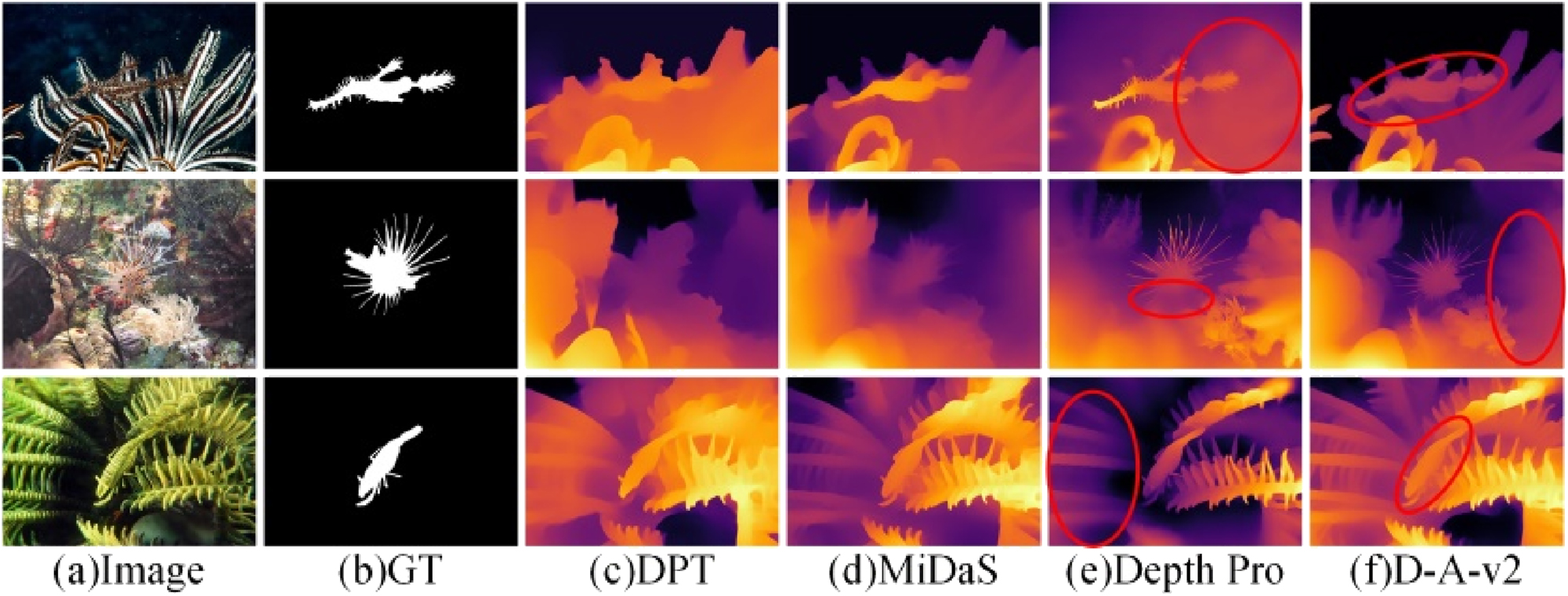
Visualization of some depth maps obtained by different MDE models (D-A-v2 represents Depth-Anything-V2).
To address these issues, researchers have conducted a series of investigations. Regarding depth quality assessment, Liu et al. [15] employed an indirect evaluation approach by comparing model performance across depth maps generated by various monocular depth estimation algorithms, including DPT [18], AdelaiDepth [22], and MiDaS [19], ultimately selecting MiDaS based on optimal performance conditions. While this performance-based evaluation method offers greater objectivity than purely visual judgment, it not only fails to fundamentally address the depth quality assessment issue but also introduces additional workload by not directly evaluating the quality of depth data itself. In contrast, this paper proposes a comprehensive depth quality metric that considers multiple factors, providing direct and reliable quantitative criteria for MDE method selection.
Concerning depth data generation, existing studies [9], 13], 14], 16] typically employ a single MDE method with good visual effects to generate all depth data. This approach overlooks a crucial fact: different MDE methods often exhibit significant performance variations when processing different images, and even the best-performing MDE method overall cannot guarantee superior results for every image. To address this issue, our paper independently evaluates multiple MDE-generated results for each image based on the proposed depth quality metrics, constructing high-quality training and testing datasets by selecting the optimal depth maps.
To mitigate the negative impact of low-quality depth maps, existing research has primarily focused on exploring effective multimodal fusion strategies [9], 13], 15], 16]. For instance, Bi et al. [9] designed a depth alignment index to evaluate depth map quality and dynamically adjust fusion weights accordingly, while Liu et al. [15] proposed a depth-weighted cross-attention fusion module that adaptively adjusts weight distribution by assessing the importance of both RGB and depth modalities. Although these methods partially suppress the interference of inaccurate depth maps on COD performance, as shown in Table 1, models still exhibit significant performance variations across datasets of different quality levels, indicating that existing methods struggle to fundamentally overcome the impact of depth map quality on model performance. Unlike these approaches, we are committed to addressing depth map quality issues at their source: after screening for relatively high-quality depth maps, we further calibrate existing biases to significantly enhance depth map quality, thereby obtaining a high-quality depth dataset.
Quantitative comparison of 4 state-of-the-art models on three benchmark datasets. “↑”/“↓” indicates that larger/smaller is better.
| Data | Method | CAMO | COD10K | NC4K | |||||||||
|---|---|---|---|---|---|---|---|---|---|---|---|---|---|
| S α ↑ | E ϕ ↑ | F β ↑ | M↓ | S α ↑ | E ϕ ↑ | F β ↑ | M↓ | S α ↑ | E ϕ ↑ | F β ↑ | M↓ | ||
| MiDas (Q = 0.79) | DaCOD | 0.805 | 0.879 | 0.769 | 0.071 | 0.791 | 0.865 | 0.691 | 0.039 | 0.824 | 0.886 | 0.782 | 0.053 |
| PopNet | 0.806 | 0.862 | 0.772 | 0.077 | 0.817 | 0.884 | 0.730 | 0.035 | 0.847 | 0.899 | 0.810 | 0.047 | |
| DAINet | 0.802 | 0.860 | 0.761 | 0.077 | 0.807 | 0.884 | 0.712 | 0.037 | 0.838 | 0.895 | 0.796 | 0.049 | |
| DAFNet | 0.810 | 0.859 | 0.767 | 0.075 | 0.826 | 0.888 | 0.732 | 0.035 | 0.857 | 0.902 | 0.811 | 0.045 | |
| DPT (Q = 0.76) | DaCOD | 0.791 | 0.861 | 0.762 | 0.074 | 0.786 | 0.862 | 0.674 | 0.042 | 0.823 | 0.884 | 0.767 | 0.053 |
| PopNet | 0.794 | 0.843 | 0.755 | 0.083 | 0.815 | 0.883 | 0.725 | 0.035 | 0.847 | 0.896 | 0.807 | 0.047 | |
| DAINet | 0.792 | 0.848 | 0.749 | 0.082 | 0.805 | 0.883 | 0.708 | 0.038 | 0.838 | 0.895 | 0.796 | 0.049 | |
| DAFNet | 0.807 | 0.855 | 0.760 | 0.076 | 0.823 | 0.885 | 0.728 | 0.035 | 0.852 | 0.896 | 0.804 | 0.047 | |
| Depth-Anything-V2 (Q = 0.89) | DaCOD | 0.851 | 0.914 | 0.829 | 0.048 | 0.823 | 0.898 | 0.740 | 0.029 | 0.864 | 0.922 | 0.833 | 0.035 |
| PopNet | 0.850 | 0.890 | 0.822 | 0.056 | 0.837 | 0.897 | 0.753 | 0.029 | 0.863 | 0.909 | 0.830 | 0.042 | |
| DAINet | 0.854 | 0.905 | 0.833 | 0.053 | 0.830 | 0.897 | 0.746 | 0.031 | 0.861 | 0.912 | 0.825 | 0.041 | |
| DAFNet | 0.858 | 0.902 | 0.819 | 0.054 | 0.841 | 0.895 | 0.751 | 0.032 | 0.868 | 0.908 | 0.824 | 0.041 | |
| Depth pro (Q = 0.87) | DaCOD | 0.834 | 0.898 | 0.810 | 0.060 | 0.807 | 0.877 | 0.713 | 0.034 | 0.841 | 0.907 | 0.799 | 0.042 |
| PopNet | 0.845 | 0.892 | 0.817 | 0.061 | 0.833 | 0.895 | 0.752 | 0.030 | 0.861 | 0.906 | 0.826 | 0.042 | |
| DAINet | 0.852 | 0.905 | 0.832 | 0.055 | 0.829 | 0.897 | 0.742 | 0.031 | 0.853 | 0.907 | 0.818 | 0.044 | |
| DAFNet | 0.851 | 0.889 | 0.816 | 0.059 | 0.832 | 0.886 | 0.740 | 0.035 | 0.863 | 0.905 | 0.819 | 0.044 | |
| Depth cal (Q = 0.95) | DaCOD | 0.870 | 0.927 | 0.850 | 0.044 | 0.831 | 0.901 | 0.747 | 0.028 | 0.871 | 0.927 | 0.838 | 0.033 |
| PopNet | 0.865 | 0.908 | 0.842 | 0.050 | 0.854 | 0.912 | 0.783 | 0.026 | 0.879 | 0.921 | 0.850 | 0.036 | |
| DAINet | 0.877 | 0.928 | 0.859 | 0.043 | 0.850 | 0.912 | 0.774 | 0.027 | 0.875 | 0.923 | 0.845 | 0.037 | |
| DAFNet | 0.884 | 0.921 | 0.852 | 0.043 | 0.854 | 0.901 | 0.768 | 0.028 | 0.883 | 0.920 | 0.841 | 0.037 | |
Based on the above analysis, this paper proposes a depth selection and calibration (DSC) framework aimed at constructing a high-quality RGBD COD dataset, establishing a foundation for in-depth exploration of depth information’s role in enhancing COD performance. This framework optimizes depth image quality through systematic evaluation, selection, and calibration processes, building upon depth data generated by existing advanced MDE methods. Specifically, we first design comprehensive evaluation metrics that assess depth data generated by different MDE methods across multiple key dimensions, including edge consistency, structural similarity, and depth smoothness. Subsequently, we evaluate multiple MDE-generated results for each image based on these metrics, selecting the highest-scoring depth maps to form an initial dataset. Finally, through a designed Two-stage Depth Calibration (TDC) strategy, we calibrate the depth maps in the initial RGBD COD dataset and correct their biases, thereby further enhancing the overall quality of the RGBD COD dataset.
Our main contributions are summarized as:
We propose a depth selection and calibration (DSC) framework to construct a high-quality RGBD COD dataset, providing a reliable data benchmark for related research.
We introduce depth quality evaluation metrics that enable quantitative assessment of data generated by different MDE methods, offering reliable criteria for selecting high-quality depth maps.
We design a two-stage depth calibration strategy to calibrate depth images and correct potential biases, effectively enhancing the overall quality of depth maps.
We validate the effectiveness of our constructed dataset through various depth image-based detection methods. Experimental results demonstrate that models trained with our depth data significantly outperform alternative approaches.
2 Proposed method
2.1 Method overview
Figure 3 presents the overall architecture of the depth selection and calibration (DSC) framework. This framework comprises two key components: evaluation-based selection and depth calibration. Specifically, we first generate depth data using various MDE methods to establish an initial database. Subsequently, based on our proposed depth quality evaluation metric (Quality score, represented by Q), we select the optimal depth map for each image from the initial database to construct a preliminary RGBD COD dataset. Finally, we employ the designed Two-stage Depth Calibration (TDC) strategy to calibrate the depth maps in the preliminary RGBD COD dataset, correcting potential noise introduced by unreliable original depth maps, thereby constructing a high-quality RGBD COD dataset. In the following sections, we will discuss these two components in detail.
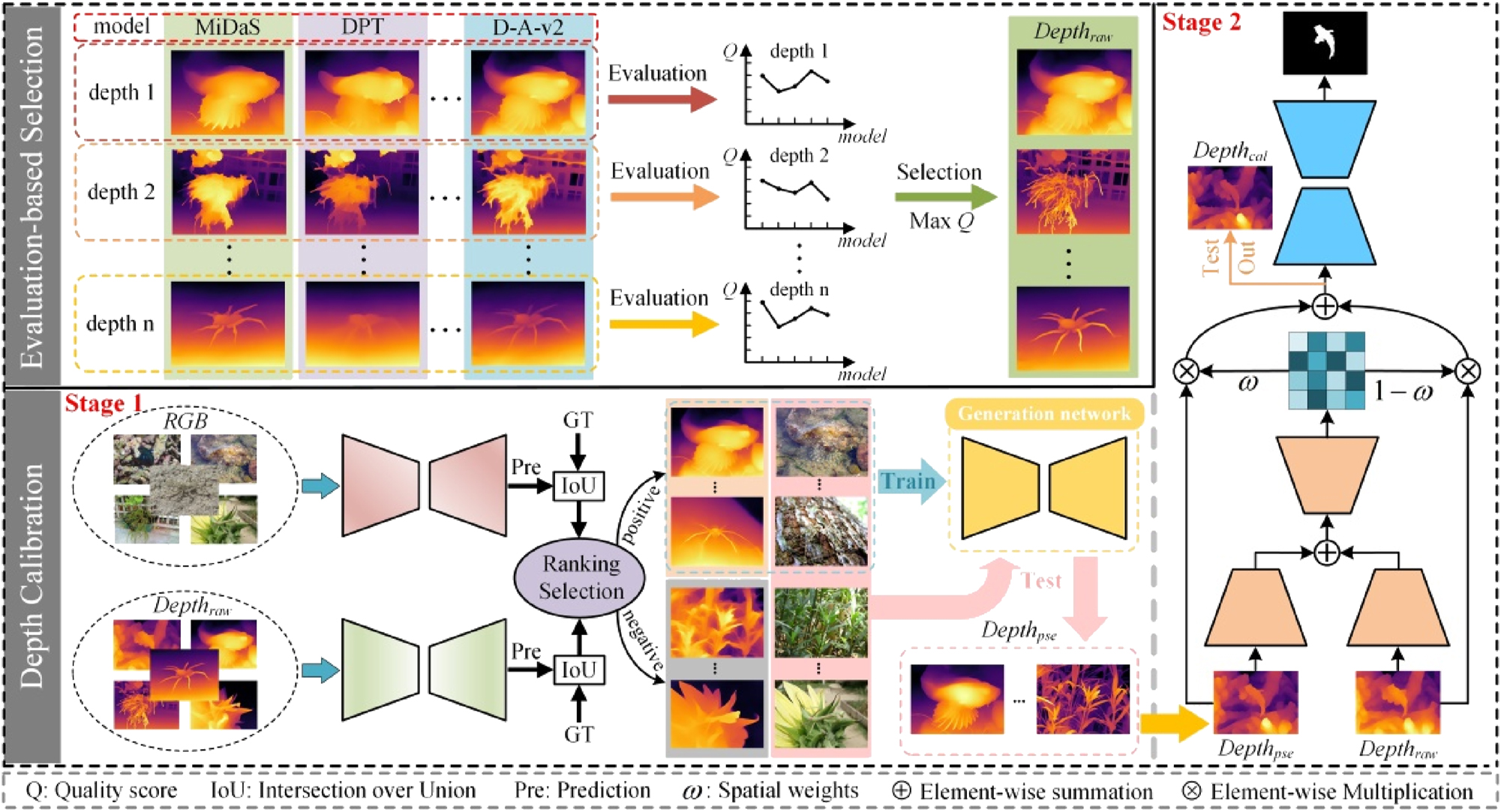
Detailed architecture of our depth selection and calibration (DSC) network (D-A-v2 represents Depth-Anything-V2).
2.2 Evaluation-based selection
As previously discussed, depth data generated by different MDE methods exhibits significant variations, and researchers typically rely on subjective observations to assess depth quality, which is both time-consuming and difficult to quantify. Moreover, due to the varying complexity of camouflaged image scenes, single MDE methods have limited generalization capability and struggle to generate high-quality depth maps consistently across all images. Therefore, relying solely on depth data generated by a single MDE method as a training benchmark cannot guarantee optimal model performance.
To address the challenges of quantitative depth quality assessment and data variability, we construct depth quality evaluation metrics from multiple dimensions to achieve quantitative assessment of depth map quality and selection of high-quality depth maps. Our proposed quality assessment metric (quality score, represented by Q) comprises five key components: structural similarity, edge consistency, foreground smoothness, depth value utilization rate, and depth difference between foreground and background.
Structural Similarity (SSIM) [23] is a widely used metric for measuring similarity between images. We compare the depth map with the grayscale version of the RGB image, using SSIM to evaluate their consistency. SSIM models similarity as a combination of three factors: luminance similarity, contrast similarity, and structural similarity. The definition of SSIM is as follows:
where
where
The edge structure of high-quality depth maps should maintain consistency with the original RGB images. However, RGB images contain rich color details that are not present in depth maps. As shown in Figure 4, although Canny edge detection results from RGB images and corresponding depth maps are difficult to compare directly, we observe that high-quality depth map edges demonstrate good consistency with the ground truth edges of camouflaged objects. Based on this key finding, we propose using the mean absolute error between depth map edges and the ground truth edges of camouflaged objects to evaluate edge consistency. The specific steps are as follows: first, normalize the depth map, then use the Canny operator to extract the edge map E D , and finally calculate the edge consistency score E between the edge map E D and the edge ground truth E G . The specific formula is:
where
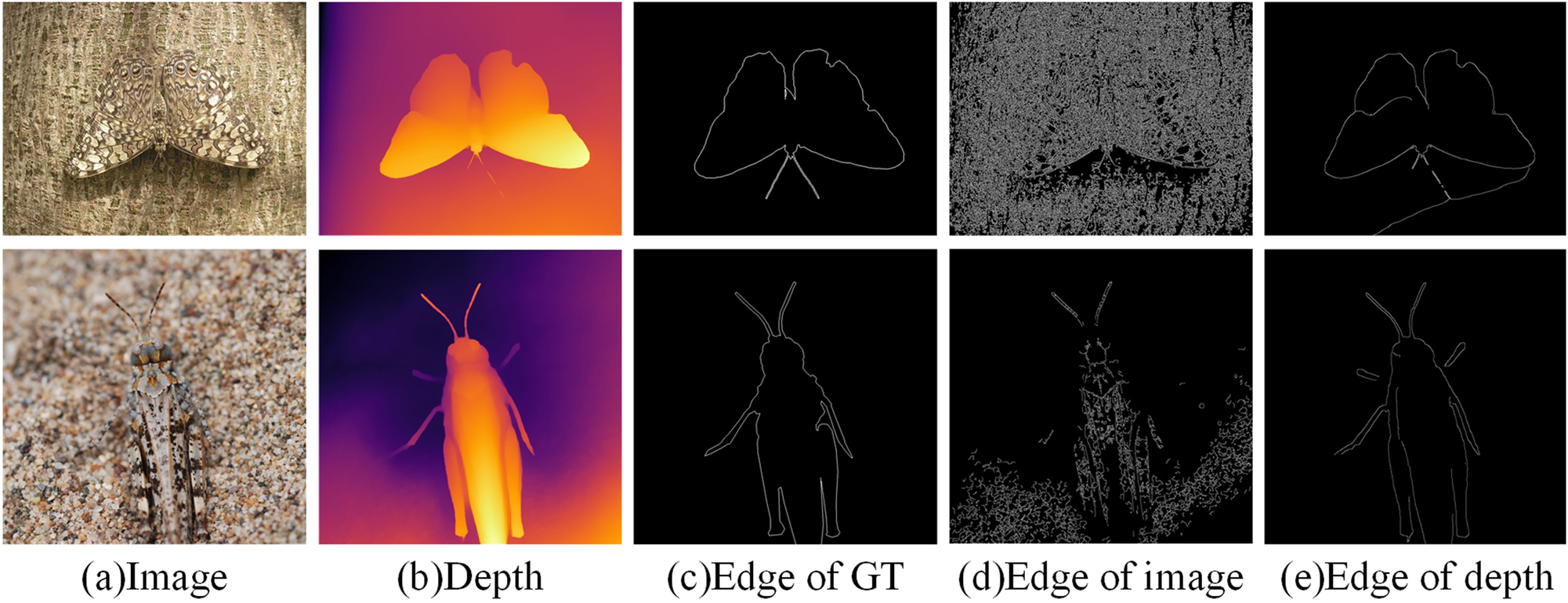
Comparative example of edge extraction results.
In the real world, object surfaces typically exhibit smooth characteristics, which should be reflected as continuous depth variations in depth maps. However, MDE methods may introduce interference, such as noise and depth discontinuities, when generating depth maps. To evaluate the smoothness of depth in foreground regions, we multiply the depth map with the ground truth mask to obtain the foreground depth map and describe the spatial distribution smoothness by calculating the depth variance in the object region. The foreground smoothness S f is defined as:
where
As a measure of object distances in a scene, depth map quality depends not only on local matching with the original image but more importantly on the richness and effective utilization of depth information. When depth values are overly concentrated (e.g., most pixels having similar or identical depth values), the depth map will struggle to accurately characterize the three-dimensional structural features of the scene. Therefore, we introduce the depth value utilization rate as an evaluation metric to quantify the distribution characteristics of depth values in depth maps, ensuring that depth maps can fully utilize the available depth range and effectively express the scene’s depth hierarchy information. This metric is based on information entropy theory and is used to evaluate the uniformity and diversity of depth value distribution. Specifically, we first divide the depth values in the depth map into N intervals (typically N = 256, corresponding to the grayscale levels of an 8 bit depth map) to obtain a depth value histogram {n i }(i = 1,2,…,N). Then, we normalize the histogram to calculate the probability p i for each depth value interval:
Subsequently, based on the definition of information entropy, we calculate the entropy of depth value distribution:
where ɛ is a small exponent to prevent log0 cases.
Finally, we calculate the maximum entropy value H max and compute the normalized depth value utilization rate U:
The value of U ranges from [0,1], with values closer to 1 indicating more uniform depth value distribution and higher utilization rate.
Furthermore, although camouflaged objects exhibit high similarity with their backgrounds in RGB images, they still maintain significant spatial differences. High-quality depth maps should effectively capture and reflect these spatial differential characteristics. Based on this observation, we propose a depth difference metric between foreground and background. To ensure assessment accuracy, rather than directly calculating the average depth difference between foreground and background, we compute the average depth difference within a 5 × 5 neighborhood around the target boundary, thereby quantifying the depth map’s ability to highlight camouflaged targets. The mathematical definition of the foreground-background depth difference D is as follows:
where
Integrating the above five dimensions, our depth quality evaluation metric (Q) is calculated as:
where
2.3 Depth calibration
Spatial information provided by depth maps and the texture-free separation of foreground and background play crucial roles in breaking camouflage. However, due to domain gaps, depth maps generated by monocular depth estimation methods contain substantial noise, resulting in unreliable depth data. Direct use of such depth data may significantly degrade the performance of RGBD COD models.
To address the performance bottleneck caused by noise, similar to [24], 25], we attempt to calibrate the original depth maps to obtain high-quality depth maps consistent with foreground objects. Two key issues need to be addressed: 1) how to distinguish between good-quality (positive samples) and poor-quality (negative samples) depth maps in the initial RGBD COD dataset. (2) how to generate calibrated depth maps that preserve high-quality portions while correcting low-quality regions. Therefore, we design a Two-stage Depth Calibration (TDC) strategy, which forms the core component of DSC. The two consecutive stages involve distinguishing positive and negative samples and generating calibrated depth maps. Figure 3 illustrates the proposed TDC strategy, with specific details as follows:
Stage 1: Positive and negative samples are separated based on the IoU [26] between prediction results and their ground truth (GT). This is based on the consideration that IoU can measure the consistency between prediction results and their corresponding GT, thereby reflecting the reliability of information contained in depth images to some extent.
Specifically, first, under-ground truth supervision, we train two encoder-decoder networks with identical architectures for RGB data and depth data separately. Here, the Resnet50 network [27] serves as the encoder, while the decoder part of U-Net [28] serves as the decoder. Then, RGB data and depth data are input separately into their respective pre-trained networks to generate camouflaged object prediction results, and IoU values between each prediction result and its corresponding ground truth are calculated, denoted as IoUdepth and IoURGB respectively. Finally, depth images that provide reliable cues, namely samples ranking in the top 20 % of IoUdepth and samples where IoUdepth > IoURGB, are selected from the initial RGBD COD dataset as the positive sample set, with the remaining images forming the negative sample set. Compared to the negative sample set, depth images in the positive sample set are more beneficial for COD, with more acceptable depth quality. The middle position of the lower half of Figure 3 shows typical examples from both positive and negative sample sets.
Stage 2: Utilize a generation network to generate depth images and calibrate original depth images using the generated images.
Specifically, we first retrain the image generation network from [29] with RGB images as input and depth maps from the positive sample set as supervision information to reduce noise in the original depth data. Subsequently, RGB images from the initial RGBD COD dataset are input into the trained generation network to obtain high-quality pseudo depth images. These pseudo depth images do not directly replace the initial depth maps (depth maps in the initial RGBD COD dataset) but are used for calibration. During calibration, we adopt a spatial weighted sum of initial depth maps and pseudo depth maps to replace the original depth maps, with weights determined by depth’s contribution to detection. As shown on the right side of Figure 3, initial depth maps and pseudo depth maps are separately input into the encoder (Resnet50) for feature extraction, followed by feature fusion through the decoder to generate spatial weights. These weights are applied to both types of depth maps to obtain calibrated depth maps, which are then input into the same encoder-decoder network used in Stage 1 for camouflaged object detection. Spatial weights are dynamically adjusted during network training, and upon completion of training, optimal weights and calibrated depth maps Depth cal are obtained, calculated as follows:
where Depth raw and Depth pse represent the initial depth map and pseudo depth map respectively, and ω represents spatial weights. For better understanding, we visualize intermediate results of the depth calibration process in Figure 5. Through comparative analysis of different depth maps in Figure 5, we can draw the following observations: First, comparing the third and fourth columns, Depth pse provides richer three-dimensional spatial layout information compared to Depth raw . Second, comparing the third and fifth columns clearly shows that Depth cal presents more complete scene structure than Depth raw , with clearer target structural details. Finally, comprehensive comparison of results in the third, fourth, and fifth columns demonstrates that Depth cal exhibits significant advantages in overall visual quality.

The internal inspections of depth calibration: examples of initial depth map Depth raw , pseudo depth map Depth pse and the calibrated depth map Depth cal .
3 Experiments
3.1 Experimental setup
Datasets: To evaluate the effectiveness of the proposed DSC framework, we conducted experiments on three widely used and challenging COD datasets: CAMO [30], COD10K [31], and NC4K [32]. CAMO contains 1,250 images, with 1,000 for training and 250 for testing. COD10K is currently the largest camouflaged object dataset with high-quality pixel-level annotations, comprising 5,066 camouflaged images, of which 3,040 are used for training and 2,026 for testing. NC4K is the largest camouflaged object test set to date, consisting of 4,121 images downloaded from the internet, providing a rigorous test of model generalization capability. Following mainstream training configurations [1], [5], [6], [7], 31], we use 3,040 samples from COD10K and 1,000 samples from CAMO as the training set, while the remaining samples and the NC4K dataset are used for testing.
Evaluation Metrics: To quantitatively assess the impact of different depth data on model performance, we employ four widely-used evaluation metrics: S-measure (S α ), F-measure (F β ), E-measure (E ϕ ), and Mean Absolute Error (MAE, M). Among these metrics, higher values of S α , F β , and E ϕ indicate better performance, while the opposite holds true for M. For detailed definitions of these evaluation metrics, please refer to [31].
Implementation details: The framework is implemented in PyTorch and trained using an NVIDIA GeForce RTX 3090 GPU with 24 GB memory. The backbone network employs Resnet50 with parameters pre-trained on ImageNet. Input images are uniformly resized to 352 × 352 pixels, and various data augmentation techniques are applied, including random flipping, rotation, and cropping. During training, the initial learning rate is set to 1e-4 using the Adam optimizer with a batch size of 16. During inference, the encoder-decoder architecture predicts camouflaged objects in an end-to-end manner without requiring any post-processing operations.
3.2 Comparative experiments
We compare Depthcal with depth data generated by four MDE methods: DPT [18], MiDaS [19], Depth-Anything-V2 [20], and Depth Pro [21]. DPT leverages Vision Transformers for dense prediction tasks and is known for its high accuracy and strong generalization across diverse visual scenes. MiDaS emphasizes robustness by mixing multiple datasets for training, enabling zero-shot cross-dataset transfer; however, its depth maps may be less sharp in fine-structured regions. Depth-Anything-V2 is designed for scalability with large-scale data and achieves impressive performance on both indoor and outdoor scenarios, but it may require substantial computational resources. Depth Pro focuses on delivering sharp and metrically accurate depth maps with fast inference speed, though its performance can fluctuate in highly complex or ambiguous scenes. By utilizing these diverse models, we are able to comprehensively evaluate the effectiveness of the proposed framework. In addition, the performance of four advanced RGBD COD methods (DaCOD [13], PopNet [14], DAINet [9], and DAFNet [15]) are evaluated on different depth data. All methods are implemented using author-provided open-source code, with MDE methods utilizing original weights and detection methods retrained using default parameters. To ensure fairness, we employ unified evaluation protocols and code for objective assessment of prediction results.
Quantitative evaluation: Table 1 presents the quantitative comparison results. As shown in Table 1, Depthcal demonstrates the most outstanding performance in overall quality assessment, achieving a quality score Q of 0.95, significantly outperforming depth data generated by other MDE methods. Compared to other depth data sources, all detection methods achieve optimal performance when using Depthcal. Specifically, taking DAFNet as an example, compared to Depth-Anything-V2 (the second-best performing depth data), using Depthcal results in average improvements of 2.5 %, 1.2 %, and 2.2 % in Sα, Fβ, and Eφ metrics respectively, while reducing M by 0.3 %. To clearly illustrate the experimental results, we visualize part of the quantitative data from Table 1 as line graphs (as shown in Figure 6). Through systematic analysis, we find a significant positive correlation between depth data quality score Q and model performance: higher quality scores correspond to better model performance. This finding strongly validates the rationality of our proposed quality assessment metrics. Additionally, the performance variations of different detection models across various depth data sources further confirm the effectiveness of the Depthcal.

Comparison of S-measure metrics across different methods on three benchmark datasets (D-A-v2 represents Depth-Anything-V2).
Qualitative evaluation: Figure 7 shows typical samples generated by Depth cal and various advanced MDE methods along with their corresponding quality scores. Comparative analysis indicates that calibrated depth (Depth cal ) provides richer 3D scene information and target structural details. Meanwhile, depth maps with higher quality scores typically exhibit superior visual quality and better foreground consistency with corresponding RGB images. Figure 8 demonstrates the prediction results of the advanced detection method DAFNet based on different depth data. For simple scenes like Image 1, depth maps generated by various monocular depth estimation methods show similar and relatively high quality, enabling DAFNet to accurately identify camouflaged targets. However, for complex scenes like Image 2, some generated depth maps exhibit poor quality or inconsistency with RGB image foregrounds, leading to suboptimal detection results. For instance, DAFNet encounters incomplete target detection issues when using depth maps generated by Depth Pro, while depth maps from Depth-Anything-V2 cause background regions to be misidentified as foreground. Furthermore, for multi-target images like Image 3, most MDE methods struggle to completely estimate depth information for all targets, preventing detection models from achieving comprehensive identification of all camouflaged targets. In contrast, detection methods using Depth cal can effectively identify camouflaged targets in these challenging scenarios, primarily benefiting from Depth cal ’s higher depth quality and significantly improved foreground consistency after calibration.

Typical examples of different depth data (D-A-v2 represents Depth-Anything-V2).
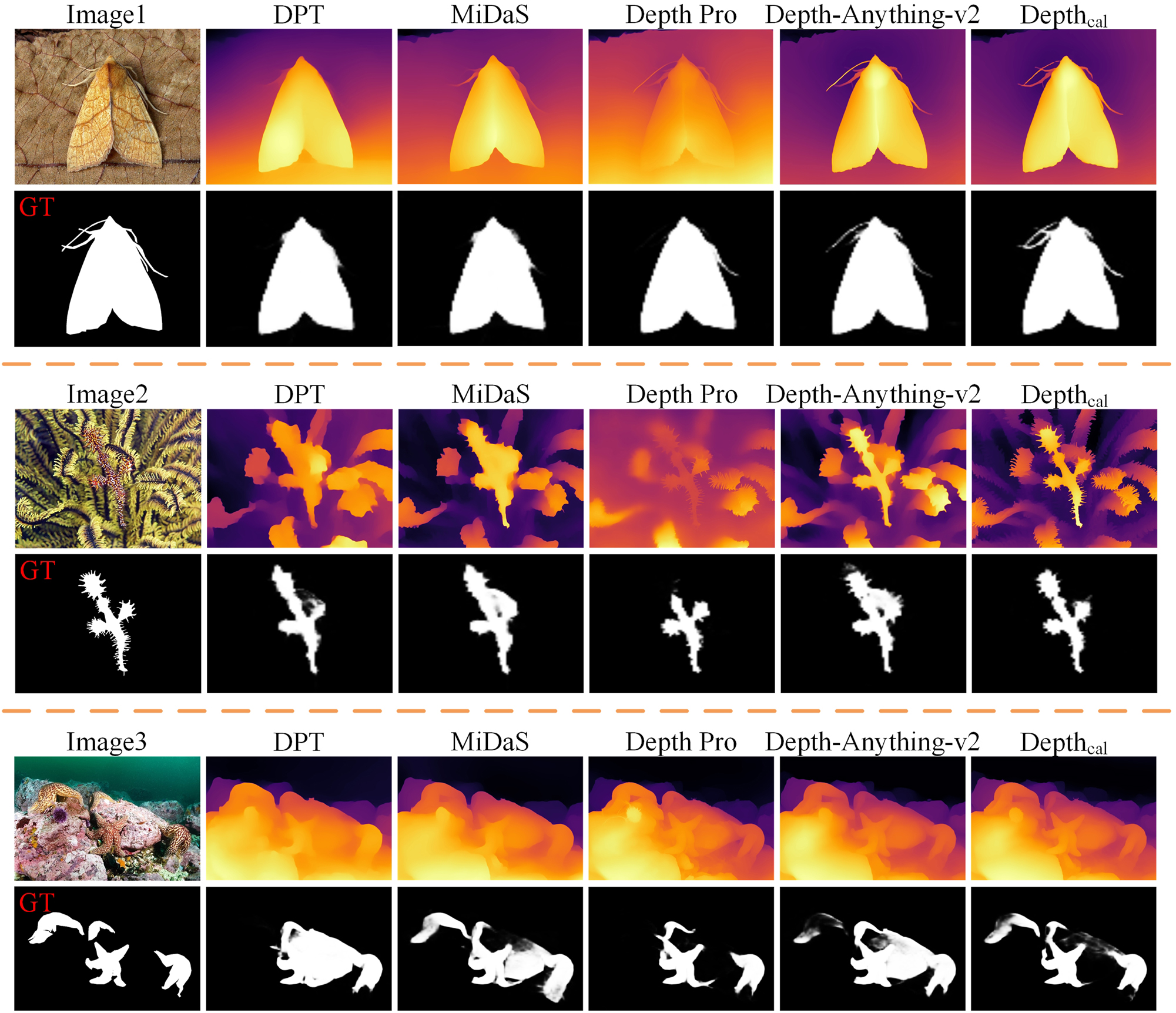
Visual comparison of detection results obtained by models using different depth data (D-A-v2 represents Depth-Anything-V2).
3.3 Ablation studies
Our DSC framework primarily consists of two core modules: evaluation-based selection and depth calibration. To systematically validate the effectiveness of each module and its components, we conducted two groups of ablation experiments on three benchmark datasets.
Effectiveness of evaluation-based selection.
To assess the effectiveness of the evaluation-based selection module, we compared the detection performance when models use Depth raw (depth data from the initial RGBD COD dataset) versus depth maps generated by various MDE methods. Quantitative results are shown in Tables 1 and 2. Across three datasets, compared to Depth Pro, Depth raw improved DAFNet’s S α , F β , and E φ metrics by an average of 1.3 %, 1.2 %, and 1.5 % respectively, while reducing M by 0.5 %. Depth raw , a collection of high-quality depth maps selected through evaluation from those generated by various MDE methods, provides reliable depth information for the COD task. Notably, compared to other depth data, detection models showed smaller performance improvements when using Depth raw versus depth maps generated by Depth-Anything-V2. This phenomenon is reasonable since depth maps generated by Depth-Anything-V2 inherently possess relatively high quality.
Effectiveness of depth calibration.
Quantitative results of ablation experiments. “↑”/“↓” indicates that larger/smaller is better.
| Data | Method | CAMO | COD10K | NC4K | |||||||||
|---|---|---|---|---|---|---|---|---|---|---|---|---|---|
| S α ↑ | E ϕ ↑ | F β ↑ | M↓ | S α ↑ | E ϕ ↑ | F β ↑ | M↓ | S α ↑ | E ϕ ↑ | F β ↑ | M↓ | ||
| Depth raw (Q = 0.91) | DaCOD | 0.856 | 0.919 | 0.835 | 0.047 | 0.830 | 0.900 | 0.743 | 0.029 | 0.869 | 0.924 | 0.835 | 0.035 |
| PopNet | 0.855 | 0.902 | 0.830 | 0.053 | 0.839 | 0.898 | 0.759 | 0.029 | 0.868 | 0.913 | 0.833 | 0.039 | |
| DAINet | 0.861 | 0.911 | 0.838 | 0.048 | 0.834 | 0.898 | 0.752 | 0.031 | 0.862 | 0.915 | 0.828 | 0.041 | |
| DAFNet | 0.866 | 0.903 | 0.834 | 0.052 | 0.844 | 0.898 | 0.754 | 0.030 | 0.874 | 0.914 | 0.832 | 0.040 | |
| Depth’ cal (Q = 0.85) | DaCOD | 0.828 | 0.893 | 0.801 | 0.063 | 0.803 | 0.874 | 0.708 | 0.035 | 0.837 | 0.902 | 0.795 | 0.045 |
| PopNet | 0.835 | 0.885 | 0.806 | 0.065 | 0.829 | 0.892 | 0.747 | 0.031 | 0.858 | 0.904 | 0.822 | 0.043 | |
| DAINet | 0.840 | 0.894 | 0.814 | 0.061 | 0.824 | 0.894 | 0.735 | 0.033 | 0.849 | 0.904 | 0.813 | 0.045 | |
| DAFNet | 0.841 | 0.882 | 0.804 | 0.063 | 0.831 | 0.887 | 0.738 | 0.035 | 0.862 | 0.904 | 0.817 | 0.044 | |
To evaluate the effectiveness of the depth calibration module, we compared the performance of detection models using Depth raw , Depth cal , and Depth’ cal respectively. Here, Depth’ cal represents depth data obtained by removing Stage 1 from the TDC strategy, where Depth raw is directly used as supervision information for the image generation network. It should be noted that removing Stage 2 alone or removing both stages from the TDC strategy would not generate new depth data; in these cases, the depth data after TDC strategy processing remains as Depth raw . As shown in Table 2, experimental results indicate that detection models experience performance degradation when using Depth’ cal compared to using Depth raw . This performance deterioration primarily occurs because Depth raw contains some low-quality depth maps, and directly using all Depth raw data as supervision information reduces the quality of generated pseudo depth images, leading to suboptimal detection results. This phenomenon confirms the necessity of Stage 1 in the TDC strategy, which plays a crucial role in generating high-quality calibrated depth maps. Further analysis reveals that all detection models achieve optimal performance when using Depth cal compared to using Depth raw and Depth’ cal , fully validating the effectiveness of the TDC strategy. To intuitively demonstrate the effectiveness of the TDC strategy, we provide visual comparison results of Depth raw , Depth cal , and Depth’ cal in Figure 9. As shown in Figure 9(d), due to using initial depth maps containing low quality and foreground inconsistencies as supervision information, calibrated depth maps generated by the TDC strategy (without Stage 1) still exhibit poor visual quality or inconsistency with corresponding RGB image foregrounds. By comparing Figure 9(c)–(e), we can clearly observe that the complete TDC strategy generates depth images with significantly improved quality. This indicates that our proposed TDC strategy can effectively generate high-quality depth maps with foreground consistency, providing more reliable depth information support for the COD task.

Visualization results for validating the effectiveness of TDC strategy.
3.4 Generalization experiments
To verify the generalization capability of the proposed framework, we applied it to the RGB-D SOD field. The widely used RGB-D SOD dataset – NJU2K dataset [33] – was selected for experiments. Following the experimental procedure described in this paper, we obtained depth maps generated by various MDE methods as well as the depth calibration results. Relevant examples are shown in Figure 10. By comparing the first six columns in Figure 10, it can be observed that, compared with the ground truth depth maps provided by the dataset (third column), the depth maps generated by MDE methods display better visual effects. Further comparison of the last four columns in Figure 10 shows that the depth calibration results produced by the proposed framework are of higher quality than the original outputs of each MDE method, not only containing more complete 3D scene information and object structural features, but also exhibiting better consistency with the RGB images in terms of foreground alignment. These experimental results indicate that the proposed framework is not only applicable to camouflaged object detection, but can also be effectively used to optimize depth data for other visual tasks, fully demonstrating the method’s strong domain transferability and generalization performance.

Examples of different depth data on the NJU2K dataset (D-A-v2 represents Depth-Anything-V2).
4 Conclusions
This paper proposes the DSC framework to address depth data quality assessment and optimization issues in RGBD COD tasks. Through the design of multi-dimensional depth quality evaluation metrics, the framework enables quantitative assessment of depth data generated by different MDE methods, providing reliable criteria for selecting high-quality depth maps. Meanwhile, the designed TDC strategy effectively calibrates depth maps and corrects potential biases, significantly improving the overall quality of depth data. Experimental results demonstrate that the high-quality RGBD COD dataset constructed in this paper can provide more reliable depth information support for detection models, effectively enhancing model performance. In the future, our research will focus on improving the performance of RGBD COD detection. We will dedicate efforts to deeply exploring the synergistic mechanisms between depth information and RGB information, developing efficient multimodal feature fusion strategies to further enhance detection performance.
-
Funding information: Intra-military research project.
-
Author contribution: All authors have accepted responsibility for the entire content of this manuscript and approved its submission.
-
Conflict of interest: The authors state no conflict of interest.
-
Data availability statement: The datasets generated and/or analysed during the current study are available from the corresponding author on reasonable request.
References
1. Fan, DP, Ji, GP, Cheng, MM, Shao, L. Concealed object detection. IEEE Trans Pattern Anal Mach Intell 2022;44:6024–42. https://doi.org/10.1109/tpami.2021.3085766.Search in Google Scholar PubMed
2. Dai, SL, Man, H. A convolutional Riemannian texture model with differential entropic active contours for unsupervised pest detection. In: 2017 IEEE international conference on acoustics, speech and signal processing (ICASSP). New Orleans, LA, USA: IEEE; 2017:1028–32 pp.10.1109/ICASSP.2017.7952312Search in Google Scholar
3. Xiang, XY, Liu, MQ, Zhang, SL, Wei, P, Chen, B. Multi-scale attention and dilation network for small defect detection. Pattern Recognit Lett 2023;172:82–8. https://doi.org/10.1016/j.patrec.2023.06.010.Search in Google Scholar
4. Guo, XY, Lin, X, Yang, X, Yu, L, Cheng, KT, Yan, Z. UCTNet: Uncertainty-guided CNN-Transformer hybrid networks for medical image segmentation. Pattern Recogn 2024;152:110491. https://doi.org/10.1016/j.patcog.2024.110491.Search in Google Scholar
5. Liang, WY, Wu, JS, Mu, XY, Hao, F, Du, J, Xu, J, et al.. Weighted dense semantic aggregation and explicit boundary modeling for camouflaged object detection. IEEE Sens J 2024;24:21108–22. https://doi.org/10.1109/jsen.2024.3401722.Search in Google Scholar
6. Yang, JC, Zhang, Q, Zhao, YL, Li, YT, Liu, ZM. Bi-directional Boundary-object interaction and refinement network for camouflaged object detection. In: 2024 IEEE International Conference on Multimedia and Expo (ICME). Niagara Falls, ON, Canada: IEEE; 2024:1–6 pp.10.1109/ICME57554.2024.10687766Search in Google Scholar
7. Tang, Z, Tang, J, Zou, DP, Rao, J, Qi, F. Two guidance joint network based on coarse map and edge map for camouflaged object detection. Appl Intell 2024;54:7531–44. https://doi.org/10.1007/s10489-024-05559-y.Search in Google Scholar
8. Phung, TH, Chen, HJ, Shuai, HH. Hierarchically aggregated identification transformer network for camouflaged object detection. In: 2024 IEEE International Conference on Multimedia and Expo (ICME). Niagara Falls, ON, Canada: IEEE; 2024:1–6 pp.10.1109/ICME57554.2024.10687759Search in Google Scholar
9. Bi, HB, Tong, YY, Zhang, JY, Zhang, C, Tong, J, Jin, W. Depth alignment interaction network for camouflaged object detection. Multimed Syst 2024;30:51. https://doi.org/10.1007/s00530-023-01250-3.Search in Google Scholar
10. Chen, TY, Xiao, J, Hu, XG, Zhang, G, Wang, S. Adaptive fusion network for RGB-D salient object detection. Neurocomputing 2023;522:152–64. https://doi.org/10.1016/j.neucom.2022.12.004.Search in Google Scholar
11. Sun, HD, Wang, Y, Ma, XP. An adaptive guidance fusion network for RGB-D salient object detection. Signal, Image Video Proces 2024;18:1683–93. https://doi.org/10.1007/s11760-023-02775-w.Search in Google Scholar
12. Zhong, MY, Sun, J, Ren, P, Wang, F, Sun, F. MAGNet: multi-scale awareness and global fusion network for RGB-D salient object detection. Knowl Base Syst 2024;299:112126. https://doi.org/10.1016/j.knosys.2024.112126.Search in Google Scholar
13. Wang, QW, Yang, JY, Yu, XS, Wang, FY, Chen, P, Zheng, F. Depth-aided camouflaged object detection. In: Proceedings of the 31st ACM International Conference on Multimedia. New York, NY, USA: ACM; 2023:3297–306 pp.10.1145/3581783.3611874Search in Google Scholar
14. Wu, ZW, Paudel, DP, Fan, DP, Wang, JJ, Wang, S, Demonceaux, C, et al.. Source-free depth for object Pop-out. In: 2023 IEEE/CVF International Conference on Computer Vision (ICCV). Paris, France: IEEE; 2023:1032–42 pp.10.1109/ICCV51070.2023.00101Search in Google Scholar
15. Liu, XR, Qi, L, Song, YX, Wen, Q. Depth awakens: a depth-perceptual attention fusion network for RGB-D camouflaged object detection. Image Vis Comput 2024;143:104924. https://doi.org/10.1016/j.imavis.2024.104924.Search in Google Scholar
16. Xiang, MC, Zhang, J, Lv, YQ, Li, AX, Zhong, YR, Dai, YC. Exploring depth contribution for camouflaged object detection. arXiv preprint arXiv:2106.13217 2021.Search in Google Scholar
17. Yuan, WH, Gu, XD, Dai, ZZ, Zhu, SY, Tan, P. Neural window fully-connected CRFs for monocular depth estimation. In: 2022 IEEE/CVF Conference on Computer Vision and Pattern Recognition (CVPR). New Orleans, LA, USA: IEEE; 2022:3906–15 pp.10.1109/CVPR52688.2022.00389Search in Google Scholar
18. Ranftl, R, Bochkovskiy, A, Koltun, V. Vision transformers for dense prediction[C]. In: 2021 IEEE/CVF International Conference on Computer Vision (ICCV). Montreal, QC, Canada: IEEE; 2021:12159–68 pp.10.1109/ICCV48922.2021.01196Search in Google Scholar
19. Ranftl, RE, Lasinger, K, Hafner, D, Schindler, K, Koltun, V. Towards robust monocular depth estimation: mixing datasets for zero-shot cross-dataset transfer. IEEE Trans Pattern Anal Mach Intell 2020;44:1623–37.10.1109/TPAMI.2020.3019967Search in Google Scholar PubMed
20. Yang, LH, Kang, BY, Huang, ZL, Zhao, Z, Xu, XG, Feng, JS, et al.. Depth anything v2. Adv Neural Inf Process Syst 2025;37:21875–911.10.52202/079017-0688Search in Google Scholar
21. Bochkovskii, A, Delaunoy, AEL, Germain, H, Santos, M, Zhou, YC, Richter, SR, et al.. Depth pro: sharp monocular metric depth in less than a second. arXiv preprint arXiv:2410.02073. 2024. https://doi.org/10.48550/arXiv.2410.02073.Search in Google Scholar
22. Yin, W, Zhang, JM, Wang, O, Niklaus, S, Chen, SM, Liu, YF. Towards accurate reconstruction of 3d scene shape from a single monocular image. IEEE Trans Pattern Anal Mach Intell 2022;45:6480–94.10.1109/TPAMI.2022.3209968Search in Google Scholar PubMed
23. Wang, Z, Bovik, AC, Sheikh, HR, Simoncelli, E. Image quality assessment: from error visibility to structural similarity. IEEE Trans Image Process 2004;13:600–12. https://doi.org/10.1109/tip.2003.819861.Search in Google Scholar PubMed
24. Zhang, Q, Qin, Q, Yang, Y, Jiao, Q, Han, JG. Feature calibrating and fusing network for RGB-D salient object detection. IEEE Trans Circ Syst Video Technol 2023;34:1493–507.10.1109/TCSVT.2023.3296581Search in Google Scholar
25. Ji, W, Li, JJ, Yu, S, Zhang, M, Piao, YR, Yao, SY. Calibrated RGB-D salient object detection. In: 2021 IEEE/CVF Conference on Computer Vision and Pattern Recognition (CVPR). Nashville, TN, USA: IEEE; 2021:9466–76 pp.10.1109/CVPR46437.2021.00935Search in Google Scholar
26. Everingham, M, Van Gool, L, Williams, CK, Winn, J, Zisserman, A. The pascal visual object classes (voc) challenge. Int J Comput Vis 2010;88:303–38. https://doi.org/10.1007/s11263-009-0275-4.Search in Google Scholar
27. Simonyan, K, Zisserman, A. Very deep convolutional networks for large-scale image recognition. arXiv preprint arXiv:1409.1556 2014.Search in Google Scholar
28. Ronneberger, OAFP. U-Net: Convolutional networks for biomedical image segmentation[C]. In: Medical Image Computing and Computer-Assisted Intervention – MICCAI 2015: 18th international conference. Munich, Germany: Springer; 2015:234–41 pp.10.1007/978-3-319-24574-4_28Search in Google Scholar
29. Cui, JY, Zhang, H, Han, H, Shan, SG, Chen, XL. Improving 2D face recognition via discriminative face depth estimation[C]. In: 2018 International Conference on Biometrics (ICB). Gold Coast, QLD, Australia: IEEE; 2018:140–7 pp.10.1109/ICB2018.2018.00031Search in Google Scholar
30. Le, T, Nguyen, TV, Nie, ZL, Tran, MT, Sugimoto, A. Anabranch network for camouflaged object segmentation. Comput Vis Image Understand 2019;184:45–56. https://doi.org/10.1016/j.cviu.2019.04.006.Search in Google Scholar
31. Fan, DP, Ji, GP, Sun, GL, Cheng, MM, Shen, JB, Shao, L. Camouflaged object detection. In: 2020 IEEE/CVF Conference on Computer Vision and Pattern Recognition (CVPR). Seattle, WA, USA: IEEE; 2020:2774–84 pp.10.1109/CVPR42600.2020.00285Search in Google Scholar
32. Lv, YQ, Zhang, J, Dai, YC, Li, A, Barnes, N, Fan, DP. Toward deeper understanding of camouflaged object detection. IEEE Trans Circ Syst Video Technol 2023;33:3462–76. https://doi.org/10.1109/tcsvt.2023.3234578.Search in Google Scholar
33. Ju, R, Ge, L, Geng, WJ, Wu, GS. Depth saliency based on anisotropic center-surround difference. In: 2014 IEEE International Conference on Image Processing (ICIP). Paris, France: IEEE; 2014:1115–19 pp.10.1109/ICIP.2014.7025222Search in Google Scholar
© 2025 the author(s), published by De Gruyter, Berlin/Boston
This work is licensed under the Creative Commons Attribution 4.0 International License.
Articles in the same Issue
- Research Articles
- Single-step fabrication of Ag2S/poly-2-mercaptoaniline nanoribbon photocathodes for green hydrogen generation from artificial and natural red-sea water
- Abundant new interaction solutions and nonlinear dynamics for the (3+1)-dimensional Hirota–Satsuma–Ito-like equation
- A novel gold and SiO2 material based planar 5-element high HPBW end-fire antenna array for 300 GHz applications
- Explicit exact solutions and bifurcation analysis for the mZK equation with truncated M-fractional derivatives utilizing two reliable methods
- Optical and laser damage resistance: Role of periodic cylindrical surfaces
- Numerical study of flow and heat transfer in the air-side metal foam partially filled channels of panel-type radiator under forced convection
- Water-based hybrid nanofluid flow containing CNT nanoparticles over an extending surface with velocity slips, thermal convective, and zero-mass flux conditions
- Dynamical wave structures for some diffusion--reaction equations with quadratic and quartic nonlinearities
- Solving an isotropic grey matter tumour model via a heat transfer equation
- Study on the penetration protection of a fiber-reinforced composite structure with CNTs/GFP clip STF/3DKevlar
- Influence of Hall current and acoustic pressure on nanostructured DPL thermoelastic plates under ramp heating in a double-temperature model
- Applications of the Belousov–Zhabotinsky reaction–diffusion system: Analytical and numerical approaches
- AC electroosmotic flow of Maxwell fluid in a pH-regulated parallel-plate silica nanochannel
- Interpreting optical effects with relativistic transformations adopting one-way synchronization to conserve simultaneity and space–time continuity
- Modeling and analysis of quantum communication channel in airborne platforms with boundary layer effects
- Theoretical and numerical investigation of a memristor system with a piecewise memductance under fractal–fractional derivatives
- Tuning the structure and electro-optical properties of α-Cr2O3 films by heat treatment/La doping for optoelectronic applications
- High-speed multi-spectral explosion temperature measurement using golden-section accelerated Pearson correlation algorithm
- Dynamic behavior and modulation instability of the generalized coupled fractional nonlinear Helmholtz equation with cubic–quintic term
- Study on the duration of laser-induced air plasma flash near thin film surface
- Exploring the dynamics of fractional-order nonlinear dispersive wave system through homotopy technique
- The mechanism of carbon monoxide fluorescence inside a femtosecond laser-induced plasma
- Numerical solution of a nonconstant coefficient advection diffusion equation in an irregular domain and analyses of numerical dispersion and dissipation
- Numerical examination of the chemically reactive MHD flow of hybrid nanofluids over a two-dimensional stretching surface with the Cattaneo–Christov model and slip conditions
- Impacts of sinusoidal heat flux and embraced heated rectangular cavity on natural convection within a square enclosure partially filled with porous medium and Casson-hybrid nanofluid
- Stability analysis of unsteady ternary nanofluid flow past a stretching/shrinking wedge
- Solitonic wave solutions of a Hamiltonian nonlinear atom chain model through the Hirota bilinear transformation method
- Bilinear form and soltion solutions for (3+1)-dimensional negative-order KdV-CBS equation
- Solitary chirp pulses and soliton control for variable coefficients cubic–quintic nonlinear Schrödinger equation in nonuniform management system
- Influence of decaying heat source and temperature-dependent thermal conductivity on photo-hydro-elasto semiconductor media
- Dissipative disorder optimization in the radiative thin film flow of partially ionized non-Newtonian hybrid nanofluid with second-order slip condition
- Bifurcation, chaotic behavior, and traveling wave solutions for the fractional (4+1)-dimensional Davey–Stewartson–Kadomtsev–Petviashvili model
- New investigation on soliton solutions of two nonlinear PDEs in mathematical physics with a dynamical property: Bifurcation analysis
- Mathematical analysis of nanoparticle type and volume fraction on heat transfer efficiency of nanofluids
- Creation of single-wing Lorenz-like attractors via a ten-ninths-degree term
- Optical soliton solutions, bifurcation analysis, chaotic behaviors of nonlinear Schrödinger equation and modulation instability in optical fiber
- Chaotic dynamics and some solutions for the (n + 1)-dimensional modified Zakharov–Kuznetsov equation in plasma physics
- Fractal formation and chaotic soliton phenomena in nonlinear conformable Heisenberg ferromagnetic spin chain equation
- Single-step fabrication of Mn(iv) oxide-Mn(ii) sulfide/poly-2-mercaptoaniline porous network nanocomposite for pseudo-supercapacitors and charge storage
- Novel constructed dynamical analytical solutions and conserved quantities of the new (2+1)-dimensional KdV model describing acoustic wave propagation
- Tavis–Cummings model in the presence of a deformed field and time-dependent coupling
- Spinning dynamics of stress-dependent viscosity of generalized Cross-nonlinear materials affected by gravitationally swirling disk
- Design and prediction of high optical density photovoltaic polymers using machine learning-DFT studies
- Robust control and preservation of quantum steering, nonlocality, and coherence in open atomic systems
- Coating thickness and process efficiency of reverse roll coating using a magnetized hybrid nanomaterial flow
- Dynamic analysis, circuit realization, and its synchronization of a new chaotic hyperjerk system
- Decoherence of steerability and coherence dynamics induced by nonlinear qubit–cavity interactions
- Finite element analysis of turbulent thermal enhancement in grooved channels with flat- and plus-shaped fins
- Modulational instability and associated ion-acoustic modulated envelope solitons in a quantum plasma having ion beams
- Statistical inference of constant-stress partially accelerated life tests under type II generalized hybrid censored data from Burr III distribution
- On solutions of the Dirac equation for 1D hydrogenic atoms or ions
- Entropy optimization for chemically reactive magnetized unsteady thin film hybrid nanofluid flow on inclined surface subject to nonlinear mixed convection and variable temperature
- Stability analysis, circuit simulation, and color image encryption of a novel four-dimensional hyperchaotic model with hidden and self-excited attractors
- A high-accuracy exponential time integration scheme for the Darcy–Forchheimer Williamson fluid flow with temperature-dependent conductivity
- Novel analysis of fractional regularized long-wave equation in plasma dynamics
- Development of a photoelectrode based on a bismuth(iii) oxyiodide/intercalated iodide-poly(1H-pyrrole) rough spherical nanocomposite for green hydrogen generation
- Investigation of solar radiation effects on the energy performance of the (Al2O3–CuO–Cu)/H2O ternary nanofluidic system through a convectively heated cylinder
- Quantum resources for a system of two atoms interacting with a deformed field in the presence of intensity-dependent coupling
- Studying bifurcations and chaotic dynamics in the generalized hyperelastic-rod wave equation through Hamiltonian mechanics
- A new numerical technique for the solution of time-fractional nonlinear Klein–Gordon equation involving Atangana–Baleanu derivative using cubic B-spline functions
- Interaction solutions of high-order breathers and lumps for a (3+1)-dimensional conformable fractional potential-YTSF-like model
- Hydraulic fracturing radioactive source tracing technology based on hydraulic fracturing tracing mechanics model
- Numerical solution and stability analysis of non-Newtonian hybrid nanofluid flow subject to exponential heat source/sink over a Riga sheet
- Numerical investigation of mixed convection and viscous dissipation in couple stress nanofluid flow: A merged Adomian decomposition method and Mohand transform
- Effectual quintic B-spline functions for solving the time fractional coupled Boussinesq–Burgers equation arising in shallow water waves
- Analysis of MHD hybrid nanofluid flow over cone and wedge with exponential and thermal heat source and activation energy
- Solitons and travelling waves structure for M-fractional Kairat-II equation using three explicit methods
- Impact of nanoparticle shapes on the heat transfer properties of Cu and CuO nanofluids flowing over a stretching surface with slip effects: A computational study
- Computational simulation of heat transfer and nanofluid flow for two-sided lid-driven square cavity under the influence of magnetic field
- Irreversibility analysis of a bioconvective two-phase nanofluid in a Maxwell (non-Newtonian) flow induced by a rotating disk with thermal radiation
- Hydrodynamic and sensitivity analysis of a polymeric calendering process for non-Newtonian fluids with temperature-dependent viscosity
- Exploring the peakon solitons molecules and solitary wave structure to the nonlinear damped Kortewege–de Vries equation through efficient technique
- Modeling and heat transfer analysis of magnetized hybrid micropolar blood-based nanofluid flow in Darcy–Forchheimer porous stenosis narrow arteries
- Activation energy and cross-diffusion effects on 3D rotating nanofluid flow in a Darcy–Forchheimer porous medium with radiation and convective heating
- Insights into chemical reactions occurring in generalized nanomaterials due to spinning surface with melting constraints
- Influence of a magnetic field on double-porosity photo-thermoelastic materials under Lord–Shulman theory
- Soliton-like solutions for a nonlinear doubly dispersive equation in an elastic Murnaghan's rod via Hirota's bilinear method
- Analytical and numerical investigation of exact wave patterns and chaotic dynamics in the extended improved Boussinesq equation
- Nonclassical correlation dynamics of Heisenberg XYZ states with (x, y)-spin--orbit interaction, x-magnetic field, and intrinsic decoherence effects
- Exact traveling wave and soliton solutions for chemotaxis model and (3+1)-dimensional Boiti–Leon–Manna–Pempinelli equation
- Unveiling the transformative role of samarium in ZnO: Exploring structural and optical modifications for advanced functional applications
- On the derivation of solitary wave solutions for the time-fractional Rosenau equation through two analytical techniques
- Analyzing the role of length and radius of MWCNTs in a nanofluid flow influenced by variable thermal conductivity and viscosity considering Marangoni convection
- Advanced mathematical analysis of heat and mass transfer in oscillatory micropolar bio-nanofluid flows via peristaltic waves and electroosmotic effects
- Exact bound state solutions of the radial Schrödinger equation for the Coulomb potential by conformable Nikiforov–Uvarov approach
- Some anisotropic and perfect fluid plane symmetric solutions of Einstein's field equations using killing symmetries
- Nonlinear dynamics of the dissipative ion-acoustic solitary waves in anisotropic rotating magnetoplasmas
- Curves in multiplicative equiaffine plane
- Exact solution of the three-dimensional (3D) Z2 lattice gauge theory
- Propagation properties of Airyprime pulses in relaxing nonlinear media
- Symbolic computation: Analytical solutions and dynamics of a shallow water wave equation in coastal engineering
- Wave propagation in nonlocal piezo-photo-hygrothermoelastic semiconductors subjected to heat and moisture flux
- Comparative reaction dynamics in rotating nanofluid systems: Quartic and cubic kinetics under MHD influence
- Laplace transform technique and probabilistic analysis-based hypothesis testing in medical and engineering applications
- Physical properties of ternary chloro-perovskites KTCl3 (T = Ge, Al) for optoelectronic applications
- Gravitational length stretching: Curvature-induced modulation of quantum probability densities
- The search for the cosmological cold dark matter axion – A new refined narrow mass window and detection scheme
- A comparative study of quantum resources in bipartite Lipkin–Meshkov–Glick model under DM interaction and Zeeman splitting
- PbO-doped K2O–BaO–Al2O3–B2O3–TeO2-glasses: Mechanical and shielding efficacy
- Nanospherical arsenic(iii) oxoiodide/iodide-intercalated poly(N-methylpyrrole) composite synthesis for broad-spectrum optical detection
- Sine power Burr X distribution with estimation and applications in physics and other fields
- Numerical modeling of enhanced reactive oxygen plasma in pulsed laser deposition of metal oxide thin films
- Dynamical analyses and dispersive soliton solutions to the nonlinear fractional model in stratified fluids
- Computation of exact analytical soliton solutions and their dynamics in advanced optical system
- An innovative approximation concerning the diffusion and electrical conductivity tensor at critical altitudes within the F-region of ionospheric plasma at low latitudes
- An analytical investigation to the (3+1)-dimensional Yu–Toda–Sassa–Fukuyama equation with dynamical analysis: Bifurcation
- Swirling-annular-flow-induced instability of a micro shell considering Knudsen number and viscosity effects
- Numerical analysis of non-similar convection flows of a two-phase nanofluid past a semi-infinite vertical plate with thermal radiation
- MgO NPs reinforced PCL/PVC nanocomposite films with enhanced UV shielding and thermal stability for packaging applications
- Optimal conditions for indoor air purification using non-thermal Corona discharge electrostatic precipitator
- Investigation of thermal conductivity and Raman spectra for HfAlB, TaAlB, and WAlB based on first-principles calculations
- Tunable double plasmon-induced transparency based on monolayer patterned graphene metamaterial
- DSC: depth data quality optimization framework for RGBD camouflaged object detection
- A new family of Poisson-exponential distributions with applications to cancer data and glass fiber reliability
- Numerical investigation of couple stress under slip conditions via modified Adomian decomposition method
- Monitoring plateau lake area changes in Yunnan province, southwestern China using medium-resolution remote sensing imagery: applicability of water indices and environmental dependencies
- Heterodyne interferometric fiber-optic gyroscope
- Exact solutions of Einstein’s field equations via homothetic symmetries of non-static plane symmetric spacetime
- A widespread study of discrete entropic model and its distribution along with fluctuations of energy
- Empirical model integration for accurate charge carrier mobility simulation in silicon MOSFETs
- The influence of scattering correction effect based on optical path distribution on CO2 retrieval
- Anisotropic dissociation and spectral response of 1-Bromo-4-chlorobenzene under static directional electric fields
- Role of tungsten oxide (WO3) on thermal and optical properties of smart polymer composites
- Analysis of iterative deblurring: no explicit noise
- Review Article
- Examination of the gamma radiation shielding properties of different clay and sand materials in the Adrar region
- Erratum
- Erratum to “On Soliton structures in optical fiber communications with Kundu–Mukherjee–Naskar model (Open Physics 2021;19:679–682)”
- Special Issue on Fundamental Physics from Atoms to Cosmos - Part II
- Possible explanation for the neutron lifetime puzzle
- Special Issue on Nanomaterial utilization and structural optimization - Part III
- Numerical investigation on fluid-thermal-electric performance of a thermoelectric-integrated helically coiled tube heat exchanger for coal mine air cooling
- Special Issue on Nonlinear Dynamics and Chaos in Physical Systems
- Analysis of the fractional relativistic isothermal gas sphere with application to neutron stars
- Abundant wave symmetries in the (3+1)-dimensional Chafee–Infante equation through the Hirota bilinear transformation technique
- Successive midpoint method for fractional differential equations with nonlocal kernels: Error analysis, stability, and applications
- Novel exact solitons to the fractional modified mixed-Korteweg--de Vries model with a stability analysis
Articles in the same Issue
- Research Articles
- Single-step fabrication of Ag2S/poly-2-mercaptoaniline nanoribbon photocathodes for green hydrogen generation from artificial and natural red-sea water
- Abundant new interaction solutions and nonlinear dynamics for the (3+1)-dimensional Hirota–Satsuma–Ito-like equation
- A novel gold and SiO2 material based planar 5-element high HPBW end-fire antenna array for 300 GHz applications
- Explicit exact solutions and bifurcation analysis for the mZK equation with truncated M-fractional derivatives utilizing two reliable methods
- Optical and laser damage resistance: Role of periodic cylindrical surfaces
- Numerical study of flow and heat transfer in the air-side metal foam partially filled channels of panel-type radiator under forced convection
- Water-based hybrid nanofluid flow containing CNT nanoparticles over an extending surface with velocity slips, thermal convective, and zero-mass flux conditions
- Dynamical wave structures for some diffusion--reaction equations with quadratic and quartic nonlinearities
- Solving an isotropic grey matter tumour model via a heat transfer equation
- Study on the penetration protection of a fiber-reinforced composite structure with CNTs/GFP clip STF/3DKevlar
- Influence of Hall current and acoustic pressure on nanostructured DPL thermoelastic plates under ramp heating in a double-temperature model
- Applications of the Belousov–Zhabotinsky reaction–diffusion system: Analytical and numerical approaches
- AC electroosmotic flow of Maxwell fluid in a pH-regulated parallel-plate silica nanochannel
- Interpreting optical effects with relativistic transformations adopting one-way synchronization to conserve simultaneity and space–time continuity
- Modeling and analysis of quantum communication channel in airborne platforms with boundary layer effects
- Theoretical and numerical investigation of a memristor system with a piecewise memductance under fractal–fractional derivatives
- Tuning the structure and electro-optical properties of α-Cr2O3 films by heat treatment/La doping for optoelectronic applications
- High-speed multi-spectral explosion temperature measurement using golden-section accelerated Pearson correlation algorithm
- Dynamic behavior and modulation instability of the generalized coupled fractional nonlinear Helmholtz equation with cubic–quintic term
- Study on the duration of laser-induced air plasma flash near thin film surface
- Exploring the dynamics of fractional-order nonlinear dispersive wave system through homotopy technique
- The mechanism of carbon monoxide fluorescence inside a femtosecond laser-induced plasma
- Numerical solution of a nonconstant coefficient advection diffusion equation in an irregular domain and analyses of numerical dispersion and dissipation
- Numerical examination of the chemically reactive MHD flow of hybrid nanofluids over a two-dimensional stretching surface with the Cattaneo–Christov model and slip conditions
- Impacts of sinusoidal heat flux and embraced heated rectangular cavity on natural convection within a square enclosure partially filled with porous medium and Casson-hybrid nanofluid
- Stability analysis of unsteady ternary nanofluid flow past a stretching/shrinking wedge
- Solitonic wave solutions of a Hamiltonian nonlinear atom chain model through the Hirota bilinear transformation method
- Bilinear form and soltion solutions for (3+1)-dimensional negative-order KdV-CBS equation
- Solitary chirp pulses and soliton control for variable coefficients cubic–quintic nonlinear Schrödinger equation in nonuniform management system
- Influence of decaying heat source and temperature-dependent thermal conductivity on photo-hydro-elasto semiconductor media
- Dissipative disorder optimization in the radiative thin film flow of partially ionized non-Newtonian hybrid nanofluid with second-order slip condition
- Bifurcation, chaotic behavior, and traveling wave solutions for the fractional (4+1)-dimensional Davey–Stewartson–Kadomtsev–Petviashvili model
- New investigation on soliton solutions of two nonlinear PDEs in mathematical physics with a dynamical property: Bifurcation analysis
- Mathematical analysis of nanoparticle type and volume fraction on heat transfer efficiency of nanofluids
- Creation of single-wing Lorenz-like attractors via a ten-ninths-degree term
- Optical soliton solutions, bifurcation analysis, chaotic behaviors of nonlinear Schrödinger equation and modulation instability in optical fiber
- Chaotic dynamics and some solutions for the (n + 1)-dimensional modified Zakharov–Kuznetsov equation in plasma physics
- Fractal formation and chaotic soliton phenomena in nonlinear conformable Heisenberg ferromagnetic spin chain equation
- Single-step fabrication of Mn(iv) oxide-Mn(ii) sulfide/poly-2-mercaptoaniline porous network nanocomposite for pseudo-supercapacitors and charge storage
- Novel constructed dynamical analytical solutions and conserved quantities of the new (2+1)-dimensional KdV model describing acoustic wave propagation
- Tavis–Cummings model in the presence of a deformed field and time-dependent coupling
- Spinning dynamics of stress-dependent viscosity of generalized Cross-nonlinear materials affected by gravitationally swirling disk
- Design and prediction of high optical density photovoltaic polymers using machine learning-DFT studies
- Robust control and preservation of quantum steering, nonlocality, and coherence in open atomic systems
- Coating thickness and process efficiency of reverse roll coating using a magnetized hybrid nanomaterial flow
- Dynamic analysis, circuit realization, and its synchronization of a new chaotic hyperjerk system
- Decoherence of steerability and coherence dynamics induced by nonlinear qubit–cavity interactions
- Finite element analysis of turbulent thermal enhancement in grooved channels with flat- and plus-shaped fins
- Modulational instability and associated ion-acoustic modulated envelope solitons in a quantum plasma having ion beams
- Statistical inference of constant-stress partially accelerated life tests under type II generalized hybrid censored data from Burr III distribution
- On solutions of the Dirac equation for 1D hydrogenic atoms or ions
- Entropy optimization for chemically reactive magnetized unsteady thin film hybrid nanofluid flow on inclined surface subject to nonlinear mixed convection and variable temperature
- Stability analysis, circuit simulation, and color image encryption of a novel four-dimensional hyperchaotic model with hidden and self-excited attractors
- A high-accuracy exponential time integration scheme for the Darcy–Forchheimer Williamson fluid flow with temperature-dependent conductivity
- Novel analysis of fractional regularized long-wave equation in plasma dynamics
- Development of a photoelectrode based on a bismuth(iii) oxyiodide/intercalated iodide-poly(1H-pyrrole) rough spherical nanocomposite for green hydrogen generation
- Investigation of solar radiation effects on the energy performance of the (Al2O3–CuO–Cu)/H2O ternary nanofluidic system through a convectively heated cylinder
- Quantum resources for a system of two atoms interacting with a deformed field in the presence of intensity-dependent coupling
- Studying bifurcations and chaotic dynamics in the generalized hyperelastic-rod wave equation through Hamiltonian mechanics
- A new numerical technique for the solution of time-fractional nonlinear Klein–Gordon equation involving Atangana–Baleanu derivative using cubic B-spline functions
- Interaction solutions of high-order breathers and lumps for a (3+1)-dimensional conformable fractional potential-YTSF-like model
- Hydraulic fracturing radioactive source tracing technology based on hydraulic fracturing tracing mechanics model
- Numerical solution and stability analysis of non-Newtonian hybrid nanofluid flow subject to exponential heat source/sink over a Riga sheet
- Numerical investigation of mixed convection and viscous dissipation in couple stress nanofluid flow: A merged Adomian decomposition method and Mohand transform
- Effectual quintic B-spline functions for solving the time fractional coupled Boussinesq–Burgers equation arising in shallow water waves
- Analysis of MHD hybrid nanofluid flow over cone and wedge with exponential and thermal heat source and activation energy
- Solitons and travelling waves structure for M-fractional Kairat-II equation using three explicit methods
- Impact of nanoparticle shapes on the heat transfer properties of Cu and CuO nanofluids flowing over a stretching surface with slip effects: A computational study
- Computational simulation of heat transfer and nanofluid flow for two-sided lid-driven square cavity under the influence of magnetic field
- Irreversibility analysis of a bioconvective two-phase nanofluid in a Maxwell (non-Newtonian) flow induced by a rotating disk with thermal radiation
- Hydrodynamic and sensitivity analysis of a polymeric calendering process for non-Newtonian fluids with temperature-dependent viscosity
- Exploring the peakon solitons molecules and solitary wave structure to the nonlinear damped Kortewege–de Vries equation through efficient technique
- Modeling and heat transfer analysis of magnetized hybrid micropolar blood-based nanofluid flow in Darcy–Forchheimer porous stenosis narrow arteries
- Activation energy and cross-diffusion effects on 3D rotating nanofluid flow in a Darcy–Forchheimer porous medium with radiation and convective heating
- Insights into chemical reactions occurring in generalized nanomaterials due to spinning surface with melting constraints
- Influence of a magnetic field on double-porosity photo-thermoelastic materials under Lord–Shulman theory
- Soliton-like solutions for a nonlinear doubly dispersive equation in an elastic Murnaghan's rod via Hirota's bilinear method
- Analytical and numerical investigation of exact wave patterns and chaotic dynamics in the extended improved Boussinesq equation
- Nonclassical correlation dynamics of Heisenberg XYZ states with (x, y)-spin--orbit interaction, x-magnetic field, and intrinsic decoherence effects
- Exact traveling wave and soliton solutions for chemotaxis model and (3+1)-dimensional Boiti–Leon–Manna–Pempinelli equation
- Unveiling the transformative role of samarium in ZnO: Exploring structural and optical modifications for advanced functional applications
- On the derivation of solitary wave solutions for the time-fractional Rosenau equation through two analytical techniques
- Analyzing the role of length and radius of MWCNTs in a nanofluid flow influenced by variable thermal conductivity and viscosity considering Marangoni convection
- Advanced mathematical analysis of heat and mass transfer in oscillatory micropolar bio-nanofluid flows via peristaltic waves and electroosmotic effects
- Exact bound state solutions of the radial Schrödinger equation for the Coulomb potential by conformable Nikiforov–Uvarov approach
- Some anisotropic and perfect fluid plane symmetric solutions of Einstein's field equations using killing symmetries
- Nonlinear dynamics of the dissipative ion-acoustic solitary waves in anisotropic rotating magnetoplasmas
- Curves in multiplicative equiaffine plane
- Exact solution of the three-dimensional (3D) Z2 lattice gauge theory
- Propagation properties of Airyprime pulses in relaxing nonlinear media
- Symbolic computation: Analytical solutions and dynamics of a shallow water wave equation in coastal engineering
- Wave propagation in nonlocal piezo-photo-hygrothermoelastic semiconductors subjected to heat and moisture flux
- Comparative reaction dynamics in rotating nanofluid systems: Quartic and cubic kinetics under MHD influence
- Laplace transform technique and probabilistic analysis-based hypothesis testing in medical and engineering applications
- Physical properties of ternary chloro-perovskites KTCl3 (T = Ge, Al) for optoelectronic applications
- Gravitational length stretching: Curvature-induced modulation of quantum probability densities
- The search for the cosmological cold dark matter axion – A new refined narrow mass window and detection scheme
- A comparative study of quantum resources in bipartite Lipkin–Meshkov–Glick model under DM interaction and Zeeman splitting
- PbO-doped K2O–BaO–Al2O3–B2O3–TeO2-glasses: Mechanical and shielding efficacy
- Nanospherical arsenic(iii) oxoiodide/iodide-intercalated poly(N-methylpyrrole) composite synthesis for broad-spectrum optical detection
- Sine power Burr X distribution with estimation and applications in physics and other fields
- Numerical modeling of enhanced reactive oxygen plasma in pulsed laser deposition of metal oxide thin films
- Dynamical analyses and dispersive soliton solutions to the nonlinear fractional model in stratified fluids
- Computation of exact analytical soliton solutions and their dynamics in advanced optical system
- An innovative approximation concerning the diffusion and electrical conductivity tensor at critical altitudes within the F-region of ionospheric plasma at low latitudes
- An analytical investigation to the (3+1)-dimensional Yu–Toda–Sassa–Fukuyama equation with dynamical analysis: Bifurcation
- Swirling-annular-flow-induced instability of a micro shell considering Knudsen number and viscosity effects
- Numerical analysis of non-similar convection flows of a two-phase nanofluid past a semi-infinite vertical plate with thermal radiation
- MgO NPs reinforced PCL/PVC nanocomposite films with enhanced UV shielding and thermal stability for packaging applications
- Optimal conditions for indoor air purification using non-thermal Corona discharge electrostatic precipitator
- Investigation of thermal conductivity and Raman spectra for HfAlB, TaAlB, and WAlB based on first-principles calculations
- Tunable double plasmon-induced transparency based on monolayer patterned graphene metamaterial
- DSC: depth data quality optimization framework for RGBD camouflaged object detection
- A new family of Poisson-exponential distributions with applications to cancer data and glass fiber reliability
- Numerical investigation of couple stress under slip conditions via modified Adomian decomposition method
- Monitoring plateau lake area changes in Yunnan province, southwestern China using medium-resolution remote sensing imagery: applicability of water indices and environmental dependencies
- Heterodyne interferometric fiber-optic gyroscope
- Exact solutions of Einstein’s field equations via homothetic symmetries of non-static plane symmetric spacetime
- A widespread study of discrete entropic model and its distribution along with fluctuations of energy
- Empirical model integration for accurate charge carrier mobility simulation in silicon MOSFETs
- The influence of scattering correction effect based on optical path distribution on CO2 retrieval
- Anisotropic dissociation and spectral response of 1-Bromo-4-chlorobenzene under static directional electric fields
- Role of tungsten oxide (WO3) on thermal and optical properties of smart polymer composites
- Analysis of iterative deblurring: no explicit noise
- Review Article
- Examination of the gamma radiation shielding properties of different clay and sand materials in the Adrar region
- Erratum
- Erratum to “On Soliton structures in optical fiber communications with Kundu–Mukherjee–Naskar model (Open Physics 2021;19:679–682)”
- Special Issue on Fundamental Physics from Atoms to Cosmos - Part II
- Possible explanation for the neutron lifetime puzzle
- Special Issue on Nanomaterial utilization and structural optimization - Part III
- Numerical investigation on fluid-thermal-electric performance of a thermoelectric-integrated helically coiled tube heat exchanger for coal mine air cooling
- Special Issue on Nonlinear Dynamics and Chaos in Physical Systems
- Analysis of the fractional relativistic isothermal gas sphere with application to neutron stars
- Abundant wave symmetries in the (3+1)-dimensional Chafee–Infante equation through the Hirota bilinear transformation technique
- Successive midpoint method for fractional differential equations with nonlocal kernels: Error analysis, stability, and applications
- Novel exact solitons to the fractional modified mixed-Korteweg--de Vries model with a stability analysis
