Advanced mathematical analysis of heat and mass transfer in oscillatory micropolar bio-nanofluid flows via peristaltic waves and electroosmotic effects
-
Essam M. Elsaid


Abstract
This study presents a novel mathematical investigation of peristaltic transport in electroosmotic-driven micropolar bio-nanofluids containing gyrotactic microorganisms within a magnetized microchannel. The current study addresses the effects of Joule heating, viscous dissipation, first-order chemical reactions, as well as Soret and Dufour impacts. The governing nonlinear differential equations are derived under the assumptions of low Reynolds numbers and long-wavelength approximation and are numerically solved using the parametric NDSolve function in MATHEMATICA software. The influence of key parameters such as Helmholtz–Smoluchowski velocity, electroosmotic parameter, magnetic field strength, thermophoresis, and Brownian motion on the velocity, temperature, concentration, microrotation, and motile microorganism density is thoroughly analyzed. Trapping phenomena are also examined, revealing sensitivity to electrokinetic parameters. Notably, increasing the electroosmotic parameter and
1 Introduction
There are several opportunities in the engineering field and industry to improve heat transfer. These applications usually entail the use of heat-transferring fluids, including vegetable oil, ethylene glycol, paraffin oil, mineral oil, naphthalene, etc. These fluids are selected because, in most situations, their poor thermal conductivity helps restrict the amount of heat transmission. The unique thermophysical characteristics of nanofluids and colloidal suspensions of nanoparticles smaller than 100 nm within a conventional liquid have made them extremely popular recently, owing to their substantial potential for heat transmission applications. The first study on the basic properties of nanofluids was started in 1995 by Choi and Eastman [1]. Subsequently, Buongiorno [2] presented a non-uniform equilibrium prototype that clarifies the unusual increase in thermal conductance ascribed to two principal mechanisms: thermophoretic diffusion and the Brownian movement of nanoparticles. The usefulness of nanofluid as a radiator coolant is examined by Leong et al. [3]. Peristalsis using nanofluids was investigated by Mustafa et al. [4]. Using a nanoliquid, Kothandapani and Prakash [5] investigated several peristaltic activity features. The characteristics of nanoparticles for convective conditions in peristalsis were discussed by Hayat et al. [6]. Abbasi et al. [7] investigated the effects of peristalsis flowing with nanoparticles of Au, Fe3O4, Ag, Fe3O4, and Cu. Abd-Alla et al. [8] described their computational examination of peristalsis flowing in an oblique nanoliquid duct. Using peristaltic flow, Tahir et al. [9] investigated the pseudo-plastic and dilatant act characteristics of the nanofluid. By modifying Darcy’s expression, Nisar et al. [10] investigated the peristalsis transference of Carreau–Yasuda nanomolecules. A few more recent investigations are available [11,12].
Peristalsis, another name for peristaltic motion, is the rhythmic, wave-like contracting and relaxation of muscles in the walls of the ureters, esophagus, and digestive system, among other tubes in the human body. The passage of materials through these organs, including food, liquids, and waste, depends heavily on this action. There are numerous significant uses of peristaltic motion in engineering as well as biology. In the production of pharmaceuticals, precisely measured liquid volumes are dispensed using piezoelectric pumps. Since there are no moving parts in these pumps that meet the fluid, they are perfect for handling delicate materials. Peristaltic pumps are also employed in wastewater treatment procedures to introduce chemicals and reagents, which aid in the breakdown of impurities and water purification before disposal. The first effort at the pump’s peristaltic transport flow is credited to Latham [13]. Shapiro et al. [14] examined the motion of a low Reynolds number along a wavelength conduit or duct. The features of peristaltic flow with wall and slide for a viscous fluid property are covered by Srinivas et al. [15]. Tripathi [16] published mathematical models for the small intestine’s peristaltic motion. Erratic peristaltic flow within an asymmetric channel heated convectively was explored by Sarkar et al. [17]. Reddy and Makinde [18] investigated the Jeffrey nanofluid’s peristalsis. Reactive chemical peristalsis, electroosmotic movement of a pair stress fluid, was illustrated by Reddy et al. [19], who assessed the motion of a peristaltic electroosmotic chemically reactive pair stress fluid. A numerical investigation was carried out for the Casson liquid flowing peristaltically by Priam and Nasrin [20]. There are many studies on this subject [21,22].
Over the past few decades, microfluidic devices have garnered the interest of many investigators owing to their applications in various scientific and manufacturing fields. When the normal dimension scale gets closer, the exterior phenomena have a substantial impact on the flow. To propel the flow, electrokinetic effects are used as opposed to flow driven by pressure, which is ineffective in tiny devices because of the significant production complexity and friction losses. The surface charge repelled co-ions and caused an overall counter-ion attraction toward the walls when an aqueous solution is present. Electrical double layer (EDL) [23], which is made up of more counter-ions than co-ions, is the consequence. An electroosmotic flow (EOF) occurs when an electric field from the outside induces ion motion close to a microchannel’s charged surface [24]. The first mathematical model of electroosmosis-assisted peristaltic flow was created by Chakraborty [25]. Key factors for EOF across microchannels include the interfacial velocity of sliding and various zeta potentials. Dutta and Beskok [26] reported the peristaltic flow analytical investigation with slip velocity conditions when there is an applied electrical field.
Because fluid flow through porous materials has many applications in chemicals, petroleum, geophysics, hydrogeology, nuclear reactors, pharmaceuticals, and environmental sciences, researchers are interested in this topic. Fluid rheology, the distance between two places, the pressure differential between them, and the interconnectivity of the medium’s flowing paths all influence the movement of fluid through porous media. The interconnectivity of a porous medium is measured by permeability, which in isotropic media is a scalar quantity and, in anisotropic materials, a uniform tensor of second order [27]. Using an inclined unequal channel, in the instance of a porous medium, Ramesh and Devakar [28] examined how the transmission of heat affected peristaltic magnetic flow. In the case of electrohydrodynamics (EHD), the influences of sliding movement and various zeta potential values on the dynamics of peristaltic circulation through porous media were investigated by Ranjit et al. [29]. The theoretical framework was created by Noreen and Tripathi [30] to examine the heat consequences of electroosmotic peristalsis viscous flowing across porous non-Darcy media. Lodhi and Ramesh [31] studied the elastic flow factor (EOF) of a fluid with viscoelasticity via an absorbent material when a magnetized force, slippage constraints, and different zeta potentials caused by peristalsis are present. Reddappa et al. [32] introduced the MHD Williamson fluid across a porous material with boundary criteria for slippage created by regular channel wall shrinkage and relaxation.
Bioconvection is the flow created when a group of motile, slightly denser-than-water microorganisms swim together [33]. In one direction, the self-propelling motile bacteria increase the conventional liquid density. The upper layer’s microbial accumulation renders the suspension too dense, which leads to instability. Convective instability and the creation of convective outlines occur under such a perimeter. Bioconvection occurs in the system as a result of the microorganisms’ rapid and haphazard movement. According to Pedley et al. [34], bioconvection destabilization arises from an initially homogeneous suspension in the absence of an unstable density disturbance. Previous studies [35,36] list numerous researchers who have worked on bioconvection with various geometries. The last few years have shown a notable boost in the study of biological fluid mechanics in flows, particularly base fluids, and nano-bioconvection, containing suspended nanoparticles. Unlike motile microorganisms, the movement of nanomolecules is attributed to thermophoresis along with Brownian diffusion rather than self-propulsion. When a nanoparticle concentration is low, bioconvection takes place in a nanofluid. Latest advancements in nano-bioconvection incorporating microorganisms are discussed in previous studies [37,38,39].
The micropolar bio-nanofluid model was selected due to its superior ability to capture microscale rotational behavior, couple stresses, and non-symmetric stress tensors, which are inherent in biological fluids containing active nanoparticles or motile microorganisms. This framework offers enhanced realism and predictive capability for simulating peristaltic transport under electroosmotic and magnetic forces, making it highly suitable for biomedical implementations such as drug delivery and microfluidic control. The present work offers a novel theoretical framework for analyzing the peristalsis flow of micropolar nanofluids containing gyrotactic microorganisms with the influence of electroosmotic forces in a magnetically active microenvironment. This integrated model combines electrokinetic, bioconvective, and micropolar effects within a unified mathematical formulation. The study contributes to microfluidic transport modeling by addressing a complex interplay of forces under biologically relevant conditions. The following succinctly describes the uniqueness and innovation of the contemporary examination:
To the best of our knowledge, this is the first attempt to analyze peristaltic transport of a micropolar nanofluid with gyrotactic microorganisms under the simultaneous effects of electroosmosis and magnetic fields in microchannels.
This study uniquely incorporates electrokinetic slip and peristaltic bio-mixing in a micropolar nanofluid under magnetic and porous effects.
The analysis incorporates slip boundary conditions for temperature, concentration, microrotation, and microorganisms, enhancing the physical realism of microscale bio-nanofluid modeling.
The model incorporates the Debye–Hückel approximation, which is valid for low zeta potentials (<25 mV), to capture the structure of the EDL.
The formulation incorporates important physical processes that are crucial to bio-nano flow systems, such as thermophoresis, Brownian motion, Joule heating, and first-order chemical reactions.
The governing equations are reduced to managing long-wavelength and low Reynolds numbers suppositions, which are appropriate for microfluidic regimes.
The coupled nonlinear system is resolved utilizing the parametric ND Solve command in Mathematica software, allowing flexible and efficient parametric analysis.
The impacts of numerous dimensionless parameters that are interesting are depicted using graphs. The physical ramifications of the discoveries are thoroughly addressed, and the most important findings are then summarized.
This research enhances fundamental understanding and has practical implications, including precise fluid manipulation and microscale mixing. This unique method seeks to uncover undiscovered potential at the electrokinetic-peristaltic junction being created. Moreover, one may understand and use the peristalsis and electroosmosis activities for the advancement of sophisticated lab-on-a-chip systems and microfluidic devices. This technique might substantially improve performance and functionality in areas necessitating precise fluid control at the microscale, including chemical analysis and biomedical engineering. Table 1 substantiates the originality of the present study and its contribution to the scientific understanding of the principles behind peristalsis electroosmotic transfer.
Innovation of the existing study
| Effects | Ref. [40] | Ref. [41] | Ref. [42] | Ref. [43] | Ref. [44] | Ref. [45] | Ref. [46] | Current investigation |
|---|---|---|---|---|---|---|---|---|
| EOF | — | Examined | Examined | Examined | Examined | Examined | Examined | Examined |
| Micropolar fluid | Examined | Examined | — | — | — | — | — | Examined |
| Electric and magnetic fields | — | — | — | Examined | Examined | Examined | Examined | Examined |
| Soret and Dufour effects | — | — | Examined | Examined | Examined | Examined | Examined | Examined |
| Porous medium | Examined | — | — | — | Examined | — | — | Examined |
| Joule heating | Examined | — | — | Examined | Examined | — | — | Examined |
| Viscous dissipation | Examined | — | Examined | — | Examined | Examined | — | Examined |
| First chemical reactions | — | — | — | Examined | — | — | Examined | Examined |
| Buoyancy effects | Examined | — | — | Examined | — | — | Examined | Examined |
| Slip boundary conditions | — | — | — | — | Examined | Examined | — | Examined |
| Bioconvection | — | — | — | — | — | — | — | Examined |
| Buongiorno’s nanofluid model | Examined | — | — | — | — | — | Examined | Examined |
2 Mathematical formulation
2.1 Analysis of flow
This study investigates the two-dimensional unsteady flow of an electroosmotic micropolar bio-nanofluid within a microchannel under the influence of peristaltic wave motion, magnetic, and electric fields. The fluid contains suspended nanoparticles and oxytactic microorganisms, making it suitable for modeling physiological and microfluidic transport. A transverse magnetized force and an axial electrical field are imposed to induce Lorentz and electroosmotic forces. The channel walls exhibit sinusoidal peristaltic waves, and appropriate slip boundary conditions are applied to account for microscale effects. The regulating equations are formulated under long-wavelength and low Reynolds numbers approximation. Assumptions and problem setup are as follows:
The flow is considered two-dimensional, unsteady, and incompressible within a microchannel of half-width
The channel walls exhibit peristaltic motion, modeled as sine wave trains of wavelength
A rectangular coordinate system
An external magnetized field
The external magnetic field is assumed to be applied transversely at
The flow is governed by low magnetized Reynolds numbers, allowing the induced magnetic field to be neglected.
An axial electric field
The fluid is considered electrically conductive and subject to electroosmotic effects.
The lower channel wall’s temperature as well as the concentration fields are maintained at
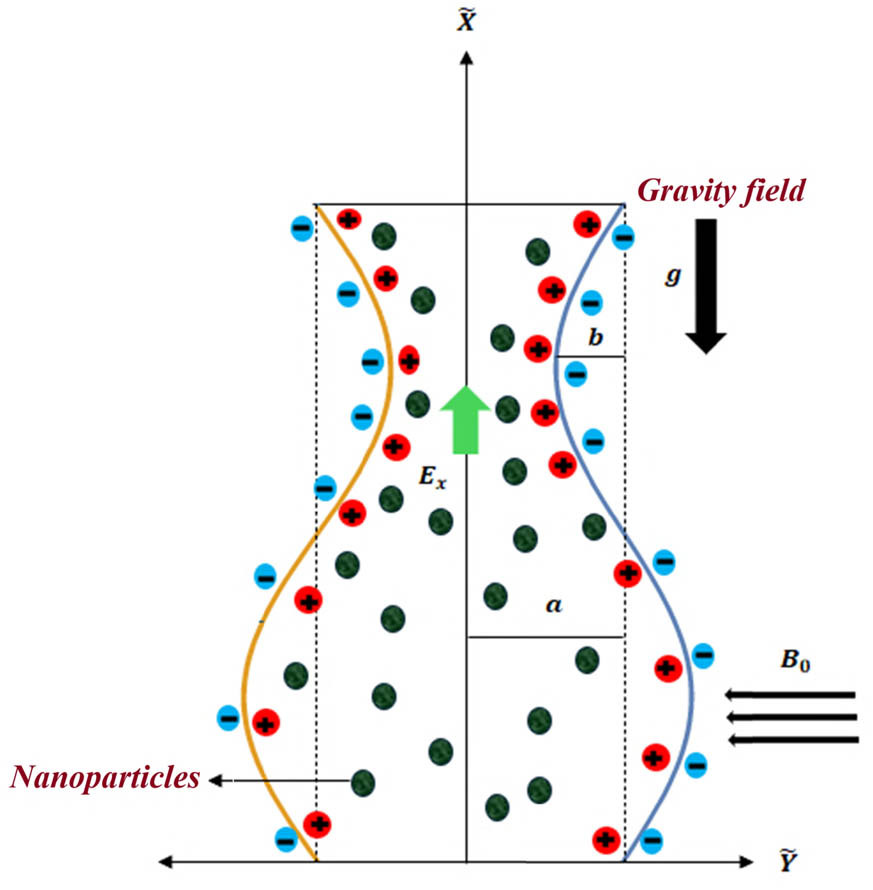
A diagram of EOF accompanied by peristalsis.
Microchannel geometry can be represented mathematically as [47]
2.2 Governing equations
The EOF of a micropolar nanofluid in an electromagnetohydrodynamic (EMHD) environment is controlled by the following formulas in the laboratory frame [37,47,48,49]:
Continuity equation:
Equation of motion:
Equation of microrotation motion:
Energy equation with viscous dissipation:
Concentration equation:
Microorganisms’ equation:
where
2.2.1 EHD [47]
In a microscopic channel, Poisson’s equation [25] is defined as follows:
where
2.2.2 Potential distributions
Consistent with the distributions of Boltzmann [50], the total density of charges
The definition of the anions
where
Given that Eq. (9) yields
where
Eq. (13) therefore becomes
where
2.2.3 Boundary under certain conditions, the lubrication technique, and non-dimensionalities
The fluctuating boundary causes the motion to be erratic within the stationary frame
Applying the changes described in (17), the continuation, momentum, microrotation, energy, quantity, and microorganisms within the waveform frame referencing Eqs. (2)–(8) can be expressed as [41,49,52,53,54] follows.
Continuity equation:
Equation of motion:
Equation of microrotation motion:
Energy equation with viscous dissipation:
Concentration equation:
Microorganisms’ equation:
Familiarizing the nondimensional variables:
Here,
Continuity equation:
Equation of motion:
Equation of microrotation motion:
Energy equation with viscous dissipation:
Concentration equation:
Microorganism equation:
In the context of the stream characteristic
Eq. (26) is met in the same way once Eq. (33) is introduced, and Eqs. (27)–(32) are as follows [37,47,49,52,53].
Equation of motion :
Equation of microrotation motion:
Energy equation with viscous dissipation:
Concentration equation:
Microorganism equation:
Considering the extended wavelengths
When pressure is removed from Eq. (40) as well as Eq. (41), we obtain
Under conditions [55]:
The boundary conditions applied in this study reflect realistic physical constraints commonly encountered in microfluidic environments. At the lower wall, no-slip and insulation conditions are assumed, implying that there is no penetration of fluid, heat, mass, microrotation, or microorganisms across the wall. This represents a thermal and mass-insulated surface with no microrotational effects. At the upper peristaltically oscillating wall, velocity, thermal, concentration, microrotation, and microorganism slip conditions are incorporated to account for the partial interaction between the wall and fluid. These slip conditions simulate more accurate physical behaviors, where the wall may allow limited transfer or interaction due to surface characteristics or biological coatings. Collectively, these boundary settings allow the model to realistically capture the influences of wall dynamics and surface attributes on electroosmotic peristalsis flow of micropolar bio-nanofluids. Here,
where
The following are the non-dimensional formulas [41,52,53,54] describing the rate of pressure surge for wavelength
3 Computational methodology
The use of mathematical models to address real-world issues has become crucial in several aspects of contemporary life for elucidating, delineating, or forecasting a wide array of phenomena. To exemplify these challenges, scientists often use a set of very intricate non-linear linked equations derived from partial differential equations. Analytical solutions for such challenges are often unattainable. We can efficiently and dependably manage this degree of complexity due to our expertise in numerous prominent computational programming languages. Mathematica, an advanced and completely integrated software programming language, has been used in our problem-solving endeavors. A systematic and successful methodology for addressing the complexity of solving the governing system of equations has been established with the built-in command, parametric estimate NDSolve. This numerical approach provides substantial benefits by decreasing mistakes and reducing CPU time per evaluation. This built-in tool generates a suitable method for numerical computations and produces the corresponding graphical output. According to the selected convergence criterion, the difference between consecutive solution values must be less than 10−6 to guarantee good precision.
4 Verification of the outcomes
To demonstrate the validity of our current work, we compare our numerical approach for dimensionless velocity and the results of two earlier studies [54,41], concentrating on a particular case. Many phenomena are disregarded in this comparison, including the mass and heat transmission of the liquid, the motion of organisms in the non-existence of the porous material in the channel, and, most importantly, the impact of the field of magnetic attraction. Table 2 contrasts the speed profiles of the two scenarios – the hydrodynamic case [54] and the EHD instance [41] – to show how our model compares with the findings given by Ali and Hayat [54] and Noreen et al. [41]. To enable pertinent comparisons, we have set
Velocity profile
| Microrotation
|
Coupling number
|
Hydrodynamic case [54]
|
Current study | EHD Case. [41]
|
Current study |
|---|---|---|---|---|---|
| 1 | 0.2 | −1 | −1 | 2.49730 | 2.45870 |
| 10 | 0.2 | −1 | −1 | 3.00531 | 3.01260 |
| 100 | 0.2 | −1 | −1 | 3.28171 | 3.27924 |
| 100 | 0.3 | 6.173850 | 6.17425 | 3.25985 | 3.25478 |
| 100 | 0.4 | 6.739920 | 6.73578 | 3.23800 | 3.23576 |
| 100 | 0.5 | 7.111769 | 7.11234 | 3.21614 | 3.21458 |
5 Computational discussion of the results
The physical structure of the problem comprises a microchannel, which is a simplified but accurate depiction of microfluidic devices encountered in real-world applications. In the above structure, the addition of an electric field from the outside
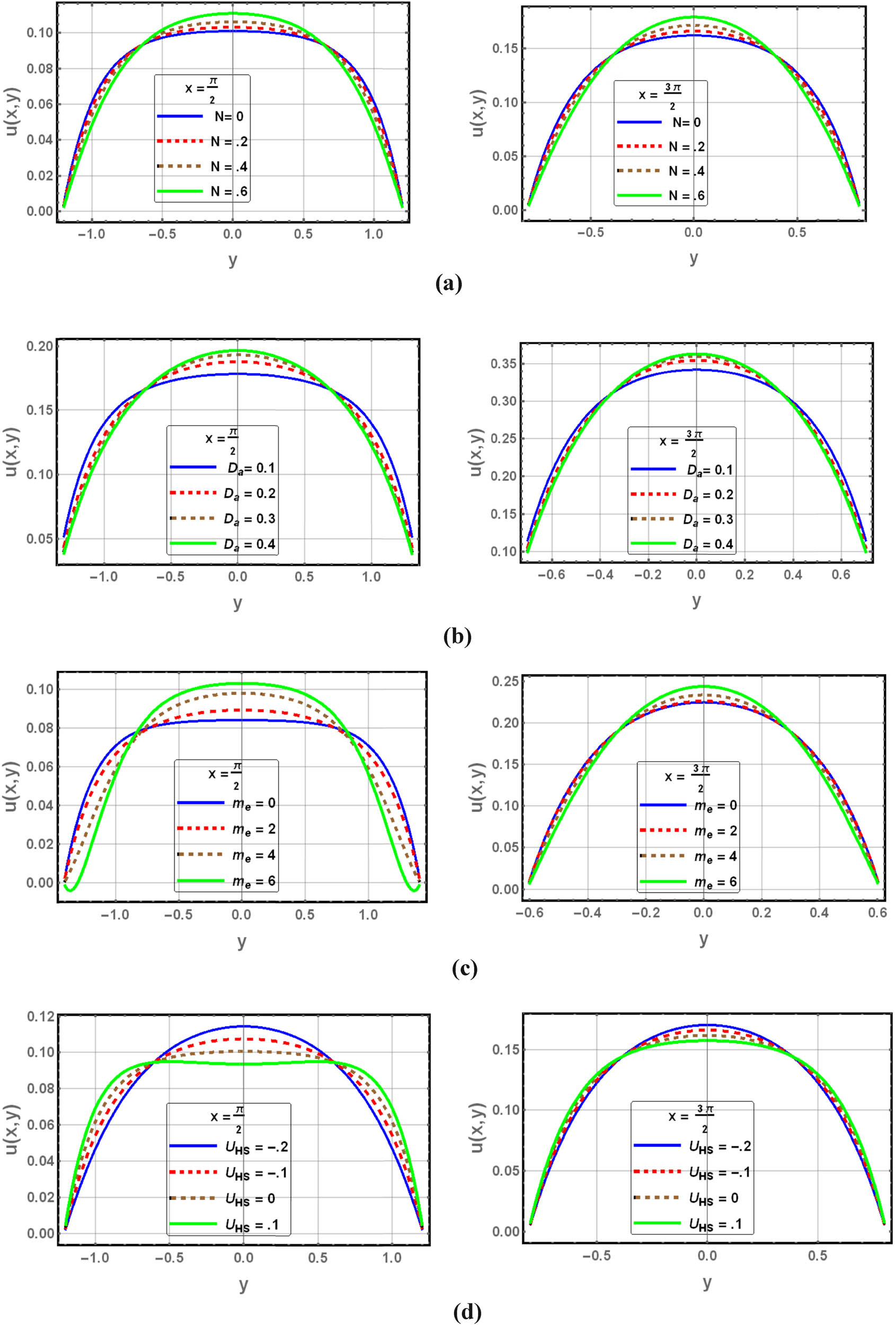
Velocity distribution for (a)

Temperature distribution for (a)

Motile density of microorganism’s distribution for (a)

Concentration distribution for (a)

Microrotation velocity distribution for (a)
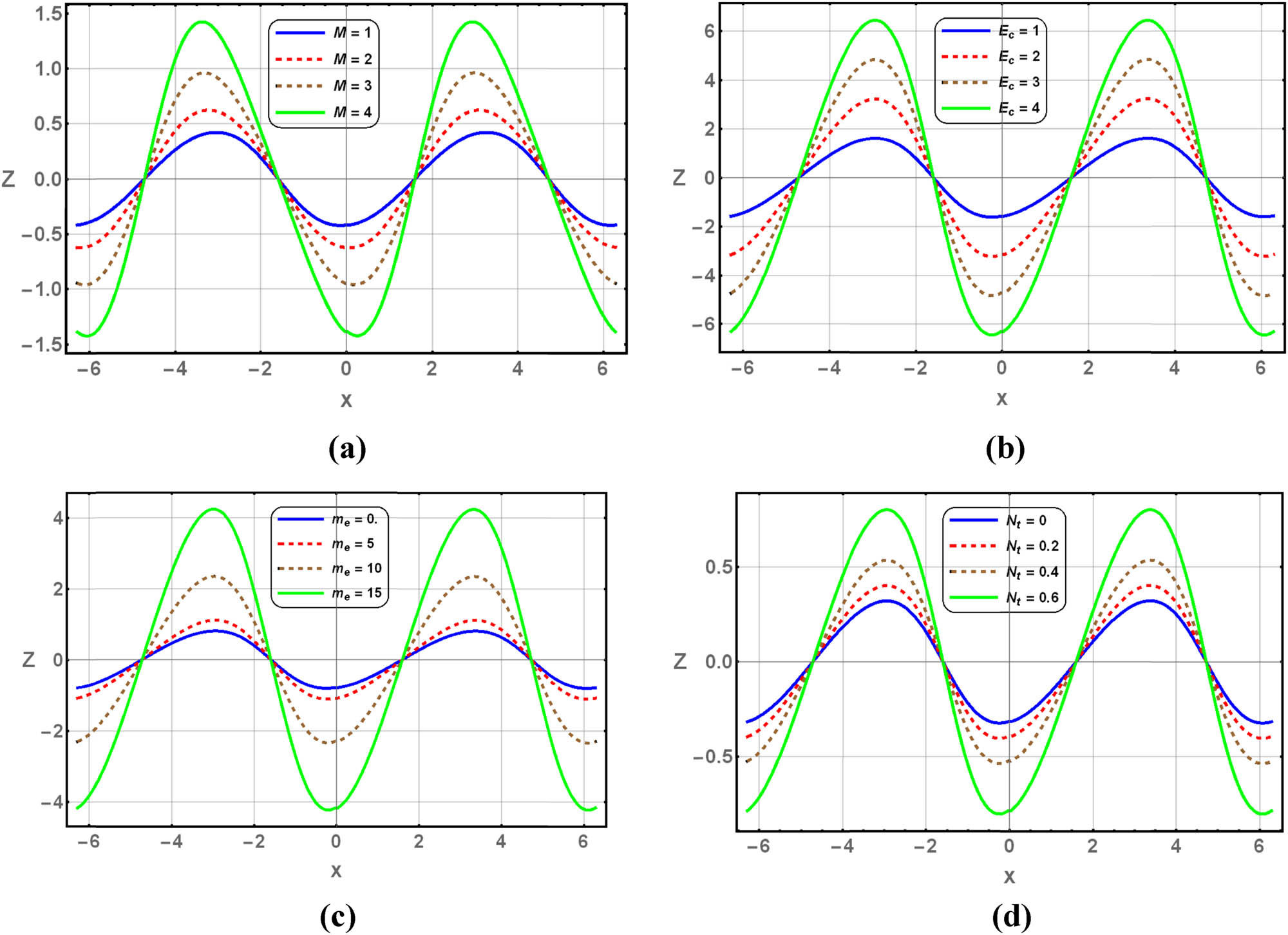
The rate of heat transmission for (a)


Distribution of microrotation velocity for (a)
5.1 Velocity profile
This section discusses the implications of the coupling number
5.2 Temperature profile
Figure 3(a–d) depicts the temperature change with pertinent fluid parameters. Temperature profiles, like velocity profiles, display the graph’s parabolic form, with the highest possible temperature occurring in the center. The change in the temperature slip parameter
5.3 Density of motile microorganism profiles
Figure 4(a–d) shows the activities of motile microorganism profiles for various values of physical factors. It can be established from Figure 4(a) that as the Brownian diffusion variable
5.4 Concentration profile
Figure 5(a–d) shows how different physical parameters affect the concentration distribution
5.5 Microrotation profile
The features and characteristics of various pertinent hydrodynamical flow variables, such as the microrotation slip parameter
5.6 Heat transfer rates
In Figure 7(a–d), the corresponding changes in the (a) magnetic field parameter
5.7 Streamline patterns
In the context of peristalsis fluid flow, a trapping method is a significant additional feature of rheological effectiveness. The propagating bolus structure of this phenomenon may, in certain instances, take the shape of a streamlined organization that is parallel to the boundary walls. They move in the same orientation as peristaltic impulses and are reliant on the wave that has peristaltic characteristics on the boundary sides. They migrate at the same tempo as peristaltic impulses. The characteristics of regurgitation, an increase in vorticity, as well as the strength of blood flow that occurs during peristalsis movements, can be determined. Figure 8(a–d) shows the additionally discovered behavior of trapping. To portray the streamlined configuration for diverse values of the Helmholtz–Smoluchowski velocity
6 Concluding remarks
In this study, we have developed a novel mathematical model to investigate the peristalsis flow of a micropolar bio-nanofluid, comprehending gyrotactic microorganisms with the combined effects of electroosmotic forces, magnetized fields, viscous dissipations, Joule heating, first-order chemical reactions, and slip boundary conditions. This comprehensive framework addresses an unstudied configuration in the literature and incorporates important microfluidic phenomena, such as thermophoresis, Brownian motion, and chemical reactions. The model reveals how parameters like the electroosmotic velocity, Helmholtz–Smoluchowski speed, and micropolar effects influence the velocity, temperature, concentration, and microorganism distributions. Importantly, the application of slip conditions enhances physical realism and reflects actual microchannel behaviors. The problem’s linked non-linear differential equations are reduced to a multidimensional form using Reynolds numbers that are small and long-wavelength approximations. Because of the intricacy of the outcome’s set of mathematical equations, mathematical modeling has been performed via the computing software program Mathematica by employing the integrated function (parametric NDSolve). The results offer a thorough comprehension of the system’s behavior, which exhibits a significant correlation with the physical characteristics controlling it. In particular, the zeta potential, voltage, and channel shape are found to have a considerable impact on the acceleration of EOF. These discoveries may prove useful in the creation of microfluidic devices suitable for certain uses requiring fine-grained fluid handling. Finally, we discussed how various parameters affect the results. The significant findings are as follows:
The administration of specific pharmaceuticals may be enhanced by using electroosmotic forces to modify the nanofluid during peristalsis movement. This coordinated mobility may facilitate the exact delivery of drugs to certain physiological regions or cells.
Thermal and mass transport phenomena are highly sensitive to slip boundary conditions. For instance, thermal and concentration slip enhance energy and species diffusion, influencing nanoparticle and microorganism distributions.
Regulated buoyant forces may be used in biological processes to manipulate the behavior of nanoparticles in blood-based fluids. For instance, it may influence the distribution and circulation of therapeutic nanomaterials in drug delivery systems.
Electroosmotic forces play a dominant role in enhancing flow transport; increasing the zeta potential and electric field intensity significantly boosts the axial flow and nanoparticle convection.
The density of motile bacteria exhibits contrasting results with increasing levels of the Brownian movement variable and the thermophoretic variable.
The Helmholtz–Smoluchowski velocity emerges as a critical parameter in tuning both the fluid velocity and particle concentration profiles, particularly near the channel center.
Trapping phenomena are notably affected by the electroosmotic parameters, revealing possibilities for controlled transport and targeted delivery in bio-microfluidic systems.
The micropolar effects, including microrotation and spin viscosity, subtly influence the flow near the walls but have a limited effect at the core region, offering fine control over wall-bound layer dynamics.
The theoretical results may find practical applications in physiological flows and commercial applications involving electroosmosis-driven peristaltic transport subjected to microrotation of fluid particles.
7 Future directions and limitations
This work can be developed further in several ways. The significance of biomedical engineering has been strengthened by its reliance on curvature effects. It is also important to note the application of different rheological concepts and the ciliated wall effects, along with the pushing of bacterial cells and spermatozoa. These practical studies will contribute to the development of more advanced nanomagnetic and electric microrobots. The current analysis relies on several simplifying assumptions, such as the long wavelength, low Reynolds number, and the Debye–Hückel approximation, which limits its applicability to low-potential, slow-flow regimes. The model also considers constant wall properties and diminished first-order chemical reactions. Although these assumptions were required for tractability, they may not fully capture the complexity of actual bio-microfluidic systems. Future work could target optimization of flow rate by tuning electrokinetic and geometric parameters. Additionally, a sensitivity analysis is recommended in future investigations to identify the most influential parameters affecting the system behavior and optimize design considerations accordingly.
Acknowledgments
The authors extend their appreciation to the Deanship of Scientific Research at Northern Border University, Arar, KSA for funding this research work through the project number NBU-FFR-2025-3021-08. The authors are thankful to the Deanship of Graduate Studies and Scientific Research at University of Bisha for supporting this work through the Fast-Track Research Support Program.
-
Funding information: The Deanship of Scientific Research at Northern Border University, Arar, KSA for funding this research work through the project number NBU-FFR-2025-3021-08. The authors are thankful to the Deanship of Graduate Studies and Scientific Research at University of Bisha for supporting this work through the Fast-Track Research Support Program.
-
Author contributions: Conceptualization: EME, SAH, and NTME; data curation: AMA and KhL; formal analysis: EME, SAH, and MRE; investigation: NTME, KhL, and MRE; methodology: SAH and AMA; project administration: MRE; supervision: NTME; validation: EME, NTME, and MRE; visualization: SAH and KhL; writing – original draft: SAH, AMA, and KhL; writing – review and editing: EME, AMA, and MRE. All authors have accepted responsibility for the entire content of this manuscript and approved its submission.
-
Conflict of interest: The authors state no conflict of interest.
-
Data availability statement: All data generated or analyzed during this study are included in this published article.
References
[1] Choi SU, Eastman JA. Enhancing thermal conductivity of fluids with nanoparticles. Argonne, IL (United States): Argonne National Laboratory (ANL); 1995.Search in Google Scholar
[2] Buongiorno J. Convective transport in nanofluids. ASME J Heat Transf. 2006;128(3):240–50.10.1115/1.2150834Search in Google Scholar
[3] Leong KY, Saidur R, Kazi S, Mamun A. Performance investigation of an automotive car radiator operated with nanofluid-based coolants. Appl Therm Eng. 2010;30(17–18):2685–92.10.1016/j.applthermaleng.2010.07.019Search in Google Scholar
[4] Mustafa M, Hina S, Hayat T, Alsaedi A. Influence of wall properties on the peristaltic flow of a nanofluid: analytic and numerical solutions. Int J Heat Mass Transf. 2012;55(17–18):4871–7.10.1016/j.ijheatmasstransfer.2012.04.060Search in Google Scholar
[5] Kothandapani M, Prakash J. Effect of radiation and magnetic field on peristaltic transport of nanofluids through a porous space in a tapered asymmetric channel. J Magn Magn Mater. 2015;378:152–63.10.1016/j.jmmm.2014.11.031Search in Google Scholar
[6] Hayat T, Nisar Z, Yasmin H, Alsaedi A. Peristaltic transport of nanofluid in a compliant wall channel with convective conditions and thermal radiation. J Mol Liq. 2016;220:448–53.10.1016/j.molliq.2016.04.080Search in Google Scholar
[7] Abbasi F, Gul M, Shehzad S. Effectiveness of temperature-dependent properties of Au, Ag, Fe3O4, Cu nanoparticles in peristalsis of nanofluids. Int Commun Heat Mass Transf. 2020;116:104651.10.1016/j.icheatmasstransfer.2020.104651Search in Google Scholar
[8] Abd-Alla A, Thabet EN, Bayones F. Numerical solution for MHD peristaltic transport in an inclined nanofluid symmetric channel with porous medium. Sci Rep. 2022;12(1):3348.10.1038/s41598-022-07193-5Search in Google Scholar PubMed PubMed Central
[9] Tahir M, Ahmad A, Shehzad SA. Study of pseudoplastic and dilatant behavior of nanofluid in peristaltic flow: Reiner-Philippoff models. Chin J Phys. 2022;77:2371–88.10.1016/j.cjph.2022.04.001Search in Google Scholar
[10] Nisar Z, Hayat T, Alsaedi A, Momani S. Peristaltic flow of chemically reactive Carreau-Yasuda nanofluid with modified Darcy’s expression. Mater Today Commun. 2022;33:104532.10.1016/j.mtcomm.2022.104532Search in Google Scholar
[11] Nisar Z, Hayat T, Alsaedi A, Momani S. Mathematical modelling for peristaltic flow of fourth‐grade nanoliquid with entropy generation. Z Angew Math Mech. 2024;104(1):e202300034.10.1002/zamm.202300034Search in Google Scholar
[12] Ahmed SE, Arafa AA, Hussein SA. Hydrothermal dissipative nanofluid flow over a stretching Riga plate with heat and mass transmission and shape effects. J Therm Anal Calorim. 2024;149(10):4855–72.10.1007/s10973-024-13061-3Search in Google Scholar
[13] Latham TW. Fluid motions in a peristaltic pump. Cambridge (MA): Massachusetts Institute of Technology; 1966.Search in Google Scholar
[14] Shapiro AH, Jaffrin MY, Weinberg SL. Peristaltic pumping with long wavelengths at low Reynolds number. J Fluid Mech. 1969;37(4):799–825.10.1017/S0022112069000899Search in Google Scholar
[15] Srinivas S, Gayathri R, Kothandapani M. The influence of slip conditions, wall properties and heat transfer on MHD peristaltic transport. Comput Phys Commun. 2009;180(11):2115–22.10.1016/j.cpc.2009.06.015Search in Google Scholar
[16] Tripathi D. A mathematical model for the peristaltic flow of chyme movement in small intestine. Math Biosci. 2011;233(2):90–7.10.1016/j.mbs.2011.06.007Search in Google Scholar PubMed
[17] Sarkar B, Das S, Jana R, Makinde O. Magnetohydrodynamic peristaltic flow of nanofluids in a convectively heated vertical asymmetric channel in presence of thermal radiation. J Nanofluids. 2015;4(4):461–73.10.1166/jon.2015.1169Search in Google Scholar
[18] Reddy MG, Makinde O. Magnetohydrodynamic peristaltic transport of Jeffrey nanofluid in an asymmetric channel. J Mol Liq. 2016;223:1242–8.10.1016/j.molliq.2016.09.080Search in Google Scholar
[19] Reddy KV, Reddy MG, Makinde OD. Heat and mass transfer of a peristaltic electro-osmotic flow of a couple stress fluid through an inclined asymmetric channel with effects of thermal radiation and chemical reaction. Period Polytech Mech Eng. 2021;65(2):151–62.10.3311/PPme.16760Search in Google Scholar
[20] Priam SS, Nasrin R. Numerical appraisal of time-dependent peristaltic duct flow using Casson fluid. Int J Mech Sci. 2022;233:107676.10.1016/j.ijmecsci.2022.107676Search in Google Scholar
[21] Ahmed SE, Arafa AA, Hussein SA. Viscous dissipation and Joule heating in case of variable electrical conductivity Carreau–Yasuda nanofluid flow in a complex wavy asymmetric channel through porous media. Mod Phys Lett B. 2024;38(36):2450369.10.1142/S021798492450369XSearch in Google Scholar
[22] Sayed AAM, Abo-Elkhair RE, Elsaid EM. Improving the rheological behavior of magnetiz couple stress Buongiorno’s nanofluid through resilient wavy channel with curvature effect: Nonlinear analysis. Chin J Phys. 2024;89:1508–37.10.1016/j.cjph.2024.04.017Search in Google Scholar
[23] Li H, Wei S, Qing C, Yang J. Discussion on the position of the shear plane. J Colloid Interface Sci. 2003;258(1):40–4.10.1016/S0021-9797(02)00077-2Search in Google Scholar
[24] Ghosal S. Fluid mechanics of electroosmotic flow and its effect on band broadening in capillary electrophoresis. Electrophoresis. 2004;25(2):214–28.10.1002/elps.200305745Search in Google Scholar PubMed
[25] Chakraborty S. Augmentation of peristaltic microflows through electro-osmotic mechanisms. J Phys D Appl Phys. 2006;39(24):5356.10.1088/0022-3727/39/24/037Search in Google Scholar
[26] Dutta P, Beskok A. Analytical solution of combined electroosmotic/pressure driven flows in two-dimensional straight channels: finite Debye layer effects. Anal Chem. 2001;73(9):1979–86.10.1021/ac001182iSearch in Google Scholar PubMed
[27] Liakopoulos AC. Darcy’s coefficient of permeability as symmetric tensor of second rank. Hydrol Sci J. 1965;10(3):41–8.10.1080/02626666509493405Search in Google Scholar
[28] Ramesh K, Devakar M. Effect of heat transfer on the peristaltic transport of a MHD second grade fluid through a porous medium in an inclined asymmetric channel. Chin J Phys. 2017;55(3):825–44.10.1016/j.cjph.2016.10.028Search in Google Scholar
[29] Ranjit N, Shit G, Tripathi D. Joule heating and zeta potential effects on peristaltic blood flow through porous micro vessels altered by electrohydrodynamic. Microvasc Res. 2018;117:74–89.10.1016/j.mvr.2017.12.004Search in Google Scholar PubMed
[30] Noreen S, Tripathi D. Heat transfer analysis on electroosmotic flow via peristaltic pumping in non-Darcy porous medium. Therm Sci Eng Prog. 2019;11:254–62.10.1016/j.tsep.2019.03.015Search in Google Scholar
[31] Lodhi RK, Ramesh K. Comparative study on electroosmosis modulated flow of MHD viscoelastic fluid in the presence of modified Darcy’s law. Chin J Phys. 2020;68:106–20.10.1016/j.cjph.2020.09.005Search in Google Scholar
[32] Reddappa B, Parandhama A, Sreenadh S. Peristaltic transport of conducting Williamson fluid in a porous channel. J Math Comput Sci. 2019;10(2):277–88.Search in Google Scholar
[33] Platt JR. Bioconvection patterns in cultures of free-swimming organisms. Science. 1961;133(3466):1766–7.10.1126/science.133.3466.1766Search in Google Scholar PubMed
[34] Pedley TJ, Hill N, Kessler JO. The growth of bioconvection patterns in a uniform suspension of gyrotactic micro-organisms. J Fluid Mech. 1988;195:223–37.10.1017/S0022112088002393Search in Google Scholar PubMed
[35] Sampath Kumar P, Gireesha B, Mahanthesh B, Chamkha AJ. Thermal analysis of nanofluid flow containing gyrotactic microorganisms in bioconvection and second order slip with convective condition. J Therm Anal Calorim. 2019;136:1947–57.10.1007/s10973-018-7860-0Search in Google Scholar
[36] Eldabe N, Gabr M, Hussein SA. Numerical treatment for the boundary layer flow of Sutterby nanofluid through porous medium with planktonic microorganisms over a stretching Riga cylindrical tube. Int J Ambient Energy. 2024;45(1):2345251.10.1080/01430750.2024.2345251Search in Google Scholar
[37] Hussein SA, Arafa AA, Elshekhipy A, Hassan Almalki N, AL-Essa L, Akbar Y. Radiative and dissipative MHD Eyring–Powell nanofluid bioconvective flow through peristaltic waves in the presence of bilateral chemical reaction with Arrhenius activation energy: entropy optimization. Numer Heat Transf A Appl. 2023;83(1):1–27.Search in Google Scholar
[38] Alqarni AJ, Elsaid EM, Al Qarni AA, Mekheimer KS, Abo-Elkhair RE, Abdel-Wahed MS. Exploration of bioconvection flow for biological fluid with planktonic microorganism and thermal radiation: Drug carriers for tumor cells. Mod Phys Lett B. 2024;38(36):2450505.10.1142/S0217984924505055Search in Google Scholar
[39] Ahmed SE, Arafa AA, Hussein SA. MHD Ellis nanofluids flow around rotating cone in the presence of motile oxytactic microorganisms. Int Commun Heat Mass Transf. 2022;134:106056.10.1016/j.icheatmasstransfer.2022.106056Search in Google Scholar
[40] Abd-Alla A, Abo-Dahab S, Thabet EN, Abdelhafez M. Heat and mass transfer for MHD peristaltic flow in a micropolar nanofluid: mathematical model with thermophysical features. Sci Rep. 2022;12(1):21540.10.1038/s41598-022-26057-6Search in Google Scholar PubMed PubMed Central
[41] Noreen S, Batool S, Tripathi D. Electroosmosis and peristaltic mechanism in a symmetric channel flow. Microfluid Nanofluid. 2024;28(3):15.10.1007/s10404-024-02712-4Search in Google Scholar
[42] Waheed S, Noreen S, Hussanan A. Study of heat and mass transfer in electroosmotic flow of third order fluid through peristaltic microchannels. Appl Sci. 2019;9(10):2164.10.3390/app9102164Search in Google Scholar
[43] Ramesh K, Prakash J. Thermal analysis for heat transfer enhancement in electroosmosis-modulated peristaltic transport of Sutterby nanofluids in a microfluidic vessel. J Therm Anal Calorim. 2019;138:1311–26.10.1007/s10973-018-7939-7Search in Google Scholar
[44] Yasmin H, Iqbal N. Convective mass/heat analysis of an electroosmotic peristaltic flow of ionic liquid in a symmetric porous microchannel with soret and dufour. Math Probl Eng. 2021;2021(1):2638647.10.1155/2021/2638647Search in Google Scholar
[45] Choudhari R, Ramesh K, Tripathi D, Vaidya H, Prasad KV. Heat transfer and electroosmosis driven MHD peristaltic pumping in a microchannel with multiple slips and fluid properties. Heat Transf. 2022;51(7):6507–27.10.1002/htj.22602Search in Google Scholar
[46] Hussain A, Saddiqa A, Riaz MB, Martinovic J. A comparative study of peristaltic flow of electro-osmosis and MHD with solar radiative effects and activation energy. Int Commun Heat Mass Transf. 2024;156:107666.10.1016/j.icheatmasstransfer.2024.107666Search in Google Scholar
[47] Hussein SA, Ahmed SE, Arafa AA. Electrokinetic peristaltic bioconvective Jeffrey nanofluid flow with activation energy for binary chemical reaction, radiation and variable fluid properties. Z Angew Math Mech. 2023;103(1):e202200284.10.1002/zamm.202200284Search in Google Scholar
[48] Jhorar R, Tripathi D, Bhatti M, Ellahi R. Electroosmosis modulated biomechanical transport through asymmetric microfluidics channel. Indian J Phys. 2018;92:1229–38.10.1007/s12648-018-1215-3Search in Google Scholar
[49] Kotnurkar AS, Giddaiah S. Bioconvection peristaltic flow of nano Eyring–Powell fluid containing gyrotactic microorganism. SN Appl Sci. 2019;1(10):1276.10.1007/s42452-019-1281-ySearch in Google Scholar
[50] Tang G, Li X, He Y, Tao W. Electroosmotic flow of non-Newtonian fluid in microchannels. J Non-Newton Fluid Mech. 2009;157(1–2):133–7.10.1016/j.jnnfm.2008.11.002Search in Google Scholar
[51] Noreen S. Mixed convection peristaltic flow of third order nanofluid with an induced magnetic field. PLoS One. 2013;8(11):e78770.10.1371/journal.pone.0078770Search in Google Scholar PubMed PubMed Central
[52] Hussein SA. Simulating and interpretation of MHD peristaltic transport of dissipated Eyring–Powell nanofluid flow through vertical divergent/nondivergent channel. Numer Heat Transf A Appl. 2023;84(10):1124–48.10.1080/10407782.2023.2171928Search in Google Scholar
[53] Hussein SA. Numerical simulation for peristaltic transport of radiative and dissipative MHD Prandtl nanofluid through the vertical asymmetric channel in the presence of double diffusion convection. Numer Heat Transf B Fundam. 2024;85(4):385–411.10.1080/10407790.2023.2235886Search in Google Scholar
[54] Ali N, Hayat T. Peristaltic flow of a micropolar fluid in an asymmetric channel. Comput Math Appl. 2008;55(4):589–608.10.1016/j.camwa.2007.06.003Search in Google Scholar
[55] Hayat T, Khan A, Bibi F, Farooq S. Activation energy and non-Darcy resistance in magneto peristalsis of Jeffrey material. J Phys Chem Solids. 2019;129:155–61.10.1016/j.jpcs.2018.12.044Search in Google Scholar
© 2025 the author(s), published by De Gruyter
This work is licensed under the Creative Commons Attribution 4.0 International License.
Articles in the same Issue
- Research Articles
- Single-step fabrication of Ag2S/poly-2-mercaptoaniline nanoribbon photocathodes for green hydrogen generation from artificial and natural red-sea water
- Abundant new interaction solutions and nonlinear dynamics for the (3+1)-dimensional Hirota–Satsuma–Ito-like equation
- A novel gold and SiO2 material based planar 5-element high HPBW end-fire antenna array for 300 GHz applications
- Explicit exact solutions and bifurcation analysis for the mZK equation with truncated M-fractional derivatives utilizing two reliable methods
- Optical and laser damage resistance: Role of periodic cylindrical surfaces
- Numerical study of flow and heat transfer in the air-side metal foam partially filled channels of panel-type radiator under forced convection
- Water-based hybrid nanofluid flow containing CNT nanoparticles over an extending surface with velocity slips, thermal convective, and zero-mass flux conditions
- Dynamical wave structures for some diffusion--reaction equations with quadratic and quartic nonlinearities
- Solving an isotropic grey matter tumour model via a heat transfer equation
- Study on the penetration protection of a fiber-reinforced composite structure with CNTs/GFP clip STF/3DKevlar
- Influence of Hall current and acoustic pressure on nanostructured DPL thermoelastic plates under ramp heating in a double-temperature model
- Applications of the Belousov–Zhabotinsky reaction–diffusion system: Analytical and numerical approaches
- AC electroosmotic flow of Maxwell fluid in a pH-regulated parallel-plate silica nanochannel
- Interpreting optical effects with relativistic transformations adopting one-way synchronization to conserve simultaneity and space–time continuity
- Modeling and analysis of quantum communication channel in airborne platforms with boundary layer effects
- Theoretical and numerical investigation of a memristor system with a piecewise memductance under fractal–fractional derivatives
- Tuning the structure and electro-optical properties of α-Cr2O3 films by heat treatment/La doping for optoelectronic applications
- High-speed multi-spectral explosion temperature measurement using golden-section accelerated Pearson correlation algorithm
- Dynamic behavior and modulation instability of the generalized coupled fractional nonlinear Helmholtz equation with cubic–quintic term
- Study on the duration of laser-induced air plasma flash near thin film surface
- Exploring the dynamics of fractional-order nonlinear dispersive wave system through homotopy technique
- The mechanism of carbon monoxide fluorescence inside a femtosecond laser-induced plasma
- Numerical solution of a nonconstant coefficient advection diffusion equation in an irregular domain and analyses of numerical dispersion and dissipation
- Numerical examination of the chemically reactive MHD flow of hybrid nanofluids over a two-dimensional stretching surface with the Cattaneo–Christov model and slip conditions
- Impacts of sinusoidal heat flux and embraced heated rectangular cavity on natural convection within a square enclosure partially filled with porous medium and Casson-hybrid nanofluid
- Stability analysis of unsteady ternary nanofluid flow past a stretching/shrinking wedge
- Solitonic wave solutions of a Hamiltonian nonlinear atom chain model through the Hirota bilinear transformation method
- Bilinear form and soltion solutions for (3+1)-dimensional negative-order KdV-CBS equation
- Solitary chirp pulses and soliton control for variable coefficients cubic–quintic nonlinear Schrödinger equation in nonuniform management system
- Influence of decaying heat source and temperature-dependent thermal conductivity on photo-hydro-elasto semiconductor media
- Dissipative disorder optimization in the radiative thin film flow of partially ionized non-Newtonian hybrid nanofluid with second-order slip condition
- Bifurcation, chaotic behavior, and traveling wave solutions for the fractional (4+1)-dimensional Davey–Stewartson–Kadomtsev–Petviashvili model
- New investigation on soliton solutions of two nonlinear PDEs in mathematical physics with a dynamical property: Bifurcation analysis
- Mathematical analysis of nanoparticle type and volume fraction on heat transfer efficiency of nanofluids
- Creation of single-wing Lorenz-like attractors via a ten-ninths-degree term
- Optical soliton solutions, bifurcation analysis, chaotic behaviors of nonlinear Schrödinger equation and modulation instability in optical fiber
- Chaotic dynamics and some solutions for the (n + 1)-dimensional modified Zakharov–Kuznetsov equation in plasma physics
- Fractal formation and chaotic soliton phenomena in nonlinear conformable Heisenberg ferromagnetic spin chain equation
- Single-step fabrication of Mn(iv) oxide-Mn(ii) sulfide/poly-2-mercaptoaniline porous network nanocomposite for pseudo-supercapacitors and charge storage
- Novel constructed dynamical analytical solutions and conserved quantities of the new (2+1)-dimensional KdV model describing acoustic wave propagation
- Tavis–Cummings model in the presence of a deformed field and time-dependent coupling
- Spinning dynamics of stress-dependent viscosity of generalized Cross-nonlinear materials affected by gravitationally swirling disk
- Design and prediction of high optical density photovoltaic polymers using machine learning-DFT studies
- Robust control and preservation of quantum steering, nonlocality, and coherence in open atomic systems
- Coating thickness and process efficiency of reverse roll coating using a magnetized hybrid nanomaterial flow
- Dynamic analysis, circuit realization, and its synchronization of a new chaotic hyperjerk system
- Decoherence of steerability and coherence dynamics induced by nonlinear qubit–cavity interactions
- Finite element analysis of turbulent thermal enhancement in grooved channels with flat- and plus-shaped fins
- Modulational instability and associated ion-acoustic modulated envelope solitons in a quantum plasma having ion beams
- Statistical inference of constant-stress partially accelerated life tests under type II generalized hybrid censored data from Burr III distribution
- On solutions of the Dirac equation for 1D hydrogenic atoms or ions
- Entropy optimization for chemically reactive magnetized unsteady thin film hybrid nanofluid flow on inclined surface subject to nonlinear mixed convection and variable temperature
- Stability analysis, circuit simulation, and color image encryption of a novel four-dimensional hyperchaotic model with hidden and self-excited attractors
- A high-accuracy exponential time integration scheme for the Darcy–Forchheimer Williamson fluid flow with temperature-dependent conductivity
- Novel analysis of fractional regularized long-wave equation in plasma dynamics
- Development of a photoelectrode based on a bismuth(iii) oxyiodide/intercalated iodide-poly(1H-pyrrole) rough spherical nanocomposite for green hydrogen generation
- Investigation of solar radiation effects on the energy performance of the (Al2O3–CuO–Cu)/H2O ternary nanofluidic system through a convectively heated cylinder
- Quantum resources for a system of two atoms interacting with a deformed field in the presence of intensity-dependent coupling
- Studying bifurcations and chaotic dynamics in the generalized hyperelastic-rod wave equation through Hamiltonian mechanics
- A new numerical technique for the solution of time-fractional nonlinear Klein–Gordon equation involving Atangana–Baleanu derivative using cubic B-spline functions
- Interaction solutions of high-order breathers and lumps for a (3+1)-dimensional conformable fractional potential-YTSF-like model
- Hydraulic fracturing radioactive source tracing technology based on hydraulic fracturing tracing mechanics model
- Numerical solution and stability analysis of non-Newtonian hybrid nanofluid flow subject to exponential heat source/sink over a Riga sheet
- Numerical investigation of mixed convection and viscous dissipation in couple stress nanofluid flow: A merged Adomian decomposition method and Mohand transform
- Effectual quintic B-spline functions for solving the time fractional coupled Boussinesq–Burgers equation arising in shallow water waves
- Analysis of MHD hybrid nanofluid flow over cone and wedge with exponential and thermal heat source and activation energy
- Solitons and travelling waves structure for M-fractional Kairat-II equation using three explicit methods
- Impact of nanoparticle shapes on the heat transfer properties of Cu and CuO nanofluids flowing over a stretching surface with slip effects: A computational study
- Computational simulation of heat transfer and nanofluid flow for two-sided lid-driven square cavity under the influence of magnetic field
- Irreversibility analysis of a bioconvective two-phase nanofluid in a Maxwell (non-Newtonian) flow induced by a rotating disk with thermal radiation
- Hydrodynamic and sensitivity analysis of a polymeric calendering process for non-Newtonian fluids with temperature-dependent viscosity
- Exploring the peakon solitons molecules and solitary wave structure to the nonlinear damped Kortewege–de Vries equation through efficient technique
- Modeling and heat transfer analysis of magnetized hybrid micropolar blood-based nanofluid flow in Darcy–Forchheimer porous stenosis narrow arteries
- Activation energy and cross-diffusion effects on 3D rotating nanofluid flow in a Darcy–Forchheimer porous medium with radiation and convective heating
- Insights into chemical reactions occurring in generalized nanomaterials due to spinning surface with melting constraints
- Influence of a magnetic field on double-porosity photo-thermoelastic materials under Lord–Shulman theory
- Soliton-like solutions for a nonlinear doubly dispersive equation in an elastic Murnaghan's rod via Hirota's bilinear method
- Analytical and numerical investigation of exact wave patterns and chaotic dynamics in the extended improved Boussinesq equation
- Nonclassical correlation dynamics of Heisenberg XYZ states with (x, y)-spin--orbit interaction, x-magnetic field, and intrinsic decoherence effects
- Exact traveling wave and soliton solutions for chemotaxis model and (3+1)-dimensional Boiti–Leon–Manna–Pempinelli equation
- Unveiling the transformative role of samarium in ZnO: Exploring structural and optical modifications for advanced functional applications
- On the derivation of solitary wave solutions for the time-fractional Rosenau equation through two analytical techniques
- Analyzing the role of length and radius of MWCNTs in a nanofluid flow influenced by variable thermal conductivity and viscosity considering Marangoni convection
- Advanced mathematical analysis of heat and mass transfer in oscillatory micropolar bio-nanofluid flows via peristaltic waves and electroosmotic effects
- Exact bound state solutions of the radial Schrödinger equation for the Coulomb potential by conformable Nikiforov–Uvarov approach
- Some anisotropic and perfect fluid plane symmetric solutions of Einstein's field equations using killing symmetries
- Nonlinear dynamics of the dissipative ion-acoustic solitary waves in anisotropic rotating magnetoplasmas
- Curves in multiplicative equiaffine plane
- Exact solution of the three-dimensional (3D) Z2 lattice gauge theory
- Propagation properties of Airyprime pulses in relaxing nonlinear media
- Symbolic computation: Analytical solutions and dynamics of a shallow water wave equation in coastal engineering
- Wave propagation in nonlocal piezo-photo-hygrothermoelastic semiconductors subjected to heat and moisture flux
- Comparative reaction dynamics in rotating nanofluid systems: Quartic and cubic kinetics under MHD influence
- Laplace transform technique and probabilistic analysis-based hypothesis testing in medical and engineering applications
- Physical properties of ternary chloro-perovskites KTCl3 (T = Ge, Al) for optoelectronic applications
- Gravitational length stretching: Curvature-induced modulation of quantum probability densities
- The search for the cosmological cold dark matter axion – A new refined narrow mass window and detection scheme
- A comparative study of quantum resources in bipartite Lipkin–Meshkov–Glick model under DM interaction and Zeeman splitting
- PbO-doped K2O–BaO–Al2O3–B2O3–TeO2-glasses: Mechanical and shielding efficacy
- Nanospherical arsenic(iii) oxoiodide/iodide-intercalated poly(N-methylpyrrole) composite synthesis for broad-spectrum optical detection
- Sine power Burr X distribution with estimation and applications in physics and other fields
- Numerical modeling of enhanced reactive oxygen plasma in pulsed laser deposition of metal oxide thin films
- Dynamical analyses and dispersive soliton solutions to the nonlinear fractional model in stratified fluids
- Computation of exact analytical soliton solutions and their dynamics in advanced optical system
- An innovative approximation concerning the diffusion and electrical conductivity tensor at critical altitudes within the F-region of ionospheric plasma at low latitudes
- An analytical investigation to the (3+1)-dimensional Yu–Toda–Sassa–Fukuyama equation with dynamical analysis: Bifurcation
- Swirling-annular-flow-induced instability of a micro shell considering Knudsen number and viscosity effects
- Numerical analysis of non-similar convection flows of a two-phase nanofluid past a semi-infinite vertical plate with thermal radiation
- MgO NPs reinforced PCL/PVC nanocomposite films with enhanced UV shielding and thermal stability for packaging applications
- Optimal conditions for indoor air purification using non-thermal Corona discharge electrostatic precipitator
- Investigation of thermal conductivity and Raman spectra for HfAlB, TaAlB, and WAlB based on first-principles calculations
- Tunable double plasmon-induced transparency based on monolayer patterned graphene metamaterial
- DSC: depth data quality optimization framework for RGBD camouflaged object detection
- A new family of Poisson-exponential distributions with applications to cancer data and glass fiber reliability
- Numerical investigation of couple stress under slip conditions via modified Adomian decomposition method
- Monitoring plateau lake area changes in Yunnan province, southwestern China using medium-resolution remote sensing imagery: applicability of water indices and environmental dependencies
- Heterodyne interferometric fiber-optic gyroscope
- Exact solutions of Einstein’s field equations via homothetic symmetries of non-static plane symmetric spacetime
- A widespread study of discrete entropic model and its distribution along with fluctuations of energy
- Empirical model integration for accurate charge carrier mobility simulation in silicon MOSFETs
- The influence of scattering correction effect based on optical path distribution on CO2 retrieval
- Anisotropic dissociation and spectral response of 1-Bromo-4-chlorobenzene under static directional electric fields
- Role of tungsten oxide (WO3) on thermal and optical properties of smart polymer composites
- Analysis of iterative deblurring: no explicit noise
- The influence of anisotropy of InP on its elasticity and phonon properties
- Review Article
- Examination of the gamma radiation shielding properties of different clay and sand materials in the Adrar region
- Erratum
- Erratum to “On Soliton structures in optical fiber communications with Kundu–Mukherjee–Naskar model (Open Physics 2021;19:679–682)”
- Special Issue on Fundamental Physics from Atoms to Cosmos - Part II
- Possible explanation for the neutron lifetime puzzle
- Special Issue on Nanomaterial utilization and structural optimization - Part III
- Numerical investigation on fluid-thermal-electric performance of a thermoelectric-integrated helically coiled tube heat exchanger for coal mine air cooling
- Special Issue on Nonlinear Dynamics and Chaos in Physical Systems
- Analysis of the fractional relativistic isothermal gas sphere with application to neutron stars
- Abundant wave symmetries in the (3+1)-dimensional Chafee–Infante equation through the Hirota bilinear transformation technique
- Successive midpoint method for fractional differential equations with nonlocal kernels: Error analysis, stability, and applications
- Novel exact solitons to the fractional modified mixed-Korteweg--de Vries model with a stability analysis
Articles in the same Issue
- Research Articles
- Single-step fabrication of Ag2S/poly-2-mercaptoaniline nanoribbon photocathodes for green hydrogen generation from artificial and natural red-sea water
- Abundant new interaction solutions and nonlinear dynamics for the (3+1)-dimensional Hirota–Satsuma–Ito-like equation
- A novel gold and SiO2 material based planar 5-element high HPBW end-fire antenna array for 300 GHz applications
- Explicit exact solutions and bifurcation analysis for the mZK equation with truncated M-fractional derivatives utilizing two reliable methods
- Optical and laser damage resistance: Role of periodic cylindrical surfaces
- Numerical study of flow and heat transfer in the air-side metal foam partially filled channels of panel-type radiator under forced convection
- Water-based hybrid nanofluid flow containing CNT nanoparticles over an extending surface with velocity slips, thermal convective, and zero-mass flux conditions
- Dynamical wave structures for some diffusion--reaction equations with quadratic and quartic nonlinearities
- Solving an isotropic grey matter tumour model via a heat transfer equation
- Study on the penetration protection of a fiber-reinforced composite structure with CNTs/GFP clip STF/3DKevlar
- Influence of Hall current and acoustic pressure on nanostructured DPL thermoelastic plates under ramp heating in a double-temperature model
- Applications of the Belousov–Zhabotinsky reaction–diffusion system: Analytical and numerical approaches
- AC electroosmotic flow of Maxwell fluid in a pH-regulated parallel-plate silica nanochannel
- Interpreting optical effects with relativistic transformations adopting one-way synchronization to conserve simultaneity and space–time continuity
- Modeling and analysis of quantum communication channel in airborne platforms with boundary layer effects
- Theoretical and numerical investigation of a memristor system with a piecewise memductance under fractal–fractional derivatives
- Tuning the structure and electro-optical properties of α-Cr2O3 films by heat treatment/La doping for optoelectronic applications
- High-speed multi-spectral explosion temperature measurement using golden-section accelerated Pearson correlation algorithm
- Dynamic behavior and modulation instability of the generalized coupled fractional nonlinear Helmholtz equation with cubic–quintic term
- Study on the duration of laser-induced air plasma flash near thin film surface
- Exploring the dynamics of fractional-order nonlinear dispersive wave system through homotopy technique
- The mechanism of carbon monoxide fluorescence inside a femtosecond laser-induced plasma
- Numerical solution of a nonconstant coefficient advection diffusion equation in an irregular domain and analyses of numerical dispersion and dissipation
- Numerical examination of the chemically reactive MHD flow of hybrid nanofluids over a two-dimensional stretching surface with the Cattaneo–Christov model and slip conditions
- Impacts of sinusoidal heat flux and embraced heated rectangular cavity on natural convection within a square enclosure partially filled with porous medium and Casson-hybrid nanofluid
- Stability analysis of unsteady ternary nanofluid flow past a stretching/shrinking wedge
- Solitonic wave solutions of a Hamiltonian nonlinear atom chain model through the Hirota bilinear transformation method
- Bilinear form and soltion solutions for (3+1)-dimensional negative-order KdV-CBS equation
- Solitary chirp pulses and soliton control for variable coefficients cubic–quintic nonlinear Schrödinger equation in nonuniform management system
- Influence of decaying heat source and temperature-dependent thermal conductivity on photo-hydro-elasto semiconductor media
- Dissipative disorder optimization in the radiative thin film flow of partially ionized non-Newtonian hybrid nanofluid with second-order slip condition
- Bifurcation, chaotic behavior, and traveling wave solutions for the fractional (4+1)-dimensional Davey–Stewartson–Kadomtsev–Petviashvili model
- New investigation on soliton solutions of two nonlinear PDEs in mathematical physics with a dynamical property: Bifurcation analysis
- Mathematical analysis of nanoparticle type and volume fraction on heat transfer efficiency of nanofluids
- Creation of single-wing Lorenz-like attractors via a ten-ninths-degree term
- Optical soliton solutions, bifurcation analysis, chaotic behaviors of nonlinear Schrödinger equation and modulation instability in optical fiber
- Chaotic dynamics and some solutions for the (n + 1)-dimensional modified Zakharov–Kuznetsov equation in plasma physics
- Fractal formation and chaotic soliton phenomena in nonlinear conformable Heisenberg ferromagnetic spin chain equation
- Single-step fabrication of Mn(iv) oxide-Mn(ii) sulfide/poly-2-mercaptoaniline porous network nanocomposite for pseudo-supercapacitors and charge storage
- Novel constructed dynamical analytical solutions and conserved quantities of the new (2+1)-dimensional KdV model describing acoustic wave propagation
- Tavis–Cummings model in the presence of a deformed field and time-dependent coupling
- Spinning dynamics of stress-dependent viscosity of generalized Cross-nonlinear materials affected by gravitationally swirling disk
- Design and prediction of high optical density photovoltaic polymers using machine learning-DFT studies
- Robust control and preservation of quantum steering, nonlocality, and coherence in open atomic systems
- Coating thickness and process efficiency of reverse roll coating using a magnetized hybrid nanomaterial flow
- Dynamic analysis, circuit realization, and its synchronization of a new chaotic hyperjerk system
- Decoherence of steerability and coherence dynamics induced by nonlinear qubit–cavity interactions
- Finite element analysis of turbulent thermal enhancement in grooved channels with flat- and plus-shaped fins
- Modulational instability and associated ion-acoustic modulated envelope solitons in a quantum plasma having ion beams
- Statistical inference of constant-stress partially accelerated life tests under type II generalized hybrid censored data from Burr III distribution
- On solutions of the Dirac equation for 1D hydrogenic atoms or ions
- Entropy optimization for chemically reactive magnetized unsteady thin film hybrid nanofluid flow on inclined surface subject to nonlinear mixed convection and variable temperature
- Stability analysis, circuit simulation, and color image encryption of a novel four-dimensional hyperchaotic model with hidden and self-excited attractors
- A high-accuracy exponential time integration scheme for the Darcy–Forchheimer Williamson fluid flow with temperature-dependent conductivity
- Novel analysis of fractional regularized long-wave equation in plasma dynamics
- Development of a photoelectrode based on a bismuth(iii) oxyiodide/intercalated iodide-poly(1H-pyrrole) rough spherical nanocomposite for green hydrogen generation
- Investigation of solar radiation effects on the energy performance of the (Al2O3–CuO–Cu)/H2O ternary nanofluidic system through a convectively heated cylinder
- Quantum resources for a system of two atoms interacting with a deformed field in the presence of intensity-dependent coupling
- Studying bifurcations and chaotic dynamics in the generalized hyperelastic-rod wave equation through Hamiltonian mechanics
- A new numerical technique for the solution of time-fractional nonlinear Klein–Gordon equation involving Atangana–Baleanu derivative using cubic B-spline functions
- Interaction solutions of high-order breathers and lumps for a (3+1)-dimensional conformable fractional potential-YTSF-like model
- Hydraulic fracturing radioactive source tracing technology based on hydraulic fracturing tracing mechanics model
- Numerical solution and stability analysis of non-Newtonian hybrid nanofluid flow subject to exponential heat source/sink over a Riga sheet
- Numerical investigation of mixed convection and viscous dissipation in couple stress nanofluid flow: A merged Adomian decomposition method and Mohand transform
- Effectual quintic B-spline functions for solving the time fractional coupled Boussinesq–Burgers equation arising in shallow water waves
- Analysis of MHD hybrid nanofluid flow over cone and wedge with exponential and thermal heat source and activation energy
- Solitons and travelling waves structure for M-fractional Kairat-II equation using three explicit methods
- Impact of nanoparticle shapes on the heat transfer properties of Cu and CuO nanofluids flowing over a stretching surface with slip effects: A computational study
- Computational simulation of heat transfer and nanofluid flow for two-sided lid-driven square cavity under the influence of magnetic field
- Irreversibility analysis of a bioconvective two-phase nanofluid in a Maxwell (non-Newtonian) flow induced by a rotating disk with thermal radiation
- Hydrodynamic and sensitivity analysis of a polymeric calendering process for non-Newtonian fluids with temperature-dependent viscosity
- Exploring the peakon solitons molecules and solitary wave structure to the nonlinear damped Kortewege–de Vries equation through efficient technique
- Modeling and heat transfer analysis of magnetized hybrid micropolar blood-based nanofluid flow in Darcy–Forchheimer porous stenosis narrow arteries
- Activation energy and cross-diffusion effects on 3D rotating nanofluid flow in a Darcy–Forchheimer porous medium with radiation and convective heating
- Insights into chemical reactions occurring in generalized nanomaterials due to spinning surface with melting constraints
- Influence of a magnetic field on double-porosity photo-thermoelastic materials under Lord–Shulman theory
- Soliton-like solutions for a nonlinear doubly dispersive equation in an elastic Murnaghan's rod via Hirota's bilinear method
- Analytical and numerical investigation of exact wave patterns and chaotic dynamics in the extended improved Boussinesq equation
- Nonclassical correlation dynamics of Heisenberg XYZ states with (x, y)-spin--orbit interaction, x-magnetic field, and intrinsic decoherence effects
- Exact traveling wave and soliton solutions for chemotaxis model and (3+1)-dimensional Boiti–Leon–Manna–Pempinelli equation
- Unveiling the transformative role of samarium in ZnO: Exploring structural and optical modifications for advanced functional applications
- On the derivation of solitary wave solutions for the time-fractional Rosenau equation through two analytical techniques
- Analyzing the role of length and radius of MWCNTs in a nanofluid flow influenced by variable thermal conductivity and viscosity considering Marangoni convection
- Advanced mathematical analysis of heat and mass transfer in oscillatory micropolar bio-nanofluid flows via peristaltic waves and electroosmotic effects
- Exact bound state solutions of the radial Schrödinger equation for the Coulomb potential by conformable Nikiforov–Uvarov approach
- Some anisotropic and perfect fluid plane symmetric solutions of Einstein's field equations using killing symmetries
- Nonlinear dynamics of the dissipative ion-acoustic solitary waves in anisotropic rotating magnetoplasmas
- Curves in multiplicative equiaffine plane
- Exact solution of the three-dimensional (3D) Z2 lattice gauge theory
- Propagation properties of Airyprime pulses in relaxing nonlinear media
- Symbolic computation: Analytical solutions and dynamics of a shallow water wave equation in coastal engineering
- Wave propagation in nonlocal piezo-photo-hygrothermoelastic semiconductors subjected to heat and moisture flux
- Comparative reaction dynamics in rotating nanofluid systems: Quartic and cubic kinetics under MHD influence
- Laplace transform technique and probabilistic analysis-based hypothesis testing in medical and engineering applications
- Physical properties of ternary chloro-perovskites KTCl3 (T = Ge, Al) for optoelectronic applications
- Gravitational length stretching: Curvature-induced modulation of quantum probability densities
- The search for the cosmological cold dark matter axion – A new refined narrow mass window and detection scheme
- A comparative study of quantum resources in bipartite Lipkin–Meshkov–Glick model under DM interaction and Zeeman splitting
- PbO-doped K2O–BaO–Al2O3–B2O3–TeO2-glasses: Mechanical and shielding efficacy
- Nanospherical arsenic(iii) oxoiodide/iodide-intercalated poly(N-methylpyrrole) composite synthesis for broad-spectrum optical detection
- Sine power Burr X distribution with estimation and applications in physics and other fields
- Numerical modeling of enhanced reactive oxygen plasma in pulsed laser deposition of metal oxide thin films
- Dynamical analyses and dispersive soliton solutions to the nonlinear fractional model in stratified fluids
- Computation of exact analytical soliton solutions and their dynamics in advanced optical system
- An innovative approximation concerning the diffusion and electrical conductivity tensor at critical altitudes within the F-region of ionospheric plasma at low latitudes
- An analytical investigation to the (3+1)-dimensional Yu–Toda–Sassa–Fukuyama equation with dynamical analysis: Bifurcation
- Swirling-annular-flow-induced instability of a micro shell considering Knudsen number and viscosity effects
- Numerical analysis of non-similar convection flows of a two-phase nanofluid past a semi-infinite vertical plate with thermal radiation
- MgO NPs reinforced PCL/PVC nanocomposite films with enhanced UV shielding and thermal stability for packaging applications
- Optimal conditions for indoor air purification using non-thermal Corona discharge electrostatic precipitator
- Investigation of thermal conductivity and Raman spectra for HfAlB, TaAlB, and WAlB based on first-principles calculations
- Tunable double plasmon-induced transparency based on monolayer patterned graphene metamaterial
- DSC: depth data quality optimization framework for RGBD camouflaged object detection
- A new family of Poisson-exponential distributions with applications to cancer data and glass fiber reliability
- Numerical investigation of couple stress under slip conditions via modified Adomian decomposition method
- Monitoring plateau lake area changes in Yunnan province, southwestern China using medium-resolution remote sensing imagery: applicability of water indices and environmental dependencies
- Heterodyne interferometric fiber-optic gyroscope
- Exact solutions of Einstein’s field equations via homothetic symmetries of non-static plane symmetric spacetime
- A widespread study of discrete entropic model and its distribution along with fluctuations of energy
- Empirical model integration for accurate charge carrier mobility simulation in silicon MOSFETs
- The influence of scattering correction effect based on optical path distribution on CO2 retrieval
- Anisotropic dissociation and spectral response of 1-Bromo-4-chlorobenzene under static directional electric fields
- Role of tungsten oxide (WO3) on thermal and optical properties of smart polymer composites
- Analysis of iterative deblurring: no explicit noise
- The influence of anisotropy of InP on its elasticity and phonon properties
- Review Article
- Examination of the gamma radiation shielding properties of different clay and sand materials in the Adrar region
- Erratum
- Erratum to “On Soliton structures in optical fiber communications with Kundu–Mukherjee–Naskar model (Open Physics 2021;19:679–682)”
- Special Issue on Fundamental Physics from Atoms to Cosmos - Part II
- Possible explanation for the neutron lifetime puzzle
- Special Issue on Nanomaterial utilization and structural optimization - Part III
- Numerical investigation on fluid-thermal-electric performance of a thermoelectric-integrated helically coiled tube heat exchanger for coal mine air cooling
- Special Issue on Nonlinear Dynamics and Chaos in Physical Systems
- Analysis of the fractional relativistic isothermal gas sphere with application to neutron stars
- Abundant wave symmetries in the (3+1)-dimensional Chafee–Infante equation through the Hirota bilinear transformation technique
- Successive midpoint method for fractional differential equations with nonlocal kernels: Error analysis, stability, and applications
- Novel exact solitons to the fractional modified mixed-Korteweg--de Vries model with a stability analysis
