Optical and laser damage resistance: Role of periodic cylindrical surfaces
-
Yuan Li
 and
Junhong Su
and
Junhong Su

Abstract
Traditional laser thin film optical components are specially designed layered structures made of two or more materials. However, as the number of layers increases, the anti-laser damage ability of the optical elements is significantly reduced. In this study, a single-layer structured surface is designed to have better optical transmittance than its homogeneous substrate. It also shows potential advantages in laser damage resistance applications. The transmittance and laser damage morphology of periodic cylindrical surfaces and their uniform substrates using a combination of experimental and simulation methods are examined. According to ISO21254, the laser-induced damage threshold (LIDT) of the structured surface and the uniform substrate were measured on a 1-on-1 irradiation of a 1,064 nm laser with a pulse width of 10 ns. The measured LIDT values were (15.3 ± 1.15) J/cm2 for the structured surface and (15.2 ± 1.09) J/cm2 for the uniform substrate. The damaged morphology of the structured surface was analyzed using a polarizing microscope to study its periodic distribution. Additionally, the electric field distribution on the surface of the structure and its uniform substrate was simulated using the finite element method. The results indicate that the damage characteristics of the structured surface are influenced by the surface structure, and the presence of the structure influences the energy distribution of laser deposition. This study serves as a valuable reference for further research into the laser damage mechanism of structured surfaces.
1 Introduction
Laser damage to optical components is a major issue in high-power laser systems, significantly impacting the performance and reliability of these components [1,2]. Improved laser-damage-resistant materials are vital for industries dependent on high-power laser systems, such as medical imaging, industrial processing, energy production, and high-energy laser weapons. Enhancing resistance to laser-induced damage is key to advancing these sectors and ensuring the efficient operation of crucial laser systems. Traditionally, the laser damage resistance of optical components depends on laser thin films, typically created with multi-layer structures to provide specific optical properties such as anti-reflection, high reflection, polarization, and filtering. Generally, more layers increase the risk of damage. However, the anti-damage performance of these thin films has reached its limit, creating a bottleneck that fails to meet the growing demands of modern high-power laser systems. Improving the resistance of optical elements to laser damage has been a focus of extensive research, prompting the investigation of new surface structure technologies to reduce damage. The structural surface is a planar optical element that manipulates light through its structure, unlike multi-layer dielectric films. Structural surfaces have shown the ability to achieve flexible optical manipulation [3,4,5,6], offering advantages over traditional optical components [7,8,9] and holding potential for applications in high-power laser systems. Flexible optical manipulation refers to the ability to dynamically and precisely control the optical properties of light, including its amplitude, phase, polarization, wavelength, and propagation direction, at the deep-subwavelength scale. This level of control is unprecedented in conventional optics, which typically relies on light refraction and propagation.
However, for optical elements with micro/nanostructures on the surface, the influences of the structured surface on laser damage performance are more complex. The damage mechanism in nanosecond laser-induced optical dielectric materials arises from multiple factors. Key mechanisms include field damage (such as multi-photon absorption, avalanche ionization, and plasma formation), thermal effects (including thermal diffusion, phase changes, and stress or strain in the material), nonlinear optical processes (such as two-photon absorption and self-focusing), and inherent material properties (such as dielectric constant, thermal conductivity, and mechanical strength) [10]. Surface defects [11,12] and electric field enhancement [13] at the surface also play significant roles in laser damage. Du et al. [14] utilized experimental and simulation techniques to investigate the periodic arrangement of cylindrical subwavelength gratings on a fused quartz substrate. The results indicate that the absorption center and nonuniform thermomechanical distribution on subwavelength gratings (SWGs) result in a lower laser-induced damage threshold (LIDT) on the columnar structured fused quartz compared to the bare fused quartz substrate. Ye et al. [15] utilized the finite-difference time-domain method to simulate the distribution of electric field in subwavelength gratings on a fused quartz substrate. The findings indicated a strong correlation between the electric field distribution (EFD) and the periodic surface structure, and the LIDT of SWG to be nearly as high as for plain bulk fused silica. The results are contrary.
Building on these foundational studies, our current work delves into the intricate relationship between micro/nanostructured surfaces and their laser damage resistance, offering novel insights that could significantly progress the development of high-power laser systems. Our previous studies [16,17,18] have indicated that the surface of nanostructures has a significant impact on laser response, potentially resulting in damage properties that differ from those of typical materials. Nevertheless, detailed research in this field is currently limited, particularly regarding comprehending the mechanism and nature of damage caused by a 1,064 nm laser.
Compared to metal-dielectric materials, dielectric materials generally have a higher resistance to laser damage [19,20,21,22]. Nasiri et al. studied the laser damage properties of all-medium and metal-medium mirrors and found that all-medium mirrors have a higher laser damage threshold [19]. Lin et al. studied the laser damage resistance of HfO2/SiO2 multilayer dielectric gratings and films and found that the LIDT of such multilayer dielectric gratings is lower than that of multilayer dielectric films. This is mainly caused by the grating’s surface structure and the field enhancement of the incomplete clean surface [23].
As we know, silicon dioxide (SiO2) is an ideal material for studying the effect of surface structure on laser damage properties. Silicon dioxide (SiO2) is a widely used low-refractive index optical medium, which has the advantages of optical transparency, low absorption, low refractive index [24,25,26,27], dielectric properties, and structural adaptability, and is crucial in the design and manufacture of optical components. Its versatility improves the performance of other materials in optical applications and has strong resistance to laser damage [28,29]. Therefore, silicon dioxide (SiO2) is an ideal material for studying the influence of surface structure on laser damage properties. Moreover, the structure of the silica surface can effectively adjust the refractive index [30], and customizable silica cylindrical grating can achieve a specific refractive index, which is necessary for subwavelength optical operation, giving it anti-reflection properties and potential advantages in resistance to laser damage.
This study investigates the laser damage resistance and transmittance of a columnar surface and its uniform substrate, which is quartz glass coated with a thin silicon oxide film. To further understand the effect of micro/nanostructure on laser damage, the influence of the SiO2 material and its periodic cylindrical structure on the laser damage performance was compared. Numerical simulation analysis and experiments were used to study the effect of periodic columnar distribution on damage behavior under 1,064 nm laser irradiation. The results indicate that the damage mechanisms of the structured surface optical element caused by nanosecond pulse laser are complex. The results show that micro/nanostructured surfaces regulate the energy of laser deposition, leading to a complex damage mechanism attributed to the presence of the structure. The damage morphology is associated with the structure and periodic distribution of the optical elements. This study provides insights for designing and optimizing structural surface antilaser damage, enriching the strategy.
2 Materials and methods
2.1 Design and fabrication of sample
A structured surface with periodic columnar distributions and its homogeneous substrate were designed and fabricated for a comparative study of the laser damage resistance. Experimental studies indicate that 500 nm thick SiO2 films exhibit greater resistance to laser damage compared to thicker films [16], which is crucial for our research on laser damage thresholds for grating structures. The homogeneous substrate consists of a 500 nm thick SiO2 film on a 1 mm thick quartz glass base. Studying 500 nm high cylindrical feature gratings is essential for comparing and analyzing the laser damage resistance of homogeneous substrates, which is vital for achieving our research objectives and understanding the durability of structural surfaces against laser damage. To ensure the studies were comparable, the SiO2 films were prepared from the same batch. The SiO2 films were prepared by the plasma-enhanced chemical vapor deposition (PECVD) on quartz glass, which was from the same batch. Using SiH4 and N2O as reaction gases, the PECVD technique was used to fabricate a batch of SiO2 films with the following deposition parameters: substrate temperature of 350°C, deposition pressure at 100 Pa, and gas flow rates of SiH4 and N2O at 20 sccm. The deposition rate was (15 ± 1) nm/min. These parameters were carefully selected based on preliminary experiments to optimize the properties of the SiO2 thin film, including refractive index and extinction coefficient, which are crucial for LIDT applications. The measured refractive indices of SiO2 film and quartz glass in the 700–2,500 nm band are 1.49 ± 0.02 and 1.45, respectively, which is in good agreement with the data published on the website [31].
Rigorous coupled wave analysis (RCWA) was employed to design the structure’s surface parameters. This efficient and accurate semi-analytical technique transforms the partial differential equation of Fourier amplitudes into ordinary differential equations, enabling precise handling of complex media structures with minimal computational resources. Given the periodic nature of the studied structural surface, RCWA is particularly well suited for design and optimization. The design structure parameters of the sample are Λ = 1 μm, d = 500 nm, f = d/Λ = 0.5, and h = 500 nm, respectively, where Λ is the period, d is the diameter, f is the duty cycle, and h is the column height. The scheme of the structured surface with periodic columnar distributions is shown in Figure 1, where Figure 1(a) is the side view and Figure 1(b) is the top view. The blue arrow in Figure 1(a) shows the laser incidence direction directly onto the structured surface.

Scheme of the structured surface with periodic columnar distributions: (a) top view and (b) side view.
The sample of this structural surface was fabricated by nanoimprint combined with ion beam etching, using the same preparation process as our previous work [16]. Please refer to our previous work for more detailed process flow. Nano-imprinting technology combines an inductively coupled plasma (ICP) and reactive ion etching (RIE) system to create a periodic cylindrical nanocolumn array on a substrate. The array has a height of 500 nm, a period of 1 μm, and a diameter of 500 nm, with the substrate being 1 mm thick quartz glass coated with a 500 nm SiO2 film. During the nanoimprint process, maintaining the substrate temperature at 100°C and pressure at 2 bar prevents damage to the film, while a 60 s holding time allows the anti-reagent to flow and fill the mold. For the ICP-RIE etching process, the mixture of CF4 and H2 is conducive to controlling the etching rate and the formation of the passivation layer. The gas flow rate is 50 sccm for CF4 and 5 sccm for H2, and the etching rate is 100 nm/min. When the bias voltage is 150 V, it helps to increase the ion energy, thus increasing the etching rate and anisotropy. The prepared surface samples have good repeatability and stability. After these processes, the surfaces underwent ultrasonic cleaning in deionized water with a non-abrasive detergent at 40 kHz for 20 min to remove residual contaminants. This was followed by a thorough rinse in deionized water and a nitrogen purge for drying to prevent water spots.
The scanning electron microscope (SEM) diagram of the sample is shown in Figure 2. The structural parameters of the sample were measured multiple times to ensure accuracy and consistency. The mean values are Λ = 1.006 μm, d = 513 nm, and h = 498 nm, with standard deviations of Λ = 0.03 μm, d = 15 nm, and h = 10 nm, respectively. The coefficient of variation for each parameter is Λ = 3%, d = 3%, and h = 2%. These statistical measures indicate that the preparation error is within an acceptable range, demonstrating the high precision and quality of our fabrication process.
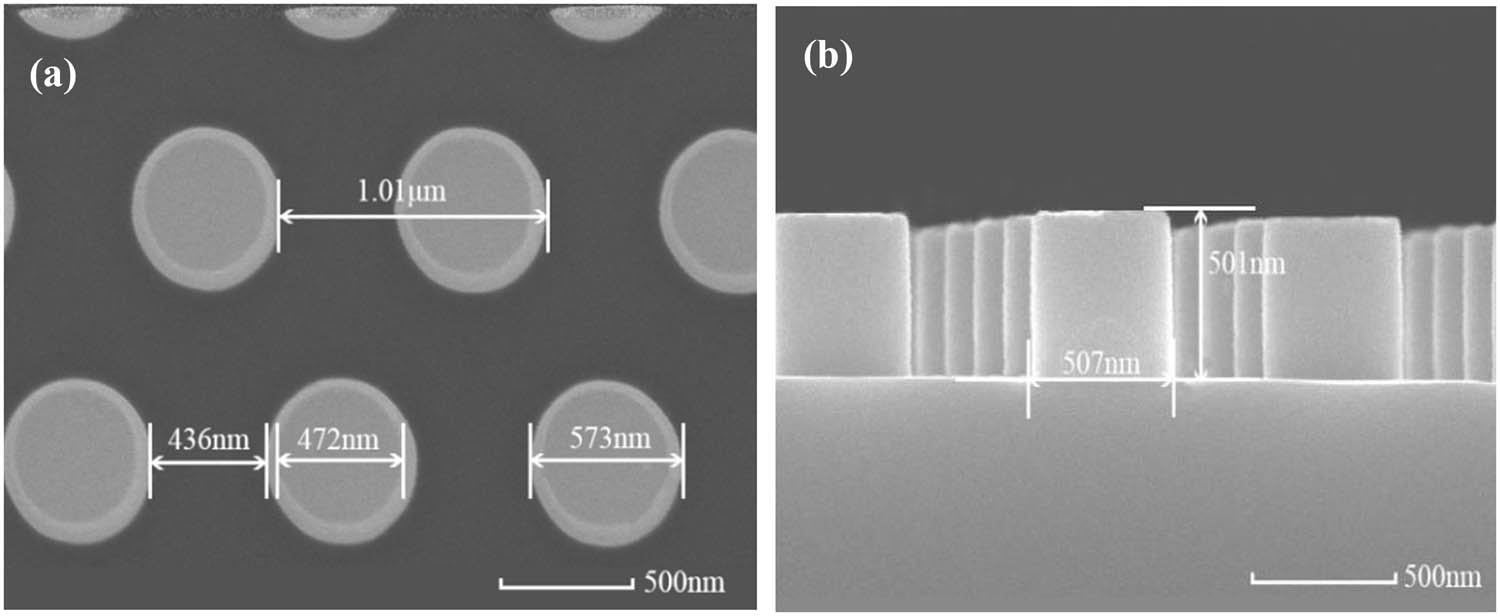
(a) Overhead and (b) cross-sectional SEM micrographs of nanostructured surface.
2.2 Optical characteristics
The transmittance spectra of samples were measured using a spectrophotometer (Lambda 950, Perkin Elmer Company, Waltham, MA, US). The spectral curves for the samples are displayed in Figure 3. Figure (a) shows the measured spectral curves and the simulated curves for the samples as a function of wavelength. Figure (b) is a magnified view of Figure (a). The transmittance can be presented more clearly. The blue unmarked and the black cross-curves represent the simulated and measured curves of the structural surface, while the green asterisk-marked and red triangle-marked curves correspond to the simulated and measured curves of the SiO2 film, respectively.
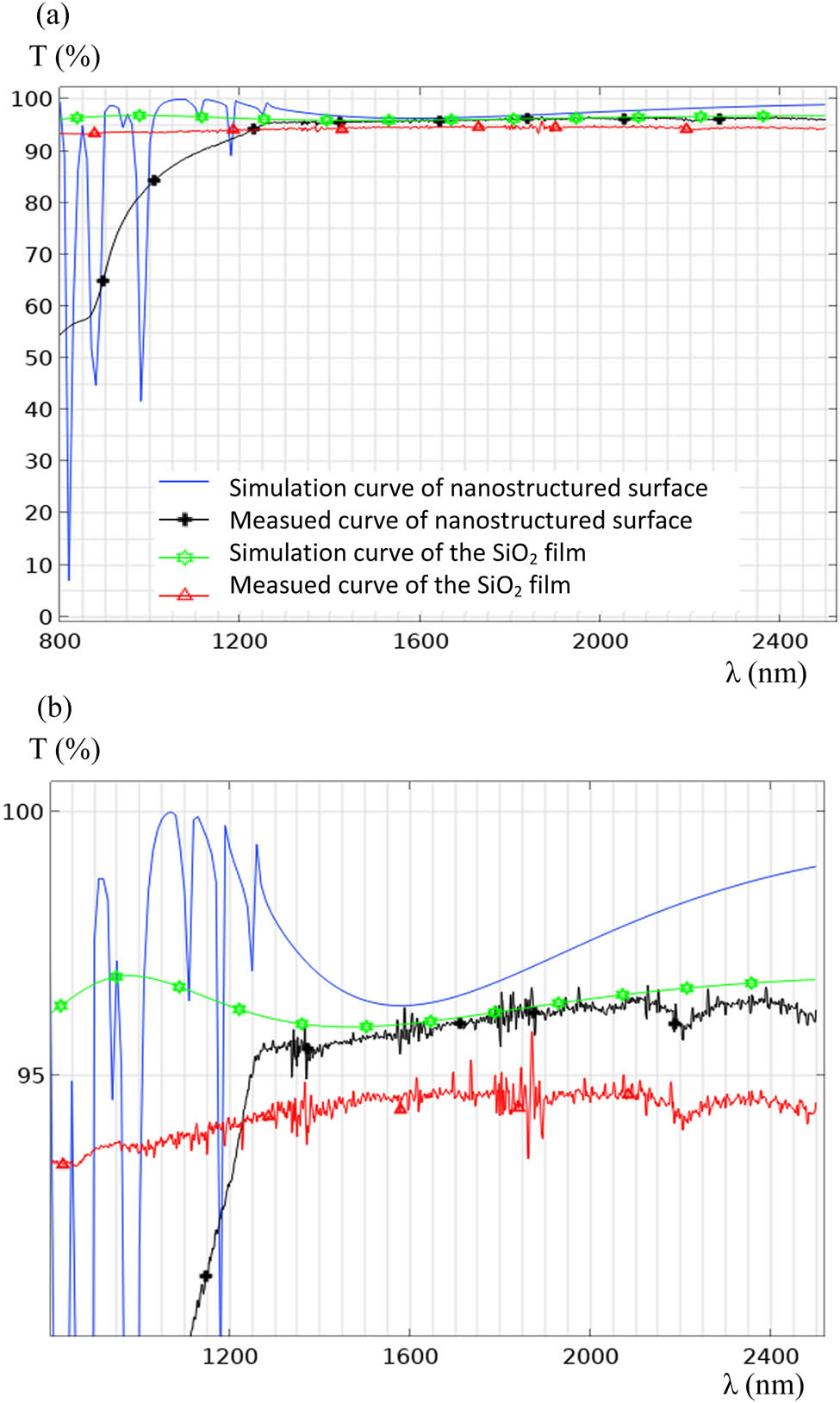
Transmittance of the samples: (a) comparison of measured and simulated transmittance spectra of the samples as a function of wavelength at normal incidence and (b) the partial enlarged view.
From 1,250 to 2,400 nm, the average simulated and measured transmittance of the structural surface is 97.5 and 95.8%, and the average simulated and measured transmittance of the SiO2 film with a thickness of 500 nm is 96.1 and 94.2%, respectively. Although the measured transmittance is almost 2% lower than the simulated transmittance, it is reasonable because the simulation only considered one surface and did not account for the reflection loss at the back and the interface of the samples.
In the range of 800 and 1,250 nm, the simulated transmittance of the structural surface oscillates due to the appearance of higher-order diffraction for the surface of the periodic distribution structure, where the period and wavelength satisfy the diffraction formula, as shown in formula (1) [32]. The measured transmittance curve is consistent with the average value of the simulated transmittance:
where Λ, n s, n 0, and λ represent the period of the structural surface, the refractive index of silica material and air, and the wavelength of light wave, respectively. α and β m represent the incidence angle and the diffraction angle of the m-order diffraction order, respectively, where m is the diffraction order. When m = 0, this is known as the reflection law. Without higher-order diffraction above order 2, formula (1) is further transformed into formula (2):
The refractive indices of silica and air are 1.49 and 1, respectively. The magnitude of a sine function is always less than or equal to 1. As shown in Eq. (2), for an average measured period of 1.01 μm, there is no high-order diffraction on the structural surfaces, and the incident wavelengths should be greater than 1,257 nm. It is not difficult to see that the simulated transmittance curve is in good agreement with the measured curve.
2.3 Experimental setup for testing laser-induced damage
According to the ISO21254-2 standard [33], the experimental setup schematic for testing the LIDT of samples is illustrated in Figure 4 [16]. The Nd: YAG laser beam is guided through the expanding system and subsequently focused into the attenuator. The attenuation is meticulously fine-tuned to achieve the desired laser energy output. To divide the beam into two separate paths, a spectroscope is employed. One of the split beams is measured by an energy meter, while the other is directed onto the sample surface via the lens. The energy meter reading is then used to determine the exact amount of laser energy applied to the sample surface. The laser operates at 1,064 nm with a pulse width of 10 ns. The light spot is Gaussian with a maximum energy of 400 mJ and a diameter of 0.8 mm.
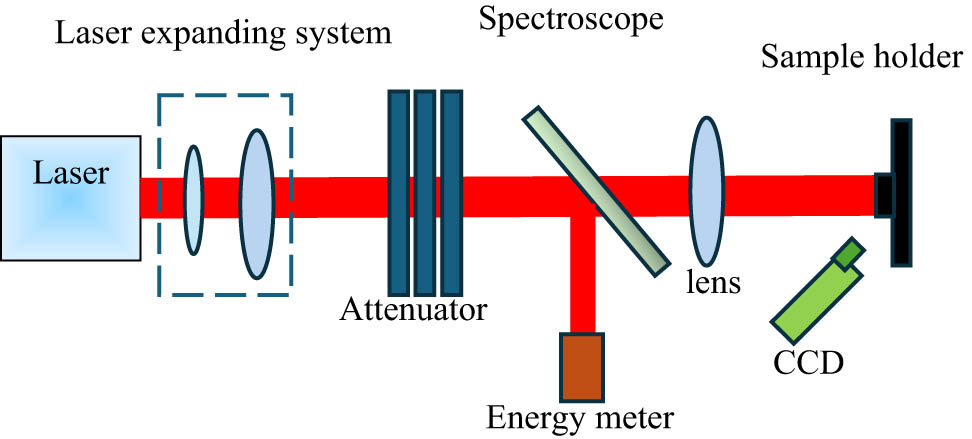
Scheme of the LIDT testing system for optical elements.
The LIDT is a crucial parameter for assessing the laser damage resistance of optical components. According to the ISO21254 standard, a “1-on-1” zero-probability damage test method is used to determine the LIDTs for optical components in this study. Specific operations are as follows: this involves irradiating different points on the surface of a sample with a single pulse of specific energy. Each point is only irradiated once, and the number of damaged points is recorded. The imaging method is utilized to identify the damaged point, while CCD is used to capture images before and after laser irradiation to determine whether the point is damaged. The damage probability at each level is calculated as p = m/k, where m is the number of damaged points and k is the total number of irradiated points. The more energy levels measured, the closer to the true value, and the energy level should cover the damage probability range from 0 to 100%. Before the formal test, damage energy was predicted at the sample’s edge to identify the maximum energy that does not cause damage and the minimum energy that does. The energy level is usually set to 10, ranging from 0 to 100%, and each level is tested at least 10 times. The horizontal axis represents the energy density, while the vertical axis represents the damage probability. Each dot illustrates the damage probability at a specific energy level. These points are fitted to a straight line using the least-squares method in Matlab. The intersection of this line with the horizontal axis indicates the energy density corresponding to a damage probability of zero, defined as the zero-probability laser damage threshold for the component.
3 Laser-induced damage test results
The LIDT test results for the samples are shown in Figure 5, where the blue dots depict the damage probabilities of the structural surface and the orange dots show the damage probabilities of the SiO2 film at various fluence levels. The blue and orange lines correspond to fitting lines of the structural surface and SiO2 film damage probabilities, respectively. The points where the lines intersect the y-axis reveal the energy density of the samples at which the damage probability is zero, known as the LIDTs of the samples. At a confidence level of 95%, it has been shown that the LIDT of the structural surface and the SiO2 film are (15.3 ± 1.15) J/cm2 and (15.2 ± 1.09) J/cm2, respectively.

LIDTs of the samples.
The data processing methods and details align with our previous work [34]. These measurements were taken in a controlled environment at 22 ± 1°C and 45 ± 5% relative humidity to ensure accuracy and reproducibility. It is demonstrated that the laser damage resistance of the structural surface is not decreased compared to the nonstructured SiO2 film. Typically, as the number of layers increases, the LIDT decreases due to material mismatch, film absorption, interface defects, and other factors. The LIDT varies with the thickness of single-layer films [16]. In contrast to the LIDT values of 12.3 and 12.8 J/cm2 (1,064 nm, 12 ns, 1-on-1) for traditional antireflection films [35], the structural surface shows promising advantages in light damage resistance.
Figure 6 shows a typical damage profile taken by a polarizing microscope (KEYENCE, VHX-7000, Japan). The pattern of damage is in the shape of a regular hexagon. The damage spot has a transverse size of 0.18 mm, which is smaller than the 0.8 mm diameter. It is not difficult to find that the typical damage morphology is related to the periodic cylindrical distribution pattern. This damage morphology is consistent in multiple test samples.

Damage morphology of the nanostructured surface.
4 Discussions
To understand the formation mechanism of damage, the surface EFD of the structural surface and the homogeneous substrate (SiO2 film with 500 nm thickness) was simulated by finite element method. The “elements” are numerically simulated using Floquet periodic boundary conditions based on the structure’s periodic surface distribution characteristics. The triangular grid divides the geometric model, and near the structural elements is a denser grid that is one-tenth the size of the structural elements. We set the relative tolerance to 0.01 to address the convergence problem. The surface of the sample is vertically incident with a 1,064 nm pulsed laser. Figure 6 shows the EFD on the surface when the peak power of the laser incident is 1 W. The effect of surface EFD on laser damage was explored. TE and TM polarizations are fundamental modes that influence the EFD of the structured surface. Thus, simulating the EFD for the two modes on the structure’s surface is essential. A lower electric field strength of the surface is beneficial to obtaining the optical device with a higher LIDT. Figure 7(a) shows the EFD diagram of the unstructured surface, while Figure 7(b) and (c) displays the EFD diagram of the structured surface with cylindrical periodic distribution for the TM and TE polarization incidents, respectively. The setup of coordinate axes is shown in Figure 7. The substrate plane is parallel to the XOY plane. When the magnetic field component Hy of the incident light is parallel to the y-axis, it is a TM wave; when the electric field component Ey of the incident light is parallel to the y-axis, it is a TE wave.

EFD on the surface of the samples: (a) EFD diagram of the unstructured surface, (b) EFD diagram of the structured surface with cylindrical periodic distribution for the TM wave, and (c) EFD diagram of the structured surface with cylindrical periodic distribution for the TE wave.
From Figure 7, we can see that the electric field intensity on the film surface is higher than at the interface. The most intense electric field occurs at the interface between the column’s base and the air, a pattern that remains consistent for both the TM and the TE waves. When the laser incident conditions are the same, the electric field intensity at the bottom of the cylinder and the air interface is higher than that on the surface of the film.
The inherent LIDT of the optical material is defined according to the plasma spark, as shown in Formula (3) [36], where c represents the speed of light; ε is the dielectric constant of the material; Time t c is the time when the initial electron density in the conduction band rises to the critical electron density; and E denotes the electric field strength corresponding to the critical electron density of free electrons in the conduction band. According to the relation between the electric field intensity and LIDT, the intrinsic LIDT of the material is related to the electric field intensity at the critical electron density. This means that under the same laser incident conditions, the electric field intensity caused by the surface is lower compared to other surfaces, yet it exhibits a high resistance to laser damage.
However, this was not the case. The LIDT of a material is influenced by both intrinsic and extrinsic factors. Intrinsic factors include linear and nonlinear absorption, as well as nonlinear phenomena such as self-focusing, stimulated Raman and Brillouin scattering, and electron avalanche breakdown. Extrinsic factors involve material defects, impurities, inclusions, and the quality of surface finishing. Despite structural differences, similar LIDT values can be observed due to the compensation of these factors. The physical mechanisms underlying LIDT values involve the interaction of the laser with the material, leading to the creation of defects and the subsequent propagation of these defects under the influence of the laser field. The boundary shape of the damaged appearance can rule out the defect as a cause. The structured surfaces in our study, despite their differences, may have similar defect densities or similar quality of surface finishing, which could contribute to similar LIDT values. The distribution of the electromagnetic field within the material is also crucial. The structured surfaces may couple differently with the incident laser, affecting the EFD. The surface that couples more energy from the laser will have a lower damage threshold due to higher field strength and energy density via constructive interference. However, if the structured surfaces are designed in such a way that they distribute the laser energy more evenly, they could exhibit similar LIDT values despite structural differences. Additionally, the electronic structure of the material plays a significant role in the observed damage threshold as a function of photon energy. Materials with similar electronic structures may require the same order of absorption process for electronic excitation, leading to similar LIDT values despite differences in structure.
In conclusion, the LIDT of a material is influenced by intrinsic and extrinsic factors. Intrinsic factors include linear and nonlinear absorption, as well as phenomena such as self-focusing, stimulated Raman and Brillouin scattering, and electron avalanche breakdown. Extrinsic factors encompass material defects, impurities, inclusions, and surface quality. Despite structural differences, similar LIDT values can arise from the compensation of these factors. The inherent LIDT of the material is usually much higher than the actual LIDT, and the actual material damage caused by the electric field may not be the only reason for the material damage.
For structural surfaces, laser-induced damage is not solely dictated by the surface electric field, i.e., the LIDT of the structure surface is equivalent to that of its homogeneous substrate. This shows that the structure regulates the energy of the laser deposition and the damage mechanism is complicated due to the existence of the structured surface. The damage morphology suggests that the damage mode may be linked to a thermoelastic mechanism due to the periodic structure [37,38], although the specific damage process requires further investigation. Future research should prioritize analyzing the thermal effects on the structural surface and conducting stress analyses. Additionally, studying the impact of nanosecond pulse duration on damage will enhance our understanding of laser-induced damage to the structural surface.
The findings on damage morphology and LIDT emphasize the importance of structural surface design. The anti-reflection effect is achieved through this structural design, allowing the desired optical transmittance to be attained with just one layer, unlike traditional optical films that require multiple layers. Furthermore, our analysis of the LIDT revealed that, unlike the typical trend of decreasing LIDT with more layers, our structured surface maintains a comparable or even superior LIDT compared to single-layer thin films. This signifies a significant advantage, suggesting that the structured design can enhance laser damage resistance without additional layers, making it particularly beneficial for applications where multilayer films are impractical or undesirable.
5 Conclusions
In this study, we have designed and characterized a single-layer surface with a cylindrical periodic structure, investigating its optical properties and resistance to laser-induced damage. Our findings reveal that within the spectral range of 1,250–2,400 nm, the transmittance of the cylindrical periodic structured surface exceeds that of its homogeneous counterpart. The LIDTs for the cylindrical periodic structure and the homogeneous substrate are determined to be (15.3 ± 1.15) J/cm² and (15.2 ± 1.09) J/cm², respectively. These findings indicate a negligible difference in their susceptibility to laser damage, suggesting that the periodic structure does not significantly impact the material’s durability.
The finite element method simulated the surface EFD while excluding electric field enhancement as a direct factor in structured surface damage. The damage morphology of the structure indicates that the damage mode relates to the distribution of micro/nanostructures, and the arrangement of surface “units” influences laser energy deposition. These micro/nanostructures complicate the laser damage mechanism and impact overall laser damage performance. Further research is required to understand the specific damage process.
Acknowledgments
This research was funded by the National Natural Science Foundation of China (No. 61378050) and the University-Level Research Project of Shaanxi University of Technology (X20240026).
-
Funding information: This research was funded by the National Natural Science Foundation of China (No. 61378050) and the University-Level Research Project of Shaanxi University of Technology (X20240026).
-
Author contributions: All authors have accepted responsibility for the entire content of this manuscript and approved its submission.
-
Conflict of interest: The authors state no conflict of interest.
-
Data availability statement: The datasets generated and/or analyzed during the current study are available from the corresponding author on reasonable request.
References
[1] Moses EI, Lindl JD, Spaeth ML, Patterson RW, Sawicki RH, Atherton LJ, et al. Overview: Development of the national, ignition facility and the transition to a user facility for the ignition campaign and high energy density scientific research. Fusion Sci Technol. 2016;69(1):1–24.10.13182/FST15-128Search in Google Scholar
[2] Manenkov AM. Fundamental mechanisms of laser-induced damage in optical materials: today’s state of understanding and problems. Opt Eng. 2014;53(1):010901.10.1117/1.OE.53.1.010901Search in Google Scholar
[3] Li X, Zhou Y, Ge S, Wang G, Li S, Liu Z, et al. Experimental demonstration of optical trapping and manipulation with multifunctional metasurface. Opt Lett. 2022;47:977–80.10.1364/OL.450490Search in Google Scholar PubMed
[4] Zhang JH, Kivshar Y. Quantum metaphotonics: recent advances and perspective. APL Quantum. 2024;1(2):020902.10.1063/5.0201107Search in Google Scholar
[5] Kuo HY, Vyas S, Chu CH, Chen MK, Shi X, Misawa H, et al. Cubic-phase metasurface for three-dimensional optical manipulation. Nanomaterials. 2021;11:1730.10.3390/nano11071730Search in Google Scholar PubMed PubMed Central
[6] Xu Y, Su XR, Chai Z, Li JL. Metasurfaces toward optical manipulation technologies for quantum precision measurement. Laser Photonics Rev. 2024;18(3):2300355.10.1002/lpor.202300355Search in Google Scholar
[7] Li YF, Zhang JH, Yang B. Antireflective surfaces based on biomimetic nanopillared arrays. Nano Today. 2010;5:117–27.10.1016/j.nantod.2010.03.001Search in Google Scholar
[8] Yang J, Yang J, Fu YG, Wu JS, Ouyang MZ, Dong LT, et al. Design and manufacturing of mid-infrared ultra-wide-angle antireflective composite micro-nano structure film. Opt Mater. 2024;149:115137.10.1016/j.optmat.2024.115137Search in Google Scholar
[9] Chen YA, Sharan VN, Luo ZR, Chang CH. Enhancing optical transmission of multilayer composites using interfacial nanostructures. J Appl Phys. 2019;126(6):063101.10.1063/1.5097832Search in Google Scholar
[10] Yang H, Cheng J, Liu ZC, Liu Q, Zhao LJ, Wang J, et al. Dynamic behavior modeling of laser-induced damage initiated by surface defects on KDP crystals under nanosecond laser irradiation. Sci Rep. 2020;10(1):500.10.1038/s41598-019-57300-2Search in Google Scholar PubMed PubMed Central
[11] Cheng XB, Wang ZS. Defect-related properties of optical coatings. Adv Opt Technol. 2014;3:65–90.10.1515/aot-2013-0063Search in Google Scholar
[12] Stolz CJ, Negres RA. Ten-year summary of the Boulder Damage Symposium annual thin film laser damage competition. Opt Eng. 2018;57:121910.10.1117/1.OE.57.12.121910Search in Google Scholar
[13] Dong S, Jiao H, Wang Z, Zhang J, Cheng X. Interface and defects engineering for multilayer laser coatings. Prog Surf Sci. 2022;97(3):100663.10.1016/j.progsurf.2022.100663Search in Google Scholar
[14] Du Y, Wu X, Zhu MP, Le ZC. Theoretical and experimental research on laser-induced damage of cylindrical subwavelength grating. Opt Express. 2015;23(19):24296–307.10.1364/OE.23.024296Search in Google Scholar PubMed
[15] Ye X, Huang J, Geng F, Liu HJ, Sun LX, Yan LH, et al. High power laser antireflection subwavelength grating on fused silica by colloidal lithography. J Phys D Appl Phys. 2016;49(26):265104.10.1088/0022-3727/49/26/265104Search in Google Scholar
[16] Li Y, Su JH, Xu JQ, Yang LH, Yang G. Optical and laser-induced damage characterization of porous structural silicon oxide film with hexagonal period by nanoimprint lithography. Coatings. 2022;12(3):351.10.3390/coatings12030351Search in Google Scholar
[17] Li Y, Su JH, Xu JQ, Yang G. Characterization of damage morphology of structural SiO2 film induced by nanosecond pulsed laser. Open Phys. 2022;20(1):724–9.10.1515/phys-2022-0060Search in Google Scholar
[18] Li Y, Su JH, Xu JQ, Yang LH, Chen D, Yang GL. Polarization characteristics of the near-field distribution of one-dimensional subwavelength gratings. IEEE Access. 2021;9:24814–22.10.1109/ACCESS.2021.3057084Search in Google Scholar
[19] Zahra N, Hamidreza F, Morteza H, Mehdi M. Investigation of the laser induced damage thresholds of all-dielectric and metal-dielectric mirrors for a continuous wave at 10.6 μm. Opt Mater. 2021;114:110936.10.1016/j.optmat.2021.110936Search in Google Scholar
[20] Jiao HF, Zhang JL. Research on damage mechanism and application of nanosecond laser coatings. Opt Precis Eng. 2022;30(21):2568–90.10.37188/OPE.20223021.2568Search in Google Scholar
[21] Han YX, Jin YX, Kong FY, Wang YL, Zhang YB, Cao HC, et al. High-repetition-rate and multi-pulse ultrashort laser damage of gold-coated photoresist grating. Appl Surf Sci. 2022;576:151819.10.1016/j.apsusc.2021.151819Search in Google Scholar
[22] Li Z, Xia Z. The damage mechanism and process of metal multi-layer dielectric gratings induced by ps-pulsed laser. Appl Surf Sci. 2019;494(Nov.15):977–82.10.1016/j.apsusc.2019.07.084Search in Google Scholar
[23] Lin XK, Zhao Y, Liu XF, Li D, Shuai K, Ma H, et al. Damage characteristics of pulse compression grating irradiated by a nanosecond laser. Opt Mater Express. 2022;12(2):643–52.10.1364/OME.449428Search in Google Scholar
[24] Golosov DA, Vilya N, Zavadski SM, Melnikov SN, Avramchuk AV, Grekhov MM, et al. Influence of film thickness on the dielectric characteristics of hafnium oxide layers. Thin Solid Film. 2019;690:137517.10.1016/j.tsf.2019.137517Search in Google Scholar
[25] Shawon A, Pallabi P, Vivek B, Paul S, Olaf S, Marcus T, et al. Heterostructure films of SiO2 and HfO2 for high power laser optics prepared by plasma-enhanced atomic layer deposition. Coatings. 2023;13(2):278–8.10.3390/coatings13020278Search in Google Scholar
[26] Gao L, Lemarchand F, Lequime M. Refractive index determination of SiO2 layer in the UV/Vis/NIR range: Spectrophotometric reverse engineering on single and bi-layer designs. J Eur Opt Soc Rapid Publ. 2013;8:13010.10.2971/jeos.2013.13010Search in Google Scholar
[27] Liu H. Atomic layer deposition for high power laser applications: Al2O3 and HfO2. Phd dissertation, Leibniz University, Hannover, Germany; 2018.Search in Google Scholar
[28] Congcong L, Yuan Z, Qing Z, Jinjin L, Wenhui C, Xueshen W, et al. Low-temperature deposition of high-quality SiO2 films with a sloped sidewall profile for vertical step coverage. Coatings. 2022;12(10):1411.10.3390/coatings12101411Search in Google Scholar
[29] Mehrvar L, Drogoff BL, Menard M, Chaker M. TEOS-PECVD films for high-quality SiO2 cladding layers in Si3N4-photonics with low mechanical stress and optical loss. 2024 Photonics North (PN). Vancouver, BC, Canada; 2024. p. 1–2.10.1109/PN62551.2024.10621767Search in Google Scholar
[30] Wan LL, Yang J, Liu XR, Zhu JY, Xu G, Hao CC, et al. Enhanced antireflective and laser damage resistance of refractive-index gradient SiO2 nanostructured films at 1064 nm. Pol J Chem Technol. 2024;26(2):25–30.10.2478/pjct-2024-0014Search in Google Scholar
[31] RefractiveIndex.INFO website: © 2008-2022 Mikhail Polyanskiy [EB/OL]. [2008-2022] https://refractiveindex.info/?shelf=main&book=SiO2&page=Lemarchand.Search in Google Scholar
[32] Lai M, Sridharan GM, Parish G, Bhattacharya S, Keating A. Multilayer porous silicon diffraction gratings operating in the infrared. Nanoscale Res Lett. 2012;7:645.10.1186/1556-276X-7-645Search in Google Scholar PubMed PubMed Central
[33] Lasers and laser-related equipment. Test methods for laser-induced damage threshold. Standard ISO 21254:2011, International Organization for Standardization (2011).Search in Google Scholar
[34] Li Y, Su J, Xu J, Yang L, Yang G. Fitting model of laser-induced damage threshold for optical elements with periodic surface. Laser Optoelectron Prog. 2022;59(23):2320001.10.3788/LOP202259.2320001Search in Google Scholar
[35] Xu JQ, Su JH, Hui YX, Cheng YJ. Laser damage properties of 1064 nm anti-reflective films with different electric field distributions. J Optoelectron Laser. 2012;23(7):1268–73.Search in Google Scholar
[36] Shang X, Zhang R, Ma P. Analysis of avalanche mechanisms in short-pulses laser-induced damage. Opt Laser Technol. 2010;42(1):234–46.10.1016/j.optlastec.2009.04.014Search in Google Scholar
[37] Marin M, Hobiny A, Abbas I. The effects of fractional time derivatives in porothermoelastic materials using finite element method. Mathematics. 2021;9(14):1606.10.3390/math9141606Search in Google Scholar
[38] Sherief HH, El-Maghraby NM, Abbas MF. Two-dimensional axisymmetric thermoelastic problem for an infinite-space with a cylindrical heat source of a different material under Green–Lindsay theory. Mech Des Struct Mach. 2022;50(10):3404–16.10.1080/15397734.2020.1807361Search in Google Scholar
© 2025 the author(s), published by De Gruyter
This work is licensed under the Creative Commons Attribution 4.0 International License.
Articles in the same Issue
- Research Articles
- Single-step fabrication of Ag2S/poly-2-mercaptoaniline nanoribbon photocathodes for green hydrogen generation from artificial and natural red-sea water
- Abundant new interaction solutions and nonlinear dynamics for the (3+1)-dimensional Hirota–Satsuma–Ito-like equation
- A novel gold and SiO2 material based planar 5-element high HPBW end-fire antenna array for 300 GHz applications
- Explicit exact solutions and bifurcation analysis for the mZK equation with truncated M-fractional derivatives utilizing two reliable methods
- Optical and laser damage resistance: Role of periodic cylindrical surfaces
- Numerical study of flow and heat transfer in the air-side metal foam partially filled channels of panel-type radiator under forced convection
- Water-based hybrid nanofluid flow containing CNT nanoparticles over an extending surface with velocity slips, thermal convective, and zero-mass flux conditions
- Dynamical wave structures for some diffusion--reaction equations with quadratic and quartic nonlinearities
- Solving an isotropic grey matter tumour model via a heat transfer equation
- Study on the penetration protection of a fiber-reinforced composite structure with CNTs/GFP clip STF/3DKevlar
- Influence of Hall current and acoustic pressure on nanostructured DPL thermoelastic plates under ramp heating in a double-temperature model
- Applications of the Belousov–Zhabotinsky reaction–diffusion system: Analytical and numerical approaches
- AC electroosmotic flow of Maxwell fluid in a pH-regulated parallel-plate silica nanochannel
- Interpreting optical effects with relativistic transformations adopting one-way synchronization to conserve simultaneity and space–time continuity
- Modeling and analysis of quantum communication channel in airborne platforms with boundary layer effects
- Theoretical and numerical investigation of a memristor system with a piecewise memductance under fractal–fractional derivatives
- Tuning the structure and electro-optical properties of α-Cr2O3 films by heat treatment/La doping for optoelectronic applications
- High-speed multi-spectral explosion temperature measurement using golden-section accelerated Pearson correlation algorithm
- Dynamic behavior and modulation instability of the generalized coupled fractional nonlinear Helmholtz equation with cubic–quintic term
- Study on the duration of laser-induced air plasma flash near thin film surface
- Exploring the dynamics of fractional-order nonlinear dispersive wave system through homotopy technique
- The mechanism of carbon monoxide fluorescence inside a femtosecond laser-induced plasma
- Numerical solution of a nonconstant coefficient advection diffusion equation in an irregular domain and analyses of numerical dispersion and dissipation
- Numerical examination of the chemically reactive MHD flow of hybrid nanofluids over a two-dimensional stretching surface with the Cattaneo–Christov model and slip conditions
- Impacts of sinusoidal heat flux and embraced heated rectangular cavity on natural convection within a square enclosure partially filled with porous medium and Casson-hybrid nanofluid
- Stability analysis of unsteady ternary nanofluid flow past a stretching/shrinking wedge
- Solitonic wave solutions of a Hamiltonian nonlinear atom chain model through the Hirota bilinear transformation method
- Bilinear form and soltion solutions for (3+1)-dimensional negative-order KdV-CBS equation
- Solitary chirp pulses and soliton control for variable coefficients cubic–quintic nonlinear Schrödinger equation in nonuniform management system
- Influence of decaying heat source and temperature-dependent thermal conductivity on photo-hydro-elasto semiconductor media
- Dissipative disorder optimization in the radiative thin film flow of partially ionized non-Newtonian hybrid nanofluid with second-order slip condition
- Bifurcation, chaotic behavior, and traveling wave solutions for the fractional (4+1)-dimensional Davey–Stewartson–Kadomtsev–Petviashvili model
- New investigation on soliton solutions of two nonlinear PDEs in mathematical physics with a dynamical property: Bifurcation analysis
- Mathematical analysis of nanoparticle type and volume fraction on heat transfer efficiency of nanofluids
- Creation of single-wing Lorenz-like attractors via a ten-ninths-degree term
- Optical soliton solutions, bifurcation analysis, chaotic behaviors of nonlinear Schrödinger equation and modulation instability in optical fiber
- Chaotic dynamics and some solutions for the (n + 1)-dimensional modified Zakharov–Kuznetsov equation in plasma physics
- Fractal formation and chaotic soliton phenomena in nonlinear conformable Heisenberg ferromagnetic spin chain equation
- Single-step fabrication of Mn(iv) oxide-Mn(ii) sulfide/poly-2-mercaptoaniline porous network nanocomposite for pseudo-supercapacitors and charge storage
- Novel constructed dynamical analytical solutions and conserved quantities of the new (2+1)-dimensional KdV model describing acoustic wave propagation
- Tavis–Cummings model in the presence of a deformed field and time-dependent coupling
- Spinning dynamics of stress-dependent viscosity of generalized Cross-nonlinear materials affected by gravitationally swirling disk
- Design and prediction of high optical density photovoltaic polymers using machine learning-DFT studies
- Robust control and preservation of quantum steering, nonlocality, and coherence in open atomic systems
- Coating thickness and process efficiency of reverse roll coating using a magnetized hybrid nanomaterial flow
- Dynamic analysis, circuit realization, and its synchronization of a new chaotic hyperjerk system
- Decoherence of steerability and coherence dynamics induced by nonlinear qubit–cavity interactions
- Finite element analysis of turbulent thermal enhancement in grooved channels with flat- and plus-shaped fins
- Modulational instability and associated ion-acoustic modulated envelope solitons in a quantum plasma having ion beams
- Statistical inference of constant-stress partially accelerated life tests under type II generalized hybrid censored data from Burr III distribution
- On solutions of the Dirac equation for 1D hydrogenic atoms or ions
- Entropy optimization for chemically reactive magnetized unsteady thin film hybrid nanofluid flow on inclined surface subject to nonlinear mixed convection and variable temperature
- Stability analysis, circuit simulation, and color image encryption of a novel four-dimensional hyperchaotic model with hidden and self-excited attractors
- A high-accuracy exponential time integration scheme for the Darcy–Forchheimer Williamson fluid flow with temperature-dependent conductivity
- Novel analysis of fractional regularized long-wave equation in plasma dynamics
- Development of a photoelectrode based on a bismuth(iii) oxyiodide/intercalated iodide-poly(1H-pyrrole) rough spherical nanocomposite for green hydrogen generation
- Investigation of solar radiation effects on the energy performance of the (Al2O3–CuO–Cu)/H2O ternary nanofluidic system through a convectively heated cylinder
- Quantum resources for a system of two atoms interacting with a deformed field in the presence of intensity-dependent coupling
- Studying bifurcations and chaotic dynamics in the generalized hyperelastic-rod wave equation through Hamiltonian mechanics
- A new numerical technique for the solution of time-fractional nonlinear Klein–Gordon equation involving Atangana–Baleanu derivative using cubic B-spline functions
- Interaction solutions of high-order breathers and lumps for a (3+1)-dimensional conformable fractional potential-YTSF-like model
- Hydraulic fracturing radioactive source tracing technology based on hydraulic fracturing tracing mechanics model
- Numerical solution and stability analysis of non-Newtonian hybrid nanofluid flow subject to exponential heat source/sink over a Riga sheet
- Numerical investigation of mixed convection and viscous dissipation in couple stress nanofluid flow: A merged Adomian decomposition method and Mohand transform
- Effectual quintic B-spline functions for solving the time fractional coupled Boussinesq–Burgers equation arising in shallow water waves
- Analysis of MHD hybrid nanofluid flow over cone and wedge with exponential and thermal heat source and activation energy
- Solitons and travelling waves structure for M-fractional Kairat-II equation using three explicit methods
- Impact of nanoparticle shapes on the heat transfer properties of Cu and CuO nanofluids flowing over a stretching surface with slip effects: A computational study
- Computational simulation of heat transfer and nanofluid flow for two-sided lid-driven square cavity under the influence of magnetic field
- Irreversibility analysis of a bioconvective two-phase nanofluid in a Maxwell (non-Newtonian) flow induced by a rotating disk with thermal radiation
- Hydrodynamic and sensitivity analysis of a polymeric calendering process for non-Newtonian fluids with temperature-dependent viscosity
- Exploring the peakon solitons molecules and solitary wave structure to the nonlinear damped Kortewege–de Vries equation through efficient technique
- Modeling and heat transfer analysis of magnetized hybrid micropolar blood-based nanofluid flow in Darcy–Forchheimer porous stenosis narrow arteries
- Activation energy and cross-diffusion effects on 3D rotating nanofluid flow in a Darcy–Forchheimer porous medium with radiation and convective heating
- Insights into chemical reactions occurring in generalized nanomaterials due to spinning surface with melting constraints
- Influence of a magnetic field on double-porosity photo-thermoelastic materials under Lord–Shulman theory
- Soliton-like solutions for a nonlinear doubly dispersive equation in an elastic Murnaghan's rod via Hirota's bilinear method
- Analytical and numerical investigation of exact wave patterns and chaotic dynamics in the extended improved Boussinesq equation
- Nonclassical correlation dynamics of Heisenberg XYZ states with (x, y)-spin--orbit interaction, x-magnetic field, and intrinsic decoherence effects
- Exact traveling wave and soliton solutions for chemotaxis model and (3+1)-dimensional Boiti–Leon–Manna–Pempinelli equation
- Unveiling the transformative role of samarium in ZnO: Exploring structural and optical modifications for advanced functional applications
- On the derivation of solitary wave solutions for the time-fractional Rosenau equation through two analytical techniques
- Analyzing the role of length and radius of MWCNTs in a nanofluid flow influenced by variable thermal conductivity and viscosity considering Marangoni convection
- Advanced mathematical analysis of heat and mass transfer in oscillatory micropolar bio-nanofluid flows via peristaltic waves and electroosmotic effects
- Exact bound state solutions of the radial Schrödinger equation for the Coulomb potential by conformable Nikiforov–Uvarov approach
- Some anisotropic and perfect fluid plane symmetric solutions of Einstein's field equations using killing symmetries
- Nonlinear dynamics of the dissipative ion-acoustic solitary waves in anisotropic rotating magnetoplasmas
- Curves in multiplicative equiaffine plane
- Exact solution of the three-dimensional (3D) Z2 lattice gauge theory
- Propagation properties of Airyprime pulses in relaxing nonlinear media
- Symbolic computation: Analytical solutions and dynamics of a shallow water wave equation in coastal engineering
- Wave propagation in nonlocal piezo-photo-hygrothermoelastic semiconductors subjected to heat and moisture flux
- Comparative reaction dynamics in rotating nanofluid systems: Quartic and cubic kinetics under MHD influence
- Laplace transform technique and probabilistic analysis-based hypothesis testing in medical and engineering applications
- Physical properties of ternary chloro-perovskites KTCl3 (T = Ge, Al) for optoelectronic applications
- Gravitational length stretching: Curvature-induced modulation of quantum probability densities
- The search for the cosmological cold dark matter axion – A new refined narrow mass window and detection scheme
- A comparative study of quantum resources in bipartite Lipkin–Meshkov–Glick model under DM interaction and Zeeman splitting
- PbO-doped K2O–BaO–Al2O3–B2O3–TeO2-glasses: Mechanical and shielding efficacy
- Nanospherical arsenic(iii) oxoiodide/iodide-intercalated poly(N-methylpyrrole) composite synthesis for broad-spectrum optical detection
- Sine power Burr X distribution with estimation and applications in physics and other fields
- Numerical modeling of enhanced reactive oxygen plasma in pulsed laser deposition of metal oxide thin films
- Dynamical analyses and dispersive soliton solutions to the nonlinear fractional model in stratified fluids
- Computation of exact analytical soliton solutions and their dynamics in advanced optical system
- An innovative approximation concerning the diffusion and electrical conductivity tensor at critical altitudes within the F-region of ionospheric plasma at low latitudes
- An analytical investigation to the (3+1)-dimensional Yu–Toda–Sassa–Fukuyama equation with dynamical analysis: Bifurcation
- Swirling-annular-flow-induced instability of a micro shell considering Knudsen number and viscosity effects
- Numerical analysis of non-similar convection flows of a two-phase nanofluid past a semi-infinite vertical plate with thermal radiation
- MgO NPs reinforced PCL/PVC nanocomposite films with enhanced UV shielding and thermal stability for packaging applications
- Optimal conditions for indoor air purification using non-thermal Corona discharge electrostatic precipitator
- Investigation of thermal conductivity and Raman spectra for HfAlB, TaAlB, and WAlB based on first-principles calculations
- Tunable double plasmon-induced transparency based on monolayer patterned graphene metamaterial
- DSC: depth data quality optimization framework for RGBD camouflaged object detection
- A new family of Poisson-exponential distributions with applications to cancer data and glass fiber reliability
- Numerical investigation of couple stress under slip conditions via modified Adomian decomposition method
- Monitoring plateau lake area changes in Yunnan province, southwestern China using medium-resolution remote sensing imagery: applicability of water indices and environmental dependencies
- Heterodyne interferometric fiber-optic gyroscope
- Exact solutions of Einstein’s field equations via homothetic symmetries of non-static plane symmetric spacetime
- A widespread study of discrete entropic model and its distribution along with fluctuations of energy
- Empirical model integration for accurate charge carrier mobility simulation in silicon MOSFETs
- The influence of scattering correction effect based on optical path distribution on CO2 retrieval
- Anisotropic dissociation and spectral response of 1-Bromo-4-chlorobenzene under static directional electric fields
- Role of tungsten oxide (WO3) on thermal and optical properties of smart polymer composites
- Analysis of iterative deblurring: no explicit noise
- The influence of anisotropy of InP on its elasticity and phonon properties
- Review Article
- Examination of the gamma radiation shielding properties of different clay and sand materials in the Adrar region
- Erratum
- Erratum to “On Soliton structures in optical fiber communications with Kundu–Mukherjee–Naskar model (Open Physics 2021;19:679–682)”
- Special Issue on Fundamental Physics from Atoms to Cosmos - Part II
- Possible explanation for the neutron lifetime puzzle
- Special Issue on Nanomaterial utilization and structural optimization - Part III
- Numerical investigation on fluid-thermal-electric performance of a thermoelectric-integrated helically coiled tube heat exchanger for coal mine air cooling
- Special Issue on Nonlinear Dynamics and Chaos in Physical Systems
- Analysis of the fractional relativistic isothermal gas sphere with application to neutron stars
- Abundant wave symmetries in the (3+1)-dimensional Chafee–Infante equation through the Hirota bilinear transformation technique
- Successive midpoint method for fractional differential equations with nonlocal kernels: Error analysis, stability, and applications
- Novel exact solitons to the fractional modified mixed-Korteweg--de Vries model with a stability analysis
Articles in the same Issue
- Research Articles
- Single-step fabrication of Ag2S/poly-2-mercaptoaniline nanoribbon photocathodes for green hydrogen generation from artificial and natural red-sea water
- Abundant new interaction solutions and nonlinear dynamics for the (3+1)-dimensional Hirota–Satsuma–Ito-like equation
- A novel gold and SiO2 material based planar 5-element high HPBW end-fire antenna array for 300 GHz applications
- Explicit exact solutions and bifurcation analysis for the mZK equation with truncated M-fractional derivatives utilizing two reliable methods
- Optical and laser damage resistance: Role of periodic cylindrical surfaces
- Numerical study of flow and heat transfer in the air-side metal foam partially filled channels of panel-type radiator under forced convection
- Water-based hybrid nanofluid flow containing CNT nanoparticles over an extending surface with velocity slips, thermal convective, and zero-mass flux conditions
- Dynamical wave structures for some diffusion--reaction equations with quadratic and quartic nonlinearities
- Solving an isotropic grey matter tumour model via a heat transfer equation
- Study on the penetration protection of a fiber-reinforced composite structure with CNTs/GFP clip STF/3DKevlar
- Influence of Hall current and acoustic pressure on nanostructured DPL thermoelastic plates under ramp heating in a double-temperature model
- Applications of the Belousov–Zhabotinsky reaction–diffusion system: Analytical and numerical approaches
- AC electroosmotic flow of Maxwell fluid in a pH-regulated parallel-plate silica nanochannel
- Interpreting optical effects with relativistic transformations adopting one-way synchronization to conserve simultaneity and space–time continuity
- Modeling and analysis of quantum communication channel in airborne platforms with boundary layer effects
- Theoretical and numerical investigation of a memristor system with a piecewise memductance under fractal–fractional derivatives
- Tuning the structure and electro-optical properties of α-Cr2O3 films by heat treatment/La doping for optoelectronic applications
- High-speed multi-spectral explosion temperature measurement using golden-section accelerated Pearson correlation algorithm
- Dynamic behavior and modulation instability of the generalized coupled fractional nonlinear Helmholtz equation with cubic–quintic term
- Study on the duration of laser-induced air plasma flash near thin film surface
- Exploring the dynamics of fractional-order nonlinear dispersive wave system through homotopy technique
- The mechanism of carbon monoxide fluorescence inside a femtosecond laser-induced plasma
- Numerical solution of a nonconstant coefficient advection diffusion equation in an irregular domain and analyses of numerical dispersion and dissipation
- Numerical examination of the chemically reactive MHD flow of hybrid nanofluids over a two-dimensional stretching surface with the Cattaneo–Christov model and slip conditions
- Impacts of sinusoidal heat flux and embraced heated rectangular cavity on natural convection within a square enclosure partially filled with porous medium and Casson-hybrid nanofluid
- Stability analysis of unsteady ternary nanofluid flow past a stretching/shrinking wedge
- Solitonic wave solutions of a Hamiltonian nonlinear atom chain model through the Hirota bilinear transformation method
- Bilinear form and soltion solutions for (3+1)-dimensional negative-order KdV-CBS equation
- Solitary chirp pulses and soliton control for variable coefficients cubic–quintic nonlinear Schrödinger equation in nonuniform management system
- Influence of decaying heat source and temperature-dependent thermal conductivity on photo-hydro-elasto semiconductor media
- Dissipative disorder optimization in the radiative thin film flow of partially ionized non-Newtonian hybrid nanofluid with second-order slip condition
- Bifurcation, chaotic behavior, and traveling wave solutions for the fractional (4+1)-dimensional Davey–Stewartson–Kadomtsev–Petviashvili model
- New investigation on soliton solutions of two nonlinear PDEs in mathematical physics with a dynamical property: Bifurcation analysis
- Mathematical analysis of nanoparticle type and volume fraction on heat transfer efficiency of nanofluids
- Creation of single-wing Lorenz-like attractors via a ten-ninths-degree term
- Optical soliton solutions, bifurcation analysis, chaotic behaviors of nonlinear Schrödinger equation and modulation instability in optical fiber
- Chaotic dynamics and some solutions for the (n + 1)-dimensional modified Zakharov–Kuznetsov equation in plasma physics
- Fractal formation and chaotic soliton phenomena in nonlinear conformable Heisenberg ferromagnetic spin chain equation
- Single-step fabrication of Mn(iv) oxide-Mn(ii) sulfide/poly-2-mercaptoaniline porous network nanocomposite for pseudo-supercapacitors and charge storage
- Novel constructed dynamical analytical solutions and conserved quantities of the new (2+1)-dimensional KdV model describing acoustic wave propagation
- Tavis–Cummings model in the presence of a deformed field and time-dependent coupling
- Spinning dynamics of stress-dependent viscosity of generalized Cross-nonlinear materials affected by gravitationally swirling disk
- Design and prediction of high optical density photovoltaic polymers using machine learning-DFT studies
- Robust control and preservation of quantum steering, nonlocality, and coherence in open atomic systems
- Coating thickness and process efficiency of reverse roll coating using a magnetized hybrid nanomaterial flow
- Dynamic analysis, circuit realization, and its synchronization of a new chaotic hyperjerk system
- Decoherence of steerability and coherence dynamics induced by nonlinear qubit–cavity interactions
- Finite element analysis of turbulent thermal enhancement in grooved channels with flat- and plus-shaped fins
- Modulational instability and associated ion-acoustic modulated envelope solitons in a quantum plasma having ion beams
- Statistical inference of constant-stress partially accelerated life tests under type II generalized hybrid censored data from Burr III distribution
- On solutions of the Dirac equation for 1D hydrogenic atoms or ions
- Entropy optimization for chemically reactive magnetized unsteady thin film hybrid nanofluid flow on inclined surface subject to nonlinear mixed convection and variable temperature
- Stability analysis, circuit simulation, and color image encryption of a novel four-dimensional hyperchaotic model with hidden and self-excited attractors
- A high-accuracy exponential time integration scheme for the Darcy–Forchheimer Williamson fluid flow with temperature-dependent conductivity
- Novel analysis of fractional regularized long-wave equation in plasma dynamics
- Development of a photoelectrode based on a bismuth(iii) oxyiodide/intercalated iodide-poly(1H-pyrrole) rough spherical nanocomposite for green hydrogen generation
- Investigation of solar radiation effects on the energy performance of the (Al2O3–CuO–Cu)/H2O ternary nanofluidic system through a convectively heated cylinder
- Quantum resources for a system of two atoms interacting with a deformed field in the presence of intensity-dependent coupling
- Studying bifurcations and chaotic dynamics in the generalized hyperelastic-rod wave equation through Hamiltonian mechanics
- A new numerical technique for the solution of time-fractional nonlinear Klein–Gordon equation involving Atangana–Baleanu derivative using cubic B-spline functions
- Interaction solutions of high-order breathers and lumps for a (3+1)-dimensional conformable fractional potential-YTSF-like model
- Hydraulic fracturing radioactive source tracing technology based on hydraulic fracturing tracing mechanics model
- Numerical solution and stability analysis of non-Newtonian hybrid nanofluid flow subject to exponential heat source/sink over a Riga sheet
- Numerical investigation of mixed convection and viscous dissipation in couple stress nanofluid flow: A merged Adomian decomposition method and Mohand transform
- Effectual quintic B-spline functions for solving the time fractional coupled Boussinesq–Burgers equation arising in shallow water waves
- Analysis of MHD hybrid nanofluid flow over cone and wedge with exponential and thermal heat source and activation energy
- Solitons and travelling waves structure for M-fractional Kairat-II equation using three explicit methods
- Impact of nanoparticle shapes on the heat transfer properties of Cu and CuO nanofluids flowing over a stretching surface with slip effects: A computational study
- Computational simulation of heat transfer and nanofluid flow for two-sided lid-driven square cavity under the influence of magnetic field
- Irreversibility analysis of a bioconvective two-phase nanofluid in a Maxwell (non-Newtonian) flow induced by a rotating disk with thermal radiation
- Hydrodynamic and sensitivity analysis of a polymeric calendering process for non-Newtonian fluids with temperature-dependent viscosity
- Exploring the peakon solitons molecules and solitary wave structure to the nonlinear damped Kortewege–de Vries equation through efficient technique
- Modeling and heat transfer analysis of magnetized hybrid micropolar blood-based nanofluid flow in Darcy–Forchheimer porous stenosis narrow arteries
- Activation energy and cross-diffusion effects on 3D rotating nanofluid flow in a Darcy–Forchheimer porous medium with radiation and convective heating
- Insights into chemical reactions occurring in generalized nanomaterials due to spinning surface with melting constraints
- Influence of a magnetic field on double-porosity photo-thermoelastic materials under Lord–Shulman theory
- Soliton-like solutions for a nonlinear doubly dispersive equation in an elastic Murnaghan's rod via Hirota's bilinear method
- Analytical and numerical investigation of exact wave patterns and chaotic dynamics in the extended improved Boussinesq equation
- Nonclassical correlation dynamics of Heisenberg XYZ states with (x, y)-spin--orbit interaction, x-magnetic field, and intrinsic decoherence effects
- Exact traveling wave and soliton solutions for chemotaxis model and (3+1)-dimensional Boiti–Leon–Manna–Pempinelli equation
- Unveiling the transformative role of samarium in ZnO: Exploring structural and optical modifications for advanced functional applications
- On the derivation of solitary wave solutions for the time-fractional Rosenau equation through two analytical techniques
- Analyzing the role of length and radius of MWCNTs in a nanofluid flow influenced by variable thermal conductivity and viscosity considering Marangoni convection
- Advanced mathematical analysis of heat and mass transfer in oscillatory micropolar bio-nanofluid flows via peristaltic waves and electroosmotic effects
- Exact bound state solutions of the radial Schrödinger equation for the Coulomb potential by conformable Nikiforov–Uvarov approach
- Some anisotropic and perfect fluid plane symmetric solutions of Einstein's field equations using killing symmetries
- Nonlinear dynamics of the dissipative ion-acoustic solitary waves in anisotropic rotating magnetoplasmas
- Curves in multiplicative equiaffine plane
- Exact solution of the three-dimensional (3D) Z2 lattice gauge theory
- Propagation properties of Airyprime pulses in relaxing nonlinear media
- Symbolic computation: Analytical solutions and dynamics of a shallow water wave equation in coastal engineering
- Wave propagation in nonlocal piezo-photo-hygrothermoelastic semiconductors subjected to heat and moisture flux
- Comparative reaction dynamics in rotating nanofluid systems: Quartic and cubic kinetics under MHD influence
- Laplace transform technique and probabilistic analysis-based hypothesis testing in medical and engineering applications
- Physical properties of ternary chloro-perovskites KTCl3 (T = Ge, Al) for optoelectronic applications
- Gravitational length stretching: Curvature-induced modulation of quantum probability densities
- The search for the cosmological cold dark matter axion – A new refined narrow mass window and detection scheme
- A comparative study of quantum resources in bipartite Lipkin–Meshkov–Glick model under DM interaction and Zeeman splitting
- PbO-doped K2O–BaO–Al2O3–B2O3–TeO2-glasses: Mechanical and shielding efficacy
- Nanospherical arsenic(iii) oxoiodide/iodide-intercalated poly(N-methylpyrrole) composite synthesis for broad-spectrum optical detection
- Sine power Burr X distribution with estimation and applications in physics and other fields
- Numerical modeling of enhanced reactive oxygen plasma in pulsed laser deposition of metal oxide thin films
- Dynamical analyses and dispersive soliton solutions to the nonlinear fractional model in stratified fluids
- Computation of exact analytical soliton solutions and their dynamics in advanced optical system
- An innovative approximation concerning the diffusion and electrical conductivity tensor at critical altitudes within the F-region of ionospheric plasma at low latitudes
- An analytical investigation to the (3+1)-dimensional Yu–Toda–Sassa–Fukuyama equation with dynamical analysis: Bifurcation
- Swirling-annular-flow-induced instability of a micro shell considering Knudsen number and viscosity effects
- Numerical analysis of non-similar convection flows of a two-phase nanofluid past a semi-infinite vertical plate with thermal radiation
- MgO NPs reinforced PCL/PVC nanocomposite films with enhanced UV shielding and thermal stability for packaging applications
- Optimal conditions for indoor air purification using non-thermal Corona discharge electrostatic precipitator
- Investigation of thermal conductivity and Raman spectra for HfAlB, TaAlB, and WAlB based on first-principles calculations
- Tunable double plasmon-induced transparency based on monolayer patterned graphene metamaterial
- DSC: depth data quality optimization framework for RGBD camouflaged object detection
- A new family of Poisson-exponential distributions with applications to cancer data and glass fiber reliability
- Numerical investigation of couple stress under slip conditions via modified Adomian decomposition method
- Monitoring plateau lake area changes in Yunnan province, southwestern China using medium-resolution remote sensing imagery: applicability of water indices and environmental dependencies
- Heterodyne interferometric fiber-optic gyroscope
- Exact solutions of Einstein’s field equations via homothetic symmetries of non-static plane symmetric spacetime
- A widespread study of discrete entropic model and its distribution along with fluctuations of energy
- Empirical model integration for accurate charge carrier mobility simulation in silicon MOSFETs
- The influence of scattering correction effect based on optical path distribution on CO2 retrieval
- Anisotropic dissociation and spectral response of 1-Bromo-4-chlorobenzene under static directional electric fields
- Role of tungsten oxide (WO3) on thermal and optical properties of smart polymer composites
- Analysis of iterative deblurring: no explicit noise
- The influence of anisotropy of InP on its elasticity and phonon properties
- Review Article
- Examination of the gamma radiation shielding properties of different clay and sand materials in the Adrar region
- Erratum
- Erratum to “On Soliton structures in optical fiber communications with Kundu–Mukherjee–Naskar model (Open Physics 2021;19:679–682)”
- Special Issue on Fundamental Physics from Atoms to Cosmos - Part II
- Possible explanation for the neutron lifetime puzzle
- Special Issue on Nanomaterial utilization and structural optimization - Part III
- Numerical investigation on fluid-thermal-electric performance of a thermoelectric-integrated helically coiled tube heat exchanger for coal mine air cooling
- Special Issue on Nonlinear Dynamics and Chaos in Physical Systems
- Analysis of the fractional relativistic isothermal gas sphere with application to neutron stars
- Abundant wave symmetries in the (3+1)-dimensional Chafee–Infante equation through the Hirota bilinear transformation technique
- Successive midpoint method for fractional differential equations with nonlocal kernels: Error analysis, stability, and applications
- Novel exact solitons to the fractional modified mixed-Korteweg--de Vries model with a stability analysis
