Stability analysis of unsteady ternary nanofluid flow past a stretching/shrinking wedge
-
 ,
,
 ,
and
,
and

Abstract
Slit die extrusion depends highly on fluid temperature and flow properties, which play a crucial role in determining material quality. This research aims to enhance product quality in extrusion processes by deriving a mathematical model from the extrusion process, ensuring practical relevance to industrial applications. The study focuses on the stability analysis of unsteady ternary nanofluid flow past a stretching/shrinking wedge, incorporating viscous dissipation and Joule heating. A key novelty of this work lies in identifying the critical values for the existence of dual solutions and conducting a comprehensive stability analysis. The findings reveal that the first solution is stable, whereas the second is unstable. Critical values are determined using the boundary value problem solver using 4th-order collocation method function in Matlab, and the effects of key parameters – such as the wedge parameter, Eckert number, suction/injection parameter (
Nomenclature
- HNF
-
binary hybrid nanofluid
- NF
-
mono hybrid nanofluid
- THNF
-
ternary hybrid nanofluid
- ODEs
-
ordinary differential equations
- PDEs
-
partial differential equations
- BVPs
-
boundary value problems
-
Roman letters
-
-
unsteadiness parameter
-
-
positive constant
-
-
non-negative constant
-
-
skin friction coefficient
-
-
specific heat capacity (J kg−1 K−1)
-
-
thermal conductivity (W mK−1)
-
-
characteristic length (m)
-
-
wedge angle parameter
-
-
Nusselt number
- Pr
-
Prandtl number
- Re
-
Reynolds number
-
-
suction/injection parameter
-
-
temperature (K)
-
-
temperature far away from the sheet (K)
-
-
velocity component in the
-
-
stretching surface velocity (m
-
-
mass flux velocity (m
-
-
ambient velocity (m
-
-
heat capacitance (
-
Greek symbols
-
-
dimensionless wedge gradient parameter
-
-
dimensionless similarity variable
-
-
stretching/shrinking parameter
-
-
dynamic viscosity (N s
-
-
kinematic viscosity (
-
-
cupric nanoparticle volume fraction
-
-
magnesia nanoparticle volume fraction
-
-
titania nanoparticle volume fraction
-
-
density (kg
-
-
dimensionless temperature
-
Subscripts
- f
-
fluid
- hnf
-
hybrid nanofluid
- nf
-
nanofluid
- thnf
-
ternary hybrid nanofluid
- 1
-
cupric
- 2
-
magnesia
- 3
-
titania
- w
-
wall
1 Introduction
Slit die extrusion requires precise control of the fluid's thermal and flow properties to achieve optimal product characteristics and enhance processing efficiency. In this context, the addition of ternary hybrid nanofluids, which comprise three types of nanoparticles dispersed in a base fluid, plays a crucial role. Nanoparticles improve the fluid's thermal conductivity and viscosity, enabling better heat transfer and flow behavior during the extrusion process. For instance, Said et al. [1] studied ternary nanofluids composed of rGO-
Slit die extrusion processes are deeply connected to foundational fluid dynamics concepts, such as boundary layer theory. Introduced by Prandtl [3] in 1904, this theory provides the framework for understanding the distinction between steady and unsteady flows. Unsteady flows, characterized by temporal variations in velocity and pressure, have applications across multiple industries. Pop et al. [4] reviewed the significance of unsteady boundary layer flows in fields like aerospace, turbine engineering, and nanofluid applications. Their work highlights how nanofluids enhance thermal conductivity in permeable materials and microparticle fluids, transforming governing equations into ordinary differential equations (ODEs) to analyze mass transfer, micropolar effects, and flow dynamics. Ouyang et al. [5] investigated an
In 1931, Falkneb and Skan [6] expanded on Prandtl's boundary layer theory by developing wedge flow theory, describing fluid flow in directions not parallel to the primary flow. This theory has been extensively applied in various fields. Notably, Seddeek et al. [7] investigated steady Falkner–Skan (F-S) flow and thermal transfer over a wedge with variable viscosity and heat conductivity, significantly advancing the understanding of such flows. The F-S boundary layer flow equation, which addresses boundary layer flow with a streamwise pressure gradient, has been widely studied. For example, Fang and Zhang [8] and Weidman et al. [9] independently conducted numerical analyses of the F-S equation cases. Abbasbandy and Hayat [10] also explored different aspects of these solutions, contributing valuable insights into fluid flow behavior. Zhang et al. [11] examined the flow and thermal characteristics of a radiating homogeneous hybrid nanofluid over a stationary wedge surface, highlighting the effects of heat buoyancy forces, Lorentz forces, and Darcy forces on the cooling performance of the hybrid nanofluid. Riley and Weidman [12] analyzed pressure-driven flow over a stretching boundary, revealing multiple solution possibilities and the existence of similar solutions. Ishak et al. [13] studied the boundary layer flow of a conductive fluid perpendicular to a changing magnetic field along a moving wedge, providing insights into complex flow conditions.
Joule heating, a mechanism for converting electrical energy into thermal energy, involves heat generation through a decay layer. Research by Shagaiya Daniel examined radiation and ohmic heating effects on nanofluids. Teh and Ashgar [14] studied 3D mixed nanofluid flow across a rotationally deformable surface under ohmic heating, finding that increasing magnetic parameters increased the velocity but decreased the temperature. Yan et al. [15] analyzed Joule heating effects on mixed nanoparticle fluid flow over an exponential surface, noting that
Stability analysis is used to determine the response of the solution to perturbations. Stable solutions can be used in actual production. Stability analysis can help inform our understanding of the physical properties of different solutions. Merkin [21] applied stability analysis framework to his earlier work [22] on boundary layer and mixed repulsion flow against an upright plane in a fully permeated porous environment. These insights set a precedent, leading many researchers to adopt Merkin's stability analysis and results in their examination of dual solutions' stability. Subsequent studies, such as those by Bachok et al. [23], Harris et al. [24], Roşca and Pop [25,26], Najib et al. [27], and Yasin et al. [28], have followed Merkin’s [21] analytical approach to determine the stability of solutions in their respective investigations. This framework has since been extended to encompass the stability analysis of two solutions in nanofluid flow (including NF, HNF, and THNF), marking a significant evolution in the study of fluid dynamics within boundary layers.
Slit die extrusion requires precise control of fluid thermal and flow properties, making it essential to incorporate nanoparticles for enhancing thermal conductivity and viscosity. The current study explores the stability analysis of unsteady ternary nanofluid flow over a stretching/shrinking wedge, incorporating viscous dissipation and Joule heating – an area that has been insufficiently addressed in prior research. A key novelty of this study lies in identifying the critical values for the existence of dual solutions and conducting a comprehensive stability analysis. By understanding these critical values, the study provides insights into predicting temperature distributions and maintaining thermal stability, which are vital for ensuring product quality in extrusion processes. Optimizing these factors enables manufacturers to achieve greater uniformity, reduce defects, and enhance efficiency in sectors such as polymers, food processing, and composite materials. This research not only addresses a significant gap in the literature but also lays a robust foundation for validating advanced models and optimizing heat transfer processes in industrial applications. This research aims to improve thermal efficiency in slit die extrusion and addresses the following key questions:
Which solution is stable?
How do viscous dissipation and Joule heating impact heat transfer?
How do factors like fluid type, unsteadiness parameter (
2 Mathematical formulation
Consider dual solutions of the unsteady boundary layer nanofluid flow over a moving wedge with viscous dissipation and Joule heating, as shown in Figure 1, where the flow being at

The physical model and coordinate system.
Using the above statements and assumptions, the control equations can be set forth as [29]
subject to
where
Further, the ternary nanofluid’s physical characteristics
where
Thermophysical properties (Adnan and Ashraf [31])
| Physical characteristics |
|
|
|
|
|---|---|---|---|---|
|
|
997.1 | 6,320 | 3,560 | 4,250 |
|
|
4,179 | 531.8 | 955 | 686.2 |
|
|
0.613 | 76.5 | 45 | 8.953 |
To solve Eqs (1)–(3), it is appropriate to present the ensuing similarity transformations
and
In this passage, the symbol prime represents differentiation with respect to variable
By substituting Eq. (6) in Eqs (2)–(4), we can derive the subsequent equations for similarity.
along with
where Pr is the Prandtl number,
where
Using Eqs (6) and (12), we obtain
where
3 Stability analysis
The stability of the non-unique solutions provided by Eqs (8)–(10) is evaluated in this section.
Thus,
together with
The robustness of the similarity solutions
where
together with
Let
with
Following Harris et al. [24],
4 Results and discussion
The boundary value problem solver using 4th-order collocation (BVP4C) method function in MATLAB is developed to solve non-linear boundary value problems. This function is established on the three-stage Lobatto IIIa formula. The core idea behind this method is to transform BVPs into a set of ODEs, as shown in Eqs (8)–(10). Solutions to these problems are illustrated in Figures 2, 3, 4, 5, 6, 7. The substantial agreement highlighted in Table 2 bolsters the confidence in the accuracy of our numerical outcomes, thereby reinforcing the credibility of the results.

Physical properties for NF, HNF, THNF fluid flow: (a)
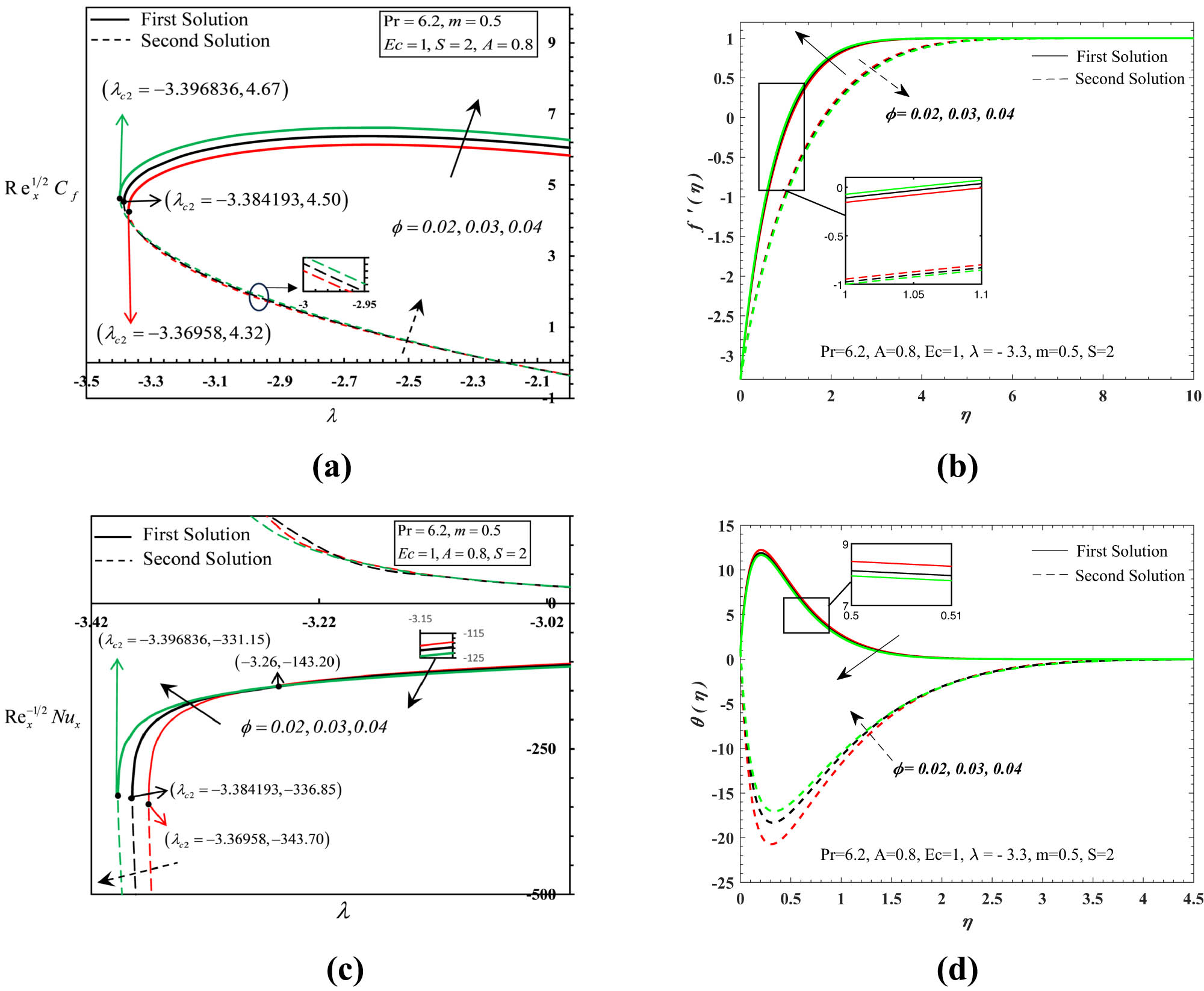
Physical properties for different

Physical properties for different

Physical properties for different

Physical properties for different

Physical properties for different Ec values: (a)
Values of
|
|
Wang [32] | Naganthran et al. [33] | Present result | |||
|---|---|---|---|---|---|---|
| Upper branch | Lower branch | Upper branch | Lower branch | Upper branch | Lower branch | |
|
|
1.40224 | — | 1.4022407 | — | 1.4022408 | — |
|
|
1.49567 | — | 1.4956697 | — | 1.4956698 | — |
|
|
1.32882 | 0 | 1.3288168 | 0 | 1.3288169 | 0 |
|
|
— | — | 1.1866805 | 0.0492290 | 1.1866803 | 0.0492289 |
|
|
1.08223 | 0.116702 | 1.0822311 | 0.1167020 | 1.0822312 | 0.1167021 |
|
|
— | — | 0.9324733 | 0.2336496 | 0.9324735 | 0.2336497 |
|
|
0.5543 | — | 0.5842759 | 0.5542976 | 0.5842819 | 0.5542962 |
|
|
— | — | 0.5745397 | 0.5640169 | 0.5745587 | 0.5640157 |
Figures 2–7 demonstrate the effects of fluid flow on the skin friction coefficient and the Nusselt number. The results indicate the presence of two solutions when
Figure 2 illustrates the enhancement of the Nusselt number but a decrease in the skin friction coefficient as the fluid transitions from NF to HNF to THNF. According to Myers et al. [34], the sum of the volume fractions
The expression of the skin friction coefficient, representing a specific fluid dynamic characteristic, shows a decreasing trend from NF to HNF to THNF. This reduction likely reflects changes in the fluid's viscosity, thermal conductivity, or both, which impact the friction factor at the fluid's surface. In Figure 2(b), the Nusselt number increases as the fluid transitions from NF to HNF to THNF as
Figure 3 illustrates the effect of nanoparticle volume fraction (
Additionally, the Nusselt number shows an increase for
Figure 4(a) illustrates the behavior of the skin friction coefficient in the upper branch solution as the wedge experiences shrinkage and
Both figures indicate that higher
Figure 5 illustrates the impact of
When
The Nusselt number decreases with the increase in
In Figure 6(a), it is observed that as
Additionally, in Figure 6(b), the increase in the Nusselt number with rising
In Figure 7, the influence of Ec on thermal exchange distribution is presented. Ec considers the combined effects of Ohmic heating and the magnetic field. As shown in Figure 7(b), an increased Ec results in a higher temperature, indicating more effective convective thermal transfer and enhanced heat diffusivity, which together promote greater heat dissipation. However, despite these improvements, a higher Eckert number ultimately leads to a decrease in the convective heat exchange rate. This occurs because the increased internal temperature of the fluid reduces the temperature gradient between the fluid and its environment, making heat exchange less efficient. When Ec increases, the critical value and the skin friction coefficient remain unchanged.
From Table 3, the first solution is stable because
|
|
Ec | HNF/THNF |
|
1st solution
|
2nd solution
|
|---|---|---|---|---|---|
| 0.6 | 1 | THNF |
|
0.018436 |
|
|
|
0.07144 |
|
|||
|
|
0.22129 |
|
|||
| 0.8 | 1.5 | THNF |
|
0.013348 |
|
|
|
0.064373 |
|
|||
|
|
0.186729 |
|
|||
| 0.8 | 1 | NF |
|
0.0078496 |
|
|
|
0.0325714 |
|
|||
|
|
0.0782518 |
|
5 Conclusion
This research focuses on developing a numerical solution for unsteady wedge flow, considering viscous dissipation and Joule heating in a ternary
The first solution is stable, whereas the second solution is unstable.
The Nusselt number drops as the Eckert number increases.
The convective heat transfer enhances from mono to binary to ternary nanofluid when
The boundary layer separation is delayed with rising unsteadiness parameter, nanoparticle volume fraction, and suction/injection parameter while decelerating with increasing type numbers of nanoparticles and wedge angle.
When the wedge surface is shrinking, the skin friction coefficient and the Nusselt number increase with the rising unsteadiness parameter, nanoparticle volume fraction, and suction/injection parameter.
When the wedge surface is shrinking, the skin friction coefficient increases with the rising wedge angle parameter, while the Nusselt number drops.
This research provides valuable insights into the flow behavior of ternary nanofluids, offering practical guidance for optimizing heat transfer and improving efficiency in extrusion processes across industries such as polymer manufacturing, food processing, and composite materials. The findings suggest that increasing parameters such as the unsteadiness parameter, nanoparticle volume fraction, and suction/injection parameter can help meet specific industrial requirements, enabling better control over thermal and flow properties.
However, a limitation of this study is its focus on a specific set of parameters, leaving room for further exploration. Future research could expand the scope by incorporating additional parameters and introducing new conditions, such as velocity slip (Ouyang et al. [35]), heat generation/absorption (Ouyang et al. [36]), Casson fluid (Naganthran and Nazar [37]), gyro tactic bio-convection flow (Basir et al. [38]), cone (Hanif et al. [39]), and Brownian motion (Saleem et al. [40]). These additions could further refine the understanding of nanofluid behavior and enhance its applicability in industrial processes.
Acknowledgments
The authors would like to acknowledge the financial support from Universiti Teknologi Malaysia for the funding under UTM fundamental Research (UTMFR) [grant number Q.J130000.3854.21H91], Malaysian Ministry of Higher Education [grant number FRGS/1/2023/STG06/UM/02/14], and Key Laboratory of AI and Information Processing (Hechi University), Education Department of Guangxi Zhuang Autonomous Region, China.
-
Funding information: The authors would like to acknowledge the financial support from Universiti Teknologi Malaysia for the funding under UTM fundamental Research (UTMFR) [grant number Q.J130000.3854.21H91], Malaysian Ministry of Higher Education [grant number FRGS/1/2023/STG06/UM/02/14], and Key Laboratory of AI and Information Processing (Hechi University), Education Department of Guangxi Zhuang Autonomous Region, China.
-
Author contributions: Yun Ouyang – resources, methodology, software, and writing; Md Faisal Md Basir – funding acquisition, writing, supervision, and project administration; Kohilavani Naganthran – writing, supervision, visualization, and validation; Ioan Pop – writing, methodology, formal analysis, and validation. All authors have accepted responsibility for the entire content of this manuscript and approved its submission.
-
Conflict of interest: The authors state no conflict of interest.
-
Data availability statement: All data generated or analyzed during this study are included in this published article.
References
[1] Said Z, Cakmak NK, Sharma P, Sundar LS, Inayat A, Keklikcioglu O, et al. Synthesis, stability, density, viscosity of ethylene glycol-based ternary hybrid nanofluids: Experimental investigations and model-prediction using modern machine learning techniques. Powder Tech. 2022;400:117190. 10.1016/j.powtec.2022.117190Search in Google Scholar
[2] Mousavi S, Esmaeilzadeh F, Wang X. Effects of temperature and particles volume concentration on the thermophysical properties and the rheological behavior of CuO/MgO/TiO2 aqueous ternary hybrid nanofluid: Experimental investigation. J Thermal Anal Calorimetry. 2019;137:879–901. 10.1007/s10973-019-08006-0Search in Google Scholar
[3] Prandtl L. On the motion of a fluid with very small viscosity. In: Proceedings of the Third International Mathematical Congress; 1904. p. 484–91. Search in Google Scholar
[4] Pop I, Groşan T, Revnic C, Roşca AV. Unsteady flow and heat transfer of nanofluids, hybrid nanofluids, micropolar fluids and porous media: A review. Therm Sci Eng Progress. 2023;46:102248. 10.1016/j.tsep.2023.102248Search in Google Scholar
[5] Ouyang Y, Basir MFM, Naganthran K, Pop I. Effects of discharge concentration and convective boundary conditions on unsteady hybrid nanofluid flow in a porous medium. Case Stud Therm Eng. 2024;58:104374. 10.1016/j.csite.2024.104374Search in Google Scholar
[6] Falkneb V, Skan SW. LXXXV. Solutions of the boundary-layer equations. London Edinburgh Dublin Philos Magazine J Sci. 1931;12(80):865–96. 10.1080/14786443109461870Search in Google Scholar
[7] Seddeek M, Afify A, Al-Hanaya A. Similarity solutions for a steady MHD Falkner-Skan flow and heat transfer over a wedge considering the effects of variable viscosity and thermal conductivity. Appl Appl Math Int J. 2009;4(2):6. Search in Google Scholar
[8] Fang T, Zhang J. An exact analytical solution of the Falkner-Skan equation with mass transfer and wall stretching. Int J Non-Linear Mech. 2008;43(9):1000–6. 10.1016/j.ijnonlinmec.2008.05.006Search in Google Scholar
[9] Weidman P, Kubitschek D, Davis A. The effect of transpiration on self-similar boundary layer flow over moving surfaces. Int J Eng Sci. 2006;44(11-12):730–7. 10.1016/j.ijengsci.2006.04.005Search in Google Scholar
[10] Abbasbandy S, Hayat T. Solution of the MHD Falkner-Skan flow by homotopy analysis method. Commun Nonl Sci Numer Simulat. 2009;14(9-10):3591–8. 10.1016/j.cnsns.2009.01.030Search in Google Scholar
[11] Zhang K, Shah NA, Alshehri M, Alkarni S, Wakif A, Eldin SM. Water thermal enhancement in a porous medium via a suspension of hybrid nanoparticles: MHD mixed convective Falkneras-Skan flow case study. Case Stud Therm Eng. 2023;47:103062. 10.1016/j.csite.2023.103062Search in Google Scholar
[12] Riley N, Weidman P. Multiple solutions of the Falkner-Skan equation for flow past a stretching boundary. SIAM J Appl Math. 1989;49(5):1350–8. 10.1137/0149081Search in Google Scholar
[13] Ishak A, Nazar R, Pop I. MHD boundary-layer flow past a moving wedge. Magnetohydrodynamics. 2009;45(1):103–10. 10.22364/mhd.45.1.10Search in Google Scholar
[14] Teh YY, Ashgar A. Three dimensional MHD hybrid nanofluid Flow with rotating stretching/shrinking sheet and Joule heating. CFD Letters. 2021;13(8):1–19. 10.37934/cfdl.13.8.119Search in Google Scholar
[15] Yan L, Dero S, Khan I, Mari IA, Baleanu D, Nisar KS, et al. Dual solutions and stability analysis of magnetized hybrid nanofluid with Joule heating and multiple slip conditions. Processes. 2020;8(3):332. 10.3390/pr8030332Search in Google Scholar
[16] Khashi’ie NS, Arifin NM, Pop I, Wahid NS. Flow and heat transfer of hybrid nanofluid over a permeable shrinking cylinder with Joule heating: A comparative analysis. Alexandr Eng J. 2020;59(3):1787–98. 10.1016/j.aej.2020.04.048Search in Google Scholar
[17] Kishore P, Bhanumathi D, Verma VS. The influence of chemical reaction and viscous dissipation on unsteady MHD free convection flow past an exponentially accelerated vertical plate with variable surface conditions. Chem Industry Chem Eng Quarter. 2013;19(2):181–93. 10.2298/CICEQ110730053KSearch in Google Scholar
[18] Zeeshan A, Majeed A, Akram MJ, Alzahrani F. Numerical investigation of MHD radiative heat and mass transfer of nanofluid flow towards a vertical wavy surface with viscous dissipation and Joule heating effects using Keller-box method. Math Comput Simulat. 2021;190:1080–109. 10.1016/j.matcom.2021.07.002Search in Google Scholar
[19] Zainal N, Nazar R, Naganthran K, Pop I. Viscous dissipation and MHD hybrid nanofluid flow towards an exponentially stretching/shrinking surface. Neural Comput Appl. 2021;33:1–11. 10.1007/s00521-020-05645-5Search in Google Scholar
[20] Ouyang Y, Md Basir MF, Naganthran K, Pop I. Unsteady magnetohydrodynamic tri-hybrid nanofluid flow past a moving wedge with viscous dissipation and Joule heating. Phys Fluids. 2024;36(6):062009. 10.1063/5.0208608Search in Google Scholar
[21] Merkin J. On dual solutions occurring in mixed convection in a porous medium. J Eng Math. 1986;20(2):171–9. 10.1007/BF00042775Search in Google Scholar
[22] Merkin J. Mixed convection boundary layer flow on a vertical surface in a saturated porous medium. J Eng Math. 1980;14(4):301–13. 10.1007/BF00052913Search in Google Scholar
[23] Bachok N, Ishak A, Pop I. Boundary-layer flow of nanofluids over a moving surface in a flowing fluid. Int J Therm Sci. 2010;49(9):1663–8. 10.1016/j.ijthermalsci.2010.01.026Search in Google Scholar
[24] Harris S, Ingham D, Pop I. Mixed convection boundary-layer flow near the stagnation point on a vertical surface in a porous medium: Brinkman model with slip. Transport Porous Media. 2009;77:267–85. 10.1007/s11242-008-9309-6Search in Google Scholar
[25] Roşca AV, Pop I. Flow and heat transfer over a vertical permeable stretching/shrinking sheet with a second order slip. Int J Heat Mass Transfer. 2013;60:355–64. 10.1016/j.ijheatmasstransfer.2012.12.028Search in Google Scholar
[26] Roşca AV, Pop I. Flow and heat transfer of Powell-Eyring fluid over a shrinking surface in a parallel free stream. Int J Heat Mass Transfer. 2014;71:321–7. 10.1016/j.ijheatmasstransfer.2013.12.020Search in Google Scholar
[27] Najib N, Bachok N, Arifin NM. Stability of dual solutions in boundary layer flow and heat transfer over an exponentially shrinking cylinder. Indian J Sci Tech. 2016;9:1–6. 10.17485/ijst/2016/v9i48/97740Search in Google Scholar
[28] Yasin MHM, Ishak A, Pop I. Boundary layer flow and heat transfer past a permeable shrinking surface embedded in a porous medium with a second-order slip: A stability analysis. Appl Therm Eng. 2017;115:1407–11. 10.1016/j.applthermaleng.2016.08.080Search in Google Scholar
[29] Devi SU, Devi SA. Heat transfer enhancement of Cu–Al2O3/water hybrid nanofluid flow over a stretching sheet. J Nigerian Math Soc. 2017;36(2):419–33. Search in Google Scholar
[30] White FM, Majdalani J. Viscous fluid flow. vol. 3. New York: McGraw-Hill; 2006. Search in Google Scholar
[31] Adnan, Ashraf W. Thermal efficiency in hybrid (Al2O3–CuO/H2O and ternary hybrid nanofluids (Al2O3–CuO/H2O) by considering the novel effects of imposed magnetic field and convective heat condition. Waves Random Complex Media. 2022;32:1–16. 10.1080/17455030.2022.2092233Search in Google Scholar
[32] Wang C. Stagnation flow towards a shrinking sheet. Int J Non-Linear Mech. 2008;43(5):377–82. 10.1016/j.ijnonlinmec.2007.12.021Search in Google Scholar
[33] Naganthran K, Nazar R, Pop I. Unsteady stagnation-point flow and heat transfer of a special third grade fluid past a permeable stretching/shrinking sheet. Scientif Reports. 2016;6(1):24632. 10.1038/srep24632Search in Google Scholar PubMed PubMed Central
[34] Myers TG, Ribera H, Cregan V. Does mathematics contribute to the nanofluid debate? Int J Heat Mass Transfer. 2017;111:279–88. 10.1016/j.ijheatmasstransfer.2017.03.118Search in Google Scholar
[35] Ouyang Y, Basir MFM, Naganthran K, Pop I. Dual solutions in Maxwell ternary nanofluid flow with viscous dissipation and velocity slip past a stretching/shrinking sheet. Alexandr Eng J. 2024;105:437–48. 10.1016/j.aej.2024.07.093Search in Google Scholar
[36] Ouyang Y, Basir MFM, Naganthran K, Pop I. Triple solutions for unsteady stagnation flow of tri-hybrid nanofluid with heat generation/absorption in a porous medium. Case Stud Therm Eng. 2024;61:105027. 10.1016/j.csite.2024.105027Search in Google Scholar
[37] Naganthran K, Nazar R. Unsteady boundary layer flow of a Casson fluid past a permeable stretching/shrinking sheet: paired solutions and stability analysis. In: Journal of Physics: Conference Series. vol. 1212. IOP Publishing; 2019. p. 012028. 10.1088/1742-6596/1212/1/012028Search in Google Scholar
[38] Basir MFM, Hafidzuddin MEH, Naganthran K, Chaharborj SS, Kasihmuddin MSM, Nazar R, et al. Stability analysis of unsteady stagnation-point gyrotactic bioconvection flow and heat transfer towards the moving sheet in a nanofluid. Chin J Phys. 2020;65:538–53. 10.1016/j.cjph.2020.02.021Search in Google Scholar
[39] Hanif H, Khan A, Rijal Illias M, Shafie S. Significance of Cu-Fe3O4 on fractional Maxwell fluid flow over a cone with Newtonian heating. J Taibah Univ Sci. 2024;18(1):2285491. 10.1080/16583655.2023.2285491Search in Google Scholar
[40] Saleem S, Animasaun I, Yook SJ, Al-Mdallal QM, Shah NA, Faisal M. Insight into the motion of water conveying three kinds of nanoparticles shapes on a horizontal surface: significance of thermo-migration and Brownian motion. Surfaces Interfaces. 2022;30:101854. 10.1016/j.surfin.2022.101854Search in Google Scholar
© 2025 the author(s), published by De Gruyter
This work is licensed under the Creative Commons Attribution 4.0 International License.
Articles in the same Issue
- Research Articles
- Single-step fabrication of Ag2S/poly-2-mercaptoaniline nanoribbon photocathodes for green hydrogen generation from artificial and natural red-sea water
- Abundant new interaction solutions and nonlinear dynamics for the (3+1)-dimensional Hirota–Satsuma–Ito-like equation
- A novel gold and SiO2 material based planar 5-element high HPBW end-fire antenna array for 300 GHz applications
- Explicit exact solutions and bifurcation analysis for the mZK equation with truncated M-fractional derivatives utilizing two reliable methods
- Optical and laser damage resistance: Role of periodic cylindrical surfaces
- Numerical study of flow and heat transfer in the air-side metal foam partially filled channels of panel-type radiator under forced convection
- Water-based hybrid nanofluid flow containing CNT nanoparticles over an extending surface with velocity slips, thermal convective, and zero-mass flux conditions
- Dynamical wave structures for some diffusion--reaction equations with quadratic and quartic nonlinearities
- Solving an isotropic grey matter tumour model via a heat transfer equation
- Study on the penetration protection of a fiber-reinforced composite structure with CNTs/GFP clip STF/3DKevlar
- Influence of Hall current and acoustic pressure on nanostructured DPL thermoelastic plates under ramp heating in a double-temperature model
- Applications of the Belousov–Zhabotinsky reaction–diffusion system: Analytical and numerical approaches
- AC electroosmotic flow of Maxwell fluid in a pH-regulated parallel-plate silica nanochannel
- Interpreting optical effects with relativistic transformations adopting one-way synchronization to conserve simultaneity and space–time continuity
- Modeling and analysis of quantum communication channel in airborne platforms with boundary layer effects
- Theoretical and numerical investigation of a memristor system with a piecewise memductance under fractal–fractional derivatives
- Tuning the structure and electro-optical properties of α-Cr2O3 films by heat treatment/La doping for optoelectronic applications
- High-speed multi-spectral explosion temperature measurement using golden-section accelerated Pearson correlation algorithm
- Dynamic behavior and modulation instability of the generalized coupled fractional nonlinear Helmholtz equation with cubic–quintic term
- Study on the duration of laser-induced air plasma flash near thin film surface
- Exploring the dynamics of fractional-order nonlinear dispersive wave system through homotopy technique
- The mechanism of carbon monoxide fluorescence inside a femtosecond laser-induced plasma
- Numerical solution of a nonconstant coefficient advection diffusion equation in an irregular domain and analyses of numerical dispersion and dissipation
- Numerical examination of the chemically reactive MHD flow of hybrid nanofluids over a two-dimensional stretching surface with the Cattaneo–Christov model and slip conditions
- Impacts of sinusoidal heat flux and embraced heated rectangular cavity on natural convection within a square enclosure partially filled with porous medium and Casson-hybrid nanofluid
- Stability analysis of unsteady ternary nanofluid flow past a stretching/shrinking wedge
- Solitonic wave solutions of a Hamiltonian nonlinear atom chain model through the Hirota bilinear transformation method
- Bilinear form and soltion solutions for (3+1)-dimensional negative-order KdV-CBS equation
- Solitary chirp pulses and soliton control for variable coefficients cubic–quintic nonlinear Schrödinger equation in nonuniform management system
- Influence of decaying heat source and temperature-dependent thermal conductivity on photo-hydro-elasto semiconductor media
- Dissipative disorder optimization in the radiative thin film flow of partially ionized non-Newtonian hybrid nanofluid with second-order slip condition
- Bifurcation, chaotic behavior, and traveling wave solutions for the fractional (4+1)-dimensional Davey–Stewartson–Kadomtsev–Petviashvili model
- New investigation on soliton solutions of two nonlinear PDEs in mathematical physics with a dynamical property: Bifurcation analysis
- Mathematical analysis of nanoparticle type and volume fraction on heat transfer efficiency of nanofluids
- Creation of single-wing Lorenz-like attractors via a ten-ninths-degree term
- Optical soliton solutions, bifurcation analysis, chaotic behaviors of nonlinear Schrödinger equation and modulation instability in optical fiber
- Chaotic dynamics and some solutions for the (n + 1)-dimensional modified Zakharov–Kuznetsov equation in plasma physics
- Fractal formation and chaotic soliton phenomena in nonlinear conformable Heisenberg ferromagnetic spin chain equation
- Single-step fabrication of Mn(iv) oxide-Mn(ii) sulfide/poly-2-mercaptoaniline porous network nanocomposite for pseudo-supercapacitors and charge storage
- Novel constructed dynamical analytical solutions and conserved quantities of the new (2+1)-dimensional KdV model describing acoustic wave propagation
- Tavis–Cummings model in the presence of a deformed field and time-dependent coupling
- Spinning dynamics of stress-dependent viscosity of generalized Cross-nonlinear materials affected by gravitationally swirling disk
- Design and prediction of high optical density photovoltaic polymers using machine learning-DFT studies
- Robust control and preservation of quantum steering, nonlocality, and coherence in open atomic systems
- Coating thickness and process efficiency of reverse roll coating using a magnetized hybrid nanomaterial flow
- Dynamic analysis, circuit realization, and its synchronization of a new chaotic hyperjerk system
- Decoherence of steerability and coherence dynamics induced by nonlinear qubit–cavity interactions
- Finite element analysis of turbulent thermal enhancement in grooved channels with flat- and plus-shaped fins
- Modulational instability and associated ion-acoustic modulated envelope solitons in a quantum plasma having ion beams
- Statistical inference of constant-stress partially accelerated life tests under type II generalized hybrid censored data from Burr III distribution
- On solutions of the Dirac equation for 1D hydrogenic atoms or ions
- Entropy optimization for chemically reactive magnetized unsteady thin film hybrid nanofluid flow on inclined surface subject to nonlinear mixed convection and variable temperature
- Stability analysis, circuit simulation, and color image encryption of a novel four-dimensional hyperchaotic model with hidden and self-excited attractors
- A high-accuracy exponential time integration scheme for the Darcy–Forchheimer Williamson fluid flow with temperature-dependent conductivity
- Novel analysis of fractional regularized long-wave equation in plasma dynamics
- Development of a photoelectrode based on a bismuth(iii) oxyiodide/intercalated iodide-poly(1H-pyrrole) rough spherical nanocomposite for green hydrogen generation
- Investigation of solar radiation effects on the energy performance of the (Al2O3–CuO–Cu)/H2O ternary nanofluidic system through a convectively heated cylinder
- Quantum resources for a system of two atoms interacting with a deformed field in the presence of intensity-dependent coupling
- Studying bifurcations and chaotic dynamics in the generalized hyperelastic-rod wave equation through Hamiltonian mechanics
- A new numerical technique for the solution of time-fractional nonlinear Klein–Gordon equation involving Atangana–Baleanu derivative using cubic B-spline functions
- Interaction solutions of high-order breathers and lumps for a (3+1)-dimensional conformable fractional potential-YTSF-like model
- Hydraulic fracturing radioactive source tracing technology based on hydraulic fracturing tracing mechanics model
- Numerical solution and stability analysis of non-Newtonian hybrid nanofluid flow subject to exponential heat source/sink over a Riga sheet
- Numerical investigation of mixed convection and viscous dissipation in couple stress nanofluid flow: A merged Adomian decomposition method and Mohand transform
- Effectual quintic B-spline functions for solving the time fractional coupled Boussinesq–Burgers equation arising in shallow water waves
- Analysis of MHD hybrid nanofluid flow over cone and wedge with exponential and thermal heat source and activation energy
- Solitons and travelling waves structure for M-fractional Kairat-II equation using three explicit methods
- Impact of nanoparticle shapes on the heat transfer properties of Cu and CuO nanofluids flowing over a stretching surface with slip effects: A computational study
- Computational simulation of heat transfer and nanofluid flow for two-sided lid-driven square cavity under the influence of magnetic field
- Irreversibility analysis of a bioconvective two-phase nanofluid in a Maxwell (non-Newtonian) flow induced by a rotating disk with thermal radiation
- Hydrodynamic and sensitivity analysis of a polymeric calendering process for non-Newtonian fluids with temperature-dependent viscosity
- Exploring the peakon solitons molecules and solitary wave structure to the nonlinear damped Kortewege–de Vries equation through efficient technique
- Modeling and heat transfer analysis of magnetized hybrid micropolar blood-based nanofluid flow in Darcy–Forchheimer porous stenosis narrow arteries
- Activation energy and cross-diffusion effects on 3D rotating nanofluid flow in a Darcy–Forchheimer porous medium with radiation and convective heating
- Insights into chemical reactions occurring in generalized nanomaterials due to spinning surface with melting constraints
- Influence of a magnetic field on double-porosity photo-thermoelastic materials under Lord–Shulman theory
- Soliton-like solutions for a nonlinear doubly dispersive equation in an elastic Murnaghan's rod via Hirota's bilinear method
- Analytical and numerical investigation of exact wave patterns and chaotic dynamics in the extended improved Boussinesq equation
- Nonclassical correlation dynamics of Heisenberg XYZ states with (x, y)-spin--orbit interaction, x-magnetic field, and intrinsic decoherence effects
- Exact traveling wave and soliton solutions for chemotaxis model and (3+1)-dimensional Boiti–Leon–Manna–Pempinelli equation
- Unveiling the transformative role of samarium in ZnO: Exploring structural and optical modifications for advanced functional applications
- On the derivation of solitary wave solutions for the time-fractional Rosenau equation through two analytical techniques
- Analyzing the role of length and radius of MWCNTs in a nanofluid flow influenced by variable thermal conductivity and viscosity considering Marangoni convection
- Advanced mathematical analysis of heat and mass transfer in oscillatory micropolar bio-nanofluid flows via peristaltic waves and electroosmotic effects
- Exact bound state solutions of the radial Schrödinger equation for the Coulomb potential by conformable Nikiforov–Uvarov approach
- Some anisotropic and perfect fluid plane symmetric solutions of Einstein's field equations using killing symmetries
- Nonlinear dynamics of the dissipative ion-acoustic solitary waves in anisotropic rotating magnetoplasmas
- Curves in multiplicative equiaffine plane
- Exact solution of the three-dimensional (3D) Z2 lattice gauge theory
- Propagation properties of Airyprime pulses in relaxing nonlinear media
- Symbolic computation: Analytical solutions and dynamics of a shallow water wave equation in coastal engineering
- Wave propagation in nonlocal piezo-photo-hygrothermoelastic semiconductors subjected to heat and moisture flux
- Comparative reaction dynamics in rotating nanofluid systems: Quartic and cubic kinetics under MHD influence
- Laplace transform technique and probabilistic analysis-based hypothesis testing in medical and engineering applications
- Physical properties of ternary chloro-perovskites KTCl3 (T = Ge, Al) for optoelectronic applications
- Gravitational length stretching: Curvature-induced modulation of quantum probability densities
- The search for the cosmological cold dark matter axion – A new refined narrow mass window and detection scheme
- A comparative study of quantum resources in bipartite Lipkin–Meshkov–Glick model under DM interaction and Zeeman splitting
- PbO-doped K2O–BaO–Al2O3–B2O3–TeO2-glasses: Mechanical and shielding efficacy
- Nanospherical arsenic(iii) oxoiodide/iodide-intercalated poly(N-methylpyrrole) composite synthesis for broad-spectrum optical detection
- Sine power Burr X distribution with estimation and applications in physics and other fields
- Numerical modeling of enhanced reactive oxygen plasma in pulsed laser deposition of metal oxide thin films
- Dynamical analyses and dispersive soliton solutions to the nonlinear fractional model in stratified fluids
- Computation of exact analytical soliton solutions and their dynamics in advanced optical system
- An innovative approximation concerning the diffusion and electrical conductivity tensor at critical altitudes within the F-region of ionospheric plasma at low latitudes
- An analytical investigation to the (3+1)-dimensional Yu–Toda–Sassa–Fukuyama equation with dynamical analysis: Bifurcation
- Swirling-annular-flow-induced instability of a micro shell considering Knudsen number and viscosity effects
- Numerical analysis of non-similar convection flows of a two-phase nanofluid past a semi-infinite vertical plate with thermal radiation
- MgO NPs reinforced PCL/PVC nanocomposite films with enhanced UV shielding and thermal stability for packaging applications
- Optimal conditions for indoor air purification using non-thermal Corona discharge electrostatic precipitator
- Investigation of thermal conductivity and Raman spectra for HfAlB, TaAlB, and WAlB based on first-principles calculations
- Tunable double plasmon-induced transparency based on monolayer patterned graphene metamaterial
- DSC: depth data quality optimization framework for RGBD camouflaged object detection
- A new family of Poisson-exponential distributions with applications to cancer data and glass fiber reliability
- Numerical investigation of couple stress under slip conditions via modified Adomian decomposition method
- Monitoring plateau lake area changes in Yunnan province, southwestern China using medium-resolution remote sensing imagery: applicability of water indices and environmental dependencies
- Heterodyne interferometric fiber-optic gyroscope
- Exact solutions of Einstein’s field equations via homothetic symmetries of non-static plane symmetric spacetime
- A widespread study of discrete entropic model and its distribution along with fluctuations of energy
- Empirical model integration for accurate charge carrier mobility simulation in silicon MOSFETs
- The influence of scattering correction effect based on optical path distribution on CO2 retrieval
- Anisotropic dissociation and spectral response of 1-Bromo-4-chlorobenzene under static directional electric fields
- Role of tungsten oxide (WO3) on thermal and optical properties of smart polymer composites
- Analysis of iterative deblurring: no explicit noise
- The influence of anisotropy of InP on its elasticity and phonon properties
- Review Article
- Examination of the gamma radiation shielding properties of different clay and sand materials in the Adrar region
- Erratum
- Erratum to “On Soliton structures in optical fiber communications with Kundu–Mukherjee–Naskar model (Open Physics 2021;19:679–682)”
- Special Issue on Fundamental Physics from Atoms to Cosmos - Part II
- Possible explanation for the neutron lifetime puzzle
- Special Issue on Nanomaterial utilization and structural optimization - Part III
- Numerical investigation on fluid-thermal-electric performance of a thermoelectric-integrated helically coiled tube heat exchanger for coal mine air cooling
- Special Issue on Nonlinear Dynamics and Chaos in Physical Systems
- Analysis of the fractional relativistic isothermal gas sphere with application to neutron stars
- Abundant wave symmetries in the (3+1)-dimensional Chafee–Infante equation through the Hirota bilinear transformation technique
- Successive midpoint method for fractional differential equations with nonlocal kernels: Error analysis, stability, and applications
- Novel exact solitons to the fractional modified mixed-Korteweg--de Vries model with a stability analysis
Articles in the same Issue
- Research Articles
- Single-step fabrication of Ag2S/poly-2-mercaptoaniline nanoribbon photocathodes for green hydrogen generation from artificial and natural red-sea water
- Abundant new interaction solutions and nonlinear dynamics for the (3+1)-dimensional Hirota–Satsuma–Ito-like equation
- A novel gold and SiO2 material based planar 5-element high HPBW end-fire antenna array for 300 GHz applications
- Explicit exact solutions and bifurcation analysis for the mZK equation with truncated M-fractional derivatives utilizing two reliable methods
- Optical and laser damage resistance: Role of periodic cylindrical surfaces
- Numerical study of flow and heat transfer in the air-side metal foam partially filled channels of panel-type radiator under forced convection
- Water-based hybrid nanofluid flow containing CNT nanoparticles over an extending surface with velocity slips, thermal convective, and zero-mass flux conditions
- Dynamical wave structures for some diffusion--reaction equations with quadratic and quartic nonlinearities
- Solving an isotropic grey matter tumour model via a heat transfer equation
- Study on the penetration protection of a fiber-reinforced composite structure with CNTs/GFP clip STF/3DKevlar
- Influence of Hall current and acoustic pressure on nanostructured DPL thermoelastic plates under ramp heating in a double-temperature model
- Applications of the Belousov–Zhabotinsky reaction–diffusion system: Analytical and numerical approaches
- AC electroosmotic flow of Maxwell fluid in a pH-regulated parallel-plate silica nanochannel
- Interpreting optical effects with relativistic transformations adopting one-way synchronization to conserve simultaneity and space–time continuity
- Modeling and analysis of quantum communication channel in airborne platforms with boundary layer effects
- Theoretical and numerical investigation of a memristor system with a piecewise memductance under fractal–fractional derivatives
- Tuning the structure and electro-optical properties of α-Cr2O3 films by heat treatment/La doping for optoelectronic applications
- High-speed multi-spectral explosion temperature measurement using golden-section accelerated Pearson correlation algorithm
- Dynamic behavior and modulation instability of the generalized coupled fractional nonlinear Helmholtz equation with cubic–quintic term
- Study on the duration of laser-induced air plasma flash near thin film surface
- Exploring the dynamics of fractional-order nonlinear dispersive wave system through homotopy technique
- The mechanism of carbon monoxide fluorescence inside a femtosecond laser-induced plasma
- Numerical solution of a nonconstant coefficient advection diffusion equation in an irregular domain and analyses of numerical dispersion and dissipation
- Numerical examination of the chemically reactive MHD flow of hybrid nanofluids over a two-dimensional stretching surface with the Cattaneo–Christov model and slip conditions
- Impacts of sinusoidal heat flux and embraced heated rectangular cavity on natural convection within a square enclosure partially filled with porous medium and Casson-hybrid nanofluid
- Stability analysis of unsteady ternary nanofluid flow past a stretching/shrinking wedge
- Solitonic wave solutions of a Hamiltonian nonlinear atom chain model through the Hirota bilinear transformation method
- Bilinear form and soltion solutions for (3+1)-dimensional negative-order KdV-CBS equation
- Solitary chirp pulses and soliton control for variable coefficients cubic–quintic nonlinear Schrödinger equation in nonuniform management system
- Influence of decaying heat source and temperature-dependent thermal conductivity on photo-hydro-elasto semiconductor media
- Dissipative disorder optimization in the radiative thin film flow of partially ionized non-Newtonian hybrid nanofluid with second-order slip condition
- Bifurcation, chaotic behavior, and traveling wave solutions for the fractional (4+1)-dimensional Davey–Stewartson–Kadomtsev–Petviashvili model
- New investigation on soliton solutions of two nonlinear PDEs in mathematical physics with a dynamical property: Bifurcation analysis
- Mathematical analysis of nanoparticle type and volume fraction on heat transfer efficiency of nanofluids
- Creation of single-wing Lorenz-like attractors via a ten-ninths-degree term
- Optical soliton solutions, bifurcation analysis, chaotic behaviors of nonlinear Schrödinger equation and modulation instability in optical fiber
- Chaotic dynamics and some solutions for the (n + 1)-dimensional modified Zakharov–Kuznetsov equation in plasma physics
- Fractal formation and chaotic soliton phenomena in nonlinear conformable Heisenberg ferromagnetic spin chain equation
- Single-step fabrication of Mn(iv) oxide-Mn(ii) sulfide/poly-2-mercaptoaniline porous network nanocomposite for pseudo-supercapacitors and charge storage
- Novel constructed dynamical analytical solutions and conserved quantities of the new (2+1)-dimensional KdV model describing acoustic wave propagation
- Tavis–Cummings model in the presence of a deformed field and time-dependent coupling
- Spinning dynamics of stress-dependent viscosity of generalized Cross-nonlinear materials affected by gravitationally swirling disk
- Design and prediction of high optical density photovoltaic polymers using machine learning-DFT studies
- Robust control and preservation of quantum steering, nonlocality, and coherence in open atomic systems
- Coating thickness and process efficiency of reverse roll coating using a magnetized hybrid nanomaterial flow
- Dynamic analysis, circuit realization, and its synchronization of a new chaotic hyperjerk system
- Decoherence of steerability and coherence dynamics induced by nonlinear qubit–cavity interactions
- Finite element analysis of turbulent thermal enhancement in grooved channels with flat- and plus-shaped fins
- Modulational instability and associated ion-acoustic modulated envelope solitons in a quantum plasma having ion beams
- Statistical inference of constant-stress partially accelerated life tests under type II generalized hybrid censored data from Burr III distribution
- On solutions of the Dirac equation for 1D hydrogenic atoms or ions
- Entropy optimization for chemically reactive magnetized unsteady thin film hybrid nanofluid flow on inclined surface subject to nonlinear mixed convection and variable temperature
- Stability analysis, circuit simulation, and color image encryption of a novel four-dimensional hyperchaotic model with hidden and self-excited attractors
- A high-accuracy exponential time integration scheme for the Darcy–Forchheimer Williamson fluid flow with temperature-dependent conductivity
- Novel analysis of fractional regularized long-wave equation in plasma dynamics
- Development of a photoelectrode based on a bismuth(iii) oxyiodide/intercalated iodide-poly(1H-pyrrole) rough spherical nanocomposite for green hydrogen generation
- Investigation of solar radiation effects on the energy performance of the (Al2O3–CuO–Cu)/H2O ternary nanofluidic system through a convectively heated cylinder
- Quantum resources for a system of two atoms interacting with a deformed field in the presence of intensity-dependent coupling
- Studying bifurcations and chaotic dynamics in the generalized hyperelastic-rod wave equation through Hamiltonian mechanics
- A new numerical technique for the solution of time-fractional nonlinear Klein–Gordon equation involving Atangana–Baleanu derivative using cubic B-spline functions
- Interaction solutions of high-order breathers and lumps for a (3+1)-dimensional conformable fractional potential-YTSF-like model
- Hydraulic fracturing radioactive source tracing technology based on hydraulic fracturing tracing mechanics model
- Numerical solution and stability analysis of non-Newtonian hybrid nanofluid flow subject to exponential heat source/sink over a Riga sheet
- Numerical investigation of mixed convection and viscous dissipation in couple stress nanofluid flow: A merged Adomian decomposition method and Mohand transform
- Effectual quintic B-spline functions for solving the time fractional coupled Boussinesq–Burgers equation arising in shallow water waves
- Analysis of MHD hybrid nanofluid flow over cone and wedge with exponential and thermal heat source and activation energy
- Solitons and travelling waves structure for M-fractional Kairat-II equation using three explicit methods
- Impact of nanoparticle shapes on the heat transfer properties of Cu and CuO nanofluids flowing over a stretching surface with slip effects: A computational study
- Computational simulation of heat transfer and nanofluid flow for two-sided lid-driven square cavity under the influence of magnetic field
- Irreversibility analysis of a bioconvective two-phase nanofluid in a Maxwell (non-Newtonian) flow induced by a rotating disk with thermal radiation
- Hydrodynamic and sensitivity analysis of a polymeric calendering process for non-Newtonian fluids with temperature-dependent viscosity
- Exploring the peakon solitons molecules and solitary wave structure to the nonlinear damped Kortewege–de Vries equation through efficient technique
- Modeling and heat transfer analysis of magnetized hybrid micropolar blood-based nanofluid flow in Darcy–Forchheimer porous stenosis narrow arteries
- Activation energy and cross-diffusion effects on 3D rotating nanofluid flow in a Darcy–Forchheimer porous medium with radiation and convective heating
- Insights into chemical reactions occurring in generalized nanomaterials due to spinning surface with melting constraints
- Influence of a magnetic field on double-porosity photo-thermoelastic materials under Lord–Shulman theory
- Soliton-like solutions for a nonlinear doubly dispersive equation in an elastic Murnaghan's rod via Hirota's bilinear method
- Analytical and numerical investigation of exact wave patterns and chaotic dynamics in the extended improved Boussinesq equation
- Nonclassical correlation dynamics of Heisenberg XYZ states with (x, y)-spin--orbit interaction, x-magnetic field, and intrinsic decoherence effects
- Exact traveling wave and soliton solutions for chemotaxis model and (3+1)-dimensional Boiti–Leon–Manna–Pempinelli equation
- Unveiling the transformative role of samarium in ZnO: Exploring structural and optical modifications for advanced functional applications
- On the derivation of solitary wave solutions for the time-fractional Rosenau equation through two analytical techniques
- Analyzing the role of length and radius of MWCNTs in a nanofluid flow influenced by variable thermal conductivity and viscosity considering Marangoni convection
- Advanced mathematical analysis of heat and mass transfer in oscillatory micropolar bio-nanofluid flows via peristaltic waves and electroosmotic effects
- Exact bound state solutions of the radial Schrödinger equation for the Coulomb potential by conformable Nikiforov–Uvarov approach
- Some anisotropic and perfect fluid plane symmetric solutions of Einstein's field equations using killing symmetries
- Nonlinear dynamics of the dissipative ion-acoustic solitary waves in anisotropic rotating magnetoplasmas
- Curves in multiplicative equiaffine plane
- Exact solution of the three-dimensional (3D) Z2 lattice gauge theory
- Propagation properties of Airyprime pulses in relaxing nonlinear media
- Symbolic computation: Analytical solutions and dynamics of a shallow water wave equation in coastal engineering
- Wave propagation in nonlocal piezo-photo-hygrothermoelastic semiconductors subjected to heat and moisture flux
- Comparative reaction dynamics in rotating nanofluid systems: Quartic and cubic kinetics under MHD influence
- Laplace transform technique and probabilistic analysis-based hypothesis testing in medical and engineering applications
- Physical properties of ternary chloro-perovskites KTCl3 (T = Ge, Al) for optoelectronic applications
- Gravitational length stretching: Curvature-induced modulation of quantum probability densities
- The search for the cosmological cold dark matter axion – A new refined narrow mass window and detection scheme
- A comparative study of quantum resources in bipartite Lipkin–Meshkov–Glick model under DM interaction and Zeeman splitting
- PbO-doped K2O–BaO–Al2O3–B2O3–TeO2-glasses: Mechanical and shielding efficacy
- Nanospherical arsenic(iii) oxoiodide/iodide-intercalated poly(N-methylpyrrole) composite synthesis for broad-spectrum optical detection
- Sine power Burr X distribution with estimation and applications in physics and other fields
- Numerical modeling of enhanced reactive oxygen plasma in pulsed laser deposition of metal oxide thin films
- Dynamical analyses and dispersive soliton solutions to the nonlinear fractional model in stratified fluids
- Computation of exact analytical soliton solutions and their dynamics in advanced optical system
- An innovative approximation concerning the diffusion and electrical conductivity tensor at critical altitudes within the F-region of ionospheric plasma at low latitudes
- An analytical investigation to the (3+1)-dimensional Yu–Toda–Sassa–Fukuyama equation with dynamical analysis: Bifurcation
- Swirling-annular-flow-induced instability of a micro shell considering Knudsen number and viscosity effects
- Numerical analysis of non-similar convection flows of a two-phase nanofluid past a semi-infinite vertical plate with thermal radiation
- MgO NPs reinforced PCL/PVC nanocomposite films with enhanced UV shielding and thermal stability for packaging applications
- Optimal conditions for indoor air purification using non-thermal Corona discharge electrostatic precipitator
- Investigation of thermal conductivity and Raman spectra for HfAlB, TaAlB, and WAlB based on first-principles calculations
- Tunable double plasmon-induced transparency based on monolayer patterned graphene metamaterial
- DSC: depth data quality optimization framework for RGBD camouflaged object detection
- A new family of Poisson-exponential distributions with applications to cancer data and glass fiber reliability
- Numerical investigation of couple stress under slip conditions via modified Adomian decomposition method
- Monitoring plateau lake area changes in Yunnan province, southwestern China using medium-resolution remote sensing imagery: applicability of water indices and environmental dependencies
- Heterodyne interferometric fiber-optic gyroscope
- Exact solutions of Einstein’s field equations via homothetic symmetries of non-static plane symmetric spacetime
- A widespread study of discrete entropic model and its distribution along with fluctuations of energy
- Empirical model integration for accurate charge carrier mobility simulation in silicon MOSFETs
- The influence of scattering correction effect based on optical path distribution on CO2 retrieval
- Anisotropic dissociation and spectral response of 1-Bromo-4-chlorobenzene under static directional electric fields
- Role of tungsten oxide (WO3) on thermal and optical properties of smart polymer composites
- Analysis of iterative deblurring: no explicit noise
- The influence of anisotropy of InP on its elasticity and phonon properties
- Review Article
- Examination of the gamma radiation shielding properties of different clay and sand materials in the Adrar region
- Erratum
- Erratum to “On Soliton structures in optical fiber communications with Kundu–Mukherjee–Naskar model (Open Physics 2021;19:679–682)”
- Special Issue on Fundamental Physics from Atoms to Cosmos - Part II
- Possible explanation for the neutron lifetime puzzle
- Special Issue on Nanomaterial utilization and structural optimization - Part III
- Numerical investigation on fluid-thermal-electric performance of a thermoelectric-integrated helically coiled tube heat exchanger for coal mine air cooling
- Special Issue on Nonlinear Dynamics and Chaos in Physical Systems
- Analysis of the fractional relativistic isothermal gas sphere with application to neutron stars
- Abundant wave symmetries in the (3+1)-dimensional Chafee–Infante equation through the Hirota bilinear transformation technique
- Successive midpoint method for fractional differential equations with nonlocal kernels: Error analysis, stability, and applications
- Novel exact solitons to the fractional modified mixed-Korteweg--de Vries model with a stability analysis
