Wave propagation in nonlocal piezo-photo-hygrothermoelastic semiconductors subjected to heat and moisture flux
-

 ,
,

Abstract
This research explores the propagation characteristics of piezo-photo-hygrothermoelastic waves in orthotropic semiconductor materials by incorporating the effect of nonlocal elasticity. The proposed model describes the complex interactions between piezoelectricity, photothermal excitation, plasma wave transport, and hygrothermal diffusion under continuous heat and moisture fluxes while accounting for the influence of spatial nonlocality on the elastic response. The nonlocal parameter is introduced into the elastic constitutive relation to capture the size-dependent and dispersive nature of elastic waves, which is essential for semiconductor devices operating at small scales. The study develops a generalized system of coupled equations involving the elastic, thermal, moisture, and plasma fields, all integrated within the framework of nonlocal piezo-photo-hygrothermoelasticity. The system is analytically solved using the normal mode technique to derive expressions for temperature distribution, moisture concentration, carrier density, electric potential, displacement fields, and stresses. Numerical simulations are carried out for the cadmium selenide (CdSe) semiconductor material. The results show that the nonlocal parameter significantly modifies the wave amplitudes, attenuation characteristics, and coupling between the involved physical fields. The proposed model offers valuable insights into the dynamic behavior of semiconductor devices subjected to coupled thermo-mechanical–electrical–moisture interactions, especially when nonlocal effects become significant due to micro- and nanoscale dimensions.
Nomenclature
-
-
thermal temperature
-
-
elastic stiffness tensor
-
-
coupled thermal diffusivity
-
-
electric potential
-
-
electronic deformation coefficient
-
-
pyroelectric constants
-
-
moisture concentration potential
-
-
coupled moisture diffusivities
-
-
coupling thermal material coefficients
-
-
temperature diffusivity
-
-
thermal activation coupling parameter
-
-
photogenerated carrier lifetime
-
-
energy gap of the semiconductor
-
-
difference in the deformation potential of the conduction and valence bands
-
-
thermal activation coupling parameter
-
-
component of strain
-
-
thermal moduli tensor
-
-
electric displacement
-
-
piezothermal moduli tensors
-
-
electric field density
-
-
specific heat at constant strain
-
-
moisture diffusion constant
-
-
density
-
-
moisture moduli tensor
-
-
moisture diffusivity
-
-
component of stress
-
-
Kroneckar delta
-
-
photoexcitation effect
1 Introduction
The study of wave propagation in semiconductor materials subjected to coupled thermoelastic, piezoelectric, photothermal, plasma, and moisture diffusion effects has become increasingly important due to its wide applications in microelectronics, optoelectronics, MEMS/NEMS, and advanced sensing technologies. In such materials, the interaction between mechanical, thermal, electric, photothermal, and hygrothermal fields gives rise to a variety of waves whose dynamics directly affect the performance, stability, and lifespan of semiconductor-based devices. These interactions are particularly significant under harsh service conditions involving thermal shocks, moisture ingress, and high-frequency excitations. Recently, the importance of nonlocal elasticity has emerged as a critical factor when analyzing wave propagation in microscale and nanoscale systems, where classical local continuum theories fail to capture the observed dispersive and size-dependent behaviors. The inclusion of the nonlocal parameter accounts for the long-range interatomic interactions that significantly modify the elastic response, especially at a small scales. As semiconductor devices continue to miniaturize, understanding the interplay between piezoelectric, photothermal, moisture, plasma, and nonlocal elastic effects becomes essential for the accurate design and optimization of high-performance components. This coupled and nonlinear multiphysical problem forms the basis of modern research aimed at improving the functionality and reliability of next-generation semiconductor technologies. This has led to the urgent need for more accurate and comprehensive models capturing the simultaneous effects of piezoelectricity, photothermal excitation, plasma waves, and moisture transport in semiconductors. In addition to the classical couplings, the mechanical response of semiconductor materials at small scales is notably affected by nonlocal elastic effects, where the stress at a given point is influenced by strains in its neighborhood rather than just the local strain. The presence of nonlocality becomes critical when wave phenomena are studied in micro- and nanoscale semiconductor structures, as classical local theories often fail to account for observed dispersive and size-dependent behaviors. However, the majority of existing investigations have either neglected the nonlocal influence or restricted it to simple elasticity without considering its interaction with hygrothermoelastic, piezoelectric, and photothermal fields.
Previous research has provided valuable contributions to the understanding of hygrothermal and thermoelastic interactions in solids. The interaction of temperature and moisture diffusion has been explored in polymers, composite structures, and geomaterials, where the coupled diffusion of heat and moisture significantly affects stress development [1,2,3,4,5,6]. The foundation of thermoelasticity itself was laid by Biot [7], and later expanded through the development of generalized thermoelasticity theories [8,9] and their application in modeling thermal, electromagnetic, and elastic wave interactions [10,11,12,13,14]. Similarly, the theory of piezo-thermoelasticity, introduced by Nowacki [15,16] and further developed by Mindlin [17,18], accounts for the coupling between thermal, mechanical, and piezoelectric effects. Chandrasekharaiah [19] refined this theory by introducing finite wave propagation speeds to better describe wave behaviors in realistic materials.
The elastic response of semiconductors has also been extensively studied due to their widespread applications in electronics and optoelectronics. Early contributions from Mindlin [20] highlighted the significance of piezoelectricity in semiconductors, and subsequent studies [21,22,23,24,25] examined how photothermal and plasma wave effects influence the dynamic behavior of these materials. Further developments were achieved by Khamis et al. [22] and Lotfy [26], who examined photothermal and thermoelastic wave propagation under dual-phase-lag and memory-dependent models [27]. Hobiny and Abbas [28] further extended the framework by incorporating fractional-order thermoelastic theories in semiconductor materials. While these models provided valuable insights, they largely relied on classical elasticity, neglecting the potential influence of nonlocal elasticity on wave propagation.
Motivated by this limitation, the present work proposes a comprehensive theoretical model that incorporates nonlocal elasticity into the piezo-photo-hygrothermoelastic wave propagation framework for orthotropic semiconductor materials [29,30,31]. The model fully captures the simultaneous interactions between elastic, photothermal, piezoelectric, plasma, and moisture diffusion fields, while accounting for the size-dependent effects inherent in nonlocal elastic theory [32]. The inclusion of the nonlocal parameter in the constitutive relations leads to modified wave characteristics, including dispersion and attenuation patterns, which are critical for accurately predicting wave propagation in micro- and nanoscale semiconductor devices. In practical scenarios, semiconductor devices are often designed with characteristic dimensions at micro- and nanoscales, where nonlocal effects cannot be ignored [33,34,35]. While several models have addressed hygrothermal stresses in polymeric and composite systems, and generalized thermoelastic and piezo-thermoelastic responses in semiconductors, only a few studies have explored nonlocal elasticity in the context of coupled piezo-photo-hygrothermoelastic wave propagation [36,37]. The proposed model fills this gap by integrating nonlocal elasticity with hygrothermoelastic and photothermal effects, enabling a more accurate description of the coupled wave behavior [38].
Wave propagation in semiconductor and elastic media has been extensively investigated in recent years, particularly in the presence of complex coupled effects such as porosity, size dependence, nonlocality, and thermo-piezoelectric interactions. Studies have explored the impact of double and single porosity on SH-wave vibrations in periodic porous lattices, revealing significant alterations in wave behavior due to porosity variations [39]. Additionally, the interaction of surface waves in micropolar thermoelastic media with dual pore connectivity has been analyzed, demonstrating size-dependent effects on wave dispersion and attenuation [40]. Recent work has also addressed moisture and temperature diffusivity in orthotropic hygro-thermo-piezo-elastic materials, providing insights into coupled moisture–temperature interactions [41]. The role of nonlocality in shear wave propagation within fiber-reinforced poroelastic structures has been examined, highlighting its influence on wave speed and stability under interfacial disturbances [42]. Furthermore, vibrational analysis of size-dependent thermo-piezo-photoelectric semiconductor media has been conducted under the memory-dependent Moore–Gibson–Thompson photo-thermoelasticity framework, emphasizing the significance of memory effects in advanced semiconductor applications [43]. Additional studies have explored double poro-magneto-thermoelastic models incorporating microtemperature and initial stress under memory-dependent heat transfer, shedding light on thermal relaxation effects in complex elastic media [44]. The propagation of Rayleigh waves in nonlocal piezo-thermoelastic materials with voids under memory-dependent heat transfer has also been examined, showcasing the intricate interplay between thermal memory and wave characteristics [45]. In a different context, flexoelectric effects and viscoelastic coatings have been shown to significantly alter surface wave dynamics in advanced geomaterial plates [46]. Moreover, fractional and memory effects on wave reflection in pre-stressed microstructured solids with dual porosity have been investigated, offering new insights into wave behavior in engineered materials [47]. The study of wave propagation in complex elastic media has been significantly advanced by incorporating micropolar, microstretch, and diffusion effects, leading to more refined and accurate physical models. While these studies have advanced our understanding of wave propagation in various structured media, the combined effects of nonlocality, temperature-dependent thermal conductivity, and orthotropic piezoelectric micropolar interactions in semiconductor materials remain largely unexplored [48]. The present study aims to bridge this gap by developing a comprehensive model that integrates these factors, providing a more realistic representation of wave dynamics in semiconductor devices at micro- and nanoscales according to microstretch thermoelastic diffusion [49]. Although several studies have been conducted on wave propagation in piezo-photo-thermoelastic and hygrothermoelastic semiconductor media, most of them have ignored the influence of nonlocal effects, which become critical when dealing with micro- and nanoscale semiconductor structures. The neglect of nonlocal elasticity in previous investigations leads to inaccurate predictions of stress, displacement, and temperature distributions, especially under high-frequency or small-scale conditions. Furthermore, the combined interaction of piezoelectric, photothermal, and hygrothermal fields in the presence of nonlocality has not been adequately addressed. Motivated by these shortcomings, the present work aims to develop a comprehensive theoretical model that incorporates nonlocal elasticity within the framework of photo-thermoelasticity for piezo-photo-hygrothermoelastic semiconductors. This formulation provides a more realistic understanding of the coupled wave propagation behavior, capturing the essential physics that was previously overlooked.
The primary goal of this work is to investigate how nonlocal elasticity affects the transient and steady-state responses of the semiconductor medium when exposed to heat, moisture, and photothermal excitations. Using the normal mode technique, the governing equations are analytically solved, and the obtained expressions describe the distributions of displacement, temperature, carrier density, moisture concentration, stress, and electric fields. Numerical simulations are conducted for the cadmium selenide (CdSe) semiconductor material to demonstrate the impact of the nonlocal parameter on wave profiles. The results show that the presence of nonlocal elasticity leads to substantial changes in wave amplitudes, attenuation rates, and coupling characteristics between the various fields, providing deeper insights into the behavior of semiconductor devices operating under coupled thermoelectrical–mechanical–moisture environments, particularly at small scales.
2 Basic equation
This section contains the fundamental governing equations describing the propagation of coupled piezo-photo-hygrothermoelastic waves in an orthotropic nonlocal semiconductor with temperature-dependent thermal conductivity. In this study, we consider an orthotropic semiconductor medium subjected to simultaneous mechanical, thermal, electric, and moisture effects, where the photothermal excitation and moisture flux are applied on the surface. The material is assumed to be homogeneous, electrically and thermally conductive, and exhibits piezoelectric characteristics. The coordinate system is chosen such that the x-axis is normal to the surface of the semiconductor, while the z-axis lies along the surface, describing a semi-infinite domain (x ≥ 0) (Figure 1). The physical quantities involved in the formulation include the displacement vector
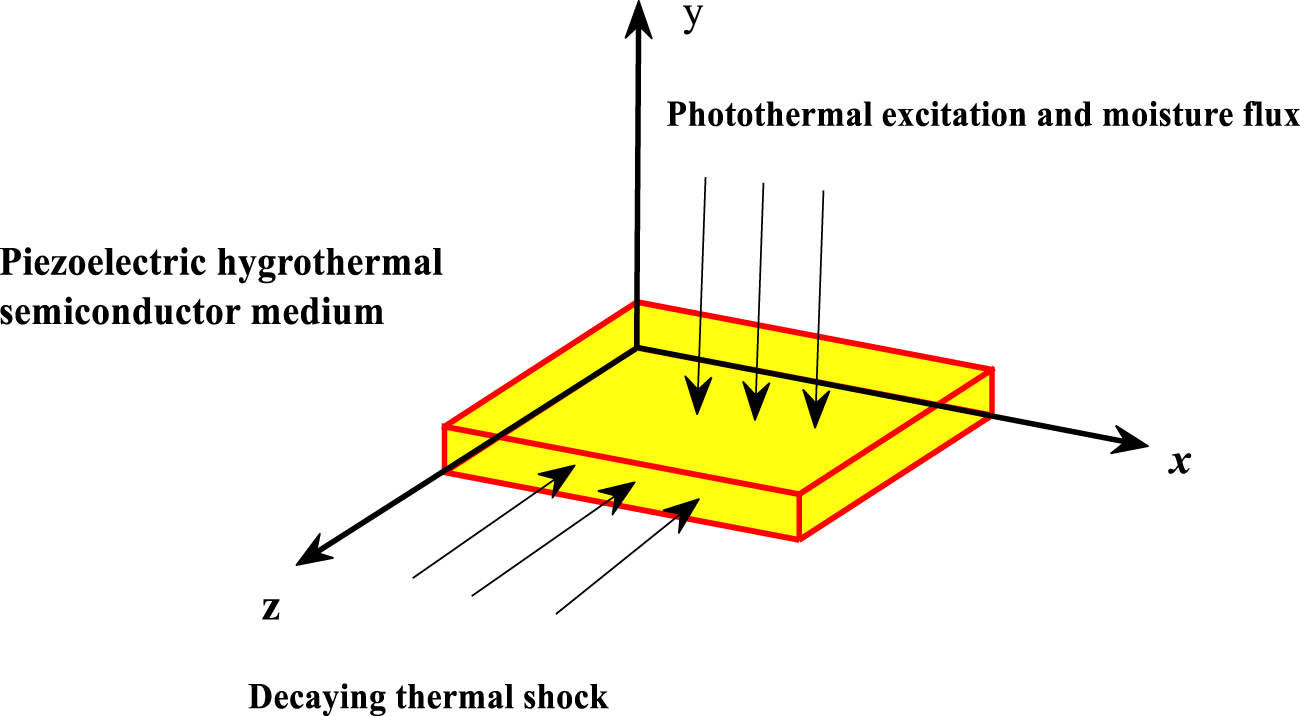
Geometry of the problem.
The stress–strain–temperature–moisture relation for an orthotropic piezo-hygrothermoelastic nonlocal semiconductor is given by
The nonlocal parameter
In this formulation,
Considering
Taking into account the Thomson effect within Fourier’s heat conduction law, and considering the additional influence of plasma on heat transport while disregarding the Peltier contribution, the modified heat conduction behavior for semiconductors can be formulated [51,52]:
By differentiating Eq. (8) for
Substituting Eq. (9) into Eq. (10) yields the governing equation for temperature and plasma diffusion within the piezoelectric hygrothermal semiconductor medium [54]:
Similarly, the moisture-plasma diffusion equation governing the behavior in a piezoelectric hygrothermal semiconductor medium can be expressed as [31]
The equation of motion for a nonlocal semiconductor medium [32,33] is
3 Problem formulation
By substituting Eqs. (1) and (2) into Eq. (12), the governing equations for the two-dimensional (2D) case are obtained under the assumption
where
The corresponding 2D plasma-thermal diffusion equation governing the interaction between the carrier density and temperature fields is expressed as follows [56]:
The 2D heat-plasma diffusion equation for the piezoelectric hygrothermal semiconductor medium, derived from Eq. (10), can be expressed as
The moisture-plasma diffusion equation describing the coupled behavior in the piezoelectric hygrothermal semiconductor medium, as obtained from Eq. (11), takes the following form:
where
4 Solution to the problem
To analyze the propagation of harmonic waves in the considered medium, we focus on waves traveling, with the wave normal lying in the xz-plane. To obtain analytical solutions for Eqs. (13)–(18) governing the coupled physical fields, the normal mode method is employed by assuming the following form for the physical variables. The normal mode technique is particularly advantageous in solving multi-physics wave propagation problems, as it effectively reduces the system of partial differential equations to an algebraic system in the transformed domain. This method allows for the direct analysis of wave dispersion, attenuation, and coupling characteristics between the thermoelastic, piezoelectric, photothermal, and plasma fields, making it highly suitable for complex semiconductor models involving nonlocal effects and hygrothermal interactions [57,58,59]:
where
where
By employing the elimination method to solve the system of Eqs. (20)–(25), we obtain the following results:
The explicit expressions for the coefficients
where
Similarly, the solutions corresponding to the other physical variables take the following form:
such that
where
5 Boundary conditions
The solution of the governing equations requires the specification of appropriate boundary conditions that accurately reflect the physical situation under consideration. In the present problem, the piezoelectric hygrothermal semiconductor medium is subjected to coupled mechanical, thermal, plasma, moisture, and electric fields at its surface. Therefore, boundary conditions are formulated to account for external actions such as thermal and plasma excitations, moisture variation, and mechanical stresses. These conditions play a crucial role in capturing the interaction between temperature, moisture, carrier density, electric potential, and stress fields, which are vital for understanding the behavior of the medium under practical engineering applications, including thermal management, optoelectronic devices, and moisture-sensitive semiconductor components. The boundary conditions are chosen to ensure the physical realism of the model and the proper decay of the disturbances away from the excitation region. To obtain the constants
(I) Since the surface is subjected to a decaying thermal shock, the temperature at the boundary is not constant but follows an exponentially decaying function with time at
where
(II) The normal component of the electric field at the free surface
Therefore,
This boundary condition ensures that no electric flux crosses the boundary, reflecting practical situations where the surface is either free of charge carriers or insulated, which is highly relevant in microelectronic and piezoelectric device applications.
(III) At the boundary
Hence,
where
(Ⅳ) Since the surface is assumed to be traction-free, the boundary conditions for mechanical stresses are given by
Furthermore,
These conditions represent a mechanically free surface, common in thin films, coatings, and layered semiconductor structures, where the outer surface is not subjected to external mechanical loads.
(V) The tangent mechanical conditions at
Hence,
(VI) At the boundary
So,
where
The simultaneous solution of the established boundary conditions yields the unknown parameters
6 Numerical results and discussions
In this section, numerical simulations are carried out based on the physical constants of the CdSe semiconductor material. The obtained computational results are valuable for illustrating the influence of the proposed model and may contribute to advancements in physics-based technologies, with potential applications across various sectors of the modern mechanical and semiconductor industries. The physical properties of CdSe used in the simulation are listed in Table 1, where all constants are expressed in SI units [36,37].
Physical constants of the CdSe medium
|
|
|
|
|
|
|
|
||
|
|
5,504 |
|
|
|
|
|
|
|
|
|
|
|
|
|
|
|
|
|
|
|
|
|
|
|
|
|
|
|
|
|
|
|
|
|
|
|
|
|
|
|
|
|
|
|
|
|
|
|
|
|
|
|
|
|
|
|
|
|
|
|
|
6.1 Impact of nonlocal parameters
In this section, we investigate the influence of the nonlocal effect on the behavior of the piezo-hygrothermoelastic semiconductor medium subjected to thermal, moisture, and electrical fields. The results are presented for two cases: (i) local medium and (ii) nonlocal medium. The variations of the main physical fields (temperature, moisture concentration, carrier density, displacement, and electric potential) against the dimensionless distance are plotted and analyzed, as shown in Figure 2. From subplot 1, it is evident that the temperature decays monotonically as the distance increases. However, the nonlocal medium exhibits a slower decay compared to the local medium. This indicates that the nonlocal effect enhances the thermal conduction and causes the thermal wave to penetrate deeper into the medium. Physically, this can be attributed to the fact that the nonlocal model accounts for the long-range interactions among particles, leading to an extended thermal influence beyond the immediate neighborhood. Subplot 2 shows an oscillatory behavior of moisture concentration that diminishes with distance. The amplitude and phase of oscillations are noticeably altered under the nonlocal effect, displaying a smoother attenuation compared to the local model. This is because nonlocality helps redistribute the moisture effect more gradually, reducing sharp moisture gradients, which is crucial for predicting moisture transport in micro- and nanoscale devices. Subplot 3 illustrates the distribution of electric displacement in both local and nonlocal piezo-hygrothermoelastic semiconductor media. In the local case, the electric displacement oscillates with higher peaks and attenuates quickly due to the immediate and concentrated interaction between the piezoelectric effect and the applied thermal and moisture fields. In contrast, the nonlocal case shows a smoother and more extended distribution with lower amplitude and delayed attenuation. This behavior is attributed to the long-range interactions incorporated by the nonlocal effect, which spreads the electric field response over a larger area and reduces the intensity of localized electric displacement. Such a response is beneficial in semiconductor devices where smoother and less concentrated electric displacement can improve device performance and reduce the risk of dielectric breakdown. Subplot 4 demonstrates a decreasing trend of the carrier density with distance. In the nonlocal case, carrier diffusion appears more extended, with a higher concentration maintained over larger distances compared to the local case. This is a direct consequence of nonlocality facilitating a more effective redistribution of carriers, which is important for semiconductor performance, especially under photothermal or hygrothermal loads. The dimensionless tangential (shear) stress distribution, as shown in subplot 5, exhibits a wave-like oscillatory pattern along the dimensionless distance for both the local and nonlocal semiconductor mediums. This behavior is a direct result of the combined effects of thermal, hygrothermal, and piezoelectric interactions under the applied boundary conditions and external stimuli. In the local medium, the tangential stress demonstrates higher-amplitude oscillations, which decay gradually with distance. The oscillations arise due to the coupling between mechanical deformation and the applied thermal and moisture loads. These interactions generate shear waves that propagate through the medium, leading to alternating tensile and compressive tangential stresses. The relatively sharp peaks and valleys observed in the local case are associated with the localized nature of the stress wave propagation without considering long-range atomic or microstructural interactions. In contrast, the nonlocal medium exhibits smoother, damped, and wider oscillations in the tangential stress distribution. The amplitudes of the tangential stress waves are slightly reduced, and their spatial spread is extended compared to the local case. This difference is attributed to the nonlocal effect, which accounts for the internal length scale and long-range forces in the semiconductor structure. The nonlocality acts as a stabilizing factor, reducing the sharpness of stress concentrations and distributing the tangential stress more uniformly over the medium. This is mechanically beneficial since it lowers the risk of shear-induced failures such as micro-cracking or delamination, which are critical concerns in semiconductor and MEMS structures. The displacement plots (subplot 6) show characteristic thermoelastic damped oscillations. Notably, the nonlocal model leads to more pronounced and longer-lasting oscillations compared to the local model. This behavior is physically reasonable as the nonlocal effect introduces additional stiffness to the medium due to internal interactions across finite distances, causing the mechanical waves to sustain their oscillations longer before damping out. The normal stress distribution, as shown in subplot 7, exhibits significant differences between the local and nonlocal cases. In the local medium, the normal stress displays sharp oscillations with higher amplitude and rapid decay due to the direct and localized response of the material to the coupled effects of thermal, moisture, and piezoelectric loadings. However, in the nonlocal medium, the stress distribution becomes smoother with reduced amplitude and slower decay, indicating the role of microstructural interactions in dispersing the stress over a wider region. This nonlocal behavior effectively mitigates stress concentration and delays the stress wave attenuation, which is crucial for enhancing the structural stability of the piezo-hygrothermoelastic semiconductor medium under thermo–moisture–mechanical coupling. The electric potential exhibits a similar oscillatory pattern (subplot 8). The nonlocal medium shows a shift in both amplitude and phase compared to the local medium. This shift indicates that the piezoelectric coupling is significantly influenced by the nonlocal parameter. Mechanically, the internal interactions in the nonlocal model redistribute electric charges more effectively, altering the resulting potential field distribution.
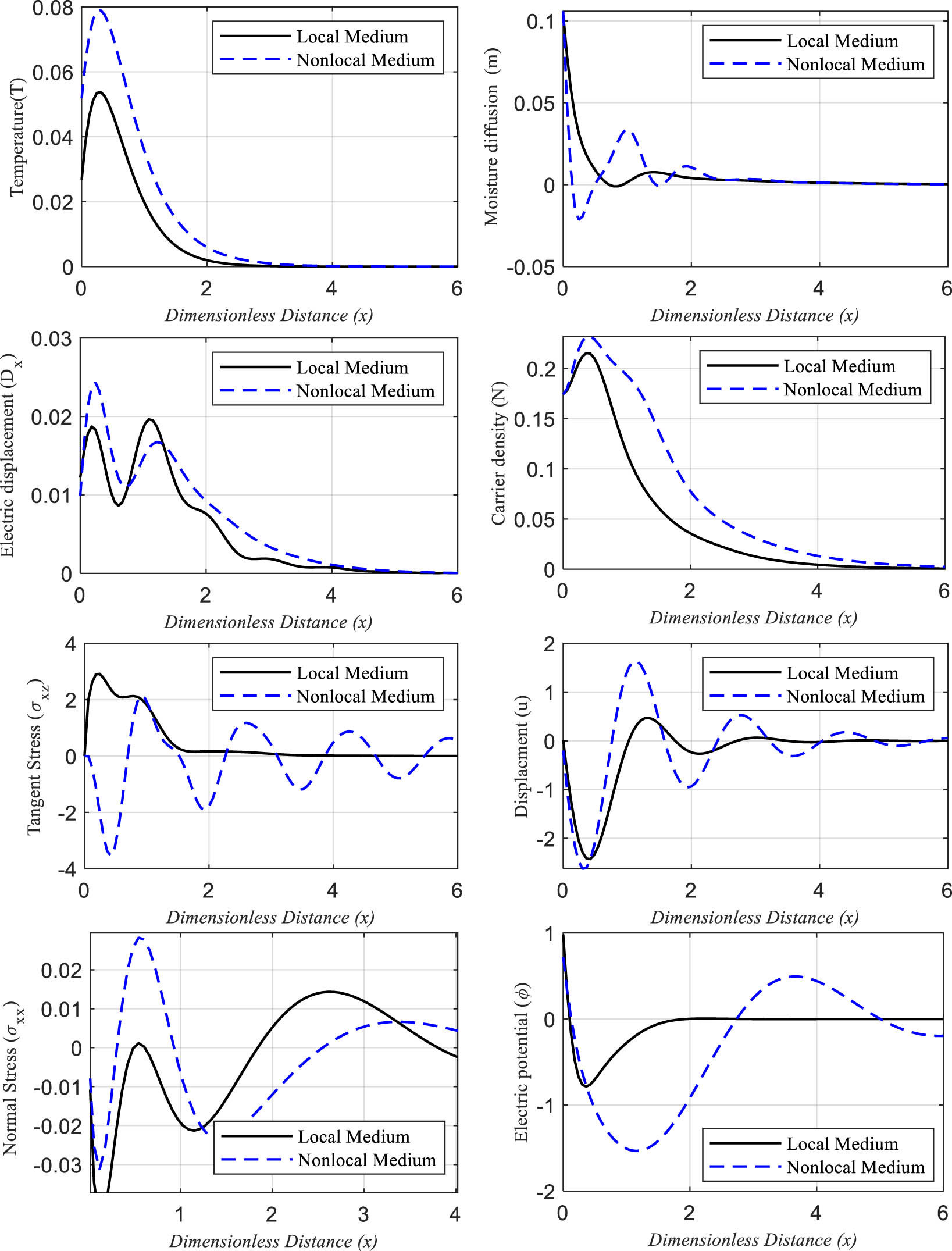
Variation of the dimensionless main fields versus the dimensionless distance x in a piezo-hygrothermoelastic semiconductor medium for both local and nonlocal cases at m 0 = 20%.
6.1.1 Mechanism analysis
From a physical standpoint, the presence of the nonlocal effect fundamentally modifies the energy transfer processes in the system. The internal length scale parameter introduced by the nonlocal theory enables the medium to account for long-range interactions among neighboring points, leading to the observed moderation of gradients and oscillations across all fields. This mechanism ensures smoother transitions of physical quantities and improved resistance to external disturbances, making nonlocality a valuable factor in the engineering of advanced semiconductor devices, microelectromechanical systems (MEMS), and sensors.
6.1.2 Physical interpretation
The nonlocal behavior helps the material dissipate stress more efficiently, which is beneficial for preventing failure due to normal stress concentration, such as microcracking, delamination, or debonding. In semiconductor and MEMS, where miniaturization makes nonlocality more pronounced, this effect is crucial for ensuring mechanical integrity under thermal and moisture-induced loads.
6.2 Piezoelectric effect
Figure 3 displays the plotted fields of (1) temperature, (2) moisture concentration, (3) carrier density, (4) tangent stress, (5) displacement, and (6) normal stress. The results demonstrate the significant influence of the piezoelectric effect on enhancing or altering the amplitude, phase, and attenuation behavior of the thermal, mechanical, electric, and diffusion responses in the medium. The nonlocal nature of the semiconductor further modifies the wave characteristics, making the interactions more complex and physically meaningful. The temperature distribution decreases progressively with the increase in the dimensionless distance for both cases (without and with the piezoelectric effect). However, the temperature field in the presence of the piezoelectric effect shows slightly lower values and a more gradual decay compared to the case without piezoelectricity. This behavior is mainly due to the energy conversion mechanism induced by the piezoelectric coupling, where part of the thermal energy is converted into electrical and mechanical energies. Consequently, the heat conduction process is altered, leading to a reduced thermal diffusion rate and a smoother temperature profile. The piezoelectric effect also interacts with the hygrothermal and mechanical fields, modifying the thermal stress and influencing the heat propagation characteristics in the semiconductor medium. The observed attenuation indicates the combined influence of nonlocality, moisture, and piezoelectric coupling on heat transfer within the material. The moisture concentration decreases smoothly with the dimensionless distance in both cases (with and without the piezoelectric effect). However, the presence of the piezoelectric effect slightly reduces the moisture concentration throughout the medium. This is attributed to the coupling between the electrical and mechanical fields caused by the piezoelectric effect, which influences the diffusion of moisture. The piezoelectric effect alters stress distribution, leading to a redistribution of the moisture concentration, resulting in slightly lower values compared to the case without the piezoelectric effect. The carrier density exhibits a decaying behavior with increasing distance, similar to the moisture concentration. It is observed that the presence of the piezoelectric effect leads to a noticeable reduction in the carrier density. The physical mechanism behind this is that the additional electric field generated by the piezoelectric effect alters the electrochemical potential, which in turn affects the carrier distribution. This coupling causes carriers to redistribute differently, reducing their concentration compared to the purely hygrothermoelastic case without piezoelectricity. The tangent stress distribution shows significant oscillations near the boundary, and these oscillations are more pronounced when the piezoelectric effect is considered. The piezoelectric coupling intensifies the mechanical wave interactions due to the induced electric field, which amplifies the stress fluctuations. Physically, this is due to the energy exchange between the mechanical and electric fields, which causes more prominent stress variations and higher peaks and valleys compared to the nonpiezoelectric case. The displacement distribution exhibits an oscillatory behavior that gradually attenuates as the dimensionless distance increases. It is evident that the displacement amplitude is higher in the case with the piezoelectric effect compared to the case without it. This enhancement can be physically explained by the fact that the piezoelectric coupling generates additional internal stresses and electric fields, which in turn reinforce the mechanical response of the medium. The interaction between the hygrothermal field, moisture diffusion, and the induced electric field leads to stronger deformation when piezoelectricity is present. The nonlocal effect also contributes to the persistence of oscillations over longer distances due to the memory effect and microstructural interactions in the semiconductor. The oscillatory nature of the displacement reflects the wave-like propagation of the coupled thermoelastic and piezoelectric fields, which are further modulated by moisture content and nonlocality, making the displacement more pronounced and spread over a larger region when the piezoelectric effect is active. The normal stress distribution shows clear oscillations that decay with increasing dimensionless distance. The presence of the piezoelectric effect significantly amplifies the magnitude of the normal stress compared to the case without the piezoelectric contribution. This behavior is attributed to the coupling between the electric and mechanical fields through the piezoelectric effect, which induces additional internal forces resisting deformation. As the piezoelectric coupling generates extra electric displacements under mechanical loading, it modifies the stress state and results in more intense stress oscillations. The nonlocality also plays a role by allowing the stress waves to be influenced by the microstructure of the semiconductor, leading to smoother decay and an extended influence range. Physically, this indicates that the piezoelectric mechanism not only strengthens the normal stress response but also delays the attenuation of stress waves as they propagate through the medium, resulting in larger and longer-lasting oscillations compared to the nonpiezoelectric case.
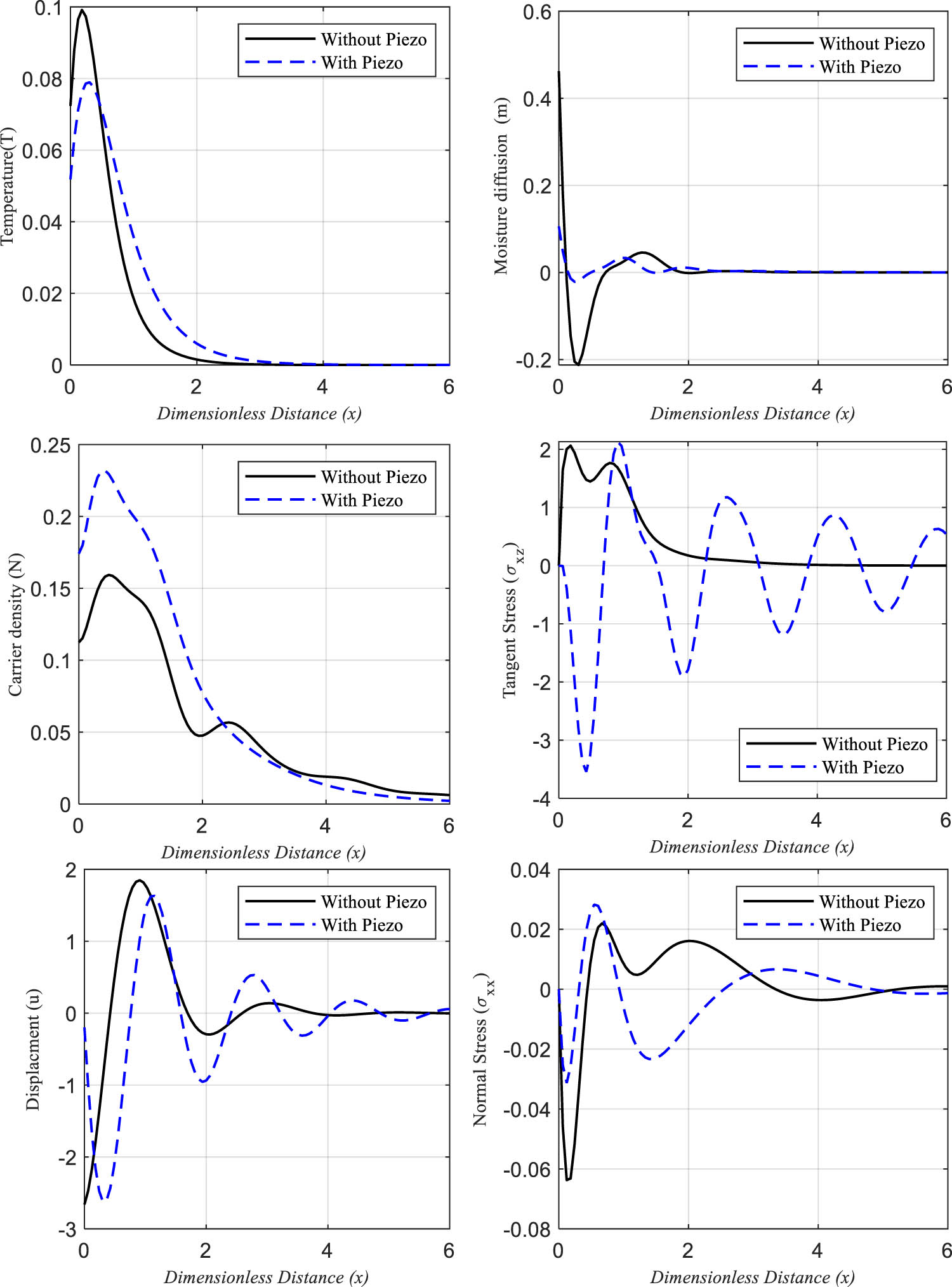
Distributions of the dimensionless physical fields versus the dimensionless distance in a piezo-hygrothermoelastic nonlocal semiconductor medium, illustrating the comparison between two cases: With piezoelectric effect and without piezoelectric effect at m 0 = 20%.
6.3 Three-dimensional (3D) representation
Figure 4 presents 3D visualizations of the key physical fields, namely temperature, moisture diffusion, electric displacement, carrier density, tangential stress, displacement, normal stress, and electric potential, within the piezo-hygrothermoelastic nonlocal semiconductor medium. The temperature and normal stress fields exhibit relatively smooth wave patterns, with noticeable attenuation along the z direction due to thermal and mechanical dissipation. The moisture diffusion and carrier density fields show oscillatory and rapidly decaying behavior along both the x and z directions, indicating a strong coupling between moisture and carrier dynamics. The electric displacement and electric potential plots highlight the localized nature of the piezoelectric effect, contributing to sharp gradients near the excitation region and influencing the wave propagation. Tangential stress and displacement fields exhibit complex wavefronts with noticeable reflections and interference patterns, reflecting the combined influence of mechanical, thermal, and piezoelectric interactions. Overall, the 3D plots reveal the synergistic behavior between the involved multiphysics fields and demonstrate how nonlocality and piezoelectricity alter the spatial evolution of each field.
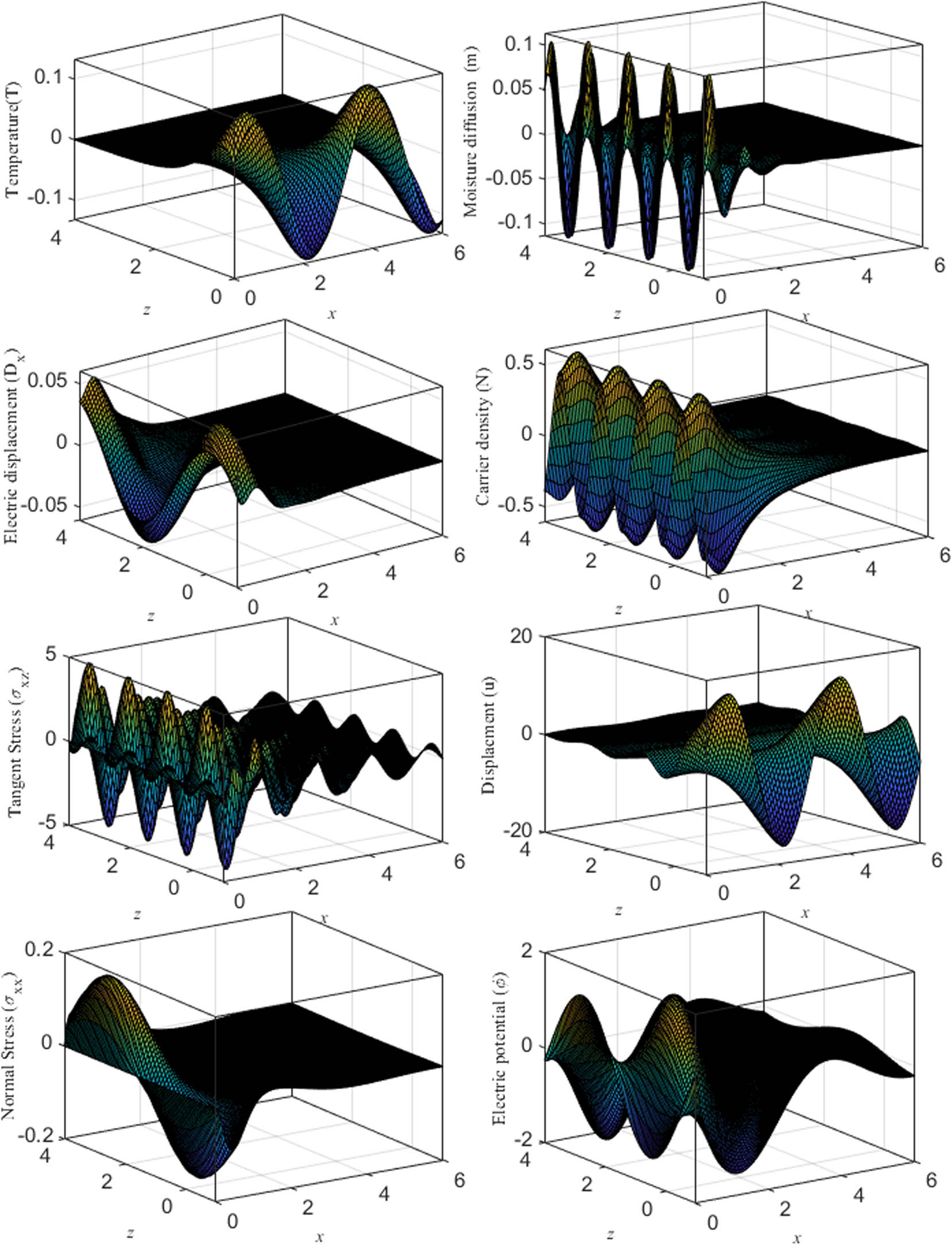
3D representations of the main physical fields within the piezo-hygrothermoelastic nonlocal semiconductor medium, illustrating the variations of main fields as functions of the dimensionless coordinates x and z.
However, the present study still has some limitations. The model is based on linear material behavior and considers an idealized 2D geometry, which does not fully capture 3D or nonlinear effects that may occur in real semiconductor structures. In addition, the material was assumed to be homogeneous and isotropic, although actual semiconductors often exhibit anisotropy and graded properties. Moreover, phenomena such as temperature-dependent thermal conductivity, plastic deformation, and damage mechanisms were not considered. Future studies may address these aspects by extending the model to a more general 3D formulation, incorporating nonlinear and anisotropic effects, and including additional physical mechanisms to provide a more realistic and comprehensive analysis.
6.4 Comparison between the present study and existing literature
To highlight the novelty and significance of the present work, a comprehensive comparison with recent related studies is summarized in Table 2. Previous investigations mainly focused on simplified models considering partial coupling between physical fields such as photo-thermoelastic or magneto-thermoelastic effects, while often neglecting essential factors like nonlocal elasticity, hygrothermal interaction, or temperature-dependent thermal conductivity. Some works addressed nonlocal effects but were limited to one-dimensional geometries or lacked the inclusion of piezoelectric and photo-induced effects, which are critical in modern semiconductor applications. In contrast, the current study develops an advanced and more realistic 2D model that integrates piezoelectricity, photo-thermal interaction, hygrothermal effects, nonlocal elasticity, and temperature-dependent thermal conductivity. This combination provides a comprehensive framework suitable for analyzing wave propagation phenomena in semiconductor devices at micro- and nanoscales.
Comparison between the present study and related previous works
| Study | Model | Coupled fields | Nonlocal effect | Geometry | Solution technique | Explanation |
|---|---|---|---|---|---|---|
| Lotfy et al. (2023) | Photo-thermoelastic semiconductor | Photo + thermoelastic | Not considered | 2D | Normal mode | Investigated photo-thermoelastic waves but neglected nonlocality, hygrothermal, and piezoelectric effects. Limited for modern semiconductors |
| Zenkour and Abbas (2022) | Magneto-thermoelastic semiconductor | Magnetic + thermoelastic | Not considered | 2D | Laplace transform | Focused on magneto-thermoelasticity but ignored nonlocality and photo/piezoeffects, limiting applicability to advanced semiconductor devices |
| Shah et al. (2021) | Thermoelastic micro/nanorods | Thermoelastic only | Considered | 1D | Normal mode | Included nonlocality, but limited to 1D geometry without considering optical, piezoelectric, or hygrothermal interactions |
| Present Study | Piezo-photo-hygrothermoelastic semiconductor | Piezoelectric + photo + hygrothermal + thermoelastic | Fully considered | 2D | Normal mode | Novel combination of nonlocality, piezoelectricity, photo-thermoelasticity, hygrothermal effect, and temperature-dependent conductivity, making it suitable for modern optoelectronic and semiconductor systems |
To validate the accuracy of the present analytical model, a comparative analysis is conducted by juxtaposing the obtained numerical results with those from the existing literature. Figures 2 and 3 illustrate the variation of key physical parameters, such as displacement, temperature distribution, and stress components, in comparison with results reported by Lotfy et al. [62]. The trends observed in our findings exhibit strong agreement with previously established results, demonstrating the reliability of the proposed model. Additionally, minor deviations can be attributed to differences in boundary conditions, material properties, and the incorporation of nonlocal and temperature-dependent effects in the present study. This comparison substantiates the correctness of our approach and reinforces the significance of the newly introduced physical effects in semiconductor materials.
The graphical results presented in Figures 2–4 illustrate the behavior of key physical parameters, including displacement, temperature distribution, and stress variations, under the influence of different governing factors. It is observed that the temperature profile exhibits a nonmonotonic variation, initially increasing due to rapid thermal diffusion and subsequently stabilizing as heat conduction reaches equilibrium. This trend is primarily driven by the temperature-dependent thermal conductivity, which influences heat transfer rates across the semiconductor medium. Similarly, the displacement field shows oscillatory behavior, particularly in the presence of nonlocal effects, which account for size-dependent material responses. The amplitude of oscillations increases in regions of higher thermal gradient, highlighting the coupling between thermal and mechanical fields. Furthermore, stress distributions reveal significant variations in regions with strong electromagnetic interactions, indicating the interplay between piezoelectric, thermal, and elastic effects. The observed differences between the present results and classical models emphasize the impact of nonlocality, fractional-order derivatives, and semiconductor microstructural characteristics on wave propagation.
These graphical trends align well with theoretical expectations and previous studies, validating the effectiveness of the proposed model in capturing complex thermoelastic interactions in hydro-poroelastic semiconductor media.
7 Conclusion and applications
In this study, the coupled interactions of thermal, moisture, electrical, and mechanical fields in a piezo-hygrothermoelastic nonlocal semiconductor medium were investigated. The presented results, both in 2D and 3D representations, show that the piezoelectric effect significantly influences the dynamic behavior of all the studied fields. The inclusion of piezoelectricity leads to noticeable alterations in the amplitudes, oscillations, and decay patterns of temperature, moisture diffusion, carrier density, electric displacement, electric potential, displacement, and stress distributions. Notably, the nonlocal effect introduces spatial smoothing and modifies the wave propagation characteristics, while moisture diffusion and carrier density show strong localized responses near the excitation region. The mechanical fields (displacement, tangential, and normal stresses) experience considerable amplification and spatial redistribution due to the piezoelectric coupling. These observations confirm that piezoelectricity, moisture, and temperature changes play a dominant role in controlling the wave behavior and field distributions in semiconductor media.
The obtained results are highly relevant to the design and optimization of advanced semiconductor devices such as photoacoustic sensors, MEMS/NEMS, piezoelectric transducers, and smart materials subjected to thermal, mechanical, and electrical excitations. Moreover, the insights from this work can be applied to improve semiconductor-based devices operating in harsh environments where moisture, temperature, and electric effects are present simultaneously, such as aerospace, biomedical devices, and microelectronics industries. Future extensions of this study may include the consideration of fractional-order models, dynamic boundary conditions, and more complex geometries to further enhance the applicability to modern semiconductor technologies.
Specifically, the current model can be further advanced by considering the following. The extension to 3D formulations captures more realistic geometrical effects. The inclusion of material anisotropies and functionally graded properties, which are common in advanced semiconductor devices. Incorporation of nonlinear thermoelasticity and large deformation effects to handle high-intensity or shock-type loading. Studying time-fractional derivatives or memory-dependent heat conduction models to account for relaxation phenomena and non-Fourier heat conduction. Considering temperature-dependent physical parameters such as thermal conductivity, elasticity moduli, and piezoelectric coefficients for more accurate temperature-field predictions. Investigation of dynamic boundary conditions, surface effects, and microstructural interactions in nanostructured semiconductors.
Acknowledgments
The authors would like to extend their sincere appreciation to Ongoing Research Funding program (ORF-2025-1112), King Saud University, Riyadh, Saudi Arabia.
-
Funding information: The authors would like to extend their sincere appreciation to Ongoing Research Funding program (ORF-2025-1112), King Saud University, Riyadh, Saudi Arabia.
-
Author contributions: All authors have accepted responsibility for the entire content of this manuscript and approved its submission.
-
Conflict of interest: The authors state no conflict of interest.
-
Data availability statement: All data generated or analyzed during this study are included in this published article [and its supplementary information files].
Appendix A
The main coefficients of Eq. (26) are as follows:
References
[1] Sih G, Michopoulos J, Chou SC. Hygrothermoelasticity. Dordrecht, The Netherlands: Martinus Niijhoof Publishing; 1986.10.1007/978-94-009-4418-3Search in Google Scholar
[2] Chang WJ. Transient hygrothermal responses in a solid cylinder by linear theory of coupled heat and moisture. Appl Math Model. 1994;18(8):467–73.10.1016/0307-904X(94)90309-3Search in Google Scholar
[3] Benkhedda A, Tounsi A, Addabedia EA. Effect of temperature and humidity on transient hygrothermal stresses during moisture desorption in laminated composite plates. Compos Struct. 2008;82(4):629–35.10.1016/j.compstruct.2007.04.013Search in Google Scholar
[4] Zenkour A. Hygrothermoelastic responses of inhomogeneous piezoelectric and exponentially graded cylinders. Int J Press Vessel Pip. 2014;119:8–18.10.1016/j.ijpvp.2014.02.001Search in Google Scholar
[5] Chiba R, Sugano Y. Transient hygrothermoelastic analysis of layered plates with one-dimensional temperature and moisture variations through the thickness. Compos Struct. 2011;93(9):2260–8.10.1016/j.compstruct.2011.03.014Search in Google Scholar
[6] Ishihara M, Ootao Y, Kameo Y. Hygrothermal field considering nonlinear coupling between heat and binary moisture diffusion in porous media. J Therm Stresses. 2014;37(10):1173–200.10.1080/01495739.2014.936232Search in Google Scholar
[7] Biot MA. Theory of elasticity and consolidation for a porous anisotropic solid. J Appl Phys. 1956;27(5):459–67. 10.1063/1.1722258.Search in Google Scholar
[8] Lord H, Shulman Y. A generalized dynamical theory of Thermoelasticity. J Mech Phys Solids. 1967;15:299–309.10.1016/0022-5096(67)90024-5Search in Google Scholar
[9] Green AE, Lindsay KA. Thermoelasticity. J Elast. 1972;2:1–7.10.1007/BF00045689Search in Google Scholar
[10] Chandrasekharaiah DS. Thermoelasticity with second sound: A review. Appl Mech Rev. 1986;39:355–76.10.1115/1.3143705Search in Google Scholar
[11] Chandrasekharaiah DS. Hyperbolic Thermoelasticity: A review of recent literature. Appl Mech Rev. 1998;51:705–29.10.1115/1.3098984Search in Google Scholar
[12] Sharma JN, Kumar V, Dayal C. Reflection of generalized thermoelastic waves from the boundary of a half-space. J Therm Stresses. 2003;26:925–42.10.1080/01495730306342Search in Google Scholar
[13] Lotfy Kh, Hassan W. Normal mode method for two-temperature generalized thermoelasticity under thermal shock problem. J Therm Stresses. 2014;37(5):545–60.10.1080/01495739.2013.869145Search in Google Scholar
[14] Abo-Dahab S, Lotfy Kh, Gohaly A. Rotation and magnetic field effect on surface waves propagation in an elastic layer lying over a generalized thermoelastic diffusive half-space with imperfect boundary. Math Probl Eng. 2015;2015:671783.10.1155/2015/671783Search in Google Scholar
[15] Nowacki W. Some general theorems of thermo-piezoelectricity. J Therm Stress. 1978;1:171–82.10.1080/01495737808926940Search in Google Scholar
[16] Nowacki W. Foundations of linear piezoelectricity. In: Parkus H, editor. Electromagnetic interactions in elastic solids. Wein: Springer; Chapter 1. 1979.Search in Google Scholar
[17] Mindlin R. On the equations of motion of piezoelectric crystals. Prob Contin Mech. 1961;282–90.Search in Google Scholar
[18] Mindlin R. Equations of high-frequency vibrations of thermo piezoelectric crystal plates. Int J Solids Struct. 1964;10:625–37.10.1016/0020-7683(74)90047-XSearch in Google Scholar
[19] Chandrasekharaiah D. A generalized linear thermoelasticity theory of piezoelectric media. Acta Mech. 1988;71:39–49. 10.1007/BF01173936.Search in Google Scholar
[20] Mindlin R. Piezoelectricity and anisotropy of crystals. Phys Rev. 1962;126(5):1511–24. 10.1103/PhysRev.126.1511.Search in Google Scholar
[21] Lotfy Kh, Elidy E, Tantawi R. Piezo-photo-thermoelasticity transport process for hyperbolic two-temperature theory of semiconductor material. Int J Mod Phys C. 2021;32(7):2150088.10.1142/S0129183121500881Search in Google Scholar
[22] Khamis AK, Lotfy Kh, El-Bary AA, Mahdy AMS, Ahmed MH. Thermal-piezoelectric problem of a semiconductor medium during photo-thermal excitation. Waves Random Complex Media. 2021;31(6):2499–513. 10.1080/17455030.2020.1757784.Search in Google Scholar
[23] Tam AC. Photothermal investigations in solids and fluids. Boston: Academic Press; 1989.Search in Google Scholar
[24] Todorovic D, Nikolic P, Bojicic A. Photoacoustic frequency transmission technique: electronic deformation mechanism in semiconductors. J Appl Phys. 1999;85:7716.10.1063/1.370576Search in Google Scholar
[25] Song Y, Todorovic D, Cretin B, Vairac P. Study on the generalized thermoelastic vibration of the optically excited semiconducting microcantilevers. Int J Solids Struct. 2010;47:1871–5. 10.1016/j.ijsolstr.2010.03.020.Search in Google Scholar
[26] Lotfy Kh. The elastic wave motions for a photothermal medium of a dual-phase-lag model with an internal heat source and gravitational field. Can J Phys. 2016;94:400–9.10.1139/cjp-2015-0782Search in Google Scholar
[27] Lotfy Kh, Sarkar N. Memory-dependent derivatives for photothermal semiconducting medium in generalized thermoelasticity with two- temperature. Mech Time- Depend Mater. 2017;21:519–34.10.1007/s11043-017-9340-5Search in Google Scholar
[28] Hobiny A, Abbas I. Fractional order G.N. model on photothermal interaction in a semiconductor plane. Silicon. 2020;12:1957–64.10.1007/s12633-019-00292-5Search in Google Scholar
[29] Eringen A. Nonlocal polar elastic continua. Int J Eng Sci. 1972;10:1–16.10.1016/0020-7225(72)90070-5Search in Google Scholar
[30] Eringen A, Edelen D. On nonlocal elastic. Int J Eng Sci. 1972;10:233–48.10.1016/0020-7225(72)90039-0Search in Google Scholar
[31] Eringen A. On differential equations of nonlocal elasticity and solutions of screw dislocation and surface waves. J Appl Phys. 1983;54:4703–10.10.1063/1.332803Search in Google Scholar
[32] Bachher M, Sarkar N, Lahiri A. Generalized thermoelastic infinite medium with voids subjected to an instantaneous heat source with fractional derivative heat transfer. Int J Mech Sci. 2014;89:84–91.10.1016/j.ijmecsci.2014.08.029Search in Google Scholar
[33] Abbas I, Kumar R. Response of thermal source in initially stressed generalized thermoelastic half-space with voids. J Comput Theor Nanosci. 2014;11(6):1472–9.10.1166/jctn.2014.3520Search in Google Scholar
[34] Abbas I, Marin M. Analytical solutions of a two-dimensional generalized thermoelastic diffusions problem due to laser pulse. Iran J Sci Technol Trans Mech Eng. 2018;42:57–71.10.1007/s40997-017-0077-1Search in Google Scholar
[35] Marin M, Öchsner A, Bhatti M. Some results in Moore‐Gibson‐Thompson thermoelasticity of dipolar bodies. (ZAMM) Zfur Angew Math Mech. 2020;100(12):Art No. e202000090.10.1002/zamm.202000090Search in Google Scholar
[36] Liu H, Wang F. A novel semi-analytical meshless method for the thickness optimization of porous material distributed on sound barriers. Appl Math Lett. 2024;147:108844.10.1016/j.aml.2023.108844Search in Google Scholar
[37] Hosseini S, Zhang C. Plasma-affected photo-thermoelastic wave propagation in a semiconductor Love–Bishop nanorod using strain-gradient Moore–Gibson–Thompson theories. Thin-Walled Struct. 2022;179:109480.10.1016/j.tws.2022.109480Search in Google Scholar
[38] Abouelregal A, Sedighi H, Megahid S. Photothermal-induced interactions in a semiconductor solid with a cylindrical gap due to laser pulse duration using a fractional MGT heat conduction model. Arch Appl Mech. 2023;93:2287–305.10.1007/s00419-023-02383-7Search in Google Scholar
[39] Dutta R, Das S, Ahmad H, Meghana A, Gupta V. Comparative analysis of double and single porosity effects on SH-wave induced vibrations in periodic porous lattices. Soil Dyn Earthq Eng. 2024;186:108919. 10.1016/j.soildyn.2024.108919.Search in Google Scholar
[40] Das S, Dutta R, Craciun E, Sur A, Barak M, Gupta V. Size-dependent effect on the interaction of surface waves in micropolar thermoelastic medium with dual pore connectivity. Phys Scr. 2024;99(6):065232. 10.1088/1402-4896/ad4829.Search in Google Scholar
[41] Gupta V, Barak M, Ahmad H, Das S, Almohsen B. Response of moisture and temperature diffusivity on an orthotropic hygro-thermo-piezo-elastic medium. J Nonlinear Math Phys. 2024;31:26. 10.1007/s44198-024-00187-z.Search in Google Scholar
[42] Dutta R, Das S, Bhengra N, Vishwakarma S, Das S. Nonlocal effect on shear wave propagation in a fiber-reinforced poroelastic layered structure subjected to interfacial impulsive disturbance. Soil Dyn Earthq Eng. 2024;176:108307. 10.1016/j.soildyn.2023.108307.Search in Google Scholar
[43] Gupta V, Barak M, Das S. Vibrational analysis of size-dependent thermo-piezo-photo-electric semiconductor medium under memory-dependent Moore–Gibson–Thompson photo-thermoelasticity theory. Mech Adv Mater Struct. 2023;31(28):10543–59. 10.1080/15376494.2023.2291804.Search in Google Scholar
[44] Gupta S, Dutta R, Das S, Verma A. Double poro-magneto-thermoelastic model with microtemperatures and initial stress under memory-dependent heat transfer. J Therm Stresses. 2023;46(8):743–74. 10.1080/01495739.2023.2202718.Search in Google Scholar
[45] Gupta V, Barak M, Das S. Impact of memory-dependent heat transfer on Rayleigh waves propagation in nonlocal piezo-thermo-elastic medium with voids. Int J Numer Methods Heat Fluid Flow. 2024;34(4):1902–26. 10.1108/HFF-10-2023-0615.Search in Google Scholar
[46] Seema, Singhal A, Tiwari R, Gupta V, Dutta R, Ahmad H, et al. Rheology-dependent surface wave characteristics in an advanced geomaterial flexoelectric plate with viscoelastic coating. Phys Scr. 2025;100:015232. 10.1088/1402-4896/ad97eb.Search in Google Scholar
[47] Das S, Dutta R, Gupta V, Singhal A, Barak M, Almohsen B. Fractional and memory effects on wave reflection in pre-stressed microstructured solids with dual porosity. Eur J Mech - A/Solids. 2025;111:105565. 10.1016/j.euromechsol.2024.105565.Search in Google Scholar
[48] Tochhawng L, Singh S, Debnath S. Specific heat and magnetic effects in orthotropic piezoelectric micropolar medium under three-phase-lag thermoelastic model. Int J Comput Mater Sci Eng. 2023;12(4):2350010.10.1142/S2047684123500100Search in Google Scholar
[49] Debnath S, Singh S. Propagation of Lamb wave in the plate of microstretch thermoelastic diffusion materials. J Braz Soc Mech Sci Eng. 2024;46:218. 10.1007/s40430-024-04721-4.Search in Google Scholar
[50] Yadav AK, Barak MS, Gupta V. Reflection at the free surface of the orthotropic piezo-hygro-thermoelastic medium. Int J Numer Methods Heat Fluid Flow. 2023;33(10):3535–60. 10.1108/HFF-04-2023-0208.Search in Google Scholar
[51] Yadav AK. Reflection of plane waves from the free surface of a rotating orthotropic magneto-thermoelastic solid half-space with diffusion. J Therm Stresses. 2021;44(1):86–106. 10.1080/01495739.2020.1842273.Search in Google Scholar
[52] Yadav AK. Reflection of plane waves in a fraction-order generalized magneto-thermo-elasticity in a rotating triclinic solid half-space. Mech Adv Mater Struct. 2021;29(18):1–18. 10.1080/15376494.2021.1926017.Search in Google Scholar
[53] Marin M, Hobiny A, Abbas I. The effects of fractional time derivatives in porothermoelastic materials using finite element method. Mathematics. 2021;9(14):Art. No. 1606.10.3390/math9141606Search in Google Scholar
[54] Marin M, Seadawy A, Vlase S, Chirila A. On mixed problem in thermoelasticity of type III for Cosserat media. J Taibah Univ Sci. 2022;16(1):1264–74.10.1080/16583655.2022.2160290Search in Google Scholar
[55] Mahdy A, Mohamed M, Lotfy Kh, El-Bary A, Raddadi M. Numerical solution and dynamical behaviors for solving fractional nonlinear Rubella ailment disease model. Results Phys. 2021;24:104091.10.1016/j.rinp.2021.104091Search in Google Scholar
[56] Mahdy A, Gepreel K, Lotfy Kh, El-Bary A. A numerical method for solving the Rubella ailment disease model. Int J Mod Phys C. 2021;32(7):2150097.10.1142/S0129183121500972Search in Google Scholar
[57] El-Sapa S, Lotfy Kh, Elidy E, El-Bary A, Tantawi R. Photothermal excitation process in semiconductor materials under the effect moisture diffusivity. Silicon. 2023;15:4171–82.10.1007/s12633-023-02311-ySearch in Google Scholar
[58] Lotfy Kh, Elidy E, Tantawi R. Photothermal excitation process during hyperbolic two-temperature theory for magneto-thermo-elastic semiconducting medium. Silicon. 2021;13:2275–88.10.1007/s12633-020-00795-6Search in Google Scholar
[59] Mahdy A. Stability, existence, and uniqueness for solving fractional glioblastoma multiforme using a Caputo–Fabrizio derivative. Math Methods Appl Sci. 2025;48(7):7360–77. 10.1002/mma.9038.Search in Google Scholar
[60] El-Mesady A, Elsadany A, Mahdy A, Elsonbaty A. Nonlinear dynamics and optimal control strategies of a novel fractional-order lumpy skin disease model. J Comput Sci. 2024;79:102286. 10.1016/j.jocs.2024.102286.Search in Google Scholar
[61] Mahdy A, Mohamed D. Approximate solution of Cauchy integral equations by using Lucas polynomials. Comp Appl Math. 2022;41:403. 10.1007/s40314-022-02116-6.Search in Google Scholar
[62] Lotfy Kh, Elshazly I, Halouani B, Sharma S, Elidy E. Piezo-photothermal wave dynamics in an orthotropic hygrothermal semiconductor exposed to heat and moisture flux. Eur Phys J B. 2025;98:9. 10.1140/epjb/s10051-024-00852-8.Search in Google Scholar
© 2025 the author(s), published by De Gruyter
This work is licensed under the Creative Commons Attribution 4.0 International License.
Articles in the same Issue
- Research Articles
- Single-step fabrication of Ag2S/poly-2-mercaptoaniline nanoribbon photocathodes for green hydrogen generation from artificial and natural red-sea water
- Abundant new interaction solutions and nonlinear dynamics for the (3+1)-dimensional Hirota–Satsuma–Ito-like equation
- A novel gold and SiO2 material based planar 5-element high HPBW end-fire antenna array for 300 GHz applications
- Explicit exact solutions and bifurcation analysis for the mZK equation with truncated M-fractional derivatives utilizing two reliable methods
- Optical and laser damage resistance: Role of periodic cylindrical surfaces
- Numerical study of flow and heat transfer in the air-side metal foam partially filled channels of panel-type radiator under forced convection
- Water-based hybrid nanofluid flow containing CNT nanoparticles over an extending surface with velocity slips, thermal convective, and zero-mass flux conditions
- Dynamical wave structures for some diffusion--reaction equations with quadratic and quartic nonlinearities
- Solving an isotropic grey matter tumour model via a heat transfer equation
- Study on the penetration protection of a fiber-reinforced composite structure with CNTs/GFP clip STF/3DKevlar
- Influence of Hall current and acoustic pressure on nanostructured DPL thermoelastic plates under ramp heating in a double-temperature model
- Applications of the Belousov–Zhabotinsky reaction–diffusion system: Analytical and numerical approaches
- AC electroosmotic flow of Maxwell fluid in a pH-regulated parallel-plate silica nanochannel
- Interpreting optical effects with relativistic transformations adopting one-way synchronization to conserve simultaneity and space–time continuity
- Modeling and analysis of quantum communication channel in airborne platforms with boundary layer effects
- Theoretical and numerical investigation of a memristor system with a piecewise memductance under fractal–fractional derivatives
- Tuning the structure and electro-optical properties of α-Cr2O3 films by heat treatment/La doping for optoelectronic applications
- High-speed multi-spectral explosion temperature measurement using golden-section accelerated Pearson correlation algorithm
- Dynamic behavior and modulation instability of the generalized coupled fractional nonlinear Helmholtz equation with cubic–quintic term
- Study on the duration of laser-induced air plasma flash near thin film surface
- Exploring the dynamics of fractional-order nonlinear dispersive wave system through homotopy technique
- The mechanism of carbon monoxide fluorescence inside a femtosecond laser-induced plasma
- Numerical solution of a nonconstant coefficient advection diffusion equation in an irregular domain and analyses of numerical dispersion and dissipation
- Numerical examination of the chemically reactive MHD flow of hybrid nanofluids over a two-dimensional stretching surface with the Cattaneo–Christov model and slip conditions
- Impacts of sinusoidal heat flux and embraced heated rectangular cavity on natural convection within a square enclosure partially filled with porous medium and Casson-hybrid nanofluid
- Stability analysis of unsteady ternary nanofluid flow past a stretching/shrinking wedge
- Solitonic wave solutions of a Hamiltonian nonlinear atom chain model through the Hirota bilinear transformation method
- Bilinear form and soltion solutions for (3+1)-dimensional negative-order KdV-CBS equation
- Solitary chirp pulses and soliton control for variable coefficients cubic–quintic nonlinear Schrödinger equation in nonuniform management system
- Influence of decaying heat source and temperature-dependent thermal conductivity on photo-hydro-elasto semiconductor media
- Dissipative disorder optimization in the radiative thin film flow of partially ionized non-Newtonian hybrid nanofluid with second-order slip condition
- Bifurcation, chaotic behavior, and traveling wave solutions for the fractional (4+1)-dimensional Davey–Stewartson–Kadomtsev–Petviashvili model
- New investigation on soliton solutions of two nonlinear PDEs in mathematical physics with a dynamical property: Bifurcation analysis
- Mathematical analysis of nanoparticle type and volume fraction on heat transfer efficiency of nanofluids
- Creation of single-wing Lorenz-like attractors via a ten-ninths-degree term
- Optical soliton solutions, bifurcation analysis, chaotic behaviors of nonlinear Schrödinger equation and modulation instability in optical fiber
- Chaotic dynamics and some solutions for the (n + 1)-dimensional modified Zakharov–Kuznetsov equation in plasma physics
- Fractal formation and chaotic soliton phenomena in nonlinear conformable Heisenberg ferromagnetic spin chain equation
- Single-step fabrication of Mn(iv) oxide-Mn(ii) sulfide/poly-2-mercaptoaniline porous network nanocomposite for pseudo-supercapacitors and charge storage
- Novel constructed dynamical analytical solutions and conserved quantities of the new (2+1)-dimensional KdV model describing acoustic wave propagation
- Tavis–Cummings model in the presence of a deformed field and time-dependent coupling
- Spinning dynamics of stress-dependent viscosity of generalized Cross-nonlinear materials affected by gravitationally swirling disk
- Design and prediction of high optical density photovoltaic polymers using machine learning-DFT studies
- Robust control and preservation of quantum steering, nonlocality, and coherence in open atomic systems
- Coating thickness and process efficiency of reverse roll coating using a magnetized hybrid nanomaterial flow
- Dynamic analysis, circuit realization, and its synchronization of a new chaotic hyperjerk system
- Decoherence of steerability and coherence dynamics induced by nonlinear qubit–cavity interactions
- Finite element analysis of turbulent thermal enhancement in grooved channels with flat- and plus-shaped fins
- Modulational instability and associated ion-acoustic modulated envelope solitons in a quantum plasma having ion beams
- Statistical inference of constant-stress partially accelerated life tests under type II generalized hybrid censored data from Burr III distribution
- On solutions of the Dirac equation for 1D hydrogenic atoms or ions
- Entropy optimization for chemically reactive magnetized unsteady thin film hybrid nanofluid flow on inclined surface subject to nonlinear mixed convection and variable temperature
- Stability analysis, circuit simulation, and color image encryption of a novel four-dimensional hyperchaotic model with hidden and self-excited attractors
- A high-accuracy exponential time integration scheme for the Darcy–Forchheimer Williamson fluid flow with temperature-dependent conductivity
- Novel analysis of fractional regularized long-wave equation in plasma dynamics
- Development of a photoelectrode based on a bismuth(iii) oxyiodide/intercalated iodide-poly(1H-pyrrole) rough spherical nanocomposite for green hydrogen generation
- Investigation of solar radiation effects on the energy performance of the (Al2O3–CuO–Cu)/H2O ternary nanofluidic system through a convectively heated cylinder
- Quantum resources for a system of two atoms interacting with a deformed field in the presence of intensity-dependent coupling
- Studying bifurcations and chaotic dynamics in the generalized hyperelastic-rod wave equation through Hamiltonian mechanics
- A new numerical technique for the solution of time-fractional nonlinear Klein–Gordon equation involving Atangana–Baleanu derivative using cubic B-spline functions
- Interaction solutions of high-order breathers and lumps for a (3+1)-dimensional conformable fractional potential-YTSF-like model
- Hydraulic fracturing radioactive source tracing technology based on hydraulic fracturing tracing mechanics model
- Numerical solution and stability analysis of non-Newtonian hybrid nanofluid flow subject to exponential heat source/sink over a Riga sheet
- Numerical investigation of mixed convection and viscous dissipation in couple stress nanofluid flow: A merged Adomian decomposition method and Mohand transform
- Effectual quintic B-spline functions for solving the time fractional coupled Boussinesq–Burgers equation arising in shallow water waves
- Analysis of MHD hybrid nanofluid flow over cone and wedge with exponential and thermal heat source and activation energy
- Solitons and travelling waves structure for M-fractional Kairat-II equation using three explicit methods
- Impact of nanoparticle shapes on the heat transfer properties of Cu and CuO nanofluids flowing over a stretching surface with slip effects: A computational study
- Computational simulation of heat transfer and nanofluid flow for two-sided lid-driven square cavity under the influence of magnetic field
- Irreversibility analysis of a bioconvective two-phase nanofluid in a Maxwell (non-Newtonian) flow induced by a rotating disk with thermal radiation
- Hydrodynamic and sensitivity analysis of a polymeric calendering process for non-Newtonian fluids with temperature-dependent viscosity
- Exploring the peakon solitons molecules and solitary wave structure to the nonlinear damped Kortewege–de Vries equation through efficient technique
- Modeling and heat transfer analysis of magnetized hybrid micropolar blood-based nanofluid flow in Darcy–Forchheimer porous stenosis narrow arteries
- Activation energy and cross-diffusion effects on 3D rotating nanofluid flow in a Darcy–Forchheimer porous medium with radiation and convective heating
- Insights into chemical reactions occurring in generalized nanomaterials due to spinning surface with melting constraints
- Influence of a magnetic field on double-porosity photo-thermoelastic materials under Lord–Shulman theory
- Soliton-like solutions for a nonlinear doubly dispersive equation in an elastic Murnaghan's rod via Hirota's bilinear method
- Analytical and numerical investigation of exact wave patterns and chaotic dynamics in the extended improved Boussinesq equation
- Nonclassical correlation dynamics of Heisenberg XYZ states with (x, y)-spin--orbit interaction, x-magnetic field, and intrinsic decoherence effects
- Exact traveling wave and soliton solutions for chemotaxis model and (3+1)-dimensional Boiti–Leon–Manna–Pempinelli equation
- Unveiling the transformative role of samarium in ZnO: Exploring structural and optical modifications for advanced functional applications
- On the derivation of solitary wave solutions for the time-fractional Rosenau equation through two analytical techniques
- Analyzing the role of length and radius of MWCNTs in a nanofluid flow influenced by variable thermal conductivity and viscosity considering Marangoni convection
- Advanced mathematical analysis of heat and mass transfer in oscillatory micropolar bio-nanofluid flows via peristaltic waves and electroosmotic effects
- Exact bound state solutions of the radial Schrödinger equation for the Coulomb potential by conformable Nikiforov–Uvarov approach
- Some anisotropic and perfect fluid plane symmetric solutions of Einstein's field equations using killing symmetries
- Nonlinear dynamics of the dissipative ion-acoustic solitary waves in anisotropic rotating magnetoplasmas
- Curves in multiplicative equiaffine plane
- Exact solution of the three-dimensional (3D) Z2 lattice gauge theory
- Propagation properties of Airyprime pulses in relaxing nonlinear media
- Symbolic computation: Analytical solutions and dynamics of a shallow water wave equation in coastal engineering
- Wave propagation in nonlocal piezo-photo-hygrothermoelastic semiconductors subjected to heat and moisture flux
- Comparative reaction dynamics in rotating nanofluid systems: Quartic and cubic kinetics under MHD influence
- Laplace transform technique and probabilistic analysis-based hypothesis testing in medical and engineering applications
- Physical properties of ternary chloro-perovskites KTCl3 (T = Ge, Al) for optoelectronic applications
- Gravitational length stretching: Curvature-induced modulation of quantum probability densities
- The search for the cosmological cold dark matter axion – A new refined narrow mass window and detection scheme
- A comparative study of quantum resources in bipartite Lipkin–Meshkov–Glick model under DM interaction and Zeeman splitting
- PbO-doped K2O–BaO–Al2O3–B2O3–TeO2-glasses: Mechanical and shielding efficacy
- Nanospherical arsenic(iii) oxoiodide/iodide-intercalated poly(N-methylpyrrole) composite synthesis for broad-spectrum optical detection
- Sine power Burr X distribution with estimation and applications in physics and other fields
- Numerical modeling of enhanced reactive oxygen plasma in pulsed laser deposition of metal oxide thin films
- Dynamical analyses and dispersive soliton solutions to the nonlinear fractional model in stratified fluids
- Computation of exact analytical soliton solutions and their dynamics in advanced optical system
- An innovative approximation concerning the diffusion and electrical conductivity tensor at critical altitudes within the F-region of ionospheric plasma at low latitudes
- An analytical investigation to the (3+1)-dimensional Yu–Toda–Sassa–Fukuyama equation with dynamical analysis: Bifurcation
- Swirling-annular-flow-induced instability of a micro shell considering Knudsen number and viscosity effects
- Numerical analysis of non-similar convection flows of a two-phase nanofluid past a semi-infinite vertical plate with thermal radiation
- MgO NPs reinforced PCL/PVC nanocomposite films with enhanced UV shielding and thermal stability for packaging applications
- Optimal conditions for indoor air purification using non-thermal Corona discharge electrostatic precipitator
- Investigation of thermal conductivity and Raman spectra for HfAlB, TaAlB, and WAlB based on first-principles calculations
- Tunable double plasmon-induced transparency based on monolayer patterned graphene metamaterial
- DSC: depth data quality optimization framework for RGBD camouflaged object detection
- A new family of Poisson-exponential distributions with applications to cancer data and glass fiber reliability
- Numerical investigation of couple stress under slip conditions via modified Adomian decomposition method
- Monitoring plateau lake area changes in Yunnan province, southwestern China using medium-resolution remote sensing imagery: applicability of water indices and environmental dependencies
- Heterodyne interferometric fiber-optic gyroscope
- Exact solutions of Einstein’s field equations via homothetic symmetries of non-static plane symmetric spacetime
- A widespread study of discrete entropic model and its distribution along with fluctuations of energy
- Empirical model integration for accurate charge carrier mobility simulation in silicon MOSFETs
- The influence of scattering correction effect based on optical path distribution on CO2 retrieval
- Anisotropic dissociation and spectral response of 1-Bromo-4-chlorobenzene under static directional electric fields
- Role of tungsten oxide (WO3) on thermal and optical properties of smart polymer composites
- Analysis of iterative deblurring: no explicit noise
- The influence of anisotropy of InP on its elasticity and phonon properties
- Review Article
- Examination of the gamma radiation shielding properties of different clay and sand materials in the Adrar region
- Erratum
- Erratum to “On Soliton structures in optical fiber communications with Kundu–Mukherjee–Naskar model (Open Physics 2021;19:679–682)”
- Special Issue on Fundamental Physics from Atoms to Cosmos - Part II
- Possible explanation for the neutron lifetime puzzle
- Special Issue on Nanomaterial utilization and structural optimization - Part III
- Numerical investigation on fluid-thermal-electric performance of a thermoelectric-integrated helically coiled tube heat exchanger for coal mine air cooling
- Special Issue on Nonlinear Dynamics and Chaos in Physical Systems
- Analysis of the fractional relativistic isothermal gas sphere with application to neutron stars
- Abundant wave symmetries in the (3+1)-dimensional Chafee–Infante equation through the Hirota bilinear transformation technique
- Successive midpoint method for fractional differential equations with nonlocal kernels: Error analysis, stability, and applications
- Novel exact solitons to the fractional modified mixed-Korteweg--de Vries model with a stability analysis
Articles in the same Issue
- Research Articles
- Single-step fabrication of Ag2S/poly-2-mercaptoaniline nanoribbon photocathodes for green hydrogen generation from artificial and natural red-sea water
- Abundant new interaction solutions and nonlinear dynamics for the (3+1)-dimensional Hirota–Satsuma–Ito-like equation
- A novel gold and SiO2 material based planar 5-element high HPBW end-fire antenna array for 300 GHz applications
- Explicit exact solutions and bifurcation analysis for the mZK equation with truncated M-fractional derivatives utilizing two reliable methods
- Optical and laser damage resistance: Role of periodic cylindrical surfaces
- Numerical study of flow and heat transfer in the air-side metal foam partially filled channels of panel-type radiator under forced convection
- Water-based hybrid nanofluid flow containing CNT nanoparticles over an extending surface with velocity slips, thermal convective, and zero-mass flux conditions
- Dynamical wave structures for some diffusion--reaction equations with quadratic and quartic nonlinearities
- Solving an isotropic grey matter tumour model via a heat transfer equation
- Study on the penetration protection of a fiber-reinforced composite structure with CNTs/GFP clip STF/3DKevlar
- Influence of Hall current and acoustic pressure on nanostructured DPL thermoelastic plates under ramp heating in a double-temperature model
- Applications of the Belousov–Zhabotinsky reaction–diffusion system: Analytical and numerical approaches
- AC electroosmotic flow of Maxwell fluid in a pH-regulated parallel-plate silica nanochannel
- Interpreting optical effects with relativistic transformations adopting one-way synchronization to conserve simultaneity and space–time continuity
- Modeling and analysis of quantum communication channel in airborne platforms with boundary layer effects
- Theoretical and numerical investigation of a memristor system with a piecewise memductance under fractal–fractional derivatives
- Tuning the structure and electro-optical properties of α-Cr2O3 films by heat treatment/La doping for optoelectronic applications
- High-speed multi-spectral explosion temperature measurement using golden-section accelerated Pearson correlation algorithm
- Dynamic behavior and modulation instability of the generalized coupled fractional nonlinear Helmholtz equation with cubic–quintic term
- Study on the duration of laser-induced air plasma flash near thin film surface
- Exploring the dynamics of fractional-order nonlinear dispersive wave system through homotopy technique
- The mechanism of carbon monoxide fluorescence inside a femtosecond laser-induced plasma
- Numerical solution of a nonconstant coefficient advection diffusion equation in an irregular domain and analyses of numerical dispersion and dissipation
- Numerical examination of the chemically reactive MHD flow of hybrid nanofluids over a two-dimensional stretching surface with the Cattaneo–Christov model and slip conditions
- Impacts of sinusoidal heat flux and embraced heated rectangular cavity on natural convection within a square enclosure partially filled with porous medium and Casson-hybrid nanofluid
- Stability analysis of unsteady ternary nanofluid flow past a stretching/shrinking wedge
- Solitonic wave solutions of a Hamiltonian nonlinear atom chain model through the Hirota bilinear transformation method
- Bilinear form and soltion solutions for (3+1)-dimensional negative-order KdV-CBS equation
- Solitary chirp pulses and soliton control for variable coefficients cubic–quintic nonlinear Schrödinger equation in nonuniform management system
- Influence of decaying heat source and temperature-dependent thermal conductivity on photo-hydro-elasto semiconductor media
- Dissipative disorder optimization in the radiative thin film flow of partially ionized non-Newtonian hybrid nanofluid with second-order slip condition
- Bifurcation, chaotic behavior, and traveling wave solutions for the fractional (4+1)-dimensional Davey–Stewartson–Kadomtsev–Petviashvili model
- New investigation on soliton solutions of two nonlinear PDEs in mathematical physics with a dynamical property: Bifurcation analysis
- Mathematical analysis of nanoparticle type and volume fraction on heat transfer efficiency of nanofluids
- Creation of single-wing Lorenz-like attractors via a ten-ninths-degree term
- Optical soliton solutions, bifurcation analysis, chaotic behaviors of nonlinear Schrödinger equation and modulation instability in optical fiber
- Chaotic dynamics and some solutions for the (n + 1)-dimensional modified Zakharov–Kuznetsov equation in plasma physics
- Fractal formation and chaotic soliton phenomena in nonlinear conformable Heisenberg ferromagnetic spin chain equation
- Single-step fabrication of Mn(iv) oxide-Mn(ii) sulfide/poly-2-mercaptoaniline porous network nanocomposite for pseudo-supercapacitors and charge storage
- Novel constructed dynamical analytical solutions and conserved quantities of the new (2+1)-dimensional KdV model describing acoustic wave propagation
- Tavis–Cummings model in the presence of a deformed field and time-dependent coupling
- Spinning dynamics of stress-dependent viscosity of generalized Cross-nonlinear materials affected by gravitationally swirling disk
- Design and prediction of high optical density photovoltaic polymers using machine learning-DFT studies
- Robust control and preservation of quantum steering, nonlocality, and coherence in open atomic systems
- Coating thickness and process efficiency of reverse roll coating using a magnetized hybrid nanomaterial flow
- Dynamic analysis, circuit realization, and its synchronization of a new chaotic hyperjerk system
- Decoherence of steerability and coherence dynamics induced by nonlinear qubit–cavity interactions
- Finite element analysis of turbulent thermal enhancement in grooved channels with flat- and plus-shaped fins
- Modulational instability and associated ion-acoustic modulated envelope solitons in a quantum plasma having ion beams
- Statistical inference of constant-stress partially accelerated life tests under type II generalized hybrid censored data from Burr III distribution
- On solutions of the Dirac equation for 1D hydrogenic atoms or ions
- Entropy optimization for chemically reactive magnetized unsteady thin film hybrid nanofluid flow on inclined surface subject to nonlinear mixed convection and variable temperature
- Stability analysis, circuit simulation, and color image encryption of a novel four-dimensional hyperchaotic model with hidden and self-excited attractors
- A high-accuracy exponential time integration scheme for the Darcy–Forchheimer Williamson fluid flow with temperature-dependent conductivity
- Novel analysis of fractional regularized long-wave equation in plasma dynamics
- Development of a photoelectrode based on a bismuth(iii) oxyiodide/intercalated iodide-poly(1H-pyrrole) rough spherical nanocomposite for green hydrogen generation
- Investigation of solar radiation effects on the energy performance of the (Al2O3–CuO–Cu)/H2O ternary nanofluidic system through a convectively heated cylinder
- Quantum resources for a system of two atoms interacting with a deformed field in the presence of intensity-dependent coupling
- Studying bifurcations and chaotic dynamics in the generalized hyperelastic-rod wave equation through Hamiltonian mechanics
- A new numerical technique for the solution of time-fractional nonlinear Klein–Gordon equation involving Atangana–Baleanu derivative using cubic B-spline functions
- Interaction solutions of high-order breathers and lumps for a (3+1)-dimensional conformable fractional potential-YTSF-like model
- Hydraulic fracturing radioactive source tracing technology based on hydraulic fracturing tracing mechanics model
- Numerical solution and stability analysis of non-Newtonian hybrid nanofluid flow subject to exponential heat source/sink over a Riga sheet
- Numerical investigation of mixed convection and viscous dissipation in couple stress nanofluid flow: A merged Adomian decomposition method and Mohand transform
- Effectual quintic B-spline functions for solving the time fractional coupled Boussinesq–Burgers equation arising in shallow water waves
- Analysis of MHD hybrid nanofluid flow over cone and wedge with exponential and thermal heat source and activation energy
- Solitons and travelling waves structure for M-fractional Kairat-II equation using three explicit methods
- Impact of nanoparticle shapes on the heat transfer properties of Cu and CuO nanofluids flowing over a stretching surface with slip effects: A computational study
- Computational simulation of heat transfer and nanofluid flow for two-sided lid-driven square cavity under the influence of magnetic field
- Irreversibility analysis of a bioconvective two-phase nanofluid in a Maxwell (non-Newtonian) flow induced by a rotating disk with thermal radiation
- Hydrodynamic and sensitivity analysis of a polymeric calendering process for non-Newtonian fluids with temperature-dependent viscosity
- Exploring the peakon solitons molecules and solitary wave structure to the nonlinear damped Kortewege–de Vries equation through efficient technique
- Modeling and heat transfer analysis of magnetized hybrid micropolar blood-based nanofluid flow in Darcy–Forchheimer porous stenosis narrow arteries
- Activation energy and cross-diffusion effects on 3D rotating nanofluid flow in a Darcy–Forchheimer porous medium with radiation and convective heating
- Insights into chemical reactions occurring in generalized nanomaterials due to spinning surface with melting constraints
- Influence of a magnetic field on double-porosity photo-thermoelastic materials under Lord–Shulman theory
- Soliton-like solutions for a nonlinear doubly dispersive equation in an elastic Murnaghan's rod via Hirota's bilinear method
- Analytical and numerical investigation of exact wave patterns and chaotic dynamics in the extended improved Boussinesq equation
- Nonclassical correlation dynamics of Heisenberg XYZ states with (x, y)-spin--orbit interaction, x-magnetic field, and intrinsic decoherence effects
- Exact traveling wave and soliton solutions for chemotaxis model and (3+1)-dimensional Boiti–Leon–Manna–Pempinelli equation
- Unveiling the transformative role of samarium in ZnO: Exploring structural and optical modifications for advanced functional applications
- On the derivation of solitary wave solutions for the time-fractional Rosenau equation through two analytical techniques
- Analyzing the role of length and radius of MWCNTs in a nanofluid flow influenced by variable thermal conductivity and viscosity considering Marangoni convection
- Advanced mathematical analysis of heat and mass transfer in oscillatory micropolar bio-nanofluid flows via peristaltic waves and electroosmotic effects
- Exact bound state solutions of the radial Schrödinger equation for the Coulomb potential by conformable Nikiforov–Uvarov approach
- Some anisotropic and perfect fluid plane symmetric solutions of Einstein's field equations using killing symmetries
- Nonlinear dynamics of the dissipative ion-acoustic solitary waves in anisotropic rotating magnetoplasmas
- Curves in multiplicative equiaffine plane
- Exact solution of the three-dimensional (3D) Z2 lattice gauge theory
- Propagation properties of Airyprime pulses in relaxing nonlinear media
- Symbolic computation: Analytical solutions and dynamics of a shallow water wave equation in coastal engineering
- Wave propagation in nonlocal piezo-photo-hygrothermoelastic semiconductors subjected to heat and moisture flux
- Comparative reaction dynamics in rotating nanofluid systems: Quartic and cubic kinetics under MHD influence
- Laplace transform technique and probabilistic analysis-based hypothesis testing in medical and engineering applications
- Physical properties of ternary chloro-perovskites KTCl3 (T = Ge, Al) for optoelectronic applications
- Gravitational length stretching: Curvature-induced modulation of quantum probability densities
- The search for the cosmological cold dark matter axion – A new refined narrow mass window and detection scheme
- A comparative study of quantum resources in bipartite Lipkin–Meshkov–Glick model under DM interaction and Zeeman splitting
- PbO-doped K2O–BaO–Al2O3–B2O3–TeO2-glasses: Mechanical and shielding efficacy
- Nanospherical arsenic(iii) oxoiodide/iodide-intercalated poly(N-methylpyrrole) composite synthesis for broad-spectrum optical detection
- Sine power Burr X distribution with estimation and applications in physics and other fields
- Numerical modeling of enhanced reactive oxygen plasma in pulsed laser deposition of metal oxide thin films
- Dynamical analyses and dispersive soliton solutions to the nonlinear fractional model in stratified fluids
- Computation of exact analytical soliton solutions and their dynamics in advanced optical system
- An innovative approximation concerning the diffusion and electrical conductivity tensor at critical altitudes within the F-region of ionospheric plasma at low latitudes
- An analytical investigation to the (3+1)-dimensional Yu–Toda–Sassa–Fukuyama equation with dynamical analysis: Bifurcation
- Swirling-annular-flow-induced instability of a micro shell considering Knudsen number and viscosity effects
- Numerical analysis of non-similar convection flows of a two-phase nanofluid past a semi-infinite vertical plate with thermal radiation
- MgO NPs reinforced PCL/PVC nanocomposite films with enhanced UV shielding and thermal stability for packaging applications
- Optimal conditions for indoor air purification using non-thermal Corona discharge electrostatic precipitator
- Investigation of thermal conductivity and Raman spectra for HfAlB, TaAlB, and WAlB based on first-principles calculations
- Tunable double plasmon-induced transparency based on monolayer patterned graphene metamaterial
- DSC: depth data quality optimization framework for RGBD camouflaged object detection
- A new family of Poisson-exponential distributions with applications to cancer data and glass fiber reliability
- Numerical investigation of couple stress under slip conditions via modified Adomian decomposition method
- Monitoring plateau lake area changes in Yunnan province, southwestern China using medium-resolution remote sensing imagery: applicability of water indices and environmental dependencies
- Heterodyne interferometric fiber-optic gyroscope
- Exact solutions of Einstein’s field equations via homothetic symmetries of non-static plane symmetric spacetime
- A widespread study of discrete entropic model and its distribution along with fluctuations of energy
- Empirical model integration for accurate charge carrier mobility simulation in silicon MOSFETs
- The influence of scattering correction effect based on optical path distribution on CO2 retrieval
- Anisotropic dissociation and spectral response of 1-Bromo-4-chlorobenzene under static directional electric fields
- Role of tungsten oxide (WO3) on thermal and optical properties of smart polymer composites
- Analysis of iterative deblurring: no explicit noise
- The influence of anisotropy of InP on its elasticity and phonon properties
- Review Article
- Examination of the gamma radiation shielding properties of different clay and sand materials in the Adrar region
- Erratum
- Erratum to “On Soliton structures in optical fiber communications with Kundu–Mukherjee–Naskar model (Open Physics 2021;19:679–682)”
- Special Issue on Fundamental Physics from Atoms to Cosmos - Part II
- Possible explanation for the neutron lifetime puzzle
- Special Issue on Nanomaterial utilization and structural optimization - Part III
- Numerical investigation on fluid-thermal-electric performance of a thermoelectric-integrated helically coiled tube heat exchanger for coal mine air cooling
- Special Issue on Nonlinear Dynamics and Chaos in Physical Systems
- Analysis of the fractional relativistic isothermal gas sphere with application to neutron stars
- Abundant wave symmetries in the (3+1)-dimensional Chafee–Infante equation through the Hirota bilinear transformation technique
- Successive midpoint method for fractional differential equations with nonlocal kernels: Error analysis, stability, and applications
- Novel exact solitons to the fractional modified mixed-Korteweg--de Vries model with a stability analysis
