Influence of Hall current and acoustic pressure on nanostructured DPL thermoelastic plates under ramp heating in a double-temperature model
-
Kh. Lotfy

 ,
Ibrahim S. Elshazly
,
Ibrahim S. Elshazly

Abstract
This work explores the influence of Hall current on the thermoelastic behavior of nanostructured (nonlocal) plates made of an elastic material, modeled under a double-temperature (two-temperature theory) framework, and subjected to ramp-type heating. The dual-temperature model accounts for the separate thermal dynamics, while the nonlocal elasticity theory incorporates long-range interactions within the material, making it particularly suitable for nanoscale materials. The governing equations are derived by integrating the effects of Hall current, and nonlocal elasticity into the coupled electro-thermo-mechanical equations according to the dual-phase lag model. The solution is obtained through the application of the normal mode analysis technique, allowing for the decoupling of the governing equations into solvable ordinary differential equations. Numerical simulations are performed, and results are presented graphically to compare the wave propagation characteristics of the basic physical fields such as temperature, displacement, acoustic pressure, and stress under the influence of Hall current and varying nonlocal parameters. The results reveal significant changes in wave propagation under varying boundary conditions, offering valuable insights into the interaction between magneto-electric fields, mechanical stresses, and thermal gradients. The study provides a novel framework for understanding wave propagation in nanostructured materials and paves the way for further research into their application in advanced thermoelectric-mechanical devices.
Nomenclature
- a
-
two-temperatures parameter
-
-
material constant
-
-
specific heat
-
-
material’s characteristic length or intrinsic length scale
-
-
cubical dilatation
-
-
components of the strain tensor
-
-
Lorentz force
-
-
thermal conductivity
-
-
reference length scale of the system
-
-
acoustic pressure
-
-
absolute temperature
-
-
pulse time rising
-
-
components of the displacement vector
-
-
coefficient of linear thermal expansion
-
-
components of the stress tensor
-
-
conductive heat temperature
-
-
density of the medium
-
-
electric permittivity
-
-
Kronecker delta function
-
-
Lame’s parameters
-
-
magnetic permeability
-
-
nonlocal parameter
-
-
permutation tensor
-
-
thermal relaxation time
-
-
thermodynamical temperature
-
-
volume thermal expansion
1 Introduction
The interplay between the Hall current and acoustic pressure in nanostructured thermoelastic plates under ramp heating in a dual-temperature model is crucial for understanding the coupled electromechanical and thermal responses in advanced materials. The Hall current, induced by the interaction of electric and magnetic fields, modifies the charge carrier distribution and exerts a significant influence on the propagation of acoustic waves within the plate. This interaction becomes even more complex under ramp heating, which introduces a transient thermal gradient that drives thermal stresses and enhances the non-equilibrium effects described by the dual-temperature theory. In nanostructures, where size-dependent properties dominate, these effects are amplified due to the enhanced surface-to-volume ratio and quantum confinement. Investigating this problem is vital for applications in micro- and nanoscale devices, such as sensors and actuators, where precise control of thermal and electromechanical interactions is essential. Understanding these relations contributes to the design of materials and devices capable of withstanding high-frequency electromagnetic and thermal fields in emerging technologies.
The study of thermoelasticity, a fundamental area of continuum mechanics, is essential for understanding the complex interactions between thermal and mechanical processes in solid materials [1]. Classical thermoelasticity, which integrates heat conduction and elasticity, provides a foundational framework for examining how temperature changes influence mechanical deformations and vice versa [2]. However, traditional theories are often inadequate for capturing the nuances of heat transfer in scenarios involving rapid thermal transients, high-frequency oscillations, or nanoscale systems. Such limitations have driven the evolution of advanced thermoelastic theories that incorporate more realistic heat propagation mechanisms [3]. By introducing finite thermal wave speeds and addressing the temporal delay in thermal signal transmission, these extended models offer significant improvements in accurately describing non-equilibrium thermal processes [4]. This progression, marked by the transition from classical to hyperbolic and generalized thermoelasticity, has opened new avenues for studying phenomena like thermal shocks, second sound effects, and microstructural thermal inertia, which are critical in modern materials science and engineering applications [5]. The dual-phase-lag (DPL) heat conduction model, introduced by Tzou [6], revolutionized the understanding of transient thermal processes by incorporating two distinct delays: the phase lag of the heat flux and the phase lag of the temperature gradient. This approach addresses the limitations of classical Fourier heat conduction, which assumes infinite thermal propagation speed, making it unsuitable for applications involving rapid thermal responses or micro- and nanoscale systems [7]. By introducing these phase lags, the DPL model accounts for the finite relaxation times associated with heat flux and temperature gradient, providing a more accurate depiction of non-equilibrium thermal behavior.
The two-temperatures theory (2TT), initially introduced by Chen et al. [8], provides a framework for heat transfer in deformable materials by distinguishing between two distinct temperature fields: The thermodynamic temperature and the conductive temperature. This distinction arises from the non-equilibrium heat conduction processes that occur at small scales or under rapid thermal variations. Many authors demonstrated that when external heat sources are present, the difference between these two temperatures is proportional to the heat supply, while in the absence of external heating, the temperatures converge to equilibrium [9,10,11]. Quintanilla [12] investigated the mathematical and physical properties of the 2TT, including stability and spatial resolution, reinforcing its applicability to advanced thermal systems. Building on this framework, Youssef [13] proposed a generalized thermoelasticity model based on the two-temperature concept, where the relationship between the temperature difference and the heat supply is defined through a non-negative constant. Over the years, the 2TT has gained significant attention in the context of generalized thermoelasticity and extended thermodynamics, providing critical insights into heat transfer processes in nano-engineered materials and complex thermal environments [14,15,16,17]. The use of 2TT (conductive and thermodynamic temperatures) in thermoelastic models addresses this shortcoming, offering greater accuracy in describing heat transfer dynamics. On the other hand, Awad [18] introduced a novel idea about the spatial decay estimates in semi-cylindrical with bounded domains, according to the non-classical linear thermoelasticity. Awad et al. [19] studied a thermal resonance according to the temperature amplitude attained and oscillations for an external exciting frequency source in the electron–phonon interaction process.
In thermoelasticity, the interaction between magnetic fields and acoustic pressure plays a critical role in analyzing the dynamic behavior of materials under external influences. Magnetic fields influence the elastic properties of materials, altering the propagation of acoustic waves through magnetoacoustic coupling, a phenomenon where the Lorentz force on charged particles induces or modifies acoustic wave behavior [20]. Lotfy et al. [21] explored the effects of magnetic fields on photothermal transport processes in semiconducting materials, incorporating Thomson effects and microtemperature phenomena. Their research also addressed Hall current impacts in rotating semiconducting media subjected to magnetic fields and ramp heating [22,23]. Mandelis [24] employed the photoacoustic effect to study thermal waves in elastic semiconductors, expanding the understanding of energy interactions in such systems. Additionally, Lotfy et al. [25] proposed a model for photoacoustic and plasmaelastic interactions in nonlocal thermoelastic media, emphasizing the role of laser-induced heating and variable thermal conductivity. These studies underscore the importance of magnetoacoustic interactions in advancing technologies like magnetoacoustic imaging and the development of magnetoelastic materials [26,27,28,29]. Some theoretical studies investigate the behavior of surface wave propagation in magneto-electro-elastic structures [30]. Tiwari et al. [31] studied the memory response according to the DPL thermoelasticity under the nonlocal effect. Singhal [32] examined the Love-type wave velocity during imperfect interface in the context of the piezo-structure of three distinct rheological models. Gupta et al. [33,34] studied the two temperature theories in the context of the photo-thermo-piezo-elastic theory with fractional order in a semiconductor material. Barak et al. [35] analyzed the nonlocal dual-phase-lag at distinct piezo-thermoelastic media to study the behavior of higher-order heat equations and wave propagations.
The novelty of the present study lies in its comprehensive investigation of the interplay between magnetic fields, acoustic pressure, and thermoelastic effects in nonlocal elastic media under ramp heating conditions. While previous research has explored these phenomena separately, this work introduces a coupled model that integrates the effects of Hall currents, two-temperature phenomena, and magnetic field-induced acoustic wave modulation in a nonlocal elastic medium. The methodology employs a combination of analytical and numerical techniques to solve the governing equations of magneto-acoustic coupling in the context of nonlocal thermoelasticity, with particular attention to ramp heating conditions. The motivation for this research stems from the need to improve our understanding of the behavior of advanced materials under extreme thermal and electromagnetic conditions, particularly for applications in magneto-acoustic imaging, sensor technologies, and laser-induced thermal processing. However, a limitation of this study is the complexity of the coupled system, which may restrict the applicability of the model to highly idealized scenarios, potentially overlooking real-world factors such as material heterogeneities or external noise. Despite this, the insights gained provide a significant step forward in modeling and understanding the dynamic behavior of semiconducting materials in the presence of magnetic fields and thermal gradients.
2 Formulation of the problem
Through the elastic medium, the main equations that describe the interactions between acoustic, thermal, electromagnetic field, and mechanical waves can be derived by coupling the heat conduction, thermoelasticity, and wave propagation equations. The general form of the dual-phase-lag heat conduction equation with two temperatures in the presence of thermal waves is expressed as follows [23,36]:
For a transversely isotropic (or transversely thermoelastic) material under the influence of the Lorentz force (
In the context of the 2TT, the interaction between
The acoustic diffusivity in the elastic medium can be characterized by the acoustic pressure or the thermoacoustic effects resulting from the heating processes. The acoustic pressure equation, which describes the interaction between acoustic pressure and temperature in a thermoelastic medium, can be derived from the fundamental principles of thermodynamics and wave propagation in the medium. In the presence of a temperature field, acoustic waves are influenced by thermal effects, and the coupling between the acoustic pressure and temperature can be modeled as follows [24,25,26,37]:
The speed of sound in the medium is
For an elastic material, the nonlocal stress–strain relation is given by [38,39]
In generalized thermoelasticity theory, the phase-lags associated with the temperature gradient and heat flux are key concepts that describe the delay in the response of thermal variables to thermal disturbances. Specifically,
To incorporate the Hall current impact and the finite conductivity of the material into the system of equations, we need to include the generalized form of Ohm’s law and the Lorentz force. The generalized Ohm’s law accounts for the current density in a conducting medium, which can be influenced by both the electric field and the magnetic field (in the presence of the Hall effect). In the presence of a magnetic field, in a more general tensor form, the components of the current density tensor
When an elastic medium is subjected to an initial magnetic field of strength
The influence of the Hall current, represented by the Hall parameter
The 2D heat Eq. (1) is reformulated as follows:
The 2D stress–strain relations are
The 2D motion equations are
The 2D of 2TT is
The 2D acoustic pressure equation can be reformulated as follows:
By introducing dimensionless field variables, the governing equations can be expressed in their dimensionless forms. The main variables are then defined through their corresponding dimensionless quantities as follows [40,41]:
where
where
Due to the various field variables that have been analyzed, we can introduce the potential functions
By transforming Eq. (22) into Eqs. (17), (19), and (20), the corresponding system of equations can be formulated as follows:
where
Eqs. (24) and (25) describe the dynamics of transverse waves in the system. These equations specifically describe transverse waves, which are independent of the overall motion and do not rely on thermal or mechanical forces. These elastic waves propagate through space, maintaining their strength throughout their journey.
3 Solution to the problem
To solve the system of governing equations, we will assume that the domain variables are evaluated using the following forms based on normal mode analysis [44,45]:
where
where
The eighth-order differential equation is obtained after the elimination method is applied for Eqs. (27)–(31), one can obtain
where
where
Here is the structured presentation of the homogeneous factorization Eq. (32).
This transforms the equation into the characteristic equation with roots
The linear solutions are formulated from exponential solutions. The general solution is obtained when
where
The strain–displacement components are generally derived from Eq. (22) as follows:
Utilizing Eqs. (39), (41), and (42) to obtain the stress components from the constitutive relations
where
4 Boundary conditions
To solve the presented system of differential equations and determine the unknown parameters
Ramp-type heating (varies sinusoidally with time) is applied based on thermal conditions with an arbitrary constant temperature
(48)Sinusoidal time variations allow for studying the transient heat transfer behavior in materials or structures, where thermal effects are not constant but vary periodically. This helps to analyze the thermal responses which means how the material or structure responds to oscillating heat inputs, which can lead to phenomena like thermal resonance, cyclic expansion, and contraction.
The tangent mechanical stress can be chosen as zero traction (free surface) as follows:
(50)Acoustic pressure refers to the fluctuating pressure within a medium caused by the propagation of acoustic waves, which result from disturbances such as sound, vibrations, or thermal gradients. At the free surface of an elastic medium, the acoustic pressure is typically related to external disturbances
By applying the normal mode method to Eqs. (48)–(51), the following system of equations was obtained:
The parameters
5 Validation
5.1 DPL thermoelasticity theory
When the conductivity temperature
5.2 Influence of Hall current parameter
The proposed set of equations addresses the DPL thermoelasticity theory, capturing the interaction between elastic, thermal, and mechanical waves while neglecting the effects of external magnetic fields. To validate the model and its implementation, by neglecting the Lorentz force

Variation in the primary dimensionless nonlocal physical fields for the vertical distance for two different values of the Hall current parameter, based on the DPL model, with varying sinusoidal heating parameters.
5.3 Non-local impact
The formulated fundamental equations incorporate nonlocal effects to study their impact on the main physical fields in the context of thermoelastic wave propagation. To validate the robustness of the model, the following methodologies were employed:
Reduction to the DPL thermoelasticity model, by setting the nonlocal parameter to zero (
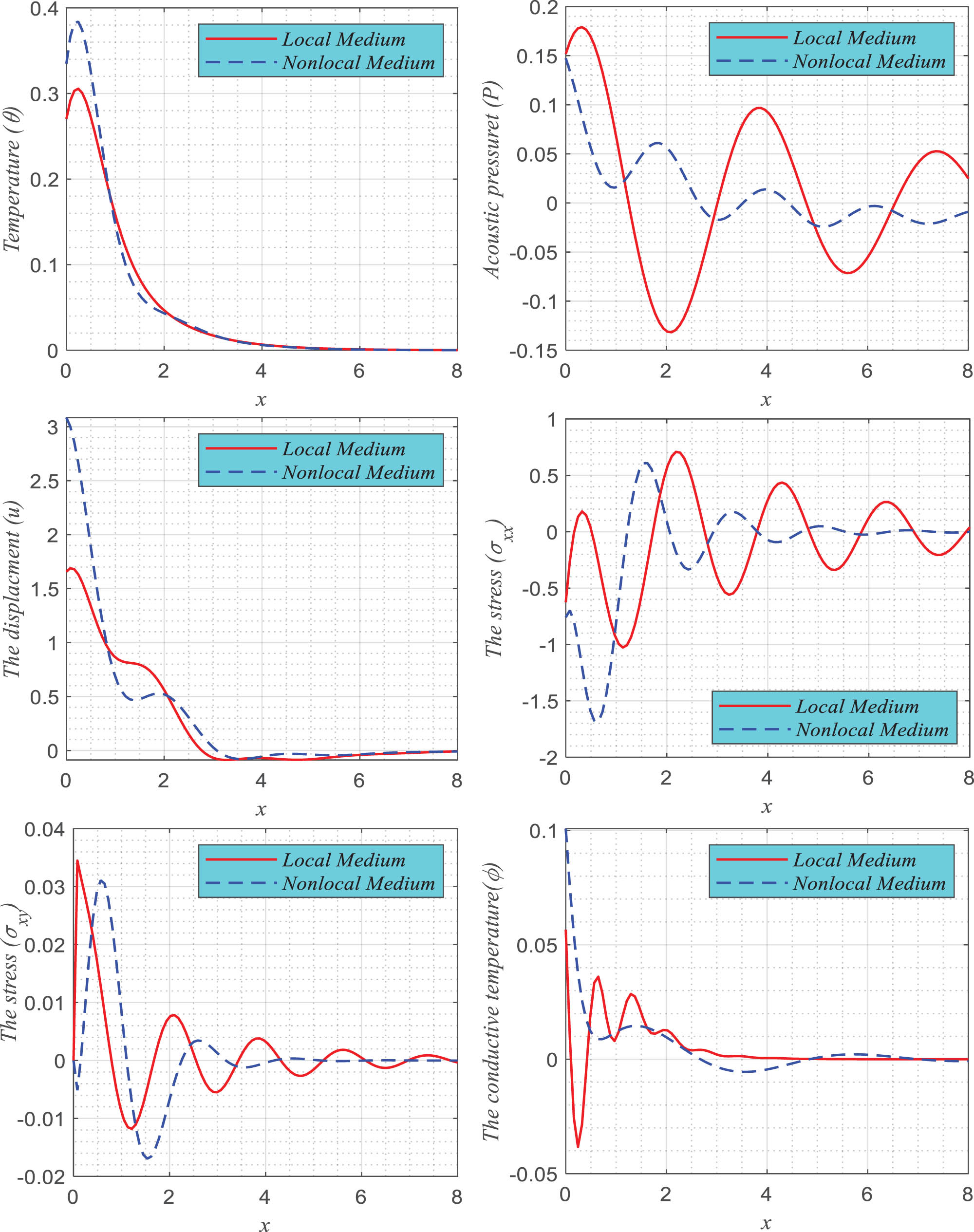
Variation in the primary dimensionless physical fields for the vertical distance for local and nonlocal media under the impact of Hall current, based on the DPL model, with varying sinusoidal heating parameters.
6 Numerical results
This section provides a quantitative assessment of the analytical solutions to the various problem areas discussed earlier. This section presents numerical results for several dimensionless physical quantities associated with thermoelastic behavior, emphasizing temperature, acoustic pressure, and stress. The numerical results are presented graphically and analyzed theoretically. To highlight the influence of each factor in facilitating wave propagation within an elastic medium, a detailed discussion and analysis of its effect on the system of equations is conducted. While additional variables were chosen individually, all studies were completed within a relatively short time period (t = 0.001 s) when
6.1 Hall current effect
Figure 1 illustrates the effect of the Hall current (represented by the parameter
6.2 Influence of the nonlocal parameter
Figure 2 displays the influence of the nonlocal parameter on wave propagation in the context of an elastic medium under the effect of the Hall current, modeled according to the DPL approach, which leads to significant alterations in the behavior of various physical fields. This effect appears when the nonlocal parameter affects the dimensionless physical fields: Temperature, acoustic pressure, displacement, normal stress, tangent stress, and conductive temperature. When the nonlocal parameter is introduced, the temperature distribution in the medium changes due to the memory effect of the material. In the local model, the temperature evolves based on the present state of the system, while in the nonlocal case, it is affected by the past thermal history (due to phase lags). This results in more complex thermal waves, which may show delayed responses or oscillatory behavior. The nonlocal parameter models the delay in the thermal response. The inclusion of nonlocal effects tends to dampen the amplitude of acoustic pressure waves and may cause a phase shift. The nonlocal medium takes into account the history of the stress field, leading to a more gradual response rather than the sharp propagation seen in the local case. The nonlocal parameter introduces a lag in the acoustic wave’s response to external excitations, modifying the pressure wave’s amplitude and velocity. Displacement waves (acoustic waves) in a nonlocal medium tend to exhibit more complex patterns due to the delayed material response. These waves can show oscillations that differ from the traditional propagation in the local medium. The amplitude of displacement might also be reduced as the nonlocal effects lead to additional damping. Normal stress, which relates to the force per unit area acting perpendicular to a surface in the medium, is influenced by the nonlocal parameter by showing more complex distribution patterns. The stress response becomes less sharp and more distributed as the material “remembers” prior deformations. The inclusion of the Hall current in this context can induce additional stress components in the material, which interact with the wave propagation. Tangent stress, which is parallel to the surface of the material, behaves similar to normal stress under nonlocal effects, showing more gradual variations. Nonlocality induces additional damping or phase shifts in tangent stresses, particularly in regions where the stress concentrations would typically occur. Conductive temperature shows significant changes with nonlocal parameters because the heat conduction becomes delayed, and the temperature profile will not follow a simple gradient in time and space. This effect is more pronounced when Hall currents influence the electron transport, as they modify how energy is transferred in the medium. Finally, nonlocal parameters introduce delays or phase lags in the response of all the physical fields. The material’s history influences wave propagation, temperature, stress, and displacement [31].
6.3 Impact of DPL thermal times
The relaxation times in the LS model and the DPL model play a crucial role in the propagation of waves in a nonlocal medium, especially under the influence of the Hall current which is obtained in Figure 3. These models introduce memory effects or time lags into the material’s response to mechanical and thermal disturbances, which are essential for accurately modeling complex phenomena in materials with thermal and elastic relaxation processes. The LS model introduces thermal relaxation time (
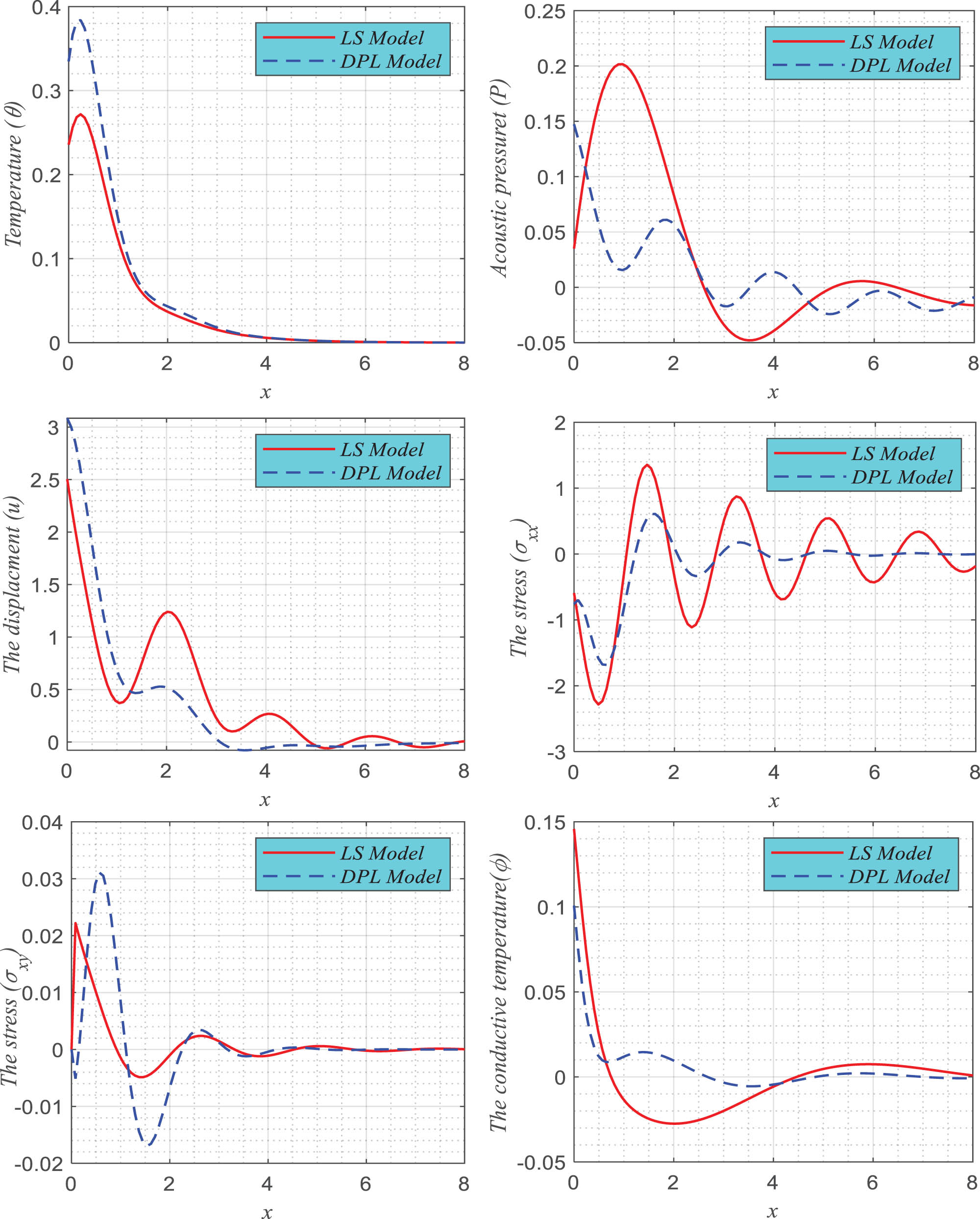
Variation in the primary dimensionless nonlocal physical fields for the vertical distance for different thermal memories according to the LS model and DPL model, based on the Hall current model, with varying sinusoidal heating parameters.
6.4 Surface wave propagation
The surface wave propagation of various dimensionless nonlocal physical fields (temperature, acoustic pressure, displacement, normal stress, tangent stress, and conductive temperature) is influenced by several factors. In the context of Figure 4, the DPL model and the Hall current model are used to describe the effects of sinusoidal heating on wave propagation. The figure likely shows the behavior of these fields as a function of both vertical (x) and horizontal (z) distances, while varying sinusoidal heating parameters (amplitude, frequency, or other characteristics). Let us break down the effects in detail. Sinusoidal heating typically involves a periodic temperature variation that can significantly affect the propagation of waves. In this case, the sinusoidal heating parameters influence the material’s response, modifying the characteristics of wave propagation, especially in terms of amplitude, frequency, and damping. Overall, the combined effects of sinusoidal heating, Hall current, and the DPL model lead to more complex and slower wave propagation, with significant changes in the amplitude, phase, and damping of the waves.
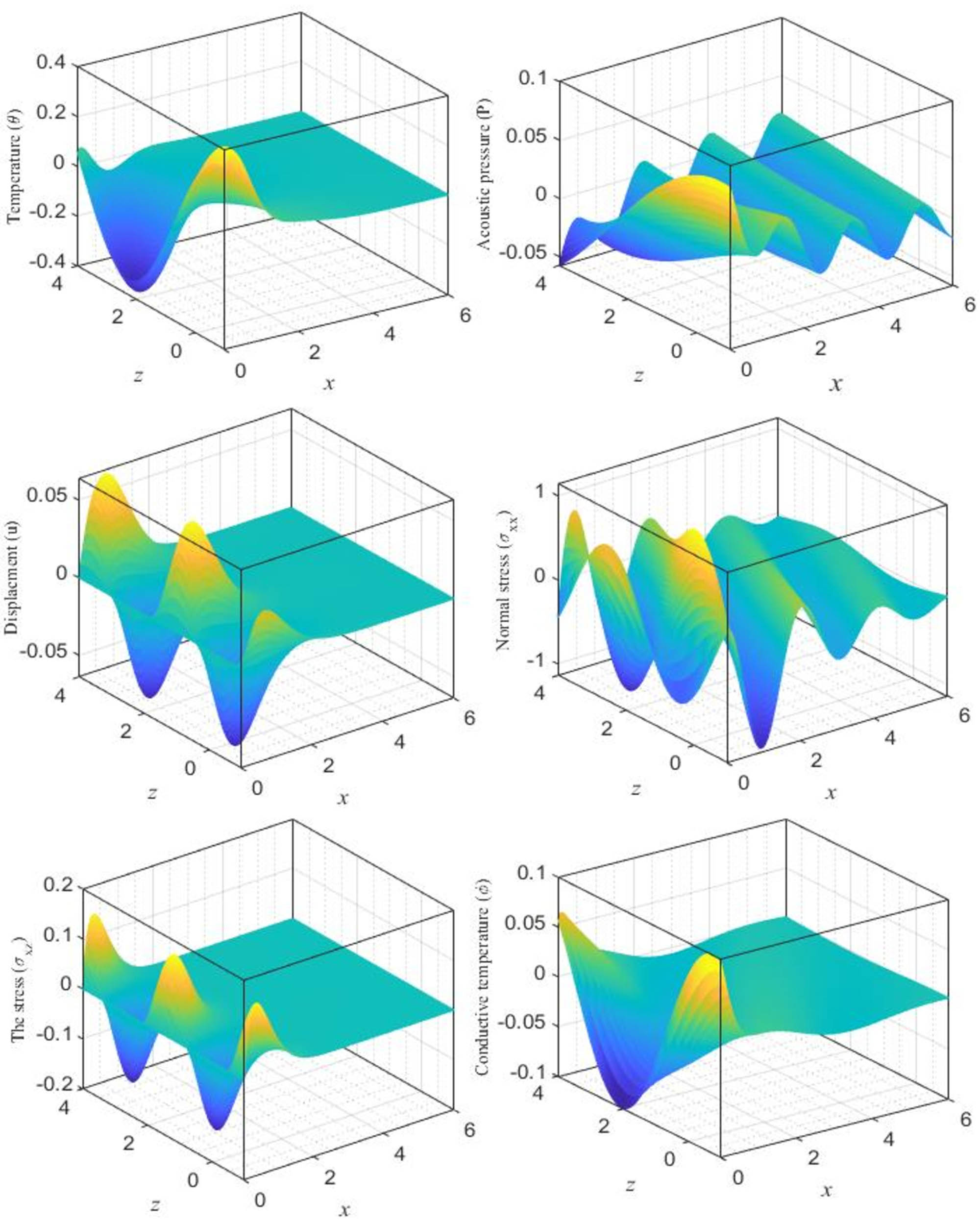
Variation in the primary dimensionless nonlocal physical fields for the horizontal and vertical distances according to the DPL model, based on the Hall current model, with varying sinusoidal heating parameters.
7 Life applications
The DPL thermoelasticity theory and its extension to nonlocal effects provide insights into heat transfer and stress distribution in nanostructures. These results are critical for developing efficient thermal management strategies in microelectronics and photonics.
The study of elastic and thermal wave propagation with nonlocal effects can advance acoustic wave applications, such as surface acoustic wave devices, which are used in sensors, filters, and signal processing systems in communication technology.
The framework developed in this work provides a foundation for studying mechanical and thermal behaviors in advanced materials, including nanocomposites and metamaterials. The incorporation of nonlocal effects is particularly relevant for understanding and designing materials with tailored properties at the nanoscale.
In aerospace engineering, where materials are exposed to extreme thermal and electromagnetic environments, this study provides essential tools for predicting material behavior and ensuring reliability in advanced structural applications.
The coupling between thermal, elastic, and electromagnetic fields can be exploited in piezoelectric and thermoelectric energy harvesting systems. Insights from this investigation could contribute to the efficiency and miniaturization of such systems.
8 Conclusion
This work presents an advanced model of magnetothermal elasticity, incorporating acoustic pressure and extending the heat transfer concept to include both dynamic and conductive temperatures, along with relaxation times. The governing equations were derived from the nonlocal thermoelastic model influenced by acoustic pressure in the presence of a strong magnetic field. The model was solved using the harmonic wave method, with specific boundary conditions applied to the free surface. The study focused on the response of nonlocal thermoelastic materials to thermal and acoustic stresses, temperature variations, and deformations, while also considering the impact of Hall effect. The role of the Hall current is emphasized, as the variations in conductivity caused by a strong magnetic field make it a significant factor. This current is generated when ions and electrons collide and move perpendicular to the electromagnetic fields along the magnetic lines of force. The current DPL model is found to offer more accurate predictions compared to the LS models, highlighting the importance of incorporating different relaxation times for a better understanding of heat and stress propagation dynamics within materials. Additionally, the varied heating sinusoidally (ramp heating) with time parameter is identified as a crucial factor in determining how heat is applied to the thermoelastic medium over time, significantly affecting the behavior of the studied thermophysical domains. Integrating the Hall current effect, varying relaxation times, and ramp-type heating parameters into thermoelastic models not only deepens our understanding of wave propagation phenomena but also facilitates the development of advanced materials and technologies. This enhanced understanding has wide-ranging implications across fields such as science, engineering, and medicine, particularly in the design of magnetostrictive materials for sensors and actuators. Furthermore, it aids in optimizing material processing techniques to improve performance and efficiency, especially in the context of tailored materials with specialized functionalities. Understanding the complex interactions between magnetic fields, thermal properties, and mechanical responses is essential for the advancement of next-generation materials.
Acknowledgments
The authors would like to extend their sincere appreciation to Researchers Supporting Project number (RSPD2025R1112), King Saud University, Riyadh, Saudi Arabia.
-
Funding information: Researchers Supporting Project number (RSPD2025R1112), King Saud University, Riyadh, Saudi Arabia.
-
Author contributions: All authors have accepted responsibility for the entire content of this manuscript and approved its submission.
-
Conflict of interest: The authors state no conflict of interest.
-
Data availability statement: The datasets generated and/or analyzed during the current study are available from the corresponding author on reasonable request.
References
[1] Biot MA. Thermoclasticity and irreversible thermodynamics. J Appl Phys. 1956;27:240–53.10.1063/1.1722351Search in Google Scholar
[2] Hetnarski R, Ignaczak J. Generalized thermoelasticity. J Therm Stress. 1999;22:451–76.10.1080/014957399280832Search in Google Scholar
[3] Lord HW, Shulman Y. A generalized dynamical theory of thermolasticity. J Mech Phys Solids. 1967;15:299–309.10.1016/0022-5096(67)90024-5Search in Google Scholar
[4] Green AE, Lindsay KA. Thermoelasticity. J Elast. 1972;2:1–7.10.1007/BF00045689Search in Google Scholar
[5] Green AE, Naghdi P. Thermoelasticity without energy dissipation. J Elast. 1993;31:189–208.10.1007/BF00044969Search in Google Scholar
[6] Tzou D. Experimental support for the lagging behavior in heat propagation. J Thermophys Heat Transf. 1995;9:686–93.10.2514/3.725Search in Google Scholar
[7] Tzou D. Macro-to microscale heat transfer: the lagging behavior. Washington, DC, USA: Taylor and Francis; 1996.Search in Google Scholar
[8] Chen P, Gurtin M, Williams W. On the thermodynamics of non-simple elastic materials with two temperatures. Z Angew Math Phys. 1969;20:107–12.10.1007/BF01591120Search in Google Scholar
[9] Chen P, Williams W. A note on non-simple heat conduction. Z Angew Math Phys. 1968;19:969–70.10.1007/BF01602278Search in Google Scholar
[10] Lotfy K. Mode-I crack in a two-dimensional fibre-reinforced generalized thermoelastic problem. Chin Phys B. 2012;21(1):014209.10.1088/1674-1056/21/1/014209Search in Google Scholar
[11] Othman M, Lotfy Kh. The effect of magnetic field and rotation of the 2-D problem of a fiber-reinforced thermoelastic under three theories with influence of gravity. Mech Mater. 2013;60:129–43.10.1016/j.mechmat.2013.01.007Search in Google Scholar
[12] Quintanilla R. On existence, structural stability, convergence and spatial behavior in thermoelasticity with two temperatures. Acta Mech. 2004;168:61–73.10.1007/s00707-004-0073-6Search in Google Scholar
[13] Youssef HM. Theory of two-temperature-generalized thermoelasticity. IMA J Appl Math. 2006;71:383–90.10.1093/imamat/hxh101Search in Google Scholar
[14] Jadhav N, Gaikwad K, Khavale S. Fractional order thermoelastic problem for a thin circular plate with uniform internal heat generation. J Heat Mass Transf. 2023;35:107–24.10.17654/0973576323045Search in Google Scholar
[15] Awad E, Alhazmi S, Abdou M, Fayik M. Anomalous thermally induced deformation in Kelvin–Voigt plate with ultrafast double-strip surface heating. Fractal Fract. 2023;7:563.10.3390/fractalfract7070563Search in Google Scholar
[16] Guo H, Shang F, Tian X, He T. An analytical study of transient thermo-viscoelastic responses of viscoelastic laminated sandwich composite structure for vibration control. Mech Adv Mater Struct. 2022;29:171–81.10.1080/15376494.2020.1756544Search in Google Scholar
[17] Guo H, Shang F, He T. Fractional-order rate-dependent piezoelectric thermoelasticity theory based on new fractional derivatives and its application in structural transient response analysis of smart piezoelectric composite laminates. Int J Appl Mech. 2024;16:2450016.10.1142/S1758825124500169Search in Google Scholar
[18] Awad E. A note on the spatial decay estimates in non-classical linear thermoelastic semi-cylindrical bounded domains. J Therm Stresses. 2011;34(2):147–60. 10.1080/01495739.2010.511942.Search in Google Scholar
[19] Awad E, Dai W, Sobolev S. Thermal oscillations and resonance in electron–phonon interaction process. Z Angew Math Phys. 2024;75:143. 10.1007/s00033-024-02277-w.Search in Google Scholar
[20] Fan T. Mathematical theory of elasticity of quasicrystals and its applications. Springer: Singapore; 2016. 10.1007/978-981-10-1984-5.Search in Google Scholar
[21] Lotfy K, El-Bary A, Hassan W, Alharbi A, Almatrafi M. Electromagnetic and Thomson effects during photothermal transport process of a rotator semiconductor medium under hydrostatic initial stress. Results Phys. 2020;16:102983. 10.1016/j.rinp.2020.102983.Search in Google Scholar
[22] Lotfy K, El-Bary A, El-Sharif AH. Ramp-type heating microtemperature for a rotator semiconducting material during photo-excited processes with magnetic field. Results Phys. 2020;19:103338. 10.1016/j.rinp.2020.103338.Search in Google Scholar
[23] Lotfy K, El-Bary A, Hassan W, Ahmed MH. Hall current influence of microtemperature magneto-elastic semiconductor material. Superlattices Microstruct. 2020;139:106428. 10.1016/j.spmi.2020.106428.Search in Google Scholar
[24] Mandelis A. Photoacoustic and thermal wave phenomena in semiconductors. United States: Elsevier; 1987.Search in Google Scholar
[25] Lotfy K, El-Bary A, Daoud S, Ahmed MH, Allan M. A novel model of nonlocal photoacoustic and plasmaelastic heated by laser pulsed excitation of nanoscale semiconductor medium. Phys Fluids. 2024;36:012021. 10.1063/5.0190226.Search in Google Scholar
[26] Alshehri H, Lotfy K, Raddadi M, El-Bary A. A nonlocal photoacoustic effect with variable thermal conductivity of semiconductor material subjected to laser heat source. Results Phys. 2024;61:107715. 10.1016/j.rinp.2024.107715.Search in Google Scholar
[27] Sadeghi M, Kiani Y. Generalized magneto-thermoelasticity of a layer based on the Lord–Shulman and Green–Lindsay theories. J Therm Stress. 2022;45:319–40.10.1080/01495739.2022.2038745Search in Google Scholar
[28] Abbas I, Marin M. Analytical solutions of a two-dimensional generalized thermoelastic diffusions problem due to laser pulse. Iran J Sci Technol Trans Mech Eng. 2018;42:57–71.10.1007/s40997-017-0077-1Search in Google Scholar
[29] Hobiny A, Abbas I. Theoretical analysis of thermal damages in skin tissue induced by intense moving heat source. Int J Heat Mass Trans. 2018;124:1011–4.10.1016/j.ijheatmasstransfer.2018.04.018Search in Google Scholar
[30] Singhal A. Theoretical investigation of SH wave transmission in magneto-electro-elastic structure having imperfect interface using approximating method. Appl Phys A. 2024;130:597. 10.1007/s00339-024-07744-9.Search in Google Scholar
[31] Tiwari R, Saeed AM, Kumar R, Kumar A, Singhal A. Memory response on generalized thermoelastic medium in context of dual phase lag thermoelasticity with non-local effect. Arch Mech. 2022;74(2–3):69–88. 10.24423/aom.3926.Search in Google Scholar
[32] Singhal A. Examining three distinct rheological models with flexoelectric effect to investigate Love-type wave velocity in bedded piezo-structure. Z Angew Math Mech. 2024;104:e202400724. 10.1002/zamm.202400724.Search in Google Scholar
[33] Gupta V, Barak M. Photo-thermo-piezo-elastic waves in semiconductor medium subject to distinct two temperature models with higher order memory dependencies. Int J Numer Methods Heat Fluid Flow. 2024;34(1):84–108. 10.1108/HFF-07-2023-0380.Search in Google Scholar
[34] Gupta V, Barak M, Ahmad H. Reflection of quasi plasma wave in photo-piezo semiconductor medium with distinct higher order fractional derivative two temperature models. Phys, Scr. 2024;99:025515. 10.1088/1402-4896/ad1972.Search in Google Scholar
[35] Barak M, Ahmad H, Kumar R. Behavior of higher-order MDD on energy ratios at the interface of thermoelastic and piezothermoelastic mediums. Sci Rep. 2023;13:17170. 10.1038/s41598-023-44339-5.Search in Google Scholar PubMed PubMed Central
[36] Othman M, Fekry M, Marin M. Plane waves in generalized magneto-thermo-viscoelastic medium with voids under the effect of initial stress and laser pulse heating. Struct Eng Mech. 2020;73(6):621–9.Search in Google Scholar
[37] Maldague XP, Zhang SY. Introduction to the scope and applications of photothermal and photoacoustic effects, Photothermal and Photoacoustic Phenomena II. Vol. 11, Bellingham, Washington, USA: International Society for Optics and Photonics; 1992.Search in Google Scholar
[38] Gutiérrez-Reyes E, García-Segundo C, García-Valenzuela A, Ortega R, Buj C, Filbir F. Heat transport considerations in the mathematical analysis of the photoacoustic and photothermal effects. J Phys Commun. 2019;3:085007.10.1088/2399-6528/ab376dSearch in Google Scholar
[39] Marin M. An evolutionary equation in thermoelasticity of dipolar bodies. J Math Phys. 1999;40(3):1391–9.10.1063/1.532809Search in Google Scholar
[40] Marin M. On existence and uniqueness in thermoelasticity of micropolar bodies. Comptes Rendus l’Académie Sci, Paris, Série II. 1995;321(12):475–80.Search in Google Scholar
[41] Abouelregal A, Alhassan Y, Althagafi H, Alsharif F. A two-temperature fractional DPL thermoelasticity model with an exponential Rabotnov kernel for a flexible cylinder with changeable properties. Fractal Fract. 2024;8:182.10.3390/fractalfract8040182Search in Google Scholar
[42] Ailawalia P, Sachdeva S, Pathania D. Two-dimensional problem on laser pulse heating in thermoelastic microelongated solid. Arch Thermodyn. 2019;40(2):69–85.Search in Google Scholar
[43] Abo-Dahab S, Abouelregal A, Marin M. Generalized thermoelastic functionally graded on a thin slim strip non-Gaussian laser beam. Symmetry. 2020;12(7):1094.10.3390/sym12071094Search in Google Scholar
[44] Lata P, Kaur H. Interactions in a transversely isotropic new modified couple stress thermoelastic thick circular plate with two temperature theory. Coupled Syst Mech. 2023;12(3):261–76.Search in Google Scholar
[45] Lata P. Thermomechanical interactions in a transversely isotropic thermoelastic media with diffusion due to inclined load. Struct Eng Mech. 2024;90(3):263–72.Search in Google Scholar
[46] Kaur I, Singh K. Effect of memory dependent derivative and variable thermal conductivity in cantilever nano-beam with forced transverse vibrations. Forces Mech. 2021;5:100043.10.1016/j.finmec.2021.100043Search in Google Scholar
[47] Kaur I, Lata P, Singh K. Thermomechanical deformation in a transversely isotropic magneto-thermoelastic rotating solids under initial stress. Partial Differ Equ Appl Math. 2021;3:100028.10.1016/j.padiff.2021.100028Search in Google Scholar
[48] Ailawalia P, Priyanka, Marin M, Altenbach H. Variable thermal conductivity in context of Green-Naghdi theory of thermo-microstretch solids. ZAMM-J Appl Math Mech/Z Angew Math Mech. 2024;104(4):e202400010.10.1002/zamm.202400010Search in Google Scholar
© 2025 the author(s), published by De Gruyter
This work is licensed under the Creative Commons Attribution 4.0 International License.
Articles in the same Issue
- Research Articles
- Single-step fabrication of Ag2S/poly-2-mercaptoaniline nanoribbon photocathodes for green hydrogen generation from artificial and natural red-sea water
- Abundant new interaction solutions and nonlinear dynamics for the (3+1)-dimensional Hirota–Satsuma–Ito-like equation
- A novel gold and SiO2 material based planar 5-element high HPBW end-fire antenna array for 300 GHz applications
- Explicit exact solutions and bifurcation analysis for the mZK equation with truncated M-fractional derivatives utilizing two reliable methods
- Optical and laser damage resistance: Role of periodic cylindrical surfaces
- Numerical study of flow and heat transfer in the air-side metal foam partially filled channels of panel-type radiator under forced convection
- Water-based hybrid nanofluid flow containing CNT nanoparticles over an extending surface with velocity slips, thermal convective, and zero-mass flux conditions
- Dynamical wave structures for some diffusion--reaction equations with quadratic and quartic nonlinearities
- Solving an isotropic grey matter tumour model via a heat transfer equation
- Study on the penetration protection of a fiber-reinforced composite structure with CNTs/GFP clip STF/3DKevlar
- Influence of Hall current and acoustic pressure on nanostructured DPL thermoelastic plates under ramp heating in a double-temperature model
- Applications of the Belousov–Zhabotinsky reaction–diffusion system: Analytical and numerical approaches
- AC electroosmotic flow of Maxwell fluid in a pH-regulated parallel-plate silica nanochannel
- Interpreting optical effects with relativistic transformations adopting one-way synchronization to conserve simultaneity and space–time continuity
- Modeling and analysis of quantum communication channel in airborne platforms with boundary layer effects
- Theoretical and numerical investigation of a memristor system with a piecewise memductance under fractal–fractional derivatives
- Tuning the structure and electro-optical properties of α-Cr2O3 films by heat treatment/La doping for optoelectronic applications
- High-speed multi-spectral explosion temperature measurement using golden-section accelerated Pearson correlation algorithm
- Dynamic behavior and modulation instability of the generalized coupled fractional nonlinear Helmholtz equation with cubic–quintic term
- Study on the duration of laser-induced air plasma flash near thin film surface
- Exploring the dynamics of fractional-order nonlinear dispersive wave system through homotopy technique
- The mechanism of carbon monoxide fluorescence inside a femtosecond laser-induced plasma
- Numerical solution of a nonconstant coefficient advection diffusion equation in an irregular domain and analyses of numerical dispersion and dissipation
- Numerical examination of the chemically reactive MHD flow of hybrid nanofluids over a two-dimensional stretching surface with the Cattaneo–Christov model and slip conditions
- Impacts of sinusoidal heat flux and embraced heated rectangular cavity on natural convection within a square enclosure partially filled with porous medium and Casson-hybrid nanofluid
- Stability analysis of unsteady ternary nanofluid flow past a stretching/shrinking wedge
- Solitonic wave solutions of a Hamiltonian nonlinear atom chain model through the Hirota bilinear transformation method
- Bilinear form and soltion solutions for (3+1)-dimensional negative-order KdV-CBS equation
- Solitary chirp pulses and soliton control for variable coefficients cubic–quintic nonlinear Schrödinger equation in nonuniform management system
- Influence of decaying heat source and temperature-dependent thermal conductivity on photo-hydro-elasto semiconductor media
- Dissipative disorder optimization in the radiative thin film flow of partially ionized non-Newtonian hybrid nanofluid with second-order slip condition
- Bifurcation, chaotic behavior, and traveling wave solutions for the fractional (4+1)-dimensional Davey–Stewartson–Kadomtsev–Petviashvili model
- New investigation on soliton solutions of two nonlinear PDEs in mathematical physics with a dynamical property: Bifurcation analysis
- Mathematical analysis of nanoparticle type and volume fraction on heat transfer efficiency of nanofluids
- Creation of single-wing Lorenz-like attractors via a ten-ninths-degree term
- Optical soliton solutions, bifurcation analysis, chaotic behaviors of nonlinear Schrödinger equation and modulation instability in optical fiber
- Chaotic dynamics and some solutions for the (n + 1)-dimensional modified Zakharov–Kuznetsov equation in plasma physics
- Fractal formation and chaotic soliton phenomena in nonlinear conformable Heisenberg ferromagnetic spin chain equation
- Single-step fabrication of Mn(iv) oxide-Mn(ii) sulfide/poly-2-mercaptoaniline porous network nanocomposite for pseudo-supercapacitors and charge storage
- Novel constructed dynamical analytical solutions and conserved quantities of the new (2+1)-dimensional KdV model describing acoustic wave propagation
- Tavis–Cummings model in the presence of a deformed field and time-dependent coupling
- Spinning dynamics of stress-dependent viscosity of generalized Cross-nonlinear materials affected by gravitationally swirling disk
- Design and prediction of high optical density photovoltaic polymers using machine learning-DFT studies
- Robust control and preservation of quantum steering, nonlocality, and coherence in open atomic systems
- Coating thickness and process efficiency of reverse roll coating using a magnetized hybrid nanomaterial flow
- Dynamic analysis, circuit realization, and its synchronization of a new chaotic hyperjerk system
- Decoherence of steerability and coherence dynamics induced by nonlinear qubit–cavity interactions
- Finite element analysis of turbulent thermal enhancement in grooved channels with flat- and plus-shaped fins
- Modulational instability and associated ion-acoustic modulated envelope solitons in a quantum plasma having ion beams
- Statistical inference of constant-stress partially accelerated life tests under type II generalized hybrid censored data from Burr III distribution
- On solutions of the Dirac equation for 1D hydrogenic atoms or ions
- Entropy optimization for chemically reactive magnetized unsteady thin film hybrid nanofluid flow on inclined surface subject to nonlinear mixed convection and variable temperature
- Stability analysis, circuit simulation, and color image encryption of a novel four-dimensional hyperchaotic model with hidden and self-excited attractors
- A high-accuracy exponential time integration scheme for the Darcy–Forchheimer Williamson fluid flow with temperature-dependent conductivity
- Novel analysis of fractional regularized long-wave equation in plasma dynamics
- Development of a photoelectrode based on a bismuth(iii) oxyiodide/intercalated iodide-poly(1H-pyrrole) rough spherical nanocomposite for green hydrogen generation
- Investigation of solar radiation effects on the energy performance of the (Al2O3–CuO–Cu)/H2O ternary nanofluidic system through a convectively heated cylinder
- Quantum resources for a system of two atoms interacting with a deformed field in the presence of intensity-dependent coupling
- Studying bifurcations and chaotic dynamics in the generalized hyperelastic-rod wave equation through Hamiltonian mechanics
- A new numerical technique for the solution of time-fractional nonlinear Klein–Gordon equation involving Atangana–Baleanu derivative using cubic B-spline functions
- Interaction solutions of high-order breathers and lumps for a (3+1)-dimensional conformable fractional potential-YTSF-like model
- Hydraulic fracturing radioactive source tracing technology based on hydraulic fracturing tracing mechanics model
- Numerical solution and stability analysis of non-Newtonian hybrid nanofluid flow subject to exponential heat source/sink over a Riga sheet
- Numerical investigation of mixed convection and viscous dissipation in couple stress nanofluid flow: A merged Adomian decomposition method and Mohand transform
- Effectual quintic B-spline functions for solving the time fractional coupled Boussinesq–Burgers equation arising in shallow water waves
- Analysis of MHD hybrid nanofluid flow over cone and wedge with exponential and thermal heat source and activation energy
- Solitons and travelling waves structure for M-fractional Kairat-II equation using three explicit methods
- Impact of nanoparticle shapes on the heat transfer properties of Cu and CuO nanofluids flowing over a stretching surface with slip effects: A computational study
- Computational simulation of heat transfer and nanofluid flow for two-sided lid-driven square cavity under the influence of magnetic field
- Irreversibility analysis of a bioconvective two-phase nanofluid in a Maxwell (non-Newtonian) flow induced by a rotating disk with thermal radiation
- Hydrodynamic and sensitivity analysis of a polymeric calendering process for non-Newtonian fluids with temperature-dependent viscosity
- Exploring the peakon solitons molecules and solitary wave structure to the nonlinear damped Kortewege–de Vries equation through efficient technique
- Modeling and heat transfer analysis of magnetized hybrid micropolar blood-based nanofluid flow in Darcy–Forchheimer porous stenosis narrow arteries
- Activation energy and cross-diffusion effects on 3D rotating nanofluid flow in a Darcy–Forchheimer porous medium with radiation and convective heating
- Insights into chemical reactions occurring in generalized nanomaterials due to spinning surface with melting constraints
- Influence of a magnetic field on double-porosity photo-thermoelastic materials under Lord–Shulman theory
- Soliton-like solutions for a nonlinear doubly dispersive equation in an elastic Murnaghan's rod via Hirota's bilinear method
- Analytical and numerical investigation of exact wave patterns and chaotic dynamics in the extended improved Boussinesq equation
- Nonclassical correlation dynamics of Heisenberg XYZ states with (x, y)-spin--orbit interaction, x-magnetic field, and intrinsic decoherence effects
- Exact traveling wave and soliton solutions for chemotaxis model and (3+1)-dimensional Boiti–Leon–Manna–Pempinelli equation
- Unveiling the transformative role of samarium in ZnO: Exploring structural and optical modifications for advanced functional applications
- On the derivation of solitary wave solutions for the time-fractional Rosenau equation through two analytical techniques
- Analyzing the role of length and radius of MWCNTs in a nanofluid flow influenced by variable thermal conductivity and viscosity considering Marangoni convection
- Advanced mathematical analysis of heat and mass transfer in oscillatory micropolar bio-nanofluid flows via peristaltic waves and electroosmotic effects
- Exact bound state solutions of the radial Schrödinger equation for the Coulomb potential by conformable Nikiforov–Uvarov approach
- Some anisotropic and perfect fluid plane symmetric solutions of Einstein's field equations using killing symmetries
- Nonlinear dynamics of the dissipative ion-acoustic solitary waves in anisotropic rotating magnetoplasmas
- Curves in multiplicative equiaffine plane
- Exact solution of the three-dimensional (3D) Z2 lattice gauge theory
- Propagation properties of Airyprime pulses in relaxing nonlinear media
- Symbolic computation: Analytical solutions and dynamics of a shallow water wave equation in coastal engineering
- Wave propagation in nonlocal piezo-photo-hygrothermoelastic semiconductors subjected to heat and moisture flux
- Comparative reaction dynamics in rotating nanofluid systems: Quartic and cubic kinetics under MHD influence
- Laplace transform technique and probabilistic analysis-based hypothesis testing in medical and engineering applications
- Physical properties of ternary chloro-perovskites KTCl3 (T = Ge, Al) for optoelectronic applications
- Gravitational length stretching: Curvature-induced modulation of quantum probability densities
- The search for the cosmological cold dark matter axion – A new refined narrow mass window and detection scheme
- A comparative study of quantum resources in bipartite Lipkin–Meshkov–Glick model under DM interaction and Zeeman splitting
- PbO-doped K2O–BaO–Al2O3–B2O3–TeO2-glasses: Mechanical and shielding efficacy
- Nanospherical arsenic(iii) oxoiodide/iodide-intercalated poly(N-methylpyrrole) composite synthesis for broad-spectrum optical detection
- Sine power Burr X distribution with estimation and applications in physics and other fields
- Numerical modeling of enhanced reactive oxygen plasma in pulsed laser deposition of metal oxide thin films
- Dynamical analyses and dispersive soliton solutions to the nonlinear fractional model in stratified fluids
- Computation of exact analytical soliton solutions and their dynamics in advanced optical system
- An innovative approximation concerning the diffusion and electrical conductivity tensor at critical altitudes within the F-region of ionospheric plasma at low latitudes
- An analytical investigation to the (3+1)-dimensional Yu–Toda–Sassa–Fukuyama equation with dynamical analysis: Bifurcation
- Swirling-annular-flow-induced instability of a micro shell considering Knudsen number and viscosity effects
- Numerical analysis of non-similar convection flows of a two-phase nanofluid past a semi-infinite vertical plate with thermal radiation
- MgO NPs reinforced PCL/PVC nanocomposite films with enhanced UV shielding and thermal stability for packaging applications
- Optimal conditions for indoor air purification using non-thermal Corona discharge electrostatic precipitator
- Investigation of thermal conductivity and Raman spectra for HfAlB, TaAlB, and WAlB based on first-principles calculations
- Tunable double plasmon-induced transparency based on monolayer patterned graphene metamaterial
- DSC: depth data quality optimization framework for RGBD camouflaged object detection
- A new family of Poisson-exponential distributions with applications to cancer data and glass fiber reliability
- Numerical investigation of couple stress under slip conditions via modified Adomian decomposition method
- Monitoring plateau lake area changes in Yunnan province, southwestern China using medium-resolution remote sensing imagery: applicability of water indices and environmental dependencies
- Heterodyne interferometric fiber-optic gyroscope
- Exact solutions of Einstein’s field equations via homothetic symmetries of non-static plane symmetric spacetime
- A widespread study of discrete entropic model and its distribution along with fluctuations of energy
- Empirical model integration for accurate charge carrier mobility simulation in silicon MOSFETs
- The influence of scattering correction effect based on optical path distribution on CO2 retrieval
- Anisotropic dissociation and spectral response of 1-Bromo-4-chlorobenzene under static directional electric fields
- Role of tungsten oxide (WO3) on thermal and optical properties of smart polymer composites
- Analysis of iterative deblurring: no explicit noise
- The influence of anisotropy of InP on its elasticity and phonon properties
- Review Article
- Examination of the gamma radiation shielding properties of different clay and sand materials in the Adrar region
- Erratum
- Erratum to “On Soliton structures in optical fiber communications with Kundu–Mukherjee–Naskar model (Open Physics 2021;19:679–682)”
- Special Issue on Fundamental Physics from Atoms to Cosmos - Part II
- Possible explanation for the neutron lifetime puzzle
- Special Issue on Nanomaterial utilization and structural optimization - Part III
- Numerical investigation on fluid-thermal-electric performance of a thermoelectric-integrated helically coiled tube heat exchanger for coal mine air cooling
- Special Issue on Nonlinear Dynamics and Chaos in Physical Systems
- Analysis of the fractional relativistic isothermal gas sphere with application to neutron stars
- Abundant wave symmetries in the (3+1)-dimensional Chafee–Infante equation through the Hirota bilinear transformation technique
- Successive midpoint method for fractional differential equations with nonlocal kernels: Error analysis, stability, and applications
- Novel exact solitons to the fractional modified mixed-Korteweg--de Vries model with a stability analysis
Articles in the same Issue
- Research Articles
- Single-step fabrication of Ag2S/poly-2-mercaptoaniline nanoribbon photocathodes for green hydrogen generation from artificial and natural red-sea water
- Abundant new interaction solutions and nonlinear dynamics for the (3+1)-dimensional Hirota–Satsuma–Ito-like equation
- A novel gold and SiO2 material based planar 5-element high HPBW end-fire antenna array for 300 GHz applications
- Explicit exact solutions and bifurcation analysis for the mZK equation with truncated M-fractional derivatives utilizing two reliable methods
- Optical and laser damage resistance: Role of periodic cylindrical surfaces
- Numerical study of flow and heat transfer in the air-side metal foam partially filled channels of panel-type radiator under forced convection
- Water-based hybrid nanofluid flow containing CNT nanoparticles over an extending surface with velocity slips, thermal convective, and zero-mass flux conditions
- Dynamical wave structures for some diffusion--reaction equations with quadratic and quartic nonlinearities
- Solving an isotropic grey matter tumour model via a heat transfer equation
- Study on the penetration protection of a fiber-reinforced composite structure with CNTs/GFP clip STF/3DKevlar
- Influence of Hall current and acoustic pressure on nanostructured DPL thermoelastic plates under ramp heating in a double-temperature model
- Applications of the Belousov–Zhabotinsky reaction–diffusion system: Analytical and numerical approaches
- AC electroosmotic flow of Maxwell fluid in a pH-regulated parallel-plate silica nanochannel
- Interpreting optical effects with relativistic transformations adopting one-way synchronization to conserve simultaneity and space–time continuity
- Modeling and analysis of quantum communication channel in airborne platforms with boundary layer effects
- Theoretical and numerical investigation of a memristor system with a piecewise memductance under fractal–fractional derivatives
- Tuning the structure and electro-optical properties of α-Cr2O3 films by heat treatment/La doping for optoelectronic applications
- High-speed multi-spectral explosion temperature measurement using golden-section accelerated Pearson correlation algorithm
- Dynamic behavior and modulation instability of the generalized coupled fractional nonlinear Helmholtz equation with cubic–quintic term
- Study on the duration of laser-induced air plasma flash near thin film surface
- Exploring the dynamics of fractional-order nonlinear dispersive wave system through homotopy technique
- The mechanism of carbon monoxide fluorescence inside a femtosecond laser-induced plasma
- Numerical solution of a nonconstant coefficient advection diffusion equation in an irregular domain and analyses of numerical dispersion and dissipation
- Numerical examination of the chemically reactive MHD flow of hybrid nanofluids over a two-dimensional stretching surface with the Cattaneo–Christov model and slip conditions
- Impacts of sinusoidal heat flux and embraced heated rectangular cavity on natural convection within a square enclosure partially filled with porous medium and Casson-hybrid nanofluid
- Stability analysis of unsteady ternary nanofluid flow past a stretching/shrinking wedge
- Solitonic wave solutions of a Hamiltonian nonlinear atom chain model through the Hirota bilinear transformation method
- Bilinear form and soltion solutions for (3+1)-dimensional negative-order KdV-CBS equation
- Solitary chirp pulses and soliton control for variable coefficients cubic–quintic nonlinear Schrödinger equation in nonuniform management system
- Influence of decaying heat source and temperature-dependent thermal conductivity on photo-hydro-elasto semiconductor media
- Dissipative disorder optimization in the radiative thin film flow of partially ionized non-Newtonian hybrid nanofluid with second-order slip condition
- Bifurcation, chaotic behavior, and traveling wave solutions for the fractional (4+1)-dimensional Davey–Stewartson–Kadomtsev–Petviashvili model
- New investigation on soliton solutions of two nonlinear PDEs in mathematical physics with a dynamical property: Bifurcation analysis
- Mathematical analysis of nanoparticle type and volume fraction on heat transfer efficiency of nanofluids
- Creation of single-wing Lorenz-like attractors via a ten-ninths-degree term
- Optical soliton solutions, bifurcation analysis, chaotic behaviors of nonlinear Schrödinger equation and modulation instability in optical fiber
- Chaotic dynamics and some solutions for the (n + 1)-dimensional modified Zakharov–Kuznetsov equation in plasma physics
- Fractal formation and chaotic soliton phenomena in nonlinear conformable Heisenberg ferromagnetic spin chain equation
- Single-step fabrication of Mn(iv) oxide-Mn(ii) sulfide/poly-2-mercaptoaniline porous network nanocomposite for pseudo-supercapacitors and charge storage
- Novel constructed dynamical analytical solutions and conserved quantities of the new (2+1)-dimensional KdV model describing acoustic wave propagation
- Tavis–Cummings model in the presence of a deformed field and time-dependent coupling
- Spinning dynamics of stress-dependent viscosity of generalized Cross-nonlinear materials affected by gravitationally swirling disk
- Design and prediction of high optical density photovoltaic polymers using machine learning-DFT studies
- Robust control and preservation of quantum steering, nonlocality, and coherence in open atomic systems
- Coating thickness and process efficiency of reverse roll coating using a magnetized hybrid nanomaterial flow
- Dynamic analysis, circuit realization, and its synchronization of a new chaotic hyperjerk system
- Decoherence of steerability and coherence dynamics induced by nonlinear qubit–cavity interactions
- Finite element analysis of turbulent thermal enhancement in grooved channels with flat- and plus-shaped fins
- Modulational instability and associated ion-acoustic modulated envelope solitons in a quantum plasma having ion beams
- Statistical inference of constant-stress partially accelerated life tests under type II generalized hybrid censored data from Burr III distribution
- On solutions of the Dirac equation for 1D hydrogenic atoms or ions
- Entropy optimization for chemically reactive magnetized unsteady thin film hybrid nanofluid flow on inclined surface subject to nonlinear mixed convection and variable temperature
- Stability analysis, circuit simulation, and color image encryption of a novel four-dimensional hyperchaotic model with hidden and self-excited attractors
- A high-accuracy exponential time integration scheme for the Darcy–Forchheimer Williamson fluid flow with temperature-dependent conductivity
- Novel analysis of fractional regularized long-wave equation in plasma dynamics
- Development of a photoelectrode based on a bismuth(iii) oxyiodide/intercalated iodide-poly(1H-pyrrole) rough spherical nanocomposite for green hydrogen generation
- Investigation of solar radiation effects on the energy performance of the (Al2O3–CuO–Cu)/H2O ternary nanofluidic system through a convectively heated cylinder
- Quantum resources for a system of two atoms interacting with a deformed field in the presence of intensity-dependent coupling
- Studying bifurcations and chaotic dynamics in the generalized hyperelastic-rod wave equation through Hamiltonian mechanics
- A new numerical technique for the solution of time-fractional nonlinear Klein–Gordon equation involving Atangana–Baleanu derivative using cubic B-spline functions
- Interaction solutions of high-order breathers and lumps for a (3+1)-dimensional conformable fractional potential-YTSF-like model
- Hydraulic fracturing radioactive source tracing technology based on hydraulic fracturing tracing mechanics model
- Numerical solution and stability analysis of non-Newtonian hybrid nanofluid flow subject to exponential heat source/sink over a Riga sheet
- Numerical investigation of mixed convection and viscous dissipation in couple stress nanofluid flow: A merged Adomian decomposition method and Mohand transform
- Effectual quintic B-spline functions for solving the time fractional coupled Boussinesq–Burgers equation arising in shallow water waves
- Analysis of MHD hybrid nanofluid flow over cone and wedge with exponential and thermal heat source and activation energy
- Solitons and travelling waves structure for M-fractional Kairat-II equation using three explicit methods
- Impact of nanoparticle shapes on the heat transfer properties of Cu and CuO nanofluids flowing over a stretching surface with slip effects: A computational study
- Computational simulation of heat transfer and nanofluid flow for two-sided lid-driven square cavity under the influence of magnetic field
- Irreversibility analysis of a bioconvective two-phase nanofluid in a Maxwell (non-Newtonian) flow induced by a rotating disk with thermal radiation
- Hydrodynamic and sensitivity analysis of a polymeric calendering process for non-Newtonian fluids with temperature-dependent viscosity
- Exploring the peakon solitons molecules and solitary wave structure to the nonlinear damped Kortewege–de Vries equation through efficient technique
- Modeling and heat transfer analysis of magnetized hybrid micropolar blood-based nanofluid flow in Darcy–Forchheimer porous stenosis narrow arteries
- Activation energy and cross-diffusion effects on 3D rotating nanofluid flow in a Darcy–Forchheimer porous medium with radiation and convective heating
- Insights into chemical reactions occurring in generalized nanomaterials due to spinning surface with melting constraints
- Influence of a magnetic field on double-porosity photo-thermoelastic materials under Lord–Shulman theory
- Soliton-like solutions for a nonlinear doubly dispersive equation in an elastic Murnaghan's rod via Hirota's bilinear method
- Analytical and numerical investigation of exact wave patterns and chaotic dynamics in the extended improved Boussinesq equation
- Nonclassical correlation dynamics of Heisenberg XYZ states with (x, y)-spin--orbit interaction, x-magnetic field, and intrinsic decoherence effects
- Exact traveling wave and soliton solutions for chemotaxis model and (3+1)-dimensional Boiti–Leon–Manna–Pempinelli equation
- Unveiling the transformative role of samarium in ZnO: Exploring structural and optical modifications for advanced functional applications
- On the derivation of solitary wave solutions for the time-fractional Rosenau equation through two analytical techniques
- Analyzing the role of length and radius of MWCNTs in a nanofluid flow influenced by variable thermal conductivity and viscosity considering Marangoni convection
- Advanced mathematical analysis of heat and mass transfer in oscillatory micropolar bio-nanofluid flows via peristaltic waves and electroosmotic effects
- Exact bound state solutions of the radial Schrödinger equation for the Coulomb potential by conformable Nikiforov–Uvarov approach
- Some anisotropic and perfect fluid plane symmetric solutions of Einstein's field equations using killing symmetries
- Nonlinear dynamics of the dissipative ion-acoustic solitary waves in anisotropic rotating magnetoplasmas
- Curves in multiplicative equiaffine plane
- Exact solution of the three-dimensional (3D) Z2 lattice gauge theory
- Propagation properties of Airyprime pulses in relaxing nonlinear media
- Symbolic computation: Analytical solutions and dynamics of a shallow water wave equation in coastal engineering
- Wave propagation in nonlocal piezo-photo-hygrothermoelastic semiconductors subjected to heat and moisture flux
- Comparative reaction dynamics in rotating nanofluid systems: Quartic and cubic kinetics under MHD influence
- Laplace transform technique and probabilistic analysis-based hypothesis testing in medical and engineering applications
- Physical properties of ternary chloro-perovskites KTCl3 (T = Ge, Al) for optoelectronic applications
- Gravitational length stretching: Curvature-induced modulation of quantum probability densities
- The search for the cosmological cold dark matter axion – A new refined narrow mass window and detection scheme
- A comparative study of quantum resources in bipartite Lipkin–Meshkov–Glick model under DM interaction and Zeeman splitting
- PbO-doped K2O–BaO–Al2O3–B2O3–TeO2-glasses: Mechanical and shielding efficacy
- Nanospherical arsenic(iii) oxoiodide/iodide-intercalated poly(N-methylpyrrole) composite synthesis for broad-spectrum optical detection
- Sine power Burr X distribution with estimation and applications in physics and other fields
- Numerical modeling of enhanced reactive oxygen plasma in pulsed laser deposition of metal oxide thin films
- Dynamical analyses and dispersive soliton solutions to the nonlinear fractional model in stratified fluids
- Computation of exact analytical soliton solutions and their dynamics in advanced optical system
- An innovative approximation concerning the diffusion and electrical conductivity tensor at critical altitudes within the F-region of ionospheric plasma at low latitudes
- An analytical investigation to the (3+1)-dimensional Yu–Toda–Sassa–Fukuyama equation with dynamical analysis: Bifurcation
- Swirling-annular-flow-induced instability of a micro shell considering Knudsen number and viscosity effects
- Numerical analysis of non-similar convection flows of a two-phase nanofluid past a semi-infinite vertical plate with thermal radiation
- MgO NPs reinforced PCL/PVC nanocomposite films with enhanced UV shielding and thermal stability for packaging applications
- Optimal conditions for indoor air purification using non-thermal Corona discharge electrostatic precipitator
- Investigation of thermal conductivity and Raman spectra for HfAlB, TaAlB, and WAlB based on first-principles calculations
- Tunable double plasmon-induced transparency based on monolayer patterned graphene metamaterial
- DSC: depth data quality optimization framework for RGBD camouflaged object detection
- A new family of Poisson-exponential distributions with applications to cancer data and glass fiber reliability
- Numerical investigation of couple stress under slip conditions via modified Adomian decomposition method
- Monitoring plateau lake area changes in Yunnan province, southwestern China using medium-resolution remote sensing imagery: applicability of water indices and environmental dependencies
- Heterodyne interferometric fiber-optic gyroscope
- Exact solutions of Einstein’s field equations via homothetic symmetries of non-static plane symmetric spacetime
- A widespread study of discrete entropic model and its distribution along with fluctuations of energy
- Empirical model integration for accurate charge carrier mobility simulation in silicon MOSFETs
- The influence of scattering correction effect based on optical path distribution on CO2 retrieval
- Anisotropic dissociation and spectral response of 1-Bromo-4-chlorobenzene under static directional electric fields
- Role of tungsten oxide (WO3) on thermal and optical properties of smart polymer composites
- Analysis of iterative deblurring: no explicit noise
- The influence of anisotropy of InP on its elasticity and phonon properties
- Review Article
- Examination of the gamma radiation shielding properties of different clay and sand materials in the Adrar region
- Erratum
- Erratum to “On Soliton structures in optical fiber communications with Kundu–Mukherjee–Naskar model (Open Physics 2021;19:679–682)”
- Special Issue on Fundamental Physics from Atoms to Cosmos - Part II
- Possible explanation for the neutron lifetime puzzle
- Special Issue on Nanomaterial utilization and structural optimization - Part III
- Numerical investigation on fluid-thermal-electric performance of a thermoelectric-integrated helically coiled tube heat exchanger for coal mine air cooling
- Special Issue on Nonlinear Dynamics and Chaos in Physical Systems
- Analysis of the fractional relativistic isothermal gas sphere with application to neutron stars
- Abundant wave symmetries in the (3+1)-dimensional Chafee–Infante equation through the Hirota bilinear transformation technique
- Successive midpoint method for fractional differential equations with nonlocal kernels: Error analysis, stability, and applications
- Novel exact solitons to the fractional modified mixed-Korteweg--de Vries model with a stability analysis
