High-speed multi-spectral explosion temperature measurement using golden-section accelerated Pearson correlation algorithm
-
 ,
,

Abstract
To measure transient and extremely high temperatures of explosion processes, a high-speed multi-spectral temperature measurement system was developed. By measuring spectral radiant exitance corresponding to six wavelengths by six fast photodetectors, transient explosion temperature can be extracted in realtime through a linear correlation algorithm accelerated by the golden-section method. Real explosion experiments with the energetic material polymer-bonded explosive demonstrated that the method could rapidly and accurately determine explosion temperatures. Peak explosion temperature up to 3,560 K has been successfully extracted. The proposed method may find applications in explosive evaluations.
1 Introduction
Temperature is an important parameter for industrial manufacture, chemical synthesis, agriculture, and so on [1–7]. In military and civil engineering applications, to evaluate the performance of explosives, explosion experiments are usually conducted, in which, explosion temperature, is also one of the most important parameters for evaluation. Explosion temperature greatly affects performances of explosives in demolition, mining, or defense systems. However, because of the violent, destructive, and rapidly changing characteristics of the explosion process, temperature measurements are generally extremely challenging.
Explosion temperature measurements are conducted using two types of methods, i.e., contact and noncontact methods. Thermocouples [8] and fiber optical probes [9] have been proposed for the direct measurement of high temperatures in explosive fireballs, with capabilities to measure high temperatures exceeding 1,900 K. However, these devices are limited by poor repeatability and a relatively low upper limit for the measurement range. Moreover, as direct contact is necessary for heat transfer, the response speed is too low for transient high temperature measurements. Furthermore, these sensors lacked the robustness needed to withstand the extreme conditions of explosive fireballs.
In comparison to the contact method, without using the slow heat transfer mechanism, and the sensing part does not need direct withstand extremely high temperature, noncontact approaches can more accurately and quickly obtain the transient temperature, and the upper measurement limit can be considerably expanded to much higher temperature value. The most widely used noncontact method is radiation thermometry, which determines the temperature of a surface or volume by measuring the emitted electromagnetic radiation [10–13]. Various types of radiation pyrometers have been developed, including two color pyrometers [14,15], multiwavelength pyrometers [16–19], and polarization pyrometers [20,21]. Multiwavelength pyrometers are widely used because they can obtain accurate temperatures over a large measurement range by effectively overcoming the influence of varying emissivity on the measured results. The multiwavelength pyrometer samples spectral radiant exitance at several different wavelengths (more than two) and determines the temperature by fitting through radiation curve of a standard blackbody source. The most widely used technique is the emissivity construction method proposed by Gebbie et al. and Svet [22,23], in which an assumed model of spectral emissivity is considered, and the least squares method is commonly used for temperature calculation [24,25]. However, this method is limited owing to the lack of a priori knowledge of spectral emissivity. In many cases, a simple assumed emissivity model can result in a relatively large uncertainty in the calculated temperature. Particularly for temperature measurements in explosion processes, accurate determination of the spectral emissivity consistent with the actual case is rather difficult, as a result, the fast and accurate estimation of temperature is challenging.
To solve the aforementioned problem, in this study, we built a fast response six wavelength fiber-type multi-spectral pyrometer, and inspired by new development of numerical and semi-analytical methods [26–28], we proposed a Pearson correlation algorithm accelerated by the golden-section method for high-speed temperature extraction without using the emissivity model. By directly calibrating the measurement system to a blackbody source, the explosion temperature measurement result can be more accurate. With the usage of the golden-section acceleration, the extracting efficiency of the temperature extraction can be greatly improved to satisfy the realtime high-speed output requirement. We performed simulations and experiments, which demonstrated that the temperature change process is consistent with actual results; the uncertainty of the calculated temperature could also be effectively reduced.
2 Methods
2.1 Multi-spectral explosion temperature measurement principle
All objects above absolute zero continuously emit thermal radiation. The thermal radiation has a specific spectral distribution, and the amount of thermal radiation at a specific wavelength depends only on the temperature of the object and is not related to any other properties, which renders noncontact temperature acquisition through radiation measurement possible.
The radiation characteristics of a thermally radiating object can be described by a quantity called the spectral radiant exitance, i.e., the radiation flux per unit wavelength interval emitted per unit area from the surface of the thermally radiating object. The spectral radiant exitance is related to temperature and has a certain distribution form in the wavelength domain. For most cases, the blackbody radiation model can be used, the spectral radiation exitance can be given by Planck’s law [11]:
where
From Eq. (1), the spectral radiant exitance corresponds to the temperature at a specific wavelength. The maximum of the spectral radiant exitance gradually shifts to the shorter wavelength with the increase in temperature, and the spectral radiant exitance distribution only depends on the temperature, so if the distribution in wavelength domain can be obtained, the temperature can be extracted accordingly, which constitutes the theoretical foundation of radiation thermometry.
For this purpose, an optical spectrum analyzer may be the best choice. However, optical spectrum analyzers generally operate at a relatively low speed, which cannot satisfy fast temperature measurement requirements of explosion tests. In an actual fast measurement of explosion temperature, several optical filters with specific wavelengths are used to separately filter out radiation at different wavelengths, and several photodetectors with fast response times are used to simultaneously monitor the filtered radiation. This is the basic concept in which multi-spectral radiation thermometry is grounded.
When photodetectors with optical filters are used as measurement devices in the linear working region, the relationships between output voltages of photodetectors and spectral radiant exitance at different wavelengths can be expressed as
where
Using a well-designed calculation algorithm, the temperature
where
From our actual temperature measurements and calculations, the relationship between the correlation coefficient and temperature is a simple curve with only one maximum (Figure 1). The maximum temperature corresponds to the actual temperature. Thus, different temperatures were tested in a specific range. The actual temperature of the object could be determined by comparing the correlation coefficients and searching for the maximum value.
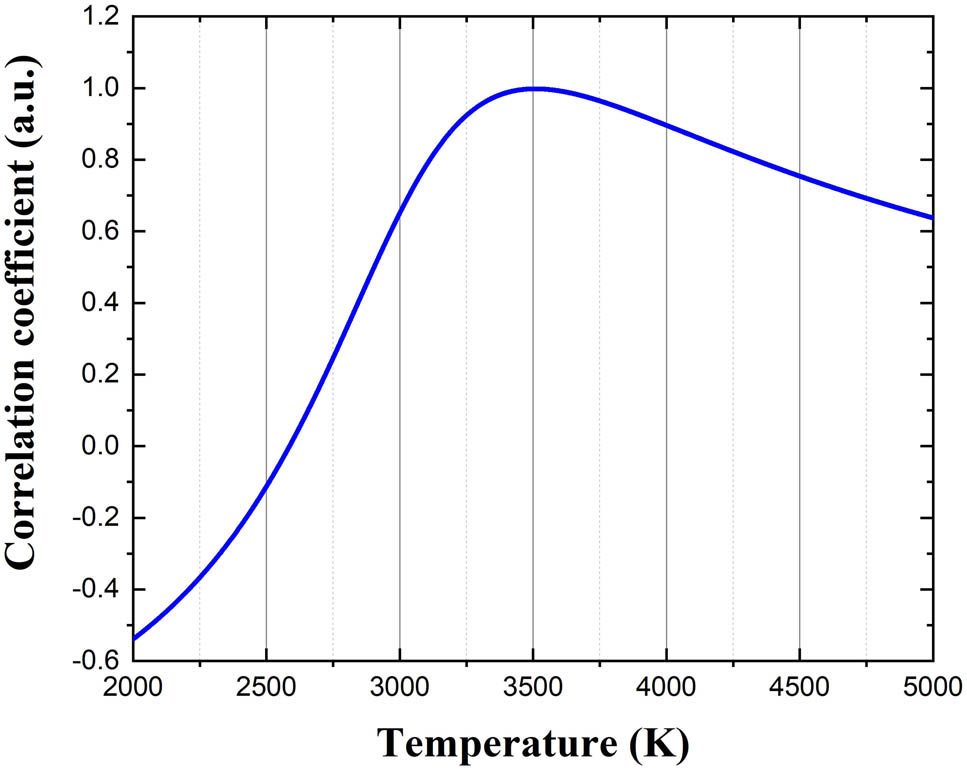
Relationship between correlation coefficient and temperature.
2.2 Temperature extraction by golden-section accelerated Pearson correlation algorithm
To guarantee the maximum value of the correlation coefficient, according to the empirical value of the maximum explosion temperature of the explosives, a temperature of 2,000–5,000 K can be used as the temperature seeking range. If the temperature resolution is set to 1 K, 3,001 one by one calculations are required. Evidently, the number of calculations is too large, and the time required to obtain the temperature is relatively long. Several different searching algorithms have been considered, such as binary search, gradient descent, and golden-section algorithms. The binary search is proper for the searching of a result in a monotonic sequence. In our case, the relationship between the correlation coefficient and the temperature is not monotonic, so the binary search is not suitable. The gradient descent algorithm is generally suitable for the peak searching of functions or sequences with multiple variables. For cases with a single variable, whether with a fixed or variable searching step, multiple rounds of searching are needed. The efficiency cannot be guaranteed for the fast extraction of temperature. In comparison, the golden-section algorithm [30] is simple, direct, and efficient; thus, we introduce the golden-section algorithm for the maximum correlation coefficient search to significantly reduce the amount of computation.
To extract the temperature of the measured object, an algorithm based on the Pearson correlation with the golden-section algorithm was proposed. The flowchart is shown in Figure 2, and the program flow is described below.
Step 1: We obtain the output voltage
Step 2: We set the lower and upper values
Step 4: If
Step 5: We repeat Steps 3 and 4 with the updated parameters until the searching range is smaller than 1 K. Subsequently, we compare the correlation coefficients at
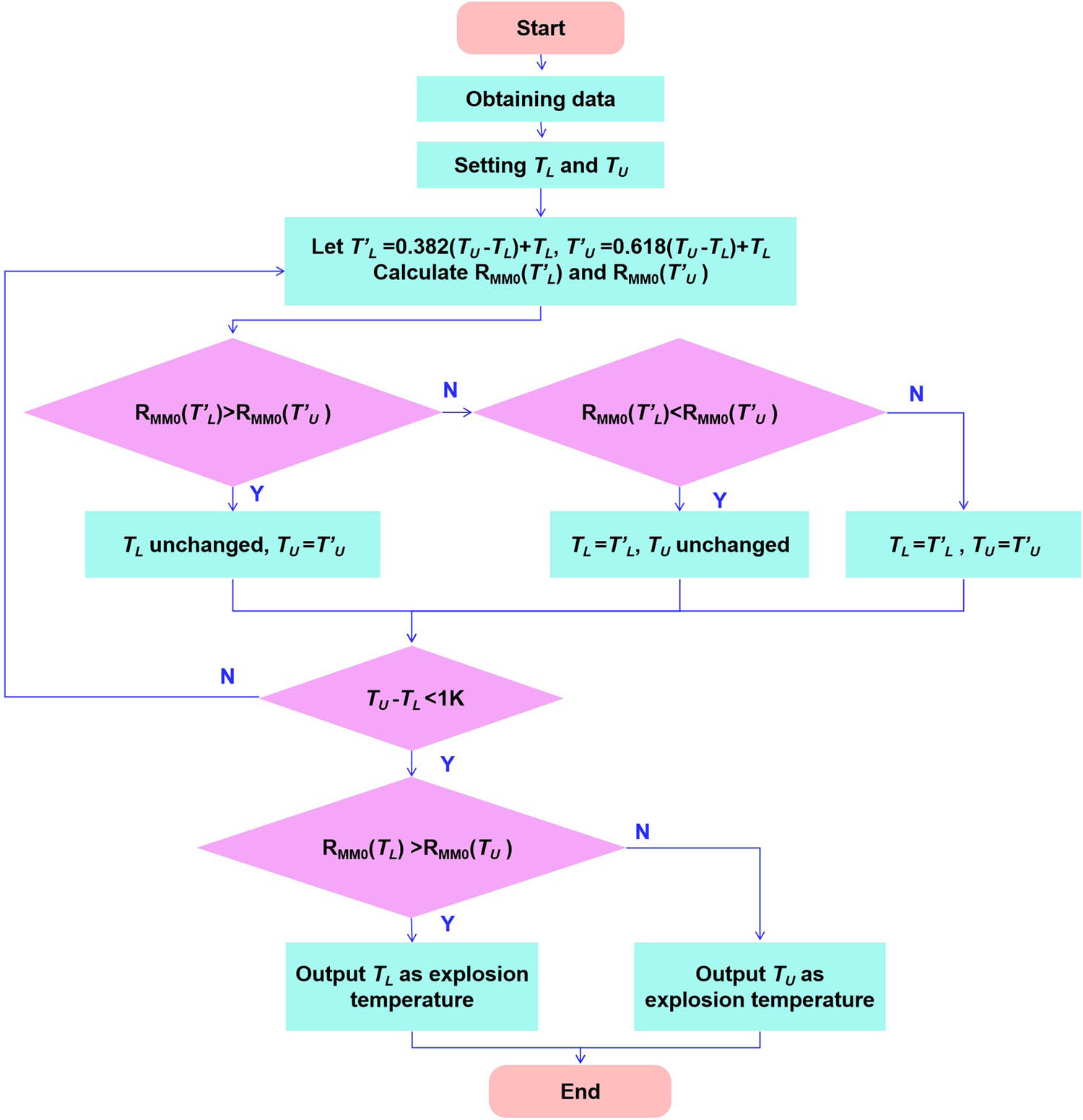
Flowchart of golden-section accelerated Pearson correlation algorithm.
According to the golden-section algorithm, for the temperature range of 2,000–5,000 K, at most 18 calculations can yield the final result, which significantly increases the efficiency of explosion temperature extraction.
3 Explosion temperature simulation
After explosive denotation, an explosion fireball will be generated that will expand outward rapidly. Theoretically, describing the entire fireball expansion and the temperature distribution changing process will be relatively difficult because of the complicated fluid and chemical reaction dynamic processes. However, the temperature at the initial stage of the firewall can be estimated relatively accurately by simulation.
In the initial stage of fireball expansion, the main characteristic of an explosion is outward expansion of the explosion products. To approximate the real state of the explosion products, ideal gas equation is inadequate. The fireball temperature can be calculated using the wellknown semiempirical Becker–Kistiakowski–Wilson (BKW) state equation, which viewed the explosion products as a very dense gas. The BKW state equation [31] is given in the following equation:
where
For the polymer-bonded explosive (PBX) used in the experimental test, the explosion and BKW parameters were calculated using the thermochemical software EXPLO5 (Tables 1 and 2). In the initial expansion stage, the temperature of the explosion products decreased from the temperature of the Chapman-Jouguet (CJ) state to a specific value. For the PBX, the temperature of the CJ state, i.e., the explosion temperature, was calculated to be 3559.90 K; when the explosion product expanded to the initial density, the corresponding temperature was 2,700 K.
Typical parameter values of explosive
| Energetic material | Density (g/cm3) | CJ pressure (Mbar) | Detonation velocity (cm/s) | Explosion heat (MJ/kg) | Constant volume specific heat (MJ/kg/K) |
|---|---|---|---|---|---|
| PBX-MY | 1.86 | 34.81 | 0.8846 | 0.108 | 0.792 |
Calculated BKW parameters
|
|
|
|
|
|---|---|---|---|
| 0.5 | 1.86 | 34.81 | 0.8846 |
From the simulation results in Figure 3, before the explosion fireball reaches the measurement point, the temperature of the measurement point is the same as that of the environment; when the explosion fireball reaches the monitoring point, the temperature rapidly increases to a peak of 3558.90 K. With further outward expansion of the explosion fireball, the temperature of the measured point decreases to the initial value.
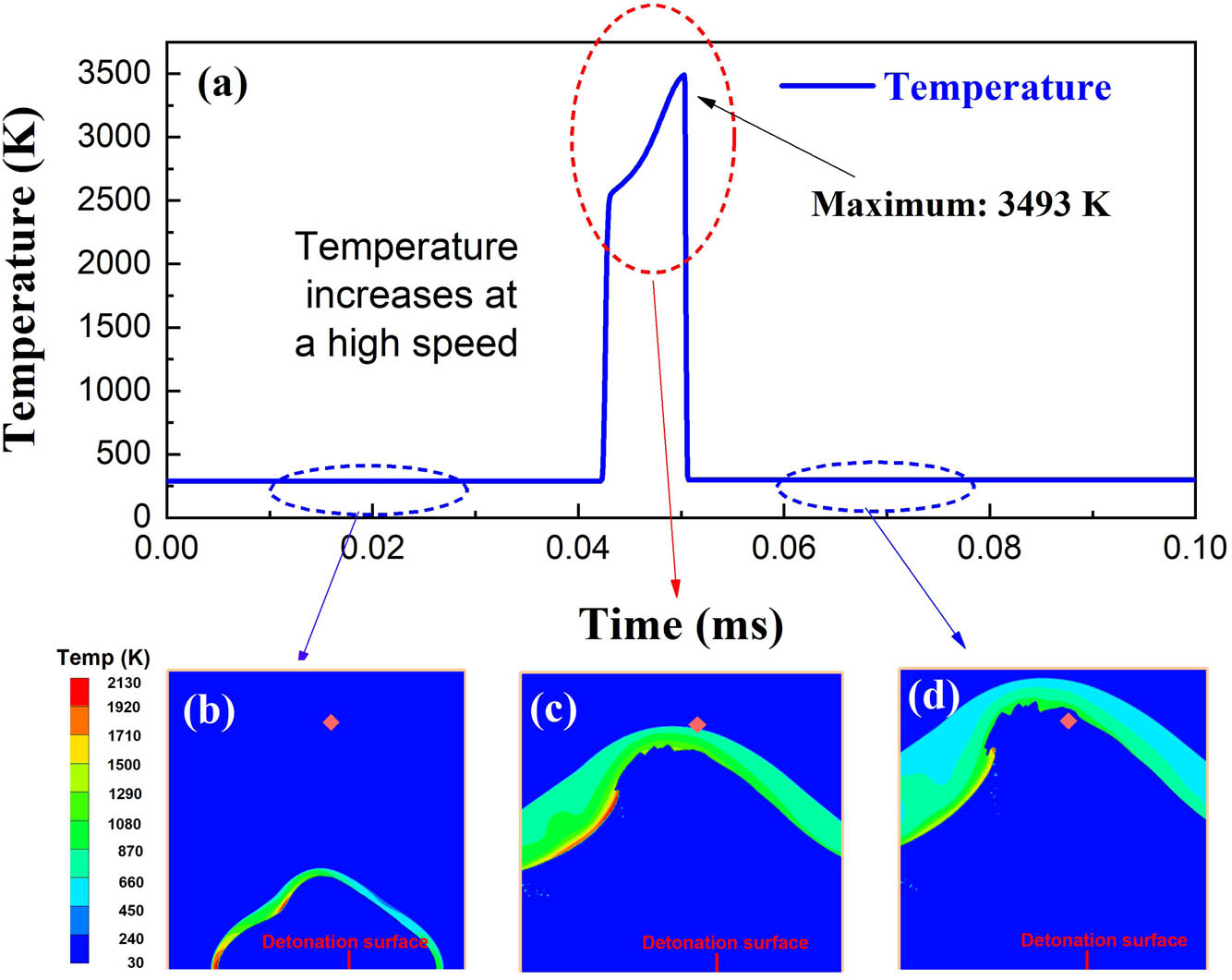
Simulated temperature change at a monitoring point in time domain. (a) Temperature distributions before (b), when (c), and after (d) the fireball surface is arriving.
To characterize the surface temperature of the explosion fireball, we set a group of measurement points to obtain the peak temperatures at these points, which could be used to obtain the equivalent temperature variation in the fireball surface. The surface temperature gradually decreases with the outward expansion of the explosion fireball (Figure 4). Within 0.02 ms, the surface temperature reduces from a peak temperature of 3,500 K to a temperature of 2,700 K. The quick decrease in the peak temperature come from the quick change in the pressure and specific volume caused by the fast outward expansion of the explosion fireball.
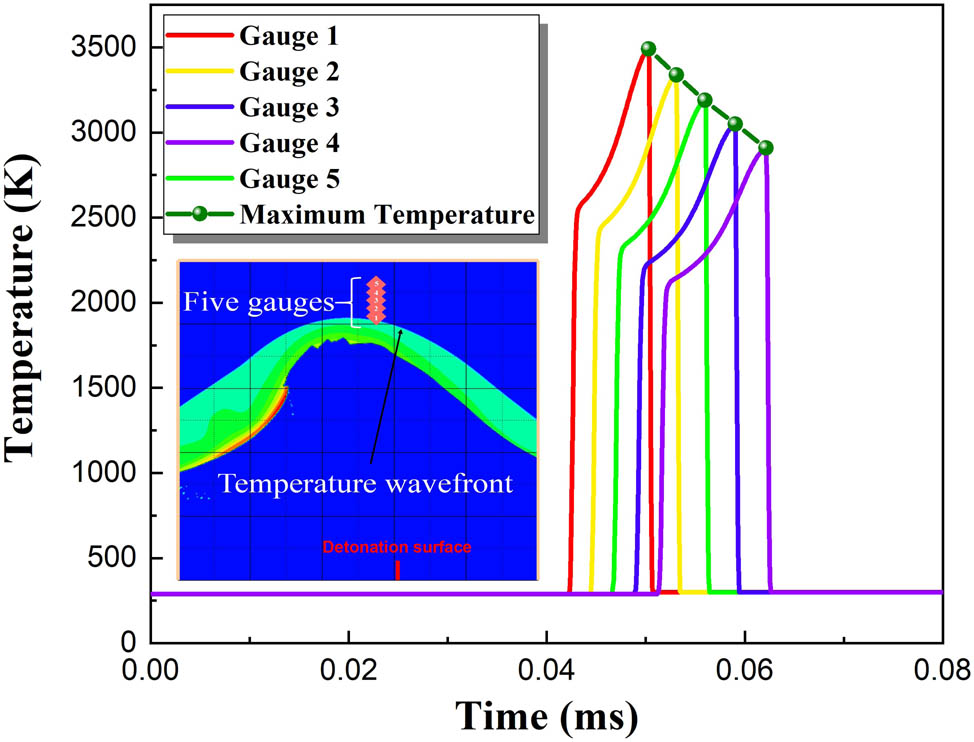
Simulated temperature change in firewall surface in time domain.
4 Experiments
4.1 Multi-spectral explosion temperature measurement system
The multi-spectral temperature measurement system comprises an optical probe, a long transmission fiber, a

Schematic of multi-spectral temperature measurement system.
The optical probe was in the form of a multi-mode fiber protected by a stainless steel tube, which pointed to the measured position of the object. The long transmission fiber (Shenzhen Optical Communication Co. Ltd, multimode silica fiber with wide passing band, core diameter: 600
The thermal radiation was then converted into electric voltage signals by the six photodetectors. For the three optical channels with wavelengths of 0.532, 0.7, and 0.825
4.2 System calibration
A 24 V 150 W quartz halogen tungsten lamp as a blackbody source was used to calibrate the radiation temperature measurement system. The optical probe was fixed and pointed to the quartz halogen tungsten lamp at a distance of about 3 m, which is the same distance between the optical probe and the explosive in explosion temperature measurement. The relationship between the temperature and driving current/voltage of the tungsten lamp was previously calibrated by the China Institute of Testing Technology. The calibration results are listed in Table 3.
Characteristic parameters of halogen tungsten lamp
| Current (A) | Voltage (V) | Temperature (K) |
|---|---|---|
| 3.52 | 7.74 | 2,042 |
| 3.95 | 9.54 | 2,200 |
| 4.52 | 12.16 | 2,400 |
| 5.12 | 15.23 | 2,600 |
| 5.93 | 19.86 | 2,856 |
| 6.41 | 22.84 | 3,000 |
At a driving current of 5.12 A, the corresponding temperature
Output voltages and calibration coefficients at six wavelengths channels with
| Wavelength (
|
Output voltage (mV) | Calibration coefficient (
|
|---|---|---|
| 0.532 | 205.6 | 1.70126 |
| 0.70 | 356.3 | 1.06891 |
| 0.825 | 645.87 | 1.36348 |
| 1.31 | 783.91 | 1.50392 |
| 1.45 | 435.8 | 1.12508 |
| 1.65 | 693.8 | 2.03005 |
4.3 Explosion temperature measurement
A photograph of the explosion test site is presented in Figure 6. The explosion experiment was conducted in an open field without any buildings. A section of a 100 m long silica optical fiber with a wide transmission band was used to transmit the thermal radiation collected by the optical probe near the explosion center back to the main temperature measurement system in a safe testing room, which was a small shelter that can shield any explosion products. The optical fibers were sealed in a corrugated stainless steel tube to prevent damage from the explosion. The measured data were obtained quickly and recorded using this system. The energetic material was remote detonated electrically after confirming security.

Photograph of explosion test site.
The energetic material used was a PBX, which consisted of 95% octogen, 4.3% fluorouracil as a binder, and 0.7% graphite as a desensitizing agent. The density was approximately 1.86 g/cm3. The explosive was cylindrical with a diameter of 25 mm and a height of 60 mm. It was placed on an explosive carrier with the optical probe fixed on a pillar at a distance of 3 m from the explosive. The optical probe was placed at the same height as the explosive cylinder and pointed toward its center.
4.4 Experimental results and analysis
A system with a golden-section accelerated Pearson correlation algorithm was used to obtain the explosion temperature from the real explosion experiments. The PBX explosion experiments were conducted under the same condition for two times. The variation curves of the output voltages of the six wavelength channels in the time domain were recorded (Figure 7). The optoelectronic signals from all six wavelength channels changed in a microsecond time scale, so the response time of the photodetectors, and the bandwidth, sampling rate of the data acquisition system are fast enough for the quick extraction of the radiation temperature. It can be observed that the detailed transient output voltages of the six channels are different for the two times of measurement. Because the explosion of explosives is a drastic dynamic process accompanied by violent chemical reactions and physical changes, detailed transient process will be very different for each time. The results show that the temperature measurement system can correctly respond to the spectral radiant exitances in each wavelength channel.

Output voltages at six wavelength channels in time domain. (a) First explosion and (b) second explosion.
The temperatures obtained for the two explosions were calculated based on the experimental data. The temperature change curves are shown in Figure 8. Two calculation methods were used in this study. One was based on the emissivity construction method, and the other was based on the Pearson correlation method. The output of the photodetectors gradually increased to their peaks in a time scale of several tens of microsecond. However, the temperature increased to their peak values in a much short time duration, maybe, a few nanoseconds. It should be noted that the temperature extracted is directly related to the relative light intensities received by the photodetectors but not their absolute values. In our case, limited by the sensitivities and response times of our measurement system, this initial temperature increasing process was failed to be distinguished. We will try to solve the problem in our further study by improving the measurement system by using better photodetectors and faster data acquisition system.
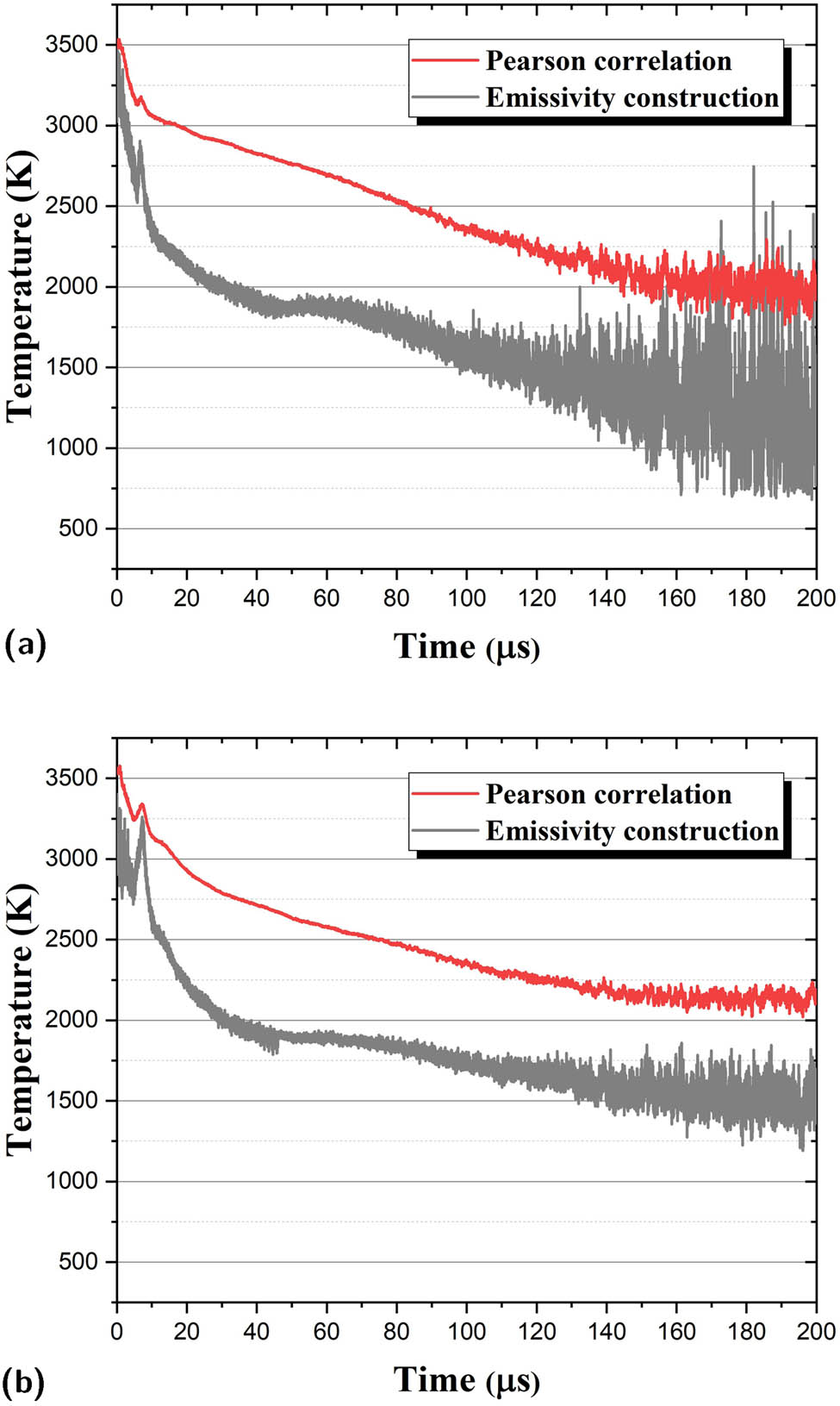
Temperature change with time of the two explosion processes obtained by the Pearson correlation and emissivity construction algorithms. (a) First explosion and (b) second explosion.
From the results shown in Figure 8, the maximum temperatures extracted for the two explosions using the Pearson correlation method are 3,501 and 3,560 K, respectively, and the maximum temperatures extracted using the emissivity construction method are 3,400 and 3,420 K, respectively. The results extracted from the proposed method were closer to the simulated results, of 3,500 K. The reason for the large deviation of the emissivity construction method may come from the uncertainty of the emissivity, which quickly changes in the explosion process and can hardly be given precisely. It can also be noted that the peak temperatures extracted for the two cases have a difference of 59 K, which is normal, because the explosion of explosives is a rapid, violent chaotic process accompanied by generations of large amount of heat and gases, and the detailed process cannot be the same for each case. Furthermore, the uncertainty in the temperature results extracted using the emissivity construction method was considerably larger. In comparison, the uncertainty in the temperature results obtained using the Pearson correlation method was considerably lower. Thus, the proposed Pearson correlation method performed better than the emissivity construction method for explosion temperature measurements.
5 Conclusion
In conclusion, for radiation temperature measurement of explosive explosion, we developed a high-speed fiber-type six-wavelength multi-spectral pyrometer and proposed a golden-section accelerated Pearson correlation method for the fast temperature extraction. After calibrating the temperature measurement system with a halogen tungsten lamp, rapid explosion temperature changes in explosion experiment of PBX, were successfully extracted. Highest temperature of up to 3,560 K was successfully obtained. In comparison with the results of the emissivity construction method, our extracted temperatures were more consistent with the simulation and experimental results, and the temperature calculation uncertainty was effectively reduced. The rapid temperature increasing process was failed to be extracted in our study, which will be focused to resolve by improving the sensitivity and bandwidth of the measurement system. The proposed method may find applications in explosive evaluations.
-
Funding information: The research was supported by the Key R&D Plan of Shaanxi Province, China, Grant No. 2024GX-YBXM-041, and National Key Laboratory of Energetic Materials, China, Grant No. 2024-XXXX-XX-JJ-046-06.
-
Author contributions: Conceptualization: G.L.; methodology: M.G.; software: C.L.; validation: G.L. and X.Z.; Resources: H.C.; data curation: C.L.; writing – original draft Preparation: G.L.; writing – review and editing: M.G.; and funding acquisition: H.C. All authors have accepted responsibility for the entire content of this manuscript and approved its submission.
-
Conflict of interest: The authors state no conflict of interest.
-
Data availability statement: The datasets generated and/or analysed during the current study are available from the corresponding author on reasonable request.
References
[1] Abbas IA. Generalized thermoelastic interaction in functional graded material with fractional order three-phase lag heat transfer. J Cent South Univ. 2015;22:1606–13. 10.1007/s11771-015-2677-5Search in Google Scholar
[2] Abbas IA, Saeed T, Alhothuali M. Hyperbolic two-temperature photo-thermal interaction in a semiconductor medium with a cylindrical cavity. Silicon 2020;13:1871–8. 10.1007/s12633-020-00570-7Search in Google Scholar
[3] Alzahrani FS, Abbas IA. Photo-thermal interactions in a semiconducting media with a spherical cavity under hyperbolic two-temperature model. Mathematics. 2020;8(4):585. 10.3390/math8040585Search in Google Scholar
[4] Carrera E, Abouelregal AE, Abbas IA, Zenkour AM. Vibrational analysis for an axially moving microbeam with two temper-atures. J Therm Stresses. 2015;38(6):569–90. 10.1080/01495739.2015.1015837Search in Google Scholar
[5] Abbas IA, Othman MIA. Plane waves in generalized thermo-microstretch elastic solid with thermal relaxation using finite element method. Int J Thermophys 2012;33:2407–23. 10.1007/s10765-012-1340-8Search in Google Scholar
[6] Malik MF, Shah SAA, Bilal M, Hussien M, Mahmood I, Akgul A, et al. New insights into the dynamics of heat and mass transfer in a hybrid (Ag-TiO2) nanofluid using modified Buongiorno model: a case of a rotating disk. Results Phys. 2023;53:106909. 10.1016/j.rinp.2023.106906Search in Google Scholar
[7] Mladenoviç ZZ, Gocić S. Effect of electron temperature and concentration on production of hydroxyl radical and nitric oxide in atmospheric pressure low-temperature helium plasma jet: Swarm analysis and global model investigation. Open Phys. 2024;22(1):20240055. 10.1515/phys-2024-0055Search in Google Scholar
[8] Frost DL, Clemenson J, Goroshin S, Zhang F, Soo M. Thermocouple temperature measurements in metalized explosive fireballs. Prop Explos Pyrotech. 2021;46(6):899–911. 10.1002/prep.202000328Search in Google Scholar
[9] Lebel LS, Brousseau P, Erhardt L, Andrews WS. Measurements of the temperature inside an explosive fireball. J Appl Mech. 2013;80(3):031702. 10.1115/1.4023561Search in Google Scholar
[10] Tischler M. High accuracy temperature and uncertainty calculation in radiation pyrometry. Metrologia. 1981;17(2):49–57. 10.1088/0026-1394/17/2/003Search in Google Scholar
[11] DeWitt DP, Nutter GD. Theory and practice of radiation thermometry. New York, USA: John Wiley & Sons;1991. Search in Google Scholar
[12] Xin CS, Dai JM, Wang YL. Development of optical fiber twenty-spectral radiation pyrometer. Infra Technol. 2008;30(1):47–50. Search in Google Scholar
[13] Fu T, Liu J, Duan M, Zong A. Temperature measurements using multicolor pyrometry in thermal radiation heating environments. Rev. Sci. Instrum. 2014;85(4):044901. 10.1063/1.4870252Search in Google Scholar PubMed
[14] Anselmi-Tamburini U, Campari G, Spinolo G, Lupotto P. A two-color spatial-scanning pyrometer for the determination of temperature profiles in combustion synthesis reactions. Rev Sci Instrum. 1995;66(10):5006–14. 10.1063/1.1146124Search in Google Scholar
[15] Müller B, Renz U. Development of a fast fiber-optic two-color pyrometer for the temperature measurement of surfaces with varying emissivities. Rev Sci Instrum. 2001;72(8):3366–74. 10.1063/1.1384448Search in Google Scholar
[16] Kosonocky WF, Kaplinsky MB, Mccaffrey NJ, Edwin SHH, Constantine NM, Nuggehalli MR, et al. Multiwavelength imaging pyrometer. Proc. SPIE: Infrared Detectors and Focal Plane Arrays III; 1994 July 15. Orlando, FL, United States; 1994. Search in Google Scholar
[17] Lyzenga GA, Ahrens TJ. Multiwavelength optical pyrometer for shock compression experiments. Rev Sci Instrum. 1979;50(11):1421–4. 10.1063/1.1135731Search in Google Scholar PubMed
[18] Duvaut T, Georgeault D, Beaudoin JL. Multiwavelength infrared pyrometry: optimization and computer simulations. Infrared Phys Technol. 1995;36(7):1089–103. 10.1016/1350-4495(95)00040-2Search in Google Scholar
[19] Krapez JC. Measurements without contact in heat transfer: multiwavelength radiation thermometry. Principle, implementation and pitfalls, Thermal measurements and inverse techniques. San Francisco: Taylor & Francis; 2019. Search in Google Scholar
[20] Ni PA, More RM, Yoneda H, Bieniosek FM. Polarization pyrometry: An improvement to multi-wavelength optical pyrometry. Rev Sci Instrum. 2012;83(12):123501. 10.1063/1.4768473Search in Google Scholar PubMed
[21] Svet DY, Sayapina VI. Effect of polarization on the accuracy of optical pyrometers. Meas Tech. 1970;13(2):235–8. 10.1007/BF00982972Search in Google Scholar
[22] Gebbie HA, Bohlander RA, Futrelle RP. Properties of photons determined by interferometric spectroscopy. Nature 1972;240(5381):391–4. 10.1038/240391a0Search in Google Scholar
[23] Svet DI. Determination of the emissivity of a substance from the spectrum of its thermal radiation and optimal methods of optical pyrometry. European Conference on Thermophysical Properties of Solids at High Temperatures, 5th; High Temperatures, High Pressures; 1976 May 18–21. Moscow, USSR; 1976. Search in Google Scholar
[24] Coates PB. The least-squares approach to multi-wavelength pyrometry. High Temp High Pressures. 1988;20(4):433–41. Search in Google Scholar
[25] Hoch M. Multiwavelength pyrometry: radiance temperature versus wavelength curve should be used for temperature determination. Rev Sci Instrum. 1992;63(9):4205–7. 10.1063/1.1143236Search in Google Scholar
[26] Haider JA, Ahmad S, Ghazwani HA, Hussien M, Almusawa MY, Az-Zo’Bi EA. Results validation by using finite volume method for the blood flow with magnetohydrodynamics and hybrid nanofluids. Mod Phys Lett B. 2024;38(24):2450208. 10.1142/S0217984924502087Search in Google Scholar
[27] Khan SA, Yasmin S, Waqas H, Az-Zo’Bi EA, Alhushaybari A, Akgület A, et al. Entropy optimized Ferro-copper/blood based nanofluid flow between double stretchable disks: application to brain dynamic. Alex Eng J. 2023;79:296–307. 10.1016/j.aej.2023.08.017Search in Google Scholar
[28] Az-Zo’Bi EA, Dawoud KA, Marashdeh M. Numeric-analytic solutions of mixed-type systems of balance laws. Appl Math Com. 2015;265:133–43. 10.1016/j.amc.2015.04.119Search in Google Scholar
[29] Rodgers L, Nicewander WA. Thirteen ways to look at the correlation coefficient. Am Stat. 1988;42(1):59–66. 10.1080/00031305.1988.10475524Search in Google Scholar
[30] Zoubiri FZ, Rihani R, Bentahar F. Golden section algorithm to optimise the chemical pretreatment of agro-industrial waste for sugars extraction. Fuel. 2020;266:117028. 10.1016/j.fuel.2020.117028Search in Google Scholar
[31] Arnold W, Rottenkolber E, Hartmann T. DRAGON - The German thermo-chemical code based on the Becker-Kistiakowsky-Wilson equation of State. Propell Explos Pyrot. 2023;48:e202100329. 10.1002/prep.202100329Search in Google Scholar
© 2025 the author(s), published by De Gruyter
This work is licensed under the Creative Commons Attribution 4.0 International License.
Articles in the same Issue
- Research Articles
- Single-step fabrication of Ag2S/poly-2-mercaptoaniline nanoribbon photocathodes for green hydrogen generation from artificial and natural red-sea water
- Abundant new interaction solutions and nonlinear dynamics for the (3+1)-dimensional Hirota–Satsuma–Ito-like equation
- A novel gold and SiO2 material based planar 5-element high HPBW end-fire antenna array for 300 GHz applications
- Explicit exact solutions and bifurcation analysis for the mZK equation with truncated M-fractional derivatives utilizing two reliable methods
- Optical and laser damage resistance: Role of periodic cylindrical surfaces
- Numerical study of flow and heat transfer in the air-side metal foam partially filled channels of panel-type radiator under forced convection
- Water-based hybrid nanofluid flow containing CNT nanoparticles over an extending surface with velocity slips, thermal convective, and zero-mass flux conditions
- Dynamical wave structures for some diffusion--reaction equations with quadratic and quartic nonlinearities
- Solving an isotropic grey matter tumour model via a heat transfer equation
- Study on the penetration protection of a fiber-reinforced composite structure with CNTs/GFP clip STF/3DKevlar
- Influence of Hall current and acoustic pressure on nanostructured DPL thermoelastic plates under ramp heating in a double-temperature model
- Applications of the Belousov–Zhabotinsky reaction–diffusion system: Analytical and numerical approaches
- AC electroosmotic flow of Maxwell fluid in a pH-regulated parallel-plate silica nanochannel
- Interpreting optical effects with relativistic transformations adopting one-way synchronization to conserve simultaneity and space–time continuity
- Modeling and analysis of quantum communication channel in airborne platforms with boundary layer effects
- Theoretical and numerical investigation of a memristor system with a piecewise memductance under fractal–fractional derivatives
- Tuning the structure and electro-optical properties of α-Cr2O3 films by heat treatment/La doping for optoelectronic applications
- High-speed multi-spectral explosion temperature measurement using golden-section accelerated Pearson correlation algorithm
- Dynamic behavior and modulation instability of the generalized coupled fractional nonlinear Helmholtz equation with cubic–quintic term
- Study on the duration of laser-induced air plasma flash near thin film surface
- Exploring the dynamics of fractional-order nonlinear dispersive wave system through homotopy technique
- The mechanism of carbon monoxide fluorescence inside a femtosecond laser-induced plasma
- Numerical solution of a nonconstant coefficient advection diffusion equation in an irregular domain and analyses of numerical dispersion and dissipation
- Numerical examination of the chemically reactive MHD flow of hybrid nanofluids over a two-dimensional stretching surface with the Cattaneo–Christov model and slip conditions
- Impacts of sinusoidal heat flux and embraced heated rectangular cavity on natural convection within a square enclosure partially filled with porous medium and Casson-hybrid nanofluid
- Stability analysis of unsteady ternary nanofluid flow past a stretching/shrinking wedge
- Solitonic wave solutions of a Hamiltonian nonlinear atom chain model through the Hirota bilinear transformation method
- Bilinear form and soltion solutions for (3+1)-dimensional negative-order KdV-CBS equation
- Solitary chirp pulses and soliton control for variable coefficients cubic–quintic nonlinear Schrödinger equation in nonuniform management system
- Influence of decaying heat source and temperature-dependent thermal conductivity on photo-hydro-elasto semiconductor media
- Dissipative disorder optimization in the radiative thin film flow of partially ionized non-Newtonian hybrid nanofluid with second-order slip condition
- Bifurcation, chaotic behavior, and traveling wave solutions for the fractional (4+1)-dimensional Davey–Stewartson–Kadomtsev–Petviashvili model
- New investigation on soliton solutions of two nonlinear PDEs in mathematical physics with a dynamical property: Bifurcation analysis
- Mathematical analysis of nanoparticle type and volume fraction on heat transfer efficiency of nanofluids
- Creation of single-wing Lorenz-like attractors via a ten-ninths-degree term
- Optical soliton solutions, bifurcation analysis, chaotic behaviors of nonlinear Schrödinger equation and modulation instability in optical fiber
- Chaotic dynamics and some solutions for the (n + 1)-dimensional modified Zakharov–Kuznetsov equation in plasma physics
- Fractal formation and chaotic soliton phenomena in nonlinear conformable Heisenberg ferromagnetic spin chain equation
- Single-step fabrication of Mn(iv) oxide-Mn(ii) sulfide/poly-2-mercaptoaniline porous network nanocomposite for pseudo-supercapacitors and charge storage
- Novel constructed dynamical analytical solutions and conserved quantities of the new (2+1)-dimensional KdV model describing acoustic wave propagation
- Tavis–Cummings model in the presence of a deformed field and time-dependent coupling
- Spinning dynamics of stress-dependent viscosity of generalized Cross-nonlinear materials affected by gravitationally swirling disk
- Design and prediction of high optical density photovoltaic polymers using machine learning-DFT studies
- Robust control and preservation of quantum steering, nonlocality, and coherence in open atomic systems
- Coating thickness and process efficiency of reverse roll coating using a magnetized hybrid nanomaterial flow
- Dynamic analysis, circuit realization, and its synchronization of a new chaotic hyperjerk system
- Decoherence of steerability and coherence dynamics induced by nonlinear qubit–cavity interactions
- Finite element analysis of turbulent thermal enhancement in grooved channels with flat- and plus-shaped fins
- Modulational instability and associated ion-acoustic modulated envelope solitons in a quantum plasma having ion beams
- Statistical inference of constant-stress partially accelerated life tests under type II generalized hybrid censored data from Burr III distribution
- On solutions of the Dirac equation for 1D hydrogenic atoms or ions
- Entropy optimization for chemically reactive magnetized unsteady thin film hybrid nanofluid flow on inclined surface subject to nonlinear mixed convection and variable temperature
- Stability analysis, circuit simulation, and color image encryption of a novel four-dimensional hyperchaotic model with hidden and self-excited attractors
- A high-accuracy exponential time integration scheme for the Darcy–Forchheimer Williamson fluid flow with temperature-dependent conductivity
- Novel analysis of fractional regularized long-wave equation in plasma dynamics
- Development of a photoelectrode based on a bismuth(iii) oxyiodide/intercalated iodide-poly(1H-pyrrole) rough spherical nanocomposite for green hydrogen generation
- Investigation of solar radiation effects on the energy performance of the (Al2O3–CuO–Cu)/H2O ternary nanofluidic system through a convectively heated cylinder
- Quantum resources for a system of two atoms interacting with a deformed field in the presence of intensity-dependent coupling
- Studying bifurcations and chaotic dynamics in the generalized hyperelastic-rod wave equation through Hamiltonian mechanics
- A new numerical technique for the solution of time-fractional nonlinear Klein–Gordon equation involving Atangana–Baleanu derivative using cubic B-spline functions
- Interaction solutions of high-order breathers and lumps for a (3+1)-dimensional conformable fractional potential-YTSF-like model
- Hydraulic fracturing radioactive source tracing technology based on hydraulic fracturing tracing mechanics model
- Numerical solution and stability analysis of non-Newtonian hybrid nanofluid flow subject to exponential heat source/sink over a Riga sheet
- Numerical investigation of mixed convection and viscous dissipation in couple stress nanofluid flow: A merged Adomian decomposition method and Mohand transform
- Effectual quintic B-spline functions for solving the time fractional coupled Boussinesq–Burgers equation arising in shallow water waves
- Analysis of MHD hybrid nanofluid flow over cone and wedge with exponential and thermal heat source and activation energy
- Solitons and travelling waves structure for M-fractional Kairat-II equation using three explicit methods
- Impact of nanoparticle shapes on the heat transfer properties of Cu and CuO nanofluids flowing over a stretching surface with slip effects: A computational study
- Computational simulation of heat transfer and nanofluid flow for two-sided lid-driven square cavity under the influence of magnetic field
- Irreversibility analysis of a bioconvective two-phase nanofluid in a Maxwell (non-Newtonian) flow induced by a rotating disk with thermal radiation
- Hydrodynamic and sensitivity analysis of a polymeric calendering process for non-Newtonian fluids with temperature-dependent viscosity
- Exploring the peakon solitons molecules and solitary wave structure to the nonlinear damped Kortewege–de Vries equation through efficient technique
- Modeling and heat transfer analysis of magnetized hybrid micropolar blood-based nanofluid flow in Darcy–Forchheimer porous stenosis narrow arteries
- Activation energy and cross-diffusion effects on 3D rotating nanofluid flow in a Darcy–Forchheimer porous medium with radiation and convective heating
- Insights into chemical reactions occurring in generalized nanomaterials due to spinning surface with melting constraints
- Influence of a magnetic field on double-porosity photo-thermoelastic materials under Lord–Shulman theory
- Soliton-like solutions for a nonlinear doubly dispersive equation in an elastic Murnaghan's rod via Hirota's bilinear method
- Analytical and numerical investigation of exact wave patterns and chaotic dynamics in the extended improved Boussinesq equation
- Nonclassical correlation dynamics of Heisenberg XYZ states with (x, y)-spin--orbit interaction, x-magnetic field, and intrinsic decoherence effects
- Exact traveling wave and soliton solutions for chemotaxis model and (3+1)-dimensional Boiti–Leon–Manna–Pempinelli equation
- Unveiling the transformative role of samarium in ZnO: Exploring structural and optical modifications for advanced functional applications
- On the derivation of solitary wave solutions for the time-fractional Rosenau equation through two analytical techniques
- Analyzing the role of length and radius of MWCNTs in a nanofluid flow influenced by variable thermal conductivity and viscosity considering Marangoni convection
- Advanced mathematical analysis of heat and mass transfer in oscillatory micropolar bio-nanofluid flows via peristaltic waves and electroosmotic effects
- Exact bound state solutions of the radial Schrödinger equation for the Coulomb potential by conformable Nikiforov–Uvarov approach
- Some anisotropic and perfect fluid plane symmetric solutions of Einstein's field equations using killing symmetries
- Nonlinear dynamics of the dissipative ion-acoustic solitary waves in anisotropic rotating magnetoplasmas
- Curves in multiplicative equiaffine plane
- Exact solution of the three-dimensional (3D) Z2 lattice gauge theory
- Propagation properties of Airyprime pulses in relaxing nonlinear media
- Symbolic computation: Analytical solutions and dynamics of a shallow water wave equation in coastal engineering
- Wave propagation in nonlocal piezo-photo-hygrothermoelastic semiconductors subjected to heat and moisture flux
- Comparative reaction dynamics in rotating nanofluid systems: Quartic and cubic kinetics under MHD influence
- Laplace transform technique and probabilistic analysis-based hypothesis testing in medical and engineering applications
- Physical properties of ternary chloro-perovskites KTCl3 (T = Ge, Al) for optoelectronic applications
- Gravitational length stretching: Curvature-induced modulation of quantum probability densities
- The search for the cosmological cold dark matter axion – A new refined narrow mass window and detection scheme
- A comparative study of quantum resources in bipartite Lipkin–Meshkov–Glick model under DM interaction and Zeeman splitting
- PbO-doped K2O–BaO–Al2O3–B2O3–TeO2-glasses: Mechanical and shielding efficacy
- Nanospherical arsenic(iii) oxoiodide/iodide-intercalated poly(N-methylpyrrole) composite synthesis for broad-spectrum optical detection
- Sine power Burr X distribution with estimation and applications in physics and other fields
- Numerical modeling of enhanced reactive oxygen plasma in pulsed laser deposition of metal oxide thin films
- Dynamical analyses and dispersive soliton solutions to the nonlinear fractional model in stratified fluids
- Computation of exact analytical soliton solutions and their dynamics in advanced optical system
- An innovative approximation concerning the diffusion and electrical conductivity tensor at critical altitudes within the F-region of ionospheric plasma at low latitudes
- An analytical investigation to the (3+1)-dimensional Yu–Toda–Sassa–Fukuyama equation with dynamical analysis: Bifurcation
- Swirling-annular-flow-induced instability of a micro shell considering Knudsen number and viscosity effects
- Numerical analysis of non-similar convection flows of a two-phase nanofluid past a semi-infinite vertical plate with thermal radiation
- MgO NPs reinforced PCL/PVC nanocomposite films with enhanced UV shielding and thermal stability for packaging applications
- Optimal conditions for indoor air purification using non-thermal Corona discharge electrostatic precipitator
- Investigation of thermal conductivity and Raman spectra for HfAlB, TaAlB, and WAlB based on first-principles calculations
- Tunable double plasmon-induced transparency based on monolayer patterned graphene metamaterial
- DSC: depth data quality optimization framework for RGBD camouflaged object detection
- A new family of Poisson-exponential distributions with applications to cancer data and glass fiber reliability
- Numerical investigation of couple stress under slip conditions via modified Adomian decomposition method
- Monitoring plateau lake area changes in Yunnan province, southwestern China using medium-resolution remote sensing imagery: applicability of water indices and environmental dependencies
- Heterodyne interferometric fiber-optic gyroscope
- Exact solutions of Einstein’s field equations via homothetic symmetries of non-static plane symmetric spacetime
- A widespread study of discrete entropic model and its distribution along with fluctuations of energy
- Empirical model integration for accurate charge carrier mobility simulation in silicon MOSFETs
- The influence of scattering correction effect based on optical path distribution on CO2 retrieval
- Anisotropic dissociation and spectral response of 1-Bromo-4-chlorobenzene under static directional electric fields
- Role of tungsten oxide (WO3) on thermal and optical properties of smart polymer composites
- Analysis of iterative deblurring: no explicit noise
- The influence of anisotropy of InP on its elasticity and phonon properties
- Review Article
- Examination of the gamma radiation shielding properties of different clay and sand materials in the Adrar region
- Erratum
- Erratum to “On Soliton structures in optical fiber communications with Kundu–Mukherjee–Naskar model (Open Physics 2021;19:679–682)”
- Special Issue on Fundamental Physics from Atoms to Cosmos - Part II
- Possible explanation for the neutron lifetime puzzle
- Special Issue on Nanomaterial utilization and structural optimization - Part III
- Numerical investigation on fluid-thermal-electric performance of a thermoelectric-integrated helically coiled tube heat exchanger for coal mine air cooling
- Special Issue on Nonlinear Dynamics and Chaos in Physical Systems
- Analysis of the fractional relativistic isothermal gas sphere with application to neutron stars
- Abundant wave symmetries in the (3+1)-dimensional Chafee–Infante equation through the Hirota bilinear transformation technique
- Successive midpoint method for fractional differential equations with nonlocal kernels: Error analysis, stability, and applications
- Novel exact solitons to the fractional modified mixed-Korteweg--de Vries model with a stability analysis
Articles in the same Issue
- Research Articles
- Single-step fabrication of Ag2S/poly-2-mercaptoaniline nanoribbon photocathodes for green hydrogen generation from artificial and natural red-sea water
- Abundant new interaction solutions and nonlinear dynamics for the (3+1)-dimensional Hirota–Satsuma–Ito-like equation
- A novel gold and SiO2 material based planar 5-element high HPBW end-fire antenna array for 300 GHz applications
- Explicit exact solutions and bifurcation analysis for the mZK equation with truncated M-fractional derivatives utilizing two reliable methods
- Optical and laser damage resistance: Role of periodic cylindrical surfaces
- Numerical study of flow and heat transfer in the air-side metal foam partially filled channels of panel-type radiator under forced convection
- Water-based hybrid nanofluid flow containing CNT nanoparticles over an extending surface with velocity slips, thermal convective, and zero-mass flux conditions
- Dynamical wave structures for some diffusion--reaction equations with quadratic and quartic nonlinearities
- Solving an isotropic grey matter tumour model via a heat transfer equation
- Study on the penetration protection of a fiber-reinforced composite structure with CNTs/GFP clip STF/3DKevlar
- Influence of Hall current and acoustic pressure on nanostructured DPL thermoelastic plates under ramp heating in a double-temperature model
- Applications of the Belousov–Zhabotinsky reaction–diffusion system: Analytical and numerical approaches
- AC electroosmotic flow of Maxwell fluid in a pH-regulated parallel-plate silica nanochannel
- Interpreting optical effects with relativistic transformations adopting one-way synchronization to conserve simultaneity and space–time continuity
- Modeling and analysis of quantum communication channel in airborne platforms with boundary layer effects
- Theoretical and numerical investigation of a memristor system with a piecewise memductance under fractal–fractional derivatives
- Tuning the structure and electro-optical properties of α-Cr2O3 films by heat treatment/La doping for optoelectronic applications
- High-speed multi-spectral explosion temperature measurement using golden-section accelerated Pearson correlation algorithm
- Dynamic behavior and modulation instability of the generalized coupled fractional nonlinear Helmholtz equation with cubic–quintic term
- Study on the duration of laser-induced air plasma flash near thin film surface
- Exploring the dynamics of fractional-order nonlinear dispersive wave system through homotopy technique
- The mechanism of carbon monoxide fluorescence inside a femtosecond laser-induced plasma
- Numerical solution of a nonconstant coefficient advection diffusion equation in an irregular domain and analyses of numerical dispersion and dissipation
- Numerical examination of the chemically reactive MHD flow of hybrid nanofluids over a two-dimensional stretching surface with the Cattaneo–Christov model and slip conditions
- Impacts of sinusoidal heat flux and embraced heated rectangular cavity on natural convection within a square enclosure partially filled with porous medium and Casson-hybrid nanofluid
- Stability analysis of unsteady ternary nanofluid flow past a stretching/shrinking wedge
- Solitonic wave solutions of a Hamiltonian nonlinear atom chain model through the Hirota bilinear transformation method
- Bilinear form and soltion solutions for (3+1)-dimensional negative-order KdV-CBS equation
- Solitary chirp pulses and soliton control for variable coefficients cubic–quintic nonlinear Schrödinger equation in nonuniform management system
- Influence of decaying heat source and temperature-dependent thermal conductivity on photo-hydro-elasto semiconductor media
- Dissipative disorder optimization in the radiative thin film flow of partially ionized non-Newtonian hybrid nanofluid with second-order slip condition
- Bifurcation, chaotic behavior, and traveling wave solutions for the fractional (4+1)-dimensional Davey–Stewartson–Kadomtsev–Petviashvili model
- New investigation on soliton solutions of two nonlinear PDEs in mathematical physics with a dynamical property: Bifurcation analysis
- Mathematical analysis of nanoparticle type and volume fraction on heat transfer efficiency of nanofluids
- Creation of single-wing Lorenz-like attractors via a ten-ninths-degree term
- Optical soliton solutions, bifurcation analysis, chaotic behaviors of nonlinear Schrödinger equation and modulation instability in optical fiber
- Chaotic dynamics and some solutions for the (n + 1)-dimensional modified Zakharov–Kuznetsov equation in plasma physics
- Fractal formation and chaotic soliton phenomena in nonlinear conformable Heisenberg ferromagnetic spin chain equation
- Single-step fabrication of Mn(iv) oxide-Mn(ii) sulfide/poly-2-mercaptoaniline porous network nanocomposite for pseudo-supercapacitors and charge storage
- Novel constructed dynamical analytical solutions and conserved quantities of the new (2+1)-dimensional KdV model describing acoustic wave propagation
- Tavis–Cummings model in the presence of a deformed field and time-dependent coupling
- Spinning dynamics of stress-dependent viscosity of generalized Cross-nonlinear materials affected by gravitationally swirling disk
- Design and prediction of high optical density photovoltaic polymers using machine learning-DFT studies
- Robust control and preservation of quantum steering, nonlocality, and coherence in open atomic systems
- Coating thickness and process efficiency of reverse roll coating using a magnetized hybrid nanomaterial flow
- Dynamic analysis, circuit realization, and its synchronization of a new chaotic hyperjerk system
- Decoherence of steerability and coherence dynamics induced by nonlinear qubit–cavity interactions
- Finite element analysis of turbulent thermal enhancement in grooved channels with flat- and plus-shaped fins
- Modulational instability and associated ion-acoustic modulated envelope solitons in a quantum plasma having ion beams
- Statistical inference of constant-stress partially accelerated life tests under type II generalized hybrid censored data from Burr III distribution
- On solutions of the Dirac equation for 1D hydrogenic atoms or ions
- Entropy optimization for chemically reactive magnetized unsteady thin film hybrid nanofluid flow on inclined surface subject to nonlinear mixed convection and variable temperature
- Stability analysis, circuit simulation, and color image encryption of a novel four-dimensional hyperchaotic model with hidden and self-excited attractors
- A high-accuracy exponential time integration scheme for the Darcy–Forchheimer Williamson fluid flow with temperature-dependent conductivity
- Novel analysis of fractional regularized long-wave equation in plasma dynamics
- Development of a photoelectrode based on a bismuth(iii) oxyiodide/intercalated iodide-poly(1H-pyrrole) rough spherical nanocomposite for green hydrogen generation
- Investigation of solar radiation effects on the energy performance of the (Al2O3–CuO–Cu)/H2O ternary nanofluidic system through a convectively heated cylinder
- Quantum resources for a system of two atoms interacting with a deformed field in the presence of intensity-dependent coupling
- Studying bifurcations and chaotic dynamics in the generalized hyperelastic-rod wave equation through Hamiltonian mechanics
- A new numerical technique for the solution of time-fractional nonlinear Klein–Gordon equation involving Atangana–Baleanu derivative using cubic B-spline functions
- Interaction solutions of high-order breathers and lumps for a (3+1)-dimensional conformable fractional potential-YTSF-like model
- Hydraulic fracturing radioactive source tracing technology based on hydraulic fracturing tracing mechanics model
- Numerical solution and stability analysis of non-Newtonian hybrid nanofluid flow subject to exponential heat source/sink over a Riga sheet
- Numerical investigation of mixed convection and viscous dissipation in couple stress nanofluid flow: A merged Adomian decomposition method and Mohand transform
- Effectual quintic B-spline functions for solving the time fractional coupled Boussinesq–Burgers equation arising in shallow water waves
- Analysis of MHD hybrid nanofluid flow over cone and wedge with exponential and thermal heat source and activation energy
- Solitons and travelling waves structure for M-fractional Kairat-II equation using three explicit methods
- Impact of nanoparticle shapes on the heat transfer properties of Cu and CuO nanofluids flowing over a stretching surface with slip effects: A computational study
- Computational simulation of heat transfer and nanofluid flow for two-sided lid-driven square cavity under the influence of magnetic field
- Irreversibility analysis of a bioconvective two-phase nanofluid in a Maxwell (non-Newtonian) flow induced by a rotating disk with thermal radiation
- Hydrodynamic and sensitivity analysis of a polymeric calendering process for non-Newtonian fluids with temperature-dependent viscosity
- Exploring the peakon solitons molecules and solitary wave structure to the nonlinear damped Kortewege–de Vries equation through efficient technique
- Modeling and heat transfer analysis of magnetized hybrid micropolar blood-based nanofluid flow in Darcy–Forchheimer porous stenosis narrow arteries
- Activation energy and cross-diffusion effects on 3D rotating nanofluid flow in a Darcy–Forchheimer porous medium with radiation and convective heating
- Insights into chemical reactions occurring in generalized nanomaterials due to spinning surface with melting constraints
- Influence of a magnetic field on double-porosity photo-thermoelastic materials under Lord–Shulman theory
- Soliton-like solutions for a nonlinear doubly dispersive equation in an elastic Murnaghan's rod via Hirota's bilinear method
- Analytical and numerical investigation of exact wave patterns and chaotic dynamics in the extended improved Boussinesq equation
- Nonclassical correlation dynamics of Heisenberg XYZ states with (x, y)-spin--orbit interaction, x-magnetic field, and intrinsic decoherence effects
- Exact traveling wave and soliton solutions for chemotaxis model and (3+1)-dimensional Boiti–Leon–Manna–Pempinelli equation
- Unveiling the transformative role of samarium in ZnO: Exploring structural and optical modifications for advanced functional applications
- On the derivation of solitary wave solutions for the time-fractional Rosenau equation through two analytical techniques
- Analyzing the role of length and radius of MWCNTs in a nanofluid flow influenced by variable thermal conductivity and viscosity considering Marangoni convection
- Advanced mathematical analysis of heat and mass transfer in oscillatory micropolar bio-nanofluid flows via peristaltic waves and electroosmotic effects
- Exact bound state solutions of the radial Schrödinger equation for the Coulomb potential by conformable Nikiforov–Uvarov approach
- Some anisotropic and perfect fluid plane symmetric solutions of Einstein's field equations using killing symmetries
- Nonlinear dynamics of the dissipative ion-acoustic solitary waves in anisotropic rotating magnetoplasmas
- Curves in multiplicative equiaffine plane
- Exact solution of the three-dimensional (3D) Z2 lattice gauge theory
- Propagation properties of Airyprime pulses in relaxing nonlinear media
- Symbolic computation: Analytical solutions and dynamics of a shallow water wave equation in coastal engineering
- Wave propagation in nonlocal piezo-photo-hygrothermoelastic semiconductors subjected to heat and moisture flux
- Comparative reaction dynamics in rotating nanofluid systems: Quartic and cubic kinetics under MHD influence
- Laplace transform technique and probabilistic analysis-based hypothesis testing in medical and engineering applications
- Physical properties of ternary chloro-perovskites KTCl3 (T = Ge, Al) for optoelectronic applications
- Gravitational length stretching: Curvature-induced modulation of quantum probability densities
- The search for the cosmological cold dark matter axion – A new refined narrow mass window and detection scheme
- A comparative study of quantum resources in bipartite Lipkin–Meshkov–Glick model under DM interaction and Zeeman splitting
- PbO-doped K2O–BaO–Al2O3–B2O3–TeO2-glasses: Mechanical and shielding efficacy
- Nanospherical arsenic(iii) oxoiodide/iodide-intercalated poly(N-methylpyrrole) composite synthesis for broad-spectrum optical detection
- Sine power Burr X distribution with estimation and applications in physics and other fields
- Numerical modeling of enhanced reactive oxygen plasma in pulsed laser deposition of metal oxide thin films
- Dynamical analyses and dispersive soliton solutions to the nonlinear fractional model in stratified fluids
- Computation of exact analytical soliton solutions and their dynamics in advanced optical system
- An innovative approximation concerning the diffusion and electrical conductivity tensor at critical altitudes within the F-region of ionospheric plasma at low latitudes
- An analytical investigation to the (3+1)-dimensional Yu–Toda–Sassa–Fukuyama equation with dynamical analysis: Bifurcation
- Swirling-annular-flow-induced instability of a micro shell considering Knudsen number and viscosity effects
- Numerical analysis of non-similar convection flows of a two-phase nanofluid past a semi-infinite vertical plate with thermal radiation
- MgO NPs reinforced PCL/PVC nanocomposite films with enhanced UV shielding and thermal stability for packaging applications
- Optimal conditions for indoor air purification using non-thermal Corona discharge electrostatic precipitator
- Investigation of thermal conductivity and Raman spectra for HfAlB, TaAlB, and WAlB based on first-principles calculations
- Tunable double plasmon-induced transparency based on monolayer patterned graphene metamaterial
- DSC: depth data quality optimization framework for RGBD camouflaged object detection
- A new family of Poisson-exponential distributions with applications to cancer data and glass fiber reliability
- Numerical investigation of couple stress under slip conditions via modified Adomian decomposition method
- Monitoring plateau lake area changes in Yunnan province, southwestern China using medium-resolution remote sensing imagery: applicability of water indices and environmental dependencies
- Heterodyne interferometric fiber-optic gyroscope
- Exact solutions of Einstein’s field equations via homothetic symmetries of non-static plane symmetric spacetime
- A widespread study of discrete entropic model and its distribution along with fluctuations of energy
- Empirical model integration for accurate charge carrier mobility simulation in silicon MOSFETs
- The influence of scattering correction effect based on optical path distribution on CO2 retrieval
- Anisotropic dissociation and spectral response of 1-Bromo-4-chlorobenzene under static directional electric fields
- Role of tungsten oxide (WO3) on thermal and optical properties of smart polymer composites
- Analysis of iterative deblurring: no explicit noise
- The influence of anisotropy of InP on its elasticity and phonon properties
- Review Article
- Examination of the gamma radiation shielding properties of different clay and sand materials in the Adrar region
- Erratum
- Erratum to “On Soliton structures in optical fiber communications with Kundu–Mukherjee–Naskar model (Open Physics 2021;19:679–682)”
- Special Issue on Fundamental Physics from Atoms to Cosmos - Part II
- Possible explanation for the neutron lifetime puzzle
- Special Issue on Nanomaterial utilization and structural optimization - Part III
- Numerical investigation on fluid-thermal-electric performance of a thermoelectric-integrated helically coiled tube heat exchanger for coal mine air cooling
- Special Issue on Nonlinear Dynamics and Chaos in Physical Systems
- Analysis of the fractional relativistic isothermal gas sphere with application to neutron stars
- Abundant wave symmetries in the (3+1)-dimensional Chafee–Infante equation through the Hirota bilinear transformation technique
- Successive midpoint method for fractional differential equations with nonlocal kernels: Error analysis, stability, and applications
- Novel exact solitons to the fractional modified mixed-Korteweg--de Vries model with a stability analysis
