Laplace transform technique and probabilistic analysis-based hypothesis testing in medical and engineering applications
-
Mahmoud E. Bakr
 ,
Alaa M. Gadallah
,
Alaa M. Gadallah

Abstract
This study introduces a novel nonparametric hypothesis test designed to evaluate exponentiality against the New Better than Renewal Used in Moment Generating Function (NBRUmgf) class. The test employs the Laplace transform to construct a scale-invariant statistic, facilitating the efficient analysis of both complete and right-censored data. We derive the asymptotic distribution of the test statistic and calculate Pitman’s asymptotic efficiency under common alternatives, including Weibull, Gamma, and Makeham distributions. Extensive Monte Carlo simulations are conducted to determine the critical values and to demonstrate the test's power properties across a wide range of scenarios. The application of this test to real datasets of physical, engineering, and medical relevance corroborates the validity of our method. The test demonstrates superior efficiency and stability compared to existing methodologies, thereby providing a valuable tool for reliability estimation and statistical inference.
1 Introduction
Life distributions are simple instruments used in statistical modeling across a wide range of disciplines, including reliability engineering, biomedical science, and industrial systems. Life distributions provide critical information regarding the failure behavior and performance of systems over time. The most extensively investigated classes are Increasing Failure Rate (IFR), New Better than Used (NBU), New Better than Used in Expectation (NBUE), and Harmonic NBUE (HNBUE). All these classes of aging capture some temporal characteristics and failure patterns. Models based on renewal such as New Renewal Better than Used (NRBU), Renewal New Better than Used (RNBU), and Renewal NBUE (NRBUE) extend these concepts to systems that are replaced or repaired at regular intervals. These models are particularly useful in modeling actual systems where maintenance policies affect the effective lifetime distribution of components, for additional details, see Al-Ruzaiza et al. [1], Ross [2], Ahmad [3], Lai and Xie [4], Mahmoud et al. [5], Ghosh and Mitra [6], Wasim et al. [7], Abbas et al. [8], Nazir et al. [9] and references therein. Furthermore, the study of life distributions is essential for comprehending time-to-event results in medical research, such as the beginning of sickness or patient recovery. Classes such as IFR, which show an IFR over time, have consequences for treatment planning and medical prognosis. The interaction between these courses and practical medical applications highlights the importance of understanding the temporal dynamics in health contexts.
Renewal classes add even more functionality to the analytical toolbox by providing a framework for modeling systems that require replacement or replenishment on a regular basis. When components are periodically upgraded or replaced, the NRBU, NRBUE, and RNBU classes offer insightful information on renewal processes and enable the characterization of system behavior.
1.1 Renewal classes
In statistical modeling, renewal classes are essential because they offer a flexible framework for comprehending systems that are periodically replenished or replaced. The NRBU, RNBRU, and RNBU classes offer significant insights into the renewal processes. These insights facilitate the characterization of system behavior in situations involving periodic upgrades or replacements. Their unique role in statistical modeling highlights their significance for reliability analysis by providing a full toolbox for evaluating the dynamics of periodically renewing components. In this subsection, we explore the key terminologies and approaches related to renewal classes, emphasizing their importance in describing temporal behavior and advancing our knowledge of dependability dynamics. Abouammoh et al. [10], Mahmoud et al. [11], Mugdadi and Ahmad [12] and EL-Arishy et al. [13] can be consulted for further information.
The renewal survival function, denoted by
The following definitions encapsulate key properties of renewal classes:
New Better than Renewal Used (NBRU): X is NBRU if
(1)RNBU: X is RNBU if
(2)Renewal new Better than Renewal Used (RNBRU): X is RNBRU if
These definitions capture different aspects of renewal processes, highlighting the relationship between survival functions and renewal properties.
Furthermore, we introduce the concept of New Better than Renewal Used in Moment Generating Function order (NBRUmgf)
Definition (1): X is NBRUmgf if
Eq. (4) can be written as follows:
The NBRUmgf class offers a state-of-the-art framework that generalizes and extends the renewal-based aging models. Though of theoretical interest, hypothesis testing for the NBRUmgf class has so far been examined only partially in the literature, especially when censored data are involved.
In this study, we obtain a new test statistic based on the characterization of the NBRUmgf class through the Laplace transform and determine its asymptotic distribution, providing expressions for the variance under the null hypothesis. The test efficiency is assessed in terms of Pitman asymptotic efficiencies, whose values are found for commonly considered alternatives, such as Weibull, Makeham, and Linear Failure Rate (LFR) distributions. To facilitate practical implementation, Monte Carlo simulations were used to find critical values across different sample sizes and conduct a power analysis. In addition, the method was validated against real datasets found in engineering and medical studies, with great success and effectiveness. Overall, this study enhances the art of nonparametric hypothesis testing for reliability analysis through the provision of a statistically justifiable and computationally efficient process that is favorably suited for diverse applications.
The remainder of this study is organized as follows. In Section 2, a test statistic utilizing the Laplace Transform technique is presented to test whether the alternative hypothesis is not exponential and belongs to the NBRUmgf class, against the null hypothesis that has an exponential distribution. In Section 3, Mathematica 13.3 is used to depict the critical points of the Monte Carlo null distribution for sample sizes ranging from 5 to 100. In Section 4, the Pitman asymptotic efficiency of widely used alternatives is presented. The power estimates for the proposed test are presented in Section 5. In Section 6, we present a testing procedure using right-censored data. To demonstrate the significance and applicability of the test presented in this study, sets of real data are analyzed in Section 7.
2 Testing exponentiality
Based on the Laplace transform, statisticians and reliability analysts have created novel techniques in recent years for assessing exponentiality over a range of life distribution classes. Studies by Atallah et al. [14], Mahmoud et al. [15], Abu-Youssef et al. [16], Gadallah [17], EL-Sagheer et al. [18], and Bakr et al. [19] demonstrate this progress.
The theoretical foundation for building a departure measure from exponentiality is the following inequality, which is a consequence of the definitions of NBRUmgf class in Eq. (4) and Laplace transform properties. The distribution is exponential if equality occurs; it is in the NBRUmgf class if inequality occurs strictly.
After several calculations, assuming
Substituting Eqs (7)–(9) in Eq. (6), we obtain
Then, we formulate the following exponential departure measure:
Thus, in order to make the test scale invariant
The empirical estimate of
Theorem 2.1.
As
Proof:
Let,
Let us define
After computation, it is easy to discover that under
To assess the proposed test, we study finite-sample performance through large-scale Monte Carlo simulations, tabulating critical values and tabulated percentiles for sample sizes from 5 to 100. We also calculate Pitman’s asymptotic efficiency (PAE) for some common alternatives, the Makeham, Weibull, and LFR distributions, providing a theoretical benchmark for sensitivity and calculating empirical power under various alternatives to test robustness. All of the calculations and simulations were coded in Mathematica 13.3.
3 Monte Carlo null distribution critical points
Herein, we report the simulation results used to evaluate the performance of the proposed test. Simulations were performed with 10,000 random samples for each sample size
The critical values are shown in Tables 1 and 2, respectively, at s = 0.01, b = 5, and s = 0.1, b = 5.
Percentile points
| n | 1% | 5% | 10% | 90% | 95% | 99% |
|---|---|---|---|---|---|---|
| 5 |
|
|
|
|
|
|
| 10 |
|
|
|
|
|
|
| 15 |
|
|
|
|
|
|
| 20 |
|
|
|
|
|
|
| 25 |
|
|
|
|
|
|
| 30 |
|
|
|
|
|
|
| 35 |
|
|
|
|
|
|
| 40 |
|
|
|
|
|
|
| 45 |
|
|
|
|
|
|
| 50 |
|
|
|
|
|
|
| 55 |
|
|
|
|
|
|
| 60 |
|
|
|
|
|
|
| 65 |
|
|
|
|
|
|
| 70 |
|
|
|
|
|
|
| 75 |
|
|
|
|
|
|
| 80 |
|
|
|
|
|
|
| 85 |
|
|
|
|
|
|
| 90 |
|
|
|
|
|
|
| 95 |
|
|
|
|
|
|
| 100 |
|
|
|
|
|
|
Percentile points
| n | 1% | 5% | 10% | 90% | 95% | 99% |
|---|---|---|---|---|---|---|
| 5 | −0.277746 |
|
−0.0573371 | 0.200031 | 0.217643 | 0.248175 |
| 10 | −0.384055 | −0.16892 | −0.0900234 | 0.163156 | 0.176799 | 0.210931 |
| 15 | −0.419416 | −0.17994 | −0.100138 | 0.147477 | 0.161652 | 0.189299 |
| 20 | −0.346888 | −0.182371 | −0.0999247 | 0.134256 | 0.147959 | 0.175123 |
| 25 | −0.300169 | −0.143848 | −0.0865586 | 0.124446 | 0.142333 | 0.165532 |
| 30 | −0.381979 | −0.180721 | −0.112804 | 0.112581 | 0.129599 | 0.149253 |
| 35 | −0.282259 | −0.136437 | −0.0805488 | 0.107287 | 0.123885 | 0.143892 |
| 40 | −0.26349 | −0.134984 | −0.0887312 | 0.0962538 | 0.114215 | 0.137399 |
| 45 | −0.234946 | −0.142924 | −0.0926471 | 0.0952688 | 0.107379 | 0.128674 |
| 50 |
|
−0.112527 | −0.0727774 | 0.0926585 | 0.108896 | 0.134277 |
| 55 | −0.271661 | −0.126957 | −0.0844715 | 0.0863861 | 0.0990114 | 0.116895 |
| 60 | −0.253524 | −0.127403 | −0.0865372 | 0.0873587 | 0.101944 | 0.123945 |
| 65 | −0.218246 | −0.120645 | −0.0830349 | 0.0824862 | 0.0949735 | 0.120214 |
| 70 | −0.22568 | −0.110913 | −0.0737533 | 0.0810302 | 0.0937786 | 0.112777 |
| 75 | −0.182346 | −0.106899 | −0.0725559 | 0.0804655 | 0.0943715 | 0.115878 |
| 80 | −0.218004 | −0.104037 | −0.0701519 | 0.0742153 | 0.0889227 | 0.115672 |
| 85 |
|
−0.0896711 | −0.0623137 | 0.07312 | 0.0864806 | 0.102854 |
| 90 | −0.176648 | −0.100136 | −0.0699739 | 0.0744652 | 0.0849296 | 0.106745 |
| 95 | −0.194096 | −0.103761 | −0.0723404 | 0.0695266 | 0.0832672 | 0.102215 |
| 100 |
|
−0.0887166 |
|
0.069655 | 0.0799656 | 0.1003 |
Tables 1 and 2, along with Figures 1 and 2, clearly demonstrate that as the sample size increases, the critical values stabilize and converge, thereby illustrating the consistency of the proposed test. Furthermore, the percentile values decrease with the increase in sample size, as evidenced by the enhanced information derived from larger samples.
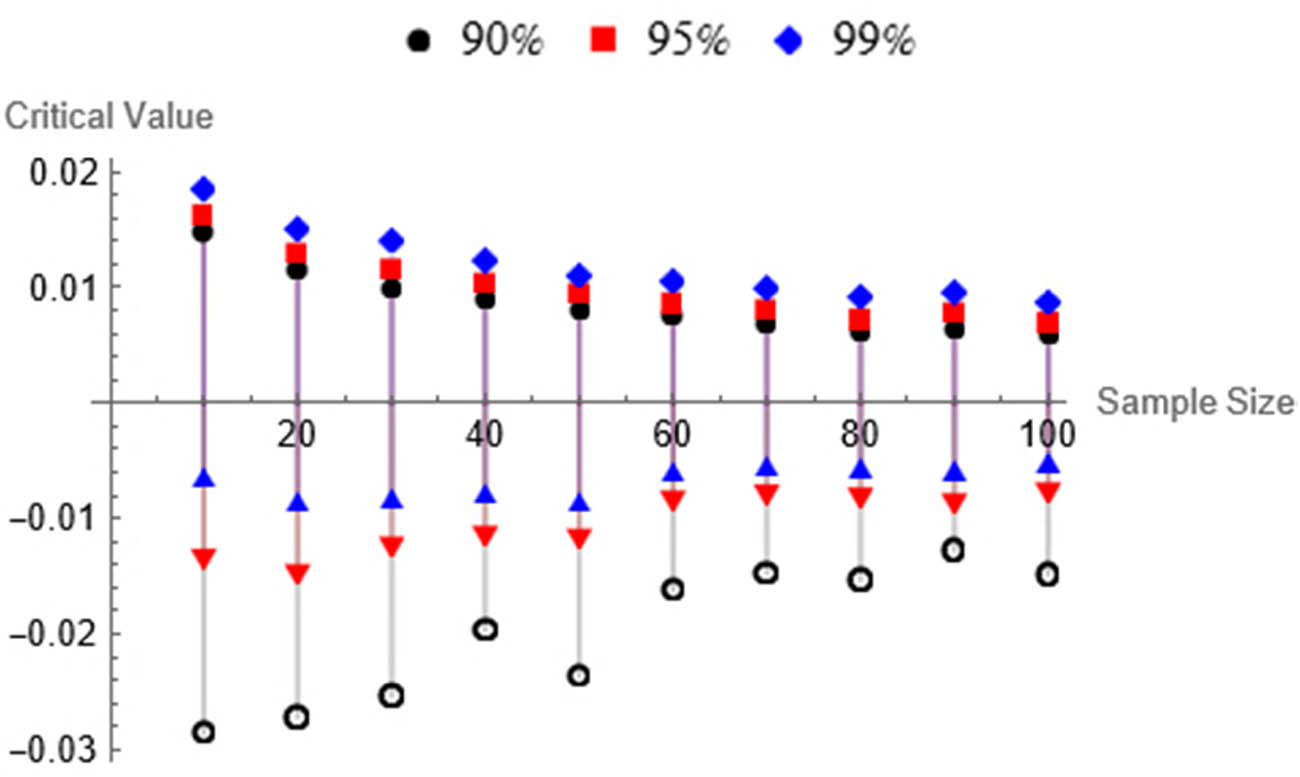
Relation between n and percentile points at s = 0.01, b = 5.
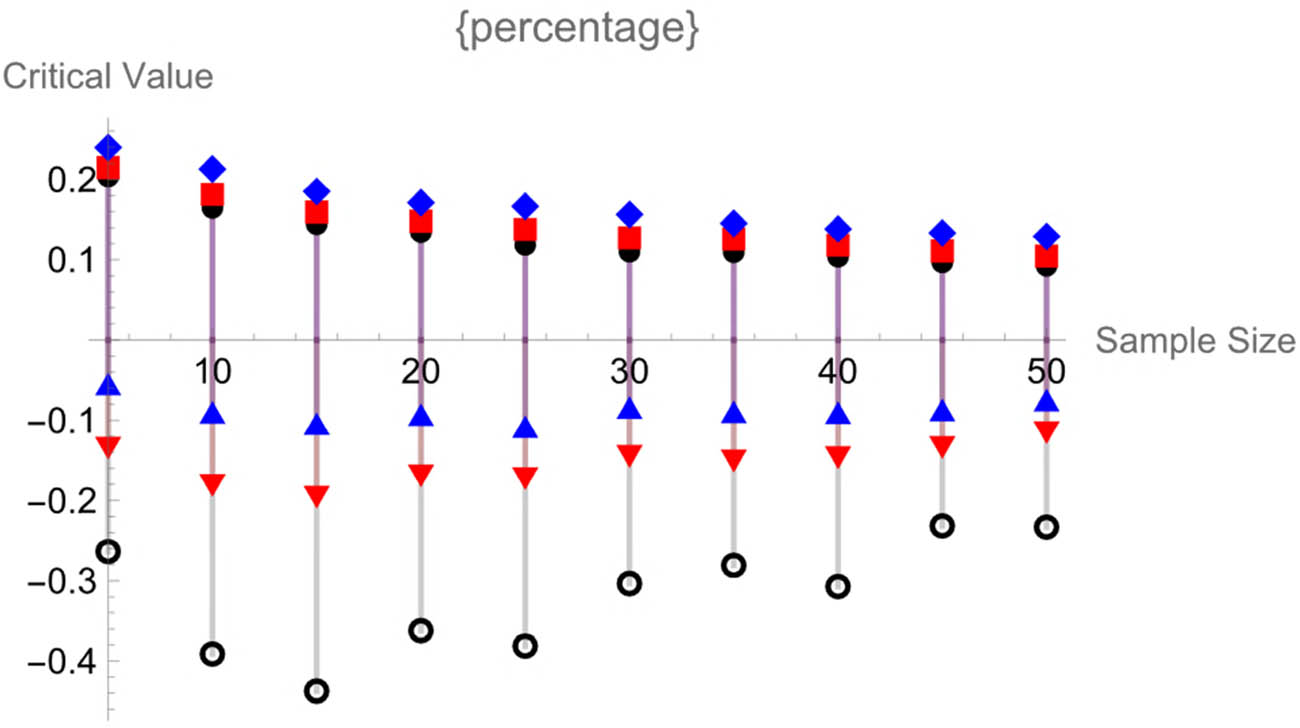
Relation between n and percentile points at s = 0.1, b = 5.
4 PAEs
To investigate the sensitivity of the proposed test to different types of departures from exponentiality, we computed PAEs for three rival distributions: Makeham, Weibull, and LFR. The PAE values are a measure of how well the test separates the null and alternative hypotheses. The result show that the test performs particularly well for the Weibull and LFR families with high asymptotic relative efficiency compared to benchmark tests.
where
where
Here we obtain
As indicated from Table 3 and Figure 3, the PAE’s of
| Distribution |
|
|
|
|
|---|---|---|---|---|
| Makeham | 0.23156 | 0.23799 | 0.24137 | 0.24337 |
| Weibull | 0.90820 | 0.93570 | 0.95133 | 0.96122 |
| LFR | 0.99301 | 0.99665 | 0.99810 | 0.99880 |
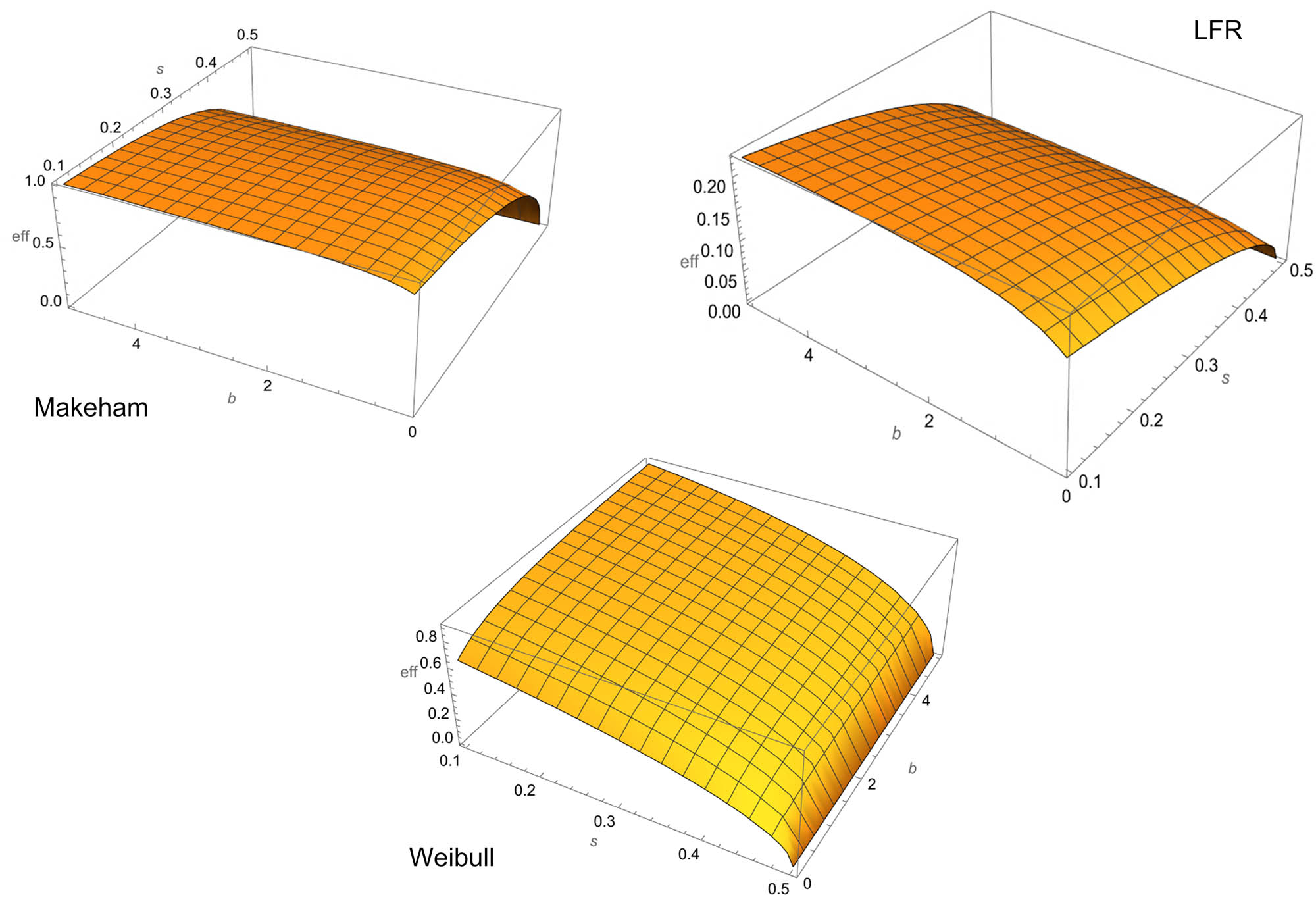
The relationship between PAE and the values of s and b for Makeham, Weibull, and LFR.
A comparison is made between the PAE of our proposed test
Asymptotic relative efficiencies
| Distribution |
|
|
|---|---|---|
| LFR | 1.14288 | 1.12125 |
| Makeham | 1.31558 | 1.11 × 10⁻⁴ |
| Weibull | 88.0964 | 1.44520 |
From Table 4, our test clearly has the highest efficiency in Weibull and LFR families.
5 Power estimates
At the significance level α = 0.05, Table 5 will be used to conduct the power estimation of the suggested test
Powers estimates at
| Distribution | n |
|
|
|
|---|---|---|---|---|
| Gamma | 10 |
|
|
|
| 20 |
|
|
|
|
| 30 |
|
|
|
|
| Weibull | 10 |
|
|
|
| 20 |
|
|
1 | |
| 30 |
|
1 | 1 |
Table 5 clearly demonstrates the suitability of our test for the Weibull and Gamma distributions, as the test’s power consistently increases with larger sample sizes (n) and higher parameter values (θ).
6 Test for NBRUmgf in case for right censored data
Using the estimator of Kaplan and Meier, the measure of departure provided in Eq. (11) can be expressed as follows:
where
and
The critical value percentiles of
Percentile points
| N | 1% | 5% | 10% | 90% | 95% | 99% |
|---|---|---|---|---|---|---|
| 4 | 3.49871 | 3.71034 | 3.82311 | 4.61405 | 4.72682 | 4.93845 |
| 8 | 3.70422 | 3.85387 | 3.93361 | 4.49289 | 4.57263 | 4.72228 |
| 12 | 3.78985 | 3.91204 | 3.97715 | 4.43379 | 4.4989 | 4.62109 |
| 16 | 3.83276 | 3.93858 | 3.99497 | 4.39043 | 4.44682 | 4.55264 |
| 18 | 3.84298 | 3.94275 | 3.99591 | 4.36876 | 4.42192 | 4.52168 |
| 20 | 3.84396 | 3.93861 | 3.98904 | 4.34276 | 4.39319 | 4.48784 |
| 30 | 3.98714 | 4.06442 | 4.1056 | 4.3944 | 4.43558 | 4.51286 |
| 40 | 4.02236 | 4.08928 | 4.12494 | 4.37506 | 4.41072 | 4.47764 |
| 50 | 4.16285 | 4.22271 | 4.25461 | 4.47832 | 4.51021 | 4.57007 |
| 60 | 4.10866 | 4.16331 | 4.19242 | 4.39664 | 4.42576 | 4.4804 |
| 70 | 4.10725 | 4.15784 | 4.18479 | 4.37386 | 4.40082 | 4.45141 |
| 80 | 4.11113 | 4.15845 | 4.18367 | 4.36053 | 4.38574 | 4.43306 |
| 90 | 4.11602 | 4.16064 | 4.18442 | 4.35116 | 4.37493 | 4.41955 |
| 100 | 4.12093 | 4.16326 | 4.18581 | 4.344 | 4.36655 | 4.40888 |
7 Applications
To demonstrate the practical utility of the test, we used it on actual datasets from physical, engineering, and medical sciences. These examples demonstrate the potential of the test to detect departures from exponentiality and its usefulness for complete and censored data (Figure 4).
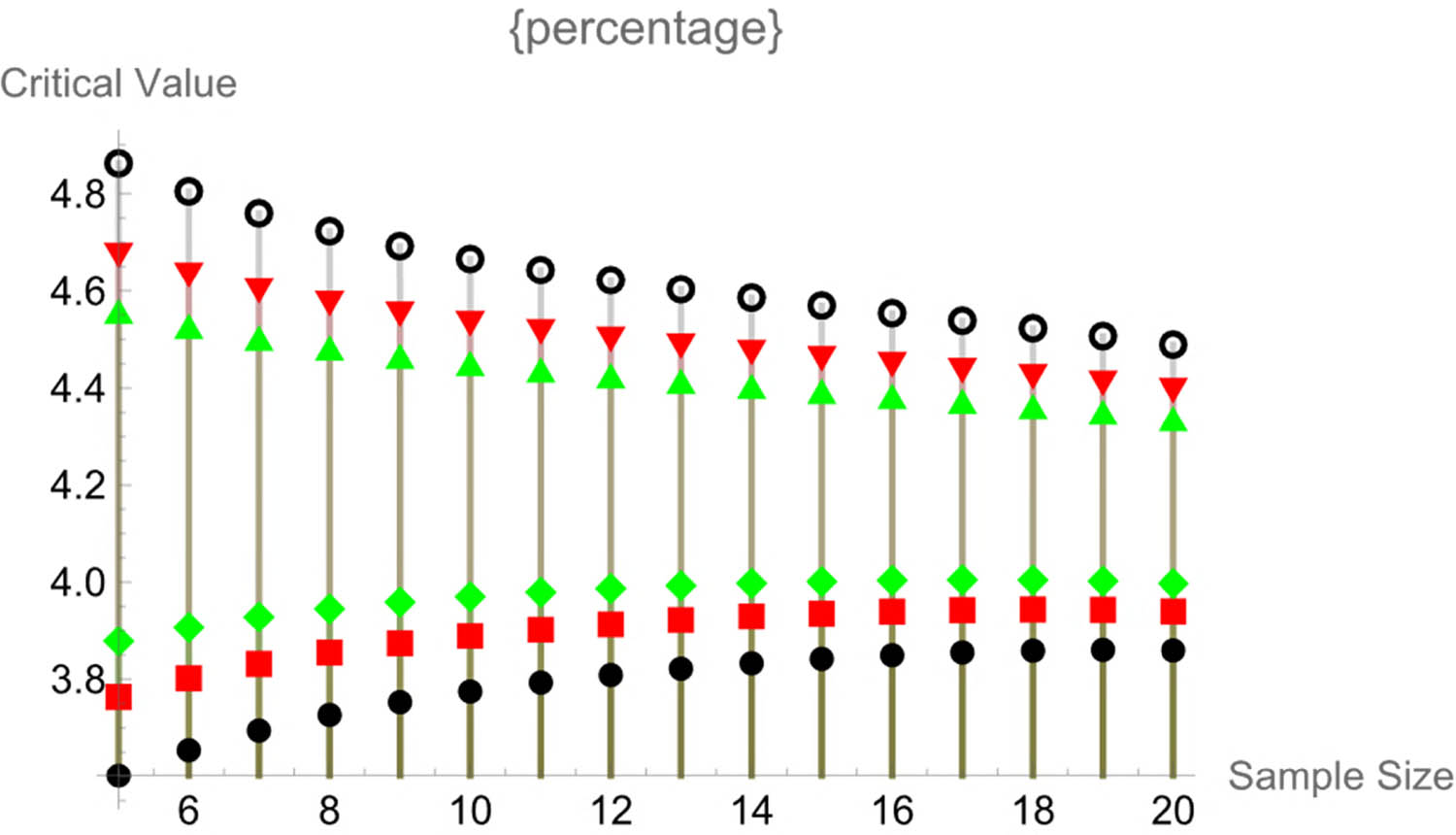
Relation between n and percentile points.
7.1 Complete data applications
7.1.1 Dataset #1: Data about carbon fibers’ breaking stress
Examine the information studied by Marzouk et al. [22], which shows the breaking stress of carbon fibers (measured in Gba). Figure 5 displays the data visualization graphs.

Representation of fibers' breaking stress dataset.
We find that
7.1.2 Dataset #2: UK COVID-19 data
Suppose the dataset, as presented in Almetwally et al. [23], which depicts a 36-day period of COVID-19 data in Canada, spanning from April 10 to May 15, 2020 (Figure 6). This dataset is based on the daily death rate due to COVID-19.
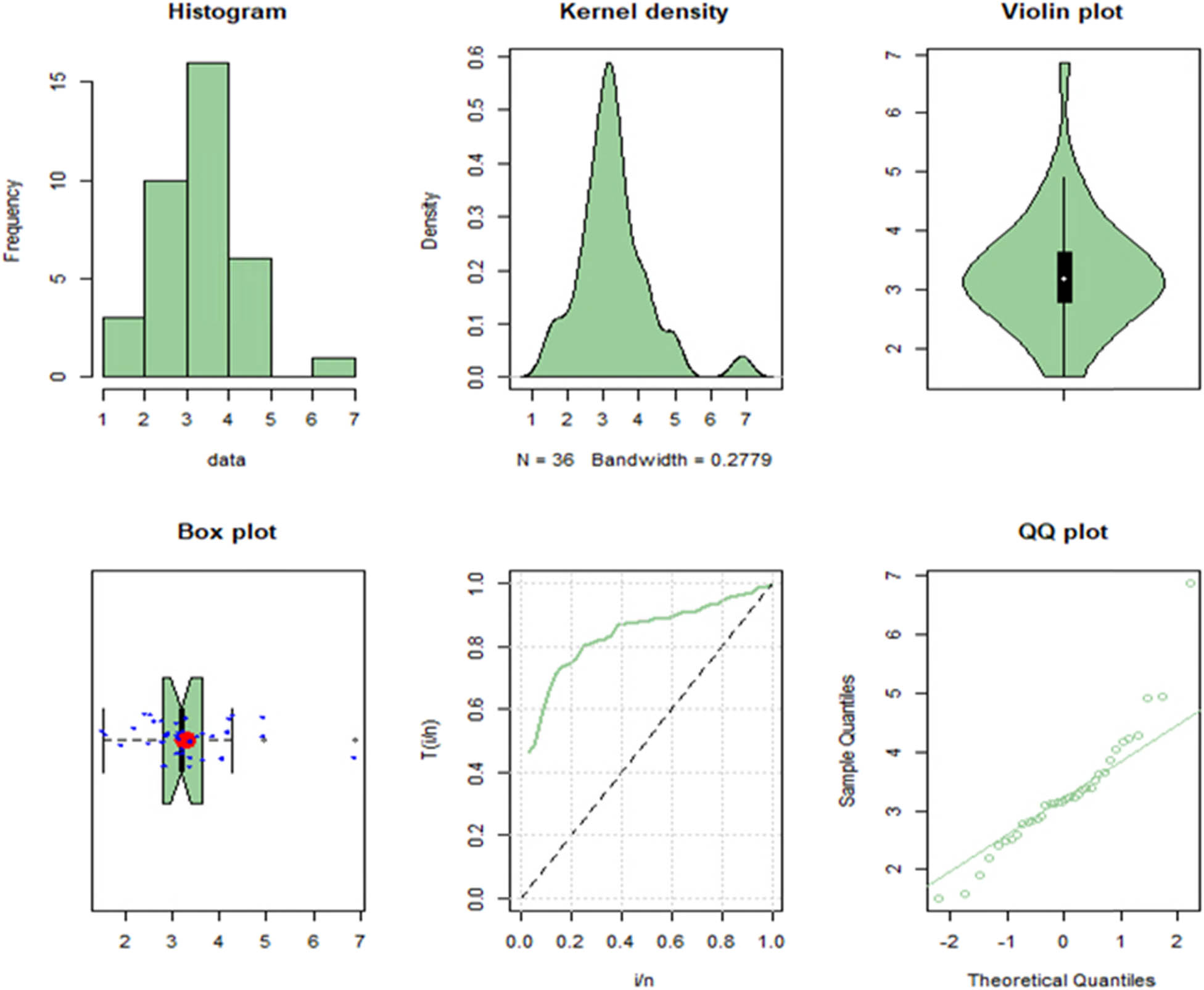
Representation of (COVID-19) dataset.
After calculation, we find
7.1.3 Dataset #3: Dataset in Keating
We consider a classical real data in Keating et al. [24] set on the times, in operating days, between successive failures of air conditioning equipment in an aircraft (Figure 7).
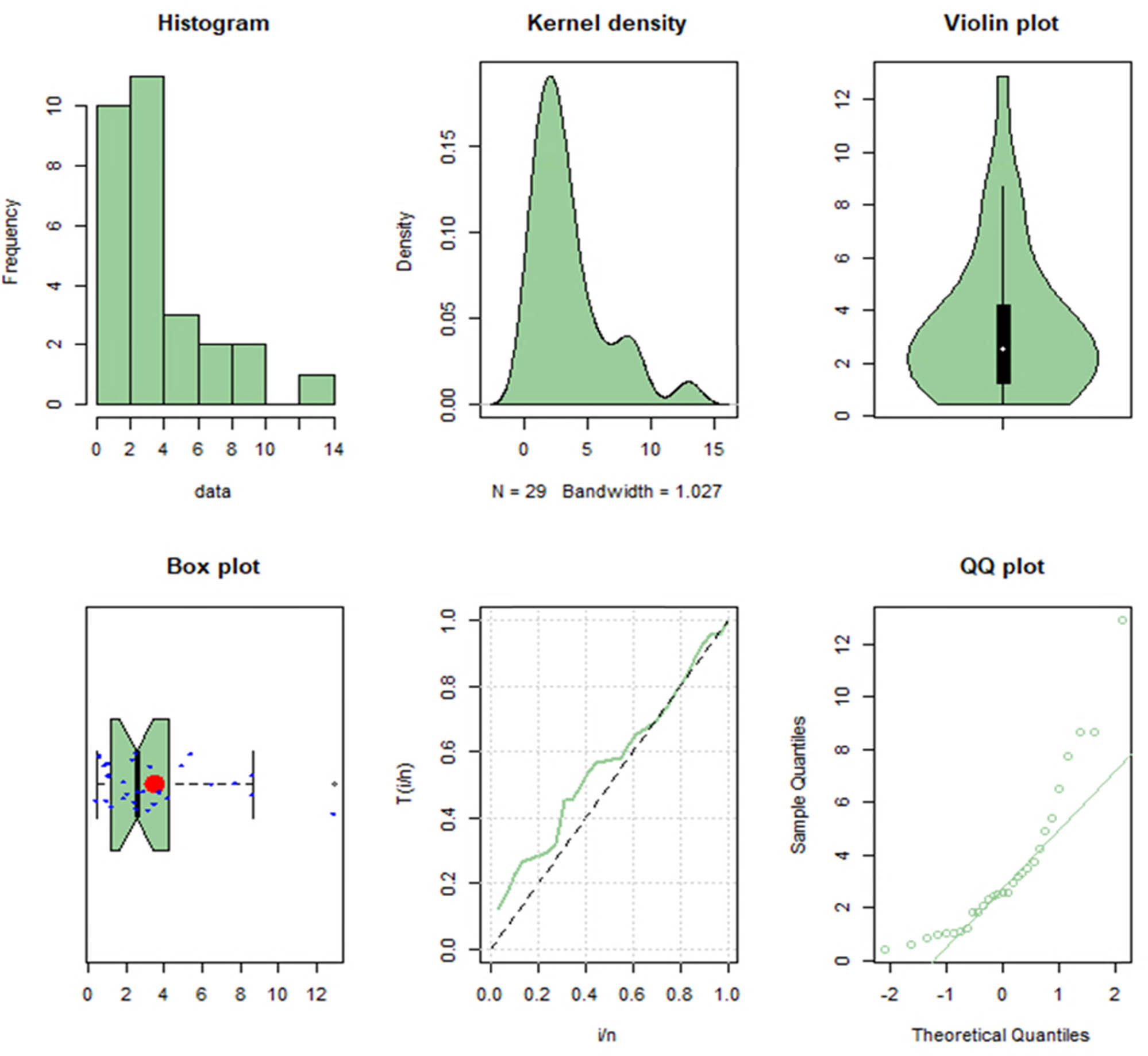
Representation of Keating dataset.
It is clear that the values of the test statistic
7.2 Censored data application
7.2.1 Dataset #4: Cyclophosphamide-treated lung cancer patients’ survival data
We consider a classical real data in Kamran Abbas et al. [25] dataset, which had data on the life durations of some patients with terminal lung cancer undergoing cyclophosphamide treatment. Twenty-eight edited and 33 unedited observations each feature a patient whose condition worsened and therapy was stopped (Figure 8).
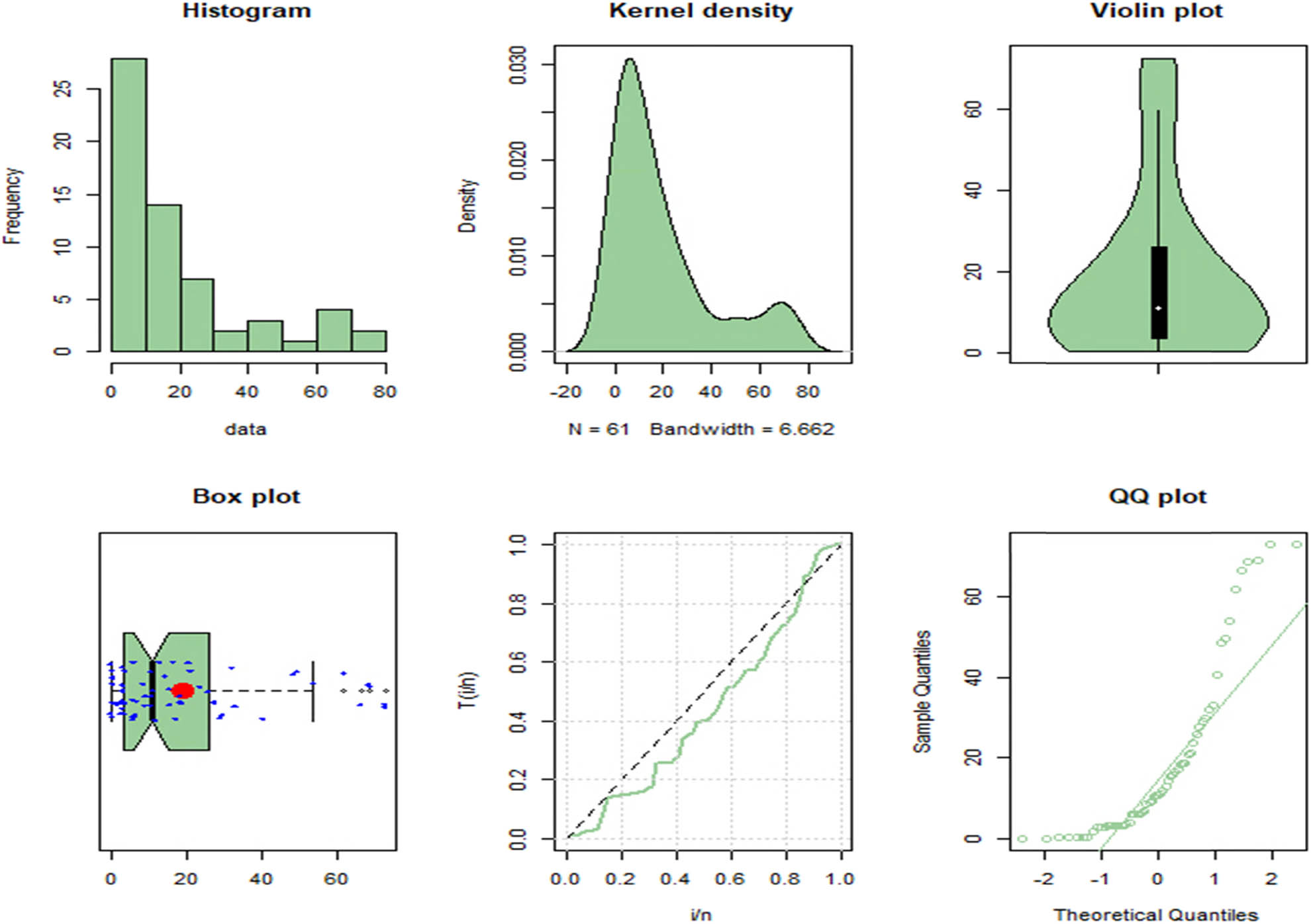
Cyclophosphamide-treated lung cancer patients’ survival data.
At
8 Conclusion
In this study, we introduce a novel nonparametric hypothesis testing method to assess exponentiality against the NBRUmgf class of life distributions. The test is grounded in solid theoretical foundations, including the derivation of its variance and asymptotic distribution under the null hypothesis. It shows competitive PAE compared to established methods, particularly under Gamma and Weibull alternatives. Extensive Monte Carlo simulations confirm the empirical reliability of the test, demonstrating sensitivity to deviations from exponentiality even with small sample sizes. Its practical utility is further highlighted through applications to both complete and right-censored real-world datasets from engineering, medical, and physical domains.
Despite these strengths, the current study is limited to univariate, independent observations. Future work could explore extending the test to multivariate or dependent data scenarios. Additionally, integrating alternative kernel functions or bootstrap-based methods may further improve its robustness and flexibility. We also suggest investigating broader classes of life distributions and different censoring schemes, which would enhance the applicability of the proposed test in diverse real-world reliability and survival analysis contexts.
In conclusion, the proposed Laplace transform-based test offers a valuable addition to the statistical tools used in reliability analysis. It provides a theoretically robust and practically flexible approach for identifying non-exponential behavior within the NBRUmgf class. This method shows strong potential for application across various scientific and industrial fields where understanding life distribution patterns is essential.
Acknowledgments
The authors acknowledge the funding by Ongoing Research Funding program, (ORF-2025-1004), King Saud University, Riyadh, Saudi Arabia.
-
Funding information: This study was funded by Ongoing Research Funding program, (ORF-2025-1004), King Saud University, Riyadh, Saudi Arabia.
-
Author contributions: The authors have accepted responsibility for the entire content of this manuscript and approved its submission.
-
Conflict of interest: The authors state no conflict of interest.
-
Data availability statement: All data generated or analyzed during this study are included in this published article.
References
[1] Al-Ruzaiza AS, Hendi MI, Abu-youssuf SE. A note on moment inequalities for harmonic new better than used in expectation property with hypotheses testing applications. J Nonparam Stat. 2003;15:267–72.10.1080/1048525031000141221Search in Google Scholar
[2] Ross SM. Introduction to probability models. 8th edn. New York, NY: Academic Press; 2003.Search in Google Scholar
[3] Ahmad IA. Some properties of classes of life distributions with unknown age. Stat Probab Lett. 2004;9(3):333–42.10.1016/j.spl.2004.06.029Search in Google Scholar
[4] Lai C-D, Xie M. Stochastic ageing and dependence for reliability. NY, USA: Springer-Verlag; 2006.Search in Google Scholar
[5] Mahmoud MAW, Moshref ME, Gadallah AM. On HNBUE class after specific age. J Egypt Math Soc. 2013;21:82–7.10.1016/j.joems.2012.10.010Search in Google Scholar
[6] Ghosh S, Mitra M. A new test for exponentiality against HNBUE alternatives. Commun Stat Theor Meth. 2020;49(1):27–43.10.1080/03610926.2018.1528370Search in Google Scholar
[7] Wasim I, Abbas M, Kashif Iqbal M, Mubashir Hayat A. Exponential B-spline collocation method for solving the generalized newell-whitehead-segel equation. J Math Comput Sci. 2020;20:313–24.10.22436/jmcs.020.04.05Search in Google Scholar
[8] Abbas M, Kashif Iqbal M, Zafar B, Binti Mat Zin S. New cubic b-spline approximation for solving non-linear third-order korteweg-de vries equation. Indian J Sci Technol. 2019;12(6):1–9.10.17485/ijst/2019/v12i6/141953Search in Google Scholar
[9] Nazir T, Abbas M, Kashif Iqbal M. A new quintic B-spline approximation for numerical treatment of Boussinesq equation. J Math Comput Sci. 2020;20:30–42.10.22436/jmcs.020.01.04Search in Google Scholar
[10] Abouammoh AM, Ahmad R, Khalique A. On new renewal better than used classes of life distributions. Stat Probab Lett. 2000;48:189–94.10.1016/S0167-7152(99)00204-7Search in Google Scholar
[11] Mahmoud W, El-Arishy SM, Diab LS. Testing renewal new better than used life distributions based on U-test. Appl Math Model. 2005;29(8):784–96.10.1016/j.apm.2004.10.011Search in Google Scholar
[12] Mugdadi AR, Ahmad IA. Moment inequalities derived from comparing life with its equilibrium form. J Stat Plan Inference. 2005;134(2):303–17.10.1016/j.jspi.2004.04.016Search in Google Scholar
[13] EL-Arishy SM, Diab LS, EL-Atfy ES. Characterizations and testing hypotheses for RNBUmgf class of life distributions. J Stat: Adv Theor Appl. 2019;21(1):71–89.10.18642/jsata_7100122044Search in Google Scholar
[14] Atallah MA, Mahmoud MAW, Alzahrani BM. A new test for exponentiality versus NBUmgf life distribution based on Laplace transform. Qual Reliab Eng Int. 2014;30(8):1353–9.10.1002/qre.1557Search in Google Scholar
[15] Mahmoud MAW, EL-Sagheer RM, Etman WBH. Testing exponentiality against overall decreasing life in Laplace transform order. Comput Sci Comput Maths. 2017;7(1):19–24.10.20967/jcscm.2017.01.004Search in Google Scholar
[16] Abu-Youssef SE, Nahed SA, Bakr ME. A new test for unknown age class of life distribution based on Laplace transform technique. Int J Comput Appl. 2018;180(33):21–7.10.5120/ijca2018916833Search in Google Scholar
[17] Gadallah AM. Testing EBUmgf class of life distributions based on Laplace transform technique. J Stat Appl Probab. 2017;6(3):471–7.10.18576/jsap/060302Search in Google Scholar
[18] EL-Sagheer RM, Abu-Youssef SE, Sadek A, Omar KM, Etman WBH. Characterizations and testing NBRUL class of life distributions based on Laplace transform technique. J Stat Appl Pro. 2022;11(1):1–14.10.18576/jsap/110106Search in Google Scholar
[19] Bakr ME, Golam Kibria BM, Gadallah AM. A new non-parametric hypothesis testing with reliability analysis applications to model some real data. J Radiat Res Appl Sci. 2023;16:100724.10.1016/j.jrras.2023.100724Search in Google Scholar
[20] Hassan EMA, Said MM. A new class of life distributions based on moment inequalities. Asian J Probab Stat. 2021;13(4):47–57.10.9734/ajpas/2021/v13i430315Search in Google Scholar
[21] Bakr ME, El-Atfy ES, Balogun OS, Tashkandy YA, Gadallah AM. Statistical insights: analyzing shock models, reliability operations and testing exponentiality for NBRUmgf class of life distributions. Eksploat Niezawodn – Maint Reliab. 2024;26(2):184185.10.17531/ein/184185Search in Google Scholar
[22] Marzouk W, Shafiq S, Naz S, Jamal F, Sapkota LP, Nagy M, et al. A new univariate continuous distribution with applications in reliability. AIP Adv. 2023;13(115):126.10.1063/5.0179914Search in Google Scholar
[23] Almetwally EM, Alharbi R, Alnagar D, Hafez EH. A new inverted Topp-Leone distribution: applications to the COVID-19 mortality rate in two different countries. Axioms. 2021;10(1):25.10.3390/axioms10010025Search in Google Scholar
[24] Keating JP, Glaser RE, Ketchum NS. Testing hypotheses about the shape of a Gamma distribution. Technometrics. 1990;32(1):67–82.10.1080/00401706.1990.10484594Search in Google Scholar
[25] Abbas K, Hussain Z, Rashid N, Ali A, Taj M, Khan SA, et al. Bayesian estimation of Gumbel type-II distribution under type-II censoring with medical applications. J Comput Math Methods Med. 2020;7:1–11.10.1155/2020/1876073Search in Google Scholar
© 2025 the author(s), published by De Gruyter
This work is licensed under the Creative Commons Attribution 4.0 International License.
Articles in the same Issue
- Research Articles
- Single-step fabrication of Ag2S/poly-2-mercaptoaniline nanoribbon photocathodes for green hydrogen generation from artificial and natural red-sea water
- Abundant new interaction solutions and nonlinear dynamics for the (3+1)-dimensional Hirota–Satsuma–Ito-like equation
- A novel gold and SiO2 material based planar 5-element high HPBW end-fire antenna array for 300 GHz applications
- Explicit exact solutions and bifurcation analysis for the mZK equation with truncated M-fractional derivatives utilizing two reliable methods
- Optical and laser damage resistance: Role of periodic cylindrical surfaces
- Numerical study of flow and heat transfer in the air-side metal foam partially filled channels of panel-type radiator under forced convection
- Water-based hybrid nanofluid flow containing CNT nanoparticles over an extending surface with velocity slips, thermal convective, and zero-mass flux conditions
- Dynamical wave structures for some diffusion--reaction equations with quadratic and quartic nonlinearities
- Solving an isotropic grey matter tumour model via a heat transfer equation
- Study on the penetration protection of a fiber-reinforced composite structure with CNTs/GFP clip STF/3DKevlar
- Influence of Hall current and acoustic pressure on nanostructured DPL thermoelastic plates under ramp heating in a double-temperature model
- Applications of the Belousov–Zhabotinsky reaction–diffusion system: Analytical and numerical approaches
- AC electroosmotic flow of Maxwell fluid in a pH-regulated parallel-plate silica nanochannel
- Interpreting optical effects with relativistic transformations adopting one-way synchronization to conserve simultaneity and space–time continuity
- Modeling and analysis of quantum communication channel in airborne platforms with boundary layer effects
- Theoretical and numerical investigation of a memristor system with a piecewise memductance under fractal–fractional derivatives
- Tuning the structure and electro-optical properties of α-Cr2O3 films by heat treatment/La doping for optoelectronic applications
- High-speed multi-spectral explosion temperature measurement using golden-section accelerated Pearson correlation algorithm
- Dynamic behavior and modulation instability of the generalized coupled fractional nonlinear Helmholtz equation with cubic–quintic term
- Study on the duration of laser-induced air plasma flash near thin film surface
- Exploring the dynamics of fractional-order nonlinear dispersive wave system through homotopy technique
- The mechanism of carbon monoxide fluorescence inside a femtosecond laser-induced plasma
- Numerical solution of a nonconstant coefficient advection diffusion equation in an irregular domain and analyses of numerical dispersion and dissipation
- Numerical examination of the chemically reactive MHD flow of hybrid nanofluids over a two-dimensional stretching surface with the Cattaneo–Christov model and slip conditions
- Impacts of sinusoidal heat flux and embraced heated rectangular cavity on natural convection within a square enclosure partially filled with porous medium and Casson-hybrid nanofluid
- Stability analysis of unsteady ternary nanofluid flow past a stretching/shrinking wedge
- Solitonic wave solutions of a Hamiltonian nonlinear atom chain model through the Hirota bilinear transformation method
- Bilinear form and soltion solutions for (3+1)-dimensional negative-order KdV-CBS equation
- Solitary chirp pulses and soliton control for variable coefficients cubic–quintic nonlinear Schrödinger equation in nonuniform management system
- Influence of decaying heat source and temperature-dependent thermal conductivity on photo-hydro-elasto semiconductor media
- Dissipative disorder optimization in the radiative thin film flow of partially ionized non-Newtonian hybrid nanofluid with second-order slip condition
- Bifurcation, chaotic behavior, and traveling wave solutions for the fractional (4+1)-dimensional Davey–Stewartson–Kadomtsev–Petviashvili model
- New investigation on soliton solutions of two nonlinear PDEs in mathematical physics with a dynamical property: Bifurcation analysis
- Mathematical analysis of nanoparticle type and volume fraction on heat transfer efficiency of nanofluids
- Creation of single-wing Lorenz-like attractors via a ten-ninths-degree term
- Optical soliton solutions, bifurcation analysis, chaotic behaviors of nonlinear Schrödinger equation and modulation instability in optical fiber
- Chaotic dynamics and some solutions for the (n + 1)-dimensional modified Zakharov–Kuznetsov equation in plasma physics
- Fractal formation and chaotic soliton phenomena in nonlinear conformable Heisenberg ferromagnetic spin chain equation
- Single-step fabrication of Mn(iv) oxide-Mn(ii) sulfide/poly-2-mercaptoaniline porous network nanocomposite for pseudo-supercapacitors and charge storage
- Novel constructed dynamical analytical solutions and conserved quantities of the new (2+1)-dimensional KdV model describing acoustic wave propagation
- Tavis–Cummings model in the presence of a deformed field and time-dependent coupling
- Spinning dynamics of stress-dependent viscosity of generalized Cross-nonlinear materials affected by gravitationally swirling disk
- Design and prediction of high optical density photovoltaic polymers using machine learning-DFT studies
- Robust control and preservation of quantum steering, nonlocality, and coherence in open atomic systems
- Coating thickness and process efficiency of reverse roll coating using a magnetized hybrid nanomaterial flow
- Dynamic analysis, circuit realization, and its synchronization of a new chaotic hyperjerk system
- Decoherence of steerability and coherence dynamics induced by nonlinear qubit–cavity interactions
- Finite element analysis of turbulent thermal enhancement in grooved channels with flat- and plus-shaped fins
- Modulational instability and associated ion-acoustic modulated envelope solitons in a quantum plasma having ion beams
- Statistical inference of constant-stress partially accelerated life tests under type II generalized hybrid censored data from Burr III distribution
- On solutions of the Dirac equation for 1D hydrogenic atoms or ions
- Entropy optimization for chemically reactive magnetized unsteady thin film hybrid nanofluid flow on inclined surface subject to nonlinear mixed convection and variable temperature
- Stability analysis, circuit simulation, and color image encryption of a novel four-dimensional hyperchaotic model with hidden and self-excited attractors
- A high-accuracy exponential time integration scheme for the Darcy–Forchheimer Williamson fluid flow with temperature-dependent conductivity
- Novel analysis of fractional regularized long-wave equation in plasma dynamics
- Development of a photoelectrode based on a bismuth(iii) oxyiodide/intercalated iodide-poly(1H-pyrrole) rough spherical nanocomposite for green hydrogen generation
- Investigation of solar radiation effects on the energy performance of the (Al2O3–CuO–Cu)/H2O ternary nanofluidic system through a convectively heated cylinder
- Quantum resources for a system of two atoms interacting with a deformed field in the presence of intensity-dependent coupling
- Studying bifurcations and chaotic dynamics in the generalized hyperelastic-rod wave equation through Hamiltonian mechanics
- A new numerical technique for the solution of time-fractional nonlinear Klein–Gordon equation involving Atangana–Baleanu derivative using cubic B-spline functions
- Interaction solutions of high-order breathers and lumps for a (3+1)-dimensional conformable fractional potential-YTSF-like model
- Hydraulic fracturing radioactive source tracing technology based on hydraulic fracturing tracing mechanics model
- Numerical solution and stability analysis of non-Newtonian hybrid nanofluid flow subject to exponential heat source/sink over a Riga sheet
- Numerical investigation of mixed convection and viscous dissipation in couple stress nanofluid flow: A merged Adomian decomposition method and Mohand transform
- Effectual quintic B-spline functions for solving the time fractional coupled Boussinesq–Burgers equation arising in shallow water waves
- Analysis of MHD hybrid nanofluid flow over cone and wedge with exponential and thermal heat source and activation energy
- Solitons and travelling waves structure for M-fractional Kairat-II equation using three explicit methods
- Impact of nanoparticle shapes on the heat transfer properties of Cu and CuO nanofluids flowing over a stretching surface with slip effects: A computational study
- Computational simulation of heat transfer and nanofluid flow for two-sided lid-driven square cavity under the influence of magnetic field
- Irreversibility analysis of a bioconvective two-phase nanofluid in a Maxwell (non-Newtonian) flow induced by a rotating disk with thermal radiation
- Hydrodynamic and sensitivity analysis of a polymeric calendering process for non-Newtonian fluids with temperature-dependent viscosity
- Exploring the peakon solitons molecules and solitary wave structure to the nonlinear damped Kortewege–de Vries equation through efficient technique
- Modeling and heat transfer analysis of magnetized hybrid micropolar blood-based nanofluid flow in Darcy–Forchheimer porous stenosis narrow arteries
- Activation energy and cross-diffusion effects on 3D rotating nanofluid flow in a Darcy–Forchheimer porous medium with radiation and convective heating
- Insights into chemical reactions occurring in generalized nanomaterials due to spinning surface with melting constraints
- Influence of a magnetic field on double-porosity photo-thermoelastic materials under Lord–Shulman theory
- Soliton-like solutions for a nonlinear doubly dispersive equation in an elastic Murnaghan's rod via Hirota's bilinear method
- Analytical and numerical investigation of exact wave patterns and chaotic dynamics in the extended improved Boussinesq equation
- Nonclassical correlation dynamics of Heisenberg XYZ states with (x, y)-spin--orbit interaction, x-magnetic field, and intrinsic decoherence effects
- Exact traveling wave and soliton solutions for chemotaxis model and (3+1)-dimensional Boiti–Leon–Manna–Pempinelli equation
- Unveiling the transformative role of samarium in ZnO: Exploring structural and optical modifications for advanced functional applications
- On the derivation of solitary wave solutions for the time-fractional Rosenau equation through two analytical techniques
- Analyzing the role of length and radius of MWCNTs in a nanofluid flow influenced by variable thermal conductivity and viscosity considering Marangoni convection
- Advanced mathematical analysis of heat and mass transfer in oscillatory micropolar bio-nanofluid flows via peristaltic waves and electroosmotic effects
- Exact bound state solutions of the radial Schrödinger equation for the Coulomb potential by conformable Nikiforov–Uvarov approach
- Some anisotropic and perfect fluid plane symmetric solutions of Einstein's field equations using killing symmetries
- Nonlinear dynamics of the dissipative ion-acoustic solitary waves in anisotropic rotating magnetoplasmas
- Curves in multiplicative equiaffine plane
- Exact solution of the three-dimensional (3D) Z2 lattice gauge theory
- Propagation properties of Airyprime pulses in relaxing nonlinear media
- Symbolic computation: Analytical solutions and dynamics of a shallow water wave equation in coastal engineering
- Wave propagation in nonlocal piezo-photo-hygrothermoelastic semiconductors subjected to heat and moisture flux
- Comparative reaction dynamics in rotating nanofluid systems: Quartic and cubic kinetics under MHD influence
- Laplace transform technique and probabilistic analysis-based hypothesis testing in medical and engineering applications
- Physical properties of ternary chloro-perovskites KTCl3 (T = Ge, Al) for optoelectronic applications
- Gravitational length stretching: Curvature-induced modulation of quantum probability densities
- The search for the cosmological cold dark matter axion – A new refined narrow mass window and detection scheme
- A comparative study of quantum resources in bipartite Lipkin–Meshkov–Glick model under DM interaction and Zeeman splitting
- PbO-doped K2O–BaO–Al2O3–B2O3–TeO2-glasses: Mechanical and shielding efficacy
- Nanospherical arsenic(iii) oxoiodide/iodide-intercalated poly(N-methylpyrrole) composite synthesis for broad-spectrum optical detection
- Sine power Burr X distribution with estimation and applications in physics and other fields
- Numerical modeling of enhanced reactive oxygen plasma in pulsed laser deposition of metal oxide thin films
- Dynamical analyses and dispersive soliton solutions to the nonlinear fractional model in stratified fluids
- Computation of exact analytical soliton solutions and their dynamics in advanced optical system
- An innovative approximation concerning the diffusion and electrical conductivity tensor at critical altitudes within the F-region of ionospheric plasma at low latitudes
- An analytical investigation to the (3+1)-dimensional Yu–Toda–Sassa–Fukuyama equation with dynamical analysis: Bifurcation
- Swirling-annular-flow-induced instability of a micro shell considering Knudsen number and viscosity effects
- Numerical analysis of non-similar convection flows of a two-phase nanofluid past a semi-infinite vertical plate with thermal radiation
- MgO NPs reinforced PCL/PVC nanocomposite films with enhanced UV shielding and thermal stability for packaging applications
- Optimal conditions for indoor air purification using non-thermal Corona discharge electrostatic precipitator
- Investigation of thermal conductivity and Raman spectra for HfAlB, TaAlB, and WAlB based on first-principles calculations
- Tunable double plasmon-induced transparency based on monolayer patterned graphene metamaterial
- DSC: depth data quality optimization framework for RGBD camouflaged object detection
- A new family of Poisson-exponential distributions with applications to cancer data and glass fiber reliability
- Numerical investigation of couple stress under slip conditions via modified Adomian decomposition method
- Monitoring plateau lake area changes in Yunnan province, southwestern China using medium-resolution remote sensing imagery: applicability of water indices and environmental dependencies
- Heterodyne interferometric fiber-optic gyroscope
- Exact solutions of Einstein’s field equations via homothetic symmetries of non-static plane symmetric spacetime
- A widespread study of discrete entropic model and its distribution along with fluctuations of energy
- Empirical model integration for accurate charge carrier mobility simulation in silicon MOSFETs
- The influence of scattering correction effect based on optical path distribution on CO2 retrieval
- Anisotropic dissociation and spectral response of 1-Bromo-4-chlorobenzene under static directional electric fields
- Role of tungsten oxide (WO3) on thermal and optical properties of smart polymer composites
- Analysis of iterative deblurring: no explicit noise
- The influence of anisotropy of InP on its elasticity and phonon properties
- Review Article
- Examination of the gamma radiation shielding properties of different clay and sand materials in the Adrar region
- Erratum
- Erratum to “On Soliton structures in optical fiber communications with Kundu–Mukherjee–Naskar model (Open Physics 2021;19:679–682)”
- Special Issue on Fundamental Physics from Atoms to Cosmos - Part II
- Possible explanation for the neutron lifetime puzzle
- Special Issue on Nanomaterial utilization and structural optimization - Part III
- Numerical investigation on fluid-thermal-electric performance of a thermoelectric-integrated helically coiled tube heat exchanger for coal mine air cooling
- Special Issue on Nonlinear Dynamics and Chaos in Physical Systems
- Analysis of the fractional relativistic isothermal gas sphere with application to neutron stars
- Abundant wave symmetries in the (3+1)-dimensional Chafee–Infante equation through the Hirota bilinear transformation technique
- Successive midpoint method for fractional differential equations with nonlocal kernels: Error analysis, stability, and applications
- Novel exact solitons to the fractional modified mixed-Korteweg--de Vries model with a stability analysis
Articles in the same Issue
- Research Articles
- Single-step fabrication of Ag2S/poly-2-mercaptoaniline nanoribbon photocathodes for green hydrogen generation from artificial and natural red-sea water
- Abundant new interaction solutions and nonlinear dynamics for the (3+1)-dimensional Hirota–Satsuma–Ito-like equation
- A novel gold and SiO2 material based planar 5-element high HPBW end-fire antenna array for 300 GHz applications
- Explicit exact solutions and bifurcation analysis for the mZK equation with truncated M-fractional derivatives utilizing two reliable methods
- Optical and laser damage resistance: Role of periodic cylindrical surfaces
- Numerical study of flow and heat transfer in the air-side metal foam partially filled channels of panel-type radiator under forced convection
- Water-based hybrid nanofluid flow containing CNT nanoparticles over an extending surface with velocity slips, thermal convective, and zero-mass flux conditions
- Dynamical wave structures for some diffusion--reaction equations with quadratic and quartic nonlinearities
- Solving an isotropic grey matter tumour model via a heat transfer equation
- Study on the penetration protection of a fiber-reinforced composite structure with CNTs/GFP clip STF/3DKevlar
- Influence of Hall current and acoustic pressure on nanostructured DPL thermoelastic plates under ramp heating in a double-temperature model
- Applications of the Belousov–Zhabotinsky reaction–diffusion system: Analytical and numerical approaches
- AC electroosmotic flow of Maxwell fluid in a pH-regulated parallel-plate silica nanochannel
- Interpreting optical effects with relativistic transformations adopting one-way synchronization to conserve simultaneity and space–time continuity
- Modeling and analysis of quantum communication channel in airborne platforms with boundary layer effects
- Theoretical and numerical investigation of a memristor system with a piecewise memductance under fractal–fractional derivatives
- Tuning the structure and electro-optical properties of α-Cr2O3 films by heat treatment/La doping for optoelectronic applications
- High-speed multi-spectral explosion temperature measurement using golden-section accelerated Pearson correlation algorithm
- Dynamic behavior and modulation instability of the generalized coupled fractional nonlinear Helmholtz equation with cubic–quintic term
- Study on the duration of laser-induced air plasma flash near thin film surface
- Exploring the dynamics of fractional-order nonlinear dispersive wave system through homotopy technique
- The mechanism of carbon monoxide fluorescence inside a femtosecond laser-induced plasma
- Numerical solution of a nonconstant coefficient advection diffusion equation in an irregular domain and analyses of numerical dispersion and dissipation
- Numerical examination of the chemically reactive MHD flow of hybrid nanofluids over a two-dimensional stretching surface with the Cattaneo–Christov model and slip conditions
- Impacts of sinusoidal heat flux and embraced heated rectangular cavity on natural convection within a square enclosure partially filled with porous medium and Casson-hybrid nanofluid
- Stability analysis of unsteady ternary nanofluid flow past a stretching/shrinking wedge
- Solitonic wave solutions of a Hamiltonian nonlinear atom chain model through the Hirota bilinear transformation method
- Bilinear form and soltion solutions for (3+1)-dimensional negative-order KdV-CBS equation
- Solitary chirp pulses and soliton control for variable coefficients cubic–quintic nonlinear Schrödinger equation in nonuniform management system
- Influence of decaying heat source and temperature-dependent thermal conductivity on photo-hydro-elasto semiconductor media
- Dissipative disorder optimization in the radiative thin film flow of partially ionized non-Newtonian hybrid nanofluid with second-order slip condition
- Bifurcation, chaotic behavior, and traveling wave solutions for the fractional (4+1)-dimensional Davey–Stewartson–Kadomtsev–Petviashvili model
- New investigation on soliton solutions of two nonlinear PDEs in mathematical physics with a dynamical property: Bifurcation analysis
- Mathematical analysis of nanoparticle type and volume fraction on heat transfer efficiency of nanofluids
- Creation of single-wing Lorenz-like attractors via a ten-ninths-degree term
- Optical soliton solutions, bifurcation analysis, chaotic behaviors of nonlinear Schrödinger equation and modulation instability in optical fiber
- Chaotic dynamics and some solutions for the (n + 1)-dimensional modified Zakharov–Kuznetsov equation in plasma physics
- Fractal formation and chaotic soliton phenomena in nonlinear conformable Heisenberg ferromagnetic spin chain equation
- Single-step fabrication of Mn(iv) oxide-Mn(ii) sulfide/poly-2-mercaptoaniline porous network nanocomposite for pseudo-supercapacitors and charge storage
- Novel constructed dynamical analytical solutions and conserved quantities of the new (2+1)-dimensional KdV model describing acoustic wave propagation
- Tavis–Cummings model in the presence of a deformed field and time-dependent coupling
- Spinning dynamics of stress-dependent viscosity of generalized Cross-nonlinear materials affected by gravitationally swirling disk
- Design and prediction of high optical density photovoltaic polymers using machine learning-DFT studies
- Robust control and preservation of quantum steering, nonlocality, and coherence in open atomic systems
- Coating thickness and process efficiency of reverse roll coating using a magnetized hybrid nanomaterial flow
- Dynamic analysis, circuit realization, and its synchronization of a new chaotic hyperjerk system
- Decoherence of steerability and coherence dynamics induced by nonlinear qubit–cavity interactions
- Finite element analysis of turbulent thermal enhancement in grooved channels with flat- and plus-shaped fins
- Modulational instability and associated ion-acoustic modulated envelope solitons in a quantum plasma having ion beams
- Statistical inference of constant-stress partially accelerated life tests under type II generalized hybrid censored data from Burr III distribution
- On solutions of the Dirac equation for 1D hydrogenic atoms or ions
- Entropy optimization for chemically reactive magnetized unsteady thin film hybrid nanofluid flow on inclined surface subject to nonlinear mixed convection and variable temperature
- Stability analysis, circuit simulation, and color image encryption of a novel four-dimensional hyperchaotic model with hidden and self-excited attractors
- A high-accuracy exponential time integration scheme for the Darcy–Forchheimer Williamson fluid flow with temperature-dependent conductivity
- Novel analysis of fractional regularized long-wave equation in plasma dynamics
- Development of a photoelectrode based on a bismuth(iii) oxyiodide/intercalated iodide-poly(1H-pyrrole) rough spherical nanocomposite for green hydrogen generation
- Investigation of solar radiation effects on the energy performance of the (Al2O3–CuO–Cu)/H2O ternary nanofluidic system through a convectively heated cylinder
- Quantum resources for a system of two atoms interacting with a deformed field in the presence of intensity-dependent coupling
- Studying bifurcations and chaotic dynamics in the generalized hyperelastic-rod wave equation through Hamiltonian mechanics
- A new numerical technique for the solution of time-fractional nonlinear Klein–Gordon equation involving Atangana–Baleanu derivative using cubic B-spline functions
- Interaction solutions of high-order breathers and lumps for a (3+1)-dimensional conformable fractional potential-YTSF-like model
- Hydraulic fracturing radioactive source tracing technology based on hydraulic fracturing tracing mechanics model
- Numerical solution and stability analysis of non-Newtonian hybrid nanofluid flow subject to exponential heat source/sink over a Riga sheet
- Numerical investigation of mixed convection and viscous dissipation in couple stress nanofluid flow: A merged Adomian decomposition method and Mohand transform
- Effectual quintic B-spline functions for solving the time fractional coupled Boussinesq–Burgers equation arising in shallow water waves
- Analysis of MHD hybrid nanofluid flow over cone and wedge with exponential and thermal heat source and activation energy
- Solitons and travelling waves structure for M-fractional Kairat-II equation using three explicit methods
- Impact of nanoparticle shapes on the heat transfer properties of Cu and CuO nanofluids flowing over a stretching surface with slip effects: A computational study
- Computational simulation of heat transfer and nanofluid flow for two-sided lid-driven square cavity under the influence of magnetic field
- Irreversibility analysis of a bioconvective two-phase nanofluid in a Maxwell (non-Newtonian) flow induced by a rotating disk with thermal radiation
- Hydrodynamic and sensitivity analysis of a polymeric calendering process for non-Newtonian fluids with temperature-dependent viscosity
- Exploring the peakon solitons molecules and solitary wave structure to the nonlinear damped Kortewege–de Vries equation through efficient technique
- Modeling and heat transfer analysis of magnetized hybrid micropolar blood-based nanofluid flow in Darcy–Forchheimer porous stenosis narrow arteries
- Activation energy and cross-diffusion effects on 3D rotating nanofluid flow in a Darcy–Forchheimer porous medium with radiation and convective heating
- Insights into chemical reactions occurring in generalized nanomaterials due to spinning surface with melting constraints
- Influence of a magnetic field on double-porosity photo-thermoelastic materials under Lord–Shulman theory
- Soliton-like solutions for a nonlinear doubly dispersive equation in an elastic Murnaghan's rod via Hirota's bilinear method
- Analytical and numerical investigation of exact wave patterns and chaotic dynamics in the extended improved Boussinesq equation
- Nonclassical correlation dynamics of Heisenberg XYZ states with (x, y)-spin--orbit interaction, x-magnetic field, and intrinsic decoherence effects
- Exact traveling wave and soliton solutions for chemotaxis model and (3+1)-dimensional Boiti–Leon–Manna–Pempinelli equation
- Unveiling the transformative role of samarium in ZnO: Exploring structural and optical modifications for advanced functional applications
- On the derivation of solitary wave solutions for the time-fractional Rosenau equation through two analytical techniques
- Analyzing the role of length and radius of MWCNTs in a nanofluid flow influenced by variable thermal conductivity and viscosity considering Marangoni convection
- Advanced mathematical analysis of heat and mass transfer in oscillatory micropolar bio-nanofluid flows via peristaltic waves and electroosmotic effects
- Exact bound state solutions of the radial Schrödinger equation for the Coulomb potential by conformable Nikiforov–Uvarov approach
- Some anisotropic and perfect fluid plane symmetric solutions of Einstein's field equations using killing symmetries
- Nonlinear dynamics of the dissipative ion-acoustic solitary waves in anisotropic rotating magnetoplasmas
- Curves in multiplicative equiaffine plane
- Exact solution of the three-dimensional (3D) Z2 lattice gauge theory
- Propagation properties of Airyprime pulses in relaxing nonlinear media
- Symbolic computation: Analytical solutions and dynamics of a shallow water wave equation in coastal engineering
- Wave propagation in nonlocal piezo-photo-hygrothermoelastic semiconductors subjected to heat and moisture flux
- Comparative reaction dynamics in rotating nanofluid systems: Quartic and cubic kinetics under MHD influence
- Laplace transform technique and probabilistic analysis-based hypothesis testing in medical and engineering applications
- Physical properties of ternary chloro-perovskites KTCl3 (T = Ge, Al) for optoelectronic applications
- Gravitational length stretching: Curvature-induced modulation of quantum probability densities
- The search for the cosmological cold dark matter axion – A new refined narrow mass window and detection scheme
- A comparative study of quantum resources in bipartite Lipkin–Meshkov–Glick model under DM interaction and Zeeman splitting
- PbO-doped K2O–BaO–Al2O3–B2O3–TeO2-glasses: Mechanical and shielding efficacy
- Nanospherical arsenic(iii) oxoiodide/iodide-intercalated poly(N-methylpyrrole) composite synthesis for broad-spectrum optical detection
- Sine power Burr X distribution with estimation and applications in physics and other fields
- Numerical modeling of enhanced reactive oxygen plasma in pulsed laser deposition of metal oxide thin films
- Dynamical analyses and dispersive soliton solutions to the nonlinear fractional model in stratified fluids
- Computation of exact analytical soliton solutions and their dynamics in advanced optical system
- An innovative approximation concerning the diffusion and electrical conductivity tensor at critical altitudes within the F-region of ionospheric plasma at low latitudes
- An analytical investigation to the (3+1)-dimensional Yu–Toda–Sassa–Fukuyama equation with dynamical analysis: Bifurcation
- Swirling-annular-flow-induced instability of a micro shell considering Knudsen number and viscosity effects
- Numerical analysis of non-similar convection flows of a two-phase nanofluid past a semi-infinite vertical plate with thermal radiation
- MgO NPs reinforced PCL/PVC nanocomposite films with enhanced UV shielding and thermal stability for packaging applications
- Optimal conditions for indoor air purification using non-thermal Corona discharge electrostatic precipitator
- Investigation of thermal conductivity and Raman spectra for HfAlB, TaAlB, and WAlB based on first-principles calculations
- Tunable double plasmon-induced transparency based on monolayer patterned graphene metamaterial
- DSC: depth data quality optimization framework for RGBD camouflaged object detection
- A new family of Poisson-exponential distributions with applications to cancer data and glass fiber reliability
- Numerical investigation of couple stress under slip conditions via modified Adomian decomposition method
- Monitoring plateau lake area changes in Yunnan province, southwestern China using medium-resolution remote sensing imagery: applicability of water indices and environmental dependencies
- Heterodyne interferometric fiber-optic gyroscope
- Exact solutions of Einstein’s field equations via homothetic symmetries of non-static plane symmetric spacetime
- A widespread study of discrete entropic model and its distribution along with fluctuations of energy
- Empirical model integration for accurate charge carrier mobility simulation in silicon MOSFETs
- The influence of scattering correction effect based on optical path distribution on CO2 retrieval
- Anisotropic dissociation and spectral response of 1-Bromo-4-chlorobenzene under static directional electric fields
- Role of tungsten oxide (WO3) on thermal and optical properties of smart polymer composites
- Analysis of iterative deblurring: no explicit noise
- The influence of anisotropy of InP on its elasticity and phonon properties
- Review Article
- Examination of the gamma radiation shielding properties of different clay and sand materials in the Adrar region
- Erratum
- Erratum to “On Soliton structures in optical fiber communications with Kundu–Mukherjee–Naskar model (Open Physics 2021;19:679–682)”
- Special Issue on Fundamental Physics from Atoms to Cosmos - Part II
- Possible explanation for the neutron lifetime puzzle
- Special Issue on Nanomaterial utilization and structural optimization - Part III
- Numerical investigation on fluid-thermal-electric performance of a thermoelectric-integrated helically coiled tube heat exchanger for coal mine air cooling
- Special Issue on Nonlinear Dynamics and Chaos in Physical Systems
- Analysis of the fractional relativistic isothermal gas sphere with application to neutron stars
- Abundant wave symmetries in the (3+1)-dimensional Chafee–Infante equation through the Hirota bilinear transformation technique
- Successive midpoint method for fractional differential equations with nonlocal kernels: Error analysis, stability, and applications
- Novel exact solitons to the fractional modified mixed-Korteweg--de Vries model with a stability analysis
