Study on the chronic toxicity and carcinogenicity of iron-based bioabsorbable stents
-
Xiaoli Shi


Abstract
Fe-based stents have been made a figure in biodegradable stents by their good mechanical capacity and biocompatibility, appropriate strength–ductility combination. Although the iron corrosion rate was not ideal, which had been optimized by iron alloy and polymer coating introduction. As a long-term implanted biodegradable material, the real concern about iron-based stents mainly laid in long-term biosafety. In this work, rats were used as an animal model to study the chronic toxicity and carcinogenicity of iron-based stents. Two years later, the changes in body weight and the physiological status during the experiment were monitored, and the blood routine and blood analysis combined with the health of major organs and histopathological tests were performed. The results demonstrated that there was no significant difference compared with the control group (316L SS) in body weight, blood routine index, blood biochemical index, and carcinogenic rate that further confirmed the biosafety of iron-based material.
Abbreviations
- ALB
-
albumen
- ALP
-
alkaline phosphatase
- ALT
-
glutamate pyruvate transaminase
- AST
-
glutamic oxalacetic transaminase
- BASO
-
basophile granulocyte
- BUN
-
urea nitrogen
- Ca
-
calcium
- CHOL
-
cholesterol
- Cl
-
serum chloride
- CRE
-
creatinine
- EOS
-
eosinophile
- GLU
-
glutamic acid
- HCT
-
hematocrit
- HGB
-
hemoglobin
- K
-
serum potassium
- LYM
-
lymphocyte
- MCV
-
mean corpuscular volume
- MONO
-
monocyte count
- Na
-
serum natrium
- NEU
-
neurilemmal
- P
-
phosphorous
- PLT
-
platelet
- RBC
-
red blood cell
- TB
-
serum total bilirubin
- TG
-
triglyceride
- WBC
-
whole blood cell
1 Introduction
Biodegradable stents (BDS), designed to support the arterial wall and disappear after its remodeling [1–3], address the problem of conventional stents that may form thrombus and impede revascularization [4–6]. As the fourth stent revolution following simple balloon expansion, bare metal stents, and drug-eluting stents [4,7], BDS has received widespread attention since it was first proposed 20 years ago [8]. However, some challenges in design need to be noticed and there is still room for performance optimization to reach a satisfactory goal. An ideal biodegradable scaffold should have good biocompatibility, appropriate strength–ductility combination, corrosion rate matching the tissue healing rate, and requisite fatigue strength [9–11]. Nowadays, there are two broad categories of materials generally used for BDS: biodegradable biopolymers and biodegradable metals and alloys [12]. However, no single material, whether it is a biodegradable polymer or metal, has been able to establish a perfect balance among biocompatibility, mechanical strength, and ductility.
Fe- and Mg-based alloys are the two kinds of biodegradable metallic materials for fabricating biodegradable stents [7,13,14]. Recently, Zn-based materials have also emerged as alternative biodegradable stent materials [15–19]. Comparable mechanical properties to 316L stainless steel (316L SS) give Fe-based alloys an advantage over Mg-based and Zn-based alloys as a material for stents [20]. Meanwhile, in the physical environment, the corrosion products of iron do not release gas or cause alkalization of body fluid [21]. In addition, iron is an essential element for the human body [22]. Nevertheless, currently, the magnesium-alloy resorbable stent devices are supported by the most robust data [23–25]. On the one hand, the lower-than-required degradation rate and the slow rate of clearance from the vessel up to 18 months after implantation limited its development in BDS [7,26].
To date, many efforts have been made to optimize the degradation rate of iron, and iron alloying is one of the commonly used methods [27,28]. Recently, it is reported that a new strategy, which takes advantage of the controllable degradation of polymers to accelerate iron degradation [29,30] can realize the controlled degradation of iron-based stents in the needed time. This strategy was inspired by the lower local pH generated by the polymer hydrolysis near the iron surface and the alleviation from the passivated layer produced by the polymer coating. Based on this strategy, directions are pointed to the balancing of rapid corrosion and good biocompatibility maintenance, which compensates for the deficiency of iron-based absorbable stent. In our previous work [31], we presented a novel drug-eluting absorbable iron stent (IBS stent), in which a nitriding technology [32] and a zinc buffer covering the whole strut before the sirolimus-eluted poly-L-lactic acid coating were proposed. IBS is a fully degradable scaffold, which begins to degrade after the completion of effective vascular support (i.e., 3–6 months after implantation) and completely degrades after about 2 years.
On the other hand, the concern about carcinogenicity also hinders the clinical transformation and application of iron-based stents. Epidemiological studies have demonstrated an association between excess iron and increased incidence and risk of cancer [33]. Iron is an essential co-factor for a multitude of enzymes involved in diverse physiological processes such as oxygen binding, DNA synthesis, and redox enzyme activity [34], and it could decrease the proliferation rate of vascular smooth muscle cells [35]. Iron is also a critical intermediate in the generation of reactive oxygen species (ROS) that can damage cellular structures and accelerate both aging and cancer [36,37]. Therefore, after the degradation of the iron-based stents is controlled, whether the excessive iron ions correlate with cancer in vivo still needs systematic research. To our knowledge, no study to date has systematically examined the carcinogenicity of iron-based stents in vivo through long-term animal implantation, while the internal environment with important research significance is different from and more complex than the cellular level.
So far, research on IBS stent [26,31,38–41] has mainly focused on the design, characterization, cytocompatibility, long-term in vivo biocorrosion, biotoxicity, and resorption of the stents. However, the link between iron from IBS and cancer still requires long-term in vivo scientific studies. In this study, rats were selected as model animals to investigate the iron concentrations before and after the degradation of the IBS stent, and the 316L SS stent was used as the control group. For the 2-year chronic toxicity and carcinogenicity research, rats were the model animals, and the IBS stent was implanted into the abdominal aorta of rats. The body weight and physiological status of the animals during the experiment were monitored. Two years later, blood routine, blood analysis, major organ health, and histopathological tests were obtained, providing systematic evidence for the association of IBS implantation with chronic toxicity and carcinogenicity.
2 Materials and methods
2.1 Materials
The iron bioabsorbable coronary scaffold (IBS) was designed and manufactured by Biotyx Medical (Shenzhen) Co., Ltd (Shenzhen, China). The technological parameters and characterizations have been described in our previous work [31]. IBS samples were used as the test group, and 316L SS stents were used as the control group. All stents were 2.5 mm in diameter and 12 mm in length, and the number of stents in each group was 120. To prepare the IBS stent, the iron strut was nitride and drawn to obtain a pure iron tube, which was further subjected to laser cutting, electrochemically polishing, development of point riveting, pure zinc layer (∼600 nm) coating, and sirolimus poly-dl-lactic acid (PDLLA, Amorphous; Evonik Industries, Germany) spraying. The IBS containing Fe–0.05%N, Zn, Au, PDLLA, and sirolimus is degradable and absorbed in coronary arteries. The control group used was 316L SS (316L stainless steel bare stent, Lifetech Scientific, Shenzhen, China), which was already in the market, with the same specification as the IBS scaffold (2.5 mm × 12 mm).
2.2 Animal models
The study protocol was compliant with the Regulations for the Administration of Affairs Concerning Experimental Animals (a Chinese Government publication). Around 240 Wistar rats with the weight of 250–350 g were randomly separated to the IBS scaffold group and 316L SS control group, with 120 animals in each group, half male and half female.
2.3 Implantation procedure
The weighed rats were marked with earmarks. After anesthetized with 0.3% pentobarbital sodium with a dose of 30 mg/kg via intraperitoneal injection, each animal received an intravenous injection of heparin (200 U/kg B.W.). The left common carotid artery was separated and punctured. From the puncture, a metal guidewire (0.014 in) was delivered into the abdominal aorta. The stent was delivered along the guidewire to the abdominal aorta, then inflated by the balloon with a pressure of 6–8 atm for 10 s. One scaffold was implanted in each animal. Prior to the removal of the balloon catheter and guidewire, decompression was applied for 2 s. The wound was closed with sutures before sterilization. Ampicillin sodium was administered subcutaneously at a dose of 50 mg/kg/day for the first 3 days and aspirin at a dose of 5 mg/kg/day for 14 days.
2.4 Postoperative care
The IBS scaffold group and the 316L SS control group animals were housed and care was provided, in accordance with the Guide for the Care and Use of Laboratory Animals. Animals were observed daily for recording significant changes in terms of the eating habits, alertness, obvious loss in body weight, and palpation, which were carried out at least once a week for detectable masses. This examination included, but was not limited to, the changes in the skin and fur, eyes and mucous membranes, as well as the respiratory, circulatory, autonomic and central nervous system, somatic motor activity, and behavioral patterns. Abnormalities in the examinations were recorded. The dead animals and the euthanatized animals were subjected to a full gross necropsy during the experiment. If euthanasia before the schedule was required for the welfare of an animal, a full necropsy was performed after euthanasia.
2.5 Terminal procedures
Recommended duration for the evaluation of tumorigenicity in rats is about 2 years. At the termination of study, a majority of the animals in each group should have been survived for euthanasia or been terminated early for study-related reasons such as increased tumor incidence, spontaneous tumors, or toxicity of the test article. It is expected that a minimum of 50% of the animals per sex and per group should survive until final study termination barring the above reasons. Moreover, the number of survivors or study-related terminations should be sufficient for the detection of effects at the P < 0.05 level of significance.
2.6 Hematology and blood chemistry assays
At the end of the experiment, the animals were weighed and food was withheld for up to 20 h before anesthesia. Blood samples were collected from the posterior vena cava for a complete blood cell count with differential and chemistry analyses. Hematology and biochemical determination on blood were performed by a biochemical blood analyzer (Hitachi 7080, Tokyo, Japan). Specific items are listed below:
Hematology: WBC, RBC, HGB, MCV, HCT, PLT, NEU, LYM, MONO, EOS, BASO.
Biochemistry: ALT, AST, ALP, ALB, GLU, Ca, CHOL, CRE, P, K, TB, TG, Na, Cl, BUN.
2.7 Gross pathology
All animals were subjected to full gross necropsy including examination of the external surface of the body, all orifices, cranial, thoracic, abdominal cavities, and their contents. The adrenals, brain, epididymis, heart, kidneys, liver, ovaries, spleen, testes, thymus, and uterus were wet-weighed as soon as possible after dissection. Paired organs were weighted together. The tissues were preserved in 10% neutral buffered formalin until further processing.
2.8 Histopathology
A full histopathological examination of organs and tissues of animals in the IBS and 316L SS control group was carried out. All gross lesions were examined, documented, and photographed. The implantation sites were analyzed and documented in detail. As for the carcinogenicity study, the types and numbers of tumors in both the test and the control group were recorded. The tissues were processed using standard histological techniques, sectioned, and stained with hematoxylin and eosin. Microscopic evaluation was conducted.
2.9 Evaluation and statistical analysis
The test and control groups were considered as the variables of comparison. Data were analyzed separately for male and female animals. Statistical analyses were performed for the body weight, organ weight, organ/body weight ratios, hematology, and chemical pathology values. Descriptive statistics and group comparisons of data were accomplished with a validated statistical software package. After screening the data for normality and equal variance, the appropriate parametric or nonparametric tests were performed. Normally distributed data with equal variance were considered parametric and evaluated using an “unpaired t-test.” If the data were nonparametric, two-sample t-test of unequal variance was used to compare the two groups. The statistical significance was determined with the aid of the commercially available software (SPSS version 15). The calculated probability (P) values less than 0.05 were considered statistically significant.
3 Results
3.1 Postoperative care
No toxicity response was found in animal experiment observations during the test period in the test group and in the control group. In the two groups, deaths were caused by common diseases and spontaneous tumorigenesis. The death rate of the test group was similar to the control group, as shown in Table 1.
Death of test group and control group
| Groups | Male | Female | ||
|---|---|---|---|---|
| IBS group | 316L SS group | IBS group | 316L SS group | |
| Death number during the test period | 22 | 24 | 25 | 26 |
| Death number euthanized at the end of the test | 38 | 36 | 35 | 34 |
| Total number | 60 | 60 | 60 | 60 |
| Survival rate at the end of the test (%) | 63.3 | 60.0 | 58.3 | 56.7 |
Body weights of the animals of each sex in the sample and control group were measured every month after implantation. The measured weights of male and female animals are shown in Figure 1, there was no significant difference in body weight between the test group and the control group, P>0.05. Individual weight gain and mean group body weight for both male and female animals were considered to be clinically acceptable after implantation.

The curves of body weight.
3.2 Hematology and blood chemistry assays
As shown in Figure 2, the hematology values showed no evidence of treatment-induced effects and the results of the test and control groups were comparable. Compared with the control group, the platelet (PLT) was lower in the male rats of the test group (P<0.05). The RBC, NEU, and BASO were higher in the female rats of the test group than in the control group (P<0.05). The differences between the two groups had no relation to sex and the data were all within the normal laboratory ranges. The rest of the data in the test group had no significant difference from the data in the control group. The results are shown in Table 2.
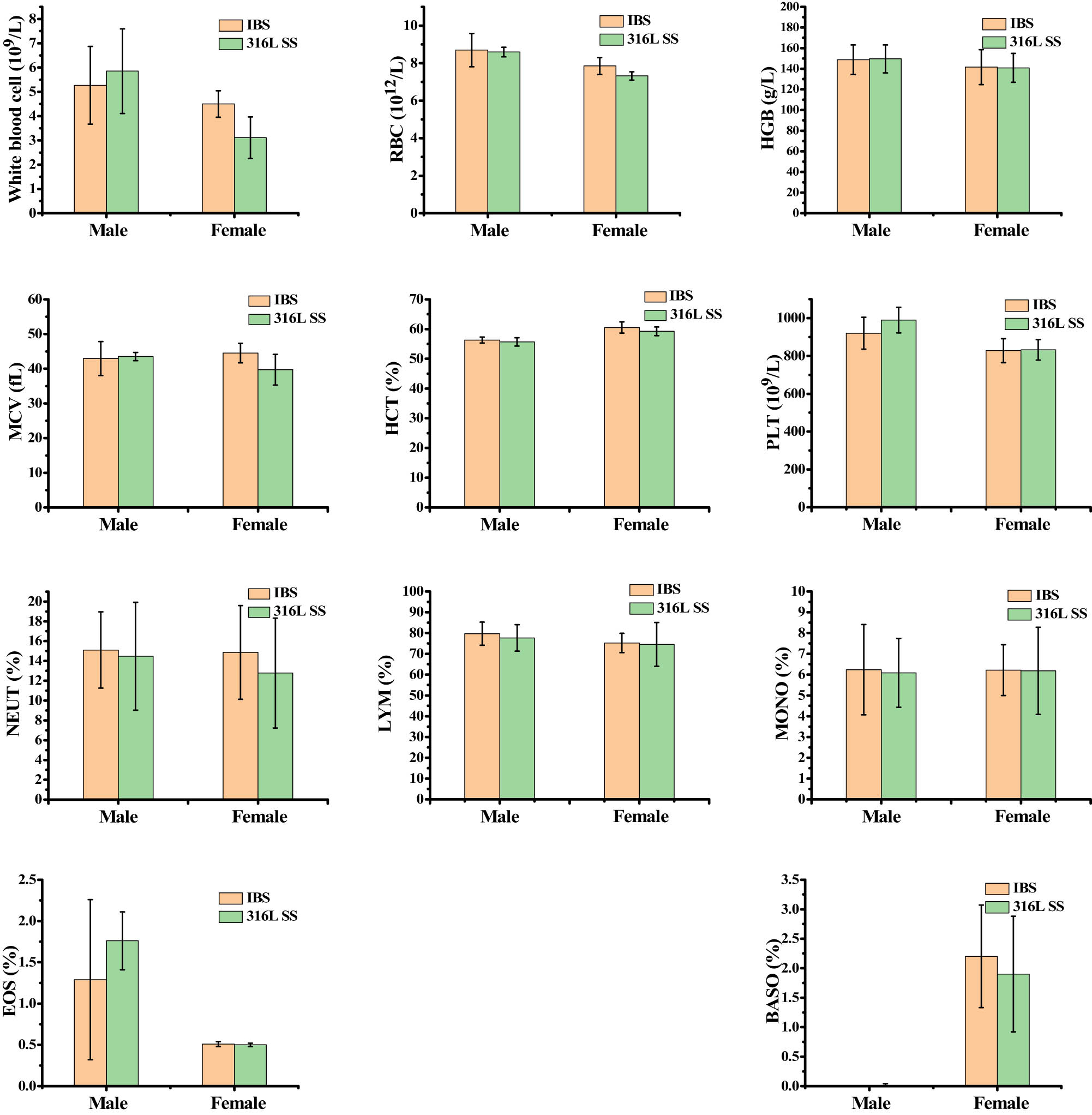
Hematology results.
Summary of hematology data
| Sex | Parameter | IBS | 316L SS |
|---|---|---|---|
| Mean ± SD | Mean ± SD | ||
| Male | WBC (×109/L) | 5.27 ± 1.60 | 5.85 ± 1.74 |
| RBC (×1012/L) | 8.70 ± 0.89 | 8.59 ± 0.26 | |
| HGB (g/L) | 148.78 ± 14.25 | 149.50 ± 13.47 | |
| MCV (%) | 42.93 ± 4.87 | 43.49 ± 1.19 | |
| HCT (fL) | 56.30 ± 1.01 | 55.65 ± 1.39 | |
| PLT (×109/L) | 920 ± 84.15* | 989.40 ± 67.6 | |
| NEU (%) | 15.10 ± 3.85 | 14.48 ± 5.45 | |
| LYM (%) | 79.74 ± 5.57 | 77.66 ± 6.36 | |
| MONO (%) | 6.24 ± 2.17 | 6.09 ± 1.66 | |
| EOS (%) | 1.29 ± 0.97 | 1.76 ± 0.35 | |
| BASO (%) | 0.00 ± 0.00 | 0.01 ± 0.03 | |
| Female | WBC (×109/L) | 4.50 ± 0.55 | 3.11 ± 0.86 |
| RBC (×1012/L) | 7.85 ± 0.45* | 7.32 ± 0.22 | |
| HGB (g/L) | 141.60 ± 16.95 | 140.90 ± 14.01 | |
| MCV (%) | 44.49 ± 2.81 | 39.70 ± 4.42 | |
| HCT (fL) | 60.53 ± 1.88 | 59.26 ± 1.43 | |
| PLT (×109/L) | 828.00 ± 63.32 | 832.40 ± 54.47 | |
| NEU (%) | 14.86 ± 4.74* | 12.78 ± 5.54 | |
| LYM (%) | 75.21 ± 4.62 | 74.54 ± 10.54 | |
| MONO (%) | 6.22 ± 1.22 | 6.18 ± 2.10 | |
| EOS (%) | 0.51 ± 0.03 | 0.50 ± 0.02 | |
| BASO (%) | 2.20 ± 0.87* | 1.9 ± 0.98 |
SD, standard deviation.
*Data showed a statistically significant difference between the control and test group (P<0.05).
The biochemistry values showed no evidence of the treatment-induced effects and were comparable between the test and control groups. Compared with the control group of the same sex, male rats in the test group had lower ALT (P<0.05) and higher CRE (P<0.05), while female rats had lower ALP (P<0.01), GLU, and P (P<0.05). The data are all within the normal laboratory ranges. The rest of the data in the test group had no significant difference from the data in the control group. The specific values are shown in Table 3 (Figure 3).
Summary of chemical pathology data
| Parameter | Males | Females | ||
|---|---|---|---|---|
| IBS (Mean ± SD) | 316L SS (Mean ± SD) | IBS (Mean ± SD) | 316L SS (Mean ± SD) | |
| ALT (U/L) | 62.00 ± 24.3* | 74.39 ± 16.30 | 86.04 ± 24.47 | 76.04 ± 25.94 |
| AST (U/L) | 170.7 ± 37.8 | 154.11 ± 19.94 | 147.86 ± 29.47 | 164.32 ± 26.91 |
| ALP (U/L) | 102.11 ± 22.91 | 106.32 ± 22.00 | 87.00 ± 15.85* | 108.55 ± 18.52 |
| ALB (g/dL) | 3.25 ± 0.31 | 3.15 ± 0.25 | 3.03 ± 0.25 | 2.90 ± 0.20 |
| GLU (mg/dL) | 148.72 ± 25.32 | 133.81 ± 32.28 | 113.71 ± 34.11* | 152.99 ± 20.37 |
| Ca (mg/dL) | 9.47 ± 0.85 | 9.74 ± 0.61 | 9.38 ± 0.52 | 9.74 ± 0.74 |
| CHOL (mg/dL) | 93.58 ± 18.49 | 95.65 ± 14.68 | 95.84 ± 14.58 | 93.10 ± 20.86 |
| CRE (mg/dL) | 0.34 ± 0.10* | 0.27 ± 0.04 | 0.32 ± 0.03 | 0.34 ± 0.07 |
| P (mg/dL) | 9.33 ± 2.27 | 8.52 ± 1.54 | 7.04 ± 1.63* | 9.32 ± 2.25 |
| K (mmol/L) | 4.47 ± 0.18 | 4.38 ± 0.20 | 4.29 ± 0.14 | 4.42 ± 0.25 |
| TB (mg/dL) | 0.10 ± 0.03 | 0.10 ± 0.02 | 0.10 ± 0.01 | 0.09 ± 0.02 |
| TG (mg/dL) | 173.53 ± 43.03 | 164.52 ± 16.65 | 146.34 ± 29.88 | 163.23 ± 22.48 |
| Na (mmol/L) | 144.42 ± 2.43 | 143.97 ± 1.54 | 143.37 ± 1.64 | 144.37 ± 1.80 |
| Cl (mmol/L) | 105.69 ± 1.96 | 105.95 ± 1.24 | 105.36 ± 0.94 | 106.98 ± 2.11 |
| BUN (mg/dL) | 33.53 ± 6.19 | 35.20 ± 3.89 | 32.41 ± 6.61 | 34.52 ± 3.75 |
SD, standard deviation.
* Data showed a statistically significant difference between the control and test group (P<0.05).
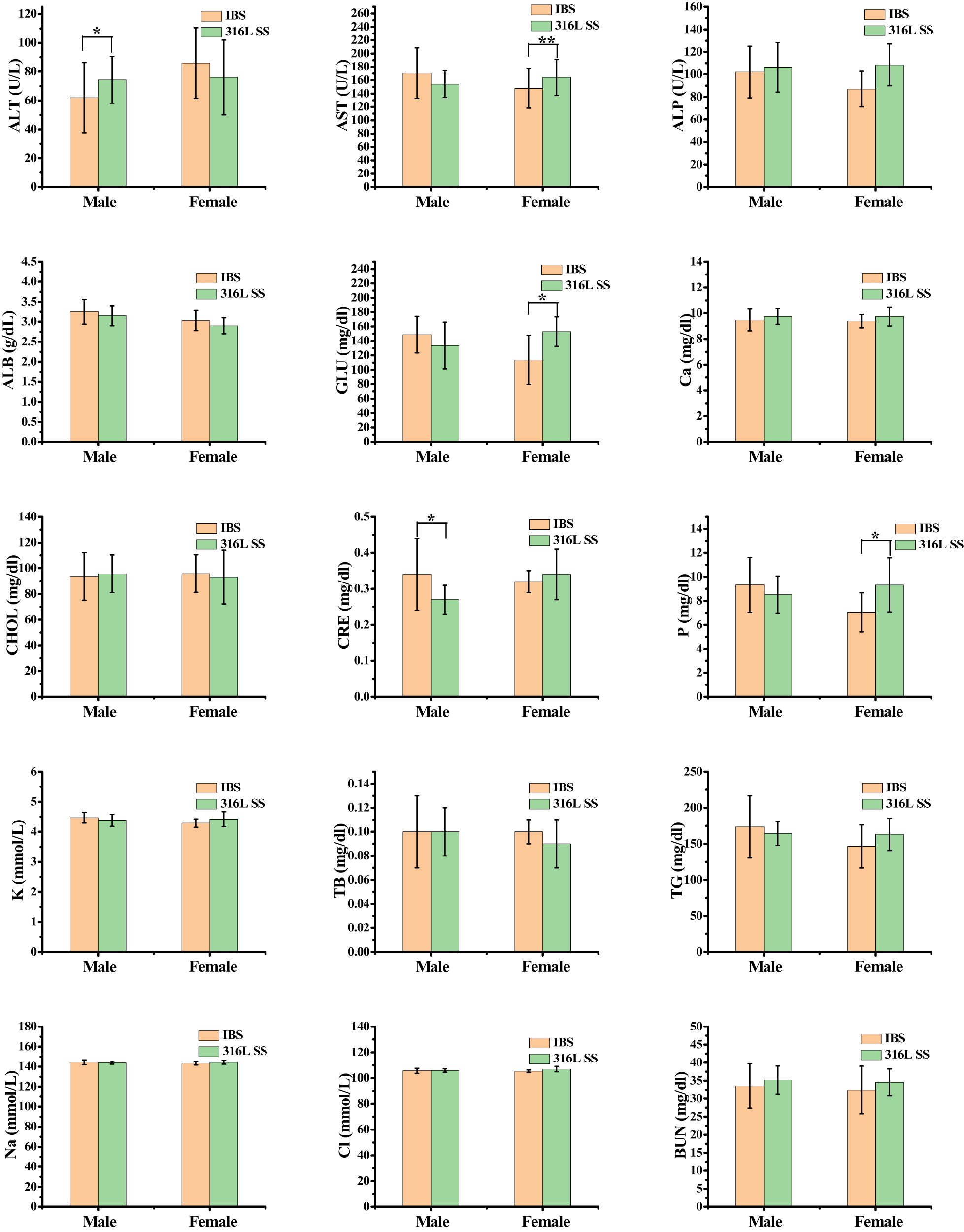
Chemical pathology results.
3.3 Gross pathology
Organ-to-body weight ratios were similar between the test and control groups. There was no difference between the two groups that were considered to be related to treatment. Compared with the control group of the same sex, male rats in the test group had a lower testis coefficient (P<0.05) and higher liver coefficient (P<0.05), while female rats had a higher kidney coefficient (P<0.05). The data are all within the normal ranges of healthy rats. The rest of the data of the test group had no significant difference from those of the control group. The results are shown in Figure 4 and Table 4.
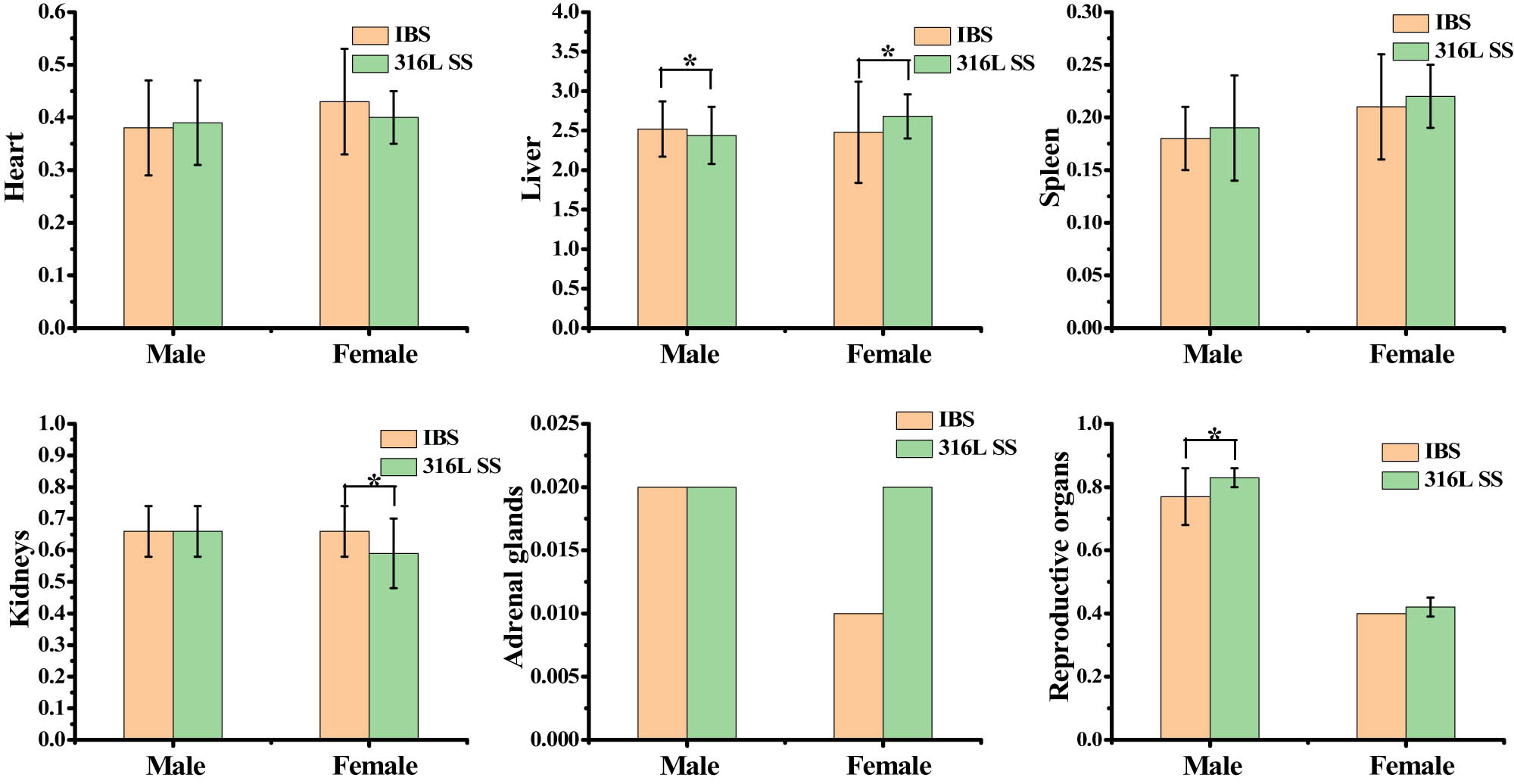
Organ/body weight ratios (%).
Summary of organ/body weight ratios (%)
| Sex | Organ | IBS (Mean ± SD) | 316L SS (Mean ± SD) |
|---|---|---|---|
| Male | Heart | 0.38 ± 0.09 | 0.39 ± 0.08 |
| Liver | 2.52 ± 0.35* | 2.44 ± 0.36 | |
| Spleen | 0.18 ± 0.03 | 0.19 ± 0.05 | |
| Kidneys (2) | 0.66 ± 0.08 | 0.66 ± 0.08 | |
| Adrenal glands (2) | 0.02 ± 0.00 | 0.02 ± 0.00 | |
| Testis (2) | 0.77 ± 0.09* | 0.83 ± 0.03 | |
| Female | Heart | 0.43 ± 0.10 | 0.40 ± 0.05 |
| Liver | 2.48 ± 0.64* | 2.68 ± 0.28 | |
| Spleen | 0.21 ± 0.05 | 0.22 ± 0.03 | |
| Kidneys (2) | 0.66 ± 0.08* | 0.59 ± 0.11 | |
| Adrenal glands (2) | 0.01 ± 0.00 | 0.02 ± 0.00 | |
| Uterus and ovaries (2) | 0.40 ± 0.00 | 0.42 ± 0.03 |
SD, standard deviation.
*Data showed a statistically significant difference between the control and test group (P<0.05).
The types and numbers of tumors were somewhat different between the test and the control animals, but there were no significant differences in the type and numbers of the main tumors between them. In both the groups, the probability of tumorigenesis in the animals increased with age. The types and numbers of tumor in the two groups are show in Tables 5 and 6.
Summary of tumor types and numbers (male)
| Sex | Tumor types | IBS | 316L SS | ||
|---|---|---|---|---|---|
| Animal number | Percentage | Animal number | Percentage | ||
| Male | Subcutaneous fibroma | 6 | 10.00 | 4 | 6.67 |
| Pituitary adenoma | 4 | 6.67 | 6 | 10.00 | |
| Thyroid adenoma | 1 | 1.67 | 2 | 3.33 | |
| Islet cell adenoma | 1 | 1.67 | 1 | 1.67 | |
| Salivary adenoma | 0 | 0 | 1 | 1.67 | |
| Fibroadenoma | 1 | 1.66 | 0 | 0 | |
| Lipomyoma | 0 | 0 | 0 | 0 | |
| Fibroangioma | 4 | 6.67 | 3 | 5.00 | |
| Lung cancer | 2 | 3.33 | 3 | 5.00 | |
| Renal cell cancer | 2 | 3.33 | 1 | 1.67 | |
| Hemangiosarcoma | 2 | 3.33 | 2 | 3.33 | |
| Fibrosarcoma | 2 | 3.33 | 2 | 3.33 | |
| Stromal cell tumor of testis | 1 | 1.67 | 1 | 1.67 | |
| Squamous-cell carcinoma | 1 | 1.67 | 1 | 1.67 | |
| Total | 27 | 45 | 27 | 45 | |
Summary of tumor types and numbers (female)
| Sex | Tumor types | IBS | 316L SS | ||
|---|---|---|---|---|---|
| Animal number | Percentage | Animal number | Percentage | ||
| Female | Subcutaneous fibroma | 5 | 8.33 | 4 | 6.67 |
| Breast fibroadenoma | 5 | 8.33 | 4 | 6.67 | |
| Pituitary adenoma | 4 | 6.67 | 3 | 5.00 | |
| Adenocarcinoma | 1 | 1.67 | 1 | 1.67 | |
| Breast cancer | 4 | 6.67 | 4 | 6.67 | |
| Breast adenoma | 4 | 6.67 | 3 | 5.0 | |
| Brain glioma | 2 | 3.33 | 3 | 5.0 | |
| Salivary adenoma | 2 | 3.33 | 0 | 0 | |
| Lipomyoma | 2 | 3.33 | 2 | 3.33 | |
| Lung cancer | 2 | 3.33 | 2 | 3.33 | |
| Uterine leiomyosarcoma | 1 | 1.67 | 2 | 3.33 | |
| Squamous cell carcer | 3 | 5.00 | 3 | 5.00 | |
| Total | 35 | 58.33 | 31 | 51.67 | |
3.4 Histopathology
The diseases of the animals were diagnosed by gross lesions and histopathology. The H&E staining of each tissue and organ is shown in Figure 5. The shape of each organ was clear, and no serious inflammatory cell aggregation was observed. No significant difference between the test group and the control group was observed. Conclusively, there was no microscopic tissue change indicating any systemic toxicity.

Histopathologic observations on organ tissues 2 years after implantation of the IBS and 316L SS (scar bar is 100 or 200 µm).
The corrosion of IBS should not cause cancer or mutations after implantation. Studies have shown that Fe2+ is involved in the Fenton/Haber–Weiss reaction along with peroxides during iron corrosion, resulting in hydroxyl radicals (HO˙) [42,43], whereas HO˙ damages DNA the most in ROS produced by aerobic cell metabolism and has been well reported in chemomutagenicity/genotoxicity [44–46]. In our study, iron-based scaffold implantation was not observed to be carcinogenic in rats for the duration of 2 years. This may be due to the fact that the iron balance and ROS balance in the body is not disturbed. Iron ions are released by corrosion of IBS in the body and enter the normal iron pathway of the body to participate in physiological activities [47]. Protein-bound iron does not produce wandering iron ions, so it cannot participate in ROS production [43]. Or iron corrosion products are swallowed by phagocytes and form ferritin deposited in tissues, leaving no free iron ions [48,49]. Besides, the body has oxidation and antioxidant homeostasis [50], which eliminates HO˙ that forms around the iron stent and prevents oxidative damage before the equilibrium is disturbed, so no carcinogenicity of IBS has been observed (Figure 6).
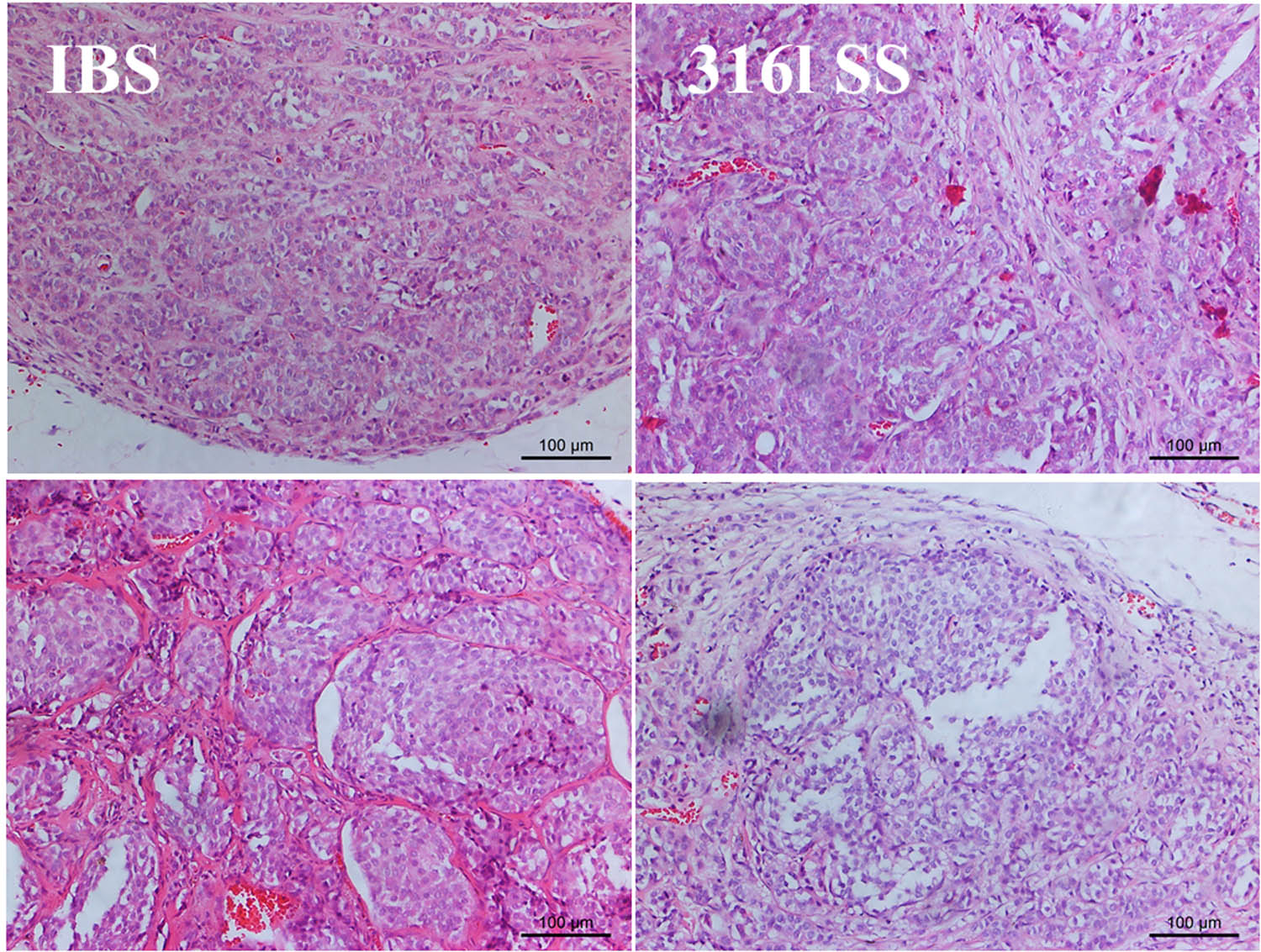
Pathological images of tumor in the IBS group and 316L SS group (scar bar is 100 µm).
4 Conclusions
In this study, stent implantation experiments in rats proved that IBS breaks through the limits of slow degradation of iron-based stents. The iron ions produced after degradation do not cause significant fluctuations in the blood iron ion levels, and there was no significant difference between the widely used 316L SS stent in terms of blood ions. Furthermore, through a 2-year stent implantation test in the abdominal aorta of rats, the pertinence between the chronic toxicity in vivo and the carcinogenicity of IBS was studied. Combining the comprehensive analysis of the body weight, hematology data, death, and pathological results of animal experiments, there was no significant difference between the IBS group and the 316L SS group, and the samples did not cause chronic systemic toxicity in rats. In addition, the occurrence of tumors of the same sex in the sample group was not significantly different from that of the control group, except for animal deaths or natural tumors caused by accidental factors such as environment, food, and water. The incidence is within the range of the spontaneous tumor rate in rats, and IBS is not carcinogenic.
Although a lot of effort still needs to be done, the biodegradation stent platform has become another alternative option for patients with coronary artery disease, especially for pediatric patients, which potentially allows for late vessel growth [51]. As a new type of fully degradable iron-based stent, IBS with good biocompatibility fulfills the mission of a degradable stent and shows great potential in clinical transformation.
-
Funding information: This work was financially supported by the National Natural Science Foundation of China (NSFC Project 32071328), Sichuan Science and Technology Program (2022NSFSC0809), the International Cooperation Project by Science and Technology Department of Sichuan Province (2021YFH0056), and the High-Level Talents Research and Development Program of Affiliated Dongguan Hospital (K202102).
-
Author contributions: All authors have accepted responsibility for the entire content of this manuscript and approved its submission.
-
Conflict of interest: The authors state no conflict of interest.
-
Ethical approval: The research related to animals’ use has been complied with all the relevant national regulations and institutional policies for the care and use of animals.
-
Data availability statement: The datasets used and analyzed in this work can be available from the authors on reasonable request.
References
[1] Jinnouchi H, Torii S, Sakamoto A, Kolodgie FD, Virmani R, Finn AV. Fully bioresorbable vascular scaffolds: lessons learned and future directions. Nat Rev Cardiol. 2019;16(5):286–304.10.1038/s41569-018-0124-7Suche in Google Scholar PubMed
[2] Hu T, Yang C, Lin S, Yu Q, Wang G. Biodegradable stents for coronary artery disease treatment: recent advances and future perspectives. Mater Sci Eng C Mater Biol Appl. 2018;91:163–78.10.1016/j.msec.2018.04.100Suche in Google Scholar PubMed
[3] Sun J, Sun K, Bai K, Chen S, Wang F, Zhao F, et al. A novel braided biodegradable stent for use in congenital heart disease: short-term results in porcine iliac artery. J Biomed Mater Res A. 2019;107(8):1667–77.10.1002/jbm.a.36682Suche in Google Scholar PubMed
[4] Wang Y, Wu H, Zhou Z, Maitz MF, Liu K, Zhang B, et al. A thrombin-triggered self-regulating anticoagulant strategy combined with anti-inflammatory capacity for blood-contacting implants. Sci Adv. 2022;8(9):eabm3378.10.1126/sciadv.abm3378Suche in Google Scholar PubMed PubMed Central
[5] Lee SJ, Jo HH, Lim KS, Lim D, Lee S, Lee JH, et al. Heparin coating on 3D printed poly (l-lactic acid) biodegradable cardiovascular stent via mild surface modification approach for coronary artery implantation. Chem Eng J. 2019;378:122116.10.1016/j.cej.2019.122116Suche in Google Scholar
[6] Misra SK, Ostadhossein F, Babu R, Kus J, Tankasala D, Sutrisno A, et al. 3D-printed multidrug-eluting stent from graphene-nanoplatelet-doped biodegradable polymer composite. Adv Healthc Mater. 2017;6(11):1700008.10.1002/adhm.201700008Suche in Google Scholar PubMed
[7] Zhou Z, Luo R, Chen L, Hu C, Chen C, Maitz MF, et al. Dressing blood-contacting devices with platelet membrane enables large-scale multifunctional biointerfacing. Matter. 2022;5:2334–51.10.1016/j.matt.2022.05.018Suche in Google Scholar
[8] Kawashima H, Ono M, Kogame N, Takahashi K, Chang CC, Hara H, et al. Drug-eluting bioresorbable scaffolds in cardiovascular disease, peripheral artery and gastrointestinal fields: a clinical update. Expert Opin Drug Deliv. 2020;17(7):931–45.10.1080/17425247.2020.1764932Suche in Google Scholar PubMed
[9] Zhu Y, Yang K, Cheng R, Xiang Y, Yuan T, Cheng Y, et al. The current status of biodegradable stent to treat benign luminal disease. Mater Today. 2017;20(9):516–29.10.1016/j.mattod.2017.05.002Suche in Google Scholar
[10] Hytonen JP, Taavitsainen J, Tarvainen S, Yla-Herttuala S. Biodegradable coronary scaffolds: their future and clinical and technological challenges. Cardiovasc Res. 2018;114(8):1063–72.10.1093/cvr/cvy097Suche in Google Scholar PubMed
[11] Im SH, Jung Y, Kim SH. Current status and future direction of biodegradable metallic and polymeric vascular scaffolds for next-generation stents. Acta Biomater. 2017;60:3–22.10.1016/j.actbio.2017.07.019Suche in Google Scholar PubMed
[12] Li X, Zhang W, Lin W, Qiu H, Qi Y, Ma X, et al. Long-term efficacy of biodegradable metal–polymer composite stents after the first and the second implantations into porcine coronary arteries. ACS Appl Mater Interfaces. 2020;12(13):15703–15.10.1021/acsami.0c00971Suche in Google Scholar PubMed
[13] Schmidt T, Abbott JD. Coronary stents: history, design, and construction. J Clin Med. 2018;7(6):126.10.3390/jcm7060126Suche in Google Scholar PubMed PubMed Central
[14] Venezuela J, Dargusch MS. Addressing the slow corrosion rate of biodegradable Fe–Mn: current approaches and future trends. Curr Opin Solid State Mater Sci. 2020;24(3):100822.10.1016/j.cossms.2020.100822Suche in Google Scholar
[15] Zhou C, Li HF, Yin YX, Shi ZZ, Li T, Feng XY, et al. Long-term in vivo study of biodegradable Zn–Cu stent: a 2-year implantation evaluation in porcine coronary artery. Acta Biomater. 2019;97:657–70.10.1016/j.actbio.2019.08.012Suche in Google Scholar PubMed
[16] Zhou C, Feng X, Shi Z, Song C, Cui X, Zhang J, et al. Research on elastic recoil and restoration of vessel pulsatility of Zn–Cu biodegradable coronary stents. Biomed Tech (Berlin). 2020;65(2):219–27.10.1515/bmt-2019-0025Suche in Google Scholar PubMed
[17] Yang H, Wang C, Liu C, Chen H, Wu Y, Han J, et al. Evolution of the degradation mechanism of pure zinc stent in the one-year study of rabbit abdominal aorta model. Biomaterials. 2017;145:92–105.10.1016/j.biomaterials.2017.08.022Suche in Google Scholar PubMed
[18] Mostaed E, Sikora-Jasinska M, Drelich JW, Vedani M. Zinc-based alloys for degradable vascular stent applications. Acta Biomater. 2018;71:1–23.10.1016/j.actbio.2018.03.005Suche in Google Scholar PubMed PubMed Central
[19] Shen D, Qi H, Lin W, Zhang W, Bian D, Shi X, et al. PDLLA–Zn–nitrided Fe bioresorbable scaffold with 53-μm-thick metallic struts and tunable multistage biodegradation function. Sci Adv. 2021;7(23):eabf0614.10.1126/sciadv.abf0614Suche in Google Scholar PubMed PubMed Central
[20] Li M, Xu X, Jia Z, Shi Y, Cheng Y, Zheng Y. Rapamycin-loaded nanoporous alpha-Fe2O3 as an endothelial favorable and thromboresistant coating for biodegradable drug-eluting Fe stent applications. J Mater Chem B. 2017;5(6):1182–94.10.1039/C6TB02634FSuche in Google Scholar
[21] Mariot P, Leeflang MA, Schaeffer L, Zhou J. An investigation on the properties of injection-molded pure iron potentially for biodegradable stent application. Powder Technol. 2016;294:226–35.10.1016/j.powtec.2016.02.042Suche in Google Scholar
[22] Zhang E, Chen H, Shen F. Biocorrosion properties and blood and cell compatibility of pure iron as a biodegradable biomaterial. J Mater Sci Mater Med. 2010;21(7):2151–63.10.1007/s10856-010-4070-0Suche in Google Scholar PubMed
[23] Chen C, Chen J, Wu W, Shi Y, Jin L, Petrini L, et al. In vivo and in vitro evaluation of a biodegradable magnesium vascular stent designed by shape optimization strategy. Biomaterials. 2019;221:119414.10.1016/j.biomaterials.2019.119414Suche in Google Scholar PubMed PubMed Central
[24] Srivastava A, Ahuja R, Bhati P, Singh S, Chauhan P, Vashisth P, et al. Fabrication and characterization of PLLA/Mg composite tube as the potential bioresorbable/biodegradable stent (BRS). Materialia. 2020;10:100661.10.1016/j.mtla.2020.100661Suche in Google Scholar
[25] Zhu J, Zhang X, Niu J, Shi Y, Zhu Z, Dai D, et al. Biosafety and efficacy evaluation of a biodegradable magnesium-based drug-eluting stent in porcine coronary artery. Sci Rep. 2021;11(1):7330.10.1038/s41598-021-86803-0Suche in Google Scholar PubMed PubMed Central
[26] Zheng JF, Qiu H, Tian Y, Hu XY, Luo T, Wu C, et al. Preclinical evaluation of a novel sirolimus-eluting iron bioresorbable coronary scaffold in porcine coronary artery at 6 months. JACC Cardiovasc Interv. 2019;12(3):245–55.10.1016/j.jcin.2018.10.020Suche in Google Scholar PubMed
[27] Huang T, Cheng J, Bian D, Zheng Y. Fe–Au and Fe–Ag composites as candidates for biodegradable stent materials. J Biomed Mater Res B Appl Biomater. 2016;104(2):225–40.10.1002/jbm.b.33389Suche in Google Scholar PubMed
[28] Francis A, Yang Y, Virtanen S, Boccaccini AR. Iron and iron-based alloys for temporary cardiovascular applications. J Mater Sci Mater Med. 2015;26(3):138.10.1007/s10856-015-5473-8Suche in Google Scholar PubMed
[29] Qi Y, Qi H, He Y, Lin W, Li P, Qin L, et al. Strategy of metal–polymer composite stent to accelerate biodegradation of iron-based biomaterials. ACS Appl Mater Interfaces. 2018;10(1):182–92.10.1021/acsami.7b15206Suche in Google Scholar PubMed
[30] Qi Y, Li X, He Y, Zhang D, Ding J. Mechanism of acceleration of iron corrosion by a polylactide coating. ACS Appl Mater Interfaces. 2019;11(1):202–18.10.1021/acsami.8b17125Suche in Google Scholar PubMed
[31] Lin WJ, Zhang DY, Zhang G, Sun HT, Qi HP, Chen LP, et al. Design and characterization of a novel biocorrodible iron-based drug-eluting coronary scaffold. Mater Des. 2016;91:72–9.10.1016/j.matdes.2015.11.045Suche in Google Scholar
[32] Shi X, Wang J, Zhang G, Zhang L, Zhang W, Cao P, et al. Safety study of malapposition of the bio-corrodible nitrided iron stent in vivo. Nanotechnol Rev. 2021;10(1):839–46.10.1515/ntrev-2021-0062Suche in Google Scholar
[33] Torti SV, Manz DH, Paul BT, Blanchette-Farra N, Torti FM. Iron and cancer. Annu Rev Nutr. 2018;38:97–125.10.1146/annurev-nutr-082117-051732Suche in Google Scholar PubMed PubMed Central
[34] Torti SV, Torti FM. Iron: the cancer connection. Mol Aspects Med. 2020;75:100860.10.1016/j.mam.2020.100860Suche in Google Scholar PubMed PubMed Central
[35] Mueller PP, May T, Perz A, Hauser H, Peuster M. Control of smooth muscle cell proliferation by ferrous iron. Biomaterials. 2006;27(10):2193–200.10.1016/j.biomaterials.2005.10.042Suche in Google Scholar PubMed
[36] Jung M, Mertens C, Tomat E, Brune B. Iron as a central player and promising target in cancer progression. Int J Mol Sci. 2019;20(2):273.10.3390/ijms20020273Suche in Google Scholar PubMed PubMed Central
[37] Brown RAM, Richardson KL, Kabir TD, Trinder D, Ganss R, Leedman PJ. Altered iron metabolism and impact in cancer biology, metastasis, and immunology. Front Oncol. 2020;10:476.10.3389/fonc.2020.00476Suche in Google Scholar PubMed PubMed Central
[38] Lin W, Zhang H, Zhang W, Qi H, Zhang G, Qian J, et al. In vivo degradation and endothelialization of an iron bioresorbable scaffold. Bioact Mater. 2021;6(4):1028–39.10.1016/j.bioactmat.2020.09.020Suche in Google Scholar PubMed PubMed Central
[39] Shi J, Miao X, Fu H, Jiang A, Liu Y, Shi X, et al. In vivo biological safety evaluation of an iron-based bioresorbable drug-eluting stent. Biometals. 2020;33(4–5):217–28.10.1007/s10534-020-00244-2Suche in Google Scholar PubMed
[40] Lin W, Zhang G, Cao P, Zhang D, Zheng Y, Wu R, et al. Cytotoxicity and its test methodology for a bioabsorbable nitrided iron stent. J Biomed Mater Res B Appl Biomater. 2015;103(4):764–76.10.1002/jbm.b.33246Suche in Google Scholar PubMed
[41] Chen L, Zhou Z, Hu C, Maitz MF, Yang L, Luo R, et al. Platelet membrane-coated nanocarriers targeting plaques to deliver anti-CD47 antibody for atherosclerotic therapy. Research. 2022;2022:9845459.10.34133/2022/9845459Suche in Google Scholar PubMed PubMed Central
[42] Lee H, Lee H, Kim HE, Kweon J, Lee BD, Lee C. Oxidant production from corrosion of nano- and microparticulate zero-valent iron in the presence of oxygen: a comparative study. J Hazard Mater. 2014;265:201–7.10.1016/j.jhazmat.2013.11.066Suche in Google Scholar PubMed
[43] Scarcello E, Herpain A, Tomatis M, Turci F, Jacques PJ, Lison D. Hydroxyl radicals and oxidative stress: the dark side of Fe corrosion. Colloids Surf B Biointerfaces. 2020;185:110542.10.1016/j.colsurfb.2019.110542Suche in Google Scholar PubMed
[44] De Kok T, Van Maanen JMS, Lankelma J, Hoor FT, Kleinjans JC. Electron spin resonance spectroscopy of oxygen radicals generated by synthetic fecapentaene-12 and reduction of fecapentaene mutagenicity to Salmonella typhimurium by hydroxyl radical scavenging. Carcinogenesis. 1992;13(7):1249–55.10.1093/carcin/13.7.1249Suche in Google Scholar PubMed
[45] Oikawa S, Ito T, Iwayama M, Kawanishi S. Radical production and DNA damage induced by carcinogenic 4-hydrazinobenzoic acid, an ingredient of mushroom Agaricus bisporus. Free Radic Res. 2006;40(1):31–9.10.1080/10715760500329994Suche in Google Scholar PubMed
[46] Chatgilialoglu C, Ferreri C, Krokidis MG, Masi A, Terzidis MA. On the relevance of hydroxyl radical to purine DNA damage. Free Radic Res. 2021;55(4):384–404.10.1080/10715762.2021.1876855Suche in Google Scholar PubMed
[47] Testa U. Recent developments in the understanding of iron metabolism. Hematol J Off J Eur Haematol Assoc. 2002;3(2):63–89.10.1038/sj.thj.6200163Suche in Google Scholar PubMed
[48] Zheng JF, Xi ZW, Li Y, Li JN, Qiu H, Hu XY, et al. Long-term safety and absorption assessment of a novel bioresorbable nitrided iron scaffold in porcine coronary artery. Bioact Mater. 2022;17:496–505.10.1016/j.bioactmat.2022.01.005Suche in Google Scholar PubMed PubMed Central
[49] Lin W, Qin L, Qi H, Zhang D, Zhang G, Gao R, et al. Long-term in vivo corrosion behavior, biocompatibility and bioresorption mechanism of a bioresorbable nitrided iron scaffold. Acta Biomater. 2017;54:454–68.10.1016/j.actbio.2017.03.020Suche in Google Scholar PubMed
[50] Halliwell B. Reactive species and antioxidants. Redox biology is a fundamental theme of aerobic life. Plant Physiol. 2006;141(2):312–22.10.1104/pp.106.077073Suche in Google Scholar PubMed PubMed Central
[51] Veeram Reddy SR, Welch TR, Nugent AW. Biodegradable stent use for congenital heart disease. Prog Pediatric Cardiol. 2021;61:101349.10.1016/j.ppedcard.2021.101349Suche in Google Scholar
© 2023 the author(s), published by De Gruyter
This work is licensed under the Creative Commons Attribution 4.0 International License.
Artikel in diesem Heft
- Research Articles
- Preparation of CdS–Ag2S nanocomposites by ultrasound-assisted UV photolysis treatment and its visible light photocatalysis activity
- Significance of nanoparticle radius and inter-particle spacing toward the radiative water-based alumina nanofluid flow over a rotating disk
- Aptamer-based detection of serotonin based on the rapid in situ synthesis of colorimetric gold nanoparticles
- Investigation of the nucleation and growth behavior of Ti2AlC and Ti3AlC nano-precipitates in TiAl alloys
- Dynamic recrystallization behavior and nucleation mechanism of dual-scale SiCp/A356 composites processed by P/M method
- High mechanical performance of 3-aminopropyl triethoxy silane/epoxy cured in a sandwich construction of 3D carbon felts foam and woven basalt fibers
- Applying solution of spray polyurea elastomer in asphalt binder: Feasibility analysis and DSR study based on the MSCR and LAS tests
- Study on the chronic toxicity and carcinogenicity of iron-based bioabsorbable stents
- Influence of microalloying with B on the microstructure and properties of brazed joints with Ag–Cu–Zn–Sn filler metal
- Thermohydraulic performance of thermal system integrated with twisted turbulator inserts using ternary hybrid nanofluids
- Study of mechanical properties of epoxy/graphene and epoxy/halloysite nanocomposites
- Effects of CaO addition on the CuW composite containing micro- and nano-sized tungsten particles synthesized via aluminothermic coupling with silicothermic reduction
- Cu and Al2O3-based hybrid nanofluid flow through a porous cavity
- Design of functional vancomycin-embedded bio-derived extracellular matrix hydrogels for repairing infectious bone defects
- Study on nanocrystalline coating prepared by electro-spraying 316L metal wire and its corrosion performance
- Axial compression performance of CFST columns reinforced by ultra-high-performance nano-concrete under long-term loading
- Tungsten trioxide nanocomposite for conventional soliton and noise-like pulse generation in anomalous dispersion laser cavity
- Microstructure and electrical contact behavior of the nano-yttria-modified Cu-Al2O3/30Mo/3SiC composite
- Melting rheology in thermally stratified graphene-mineral oil reservoir (third-grade nanofluid) with slip condition
- Re-examination of nonlinear vibration and nonlinear bending of porous sandwich cylindrical panels reinforced by graphene platelets
- Parametric simulation of hybrid nanofluid flow consisting of cobalt ferrite nanoparticles with second-order slip and variable viscosity over an extending surface
- Chitosan-capped silver nanoparticles with potent and selective intrinsic activity against the breast cancer cells
- Multi-core/shell SiO2@Al2O3 nanostructures deposited on Ti3AlC2 to enhance high-temperature stability and microwave absorption properties
- Solution-processed Bi2S3/BiVO4/TiO2 ternary heterojunction photoanode with enhanced photoelectrochemical performance
- Electroporation effect of ZnO nanoarrays under low voltage for water disinfection
- NIR-II window absorbing graphene oxide-coated gold nanorods and graphene quantum dot-coupled gold nanorods for photothermal cancer therapy
- Nonlinear three-dimensional stability characteristics of geometrically imperfect nanoshells under axial compression and surface residual stress
- Investigation of different nanoparticles properties on the thermal conductivity and viscosity of nanofluids by molecular dynamics simulation
- Optimized Cu2O-{100} facet for generation of different reactive oxidative species via peroxymonosulfate activation at specific pH values to efficient acetaminophen removal
- Brownian and thermal diffusivity impact due to the Maxwell nanofluid (graphene/engine oil) flow with motile microorganisms and Joule heating
- Appraising the dielectric properties and the effectiveness of electromagnetic shielding of graphene reinforced silicone rubber nanocomposite
- Synthesis of Ag and Cu nanoparticles by plasma discharge in inorganic salt solutions
- Low-cost and large-scale preparation of ultrafine TiO2@C hybrids for high-performance degradation of methyl orange and formaldehyde under visible light
- Utilization of waste glass with natural pozzolan in the production of self-glazed glass-ceramic materials
- Mechanical performance of date palm fiber-reinforced concrete modified with nano-activated carbon
- Melting point of dried gold nanoparticles prepared with ultrasonic spray pyrolysis and lyophilisation
- Graphene nanofibers: A modern approach towards tailored gypsum composites
- Role of localized magnetic field in vortex generation in tri-hybrid nanofluid flow: A numerical approach
- Intelligent computing for the double-diffusive peristaltic rheology of magneto couple stress nanomaterials
- Bioconvection transport of upper convected Maxwell nanoliquid with gyrotactic microorganism, nonlinear thermal radiation, and chemical reaction
- 3D printing of porous Ti6Al4V bone tissue engineering scaffold and surface anodization preparation of nanotubes to enhance its biological property
- Bioinspired ferromagnetic CoFe2O4 nanoparticles: Potential pharmaceutical and medical applications
- Significance of gyrotactic microorganisms on the MHD tangent hyperbolic nanofluid flow across an elastic slender surface: Numerical analysis
- Performance of polycarboxylate superplasticisers in seawater-blended cement: Effect from chemical structure and nano modification
- Entropy minimization of GO–Ag/KO cross-hybrid nanofluid over a convectively heated surface
- Oxygen plasma assisted room temperature bonding for manufacturing SU-8 polymer micro/nanoscale nozzle
- Performance and mechanism of CO2 reduction by DBD-coupled mesoporous SiO2
- Polyarylene ether nitrile dielectric films modified by HNTs@PDA hybrids for high-temperature resistant organic electronics field
- Exploration of generalized two-phase free convection magnetohydrodynamic flow of dusty tetra-hybrid Casson nanofluid between parallel microplates
- Hygrothermal bending analysis of sandwich nanoplates with FG porous core and piezomagnetic faces via nonlocal strain gradient theory
- Design and optimization of a TiO2/RGO-supported epoxy multilayer microwave absorber by the modified local best particle swarm optimization algorithm
- Mechanical properties and frost resistance of recycled brick aggregate concrete modified by nano-SiO2
- Self-template synthesis of hollow flower-like NiCo2O4 nanoparticles as an efficient bifunctional catalyst for oxygen reduction and oxygen evolution in alkaline media
- High-performance wearable flexible strain sensors based on an AgNWs/rGO/TPU electrospun nanofiber film for monitoring human activities
- High-performance lithium–selenium batteries enabled by nitrogen-doped porous carbon from peanut meal
- Investigating effects of Lorentz forces and convective heating on ternary hybrid nanofluid flow over a curved surface using homotopy analysis method
- Exploring the potential of biogenic magnesium oxide nanoparticles for cytotoxicity: In vitro and in silico studies on HCT116 and HT29 cells and DPPH radical scavenging
- Enhanced visible-light-driven photocatalytic degradation of azo dyes by heteroatom-doped nickel tungstate nanoparticles
- A facile method to synthesize nZVI-doped polypyrrole-based carbon nanotube for Ag(i) removal
- Improved osseointegration of dental titanium implants by TiO2 nanotube arrays with self-assembled recombinant IGF-1 in type 2 diabetes mellitus rat model
- Functionalized SWCNTs@Ag–TiO2 nanocomposites induce ROS-mediated apoptosis and autophagy in liver cancer cells
- Triboelectric nanogenerator based on a water droplet spring with a concave spherical surface for harvesting wave energy and detecting pressure
- A mathematical approach for modeling the blood flow containing nanoparticles by employing the Buongiorno’s model
- Molecular dynamics study on dynamic interlayer friction of graphene and its strain effect
- Induction of apoptosis and autophagy via regulation of AKT and JNK mitogen-activated protein kinase pathways in breast cancer cell lines exposed to gold nanoparticles loaded with TNF-α and combined with doxorubicin
- Effect of PVA fibers on durability of nano-SiO2-reinforced cement-based composites subjected to wet-thermal and chloride salt-coupled environment
- Effect of polyvinyl alcohol fibers on mechanical properties of nano-SiO2-reinforced geopolymer composites under a complex environment
- In vitro studies of titanium dioxide nanoparticles modified with glutathione as a potential drug delivery system
- Comparative investigations of Ag/H2O nanofluid and Ag-CuO/H2O hybrid nanofluid with Darcy-Forchheimer flow over a curved surface
- Study on deformation characteristics of multi-pass continuous drawing of micro copper wire based on crystal plasticity finite element method
- Properties of ultra-high-performance self-compacting fiber-reinforced concrete modified with nanomaterials
- Prediction of lap shear strength of GNP and TiO2/epoxy nanocomposite adhesives
- A novel exploration of how localized magnetic field affects vortex generation of trihybrid nanofluids
- Fabrication and physicochemical characterization of copper oxide–pyrrhotite nanocomposites for the cytotoxic effects on HepG2 cells and the mechanism
- Thermal radiative flow of cross nanofluid due to a stretched cylinder containing microorganisms
- In vitro study of the biphasic calcium phosphate/chitosan hybrid biomaterial scaffold fabricated via solvent casting and evaporation technique for bone regeneration
- Insights into the thermal characteristics and dynamics of stagnant blood conveying titanium oxide, alumina, and silver nanoparticles subject to Lorentz force and internal heating over a curved surface
- Effects of nano-SiO2 additives on carbon fiber-reinforced fly ash–slag geopolymer composites performance: Workability, mechanical properties, and microstructure
- Energy bandgap and thermal characteristics of non-Darcian MHD rotating hybridity nanofluid thin film flow: Nanotechnology application
- Green synthesis and characterization of ginger-extract-based oxali-palladium nanoparticles for colorectal cancer: Downregulation of REG4 and apoptosis induction
- Abnormal evolution of resistivity and microstructure of annealed Ag nanoparticles/Ag–Mo films
- Preparation of water-based dextran-coated Fe3O4 magnetic fluid for magnetic hyperthermia
- Statistical investigations and morphological aspects of cross-rheological material suspended in transportation of alumina, silica, titanium, and ethylene glycol via the Galerkin algorithm
- Effect of CNT film interleaves on the flexural properties and strength after impact of CFRP composites
- Self-assembled nanoscale entities: Preparative process optimization, payload release, and enhanced bioavailability of thymoquinone natural product
- Structure–mechanical property relationships of 3D-printed porous polydimethylsiloxane films
- Nonlinear thermal radiation and the slip effect on a 3D bioconvection flow of the Casson nanofluid in a rotating frame via a homotopy analysis mechanism
- Residual mechanical properties of concrete incorporated with nano supplementary cementitious materials exposed to elevated temperature
- Time-independent three-dimensional flow of a water-based hybrid nanofluid past a Riga plate with slips and convective conditions: A homotopic solution
- Lightweight and high-strength polyarylene ether nitrile-based composites for efficient electromagnetic interference shielding
- Review Articles
- Recycling waste sources into nanocomposites of graphene materials: Overview from an energy-focused perspective
- Hybrid nanofiller reinforcement in thermoset and biothermoset applications: A review
- Current state-of-the-art review of nanotechnology-based therapeutics for viral pandemics: Special attention to COVID-19
- Solid lipid nanoparticles for targeted natural and synthetic drugs delivery in high-incidence cancers, and other diseases: Roles of preparation methods, lipid composition, transitional stability, and release profiles in nanocarriers’ development
- Critical review on experimental and theoretical studies of elastic properties of wurtzite-structured ZnO nanowires
- Polyurea micro-/nano-capsule applications in construction industry: A review
- A comprehensive review and clinical guide to molecular and serological diagnostic tests and future development: In vitro diagnostic testing for COVID-19
- Recent advances in electrocatalytic oxidation of 5-hydroxymethylfurfural to 2,5-furandicarboxylic acid: Mechanism, catalyst, coupling system
- Research progress and prospect of silica-based polymer nanofluids in enhanced oil recovery
- Review of the pharmacokinetics of nanodrugs
- Engineered nanoflowers, nanotrees, nanostars, nanodendrites, and nanoleaves for biomedical applications
- Research progress of biopolymers combined with stem cells in the repair of intrauterine adhesions
- Progress in FEM modeling on mechanical and electromechanical properties of carbon nanotube cement-based composites
- Antifouling induced by surface wettability of poly(dimethyl siloxane) and its nanocomposites
- TiO2 aerogel composite high-efficiency photocatalysts for environmental treatment and hydrogen energy production
- Structural properties of alumina surfaces and their roles in the synthesis of environmentally persistent free radicals (EPFRs)
- Nanoparticles for the potential treatment of Alzheimer’s disease: A physiopathological approach
- Current status of synthesis and consolidation strategies for thermo-resistant nanoalloys and their general applications
- Recent research progress on the stimuli-responsive smart membrane: A review
- Dispersion of carbon nanotubes in aqueous cementitious materials: A review
- Applications of DNA tetrahedron nanostructure in cancer diagnosis and anticancer drugs delivery
- Magnetic nanoparticles in 3D-printed scaffolds for biomedical applications
- An overview of the synthesis of silicon carbide–boron carbide composite powders
- Organolead halide perovskites: Synthetic routes, structural features, and their potential in the development of photovoltaic
- Recent advancements in nanotechnology application on wood and bamboo materials: A review
- Application of aptamer-functionalized nanomaterials in molecular imaging of tumors
- Recent progress on corrosion mechanisms of graphene-reinforced metal matrix composites
- Research progress on preparation, modification, and application of phenolic aerogel
- Application of nanomaterials in early diagnosis of cancer
- Plant mediated-green synthesis of zinc oxide nanoparticles: An insight into biomedical applications
- Recent developments in terahertz quantum cascade lasers for practical applications
- Recent progress in dielectric/metal/dielectric electrodes for foldable light-emitting devices
- Nanocoatings for ballistic applications: A review
- A mini-review on MoS2 membrane for water desalination: Recent development and challenges
- Recent updates in nanotechnological advances for wound healing: A narrative review
- Recent advances in DNA nanomaterials for cancer diagnosis and treatment
- Electrochemical micro- and nanobiosensors for in vivo reactive oxygen/nitrogen species measurement in the brain
- Advances in organic–inorganic nanocomposites for cancer imaging and therapy
- Advancements in aluminum matrix composites reinforced with carbides and graphene: A comprehensive review
- Modification effects of nanosilica on asphalt binders: A review
- Decellularized extracellular matrix as a promising biomaterial for musculoskeletal tissue regeneration
- Review of the sol–gel method in preparing nano TiO2 for advanced oxidation process
- Micro/nano manufacturing aircraft surface with anti-icing and deicing performances: An overview
- Cell type-targeting nanoparticles in treating central nervous system diseases: Challenges and hopes
- An overview of hydrogen production from Al-based materials
- A review of application, modification, and prospect of melamine foam
- A review of the performance of fibre-reinforced composite laminates with carbon nanotubes
- Research on AFM tip-related nanofabrication of two-dimensional materials
- Advances in phase change building materials: An overview
- Development of graphene and graphene quantum dots toward biomedical engineering applications: A review
- Nanoremediation approaches for the mitigation of heavy metal contamination in vegetables: An overview
- Photodynamic therapy empowered by nanotechnology for oral and dental science: Progress and perspectives
- Biosynthesis of metal nanoparticles: Bioreduction and biomineralization
- Current diagnostic and therapeutic approaches for severe acute respiratory syndrome coronavirus-2 (SARS-COV-2) and the role of nanomaterial-based theragnosis in combating the pandemic
- Application of two-dimensional black phosphorus material in wound healing
- Special Issue on Advanced Nanomaterials and Composites for Energy Conversion and Storage - Part I
- Helical fluorinated carbon nanotubes/iron(iii) fluoride hybrid with multilevel transportation channels and rich active sites for lithium/fluorinated carbon primary battery
- The progress of cathode materials in aqueous zinc-ion batteries
- Special Issue on Advanced Nanomaterials for Carbon Capture, Environment and Utilization for Energy Sustainability - Part I
- Effect of polypropylene fiber and nano-silica on the compressive strength and frost resistance of recycled brick aggregate concrete
- Mechanochemical design of nanomaterials for catalytic applications with a benign-by-design focus
Artikel in diesem Heft
- Research Articles
- Preparation of CdS–Ag2S nanocomposites by ultrasound-assisted UV photolysis treatment and its visible light photocatalysis activity
- Significance of nanoparticle radius and inter-particle spacing toward the radiative water-based alumina nanofluid flow over a rotating disk
- Aptamer-based detection of serotonin based on the rapid in situ synthesis of colorimetric gold nanoparticles
- Investigation of the nucleation and growth behavior of Ti2AlC and Ti3AlC nano-precipitates in TiAl alloys
- Dynamic recrystallization behavior and nucleation mechanism of dual-scale SiCp/A356 composites processed by P/M method
- High mechanical performance of 3-aminopropyl triethoxy silane/epoxy cured in a sandwich construction of 3D carbon felts foam and woven basalt fibers
- Applying solution of spray polyurea elastomer in asphalt binder: Feasibility analysis and DSR study based on the MSCR and LAS tests
- Study on the chronic toxicity and carcinogenicity of iron-based bioabsorbable stents
- Influence of microalloying with B on the microstructure and properties of brazed joints with Ag–Cu–Zn–Sn filler metal
- Thermohydraulic performance of thermal system integrated with twisted turbulator inserts using ternary hybrid nanofluids
- Study of mechanical properties of epoxy/graphene and epoxy/halloysite nanocomposites
- Effects of CaO addition on the CuW composite containing micro- and nano-sized tungsten particles synthesized via aluminothermic coupling with silicothermic reduction
- Cu and Al2O3-based hybrid nanofluid flow through a porous cavity
- Design of functional vancomycin-embedded bio-derived extracellular matrix hydrogels for repairing infectious bone defects
- Study on nanocrystalline coating prepared by electro-spraying 316L metal wire and its corrosion performance
- Axial compression performance of CFST columns reinforced by ultra-high-performance nano-concrete under long-term loading
- Tungsten trioxide nanocomposite for conventional soliton and noise-like pulse generation in anomalous dispersion laser cavity
- Microstructure and electrical contact behavior of the nano-yttria-modified Cu-Al2O3/30Mo/3SiC composite
- Melting rheology in thermally stratified graphene-mineral oil reservoir (third-grade nanofluid) with slip condition
- Re-examination of nonlinear vibration and nonlinear bending of porous sandwich cylindrical panels reinforced by graphene platelets
- Parametric simulation of hybrid nanofluid flow consisting of cobalt ferrite nanoparticles with second-order slip and variable viscosity over an extending surface
- Chitosan-capped silver nanoparticles with potent and selective intrinsic activity against the breast cancer cells
- Multi-core/shell SiO2@Al2O3 nanostructures deposited on Ti3AlC2 to enhance high-temperature stability and microwave absorption properties
- Solution-processed Bi2S3/BiVO4/TiO2 ternary heterojunction photoanode with enhanced photoelectrochemical performance
- Electroporation effect of ZnO nanoarrays under low voltage for water disinfection
- NIR-II window absorbing graphene oxide-coated gold nanorods and graphene quantum dot-coupled gold nanorods for photothermal cancer therapy
- Nonlinear three-dimensional stability characteristics of geometrically imperfect nanoshells under axial compression and surface residual stress
- Investigation of different nanoparticles properties on the thermal conductivity and viscosity of nanofluids by molecular dynamics simulation
- Optimized Cu2O-{100} facet for generation of different reactive oxidative species via peroxymonosulfate activation at specific pH values to efficient acetaminophen removal
- Brownian and thermal diffusivity impact due to the Maxwell nanofluid (graphene/engine oil) flow with motile microorganisms and Joule heating
- Appraising the dielectric properties and the effectiveness of electromagnetic shielding of graphene reinforced silicone rubber nanocomposite
- Synthesis of Ag and Cu nanoparticles by plasma discharge in inorganic salt solutions
- Low-cost and large-scale preparation of ultrafine TiO2@C hybrids for high-performance degradation of methyl orange and formaldehyde under visible light
- Utilization of waste glass with natural pozzolan in the production of self-glazed glass-ceramic materials
- Mechanical performance of date palm fiber-reinforced concrete modified with nano-activated carbon
- Melting point of dried gold nanoparticles prepared with ultrasonic spray pyrolysis and lyophilisation
- Graphene nanofibers: A modern approach towards tailored gypsum composites
- Role of localized magnetic field in vortex generation in tri-hybrid nanofluid flow: A numerical approach
- Intelligent computing for the double-diffusive peristaltic rheology of magneto couple stress nanomaterials
- Bioconvection transport of upper convected Maxwell nanoliquid with gyrotactic microorganism, nonlinear thermal radiation, and chemical reaction
- 3D printing of porous Ti6Al4V bone tissue engineering scaffold and surface anodization preparation of nanotubes to enhance its biological property
- Bioinspired ferromagnetic CoFe2O4 nanoparticles: Potential pharmaceutical and medical applications
- Significance of gyrotactic microorganisms on the MHD tangent hyperbolic nanofluid flow across an elastic slender surface: Numerical analysis
- Performance of polycarboxylate superplasticisers in seawater-blended cement: Effect from chemical structure and nano modification
- Entropy minimization of GO–Ag/KO cross-hybrid nanofluid over a convectively heated surface
- Oxygen plasma assisted room temperature bonding for manufacturing SU-8 polymer micro/nanoscale nozzle
- Performance and mechanism of CO2 reduction by DBD-coupled mesoporous SiO2
- Polyarylene ether nitrile dielectric films modified by HNTs@PDA hybrids for high-temperature resistant organic electronics field
- Exploration of generalized two-phase free convection magnetohydrodynamic flow of dusty tetra-hybrid Casson nanofluid between parallel microplates
- Hygrothermal bending analysis of sandwich nanoplates with FG porous core and piezomagnetic faces via nonlocal strain gradient theory
- Design and optimization of a TiO2/RGO-supported epoxy multilayer microwave absorber by the modified local best particle swarm optimization algorithm
- Mechanical properties and frost resistance of recycled brick aggregate concrete modified by nano-SiO2
- Self-template synthesis of hollow flower-like NiCo2O4 nanoparticles as an efficient bifunctional catalyst for oxygen reduction and oxygen evolution in alkaline media
- High-performance wearable flexible strain sensors based on an AgNWs/rGO/TPU electrospun nanofiber film for monitoring human activities
- High-performance lithium–selenium batteries enabled by nitrogen-doped porous carbon from peanut meal
- Investigating effects of Lorentz forces and convective heating on ternary hybrid nanofluid flow over a curved surface using homotopy analysis method
- Exploring the potential of biogenic magnesium oxide nanoparticles for cytotoxicity: In vitro and in silico studies on HCT116 and HT29 cells and DPPH radical scavenging
- Enhanced visible-light-driven photocatalytic degradation of azo dyes by heteroatom-doped nickel tungstate nanoparticles
- A facile method to synthesize nZVI-doped polypyrrole-based carbon nanotube for Ag(i) removal
- Improved osseointegration of dental titanium implants by TiO2 nanotube arrays with self-assembled recombinant IGF-1 in type 2 diabetes mellitus rat model
- Functionalized SWCNTs@Ag–TiO2 nanocomposites induce ROS-mediated apoptosis and autophagy in liver cancer cells
- Triboelectric nanogenerator based on a water droplet spring with a concave spherical surface for harvesting wave energy and detecting pressure
- A mathematical approach for modeling the blood flow containing nanoparticles by employing the Buongiorno’s model
- Molecular dynamics study on dynamic interlayer friction of graphene and its strain effect
- Induction of apoptosis and autophagy via regulation of AKT and JNK mitogen-activated protein kinase pathways in breast cancer cell lines exposed to gold nanoparticles loaded with TNF-α and combined with doxorubicin
- Effect of PVA fibers on durability of nano-SiO2-reinforced cement-based composites subjected to wet-thermal and chloride salt-coupled environment
- Effect of polyvinyl alcohol fibers on mechanical properties of nano-SiO2-reinforced geopolymer composites under a complex environment
- In vitro studies of titanium dioxide nanoparticles modified with glutathione as a potential drug delivery system
- Comparative investigations of Ag/H2O nanofluid and Ag-CuO/H2O hybrid nanofluid with Darcy-Forchheimer flow over a curved surface
- Study on deformation characteristics of multi-pass continuous drawing of micro copper wire based on crystal plasticity finite element method
- Properties of ultra-high-performance self-compacting fiber-reinforced concrete modified with nanomaterials
- Prediction of lap shear strength of GNP and TiO2/epoxy nanocomposite adhesives
- A novel exploration of how localized magnetic field affects vortex generation of trihybrid nanofluids
- Fabrication and physicochemical characterization of copper oxide–pyrrhotite nanocomposites for the cytotoxic effects on HepG2 cells and the mechanism
- Thermal radiative flow of cross nanofluid due to a stretched cylinder containing microorganisms
- In vitro study of the biphasic calcium phosphate/chitosan hybrid biomaterial scaffold fabricated via solvent casting and evaporation technique for bone regeneration
- Insights into the thermal characteristics and dynamics of stagnant blood conveying titanium oxide, alumina, and silver nanoparticles subject to Lorentz force and internal heating over a curved surface
- Effects of nano-SiO2 additives on carbon fiber-reinforced fly ash–slag geopolymer composites performance: Workability, mechanical properties, and microstructure
- Energy bandgap and thermal characteristics of non-Darcian MHD rotating hybridity nanofluid thin film flow: Nanotechnology application
- Green synthesis and characterization of ginger-extract-based oxali-palladium nanoparticles for colorectal cancer: Downregulation of REG4 and apoptosis induction
- Abnormal evolution of resistivity and microstructure of annealed Ag nanoparticles/Ag–Mo films
- Preparation of water-based dextran-coated Fe3O4 magnetic fluid for magnetic hyperthermia
- Statistical investigations and morphological aspects of cross-rheological material suspended in transportation of alumina, silica, titanium, and ethylene glycol via the Galerkin algorithm
- Effect of CNT film interleaves on the flexural properties and strength after impact of CFRP composites
- Self-assembled nanoscale entities: Preparative process optimization, payload release, and enhanced bioavailability of thymoquinone natural product
- Structure–mechanical property relationships of 3D-printed porous polydimethylsiloxane films
- Nonlinear thermal radiation and the slip effect on a 3D bioconvection flow of the Casson nanofluid in a rotating frame via a homotopy analysis mechanism
- Residual mechanical properties of concrete incorporated with nano supplementary cementitious materials exposed to elevated temperature
- Time-independent three-dimensional flow of a water-based hybrid nanofluid past a Riga plate with slips and convective conditions: A homotopic solution
- Lightweight and high-strength polyarylene ether nitrile-based composites for efficient electromagnetic interference shielding
- Review Articles
- Recycling waste sources into nanocomposites of graphene materials: Overview from an energy-focused perspective
- Hybrid nanofiller reinforcement in thermoset and biothermoset applications: A review
- Current state-of-the-art review of nanotechnology-based therapeutics for viral pandemics: Special attention to COVID-19
- Solid lipid nanoparticles for targeted natural and synthetic drugs delivery in high-incidence cancers, and other diseases: Roles of preparation methods, lipid composition, transitional stability, and release profiles in nanocarriers’ development
- Critical review on experimental and theoretical studies of elastic properties of wurtzite-structured ZnO nanowires
- Polyurea micro-/nano-capsule applications in construction industry: A review
- A comprehensive review and clinical guide to molecular and serological diagnostic tests and future development: In vitro diagnostic testing for COVID-19
- Recent advances in electrocatalytic oxidation of 5-hydroxymethylfurfural to 2,5-furandicarboxylic acid: Mechanism, catalyst, coupling system
- Research progress and prospect of silica-based polymer nanofluids in enhanced oil recovery
- Review of the pharmacokinetics of nanodrugs
- Engineered nanoflowers, nanotrees, nanostars, nanodendrites, and nanoleaves for biomedical applications
- Research progress of biopolymers combined with stem cells in the repair of intrauterine adhesions
- Progress in FEM modeling on mechanical and electromechanical properties of carbon nanotube cement-based composites
- Antifouling induced by surface wettability of poly(dimethyl siloxane) and its nanocomposites
- TiO2 aerogel composite high-efficiency photocatalysts for environmental treatment and hydrogen energy production
- Structural properties of alumina surfaces and their roles in the synthesis of environmentally persistent free radicals (EPFRs)
- Nanoparticles for the potential treatment of Alzheimer’s disease: A physiopathological approach
- Current status of synthesis and consolidation strategies for thermo-resistant nanoalloys and their general applications
- Recent research progress on the stimuli-responsive smart membrane: A review
- Dispersion of carbon nanotubes in aqueous cementitious materials: A review
- Applications of DNA tetrahedron nanostructure in cancer diagnosis and anticancer drugs delivery
- Magnetic nanoparticles in 3D-printed scaffolds for biomedical applications
- An overview of the synthesis of silicon carbide–boron carbide composite powders
- Organolead halide perovskites: Synthetic routes, structural features, and their potential in the development of photovoltaic
- Recent advancements in nanotechnology application on wood and bamboo materials: A review
- Application of aptamer-functionalized nanomaterials in molecular imaging of tumors
- Recent progress on corrosion mechanisms of graphene-reinforced metal matrix composites
- Research progress on preparation, modification, and application of phenolic aerogel
- Application of nanomaterials in early diagnosis of cancer
- Plant mediated-green synthesis of zinc oxide nanoparticles: An insight into biomedical applications
- Recent developments in terahertz quantum cascade lasers for practical applications
- Recent progress in dielectric/metal/dielectric electrodes for foldable light-emitting devices
- Nanocoatings for ballistic applications: A review
- A mini-review on MoS2 membrane for water desalination: Recent development and challenges
- Recent updates in nanotechnological advances for wound healing: A narrative review
- Recent advances in DNA nanomaterials for cancer diagnosis and treatment
- Electrochemical micro- and nanobiosensors for in vivo reactive oxygen/nitrogen species measurement in the brain
- Advances in organic–inorganic nanocomposites for cancer imaging and therapy
- Advancements in aluminum matrix composites reinforced with carbides and graphene: A comprehensive review
- Modification effects of nanosilica on asphalt binders: A review
- Decellularized extracellular matrix as a promising biomaterial for musculoskeletal tissue regeneration
- Review of the sol–gel method in preparing nano TiO2 for advanced oxidation process
- Micro/nano manufacturing aircraft surface with anti-icing and deicing performances: An overview
- Cell type-targeting nanoparticles in treating central nervous system diseases: Challenges and hopes
- An overview of hydrogen production from Al-based materials
- A review of application, modification, and prospect of melamine foam
- A review of the performance of fibre-reinforced composite laminates with carbon nanotubes
- Research on AFM tip-related nanofabrication of two-dimensional materials
- Advances in phase change building materials: An overview
- Development of graphene and graphene quantum dots toward biomedical engineering applications: A review
- Nanoremediation approaches for the mitigation of heavy metal contamination in vegetables: An overview
- Photodynamic therapy empowered by nanotechnology for oral and dental science: Progress and perspectives
- Biosynthesis of metal nanoparticles: Bioreduction and biomineralization
- Current diagnostic and therapeutic approaches for severe acute respiratory syndrome coronavirus-2 (SARS-COV-2) and the role of nanomaterial-based theragnosis in combating the pandemic
- Application of two-dimensional black phosphorus material in wound healing
- Special Issue on Advanced Nanomaterials and Composites for Energy Conversion and Storage - Part I
- Helical fluorinated carbon nanotubes/iron(iii) fluoride hybrid with multilevel transportation channels and rich active sites for lithium/fluorinated carbon primary battery
- The progress of cathode materials in aqueous zinc-ion batteries
- Special Issue on Advanced Nanomaterials for Carbon Capture, Environment and Utilization for Energy Sustainability - Part I
- Effect of polypropylene fiber and nano-silica on the compressive strength and frost resistance of recycled brick aggregate concrete
- Mechanochemical design of nanomaterials for catalytic applications with a benign-by-design focus
