Investigating effects of Lorentz forces and convective heating on ternary hybrid nanofluid flow over a curved surface using homotopy analysis method
-
Showkat Ahmad Lone
 and
Sayed M. Eldin
and
Sayed M. Eldin

Abstract
This work investigates the ternary hybrid nanofluid flow over an extending curved surface. The surface is impermeable and convective with hot working fluid water. Additionally,
Nomenclature
- (
-
curvilinear coordinates
- TiO2
-
titanium dioxide
-
-
positive fixed number
-
-
surface temperature
-
-
specific heat capacity
-
-
electrical conductivity
- Rc
-
curvature factor
- Ec
-
Eckert number
-
-
chemical reaction factor
- Nb
-
Brownian motion factor
-
-
velocity field
- MgO
-
magnesium oxide
-
-
stretching velocity
- CoFe2O4
-
cobalt ferrite
-
-
density
-
-
surface volumetric fraction distribution
-
-
thermal diffusivity
- M
-
magnetic factor
- Bi
-
thermal Biot number
- Q
-
heat source parameter
- Sc
-
Schmidt number
- Nt
-
thermophoresis factor
1 Introduction
Titanium dioxide (TiO2) is an inorganic substance that is used extensively as a white pigment. Compared with many other inorganic pigments, TiO2 has the advantages such as high stability, being non-toxic, and low cost. TiO2 has three polymorphs: anatase, rutile, and brookite, but only anatase and rutile crystal forms are used as pigments. Both anatase and rutile crystals have very high refractive indices, and their particles can scatter visible light almost completely. In the early application of TiO2 as pigment, it was found that paint faded more rapidly than others when painted films were exposed to the Sun and ultraviolet light. Coating with inorganic compounds such as alumina or silica suppressed the catalytic activity on the surface and improved the weather resistance. Hence, titanium dioxide is used in a wide range of applications such as white pigment.
Modifications of metal oxide nanoparticles with metallic element are the ideal choice for heterogeneous photocatalysis to eliminate different kinds of contamination from wastewater. Among the metal and metal oxide nanoparticles, MgO nanoparticles played a significant role in antimicrobial activity, dye degradation, and phenol degradation activity. Ag nanoparticles are, without a doubt, the most widely used inorganic nanoparticles with huge applications. MgO nanoparticles acquired additional consideration due to their vast applications in medical, catalysis, as absorbents, etc.
The reason for cobalt spinel ferrites (CoFe2O4) gaining so much attention is because of their excellent chemical and good mechanical stabilities at room temperature, their moderate saturation magnetization, high coercivity, and their strong anisotropy. The chemical and mechanical stabilities of cobalt spinel ferrites are very different from their bulk counterparts. Due to all of these properties, cobalt ferrites have been broadly used in biotechnology, catalysis, biomedical, magnetic drug delivery, solar cells, magnetic cards, recording devices, and sensors. CoFe2O4 nanoparticles should have high magnetization values and narrow-size distribution for catalysis applications.
Nanofluid flow refers to the movement of a fluid that contains suspended tiny particles with diameters typically fluctuating from 1 to 100 nm. The flow behavior of nanofluids is different from that of pure fluids, as the nanoparticles can affect the viscosity, thermal flow, and flow characteristics of the fluid. Nanofluids have been extensively used recently due to their potential applications in areas such as energy storage, electronic cooling, and biomedical engineering. The idea of such fluids was floated first by Choi and Eastman [1] to augment the thermal behavior of normal fluids. The flow behavior of nanofluids is influenced by numerous factors, comprising the size and shape of nanoparticles, the volumetric fraction distribution and type of the nanoparticles, the flow rate and temperature of the fluid, and the geometry of the system. Mourad et al. [2] executed a numerical analysis of the entropy production and magnetohydrodynamics (MHD) natural convection of a Cu-water nanofluid that was enclosed within a wavy cylinder and heated Koch snowflake. Acharya et al. [3] deliberated on nanofluid flow on a gyratory disk using the influences of nanolayer and diameter of nanoparticles and determined that temperature has increased for progression in nanolayer ratio as well as thermal radiation but has declined with upsurge in diameter of nanoparticles. Shahid et al. [4] conducted numerical experiment for bioconvective nanofluid flow on a porous sheet. Bhatti et al. [5] scrutinized MHD Williamson nanofluid flow through a spinning circular sheet with influence of microorganisms and proved that the liquid velocity has weakened with progression in nanoparticles’ volumetric fraction distribution and magnetic factor, while, on the other side, the thermal distribution has augmented. Wijayanta [6,7] reported on the thermal evaluation of natural convection in an opening using the numerical approach to estimate the laminar natural convective flow along with heat exchange in triangle-shaped cavities. Makarim et al. [8] investigated numerically the Marangoni convection that occurs when steam is absorbed into a water-soluble lithium bromide solution. Kumar et al. [9] investigated theoretically the mathematical model of nanoliquid flow past a sheet with the impact of magnetic factor and chemically reactive effects.
Hybrid nanofluid flow is fluid flow that contains a mixture of two or more dissimilar nature of nanoparticles, such as metal oxide and carbon-based nanoparticles. The combination of nanoparticles can lead to synergistic effects, where the resulting nanofluid has enhanced thermal and/or mechanical properties compared to a single-component nanofluid. The flow behavior of hybrid nanofluids can be more complex than that of single-component nanofluids, as the different types of nanoparticles can interact with each other and with the base fluid in various ways. The properties of hybrid nanofluids can be influenced by factors such as the nature of the particles, particle–fluid interactions, and the flow conditions. The aim of investigating hybrid nanofluid is to gain a better idea about the flow behavior and properties of hybrid nanofluids, as well as to develop methods for optimizing their performance in various applications such as thermal management in electronic devices and energy storage systems. Zhang et al. [10] discussed hybrid nanofluid flow on a surface using nickel and tantalum nanoparticles using the effects of magnetic field and have concluded that flow has propagated faster in case of tantalum nanoparticles and Darcy number, while it has declined with progression in magnetic effects. Khan et al. [11] inspected bioconvective nanofluid flow with impact of binary chemical reactions, viscous dissipation, and activated energy on a heated needle. Chu et al. [12] examined MHD hybrid nanofluid flow through a channel using the impact of nanoparticles’ shape. Ojjela [13] discussed numerically the thermal transportation for silica–alumina hybrid nanofluid flow using modeling simulation. Gumber et al. [14] discussed the thermal flow for hybrid nanofluid flow on a surface using impacts of suction as well as injection and thermal radiations. Slimani et al. [15] discussed the MHD hybrid nanofluid’s flow with heat distribution in a trimmed cone with open domains that were stimulated by a magnetic flux. The study reveals that the rate of Nusselt number enhances with an upshot of magnetic flux.
Ternary hybrid nanofluid flow states the movement of a fluid that contains three different types of nanoparticles suspended in it. As discussed earlier, nanofluids are made by dispersing tiny particles, typically less than 100 nm in size, into a pure fluid. These particles are often metallic, ceramic, or carbon-based, and they can considerably alter the thermal and rheological properties of the fluid. A ternary hybrid nanofluid flow would contain three different types of nanoparticles, which could potentially lead to unique properties such as improved thermal conductivity or enhanced heat transfer characteristics. Arif et al. [16] analyzed the heat transmission of fractal model for ternary hybrid nanofluid flow in a conduit using different shapes of nanoparticles. Shahzad et al. [17] inspected the influences of pressure variation on ternary hybrid nanofluid flow through a circular conduit. When three unlike forms of nanoparticles are dispersed into a base fluid, they can considerably alter the heat and rheological characteristics of liquid, leading to unique behavior. Sudharani et al. [18] assessed computationally the ternary hybrid nanofluid flow affected by linearly radiated effects and slip flow and have deduced that the thermal flow performance has amplified more in case of ternary hybrid nanoparticles in comparison with other two fluids. The study of ternary hybrid nanofluid flow involves both computational modeling and experimental studies to better understand the behavior and potential applications of these complex fluids. Guedri et al. [19] inspected the thermally radiative flow of ternary hybrid nanofluid on a nonlinearly elongating surface using the Darcy–Forchheimer model.
Convective heat transfer refers to the transfer of heat through fluid and solid surface, typically a gas or a liquid that is in motion. The heat is transferred due to the movement of the fluid, which carries thermal energy away from the surface and transports it to another location. Convective heat transfer is an important mechanism in different phenomena, like cooling of electronic devices, the transfer of heat in a car’s radiator, and the circulation of air in a room. The analysis and prediction of convective heat transfer is an important area of study in many fields, including engineering, physics, and materials science. Shevchuk [20] inspected convective heat transportation for geometry of disk and cone by using the advanced asymptotic expansion method and turning effects of the cone on flow model. Olayemi et al. [21] inspected the parametric convective thermal transportation for fluid flow on a cylinder placed in a square conduit and deduced that the rate of heat transmission has been observed to rise with increasing aspect ratio and Rayleigh number. Manna et al. [22] discussed MHD fluid flow and production of entropy on a circular surface subject to the impact of convective thermal transportation. Wang and Wang [23] simulated computationally the convective heat transportation through a packed bed and have proved that the fluid flow and thermal transportation are affected by the porosity factor. Shi et al. [24] discussed the convective thermal transportation properties for fluid flow on a cylinder through a confined space.
Joule heating is a phenomenon in which electrical energy is changed to thermal energy. This heat is generated as a consequence of the collisions among the electrons and the atoms or molecules in the material. Abbas et al. [25] inspected the Darcy–Forchheimer phenomenon for fluid flow on a porous sheet subject to the impacts of Joule heating. Naseem et al. [26] deliberated the effects of Joule heating on MHD fluid flow using variable temperature and deduced that thermal transportation has amplified with progression in the Eckert number and weakened with upsurge in the Prandtl number. Rahseed et al. [27] treated analytically the MHD fluid flow with impact of Joule heating, viscous variable forces, and chemically reactive effects and have deduced that velocity distribution weakened, while thermal panels have expanded with growth in magnetic factor. Mahdy et al. [28] inspected numerically the effects of convective thermal conditions and Joule heating on a stretched sheet and have solved their modeled equations effectively using HPM. Waqas et al. [29] discussed bioconvective MHD fluid flow on a radiating stretchable sheet using viscously dissipative and Joule heating effects. Mahanthesh et al. [30] examined the production of entropy radiative thermal transportation for fluid flow in a channel subject to Joule heating and nonlinear mixed convection effects. Gangadhar et al. [31] deliberated on MHD bioconvective fluid flow with influences of microorganisms and Joule heating.
Curved surfaces are used in many fields, including engineering, architecture, art, and design. They can provide strength and stability to structures, as well as aesthetic applications. In addition, curved surfaces can be used to optimize airflow, improve acoustics, and reduce drag in vehicles and aircrafts. There are many different types of curved surfaces, each with their own properties and applications. Examples include spheres, cylinders, cones, tori (donut-shaped surfaces), and more complex shapes such as hyperboloids and ellipsoids. Curved surfaces are common in everyday life and can be found in a variety of objects, including the human body, cars, airplanes, and buildings. They can be used for both aesthetic and functional purposes. For example, the curved surface of a car’s body can improve its aerodynamics and reduce drag, while the curved surface of a building can improve its structural stability and provide an interesting architectural design. Mishra and Upreti [32] conducted a comparative analysis for two different types of hybrid nanoparticles on a curved sheet using the Buongiorno model and have proved that mass transportation has augmented with progression in thermophoretic and chemically reactive factors. Maity and Kundu [33] examined chemically reactive and magnetically driven flow nanofluid on a curved surface with effects of radiation and have noted that growth in mass and temperature and Biot numbers have supported, respectively, the transportation of volumetric fraction distribution and temperature. Khan et al. [34] investigated the gold nanoparticle carrier for blood flow on a curved sheet using thermal radiation, suction, and MHD effects. Sun et al. [35] investigated experimentally the control flow on a curved surface of jet at Mach 5 hypersonic flow of fluid. Fuzhang et al. [36] discussed the time-based nanofluid flow on an exponentially elongating curved surface using chemically reactive effects.
Keeping in mind the aforementioned literature, the authors decided to present the homotopic solution of the ternary hybrid nanofluid flow on an extending curved surface. The curved surface is considered to be impermeable and convectively heat with a hot working fluid. Three different types of nanoparticles (
What are the impacts of the embedded factors on velocity, temperature, and volumetric fraction distribution profiles of the ternary hybrid nanofluid flow?
How were the flow profiles (i.e., velocity, temperature, and volumetric fraction distribution profiles) if we increase the radius of curvature parameter of the curved surface?
How do the skin friction, local Nusselt number, and Sherwood number behave for the increasing embedded factors?
Thus to answer these questions, we have presented this study in the following sections. Section 2 depicts the leading equations. Similarity variables are used for the transformation of partial differential equations into ordinary differential equations (ODEs). The application of the homotopy analysis method (HAM) technique for solving transformed ODEs is discussed in Section 3. The convergence of the HAM method is presented in Section 4. The results obtained using HAM, along with figures and a table, are showcased in Section 5. Finally, the conclusive outcomes are summarized in Section 6.
2 Problem statement
We have assumed the ternary hybrid nanofluid flow encompassing
The flow is affected by magnetic, Joule heating, and chemical reaction effects.
The surface is assumed to be impermeable.
The temperature and volumetric fraction distribution equations account for the effects of Brownian motion and thermophoresis.
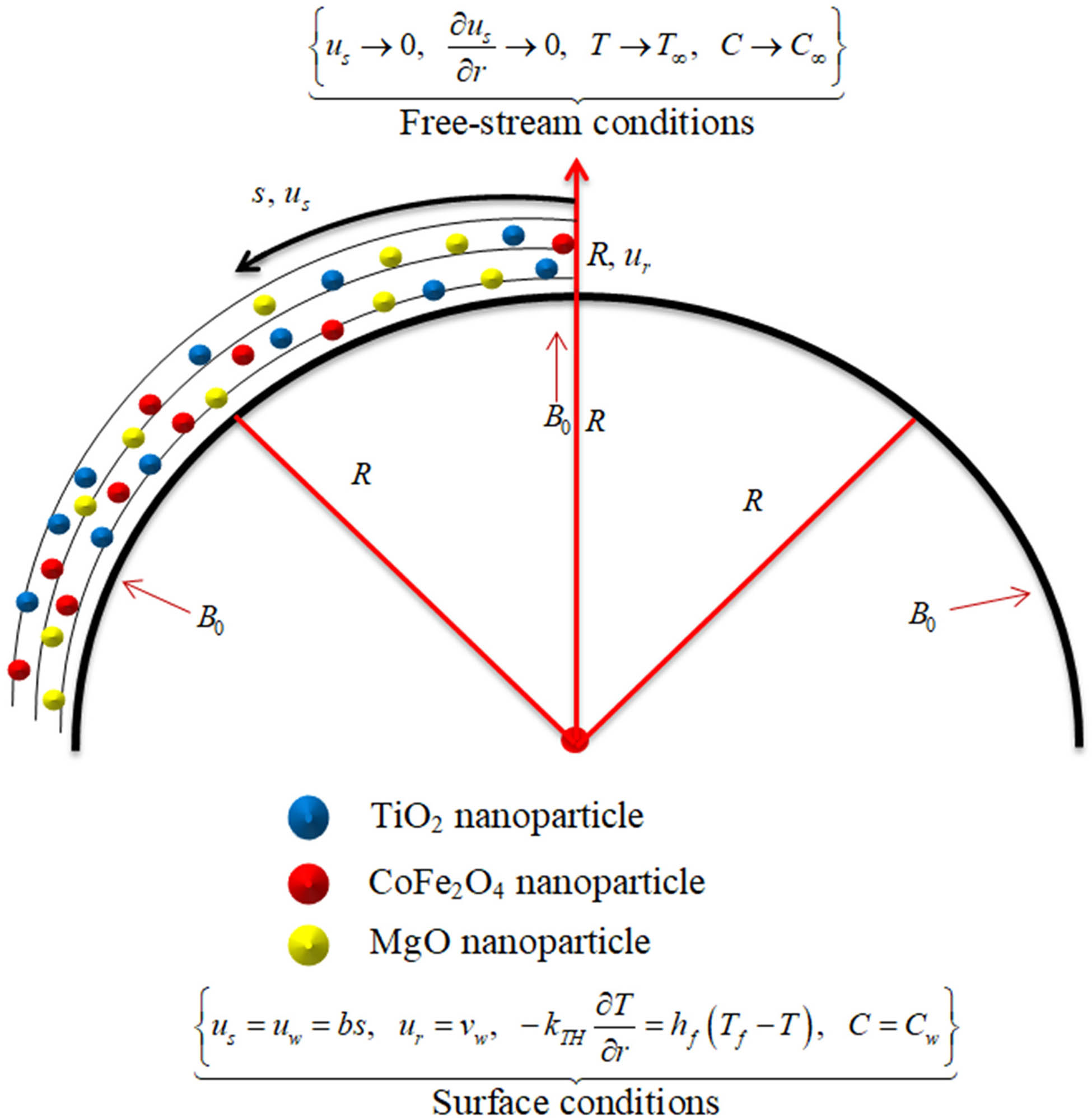
Curved surface representation.
Based on the aforementioned assumptions, the model equations can be expressed as follows [37,38,39]:
The constraints at boundaries are as follows [40,41]:
The thermophysical properties of the ternary hybrid nanofluids are characterized as follows [19,42,43]:
In the aforementioned properties,
| Properties |
|
|
|
|
|---|---|---|---|---|
|
|
997.1 | 4,179 | 0.613 | 0.05 |
|
|
4,250 | 686.2 | 8.9538 | 2.38 × 10⁶ |
|
|
4,907 | 700 | 3.7 | 5.51 × 10⁹ |
|
|
45 | 955 | 45 | 1.42 × 10⁻³ |
To transform the aforementioned equations, the similarity variables are defined as follows [40,46,47,48]:
Using the aforementioned similarity variables, equation (1) becomes apparent, and equation (2) can be simplified as follows:
Eq. (3) can be reduced as:
After differentiating equation (10) with respect to
Likewise, the remaining equations are transformed as:
Pressure can be reduced as:
where
The quantities of interest are defined as follows:
Using the similarity variables, the reduced form of equation (16) can be written as:
where
3 HAM solution
To apply HAM, we introduced the initial guesses and linear operators as follows:
with properties:
where
3.1 Advantages of HAM
HAM has several advantages over many traditional analytical methods. It is a series expansion method that does not directly depend on small or large physical parameters. Thus, it is applicable not only for weakly but also strongly nonlinear problems. HAM is a unified method for the Lyapunov artificial small parameter method, Delta expansion method, Adomian decomposition method, and homotopy perturbation method. It gives excellent flexibility to the expression of the solution and how the solution is explicitly obtained, and it provides great freedom in choosing the base functions of the desired solution and the corresponding auxiliary linear operator of homotopy. HAM provides a simple way to ensure the convergence of the solution series and is able to combine with other techniques used in nonlinear differential equations such as spectral methods and Padé approximants.
4 Validation
To confirm the validation of the coded problem in Mathematica 12.0 software, Tables 2 and 3 are shown. The validation is confirmed under some special conditions when
Comparing the values of
|
|
5 | 10 | 20 | 30 | 40 | 50 | 100 | 200 | 1000 |
|---|---|---|---|---|---|---|---|---|---|
| Present outcomes | 1.157565 | 1.072534 | 1.035464 | 1.023463 | 1.017346 | 1.013995 | 1.006963 | 1.003501 | 1.000798 |
| Roşca and Pop [49] | 1.15076 | 1.07172 | 1.03501 | 1.02315 | 1.01729 | 1.01380 | 1.00687 | 1.00342 | 1.00068 |
| Afridi et al. [50] | 1.1576312 | 1.0734886 | 1.0356098 | 1.0235310 | 1.0175866 | 1.0140492 | 1.0070384 | 1.0035641 | 1.0007993 |
| Abbas et al. [51] | 1.15763 | 1.07349 | 1.03561 | 1.02353 | 1.01759 | 1.01405 | 1.00704 | 1.00356 | 1.00079 |
| Ahmad et al. [52] | 1.157630 | 1.073490 | — | 1.023530 | — | 1.014050 | — | 1.003560 | |
| 1.000790 | |||||||||
| Dey et al. [53] | 1.157630 | 1.073490 | — | 1.0223 | — | — | — | — | — |
Comparison of the values of
|
|
0.01 | 0.72 | 1.0 | 2.0 | 7.0 | 10 |
|---|---|---|---|---|---|---|
| Present outcomes | 0.015664 | 0.463144 | 0.581976 | 0.911361 | 1.895420 | 2.308034 |
| Khan and Pop [54] | — | — | — | 0.9114 | 1.8954 | — |
| Wang [55] | — | — | — | 0.9114 | 1.8954 | — |
| Gorla and Sidawi [56] | — | — | — | 0.9114 | 1.8905 | — |
| Devi and Devi [57] | — | — | — | 0.91135 | 1.89540 | — |
| Grubka and Bobba [58] | 0.0099 | 0.4631 | 0.5820 | — | — | 2.3080 |
| Gowda et al. [59] | 0.00978 | 0.46273 | 0.58193 | — | — | 2.30793 |
5 HAM convergence
The homotopic series solution contains the auxiliary factor

6 Discussion of results
Next, the variations in different profiles (such as

(a) Impression of

(a) impression of

(a) Impression of

Impression of

(a) Impression of

(a) Impression of

Impression of

Impression of

Impression of
Nusselt number for different values of
|
|
|
|
|
|
|
|
|---|---|---|---|---|---|---|
| 0.01 | 0.986684 | |||||
| 0.02 | 1.243256 | |||||
| 0.03 | 1.486474 | |||||
| 0.04 | 1.625784 | |||||
| 0.1 | 0.486546 | |||||
| 1.2 | 0.497549 | |||||
| 1.9 | 0.510753 | |||||
| 0.3 | 0.609543 | |||||
| 0.6 | 0.658074 | |||||
| 0.9 | 0.697544 | |||||
| 0.5 | 0.508538 | |||||
| 0.7 | 0.497538 | |||||
| 0.9 | 0.480746 | |||||
| 0.1 | 0.696743 | |||||
| 0.5 | 0.666436 | |||||
| 0.9 | 0.620753 | |||||
| 0.1 | 0.597438 | |||||
| 0.3 | 0.637906 | |||||
| 0.5 | 0.675274 |
Sherwood number for different values of
|
|
|
|
|---|---|---|
| 0.5 | 0.864753 | |
| 0.7 | 0.896447 | |
| 0.9 | 0.925789 | |
| 0.1 | 0.596537 | |
| 0.5 | 0.608637 | |
| 0.9 | 0.612483 |
7 Conclusion
A ternary hybrid nanofluid flow with
The velocity distribution exhibits a decreasing trend with respect to the magnetic parameter, while the temperature distribution demonstrates an increasing trend with respect to the magnetic parameter.
The greater curvature parameter boots the flow, thermal, and volumetric fraction distributions.
Higher heat source factor, the Eckert and thermal Biot numbers increase the thermal distribution.
Thermal and volumetric fraction distributions are the growing functions of the thermophoresis factor.
Thermal distribution has booted up with upsurge in the Brownian factor, while the volumetric fraction distribution panels have retarded with growth in the Brownian factor and the Schmidt number.
The higher magnetic parameter, Eckert and thermal Biot numbers increase the Nusselt number while reduces with the higher Brownian and thermophoresis factors.
Higher Brownian and thermophoresis factors heighten the Sherwood number.
Acknowledgments
This research was supported by the Princess Nourah bint Abdulrahman University Researchers Supporting Project number (PNURSP2023R259), Princess Nourah bint Abdulrahman University, Riyadh, Saudi Arabia.
-
Funding information: This research was supported by the Princess Nourah Bint Abdulrahman University Researchers Supporting Project Number (PNURSP2023R259), Princess Nourah Bint Abdulrahman University, Riyadh, Saudi Arabia.
-
Author contributions: All authors have accepted responsibility for the entire content of this manuscript and approved its submission.
-
Conflict of interest: The authors state no conflict of interest.
References
[1] Choi SUS, Eastman JA. Enhancing thermal conductivity of fluids with nanoparticles. Int. Mech. Eng. Congr. Exhib. San Fr. CA (United States): 1995. p. 12–7. https://digital.library.unt.edu/ark:/67531/metadc671104/ (accessed October 2, 2021).Search in Google Scholar
[2] Mourad A, Abderrahmane A, Younis O, Marzouki R, Alazzam A. Numerical simulations of magnetohydrodynamics natural convection and entropy production in a porous annulus bounded by wavy cylinder and Koch snowflake loaded with Cu–Water nanofluid. Micromachines. 2022;13:182.10.3390/mi13020182Search in Google Scholar PubMed PubMed Central
[3] Acharya N, Mabood F, Shahzad SA, Badruddin IA. Hydrothermal variations of radiative nanofluid flow by the influence of nanoparticles diameter and nanolayer. Int Commun Heat Mass Transf. 2022;130:105781. 10.1016/J.ICHEATMASSTRANSFER.2021.105781.Search in Google Scholar
[4] Shahid A, Bhatti MM, Ellahi R, Mekheimer KS. Numerical experiment to examine activation energy and bi-convection Carreau nanofluid flow on an upper paraboloid porous surface: Application in solar energy. Sustain Energy Technol Assessments. 2022;52:102029.10.1016/j.seta.2022.102029Search in Google Scholar
[5] Bhatti MM, Arain MB, Zeeshan A, Ellahi R, Doranehgard MH. Swimming of Gyrotactic Microorganism in MHD Williamson nanofluid flow between rotating circular plates embedded in porous medium: Application of thermal energy storage. J Energy Storage. 2022;45:103511.10.1016/j.est.2021.103511Search in Google Scholar
[6] Wijayanta AT. Numerical solution strategy for natural convection problems in a triangular cavity using a direct meshless local Petrov-Galerkin method combined with an implicit artificial-compressibility model. Eng Anal Bound Elem. 2021;126:13–29.10.1016/j.enganabound.2021.02.006Search in Google Scholar
[7] Wijayanta AT. A localized meshless approach using radial basis functions for conjugate heat transfer problems in a heat exchanger. Int J Refrig. 2020;110:38–46.10.1016/j.ijrefrig.2019.10.025Search in Google Scholar
[8] Makarim DA, Suami A, Wijayanta AT, Kobayashi N, Itaya Y. Marangoni convection within thermosolute and absorptive aqueous LiBr solution. Int J Heat Mass Transf. 2022;188:122621.10.1016/j.ijheatmasstransfer.2022.122621Search in Google Scholar
[9] Kumar RSV, Dhananjaya PG, Kumar RN, Gowda RJP, Prasannakumara BC. Modeling and theoretical investigation on Casson nanofluid flow over a curved stretching surface with the influence of magnetic field and chemical reaction. Int J Comput Methods Eng Sci Mech. 2022;23:12–9.10.1080/15502287.2021.1900451Search in Google Scholar
[10] Zhang L, Bhatti MM, Michaelides MM, Marin M, Ellahi R. Hybrid nanofluid flow towards an elastic surface with tantalum and nickel nanoparticles, under the influence of an induced magnetic field. Eur Phys J Spec Top. 2022;231:521–33.10.1140/epjs/s11734-021-00409-1Search in Google Scholar
[11] Khan A, Saeed A, Tassaddiq A, Gul T, Mukhtar S, Kumam P, et al. Bio-convective micropolar nanofluid flow over thin moving needle subject to Arrhenius activation energy, viscous dissipation and binary chemical reaction. Case Stud. Therm Eng. 2021;25:100989.10.1016/j.csite.2021.100989Search in Google Scholar
[12] Chu Y, Bashir S, Ramzan M, Malik MY. Model‐based comparative study of magnetohydrodynamics unsteady hybrid nanofluid flow between two infinite parallel plates with particle shape effects. Math Methods Appl Sci. 2023 Jul 15;46(10):11568–82.10.1002/mma.8234Search in Google Scholar
[13] Ojjela O. Numerical investigation of heat transport in Alumina–Silica hybrid nanofluid flow with modeling and simulation. Math Comput Simul. 2022;193:100–22.10.1016/j.matcom.2021.09.022Search in Google Scholar
[14] Gumber P, Yaseen M, Rawat SK, Kumar M. Heat transfer in micropolar hybrid nanofluid flow past a vertical plate in the presence of thermal radiation and suction/injection effects. Partial Differ Equations Appl Math. 2022;5:100240.10.1016/j.padiff.2021.100240Search in Google Scholar
[15] Slimani R, Aissa A, Oudina FM, Khan U, Sahnoun M, Chamkha AJ, et al. Natural convection analysis flow of Al2O3-Cu/water hybrid nanofluid in a porous conical enclosure subjected to the magnetic field. Eur Phys J Appl Phys. 2020;92:10904. 10.1051/EPJAP/2020200260.Search in Google Scholar
[16] Arif M, Persio LD, Kumam P, Watthayu W, Akgül A. Heat transfer analysis of fractional model of couple stress Casson tri-hybrid nanofluid using dissimilar shape nanoparticles in blood with biomedical applications. Sci Rep. 2023;13:4596.10.1038/s41598-022-25127-zSearch in Google Scholar PubMed PubMed Central
[17] Shahzad F, Jamshed W, Eid MR, Ibrahim RW, Aslam F, Isa SSPM, et al. The effect of pressure gradient on MHD flow of a tri-hybrid Newtonian nanofluid in a circular channel. J Magn Magn Mater. 2023;568:170320.10.1016/j.jmmm.2022.170320Search in Google Scholar
[18] Sudharani M, Prakasha DG, Kumar KG, Chamkha AJ. Computational assessment of hybrid and tri hybrid nanofluid influenced by slip flow and linear radiation. Eur Phys J Plus. 2023;138:257.10.1140/epjp/s13360-023-03852-2Search in Google Scholar
[19] Guedri K, Khan A, Sene N, Raizah Z, Saeed A, Galal AM. Thermal flow for radiative ternary hybrid nanofluid over nonlinear stretching sheet subject to Darcy–Forchheimer phenomenon. Math. Probl. Eng. 2022;2022:3429439.10.1155/2022/3429439Search in Google Scholar
[20] Shevchuk IV. An improved asymptotic expansion method for fluid flow and convective heat transfer in cone-and-disk geometries with rotating cone. Phys Fluids. 2023;35:43603.10.1063/5.0146556Search in Google Scholar
[21] Olayemi OA, Khaled AF, Temitope OJ, Victor OO, Odetunde CB, Adegun IK. Parametric study of natural convection heat transfer from an inclined rectangular cylinder embedded in a square enclosure. Aust J Mech Eng. 2023;21:668–81.10.1080/14484846.2021.1913853Search in Google Scholar
[22] Manna NK, Biswas N, Mandal DK, Sarkar UK, Öztop HF, Hamdeh NH. Impacts of heater-cooler position and Lorentz force on heat transfer and entropy generation of hybrid nanofluid convection in quarter-circular cavity. Int J Numer Methods Heat Fluid Flow. 2023;33:1249–86.10.1108/HFF-07-2022-0402Search in Google Scholar
[23] Wang SR, Wang CA. Numerical simulation of convective heat transfer in packed bed using open-source computational fluid dynamics. Powder Technol. 2023;422:118452.10.1016/j.powtec.2023.118452Search in Google Scholar
[24] Shi L, Zhu X, Du Z. Study on convective heat transfer characteristics of inclined jet impinging cylindrical target surface in the confined space. Appl Therm Eng. 2023;218:119316.10.1016/j.applthermaleng.2022.119316Search in Google Scholar
[25] Abbas A, Jeelani MB, Alharthi NH. Darcy–Forchheimer relation influence on MHD dissipative third-grade fluid flow and heat transfer in porous medium with joule heating effects: A numerical approach. Processes. 2022;10:906.10.3390/pr10050906Search in Google Scholar
[26] Naseem T, Fatima U, Munir M, Shahzad A, Kausar N, Nisar KS, et al. Joule heating and viscous dissipation effects in hydromagnetized boundary layer flow with variable temperature, Case Stud. Therm Eng. 2022;35:102083.10.1016/j.csite.2022.102083Search in Google Scholar
[27] Rasheed HU, Islam S, Zeeshan, Abbas T, Khan J. Analytical treatment of MHD flow and chemically reactive Casson fluid with Joule heating and variable viscosity effect. Waves Random Complex Media. 2022;1–17. 10.1080/17455030.2022.2042622.Search in Google Scholar
[28] Mahdy AMS, Babatin MM, Khader MM. Numerical treatment for processing the effect of convective thermal condition and Joule heating on Casson fluid flow past a stretching sheet. Int J Mod Phys C. 2022;33:2250108.10.1142/S012918312250108XSearch in Google Scholar
[29] Waqas H, Sadiq MA, Bahaidarah HMS. Gyrotactic bioconvection stratified flow of magnetized micropolar nanoliquid configured by stretchable radiating surface with Joule heating and viscous dissipation. Int Commun Heat Mass Transf. 2022;138:106229.10.1016/j.icheatmasstransfer.2022.106229Search in Google Scholar
[30] Mahanthesh B, Reddy CS, Srikantha S, Lorenzini G. Entropy generation analysis of radiative heat transfer in Williamson fluid flowing in a microchannel with nonlinear mixed convection and Joule heating. Proc Inst Mech Eng Part E J Process Mech Eng. 2022;09544089221074846. 10.1177/09544089221074846.Search in Google Scholar
[31] Gangadhar K, Lakshmi KB, Kannan T, Chamkha AJ. Bioconvective magnetized oldroyd-B nanofluid flow in the presence of Joule heating with gyrotactic microorganisms. Waves Random Complex Media. 2022;1–21. 10.1080/17455030.2022.2050441.Search in Google Scholar
[32] Mishra A, Upreti H. A comparative study of Ag–MgO/water and Fe3O4–CoFe2O4/EG–water hybrid nanofluid flow over a curved surface with chemical reaction using Buongiorno model. Partial Differ Equations Appl Math. 2022;5:100322.10.1016/j.padiff.2022.100322Search in Google Scholar
[33] Maity S, Kundu PK. Magnetically driven chemically reactive Casson nanofluid flow over curved surface with thermal radiation. Heat Transf. 2022;51:4882–905.10.1002/htj.22527Search in Google Scholar
[34] Khan U, Zaib A, Ishak A, Bakar AS, Animasaun IL, Yook SJ. Insights into the dynamics of blood conveying gold nanoparticles on a curved surface when suction, thermal radiation, and Lorentz force are significant: The case of Non-Newtonian Williamson fluid. Math Comput Simul. 2022;193:250–68.10.1016/j.matcom.2021.10.014Search in Google Scholar
[35] Sun Z, Shi Z, Li Z, Geng X, Sun Q, Chen S, et al. Experimental investigation of flow control of a curved-surface jet hypersonic flow. Phys Fluids. 2022;34:66107.10.1063/5.0094555Search in Google Scholar
[36] Fuzhang W, Anwar MI, Ali M, El-Shafay AS, Abbas N, Ali R. Inspections of unsteady micropolar nanofluid model over exponentially stretching curved surface with chemical reaction. Waves Random Complex Media. 2022;1–22. 10.1080/17455030.2021.2025280.Search in Google Scholar
[37] Nadeem S, Abbas N, Malik MY. Inspection of hybrid based nanofluid flow over a curved surface. Comput Methods Programs Biomed. 2020;189:105193. 10.1016/j.cmpb.2019.105193.Search in Google Scholar PubMed
[38] Sarada K, Gamaoun F, Abdulrahman A, Paramesh SO, Kumar R, Prasanna GD, et al. Impact of exponential form of internal heat generation on water-based ternary hybrid nanofluid flow by capitalizing non-Fourier heat flux model. Case Stud Therm Eng. 2022;38:102332.10.1016/j.csite.2022.102332Search in Google Scholar
[39] Dawar A, Islam S, Shah Z, Mahmuod SR. A passive control of Casson hybrid nanofluid flow over a curved surface with alumina and copper nanomaterials: A study on sodium alginate-based fluid. J Mol Liq. 2023;382:122018.10.1016/j.molliq.2023.122018Search in Google Scholar
[40] Sun X, Animasaun IL, Swain K, Shah NA, Wakif A, Olanrewaju PO. Significance of nanoparticle radius, inter‐particle spacing, inclined magnetic field, and space‐dependent internal heating: The case of chemically reactive water conveying copper nanoparticles. ZAMM‐J Appl Math Mech Für Angew Math Und Mech. 2022;102:e202100094.10.1002/zamm.202100094Search in Google Scholar
[41] Dawar A, Wakif A, Saeed A, Shah Z, Muhammad T, Kumam P. Significance of Lorentz forces on Jeffrey nanofluid flows over a convectively heated flat surface featured by multiple velocity slips and dual stretching constraint: a homotopy analysis approach. J Comput Des Eng. 2022;9:564–82.10.1093/jcde/qwac019Search in Google Scholar
[42] Souayeh B, Ramesh K. Numerical scrutinization of ternary nanofluid flow over an exponentially stretching sheet with gyrotactic microorganisms. Mathematics. 2023;11(4):981.10.3390/math11040981Search in Google Scholar
[43] Priyadharshini P, Archana MV, Shah NA, Alshehri MH. Ternary hybrid nanofluid flow emerging on a symmetrically stretching sheet optimization with machine learning prediction scheme. Symmetry. 2023;15:1225.10.3390/sym15061225Search in Google Scholar
[44] Wang F, Nazir U, Sohail M, El-Zahar ER, Park C, Thounthong P. A Galerkin strategy for tri-hybridized mixture in ethylene glycol comprising variable diffusion and thermal conductivity using non-Fourier’s theory. Nanotechnol Rev. 2022;11:834–45.10.1515/ntrev-2022-0050Search in Google Scholar
[45] Acharya N, Maity S, Kundu PK. Framing the hydrothermal features of magnetized TiO2–CoFe2O4 water-based steady hybrid nanofluid flow over a radiative revolving disk. Multidiscip. Model Mater Struct. 2020;16:765–90. 10.1108/MMMS-08-2019-0151/FULL/XML.Search in Google Scholar
[46] Mishra A, Pandey AK, Kumar M. Thermal performance of Ag–water nanofluid flow over a curved surface due to chemical reaction using Buongiorno’s model. Heat Transf. 2021;50:257–78.10.1002/htj.21875Search in Google Scholar
[47] Abbas Z, Naveed M, Sajid M. Hydromagnetic slip flow of nanofluid over a curved stretching surface with heat generation and thermal radiation. J Mol Liq. 2016;215:756–62.10.1016/j.molliq.2016.01.012Search in Google Scholar
[48] Algehyne EA, Wakif A, Rasool G, Saeed A, Ghouli Z. Significance of Darcy-Forchheimer and Lorentz forces on radiative alumina-water nanofluid flows over a slippery curved geometry under multiple convective constraints: a renovated Buongiorno’s model with validated thermophysical correlations. Waves Random Complex Media. 2022;1–30. 10.1080/17455030.2022.2074570.Search in Google Scholar
[49] Roşca NC, Pop I. Unsteady boundary layer flow over a permeable curved stretching/shrinking surface. Eur J Mech. 2015;51:61–7.10.1016/j.euromechflu.2015.01.001Search in Google Scholar
[50] Afridi MI, Qasim M, Wakif A, Hussanan A. Second law analysis of dissipative nanofluid flow over a curved surface in the presence of Lorentz Force: Utilization of the Chebyshev–Gauss–Lobatto spectral method. Nanomater. 2019;9:195. 10.3390/NANO9020195.Search in Google Scholar
[51] Abbas Z, Naveed M, Sajid M. Heat transfer analysis for stretching flow over a curved surface with magnetic field. J Eng Thermophys. 2013;22:337–45.10.1134/S1810232813040061Search in Google Scholar
[52] Ahmad S, Nadeem S, Muhammad N. Boundary layer flow over a curved surface imbedded in porous medium. Commun Theor Phys. 2019;71:344.10.1088/0253-6102/71/3/344Search in Google Scholar
[53] Dey D, Makinde OD, Chutia B. Hydromagnetic flow of dusty fluid with heat and mass transfer past a stretching curved surface in a porous medium. Lat Am Appl Res. 2022;52:201–6.10.52292/j.laar.2022.831Search in Google Scholar
[54] Khan WA, Pop I. Boundary-layer flow of a nanofluid past a stretching sheet. Int J Heat Mass Transf. 2010;53:2477–83.10.1016/j.ijheatmasstransfer.2010.01.032Search in Google Scholar
[55] Wang CY. Free convection on a vertical stretching surface. ZAMM‐J Appl Math Mech Für Angew Math Und Mech. 1989;69:418–20.10.1002/zamm.19890691115Search in Google Scholar
[56] Gorla RS, Sidawi I. Free convection on a vertical stretching surface with suction and blowing. Appl Sci Res. 1994;52:247–57.10.1007/BF00853952Search in Google Scholar
[57] Devi SU, Devi SPA. Heat transfer enhancement of cu− $ al_ {2} o_ {3} $/water hybrid nanofluid flow over a stretching sheet. J Niger Math Soc. 2017;36:419–33.Search in Google Scholar
[58] Grubka LG, Bobba KM. Heat transfer characteristics of a continuous stretching surface with variable temperature. J Heat Transfer. 1985;107:248–50.10.1115/1.3247387Search in Google Scholar
[59] Gowda RJP, Al-Mubaddel FS, Kumar RN, Prasannakumara BC, Issakhov A, Rahimi-Gorji A, et al. Computational modelling of nanofluid flow over a curved stretching sheet using Koo–Kleinstreuer and Li (KKL) correlation and modified Fourier heat flux model. Chaos Solit Fractals. 2021;145:110774.10.1016/j.chaos.2021.110774Search in Google Scholar
© 2023 the author(s), published by De Gruyter
This work is licensed under the Creative Commons Attribution 4.0 International License.
Articles in the same Issue
- Research Articles
- Preparation of CdS–Ag2S nanocomposites by ultrasound-assisted UV photolysis treatment and its visible light photocatalysis activity
- Significance of nanoparticle radius and inter-particle spacing toward the radiative water-based alumina nanofluid flow over a rotating disk
- Aptamer-based detection of serotonin based on the rapid in situ synthesis of colorimetric gold nanoparticles
- Investigation of the nucleation and growth behavior of Ti2AlC and Ti3AlC nano-precipitates in TiAl alloys
- Dynamic recrystallization behavior and nucleation mechanism of dual-scale SiCp/A356 composites processed by P/M method
- High mechanical performance of 3-aminopropyl triethoxy silane/epoxy cured in a sandwich construction of 3D carbon felts foam and woven basalt fibers
- Applying solution of spray polyurea elastomer in asphalt binder: Feasibility analysis and DSR study based on the MSCR and LAS tests
- Study on the chronic toxicity and carcinogenicity of iron-based bioabsorbable stents
- Influence of microalloying with B on the microstructure and properties of brazed joints with Ag–Cu–Zn–Sn filler metal
- Thermohydraulic performance of thermal system integrated with twisted turbulator inserts using ternary hybrid nanofluids
- Study of mechanical properties of epoxy/graphene and epoxy/halloysite nanocomposites
- Effects of CaO addition on the CuW composite containing micro- and nano-sized tungsten particles synthesized via aluminothermic coupling with silicothermic reduction
- Cu and Al2O3-based hybrid nanofluid flow through a porous cavity
- Design of functional vancomycin-embedded bio-derived extracellular matrix hydrogels for repairing infectious bone defects
- Study on nanocrystalline coating prepared by electro-spraying 316L metal wire and its corrosion performance
- Axial compression performance of CFST columns reinforced by ultra-high-performance nano-concrete under long-term loading
- Tungsten trioxide nanocomposite for conventional soliton and noise-like pulse generation in anomalous dispersion laser cavity
- Microstructure and electrical contact behavior of the nano-yttria-modified Cu-Al2O3/30Mo/3SiC composite
- Melting rheology in thermally stratified graphene-mineral oil reservoir (third-grade nanofluid) with slip condition
- Re-examination of nonlinear vibration and nonlinear bending of porous sandwich cylindrical panels reinforced by graphene platelets
- Parametric simulation of hybrid nanofluid flow consisting of cobalt ferrite nanoparticles with second-order slip and variable viscosity over an extending surface
- Chitosan-capped silver nanoparticles with potent and selective intrinsic activity against the breast cancer cells
- Multi-core/shell SiO2@Al2O3 nanostructures deposited on Ti3AlC2 to enhance high-temperature stability and microwave absorption properties
- Solution-processed Bi2S3/BiVO4/TiO2 ternary heterojunction photoanode with enhanced photoelectrochemical performance
- Electroporation effect of ZnO nanoarrays under low voltage for water disinfection
- NIR-II window absorbing graphene oxide-coated gold nanorods and graphene quantum dot-coupled gold nanorods for photothermal cancer therapy
- Nonlinear three-dimensional stability characteristics of geometrically imperfect nanoshells under axial compression and surface residual stress
- Investigation of different nanoparticles properties on the thermal conductivity and viscosity of nanofluids by molecular dynamics simulation
- Optimized Cu2O-{100} facet for generation of different reactive oxidative species via peroxymonosulfate activation at specific pH values to efficient acetaminophen removal
- Brownian and thermal diffusivity impact due to the Maxwell nanofluid (graphene/engine oil) flow with motile microorganisms and Joule heating
- Appraising the dielectric properties and the effectiveness of electromagnetic shielding of graphene reinforced silicone rubber nanocomposite
- Synthesis of Ag and Cu nanoparticles by plasma discharge in inorganic salt solutions
- Low-cost and large-scale preparation of ultrafine TiO2@C hybrids for high-performance degradation of methyl orange and formaldehyde under visible light
- Utilization of waste glass with natural pozzolan in the production of self-glazed glass-ceramic materials
- Mechanical performance of date palm fiber-reinforced concrete modified with nano-activated carbon
- Melting point of dried gold nanoparticles prepared with ultrasonic spray pyrolysis and lyophilisation
- Graphene nanofibers: A modern approach towards tailored gypsum composites
- Role of localized magnetic field in vortex generation in tri-hybrid nanofluid flow: A numerical approach
- Intelligent computing for the double-diffusive peristaltic rheology of magneto couple stress nanomaterials
- Bioconvection transport of upper convected Maxwell nanoliquid with gyrotactic microorganism, nonlinear thermal radiation, and chemical reaction
- 3D printing of porous Ti6Al4V bone tissue engineering scaffold and surface anodization preparation of nanotubes to enhance its biological property
- Bioinspired ferromagnetic CoFe2O4 nanoparticles: Potential pharmaceutical and medical applications
- Significance of gyrotactic microorganisms on the MHD tangent hyperbolic nanofluid flow across an elastic slender surface: Numerical analysis
- Performance of polycarboxylate superplasticisers in seawater-blended cement: Effect from chemical structure and nano modification
- Entropy minimization of GO–Ag/KO cross-hybrid nanofluid over a convectively heated surface
- Oxygen plasma assisted room temperature bonding for manufacturing SU-8 polymer micro/nanoscale nozzle
- Performance and mechanism of CO2 reduction by DBD-coupled mesoporous SiO2
- Polyarylene ether nitrile dielectric films modified by HNTs@PDA hybrids for high-temperature resistant organic electronics field
- Exploration of generalized two-phase free convection magnetohydrodynamic flow of dusty tetra-hybrid Casson nanofluid between parallel microplates
- Hygrothermal bending analysis of sandwich nanoplates with FG porous core and piezomagnetic faces via nonlocal strain gradient theory
- Design and optimization of a TiO2/RGO-supported epoxy multilayer microwave absorber by the modified local best particle swarm optimization algorithm
- Mechanical properties and frost resistance of recycled brick aggregate concrete modified by nano-SiO2
- Self-template synthesis of hollow flower-like NiCo2O4 nanoparticles as an efficient bifunctional catalyst for oxygen reduction and oxygen evolution in alkaline media
- High-performance wearable flexible strain sensors based on an AgNWs/rGO/TPU electrospun nanofiber film for monitoring human activities
- High-performance lithium–selenium batteries enabled by nitrogen-doped porous carbon from peanut meal
- Investigating effects of Lorentz forces and convective heating on ternary hybrid nanofluid flow over a curved surface using homotopy analysis method
- Exploring the potential of biogenic magnesium oxide nanoparticles for cytotoxicity: In vitro and in silico studies on HCT116 and HT29 cells and DPPH radical scavenging
- Enhanced visible-light-driven photocatalytic degradation of azo dyes by heteroatom-doped nickel tungstate nanoparticles
- A facile method to synthesize nZVI-doped polypyrrole-based carbon nanotube for Ag(i) removal
- Improved osseointegration of dental titanium implants by TiO2 nanotube arrays with self-assembled recombinant IGF-1 in type 2 diabetes mellitus rat model
- Functionalized SWCNTs@Ag–TiO2 nanocomposites induce ROS-mediated apoptosis and autophagy in liver cancer cells
- Triboelectric nanogenerator based on a water droplet spring with a concave spherical surface for harvesting wave energy and detecting pressure
- A mathematical approach for modeling the blood flow containing nanoparticles by employing the Buongiorno’s model
- Molecular dynamics study on dynamic interlayer friction of graphene and its strain effect
- Induction of apoptosis and autophagy via regulation of AKT and JNK mitogen-activated protein kinase pathways in breast cancer cell lines exposed to gold nanoparticles loaded with TNF-α and combined with doxorubicin
- Effect of PVA fibers on durability of nano-SiO2-reinforced cement-based composites subjected to wet-thermal and chloride salt-coupled environment
- Effect of polyvinyl alcohol fibers on mechanical properties of nano-SiO2-reinforced geopolymer composites under a complex environment
- In vitro studies of titanium dioxide nanoparticles modified with glutathione as a potential drug delivery system
- Comparative investigations of Ag/H2O nanofluid and Ag-CuO/H2O hybrid nanofluid with Darcy-Forchheimer flow over a curved surface
- Study on deformation characteristics of multi-pass continuous drawing of micro copper wire based on crystal plasticity finite element method
- Properties of ultra-high-performance self-compacting fiber-reinforced concrete modified with nanomaterials
- Prediction of lap shear strength of GNP and TiO2/epoxy nanocomposite adhesives
- A novel exploration of how localized magnetic field affects vortex generation of trihybrid nanofluids
- Fabrication and physicochemical characterization of copper oxide–pyrrhotite nanocomposites for the cytotoxic effects on HepG2 cells and the mechanism
- Thermal radiative flow of cross nanofluid due to a stretched cylinder containing microorganisms
- In vitro study of the biphasic calcium phosphate/chitosan hybrid biomaterial scaffold fabricated via solvent casting and evaporation technique for bone regeneration
- Insights into the thermal characteristics and dynamics of stagnant blood conveying titanium oxide, alumina, and silver nanoparticles subject to Lorentz force and internal heating over a curved surface
- Effects of nano-SiO2 additives on carbon fiber-reinforced fly ash–slag geopolymer composites performance: Workability, mechanical properties, and microstructure
- Energy bandgap and thermal characteristics of non-Darcian MHD rotating hybridity nanofluid thin film flow: Nanotechnology application
- Green synthesis and characterization of ginger-extract-based oxali-palladium nanoparticles for colorectal cancer: Downregulation of REG4 and apoptosis induction
- Abnormal evolution of resistivity and microstructure of annealed Ag nanoparticles/Ag–Mo films
- Preparation of water-based dextran-coated Fe3O4 magnetic fluid for magnetic hyperthermia
- Statistical investigations and morphological aspects of cross-rheological material suspended in transportation of alumina, silica, titanium, and ethylene glycol via the Galerkin algorithm
- Effect of CNT film interleaves on the flexural properties and strength after impact of CFRP composites
- Self-assembled nanoscale entities: Preparative process optimization, payload release, and enhanced bioavailability of thymoquinone natural product
- Structure–mechanical property relationships of 3D-printed porous polydimethylsiloxane films
- Nonlinear thermal radiation and the slip effect on a 3D bioconvection flow of the Casson nanofluid in a rotating frame via a homotopy analysis mechanism
- Residual mechanical properties of concrete incorporated with nano supplementary cementitious materials exposed to elevated temperature
- Time-independent three-dimensional flow of a water-based hybrid nanofluid past a Riga plate with slips and convective conditions: A homotopic solution
- Lightweight and high-strength polyarylene ether nitrile-based composites for efficient electromagnetic interference shielding
- Review Articles
- Recycling waste sources into nanocomposites of graphene materials: Overview from an energy-focused perspective
- Hybrid nanofiller reinforcement in thermoset and biothermoset applications: A review
- Current state-of-the-art review of nanotechnology-based therapeutics for viral pandemics: Special attention to COVID-19
- Solid lipid nanoparticles for targeted natural and synthetic drugs delivery in high-incidence cancers, and other diseases: Roles of preparation methods, lipid composition, transitional stability, and release profiles in nanocarriers’ development
- Critical review on experimental and theoretical studies of elastic properties of wurtzite-structured ZnO nanowires
- Polyurea micro-/nano-capsule applications in construction industry: A review
- A comprehensive review and clinical guide to molecular and serological diagnostic tests and future development: In vitro diagnostic testing for COVID-19
- Recent advances in electrocatalytic oxidation of 5-hydroxymethylfurfural to 2,5-furandicarboxylic acid: Mechanism, catalyst, coupling system
- Research progress and prospect of silica-based polymer nanofluids in enhanced oil recovery
- Review of the pharmacokinetics of nanodrugs
- Engineered nanoflowers, nanotrees, nanostars, nanodendrites, and nanoleaves for biomedical applications
- Research progress of biopolymers combined with stem cells in the repair of intrauterine adhesions
- Progress in FEM modeling on mechanical and electromechanical properties of carbon nanotube cement-based composites
- Antifouling induced by surface wettability of poly(dimethyl siloxane) and its nanocomposites
- TiO2 aerogel composite high-efficiency photocatalysts for environmental treatment and hydrogen energy production
- Structural properties of alumina surfaces and their roles in the synthesis of environmentally persistent free radicals (EPFRs)
- Nanoparticles for the potential treatment of Alzheimer’s disease: A physiopathological approach
- Current status of synthesis and consolidation strategies for thermo-resistant nanoalloys and their general applications
- Recent research progress on the stimuli-responsive smart membrane: A review
- Dispersion of carbon nanotubes in aqueous cementitious materials: A review
- Applications of DNA tetrahedron nanostructure in cancer diagnosis and anticancer drugs delivery
- Magnetic nanoparticles in 3D-printed scaffolds for biomedical applications
- An overview of the synthesis of silicon carbide–boron carbide composite powders
- Organolead halide perovskites: Synthetic routes, structural features, and their potential in the development of photovoltaic
- Recent advancements in nanotechnology application on wood and bamboo materials: A review
- Application of aptamer-functionalized nanomaterials in molecular imaging of tumors
- Recent progress on corrosion mechanisms of graphene-reinforced metal matrix composites
- Research progress on preparation, modification, and application of phenolic aerogel
- Application of nanomaterials in early diagnosis of cancer
- Plant mediated-green synthesis of zinc oxide nanoparticles: An insight into biomedical applications
- Recent developments in terahertz quantum cascade lasers for practical applications
- Recent progress in dielectric/metal/dielectric electrodes for foldable light-emitting devices
- Nanocoatings for ballistic applications: A review
- A mini-review on MoS2 membrane for water desalination: Recent development and challenges
- Recent updates in nanotechnological advances for wound healing: A narrative review
- Recent advances in DNA nanomaterials for cancer diagnosis and treatment
- Electrochemical micro- and nanobiosensors for in vivo reactive oxygen/nitrogen species measurement in the brain
- Advances in organic–inorganic nanocomposites for cancer imaging and therapy
- Advancements in aluminum matrix composites reinforced with carbides and graphene: A comprehensive review
- Modification effects of nanosilica on asphalt binders: A review
- Decellularized extracellular matrix as a promising biomaterial for musculoskeletal tissue regeneration
- Review of the sol–gel method in preparing nano TiO2 for advanced oxidation process
- Micro/nano manufacturing aircraft surface with anti-icing and deicing performances: An overview
- Cell type-targeting nanoparticles in treating central nervous system diseases: Challenges and hopes
- An overview of hydrogen production from Al-based materials
- A review of application, modification, and prospect of melamine foam
- A review of the performance of fibre-reinforced composite laminates with carbon nanotubes
- Research on AFM tip-related nanofabrication of two-dimensional materials
- Advances in phase change building materials: An overview
- Development of graphene and graphene quantum dots toward biomedical engineering applications: A review
- Nanoremediation approaches for the mitigation of heavy metal contamination in vegetables: An overview
- Photodynamic therapy empowered by nanotechnology for oral and dental science: Progress and perspectives
- Biosynthesis of metal nanoparticles: Bioreduction and biomineralization
- Current diagnostic and therapeutic approaches for severe acute respiratory syndrome coronavirus-2 (SARS-COV-2) and the role of nanomaterial-based theragnosis in combating the pandemic
- Application of two-dimensional black phosphorus material in wound healing
- Special Issue on Advanced Nanomaterials and Composites for Energy Conversion and Storage - Part I
- Helical fluorinated carbon nanotubes/iron(iii) fluoride hybrid with multilevel transportation channels and rich active sites for lithium/fluorinated carbon primary battery
- The progress of cathode materials in aqueous zinc-ion batteries
- Special Issue on Advanced Nanomaterials for Carbon Capture, Environment and Utilization for Energy Sustainability - Part I
- Effect of polypropylene fiber and nano-silica on the compressive strength and frost resistance of recycled brick aggregate concrete
- Mechanochemical design of nanomaterials for catalytic applications with a benign-by-design focus
Articles in the same Issue
- Research Articles
- Preparation of CdS–Ag2S nanocomposites by ultrasound-assisted UV photolysis treatment and its visible light photocatalysis activity
- Significance of nanoparticle radius and inter-particle spacing toward the radiative water-based alumina nanofluid flow over a rotating disk
- Aptamer-based detection of serotonin based on the rapid in situ synthesis of colorimetric gold nanoparticles
- Investigation of the nucleation and growth behavior of Ti2AlC and Ti3AlC nano-precipitates in TiAl alloys
- Dynamic recrystallization behavior and nucleation mechanism of dual-scale SiCp/A356 composites processed by P/M method
- High mechanical performance of 3-aminopropyl triethoxy silane/epoxy cured in a sandwich construction of 3D carbon felts foam and woven basalt fibers
- Applying solution of spray polyurea elastomer in asphalt binder: Feasibility analysis and DSR study based on the MSCR and LAS tests
- Study on the chronic toxicity and carcinogenicity of iron-based bioabsorbable stents
- Influence of microalloying with B on the microstructure and properties of brazed joints with Ag–Cu–Zn–Sn filler metal
- Thermohydraulic performance of thermal system integrated with twisted turbulator inserts using ternary hybrid nanofluids
- Study of mechanical properties of epoxy/graphene and epoxy/halloysite nanocomposites
- Effects of CaO addition on the CuW composite containing micro- and nano-sized tungsten particles synthesized via aluminothermic coupling with silicothermic reduction
- Cu and Al2O3-based hybrid nanofluid flow through a porous cavity
- Design of functional vancomycin-embedded bio-derived extracellular matrix hydrogels for repairing infectious bone defects
- Study on nanocrystalline coating prepared by electro-spraying 316L metal wire and its corrosion performance
- Axial compression performance of CFST columns reinforced by ultra-high-performance nano-concrete under long-term loading
- Tungsten trioxide nanocomposite for conventional soliton and noise-like pulse generation in anomalous dispersion laser cavity
- Microstructure and electrical contact behavior of the nano-yttria-modified Cu-Al2O3/30Mo/3SiC composite
- Melting rheology in thermally stratified graphene-mineral oil reservoir (third-grade nanofluid) with slip condition
- Re-examination of nonlinear vibration and nonlinear bending of porous sandwich cylindrical panels reinforced by graphene platelets
- Parametric simulation of hybrid nanofluid flow consisting of cobalt ferrite nanoparticles with second-order slip and variable viscosity over an extending surface
- Chitosan-capped silver nanoparticles with potent and selective intrinsic activity against the breast cancer cells
- Multi-core/shell SiO2@Al2O3 nanostructures deposited on Ti3AlC2 to enhance high-temperature stability and microwave absorption properties
- Solution-processed Bi2S3/BiVO4/TiO2 ternary heterojunction photoanode with enhanced photoelectrochemical performance
- Electroporation effect of ZnO nanoarrays under low voltage for water disinfection
- NIR-II window absorbing graphene oxide-coated gold nanorods and graphene quantum dot-coupled gold nanorods for photothermal cancer therapy
- Nonlinear three-dimensional stability characteristics of geometrically imperfect nanoshells under axial compression and surface residual stress
- Investigation of different nanoparticles properties on the thermal conductivity and viscosity of nanofluids by molecular dynamics simulation
- Optimized Cu2O-{100} facet for generation of different reactive oxidative species via peroxymonosulfate activation at specific pH values to efficient acetaminophen removal
- Brownian and thermal diffusivity impact due to the Maxwell nanofluid (graphene/engine oil) flow with motile microorganisms and Joule heating
- Appraising the dielectric properties and the effectiveness of electromagnetic shielding of graphene reinforced silicone rubber nanocomposite
- Synthesis of Ag and Cu nanoparticles by plasma discharge in inorganic salt solutions
- Low-cost and large-scale preparation of ultrafine TiO2@C hybrids for high-performance degradation of methyl orange and formaldehyde under visible light
- Utilization of waste glass with natural pozzolan in the production of self-glazed glass-ceramic materials
- Mechanical performance of date palm fiber-reinforced concrete modified with nano-activated carbon
- Melting point of dried gold nanoparticles prepared with ultrasonic spray pyrolysis and lyophilisation
- Graphene nanofibers: A modern approach towards tailored gypsum composites
- Role of localized magnetic field in vortex generation in tri-hybrid nanofluid flow: A numerical approach
- Intelligent computing for the double-diffusive peristaltic rheology of magneto couple stress nanomaterials
- Bioconvection transport of upper convected Maxwell nanoliquid with gyrotactic microorganism, nonlinear thermal radiation, and chemical reaction
- 3D printing of porous Ti6Al4V bone tissue engineering scaffold and surface anodization preparation of nanotubes to enhance its biological property
- Bioinspired ferromagnetic CoFe2O4 nanoparticles: Potential pharmaceutical and medical applications
- Significance of gyrotactic microorganisms on the MHD tangent hyperbolic nanofluid flow across an elastic slender surface: Numerical analysis
- Performance of polycarboxylate superplasticisers in seawater-blended cement: Effect from chemical structure and nano modification
- Entropy minimization of GO–Ag/KO cross-hybrid nanofluid over a convectively heated surface
- Oxygen plasma assisted room temperature bonding for manufacturing SU-8 polymer micro/nanoscale nozzle
- Performance and mechanism of CO2 reduction by DBD-coupled mesoporous SiO2
- Polyarylene ether nitrile dielectric films modified by HNTs@PDA hybrids for high-temperature resistant organic electronics field
- Exploration of generalized two-phase free convection magnetohydrodynamic flow of dusty tetra-hybrid Casson nanofluid between parallel microplates
- Hygrothermal bending analysis of sandwich nanoplates with FG porous core and piezomagnetic faces via nonlocal strain gradient theory
- Design and optimization of a TiO2/RGO-supported epoxy multilayer microwave absorber by the modified local best particle swarm optimization algorithm
- Mechanical properties and frost resistance of recycled brick aggregate concrete modified by nano-SiO2
- Self-template synthesis of hollow flower-like NiCo2O4 nanoparticles as an efficient bifunctional catalyst for oxygen reduction and oxygen evolution in alkaline media
- High-performance wearable flexible strain sensors based on an AgNWs/rGO/TPU electrospun nanofiber film for monitoring human activities
- High-performance lithium–selenium batteries enabled by nitrogen-doped porous carbon from peanut meal
- Investigating effects of Lorentz forces and convective heating on ternary hybrid nanofluid flow over a curved surface using homotopy analysis method
- Exploring the potential of biogenic magnesium oxide nanoparticles for cytotoxicity: In vitro and in silico studies on HCT116 and HT29 cells and DPPH radical scavenging
- Enhanced visible-light-driven photocatalytic degradation of azo dyes by heteroatom-doped nickel tungstate nanoparticles
- A facile method to synthesize nZVI-doped polypyrrole-based carbon nanotube for Ag(i) removal
- Improved osseointegration of dental titanium implants by TiO2 nanotube arrays with self-assembled recombinant IGF-1 in type 2 diabetes mellitus rat model
- Functionalized SWCNTs@Ag–TiO2 nanocomposites induce ROS-mediated apoptosis and autophagy in liver cancer cells
- Triboelectric nanogenerator based on a water droplet spring with a concave spherical surface for harvesting wave energy and detecting pressure
- A mathematical approach for modeling the blood flow containing nanoparticles by employing the Buongiorno’s model
- Molecular dynamics study on dynamic interlayer friction of graphene and its strain effect
- Induction of apoptosis and autophagy via regulation of AKT and JNK mitogen-activated protein kinase pathways in breast cancer cell lines exposed to gold nanoparticles loaded with TNF-α and combined with doxorubicin
- Effect of PVA fibers on durability of nano-SiO2-reinforced cement-based composites subjected to wet-thermal and chloride salt-coupled environment
- Effect of polyvinyl alcohol fibers on mechanical properties of nano-SiO2-reinforced geopolymer composites under a complex environment
- In vitro studies of titanium dioxide nanoparticles modified with glutathione as a potential drug delivery system
- Comparative investigations of Ag/H2O nanofluid and Ag-CuO/H2O hybrid nanofluid with Darcy-Forchheimer flow over a curved surface
- Study on deformation characteristics of multi-pass continuous drawing of micro copper wire based on crystal plasticity finite element method
- Properties of ultra-high-performance self-compacting fiber-reinforced concrete modified with nanomaterials
- Prediction of lap shear strength of GNP and TiO2/epoxy nanocomposite adhesives
- A novel exploration of how localized magnetic field affects vortex generation of trihybrid nanofluids
- Fabrication and physicochemical characterization of copper oxide–pyrrhotite nanocomposites for the cytotoxic effects on HepG2 cells and the mechanism
- Thermal radiative flow of cross nanofluid due to a stretched cylinder containing microorganisms
- In vitro study of the biphasic calcium phosphate/chitosan hybrid biomaterial scaffold fabricated via solvent casting and evaporation technique for bone regeneration
- Insights into the thermal characteristics and dynamics of stagnant blood conveying titanium oxide, alumina, and silver nanoparticles subject to Lorentz force and internal heating over a curved surface
- Effects of nano-SiO2 additives on carbon fiber-reinforced fly ash–slag geopolymer composites performance: Workability, mechanical properties, and microstructure
- Energy bandgap and thermal characteristics of non-Darcian MHD rotating hybridity nanofluid thin film flow: Nanotechnology application
- Green synthesis and characterization of ginger-extract-based oxali-palladium nanoparticles for colorectal cancer: Downregulation of REG4 and apoptosis induction
- Abnormal evolution of resistivity and microstructure of annealed Ag nanoparticles/Ag–Mo films
- Preparation of water-based dextran-coated Fe3O4 magnetic fluid for magnetic hyperthermia
- Statistical investigations and morphological aspects of cross-rheological material suspended in transportation of alumina, silica, titanium, and ethylene glycol via the Galerkin algorithm
- Effect of CNT film interleaves on the flexural properties and strength after impact of CFRP composites
- Self-assembled nanoscale entities: Preparative process optimization, payload release, and enhanced bioavailability of thymoquinone natural product
- Structure–mechanical property relationships of 3D-printed porous polydimethylsiloxane films
- Nonlinear thermal radiation and the slip effect on a 3D bioconvection flow of the Casson nanofluid in a rotating frame via a homotopy analysis mechanism
- Residual mechanical properties of concrete incorporated with nano supplementary cementitious materials exposed to elevated temperature
- Time-independent three-dimensional flow of a water-based hybrid nanofluid past a Riga plate with slips and convective conditions: A homotopic solution
- Lightweight and high-strength polyarylene ether nitrile-based composites for efficient electromagnetic interference shielding
- Review Articles
- Recycling waste sources into nanocomposites of graphene materials: Overview from an energy-focused perspective
- Hybrid nanofiller reinforcement in thermoset and biothermoset applications: A review
- Current state-of-the-art review of nanotechnology-based therapeutics for viral pandemics: Special attention to COVID-19
- Solid lipid nanoparticles for targeted natural and synthetic drugs delivery in high-incidence cancers, and other diseases: Roles of preparation methods, lipid composition, transitional stability, and release profiles in nanocarriers’ development
- Critical review on experimental and theoretical studies of elastic properties of wurtzite-structured ZnO nanowires
- Polyurea micro-/nano-capsule applications in construction industry: A review
- A comprehensive review and clinical guide to molecular and serological diagnostic tests and future development: In vitro diagnostic testing for COVID-19
- Recent advances in electrocatalytic oxidation of 5-hydroxymethylfurfural to 2,5-furandicarboxylic acid: Mechanism, catalyst, coupling system
- Research progress and prospect of silica-based polymer nanofluids in enhanced oil recovery
- Review of the pharmacokinetics of nanodrugs
- Engineered nanoflowers, nanotrees, nanostars, nanodendrites, and nanoleaves for biomedical applications
- Research progress of biopolymers combined with stem cells in the repair of intrauterine adhesions
- Progress in FEM modeling on mechanical and electromechanical properties of carbon nanotube cement-based composites
- Antifouling induced by surface wettability of poly(dimethyl siloxane) and its nanocomposites
- TiO2 aerogel composite high-efficiency photocatalysts for environmental treatment and hydrogen energy production
- Structural properties of alumina surfaces and their roles in the synthesis of environmentally persistent free radicals (EPFRs)
- Nanoparticles for the potential treatment of Alzheimer’s disease: A physiopathological approach
- Current status of synthesis and consolidation strategies for thermo-resistant nanoalloys and their general applications
- Recent research progress on the stimuli-responsive smart membrane: A review
- Dispersion of carbon nanotubes in aqueous cementitious materials: A review
- Applications of DNA tetrahedron nanostructure in cancer diagnosis and anticancer drugs delivery
- Magnetic nanoparticles in 3D-printed scaffolds for biomedical applications
- An overview of the synthesis of silicon carbide–boron carbide composite powders
- Organolead halide perovskites: Synthetic routes, structural features, and their potential in the development of photovoltaic
- Recent advancements in nanotechnology application on wood and bamboo materials: A review
- Application of aptamer-functionalized nanomaterials in molecular imaging of tumors
- Recent progress on corrosion mechanisms of graphene-reinforced metal matrix composites
- Research progress on preparation, modification, and application of phenolic aerogel
- Application of nanomaterials in early diagnosis of cancer
- Plant mediated-green synthesis of zinc oxide nanoparticles: An insight into biomedical applications
- Recent developments in terahertz quantum cascade lasers for practical applications
- Recent progress in dielectric/metal/dielectric electrodes for foldable light-emitting devices
- Nanocoatings for ballistic applications: A review
- A mini-review on MoS2 membrane for water desalination: Recent development and challenges
- Recent updates in nanotechnological advances for wound healing: A narrative review
- Recent advances in DNA nanomaterials for cancer diagnosis and treatment
- Electrochemical micro- and nanobiosensors for in vivo reactive oxygen/nitrogen species measurement in the brain
- Advances in organic–inorganic nanocomposites for cancer imaging and therapy
- Advancements in aluminum matrix composites reinforced with carbides and graphene: A comprehensive review
- Modification effects of nanosilica on asphalt binders: A review
- Decellularized extracellular matrix as a promising biomaterial for musculoskeletal tissue regeneration
- Review of the sol–gel method in preparing nano TiO2 for advanced oxidation process
- Micro/nano manufacturing aircraft surface with anti-icing and deicing performances: An overview
- Cell type-targeting nanoparticles in treating central nervous system diseases: Challenges and hopes
- An overview of hydrogen production from Al-based materials
- A review of application, modification, and prospect of melamine foam
- A review of the performance of fibre-reinforced composite laminates with carbon nanotubes
- Research on AFM tip-related nanofabrication of two-dimensional materials
- Advances in phase change building materials: An overview
- Development of graphene and graphene quantum dots toward biomedical engineering applications: A review
- Nanoremediation approaches for the mitigation of heavy metal contamination in vegetables: An overview
- Photodynamic therapy empowered by nanotechnology for oral and dental science: Progress and perspectives
- Biosynthesis of metal nanoparticles: Bioreduction and biomineralization
- Current diagnostic and therapeutic approaches for severe acute respiratory syndrome coronavirus-2 (SARS-COV-2) and the role of nanomaterial-based theragnosis in combating the pandemic
- Application of two-dimensional black phosphorus material in wound healing
- Special Issue on Advanced Nanomaterials and Composites for Energy Conversion and Storage - Part I
- Helical fluorinated carbon nanotubes/iron(iii) fluoride hybrid with multilevel transportation channels and rich active sites for lithium/fluorinated carbon primary battery
- The progress of cathode materials in aqueous zinc-ion batteries
- Special Issue on Advanced Nanomaterials for Carbon Capture, Environment and Utilization for Energy Sustainability - Part I
- Effect of polypropylene fiber and nano-silica on the compressive strength and frost resistance of recycled brick aggregate concrete
- Mechanochemical design of nanomaterials for catalytic applications with a benign-by-design focus
