Significance of nanoparticle radius and inter-particle spacing toward the radiative water-based alumina nanofluid flow over a rotating disk
-
 and
and

Abstract
The study of nanofluid flow over a rotating disk has significant importance because of its enormous range of implementations, including cancer treatments, chemotherapy, nanomedicines, fermentation sciences, selective drug delivery, food sciences, biosensors, biomedicines, and electronics. Due to these applications of nanofluid, the present problem investigates the magnetohydrodynamic flow of nanofluid with nonlinear thermal radiation and viscous dissipation. In this analysis, the aluminum oxide nanoparticles are mixed with water. Furthermore, the mechanism for inter-particle spacing and radius of aluminum oxide nanoparticles on the dynamics of the two-dimensional flow of nanofluid are investigated. The present problem is modeled in the form of partial differential equations (PDEs), and these PDEs are converted into ordinary differential equations with the help of suitable similarity transformations. The analytical solution to the current modeled problem has been obtained by using the homotopy analysis technique. The main purpose of the present research work is to analyze the behavior of the velocity and temperature of the nanofluid for small and large radius of the aluminum oxide nanoparticles and inter-particle spacing. Also, the role of heat transport is computed for linear and nonlinear thermal radiation cases. The major findings and principal results of this investigation are concluded that the primary velocity of nanoliquid is augmented due to the intensification in suction parameter for both the small and larger radius of aluminum oxide nanoparticles. Furthermore, it is perceived that the heat rate transfer is larger when the Eckert number and nanoparticle volume fraction are higher for both nonlinear and linear thermal radiation cases.
1 Introduction
The mixture of nano-sized particles (nanoparticles) suspended in a base liquid is known as nanofluid. Nanofluid is used for the improvement of the rate of heat transmission, and its thermal conductivity is higher compared to the base liquid. Nanofluids are used in several manufacturing and engineering fields. So, the applications of nanofluids are vehicle thermal management, fuel cells, hybrid-powered engines, refrigerators, microelectronics, heat transfer, engine cooling, pharmaceutical processes, heat exchangers, etc. Due to these applications, many investigators used the phenomena of nanofluid in their field of study. Shamshuddin and Eid [1] examined the mixed convection flow of water-based silver (
In the last few decades, for the enhancement of the thermophysical properties of fluids, scientists and researchers have developed different techniques. In heat transport, the addition of the nanoparticles enhances the thermal conductivity and the thermophysical properties of fluids. Khan et al. [18] described the simulation of the mixed convection hybrid nanofluid flow comprising the
In recent years, MHD flow problems have piqued the interest of researchers and scientists due to their vast range of applications in discrete arenas of industries and manufacturing. The MHD effect was first investigated by Alfvén [35]. In 1970, he received the Nobel prize in physics. In industries and engineering, MHD flow problems have a number of fascinating usages such as MHD generators, nuclear reactor designs, pumps, flow meters, liquid metal cooling systems, blood flow measures, MHD-based biomedical sensors, actuators, and solar winds. On the basis of the above-mentioned applications, different scientific researchers and scholars have conducted their research on the MHD flow problems. Eswaramoorthi et al. [36] presented the upshot of MHD water-based nanofluid flow containing the
Nowadays, flow behavior of the fluids under the rotating disk in fluid mechanics is interesting to investigate. The applications of the flow problems through the rotating disk in industries and engineering areas are rotor–stator system, electrochemical system, manufacturing processes of glass fiber innovation, deposition of the coating on a surface, geophysics, solutal and thermal transport, and different mechanical fields. Therefore, different scientists and researchers show their keen attention in studying the flow problems related to the rotating disks. Nuwairan et al. [49] have determined the radiative Maxwell nanoliquid flow toward the rotating disk with heat generation. They found that the augmentation in heat generation factor led to improve the nanoliquid energy. Alzahrani and Khan [50] used the double rotating disks for the study of Darcy–Forchheimer on the Ree–Eyring nanofluid flow with artificial neural network and entropic behavior. Ayub et al. [51] discussed the effect of Lorentz forces and mass transportation on the 3D radiative cross-nanoliquid flow with the magnetic flux and autocatalysis chemical reaction by using the two rotating disks. In this work, it is predicted that the fluid particle speed is reduced due to the production of the Lorentz forces. Waini et al. [52] analyzed the stability analysis by using a rotating disk on the unsteady flow of hybrid nanofluid and found multiple solutions to their problem. In this examination, it is obtained that the Nusselt number for all solutions is greater when the suction is applied on the surface of the disk. Kumar et al. [53] explained the heat source/sink analysis in a dusty flow of nanofluid toward the revolving disk through the porous medium. In this analysis, they used water as the base liquid and multi-walled carbon nanotubes and single-walled carbon nanotubes (SWCNT) are the nanoparticles. Sun et al. [54] have considered the nonlinear thermal radiation impact over the thin-film Maxwell nanofluid flow with Brownian and thermal diffusivity under the rotating disk. In this inquiry, it is attained that the rotation constraint augmented the nanoliquid Sherwood number. Ramzan et al. [55] analyzed the impacts of mixed convection nanofluid flow toward the revolving disk. In this study, they used
In this work, the flow of two-dimensional electrically conducting nanofluid with the effect of a magnetic field toward the spinning disk has been investigated. Nanofluid is created by mixing
What is the behavior of velocity profiles and skin friction coefficients of the nanofluid for small and large inter-particle spacing?
How do the nanofluid skin friction coefficients and velocity profiles behave for a small and large radius of
What is the effect of the Lorentz force on the nanofluid velocity with the applications of the magnetic field?
How do the linear and nonlinear thermal radiation phenomena affect the nanofluid temperature profiles and heat transfer rate?
2 Problem formulation
Let us assume the two-dimensional electrically conducting water-based nanofluid containing the
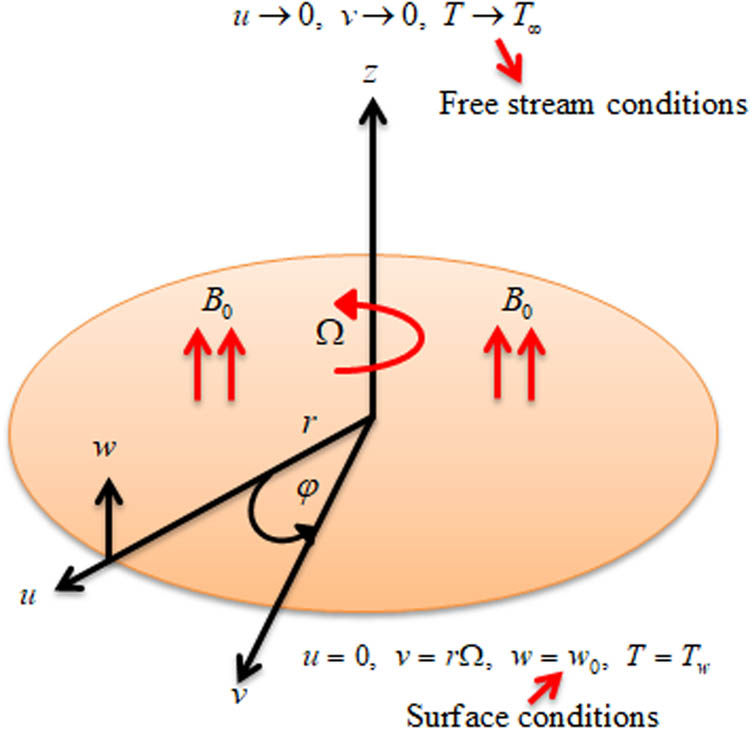
Geometry of the flow problem.
The leading equations for the present model on the base of the above-mentioned flow assumptions are as follows [58–61]:
The boundary conditions are as follows:
where
2.1 Suggested thermophysical properties of nanofluid
According to the study of Graham [62] and Gosukonda et al. [63], the viscosity model is deliberated as:
where
In 1998, first, the density was discussed by Pak and Cho [64]. After this, a lot of research and scientists [65–67] have discussed the behavior of the density in different flow problems.
The heat capacitance was first offered by Pak and Cho [64] and deliberated as:
where
In 1962, Hamilton and Crosser [68] initially discussed the thermal conductivity of the nanofluid and discussed as:
where
The electrical conductivity was initially presented by Cruz et al. [69] and is defined as:
where
The physical characteristics of nanoparticles and base fluid are depicted in Table 1.
Thermophysical characteristics of the base liquid and nanoparticles
| Property | Water |
|
|---|---|---|
|
|
4,179 | 880 |
|
|
997.1 | 3,890 |
|
|
0.613 | 35 |
|
|
5.5 × 10⁻⁶ | 3.5 × 10⁷ |
In the present analysis, the similarity transformations are discussed [58–61]:
By applying the above similarity transformations in equation (12), equations (2)–(5) are converted into following form:
and transformed boundary conditions:
The leading dimensionless parameters from the present investigation are discussed here. The similarity variable is
Some physical quantities are described as:
Now, the dimensionless forms of
where
3 Homotopy analysis method solution
The initial guesses and linear operator for the present case are as follows:
As such,
and
3.1 Zeroth-order deformation problems
The zero-order deformation problems are discussed as:
Here, the embedding parameter is
For
According to Taylor’s series expansion, we have
By putting
3.2 mth-order deformation problems
The mth-order form of the problem is
With the assistance of particular solution, the general solution of the present enquiry is achieved:
4 Results and discussion
This segment explains that the physical significance of the MHD flow of water-based nanofluid containing
Effects of
|
|
|
|
|||
|---|---|---|---|---|---|
|
|
|
|
|
||
| 0.1 | 0.273832 | 0.273829 | 0.024810 | 0.034812 | |
| 0.2 | 0.273833 | 0.273831 | 0.024811 | 0.034816 | |
| 0.3 | 0.272834 | 0.273834 | 0.024812 | 0.034818 | |
| 0.4 | 0.273836 | 0.273836 | 0.024813 | 0.034819 | |
| 0.01 | 0.253831 | 0.263532 | 0.283833 | 0.293832 | |
| 0.02 | 0.252962 | 0.264668 | 0.282969 | 0.292968 | |
| 0.03 | 0.252393 | 0.265793 | 0.282394 | 0.292393 | |
| 0.04 | 0.252095 | 0.266794 | 0.282096 | 0.292096 | |
Effects of
|
|
|
|
|||
|---|---|---|---|---|---|
|
|
|
|
|
||
| 0.1 | 2.891303 | 0.762811 | 0.819206 | 0.919206 | |
| 0.2 | 2.900508 | 0.772016 | 0.824415 | 0.920415 | |
| 0.3 | 2.919713 | 0.781221 | 0.835362 | 0.922624 | |
| 0.4 | 2.938918 | 0.690426 | 0.840834 | 0.923834 | |
| 0.01 | 3.110370 | 0.981878 | 1.226369 | 1.718265 | |
| 0.02 | 3.100556 | 0.978780 | 1.222499 | 1.712844 | |
| 0.03 | 3.094028 | 0.976719 | 1.219925 | 1.709237 | |
| 0.04 | 3.090648 | 0.975652 | 1.218593 | 1.707370 | |
Effects of
|
|
|
|
|
|
|---|---|---|---|---|
|
|
|
|||
| 0.1 | 1.583450 | 1.509312 | ||
| 0.2 | 2.155726 | 2.983882 | ||
| 0.3 | 3.716828 | 3.423517 | ||
| 0.4 | 4.266756 | 4.828410 | ||
| 0.1 | 2.624424 | 3.218437 | ||
| 0.2 | 3.716828 | 3.423517 | ||
| 0.3 | 4.809231 | 3.628597 | ||
| 0.4 | 4.901634 | 3.833677 | ||
| 0.01 | 1.703150 | 1.069990 | ||
| 0.02 | 1.819742 | 1.247410 | ||
| 0.03 | 1.951036 | 1.447200 | ||
| 0.04 | 1.998451 | 1.671524 |
From this examination, it is perceived that the heat rate transfer increases more for the case of nonlinear thermal radiation by increasing the temperature ratio parameter

Flow chart.

Effect of

Effect of

Effect of

Effect of

Effect of

Effect of

Effect of

Effect of

Effect of

Effect of

Effect of

Effect of

Effect of
5 Conclusion
In this work, an MHD flow of nanofluid containing
The enhancement in
For the case of lower or higher radius of
When the radius of
It is witnessed that
In case of lower or higher inter-particle spacing,
For the case of small or larger inter-particle spacing, increment in suction parameter led to enhance
-
Funding information: This research project is supported by Thailand Science Research and Innovation (TSRI) Basic Research Fund: Fiscal year 2023 under project number FRB660073/0164. The first author appreciates the support provided by Petchra Pra Jom Klao Ph.D. Research Scholarship (Grant No. 14/2562 and Grant No. 25/2563).
-
Author contributions: All authors have accepted responsibility for the entire content of this manuscript and approved its submission.
-
Conflict of interest: The authors state no conflict of interest.
References
[1] Shamshuddin MD, Eid MR. nth order reactive nanoliquid through convective elongated sheet under mixed convection flow with joule heating effects. J Therm Anal Calorim. 2022;147(5):3853–67.10.1007/s10973-021-10816-0Search in Google Scholar
[2] Tayyab M, Siddique I, Jarad F, Ashraf MK, Ali B. Numerical solution of 3D rotating nanofluid flow subject to Darcy-Forchheimer law, bio-convection and activation energy. S Afr J Chem Eng. 2022;40:48–56.10.1016/j.sajce.2022.01.005Search in Google Scholar
[3] Ramzan M, Rehman S, Junaid MS, Saeed A, Kumam P, Watthayu W, et al. Dynamics of Williamson Ferro-nanofluid due to bioconvection in the portfolio of magnetic dipole and activation energy over a stretching sheet. Int Commun Heat Mass Transf. 2022;137:106245.10.1016/j.icheatmasstransfer.2022.106245Search in Google Scholar
[4] Ahmad S, Naveed Khan M, Nadeem S. Unsteady three dimensional bioconvective flow of Maxwell nanofluid over an exponentially stretching sheet with variable thermal conductivity and chemical reaction. Int J Ambient Energy. 2022;12:1–11.10.1080/01430750.2022.2029765Search in Google Scholar
[5] Abd-Alla AM, Mohamed RA, Abo-Dahab SM, Soliman MS. Rotation and initial stress effect on MHD peristaltic flow of reacting radiating fourth-grade nanofluid with viscous dissipation and Joule heating. Waves Random Complex Media. 2022;1–35.10.1080/17455030.2022.2072972Search in Google Scholar
[6] Dawar A, Saeed A, Kumam P. Magneto-hydrothermal analysis of copper and copper oxide nanoparticles between two parallel plates with Brownian motion and thermophoresis effects. Int Commun Heat Mass Transf. 2022;133:105982.10.1016/j.icheatmasstransfer.2022.105982Search in Google Scholar
[7] Hafeez A, Khan M, Ahmed A, Ahmed J. Features of Cattaneo-Christov double diffusion theory on the flow of non-Newtonian Oldroyd-B nanofluid with Joule heating. Appl Nanosci. 2022;12(3):265–72.10.1007/s13204-020-01600-xSearch in Google Scholar
[8] Nabwey HA, Alshber SI, Rashad AM, Mahdy AEN. Influence of bioconvection and chemical reaction on magneto—Carreau nanofluid flow through an inclined cylinder. Mathematics. 2022;10(3):504.10.3390/math10030504Search in Google Scholar
[9] Shafiq A, Çolak AB, Sindhu TN. Modeling of Soret and Dufour’s convective heat transfer in nanofluid flow through a moving needle with artificial neural network. Arab J Sci Eng. 2022;1–14.10.1007/s13369-022-06945-9Search in Google Scholar
[10] Çolak AB, Shafiq A, Sindhu TN. Modeling of Darcy–Forchheimer bioconvective Powell Eyring nanofluid with artificial neural network. Chin J Phys. 2022;77:2435–53.10.1016/j.cjph.2022.04.004Search in Google Scholar
[11] Shafiq A, Mebarek-Oudina F, Sindhu TN, Rasool G. Sensitivity analysis for Walters-B nanoliquid flow over a radiative Riga surface by RSM. Sci Iran. 2022;29(3):1236–49.10.24200/sci.2021.58293.5662Search in Google Scholar
[12] Bhatti MM, Ellahi R, Doranehgard MH. Numerical study on the hybrid nanofluid (Co3O4-Go/H2O) flow over a circular elastic surface with non-Darcy medium: Application in solar energy. J Mol Liq. 2022;361:119655.10.1016/j.molliq.2022.119655Search in Google Scholar
[13] Rashidi MM, Mahariq I, Alhuyi Nazari M, Accouche O, Bhatti MM. Comprehensive review on exergy analysis of shell and tube heat exchangers. J Therm Anal Calorim. 2022;147:12301–11.10.1007/s10973-022-11478-2Search in Google Scholar
[14] Algehyne EA, Alharbi AF, Saeed A, Dawar A, Ramzan M, Kumam P, et al. Analysis of the MHD partially ionized GO-Ag/water and GO-Ag/kerosene oil hybrid nanofluids flow over a stretching surface with Cattaneo–Christov double diffusion model: A comparative study. Int Commun Heat Mass Transf. 2022;136:106205.10.1016/j.icheatmasstransfer.2022.106205Search in Google Scholar
[15] Muhammad R, Dawar A, Saeed A, Kumam P, Sitthithakerngkiet K, Lone SA, et al. Analysis of the partially ionized kerosene oil-based ternary nanofluid flow over a convectively heated rotating surface. Open Phys. 2022;201:507–25.10.1515/phys-2022-0055Search in Google Scholar
[16] Ramzan M, Khan NS, Kumam P. Mechanical analysis of non-Newtonian nanofluid past a thin needle with dipole effect and entropic characteristics. Sci Rep. 2021;11(1):1–25.10.1038/s41598-021-98128-zSearch in Google Scholar PubMed PubMed Central
[17] Dawar A, Saeed A, Kumam P. Magneto-hydrothermal analysis of copper and copper oxide nanoparticles between two parallel plates with Brownian motion and thermophoresis effects. Int Commun Heat Mass Transf. 2022;133:105982.10.1016/j.icheatmasstransfer.2022.105982Search in Google Scholar
[18] Khan U, Zaib A, Ishak A, Sherif ESM, Waini I, Chu YM, et al. Radiative mixed convective flow induced by hybrid nanofluid over a porous vertical cylinder in a porous media with irregular heat sink/source. Case Stud. Therm Eng. 2022;30:101711.10.1016/j.csite.2021.101711Search in Google Scholar
[19] Acharya N, Mabood F, Shahzad SA, Badruddin IA. Hydrothermal variations of radiative nanofluid flow by the influence of nanoparticles diameter and nanolayer. Int Commun Heat Mass Transf. 2022;130:105781.10.1016/j.icheatmasstransfer.2021.105781Search in Google Scholar
[20] Cao W, Animasaun IL, Yook SJ, Oladipupo VA, Ji X. Simulation of the dynamics of colloidal mixture of water with various nanoparticles at different levels of partial slip: Ternary-hybrid nanofluid. Int Commun Heat Mass Transf. 2022;135:106069.10.1016/j.icheatmasstransfer.2022.106069Search in Google Scholar
[21] Gangadhar K, Venkata Subba Rao M, Surekha P, Kannan T. Shape effects on 3D MHD micropolar Au-MgO/blood hybrid nanofluid with Joule Heating. Int J Ambient Energy. 2022;1–32.10.1080/01430750.2022.2095530Search in Google Scholar
[22] Akram J, Akbar NS, Tripathi D. Thermal analysis on MHD flow of ethylene glycol-based BNNTs nanofluids via peristaltically induced electroosmotic pumping in a curved microchannel. Arab J Sci Eng. 2022;47(6):7487–503.10.1007/s13369-021-06173-7Search in Google Scholar
[23] Fares R, Mebarek-Oudina F, Aissa A, Bilal SM, Öztop HF. Optimal entropy generation in Darcy-Forchheimer magnetized flow in a square enclosure filled with silver based water nanoliquid. J Therm Anal Calorim. 2022;147(2):1571–81.10.1007/s10973-020-10518-zSearch in Google Scholar
[24] Ramzan M, Shah Z, Kumam P, Khan W, Watthayu W, Kumam W, et al. Bidirectional flow of MHD nanofluid with Hall current and Cattaneo-Christove heat flux toward the stretching surface. PLoS one. 2022;17(4):e0264208.10.1371/journal.pone.0264208Search in Google Scholar PubMed PubMed Central
[25] Waini I, Ishak A, Pop I. Radiative and magnetohydrodynamic micropolar hybrid nanofluid flow over a shrinking sheet with Joule heating and viscous dissipation effects. Neural Comput Appl. 2022;34(5):3783–94.10.1007/s00521-021-06640-0Search in Google Scholar
[26] Gumber P, Yaseen M, Rawat SK, Kumar M. Heat transfer in micropolar hybrid nanofluid flow past a vertical plate in the presence of thermal radiation and suction/injection effects. Partial Differ Equ Appl Math. 2022;5:100240.10.1016/j.padiff.2021.100240Search in Google Scholar
[27] Acharya N. Spectral simulation to investigate the effects of nanoparticle diameter and nanolayer on the ferrofluid flow over a slippery rotating disk in the presence of low oscillating magnetic field. Heat Transf. 2021;50(6):5951–81.10.1002/htj.22157Search in Google Scholar
[28] Acharya N. Framing the impacts of highly oscillating magnetic field on the ferrofluid flow over a spinning disk considering nanoparticle diameter and solid–liquid interfacial layer. J Heat Trans. 2020;142(10).10.1115/1.4047503Search in Google Scholar
[29] Acharya N. Spectral simulation on the flow patterns and thermal control of radiative nanofluid spraying on an inclined revolving disk considering the effect of nanoparticle diameter and Solid–Liquid interfacial layer. J Heat Trans. 2022;144(9):092801.10.1115/1.4054595Search in Google Scholar
[30] Asogwa KK, Mebarek-Oudina F, Animasaun IL. Comparative investigation of water-based Al2O3 nanoparticles through water-based CuO nanoparticles over an exponentially accelerated radiative Riga plate surface via heat transport. Arab J Sci Eng. 2022;47:8721–38.10.1007/s13369-021-06355-3Search in Google Scholar
[31] Bhatti MM, Bég OA, Abdelsalam SI. Computational framework of magnetized MgO–Ni/water-based stagnation nanoflow past an elastic stretching surface: Application in solar energy coatings. Nanomaterials. 2022;12(7):1049.10.3390/nano12071049Search in Google Scholar PubMed PubMed Central
[32] Dawar A, Wakif A, Saeed A, Shah Z, Muhammad T, Kumam P, et al. Significance of Lorentz forces on Jeffrey nanofluid flows over a convectively heated flat surface featured by multiple velocity slips and dual stretching constraint: a homotopy analysis approach. J Comput Des Eng. 2022;9(2):564–82.10.1093/jcde/qwac019Search in Google Scholar
[33] Dawar A, Bonyah E, Islam S, Alshehri A, Shah Z. Theoretical analysis of Cu-H2O, Al2O3-H2O, and TiO2-H2O nanofluid flow past a rotating disk with velocity slip and convective conditions. J Nanomater. 2021.10.1155/2021/5471813Search in Google Scholar
[34] Dawar A, Wakif A, Thumma T, Shah NA. Towards a new MHD non-homogeneous convective nanofluid flow model for simulating a rotating inclined thin layer of sodium alginate-based Iron oxide exposed to incident solar energy. Int Commun Heat Mass Transf. 2022;130:105800.10.1016/j.icheatmasstransfer.2021.105800Search in Google Scholar
[35] Alfvén H. Existence of electromagnetic-hydrodynamic waves. Nature. 1942;150(3805):405–6.10.1038/150405d0Search in Google Scholar
[36] Eswaramoorthi S, Divya S, Faisal M, Namgyel N. Entropy and heat transfer analysis for MHD flow of-water-based nanofluid on a heated 3D plate with nonlinear radiation. Math Probl Eng; 2022.10.1155/2022/7319988Search in Google Scholar
[37] Bhatti MM, Arain MB, Zeeshan A, Ellahi R, Doranehgard MH. Swimming of Gyrotactic Microorganism in MHD Williamson nanofluid flow between rotating circular plates embedded in porous medium: Application of thermal energy storage. J Energy Storage. 2022;45:103511.10.1016/j.est.2021.103511Search in Google Scholar
[38] Khan MR, Mao S, Deebani W, Elsiddieg AM. Numerical analysis of heat transfer and friction drag relating to the effect of Joule heating, viscous dissipation and heat generation/absorption in aligned MHD slip flow of a nanofluid. Int Commun Heat Mass Transf. 2022;131:105843.10.1016/j.icheatmasstransfer.2021.105843Search in Google Scholar
[39] Swain K, Mebarek-Oudina F, Abo-Dahab SM. Influence of MWCNT/Fe3O4 hybrid nanoparticles on an exponentially porous shrinking sheet with chemical reaction and slip boundary conditions. J Therm Anal Calorim. 2022;147(2):1561–70.10.1007/s10973-020-10432-4Search in Google Scholar
[40] Nandi S, Kumbhakar B, Sarkar S. MHD stagnation point flow of Fe3O4/Cu/Ag-CH3OH nanofluid along a convectively heated stretching sheet with partial slip and activation energy: Numerical and statistical approach. Int Commun Heat Mass Transf. 2022;130:105791.10.1016/j.icheatmasstransfer.2021.105791Search in Google Scholar
[41] Ramzan M, Dawar A, Saeed A, Kumam P, Watthayu W, Kumam W, et al. Heat transfer analysis of the mixed convective flow of magnetohydrodynamic hybrid nanofluid past a stretching sheet with velocity and thermal slip conditions. PLoS one. 2021;16(12):e0260854.10.1371/journal.pone.0260854Search in Google Scholar PubMed PubMed Central
[42] Ramzan M, Saeed A, Kumam P, Ahmad Z, Junaid MS, Khan D, et al. Influences of Soret and Dufour numbers on mixed convective and chemically reactive Casson fluids flow towards an inclined flat plate. Heat Transf;2022.10.1002/htj.22505Search in Google Scholar
[43] Joshi N, Upreti H, Pandey AK. MHD Darcy-Forchheimer Cu-Ag/H2O-C2H6O2 hybrid nanofluid flow via a porous stretching sheet with suction/blowing and viscous dissipation. Int J Comput Methods Eng. 2022;23:527–35.10.1080/15502287.2022.2030426Search in Google Scholar
[44] Hayat T, Shafiq A, Alsaedi A. MHD axisymmetric flow of third grade fluid by a stretching cylinder. Alex Eng J. 2015;54(2):205–12.10.1016/j.aej.2015.03.013Search in Google Scholar
[45] Hayat T, Shafiq A, Alsaedi A. Effect of Joule heating and thermal radiation in flow of third grade fluid over radiative surface. PLoS One. 2014;9(1):e83153.10.1371/journal.pone.0083153Search in Google Scholar PubMed PubMed Central
[46] Sharma RP, Shaw S. MHD Non-Newtonian fluid flow past a stretching sheet under the influence of non-linear radiation and viscous dissipation. J Appl Comput Mech. 2022;8(3):949–61.Search in Google Scholar
[47] Raja MAZ, Tabassum R, El-Zahar ER, Shoaib M, Khan MI, Malik MY, et al. Intelligent computing through neural networks for entropy generation in MHD third-grade nanofluid under chemical reaction and viscous dissipation. Waves Random Complex Media. 2022;1–25.10.1080/17455030.2022.2044095Search in Google Scholar
[48] Bhatti MM, Bég OA, Ellahi R, Abbas T. Natural convection non-Newtonian EMHD dissipative flow through a microchannel containing a non-Darcy porous medium: Homotopy perturbation method study. Qual Theory Dyn Syst. 2022;21(4):1–27.10.1007/s12346-022-00625-7Search in Google Scholar
[49] Al Nuwairan M, Hafeez A, Khalid A, Syed A. Heat generation/absorption effects on radiative stagnation point flow of Maxwell nanofluid by a rotating disk influenced by activation energy. Case Stud Therm Eng. 2022;35:102047.10.1016/j.csite.2022.102047Search in Google Scholar
[50] Alzahrani F, Khan MI. Entropy generation and Joule heating applications for Darcy Forchheimer flow of Ree-Eyring nanofluid due to double rotating disks with artificial neural network. Alex Eng J. 2022;61(5):3679–89.10.1016/j.aej.2021.08.071Search in Google Scholar
[51] Ayub A, Sabir Z, Shah SZH, Wahab HA, Sadat R, Ali MR, et al. Effects of homogeneous-heterogeneous and Lorentz forces on 3-D radiative magnetized cross nanofluid using two rotating disks. Int Commun Heat Mass Transf. 2022;130:105778.10.1016/j.icheatmasstransfer.2021.105778Search in Google Scholar
[52] Waini I, Ishak A, Pop I. Multiple solutions of the unsteady hybrid nanofluid flow over a rotating disk with stability analysis. Eur J Mech B Fluids. 2022;94:121–7.10.1016/j.euromechflu.2022.02.011Search in Google Scholar
[53] Naveen Kumar R, Mallikarjuna HB, Tigalappa N, Punith Gowda RJ, Umrao Sarwe D. Carbon nanotubes suspended dusty nanofluid flow over stretching porous rotating disk with non-uniform heat source/sink. Int J Comput Methods Eng. 2022;23(2):119–28.10.1080/15502287.2021.1920645Search in Google Scholar
[54] Sun TC, Uddin I, Raja MAZ, Shoaib M, Ullah I, Jamshed W, Islam S, et al. Numerical investigation of thin-film flow over a rotating disk subject to the heat source and nonlinear radiation: Lobatto IIIA approach. Waves Random Complex Media. 2022;1–15.10.1080/17455030.2022.2026526Search in Google Scholar
[55] Ramzan M, Khan NS, Kumam P, Khan R. A numerical study of chemical reaction in a nanofluid flow due to rotating disk in the presence of magnetic field. Sci Rep. 2021;11(1):1–24.10.1038/s41598-021-98881-1Search in Google Scholar PubMed PubMed Central
[56] Ghaffari A, Muhammad T, Mustafa I. Heat transfer enhancement in a power-law nanofluid flow between two rotating stretchable disks. Pramana. 2022;96(1):1–11.10.1007/s12043-021-02272-0Search in Google Scholar
[57] Andersson HI, De Korte E. MHD flow of a power-law fluid over a rotating disk. Eur J Mech B Fluids. 2002;21(3):317–24.10.1016/S0997-7546(02)01184-6Search in Google Scholar
[58] Shamshuddin MD, Akkurt N, Saeed A, Kumam P. Radiation mechanism on dissipative ternary hybrid nanoliquid flow through rotating disk encountered by Hall currents: HAM solution. Alex Eng J; 2022.10.1016/j.aej.2022.10.021Search in Google Scholar
[59] Alsallami SA, Khan SU, Ghaffari A, Khan MI, El-Shorbagy MA, Khan MR. Numerical simulations for optimised flow of second-grade nanofluid due to rotating disk with nonlinear thermal radiation: Chebyshev spectral collocation method analysis. Pramana. 2022;96(2):1–10.10.1007/s12043-022-02337-8Search in Google Scholar
[60] Khan U, Ahmed N, Mohyud-Din ST, Alharbi SO, Khan I. Thermal improvement in magnetized nanofluid for multiple shapes nanoparticles over radiative rotating disk. Alex Eng J. 2022;61(3):2318–29.10.1016/j.aej.2021.07.021Search in Google Scholar
[61] Dawar A, Islam S, Shah Z, Mahmuod SR, Lone SA. Dynamics of inter-particle spacing, nanoparticle radius, inclined magnetic field and nonlinear thermal radiation on the water-based copper nanofluid flow past a convectively heated stretching surface with mass flux condition: A strong suction case. Int Commun Heat Mass Transf. 2022;137:106286.10.1016/j.icheatmasstransfer.2022.106286Search in Google Scholar
[62] Graham AL. On the viscosity of suspensions of solid spheres. Appl Sci Res. 1981;37(3):275–86.10.1007/BF00951252Search in Google Scholar
[63] Gosukonda S, Gorti VS, Baluguri SB, Sakam SR. Particle spacing and chemical reaction effects on convective heat transfer through a nano-fluid in cylindrical annulus. Procedia Eng. 2015;127:263–70.10.1016/j.proeng.2015.11.359Search in Google Scholar
[64] Pak BC, Cho YI. Hydrodynamic and heat transfer study of dispersed fluids with submicron metallic oxide particles. Exp Heat Transf. 1998;11(2):151–70.10.1080/08916159808946559Search in Google Scholar
[65] Shah NA, Animasaun IL, Chung JD, Wakif A, Alao FI, Raju CSK, et al. Significance of nanoparticle’s radius, heat flux due to concentration gradient, and mass flux due to temperature gradient: The case of Water conveying copper nanoparticles. Sci Rep. 2021;11(1):1–11.10.1038/s41598-021-81417-ySearch in Google Scholar PubMed PubMed Central
[66] Acharya N. Spectral quasi linearization simulation on the hydrothermal behavior of hybrid nanofluid spraying on an inclined spinning disk. Partial Differ Equ Appl Math. 2021;4:100094.10.1016/j.padiff.2021.100094Search in Google Scholar
[67] Khan U, Zaib A, Khan I, Nisar KS. Insight into the dynamics of transient blood conveying gold nanoparticles when entropy generation and Lorentz force are significant. Int Commun Heat Mass Transf. 2021;127:105415.10.1016/j.icheatmasstransfer.2021.105415Search in Google Scholar
[68] Hamilton RL, Crosser OK. Thermal conductivity of heterogeneous two-component systems. Ind Eng Chem. 1962;1(3):187–91.10.1021/i160003a005Search in Google Scholar
[69] Cruz RCD, Reinshagen J, Oberacker R, Segadães AM, Hoffmann MJ. Electrical conductivity and stability of concentrated aqueous alumina suspensions. J Colloid Interface Sci. 2005;286(2):579–88.10.1016/j.jcis.2005.02.025Search in Google Scholar PubMed
[70] Kumar KG, Rudraswamy NG, Gireesha BJ, Manjunatha S. Nonlinear thermal radiation effect on Williamson fluid with particle-liquid suspension past a stretching surface. Results Phys. 2017;7:3196–202.10.1016/j.rinp.2017.08.027Search in Google Scholar
© 2023 the author(s), published by De Gruyter
This work is licensed under the Creative Commons Attribution 4.0 International License.
Articles in the same Issue
- Research Articles
- Preparation of CdS–Ag2S nanocomposites by ultrasound-assisted UV photolysis treatment and its visible light photocatalysis activity
- Significance of nanoparticle radius and inter-particle spacing toward the radiative water-based alumina nanofluid flow over a rotating disk
- Aptamer-based detection of serotonin based on the rapid in situ synthesis of colorimetric gold nanoparticles
- Investigation of the nucleation and growth behavior of Ti2AlC and Ti3AlC nano-precipitates in TiAl alloys
- Dynamic recrystallization behavior and nucleation mechanism of dual-scale SiCp/A356 composites processed by P/M method
- High mechanical performance of 3-aminopropyl triethoxy silane/epoxy cured in a sandwich construction of 3D carbon felts foam and woven basalt fibers
- Applying solution of spray polyurea elastomer in asphalt binder: Feasibility analysis and DSR study based on the MSCR and LAS tests
- Study on the chronic toxicity and carcinogenicity of iron-based bioabsorbable stents
- Influence of microalloying with B on the microstructure and properties of brazed joints with Ag–Cu–Zn–Sn filler metal
- Thermohydraulic performance of thermal system integrated with twisted turbulator inserts using ternary hybrid nanofluids
- Study of mechanical properties of epoxy/graphene and epoxy/halloysite nanocomposites
- Effects of CaO addition on the CuW composite containing micro- and nano-sized tungsten particles synthesized via aluminothermic coupling with silicothermic reduction
- Cu and Al2O3-based hybrid nanofluid flow through a porous cavity
- Design of functional vancomycin-embedded bio-derived extracellular matrix hydrogels for repairing infectious bone defects
- Study on nanocrystalline coating prepared by electro-spraying 316L metal wire and its corrosion performance
- Axial compression performance of CFST columns reinforced by ultra-high-performance nano-concrete under long-term loading
- Tungsten trioxide nanocomposite for conventional soliton and noise-like pulse generation in anomalous dispersion laser cavity
- Microstructure and electrical contact behavior of the nano-yttria-modified Cu-Al2O3/30Mo/3SiC composite
- Melting rheology in thermally stratified graphene-mineral oil reservoir (third-grade nanofluid) with slip condition
- Re-examination of nonlinear vibration and nonlinear bending of porous sandwich cylindrical panels reinforced by graphene platelets
- Parametric simulation of hybrid nanofluid flow consisting of cobalt ferrite nanoparticles with second-order slip and variable viscosity over an extending surface
- Chitosan-capped silver nanoparticles with potent and selective intrinsic activity against the breast cancer cells
- Multi-core/shell SiO2@Al2O3 nanostructures deposited on Ti3AlC2 to enhance high-temperature stability and microwave absorption properties
- Solution-processed Bi2S3/BiVO4/TiO2 ternary heterojunction photoanode with enhanced photoelectrochemical performance
- Electroporation effect of ZnO nanoarrays under low voltage for water disinfection
- NIR-II window absorbing graphene oxide-coated gold nanorods and graphene quantum dot-coupled gold nanorods for photothermal cancer therapy
- Nonlinear three-dimensional stability characteristics of geometrically imperfect nanoshells under axial compression and surface residual stress
- Investigation of different nanoparticles properties on the thermal conductivity and viscosity of nanofluids by molecular dynamics simulation
- Optimized Cu2O-{100} facet for generation of different reactive oxidative species via peroxymonosulfate activation at specific pH values to efficient acetaminophen removal
- Brownian and thermal diffusivity impact due to the Maxwell nanofluid (graphene/engine oil) flow with motile microorganisms and Joule heating
- Appraising the dielectric properties and the effectiveness of electromagnetic shielding of graphene reinforced silicone rubber nanocomposite
- Synthesis of Ag and Cu nanoparticles by plasma discharge in inorganic salt solutions
- Low-cost and large-scale preparation of ultrafine TiO2@C hybrids for high-performance degradation of methyl orange and formaldehyde under visible light
- Utilization of waste glass with natural pozzolan in the production of self-glazed glass-ceramic materials
- Mechanical performance of date palm fiber-reinforced concrete modified with nano-activated carbon
- Melting point of dried gold nanoparticles prepared with ultrasonic spray pyrolysis and lyophilisation
- Graphene nanofibers: A modern approach towards tailored gypsum composites
- Role of localized magnetic field in vortex generation in tri-hybrid nanofluid flow: A numerical approach
- Intelligent computing for the double-diffusive peristaltic rheology of magneto couple stress nanomaterials
- Bioconvection transport of upper convected Maxwell nanoliquid with gyrotactic microorganism, nonlinear thermal radiation, and chemical reaction
- 3D printing of porous Ti6Al4V bone tissue engineering scaffold and surface anodization preparation of nanotubes to enhance its biological property
- Bioinspired ferromagnetic CoFe2O4 nanoparticles: Potential pharmaceutical and medical applications
- Significance of gyrotactic microorganisms on the MHD tangent hyperbolic nanofluid flow across an elastic slender surface: Numerical analysis
- Performance of polycarboxylate superplasticisers in seawater-blended cement: Effect from chemical structure and nano modification
- Entropy minimization of GO–Ag/KO cross-hybrid nanofluid over a convectively heated surface
- Oxygen plasma assisted room temperature bonding for manufacturing SU-8 polymer micro/nanoscale nozzle
- Performance and mechanism of CO2 reduction by DBD-coupled mesoporous SiO2
- Polyarylene ether nitrile dielectric films modified by HNTs@PDA hybrids for high-temperature resistant organic electronics field
- Exploration of generalized two-phase free convection magnetohydrodynamic flow of dusty tetra-hybrid Casson nanofluid between parallel microplates
- Hygrothermal bending analysis of sandwich nanoplates with FG porous core and piezomagnetic faces via nonlocal strain gradient theory
- Design and optimization of a TiO2/RGO-supported epoxy multilayer microwave absorber by the modified local best particle swarm optimization algorithm
- Mechanical properties and frost resistance of recycled brick aggregate concrete modified by nano-SiO2
- Self-template synthesis of hollow flower-like NiCo2O4 nanoparticles as an efficient bifunctional catalyst for oxygen reduction and oxygen evolution in alkaline media
- High-performance wearable flexible strain sensors based on an AgNWs/rGO/TPU electrospun nanofiber film for monitoring human activities
- High-performance lithium–selenium batteries enabled by nitrogen-doped porous carbon from peanut meal
- Investigating effects of Lorentz forces and convective heating on ternary hybrid nanofluid flow over a curved surface using homotopy analysis method
- Exploring the potential of biogenic magnesium oxide nanoparticles for cytotoxicity: In vitro and in silico studies on HCT116 and HT29 cells and DPPH radical scavenging
- Enhanced visible-light-driven photocatalytic degradation of azo dyes by heteroatom-doped nickel tungstate nanoparticles
- A facile method to synthesize nZVI-doped polypyrrole-based carbon nanotube for Ag(i) removal
- Improved osseointegration of dental titanium implants by TiO2 nanotube arrays with self-assembled recombinant IGF-1 in type 2 diabetes mellitus rat model
- Functionalized SWCNTs@Ag–TiO2 nanocomposites induce ROS-mediated apoptosis and autophagy in liver cancer cells
- Triboelectric nanogenerator based on a water droplet spring with a concave spherical surface for harvesting wave energy and detecting pressure
- A mathematical approach for modeling the blood flow containing nanoparticles by employing the Buongiorno’s model
- Molecular dynamics study on dynamic interlayer friction of graphene and its strain effect
- Induction of apoptosis and autophagy via regulation of AKT and JNK mitogen-activated protein kinase pathways in breast cancer cell lines exposed to gold nanoparticles loaded with TNF-α and combined with doxorubicin
- Effect of PVA fibers on durability of nano-SiO2-reinforced cement-based composites subjected to wet-thermal and chloride salt-coupled environment
- Effect of polyvinyl alcohol fibers on mechanical properties of nano-SiO2-reinforced geopolymer composites under a complex environment
- In vitro studies of titanium dioxide nanoparticles modified with glutathione as a potential drug delivery system
- Comparative investigations of Ag/H2O nanofluid and Ag-CuO/H2O hybrid nanofluid with Darcy-Forchheimer flow over a curved surface
- Study on deformation characteristics of multi-pass continuous drawing of micro copper wire based on crystal plasticity finite element method
- Properties of ultra-high-performance self-compacting fiber-reinforced concrete modified with nanomaterials
- Prediction of lap shear strength of GNP and TiO2/epoxy nanocomposite adhesives
- A novel exploration of how localized magnetic field affects vortex generation of trihybrid nanofluids
- Fabrication and physicochemical characterization of copper oxide–pyrrhotite nanocomposites for the cytotoxic effects on HepG2 cells and the mechanism
- Thermal radiative flow of cross nanofluid due to a stretched cylinder containing microorganisms
- In vitro study of the biphasic calcium phosphate/chitosan hybrid biomaterial scaffold fabricated via solvent casting and evaporation technique for bone regeneration
- Insights into the thermal characteristics and dynamics of stagnant blood conveying titanium oxide, alumina, and silver nanoparticles subject to Lorentz force and internal heating over a curved surface
- Effects of nano-SiO2 additives on carbon fiber-reinforced fly ash–slag geopolymer composites performance: Workability, mechanical properties, and microstructure
- Energy bandgap and thermal characteristics of non-Darcian MHD rotating hybridity nanofluid thin film flow: Nanotechnology application
- Green synthesis and characterization of ginger-extract-based oxali-palladium nanoparticles for colorectal cancer: Downregulation of REG4 and apoptosis induction
- Abnormal evolution of resistivity and microstructure of annealed Ag nanoparticles/Ag–Mo films
- Preparation of water-based dextran-coated Fe3O4 magnetic fluid for magnetic hyperthermia
- Statistical investigations and morphological aspects of cross-rheological material suspended in transportation of alumina, silica, titanium, and ethylene glycol via the Galerkin algorithm
- Effect of CNT film interleaves on the flexural properties and strength after impact of CFRP composites
- Self-assembled nanoscale entities: Preparative process optimization, payload release, and enhanced bioavailability of thymoquinone natural product
- Structure–mechanical property relationships of 3D-printed porous polydimethylsiloxane films
- Nonlinear thermal radiation and the slip effect on a 3D bioconvection flow of the Casson nanofluid in a rotating frame via a homotopy analysis mechanism
- Residual mechanical properties of concrete incorporated with nano supplementary cementitious materials exposed to elevated temperature
- Time-independent three-dimensional flow of a water-based hybrid nanofluid past a Riga plate with slips and convective conditions: A homotopic solution
- Lightweight and high-strength polyarylene ether nitrile-based composites for efficient electromagnetic interference shielding
- Review Articles
- Recycling waste sources into nanocomposites of graphene materials: Overview from an energy-focused perspective
- Hybrid nanofiller reinforcement in thermoset and biothermoset applications: A review
- Current state-of-the-art review of nanotechnology-based therapeutics for viral pandemics: Special attention to COVID-19
- Solid lipid nanoparticles for targeted natural and synthetic drugs delivery in high-incidence cancers, and other diseases: Roles of preparation methods, lipid composition, transitional stability, and release profiles in nanocarriers’ development
- Critical review on experimental and theoretical studies of elastic properties of wurtzite-structured ZnO nanowires
- Polyurea micro-/nano-capsule applications in construction industry: A review
- A comprehensive review and clinical guide to molecular and serological diagnostic tests and future development: In vitro diagnostic testing for COVID-19
- Recent advances in electrocatalytic oxidation of 5-hydroxymethylfurfural to 2,5-furandicarboxylic acid: Mechanism, catalyst, coupling system
- Research progress and prospect of silica-based polymer nanofluids in enhanced oil recovery
- Review of the pharmacokinetics of nanodrugs
- Engineered nanoflowers, nanotrees, nanostars, nanodendrites, and nanoleaves for biomedical applications
- Research progress of biopolymers combined with stem cells in the repair of intrauterine adhesions
- Progress in FEM modeling on mechanical and electromechanical properties of carbon nanotube cement-based composites
- Antifouling induced by surface wettability of poly(dimethyl siloxane) and its nanocomposites
- TiO2 aerogel composite high-efficiency photocatalysts for environmental treatment and hydrogen energy production
- Structural properties of alumina surfaces and their roles in the synthesis of environmentally persistent free radicals (EPFRs)
- Nanoparticles for the potential treatment of Alzheimer’s disease: A physiopathological approach
- Current status of synthesis and consolidation strategies for thermo-resistant nanoalloys and their general applications
- Recent research progress on the stimuli-responsive smart membrane: A review
- Dispersion of carbon nanotubes in aqueous cementitious materials: A review
- Applications of DNA tetrahedron nanostructure in cancer diagnosis and anticancer drugs delivery
- Magnetic nanoparticles in 3D-printed scaffolds for biomedical applications
- An overview of the synthesis of silicon carbide–boron carbide composite powders
- Organolead halide perovskites: Synthetic routes, structural features, and their potential in the development of photovoltaic
- Recent advancements in nanotechnology application on wood and bamboo materials: A review
- Application of aptamer-functionalized nanomaterials in molecular imaging of tumors
- Recent progress on corrosion mechanisms of graphene-reinforced metal matrix composites
- Research progress on preparation, modification, and application of phenolic aerogel
- Application of nanomaterials in early diagnosis of cancer
- Plant mediated-green synthesis of zinc oxide nanoparticles: An insight into biomedical applications
- Recent developments in terahertz quantum cascade lasers for practical applications
- Recent progress in dielectric/metal/dielectric electrodes for foldable light-emitting devices
- Nanocoatings for ballistic applications: A review
- A mini-review on MoS2 membrane for water desalination: Recent development and challenges
- Recent updates in nanotechnological advances for wound healing: A narrative review
- Recent advances in DNA nanomaterials for cancer diagnosis and treatment
- Electrochemical micro- and nanobiosensors for in vivo reactive oxygen/nitrogen species measurement in the brain
- Advances in organic–inorganic nanocomposites for cancer imaging and therapy
- Advancements in aluminum matrix composites reinforced with carbides and graphene: A comprehensive review
- Modification effects of nanosilica on asphalt binders: A review
- Decellularized extracellular matrix as a promising biomaterial for musculoskeletal tissue regeneration
- Review of the sol–gel method in preparing nano TiO2 for advanced oxidation process
- Micro/nano manufacturing aircraft surface with anti-icing and deicing performances: An overview
- Cell type-targeting nanoparticles in treating central nervous system diseases: Challenges and hopes
- An overview of hydrogen production from Al-based materials
- A review of application, modification, and prospect of melamine foam
- A review of the performance of fibre-reinforced composite laminates with carbon nanotubes
- Research on AFM tip-related nanofabrication of two-dimensional materials
- Advances in phase change building materials: An overview
- Development of graphene and graphene quantum dots toward biomedical engineering applications: A review
- Nanoremediation approaches for the mitigation of heavy metal contamination in vegetables: An overview
- Photodynamic therapy empowered by nanotechnology for oral and dental science: Progress and perspectives
- Biosynthesis of metal nanoparticles: Bioreduction and biomineralization
- Current diagnostic and therapeutic approaches for severe acute respiratory syndrome coronavirus-2 (SARS-COV-2) and the role of nanomaterial-based theragnosis in combating the pandemic
- Application of two-dimensional black phosphorus material in wound healing
- Special Issue on Advanced Nanomaterials and Composites for Energy Conversion and Storage - Part I
- Helical fluorinated carbon nanotubes/iron(iii) fluoride hybrid with multilevel transportation channels and rich active sites for lithium/fluorinated carbon primary battery
- The progress of cathode materials in aqueous zinc-ion batteries
- Special Issue on Advanced Nanomaterials for Carbon Capture, Environment and Utilization for Energy Sustainability - Part I
- Effect of polypropylene fiber and nano-silica on the compressive strength and frost resistance of recycled brick aggregate concrete
- Mechanochemical design of nanomaterials for catalytic applications with a benign-by-design focus
Articles in the same Issue
- Research Articles
- Preparation of CdS–Ag2S nanocomposites by ultrasound-assisted UV photolysis treatment and its visible light photocatalysis activity
- Significance of nanoparticle radius and inter-particle spacing toward the radiative water-based alumina nanofluid flow over a rotating disk
- Aptamer-based detection of serotonin based on the rapid in situ synthesis of colorimetric gold nanoparticles
- Investigation of the nucleation and growth behavior of Ti2AlC and Ti3AlC nano-precipitates in TiAl alloys
- Dynamic recrystallization behavior and nucleation mechanism of dual-scale SiCp/A356 composites processed by P/M method
- High mechanical performance of 3-aminopropyl triethoxy silane/epoxy cured in a sandwich construction of 3D carbon felts foam and woven basalt fibers
- Applying solution of spray polyurea elastomer in asphalt binder: Feasibility analysis and DSR study based on the MSCR and LAS tests
- Study on the chronic toxicity and carcinogenicity of iron-based bioabsorbable stents
- Influence of microalloying with B on the microstructure and properties of brazed joints with Ag–Cu–Zn–Sn filler metal
- Thermohydraulic performance of thermal system integrated with twisted turbulator inserts using ternary hybrid nanofluids
- Study of mechanical properties of epoxy/graphene and epoxy/halloysite nanocomposites
- Effects of CaO addition on the CuW composite containing micro- and nano-sized tungsten particles synthesized via aluminothermic coupling with silicothermic reduction
- Cu and Al2O3-based hybrid nanofluid flow through a porous cavity
- Design of functional vancomycin-embedded bio-derived extracellular matrix hydrogels for repairing infectious bone defects
- Study on nanocrystalline coating prepared by electro-spraying 316L metal wire and its corrosion performance
- Axial compression performance of CFST columns reinforced by ultra-high-performance nano-concrete under long-term loading
- Tungsten trioxide nanocomposite for conventional soliton and noise-like pulse generation in anomalous dispersion laser cavity
- Microstructure and electrical contact behavior of the nano-yttria-modified Cu-Al2O3/30Mo/3SiC composite
- Melting rheology in thermally stratified graphene-mineral oil reservoir (third-grade nanofluid) with slip condition
- Re-examination of nonlinear vibration and nonlinear bending of porous sandwich cylindrical panels reinforced by graphene platelets
- Parametric simulation of hybrid nanofluid flow consisting of cobalt ferrite nanoparticles with second-order slip and variable viscosity over an extending surface
- Chitosan-capped silver nanoparticles with potent and selective intrinsic activity against the breast cancer cells
- Multi-core/shell SiO2@Al2O3 nanostructures deposited on Ti3AlC2 to enhance high-temperature stability and microwave absorption properties
- Solution-processed Bi2S3/BiVO4/TiO2 ternary heterojunction photoanode with enhanced photoelectrochemical performance
- Electroporation effect of ZnO nanoarrays under low voltage for water disinfection
- NIR-II window absorbing graphene oxide-coated gold nanorods and graphene quantum dot-coupled gold nanorods for photothermal cancer therapy
- Nonlinear three-dimensional stability characteristics of geometrically imperfect nanoshells under axial compression and surface residual stress
- Investigation of different nanoparticles properties on the thermal conductivity and viscosity of nanofluids by molecular dynamics simulation
- Optimized Cu2O-{100} facet for generation of different reactive oxidative species via peroxymonosulfate activation at specific pH values to efficient acetaminophen removal
- Brownian and thermal diffusivity impact due to the Maxwell nanofluid (graphene/engine oil) flow with motile microorganisms and Joule heating
- Appraising the dielectric properties and the effectiveness of electromagnetic shielding of graphene reinforced silicone rubber nanocomposite
- Synthesis of Ag and Cu nanoparticles by plasma discharge in inorganic salt solutions
- Low-cost and large-scale preparation of ultrafine TiO2@C hybrids for high-performance degradation of methyl orange and formaldehyde under visible light
- Utilization of waste glass with natural pozzolan in the production of self-glazed glass-ceramic materials
- Mechanical performance of date palm fiber-reinforced concrete modified with nano-activated carbon
- Melting point of dried gold nanoparticles prepared with ultrasonic spray pyrolysis and lyophilisation
- Graphene nanofibers: A modern approach towards tailored gypsum composites
- Role of localized magnetic field in vortex generation in tri-hybrid nanofluid flow: A numerical approach
- Intelligent computing for the double-diffusive peristaltic rheology of magneto couple stress nanomaterials
- Bioconvection transport of upper convected Maxwell nanoliquid with gyrotactic microorganism, nonlinear thermal radiation, and chemical reaction
- 3D printing of porous Ti6Al4V bone tissue engineering scaffold and surface anodization preparation of nanotubes to enhance its biological property
- Bioinspired ferromagnetic CoFe2O4 nanoparticles: Potential pharmaceutical and medical applications
- Significance of gyrotactic microorganisms on the MHD tangent hyperbolic nanofluid flow across an elastic slender surface: Numerical analysis
- Performance of polycarboxylate superplasticisers in seawater-blended cement: Effect from chemical structure and nano modification
- Entropy minimization of GO–Ag/KO cross-hybrid nanofluid over a convectively heated surface
- Oxygen plasma assisted room temperature bonding for manufacturing SU-8 polymer micro/nanoscale nozzle
- Performance and mechanism of CO2 reduction by DBD-coupled mesoporous SiO2
- Polyarylene ether nitrile dielectric films modified by HNTs@PDA hybrids for high-temperature resistant organic electronics field
- Exploration of generalized two-phase free convection magnetohydrodynamic flow of dusty tetra-hybrid Casson nanofluid between parallel microplates
- Hygrothermal bending analysis of sandwich nanoplates with FG porous core and piezomagnetic faces via nonlocal strain gradient theory
- Design and optimization of a TiO2/RGO-supported epoxy multilayer microwave absorber by the modified local best particle swarm optimization algorithm
- Mechanical properties and frost resistance of recycled brick aggregate concrete modified by nano-SiO2
- Self-template synthesis of hollow flower-like NiCo2O4 nanoparticles as an efficient bifunctional catalyst for oxygen reduction and oxygen evolution in alkaline media
- High-performance wearable flexible strain sensors based on an AgNWs/rGO/TPU electrospun nanofiber film for monitoring human activities
- High-performance lithium–selenium batteries enabled by nitrogen-doped porous carbon from peanut meal
- Investigating effects of Lorentz forces and convective heating on ternary hybrid nanofluid flow over a curved surface using homotopy analysis method
- Exploring the potential of biogenic magnesium oxide nanoparticles for cytotoxicity: In vitro and in silico studies on HCT116 and HT29 cells and DPPH radical scavenging
- Enhanced visible-light-driven photocatalytic degradation of azo dyes by heteroatom-doped nickel tungstate nanoparticles
- A facile method to synthesize nZVI-doped polypyrrole-based carbon nanotube for Ag(i) removal
- Improved osseointegration of dental titanium implants by TiO2 nanotube arrays with self-assembled recombinant IGF-1 in type 2 diabetes mellitus rat model
- Functionalized SWCNTs@Ag–TiO2 nanocomposites induce ROS-mediated apoptosis and autophagy in liver cancer cells
- Triboelectric nanogenerator based on a water droplet spring with a concave spherical surface for harvesting wave energy and detecting pressure
- A mathematical approach for modeling the blood flow containing nanoparticles by employing the Buongiorno’s model
- Molecular dynamics study on dynamic interlayer friction of graphene and its strain effect
- Induction of apoptosis and autophagy via regulation of AKT and JNK mitogen-activated protein kinase pathways in breast cancer cell lines exposed to gold nanoparticles loaded with TNF-α and combined with doxorubicin
- Effect of PVA fibers on durability of nano-SiO2-reinforced cement-based composites subjected to wet-thermal and chloride salt-coupled environment
- Effect of polyvinyl alcohol fibers on mechanical properties of nano-SiO2-reinforced geopolymer composites under a complex environment
- In vitro studies of titanium dioxide nanoparticles modified with glutathione as a potential drug delivery system
- Comparative investigations of Ag/H2O nanofluid and Ag-CuO/H2O hybrid nanofluid with Darcy-Forchheimer flow over a curved surface
- Study on deformation characteristics of multi-pass continuous drawing of micro copper wire based on crystal plasticity finite element method
- Properties of ultra-high-performance self-compacting fiber-reinforced concrete modified with nanomaterials
- Prediction of lap shear strength of GNP and TiO2/epoxy nanocomposite adhesives
- A novel exploration of how localized magnetic field affects vortex generation of trihybrid nanofluids
- Fabrication and physicochemical characterization of copper oxide–pyrrhotite nanocomposites for the cytotoxic effects on HepG2 cells and the mechanism
- Thermal radiative flow of cross nanofluid due to a stretched cylinder containing microorganisms
- In vitro study of the biphasic calcium phosphate/chitosan hybrid biomaterial scaffold fabricated via solvent casting and evaporation technique for bone regeneration
- Insights into the thermal characteristics and dynamics of stagnant blood conveying titanium oxide, alumina, and silver nanoparticles subject to Lorentz force and internal heating over a curved surface
- Effects of nano-SiO2 additives on carbon fiber-reinforced fly ash–slag geopolymer composites performance: Workability, mechanical properties, and microstructure
- Energy bandgap and thermal characteristics of non-Darcian MHD rotating hybridity nanofluid thin film flow: Nanotechnology application
- Green synthesis and characterization of ginger-extract-based oxali-palladium nanoparticles for colorectal cancer: Downregulation of REG4 and apoptosis induction
- Abnormal evolution of resistivity and microstructure of annealed Ag nanoparticles/Ag–Mo films
- Preparation of water-based dextran-coated Fe3O4 magnetic fluid for magnetic hyperthermia
- Statistical investigations and morphological aspects of cross-rheological material suspended in transportation of alumina, silica, titanium, and ethylene glycol via the Galerkin algorithm
- Effect of CNT film interleaves on the flexural properties and strength after impact of CFRP composites
- Self-assembled nanoscale entities: Preparative process optimization, payload release, and enhanced bioavailability of thymoquinone natural product
- Structure–mechanical property relationships of 3D-printed porous polydimethylsiloxane films
- Nonlinear thermal radiation and the slip effect on a 3D bioconvection flow of the Casson nanofluid in a rotating frame via a homotopy analysis mechanism
- Residual mechanical properties of concrete incorporated with nano supplementary cementitious materials exposed to elevated temperature
- Time-independent three-dimensional flow of a water-based hybrid nanofluid past a Riga plate with slips and convective conditions: A homotopic solution
- Lightweight and high-strength polyarylene ether nitrile-based composites for efficient electromagnetic interference shielding
- Review Articles
- Recycling waste sources into nanocomposites of graphene materials: Overview from an energy-focused perspective
- Hybrid nanofiller reinforcement in thermoset and biothermoset applications: A review
- Current state-of-the-art review of nanotechnology-based therapeutics for viral pandemics: Special attention to COVID-19
- Solid lipid nanoparticles for targeted natural and synthetic drugs delivery in high-incidence cancers, and other diseases: Roles of preparation methods, lipid composition, transitional stability, and release profiles in nanocarriers’ development
- Critical review on experimental and theoretical studies of elastic properties of wurtzite-structured ZnO nanowires
- Polyurea micro-/nano-capsule applications in construction industry: A review
- A comprehensive review and clinical guide to molecular and serological diagnostic tests and future development: In vitro diagnostic testing for COVID-19
- Recent advances in electrocatalytic oxidation of 5-hydroxymethylfurfural to 2,5-furandicarboxylic acid: Mechanism, catalyst, coupling system
- Research progress and prospect of silica-based polymer nanofluids in enhanced oil recovery
- Review of the pharmacokinetics of nanodrugs
- Engineered nanoflowers, nanotrees, nanostars, nanodendrites, and nanoleaves for biomedical applications
- Research progress of biopolymers combined with stem cells in the repair of intrauterine adhesions
- Progress in FEM modeling on mechanical and electromechanical properties of carbon nanotube cement-based composites
- Antifouling induced by surface wettability of poly(dimethyl siloxane) and its nanocomposites
- TiO2 aerogel composite high-efficiency photocatalysts for environmental treatment and hydrogen energy production
- Structural properties of alumina surfaces and their roles in the synthesis of environmentally persistent free radicals (EPFRs)
- Nanoparticles for the potential treatment of Alzheimer’s disease: A physiopathological approach
- Current status of synthesis and consolidation strategies for thermo-resistant nanoalloys and their general applications
- Recent research progress on the stimuli-responsive smart membrane: A review
- Dispersion of carbon nanotubes in aqueous cementitious materials: A review
- Applications of DNA tetrahedron nanostructure in cancer diagnosis and anticancer drugs delivery
- Magnetic nanoparticles in 3D-printed scaffolds for biomedical applications
- An overview of the synthesis of silicon carbide–boron carbide composite powders
- Organolead halide perovskites: Synthetic routes, structural features, and their potential in the development of photovoltaic
- Recent advancements in nanotechnology application on wood and bamboo materials: A review
- Application of aptamer-functionalized nanomaterials in molecular imaging of tumors
- Recent progress on corrosion mechanisms of graphene-reinforced metal matrix composites
- Research progress on preparation, modification, and application of phenolic aerogel
- Application of nanomaterials in early diagnosis of cancer
- Plant mediated-green synthesis of zinc oxide nanoparticles: An insight into biomedical applications
- Recent developments in terahertz quantum cascade lasers for practical applications
- Recent progress in dielectric/metal/dielectric electrodes for foldable light-emitting devices
- Nanocoatings for ballistic applications: A review
- A mini-review on MoS2 membrane for water desalination: Recent development and challenges
- Recent updates in nanotechnological advances for wound healing: A narrative review
- Recent advances in DNA nanomaterials for cancer diagnosis and treatment
- Electrochemical micro- and nanobiosensors for in vivo reactive oxygen/nitrogen species measurement in the brain
- Advances in organic–inorganic nanocomposites for cancer imaging and therapy
- Advancements in aluminum matrix composites reinforced with carbides and graphene: A comprehensive review
- Modification effects of nanosilica on asphalt binders: A review
- Decellularized extracellular matrix as a promising biomaterial for musculoskeletal tissue regeneration
- Review of the sol–gel method in preparing nano TiO2 for advanced oxidation process
- Micro/nano manufacturing aircraft surface with anti-icing and deicing performances: An overview
- Cell type-targeting nanoparticles in treating central nervous system diseases: Challenges and hopes
- An overview of hydrogen production from Al-based materials
- A review of application, modification, and prospect of melamine foam
- A review of the performance of fibre-reinforced composite laminates with carbon nanotubes
- Research on AFM tip-related nanofabrication of two-dimensional materials
- Advances in phase change building materials: An overview
- Development of graphene and graphene quantum dots toward biomedical engineering applications: A review
- Nanoremediation approaches for the mitigation of heavy metal contamination in vegetables: An overview
- Photodynamic therapy empowered by nanotechnology for oral and dental science: Progress and perspectives
- Biosynthesis of metal nanoparticles: Bioreduction and biomineralization
- Current diagnostic and therapeutic approaches for severe acute respiratory syndrome coronavirus-2 (SARS-COV-2) and the role of nanomaterial-based theragnosis in combating the pandemic
- Application of two-dimensional black phosphorus material in wound healing
- Special Issue on Advanced Nanomaterials and Composites for Energy Conversion and Storage - Part I
- Helical fluorinated carbon nanotubes/iron(iii) fluoride hybrid with multilevel transportation channels and rich active sites for lithium/fluorinated carbon primary battery
- The progress of cathode materials in aqueous zinc-ion batteries
- Special Issue on Advanced Nanomaterials for Carbon Capture, Environment and Utilization for Energy Sustainability - Part I
- Effect of polypropylene fiber and nano-silica on the compressive strength and frost resistance of recycled brick aggregate concrete
- Mechanochemical design of nanomaterials for catalytic applications with a benign-by-design focus
