Application of the Taguchi method and RSM for process parameter optimization in AWSJ machining of CFRP composite-based orthopedic implants
-
Ramesha Kodandappa
 ,
Santhosh Nagaraja
,
Manjunatha Matnahalli Chowdappa
,
Manjunath Krishnappa
,
Gubbi Shivarathri Poornima
und
Muhammad Imam Ammarullah
,
Santhosh Nagaraja
,
Manjunatha Matnahalli Chowdappa
,
Manjunath Krishnappa
,
Gubbi Shivarathri Poornima
und
Muhammad Imam Ammarullah


Abstract
Abrasive water suspension jet (AWSJ) machining on carbon fiber-reinforced polymer (CFRP) composite-based orthopedic implants yielded insightful results based on experimental data and subsequent statistical validations. Underwater AWSJ cutting consistently outperformed free air cutting, with numerical findings demonstrating its superiority. For instance, at #100 abrasive size and 5 mm standoff distance (SOD), the material removal rate (MRR) peaked at 2.44 g/min with a kerf width of 0.89 mm and a surface roughness (SR) of 9.25 µm. Notably, the increase in abrasive size correlated with higher MRR values, such as achieving 2.15 g/min at #120 grit and 3 mm SOD. Furthermore, optimization techniques like the Taguchi method and response surface methodology (RSM) were applied to refine machining parameters. These methodologies enhanced MRR, exemplified by achieving 2.10 g/min with #120 abrasive size and 5 mm SOD in underwater cutting conditions. The research explored the impact of key process parameters, namely, the speed, feed, and SOD on the MRR, kerf width, and SR in both free air cutting and underwater cutting conditions, which is one of the novel research endeavors in the domain of abrasive jet machining of composites.
1 Introduction
Carbon fiber-reinforced polymer (CFRP) composites renowned for their radiolucency, biocompatibility, reduced stress shielding, fatigue resistance, and corrosion resistance are attractive materials of choice for orthopedic implants. These materials offer a favorable combination of durability, rigidity, a high strength-to-weight ratio, and corrosion resistance [1]. However, machining these composites for application as orthopedic implants using conventional methods presents challenges due to their robust layers resulting in increased tool wear and the occurrence of splintering and delamination along the component edges. Such defects can significantly compromise the strength of the final components [2].
To address these issues, the abrasive water jet (AWJ) machining method has emerged as a promising non-conventional alternative. In AWJ machining, abrasive particles are mixed with a high-pressure, concentrated water jet. The sharp edges of these abrasive particles act as cutting edges, and the kinetic energy of the water–abrasive mixture removes the material through erosion. Despite its advantages, AWJ machining faces challenges due to the uneven suspension of abrasive particles in water, leading to decreased cutting efficiency. An innovative solution to this challenge is abrasive water suspension jet (AWSJ) machining. This technique involves increasing the water viscosity by incorporating a polymer, such as zycoprint. This modification helps achieve a uniform distribution of abrasive particles in water, consequently enhancing the cutting efficiency [3]. Figure 1 shows the schematic diagram of AWSJ machining.

Schematic of AWSJ machining.
Despite the significance of CFRP composites in the biomedical industry, research on AWSJ machining for these materials remains limited [4,5]. Existing studies primarily focused on exploring the impact of process parameters governing AWSJ machining on the surface quality and associated defects like kerf width and surface roughness (SR) [6,7]. Ramulu et al. [8] carried out a series of experiments to investigate the impact of cutting parameters on kerf taper and SR in the AWSJ machining process of a glass fibre-reinforced plastic (GFRP) composite laminate. Mathematical models were formulated by the researchers to predict both the SR and kerf taper. Additionally, the researchers delved into factors contributing to the formation of striations on the cut surface. Wang [9] evolved a statistically designed principle model that was utilized to investigate the impact of jet angles on the production of high-quality cuts in the multidirectional cutting of ceramics through AWJ machining. Additionally, a novel cutting head oscillation technique was implemented to improve the overall cut quality achieved by AWJ. The study revealed distinct characteristics in different zones of the cut. In the upper zone, the surface appeared smooth, devoid of visible striations and pits, with the kerf width tapering and reaching the minimum width at the end of this zone. Moving to the middle zone, noticeable striations were present, although pits were absent, and the kerf width remained consistent with that of the upper zone. Finally, in the lower zone, characterized by numerous pits, the kerf curvature exhibited a gradual change, and a pronounced ballooning formation was observed. Chen [10] accomplished the examination of cut surfaces across various materials through scanning electron microscopy and revealed that the formation of striations can be attributed to factors such as the presence of wavy abrasive particles, variations in kinetic energy distribution, fluctuations in the parameters of the AWJ process – namely, traverse speed, pressure, and abrasive flow rate – as well as the influence of vibrations on both the workpiece and the nozzle traverse system.
Akkurt and Kulekci [11] carried out experiments to investigate the impact of both the feed rate and workpiece thickness on the deformation effect of varying workpiece thicknesses. The research aimed to assess the influence of deformation wear and cutting wear mechanisms on the resulting surface quality. The findings indicated that the cutting wear mechanism yielded superior surface quality compared to the deformation wear mechanism. The study cautioned against cutting materials with thickness below a specified limit due to the adverse effects of high pressure on thinner materials. Azmir and Ahsan [12] conducted experiments on the SR and kerf taper ratio attributes of a GFRP composite laminate subjected to AWJ machining. They formulated an empirical model to assess the impact of machining parameters on the SR and kerf taper ratio. Their findings indicated that employing a harder abrasive material yielded superior machining characteristics. Furthermore, they observed that the higher hydraulic pressure and abrasive mass flow rate led to enhanced machining performance. Conversely, reducing the standoff distance (SOD) and traverse rate showed potential for improving machining characteristics. Nair and Kumanan [13] concentrated their efforts on optimizing the form and dimensions of a jet-drilled hole using grey relational analysis. They systematically analyzed the interactive effects of individual means for the selected experimental parameters. The findings validate that the abrasive mass flow rate, water jet pressure, and SOD have been successfully optimized. As a result, the machined surfaces of INCONEL alloy 617 demonstrate superior characteristics. Ravi Kumar et al. [14] successfully conducted a study on optimizing AWSJ machining through the application of response surface methodology (RSM). This involved a detailed analysis of experimental trials and their outcomes, focusing on critical aspects and validations. Their efforts were directed toward optimizing machining parameters for abrasive jet machining of aluminum/tungsten carbide composites. The reported results indicate that the chosen optimum parameters not only enhance the material removal rate (MRR) but also reduce the SR by 22%. This improvement is attributed to the careful selection of appropriate SOD and traverse speed during the machining process. Deepak et al. [15] studied on the impact of abrasive grain size and nozzle diameter on composite SR; they observed a direct correlation between the SR, abrasive grain size, and nozzle diameter. This relationship is deemed crucial for achieving enhanced machinability in AWSJ machining. Anjaiah and Chincholkar [16] conducted a sequence of experiments aimed at investigating the impact of low-pressure AWJs on brittle materials. Their findings indicate a linear correlation between pressure increments and the enhancement of metal removal rates in brittle materials. Furthermore, they explored the influence of polymer liquid concentration on the MRR and determined that MRR rises proportionally with the higher percentages of polymer in the slurry. Brandt et al. [17] pioneered an AWSJ machining using the bypass principle, operating at pressures of up to 200 MPa. This setup involves storing a highly concentrated mixture of polymerized water and abrasives in a water storage vessel. Subsequently, the mixture is loaded into the cutting system and pressurized onto the workpiece in the form of a fine jet to achieve precision cutting of the target material.
The AWSJ machining system operates through a meticulous sequence of five stages. It commences with suspension preparation, where water is blended with zycoprint to increase the viscosity, followed by the addition of abrasive powder. The resulting mixture is transferred to a storage tank. Subsequently, the suspension is filled into the suspension charging tank, necessitating the closure of specific valves and the release of trapped air. Charging the floating piston cylinder involves a controlled process of opening valves to allow compressed air to fill the cylinder with suspension until the water flow ceases. The cutting operation ensues, with the suspension pressurized and expelled through a nozzle controlled by CNC, following safety protocols such as wearing protective gear and regulating pressure. Finally, the cleaning procedure involves flushing hoses with fresh water to prevent any residue buildup that could impede system functionality. Figure 1 gives the schematic of the AWSJ machining setup used in the present work.
The existing body of literature reveals a prevailing trend in research, wherein investigations into AWSJ machining involve positioning the workpiece above water. Furthermore, the optimization of machining characteristics has predominantly employed statistical methods other than Taguchi techniques [18,19]. Notably, the use of “above water” AWSJ machining introduces a potential challenge, as air entrapment in the AWJ may occur, leading to jet expansion and subsequent impacts on machining characteristics such as kerf width and SR. Recognizing these observations, the current research aims to yield groundbreaking results [20,21]. The focus is on expanding the possibilities for future work in this domain by employing Taguchi techniques for optimizing process parameters, facilitated by the utilization of “Minitab and Design Expert Software” for process optimization [22,23].
From the extensive review of literature findings, the research gap related to the optimization of factors that affect the AWSJ machining of CFRP composite-based orthopedic implants in free air and underwater conditions is identified and subsequently addressed from the current work. By analyzing numerical data, the research aims at optimizing the process parameters affecting the MRR, kerf width, and SR across various scenarios [24,25]. Notably, the research highlights the novelty of underwater cutting over free air cutting, showing that specific combinations of abrasive size, SOD, and feed rate result in the best outcomes. Furthermore, the research work focuses on the effectiveness of optimization methods like the Taguchi method and RSM in improving MRR, offering valuable guidance for optimizing AWSJ machining processes for CFRP composite-based orthopedic implants. This systematic approach adopted in the present work ensures optimal parameter selection, contributing to the efficiency and effectiveness of AWSJ machining process to achieve sustainability.
2 Experimentations and statistical methods
The current experimental investigation employs CFRP composite-based orthopedic implants as the work material to assess the MRR, kerf width, and SR under both “free air and underwater cutting” conditions. The choice of CFRP composite-based orthopedic implants is primarily motivated by its brittle nature, which makes it well suited for AWSJ cutting. The workpiece dimensions considered for AWSJ machining are 75 mm × 50 mm × 6 mm fabricated using hand lay-up techniques.
The fabrication of the CFRP composite laminates involves utilizing hand lay-up techniques, where the matrix phase consists of EPOXY-ASC resin cured with HY951 hardener, and the reinforcement is sourced from ZOLTEK Corporation. The CFRP composite laminate fabrication involves the following steps.
The surface is meticulously prepared, ensuring it is free from abrasions and dirt while maintaining complete flatness. Subsequently, a gel release coat is applied to facilitate the effortless release of CFRP composite laminates.
The matrix phase is formulated by combining the necessary amount of epoxy resin with the hardener in a weight ratio of 10:1. The mixture is then stirred thoroughly to ensure that the weight ratio of the fiber to the resin and hardener blend falls within the prescribed range of 40:60.
Additionally, a resin–hardener mixture in the form of a thin film is spread over the release coat. Subsequently, polyacrylonitrile (PAN)-based carbon fibers are layered onto this surface, and a second substantial coat of EPOXY-ASC resin–hardener mixture is applied uniformly across the carbon fiber.
Intermittent rolling is performed on this layer, which is enveloped in a thin plastic film treated with wax to facilitate smooth removal. The rolling process is executed with consistent pressure to ensure proper penetration.
Afterward, eight additional layers of reinforcements and matrix are applied successively until a laminate in the range of 3.9–4.1 mm thickness is achieved for subjecting it to AWSJ machining in free air and underwater cutting conditions.
To achieve the desired surface finish, a thin layer of a resin and hardener mixture is carefully applied.
The CFRP composite laminate is subsequently allowed to cure for a period of 24 h, followed by post-curing in an oven at a temperature of 120 °C for an additional 5 h.
The CFRP composite-based orthopedic implants are employed to assess the influence of AWSJ machining parameters on the MRR, SR, and kerf width under both free air and underwater cutting conditions. The CFRP composite workpiece is cut into the required size, and the AWSJ machining process employed is optimized for finding the influence of process parameters through Taguchi design. Taguchi designs, chosen based on the number of input factors and their levels, are validated for the entire experimentation, ensuring a minimal number of experiments while yielding acceptable results. The selection of a specific parameter for further optimization hinges on the total degree of freedom (DOF), which is calculated from the main effects of all factors involved in the experiment. Tables 1 and 2 outline the total DOF for the factors considered in the present study for free air cutting and underwater cutting. The chosen process parameters for AWSJ machining include abrasive size, SOD, abrasive concentration, and feed. For abrasive size, the study considers 100 grit, 120 grit, and 140 grit, selected based on the minimum and maximum materials removed by abrasive particles. SOD is set at 1, 3, and 5 mm to account for the observed minimum and maximum MRRs. The abrasive concentration is varied at 100, 150, and 200 g, while the feed of abrasive particles is adjusted to 30, 45, and 60 mm/min. A total of nine experimental trials are conducted, determined through an initial dry run that establishes the minimum and maximum ranges for the process parameters. This approach, incorporating intermittent parameters, proves sufficient for deterministically identifying the comprehensive variable and compiling the outcomes.
AWSJ machining parameters and their levels
| Sl. no. | Parameter | Levels | ||
|---|---|---|---|---|
| Level-1 | Level-2 | Level-3 | ||
| 1 | Abr. size (grit) | #100 | #120 | #140 |
| 2 | SOD (mm) | 1 | 3 | 5 |
| 3 | Abr. con. (g) | 100 | 150 | 200 |
| 4 | Feed (mm/min) | 30 | 45 | 60 |
Factor settings and response parameters for free air cutting
| Expt. no. | Abr. size (grit) | SOD (mm) | Abr. con. (g) | Feed (mm/min) | MRR (g/min) | TKW (mm) | BKW (mm) | SR (µ) |
|---|---|---|---|---|---|---|---|---|
| 1 | #100 | 1 | 100 | 30 | 1.79 | 1.84 | 0.93 | 8.93 |
| 2 | #100 | 3 | 150 | 45 | 2.02 | 1.76 | 0.91 | 9.06 |
| 3 | #100 | 5 | 200 | 60 | 2.44 | 2.01 | 0.89 | 9.25 |
| 4 | #120 | 1 | 150 | 60 | 1.56 | 1.52 | 0.82 | 9.59 |
| 5 | #120 | 3 | 200 | 30 | 2.15 | 1.98 | 0.97 | 8.54 |
| 6 | #120 | 5 | 100 | 45 | 2.09 | 2.10 | 0.98 | 9.10 |
| 7 | #140 | 1 | 200 | 30 | 1.60 | 1.35 | 0.87 | 9.21 |
| 8 | #140 | 3 | 100 | 60 | 1.56 | 1.14 | 0.77 | 9.42 |
| 9 | #140 | 5 | 150 | 45 | 2.09 | 2.04 | 0.96 | 8.65 |
2.1 AWSJ machining parameters
The parameters associated with AWSJ machining can be categorized into process parameters and performance parameters. The cutting process is influenced by three distinct groups of process parameters, namely, abrasive suspension parameters, nozzle characteristics, and system operational parameters [1,3]. The specific parameters used for the AWSJ machining of CFRP composite-based orthopedic implants in the present work are given in Table 1.
Upon closely scrutinizing Table 1, it becomes evident that a thorough understanding of the distinct process parameters is crucial for a deterministic modeling of the process. This realization prompted the establishment of precise conditions for conducting pilot experiments. The experimental trials were meticulously executed for free air and underwater suspension jet machining under standard atmospheric conditions, wherein the ambient pressure of air was diligently accounted for at 101.325 kPa. Additionally, the density of air was considered at 1.225 kg/m³, and the temperature of the setup was carefully maintained at 288.15 K. These controlled parameters lay the foundation for robust and replicable experimental procedures, ensuring a comprehensive exploration of the underlying processes. The selection of process parameters is a critical aspect in AWSJ machining of composites. The work of El-Hofy M has been referred to understand the criticality of selection of process parameters for machining multilayered composites [26].
2.2 Taguchi method
The Taguchi method proves to be a potent statistical tool applied in optimizing engineering and manufacturing processes [26,27], as demonstrated in the research concerning AWSJ machining for CFRP composite-based orthopedic implants. In this study, the Taguchi method was instrumental in examining the influence of critical process parameters – speed, feed, and SOD – on the kerf width and SR under free air and underwater cutting conditions [28]. The research findings unequivocally favored underwater cutting, revealing its superiority over free air cutting in achieving desirable machining outcomes. Notably, an expansion of the jet diameter in free air cutting led to a reduction in the kerf width and SR, while underwater cutting exhibited improvements in both parameters with an expanded jet diameter. Moreover, underwater cutting demonstrated reduced nozzle vibration during high-pressure operations, resulting in decreased kerf width and improved SR, emphasizing its advantages for precise and refined machining outcomes [29,30]. Utilizing the Taguchi method allowed for the systematic optimization of process parameters, enabling the identification of optimal settings for speed, feed, and SOD. This systematic approach facilitated the determination of influential factors and their optimal levels for attaining superior machining results in CFRP composite materials across both cutting conditions. The Taguchi method encompasses several equations and concepts to optimize the quality of products and processes [31,32]. One of the fundamental equations associated with the Taguchi method is the signal-to-noise (S/N) ratio. The S/N ratio in Equation (1) is used to evaluate the quality characteristics of a product or process by considering the mean and variance of the responses.
The general form of S/N ratio equation from Ramesha et al. [3] is given as follows:
where n is the number of experimental runs, Y I is the response value for ith experimental run, and σ 2 is the variance.
2.3 RSM
RSM represents a statistical approach utilized for modeling and analyzing the intricate relationship between various process variables and the desired response in engineering and manufacturing contexts [33]. In the specific domain of AWSJ machining applied to CFRP composite-based orthopedic implants, RSM serves as a valuable tool for optimizing machining parameters and predicting the machining performance. RSM entails fitting a mathematical model, often in the form of a polynomial equation, to experimental data obtained from designed experiments where process variables like jet speed, feed rate, and SOD are systematically varied. The ultimate objective lies in determining the optimal combination of these variables that results in the desired machining response, such as minimizing the SR or kerf width. By analyzing the regression model derived from experimental data, researchers can discern the significance of each process variable and uncover potential interactions between them, paving the way for informed decision-making in process optimization. With validated regression models, RSM enables the prediction of machining outcomes for different sets of process variables within the experimental domain, facilitating the identification of optimal process settings to enhance machining precision and efficiency in CFRP composite-based orthopedic implant machining applications [34]. RSM involves fitting a mathematical model to experimental data to represent the relationship between the response variable and the process variables. The general form of the polynomial equation used in RSM is given by Equation (2) [33].
where Y is the response variable, X 1, X 2, …, X P are the independent variables, and f is the response surface function representing the relationship between the independent variables and the response.
3 Results and discussion
The results and discussion for the machining process accomplished and statistical validations carried out are presented in this section under two subheadings, viz. free air and underwater suspension jet machining conditions, with critical inferences drawn for each of the two conditions of AWSJ machining considered for the present work.
3.1 Free air cutting conditions
Table 2 depicts the data from experiments investigating the effects of varying factor settings on response parameters in AWSJ machining conducted in a free air cutting environment. These experiments explore different combinations of abrasive size, SOD, abrasive concentration, and feed rate to analyze their impact on the MRR, top and bottom kerf widths, and SR. By altering these factors, the changes in grit size, SOD, concentration, and feed rate influence the efficiency of material removal, the width of the cut at the top and bottom surfaces, and the smoothness of the machined surface can be critically observed. The data serve as a basis for identifying optimal machining conditions that result in higher MRRs, precise kerf widths, and smoother surface finishes, which are crucial for enhancing the performance and quality of AWSJ machining processes in various industrial applications.
The recorded response data in the table are critically analyzed, and the MRR, which is an important response for effectively understanding the machining process, is subjected to Taguchi analysis to determine the significant factors at 95% confidence level. The results of Taguchi’s optimization, specifically for MRR in free air cutting are outlined in Tables 3–5. By examining the F-value in the analysis of variance (ANOVA), Table 5, one can discern the impact of various process parameters on MRR during free air cutting.
Response table for S/N ratios (larger is better)
| Level | Abrasive size (grit) | SOD (mm) | Abr. con. (g) | Feed (mm/min) |
|---|---|---|---|---|
| 1 | 3.152 | 2.167 | 2.554 | 2.631 |
| 2 | 2.819 | 2.770 | 2.729 | 3.152 |
| 3 | 2.391 | 3.426 | 3.080 | 2.579 |
| Delta | 0.761 | 1.259 | 0.526 | 0.573 |
| Rank | 2 | 1 | 4 | 3 |
Response table for means
| Level | Abrasive size (grit) | SOD (mm) | Abr. con. (g) | Feed (mm/min) |
|---|---|---|---|---|
| 1 | 1.440 | 1.284 | 1.344 | 1.356 |
| 2 | 1.387 | 1.379 | 1.372 | 1.438 |
| 3 | 1.320 | 1.484 | 1.431 | 1.353 |
| Delta | 0.121 | 0.201 | 0.087 | 0.084 |
| Rank | 2 | 1 | 3 | 4 |
ANOVA of MRR in free air cutting conditions
| Source | Sum of squares | DF | Mean square | F-value | p-value | Remarks |
|---|---|---|---|---|---|---|
| Model | 0.7580 | 4 | 0.1895 | 65.79 | 0.0007 | Significant |
| A – Abrasive size | 0.1667 | 1 | 0.1667 | 57.86 | 0.0016 | |
| B – SOD | 0.4940 | 1 | 0.4940 | 171.51 | 0.0002 | |
| C – Abrasive concentration | 0.0725 | 1 | 0.0725 | 25.19 | 0.0074 | |
| D – Feed | 0.0328 | 1 | 0.0328 | 11.39 | 0.0279 | |
| Residual | 0.0115 | 4 | 0.0029 | |||
| Cor total | 0.7696 | 8 |
A factor is deemed significant if alterations in its value result in a significant change in the response value. This implies that variations in the response value primarily stem from intentional adjustments to the process parameter value rather than random chance. The average value of the responses at each level of an individual factor is referred to as the main effects of process parameters on MRR under free air cutting conditions.
3.1.1 Results of the Taguchi method for MRR for free air cutting
Figure 2 shows the main effects plot for means for MRR. It is evident that the abrasive size of 100 grit (level 1), SOD of 5 mm (level 3), abrasive concentration of 200 g (level 3), and feed rate of 45 mm/min (level 2) give the mean for each combination of control factor levels in the design for optimizing the MRR as per the Taguchi’s condition of larger is better.
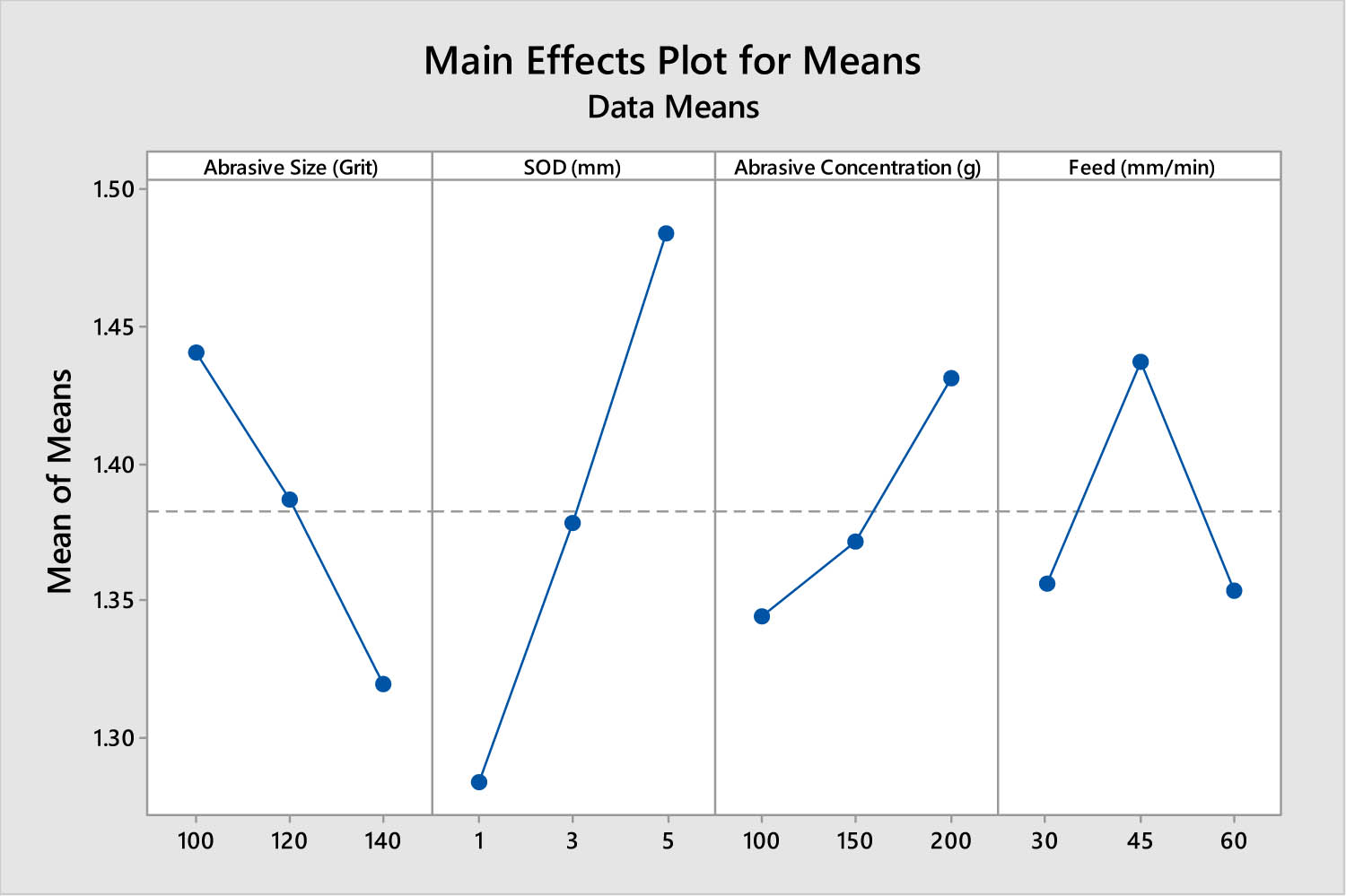
Main effects plot for means for MRR for free air cutting.
From, the main effects plot for S/N ratios seen for MRR in Figure 3, it is evidenced that the optimized set of process parameters, viz. abrasive size of 100 grit, SOD of 5 mm, abrasive concentration of 200 g, and feed rate of 45 mm/min give the maximum MRR.
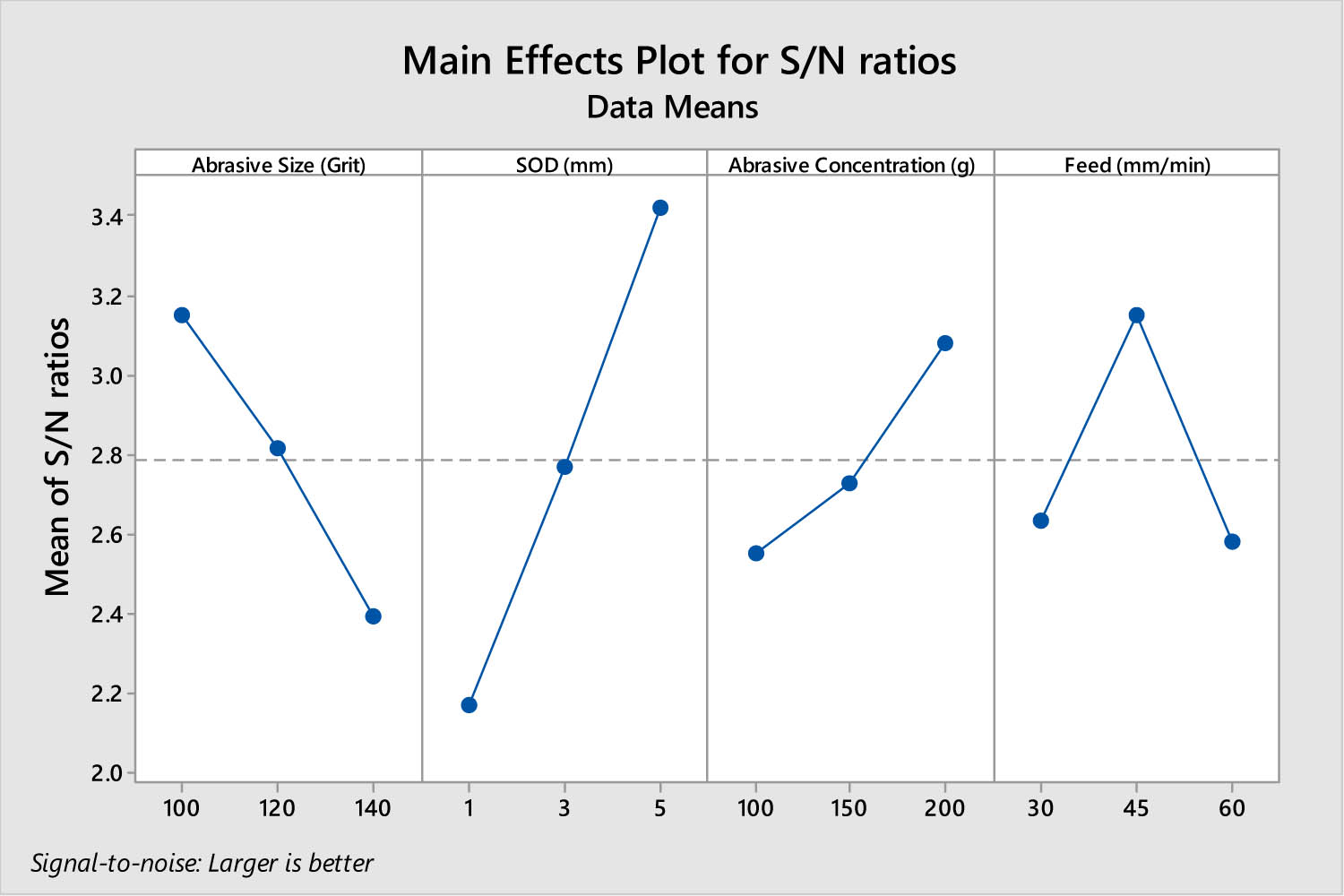
Mean of S/N ratios for MRR for free air cutting.
The response table for S/N ratios is given in Table 3. It is seen from the table that the SOD has a significant effect on MRR, followed by the abrasive size, feed, and abrasive concentration.
The response table for means for MRR is given in Table 4. It is seen from the table that the SOD has a significant effect on the mean for each combination of control factor levels in the design for optimizing the MRR, followed by the abrasive size, abrasive concentration, and feed rate.
3.1.2 Results of RSM for MRR for free air cutting
The RSM accomplished for MRR for free air cutting gives the ANOVA table, surface and contour plots, and predicted vs actual plots for different conditions. The results of ANOVA are presented in Table 5.
The model F-value of 65.79 implies the model is significant. There is only a 0.07% chance that an F-value this large could occur due to noise.
P-values less than 0.0500 indicate model terms are significant. In this case A, B, C, and D are significant model terms. Values greater than 0.1000 indicate the model terms are not significant. If there are many insignificant model terms (not counting those required to support hierarchy), model reduction may improve your model.
Figures 4 and 5 show the contour plot and surface plot illustrating the relationship between SOD and abrasive size in relation to MRR, respectively. The plots distinctly indicate that a substantial increase in abrasive particle size and SOD result in a significant boost in MRR. A larger grain size contributes to a heightened area of erosion, consequently leading to an increase in MRR. Moreover, an elevated SOD leads to a broader coverage area by the jet, thereby further enhancing the MRR.
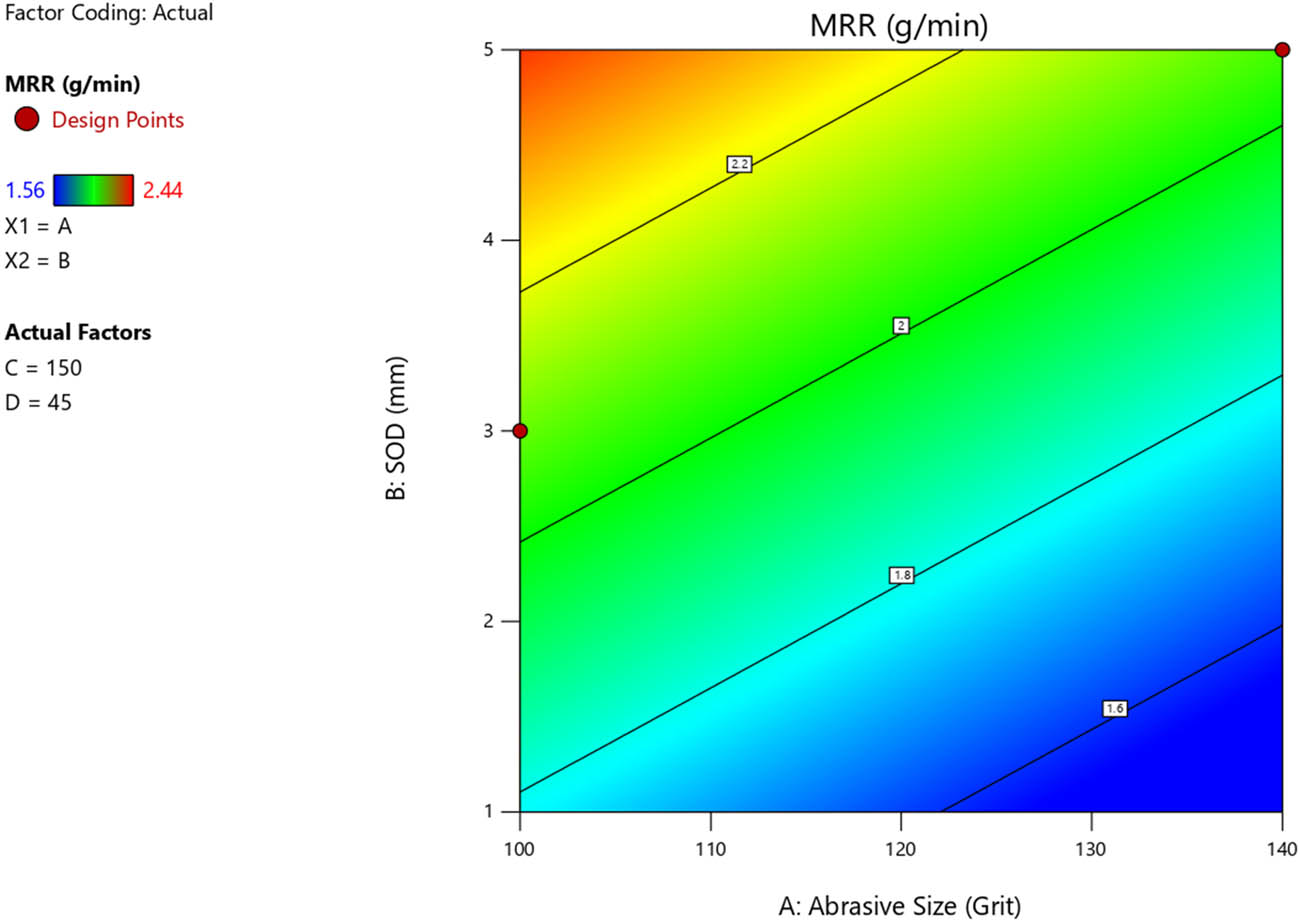
Contour plot of SOD vs abrasive size for MRR for free air cutting.
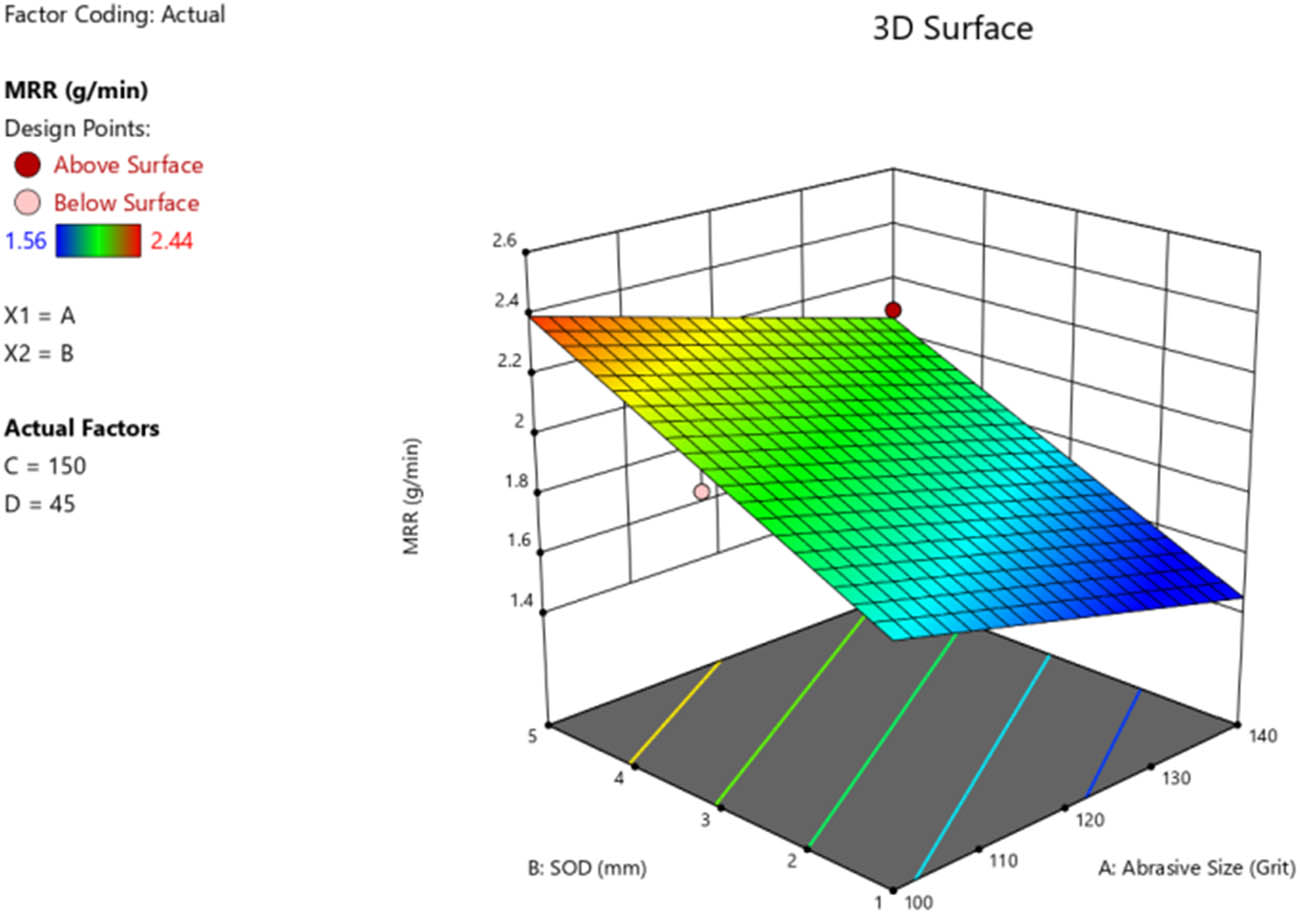
3D surface plot of SOD vs abrasive size for MRR for free air cutting.
Figures 6 and 7 display the contour plot and surface plot, illustrating the correlation between SOD and abrasive concentration in relation to MRR, respectively. The plots distinctly reveal that a noteworthy escalation in SOD and abrasive concentration correlates with a significant upsurge in MRR. An increase in abrasive concentration intensifies the frequency of particles participating in the erosion process, consequently leading to an augmentation in MRR. Additionally, a heightened SOD contributes to a more extensive coverage area by the jet, further amplifying the MRR. The combined impact of both parameters results in a higher MRR.
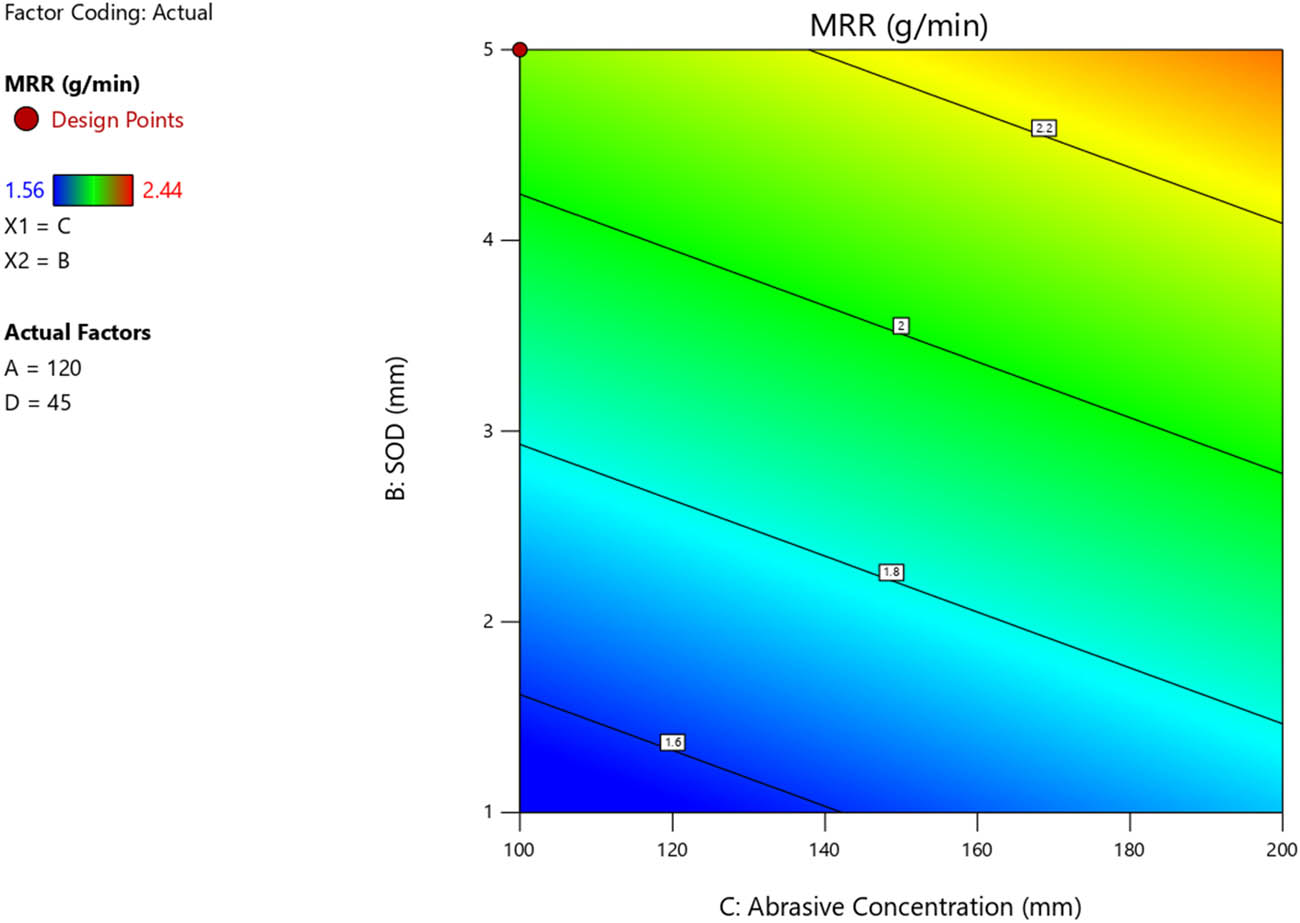
Contour plot of abrasive concentration vs SOD for MRR for free air cutting.
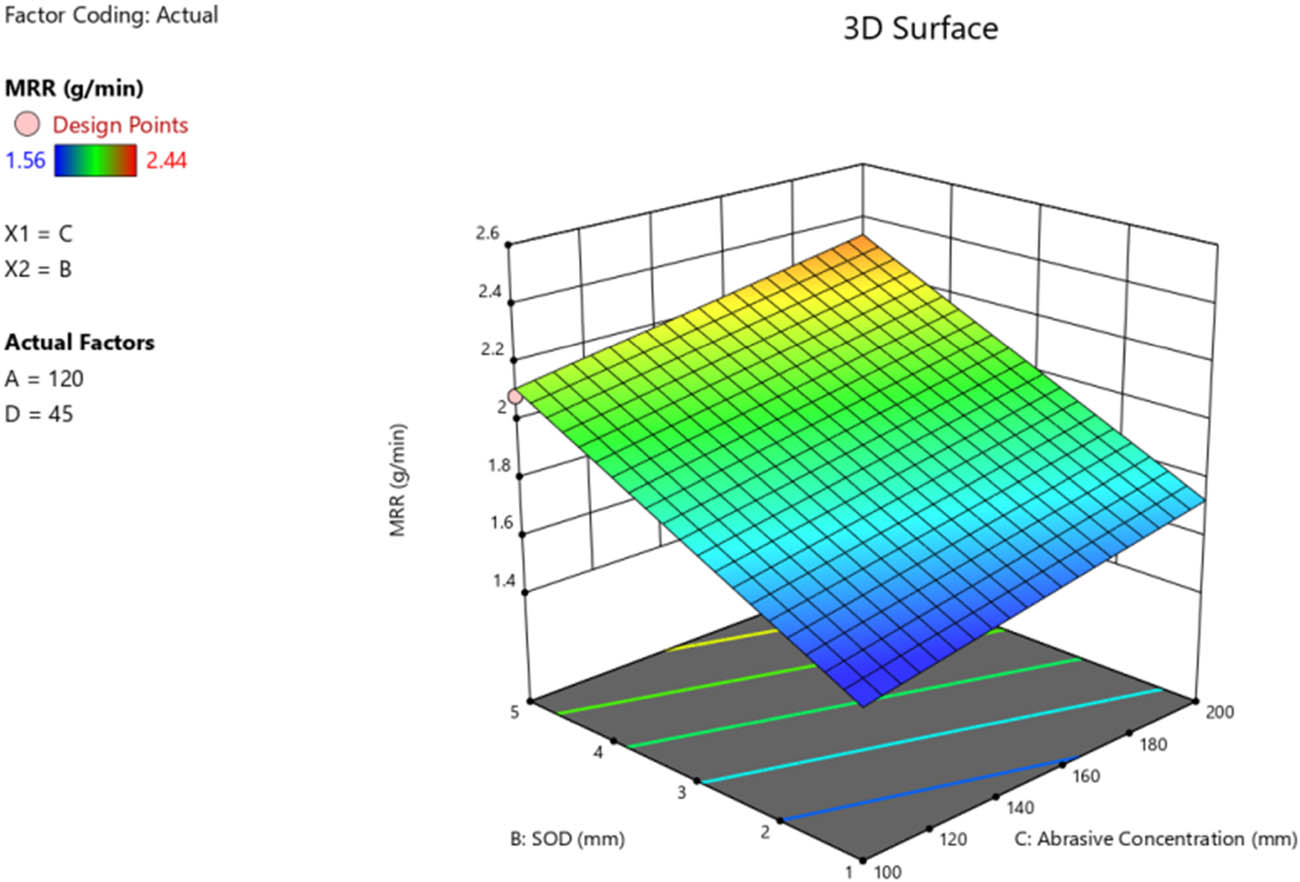
3D surface plot of abrasive concentration vs SOD for MRR for free air cutting.
Figures 8 and 9 present the contour plot and surface plot illustrating the correlation between the SOD and feed rate in relation to MRR, respectively. The plots distinctly reveal that a noteworthy increase in SOD, coupled with a decrease in the feed rate, results in a significant enhancement of MRR. An escalation in the feed rate contributes to a reduction in MRR due to a decrease in abrasive flow velocity. Consequently, the limited kinetic energy of the jet gets distributed over a larger number of particles, resulting in a diminished kinetic energy for each specific particle. This phenomenon also leads to an increase in turbulence. Furthermore, an elevated SOD amplifies the coverage area by the jet, further augmenting the MRR. The combined impact of both parameters yields a higher MRR. Figure 10 gives the predicted vs actual plot of MRR for free air cutting for different sets of AWSJ machining conditions.
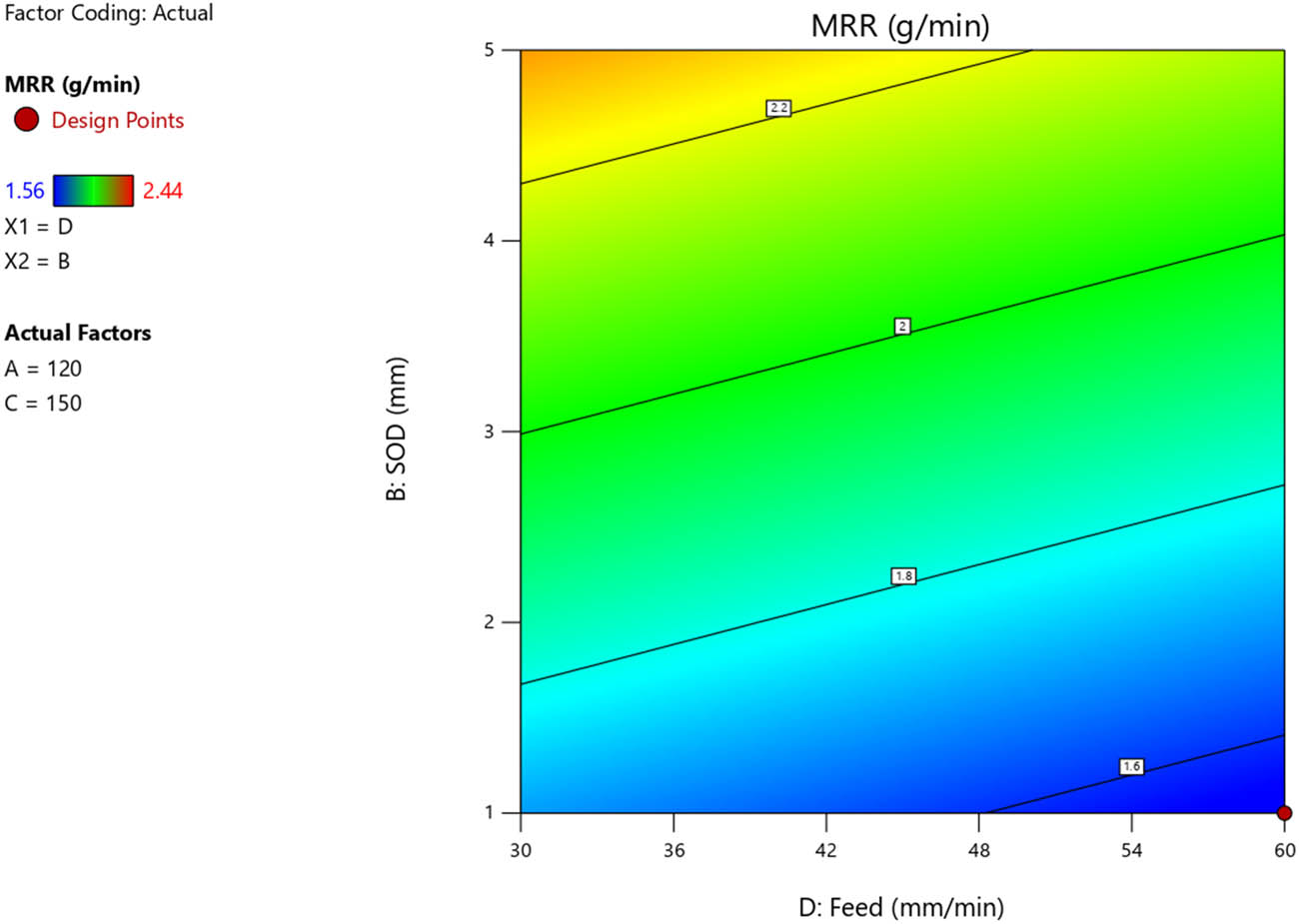
Contour plot of feed vs SOD for MRR for free air cutting.
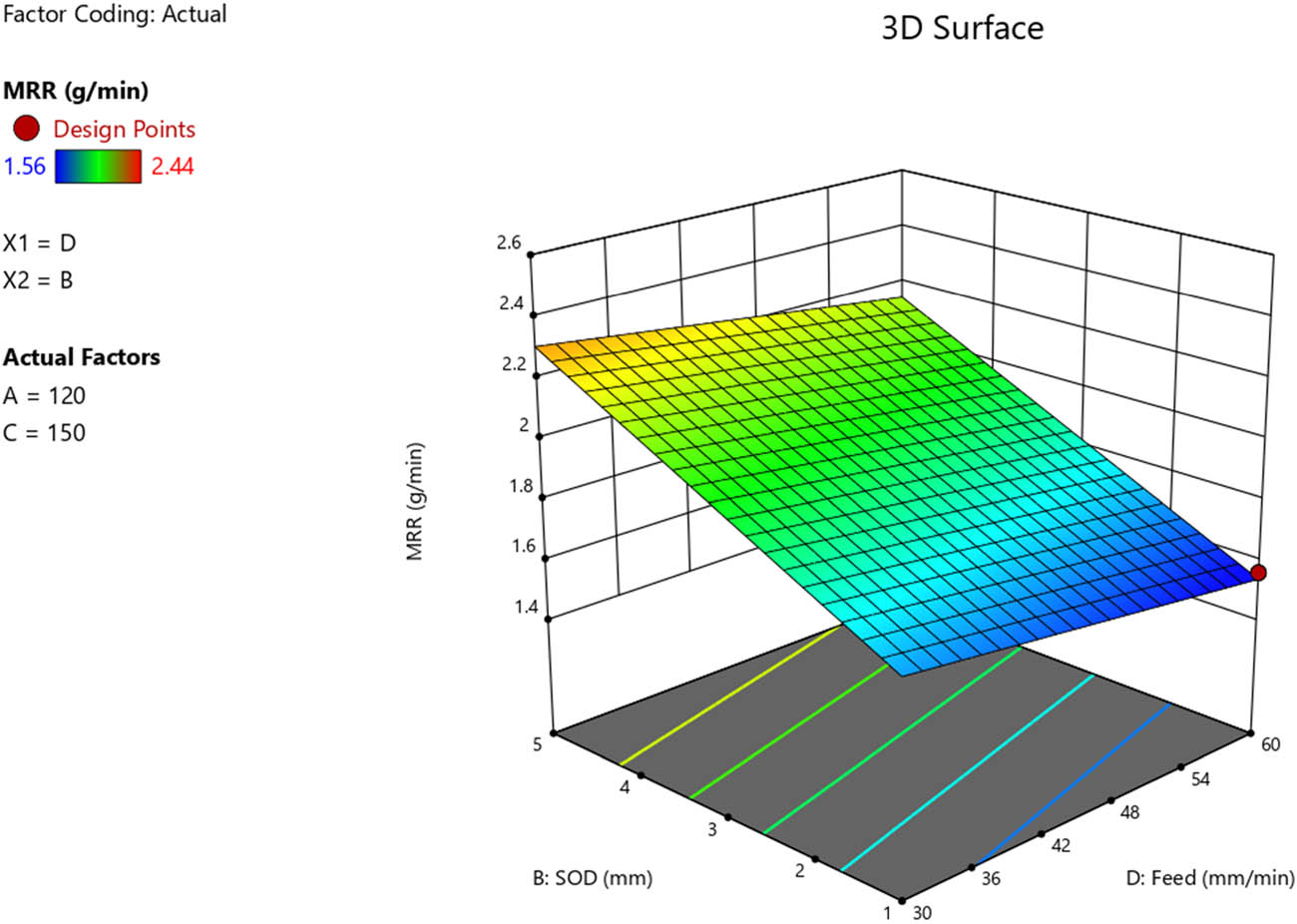
3D surface plot of feed vs SOD for MRR for free air cutting.
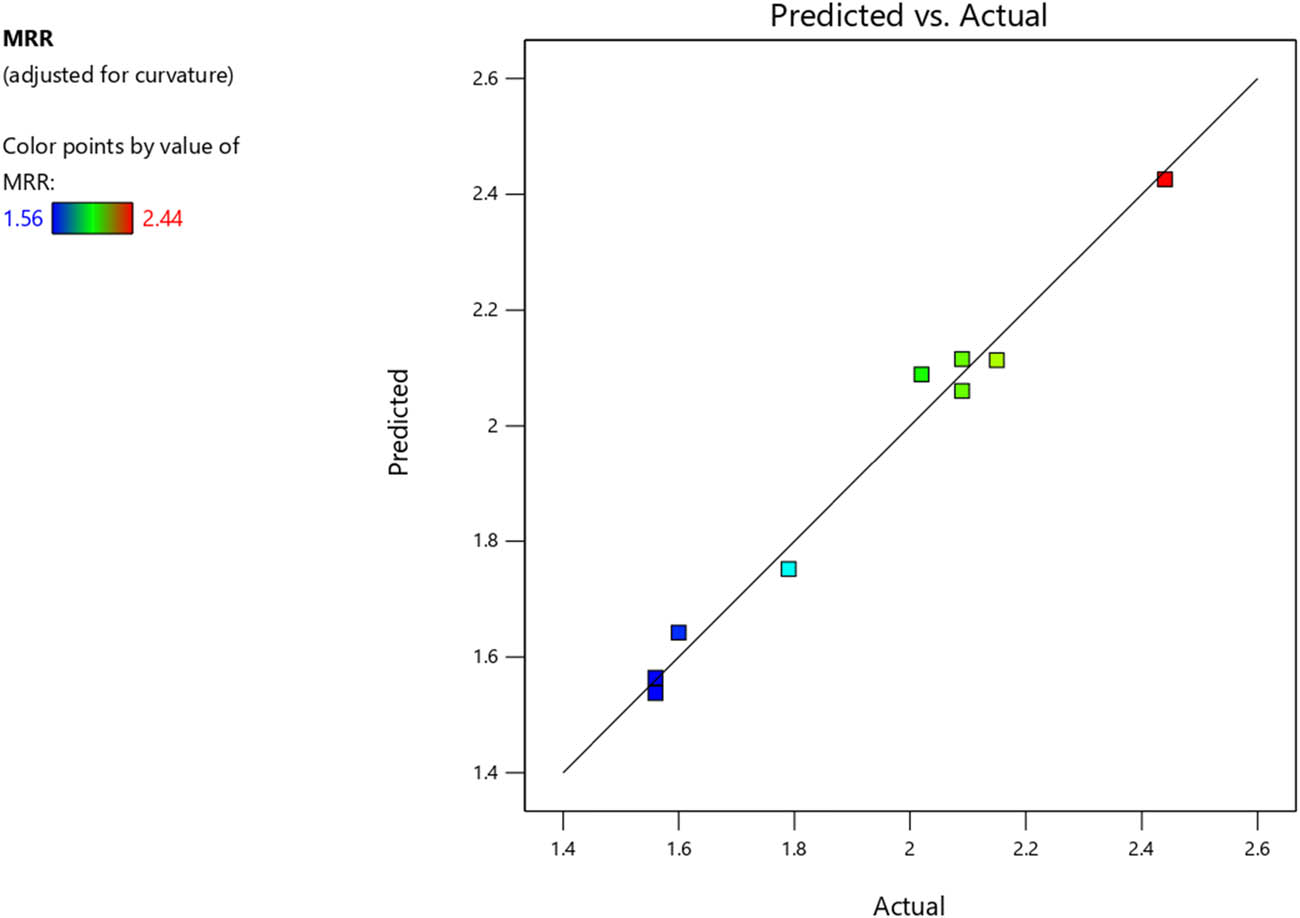
Predicted vs actual plot of MRR for free air cutting.
Table 6 gives the fit statistics of RSM for MRR for free air machining conditions. The predicted R² of 0.9184 is in reasonable agreement with the adjusted R² of 0.9701, i.e., the difference is less than 0.2. The Adeq Precision measures the S/N ratio. A ratio greater than 4 is desirable. The ratio of 22.203 indicates an adequate signal. This regression fit statistics can be effectively employed to evolve newer design spaces.
Fit statistics of RSM for MRR for free air conditions
| Std. dev. | 0.0537 | R² | 0.9850 |
| Mean | 1.92 | Adjusted R² | 0.9701 |
| C.V. % | 2.79 | Predicted R² | 0.9184 |
| Adeq precision | 22.2027 |
Equation (3) gives the regression equation obtained from the RSM analysis of the parameters on MRR, which can be effectively used to predict the outcomes for different input conditions.
The results of present work are compared with the findings of Santhosh et al. [29,30] who have successfully conducted several studies on optimizations through the application of RSM. This involved a detailed analysis of experimental trials and their outcomes, focusing on critical aspects and validations. Their efforts were directed toward optimizing experimental parameters for wear in composites. The reported results indicate that the chosen optimum parameters not only enhance the wear resistance but also reduce the wear resistance by 22%. Similarly, in the present work, the MRR improves, while the SR reduces. This improvement is attributed to the careful selection of appropriate SOD and traverse speed during the AWSJ machining process.
RSM stands out as a potent instrument for fine-tuning parameters within manufacturing processes. By harnessing mathematical and statistical methodologies, RSM aids in unraveling intricate connections between input variables and desired output responses. In machining and production domains, RSM serves to amplify process efficacy, curtail expenses, and elevate product standards [31]. One key merit of RSM lies in its capacity to streamline the number of experimental trials necessary for optimization. Instead of exhaustively testing every conceivable parameter combination, RSM enables researchers to judiciously select a subset of experiments grounded in statistical design principles like factorial or fractional factorial designs. This strategy not only conserves resources but also furnishes valuable insights into the interrelations among diverse variables. Additionally, RSM facilitates the identification of optimal parameter configurations that maximize desired outcomes while minimizing variations and defects. By constructing response surfaces and contour plots, engineers can visually map the nexus between input parameters and performance metrics, thereby facilitating informed decision-making and process enhancement. RSM finds practical utility across a spectrum of manufacturing applications, encompassing composite fabrication and machining. Its adaptability and efficacy render it indispensable for industries striving to bolster productivity and maintain a competitive edge in today’s dynamic market milieu [32,33]. The same holds good in the present work, wherein the MRR is considered for optimizing the process parameters in the AWSJ machining process for two cutting conditions.
The results of AWSJ machining of CFRP composite-based orthopedic implants in the present work are further compared with the findings of Santhana kumar et al. [34], who have applied grey-based RSM for optimizing AWSJ cutting parameters in ceramic tile machining. Their study addresses the challenges of achieving precise cuts and minimizing SR in ceramic tile processing, which are critical factors in ensuring quality and efficiency in the manufacturing industry. They have conducted experimental trials to investigate the effects of key cutting parameters such as jet pressure, abrasive flow rate, SOD, and traverse speed on MRR and SR. By employing grey relational RSM techniques, they were able to model the complex relationships between process variables and performance metrics. The findings of the study provide valuable insights into the optimal parameter settings that enhance the cutting efficiency and quality in AWSJ machining of ceramic tiles. In the present work, through systematic experimentation and analysis, it is herewith observed that the MRR in the AWSJ machining process for composites is a critical factor, which depends on the abrasive size, concentration, nozzle SOD, and suspension of composites in water for increasing the MRR and the machining quality for the composites.
3.2 Underwater AWSJ cutting conditions
Table 7 outlines the experimental setup and results for underwater cutting, specifically examining the influence of different factor settings on various response parameters. Each experiment, labeled from 1 to 9, investigates combinations of abrasive size, SOD, abrasive concentration, and feed rate, measuring their impact on MRR, top and bottom kerf widths (TKW and BKW, respectively), and SR. By altering factors such as abrasive size, SOD, concentration, and feed rate, researchers observed changes in the efficiency of material removal, the width of the cut at different depths, and the smoothness of the machined surface. The data provide insights into optimal conditions for underwater cutting processes, aiming for higher MRRs, precise kerf widths, and improved surface finishes, crucial for enhancing the effectiveness and quality of underwater cutting applications across various industries.
Factor settings and response parameters for underwater cutting
| Expt. no. | Abr. size (grit) | SOD (mm) | Abr. con. (g) | Feed (mm/min) | MRR (g/min) | TKW (mm) | BKW (mm) | SR (µ) |
|---|---|---|---|---|---|---|---|---|
| 1 | #100 | 1 | 100 | 30 | 1.90 | 1.79 | 0.80 | 8.16 |
| 2 | #100 | 3 | 150 | 45 | 2.12 | 1.83 | 0.84 | 8.73 |
| 3 | #100 | 5 | 200 | 60 | 2.62 | 1.78 | 0.78 | 8.85 |
| 4 | #120 | 1 | 150 | 60 | 1.65 | 1.56 | 0.71 | 8.96 |
| 5 | #120 | 3 | 200 | 30 | 2.42 | 1.82 | 0.84 | 8.22 |
| 6 | #120 | 5 | 100 | 45 | 2.27 | 1.88 | 0.79 | 8.76 |
| 7 | #140 | 1 | 200 | 30 | 1.71 | 1.70 | 0.81 | 8.69 |
| 8 | #140 | 3 | 100 | 60 | 1.65 | 1.54 | 0.67 | 9.1 |
| 9 | #140 | 5 | 150 | 45 | 2.18 | 1.85 | 0.84 | 8.21 |
The recorded response data in this table, including MRR, TKW, BKW, and SR, were subject to ANOVA to determine the significant factors at a 95% confidence level. The ANOVA results, specifically for MRR in underwater cutting, are outlined in Table 10. By examining the F-value in these tables, one can discern the impact of various process parameters on MRR during free air cutting.
3.2.1 Results of the Taguchi method for MRR for underwater cutting
The provided response in Table 8 illustrates the S/N ratios (larger is better) for different levels of abrasive size (grit), SOD (mm), abrasive concentration (g), and feed rate (mm/min) in the context of underwater AWSJ machining. The table displays S/N values corresponding to each level of factors, with higher values indicating a better performance. Additionally, the “Delta” row showcases the differences between the highest and the lowest S/N values within each factor, while the “Rank” row assigns a rank to each factor based on their S/N values, with lower ranks signifying better performance. This analysis aids in identifying the most influential factors and optimal levels for achieving improved outcomes in underwater AWSJ machining processes. It is seen from the table that the SOD has a significant effect on MRR, followed by the abrasive size, feed, and abrasive concentration.
Response table for S/N ratios (larger is better)
| Level | Abrasive size (grit) | SOD (mm) | Abr. con. (g) | Feed (mm/min) |
|---|---|---|---|---|
| 1 | 6.304 | 4.334 | 5.107 | 5.263 |
| 2 | 5.638 | 5.539 | 5.457 | 6.304 |
| 3 | 4.783 | 6.851 | 6.160 | 5.158 |
| Delta | 1.521 | 2.517 | 1.052 | 1.147 |
| Rank | 2 | 1 | 4 | 3 |
The response table for means for MRR is given in Table 9. It is seen from the table that the SOD has a significant effect on the mean for each combination of control factor levels in the design for optimizing the MRR, followed by abrasive size, abrasive concentration, and feed rate. Figure 11 shows the main effects plot for means for MRR. It is evident that the abrasive size of 100 grit (level 1), SOD of 5 mm (level 3), abrasive concentration of 200 g (level 3), and feed rate of 45 mm/min (level 2) give the mean for each combination of control factor levels in the design for optimizing the MRR as per Taguchi’s condition of larger is better. From the main effects plot for S/N ratios seen for MRR in Figure 12, it is evidenced that the optimized set of process parameters, viz. the abrasive size of 100 grit, SOD of 5 mm, abrasive concentration of 200 g, and feed rate of 45 mm/min gives the maximum MRR.
Response table for means
| Level | Abrasive size (grit) | SOD (mm) | Abr. con. (g) | Feed (mm/min) |
|---|---|---|---|---|
| 1 | 2.083 | 1.650 | 1.813 | 1.847 |
| 2 | 1.933 | 1.910 | 1.890 | 2.067 |
| 3 | 1.750 | 2.207 | 2.063 | 1.853 |
| Delta | 0.333 | 0.557 | 0.250 | 0.220 |
| Rank | 2 | 1 | 3 | 4 |
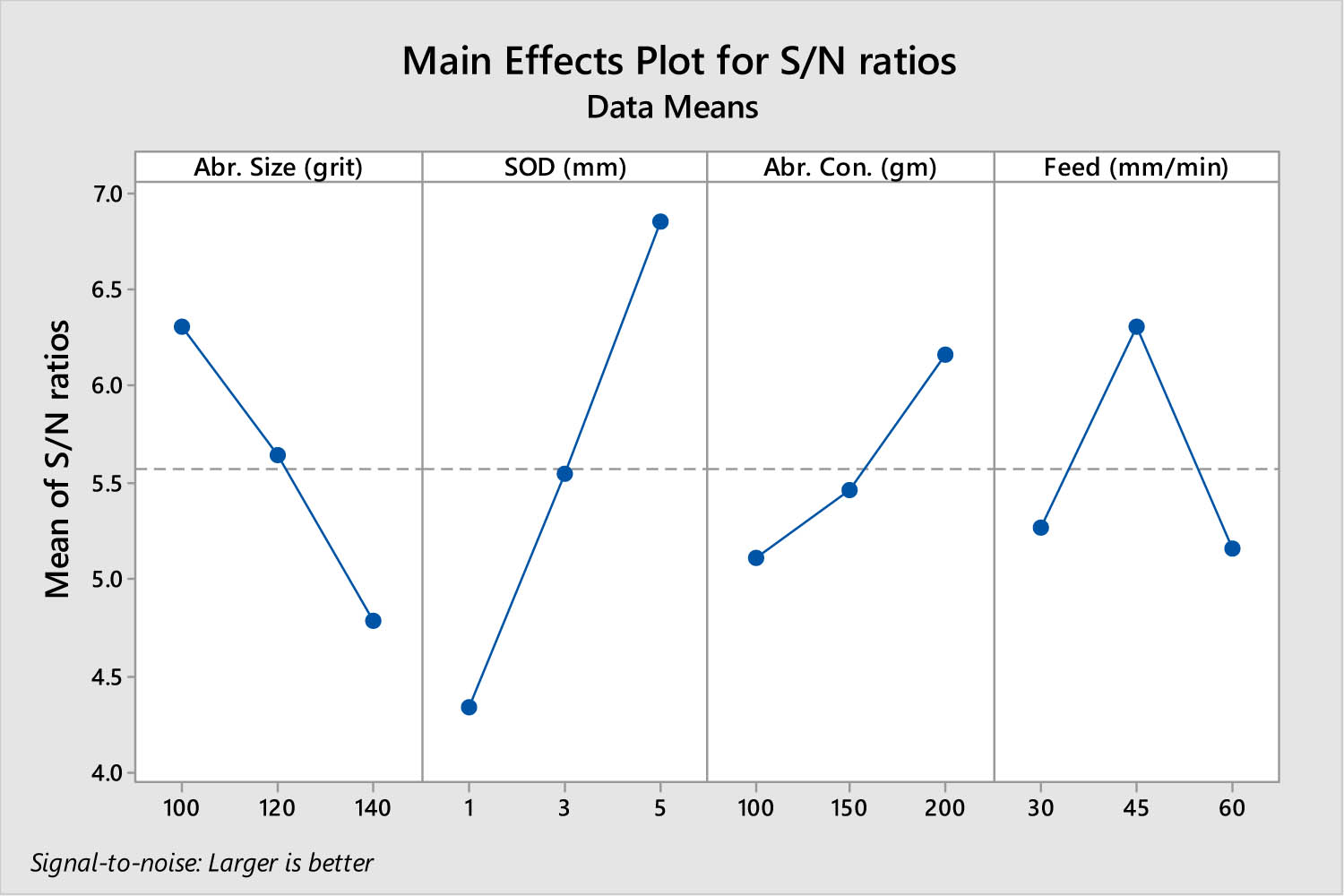
Main effects plot for means for MRR for underwater cutting.
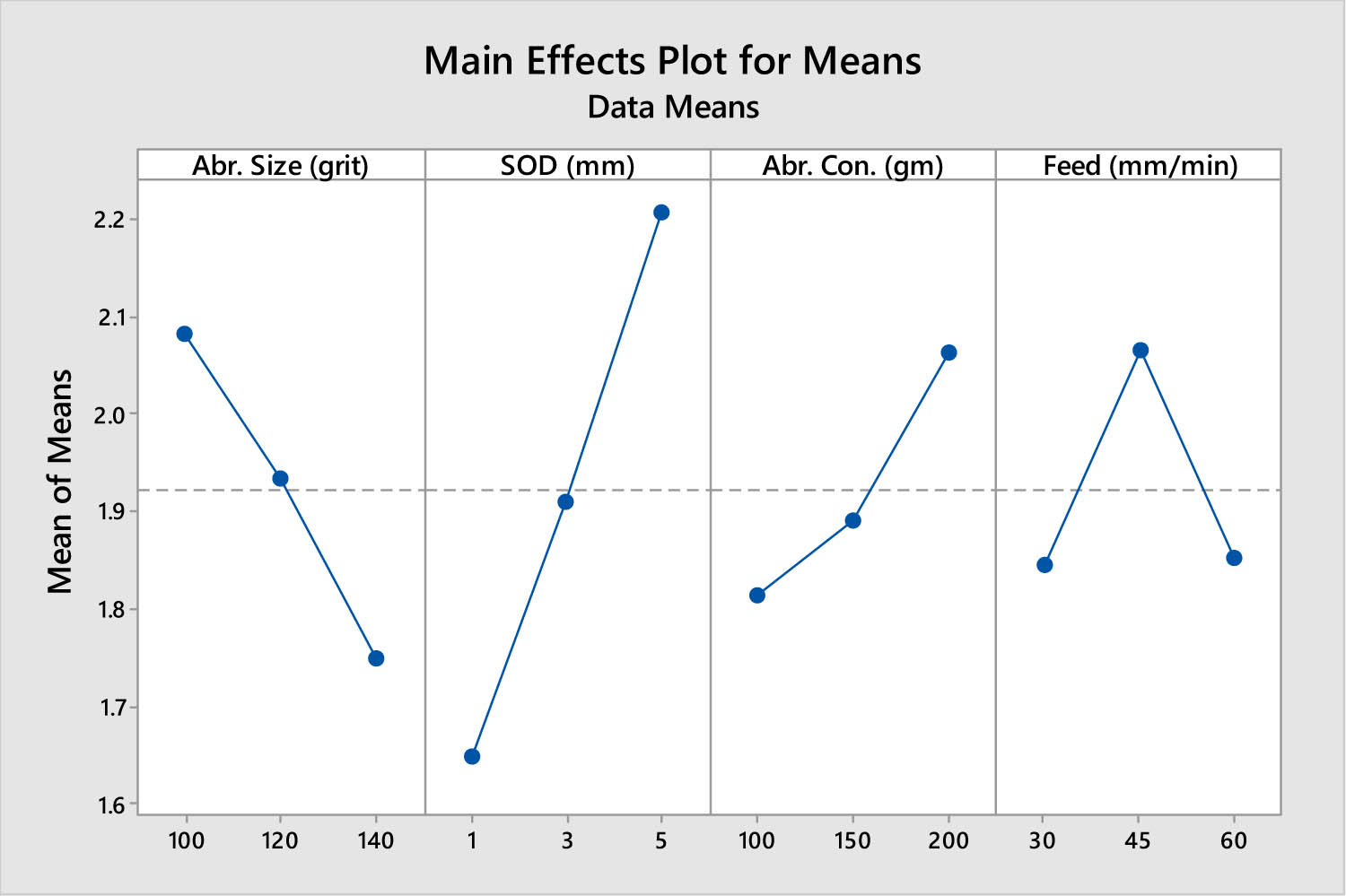
Mean of S/N for MRR for underwater cutting.
3.2.2 Results of ANOVA for MRR for underwater cutting
Table 10 gives the ANOVA of MRR in underwater cutting conditions. The model F-value of 25.47 implies the model is significant. There is only a 0.42% chance that an F-value this large could occur due to noise. From the ANOVA table, it is herewith observed that p-values <0.0500 indicate model terms are significant. In this case A, B, and C are significant model terms. Values greater than 0.1000 indicate the model terms are not significant. If there are many insignificant model terms (not counting those required to support hierarchy), model reduction may improve the model.
ANOVA of MRR in underwater cutting conditions
| Source | Sum of squares | DF | Mean square | F-value | p-value | Remarks |
|---|---|---|---|---|---|---|
| Model | 0.9522 | 4 | 0.2380 | 25.47 | 0.0042 | significant |
| A – Abrasive size | 0.2017 | 1 | 0.2017 | 21.58 | 0.0097 | |
| B – SOD | 0.6060 | 1 | 0.6060 | 64.84 | 0.0013 | |
| C – Abrasive concentration | 0.1091 | 1 | 0.1091 | 11.67 | 0.0269 | |
| D – feed | 0.0603 | 1 | 0.0603 | 6.46 | 0.0639 | |
| Residual | 0.0374 | 4 | 0.0093 | |||
| Cor total | 0.9896 | 8 |
Figures 13 and 14 show the contour plot and surface plot illustrating the relationship between SOD and abrasive size in relation to MRR, respectively. The plots distinctly indicate that a substantial increase in abrasive particle size and SOD results in a significant boost in MRR. A larger grain size contributes to a heightened area of erosion, consequently leading to an increase in MRR. Moreover, an elevated SOD leads to a broader coverage area by the jet, thereby further enhancing the MRR.
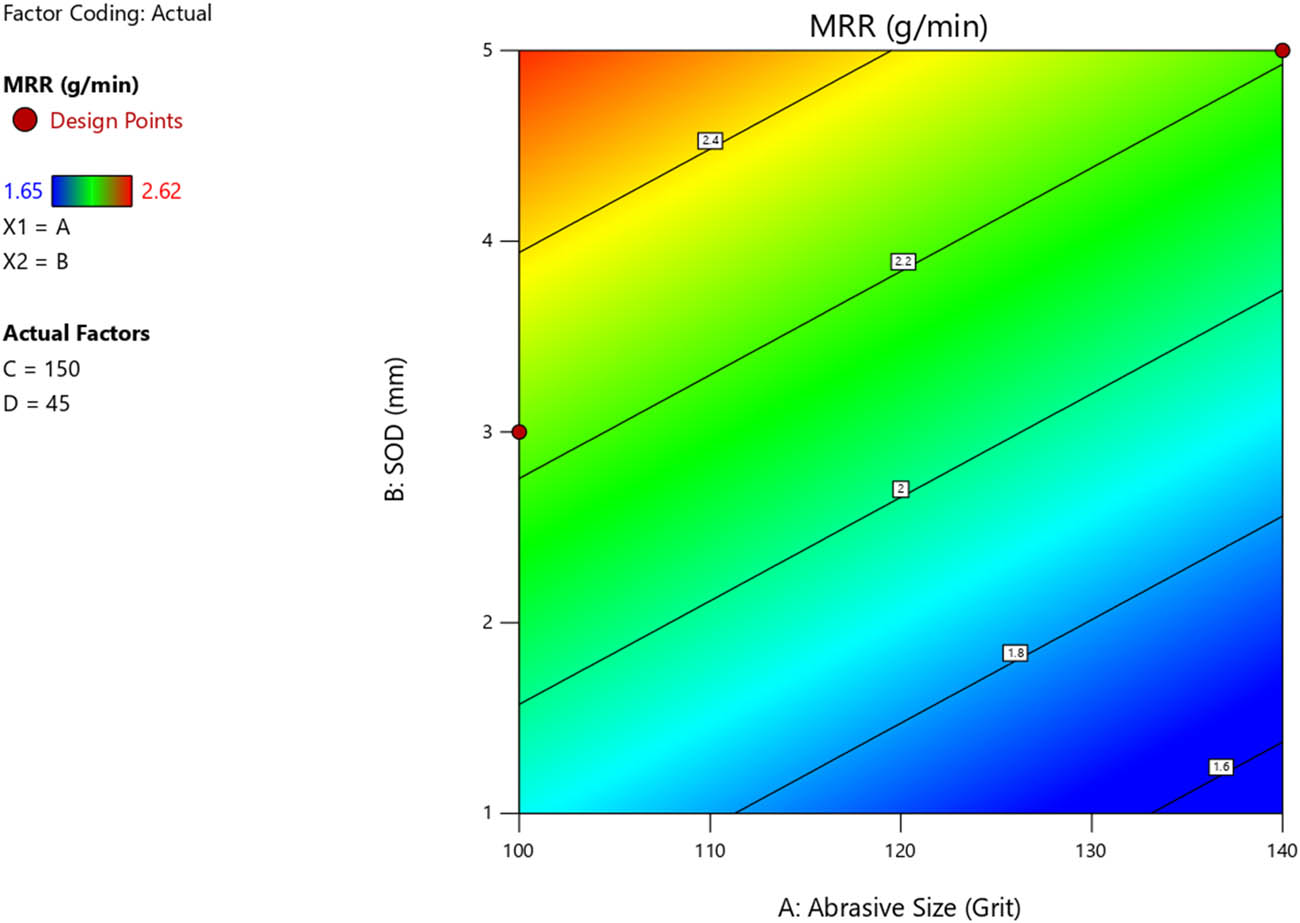
Contour plot of SOD vs abrasive size for MRR for underwater cutting.
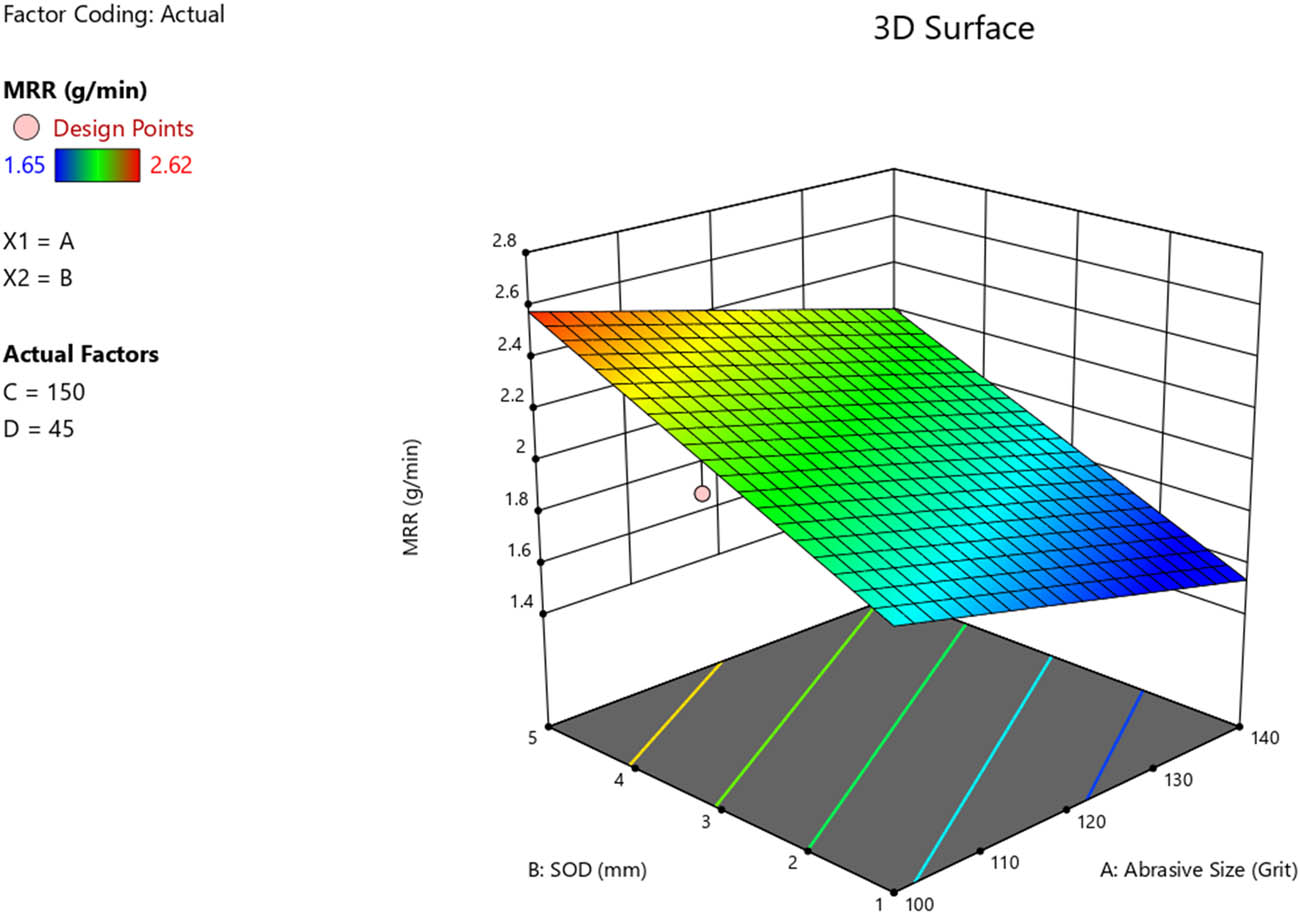
3D surface plot of SOD vs abrasive size for MRR for underwater cutting.
Figures 15 and 16 display the contour plot and surface plot, illustrating the correlation between SOD and abrasive concentration in relation to MRR, respectively. The plots distinctly reveal that a noteworthy escalation in SOD and abrasive concentration correlates with a significant upsurge in MRR. An increase in the abrasive concentration intensifies the frequency of particles participating in the erosion process, consequently leading to an augmentation in MRR. Additionally, a heightened SOD contributes to a more extensive coverage area by the jet, further amplifying the MRR. The combined impact of both parameters results in a higher MRR.
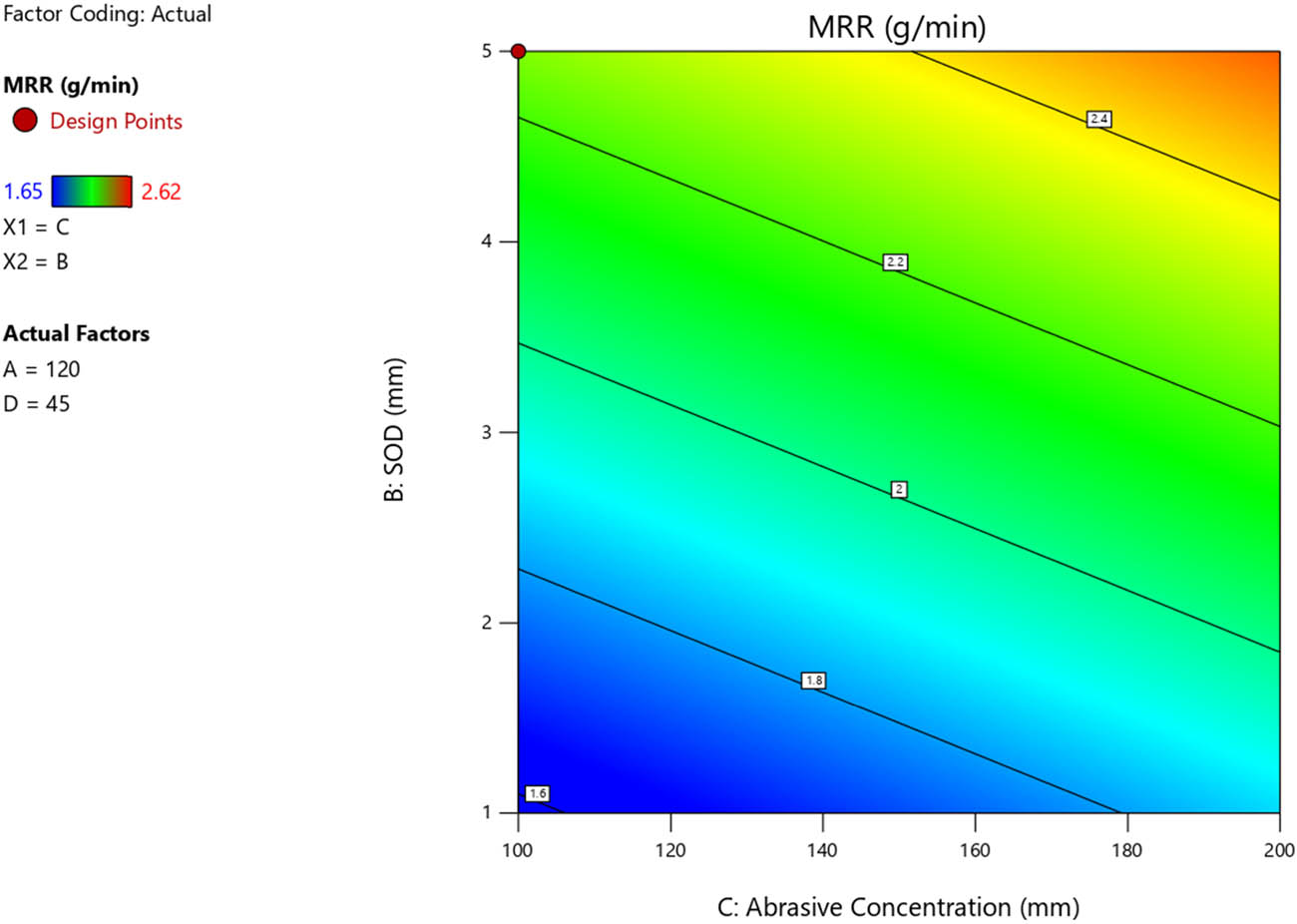
Contour plot of abrasive concentration vs SOD for MRR for underwater cutting.
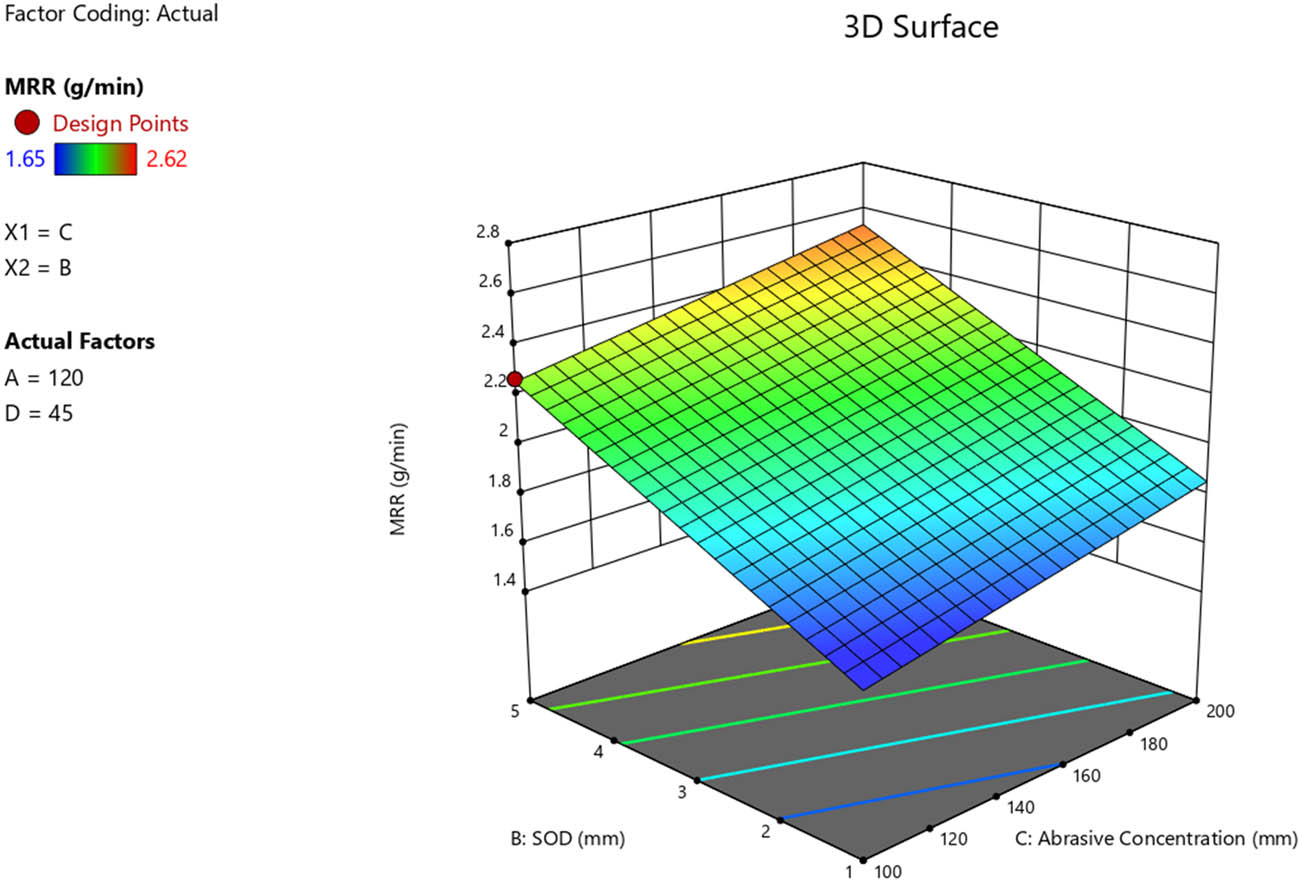
3D surface plot of abrasive concentration vs SOD for MRR for underwater cutting.
Figures 17 and 18 present the contour plot and surface plot illustrating the correlation between the SOD and feed rate in relation to MRR, respectively. The plots distinctly reveal that a noteworthy increase in SOD, coupled with a decrease in the feed rate, results in a significant enhancement of MRR. An escalation in feed rate contributes to a reduction in MRR due to a decrease in the abrasive flow velocity. Consequently, the limited kinetic energy of the jet gets distributed over a larger number of particles, resulting in a diminished kinetic energy for each specific particle. This phenomenon also leads to an increase in turbulence. Furthermore, an elevated SOD amplifies the coverage area by the jet, further augmenting the MRR. The combined impact of both parameters yields a higher MRR. Figure 19 gives the predicted vs actual plot for the MRR for underwater cutting. It is herewith evident that the actual results are in close agreement with the predicted results.
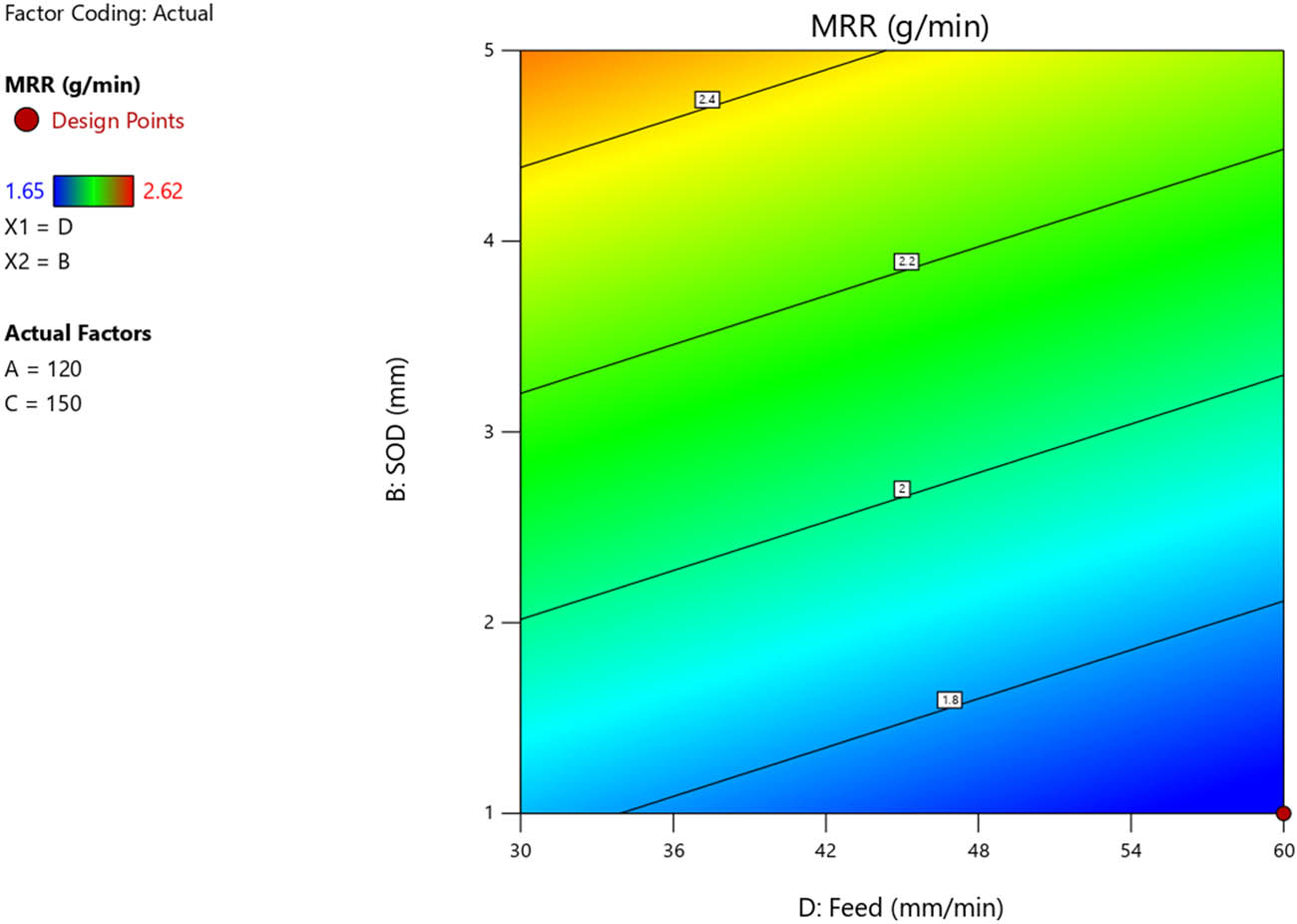
Contour plot of feed vs SOD for MRR for underwater cutting.
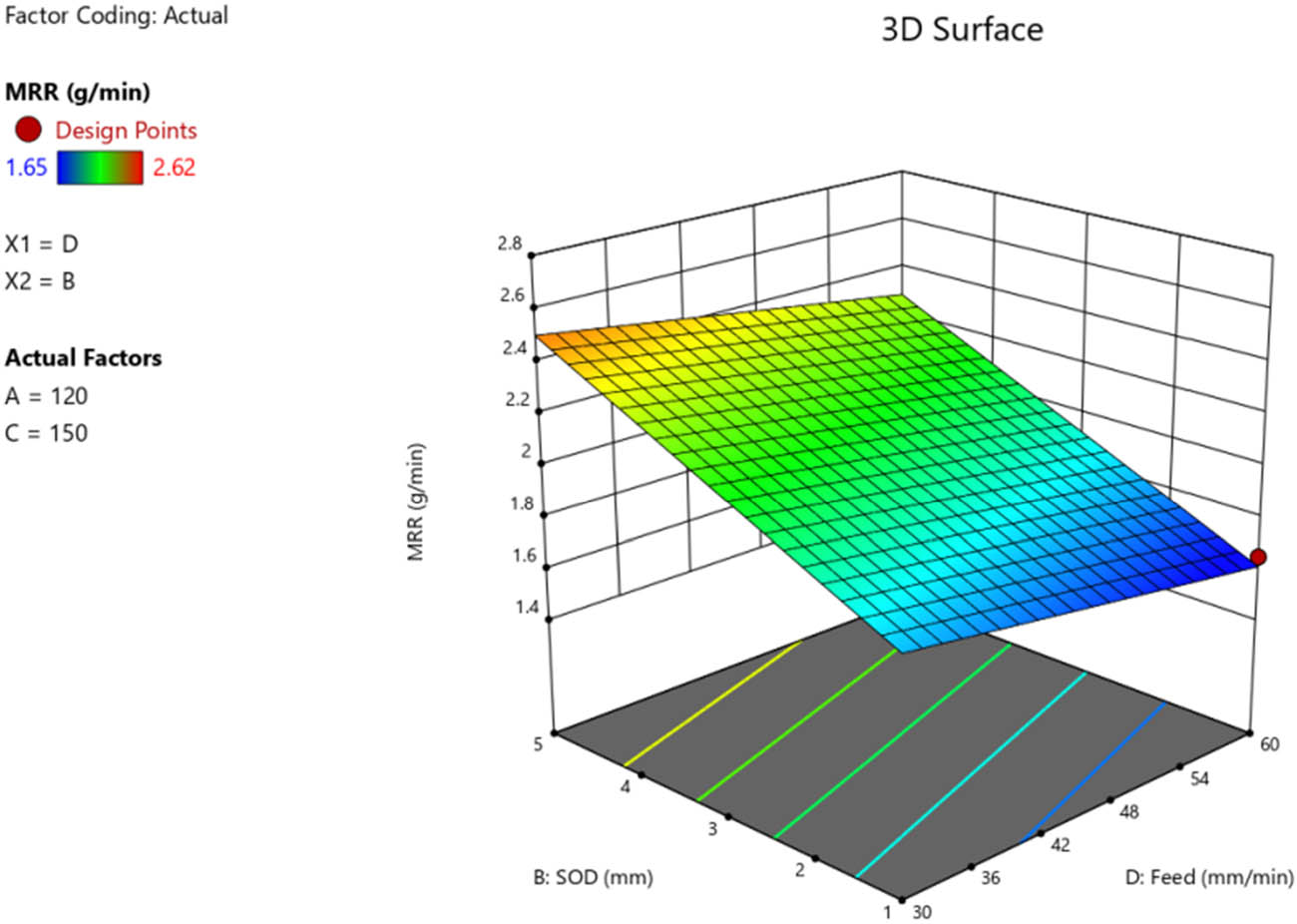
3D surface plot of feed vs SOD for MRR for underwater cutting.
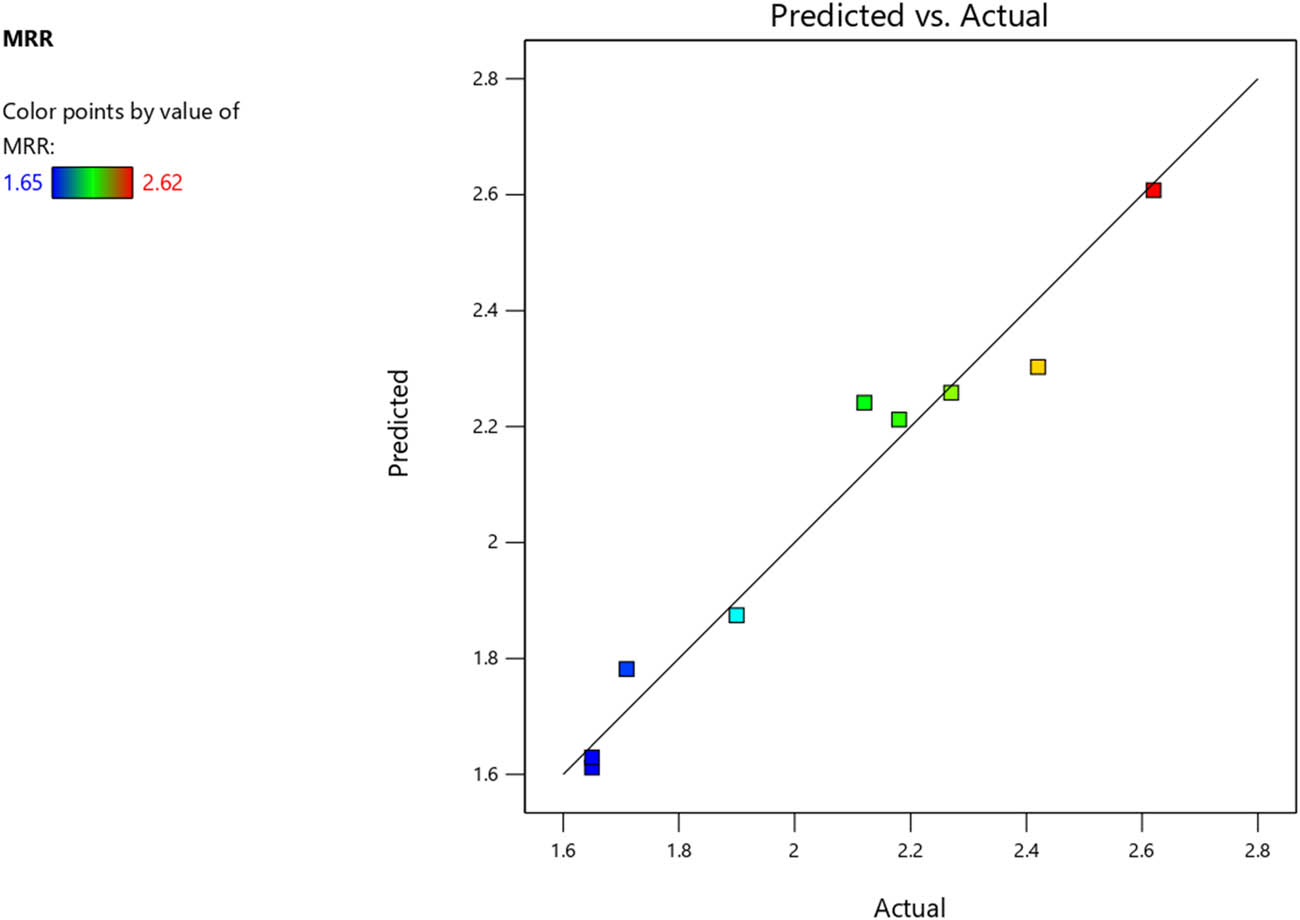
Predicted vs actual plot of MRR for underwater cutting.
Table 11 presents the fit statistics of MRR for underwater cutting. The predicted R² of 0.8572 is in reasonable agreement with the adjusted R² of 0.9244, i.e., the difference is less than 0.2.
Fit statistics of MRR for underwater cutting
| Std. dev. | 0.0967 | R² | 0.9622 |
| Mean | 2.06 | Adjusted R² | 0.9244 |
| C.V. % | 4.70 | Predicted R² | 0.8572 |
| Adeq precision | 13.8178 |
Adeq Precision measures the S/N ratio. A ratio greater than 4 is desirable. The ratio of 13.818 indicates an adequate signal. The regression equation of MRR for underwater cutting is given in Equation (4). The equation holds good, and it can be effectively employed to design newer arrays of experimentations.
The results of the present work are compared with the findings of Alberdi et al. [35]; the study explores the effectiveness of AWJ in machining composite materials, aiming to understand its capabilities and limitations. Through experimentation and analysis, the authors examine various factors influencing the cutting process, including the abrasive size, SOD, feed rate, and cutting speed. Their work provides insights into the mechanisms involved in composite cutting with AWJ only; however, the present work has explored the AWSJ process in both free air and underwater conditions and has additionally explored challenges and opportunities for further research in this field, contributing to the advancement of composite machining techniques.
The work of Alberdi et al. also delves into the effect of energy consumption and temperature of the abrasive water in the composite cutting process. It explores how variations in energy consumption and temperature can impact the efficiency and effectiveness of the cutting operation. By analyzing these factors, the authors aim to optimize the cutting process to minimize energy consumption while maintaining desired cutting performance. Additionally, the article discusses the thermal effects of abrasive water on the workpiece material and how temperature changes can affect the material properties and cutting quality. Variations in temperature influence the viscosity and density of the abrasive–water mixture, affecting the cutting efficiency, while thermal effects on the workpiece material can lead to dimensional inaccuracies and structural damage. Overall, the investigation into energy consumption and temperature provides valuable insights into improving the sustainability and precision of AWJ cutting for composite materials [35].
4 Conclusions
The conclusions drawn from the analysis of AWSJ machining on CFRP composite-based orthopedic implants provide valuable insights based on numerical findings and statistical validations.
SOD emerges as the most influential factor in controlling MRR, with underwater cutting consistently outperforming free air cutting.
For instance, at #100 abrasive size and 5 mm SOD, the MRR peaked at 2.44 g/min, while an increase in abrasive size correlated with higher MRR values, such as achieving 2.15 g/min at #120 grit and 3 mm SOD.
Furthermore, the study highlights the significance of traverse rate and SOD in controlling the kerf width (TKW and BKW) and SR.
Underwater cutting conditions consistently yield superior results compared to free air cutting, as evidenced by numerical values such as a kerf width of 0.89 mm and an SR of 9.25 µm achieved under specific conditions.
These findings underscore the effectiveness of underwater cutting and provide valuable guidance for optimizing AWSJ machining parameters for CFRP composites-based orthopedic implants.
The Taguchi method and RSM helped in the statistical validation and optimization of the grit size, SOD, abrasive concentrations, and feed rate in underwater cutting conditions.
Acknowledgements
The authors gratefully thank their respective institutions for their strong support in this study.
-
Funding information: Authors state no funding involved.
-
Author contributions: All authors have accepted responsibility for the entire content of this manuscript and consented to its submission to the journal, reviewed all the results and approved the final version of the manuscript. RK, SN, MMC, MK, GSP and MIA: conceptualization, data curation, formal analysis, funding acquisition, investigation, methodology, project administration, resources, software, supervision, validation, visualization, writing – original draft, and writing – review and editing.
-
Conflict of interest: Authors state no conflict of interest.
-
Data availability statement: The necessary data used in the manuscript are already present in the manuscript.
References
[1] Goto K, Imai K, Arai M, Ishikawa T. Shear and tensile joint strengths of carbon fiber-reinforced thermoplastics using ultrasonic welding. Compos Part A Appl Sci Manuf. 2019;116:126–37. 10.1016/j.compositesa.2018.10.032.Suche in Google Scholar
[2] Raj A, Ramesha K, Sajan JU, Khan DM, Varshini UA. Comparison of various types of lubrication during hard turning of H13 tool steel by analysing Flank wear using ANOVA. In: Vijayaraghavan L, Reddy K, Jameel Basha S, editors. Emerging trends in mechanical engineering. Lecture notes in mechanical engineering. Singapore: Springer; 2020. p. 489–97. 10.1007/978-981-32-9931-3_47.Suche in Google Scholar
[3] Ramesha K, Santhosh N, Kiran K, Manjunath N, Naresh H. Effect of the process parameters on machining of GFRP composites for different conditions of abrasive water suspension jet machining. Arab J Sci Eng. 2019;44:7933–43. 10.1007/s13369-019-03973-w.Suche in Google Scholar
[4] Pahuja R, Ramulu M. Abrasive water jet machining of Titanium (Ti6Al4V)–CFRP stacks – A semi-analytical modeling approach in the prediction of kerf geometry. J Manuf Process. 2019;39:327–37. 10.1016/j.jmapro.2019.01.041.Suche in Google Scholar
[5] Pahuja R, Ramulu M, Hashish M. Abrasive Water jet machining (AWJ) of hybrid Titanium/Graphite composite laminate: Preliminary results. In Proceedings of the 22nd International Conference on Water Jetting, Haarlem, the Netherlands; 3–5 September 2014. p. 83–95. 10.13140/2.1.4554.1765.Suche in Google Scholar
[6] Pahuja R, Ramulu M, Hashish M. Abrasive water jet profile cutting of thick Titanium/Graphitefibermetal laminate. In ASME International Mechanical Engineering Congress and Exposition. New York, NY, USA: American Society of Mechanical Engineers; 2016. p. 1–11. 10.1115/IMECE2016-67136.Suche in Google Scholar
[7] Li M, Huang M, Chen Y, Gong P, Yang X. Effects of processing parameters on kerf characteristics and surface integrity following abrasive water jet slotting of Ti6Al4V/CFRP stacks. J Manuf Process. 2019;42:82–95. 10.1016/j.jmapro.2019.04.024.Suche in Google Scholar
[8] Ramulu M, Kunapurn S, Arola D, Hashish M. Water jet machining and peening of metals. Trans ASME J Press Vessel Technol. 2000;122:90–5. 10.1115/1.556155.Suche in Google Scholar
[9] Wang J. The effects of the jet impact angle on the cutting performance in AWJ machining of alumina ceramics. Key Eng Mater. 2003;238–239:117–24. 10.1115/1.556155.Suche in Google Scholar
[10] Chen Fl. The effect of cutting jet variation on striation formation in abrasive water jet cutting. Int J Mach Tools Manuf. 2001;41(10):1479–86. 10.1016/S0890-6955(01)00013-X.Suche in Google Scholar
[11] Akkurt A, Kulekci MK. Effect of feed rate on surface roughness in abrasive water jet cutting applications. J Mater Process Technol. 2004;147:389–96. 10.1016/j.jmatprotec.2004.01.013.Suche in Google Scholar
[12] Azmir MA, Ahsan AK. A study of abrasive water jet machining process on glass/epoxy composite laminate. J Mater Process Technol. 2009;209(20):6168–73. 10.1016/j.jmatprotec.2009.08.011.Suche in Google Scholar
[13] Nair A, Kumanan S. Optimization of size and form characteristics using multi-objective grey analysis in abrasive water jet drilling of Inconel 617. J Braz Soc Mech Sci Eng. 2018;40:121. 10.1007/s40430-018-1042-7.Suche in Google Scholar
[14] Ravi Kumar K, SreeBalaji VS, Pridhar T. Characterization and optimization of abrasive water jet machining parameters of aluminium/tungsten carbide composites. Measurement. 2018;117:57–66. 10.1016/j.measurement.2017.11.059.Suche in Google Scholar
[15] Deepak D, Anjaiah D, Yagnesh Sharma N. The effect of diameter ratio and abrasive grain size on exit velocity by numerical simulation of flow through abrasive water suspension jet nozzle using statistical experimental design. In 2011 WJTA-IMCA Conference and Expo, George R. Brown Convention Center, Houston, Texas, USA, 19th September – 21st September; 2011.Suche in Google Scholar
[16] Anjaiah D, Chincholkar AM. Cutting of glass using low pressure abrasive water suspension jet with the addition of Zycoprint polymer. In Proceedings of 19th International Conference on Water Jetting, BHR Group, UK; 2008. p. 105–19.Suche in Google Scholar
[17] Brandt S, Louis H, Milchers W, Mohamed M, Pude F, von Rad C. Abrasive water jets—a flexible tool for nonconventional machining. In Proceedings of 19th AIMTDR Conference, Narosa Publishing House, New Delhi, India; 2000. p. 129–34.Suche in Google Scholar
[18] Santhosh N, Kempaiah UN, Manjunath N, Ramesha K. Fabrication and characterization of hybrid aluminium AA 5083/SiCP/Fly ash composites. Tathapi. 2020;19(56):236–46.Suche in Google Scholar
[19] Ramesha K, Pd S, Santhosh N, Jangam S. Design and optimization of the process parameters for friction stir welding of dissimilar aluminium alloys. Eng Appl Sci Res. 2021;48(3):257–67, https://ph01.tci-thaijo.org/index.php/easr/article/view/241021.Suche in Google Scholar
[20] Ramesha K, Santhosh N, Bedi R, Sudersanan PD. A comprehensive review of novelty of friction stir welding of aluminium-magnesium alloys for advanced engineering applications. J Thin Films Coat Sci Technol Appl. 2018;5(2):7–14. https://engineeringjournals.stmjournals.in/index.php/JoTCSTA/article/view/698.Suche in Google Scholar
[21] Santhosh N, Ramesha K. Mechanical and thermal characterization of friction stir weld joints of Al-Mg Alloy. Int J Res Aeronaut Mech Eng. 2017;(Special):443–53.Suche in Google Scholar
[22] Hussein MA, Shamkhi HA, Abd ZN, Abbas FH. Experimental study of chemical oxygen demand removal by electrochemical oxidation treatment of petroleum refinery wastewater by using response surface methodology. Desalin Water Treat. 2023;316:371–82. 10.5004/dwt.2023.30207.Suche in Google Scholar
[23] Albdiri ADZ, Mohammed AA, Hussein M, Koter S. Modeling of lead ions transport through a bulk liquid membrane. Desalin Water Treat. 2020;181:213–20. 10.5004/dwt.2020.25098.Suche in Google Scholar
[24] Ramesha K, Sudersanan PD, Santhosh N, Ravichandran G, Manjunath N. Optimization of friction stir welding parameters using Taguchi method for aerospace applications. In: Vinyas M, Loja A, Reddy K, edtiors. Advances in structures, systems and materials. Lecture notes on multidisciplinary industrial engineering. Singapore: Springer; 2020. p. 293–306. 10.1007/978-981-15-3254-2_27.Suche in Google Scholar
[25] Ramesha K, Sudersanan PD, Gowda AC, Santhosh N, Jangam S, Manjunath N. Friction stir welding of dissimilar aluminium alloys for vehicle structures. Int J Veh Struct Syst. 2022;14(1):5–9. 10.4273/ijvss.14.1.02.Suche in Google Scholar
[26] El-Hofy M, Helmy MO, Escobar-Palafox G, Kerrigan K, Scaife R, El-Hofy H. Abrasive water jet machining of multidirectional CFRP laminates. Procedia CIRP. 2018;68:535–40. 10.1016/j.procir.2017.12.109.Suche in Google Scholar
[27] Ramesha K, Santhosh N, Naresh H. Corrosion characterization of friction stir weld dissimilar aluminium alloy joints. J Mines Met Fuels. 2022;70(8A):16–22. 10.18311/jmmf/2022/32003.Suche in Google Scholar
[28] Kumar JP, Raj A, Ramesha K, Rout IS. Design and optimization of friction stir welding of Al-Cu BUTT joint configuration using Taguchi method. J Mines Met Fuels. 2022;70(8A):471–9. 10.18311/jmmf/2022/32029.Suche in Google Scholar
[29] Santhosh N, Praveena BA, Chandrashekar A, Mohanavel V, Raghavendra S, Basheer D. Wear behaviour of aluminium alloy 5083/SiC/fly ash inoculants based functional composites– optimization studies. Mater Res Express. 2022;9:076513. 10.1088/2053-1591/ac8229.Suche in Google Scholar
[30] Santhosh N, Praveena BA, Jain R, Hasan MA, Islam S, Khan MA, et al. Analysis of friction and wear of aluminium AA 5083/WC composites for building applications using advanced machine learning models. Ain Shams Eng J. 2022;14(9):102090. 10.1016/j.asej.2022.102090.Suche in Google Scholar
[31] Jagadeesan N, Selvaraj A, Nagaraja S, Abbas M, Ahamed Saleel C, Aabid A, et al. Response surface methodology based optimization of test parameter in glass fiber reinforced polyamide 66 for dry sliding, tribological performance. Materials. 2022;15(19):6520. 10.3390/ma15196520.Suche in Google Scholar PubMed PubMed Central
[32] Srikanth HV, Praveena BA, Arunkumar GL, Balaji S, Santhosh N, Sridhar K, et al. Production optimisation of mixed oil (rubber seed oil–fish oil) feedstock using response surface methodology and artificial neural network. Int J Ambient Energy. 2023;44(1):2336–46. 10.1080/01430750.2023.2236107.Suche in Google Scholar
[33] Lestari WD, Adyono N, Faizin AK, Haqiyah A, Sanjaya KH, Nugroho A, et al. Optimization of 3D printed parameters for socket prosthetic manufacturing using the taguchi method and response surface methodology. Results Eng. 2024;21(March 2024):101847. 10.1016/j.rineng.2024.101847.Suche in Google Scholar
[34] Santhana kumar M, Adalarasan R, Rajmohan M. Experimental modelling and analysis in abrasive waterjet cutting of ceramic tiles using grey-based response surface methodology. Arab J Sci Eng. 2015;40:3299–311. 10.1007/s13369-015-1775-x.Suche in Google Scholar
[35] Alberdi A, Suárez A, Artaza T, Escobar-Palafox GA, Ridgway K. Composite cutting with abrasive water jet. Procedia Eng. 2013;63:421–9. 10.1016/j.proeng.2013.08.217.Suche in Google Scholar
© 2024 the author(s), published by De Gruyter
This work is licensed under the Creative Commons Attribution 4.0 International License.
Artikel in diesem Heft
- Regular Articles
- Methodology of automated quality management
- Influence of vibratory conveyor design parameters on the trough motion and the self-synchronization of inertial vibrators
- Application of finite element method in industrial design, example of an electric motorcycle design project
- Correlative evaluation of the corrosion resilience and passivation properties of zinc and aluminum alloys in neutral chloride and acid-chloride solutions
- Will COVID “encourage” B2B and data exchange engineering in logistic firms?
- Influence of unsupported sleepers on flange climb derailment of two freight wagons
- A hybrid detection algorithm for 5G OTFS waveform for 64 and 256 QAM with Rayleigh and Rician channels
- Effect of short heat treatment on mechanical properties and shape memory properties of Cu–Al–Ni shape memory alloy
- Exploring the potential of ammonia and hydrogen as alternative fuels for transportation
- Impact of insulation on energy consumption and CO2 emissions in high-rise commercial buildings at various climate zones
- Advanced autopilot design with extremum-seeking control for aircraft control
- Adaptive multidimensional trust-based recommendation model for peer to peer applications
- Effects of CFRP sheets on the flexural behavior of high-strength concrete beam
- Enhancing urban sustainability through industrial synergy: A multidisciplinary framework for integrating sustainable industrial practices within urban settings – The case of Hamadan industrial city
- Advanced vibrant controller results of an energetic framework structure
- Application of the Taguchi method and RSM for process parameter optimization in AWSJ machining of CFRP composite-based orthopedic implants
- Improved correlation of soil modulus with SPT N values
- Technologies for high-temperature batch annealing of grain-oriented electrical steel: An overview
- Assessing the need for the adoption of digitalization in Indian small and medium enterprises
- A non-ideal hybridization issue for vertical TFET-based dielectric-modulated biosensor
- Optimizing data retrieval for enhanced data integrity verification in cloud environments
- Performance analysis of nonlinear crosstalk of WDM systems using modulation schemes criteria
- Nonlinear finite-element analysis of RC beams with various opening near supports
- Thermal analysis of Fe3O4–Cu/water over a cone: a fractional Maxwell model
- Radial–axial runner blade design using the coordinate slice technique
- Theoretical and experimental comparison between straight and curved continuous box girders
- Effect of the reinforcement ratio on the mechanical behaviour of textile-reinforced concrete composite: Experiment and numerical modeling
- Experimental and numerical investigation on composite beam–column joint connection behavior using different types of connection schemes
- Enhanced performance and robustness in anti-lock brake systems using barrier function-based integral sliding mode control
- Evaluation of the creep strength of samples produced by fused deposition modeling
- A combined feedforward-feedback controller design for nonlinear systems
- Effect of adjacent structures on footing settlement for different multi-building arrangements
- Analyzing the impact of curved tracks on wheel flange thickness reduction in railway systems
- Review Articles
- Mechanical and smart properties of cement nanocomposites containing nanomaterials: A brief review
- Applications of nanotechnology and nanoproduction techniques
- Relationship between indoor environmental quality and guests’ comfort and satisfaction at green hotels: A comprehensive review
- Communication
- Techniques to mitigate the admission of radon inside buildings
- Erratum
- Erratum to “Effect of short heat treatment on mechanical properties and shape memory properties of Cu–Al–Ni shape memory alloy”
- Special Issue: AESMT-3 - Part II
- Integrated fuzzy logic and multicriteria decision model methods for selecting suitable sites for wastewater treatment plant: A case study in the center of Basrah, Iraq
- Physical and mechanical response of porous metals composites with nano-natural additives
- Special Issue: AESMT-4 - Part II
- New recycling method of lubricant oil and the effect on the viscosity and viscous shear as an environmentally friendly
- Identify the effect of Fe2O3 nanoparticles on mechanical and microstructural characteristics of aluminum matrix composite produced by powder metallurgy technique
- Static behavior of piled raft foundation in clay
- Ultra-low-power CMOS ring oscillator with minimum power consumption of 2.9 pW using low-voltage biasing technique
- Using ANN for well type identifying and increasing production from Sa’di formation of Halfaya oil field – Iraq
- Optimizing the performance of concrete tiles using nano-papyrus and carbon fibers
- Special Issue: AESMT-5 - Part II
- Comparative the effect of distribution transformer coil shape on electromagnetic forces and their distribution using the FEM
- The complex of Weyl module in free characteristic in the event of a partition (7,5,3)
- Restrained captive domination number
- Experimental study of improving hot mix asphalt reinforced with carbon fibers
- Asphalt binder modified with recycled tyre rubber
- Thermal performance of radiant floor cooling with phase change material for energy-efficient buildings
- Surveying the prediction of risks in cryptocurrency investments using recurrent neural networks
- A deep reinforcement learning framework to modify LQR for an active vibration control applied to 2D building models
- Evaluation of mechanically stabilized earth retaining walls for different soil–structure interaction methods: A review
- Assessment of heat transfer in a triangular duct with different configurations of ribs using computational fluid dynamics
- Sulfate removal from wastewater by using waste material as an adsorbent
- Experimental investigation on strengthening lap joints subjected to bending in glulam timber beams using CFRP sheets
- A study of the vibrations of a rotor bearing suspended by a hybrid spring system of shape memory alloys
- Stability analysis of Hub dam under rapid drawdown
- Developing ANFIS-FMEA model for assessment and prioritization of potential trouble factors in Iraqi building projects
- Numerical and experimental comparison study of piled raft foundation
- Effect of asphalt modified with waste engine oil on the durability properties of hot asphalt mixtures with reclaimed asphalt pavement
- Hydraulic model for flood inundation in Diyala River Basin using HEC-RAS, PMP, and neural network
- Numerical study on discharge capacity of piano key side weir with various ratios of the crest length to the width
- The optimal allocation of thyristor-controlled series compensators for enhancement HVAC transmission lines Iraqi super grid by using seeker optimization algorithm
- Numerical and experimental study of the impact on aerodynamic characteristics of the NACA0012 airfoil
- Effect of nano-TiO2 on physical and rheological properties of asphalt cement
- Performance evolution of novel palm leaf powder used for enhancing hot mix asphalt
- Performance analysis, evaluation, and improvement of selected unsignalized intersection using SIDRA software – Case study
- Flexural behavior of RC beams externally reinforced with CFRP composites using various strategies
- Influence of fiber types on the properties of the artificial cold-bonded lightweight aggregates
- Experimental investigation of RC beams strengthened with externally bonded BFRP composites
- Generalized RKM methods for solving fifth-order quasi-linear fractional partial differential equation
- An experimental and numerical study investigating sediment transport position in the bed of sewer pipes in Karbala
- Role of individual component failure in the performance of a 1-out-of-3 cold standby system: A Markov model approach
- Implementation for the cases (5, 4) and (5, 4)/(2, 0)
- Center group actions and related concepts
- Experimental investigation of the effect of horizontal construction joints on the behavior of deep beams
- Deletion of a vertex in even sum domination
- Deep learning techniques in concrete powder mix designing
- Effect of loading type in concrete deep beam with strut reinforcement
- Studying the effect of using CFRP warping on strength of husk rice concrete columns
- Parametric analysis of the influence of climatic factors on the formation of traditional buildings in the city of Al Najaf
- Suitability location for landfill using a fuzzy-GIS model: A case study in Hillah, Iraq
- Hybrid approach for cost estimation of sustainable building projects using artificial neural networks
- Assessment of indirect tensile stress and tensile–strength ratio and creep compliance in HMA mixes with micro-silica and PMB
- Density functional theory to study stopping power of proton in water, lung, bladder, and intestine
- A review of single flow, flow boiling, and coating microchannel studies
- Effect of GFRP bar length on the flexural behavior of hybrid concrete beams strengthened with NSM bars
- Exploring the impact of parameters on flow boiling heat transfer in microchannels and coated microtubes: A comprehensive review
- Crumb rubber modification for enhanced rutting resistance in asphalt mixtures
- Special Issue: AESMT-6
- Design of a new sorting colors system based on PLC, TIA portal, and factory I/O programs
- Forecasting empirical formula for suspended sediment load prediction at upstream of Al-Kufa barrage, Kufa City, Iraq
- Optimization and characterization of sustainable geopolymer mortars based on palygorskite clay, water glass, and sodium hydroxide
- Sediment transport modelling upstream of Al Kufa Barrage
- Study of energy loss, range, and stopping time for proton in germanium and copper materials
- Effect of internal and external recycle ratios on the nutrient removal efficiency of anaerobic/anoxic/oxic (VIP) wastewater treatment plant
- Enhancing structural behaviour of polypropylene fibre concrete columns longitudinally reinforced with fibreglass bars
- Sustainable road paving: Enhancing concrete paver blocks with zeolite-enhanced cement
- Evaluation of the operational performance of Karbala waste water treatment plant under variable flow using GPS-X model
- Design and simulation of photonic crystal fiber for highly sensitive chemical sensing applications
- Optimization and design of a new column sequencing for crude oil distillation at Basrah refinery
- Inductive 3D numerical modelling of the tibia bone using MRI to examine von Mises stress and overall deformation
- An image encryption method based on modified elliptic curve Diffie-Hellman key exchange protocol and Hill Cipher
- Experimental investigation of generating superheated steam using a parabolic dish with a cylindrical cavity receiver: A case study
- Effect of surface roughness on the interface behavior of clayey soils
- Investigated of the optical properties for SiO2 by using Lorentz model
- Measurements of induced vibrations due to steel pipe pile driving in Al-Fao soil: Effect of partial end closure
- Experimental and numerical studies of ballistic resistance of hybrid sandwich composite body armor
- Evaluation of clay layer presence on shallow foundation settlement in dry sand under an earthquake
- Optimal design of mechanical performances of asphalt mixtures comprising nano-clay additives
- Advancing seismic performance: Isolators, TMDs, and multi-level strategies in reinforced concrete buildings
- Predicted evaporation in Basrah using artificial neural networks
- Energy management system for a small town to enhance quality of life
- Numerical study on entropy minimization in pipes with helical airfoil and CuO nanoparticle integration
- Equations and methodologies of inlet drainage system discharge coefficients: A review
- Thermal buckling analysis for hybrid and composite laminated plate by using new displacement function
- Investigation into the mechanical and thermal properties of lightweight mortar using commercial beads or recycled expanded polystyrene
- Experimental and theoretical analysis of single-jet column and concrete column using double-jet grouting technique applied at Al-Rashdia site
- The impact of incorporating waste materials on the mechanical and physical characteristics of tile adhesive materials
- Seismic resilience: Innovations in structural engineering for earthquake-prone areas
- Automatic human identification using fingerprint images based on Gabor filter and SIFT features fusion
- Performance of GRKM-method for solving classes of ordinary and partial differential equations of sixth-orders
- Visible light-boosted photodegradation activity of Ag–AgVO3/Zn0.5Mn0.5Fe2O4 supported heterojunctions for effective degradation of organic contaminates
- Production of sustainable concrete with treated cement kiln dust and iron slag waste aggregate
- Key effects on the structural behavior of fiber-reinforced lightweight concrete-ribbed slabs: A review
- A comparative analysis of the energy dissipation efficiency of various piano key weir types
- Special Issue: Transport 2022 - Part II
- Variability in road surface temperature in urban road network – A case study making use of mobile measurements
- Special Issue: BCEE5-2023
- Evaluation of reclaimed asphalt mixtures rejuvenated with waste engine oil to resist rutting deformation
- Assessment of potential resistance to moisture damage and fatigue cracks of asphalt mixture modified with ground granulated blast furnace slag
- Investigating seismic response in adjacent structures: A study on the impact of buildings’ orientation and distance considering soil–structure interaction
- Improvement of porosity of mortar using polyethylene glycol pre-polymer-impregnated mortar
- Three-dimensional analysis of steel beam-column bolted connections
- Assessment of agricultural drought in Iraq employing Landsat and MODIS imagery
- Performance evaluation of grouted porous asphalt concrete
- Optimization of local modified metakaolin-based geopolymer concrete by Taguchi method
- Effect of waste tire products on some characteristics of roller-compacted concrete
- Studying the lateral displacement of retaining wall supporting sandy soil under dynamic loads
- Seismic performance evaluation of concrete buttress dram (Dynamic linear analysis)
- Behavior of soil reinforced with micropiles
- Possibility of production high strength lightweight concrete containing organic waste aggregate and recycled steel fibers
- An investigation of self-sensing and mechanical properties of smart engineered cementitious composites reinforced with functional materials
- Forecasting changes in precipitation and temperatures of a regional watershed in Northern Iraq using LARS-WG model
- Experimental investigation of dynamic soil properties for modeling energy-absorbing layers
- Numerical investigation of the effect of longitudinal steel reinforcement ratio on the ductility of concrete beams
- An experimental study on the tensile properties of reinforced asphalt pavement
- Self-sensing behavior of hot asphalt mixture with steel fiber-based additive
- Behavior of ultra-high-performance concrete deep beams reinforced by basalt fibers
- Optimizing asphalt binder performance with various PET types
- Investigation of the hydraulic characteristics and homogeneity of the microstructure of the air voids in the sustainable rigid pavement
- Enhanced biogas production from municipal solid waste via digestion with cow manure: A case study
- Special Issue: AESMT-7 - Part I
- Preparation and investigation of cobalt nanoparticles by laser ablation: Structure, linear, and nonlinear optical properties
- Seismic analysis of RC building with plan irregularity in Baghdad/Iraq to obtain the optimal behavior
- The effect of urban environment on large-scale path loss model’s main parameters for mmWave 5G mobile network in Iraq
- Formatting a questionnaire for the quality control of river bank roads
- Vibration suppression of smart composite beam using model predictive controller
- Machine learning-based compressive strength estimation in nanomaterial-modified lightweight concrete
- In-depth analysis of critical factors affecting Iraqi construction projects performance
- Behavior of container berth structure under the influence of environmental and operational loads
- Energy absorption and impact response of ballistic resistance laminate
- Effect of water-absorbent polymer balls in internal curing on punching shear behavior of bubble slabs
- Effect of surface roughness on interface shear strength parameters of sandy soils
- Evaluating the interaction for embedded H-steel section in normal concrete under monotonic and repeated loads
- Estimation of the settlement of pile head using ANN and multivariate linear regression based on the results of load transfer method
- Enhancing communication: Deep learning for Arabic sign language translation
- A review of recent studies of both heat pipe and evaporative cooling in passive heat recovery
- Effect of nano-silica on the mechanical properties of LWC
- An experimental study of some mechanical properties and absorption for polymer-modified cement mortar modified with superplasticizer
- Digital beamforming enhancement with LSTM-based deep learning for millimeter wave transmission
- Developing an efficient planning process for heritage buildings maintenance in Iraq
- Design and optimization of two-stage controller for three-phase multi-converter/multi-machine electric vehicle
- Evaluation of microstructure and mechanical properties of Al1050/Al2O3/Gr composite processed by forming operation ECAP
- Calculations of mass stopping power and range of protons in organic compounds (CH3OH, CH2O, and CO2) at energy range of 0.01–1,000 MeV
- Investigation of in vitro behavior of composite coating hydroxyapatite-nano silver on 316L stainless steel substrate by electrophoretic technic for biomedical tools
- A review: Enhancing tribological properties of journal bearings composite materials
- Improvements in the randomness and security of digital currency using the photon sponge hash function through Maiorana–McFarland S-box replacement
- Design a new scheme for image security using a deep learning technique of hierarchical parameters
- Special Issue: ICES 2023
- Comparative geotechnical analysis for ultimate bearing capacity of precast concrete piles using cone resistance measurements
- Visualizing sustainable rainwater harvesting: A case study of Karbala Province
- Geogrid reinforcement for improving bearing capacity and stability of square foundations
- Evaluation of the effluent concentrations of Karbala wastewater treatment plant using reliability analysis
- Adsorbent made with inexpensive, local resources
- Effect of drain pipes on seepage and slope stability through a zoned earth dam
- Sediment accumulation in an 8 inch sewer pipe for a sample of various particles obtained from the streets of Karbala city, Iraq
- Special Issue: IETAS 2024 - Part I
- Analyzing the impact of transfer learning on explanation accuracy in deep learning-based ECG recognition systems
- Effect of scale factor on the dynamic response of frame foundations
- Improving multi-object detection and tracking with deep learning, DeepSORT, and frame cancellation techniques
- The impact of using prestressed CFRP bars on the development of flexural strength
- Assessment of surface hardness and impact strength of denture base resins reinforced with silver–titanium dioxide and silver–zirconium dioxide nanoparticles: In vitro study
- A data augmentation approach to enhance breast cancer detection using generative adversarial and artificial neural networks
- Modification of the 5D Lorenz chaotic map with fuzzy numbers for video encryption in cloud computing
- Special Issue: 51st KKBN - Part I
- Evaluation of static bending caused damage of glass-fiber composite structure using terahertz inspection
Artikel in diesem Heft
- Regular Articles
- Methodology of automated quality management
- Influence of vibratory conveyor design parameters on the trough motion and the self-synchronization of inertial vibrators
- Application of finite element method in industrial design, example of an electric motorcycle design project
- Correlative evaluation of the corrosion resilience and passivation properties of zinc and aluminum alloys in neutral chloride and acid-chloride solutions
- Will COVID “encourage” B2B and data exchange engineering in logistic firms?
- Influence of unsupported sleepers on flange climb derailment of two freight wagons
- A hybrid detection algorithm for 5G OTFS waveform for 64 and 256 QAM with Rayleigh and Rician channels
- Effect of short heat treatment on mechanical properties and shape memory properties of Cu–Al–Ni shape memory alloy
- Exploring the potential of ammonia and hydrogen as alternative fuels for transportation
- Impact of insulation on energy consumption and CO2 emissions in high-rise commercial buildings at various climate zones
- Advanced autopilot design with extremum-seeking control for aircraft control
- Adaptive multidimensional trust-based recommendation model for peer to peer applications
- Effects of CFRP sheets on the flexural behavior of high-strength concrete beam
- Enhancing urban sustainability through industrial synergy: A multidisciplinary framework for integrating sustainable industrial practices within urban settings – The case of Hamadan industrial city
- Advanced vibrant controller results of an energetic framework structure
- Application of the Taguchi method and RSM for process parameter optimization in AWSJ machining of CFRP composite-based orthopedic implants
- Improved correlation of soil modulus with SPT N values
- Technologies for high-temperature batch annealing of grain-oriented electrical steel: An overview
- Assessing the need for the adoption of digitalization in Indian small and medium enterprises
- A non-ideal hybridization issue for vertical TFET-based dielectric-modulated biosensor
- Optimizing data retrieval for enhanced data integrity verification in cloud environments
- Performance analysis of nonlinear crosstalk of WDM systems using modulation schemes criteria
- Nonlinear finite-element analysis of RC beams with various opening near supports
- Thermal analysis of Fe3O4–Cu/water over a cone: a fractional Maxwell model
- Radial–axial runner blade design using the coordinate slice technique
- Theoretical and experimental comparison between straight and curved continuous box girders
- Effect of the reinforcement ratio on the mechanical behaviour of textile-reinforced concrete composite: Experiment and numerical modeling
- Experimental and numerical investigation on composite beam–column joint connection behavior using different types of connection schemes
- Enhanced performance and robustness in anti-lock brake systems using barrier function-based integral sliding mode control
- Evaluation of the creep strength of samples produced by fused deposition modeling
- A combined feedforward-feedback controller design for nonlinear systems
- Effect of adjacent structures on footing settlement for different multi-building arrangements
- Analyzing the impact of curved tracks on wheel flange thickness reduction in railway systems
- Review Articles
- Mechanical and smart properties of cement nanocomposites containing nanomaterials: A brief review
- Applications of nanotechnology and nanoproduction techniques
- Relationship between indoor environmental quality and guests’ comfort and satisfaction at green hotels: A comprehensive review
- Communication
- Techniques to mitigate the admission of radon inside buildings
- Erratum
- Erratum to “Effect of short heat treatment on mechanical properties and shape memory properties of Cu–Al–Ni shape memory alloy”
- Special Issue: AESMT-3 - Part II
- Integrated fuzzy logic and multicriteria decision model methods for selecting suitable sites for wastewater treatment plant: A case study in the center of Basrah, Iraq
- Physical and mechanical response of porous metals composites with nano-natural additives
- Special Issue: AESMT-4 - Part II
- New recycling method of lubricant oil and the effect on the viscosity and viscous shear as an environmentally friendly
- Identify the effect of Fe2O3 nanoparticles on mechanical and microstructural characteristics of aluminum matrix composite produced by powder metallurgy technique
- Static behavior of piled raft foundation in clay
- Ultra-low-power CMOS ring oscillator with minimum power consumption of 2.9 pW using low-voltage biasing technique
- Using ANN for well type identifying and increasing production from Sa’di formation of Halfaya oil field – Iraq
- Optimizing the performance of concrete tiles using nano-papyrus and carbon fibers
- Special Issue: AESMT-5 - Part II
- Comparative the effect of distribution transformer coil shape on electromagnetic forces and their distribution using the FEM
- The complex of Weyl module in free characteristic in the event of a partition (7,5,3)
- Restrained captive domination number
- Experimental study of improving hot mix asphalt reinforced with carbon fibers
- Asphalt binder modified with recycled tyre rubber
- Thermal performance of radiant floor cooling with phase change material for energy-efficient buildings
- Surveying the prediction of risks in cryptocurrency investments using recurrent neural networks
- A deep reinforcement learning framework to modify LQR for an active vibration control applied to 2D building models
- Evaluation of mechanically stabilized earth retaining walls for different soil–structure interaction methods: A review
- Assessment of heat transfer in a triangular duct with different configurations of ribs using computational fluid dynamics
- Sulfate removal from wastewater by using waste material as an adsorbent
- Experimental investigation on strengthening lap joints subjected to bending in glulam timber beams using CFRP sheets
- A study of the vibrations of a rotor bearing suspended by a hybrid spring system of shape memory alloys
- Stability analysis of Hub dam under rapid drawdown
- Developing ANFIS-FMEA model for assessment and prioritization of potential trouble factors in Iraqi building projects
- Numerical and experimental comparison study of piled raft foundation
- Effect of asphalt modified with waste engine oil on the durability properties of hot asphalt mixtures with reclaimed asphalt pavement
- Hydraulic model for flood inundation in Diyala River Basin using HEC-RAS, PMP, and neural network
- Numerical study on discharge capacity of piano key side weir with various ratios of the crest length to the width
- The optimal allocation of thyristor-controlled series compensators for enhancement HVAC transmission lines Iraqi super grid by using seeker optimization algorithm
- Numerical and experimental study of the impact on aerodynamic characteristics of the NACA0012 airfoil
- Effect of nano-TiO2 on physical and rheological properties of asphalt cement
- Performance evolution of novel palm leaf powder used for enhancing hot mix asphalt
- Performance analysis, evaluation, and improvement of selected unsignalized intersection using SIDRA software – Case study
- Flexural behavior of RC beams externally reinforced with CFRP composites using various strategies
- Influence of fiber types on the properties of the artificial cold-bonded lightweight aggregates
- Experimental investigation of RC beams strengthened with externally bonded BFRP composites
- Generalized RKM methods for solving fifth-order quasi-linear fractional partial differential equation
- An experimental and numerical study investigating sediment transport position in the bed of sewer pipes in Karbala
- Role of individual component failure in the performance of a 1-out-of-3 cold standby system: A Markov model approach
- Implementation for the cases (5, 4) and (5, 4)/(2, 0)
- Center group actions and related concepts
- Experimental investigation of the effect of horizontal construction joints on the behavior of deep beams
- Deletion of a vertex in even sum domination
- Deep learning techniques in concrete powder mix designing
- Effect of loading type in concrete deep beam with strut reinforcement
- Studying the effect of using CFRP warping on strength of husk rice concrete columns
- Parametric analysis of the influence of climatic factors on the formation of traditional buildings in the city of Al Najaf
- Suitability location for landfill using a fuzzy-GIS model: A case study in Hillah, Iraq
- Hybrid approach for cost estimation of sustainable building projects using artificial neural networks
- Assessment of indirect tensile stress and tensile–strength ratio and creep compliance in HMA mixes with micro-silica and PMB
- Density functional theory to study stopping power of proton in water, lung, bladder, and intestine
- A review of single flow, flow boiling, and coating microchannel studies
- Effect of GFRP bar length on the flexural behavior of hybrid concrete beams strengthened with NSM bars
- Exploring the impact of parameters on flow boiling heat transfer in microchannels and coated microtubes: A comprehensive review
- Crumb rubber modification for enhanced rutting resistance in asphalt mixtures
- Special Issue: AESMT-6
- Design of a new sorting colors system based on PLC, TIA portal, and factory I/O programs
- Forecasting empirical formula for suspended sediment load prediction at upstream of Al-Kufa barrage, Kufa City, Iraq
- Optimization and characterization of sustainable geopolymer mortars based on palygorskite clay, water glass, and sodium hydroxide
- Sediment transport modelling upstream of Al Kufa Barrage
- Study of energy loss, range, and stopping time for proton in germanium and copper materials
- Effect of internal and external recycle ratios on the nutrient removal efficiency of anaerobic/anoxic/oxic (VIP) wastewater treatment plant
- Enhancing structural behaviour of polypropylene fibre concrete columns longitudinally reinforced with fibreglass bars
- Sustainable road paving: Enhancing concrete paver blocks with zeolite-enhanced cement
- Evaluation of the operational performance of Karbala waste water treatment plant under variable flow using GPS-X model
- Design and simulation of photonic crystal fiber for highly sensitive chemical sensing applications
- Optimization and design of a new column sequencing for crude oil distillation at Basrah refinery
- Inductive 3D numerical modelling of the tibia bone using MRI to examine von Mises stress and overall deformation
- An image encryption method based on modified elliptic curve Diffie-Hellman key exchange protocol and Hill Cipher
- Experimental investigation of generating superheated steam using a parabolic dish with a cylindrical cavity receiver: A case study
- Effect of surface roughness on the interface behavior of clayey soils
- Investigated of the optical properties for SiO2 by using Lorentz model
- Measurements of induced vibrations due to steel pipe pile driving in Al-Fao soil: Effect of partial end closure
- Experimental and numerical studies of ballistic resistance of hybrid sandwich composite body armor
- Evaluation of clay layer presence on shallow foundation settlement in dry sand under an earthquake
- Optimal design of mechanical performances of asphalt mixtures comprising nano-clay additives
- Advancing seismic performance: Isolators, TMDs, and multi-level strategies in reinforced concrete buildings
- Predicted evaporation in Basrah using artificial neural networks
- Energy management system for a small town to enhance quality of life
- Numerical study on entropy minimization in pipes with helical airfoil and CuO nanoparticle integration
- Equations and methodologies of inlet drainage system discharge coefficients: A review
- Thermal buckling analysis for hybrid and composite laminated plate by using new displacement function
- Investigation into the mechanical and thermal properties of lightweight mortar using commercial beads or recycled expanded polystyrene
- Experimental and theoretical analysis of single-jet column and concrete column using double-jet grouting technique applied at Al-Rashdia site
- The impact of incorporating waste materials on the mechanical and physical characteristics of tile adhesive materials
- Seismic resilience: Innovations in structural engineering for earthquake-prone areas
- Automatic human identification using fingerprint images based on Gabor filter and SIFT features fusion
- Performance of GRKM-method for solving classes of ordinary and partial differential equations of sixth-orders
- Visible light-boosted photodegradation activity of Ag–AgVO3/Zn0.5Mn0.5Fe2O4 supported heterojunctions for effective degradation of organic contaminates
- Production of sustainable concrete with treated cement kiln dust and iron slag waste aggregate
- Key effects on the structural behavior of fiber-reinforced lightweight concrete-ribbed slabs: A review
- A comparative analysis of the energy dissipation efficiency of various piano key weir types
- Special Issue: Transport 2022 - Part II
- Variability in road surface temperature in urban road network – A case study making use of mobile measurements
- Special Issue: BCEE5-2023
- Evaluation of reclaimed asphalt mixtures rejuvenated with waste engine oil to resist rutting deformation
- Assessment of potential resistance to moisture damage and fatigue cracks of asphalt mixture modified with ground granulated blast furnace slag
- Investigating seismic response in adjacent structures: A study on the impact of buildings’ orientation and distance considering soil–structure interaction
- Improvement of porosity of mortar using polyethylene glycol pre-polymer-impregnated mortar
- Three-dimensional analysis of steel beam-column bolted connections
- Assessment of agricultural drought in Iraq employing Landsat and MODIS imagery
- Performance evaluation of grouted porous asphalt concrete
- Optimization of local modified metakaolin-based geopolymer concrete by Taguchi method
- Effect of waste tire products on some characteristics of roller-compacted concrete
- Studying the lateral displacement of retaining wall supporting sandy soil under dynamic loads
- Seismic performance evaluation of concrete buttress dram (Dynamic linear analysis)
- Behavior of soil reinforced with micropiles
- Possibility of production high strength lightweight concrete containing organic waste aggregate and recycled steel fibers
- An investigation of self-sensing and mechanical properties of smart engineered cementitious composites reinforced with functional materials
- Forecasting changes in precipitation and temperatures of a regional watershed in Northern Iraq using LARS-WG model
- Experimental investigation of dynamic soil properties for modeling energy-absorbing layers
- Numerical investigation of the effect of longitudinal steel reinforcement ratio on the ductility of concrete beams
- An experimental study on the tensile properties of reinforced asphalt pavement
- Self-sensing behavior of hot asphalt mixture with steel fiber-based additive
- Behavior of ultra-high-performance concrete deep beams reinforced by basalt fibers
- Optimizing asphalt binder performance with various PET types
- Investigation of the hydraulic characteristics and homogeneity of the microstructure of the air voids in the sustainable rigid pavement
- Enhanced biogas production from municipal solid waste via digestion with cow manure: A case study
- Special Issue: AESMT-7 - Part I
- Preparation and investigation of cobalt nanoparticles by laser ablation: Structure, linear, and nonlinear optical properties
- Seismic analysis of RC building with plan irregularity in Baghdad/Iraq to obtain the optimal behavior
- The effect of urban environment on large-scale path loss model’s main parameters for mmWave 5G mobile network in Iraq
- Formatting a questionnaire for the quality control of river bank roads
- Vibration suppression of smart composite beam using model predictive controller
- Machine learning-based compressive strength estimation in nanomaterial-modified lightweight concrete
- In-depth analysis of critical factors affecting Iraqi construction projects performance
- Behavior of container berth structure under the influence of environmental and operational loads
- Energy absorption and impact response of ballistic resistance laminate
- Effect of water-absorbent polymer balls in internal curing on punching shear behavior of bubble slabs
- Effect of surface roughness on interface shear strength parameters of sandy soils
- Evaluating the interaction for embedded H-steel section in normal concrete under monotonic and repeated loads
- Estimation of the settlement of pile head using ANN and multivariate linear regression based on the results of load transfer method
- Enhancing communication: Deep learning for Arabic sign language translation
- A review of recent studies of both heat pipe and evaporative cooling in passive heat recovery
- Effect of nano-silica on the mechanical properties of LWC
- An experimental study of some mechanical properties and absorption for polymer-modified cement mortar modified with superplasticizer
- Digital beamforming enhancement with LSTM-based deep learning for millimeter wave transmission
- Developing an efficient planning process for heritage buildings maintenance in Iraq
- Design and optimization of two-stage controller for three-phase multi-converter/multi-machine electric vehicle
- Evaluation of microstructure and mechanical properties of Al1050/Al2O3/Gr composite processed by forming operation ECAP
- Calculations of mass stopping power and range of protons in organic compounds (CH3OH, CH2O, and CO2) at energy range of 0.01–1,000 MeV
- Investigation of in vitro behavior of composite coating hydroxyapatite-nano silver on 316L stainless steel substrate by electrophoretic technic for biomedical tools
- A review: Enhancing tribological properties of journal bearings composite materials
- Improvements in the randomness and security of digital currency using the photon sponge hash function through Maiorana–McFarland S-box replacement
- Design a new scheme for image security using a deep learning technique of hierarchical parameters
- Special Issue: ICES 2023
- Comparative geotechnical analysis for ultimate bearing capacity of precast concrete piles using cone resistance measurements
- Visualizing sustainable rainwater harvesting: A case study of Karbala Province
- Geogrid reinforcement for improving bearing capacity and stability of square foundations
- Evaluation of the effluent concentrations of Karbala wastewater treatment plant using reliability analysis
- Adsorbent made with inexpensive, local resources
- Effect of drain pipes on seepage and slope stability through a zoned earth dam
- Sediment accumulation in an 8 inch sewer pipe for a sample of various particles obtained from the streets of Karbala city, Iraq
- Special Issue: IETAS 2024 - Part I
- Analyzing the impact of transfer learning on explanation accuracy in deep learning-based ECG recognition systems
- Effect of scale factor on the dynamic response of frame foundations
- Improving multi-object detection and tracking with deep learning, DeepSORT, and frame cancellation techniques
- The impact of using prestressed CFRP bars on the development of flexural strength
- Assessment of surface hardness and impact strength of denture base resins reinforced with silver–titanium dioxide and silver–zirconium dioxide nanoparticles: In vitro study
- A data augmentation approach to enhance breast cancer detection using generative adversarial and artificial neural networks
- Modification of the 5D Lorenz chaotic map with fuzzy numbers for video encryption in cloud computing
- Special Issue: 51st KKBN - Part I
- Evaluation of static bending caused damage of glass-fiber composite structure using terahertz inspection
