Enhancing urban sustainability through industrial synergy: A multidisciplinary framework for integrating sustainable industrial practices within urban settings – The case of Hamadan industrial city
-
Asaad Al-Asadi


Abstract
This study conducts an in-depth analysis of the interplay between sustainable industrial growth and integrated industrial urban environments, proposing a novel paradigm for urban production. The aim of this study is to combine sustainable industrial growth with its integration into urban environments, to establish a new and novel way to seamlessly integrate industrial processes within urban surroundings. This research utilizes a thorough approach, incorporating several disciplines, to examine Hamadan industrial city. It includes an extensive survey of existing literature, a comparative analysis based on empirical evidence, and a detailed evaluation of a specific example. This technique aims to address a significant research gap by providing a comprehensive framework that promotes sustainable industrial practices in urban environments. The scholarly contribution of this work is to manifest in its formulation of a pragmatic framework designed to provide urban planners and policymakers with strategies to harmonize industrial growth with urban sustainability imperatives. This article tackles the considerable challenges posed by escalating urbanization and industrialization. To conceive a framework for urban planning and industrial operations that emphasize environmental stewardship, resource efficiency, and social welfare is the primary purpose of this project. The study shows how industrial cities may revitalize economies, innovate industries, and solve urban problems including housing shortages and congestion. The importance of creative, collaborative, and policy-driven initiatives to build sustainable and resilient industrial–urban ecosystems in global industrial sustainability efforts is highlighted. The findings show that synergistic urban–industrial integration is needed for economic growth, environmental protection, and social welfare.
1 Introduction
1.1 Background
This study investigates the dynamic relationship between urbanization and industrialization, particularly emphasizing Hamadan industrial city as a case study. It tackles the critical need for an approach to urban–industrial development that is both comprehensive and sustainable, and it acknowledges the complex problems and possibilities that this integration brings. The investigation is based on a complete interdisciplinary examination investigating the effects on the environment, the economy, and society [1,2]. It tries to comprehend and design frameworks for urban planning and industrial operations that balance the responsible management of resources, the protection of the environment, and the welfare of society. To contribute to the ongoing conversation on urbanization, industrial sustainability, and the development of resilient industrial urban ecosystems, the study focuses on the transformative potential of sustainable industrial practices in urban settings. The study will answer the following questions:
What mechanisms underlie industrial development and urban planning coalescence in fostering sustainable urban–industrial ecosystems?
How do interdisciplinary methodologies contribute to resolving the complexities of integrating industrial operations within urban environments?
What impacts arise from sustainable industrial practices in urban settings on socio-economic growth and environmental conservation?
The study on the Hamadan industrial complex (HIC) adeptly combines broad methodologies with precise implementations. The study begins with a comprehensive theoretical framework for urban sustainability, focusing on industrial metropolitan areas. This framework facilitates the research process by positioning HIC within the existing academic conversation and pinpointing areas for more understanding. The technique then transitions to a comparative empirical investigation, juxtaposing HIC’s urban design and sustainability practices with other industrial urban regions worldwide. This methodology evaluates effective strategies for integrating sustainability into urban planning and provides a nuanced understanding pertinent to HIC. It presents a unique perspective on the application of these strategies. The rigor of this study is bolstered by extensive data collection and analysis, employing both quantitative techniques and hermeneutic approaches. These methodological choices strengthen the validity of the findings, making them relevant for stakeholders seeking to apply these insights in similar contexts.
1.2 Literature review
Adapting swiftly to the constantly evolving dynamics of daily business operations is essential for global development [3]. The prevalent trends of urbanization and industrialization are significantly reshaping the global landscape, leading to various complex challenges across economic, social, and environmental domains. Investigating the dynamic relationship between urbanization and industrialization is necessary, particularly emphasizing Hamadan industrial city as a case study. It tackles the critical need for an approach to urban–industrial development that is both comprehensive and sustainable, and it acknowledges the complex problems and possibilities that this integration brings. The necessity for rapid adaptability in the face of changing dynamics of daily commercial operations is crucial for global economic growth. Urbanization and industrialization fundamentally alter the global landscape, creating diverse and complex economic, social, and environmental challenges. Bai et al. argued that urbanization is a significant social transition of the modern era, driven by and contributing to various social, economic, and environmental factors. The ecological impacts of urbanization are extensive and multifaceted, presenting in multiple forms across local, regional, and global scales [4]. Scholarly inquiry in this field is predicated on the understanding that the development of theoretical frameworks necessitates the examination of complex subjects, which are optimally addressed through interdisciplinary or transdisciplinary methodologies. Bibri (2018) underscores that the profound intricacy inherent in the concept of creative and sustainable cities surpasses the capacity of single-disciplinary methods to address comprehensively, emphasizing the imperative of a more holistic and integrated scholarly perspective [5]. The “Urbanization and Industrial Growth Dynamics in Hamadan Industrial City” area examines the complex relationship between urban expansion and industrial development in Hamadan industrial city, focusing on the unique challenges and opportunities that arise from their synergy and the reciprocal shaping of urban growth and industrialization. This analysis contributes to understanding the city’s evolving urban–industrial landscape and its future trajectory regarding economic, social, and environmental outcomes.
Because it entails analyzing the environmental consequences of industrial activity in urban areas, it is essential to comprehensively understand the ecological implications of urban industrialization. Song et al. and Ren and Wu pointed out that increasing urban and industrial expansion has resulted in substantial environmental problems, the most notable of which is a rise in human carbon emissions. It is essential to have a comprehensive grasp of the spatial dynamics and socio-economic shifts in urban areas [6,7]. This information is necessary for designing land use and industrial development plans compatible with the Sustainable Development Goals (SDGs) for the environment while supporting economic sustainability. Additionally, the topic encompasses the evaluation of the deterioration of air and water quality, the management of waste, and the depletion of natural resources. Stancu posits that the future is fundamentally anchored in a moral and socio-economic imperative, which necessitates achieving sustainability across various dimensions. This can be realized through the recognition that natural capital, society, and the economy are inextricably linked, thereby obliging humanity to engage in responsible stewardship [8]. While urban industrialization plays a part in accelerating greenhouse gas emissions, which contributes to the worsening of global climate change, it also has the potential to develop sustainable practices such as green technology and resource efficiency. To achieve sustainable urban development, this conversation highlights how important it is to strike a balance between the advancement of industry and the preservation of the environment.
Integrating industrial processes with urban expansion has significant financial ramifications, particularly in augmenting urban labor markets via employment generation. Ling’s study explores how urban restructuring in large cities has been altered by globalization, with an emphasis on the ensuing socioeconomic instability and how it affects impoverished areas [9]. This has made industrial adjustments necessary to address societal empowerment and employment challenges. The current health and climate crises highlight the difficulties in preserving urban socio-economic resilience and the need for effective crisis management and service provision in intricate urban settings. The symbiotic link between urban environments and industrial operations must also be explored, focusing on how these relationships promote economic growth and innovation in urban–industrial contexts. A thorough inquiry into the financial ramifications of this development will be necessary. Therefore, it required exploring the impact of expanding industrial activity on local communities, specifically focusing on how it affects community cohesion, demographic transitions, and the dynamics of local culture. Furthermore, it evaluates the improvement of societal well-being by considering several factors, such as job quality, availability of social services, and engagement in community development initiatives. Klingmann’s analysis reveals that the examined case studies provide significant strategies to improve urban mobility by creating pedestrian and cyclist-friendly greenways connected to public transportation systems [10]. These measures align with the criteria for sustainable development. Moreover, when strategically integrated as a sequence of urban layers, the projects can create urban synergies across various lifestyle domains that might have a favorable impact on both current and planned communities, significantly when expanded via an inclusive approach. Furthermore, an analysis is conducted on the overall standard of living in metropolitan areas with industrial activity, including housing, healthcare, educational opportunities, and recreational amenities. This comprehensive viewpoint offers valuable insights into the impact of urban manufacturing on the social structure of cities. In today’s world, it is crucial to recognize clear and non-negotiable requirements: the need for a carefully coordinated interaction between urbanization and industry to enable a condition of balanced and long-lasting coexistence. Famutimi and Olugbamila argue that in today’s interconnected and globalized world, the progress of technology, the rise in breakthroughs and innovations, and the development of civilization are closely tied to the kindness of nature and its limited resources [11]. This requires a detailed explanation of sustainable urban planning methodologies within the framework of industrial expansion. It emphasizes balancing environmental conservation, economic advancement, and social welfare. The principal objective of this study is to scrutinize the integration of urban planning and industrial development as a strategy to foster sustainable growth. This examination specifically aims to address environmental, economic, and social challenges in a reasoned and rational manner. This investigation emphasizes the need for sustainable practices in industrial urban regions to create a resilient future. According to Hariram et al., traditional economic systems such as capitalism, socialism, and communism have advantages and disadvantages. However, none of these systems have fully addressed the sustainable development. As a result, the authors propose a new development model called “sensationalism” that takes a holistic approach [12]. Conducting a comprehensive case study focusing on Hamadan industrial city is essential. This part is intended to provide a detailed and practical application of the ideas and concepts covered in the previous sections. The research offers a concrete example of urban–industrial synergy by concentrating on Hamadan industrial city. It conducts an in-depth analysis of the effectiveness of several sustainable urban designs and industrial methods. This case study is beneficial in understanding the subtle consequences of these tactics in a live, dynamic urban–industrial environment. As a result, it successfully bridges theoretical paradigms with practical facts. This investigation marks a considerable advancement towards a future characterized by enhanced sustainability and resilience. It emphasizes the crucial function of integrated industrial metropolitan regions in directing societal progress toward industrial sustainability. This perspective aligns with Wallner’s and Chen et al.’s views, where sustainable development is perceived as a comprehensive framework of human evolution encompassing sociocultural, ecological, and economic aspects [13,14]. The study’s findings shed light on the path forward, emphasizing the imperative of innovative methodologies, collaborative partnerships, and transformative policies to design urban environments seamlessly integrating industry and sustainability. According to Goçoğlu and Goksu, these efforts are believed to pave the way for a more environmentally friendly and sustainable industrial future. They also endeavor to guarantee that combining urbanization and industrialization will result in a beneficial transition worldwide [15]. Subsequent sections of this research will delve further into specific challenges, methodologies, and findings related to the interplay between integrated industrial urban environments and sustainable industrial development. Through this exploration, the aim of this study is to contribute meaningfully to the ongoing discourse on urbanization and industrialization, offering insights to inform future policy decisions [16]. This study adopts a comprehensive approach, aiming to explore the multifaceted dimensions of the modern industrial city. Moreover, it acknowledges the role of urban congestion and housing demands in shaping the industrial environment within metropolitan regions, addressing critical urban challenges.
On the other hand, Weiss’s “The Economics of Industrial Development” provides a vital lens through which to examine the economic impacts of industrial integration in the industrial city. The book’s examination of global shifts in industrial centers highlighting the transition from established centers in developed countries to emerging ones in developing regions offers a contextual backdrop for understanding Hamadan’s position within the global industrial landscape [17]. Hoornweg’s book on sustainable urban development emphasizes eco-urbanism ideas that might inform your study theoretically and practically. Cities are best suited to create and implement sustainable solutions. An agreement among the world’s largest cities may be required, but not sufficient, for sustainable growth. “Cities and Sustainability” discusses how cities are the largest danger to sustainability and the best tool for sustainable development. The book provides new measures and methodologies that consider cities essential for sustainability using an innovative methodology for a complicated subject, which can be used in Hamadan industrial city, integrate eco-urbanism principles, develop sustainability metrics, form multi-stakeholder partnerships, and learn from global case studies [18].
1.3 Research problem and goals
The study investigates the crucial matter of amalgamating industrial and urban development to attain sustainable growth. A significant issue is a conventional division between urban planning and industrial activity, which results in wasteful resource use, environmental deterioration, and social disregard [19]. The aim of the study is to promote the integration of industrial operations with urban planning and social welfare to cultivate a sustainable environment. This integration aims to improve resource efficiency, preserve the environment, enhance social welfare, and promote economic growth. The research seeks to integrate environmentally conscious industrial practices in urban areas. Additionally, it aims to improve resource efficiency, environmental protection, social welfare, and economic development. The analysis of this integration encompasses several disciplines, including environmental, economic, and socio-cultural aspects. The essay demonstrates the feasibility and advantages of adopting an integrated urban development strategy by examining the example of Hamadan industrial city. This case study serves as a model for achieving sustainable urban industrial growth. The research provides valuable insights for urban planners, politicians, and stakeholders. It utilizes a rigorous approach, including a literature review, data gathering via surveys and interviews, and quantitative and hermeneutic analysis. The primary objective is to create customized approaches for sustainable urban planning, supported by a robust system for executing and evaluating them, guaranteeing their efficacy in practical situations.
2 Materials and method
The study of Hamdan industrial city’s urban environment combines scientific rigor with practical application. In elucidating the methodological rigor underpinning our study, the authors endeavored to articulate the multifaceted and comprehensive approach adopted. The Hamadan industrial city study represents a paradigm change toward an integrated and holistic evaluation of urban–industrial ecosystems, integrating urban planning, environmental science, and socio-economic development. The methodological approach presented here is carefully constructed to navigate the complexity of sustainable industrial expansion in urban milieus, ensuring theoretical and empirical accuracy. The investigation of the urban dynamics of Hamdan industrial city (HIC) employs a rigorous and advanced methodology to incorporate sustainability into the structure of industrial urban centers effectively. Sustainability has emerged as a pivotal and intensely scrutinized subject, garnering significant attention from academic scholars, regulatory bodies, and the commercial sector. The research in this field is methodically structured into various stages, each contributing indispensable insights crucial for realizing sustainable urban development. This multistage research approach ensures a comprehensive understanding and application of sustainability principles in urban growth contexts [20,21].
2.1 Theoretical foundation and literature review
The initial phase of the study consisted of a comprehensive literature analysis, which entailed a thorough examination of current studies on urban sustainability, with a particular focus on the industrial metropolitan setting [22,23,24]. This extensive review not only lights the path for our empirical investigation but also aids in crafting a solid theoretical framework. It highlights the current state of knowledge, identifies gaps, and sets the groundwork for exploring the complex relationship between urban development and industrial sustainability. By weaving together insights from diverse fields, we establish a conceptual framework that guides our empirical research, ensuring it is well-grounded in the broader discourse on sustainable urban–industrial integration.
2.2 Empirical investigation and comparative analysis
Advancing beyond the theoretical scaffolding, our methodological expedition engages in a rigorous empirical investigation, characterized by a comparative analysis that benchmarks the urban design and sustainability practices of Hamadan industrial city against global exemplars. This juxtaposition harnesses a kaleidoscope of international experiences, fostering a critical discourse on efficacious strategies for embedding sustainability into urban design. The comparative dimension of this analysis transcends mere observational study, facilitating a dialogic engagement with global best practices and engendering a contextualized understanding that is both globally informed and locally attuned. This step included comparing HIC’s urban design and sustainability practices with worldwide standards. The aim was to extract efficient methods for incorporating sustainability into urban design based on a wide range of worldwide experiences. This comparative methodology was crucial in placing HIC’s challenges and prospects within the broader framework of global industrial urbanization [25].
2.3 Multimodal data collection and stakeholder dialogues
A key component of our methodology is multimodal data collecting, which includes surveys and interviews with urban planners, industry leaders, and residents. This method democratizes research and captures Hamadan’s urban–industrial tapestry’s many views. Engaging stakeholders beyond transactional data collection fosters a participatory discourse that strengthens our study’s empirical base. Well-designed data collection was crucial for the empirical phase. The authors conducted well-designed surveys and thorough interviews with HIC stakeholders such as urban planners, industry leaders, and citizens. A diverse and comprehensive dataset on the metropolitan environment’s environmental, social, and economic components was the goal [22]. The amassed data was subjected to a rigorous analytical process employing quantitative methods and hermeneutic analysis. Quantitative techniques provided an objective data assessment, including statistical analysis and modeling. In contrast, hermeneutic analysis delved into the deeper interpretative aspects, unraveling the nuanced meanings and implications underlying the quantitative findings [26,27]. This dual analytical approach facilitated a multi-dimensional understanding of sustainability challenges and potentials in HIC.
2.4 Analytical dialectics and hermeneutics
Our study bridged the quantitative-qualitative divide with statistical rigor and hermeneutic depth. The hermeneutic analysis explores the interpretative layers of our empirical results, whereas quantitative methods objectively condense facts. This dialectic interaction weaves the empirical and theoretical into a unified narrative of Hamadan’s urban–industrial nexus’ sustainability difficulties and potentials. The study proposed HIC approaches based on its findings. These were carefully divided into actionable and imaginative frameworks. The strategies were carefully designed to address difficulties and maximize opportunities. Next a detailed implementation plan including tasks, timelines, roles, and resource allocations was prepared. This step was critical for turning theoretical and empirical findings into action [28,29].
2.5 Strategic foresight and implementation blueprint
The culmination of our methodological journey is the articulation of strategic recommendations, delineated into immediate actionable initiatives and visionary long-term frameworks. Accompanied by a meticulously crafted implementation blueprint, these recommendations translate theoretical and empirical insights into tangible strategies. This prescriptive dimension underscores the pragmatic essence of our study, bridging the chasm between academic discourse and practical implementation.
2.6 Evaluative continuum and reflexive mechanisms
The integration of a specialized monitoring and evaluation mechanism epitomizes our commitment to sustainability and iterative refinement. This evaluative continuum ensures that the strategies implemented are subject to continuous scrutiny and adaptive recalibration, responsive to the dynamic contours of Hamadan’s urban–industrial landscape.
The methodological framework used for our study is exemplary of academic rigor, embodying an interdisciplinary synthesis that navigates the complex terrain of sustainable urban–industrial development. This model offers a comprehensive approach to scholarly inquiry, blending empirical depth with theoretical breadth and practical applicability. It introduces a new paradigm for integrating industrial practices into urban areas like Hamadan.
3 Urbanization dynamics in Middle Eastern metropolises: Analyzing challenges, principles, and theoretical perspectives
3.1 Integrating urbanization and sustainability: Dynamics and strategies in Middle Eastern cities
In contemporary urban studies, urbanization and sustainable development significantly impact urban development. Landscape processes are complex and interdependent. Surya et al. argued that spatial integration, interaction, and aggregation are essential for urban activity systems. They believe understanding and managing urban expansion by sustainable urban development requires the interaction between these spatial dimensions [19]. Urbanization in Middle Eastern metropolises is socio-spatial, land-use planning is complex, and environmental considerations are significant. Unfortunately, this combination generally leads to undesirable outcomes that outweigh the predicted benefits [30]. The growth of cities and their surrounding areas, which can be considered dynamic urban ecosystems, necessitates sustainable urban development theories. Since the mid-twentieth century, urbanization theories have improved our understanding of urban growth. Using insights from geography, urban planning, and regional dynamics, these frameworks emphasize that urban space is more than physical. Instead, it may be a socio-cultural construct resulting from complex historical processes that change natural landscapes [31]. Urban conglomerations, with their rapid growth, robust economy, and dynamic social milieu, are at a vital point where development and sustainability intersect [32,33]. Sustainable development theories illuminate the complex nature of urbanization and emphasize the necessity for a well-rounded plan that prioritizes economic growth, environmental protection, and social justice. Sustainable development is a global requirement, yet urban contexts have unique characteristics. The complex idea of “development” embraces multiple industries and sizes. Its impact on urbanization is particularly substantial. As services specialize, industrial activity grows, transportation networks become more complicated, and other urban functions increase, urbanization happens throughout economic growth. Urbanization tendencies today differ significantly from their predecessors. Globally, more people are moving to big cities. As these cities flourish, citizens move to more expansive metropolitan areas, raising regional populations despite dropping urban densities. Development management methods that are strategic, flexible, and proactive are needed to solve urban expansion concerns [34,35]. Integrating spatial planning, infrastructural development, and socio-economic initiatives with sustainability principles is required. Strategic planning, based on sustainable development and urbanization, is crucial. Given the growing worldwide focus on sustainability, urbanization theories offer a holistic perspective that helps integrate global goals with local conditions. Authentic sustainable urbanization envisions dynamic, resilient, and inclusive cities that enhance human welfare, cultural diversity, natural ecosystems, and resource efficiency [19,30,31]. Sustainable development and urbanization provide a holistic foundation for ambitious, sustainable urban futures. As cities evolve, synergistic strategies are needed for resilience, vibrancy, and survival [36,37,38].
3.2 Systematic exploration of urban sustainability challenges in emerging economies
As a result of the consequences of fast-increasing population growth rates, the problem of urban sustainability has grown in importance, especially for developing nations. Modifying their urban infrastructures and social frameworks to handle this expansion is a key problem that these countries must undertake. Infrastructure, social institutions, massive building projects, and the general urban morphology are all crucial components that must be improved and reinforced [39,40]. The problem of dwindling resources stands in sharp contrast to the increasing demands of cities, further complicating this pursuit [41]. Integrating the city’s physical infrastructure with its geographical and socio-cultural settings is crucial for implementing a sustainable urban plan. To tackle these issues successfully, we must first understand and then put into practice the guiding principles of urban sustainability.
3.2.1 Emphasizing the role of urban centers
A thorough examination of cities is essential for sustainable development, especially for developing countries with a fast population increase [42]. These hubs greatly enhance cultural, economic, and social interactions, which are crucial in population management. To promote sustainable urban practices, Teng et al.’s study shows that digitalization is critical to lowering carbon dioxide emissions [42]. This emphasizes how important it is for urban planners to incorporate sustainability and technology. Aligning urban infrastructure with geographic and socio-cultural contexts is essential for addressing the challenge of resource scarcity in the face of increasing urban demands [43]. Aiming to produce economically vibrant, socially inclusive, and environmentally sustainable metropolitan environments, key initiatives include developing green spaces, building community resilience, and efficiently using resources.
3.2.2 Strategic urban densification: Balancing ecology and development in urban planning
Increasing the population density in cities is a vital strategy for tackling the problems caused by urban growth. This approach prioritizes the effective allocation of resources and the promotion of social cohesiveness. By implementing densification, the urban infrastructure and services are increased, resulting in improved environmental sustainability and a higher quality of life for the city’s citizens [44]. This approach challenges the assumption that urbanization results in a detachment from nature, a notion emphasized by Rees [44]. From an ecological perspective, there is a strong interconnectedness between urban regions and the natural environment. This highlights the need to incorporate ecological factors into urban design [45]. Emphasizing urban density entails giving importance to compact architectural designs and diverse land utilization while also safeguarding green areas and communal spaces [46]. In this context, the establishment of comprehensive public transportation systems is crucial. This encourages sustainable urban mobility and contributes to the mitigation of carbon emissions [46]. From an economic standpoint, this technique is advantageous since it might decrease the requirement for significant new expenditures in infrastructure and the continuous expenses of maintaining it, which are usually linked to rapid urban expansion [47].
3.2.3 Enriching urban heritage and community spaces
Urban landscapes are complex and diverse settings that include many narratives and historical events, contributing to a feeling of connection and inclusion [48]. Strengthening these elements increases urban places’ cultural and historical significance, rendering them more attractive to both inhabitants. Enhancing urban open spaces, such as parks and plazas, requires strategic planning and upkeep to accommodate a variety of activities, including recreation, ecological purposes, and community interaction. These diverse places enhance the quality of urban life and the city’s over-all attractiveness. The success of sustainable urban development depends on adopting a harmonious strategy that recognizes the importance of both contemporary progress and the conservation of distinctive historical and cultural elements within urban environments [49].
3.3 Advancing sustainable urban-industrial integration through industrial ecology
Industrial ecology is a developing discipline that focuses on environmentally sustainable practices. It carefully analyzes the connection between industrial operations and their environmental effects. This field draws inspiration from natural ecosystems and advocates for using waste from one process as a resource for another. This approach aims to create a more cyclical and resource-efficient urban–industrial environment [50]. Peralta contends that sustainable production systems have introduced technologies that facilitate the conservation of raw materials, reduce energy consumption, prevent pollution, and safeguard public health and safety. The effective incorporation of these systems into traditional production frameworks enhances the complexity associated with the design, development, and management of product and process life cycles [51]. The industrial symbiosis method plays a crucial role in shifting from linear to circular production processes, emphasizing optimizing resources and minimizing waste. These principles are essential in urban planning, guiding urban regions towards sustainable industrial practices that effectively combine economic growth with environmental and social obligations [52]. Industrial ecology contributes to the design of urban industrial areas by emphasizing cooperative resource usage and minimizing environmental impact. Additionally, it plays a role in policy formation by incorporating ecological factors into broader urban development plans. This paradigm is crucial for promoting a healthy equilibrium between industrial expansion and environmental preservation in metropolitan settings.
3.3.1 Industrial ecology: Lifecycle optimization and resource efficiency in industry
According to McMahon et al., the European Union has established objectives for gathering and processing materials, specifically emphasizing reusing and recycling commodities about market quantities [53]. Industrial ecology is a discipline that focuses on studying the movement of materials and energy within industrial systems. Its goal is to maximize the whole lifespan of products, starting from extraction and ending with recycling or disposal. This strategy is designed to minimize waste and preserve resources. According to Erkman, industrial ecology conceptualizes industrial systems as ecosystems characterized by intricate interactions involving materials, energy, and information [54]. The objective is to optimize resource utilization and minimize ecological footprint by transforming trash into valuable resources.
3.3.2 Urban–industrial symbiosis: Harnessing industrial ecology for sustainable metropolitan development
Urban–industrial landscapes comprise concentrated production centers that house several industries, suppliers, and customers. This creates an intricate network inside metropolitan areas [55,56]. These integrated landscapes demonstrate the ideas of industrial ecology by increasing resource efficiency by reusing waste from one operation as a resource for another. For example, excess heat from companies is utilized to power surrounding facilities. This technique additionally promotes the establishment of efficient transportation and distribution networks, hence leading to less energy consumption and diminished emissions. Implementing industrial ecology concepts in urban manufacturing offers a sustainable operational framework, particularly important as cities become hubs of industry and research works [57,58,59] guide sustainable industrial practices, highlighting cities’ potential to lead in resource efficiency and environmental stewardship, as stated in the study by Li [60]. Embracing this viewpoint offers a comprehensive comprehension of the complexities and possibilities within urban–industrial settings [61], resulting in the conversion of production techniques into more environmentally aware and sustainable approaches.
4 Integrated framework for urban–industrial development: Theoretical foundations and strategic implementation
Understanding the significance of strategic planning in urban–industrial development, which considers economic, environmental, and social variables, is becoming increasingly important [62]. To achieve sustainable urban–industrial ecosystems, a multidimensional approach is required, which includes the following:
4.1 Evaluation of the characteristics of the location
An analysis of spatial linkages, as well as the urban structure, historical background, and transportation infrastructure compatibility of the site, is required to comprehend contextual connectivity, which is a critical component in understanding the interactions that take place inside a particular region [63]. To ensure efficient design planning, it is essential to have an accurate geographical demarcation that uses advanced geospatial tools.
4.2 Investigation into the legal structures and land ownership
A comprehensive analysis of property records, entitlements, and legal papers is required to understand land ownership rights. This review helps shape the area’s development path within the context of its legal and regulatory framework [64].
4.3 Investigation into the inherent characteristics of the site
Standardized geological and topographical assessments are critical for making informed structural decisions, especially those about water management and environmental integration [65]. The maintenance of ecological systems and biodiversity are the primary focuses of environmental assessments.
4.4 Master plan for strategies for Hamdan industrial city
Territorial segmentation, infrastructure conceptualization, spatial dynamics analysis, and phased extension methods are all plan components, emphasizing modular and sustainable growth [66]. Urban matrix diagnostics and land use allocation are methods for efficient urban planning and integrating a wide range of urban characteristics [67].
4.5 Comprehensive analysis for the development of industrial cities
A rigorous academic and strategic planning is required, commencing with a comprehensive site evaluation that considers the spatial dynamics, geomorphology, and socio-economic elements [68,69]. During master planning, zoning and resource allocation are included, emphasizing biophilic design and a cohesive transportation network to achieve sustainable urban–industrial symbiosis [70].
The conclusion of the analysis highlights the interconnectedness of many themes and presents a comprehensive framework for urban–industrial growth. It emphasizes the importance of strategic planning considering economic, environmental, and social aspects. The analysis thoroughly examines geographical characteristics to comprehend spatial connections and compatibility with urban infrastructure. A comprehensive property ownership and regulatory framework assessment guide the development process. The framework also includes geological and topographical studies to inform the integration of the environment, strategic planning for Hamdan industrial city with a focus on sustainable growth, and a thorough analysis of development that considers spatial dynamics and socio-economic factors for the symbiotic relationship between urban and industrial areas. This comprehensive approach seeks to improve sustainable urban–industrial ecosystems, establishing a model for future developmental projects.
5 Hamdan industrial complex – case study
5.1 Overview and infrastructure of the Hamdan industrial complex
The Hamdan industrial complex is a significant hub of industrial activity in its large geographical area. Figure 1 shows the Hamadan industrial complex’s industrial and commercial enterprises’ locations. The blue-tinted sections represent the complex’s factories, the manufacturing heart. Next to them are beige storehouses, indicating logistics and storage. This picture not only shows the industrial complex’s architecture but also shows how industry specialties interact in this metropolitan setting.

Spatial analysis of the Hamadan industrial complex.
Beyond mere manufacturing or processing entities, the complex encompasses specialized exposition spaces and an array of tailored industrial workshops dedicated to specific domains. Such multifariousness underscores its pivotal role as an industrial advancement and ideation cradle. Conversely, Figure 2 illustrates the diverse zones encircling the Hamadan industrial complex, emphasizing the extensive range of adjacent infrastructural and functional areas. Several power stations and a sewage treatment facility are strategically positioned to meet the energy requirements and environmental management needs of the industrial core. Next to them is a gasoline service station and an agroecological zone, suggesting a convergence of energy distribution with environmentally friendly farming methods. The coexistence of unplanned communities nearby may demonstrate the reciprocal relationship between socio-economic factors and the impact of the industrial complex. Commercial retail shops provide customer interaction with the industrial environment. Additionally, a stadium is there, perhaps functioning as a community or recreational area amid this mostly industrial environment. Furthermore, designating an oil pipeline as a restricted area emphasizes the crucial significance of the facility in the broader energy infrastructure. These factors represent a complex and interconnected network of industrial, ecological, and social components surrounding the Hamdan industrial complex.
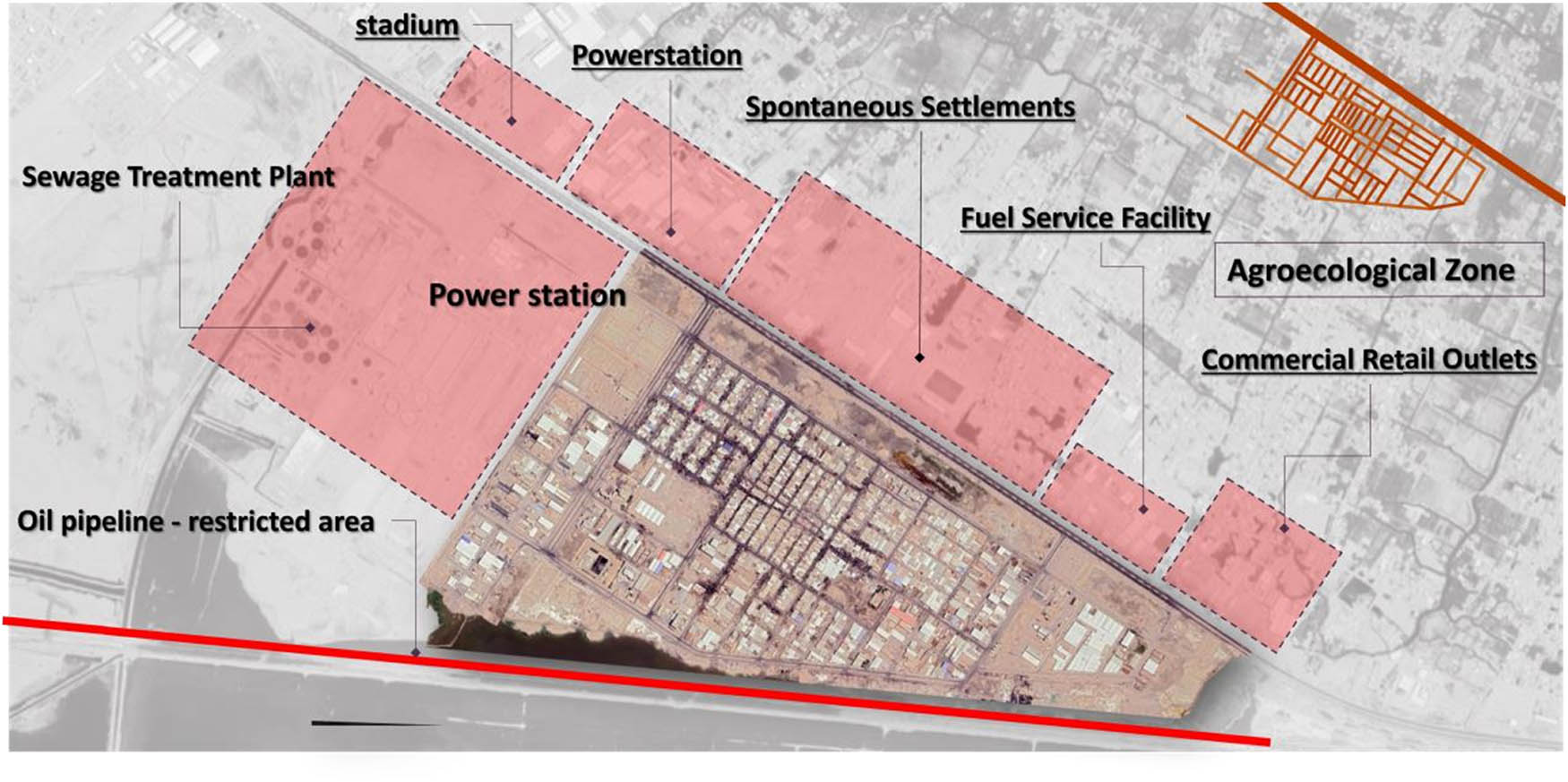
Integrative urban planning in Hamadan industrial city.
5.2 Spatial layout, facilities, and environmental management
The Hamdan industrial complex is surrounded by infrastructure and environmental factors. The facility is next to a wastewater treatment plant, demonstrating the region’s dedication to environmental responsibility and the proactive handling of industrial waste. Figure 2 shows Hamadan industrial city’s integrated industrial, residential, and service infrastructure. The graphic shows an industrial complex with energy and waste management infrastructure and a power station in the manufacturing core, demonstrating how energy-intensive industrial activity is. This northwest-located sewage treatment facility demonstrates environmental management and sustainable industrial effluent treatment. The restricted oil pipeline beside the complex emphasizes energy supply and safety. To the east, commercial retail outlets show the economic connectivity between industry and consumer services, giving a comprehensive microcosm of urban life around the industrial nexus. This chart depicts Hamadan industrial city’s urban characteristics’ interdependence. The Hamdan industrial complex and its surroundings form an interconnected network necessary for its functioning and adaptation.
In addition to its role as a center for essential services, which includes the General Automobile Company and an oil storage facility, the Hamdan industrial complex is also home for several other commercial enterprises. It is important to note that it demonstrates a dedication to ecological integration, as shown by the inclusion of green areas and the deliberate protection of undeveloped stretches of land. The complex’s commitment to supporting industrial expansion while preserving the environment is shown by the purposeful spatial arrangement interconnected seamlessly by a complete street network. Figure 3 presents the proportional distribution of land utilization within the Hamadan industrial city. Each bar in the graph corresponds to a distinct category of land use, ranging from workshops and manufacturing facilities to green areas and service zones. The chart shows that the largest proportion of land is allocated to repair and maintenance workshops for cars, followed by carpentry workshops, laboratories, and stores. Notable too is the significant allocation for a green belt, underscoring an emphasis on sustainable urban design. Less land is devoted to on-site services like firefighting, gas stations, and restaurants. The smallest proportions are attributed to unused land and miscellaneous stores, reflecting a high degree of land utilization within the industrial city. This visualization is a clear representation of how space is allocated across various industrial and support functions in the city. Notably, it also incorporates ecological and recreational areas, such as the green belt and unused land, which demonstrates the incorporation of environmental issues into the layout of the industrial facility. This picture highlights the multi-functional environment of the complex, which strives to strike a balance between ecological, economic, and industrial components.

Land use distribution in Hamadan industrial city: According to the field survey.
Based on an extensive field survey conducted within the Hamdan industrial city, it has been determined that approximately 934 diverse workshops are operational, specializing in the repair and maintenance of various types of automobiles. This finding highlights a significant concentration of automotive service facilities in this industrial zone. A comprehensive field survey by the authors was used to compile the information shown in Table 1, which is an exhaustive listing of auto repair businesses. This classification system classifies these workshops as new or old industrial workshops and washing and lubricating workshops. It also provides information on the number of workshops, their individual and total areas, and their proportion of the total occupied space. Comprehending the location and size of these workshops, which reflects the dynamics of the automobile repair business, requires these data, which are vital for understanding the situation. When making educated judgments about the sector’s future and its space’s design, stakeholders, urban planners, and politicians may benefit tremendously from having access to such information.
Quantitative distribution of workshop types and their spatial footprints in Hamadan industrial city, derived from a comprehensive field survey
| Category | Workshop type | Number of workshops | Individual workshop area (m²) | Total area (m²) | Percentage of total area |
|---|---|---|---|---|---|
| New industrial workshops | — | 40 | 200 | 8,000 | — |
| 40 | 100 | 4,000 | — | ||
| 288 | 150 | 43,200 | — | ||
| Subtotal | 368 | — | 55,200 | 8.77% | |
| Old industrial workshops | — | 514 | 122 | 62,708 | 3.36% |
| Washing and lubricating workshops | — | 52 | 400 | 20,800 | 1.12% |
The “Number of Workshops” column in this table meticulously enumerates the total count of individual workshops within each specified category. The term “Individual Workshop Area” refers to the spatial dimensions associated with each workshop unit. Subsequently, the “Total Area” is calculated by multiplying the number of workshops by the area of each unit, thereby deriving the cumulative spatial expanse occupied by all the workshops within a specific category. Furthermore, the “Percentage of Total Area” column offers a quantitative depiction of the fraction of the total area that is occupied by all workshops belonging to each designated group. This tabular arrangement offers a sturdy framework from an academic standpoint, and it differentiates between the many sorts of workshops. It comprehensively analyzes their distribution, individual dimensions, and collective spatial influence within the more significant industrial environment.
5.3 Proportional distribution and “HIC” zoning analysis
The Basra Municipality Directorate has conducted a comprehensive zoning analysis, delineating the distribution of various facilities and their spatial footprints within the designated area. This analysis is pivotal in understanding the urban landscape and planning needs. The findings are categorized as follows:
Urban infrastructure distribution:
Roadways represent 25% of the total area, indicating a significant investment in transportation infrastructure.
Facilities with diverse functionalities comprise 63% of the site, reflecting a multi-dimensional urban development approach.
Green spaces and open areas constitute 12%, underscoring the integration of environmental considerations in urban planning.
Allocations for repair and maintenance facilities:
Designated areas for spare tool shops are approximately 120 m2 per establishment.
Repair and maintenance shops are allocated 96 m2 each.
Washing and lubricating workshops are 720 m2 per unit.
Comprehensive repair agencies are provided with a significant area of 960 m2 each.
Project area percentage analysis:
These spatial allocations were derived from an extensive field survey focusing on the existing repair shops and facilities.
The survey also considers the need for expanding certain areas to meet the increasing demand and the current service gaps in catering to customer needs.
This detailed zoning analysis provides crucial insights into the urban structure and service distribution within the Basra Municipality, highlighting potential growth areas and the need for strategic urban planning to enhance service delivery and environmental sustainability.
5.4 Assessment of infrastructure services in the industrial zone
This section delineates a critical analysis of the existing infrastructure services within the industrial zone, highlighting the challenges and disparities in service provision:
Water infrastructure evaluation:
The older sector of the industrial zone is serviced by an antiquated and deteriorating water network, highlighting a significant deficiency in maintaining essential infrastructure.
In marked discrepancy, the nascent developed sectors of the zone exhibit a deficiency in water supply infrastructure, reflecting an oversight in anticipatory urban planning and development strategies.
Electricity supply analysis:
The industrial zone experiences programmed electricity outages, a critical issue that significantly hampers industrial productivity and operational efficiency. This intermittent power supply underscores the need for a more robust and reliable electrical infrastructure to support industrial activities.
Sewage system overview:
A conspicuous absence of a sewage network is observed despite the proximity of a main sewage treatment facility. This paradoxical situation reflects a severe oversight in infrastructural planning and poses substantial environmental and health risks. This assessment underscores the urgent need for infrastructural upgrades and strategic planning in the industrial zone to ensure sustainable industrial growth and environmental compliance.
Infrastructure analysis in the industrial area
Water infrastructure: The existing water network in the older sector contrasts starkly with its absence in the newer sector. This discrepancy necessitates strategic planning for equitable water distribution and network modernization, ensuring reliable water supply across the entire industrial area.
Electricity supply: The industrial area faces programmed electricity outages, severely impacting manufacturing processes. Addressing these disruptions is critical, possibly through enhanced electrical infrastructure or integrating alternative energy sources, to ensure a consistent and reliable power supply.
Sewerage system: Despite the proximity to a central sewage filtering facility, the industrial area lacks a comprehensive sewage network, posing environmental and health risks. Developing an efficient sewage system is essential for effective waste management and compliance with environmental standards.
Improving these infrastructure elements is vital for the operational efficiency, environmental sustainability, and future growth of the industrial area. It requires a balanced approach encompassing technological upgrades, policy reform, and sustainable infrastructure development.
Classification and environmental impact of automotive service workshops in Hamadan industrial city through the field survey
| Functional area | Proportion of total workshops (%) | Predominant location | Environmental impact assessment |
|---|---|---|---|
| Shops selling spare tools | 3.14 | Flanking both sides of streets | Minor |
| Small car repair garages | 6.54 | Flanking both sides of streets | Significant |
| Large car repair garages | 2.46 | Operated via an online platform | Significant |
| Washing and lubricating workshops | 1.11 | Situated on main Street | Significant |
Note: The table presents the proportion of workshops relative to the total number within the industrial city, their signature locations indicating the typical setting for the workshop type, and an assessment of the environmental impact they render, ranging from “Minor” to “Significant.”
5.5 Infrastructure services and urban planning
This analysis outlines the spatial distribution and allocation of various establishments within the Basra Municipality site, as defined by the Directorate of Basra Municipality.
Site composition
Roads: Comprising 25% of the total area, highlighting infrastructure focus on accessibility.
Diverse installations: Occupying 63%, these represent the site’s emphasis on economic activity.
Green spaces and open areas: Making up 12%, indicating a balance between urban development and environmental consideration.
Repair and maintenance services allocation
Spare tools shops: Allocated 120 m² each.
Repair and maintenance shops: Provided with 96 m² per shop.
Washing and lubrication workshops: Given 720 m² each.
Integrated repair agencies: Allotted 960 m² per agency.
Project area proportions:
Based on a field survey, these proportions consider the need for expanded space in certain areas to meet increasing demand and service capacity. This distribution reflects strategic urban planning within the municipality, balancing economic activities with infrastructural and environmental needs. The adjustments in space allocation for certain services demonstrate a responsive approach to evolving urban demands. Table 2 shows the predominance of urban automobile service workshops by type. The workshops are categorized by their main purpose, their typical settings, and their environmental implications. Spare tool shops are ubiquitous and located in high-traffic locations, but repair garages, both small and big, have a greater environmental effect and may require specialized environmental management. Eco-friendly car washing and lubrication workshops are strategically situated on important roads. This table helps urban development and environmental management by identifying automobile service hubs and assessing their environmental effect. This thorough table is a valuable tool for understanding the business’s structure, the industry’s spatial dynamics, and the industry’s environmental consequences. It is necessary for academic study and the formation of policy in the field of urban and environmental planning.
5.6 Integrative urban services
It was limited to the presence of some services in a simplified and non-integrated manner with the urban planning and design of the city and the absence of other integrated urban services – from the existing services in a simplified form (fire station, gas station, mosque, and popular restaurants). Table 3 is an organized representation of how space is utilized for essential services in Hamadan industrial city, reflecting the area each service occupies as a percentage of the total available space. It shows that among the facilities listed, the fuel service station takes up the most area, followed by the fire station, restaurants, and the mosque, in descending order of space occupied. The data suggest a prioritization of services related to safety, refueling needs, dining, and religious practices within the urban infrastructure. This information can be instrumental for city planners and officials to understand the distribution of community services and to guide future urban development initiatives, where urban planners, policymakers, and academics need such data to evaluate the infrastructure layout and its consequences for community accessibility, resource management, and overall urban growth in the area. These data are essential for analyzing the layout of the infrastructure.
Proportional allocation of essential services within Hamadan industrial city’s designated area through the field survey
| Service category | Percentage of total allocated area | Service footprint (m²) |
|---|---|---|
| Fire station | 0.17 | 3,200 |
| Mosque in the industrial district | 0.06 | 1,225 |
| Fuel service facility (filling station) | 0.53 | 9,975 |
| Culinary establishments (restaurants) | 0.08 | 1,530 |
Table 4 offers a detailed breakdown of the types and quantities of industrial and research facilities within Hamadan industrial city, alongside their respective spatial footprints and contributions to the total area dedicated to laboratory and workshop spaces. This table categorizes facilities into six main types, ranging from flour mills and construction material labs to forging factories and miscellaneous research units, highlighting the diversity and specialization of the city’s industrial sector. The data, collected through a comprehensive field survey, underscore the significant allocation of space to forging workshops, which occupy the largest percentage of the total laboratory area, illustrating a major focus on metalworking within the city’s industrial landscape. This information is invaluable for understanding the industrial composition and research capabilities of Hamadan industrial city, providing insights into its operational focus and potential areas for development or investment. This systematic compilation and analysis aim to provide in-depth knowledge of the industrial and research environment in the Hamdan industrial city “HIC.” This understanding highlights these specialized facilities’ variety, scope, and dispersion. For academic research, the formulation of policy, and strategic planning in the context of industrial development and scientific innovation, information of this level of specificity is of the utmost significance.
Spatial distribution and proportional analysis of industrial and research facilities in Hamadan industrial city based on field survey data
| Facility type | Quantity | Footprint (m²) | Share of total laboratory space (%) |
|---|---|---|---|
| Flour mills | 7 units | 35,000 | 1.88 |
| Laboratories for construction materials | 101 units | 88,016 | 4.73 |
| Food processing laboratories | 40 units | 28,284 | 1.51 |
| Forging workshops | 312 units | 143,028 | 7.68 |
| Carpentry workshops | 96 units | 46,752 | 2.51 |
| Miscellaneous research facilities | 7 units | 24,500 | 1.31 |
Figure 4 presents a comprehensive zoning map of Hamadan industrial city, articulated through a color-coded schema that indicates the purpose and categorization of various sectors within the industrial complex. The vibrant green areas denote operational zones primarily dedicated to manufacturing and processing activities, reflecting the city’s industrial vitality. Contrasting blue areas signify administrative and possibly research divisions, illustrating the intellectual and managerial backbone of the city. Yellow blocks may represent auxiliary services or utility zones, crucial for supporting the infrastructure of a fully functioning industrial environment. Red sections could indicate high-priority or emergency services, essential for maintaining safety and efficiency. The expanse of white indicates undeveloped or potential expansion zones, offering insights into future growth opportunities within the industrial city. The black background enhances the visual demarcation of zones, ensuring clear distinction and ease of interpretability. This figure serves as a strategic tool for urban planners, investors, and policymakers, enabling a nuanced understanding of the industrial city’s spatial dynamics and providing a foundation for strategic development, operational management, and future expansion planning.

Zoning and functional layout of Hamadan industrial city (source: Empirical field survey).
An exhaustive field study was conducted to determine the labor deployment and parking facility allocation across various automobile repair workshops in a particular jurisdiction. Table 5 shows Hamadan industrial city’s service sector parking spots and workers. It illustrates the city’s automobile service sector infrastructure, including parking and labor distribution. Mechanical services employ the most people, followed by paint, plumbing, and bodywork. The chart shows the operating capacity and workforce distribution, demonstrating the city’s dedication to a strong automotive services industry.
Allocation of parking spaces and workforce in various service sectors within Hamadan industrial city (source: Empirical field survey)
| Service sector | Available parking spaces | Workforce employed |
|---|---|---|
| Mechanical services | 4 | 5 |
| Paint and bodywork services | 3 | 5 |
| Plumbing services | 3 | 4 |
| Bodywork and mourning services | 3 | 4 |
| Electrical services | 2 | 4 |
| Upholstery services | 2 | 4 |
| Glass and composite materials | 2 | 4 |
| Vehicle aesthetics (salon) | 2 | 3 |
| Tire repair services | 2 | 3 |
| Radiator repair services | 2 | 3 |
| General mechanical services | 6 | 12 |
| Vehicle washing and lubrication | 4 | 9 |
| Financial oversight (budget officer) | 2 | 6 |
This table shows Hamadan industrial city’s service sector parking spots and workers. It illustrates the city’s automobile service sector infrastructure. A statistic indicates the operational capability for accommodating automobiles, and the table provides information about the number of parking spots available for each service specialty specifically. At the same time, it reveals the workforce complement, which sheds information on the human resources employed within each service domain. This systematic tabulation aims to give a scholarly insight into the labor allocations and infrastructure provisions necessary for evaluating the car repair workshops’ service readiness and operational capabilities. It provides a nuanced perspective on the industry’s readiness to fulfill the needs of the automotive service industry by highlighting the interaction between the physical infrastructure and the human capital present within the sector.
5.7 Evaluating the impact of sustainable industrial strategies on Hamadan industrial city: A pre- and post-implementation stud
Table 6 compares strategic actions in Hamadan industrial city’s environmental, economic, social, and industrial areas before and after policy implementation. It shows significant gains in these areas, from high carbon emissions and poor waste management to a more ecologically friendly atmosphere. As urban and industrial sectors collaborate more, economic activity has grown. Enhancements in social welfare are evident through improved housing quality, augmented services, and reduced congestion. Concurrently, the amalgamation of urban development has catalyzed industrial innovation within the city. This table shows how policy execution has improved urban–industrial synergy in the city. Progress was made in social welfare, which included improvements in social services and living situations, as well as fundamental issues such as housing and congestion. A surge in innovation was supported by urban–industrial integration, which led to a shift from the restricted scope of innovations in industries that were caused by isolation.
Comparative assessment of urban and industrial development outcomes in Hamadan industrial city before and after policy implementation
| Developmental aspect | Pre-implementation condition | Post-implementation outcome |
|---|---|---|
| Environmental impact | Characterized by high carbon emissions and inefficient waste management | Marked by a reduction in emissions and advancements in waste management efficiency |
| Economic growth | Exhibited limited growth with industrial activities occurring in isolation | Showed an uptick in growth with enhanced synergy between industrial operations and urban development |
| Social welfare | Faced with resource allocation challenges, housing scarcity, and traffic congestion | Improved provision of social services, availability of quality housing, and alleviation of traffic congestion |
| Urban development challenges | Struggled with acute housing shortages and pervasive congestion | Implementation of innovative urban planning strategies resulting in mitigation of housing and congestion issues |
| Industrial innovation | Experienced stifled innovation due to sectoral separation | Witnessed an upsurge in innovation catalyzed by the integration of industrial activities with urban planning |
Note: This table juxtaposes the status of key urban and industrial development indicators in Hamadan industrial city before and after the implementation of strategic policies aimed at fostering sustainable growth. The left column enumerates various facets of development, the middle column describes the initial challenges and the right column highlights the improvements achieved following policy interventions. This serves to illustrate the transformative effects of integrated policy approaches on urban and industrial environments.
6 Results and discussion
Evidence supports the assertion that the implementation of sustainable industrial practices within Hamadan industrial city has yielded substantial benefits across environmental sustainability, economic stability, and social well-being. Positioned within the broader context of sustainable urban–industrial integration, this section elucidates the variables examined – namely, carbon emissions, water consumption, energy efficiency, waste generation, and employment rates. Further, it explores the interrelationships among these factors and discusses their resultant implications. Sections 6.1–6.3 detail the environmental variables under consideration.
6.1 Carbon emissions and energy efficiency
Carbon emissions were selected as the major variable because of the considerable influence they have on the environment and the significance they have to SDGs on a global scale. A decrease in emissions by 25% was achieved with the implementation of energy-efficient devices. There is a close relationship between this variable and energy efficiency, which was shown to have improved by 20%. The decrease in the amount of energy that is consumed for each unit of industrial production not only contributes to the achievement of environmental goals but also demonstrates the economic benefits that originate from lower operating expenses.
6.2 Water use
Water efficiency techniques were employed, which resulted in a 30% reduction in water use. Given the limited availability of water resources in the area, this variable was of utmost importance, and as a result, it was an essential component in determining whether industrial operations are sustainable.
6.3 Waste output
The decrease in waste output by 15% was accomplished by the utilization of industrial synergy, which includes the incorporation of waste products from one process into another process as raw materials. This technique not only lessens the influence on the environment but also lowers the expenses associated with waste treatment and the acquisition of raw materials, which exemplifies the interdependence of these factors on both the economy and the environment.
Four social variables were taken into consideration while evaluating the social implications of incorporating sustainable practices. The employment rate was the primary variable. The larger socio-economic benefits of sustainable industrial growth are shown by the fact that employment rates in the industrial sectors have increased by 18%, notably in occupations related to technology and sustainability. It is important to note that the rise in employment is connected to both the economic viability and the social stability of the city. This highlights the fact that industrial sustainability adds to the overall socio-economic resilience of the system.
6.3.1 Interactions and broader implications
How these factors interact with one another exemplifies an all-encompassing strategy for sustainable development. Energy efficiency and waste reduction are two factors that directly contribute to the sustainability of the environment, while also contributing to the improvement of economic results through cost savings. In a similar vein, efforts to save water contribute to the maintenance of ecological equilibrium as well as economic efficiency in situations when resources are scarce. To illustrate the interwoven nature of sustainable practices, it is important to note that social gains, such as greater employment, are directly affected by these environmental and economic developments.
The selection of these elements was based on their relevance to the study’s goal of establishing a sustainable urban–industrial environment in HIC. When sustainable industrial practices are integrated into urban surroundings, they promote a harmonious balance between social welfare, economic well-being, and environmental responsibility. The holistic approach not only facilitates the attainment of the immediate goals of the HIC but also adds to the broader discourse on the long-term viability of the global environment. This study examines the complex relationship between manufacturing processes and urban living. Luo et al. argued that efficiently integrating industrial activities within urban surroundings may lead to sustainable industrial growth, indicating a significant change in the prevailing paradigm. In the context of sustainable development, governments worldwide are placing more emphasis on green innovation in their environmental policies. They acknowledge the crucial role of the digital economy in enhancing efforts toward green innovation [71]. This holistic approach fits with the worldwide focus on sustainability. It suggests a model of harmonization in which industrial and urban entities coexist in a way that makes better use of resources, has fewer adverse effects on the environment, and increases socio-economic benefits. The study presents a compelling argument for integrating industrial operations within urban environments, which departs from traditional urban planning models that typically separate residential and commercial zones from industrial activities. This argument is presented in the context of our case study, which focused on Hamadan industrial city. This integrated strategy, as was proved in the example of Hamadan, results in enhanced resource efficiency, reduces the adverse effects on the environment, and generates significant socio-economic advantages. Weiss’s comprehensive overview of contemporary issues in industrial development, coupled with analysis of trade policy, firm networks, the role of technology, and government policy, provides a concrete framework for evaluating Hamadan’s industrial sector. By applying these insights, the study can objectively assess the current state of Hamadan’s industrial development, identify challenges and opportunities, and propose targeted strategies for sustainable economic growth within the urban environment of Hamadan (Table 7).
Economic dynamics of industrial development in Hamadan industrial city: Insights from John Weiss and their application
| Aspect | Insights from John Weiss | Application to Hamadan industrial city |
|---|---|---|
| Role of manufacturing | Manufacturing drives job creation,and product innovation, and establishes global trade links | Assess how Hamadan’s manufacturing sector has contributed to local employment, innovation, and its position in international trade |
| Global economic shifts | Shift from established industrial centers to new ones in developing countries | Investigate the positioning of Hamadan within these global shifts, identifying opportunities and challenges |
| Impact of trade policy | Trade policies and WTO rules significantly affect industrial development | Analyze Hamadan’s trade policies and their alignment with WTO rules, exploring their impact on industrial growth |
| Inter-firm networks | Networks between firms across the global economy play a critical role | Examine the network of relationships between firms in Hamadan and international partners, assessing the impact on industrial synergy |
| Role of small firms and technology | Small firms and technology are crucial for industrialization | Evaluate the presence and impact of small firms and technology-driven enterprises in Hamadan’s industrial development |
| Government policy | Government policies toward industry, with insights from East Asia’s economic success | Review Hamadan’s industrial policies, comparing them with successful strategies from East Asian economies for potential lessons learned |
This integration has the potential to be very beneficial, as shown by the Hamadan case study. It has been established that Hamadan has exhibited increased synergy between industrial productivity and urban sustainability by incorporating industrial operations into the underlying fabric of the city. This paradigm requires a considerable change in urban policy frameworks, which calls for reevaluating zoning regulations and infrastructure development. It is essential to make such policy modifications to promote a peaceful cohabitation of urban and industrial zones, which, in turn, may stimulate economic development while adhering to sustainability principles. This holistic approach fits with the worldwide focus on sustainability. It suggests a model of harmonization in which industrial and urban entities coexist in a way that makes better use of resources, has fewer adverse effects on the environment, and increases socio-economic benefits. The findings of the research on sustainable urban manufacturing, which were observed in Hamadan, shed light on the possibility of establishing manufacturing processes that are both socially inclusive and ecologically responsible within urban environments. In Hamadan, implementing environmentally friendly technology and energy-efficient practices has contributed to the city’s economic vitality and sustainability regarding the environment and social inclusion. As an additional point of interest, the story of Hamadan industrial city highlights this integration’s transformational influence on the rehabilitation of metropolitan areas. Table 8 provides a concise overview of the main ideas presented in “Cities and Sustainability” by Daniel Hoornweg. It also highlights how these principles can be explicitly implemented to improve sustainability in Hamadan industrial city.
Integration of “Cities and Sustainability” insights into Hamadan industrial city: A comparative analysis
| Aspect | Insights from Daniel Hoornweg | Application to Hamadan industrial city |
|---|---|---|
| Eco-urbanism principles | General exploration of eco-urbanism in urban settings without a specific focus on integration with industry | Applies eco-urbanism to integrate sustainable practices in Hamadan’s industrial and urban development |
| Role of cities | Discusses cities’ roles in sustainability broadly, often focusing on environmental aspects | Highlights Hamadan as a case study for sustainable urban–industrial synergy |
| Innovative methodology | Existing studies offer various metrics but lack focus on industrial cities | Introduces new sustainability metrics and tools designed for Hamadan |
The city has seen a reduction in the need for transportation, a reduction in emissions, and an improvement in accessibility for its residents due to the placement of industrial activities near residential areas. This closeness fosters a more robust relationship between the industrial sector and the local labor, increasing job prospects and developing related skills. Furthermore, the history of Hamadan demonstrates how metropolitan regions may develop into hubs of invention and creativity under certain circumstances. By incorporating industrial areas into the urban environment, cross-sectoral cooperation is encouraged, which in turn helps cultivate an atmosphere conducive to innovation. Because of this, Hamadan has become a pioneer in environmentally friendly and forward-thinking manufacturing processes, contributing to the city’s rapid economic expansion. The Hamadan case study supports the contention that urban planning and industrial growth should undergo a paradigm change. The paradigm presented here is one in which industrial activities are not only co-located with one another but are integrated into the urban ecology to enhance the economic, environmental, and social advantages achieved. To create urban communities that are sustainable, resilient, and dynamic, it will be necessary to embrace this integrated approach as cities like Hamadan continue to transform. This will provide a precedent for the development of urban areas in the future.
The third and fourth sections focused on the dynamic relationship between industrial development and urban planning, notably studying the active link between the two. The interaction between sustainable industrial growth and integrated industrial urban settings was central to both sections. The study highlighted the advantages of industrial growth and urban environmental sustainability, underlining the effective integration of sustainable industrial practices in urban settings. As a result of its contribution to the economic and ecological well-being of urban–industrial complexes, this part is essential for understanding the mutually beneficial interaction between urban life and industrial activity. The study strongly supports integrating industrial activities into urban environments, advocating a shift towards sustainable urban manufacturing. This approach aligns with the urgent need for sustainable development practices and offers a novel pathway for creating resilient, efficient, and livable urban spaces. As cities evolve, embracing this integrated approach may be crucial for shaping a sustainable and prosperous future. The study concluded that integrating industrial operations into urban settings boosts economic growth and fosters sustainable industry development. This finding is significant as it encompasses not just financial aspects but also environmental and social dimensions of urban life.
To identify the unique contributions of our work in the field of sustainable industrial growth in urban areas, it is essential to analyze the current literature thoroughly. Our study aims to compare and connect the wide-ranging economic, environmental, and social effects of urban–industrial synergy with the specific investigations conducted in previous studies. The following discussion compares our findings with the fundamental ideas and empirical data in important and current academic papers. Through the comparison of these viewpoints, our goal is to highlight the innovative aspects of our research, specifically focusing on economic rejuvenation, industrial advancement, urban difficulties, and global sustainability initiatives. This will contribute to the academic discussion by providing new perspectives and comprehensive strategies. This comparative study uncovers the intricate ways in which our research enhances comprehension and tackles the intricate relationship between industrial operations and urban growth, therefore facilitating the creation of sustainable and resilient future cities. Table 9 presents a comparison between the findings of the current study and the existing literature. It also includes citations to important sources for each topic that is examined. This statement aims to enhance the discussion portion of the paper by clearly expressing the unique contributions of this study to the wider academic conversation on sustainable industrial growth in urban settings.
Comparative analysis of research contributions in sustainable urban–industrial development
| Aspect | This study | Existing literature | Contribution to research area | Refs |
|---|---|---|---|---|
| Economic revitalization | Explores the role of industrial cities in economic growth | Mostly focuses on the general economic impacts of urbanization | Highlights specific mechanisms through which industrial cities can rejuvenate economies | [8,9,14,16,23,24,33,40,62] |
| Innovation in industries | Advocates for urban–industrial integration to foster innovation | Previous studies concentrate on innovation within industries in isolation | Demonstrates how urban–industrial symbiosis can enhance industry innovation | [3,12,19,20,26,59,69,70,71] |
| Urban challenges (housing and congestion) | Proposes solutions to housing shortages and congestion through industrial urban ecosystems | Limited discussion on how industrial development can alleviate these issues | Provides novel insights into using industrial development as a strategy to address urban problems | [10,18,30,38,44,46,63,64] |
| Sustainable urban–industrial ecosystems | Suggests creative, collaborative, and policy-driven approaches for sustainability | Discusses sustainability in either urban or industrial contexts separately | Bridges the gap by offering a comprehensive framework for integrated sustainable development | [1,2,4,5,6,7,13,15,17,25,27,31,35,36,37,41,42,43,47,48,49,50,52,53,54,55,56,57,58,60,61,65,66,67,68] |
| Global industrial sustainability efforts | Emphasizes the role of industrial cities in guiding global sustainability efforts | Focuses on localized or sector-specific sustainability initiatives | Expands the discourse by positioning industrial cities at the fore front of global sustainability | [11,21,22,28,29,32,34,39,45,51,72,73,74] |
Table 9 summarizes the references according to the different components of the investigation, demonstrating how this study expands upon or differs from previous literature and the distinct contributions it offers to each research field.
7 Conclusion
This study meticulously scrutinizes the industrial urban landscape of the Hamdan industrial area, uncovering a plethora of critical challenges that demand immediate theoretical and practical redress. The study discerns an inverse relationship between the pace of industrial expansion and the generation of urban employment opportunities, adversely impacting the area’s economic vitality. The discourse on sustainable urban development has arisen as a critical issue within academic research and policymaking in the modern age of globalization [72]. The findings of this study have shed light on significant issues and provided analytical implications for the development of sustainable industrial and urban areas. These findings are based on an exhaustive assessment of the industrial–urban environment of the Hamadan industrial region. One example that demonstrates a paradigm shift toward sustainable development is the case of Hamadan industrial city, which highlights the synergistic synergy between the rise of industry and urban design. The purpose of this study is to advocate for a peaceful cohabitation that is beneficial for economic progress, environmental protection, and social welfare. It does so by navigating through the intricacies of encouraging industrial activity inside urban contexts. The results underscore the importance of innovative, collaborative, and policy-driven initiatives in fostering resilient and sustainable industrial–urban ecosystems. As demonstrated by the city of Hamadan, the incorporation of industrial operations into the urban fabric has demonstrated the ability to improve resource efficiency, lessen the impact on the environment, and provide socio-economic benefits. Not only does this integration contributes to the economic vibrancy and sustainability of urban regions but it also solves urgent urban concerns such as housing shortages and congestion through innovative urban planning and industrial policies from the perspective of the city. Through strategic urban planning and industrial techniques, the primary objective is to reduce the pace of environmental deterioration, improve the efficiency with which resources are utilized, and improve the well-being of everyone in the society [73]. An exhaustive survey of relevant academic literature is the foundation for this research. It also uses a comprehensive case study analysis of the Hamadan industrial city to illustrate its claims. It proposes that there is a need for a complete and long-term framework that may facilitate the integration of industrial operations inside urban areas. It is essential for the study that will be conducted in the future to investigate further the techniques and frameworks that have the potential to operationalize the integration of urban and industrial domains more efficiently. It will be extremely important to do research into the long-term effects that such integration will have on the resilience of metropolitan areas, social cohesion, and environmental sustainability. In addition, research should consider the impact that technical advancements, digitization, and environmentally conscious legislation have in increasing the synergy between the expansion of industrial production and the rise of urban areas. The advancement of the discourse on sustainable industrial–urban integration will also require the adaptation of global best practices and the customization of tactics to local circumstances. Both aspects will be essential. Each component is vital in developing urban environments characterized by seamlessly integrating industrial and environmentally responsible activities [74]. This study makes a significant contribution to the continuing discussion on urbanization and industrialization by providing a fresh viewpoint on the topic of attaining sustainable development via integrated industrial and urban planning. The Hamadan case study offers a significant framework for policymakers, urban planners, and stakeholders who are interested in replicating comparable results in other places. The insights and strategic implications that were generated from the study give important information. As the rate of urbanization continues to rise on a worldwide scale, the lessons that have been learned from Hamadan industrial city underscore the significance of embracing creative approaches to the integration of industrial and urban areas. This will pave the way for cities in the future that are more environmentally friendly, efficient, and habitable.
7.1 Potential outcomes in the future and appropriate solutions
The study proposes strategic future visioning and corrective activities. This research has developed a comprehensive and scalable framework for integrating sustainable industrial practices into urban areas, as shown by Hamadan industrial city. The report emphasizes the need for creative, intersectoral collaboration and strong policies to build resilient and sustainable industrial–urban ecosystems, which will play a key role in global industrial sustainability. Table 10 presents a strategy framework for sustainable urban–industrial expansion, including projected future trends and practical initiatives. It proposes changes and technical integrations to apply the successful Hamadan model to new situations. On the other hand, it suggests policy innovation, community-centric equality frameworks, and resilience building. This complete tableau shows stakeholders how multidisciplinary methodologies, smart technology, and inclusive policies can create a sustainable symbiosis between urban and industrial growth. It summarizes the research’s key results and recommendations to help urban planners, legislators, and industry executives integrate industrial activities within urban settings.
Prospects and solutions for sustainable urban–industrial development
| Category | Future prospects | Relevant solutions |
|---|---|---|
| Model adaptation | Calibration of the Hamadan model for varied global urban–industrial contexts to serve as a prototype for replication | Emphasize transdisciplinary methodologies, incorporating a broad knowledge base to tackle urban–industrial sustainability challenges |
| Technological integration | Investigation into the incorporation of emerging technologies to advance sustainability within the urban–industrial nexus | Employ smart planning and digital technologies to optimize resource management and enhance land use efficiency in urban–industrial landscapes |
| Policy innovation | Development of pioneering policy frameworks to support the integration of sustainable urban development and industrial growth | Advocate for the adoption of circular economy principles, focusing on resource recycling and reusability to reduce waste and enhance sustainability |
| Community equity | Design of inclusive frameworks to ensure equitable distribution of urban–industrial integration benefits | Foster multistakeholder engagement, involving diverse groups in collaborative decision-making for sustainable industrial–urban ecosystem development |
| Resilience building | Enhancement of urban–industrial resilience to ensure long-term sustainability amid changing global conditions | Enhance green infrastructure development as a vital component of urban sustainability, supporting environmental quality and urban livability |
This table provides a concise summary of the study’s vision for future routes and solutions that may be implemented to achieve sustainable urban–industrial growth.
-
Funding information: Authors state no funding involved.
-
Author contributions: All authors have accepted responsibility for the entire content of this manuscript and consented to its submission to the journal, reviewed all the results and approved the final version of the manuscript. AA-A: conceptualization, methodology, validation, formal analysis, data curation, writing – original draft preparation, writing – review and editing, supervision, and project administration. FA-A: conceptualization and methodology. AA (Amjad Almusaed): software, validation, formal analysis, investigation, resources, data curation, visualization, and project administration. AA (Asaad Almssad): validation, investigation, writing – review and editing.
-
Conflict of interest: The authors declare no conflict of interest.
-
Data availability statement: The data supporting this study’s findings are available upon request from the corresponding author. Interested researchers may contact the corresponding author to request the data, subject to any necessary approvals and agreements that ensure the data are used by ethical guidelines and privacy laws applicable to this research.
References
[1] Li L, Sun W, Hu W, Sun Y. Impact of natural and social environmental factors on building energy consumption: Based on bibliometrics. J Build Eng. 2021;37:102136.10.1016/j.jobe.2020.102136Search in Google Scholar
[2] Concari A, Kok G, Martens P. A systematic literature review of concepts and factors related to pro-environmental consumer behavior about waste management through an interdisciplinary approach. Sustainability. 2020;12(11):4452.10.3390/su12114452Search in Google Scholar
[3] Zabel C, O'Brien D, Natzel J. Sensing the Metaverse: The microfoundations of complementor firms' dynamic sensing capabilities in emerging-technology ecosystems. Technol Forecast Soc Change. 2023;192:122562.10.1016/j.techfore.2023.122562Search in Google Scholar
[4] Bai X, McPhearson T, Cleugh H, Nagendra H, Tong X, Zhu T, et al. Linking urbanization and the environment: Conceptual and empirical advances. Annu Rev Environ Resour. 2017;42:215–40.10.1146/annurev-environ-102016-061128Search in Google Scholar
[5] Bibri SE. A foundational framework for smart, sustainable city development: Theoretical, disciplinary, and discursive dimensions and their synergies. Sustain Cities Soc. 2018;38:758–94.10.1016/j.scs.2017.12.032Search in Google Scholar
[6] Song W, Yang W, Wang N, Wang C, Li Z, Ou Y, et al. How does industrial transformative process shape the spatial dynamics of urban development? Land Use Policy. 2024;138:107015.10.1016/j.landusepol.2023.107015Search in Google Scholar
[7] Ren K, Wu T. Analyzing the evolution of a rural construction community in China from the perspective of cultural landscape. Buildings. 2024;14(1):97.10.3390/buildings14010097Search in Google Scholar
[8] Stancu A. Analysis of food loss and waste for the European countries in the context of sustainable development. Sustainability and intelligent management. Cham: Springer International Publishing; 2022. p. 119–48.10.1007/978-3-030-98036-8_6Search in Google Scholar
[9] Ling T-Y. Investigating the malleable socioeconomic resilience pathway to urban cohesion: A case of Taipei metropolitan area. Environ Dev Sustain. 2021;23:13016–41.10.1007/s10668-020-01197-9Search in Google Scholar PubMed PubMed Central
[10] Klingmann A. Rescripting Riyadh: How the capital of Saudi Arabia employs urban mega-projects as catalysts to enhance the quality of life within the city’s neighborhoods. J Place Manag Dev. 2023;16(1):45–72.10.1108/JPMD-06-2021-0062Search in Google Scholar
[11] Famutimi JTF, Olugbamila OBO. Implications of Living in Harmony with Nature for Urban Sustainability in Post Covid-19 Era. Urban Reg Plan Rev. 2022;8(1):19–33.Search in Google Scholar
[12] Hariram NP, Mekha KB, Suganthan V, Sudhakar K. Sustainalism: An integrated socio-economic-environmental model to address sustainable development and sustainability. Sustainability. 2023;15:10682. 10.3390/su151310682.Search in Google Scholar
[13] Wallner HP. Towards sustainable development of industry: networking, complexity, and eco-clusters. J Clean Prod. 1999;7(1):49–58.10.1016/S0959-6526(98)00036-5Search in Google Scholar
[14] Chen Y, He M, Xu Y. Sustainable mining sector development for achieving shared prosperity in Chinese rural areas. Resour Policy. 2023;87:104325.10.1016/j.resourpol.2023.104325Search in Google Scholar
[15] Göçoğlu V, Göksu S. How do industrialization and agricultural land use affect the urban population in Turkey? Policy implications in the context of SDGs. J Policy Modeling. 2023;46(1):198–211.10.1016/j.jpolmod.2023.08.004Search in Google Scholar
[16] Feng Y, Hu J, Afshan S, Irfan M, Hu M, Abbas S. Bridging resource disparities for sustainable development: A comparative analysis of resource-rich and resource-scarce countries. Resour Policy. 2023;85:103981.10.1016/j.resourpol.2023.103981Search in Google Scholar
[17] Weiss J. The economics of industrial development. UK: Routledge; 2010 Sep.10.4324/9780203846803Search in Google Scholar
[18] Hoornweg D. Cities and sustainability: A new approach. UK: Taylor and Francis; 2018.Search in Google Scholar
[19] Almusaed A, Almssad A. Urban social sustainability – Case Study; Gellerupparken–Denmark. Sustainability in urban planning and design. UK: IntechOpen; Dec. 2020. 10.5772/intechopen.93124.Search in Google Scholar
[20] Enteshari S. Identification of sustainability’s threshold concept(s) among multi-discipline engineering students. Doctoral dissertation. The University of Waikato, New Zealand, 2023.Search in Google Scholar
[21] Dhir A. Disruptive digital innovations in healthcare: Knowing the past and anticipating the future. Switzerland: Elsevier; 2023.Search in Google Scholar
[22] Hanandeh A, Haddad E, Najdawi S, Kilani Q. The impact of digital marketing, social media, and digital transformation on the development of digital leadership abilities and the enhancement of employee performance: A case study of the Amman Stock Exchange. Int J Data Netw Sci. 2024;8(3):1915–28.10.5267/j.ijdns.2024.1.021Search in Google Scholar
[23] Hooda M, Ramesh M, Gupta A, Nair J, Nandanan K. Need assessment and design of an IoT-based healthcare solution through participatory approaches for a rural village in Bihar, India. 2021 IEEE 9th Region 10 Humanitarian Technology Conference (R10-HTC). IEEE; 2021.10.1109/R10-HTC53172.2021.9641697Search in Google Scholar
[24] Parkoo KW. Open source technologies and local economic development: Exploring adoption factors in a Less Developed Country. Sweden: Sida; 2019.Search in Google Scholar
[25] Randolph GF, Storper M. Is urbanization in the Global South fundamentally different? Comparative global urban analysis for the 21st century. Urban Stud. 2023;60(1):3–25.10.1177/00420980211067926Search in Google Scholar
[26] Xu J, Song R, Zhu H. Evaluation of smart city sustainable development prospects based on fuzzy comprehensive evaluation method. Comput Intell Neurosci. 2022;2022:11.10.1155/2022/5744415Search in Google Scholar PubMed PubMed Central
[27] Hernandez G. The thematic embodiment of technological trauma: A hermeneutic phenomenological study of teachers’ perceptions and their lived experiences during the COVID-19 pandemic. Doctoral dissertation. Aurora University, Virginia, USA, 2023.Search in Google Scholar
[28] Yu S, Wang X, Liu J, Wei F. Role of mining waste trade on green development in China: Policy implications for circular economy. Resour Policy. 2023;86:104147.10.1016/j.resourpol.2023.104147Search in Google Scholar
[29] Surya B, Ahmad DNA, Sakti HH, Sahban H. Land use change, spatial interaction, and sustainable development in the metropolitan urban areas, South Sulawesi Province, Indonesia. Land. 2020;9:95. 10.3390/land9030095.Search in Google Scholar
[30] Ni L, Ahmad SF, Alshammari TO, Liang H, Alsanie G, Irshad M, et al. The role of environmental regulation and green human capital towards sustainable development: The mediating role of green innovation and industry upgradation. J Clean Prod. 2023;421:138497.10.1016/j.jclepro.2023.138497Search in Google Scholar
[31] Yang F, Qi W, Han J. Research on the mechanism of promoting coordinated development of ecological well-being in rural counties through industrial transformation. PLoS one. 2023;18(9):e0291232.10.1371/journal.pone.0291232Search in Google Scholar PubMed PubMed Central
[32] Petkova I, Rosin S. Destination facelift: Unveiling the dynamic capabilities that rejuvenate madeira Island. 2023. 10.1109/R10-HTC53172.2021.9641697. Sarpong D, Boakye D, Ofosu G, Botchie D. The three pointers of research and development (R&D) for a growth-boosting sustainable innovation system. Technovation. 2023;122:102581.Search in Google Scholar
[33] Almusaed A, Almssad A. Sustainable wooden skyscrapers for the future cities. UK: IntechOpen. 2023. 10.5772/intechopen.105809.Search in Google Scholar
[34] Jia X, Macário R, Buyle S. Expanding horizons: A review of sustainability evaluation methodologies in the airport sector and beyond. Sustainability. 2023;15(15):11584. 10.3390/su151511584.Search in Google Scholar
[35] Beaurain C, Chembessi C, Rajaonson J. Investigating the cultural dimension of circular economy: A pragmatist perspective. J Clean Prod. 2023;417:138012.10.1016/j.jclepro.2023.138012Search in Google Scholar
[36] Xu L, Fang K, Huang Y, Xu S. Demand priority of green space from the perspective of carbon emissions and storage. Sustainability. 2023;15(14):11199. 10.3390/su151411199.Search in Google Scholar
[37] Almulhim AI, Cobbinah PB. Can rapid urbanization be sustainable? The case of Saudi Arabian cities. Habitat Int. 2023;139:102884; Almusaed A, Almssad A. City phenomenon between urban structure and composition. Sustainability in Urban Planning and Design. UK: IntechOpen; 2020. 10.5772/intechopen.90443.Search in Google Scholar
[38] González-Calle JL, Sánchez Contreras CA, Monteserín Abella O. The nature and production of urban space in Latin America: A historical review of the case of Ibagué (Colombia). Land. 2023;12(9):1807. 10.3390/land12091807.Search in Google Scholar
[39] Bai H, Li N. Exploring green economic efficiency trends in dominant Chinese urban agglomerations: A super-efficient SBM model approach. J Knowl Economy. 2023;1–24. 10.1007/s13132-023-01494-4.Search in Google Scholar
[40] Geng Q, Lo K. Global ecological civilization: An analysis of macro-level policies of the belt and road initiative. Res Globalization. 2023;7:100141.10.1016/j.resglo.2023.100141Search in Google Scholar
[41] Almusaed A, Almssad A, Alasadi A, Yitmen I, Al-Samaraee S. Assessing the role and efficiency of thermal insulation by the “BIO-GREEN PANEL” in enhancing sustainability in a built environment. Sustainability. 2023;15(13):10418. 10.3390/su151310418.Search in Google Scholar
[42] Teng Z, He Y, Qiao Z. Exploring the synergistic effects of digitalization and economic uncertainty on environmental sustainability: An investigation from China. Sustainability. 2023;15:11997. 10.3390/su151511997.Search in Google Scholar
[43] Boulton C, Dedekorkut-Howes A, Byrne J. A ‘tug of war ’ between more parks or better greenspace: The dilemma of meeting ‘community expectations’ with limited resources. Cities. 2022;126:103665.10.1016/j.cities.2022.103665Search in Google Scholar
[44] Rees WE. The built environment, and the ecosphere: a global perspective. Build Res Inf. 1999;27(4–5):206–20.10.1080/096132199369336Search in Google Scholar
[45] Arif M, Aldosary. AS. Urban spatial strategies of the Gulf Cooperation Council: A comparative analysis and lessons learned. Sustainability. 2023;15(18):13344. 10.3390/su151813344.Search in Google Scholar
[46] Al-Zibaree HKY, Konur M. Fuzzy analytic hierarchal process for sustainable public transport system. J Oper Intell. 2023;1(1):1–10.10.31181/jopi1120234Search in Google Scholar
[47] Bueno-Suárez C, Coq-Huelva D. Sustaining what is unsustainable: A review of urban sprawl and urban socio-environmental policies in North America and Western Europe. Sustainability. 2020;12(11):4445.10.3390/su12114445Search in Google Scholar
[48] Cardoni G, Fabbri F, Iannucci A. The digital living archive and constructing a participatory cultural memory in the DARE-UIA project (Digital environment for collaborative alliances to regenerate urban ecosystems in middle-sized Cities). Bibliothecae it. 2022;11(2):350–80.Search in Google Scholar
[49] Luger K, Ripp M, editors. World heritage, place making and sustainable tourism: Towards integrative approaches in heritage management. Germany: Studien Verlag; 2020.Search in Google Scholar
[50] Peralta ME. Sustainable and fractal manufacturing systems: complexity minimization when sustainability and Industry 4.0 interact. Innovation and Sustainable Manufacturing. Switzerland: Wood-Head Publishing; 2023. p. 1–27.10.1016/B978-0-12-819513-0.00008-1Search in Google Scholar
[51] Choudhary BK, Singh AK, Das D, editors. City, space, and politics in the global South. UK: Routledge; 2020.10.4324/9781003048909Search in Google Scholar
[52] Awan U. Industrial ecology in support of sustainable development goals. Responsible consumption and production. Cham: Springer International Publishing; 2022. p. 370–80.10.1007/978-3-319-95726-5_18Search in Google Scholar
[53] McMahon K, Uchendu C, Fitzpatrick C. Characterizing IT asset disposition flows for the circular economy: A case study on export for reuse from Ireland. J Ind Ecol. 2023;27(4):1212–22.10.1111/jiec.13406Search in Google Scholar
[54] Almusaed A, Almssad A. Introductory chapter: Overview of sustainable cities, theory and practices. Sustainable cities – Authenticity, ambition, and dream. UK: IntechOpen; 2019. 10.5772/intechopen.82632.Search in Google Scholar
[55] Rauf MA. Sustainable urban development nexus of understanding, methodology, and governance. Canada: UWSpace; 2023.Search in Google Scholar
[56] Wang X, Xu S, Wang D. Analysis of regional resilience network from the perspective of relational and dynamic equilibrium. J Clean Prod. 2023;425:138859.10.1016/j.jclepro.2023.138859Search in Google Scholar
[57] Almulhim AI, Cobbinah PB. Can rapid urbanization be sustainable? The case of Saudi Arabian cities. Habitat Int. 2023;139:102884.10.1016/j.habitatint.2023.102884Search in Google Scholar
[58] Keser I. Interdependence and complementarity of a multi-dimensional concept of sustainable development and the integrated approach to urban governance—Case study City of Zagreb. Sustainability. 2023;15:9213. 10.3390/su15129213.Search in Google Scholar
[59] Erkman S. Industrial ecology: A historical view. J Clean Prod. 1997;5(1–2):1–10.10.1016/S0959-6526(97)00003-6Search in Google Scholar
[60] Li M, editor. Large-scale urban parks on post-industrial sites in contemporary urban landscape conceptions. Switzerland: MDPI; 2023.10.3390/books978-3-0365-5559-1Search in Google Scholar
[61] Yusuf DA, Zhu J, Nashe SA, Usman AM, Sagir A, Yukubu A, et al. A typology for urban landscape progression: Toward a sustainable planning mechanism in Kano Metropolis, Nigeria. Urban Sci. 2023;7(2):36.10.3390/urbansci7020036Search in Google Scholar
[62] Grant RM. Contemporary strategy analysis. United States: John Wiley & Sons; 2021.Search in Google Scholar
[63] Thériault M, Rosiers FDes, editors. Modeling urban dynamics: Mobility, accessibility and real estate value. John Wiley & Sons; 2013.Search in Google Scholar
[64] García-Hernández M, de Miguel SM. Urban planning regulations for tourism in the context of overtourism. Applications in historic centres. Sustainability. 2021;13(1):70.10.3390/su13010070Search in Google Scholar
[65] Durán-Díaz P. Sustainable land governance for water–energy–food systems: A framework for rural and peri-urban revitalisation. Land. 2023;12:1828. 10.3390/land12101828.Search in Google Scholar
[66] Li B, Wang H. Comprehensive evaluation of urban high-quality development: A case study of Liaoning Province. Environ Dev Sustain. 2023;25(2):1809–31.10.1007/s10668-022-02129-5Search in Google Scholar
[67] Morizet‐Davis J, Marting Vidaurre NA, Reinmuth E, Rezaei-Chiyaneh E, Schlecht V, Schmidt S, et al. Ecosystem services at the farm level—Overview, synergies, trade‐offs, and stakeholder analysis. Glob Chall. 2023;19:2200225.10.1002/gch2.202200225Search in Google Scholar PubMed PubMed Central
[68] Çetin S, De Wolf C, Bocken N. Circular digital built environment: An emerging framework. Sustainability. 2021;13(11):6348.10.3390/su13116348Search in Google Scholar
[69] Bibri ES, Krogstie J, Kaboli A, Alahi A. Smarter eco-cities and their leading-edge artificial intelligence of things solutions for environmental sustainability: A comprehensive systematic review. Environ Sci Ecotechnol. 2024;19:100330.Search in Google Scholar
[70] Ependi U, Rochim AF, Wibowo A. An assessment model for sustainable cities using crowdsourced data based on general system theory: A design science methodology approach. Smart Cities. 2023;6(6):3032–59.10.3390/smartcities6060136Search in Google Scholar
[71] Derlukiewicz N, Szałata Ł, Mańkowska D. Scaling up innovation-exemplary initiatives for sustainable development in European smart cities with a focus on smart mobility. Eur J Sustain Dev. 2023;12(3):229–9.10.14207/ejsd.2023.v12n3p229Search in Google Scholar
[72] Jamal T, Higham J. Justice and ethics: Towards a new platform for tourism and sustainability. J Sustain Tour. 2021;29(2–3):143–57.10.1080/09669582.2020.1835933Search in Google Scholar
[73] Long R, Li H, Wu M, Li W. Dynamic evaluation of the green development level of China's coal-resource-based cities using the TOPSIS method. Resour Policy. 2021;74:102415.10.1016/j.resourpol.2021.102415Search in Google Scholar
[74] Bibri SE, Krogstie J, Kaboli A, Alahi A. Smarter eco-cities and their leading-edge artificial intelligence of things solutions for environmental sustainability: A comprehensive systematic review. Environ Sci Ecotechnol. 2024;19:100330.10.1016/j.ese.2023.100330Search in Google Scholar PubMed PubMed Central
© 2024 the author(s), published by De Gruyter
This work is licensed under the Creative Commons Attribution 4.0 International License.
Articles in the same Issue
- Regular Articles
- Methodology of automated quality management
- Influence of vibratory conveyor design parameters on the trough motion and the self-synchronization of inertial vibrators
- Application of finite element method in industrial design, example of an electric motorcycle design project
- Correlative evaluation of the corrosion resilience and passivation properties of zinc and aluminum alloys in neutral chloride and acid-chloride solutions
- Will COVID “encourage” B2B and data exchange engineering in logistic firms?
- Influence of unsupported sleepers on flange climb derailment of two freight wagons
- A hybrid detection algorithm for 5G OTFS waveform for 64 and 256 QAM with Rayleigh and Rician channels
- Effect of short heat treatment on mechanical properties and shape memory properties of Cu–Al–Ni shape memory alloy
- Exploring the potential of ammonia and hydrogen as alternative fuels for transportation
- Impact of insulation on energy consumption and CO2 emissions in high-rise commercial buildings at various climate zones
- Advanced autopilot design with extremum-seeking control for aircraft control
- Adaptive multidimensional trust-based recommendation model for peer to peer applications
- Effects of CFRP sheets on the flexural behavior of high-strength concrete beam
- Enhancing urban sustainability through industrial synergy: A multidisciplinary framework for integrating sustainable industrial practices within urban settings – The case of Hamadan industrial city
- Advanced vibrant controller results of an energetic framework structure
- Application of the Taguchi method and RSM for process parameter optimization in AWSJ machining of CFRP composite-based orthopedic implants
- Improved correlation of soil modulus with SPT N values
- Technologies for high-temperature batch annealing of grain-oriented electrical steel: An overview
- Assessing the need for the adoption of digitalization in Indian small and medium enterprises
- A non-ideal hybridization issue for vertical TFET-based dielectric-modulated biosensor
- Optimizing data retrieval for enhanced data integrity verification in cloud environments
- Performance analysis of nonlinear crosstalk of WDM systems using modulation schemes criteria
- Nonlinear finite-element analysis of RC beams with various opening near supports
- Thermal analysis of Fe3O4–Cu/water over a cone: a fractional Maxwell model
- Radial–axial runner blade design using the coordinate slice technique
- Theoretical and experimental comparison between straight and curved continuous box girders
- Effect of the reinforcement ratio on the mechanical behaviour of textile-reinforced concrete composite: Experiment and numerical modeling
- Experimental and numerical investigation on composite beam–column joint connection behavior using different types of connection schemes
- Enhanced performance and robustness in anti-lock brake systems using barrier function-based integral sliding mode control
- Evaluation of the creep strength of samples produced by fused deposition modeling
- A combined feedforward-feedback controller design for nonlinear systems
- Effect of adjacent structures on footing settlement for different multi-building arrangements
- Analyzing the impact of curved tracks on wheel flange thickness reduction in railway systems
- Review Articles
- Mechanical and smart properties of cement nanocomposites containing nanomaterials: A brief review
- Applications of nanotechnology and nanoproduction techniques
- Relationship between indoor environmental quality and guests’ comfort and satisfaction at green hotels: A comprehensive review
- Communication
- Techniques to mitigate the admission of radon inside buildings
- Erratum
- Erratum to “Effect of short heat treatment on mechanical properties and shape memory properties of Cu–Al–Ni shape memory alloy”
- Special Issue: AESMT-3 - Part II
- Integrated fuzzy logic and multicriteria decision model methods for selecting suitable sites for wastewater treatment plant: A case study in the center of Basrah, Iraq
- Physical and mechanical response of porous metals composites with nano-natural additives
- Special Issue: AESMT-4 - Part II
- New recycling method of lubricant oil and the effect on the viscosity and viscous shear as an environmentally friendly
- Identify the effect of Fe2O3 nanoparticles on mechanical and microstructural characteristics of aluminum matrix composite produced by powder metallurgy technique
- Static behavior of piled raft foundation in clay
- Ultra-low-power CMOS ring oscillator with minimum power consumption of 2.9 pW using low-voltage biasing technique
- Using ANN for well type identifying and increasing production from Sa’di formation of Halfaya oil field – Iraq
- Optimizing the performance of concrete tiles using nano-papyrus and carbon fibers
- Special Issue: AESMT-5 - Part II
- Comparative the effect of distribution transformer coil shape on electromagnetic forces and their distribution using the FEM
- The complex of Weyl module in free characteristic in the event of a partition (7,5,3)
- Restrained captive domination number
- Experimental study of improving hot mix asphalt reinforced with carbon fibers
- Asphalt binder modified with recycled tyre rubber
- Thermal performance of radiant floor cooling with phase change material for energy-efficient buildings
- Surveying the prediction of risks in cryptocurrency investments using recurrent neural networks
- A deep reinforcement learning framework to modify LQR for an active vibration control applied to 2D building models
- Evaluation of mechanically stabilized earth retaining walls for different soil–structure interaction methods: A review
- Assessment of heat transfer in a triangular duct with different configurations of ribs using computational fluid dynamics
- Sulfate removal from wastewater by using waste material as an adsorbent
- Experimental investigation on strengthening lap joints subjected to bending in glulam timber beams using CFRP sheets
- A study of the vibrations of a rotor bearing suspended by a hybrid spring system of shape memory alloys
- Stability analysis of Hub dam under rapid drawdown
- Developing ANFIS-FMEA model for assessment and prioritization of potential trouble factors in Iraqi building projects
- Numerical and experimental comparison study of piled raft foundation
- Effect of asphalt modified with waste engine oil on the durability properties of hot asphalt mixtures with reclaimed asphalt pavement
- Hydraulic model for flood inundation in Diyala River Basin using HEC-RAS, PMP, and neural network
- Numerical study on discharge capacity of piano key side weir with various ratios of the crest length to the width
- The optimal allocation of thyristor-controlled series compensators for enhancement HVAC transmission lines Iraqi super grid by using seeker optimization algorithm
- Numerical and experimental study of the impact on aerodynamic characteristics of the NACA0012 airfoil
- Effect of nano-TiO2 on physical and rheological properties of asphalt cement
- Performance evolution of novel palm leaf powder used for enhancing hot mix asphalt
- Performance analysis, evaluation, and improvement of selected unsignalized intersection using SIDRA software – Case study
- Flexural behavior of RC beams externally reinforced with CFRP composites using various strategies
- Influence of fiber types on the properties of the artificial cold-bonded lightweight aggregates
- Experimental investigation of RC beams strengthened with externally bonded BFRP composites
- Generalized RKM methods for solving fifth-order quasi-linear fractional partial differential equation
- An experimental and numerical study investigating sediment transport position in the bed of sewer pipes in Karbala
- Role of individual component failure in the performance of a 1-out-of-3 cold standby system: A Markov model approach
- Implementation for the cases (5, 4) and (5, 4)/(2, 0)
- Center group actions and related concepts
- Experimental investigation of the effect of horizontal construction joints on the behavior of deep beams
- Deletion of a vertex in even sum domination
- Deep learning techniques in concrete powder mix designing
- Effect of loading type in concrete deep beam with strut reinforcement
- Studying the effect of using CFRP warping on strength of husk rice concrete columns
- Parametric analysis of the influence of climatic factors on the formation of traditional buildings in the city of Al Najaf
- Suitability location for landfill using a fuzzy-GIS model: A case study in Hillah, Iraq
- Hybrid approach for cost estimation of sustainable building projects using artificial neural networks
- Assessment of indirect tensile stress and tensile–strength ratio and creep compliance in HMA mixes with micro-silica and PMB
- Density functional theory to study stopping power of proton in water, lung, bladder, and intestine
- A review of single flow, flow boiling, and coating microchannel studies
- Effect of GFRP bar length on the flexural behavior of hybrid concrete beams strengthened with NSM bars
- Exploring the impact of parameters on flow boiling heat transfer in microchannels and coated microtubes: A comprehensive review
- Crumb rubber modification for enhanced rutting resistance in asphalt mixtures
- Special Issue: AESMT-6
- Design of a new sorting colors system based on PLC, TIA portal, and factory I/O programs
- Forecasting empirical formula for suspended sediment load prediction at upstream of Al-Kufa barrage, Kufa City, Iraq
- Optimization and characterization of sustainable geopolymer mortars based on palygorskite clay, water glass, and sodium hydroxide
- Sediment transport modelling upstream of Al Kufa Barrage
- Study of energy loss, range, and stopping time for proton in germanium and copper materials
- Effect of internal and external recycle ratios on the nutrient removal efficiency of anaerobic/anoxic/oxic (VIP) wastewater treatment plant
- Enhancing structural behaviour of polypropylene fibre concrete columns longitudinally reinforced with fibreglass bars
- Sustainable road paving: Enhancing concrete paver blocks with zeolite-enhanced cement
- Evaluation of the operational performance of Karbala waste water treatment plant under variable flow using GPS-X model
- Design and simulation of photonic crystal fiber for highly sensitive chemical sensing applications
- Optimization and design of a new column sequencing for crude oil distillation at Basrah refinery
- Inductive 3D numerical modelling of the tibia bone using MRI to examine von Mises stress and overall deformation
- An image encryption method based on modified elliptic curve Diffie-Hellman key exchange protocol and Hill Cipher
- Experimental investigation of generating superheated steam using a parabolic dish with a cylindrical cavity receiver: A case study
- Effect of surface roughness on the interface behavior of clayey soils
- Investigated of the optical properties for SiO2 by using Lorentz model
- Measurements of induced vibrations due to steel pipe pile driving in Al-Fao soil: Effect of partial end closure
- Experimental and numerical studies of ballistic resistance of hybrid sandwich composite body armor
- Evaluation of clay layer presence on shallow foundation settlement in dry sand under an earthquake
- Optimal design of mechanical performances of asphalt mixtures comprising nano-clay additives
- Advancing seismic performance: Isolators, TMDs, and multi-level strategies in reinforced concrete buildings
- Predicted evaporation in Basrah using artificial neural networks
- Energy management system for a small town to enhance quality of life
- Numerical study on entropy minimization in pipes with helical airfoil and CuO nanoparticle integration
- Equations and methodologies of inlet drainage system discharge coefficients: A review
- Thermal buckling analysis for hybrid and composite laminated plate by using new displacement function
- Investigation into the mechanical and thermal properties of lightweight mortar using commercial beads or recycled expanded polystyrene
- Experimental and theoretical analysis of single-jet column and concrete column using double-jet grouting technique applied at Al-Rashdia site
- The impact of incorporating waste materials on the mechanical and physical characteristics of tile adhesive materials
- Seismic resilience: Innovations in structural engineering for earthquake-prone areas
- Automatic human identification using fingerprint images based on Gabor filter and SIFT features fusion
- Performance of GRKM-method for solving classes of ordinary and partial differential equations of sixth-orders
- Visible light-boosted photodegradation activity of Ag–AgVO3/Zn0.5Mn0.5Fe2O4 supported heterojunctions for effective degradation of organic contaminates
- Production of sustainable concrete with treated cement kiln dust and iron slag waste aggregate
- Key effects on the structural behavior of fiber-reinforced lightweight concrete-ribbed slabs: A review
- A comparative analysis of the energy dissipation efficiency of various piano key weir types
- Special Issue: Transport 2022 - Part II
- Variability in road surface temperature in urban road network – A case study making use of mobile measurements
- Special Issue: BCEE5-2023
- Evaluation of reclaimed asphalt mixtures rejuvenated with waste engine oil to resist rutting deformation
- Assessment of potential resistance to moisture damage and fatigue cracks of asphalt mixture modified with ground granulated blast furnace slag
- Investigating seismic response in adjacent structures: A study on the impact of buildings’ orientation and distance considering soil–structure interaction
- Improvement of porosity of mortar using polyethylene glycol pre-polymer-impregnated mortar
- Three-dimensional analysis of steel beam-column bolted connections
- Assessment of agricultural drought in Iraq employing Landsat and MODIS imagery
- Performance evaluation of grouted porous asphalt concrete
- Optimization of local modified metakaolin-based geopolymer concrete by Taguchi method
- Effect of waste tire products on some characteristics of roller-compacted concrete
- Studying the lateral displacement of retaining wall supporting sandy soil under dynamic loads
- Seismic performance evaluation of concrete buttress dram (Dynamic linear analysis)
- Behavior of soil reinforced with micropiles
- Possibility of production high strength lightweight concrete containing organic waste aggregate and recycled steel fibers
- An investigation of self-sensing and mechanical properties of smart engineered cementitious composites reinforced with functional materials
- Forecasting changes in precipitation and temperatures of a regional watershed in Northern Iraq using LARS-WG model
- Experimental investigation of dynamic soil properties for modeling energy-absorbing layers
- Numerical investigation of the effect of longitudinal steel reinforcement ratio on the ductility of concrete beams
- An experimental study on the tensile properties of reinforced asphalt pavement
- Self-sensing behavior of hot asphalt mixture with steel fiber-based additive
- Behavior of ultra-high-performance concrete deep beams reinforced by basalt fibers
- Optimizing asphalt binder performance with various PET types
- Investigation of the hydraulic characteristics and homogeneity of the microstructure of the air voids in the sustainable rigid pavement
- Enhanced biogas production from municipal solid waste via digestion with cow manure: A case study
- Special Issue: AESMT-7 - Part I
- Preparation and investigation of cobalt nanoparticles by laser ablation: Structure, linear, and nonlinear optical properties
- Seismic analysis of RC building with plan irregularity in Baghdad/Iraq to obtain the optimal behavior
- The effect of urban environment on large-scale path loss model’s main parameters for mmWave 5G mobile network in Iraq
- Formatting a questionnaire for the quality control of river bank roads
- Vibration suppression of smart composite beam using model predictive controller
- Machine learning-based compressive strength estimation in nanomaterial-modified lightweight concrete
- In-depth analysis of critical factors affecting Iraqi construction projects performance
- Behavior of container berth structure under the influence of environmental and operational loads
- Energy absorption and impact response of ballistic resistance laminate
- Effect of water-absorbent polymer balls in internal curing on punching shear behavior of bubble slabs
- Effect of surface roughness on interface shear strength parameters of sandy soils
- Evaluating the interaction for embedded H-steel section in normal concrete under monotonic and repeated loads
- Estimation of the settlement of pile head using ANN and multivariate linear regression based on the results of load transfer method
- Enhancing communication: Deep learning for Arabic sign language translation
- A review of recent studies of both heat pipe and evaporative cooling in passive heat recovery
- Effect of nano-silica on the mechanical properties of LWC
- An experimental study of some mechanical properties and absorption for polymer-modified cement mortar modified with superplasticizer
- Digital beamforming enhancement with LSTM-based deep learning for millimeter wave transmission
- Developing an efficient planning process for heritage buildings maintenance in Iraq
- Design and optimization of two-stage controller for three-phase multi-converter/multi-machine electric vehicle
- Evaluation of microstructure and mechanical properties of Al1050/Al2O3/Gr composite processed by forming operation ECAP
- Calculations of mass stopping power and range of protons in organic compounds (CH3OH, CH2O, and CO2) at energy range of 0.01–1,000 MeV
- Investigation of in vitro behavior of composite coating hydroxyapatite-nano silver on 316L stainless steel substrate by electrophoretic technic for biomedical tools
- A review: Enhancing tribological properties of journal bearings composite materials
- Improvements in the randomness and security of digital currency using the photon sponge hash function through Maiorana–McFarland S-box replacement
- Design a new scheme for image security using a deep learning technique of hierarchical parameters
- Special Issue: ICES 2023
- Comparative geotechnical analysis for ultimate bearing capacity of precast concrete piles using cone resistance measurements
- Visualizing sustainable rainwater harvesting: A case study of Karbala Province
- Geogrid reinforcement for improving bearing capacity and stability of square foundations
- Evaluation of the effluent concentrations of Karbala wastewater treatment plant using reliability analysis
- Adsorbent made with inexpensive, local resources
- Effect of drain pipes on seepage and slope stability through a zoned earth dam
- Sediment accumulation in an 8 inch sewer pipe for a sample of various particles obtained from the streets of Karbala city, Iraq
- Special Issue: IETAS 2024 - Part I
- Analyzing the impact of transfer learning on explanation accuracy in deep learning-based ECG recognition systems
- Effect of scale factor on the dynamic response of frame foundations
- Improving multi-object detection and tracking with deep learning, DeepSORT, and frame cancellation techniques
- The impact of using prestressed CFRP bars on the development of flexural strength
- Assessment of surface hardness and impact strength of denture base resins reinforced with silver–titanium dioxide and silver–zirconium dioxide nanoparticles: In vitro study
- A data augmentation approach to enhance breast cancer detection using generative adversarial and artificial neural networks
- Modification of the 5D Lorenz chaotic map with fuzzy numbers for video encryption in cloud computing
- Special Issue: 51st KKBN - Part I
- Evaluation of static bending caused damage of glass-fiber composite structure using terahertz inspection
Articles in the same Issue
- Regular Articles
- Methodology of automated quality management
- Influence of vibratory conveyor design parameters on the trough motion and the self-synchronization of inertial vibrators
- Application of finite element method in industrial design, example of an electric motorcycle design project
- Correlative evaluation of the corrosion resilience and passivation properties of zinc and aluminum alloys in neutral chloride and acid-chloride solutions
- Will COVID “encourage” B2B and data exchange engineering in logistic firms?
- Influence of unsupported sleepers on flange climb derailment of two freight wagons
- A hybrid detection algorithm for 5G OTFS waveform for 64 and 256 QAM with Rayleigh and Rician channels
- Effect of short heat treatment on mechanical properties and shape memory properties of Cu–Al–Ni shape memory alloy
- Exploring the potential of ammonia and hydrogen as alternative fuels for transportation
- Impact of insulation on energy consumption and CO2 emissions in high-rise commercial buildings at various climate zones
- Advanced autopilot design with extremum-seeking control for aircraft control
- Adaptive multidimensional trust-based recommendation model for peer to peer applications
- Effects of CFRP sheets on the flexural behavior of high-strength concrete beam
- Enhancing urban sustainability through industrial synergy: A multidisciplinary framework for integrating sustainable industrial practices within urban settings – The case of Hamadan industrial city
- Advanced vibrant controller results of an energetic framework structure
- Application of the Taguchi method and RSM for process parameter optimization in AWSJ machining of CFRP composite-based orthopedic implants
- Improved correlation of soil modulus with SPT N values
- Technologies for high-temperature batch annealing of grain-oriented electrical steel: An overview
- Assessing the need for the adoption of digitalization in Indian small and medium enterprises
- A non-ideal hybridization issue for vertical TFET-based dielectric-modulated biosensor
- Optimizing data retrieval for enhanced data integrity verification in cloud environments
- Performance analysis of nonlinear crosstalk of WDM systems using modulation schemes criteria
- Nonlinear finite-element analysis of RC beams with various opening near supports
- Thermal analysis of Fe3O4–Cu/water over a cone: a fractional Maxwell model
- Radial–axial runner blade design using the coordinate slice technique
- Theoretical and experimental comparison between straight and curved continuous box girders
- Effect of the reinforcement ratio on the mechanical behaviour of textile-reinforced concrete composite: Experiment and numerical modeling
- Experimental and numerical investigation on composite beam–column joint connection behavior using different types of connection schemes
- Enhanced performance and robustness in anti-lock brake systems using barrier function-based integral sliding mode control
- Evaluation of the creep strength of samples produced by fused deposition modeling
- A combined feedforward-feedback controller design for nonlinear systems
- Effect of adjacent structures on footing settlement for different multi-building arrangements
- Analyzing the impact of curved tracks on wheel flange thickness reduction in railway systems
- Review Articles
- Mechanical and smart properties of cement nanocomposites containing nanomaterials: A brief review
- Applications of nanotechnology and nanoproduction techniques
- Relationship between indoor environmental quality and guests’ comfort and satisfaction at green hotels: A comprehensive review
- Communication
- Techniques to mitigate the admission of radon inside buildings
- Erratum
- Erratum to “Effect of short heat treatment on mechanical properties and shape memory properties of Cu–Al–Ni shape memory alloy”
- Special Issue: AESMT-3 - Part II
- Integrated fuzzy logic and multicriteria decision model methods for selecting suitable sites for wastewater treatment plant: A case study in the center of Basrah, Iraq
- Physical and mechanical response of porous metals composites with nano-natural additives
- Special Issue: AESMT-4 - Part II
- New recycling method of lubricant oil and the effect on the viscosity and viscous shear as an environmentally friendly
- Identify the effect of Fe2O3 nanoparticles on mechanical and microstructural characteristics of aluminum matrix composite produced by powder metallurgy technique
- Static behavior of piled raft foundation in clay
- Ultra-low-power CMOS ring oscillator with minimum power consumption of 2.9 pW using low-voltage biasing technique
- Using ANN for well type identifying and increasing production from Sa’di formation of Halfaya oil field – Iraq
- Optimizing the performance of concrete tiles using nano-papyrus and carbon fibers
- Special Issue: AESMT-5 - Part II
- Comparative the effect of distribution transformer coil shape on electromagnetic forces and their distribution using the FEM
- The complex of Weyl module in free characteristic in the event of a partition (7,5,3)
- Restrained captive domination number
- Experimental study of improving hot mix asphalt reinforced with carbon fibers
- Asphalt binder modified with recycled tyre rubber
- Thermal performance of radiant floor cooling with phase change material for energy-efficient buildings
- Surveying the prediction of risks in cryptocurrency investments using recurrent neural networks
- A deep reinforcement learning framework to modify LQR for an active vibration control applied to 2D building models
- Evaluation of mechanically stabilized earth retaining walls for different soil–structure interaction methods: A review
- Assessment of heat transfer in a triangular duct with different configurations of ribs using computational fluid dynamics
- Sulfate removal from wastewater by using waste material as an adsorbent
- Experimental investigation on strengthening lap joints subjected to bending in glulam timber beams using CFRP sheets
- A study of the vibrations of a rotor bearing suspended by a hybrid spring system of shape memory alloys
- Stability analysis of Hub dam under rapid drawdown
- Developing ANFIS-FMEA model for assessment and prioritization of potential trouble factors in Iraqi building projects
- Numerical and experimental comparison study of piled raft foundation
- Effect of asphalt modified with waste engine oil on the durability properties of hot asphalt mixtures with reclaimed asphalt pavement
- Hydraulic model for flood inundation in Diyala River Basin using HEC-RAS, PMP, and neural network
- Numerical study on discharge capacity of piano key side weir with various ratios of the crest length to the width
- The optimal allocation of thyristor-controlled series compensators for enhancement HVAC transmission lines Iraqi super grid by using seeker optimization algorithm
- Numerical and experimental study of the impact on aerodynamic characteristics of the NACA0012 airfoil
- Effect of nano-TiO2 on physical and rheological properties of asphalt cement
- Performance evolution of novel palm leaf powder used for enhancing hot mix asphalt
- Performance analysis, evaluation, and improvement of selected unsignalized intersection using SIDRA software – Case study
- Flexural behavior of RC beams externally reinforced with CFRP composites using various strategies
- Influence of fiber types on the properties of the artificial cold-bonded lightweight aggregates
- Experimental investigation of RC beams strengthened with externally bonded BFRP composites
- Generalized RKM methods for solving fifth-order quasi-linear fractional partial differential equation
- An experimental and numerical study investigating sediment transport position in the bed of sewer pipes in Karbala
- Role of individual component failure in the performance of a 1-out-of-3 cold standby system: A Markov model approach
- Implementation for the cases (5, 4) and (5, 4)/(2, 0)
- Center group actions and related concepts
- Experimental investigation of the effect of horizontal construction joints on the behavior of deep beams
- Deletion of a vertex in even sum domination
- Deep learning techniques in concrete powder mix designing
- Effect of loading type in concrete deep beam with strut reinforcement
- Studying the effect of using CFRP warping on strength of husk rice concrete columns
- Parametric analysis of the influence of climatic factors on the formation of traditional buildings in the city of Al Najaf
- Suitability location for landfill using a fuzzy-GIS model: A case study in Hillah, Iraq
- Hybrid approach for cost estimation of sustainable building projects using artificial neural networks
- Assessment of indirect tensile stress and tensile–strength ratio and creep compliance in HMA mixes with micro-silica and PMB
- Density functional theory to study stopping power of proton in water, lung, bladder, and intestine
- A review of single flow, flow boiling, and coating microchannel studies
- Effect of GFRP bar length on the flexural behavior of hybrid concrete beams strengthened with NSM bars
- Exploring the impact of parameters on flow boiling heat transfer in microchannels and coated microtubes: A comprehensive review
- Crumb rubber modification for enhanced rutting resistance in asphalt mixtures
- Special Issue: AESMT-6
- Design of a new sorting colors system based on PLC, TIA portal, and factory I/O programs
- Forecasting empirical formula for suspended sediment load prediction at upstream of Al-Kufa barrage, Kufa City, Iraq
- Optimization and characterization of sustainable geopolymer mortars based on palygorskite clay, water glass, and sodium hydroxide
- Sediment transport modelling upstream of Al Kufa Barrage
- Study of energy loss, range, and stopping time for proton in germanium and copper materials
- Effect of internal and external recycle ratios on the nutrient removal efficiency of anaerobic/anoxic/oxic (VIP) wastewater treatment plant
- Enhancing structural behaviour of polypropylene fibre concrete columns longitudinally reinforced with fibreglass bars
- Sustainable road paving: Enhancing concrete paver blocks with zeolite-enhanced cement
- Evaluation of the operational performance of Karbala waste water treatment plant under variable flow using GPS-X model
- Design and simulation of photonic crystal fiber for highly sensitive chemical sensing applications
- Optimization and design of a new column sequencing for crude oil distillation at Basrah refinery
- Inductive 3D numerical modelling of the tibia bone using MRI to examine von Mises stress and overall deformation
- An image encryption method based on modified elliptic curve Diffie-Hellman key exchange protocol and Hill Cipher
- Experimental investigation of generating superheated steam using a parabolic dish with a cylindrical cavity receiver: A case study
- Effect of surface roughness on the interface behavior of clayey soils
- Investigated of the optical properties for SiO2 by using Lorentz model
- Measurements of induced vibrations due to steel pipe pile driving in Al-Fao soil: Effect of partial end closure
- Experimental and numerical studies of ballistic resistance of hybrid sandwich composite body armor
- Evaluation of clay layer presence on shallow foundation settlement in dry sand under an earthquake
- Optimal design of mechanical performances of asphalt mixtures comprising nano-clay additives
- Advancing seismic performance: Isolators, TMDs, and multi-level strategies in reinforced concrete buildings
- Predicted evaporation in Basrah using artificial neural networks
- Energy management system for a small town to enhance quality of life
- Numerical study on entropy minimization in pipes with helical airfoil and CuO nanoparticle integration
- Equations and methodologies of inlet drainage system discharge coefficients: A review
- Thermal buckling analysis for hybrid and composite laminated plate by using new displacement function
- Investigation into the mechanical and thermal properties of lightweight mortar using commercial beads or recycled expanded polystyrene
- Experimental and theoretical analysis of single-jet column and concrete column using double-jet grouting technique applied at Al-Rashdia site
- The impact of incorporating waste materials on the mechanical and physical characteristics of tile adhesive materials
- Seismic resilience: Innovations in structural engineering for earthquake-prone areas
- Automatic human identification using fingerprint images based on Gabor filter and SIFT features fusion
- Performance of GRKM-method for solving classes of ordinary and partial differential equations of sixth-orders
- Visible light-boosted photodegradation activity of Ag–AgVO3/Zn0.5Mn0.5Fe2O4 supported heterojunctions for effective degradation of organic contaminates
- Production of sustainable concrete with treated cement kiln dust and iron slag waste aggregate
- Key effects on the structural behavior of fiber-reinforced lightweight concrete-ribbed slabs: A review
- A comparative analysis of the energy dissipation efficiency of various piano key weir types
- Special Issue: Transport 2022 - Part II
- Variability in road surface temperature in urban road network – A case study making use of mobile measurements
- Special Issue: BCEE5-2023
- Evaluation of reclaimed asphalt mixtures rejuvenated with waste engine oil to resist rutting deformation
- Assessment of potential resistance to moisture damage and fatigue cracks of asphalt mixture modified with ground granulated blast furnace slag
- Investigating seismic response in adjacent structures: A study on the impact of buildings’ orientation and distance considering soil–structure interaction
- Improvement of porosity of mortar using polyethylene glycol pre-polymer-impregnated mortar
- Three-dimensional analysis of steel beam-column bolted connections
- Assessment of agricultural drought in Iraq employing Landsat and MODIS imagery
- Performance evaluation of grouted porous asphalt concrete
- Optimization of local modified metakaolin-based geopolymer concrete by Taguchi method
- Effect of waste tire products on some characteristics of roller-compacted concrete
- Studying the lateral displacement of retaining wall supporting sandy soil under dynamic loads
- Seismic performance evaluation of concrete buttress dram (Dynamic linear analysis)
- Behavior of soil reinforced with micropiles
- Possibility of production high strength lightweight concrete containing organic waste aggregate and recycled steel fibers
- An investigation of self-sensing and mechanical properties of smart engineered cementitious composites reinforced with functional materials
- Forecasting changes in precipitation and temperatures of a regional watershed in Northern Iraq using LARS-WG model
- Experimental investigation of dynamic soil properties for modeling energy-absorbing layers
- Numerical investigation of the effect of longitudinal steel reinforcement ratio on the ductility of concrete beams
- An experimental study on the tensile properties of reinforced asphalt pavement
- Self-sensing behavior of hot asphalt mixture with steel fiber-based additive
- Behavior of ultra-high-performance concrete deep beams reinforced by basalt fibers
- Optimizing asphalt binder performance with various PET types
- Investigation of the hydraulic characteristics and homogeneity of the microstructure of the air voids in the sustainable rigid pavement
- Enhanced biogas production from municipal solid waste via digestion with cow manure: A case study
- Special Issue: AESMT-7 - Part I
- Preparation and investigation of cobalt nanoparticles by laser ablation: Structure, linear, and nonlinear optical properties
- Seismic analysis of RC building with plan irregularity in Baghdad/Iraq to obtain the optimal behavior
- The effect of urban environment on large-scale path loss model’s main parameters for mmWave 5G mobile network in Iraq
- Formatting a questionnaire for the quality control of river bank roads
- Vibration suppression of smart composite beam using model predictive controller
- Machine learning-based compressive strength estimation in nanomaterial-modified lightweight concrete
- In-depth analysis of critical factors affecting Iraqi construction projects performance
- Behavior of container berth structure under the influence of environmental and operational loads
- Energy absorption and impact response of ballistic resistance laminate
- Effect of water-absorbent polymer balls in internal curing on punching shear behavior of bubble slabs
- Effect of surface roughness on interface shear strength parameters of sandy soils
- Evaluating the interaction for embedded H-steel section in normal concrete under monotonic and repeated loads
- Estimation of the settlement of pile head using ANN and multivariate linear regression based on the results of load transfer method
- Enhancing communication: Deep learning for Arabic sign language translation
- A review of recent studies of both heat pipe and evaporative cooling in passive heat recovery
- Effect of nano-silica on the mechanical properties of LWC
- An experimental study of some mechanical properties and absorption for polymer-modified cement mortar modified with superplasticizer
- Digital beamforming enhancement with LSTM-based deep learning for millimeter wave transmission
- Developing an efficient planning process for heritage buildings maintenance in Iraq
- Design and optimization of two-stage controller for three-phase multi-converter/multi-machine electric vehicle
- Evaluation of microstructure and mechanical properties of Al1050/Al2O3/Gr composite processed by forming operation ECAP
- Calculations of mass stopping power and range of protons in organic compounds (CH3OH, CH2O, and CO2) at energy range of 0.01–1,000 MeV
- Investigation of in vitro behavior of composite coating hydroxyapatite-nano silver on 316L stainless steel substrate by electrophoretic technic for biomedical tools
- A review: Enhancing tribological properties of journal bearings composite materials
- Improvements in the randomness and security of digital currency using the photon sponge hash function through Maiorana–McFarland S-box replacement
- Design a new scheme for image security using a deep learning technique of hierarchical parameters
- Special Issue: ICES 2023
- Comparative geotechnical analysis for ultimate bearing capacity of precast concrete piles using cone resistance measurements
- Visualizing sustainable rainwater harvesting: A case study of Karbala Province
- Geogrid reinforcement for improving bearing capacity and stability of square foundations
- Evaluation of the effluent concentrations of Karbala wastewater treatment plant using reliability analysis
- Adsorbent made with inexpensive, local resources
- Effect of drain pipes on seepage and slope stability through a zoned earth dam
- Sediment accumulation in an 8 inch sewer pipe for a sample of various particles obtained from the streets of Karbala city, Iraq
- Special Issue: IETAS 2024 - Part I
- Analyzing the impact of transfer learning on explanation accuracy in deep learning-based ECG recognition systems
- Effect of scale factor on the dynamic response of frame foundations
- Improving multi-object detection and tracking with deep learning, DeepSORT, and frame cancellation techniques
- The impact of using prestressed CFRP bars on the development of flexural strength
- Assessment of surface hardness and impact strength of denture base resins reinforced with silver–titanium dioxide and silver–zirconium dioxide nanoparticles: In vitro study
- A data augmentation approach to enhance breast cancer detection using generative adversarial and artificial neural networks
- Modification of the 5D Lorenz chaotic map with fuzzy numbers for video encryption in cloud computing
- Special Issue: 51st KKBN - Part I
- Evaluation of static bending caused damage of glass-fiber composite structure using terahertz inspection
