Radial–axial runner blade design using the coordinate slice technique
-
Libor Koudelka


Abstract
There is a lack of information about the geometric description of radial–axial runner blades. The article aims to fill this gap using a method that exploits modern differential geometry for the description and shape modification of the runner blade. Three-dimensional Euclidean space with a curvilinear coordinate system serves as a basic manifold object, and the technique of coordinate slice gives the blade camber surface a submanifold. The camber surface definition given in the article is suitable for interactive design and optimization of the shape in a computer program optimization loop. Geometric entities and maps can be viewed as objects and methods of a computer object-oriented in-house program. The Francis runner blade serves as an example. Complete blade design contains the camber surface wrapped up with an airfoil surface, but this is not dealt with here. Basic knowledge of differential geometry and spline theory is expected.
Nomenclature
- (.,.)
-
Open interval
- [.,.]
-
Closed interval
- 〈.,.〉
-
Scalar product
- BEP
-
Best efficiency point
- Bold letter
-
Vector, vector function, or matrix
- C k
-
Continuous up to the k-th derivative
- D
-
Runner diameter (m)
- g u
-
Tangent vector to isoparametric u-curve
- H
-
Net head (m)
- J|g|
-
Jacobi determinant of function g
- n
-
Runner speed (min−1)
-
-
Double reduced runner speed (min−1)
-
-
Specific volumetric runner speed (min−1 m−1/4)
- Q
-
Discharge (m3 s−1)
-
-
Double reduced discharge (m3 s−1)
- R 3
-
Three-dimensional real vector space
- |v|
-
Length of vector v
- w(x, y, z), w(u, v)
-
Two different functions distinguished by number of variables
- x, u
-
Partial derivative of function x with respect to variable u
1 Introduction and background
Hydraulic design of a runner can be done in two ways. Either based on geometrical parameters or based on hydrodynamic parameters. The first uses interactive (trial and error) or optimization methods, while the second is defined as inverse design. This article is a contribution to the first one.
Many articles have been published on the topic, but none of them offer an explicit geometric description of the blade geometry. Nevertheless, at least brief information can be found. Over time, as computational fluid dynamics (CFD) became more and more powerful and available, procedures gradually advanced from one dimension to three dimensions. In modern design, CFD simulation techniques play a crucial part in both the interactive (trial and error) design process of turbomachinery and its automatic optimization process.
The one-dimensional (1D) procedure is accompanied by a simpler set of parameters and applications for small turbines. Chen et al. [1] investigated the minimum blade passage area at the runner exit (called the port area there), while the meridional shape of the runner was inferred from a combination of guide vane loss analysis and experience. Also, blade inlet and outlet angles were determined by experience. The port area adjustment, together with the blade outlet angle, was applied to correct the outflow angle to the draft tube, and in this way, efficiency was improved. All these are for the design operation point. The design quality is evaluated from averaged pressure differences.
The three-dimensional (3D) method is widely used, giving more accurate results. A simple application was presented by Biswakarma and Shrestha [2]. Design is based on basic information such as the Euler turbine equation and computation of blade leading and trailing angles from velocity triangles. Mathematical formulations were written in MATLAB. A 3D model of the blade is then obtained via the requirement of equal energy distribution for all streamlines and subjected to CFD simulation. Another improvement of the blade shape is then necessary since the runner’s hydraulic efficiency is 59%. Ayli et al. [3] investigated the effect of five parameters (runner outlet diameter, inlet and outlet β-angles, lean angle, and runner speed) on four medium-specific speed runners. The effect of each separate parameter variation on performance and efficiency and finally correlation between rotational speed and flow rate are presented. This research resulted in a universal characteristic for the varied parameters. Ayancik et al. [4] proceeded from starting parameters (flow rate, head, and turbine-specific speed) to an initial shape that was inserted into an optimization loop. Leading and trailing angles were determined on five meridional sections. The optimization also contains a mechanical analysis and output to manufacturing. Ayancik et al. [5] improved the previous method. The optimization loop is complemented by preliminary design and enhanced by a sub-loop equipped with rough mesh. The result of the study based on CFD simulation is the effect of theoretical runner parameters on the design, cavitation, and efficiency. It is interesting to notice that since the blade pitch angle was not parameterized, the runner blade for low-specific speed has rather a strange shape (Figure 3). A more sophisticated procedure for the design of a large high-speed Francis turbine combining global and local optimization is given in Flores et al. [6]. The blade design is included in the global loop. The 3D optimization was model tested to confirm the expected results. The runner blade is described by one cubic NURBS patch generated by an in-house program. To manage a higher-order patch automatically would probably be difficult. This geometric description is rather simple and lacks the possibility of fine modification.
Other researchers concentrated on the improvement of existing runners. An even more specialized application is presented by Takahashi et al. [7], where the existing runner was redesigned to get an optimized unshrouded version. The main optimization parameter was the shroud tip clearance and trailing edge shape. Such runners, though having lower efficiency, are cheaper and suitable mainly for small hydraulic power plants. A conventional approach to runner design is presented in Koudelka [8] for high-specific speed runners used especially in fountain turbines. This proves that conventional methods can give good results. Only by runner replacement the turbine reached a hydraulic efficiency of 91%. Reverse engineering for the original runner was used for the comparison of efficiency and power output between turbines equipped with old and new runners. Celebioglu and Kaplan [9] focused in more detail on reverse engineering and its methodology. The methodology was first applied to the runner design of a new turbine. ANSYS Bladegen® and SolidWorks® were utilized to obtain analyzable blade geometry from a scanned cloud of points. The geometry was then subjected to CFD analysis to verify that the geometry and performance results are the same as the actual cases. The next step was the redesign of the second runner for improved performance since the power plant utilized only 70% of its installed capacity. The redesign, performed by trial-and-error method, resulted in a smaller blade trailing angle and increased blade thickness distribution. In this way, the full capacity of water was exploited. Agromayor et al. [10] made the most recent attempt at the generalization of blade geometry suitable for reverse engineering and possible subsequent CFD analysis. Surfaces are described by NURBS and several tens of parameters. The parameters are unfortunately vaguely defined.
We should mention the inverse design method, which is being developed contemporaneously. It consists namely of two parts: calculation of the flow field and then the geometry of the blade. The process is iterative. Blade geometry is determined according to the previously computed flow field. Then usually, the fully 3D turbulence flow calculation is used as an indispensable tool for evaluation, optimization of the design outcome, and studying the design know-how.
A review of the 3D inverse design method and its applications can be found in Yang et al. [11], while the Kaplan runner blade design is presented by Krzemianowski [12]. In this case, streamlines in the volume where the blade operates described by cylindrical coordinates are computed from the velocity vector field. The shape of the blade is derived from the path line of a fluid element. Application of the method and boundary conditions are also presented. The design of the turbine including guide vanes was then subjected to CFD analysis to find the best efficiency point of 88.6%. A similar approach to the design of the Francis runner blade is presented by Krzemianowski and Steller [13] based on the same coordinate system but a different meridional shape. Moreover, the vortex lattice method was exploited to compute streamlines in meridional cross-section. The completed runner blade was then subjected to optimization to increase efficiency. The optimization was performed in ANSYS Workbench®, resulting in 1% extra efficiency, although the absolute value is not mentioned. An interesting idea of inheritance is presented by Yin et al. [14]. The inheritance lies in the extraction of the blade load distribution from a runner with good weighted prototype efficiency (93.84%) and utilizing its design parameters in other designs with similar specific speeds. The method avoids extra CFD work, but the initialization by a quality profile is necessary. The new pump turbine had a weighted efficiency of 94% in pump mode. Ma et al. [15] optimized channel geometry, blade loading, and blade stacking to improve the range of operation and increase efficiency. The inverse method was exploited for a high-specific speed turbine runner to get also better pressure distribution on blades since the original ones had cracked after a few years. The latest paper on this topic is by Zanneti et al. [16]. They present and discuss the most interesting design solutions so far documented with the main aim to illustrate the results achieved in the field of hydraulic turbines. The basic theory of the inverse design method is presented and analyzed with a focus on the suppression of secondary flows. Then, recent applications of the method to pump turbines and Francis turbines are reported.
Because the main tool for blade construction is a differentiable manifold and its coordinate slice, we provide some basic information on this topic.
1.1 Euclidean space and coordinate slice
We briefly mention the notion of Euclidean space, viewed as a differentiable manifold. Space R 3 viewed as the Euclidean space, is the Hausdorff topological space with only one identity, diffeomorphic map (chart) onto its copy, where diffeomorphism is a bijection of class C k . Then, it is a C ∞ differentiable manifold. Let M 3 be a subset of space R 3, where the camber surface will be placed, and μ: U ⊂ M 3 → R 3 be a diffeomorphism called chart. Then, μ is the system of curvilinear coordinates. If ν is another chart: V ⊂ M 3 → R 3, it is another system of curvilinear coordinates. Compositions μ○ν –1 and ν○μ –1 are transition maps. If both transition maps are C k , then M 3 is called a C k differentiable manifold of dimension 3 [17] (Figure 1).
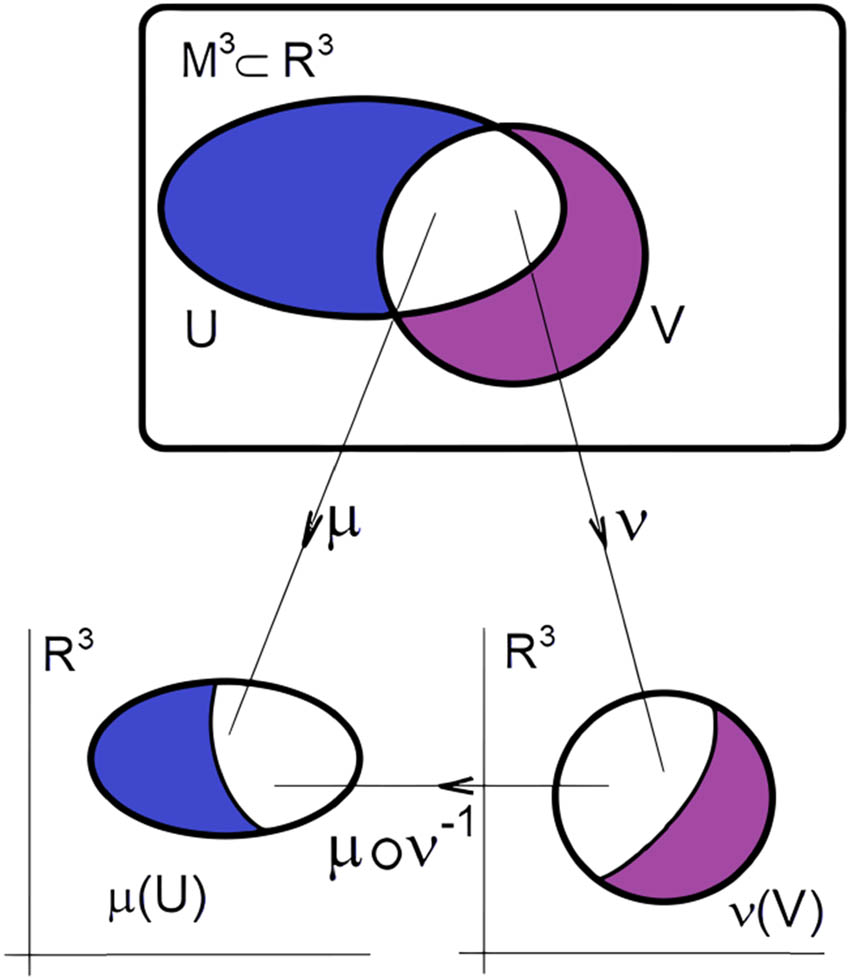
Scheme of manifold mapping.
Coordinate slice S of dimension 2 in 3D manifold M 3 in a neighborhood U ∈ M 3 with coordinates u, v, and w is a set S = {p ∈ U: w(p) = const.}
2 Problem description
From the designer’s point of view, the runner of a radial–axial turbine can be viewed as a ring with a meridional cross-section in the shape of a curvilinear rectangle revolved around the axis of runner rotation. The sides of the rectangle are given by inlet, outlet, hub, and shroud curve (Figure 2). Camber surface was added to clarify the geometry. It is not used for meshing. Moreover, the periodicity of the blading is specified during the runner design. Meshing programs are so powerful that it is enough to upload the meridional curves of the rectangle mentioned above, the blade surface, and specify the number of blades to obtain meshed volume (Figure 3), where there is such a meshed volume prepared in Numeca Autogrid®. Now, we can define the problem itself.
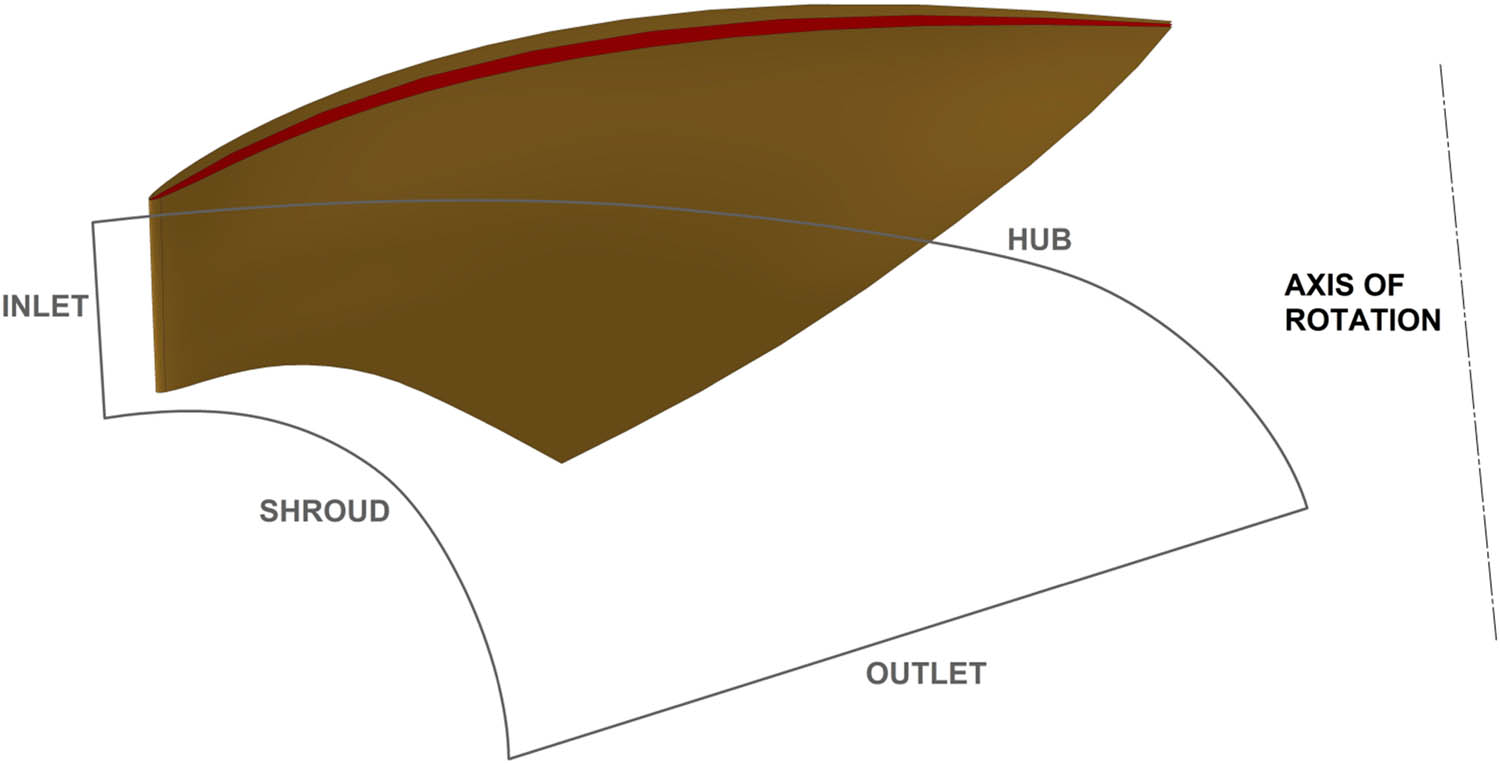
Basic geometry for Numeca Autogrid® mesher with camber surface (red).
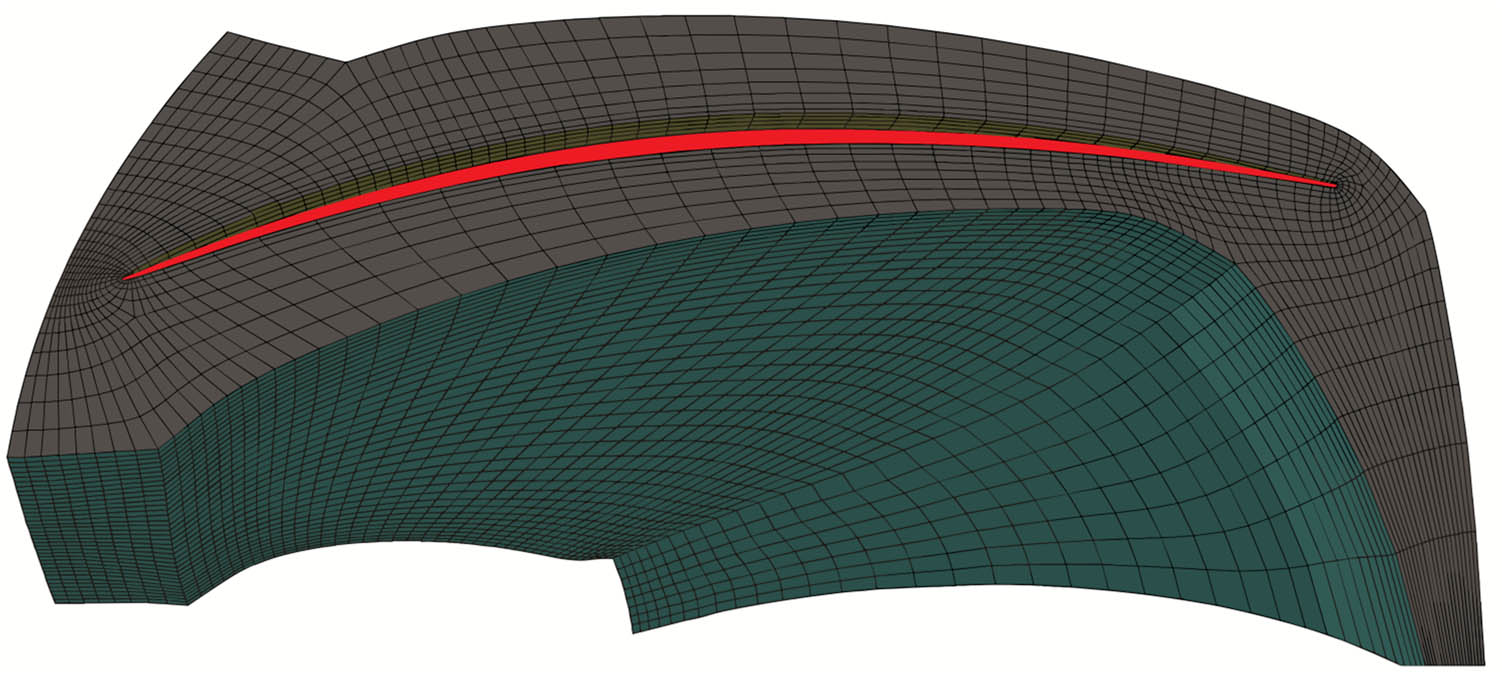
Example of a meshed periodic runner volume with camber surface (red).
2.1 General characteristics
At this point, we can claim that the most reasonable solution for camber surface definition is a parametric surface, say s(u, v), with the following properties:
s is smooth enough to enable an efficient transformation of fluid energy. s ∈ C k , k > 0.
u-curves connect the leading and trailing edges, while v-curves connect the hub and shroud.
Meridional curves of the hub and shroud and the curves of the inlet and outlet edge are at least C 1.
The leading and trailing angles are specified at the hub and shroud meridional curves and change smoothly along the inlet and outlet edges.
If one of these angles is altered, the surface must change smoothly near the leading or trailing edge so that an unwanted wave or even oscillation does not occur.
The easiest and most efficient way to specify the blade hub and shroud curve is to map a plane curve into the corresponding surface.
Pitch angles for the hub and shroud curve can be easily specified. Blade pitch angles define the runner’s specific speed and vice versa.
The geometric method and object should comply with the geometric nature of the runner.
Strictly speaking, we are to prepare a meaningful camber surface for an airfoil-shaped hole in the volume of the runner. The situation is depicted in Figures 2 and 3.
2.2 Leading and trailing angle
These are usually referred to as β
1 and β
2. The geometric meaning is shown in Figure 4. The runner is considered to rotate CW in the turbine mode. To introduce these angles, it is necessary to manipulate the camber surface at the leading and trailing edges. This is done in the [u, v, w] space using function w(u, v) on the slice and mapped in the manifold as a camber surface. The procedure is described in the following example. Analytically, the angles are defined using the scalar product of tangent vectors to the camber surface and a w-curve by
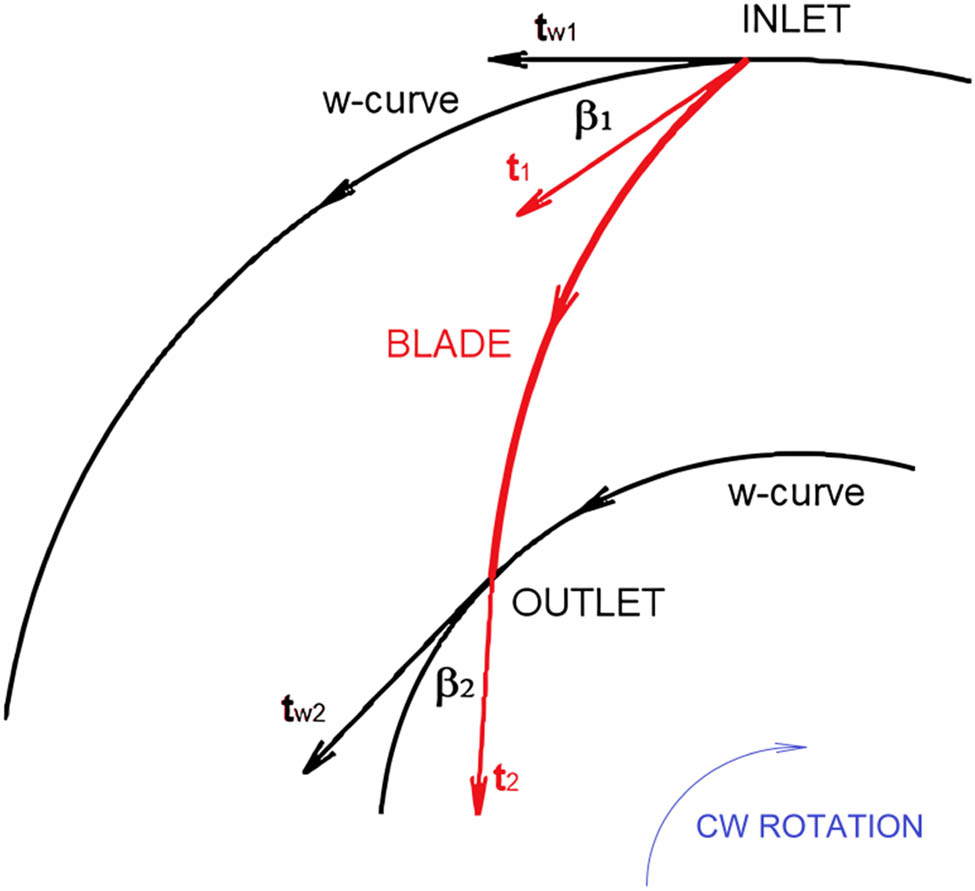
Definition of leading and trailing angles.
3 Method
3.1 Manifold
We work with a 3D manifold M 3 ∈ R 3 given by a system of curvilinear coordinates
such that g(u, v, w) ∈ C n , n ≥ 2 is injective and Jacobi determinant
Then, there is a unique chart µ: M 3 → A given by an inverse of g(u, v, w)
According to Bishop and Goldberg [17], M 3 is a submanifold embedded into R 3 with μ as the only chart. In the words of Section 1.1, A is a subset of the copy of R 3. To tailor the method to our purpose, we can imbed M 3 in a quite special way as a cylindrical curvilinear coordinate system. This can be done by rotating a plane curvilinear coordinate patch by a specific angle (Figure 5). The plane patch deserves more attention since it naturally reflects the runner’s meridional curves, namely the hub, shroud, inlet, and outlet. Rotation by an angle less than π is a diffeomorphic operation.
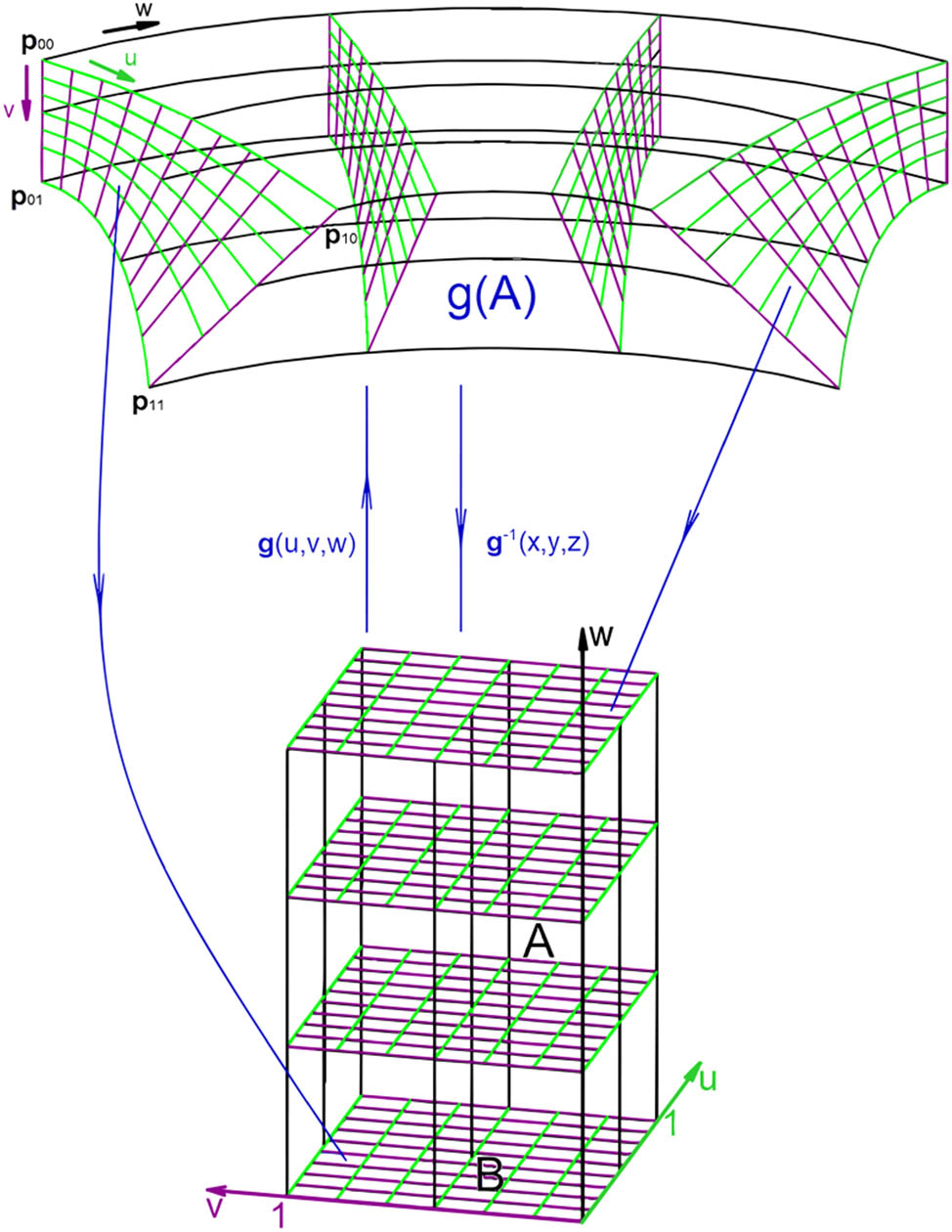
Scheme of the manifold with mapping.
3.2 Coordinate slice
Now, we refine the definition from Section 1.1 and tailor it to our purpose by setting U = A, and we can go even further. We can consider the camber surface in A as a submanifold S embedded by the inclusion map and utilize Proposition 1.4.1 of [17], p. 42, namely its constructive proof. In principle, the proposition says that if S is a submanifold, then there exists a coordinate system in A such that S is a coordinate slice in A. The proof even gives a recipe for its construction. For our purpose, the slice is one dimension less than the sliced manifold. A simple example of the situation can be seen in Figure 6. The submanifold itself is used for the definition of a new coordinate system [y 1, y 2] as follows:
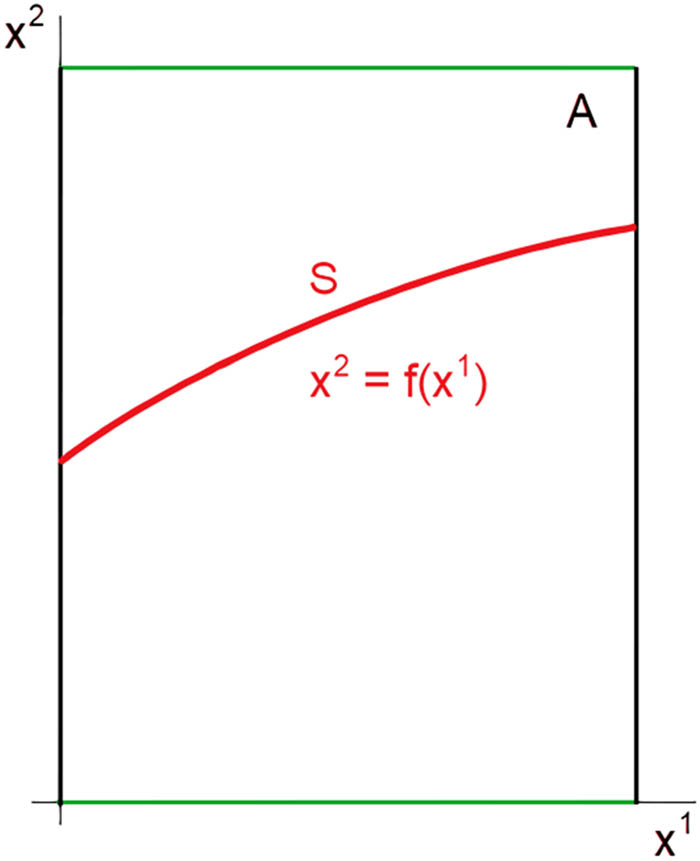
Simple 1D coordinate slice.
S in Figure 6 is a coordinate slice since y 2 = 0 on S. A is mapped identically onto its copy and S onto the projection of A in the x 1-axis. We used the designation of the coordinates from the proposition mentioned above.
Using this technique in 3D, we slice the 3D set A in a more general way. Let parametric surfaces g(u, v 1, w), g(u, v 2, w) define the hub and shroud of a runner while g(u 1, v, w), g(u 2, v, w) define the inlet and outlet surfaces, respectively. Now, the camber surface can be represented by a coordinate slice S given by an injective function:
such that rank [w, u w, v ] ≠ 0, w(u, v) ∈ C n , n ≥ 1, (u, v) ∈ B, B = [u 1, u 2] × [v 1, v 2] (Figure 7).
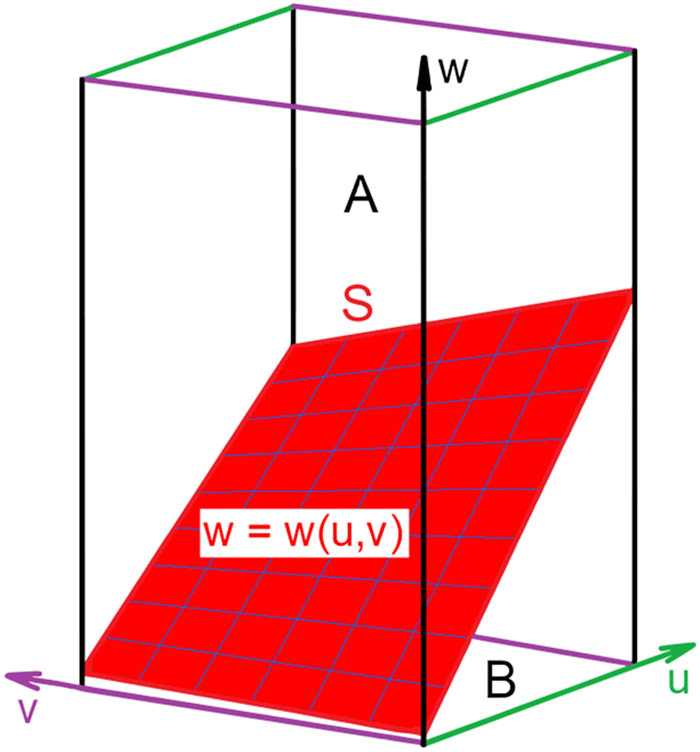
2D coordinate slice.
The corresponding chart of the slice into A is
To prove that σ gives a coordinate slice, it is enough to define a coordinate system [y 1, y 2 , y 3 ], again by Proposition 1.4.1 of [17], p. 42.
Rem. Here, w(x, y, z) and w(u, v) represent two different functions distinguished by the number of variables.
This represents a coordinate system in M 3, and the points of S are those where y 3 = 0. This also means that S is given by
which is a submanifold of M 3. The slice is well defined, and its use for camber surface description is correct. In other words, since each curvilinear coordinate system is diffeomorphic with a Cartesian coordinate system, the slice under the conditions given above is well defined.
4 Simple example
The same notation as in Section 3 will be used to obtain the correspondence between both parts. Continuity C n is meant for n ≥ 1.
4.1 Coons patch
This method for surface description is based on the framework of its boundary curves [18]. The surface patch P ⊂ R 3 is defined as
p: B → P, B = [0, 1] × [0, 1].
The injectivity of p is an additional requirement to the definition given in [18].
Considering Figure 8, we can write Equation (6) in components as follows:
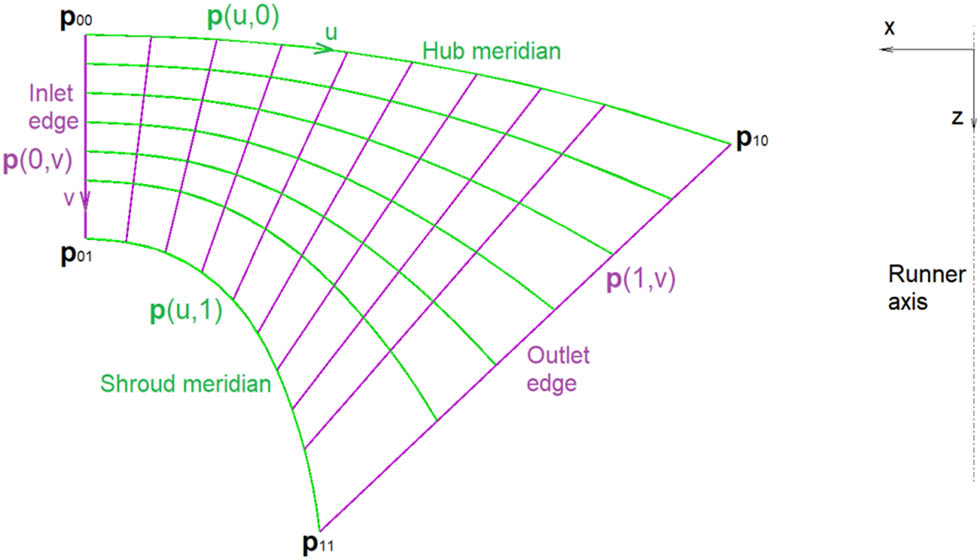
Patched portion of the zx-plane.
For future simplification of Equation (11) and others, we designate
4.2 Manifold
It is introduced as a curvilinear coordinate system similar to a cylindrical one, where u-curves are given by the hub and shroud meridian, v-curves by inlet and outlet edge, and w-curves are circular arcs with center on runner axis and in interval [0, π]. With this idea in mind, it is necessary to proceed from the basic data for runner design. These are curves defining hub and shroud meridian, and inlet and outlet edge. Figure 8 shows the basic net of the u- and v-curves in the zx-plane represented by the corresponding planar Coons patch. We call it the basic patch p(u,v).
Now, the basic patch is used for the construction of manifold M as a curvilinear coordinate system by
where w is the angular coordinate. Sets A and B are marked in Figure 7.
on A. This is derived from Equations (10) and (11).
In correspondence with Equation (2), this ensures the existence and uniqueness of g −1(x, y, z) ∈ C n . The manifold is mapped onto A by
This is the only map. It is a C n manifold of dimension 3 with a boundary, where n depends on the continuity of the basic patch boundary curves. It can be observed also in Figure 5 that g is injective. The isoparametric curves are not tangent to each other.
Rem. Tangent space at a point has the basis
4.3 Coordinate slice
We define the coordinate slice in the same manner as described in Section 3.2. Then, Equation (5) has the following form:
Thus, s(u,v) is a regular surface and can be considered as embedded in M by inclusion. This situation is shown in Figure 9.

Camber surface as a coordinate slice.
4.4 Manipulating leading and trailing angle
We work in A with isoparametric curves w(u, 0) and w(u, 1). They connect vertices w 00, w 10, and w 01, w 11. The curves can be defined as cubic polynomials with boundary conditions listed in Table 1. Coefficients of the polynomials are easily calculated from boundary conditions
Boundary conditions
| Curve | Position | Angle | Leading and trailing angle | |||
|---|---|---|---|---|---|---|
| w(u, 0) | w 00 | w 10 | φ 00 | φ 10 | β 10 | β 20 |
| w(u, 1) | w 01 | w 11 | φ 01 | φ 11 | β 11 | β 21 |
The meaning of these angles is shown in Figure 10. These curves are then mapped in S. Because the mapping is not conformal, it is necessary to compute real β 1 and β 2 angles, as defined in Section 2.2, and step-by-step change φ ij to obtain the required values. This can be performed in the cycle of a computer language program. Function w(u, v) to be inserted into Equation (12) is
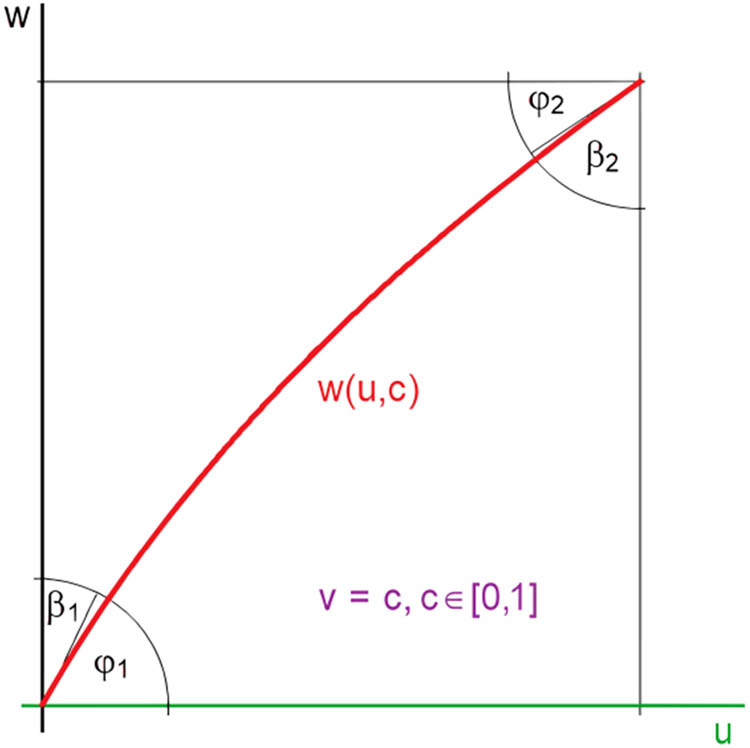
Section of the slice in A at v = const. with definition of the corresponding leading and trailing angles.
Figure 11 shows the same camber surface as in Figure 9 but with modified φ ij and corresponding β ij . The shape modification is rather excessive, to be evident.
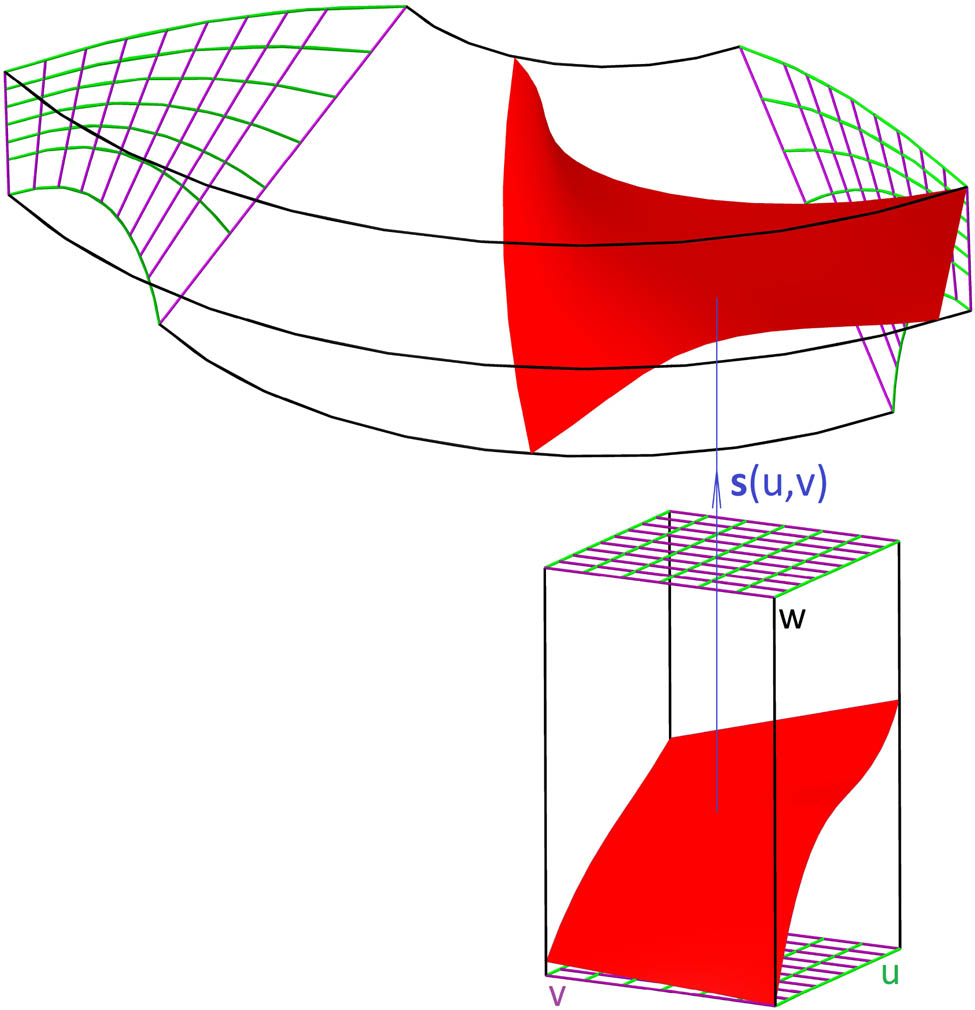
Camber surface with modified β-angles.
Now, having explained the idea and basic strategy, we can approach generalization.
5 Generalization
Since Equation (15) together with sine and cosine functions on [0, π] is C 1 and injective, we claim that any C 1 slice in space (u, v, w) is mapped on a C 1 camber surface. Now, the idea is simple. We can patch the slice consisting of its boundary curves and as many as necessary v = const. curves. The patch including curves with properly set β-angles is then mapped as the camber surface. In this way, the hydraulic designer can specify a blade with pitch and β-angles on those v = const. meridional curves.
We keep the idea of Section 4.4 where camber curves were defined as cubic polynomials. With this in mind, particularly useful is the bicubic blending. Figure 12 shows the method that offers to set four meridional curves, which require three patches. Detailed patching procedure of the coordinate slice in set A is given in [18], p. 231–234. This also shows that the method is well-defined. The table with boundary conditions would be similar to Table 1 but with four rows. This enables finer shape modification like bent of the trailing edge (black curves in the slice and camber surface).
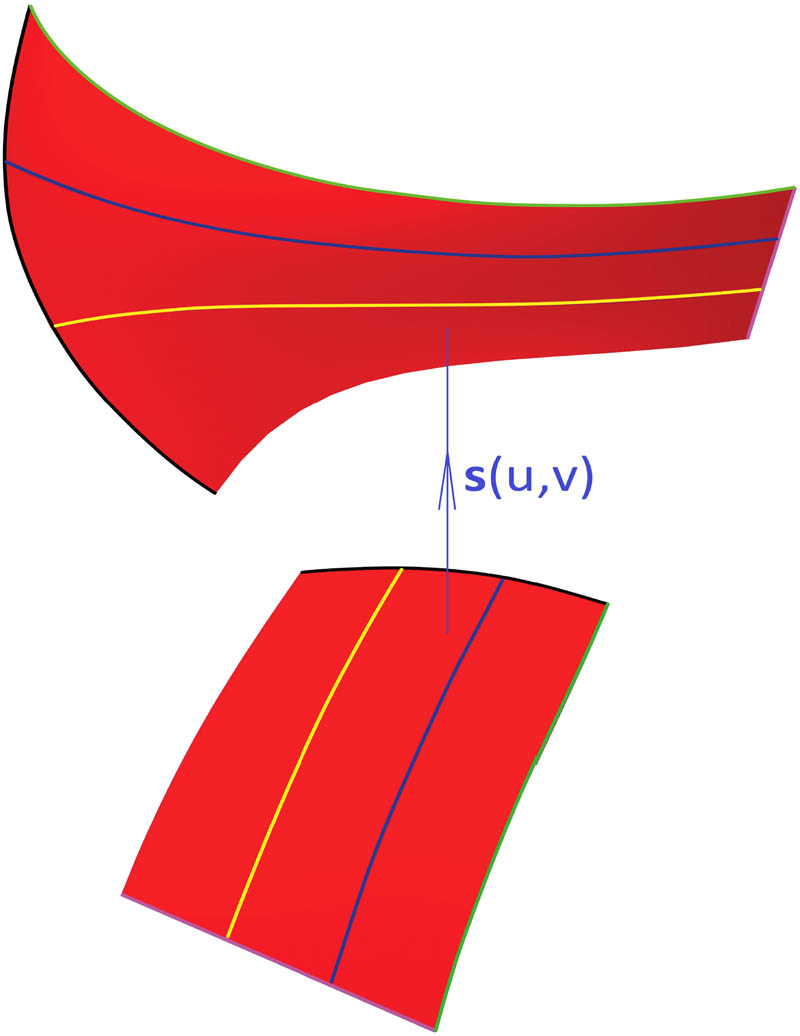
Bicubic blended coordinate slice in R3 and corresponding camber surface.
If necessary, the camber surface can be fitted as a NURBS surface (Figure 13).
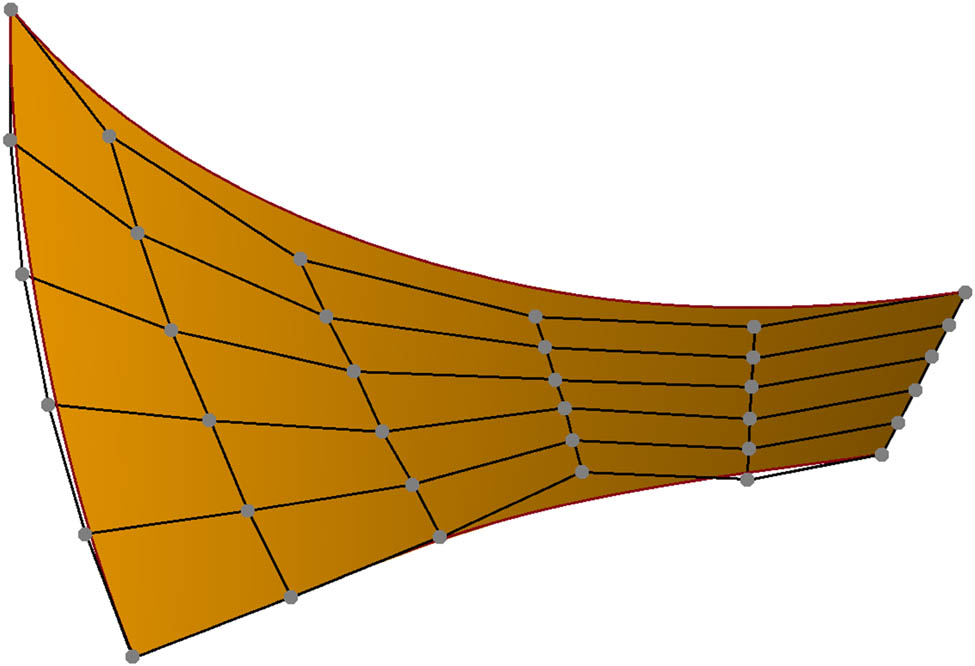
Quintic NURBS representation of the camber surface.
6 Practical example and physical meaning
The above method was used for the design of the high-specific speed Francis runner presented in Koudelka [8]. A detailed design process is described there. Nevertheless, basic hydraulic and geometric parameters are listed in Table 2 and depicted in Figure 14. The data in Table 2 are inferred from those given in Koudelka [8].
Hydraulic parameters
| Parameter | Value |
|---|---|
| Runner diameter D | 0.35 m |
| Number of blades | 11 |
| Runner speed n | 470 min−1 |
| Number of guide vanes | 10 |
| Net head H | 4.6 m |
| Rated discharge Q | 0.32 m3 s−1 |
| Q 11 at BEP | 1.23 |
| n 11 at BEP | 75.1 min−1 |
| n sq at BEP | 84.7 min−1 m−1/4 |
| Hydraulic efficiency at BEP | 91% |
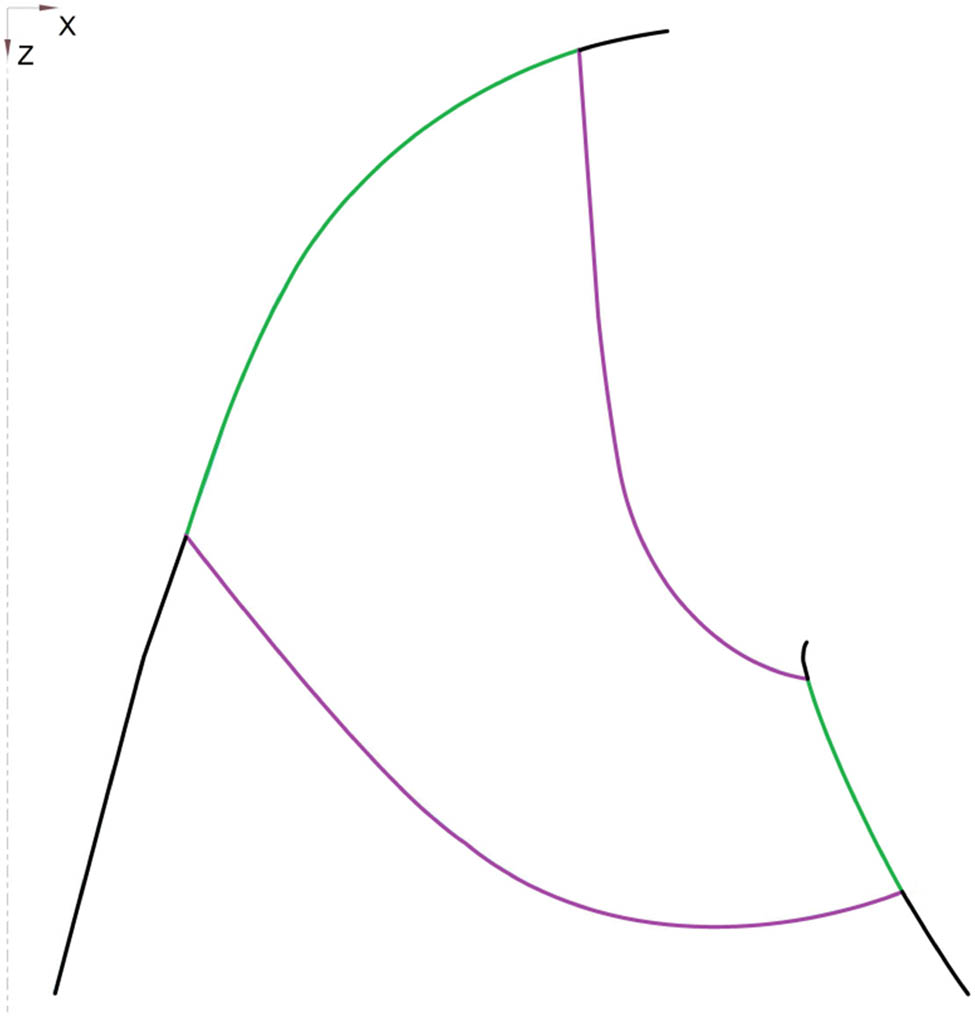
Runner meridian with borders of the basic patch.
Since the runner for such speed is higher, there must be six v = const. Curves in R 3 to sufficiently describe the camber surface (Figure 15).
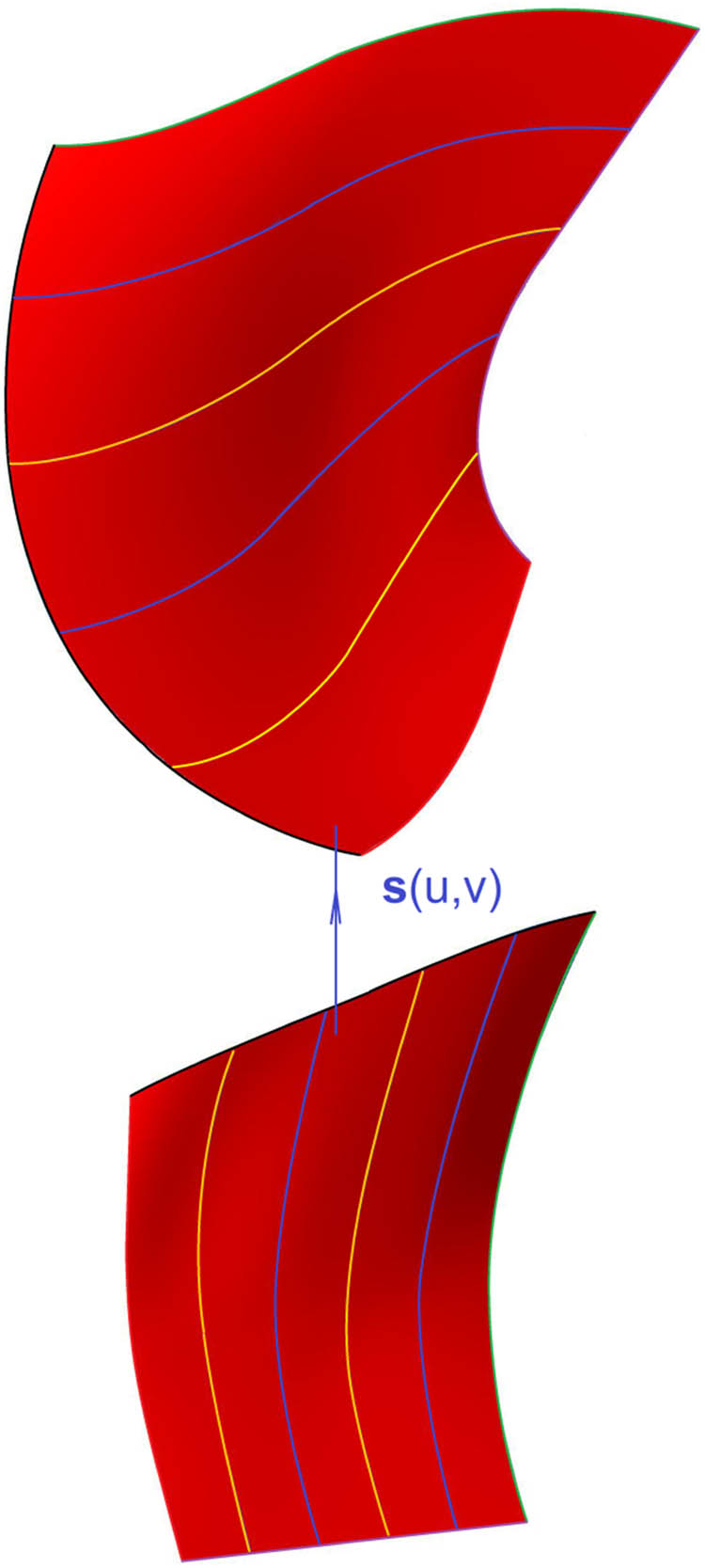
Bicubic blended coordinate slice in R 3 and corresponding camber surface with six curves.
To describe the situation thoroughly, Figure 16 shows the camber surface (red) inside the manifold boundaries formed by the hub and shroud (green) together with inlet and outlet (violet) surfaces.
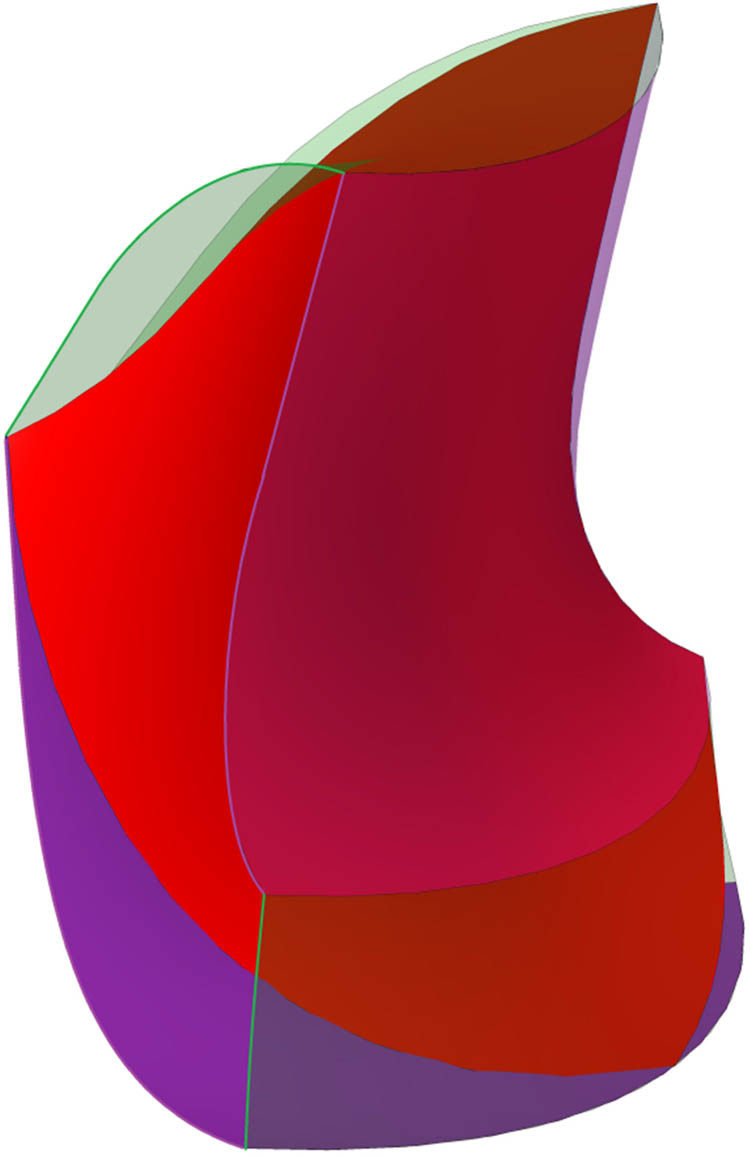
Blade in the boundaries.
The basic physical meaning of the blade is to take effectively the static component of the water pressure, transform it into the runner torque, and subsequently produce turbo-generator power. The process of draining static pressure is nicely seen in Figure 17. Pressure decreases from the leading to the trailing edge as the blade sucks it gradually.
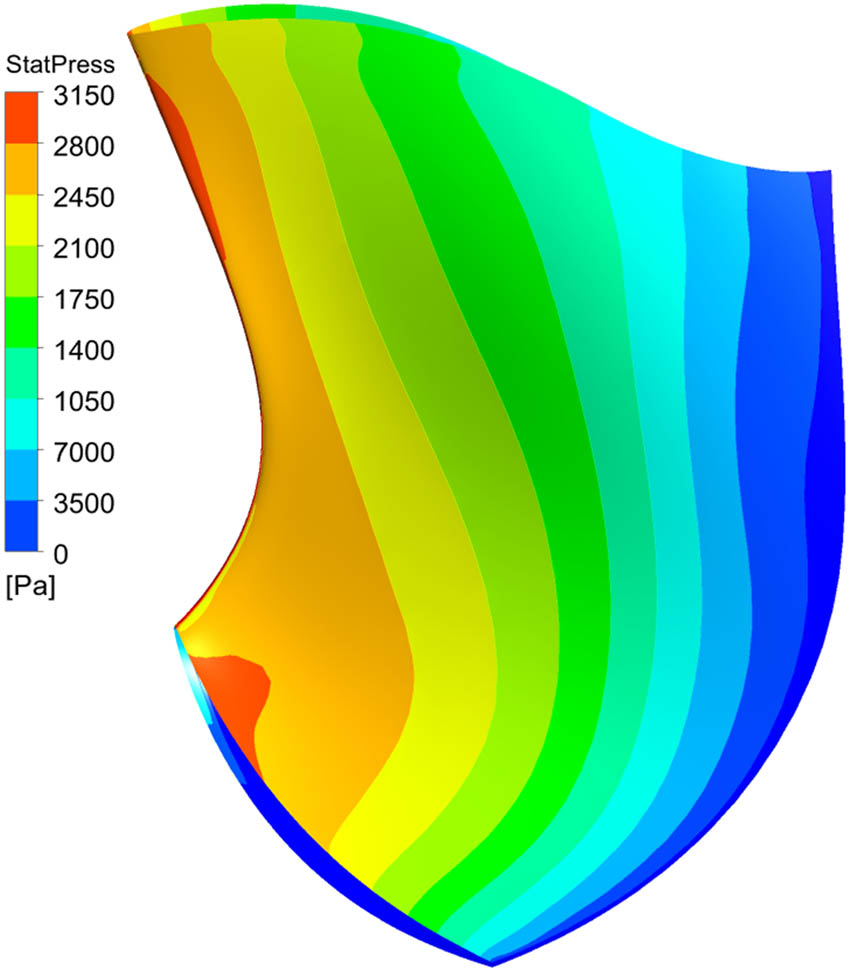
Pressure field on the blade pressure side at BEP.
This process is the most effective when flow splits just on the leading edge, also indicated by the red pressure strip in Figure 18. This also indicates the best efficiency point.
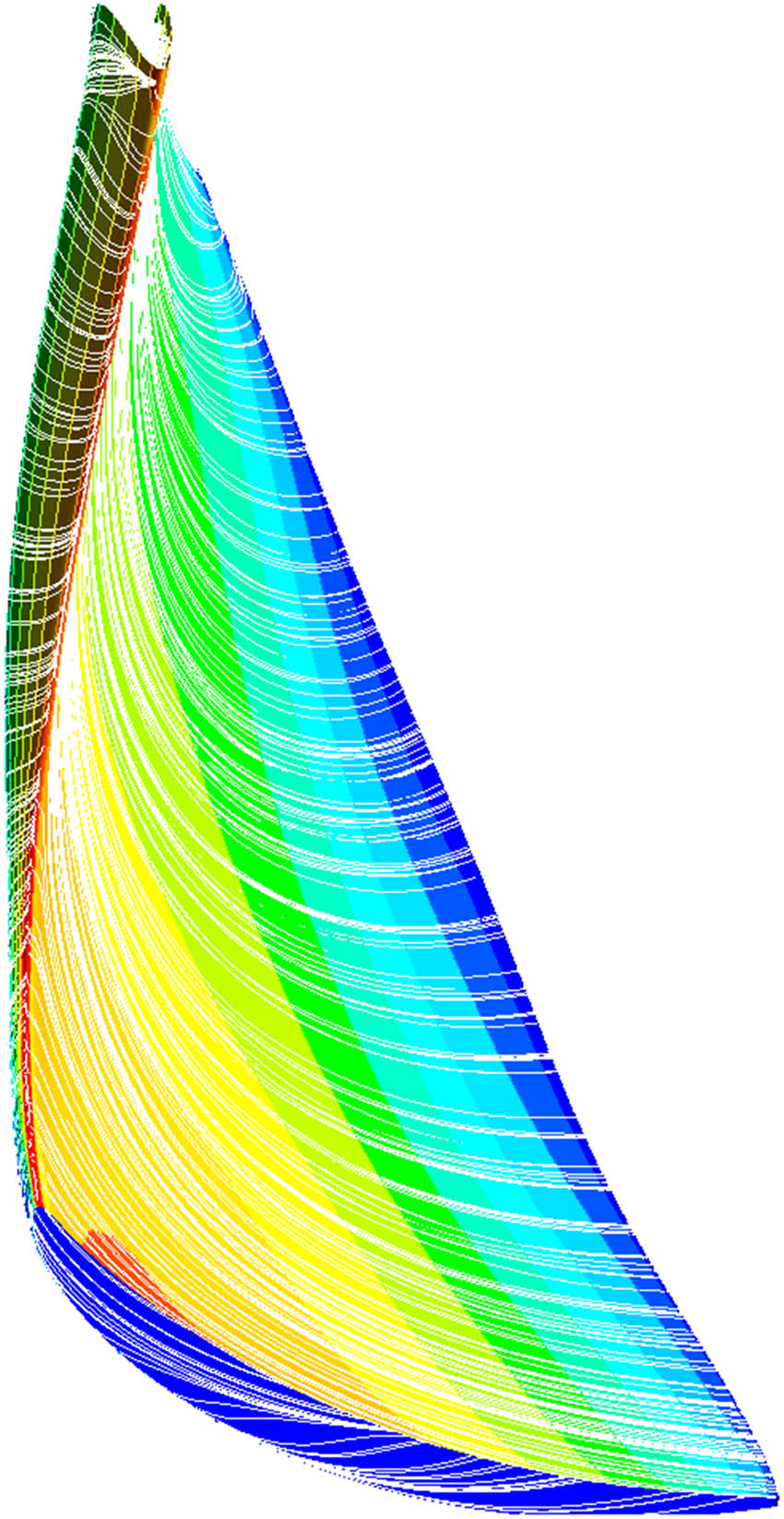
Flow lines splitting at the leading edge at the BEP.
A photograph of the resulting runner in steel can be seen in [8].
7 Discussion and conclusions
A straightforward step toward an object-oriented programming language is possible. Objects include surfaces, curves, vectors, etc., with methods for manipulation, description, and display. The runner is then inserted into a turbine model, and this virtual prototype is subjected directly to CFD analysis or an optimization loop.
7.1 Why the coordinate slice?
The question may arise as to why we do not define a surface patch such as NURBS in the bounds of hub, shroud, inlet, and outlet surfaces [19]. Here are some difficulties coming from the nature of this technique:
It is difficult to insert such a patch inside the runner volume with specified camber surface pitch angles, namely positions of control points, since each of them has three degrees of freedom. Moreover, the surface would consist of more than one patch or a patch of a higher degree than three, as can be seen from Section 5.
The danger of local change of the surface, namely when a higher order (rational) polynomial is used. This can result in unwanted waves and does not comply with items 1 and 5 (Section 2.1).
Simple modification of β-angles by the control polygons in space is questionable. That is why Flores et al. [6] use the simplest reasonable NURBS patch for the purpose, which is the cubic patch.
The subset of R 3 defining the runner is described by a cylindrical coordinate system. This follows from the fact that the runner rotates around its axis, here coincident with the z-axis. If this approach is not applied, then the problem of pitch angle specification arises. These angles define runner speed and vice versa. A problem with a deformed blade may emerge like in [5].
Techniques based on classic patches (NURBS can be considered to be their generalization) are suitable, namely for free-form modeling. Reasonable utilization in blade design requires a patch with a small number of control points to handle the shape either in an interactive or optimization loop process. That is why only cubic patch is used in [6]. Usage of patches of higher degree may lead to unwanted oscillations. See also Figure 13, where the NURBS control polygon was generated just after design in the way of the coordinate slice. The coordinate slice is easily defined, including the construction of the planar curve mapped as a camber curve and easy mapping into the manifold, which complies with runner geometry.
Conversely, the coordinate slice technique respects the nature of the blade geometry. One can, in a natural geometric way, define all important blade parameters as follows:
Meridional shape of hub, shroud, inlet, and outlet edge by corresponding (spline) curves.
Pitch, leading, and trailing angles by straight assignment of the value for specific camber curves.
Lean angle by varying the w-parameter along the blade and, in this way, also the curved shape of the leading and trailing edge and blade passage area at the runner exit.
Since the camber surface is regular, it is possible to modify it in the normal direction reasonably.
The inheritance method mentioned in [13] is obvious here. This time geometric parameters are inherited.
The method is also suitable for low-specific speed runners, as indicated in Section 5. To the author’s knowledge, this method may not be useful for the inverse problem design.
7.2 Further development
The next step to improve the presented method lies in conformal mapping of the slice isoparametric curves. This leads to avoiding the numerical computation of meridional curves that have required leading and trailing angles.
-
Funding information: Author states no funding involved.
-
Author contributions: The author confirms the sole responsibility for the conception of the study, presented results and manuscript preparation.
-
Conflict of interest: Author L.K. is an employee of Strojírny Brno.
-
Data availability statement: The data generated during and/or analysed during the current study are available from the author on request.
References
[1] Chen Z, Singh PM, Choi Y. Francis turbine blade design on the basis of port area and loss analysis. Energies. 2016;9:164. 10.3390/en9030164.Search in Google Scholar
[2] Biswakarma BB, Shrestha R. Mathematical modeling for the design of Francis runner. Proceedings of IOE Graduate Conference. vol. 5, 2017. p. 67–74.Search in Google Scholar
[3] Ayli E, Celebioglu K, Aradag S. Determining and generalization of the effects of design parameters on Francis turbine runner performance. Eng Appl Comput Fluid Mech. 2016;10:545–64. 10.1080/19942060.2016.1213664.Search in Google Scholar
[4] Ayancik F, Aradag U, Ozkaya E, Celebioglu K, Unver O, Aradag S. Hydroturbine runner design and manufacturing. Int J Mater Mech Manuf. 2013;1:162–5. 10.7763/IJMMM.2013.V1.35.Search in Google Scholar
[5] Ayancik F, Celebioglu K, Aradag S. Parametrical and theoretical design of a Francis turbine runner with help of computational fluid dynamics. International Conference on Heat Transfer, Fluid Mechanics and Thermodynamics. Vol. 10, 2014. p. 775–80. 10.13140/2.1.3604.7683.Search in Google Scholar
[6] Flores E, Bornard L, Tomas L, Liu J, Couston M. Design of large Francis turbine using optimal methods. IOP Conf Series: Earth Environ Sci. 2012;15:022023. 10.1088/1755-1315/15/2/022023 Search in Google Scholar
[7] Takahashi W, Shinji M, Liu ZH, Miyagawa K, Hayashi Y. Design optimization of medium specific speed Francis turbines with unshrouded runners. IOP Conf Series: Earth Environ Sci. 2019;240:1–12. 10.1088/1755-1315/240/2/022060.Search in Google Scholar
[8] Koudelka L. Do not be afraid of small high-speed Francis turbines. de Gruyter J Mech Eng. 2018;3:111–28. 10.2478/scjme.2018.0030.Search in Google Scholar
[9] Celebioglu K, Kaplan A. Development and implementation of a methodology for reverse design of Francis turbine runners. Pamukale Univ J Eng Sci. 2019;25(4):430–9. 10.5505/pajes.2018.43959.Search in Google Scholar
[10] Agromayor R, Anand N, Muller JD, Pini M, Nord LO. A unified geometry parametrization method for turbomachinery blades. Comput Des. 2021;2021:133. 10.1016/j.cad.2020.102987.Search in Google Scholar
[11] Yang W, Liu B, Xiao R. Three-dimensional inverse design method for hydraulic machinery. Energies. 2019;12:1–19. 10.3390/en12173210 Search in Google Scholar
[12] Krzemianowski Z. Engineering design of low-head Kaplan hydraulic turbine blades using the inverse problem method. Bull Pol Acad Sci: Tech Sciences. 2019;67(6):1133–47. 10.24425/bpasts.2019.130888.Search in Google Scholar
[13] Krzemianowski Z, Steller J. High specific speed Francis turbine for small hydro purposes – design methodology based on solving the inverse problem in fluid mechanics and the cavitation test experience. Renew Energy. 2021;169:1210–28. 10.1016/j.renene.2021.01.095.Search in Google Scholar
[14] Yin J, Li J, Wang D, Wei X. A simple inverse design method for pump turbine. IOP Conf Series: Earth Environ Sci. 2014;22(1):012030. 10.1088/1755-1315/22/1/012030.Search in Google Scholar
[15] Ma Z, Zhu B, Shangguan Y. Comprehensive hydraulic improvement and parametric analysis of a Francis turbine runner. Energies. 2019;12:1–20. 10.3390/en12020307.Search in Google Scholar
[16] Zanneti G, Siviero M, Savazzini G, Santolini A. Application of the 3D inverse design method in reversible pump turbines and francis turbines. Water. 2023;15:2271. 10.3390/w15122271.Search in Google Scholar
[17] Bishop RL, Goldberg SI. Tensor analysis on manifolds. Vol. 1968. USA: Dover Publications; 1968. p. 40–55.Search in Google Scholar
[18] Faux ID, Pratt MJ. Computational geometry for design and manufacture. Vol. 1980. UK: Ellis Horwood; 1980. p. 231–4.Search in Google Scholar
[19] Piegl L, Tiller W. The NURBS book. Germany: Springer; 1997. p. 81–138.10.1007/978-3-642-59223-2_3Search in Google Scholar
© 2024 the author(s), published by De Gruyter
This work is licensed under the Creative Commons Attribution 4.0 International License.
Articles in the same Issue
- Regular Articles
- Methodology of automated quality management
- Influence of vibratory conveyor design parameters on the trough motion and the self-synchronization of inertial vibrators
- Application of finite element method in industrial design, example of an electric motorcycle design project
- Correlative evaluation of the corrosion resilience and passivation properties of zinc and aluminum alloys in neutral chloride and acid-chloride solutions
- Will COVID “encourage” B2B and data exchange engineering in logistic firms?
- Influence of unsupported sleepers on flange climb derailment of two freight wagons
- A hybrid detection algorithm for 5G OTFS waveform for 64 and 256 QAM with Rayleigh and Rician channels
- Effect of short heat treatment on mechanical properties and shape memory properties of Cu–Al–Ni shape memory alloy
- Exploring the potential of ammonia and hydrogen as alternative fuels for transportation
- Impact of insulation on energy consumption and CO2 emissions in high-rise commercial buildings at various climate zones
- Advanced autopilot design with extremum-seeking control for aircraft control
- Adaptive multidimensional trust-based recommendation model for peer to peer applications
- Effects of CFRP sheets on the flexural behavior of high-strength concrete beam
- Enhancing urban sustainability through industrial synergy: A multidisciplinary framework for integrating sustainable industrial practices within urban settings – The case of Hamadan industrial city
- Advanced vibrant controller results of an energetic framework structure
- Application of the Taguchi method and RSM for process parameter optimization in AWSJ machining of CFRP composite-based orthopedic implants
- Improved correlation of soil modulus with SPT N values
- Technologies for high-temperature batch annealing of grain-oriented electrical steel: An overview
- Assessing the need for the adoption of digitalization in Indian small and medium enterprises
- A non-ideal hybridization issue for vertical TFET-based dielectric-modulated biosensor
- Optimizing data retrieval for enhanced data integrity verification in cloud environments
- Performance analysis of nonlinear crosstalk of WDM systems using modulation schemes criteria
- Nonlinear finite-element analysis of RC beams with various opening near supports
- Thermal analysis of Fe3O4–Cu/water over a cone: a fractional Maxwell model
- Radial–axial runner blade design using the coordinate slice technique
- Theoretical and experimental comparison between straight and curved continuous box girders
- Effect of the reinforcement ratio on the mechanical behaviour of textile-reinforced concrete composite: Experiment and numerical modeling
- Experimental and numerical investigation on composite beam–column joint connection behavior using different types of connection schemes
- Enhanced performance and robustness in anti-lock brake systems using barrier function-based integral sliding mode control
- Evaluation of the creep strength of samples produced by fused deposition modeling
- A combined feedforward-feedback controller design for nonlinear systems
- Effect of adjacent structures on footing settlement for different multi-building arrangements
- Analyzing the impact of curved tracks on wheel flange thickness reduction in railway systems
- Review Articles
- Mechanical and smart properties of cement nanocomposites containing nanomaterials: A brief review
- Applications of nanotechnology and nanoproduction techniques
- Relationship between indoor environmental quality and guests’ comfort and satisfaction at green hotels: A comprehensive review
- Communication
- Techniques to mitigate the admission of radon inside buildings
- Erratum
- Erratum to “Effect of short heat treatment on mechanical properties and shape memory properties of Cu–Al–Ni shape memory alloy”
- Special Issue: AESMT-3 - Part II
- Integrated fuzzy logic and multicriteria decision model methods for selecting suitable sites for wastewater treatment plant: A case study in the center of Basrah, Iraq
- Physical and mechanical response of porous metals composites with nano-natural additives
- Special Issue: AESMT-4 - Part II
- New recycling method of lubricant oil and the effect on the viscosity and viscous shear as an environmentally friendly
- Identify the effect of Fe2O3 nanoparticles on mechanical and microstructural characteristics of aluminum matrix composite produced by powder metallurgy technique
- Static behavior of piled raft foundation in clay
- Ultra-low-power CMOS ring oscillator with minimum power consumption of 2.9 pW using low-voltage biasing technique
- Using ANN for well type identifying and increasing production from Sa’di formation of Halfaya oil field – Iraq
- Optimizing the performance of concrete tiles using nano-papyrus and carbon fibers
- Special Issue: AESMT-5 - Part II
- Comparative the effect of distribution transformer coil shape on electromagnetic forces and their distribution using the FEM
- The complex of Weyl module in free characteristic in the event of a partition (7,5,3)
- Restrained captive domination number
- Experimental study of improving hot mix asphalt reinforced with carbon fibers
- Asphalt binder modified with recycled tyre rubber
- Thermal performance of radiant floor cooling with phase change material for energy-efficient buildings
- Surveying the prediction of risks in cryptocurrency investments using recurrent neural networks
- A deep reinforcement learning framework to modify LQR for an active vibration control applied to 2D building models
- Evaluation of mechanically stabilized earth retaining walls for different soil–structure interaction methods: A review
- Assessment of heat transfer in a triangular duct with different configurations of ribs using computational fluid dynamics
- Sulfate removal from wastewater by using waste material as an adsorbent
- Experimental investigation on strengthening lap joints subjected to bending in glulam timber beams using CFRP sheets
- A study of the vibrations of a rotor bearing suspended by a hybrid spring system of shape memory alloys
- Stability analysis of Hub dam under rapid drawdown
- Developing ANFIS-FMEA model for assessment and prioritization of potential trouble factors in Iraqi building projects
- Numerical and experimental comparison study of piled raft foundation
- Effect of asphalt modified with waste engine oil on the durability properties of hot asphalt mixtures with reclaimed asphalt pavement
- Hydraulic model for flood inundation in Diyala River Basin using HEC-RAS, PMP, and neural network
- Numerical study on discharge capacity of piano key side weir with various ratios of the crest length to the width
- The optimal allocation of thyristor-controlled series compensators for enhancement HVAC transmission lines Iraqi super grid by using seeker optimization algorithm
- Numerical and experimental study of the impact on aerodynamic characteristics of the NACA0012 airfoil
- Effect of nano-TiO2 on physical and rheological properties of asphalt cement
- Performance evolution of novel palm leaf powder used for enhancing hot mix asphalt
- Performance analysis, evaluation, and improvement of selected unsignalized intersection using SIDRA software – Case study
- Flexural behavior of RC beams externally reinforced with CFRP composites using various strategies
- Influence of fiber types on the properties of the artificial cold-bonded lightweight aggregates
- Experimental investigation of RC beams strengthened with externally bonded BFRP composites
- Generalized RKM methods for solving fifth-order quasi-linear fractional partial differential equation
- An experimental and numerical study investigating sediment transport position in the bed of sewer pipes in Karbala
- Role of individual component failure in the performance of a 1-out-of-3 cold standby system: A Markov model approach
- Implementation for the cases (5, 4) and (5, 4)/(2, 0)
- Center group actions and related concepts
- Experimental investigation of the effect of horizontal construction joints on the behavior of deep beams
- Deletion of a vertex in even sum domination
- Deep learning techniques in concrete powder mix designing
- Effect of loading type in concrete deep beam with strut reinforcement
- Studying the effect of using CFRP warping on strength of husk rice concrete columns
- Parametric analysis of the influence of climatic factors on the formation of traditional buildings in the city of Al Najaf
- Suitability location for landfill using a fuzzy-GIS model: A case study in Hillah, Iraq
- Hybrid approach for cost estimation of sustainable building projects using artificial neural networks
- Assessment of indirect tensile stress and tensile–strength ratio and creep compliance in HMA mixes with micro-silica and PMB
- Density functional theory to study stopping power of proton in water, lung, bladder, and intestine
- A review of single flow, flow boiling, and coating microchannel studies
- Effect of GFRP bar length on the flexural behavior of hybrid concrete beams strengthened with NSM bars
- Exploring the impact of parameters on flow boiling heat transfer in microchannels and coated microtubes: A comprehensive review
- Crumb rubber modification for enhanced rutting resistance in asphalt mixtures
- Special Issue: AESMT-6
- Design of a new sorting colors system based on PLC, TIA portal, and factory I/O programs
- Forecasting empirical formula for suspended sediment load prediction at upstream of Al-Kufa barrage, Kufa City, Iraq
- Optimization and characterization of sustainable geopolymer mortars based on palygorskite clay, water glass, and sodium hydroxide
- Sediment transport modelling upstream of Al Kufa Barrage
- Study of energy loss, range, and stopping time for proton in germanium and copper materials
- Effect of internal and external recycle ratios on the nutrient removal efficiency of anaerobic/anoxic/oxic (VIP) wastewater treatment plant
- Enhancing structural behaviour of polypropylene fibre concrete columns longitudinally reinforced with fibreglass bars
- Sustainable road paving: Enhancing concrete paver blocks with zeolite-enhanced cement
- Evaluation of the operational performance of Karbala waste water treatment plant under variable flow using GPS-X model
- Design and simulation of photonic crystal fiber for highly sensitive chemical sensing applications
- Optimization and design of a new column sequencing for crude oil distillation at Basrah refinery
- Inductive 3D numerical modelling of the tibia bone using MRI to examine von Mises stress and overall deformation
- An image encryption method based on modified elliptic curve Diffie-Hellman key exchange protocol and Hill Cipher
- Experimental investigation of generating superheated steam using a parabolic dish with a cylindrical cavity receiver: A case study
- Effect of surface roughness on the interface behavior of clayey soils
- Investigated of the optical properties for SiO2 by using Lorentz model
- Measurements of induced vibrations due to steel pipe pile driving in Al-Fao soil: Effect of partial end closure
- Experimental and numerical studies of ballistic resistance of hybrid sandwich composite body armor
- Evaluation of clay layer presence on shallow foundation settlement in dry sand under an earthquake
- Optimal design of mechanical performances of asphalt mixtures comprising nano-clay additives
- Advancing seismic performance: Isolators, TMDs, and multi-level strategies in reinforced concrete buildings
- Predicted evaporation in Basrah using artificial neural networks
- Energy management system for a small town to enhance quality of life
- Numerical study on entropy minimization in pipes with helical airfoil and CuO nanoparticle integration
- Equations and methodologies of inlet drainage system discharge coefficients: A review
- Thermal buckling analysis for hybrid and composite laminated plate by using new displacement function
- Investigation into the mechanical and thermal properties of lightweight mortar using commercial beads or recycled expanded polystyrene
- Experimental and theoretical analysis of single-jet column and concrete column using double-jet grouting technique applied at Al-Rashdia site
- The impact of incorporating waste materials on the mechanical and physical characteristics of tile adhesive materials
- Seismic resilience: Innovations in structural engineering for earthquake-prone areas
- Automatic human identification using fingerprint images based on Gabor filter and SIFT features fusion
- Performance of GRKM-method for solving classes of ordinary and partial differential equations of sixth-orders
- Visible light-boosted photodegradation activity of Ag–AgVO3/Zn0.5Mn0.5Fe2O4 supported heterojunctions for effective degradation of organic contaminates
- Production of sustainable concrete with treated cement kiln dust and iron slag waste aggregate
- Key effects on the structural behavior of fiber-reinforced lightweight concrete-ribbed slabs: A review
- A comparative analysis of the energy dissipation efficiency of various piano key weir types
- Special Issue: Transport 2022 - Part II
- Variability in road surface temperature in urban road network – A case study making use of mobile measurements
- Special Issue: BCEE5-2023
- Evaluation of reclaimed asphalt mixtures rejuvenated with waste engine oil to resist rutting deformation
- Assessment of potential resistance to moisture damage and fatigue cracks of asphalt mixture modified with ground granulated blast furnace slag
- Investigating seismic response in adjacent structures: A study on the impact of buildings’ orientation and distance considering soil–structure interaction
- Improvement of porosity of mortar using polyethylene glycol pre-polymer-impregnated mortar
- Three-dimensional analysis of steel beam-column bolted connections
- Assessment of agricultural drought in Iraq employing Landsat and MODIS imagery
- Performance evaluation of grouted porous asphalt concrete
- Optimization of local modified metakaolin-based geopolymer concrete by Taguchi method
- Effect of waste tire products on some characteristics of roller-compacted concrete
- Studying the lateral displacement of retaining wall supporting sandy soil under dynamic loads
- Seismic performance evaluation of concrete buttress dram (Dynamic linear analysis)
- Behavior of soil reinforced with micropiles
- Possibility of production high strength lightweight concrete containing organic waste aggregate and recycled steel fibers
- An investigation of self-sensing and mechanical properties of smart engineered cementitious composites reinforced with functional materials
- Forecasting changes in precipitation and temperatures of a regional watershed in Northern Iraq using LARS-WG model
- Experimental investigation of dynamic soil properties for modeling energy-absorbing layers
- Numerical investigation of the effect of longitudinal steel reinforcement ratio on the ductility of concrete beams
- An experimental study on the tensile properties of reinforced asphalt pavement
- Self-sensing behavior of hot asphalt mixture with steel fiber-based additive
- Behavior of ultra-high-performance concrete deep beams reinforced by basalt fibers
- Optimizing asphalt binder performance with various PET types
- Investigation of the hydraulic characteristics and homogeneity of the microstructure of the air voids in the sustainable rigid pavement
- Enhanced biogas production from municipal solid waste via digestion with cow manure: A case study
- Special Issue: AESMT-7 - Part I
- Preparation and investigation of cobalt nanoparticles by laser ablation: Structure, linear, and nonlinear optical properties
- Seismic analysis of RC building with plan irregularity in Baghdad/Iraq to obtain the optimal behavior
- The effect of urban environment on large-scale path loss model’s main parameters for mmWave 5G mobile network in Iraq
- Formatting a questionnaire for the quality control of river bank roads
- Vibration suppression of smart composite beam using model predictive controller
- Machine learning-based compressive strength estimation in nanomaterial-modified lightweight concrete
- In-depth analysis of critical factors affecting Iraqi construction projects performance
- Behavior of container berth structure under the influence of environmental and operational loads
- Energy absorption and impact response of ballistic resistance laminate
- Effect of water-absorbent polymer balls in internal curing on punching shear behavior of bubble slabs
- Effect of surface roughness on interface shear strength parameters of sandy soils
- Evaluating the interaction for embedded H-steel section in normal concrete under monotonic and repeated loads
- Estimation of the settlement of pile head using ANN and multivariate linear regression based on the results of load transfer method
- Enhancing communication: Deep learning for Arabic sign language translation
- A review of recent studies of both heat pipe and evaporative cooling in passive heat recovery
- Effect of nano-silica on the mechanical properties of LWC
- An experimental study of some mechanical properties and absorption for polymer-modified cement mortar modified with superplasticizer
- Digital beamforming enhancement with LSTM-based deep learning for millimeter wave transmission
- Developing an efficient planning process for heritage buildings maintenance in Iraq
- Design and optimization of two-stage controller for three-phase multi-converter/multi-machine electric vehicle
- Evaluation of microstructure and mechanical properties of Al1050/Al2O3/Gr composite processed by forming operation ECAP
- Calculations of mass stopping power and range of protons in organic compounds (CH3OH, CH2O, and CO2) at energy range of 0.01–1,000 MeV
- Investigation of in vitro behavior of composite coating hydroxyapatite-nano silver on 316L stainless steel substrate by electrophoretic technic for biomedical tools
- A review: Enhancing tribological properties of journal bearings composite materials
- Improvements in the randomness and security of digital currency using the photon sponge hash function through Maiorana–McFarland S-box replacement
- Design a new scheme for image security using a deep learning technique of hierarchical parameters
- Special Issue: ICES 2023
- Comparative geotechnical analysis for ultimate bearing capacity of precast concrete piles using cone resistance measurements
- Visualizing sustainable rainwater harvesting: A case study of Karbala Province
- Geogrid reinforcement for improving bearing capacity and stability of square foundations
- Evaluation of the effluent concentrations of Karbala wastewater treatment plant using reliability analysis
- Adsorbent made with inexpensive, local resources
- Effect of drain pipes on seepage and slope stability through a zoned earth dam
- Sediment accumulation in an 8 inch sewer pipe for a sample of various particles obtained from the streets of Karbala city, Iraq
- Special Issue: IETAS 2024 - Part I
- Analyzing the impact of transfer learning on explanation accuracy in deep learning-based ECG recognition systems
- Effect of scale factor on the dynamic response of frame foundations
- Improving multi-object detection and tracking with deep learning, DeepSORT, and frame cancellation techniques
- The impact of using prestressed CFRP bars on the development of flexural strength
- Assessment of surface hardness and impact strength of denture base resins reinforced with silver–titanium dioxide and silver–zirconium dioxide nanoparticles: In vitro study
- A data augmentation approach to enhance breast cancer detection using generative adversarial and artificial neural networks
- Modification of the 5D Lorenz chaotic map with fuzzy numbers for video encryption in cloud computing
- Special Issue: 51st KKBN - Part I
- Evaluation of static bending caused damage of glass-fiber composite structure using terahertz inspection
Articles in the same Issue
- Regular Articles
- Methodology of automated quality management
- Influence of vibratory conveyor design parameters on the trough motion and the self-synchronization of inertial vibrators
- Application of finite element method in industrial design, example of an electric motorcycle design project
- Correlative evaluation of the corrosion resilience and passivation properties of zinc and aluminum alloys in neutral chloride and acid-chloride solutions
- Will COVID “encourage” B2B and data exchange engineering in logistic firms?
- Influence of unsupported sleepers on flange climb derailment of two freight wagons
- A hybrid detection algorithm for 5G OTFS waveform for 64 and 256 QAM with Rayleigh and Rician channels
- Effect of short heat treatment on mechanical properties and shape memory properties of Cu–Al–Ni shape memory alloy
- Exploring the potential of ammonia and hydrogen as alternative fuels for transportation
- Impact of insulation on energy consumption and CO2 emissions in high-rise commercial buildings at various climate zones
- Advanced autopilot design with extremum-seeking control for aircraft control
- Adaptive multidimensional trust-based recommendation model for peer to peer applications
- Effects of CFRP sheets on the flexural behavior of high-strength concrete beam
- Enhancing urban sustainability through industrial synergy: A multidisciplinary framework for integrating sustainable industrial practices within urban settings – The case of Hamadan industrial city
- Advanced vibrant controller results of an energetic framework structure
- Application of the Taguchi method and RSM for process parameter optimization in AWSJ machining of CFRP composite-based orthopedic implants
- Improved correlation of soil modulus with SPT N values
- Technologies for high-temperature batch annealing of grain-oriented electrical steel: An overview
- Assessing the need for the adoption of digitalization in Indian small and medium enterprises
- A non-ideal hybridization issue for vertical TFET-based dielectric-modulated biosensor
- Optimizing data retrieval for enhanced data integrity verification in cloud environments
- Performance analysis of nonlinear crosstalk of WDM systems using modulation schemes criteria
- Nonlinear finite-element analysis of RC beams with various opening near supports
- Thermal analysis of Fe3O4–Cu/water over a cone: a fractional Maxwell model
- Radial–axial runner blade design using the coordinate slice technique
- Theoretical and experimental comparison between straight and curved continuous box girders
- Effect of the reinforcement ratio on the mechanical behaviour of textile-reinforced concrete composite: Experiment and numerical modeling
- Experimental and numerical investigation on composite beam–column joint connection behavior using different types of connection schemes
- Enhanced performance and robustness in anti-lock brake systems using barrier function-based integral sliding mode control
- Evaluation of the creep strength of samples produced by fused deposition modeling
- A combined feedforward-feedback controller design for nonlinear systems
- Effect of adjacent structures on footing settlement for different multi-building arrangements
- Analyzing the impact of curved tracks on wheel flange thickness reduction in railway systems
- Review Articles
- Mechanical and smart properties of cement nanocomposites containing nanomaterials: A brief review
- Applications of nanotechnology and nanoproduction techniques
- Relationship between indoor environmental quality and guests’ comfort and satisfaction at green hotels: A comprehensive review
- Communication
- Techniques to mitigate the admission of radon inside buildings
- Erratum
- Erratum to “Effect of short heat treatment on mechanical properties and shape memory properties of Cu–Al–Ni shape memory alloy”
- Special Issue: AESMT-3 - Part II
- Integrated fuzzy logic and multicriteria decision model methods for selecting suitable sites for wastewater treatment plant: A case study in the center of Basrah, Iraq
- Physical and mechanical response of porous metals composites with nano-natural additives
- Special Issue: AESMT-4 - Part II
- New recycling method of lubricant oil and the effect on the viscosity and viscous shear as an environmentally friendly
- Identify the effect of Fe2O3 nanoparticles on mechanical and microstructural characteristics of aluminum matrix composite produced by powder metallurgy technique
- Static behavior of piled raft foundation in clay
- Ultra-low-power CMOS ring oscillator with minimum power consumption of 2.9 pW using low-voltage biasing technique
- Using ANN for well type identifying and increasing production from Sa’di formation of Halfaya oil field – Iraq
- Optimizing the performance of concrete tiles using nano-papyrus and carbon fibers
- Special Issue: AESMT-5 - Part II
- Comparative the effect of distribution transformer coil shape on electromagnetic forces and their distribution using the FEM
- The complex of Weyl module in free characteristic in the event of a partition (7,5,3)
- Restrained captive domination number
- Experimental study of improving hot mix asphalt reinforced with carbon fibers
- Asphalt binder modified with recycled tyre rubber
- Thermal performance of radiant floor cooling with phase change material for energy-efficient buildings
- Surveying the prediction of risks in cryptocurrency investments using recurrent neural networks
- A deep reinforcement learning framework to modify LQR for an active vibration control applied to 2D building models
- Evaluation of mechanically stabilized earth retaining walls for different soil–structure interaction methods: A review
- Assessment of heat transfer in a triangular duct with different configurations of ribs using computational fluid dynamics
- Sulfate removal from wastewater by using waste material as an adsorbent
- Experimental investigation on strengthening lap joints subjected to bending in glulam timber beams using CFRP sheets
- A study of the vibrations of a rotor bearing suspended by a hybrid spring system of shape memory alloys
- Stability analysis of Hub dam under rapid drawdown
- Developing ANFIS-FMEA model for assessment and prioritization of potential trouble factors in Iraqi building projects
- Numerical and experimental comparison study of piled raft foundation
- Effect of asphalt modified with waste engine oil on the durability properties of hot asphalt mixtures with reclaimed asphalt pavement
- Hydraulic model for flood inundation in Diyala River Basin using HEC-RAS, PMP, and neural network
- Numerical study on discharge capacity of piano key side weir with various ratios of the crest length to the width
- The optimal allocation of thyristor-controlled series compensators for enhancement HVAC transmission lines Iraqi super grid by using seeker optimization algorithm
- Numerical and experimental study of the impact on aerodynamic characteristics of the NACA0012 airfoil
- Effect of nano-TiO2 on physical and rheological properties of asphalt cement
- Performance evolution of novel palm leaf powder used for enhancing hot mix asphalt
- Performance analysis, evaluation, and improvement of selected unsignalized intersection using SIDRA software – Case study
- Flexural behavior of RC beams externally reinforced with CFRP composites using various strategies
- Influence of fiber types on the properties of the artificial cold-bonded lightweight aggregates
- Experimental investigation of RC beams strengthened with externally bonded BFRP composites
- Generalized RKM methods for solving fifth-order quasi-linear fractional partial differential equation
- An experimental and numerical study investigating sediment transport position in the bed of sewer pipes in Karbala
- Role of individual component failure in the performance of a 1-out-of-3 cold standby system: A Markov model approach
- Implementation for the cases (5, 4) and (5, 4)/(2, 0)
- Center group actions and related concepts
- Experimental investigation of the effect of horizontal construction joints on the behavior of deep beams
- Deletion of a vertex in even sum domination
- Deep learning techniques in concrete powder mix designing
- Effect of loading type in concrete deep beam with strut reinforcement
- Studying the effect of using CFRP warping on strength of husk rice concrete columns
- Parametric analysis of the influence of climatic factors on the formation of traditional buildings in the city of Al Najaf
- Suitability location for landfill using a fuzzy-GIS model: A case study in Hillah, Iraq
- Hybrid approach for cost estimation of sustainable building projects using artificial neural networks
- Assessment of indirect tensile stress and tensile–strength ratio and creep compliance in HMA mixes with micro-silica and PMB
- Density functional theory to study stopping power of proton in water, lung, bladder, and intestine
- A review of single flow, flow boiling, and coating microchannel studies
- Effect of GFRP bar length on the flexural behavior of hybrid concrete beams strengthened with NSM bars
- Exploring the impact of parameters on flow boiling heat transfer in microchannels and coated microtubes: A comprehensive review
- Crumb rubber modification for enhanced rutting resistance in asphalt mixtures
- Special Issue: AESMT-6
- Design of a new sorting colors system based on PLC, TIA portal, and factory I/O programs
- Forecasting empirical formula for suspended sediment load prediction at upstream of Al-Kufa barrage, Kufa City, Iraq
- Optimization and characterization of sustainable geopolymer mortars based on palygorskite clay, water glass, and sodium hydroxide
- Sediment transport modelling upstream of Al Kufa Barrage
- Study of energy loss, range, and stopping time for proton in germanium and copper materials
- Effect of internal and external recycle ratios on the nutrient removal efficiency of anaerobic/anoxic/oxic (VIP) wastewater treatment plant
- Enhancing structural behaviour of polypropylene fibre concrete columns longitudinally reinforced with fibreglass bars
- Sustainable road paving: Enhancing concrete paver blocks with zeolite-enhanced cement
- Evaluation of the operational performance of Karbala waste water treatment plant under variable flow using GPS-X model
- Design and simulation of photonic crystal fiber for highly sensitive chemical sensing applications
- Optimization and design of a new column sequencing for crude oil distillation at Basrah refinery
- Inductive 3D numerical modelling of the tibia bone using MRI to examine von Mises stress and overall deformation
- An image encryption method based on modified elliptic curve Diffie-Hellman key exchange protocol and Hill Cipher
- Experimental investigation of generating superheated steam using a parabolic dish with a cylindrical cavity receiver: A case study
- Effect of surface roughness on the interface behavior of clayey soils
- Investigated of the optical properties for SiO2 by using Lorentz model
- Measurements of induced vibrations due to steel pipe pile driving in Al-Fao soil: Effect of partial end closure
- Experimental and numerical studies of ballistic resistance of hybrid sandwich composite body armor
- Evaluation of clay layer presence on shallow foundation settlement in dry sand under an earthquake
- Optimal design of mechanical performances of asphalt mixtures comprising nano-clay additives
- Advancing seismic performance: Isolators, TMDs, and multi-level strategies in reinforced concrete buildings
- Predicted evaporation in Basrah using artificial neural networks
- Energy management system for a small town to enhance quality of life
- Numerical study on entropy minimization in pipes with helical airfoil and CuO nanoparticle integration
- Equations and methodologies of inlet drainage system discharge coefficients: A review
- Thermal buckling analysis for hybrid and composite laminated plate by using new displacement function
- Investigation into the mechanical and thermal properties of lightweight mortar using commercial beads or recycled expanded polystyrene
- Experimental and theoretical analysis of single-jet column and concrete column using double-jet grouting technique applied at Al-Rashdia site
- The impact of incorporating waste materials on the mechanical and physical characteristics of tile adhesive materials
- Seismic resilience: Innovations in structural engineering for earthquake-prone areas
- Automatic human identification using fingerprint images based on Gabor filter and SIFT features fusion
- Performance of GRKM-method for solving classes of ordinary and partial differential equations of sixth-orders
- Visible light-boosted photodegradation activity of Ag–AgVO3/Zn0.5Mn0.5Fe2O4 supported heterojunctions for effective degradation of organic contaminates
- Production of sustainable concrete with treated cement kiln dust and iron slag waste aggregate
- Key effects on the structural behavior of fiber-reinforced lightweight concrete-ribbed slabs: A review
- A comparative analysis of the energy dissipation efficiency of various piano key weir types
- Special Issue: Transport 2022 - Part II
- Variability in road surface temperature in urban road network – A case study making use of mobile measurements
- Special Issue: BCEE5-2023
- Evaluation of reclaimed asphalt mixtures rejuvenated with waste engine oil to resist rutting deformation
- Assessment of potential resistance to moisture damage and fatigue cracks of asphalt mixture modified with ground granulated blast furnace slag
- Investigating seismic response in adjacent structures: A study on the impact of buildings’ orientation and distance considering soil–structure interaction
- Improvement of porosity of mortar using polyethylene glycol pre-polymer-impregnated mortar
- Three-dimensional analysis of steel beam-column bolted connections
- Assessment of agricultural drought in Iraq employing Landsat and MODIS imagery
- Performance evaluation of grouted porous asphalt concrete
- Optimization of local modified metakaolin-based geopolymer concrete by Taguchi method
- Effect of waste tire products on some characteristics of roller-compacted concrete
- Studying the lateral displacement of retaining wall supporting sandy soil under dynamic loads
- Seismic performance evaluation of concrete buttress dram (Dynamic linear analysis)
- Behavior of soil reinforced with micropiles
- Possibility of production high strength lightweight concrete containing organic waste aggregate and recycled steel fibers
- An investigation of self-sensing and mechanical properties of smart engineered cementitious composites reinforced with functional materials
- Forecasting changes in precipitation and temperatures of a regional watershed in Northern Iraq using LARS-WG model
- Experimental investigation of dynamic soil properties for modeling energy-absorbing layers
- Numerical investigation of the effect of longitudinal steel reinforcement ratio on the ductility of concrete beams
- An experimental study on the tensile properties of reinforced asphalt pavement
- Self-sensing behavior of hot asphalt mixture with steel fiber-based additive
- Behavior of ultra-high-performance concrete deep beams reinforced by basalt fibers
- Optimizing asphalt binder performance with various PET types
- Investigation of the hydraulic characteristics and homogeneity of the microstructure of the air voids in the sustainable rigid pavement
- Enhanced biogas production from municipal solid waste via digestion with cow manure: A case study
- Special Issue: AESMT-7 - Part I
- Preparation and investigation of cobalt nanoparticles by laser ablation: Structure, linear, and nonlinear optical properties
- Seismic analysis of RC building with plan irregularity in Baghdad/Iraq to obtain the optimal behavior
- The effect of urban environment on large-scale path loss model’s main parameters for mmWave 5G mobile network in Iraq
- Formatting a questionnaire for the quality control of river bank roads
- Vibration suppression of smart composite beam using model predictive controller
- Machine learning-based compressive strength estimation in nanomaterial-modified lightweight concrete
- In-depth analysis of critical factors affecting Iraqi construction projects performance
- Behavior of container berth structure under the influence of environmental and operational loads
- Energy absorption and impact response of ballistic resistance laminate
- Effect of water-absorbent polymer balls in internal curing on punching shear behavior of bubble slabs
- Effect of surface roughness on interface shear strength parameters of sandy soils
- Evaluating the interaction for embedded H-steel section in normal concrete under monotonic and repeated loads
- Estimation of the settlement of pile head using ANN and multivariate linear regression based on the results of load transfer method
- Enhancing communication: Deep learning for Arabic sign language translation
- A review of recent studies of both heat pipe and evaporative cooling in passive heat recovery
- Effect of nano-silica on the mechanical properties of LWC
- An experimental study of some mechanical properties and absorption for polymer-modified cement mortar modified with superplasticizer
- Digital beamforming enhancement with LSTM-based deep learning for millimeter wave transmission
- Developing an efficient planning process for heritage buildings maintenance in Iraq
- Design and optimization of two-stage controller for three-phase multi-converter/multi-machine electric vehicle
- Evaluation of microstructure and mechanical properties of Al1050/Al2O3/Gr composite processed by forming operation ECAP
- Calculations of mass stopping power and range of protons in organic compounds (CH3OH, CH2O, and CO2) at energy range of 0.01–1,000 MeV
- Investigation of in vitro behavior of composite coating hydroxyapatite-nano silver on 316L stainless steel substrate by electrophoretic technic for biomedical tools
- A review: Enhancing tribological properties of journal bearings composite materials
- Improvements in the randomness and security of digital currency using the photon sponge hash function through Maiorana–McFarland S-box replacement
- Design a new scheme for image security using a deep learning technique of hierarchical parameters
- Special Issue: ICES 2023
- Comparative geotechnical analysis for ultimate bearing capacity of precast concrete piles using cone resistance measurements
- Visualizing sustainable rainwater harvesting: A case study of Karbala Province
- Geogrid reinforcement for improving bearing capacity and stability of square foundations
- Evaluation of the effluent concentrations of Karbala wastewater treatment plant using reliability analysis
- Adsorbent made with inexpensive, local resources
- Effect of drain pipes on seepage and slope stability through a zoned earth dam
- Sediment accumulation in an 8 inch sewer pipe for a sample of various particles obtained from the streets of Karbala city, Iraq
- Special Issue: IETAS 2024 - Part I
- Analyzing the impact of transfer learning on explanation accuracy in deep learning-based ECG recognition systems
- Effect of scale factor on the dynamic response of frame foundations
- Improving multi-object detection and tracking with deep learning, DeepSORT, and frame cancellation techniques
- The impact of using prestressed CFRP bars on the development of flexural strength
- Assessment of surface hardness and impact strength of denture base resins reinforced with silver–titanium dioxide and silver–zirconium dioxide nanoparticles: In vitro study
- A data augmentation approach to enhance breast cancer detection using generative adversarial and artificial neural networks
- Modification of the 5D Lorenz chaotic map with fuzzy numbers for video encryption in cloud computing
- Special Issue: 51st KKBN - Part I
- Evaluation of static bending caused damage of glass-fiber composite structure using terahertz inspection
