Home Technology Bifurcation dynamics and optical soliton structures in the nonlinear Schrödinger–Bopp–Podolsky system
Article Open Access

Bifurcation dynamics and optical soliton structures in the nonlinear Schrödinger–Bopp–Podolsky system

  • Shabbir Hussain , Romana Ashraf and Mustafa Inc EMAIL logo
Published/Copyright: November 4, 2025
Become an author with De Gruyter Brill

Abstract

In this article, the complex structure of optical soliton solutions of the nonlinear Schrödinger–Bopp–Podolsky system is investigated using the enhanced modified extended tanh-expansion approach. It also analyzes the system’s stability and how it changes by performing a bifurcation analysis. This system holds special importance in nonlinear optics because it describes light-wave behavior when they interact with nonlinear materials. The enhanced modified extended tanh-expansion method serves as a strong analytical method to construct numerous innovative and diverse optical solitons including dark and bright and singular types. The obtained solutions help researchers understand all aspects that influence the nonlinear Schrödinger–Bopp–Podolsky system behavior while providing tools for simulating nonlinear optical processes. The potential for discovering new types of optical soliton solutions specific to the Schrödinger–Bopp–Podolsky system, which may differ from those found in other systems, remains untapped. While the current literature demonstrates the effectiveness of the enhanced modified extended tanh-method in various contexts, its application to the nonlinear Schrödinger–Bopp–Podolsky system could provide new insights and expand the understanding of soliton dynamics in modified nonlinear systems.This study is innovative because it is the first to apply the enhanced modified extended tanh-method to the nonlinear Schrödinger–Bopp–Podolsky system. This approach enables the construction of new soliton solutions and provides a deeper understanding of the nonlinear dynamics of the system. We employed Mathematica and MATLAB together to provide comprehensive, illustrative, and high-quality visualizations of the findings for graphical representation.

1 Introduction

The intricate soliton dynamics of the nonlinear Schrödinger–Bopp–Podolsky system are essential for simulating stable, localized wave structures in nonlinear optics and Bose–Einstein condensates. These dynamics reveal how wave-potential interactions lead to phenomena like self-focusing, pattern formation, and energy transfer, impacting applications in quantum technologies and photonics. The nonlinear Schrödinger–Bopp–Podolsky system, coupling the Schrödinger equation with Bopp–Podolsky electrodynamics, has been extensively studied since d’Avenia and Siciliano’s 2019 foundational work, which established a functional framework for electrostatic solutions in R 3 , proving existence for small coupling or specific nonlinearities ( p ( 2 , 6 ) ), nonexistence for p 6 , and convergence to Schrödinger–Poisson as the Bopp–Podolsky parameter a 0 [1]. Subsequent research explored ground states [2,3], normalized solutions [4,5], and sign-changing solutions [6,7], using variational methods like Nehari manifold and concentration-compactness, with extensions to critical exponents ( p = 6 ) and asymptotically periodic potentials. Semiclassical limits and concentration phenomena were analyzed, revealing multipeak solutions via Lyapunov–Schmidt reduction [8,9], while time-dependent dynamics, including blow-up and nonscattering, were addressed using virial identities [10]. Recent studies cover zero-mass cases [11], bounded domains [12], and variants with convolution or Dirac couplings [7], with ongoing challenges in scattering, higher dimensions, and relativistic extensions. The nonlinear Schrödinger equations serve as key equations in nonlinear optics because they simulate how light pulses propagate through nonlinear media. The nonlinear Schrödinger Bopp–Podolsky system [2,1321], which incorporates dispersion and higher-order nonlinearities, originates by combining the nonlinear Schrödinger equation with the Bopp–Podolsky equation. The nonlinear Schrödinger Bopp–Podolsky system analysis shows potential applications for describing self-focusing and self-phase modulation and optical soliton propagation within nonlinear optical fibers. The nonlinear Schrödinger–Bopp–Podolsky system allows researchers to investigate physical phenomena which span Bose–Einstein condensates and nonlinear optics.

The objective of this study is to construct exact soliton solutions of the Schrödinger–Bopp–Podolsky system using the enhanced modified mxtended tanh-method and to analyze their stability through bifurcation analysis of key parameters. This study fills the gap in understanding the nonlinear Schrödinger–Bopp–Podolsky system’s complex soliton dynamics by constructing new solutions via the enhanced modified extended tanh-method and mapping their stability through bifurcation analysis of key parameters λ , γ . Bridging this gap is essential to uncover the full nonlinear behavior of the nonlinear Schrödinger–Bopp–Podolsky system, and combining the enhanced modified extended tanh-method with bifurcation analysis allows for the construction of exact soliton solutions alongside a thorough stability assessment. This work is motivated by the need to analytically understand how key parameters influence soliton dynamics in the nonlinear Schrödinger–Bopp–Podolsky system, which is essential for predicting and controlling nonlinear wave behavior in realistic physical settings.

The methods for obtaining exact explicit soliton solutions of nonlinear partial differential equations are the tanh-function method [22], the exp-function method [23], the extended modified rational expansion method [24], extension of modified rational [25,26], expansion approach improved F-expansion method [27], extended simple equation technique [28], extension of simple equation technique [29], auxiliary equation approach [30,31], extended generalized Riccati equation mapping method [32], unified solver method [33,34], Sardar sub-equation method [35], Jacobi elliptic function method [36], and new mapping method [37].

In this article, we are interested in applying the enhanced modified extended tanh-method for solving the presented model trying to reveal their complex dynamics. The enhanced modified extended tanh-method [3842] is chosen because it provides a unified framework for construction a broad range of exact soliton solutions, including bright, dark, and singular solitons, for nonlinear partial differential equations like the nonlinear Schrödinger–Bopp–Podolsky system. Compared to standard tanh or sine-cosine methods, it handles more general nonlinearities and yields closed-form results with high efficiency. This flexibility makes it well suited for capturing the rich variety of soliton structures present in the model. Additionally, the method might present novel types of solutions, advancing the discipline. The enhanced modified extended tanh-method is a potent tool for studying nonlinear partial differential equations as a result, and it can significantly enhance research in this area. The enhanced modified extended tanh-method has been successfully applied to the (3+1)-dimensional generalized KdV-ZK equation yielding a variety of soliton solutions, including bright, singular, and periodic solitons [42]. It has also been used to extract exact travelling wave solutions for perturbed nonlinear Schrödinger equations with Kudryashov’s law of refractive index, producing solutions such as bright, dark, and singular solitons [43]. The method has been employed to derive soliton solutions for higher-order (2+1)-dimensional Schrödinger equations with fractional derivatives, demonstrating its versatility in handling complex physical phenomena. Despite its success in other contexts, the application of the enhanced modified extended tanh-expansion method to the nonlinear Schrödinger–Bopp–Podolsky system remains unexplored.

The bifurcation analysis [4446] performed on this system contributes information about solution alterations during variations in system parameters. Solution structural changes become visible to bifurcation theory when researchers study conditions that construct new solution branches and generate existing solution instability. An essential analysis of solutions is vital because it shows how optical soliton dynamics perform within the nonlinear Schrödinger–Bopp–Podolsky system.

2 Algorithm for enhanced modified extended tanh-expansion method

The enhanced modified extended tanh-method [3842] algorithm is presented in this section. Below is a summary of our method’s primary steps.

Suppose we have the following nonlinear partial differential equation:

(2.1) P ( u , u t , u x , u t t , u x x , u x t , ) = 0 ,

where P is a polynomial in u = u ( x , t ) and u is an unknown wave function, while subscripts represent the partial derivatives.

Step 1. For traveling wave solutions, apply the following wave transformation:

(2.2) u = U ( ζ ) , ζ = x c t ,

where c is the wave speed.

Step 2. Substituting Eq. (2.2) into Eq. (2.1) yields a nonlinear ordinary differential equation:

(2.3) O ( U , U , U , U , ) = 0 .

Step 3. Now let U ( ζ ) , which can be expressed into a polynomial in Ω ( ζ ) :

(2.4) U ( ζ ) = Γ 0 + i = 1 m Γ i Ω i ( ζ ) + i = 1 M β i Ω i ( ζ ) ,

(2.5) V ( ζ ) = f 0 + i = 1 n f i Ω i ( ζ ) + i = 1 N δ i Ω i ( ζ ) ,

where Γ i , β i , f i , and δ i are real constants to be determined later, and Ω ( ζ ) satisfying the following Riccati equation:

(2.6) Ω ( ζ ) = μ + Ω 2 ( ζ ) ,

where μ is a real constant.

Step 4. The homogeneous balance between the highest order derivatives and the nonlinear variables in Eq. (2.3) is utilized to determine the value of the positive integers M and N .

Step 5. A system of algebraic equations with regard to Ω ( ζ ) where i = ± 1 , ± 2 , n will be obtained by plugging Eqs. (2.4) and (2.5) with Eq. (2.6) into Eq. (2.3) and collecting all coefficients of Ω i ( ζ ) , where i = 0 , 1 , 2 , .

Step 6. The generic form of the optical solitons of Eq. (2.6), which accepts the following solutions, is obtained by solving the algebraic system of equations and then inserting the solutions into Eqs. (2.4) and (2.5)

Type-I. When μ < 0 , we have

(2.7) Ω 1 ( ζ ) = μ tanh ( μ ζ ) , Ω 2 ( ζ ) = μ coth ( μ ζ ) , Ω 3 ( ζ ) = μ ( tanh ( 2 μ ζ ) + i ε sech ( 2 μ ζ ) ) , Ω 4 ( ζ ) = μ μ tanh ( μ ζ ) 1 + μ tanh ( μ ζ ) , Ω 5 ( ζ ) = μ ( 5 4 cosh ( 2 μ ζ ) ) 3 + 4 sinh ( 2 μ ζ ) , Ω 6 ( ζ ) = ε μ ( p 2 + s 2 ) p μ cosh ( 2 μ ζ ) p sinh ( 2 μ ζ ) + s , Ω 7 ( ζ ) = ε μ 1 2 p p + cosh ( 2 μ ζ ) ε sinh ( 2 μ ζ ) .

Type-II. When μ > 0 , we have

(2.8) Ω 8 ( ζ ) = μ tan ( μ ζ ) , Ω 9 ( ζ ) = μ cot ( μ ζ ) , Ω 10 ( ζ ) = μ [ tan ( 2 μ ζ ) + ε sec ( 2 μ ζ ) ] , Ω 11 ( ζ ) = μ 1 tan ( μ ζ ) 1 + tan ( μ ζ ) , Ω 12 ( ζ ) = μ 4 5 cos ( 2 μ ζ ) 3 + 5 sin ( 2 μ ζ ) , Ω 13 ( ζ ) = ε μ ( p 2 s 2 ) p μ cos ( 2 μ ζ ) p sin ( 2 μ ζ ) + s , Ω 14 ( ζ ) = i ε μ 1 2 p p + cos ( 2 μ ζ ) i ε sin ( 2 μ ζ ) ,

where p and s are arbitrary constants.

Type-III. When μ = 0 , we have

(2.9) Ω 15 ( ζ ) = 1 ζ .

3 Application of enhanced modified extended tanh-expansion method

Consider the nonlinear Schrödinger–Bopp–Podolsky system [2,1721]:

(3.1) i ψ t = 2 ψ + λ ψ 2 ψ + γ v , v t = Δ v λ ψ 2 v ,

where ψ ( x , t ) is a complex valued wave function, which describes the system together with the real valued wave function v ( x , t ) , while the constants are λ , γ , and 2 , Δ are Laplacian operators, respectively.

To find the optical soliton solutions of the nonlinear Schrödinger–Bopp–Podolsky system, suppose the following wave transformation,

(3.2) ψ ( x , t ) = U ( ζ ) e i η ,

(3.3) v ( x , t ) = V ( ζ ) ,

where ζ = x c t and η = k x + w t + θ . In Eq. (3.2), U ( ζ ) is the amplitude component, e i η is the phase component, k represents the soliton frequency, w is the wave number, θ stands for the phase constant, and c is the wave speed of the soliton, respectively. Plugging Eqs (3.2) and (3.3) into Eq. (3.1), then we have obtained the following system of coupled nonlinear ordinary differential equations:

(3.4) U = U κ 2 λ U 3 γ V U c ,

(3.5) c V = V λ U 2 V .

Applying homogeneous balance between the highest order derivatives and the nonlinear terms found in Eq. (3.4), i.e., M + 2 = 3 M , we obtain M = 1 and similarly for Eq. (3.5), we obtain N = 2 , where M and N are positive integers. By using Eqs (2.4) and (2.5), the formal solutions of Eqs (3.4) and (3.5) are expressed in the following form:

(3.6) U ( ζ ) = Γ 0 + Γ 1 Ω ( ζ ) + β 1 Ω ( ζ ) ,

(3.7) V ( ζ ) = f 0 + f 1 Ω ( ζ ) + f 2 Ω 2 ( ζ ) + δ 1 Ω ( ζ ) + δ 2 Ω 2 ( ζ ) .

We obtained the following system of algebraic equations by plugging Eq. (3.6) into Eq. (3.4) and then gathering all coefficients of Ω i ( ζ ) , where i = 0 , 1 , 2 , .

(3.8) 2 Γ 1 + λ Γ 1 3 = 0 , 3 λ Γ 0 Γ 1 2 μ 2 Γ 1 + λ f 2 + c Γ 1 = 0 , 2 Γ 1 μ + λ f 1 + 3 λ Γ 0 2 Γ 1 + 3 λ Γ 1 2 β 1 = 0 , μ 2 Γ 1 μ + 6 λ Γ 0 Γ 1 β 1 + c Γ 1 μ + λ f 0 + λ Γ 0 3 + μ 2 β 1 c β 1 = 0 , 2 β 1 μ + λ δ 1 + 3 λ Γ 0 2 β 1 + 3 λ Γ 1 β 1 2 = 0 , λ δ 2 + μ 2 β 1 μ + 3 λ Γ 0 β 1 2 c β 1 μ = 0 , 2 β 1 μ 2 + λ β 1 3 = 0 .

Solving system of algebraic Eq. (3.8) with help of computational software Maple, we obtained the following results:

(3.9) Γ 1 = ± 2 2 λ , Γ 0 = ± 1 6 λ 6 λ ( 8 μ + γ f 1 2 λ ) , β 1 = ± 2 μ 2 λ , f 1 = f 1 .

Similarly, we obtained the following system of algebraic equations by plugging Eq. (3.7) into Eq. (3.5) and then gathering all coefficients of Ω s ( ζ ) , where s = 0 , 1 , 2 , .

(3.10) λ Γ 1 2 f 1 + 2 λ Γ 0 Γ 1 f 2 2 f 1 = 0 , λ Γ 1 2 f 0 + λ Γ 0 2 f 2 + 2 λ Γ 0 Γ 1 f 1 + 2 λ Γ 1 β 1 f 2 c f 2 8 f 2 μ = 0 , λ Γ 1 2 δ 1 + λ Γ 0 2 f 1 + 2 λ Γ 0 β 1 f 2 2 f 1 μ + 2 λ Γ 1 β 1 f 1 c f 1 + 2 λ Γ 0 Γ 1 f 0 = 0 , 2 λ Γ 0 Γ 1 δ 1 + λ β 1 2 f 2 + 2 λ Γ 0 β 1 f 1 + λ Γ 1 2 δ 2 + 2 λ Γ 1 β 1 f 0 + λ Γ 0 2 f 0 2 f 2 μ 2 c f 0 2 δ 2 = 0 , 2 λ Γ 0 β 1 f 0 + 2 λ Γ 1 β 1 δ 1 + λ Γ 0 2 δ 1 + 2 λ Γ 0 Γ 1 δ 2 + λ β 1 2 f 1 c δ 1 2 δ 1 μ = 0 , 8 δ 2 μ + 2 λ Γ 1 β 1 δ 2 c δ 2 + 2 λ Γ 0 β 1 δ 1 + λ Γ 0 2 δ 2 + λ β 1 2 f 0 = 0 , λ β 1 2 δ 1 2 δ 1 μ 2 + 2 λ Γ 0 β 1 δ 2 = 0 , 6 δ 2 μ 2 + λ β 1 2 δ 2 = 0 .

Similarly solving the system of algebraic equation 3.10 with help of computational software Maple, we obtained the following results:

(3.11) f 0 = 0 , f 2 = 12 ( 40 μ + 3 c ) γ 6 λ ( 72 μ + 6 c ) , f 1 = 2 ( 40 μ + 3 c ) 2 λ γ , δ 1 = 2 μ 2 ( 40 μ + 3 c ) 2 λ γ ( 7 μ + c ) , δ 2 = 2 μ 3 ( 40 μ + 3 c ) γ ( 7 μ + c ) λ ( 12 μ + c ) .

Now we obtained the following optical soliton solutions of Eq. (3.1) by substituting Eqs. (3.9) and (3.11) into Eqs. (3.6), and (3.7), respectively, and then substituting the resulting equations into (3.2), and (3.3). Additionally, we employ the Eqs. (2.7)–(2.9) for this purpose.

Type-I. When μ < 0 , we have the following optical soliton solutions:

(3.12) ψ 1 ( x , t ) = 1 6 λ 6 λ ( 8 μ + γ f 1 2 λ ) + 2 2 λ ( μ tanh ( μ ζ ) ) + 2 μ 2 λ ( μ tanh ( μ ζ ) ) 1 e i η ,

(3.13) v 1 ( x , t ) = f 1 ( μ tanh ( μ ζ ) ) + 12 ( 40 μ + 3 c ) γ 6 λ ( 72 μ + 6 c ) ( μ tanh ( μ ζ ) ) 2 2 μ 2 ( 40 μ + 3 c ) 2 λ γ ( 7 μ + c ) ( μ tanh ( μ ζ ) ) 1 2 μ 3 ( 40 μ + 3 c ) γ ( 7 μ + c ) λ ( 12 μ + c ) ( μ tanh ( μ ζ ) ) 2 ,

(3.14) ψ 2 ( x , t ) = 1 6 λ 6 λ ( 8 μ + γ f 1 2 λ ) + 2 2 λ ( μ coth ( μ ζ ) ) + 2 μ 2 λ ( μ coth ( μ ζ ) ) 1 e i η ,

(3.15) v 2 ( x , t ) = f 1 ( μ coth ( μ ζ ) ) + 12 ( 40 μ + 3 c ) γ 6 λ ( 72 μ + 6 c ) ( μ coth ( μ ζ ) ) 2 2 μ 2 ( 40 μ + 3 c ) 2 λ γ ( 7 μ + c ) ( μ coth ( μ ζ ) ) 1 2 μ 3 ( 40 μ + 3 c ) γ ( 7 μ + c ) λ ( 12 μ + c ) ( μ coth ( μ ζ ) ) 2 ,

(3.16) ψ 3 ( x , t ) = 1 6 λ 6 λ ( 8 μ + γ f 1 2 λ ) + 2 2 λ ( μ ( tanh ( 2 μ ζ ) + i ε sech ( 2 μ ζ ) ) ) + 2 μ 2 λ ( μ ( tanh ( 2 μ ζ ) + i ε sech ( 2 μ ζ ) ) ) 1 e i η ,

(3.17) v 3 ( x , t ) = f 1 ( μ ( tanh ( 2 μ ζ ) + i ε sech ( 2 μ ζ ) ) ) + 12 ( 40 μ + 3 c ) γ 6 λ ( 72 μ + 6 c ) ( μ ( tanh ( 2 μ ζ ) + i ε sech ( 2 μ ζ ) ) ) 2 2 μ 2 ( 40 μ + 3 c ) 2 λ γ ( 7 μ + c ) ( μ ( tanh ( 2 μ ζ ) + i ε sech ( 2 μ ζ ) ) ) 1 + 2 μ 3 ( 40 μ + 3 c ) γ ( 7 μ + c ) λ ( 12 μ + c ) ( μ ( tanh ( 2 μ ζ ) + i ε sech ( 2 μ ζ ) ) ) 2 ,

(3.18) ψ 4 ( x , t ) = 1 6 λ 6 λ ( 8 μ + γ f 1 2 λ ) + 2 2 λ μ μ tanh ( μ ζ ) 1 + μ tanh ( μ ζ ) + 2 μ 2 λ μ μ tanh ( μ ζ ) 1 + μ tanh ( μ ζ ) 1 e i η ,

(3.19) v 4 ( x , t ) = f 1 μ μ tanh ( μ ζ ) 1 + μ tanh ( μ ζ ) + 12 ( 40 μ + 3 c ) γ 6 λ ( 72 μ + 6 c ) μ μ tanh ( μ ζ ) 1 + μ tanh ( μ ζ ) 2 2 μ 2 ( 40 μ + 3 c ) 2 λ γ ( 7 μ + c ) μ μ tanh ( μ ζ ) 1 + μ tanh ( μ ζ ) 1 + 2 μ 3 ( 40 μ + 3 c ) γ ( 7 μ + c ) λ ( 12 μ + c ) μ μ tanh ( μ ζ ) 1 + μ tanh ( μ ζ ) 2 ,

(3.20) ψ 5 ( x , t ) = 1 6 λ 6 λ ( 8 μ + γ f 1 2 λ ) + 2 2 λ μ ( 5 4 cosh ( 2 μ ζ ) ) 3 + 4 sinh ( 2 μ ζ ) + 2 μ 2 λ μ ( 5 4 cosh ( 2 μ ζ ) ) 3 + 4 sinh ( 2 μ ζ ) 1 e i η ,

(3.21) v 5 ( x , t ) = f 1 μ ( 5 4 cosh ( 2 μ ζ ) ) 3 + 4 sinh ( 2 μ ζ ) + 12 ( 40 μ + 3 c ) γ 6 λ ( 72 μ + 6 c ) μ ( 5 4 cosh ( 2 μ ζ ) ) 3 + 4 sinh ( 2 μ ζ ) 2 2 μ 2 ( 40 μ + 3 c ) 2 λ γ ( 7 μ + c ) μ ( 5 4 cosh ( 2 μ ζ ) ) 3 + 4 sinh ( 2 μ ζ ) 1 + 2 μ 3 ( 40 μ + 3 c ) γ ( 7 μ + c ) λ ( 12 μ + c ) μ ( 5 4 cosh ( 2 μ ζ ) ) 3 + 4 sinh ( 2 μ ζ ) 2 ,

(3.22) ψ 6 ( x , t ) = 1 6 λ 6 λ ( 8 μ + γ f 1 2 λ ) + 2 2 λ ε μ ( p 2 + s 2 ) p μ cosh ( 2 μ ζ ) p sinh ( 2 μ ζ ) + s + 2 μ 2 λ ε μ ( p 2 + s 2 ) p μ cosh ( 2 μ ζ ) p sinh ( 2 μ ζ ) + s 1 e i η ,

(3.23) v 6 ( x , t ) = f 1 ε μ ( p 2 + s 2 ) p μ cosh ( 2 μ ζ ) p sinh ( 2 μ ζ ) + s + 12 ( 40 μ + 3 c ) γ 6 λ ( 72 μ + 6 c ) ε μ ( p 2 + s 2 ) p μ cosh ( 2 μ ζ ) p sinh ( 2 μ ζ ) + s 2 2 μ 2 ( 40 μ + 3 c ) 2 λ γ ( 7 μ + c ) ε μ ( p 2 + s 2 ) p μ cosh ( 2 μ ζ ) p sinh ( 2 μ ζ ) + s 1 + 2 μ 3 ( 40 μ + 3 c ) γ ( 7 μ + c ) λ ( 12 μ + c ) ε μ ( p 2 + s 2 ) p μ cosh ( 2 μ ζ ) p sinh ( 2 μ ζ ) + s 2 ,

(3.24) ψ 7 ( x , t ) = 1 6 λ 6 λ ( 8 μ + γ f 1 2 λ ) + 2 2 λ ε μ 1 2 p p + cosh ( 2 μ ζ ) ε sinh ( 2 μ ζ ) + 2 μ 2 λ ε μ 1 2 p p + cosh ( 2 μ ζ ) ε sinh ( 2 μ ζ ) 1 e i η ,

(3.25) v 7 ( x , t ) = f 1 ε μ 1 2 p p + cosh ( 2 μ ζ ) ε sinh ( 2 μ ζ ) + 12 ( 40 μ + 3 c ) γ 6 λ ( 72 μ + 6 c ) ε μ 1 2 p p + cosh ( 2 μ ζ ) ε sinh ( 2 μ ζ ) 2 2 μ 2 ( 40 μ + 3 c ) 2 λ γ ( 7 μ + c ) ε μ 1 2 p p + cosh ( 2 μ ζ ) ε sinh ( 2 μ ζ ) 1 + 2 μ 3 ( 40 μ + 3 c ) γ ( 7 μ + c ) λ ( 12 μ + c ) ε μ 1 2 p p + cosh ( 2 μ ζ ) ε sinh ( 2 μ ζ ) 2 .

Type-II. When μ > 0 , we have

(3.26) ψ 8 ( x , t ) = 1 6 λ 6 λ ( 8 μ + γ f 1 2 λ ) + 2 2 λ ( μ tan ( μ ζ ) ) + 2 μ 2 λ ( μ tan ( μ ζ ) ) 1 e i η ,

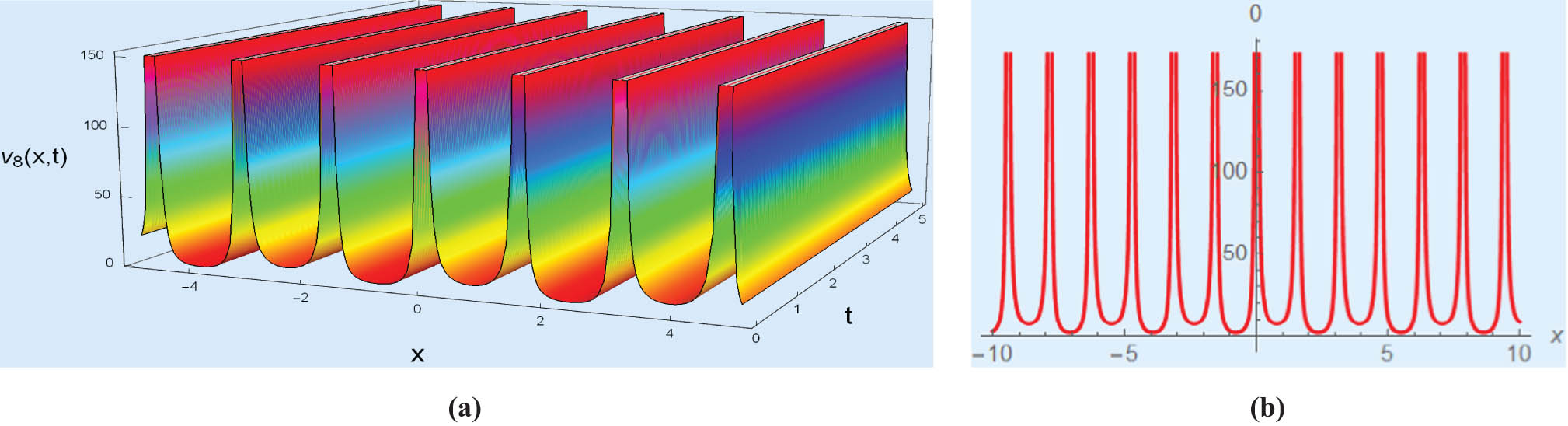
(3.27) v 8 ( x , t ) = f 1 ( μ tan ( μ ζ ) ) + 12 ( 40 μ + 3 c ) γ 6 λ ( 72 μ + 6 c ) ( μ tan ( μ ζ ) ) 2 2 μ 2 ( 40 μ + 3 c ) 2 λ γ ( 7 μ + c ) ( μ tan ( μ ζ ) ) 1 + 2 μ 3 ( 40 μ + 3 c ) γ ( 7 μ + c ) λ ( 12 μ + c ) ( μ tan ( μ ζ ) ) 2 , ,

(3.28) ψ 9 ( x , t ) = 1 6 λ 6 λ ( 8 μ + γ f 1 2 λ ) + 2 2 λ ( μ cot ( μ ζ ) ) + 2 μ 2 λ ( μ cot ( μ ζ ) ) 1 e i η ,

(3.29) v 9 ( x , t ) = f 1 ( μ cot ( μ ζ ) ) + 12 ( 40 μ + 3 c ) γ 6 λ ( 72 μ + 6 c ) ( μ cot ( μ ζ ) ) 2 2 μ 2 ( 40 μ + 3 c ) 2 λ γ ( 7 μ + c ) ( μ cot ( μ ζ ) ) 1 + 2 μ 3 ( 40 μ + 3 c ) γ ( 7 μ + c ) λ ( 12 μ + c ) ( μ cot ( μ ζ ) ) 2 ,

(3.30) ψ 10 ( x , t ) = 1 6 λ 6 λ ( 8 μ + γ f 1 2 λ ) + 2 2 λ ( μ ( μ [ tan ( 2 μ ζ ) + ε sec ( 2 μ ζ ) ] ) ) + 2 μ 2 λ ( μ [ tan ( 2 μ ζ ) + ε sec ( 2 μ ζ ) ] ) 1 e i η ,

(3.31) v 10 ( x , t ) = f 1 ( μ [ tan ( 2 μ ζ ) + ε sec ( 2 μ ζ ) ] ) + 12 ( 40 μ + 3 c ) γ 6 λ ( 72 μ + 6 c ) ( μ [ tan ( 2 μ ζ ) + ε sec ( 2 μ ζ ) ] ) 2 2 μ 2 ( 40 μ + 3 c ) 2 λ γ ( 7 μ + c ) ( μ [ tan ( 2 μ ζ ) + ε sec ( 2 μ ζ ) ] ) 1 + 2 μ 3 ( 40 μ + 3 c ) γ ( 7 μ + c ) λ ( 12 μ + c ) ( μ [ tan ( 2 μ ζ ) + ε sec ( 2 μ ζ ) ] ) 2 ,

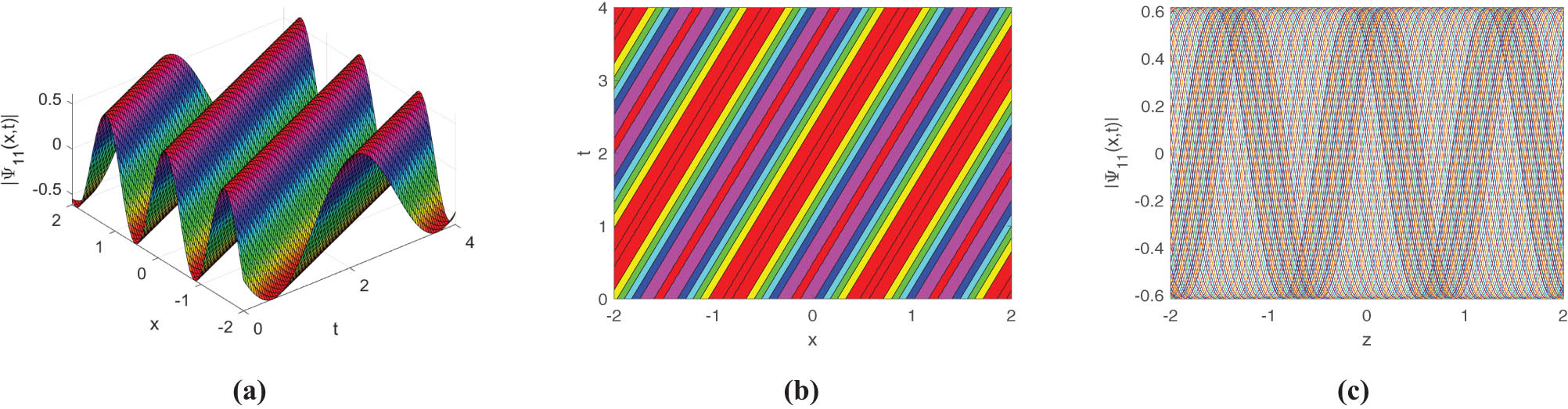
(3.32) ψ 11 ( x , t ) = 1 6 λ 6 λ ( 8 μ + γ f 1 2 λ ) + 2 2 λ μ 1 tan ( μ ζ ) 1 + tan ( μ ζ ) + 2 μ 2 λ μ 1 tan ( μ ζ ) 1 + tan ( μ ζ ) 1 e i η ,

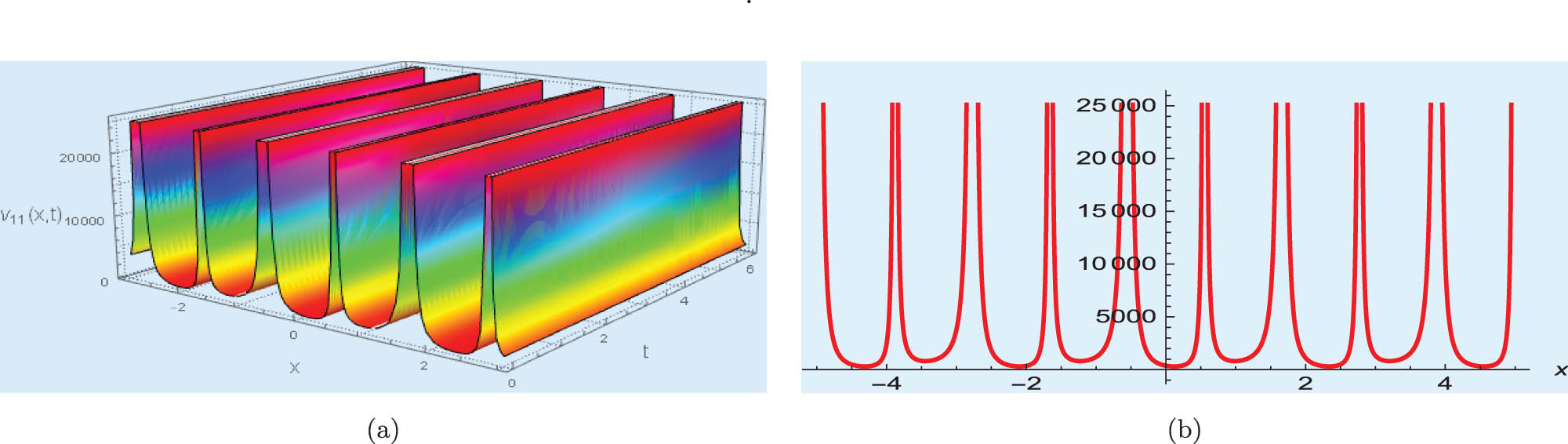
(3.33) v 11 ( x , t ) = f 1 μ 1 tan ( μ ζ ) 1 + tan ( μ ζ ) + 12 ( 40 μ + 3 c ) γ 6 λ ( 72 μ + 6 c ) μ 1 tan ( μ ζ ) 1 + tan ( μ ζ ) 2 2 μ 2 ( 40 μ + 3 c ) 2 λ γ ( 7 μ + c ) μ 1 tan ( μ ζ ) 1 + tan ( μ ζ ) 1 + 2 μ 3 ( 40 μ + 3 c ) γ ( 7 μ + c ) λ ( 12 μ + c ) μ 1 tan ( μ ζ ) 1 + tan ( μ ζ ) 2 ,

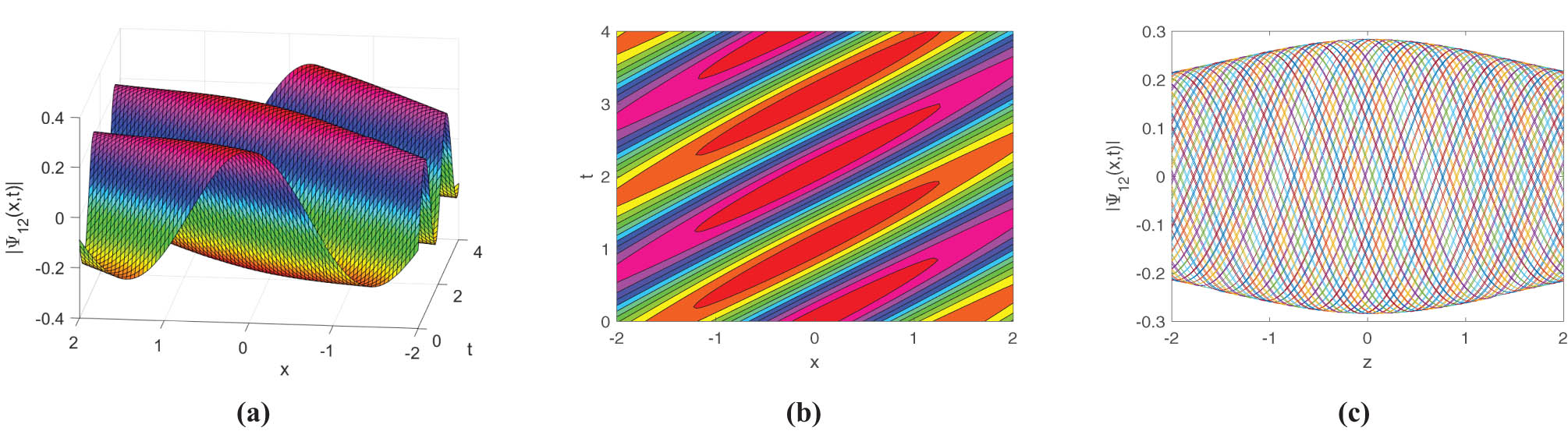
(3.34) ψ 12 ( x , t ) = 1 6 λ 6 λ ( 8 μ + γ f 1 2 λ ) + 2 2 λ μ 4 5 cos ( 2 μ ζ ) 3 + 5 sin ( 2 μ ζ ) + 2 μ 2 λ μ 4 5 cos ( 2 μ ζ ) 3 + 5 sin ( 2 μ ζ ) 1 e i η ,

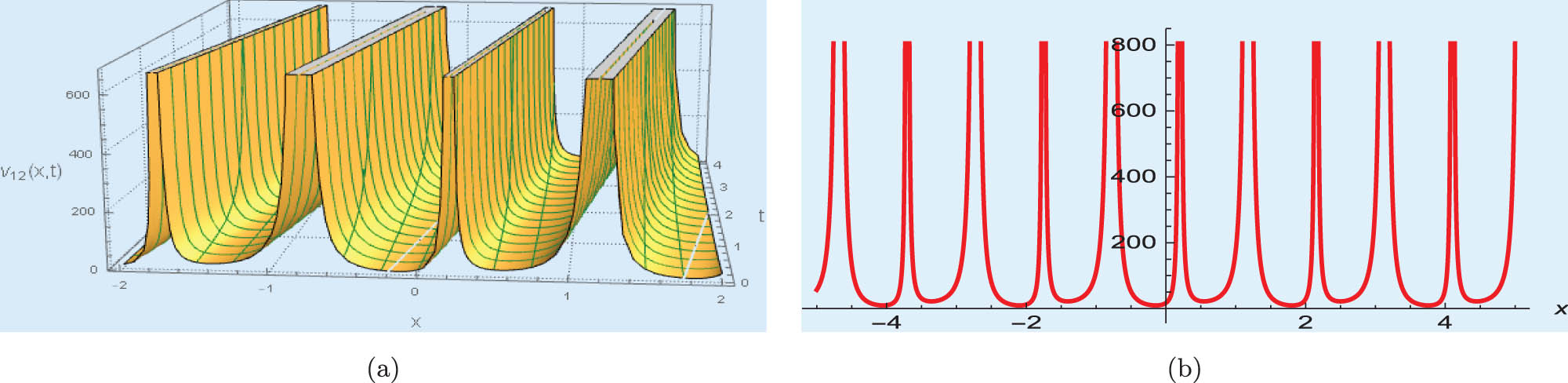
(3.35) v 12 ( x , t ) = f 1 μ 4 5 cos ( 2 μ ζ ) 3 + 5 sin ( 2 μ ζ ) + 12 ( 40 μ + 3 c ) γ 6 λ ( 72 μ + 6 c ) μ 4 5 cos ( 2 μ ζ ) 3 + 5 sin ( 2 μ ζ ) 2 2 μ 2 ( 40 μ + 3 c ) 2 λ γ ( 7 μ + c ) μ 4 5 cos ( 2 μ ζ ) 3 + 5 sin ( 2 μ ζ ) 1 + 2 μ 3 ( 40 μ + 3 c ) γ ( 7 μ + c ) λ ( 12 μ + c ) μ 4 5 cos ( 2 μ ζ ) 3 + 5 sin ( 2 μ ζ ) 2 ,

(3.36) ψ 13 ( x , t ) = 1 6 λ 6 λ ( 8 μ + γ f 1 2 λ ) + 2 2 λ ε μ ( p 2 s 2 ) p μ cos ( 2 μ ζ ) p sin ( 2 μ ζ ) + s + 2 μ 2 λ ε μ ( p 2 s 2 ) p μ cos ( 2 μ ζ ) p sin ( 2 μ ζ ) + s 1 e i η ,

(3.37) v 13 ( x , t ) = f 1 ε μ ( p 2 s 2 ) p μ cos ( 2 μ ζ ) p sin ( 2 μ ζ ) + s + 12 ( 40 μ + 3 c ) γ 6 λ ( 72 μ + 6 c ) ε μ ( p 2 s 2 ) p μ cos ( 2 μ ζ ) p sin ( 2 μ ζ ) + s 2 2 μ 2 ( 40 μ + 3 c ) 2 λ γ ( 7 μ + c ) ε μ ( p 2 s 2 ) p μ cos ( 2 μ ζ ) p sin ( 2 μ ζ ) + s 1 + 2 μ 3 ( 40 μ + 3 c ) γ ( 7 μ + c ) λ ( 12 μ + c ) ε μ ( p 2 s 2 ) p μ cos ( 2 μ ζ ) p sin ( 2 μ ζ ) + s 2 ,

(3.38) ψ 14 ( x , t ) = 1 6 λ 6 λ ( 8 μ + γ f 1 2 λ ) + 2 2 λ i ε μ 1 2 p p + cos ( 2 μ ζ ) i ε sin ( 2 μ ζ ) + 2 μ 2 λ i ε μ 1 2 p p + cos ( 2 μ ζ ) i ε sin ( 2 μ ζ ) 1 e i η ,

(3.39) v 14 ( x , t ) = f 1 i ε μ 1 2 p p + cos ( 2 μ ζ ) i ε sin ( 2 μ ζ ) + 12 ( 40 μ + 3 c ) γ 6 λ ( 72 μ + 6 c ) i ε μ 1 2 p p + cos ( 2 μ ζ ) i ε sin ( 2 μ ζ ) 2 2 μ 2 ( 40 μ + 3 c ) 2 λ γ ( 7 μ + c ) i ε μ 1 2 p p + cos ( 2 μ ζ ) i ε sin ( 2 μ ζ ) 1 + 2 μ 3 ( 40 μ + 3 c ) γ ( 7 μ + c ) λ ( 12 μ + c ) i ε μ 1 2 p p + cos ( 2 μ ζ ) i ε sin ( 2 μ ζ ) 2 ,

Type-III. When μ = 0 , we have

(3.40) ψ 15 ( x , t ) = 1 6 λ 6 λ ( 8 μ + γ f 1 2 λ ) + 2 2 λ 1 ζ + 2 μ 2 λ 1 ζ 1 e i η ,

(3.41) v 15 ( x , t ) = f 1 1 ζ 6 f 1 ( 1 + μ 2 ) c ( 1 + 3 μ 2 ) 1 ζ 2 2 μ 2 ( 40 μ + 3 c ) 2 λ γ ( 7 μ + c ) 1 ζ 1 + 2 μ 3 ( 40 μ + 3 c ) γ ( 7 μ + c ) λ ( 12 μ + c ) 1 ζ 2 .

3.1 The graphical representation of optical soliton solutions

In this section, we employ MATLAB and Mathematica for simulation; we plotted three dimensional surface plots, two-dimensional contour plots, and line plots, which illustrate the effects optical soliton solutions of the NLS-BP system, for bright optical soliton, dark optical soliton, kink optical soliton and anti-kink optical soliton. In these visualizations, one can observe how different types of optical solitons behave in spatial and temporal variables and how stable they are with their unique features.

4 Bifurcation analysis

This section provides a bifurcation analysis of the coupled nonlinear ordinary differential equations:

(4.1) U U κ 2 + λ U 3 + γ V + U c = 0 , V + c V λ U 2 V = 0 ,

where U and V are functions of a single independent variable x , and U , U , V , V denote derivatives with respect to x . This is a system of second-order ordinary differential equations. Bifurcation analysis is a study of how the qualitative or topological structure of a given system’s dynamics changes as parameters are varied. For this system, the parameters are κ , γ , λ and c , where κ 2 acts as an effective linear stiffness, λ controls nonlinear self-interaction strength, γ couples the U and V fields, and c introduces damping or advection. To perform a bifurcation analysis, we must first convert second-order system (4.1) into a first-order system. We introduce new variables, X 1 = U , X 2 = U , X 3 = V , X 4 = V . Then the system (4.1) becomes a four-dimensional system of first-order ordinary differential equations:

(4.2) X 1 X 2 X 3 X 4 = X 2 X 1 κ 2 λ X 1 3 γ X 3 c X 2 X 4 c X 3 + λ X 1 2 X 3 .

A fixed point (or equilibrium point) is a state where the system does not change over time. In our first-order system, this means all derivatives are zero. We need to solve the following system of algebraic equations:

(4.3) X 2 = 0 ,

(4.4) X 1 κ 2 λ X 1 3 γ X 3 c X 2 = 0 ,

(4.5) X 4 = 0 ,

(4.6) c X 3 + λ X 1 2 X 3 = 0 .

Clearly, X 2 = 0 , X 4 = 0 , and equation, X 3 ( c + λ X 1 2 ) = 0 , gives us two main cases for a fixed point:

Case 1: X 3 = 0 , substituting this into Eq. (4.4) gives X 1 κ 2 λ X 1 3 = 0 , which can be factored as X 1 ( κ 2 λ X 1 2 ) = 0 . This yields more possible subcases for a fixed point,

  1. X 1 = 0 , which gives the trivial fixed point (0, 0, 0, 0).

  2. κ 2 λ X 1 2 = 0 : This is valid only if κ 2 λ > 0 , giving the fixed points ( ± κ 2 λ , 0,0,0 ) .

Case 2: c + λ X 1 2 = 0 , this case is valid only if c λ < 0 . If so, we have X 1 = ± c λ , substituting this into Eq. (4.4) and solving for X 3 gives:

X 3 = 1 γ ( X 1 κ 2 λ X 1 3 ) = 1 γ [ ± c λ κ 2 λ ± c λ 3 ] , provided γ 0 .

To determine the stability of these fixed points, we linearize the system by computing the Jacobian matrix J of the first-order system (4.2). The Jacobian matrix is:

(4.7) J = X 1 X 1 X 1 X 2 X 1 X 3 X 1 X 4 X 2 X 1 X 2 X 2 X 2 X 3 X 2 X 4 X 3 X 1 X 3 X 2 X 3 X 3 X 3 X 4 X 4 X 1 X 4 X 2 X 4 X 3 X 4 X 4 = 0 1 0 0 κ 2 3 λ X 1 2 c γ 0 0 0 0 1 2 λ X 1 X 3 0 c + λ X 1 2 0 .

We then evaluate the Jacobian at each fixed point and find its eigenvalues. The stability of the fixed point is determined by the real part of these eigenvalues.

  • If all eigenvalues have negative real parts, the fixed point is asymptotically stable (a sink).

  • If at least one eigenvalue has a positive real part, the fixed point is unstable (a source or saddle).

  • If one or more eigenvalues have a zero real part, the linear approximation fails, and this is where a bifurcation might occur.

A bifurcation occurs when the stability or number of fixed points changes as a parameter is varied. This happens when the real part of an eigenvalue of the Jacobian matrix crosses zero. For example, at the trivial fixed point (0, 0, 0, 0), the Jacobian matrix simplifies to:

J ( 0,0,0,0 ) = 0 1 0 0 κ 2 c γ 0 0 0 0 1 0 0 c 0 .

The eigenvalues are given by the roots of the characteristic equation det ( J Λ I ) = 0 , which simplifies to ( Λ 2 + c Λ κ 2 ) ( Λ 2 c ) = 0 . The roots are:

Λ 1,2 = c ± c 2 + 4 κ 2 2 and Λ 3,4 = ± c .

A bifurcation will occur at any point where one of these eigenvalues changes sign, such as when c = 0 or κ = 0 . The change in the number of fixed points as the ratio κ 2 λ crosses zero is an example of a pitchfork bifurcation.

4.1 Graphical representation of bifurcation analysis

A graphical representation of the bifurcation analysis is a great way to visualize how the system’s behavior changes with its parameters. Since our system is four-dimensional, plotting a full phase portrait is not feasible. The most common and effective way to show this is with a bifurcation diagram and simplified 2D-phase portraits (Table 1).

Table 1

Summary of bifurcation analysis for the coupled U V system

Parameter Role in dynamics Bifurcation indicator Observed effect (from plots) Physical meaning
κ 2 Linear stiffness term in U -equation Changes sign in κ 2 3 λ U 0 2 from Jacobian Alters phase portrait topology: from single-well to double-well effective potential; critical value where equilibria split Controls oscillation frequency and onset of symmetry-breaking
λ Nonlinear self-interaction Appears in cubic term λ U 3 and in V -coupling Larger λ increases nonlinearity, shifting bifurcation point Sets strength of self-focusing/defocusing
γ Linear coupling between U and V Off-diagonal term in Jacobian ( γ ) Couples U V oscillations; modifies stability boundaries Energy exchange between modes
c Damping (or advection-like) term Linear in P and V equations Higher c smooths trajectories, reduces amplitude peaks Dissipation or background drift

5 Physical interpretation of the obtained geometries

5.1 Physical interpretation of the optical soliton solutions

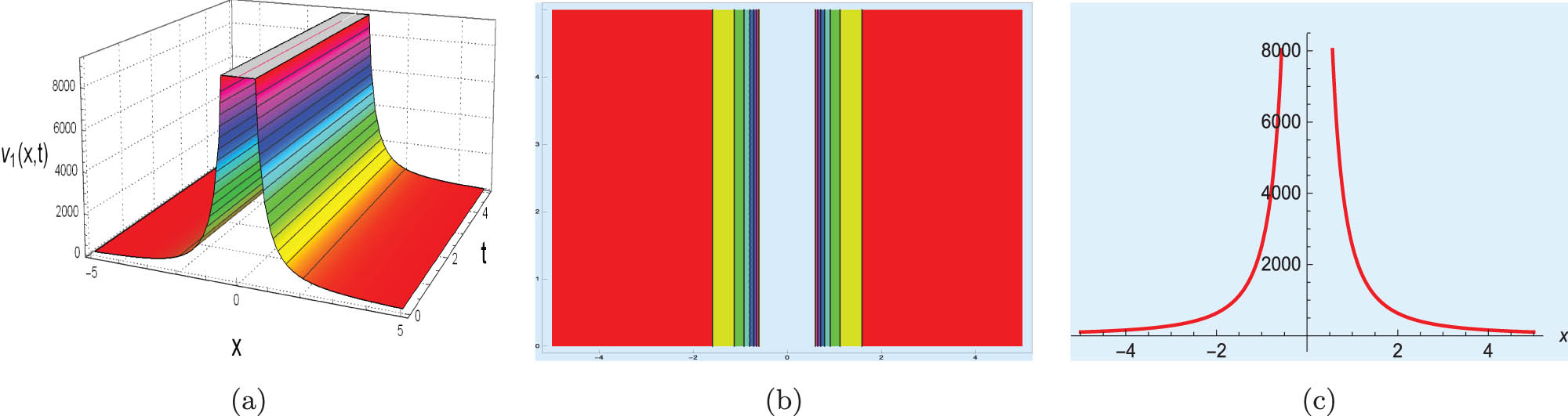
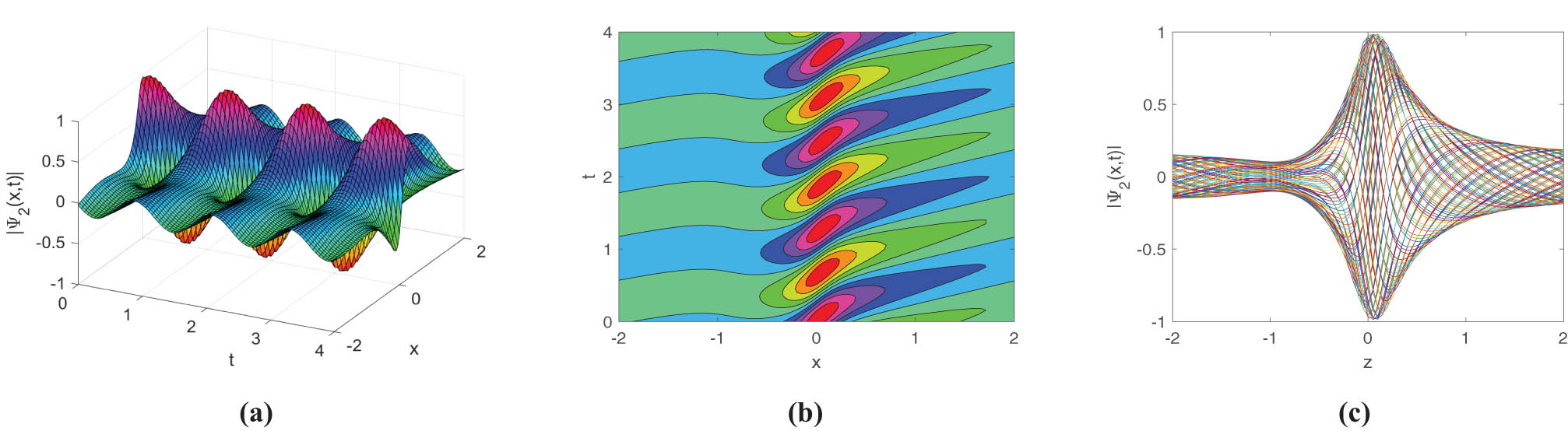
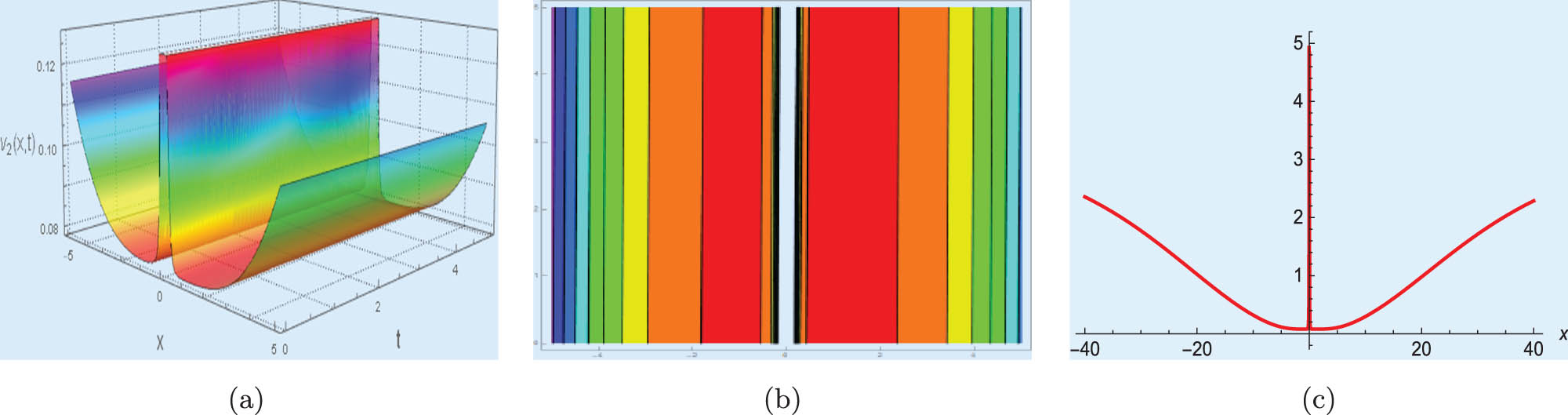
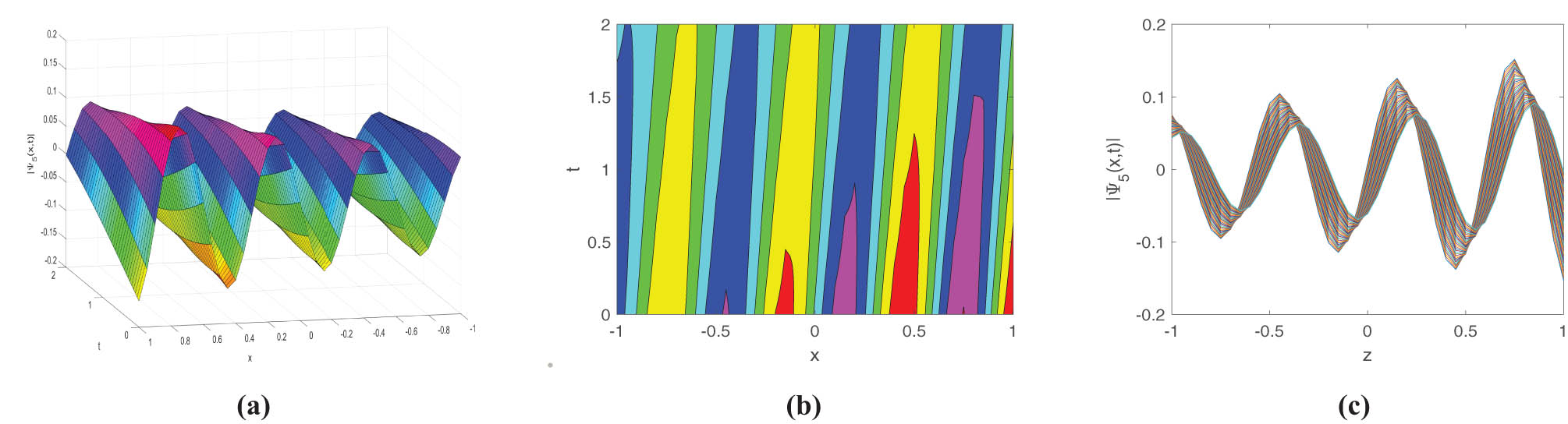
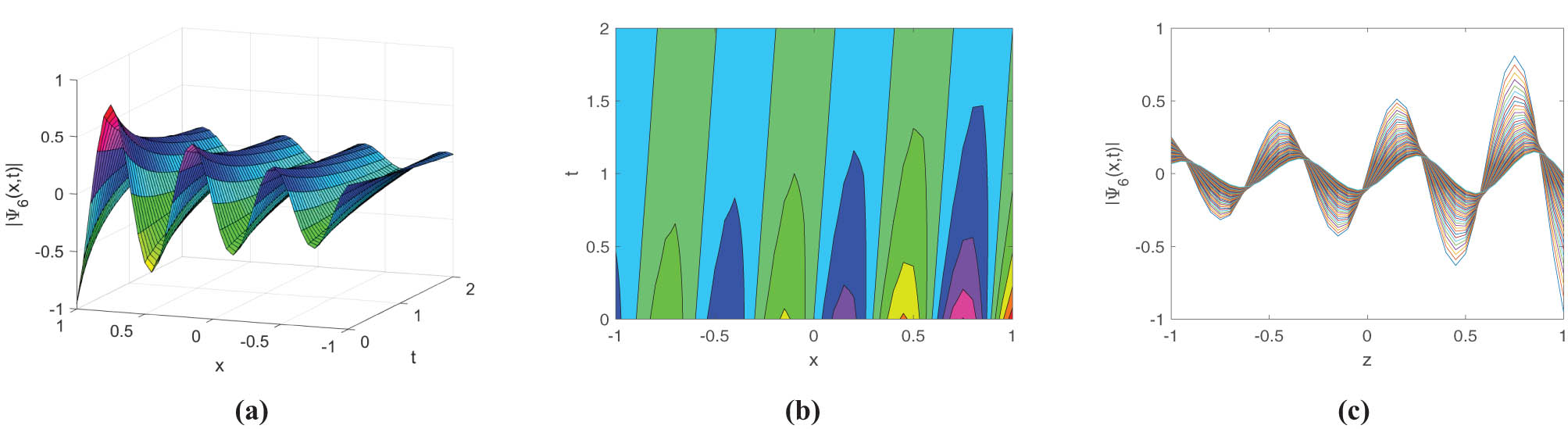
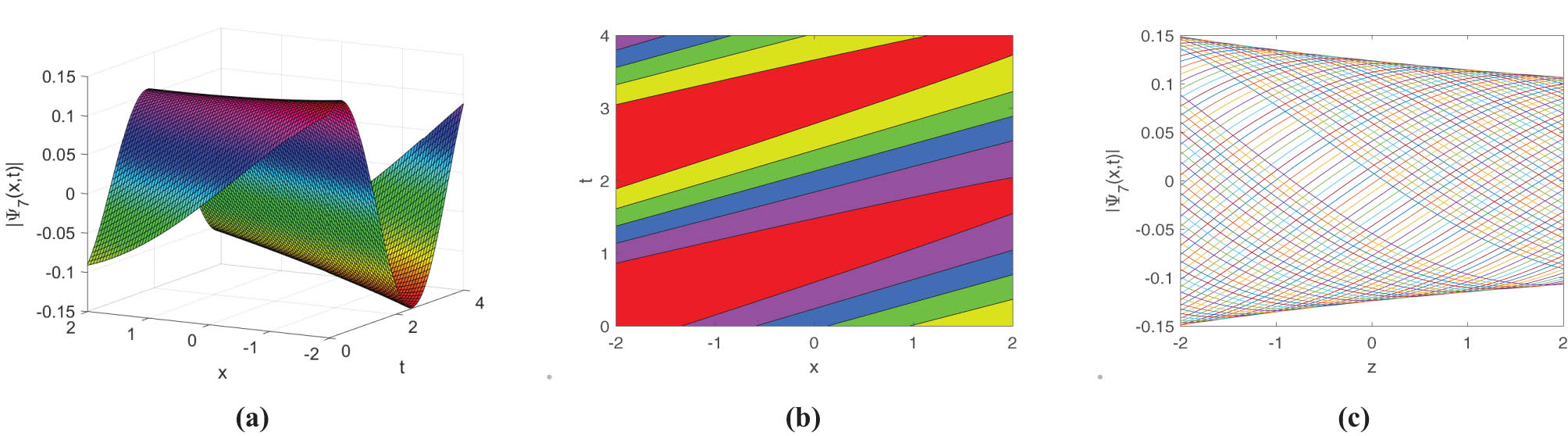
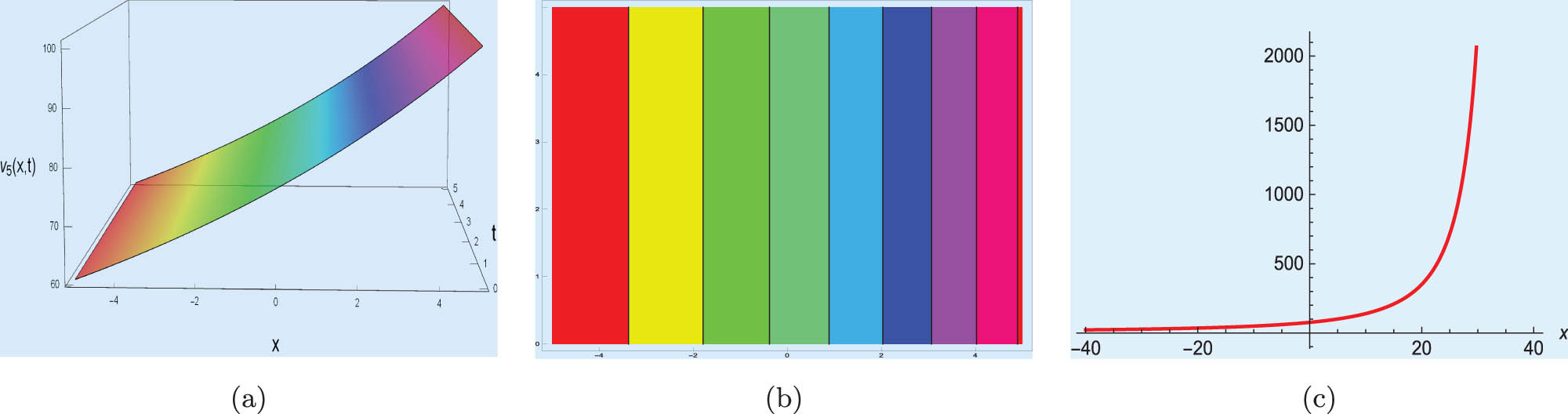
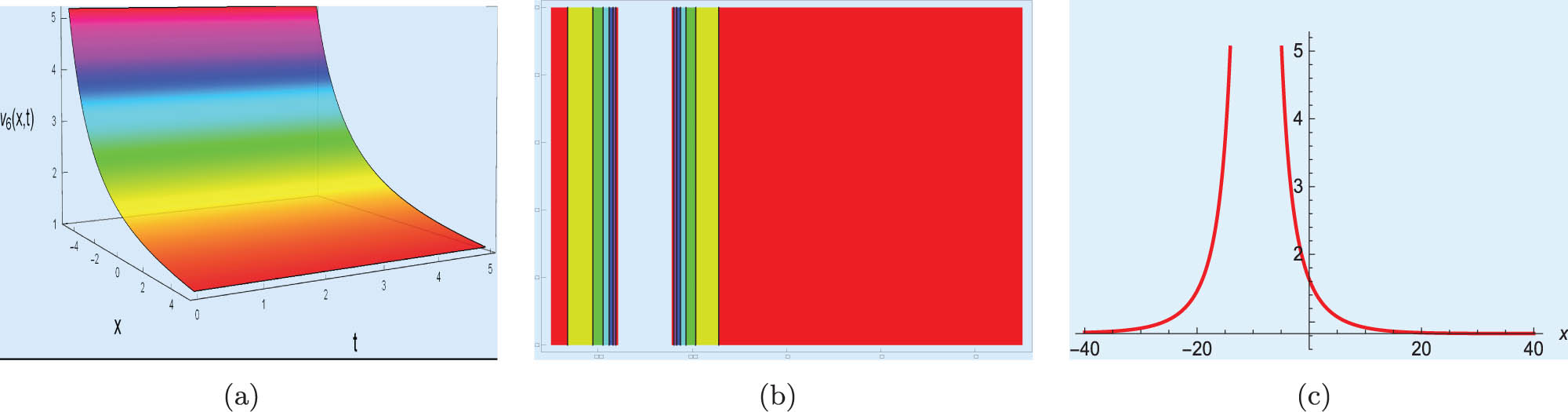
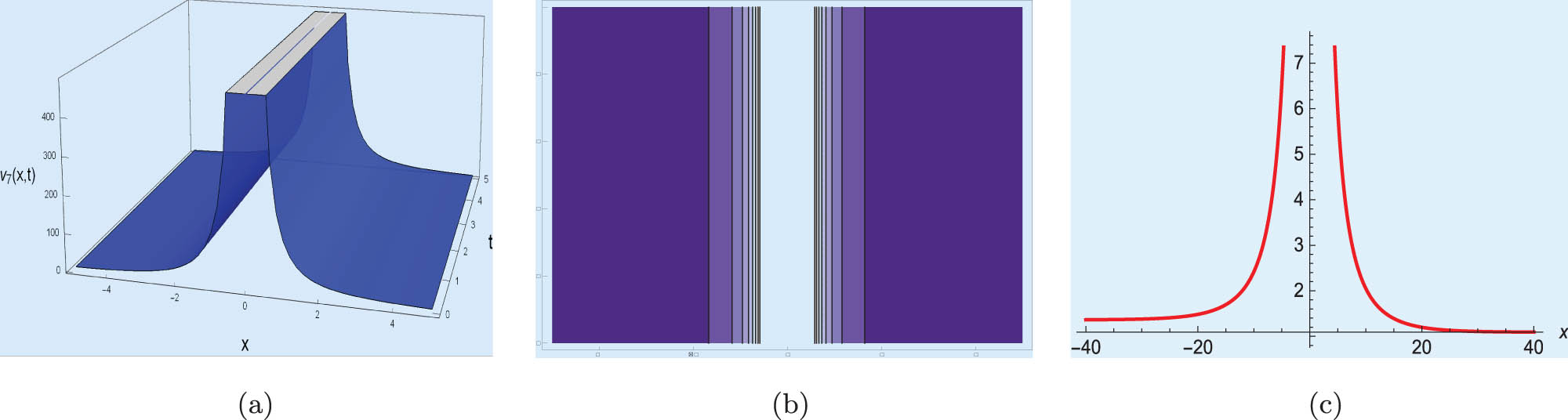
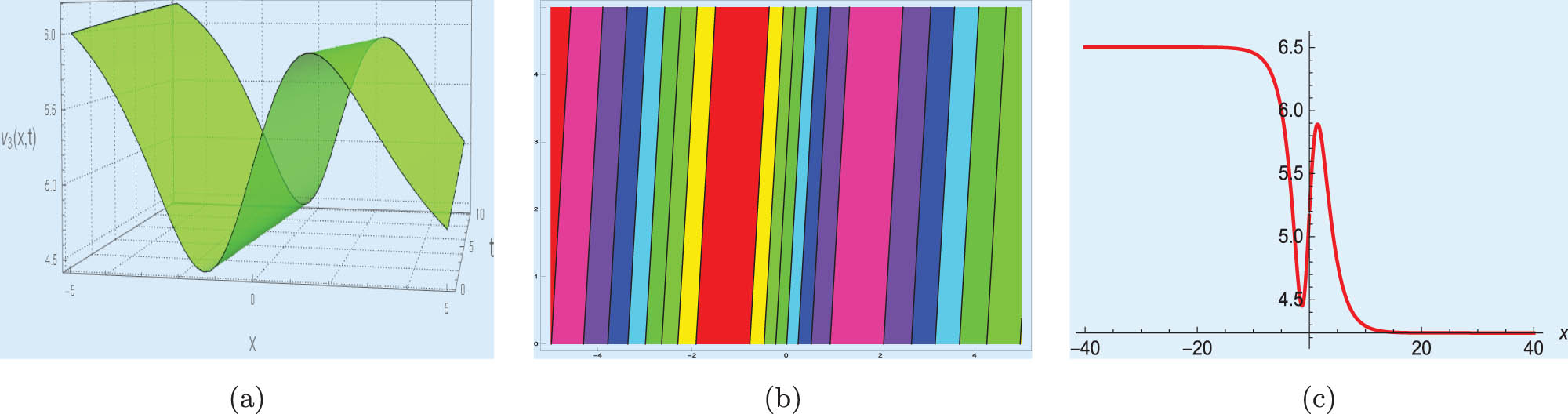
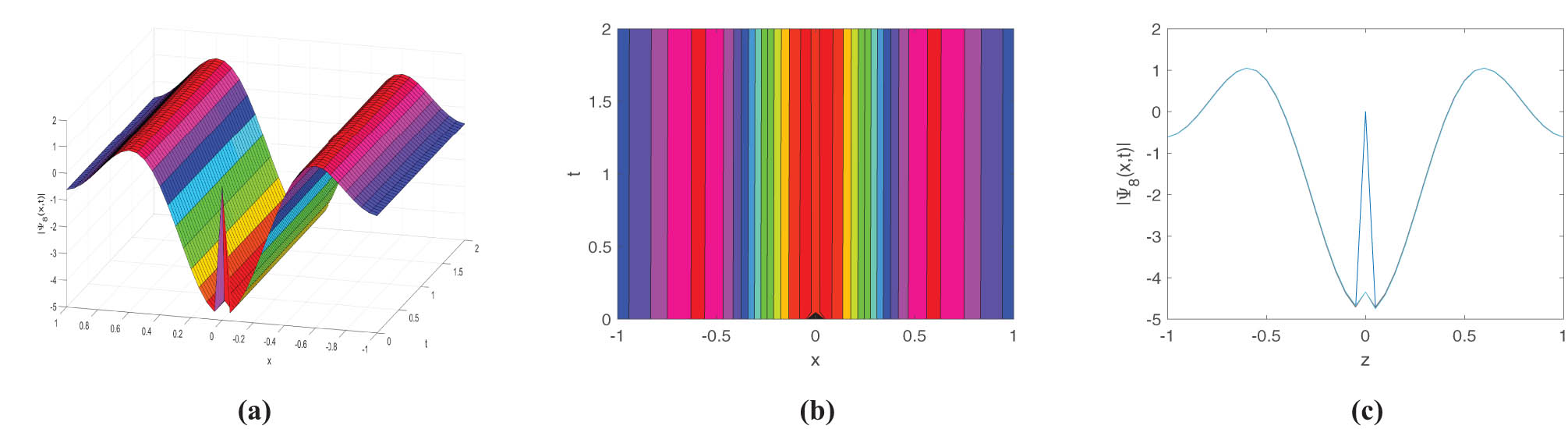
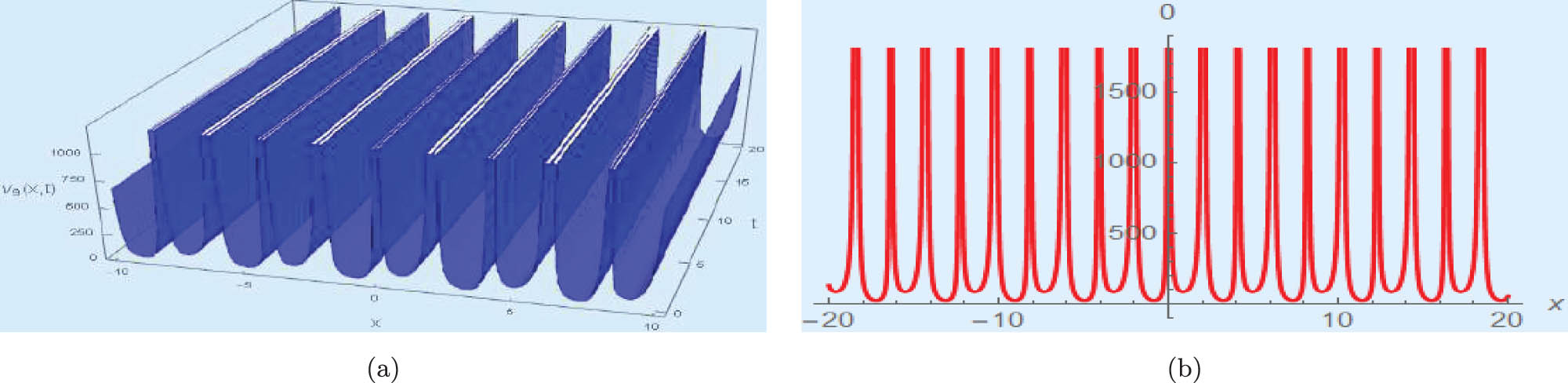
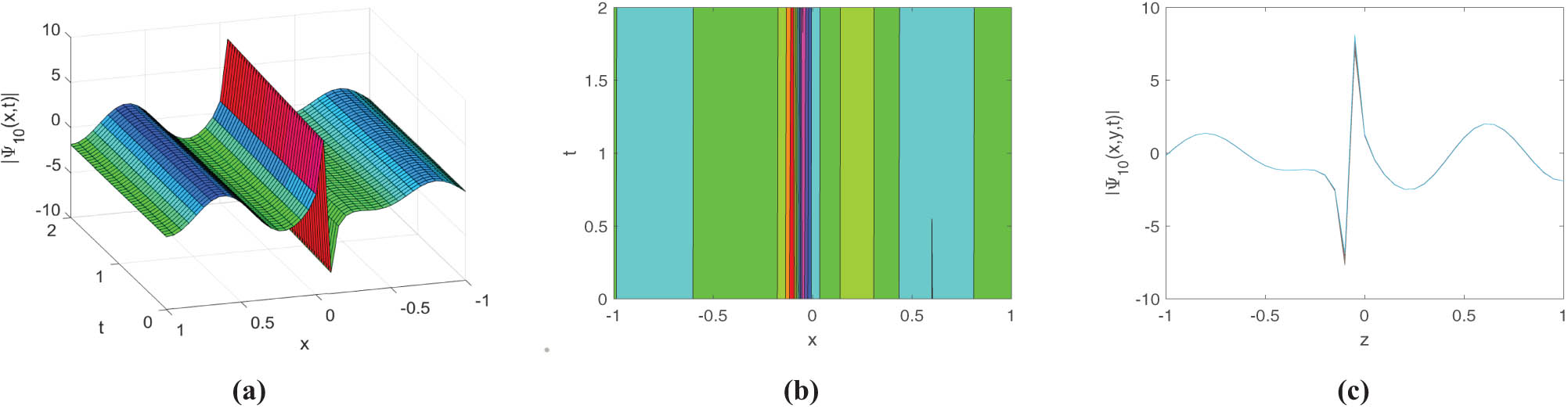
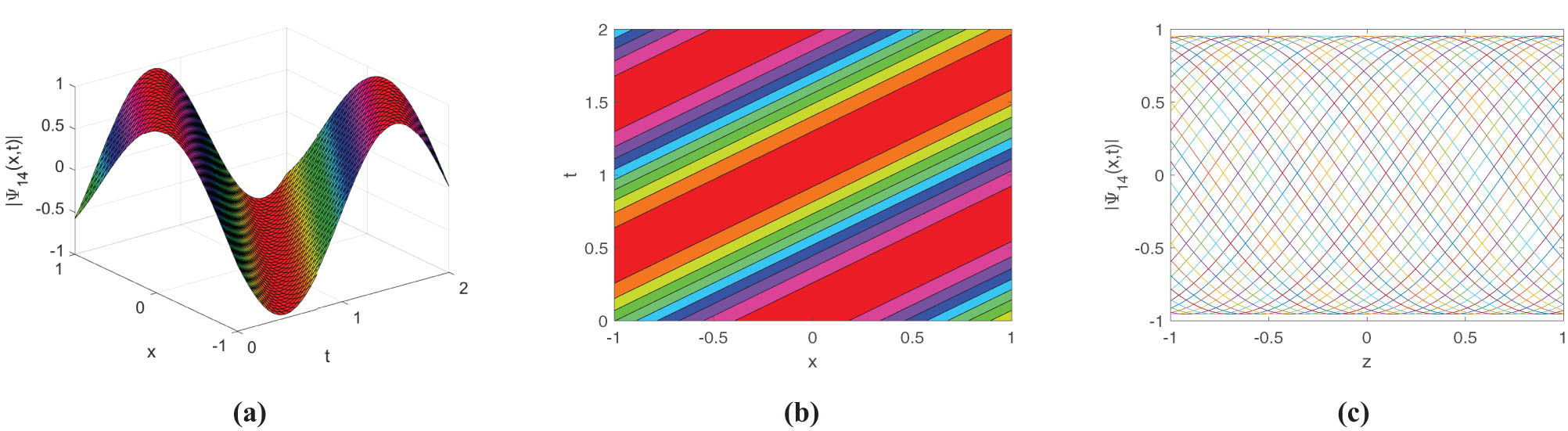
To demonstrate the physical Interpretation of the optical soliton solutions and to define the nature of optical solitons are illustrated through constructed 3D, contour, and 2D (line) graphs in this section. 2D and 3D plots are essential tools for visualizing and understanding the behavior of waves, particularly optical solitons, in various physical systems. The amplitude of the wave, such as height, pressure, or displacement, is usually plotted in two dimensions as a function of time or position. The wave’s shape, wavelength, and amplitude at a given time are revealed by a 2D plot of amplitude versus position. This offers the wave’s spatial profile. On the other hand, a 2D plot of amplitude versus time at a fixed position shows how the wave’s amplitude changes over time at that particular location, helping to observe the wave’s frequency and period. In the context of optical solitons, 2D plots can demonstrate the optical soliton’s characteristic shape and how it propagates without changing its form, such as a series of plots showing the optical soliton’s movement over time. These plots illustrate how the wave evolves through time and space and serve as useful tools for visualizing the behavior of optical solitons. The nature of optical soliton for different scenario is given below. Figures 1 and 2 present visual representations of dark optical soliton solutions. A dark optical soliton forms into waves that uphold their shape as they move through systems containing nonlinearity properties. Such waves appear because light intensity creates a reduction in the refractive index, which results in self-defocusing. Central light pulse spreading occurs as a result of dispersion, but it is offset by dispersion which makes different frequency components move at varying speeds. Self-defocusing interaction sustains dark optical solitons because it balances with the dispersion effects. Dark optical solitons show important characteristics such as a brightness dip in the middle of a brighter background alongside π radians of phase shift across this region, which propagates while maintaining its shape while maintaining exceptional stability both independently and when encountering other optical solitons. Dark optical solitons are promising for optical communication applications because their stability and information-carrying ability function advantageously while simultaneously showing potential for applications in optical switching through phase jumps and quantum information processing in ultra cold atomic gases. Figures 3 and 4 show singular optical soliton solutions. The combination of singular optical soliton solutions is shown in Figures 5, 6, 7, 8, 9, and 10. A singular optical soliton is a solution type for nonlinear partial differential equations that presents singular features as its properties reach infinite limits within specific spatial or temporal domains. The propagation of singular optical solitons generates blowup regions where solutions approach infinite values although these waves share localized wave features comparable to regular soliton solutions. The wave keeps its localized structure during propagation as one aspect of this behavior combines with the nonlinearity to create singularities at particular points. Singular solitons physically convey wave collapse events and energy point concentration phenomena. Research on singular optical solitons assists studies within nonlinear optics to explain beam collapse in self-focusing media and fluid dynamics to describe rogue waves as well as plasma physics to explain energy concentration in plasmas. The mathematical interpretation and physical evaluation of singular optical solitons is challenging because their singularities reflect stability issues and system breakdown, which demands thorough investigation to identify regularization possibilities.
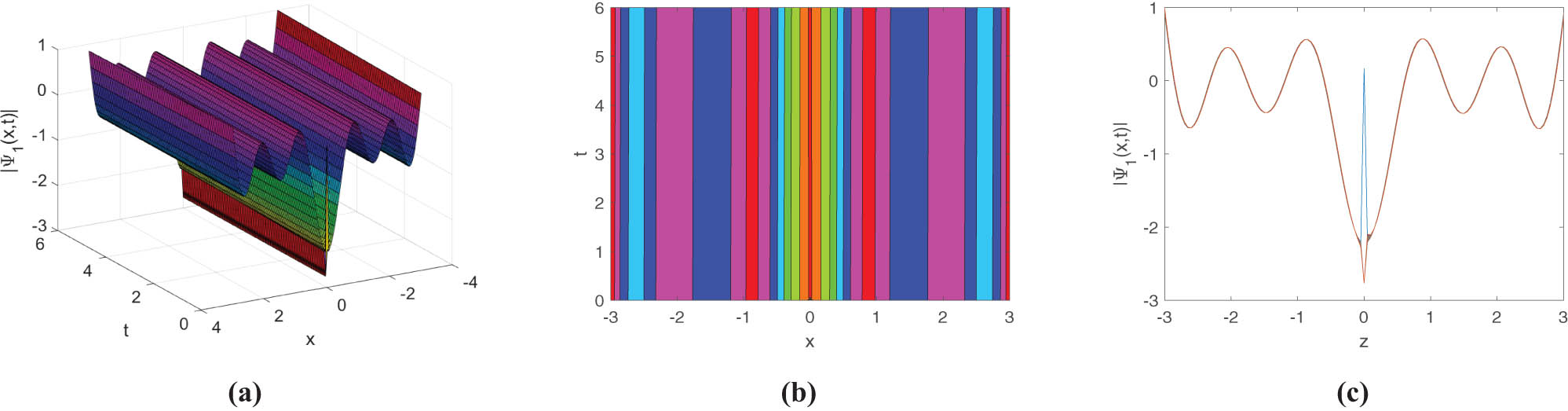
Figure 1 
                  Select 


                              μ
                              =
                              −
                              0.22
                           
                           \mu =-0.22
                        
                     , 


                              λ
                              =
                              11.02
                           
                           \lambda =11.02
                        
                     , 


                              γ
                              =
                              11.60
                           
                           \gamma =11.60
                        
                     , 


                              k
                              =
                              5.55
                           
                           k=5.55
                        
                     , 


                              w
                              =
                              0.0102
                           
                           w=0.0102
                        
                     , 


                              θ
                              =
                              0.012
                           
                           \theta =0.012
                        
                     , 


                              c
                              =
                              0.0015
                           
                           c=0.0015
                        
                     , 


                                    f
                                 
                                 
                                    1
                                 
                              
                              =
                              0.002
                           
                           {f}_{1}=0.002
                        
                      for (a) 3D surface plot, (b) contour plot, and (c) line plot for the solution of Eq. (3.12).
Figure 1

Select μ = 0.22 , λ = 11.02 , γ = 11.60 , k = 5.55 , w = 0.0102 , θ = 0.012 , c = 0.0015 , f 1 = 0.002 for (a) 3D surface plot, (b) contour plot, and (c) line plot for the solution of Eq. (3.12).

Figure 2 
                  Select 


                              μ
                              =
                              −
                              0.009
                           
                           \mu =-0.009
                        
                     , 


                              λ
                              =
                              0.0025
                           
                           \lambda =0.0025
                        
                     , 


                              γ
                              =
                              15.60
                           
                           \gamma =15.60
                        
                     , 


                              c
                              =
                              0.0125
                           
                           c=0.0125
                        
                      for (a) 3D surface plot, (b) contour plot, and (c) line plot for the solution of Eq. (3.13).
Figure 2

Select μ = 0.009 , λ = 0.0025 , γ = 15.60 , c = 0.0125 for (a) 3D surface plot, (b) contour plot, and (c) line plot for the solution of Eq. (3.13).

Figure 3 
                  Select 


                              μ
                              =
                              −
                              0.022
                           
                           \mu =-0.022
                        
                     , 


                              λ
                              =
                              10.02
                           
                           \lambda =10.02
                        
                     , 


                              γ
                              =
                              2.60
                           
                           \gamma =2.60
                        
                     , 


                              k
                              =
                              6.55
                           
                           k=6.55
                        
                     , 


                              w
                              =
                              0.0102
                           
                           w=0.0102
                        
                     , 


                              θ
                              =
                              1.012
                           
                           \theta =1.012
                        
                     , 


                              c
                              =
                              0.0015
                           
                           c=0.0015
                        
                      for 3D and contour graphs of (3.14).
Figure 3

Select μ = 0.022 , λ = 10.02 , γ = 2.60 , k = 6.55 , w = 0.0102 , θ = 1.012 , c = 0.0015 for 3D and contour graphs of (3.14).

Figure 4 
                  Select 


                              μ
                              =
                              −
                              0.00099
                           
                           \mu =-0.00099
                        
                     , 


                              λ
                              =
                              0.00095
                           
                           \lambda =0.00095
                        
                     , 


                              γ
                              =
                              15.60
                           
                           \gamma =15.60
                        
                     , 


                              c
                              =
                              0.00825
                           
                           c=0.00825
                        
                      for (a) 3D surface plot, (b) contour plot, and (c) line plot for the solution of Eq. (3.15).
Figure 4

Select μ = 0.00099 , λ = 0.00095 , γ = 15.60 , c = 0.00825 for (a) 3D surface plot, (b) contour plot, and (c) line plot for the solution of Eq. (3.15).

Figure 5 
                  Select for 


                              μ
                              =
                              −
                              0.0042
                           
                           \mu =-0.0042
                        
                     , 


                              λ
                              =
                              2.02
                           
                           \lambda =2.02
                        
                     , 


                              γ
                              =
                              2.76
                           
                           \gamma =2.76
                        
                     , 


                              k
                              =
                              10.55
                           
                           k=10.55
                        
                     , 


                              w
                              =
                              
                                 
                                    2
                                    π
                                 
                                 
                                    k


                           w=\frac{2\pi }{k}
                        
                     , 


                              θ
                              =
                              0.12
                           
                           \theta =0.12
                        
                     , 


                              c
                              =
                              0.87
                           
                           c=0.87
                        
                     , 


                                    f
                                 
                                 
                                    1
                                 
                              
                              =
                              0.002
                           
                           {f}_{1}=0.002
                        
                      for (a) 3D surface plot, (b) contour plot, and (c) line plot for the solution of Eq. (3.20).
Figure 5

Select for μ = 0.0042 , λ = 2.02 , γ = 2.76 , k = 10.55 , w = 2 π k , θ = 0.12 , c = 0.87 , f 1 = 0.002 for (a) 3D surface plot, (b) contour plot, and (c) line plot for the solution of Eq. (3.20).

Figure 6 
                  Select for 


                              μ
                              =
                              −
                              0.0042
                           
                           \mu =-0.0042
                        
                     , 


                              λ
                              =
                              2.02
                           
                           \lambda =2.02
                        
                     , 


                              γ
                              =
                              2.76
                           
                           \gamma =2.76
                        
                     , 


                              k
                              =
                              10.55
                           
                           k=10.55
                        
                     , 


                              w
                              =
                              
                                 
                                    2
                                    π
                                 
                                 
                                    k


                           w=\frac{2\pi }{k}
                        
                     , 


                              θ
                              =
                              0.12
                           
                           \theta =0.12
                        
                     , 


                              c
                              =
                              1.80
                           
                           c=1.80
                        
                     , 


                              p
                              =
                              4
                           
                           p=4
                        
                     , 


                              s
                              =
                              1
                           
                           s=1
                        
                     , 


                                    f
                                 
                                 
                                    1
                                 
                              
                              =
                              0.002
                           
                           {f}_{1}=0.002
                        
                      for (a) 3D surface plot, (b) contour plot, and (c) line plot for the solution of Eq. (3.22).
Figure 6

Select for μ = 0.0042 , λ = 2.02 , γ = 2.76 , k = 10.55 , w = 2 π k , θ = 0.12 , c = 1.80 , p = 4 , s = 1 , f 1 = 0.002 for (a) 3D surface plot, (b) contour plot, and (c) line plot for the solution of Eq. (3.22).

Figure 7 
                  Select for 


                              μ
                              =
                              −
                              0.0042
                           
                           \mu =-0.0042
                        
                     , 


                              λ
                              =
                              2.02
                           
                           \lambda =2.02
                        
                     , 


                              γ
                              =
                              2.76
                           
                           \gamma =2.76
                        
                     , 


                              k
                              =
                              0.55
                           
                           k=0.55
                        
                     , 


                              w
                              =
                              1.44
                           
                           w=1.44
                        
                     , 


                              θ
                              =
                              0.012
                           
                           \theta =0.012
                        
                     , 


                              c
                              =
                              0.008
                           
                           c=0.008
                        
                     , 


                              p
                              =
                              4
                           
                           p=4
                        
                     , 


                                    f
                                 
                                 
                                    1
                                 
                              
                              =
                              0.002
                           
                           {f}_{1}=0.002
                        
                      for (a) 3D surface plot, (b) contour plot, and (c) line plot for the solution of Eq. (3.24).
Figure 7

Select for μ = 0.0042 , λ = 2.02 , γ = 2.76 , k = 0.55 , w = 1.44 , θ = 0.012 , c = 0.008 , p = 4 , f 1 = 0.002 for (a) 3D surface plot, (b) contour plot, and (c) line plot for the solution of Eq. (3.24).

Figure 8 
                  Select 


                              μ
                              =
                              −
                              0.00009
                           
                           \mu =-0.00009
                        
                     , 


                              λ
                              =
                              0.0025
                              ,
                              c
                              =
                              0.225
                           
                           \lambda =0.0025,c=0.225
                        
                      for (a) 3D surface plot, (b) contour plot, and (c) line plot for the solution of Eq. (3.21).
Figure 8

Select μ = 0.00009 , λ = 0.0025 , c = 0.225 for (a) 3D surface plot, (b) contour plot, and (c) line plot for the solution of Eq. (3.21).

Figure 9 
                  Select 


                              μ
                              =
                              −
                              1.0099
                           
                           \mu =-1.0099
                        
                     , 


                              λ
                              =
                              0.2095
                           
                           \lambda =0.2095
                        
                     , 


                              c
                              =
                              0.00825
                           
                           c=0.00825
                        
                     , 


                              p
                              =
                              6
                           
                           p=6
                        
                      for (a) 3D surface plot, (b) contour plot, and (c) line plot for the solution of Eq. (3.23).
Figure 9

Select μ = 1.0099 , λ = 0.2095 , c = 0.00825 , p = 6 for (a) 3D surface plot, (b) contour plot, and (c) line plot for the solution of Eq. (3.23).

Figure 10 
                  Select 


                              μ
                              =
                              −
                              5.09
                           
                           \mu =-5.09
                        
                     , 


                              λ
                              =
                              12.2095
                           
                           \lambda =12.2095
                        
                     , 


                              c
                              =
                              1.25
                           
                           c=1.25
                        
                     , 


                              p
                              =
                              3
                              .
                           
                           p=3.
                        
                      for (a) 3D surface plot, (b) contour plot, and (c) line plot for the solution of Eq. (3.25).
Figure 10

Select μ = 5.09 , λ = 12.2095 , c = 1.25 , p = 3 . for (a) 3D surface plot, (b) contour plot, and (c) line plot for the solution of Eq. (3.25).

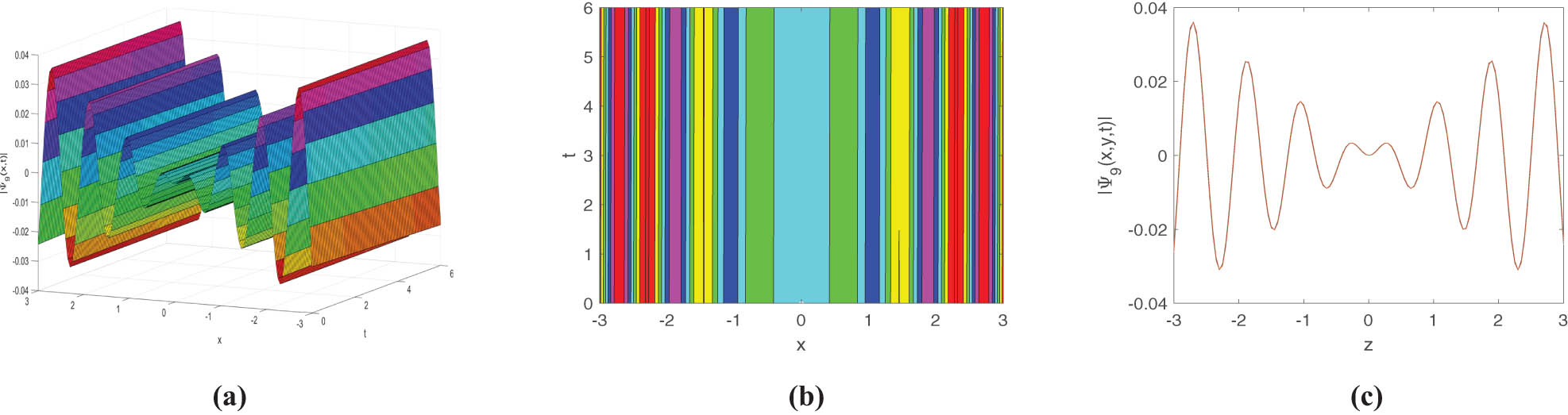
Dark-bright optical soliton appears together in Figures 11 and 12. The propagation of localized wave packets known as bright optical solitons fights against natural dispersion effects which cause wave spreading in time. Self-focusing develops through the balancing of dispersion in the medium and nonlinearity which either emerges from changes to refractive index due to intensity variations or from interatomic interactions. A stable localized wave packet emerges from this balanced state. The essential characteristics of bright optical solitons include elevated intensity above background levels together with shape preservation during transmission and resistance to external disturbances and interactions that handle them like particles. These localized waves exist in different systems, which include optical fibers used for distortion-free data transmission over long distances and Bose–Einstein condensates that produce localized matter waves through atomic interactions. Broad applications for bright optical solitons exist in fields of optical communications as well as laser technology and quantum computing and the study of nonlinear waves in fundamental research. Figures 13, 14, 15, 16, 17, 18, display singular periodic optical soliton solutions, and Figures 19, 20, 21, 22 display combination of singular periodic optical soliton solution. A periodic optical soliton refers to a optical soliton-like solution of a NLPDE that exhibits periodic behavior in space, time, or both. Unlike traditional optical solitons, which are localized and nonrepeating, periodic optical solitons are characterized by their repeating patterns while still retaining some optical soliton-like properties, such as stability and shape preservation during propagation. Periodic optical solitons arise in integrable systems and nonlinear wave equations, often as a result of balancing nonlinearity and dispersion. They are important in understanding wave phenomena in various physical systems, such as optics, fluid dynamics, and plasma physics.
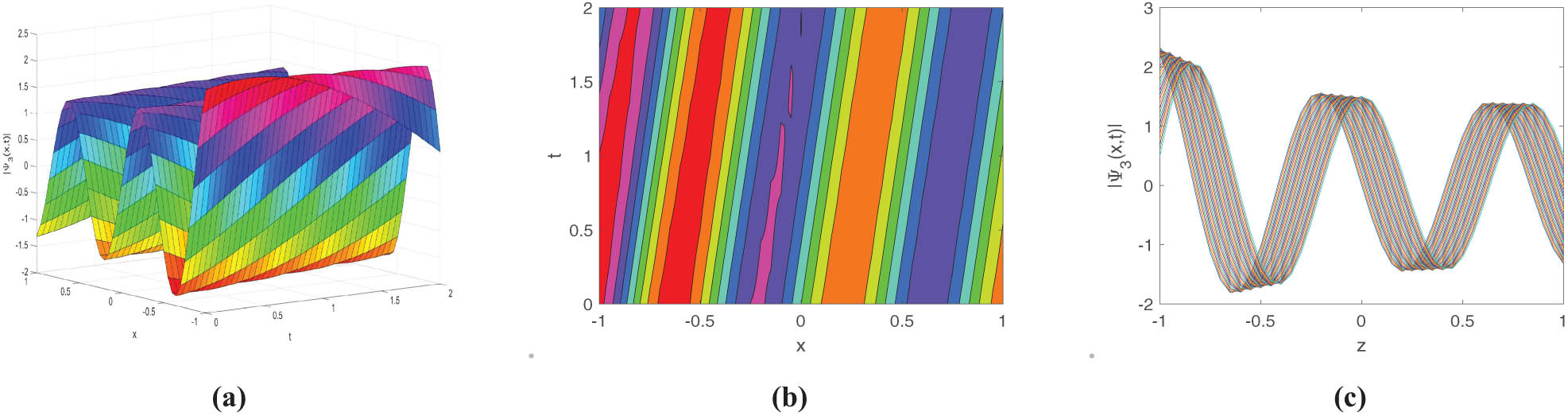
Figure 11 
                  Select 


                              μ
                              =
                              −
                              0.22
                           
                           \mu =-0.22
                        
                     , 


                              λ
                              =
                              11.02
                           
                           \lambda =11.02
                        
                     , 


                              γ
                              =
                              11.60
                           
                           \gamma =11.60
                        
                     , 


                              k
                              =
                              1.55
                           
                           k=1.55
                        
                     , 


                              w
                              =
                              5.2
                           
                           w=5.2
                        
                     , 


                              θ
                              =
                              0.012
                           
                           \theta =0.012
                        
                     , 


                              c
                              =
                              0.015
                           
                           c=0.015
                        
                     , 


                                    f
                                 
                                 
                                    1
                                 
                              
                              =
                              0.002
                           
                           {f}_{1}=0.002
                        
                      for (a) 3D surface plot, (b) contour plot, and (c) line plot for the solution of Eq. (3.16).
Figure 11

Select μ = 0.22 , λ = 11.02 , γ = 11.60 , k = 1.55 , w = 5.2 , θ = 0.012 , c = 0.015 , f 1 = 0.002 for (a) 3D surface plot, (b) contour plot, and (c) line plot for the solution of Eq. (3.16).

Figure 12 
                  Select 


                              μ
                              =
                              −
                              0.0099
                           
                           \mu =-0.0099
                        
                     , 


                              λ
                              =
                              0.0095
                              ,
                              c
                              =
                              0.0825
                           
                           \lambda =0.0095,c=0.0825
                        
                      for (a) 3D surface plot, (b) contour plot, and (c) line plot for the solution of Eq. (3.17).
Figure 12

Select μ = 0.0099 , λ = 0.0095 , c = 0.0825 for (a) 3D surface plot, (b) contour plot, and (c) line plot for the solution of Eq. (3.17).

Figure 13 
                  Select 


                              μ
                              =
                              0.22
                           
                           \mu =0.22
                        
                     , 


                              λ
                              =
                              5.02
                           
                           \lambda =5.02
                        
                     , 


                              γ
                              =
                              1.6
                           
                           \gamma =1.6
                        
                     , 


                              k
                              =
                              7.55
                           
                           k=7.55
                        
                     , 


                              w
                              =
                              0.0102
                           
                           w=0.0102
                        
                     , 


                              θ
                              =
                              0.012
                           
                           \theta =0.012
                        
                     , 


                              c
                              =
                              0.0015
                           
                           c=0.0015
                        
                     , 


                                    f
                                 
                                 
                                    1
                                 
                              
                              =
                              0.002
                           
                           {f}_{1}=0.002
                        
                      for (a) 3D surface plot, (b) contour plot, and (c) line plot for the solution of Eq. (3.26).
Figure 13

Select μ = 0.22 , λ = 5.02 , γ = 1.6 , k = 7.55 , w = 0.0102 , θ = 0.012 , c = 0.0015 , f 1 = 0.002 for (a) 3D surface plot, (b) contour plot, and (c) line plot for the solution of Eq. (3.26).

Figure 14 
                  Select 


                              μ
                              =
                              0.022
                           
                           \mu =0.022
                        
                     , 


                              λ
                              =
                              5.02
                           
                           \lambda =5.02
                        
                     , 


                              γ
                              =
                              1.60
                           
                           \gamma =1.60
                        
                     , 


                              k
                              =
                              7.55
                           
                           k=7.55
                        
                     , 


                              w
                              =
                              0.0102
                           
                           w=0.0102
                        
                     , 


                              θ
                              =
                              0.012
                           
                           \theta =0.012
                        
                     , 


                              c
                              =
                              0.0015
                           
                           c=0.0015
                        
                     , 


                                    f
                                 
                                 
                                    1
                                 
                              
                              =
                              0.002
                           
                           {f}_{1}=0.002
                        
                      for (a) 3D surface plot, (b) contour plot, and (c) line plot for the solution of Eq. (3.28).
Figure 14

Select μ = 0.022 , λ = 5.02 , γ = 1.60 , k = 7.55 , w = 0.0102 , θ = 0.012 , c = 0.0015 , f 1 = 0.002 for (a) 3D surface plot, (b) contour plot, and (c) line plot for the solution of Eq. (3.28).

Figure 15 
                  Select 


                              μ
                              =
                              0.022
                           
                           \mu =0.022
                        
                     , 


                              λ
                              =
                              5.02
                           
                           \lambda =5.02
                        
                     , 


                              γ
                              =
                              1.60
                           
                           \gamma =1.60
                        
                     , 


                              k
                              =
                              4.55
                           
                           k=4.55
                        
                     , 


                              w
                              =
                              2.02
                           
                           w=2.02
                        
                     , 


                              θ
                              =
                              0.012
                           
                           \theta =0.012
                        
                     , 


                              c
                              =
                              0.0015
                           
                           c=0.0015
                        
                     , 


                                    f
                                 
                                 
                                    1
                                 
                              
                              =
                              2.002
                           
                           {f}_{1}=2.002
                        
                      for (a) 3D surface plot, (b) contour plot, and (c) line plot for the solution of Eq. (3.32).
Figure 15

Select μ = 0.022 , λ = 5.02 , γ = 1.60 , k = 4.55 , w = 2.02 , θ = 0.012 , c = 0.0015 , f 1 = 2.002 for (a) 3D surface plot, (b) contour plot, and (c) line plot for the solution of Eq. (3.32).

Figure 16 
                  Select for 


                              μ
                              =
                              2.09
                           
                           \mu =2.09
                        
                     , 


                              λ
                              =
                              1.25
                           
                           \lambda =1.25
                        
                     , 


                              c
                              =
                              0.125
                           
                           c=0.125
                        
                      for (a) 3D surface plot, (b) 2D line plot for the solution of Eq. (3.27).
Figure 16

Select for μ = 2.09 , λ = 1.25 , c = 0.125 for (a) 3D surface plot, (b) 2D line plot for the solution of Eq. (3.27).

Figure 17 
                  Select 


                              μ
                              =
                              0.59
                           
                           \mu =0.59
                        
                     , 


                              λ
                              =
                              0.0025
                           
                           \lambda =0.0025
                        
                     , 


                              c
                              =
                              0.125
                           
                           c=0.125
                        
                      for (a) 3D surface plot, (b) 2D line plot for the solution of Eq. (3.29).
Figure 17

Select μ = 0.59 , λ = 0.0025 , c = 0.125 for (a) 3D surface plot, (b) 2D line plot for the solution of Eq. (3.29).

Figure 18 
                  Select 


                              μ
                              =
                              2.59
                           
                           \mu =2.59
                        
                     , 


                              λ
                              =
                              1.25
                           
                           \lambda =1.25
                        
                     , 


                              c
                              =
                              0.125
                           
                           c=0.125
                        
                      for (a) 3D surface plot, (b) 2D line plot for the solution of Eq. (3.33).
Figure 18

Select μ = 2.59 , λ = 1.25 , c = 0.125 for (a) 3D surface plot, (b) 2D line plot for the solution of Eq. (3.33).

Figure 19 
                  Select 


                              μ
                              =
                              0.22
                           
                           \mu =0.22
                        
                     , 


                              λ
                              =
                              5.02
                           
                           \lambda =5.02
                        
                     , 


                              γ
                              =
                              11.60
                           
                           \gamma =11.60
                        
                     , 


                              k
                              =
                              8.55
                           
                           k=8.55
                        
                     , 


                              w
                              =
                              0.0102
                           
                           w=0.0102
                        
                     , 


                              θ
                              =
                              0.012
                           
                           \theta =0.012
                        
                     , 


                              c
                              =
                              0.0015
                           
                           c=0.0015
                        
                     , 


                                    f
                                 
                                 
                                    1
                                 
                              
                              =
                              2.002
                           
                           {f}_{1}=2.002
                        
                      for (a) 3D surface plot, (b) contour plot, and (c) line plot for the solution of Eq. (3.30).
Figure 19

Select μ = 0.22 , λ = 5.02 , γ = 11.60 , k = 8.55 , w = 0.0102 , θ = 0.012 , c = 0.0015 , f 1 = 2.002 for (a) 3D surface plot, (b) contour plot, and (c) line plot for the solution of Eq. (3.30).

Figure 20 
                  Select 


                              μ
                              =
                              0.022
                           
                           \mu =0.022
                        
                     , 


                              λ
                              =
                              5.02
                           
                           \lambda =5.02
                        
                     , 


                              γ
                              =
                              11.60
                           
                           \gamma =11.60
                        
                     , 


                              k
                              =
                              2.55
                           
                           k=2.55
                        
                     , 


                              w
                              =
                              3.0102
                           
                           w=3.0102
                        
                     , 


                              θ
                              =
                              0.012
                           
                           \theta =0.012
                        
                     , 


                              c
                              =
                              0.0015
                           
                           c=0.0015
                        
                     , 


                                    f
                                 
                                 
                                    1
                                 
                              
                              =
                              2.002
                           
                           {f}_{1}=2.002
                        
                      for (a) 3D surface plot, (b) contour plot, and (c) line plot for the solution of Eq. (3.34).
Figure 20

Select μ = 0.022 , λ = 5.02 , γ = 11.60 , k = 2.55 , w = 3.0102 , θ = 0.012 , c = 0.0015 , f 1 = 2.002 for (a) 3D surface plot, (b) contour plot, and (c) line plot for the solution of Eq. (3.34).

Figure 21 
                  Select 


                              μ
                              =
                              3.0048
                           
                           \mu =3.0048
                        
                     , 


                              λ
                              =
                              5.02
                           
                           \lambda =5.02
                        
                     , 


                              γ
                              =
                              1.60
                           
                           \gamma =1.60
                        
                     , 


                              k
                              =
                              2.0055
                           
                           k=2.0055
                        
                     , 


                              w
                              =
                              3.02
                           
                           w=3.02
                        
                     , 


                              θ
                              =
                              0.0012
                           
                           \theta =0.0012
                        
                     , 


                              c
                              =
                              0.0015
                           
                           c=0.0015
                        
                     , 


                              p
                              =
                              2
                           
                           p=2
                        
                     , 


                                    f
                                 
                                 
                                    1
                                 
                              
                              =
                              2.2
                           
                           {f}_{1}=2.2
                        
                      for (a) 3D surface plot, (b) contour plot, and (c) line plot for the solution of Eq. (3.38).
Figure 21

Select μ = 3.0048 , λ = 5.02 , γ = 1.60 , k = 2.0055 , w = 3.02 , θ = 0.0012 , c = 0.0015 , p = 2 , f 1 = 2.2 for (a) 3D surface plot, (b) contour plot, and (c) line plot for the solution of Eq. (3.38).

Figure 22 
                  Select 


                              μ
                              =
                              2.59
                           
                           \mu =2.59
                        
                     , 


                              λ
                              =
                              1.25
                           
                           \lambda =1.25
                        
                     , 


                              c
                              =
                              0.125
                           
                           c=0.125
                        
                      for (a) 3D surface plot, (b) 2D line plot for the solution of Eq. (3.35).
Figure 22

Select μ = 2.59 , λ = 1.25 , c = 0.125 for (a) 3D surface plot, (b) 2D line plot for the solution of Eq. (3.35).

The rational form of optical soliton appears in Figure 23. A rational optical soliton stands as a type of optical soliton for NLPDEs when its solution takes the form of rational functions composed of ratios between polynomials. The decay pattern of standard optical solitons occurs exponentially while rational optical solitons use algebraic equations for their behavior x ± or t ± . The distinct characteristics of rational optical solitons grant scientists essential knowledge about the behavior of nonlinear systems through their capabilities to reveal energy concentrations and wave amplification processes in fluid dynamics and optics as well as plasma physics. Different soliton types reflect distinct physical transitions, kinks, and anti-kinks represent topological changes between stable states, while mixed bright–dark solitons capture localized energy packets interacting with background depressions, revealing rich nonlinear wave interactions.
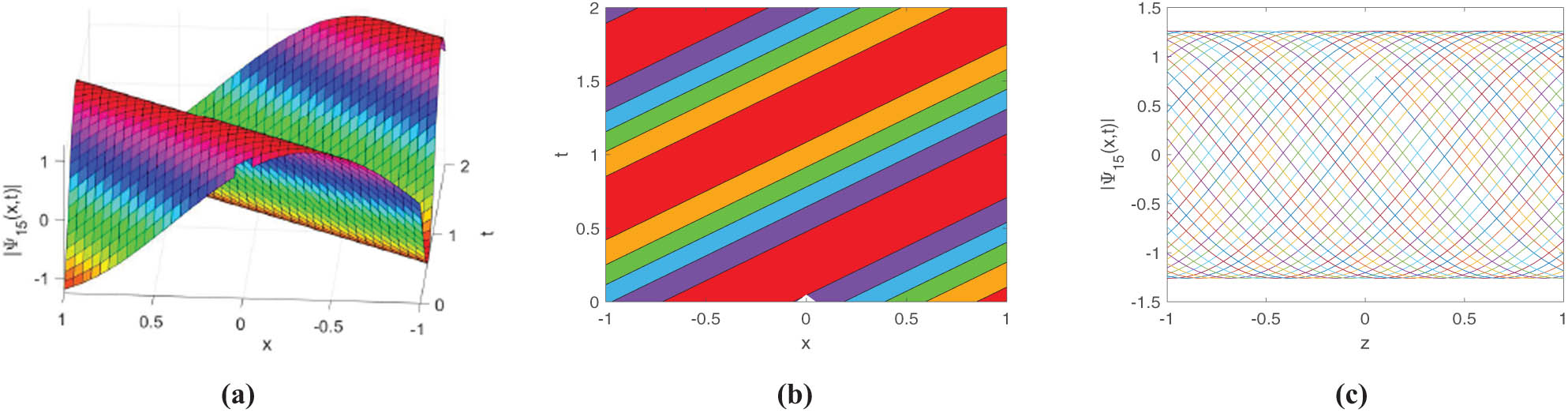
Figure 23 
                  Select 


                              μ
                              =
                              0.0048
                           
                           \mu =0.0048
                        
                     , 


                              λ
                              =
                              15.02
                           
                           \lambda =15.02
                        
                     , 


                              γ
                              =
                              11.60
                           
                           \gamma =11.60
                        
                     , 


                              k
                              =
                              2.0055
                           
                           k=2.0055
                        
                     , 


                              w
                              =
                              3.02
                           
                           w=3.02
                        
                     , 


                              θ
                              =
                              0.0012
                           
                           \theta =0.0012
                        
                     , 


                              c
                              =
                              0.0015
                           
                           c=0.0015
                        
                     , 


                                    f
                                 
                                 
                                    1
                                 
                              
                              =
                              2.002
                           
                           {f}_{1}=2.002
                        
                      for (a) 3D surface plot, (b) contour plot, and (c) line plot for the solution of Eq. (3.40).
Figure 23

Select μ = 0.0048 , λ = 15.02 , γ = 11.60 , k = 2.0055 , w = 3.02 , θ = 0.0012 , c = 0.0015 , f 1 = 2.002 for (a) 3D surface plot, (b) contour plot, and (c) line plot for the solution of Eq. (3.40).

5.2 Physical interpretation of bifurcation analysis results

Figure 24(a), the bifurcation diagram, plots the equilibrium values of U against the parameter κ 2 . For κ 2 < 0 , there is only one equilibrium point, U = 0 . At the bifurcation point κ 2 = 0 , the trivial solution U = 0 becomes unstable, and two new stable equilibrium points emerge at U = ± κ 2 λ . This is a visual representation of a pitchfork bifurcation. The set of plots 24(b) shows the system’s dynamics in the ( U , U ) phase plane. The plot for prebifurcation ( κ 2 = 5 ) shows that all trajectories converge to a single, stable fixed point at the origin (0, 0). The plot for post-bifurcation ( κ 2 = 5 ) shows that the fixed point at the origin has become unstable, and two new stable fixed points have appeared at ( ± 5 , 0). Trajectories now converge to these new, nonzero equilibrium points, demonstrating the qualitative change in the system’s long-term behavior. Figure 25(a), also known as a bifurcation manifold, extends the standard bifurcation diagram into a higher-dimensional parameter space. The blue plane represents the trivial fixed point at U = 0 , which exists for all parameter values. The two red surfaces represent the nontrivial fixed points at U = ± κ 2 λ . These surfaces only exist for positive values of κ 2 , which is where they emerge from the trivial fixed point. The point where the blue plane and the red surfaces meet (along the κ 2 = 0 line) is the location of the pitchfork bifurcation. This plot demonstrates how this bifurcation persists across a range of values for other parameters like λ . Figure 25(b) shows how the states U and V are dynamically linked. The green dots represent the stable fixed points where the system eventually settles. These are the nontrivial solutions found in the analysis. The red dot at the origin represents an unstable saddle point. Trajectories near this point are repelled. The blue lines are the trajectories, showing how the system’s state ( U , V ) evolves over time from different initial conditions. We can see how most trajectories converge toward the stable fixed points, demonstrating the system’s long-term behavior.
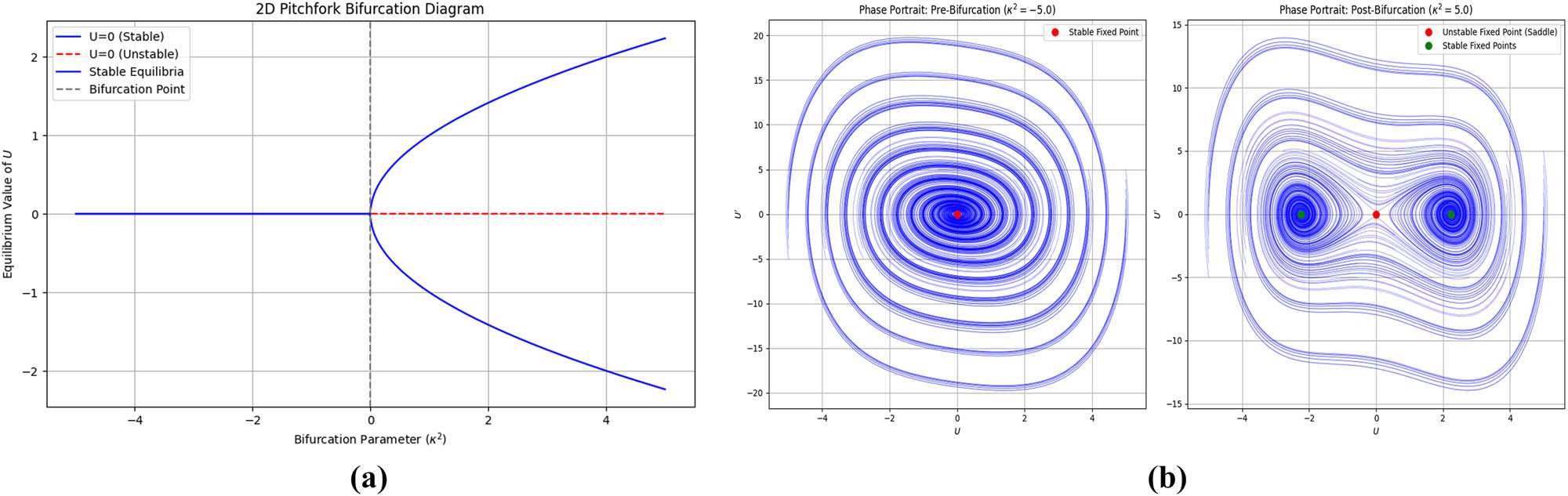
Figure 24 
                  (a) A bifurcation diagram showing the equilibrium points of U as a function of the parameter ratio 
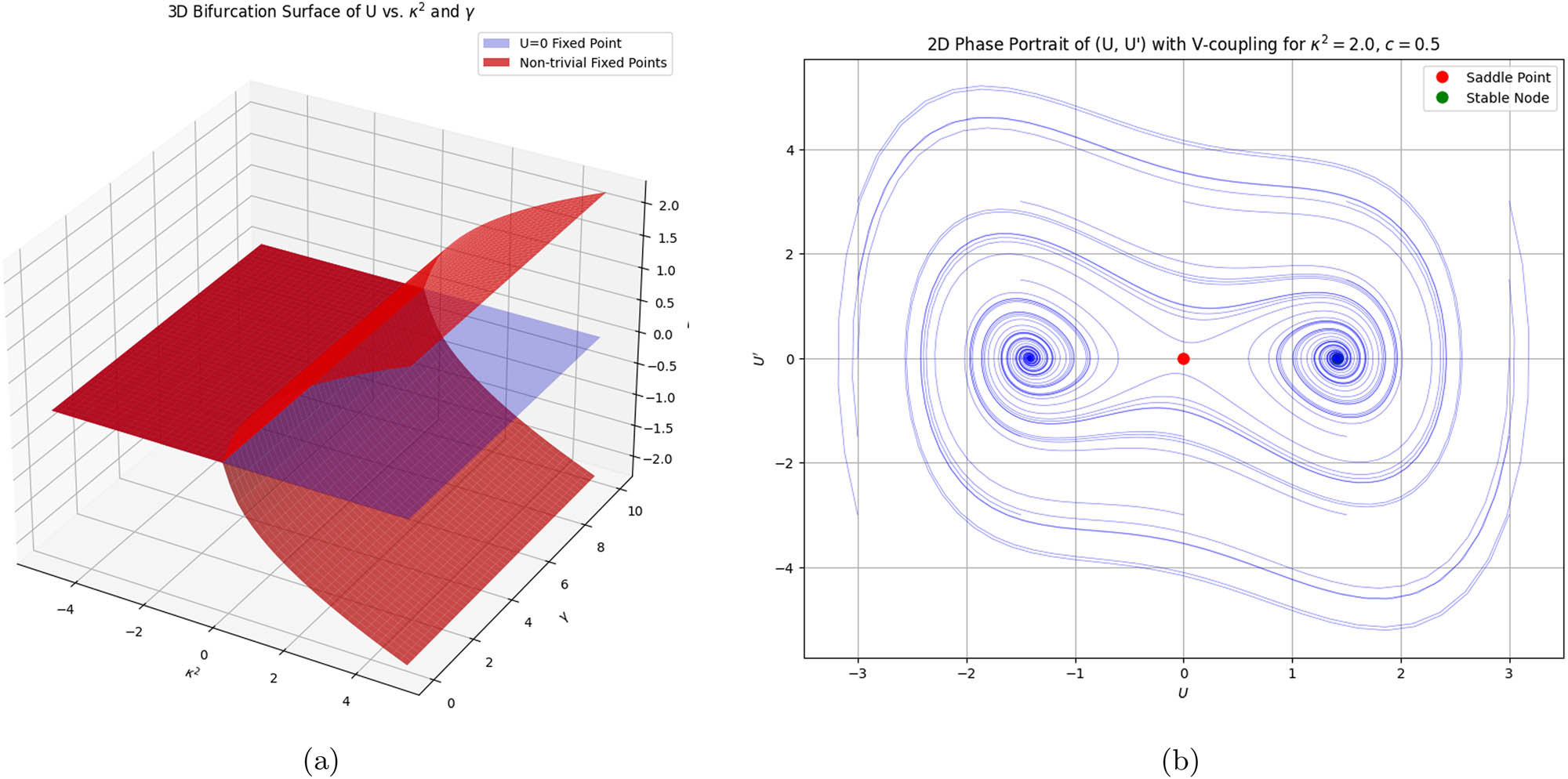


                                    κ
                                 
                                 
                                    2
                                 
                              
                              ∕
                              λ
                           
                           {\kappa }^{2}/\lambda 
                        
                     . (b) This clearly illustrates the pitchfork bifurcation where the number of equilibrium points changes.
Figure 24

(a) A bifurcation diagram showing the equilibrium points of U as a function of the parameter ratio κ 2 λ . (b) This clearly illustrates the pitchfork bifurcation where the number of equilibrium points changes.

Figure 25 
                  (a) A bifurcation diagram showing the equilibrium points of U as a function of the parameter ratio 


                                    κ
                                 
                                 
                                    2
                                 
                              
                              ∕
                              λ
                           
                           {\kappa }^{2}/\lambda 
                        
                     . (b) This clearly illustrates the pitchfork bifurcation where the number of equilibrium points changes.
Figure 25

(a) A bifurcation diagram showing the equilibrium points of U as a function of the parameter ratio κ 2 λ . (b) This clearly illustrates the pitchfork bifurcation where the number of equilibrium points changes.

6 Conclusion

This article demonstrated the successful application of the enhanced modified extended tanh-expansion method to construct optical soliton solutions of nonlinear Schrödinger–Bopp–Podolsky system. The nonlinear Schrödinger equation provides solid modeling capability for standard nonlinear media optical solitons yet struggles to handle complex optical systems adequately. The Bopp–Podolsky framework delivers advanced capabilities to study optical soliton stability alongside energy transport because it includes higher-order terms. The analytical findings prove that optical solitons keep their energy contained successfully, which establishes their critical role in optical communications technology. It has also been shown that the enhanced modified extended tanh-expansion method is adaptable and effective in handling nonlinear partial differential equations based on the solutions, which comprise optical solitons, periodic waves solutions, bright solutions, dark solutions, and singular solutions. The enhanced modified extended tanh-expansion method is compared to other methods such as ( G G ) expansion method, exp-function method, and homogeneous balance method, and is shown to have a more systematic and generalized manner than the others, in which wider class of solutions with higher accuracy can be constructed. The motivation for proposing the method was to effectively handle nonlinear influences, especially nonlinearities, and dispersions in the nonlinear Schrödinger–Bopp–Podolsky system and to derive exact optical soliton solutions. Numerical simulations confirm that the enhanced modified extended tanh-expansion method accurately captures the effects of wave dynamics, demonstrating the reliability of our system. These solutions suggest that the enhanced modified extended tanh-expansion method is helpful for researchers handling difficult fully nonlinear partial differential in nonlinear science and that it provides significantly more precise and effective computation compared to existing methods for these kinds of problems. For future work, we would like to expand this approach to other stochastic nonlinear partial differential equations of current importance in research. This unexplored area offers a promising avenue for future research, potentially leading to significant contributions to the field of nonlinear wave equations. Our objective is to expand enhanced modified extended tanh-expansion method for usage with advanced research problems to enhance our comprehension of nonlinear systems as well as their practical utility in optics and plasma physics and condensed matter fields. The future scope of this study includes extending the enhanced modified extended tanh-expansion method to higher-dimensional or fractional stochastic systems, investigating the influence of Lévy and other non-Gaussian noise types, and validating the model through experimental data or real-time optical fiber observations to strengthen its practical relevance and applicability. The application of bifurcation analysis provides fundamental information about optical soliton dynamics because it reveals limits of stability alongside transmission behavior patterns. Researchers should explore experimental confirmation of optical soliton models while using delay differential equations for bifurcation analysis to improve the stability of solitonic framework development. The developed outcomes help advance photonic systems, which in turn enables better performance in optical communication technologies and energy transport mechanisms.

Acknowledgments

This research was financially supported by Firat University.

  1. Funding information: The authors state no funding involved.

  2. Author contributions: All authors have accepted responsibility for the entire content of this manuscript and approved its submission.

  3. Conflict of interest: The authors state no conflict of interest.

  4. Data availability statement: All data generated or analysed during this study are included in this published article.

References

[1] d’Avenia P, Siciliano G. Nonlinear Schrödinger equation in the Bopp-Podolsky electrodynamics: Solutions in the electrostatic case. J Differ Equ. 2019;267(2):1025–65. 10.1016/j.jde.2019.02.001Search in Google Scholar

[2] Li L, Pucci P, Tang X. Ground state solutions for the nonlinear Schrödinger–Bopp-Podolsky system with critical Sobolev exponent. Adv Nonlinear Stud. 2020;20(3):511–38. 10.1515/ans-2020-2097Search in Google Scholar

[3] Yang H, Yuan Y, Liu J. On Nonlinear Schrödinger–Bopp-Podolsky system with asymptotically periodic potentials. J Funct Spaces. 2022;2022:9287998. 10.1155/2022/9287998Search in Google Scholar

[4] Li Y, Ye H. Normalized solutions for Sobolev critical Schrödinger–Bopp-Podolsky systems. J Math Anal Appl. 2023;529(1):127569. 10.58997/ejde.2023.56Search in Google Scholar

[5] Jiang Q, Li L, Chen S, Siciliano G. Ground state solutions for the nonlinear Schrödinger–Bopp-Podolsky system with nonperiodic potentials. Electron J Differ Equ. 2024;2024:43–25. 10.58997/ejde.2024.43Search in Google Scholar

[6] Bahrouni A, Missaoui H. On the Schrödinger–Bopp-Podolsky system: Ground state & least energy nodal solutions with nonsmooth nonlinearity. 2022. arXiv: http://arXiv.org/abs/arXiv:2212.11389. Search in Google Scholar

[7] Hu Y, Wu X, Tang C. Existence of least-energy sign-changing solutions for the Schrödinger–Bopp-Podolsky system with critical growth. Bull Malays Math Sci Soc. 2023;46(1):45. 10.1007/s40840-022-01441-7Search in Google Scholar

[8] de Paula Ramos G. Cluster semiclassical states of the nonlinear Schrödinger–Bopp-Podolsky system. J Fixed Point Theory Appl. 2025;27(2):49. 10.1007/s11784-025-01198-zSearch in Google Scholar

[9] Liu J, Duan Y, Liao JF, Pan HL. Positive solutions for a non-autonomous Schrödinger–Bopp-Podolsky system. J Math Phys. 2023;64(10):101507. 10.1063/5.0159190Search in Google Scholar

[10] d’Avenia P, Siciliano G. Nonlinear Schrödinger equation in the Bopp-Podolsky electrodynamics: Global boundedness, blow-up and no scattering in the energy space. J Differ Equ. 2023;350:194–228. Search in Google Scholar

[11] Caponio E, d’Avenia P, Pomponio A, Siciliano G, Yang L. On a nonlinear Schrödinger–Bopp-Podolsky system in the zero mass case: functional framework and existence. 2025. arXiv: http://arXiv.org/abs/arXiv:2506.09752. Search in Google Scholar

[12] Santos Damian HM, Siciliano G. Schrödinger–Bopp-Podolsky system with sublinear and critical nonlinearities: solutions at negative energy levels and asymptotic behaviour. 2025. arXiv: http://arXiv.org/abs/arXiv:2507.19444. Search in Google Scholar

[13] Oliveira IG, Sales JH, Thibes R. Bopp-Podolsky scalar electrodynamics propagators and energy-momentum tensor in covariant and light-front coordinates. Eur Phys J Plus. 2020;135(9):1–13. Search in Google Scholar

[14] Oliveira IG, Sales JH, Thibes R. Bopp-Podolsky scalar electrodynamics propagators and energy-momentum tensor in covariant and light-front coordinates. 2020. arXiv e-prints, arXiv-2008. 10.1140/epjp/s13360-020-00733-wSearch in Google Scholar

[15] Gratus J, Perlick V, Tucker RW. On the self-force in Bopp-Podolsky electrodynamics. J Phys A Math Theor. 2015;48(43):435401. 10.1088/1751-8113/48/43/435401Search in Google Scholar

[16] Lazar M. Green functions and propagation in the Bopp-Podolsky electrodynamics. Wave Motion. 2019;91:102388. 10.1016/j.wavemoti.2019.102388Search in Google Scholar

[17] Siciliano G, Silva K. The fibering method approach for a non-linear Schrödinger equation coupled with the electromagnetic field. Bull Malays Math Sci Soc. 2023;46(1):45.Search in Google Scholar

[18] Chen S, Li L, Radulescu VD, Tang X. Ground state solutions of the non-autonomous Schrödinger Bopp Podolsky system. Anal Math Phys. 2022;12:1–32. 10.1007/s13324-021-00627-9Search in Google Scholar

[19] d’Avenia P, Ghimenti MG. Multiple solutions and profile description for a nonlinear Schrödinger Bopp Podolsky Proca system on a manifold. Calc Var Partial Differ Equ. 2022;61(6):223. 10.1007/s00526-022-02341-1Search in Google Scholar

[20] Afonso DG, Siciliano G. Normalized solutions to a Schrödinger Bopp Podolsky system under Neumann boundary conditions. Commun Contemp Math. 2021;15:2150100. 10.1142/S0219199721501005Search in Google Scholar

[21] Zheng P. Existence and finite time blow-up for nonlinear Schrödinger equations in the Bopp-Podolsky electrodynamics. J Math Anal Appl. 2022;514(2):126346. 10.1016/j.jmaa.2022.126346Search in Google Scholar

[22] Evans DJ, Raslan KR. The tanh function method for solving some important non-linear partial differential equations. Int J Comput Math. 2005;82(7):897–905. 10.1080/00207160412331336026Search in Google Scholar

[23] Heee JH, Wu XH. Exp-function method for nonlinear wave equations. Chaos Solitons Fractals. 2006;30(3):700–8. 10.1016/j.chaos.2006.03.020Search in Google Scholar

[24] Iqbal M, Seadawy AR, Lu D, Zhang Z. Structure of analytical and symbolic computational approach of multiple solitary wave solutions for nonlinear Zakharov-Kuznetsov modified equal width equation. Numer Methods Partial Differ Equ. 2023;39(5):3987–4006. 10.1002/num.23033Search in Google Scholar

[25] Iqbal M, Seadawy AR, Lu D, Zhang Z. Computational approach and dynamical analysis of multiple solitary wave solutions for nonlinear coupled Drinfeld-Sokolov-Wilson equation. Results Phys. 2023;54:107099. 10.1016/j.rinp.2023.107099Search in Google Scholar

[26] Iqbal M, Seadawy AR, Lu D, Zhang Z. Physical structure and multiple solitary wave solutions for the nonlinear Jaulent-Miodek hierarchy equation. Mod Phys Lett B. 2024;38(16):2341016. 10.1142/S0217984923410166Search in Google Scholar

[27] Iqbal M, Lu D, Seadawy AR, Alsubaie NE, Umurzakhova Z, Myrzakulov R. Dynamical analysis of exact optical soliton structures of the complex nonlinear Kuralay-II equation through computational simulation. Mod Phys Lett B. 2024;38(36):2450367. 10.1142/S0217984924503676Search in Google Scholar

[28] Iqbal M, Lu D, Seadawy AR, Zhang Z. Nonlinear behavior of dust acoustic periodic soliton structures of nonlinear damped modified Korteweg-de Vries equation in dusty plasma. Results Phys. 2024;59:107533. 10.1016/j.rinp.2024.107533Search in Google Scholar

[29] Iqbal M, Seadawy AR, Lu D, Zhang Z. Weakly restoring forces and shallow water waves with dynamical analysis of periodic singular solitons structures to the nonlinear Kadomtsev-Petviashvili-modified equal width equation. Mod Phys Lett B. 2024;38(27):2450265. 10.1142/S0217984924502658Search in Google Scholar

[30] Iqbal M, Lu D, Faridi WA, Murad MAS, Seadawy AR. A novel investigation on propagation of envelop optical soliton structure through a dispersive medium in the nonlinear Whitham-Broer-Kaup dynamical equation. Int J Theor Phys. 2024;63(5):131. 10.1007/s10773-024-05663-2Search in Google Scholar

[31] Iqbal M, Faridi WA, Ali R, Seadawy AR, Rajhi AA, Anqi AE, et al. Dynamical study of optical soliton structure to the nonlinear Landau-Ginzburg-Higgs equation through computational simulation. Opt Quantum Electron. 2024;56(7):1192. 10.1007/s11082-024-06401-ySearch in Google Scholar

[32] Manzoor Z, Iqbal MS, Hussain S, Ashraf F, Inc M, Akhtar Tarar M, et al. A study of propagation of the ultra-short femtosecond pulses in an optical fiber by using the extended generalized Riccati equation mapping method. Opt Quant Electron. 2023;55:717. 10.1007/s11082-023-04934-2Search in Google Scholar

[33] Chou D, Rehman HU, Haider R, Muhammad T, Li TL. Analyzing optical soliton propagation in perturbed nonlinear Schrödinger equation: a multi-technique study. Optik. 2024;302:171714. 10.1016/j.ijleo.2024.171714Search in Google Scholar

[34] Chou D, Boulaaras SM, Rehman HU, Iqbal I, Akram A, Ullah N. Additional investigation of the Biswas-Arshed equation to reveal optical soliton dynamics in birefringent fiber. Opt Quantum Electron. 2024;56(4):705. 10.1007/s11082-024-06366-ySearch in Google Scholar

[35] Chou D, UrRehman H, Amer A, Amer A. New solitary wave solutions of generalized fractional Tzitzéica-type evolution equations using Sardar sub-equation method. Opt Quantum Electron. 2023;55(13):1148. 10.1007/s11082-023-05425-0Search in Google Scholar

[36] Chou D, Boulaaras SM, Rehman HU, Iqbal I. Probing wave dynamics in the modified fractional nonlinear Schrödinger equation: implications for ocean engineering. Opt Quantum Electron. 2024;56(2):228. 10.1007/s11082-023-05954-8Search in Google Scholar

[37] Fahad A, Boulaaras SM, Rehman HU, Iqbal I, Saleem MS, Chou D. Analysing soliton dynamics and a comparative study of fractional derivatives in the nonlinear fractional Kudryashovas equation. Results Phys. 2023;55:107114. 10.1016/j.rinp.2023.107114Search in Google Scholar

[38] Esen H, Ozisik M, Secer A, Bayram M. Optical soliton perturbation with Fokas Lenells equation via enhanced modified extended tanh-expansion approach. Optik. 2022;267:169615. 10.1016/j.ijleo.2022.169615Search in Google Scholar

[39] Ashraf R, Ashraf F, Akguel A, Ashraf S, Alshahrani B, Mahmoud M, et al. Some new soliton solutions to the (3+1)-dimensional generalized KdV-ZK equation via enhanced modified extended tanh-expansion approach. Alexandria Eng J. 2023;69:303–9. 10.1016/j.aej.2023.01.007Search in Google Scholar

[40] Alam LMB, Jiang X. Exact and explicit traveling wave solution to the time-fractional phi-four and (2+1) dimensional CBS equations using the modified extended tanh-function method in mathematical physics. Partial Differ Equ Appl Math. 2021;4:100039. 10.1016/j.padiff.2021.100039Search in Google Scholar

[41] Ananna SN, Gharami PP, An T, Asaduzzaman M. The improved modified extended tanh-function method to develop the exact travelling wave solutions of a family of 3D fractional WBBM equations. Results Phys. 2022;41:105969. 10.1016/j.rinp.2022.105969Search in Google Scholar

[42] Ozdemir N, Secer A, Ozisik M, Bayram M. Perturbation of dispersive optical solitons with Schrödinger-Hirota equation with Kerr law and spatio-temporal dispersion. Optik. 2022;265:169545. 10.1016/j.ijleo.2022.169545Search in Google Scholar

[43] Samir I, Badra N, Ahmed HM, Arnous AH. Optical soliton perturbation with Kudryashovas generalized law of refractive index and generalized nonlocal laws by improved modified extended tanh method. Alexandria Eng J. 2022;61(5):3365–74. 10.1016/j.aej.2021.08.050Search in Google Scholar

[44] Refaie Ali A, Alam MN, Parven MW. Unveiling optical soliton solutions and bifurcation analysis in the space-time fractional Fokas-Lenells equation via SSE approach. Sci Rep. 2024;14(1):2000. 10.1038/s41598-024-52308-9Search in Google Scholar PubMed PubMed Central

[45] Alam MN, Iqbal M, Hassan M, Fayz-Al-Asad M, Hossain MS, Tunç C. Bifurcation, phase plane analysis and exact soliton solutions in the nonlinear Schrodinger equation with Atanganaas conformable derivative. Chaos Solitons Fractals. 2024;182:114724. 10.1016/j.chaos.2024.114724Search in Google Scholar

[46] Iqbal I, Boulaaras SM, Althobaiti S, Althobaiti A, Rehman HU. Exploring soliton dynamics in the nonlinear Helmholtz equation: bifurcation, chaotic behavior, multistability, and sensitivity analysis. Nonlinear Dyn. 2025;113(13):16933–54. 10.1007/s11071-025-10961-3Search in Google Scholar

Received: 2025-05-24
Revised: 2025-08-17
Accepted: 2025-09-10
Published Online: 2025-11-04

© 2025 the author(s), published by De Gruyter

This work is licensed under the Creative Commons Attribution 4.0 International License.

Articles in the same Issue

  1. Research Articles
  2. Generalized (ψ,φ)-contraction to investigate Volterra integral inclusions and fractal fractional PDEs in super-metric space with numerical experiments
  3. Solitons in ultrasound imaging: Exploring applications and enhancements via the Westervelt equation
  4. Stochastic improved Simpson for solving nonlinear fractional-order systems using product integration rules
  5. Exploring dynamical features like bifurcation assessment, sensitivity visualization, and solitary wave solutions of the integrable Akbota equation
  6. Research on surface defect detection method and optimization of paper-plastic composite bag based on improved combined segmentation algorithm
  7. Impact the sulphur content in Iraqi crude oil on the mechanical properties and corrosion behaviour of carbon steel in various types of API 5L pipelines and ASTM 106 grade B
  8. Unravelling quiescent optical solitons: An exploration of the complex Ginzburg–Landau equation with nonlinear chromatic dispersion and self-phase modulation
  9. Perturbation-iteration approach for fractional-order logistic differential equations
  10. Variational formulations for the Euler and Navier–Stokes systems in fluid mechanics and related models
  11. Rotor response to unbalanced load and system performance considering variable bearing profile
  12. DeepFowl: Disease prediction from chicken excreta images using deep learning
  13. Channel flow of Ellis fluid due to cilia motion
  14. A case study of fractional-order varicella virus model to nonlinear dynamics strategy for control and prevalence
  15. Multi-point estimation weldment recognition and estimation of pose with data-driven robotics design
  16. Analysis of Hall current and nonuniform heating effects on magneto-convection between vertically aligned plates under the influence of electric and magnetic fields
  17. A comparative study on residual power series method and differential transform method through the time-fractional telegraph equation
  18. Insights from the nonlinear Schrödinger–Hirota equation with chromatic dispersion: Dynamics in fiber–optic communication
  19. Mathematical analysis of Jeffrey ferrofluid on stretching surface with the Darcy–Forchheimer model
  20. Exploring the interaction between lump, stripe and double-stripe, and periodic wave solutions of the Konopelchenko–Dubrovsky–Kaup–Kupershmidt system
  21. Computational investigation of tuberculosis and HIV/AIDS co-infection in fuzzy environment
  22. Signature verification by geometry and image processing
  23. Theoretical and numerical approach for quantifying sensitivity to system parameters of nonlinear systems
  24. Chaotic behaviors, stability, and solitary wave propagations of M-fractional LWE equation in magneto-electro-elastic circular rod
  25. Dynamic analysis and optimization of syphilis spread: Simulations, integrating treatment and public health interventions
  26. Visco-thermoelastic rectangular plate under uniform loading: A study of deflection
  27. Threshold dynamics and optimal control of an epidemiological smoking model
  28. Numerical computational model for an unsteady hybrid nanofluid flow in a porous medium past an MHD rotating sheet
  29. Regression prediction model of fabric brightness based on light and shadow reconstruction of layered images
  30. Dynamics and prevention of gemini virus infection in red chili crops studied with generalized fractional operator: Analysis and modeling
  31. Qualitative analysis on existence and stability of nonlinear fractional dynamic equations on time scales
  32. Fractional-order super-twisting sliding mode active disturbance rejection control for electro-hydraulic position servo systems
  33. Analytical exploration and parametric insights into optical solitons in magneto-optic waveguides: Advances in nonlinear dynamics for applied sciences
  34. Bifurcation dynamics and optical soliton structures in the nonlinear Schrödinger–Bopp–Podolsky system
  35. User profiling in university libraries by combining multi-perspective clustering algorithm and reader behavior analysis
  36. Exploring bifurcation and chaos control in a discrete-time Lotka–Volterra model framework for COVID-19 modeling
  37. Review Article
  38. Haar wavelet collocation method for existence and numerical solutions of fourth-order integro-differential equations with bounded coefficients
  39. Special Issue: Nonlinear Analysis and Design of Communication Networks for IoT Applications - Part II
  40. Silicon-based all-optical wavelength converter for on-chip optical interconnection
  41. Research on a path-tracking control system of unmanned rollers based on an optimization algorithm and real-time feedback
  42. Analysis of the sports action recognition model based on the LSTM recurrent neural network
  43. Industrial robot trajectory error compensation based on enhanced transfer convolutional neural networks
  44. Research on IoT network performance prediction model of power grid warehouse based on nonlinear GA-BP neural network
  45. Interactive recommendation of social network communication between cities based on GNN and user preferences
  46. Application of improved P-BEM in time varying channel prediction in 5G high-speed mobile communication system
  47. Construction of a BIM smart building collaborative design model combining the Internet of Things
  48. Optimizing malicious website prediction: An advanced XGBoost-based machine learning model
  49. Economic operation analysis of the power grid combining communication network and distributed optimization algorithm
  50. Sports video temporal action detection technology based on an improved MSST algorithm
  51. Internet of things data security and privacy protection based on improved federated learning
  52. Enterprise power emission reduction technology based on the LSTM–SVM model
  53. Construction of multi-style face models based on artistic image generation algorithms
  54. Research and application of interactive digital twin monitoring system for photovoltaic power station based on global perception
  55. Special Issue: Decision and Control in Nonlinear Systems - Part II
  56. Animation video frame prediction based on ConvGRU fine-grained synthesis flow
  57. Application of GGNN inference propagation model for martial art intensity evaluation
  58. Benefit evaluation of building energy-saving renovation projects based on BWM weighting method
  59. Deep neural network application in real-time economic dispatch and frequency control of microgrids
  60. Real-time force/position control of soft growing robots: A data-driven model predictive approach
  61. Mechanical product design and manufacturing system based on CNN and server optimization algorithm
  62. Application of finite element analysis in the formal analysis of ancient architectural plaque section
  63. Research on territorial spatial planning based on data mining and geographic information visualization
  64. Fault diagnosis of agricultural sprinkler irrigation machinery equipment based on machine vision
  65. Closure technology of large span steel truss arch bridge with temporarily fixed edge supports
  66. Intelligent accounting question-answering robot based on a large language model and knowledge graph
  67. Analysis of manufacturing and retailer blockchain decision based on resource recyclability
  68. Flexible manufacturing workshop mechanical processing and product scheduling algorithm based on MES
  69. Exploration of indoor environment perception and design model based on virtual reality technology
  70. Tennis automatic ball-picking robot based on image object detection and positioning technology
  71. A new CNN deep learning model for computer-intelligent color matching
  72. Design of AR-based general computer technology experiment demonstration platform
  73. Indoor environment monitoring method based on the fusion of audio recognition and video patrol features
  74. Health condition prediction method of the computer numerical control machine tool parts by ensembling digital twins and improved LSTM networks
  75. Establishment of a green degree evaluation model for wall materials based on lifecycle
  76. Quantitative evaluation of college music teaching pronunciation based on nonlinear feature extraction
  77. Multi-index nonlinear robust virtual synchronous generator control method for microgrid inverters
  78. Manufacturing engineering production line scheduling management technology integrating availability constraints and heuristic rules
  79. Analysis of digital intelligent financial audit system based on improved BiLSTM neural network
  80. Attention community discovery model applied to complex network information analysis
  81. A neural collaborative filtering recommendation algorithm based on attention mechanism and contrastive learning
  82. Rehabilitation training method for motor dysfunction based on video stream matching
  83. Research on façade design for cold-region buildings based on artificial neural networks and parametric modeling techniques
  84. Intelligent implementation of muscle strain identification algorithm in Mi health exercise induced waist muscle strain
  85. Optimization design of urban rainwater and flood drainage system based on SWMM
  86. Improved GA for construction progress and cost management in construction projects
  87. Evaluation and prediction of SVM parameters in engineering cost based on random forest hybrid optimization
  88. Museum intelligent warning system based on wireless data module
  89. Optimization design and research of mechatronics based on torque motor control algorithm
  90. Special Issue: Nonlinear Engineering’s significance in Materials Science
  91. Experimental research on the degradation of chemical industrial wastewater by combined hydrodynamic cavitation based on nonlinear dynamic model
  92. Study on low-cycle fatigue life of nickel-based superalloy GH4586 at various temperatures
  93. Some results of solutions to neutral stochastic functional operator-differential equations
  94. Ultrasonic cavitation did not occur in high-pressure CO2 liquid
  95. Research on the performance of a novel type of cemented filler material for coal mine opening and filling
  96. Testing of recycled fine aggregate concrete’s mechanical properties using recycled fine aggregate concrete and research on technology for highway construction
  97. A modified fuzzy TOPSIS approach for the condition assessment of existing bridges
  98. Nonlinear structural and vibration analysis of straddle monorail pantograph under random excitations
  99. Achieving high efficiency and stability in blue OLEDs: Role of wide-gap hosts and emitter interactions
  100. Construction of teaching quality evaluation model of online dance teaching course based on improved PSO-BPNN
  101. Enhanced electrical conductivity and electromagnetic shielding properties of multi-component polymer/graphite nanocomposites prepared by solid-state shear milling
  102. Optimization of thermal characteristics of buried composite phase-change energy storage walls based on nonlinear engineering methods
  103. A higher-performance big data-based movie recommendation system
  104. Nonlinear impact of minimum wage on labor employment in China
  105. Nonlinear comprehensive evaluation method based on information entropy and discrimination optimization
  106. Application of numerical calculation methods in stability analysis of pile foundation under complex foundation conditions
  107. Research on the contribution of shale gas development and utilization in Sichuan Province to carbon peak based on the PSA process
  108. Characteristics of tight oil reservoirs and their impact on seepage flow from a nonlinear engineering perspective
  109. Nonlinear deformation decomposition and mode identification of plane structures via orthogonal theory
  110. Numerical simulation of damage mechanism in rock with cracks impacted by self-excited pulsed jet based on SPH-FEM coupling method: The perspective of nonlinear engineering and materials science
  111. Cross-scale modeling and collaborative optimization of ethanol-catalyzed coupling to produce C4 olefins: Nonlinear modeling and collaborative optimization strategies
  112. Unequal width T-node stress concentration factor analysis of stiffened rectangular steel pipe concrete
  113. Special Issue: Advances in Nonlinear Dynamics and Control
  114. Development of a cognitive blood glucose–insulin control strategy design for a nonlinear diabetic patient model
  115. Big data-based optimized model of building design in the context of rural revitalization
  116. Multi-UAV assisted air-to-ground data collection for ground sensors with unknown positions
  117. Design of urban and rural elderly care public areas integrating person-environment fit theory
  118. Application of lossless signal transmission technology in piano timbre recognition
  119. Application of improved GA in optimizing rural tourism routes
  120. Architectural animation generation system based on AL-GAN algorithm
  121. Advanced sentiment analysis in online shopping: Implementing LSTM models analyzing E-commerce user sentiments
  122. Intelligent recommendation algorithm for piano tracks based on the CNN model
  123. Visualization of large-scale user association feature data based on a nonlinear dimensionality reduction method
  124. Low-carbon economic optimization of microgrid clusters based on an energy interaction operation strategy
  125. Optimization effect of video data extraction and search based on Faster-RCNN hybrid model on intelligent information systems
  126. Construction of image segmentation system combining TC and swarm intelligence algorithm
  127. Particle swarm optimization and fuzzy C-means clustering algorithm for the adhesive layer defect detection
  128. Optimization of student learning status by instructional intervention decision-making techniques incorporating reinforcement learning
  129. Fuzzy model-based stabilization control and state estimation of nonlinear systems
  130. Optimization of distribution network scheduling based on BA and photovoltaic uncertainty
  131. Tai Chi movement segmentation and recognition on the grounds of multi-sensor data fusion and the DBSCAN algorithm
  132. Special Issue: Dynamic Engineering and Control Methods for the Nonlinear Systems - Part III
  133. Generalized numerical RKM method for solving sixth-order fractional partial differential equations
Downloaded on 30.12.2025 from https://www.degruyterbrill.com/document/doi/10.1515/nleng-2025-0176/html
Scroll to top button