Analysis of Hall current and nonuniform heating effects on magneto-convection between vertically aligned plates under the influence of electric and magnetic fields
-


Abstract
In this study, we discussed the effect of Hall current and electric field on heat transfer and fluid flow between non-uniformly heated parallel vertical plates when fluid is presumed in transverse magnetic and electric fields. A numerical solution of dimensionless partial differential equations governing the flow is derived via the implicit Crank–Nicolson technique. The numerically calculated solutions are presented graphically and these graphical results examine the primary velocity, secondary velocity, and the temperature profiles for various physical parameters. The average values of skin friction and the Nusselt number are provided in tabular form. A significant result of our findings is that the rising values of
1 Introduction
Natural convective flow resulting from the buoyancy forces between two parallel plates has received substantial attention from engineers and scientists due to the broad range of scope in scientific and technological processes. These studies are essential in thermal hydraulics nuclear reactor (Sudo et al. [1]), thermal support dynamics in services (Rodrigues et al. [2]), channel–chimney systems (Manca et al. [3]), cooling electronic components (Florio and Harnoy [4]), and frost formation (Fossa and Tanda [5]). These applications of free convective flow attract researchers to work in this area. The heat transfer and fluid flow between the two vertical parallel plates were analyzed by Kato et al. [6] and Campo et al. [7] in different physical conditions. Nelson and Wood [8] scrutinized the flow characteristics in natural convective laminar flow in the vertical parallel plates. Their numerical results were in good agreement with the experimental results of Aihara [9], who examined the convective heat transfer through vertical parallel plates. A laminar flow of Bingham fluid via vertical parallel plates had been analyzed by Bayazitoglu et al. [10]. Jha and Ajibade [11] discussed the effect of the time-periodic thermal boundaries on the viscous dissipative free convective flow in vertical parallel plates.
The aforementioned studies have been carried without the magnetic fields. But, we know that a magnetic field has an attribute to modify the energy and flow of the system. This trait of the magnetic field has many applications in technical and scientific fields such as liquid metal coating, electromagnetic casting, confinement of plasma and others (Ni [12] and Khan et al. [13]). Therefore, many researchers worked in this context and investigated magnetohydrodynamics (MHD) flow problems [14–21] in different geometries and physical circumstances. A study by Rehman et al. [22] examined the stability of MHD couple stress concerning the effects of shape factor and magnetic field. The study by Kumam et al. [23] explored the effects of the relative magnetic field and slip on the behavior of Casson dusty fluid in a two-phase fluctuating flow over inclined parallel plates. Magneto-convective flow is well known term it stands for magnetohydrodynamics convective flow [24].
Hall effect in magnetohydrodynamics is the development of a transverse electric field in an electrically conducting fluid when it carries an electric current and placed in a magnetic field that is perpendicular to the current. The magnetic field sensing equipment, proximity detectors, and Hall effect tong tester are such applications of the Hall effect that attracted the researchers. The Hall and radiation effects were studied by VeeraKrishna et al. [25] over an unsteady magneto-convective flow in a porous medium through two vertical plates. They obtained that the primary and secondary velocity profiles enhanced with the Hall parameter and reduced with the radiation parameter. Kumar et al. [26] found in their study of MHD flow with alternating conducting vertical walls that the Hall parameter enhanced the primary rate of mass flow while the secondary rate of mass flow decreases.
MHD flow in the existence of an electric field for the flow formation problem has been increasing the interest of the researchers. A qualitative analysis of electric field had a significant bearing in industrial and chemical process applications (Tsuda [27]), such as in tissue engineering (Markx [28]), biology and medicine (Hart and Palisano [29]). Sheikholeslami et al. [30] explored the implementation of an electric field to enhance the rate of heat transfer of heat of ferrofluid in an enclosure with double moving walls. The transmission of heat in Williamson fluid flow in the appearance of applied electric and magnetic fields past a heated surface with varying thickness had been studied by Aliy and Kishan [31].
Furthermore, the idea of nonuniform heating in flow field is an emerging notion, having opportunities in design engineering and nuclear equipments. Such applications of fluid flow past nonuniformly heated surfaces caught the attention of researchers toward this arising stream of fluid dynamics. Roy and Basak [32] keenly inspected the behavior of free convection flow over the nonuniform and uniform heating wall(s). They revealed that for nonuniform heating, the heat transfer rate represents sinusoidal variations with
The research mentioned above, and their applications give us an impetus to study the influence of the Hall effect and electric field on fluid flowing through the magnetic field between nonuniformly heated parallel plates, which is still to be investigated to the best of the knowledge of the author. The aim of this study is to bridge that gap by utilizing advanced numerical approaches to comprehensively examine the interplay between Hall currents, electric field, and nonuniform heating. In this study, we observe that advancing the Hartmann number diminishes the primary fluid velocity. This maintained fluid slowing allows precise regulation in devices such as MHD pumps, where managing flow rates is essential. It enhances the accuracy of applications such as optimized heat transfer through targeted delivery of nanoparticles in a cooling mechanism.
Additionally, raising the Hall parameter speeds up fluid flow, which can enhance the efficiency of turbine systems. This faster fluid flow in MHD generators interacts more effectively with magnetic fields, making energy transformation more efficient. Therefore, we have investigated the impact of the Hall parameter on magneto-convection flow via vertical parallel plates when subjected to electric and magnetic fields under the nonuniform heating at the boundary.
2 Mathematical formulation
This mathematical model described the magneto-convective flow of an electrically conducting fluid whose thermophysical characteristics are supposed to be constant. The fluid is confined between two vertical parallel plates. The Cartesian coordinates are taken into account with
The prescribed initial and boundary conditions for the designated flow model are as follows:
where
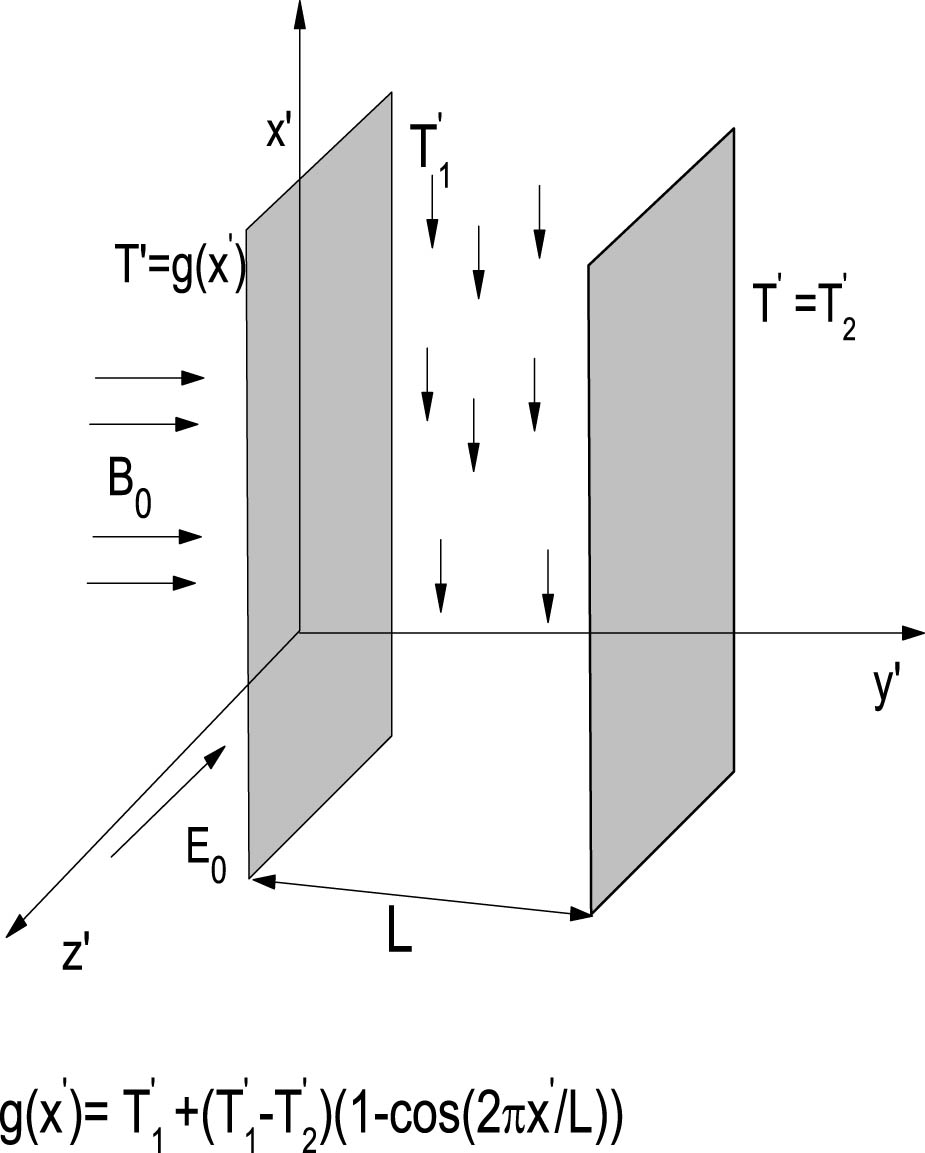
Geometry of this physical model.
The dimensionless physical parameters are proposed as follows:
By using these dimensionless parameters in Eqs (1)–(5), we obtain the following set of non-dimensional equations:
Also, the non-dimensional initial and boundary conditions are derived as
where
3 Numerical methods
The flow regime, ruled by the partial differential equations (PDEs) (6)–(10), has been solved using an implicit Crank–Nicolson scheme [38]. In this numerical technique, first, we have transformed the PDEs 6–10 into finite difference equations using the corresponding finite difference operators with grid discretization, and these equations are given as
where (
After obtaining finite difference equations, we have to convert them into algebraic equations. These algebraic equations are presented in the form of a tridiagonal system and solved by the Thomas algorithm. In this numerical procedure, we have chosen a step size of 0.025 for increments in the
For every increasing time step
In the unsteady state, the nature of flow regime has been determined at a certain time after performing definite iterations. The velocity and temperature profiles attain the steady state when the convergence criterion given below is satisfied:
where
The authenticity of our computation procedure has been checked under limiting conditions by ignoring the effect of Julian heat, viscous dissipation, and electric field at steady state with isothermal boundary condition for semi-infinite vertical plate. For this analysis, the parameter values are set as
Comparison of local Nusselt number at the steady-state values of over the fixed cross section
| Local Nusselt number | |||
|---|---|---|---|
| Pop and Watanabe [37] | Present paper | Error% | |
|
|
0.28825 | 0.2886 | 0.1214 |
|
|
0.29388 | 0.2944 | 0.1769 |
|
|
0.30705 | 0.3083 | 0.4070 |
|
|
0.33097 | 0.3334 | 0.3742 |
|
|
0.34274 | 0.3459 | 0.9220 |
|
|
0.34825 | 0.3517 | 0.9906 |
The obtained results for the temperature and velocity fields are used to calculate the local and average Nusselt numbers, as well as the skin friction, at plate 1. These values are determined using the following relationships:
4 Results and discussion
In this study, we have explored the free convection MHD flow of an electrically conducting fluid in the presence of external electric and magnetic fields between two vertical parallel plates under the nonuniform heating. We have numerically solved this flow model to determine the temperature, primary (
For the considered physical parameters, Figures 2 and 3 present the primary and secondary velocity profiles, respectively, at distinct cross-sections of
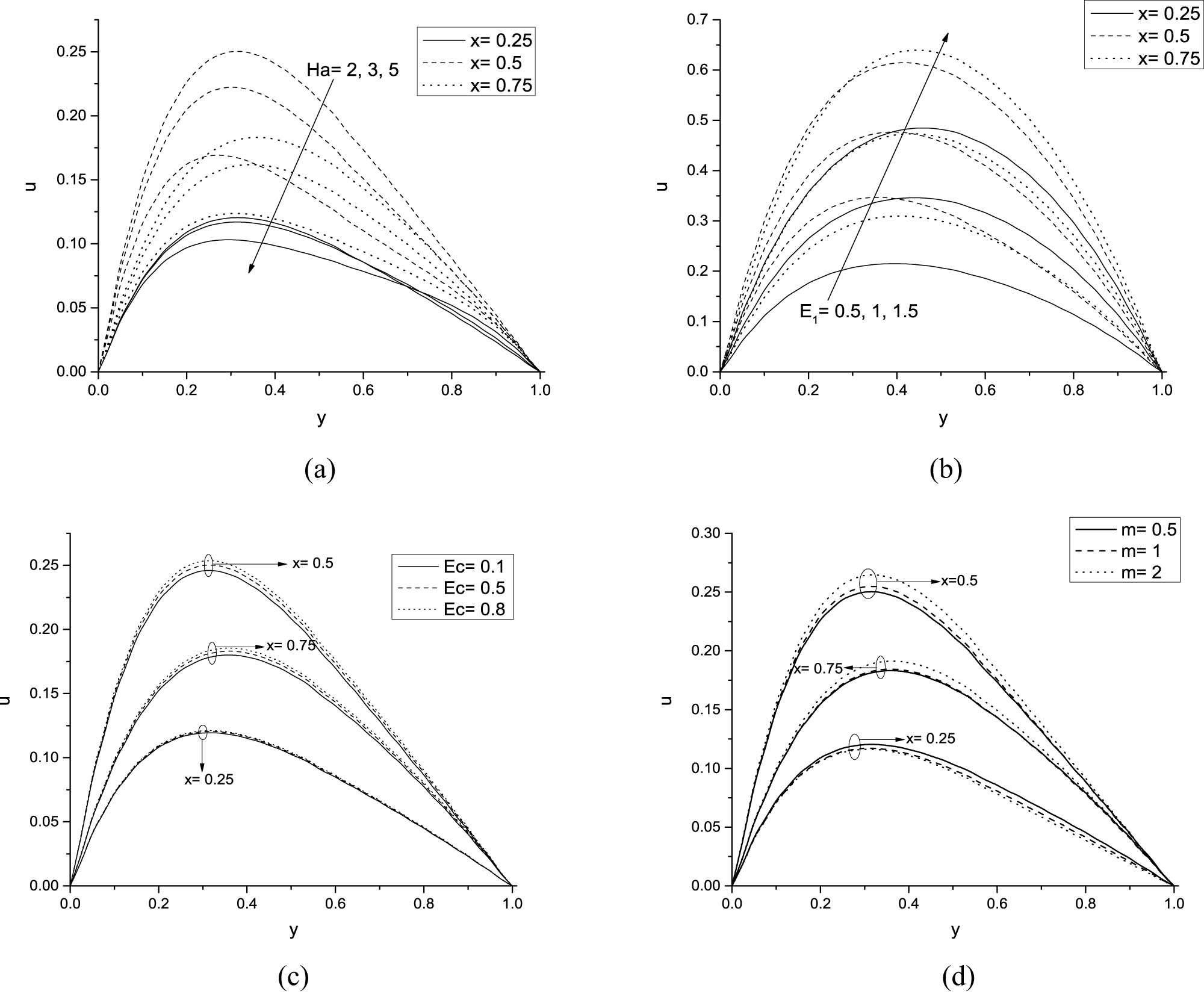
Velocity profile at
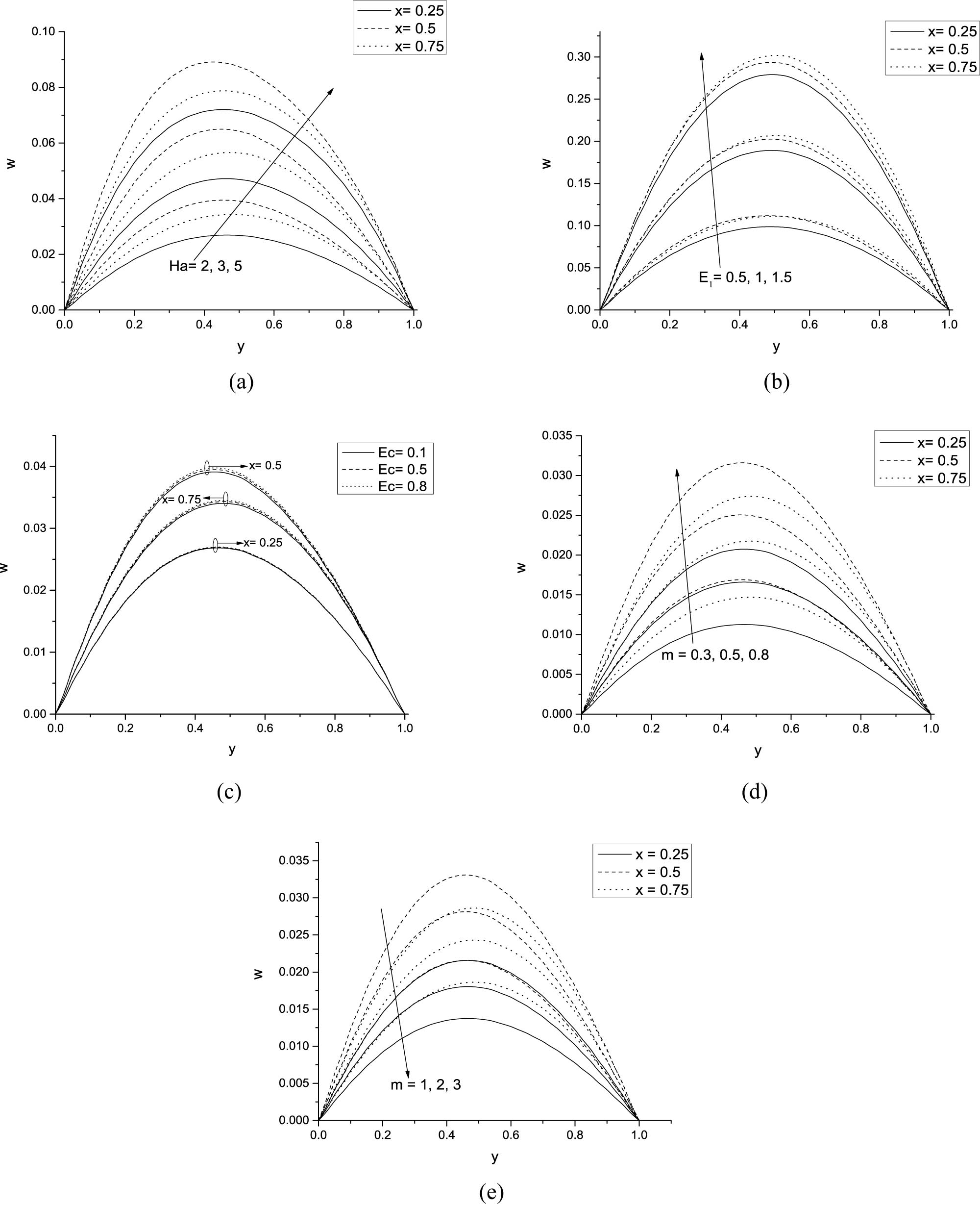
Temperature profile at
Figures 2(b) and 3(b) demonstrated the
The impacts of viscous dissipation on the
The temperature profile against
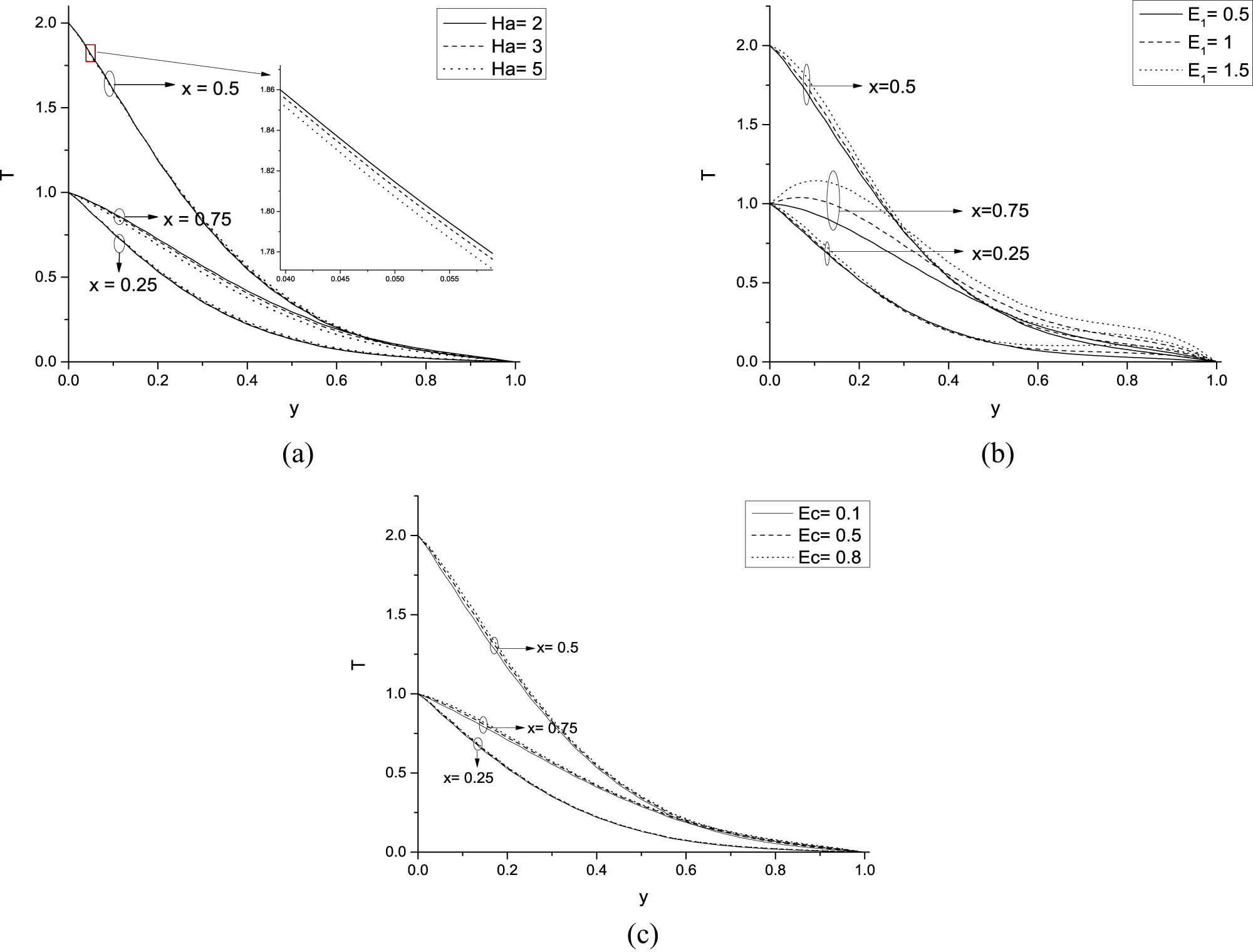
Temperature profile (
Figure 4(c) demonstrates that the Eckert number thoroughly enhances the temperature of fluid flow at every cross-section
Figure 5 shows how temperature, primary velocity, and secondary velocity profiles change over time, with a fixed cross-section at
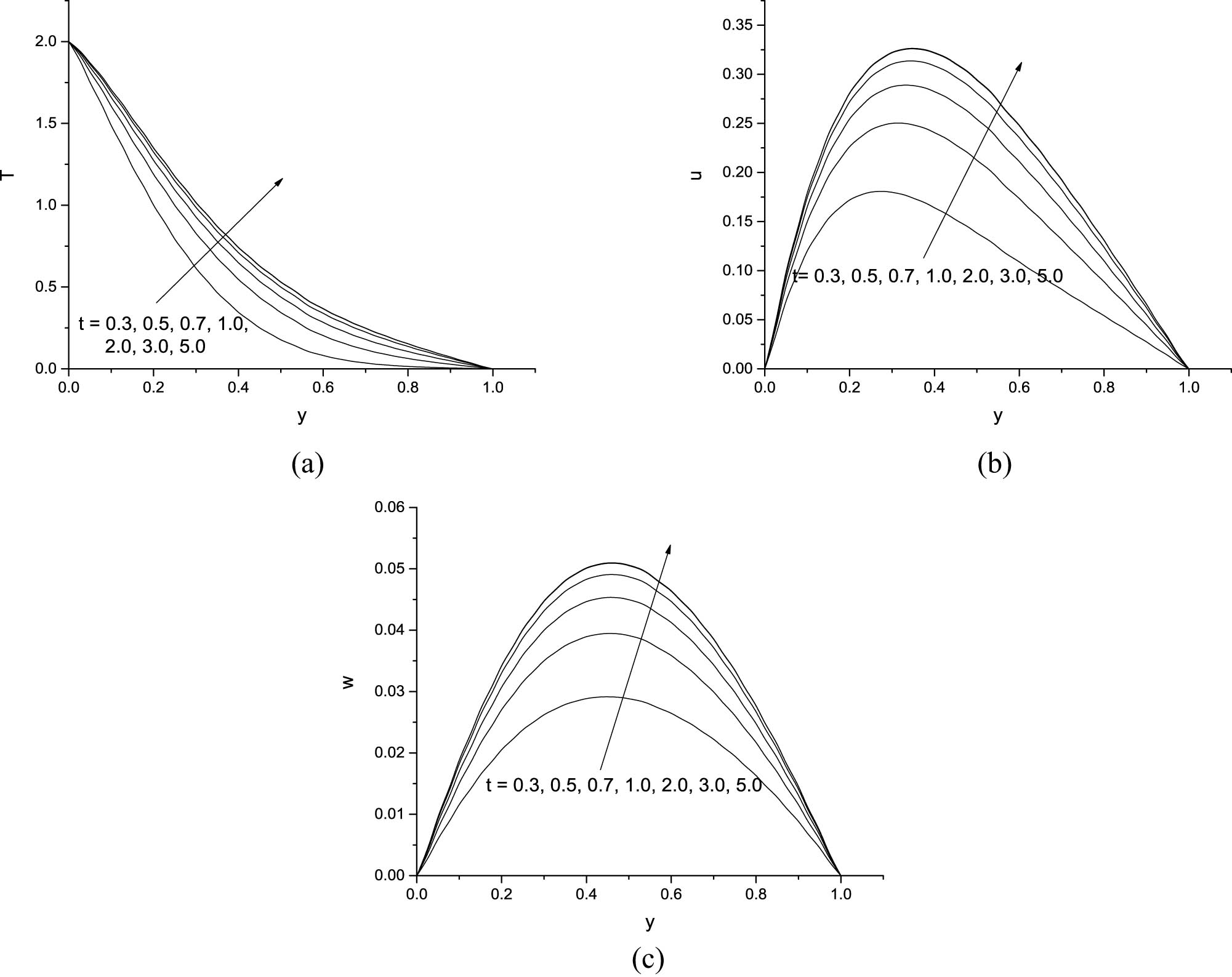
(a) Temperature profile, (b) primary velocity profile and (c) secondary velocity profile for distinct values of time parameter at cross-section
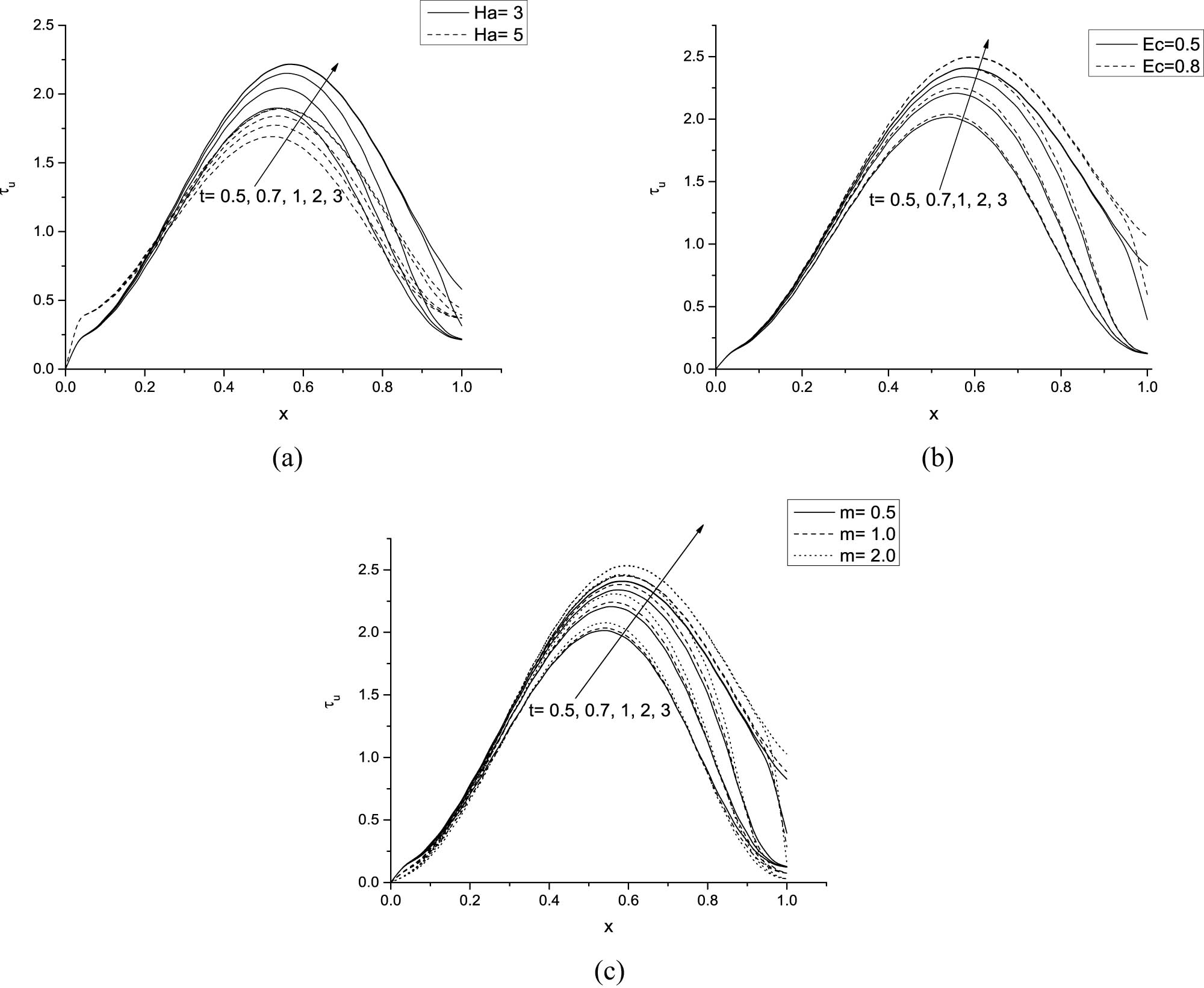
Variation in local skin friction (
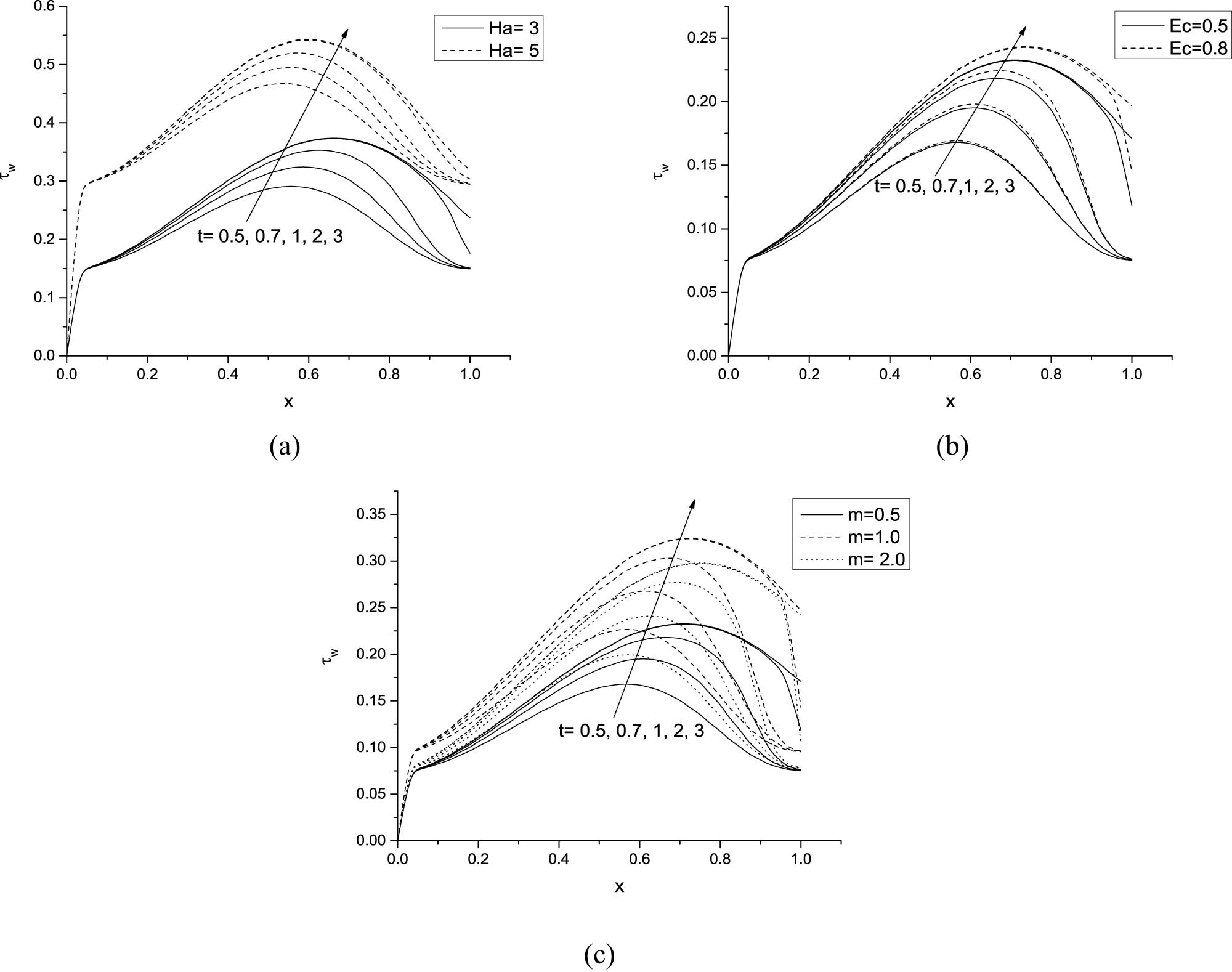
Variation in local skin friction (
The local Nusselt number profile for different flow parameters Ha, Ec, and
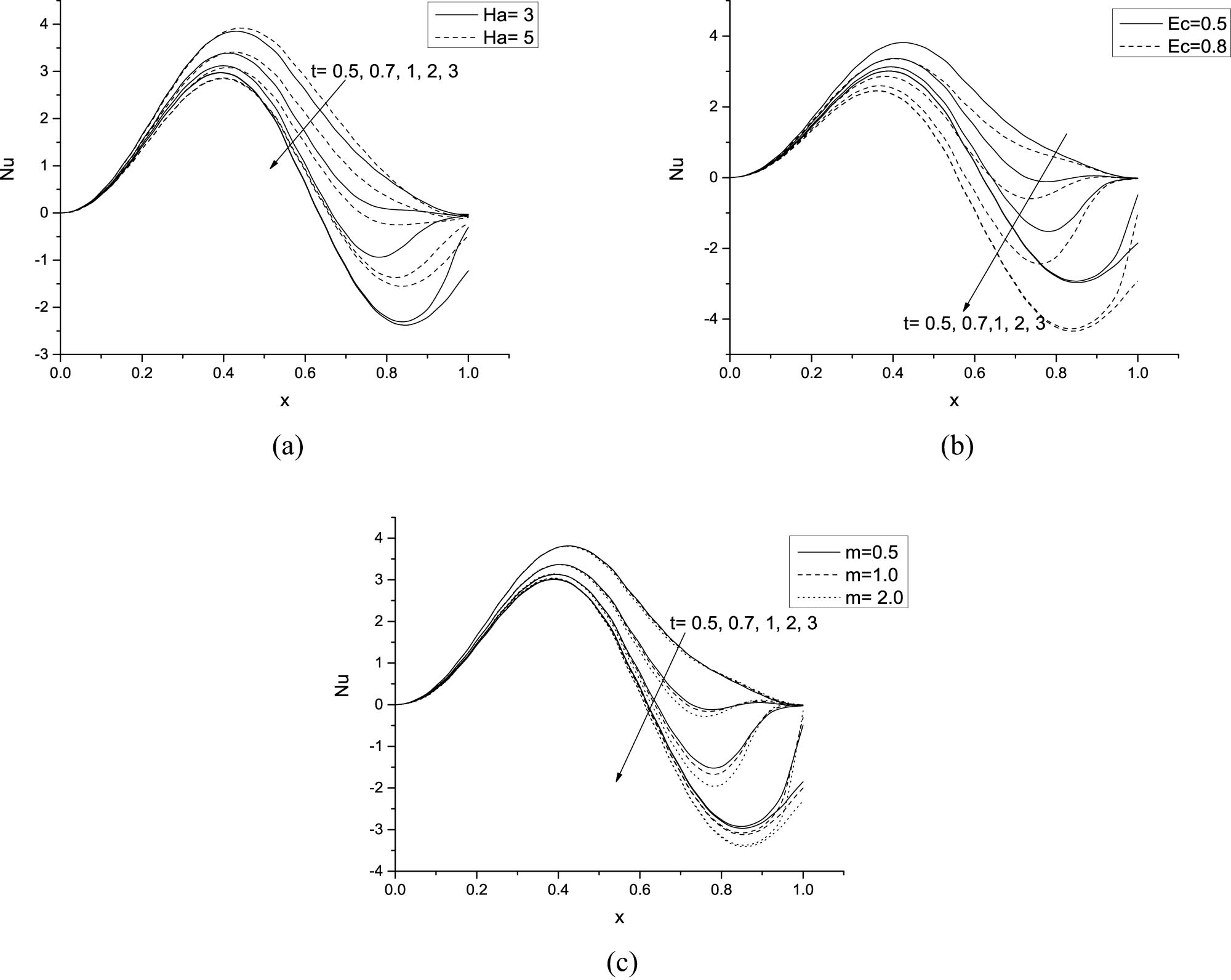
Variation in local Nusselt number for distinct values of time along with flow parameters (a) Ha, (b) Ec, and (c)
Effect of different parameters on
|
|
|
|
|
|---|---|---|---|
|
|
0.5406 | 0.0607 | 0.8651 |
|
|
0.5316 | 0.1096 | 0.8843 |
|
|
0.5154 | 0.1893 | 0.9194 |
|
|
0.5338 | 0.0603 | 1.0250 |
|
|
0.5406 | 0.0607 | 0.8651 |
|
|
0.5458 | 0.0609 | 0.7394 |
|
|
0.5406 | 0.0607 | 0.8651 |
|
|
0.5393 | 0.0482 | 0.8571 |
|
|
0.5388 | 0.0402 | 0.8539 |
|
|
0.7896 | 0.2087 | 0.6555 |
|
|
1.1107 | 0.3922 | 0.2420 |
|
|
1.4421 | 0.5741 |
|
5 Conclusion
The free convective MHD fluid flow has been studied in this work under the influence of applied electric and magnetic fields in the presence of nonuniform heating via vertical parallel plates. The fluid is considered laminar and incompressible, and a constant magnetic and electric fields of strengths
The maximum magnitude of all considered profiles has been found at the midst section between two parallel plates.
The impact of Ha on the primary velocity is to reduce it, whereas the effect of the rest of the parameters is to increase it.
The temperature profile increased with an increase in Ec and
The secondary velocity profile decreases with an enhancement in Hall current parameter for
An increase in
The rate of heat transmission reduces as
Acknowledgments
The authors are thankful to the editor-in-chief of the journal and all the reviewers for their valuable suggestions to improve the quality of the article.
-
Funding information: The authors state no funding involved.
-
Author contributions: All the authors have equally contributed to the main idea, conceptualization, software, writing, data generation, validation, analysis, and reviews.
-
Conflict of interest: The authors state no conflict of interest.
-
Data availability statement: Data sharing does not apply to this article, as no data sets were generated or analyzed during the current study.
References
[1] Sudo Y, Kaminaga M, Minazoe K. Experimental study on the effects of channel gap size on mixed convection heat transfer characteristics in vertical rectangular channels heated from both sides. Nuclear Eng Design. 1990;120(2–3):135–46. 10.1016/0029-5493(90)90368-8Search in Google Scholar
[2] Rodrigues A, Da Piedade A, Lahellec A, Grandpeix J. Modelling natural convection in a heated vertical channel for room ventilation. Building Environ. 2000;35(5):455–69. 10.1016/S0360-1323(99)00027-XSearch in Google Scholar
[3] Manca O, Musto M, Naso V. Experimental analysis of asymmetrical isoflux channel–chimney systems. Int J Therm Sci. 2003;42(9):837–46. 10.1016/S1290-0729(03)00056-5Search in Google Scholar
[4] Florio L, Harnoy A. Combination technique for improving natural convection cooling in electronics. Int J Therm Sci. 2007;46(1):76–92. 10.1016/j.ijthermalsci.2006.03.007Search in Google Scholar
[5] Fossa M, Tanda G. Frost formation in vertical channels under natural convection. Int J Multiphase Flow. 2010;36(3):210–20. 10.1016/j.ijmultiphaseflow.2009.11.002Search in Google Scholar
[6] Kato K, Takarada T, Yoshie K, Fukatsu M, Ezure Y. Natural convective flow between heated vertical parallel plates. J Chem Eng Japan. 1989;22(6):649–54. 10.1252/jcej.22.649Search in Google Scholar
[7] Campo A, Manca O, Morrone B. Numerical analysis of partially heated vertical parallel plates in natural convective cooling. Numer Heat Transfer Part A Appl. 1999;36(2):129–51. 10.1080/104077899274813Search in Google Scholar
[8] Nelson D, Wood B. Combined heat and mass transfer natural convection between vertical parallel plates. Int J Heat Mass Transfer. 1989;32(9):1779–87. 10.1016/0017-9310(89)90059-8Search in Google Scholar
[9] Aihara T. Effects of inlet boundary conditions on numerical solution of free convection between vertical parallel plates. Reports Instit High Speed Mechanics.1973;28:1–27. Search in Google Scholar
[10] Bayazitoglu Y, Paslay P, Cernocky P. Laminar Bingham fluid flow between vertical parallel plates. Int J Therm Sci. 2007;46(4):349–57. 10.1016/j.ijthermalsci.2006.06.008Search in Google Scholar
[11] Jha B, Ajibade A. Effect of viscous dissipation on natural convection flow between vertical parallel plates with time-periodic boundary conditions. Commun Nonl Sci Numer Simulat. 2012;17(4):1576–87. 10.1016/j.cnsns.2011.09.020Search in Google Scholar
[12] Ni M. Recent advances in computational techniques for MHD flow and application to fusion. Fusion Eng Design. 2012;87(9):1544–9. 10.1016/j.fusengdes.2012.04.009Search in Google Scholar
[13] Khan D, Kumam P, Khan I, Khan A, Watthayu W, Arif M. Scientific investigation of a fractional model based on hybrid nanofluids with heat generation and porous medium: applications in the drilling process. Sci Rep. 2022;12:Article Number: 6524. 10.1038/s41598-022-10398-3Search in Google Scholar PubMed PubMed Central
[14] Rajput U, Kumar S. MHD flow past an impulsively started vertical plate with variable temperature and mass diffusion. Appl Math Sci. 2011;5(3):149–57. Search in Google Scholar
[15] Kumar A, Singh A. Unsteady MHD free convective flow past a semi-infinite vertical wall with induced magnetic field. Appl Math Comput. 2013;222:462–71. 10.1016/j.amc.2013.07.044Search in Google Scholar
[16] Khan A, Khan D, Khan I, Ali F, ul Karim F, Nisar KS. MHD flow of Brinkman type H2O-Cu, Ag, TiO2 and Al2O3 nanofluids with chemical reaction and heat generation effects in a porous medium. J Magnetics. 2019;24(2):262–70. 10.4283/JMAG.2019.24.2.262Search in Google Scholar
[17] Khan A, ul Karim F, Khan I, Alkanhal TA, Ali F, Khan D, et al., Entropy generation in MHD conjugate flow with wall shear stress over an infinite plate: Exact analysis. Entropy. 2019;21(4):359. 10.3390/e21040359Search in Google Scholar PubMed PubMed Central
[18] Rajora R, Kumar A. A numerical study of magneto-double-diffusive-convection of Casson fluid over a vertical cone under nonuniform heating at surface of cone. Heat Transfer. 2021;50(3):2303–20. 10.1002/htj.21979Search in Google Scholar
[19] Khan D, Kumam P, Khan I, Sitthithakerngkiet K, Khan A, Ali G. Unsteady rotating MHD flow of a second-grade hybrid nanofluid in a porous medium: Laplace and Sumudu transforms. Heat Transfer. 2022;51(8):8065–83. Search in Google Scholar
[20] Khan D, Kumam P, Khan I, Sitthithakerngkiet K, Khan A, Ali G. Unsteady rotating MHD flow of a second-grade hybrid nanofluid in a porous medium: Laplace and Sumudu transforms. Heat Transfer. 2022;51(8):8065–83. 10.1002/htj.22681Search in Google Scholar
[21] Khan D, Rahman A, Kumam P, Watthayu W, Khan A, Galal AM. Relative magnetic field analysis on Casson dusty fluid of two-phase fluctuating flow over a parallel plate: second law analysis. J Thermal Anal Calorimetry. 2023;148:3659–70. 10.1007/s10973-023-11953-4Search in Google Scholar
[22] Rehman A, Khun M, Khan D, Shah K, Abdeljawad T. Stability analysis of the shape factor effect of radiative on MHD couple stress hybrid nanofluid. South African J Chem Eng. 2023;46:394–403. 10.1016/j.sajce.2023.09.004Search in Google Scholar
[23] Kumam P, Kumam W, Suttiarporn P, Rehman A. Relative magnetic field and slipping effect on Casson dusty fluid of two phase fluctuating flow over inclined parallel plate. South African J Chem Eng. 2023;44:135–46. 10.1016/j.sajce.2023.01.010Search in Google Scholar
[24] Adesanya S, Oluwadare E, Falade J, Makinde O. Hydromagnetic natural convection flow between vertical parallel plates with time-periodic boundary conditions. J Magnetism Magnetic Materials. 2015;396:295–303. 10.1016/j.jmmm.2015.07.096Search in Google Scholar
[25] VeeraKrishna M, Subba Reddy G, Chamkha A. Hall effects on unsteady MHD oscillatory free convective flow of second grade fluid through porous medium between two vertical plates. Phys Fluids. 2018;30(2):023106. 10.1063/1.5010863Search in Google Scholar
[26] Kumar D, Singh A, Kumar D. Influence of heat source/sink on MHD flow between vertical alternate conducting walls with Hall effect. Phys A Stat Mechanics Its Appl. 2020;544:123562. 10.1016/j.physa.2019.123562Search in Google Scholar
[27] Tsuda T. Electric Field Applications: In Chromatography, Industrial and Chemical Processes. New York: John Wiley & Sons; 2008. Search in Google Scholar
[28] Markx G. The use of electric fields in tissue engineering: A review. Organogenesis. 2008;4(1):11–7. 10.4161/org.5799Search in Google Scholar PubMed PubMed Central
[29] Hart F, Palisano J. The application of electric fields in biology and medicine. Electric Field. 2018;23:161–86. 10.5772/intechopen.71683Search in Google Scholar
[30] Sheikholeslami M, Shah Z, Tassaddiq A, Shafee A, Khan I. Application of electric field for augmentation of ferrofluid heat transfer in an enclosure including double moving walls. IEEE Access. 2019;7:21048–56. 10.1109/ACCESS.2019.2896206Search in Google Scholar
[31] Aliy G, Kishan N. Effect of electric field on MHD flow and heat transfer characteristics of Williamson nanofluid over a heated surface with variable thickness. OHAM Solution. J Adv Math Comput Sci. 2019;31(1):1–23. 10.9734/JAMCS/2019/45297Search in Google Scholar
[32] Roy S, Basak T. Finite element analysis of natural convection flows in a square cavity with non-uniformly heated wall (s). Int J Eng Sci. 2005;43(8–9):668–80. 10.1016/j.ijengsci.2005.01.002Search in Google Scholar
[33] Mythili D, Sivaraj R, Rashidi M, Yang Z. Casson fluid flow over a vertical cone with non-uniform heat source/sink and high order chemical reaction. J Naval Architecture Marine Eng. 2015;12(2):125–36. 10.3329/jname.v12i2.25269Search in Google Scholar
[34] Bai J, Pan J, Wu G, Tang L. Numerical investigation on the heat transfer of supercritical water in non-uniform heating tube. Int J Heat Mass Transfer. 2019;138:1320–32. 10.1016/j.ijheatmasstransfer.2019.04.108Search in Google Scholar
[35] Pordanjani AH, Aghakhani S, Alnaqi A, Afrand M. Effect of alumina nano-powder on the convection and the entropy generation of water inside an inclined square cavity subjected to a magnetic field: uniform and non-uniform temperature boundary conditions. Int J Mech Sci. 2019;152:99–117. 10.1016/j.ijmecsci.2018.12.030Search in Google Scholar
[36] Kumar S, Varma S, Kiran Kumar R, Raju C, Shehzad S, Bashir M. Three-dimensional hydromagnetic convective flow of chemically reactive Williamson fluid with non-uniform heat absorption and generation. Int J Chem Reactor Eng. 2019;17(2):20180118. 10.1515/ijcre-2018-0118Search in Google Scholar
[37] Pop I, Watanabe T. Hall effects on magnetohydrodynamic free convection about a semi-infinite vertical flat plate. Int J Eng Sci. 1994;32(12):1903–11. 10.1016/0020-7225(94)90087-6Search in Google Scholar
[38] Carnahan B, Luther H, Wilkes J. Applied Numerical Methods. Vol. 2. New York: Wiley; 1969. Search in Google Scholar
© 2025 the author(s), published by De Gruyter
This work is licensed under the Creative Commons Attribution 4.0 International License.
Articles in the same Issue
- Research Articles
- Generalized (ψ,φ)-contraction to investigate Volterra integral inclusions and fractal fractional PDEs in super-metric space with numerical experiments
- Solitons in ultrasound imaging: Exploring applications and enhancements via the Westervelt equation
- Stochastic improved Simpson for solving nonlinear fractional-order systems using product integration rules
- Exploring dynamical features like bifurcation assessment, sensitivity visualization, and solitary wave solutions of the integrable Akbota equation
- Research on surface defect detection method and optimization of paper-plastic composite bag based on improved combined segmentation algorithm
- Impact the sulphur content in Iraqi crude oil on the mechanical properties and corrosion behaviour of carbon steel in various types of API 5L pipelines and ASTM 106 grade B
- Unravelling quiescent optical solitons: An exploration of the complex Ginzburg–Landau equation with nonlinear chromatic dispersion and self-phase modulation
- Perturbation-iteration approach for fractional-order logistic differential equations
- Variational formulations for the Euler and Navier–Stokes systems in fluid mechanics and related models
- Rotor response to unbalanced load and system performance considering variable bearing profile
- DeepFowl: Disease prediction from chicken excreta images using deep learning
- Channel flow of Ellis fluid due to cilia motion
- A case study of fractional-order varicella virus model to nonlinear dynamics strategy for control and prevalence
- Multi-point estimation weldment recognition and estimation of pose with data-driven robotics design
- Analysis of Hall current and nonuniform heating effects on magneto-convection between vertically aligned plates under the influence of electric and magnetic fields
- A comparative study on residual power series method and differential transform method through the time-fractional telegraph equation
- Insights from the nonlinear Schrödinger–Hirota equation with chromatic dispersion: Dynamics in fiber–optic communication
- Mathematical analysis of Jeffrey ferrofluid on stretching surface with the Darcy–Forchheimer model
- Exploring the interaction between lump, stripe and double-stripe, and periodic wave solutions of the Konopelchenko–Dubrovsky–Kaup–Kupershmidt system
- Computational investigation of tuberculosis and HIV/AIDS co-infection in fuzzy environment
- Signature verification by geometry and image processing
- Theoretical and numerical approach for quantifying sensitivity to system parameters of nonlinear systems
- Chaotic behaviors, stability, and solitary wave propagations of M-fractional LWE equation in magneto-electro-elastic circular rod
- Dynamic analysis and optimization of syphilis spread: Simulations, integrating treatment and public health interventions
- Visco-thermoelastic rectangular plate under uniform loading: A study of deflection
- Threshold dynamics and optimal control of an epidemiological smoking model
- Numerical computational model for an unsteady hybrid nanofluid flow in a porous medium past an MHD rotating sheet
- Regression prediction model of fabric brightness based on light and shadow reconstruction of layered images
- Dynamics and prevention of gemini virus infection in red chili crops studied with generalized fractional operator: Analysis and modeling
- Qualitative analysis on existence and stability of nonlinear fractional dynamic equations on time scales
- Fractional-order super-twisting sliding mode active disturbance rejection control for electro-hydraulic position servo systems
- Analytical exploration and parametric insights into optical solitons in magneto-optic waveguides: Advances in nonlinear dynamics for applied sciences
- Bifurcation dynamics and optical soliton structures in the nonlinear Schrödinger–Bopp–Podolsky system
- User profiling in university libraries by combining multi-perspective clustering algorithm and reader behavior analysis
- Exploring bifurcation and chaos control in a discrete-time Lotka–Volterra model framework for COVID-19 modeling
- Review Article
- Haar wavelet collocation method for existence and numerical solutions of fourth-order integro-differential equations with bounded coefficients
- Special Issue: Nonlinear Analysis and Design of Communication Networks for IoT Applications - Part II
- Silicon-based all-optical wavelength converter for on-chip optical interconnection
- Research on a path-tracking control system of unmanned rollers based on an optimization algorithm and real-time feedback
- Analysis of the sports action recognition model based on the LSTM recurrent neural network
- Industrial robot trajectory error compensation based on enhanced transfer convolutional neural networks
- Research on IoT network performance prediction model of power grid warehouse based on nonlinear GA-BP neural network
- Interactive recommendation of social network communication between cities based on GNN and user preferences
- Application of improved P-BEM in time varying channel prediction in 5G high-speed mobile communication system
- Construction of a BIM smart building collaborative design model combining the Internet of Things
- Optimizing malicious website prediction: An advanced XGBoost-based machine learning model
- Economic operation analysis of the power grid combining communication network and distributed optimization algorithm
- Sports video temporal action detection technology based on an improved MSST algorithm
- Internet of things data security and privacy protection based on improved federated learning
- Enterprise power emission reduction technology based on the LSTM–SVM model
- Construction of multi-style face models based on artistic image generation algorithms
- Research and application of interactive digital twin monitoring system for photovoltaic power station based on global perception
- Special Issue: Decision and Control in Nonlinear Systems - Part II
- Animation video frame prediction based on ConvGRU fine-grained synthesis flow
- Application of GGNN inference propagation model for martial art intensity evaluation
- Benefit evaluation of building energy-saving renovation projects based on BWM weighting method
- Deep neural network application in real-time economic dispatch and frequency control of microgrids
- Real-time force/position control of soft growing robots: A data-driven model predictive approach
- Mechanical product design and manufacturing system based on CNN and server optimization algorithm
- Application of finite element analysis in the formal analysis of ancient architectural plaque section
- Research on territorial spatial planning based on data mining and geographic information visualization
- Fault diagnosis of agricultural sprinkler irrigation machinery equipment based on machine vision
- Closure technology of large span steel truss arch bridge with temporarily fixed edge supports
- Intelligent accounting question-answering robot based on a large language model and knowledge graph
- Analysis of manufacturing and retailer blockchain decision based on resource recyclability
- Flexible manufacturing workshop mechanical processing and product scheduling algorithm based on MES
- Exploration of indoor environment perception and design model based on virtual reality technology
- Tennis automatic ball-picking robot based on image object detection and positioning technology
- A new CNN deep learning model for computer-intelligent color matching
- Design of AR-based general computer technology experiment demonstration platform
- Indoor environment monitoring method based on the fusion of audio recognition and video patrol features
- Health condition prediction method of the computer numerical control machine tool parts by ensembling digital twins and improved LSTM networks
- Establishment of a green degree evaluation model for wall materials based on lifecycle
- Quantitative evaluation of college music teaching pronunciation based on nonlinear feature extraction
- Multi-index nonlinear robust virtual synchronous generator control method for microgrid inverters
- Manufacturing engineering production line scheduling management technology integrating availability constraints and heuristic rules
- Analysis of digital intelligent financial audit system based on improved BiLSTM neural network
- Attention community discovery model applied to complex network information analysis
- A neural collaborative filtering recommendation algorithm based on attention mechanism and contrastive learning
- Rehabilitation training method for motor dysfunction based on video stream matching
- Research on façade design for cold-region buildings based on artificial neural networks and parametric modeling techniques
- Intelligent implementation of muscle strain identification algorithm in Mi health exercise induced waist muscle strain
- Optimization design of urban rainwater and flood drainage system based on SWMM
- Improved GA for construction progress and cost management in construction projects
- Evaluation and prediction of SVM parameters in engineering cost based on random forest hybrid optimization
- Museum intelligent warning system based on wireless data module
- Optimization design and research of mechatronics based on torque motor control algorithm
- Special Issue: Nonlinear Engineering’s significance in Materials Science
- Experimental research on the degradation of chemical industrial wastewater by combined hydrodynamic cavitation based on nonlinear dynamic model
- Study on low-cycle fatigue life of nickel-based superalloy GH4586 at various temperatures
- Some results of solutions to neutral stochastic functional operator-differential equations
- Ultrasonic cavitation did not occur in high-pressure CO2 liquid
- Research on the performance of a novel type of cemented filler material for coal mine opening and filling
- Testing of recycled fine aggregate concrete’s mechanical properties using recycled fine aggregate concrete and research on technology for highway construction
- A modified fuzzy TOPSIS approach for the condition assessment of existing bridges
- Nonlinear structural and vibration analysis of straddle monorail pantograph under random excitations
- Achieving high efficiency and stability in blue OLEDs: Role of wide-gap hosts and emitter interactions
- Construction of teaching quality evaluation model of online dance teaching course based on improved PSO-BPNN
- Enhanced electrical conductivity and electromagnetic shielding properties of multi-component polymer/graphite nanocomposites prepared by solid-state shear milling
- Optimization of thermal characteristics of buried composite phase-change energy storage walls based on nonlinear engineering methods
- A higher-performance big data-based movie recommendation system
- Nonlinear impact of minimum wage on labor employment in China
- Nonlinear comprehensive evaluation method based on information entropy and discrimination optimization
- Application of numerical calculation methods in stability analysis of pile foundation under complex foundation conditions
- Research on the contribution of shale gas development and utilization in Sichuan Province to carbon peak based on the PSA process
- Characteristics of tight oil reservoirs and their impact on seepage flow from a nonlinear engineering perspective
- Nonlinear deformation decomposition and mode identification of plane structures via orthogonal theory
- Numerical simulation of damage mechanism in rock with cracks impacted by self-excited pulsed jet based on SPH-FEM coupling method: The perspective of nonlinear engineering and materials science
- Cross-scale modeling and collaborative optimization of ethanol-catalyzed coupling to produce C4 olefins: Nonlinear modeling and collaborative optimization strategies
- Unequal width T-node stress concentration factor analysis of stiffened rectangular steel pipe concrete
- Special Issue: Advances in Nonlinear Dynamics and Control
- Development of a cognitive blood glucose–insulin control strategy design for a nonlinear diabetic patient model
- Big data-based optimized model of building design in the context of rural revitalization
- Multi-UAV assisted air-to-ground data collection for ground sensors with unknown positions
- Design of urban and rural elderly care public areas integrating person-environment fit theory
- Application of lossless signal transmission technology in piano timbre recognition
- Application of improved GA in optimizing rural tourism routes
- Architectural animation generation system based on AL-GAN algorithm
- Advanced sentiment analysis in online shopping: Implementing LSTM models analyzing E-commerce user sentiments
- Intelligent recommendation algorithm for piano tracks based on the CNN model
- Visualization of large-scale user association feature data based on a nonlinear dimensionality reduction method
- Low-carbon economic optimization of microgrid clusters based on an energy interaction operation strategy
- Optimization effect of video data extraction and search based on Faster-RCNN hybrid model on intelligent information systems
- Construction of image segmentation system combining TC and swarm intelligence algorithm
- Particle swarm optimization and fuzzy C-means clustering algorithm for the adhesive layer defect detection
- Optimization of student learning status by instructional intervention decision-making techniques incorporating reinforcement learning
- Fuzzy model-based stabilization control and state estimation of nonlinear systems
- Optimization of distribution network scheduling based on BA and photovoltaic uncertainty
- Tai Chi movement segmentation and recognition on the grounds of multi-sensor data fusion and the DBSCAN algorithm
- Special Issue: Dynamic Engineering and Control Methods for the Nonlinear Systems - Part III
- Generalized numerical RKM method for solving sixth-order fractional partial differential equations
Articles in the same Issue
- Research Articles
- Generalized (ψ,φ)-contraction to investigate Volterra integral inclusions and fractal fractional PDEs in super-metric space with numerical experiments
- Solitons in ultrasound imaging: Exploring applications and enhancements via the Westervelt equation
- Stochastic improved Simpson for solving nonlinear fractional-order systems using product integration rules
- Exploring dynamical features like bifurcation assessment, sensitivity visualization, and solitary wave solutions of the integrable Akbota equation
- Research on surface defect detection method and optimization of paper-plastic composite bag based on improved combined segmentation algorithm
- Impact the sulphur content in Iraqi crude oil on the mechanical properties and corrosion behaviour of carbon steel in various types of API 5L pipelines and ASTM 106 grade B
- Unravelling quiescent optical solitons: An exploration of the complex Ginzburg–Landau equation with nonlinear chromatic dispersion and self-phase modulation
- Perturbation-iteration approach for fractional-order logistic differential equations
- Variational formulations for the Euler and Navier–Stokes systems in fluid mechanics and related models
- Rotor response to unbalanced load and system performance considering variable bearing profile
- DeepFowl: Disease prediction from chicken excreta images using deep learning
- Channel flow of Ellis fluid due to cilia motion
- A case study of fractional-order varicella virus model to nonlinear dynamics strategy for control and prevalence
- Multi-point estimation weldment recognition and estimation of pose with data-driven robotics design
- Analysis of Hall current and nonuniform heating effects on magneto-convection between vertically aligned plates under the influence of electric and magnetic fields
- A comparative study on residual power series method and differential transform method through the time-fractional telegraph equation
- Insights from the nonlinear Schrödinger–Hirota equation with chromatic dispersion: Dynamics in fiber–optic communication
- Mathematical analysis of Jeffrey ferrofluid on stretching surface with the Darcy–Forchheimer model
- Exploring the interaction between lump, stripe and double-stripe, and periodic wave solutions of the Konopelchenko–Dubrovsky–Kaup–Kupershmidt system
- Computational investigation of tuberculosis and HIV/AIDS co-infection in fuzzy environment
- Signature verification by geometry and image processing
- Theoretical and numerical approach for quantifying sensitivity to system parameters of nonlinear systems
- Chaotic behaviors, stability, and solitary wave propagations of M-fractional LWE equation in magneto-electro-elastic circular rod
- Dynamic analysis and optimization of syphilis spread: Simulations, integrating treatment and public health interventions
- Visco-thermoelastic rectangular plate under uniform loading: A study of deflection
- Threshold dynamics and optimal control of an epidemiological smoking model
- Numerical computational model for an unsteady hybrid nanofluid flow in a porous medium past an MHD rotating sheet
- Regression prediction model of fabric brightness based on light and shadow reconstruction of layered images
- Dynamics and prevention of gemini virus infection in red chili crops studied with generalized fractional operator: Analysis and modeling
- Qualitative analysis on existence and stability of nonlinear fractional dynamic equations on time scales
- Fractional-order super-twisting sliding mode active disturbance rejection control for electro-hydraulic position servo systems
- Analytical exploration and parametric insights into optical solitons in magneto-optic waveguides: Advances in nonlinear dynamics for applied sciences
- Bifurcation dynamics and optical soliton structures in the nonlinear Schrödinger–Bopp–Podolsky system
- User profiling in university libraries by combining multi-perspective clustering algorithm and reader behavior analysis
- Exploring bifurcation and chaos control in a discrete-time Lotka–Volterra model framework for COVID-19 modeling
- Review Article
- Haar wavelet collocation method for existence and numerical solutions of fourth-order integro-differential equations with bounded coefficients
- Special Issue: Nonlinear Analysis and Design of Communication Networks for IoT Applications - Part II
- Silicon-based all-optical wavelength converter for on-chip optical interconnection
- Research on a path-tracking control system of unmanned rollers based on an optimization algorithm and real-time feedback
- Analysis of the sports action recognition model based on the LSTM recurrent neural network
- Industrial robot trajectory error compensation based on enhanced transfer convolutional neural networks
- Research on IoT network performance prediction model of power grid warehouse based on nonlinear GA-BP neural network
- Interactive recommendation of social network communication between cities based on GNN and user preferences
- Application of improved P-BEM in time varying channel prediction in 5G high-speed mobile communication system
- Construction of a BIM smart building collaborative design model combining the Internet of Things
- Optimizing malicious website prediction: An advanced XGBoost-based machine learning model
- Economic operation analysis of the power grid combining communication network and distributed optimization algorithm
- Sports video temporal action detection technology based on an improved MSST algorithm
- Internet of things data security and privacy protection based on improved federated learning
- Enterprise power emission reduction technology based on the LSTM–SVM model
- Construction of multi-style face models based on artistic image generation algorithms
- Research and application of interactive digital twin monitoring system for photovoltaic power station based on global perception
- Special Issue: Decision and Control in Nonlinear Systems - Part II
- Animation video frame prediction based on ConvGRU fine-grained synthesis flow
- Application of GGNN inference propagation model for martial art intensity evaluation
- Benefit evaluation of building energy-saving renovation projects based on BWM weighting method
- Deep neural network application in real-time economic dispatch and frequency control of microgrids
- Real-time force/position control of soft growing robots: A data-driven model predictive approach
- Mechanical product design and manufacturing system based on CNN and server optimization algorithm
- Application of finite element analysis in the formal analysis of ancient architectural plaque section
- Research on territorial spatial planning based on data mining and geographic information visualization
- Fault diagnosis of agricultural sprinkler irrigation machinery equipment based on machine vision
- Closure technology of large span steel truss arch bridge with temporarily fixed edge supports
- Intelligent accounting question-answering robot based on a large language model and knowledge graph
- Analysis of manufacturing and retailer blockchain decision based on resource recyclability
- Flexible manufacturing workshop mechanical processing and product scheduling algorithm based on MES
- Exploration of indoor environment perception and design model based on virtual reality technology
- Tennis automatic ball-picking robot based on image object detection and positioning technology
- A new CNN deep learning model for computer-intelligent color matching
- Design of AR-based general computer technology experiment demonstration platform
- Indoor environment monitoring method based on the fusion of audio recognition and video patrol features
- Health condition prediction method of the computer numerical control machine tool parts by ensembling digital twins and improved LSTM networks
- Establishment of a green degree evaluation model for wall materials based on lifecycle
- Quantitative evaluation of college music teaching pronunciation based on nonlinear feature extraction
- Multi-index nonlinear robust virtual synchronous generator control method for microgrid inverters
- Manufacturing engineering production line scheduling management technology integrating availability constraints and heuristic rules
- Analysis of digital intelligent financial audit system based on improved BiLSTM neural network
- Attention community discovery model applied to complex network information analysis
- A neural collaborative filtering recommendation algorithm based on attention mechanism and contrastive learning
- Rehabilitation training method for motor dysfunction based on video stream matching
- Research on façade design for cold-region buildings based on artificial neural networks and parametric modeling techniques
- Intelligent implementation of muscle strain identification algorithm in Mi health exercise induced waist muscle strain
- Optimization design of urban rainwater and flood drainage system based on SWMM
- Improved GA for construction progress and cost management in construction projects
- Evaluation and prediction of SVM parameters in engineering cost based on random forest hybrid optimization
- Museum intelligent warning system based on wireless data module
- Optimization design and research of mechatronics based on torque motor control algorithm
- Special Issue: Nonlinear Engineering’s significance in Materials Science
- Experimental research on the degradation of chemical industrial wastewater by combined hydrodynamic cavitation based on nonlinear dynamic model
- Study on low-cycle fatigue life of nickel-based superalloy GH4586 at various temperatures
- Some results of solutions to neutral stochastic functional operator-differential equations
- Ultrasonic cavitation did not occur in high-pressure CO2 liquid
- Research on the performance of a novel type of cemented filler material for coal mine opening and filling
- Testing of recycled fine aggregate concrete’s mechanical properties using recycled fine aggregate concrete and research on technology for highway construction
- A modified fuzzy TOPSIS approach for the condition assessment of existing bridges
- Nonlinear structural and vibration analysis of straddle monorail pantograph under random excitations
- Achieving high efficiency and stability in blue OLEDs: Role of wide-gap hosts and emitter interactions
- Construction of teaching quality evaluation model of online dance teaching course based on improved PSO-BPNN
- Enhanced electrical conductivity and electromagnetic shielding properties of multi-component polymer/graphite nanocomposites prepared by solid-state shear milling
- Optimization of thermal characteristics of buried composite phase-change energy storage walls based on nonlinear engineering methods
- A higher-performance big data-based movie recommendation system
- Nonlinear impact of minimum wage on labor employment in China
- Nonlinear comprehensive evaluation method based on information entropy and discrimination optimization
- Application of numerical calculation methods in stability analysis of pile foundation under complex foundation conditions
- Research on the contribution of shale gas development and utilization in Sichuan Province to carbon peak based on the PSA process
- Characteristics of tight oil reservoirs and their impact on seepage flow from a nonlinear engineering perspective
- Nonlinear deformation decomposition and mode identification of plane structures via orthogonal theory
- Numerical simulation of damage mechanism in rock with cracks impacted by self-excited pulsed jet based on SPH-FEM coupling method: The perspective of nonlinear engineering and materials science
- Cross-scale modeling and collaborative optimization of ethanol-catalyzed coupling to produce C4 olefins: Nonlinear modeling and collaborative optimization strategies
- Unequal width T-node stress concentration factor analysis of stiffened rectangular steel pipe concrete
- Special Issue: Advances in Nonlinear Dynamics and Control
- Development of a cognitive blood glucose–insulin control strategy design for a nonlinear diabetic patient model
- Big data-based optimized model of building design in the context of rural revitalization
- Multi-UAV assisted air-to-ground data collection for ground sensors with unknown positions
- Design of urban and rural elderly care public areas integrating person-environment fit theory
- Application of lossless signal transmission technology in piano timbre recognition
- Application of improved GA in optimizing rural tourism routes
- Architectural animation generation system based on AL-GAN algorithm
- Advanced sentiment analysis in online shopping: Implementing LSTM models analyzing E-commerce user sentiments
- Intelligent recommendation algorithm for piano tracks based on the CNN model
- Visualization of large-scale user association feature data based on a nonlinear dimensionality reduction method
- Low-carbon economic optimization of microgrid clusters based on an energy interaction operation strategy
- Optimization effect of video data extraction and search based on Faster-RCNN hybrid model on intelligent information systems
- Construction of image segmentation system combining TC and swarm intelligence algorithm
- Particle swarm optimization and fuzzy C-means clustering algorithm for the adhesive layer defect detection
- Optimization of student learning status by instructional intervention decision-making techniques incorporating reinforcement learning
- Fuzzy model-based stabilization control and state estimation of nonlinear systems
- Optimization of distribution network scheduling based on BA and photovoltaic uncertainty
- Tai Chi movement segmentation and recognition on the grounds of multi-sensor data fusion and the DBSCAN algorithm
- Special Issue: Dynamic Engineering and Control Methods for the Nonlinear Systems - Part III
- Generalized numerical RKM method for solving sixth-order fractional partial differential equations
