Application of improved P-BEM in time varying channel prediction in 5G high-speed mobile communication system


Abstract
To improve people’s communication experience on high-speed trains, this study proposed a time-varying channel prediction (TVCP) method based on an improved polynomial basis extension model and backpropagation neural network. The improved polynomial-basis expansion model proposed in this study extracts the optimal basis function by constructing a channel correlation matrix and performing singular value decomposition to adapt to high-speed mobile channel changes. By using these basis functions and pilot signals to estimate historical basis coefficients as training data for back propagation neural network, future channel states can be predicted to improve the accuracy of TVCP in high-speed mobile communication systems. The results showed that when the training sample of the prediction method was 2,000, the maximum mean square error before improvement was close to 0.01, the maximum after improvement was 4.0 × 10⁻⁴. After increasing the normalized Doppler frequency shift to 0.5, the mean square error of the improved method was around 0.0001, while other methods were above 0.001. The improvement of the TVCP method effectively reduced the mean square error of TVCP, the prediction accuracy of the improved prediction method was much superior than that of traditional channel prediction methods. The designed method can greatly perfect the prediction accuracy of time-varying channels and enhance people’s communication experience on high-speed trains in high-speed mobile scenarios.
1 Introduction
With the continuous emergence of application scenarios such as the Internet of Things (IoT), intelligent transportation, and virtual reality, people’s performance requirements for communication systems are also increasing [1]. The deployment and application of 5G communication systems have become an important reason for promoting the development of digital society. 5G technology can not only achieve faster data transmission rates, but also support the connection of large-scale IoT devices and low latency, high reliability communication services [2,3]. The transmission signal of the communication system may undergo channel changes during the transmission process due to factors such as the movement of the mobile end. Channel changes can continuously alter the state of signal transmission in communication systems, which can have a significant impact on the communication system performance [4,5].
If the channel changes in the transmission signal can be accurately predicted, the signal transmission performance of the communication system can be improved. Xu et al. developed a channel extrapolation scheme built on deep learning to reduce pilot overhead and obtain time-varying cascaded channels. The network was segmented into time-domain and antenna-domain extrapolation networks, and differential equations were used. The results showed that this scheme could effectively extrapolate the cascaded reconstruction of intelligent surface channels in high-mobility scenarios [6]. Xu et al. designed a three-stage joint channel decomposition and prediction framework to mitigate the effects of shadow fading and obstacle obstruction. This framework utilized the time scale characteristics of the channel, combined with full duplex technology and sparse connection long short-term memory algorithm, to achieve intelligent surface structure capture with low pilot cost and high accuracy [7]. Huang et al. put forward a deep learning-based multi-input multi-output radar-assisted millimeter wave channel estimation scheme to improve the robustness in time-varying channels (TVCs), especially in vehicle for object communication. The design of transmission frame structure for joint radar and communication modules was divided into two stages: arrival/departure and gain estimation. In the face of incomplete array elements, a two-step angle estimation algorithm and a gain estimator based on residual denoising auto-encoder were adopted. Simulation showed that this scheme could efficiently estimate high mobility millimeter wave channels with fewer resources [8]. The application of existing channel prediction and estimation methods in communication systems has certain limitations, mainly manifested in insufficient adaptability to high-speed mobility scenarios, high complexity in processing incomplete array elements, limited prediction accuracy in complex multipath environments, and challenges in computational complexity and resource consumption. Therefore, in order to improve the overall performance of communication systems, new technologies and methods need to be developed to overcome the shortcomings of existing methods, especially in modern communication environments with rapid channel changes and complex and changing channel conditions.
There are various methods for time-varying channel prediction (TVCP), and polynomial-basis expansion model (P-BEM) is one of them. Lefebvre proposed an alternative method using P-BEM and three effective strategies for calculating high-order moments to evaluate the statistical characteristics of the model output while considering the statistical characteristics of uncertain model inputs. This method could support users to make wise choices [9]. Yu et al. proposed an uncertainty propagation method grounded on P-BEM to estimate the possibility density and cumulative distribution function of fatigue life of rolling bearings, considering the uncertainty of material parameters. This method could accurately predict the probability fatigue life of rolling bearings under constant and variable loads [10]. Pan et al. proposed a sparse solution scheme based on Bayesian regression to overcome the over-fitting and high computational complexity of P-BEM in the estimation of failure probability in geotechnical engineering, combining sequential learning and important sampling techniques. This scheme effectively improved computational efficiency and accurately estimated the probability of small faults using fewer samples [11].
In summary, TVCs with uncertain communication system transmission signals can reflect the signal transmission quality of the communication system. However, the uncertainty, time-varying nature (TVN), diversity, complexity, and dynamism of TVC make TVCP more difficult, and high-speed mobile communication (HSMC) systems further increase the difficulty of predicting TVC in communication systems. In HSMC environments, the acquisition of channel state information (CSI) faces challenges of accuracy, low latency, and low pilot overhead, especially in intelligent surface assisted systems. Due to the large number of passive elements in intelligent surfaces, accurate, low latency, and low pilot overhead CSI acquisition becomes even more difficult. P-BEM is a commonly used method for channel prediction and modeling, which uses polynomial function fitting to capture the nonlinear and TVN of the channel, thereby achieving accurate prediction of TVC. Therefore, to enhance TVCP accuracy in HSMC systems, this study proposes to combine back propagation neural network (BPNN) with P-BEM, and use the combined model to predict TVCP in HSMC systems.
The innovation of the research lies in proposing a TVCP model that combines BPNN and P-BEM. By using P-BEM to obtain the base coefficients of the channel, BPNN is trained for TVCP in HSMC systems. The main contribution of the research is to improve the prediction accuracy of TVC in the HSMC system and improve the signal transmission quality of the HSMC system. This study is conducted from four aspects. Part 1 is a survey of the current research status of TVCP, and Part 2 is a study of TVCP methods combining BPNN and P-BEM. Part 3 is an experimental validation of the constructed method. Part 4 discusses and summarizes the research content of this study.
2 Methods and materials
In this section, this article will provide a detailed introduction to the TVCP method that combines improved P-BEM and BPNN. First, the time-varying characteristics of wireless channels will be analyzed, which is the main reason for the time-varying of channels. This article will explore orthogonal frequency division multiple access (OFDMA) and OFDMA technologies, and how they combat interference and signal fading in communication networks. In addition, the design of pilot structures and how to estimate CSI from pilot symbols will also be discussed. Second, this article will construct an OFDMA communication system model for high-speed mobile scenarios and use P-BEM to model wireless channels. In addition, it is necessary to extract basis functions, estimate the basis coefficients at historical moments, and construct the training dataset for BPNN. Subsequently, the BPNN will be trained and the trained model will be used to predict future time-domain channel coefficients.
2.1 Analysis of TVN of wireless channels in HSMC systems
The TVNs of wireless channels are the main cause of channel variability. Orthogonal frequency technology is a technique that can combat interference and signal fading in communication networks, but its application range is limited due to the low efficiency of spectrum resource utilization [12,13]. OFDMA is a multi-access technology proposed by combining orthogonal frequency technology and frequency division multiplexing technology. This technology divides the signal transmission bandwidth into multiple orthogonal subcarrier sets and allocates resources according to user needs, making it the current mainstream multiple access solution. The structure of the transmitting and receiving ends of this scheme is shown in Figure 1 [5,14].
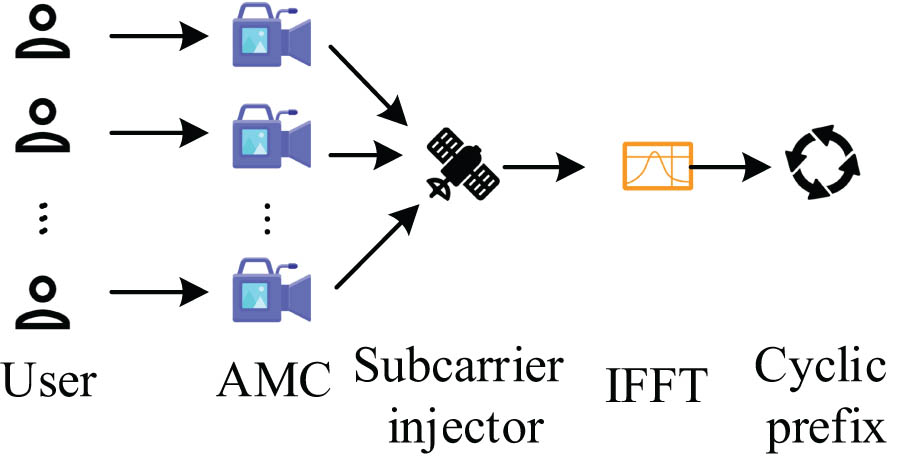
OFDMA structure.
At the transmitting end, communication participants are assigned to different sub-carriers, and then adaptive modulators are selected based on user needs to select the pairing method with the highest compatibility between sub-carriers and user channel conditions. The matched sub-carriers are first subjected to high-order modulation, and then, consistent with traditional orthogonal frequency techniques, the signal is transmitted. The operation of the receiving end and the transmitting end is opposite. Channel prediction is the process of predicting future states through the historical state of a channel during signal transmission. The core content of channel prediction is the acquisition of historical states, which rely on the CSI estimated by pilot symbols. The pilot symbols of different pilot structures are different, and channel prediction is directly related to the number and position of pilots. Pilot structures can reflect the number and position of pilots. The pilot structure includes comb shaped pilots inserted at intermediate intervals in the frequency domain, block-shaped structures distributed at intermediate intervals in the time domain, and lattice structures inserted at intermediate intervals in the time and frequency domains, as shown in Figure 2 [15,16].
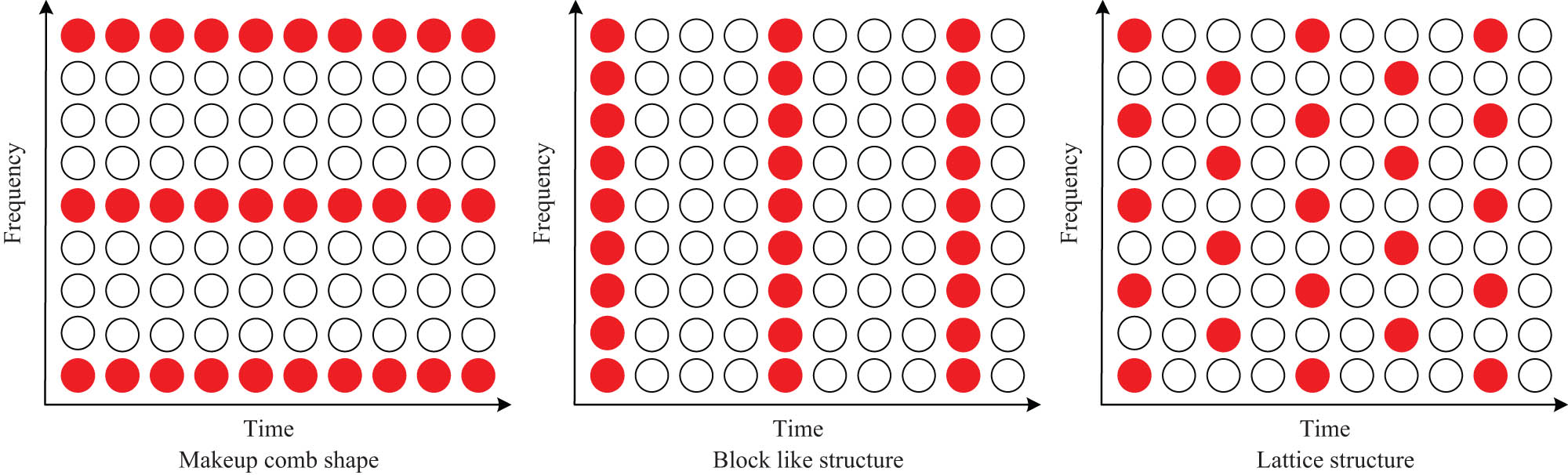
Pilot structure design.
In a comb-shaped pilot structure, the pilot is continuously distributed in the time domain. In a block like structure, pilots are continuously distributed in the frequency domain. The pilot in the lattice structure is discontinuous in both domains. In comb-like structures, signals have strong resistance to time selective fading and have better performance in HSMC scenarios [17,18].
In block like structures, signals have strong resistance to frequency selective fading. When obtaining signal state information in HSMC scenarios, this structure requires more pilots, which can increase computational complexity and reduce system efficiency. The lattice structure has weak resistance to signal fading, but when obtaining historical CSI using this structure, intelligent algorithms can be used to calculate the position of data symbols, improving the performance of communication systems. The TVNs of wireless channels include multi-path effects and Doppler frequency shift (DFS) effects, as shown in Figure 3.
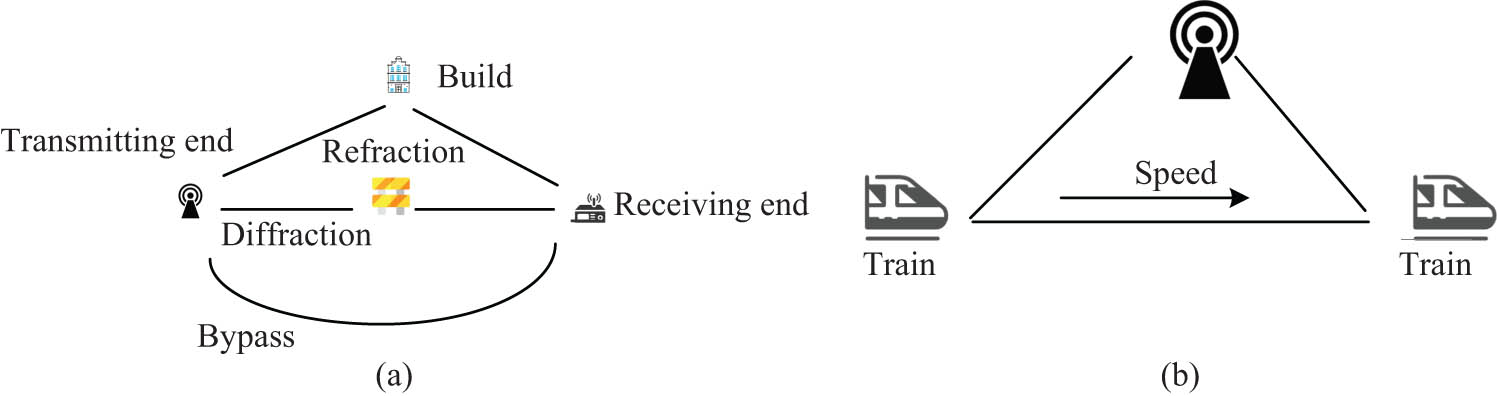
Multi-path effect and the DFS effect. (a) Multipath effect. (b) Frequency shift benefits.
Multi-path effect refers to the change in the transmission path of electromagnetic waves caused by the reflection or refraction of signals in contact with obstacles during transmission, resulting in the signal received by the terminal being a multi-path superimposed signal. After the superposition of signal paths, the amplitude and phase of the signal change, resulting in channel attenuation. The DFS effect is a phenomenon where the phase and frequency alter because of the difference in propagation distance when the wave source moves in a certain direction at a constant rate. The DFS can be calculated using Eq. (1).
where
where
where
where
where
2.2 TVCP combining P-BEM and BPNN
In HSMC systems, the prediction of TVCs faces the complexity of rapid signal changes and multipath effects. Although the traditional P-BEM method can capture the nonlinear and time-varying characteristics of the channel through polynomial function fitting, its fixed basis function may not accurately reflect the dynamic changes of the channel in high-speed moving environments. The advantage of P-BEM lies in its ability to use polynomial functions to fit and capture the nonlinear and time-varying characteristics of the channel. However, traditional P-BEM has limited predictive ability when facing rapid channel changes in high-speed mobile environments. BPNN can learn and extract the characteristics of channel changes from a large amount of historical data, which can be used as parameters for polynomial fitting in P-BEM, enabling the basic function of P-BEM to dynamically adapt to channel changes. Therefore, the study proposes to combine P-BEM with BPNN to improve the accuracy of TVCP. This model includes receiving antennas
where
The
where
where
where
where
where
where
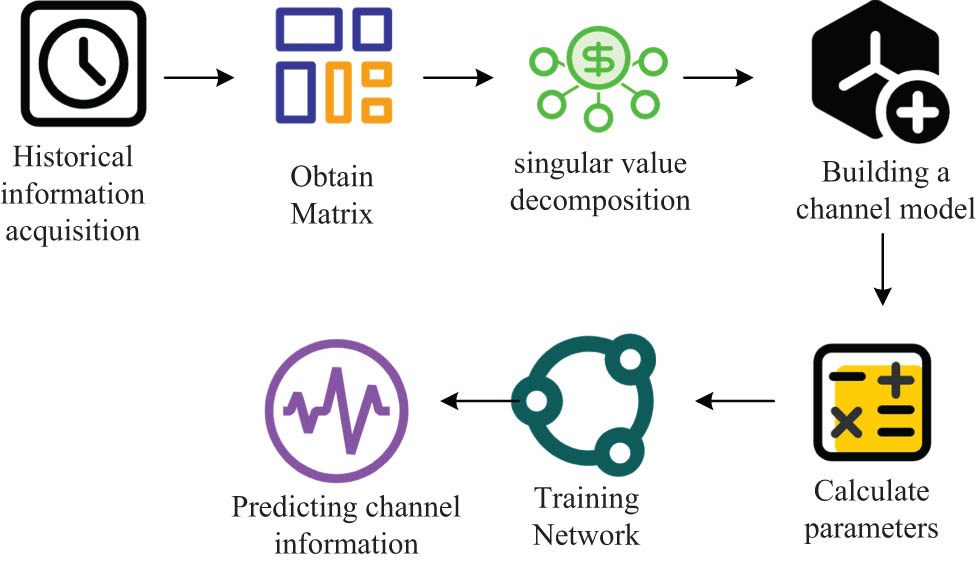
Improvement of the TVCP process of P-BEM with BPNN.
The steps to predict the WCC of the HSMC system are as follows: Step 1 is to obtain the channel correlation matrix based on the historical information of WCC. Step 2 is to perform singular value decomposition on the channel correlation matrix to obtain the optimal basis function for P-BEM. Step 3 is to model WCC using P-BEM based on the optimal basis function. Step 4 is to use the pilot signals received in the past and the optimal basis function to calculate the estimated base coefficients at historical times. Step 5 is to calculate the ideal channel basis coefficient at time
3 Results
3.1 Experimental environment and parameter settings
A TVCP method for HSMC systems based on P-BEM and BPNN was studied and improved. To verify the feasibility of the designed channel prediction method (CPM) and its improvements, a simulation experimental environment was established. Simulation tests were conducted on the improved and unimproved CPMs. The experimental operating system is Windows 10 Professional, with Intel Core i9-10900K CPU, NVIDIA GeForce RTX 3080 GPU, and 32.0GB system memory. In the HSMC system, the symbol length, cyclic prefix length, carrier frequency, sub-carrier spacing, train speed, channel model, and number of basic functions of the transmitting antenna, receiving antenna, and OFDMA are important parameters. The number of hidden layer neurons, training error, and maximum number of iterations are important parameters of BPNN. Wang et al. and Ma et al. conducted research and analysis on TVCP schemes in different network environments, and achieved certain results. Therefore, the study referred to the relevant research of these scholars to design simulation test network parameters, as shown in Tables 1 and 2 [23,24].
Communication system parameter settings
| Name | Value | Name | Value |
|---|---|---|---|
| Sending antenna | 2 | Receiving antenna | 2 |
| Symbol length for OFDMA | 128 | Loop prefix length | 16 |
| Carrier frequency | 2.35 GHz | Sub-carrier spacing | 15 kHz |
| Train speed | 500 km/h | Channel model | 5-channel Rice channel |
| Rice factor | 5 | Number of basic functions | 4 |
BPNN parameter settings
| Name | Before improvement | After improvement |
|---|---|---|
| Value | Value | |
| Number of hidden layer neurons | 20 | 5 |
| Maximum number of iterations | 3,000 | 1,000 |
| Training error | 10−4 | 10−4 |
In the BPNN model, the study selected 5 hidden layer neurons (improved) and 20 hidden layer neurons (pre improved) to balance the model’s learning ability and computational efficiency. Fewer neurons reduce model complexity and training time, while an appropriate number of neurons ensure the ability to capture channel changes. The maximum number of iterations and training error are set based on the model convergence speed and prediction accuracy, respectively, from 3,000 to 1,000 iterations, and from 1,000 to 3,000 iterations to achieve finer training stopping conditions. The sample size has been increased from 100 to 2,000 in order to improve the model’s generalization ability and prediction accuracy, especially in high-speed moving scenarios where the effect is significant. These choices take into account data diversity, training efficiency, and prediction accuracy. This study compared the performance of two improved CPMs from five aspects during simulation testing. The first method is the mean squared error (MSE) of two methods at different training sample sizes. The second type is the training time at different numbers of training samples. The third type is MSE with different training methods. The fourth type is MSE for different prediction methods, and the fifth type is analysis of computational complexity.
3.2 Analysis of channel prediction simulation results
The training samples have a significant impact on the training effectiveness of the model. This study compared the MSE of the two improved CPMs before and after the improvement under different training sample numbers, as shown in Figure 5.
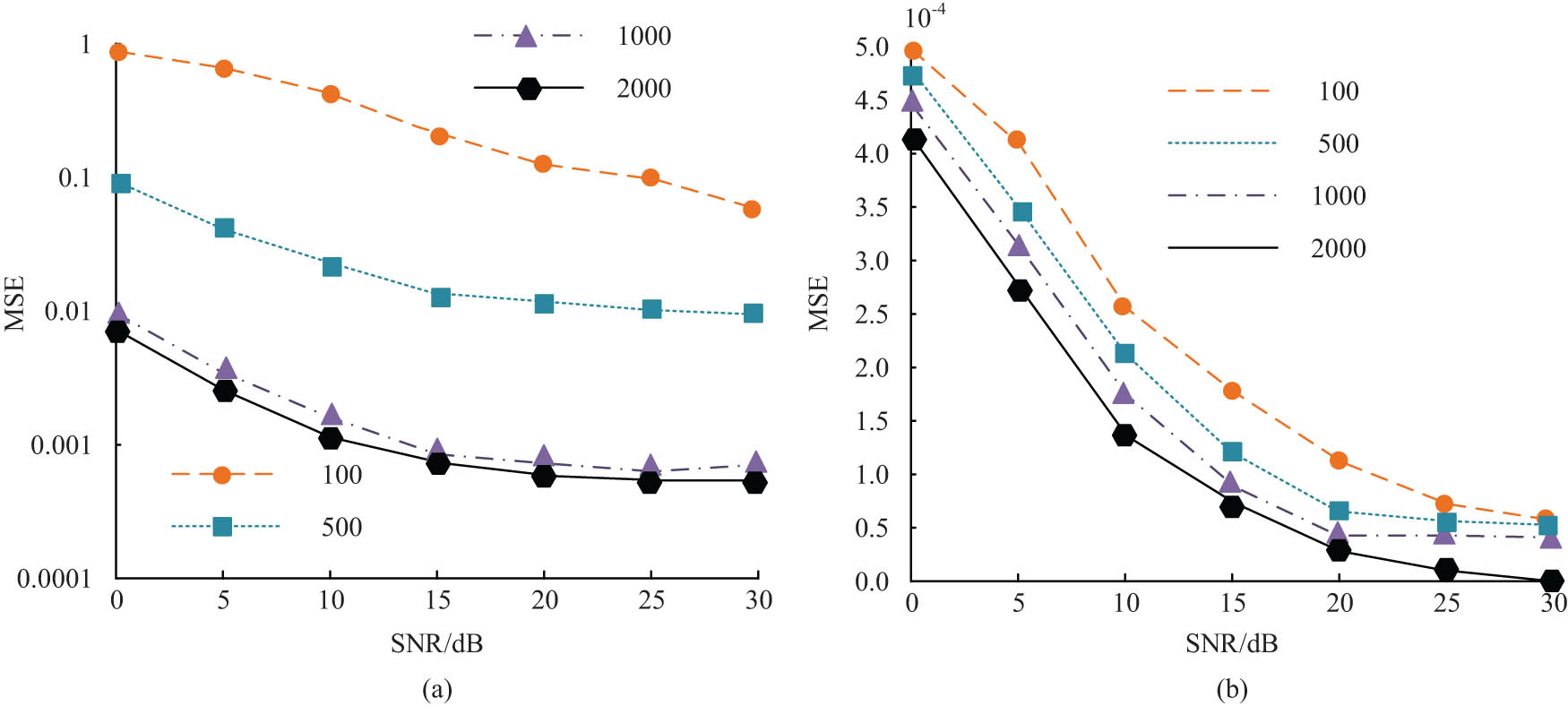
Effect of the training samples on the model training. (a) The impact of sample size on the pre-improved CPM. (b) The impact of sample size on improved CPMs.
Figure 5(a) shows the MSE of the pre-improved prediction scheme under different training samples. When the signal-to-noise ratio (SNR) was the same, the higher the training samples, the lower the MSE of the model. When the training samples were 100 and 2,000, the maximum MSE was close to 1 and 0.01. As the training data increased, the prediction accuracy would also gradually increase. Figure 5(b) shows the MSE of the improved prediction scheme under different training samples. The impact of training samples on the improved CPM was consistent with the original scheme, and the model MSE increased with the increase in training samples. Table 3 shows the training time of the two CPMs before and after improvement under different training sample sizes.
Effect of the number of training samples on the time-consuming cost of the model training
| Before improvement | After improvement | ||
|---|---|---|---|
| Sample size | Time (s) | Sample size | Time (s) |
| 100 | 9.22 | 100 | 2.30 |
| 500 | 143.81 | 500 | 8.68 |
| 1,000 | 466.71 | 1,000 | 16.63 |
| 2,000 | 787.44 | 2,000 | 30.69 |
In Table 3, the pre-improved CPM significantly increased training time as the number of training samples increased. When the training sample increased from 100 to 2,000, the training time increased from about 10 s to over 780 s. After improvement, the training time of the CPM would also increase with the rise of the training samples, but the rise speed would significantly decrease. When the training sample increased from 100 to 2,000, the training time increased from about 2 s to about 30 s. Figure 6 shows the impact of different training methods on channel prediction performance.
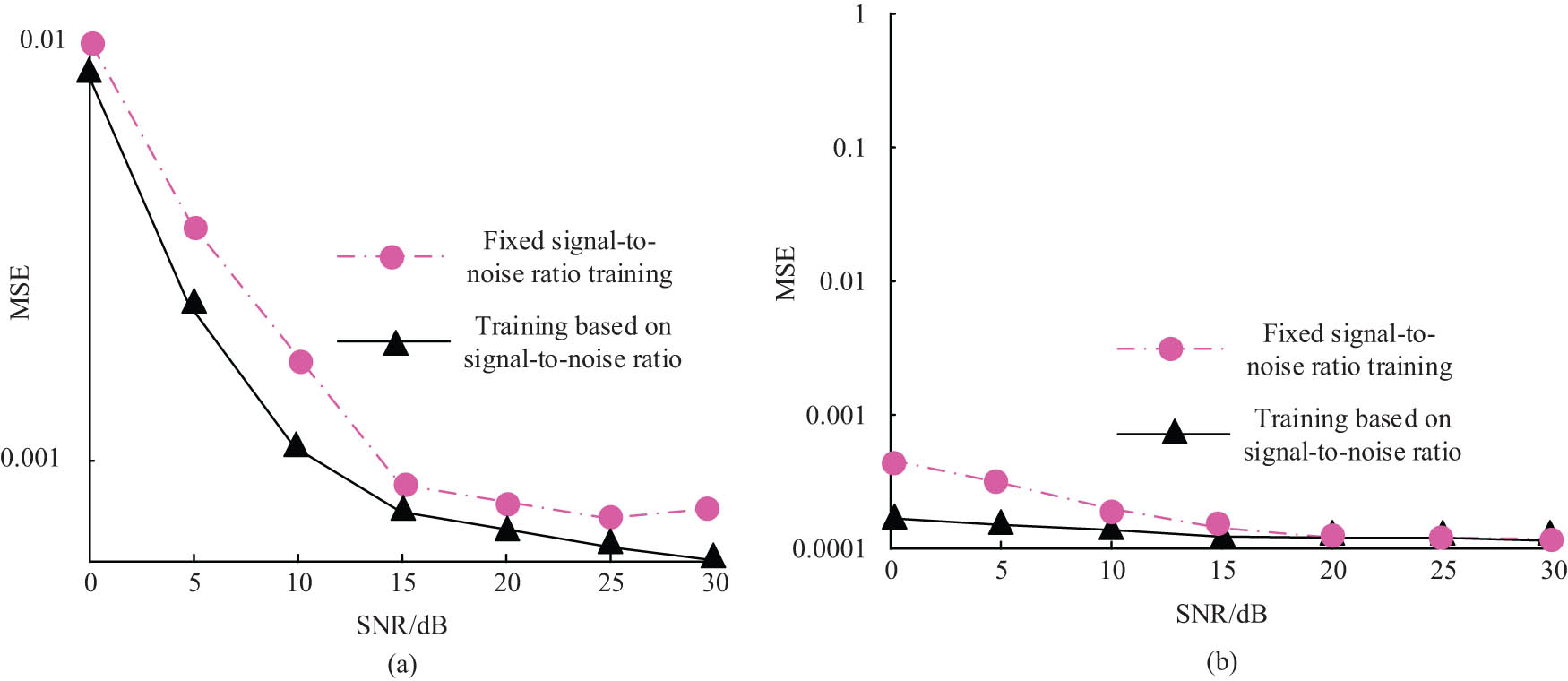
Effect of different training methods on the channel prediction performance. (a) The impact of sample size on the pre-improved CPM. (b) The impact of sample size on improved CPMs.
Figure 6(a) and (b) shows the impact of different training methods on the pre-improved and improved CPM. In Figure 6(a), when training with fixed SNR and training-based SNR, the MSE of the CPM was highest at around 0.01 and 0.009. The training-based SNR was slightly lower than the fixed SNR training method, and as the SNR increased, the difference between the two would also become larger. In Figure 6(b), as the SNR increased, the MSE of the two training methods gradually tended to be consistent. When the SNR was low, the MSE value of the training-based SNR method was smaller. To further analyze the feasibility of the proposed CPM, the improving path channel estimation (IPCE) in the research by Li and Mitra [21] and the membership filtering (MF) in the research by Zhao et al. [22] were compared with the research method. Meanwhile, this article also compared it with the dual channel transferable RUL model proposed by Guo et al. [25]. Figure 7 shows the comparison results of MES performance under normalized DFS using different prediction methods.
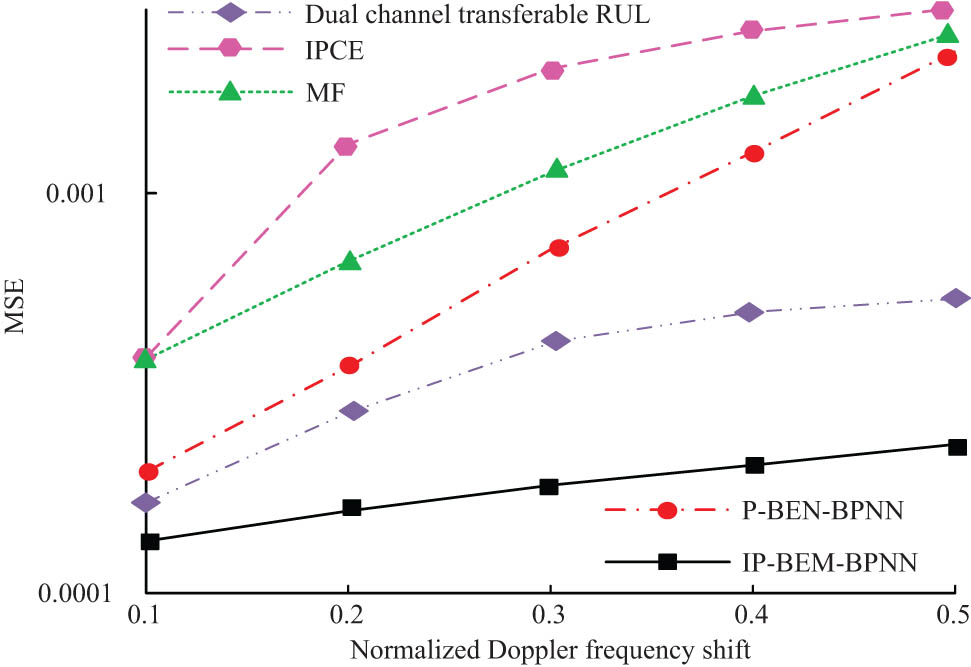
Change in the channel prediction performance with the normalized DFS.
In Figure 7, as the normalized DFS increased, the MSE of all methods increased. When the normalized DFS was 0.1, the MSE of all methods was below 0.001. After increasing the normalized DFS to 0.5, the MSE of the improved method was around 0.0001, while the MSE of other methods was above 0.001. As the Doppler shift continues to increase, the MSE values of different methods also increase slightly, but it can still be observed that the MSE value of the improved P-BEM model designed in the study remains at a low level. This indicates that the model designed for research is recognized to maintain good basic performance under the continuous increase of DFS. The normalized DFS had the least interference on the designed CPM, and the improved CPM performed the best in HSMS. The analysis of complexity was calculated. The complexity of historical information obtained, model training complexity, and prediction complexity were expanded into three dimensions.
Figure 8 shows the complexity comparison of obtaining historical information. In Figure 8(a), the complexity of the historical information obtained by the research method was much higher than that of the methods in the research by Li and Mitra [21] and Zhao et al. [22]. As the number of sub-carriers increased, the complexity of obtaining historical information would gradually increase. The changes in Figure 8(b) are consistent with Figure 8(a). Figure 9 shows a comparison of model training complexity.
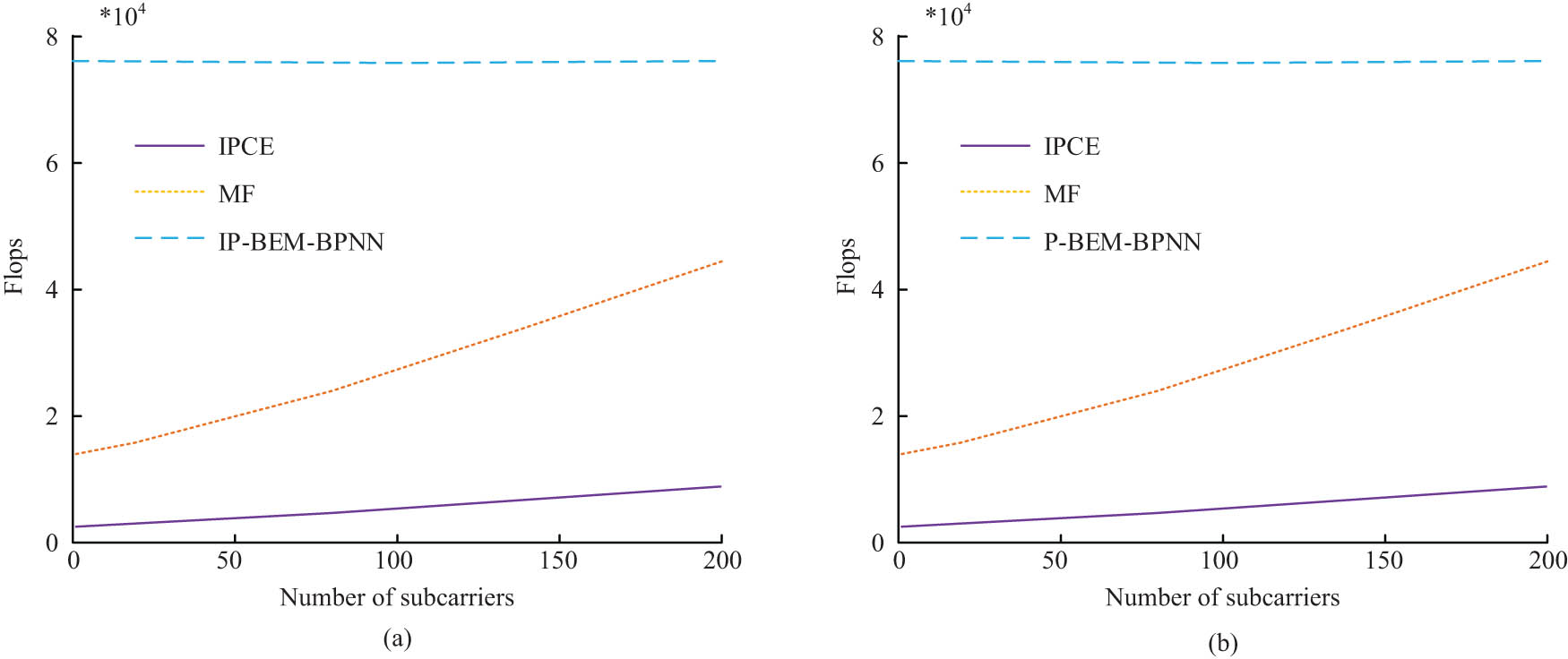
Comparison of the complexity of obtaining historical information. (a) After improvement. (b) Before improvement.
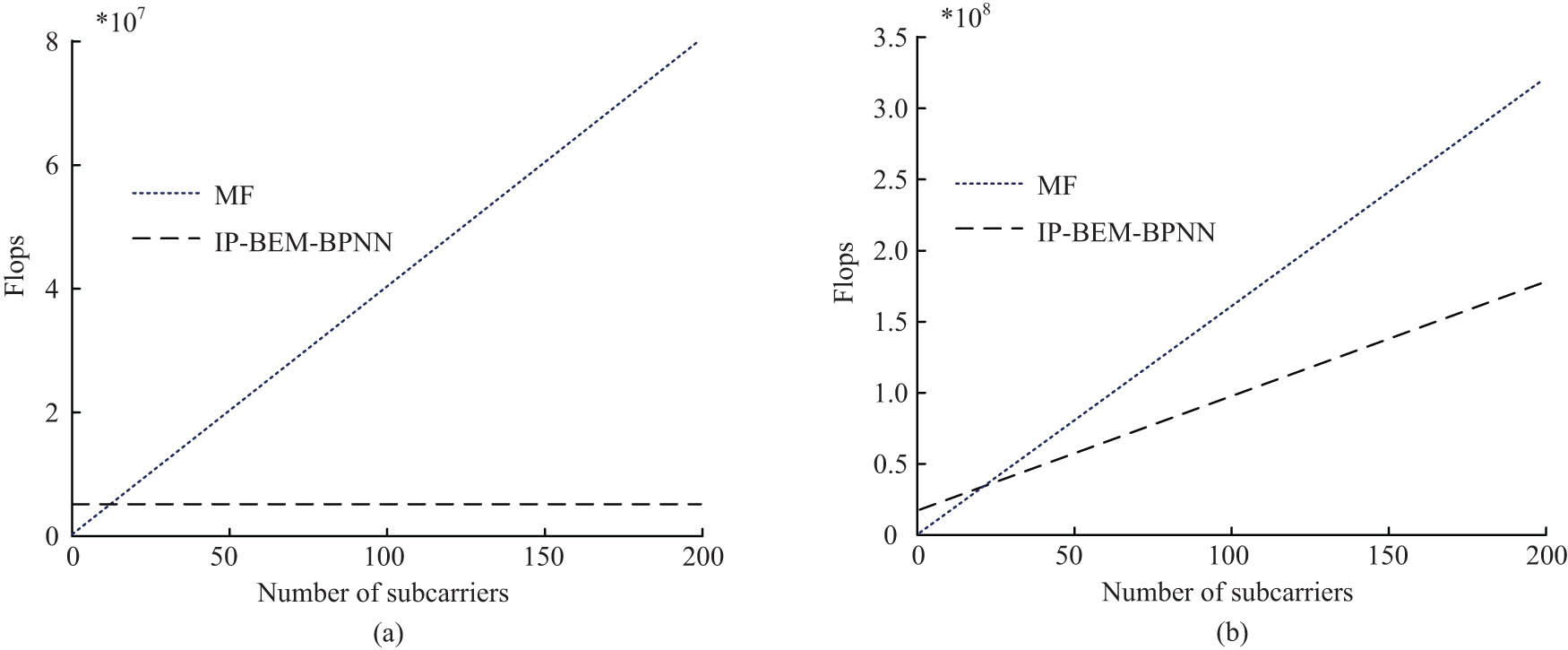
Training complexity comparison. (a) After improvement. (b) Before improvement.
Figure 9 showed the comparison of training complexity between MF and the improved and pre-improved P-BEM-BPNN methods. In Figure 9(a), the training complexity of the P-BEM-BPNN method did not increase with the increase in the quantity of sub-carriers, which is always below 1 × 10⁻⁷, while the training complexity of MF would continue to increase with the increase in the number of sub-carriers. In Figure 9(b), the training complexity of both methods increased with the increase in the number of sub-carriers. When the number of sub-carriers was higher than 20, the training complexity of the P-BEM-BPNN method was lower. Figure 10 shows a comparison of model prediction complexity.
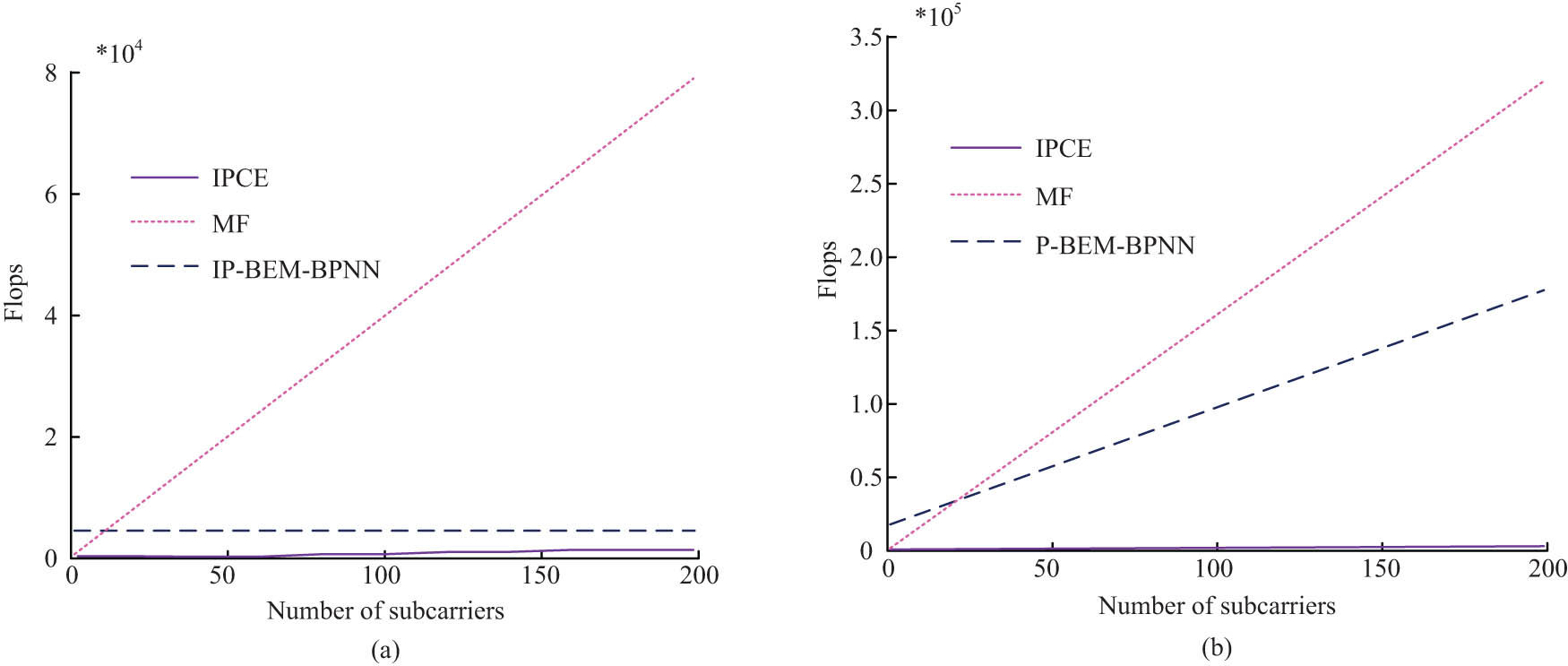
Predictive complexity comparison results. (a) After improvement. (b) Before improvement.
Figure 10 showed the comparison of prediction complexity between IPCE, MF, and P-BEM-BPNN methods before and after improvement. In Figure 10(a), the IPCE method had the lowest prediction complexity, followed by the improved P-BEM-BPNN method. The prediction complexity of these two methods did not increase with the number of sub-carriers. In Figure 10(b), the prediction complexity of the IPCE method was basically 0, while the prediction complexity of the other two methods increased with the number of sub-carriers.
The study further compared the prediction complexity of three models, IPCE, MF, and IP-BEM-BPNN, with the variation in device computing resources. The results are shown in Figure 11. Figure 11(a) shows the change in model prediction complexity with the increase in device computing resources before model optimization. As can be seen, with the continuous increase in device computing resources, the complexity of model prediction will gradually decrease. Figure 11(a) shows that after model optimization, with the continuous increase in device computing resources, the prediction complexity of the IP-BEM-BPNN model remains basically unchanged and at a lower level.
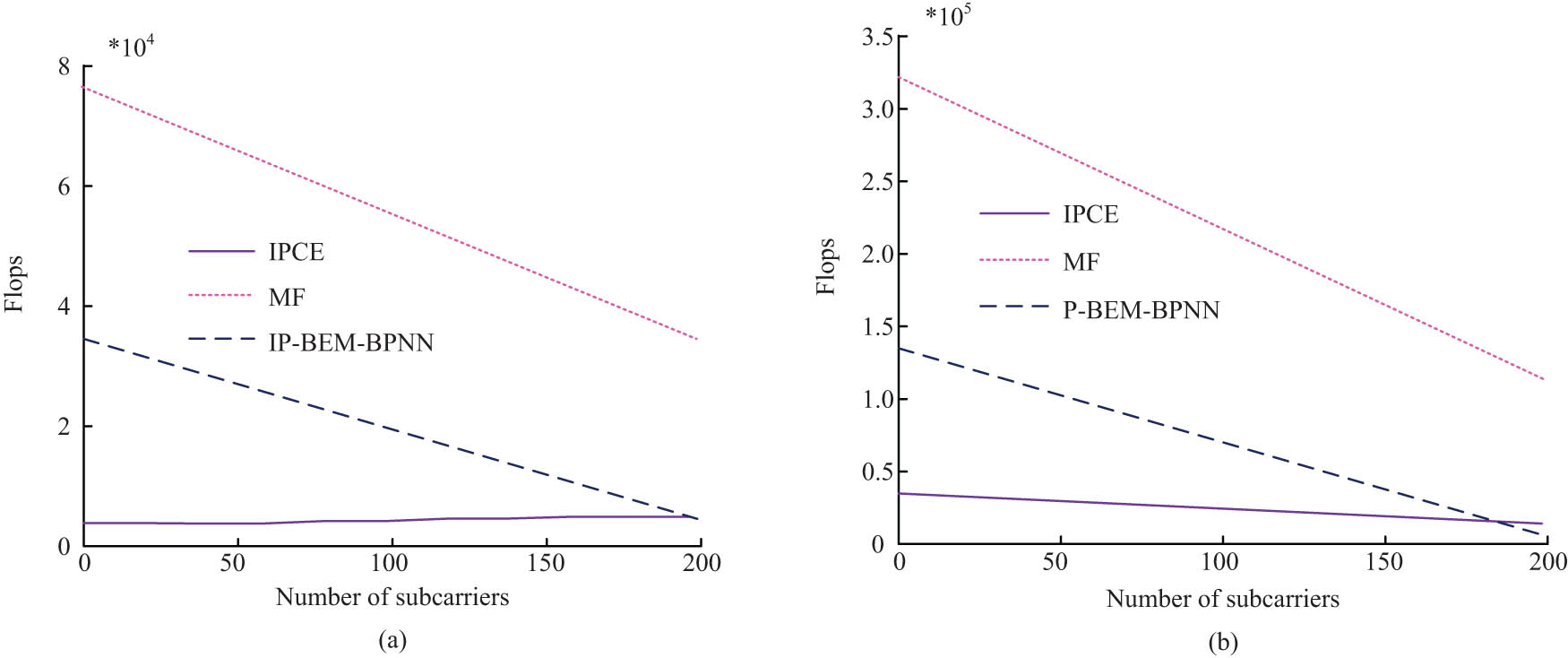
Prediction complexity changes with device computing resources. (a) After improvement. (b) Before improvement.
4 Discussion
The improved time-varying CPM proposed in this article has achieved significant results in HSMC systems. First, regarding the improvement of training time, when the number of training samples increased from 100 to 2,000, the training time of the improved CPM model increased from about 10 s to about 30 s, while the training time of the original model increased from about 10 s to over 780 s. This significant reduction in training time means that our model has significantly improved training efficiency while maintaining prediction accuracy. Compared with the improved atomic norm based time-varying multipath channel estimation method proposed by Li and Mitra [21], the training time significantly increases with the increase in sample size. The improved CPM model proposed in this study has a significant advantage in training efficiency. This improvement is particularly important for HSMC systems that require rapid deployment and real-time model updates, as it reduces the system’s waiting time for channel prediction model updates. Second, the improved CPM model studied maintains an MSE of around 0.0001 when the normalized Doppler shift is increased to 0.5, while the MSE of other methods is above 0.001. The decrease in MSE represents a significant improvement in prediction accuracy. According to Lefebvre’s (2020) research [10], the P-BEM method proposed by him has an MSE value close to 0.001 when evaluating the statistical characteristics of the model output. Compared to this, the MSE value of the improved CPM model in this article is lower, indicating a significant improvement in prediction accuracy. A low MSE value means that the difference between the predicted channel state and the actual channel state is smaller, which is crucial for the design and optimization of communication systems as it directly affects the transmission quality of signals and the reliability of the system [26,27]. In addition, the reduction in MSE also means that our model is more effective in dealing with complex channel changes in high-speed mobile scenarios. In these scenarios, the rapid changes in channels place higher demands on prediction models. The model in this article provides more accurate prediction results by dynamically adapting to channel changes, which is of great significance for improving communication quality in mobile environments such as high-speed trains.
The model of this study is based on the combination of P-BEM and BPNN, which assume that channel changes can be effectively predicted through historical data. However, this assumption may not apply to all channel environments, especially in the presence of extreme interference or atypical channel conditions. The performance of the model may be affected by the complexity of channel changes, such as in highly dynamic urban environments where rapid changes in buildings and other obstacles can lead to inaccurate model predictions. Although the model performs well under laboratory conditions, it may face scalability issues in practical deployment. As the scale of the network expands and the number of users increases, the model may require more computing resources to maintain prediction accuracy. In a multi-user environment, the model needs to process more data and more complex CSI, which may lead to an increase in computational complexity and energy consumption, limiting the application of the model on resource constrained devices.
In summary, the improved CPM model proposed in this article not only demonstrates its superiority in theory, but also has significant advantages in practical applications.
5 Conclusion
The TVCP method proposed in this article, which combines the improved P-BEM with BPNN, has important practical application significance in 5G HSMC systems. The key achievements are summarized as follows: First, by constructing channel correlation matrices and performing singular value decomposition, the optimal basis functions were extracted, effectively adapting to the changes in high-speed mobile channels. Second, using these basis functions and pilot signals to estimate historical basis coefficients as training data for BPNN, accurate prediction of future channel states has been achieved. The experimental results show that the improved method reduces the maximum MSE from nearly 0.01 to 4.0 × 10⁻⁴ when the training samples are 2,000. After increasing the normalized Doppler shift to 0.5, the MSE remains at around 0.0001, far lower than other methods, demonstrating excellent predictive performance.
In terms of potential applications, the method proposed in this article can significantly enhance the communication experience in high-speed mobile scenarios such as high-speed trains, improve signal transmission quality, and is of great significance for improving the performance of 5G and future 6G communication systems. In addition, this method also has broad application prospects in high-speed data transmission in fields such as intelligent transportation, telemedicine, and virtual reality.
Future research can further optimize algorithms based on this, reduce computational complexity, improve real-time performance, and make them more suitable for practical HSMC systems. Meanwhile, it can be considered to apply this method to a wider range of channel environments and different communication standards to verify its generalization ability and robustness. In addition, combining the latest artificial intelligence technologies such as deep learning and machine learning to further explore and improve the accuracy and efficiency of TVCP is also a direction worthy of in-depth research.
-
Funding information: Author states no funding involved.
-
Author contribution: The author has accepted responsibility for the entire content of this manuscript and approved its submission.
-
Conflict of interest: The author states no conflict of interest.
-
Data availability statement: All data generated or analyzed during this study are included in this published article.
References
[1] Wang CX, Huang J, Wang H, Gao X, You X, Hao Y. 6G wireless channel measurements and models: Trends and challenges. IEEE Veh Technol Mag. 2020;15(4):22–32.10.1109/MVT.2020.3018436Search in Google Scholar
[2] Li S, Lin S, Cai L, Li W, Zhu G. Joint resource allocation and computation offloading with time-varying fading channel in vehicular edge computing. IEEE Trans Veh Technol. 2020;69(3):3384–98.10.1109/TVT.2020.2967882Search in Google Scholar
[3] Tang W, Chen MZ, Dai JY, Zeng Y, Zhao X, Cui TJ, et al. Wireless communications with programmable metasurface: New paradigms, opportunities, and challenges on transceiver design. IEEE Wirel Commun. 2020;27(2):180–7.10.1109/MWC.001.1900308Search in Google Scholar
[4] Chowdhury MZ, Hasan MK, Shahjalal M, Hossan MT, Jang YM. Optical wireless hybrid networks: Trends, opportunities, challenges, and research directions. IEEE Commun Surv Tutor. 2020;22(2):930–66.10.1109/COMST.2020.2966855Search in Google Scholar
[5] Yang L, Meng F, Zhang J, Hasna MO, Di Renzo M. On the performance of RIS-assisted dual-hop UAV communication systems. IEEE Trans Veh Technol. 2020;69(9):10385–90.10.1109/TVT.2020.3004598Search in Google Scholar
[6] Xu M, Zhang S, Ma J, Dobre OA. Deep learning-based time-varying channel estimation for RIS assisted communication. IEEE Commun Lett. 2021;26(1):94–8.10.1109/LCOMM.2021.3127160Search in Google Scholar
[7] Xu W, An J, Xu Y, Huang C, Gan L, Yuen C. Time-varying channel prediction for RIS-assisted MU-MISO networks via deep learning. IEEE Trans Cognit Commun Netw. 2022;8(4):1802–15.10.1109/TCCN.2022.3188153Search in Google Scholar
[8] Huang S, Zhang M, Gao Y, Feng Z. MIMO radar aided mmWave time-varying channel estimation in MU-MIMO V2X communications. IEEE Trans Wirel Commun. 2021;20(11):7581–94.10.1109/TWC.2021.3085823Search in Google Scholar
[9] Tang H, Wang J, Song L, Song J. Minimizing age of information with power constraints: Multi-user opportunistic scheduling in multi-state time-varying channels. IEEE J Sel Areas Commun. 2020;38(5):854–68.10.1109/JSAC.2020.2980911Search in Google Scholar
[10] Lefebvre T. On moment estimation from polynomial chaos expansion models. IEEE Control Syst Lett. 2020;5(5):1519–24.10.1109/LCSYS.2020.3040851Search in Google Scholar
[11] Yu A, Li YF, Huang HZ, Tong H, Diao Q. Probabilistic fatigue life prediction of bearings via the generalized polynomial chaos expansion. J Mech Sci Technol. 2022;36(10):4885–94.10.1007/s12206-022-0902-3Search in Google Scholar
[12] Pan Q, Qu X, Liu L, Dias D. A sequential sparse polynomial chaos expansion using Bayesian regression for geotechnical reliability estimations. Int J Numer Anal Methods Geomech. 2020;44(6):874–89.10.1002/nag.3044Search in Google Scholar
[13] Liu X, Sun Q. Damage mechanics based probabilistic high-cycle fatigue life prediction for Al 2024-T3 using non-intrusive polynomial chaos. Fatigue Fract Eng Mater Struct. 2020;43(8):1814–23.10.1111/ffe.13234Search in Google Scholar
[14] Yang L, Yang J, Xie W, Hasna MO, Tsiftsis T, Di Renzo M. Secrecy performance analysis of RIS-aided wireless communication systems. IEEE Trans Veh Technol. 2020;69(10):12296–300.10.1109/TVT.2020.3007521Search in Google Scholar
[15] Cao H, Wu Y, Bao Y, Feng X, Wan S, Qian C. UTrans-Net: A model for short-term precipitation prediction. Artif Intell Appl. 2023;1(2):106–13.10.47852/bonviewAIA2202337Search in Google Scholar
[16] Hu C, Dai L, Han S, Wang X. Two-timescale channel estimation for reconfigurable intelligent surface aided wireless communications. IEEE Trans Commun. 2021;69(11):7736–47.10.1109/TCOMM.2021.3072729Search in Google Scholar
[17] Zhou G, Pan C, Ren H, Wang K, Di Renzo M, Nallanathan A. Robust beamforming design for intelligent reflecting surface aided MISO communication systems. IEEE Wirel Commun Lett. 2020;9(10):1658–62.10.1109/LWC.2020.3000490Search in Google Scholar
[18] Stergiou CL, Psannis KE, Gupta BB. IoT-based big data secure management in the fog over a 6G wireless network. IEEE Internet Things J. 2020;8(7):5164–71.10.1109/JIOT.2020.3033131Search in Google Scholar
[19] Zheng B, You C, Mei W, Zhang R. A survey on channel estimation and practical passive beamforming design for intelligent reflecting surface aided wireless communications. IEEE Commun Surv Tutor. 2022;24(2):1035–71.10.1109/COMST.2022.3155305Search in Google Scholar
[20] Wang CX, Di Renzo M, Stanczak S, Wang S, Larsson EG. Artificial intelligence enabled wireless networking for 5G and beyond: Recent advances and future challenges. IEEE Wirel Commun. 2020;27(1):16–23.10.1109/MWC.001.1900292Search in Google Scholar
[21] Li J, Mitra U. Improved atomic norm based time-varying multipath channel estimation. IEEE Trans Commun. 2021;69(9):6225–35.10.1109/TCOMM.2021.3087793Search in Google Scholar
[22] Zhao Z, Wang Z, Zou L, Guo J. Set-membership filtering for time-varying complex networks with uniform quantisations over randomly delayed redundant channels. Int J Syst Sci. 2020;51(16):3364–77.10.1080/00207721.2020.1814898Search in Google Scholar
[23] Wang S, Yao R, Tsiftsis TA, Miridakis NI, Qi N. Signal detection in uplink time-varying OFDM systems using RNN with bidirectional LSTM. IEEE Wirel Commun Lett. 2020;9(11):1947–51.10.1109/LWC.2020.3009170Search in Google Scholar
[24] Ma J, Zhang S, Li H, Gao F, Han Z. Time-varying downlink channel tracking for quantized massive MIMO networks. IEEE Trans Wirel Commun. 2020;19(10):6721–36.10.1109/TWC.2020.3004887Search in Google Scholar
[25] Guo J, Wang Z, Yang Y, Song Y, Wan JL, Huang CG. A dual-channel transferable RUL prediction method integrated with Bayesian deep learning and domain adaptation for rolling bearings. Qual Reliab Eng Int. 2024;40(5):2348–66.10.1002/qre.3539Search in Google Scholar
[26] Kouka N, Fourati R, Baghdadi A, Siarry P, Adel M. A mutual information-based many-objective optimization method for EEG channel selection in the epileptic seizure prediction task. Cogn Comput. 2024;16(3):1268–86.10.1007/s12559-024-10261-9Search in Google Scholar
[27] Huang Y, Wang H, Yin H, Zhao Z. Iterative time-varying channel prediction based on the vector Prony method. Wirel Pers Commun. 2024;136(1):103–22.10.1007/s11277-024-11162-8Search in Google Scholar
© 2025 the author(s), published by De Gruyter
This work is licensed under the Creative Commons Attribution 4.0 International License.
Articles in the same Issue
- Research Articles
- Generalized (ψ,φ)-contraction to investigate Volterra integral inclusions and fractal fractional PDEs in super-metric space with numerical experiments
- Solitons in ultrasound imaging: Exploring applications and enhancements via the Westervelt equation
- Stochastic improved Simpson for solving nonlinear fractional-order systems using product integration rules
- Exploring dynamical features like bifurcation assessment, sensitivity visualization, and solitary wave solutions of the integrable Akbota equation
- Research on surface defect detection method and optimization of paper-plastic composite bag based on improved combined segmentation algorithm
- Impact the sulphur content in Iraqi crude oil on the mechanical properties and corrosion behaviour of carbon steel in various types of API 5L pipelines and ASTM 106 grade B
- Unravelling quiescent optical solitons: An exploration of the complex Ginzburg–Landau equation with nonlinear chromatic dispersion and self-phase modulation
- Perturbation-iteration approach for fractional-order logistic differential equations
- Variational formulations for the Euler and Navier–Stokes systems in fluid mechanics and related models
- Rotor response to unbalanced load and system performance considering variable bearing profile
- DeepFowl: Disease prediction from chicken excreta images using deep learning
- Channel flow of Ellis fluid due to cilia motion
- A case study of fractional-order varicella virus model to nonlinear dynamics strategy for control and prevalence
- Multi-point estimation weldment recognition and estimation of pose with data-driven robotics design
- Analysis of Hall current and nonuniform heating effects on magneto-convection between vertically aligned plates under the influence of electric and magnetic fields
- A comparative study on residual power series method and differential transform method through the time-fractional telegraph equation
- Insights from the nonlinear Schrödinger–Hirota equation with chromatic dispersion: Dynamics in fiber–optic communication
- Mathematical analysis of Jeffrey ferrofluid on stretching surface with the Darcy–Forchheimer model
- Exploring the interaction between lump, stripe and double-stripe, and periodic wave solutions of the Konopelchenko–Dubrovsky–Kaup–Kupershmidt system
- Computational investigation of tuberculosis and HIV/AIDS co-infection in fuzzy environment
- Signature verification by geometry and image processing
- Theoretical and numerical approach for quantifying sensitivity to system parameters of nonlinear systems
- Chaotic behaviors, stability, and solitary wave propagations of M-fractional LWE equation in magneto-electro-elastic circular rod
- Dynamic analysis and optimization of syphilis spread: Simulations, integrating treatment and public health interventions
- Visco-thermoelastic rectangular plate under uniform loading: A study of deflection
- Threshold dynamics and optimal control of an epidemiological smoking model
- Numerical computational model for an unsteady hybrid nanofluid flow in a porous medium past an MHD rotating sheet
- Regression prediction model of fabric brightness based on light and shadow reconstruction of layered images
- Dynamics and prevention of gemini virus infection in red chili crops studied with generalized fractional operator: Analysis and modeling
- Qualitative analysis on existence and stability of nonlinear fractional dynamic equations on time scales
- Fractional-order super-twisting sliding mode active disturbance rejection control for electro-hydraulic position servo systems
- Analytical exploration and parametric insights into optical solitons in magneto-optic waveguides: Advances in nonlinear dynamics for applied sciences
- Bifurcation dynamics and optical soliton structures in the nonlinear Schrödinger–Bopp–Podolsky system
- User profiling in university libraries by combining multi-perspective clustering algorithm and reader behavior analysis
- Exploring bifurcation and chaos control in a discrete-time Lotka–Volterra model framework for COVID-19 modeling
- Review Article
- Haar wavelet collocation method for existence and numerical solutions of fourth-order integro-differential equations with bounded coefficients
- Special Issue: Nonlinear Analysis and Design of Communication Networks for IoT Applications - Part II
- Silicon-based all-optical wavelength converter for on-chip optical interconnection
- Research on a path-tracking control system of unmanned rollers based on an optimization algorithm and real-time feedback
- Analysis of the sports action recognition model based on the LSTM recurrent neural network
- Industrial robot trajectory error compensation based on enhanced transfer convolutional neural networks
- Research on IoT network performance prediction model of power grid warehouse based on nonlinear GA-BP neural network
- Interactive recommendation of social network communication between cities based on GNN and user preferences
- Application of improved P-BEM in time varying channel prediction in 5G high-speed mobile communication system
- Construction of a BIM smart building collaborative design model combining the Internet of Things
- Optimizing malicious website prediction: An advanced XGBoost-based machine learning model
- Economic operation analysis of the power grid combining communication network and distributed optimization algorithm
- Sports video temporal action detection technology based on an improved MSST algorithm
- Internet of things data security and privacy protection based on improved federated learning
- Enterprise power emission reduction technology based on the LSTM–SVM model
- Construction of multi-style face models based on artistic image generation algorithms
- Research and application of interactive digital twin monitoring system for photovoltaic power station based on global perception
- Special Issue: Decision and Control in Nonlinear Systems - Part II
- Animation video frame prediction based on ConvGRU fine-grained synthesis flow
- Application of GGNN inference propagation model for martial art intensity evaluation
- Benefit evaluation of building energy-saving renovation projects based on BWM weighting method
- Deep neural network application in real-time economic dispatch and frequency control of microgrids
- Real-time force/position control of soft growing robots: A data-driven model predictive approach
- Mechanical product design and manufacturing system based on CNN and server optimization algorithm
- Application of finite element analysis in the formal analysis of ancient architectural plaque section
- Research on territorial spatial planning based on data mining and geographic information visualization
- Fault diagnosis of agricultural sprinkler irrigation machinery equipment based on machine vision
- Closure technology of large span steel truss arch bridge with temporarily fixed edge supports
- Intelligent accounting question-answering robot based on a large language model and knowledge graph
- Analysis of manufacturing and retailer blockchain decision based on resource recyclability
- Flexible manufacturing workshop mechanical processing and product scheduling algorithm based on MES
- Exploration of indoor environment perception and design model based on virtual reality technology
- Tennis automatic ball-picking robot based on image object detection and positioning technology
- A new CNN deep learning model for computer-intelligent color matching
- Design of AR-based general computer technology experiment demonstration platform
- Indoor environment monitoring method based on the fusion of audio recognition and video patrol features
- Health condition prediction method of the computer numerical control machine tool parts by ensembling digital twins and improved LSTM networks
- Establishment of a green degree evaluation model for wall materials based on lifecycle
- Quantitative evaluation of college music teaching pronunciation based on nonlinear feature extraction
- Multi-index nonlinear robust virtual synchronous generator control method for microgrid inverters
- Manufacturing engineering production line scheduling management technology integrating availability constraints and heuristic rules
- Analysis of digital intelligent financial audit system based on improved BiLSTM neural network
- Attention community discovery model applied to complex network information analysis
- A neural collaborative filtering recommendation algorithm based on attention mechanism and contrastive learning
- Rehabilitation training method for motor dysfunction based on video stream matching
- Research on façade design for cold-region buildings based on artificial neural networks and parametric modeling techniques
- Intelligent implementation of muscle strain identification algorithm in Mi health exercise induced waist muscle strain
- Optimization design of urban rainwater and flood drainage system based on SWMM
- Improved GA for construction progress and cost management in construction projects
- Evaluation and prediction of SVM parameters in engineering cost based on random forest hybrid optimization
- Museum intelligent warning system based on wireless data module
- Optimization design and research of mechatronics based on torque motor control algorithm
- Special Issue: Nonlinear Engineering’s significance in Materials Science
- Experimental research on the degradation of chemical industrial wastewater by combined hydrodynamic cavitation based on nonlinear dynamic model
- Study on low-cycle fatigue life of nickel-based superalloy GH4586 at various temperatures
- Some results of solutions to neutral stochastic functional operator-differential equations
- Ultrasonic cavitation did not occur in high-pressure CO2 liquid
- Research on the performance of a novel type of cemented filler material for coal mine opening and filling
- Testing of recycled fine aggregate concrete’s mechanical properties using recycled fine aggregate concrete and research on technology for highway construction
- A modified fuzzy TOPSIS approach for the condition assessment of existing bridges
- Nonlinear structural and vibration analysis of straddle monorail pantograph under random excitations
- Achieving high efficiency and stability in blue OLEDs: Role of wide-gap hosts and emitter interactions
- Construction of teaching quality evaluation model of online dance teaching course based on improved PSO-BPNN
- Enhanced electrical conductivity and electromagnetic shielding properties of multi-component polymer/graphite nanocomposites prepared by solid-state shear milling
- Optimization of thermal characteristics of buried composite phase-change energy storage walls based on nonlinear engineering methods
- A higher-performance big data-based movie recommendation system
- Nonlinear impact of minimum wage on labor employment in China
- Nonlinear comprehensive evaluation method based on information entropy and discrimination optimization
- Application of numerical calculation methods in stability analysis of pile foundation under complex foundation conditions
- Research on the contribution of shale gas development and utilization in Sichuan Province to carbon peak based on the PSA process
- Characteristics of tight oil reservoirs and their impact on seepage flow from a nonlinear engineering perspective
- Nonlinear deformation decomposition and mode identification of plane structures via orthogonal theory
- Numerical simulation of damage mechanism in rock with cracks impacted by self-excited pulsed jet based on SPH-FEM coupling method: The perspective of nonlinear engineering and materials science
- Cross-scale modeling and collaborative optimization of ethanol-catalyzed coupling to produce C4 olefins: Nonlinear modeling and collaborative optimization strategies
- Unequal width T-node stress concentration factor analysis of stiffened rectangular steel pipe concrete
- Special Issue: Advances in Nonlinear Dynamics and Control
- Development of a cognitive blood glucose–insulin control strategy design for a nonlinear diabetic patient model
- Big data-based optimized model of building design in the context of rural revitalization
- Multi-UAV assisted air-to-ground data collection for ground sensors with unknown positions
- Design of urban and rural elderly care public areas integrating person-environment fit theory
- Application of lossless signal transmission technology in piano timbre recognition
- Application of improved GA in optimizing rural tourism routes
- Architectural animation generation system based on AL-GAN algorithm
- Advanced sentiment analysis in online shopping: Implementing LSTM models analyzing E-commerce user sentiments
- Intelligent recommendation algorithm for piano tracks based on the CNN model
- Visualization of large-scale user association feature data based on a nonlinear dimensionality reduction method
- Low-carbon economic optimization of microgrid clusters based on an energy interaction operation strategy
- Optimization effect of video data extraction and search based on Faster-RCNN hybrid model on intelligent information systems
- Construction of image segmentation system combining TC and swarm intelligence algorithm
- Particle swarm optimization and fuzzy C-means clustering algorithm for the adhesive layer defect detection
- Optimization of student learning status by instructional intervention decision-making techniques incorporating reinforcement learning
- Fuzzy model-based stabilization control and state estimation of nonlinear systems
- Optimization of distribution network scheduling based on BA and photovoltaic uncertainty
- Tai Chi movement segmentation and recognition on the grounds of multi-sensor data fusion and the DBSCAN algorithm
- Special Issue: Dynamic Engineering and Control Methods for the Nonlinear Systems - Part III
- Generalized numerical RKM method for solving sixth-order fractional partial differential equations
Articles in the same Issue
- Research Articles
- Generalized (ψ,φ)-contraction to investigate Volterra integral inclusions and fractal fractional PDEs in super-metric space with numerical experiments
- Solitons in ultrasound imaging: Exploring applications and enhancements via the Westervelt equation
- Stochastic improved Simpson for solving nonlinear fractional-order systems using product integration rules
- Exploring dynamical features like bifurcation assessment, sensitivity visualization, and solitary wave solutions of the integrable Akbota equation
- Research on surface defect detection method and optimization of paper-plastic composite bag based on improved combined segmentation algorithm
- Impact the sulphur content in Iraqi crude oil on the mechanical properties and corrosion behaviour of carbon steel in various types of API 5L pipelines and ASTM 106 grade B
- Unravelling quiescent optical solitons: An exploration of the complex Ginzburg–Landau equation with nonlinear chromatic dispersion and self-phase modulation
- Perturbation-iteration approach for fractional-order logistic differential equations
- Variational formulations for the Euler and Navier–Stokes systems in fluid mechanics and related models
- Rotor response to unbalanced load and system performance considering variable bearing profile
- DeepFowl: Disease prediction from chicken excreta images using deep learning
- Channel flow of Ellis fluid due to cilia motion
- A case study of fractional-order varicella virus model to nonlinear dynamics strategy for control and prevalence
- Multi-point estimation weldment recognition and estimation of pose with data-driven robotics design
- Analysis of Hall current and nonuniform heating effects on magneto-convection between vertically aligned plates under the influence of electric and magnetic fields
- A comparative study on residual power series method and differential transform method through the time-fractional telegraph equation
- Insights from the nonlinear Schrödinger–Hirota equation with chromatic dispersion: Dynamics in fiber–optic communication
- Mathematical analysis of Jeffrey ferrofluid on stretching surface with the Darcy–Forchheimer model
- Exploring the interaction between lump, stripe and double-stripe, and periodic wave solutions of the Konopelchenko–Dubrovsky–Kaup–Kupershmidt system
- Computational investigation of tuberculosis and HIV/AIDS co-infection in fuzzy environment
- Signature verification by geometry and image processing
- Theoretical and numerical approach for quantifying sensitivity to system parameters of nonlinear systems
- Chaotic behaviors, stability, and solitary wave propagations of M-fractional LWE equation in magneto-electro-elastic circular rod
- Dynamic analysis and optimization of syphilis spread: Simulations, integrating treatment and public health interventions
- Visco-thermoelastic rectangular plate under uniform loading: A study of deflection
- Threshold dynamics and optimal control of an epidemiological smoking model
- Numerical computational model for an unsteady hybrid nanofluid flow in a porous medium past an MHD rotating sheet
- Regression prediction model of fabric brightness based on light and shadow reconstruction of layered images
- Dynamics and prevention of gemini virus infection in red chili crops studied with generalized fractional operator: Analysis and modeling
- Qualitative analysis on existence and stability of nonlinear fractional dynamic equations on time scales
- Fractional-order super-twisting sliding mode active disturbance rejection control for electro-hydraulic position servo systems
- Analytical exploration and parametric insights into optical solitons in magneto-optic waveguides: Advances in nonlinear dynamics for applied sciences
- Bifurcation dynamics and optical soliton structures in the nonlinear Schrödinger–Bopp–Podolsky system
- User profiling in university libraries by combining multi-perspective clustering algorithm and reader behavior analysis
- Exploring bifurcation and chaos control in a discrete-time Lotka–Volterra model framework for COVID-19 modeling
- Review Article
- Haar wavelet collocation method for existence and numerical solutions of fourth-order integro-differential equations with bounded coefficients
- Special Issue: Nonlinear Analysis and Design of Communication Networks for IoT Applications - Part II
- Silicon-based all-optical wavelength converter for on-chip optical interconnection
- Research on a path-tracking control system of unmanned rollers based on an optimization algorithm and real-time feedback
- Analysis of the sports action recognition model based on the LSTM recurrent neural network
- Industrial robot trajectory error compensation based on enhanced transfer convolutional neural networks
- Research on IoT network performance prediction model of power grid warehouse based on nonlinear GA-BP neural network
- Interactive recommendation of social network communication between cities based on GNN and user preferences
- Application of improved P-BEM in time varying channel prediction in 5G high-speed mobile communication system
- Construction of a BIM smart building collaborative design model combining the Internet of Things
- Optimizing malicious website prediction: An advanced XGBoost-based machine learning model
- Economic operation analysis of the power grid combining communication network and distributed optimization algorithm
- Sports video temporal action detection technology based on an improved MSST algorithm
- Internet of things data security and privacy protection based on improved federated learning
- Enterprise power emission reduction technology based on the LSTM–SVM model
- Construction of multi-style face models based on artistic image generation algorithms
- Research and application of interactive digital twin monitoring system for photovoltaic power station based on global perception
- Special Issue: Decision and Control in Nonlinear Systems - Part II
- Animation video frame prediction based on ConvGRU fine-grained synthesis flow
- Application of GGNN inference propagation model for martial art intensity evaluation
- Benefit evaluation of building energy-saving renovation projects based on BWM weighting method
- Deep neural network application in real-time economic dispatch and frequency control of microgrids
- Real-time force/position control of soft growing robots: A data-driven model predictive approach
- Mechanical product design and manufacturing system based on CNN and server optimization algorithm
- Application of finite element analysis in the formal analysis of ancient architectural plaque section
- Research on territorial spatial planning based on data mining and geographic information visualization
- Fault diagnosis of agricultural sprinkler irrigation machinery equipment based on machine vision
- Closure technology of large span steel truss arch bridge with temporarily fixed edge supports
- Intelligent accounting question-answering robot based on a large language model and knowledge graph
- Analysis of manufacturing and retailer blockchain decision based on resource recyclability
- Flexible manufacturing workshop mechanical processing and product scheduling algorithm based on MES
- Exploration of indoor environment perception and design model based on virtual reality technology
- Tennis automatic ball-picking robot based on image object detection and positioning technology
- A new CNN deep learning model for computer-intelligent color matching
- Design of AR-based general computer technology experiment demonstration platform
- Indoor environment monitoring method based on the fusion of audio recognition and video patrol features
- Health condition prediction method of the computer numerical control machine tool parts by ensembling digital twins and improved LSTM networks
- Establishment of a green degree evaluation model for wall materials based on lifecycle
- Quantitative evaluation of college music teaching pronunciation based on nonlinear feature extraction
- Multi-index nonlinear robust virtual synchronous generator control method for microgrid inverters
- Manufacturing engineering production line scheduling management technology integrating availability constraints and heuristic rules
- Analysis of digital intelligent financial audit system based on improved BiLSTM neural network
- Attention community discovery model applied to complex network information analysis
- A neural collaborative filtering recommendation algorithm based on attention mechanism and contrastive learning
- Rehabilitation training method for motor dysfunction based on video stream matching
- Research on façade design for cold-region buildings based on artificial neural networks and parametric modeling techniques
- Intelligent implementation of muscle strain identification algorithm in Mi health exercise induced waist muscle strain
- Optimization design of urban rainwater and flood drainage system based on SWMM
- Improved GA for construction progress and cost management in construction projects
- Evaluation and prediction of SVM parameters in engineering cost based on random forest hybrid optimization
- Museum intelligent warning system based on wireless data module
- Optimization design and research of mechatronics based on torque motor control algorithm
- Special Issue: Nonlinear Engineering’s significance in Materials Science
- Experimental research on the degradation of chemical industrial wastewater by combined hydrodynamic cavitation based on nonlinear dynamic model
- Study on low-cycle fatigue life of nickel-based superalloy GH4586 at various temperatures
- Some results of solutions to neutral stochastic functional operator-differential equations
- Ultrasonic cavitation did not occur in high-pressure CO2 liquid
- Research on the performance of a novel type of cemented filler material for coal mine opening and filling
- Testing of recycled fine aggregate concrete’s mechanical properties using recycled fine aggregate concrete and research on technology for highway construction
- A modified fuzzy TOPSIS approach for the condition assessment of existing bridges
- Nonlinear structural and vibration analysis of straddle monorail pantograph under random excitations
- Achieving high efficiency and stability in blue OLEDs: Role of wide-gap hosts and emitter interactions
- Construction of teaching quality evaluation model of online dance teaching course based on improved PSO-BPNN
- Enhanced electrical conductivity and electromagnetic shielding properties of multi-component polymer/graphite nanocomposites prepared by solid-state shear milling
- Optimization of thermal characteristics of buried composite phase-change energy storage walls based on nonlinear engineering methods
- A higher-performance big data-based movie recommendation system
- Nonlinear impact of minimum wage on labor employment in China
- Nonlinear comprehensive evaluation method based on information entropy and discrimination optimization
- Application of numerical calculation methods in stability analysis of pile foundation under complex foundation conditions
- Research on the contribution of shale gas development and utilization in Sichuan Province to carbon peak based on the PSA process
- Characteristics of tight oil reservoirs and their impact on seepage flow from a nonlinear engineering perspective
- Nonlinear deformation decomposition and mode identification of plane structures via orthogonal theory
- Numerical simulation of damage mechanism in rock with cracks impacted by self-excited pulsed jet based on SPH-FEM coupling method: The perspective of nonlinear engineering and materials science
- Cross-scale modeling and collaborative optimization of ethanol-catalyzed coupling to produce C4 olefins: Nonlinear modeling and collaborative optimization strategies
- Unequal width T-node stress concentration factor analysis of stiffened rectangular steel pipe concrete
- Special Issue: Advances in Nonlinear Dynamics and Control
- Development of a cognitive blood glucose–insulin control strategy design for a nonlinear diabetic patient model
- Big data-based optimized model of building design in the context of rural revitalization
- Multi-UAV assisted air-to-ground data collection for ground sensors with unknown positions
- Design of urban and rural elderly care public areas integrating person-environment fit theory
- Application of lossless signal transmission technology in piano timbre recognition
- Application of improved GA in optimizing rural tourism routes
- Architectural animation generation system based on AL-GAN algorithm
- Advanced sentiment analysis in online shopping: Implementing LSTM models analyzing E-commerce user sentiments
- Intelligent recommendation algorithm for piano tracks based on the CNN model
- Visualization of large-scale user association feature data based on a nonlinear dimensionality reduction method
- Low-carbon economic optimization of microgrid clusters based on an energy interaction operation strategy
- Optimization effect of video data extraction and search based on Faster-RCNN hybrid model on intelligent information systems
- Construction of image segmentation system combining TC and swarm intelligence algorithm
- Particle swarm optimization and fuzzy C-means clustering algorithm for the adhesive layer defect detection
- Optimization of student learning status by instructional intervention decision-making techniques incorporating reinforcement learning
- Fuzzy model-based stabilization control and state estimation of nonlinear systems
- Optimization of distribution network scheduling based on BA and photovoltaic uncertainty
- Tai Chi movement segmentation and recognition on the grounds of multi-sensor data fusion and the DBSCAN algorithm
- Special Issue: Dynamic Engineering and Control Methods for the Nonlinear Systems - Part III
- Generalized numerical RKM method for solving sixth-order fractional partial differential equations
