
Phytochemical profile, in vitro antioxidant, and anti-protein denaturation activities of Curcuma longa L. rhizome and leaves
-
Najah Khalifah Mansour Altir
 ,
Ammar Mohammed Ahmed Ali
,
Abdel-Rhman Z. Gaafar
,
Ammar Mohammed Ahmed Ali
,
Abdel-Rhman Z. Gaafar
 ,
Ahmed A. Qahtan
,
Eslam M. Abdel-Salam
,
Aref Alshameri
,
Mohamed S. Hodhod
and
Bander Almunqedhi
,
Ahmed A. Qahtan
,
Eslam M. Abdel-Salam
,
Aref Alshameri
,
Mohamed S. Hodhod
and
Bander Almunqedhi

Abstract
Curcuma longa L. is a famous spice cultivated in many countries with significant variations reported in its phytochemical contents and biological potential. For the first time, the present work is aimed to identify the major phytochemicals present in methanol:chloroform (MC) and petroleum ether (PE) extracts of Curcuma longa rhizome and leaves (by determining polyphenols and GC/MS analysis), and their in-vitro antioxidant and anti-protein denaturation potential. Results showed that the highest value (P < 0.05) of polyphenolic content was in MC extract of rhizome (51.46 ± 0.46 mg GAE/g) followed by 31.20 ± 0.53 mg GAE/g in MC leaves extract. The strong antiradical activity was evaluated in MC extract of rhizome with IC50 value of 92 ± 0.02 µg/mL. MC extracts of both the rhizome and leaves exerted a potent inhibitory effect against protein denaturation with IC50 values of 106.21 ± 0.53 and 108.06 ± 4.67 μg/mL (P > 0.5), respectively. GC/MS analysis showed that α-tumerone was the main component in the rhizome oil (32.44%), whereas in the leaf oil, palmitic acid was the prominent constituent (28.33%) and α-phellandrene recorded a comparable percentage (7.29). In conclusion, C. longa is a valuable source of natural antioxidants and anti-inflammatory constituents, as indicated by its high polyphenolic content and by its considerable in vitro antiradical and anti-protein denaturation potential.
1 Introduction
Curcuma longa L. (C. longa) is a famous spice of the ginger family (Zingiberaceae) with the tuberous rhizome widely used as food additives, cosmetic materials, and to cure many worldwide ailments [1]. Many previous and recent studies recorded numerous therapeutic benefits of C. longa rhizome when it is used as fresh or dry material, extracts, and pure components [2]. C. longa rhizome pharmacological activities are frequently imputed to its major active molecules especially those concentrated in its yellow-orange dye (curcumin) which has antioxidant [3], antimicrobial [4], anti-inflammatory [5,6], anticancer [7,8], and wound healing [9] properties.
Despite that the utilization of C. longa is limited to its rhizomes, some countries such as Malaysia and India also use its leaves as a spice. Also, it was reported that C. longa leaves have good contents of macronutrients (proteins, carbohydrates, and fiber) and considerable levels of minerals (Na, Ca, K, Mg, P, and Mn), therefore leaves are recommended as food additives in Brazil [10]. Furthermore, recent studies indicated that C. longa leaves contain active components which can prevent premature aging and oxidative stress [10,11,12], relieve skin inflammation [13], and act as antitumor agents [14]. With these significant medicinal benefits of C. longa leaves, the whole aerial part of C. longa including leaves is still neglected and considered as waste material and discarded post rhizome harvesting. There are limited reports on C. longa leaves compared to that carried out on rhizomes. Some previous reports studied the chemical composition of leaves and rhizomes of C. longa from different regions like Reunion Island in France [15], the lower Himalayan region [16], Plains of Northern India [17], southwest Nigeria [18], and south of Brazil [19]. Their results showed significant variations in the phytochemical contents of C. longa cultivated in different countries, and these differences were reflected in its quality and biological aspects. It is well-known that ecological conditions and geographical divergence are important factors directly affecting the plant growth, synthesis, and storage of plant products. It is worth noticing that there is no report on the chemical composition and biological activities of C. longa grown in Sudan. Therefore, the present work was designed to investigate phytochemicals, in vitro antioxidants against DPPH free radical activity, and in vitro anti-protein denaturation activity of C. longa rhizome and leaves cultivated in Sudan.
2 Materials and methods
2.1 Plant materials and preparation of extracts
Fresh leaves and rhizomes of Curcuma longa were collected from seven months old C. longa cultivated in the botanical garden, Al Neelain University, Khartoum, Sudan. The samples were cleaned, dried at room temperature, and powdered for extraction. Ten grams of the dried powder of C. longa rhizome and leaves were soaked separately in 200 mL of petroleum ether (PE) and methanol:chloroform (MC) (1:1, v/v) for 72 h, after which the extracts were filtered and left for evaporation. All processes were conducted at room temperature.
2.2 Determination of total polyphenol content (TPC)
The TPC was determined by adopting the method described by Wolfe et al. [20]. TPC was expressed as Gallic acid equivalents (GAE, mg/g dry weight). The extract (1 mg/mL) was taken in a 10 mL glass tube and made up to a volume of 3 mL with ethanol of 0.5 mL, Folin–ciocalteau reagent (1:1 with water), and 4 mL of sodium carbonate (7.5%) added sequentially in each tube. The test solution was kept in dark for 30 min, cooled, and absorbance was measured at 765 nm. TPC was expressed as GAE mg/g dry weight using the following equation based on the calibration curve: Y = 0.0076x − 0.0785, R = 0.999.
2.3 Gas chromatography/mass spectrometry (GC/MS) analysis
PE extracts of rhizome and leaves were analyzed by GC/MS (Model GC-MS-QP2010 Plus, Shimadzu, Japan). Separation was performed using Rtx-5MS capillary column (5% of diphenyl-95% of dimethylsilicone, 30 m × 0.25 mm × 0.25 m) and a temperature program of 50°C (1 min) ramped to 300°C (3 min) at 5°C/min. Identification of compounds was based on the comparison of the mass spectra with the GC/MS system data bank (NIST 08 library), published data, and retention indices. The relative amount of each compound was expressed as the percent peak area relative to the total peak area of the GC chromatogram.
2.4 Determination of antiradical activity
Anti-DPPH free radical scavenging activity was determined using the method described by Mensor et al. [21] with a modification. Extracts were prepared separately to get test solution of 1 mg/mL. Series of extract solutions of different concentrations (100–1,000 µg/mL) were prepared by diluting with methanol. Assays were performed in 96-well microtiter plates. 140 mL of 0.6 × 10⁻⁶ mol/L DPPH were added to each well containing 70 mL of sample.
The mixture was shaken gently and left to stand for 30 min in dark at room temperature. The absorbance was measured spectrophotometrically at 517 nm using a microtiter plate reader (Synergy HT Biotek, logiciel GEN5). Blank was done in the same way using methanol and sample without DPPH and control was done in the same way but using DPPH and methanol without sample. The ability to scavenge DPPH radical was calculated by the following equation:
where Abssample is the absorbance of DPPH radical + sample; Absblank is the absorbance of sample + methanol; and Abscontrol is the absorbance of DPPH radical + methanol.
The IC50 value was calculated from the linear regression plots of concentration of the test sample against the mean percentage of the antioxidant activity.
2.5 In vitro anti-protein denaturation activity
In vitro anti-inflammatory activity was assessed by determination of inhibition of albumin denaturation as described by Shallangwa et al. [22]. PE and MC extracts of C. longa rhizome and leaves were dissolved in 0.2 mL of dimethylsulphoxide (DMSO) and diluted with 2.6 mL of phosphate buffer (0.2 M, pH 7.4). The mixture was made up to 5 mL with 0.2 mL of egg albumin (from fresh hen’s egg) and 2 mL of varying concentrations (100, 200, 400, 600, 800, and 1,000 μg/mL) of each extract. The reaction mixtures were incubated at 37°C for 15 min. Then, the denaturation was induced by keeping the mixture at 60°C in the water bath for 10 min. After cooling at room temperature, the turbidity was measured spectrophotometrically at 660 nm. Diclofenac sodium at the same concentrations as that of the extract was used as a reference drug. The inhibition percentage of albumin denaturation was calculated by the following equation and results were recorded as IC50 values:
where A sample = absorbance of sample or standard and A control = absorbance of negative control (DMSO).
2.6 Statistical analysis
All experiments (except GC/MS) were performed in triplicate and the obtained results were expressed as mean values ± standard deviation. One-way ANOVA was performed for determining significant differences between the four extracts and their antiradical activity.
3 Results
3.1 TPC
The TPC values were expressed as mg GAE/g. Results are presented in Table 1. The highest TPC was significantly (P < 0.05) amounted to MC extract of rhizome 51.46 ± 0.46 mg GAE/g followed by 31.20 ± 0.53 mg GAE/g in MC extract of leaves. PE extracts of rhizome and leaves had a small amount of TPC which was 13.7 ± 0.15 mg GAE/g in PE extract of rhizome and 14.53 ± 0.34 mg GAE/g in PE extract of leaves.
Total polyphenolic contents in MC and PE extracts of rhizome and leaves of C. longa
| Extract | TPC mg GAE/g mean value ± SD |
|---|---|
| MC rhizome | 51.46 ± 0.46a |
| MC leaves | 31.20 ± 0.53b |
| PE rhizome | 13.70 ± 0.15c |
| PE leaves | 14.53 ± 0.34c |
Mean values followed by a common letter are not significantly different by the Duncan-test at the 95% level of significance.
3.2 DPPH free radical scavenging activity
The anti-DPPH free radical scavenging activity of the MC and PE extracts of C. longa rhizome and leaves was determined and compared with standard Propyl Gallate. The inhibition percentage of the highest concentration used (1 mg/mL) against DPPH free radical is depicted in Figure 1 and IC50 values are calculated (Table 2). MC extract of rhizome revealed the highest antiradical activity with DPPH inhibition percentage of 89 ± 0.01% and IC50 value of 92 ± 0.02 µg/mL which were comparable to that obtained from the positive control (% DPPH inhibition of 90 ± 0.01 with IC50 value of 77 ± 0.01 µg/mL), followed by MC leaves extract with inhibition percentage of 51.7 ± 0.00% and IC50 value of 436 ± 0.30 µg/mL, whereas PE extracts of rhizome and leaves showed weak antioxidant activity with inhibition percentage of 10 ± 0.02 and 11 ± 0.03%, respectively.
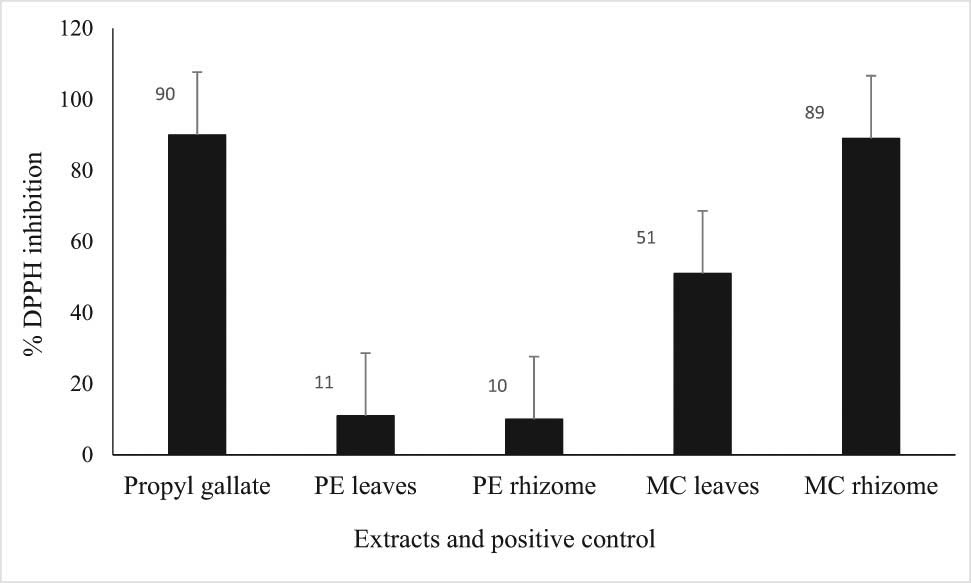
Inhibition percentage against DPPH free radical of MC and PE extracts of C. longa rhizome and leaves and standard propyl gallate at 1 mg/mL.
IC50 values of in vitro antioxidant and anti-protein denaturation activities of C. longa rhizome and leaves extracts
| Extract | Inhibition of DPPH activity IC50 ± SD μg/mL | Inhibition of protein denaturation IC50 ± SD μg/mL |
|---|---|---|
| MC rhizome | 92.15 ± 0.02b | 106.21 ± 0.53b |
| MC leaves | 436.21 ± 0.30c | 108.06 ± 4.67b |
| PE rhizome | NA | 212.52 ± 2.22c |
| PE leaves | NA | 246.42 ± 3.83d |
| Positive control* | 77.02 ± 0.01a | 53.18 ± 0.29a |
*Propyl gallate (as anti-DPPH standard) and diclofenac sodium (as anti-protein denaturation reference drug); Mean values followed by a common letter are not significantly different by the Duncan-test at the 95% level of significance, lower value of IC50 means higher activity. NA; not active.
3.3 In vitro protein denaturation inhibition
In vitro anti-inflammatory activity of rhizome and leaf extracts of C. longa and Diclofenac Sodium (reference drug) was evaluated using protein denaturation assay. The results are shown in Table 2. MC extracts of both the rhizome and leaves showed good inhibitory effect against protein denaturation with IC50 values of 106.21 ± 0.53 and 108.06 ± 4.67 μg/mL, respectively, (P > 0.5) compared to that recorded by reference drug (IC50 value of 53.18 ± 0.29 μg/mL). PE rhizome and leaves extracts revealed weak protein denaturation inhibitory effect with IC50 values of 212.52 ± 2.22 and 246.42 ± 3.83 μg/mL, respectively.
3.4 GC/MS analysis of C. longa rhizome and leaves oils
PE extracts of both rhizome and leaves showed a lack in their polyphenol content by total phenol determination test. So it raised our attention to determine the main bioactive components responsible of their evaluated activities.
GC/MS profiles of rhizome and leaves oil were determined, and their results are presented in Table 3. GC/MS chromatogram of C. longa rhizome oil revealed the presence of 45 identified components comprising 99.54% of the total oil. The oil was dominated by the presence of oxygenated sesquiterpene (56.76%) followed by alcohols (13.16%), amides (12.3%), sesquiterpenes (10.86%), and oxygenated monoterpenes (2.29%). α-tumerone was the major component found in highest concentration (32.44%), followed by curlone (13.76%), 2-amino-3-phenyl propanamide (12.3%), 3-(1-methyl-2-phenylethoxy)-2-butanol (10.65%), tumerone (7.09%), α-Curcumene (4.09%), and β-curcumene (1.43%).
GC/MS profile of Curcuma longa rhizome and leaves oils
| No. | RT | Compound name | Area (%) | |
|---|---|---|---|---|
| Rhizome | Leaves | |||
| 1 | 3.359 | Hexanoic acid | 0.37 | |
| 2 | 3.615 | Neoheptanol | 0.9 | |
| 3 | 4.650 | 2-Ethylhexanol | 2.2 | |
| 4 | 4.76 | Eucalyptol | 0.09 | 1.47 |
| 5 | 6.326 | 3-Oxabicyclo[4.3.0]non-8-en-2-one,cis- | 1.47 | |
| 6 | 6.905 | α-Phellandrene | 7.29 | |
| 7 | 6.989 | L-α-Terpineol | 1.28 | |
| 8 | 8.12 | O-Cymene | 0.02 | |
| 9 | 9.55 | 4-Methy-4-pheny-2-pentanone | 0.48 | |
| 10 | 9.84 | Zingiberene | 0.05 | |
| 11 | 9.89 | P-Toluene,N-methyl-N-nitroso- | 0.18 | |
| 12 | 10.15 | Caryophyllene | 0. 10 | |
| 13 | 10.26 | α-Bergamotene | 0.03 | |
| 14 | 10.43 | p-Cymene | 0.38 | |
| 15 | 10.45 | β–Farnesene | 0.99 | |
| 16 | 10.62 | d-Guaiene | 0.03 | |
| 17 | 10.70 | Acoradiene | 0.06 | |
| 18 | 10.84 | α-Curcumene | 4.09 | |
| 19 | 10.99 | β-Curcumene | 1.43 | |
| 20 | 11.16 | β-Bisabolene | 0.61 | |
| 21 | 11.27 | Dodecanoic acid | 0.85 | |
| 22 | 11.36 | β-Sesquiphellandrene | 2.8 | |
| 23 | 11.42 | α-Bergamotenol | 0.05 | |
| 24 | 11.46 | α-Bisabolene | 0.09 | |
| 25 | 11.73 | cis-Sesquisabinene hydrate | 0.19 | |
| 26 | 11.78 | Caryophyllene oxide | 0.15 | |
| 27 | 11.80 | Nerolidol | 0.59 | |
| 28 | 11.85 | 2,5,9-Trimethylcycloundeca-4,8-dienone | 0.11 | |
| 29 | 12.04 | p-Menthane,2,3-dibromo-8-phenyl- | 0.8 | |
| 30 | 12.17 | cis-Myrtanol | 0.19 | |
| 31 | 12.21 | 1,4-Cadinadiene | 0.46 | |
| 32 | 12.35 | 1-(3-Cyclopentylpropyl)-2,4-dimethylbenzene | 1.11 | |
| 33 | 12.44 | α-Bisabolol | 0.56 | |
| 34 | 12.59 | 10-(Tetrahydro-pyran-2-yloxy)-tricyclo[4.2.1.1(2,5)]dec-7-en-9-one | 0.6 | |
| 35 | 12.70 | α-Bergamotol | 0.66 | |
| 36 | 12.74 | 4,2,8-Ethanylylidene-2H-1-benzopyron,octahydro-2-methyl- | 0.34 | |
| 37 | 12.89 | Isolongifolol | 0.41 | |
| 38 | 13.06 | α-Tumerone | 32.44 | |
| 39 | 13.10 | Tumerone | 7.09 | |
| 40 | 13.33 | Bicyclo[3.3.1]non-2-en-9-ol,syn- | 0.38 | |
| 41 | 13.47 | Curlone | 13.67 | |
| 42 | 13.58 | Myristic acid | 1.76 | |
| 43 | 13.62 | cis-Nuciferol | 0.6 | |
| 44 | 13.89 | Di(decahydro-1-naphthyl)methane | 0.48 | |
| 45 | 13.96 | Cyclopentanecarboxylic acid,3-isopropylidene-bornyl ester | 0.94 | |
| 46 | 14.17 | 3-(1-Methyl-2-phenylethoxy)-2-butanol | 10.65 | |
| 47 | 14.27 | Spiro[bicyclo[3.3.0]octan-6-one-3-cyclopropane] | 1.53 | |
| 48 | 14.53 | 2-Amino-3-phenylpropanamide | 12.3 | |
| 49 | 14.68 | 2-Decylfuran | 4.8 | |
| 50 | 14.87 | 6,10,14-Trimethylpentadecan-2-one | 1.93 | |
| 51 | 14.96 | Octadecenal | 2.6 | |
| 52 | 15.67 | Palmitic acid | 28.33 | |
| 53 | 15.67 | Hexadecanoic acid | 0.3 | |
| 54 | 16.53 | FW 306 4,8,13-Cyclotetradecatriene-1,3-diol, 1,5,9-trimethyl-12-(1-methylethyl)- | 1.69 | |
| 55 | 17.32 | Linoleic acid | 0.28 | 5.06 |
| 56 | 17.37 | Octadecenoic acid | 9.62 | |
| 57 | 17.37 | Oleic acid | 0.13 | |
| 58 | 17.40 | Linolenic acid | 0.07 | |
| 59 | 17.50 | Trans-phytol | 8.36 | |
| 60 | 17.58 | Stearic acid | 0.1 | 7.39 |
| 61 | 19.35 | Arachidic acid | 0.04 | 1.28 |
| 62 | 19.65 | Δ-Octadecalactone | 0.94 | |
| 63 | 20.26 | Antioxidant 2246 | 2.29 | |
| 64 | 20.97 | Docosanoic acid | 1.95 | |
| 65 | 23.21 | Squalene | 7.18 | |
| Total | 99.54 | 99.99 | ||
The percent of each compound were expressed as percent peak area relative to the total peak area of the GC chromatogram.
Twenty-four components were characterized from the leaf oil. The oil was dominated by a high percentage of fatty acids (57.55%) followed by alcohol (16.26%), oxygenated monoterpenes (10.04%), and triterpenoids (7.18%). Palmitic acid (28.33%) was the prominent component in leaves oil, followed by octadecenoic acid (9.62%), trans-phytol (8.36%), stearic acid (7.39%), α-phellandrene (7.29%), squalene (7.18%), linoleic acid (5.06%) and other components were found in small concentrations (Figures 2 and 3).
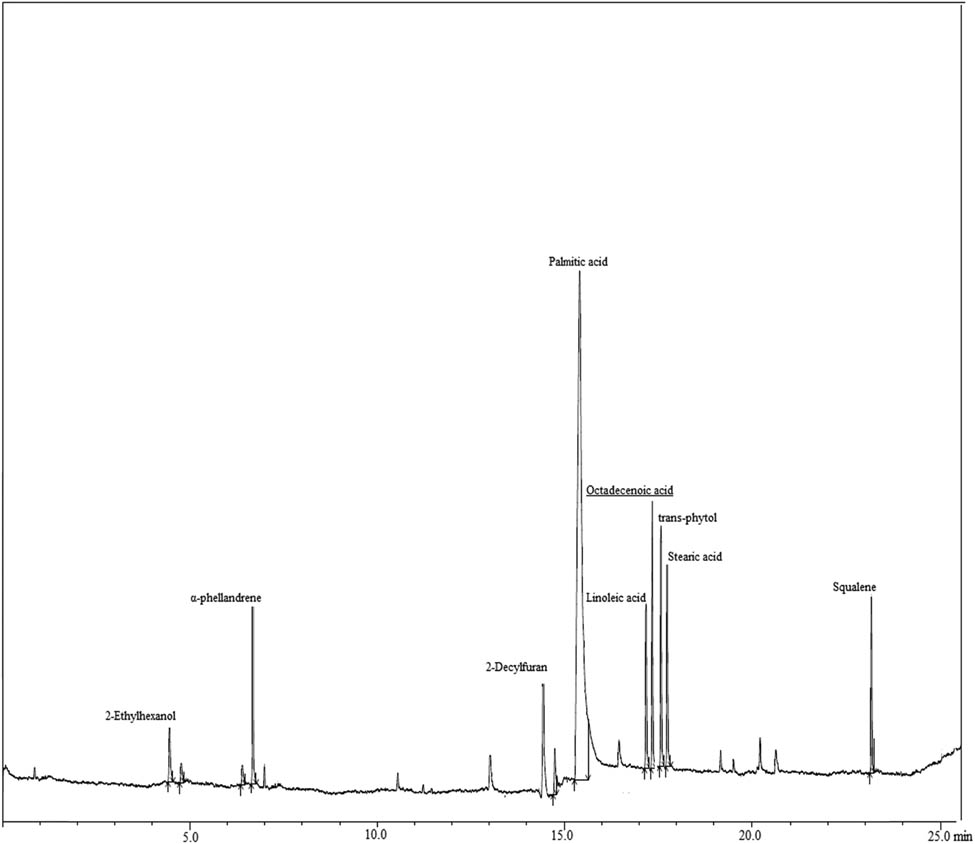
GC-MS profile for PE extract of Curcuma longa leaves.
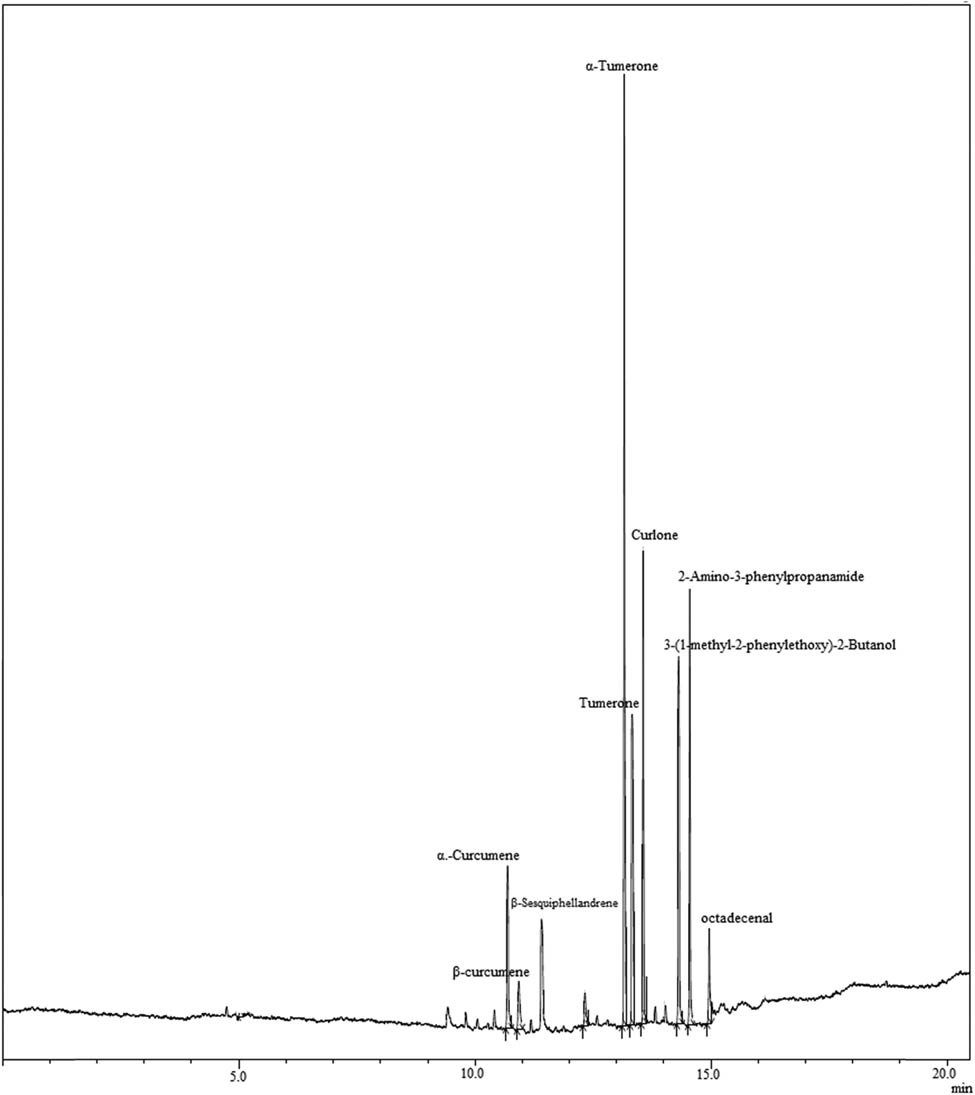
GC-MS profile for PE extract of Curcuma longa rhizome.
4 Discussion
Natural products especially those derived from plants represent the safest, effective, and alternative source for chemical drugs. With the high demand for plant products, scientists’ interest tends to detect these products in each part of the plant rather than the main part used. In the current study, the chemical profile, in vitro antiradical scavenging activity, and anti-protein denaturation effect of PE and MC extracts of C. longa leaves and rhizomes were investigated.
The result of the chemical analysis showed that the highest TPC (51.46 ± 0.46 mg GAE/g) was determined in MC rhizome extract. This TPC is higher by 6.9-fold than what was reported in the ethanolic extract 80% of C. longa rhizome (7.45 mg GAE/g) [23], and by 75-fold than what was detected in the juice extract (0.68 mg GAE/g) of C. longa rhizome [24]. In contrast, Choi [25] results showed higher values of TPC, 228.7 ± 2.3 mg GAE/g in ethyl acetate and 140.7 ± 10.6 mg GAE/g in chloroform extracts of C. longa rhizome from Korea. Also, C. longa leaves in the present work had good levels (31.20 ± 0.53 mg GAE/g) of TPC in their MC extract, which was 2-fold more than that measured in C. longa leaves from Malaysia 15.33 mg GAE/g [11], and higher by 7.57-fold than that determined in fresh C. longa leaves from Brazil 4.12 ± 5.72 mg GAE/g [10]. These differences in TPC may be due to the difference in the environmental conditions and cultivation from one country to other. These differences were detected and reported earlier in TPC of strawberry and potato peel cultivated in different European regions [26].
GC/MS analysis of the oil of rhizome revealed that the oil was characterized with high percent (56.76%) of oxygenated sesquiterpene and α-tumerone represented 32.44% of the total oil. Previously α-tumerone was reported as the major compound of rhizome oil found in higher levels 44.1% [16], 35.9% [18], or in lower levels, 21.4% [15], 12.9% [17], and 8.52% [27] compared to that obtained in our study. GC/MS chromatogram of the leaves oil showed the absence of the main constituents detected in rhizome oil, instead, leaves oil was rich in fatty acids (57.55%), especially unsaturated fatty acids, palmitic acid represented 28.33% of the total leaves oil content. Also, α-phellandrene, which was previously described as a prominent component of the oil of C. longa leaves was found in a comparable amount (7.28%) to that recorded earlier as 2.8% [15], 9.1% [17], and 41.99% [19] of C. longa leaves essential oil.
Regarding antioxidant activity results, a strong DPPH scavenging activity (IC50 = 92 ± 0.02 µg/mL) was evaluated in MC extract of the rhizome. This result was significantly higher than that reported recently through the evaluation of the antioxidant activity of four Curcuma species from Thailand and their isolated components [28]. They revealed that C. longa crude extract had an anti-DPPH activity with IC50 = 134.9 ± 1.5 µg/mL. Moreover, curcumin, the main pigment in C. longa, was evaluated in their study which had the strongest antioxidant activity with IC50 = 68.9 ± 0.6 µg/mL compared to the other constituents estimated. However, it was much lower in activity in comparison to the ethanolic extract activity of C. longa rhizome with IC50 value of 27.2 ± 1.1 μg/mL [29].
MC extract of leaves displayed moderate antioxidant activity with a DPPH inhibition percentage of 51.7%. This result is comparable to that reported in aqueous extract of C. longa leaves from Korea with an inhibition percentage of 51.10% against DPPH activity [30].
The in vitro anti-inflammatory activity results showed that MC extracts of both rhizome and leaves recorded potent in vitro anti-inflammatory activity by suppressing albumin denaturation with IC50 = 106.21 ± 0.53 and IC50 = 108.06 ± 4.67 μg/mg (P > 0.5), respectively.
Protein denaturation is a process that happens when proteins lose their structure and biological function due to inflammation and could be induced in vitro by factors such as heat, stress, or some chemical compounds. Therefore, the denaturation of tissue proteins is recognized as a marker of inflammation [31]. It is worthwhile that searching for natural agents can prevent protein denaturation to develop a new anti-inflammatory drug. C. longa anti-inflammatory activity is well-documented. Many studies have been proven the potent anti-inflammatory properties of C. longa rhizome and its main constituent curcumin [28,32,33,34]. Also, the anti-inflammatory activity of C. longa leaves is recently reported, as the inhibitory effect of their essential oil on skin inflammation [13]. Many studies ascribed the pharmacological activities of C. longa to its polyphenol molecule contents, especially curcumin as a primary polyphenol [35]. In our study, high positive correlations were observed between anti-DPPH and TPC (r = 0.99), but also between TPC and anti-protein denaturation activity (r = 0.86). This indicated that C. longa phenolic molecules are the main contributor to antioxidant and anti-inflammatory activity in this plant.
5 Conclusion
Based on the findings obtained from this work, C. longa could be suggested as a promising source of natural antioxidants and anti-inflammatory, as indicated by its strong antiradical scavenging activity of rhizome MC extract, potent anti-protein denaturation activity of MC rhizome and leaves extracts, and by its high content of polyphenols especially via MC extraction. Also GC/MS analysis showed considerable contents of the major components in the rhizome and leaf oils compared to that cultivated in other countries.
Acknowledgment
The authors extend their appreciation to the Deanship of Scientific Research at King Saud University for funding this work through the research group Project no. RG-1441-472.
-
Funding information: This study was funded by the research group Project no. RG-1441-472.
-
Author contributions: Conceptualization, N.K.M.A. and A.M.A.A.; methodology, A.Z.G. and A.A.Q.; software, N.K.M.A.; validation, B.A., A.A.Q., and E.M.A.; formal analysis, E.M.A. and A.Z.G.; investigation, A.Z.G. and M.S.H.; resources, N.K.M.A., A.M.A.A., and A.A.; data curation, A.M.A.A.; writing original draft preparation, N.K.M.A. and A.M.A.A.; writing, review and editing, A.Z.G.; visualization, A.A.; supervision, M.S.H. and A.A.; project administration, A.A.Q. and B.A.; funding acquisition, A.Z.G.
-
Conflict of interest: The authors declare that they have no conflict of interest.
-
Ethical approval: The conducted research is not related to either human or animal use.
-
Data availability statement: The authors confirm that the data supporting the findings of this study are available within the article.
References
[1] Margină D, Olaru OT, Ilie M, Grădinaru D, GuȚu C, Voicu S, et al. Assessment of the potential health benefits of certain total extracts from Vitis vinifera, Aesculus hyppocastanum and Curcuma longa. Exp Therap Med. 2015;10(5):1681–8.10.3892/etm.2015.2724Search in Google Scholar PubMed PubMed Central
[2] Kocaadam B, Sanlier N. Curcumin, an active component of turmeric (Curcuma longa), and its effects on health. Crit Rev Food Sci Nutr. 2017;57(13):2889–95.10.1080/10408398.2015.1077195Search in Google Scholar PubMed
[3] Akter J, Hossain MA, Takara K, Islam MZ, Hou D-X. Antioxidant activity of different species and varieties of turmeric (Curcuma spp): isolation of active compounds. Comp Biochem Physiol Part C: Toxicol Pharmacol. 2019;215:9–17.10.1016/j.cbpc.2018.09.002Search in Google Scholar PubMed
[4] Zorofchian Moghadamtousi S, Abdul Kadir H, Hassandarvish P, Tajik H, Abubakar S, Zandi K. A review on antibacterial, antiviral, and antifungal activity of curcumin. BioMed Res Int. 2014;2014:186864.10.1155/2014/186864Search in Google Scholar PubMed PubMed Central
[5] Shehzad A, Rehman G, Lee YS. Curcumin in inflammatory diseases. Biofactors. 2013;39(1):69–77.10.1002/biof.1066Search in Google Scholar PubMed
[6] He Y, Yue Y, Zheng X, Zhang K, Chen S, Du Z. Curcumin, inflammation, and chronic diseases: how are they linked? Molecules. 2015;20(5):9183–213.10.3390/molecules20059183Search in Google Scholar PubMed PubMed Central
[7] Allegra A, Innao V, Russo S, Gerace D, Alonci A, Musolino C. Anticancer activity of curcumin and its analogues: preclinical and clinical studies. Cancer Investigation. 2017;35(1):1–22.10.1080/07357907.2016.1247166Search in Google Scholar PubMed
[8] Zhu JY, Yang X, Chen Y, Jiang Y, Wang SJ, Li Y, et al. Curcumin suppresses lung cancer stem cells via inhibiting wnt/β-catenin and sonic hedgehog pathways. Phytother Res. 2017;31(4):680–8.10.1002/ptr.5791Search in Google Scholar PubMed
[9] Maghimaa M, Alharbi SA. Green synthesis of silver nanoparticles from Curcuma longa L. and coating on the cotton fabrics for antimicrobial applications and wound healing activity. J Photochem Photobiol B: Biol. 2020;204:111806.10.1016/j.jphotobiol.2020.111806Search in Google Scholar PubMed
[10] Braga MC, Vieira ECS, de Oliveira TF. Curcuma longa L. leaves: characterization (bioactive and antinutritional compounds) for use in human food in Brazil. Food Chem. 2018;265:308–15.10.1016/j.foodchem.2018.05.096Search in Google Scholar PubMed
[11] Chan EWC, Lim YY, Wong LF, Lianto FS, Wong SK, Lim KK, et al. Antioxidant and tyrosinase inhibition properties of leaves and rhizomes of ginger species. Food Chem. 2008;109(3):477–83.10.1016/j.foodchem.2008.02.016Search in Google Scholar
[12] Priya R, Prathapan A, Raghu KG, Menon AN. Chemical composition and in vitro antioxidative potential of essential oil isolated from Curcuma longa L. leaves. Asian Pac J Trop Biomed. 2012;2(2, Supplement):S695–9.10.1016/S2221-1691(12)60298-6Search in Google Scholar
[13] Kumar A, Agarwal K, Singh M, Saxena A, Yadav P, Maurya AK, et al. Essential oil from waste leaves of Curcuma longa L. alleviates skin inflammation. Inflammopharmacology. 2018;26(5):1245–55.10.1007/s10787-018-0447-3Search in Google Scholar PubMed
[14] Essien EE, Newby JS, Walker TM, Setzer WN, Ekundayo O. Chemotaxonomic characterization and in-vitro antimicrobial and cytotoxic activities of the leaf essential oil of Curcuma longa Grown in Southern Nigeria. Med (Basel). 2015;2(4):340–9.10.3390/medicines2040340Search in Google Scholar PubMed PubMed Central
[15] Chane-Ming J, Vera R, Chalchat J-C, Cabassu P. Chemical composition of essential oils from rhizomes, leaves and flowers of Curcuma longa L. from Reunion island. J Essent Oil Res. 2002;14(4):249–51.10.1080/10412905.2002.9699843Search in Google Scholar
[16] Raina VK, Srivastava SK, Syamsundar KV. Rhizome and leaf oil composition of Curcuma longa from the lower himalayan region of Northern India. J Essent Oil Res. 2005;17(5):556–9.10.1080/10412905.2005.9698993Search in Google Scholar
[17] Awasthi P, Dixit S. Chemical composition of Curcuma Longa leaves and rhizome oil from the plains of Northern India. J Young Pharm. 2009;1(4):322–6.10.4103/0975-1483.59319Search in Google Scholar
[18] Oyemitan IA, Elusiyan CA, Onifade AO, Akanmu MA, Oyedeji AO, McDonald AG. Neuropharmacological profile and chemical analysis of fresh rhizome essential oil of Curcuma longa (turmeric) cultivated in Southwest Nigeria. Toxicol Rep. 2017;4:391–8.10.1016/j.toxrep.2017.07.001Search in Google Scholar PubMed PubMed Central
[19] Chaaban A, Richardi VS, Carrer AR, Brum JS, Cipriano RR, Martins CEN, et al. Insecticide activity of Curcuma longa (leaves) essential oil and its major compound α-phellandrene against Lucilia cuprina larvae (Diptera: Calliphoridae): histological and ultrastructural biomarkers assessment. Pesticide Biochem Physiol. 2019;153:17–27.10.1016/j.pestbp.2018.10.002Search in Google Scholar PubMed
[20] Wolfe K, Wu X, Liu RH. Antioxidant activity of apple peels. J Agric Food Chem. 2003;51(3):609–14.10.1021/jf020782aSearch in Google Scholar PubMed
[21] Mensor LL, Menezes FS, Leitão GG, Reis AS, Santos TCd, Coube CS, et al. Screening of Brazilian plant extracts for antioxidant activity by the use of DPPH free radical method. Phytotherap Res. 2001;15(2):127–30.10.1002/ptr.687Search in Google Scholar PubMed
[22] Shallangwa GA, Jibrin GP, Haliru M, Hamidu AA, Dallatu YA, Abba H, et al. In vitro evaluation of Aloe vera and Camellia sinensis aqueous extracts effect on protein denaturation during acute inflammation. Biointerface Res Appl Chem. 2013;3:3.10.1080/22311866.2013.866340Search in Google Scholar
[23] Nisar T, Iqbal M, Raza A, Safdar M, Iftikhar F, Waheed M. Estimation of total phenolics and free radical scavenging of turmeric (Curcuma longa). Am-Eur J Agric Environ Sci. 2015;15(5):1272–7.Search in Google Scholar
[24] Maizura M, Aminah A, Wan Aida W. Total phenolic content and antioxidant activity of kesum (Polygonum minus), ginger (Zingiber officinale) and turmeric (Curcuma longa) extract. Int Food Res J. 2011;18(2):529–34.Search in Google Scholar
[25] Choi H-Y. Antioxidant Activity-of Curcuma longa L., novel foodstuff. Mol Cell Toxicol. 2009;5(3):237–42.Search in Google Scholar
[26] Kahkonen MP, Hopia AI, Vuorela HJ, Rauha JP, Pihlaja K, Kujala TS, et al. Antioxidant activity of plant extracts containing phenolic compounds. J Agric Food Chem. 1999;47(10):3954–62.10.1021/jf990146lSearch in Google Scholar PubMed
[27] Chen Z, Quan L, Zhou H, Zhao Y, Chen P, Hu L, et al. Screening of active fractions from Curcuma longa radix isolated by HPLC and GC-MS for promotion of blood circulation and relief of pain. J Ethnopharmacol. 2019;234:68–75.10.1016/j.jep.2018.09.035Search in Google Scholar PubMed
[28] Pintatum A, Maneerat W, Logie E, Tuenter E, Sakavitsi ME, Pieters L, et al. In vitro anti-inflammatory, anti-oxidant, and cytotoxic activities of four curcuma species and the isolation of compounds from Curcuma aromatica rhizome. Biomolecules. 2020;10(5):799.10.3390/biom10050799Search in Google Scholar PubMed PubMed Central
[29] Sabir S, Zeb A, Mahmood M, Abbas S, Ahmad Z, Iqbal N. Phytochemical analysis and biological activities of ethanolic extract of Curcuma longa rhizome. Braz J Biol. 2020;81:737–40.10.1590/1519-6984.230628Search in Google Scholar PubMed
[30] Kim S, Ko S-C, Kim Y-S, Ha S-K, Park H-Y, Park Y, et al. Determination of Curcuma longa L. (Turmeric) leaf extraction conditions using response surface methodology to optimize extraction yield and antioxidant content. J Food Qual. 2019;2019:7575206.10.1155/2019/7575206Search in Google Scholar
[31] Ruiz-Ruiz JC, Matus-Basto AJ, Acereto-Escoffié P, Segura-Campos MR. Antioxidant and anti-inflammatory activities of phenolic compounds isolated from Melipona beecheii honey. Food Agric Immunology. 2017;28(6):1424–37.10.1080/09540105.2017.1347148Search in Google Scholar
[32] Araújo C, Leon L. Biological activities of Curcuma longa L. Memórias do Inst Oswaldo Cruz. 2001;96(5):723–8.10.1590/S0074-02762001000500026Search in Google Scholar PubMed
[33] Srivastava S, Saksena AK, Khattri S, Kumar S, Dagur RS. Curcuma longa extract reduces inflammatory and oxidative stress biomarkers in osteoarthritis of knee: a four-month, double-blind, randomized, placebo-controlled trial. Inflammopharmacology. 2016;24(6):377–88.10.1007/s10787-016-0289-9Search in Google Scholar PubMed
[34] Lee S-Y, Cho S-S, Li Y, Bae C-S, Park KM, Park D-H. Anti-inflammatory effect of Curcuma longa and allium hookeri Co-treatment via NF-κB and COX-2 Pathways. Sci Rep. 2020;10(1):5718.10.1038/s41598-020-62749-7Search in Google Scholar PubMed PubMed Central
[35] Ross SM. Turmeric (Curcuma longa): effects of Curcuma longa extracts compared with ibuprofen for reduction of pain and functional improvement in patients with knee osteoarthritis. Holist Nurs Pract. 2016;30(3):183–6.10.1097/HNP.0000000000000152Search in Google Scholar PubMed
© 2021 Najah Khalifah Mansour Altir et al., published by De Gruyter
This work is licensed under the Creative Commons Attribution 4.0 International License.
Articles in the same Issue
- Regular Articles
- Qualitative and semi-quantitative assessment of anthocyanins in Tibetan hulless barley from different geographical locations by UPLC-QTOF-MS and their antioxidant capacities
- Effect of sodium chloride on the expression of genes involved in the salt tolerance of Bacillus sp. strain “SX4” isolated from salinized greenhouse soil
- GC-MS analysis of mango stem bark extracts (Mangifera indica L.), Haden variety. Possible contribution of volatile compounds to its health effects
- Influence of nanoscale-modified apatite-type calcium phosphates on the biofilm formation by pathogenic microorganisms
- Removal of paracetamol from aqueous solution by containment composites
- Investigating a human pesticide intoxication incident: The importance of robust analytical approaches
- Induction of apoptosis and cell cycle arrest by chloroform fraction of Juniperus phoenicea and chemical constituents analysis
- Recovery of γ-Fe2O3 from copper ore tailings by magnetization roasting and magnetic separation
- Effects of different extraction methods on antioxidant properties of blueberry anthocyanins
- Modeling the removal of methylene blue dye using a graphene oxide/TiO2/SiO2 nanocomposite under sunlight irradiation by intelligent system
- Antimicrobial and antioxidant activities of Cinnamomum cassia essential oil and its application in food preservation
- Full spectrum and genetic algorithm-selected spectrum-based chemometric methods for simultaneous determination of azilsartan medoxomil, chlorthalidone, and azilsartan: Development, validation, and application on commercial dosage form
- Evaluation of the performance of immunoblot and immunodot techniques used to identify autoantibodies in patients with autoimmune diseases
- Computational studies by molecular docking of some antiviral drugs with COVID-19 receptors are an approach to medication for COVID-19
- Synthesis of amides and esters containing furan rings under microwave-assisted conditions
- Simultaneous removal efficiency of H2S and CO2 by high-gravity rotating packed bed: Experiments and simulation
- Design, synthesis, and biological activities of novel thiophene, pyrimidine, pyrazole, pyridine, coumarin and isoxazole: Dydrogesterone derivatives as antitumor agents
- Content and composition analysis of polysaccharides from Blaps rynchopetera and its macrophage phagocytic activity
- A new series of 2,4-thiazolidinediones endowed with potent aldose reductase inhibitory activity
- Assessing encapsulation of curcumin in cocoliposome: In vitro study
- Rare norisodinosterol derivatives from Xenia umbellata: Isolation and anti-proliferative activity
- Comparative study of antioxidant and anticancer activities and HPTLC quantification of rutin in white radish (Raphanus sativus L.) leaves and root extracts grown in Saudi Arabia
- Comparison of adsorption properties of commercial silica and rice husk ash (RHA) silica: A study by NIR spectroscopy
- Sodium borohydride (NaBH4) as a high-capacity material for next-generation sodium-ion capacitors
- Aroma components of tobacco powder from different producing areas based on gas chromatography ion mobility spectrometry
- The effects of salinity on changes in characteristics of soils collected in a saline region of the Mekong Delta, Vietnam
- Synthesis, properties, and activity of MoVTeNbO catalysts modified by zirconia-pillared clays in oxidative dehydrogenation of ethane
- Synthesis and crystal structure of N,N′-bis(4-chlorophenyl)thiourea N,N-dimethylformamide
- Quantitative analysis of volatile compounds of four Chinese traditional liquors by SPME-GC-MS and determination of total phenolic contents and antioxidant activities
- A novel separation method of the valuable components for activated clay production wastewater
- On ve-degree- and ev-degree-based topological properties of crystallographic structure of cuprite Cu2O
- Antihyperglycemic effect and phytochemical investigation of Rubia cordifolia (Indian Madder) leaves extract
- Microsphere molecularly imprinted solid-phase extraction for diazepam analysis using itaconic acid as a monomer in propanol
- A nitric oxide-releasing prodrug promotes apoptosis in human renal carcinoma cells: Involvement of reactive oxygen species
- Machine vision-based driving and feedback scheme for digital microfluidics system
- Study on the application of a steam-foam drive profile modification technology for heavy oil reservoir development
- Ni–Ru-containing mixed oxide-based composites as precursors for ethanol steam reforming catalysts: Effect of the synthesis methods on the structural and catalytic properties
- Preparation of composite soybean straw-based materials by LDHs modifying as a solid sorbent for removal of Pb(ii) from water samples
- Synthesis and spectral characterizations of vanadyl(ii) and chromium(iii) mixed ligand complexes containing metformin drug and glycine amino acid
- In vitro evaluation of lactic acid bacteria with probiotic activity isolated from local pickled leaf mustard from Wuwei in Anhui as substitutes for chemical synthetic additives
- Utilization and simulation of innovative new binuclear Co(ii), Ni(ii), Cu(ii), and Zn(ii) diimine Schiff base complexes in sterilization and coronavirus resistance (Covid-19)
- Phosphorylation of Pit-1 by cyclin-dependent kinase 5 at serine 126 is associated with cell proliferation and poor prognosis in prolactinomas
- Molecularly imprinted membrane for transport of urea, creatinine, and vitamin B12 as a hemodialysis candidate membrane
- Optimization of Murrayafoline A ethanol extraction process from the roots of Glycosmis stenocarpa, and evaluation of its Tumorigenesis inhibition activity on Hep-G2 cells
- Highly sensitive determination of α-lipoic acid in pharmaceuticals on a boron-doped diamond electrode
- Synthesis, chemo-informatics, and anticancer evaluation of fluorophenyl-isoxazole derivatives
- In vitro and in vivo investigation of polypharmacology of propolis extract as anticancer, antibacterial, anti-inflammatory, and chemical properties
- Topological indices of bipolar fuzzy incidence graph
- Preparation of Fe3O4@SiO2–ZnO catalyst and its catalytic synthesis of rosin glycol ester
- Construction of a new luminescent Cd(ii) compound for the detection of Fe3+ and treatment of Hepatitis B
- Investigation of bovine serum albumin aggregation upon exposure to silver(i) and copper(ii) metal ions using Zetasizer
- Discoloration of methylene blue at neutral pH by heterogeneous photo-Fenton-like reactions using crystalline and amorphous iron oxides
- Optimized extraction of polyphenols from leaves of Rosemary (Rosmarinus officinalis L.) grown in Lam Dong province, Vietnam, and evaluation of their antioxidant capacity
- Synthesis of novel thiourea-/urea-benzimidazole derivatives as anticancer agents
- Potency and selectivity indices of Myristica fragrans Houtt. mace chloroform extract against non-clinical and clinical human pathogens
- Simple modifications of nicotinic, isonicotinic, and 2,6-dichloroisonicotinic acids toward new weapons against plant diseases
- Synthesis, optical and structural characterisation of ZnS nanoparticles derived from Zn(ii) dithiocarbamate complexes
- Presence of short and cyclic peptides in Acacia and Ziziphus honeys may potentiate their medicinal values
- The role of vitamin D deficiency and elevated inflammatory biomarkers as risk factors for the progression of diabetic nephropathy in patients with type 2 diabetes mellitus
- Quantitative structure–activity relationship study on prolonged anticonvulsant activity of terpene derivatives in pentylenetetrazole test
- GADD45B induced the enhancing of cell viability and proliferation in radiotherapy and increased the radioresistance of HONE1 cells
- Cannabis sativa L. chemical compositions as potential plasmodium falciparum dihydrofolate reductase-thymidinesynthase enzyme inhibitors: An in silico study for drug development
- Dynamics of λ-cyhalothrin disappearance and expression of selected P450 genes in bees depending on the ambient temperature
- Identification of synthetic cannabinoid methyl 2-{[1-(cyclohexylmethyl)-1H-indol-3-yl] formamido}-3-methylbutanoate using modern mass spectrometry and nuclear magnetic resonance techniques
- Study on the speciation of arsenic in the genuine medicinal material honeysuckle
- Two Cu(ii)-based coordination polymers: Crystal structures and treatment activity on periodontitis
- Conversion of furfuryl alcohol to ethyl levulinate in the presence of mesoporous aluminosilicate catalyst
- Review Articles
- Hsien Wu and his major contributions to the chemical era of immunology
- Overview of the major classes of new psychoactive substances, psychoactive effects, analytical determination and conformational analysis of selected illegal drugs
- An overview of persistent organic pollutants along the coastal environment of Kuwait
- Mechanism underlying sevoflurane-induced protection in cerebral ischemia–reperfusion injury
- COVID-19 and SARS-CoV-2: Everything we know so far – A comprehensive review
- Challenge of diabetes mellitus and researchers’ contributions to its control
- Advances in the design and application of transition metal oxide-based supercapacitors
- Color and composition of beauty products formulated with lemongrass essential oil: Cosmetics formulation with lemongrass essential oil
- The structural chemistry of zinc(ii) and nickel(ii) dithiocarbamate complexes
- Bioprospecting for antituberculosis natural products – A review
- Recent progress in direct urea fuel cell
- Rapid Communications
- A comparative morphological study of titanium dioxide surface layer dental implants
- Changes in the antioxidative properties of honeys during their fermentation
- Erratum
- Erratum to “Corrosion study of copper in aqueous sulfuric acid solution in the presence of (2E,5E)-2,5-dibenzylidenecyclopentanone and (2E,5E)-bis[(4-dimethylamino)benzylidene]cyclopentanone: Experimental and theoretical study”
- Erratum to “Modified TDAE petroleum plasticiser”
- Corrigendum
- Corrigendum to “A nitric oxide-releasing prodrug promotes apoptosis in human renal carcinoma cells: Involvement of reactive oxygen species”
- Special Issue on 3rd IC3PE 2020
- Visible light-responsive photocatalyst of SnO2/rGO prepared using Pometia pinnata leaf extract
- Antihyperglycemic activity of Centella asiatica (L.) Urb. leaf ethanol extract SNEDDS in zebrafish (Danio rerio)
- Selection of oil extraction process from Chlorella species of microalgae by using multi-criteria decision analysis technique for biodiesel production
- Special Issue on the 14th Joint Conference of Chemistry (14JCC)
- Synthesis and in vitro cytotoxicity evaluation of isatin-pyrrole derivatives against HepG2 cell line
- CO2 gas separation using mixed matrix membranes based on polyethersulfone/MIL-100(Al)
- Effect of synthesis and activation methods on the character of CoMo/ultrastable Y-zeolite catalysts
- Special Issue on Electrochemical Amplified Sensors
- Enhancement of graphene oxide through β-cyclodextrin composite to sensitive analysis of an antidepressant: Sulpiride
- Investigation of the spectroelectrochemical behavior of quercetin isolated from Zanthoxylum bungeanum
- An electrochemical sensor for high sensitive determination of lysozyme based on the aptamer competition approach
- An improved non-enzymatic electrochemical sensor amplified with CuO nanostructures for sensitive determination of uric acid
- Special Issue on Applied Biochemistry and Biotechnology 2020
- Fast discrimination of avocado oil for different extracted methods using headspace-gas chromatography-ion mobility spectroscopy with PCA based on volatile organic compounds
- Effect of alkali bases on the synthesis of ZnO quantum dots
- Quality evaluation of Cabernet Sauvignon wines in different vintages by 1H nuclear magnetic resonance-based metabolomics
- Special Issue on the Joint Science Congress of Materials and Polymers (ISCMP 2019)
- Diatomaceous Earth: Characterization, thermal modification, and application
- Electrochemical determination of atenolol and propranolol using a carbon paste sensor modified with natural ilmenite
- Special Issue on the Conference of Energy, Fuels, Environment 2020
- Assessment of the mercury contamination of landfilled and recovered foundry waste – a case study
- Primary energy consumption in selected EU Countries compared to global trends
- Modified TDAE petroleum plasticiser
- Use of glycerol waste in lactic acid bacteria metabolism for the production of lactic acid: State of the art in Poland
- Topical Issue on Applications of Mathematics in Chemistry
- Theoretical study of energy, inertia and nullity of phenylene and anthracene
- Banhatti, revan and hyper-indices of silicon carbide Si2C3-III[n,m]
- Topical Issue on Agriculture
- Occurrence of mycotoxins in selected agricultural and commercial products available in eastern Poland
- Special Issue on Ethnobotanical, Phytochemical and Biological Investigation of Medicinal Plants
- Acute and repeated dose 60-day oral toxicity assessment of chemically characterized Berberis hispanica Boiss. and Reut in Wistar rats
- Phytochemical profile, in vitro antioxidant, and anti-protein denaturation activities of Curcuma longa L. rhizome and leaves
- Antiplasmodial potential of Eucalyptus obliqua leaf methanolic extract against Plasmodium vivax: An in vitro study
- Prunus padus L. bark as a functional promoting component in functional herbal infusions – cyclooxygenase-2 inhibitory, antioxidant, and antimicrobial effects
- Molecular and docking studies of tetramethoxy hydroxyflavone compound from Artemisia absinthium against carcinogens found in cigarette smoke
- Special Issue on the Joint Science Congress of Materials and Polymers (ISCMP 2020)
- Preparation of cypress (Cupressus sempervirens L.) essential oil loaded poly(lactic acid) nanofibers
- Influence of mica mineral on flame retardancy and mechanical properties of intumescent flame retardant polypropylene composites
- Production and characterization of thermoplastic elastomer foams based on the styrene–ethylene–butylene–styrene (SEBS) rubber and thermoplastic material
- Special Issue on Applied Chemistry in Agriculture and Food Science
- Impact of essential oils on the development of pathogens of the Fusarium genus and germination parameters of selected crops
- Yield, volume, quality, and reduction of biotic stress influenced by titanium application in oilseed rape, winter wheat, and maize cultivations
- Influence of potato variety on polyphenol profile composition and glycoalcaloid contents of potato juice
- Carryover effect of direct-fed microbial supplementation and early weaning on the growth performance and carcass characteristics of growing Najdi lambs
- Special Issue on Applied Biochemistry and Biotechnology (ABB 2021)
- The electrochemical redox mechanism and antioxidant activity of polyphenolic compounds based on inlaid multi-walled carbon nanotubes-modified graphite electrode
- Study of an adsorption method for trace mercury based on Bacillus subtilis
- Special Issue on The 1st Malaysia International Conference on Nanotechnology & Catalysis (MICNC2021)
- Mitigating membrane biofouling in biofuel cell system – A review
- Mechanical properties of polymeric biomaterials: Modified ePTFE using gamma irradiation
Articles in the same Issue
- Regular Articles
- Qualitative and semi-quantitative assessment of anthocyanins in Tibetan hulless barley from different geographical locations by UPLC-QTOF-MS and their antioxidant capacities
- Effect of sodium chloride on the expression of genes involved in the salt tolerance of Bacillus sp. strain “SX4” isolated from salinized greenhouse soil
- GC-MS analysis of mango stem bark extracts (Mangifera indica L.), Haden variety. Possible contribution of volatile compounds to its health effects
- Influence of nanoscale-modified apatite-type calcium phosphates on the biofilm formation by pathogenic microorganisms
- Removal of paracetamol from aqueous solution by containment composites
- Investigating a human pesticide intoxication incident: The importance of robust analytical approaches
- Induction of apoptosis and cell cycle arrest by chloroform fraction of Juniperus phoenicea and chemical constituents analysis
- Recovery of γ-Fe2O3 from copper ore tailings by magnetization roasting and magnetic separation
- Effects of different extraction methods on antioxidant properties of blueberry anthocyanins
- Modeling the removal of methylene blue dye using a graphene oxide/TiO2/SiO2 nanocomposite under sunlight irradiation by intelligent system
- Antimicrobial and antioxidant activities of Cinnamomum cassia essential oil and its application in food preservation
- Full spectrum and genetic algorithm-selected spectrum-based chemometric methods for simultaneous determination of azilsartan medoxomil, chlorthalidone, and azilsartan: Development, validation, and application on commercial dosage form
- Evaluation of the performance of immunoblot and immunodot techniques used to identify autoantibodies in patients with autoimmune diseases
- Computational studies by molecular docking of some antiviral drugs with COVID-19 receptors are an approach to medication for COVID-19
- Synthesis of amides and esters containing furan rings under microwave-assisted conditions
- Simultaneous removal efficiency of H2S and CO2 by high-gravity rotating packed bed: Experiments and simulation
- Design, synthesis, and biological activities of novel thiophene, pyrimidine, pyrazole, pyridine, coumarin and isoxazole: Dydrogesterone derivatives as antitumor agents
- Content and composition analysis of polysaccharides from Blaps rynchopetera and its macrophage phagocytic activity
- A new series of 2,4-thiazolidinediones endowed with potent aldose reductase inhibitory activity
- Assessing encapsulation of curcumin in cocoliposome: In vitro study
- Rare norisodinosterol derivatives from Xenia umbellata: Isolation and anti-proliferative activity
- Comparative study of antioxidant and anticancer activities and HPTLC quantification of rutin in white radish (Raphanus sativus L.) leaves and root extracts grown in Saudi Arabia
- Comparison of adsorption properties of commercial silica and rice husk ash (RHA) silica: A study by NIR spectroscopy
- Sodium borohydride (NaBH4) as a high-capacity material for next-generation sodium-ion capacitors
- Aroma components of tobacco powder from different producing areas based on gas chromatography ion mobility spectrometry
- The effects of salinity on changes in characteristics of soils collected in a saline region of the Mekong Delta, Vietnam
- Synthesis, properties, and activity of MoVTeNbO catalysts modified by zirconia-pillared clays in oxidative dehydrogenation of ethane
- Synthesis and crystal structure of N,N′-bis(4-chlorophenyl)thiourea N,N-dimethylformamide
- Quantitative analysis of volatile compounds of four Chinese traditional liquors by SPME-GC-MS and determination of total phenolic contents and antioxidant activities
- A novel separation method of the valuable components for activated clay production wastewater
- On ve-degree- and ev-degree-based topological properties of crystallographic structure of cuprite Cu2O
- Antihyperglycemic effect and phytochemical investigation of Rubia cordifolia (Indian Madder) leaves extract
- Microsphere molecularly imprinted solid-phase extraction for diazepam analysis using itaconic acid as a monomer in propanol
- A nitric oxide-releasing prodrug promotes apoptosis in human renal carcinoma cells: Involvement of reactive oxygen species
- Machine vision-based driving and feedback scheme for digital microfluidics system
- Study on the application of a steam-foam drive profile modification technology for heavy oil reservoir development
- Ni–Ru-containing mixed oxide-based composites as precursors for ethanol steam reforming catalysts: Effect of the synthesis methods on the structural and catalytic properties
- Preparation of composite soybean straw-based materials by LDHs modifying as a solid sorbent for removal of Pb(ii) from water samples
- Synthesis and spectral characterizations of vanadyl(ii) and chromium(iii) mixed ligand complexes containing metformin drug and glycine amino acid
- In vitro evaluation of lactic acid bacteria with probiotic activity isolated from local pickled leaf mustard from Wuwei in Anhui as substitutes for chemical synthetic additives
- Utilization and simulation of innovative new binuclear Co(ii), Ni(ii), Cu(ii), and Zn(ii) diimine Schiff base complexes in sterilization and coronavirus resistance (Covid-19)
- Phosphorylation of Pit-1 by cyclin-dependent kinase 5 at serine 126 is associated with cell proliferation and poor prognosis in prolactinomas
- Molecularly imprinted membrane for transport of urea, creatinine, and vitamin B12 as a hemodialysis candidate membrane
- Optimization of Murrayafoline A ethanol extraction process from the roots of Glycosmis stenocarpa, and evaluation of its Tumorigenesis inhibition activity on Hep-G2 cells
- Highly sensitive determination of α-lipoic acid in pharmaceuticals on a boron-doped diamond electrode
- Synthesis, chemo-informatics, and anticancer evaluation of fluorophenyl-isoxazole derivatives
- In vitro and in vivo investigation of polypharmacology of propolis extract as anticancer, antibacterial, anti-inflammatory, and chemical properties
- Topological indices of bipolar fuzzy incidence graph
- Preparation of Fe3O4@SiO2–ZnO catalyst and its catalytic synthesis of rosin glycol ester
- Construction of a new luminescent Cd(ii) compound for the detection of Fe3+ and treatment of Hepatitis B
- Investigation of bovine serum albumin aggregation upon exposure to silver(i) and copper(ii) metal ions using Zetasizer
- Discoloration of methylene blue at neutral pH by heterogeneous photo-Fenton-like reactions using crystalline and amorphous iron oxides
- Optimized extraction of polyphenols from leaves of Rosemary (Rosmarinus officinalis L.) grown in Lam Dong province, Vietnam, and evaluation of their antioxidant capacity
- Synthesis of novel thiourea-/urea-benzimidazole derivatives as anticancer agents
- Potency and selectivity indices of Myristica fragrans Houtt. mace chloroform extract against non-clinical and clinical human pathogens
- Simple modifications of nicotinic, isonicotinic, and 2,6-dichloroisonicotinic acids toward new weapons against plant diseases
- Synthesis, optical and structural characterisation of ZnS nanoparticles derived from Zn(ii) dithiocarbamate complexes
- Presence of short and cyclic peptides in Acacia and Ziziphus honeys may potentiate their medicinal values
- The role of vitamin D deficiency and elevated inflammatory biomarkers as risk factors for the progression of diabetic nephropathy in patients with type 2 diabetes mellitus
- Quantitative structure–activity relationship study on prolonged anticonvulsant activity of terpene derivatives in pentylenetetrazole test
- GADD45B induced the enhancing of cell viability and proliferation in radiotherapy and increased the radioresistance of HONE1 cells
- Cannabis sativa L. chemical compositions as potential plasmodium falciparum dihydrofolate reductase-thymidinesynthase enzyme inhibitors: An in silico study for drug development
- Dynamics of λ-cyhalothrin disappearance and expression of selected P450 genes in bees depending on the ambient temperature
- Identification of synthetic cannabinoid methyl 2-{[1-(cyclohexylmethyl)-1H-indol-3-yl] formamido}-3-methylbutanoate using modern mass spectrometry and nuclear magnetic resonance techniques
- Study on the speciation of arsenic in the genuine medicinal material honeysuckle
- Two Cu(ii)-based coordination polymers: Crystal structures and treatment activity on periodontitis
- Conversion of furfuryl alcohol to ethyl levulinate in the presence of mesoporous aluminosilicate catalyst
- Review Articles
- Hsien Wu and his major contributions to the chemical era of immunology
- Overview of the major classes of new psychoactive substances, psychoactive effects, analytical determination and conformational analysis of selected illegal drugs
- An overview of persistent organic pollutants along the coastal environment of Kuwait
- Mechanism underlying sevoflurane-induced protection in cerebral ischemia–reperfusion injury
- COVID-19 and SARS-CoV-2: Everything we know so far – A comprehensive review
- Challenge of diabetes mellitus and researchers’ contributions to its control
- Advances in the design and application of transition metal oxide-based supercapacitors
- Color and composition of beauty products formulated with lemongrass essential oil: Cosmetics formulation with lemongrass essential oil
- The structural chemistry of zinc(ii) and nickel(ii) dithiocarbamate complexes
- Bioprospecting for antituberculosis natural products – A review
- Recent progress in direct urea fuel cell
- Rapid Communications
- A comparative morphological study of titanium dioxide surface layer dental implants
- Changes in the antioxidative properties of honeys during their fermentation
- Erratum
- Erratum to “Corrosion study of copper in aqueous sulfuric acid solution in the presence of (2E,5E)-2,5-dibenzylidenecyclopentanone and (2E,5E)-bis[(4-dimethylamino)benzylidene]cyclopentanone: Experimental and theoretical study”
- Erratum to “Modified TDAE petroleum plasticiser”
- Corrigendum
- Corrigendum to “A nitric oxide-releasing prodrug promotes apoptosis in human renal carcinoma cells: Involvement of reactive oxygen species”
- Special Issue on 3rd IC3PE 2020
- Visible light-responsive photocatalyst of SnO2/rGO prepared using Pometia pinnata leaf extract
- Antihyperglycemic activity of Centella asiatica (L.) Urb. leaf ethanol extract SNEDDS in zebrafish (Danio rerio)
- Selection of oil extraction process from Chlorella species of microalgae by using multi-criteria decision analysis technique for biodiesel production
- Special Issue on the 14th Joint Conference of Chemistry (14JCC)
- Synthesis and in vitro cytotoxicity evaluation of isatin-pyrrole derivatives against HepG2 cell line
- CO2 gas separation using mixed matrix membranes based on polyethersulfone/MIL-100(Al)
- Effect of synthesis and activation methods on the character of CoMo/ultrastable Y-zeolite catalysts
- Special Issue on Electrochemical Amplified Sensors
- Enhancement of graphene oxide through β-cyclodextrin composite to sensitive analysis of an antidepressant: Sulpiride
- Investigation of the spectroelectrochemical behavior of quercetin isolated from Zanthoxylum bungeanum
- An electrochemical sensor for high sensitive determination of lysozyme based on the aptamer competition approach
- An improved non-enzymatic electrochemical sensor amplified with CuO nanostructures for sensitive determination of uric acid
- Special Issue on Applied Biochemistry and Biotechnology 2020
- Fast discrimination of avocado oil for different extracted methods using headspace-gas chromatography-ion mobility spectroscopy with PCA based on volatile organic compounds
- Effect of alkali bases on the synthesis of ZnO quantum dots
- Quality evaluation of Cabernet Sauvignon wines in different vintages by 1H nuclear magnetic resonance-based metabolomics
- Special Issue on the Joint Science Congress of Materials and Polymers (ISCMP 2019)
- Diatomaceous Earth: Characterization, thermal modification, and application
- Electrochemical determination of atenolol and propranolol using a carbon paste sensor modified with natural ilmenite
- Special Issue on the Conference of Energy, Fuels, Environment 2020
- Assessment of the mercury contamination of landfilled and recovered foundry waste – a case study
- Primary energy consumption in selected EU Countries compared to global trends
- Modified TDAE petroleum plasticiser
- Use of glycerol waste in lactic acid bacteria metabolism for the production of lactic acid: State of the art in Poland
- Topical Issue on Applications of Mathematics in Chemistry
- Theoretical study of energy, inertia and nullity of phenylene and anthracene
- Banhatti, revan and hyper-indices of silicon carbide Si2C3-III[n,m]
- Topical Issue on Agriculture
- Occurrence of mycotoxins in selected agricultural and commercial products available in eastern Poland
- Special Issue on Ethnobotanical, Phytochemical and Biological Investigation of Medicinal Plants
- Acute and repeated dose 60-day oral toxicity assessment of chemically characterized Berberis hispanica Boiss. and Reut in Wistar rats
- Phytochemical profile, in vitro antioxidant, and anti-protein denaturation activities of Curcuma longa L. rhizome and leaves
- Antiplasmodial potential of Eucalyptus obliqua leaf methanolic extract against Plasmodium vivax: An in vitro study
- Prunus padus L. bark as a functional promoting component in functional herbal infusions – cyclooxygenase-2 inhibitory, antioxidant, and antimicrobial effects
- Molecular and docking studies of tetramethoxy hydroxyflavone compound from Artemisia absinthium against carcinogens found in cigarette smoke
- Special Issue on the Joint Science Congress of Materials and Polymers (ISCMP 2020)
- Preparation of cypress (Cupressus sempervirens L.) essential oil loaded poly(lactic acid) nanofibers
- Influence of mica mineral on flame retardancy and mechanical properties of intumescent flame retardant polypropylene composites
- Production and characterization of thermoplastic elastomer foams based on the styrene–ethylene–butylene–styrene (SEBS) rubber and thermoplastic material
- Special Issue on Applied Chemistry in Agriculture and Food Science
- Impact of essential oils on the development of pathogens of the Fusarium genus and germination parameters of selected crops
- Yield, volume, quality, and reduction of biotic stress influenced by titanium application in oilseed rape, winter wheat, and maize cultivations
- Influence of potato variety on polyphenol profile composition and glycoalcaloid contents of potato juice
- Carryover effect of direct-fed microbial supplementation and early weaning on the growth performance and carcass characteristics of growing Najdi lambs
- Special Issue on Applied Biochemistry and Biotechnology (ABB 2021)
- The electrochemical redox mechanism and antioxidant activity of polyphenolic compounds based on inlaid multi-walled carbon nanotubes-modified graphite electrode
- Study of an adsorption method for trace mercury based on Bacillus subtilis
- Special Issue on The 1st Malaysia International Conference on Nanotechnology & Catalysis (MICNC2021)
- Mitigating membrane biofouling in biofuel cell system – A review
- Mechanical properties of polymeric biomaterials: Modified ePTFE using gamma irradiation
