Mitigating membrane biofouling in biofuel cell system – A review
-
Nur Iman Syafiqah Muhammad Nasruddin


Abstract
A biofuel cell (BFC) system can transform chemical energy to electrical energy through electrochemical reactions and biochemical pathways. However, BFC faced several obstacles delaying it from commercialization, such as biofouling. Theoretically, the biofouling phenomenon occurs when microorganisms, algae, fungi, plants, or small animals accumulate on wet surfaces. In most BFC, biofouling occurs by the accumulation of microorganisms forming a biofilm. Amassed biofilm on the anode is desired for power production, however, not on the membrane separator. This phenomenon causes severities toward BFCs when it increases the electrode’s ohmic and charge transfer resistance and impedes the proton transfer, leading to a rapid decline in the system’s power performance. Apart from BFC, other activities impacted by biofouling range from the uranium industry to drug sensors in the medical field. These fields are continuously finding ways to mitigate the biofouling impact in their industries while putting forward the importance of the environment. Thus, this study aims to identify the severity of biofouling occurring on the separator materials for implementation toward the performance of the BFC system. While highlighting successful measures taken by other industries, the effectiveness of methods performed to reduce or mitigate the biofouling effect in BFC was also discussed in this study.
1 Introduction
Since decades ago, the energy crises worldwide have witnessed the decline of nonrenewable energy sources and inefficient utilization of renewable energy sources. One of the green technologies that can reduce organic pollution while simultaneously creating usable energy will be the biofuel cell (BFC). BFCs are an energy transformation technology that applies biological catalysts to a coupled redox reaction [1]. The system produced electric current by utilizing the bacteria or microorganisms, naturally consuming organic material from their ecosystem [2]. This action allows electrons to flow from anode to cathode compartment by converting chemical energy into electrical energy. In the anode compartment, power generates by electrochemical reactions from the process known as oxidation of fuels such as organic waste.
Meanwhile, at the cathode compartment, reduction of oxidant that is typically oxygen occurs [3]. BFC systems are easy to set up and do not require high temperatures to operate [4]. Active research is ongoing to improve this technology by manipulating new properties of unconventional materials at the atomic and molecular levels. This practice involves nanotubes [5], nanoparticles [6], and conductive polymers [7] for persuasive electricity generation from biological substrates through the use of various biocatalysts. The existence of nanotechnology has made it possible to achieve many important discoveries in the field of BFCs. The BFCs have the potential to be utilized as a primary and an alternate energy for stationary applications: commercial, industrial, and residential buildings, especially in remote or unreachable areas [8], and vehicles: apart from the stationary application, the BFC is also capable of propelling vehicles [9]. However, BFC faces constraints to provide sufficient energy for long-term applications and limited performance and single usability, which hinders it from commercializing green energy generation [10]. Due to the low power output, the BFCs gained interest as energy harvesters for low-powered probe sensors [11]. For instance, the BFC system can operate in human blood to power implanted medical devices, such as standard glucometer microelectronic devices, while consuming glucose and oxygen gas in human body fluids as fuel [12], apart from other various BFC devices (Table 1).
Common reported BFC systems and their general functions till 2019
| Type of BFC systems | Functions of BFC systems | References |
|---|---|---|
| Microbial fuel cell | Generating electric current and treating wastewater | [112] |
| MDC | Wastewater treatment, water desalination, and production of electrical energy | [113] |
| MEC | Generating hydrogen or methane | [114] |
| MES | Produce sustainable energy and carbon source (organic molecule) at biocathode | [115,116] |
| Biological photovoltaics | Capturing solar energy and generating electrical energy | [117] |
| Up-flow MFC | Generating power and wastewater treatment | [118] |
| Enzymatic BFC | Catalyze the conversion of chemical energy into electrical energy | [119] |
The importance of the development of BFC technology is due to its ability to generate electricity without polluting the environment while simultaneously reducing the pollution impact in wastewater [13]. BFC can also function at higher competence than a combustion engine and can change the chemical energy in fuel directly into electrical energy with an ability capable of more than 60% [14]. Microbial fuel cell (MFC) is one of the systems listed as BFC, where the system aims to generate electricity by using electrons derived from biochemical reactions using bacterial catalysts [15]. The findings show that the power generated through this system is supposed to channel sufficient energy to meet some energy demand in the urban wastewater treatment plants [16]. In addition, BFC is a safe system where the power generated is environmentally friendly [17]. Among the BFCs listed in Table 1, only the MFC, microbial desalination cell (MDC), microbial electrosynthesis (MES), and microbial electrolysis cell (MEC) have reported on the biofouling effect. The typical biofouling formation occurs on the surface of the cathode [18] and membrane [19] during the long-term operation.
Biofouling incident resulted in the deterioration of system performance and a hike in internal resistance. For instance, biofouling adversely affects the MDC system. The developed biofilm on the surface of the membrane resulted in degradation of MDC performance as there is an excessive resistance to ion transport [20]. In addition, MESs and MECs also face similar biofouling issues [21]. Most BFCs use mixed culture as inoculation, thus facing the disadvantage of membrane biofouling [22]. Hishamaddah and Amanchogle mentioned that biofouling formed as early as 1 month and fully formed on the sixth month of continuous operation [23].
2 Aim of the Study
Therefore, this research aims to understand biofilm and biofouling formation and the criticality of its impact on several industries. The study highlights several successful measures by industries to mitigate biofouling and the techniques redesigned in the BFC system. Consequently, the discussion in this study will give some insights on the BFC membrane biofouling, its consequences, and options to avoid it.
3 Biofouling mechanism
Nowadays, due to the increase in energy demand, researchers are conducting millions of studies to improve the BFC system to generate sustainable power to meet the demand. However, despite millions of studies, the problem of biofouling remains inevitable. Biofouling is the buildup of organisms (microorganisms) such as bacteria, fungi, and algae on the surface upon contact with water [24]. Biofouling is a common and natural phenomenon that occurs on the surface involving the interactions between microorganisms with organic matter. In BFCs, biofouling should thrive on the anode, however, not on the membrane. One of the negative impacts of membrane biofouling is the power performance deterioration of the BFCs [19]. Biofouling that forms on the surface of a membrane is a convoluted process involving association from bacterial adhesion (biofilm), species interactions, and extracellular polymeric substances (EPSs) excretion and utilization [25]. EPSs and soluble microbial products are the usual compounds discharged by microbes. The compounds are deposited on the surface of the membrane at the early stage of biofouling formation [26]. Biofilm contains tightly packed microorganisms in a matrix form that functions as their boundary to purification and disinfection [27]. As shown in Figure 1, at bacteria first contact with a membrane surface (stage 1), the bacteria will make an irreversible interaction. Once the bacteria are attached to the membrane surface (stage 2), the bacteria will produce and excrete the EPSs that allows cells to become cemented on the surface. Continual bacterial growth on the surface causes the development of microcolonies (stage 3). The microcolonies will continue to increase in size (stage 4); thus, the interior cells will become overcrowding, increase in concentrations of waste products, decrease in nutrients, which later leads to a change in the physicochemical environment. Finally, digestion of the matrix within the microcolony will occur due to source food depletion (stage 5) [28]. This act will free the cells from the matrix and allow active mobility for the cells. The formation of a biofilm layer on the membrane surface causes the membrane to become thicker, upturning the resistance and making it harder for mass transfer and ion transport [29]. Biofouling formation causes limitations to the operating efficiency of the BFC system. Adverse biofilm interaction on the membrane surface leads to mass transfer and charge transfer reduction [30].
![Figure 1
(a) Development and dispersion of biofilm life cycle stages before becoming biofouling and (b) electron micrographs of biofilm life cycle stages [31].](/document/doi/10.1515/chem-2021-0111/asset/graphic/j_chem-2021-0111_fig_001.jpg)
(a) Development and dispersion of biofilm life cycle stages before becoming biofouling and (b) electron micrographs of biofilm life cycle stages [31].
Since decades ago, due to this issue, researchers have sought to conduct many experiments to achieve membrane with antibiofouling features to inhibit or diminish the unfavorable outcome of this phenomenon.
In wastewater systems, biofouling is considered an unwanted deposition of micro and macroorganisms. Membranes clogged through biofouling will result in the gradual deterioration of system performance [32]. Ashfaq et al. showed that biofouling consists of proteins, polysaccharides, and lipids [33]. During long-term operations, biofouling showed capability in deterring the ions flux in the membrane [34]. In the BFC system, biofouling will occur on electrodes during electricity generation. It is essential for biofouling to occur on the anode electrode to avoid a phenomenon called electrode passivation [35], which leads to system failure. Electrode passivation has not been widely inspected, although microbe–electrode connections are essential for electricity generation [36]. The high concentration of organic matter and bacteria encouraged biofouling on the surface of the membrane, which reduced the performance of BFC system [37]. Therefore, there are studies conducted to mitigate the biofouling formation [38] such as decreasing the bacterial attachment by d-amino acids [39] and improving biofilm cleaning by manually scraping the surface of the membrane in ultrafiltration [40] to get clean water.
4 Biofouling on BFC
In a BFC system, biofilm is necessary to grow on the anode electrode to supply electrons from the oxidation of the organic substrate. It is, however, a significant drawback when biofilm forms on other parts of the system, which later leads to biofouling [41]. Flimban et al. studied the effect of Nafion membrane fouling on the power generation of MFC. They reported that biofouling affected the coulombic efficiencies and the maximum power densities of the MFC after 2 months while the system started showing decline after 6 months of operations [42].
4.1 Biofouling effect on membranes of BFC
Membranes are the crucial parts of BFCs as the function is to retain desirable hydrophilic characters to ensure electrolyte penetration [43]. Usually, biofouling on the membrane of MFC can happen in a wide range of situations. Microorganisms that cause biofouling will only attach to hydrophobic and positively charged membrane surfaces [44]. Several reports mentioned that most bacteria involved in biofilm formation are known as negatively charged [45]. The most suitable conditions for the development of microorganisms depend on sufficient carbon sources as their food and nutrients in order for the microorganisms to trigger their particular reaction, such as oxidation and reduction [46]. There are several types of the membrane that have been used widely in BFCs that facing biofouling issues, such as cation exchange membrane (CEM) [47], anion exchange membrane (AEM) [48], proton exchange membrane (PEM) [49], and ceramic membrane [50].
The MDC differs from other BFCs, due to its application of two membranes: CEM and AEM (Figure 2). Fouling on the CEM and AEM comes from salt composition and microbes, respectively [52]. The main biofouling factor is the permanent attachment of uncontrollable biofilms caused by bacteria and their EPSs on the membrane surface. Crucial initiator in membrane biofouling is the acidic polysaccharides produced by phytoplankton and bacteria, also known as transparent exopolymer particles, produced by saltwater bacteria [53], and proto biofilms. The power generation will gradually drop when the salt composition begins to scale on CEM [54]. The salt composition from ions, such as Mg2+, Ca2+, and
![Figure 2
Schematic of an MDC [51].](/document/doi/10.1515/chem-2021-0111/asset/graphic/j_chem-2021-0111_fig_002.jpg)
Schematic of an MDC [51].
One of the most reported membranes affected by biofouling is PEM. Biofouling in the MEC system is usually formed on the PEM. It is a major flaw when biofouling is spotted on PEM as it limits the proton migration [62,63]. The accumulation of bacteria and their products formed a thick biofilm on the surface of PEM and led to the decline of power generation. This thick biofilm prevents the passage of protons from the anode side toward the cathode side. The biofouling formation reduced the flux of ions on the membrane of MEC. This condition will raise the internal resistance and cause disturbance toward flowing in and flowing out of the ions on the membrane [54]. The internal resistance is related to severe membrane fouling, which hinders substrate transportation [21]. For instance, Nafion is known to be the most favored PEM in the BFC system. The reported power generation via biofouled Nafion was 20.9 mW/m2, which is 79% lesser than the power generated by pretreatment Nafion (100 mW/m2) [63]. Flimban et al. reported that their MFC reached the highest OCV of about 700 mV within 6 months before it started to decline continuously until almost zero [42]. The researchers, however, did not report on PEM cleaning nor the thickness of the biofilm formed that may have affected their system. In terms of chemical oxygen demand (COD), Kardi et al. reported that their MFC system faced decreased COD removal percentage until 18% in the first 5 days and later increased from 89 to 92% [64]. This behavior shows that COD removal gradually increases throughout the operation [42]. Percentage of COD removal indicates the existence of microbial in the wastewater to metabolize the carbon source or organic pollution [65]. Moreover, biofouling formed by these microbes causes an immediate damaging and harmful effect on a system’s membrane, such as preventing the proton transfer and raising the ohmic resistance, thus giving swift deterioration in MFC performance [66]. In continuous long-term research on PEM, its performance gradually decreased due to low proton conductivity, which degrades the electricity generation and increases MFC operational cost because of membrane replacement [67].
Ceramics application as a membrane in the fuel cell system has become a favorite because of its relatively lower cost than polymeric membranes [68]. In addition, ceramic improves power and treatment efficiencies, electroactive bacterial surroundings [69], mechanical stability, and thermal and chemical resistivity [70]. Ceramic has various pore sizes (0.14, 0.2, and 0.45 µm) formed by controlling the sintering temperature. The pore size of a membrane plays an essential role in the critical ion flux [71]. The determination of biofilm on ceramic membrane depends on the concentration of the microorganisms and the feeding concentrations – thin biofilm forms when the feeding concentration is low [72]. Gajda et al. conducted a 1 year study to compare the biofouling effect between ceramic membrane and PEM. Their results showed that ceramic membrane experienced power loss earlier on day 350, up to 20%, whereas PEM experienced 20% power loss on day 446 [73]. The results proved that PEM is the best. However, the ceramic membrane is cheap, easy to get, and easier to clean compared to PEM.
Miskan et al. reported the detection of biofouling and categorized the formation into three different stages within 6 months of the system operations. They found a biofouling layer accumulated on the studied membrane with a thickness up to 14.7 ± 0.4 µm in 2 months after start-up. In the fourth month, the result showed the biofouling layer increased by 11-fold (165.1 ± 22.4 µm) and 17-fold after 6 months (250.1 ± 10.7 µm) [74]. Fouling on the membrane increases the system’s operating pressure, decrease ions flux, and shortens the membrane life span [75]. Thus, there are approaches to using positively charged surfaces to defeat biofouling. The dilemma of biofouling formation created a significant obstacle to the water industry [76] since the unwanted organism growth can stain the water and block the surface and host pathogens [77].
5 Membrane biofouling prevention measures
Laqbaqbi et al. reported that the biofilm hydraulic permeability and membrane surface coverage hold the most significant consequences on water flux in the marine industry. This biofilm affected the process efficiency and increased the operational efficiency cost [78]. Biofouling also gives some mining difficulties in marine science, especially on the alternative method to conduct amidoxime-based polymeric or uranium adsorption [79]. Since biofouling is an inevitable issue in various activities, many adverse effects indirectly encourage researchers to study the measures in controlling its formation.
5.1 Quorum sensing (QS) disruption
Based on Figure 3, membrane bioreactors (MBRs) are reported as the most efficient technology in advanced wastewater treatment. However, the MBRs also faced with membrane biofouling issues. In MBR, biofouling starts when cell-to-cell communication occurs, which allows bacteria to accumulate. Mobile entrapping elements such as the rotary microbial carrier frame, cell entrapping beads (CEB), and macrocapsules for methods in quorum quenching (QQ) were analyzed to disrupt QS, which is a cell-to-cell means of communication in biofilm. Results showed that the application of QQ reduced up to 60% of biofouling [100]. Irreversible biofouling, which often occurs in reverse osmosis membrane, is challenging to eliminate using the physical method. Thus, the researcher had applied the quorum-sensing inhibitor as the biofouling prevention and successfully reduced up to 46–91% of biofouling growth [80].
![Figure 3
Advances in biofouling control [81].](/document/doi/10.1515/chem-2021-0111/asset/graphic/j_chem-2021-0111_fig_003.jpg)
Advances in biofouling control [81].
5.2 Quaternary ammonium compounds (QACs)
Another finding reported to reduce biofouling is through polyvinylidene fluoride (PVDF) membrane on the activated carbon air cathode [82]. Ping et al. grafted QACs on PVDF membrane. The method was through electron transfer atom-transfer radical-polymerization (ARGET ATRP), with the M0 representing unmodified membrane and MQ representing a QAC-grafted modified membrane (Figure 4). During the experiment, the water flux declined due to bacterial adhesion and biofilm growth on the membrane surface. Membrane modification showed improvement to water flux up to 50%. They discovered that the QAC-modified membrane had antimicrobial potential with the inhibition rate ∼98.3% of Escherichia coli and ∼98.5% of Staphylococcus aureus, respectively; the total of dead cells was present more than alive cells on the membrane surface [83]. Their study was later testified by Zhen et al. when the PVDF membrane loaded with QACs and silica nanopollen. The results are almost similar to Ping et al. though silica nanopollen was added to the mixture: E. coli ∼98.2% and S. aureus ∼99.9% [84].
![Figure 4
PVDF membrane modified via electron transfer ARGET ATRP method [85].](/document/doi/10.1515/chem-2021-0111/asset/graphic/j_chem-2021-0111_fig_004.jpg)
PVDF membrane modified via electron transfer ARGET ATRP method [85].
The presence of antimicrobial agents often interfered with the potential biofouling on the membrane surface. For instance, Zhang et al. applied a carbon carrier to assemble the QAC carbon blended and mixed with PVDF membrane. They found that the modified membrane’s surface was improved in biofouling mitigation due to hydrophilic carbon material. The results show that the carbon carrier could upgrade QAC stability and anti-biofouling effectiveness for engineering operation [86]. However, there was no information on the inhibition rate toward bacteria. Although PVDF is common in the membrane industry, PVDF itself is toxic to bacteria [87].
5.3 Chitosan–graphene oxide
In the marine field study, biofouling has become a global problem affecting cost and maintenance impacts for the restoration process. It affects the environment of marine life because of cross-contamination from the invasive species collected across the world from the river to pond [88]. A chitosan–graphene oxide (GCZ8A) foam was used for uranium recovery in seawater with anti-biofouling ability. GO can increase the hydrophilicity of the thin-film composite membrane and transmit antimicrobial activity to the membrane without amending the transporting features [89]. Results showed that GCZ8A displayed more than 70% cell death rate in the seawater, which simultaneously prevented cell adhesion on the surface [90]. Thus, this method is most suitable to use on membranes that work in seawater.
5.4 Metal oxide
Next, in medical field research, the isoporous silica-micelle membrane was applied on indium tin oxide (ITO) glass using the modified Stöber method as an electrode. The produced electrode provides an antibiofouling layer for electrochemical detection of drug molecules in human blood without the blood going for pretreatment [91].
Biofouling is harmful to the system and the building facade; this phenomenon has been studied with different intrinsic characteristics such as porosity and the roughness of the surface. Some researchers are working on an antibiofouling structure for placement on any surfaces exposed to flooded environments. The structures must be mixed or added to the antibiofouling agents, thus protecting biofouling from plant and animal species accumulation. In this case, the antibiofouling element utilized was titanium dioxide (TiO2) [92]. TiO2 as antibiofouling is due to the benefits of providing opacity and durability, which aid in ensuring the longevity of the paint or coating and protects the membrane surface [93].
In the natural environment, algae can produce an antifouling (AF) mechanism to protect them from biofouling by producing reactive oxygen species such as hydroxyl radicals and peroxides. The ability of the organism to safeguard themselves in an eco-friendly way inspired researchers to fabricate zinc oxide (ZnO), a photocatalytic nanocoating substance, for surface fishing net. After a month, the result showed a reduction in the abundance of microfouling organisms within 22.69% [94] (Figure 5).
![Figure 5
ZnO effect on biofilm adhered onto the fishing net [102].](/document/doi/10.1515/chem-2021-0111/asset/graphic/j_chem-2021-0111_fig_005.jpg)
ZnO effect on biofilm adhered onto the fishing net [102].
5.5 Silver ions
Dolina et al. reported that soaking a hollow fiber polyethersulfone membrane into silver ion solution and the modified membrane demonstrated a lower propensity against biofouling. Their results showed that when filtering the real wastewater for 8 h, modified membrane gives 15% higher permeability than unmodified membrane [95]. In a continuous cross-flow membrane module study, silver nanoparticles (AgNP) impregnated on sulfonated polyethersulfone showed suitability for antibiofouling membrane in a continuous operational mode [96]. Their results showed complete E. coli cell killing in E. coli flowing contaminated water.
Although manual cleaning can restore the system’s performance to 100% [29], the method is very time and energy-consuming and costly. Therefore, chemicals and nanomaterials are applied to make membranes resistant to biofouling formation. However, physical and chemical cleaning is not enough to eliminate biofouling from the membrane surface since it is a living organism with uncontrollable growth [97]. Biofouling mitigation strategies are needed as an alternative to the conventional cleaning approach. For instance, there are several ways to prepare a hydrophilic membrane, including membrane surface modifications and nanocomposite membranes such as AgNP. Likewise, various ways to eliminate organic matter that causes biofouling, using chemicals or physical cleaning. Also, choosing suitable nanomaterial properties based on material type, surface area, membrane size, hydrophilic and hydrophobicity is crucial to achieving a high-performance membrane with good antibiofouling resistance.
Many experiments are being conducted widely using silver. The main reason for the preference is the characteristic of the AgNP as antibacterial, antifungal, antioxidants, and improved physicochemical properties such as optical and thermal, electrical, and catalytic properties [98]. For instance, silver showed a successful antimicrobial agent against uropathogenic E. coli biofilms [99] and gram-positive and gram-negative bacteria [100]. In marine studies, PVDF is often used as the membrane because of its superior thermal stability, chemical resistance, and outstanding mechanical strength [101].
5.5.1 Forward osmosis (FO)
FO has the potential to treat and prevent fouling [102]. This performance can further be improved by introducing graphene oxide-silver nanocomposites on the membrane surface. The result showed that the modified membrane gave an 80% restriction rate toward Pseudomonas aeruginosa cells.
6 Recent advancements in biofouled membrane mitigation in the BFC system
Similarly, like other industries, the formation of biofouling causes many problems to BFC. Some researchers have adopted the AgNP method, as there is evidence that this element can prevent biofouling formation on the membrane surface. For instance, a report on AgNP accumulated on polydopamine (pDA) coated on PEM of MEC showed a possible method to overcome this biofouling effect [103]. They found an increase in power density from 0.9 to 1.0 W/m2. Power density gaining might be due to the decreasing internal resistance, from 54 to 52 Ω in 2 months after biofouling removal.
Additionally, a study was conducted on AgNP in MFC system with different loadings such as 5 and 10%. The result showed that 7 days after start-up, the polyamide membrane without using AgNP recorded a charge of transfer resistance increased by 32%. The AgNP modified membrane with either 5 and 10% AgNP load showed that the charge of transfer resistance increased by only 5% [104]. Reducing as much resistance in a BFC system if necessary to boost the BFC performance [105]. Meanwhile, a report on MEC revealed the failure of using AgNP on PEM as sterilizing agents as the silver leached into the electrolyte and interfered with proton transfer (Figure 6). Later, they coated the PEM with AgNP and PDA, and this action gave better power results: 68.12% higher than PEM modified with only AgNP, which was 5.69% [49]. They mentioned that the PDA was able to hold the AgNP securely on the surface of the PEM. Their finding shows that the silver ions are poisonous toward the microorganism. These silver ions disrupt the growth of microbes in several ways, such as creating pores in the microbes’ cytoplasm membrane, allowing the outflow of ions and other materials, eventually causing imbalance toward the electrical potential in the microbes [106]. Without silver ions, the membrane surface will start to foul after a long continuous operation, thus reducing the system’s performance [107]. Although the silver ions have low toxicity toward mammalian cells [108] compared to the microbes, the leaching of these ions into the anolyte will harm the electroactive bacteria on the anode, which leads to the drop in BFC power generation.
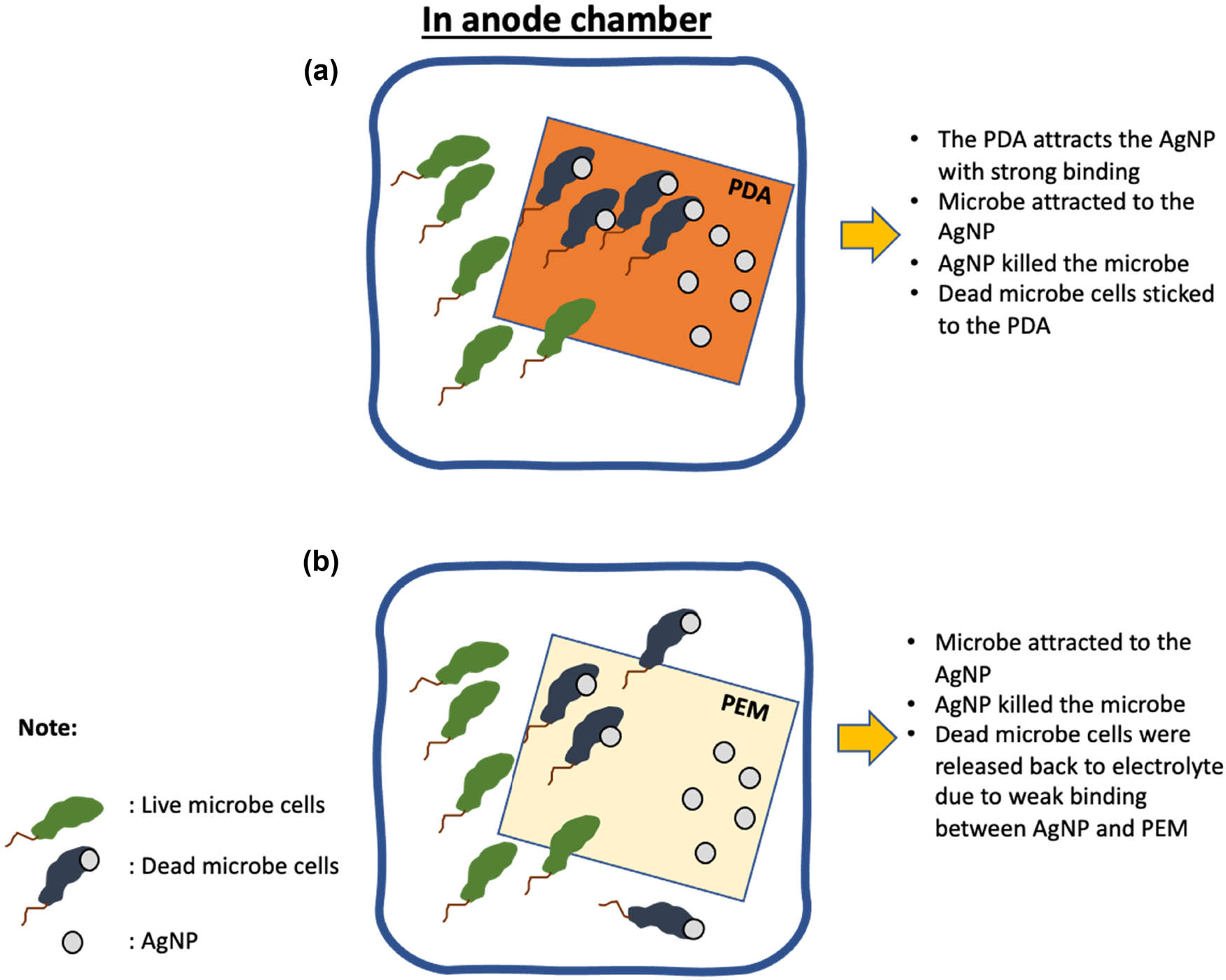
BFC membrane surface modified with (a) AgNP and polydopamine and (b) AgNP and PEM.
Other established BFC procedures to mitigate biofouling include alkaline lysis in biofilm removal and the chemical compounds formed on the membrane surface. As a result, the performance in terms of electric current was increased compared to before using the alkaline lysis procedure [109]. Replacing the outer layer of the BFC cathode is another additional step that resulted in the further increase of current from 378.6 ± 108.3 to 503.8 ± 95.6 µA [110]. Bakonyi et al. reported that choosing a suitable membrane type can avoid biofouling. Their study utilized ceramic mixture barium–cerium–gadolinium oxides (BCGO) powders doped with lithium (Li) membrane and compared to Nafion 117 membrane. The obtained results showed that BCGO doped with Li gives better permeability than Nafion 117. The biofouling formation on BCGO doped with Li surface also reduced more than 10% compared to Nafion 117 due to the unique surface of the BCGO powders [111].
7 Conclusion
Manual cleaning can restore performance to 100%; however, it is time consuming and costly. Studies using chemical solutions such as silver and QAC showed almost 100% of biofouling elimination. However, the studies were done on specific microorganism cultures, such as E. coli. Since BFC inoculum is also involved in mixed culture microorganisms, continuous studies are ongoing in mitigation membrane biofouling, not just targeting single culture. This article discussed biofouling in several systems while highlighting the main challenges and possible ways to overcome them. Exploring other systems other than BFC is necessary as these systems experienced many critical challenges with biofouling while considering the effect on the environment. Various adjustment on the available measures suits the BFC requirement, including increasing power production while suppressing biofouling. For further improvements, research needs to focus more on mitigation strategies such as delaying the biofilm formation, reducing the effect of biofouling on systems performance, and removing biofouling using advanced controlling strategies.
Acknowledgements
The authors appreciate the financial support offered by the Ministry of Education Malaysia through a research grant of FRGS/1/2018/TK10/UKM/03/2.
-
Funding information: FRGS/1/2018/TK10/UKM/03/2.
-
Author contribution: N.I.S.M.N.: writing – original draft; M.H.A.B.: writing – proofread, review and editing, conceptualization, funding acquisition, supervision, validation.
-
Conflict of interest: The authors state no conflict of interest.
-
Ethical approval: The conducted research is not related to either human or animal use.
References
[1] Conzuelo F, Marković N, Ruff A, Schuhmann W. The open circuit voltage in biofuel cells: nernstian shift in pseudocapacitive electrodes. Angew Chem - Int Ed. 2018;57(41):13681–5.10.1002/anie.201808450Search in Google Scholar PubMed
[2] Hernández-Fernández FJ, Pérez De Los Ríos A, Salar-García MJ, Ortiz-Martínez VM, Lozano-Blanco LJ, Godínez C, et al. Recent progress and perspectives in microbial fuel cells for bioenergy generation and wastewater treatment. Fuel Process Technol. 2015;138:284–97. 10.1016/j.fuproc.2015.05.022.Search in Google Scholar
[3] Cosnier S, Gross AJ, Giroud F, Holzinger M. Beyond the hype surrounding biofuel cells: What’s the future of enzymatic fuel cells? Curr Opin Electrochem. 2018;12:148–55. 10.1016/j.coelec.2018.06.006.Search in Google Scholar
[4] Cosnier S, Gross AJ, Le Goff A, Holzinger M. Recent advances on enzymatic glucose/oxygen and hydrogen/oxygen biofuel cells: achievements and limitations. J Power Sources. 2016;325(November):252–63.10.1016/j.jpowsour.2016.05.133Search in Google Scholar
[5] Yin S, Liu X, Kobayashi Y, Nishina Y, Nakagawa R, Yanai R, et al. A needle-type biofuel cell using enzyme/mediator/carbon nanotube composite fibers for wearable electronics. Biosens Bioelectron. 2020;165:112287. 10.1016/j.bios.2020.112287.Search in Google Scholar PubMed
[6] Inamuddin Shakeel N, Imran Ahamed M, Kanchi S, Abbas Kashmery H. Green synthesis of ZnO nanoparticles decorated on polyindole functionalized-MCNTs and used as anode material for enzymatic biofuel cell applications. Sci Rep. 2020;10(1):1–10.10.1038/s41598-020-61831-4Search in Google Scholar PubMed PubMed Central
[7] Kang Z, Jiao K, Cheng J, Peng R, Jiao S, Hu Z. A novel three-dimensional carbonized PANI1600@CNTs network for enhanced enzymatic biofuel cell. Biosens Bioelectron. 2018;101(September 2017):60–5. 10.1016/j.bios.2017.10.008.Search in Google Scholar PubMed
[8] Gao M, Wang P, Jiang L, Wang B, Yao Y, Liu S, et al. Power generation for wearable systems. Energy Environ Sci. 2021;14(4):2114–57.10.1039/D0EE03911JSearch in Google Scholar
[9] Abdellaoui H, Ghedamsi K, Mecharek A. Performance and lifetime increase of the PEM fuel cell in hybrid electric vehicle application by using an NPC seven-level inverter. J Eur des Syst Autom. 2019;52(3):325–32.10.18280/jesa.520314Search in Google Scholar
[10] Yun S, Zhang Y, Xu Q, Liu J, Qin Y. Recent advance in new-generation integrated devices for energy harvesting and storage. Nano Energy. 2019;60:600–19.10.1016/j.nanoen.2019.03.074Search in Google Scholar
[11] Ancona V, Caracciolo AB, Borello D, Ferrara V, Grenni P, Pietrelli A. Microbial fuel cell: an energy harvesting technique for environmental remediation. Int J Environ Impacts Manag Mitig Recover. 2020;3(2):168–79.10.2495/EI-V3-N2-168-179Search in Google Scholar
[12] Cadet M, Gounel S, Stines-Chaumeil C, Brilland X, Rouhana J, Louerat F, et al. An enzymatic glucose/O2 biofuel cell operating in human blood. Biosens Bioelectron. 2016;83:60–7. 10.1016/j.bios.2016.04.016.Search in Google Scholar PubMed
[13] Sun J, Li N, Yang P, Zhang Y, Yuan Y, Lu X, et al. Simultaneous antibiotic degradation, nitrogen removal and power generation in a microalgae-bacteria powered biofuel cell designed for aquaculture wastewater treatment and energy recovery. Int J Hydrogen Energy. 2020;45(18):10871–81. 10.1016/j.ijhydene.2020.02.029.Search in Google Scholar
[14] Hosseini SE, Butler B. An overview of development and challenges in hydrogen powered vehicles. Int J Green Energy. 2020;17(1):13–37. 10.1080/15435075.2019.1685999.Search in Google Scholar
[15] Obileke KC, Onyeaka H, Meyer EL, Nwokolo N. Microbial fuel cells, a renewable energy technology for bio-electricity generation: A mini-review. Electrochem commun. 2021;125:107003. 10.1016/j.elecom.2021.107003.Search in Google Scholar
[16] He Y, Zhu Y, Chen J, Huang M, Wang P, Wang G, et al. Assessment of energy consumption of municipal wastewater treatment plants in China. J Clean Prod. 2019;228:399–404. 10.1016/j.jclepro.2019.04.320.Search in Google Scholar
[17] Suzuki R, Shitanda I, Aikawa T, Tojo T, Kondo T, Tsujimura S, et al. Wearable glucose/oxygen biofuel cell fabricated using modified aminoferrocene and flavin adenine dinucleotide-dependent glucose dehydrogenase on poly(glycidyl methacrylate)-grafted MgO-templated carbon. J Power Sources. 2020;479(June):228807. 10.1016/j.jpowsour.2020.228807.Search in Google Scholar
[18] Al Lawati MJ, Jafary T, Baawain MS, Al-Mamun A. A mini review on biofouling on air cathode of single chamber microbial fuel cell; prevention and mitigation strategies. Biocatal Agric Biotechnol. 2019;22:101370. 10.1016/j.bcab.2019.101370.Search in Google Scholar
[19] Noori MT, Tiwari BR, Mukherjee CK, Ghangrekar MM. Enhancing the performance of microbial fuel cell using Ag–Pt bimetallic alloy as cathode catalyst and anti-biofouling agent. Int J Hydrogen Energy. 2018;43(42):19650–60. 10.1016/j.ijhydene.2018.08.120.Search in Google Scholar
[20] Rahman S, Jafary T, Al-Mamun A, Baawain MS, Choudhury MR, Alhaimali H, et al. Towards upscaling microbial desalination cell technology: A comprehensive review on current challenges and future prospects. J Clean Prod. 2021;288(March):125597. 10.1016/j.jclepro.2020.125597.Search in Google Scholar
[21] Ding A, Fan Q, Cheng R, Sun G, Zhang M, Wu D. Impacts of applied voltage on microbial electrolysis cell-anaerobic membrane bioreactor (MEC-AnMBR) and its membrane fouling mitigation mechanism. Chem Eng J. 2018;333(September 2017):630–5. 10.1016/j.cej.2017.09.190.Search in Google Scholar
[22] Dessì P, Rovira-Alsina L, Sánchez C, Dinesh GK, Tong W, Chatterjee P, et al. Microbial electrosynthesis: Towards sustainable biorefineries for production of green chemicals from CO2 emissions. Biotechnol Adv. 2021;46(July):107675.10.1016/j.biotechadv.2020.107675Search in Google Scholar PubMed
[23] Maddah H, Chogle A. Biofouling in reverse osmosis: phenomena, monitoring, controlling and remediation. Appl Water Sci. 2017;7(6):2637–51.10.1007/s13201-016-0493-1Search in Google Scholar
[24] Yebra DM, Kiil S, Dam-Johansen K. Antifouling technology - past, present and future steps towards efficient and environmentally friendly antifouling coatings. Prog Org Coatings. 2004;50(2):75–104.10.1016/j.porgcoat.2003.06.001Search in Google Scholar
[25] Lu H, Xue Z, Saikaly P, Nunes SP, Bluver TR, Liu WT. Membrane biofouling in a wastewater nitrification reactor: Microbial succession from autotrophic colonization to heterotrophic domination. Water Res. 2016;88:337–45.10.1016/j.watres.2015.10.013Search in Google Scholar PubMed
[26] Li H, Xing Y, Cao T, Dong J, Liang S. Evaluation of the fouling potential of sludge in a membrane bioreactor integrated with microbial fuel cell. Chemosphere. 2021;262:128405. 10.1016/j.chemosphere.2020.128405.Search in Google Scholar PubMed
[27] Achinas S, Charalampogiannis N, Euverink GJW. A brief recap of microbial adhesion and biofilms. Appl Sci. 2019;9(14):1–15.10.3390/app9142801Search in Google Scholar
[28] Mikhaylin S, Bazinet L. Fouling on ion-exchange membranes: Classification, characterization and strategies of prevention and control. Adv Colloid Interface Sci. 2016;229(December):34–56. 10.1016/j.cis.2015.12.006.Search in Google Scholar PubMed
[29] Sulonen MLK, Lakaniemi AM, Kokko ME, Puhakka JA. Long-term stability of bioelectricity generation coupled with tetrathionate disproportionation. Bioresour Technol. 2016;216:876–82. 10.1016/j.biortech.2016.06.024.Search in Google Scholar PubMed
[30] Amaral G, Bushee J, Cordani UG, Kawashita K, Reynolds JH, Almeida FFMDE, et al. Biofouling of membranes in microbial electrochemical technologies: Causes, characterization methods and mitigation strategies. J Petrol. 2019;369(1):1689–99. Available from: http://dx.doi.org/10.1016/j.jsames.2011.03.003%0Ahttps://doi.org/10.1016/j.gr.2017.08.001%0Ahttp://dx.doi.org/10.1016/j.precamres.2014.12.018%0Ahttp://dx.doi.org/10.1016/j.precamres.2011.08.005%0Ahttp://dx.doi.org/10.1080/00206814.2014.902757%0Ahttp://dx.10.1080/00206814.2014.902757Search in Google Scholar
[31] Monroe D. Looking for chinks in the armor of bacterial biofilms. PLoS Biol. 2007;5(11):e307. 10.1371/journal.pbio.0050307. https://journals.plos.org/plosbiology/article?id=10.1371/journal.pbio.0050307.Search in Google Scholar PubMed PubMed Central
[32] Rao TS. Chapter 6 – Biofouling in industrial water systems. In: Amjad Z, Demadis KD, editors. Mineral scales and deposits. Amsterdam: Elsevier B.V; 2015. p. 123–40. https://www.sciencedirect.com/science/article/pii/B9780444632289000061?via%3Dihub.10.1016/B978-0-444-63228-9.00006-1Search in Google Scholar
[33] Ashfaq MY, Al-Ghouti MA, Qiblawey H, Zouari N. Evaluating the effect of antiscalants on membrane biofouling using FTIR and multivariate analysis. Biofouling. 2019;35(1):1–14.10.1080/08927014.2018.1557637Search in Google Scholar PubMed
[34] Atkinson AJ. Development and performance evaluation of an innovative antibiofouling reverse osmosis membrane for water purificationapplications. Gillings School of Global Public Health: University of North Carolina at Chapel Hill; 2017. https://cdr.lib.unc.edu/downloads/j9602082m. Search in Google Scholar
[35] Mazerie I, Didier P, Razan F, Hapiot P, Coulon N, Girard A, et al. A general approach based on sampled-current voltammetry for minimizing electrode fouling in electroanalytical detection. ChemElectroChem. 2018;5(1):144–52.10.1002/celc.201700884Search in Google Scholar
[36] Pandit S, Shanbhag S, Mauter M, Oren Y, Herzberg M. Influence of Electric Fields on Biofouling of Carbonaceous Electrodes. Environ Sci Technol. 2017;51(17):10022–30.10.1021/acs.est.6b06339Search in Google Scholar PubMed
[37] Bogler A, Lin S, Bar-Zeev E. Biofouling of membrane distillation, forward osmosis and pressure retarded osmosis: Principles, impacts and future directions. J Memb Sci. 2017;542(July):378–98. 10.1016/j.memsci.2017.08.001.Search in Google Scholar
[38] Zouboulis AI, Gkotsis PK. Chapter 7 – Fouling challenges in ceramic MBR systems. In: Basile A, Ghasemzadeh K, Jalilnejad E, editors. Current trends and future developments on (bio-) membranes. Elsevier; 2020. p. 199–217. https://www.sciencedirect.com/science/article/pii/B9780128168226000070?via%3Dihub.10.1016/B978-0-12-816822-6.00007-0Search in Google Scholar
[39] Wang SY, Sun XF, Gao WJ, Wang YF, Jiang BB, Afzal MZ, et al. Mitigation of membrane biofouling by D-amino acids: Effect of bacterial cell-wall property and D-amino acid type. Colloids Surfaces B Biointerfaces. 2018;164:20–6. 10.1016/j.colsurfb.2017.12.055.Search in Google Scholar PubMed
[40] Ma W, Panecka M, Tufenkji N, Rahaman MS. Bacteriophage-based strategies for biofouling control in ultrafiltration: In situ biofouling mitigation, biocidal additives and biofilm cleanser. J Colloid Interface Sci. 2018;523:254–65. 10.1016/j.jcis.2018.03.105.Search in Google Scholar PubMed
[41] Mahmoudi N. Design of peptoid-based coating to reduce biofouling in gas exchange devices. Theses Diss; 2018. https://scholarworks.uark.edu/etd/2904.Search in Google Scholar
[42] Flimban SGA, Hassan SHA, Rahman MM, Oh SE. The effect of Nafion membrane fouling on the power generation of a microbial fuel cell. Int J Hydrogen Energy. 2018;March:2–11. 10.1016/j.ijhydene.2018.02.097.Search in Google Scholar
[43] Li X, Lv P, Yao Y, Feng Q, Mensah A, Li D, et al. A novel single-enzymatic biofuel cell based on highly flexible conductive bacterial cellulose electrode utilizing pollutants as fuel. Chem Eng J. 2020;379:122316. 10.1016/j.cej.2019.122316.Search in Google Scholar
[44] Santoro C, Babanova S, Artyushkova K, Cornejo JA, Ista L, Bretschger O, et al. Influence of anode surface chemistry on microbial fuel cell operation. Bioelectrochemistry. 2015;106:141–9. 10.1016/j.bioelechem.2015.05.002.Search in Google Scholar PubMed PubMed Central
[45] Alhariri M, Majrashi MA, Bahkali AH, Almajed FS, Azghani AO, Khiyami MA, et al. Efficacy of neutral and negatively charged liposome-loaded gentamicin on planktonic bacteria and biofilm communities. Int J Nanomedicine. 2017;12:6949–61.10.2147/IJN.S141709Search in Google Scholar PubMed PubMed Central
[46] Drygaś B, Rurka P, Rashid K, Drygaś P. Optimal growth rate conditions of microorganisms. World Sci News. 2016;57:397–403.Search in Google Scholar
[47] Ma G, Xu X, Tesfai M, Wang H, Xu P. Developing anti-biofouling and energy-efficient cation-exchange membranes using conductive polymers and nanomaterials. J Memb Sci. 2020;603(March):118034. 10.1016/j.memsci.2020.118034.Search in Google Scholar
[48] Rijnaarts T, Moreno J, Saakes M, de Vos WM, Nijmeijer K. Role of anion exchange membrane fouling in reverse electrodialysis using natural feed waters. Colloids Surfaces A Physicochem Eng Asp. 2019;560(October 2018):198–204. 10.1016/j.colsurfa.2018.10.020.Search in Google Scholar
[49] Park SG, Rajesh PP, Hwang MH, Chu KH, Cho S, Chae KJ. Long-term effects of anti-biofouling proton exchange membrane using silver nanoparticles and polydopamine on the performance of microbial electrolysis cells. Int J Hydrogen Energy. 2020;46:11345–56. 10.1016/j.ijhydene.2020.04.059.Search in Google Scholar
[50] Lee H, Ahmad R, Kim J. Alginate to simulate biofouling in submerged fluidized ceramic membrane reactor: effect of solution pH and ionic strength. Bioresour Technol. 2020;302:122813. 10.1016/j.biortech.2020.122813.Search in Google Scholar PubMed
[51] Li X, Abu-Reesh IM, He Z. Development of Bioelectrochemical Systems to Promote Sustainable Agriculture. Agriculture 2015;5(3):367–88.10.3390/agriculture5030367Search in Google Scholar
[52] Kokabian B, Gude VG. Chapter 6 – 2-Microbial desalination systems for energy and resource recovery. Microbial electrochemical technology. Elsevier B.V; 2019. p. 999–1020. 10.1016/B978-0-444-64052-9.00041-8. https://www.sciencedirect.com/science/article/pii/B9780444640529000418?via%3Dihub.Search in Google Scholar
[53] Orellana MV, Leck C. Chapter 9 – Marine microgels. In: Hansell DA, Carlson CA, editors. Biogeochemistry of marine dissolved organic matter. (2nd ed.); Boston: Academic Press; 2015. p. 451–80. https://www.sciencedirect.com/science/article/pii/B9780124059405000091?via%3Dihub.10.1016/B978-0-12-405940-5.00009-1Search in Google Scholar
[54] Al-Mamun A, Baawain MS, Dhar BR, Kim IS. Improved recovery of bioenergy and osmotic water in an osmotic microbial fuel cell using micro-diffuser assisted marine aerobic biofilm on cathode. Biochem Eng J. 2017;128:235–42. 10.1016/j.bej.2017.09.020.Search in Google Scholar
[55] Alhimali H, Jafary T, Al-Mamun A, Baawain MS, Vakili-Nezhaad GR. New insights into the application of microbial desalination cells for desalination and bioelectricity generation. Biofuel Res J. 2019;6(4):1090–9.10.18331/BRJ2019.6.4.5Search in Google Scholar
[56] Fang J, Wu Y, Zhang Y, Lyu M, Zhao J. Novel anion exchange membranes based on pyridinium groups and fluoroacrylate for alkaline anion exchange membrane fuel cells. Int J Hydrogen Energy. 2015;40(36):12392–9. 10.1016/j.ijhydene.2015.07.074.Search in Google Scholar
[57] Wang C, Mo B, He Z, Shao Q, Pan D, Wujick E, et al. Crosslinked norbornene copolymer anion exchange membrane for fuel cells. J Memb Sci. 2018;556(March):118–25. 10.1016/j.memsci.2018.03.080.Search in Google Scholar
[58] Niu M, Zhang C, He G, Zhang F, Wu X. Pendent piperidinium-functionalized blend anion exchange membrane for fuel cell application. Int J Hydrogen Energy. 2019;44(29):15482–93. 10.1016/j.ijhydene.2019.04.172.Search in Google Scholar
[59] Elangovan M, Dharmalingam S. Effect of polydopamine on quaternized poly(ether ether ketone) for antibiofouling anion exchange membrane in microbial fuel cell. Polym Adv Technol. 2018;29(1):275–84.10.1002/pat.4112Search in Google Scholar
[60] Ping Q, Cohen B, Dosoretz C, He Z. Long-term investigation of fouling of cation and anion exchange membranes in microbial desalination cells. Desalination. 2013;325:48–55. 10.1016/j.desal.2013.06.025.Search in Google Scholar
[61] Orellana MV, Leck C, Bailly du Bois P, Laguionie P, Boust D, Korsakissok I, Didier D, Fiévet B. Estimation of marine source-term following Fukushima Dai-ichi accident. J Environ Radioact. 2012;114:2–9. https://pubmed.ncbi.nlm.nih.gov/22172688/.10.1016/j.jenvrad.2011.11.015Search in Google Scholar PubMed
[62] Zhang M, Cheng C, Xie R. Control and cleaning of membrane biofouling by biogenic silver nanoparticles. IOP Conf Ser Earth Environ Sci. 2019;356(1):2–11.10.1088/1755-1315/356/1/012019Search in Google Scholar
[63] Ghasemi M, Wan Daud WR, Ismail M, Rahimnejad M, Ismail AF, Leong JX, et al. Effect of pre-treatment and biofouling of proton exchange membrane on microbial fuel cell performance. Int J Hydrogen Energy. 2013;38(13):5480–4. 10.1016/j.ijhydene.2012.09.148.Search in Google Scholar
[64] Kardi SN, Ibrahim N, Rashid NAA, Darzi GN. Investigating effect of proton-exchange membrane on new air-cathode single-chamber microbial fuel cell configuration for bioenergy recovery from Azorubine dye degradation. Environ Sci Pollut Res. 2019;26(21):21201–15.10.1007/s11356-019-05204-zSearch in Google Scholar PubMed
[65] Naik S, Jujjavarappu SE. Simultaneous bioelectricity generation from cost-effective MFC and water treatment using various wastewater samples. Environ Sci Pollut Res. 2019;27(October):27383–93.10.1007/s11356-019-06221-8Search in Google Scholar PubMed
[66] Oliot M, Etcheverry L, Mosdale A, Basseguy R, Délia ML, Bergel A. Separator electrode assembly (SEA) with 3-dimensional bioanode and removable air-cathode boosts microbial fuel cell performance. J Power Sources. 2017;356:389–99.10.1016/j.jpowsour.2017.03.016Search in Google Scholar
[67] Xu Q, Wang L, Li C, Wang X, Li C, Geng Y. Study on improvement of the proton conductivity and anti-fouling of proton exchange membrane by doping SGO@SiO2 in microbial fuel cell applications. Int J Hydrogen Energy. 2019;44(29):15322–32. 10.1016/j.ijhydene.2019.03.238.Search in Google Scholar
[68] Alresheedi MT, Barbeau B, Basu OD. Comparisons of NOM fouling and cleaning of ceramic and polymeric membranes during water treatment. Sep Purif Technol. 2018;209:452–60. 10.1016/j.seppur.2018.07.070.Search in Google Scholar
[69] Winfield J, Gajda I, Greenman J, Ieropoulos I. A review into the use of ceramics in microbial fuel cells. Bioresour Technol. 2016;215:296–303. 10.1016/j.biortech.2016.03.135.Search in Google Scholar PubMed
[70] Hubadillah SK, Othman MHD, Matsuura T, Ismail AF, Rahman MA, Harun Z, et al. Fabrications and applications of low cost ceramic membrane from kaolin: a comprehensive review. Ceram Int. 2018;44(5):4538–60.10.1016/j.ceramint.2017.12.215Search in Google Scholar
[71] Almojjly A, Johnson D, Hilal N. Investigations of the effect of pore size of ceramic membranes on the pilot- scale removal of oil from oil-water emulsion. J Water Process Eng. 2019;31(May):100868. 10.1016/j.jwpe.2019.100868.Search in Google Scholar
[72] Lech M, Trusek A. Biofouling phenomena on the ceramic microfiltration membranes – an experimental research. Desalin Water Treat. 2018;128(June):236–42.10.5004/dwt.2018.22867Search in Google Scholar
[73] Gajda I, Obata O, Jose Salar-Garcia M, Greenman J, Ieropoulos IA. Long-term bio-power of ceramic microbial fuel cells in individual and stacked configurations. Bioelectrochemistry. 2020;133:133107459. 10.1016/j.bioelechem.2020.107459.Search in Google Scholar PubMed PubMed Central
[74] Miskan M, Ismail M, Ghasemi M, Md Jahim J, Nordin D, Abu Bakar MH. Characterization of membrane biofouling and its effect on the performance of microbial fuel cell. Int J Hydrogen Energy. 2016;41(1):543–52. 10.1016/j.ijhydene.2015.09.037.Search in Google Scholar
[75] Jiang S, Li Y, Ladewig BP. A review of reverse osmosis membrane fouling and control strategies. Sci Total Environ. 2017;595(August):567–83. 10.1016/j.scitotenv.2017.03.235.Search in Google Scholar PubMed
[76] Code L. Practical application of bacterial quorum quenching and development of quorum quenching medium for biofouling control in membrane bioreactor for wastewater treatment. School of Chemical Biological Engineering, Graduate School, Seoul National University; 2018. https://s-space.snu.ac.kr/bitstream/10371/119808/1/000000136730.pdf.Search in Google Scholar
[77] Flemming HC. Biofouling in water treatment. Biofouling Biocorrosion Ind Water Syst. 1991;47–80. https://link.springer.com/chapter/10.1007%2F978-3-642-76543-8_4#citeas.10.1007/978-3-642-76543-8_4Search in Google Scholar
[78] Laqbaqbi M, Sanmartino JA, Khayet M, García-Payo C, Chaouch M. Fouling in membrane distillation, osmotic distillation and osmotic membrane distillation. Appl Sci. 2017;7(4):334.10.3390/app7040334Search in Google Scholar
[79] Park J, Gill GA, Strivens JE, Kuo LJ, Jeters RT, Avila A, et al. Effect of biofouling on the performance of amidoxime-based polymeric uranium adsorbents. Ind Eng Chem Res. 2016;55(15):4328–38.10.1021/acs.iecr.5b03457Search in Google Scholar
[80] Kim HS, Lee JY, Ham SY, Lee JH, Park JH, Park HD. Effect of biofilm inhibitor on biofouling resistance in RO processes. Fuel. 2019;253(May):823–32. 10.1016/j.fuel.2019.05.062.Search in Google Scholar
[81] Aslam M, Ahmad R, Kim J. Recent developments in biofouling control in membrane bioreactors for domestic wastewater treatment. Sep Purif Technol. 2018;206:297–315. 10.1016/j.seppur.2018.06.004.Search in Google Scholar
[82] Yang W, Rossi R, Tian Y, Kim KY, Logan BE. Mitigating external and internal cathode fouling using a polymer bonded separator in microbial fuel cells. Bioresour Technol. 2018;249(October 2017):1080–4. 10.1016/j.biortech.2017.10.109.Search in Google Scholar PubMed
[83] Ping M, Zhang X, Liu M, Wu Z, Wang Z. Surface modification of polyvinylidene fluoride membrane by atom-transfer radical-polymerization of quaternary ammonium compound for mitigating biofouling. J Memb Sci. 2019;570–571(July 2018):286–93. 10.1016/j.memsci.2018.10.070.Search in Google Scholar
[84] Zhai Y, Zhang X, Wu Z, Wang Z. Modification of polyvinylidene fluoride membrane by quaternary ammonium compounds loaded on silica nanopollens for mitigating biofouling. J Memb Sci. 2019;November:117679. 10.1016/j.memsci.2019.117679.Search in Google Scholar
[85] Ren L, Ping M, Zhang X. Membrane biofouling control by surface modification of quaternary ammonium compound using atom-transfer radical-polymerization method with silica nanoparticle as interlayer. Membranes (Basel). 2020;10(12):1–16.10.3390/membranes10120417Search in Google Scholar PubMed PubMed Central
[86] Zhang X, Wang Z, Chen M, Ma J, Chen S, Wu Z. Membrane biofouling control using polyvinylidene fluoride membrane blended with quaternary ammonium compound assembled on carbon material. J Memb Sci. 2017;539(May):229–37. 10.1016/j.memsci.2017.06.008.Search in Google Scholar
[87] Ayyaru S, Pandiyan R, Ahn Y. Fabrication and characterization of anti-fouling and non-toxic polyvinylidene fluoride -Sulphonated carbon nanotube ultrafiltration membranes for membrane bioreactors applications. Chem Eng Res Des. 2018;142:176–88. 10.1016/j.cherd.2018.12.008.Search in Google Scholar
[88] McClay T, Zabin C, Davidson I, Young R, Elam D. Vessel biofouling prevention and management options report. 2015;42:1–42. https://apps.dtic.mil/sti/pdfs/ADA626612.pdf.Search in Google Scholar
[89] Perreault F, Jaramillo H, Xie M, Ude M, Nghiem LD, Elimelech M. Biofouling mitigation in forward osmosis using graphene oxide functionalized thin-film composite membranes. Environ Sci Technol. 2016;50(11):5840–8.10.1021/acs.est.5b06364Search in Google Scholar PubMed
[90] Guo X, Yang H, Liu Q, Liu J, Chen R, Zhang H, et al. A chitosan-graphene oxide/ZIF foam with anti-biofouling ability for uranium recovery from seawater. Chem Eng J. 2020;382(September 2019):122850. 10.1016/j.cej.2019.122850.Search in Google Scholar
[91] Sun Q, Yan F, Yao L, Su B. Anti-biofouling isoporous silica-micelle membrane enabling drug detection in human whole blood. Anal Chem. 2016;88(17):8364–8.10.1021/acs.analchem.6b02091Search in Google Scholar PubMed
[92] Graziani L, Quagliarini E, D’Orazio M. TiO2-treated different fired brick surfaces for biofouling prevention: experimental and modelling results. Ceram Int. 2016;42(3):4002–10.10.1016/j.ceramint.2015.11.069Search in Google Scholar
[93] Bora NS, Mazumder B, Chattopadhyay P. Prospects of topical protection from ultraviolet radiation exposure: a critical review on the juxtaposition of the benefits and risks involved with the use of chemoprotective agents. J Dermatolog Treat. 2018;29(3):256–68. 10.1080/09546634.2017.1364691.Search in Google Scholar PubMed
[94] Sathe P, Laxman K, Myint MTZ, Dobretsov S, Richter J, Dutta J. Bioinspired nanocoatings for biofouling prevention by photocatalytic redox reactions. Sci Rep. 2017;7(1):1–12.10.1038/s41598-017-03636-6Search in Google Scholar PubMed PubMed Central
[95] Dolina J, Gončuková Z, Bobák M, Dvořák L. Modification of a hollow-fibre polyethersulfone membrane using silver nanoparticles formed: In situ for biofouling prevention. RSC Adv. 2018;8(26):14552–60.10.1039/C8RA02026DSearch in Google Scholar
[96] Biswas P, Bandyopadhyaya R. Biofouling prevention using silver nanoparticle impregnated polyethersulfone (PES) membrane: E. coli cell-killing in a continuous cross-flow membrane module. J Colloid Interface Sci. 2017;491:13–26. 10.1016/j.jcis.2016.11.060.Search in Google Scholar PubMed
[97] Ham SY, Kim HS, Jang Y, Ryoo HS, Lee JH, Park JH, et al. Synergistic control of membrane biofouling using linoleic acid and sodium hypochlorite. Chemosphere. 2021;268:128802. 10.1016/j.chemosphere.2020.128802.Search in Google Scholar PubMed
[98] Ivanova N, Gugleva V, Dobreva M, Pehlivanov I, Stefanov S, Andonova V. Silver nanoparticles as multi-functional drug delivery systems. Nanomedicines. 2019:71–92.10.5772/intechopen.80238Search in Google Scholar
[99] Rodríguez-Serrano C, Guzmán-Moreno J, Ángeles-Chávez C, Rodríguez-González V, Ortega-Sigala JJ, Ramírez-Santoyo RM, et al. Biosynthesis of silver nanoparticles by Fusarium scirpi and its potential as antimicrobial agent against uropathogenic Escherichia coli biofilms. PLoS One. 2020;15(3):1–20.10.1371/journal.pone.0230275Search in Google Scholar PubMed PubMed Central
[100] Gomaa EZ. Silver nanoparticles as an antimicrobial agent: a case study on Staphylococcus aureus and Escherichia coli as models for gram-positive and gram-negative bacteria. J Gen Appl Microbiol. 2017;63(1):36–43.10.2323/jgam.2016.07.004Search in Google Scholar PubMed
[101] Ji J, Liu F, Hashim NA, Abed MRM, Li K. Poly(vinylidene fluoride) (PVDF) membranes for fluid separation. React Funct Polym. 2015;86:134–53. 10.1016/j.reactfunctpolym.2014.09.023.Search in Google Scholar
[102] Ansari AJ, Hai FI, He T, Price WE, Nghiem LD. Physical cleaning techniques to control fouling during the pre-concentration of high suspended-solid content solutions for resource recovery by forward osmosis. Desalination. 2018;429(October 2017):134–41. 10.1016/j.desal.2017.12.011.Search in Google Scholar
[103] Shin S, Seo J, Han H, Kang S, Kim H, Lee T. Bio-inspired extreme wetting surfaces for biomedical applications. Materials (Basel). 2016;9(2):1–26.10.3390/ma9020116Search in Google Scholar PubMed PubMed Central
[104] Hesampour M, Havansi H, Vainio P, Kilponen K. Method for reducing fouling of a microbial fuel cell, cleaning agent composition and its use. 2018;1:11.Search in Google Scholar
[105] Ko Y, Kwon CH, Lee SW, Cho J. Nanoparticle-based electrodes with high charge transfer efficiency through ligand exchange layer-by-layer assembly. Adv Mater. 2020;32(51):1–26.10.1002/adma.202001924Search in Google Scholar PubMed
[106] Navarro E, Baun A, Behra R, Hartmann NB, Filser J, Miao AJ, et al. Environmental behavior and ecotoxicity of engineered nanoparticles to algae, plants, and fungi. Ecotoxicology. 2008;17(5):372–86.10.1007/s10646-008-0214-0Search in Google Scholar PubMed
[107] Zhao D, Jaroniec M, Hsiao BS. Editorial for themed issue on “Advanced materials in water treatments. J Mater Chem. 2010;20(22):4476–7.10.1039/c005140nSearch in Google Scholar
[108] Tripathi DK, Tripathi A, Shweta, Singh S, Singh Y, Vishwakarma K, et al. Uptake, accumulation and toxicity of silver nanoparticle in autotrophic plants, and heterotrophic microbes: a concentric review. Front Microbiol. 2017;8(JAN):1–16.10.3389/fmicb.2017.00007Search in Google Scholar PubMed PubMed Central
[109] Ma C, Liu M, You C, Zhu Z. Engineering a diaphorase via directed evolution for enzymatic biofuel cell application. Bioresour Bioprocess. 2020;7(1):23. 10.1186/s40643-020-00311-z.Search in Google Scholar
[110] Pasternak G, Greenman J, Ieropoulos I. Regeneration of the power performance of cathodes affected by biofouling. Appl Energy. 2016;173:431–7. 10.1016/j.apenergy.2016.04.009.Search in Google Scholar PubMed PubMed Central
[111] Bakonyi P, Koók L, Kumar G, Tóth G, Rózsenberszki T, Nguyen DD, et al. Architectural engineering of bioelectrochemical systems from the perspective of polymeric membrane separators: a comprehensive update on recent progress and future prospects. J Memb Sci. 2018;564:508–22. 10.1016/j.memsci.2018.07.051.Search in Google Scholar
[112] Li M, Zhou M, Tian X, Tan C, Mcdaniel CT, Hassett DJ, et al. Microbial fuel cell (MFC) power performance improvement through enhanced microbial electrogenicity. Biotechnol Adv. 2018;36:1316–27. 10.1016/j.biotechadv.2018.04.010.Search in Google Scholar PubMed
[113] Guang L, Koomson DA, Jingyu H, Ewusi-Mensah D, Miwornunyuie N. Performance of exoelectrogenic bacteria used in microbial desalination cell technology. Int J Environ Res Public Health. 2020;17(3):10–2.10.3390/ijerph17031121Search in Google Scholar PubMed PubMed Central
[114] Katuri KP, Ali M, Saikaly PE. The role of microbial electrolysis cell in urban wastewater treatment: integration options, challenges, and prospects. Curr Opin Biotechnol. 2019;57(June):101–10. 10.1016/j.copbio.2019.03.007.Search in Google Scholar PubMed
[115] Tan Y, Adhikari RY, Malvankar NS, Pi S, Ward JE, Woodard TL, et al. Synthetic Biological Protein Nanowires with High Conductivity. Small. 2016;12(33):4481–5.10.1002/smll.201601112Search in Google Scholar PubMed
[116] Mohanakrishna G, Vanbroekhoven K, Pant D. Imperative role of applied potential and inorganic carbon source on acetate production through microbial electrosynthesis. J CO2 Util. 2016;15:57–64. 10.1016/j.jcou.2016.03.003.Search in Google Scholar
[117] Liu L, Mohammadifar M, Choi S. Supercapacitive micro-bio-photovoltaics. J Phys Conf Ser. 2019;1407(1):012027.10.1088/1742-6596/1407/1/012027Search in Google Scholar
[118] Saratale GD, Saratale RG, Shahid MK, Zhen G, Kumar G, Shin HS, et al. A comprehensive overview on electro-active biofilms, role of exo-electrogens and their microbial niches in microbial fuel cells (MFCs). Chemosphere. 2017;178(July):534–47. 10.1016/j.chemosphere.2017.03.066.Search in Google Scholar PubMed
[119] Song Y. C-MEMS based micro enzymatic biofuel cells. Florida International University; 2015. https://digitalcommons.fiu.edu/cgi/viewcontent.cgi?article=3265&context=etd.10.25148/etd.FIDC000135Search in Google Scholar
© 2021 Nur Iman Syafiqah Muhammad Nasruddin and Mimi Hani Abu Bakar, published by De Gruyter
This work is licensed under the Creative Commons Attribution 4.0 International License.
Articles in the same Issue
- Regular Articles
- Qualitative and semi-quantitative assessment of anthocyanins in Tibetan hulless barley from different geographical locations by UPLC-QTOF-MS and their antioxidant capacities
- Effect of sodium chloride on the expression of genes involved in the salt tolerance of Bacillus sp. strain “SX4” isolated from salinized greenhouse soil
- GC-MS analysis of mango stem bark extracts (Mangifera indica L.), Haden variety. Possible contribution of volatile compounds to its health effects
- Influence of nanoscale-modified apatite-type calcium phosphates on the biofilm formation by pathogenic microorganisms
- Removal of paracetamol from aqueous solution by containment composites
- Investigating a human pesticide intoxication incident: The importance of robust analytical approaches
- Induction of apoptosis and cell cycle arrest by chloroform fraction of Juniperus phoenicea and chemical constituents analysis
- Recovery of γ-Fe2O3 from copper ore tailings by magnetization roasting and magnetic separation
- Effects of different extraction methods on antioxidant properties of blueberry anthocyanins
- Modeling the removal of methylene blue dye using a graphene oxide/TiO2/SiO2 nanocomposite under sunlight irradiation by intelligent system
- Antimicrobial and antioxidant activities of Cinnamomum cassia essential oil and its application in food preservation
- Full spectrum and genetic algorithm-selected spectrum-based chemometric methods for simultaneous determination of azilsartan medoxomil, chlorthalidone, and azilsartan: Development, validation, and application on commercial dosage form
- Evaluation of the performance of immunoblot and immunodot techniques used to identify autoantibodies in patients with autoimmune diseases
- Computational studies by molecular docking of some antiviral drugs with COVID-19 receptors are an approach to medication for COVID-19
- Synthesis of amides and esters containing furan rings under microwave-assisted conditions
- Simultaneous removal efficiency of H2S and CO2 by high-gravity rotating packed bed: Experiments and simulation
- Design, synthesis, and biological activities of novel thiophene, pyrimidine, pyrazole, pyridine, coumarin and isoxazole: Dydrogesterone derivatives as antitumor agents
- Content and composition analysis of polysaccharides from Blaps rynchopetera and its macrophage phagocytic activity
- A new series of 2,4-thiazolidinediones endowed with potent aldose reductase inhibitory activity
- Assessing encapsulation of curcumin in cocoliposome: In vitro study
- Rare norisodinosterol derivatives from Xenia umbellata: Isolation and anti-proliferative activity
- Comparative study of antioxidant and anticancer activities and HPTLC quantification of rutin in white radish (Raphanus sativus L.) leaves and root extracts grown in Saudi Arabia
- Comparison of adsorption properties of commercial silica and rice husk ash (RHA) silica: A study by NIR spectroscopy
- Sodium borohydride (NaBH4) as a high-capacity material for next-generation sodium-ion capacitors
- Aroma components of tobacco powder from different producing areas based on gas chromatography ion mobility spectrometry
- The effects of salinity on changes in characteristics of soils collected in a saline region of the Mekong Delta, Vietnam
- Synthesis, properties, and activity of MoVTeNbO catalysts modified by zirconia-pillared clays in oxidative dehydrogenation of ethane
- Synthesis and crystal structure of N,N′-bis(4-chlorophenyl)thiourea N,N-dimethylformamide
- Quantitative analysis of volatile compounds of four Chinese traditional liquors by SPME-GC-MS and determination of total phenolic contents and antioxidant activities
- A novel separation method of the valuable components for activated clay production wastewater
- On ve-degree- and ev-degree-based topological properties of crystallographic structure of cuprite Cu2O
- Antihyperglycemic effect and phytochemical investigation of Rubia cordifolia (Indian Madder) leaves extract
- Microsphere molecularly imprinted solid-phase extraction for diazepam analysis using itaconic acid as a monomer in propanol
- A nitric oxide-releasing prodrug promotes apoptosis in human renal carcinoma cells: Involvement of reactive oxygen species
- Machine vision-based driving and feedback scheme for digital microfluidics system
- Study on the application of a steam-foam drive profile modification technology for heavy oil reservoir development
- Ni–Ru-containing mixed oxide-based composites as precursors for ethanol steam reforming catalysts: Effect of the synthesis methods on the structural and catalytic properties
- Preparation of composite soybean straw-based materials by LDHs modifying as a solid sorbent for removal of Pb(ii) from water samples
- Synthesis and spectral characterizations of vanadyl(ii) and chromium(iii) mixed ligand complexes containing metformin drug and glycine amino acid
- In vitro evaluation of lactic acid bacteria with probiotic activity isolated from local pickled leaf mustard from Wuwei in Anhui as substitutes for chemical synthetic additives
- Utilization and simulation of innovative new binuclear Co(ii), Ni(ii), Cu(ii), and Zn(ii) diimine Schiff base complexes in sterilization and coronavirus resistance (Covid-19)
- Phosphorylation of Pit-1 by cyclin-dependent kinase 5 at serine 126 is associated with cell proliferation and poor prognosis in prolactinomas
- Molecularly imprinted membrane for transport of urea, creatinine, and vitamin B12 as a hemodialysis candidate membrane
- Optimization of Murrayafoline A ethanol extraction process from the roots of Glycosmis stenocarpa, and evaluation of its Tumorigenesis inhibition activity on Hep-G2 cells
- Highly sensitive determination of α-lipoic acid in pharmaceuticals on a boron-doped diamond electrode
- Synthesis, chemo-informatics, and anticancer evaluation of fluorophenyl-isoxazole derivatives
- In vitro and in vivo investigation of polypharmacology of propolis extract as anticancer, antibacterial, anti-inflammatory, and chemical properties
- Topological indices of bipolar fuzzy incidence graph
- Preparation of Fe3O4@SiO2–ZnO catalyst and its catalytic synthesis of rosin glycol ester
- Construction of a new luminescent Cd(ii) compound for the detection of Fe3+ and treatment of Hepatitis B
- Investigation of bovine serum albumin aggregation upon exposure to silver(i) and copper(ii) metal ions using Zetasizer
- Discoloration of methylene blue at neutral pH by heterogeneous photo-Fenton-like reactions using crystalline and amorphous iron oxides
- Optimized extraction of polyphenols from leaves of Rosemary (Rosmarinus officinalis L.) grown in Lam Dong province, Vietnam, and evaluation of their antioxidant capacity
- Synthesis of novel thiourea-/urea-benzimidazole derivatives as anticancer agents
- Potency and selectivity indices of Myristica fragrans Houtt. mace chloroform extract against non-clinical and clinical human pathogens
- Simple modifications of nicotinic, isonicotinic, and 2,6-dichloroisonicotinic acids toward new weapons against plant diseases
- Synthesis, optical and structural characterisation of ZnS nanoparticles derived from Zn(ii) dithiocarbamate complexes
- Presence of short and cyclic peptides in Acacia and Ziziphus honeys may potentiate their medicinal values
- The role of vitamin D deficiency and elevated inflammatory biomarkers as risk factors for the progression of diabetic nephropathy in patients with type 2 diabetes mellitus
- Quantitative structure–activity relationship study on prolonged anticonvulsant activity of terpene derivatives in pentylenetetrazole test
- GADD45B induced the enhancing of cell viability and proliferation in radiotherapy and increased the radioresistance of HONE1 cells
- Cannabis sativa L. chemical compositions as potential plasmodium falciparum dihydrofolate reductase-thymidinesynthase enzyme inhibitors: An in silico study for drug development
- Dynamics of λ-cyhalothrin disappearance and expression of selected P450 genes in bees depending on the ambient temperature
- Identification of synthetic cannabinoid methyl 2-{[1-(cyclohexylmethyl)-1H-indol-3-yl] formamido}-3-methylbutanoate using modern mass spectrometry and nuclear magnetic resonance techniques
- Study on the speciation of arsenic in the genuine medicinal material honeysuckle
- Two Cu(ii)-based coordination polymers: Crystal structures and treatment activity on periodontitis
- Conversion of furfuryl alcohol to ethyl levulinate in the presence of mesoporous aluminosilicate catalyst
- Review Articles
- Hsien Wu and his major contributions to the chemical era of immunology
- Overview of the major classes of new psychoactive substances, psychoactive effects, analytical determination and conformational analysis of selected illegal drugs
- An overview of persistent organic pollutants along the coastal environment of Kuwait
- Mechanism underlying sevoflurane-induced protection in cerebral ischemia–reperfusion injury
- COVID-19 and SARS-CoV-2: Everything we know so far – A comprehensive review
- Challenge of diabetes mellitus and researchers’ contributions to its control
- Advances in the design and application of transition metal oxide-based supercapacitors
- Color and composition of beauty products formulated with lemongrass essential oil: Cosmetics formulation with lemongrass essential oil
- The structural chemistry of zinc(ii) and nickel(ii) dithiocarbamate complexes
- Bioprospecting for antituberculosis natural products – A review
- Recent progress in direct urea fuel cell
- Rapid Communications
- A comparative morphological study of titanium dioxide surface layer dental implants
- Changes in the antioxidative properties of honeys during their fermentation
- Erratum
- Erratum to “Corrosion study of copper in aqueous sulfuric acid solution in the presence of (2E,5E)-2,5-dibenzylidenecyclopentanone and (2E,5E)-bis[(4-dimethylamino)benzylidene]cyclopentanone: Experimental and theoretical study”
- Erratum to “Modified TDAE petroleum plasticiser”
- Corrigendum
- Corrigendum to “A nitric oxide-releasing prodrug promotes apoptosis in human renal carcinoma cells: Involvement of reactive oxygen species”
- Special Issue on 3rd IC3PE 2020
- Visible light-responsive photocatalyst of SnO2/rGO prepared using Pometia pinnata leaf extract
- Antihyperglycemic activity of Centella asiatica (L.) Urb. leaf ethanol extract SNEDDS in zebrafish (Danio rerio)
- Selection of oil extraction process from Chlorella species of microalgae by using multi-criteria decision analysis technique for biodiesel production
- Special Issue on the 14th Joint Conference of Chemistry (14JCC)
- Synthesis and in vitro cytotoxicity evaluation of isatin-pyrrole derivatives against HepG2 cell line
- CO2 gas separation using mixed matrix membranes based on polyethersulfone/MIL-100(Al)
- Effect of synthesis and activation methods on the character of CoMo/ultrastable Y-zeolite catalysts
- Special Issue on Electrochemical Amplified Sensors
- Enhancement of graphene oxide through β-cyclodextrin composite to sensitive analysis of an antidepressant: Sulpiride
- Investigation of the spectroelectrochemical behavior of quercetin isolated from Zanthoxylum bungeanum
- An electrochemical sensor for high sensitive determination of lysozyme based on the aptamer competition approach
- An improved non-enzymatic electrochemical sensor amplified with CuO nanostructures for sensitive determination of uric acid
- Special Issue on Applied Biochemistry and Biotechnology 2020
- Fast discrimination of avocado oil for different extracted methods using headspace-gas chromatography-ion mobility spectroscopy with PCA based on volatile organic compounds
- Effect of alkali bases on the synthesis of ZnO quantum dots
- Quality evaluation of Cabernet Sauvignon wines in different vintages by 1H nuclear magnetic resonance-based metabolomics
- Special Issue on the Joint Science Congress of Materials and Polymers (ISCMP 2019)
- Diatomaceous Earth: Characterization, thermal modification, and application
- Electrochemical determination of atenolol and propranolol using a carbon paste sensor modified with natural ilmenite
- Special Issue on the Conference of Energy, Fuels, Environment 2020
- Assessment of the mercury contamination of landfilled and recovered foundry waste – a case study
- Primary energy consumption in selected EU Countries compared to global trends
- Modified TDAE petroleum plasticiser
- Use of glycerol waste in lactic acid bacteria metabolism for the production of lactic acid: State of the art in Poland
- Topical Issue on Applications of Mathematics in Chemistry
- Theoretical study of energy, inertia and nullity of phenylene and anthracene
- Banhatti, revan and hyper-indices of silicon carbide Si2C3-III[n,m]
- Topical Issue on Agriculture
- Occurrence of mycotoxins in selected agricultural and commercial products available in eastern Poland
- Special Issue on Ethnobotanical, Phytochemical and Biological Investigation of Medicinal Plants
- Acute and repeated dose 60-day oral toxicity assessment of chemically characterized Berberis hispanica Boiss. and Reut in Wistar rats
- Phytochemical profile, in vitro antioxidant, and anti-protein denaturation activities of Curcuma longa L. rhizome and leaves
- Antiplasmodial potential of Eucalyptus obliqua leaf methanolic extract against Plasmodium vivax: An in vitro study
- Prunus padus L. bark as a functional promoting component in functional herbal infusions – cyclooxygenase-2 inhibitory, antioxidant, and antimicrobial effects
- Molecular and docking studies of tetramethoxy hydroxyflavone compound from Artemisia absinthium against carcinogens found in cigarette smoke
- Special Issue on the Joint Science Congress of Materials and Polymers (ISCMP 2020)
- Preparation of cypress (Cupressus sempervirens L.) essential oil loaded poly(lactic acid) nanofibers
- Influence of mica mineral on flame retardancy and mechanical properties of intumescent flame retardant polypropylene composites
- Production and characterization of thermoplastic elastomer foams based on the styrene–ethylene–butylene–styrene (SEBS) rubber and thermoplastic material
- Special Issue on Applied Chemistry in Agriculture and Food Science
- Impact of essential oils on the development of pathogens of the Fusarium genus and germination parameters of selected crops
- Yield, volume, quality, and reduction of biotic stress influenced by titanium application in oilseed rape, winter wheat, and maize cultivations
- Influence of potato variety on polyphenol profile composition and glycoalcaloid contents of potato juice
- Carryover effect of direct-fed microbial supplementation and early weaning on the growth performance and carcass characteristics of growing Najdi lambs
- Special Issue on Applied Biochemistry and Biotechnology (ABB 2021)
- The electrochemical redox mechanism and antioxidant activity of polyphenolic compounds based on inlaid multi-walled carbon nanotubes-modified graphite electrode
- Study of an adsorption method for trace mercury based on Bacillus subtilis
- Special Issue on The 1st Malaysia International Conference on Nanotechnology & Catalysis (MICNC2021)
- Mitigating membrane biofouling in biofuel cell system – A review
- Mechanical properties of polymeric biomaterials: Modified ePTFE using gamma irradiation
Articles in the same Issue
- Regular Articles
- Qualitative and semi-quantitative assessment of anthocyanins in Tibetan hulless barley from different geographical locations by UPLC-QTOF-MS and their antioxidant capacities
- Effect of sodium chloride on the expression of genes involved in the salt tolerance of Bacillus sp. strain “SX4” isolated from salinized greenhouse soil
- GC-MS analysis of mango stem bark extracts (Mangifera indica L.), Haden variety. Possible contribution of volatile compounds to its health effects
- Influence of nanoscale-modified apatite-type calcium phosphates on the biofilm formation by pathogenic microorganisms
- Removal of paracetamol from aqueous solution by containment composites
- Investigating a human pesticide intoxication incident: The importance of robust analytical approaches
- Induction of apoptosis and cell cycle arrest by chloroform fraction of Juniperus phoenicea and chemical constituents analysis
- Recovery of γ-Fe2O3 from copper ore tailings by magnetization roasting and magnetic separation
- Effects of different extraction methods on antioxidant properties of blueberry anthocyanins
- Modeling the removal of methylene blue dye using a graphene oxide/TiO2/SiO2 nanocomposite under sunlight irradiation by intelligent system
- Antimicrobial and antioxidant activities of Cinnamomum cassia essential oil and its application in food preservation
- Full spectrum and genetic algorithm-selected spectrum-based chemometric methods for simultaneous determination of azilsartan medoxomil, chlorthalidone, and azilsartan: Development, validation, and application on commercial dosage form
- Evaluation of the performance of immunoblot and immunodot techniques used to identify autoantibodies in patients with autoimmune diseases
- Computational studies by molecular docking of some antiviral drugs with COVID-19 receptors are an approach to medication for COVID-19
- Synthesis of amides and esters containing furan rings under microwave-assisted conditions
- Simultaneous removal efficiency of H2S and CO2 by high-gravity rotating packed bed: Experiments and simulation
- Design, synthesis, and biological activities of novel thiophene, pyrimidine, pyrazole, pyridine, coumarin and isoxazole: Dydrogesterone derivatives as antitumor agents
- Content and composition analysis of polysaccharides from Blaps rynchopetera and its macrophage phagocytic activity
- A new series of 2,4-thiazolidinediones endowed with potent aldose reductase inhibitory activity
- Assessing encapsulation of curcumin in cocoliposome: In vitro study
- Rare norisodinosterol derivatives from Xenia umbellata: Isolation and anti-proliferative activity
- Comparative study of antioxidant and anticancer activities and HPTLC quantification of rutin in white radish (Raphanus sativus L.) leaves and root extracts grown in Saudi Arabia
- Comparison of adsorption properties of commercial silica and rice husk ash (RHA) silica: A study by NIR spectroscopy
- Sodium borohydride (NaBH4) as a high-capacity material for next-generation sodium-ion capacitors
- Aroma components of tobacco powder from different producing areas based on gas chromatography ion mobility spectrometry
- The effects of salinity on changes in characteristics of soils collected in a saline region of the Mekong Delta, Vietnam
- Synthesis, properties, and activity of MoVTeNbO catalysts modified by zirconia-pillared clays in oxidative dehydrogenation of ethane
- Synthesis and crystal structure of N,N′-bis(4-chlorophenyl)thiourea N,N-dimethylformamide
- Quantitative analysis of volatile compounds of four Chinese traditional liquors by SPME-GC-MS and determination of total phenolic contents and antioxidant activities
- A novel separation method of the valuable components for activated clay production wastewater
- On ve-degree- and ev-degree-based topological properties of crystallographic structure of cuprite Cu2O
- Antihyperglycemic effect and phytochemical investigation of Rubia cordifolia (Indian Madder) leaves extract
- Microsphere molecularly imprinted solid-phase extraction for diazepam analysis using itaconic acid as a monomer in propanol
- A nitric oxide-releasing prodrug promotes apoptosis in human renal carcinoma cells: Involvement of reactive oxygen species
- Machine vision-based driving and feedback scheme for digital microfluidics system
- Study on the application of a steam-foam drive profile modification technology for heavy oil reservoir development
- Ni–Ru-containing mixed oxide-based composites as precursors for ethanol steam reforming catalysts: Effect of the synthesis methods on the structural and catalytic properties
- Preparation of composite soybean straw-based materials by LDHs modifying as a solid sorbent for removal of Pb(ii) from water samples
- Synthesis and spectral characterizations of vanadyl(ii) and chromium(iii) mixed ligand complexes containing metformin drug and glycine amino acid
- In vitro evaluation of lactic acid bacteria with probiotic activity isolated from local pickled leaf mustard from Wuwei in Anhui as substitutes for chemical synthetic additives
- Utilization and simulation of innovative new binuclear Co(ii), Ni(ii), Cu(ii), and Zn(ii) diimine Schiff base complexes in sterilization and coronavirus resistance (Covid-19)
- Phosphorylation of Pit-1 by cyclin-dependent kinase 5 at serine 126 is associated with cell proliferation and poor prognosis in prolactinomas
- Molecularly imprinted membrane for transport of urea, creatinine, and vitamin B12 as a hemodialysis candidate membrane
- Optimization of Murrayafoline A ethanol extraction process from the roots of Glycosmis stenocarpa, and evaluation of its Tumorigenesis inhibition activity on Hep-G2 cells
- Highly sensitive determination of α-lipoic acid in pharmaceuticals on a boron-doped diamond electrode
- Synthesis, chemo-informatics, and anticancer evaluation of fluorophenyl-isoxazole derivatives
- In vitro and in vivo investigation of polypharmacology of propolis extract as anticancer, antibacterial, anti-inflammatory, and chemical properties
- Topological indices of bipolar fuzzy incidence graph
- Preparation of Fe3O4@SiO2–ZnO catalyst and its catalytic synthesis of rosin glycol ester
- Construction of a new luminescent Cd(ii) compound for the detection of Fe3+ and treatment of Hepatitis B
- Investigation of bovine serum albumin aggregation upon exposure to silver(i) and copper(ii) metal ions using Zetasizer
- Discoloration of methylene blue at neutral pH by heterogeneous photo-Fenton-like reactions using crystalline and amorphous iron oxides
- Optimized extraction of polyphenols from leaves of Rosemary (Rosmarinus officinalis L.) grown in Lam Dong province, Vietnam, and evaluation of their antioxidant capacity
- Synthesis of novel thiourea-/urea-benzimidazole derivatives as anticancer agents
- Potency and selectivity indices of Myristica fragrans Houtt. mace chloroform extract against non-clinical and clinical human pathogens
- Simple modifications of nicotinic, isonicotinic, and 2,6-dichloroisonicotinic acids toward new weapons against plant diseases
- Synthesis, optical and structural characterisation of ZnS nanoparticles derived from Zn(ii) dithiocarbamate complexes
- Presence of short and cyclic peptides in Acacia and Ziziphus honeys may potentiate their medicinal values
- The role of vitamin D deficiency and elevated inflammatory biomarkers as risk factors for the progression of diabetic nephropathy in patients with type 2 diabetes mellitus
- Quantitative structure–activity relationship study on prolonged anticonvulsant activity of terpene derivatives in pentylenetetrazole test
- GADD45B induced the enhancing of cell viability and proliferation in radiotherapy and increased the radioresistance of HONE1 cells
- Cannabis sativa L. chemical compositions as potential plasmodium falciparum dihydrofolate reductase-thymidinesynthase enzyme inhibitors: An in silico study for drug development
- Dynamics of λ-cyhalothrin disappearance and expression of selected P450 genes in bees depending on the ambient temperature
- Identification of synthetic cannabinoid methyl 2-{[1-(cyclohexylmethyl)-1H-indol-3-yl] formamido}-3-methylbutanoate using modern mass spectrometry and nuclear magnetic resonance techniques
- Study on the speciation of arsenic in the genuine medicinal material honeysuckle
- Two Cu(ii)-based coordination polymers: Crystal structures and treatment activity on periodontitis
- Conversion of furfuryl alcohol to ethyl levulinate in the presence of mesoporous aluminosilicate catalyst
- Review Articles
- Hsien Wu and his major contributions to the chemical era of immunology
- Overview of the major classes of new psychoactive substances, psychoactive effects, analytical determination and conformational analysis of selected illegal drugs
- An overview of persistent organic pollutants along the coastal environment of Kuwait
- Mechanism underlying sevoflurane-induced protection in cerebral ischemia–reperfusion injury
- COVID-19 and SARS-CoV-2: Everything we know so far – A comprehensive review
- Challenge of diabetes mellitus and researchers’ contributions to its control
- Advances in the design and application of transition metal oxide-based supercapacitors
- Color and composition of beauty products formulated with lemongrass essential oil: Cosmetics formulation with lemongrass essential oil
- The structural chemistry of zinc(ii) and nickel(ii) dithiocarbamate complexes
- Bioprospecting for antituberculosis natural products – A review
- Recent progress in direct urea fuel cell
- Rapid Communications
- A comparative morphological study of titanium dioxide surface layer dental implants
- Changes in the antioxidative properties of honeys during their fermentation
- Erratum
- Erratum to “Corrosion study of copper in aqueous sulfuric acid solution in the presence of (2E,5E)-2,5-dibenzylidenecyclopentanone and (2E,5E)-bis[(4-dimethylamino)benzylidene]cyclopentanone: Experimental and theoretical study”
- Erratum to “Modified TDAE petroleum plasticiser”
- Corrigendum
- Corrigendum to “A nitric oxide-releasing prodrug promotes apoptosis in human renal carcinoma cells: Involvement of reactive oxygen species”
- Special Issue on 3rd IC3PE 2020
- Visible light-responsive photocatalyst of SnO2/rGO prepared using Pometia pinnata leaf extract
- Antihyperglycemic activity of Centella asiatica (L.) Urb. leaf ethanol extract SNEDDS in zebrafish (Danio rerio)
- Selection of oil extraction process from Chlorella species of microalgae by using multi-criteria decision analysis technique for biodiesel production
- Special Issue on the 14th Joint Conference of Chemistry (14JCC)
- Synthesis and in vitro cytotoxicity evaluation of isatin-pyrrole derivatives against HepG2 cell line
- CO2 gas separation using mixed matrix membranes based on polyethersulfone/MIL-100(Al)
- Effect of synthesis and activation methods on the character of CoMo/ultrastable Y-zeolite catalysts
- Special Issue on Electrochemical Amplified Sensors
- Enhancement of graphene oxide through β-cyclodextrin composite to sensitive analysis of an antidepressant: Sulpiride
- Investigation of the spectroelectrochemical behavior of quercetin isolated from Zanthoxylum bungeanum
- An electrochemical sensor for high sensitive determination of lysozyme based on the aptamer competition approach
- An improved non-enzymatic electrochemical sensor amplified with CuO nanostructures for sensitive determination of uric acid
- Special Issue on Applied Biochemistry and Biotechnology 2020
- Fast discrimination of avocado oil for different extracted methods using headspace-gas chromatography-ion mobility spectroscopy with PCA based on volatile organic compounds
- Effect of alkali bases on the synthesis of ZnO quantum dots
- Quality evaluation of Cabernet Sauvignon wines in different vintages by 1H nuclear magnetic resonance-based metabolomics
- Special Issue on the Joint Science Congress of Materials and Polymers (ISCMP 2019)
- Diatomaceous Earth: Characterization, thermal modification, and application
- Electrochemical determination of atenolol and propranolol using a carbon paste sensor modified with natural ilmenite
- Special Issue on the Conference of Energy, Fuels, Environment 2020
- Assessment of the mercury contamination of landfilled and recovered foundry waste – a case study
- Primary energy consumption in selected EU Countries compared to global trends
- Modified TDAE petroleum plasticiser
- Use of glycerol waste in lactic acid bacteria metabolism for the production of lactic acid: State of the art in Poland
- Topical Issue on Applications of Mathematics in Chemistry
- Theoretical study of energy, inertia and nullity of phenylene and anthracene
- Banhatti, revan and hyper-indices of silicon carbide Si2C3-III[n,m]
- Topical Issue on Agriculture
- Occurrence of mycotoxins in selected agricultural and commercial products available in eastern Poland
- Special Issue on Ethnobotanical, Phytochemical and Biological Investigation of Medicinal Plants
- Acute and repeated dose 60-day oral toxicity assessment of chemically characterized Berberis hispanica Boiss. and Reut in Wistar rats
- Phytochemical profile, in vitro antioxidant, and anti-protein denaturation activities of Curcuma longa L. rhizome and leaves
- Antiplasmodial potential of Eucalyptus obliqua leaf methanolic extract against Plasmodium vivax: An in vitro study
- Prunus padus L. bark as a functional promoting component in functional herbal infusions – cyclooxygenase-2 inhibitory, antioxidant, and antimicrobial effects
- Molecular and docking studies of tetramethoxy hydroxyflavone compound from Artemisia absinthium against carcinogens found in cigarette smoke
- Special Issue on the Joint Science Congress of Materials and Polymers (ISCMP 2020)
- Preparation of cypress (Cupressus sempervirens L.) essential oil loaded poly(lactic acid) nanofibers
- Influence of mica mineral on flame retardancy and mechanical properties of intumescent flame retardant polypropylene composites
- Production and characterization of thermoplastic elastomer foams based on the styrene–ethylene–butylene–styrene (SEBS) rubber and thermoplastic material
- Special Issue on Applied Chemistry in Agriculture and Food Science
- Impact of essential oils on the development of pathogens of the Fusarium genus and germination parameters of selected crops
- Yield, volume, quality, and reduction of biotic stress influenced by titanium application in oilseed rape, winter wheat, and maize cultivations
- Influence of potato variety on polyphenol profile composition and glycoalcaloid contents of potato juice
- Carryover effect of direct-fed microbial supplementation and early weaning on the growth performance and carcass characteristics of growing Najdi lambs
- Special Issue on Applied Biochemistry and Biotechnology (ABB 2021)
- The electrochemical redox mechanism and antioxidant activity of polyphenolic compounds based on inlaid multi-walled carbon nanotubes-modified graphite electrode
- Study of an adsorption method for trace mercury based on Bacillus subtilis
- Special Issue on The 1st Malaysia International Conference on Nanotechnology & Catalysis (MICNC2021)
- Mitigating membrane biofouling in biofuel cell system – A review
- Mechanical properties of polymeric biomaterials: Modified ePTFE using gamma irradiation
