Influence of potato variety on polyphenol profile composition and glycoalcaloid contents of potato juice
-
Przemysław Łukasz Kowalczewski

 ,
Joanna Zembrzuska
,
Agnieszka Drożdżyńska
,
Krzysztof Smarzyński
,
Dominika Radzikowska
,
Marek Kieliszek
,
Paweł Jeżowski
and
Zuzanna Sawinska
,
Joanna Zembrzuska
,
Agnieszka Drożdżyńska
,
Krzysztof Smarzyński
,
Dominika Radzikowska
,
Marek Kieliszek
,
Paweł Jeżowski
and
Zuzanna Sawinska

Abstract
The results of studies published in recent years indicate the broad biological activity of potato juice (PJ), which is a byproduct of the starch production process. Among the most frequently described activities are anti-inflammatory, antioxidant, and cytotoxic effects. Nevertheless, this waste juice is produced by the processing of many varieties of potatoes with different proportions, which does not allow to conclude on the biological activity of individual varieties. This article is a report on the antioxidant activity of PJ from seven selected potato varieties, their profile of polyphenolic compounds, and the content of glycoalkaloids (GAs). The use of similar cultivation conditions allowed to eliminate the influence of environmental factors on the content of the analyzed compounds. The influence of PJ on the growth of probiotic, commensal, and pathogenic bacteria was also assessed. It was shown that the varieties significantly influenced the differences in antioxidant activity as well as the content of GAs, but despite the observed differences, none of them showed antimicrobial activity. Therefore, it can be concluded that an appropriately selected variety will make it possible to obtain PJ that will be characterized by high antioxidant activity and, at the same time, will be safe from the toxicological point of view.
1 Introduction
Among the factors reducing the risk of several types of cancer and cardiovascular diseases, a proper diet rich in plants, being a source of biologically active compounds, is indicated [1]. Plant phenols are a complex group of various secondary metabolite compounds, produced mainly via the shikimic acid pathway from L-phenylalanine and L-tyrosine, they have protective functions in the plant, for example, against UV radiation, competitive warfare against viruses, bacteria, insects, and other plants [2,3]. Their synthesis takes place more intensively in plants subjected to stress factors, including abiotic and biotic stress [4,5,6]. In recent years, the interest of researchers from around the world has been focused on the influence of free radicals on the human body, in particular reactive oxygen species. It is believed that oxidative stress can cause many chronic diseases. Free radicals can react with proteins, fats, and DNA. The consequence of these reactions is permanent DNA damage that can contribute to cardiovascular diseases, in particular atherosclerosis, age-related macular degeneration, cataracts, Parkinson’s and Alzheimer’s diseases, as well as cancer [7,8]. Numerous literature data [3,9,10] indicate that there are powerful natural antioxidants that play a key role in a wide range of biological and pharmacological properties, such as anti-inflammatory, anticancer, antimicrobial, antiallergic, antiviral, anticoagulant, and hepatoprotective activities.
Potatoes (Solanum tuberosum L.) are one of the most important cultivated plants intended for food and feed purposes. Easy cultivation and reasonable climate requirements make it grown all over the world [11]. The plant in its root system produces tubers rich in starch, which is why often high-starch varieties are used in the starch process, which results in pure potato starch [12]. The first mentions of potato cultivation date to 8,000 years ago, and today more than 5,000 varieties of this plant are cultivated [13]. The dry mass of potato tubers reaches 20–25%, and their chemical composition, determining the nutritional value, depends not only on the variety but also on the cultivation and harvesting conditions [14]. Literature sources indicate a significant impact of storage conditions on the content of dry matter of potato tubers, content of reducing sugars, or amino acid composition [15,16,17]. Among the nutrients forming the dry mass of potato tubers, starch, protein, vitamins, minerals, and fiber should be distinguished. Potato tubers contain, among other vitamins C, PP, B1, B2, and B6, iodine, calcium, chlorine, and sulfur. Consumption of one medium-sized potato on skin (approximately 150 g) provides the recommended daily dose of vitamin C for an adult (100 mg) [18]. It is worth adding that potatoes are vegetables with a high iron content [19,20]. Potatoes are a low-fat raw material (about 0.5% of fresh weight), containing mainly linoleic (omega-6) and linolenic (omega-3) acids [21].
Potato juice (PJ) is formed in the production of potato starch as one of the byproducts. Currently, acidic thermal coagulation is the most commonly used process of PJ management. Unfortunately, the protein preparation obtained in this way is insoluble and enzymatically inactive [22]. Low emulsifying, foaming, and water-binding abilities significantly limit the potential use of potato protein in food production [23]. In starch production factories, acid thermal coagulation of the PJ protein is commonly used, and the protein mass is then separated, dried, and used as a feed ingredient [24]. Therefore, new methods of PJ management are sought, and the directions for the use of PJ described in the literature include microbiological mediums [25,26,27] and prohealth food [28,29,30]. PJ is gaining increasing interest as a source of nutritional and bioactive compounds. On the one hand, the proteins present in PJ are characterized by high nutritional value and interesting technological properties [20,31,32,33]; on the other hand, nonprotein compounds with anti-inflammatory, cytotoxic, and antioxidant activities are also present [18,34]. Among the compounds responsible for the antiproliferative properties of PJ against human skin [35], liver [36], prostate, and breast [37] cancer cells, glycoalkaloids (GAs) are indicated, mainly α-chaconine and α-solanine. Isolating the biologically active ingredients of PJ may allow them to be used in pharmacy and medicine.
PJ is a seasonal product obtained between August and December, during the starch production season. Many different varieties of potatoes are used for processing, so the described biological activity of the juice obtained may differ depending on the varieties being processed at the time. Therefore, this article is a report on antioxidant activity, polyphenols profile composition, and GA content in PJ from selected seven potato varieties, commonly cultivated in Poland.
2 Materials and methods
2.1 Test material
The study used seven potato varieties, grown at the Experimental Station Gorzyń (52°57′N; 15°89′E), belonging to the Poznań University of Life Sciences (Poland). The juice was obtained from seven varieties and denoted as follows: VR 808 – denoted as PJ1, Saturna – denoted as PJ2, Toscana – denoted as PJ3, Ditta – denoted as PJ4, Lord – denoted as PJ5, Denar – denoted as PJ6, and Lady Claire – denoted as PJ7.
The potatoes were thoroughly washed and peeled, and then the juice was squeezed out. The obtained juice was left for an hour in a refrigerator (4°C) for starch sedimentation, and then the juice was decanted, frozen, and lyophilized. Three times 0.5 L of juice was obtained from each variety of potatoes, which was then freeze-dried and unified. The freeze-drying process was performed using Alpha 2–4 LD plus lyophilizer (Martin Christ Gefriertrocknungsanlagen GmbH, Osterode am Harz, Germany). The process was initiated with a freezing stage at −35°C for 20 h, followed by the main drying step at a shelf in 5°C for 12 h, and the final drying up at 20°C for 2 h. The obtained dried material was packed in laboratory glass and stored frozen until use.
2.2 Antioxidant activity and polyphenol profile composition
2.2.1 Extraction process of antioxidants
The extraction process was carried out using an 80% solution of methanol using a double extraction from lyophilized samples. The lyophilizate (1 g) was mixed with 20 mL of methanol solution, and then shaken for 15 min using a laboratory shaker S50 (CAT Germany GmbH, Lehrte, Germany). Subsequently, the samples were centrifuged at 6,000×g for 10 min. The supernatant was decanted, and another 10 mL of methanol solution was added to the tube. It was shaken again and centrifuged under the conditions described above. The supernatant was decanted again and mixed with previously collected, then filtered through a 0.22 μm filter, and stored in the freezer at −80°C in a glass flask.
2.2.2 Total polyphenol content and antioxidant activity
The total antioxidant activity was assessed against the 2,2′-azinobis-(3-ethylbenzothiazoline-6-sulfonic acid) radical using methods described by Re et al. [38]. Results were presented as Trolox equivalent antioxidant capacity per 1 g of dry matter of the examined sample. The total content of phenolic compounds was determined by the standard Folin-Ciocalteu colorimetric method [39] using a spectrophotometer (Multiskan GO, Thermo Fisher Scientific, Vantaa, Finland) and expressed as chlorogenic acid equivalent per 1 g of dry matter.
2.2.3 Polyphenols profile composition determined by high-performance liquid chromatography (HPLC)
Chromatographic analyses of phenolic compound content were carried out on an Agilent 1260 Infinity II (Agilent Technologies, Inc., Santa Clara, CA, USA) liquid chromatograph equipped with an automatic sample feeder (G7129A), a pump (G7111A), and a diode detector (G7115A) with an overview of the spectrum (190–400 nm). Vanillin and p-hydroxybenzoic acid determinations were made at a wavelength of 280 nm; p-coumaric, sinapic, and ferulic acids at 320 nm; rutin at 360 nm, niacin at 260 nm, and chlorogenic acid at 255 nm. Phenolic compounds were separated by high-performance liquid chromatography on a SB-C18 column (50 mm × 4.6 mm with 1.8 µm particle diameter, Agilent Technologies) at 25°C. The following were used as eluent: A: water:acetic acid (98:2) and B: methanol:acetic acid (98:2) at the flow of 0.75 mL/min in the gradient: 0 min 2% B, 22 min 40% B, 26 min 40% B, 28 min 100% B, 35 min 100% B, and 36 min 2% B. The samples were loaded onto the column in an amount of 10 mL. Quantitative calculations were made using the peak areas (measurement and computer integration using the OpenLab CDS (Agilent Technologies, Inc., Santa Clara, CA, USA) program).
2.3 Glycoalcaloid content
2.3.1 Sample preparation and GA extraction
Extraction and purification of PJ GAs were carried out using methods described by Nielsen et al. [40] with small modification. Briefly, 30 mg of freeze-dried PJ was added to 6 mL 5% acetic acid (Merck Life Science Sp. z o.o., Poznań, Poland), shaken for 15 min and centrifuged (14,000×g, 15 min, 4°C). After that, GAs were extracted from supernatant by solid-phase extraction (SPE) cartridges (HLB Oasis 1cc 30 mg, Waters Corporation, Milford, MA, USA) in vacuum manifold. SPE cartridges were preconditioned according to the manufacturer’s recommendation. The supernatant (2 mL) was added to the column, and then the column was washed with 2 mL of methanol solution (10% v/v). GAs were eluted with 2 mL of methanol with formic acid (0.1% v/v), and then, the elute was filtered (0.22 μm) before UHPLC–MS/MS analysis.
2.3.2 UHPLC–MS/MS analysis
The quantitative and qualitative determination of α-solanine and α-chocaine in PJ extracts were performed using the chromatographic system UltiMate 3000 RSLC (Dionex, Thermo Fisher Scientific Inc., Bartlesville, OK, USA) coupled to an API 4000 QTRAP triple quadrupole mass spectrometer with electrospray ionization (from AB Sciex, Foster City, CA, USA) in positive ionization mode ultra-high performance liquid chromatography tandem mass spectrometry (UHPLC–MS/MS). Chromatographic separation was done on a Kinetex 1.7 µm C18 (100 mm × 2.1 mm I.D.) column from Phenomenex (Torrance, CA, USA). A total of 0.1% formic acid (A) and acetonitrile (B) were used as the mobile phase. Elution was performed using a gradient: 25% B at 0 min, 32% at 3 min, increased to 100% B in 3 min and held for 0.5 min. The flow rate was 0.20 mL/min. The column temperature was maintained at 35°C, and the injection volume was 10.0 μL. A postrun time was set at 4.0 min for column equilibration before the next injection. The operating conditions for mass spectrometry for α-solanine and α-chocaine were as follows: curtain gas 10 psi, nebulizer gas and auxiliary gas 40 psi, source temperature 600°C, ion spray voltage 5,500 V, and collision gas set to medium. Quantitative analysis of the compounds was performed in multiple reaction monitoring (MRM) mode. For analytes was chosen one transitions of the protonated molecular ion and their respective ion product. The first MRM transition was used to quantitate, and the second was used to confirm. These transitions (m/z) with associated declustering potentials (V) and collision energies (V) were as follows: α-solanine 869 → 98, 181, 115; 869 → 398, 181, 95 and α-chocaine 852.6 → 98, 201, 119; 852.6 → 706, 201, 97. All compounds were quantified in the potato extracts using the standard addition method.
2.4 Microbiological tests
Antimicrobial activity was determined by the disc diffusion method. In antimicrobial assays, the following strains types were used: Listeria, Salmonella, Yersinia, Clostridium, Escherichia, Enterococcus, Lactobacillus, Bacteroides, and yeast Candida. Specifics about species as well as conditions for the growth of microorganisms are presented in Table S1. The microorganisms were obtained from American Type Culture Collection (Rockville, USA). Antimicrobial activity was determined by point-diffusion method. Agar media suitable for the growth of the investigated microorganisms were inoculated in the logarithmic growth phase in such an amount as to obtain a cell concentration of approximately 106 CFU/mL. Then, 20 μL of dried PJ at a concentration of 100 mg/mL was applied to solidified agar media. After 24 h incubation, the degree of inhibition of the growth of indicator microorganisms was assessed.
2.5 Statistical analysis
Statistical analysis of the data was performed with Statistica 13 (Dell Software Inc., USA) software. All measurements were studied using one-way analysis of variance independently for each dependent variable. Post hoc Tukey honest significant difference multiple comparison tests were used to identify statistically homogeneous subsets at α = 0.05.
3 Results and discussion
3.1 Antioxidant activity and polyphenol profile
The mentioned previously published data indicate that there are also antioxidants in PJ, mainly phenolic compounds, which exhibit antioxidant properties. To compare the properties of the juice obtained from a particular variety, potatoes were grown under similar conditions to eliminate the differences resulting from stress factors. The content of phenolic compounds in the analyzed juices differed between the cultivars (Figure 1). Their lowest content was recorded for PJ7 (8.09 ± 0.19 mg/g), and the highest content was recorded for PJ6 (12.85 ± 0.20 mg/g). This is much higher than the average content in potato tubers of 0.74 mg/g fresh weight [18]. Nevertheless, the polyphenol content is in each form lower than that of the waste PJ obtained in the starch production process [41]. However, the high content of phenols is not associated with high antioxidant activity. The highest total antioxidant activity was recorded for PJ5 (3.04 ± 0.11 mM/g) and the lowest for PJ2, PJ1, and PJ7 (1.45 ± 0.27, 1.50 ± 0.03, and 1.63 ± 0.76 mM/g, respectively). It can, therefore, be assumed that PJ contains phenolic compounds in bound form that are linked to cell wall polysaccharides by ester bonds. They are not detected by a simple colorimetric method, but when released in the digestive tract, they can have a beneficial effect on our body. Also, simple heat treatment can release the bound phenols [42,43,44] and thus increase their bioavailability.
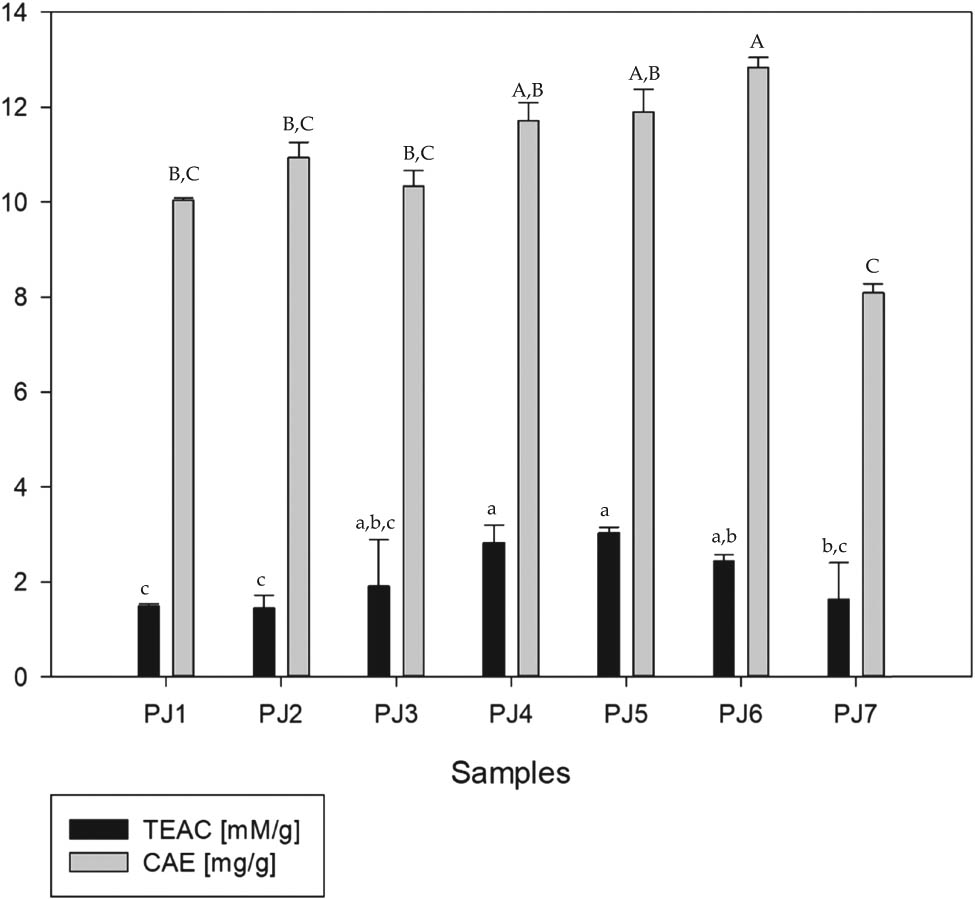
Antioxidant activities and total phenolic contents of analyzed PJ samples (PJs). PJ1: VR 808, PJ2: Saturna, PJ3: Toscana, PJ4: Ditta, PJ5: Lord, PJ6: Denar, and PJ7: Lady Claire. Mean values with different letters are significantly different at α = 0.05.
Among the free phenolic acids and polyphenols present in potatoes, the most frequently described are catechin, chlorogenic, caffeic, ferulic, gallic acids, and malvidin [45,46,47]. However, the analyzed juices showed the presence of chlorogenic, sinapic, coumaric, hydroxybenzoic acids, niacin, rutin, and vanillin. Importantly, PJs from different potato cultivars were characterized by a different profile of the analyzed compounds. PJ4 was the only one that contained chlorogenic acid, which has many health-promoting properties, most of them related to the treatment of metabolic syndrome, including antioxidant, anti-inflammatory, antilipidemic, antidiabetic, and antihypertensive effects [48], and PJ4 was the only one that did not contain hydroxybenzoic acid. PJ4 also contained the greatest amount of rutin (3,30,40,5,7-pentahydroxyflavone-3-rhamnoglucoside), which demonstrated a number of pharmacological activities, including antioxidant, cytoprotective, vasoprotective, anticarcinogenic, neuroprotective, and cardioprotective activities [49]. Detailed data on the content of individual phenols are presented in Table 1.
Phenolic compounds determined by HPLC
| Sample | Chlorogenic acid (μg/g) | Rutin (μg/g) | p-Coumaric acid (μg/g) | p-Hydroxybenzoic acid (μg/g) | Ferulic acid (μg/g) | Niacin (μg/g) | Sinapic acid (μg/g) | Vanillin (μg/g) |
|---|---|---|---|---|---|---|---|---|
| PJ1 | N/D | 4.68 ± 0.02d | 2.85 ± 0.01c | 1.16 ± 0.01b | 4.84 ± 0.02c | 233.49 ± 1.12c | N/D | 38.52 ± 0.11b |
| PJ2 | N/D | N/D | 11.46 ± 0.03a | 1.12 ± 0.01c | 3.03 ± 0.01f | 274.83 ± 0.97b | 1.93 ± 0.01b | 47.74 ± 0.27a |
| PJ3 | N/D | 23.35 ± 0.12b | 0.37 ± 0.01d | 1.61 ± 0.02a | 5.97 ± 0.01b | 208.82 ± 1.27d | 1.33 ± 0.01c | 23.59 ± 0.13c |
| PJ4 | 22.96 ± 0.89 | 131.38 ± 0.14a | N/D | N/D | 4.71 ± 0.01d | 82.08 ± 0.99g | 8.67 ± 0.02a | 17.44 ± 0.10d |
| PJ5 | N/D | 1.93 ± 0.01e | N/D | 0.46 ± 0.02d | 3.36 ± 0.02e | 138.31 ± 1.06e | 1.19 ± 0.01d | 15.97 ± 0.09e |
| PJ6 | N/D | 18.97 ± 0.06c | N/D | 0.50 ± 0.02d | 2.98 ± 0.01f | 99.22 ± 0.89f | N/D | 15.36 ± 0.08e |
| PJ7 | N/D | N/D | 4.62 ± 0.02b | 1.12 ± 0.02c | 6.36 ± 0.02a | 332.52 ± 1.03a | N/D | 39.83 ± 0.10b |
PJ1, VR 808; PJ2, Saturna; PJ3, Toscana; PJ4, Ditta; PJ5, Lord; PJ6, Denar; and PJ7, Lady Claire. N/D, not detected. Mean values with different letters in the superscript are significantly different at α = 0.05.
3.2 Glycoalcaloid contents
Despite the high nutritional value of potatoes, concern is raised by the presence of GAs, compounds that are widely recognized as toxic [50]. They are formed by combining alkaloids with one or more sugar molecules. GAs are present throughout the plant, but the greatest risk comes from their presence in the edible part, that is, tubers, from which they then pass into the PJ in the starch production process. Almost 95% of the GAs of potatoes are α-solanine and α-chaconine [51]. Due to slight differences in structure, and thus similar physicochemical properties, publications often include the total content of GAs, without distinguishing individual compounds that make up this group of compounds [52]. The use of mass spectrometry allowed to determine the content of both main GAs in the analyzed juices, and the results are presented in Figure 2. It was shown that the juices from PJ4 and PJ3 varieties had the lowest GA content, and the highest levels were observed for PJ1 and PJ6. GAs are essential for the proper growth of the plant. Like phenols, they are secondary metabolites that protect plants against pests and pathogens [53]. However, no relationship was found between the GA and phenol contents. Due to the high toxicity of GAs, an acceptable limit of their content in potatoes has been established, which is 200 mg/kg of fresh potato tubers [54]. It is, therefore, important to monitor the GA content and use varieties with the lowest possible content. For this reason, the PJ4 and PJ3 varieties can be recommended for the production of PJ, on the one hand, due to the low content of GAs and, on the other hand, due to the high content of biologically active phenolic compounds.
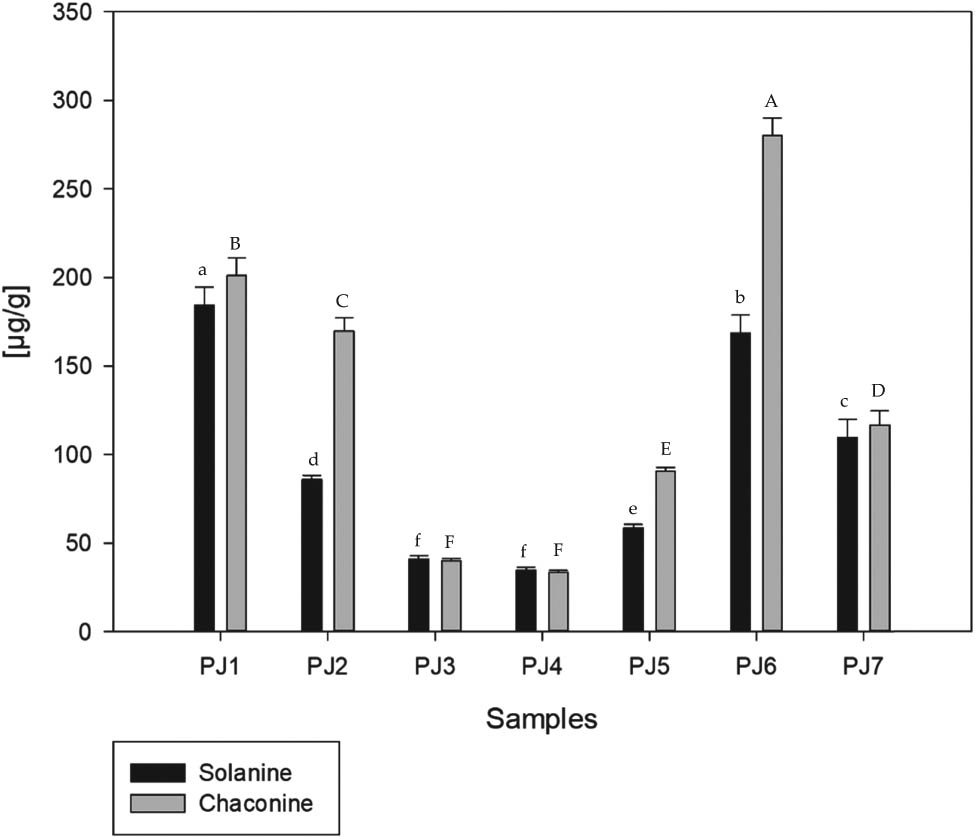
Results of LC–MS analysis of GAs. PJ1: VR 808, PJ2: Saturna, PJ3: Toscana, PJ4: Ditta, PJ5: Lord, PJ6: Denar, and PJ7: Lady Claire. Mean values with different letters are significantly different at α = 0.05.
3.3 Microbiological tests
Substances present in plants, as well as plant extracts, often exhibit antimicrobial properties. The antimicrobial properties of essential oils are the most widely described [23,55,56,57]. Also, so far few sources indicate the antimicrobial activity of substances present in potato tubers. Among them, proteins and protease inhibitors are most often described [58,59] but also polyphenolic compounds and GAs [53,60,61,62]. Strains of microorganisms selected for research represent many groups of microorganisms that are important from the point of view of human physiology, both positively influencing our body, but also pathogenic. However, despite the different contents of both phenols and GAs, no antimicrobial activity was found for any of the analyzed juices (data not shown). Therefore, it can be concluded that although PJ will not protect us against the development of pathogenic microflora, its consumption will not interfere with the growth of commensal microflora.
4 Conclusion
PJ is of increasing interest as a raw material with a high biological activity. Literature data describe the broad activity of PJ as antioxidant, anti-inflammatory, or even cytotoxic. In this study, the juices obtained from seven potato varieties, grown under the same conditions, were analyzed. It has been shown that both the content and the profile of polyphenolic compounds depend on the variety from which the juice was obtained. The highest content of polyphenols was found in the juice obtained from the Denar, Ditta, and Toscana varieties, and the lowest content was found in the juice obtained from the Lady Claire variety. However, the use of PJ raises toxicological concerns due to the presence of GAs in potatoes. Also in this case, a significant influence of the potato variety on the GA content in the juice was observed. The lowest levels of solanine and chaconine were recorded in juices from Toscana and Ditta. None of the analyzed juices inhibited the growth of the analyzed microorganisms. It can therefore be assumed that the Ditta and Toscana varieties, due to the high content of polyphenols and the low content of GAs, can be recommended for the industrial production of PJ, which is further used in the production of functional food or dietary supplements.
Acknowledgements
The authors thank Professor Grażyna Lewandowicz (Poznań University of Life Sciences, Poznań, Poland) for inspiration, consultation, and valuable advice.
-
Funding information: The National Centre for Research and Development of Poland (NCBR) is acknowledged for funding provided within the program LIDER under grant agreement No. LIDER/27/0105/L-11/19/NCBR/2020 (PI: Przemysław Kowalczewski).
-
Author contributions: Conceptualization, P.Ł.K.; funding acquisition, P.Ł.K.; formal analysis, P.Ł.K. and P.J.; investigation, P.Ł.K., J.Z., A.D., K.S., M.K., and P.J.; methodology, P.Ł.K., J.Z., and A.D.; project administration, P.Ł.K.; resources, D.R. and Z.S.; supervision, P.Ł.K.; visualization, P.Ł.K. and P.J.; writing – original draft, P.Ł.K., K.S., and P.J.; and writing – review and editing, P.Ł.K. All authors have read and agreed to the published version of the manuscript.
-
Conflict of interest: The authors declare no conflict of interest.
-
Ethical approval: The conducted research is not related to either human or animal use.
-
Data availability statement: The datasets generated during and/or analyzed during the current study are available from the corresponding author on reasonable request.
References
[1] Wahle KW, Brown I, Rotondo D, Heys SD. Plant phenolics in the prevention and treatment of cancer. In: Giardi MT, Rea G, Berra B, editors. Bio-farms for nutraceuticals. Advances in experimental medicine and biology. Boston (MA): Springer; 2010. p. 36–5110.1007/978-1-4419-7347-4_4Search in Google Scholar PubMed
[2] Heleno SA, Martins A, Queiroz MJ, Ferreira IC. Bioactivity of phenolic acids: metabolites versus parent compounds: a review. Food Chem. 2015 Apr;173:501–13.10.1016/j.foodchem.2014.10.057Search in Google Scholar PubMed
[3] Kumar N, Goel N. Phenolic acids: natural versatile molecules with promising therapeutic applications. Biotechnol Rep (Amst). 2019 Aug;24:e00370.10.1016/j.btre.2019.e00370Search in Google Scholar PubMed PubMed Central
[4] Witkowska-Banaszczak E, Radzikowska D, Ratajczak K. Chemical profile and antioxidant activity of Trollius europaeus under the influence of feeding aphids. Open Life Sci. 2018 Sep;13(1):312–8.10.1515/biol-2018-0038Search in Google Scholar PubMed PubMed Central
[5] Kowalczewski PŁ, Radzikowska D, Ivanišová E, Szwengiel A, Kačániová M, Sawinska Z. Influence of abiotic stress factors on the antioxidant properties and polyphenols profile composition of green barley (Hordeum vulgare L.). Int J Mol Sci. 2020 Jan;21(2):397.10.3390/ijms21020397Search in Google Scholar PubMed PubMed Central
[6] Bandurska H, Niedziela J, Pietrowska-Borek M, Nuc K, Chadzinikolau T, Radzikowska D. Regulation of proline biosynthesis and resistance to drought stress in two barley (Hordeum vulgare L.) genotypes of different origin. Plant Physiol Biochem. 2017 Sep;118:427–37.10.1016/j.plaphy.2017.07.006Search in Google Scholar PubMed
[7] Alamdari DH, Paletas K, Pegiou T, Sarigianni M, Befani C, Koliakos G. A novel assay for the evaluation of the prooxidant-antioxidant balance, before and after antioxidant vitamin administration in type II diabetes patients. Clin Biochem. 2007 Feb;40(3–4):248–54.10.1016/j.clinbiochem.2006.10.017Search in Google Scholar PubMed
[8] Gawlik-Dziki U, Świeca M, Sułkowski M, Dziki D, Baraniak B, Czyż J. Antioxidant and anticancer activities of Chenopodium quinoa leaves extracts - in vitro study. Food Chem Toxicol. 2013 Jul;57:154–60.10.1016/j.fct.2013.03.023Search in Google Scholar PubMed
[9] Kumar N, Gupta S, Chand Yadav T, Pruthi V, Kumar Varadwaj P, Goel N. Extrapolation of phenolic compounds as multi-target agents against cancer and inflammation. J Biomol Struct Dyn. 2019 Jun;37(9):2355–69.10.1080/07391102.2018.1481457Search in Google Scholar PubMed
[10] Działo M, Mierziak J, Korzun U, Preisner M, Szopa J, Kulma A. The potential of plant phenolics in prevention and therapy of skin disorders. Int J Mol Sci. 2016 Feb;17(2):160.10.3390/ijms17020160Search in Google Scholar PubMed PubMed Central
[11] Tryjanowski P, Sparks TH, Blecharczyk A, Małecka-Jankowiak I, Switek S, Sawinska Z. Changing phenology of potato and of the treatment for its major pest (Colorado potato beetle) – a long-term analysis. Am J Potato Res. 2018;95(1):26–32.10.1007/s12230-017-9611-3Search in Google Scholar
[12] Gibson S, Kurilich AC. The nutritional value of potatoes and potato products in the UK diet. Nutr Bull. 2013;38(4):389–99.10.1111/nbu.12057Search in Google Scholar
[13] Lutaladio N, Castaldi L, Lutaladio N, Castaldi L. Potato: the hidden treasure. J Food Compos Anal. 2009;22(6):491–3.10.1016/j.jfca.2009.05.002Search in Google Scholar
[14] Gopal J, Khurana SM. Handbook of potato production, improvement, and postharvest management. Boca Raton, FL, USA: CRC Press; 2006. 10.1201/9780429246623.Search in Google Scholar
[15] Zgórska K, Grudzińska M. Changes in selected quality parameters of potato tubers during storage. Acta Agrophys. 2012;19:203–14.Search in Google Scholar
[16] Pęksa A, Miedzianka J, Nemś A. Amino acid composition of flesh-coloured potatoes as affected by storage conditions. Food Chem. 2018 Nov;266:335–42.10.1016/j.foodchem.2018.06.026Search in Google Scholar PubMed
[17] Kaaber L, Bråthen E, Martinsen BK, Shomer I. The effect of storage conditions on chemical content of raw potatoes and texture of cooked potatoes. Potato Res. 2001;44(2):153–63.10.1007/BF02410102Search in Google Scholar
[18] Burlingame B, Mouillé B, Charrondière R. Nutrients, bioactive non-nutrients and anti-nutrients in potatoes. J Food Compos Anal. 2009;22(6):494–502.10.1016/j.jfca.2009.09.001Search in Google Scholar
[19] Brown CR, Haynes KG, Moore M, Pavek MJ, Hane DC, Love SL, et al. Stability and broad-sense heritability of mineral content in potato: iron. Am J Potato Res. 2010;87(4):390–6.10.1007/s12230-010-9145-4Search in Google Scholar
[20] Jeżowski P, Polcyn K, Tomkowiak A, Rybicka I, Radzikowska D. Technological and antioxidant properties of proteins obtained from waste potato juice. Open Life Sci. 2020 Jun;15(1):379–88.10.1515/biol-2020-0046Search in Google Scholar PubMed PubMed Central
[21] Ramadan MF, Oraby HF. Fatty acids and bioactive lipids of potato cultivars: an overview. J Oleo Sci. 2016;65(6):459–70.10.5650/jos.ess16015Search in Google Scholar PubMed
[22] Kot AM, Pobiega K, Piwowarek K, Kieliszek M, Błażejak S, Gniewosz M, et al. Biotechnological methods of management and utilization of potato industry waste – a review. Potato Res. 2020;63(3):431–47.10.1007/s11540-019-09449-6Search in Google Scholar
[23] Felšöciová S, Vukovic N, Jeżowski P, Kačániová M. Antifungal activity of selected volatile essential oils against Penicillium sp. Open Life Sci. 2020 Jul;15(1):511–21.10.1515/biol-2020-0045Search in Google Scholar PubMed PubMed Central
[24] Tuśnio A, Pastuszewska B, Święch E, Taciak M. Response of young pigs to feeding potato protein and potato fibre – nutritional, physiological and biochemical parameters. J Anim Feed Sci. 2011;20(3):361–78.10.22358/jafs/66192/2011Search in Google Scholar
[25] Bzducha-Wróbel A, Pobiega K, Błażejak S, Kieliszek M. The scale-up cultivation of Candida utilis in waste potato juice water with glycerol affects biomass and β(1,3)/(1,6)-glucan characteristic and yield. Appl Microbiol Biotechnol. 2018 Nov;102(21):9131–45.10.1007/s00253-018-9357-ySearch in Google Scholar PubMed PubMed Central
[26] Bzducha-Wróbel A, Błażejak S, Kieliszek M, Pobiega K, Falana K, Janowicz M. Modification of the cell wall structure of Saccharomyces cerevisiae strains during cultivation on waste potato juice water and glycerol towards biosynthesis of functional polysaccharides. J Biotechnol. 2018 Sep;281:1–10.10.1016/j.jbiotec.2018.06.305Search in Google Scholar PubMed
[27] Bzducha-Wróbel A, Błażejak S, Molenda M, Reczek L. Biosynthesis of β(1,3)/(1,6)-glucans of cell wall of the yeast Candida utilis ATCC 9950 strains in the culture media supplemented with deproteinated potato juice water and glycerol. Eur Food Res Technol. 2015;240(5):1023–34.10.1007/s00217-014-2406-6Search in Google Scholar
[28] Kowalczewski PŁ, Lewandowicz GG, Krzywdzińska-Bartkowiak M, Piątek M, Baranowska HM, Białas W, et al. Finely comminuted frankfurters fortified with potato juice – quality and structure. J Food Eng. 2015;167:183–8.10.1016/j.jfoodeng.2015.05.016Search in Google Scholar
[29] Kowalczewski P, Lewandowicz G, Makowska A, Knoll I, Błaszczak W, Białas W, et al. Pasta fortified with potato juice: structure, quality, and consumer acceptance. J Food Sci. 2015 Jun;80(6):S1377–82.10.1111/1750-3841.12906Search in Google Scholar PubMed
[30] Kowalczewski P, Różańska M, Makowska A, Jeżowski P, Kubiak P. Production of wheat bread with spray-dried potato juice: influence on dough and bread characteristics. Food Sci Technol Int. 2019 Apr;25(3):223–32.10.1177/1082013218814605Search in Google Scholar PubMed
[31] Kowalczewski PŁ, Olejnik A, Białas W, Rybicka I, Zielińska-Dawidziak M, Siger A, et al. The nutritional value and biological activity of concentrated protein fraction of potato juice. Nutrients. 2019 Jul;11(7):1523.10.3390/nu11071523Search in Google Scholar PubMed PubMed Central
[32] Miedzianka J, Pęksa A, Pokora M, Rytel E, Tajner-Czopek A, Kita A. Improving the properties of fodder potato protein concentrate by enzymatic hydrolysis. Food Chem. 2014 Sep;159:512–8.10.1016/j.foodchem.2014.03.054Search in Google Scholar
[33] Kowalczewski PŁ, Olejnik A, Rybicka I, Zielińska-Dawidziak M, Białas W, Lewandowicz G. Membrane filtration-assisted enzymatic hydrolysis affects the biological activity of potato juice. Molecules. 2021 Feb;26(4):852.10.3390/molecules26040852Search in Google Scholar
[34] Chrubasik S, Chrubasik C, Torda T, Madisch A. Efficacy and tolerability of potato juice in dyspeptic patients: a pilot study. Phytomedicine. 2006 Jan;13(1–2):11–5.10.1016/j.phymed.2005.03.005Search in Google Scholar
[35] Cham BE, Meares HM. Glycoalkaloids from Solanum sodomaeum are effective in the treatment of skin cancers in man. Cancer Lett. 1987 Aug;36(2):111–8.10.1016/0304-3835(87)90081-4Search in Google Scholar
[36] Kuo KW, Hsu SH, Li YP, Lin WL, Liu LF, Chang LC, et al. Anticancer activity evaluation of the solanum glycoalkaloid solamargine. Biochem Pharmacol. 2000 Dec;60(12):1865–73.10.1016/S0006-2952(00)00506-2Search in Google Scholar
[37] Hu K, Kobayashi H, Dong A, Jing Y, Iwasaki S, Yao X. Antineoplastic agents. III: steroidal glycosides from Solanum nigrum. Planta Med. 1999 Feb;65(1):35–8.10.1055/s-1999-13958Search in Google Scholar
[38] Re R, Pellegrini N, Proteggente A, Pannala A, Yang M, Rice-Evans C. Antioxidant activity applying an improved ABTS radical cation decolorization assay. Free Radic Biol Med. 1999 May;26(9–10):1231–7.10.1016/S0891-5849(98)00315-3Search in Google Scholar
[39] Singleton VL, Orthofer R, Lamuela-Raventós RM. Analysis of total phenols and other oxidation substrates and antioxidants by means of folin-ciocalteu reagent. Methods in Enzymology. Vol. 299. Cambridge, MA, USA: Academic Press; 1999. p. 152–78.10.1016/S0076-6879(99)99017-1Search in Google Scholar
[40] Nielsen SD, Schmidt JM, Kristiansen GH, Dalsgaard TK, Larsen LB. Liquid chromatography mass spectrometry quantification of α-solanine, α-chaconine, and solanidine in potato protein isolates. Foods. 2020 Apr;9(4):416.10.3390/foods9040416Search in Google Scholar PubMed PubMed Central
[41] Kowalczewski PŁ, Olejnik A, Białas W, Kubiak P, Siger A, Nowicki M, et al. Effect of thermal processing on antioxidant activity and cytotoxicity of waste potato juice. Open Life Sci. 2019 May;14(1):150–7.10.1515/biol-2019-0017Search in Google Scholar PubMed PubMed Central
[42] Fares C, Platani C, Baiano A, Menga V. Effect of processing and cooking on phenolic acid profile and antioxidant capacity of durum wheat pasta enriched with debranning fractions of wheat. Food Chem. 2010;119(3):1023–9.10.1016/j.foodchem.2009.08.006Search in Google Scholar
[43] Lee SC, Kim JH, Jeong SM, Kim DR, Ha JU, Nam KC, et al. Effect of far-infrared radiation on the antioxidant activity of rice hulls. J Agric Food Chem. 2003 Jul;51(15):4400–3.10.1021/jf0300285Search in Google Scholar
[44] Zielinski H, Kozlowska H, Lewczuk B. Bioactive compounds in the cereal grains before and after hydrothermal processing. Innov Food Sci Emerg Technol. 2001;2(3):159–69.10.1016/S1466-8564(01)00040-6Search in Google Scholar
[45] Akyol H, Riciputi Y, Capanoglu E, Caboni MF, Verardo V. Phenolic compounds in the potato and its byproducts: an overview. Int J Mol Sci. 2016 May;17(6):835.10.3390/ijms17060835Search in Google Scholar
[46] Leo L, Leone A, Longo C, Lombardi DA, Raimo F, Zacheo G. Antioxidant compounds and antioxidant activity in “early potatoes”. J Agric Food Chem. 2008 Jun;56(11):4154–63.10.1021/jf073322wSearch in Google Scholar
[47] Reddivari L, Hale AL, Miller JC. Determination of phenolic content, composition and their contribution to antioxidant activity in specialty potato selections. Am J Potato Res. 2007;84(4):275–82.10.1007/BF02986239Search in Google Scholar
[48] Santana-Gálvez J, Cisneros-Zevallos L, Jacobo-Velázquez DA. Chlorogenic acid: recent advances on its dual role as a food additive and a nutraceutical against metabolic syndrome. Molecules. 2017 Feb;22(3):358.10.3390/molecules22030358Search in Google Scholar
[49] Ganeshpurkar A, Saluja AK. The pharmacological potential of rutin. Saudi Pharm J. 2017 Feb;25(2):149–64.10.1016/j.jsps.2016.04.025Search in Google Scholar
[50] Percival GC, Dixon GR Glycoalkaloids. In D’Mello JPF, editor. Handbook of plant and fungal toxicants. Boca Raton, FL, USA: CRC Press; 2020.10.1201/9780429281952-2Search in Google Scholar
[51] Smith DB, Roddick JG, Jones JL. Potato glycoalkaloids: some unanswered questions. Trends Food Sci Technol. 1996;7(4):126–31.10.1016/0924-2244(96)10013-3Search in Google Scholar
[52] Barceloux DG. Potatoes, tomatoes, and solanine toxicity (Solanum tuberosum L., Solanum lycopersicum L.). Dis Mon. 2009 Jun;55(6):391–402.10.1002/9780470330319.ch11Search in Google Scholar
[53] Friedman M. Potato glycoalkaloids and metabolites: roles in the plant and in the diet. J Agric Food Chem. 2006 Nov;54(23):8655–81.10.1021/jf061471tSearch in Google Scholar PubMed
[54] Singh B, Dutt S, Raigond P. Potato Glycoalkaloids. Potato. Singapore: Springer Singapore; 2020. p. 191–211.10.1007/978-981-15-7662-1_11Search in Google Scholar
[55] Felšöciová S, Kačániová M, Horská E, Vukovič N, Hleba L, Petrová J, et al. Antifungal activity of essential oils against selected Terverticillate penicillia. Ann Agric Env Med. 2015;22(1):38–42.10.5604/12321966.1141367Search in Google Scholar PubMed
[56] Kačániová M, Galovičová L, Valková V, Tvrdá E, Terentjeva M, Žiarovská J, et al. Antimicrobial and antioxidant activities of Cinnamomum cassia essential oil and its application in food preservation. Open Chem. 2021;19(1):214–27.10.1515/chem-2021-0191Search in Google Scholar
[57] Kačániová M, Galovičová L, Ivanišová E, Vukovic NL, Štefániková J, Valková V, et al. Antioxidant, antimicrobial and antibiofilm activity of coriander (Coriandrum sativum L.) essential oil for its application in foods. Foods. 2020 Mar;9(3):282.10.3390/foods9030282Search in Google Scholar PubMed PubMed Central
[58] Kim JY, Park SC, Hwang I, Cheong H, Nah JW, Hahm KS, et al. Protease inhibitors from plants with antimicrobial activity. Int J Mol Sci. 2009 Jun;10(6):2860–72.10.3390/ijms10062860Search in Google Scholar PubMed PubMed Central
[59] Bártová V, Bárta J, Jarošová M. Antifungal and antimicrobial proteins and peptides of potato (Solanum tuberosum L.) tubers and their applications. Appl Microbiol Biotechnol. 2019 Jul;103(14):5533–47.10.1007/s00253-019-09887-9Search in Google Scholar PubMed
[60] Daglia M. Polyphenols as antimicrobial agents. Curr Opin Biotechnol. 2012 Apr;23(2):174–81.10.1016/j.copbio.2011.08.007Search in Google Scholar PubMed
[61] Raccach M. The antimicrobial activity of phenolic antioxidants in foods: a review. J Food Saf. 1984;6(3):141–70.10.1111/j.1745-4565.1984.tb00479.xSearch in Google Scholar
[62] Friedman M, Rasooly R. Review of the inhibition of biological activities of food-related selected toxins by natural compounds. Toxins (Basel). 2013 Apr;5(4):743–75.10.3390/toxins5040743Search in Google Scholar PubMed PubMed Central
© 2021 Przemysław Łukasz Kowalczewski et al., published by De Gruyter
This work is licensed under the Creative Commons Attribution 4.0 International License.
Articles in the same Issue
- Regular Articles
- Qualitative and semi-quantitative assessment of anthocyanins in Tibetan hulless barley from different geographical locations by UPLC-QTOF-MS and their antioxidant capacities
- Effect of sodium chloride on the expression of genes involved in the salt tolerance of Bacillus sp. strain “SX4” isolated from salinized greenhouse soil
- GC-MS analysis of mango stem bark extracts (Mangifera indica L.), Haden variety. Possible contribution of volatile compounds to its health effects
- Influence of nanoscale-modified apatite-type calcium phosphates on the biofilm formation by pathogenic microorganisms
- Removal of paracetamol from aqueous solution by containment composites
- Investigating a human pesticide intoxication incident: The importance of robust analytical approaches
- Induction of apoptosis and cell cycle arrest by chloroform fraction of Juniperus phoenicea and chemical constituents analysis
- Recovery of γ-Fe2O3 from copper ore tailings by magnetization roasting and magnetic separation
- Effects of different extraction methods on antioxidant properties of blueberry anthocyanins
- Modeling the removal of methylene blue dye using a graphene oxide/TiO2/SiO2 nanocomposite under sunlight irradiation by intelligent system
- Antimicrobial and antioxidant activities of Cinnamomum cassia essential oil and its application in food preservation
- Full spectrum and genetic algorithm-selected spectrum-based chemometric methods for simultaneous determination of azilsartan medoxomil, chlorthalidone, and azilsartan: Development, validation, and application on commercial dosage form
- Evaluation of the performance of immunoblot and immunodot techniques used to identify autoantibodies in patients with autoimmune diseases
- Computational studies by molecular docking of some antiviral drugs with COVID-19 receptors are an approach to medication for COVID-19
- Synthesis of amides and esters containing furan rings under microwave-assisted conditions
- Simultaneous removal efficiency of H2S and CO2 by high-gravity rotating packed bed: Experiments and simulation
- Design, synthesis, and biological activities of novel thiophene, pyrimidine, pyrazole, pyridine, coumarin and isoxazole: Dydrogesterone derivatives as antitumor agents
- Content and composition analysis of polysaccharides from Blaps rynchopetera and its macrophage phagocytic activity
- A new series of 2,4-thiazolidinediones endowed with potent aldose reductase inhibitory activity
- Assessing encapsulation of curcumin in cocoliposome: In vitro study
- Rare norisodinosterol derivatives from Xenia umbellata: Isolation and anti-proliferative activity
- Comparative study of antioxidant and anticancer activities and HPTLC quantification of rutin in white radish (Raphanus sativus L.) leaves and root extracts grown in Saudi Arabia
- Comparison of adsorption properties of commercial silica and rice husk ash (RHA) silica: A study by NIR spectroscopy
- Sodium borohydride (NaBH4) as a high-capacity material for next-generation sodium-ion capacitors
- Aroma components of tobacco powder from different producing areas based on gas chromatography ion mobility spectrometry
- The effects of salinity on changes in characteristics of soils collected in a saline region of the Mekong Delta, Vietnam
- Synthesis, properties, and activity of MoVTeNbO catalysts modified by zirconia-pillared clays in oxidative dehydrogenation of ethane
- Synthesis and crystal structure of N,N′-bis(4-chlorophenyl)thiourea N,N-dimethylformamide
- Quantitative analysis of volatile compounds of four Chinese traditional liquors by SPME-GC-MS and determination of total phenolic contents and antioxidant activities
- A novel separation method of the valuable components for activated clay production wastewater
- On ve-degree- and ev-degree-based topological properties of crystallographic structure of cuprite Cu2O
- Antihyperglycemic effect and phytochemical investigation of Rubia cordifolia (Indian Madder) leaves extract
- Microsphere molecularly imprinted solid-phase extraction for diazepam analysis using itaconic acid as a monomer in propanol
- A nitric oxide-releasing prodrug promotes apoptosis in human renal carcinoma cells: Involvement of reactive oxygen species
- Machine vision-based driving and feedback scheme for digital microfluidics system
- Study on the application of a steam-foam drive profile modification technology for heavy oil reservoir development
- Ni–Ru-containing mixed oxide-based composites as precursors for ethanol steam reforming catalysts: Effect of the synthesis methods on the structural and catalytic properties
- Preparation of composite soybean straw-based materials by LDHs modifying as a solid sorbent for removal of Pb(ii) from water samples
- Synthesis and spectral characterizations of vanadyl(ii) and chromium(iii) mixed ligand complexes containing metformin drug and glycine amino acid
- In vitro evaluation of lactic acid bacteria with probiotic activity isolated from local pickled leaf mustard from Wuwei in Anhui as substitutes for chemical synthetic additives
- Utilization and simulation of innovative new binuclear Co(ii), Ni(ii), Cu(ii), and Zn(ii) diimine Schiff base complexes in sterilization and coronavirus resistance (Covid-19)
- Phosphorylation of Pit-1 by cyclin-dependent kinase 5 at serine 126 is associated with cell proliferation and poor prognosis in prolactinomas
- Molecularly imprinted membrane for transport of urea, creatinine, and vitamin B12 as a hemodialysis candidate membrane
- Optimization of Murrayafoline A ethanol extraction process from the roots of Glycosmis stenocarpa, and evaluation of its Tumorigenesis inhibition activity on Hep-G2 cells
- Highly sensitive determination of α-lipoic acid in pharmaceuticals on a boron-doped diamond electrode
- Synthesis, chemo-informatics, and anticancer evaluation of fluorophenyl-isoxazole derivatives
- In vitro and in vivo investigation of polypharmacology of propolis extract as anticancer, antibacterial, anti-inflammatory, and chemical properties
- Topological indices of bipolar fuzzy incidence graph
- Preparation of Fe3O4@SiO2–ZnO catalyst and its catalytic synthesis of rosin glycol ester
- Construction of a new luminescent Cd(ii) compound for the detection of Fe3+ and treatment of Hepatitis B
- Investigation of bovine serum albumin aggregation upon exposure to silver(i) and copper(ii) metal ions using Zetasizer
- Discoloration of methylene blue at neutral pH by heterogeneous photo-Fenton-like reactions using crystalline and amorphous iron oxides
- Optimized extraction of polyphenols from leaves of Rosemary (Rosmarinus officinalis L.) grown in Lam Dong province, Vietnam, and evaluation of their antioxidant capacity
- Synthesis of novel thiourea-/urea-benzimidazole derivatives as anticancer agents
- Potency and selectivity indices of Myristica fragrans Houtt. mace chloroform extract against non-clinical and clinical human pathogens
- Simple modifications of nicotinic, isonicotinic, and 2,6-dichloroisonicotinic acids toward new weapons against plant diseases
- Synthesis, optical and structural characterisation of ZnS nanoparticles derived from Zn(ii) dithiocarbamate complexes
- Presence of short and cyclic peptides in Acacia and Ziziphus honeys may potentiate their medicinal values
- The role of vitamin D deficiency and elevated inflammatory biomarkers as risk factors for the progression of diabetic nephropathy in patients with type 2 diabetes mellitus
- Quantitative structure–activity relationship study on prolonged anticonvulsant activity of terpene derivatives in pentylenetetrazole test
- GADD45B induced the enhancing of cell viability and proliferation in radiotherapy and increased the radioresistance of HONE1 cells
- Cannabis sativa L. chemical compositions as potential plasmodium falciparum dihydrofolate reductase-thymidinesynthase enzyme inhibitors: An in silico study for drug development
- Dynamics of λ-cyhalothrin disappearance and expression of selected P450 genes in bees depending on the ambient temperature
- Identification of synthetic cannabinoid methyl 2-{[1-(cyclohexylmethyl)-1H-indol-3-yl] formamido}-3-methylbutanoate using modern mass spectrometry and nuclear magnetic resonance techniques
- Study on the speciation of arsenic in the genuine medicinal material honeysuckle
- Two Cu(ii)-based coordination polymers: Crystal structures and treatment activity on periodontitis
- Conversion of furfuryl alcohol to ethyl levulinate in the presence of mesoporous aluminosilicate catalyst
- Review Articles
- Hsien Wu and his major contributions to the chemical era of immunology
- Overview of the major classes of new psychoactive substances, psychoactive effects, analytical determination and conformational analysis of selected illegal drugs
- An overview of persistent organic pollutants along the coastal environment of Kuwait
- Mechanism underlying sevoflurane-induced protection in cerebral ischemia–reperfusion injury
- COVID-19 and SARS-CoV-2: Everything we know so far – A comprehensive review
- Challenge of diabetes mellitus and researchers’ contributions to its control
- Advances in the design and application of transition metal oxide-based supercapacitors
- Color and composition of beauty products formulated with lemongrass essential oil: Cosmetics formulation with lemongrass essential oil
- The structural chemistry of zinc(ii) and nickel(ii) dithiocarbamate complexes
- Bioprospecting for antituberculosis natural products – A review
- Recent progress in direct urea fuel cell
- Rapid Communications
- A comparative morphological study of titanium dioxide surface layer dental implants
- Changes in the antioxidative properties of honeys during their fermentation
- Erratum
- Erratum to “Corrosion study of copper in aqueous sulfuric acid solution in the presence of (2E,5E)-2,5-dibenzylidenecyclopentanone and (2E,5E)-bis[(4-dimethylamino)benzylidene]cyclopentanone: Experimental and theoretical study”
- Erratum to “Modified TDAE petroleum plasticiser”
- Corrigendum
- Corrigendum to “A nitric oxide-releasing prodrug promotes apoptosis in human renal carcinoma cells: Involvement of reactive oxygen species”
- Special Issue on 3rd IC3PE 2020
- Visible light-responsive photocatalyst of SnO2/rGO prepared using Pometia pinnata leaf extract
- Antihyperglycemic activity of Centella asiatica (L.) Urb. leaf ethanol extract SNEDDS in zebrafish (Danio rerio)
- Selection of oil extraction process from Chlorella species of microalgae by using multi-criteria decision analysis technique for biodiesel production
- Special Issue on the 14th Joint Conference of Chemistry (14JCC)
- Synthesis and in vitro cytotoxicity evaluation of isatin-pyrrole derivatives against HepG2 cell line
- CO2 gas separation using mixed matrix membranes based on polyethersulfone/MIL-100(Al)
- Effect of synthesis and activation methods on the character of CoMo/ultrastable Y-zeolite catalysts
- Special Issue on Electrochemical Amplified Sensors
- Enhancement of graphene oxide through β-cyclodextrin composite to sensitive analysis of an antidepressant: Sulpiride
- Investigation of the spectroelectrochemical behavior of quercetin isolated from Zanthoxylum bungeanum
- An electrochemical sensor for high sensitive determination of lysozyme based on the aptamer competition approach
- An improved non-enzymatic electrochemical sensor amplified with CuO nanostructures for sensitive determination of uric acid
- Special Issue on Applied Biochemistry and Biotechnology 2020
- Fast discrimination of avocado oil for different extracted methods using headspace-gas chromatography-ion mobility spectroscopy with PCA based on volatile organic compounds
- Effect of alkali bases on the synthesis of ZnO quantum dots
- Quality evaluation of Cabernet Sauvignon wines in different vintages by 1H nuclear magnetic resonance-based metabolomics
- Special Issue on the Joint Science Congress of Materials and Polymers (ISCMP 2019)
- Diatomaceous Earth: Characterization, thermal modification, and application
- Electrochemical determination of atenolol and propranolol using a carbon paste sensor modified with natural ilmenite
- Special Issue on the Conference of Energy, Fuels, Environment 2020
- Assessment of the mercury contamination of landfilled and recovered foundry waste – a case study
- Primary energy consumption in selected EU Countries compared to global trends
- Modified TDAE petroleum plasticiser
- Use of glycerol waste in lactic acid bacteria metabolism for the production of lactic acid: State of the art in Poland
- Topical Issue on Applications of Mathematics in Chemistry
- Theoretical study of energy, inertia and nullity of phenylene and anthracene
- Banhatti, revan and hyper-indices of silicon carbide Si2C3-III[n,m]
- Topical Issue on Agriculture
- Occurrence of mycotoxins in selected agricultural and commercial products available in eastern Poland
- Special Issue on Ethnobotanical, Phytochemical and Biological Investigation of Medicinal Plants
- Acute and repeated dose 60-day oral toxicity assessment of chemically characterized Berberis hispanica Boiss. and Reut in Wistar rats
- Phytochemical profile, in vitro antioxidant, and anti-protein denaturation activities of Curcuma longa L. rhizome and leaves
- Antiplasmodial potential of Eucalyptus obliqua leaf methanolic extract against Plasmodium vivax: An in vitro study
- Prunus padus L. bark as a functional promoting component in functional herbal infusions – cyclooxygenase-2 inhibitory, antioxidant, and antimicrobial effects
- Molecular and docking studies of tetramethoxy hydroxyflavone compound from Artemisia absinthium against carcinogens found in cigarette smoke
- Special Issue on the Joint Science Congress of Materials and Polymers (ISCMP 2020)
- Preparation of cypress (Cupressus sempervirens L.) essential oil loaded poly(lactic acid) nanofibers
- Influence of mica mineral on flame retardancy and mechanical properties of intumescent flame retardant polypropylene composites
- Production and characterization of thermoplastic elastomer foams based on the styrene–ethylene–butylene–styrene (SEBS) rubber and thermoplastic material
- Special Issue on Applied Chemistry in Agriculture and Food Science
- Impact of essential oils on the development of pathogens of the Fusarium genus and germination parameters of selected crops
- Yield, volume, quality, and reduction of biotic stress influenced by titanium application in oilseed rape, winter wheat, and maize cultivations
- Influence of potato variety on polyphenol profile composition and glycoalcaloid contents of potato juice
- Carryover effect of direct-fed microbial supplementation and early weaning on the growth performance and carcass characteristics of growing Najdi lambs
- Special Issue on Applied Biochemistry and Biotechnology (ABB 2021)
- The electrochemical redox mechanism and antioxidant activity of polyphenolic compounds based on inlaid multi-walled carbon nanotubes-modified graphite electrode
- Study of an adsorption method for trace mercury based on Bacillus subtilis
- Special Issue on The 1st Malaysia International Conference on Nanotechnology & Catalysis (MICNC2021)
- Mitigating membrane biofouling in biofuel cell system – A review
- Mechanical properties of polymeric biomaterials: Modified ePTFE using gamma irradiation
Articles in the same Issue
- Regular Articles
- Qualitative and semi-quantitative assessment of anthocyanins in Tibetan hulless barley from different geographical locations by UPLC-QTOF-MS and their antioxidant capacities
- Effect of sodium chloride on the expression of genes involved in the salt tolerance of Bacillus sp. strain “SX4” isolated from salinized greenhouse soil
- GC-MS analysis of mango stem bark extracts (Mangifera indica L.), Haden variety. Possible contribution of volatile compounds to its health effects
- Influence of nanoscale-modified apatite-type calcium phosphates on the biofilm formation by pathogenic microorganisms
- Removal of paracetamol from aqueous solution by containment composites
- Investigating a human pesticide intoxication incident: The importance of robust analytical approaches
- Induction of apoptosis and cell cycle arrest by chloroform fraction of Juniperus phoenicea and chemical constituents analysis
- Recovery of γ-Fe2O3 from copper ore tailings by magnetization roasting and magnetic separation
- Effects of different extraction methods on antioxidant properties of blueberry anthocyanins
- Modeling the removal of methylene blue dye using a graphene oxide/TiO2/SiO2 nanocomposite under sunlight irradiation by intelligent system
- Antimicrobial and antioxidant activities of Cinnamomum cassia essential oil and its application in food preservation
- Full spectrum and genetic algorithm-selected spectrum-based chemometric methods for simultaneous determination of azilsartan medoxomil, chlorthalidone, and azilsartan: Development, validation, and application on commercial dosage form
- Evaluation of the performance of immunoblot and immunodot techniques used to identify autoantibodies in patients with autoimmune diseases
- Computational studies by molecular docking of some antiviral drugs with COVID-19 receptors are an approach to medication for COVID-19
- Synthesis of amides and esters containing furan rings under microwave-assisted conditions
- Simultaneous removal efficiency of H2S and CO2 by high-gravity rotating packed bed: Experiments and simulation
- Design, synthesis, and biological activities of novel thiophene, pyrimidine, pyrazole, pyridine, coumarin and isoxazole: Dydrogesterone derivatives as antitumor agents
- Content and composition analysis of polysaccharides from Blaps rynchopetera and its macrophage phagocytic activity
- A new series of 2,4-thiazolidinediones endowed with potent aldose reductase inhibitory activity
- Assessing encapsulation of curcumin in cocoliposome: In vitro study
- Rare norisodinosterol derivatives from Xenia umbellata: Isolation and anti-proliferative activity
- Comparative study of antioxidant and anticancer activities and HPTLC quantification of rutin in white radish (Raphanus sativus L.) leaves and root extracts grown in Saudi Arabia
- Comparison of adsorption properties of commercial silica and rice husk ash (RHA) silica: A study by NIR spectroscopy
- Sodium borohydride (NaBH4) as a high-capacity material for next-generation sodium-ion capacitors
- Aroma components of tobacco powder from different producing areas based on gas chromatography ion mobility spectrometry
- The effects of salinity on changes in characteristics of soils collected in a saline region of the Mekong Delta, Vietnam
- Synthesis, properties, and activity of MoVTeNbO catalysts modified by zirconia-pillared clays in oxidative dehydrogenation of ethane
- Synthesis and crystal structure of N,N′-bis(4-chlorophenyl)thiourea N,N-dimethylformamide
- Quantitative analysis of volatile compounds of four Chinese traditional liquors by SPME-GC-MS and determination of total phenolic contents and antioxidant activities
- A novel separation method of the valuable components for activated clay production wastewater
- On ve-degree- and ev-degree-based topological properties of crystallographic structure of cuprite Cu2O
- Antihyperglycemic effect and phytochemical investigation of Rubia cordifolia (Indian Madder) leaves extract
- Microsphere molecularly imprinted solid-phase extraction for diazepam analysis using itaconic acid as a monomer in propanol
- A nitric oxide-releasing prodrug promotes apoptosis in human renal carcinoma cells: Involvement of reactive oxygen species
- Machine vision-based driving and feedback scheme for digital microfluidics system
- Study on the application of a steam-foam drive profile modification technology for heavy oil reservoir development
- Ni–Ru-containing mixed oxide-based composites as precursors for ethanol steam reforming catalysts: Effect of the synthesis methods on the structural and catalytic properties
- Preparation of composite soybean straw-based materials by LDHs modifying as a solid sorbent for removal of Pb(ii) from water samples
- Synthesis and spectral characterizations of vanadyl(ii) and chromium(iii) mixed ligand complexes containing metformin drug and glycine amino acid
- In vitro evaluation of lactic acid bacteria with probiotic activity isolated from local pickled leaf mustard from Wuwei in Anhui as substitutes for chemical synthetic additives
- Utilization and simulation of innovative new binuclear Co(ii), Ni(ii), Cu(ii), and Zn(ii) diimine Schiff base complexes in sterilization and coronavirus resistance (Covid-19)
- Phosphorylation of Pit-1 by cyclin-dependent kinase 5 at serine 126 is associated with cell proliferation and poor prognosis in prolactinomas
- Molecularly imprinted membrane for transport of urea, creatinine, and vitamin B12 as a hemodialysis candidate membrane
- Optimization of Murrayafoline A ethanol extraction process from the roots of Glycosmis stenocarpa, and evaluation of its Tumorigenesis inhibition activity on Hep-G2 cells
- Highly sensitive determination of α-lipoic acid in pharmaceuticals on a boron-doped diamond electrode
- Synthesis, chemo-informatics, and anticancer evaluation of fluorophenyl-isoxazole derivatives
- In vitro and in vivo investigation of polypharmacology of propolis extract as anticancer, antibacterial, anti-inflammatory, and chemical properties
- Topological indices of bipolar fuzzy incidence graph
- Preparation of Fe3O4@SiO2–ZnO catalyst and its catalytic synthesis of rosin glycol ester
- Construction of a new luminescent Cd(ii) compound for the detection of Fe3+ and treatment of Hepatitis B
- Investigation of bovine serum albumin aggregation upon exposure to silver(i) and copper(ii) metal ions using Zetasizer
- Discoloration of methylene blue at neutral pH by heterogeneous photo-Fenton-like reactions using crystalline and amorphous iron oxides
- Optimized extraction of polyphenols from leaves of Rosemary (Rosmarinus officinalis L.) grown in Lam Dong province, Vietnam, and evaluation of their antioxidant capacity
- Synthesis of novel thiourea-/urea-benzimidazole derivatives as anticancer agents
- Potency and selectivity indices of Myristica fragrans Houtt. mace chloroform extract against non-clinical and clinical human pathogens
- Simple modifications of nicotinic, isonicotinic, and 2,6-dichloroisonicotinic acids toward new weapons against plant diseases
- Synthesis, optical and structural characterisation of ZnS nanoparticles derived from Zn(ii) dithiocarbamate complexes
- Presence of short and cyclic peptides in Acacia and Ziziphus honeys may potentiate their medicinal values
- The role of vitamin D deficiency and elevated inflammatory biomarkers as risk factors for the progression of diabetic nephropathy in patients with type 2 diabetes mellitus
- Quantitative structure–activity relationship study on prolonged anticonvulsant activity of terpene derivatives in pentylenetetrazole test
- GADD45B induced the enhancing of cell viability and proliferation in radiotherapy and increased the radioresistance of HONE1 cells
- Cannabis sativa L. chemical compositions as potential plasmodium falciparum dihydrofolate reductase-thymidinesynthase enzyme inhibitors: An in silico study for drug development
- Dynamics of λ-cyhalothrin disappearance and expression of selected P450 genes in bees depending on the ambient temperature
- Identification of synthetic cannabinoid methyl 2-{[1-(cyclohexylmethyl)-1H-indol-3-yl] formamido}-3-methylbutanoate using modern mass spectrometry and nuclear magnetic resonance techniques
- Study on the speciation of arsenic in the genuine medicinal material honeysuckle
- Two Cu(ii)-based coordination polymers: Crystal structures and treatment activity on periodontitis
- Conversion of furfuryl alcohol to ethyl levulinate in the presence of mesoporous aluminosilicate catalyst
- Review Articles
- Hsien Wu and his major contributions to the chemical era of immunology
- Overview of the major classes of new psychoactive substances, psychoactive effects, analytical determination and conformational analysis of selected illegal drugs
- An overview of persistent organic pollutants along the coastal environment of Kuwait
- Mechanism underlying sevoflurane-induced protection in cerebral ischemia–reperfusion injury
- COVID-19 and SARS-CoV-2: Everything we know so far – A comprehensive review
- Challenge of diabetes mellitus and researchers’ contributions to its control
- Advances in the design and application of transition metal oxide-based supercapacitors
- Color and composition of beauty products formulated with lemongrass essential oil: Cosmetics formulation with lemongrass essential oil
- The structural chemistry of zinc(ii) and nickel(ii) dithiocarbamate complexes
- Bioprospecting for antituberculosis natural products – A review
- Recent progress in direct urea fuel cell
- Rapid Communications
- A comparative morphological study of titanium dioxide surface layer dental implants
- Changes in the antioxidative properties of honeys during their fermentation
- Erratum
- Erratum to “Corrosion study of copper in aqueous sulfuric acid solution in the presence of (2E,5E)-2,5-dibenzylidenecyclopentanone and (2E,5E)-bis[(4-dimethylamino)benzylidene]cyclopentanone: Experimental and theoretical study”
- Erratum to “Modified TDAE petroleum plasticiser”
- Corrigendum
- Corrigendum to “A nitric oxide-releasing prodrug promotes apoptosis in human renal carcinoma cells: Involvement of reactive oxygen species”
- Special Issue on 3rd IC3PE 2020
- Visible light-responsive photocatalyst of SnO2/rGO prepared using Pometia pinnata leaf extract
- Antihyperglycemic activity of Centella asiatica (L.) Urb. leaf ethanol extract SNEDDS in zebrafish (Danio rerio)
- Selection of oil extraction process from Chlorella species of microalgae by using multi-criteria decision analysis technique for biodiesel production
- Special Issue on the 14th Joint Conference of Chemistry (14JCC)
- Synthesis and in vitro cytotoxicity evaluation of isatin-pyrrole derivatives against HepG2 cell line
- CO2 gas separation using mixed matrix membranes based on polyethersulfone/MIL-100(Al)
- Effect of synthesis and activation methods on the character of CoMo/ultrastable Y-zeolite catalysts
- Special Issue on Electrochemical Amplified Sensors
- Enhancement of graphene oxide through β-cyclodextrin composite to sensitive analysis of an antidepressant: Sulpiride
- Investigation of the spectroelectrochemical behavior of quercetin isolated from Zanthoxylum bungeanum
- An electrochemical sensor for high sensitive determination of lysozyme based on the aptamer competition approach
- An improved non-enzymatic electrochemical sensor amplified with CuO nanostructures for sensitive determination of uric acid
- Special Issue on Applied Biochemistry and Biotechnology 2020
- Fast discrimination of avocado oil for different extracted methods using headspace-gas chromatography-ion mobility spectroscopy with PCA based on volatile organic compounds
- Effect of alkali bases on the synthesis of ZnO quantum dots
- Quality evaluation of Cabernet Sauvignon wines in different vintages by 1H nuclear magnetic resonance-based metabolomics
- Special Issue on the Joint Science Congress of Materials and Polymers (ISCMP 2019)
- Diatomaceous Earth: Characterization, thermal modification, and application
- Electrochemical determination of atenolol and propranolol using a carbon paste sensor modified with natural ilmenite
- Special Issue on the Conference of Energy, Fuels, Environment 2020
- Assessment of the mercury contamination of landfilled and recovered foundry waste – a case study
- Primary energy consumption in selected EU Countries compared to global trends
- Modified TDAE petroleum plasticiser
- Use of glycerol waste in lactic acid bacteria metabolism for the production of lactic acid: State of the art in Poland
- Topical Issue on Applications of Mathematics in Chemistry
- Theoretical study of energy, inertia and nullity of phenylene and anthracene
- Banhatti, revan and hyper-indices of silicon carbide Si2C3-III[n,m]
- Topical Issue on Agriculture
- Occurrence of mycotoxins in selected agricultural and commercial products available in eastern Poland
- Special Issue on Ethnobotanical, Phytochemical and Biological Investigation of Medicinal Plants
- Acute and repeated dose 60-day oral toxicity assessment of chemically characterized Berberis hispanica Boiss. and Reut in Wistar rats
- Phytochemical profile, in vitro antioxidant, and anti-protein denaturation activities of Curcuma longa L. rhizome and leaves
- Antiplasmodial potential of Eucalyptus obliqua leaf methanolic extract against Plasmodium vivax: An in vitro study
- Prunus padus L. bark as a functional promoting component in functional herbal infusions – cyclooxygenase-2 inhibitory, antioxidant, and antimicrobial effects
- Molecular and docking studies of tetramethoxy hydroxyflavone compound from Artemisia absinthium against carcinogens found in cigarette smoke
- Special Issue on the Joint Science Congress of Materials and Polymers (ISCMP 2020)
- Preparation of cypress (Cupressus sempervirens L.) essential oil loaded poly(lactic acid) nanofibers
- Influence of mica mineral on flame retardancy and mechanical properties of intumescent flame retardant polypropylene composites
- Production and characterization of thermoplastic elastomer foams based on the styrene–ethylene–butylene–styrene (SEBS) rubber and thermoplastic material
- Special Issue on Applied Chemistry in Agriculture and Food Science
- Impact of essential oils on the development of pathogens of the Fusarium genus and germination parameters of selected crops
- Yield, volume, quality, and reduction of biotic stress influenced by titanium application in oilseed rape, winter wheat, and maize cultivations
- Influence of potato variety on polyphenol profile composition and glycoalcaloid contents of potato juice
- Carryover effect of direct-fed microbial supplementation and early weaning on the growth performance and carcass characteristics of growing Najdi lambs
- Special Issue on Applied Biochemistry and Biotechnology (ABB 2021)
- The electrochemical redox mechanism and antioxidant activity of polyphenolic compounds based on inlaid multi-walled carbon nanotubes-modified graphite electrode
- Study of an adsorption method for trace mercury based on Bacillus subtilis
- Special Issue on The 1st Malaysia International Conference on Nanotechnology & Catalysis (MICNC2021)
- Mitigating membrane biofouling in biofuel cell system – A review
- Mechanical properties of polymeric biomaterials: Modified ePTFE using gamma irradiation
