Qualitative and semi-quantitative assessment of anthocyanins in Tibetan hulless barley from different geographical locations by UPLC-QTOF-MS and their antioxidant capacities
-
Tangwei Zhang


Abstract
Tibetan hulless barley (“qingke” in Chinese) is a valuable food in Tibet. Purple qingke (PQK) and black qingke (BQK), two special pigmented types of hulless barley, have traditionally been widely cultivated and consumed in Tibet for thousands of years. The composition and contents of anthocyanins of two cultivars are unknown. This study aimed to explore the composition and contents of anthocyanins of two cultivars and their antioxidant capacities. Six anthocyanins were identified by ultra-performance liquid chromatography-quadrupole-time of flight mass spectrometry from barley, most of the anthocyanins were acylated by malonyl group. The total anthocyanin contents ranged from 141 to 2,304 μg/g in PQK and from 248.7 to 2902.9 μg/g in BQK. Furthermore, qingke has strong antioxidant activity against DPPH, ABTS˙+, and FRAP. Qingke may be useful for treating or preventing diseases caused by the overproduction of radicals.
1 Introduction
Anthocyanins are the plant pigments that are responsible for spectacular red, blue, and purple colors of diverse plants. They are commonly found in foods, such as fruits, vegetables, and grains, and are important components of the human diet. Anthocyanins have been shown to have beneficial effects on human health as antioxidants and as anti-inflammatory, anti-diabetic, anti-obesity, and anti-cancer agents [1,2,3,4,5,6]. Therefore, the regular consumption of anthocyanin-rich food may help to prevent various chronic disorders and improve health. Based on daily food research in America, the daily consumption of anthocyanins was estimated to be 12.5 mg/person/day [7]. The major dietary anthocyanins were delphinidin, malvidin, and peonidin glycosides, which can be found in many plant foods, including purple sweet potatoes, grapes, berries, and wine [8,9,10].
Tibetan hulless barley, which is called “qingke” in Chinese and “ne” in Tibetan, is cultivated in the “Third Pole of the World,” the Tibetan Plateau. It has special characteristics of cold resistance and drought resistance, and it is very important for the ecosystem and agriculture in the remote area. It is the staple food for Tibetans and an important feed for livestock in the Tibetan Plateau. Purple qingke (PQK) and black qingke (BQK), two special pigmented types of hulless barley, have traditionally been widely cultivated and consumed in Tibet [11]. Tibetans have consumed qingke as daily food for thousands of years, because it is a rich source of protein, starch, sugar, and fiber [12].
Recently, much attention has been paid to qingke because of its anthocyanin content. Several previous studies have confirmed the high anthocyanin content of qingke and reported various methods to extract anthocyanins from qingke [13,14,15,16]. However, these studies focused on the development of methods for the extraction and the determination of total anthocyanin contents by spectrophotometric method. Only two studies determined the structures of anthocyanins in barley using high-performance liquid chromatography with tandem mass spectrometry (HPLC-MS/MS) [17]. There is a lack of information on the types and amounts of anthocyanins in qingke grown in Tibet. Therefore, it is important to develop a method to characterize the anthocyanins in qingke.
In this study, a rapid and reliable method to characterize the anthocyanins in PQK and BQK based on ultra-performance liquid chromatography-quadrupole-time of flight mass spectrometry (UPLC/Q-TOF-MS) was used. With this method, six anthocyanins were identified and the content of anthocyanins in barley was determined. Furthermore, the antioxidant activities of PQK and BQK were assessed.
2 Materials and methods
2.1 Chemicals and materials
Methanol and HPLC-grade acetonitrile (ACN) were obtained from Yuwang Chemical Reagents Co. (Shandong, China). Cyanidin-3-glucoside, 1,1-diphenyl-2-picrylhydrazyl (DPPH), trifluoroacetic acid (TFA), gallic acid (GA), 2,2′-azino-bis(3-ethylbenzothiazoline-6-sulfonic acid) diammonium salt (ABTS˙+), 2,4,6-tripyridyl-S-triazine, and formic acid were obtained from Sigma (St Louis, USA).
Samples of PQK and BQK were collected from 15 different growing sites in Tibet during harvest and then air-dried until the moisture content decreased to approximately 10%. Details of the sample collection sites (altitude, longitude, and latitude) are shown in Table 1. Each sample was ground and sieved through an 80-mesh sieve before analysis.
Geographical information of qingke
| No. | Location | Longitude | Latitude | Altitude (m) |
|---|---|---|---|---|
| L1 | Qushui | 29.45°N | 90.61°E | 3,650 |
| L2 | Nimu | 31.24°N | 94.23°E | 3,810 |
| L3 | Linzhou | 30.14°N | 91.31°E | 3,760 |
| L4 | Bayi | 29.74°N | 94.46°E | 3,100 |
| L5 | Milin | 29.22°N | 94.22°E | 2,940 |
| L6 | Zuogong | 29.58°N | 97.68°E | 3,810 |
| L7 | Mangkang | 29.49°N | 98.93°E | 3,920 |
| L8 | Bianba | 30.73°N | 96.08°E | 3,660 |
| L9 | Luolong | 30.91°N | 95.88°E | 3,600 |
| L10 | Jiangzi | 28.91°N | 89.61°E | 4,070 |
| L11 | Bailang | 28.95°N | 89.05°E | 3,940 |
| L12 | Pulan | 30.29°N | 81.18°E | 4,510 |
| L13 | Zhadu | 31.47°N | 79.79°E | 3,700 |
| L14 | Gongga | 29.19°N | 90.95°E | 3,570 |
| L15 | Nadong | 29.30°N | 91.76°E | 3,560 |
2.2 Extraction procedure
Briefly, 1 g of samples was extracted with 10 mL of methanol (1% formic acid) using a sonicator (Advanced sonic processing systems, Oxford, CT, USA) at 16 kHz with 300 W power for 30 min at room temperature in darkness. The suspension was centrifuged at 10,000 g for 10 min in a Contifuge 28RS centrifuge (Heraeus, South Plainfield, NJ, USA), and then was filtered through a 0.22 μm membrane filter before HPLC analysis.
2.3 Identification of anthocyanins by UPLC/Q-TOF-MS
Anthocyanins in PQK and BQK were identified by UPLC/Q-TOF-MS analysis. A Waters ACQUITY UPLC TM system (Waters Corporation, Milford, MA, USA), which was equipped with a binary solvent delivery manager, a thermostatically controlled column compartment, an auto-sampler, and a photodiode array detector, was used. The samples were separated on a ZORBAX Eclipse Plus column (100 mm × 4.6 mm i.d., 1.8 µm). The HPLC mobile phases consisted of H2O with 0.1% TFA (solvent A) and ACN with 0.1% TFA (solvent B). They were eluted from 5% B to 5% B in 2 min, followed by a gradient to 15% B in 25 min. The flow rate was 0.8 mL/min, the column temperature was 25°C, and the detection wavelength was 525 nm. An AB Triple TOF 5600 plus (AB SCIEX, Framingham, MA, USA) mass spectrometer equipped with an electrospray ionization (ESI) source was used to perform the MS analysis. The major MS/MS parameters were as follows: source type, ESI; positive ionization mode; an m/z range of 100–1,500; ion Source Gases 1 and 2 (GS1 and GS2), 50 psi; a capillary voltage of 3.50 kV; a sampling cone voltage of 28 V; an extraction cone voltage of 4.0 V; a source temperature of 100℃; a cone gas flow of 50 L/h; and a collision energy ramp of 15–25 V.
2.4 Semi-quantification of anthocyanin content by HPLC
HPLC analysis was performed on an Agilent 1200 system (Agilent, USA). The Agilent 1200 system was equipped with an Agilent HPLC workstation, a pump, a DAD detector, and a column thermostat. Samples were separated on a ZORBAX Eclipse Plus column (250 mm × 2.1 mm i.d., 5 μm). The HPLC mobile phases were H2O with 0.1% TFA (solvent A) and ACN with 0.1% TFA (solvent B). The elution gradient was 12% B to 12% B in 10 min, followed by a gradient to 15% B in 20 min. The flow rate was 1.0 mL/min, the column temperature was 25°C, and the detection wavelength was 525 nm.
Cyanidin-3-glucoside was used as the standard to prepare the calibration curve used for semi-quantitative analyses of individual anthocyanins in PQK and BQK. Each individual anthocyanin was expressed as micrograms of cyanidin-3-glucoside equivalents per gram dry sample weight.
2.5 Antioxidant activity
DPPH radical scavenging activity was measured by the method of previous report [18]. A volume of 5 μL of extraction sample was reacted with 995 μL of DPPH solution (0.4 mM) in a 96-well plate. The mixture was kept at room temperature in the dark for 30 min, and the absorbance (Abs) at 517 nm was measured by a microplate reader. GA was used as positive control. The calibration curve was established by plotting the DPPH scavenging ratio (A 0 – A t)/A 0 (A 0 and A t represent the absorbance at the initiation and termination of the reaction, respectively) against GA concentration. The results were expressed as milligrams of GA equivalents per gram of dry weight (DW).
The ABTS assay was performed according to the method of Wang et al. [19]. A volume of 5 μL of sample was added to 995 μL of diluted ABTS˙+ and to reacted in the dark at room temperature for 10 min. The mixture was tested under 732 nm. GA was used as a standard compound, and the results were expressed as mg of GA equivalents per g of DW.
The FRAP assay was performed according to the method of Wang et al. [19]. A volume of 5 µL of sample was added to 995 µL of FRAP reagent and allowed to react at room temperature in the dark for 15 min. Absorbance at 593 nm was recorded. GA was introduced as a standard. The content of GA equivalents was used to express the results.
2.6 Data analysis
Mean values of each sample were obtained from three replications and used for further analysis. Data were analyzed with SPSS software (version 20) (IBM Corp., Armonk, NY, USA). Compound identification was performed using the METLIN MS database and Food Composition and Method Development Laboratory database (U.S. Department of Agriculture).
-
Ethical approval: The conducted research is not related to either human or animal use.
3 Results and discussion
3.1 HPLC of anthocyanins
The HPLC profiles showing the anthocyanin peaks in PQK and BQK samples are shown in Figure 1. The HPLC chromatograms were similar for the PQK and BQK samples from different locations. Six peaks with large areas were detected in all samples and represented common characteristic peaks. The relative standard deviations of the retention times of peaks were less than 0.9%, confirming that the developed method was robust and suitable for analyses.
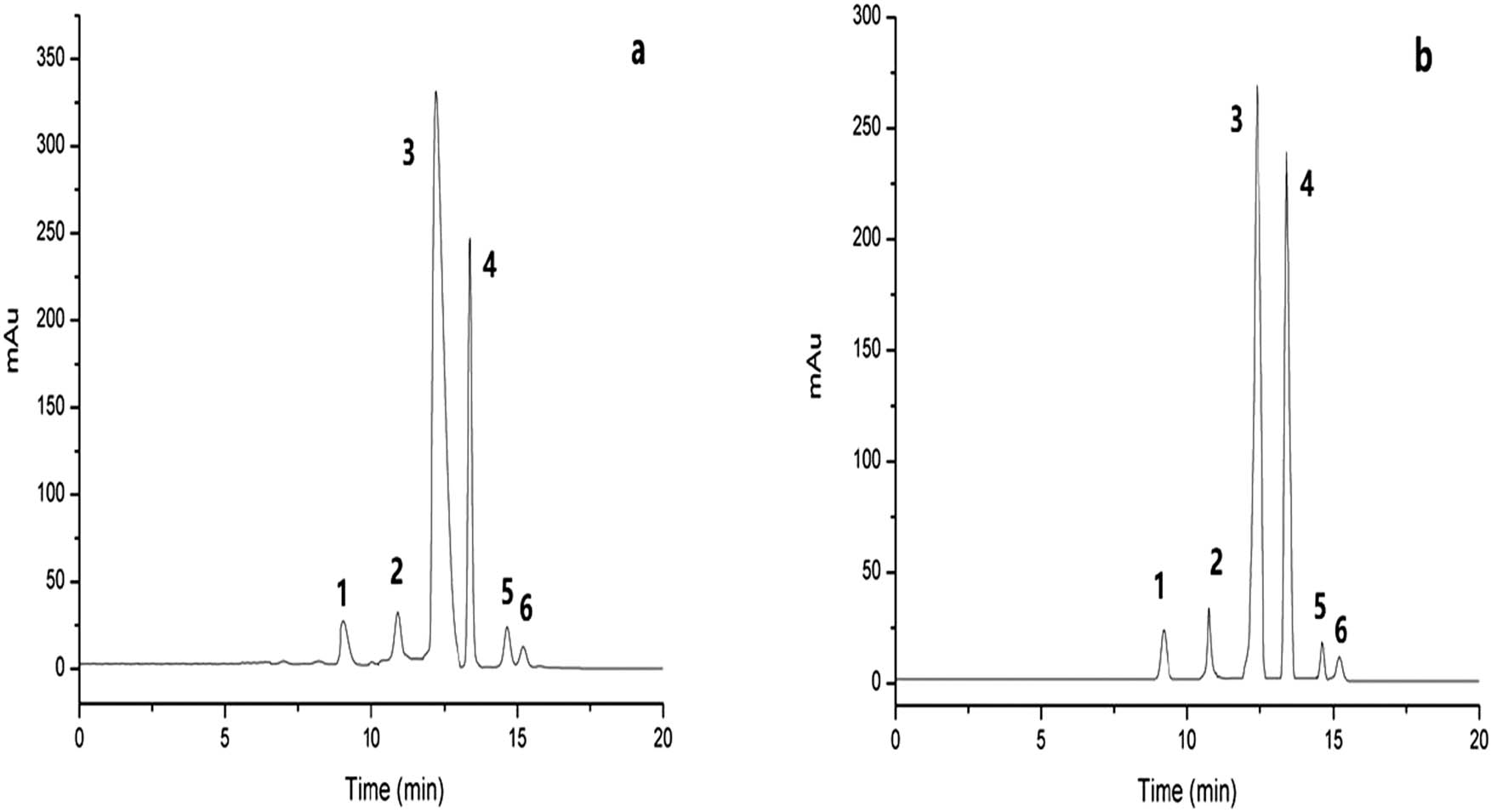
HPLC analysis of qingke. (a) HPLC analysis of PQK and (b) HPLC analysis of BQK.
3.2 Anthocyanin identification
After HPLC separation, the anthocyanins were identified on the basis of the MS data and the molecular ion characteristics for each peak (Figure 2). The m/z ratios for intact anthocyanins and their daughter fragments are listed in Table 2. Peak 1 had an MS ion at m/z 449.1083, with a fragmentation pattern (m/z 287) consistent with the loss of a hexose molecule. The MS fragments with an MS ion at m/z 287 corresponded to cyanidin aglycone moiety. Thus, peak 1 was tentatively identified as cyanidin-3-glucoside [20]. Peaks 2 and 3 had the same molecular ion (m/z 535.1081) and fragmentation pattern, suggesting that they represented isomers of cyanidin (m/z 287) derivatives attached to malonylated glucopyranosyl residues. On the basis of the retention times of peaks 2 and 3, they were tentatively identified as cyanidin 3-O-(3″-O-malonyl-glucoside) and cyanidin 3-O-(6″-O-malonyl-glucoside), respectively [21]. Peak 4 had a characteristic cyanidin aglycone ion (m/z 287), suggesting that it represented cyanidin glycoside. The fragmentation pattern suggested that peak 4 had two malonylated β-glucopyranosyl residues. Thus, peak 4 was identified as cyanidin 3-O-dimalonylglucoside [22]. The intense ion peaks at m/z 605.1129 and 635.1236 detected for compounds 5 and 6 corresponded to C27H25O16 and C28H27O17, respectively. The peak 5 at m/z 271 represented pelargonidin, peak 5 was identified as pelargonidin 3-O-dimalonylglucoside [23]. The peak 6 ion at m/z 301 indicated that it was peonidin, and peak 6 was identified as peonidin 3-O-dimalonylglucoside [23].
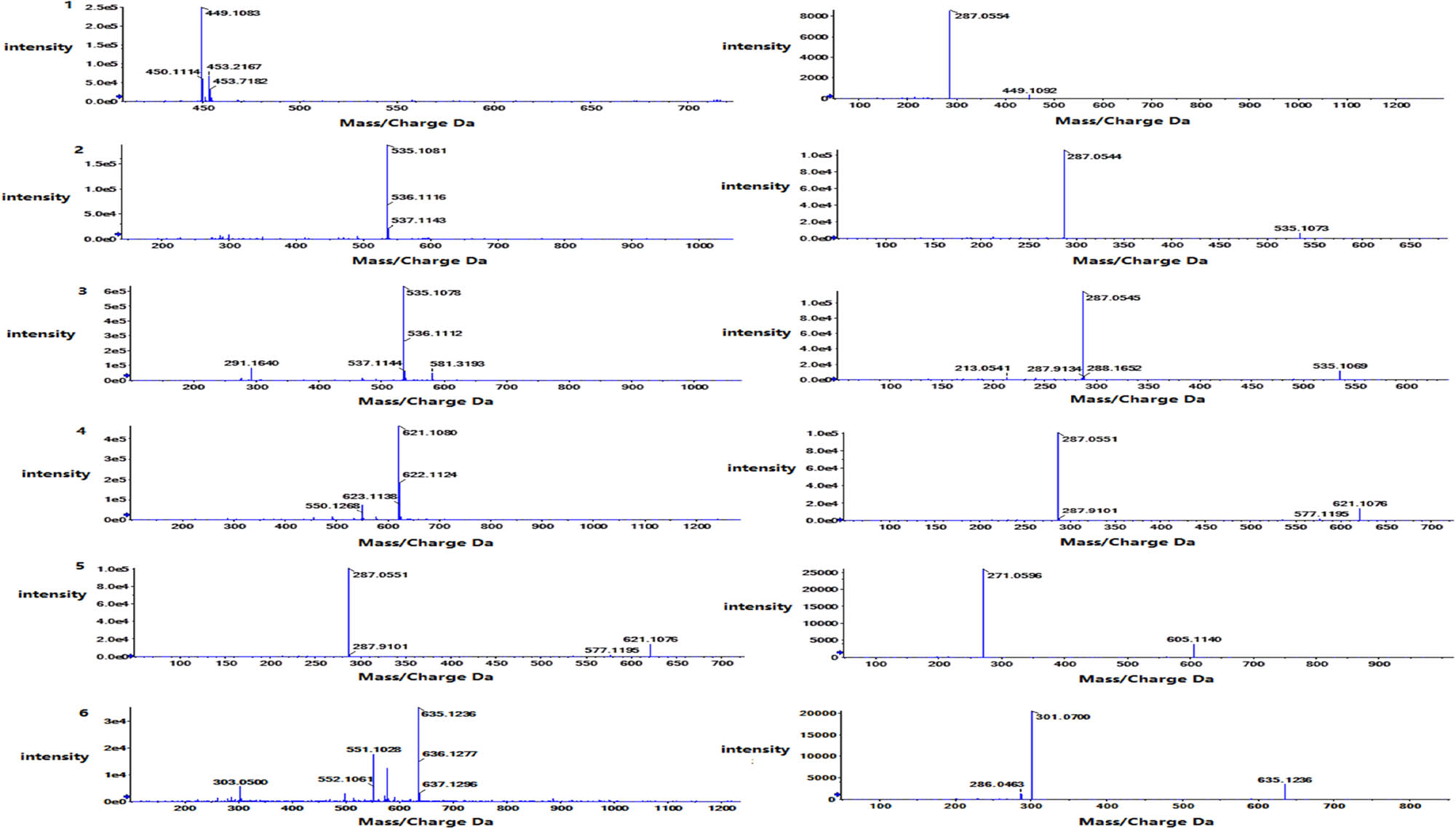
MS chromatographic profiles of anthocyanins from qingke.
Mass spectrometric data of anthocyanins of qingke
| Peak | t R (min) | [M]+ (m/z) | Formula | Fragment (m/z) | Tentative identification |
|---|---|---|---|---|---|
| 1 | 9.08 | 449.1083 | C21H21O11 | 287 | Cyanidin-3-glucoside |
| 2 | 10.92 | 535.1081 | C24H22O14 | 449, 287 | Cyanidin 3-O-(3″-O-malonyl-glucoside) |
| 3 | 11.7 | 535.1078 | C24H22O14 | 449, 287 | Cyanidin 3-O-(6″-O-malonyl-glucoside) |
| 4 | 13.35 | 621.1080 | C27H24O17 | 287 | Cyanidin 3-O-dimalonylglucoside |
| 5 | 14.62 | 605.1129 | C27H24O16 | 271, 249 | Pelargonidin 3-O-dimalonylglucoside |
| 6 | 14.99 | 635.1236 | C28H26O17 | 301, 286 | Paeonidin 3-O-dimalonylglucoside |
In this study, six anthocyanins were identified in both PQK and BQK. Four of the six anthocyanin aglycones were derivatives of cyanidin, one of the most common naturally occurring anthocyanins. The main structural feature of anthocyanins in PQK and BQK was a malonyl group. Acylated anthocyanins are more stable than non-acylated anthocyanins. The malonyl structure also stabilizes anthocyanins. A previous study revealed that environmental factors can affect the anthocyanin profile by regulating the activities of enzymes that catalyze polyphenol biosynthesis [24]. The unique geography (high altitude) and harsh climatic conditions (cold, dry, and strong ultraviolet radiation) in the qingke growing regions of Tibet would influence anthocyanin composition. Specifically, the relatively high concentrations of acylated anthocyanins in qingke may protect plants against ultraviolet damage. This trait is very important for the survival of plants exposed to high levels of ultraviolet radiation [25,26].
3.3 Anthocyanin quantification
Table 3 lists the contents of individual anthocyanins detected in PQK and BQK. The composition and total contents varied considerably among samples from different locations (Table 4). The total anthocyanin contents ranged from 141 to 2,304 µg/g in PQK and from 248.7 to 2902.9 µg/g in BQK. Lin et al. reported that the total anthocyanin contents were 2.69 mg/100 g in blue qingke and 9.55 mg/100 g in BQK [27]. The different contents were on the basis of different analysis methods. This study focused on the individual anthocyanin content. The predominant anthocyanins were cyanidin 3-O-(6″-O-malonyl-β-glucopyranoside) 3 and cyanidin 3-O-(3″,6″-di-O-malonyl-β-glucopyranoside) 4, which accounted for nearly 80% of the total anthocyanin content in PQK and BQK. In another study, the total anthocyanin content in colored barley varieties ranged from 3.2 to 1037.8 µg/g [28,29]. The higher range of concentrations detected in this study may be related to differences in the analyzed cultivars and growing conditions.
Content of anthocyanins in qingke
| Location | Peak 1 | Peak 2 | Peak 3 | Peak 4 | Peak 5 | Peak 6 |
|---|---|---|---|---|---|---|
| Content (µg/g) of PQK | ||||||
| L1 | 86.0 ± 0.2 | 107.3 ± 0.3 | 515.4 ± 0.9 | 522.3 ± 1.4 | 11.2 ± 0.1 | 4.8 ± 0.1 |
| L2 | 100.7 ± 0.8 | 120.7 ± 0.3 | 460.3 ± 0.7 | 510.2 ± 0.9 | 80.9 ± 0.3 | 70.1 ± 0.3 |
| L3 | 55.9 ± 0.4 | 86.4 ± 0.4 | 444.2 ± 0.7 | 508.7 ± 0.7 | 7.9 ± 0.1 | 4.4 ± 0.1 |
| L4 | 9.7 ± 0.1 | 20.9 ± 0.2 | 58.7 ± 0.6 | 47.9 ± 0.5 | 2.4 ± 0.1 | 1.5 ± 0.1 |
| L5 | 6.5 ± 0.1 | 11.1 ± 0.1 | 46.1 ± 0.4 | 41.1 ± 0.6 | 1.7 ± 0.1 | 2.0 ± 0.2 |
| L6 | 33.6 ± 0.2 | 106.0 ± 0.2 | 209.2 ± 0.5 | 162.4 ± 0.7 | 16.2 ± 0.2 | 1.8 ± 0.1 |
| L7 | 55.7 ± 0.2 | 70.0 ± 0.3 | 338.7 ± 0.9 | 354.1 ± 1.1 | 6.3 ± 0.1 | 2.8 ± 0.1 |
| L8 | 19.2 ± 0.2 | 31.2 ± 0.2 | 144.2 ± 0.5 | 116.5 ± 0.6 | 2.4 ± 0.1 | 1.1 ± 0.1 |
| L9 | 9.1 ± 0.2 | 23.7 ± 0.2 | 59.8 ± 0.6 | 71.8 ± 0.6 | 1.5 ± 0.2 | 1.3 ± 0.1 |
| L10 | 186.2 ± 0.2 | 200.2 ± 0.7 | 850.9 ± 0.9 | 1049.6 ± 1.7 | 12.3 ± 0.2 | 4.3 ± 0.3 |
| L11 | 112.2 ± 0.4 | 186.3 ± 0.8 | 825.6 ± 1.2 | 1096.21 ± 1.9 | 17.5 ± 0.2 | 4.0 ± 0.2 |
| L12 | 13.1 ± 0.1 | 21.8 ± 0.3 | 105.0 ± 0.7 | 108.2 ± 2.2 | 1.6 ± 0.2 | 1.3 ± 0.1 |
| L13 | 9.6 ± 0.2 | 19.2 ± 0.2 | 79.6 ± 0.7 | 80.1 ± 0.9 | 99.8 ± 0.7 | 3.0 ± 0.2 |
| L14 | 66.2 ± 0.2 | 120.6 ± 0.4 | 538.9 ± 1.2 | 615.2 ± 1.1 | 14.2 ± 0.3 | 3.9 ± 0.2 |
| L15 | 84.4 ± 0.3 | 136.6 ± 0.7 | 651.8 ± 1.4 | 901.9 ± 1.3 | 12.0 ± 0.3 | 9.5 ± 0.1 |
| Content (µg/g) of BQK | ||||||
| L1 | 230.3 ± 0.5 | 340.5 ± 0.8 | 760.7 ± 1.8 | 970.8 ± 1.6 | 190.4 ± 1.2 | 270.6 ± 0.5 |
| L2 | 63.7 ± 0.4 | 99.8 ± 0.4 | 460.6 ± 0.8 | 531.1 ± 1.5 | 10.1 ± 0.2 | 4.6 ± 0.10.1 |
| L3 | 70.9 ± 0.6 | 109.2 ± 1.4 | 535.2 ± 0.8 | 521.5 ± 1.8 | 10.0 ± 0.1 | 5.3 ± 0.2 |
| L4 | 40.3 ± 0.5 | 90.6 ± 1.2 | 140.7 ± 1.9 | 240.1 ± 1.4 | 60.6 ± 0.2 | 80.2 ± 0.2 |
| L5 | 46.6 ± 0.7 | 86.1 ± 1.5 | 393.1 ± 2.0 | 416.6 ± 1.7 | 9.2 ± 0.1 | 6.3 ± 0.2 |
| L6 | 33.3 ± 0.4 | 67.5 ± 0.2 | 304.8 ± 2.1 | 357.9 ± 1.7 | 6.3 ± 0.2 | 5.3 ± 0.2 |
| L7 | 70.2 ± 0.8 | 100.8 ± 0.3 | 250.3 ± 1.7 | 340.5 ± 1.5 | 30.4 ± 0.2 | 70.3 ± 0.4 |
| L8 | 59.5 ± 0.8 | 80.6 ± 1.6 | 371.4 ± 1.8 | 354.9 ± 1.1 | 6.2 ± 0.2 | 2.2 ± 0.2 |
| L9 | 36.6 ± 0.8 | 71.8 ± 1.6 | 326.7 ± 1.3 | 380.6 ± 0.6 | 7.1 ± 0.2 | 6.2 ± 0.2 |
| L10 | 134.0 ± 1.0 | 206.7 ± 1.8 | 851.4 ± 2.6 | 1178.2 ± 1.1 | 17.5 ± 0.3 | 5.0 ± 0.1 |
| L11 | 150.7 ± 1.1 | 252.6 ± 1.9 | 989.9 ± 2.9 | 1489.1 ± 1.3 | 18.7 ± 0.3 | 1.8 ± 0.1 |
| L12 | 14.7 ± 0.3 | 36.8 ± 0.9 | 108.6 ± 2.8 | 92.1 ± 0.7 | 2.3 ± 0.1 | 1.1 ± 0.1 |
| L13 | 14.5 ± 0.2 | 24.9 ± 0.5 | 103.6 ± 1.3 | 101.9 ± 0.9 | 2.3 ± 0.1 | 1.6 ± 0.1 |
| L14 | 56.6 ± 0.7 | 106.2 ± 0.9 | 444.0 ± 1.8 | 593.1 ± 1.4 | 8.3 ± 0.1 | 3.1 ± 0.3 |
| L15 | 60.3 ± 0.8 | 120.4 ± 1.1 | 680.5 ± 1.5 | 770.7 ± 2.0 | 140.8 ± 0.8 | 90.7 ± 0.9 |
Total content of anthocyanins from same locations
| Location | Total content of anthocyanins | |
|---|---|---|
| PQK | BQK | |
| L1 | 1247.1 | 2763.3 |
| L2 | 1342.8 | 1169.9 |
| L3 | 1107.5 | 1252.1 |
| L4 | 141.0 | 652.5 |
| L5 | 108.5 | 957.9 |
| L6 | 529.3 | 775.0 |
| L7 | 827.7 | 862.5 |
| L8 | 314.5 | 874.8 |
| L9 | 167.2 | 828.9 |
| L10 | 2303.5 | 2392.8 |
| L11 | 2241.9 | 2902.9 |
| L12 | 251.0 | 255.6 |
| L13 | 291.2 | 248.7 |
| L14 | 1359.0 | 1211.3 |
| L15 | 1796.2 | 1863.4 |
For PQK, the lowest and highest anthocyanin contents were detected in samples from locations L5 and L10, respectively, and the mean anthocyanin content was 995.1 µg/g. For BQK, the lowest and highest anthocyanin contents were detected in samples from locations L13 and L11, respectively, and the mean anthocyanin content was 1267.4 µg/g. Additionally, the total anthocyanin content was consistently higher in BQK than in PQK collected from the same locations.
3.4 Correlation analysis
In order to analyze the variations in anthocyanin contents of PQK and BQK among different growing locations (longitude, latitude, and altitude) in Tibet, the correlations between anthocyanins and geographical details (longitude, latitude, and altitude) of the sample collection locations were analyzed (Table 5). The correlation coefficient of PQK was −0.52, 0.07, and 0.32, and correlation coefficient of BQK was −0.60, 0.04, and 0.08, respectively. For both PQK and BQK, anthocyanin content was negatively correlated with latitude (P < 0.05) and tended to decrease at increasingly southern latitudes.
Correlation coefficients of anthocyanins and geographical details
| Content | Longitude | Latitude | Altitude |
|---|---|---|---|
| PQK | −0.52 | 0.07 | 0.32 |
| BQK | −0.60 | 0.04 | 0.08 |
3.5 Antioxidant activity
In this study, the antioxidant activity of qingke was examined, and the results are shown in Table 6. The DPPH result showed that qingke in L3 has the highest antioxidant activity among locations. The ABTS˙+ result showed that PQK in L6 and BQK in L10 have highest antioxidant activity, respectively. The FRAP+ result showed PQK in L3 and BQK in L11 have highest antioxidant activity, respectively. The anthocyanins of qingke showed that high antioxidant activity may be related to their structures. As we know, an increase in the number of hydroxyl substitutions on the B ring appeared to be associated with enhanced antioxidant activity. These results on antioxidant activity of anthocyanins imply that qingke may be useful for treating or preventing diseases caused by the overproduction of radicals. The cultivation of qingke rich in acetylated anthocyanins with strong antioxidant activities may be beneficial for Tibetans who are exposed to high ultraviolet radiation.
Antioxidant activity determined by DPPH, ABTS˙+, and FRAP assays (mg/g DW)
| Location | Cultivars | DPPH | ABTS˙+ | FRAP |
|---|---|---|---|---|
| L1 | PQK | 35.21 | 121.25 | 65.82 |
| L2 | 34.63 | 98.53 | 57.44 | |
| L3 | 37.94 | 102.85 | 71.84 | |
| L4 | 25.23 | 43.25 | 50.21 | |
| L5 | 22.38 | 38.25 | 44.52 | |
| L6 | 30.78 | 165.84 | 48.67 | |
| L7 | 31.59 | 94.85 | 58.94 | |
| L8 | 29.53 | 66.58 | 47.25 | |
| L9 | 23.56 | 51.46 | 30.54 | |
| L10 | 36.54 | 127.42 | 35.48 | |
| L11 | 34.99 | 75.94 | 60.33 | |
| L12 | 21.06 | 64.23 | 58.61 | |
| L13 | 21.65 | 41.97 | 28.52 | |
| L14 | 29.54 | 55.81 | 32.54 | |
| L15 | 27.38 | 56.94 | 36.59 | |
| L1 | BQK | 40.21 | 105.63 | 52.62 |
| L2 | 45.84 | 77.64 | 50.14 | |
| L3 | 46.39 | 84.25 | 60.19 | |
| L4 | 23.13 | 49.55 | 35.51 | |
| L5 | 20.68 | 43.15 | 56.22 | |
| L6 | 35.19 | 125.97 | 60.27 | |
| L7 | 23.55 | 92.37 | 62.14 | |
| L8 | 36.13 | 59.02 | 38.85 | |
| L9 | 26.34 | 65.26 | 42.24 | |
| L10 | 32.81 | 132.82 | 46.78 | |
| L11 | 41.12 | 66.74 | 70.80 | |
| L12 | 18.94 | 62.13 | 66.16 | |
| L13 | 26.43 | 40.54 | 42.34 | |
| L14 | 27.83 | 62.52 | 39.14 | |
| L15 | 29.55 | 50.54 | 39.19 |
4 Conclusions
In this study, we applied UPLC/Q-TOF-MS to identify and quantify the anthocyanins in PQK and BQK samples collected from 15 different geographical locations in Tibet. To the best of our knowledge, this is the first report on the compositions and contents of anthocyanins in qingke cultivated in Tibet. Six anthocyanins were identified, with cyanidin 3-O-(6″-O-malonyl-β-glucopyranoside) and cyanidin 3-O-(3″,6″-di-O-malonyl-β-glucopyranoside) being the predominant anthocyanins in PQK and BQK. The extraction of qingke exhibited antioxidant properties. The results indicated that specific geographical factors should be used to identify qingke crops with outstanding anthocyanin contents. As well as being a healthy food, the anthocyanin-rich qingke varieties cultivated in Tibet have the potential for development into nutritional supplements and healthcare products.
Abbreviations
- ABTS˙+
-
2,2′-azino-bis(3-ethylbenzothiazoline-6-sulfonic acid) diammonium salt
- ACN
-
acetonitrile
- BQK
-
black qingke
- DPPH
-
1,1-diphenyl-2-picrylhydrazyl
- DW
-
dry weight
- ESI
-
electrospray ionization
- GA
-
gallic acid
- HPLC
-
high performance liquid chromatography
- HPLC-MS/MS
-
high-performance liquid chromatography with tandem mass spectrometry
- PQK
-
purple qingke
- TFA
-
trifluoroacetic acid
- UPLC/Q-TOF-MS
-
ultra-performance liquid chromatography-quadrupole-time of flight mass spectrometry
Acknowledgments
The authors are grateful to Shoulan Bao for sample preparations for the experiments.
-
Funding source: This work was supported by CAS Key Technology Talent Program, Natural Science Funds of Tibet (XZ2017ZRG-48), Origin tracing technology of highland barley (XZ201901NA04), Barley industry system (CARS-05-02-06), and Qinghai Science and Technology Achievement Transformation Project (2021-SF-149).
-
Author contributions: Jilin Ma performed the experiments. Xuelian Wu, Zhihua Hao, and Ci Dun collected the samples. Tangwei Zhang carried out the data analysis. Chen Chen conceived and designed the experiment. All authors have read and agreed to the published version of the manuscript.
-
Competing interests: There are no competing interests.
-
Data availability statement: All data generated or analyzed during this study are included in this published article.
References
[1] Du DK, He J, Meng LD, Kang ZY. Extraction of anthocyanins from black barley and analysis their antioxidant activity. Jiangsu Agric Sci. 2017;45:173–9.Suche in Google Scholar
[2] Liang HQ, Li JX, Chen JG, Xin YE, Cheng C. Determination and analysis of nutrient in gradients of black hulless barley. Food Ferment Ind. 2016;42:180–2.Suche in Google Scholar
[3] Zhang TW, Yu YB, La Q. Evaluation of the qualitative differences among different Tibetan highland barley varieties. Barley Cereal Sci. 2017;34:28–41.Suche in Google Scholar
[4] Zhang WH. Study on extraction technology of black-barley pigment. Farm Products Process. 2017;9:24–32.Suche in Google Scholar
[5] Zeng XQ, Long H, Wang Z, Zhao SC, Tang YW, Huang ZY, et al. The draft genome of Tibetan hulless barley reveals adaptive patterns to the high stressful Tibetan Plateau. Proc Natl Acad Sci USA. 2015;112:1095–100.10.1073/pnas.1423628112Suche in Google Scholar PubMed PubMed Central
[6] Zhao T, Ma L, Li JJ, Du JJ, Du J, Yang J. Extraction technology of anthocyanins from black hulless barley. Food Res Dev. 2010;31:228–33.Suche in Google Scholar
[7] Wu X, Beecher GR, Holden JM, Haytowitz DB, Gebhardt SE, Prior RL. Concentrations of anthocyanins in common foods in the United States and estimation of normal consumption. J Agric Food Chem. 2006;54:4069–75.10.1021/jf060300lSuche in Google Scholar PubMed
[8] Li SY, Wu BN, Fu WY, Lavanya R. The anti-inflammatory effects of dietary anthocyanins against ulcerative colitis. Int J Mol Sci. 2019;20:2588–603.10.3390/ijms20102588Suche in Google Scholar PubMed PubMed Central
[9] Wu XL, Beecher GR, Holden JM, Haytowitz DB, Gebhardt SE, Prior R. Concentrations of anthocyanins in common foods in the United States and estimation of normal consumption. J Agric Food Chem. 2006;206(54):4069–75.10.1021/jf060300lSuche in Google Scholar
[10] Toufektsian MC, Salen P, Laporte F, Tonelli C, Lorgeril MD. Dietary flavonoids increase plasma very long-chain (n-3) fatty acids in rats. J Nutr. 2010;141:37–41.10.3945/jn.110.127225Suche in Google Scholar PubMed
[11] Lee SG, Kim B, Yang Y, Pham TX, Park YK, Mantou J, et al. Berry anthocyanins suppress the expression and secretion of proinflammatory mediators in macrophages by inhibiting nuclear translocation of NF-B independent of NRF2-mediated mechanism. J Nutr Biochem. 2014;25:404–11.10.1016/j.jnutbio.2013.12.001Suche in Google Scholar PubMed
[12] Francis FJ. Food colourants: anthocyanins. Crit Rev Food Sci Nutr. 1989;28:273–314.10.1080/10408398909527503Suche in Google Scholar PubMed
[13] Karaaslan M, Ozden M, Vardin H, Turkoglu H. Phenolic fortification of yogurt using grape and callus extracts. LWT-Food Sci Technol. 2011;44:1065–72.10.1016/j.lwt.2010.12.009Suche in Google Scholar
[14] Tasuda T, Fumihiko H, Uchida K, Aoki H, Osawa T. Dietary cyanidin-3-O-β-d-glcrich purple corn color prevents obesity and ameliorates hyperglycemia in mice. J Nutr. 2003;133:2125–30.10.1093/jn/133.7.2125Suche in Google Scholar PubMed
[15] Wildman REC. Nutraceuticals: a brief review of historical and teleological aspects. Handbook of nutraceuticals and functional foods. Florida, USA: CRC Press, LLC; 2011. p. 1–12.10.1201/9781420036695.ch1Suche in Google Scholar
[16] Diczházi I, Kursinszki L. Anthocyanin content and composition in winter blue barley cultivars and lines. Cereal Chem. 2014;91:195–200.10.1094/CCHEM-05-13-0091-RSuche in Google Scholar
[17] Yuan QX, Xie YF, Wang W, Yan YH, Ye H, Jabbar S, et al. Extraction optimization, characterization and antioxidant activity in vitro of polysaccharides from mulberry (Morus alba L.) leaves. Carbohydr Polym. 2015;128:52–62.10.1016/j.carbpol.2015.04.028Suche in Google Scholar PubMed
[18] Zhao ZG, Yan HF, Zheng R. Anthocyanins characterization and antioxidant activities of sugarcane (Saccharum officinarum L.) rind extracts. Ind Crop Products. 2018;113:38–45.10.1016/j.indcrop.2018.01.015Suche in Google Scholar
[19] Wang LJ, Wu J, Wang HX, Li SS, Zheng XC, Du H, et al. Composition of phenolic compounds and antioxidant activity in the leaves of blueberry cultivars. J Funct food. 2015;16:295–304.10.1016/j.jff.2015.04.027Suche in Google Scholar
[20] Katrin S, Markus P, Reinhold C, Andreas S. Characterization and quantification of anthocyanins in selected artichoke (Cynara scolymus L.) cultivars by HPLC-DAD-ESI-MSn. Anal Bioanal Chem. 2006;384:1511–7.10.1007/s00216-006-0316-6Suche in Google Scholar PubMed
[21] Abdel-Aal ESM, Abou-Arab AA, Gamel TH, Hucl PJ, Young C, Rabalski I. Fractionation of blue wheat anthocyanin compounds and their contribution to antioxidant properties. J Agric Food Chem. 2008;2008(56):11171–7.10.1021/jf802168cSuche in Google Scholar PubMed
[22] Montilla EC, Hillebrand S, Antezana A, Winterhalte P. Soluble and bound phenolic compounds in different bolivian purple corn (Zea mays L.) cultivars. J Agric Food Chem. 2011;2011(59):7068–74.10.1021/jf201061xSuche in Google Scholar PubMed
[23] Zhao XY, Corrales M, Zhang C, Hu XS, Ma Y, Tauscher B. Composition and thermal stability of anthocyanins from Chinese purple corn (Zea mays L.). J Agric Food Chem. 2008;56:10761–6.10.1021/jf8025056Suche in Google Scholar PubMed
[24] Guo J, Yue T, Yuan Y, Wang Y. Chemometric classification of apple juices according to variety and geographical origin based on polyphenolic profiles. J Agric Food Chem. 2013;61:6949–63.10.1021/jf4011774Suche in Google Scholar PubMed
[25] Gould K, Davies K, Winefield C. Anthocyanins: biosynthesis, functions and applications. New York: Springer-Verlag; 2008. p. 6–7.10.1007/978-0-387-77335-3Suche in Google Scholar
[26] Wang ZC, Yan YZ, Nisar T, Zou L, Yan X, Niu PF, et al. Comparison and multivariate statistical analysis of anthocyanin composition in Lycium ruthenicum Murray from different regions to trace geographical origins: the case of China. Food Chem. 2018;246:233–41.10.1016/j.foodchem.2017.11.030Suche in Google Scholar PubMed
[27] Lin S, Guo H, Gong JDB, Lu M, Lu MY, Wang L, et al. Phenolic profiles, b-glucan contents, and antioxidant capacities of colored Qingke (Tibetan hulless barley) cultivars. J Cereal Sci. 2018;81:69–75.10.1016/j.jcs.2018.04.001Suche in Google Scholar
[28] Kim MJ, Hyun JN, Kim JA, Park JC, Kim MY, Kim JG, et al. Relationship between phenolic compounds, anthocyanins content and antioxidant activity in colored barley germplasm. J Agric Food Chem. 2007;55:4802–9.10.1021/jf0701943Suche in Google Scholar PubMed
[29] Lee C, Han D, Kim B, Baek N, Baik BK. Antioxidant and anti-hypertensive activity of anthocyanin-rich extracts from hulless pigmented barley cultivars. J Food Sci Technol. 2013;48:984–91.10.1111/ijfs.12050Suche in Google Scholar
© 2021 Tangwei Zhang et al., published by De Gruyter
This work is licensed under the Creative Commons Attribution 4.0 International License.
Artikel in diesem Heft
- Regular Articles
- Qualitative and semi-quantitative assessment of anthocyanins in Tibetan hulless barley from different geographical locations by UPLC-QTOF-MS and their antioxidant capacities
- Effect of sodium chloride on the expression of genes involved in the salt tolerance of Bacillus sp. strain “SX4” isolated from salinized greenhouse soil
- GC-MS analysis of mango stem bark extracts (Mangifera indica L.), Haden variety. Possible contribution of volatile compounds to its health effects
- Influence of nanoscale-modified apatite-type calcium phosphates on the biofilm formation by pathogenic microorganisms
- Removal of paracetamol from aqueous solution by containment composites
- Investigating a human pesticide intoxication incident: The importance of robust analytical approaches
- Induction of apoptosis and cell cycle arrest by chloroform fraction of Juniperus phoenicea and chemical constituents analysis
- Recovery of γ-Fe2O3 from copper ore tailings by magnetization roasting and magnetic separation
- Effects of different extraction methods on antioxidant properties of blueberry anthocyanins
- Modeling the removal of methylene blue dye using a graphene oxide/TiO2/SiO2 nanocomposite under sunlight irradiation by intelligent system
- Antimicrobial and antioxidant activities of Cinnamomum cassia essential oil and its application in food preservation
- Full spectrum and genetic algorithm-selected spectrum-based chemometric methods for simultaneous determination of azilsartan medoxomil, chlorthalidone, and azilsartan: Development, validation, and application on commercial dosage form
- Evaluation of the performance of immunoblot and immunodot techniques used to identify autoantibodies in patients with autoimmune diseases
- Computational studies by molecular docking of some antiviral drugs with COVID-19 receptors are an approach to medication for COVID-19
- Synthesis of amides and esters containing furan rings under microwave-assisted conditions
- Simultaneous removal efficiency of H2S and CO2 by high-gravity rotating packed bed: Experiments and simulation
- Design, synthesis, and biological activities of novel thiophene, pyrimidine, pyrazole, pyridine, coumarin and isoxazole: Dydrogesterone derivatives as antitumor agents
- Content and composition analysis of polysaccharides from Blaps rynchopetera and its macrophage phagocytic activity
- A new series of 2,4-thiazolidinediones endowed with potent aldose reductase inhibitory activity
- Assessing encapsulation of curcumin in cocoliposome: In vitro study
- Rare norisodinosterol derivatives from Xenia umbellata: Isolation and anti-proliferative activity
- Comparative study of antioxidant and anticancer activities and HPTLC quantification of rutin in white radish (Raphanus sativus L.) leaves and root extracts grown in Saudi Arabia
- Comparison of adsorption properties of commercial silica and rice husk ash (RHA) silica: A study by NIR spectroscopy
- Sodium borohydride (NaBH4) as a high-capacity material for next-generation sodium-ion capacitors
- Aroma components of tobacco powder from different producing areas based on gas chromatography ion mobility spectrometry
- The effects of salinity on changes in characteristics of soils collected in a saline region of the Mekong Delta, Vietnam
- Synthesis, properties, and activity of MoVTeNbO catalysts modified by zirconia-pillared clays in oxidative dehydrogenation of ethane
- Synthesis and crystal structure of N,N′-bis(4-chlorophenyl)thiourea N,N-dimethylformamide
- Quantitative analysis of volatile compounds of four Chinese traditional liquors by SPME-GC-MS and determination of total phenolic contents and antioxidant activities
- A novel separation method of the valuable components for activated clay production wastewater
- On ve-degree- and ev-degree-based topological properties of crystallographic structure of cuprite Cu2O
- Antihyperglycemic effect and phytochemical investigation of Rubia cordifolia (Indian Madder) leaves extract
- Microsphere molecularly imprinted solid-phase extraction for diazepam analysis using itaconic acid as a monomer in propanol
- A nitric oxide-releasing prodrug promotes apoptosis in human renal carcinoma cells: Involvement of reactive oxygen species
- Machine vision-based driving and feedback scheme for digital microfluidics system
- Study on the application of a steam-foam drive profile modification technology for heavy oil reservoir development
- Ni–Ru-containing mixed oxide-based composites as precursors for ethanol steam reforming catalysts: Effect of the synthesis methods on the structural and catalytic properties
- Preparation of composite soybean straw-based materials by LDHs modifying as a solid sorbent for removal of Pb(ii) from water samples
- Synthesis and spectral characterizations of vanadyl(ii) and chromium(iii) mixed ligand complexes containing metformin drug and glycine amino acid
- In vitro evaluation of lactic acid bacteria with probiotic activity isolated from local pickled leaf mustard from Wuwei in Anhui as substitutes for chemical synthetic additives
- Utilization and simulation of innovative new binuclear Co(ii), Ni(ii), Cu(ii), and Zn(ii) diimine Schiff base complexes in sterilization and coronavirus resistance (Covid-19)
- Phosphorylation of Pit-1 by cyclin-dependent kinase 5 at serine 126 is associated with cell proliferation and poor prognosis in prolactinomas
- Molecularly imprinted membrane for transport of urea, creatinine, and vitamin B12 as a hemodialysis candidate membrane
- Optimization of Murrayafoline A ethanol extraction process from the roots of Glycosmis stenocarpa, and evaluation of its Tumorigenesis inhibition activity on Hep-G2 cells
- Highly sensitive determination of α-lipoic acid in pharmaceuticals on a boron-doped diamond electrode
- Synthesis, chemo-informatics, and anticancer evaluation of fluorophenyl-isoxazole derivatives
- In vitro and in vivo investigation of polypharmacology of propolis extract as anticancer, antibacterial, anti-inflammatory, and chemical properties
- Topological indices of bipolar fuzzy incidence graph
- Preparation of Fe3O4@SiO2–ZnO catalyst and its catalytic synthesis of rosin glycol ester
- Construction of a new luminescent Cd(ii) compound for the detection of Fe3+ and treatment of Hepatitis B
- Investigation of bovine serum albumin aggregation upon exposure to silver(i) and copper(ii) metal ions using Zetasizer
- Discoloration of methylene blue at neutral pH by heterogeneous photo-Fenton-like reactions using crystalline and amorphous iron oxides
- Optimized extraction of polyphenols from leaves of Rosemary (Rosmarinus officinalis L.) grown in Lam Dong province, Vietnam, and evaluation of their antioxidant capacity
- Synthesis of novel thiourea-/urea-benzimidazole derivatives as anticancer agents
- Potency and selectivity indices of Myristica fragrans Houtt. mace chloroform extract against non-clinical and clinical human pathogens
- Simple modifications of nicotinic, isonicotinic, and 2,6-dichloroisonicotinic acids toward new weapons against plant diseases
- Synthesis, optical and structural characterisation of ZnS nanoparticles derived from Zn(ii) dithiocarbamate complexes
- Presence of short and cyclic peptides in Acacia and Ziziphus honeys may potentiate their medicinal values
- The role of vitamin D deficiency and elevated inflammatory biomarkers as risk factors for the progression of diabetic nephropathy in patients with type 2 diabetes mellitus
- Quantitative structure–activity relationship study on prolonged anticonvulsant activity of terpene derivatives in pentylenetetrazole test
- GADD45B induced the enhancing of cell viability and proliferation in radiotherapy and increased the radioresistance of HONE1 cells
- Cannabis sativa L. chemical compositions as potential plasmodium falciparum dihydrofolate reductase-thymidinesynthase enzyme inhibitors: An in silico study for drug development
- Dynamics of λ-cyhalothrin disappearance and expression of selected P450 genes in bees depending on the ambient temperature
- Identification of synthetic cannabinoid methyl 2-{[1-(cyclohexylmethyl)-1H-indol-3-yl] formamido}-3-methylbutanoate using modern mass spectrometry and nuclear magnetic resonance techniques
- Study on the speciation of arsenic in the genuine medicinal material honeysuckle
- Two Cu(ii)-based coordination polymers: Crystal structures and treatment activity on periodontitis
- Conversion of furfuryl alcohol to ethyl levulinate in the presence of mesoporous aluminosilicate catalyst
- Review Articles
- Hsien Wu and his major contributions to the chemical era of immunology
- Overview of the major classes of new psychoactive substances, psychoactive effects, analytical determination and conformational analysis of selected illegal drugs
- An overview of persistent organic pollutants along the coastal environment of Kuwait
- Mechanism underlying sevoflurane-induced protection in cerebral ischemia–reperfusion injury
- COVID-19 and SARS-CoV-2: Everything we know so far – A comprehensive review
- Challenge of diabetes mellitus and researchers’ contributions to its control
- Advances in the design and application of transition metal oxide-based supercapacitors
- Color and composition of beauty products formulated with lemongrass essential oil: Cosmetics formulation with lemongrass essential oil
- The structural chemistry of zinc(ii) and nickel(ii) dithiocarbamate complexes
- Bioprospecting for antituberculosis natural products – A review
- Recent progress in direct urea fuel cell
- Rapid Communications
- A comparative morphological study of titanium dioxide surface layer dental implants
- Changes in the antioxidative properties of honeys during their fermentation
- Erratum
- Erratum to “Corrosion study of copper in aqueous sulfuric acid solution in the presence of (2E,5E)-2,5-dibenzylidenecyclopentanone and (2E,5E)-bis[(4-dimethylamino)benzylidene]cyclopentanone: Experimental and theoretical study”
- Erratum to “Modified TDAE petroleum plasticiser”
- Corrigendum
- Corrigendum to “A nitric oxide-releasing prodrug promotes apoptosis in human renal carcinoma cells: Involvement of reactive oxygen species”
- Special Issue on 3rd IC3PE 2020
- Visible light-responsive photocatalyst of SnO2/rGO prepared using Pometia pinnata leaf extract
- Antihyperglycemic activity of Centella asiatica (L.) Urb. leaf ethanol extract SNEDDS in zebrafish (Danio rerio)
- Selection of oil extraction process from Chlorella species of microalgae by using multi-criteria decision analysis technique for biodiesel production
- Special Issue on the 14th Joint Conference of Chemistry (14JCC)
- Synthesis and in vitro cytotoxicity evaluation of isatin-pyrrole derivatives against HepG2 cell line
- CO2 gas separation using mixed matrix membranes based on polyethersulfone/MIL-100(Al)
- Effect of synthesis and activation methods on the character of CoMo/ultrastable Y-zeolite catalysts
- Special Issue on Electrochemical Amplified Sensors
- Enhancement of graphene oxide through β-cyclodextrin composite to sensitive analysis of an antidepressant: Sulpiride
- Investigation of the spectroelectrochemical behavior of quercetin isolated from Zanthoxylum bungeanum
- An electrochemical sensor for high sensitive determination of lysozyme based on the aptamer competition approach
- An improved non-enzymatic electrochemical sensor amplified with CuO nanostructures for sensitive determination of uric acid
- Special Issue on Applied Biochemistry and Biotechnology 2020
- Fast discrimination of avocado oil for different extracted methods using headspace-gas chromatography-ion mobility spectroscopy with PCA based on volatile organic compounds
- Effect of alkali bases on the synthesis of ZnO quantum dots
- Quality evaluation of Cabernet Sauvignon wines in different vintages by 1H nuclear magnetic resonance-based metabolomics
- Special Issue on the Joint Science Congress of Materials and Polymers (ISCMP 2019)
- Diatomaceous Earth: Characterization, thermal modification, and application
- Electrochemical determination of atenolol and propranolol using a carbon paste sensor modified with natural ilmenite
- Special Issue on the Conference of Energy, Fuels, Environment 2020
- Assessment of the mercury contamination of landfilled and recovered foundry waste – a case study
- Primary energy consumption in selected EU Countries compared to global trends
- Modified TDAE petroleum plasticiser
- Use of glycerol waste in lactic acid bacteria metabolism for the production of lactic acid: State of the art in Poland
- Topical Issue on Applications of Mathematics in Chemistry
- Theoretical study of energy, inertia and nullity of phenylene and anthracene
- Banhatti, revan and hyper-indices of silicon carbide Si2C3-III[n,m]
- Topical Issue on Agriculture
- Occurrence of mycotoxins in selected agricultural and commercial products available in eastern Poland
- Special Issue on Ethnobotanical, Phytochemical and Biological Investigation of Medicinal Plants
- Acute and repeated dose 60-day oral toxicity assessment of chemically characterized Berberis hispanica Boiss. and Reut in Wistar rats
- Phytochemical profile, in vitro antioxidant, and anti-protein denaturation activities of Curcuma longa L. rhizome and leaves
- Antiplasmodial potential of Eucalyptus obliqua leaf methanolic extract against Plasmodium vivax: An in vitro study
- Prunus padus L. bark as a functional promoting component in functional herbal infusions – cyclooxygenase-2 inhibitory, antioxidant, and antimicrobial effects
- Molecular and docking studies of tetramethoxy hydroxyflavone compound from Artemisia absinthium against carcinogens found in cigarette smoke
- Special Issue on the Joint Science Congress of Materials and Polymers (ISCMP 2020)
- Preparation of cypress (Cupressus sempervirens L.) essential oil loaded poly(lactic acid) nanofibers
- Influence of mica mineral on flame retardancy and mechanical properties of intumescent flame retardant polypropylene composites
- Production and characterization of thermoplastic elastomer foams based on the styrene–ethylene–butylene–styrene (SEBS) rubber and thermoplastic material
- Special Issue on Applied Chemistry in Agriculture and Food Science
- Impact of essential oils on the development of pathogens of the Fusarium genus and germination parameters of selected crops
- Yield, volume, quality, and reduction of biotic stress influenced by titanium application in oilseed rape, winter wheat, and maize cultivations
- Influence of potato variety on polyphenol profile composition and glycoalcaloid contents of potato juice
- Carryover effect of direct-fed microbial supplementation and early weaning on the growth performance and carcass characteristics of growing Najdi lambs
- Special Issue on Applied Biochemistry and Biotechnology (ABB 2021)
- The electrochemical redox mechanism and antioxidant activity of polyphenolic compounds based on inlaid multi-walled carbon nanotubes-modified graphite electrode
- Study of an adsorption method for trace mercury based on Bacillus subtilis
- Special Issue on The 1st Malaysia International Conference on Nanotechnology & Catalysis (MICNC2021)
- Mitigating membrane biofouling in biofuel cell system – A review
- Mechanical properties of polymeric biomaterials: Modified ePTFE using gamma irradiation
Artikel in diesem Heft
- Regular Articles
- Qualitative and semi-quantitative assessment of anthocyanins in Tibetan hulless barley from different geographical locations by UPLC-QTOF-MS and their antioxidant capacities
- Effect of sodium chloride on the expression of genes involved in the salt tolerance of Bacillus sp. strain “SX4” isolated from salinized greenhouse soil
- GC-MS analysis of mango stem bark extracts (Mangifera indica L.), Haden variety. Possible contribution of volatile compounds to its health effects
- Influence of nanoscale-modified apatite-type calcium phosphates on the biofilm formation by pathogenic microorganisms
- Removal of paracetamol from aqueous solution by containment composites
- Investigating a human pesticide intoxication incident: The importance of robust analytical approaches
- Induction of apoptosis and cell cycle arrest by chloroform fraction of Juniperus phoenicea and chemical constituents analysis
- Recovery of γ-Fe2O3 from copper ore tailings by magnetization roasting and magnetic separation
- Effects of different extraction methods on antioxidant properties of blueberry anthocyanins
- Modeling the removal of methylene blue dye using a graphene oxide/TiO2/SiO2 nanocomposite under sunlight irradiation by intelligent system
- Antimicrobial and antioxidant activities of Cinnamomum cassia essential oil and its application in food preservation
- Full spectrum and genetic algorithm-selected spectrum-based chemometric methods for simultaneous determination of azilsartan medoxomil, chlorthalidone, and azilsartan: Development, validation, and application on commercial dosage form
- Evaluation of the performance of immunoblot and immunodot techniques used to identify autoantibodies in patients with autoimmune diseases
- Computational studies by molecular docking of some antiviral drugs with COVID-19 receptors are an approach to medication for COVID-19
- Synthesis of amides and esters containing furan rings under microwave-assisted conditions
- Simultaneous removal efficiency of H2S and CO2 by high-gravity rotating packed bed: Experiments and simulation
- Design, synthesis, and biological activities of novel thiophene, pyrimidine, pyrazole, pyridine, coumarin and isoxazole: Dydrogesterone derivatives as antitumor agents
- Content and composition analysis of polysaccharides from Blaps rynchopetera and its macrophage phagocytic activity
- A new series of 2,4-thiazolidinediones endowed with potent aldose reductase inhibitory activity
- Assessing encapsulation of curcumin in cocoliposome: In vitro study
- Rare norisodinosterol derivatives from Xenia umbellata: Isolation and anti-proliferative activity
- Comparative study of antioxidant and anticancer activities and HPTLC quantification of rutin in white radish (Raphanus sativus L.) leaves and root extracts grown in Saudi Arabia
- Comparison of adsorption properties of commercial silica and rice husk ash (RHA) silica: A study by NIR spectroscopy
- Sodium borohydride (NaBH4) as a high-capacity material for next-generation sodium-ion capacitors
- Aroma components of tobacco powder from different producing areas based on gas chromatography ion mobility spectrometry
- The effects of salinity on changes in characteristics of soils collected in a saline region of the Mekong Delta, Vietnam
- Synthesis, properties, and activity of MoVTeNbO catalysts modified by zirconia-pillared clays in oxidative dehydrogenation of ethane
- Synthesis and crystal structure of N,N′-bis(4-chlorophenyl)thiourea N,N-dimethylformamide
- Quantitative analysis of volatile compounds of four Chinese traditional liquors by SPME-GC-MS and determination of total phenolic contents and antioxidant activities
- A novel separation method of the valuable components for activated clay production wastewater
- On ve-degree- and ev-degree-based topological properties of crystallographic structure of cuprite Cu2O
- Antihyperglycemic effect and phytochemical investigation of Rubia cordifolia (Indian Madder) leaves extract
- Microsphere molecularly imprinted solid-phase extraction for diazepam analysis using itaconic acid as a monomer in propanol
- A nitric oxide-releasing prodrug promotes apoptosis in human renal carcinoma cells: Involvement of reactive oxygen species
- Machine vision-based driving and feedback scheme for digital microfluidics system
- Study on the application of a steam-foam drive profile modification technology for heavy oil reservoir development
- Ni–Ru-containing mixed oxide-based composites as precursors for ethanol steam reforming catalysts: Effect of the synthesis methods on the structural and catalytic properties
- Preparation of composite soybean straw-based materials by LDHs modifying as a solid sorbent for removal of Pb(ii) from water samples
- Synthesis and spectral characterizations of vanadyl(ii) and chromium(iii) mixed ligand complexes containing metformin drug and glycine amino acid
- In vitro evaluation of lactic acid bacteria with probiotic activity isolated from local pickled leaf mustard from Wuwei in Anhui as substitutes for chemical synthetic additives
- Utilization and simulation of innovative new binuclear Co(ii), Ni(ii), Cu(ii), and Zn(ii) diimine Schiff base complexes in sterilization and coronavirus resistance (Covid-19)
- Phosphorylation of Pit-1 by cyclin-dependent kinase 5 at serine 126 is associated with cell proliferation and poor prognosis in prolactinomas
- Molecularly imprinted membrane for transport of urea, creatinine, and vitamin B12 as a hemodialysis candidate membrane
- Optimization of Murrayafoline A ethanol extraction process from the roots of Glycosmis stenocarpa, and evaluation of its Tumorigenesis inhibition activity on Hep-G2 cells
- Highly sensitive determination of α-lipoic acid in pharmaceuticals on a boron-doped diamond electrode
- Synthesis, chemo-informatics, and anticancer evaluation of fluorophenyl-isoxazole derivatives
- In vitro and in vivo investigation of polypharmacology of propolis extract as anticancer, antibacterial, anti-inflammatory, and chemical properties
- Topological indices of bipolar fuzzy incidence graph
- Preparation of Fe3O4@SiO2–ZnO catalyst and its catalytic synthesis of rosin glycol ester
- Construction of a new luminescent Cd(ii) compound for the detection of Fe3+ and treatment of Hepatitis B
- Investigation of bovine serum albumin aggregation upon exposure to silver(i) and copper(ii) metal ions using Zetasizer
- Discoloration of methylene blue at neutral pH by heterogeneous photo-Fenton-like reactions using crystalline and amorphous iron oxides
- Optimized extraction of polyphenols from leaves of Rosemary (Rosmarinus officinalis L.) grown in Lam Dong province, Vietnam, and evaluation of their antioxidant capacity
- Synthesis of novel thiourea-/urea-benzimidazole derivatives as anticancer agents
- Potency and selectivity indices of Myristica fragrans Houtt. mace chloroform extract against non-clinical and clinical human pathogens
- Simple modifications of nicotinic, isonicotinic, and 2,6-dichloroisonicotinic acids toward new weapons against plant diseases
- Synthesis, optical and structural characterisation of ZnS nanoparticles derived from Zn(ii) dithiocarbamate complexes
- Presence of short and cyclic peptides in Acacia and Ziziphus honeys may potentiate their medicinal values
- The role of vitamin D deficiency and elevated inflammatory biomarkers as risk factors for the progression of diabetic nephropathy in patients with type 2 diabetes mellitus
- Quantitative structure–activity relationship study on prolonged anticonvulsant activity of terpene derivatives in pentylenetetrazole test
- GADD45B induced the enhancing of cell viability and proliferation in radiotherapy and increased the radioresistance of HONE1 cells
- Cannabis sativa L. chemical compositions as potential plasmodium falciparum dihydrofolate reductase-thymidinesynthase enzyme inhibitors: An in silico study for drug development
- Dynamics of λ-cyhalothrin disappearance and expression of selected P450 genes in bees depending on the ambient temperature
- Identification of synthetic cannabinoid methyl 2-{[1-(cyclohexylmethyl)-1H-indol-3-yl] formamido}-3-methylbutanoate using modern mass spectrometry and nuclear magnetic resonance techniques
- Study on the speciation of arsenic in the genuine medicinal material honeysuckle
- Two Cu(ii)-based coordination polymers: Crystal structures and treatment activity on periodontitis
- Conversion of furfuryl alcohol to ethyl levulinate in the presence of mesoporous aluminosilicate catalyst
- Review Articles
- Hsien Wu and his major contributions to the chemical era of immunology
- Overview of the major classes of new psychoactive substances, psychoactive effects, analytical determination and conformational analysis of selected illegal drugs
- An overview of persistent organic pollutants along the coastal environment of Kuwait
- Mechanism underlying sevoflurane-induced protection in cerebral ischemia–reperfusion injury
- COVID-19 and SARS-CoV-2: Everything we know so far – A comprehensive review
- Challenge of diabetes mellitus and researchers’ contributions to its control
- Advances in the design and application of transition metal oxide-based supercapacitors
- Color and composition of beauty products formulated with lemongrass essential oil: Cosmetics formulation with lemongrass essential oil
- The structural chemistry of zinc(ii) and nickel(ii) dithiocarbamate complexes
- Bioprospecting for antituberculosis natural products – A review
- Recent progress in direct urea fuel cell
- Rapid Communications
- A comparative morphological study of titanium dioxide surface layer dental implants
- Changes in the antioxidative properties of honeys during their fermentation
- Erratum
- Erratum to “Corrosion study of copper in aqueous sulfuric acid solution in the presence of (2E,5E)-2,5-dibenzylidenecyclopentanone and (2E,5E)-bis[(4-dimethylamino)benzylidene]cyclopentanone: Experimental and theoretical study”
- Erratum to “Modified TDAE petroleum plasticiser”
- Corrigendum
- Corrigendum to “A nitric oxide-releasing prodrug promotes apoptosis in human renal carcinoma cells: Involvement of reactive oxygen species”
- Special Issue on 3rd IC3PE 2020
- Visible light-responsive photocatalyst of SnO2/rGO prepared using Pometia pinnata leaf extract
- Antihyperglycemic activity of Centella asiatica (L.) Urb. leaf ethanol extract SNEDDS in zebrafish (Danio rerio)
- Selection of oil extraction process from Chlorella species of microalgae by using multi-criteria decision analysis technique for biodiesel production
- Special Issue on the 14th Joint Conference of Chemistry (14JCC)
- Synthesis and in vitro cytotoxicity evaluation of isatin-pyrrole derivatives against HepG2 cell line
- CO2 gas separation using mixed matrix membranes based on polyethersulfone/MIL-100(Al)
- Effect of synthesis and activation methods on the character of CoMo/ultrastable Y-zeolite catalysts
- Special Issue on Electrochemical Amplified Sensors
- Enhancement of graphene oxide through β-cyclodextrin composite to sensitive analysis of an antidepressant: Sulpiride
- Investigation of the spectroelectrochemical behavior of quercetin isolated from Zanthoxylum bungeanum
- An electrochemical sensor for high sensitive determination of lysozyme based on the aptamer competition approach
- An improved non-enzymatic electrochemical sensor amplified with CuO nanostructures for sensitive determination of uric acid
- Special Issue on Applied Biochemistry and Biotechnology 2020
- Fast discrimination of avocado oil for different extracted methods using headspace-gas chromatography-ion mobility spectroscopy with PCA based on volatile organic compounds
- Effect of alkali bases on the synthesis of ZnO quantum dots
- Quality evaluation of Cabernet Sauvignon wines in different vintages by 1H nuclear magnetic resonance-based metabolomics
- Special Issue on the Joint Science Congress of Materials and Polymers (ISCMP 2019)
- Diatomaceous Earth: Characterization, thermal modification, and application
- Electrochemical determination of atenolol and propranolol using a carbon paste sensor modified with natural ilmenite
- Special Issue on the Conference of Energy, Fuels, Environment 2020
- Assessment of the mercury contamination of landfilled and recovered foundry waste – a case study
- Primary energy consumption in selected EU Countries compared to global trends
- Modified TDAE petroleum plasticiser
- Use of glycerol waste in lactic acid bacteria metabolism for the production of lactic acid: State of the art in Poland
- Topical Issue on Applications of Mathematics in Chemistry
- Theoretical study of energy, inertia and nullity of phenylene and anthracene
- Banhatti, revan and hyper-indices of silicon carbide Si2C3-III[n,m]
- Topical Issue on Agriculture
- Occurrence of mycotoxins in selected agricultural and commercial products available in eastern Poland
- Special Issue on Ethnobotanical, Phytochemical and Biological Investigation of Medicinal Plants
- Acute and repeated dose 60-day oral toxicity assessment of chemically characterized Berberis hispanica Boiss. and Reut in Wistar rats
- Phytochemical profile, in vitro antioxidant, and anti-protein denaturation activities of Curcuma longa L. rhizome and leaves
- Antiplasmodial potential of Eucalyptus obliqua leaf methanolic extract against Plasmodium vivax: An in vitro study
- Prunus padus L. bark as a functional promoting component in functional herbal infusions – cyclooxygenase-2 inhibitory, antioxidant, and antimicrobial effects
- Molecular and docking studies of tetramethoxy hydroxyflavone compound from Artemisia absinthium against carcinogens found in cigarette smoke
- Special Issue on the Joint Science Congress of Materials and Polymers (ISCMP 2020)
- Preparation of cypress (Cupressus sempervirens L.) essential oil loaded poly(lactic acid) nanofibers
- Influence of mica mineral on flame retardancy and mechanical properties of intumescent flame retardant polypropylene composites
- Production and characterization of thermoplastic elastomer foams based on the styrene–ethylene–butylene–styrene (SEBS) rubber and thermoplastic material
- Special Issue on Applied Chemistry in Agriculture and Food Science
- Impact of essential oils on the development of pathogens of the Fusarium genus and germination parameters of selected crops
- Yield, volume, quality, and reduction of biotic stress influenced by titanium application in oilseed rape, winter wheat, and maize cultivations
- Influence of potato variety on polyphenol profile composition and glycoalcaloid contents of potato juice
- Carryover effect of direct-fed microbial supplementation and early weaning on the growth performance and carcass characteristics of growing Najdi lambs
- Special Issue on Applied Biochemistry and Biotechnology (ABB 2021)
- The electrochemical redox mechanism and antioxidant activity of polyphenolic compounds based on inlaid multi-walled carbon nanotubes-modified graphite electrode
- Study of an adsorption method for trace mercury based on Bacillus subtilis
- Special Issue on The 1st Malaysia International Conference on Nanotechnology & Catalysis (MICNC2021)
- Mitigating membrane biofouling in biofuel cell system – A review
- Mechanical properties of polymeric biomaterials: Modified ePTFE using gamma irradiation
