Adopting oculopressure tonometry as a transient in vivo rabbit glaucoma model
-
T. Stahnke
 ,
S. Siewert
,
S. Siewert

Abstract
Glaucoma represents a group of eye disorders partly related to raised intraocular pressure (IOP) leading to progressive optic nerve damage resulting in impaired vision and possibly blindness. To assess the suitability of new IOP lowering therapeutic strategies, such as the implantation of glaucoma drainage devices, appropriate animal models have to be used. Currently, a number of rodent glaucoma models are available [1], however, especially for surgical interventions rodent eyes are too small. Rabbits are much more suitable with respect to dimension. Unfortunately, rabbit glaucoma model systems described in literature are difficult to reproduce or fail totally, associated with a high level of discomfort and pain for treated animals. Therefore, development of an in vivo rabbit glaucoma model is one of the most important goals in glaucoma research. Here, we describe the adaptation of the oculopressure tonometry, an existing method to quantify the outflow of aqueous humor in humans, to generate a transient glaucoma model in rabbits. The existing suction-cup oculopressor (SCOP) is extended with newly designed suction-cups, which are adjusted to the anatomy of the rabbit eye. The modification of the oculopressure tonometry method facilitates an increase in IOP over a time frame of 9 minutes by vacuum induced deformation of the rabbit eye. This method can be used to test functionality of fistulating glaucoma surgeries or implanted drainage devices in a long term follow-up without any side effects and suffering of the animals.
1 Introduction
The second leading cause of blindness and the leading cause of irreversible blindness worldwide is glaucoma. Despite many efforts made in the research of glaucoma formation and therapeutic options glaucoma prevalence is still increasing to date. Approximately 80 million people will be affected by glaucoma in 2020 [2].
For admission of new therapy strategies it is essential to conduct experiments in rabbit model of glaucoma. It is therefore important to have methods at ones disposal to sufficiently increase IOP for the simulation of glaucoma. Different rabbit models for glaucoma induction have been published. Allemann and colleagues chose four of them with respect to ethical, surgical and logistic factors to reproduce in a large scale investigation. Unfortunately, none of these models was reproducible in a satisfactory way [3].
When looking for another approach to increase IOP in a rabbit glaucoma model the oculopressure tonometry (OPT) of Ulrich and Ulrich came to mind [4]. This method is based on creating an elevated IOP in the eye to determine aqueous humor outflow rate and has been used in general ophthalmology since 1987.
![Figure 1 a) suction-cup oculopressor (SCOP); b) contact point close to limbus [3].](/document/doi/10.1515/cdbme-2015-0033/asset/graphic/j_cdbme-2015-0033_fig_001.jpg)
a) suction-cup oculopressor (SCOP); b) contact point close to limbus [3].
The intention of this study is to adapt this diagnostic tool to the rabbit eye and to establish an alternative to conventional models of glaucoma induction without any surgical interventions of animals involved.
2 Methods
2.1 Estimation of suction-cup diameter for rabbits
For the adaptation of OPT to the rabbit eye New Zealand White rabbits were used (Charles River, Sulzfeld, Germany). As a fundamental requirement for adapting OPT to rabbit eyes, the suction-cup diameter had to be adjusted to the average size of rabbit eyeballs. The diameter ds,r for the suction-cups to be used was designed based on the diameter of suction-cups used for humans (ds,h = 13 mm) and the human or rabbit eyeball diameter (de,h = 22.50 mm and de,r = 18.25 mm, respectively). The ratio ds,r/de,r was calculated for suction-cup diameters of ds,r = 10, 11, 12 and 13 mm and compared to the corresponding ratio ds,h/de,h for human use.
2.2 Design and manufacturing of suction-cups
Suction-cups for rabbit eyes were designed according to original components using Creo Elements/Pro 5.0 (PTC Inc., Needham, USA) (Fig. 2).
Manufacturing of suction-cups was based on Polyoxymethylene (POM, SUSTARIN C, ThyssenKrupp Plastics GmbH, Essen, Germany) machined by a metalworking lathe (EMCOMAT-14D, EMCO Maier Ges.m.b.H, Hallein, Austria). Manufactured suction-cups were finally cleaned for 10 minutes in an ultrasonic bath (SONOREX RK 103 H, BANDELIN electronic GmbH & Co. KG, Berlin, Germany).
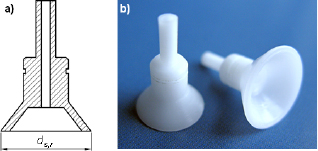
a) Design of suction-cups for rabbit eyes: variable diameter ds,r; b) Manufactured suction-cups with a diameter of ds,r = 10 mm (left) and 12 mm (right).
2.3 Application of OPT to rabbits
Application of OPT was tested for rabbits under deep anesthesia. The animals were sedated with a subcutaneously injection of 35 mg kg1 Ketamin 10% (Bela-pharm GmbH & Co. KG, Vechta, Germany), 5 mg kg1 Rompun®2% (Bayer HealthCare AG, Leverkusen, Germany). Additionally, local anaesthesia using Proparakain-POS®0,5% drops was administered to the eyes (URSAPHARM Arzneimittel GmbH, Saarbrücken, Germany). During OPT rabbits were retained in a regular sitting position.
SCOP (Fa. B. Boucke, Medizin-Elektronik, Tübingen, Germany) is used to increase IOP about 40 mmHg during a maximum examination period of 9 minutes. The SCOP-device, which is licensed for application in human medicine, consists of a vacuum pump that is connected to the eyeball by a flexible tube. The suction-cup at the end of the tube is positioned on the conjunctiva-covered sclera in the temporal canthus near the corneal limbus. Applying a vacuum to the cone-shaped SC results in an eyeball deformation and subsequently in an IOP increase.
During OPT the IOP was measured using a rebound tonometer (TAO1, Icare Finland Oy, Vantaa, Finland). This procedure is also used for IOP measurements in human ophtalmological daily routine. Tonometric IOP recordings pic with the TAO1 device were corrected according to Löbler et al. considering differences in thickness and viscoelastic properties between rabbit and human corneas. Corrected IOP for rabbits pcorr is calculated according to formula 1 [5].
Prior to anesthesia initial IOP was measured. To record pressure decay during OPT, the IOP is measured every minute (Fig. 3). Finally, IOP was recorded one minute after termination of OPT.
In order to prevent desiccation during OPT, physiologic salt solution was applied to the eyes every two minutes. Upon completion of a series of measurements a moisturizing gel (Vidisic®; Bausch & Lomb/Dr. Mann Pharma, Berlin, Germany) was applied to the eyes.
3 Results
For adaptation of OPT to the rabbit eye three demagnified suction-cups were manufactured. Table 1 illustrates that suction-cups with a diameter of d s, r = 11 mm yield the best match with regard to the suction-cup/eyeball diameter ratio used in human measurements.

IOP measurement with the Icare rebound tonometer TAO1 during OPT; Suction-cup (†) and tonometer (‡).
Calculated diameter ratio of suction-cup and eyeball for humans and rabbits.
| Diameter of suction-cup ds,h or ds,r | Diameter ratio ds,h/de,h for human eyeball (de,h = 22.50 mm) | Diameter ratio ds,r/de,r for rabbit eyeball (de,r = 18.25 mm) |
|---|---|---|
| ds,h = 13 mm | 0.58 | |
| ds,r = 12 mm | 0.66 | |
| ds,r = 11 mm | 0.60 | |
| ds,r =10 mm | 0.55 |
During OPT the measured IOP values obtained by suction-cups with a diameter of ds,r = 10 mm (SC10) generally were below IOP values obtained by suction-cups with a diameter of ds,r = 11 mm and 12 mm (SC11 and SC12) (Fig. 4). As a maximum IOP 34 mmHg was measured after one minute for SC10. Maximum IOP for SC11 and SC12 was 51 mmHg and 47 mmHg after one minute, respectively. IOP decrease was similar for all tested suction-cup sizes during the first five minutes of OPT. In the second half of OPT the pressure decay varied depending on the suction-cup diameter. While IOP decrease decelerated during measurements with SC10 and SC11, IOP decreased more rapidly using SC12. After 9 minutes IOP was still at 37 mmHg for SC11, whereas it had decreased to 23 mmHg with SC12. IOP measurements during OPT confirmed the suction-cup with ds,r = 11 mm (SC11), which is closest to the ratio of cup diameter to eyeball diameter applied in human diagnostics, is most suitable for rabbit OPT.

Pressure decay shown for OPT with suction-cups of three diameters (ds, r = 10 mm (SC10), 11 mm (SC11) and 12 mm (SC12)). OPT was performed on the left eye (n = 1).
In a second experiment series, IOP increase on both rabbit eyes was evaluate by OPT using SC11 (Fig. 5). OPT was performed on the right (OD) and left (OS) eye at various points in time (n = 9).

Pressure decay for the right (OD) and left (OS) eye using a suction-cup with a diameter of ds,r = 11 mm (SC11). OPT was performed repeatedly (n = 9).
IOP for OD and OS was 45.8±14.2 mmHg and 50.0±12.3 mmHg (n = 9) after one minute, respectively. After nine minutes IOP decreased to 29.9±13.3 mmHg and 31.0±11.5 mmHg (n = 9) for OD and OS, respectively.
4 Discussion
In the presented study OPT was adapted to rabbit eyes in an effort to create a transient rabbit glaucoma model. Suction-cups with different diameters where tested for their suitability in rabbit OPT.
Using SC10 it was not possible to increase IOP in a satisfactory way. This is due to the fact that the ratio between SC10 to the rabbit eyeball diameter is too small. The effect on the eye was not efficient.
In contrast with SC12 it was possible to reach an appropriate IOP elevation but it had shortcomings when compared to SC11. On the one hand the diameter ratio of SC12 to the rabbit eye is larger than the corresponding human ratio (Table 1). On the other hand the pressure decay with SC12 was faster than that of smaller suction-cups. Additionally, the dimensions of SC12 led to an unsatisfactory handling. Positioning of suction-cup reached either the conjunctival fornix or threatened to slide on the cornea, which could also explain the steeper decrease of IOP values.
Measurements with SC11 accomplished highest IOP values compared with the other suction-cup diameters. During the first minutes of OPT almost a linear pressure decay was detected, which slowed down at the end of OPT. This phenomenon could be explained with the decline in pressure difference between eyeball and drained aqueous humor. High IOP values cause a high outflow rate, which results in lower IOP values. Ongoing constant production of aqueous humor compensates the increasing amount of drained liquid under lower IOP conditions, which results in a slower decrease of IOP. The results from OPT measurements confirmed the theoretical estimation of the ideal suction-cup diameter. A suction-cup with ds,r = 11 mm is most suitable for rabbit OPT.
In conclusion, adopting OPT to the rabbit eye successfully elevated IOP to defined pressure values over a short period of time with SCOP. Elevation of IOP with SC11 was reproducible on right and left eyes. It was possible to establish a non-invasive, transient rabbit glaucoma model. This model system allows verification of new glaucoma therapy interventions, like implanted drainage devices with minimal stress of the examined animals. It might also be of help to measure outflow facilities after application of new potentially IOP lowering medications.
Acknowledgement:
This project was partially funded by the Federal Ministry of Education and Research (BMBF) within the research project REMEDIS “Höhere Lebensqualität durch neuartige Mikroimplantate”.
Author’s Statement
Conflict of interest: Authors state no conflict of interest. Material and Methods: Informed consent: Informed consent has been obtained from all individuals included in this study. Ethical approval: The research related to human use has been complied with all the relevant national regulations, institutional policies and in accordance the tenets of the Helsinki Declaration, and has been approved by the authors’ institutional review board or equivalent committee.
References
[1] Bouhenni RA, Dunmire J, Sewell A, Edward DP. Animal Models of Glaucoma. J Biomed Biotechnol 2012; 2012:69260910.1155/2012/692609Suche in Google Scholar PubMed PubMed Central
[2] Quigley HA and Broman AT. The number of people with glaucoma worldwide in 2010. Br J Ophthalmol 2006;90:262–26710.1136/bjo.2005.081224Suche in Google Scholar PubMed PubMed Central
[3] Allemann R, Stachs O, Falke K, Schmidt W, Siewert S, Sternberg K, Chichkov B, Wree A, Schmitz KP, Guthoff RF. Neue Konzepte für druckgesteuerte Glaukomimplantate. Ophthalmologe. 2013;110(8):733-910.1007/s00347-013-2839-5Suche in Google Scholar PubMed
[4] Ulrich WD, Ulrich C, Neunhöffer E, Fuhrmann P. Oculopression Tonometry (OPT): A New Tonographic Procedure in Glaucoma Diagnosis. Klin Monatsbl Augenheilkd 1987; 190(2): 109-11310.1055/s-2008-1050339Suche in Google Scholar PubMed
[5] Löbler M, Rehmer A, Guthoff R, Martin H, Sternberg K and Oliver Stachs. Suitability and calibration of a rebound tonometer to measure IOP in rabbit and pig eyes. Vet Ophthalmol 2011;14, 1, 66–6810.1111/j.1463-5224.2010.00794.xSuche in Google Scholar PubMed
© 2015 by Walter de Gruyter GmbH, Berlin/Boston
This article is distributed under the terms of the Creative Commons Attribution Non-Commercial License, which permits unrestricted non-commercial use, distribution, and reproduction in any medium, provided the original work is properly cited.
Artikel in diesem Heft
- Research Article
- Development and characterization of superparamagnetic coatings
- Research Article
- The development of an experimental setup to measure acousto-electric interaction signal
- Research Article
- Stability analysis of ferrofluids
- Research Article
- Investigation of endothelial growth using a sensors-integrated microfluidic system to simulate physiological barriers
- Research Article
- Energy harvesting for active implants: powering a ruminal pH-monitoring system
- Research Article
- New type of fluxgate magnetometer for the heart’s magnetic fields detection
- Research Article
- Field mapping of ballistic pressure pulse sources
- Research Article
- Development of a new homecare sleep monitor using body sounds and motion tracking
- Research Article
- Noise properties of textile, capacitive EEG electrodes
- Research Article
- Detecting phase singularities and rotor center trajectories based on the Hilbert transform of intraatrial electrograms in an atrial voxel model
- Research Article
- Spike sorting: the overlapping spikes challenge
- Research Article
- Separating the effect of respiration from the heart rate variability for cases of constant harmonic breathing
- Research Article
- Locating regions of arrhythmogenic substrate by analyzing the duration of triggered atrial activities
- Research Article
- Combining different ECG derived respiration tracking methods to create an optimal reconstruction of the breathing pattern
- Research Article
- Atrial and ventricular signal averaging electrocardiography in pacemaker and cardiac resynchronization therapy
- Research Article
- Estimation of a respiratory signal from a single-lead ECG using the 4th order central moments
- Research Article
- Compressed sensing of multi-lead ECG signals by compressive multiplexing
- Research Article
- Heart rate monitoring in ultra-high-field MRI using frequency information obtained from video signals of the human skin compared to electrocardiography and pulse oximetry
- Research Article
- Synchronization in wireless biomedical-sensor networks with Bluetooth Low Energy
- Research Article
- Automated classification of stages of anaesthesia by populations of evolutionary optimized fuzzy rules
- Research Article
- Effects of sampling rate on automated fatigue recognition in surface EMG signals
- Research Article
- Closed-loop transcranial alternating current stimulation of slow oscillations
- Research Article
- Cardiac index in atrio- and interventricular delay optimized cardiac resynchronization therapy and cardiac contractility modulation
- Research Article
- The role of expert evaluation for microsleep detection
- Research Article
- The impact of baseline wander removal techniques on the ST segment in simulated ischemic 12-lead ECGs
- Research Article
- Metal artifact reduction by projection replacements and non-local prior image integration
- Research Article
- A novel coaxial nozzle for in-process adjustment of electrospun scaffolds’ fiber diameter
- Research Article
- Processing of membranes for oxygenation using the Bellhouse-effect
- Research Article
- Inkjet printing of viable human dental follicle stem cells
- Research Article
- The use of an icebindingprotein out of the snowflea Hypogastrura harveyi as a cryoprotectant in the cryopreservation of mesenchymal stem cells
- Research Article
- New NIR spectroscopy based method to determine ischemia in vivo in liver – a first study on rats
- Research Article
- QRS and QT ventricular conduction times and permanent pacemaker therapy after transcatheter aortic valve implantation
- Research Article
- Adopting oculopressure tonometry as a transient in vivo rabbit glaucoma model
- Research Article
- Next-generation vision testing: the quick CSF
- Research Article
- Improving tactile sensation in laparoscopic surgery by overcoming size restrictions
- Research Article
- Design and control of a 3-DOF hydraulic driven surgical instrument
- Research Article
- Evaluation of endourological tools to improve the diagnosis and therapy of ureteral tumors – from model development to clinical application
- Research Article
- Frequency based assessment of surgical activities
- Research Article
- “Hands free for intervention”, a new approach for transoral endoscopic surgery
- Research Article
- Pseudo-haptic feedback in medical teleoperation
- Research Article
- Feasibility of interactive gesture control of a robotic microscope
- Research Article
- Towards structuring contextual information for workflow-driven surgical assistance functionalities
- Research Article
- Towards a framework for standardized semantic workflow modeling and management in the surgical domain
- Research Article
- Closed-loop approach for situation awareness of medical devices and operating room infrastructure
- Research Article
- Kinect based physiotherapy system for home use
- Research Article
- Evaluating the microsoft kinect skeleton joint tracking as a tool for home-based physiotherapy
- Research Article
- Integrating multimodal information for intraoperative assistance in neurosurgery
- Research Article
- Respiratory motion tracking using Microsoft’s Kinect v2 camera
- Research Article
- Using smart glasses for ultrasound diagnostics
- Research Article
- Measurement of needle susceptibility artifacts in magnetic resonance images
- Research Article
- Dimensionality reduction of medical image descriptors for multimodal image registration
- Research Article
- Experimental evaluation of different weighting schemes in magnetic particle imaging reconstruction
- Research Article
- Evaluation of CT capability for the detection of thin bone structures
- Research Article
- Towards contactless optical coherence elastography with acoustic tissue excitation
- Research Article
- Development and implementation of algorithms for automatic and robust measurement of the 2D:4D digit ratio using image data
- Research Article
- Automated high-throughput analysis of B cell spreading on immobilized antibodies with whole slide imaging
- Research Article
- Tissue segmentation from head MRI: a ground truth validation for feature-enhanced tracking
- Research Article
- Video tracking of swimming rodents on a reflective water surface
- Research Article
- MR imaging of model drug distribution in simulated vitreous
- Research Article
- Studying the extracellular contribution to the double wave vector diffusion-weighted signal
- Research Article
- Artifacts in field free line magnetic particle imaging in the presence of inhomogeneous and nonlinear magnetic fields
- Research Article
- Introducing a frequency-tunable magnetic particle spectrometer
- Research Article
- Imaging of aortic valve dynamics in 4D OCT
- Research Article
- Intravascular optical coherence tomography (OCT) as an additional tool for the assessment of stent structures
- Research Article
- Simple concept for a wide-field lensless digital holographic microscope using a laser diode
- Research Article
- Intraoperative identification of somato-sensory brain areas using optical imaging and standard RGB camera equipment – a feasibility study
- Research Article
- Respiratory surface motion measurement by Microsoft Kinect
- Research Article
- Improving image quality in EIT imaging by measurement of thorax excursion
- Research Article
- A clustering based dual model framework for EIT imaging: first experimental results
- Research Article
- Three-dimensional anisotropic regularization for limited angle tomography
- Research Article
- GPU-based real-time generation of large ultrasound volumes from freehand 3D sweeps
- Research Article
- Experimental computer tomograph
- Research Article
- US-tracked steered FUS in a respiratory ex vivo ovine liver phantom
- Research Article
- Contribution of brownian rotation and particle assembly polarisation to the particle response in magnetic particle spectrometry
- Research Article
- Preliminary investigations of magnetic modulated nanoparticles for microwave breast cancer detection
- Research Article
- Construction of a device for magnetic separation of superparamagnetic iron oxide nanoparticles
- Research Article
- An IHE-conform telecooperation platform supporting the treatment of dementia patients
- Research Article
- Automated respiratory therapy system based on the ARDSNet protocol with systemic perfusion control
- Research Article
- Identification of surgical instruments using UHF-RFID technology
- Research Article
- A generic concept for the development of model-guided clinical decision support systems
- Research Article
- Evaluation of local alterations in femoral bone mineral density measured via quantitative CT
- Research Article
- Creating 3D gelatin phantoms for experimental evaluation in biomedicine
- Research Article
- Influence of short-term fixation with mixed formalin or ethanol solution on the mechanical properties of human cortical bone
- Research Article
- Analysis of the release kinetics of surface-bound proteins via laser-induced fluorescence
- Research Article
- Tomographic particle image velocimetry of a water-jet for low volume harvesting of fat tissue for regenerative medicine
- Research Article
- Wireless medical sensors – context, robustness and safety
- Research Article
- Sequences for real-time magnetic particle imaging
- Research Article
- Speckle-based off-axis holographic detection for non-contact photoacoustic tomography
- Research Article
- A machine learning approach for planning valve-sparing aortic root reconstruction
- Research Article
- An in-ear pulse wave velocity measurement system using heart sounds as time reference
- Research Article
- Measuring different oxygenation levels in a blood perfusion model simulating the human head using NIRS
- Research Article
- Multisegmental fusion of the lumbar spine a curse or a blessing?
- Research Article
- Numerical analysis of the biomechanical complications accompanying the total hip replacement with NANOS-Prosthetic: bone remodelling and prosthesis migration
- Research Article
- A muscle model for hybrid muscle activation
- Research Article
- Mathematical, numerical and in-vitro investigation of cooling performance of an intra-carotid catheter for selective brain hypothermia
- Research Article
- An ideally parameterized unscented Kalman filter for the inverse problem of electrocardiography
- Research Article
- Interactive visualization of cardiac anatomy and atrial excitation for medical diagnosis and research
- Research Article
- Virtualizing clinical cases of atrial flutter in a fast marching simulation including conduction velocity and ablation scars
- Research Article
- Mesh structure-independent modeling of patient-specific atrial fiber orientation
- Research Article
- Accelerating mono-domain cardiac electrophysiology simulations using OpenCL
- Research Article
- Understanding the cellular mode of action of vernakalant using a computational model: answers and new questions
- Research Article
- A java based simulator with user interface to simulate ventilated patients
- Research Article
- Evaluation of an algorithm to choose between competing models of respiratory mechanics
- Research Article
- Numerical simulation of low-pulsation gerotor pumps for use in the pharmaceutical industry and in biomedicine
- Research Article
- Numerical and experimental flow analysis in centifluidic systems for rapid allergy screening tests
- Research Article
- Biomechanical parameter determination of scaffold-free cartilage constructs (SFCCs) with the hyperelastic material models Yeoh, Ogden and Demiray
- Research Article
- FPGA controlled artificial vascular system
- Research Article
- Simulation based investigation of source-detector configurations for non-invasive fetal pulse oximetry
- Research Article
- Test setup for characterizing the efficacy of embolic protection devices
- Research Article
- Impact of electrode geometry on force generation during functional electrical stimulation
- Research Article
- 3D-based visual physical activity assessment of children
- Research Article
- Realtime assessment of foot orientation by Accelerometers and Gyroscopes
- Research Article
- Image based reconstruction for cystoscopy
- Research Article
- Image guided surgery innovation with graduate students - a new lecture format
- Research Article
- Multichannel FES parameterization for controlling foot motion in paretic gait
- Research Article
- Smartphone supported upper limb prosthesis
- Research Article
- Use of quantitative tremor evaluation to enhance target selection during deep brain stimulation surgery for essential tremor
- Research Article
- Evaluation of adhesion promoters for Parylene C on gold metallization
- Research Article
- The influence of metallic ions from CoCr28Mo6 on the osteogenic differentiation and cytokine release of human osteoblasts
- Research Article
- Increasing the visibility of thin NITINOL vascular implants
- Research Article
- Possible reasons for early artificial bone failure in biomechanical tests of ankle arthrodesis systems
- Research Article
- Development of a bending test procedure for the characterization of flexible ECoG electrode arrays
- Research Article
- Tubular manipulators: a new concept for intracochlear positioning of an auditory prosthesis
- Research Article
- Investigation of the dynamic diameter deformation of vascular stents during fatigue testing with radial loading
- Research Article
- Electrospun vascular grafts with anti-kinking properties
- Research Article
- Integration of temperature sensors in polyimide-based thin-film electrode arrays
- Research Article
- Use cases and usability challenges for head-mounted displays in healthcare
- Research Article
- Device- and service profiles for integrated or systems based on open standards
- Research Article
- Risk management for medical devices in research projects
- Research Article
- Simulation of varying femoral attachment sites of medial patellofemoral ligament using a musculoskeletal multi-body model
- Research Article
- Does enhancing consciousness for strategic planning processes support the effectiveness of problem-based learning concepts in biomedical education?
- Research Article
- SPIO processing in macrophages for MPI: The breast cancer MPI-SNLB-concept
- Research Article
- Numerical simulations of airflow in the human pharynx of OSAHS patients
Artikel in diesem Heft
- Research Article
- Development and characterization of superparamagnetic coatings
- Research Article
- The development of an experimental setup to measure acousto-electric interaction signal
- Research Article
- Stability analysis of ferrofluids
- Research Article
- Investigation of endothelial growth using a sensors-integrated microfluidic system to simulate physiological barriers
- Research Article
- Energy harvesting for active implants: powering a ruminal pH-monitoring system
- Research Article
- New type of fluxgate magnetometer for the heart’s magnetic fields detection
- Research Article
- Field mapping of ballistic pressure pulse sources
- Research Article
- Development of a new homecare sleep monitor using body sounds and motion tracking
- Research Article
- Noise properties of textile, capacitive EEG electrodes
- Research Article
- Detecting phase singularities and rotor center trajectories based on the Hilbert transform of intraatrial electrograms in an atrial voxel model
- Research Article
- Spike sorting: the overlapping spikes challenge
- Research Article
- Separating the effect of respiration from the heart rate variability for cases of constant harmonic breathing
- Research Article
- Locating regions of arrhythmogenic substrate by analyzing the duration of triggered atrial activities
- Research Article
- Combining different ECG derived respiration tracking methods to create an optimal reconstruction of the breathing pattern
- Research Article
- Atrial and ventricular signal averaging electrocardiography in pacemaker and cardiac resynchronization therapy
- Research Article
- Estimation of a respiratory signal from a single-lead ECG using the 4th order central moments
- Research Article
- Compressed sensing of multi-lead ECG signals by compressive multiplexing
- Research Article
- Heart rate monitoring in ultra-high-field MRI using frequency information obtained from video signals of the human skin compared to electrocardiography and pulse oximetry
- Research Article
- Synchronization in wireless biomedical-sensor networks with Bluetooth Low Energy
- Research Article
- Automated classification of stages of anaesthesia by populations of evolutionary optimized fuzzy rules
- Research Article
- Effects of sampling rate on automated fatigue recognition in surface EMG signals
- Research Article
- Closed-loop transcranial alternating current stimulation of slow oscillations
- Research Article
- Cardiac index in atrio- and interventricular delay optimized cardiac resynchronization therapy and cardiac contractility modulation
- Research Article
- The role of expert evaluation for microsleep detection
- Research Article
- The impact of baseline wander removal techniques on the ST segment in simulated ischemic 12-lead ECGs
- Research Article
- Metal artifact reduction by projection replacements and non-local prior image integration
- Research Article
- A novel coaxial nozzle for in-process adjustment of electrospun scaffolds’ fiber diameter
- Research Article
- Processing of membranes for oxygenation using the Bellhouse-effect
- Research Article
- Inkjet printing of viable human dental follicle stem cells
- Research Article
- The use of an icebindingprotein out of the snowflea Hypogastrura harveyi as a cryoprotectant in the cryopreservation of mesenchymal stem cells
- Research Article
- New NIR spectroscopy based method to determine ischemia in vivo in liver – a first study on rats
- Research Article
- QRS and QT ventricular conduction times and permanent pacemaker therapy after transcatheter aortic valve implantation
- Research Article
- Adopting oculopressure tonometry as a transient in vivo rabbit glaucoma model
- Research Article
- Next-generation vision testing: the quick CSF
- Research Article
- Improving tactile sensation in laparoscopic surgery by overcoming size restrictions
- Research Article
- Design and control of a 3-DOF hydraulic driven surgical instrument
- Research Article
- Evaluation of endourological tools to improve the diagnosis and therapy of ureteral tumors – from model development to clinical application
- Research Article
- Frequency based assessment of surgical activities
- Research Article
- “Hands free for intervention”, a new approach for transoral endoscopic surgery
- Research Article
- Pseudo-haptic feedback in medical teleoperation
- Research Article
- Feasibility of interactive gesture control of a robotic microscope
- Research Article
- Towards structuring contextual information for workflow-driven surgical assistance functionalities
- Research Article
- Towards a framework for standardized semantic workflow modeling and management in the surgical domain
- Research Article
- Closed-loop approach for situation awareness of medical devices and operating room infrastructure
- Research Article
- Kinect based physiotherapy system for home use
- Research Article
- Evaluating the microsoft kinect skeleton joint tracking as a tool for home-based physiotherapy
- Research Article
- Integrating multimodal information for intraoperative assistance in neurosurgery
- Research Article
- Respiratory motion tracking using Microsoft’s Kinect v2 camera
- Research Article
- Using smart glasses for ultrasound diagnostics
- Research Article
- Measurement of needle susceptibility artifacts in magnetic resonance images
- Research Article
- Dimensionality reduction of medical image descriptors for multimodal image registration
- Research Article
- Experimental evaluation of different weighting schemes in magnetic particle imaging reconstruction
- Research Article
- Evaluation of CT capability for the detection of thin bone structures
- Research Article
- Towards contactless optical coherence elastography with acoustic tissue excitation
- Research Article
- Development and implementation of algorithms for automatic and robust measurement of the 2D:4D digit ratio using image data
- Research Article
- Automated high-throughput analysis of B cell spreading on immobilized antibodies with whole slide imaging
- Research Article
- Tissue segmentation from head MRI: a ground truth validation for feature-enhanced tracking
- Research Article
- Video tracking of swimming rodents on a reflective water surface
- Research Article
- MR imaging of model drug distribution in simulated vitreous
- Research Article
- Studying the extracellular contribution to the double wave vector diffusion-weighted signal
- Research Article
- Artifacts in field free line magnetic particle imaging in the presence of inhomogeneous and nonlinear magnetic fields
- Research Article
- Introducing a frequency-tunable magnetic particle spectrometer
- Research Article
- Imaging of aortic valve dynamics in 4D OCT
- Research Article
- Intravascular optical coherence tomography (OCT) as an additional tool for the assessment of stent structures
- Research Article
- Simple concept for a wide-field lensless digital holographic microscope using a laser diode
- Research Article
- Intraoperative identification of somato-sensory brain areas using optical imaging and standard RGB camera equipment – a feasibility study
- Research Article
- Respiratory surface motion measurement by Microsoft Kinect
- Research Article
- Improving image quality in EIT imaging by measurement of thorax excursion
- Research Article
- A clustering based dual model framework for EIT imaging: first experimental results
- Research Article
- Three-dimensional anisotropic regularization for limited angle tomography
- Research Article
- GPU-based real-time generation of large ultrasound volumes from freehand 3D sweeps
- Research Article
- Experimental computer tomograph
- Research Article
- US-tracked steered FUS in a respiratory ex vivo ovine liver phantom
- Research Article
- Contribution of brownian rotation and particle assembly polarisation to the particle response in magnetic particle spectrometry
- Research Article
- Preliminary investigations of magnetic modulated nanoparticles for microwave breast cancer detection
- Research Article
- Construction of a device for magnetic separation of superparamagnetic iron oxide nanoparticles
- Research Article
- An IHE-conform telecooperation platform supporting the treatment of dementia patients
- Research Article
- Automated respiratory therapy system based on the ARDSNet protocol with systemic perfusion control
- Research Article
- Identification of surgical instruments using UHF-RFID technology
- Research Article
- A generic concept for the development of model-guided clinical decision support systems
- Research Article
- Evaluation of local alterations in femoral bone mineral density measured via quantitative CT
- Research Article
- Creating 3D gelatin phantoms for experimental evaluation in biomedicine
- Research Article
- Influence of short-term fixation with mixed formalin or ethanol solution on the mechanical properties of human cortical bone
- Research Article
- Analysis of the release kinetics of surface-bound proteins via laser-induced fluorescence
- Research Article
- Tomographic particle image velocimetry of a water-jet for low volume harvesting of fat tissue for regenerative medicine
- Research Article
- Wireless medical sensors – context, robustness and safety
- Research Article
- Sequences for real-time magnetic particle imaging
- Research Article
- Speckle-based off-axis holographic detection for non-contact photoacoustic tomography
- Research Article
- A machine learning approach for planning valve-sparing aortic root reconstruction
- Research Article
- An in-ear pulse wave velocity measurement system using heart sounds as time reference
- Research Article
- Measuring different oxygenation levels in a blood perfusion model simulating the human head using NIRS
- Research Article
- Multisegmental fusion of the lumbar spine a curse or a blessing?
- Research Article
- Numerical analysis of the biomechanical complications accompanying the total hip replacement with NANOS-Prosthetic: bone remodelling and prosthesis migration
- Research Article
- A muscle model for hybrid muscle activation
- Research Article
- Mathematical, numerical and in-vitro investigation of cooling performance of an intra-carotid catheter for selective brain hypothermia
- Research Article
- An ideally parameterized unscented Kalman filter for the inverse problem of electrocardiography
- Research Article
- Interactive visualization of cardiac anatomy and atrial excitation for medical diagnosis and research
- Research Article
- Virtualizing clinical cases of atrial flutter in a fast marching simulation including conduction velocity and ablation scars
- Research Article
- Mesh structure-independent modeling of patient-specific atrial fiber orientation
- Research Article
- Accelerating mono-domain cardiac electrophysiology simulations using OpenCL
- Research Article
- Understanding the cellular mode of action of vernakalant using a computational model: answers and new questions
- Research Article
- A java based simulator with user interface to simulate ventilated patients
- Research Article
- Evaluation of an algorithm to choose between competing models of respiratory mechanics
- Research Article
- Numerical simulation of low-pulsation gerotor pumps for use in the pharmaceutical industry and in biomedicine
- Research Article
- Numerical and experimental flow analysis in centifluidic systems for rapid allergy screening tests
- Research Article
- Biomechanical parameter determination of scaffold-free cartilage constructs (SFCCs) with the hyperelastic material models Yeoh, Ogden and Demiray
- Research Article
- FPGA controlled artificial vascular system
- Research Article
- Simulation based investigation of source-detector configurations for non-invasive fetal pulse oximetry
- Research Article
- Test setup for characterizing the efficacy of embolic protection devices
- Research Article
- Impact of electrode geometry on force generation during functional electrical stimulation
- Research Article
- 3D-based visual physical activity assessment of children
- Research Article
- Realtime assessment of foot orientation by Accelerometers and Gyroscopes
- Research Article
- Image based reconstruction for cystoscopy
- Research Article
- Image guided surgery innovation with graduate students - a new lecture format
- Research Article
- Multichannel FES parameterization for controlling foot motion in paretic gait
- Research Article
- Smartphone supported upper limb prosthesis
- Research Article
- Use of quantitative tremor evaluation to enhance target selection during deep brain stimulation surgery for essential tremor
- Research Article
- Evaluation of adhesion promoters for Parylene C on gold metallization
- Research Article
- The influence of metallic ions from CoCr28Mo6 on the osteogenic differentiation and cytokine release of human osteoblasts
- Research Article
- Increasing the visibility of thin NITINOL vascular implants
- Research Article
- Possible reasons for early artificial bone failure in biomechanical tests of ankle arthrodesis systems
- Research Article
- Development of a bending test procedure for the characterization of flexible ECoG electrode arrays
- Research Article
- Tubular manipulators: a new concept for intracochlear positioning of an auditory prosthesis
- Research Article
- Investigation of the dynamic diameter deformation of vascular stents during fatigue testing with radial loading
- Research Article
- Electrospun vascular grafts with anti-kinking properties
- Research Article
- Integration of temperature sensors in polyimide-based thin-film electrode arrays
- Research Article
- Use cases and usability challenges for head-mounted displays in healthcare
- Research Article
- Device- and service profiles for integrated or systems based on open standards
- Research Article
- Risk management for medical devices in research projects
- Research Article
- Simulation of varying femoral attachment sites of medial patellofemoral ligament using a musculoskeletal multi-body model
- Research Article
- Does enhancing consciousness for strategic planning processes support the effectiveness of problem-based learning concepts in biomedical education?
- Research Article
- SPIO processing in macrophages for MPI: The breast cancer MPI-SNLB-concept
- Research Article
- Numerical simulations of airflow in the human pharynx of OSAHS patients
