Effects of normal strain on pyramidal I and II 〈c + a〉 screw dislocation mobility and structure in single-crystal magnesium
-
 and
and

Abstract
In this study, atomistic simulations were used to analyze the effects of nonglide stress and temperature on the mobility and structure of pyramidal-I (Pyr-I) and pyramidal-II (Pyr-II) 〈c + a〉 screw dislocations in single-crystal Mg. At a very low temperature (10 K), the pyramidal screw dislocations stably exist on Pyr-II planes and tend to glide on Pyr-I planes. The critical resolved shear stresses (CRSSes) of the pyramidal screw dislocations depend on the migration direction. Once a Pyr-II dislocation is transformed into a stuck core, a very high shear stress (243 and 391 MPa) is required to escape from the immobilized structure. Furthermore, their CRSSes increase with increasing compressive strain and decrease with increasing tensile strain normal to the slip planes. At the intermediate temperature range of 200 K ≤ T ≤ 400 K, the CRSSes of Pyr-I screw dislocations are weakly affected, whereas those of Pyr-II screw dislocations drastically decrease. Thus, both Pyr-I and Pyr-II screw dislocations have similar CRSS values at 400 K. At a higher temperature (500 K), Pyr-I screw dislocations frequently emit basal-
1 Introduction
To satisfy the von Mises requirement for the deformation of polycrystals, deformation along the
The use of HCP Mg is limited owing to its poor ductility and low fracture toughness at room temperature [6,7]. Recent studies have linked poor ductility to a thermally induced nonglide and glide stress-dependent transformation of glissile 〈c + a〉 edge dislocations on either Pyr-I or Pyr-II planes into a sessile basal-dissociated structure [3,8,9,10]. We recently found that a typical basal-dissociated 〈c + a〉 edge dislocation on Pyr-II plane is mobile. Thus, the limited ductility might be originated from other mechanisms [11]. In coarse grains in usual metals, the behavior of long dislocations with loop shape, which consist of edge, screw, and mixed components, controls the macroscopic deformation property. However, in fine grains in nanostructured metals and nanosized components, a slip deformation tends to occur with straight dislocations with a specific component (i.e., edge, screw, or mixed component) since the volume is too small to form a dislocation loop. Thus, understanding the detailed behavior of each dislocation component is more important in nanomaterials and nanotechnology fields. Here, we focus on 〈c + a〉 screw dislocations on the pyramidal planes.
Screw dislocations are distinguished from edge and mixed dislocations by their ability to cause cross-slip to another plane containing the dislocation line. Therefore, the cross-slip phenomenon of screw dislocations with a 〈c + a〉 Burgers vector is considered crucial in improving the ductility of Mg and its alloys [12]. Several atomistic simulations have been conducted to investigate 〈c + a〉 screw dislocations on both Pyr-I and Pyr-II planes. The results showed instances of cross-slip occurring from Pyr-I to Pyr-II planes [13], or vice versa [14,15,16]. Moreover, certain solutes could speed up the cross-slip and double cross-slip of 〈c + a〉 dislocations on Pyr-I planes, rapidly forming new 〈c + a〉 dislocation loops [17].
Since one 〈c + a〉 axis is shared by two Pyr-I planes and one Pyr-II plane, screw dislocations with a 〈c + a〉 Burgers vector can cause cross-slip between these planes. We use Pyr-I and Pyr-I’ to distinguish two Pyr-I planes that share the 〈c + a〉 Burgers vector. The energy barrier for cross-slip highly depends on the energy difference per unit length between screw dislocations on Pyr-I and II planes [12]. Several molecular dynamics (MD) simulations conducted at very low temperatures (T < 100 K) have shown that 〈c + a〉 screw dislocations mostly undergo gliding on Pyr-I planes after their nucleation from cavities or free surfaces [13,18,19]. Various intricate pathways were suggested to lead to the cross-slip behavior of a Pyr-I 〈c + a〉 screw dislocation [2,20]: the first pathway involves cross-slip onto the Pyr-II plane, followed by gliding on the Pyr-II plane for a certain distance, and then cross-slip to a Pyr-I plane that is parallel to the original plane (Pyr-I → Pyr-II → Pyr-I). Another possible cross-slip pathway may be observed, which resembles the first pathway. However, in this case, the dislocation undergoes cross-slip onto an alternative Pyr-I plane (Pyr-I′) after a certain amount of glide on the Pyr-II plane (Pyr-I → Pyr-II → Pyr-I′). The third possible pathway involves the dislocation that might cross-slip right into the next adjacent parallel Pyr-I plane, with a Pyr-I interplanar distance separating the two planes ((Pyr-I → adjacent Pyr-I)). The cross-slip process involves forming a pair of atomic-scale jogs on the Pyr-II plane, which links the two Pyr-I planes. The fourth scenario is the occurrence of a dislocation cross-slip from the initial Pyr-I plane to an alternative Pyr-I plane ((Pyr-I → Pyr-I′)). In the case of Pyr-II 〈c + a〉 slip, the Peierls stresses obtained from experiments span a relatively wide range [21] and strongly depend on temperature and strain rate [22]. Furthermore, the material unexpectedly undergoes thermal hardening [20,22].
Atomistic simulations can be an alternative approach for analyzing the slip behavior of dislocations compared to experimental studies. Especially, the MD approach is important to examine the basic nanoscale phenomena, which occur in nanoseconds. Here, we perform MD simulations to systematically examine the behavior of 〈c + a〉 screw dislocations on Pyr-I and Pyr-II planes. We provide data showing how temperature and nonglide stress affect the core structure and mobility of 〈c + a〉 screw dislocations introduced on Pyr-I and Pyr-II planes.
2 Computational modeling
2.1 Interatomic potential for Mg
The behavior of 〈c + a〉 screw dislocations on pyramidal planes was thoroughly investigated using MD simulations, which were conducted via the large-scale atomic/molecular massively parallel simulator code [23]. 〈c + a〉 screw dislocations initially located on a Pyr-I or Pyr-II plane were studied [2,24]. The interatomic interactions of Mg were described using a modified embedded-atom method (MEAM)-type interatomic potential developed by Ahmad and Wu [2]. The potential was verified by comparing it with not only the available reference data in the literature but also other important potentials available online, such as the embedded-atom method (EAM) potential developed by Wilson and Mendelev [25] (the updated EAM potential from Sun et al. [26]), and MEAM potential developed by Wu et al. [27]. The potential used in this work is an updated version of the MEAM interatomic potential developed by Wu et al. [27] and is specially parameterized to model dislocation plasticity and fracture behaviors. This MEAM potential provides a more accurate description of Mg lattice parameters, cohesive energy, and defect energies compared to those reported by Kim et al. [28] and Wu et al. [27], enabling the prediction of the core structures of 〈c + a〉 screw dislocations when the dislocation is placed on both Pyr-I and Pyr-II planes, which is consistent with density functional theory calculations [29,30]. In addition, this potential has been used in various atomistic simulations to investigate Mg deformation and dislocation behaviors [2,31,32,33].
2.2 Simulation details
The MD study involves the introduction of a screw dislocation core onto either a Pyr-I or Pyr-II plane inside a perfect HCP Mg lattice using a homemade program. The dimensions of the lattice are ∼27.5 nm along the x-axis, 21.8 nm along the y-axis, and 6.0 nm along the z-axis. The y-axis is perpendicular to the pyramidal plane (initial slip plane), whereas the z-axis is aligned with the dislocation line (parallel to the 〈c + a〉 Burgers vector). The details of the simulation model are shown in Figure 1a with the 〈c + a〉 screw dislocation core at the center of the Pyr-II plane. The Pyr-I and Pyr-II systems contain a total of 145,420 and 147,000 atoms, respectively. In both systems, the z-axis is subjected to periodic boundary condition (PBC), whereas the other two directions are subjected to traction-free conditions. As mentioned in the introduction, one 〈c + a〉 Burgers vector is shared by two Pyr-I planes and one Pyr-II plane, as shown in Figure 1b. The motion of atoms inside the uppermost (positive y-axis) and lowermost (negative y-axis) five layers (i.e., boundary atoms) is fixed.

Initial simulation model of single-crystal HCP Mg (a) with a 〈c + a〉 screw dislocation core at the center of the Pyr-II planes and (b) schematic illustration of the relation among two Pyr-I and one Pyr-II planes containing a common 〈c + a〉 direction. The red atoms in (a) represent the fixed boundary atoms, whereas the mobile atoms are represented in other colors based on the crystal structures categorized by CNA (a color version of the figure is available online).
Once screw dislocations are introduced into the system, the conjugate gradient method is used to minimize the energy. The energy is minimized with an energy tolerance of 10−8, while keeping boundary atoms immobile in all directions. To conduct simulations at finite temperatures, the locations of atoms are first scaled from their positions at absolute zero (0 K) to positions that are appropriate for the lattice constants at the desired finite temperature. Subsequently, the velocities of atoms are assigned randomly according to the Gaussian distribution, which gives the target temperature. Simulations are performed at various temperatures (T = 10, 50, 100, 200, 300, 400, and 500 K). To maintain a constant temperature throughout the computation, a Berendsen thermostat [34] is used. The simulation model is relaxed at the intended temperature for 20 ps. A nonglide strain normal to the slip plane (a normal strain,
Summary of simulation models and calculation conditions
| Number of atoms | 145,420 | |||
| Model size | ||||
| L x × L y × L z [nm3] | ∼ 27.5 × 21.8 × 6.0 | |||
| PBC | Along z | |||
| Timestep [fs] | 1.0 | |||
| Boundary velocity [m/s] | 1 (strain rate:
|
|||
| Interatomic potential | MEAM [2] | |||
| Ensemble | NVT | |||
| Temperature [K] | Constant at 10, 100, 200, 300, 400, and 500 | |||
| Normal strain (
|
−5.0 to 5.0% | |||
| Normal strain | −5 to −1% | 0% | 5–1% | |
| Duration of simulation [ps] | Pyr-I | ∼100 to 120 | ∼100 to 200 | ∼60 to 100 |
| Pyr-II | ∼120 to 180 | ∼40 to 110 | ||
To ensure that the MD simulations closely resemble experimental conditions, the dislocation motion is induced by applying boundary-velocity-controlled loading on the top and bottom boundary atoms in opposing directions along the z-axis at a velocity of 1 m/s. The velocity in the x- and y-directions of boundary atoms is set to zero. If the dislocations exhibit smooth motion along the original pyramidal planes, the average speed of dislocation is approximately 180 m/s. MD simulations are conducted using a time step of 1 fs throughout a duration of 200,000 timesteps. Data are recorded at intervals of 1 ps. The dislocations are examined using the dislocation extraction algorithm [35] and common neighbor analysis (CNA) [36], both of which are included in the OVITO software [37]. Figures 1, 2, 5, and 6 depict the arrangement of atoms in different crystal structures (i.e., HCP, body-centered cubic , and face-centered cubic). These crystal structures are represented in cyan, blue, green, and yellow, respectively. The atoms in the dislocation core are predominantly shown in yellow.
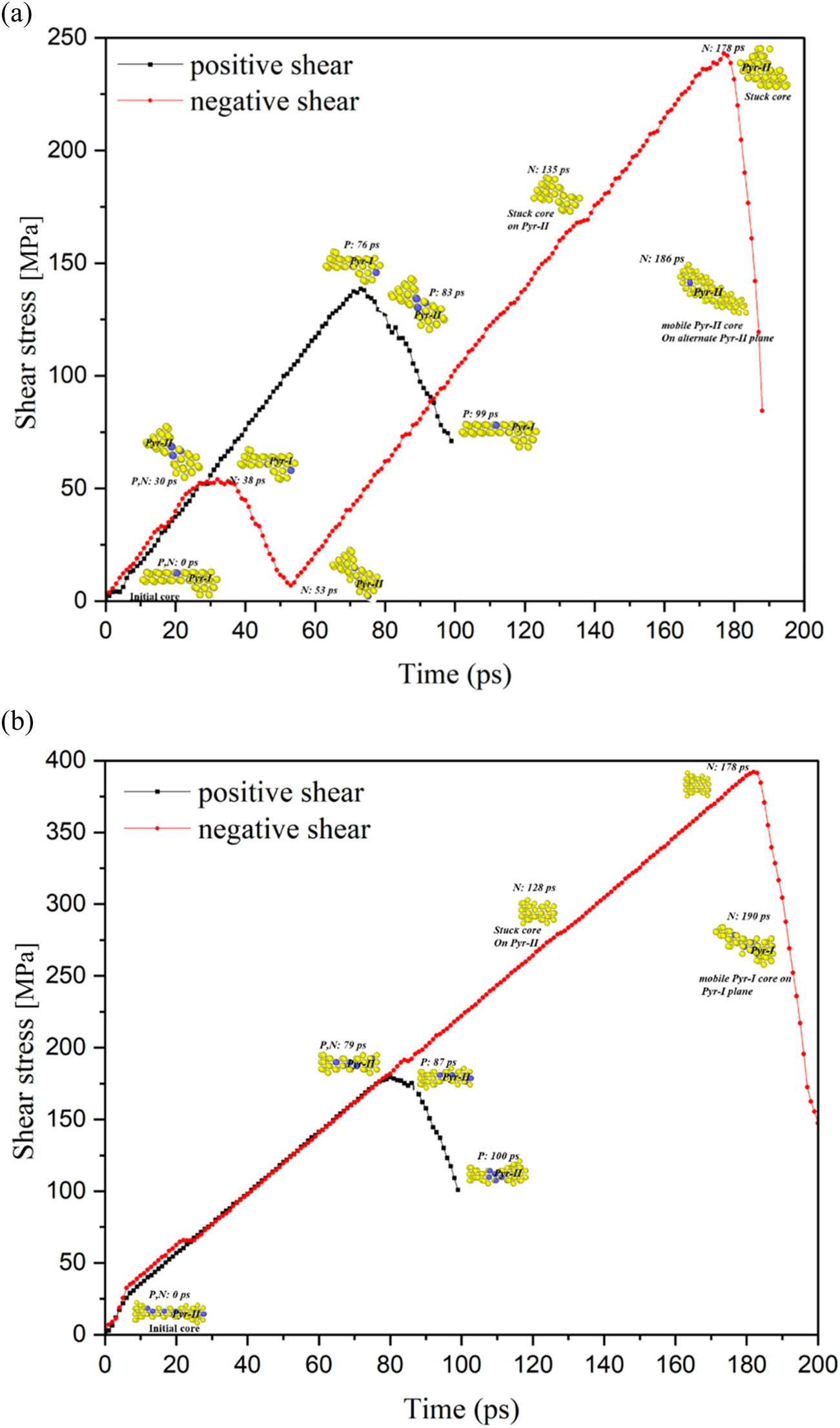
Time evolution of shear stress for (a) Pyr-I and (b) Pyr-II planes. P and N represent the positive and negative shear directions at different times, respectively. The atomistic pictures of dislocation core structures encountered during the cross-slip process are shown by drawing only non-HCP atoms near the core atoms identified using CNA.
3 Results and discussion
3.1 Cross-slip transition of Pyr-I and Pyr-II 〈c + a〉 screw dislocations at low temperature
Figure 2(a) and (b) illustrates the time-dependent progression of shear stress and the associated transition pathways of the dislocation glide on the Pyr-I and Pyr-II planes, respectively, at a temperature of 10 K. The insets in Figure 2(a) and (b) depict the atomistic images of dislocation core structures found during the cross-slip process by showing only non-HCP atoms near the dislocation core as detected by CNA. The symbols P and N denote the positive and negative shear directions at various points in time, respectively (i.e., for P, the upper boundary moves in the positive z-direction and dislocation moves the negative x-direction, whereas for N, the upper boundary moves in the negative z-direction and dislocation moves in the positive x-direction).
When the dislocation on the Pyr-I plane is subjected to a positive shear direction, the core transforms into the Pyr-II plane at ∼52 MPa and remains on the Pyr-II plane until the shear stress reaches ∼139 MPa. Subsequently, it exhibits frequent cross-slip between the Pyr-I and Pyr-II planes during the stress drop (i.e., during migration) but glides primarily on the Pyr-I plane, as depicted in Figure 2(a). A prior study found a slightly higher stress of ∼166 MPa [15] and 155 MPa [27] under homogenous strain loading conditions. Moreover, Zhang et al. [16] reported a stress of ∼283 MPa while observing the gliding of the Pyr-I core in the positive shear direction under a shear stress rate (stress rate loading) of 1.0 MPa/ps (close to our calculation). A shear stress of ∼218 MPa was obtained under homogenous strain loading conditions.
The Pyr-I core glides smoothly on the Pyr-I plane at ∼54 MPa in the negative shear direction. Interestingly, in the simulations with a negative shear direction, the Pyr-I core behaves very differently after the initial migration on the Pyr-I plane. The core causes cross-slip to a Pyr-II plane at 53 ps, remains immobile (stuck core), and becomes shrunk on the Pyr-II plane until the shear stress increases to ∼243 MPa, as shown in Figure 2(a), after which it glides on the Pyr-II plane without going through the Pyr-I plane again. No cross-slip was observed during migration. A slightly higher stress of ∼311 MPa [16] during a stress-rate loading of 1.0 MPa/ps was previously reported under homogenous strain loading conditions. The reason for the uneven behavior in different shear directions is considered to be due to the asymmetry of the leading and trailing partials [13].
The glide and cross-slip behaviors of the Pyr-II plane under shear in the positive direction can be explained as follows: the Pyr-II 〈c + a〉 screw dislocation cross-slips to another accessible Pyr-II plane parallel to the original Pyr-II plane without dwelling on the Pyr-I plane. The cross-slip depends on the direction of shear, with a shear stress of approximately 180 MPa, corresponding to the shear stress in the positive shear direction. Consequently, a discernible shear stress reduction occurs as the dislocation starts to glide with frequent cross-slips between other accessible Pyr-II planes parallel to the original Pyr-II plane.
In the negative shear direction, the Pyr-II core experiences a continuous increase in shear stress (up to ∼391 MPa) because the dislocation remains immobile (stuck core) and shrinks on the Pyr-II plane, as shown in Figure 2(b), after which it causes cross-slip onto the Pyr-I plane and starts to glide smoothly without any noticeable cross-slip during migration on the Pyr-I plane.
In summary, the dislocation tends to stay on the Pyr-II plane and mainly glides on the Pyr-I plane after it causes cross-slip. However, although the Pyr-I plane facilitates the gliding of screw dislocations, it does not always occur. Once the Pyr-II dislocation is transformed into a stuck core (only observed for negative shear), the shear stress reaches a very high value (243 and 391 MPa) to escape from the immobilized structure.
3.2 Effects of normal strain on Pyr-I and II 〈c + a〉 screw dislocations at low temperature
Defining critical resolved shear stresses (CRSSes) in the negative shear direction was difficult because of the presence of several peaks related to cross-slips and core structure changes and the dislocation motion on the inclined plane, as shown in Section 3.1 and Figure 2. Here, we discuss the influences of normal strain perpendicular to the original slip plane on CRSSes in the positive shear direction. Figure 3(a) shows the CRSSes (
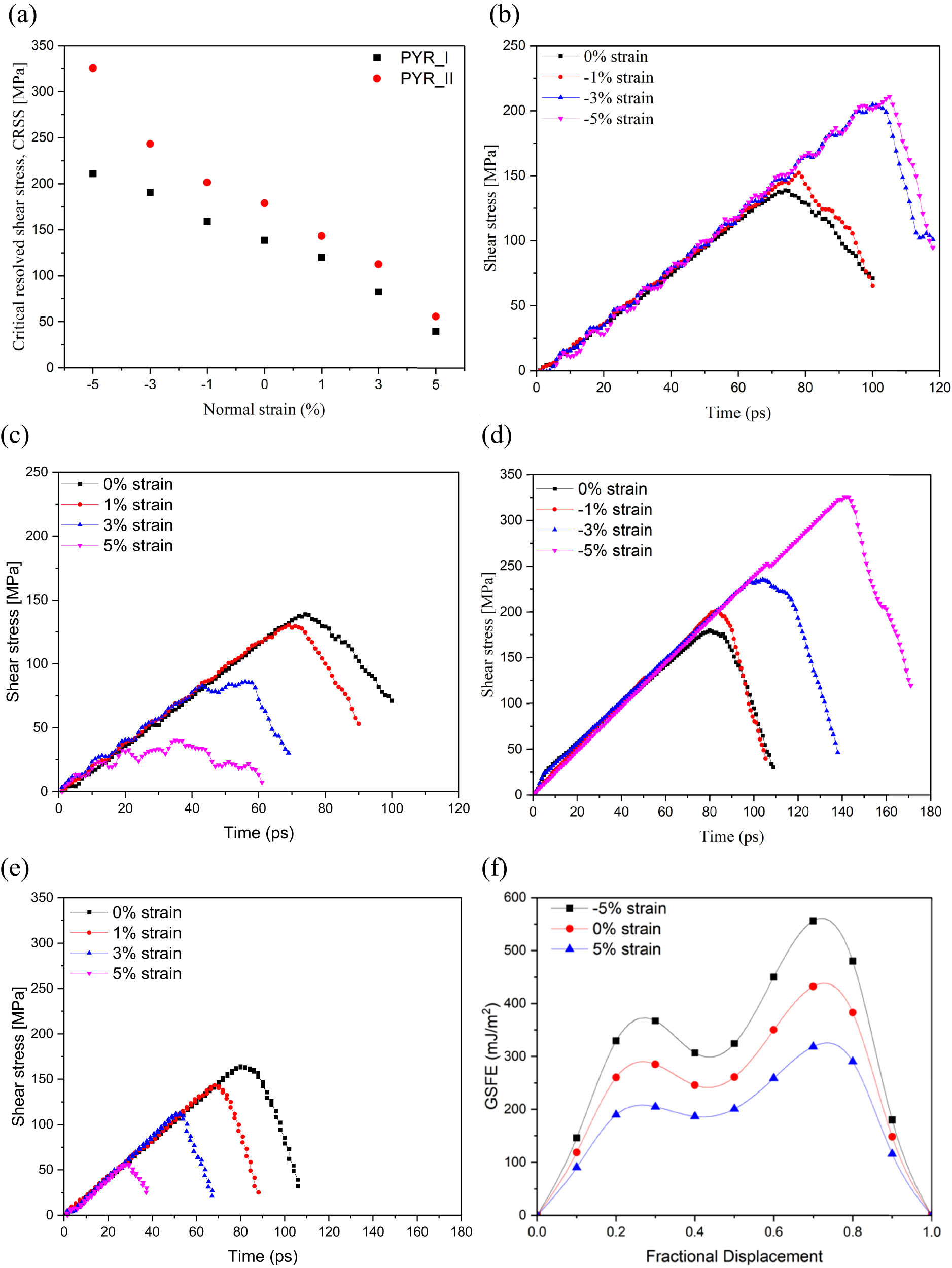
(a) CRSS (the first peak value of the shear stress) as a function of normal strain for Pyr-I and Pyr-II 〈c + a〉 screw dislocations at 10 K. Time evolution of the shear stress for the Pyr-I 〈c + a〉 screw dislocation under (b) compression and (c) tension. Time evolution of the shear stress for the Pyr-II 〈c + a〉 screw dislocation under (d) compression and (e) tension. (f) GSFE curves for the Pyr-I dislocation.
The CRSS for the 〈c + a〉 screw dislocation during shear deformation gliding on Pyr-II planes is ∼180 MPa, which is higher than that on Pyr-I planes (∼139 MPa) at 0% strain, verifying that the CRSS for Pyr-I is lower than that of Pyr-II under all normal-strain conditions. Previous MD simulations have also shown that Pyr-I screw dislocations exhibit higher mobilities than Pyr-II screw dislocations at relatively low temperatures [14]. The CRSSes for the Pyr-I and Pyr-II 〈c + a〉 screw dislocations increase with the compressive strain and decrease with the tensile strain. This result could be because the generalized stacking fault energies (GSFEs) on Pyr-I and Pyr-II planes increase under compression normal to the slip plane and decrease under tension, as shown by the GSFE curves along the 〈c + a〉 direction (z-axis) for Pyr-I (Figure 3(f)). In addition, the stacking fault energy of prismatic slip increases under compression and decreases under tension, remarkably changing the mobility of prismatic screw dislocations [38].
3.3 Effect of temperature on Pyr-I and II 〈c + a〉 screw dislocations
Figure 4(a) and (b) shows the CRSSes in the positive shear direction for the Pyr-I and Pyr-II screw dislocations at higher temperatures along with the CRSSes, as shown in Figure 3(a). The CRSSes are plotted as a function of the applied normal strain at 10, 200, 300, 400, and 500 K for Pyr-I and II slip. The cases for which the dislocation glides with or without the cross-slip behavior are shown by the filled symbols, whereas those with basal dislocation emission and recovery (discussed in Section 3.4) are shown by the half-open symbols.
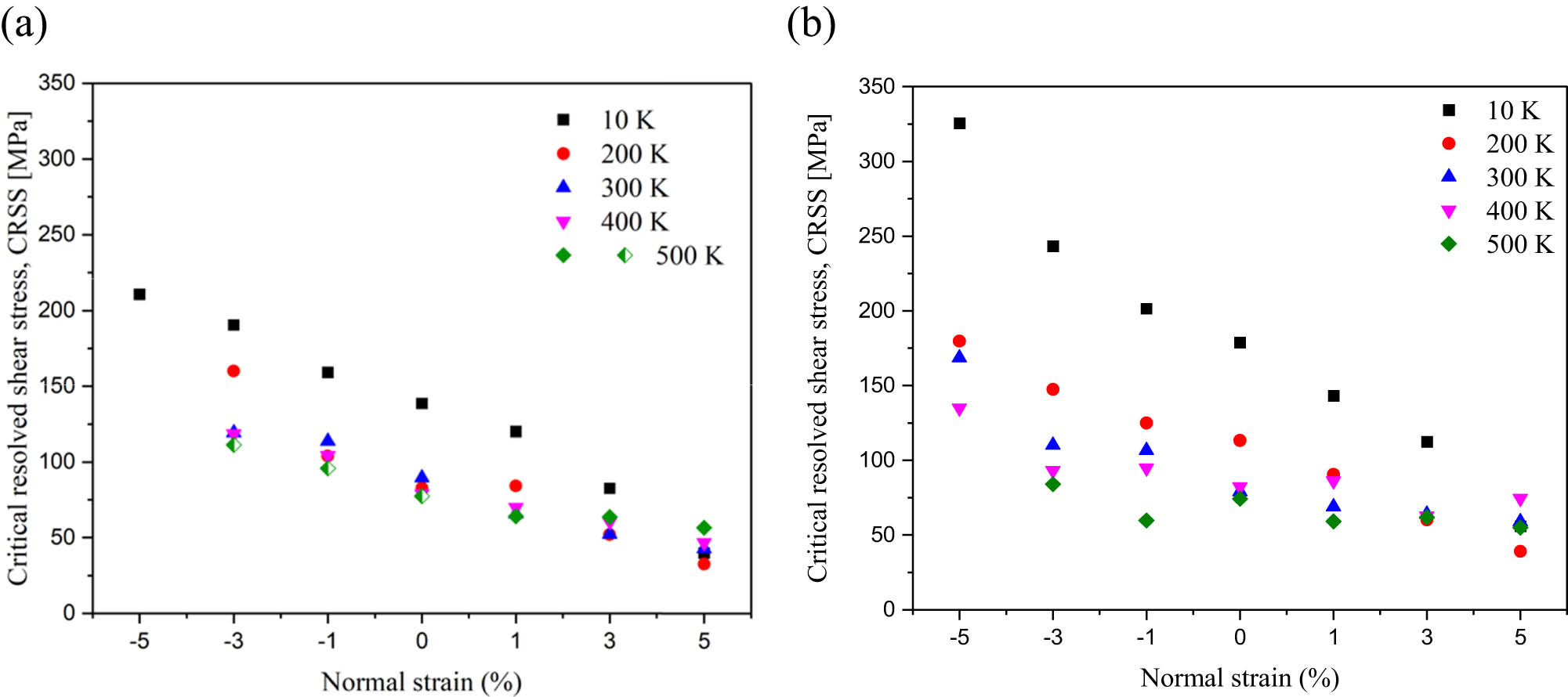
CRSS (the maximum peak value of the shear stress) as a function of normal strain for (a) Pyr-I and (b) Pyr-II 〈c + a〉 screw dislocations at different temperatures. The half-filled symbols in (a) represent the stress at which Pyr-I dislocations undergo basal dislocation emission and recovery.
The mobility of Pyr-I screw dislocation cores is weakly affected by temperature in the range studied, except 10 K where the CRSS becomes considerably high, as shown in Figure 4(a). These observations are consistent with previous findings [24]. In contrast, the CRSS for the Pyr-II screw dislocation mobility decreases with increasing temperatures (Figure 4(b)). Pyr-I screw dislocations have a lower CRSS and higher mobility than Pyr-II screw dislocations at 10 K, strongly indicating that, as anticipated from MD simulations [14], a slip mostly occurs on Pyr-I planes at low temperatures. The CRSSes of Pyr-II screw dislocations are substantially close to or even lower than the CRSSes of Pyr-I screw dislocations at 400 K. Therefore, the increased plasticity observed at the intermediate temperature range may be ascribed to the presence of both Pyr-II and Pyr-I slips. Furthermore, earlier studies have shown that the CRSSes of pyramidal dislocations in Mg and its alloys decrease with increasing temperature [39], and the increase in ductility observed above 300 K is attributed to the increased mobility of pyramidal dislocations with temperature [40]. The CRSSes of Pyr-I screw dislocations are marginally impacted by temperature based on the MD simulations, but the CRSSes of Pyr-II screw dislocations decrease with increasing temperature. Namakian et al. evaluated the temperature dependence of generalized stacking fault free energy of various slip systems in Mg [41]. They showed that the stacking fault energy of Pyr-II decreases rapidly than Pyr-I with increasing temperature, and Pyr-II slip is more favorable over 385 K. The temperature dependence of CRSS of screw dislocations obtained by our MD agrees well with Namakian’s report.
Finally, Pyr-I screw dislocations at ≥500 K tend to cause basal dislocation emission and recovery under compression and 0% normal strain. The stress for the Pyr-I screw dislocation at an extremely high compressive strain (ε yy = −5%) for all temperatures except 10 K is not shown because the dislocation transforms into a sessile dislocation (basal dislocation emission without recovery) and lose the capacity to accommodate c-axis deformation, resulting in catastrophic deformation at a high shear stress. As a result, the contribution of Pyr-I screw dislocations to plasticity is reduced at increased compressive strains and higher temperatures, as experimentally shown at 673 K [42]. Pyr-II screw dislocations at 500 K and high compressive strain (ε yy = −5%) also show a high tendency to basal dislocation emission but without recovery (the values are not shown in Figure 5b).
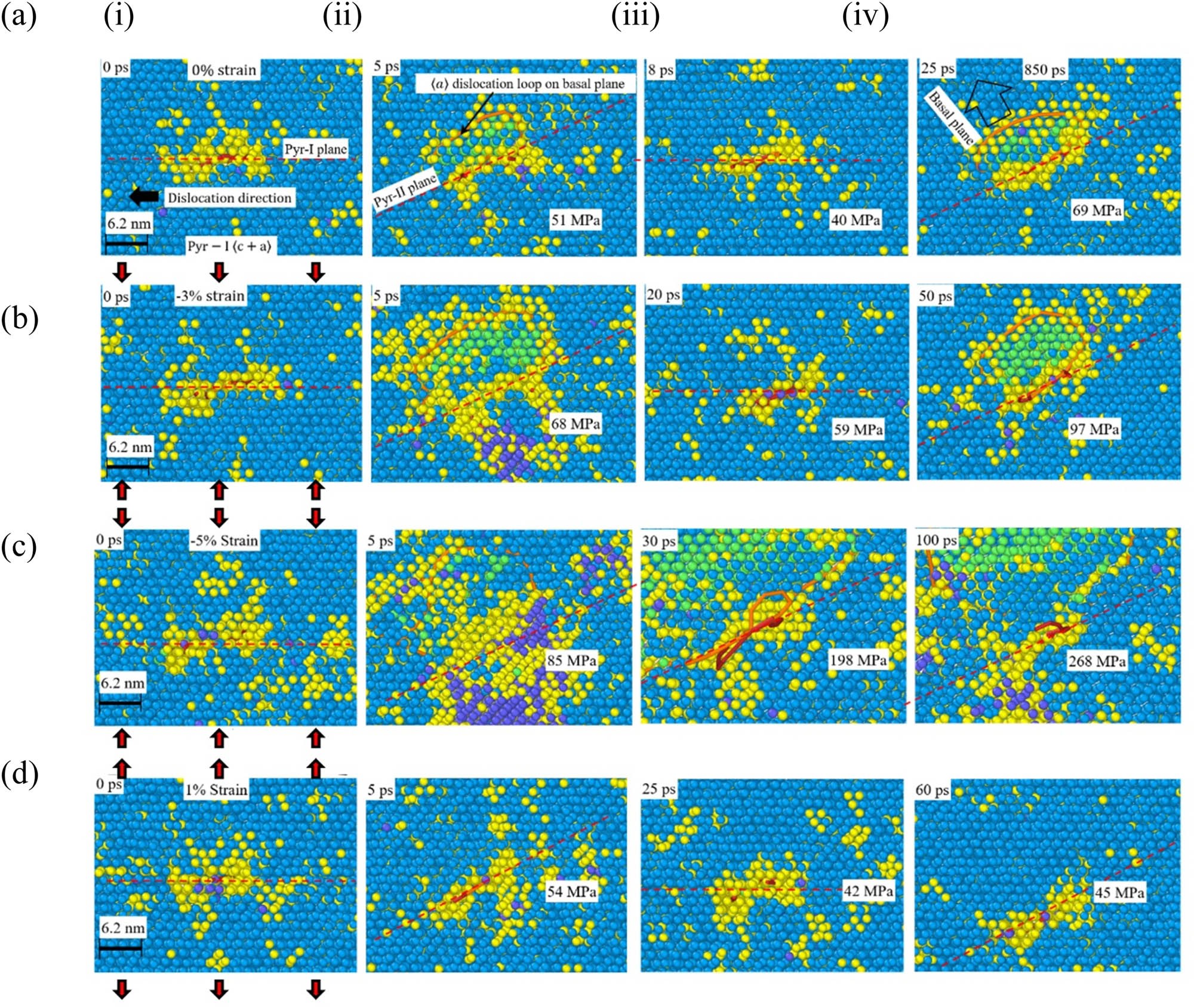
(a)–(c) Core structures of Pyr-I 〈c + a〉 screw dislocations at 500 K under normal strains of (a) zero, (b) −3%, and (c) −5%. Columns (i)–(iv) show the structure after relaxation, a typical structure during the transition, the structure showing easy glide dislocation core after transition recovery, and the structure during the second transition, respectively. Columns (iii) and (iv) in (c) show the nonrecovery behavior after the emission of basal dislocation. (d) Easy glide of a Pyr-I 〈c + a〉 screw dislocation at 500 K under a tensile strain of 1%.
3.4 Thermally activated process for Pyr-I and Pyr-II screw dislocations at high temperature
As mentioned in the introduction, Wu et al. [17] proposed a mechanism for enhancing ductility in Mg alloys. According to their theory, high ductility can be attained by sustained plastic strain in the 〈c〉 direction, achieved via the rapid generation of new dislocation loops, which counteract the immobilization of 〈c + a〉 dislocations caused by the basal dislocation emission. Here, we analyze the thermally activated strain-dependent process for 〈c + a〉 screw dislocations at an elevated temperature and normal strains of −5, −3, 0, and 1%.
The basal dislocation emission behavior of the Pyr-I 〈c + a〉 screw dislocation at a temperature of 500 K, where thermally activated processes are accelerated, is shown in Figure 5. The intense atomic vibration at 500 K can cause misjudgment in the structural analysis performed using CNA; thus, many yellow atoms (defects) appear around the dislocation core. Columns ((i)–(iv)) in Figure 5 show the structures of dislocation cores at specific instants. Figure 5(a–c)(i) shows the Pyr-I screw dislocation cores on Pyr-I planes at different normal strain levels ranging from 0 to −3%. At around 5 ps (column (ii) in Figure 5(a–c)), the dislocation causes cross-slip onto the Pyr-II plane and then emits the 〈a〉 dislocation loop onto the basal plane, and the dislocation becomes momentarily immobile. The basal-
Figure 6(a) and (b) shows the Pyr-II screw dislocation cores at zero and −5% normal strains during shear deformation in the positive shear direction at 500 K. In the strain range 0% ≤ ε yy ≤ −3%, the dislocations move roughly with frequent cross-slips and no observable transition into the Pyr-I plane, as shown in Figure 6(a). Under a very high compressive strain (ε yy = −5%) (Figure 6(b)), a large 〈a〉 dislocation loop nucleates without emission recovery during the shear deformation, leaving the dislocation immobile, and it does not contribute to plastic straining.
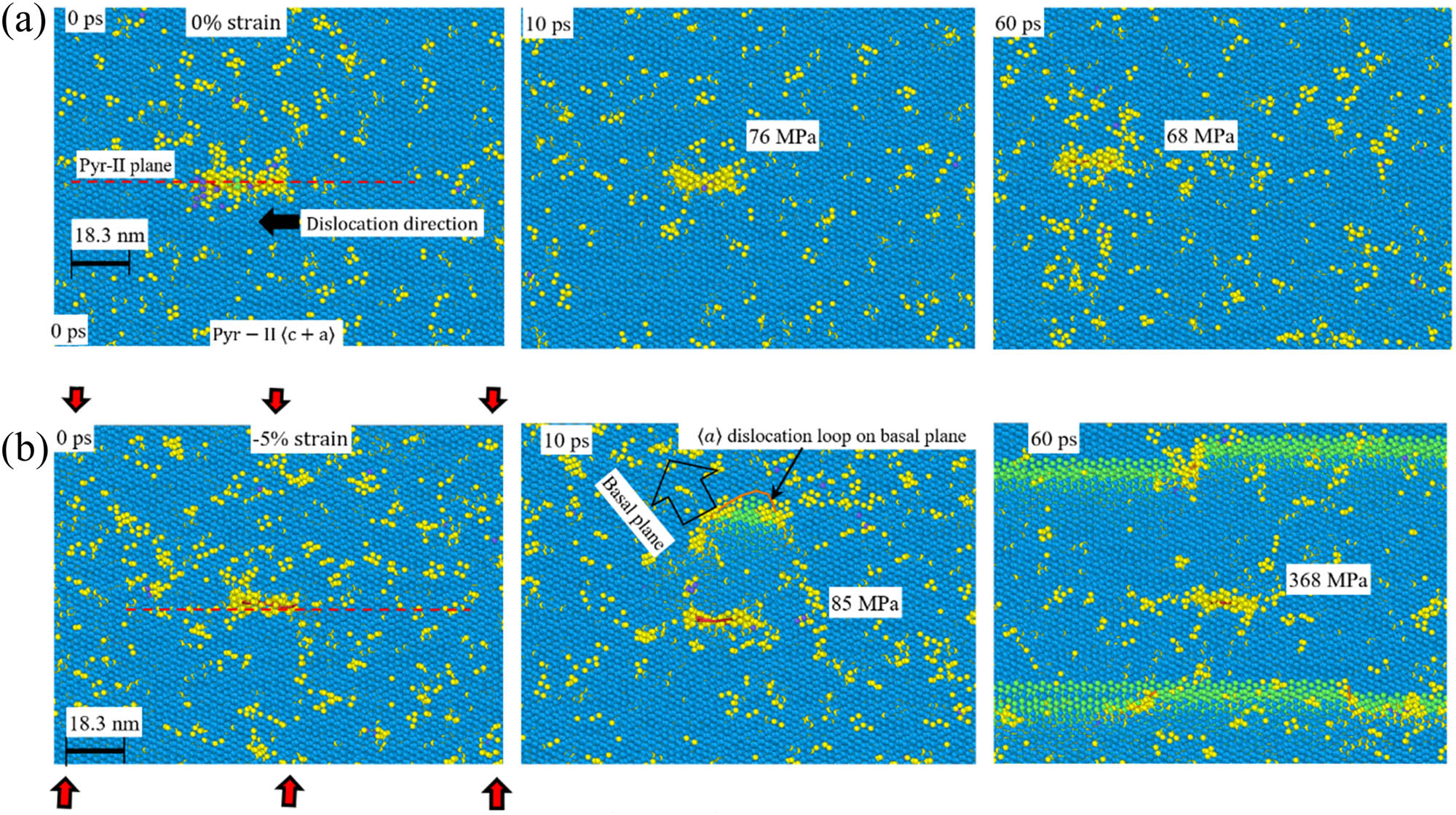
(a) Easy glide of a Pyr-II 〈c + a〉 screw dislocation at 500 K under zero strain And (b) the basal dislocation emission from a Pyr-II 〈c + a〉 screw dislocation at 500 K under a normal strain of −5%.
4 Conclusion
A detailed analysis of the effects of normal strain perpendicular to the slip plane and temperature on the mobility and structure of Pyr-I and Pyr-II 〈c + a〉 screw dislocations in single-crystal Mg was investigated by MD simulations. The main conclusions obtained are as follows:
The pyramidal screw dislocations were discovered to be stable on Pyr-II planes and tend to glide on Pyr-I planes at a significantly low temperature of 10 K. The dislocation glide direction determines the CRSSes of pyramidal screw dislocations on both Pyr-I and Pyr-II planes. A very high shear stress (∼243 and 391 MPa) is required to mobilize the core structure of Pyr-II dislocation after it has been transformed into a stuck core under deformation in a negative shear direction. Furthermore, the CRSS increases with increasing compressive strain and decreases with increasing tensile strain.
The CRSSes for Pyr-I screw dislocations are marginally influenced by temperature in the range of 200 K ≤ T ≤ 400 K. On the other hand, the CRSSes for Pyr-II screw dislocations experience a significant decrease. Consequently, the CRSS values for Pyr-I and Pyr-II screw dislocations are comparable at a temperature range of 300–400 K.
Pyr-I screw dislocations often emit a basal-〈a〉 dislocation loop at higher temperatures (500 K) and under compressive strains, while the remaining dislocation remains momentarily immobilized. As shear deformation continues, the core structure is restored, and the basal-〈a〉 dislocation loop emitted by the 〈c + a〉 dislocation is swiftly drawn back. Under an extremely high compressive stress, this recovery was not confirmed.
In this article, the detailed behavior of screw dislocations in Mg was analyzed. We believe some aspects obtained in this article are common in HCP metals, such as HCP-Ni nanoparticle [43], which are important in nanotechnology fields.
Acknowledgments
The authors would like to acknowledge financial support from the Japan Science and Technology Agency (JST) CREST (Grant Number JPMJCR2094). The authors also acknowledge Mr. Suraj Singhaneka for his contribution.
-
Funding information: This study was financially supported by the Japan Science and Technology Agency (JST) CREST (Grant Number JPMJCR2094).
-
Author contributions: Sunday Temitope Oyinbo: validation, formal analysis, investigation, data curation, writing – original draft, visualization, methodology. Ryosuke Matsumoto: conceptualization, methodology, software, validation, formal analysis, investigation, resources, writing – review and editing, visualization, supervision, project administration, funding acquisition. All authors have accepted responsibility for the entire content of this manuscript and approved its submission.
-
Conflict of interest: The authors state no conflict of interest.
-
Data availability statement: The datasets generated and/or analyzed during the current study are available from the corresponding author on reasonable request.
References
[1] Yin B, Wu Z, Curtin WA. Comprehensive first-principles study of stable stacking faults in HCP metals. Acta Mater. 2017;123:223–34. 10.1016/j.actamat.2016.10.042.Search in Google Scholar
[2] Ahmad R, Wu Z, Curtin WA. Analysis of double cross-slip of pyramidal I 〈c + a〉 screw dislocations and implications for ductility in Mg alloys. Acta Mater. 2020;183:228–41. 10.1016/j.actamat.2019.10.053.Search in Google Scholar
[3] Wu Z, Curtin WA. The origins of high hardening and low ductility in magnesium. Nature. 2015;526:62–7. 10.1038/nature15364.Search in Google Scholar PubMed
[4] Obara T, Yoshinga H, Morozumi S. {112̄2}〈1123〉 Slip system in magnesium. Acta Metall. 1973;21:845–53. 10.1016/0001-6160(73)90141-7.Search in Google Scholar
[5] Stohr PJF, Poirier JP. Etude en Microscopie Electronique du Glissement Pyramidal (1122) (1123) dans le Magnesium. Philos Mag. 1972;25:1313–29. 10.1080/14786437208223856.Search in Google Scholar
[6] Friedrich H, Schumann S. Research for a “new age of magnesium” in the automotive industry. J Mater Process Technol. 2001;117:276–81. 10.1016/S0924-0136(01)00780-4.Search in Google Scholar
[7] Kulekci MK. Magnesium and its alloys applications in automotive industry. Int J Adv Manuf Technol. 2008;39:851–65. 10.1007/s00170-007-1279-2.Search in Google Scholar
[8] Wu Z, Curtin WA. Intrinsic structural transitions of the pyramidal i <c + a> dislocation in magnesium. Scr Mater. 2016;116:104–7. 10.1016/j.scriptamat.2016.01.041.Search in Google Scholar
[9] Zhang D, Jiang L, Wang X, Beyerlein IJ, Minor AM, Schoenung JM, et al. In situ transmission electron microscopy investigation on (c + a) slip in Mg. J Mater Res. 2019;34:1499–508. 10.1557/jmr.2018.487.Search in Google Scholar
[10] Oyinbo ST, Matsumoto R, Matsunaka D, Jen TC. Influence of nonglide stress on the structure and mobility of pyramidal-I and -II 〈c + a〉 edge dislocations in magnesium. Eng Sci. 2023;25:1–12. 10.30919/es931.Search in Google Scholar
[11] Matsumoto R, Oyinbo ST, Matsunaka D. Migration mechanisms of sessile like pyramidal edge-dislocations dissociated along the basal plane of magnesium. Scr Mater. 2024;252:116235. 10.1016/j.scriptamat.2024.116235.Search in Google Scholar
[12] Wu Z, Curtin WA. Mechanism and energetics of “c + a” dislocation cross-slip in HCP metals. Proc Natl Acad Sci USA. 2016;113:11137–42. 10.1073/pnas.1603966113.Search in Google Scholar PubMed PubMed Central
[13] Tang Y, El-Awady JA. Formation and slip of pyramidal dislocations in hexagonal close-packed magnesium single crystals. Acta Mater. 2014;71:319–32. 10.1016/j.actamat.2014.03.022.Search in Google Scholar
[14] Fan H, El-Awady JA. Towards resolving the anonymity of pyramidal slip in magnesium. Mater Sci Eng A. 2015;644:318–24. 10.1016/j.msea.2015.07.080.Search in Google Scholar
[15] Buey D, Ghazisaeidi M. Atomistic simulation of <c + a> screw dislocation cross-slip in Mg. Scr Mater. 2016;117:51–4. 10.1016/j.scriptamat.2016.02.001.Search in Google Scholar
[16] Zhang J, Zhang Y, El-Awady JA, Tang Y. The plausibility of <c + a> dislocation slip on {-12-11} planes in Mg. Scr Mater. 2018;156:19–22. 10.1016/j.scriptamat.2018.07.007.Search in Google Scholar
[17] Wu Z, Ahmad R, Yin B, Sandlöbes S, Curtin WA. Mechanistic origin and prediction of enhanced ductility in magnesium alloys. Science (80-). 2018;359:447–52. 10.1017/s0368393100107606.Search in Google Scholar
[18] Li B, Ma E. Pyramidal slip in magnesium: Dislocations and stacking fault on the {101̄1} plane. Philos Mag. 2009;89:1223–35. 10.1080/14786430902936707.Search in Google Scholar
[19] Liu BY, Liu F, Yang N, Zhai XB, Zhang L, Yang Y, et al. Large plasticity in magnesium mediated by pyramidal dislocations. Science (80-). 2019;364:73–5. 10.1126/science.aaw2843.Search in Google Scholar PubMed
[20] Yoo MH, Morris JR, Ho KM, Agnew SR. Nonbasal deformation modes of HCP metals and alloys: Role of dislocation source and mobility. Metall Mater Trans A Phys Metall Mater Sci. 2002;33:813–22. 10.1007/s11661-002-0150-1.Search in Google Scholar
[21] Zhang J, Joshi SP. Phenomenological crystal plasticity modeling and detailed micromechanical investigations of pure magnesium. J Mech Phys Solids. 2012;60:945–72. 10.1016/j.jmps.2012.01.005.Search in Google Scholar
[22] Ando S, Tsushida M, Kitahara H. Deformation behavior of magnesium single crystal in c-axis compression and a-axis tension. Mater Sci Forum. 2010;654–656:699–702. 10.4028/www.scientific.net/MSF.654-656.699.Search in Google Scholar
[23] Plimpton SJ. Fast parallel algorithms for short-range molecular dynamics. J Comput Phys. 1995;117:1–19. 10.1006/jcph.1995.1039.Search in Google Scholar
[24] Fan H, Wang Q, Tian X, El-Awady JA. Temperature effects on the mobility of pyramidal <c + a> dislocations in magnesium. Scr Mater. 2017;127:68–71. 10.1016/j.scriptamat.2016.09.002.Search in Google Scholar
[25] Wilson SR, Mendelev MI. A unified relation for the solid-liquid interface free energy of pure FCC, BCC, and HCP metals. J Chem Phys. 2016;144:144707. 10.1063/1.4946032.Search in Google Scholar PubMed
[26] Sun DY, Mendelev MI, Becker CA, Kudin K, Haxhimali T, Asta M, et al. Crystal-melt interfacial free energies in HCP metals: A molecular dynamics study of Mg. Phys Rev B - Condens Matter Mater Phys. 2006;73:1–12. 10.1103/PhysRevB.73.024116.Search in Google Scholar
[27] Wu Z, Francis MF, Curtin WA. Magnesium interatomic potential for simulating plasticity and fracture phenomena. Model Simul Mater Sci Eng. 2015;23:015004. 10.1088/0965-0393/23/1/015004.Search in Google Scholar
[28] Kim YM, Kim NJ, Lee BJ. Atomistic Modeling of pure Mg and Mg-Al systems. Calphad Comput Coupling Phase Diagr Thermochem. 2009;33:650–7. 10.1016/j.calphad.2009.07.004.Search in Google Scholar
[29] Ghazisaeidi M, Hector LG, Curtin WA. First-principles core structures of 〈c + a〉 edge and screw dislocations in Mg. Scr Mater. 2014;75:42–5. 10.1016/j.scriptamat.2013.11.013.Search in Google Scholar
[30] Sandlöbes S, Friák M, Neugebauer J, Raabe D. Basal and non-basal dislocation slip in Mg–Y. Mater Sci Eng A. 2013;576:61–8. 10.1016/j.msea.2013.03.006.Search in Google Scholar
[31] Jeong J, Xie Z, Alfreider M, Korte-kerzel S, Jeong J, Xie Z, et al. Revealing the nano-scale mechanisms of the limited non-basal plasticity in magnesium. HAL Open Sci. 2023;hal-04095159. 10.21203/rs.3.rs-2783308/v1.Search in Google Scholar
[32] Du C, Gao Y, Zha M, Wang C, Jia H, Wang HY. Deformation-induced grain rotation and grain boundary formation achieved through dislocation-disclination reactions in polycrystalline hexagonal close-packed metals. Acta Mater. 2023;250. 10.1016/j.actamat.2023.118855.Search in Google Scholar
[33] Oyinbo ST, Singhaneka S, Matsumoto R. Exploring the basal/prismatic slip transfer at grain boundaries in magnesium: A molecular dynamic simulation. Vacuum. 2023;212:111995. 10.1016/j.vacuum.2023.111995.Search in Google Scholar
[34] Berendsen HJC, Postma JPM, Van Gunsteren WF, Dinola A, Haak JR. Molecular dynamics with coupling to an external bath. J Chem Phys. 1984;81:3684–90. 10.1063/1.448118.Search in Google Scholar
[35] Stukowski A, Albe K. Extracting dislocations and non-dislocation crystal defects from atomistic simulation data. Model Simul Mater Sci Eng. 2010;18:085001. 10.1088/0965-0393/18/8/085001.Search in Google Scholar
[36] Honeycutt JD, Andemen HC. Molecular dynamics study of melting and freezing of small Lennard-Jones clusters. J Phys Chem. 1987;1:4950–63. 10.1021/j100303a014.Search in Google Scholar
[37] Stukowski A. Visualization and analysis of atomistic simulation data with OVITO-the open visualization tool. Model Simul Mater Sci Eng. 2010;18:015012. 10.1088/0965-0393/18/1/015012.Search in Google Scholar
[38] Singhaneka S, Matsumoto R. Evaluating the influence of non-glide strain on prismatic dislocation in Mg using density functional theory calculations and the Peierls–Nabarro model. Comput Mater Sci. 2023;230:112458. 10.1016/j.commatsci.2023.112458.Search in Google Scholar
[39] Chapuis A, Driver JH. Temperature dependency of slip and twinning in plane strain compressed magnesium single crystals. Acta Mater. 2011;59:1986–94. 10.1016/j.actamat.2010.11.064.Search in Google Scholar
[40] Jain A, Agnew SR. Modeling the temperature dependent effect of twinning on the behavior of magnesium alloy AZ31B sheet. Mater Sci Eng A. 2007;462:29–36. 10.1016/j.msea.2006.03.160.Search in Google Scholar
[41] Namakian R, Moldovan D, Swinburne TD. Temperature dependence of generalized stacking fault free energy profiles and dissociation mechanisms of slip systems in Mg. Comput Mater Sci. 2024;231:112569. 10.1016/j.commatsci.2023.112569.Search in Google Scholar
[42] Miura H, Yang X, Sakai T, Nogawa H, Miura S, Watanabe Y, et al. High temperature deformation and extended plasticity in Mg single crystals. Philos Mag. 2005;85:3553–65. 10.1080/14786430500228440.Search in Google Scholar
[43] Jaji ND, Lee HL, Hussin MH, Akil HM, Zakaria MR, Othman MBH. Advanced nickel nanoparticles technology: From synthesis to applications. Nanotechnol Rev. 2020;9:1456–80. 10.1515/ntrev-2020-0109.Search in Google Scholar
© 2024 the author(s), published by De Gruyter
This work is licensed under the Creative Commons Attribution 4.0 International License.
Articles in the same Issue
- Research Articles
- Tension buckling and postbuckling of nanocomposite laminated plates with in-plane negative Poisson’s ratio
- Polyvinylpyrrolidone-stabilised gold nanoparticle coatings inhibit blood protein adsorption
- Energy and mass transmission through hybrid nanofluid flow passing over a spinning sphere with magnetic effect and heat source/sink
- Surface treatment with nano-silica and magnesium potassium phosphate cement co-action for enhancing recycled aggregate concrete
- Numerical investigation of thermal radiation with entropy generation effects in hybrid nanofluid flow over a shrinking/stretching sheet
- Enhancing the performance of thermal energy storage by adding nano-particles with paraffin phase change materials
- Using nano-CaCO3 and ceramic tile waste to design low-carbon ultra high performance concrete
- Numerical analysis of thermophoretic particle deposition in a magneto-Marangoni convective dusty tangent hyperbolic nanofluid flow – Thermal and magnetic features
- Dual numerical solutions of Casson SA–hybrid nanofluid toward a stagnation point flow over stretching/shrinking cylinder
- Single flake homo p–n diode of MoTe2 enabled by oxygen plasma doping
- Electrostatic self-assembly effect of Fe3O4 nanoparticles on performance of carbon nanotubes in cement-based materials
- Multi-scale alignment to buried atom-scale devices using Kelvin probe force microscopy
- Antibacterial, mechanical, and dielectric properties of hydroxyapatite cordierite/zirconia porous nanocomposites for use in bone tissue engineering applications
- Time-dependent Darcy–Forchheimer flow of Casson hybrid nanofluid comprising the CNTs through a Riga plate with nonlinear thermal radiation and viscous dissipation
- Durability prediction of geopolymer mortar reinforced with nanoparticles and PVA fiber using particle swarm optimized BP neural network
- Utilization of zein nano-based system for promoting antibiofilm and anti-virulence activities of curcumin against Pseudomonas aeruginosa
- Antibacterial effect of novel dental resin composites containing rod-like zinc oxide
- An extended model to assess Jeffery–Hamel blood flow through arteries with iron-oxide (Fe2O3) nanoparticles and melting effects: Entropy optimization analysis
- Comparative study of copper nanoparticles over radially stretching sheet with water and silicone oil
- Cementitious composites modified by nanocarbon fillers with cooperation effect possessing excellent self-sensing properties
- Confinement size effect on dielectric properties, antimicrobial activity, and recycling of TiO2 quantum dots via photodegradation processes of Congo red dye and real industrial textile wastewater
- Biogenic silver nanoparticles of Moringa oleifera leaf extract: Characterization and photocatalytic application
- Novel integrated structure and function of Mg–Gd neutron shielding materials
- Impact of multiple slips on thermally radiative peristaltic transport of Sisko nanofluid with double diffusion convection, viscous dissipation, and induced magnetic field
- Magnetized water-based hybrid nanofluid flow over an exponentially stretching sheet with thermal convective and mass flux conditions: HAM solution
- A numerical investigation of the two-dimensional magnetohydrodynamic water-based hybrid nanofluid flow composed of Fe3O4 and Au nanoparticles over a heated surface
- Development and modeling of an ultra-robust TPU-MWCNT foam with high flexibility and compressibility
- Effects of nanofillers on the physical, mechanical, and tribological behavior of carbon/kenaf fiber–reinforced phenolic composites
- Polymer nanocomposite for protecting photovoltaic cells from solar ultraviolet in space
- Study on the mechanical properties and microstructure of recycled concrete reinforced with basalt fibers and nano-silica in early low-temperature environments
- Synergistic effect of carbon nanotubes and polyvinyl alcohol on the mechanical performance and microstructure of cement mortar
- CFD analysis of paraffin-based hybrid (Co–Au) and trihybrid (Co–Au–ZrO2) nanofluid flow through a porous medium
- Forced convective tangent hyperbolic nanofluid flow subject to heat source/sink and Lorentz force over a permeable wedge: Numerical exploration
- Physiochemical and electrical activities of nano copper oxides synthesised via hydrothermal method utilising natural reduction agents for solar cell application
- A homotopic analysis of the blood-based bioconvection Carreau–Yasuda hybrid nanofluid flow over a stretching sheet with convective conditions
- In situ synthesis of reduced graphene oxide/SnIn4S8 nanocomposites with enhanced photocatalytic performance for pollutant degradation
- A coarse-grained Poisson–Nernst–Planck model for polyelectrolyte-modified nanofluidic diodes
- A numerical investigation of the magnetized water-based hybrid nanofluid flow over an extending sheet with a convective condition: Active and passive controls of nanoparticles
- The LyP-1 cyclic peptide modified mesoporous polydopamine nanospheres for targeted delivery of triptolide regulate the macrophage repolarization in atherosclerosis
- Synergistic effect of hydroxyapatite-magnetite nanocomposites in magnetic hyperthermia for bone cancer treatment
- The significance of quadratic thermal radiative scrutinization of a nanofluid flow across a microchannel with thermophoretic particle deposition effects
- Ferromagnetic effect on Casson nanofluid flow and transport phenomena across a bi-directional Riga sensor device: Darcy–Forchheimer model
- Performance of carbon nanomaterials incorporated with concrete exposed to high temperature
- Multicriteria-based optimization of roller compacted concrete pavement containing crumb rubber and nano-silica
- Revisiting hydrotalcite synthesis: Efficient combined mechanochemical/coprecipitation synthesis to design advanced tunable basic catalysts
- Exploration of irreversibility process and thermal energy of a tetra hybrid radiative binary nanofluid focusing on solar implementations
- Effect of graphene oxide on the properties of ternary limestone clay cement paste
- Improved mechanical properties of graphene-modified basalt fibre–epoxy composites
- Sodium titanate nanostructured modified by green synthesis of iron oxide for highly efficient photodegradation of dye contaminants
- Green synthesis of Vitis vinifera extract-appended magnesium oxide NPs for biomedical applications
- Differential study on the thermal–physical properties of metal and its oxide nanoparticle-formed nanofluids: Molecular dynamics simulation investigation of argon-based nanofluids
- Heat convection and irreversibility of magneto-micropolar hybrid nanofluids within a porous hexagonal-shaped enclosure having heated obstacle
- Numerical simulation and optimization of biological nanocomposite system for enhanced oil recovery
- Laser ablation and chemical vapor deposition to prepare a nanostructured PPy layer on the Ti surface
- Cilostazol niosomes-loaded transdermal gels: An in vitro and in vivo anti-aggregant and skin permeation activity investigations towards preparing an efficient nanoscale formulation
- Linear and nonlinear optical studies on successfully mixed vanadium oxide and zinc oxide nanoparticles synthesized by sol–gel technique
- Analytical investigation of convective phenomena with nonlinearity characteristics in nanostratified liquid film above an inclined extended sheet
- Optimization method for low-velocity impact identification in nanocomposite using genetic algorithm
- Analyzing the 3D-MHD flow of a sodium alginate-based nanofluid flow containing alumina nanoparticles over a bi-directional extending sheet using variable porous medium and slip conditions
- A comprehensive study of laser irradiated hydrothermally synthesized 2D layered heterostructure V2O5(1−x)MoS2(x) (X = 1–5%) nanocomposites for photocatalytic application
- Computational analysis of water-based silver, copper, and alumina hybrid nanoparticles over a stretchable sheet embedded in a porous medium with thermophoretic particle deposition effects
- A deep dive into AI integration and advanced nanobiosensor technologies for enhanced bacterial infection monitoring
- Effects of normal strain on pyramidal I and II 〈c + a〉 screw dislocation mobility and structure in single-crystal magnesium
- Computational study of cross-flow in entropy-optimized nanofluids
- Significance of nanoparticle aggregation for thermal transport over magnetized sensor surface
- A green and facile synthesis route of nanosize cupric oxide at room temperature
- Effect of annealing time on bending performance and microstructure of C19400 alloy strip
- Chitosan-based Mupirocin and Alkanna tinctoria extract nanoparticles for the management of burn wound: In vitro and in vivo characterization
- Electrospinning of MNZ/PLGA/SF nanofibers for periodontitis
- Photocatalytic degradation of methylene blue by Nd-doped titanium dioxide thin films
- Shell-core-structured electrospinning film with sequential anti-inflammatory and pro-neurogenic effects for peripheral nerve repairment
- Flow and heat transfer insights into a chemically reactive micropolar Williamson ternary hybrid nanofluid with cross-diffusion theory
- One-pot fabrication of open-spherical shapes based on the decoration of copper sulfide/poly-O-amino benzenethiol on copper oxide as a promising photocathode for hydrogen generation from the natural source of Red Sea water
- A penta-hybrid approach for modeling the nanofluid flow in a spatially dependent magnetic field
- Advancing sustainable agriculture: Metal-doped urea–hydroxyapatite hybrid nanofertilizer for agro-industry
- Utilizing Ziziphus spina-christi for eco-friendly synthesis of silver nanoparticles: Antimicrobial activity and promising application in wound healing
- Plant-mediated synthesis, characterization, and evaluation of a copper oxide/silicon dioxide nanocomposite by an antimicrobial study
- Effects of PVA fibers and nano-SiO2 on rheological properties of geopolymer mortar
- Investigating silver and alumina nanoparticles’ impact on fluid behavior over porous stretching surface
- Potential pharmaceutical applications and molecular docking study for green fabricated ZnO nanoparticles mediated Raphanus sativus: In vitro and in vivo study
- Effect of temperature and nanoparticle size on the interfacial layer thickness of TiO2–water nanofluids using molecular dynamics
- Characteristics of induced magnetic field on the time-dependent MHD nanofluid flow through parallel plates
- Flexural and vibration behaviours of novel covered CFRP composite joints with an MWCNT-modified adhesive
- Experimental research on mechanically and thermally activation of nano-kaolin to improve the properties of ultra-high-performance fiber-reinforced concrete
- Analysis of variable fluid properties for three-dimensional flow of ternary hybrid nanofluid on a stretching sheet with MHD effects
- Biodegradability of corn starch films containing nanocellulose fiber and thymol
- Toxicity assessment of copper oxide nanoparticles: In vivo study
- Some measures to enhance the energy output performances of triboelectric nanogenerators
- Reinforcement of graphene nanoplatelets on water uptake and thermomechanical behaviour of epoxy adhesive subjected to water ageing conditions
- Optimization of preparation parameters and testing verification of carbon nanotube suspensions used in concrete
- Max-phase Ti3SiC2 and diverse nanoparticle reinforcements for enhancement of the mechanical, dynamic, and microstructural properties of AA5083 aluminum alloy via FSP
- Advancing drug delivery: Neural network perspectives on nanoparticle-mediated treatments for cancerous tissues
- PEG-PLGA core–shell nanoparticles for the controlled delivery of picoplatin–hydroxypropyl β-cyclodextrin inclusion complex in triple-negative breast cancer: In vitro and in vivo study
- Conduction transportation from graphene to an insulative polymer medium: A novel approach for the conductivity of nanocomposites
- Review Articles
- Developments of terahertz metasurface biosensors: A literature review
- Overview of amorphous carbon memristor device, modeling, and applications for neuromorphic computing
- Advances in the synthesis of gold nanoclusters (AuNCs) of proteins extracted from nature
- A review of ternary polymer nanocomposites containing clay and calcium carbonate and their biomedical applications
- Recent advancements in polyoxometalate-functionalized fiber materials: A review
- Special contribution of atomic force microscopy in cell death research
- A comprehensive review of oral chitosan drug delivery systems: Applications for oral insulin delivery
- Cellular senescence and nanoparticle-based therapies: Current developments and perspectives
- Cyclodextrins-block copolymer drug delivery systems: From design and development to preclinical studies
- Micelle-based nanoparticles with stimuli-responsive properties for drug delivery
- Critical assessment of the thermal stability and degradation of chemically functionalized nanocellulose-based polymer nanocomposites
- Research progress in preparation technology of micro and nano titanium alloy powder
- Nanoformulations for lysozyme-based additives in animal feed: An alternative to fight antibiotic resistance spread
- Incorporation of organic photochromic molecules in mesoporous silica materials: Synthesis and applications
- A review on modeling of graphene and associated nanostructures reinforced concrete
- A review on strengthening mechanisms of carbon quantum dots-reinforced Cu-matrix nanocomposites
- Review on nanocellulose composites and CNFs assembled microfiber toward automotive applications
- Nanomaterial coating for layered lithium rich transition metal oxide cathode for lithium-ion battery
- Application of AgNPs in biomedicine: An overview and current trends
- Nanobiotechnology and microbial influence on cold adaptation in plants
- Hepatotoxicity of nanomaterials: From mechanism to therapeutic strategy
- Applications of micro-nanobubble and its influence on concrete properties: An in-depth review
- A comprehensive systematic literature review of ML in nanotechnology for sustainable development
- Exploiting the nanotechnological approaches for traditional Chinese medicine in childhood rhinitis: A review of future perspectives
- Twisto-photonics in two-dimensional materials: A comprehensive review
- Current advances of anticancer drugs based on solubilization technology
- Recent process of using nanoparticles in the T cell-based immunometabolic therapy
- Future prospects of gold nanoclusters in hydrogen storage systems and sustainable environmental treatment applications
- Preparation, types, and applications of one- and two-dimensional nanochannels and their transport properties for water and ions
- Microstructural, mechanical, and corrosion characteristics of Mg–Gd–x systems: A review of recent advancements
- Functionalized nanostructures and targeted delivery systems with a focus on plant-derived natural agents for COVID-19 therapy: A review and outlook
- Mapping evolution and trends of cell membrane-coated nanoparticles: A bibliometric analysis and scoping review
- Nanoparticles and their application in the diagnosis of hepatocellular carcinoma
- In situ growth of carbon nanotubes on fly ash substrates
- Structural performance of boards through nanoparticle reinforcement: An advance review
- Reinforcing mechanisms review of the graphene oxide on cement composites
- Seed regeneration aided by nanomaterials in a climate change scenario: A comprehensive review
- Surface-engineered quantum dot nanocomposites for neurodegenerative disorder remediation and avenue for neuroimaging
- Graphitic carbon nitride hybrid thin films for energy conversion: A mini-review on defect activation with different materials
- Nanoparticles and the treatment of hepatocellular carcinoma
- Special Issue on Advanced Nanomaterials and Composites for Energy Conversion and Storage - Part II
- Highly safe lithium vanadium oxide anode for fast-charging dendrite-free lithium-ion batteries
- Recent progress in nanomaterials of battery energy storage: A patent landscape analysis, technology updates, and future prospects
- Special Issue on Advanced Nanomaterials for Carbon Capture, Environment and Utilization for Energy Sustainability - Part II
- Calcium-, magnesium-, and yttrium-doped lithium nickel phosphate nanomaterials as high-performance catalysts for electrochemical water oxidation reaction
- Low alkaline vegetation concrete with silica fume and nano-fly ash composites to improve the planting properties and soil ecology
- Mesoporous silica-grafted deep eutectic solvent-based mixed matrix membranes for wastewater treatment: Synthesis and emerging pollutant removal performance
- Electrochemically prepared ultrathin two-dimensional graphitic nanosheets as cathodes for advanced Zn-based energy storage devices
- Enhanced catalytic degradation of amoxicillin by phyto-mediated synthesised ZnO NPs and ZnO-rGO hybrid nanocomposite: Assessment of antioxidant activity, adsorption, and thermodynamic analysis
- Incorporating GO in PI matrix to advance nanocomposite coating: An enhancing strategy to prevent corrosion
- Synthesis, characterization, thermal stability, and application of microporous hyper cross-linked polyphosphazenes with naphthylamine group for CO2 uptake
- Engineering in ceramic albite morphology by the addition of additives: Carbon nanotubes and graphene oxide for energy applications
- Nanoscale synergy: Optimizing energy storage with SnO2 quantum dots on ZnO hexagonal prisms for advanced supercapacitors
- Aging assessment of silicone rubber materials under corona discharge accompanied by humidity and UV radiation
- Tuning structural and electrical properties of Co-precipitated and Cu-incorporated nickel ferrite for energy applications
- Sodium alginate-supported AgSr nanoparticles for catalytic degradation of malachite green and methyl orange in aqueous medium
- An environmentally greener and reusability approach for bioenergy production using Mallotus philippensis (Kamala) seed oil feedstock via phytonanotechnology
- Micro-/nano-alumina trihydrate and -magnesium hydroxide fillers in RTV-SR composites under electrical and environmental stresses
- Mechanism exploration of ion-implanted epoxy on surface trap distribution: An approach to augment the vacuum flashover voltages
- Nanoscale engineering of semiconductor photocatalysts boosting charge separation for solar-driven H2 production: Recent advances and future perspective
- Excellent catalytic performance over reduced graphene-boosted novel nanoparticles for oxidative desulfurization of fuel oil
- Special Issue on Advances in Nanotechnology for Agriculture
- Deciphering the synergistic potential of mycogenic zinc oxide nanoparticles and bio-slurry formulation on phenology and physiology of Vigna radiata
- Nanomaterials: Cross-disciplinary applications in ornamental plants
- Special Issue on Catechol Based Nano and Microstructures
- Polydopamine films: Versatile but interface-dependent coatings
- In vitro anticancer activity of melanin-like nanoparticles for multimodal therapy of glioblastoma
- Poly-3,4-dihydroxybenzylidenhydrazine, a different analogue of polydopamine
- Chirality and self-assembly of structures derived from optically active 1,2-diaminocyclohexane and catecholamines
- Advancing resource sustainability with green photothermal materials: Insights from organic waste-derived and bioderived sources
- Bioinspired neuromelanin-like Pt(iv) polymeric nanoparticles for cancer treatment
- Special Issue on Implementing Nanotechnology for Smart Healthcare System
- Intelligent explainable optical sensing on Internet of nanorobots for disease detection
- Special Issue on Green Mono, Bi and Tri Metallic Nanoparticles for Biological and Environmental Applications
- Tracking success of interaction of green-synthesized Carbopol nanoemulgel (neomycin-decorated Ag/ZnO nanocomposite) with wound-based MDR bacteria
- Green synthesis of copper oxide nanoparticles using genus Inula and evaluation of biological therapeutics and environmental applications
- Biogenic fabrication and multifunctional therapeutic applications of silver nanoparticles synthesized from rose petal extract
- Metal oxides on the frontlines: Antimicrobial activity in plant-derived biometallic nanoparticles
- Controlling pore size during the synthesis of hydroxyapatite nanoparticles using CTAB by the sol–gel hydrothermal method and their biological activities
- Special Issue on State-of-Art Advanced Nanotechnology for Healthcare
- Applications of nanomedicine-integrated phototherapeutic agents in cancer theranostics: A comprehensive review of the current state of research
- Smart bionanomaterials for treatment and diagnosis of inflammatory bowel disease
- Beyond conventional therapy: Synthesis of multifunctional nanoparticles for rheumatoid arthritis therapy
Articles in the same Issue
- Research Articles
- Tension buckling and postbuckling of nanocomposite laminated plates with in-plane negative Poisson’s ratio
- Polyvinylpyrrolidone-stabilised gold nanoparticle coatings inhibit blood protein adsorption
- Energy and mass transmission through hybrid nanofluid flow passing over a spinning sphere with magnetic effect and heat source/sink
- Surface treatment with nano-silica and magnesium potassium phosphate cement co-action for enhancing recycled aggregate concrete
- Numerical investigation of thermal radiation with entropy generation effects in hybrid nanofluid flow over a shrinking/stretching sheet
- Enhancing the performance of thermal energy storage by adding nano-particles with paraffin phase change materials
- Using nano-CaCO3 and ceramic tile waste to design low-carbon ultra high performance concrete
- Numerical analysis of thermophoretic particle deposition in a magneto-Marangoni convective dusty tangent hyperbolic nanofluid flow – Thermal and magnetic features
- Dual numerical solutions of Casson SA–hybrid nanofluid toward a stagnation point flow over stretching/shrinking cylinder
- Single flake homo p–n diode of MoTe2 enabled by oxygen plasma doping
- Electrostatic self-assembly effect of Fe3O4 nanoparticles on performance of carbon nanotubes in cement-based materials
- Multi-scale alignment to buried atom-scale devices using Kelvin probe force microscopy
- Antibacterial, mechanical, and dielectric properties of hydroxyapatite cordierite/zirconia porous nanocomposites for use in bone tissue engineering applications
- Time-dependent Darcy–Forchheimer flow of Casson hybrid nanofluid comprising the CNTs through a Riga plate with nonlinear thermal radiation and viscous dissipation
- Durability prediction of geopolymer mortar reinforced with nanoparticles and PVA fiber using particle swarm optimized BP neural network
- Utilization of zein nano-based system for promoting antibiofilm and anti-virulence activities of curcumin against Pseudomonas aeruginosa
- Antibacterial effect of novel dental resin composites containing rod-like zinc oxide
- An extended model to assess Jeffery–Hamel blood flow through arteries with iron-oxide (Fe2O3) nanoparticles and melting effects: Entropy optimization analysis
- Comparative study of copper nanoparticles over radially stretching sheet with water and silicone oil
- Cementitious composites modified by nanocarbon fillers with cooperation effect possessing excellent self-sensing properties
- Confinement size effect on dielectric properties, antimicrobial activity, and recycling of TiO2 quantum dots via photodegradation processes of Congo red dye and real industrial textile wastewater
- Biogenic silver nanoparticles of Moringa oleifera leaf extract: Characterization and photocatalytic application
- Novel integrated structure and function of Mg–Gd neutron shielding materials
- Impact of multiple slips on thermally radiative peristaltic transport of Sisko nanofluid with double diffusion convection, viscous dissipation, and induced magnetic field
- Magnetized water-based hybrid nanofluid flow over an exponentially stretching sheet with thermal convective and mass flux conditions: HAM solution
- A numerical investigation of the two-dimensional magnetohydrodynamic water-based hybrid nanofluid flow composed of Fe3O4 and Au nanoparticles over a heated surface
- Development and modeling of an ultra-robust TPU-MWCNT foam with high flexibility and compressibility
- Effects of nanofillers on the physical, mechanical, and tribological behavior of carbon/kenaf fiber–reinforced phenolic composites
- Polymer nanocomposite for protecting photovoltaic cells from solar ultraviolet in space
- Study on the mechanical properties and microstructure of recycled concrete reinforced with basalt fibers and nano-silica in early low-temperature environments
- Synergistic effect of carbon nanotubes and polyvinyl alcohol on the mechanical performance and microstructure of cement mortar
- CFD analysis of paraffin-based hybrid (Co–Au) and trihybrid (Co–Au–ZrO2) nanofluid flow through a porous medium
- Forced convective tangent hyperbolic nanofluid flow subject to heat source/sink and Lorentz force over a permeable wedge: Numerical exploration
- Physiochemical and electrical activities of nano copper oxides synthesised via hydrothermal method utilising natural reduction agents for solar cell application
- A homotopic analysis of the blood-based bioconvection Carreau–Yasuda hybrid nanofluid flow over a stretching sheet with convective conditions
- In situ synthesis of reduced graphene oxide/SnIn4S8 nanocomposites with enhanced photocatalytic performance for pollutant degradation
- A coarse-grained Poisson–Nernst–Planck model for polyelectrolyte-modified nanofluidic diodes
- A numerical investigation of the magnetized water-based hybrid nanofluid flow over an extending sheet with a convective condition: Active and passive controls of nanoparticles
- The LyP-1 cyclic peptide modified mesoporous polydopamine nanospheres for targeted delivery of triptolide regulate the macrophage repolarization in atherosclerosis
- Synergistic effect of hydroxyapatite-magnetite nanocomposites in magnetic hyperthermia for bone cancer treatment
- The significance of quadratic thermal radiative scrutinization of a nanofluid flow across a microchannel with thermophoretic particle deposition effects
- Ferromagnetic effect on Casson nanofluid flow and transport phenomena across a bi-directional Riga sensor device: Darcy–Forchheimer model
- Performance of carbon nanomaterials incorporated with concrete exposed to high temperature
- Multicriteria-based optimization of roller compacted concrete pavement containing crumb rubber and nano-silica
- Revisiting hydrotalcite synthesis: Efficient combined mechanochemical/coprecipitation synthesis to design advanced tunable basic catalysts
- Exploration of irreversibility process and thermal energy of a tetra hybrid radiative binary nanofluid focusing on solar implementations
- Effect of graphene oxide on the properties of ternary limestone clay cement paste
- Improved mechanical properties of graphene-modified basalt fibre–epoxy composites
- Sodium titanate nanostructured modified by green synthesis of iron oxide for highly efficient photodegradation of dye contaminants
- Green synthesis of Vitis vinifera extract-appended magnesium oxide NPs for biomedical applications
- Differential study on the thermal–physical properties of metal and its oxide nanoparticle-formed nanofluids: Molecular dynamics simulation investigation of argon-based nanofluids
- Heat convection and irreversibility of magneto-micropolar hybrid nanofluids within a porous hexagonal-shaped enclosure having heated obstacle
- Numerical simulation and optimization of biological nanocomposite system for enhanced oil recovery
- Laser ablation and chemical vapor deposition to prepare a nanostructured PPy layer on the Ti surface
- Cilostazol niosomes-loaded transdermal gels: An in vitro and in vivo anti-aggregant and skin permeation activity investigations towards preparing an efficient nanoscale formulation
- Linear and nonlinear optical studies on successfully mixed vanadium oxide and zinc oxide nanoparticles synthesized by sol–gel technique
- Analytical investigation of convective phenomena with nonlinearity characteristics in nanostratified liquid film above an inclined extended sheet
- Optimization method for low-velocity impact identification in nanocomposite using genetic algorithm
- Analyzing the 3D-MHD flow of a sodium alginate-based nanofluid flow containing alumina nanoparticles over a bi-directional extending sheet using variable porous medium and slip conditions
- A comprehensive study of laser irradiated hydrothermally synthesized 2D layered heterostructure V2O5(1−x)MoS2(x) (X = 1–5%) nanocomposites for photocatalytic application
- Computational analysis of water-based silver, copper, and alumina hybrid nanoparticles over a stretchable sheet embedded in a porous medium with thermophoretic particle deposition effects
- A deep dive into AI integration and advanced nanobiosensor technologies for enhanced bacterial infection monitoring
- Effects of normal strain on pyramidal I and II 〈c + a〉 screw dislocation mobility and structure in single-crystal magnesium
- Computational study of cross-flow in entropy-optimized nanofluids
- Significance of nanoparticle aggregation for thermal transport over magnetized sensor surface
- A green and facile synthesis route of nanosize cupric oxide at room temperature
- Effect of annealing time on bending performance and microstructure of C19400 alloy strip
- Chitosan-based Mupirocin and Alkanna tinctoria extract nanoparticles for the management of burn wound: In vitro and in vivo characterization
- Electrospinning of MNZ/PLGA/SF nanofibers for periodontitis
- Photocatalytic degradation of methylene blue by Nd-doped titanium dioxide thin films
- Shell-core-structured electrospinning film with sequential anti-inflammatory and pro-neurogenic effects for peripheral nerve repairment
- Flow and heat transfer insights into a chemically reactive micropolar Williamson ternary hybrid nanofluid with cross-diffusion theory
- One-pot fabrication of open-spherical shapes based on the decoration of copper sulfide/poly-O-amino benzenethiol on copper oxide as a promising photocathode for hydrogen generation from the natural source of Red Sea water
- A penta-hybrid approach for modeling the nanofluid flow in a spatially dependent magnetic field
- Advancing sustainable agriculture: Metal-doped urea–hydroxyapatite hybrid nanofertilizer for agro-industry
- Utilizing Ziziphus spina-christi for eco-friendly synthesis of silver nanoparticles: Antimicrobial activity and promising application in wound healing
- Plant-mediated synthesis, characterization, and evaluation of a copper oxide/silicon dioxide nanocomposite by an antimicrobial study
- Effects of PVA fibers and nano-SiO2 on rheological properties of geopolymer mortar
- Investigating silver and alumina nanoparticles’ impact on fluid behavior over porous stretching surface
- Potential pharmaceutical applications and molecular docking study for green fabricated ZnO nanoparticles mediated Raphanus sativus: In vitro and in vivo study
- Effect of temperature and nanoparticle size on the interfacial layer thickness of TiO2–water nanofluids using molecular dynamics
- Characteristics of induced magnetic field on the time-dependent MHD nanofluid flow through parallel plates
- Flexural and vibration behaviours of novel covered CFRP composite joints with an MWCNT-modified adhesive
- Experimental research on mechanically and thermally activation of nano-kaolin to improve the properties of ultra-high-performance fiber-reinforced concrete
- Analysis of variable fluid properties for three-dimensional flow of ternary hybrid nanofluid on a stretching sheet with MHD effects
- Biodegradability of corn starch films containing nanocellulose fiber and thymol
- Toxicity assessment of copper oxide nanoparticles: In vivo study
- Some measures to enhance the energy output performances of triboelectric nanogenerators
- Reinforcement of graphene nanoplatelets on water uptake and thermomechanical behaviour of epoxy adhesive subjected to water ageing conditions
- Optimization of preparation parameters and testing verification of carbon nanotube suspensions used in concrete
- Max-phase Ti3SiC2 and diverse nanoparticle reinforcements for enhancement of the mechanical, dynamic, and microstructural properties of AA5083 aluminum alloy via FSP
- Advancing drug delivery: Neural network perspectives on nanoparticle-mediated treatments for cancerous tissues
- PEG-PLGA core–shell nanoparticles for the controlled delivery of picoplatin–hydroxypropyl β-cyclodextrin inclusion complex in triple-negative breast cancer: In vitro and in vivo study
- Conduction transportation from graphene to an insulative polymer medium: A novel approach for the conductivity of nanocomposites
- Review Articles
- Developments of terahertz metasurface biosensors: A literature review
- Overview of amorphous carbon memristor device, modeling, and applications for neuromorphic computing
- Advances in the synthesis of gold nanoclusters (AuNCs) of proteins extracted from nature
- A review of ternary polymer nanocomposites containing clay and calcium carbonate and their biomedical applications
- Recent advancements in polyoxometalate-functionalized fiber materials: A review
- Special contribution of atomic force microscopy in cell death research
- A comprehensive review of oral chitosan drug delivery systems: Applications for oral insulin delivery
- Cellular senescence and nanoparticle-based therapies: Current developments and perspectives
- Cyclodextrins-block copolymer drug delivery systems: From design and development to preclinical studies
- Micelle-based nanoparticles with stimuli-responsive properties for drug delivery
- Critical assessment of the thermal stability and degradation of chemically functionalized nanocellulose-based polymer nanocomposites
- Research progress in preparation technology of micro and nano titanium alloy powder
- Nanoformulations for lysozyme-based additives in animal feed: An alternative to fight antibiotic resistance spread
- Incorporation of organic photochromic molecules in mesoporous silica materials: Synthesis and applications
- A review on modeling of graphene and associated nanostructures reinforced concrete
- A review on strengthening mechanisms of carbon quantum dots-reinforced Cu-matrix nanocomposites
- Review on nanocellulose composites and CNFs assembled microfiber toward automotive applications
- Nanomaterial coating for layered lithium rich transition metal oxide cathode for lithium-ion battery
- Application of AgNPs in biomedicine: An overview and current trends
- Nanobiotechnology and microbial influence on cold adaptation in plants
- Hepatotoxicity of nanomaterials: From mechanism to therapeutic strategy
- Applications of micro-nanobubble and its influence on concrete properties: An in-depth review
- A comprehensive systematic literature review of ML in nanotechnology for sustainable development
- Exploiting the nanotechnological approaches for traditional Chinese medicine in childhood rhinitis: A review of future perspectives
- Twisto-photonics in two-dimensional materials: A comprehensive review
- Current advances of anticancer drugs based on solubilization technology
- Recent process of using nanoparticles in the T cell-based immunometabolic therapy
- Future prospects of gold nanoclusters in hydrogen storage systems and sustainable environmental treatment applications
- Preparation, types, and applications of one- and two-dimensional nanochannels and their transport properties for water and ions
- Microstructural, mechanical, and corrosion characteristics of Mg–Gd–x systems: A review of recent advancements
- Functionalized nanostructures and targeted delivery systems with a focus on plant-derived natural agents for COVID-19 therapy: A review and outlook
- Mapping evolution and trends of cell membrane-coated nanoparticles: A bibliometric analysis and scoping review
- Nanoparticles and their application in the diagnosis of hepatocellular carcinoma
- In situ growth of carbon nanotubes on fly ash substrates
- Structural performance of boards through nanoparticle reinforcement: An advance review
- Reinforcing mechanisms review of the graphene oxide on cement composites
- Seed regeneration aided by nanomaterials in a climate change scenario: A comprehensive review
- Surface-engineered quantum dot nanocomposites for neurodegenerative disorder remediation and avenue for neuroimaging
- Graphitic carbon nitride hybrid thin films for energy conversion: A mini-review on defect activation with different materials
- Nanoparticles and the treatment of hepatocellular carcinoma
- Special Issue on Advanced Nanomaterials and Composites for Energy Conversion and Storage - Part II
- Highly safe lithium vanadium oxide anode for fast-charging dendrite-free lithium-ion batteries
- Recent progress in nanomaterials of battery energy storage: A patent landscape analysis, technology updates, and future prospects
- Special Issue on Advanced Nanomaterials for Carbon Capture, Environment and Utilization for Energy Sustainability - Part II
- Calcium-, magnesium-, and yttrium-doped lithium nickel phosphate nanomaterials as high-performance catalysts for electrochemical water oxidation reaction
- Low alkaline vegetation concrete with silica fume and nano-fly ash composites to improve the planting properties and soil ecology
- Mesoporous silica-grafted deep eutectic solvent-based mixed matrix membranes for wastewater treatment: Synthesis and emerging pollutant removal performance
- Electrochemically prepared ultrathin two-dimensional graphitic nanosheets as cathodes for advanced Zn-based energy storage devices
- Enhanced catalytic degradation of amoxicillin by phyto-mediated synthesised ZnO NPs and ZnO-rGO hybrid nanocomposite: Assessment of antioxidant activity, adsorption, and thermodynamic analysis
- Incorporating GO in PI matrix to advance nanocomposite coating: An enhancing strategy to prevent corrosion
- Synthesis, characterization, thermal stability, and application of microporous hyper cross-linked polyphosphazenes with naphthylamine group for CO2 uptake
- Engineering in ceramic albite morphology by the addition of additives: Carbon nanotubes and graphene oxide for energy applications
- Nanoscale synergy: Optimizing energy storage with SnO2 quantum dots on ZnO hexagonal prisms for advanced supercapacitors
- Aging assessment of silicone rubber materials under corona discharge accompanied by humidity and UV radiation
- Tuning structural and electrical properties of Co-precipitated and Cu-incorporated nickel ferrite for energy applications
- Sodium alginate-supported AgSr nanoparticles for catalytic degradation of malachite green and methyl orange in aqueous medium
- An environmentally greener and reusability approach for bioenergy production using Mallotus philippensis (Kamala) seed oil feedstock via phytonanotechnology
- Micro-/nano-alumina trihydrate and -magnesium hydroxide fillers in RTV-SR composites under electrical and environmental stresses
- Mechanism exploration of ion-implanted epoxy on surface trap distribution: An approach to augment the vacuum flashover voltages
- Nanoscale engineering of semiconductor photocatalysts boosting charge separation for solar-driven H2 production: Recent advances and future perspective
- Excellent catalytic performance over reduced graphene-boosted novel nanoparticles for oxidative desulfurization of fuel oil
- Special Issue on Advances in Nanotechnology for Agriculture
- Deciphering the synergistic potential of mycogenic zinc oxide nanoparticles and bio-slurry formulation on phenology and physiology of Vigna radiata
- Nanomaterials: Cross-disciplinary applications in ornamental plants
- Special Issue on Catechol Based Nano and Microstructures
- Polydopamine films: Versatile but interface-dependent coatings
- In vitro anticancer activity of melanin-like nanoparticles for multimodal therapy of glioblastoma
- Poly-3,4-dihydroxybenzylidenhydrazine, a different analogue of polydopamine
- Chirality and self-assembly of structures derived from optically active 1,2-diaminocyclohexane and catecholamines
- Advancing resource sustainability with green photothermal materials: Insights from organic waste-derived and bioderived sources
- Bioinspired neuromelanin-like Pt(iv) polymeric nanoparticles for cancer treatment
- Special Issue on Implementing Nanotechnology for Smart Healthcare System
- Intelligent explainable optical sensing on Internet of nanorobots for disease detection
- Special Issue on Green Mono, Bi and Tri Metallic Nanoparticles for Biological and Environmental Applications
- Tracking success of interaction of green-synthesized Carbopol nanoemulgel (neomycin-decorated Ag/ZnO nanocomposite) with wound-based MDR bacteria
- Green synthesis of copper oxide nanoparticles using genus Inula and evaluation of biological therapeutics and environmental applications
- Biogenic fabrication and multifunctional therapeutic applications of silver nanoparticles synthesized from rose petal extract
- Metal oxides on the frontlines: Antimicrobial activity in plant-derived biometallic nanoparticles
- Controlling pore size during the synthesis of hydroxyapatite nanoparticles using CTAB by the sol–gel hydrothermal method and their biological activities
- Special Issue on State-of-Art Advanced Nanotechnology for Healthcare
- Applications of nanomedicine-integrated phototherapeutic agents in cancer theranostics: A comprehensive review of the current state of research
- Smart bionanomaterials for treatment and diagnosis of inflammatory bowel disease
- Beyond conventional therapy: Synthesis of multifunctional nanoparticles for rheumatoid arthritis therapy
