Low alkaline vegetation concrete with silica fume and nano-fly ash composites to improve the planting properties and soil ecology
-
 ,
,

Abstract
Slope protection and erosion management are severely hampered by the rapid infrastructure development in mountainous valleys, especially during the monsoon season. While conventional approaches like vegetation, porous concrete, and inorganic procedures have been used, stronger and more ecologically friendly alternatives are still needed. A new kind of concrete called vegetation concrete (VC) allows roots to grow through the concrete frame by combining plant integration with porous concrete. This creative method might be used for environmentally friendly building and planting. The alkalinity of VC significantly impacts its planting capabilities and soil nutrient levels, making it crucial to reduce VC alkalinity. In this study, silica fume (SF) and fly ash (FA) were combined to create low-alkaline VC. The effects of SF and FA on VC’s alkalinity, porosity, compressive strength, and planting characteristics were examined. The study also investigated VC’s influence on soil fertility and its impact on soil nutrients. Test results revealed that SF and FA reduced the pH of the VC by reducing calcium hydroxide (CH) crystals. While SF had a lower basicity coefficient (M) than FA, it had a more significant effect on lowering VC alkalinity. The compressive strength decreased with FA but increased with SF, despite SF having a smaller cement component in VC–SF mixes. This suggests that blending VC with SF and FA is feasible, with the SF dosage exceeding the FA dosage for reduced alkalinity and increased strength. Lowering VC alkalinity through SF and FA increased soil nutrients, including hydrolyzable nitrogen (AH-N), extractable phosphorus (P), and potassium (K). It also improved planting properties like root development, stem height, and leaf relative water content. Using VC for soil stabilization did not reduce soil fertility but instead increased the available phosphorus and alkali-hydrolyzable nitrogen in the soil by 32.81 and 52.92%, respectively. The findings of this study open up new avenues for investigation into this technology and have important ramifications for the use of VC technology, particularly in Indian contexts.
Graphical abstract

1 Introduction
Rapid infrastructural development in the hills and valleys is leaving bare slopes vulnerable to water runoff and soil erosion, as well as the danger of shallow landslides. The slope and the area around it are particularly harmed by the stormwater runoff that occurs during the monsoon season. As a method of slope protection, a variety of different strategies have been devised to counteract the detrimental impacts of the slope. Although the slope was effectively stabilized by the slope protection methods, such as vegetation, hydro-mulch, geotextiles, wire mesh, and other inorganic methods (concrete and brick masonry), these methods did not provide the slope with substantial resisting forces in the same way that anchoring and retaining structures do [1,2]. Planting vegetation on a slope is the method that is both the most beneficial to the environment and the most eco-friendly [3]. Although the soils are susceptible to erosion from storm water, it is well recognized that vegetation provides progressive and effective protection for slopes. In order to facilitate the infiltration of surface runoff and storm water, porous concrete, which is also known as pervious concrete, is an alternative material that can be used in place of ordinary concrete. In addition, the use of pervious concrete helps to decrease erosion, alters the pattern of water flow, and increases the amount of groundwater that is recharged. Very recently, a new variety of concrete known as vegetation concrete (VC) emerged as a result of traditional concrete application being combined with the influence of horticulture. The VC combines a plant with a substrate made of porous concrete that enables free passage of water, air, soil, and roots. After this, plants are able to germinate and establish their own roots in the underlying soil strata by growing through the porous concrete frame. The results of Tang et al. [1] highlight the potential of VC technology to be a realistic and successful solution, particularly considering the adaptability of specific grass species. Furthermore, it has been reported that research in this area could result in substantial breakthroughs and practical applications in slope protection and other related sectors.
It is widely recognized that plants need phosphorous (extractable), potassium (K), and hydrolyzable nitrogen (AH-N) for improved development. However, the soil’s greater alkalinity reduced the availability of nutrients and harmed the function of the enzymes needed to assimilate AH-N [4]. Additionally, the soil’s increased alkalinity made it harder for plants to absorb nutrients and water for growth [5]. Despite the fact that plants thrive in acidic environments, Codina et al. [6] and Huang et al. [7] recently showed that the high alkalinity of ordinary VC substantially restricts plant growth in VC. The literature research concluded that planting concrete should not have a higher pH since it has a major impact on the growth of plants. In addition, the increased alkalinity of the VC needs to be minimized since it may enhance the alkalinity of the soil adjacent to it. The appropriate pH values suitable for plants growing were between 8 and 10. The alkalinity of VC mainly came from the hydration phase of cement, and the pH value of hydrated Portland cement was up to about 13, making it inappropriate for making planting concrete. Therefore, Portland cement cannot be simply used to make planting concrete. Supplementary cementitious materials (SCMs) have been utilized extensively over the past few decades to lower the alkalinity of traditional concrete. Sun et al. [8] attempted to investigate the effects of silica fume (SF) and fly ash (FA) on the alkalinity of the cement paste and discovered that the pH of the pore solution decreased due to the addition of minerals, but that the corrosion resistance of reinforcement was decreased by a decrease in alkalinity. SF, a cement additive, was examined by Larbi et al. [9] in the 1990s. They found that SF’s faster pozzolanic reaction lowered the pH of the cement system even at young ages. Yan et al. [2] used powdered anhydrite to reduce the alkalinity of sulfoaluminate cement clinker. Yuan et al. [10] revealing that the anhydrite addition lowered the pH of the cement clinker and improved the performance as well. The experiments by Garcia Calvo et al. [11] showed that adding SCMs to the cement system decreased the pH of the pore fluids and completely changed the cement pastes’ microstructure in contrast to the plain cement paste. Golewski [9,12] presented a new concrete composite made with a quaternary binder containing ordinary Portland cement (OPC) partially replaced by various percentages of SCMs, such as siliceous FA, SF, and nanosilica (nS). According to the test findings, using quaternary blended cements gives promising mechanical qualities and decreased brittleness, making it appropriate for particular building applications requiring high mechanical strength and resistance to dynamic and cyclic loads. Young-Kug Jo [13] studied the integration of blast-furnace slag and FA with OPC to lower the alkalinity of OPC and it was discovered that the pH of the pore solution produced from hydrated cement paste decreased as the admixture level increased in the admixture-supplemented OPC [14]. Gong et al. [15] recently included limestone powder into VPC and assessed the influence of limestone powder on seed germination and plant growth. The results of the tests revealed that adding limestone powder lowered the alkalinity of the VPC, and they concluded that boosting plant growth in the VPC significantly boosted the soil’s moisture retention capacity and slope stability. The addition of FA and SF lowered the alkalinity of the concrete mixes while having no discernible effect on the strength of the concrete. Golewski, G.L. (2023) (2023) [16,17] observed the effect of introducing coal fly ash (CFA) into concrete compositions on the flexural compressive strength and water absorption in another investigation. According to the findings of the tests, the addition of 20% CFA resulted in an increase in flexural compressive strength and water absorption; however, the addition of 30% CFA resulted in a considerable drop in both strength and water absorption.
According to a review of the literature, SCMs, including FA, SF, and granulated blast furnace slag, were often employed by researchers to lower the pH of the cement-based paste and concrete, while relatively few researchers utilized those materials to lower the alkalinity of VC. Furthermore, the usage of SCMs in VPC is still in its early stages, with just a few studies published thus far [18]. These findings emphasize the potential for VC technology to be a viable and effective solution, especially given the adaptability of specific grass species to varying FA content. Further research in this area could lead to significant advancements and practical applications in slope protection and other related fields. Furthermore, more research is needed to determine ways to reduce VC alkalinity in order to increase planting capacities, soil fertility, and ecological preservation. In order to fill the research gap, an experimental investigation was initiated to reduce the alkalinity of the VC utilizing SF and FA, as well as to identify the appropriate dosage in VC production. Additionally, it was examined how the drop in the VC’s alkalinity due to the mixing of SF and FA influenced the planting parameters, such as the grass height, root length, and leaves relative water content (LRWC). Because VC will be used to stabilize soil slopes, the current study evaluated the effects of VC alkalinity on soil fertility that are linked with it, in order to assure environmental protection. The design of experiment (DOE) method is used in the current study to efficiently conduct the experimental inquiry and to give priority to the effect of SF and FA on the physical and physiological features of VC. The central composite design (CCD) of response surface methodology (RSM) was used to design the testing trials because it is a well-known fitting technique that prioritizes the impact of process factors with few set tests.
2 Materials
2.1 Cement
OPC was utilized to prepare the VC. VC was made with OPC that had a grade of 43 and a specific gravity of 3.08. Table 1 summarizes the chemical composition of OPC.
Chemical composition of cement
| Chemical composition | (% by weight) |
|---|---|
| Aluminum oxide (Al2O3) | 5.4 |
| Calcium oxide (CaO) | 63.6 |
| Silicon dioxide (SiO2) | 22.5 |
| Iron oxide (Fe2O3) | 3 |
| Magnesium oxide (MgO) | 2.7 |
| Sulfur trioxide (So3) | 1.8 |
| Loss on ignition (LOI) | 1.0 |
2.2 Admixtures: SF and FA
SF and FA were put onto the green concrete as admixtures to lower their alkalinity. For this experiment, FA of industrial grade, grade C, was obtained from Salem, Tamil Nadu, India. FA contains 23.14% silica, and Figure 1 details the chemical make-up of the FA. Figure 1 shows that the primary components of FA are silicon (Si) and aluminum (Al), indicating that FA may be utilized as a pozzolonic substitute for cement. Calcium (Ca), potassium (K), and sulfur (S) were also found in trace levels. With a few irregularly shaped particles, Figure 2 demonstrates that the majority of FA particles are spherical. The micrographs show the porous structure of FA, revealing its large surface area and potential for increased reactivity. The existence of agglomerates shows that FA particles have a propensity to cluster. Interparticle spaces and surface imperfections are observed, indicating probable pozzolanic reaction sites. In this investigation, SF with specific surfaces of 21,500 m2/kg and a relative density of 2.39 was utilized. Energy-dispersive X-ray analysis (EDAX) patterns and scanning electron microscopy (SEM) pictures of SF are shown in Figures 3 and 4, respectively. The specific surface, silica microsphere content, and microstructure of SF are all finer (90.7% of its weight). According to SEM, SF has a unique amorphous structure, with ultrafine particles closely packed together. The large surface area and compactness of SF particles contribute to their pozzolanic reactivity. The agglomerated structure of SF particles is shown in SEM pictures, demonstrating their propensity to form cohesive clusters. The smooth and uneven surfaces of SF particles improve their capacity to fill gaps in the concrete matrix.

EDAX pattern of FA.

SEM images of FA.

EDAX pattern of SF.

SEM images of SF.
2.3 Fine and coarse aggregates
The coarse aggregates were crushed blue metal stone, a combination of limestone and gravel, produced in Srikakulam, Andhra Pradesh. The coarse aggregates were screened, and an aggregate gradation of 10–20 mm was used (Table 2). The density of coarse aggregates was 2,780 kg/m3 and the crushing index was 8.5%. Because the addition of sand improves aggregate bonding and the strength of the VC, 2% fine aggregate (by volume) of concrete was included without affecting the VC’s porosity. In this research, sand particles with a specific gravity of 2.52 that could pass through a 4.25 mm screen were used.
Particle size distribution of fine and coarse aggregates (IS 383:2016)
| Sieve size in mm | Cumulative passing amount (%) | |
|---|---|---|
| Fine aggregate | Coarse aggregate | |
| 40 | 100 | |
| 20 | — | 97 |
| 10 | 100 | 6 |
| 4.75 | 98.9 | 4 |
| 2.36 | 86.1 | — |
| 1.18 | 76.24 | — |
| 0.6 | 60.12 | — |
| 0.3 | 29.45 | — |
| 0.15 | 2.1 | — |
2.4 Vegetation species
Ryegrass was considered as a crop for VC vegetation due to its superior adaptability/compatibility in the atmosphere of FA- and SF-modified VC and its extensive use in laboratory investigations. Table 3 provides an overview of the key traits of perennial ryegrass. Red soil, peat moss, and river sand are used in equal amounts since the soil mix has a considerable influence on how vegetation develops.
Basic properties of perennial ryegrass
| S. No | Properties | |
|---|---|---|
| 1 | Life expectancy | Perennial |
| 2 | Average mature height (cm) | 50–100 |
| 3 | Season | Cold and warm (all seasonal) |
| 4 | pH tolerance | Acidic and alkaline |
| 5 | Preferred soil type | Alluvial and Red, sandy to heavy clay |
| 6 | Other tolerance | Good cold tolerances, heat and drought tolerance |
3 Experimental program
3.1 Mixture proportion
To test FA and SF rates ranging from 0 to 40% (with a 10% increment) and 0 to 12% (with a 3% increment), 25 different tests were required. To efficiently complete the experimental program, the number of tests required for the current research must be optimized. The DOE is a novel method for analyzing experimental results in terms of independent variables. DOE requires fewer trials, links unrelated variables, and, in the end, offers the optimum reaction to experimental data [9]. As a result, the trials in this article were created with RSM’s CCD. Priority was also assigned to how process variables affect VC characteristics. The response-influencing parameters and their levels must be specified in order to design CCD experiments. Based on the components and their levels, a total of nine different experiments were produced, and the combination details are shown in Table 4. All of the mixtures are labeled, with the label 25FA-6SF indicating that it contains 25% FA and 6% SF.
Parameters levels in the CCD model
| Parameters | Coding | Parameter level | ||
|---|---|---|---|---|
| −1 | 0 | +1 | ||
| Responses: Alkalinity, compressive strength, and void content | ||||
| FA | X1 | 0 | 20 | 40 |
| SF | X2 | 0 | 6 | 12 |
Portland cement, FA, SF, river sand, and coarse aggregate were all used to develop the mixture. The water/cement ratio of 0.41 was established based on the trail test and kept constant for all mixture combinations because the weight of the cement and powder is constant for all mixtures. Table 5 summarizes the details of all mixture combinations.
Proportion of cement, FA, and SF in VC
| Test no | Fly ash (%) | SF (%) | W/C | Sand (%) | Cement (kg) | FA (kg) | SF (kg) |
|---|---|---|---|---|---|---|---|
| 1 | 40 | 0 | 0.41 | 2 | 240 | 160 | 0 |
| 2 | 20 | 14.48 | 0.41 | 2 | 262 | 80 | 58 |
| 3 | 20 | 6 | 0.41 | 2 | 296 | 80 | 24 |
| 4 | 40 | 12 | 0.41 | 2 | 192 | 160 | 48 |
| 5 | 0 | 6 | 0.41 | 2 | 376 | 0 | 24 |
| 6 | 48.28 | 6 | 0.41 | 2 | 183 | 193 | 24 |
| 7 | 20 | 0 | 0.41 | 2 | 320 | 80 | 0 |
| 8 | 0 | 0 | 0.41 | 2 | 400 | 0 | 0 |
| 9 | 0 | 12 | 0.41 | 2 | 352 | 0 | 48 |
-
For 1M3 of VC: cement – 400 kg; fine aggregate – 37 kg; coarse aggregate – 867 kg.
3.2 Specimen fabrication and testing
3.2.1 Alkalinity
In this study, a pH meter was used to measure the pH value of the VC. The test was done according to the instructions in IS:3025 (Part II) – 1983, and the test sample was made according to the instructions in Lianfang Li et al. [18] (Figure 5). For the sample preparation, the mortar part of the VC was taken out at 7 and 28 days, ground, and passed through 0.08 mm sieves. The sample of sieved mortar was then mixed with water in a ratio of 1:10 and left to rest for 1 h. The water part was then filtered and checked for pH.

Determination of pH.
3.2.2 Compressive strength test
In accordance with the procedure outlined in IS 456-2000, concrete cubes measuring 150 mm in size were fabricated and subjected to testing at the ages of 7 and 28 days. All of the cubes were created at ambient temperature, and they underwent curing and testing at a temperature of 26°C (Figure 6).

Preparation and testing of VC cubes.
3.2.3 Porosity (void ratio)
The void content of all combinations was evaluated in this study since it is widely known that minimizing the void content of VC minimizes water runoff and root penetration. The void content of VC was measured in this study using the volume displacement technique, and the test was conducted in accordance with the steps indicated in ASTM C1754/C1754M-12 [19]. After 28 days, the VC cylindrical specimen’s dry mass and underwater mass were recorded. Equation (2) [19] was then used to calculate the VR:
where k is a constant (= 1,273,240 ((mm3 kg)/(m3/g)); D m and W m are the dry mass and the mass under the water, respectively (g); ρ w is the water density (kg/m3); and D and L are the diameter and length of the cylinder specimen, respectively (mm).
3.2.4 Grass height, root length, and LRWC
After planting the plants for 3, 10, 17, 25, 35, 45, and 60 days, the plant samples were removed from the VC, and a ruler was used to randomly measure the plant’s height (stem) and roots (Figure 7). Safety precautions were implemented to guarantee that the roots’ integrity would be preserved while being removed out of the concrete. In this study, the LRWC was determined by employing the fresh weight method that was outlined in Golewski [15]. In the plantation, samples of leaves that were 15 and 90 days old were taken from the plant and weighed (W f). The leaves were gathered and then placed in a jar with water for 24 h. After 24 h, the leaves were taken out of the water, carefully dried, and weighed once more (W w). After wiping the leaves, they were put in an oven for half an hour at 105°C to dry. In addition, the weight of the dried leaves was determined (W d). After the weighing procedure had been completed, LRWC was determined by using equation (2) [15]. Figure 8 depicts the procedure for conducting the test:

Measurements of the root and stem lengths.

The LRWC test.
3.2.5 Soil fertility index
To assess the concentration of nutrients in the soil mass, soil samples from above and below the VC were obtained and tested for nutrients, such as hydrolyzable nitrogen (AH-N), phosphorous (P) (extractable), and potassium (K). Because the Olsen [20] technique is highly preferred for measuring soil phosphorous levels at pH 7.4 or higher, the same approach was used in this research to test soil phosphorus. The earth phosphate will be extracted using a 0.5 N sodium bicarbonate solution adjusted to pH 8.5 in this technique. In this research, AH-N was determined using the simple alkaline hydrolysis technique proposed by Dodor and Abatabai [21]. The released NH3 boric acid was captured in this technique by direct-steam distillation of soil with 1 M potassium hydroxide (KOH) or sodium hydroxide (NaOH), and its content was measured for 40 min.
4 Results and discussion
4.1 Alkalinity
Figure 9 shows the pH value for the entire combination, and it is clear that the integration of FA and SF reduced the alkalinity of the VC, and that increasing the dose rate of FA and SF lowered the alkalinity of the VC even more. The pH of the combination with OPC was 12.55 after 28 days, but the pH values of the mixtures VC-40FA and VC-12SF were 11.85 and 11.65%, respectively, which are 5.9 and 7.72% lower than the pH of the mixture with OPC. The amount of calcium hydroxide (CH) crystals presents in the hydration products, according to Teixeira et al. [22], not only affects the concrete’s strength but also significantly affects its alkalinity. The pozzolanic reaction of SCMs in the VC consumes CH crystals to form C–S–H gels, and the reduction in the quantity of CH crystals causes the pH of the VC to decrease.

Effects of FA and SF on the pH of the VC.
According to equation (3), documented by Hao Zeng et al. [23], the basicity coefficient (M) of the cement, FA, and SF were 2.85, 0.522, and 0.015, respectively.
The presence of FA and SF lowered the pH of the VC because their M values, which are less than 1.0, indicate that they belong to the acidic admixture. The observations above lead to the conclusion that the FA and SF can both be used effectively to reduce the alkalinity of the VC. The Pareto chart, which is a bar graph, shows the importance of different independent factors affecting the result. Figure 8 depicts the Pareto chart of alkalinity at 7 and 28 days of age. Figures 9 and 10 show that the impact of SF is far more significant in decreasing the alkalinity of the VC than the influence of FA. Additionally, the pH of the VC remained unaffected by increasing the FA dose. The 20% FA dose reduced the pH of the VC by around 0.24 units, whereas the 40% FA dosage reduced the pH of the VC by about 0.31 units, which is relatively equivalent. The results are in line with earlier research, and Sun et al. found that even though FA is an acidity addition, the FA’s decreased interaction with the cement matrix did not cause the pH to decrease. Diamond [24] observed that the FA had no effect on the pH of the concrete because the alkalis in the FA did not raise the concentration of alkalinity in the pore solution. Figures 9 and 10 clearly describe how the presence of SF in the VC influenced the hydration process and decreased the pH. Because of the pozzolanic reaction, increasing the SF dosage rate greatly decreases the pH value of VC, and the effects of SF on the pH of the VC are clearly visible even at early ages. At day 7, SF dosages of 6% and 12% in VC lowered the pH by 2.12% and 3.51%, respectively, compared to the VC with OPC. In Larbi et al. [9], the pozzolanic reaction of SF is described. The very fine silica particles in aqueous CH solutions react with water to form a saturated monosilicic acid solution

Prioritization impact of FA and SF on the pH of the VC (Pareto chart).
4.2 Porosity
The porosity of all mixtures was measured, and the results are presented in Figure 11. From Figure 11, it can be understood that the inclusion of FA and SF reduced the porosity of the VC, and as the dosage of FA and SF increased, the porosity of the VC decreased further. For instance, the porosity of the combination with OPC was 126.15%, but the porosity of the mixtures VC-40FA and VC-12SF were 21.05 and 24.35%, respectively, which are 24.22 and 13.21% lower than the porosity of the combination with OPC.

Effects of FA and SF on the porosity of VC.
The low density of the FA and SF in comparison to the cement may be the cause of the reduction in VC porosity with their addition. It is well known that the relative densities of the FA and SF were lower than that of the cement, and the relative densities of the FA and SF used in the study were 2.21 and 2.39, which are 39.37 and 28.87%, respectively, lower than that of cement, and the bulk density of cement was 3.08. Since FA and SF replaced the cement in the VC on a weight basis, the amount of binder and powder available in the VC increased. As a result, the volume of binder and powder slurry available in the VC increased, which enhanced the bonding/contact of the aggregates and decreased the VC’s porosity. Furthermore, the larger surface area of SF and FA results in enhanced void filling and packing efficiency within the concrete matrix. This, in turn, can lead to decreased porosity. The findings are consistent with those of Golewski [27,28], who discovered that the bulk cement paste matrix improves void filling and packing efficiency inside the concrete matrix. Though the relative densities of the FA and SF are relatively equal, Figure 12 clearly implies that the influence of FA was significant in reducing the porosity of the VC rather than the SF. The VC-20FA reduced its porosity by 16.68% than that of VC-0, whereas the porosity of VC-12SF was 23.98%, which was 9.04% lower than that of VC-0. This is a result of the lower slurried density of the FA.
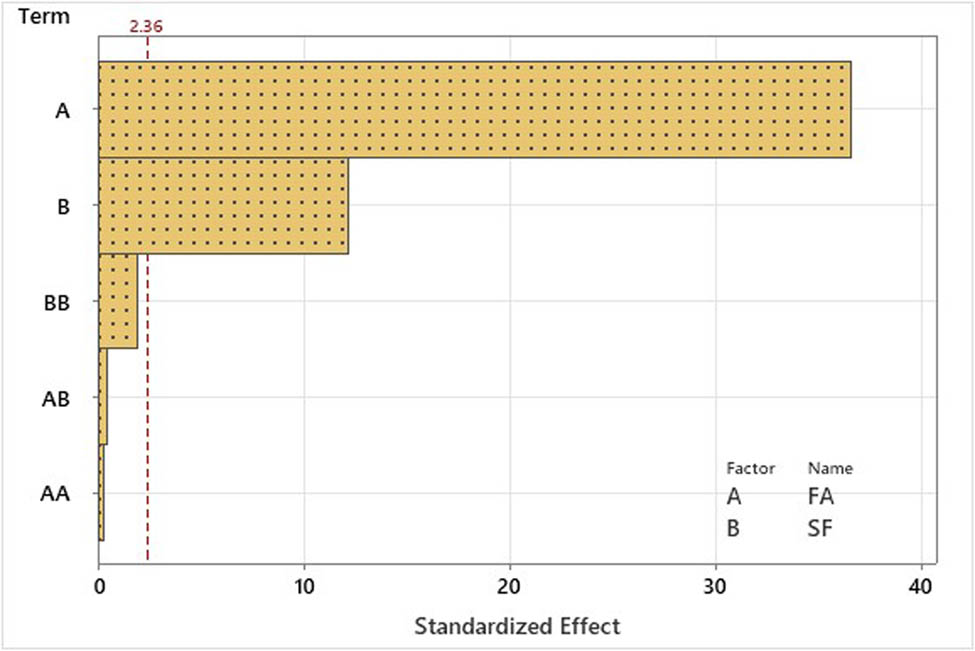
Prioritization impact of FA and SF on the porousness of the VC (Pareto chart).
4.3 Compressive strength
Figure 13 depicts the effect of FA, SF, and their combination on the compressive strength of VC after 7 and 28 days. Figure 13 depicts the complex interactions among SF, FA, and the strength of concrete. Figure 13 shows that the presence of FA in the VC lowered the compressive strength of the VC as the dosage rate increased; moreover, the drop in the compressive strength was quite considerable, particularly in the early stages (7 days). The strength of VC-20% FA was 14% lower than that of VC-0 at 7 days. Due to the FA’s lower activity (pozzolonic reaction), He et al. [29], Ibrahim [30], and others found that the substitution of FA in concrete reduces the concrete’s compressive strength at a young age. Moreover, as VC cement is replaced by FA, the cement availability in the VC decreases, resulting in less formation of the C–S–H gel. As a result, the VC’s early strength was reduced. He et al. [31] consider nevertheless, the strength of VC-20FA was roughly equivalent to that of VC-0 at 28 days, and the strength was only 7.89% lower than that of VC-0. This is due to the fact that the pozzolonic reaction of FA at later ages produced a greater quantity of C–S–H and C–A–H gels. As a result, the VC-20FA’s strength was comparable to that of the VC-0. The results of the present investigation were in excellent agreement with those of Olsen & Dodor [27,28], Zhou et al. [32] and Wei et al. [33]. Further, we observed that since the bonding of FA particles with the cement matrix is very feeble, replacing FA in VC resulted in a loss of the compressive strength.

Effects of FA and SF on the compressive strength of VC.
Figures 13 and 14 show that the incorporation of SF in the VC significantly enhanced the strength of the VC at all ages when compared to blends with FA. The results of the current investigation also showed that, despite the fact that VC–SF combinations included less cement than VC-0 mixtures, they were stronger than VC-0 mixtures. At 7 and 28 days, the strength of VC-12SF was 9.56% and 11.01% better than that of VC-0, respectively. Teixeira et al. [34] emphasized on the favorable impact of using SF as a substitute for OPC. Zeng et al. [35] discovered that blending cement with SF improved the concrete strength and resistance to sulfate attack. The presence of SF increases the strength of the VC because to the stronger pozzolanic reaction of the SF due to the increased amorphous SiO2 content of the SF. The dissolution of silica to liberate “Si” into the pore solution increased when the pH of the pore solution increased owing to the hydration process. The OH⁻ in the pore solution attacked the silica, causing the pozzolanic process to accelerate. The increased quantity of C–S–H gel formation resulted in enhanced strength, despite the fact that the cement component of VC–SF mixes was lower than that of VC-0. The key factors contributing to SF’s exceptional performance in strengthening the concrete are its high silica content, ultrafine particle size, quick pozzolanic reactivity, and capacity to support both short- and long-term strength growth. Although the blending of cement with FA lowered the strength of the VC, the cement mixed with FA and SF demonstrated that the strength was comparable to the VC-0. For example, the strength of a VC-20FA was 6.67% lower than that of VC-20FA-6SF. As previously stated, the larger amorphous SiO2 content of the SF expedited the pozzolanic process and enhanced the intensity of the VC. The current findings concurred with Thanongsak Nochaiya et al. [29], who observed that combining FA with SF may be more advantageous to the strength development of concrete than combining FA alone. These findings indicate that the VC cement may be combined with SF and FA, but still the SF dosage must be more than the FA dosage to get higher strength.

Prioritization impact of FA and SF on the compressive strength of the VC (Pareto chart).
4.4 Adaptability for vegetation: grass height, root length, and LRWC
At 45 days of age, Figure 15 depicts the development of ryegrass on the two various VC mixes. Figure 16 depicts the height of the roots and the stem at various ages and shows that the planting properties of VC blended with SCMs (FA and SF) are better than that of VC with OPC alone.

Germination and development of ryegrass on VC.

Effects of FA and SF on the growth of the plant’s roots and stems.
According to Figure 16, the ryegrass started to germinate after 3 days and the average height of the stem was 258 mm at the age of 35 days in the mixture with SCMs, whereas, in the case of VC with OPC, plants started to germinate after 4 days and at the age of 35 days, average height of the stem was 198 mm which is 30.31% lower than that in mixture with SCMs. For the plant growth, iron, alkali hydrolyzable nitrogen (AH-N), phosphorous (P) (extractable), and potassium (K) are the important nutrients. The availability of nutrients in the soil for plant growth was often decreased by the increased alkaline nature of the soil. Since the lower availability of nutrients, particularly micronutrients in the soil medium above and below the VC due to the greater alkaline nature of the VC without SCMs, had an impact on the plant growth. In the case of VC with SCMs, the blending of cement content of VC using SCMs influenced the alkalinity of the VC. Because of the enhanced Si/Ca ratio and amorphous silica’s unique adsorption properties, the C–S–H gel’s improved sorption capacity was able to reduce VC’s alkalinity. The decrease in the alkalinity of the VC, thus, increased the nutrients available in the soils slightly compared to the VC without SCMs; consequently, the planting properties was improved. The current findings are in agreement with Golewski [15], who found that a 2% reduction in the VC’s alkalinity using limestone powders significantly improved the VC’s planting qualities. In 2019, Diamond [36] found that the inclusion of SF and FA in VC having a fertilizer content of 5% increased the plant heights significantly. The outcome of Page and Vennesland [37] and Mihara et al. [38] also revealed that the decrease in the alkalinity of the VC with the inclusion of SCMs improved the vegetative capabilities of the VC.
Considering the root morphology of ryegrass in common soil, the root grows vertically in the downward direction. However, in the case of VC with and without SCMs, the root morphology of ryegrass was different and the root growth was staggering in the surface towards the pores of the VC. Though the root morphology of the rye grass was different in VC, the roots penetrated to the soil strata through pores and acquired required nutrients for growth. At the age of 45 days, the average height of the root of VC blended with SCMs was 95 mm; further, in a 95 mm root length, 67 mm of the root length penetrated into the concrete, which was 23% higher than that of VC with OPC. As mentioned above, the decrease in the alkalinity of the VC with SCMs maintained the nutrients available in the soil; consequently, the root development also improved. Though the root development pierced the VC pores and extended into the underlying soil medium, the root penetration did not harm the VC and, in fact, enhanced the underlying soil stability. Similar findings were reported in Golewski [39]. The LRWC of all VCs with and without SCMs were measured at 15 and 90 days and are summarized in Table 6.
LRWC results at various ages
| Mixture designation | LRWC (%) | |
|---|---|---|
| At 15 days | At 90 days | |
| VC-0 | 67.23 | 71.5 |
| VC-20FA-14.48SF | 70.15 | 84.56 |
The LRWC values for both combinations were nearly identical at the age of 15 days since the plants were obtaining nutrients from the soil layer above the VC, and the roots had only begun to penetrate the concrete [40,41]. However, the difference in the LRWC was observed at the age of 90 days. The LRWC of VC with SCMs was 18.26% higher than that of VC-0. As stated earlier, the decrease in the alkalinity of the VC with SCMs increased the nutrients (N–P–K) available in the soils slightly compared to the VC without SCMs; consequently, the LRWC improved [30,42,43,44,45].
4.5 Influence of VC on the soil fertility index
Though the inclusion of SCMs improved the planting properties, the influence of SCM-modified VC on the soil fertility indexes (nitrogen–phosphorous–potassium (N–P–K)) must be verified because the VC will be utilized for slope protection [46,47,48,49]. Further, Golewski [15] discovered that the utilization of VC in the soil slope protection modified the soil fertility indexes. Accordingly, alkali-hydrolyzable nitrogen (AH-N), phosphorous (P) (extractable), and potassium (K) were measured on the surface soil of VC after 180 days, and the results are presented in Figure 17.

Soil fertility index: nitrogen–phosphorous–potassium (N–P–K).
It can be seen from Figure 17 that the VC enhanced the soil fertility indexes; further, the introduction of SCMs in the VC improved the available phosphorous and alkali-hydrolyzable nitrogen of the soil. The available phosphorous and alkali-hydrolyzable nitrogen of the soil above the VC with SCMs increased by 32.81 and 52.92%, respectively, compared to nutrients available on the first day of planting. The current findings are in agreement with the findings of Brunno da Silva Cerozi and Kevin Fitzsimmons [30], and it was discovered that the available phosphorous and alkali-hydrolyzable nitrogen in the soil decreased with the increase in the pH of the soil. Golewski [15] found that the VC improved the available phosphorus in the soil by 70.2% within 1 year after construction [50,51,52,53,54]. Figure 15 implies that the VC decreased the soil potassium levels; the levels were further decreased with the inclusion of SCMs in the VC. In general, the potassium nutrients available in the soil increased with the increase in the alkaline levels of the soil [55,56,57,58]. Further, because the alkaline nature of the soil increased the cation exchange capacity (CEC), the potassium nutrients available in the soil will be increased. Since the alkalinity of the VC with SCMs was lower than that without SCMs, there was a decrease in the soil potassium levels; however, the difference was not high, and was 4.91% compared to that of VC without SCMs.
5 Conclusions
The present study investigates how SF and SF influenced the VC’s alkalinity, porosity, strength, and plant characteristics, including the grass height, root length, and LRWC. The cement content of the VC was substituted in various proportions with SF and FA. Furthermore, because VC is widely used to stabilize soil slopes, the influence of VC on the soil fertility was studied to ensure ecological protection.
Due to the lower relative density of the FA and SF, the volume of binder and powder slurry increased to combine the coarse aggregates of the VC, thus reducing the porosity of the VC. The cement content of VC mixed with 20% FA decreased the porosity by 16.68% compared to VC-0.
The lower reactivity of FA with the cement matrix reduced the VC strength; however, the swift pozzolanic reaction of SF increased the quantity of C–S–H gel formation, thereby increasing the VC strength, even though the cement component was smaller than that of VC with OPC.
The results show that SF and FA may be coupled with VC cement; however in order to get better strength, the SF dosage must be greater than the FA dosage.
The reduction in alkalinity caused by the addition of SF and FA improved the soil nutrients linked to the VC, which improved the planting.
The use of VC for soil stability boosted soil fertility indexes by enhancing the soil medium nutrients, such as hydrolyzable nitrogen (AH-N), phosphorous (P) (extractable), and potassium (K).
Acknowledgments
The authors extend their appreciation to the Researchers Supporting Project number (RSP2024R381), King Saud University, Riyadh, Saudi Arabia.
-
Funding information: This research was funded by the Researchers Supporting Project number (RSP2024R381), King Saud University, Riyadh, Saudi Arabia.
-
Author contributions: All authors have accepted responsibility for the entire content of this manuscript and approved its submission.
-
Conflict of interest: The authors state no conflict of interest.
-
Data availability statement: All data generated or analyzed during this study are included in this published article (and its supplementary information files).
References
[1] Tang W, Mohseni E, Wang Z. Development of vegetation concrete technology for slope protection and greening. Constr Build Mater. 2018;179:605–13.10.1016/j.conbuildmat.2018.05.207Search in Google Scholar
[2] Yan XB, Lu L, Gong C, Wang S. Preparation and properties of sulphoaluminate cementitious materials with low alkalinity. Appl Mech Mater. 2012;174–177:1164–7.10.4028/www.scientific.net/AMM.174-177.1164Search in Google Scholar
[3] Duan L, Huang M, Zhang L. Differences in hydrological responses for different vegetation types on a steep slope on the Loess Plateau, China. J Hydrol. 2016;537:356–66.10.1016/j.jhydrol.2016.03.057Search in Google Scholar
[4] Marschner P. Marschner’s mineral nutrition of higher plants. Waltham: Elsevier Ltd.; 2012.Search in Google Scholar
[5] Zhang W, Calvo-Polanco M, Chen ZC, Zwiazek JJ. Growth and physiological responses of trembling aspen (Populus tremuloides), white spruce (Picea glauca) and tamarack (Larix laricina) seedlings to root zone pH. Plant Soil. 2013;373:775–86.10.1007/s11104-013-1843-5Search in Google Scholar
[6] Codina M, Cau-dit-Coumes C, Bescop PL, Verdier J, Ollivier JP. Design and characterization of low-heat and low-alkalinity cements. Cem Concr Res. 2007;38:437–48.10.1016/j.cemconres.2007.12.002Search in Google Scholar
[7] Huang H, Yuan Y, Zhang W, Zhu L. Property assessment of high-performance concrete containing three types of fibers. Int J Concr Struct Mater. 2021;15(1):39. 10.1186/s40069-021-00476-7.Search in Google Scholar
[8] Sun L, Wang C, Zhang C, Yang Z, Li C, Qiao P. Experimental investigation on the bond performance of sea sand coral concrete with FRP bar reinforcement for marine environments. Adv Struct Eng. 2022;26(3):533–46. 10.1177/13694332221131153.Search in Google Scholar
[9] Larbi JA, Fraay ALA, Bijen JMJM. The chemistry of the pore fluid of silica fume-blended cement systems. Cem Concr Res. 1990;20:506–16.10.1016/0008-8846(90)90095-FSearch in Google Scholar
[10] Yuan J, Wang TJ, Chen J, Huang JA. Microscopic mechanism study of the creep properties of soil based on the energy scale method. Front Mater. 2023;10. 10.3389/fmats.2023.1137728.Search in Google Scholar
[11] Jaunia M, Kuoppamäki. K, Hagner M, Prass M, Suonioa T, Franssone A-M, et al. Alkaline habitat for vegetated roofs? Ecosystem dynamics in a vegetated roof with crushed concrete-based substrate. Ecol Eng. 2020;157:1059–70.10.1016/j.ecoleng.2020.105970Search in Google Scholar
[12] Byfors K. Influence Of silica fume and flyash on chloride diffusion and Ph values in cement paste. Cem Concr Res. 1987;17:115–30.10.1016/0008-8846(87)90066-4Search in Google Scholar
[13] García Calvo JL, Hidalgo A, Alonso C, Fernández Luco L. Development of low-pH cementitious materials for HLRW repositories Resistance against ground waters aggression. Cem Concr Res. 2010;40:1290–7.10.1016/j.cemconres.2009.11.008Search in Google Scholar
[14] Golewski GL. Mechanical properties and brittleness of concrete made by combined fly ash, silica fume and nanosilica with ordinary Portland cement. AIMS Mater Sci. 2023;10(3):390–404. 10.3934/matersci.2023021.Search in Google Scholar
[15] Golewski GL. Composites based on quaternary blended cements with a reduced width of initial microcracks. Appl Sci. 2023;13:7338. 10.3390/app13127338.Search in Google Scholar
[16] Jo Y-K. A study on the pH reduction of cement concrete with various mixing conditions. J Korea Inst Build Constr. 2008;8(4):79–85.10.5345/JKIC.2008.8.4.079Search in Google Scholar
[17] Aziminezhad M, Mahdikhani M, Memarpour MM. RSM-based modeling and optimization of self-consolidating mortar to predict acceptable ranges of rheological properties. Constr Build Mater. 2018;189:1200–13.10.1016/j.conbuildmat.2018.09.019Search in Google Scholar
[18] Gong C, Zhou X, Ji L, Dai W, Lu L, Cheng X. Effects of limestone powders on pore structure and physiological characteristics of planting concrete with sulfoaluminate cement. Constr Build Mater. 2018;162:314–20.10.1016/j.conbuildmat.2017.10.012Search in Google Scholar
[19] Golewski GL. Study of strength and microstructure of a new sustainable concrete incorporating pozzolanic materials. Struct Eng Mech. 2023;86(4):431–41. 10.12989/sem.2023.86.4.431.Search in Google Scholar
[20] Golewski GL. The effect of the addition of coal fly ash (CFA) on the control of water movement within the structure of the concrete. Materials. 2023;16:5218. 10.3390/ma16155218.Search in Google Scholar PubMed PubMed Central
[21] Li L, Nam J, Hartt WH. Ex situ leaching measurement of concrete alkalinity. Cem Concr Res. 2005;35(2):277–83.10.1016/j.cemconres.2004.04.024Search in Google Scholar
[22] Standard test method for density and void content of hardened pervious concrete; ASTM C1754. West Conshohocken, PA, USA: ASTM International; 2012.Search in Google Scholar
[23] Yu D, Yu Y, Tang J, Li X, Ke C, Yao Z. Application fields of kitchen waste biochar and its prospects as catalytic material, A review. Sci Total Env. 2022;810:152171.10.1016/j.scitotenv.2021.152171Search in Google Scholar PubMed
[24] Wong NH, Chen Y, Ong CL, Sia A. Investigation of thermal benefits of rooftop garden in the tropical environment. Build Env. 2003;38:261–70.10.1016/S0360-1323(02)00066-5Search in Google Scholar
[25] Khan S, Anwar S, Kuai J, Ullah S, Fahad S, Zhou G. Optimization of nitrogen rate and planting density for improving yield, nitrogen use efficiency, and lodging resistance in oilseed rape. Front Plant Sci. 2017;8:532.10.3389/fpls.2017.00532Search in Google Scholar PubMed PubMed Central
[26] Jia Q, Xu Y, Ali S, Sun L, Ding R, Ren X, et al. Strategies of supplemental irrigation and modified planting densities to improve the root growth and lodging resistance of maize (Zea mays L.) under the ridge-furrow rainfall harvesting system. Field Crop Res. 2018;224:48–59.10.1016/j.fcr.2018.04.011Search in Google Scholar
[27] Olsen SR, Sommers LE. Phosphorus. In: Page AL, et al., editors. Methods of soil analysis: Part 2. Chemical and microbiological properties. Agron. Mongr. 9. 2nd edn. Madison, WI: ASA and SSSA; 1982. p. 403–30.10.2134/agronmonogr9.2.2ed.c24Search in Google Scholar
[28] Dodor DE, Tabatabai MA. A simple alkaline hydrolysis method for estimating nitrogen mineralization potentially of soils. West Afr J Appl Ecol. 2019;27:16–31.Search in Google Scholar
[29] He M, Ren T, Jin ZD, Deng L, Liu H, Cheng YY, et al. Precise analysis of potassium isotopic composition in plant materials by multi-collector inductively coupled plasma mass spectrometry. Spectrochim Acta Part B: At Spectrosc. 2023;209:106781. 10.1016/j.sab.2023.106781.Search in Google Scholar
[30] Ibrahim KIM. Recycled waste glass powder as a partial replacement of cement in concrete containing silica fume and fly ash. Case Stud Constr Mater. 2021;15:e00630.10.1016/j.cscm.2021.e00630Search in Google Scholar
[31] He H, Shuang E, Wen T, Yao J, Wang X, He C, et al. Employing novel N-doped graphene quantum dots to improve chloride binding of cement. Constr Build Mater. 2023;401:132944. 10.1016/j.conbuildmat.2023.132944.Search in Google Scholar
[32] Zhou S, Lu C, Zhu X, Li F. Preparation and characterization of high-strength geopolymer based on BH-1 lunar soil simulant with low alkali content. Engineering. 2021;7(11):1631–45. 10.1016/j.eng.2020.10.016.Search in Google Scholar
[33] Wei X, Bai X, Wen X, Liu L, Xiong J, Yang C. A large and overlooked Cd source in karst areas: The migration and origin of Cd during soil formation and erosion. Sci Total Environ. 2023;895:165126. 10.1016/j.scitotenv.2023.165126.Search in Google Scholar PubMed
[34] Teixeira ER, Camões A, Branco FG, Aguiar JB, Fangueiro R. Recycling of biomass and coal fly ash as cement replacement material and its effect on hydration and carbonation of concrete. Waste Manag. 2019;94:39e48.10.1016/j.wasman.2019.05.044Search in Google Scholar PubMed
[35] Zeng H, Li Y, Zhang J, Chong P, Zhang K. Effect of limestone powder and fly ash on the pH evolution coefficient of concrete in a sulphate freeze thaw environment. J Mater Res Technol. 2022;16:1889–903.10.1016/j.jmrt.2021.12.033Search in Google Scholar
[36] Diamond. Effects of two Danish fly-ashes on alkali contents of pore solutions of cement fly-ash pastes. Cem Concr Res. 1981;1:383–94.10.1016/0008-8846(81)90110-1Search in Google Scholar
[37] Page CL, Vennesland O. Pore solution composition and chloride binding capacity of silica fume cement pastes. Mater Struct. 1983;91:19–25.10.1007/BF02474863Search in Google Scholar
[38] Mihara M, Iriya K, Neyama A, Ito M. Experimental and modelling studies on the interaction between cement paste with silica fume and distilled water. Radioactive Waste Res - At Energy Soc Jpn. 1997;2:71–9.10.3327/jnuce.3.71Search in Google Scholar
[39] Golewski GL. Assessing of water absorption on concrete composites containing fly ash up to 30 % in regards to structures completely immersed in water. Case Stud Constr Mater. 2023;19:e02337. 10.1016/j.cscm.2023.e02337.Search in Google Scholar
[40] Golewski GL. Examination of water absorption of low volume fly ash concrete (LVFAC) under water immersion conditions. Mater Res Express. 2023;10(8):085505. 10.1088/2053-1591/acedef.Search in Google Scholar
[41] Nochaiya T, Suriwong T, Julphunthong P. Acidic corrosion-abrasion resistance of concrete containing fly ash and silica fume for use as concrete floors in pig farm. Case Stud Constr Mater. 2022;16:1001–e01010.10.1016/j.cscm.2022.e01010Search in Google Scholar
[42] Yao X, Lyu X, Sun J, Wang B, Wang Y, Yang M, et al. AI-based performance prediction for 3D-printed concrete considering anisotropy and steam curing condition. Constr Build Mater. 2023;375:130898. 10.1016/j.conbuildmat.2023.130898.Search in Google Scholar
[43] Ren Z, Zeng H, Zeng X, Chen X, Wang X. Effect of nanographite conductive concrete mixed with magnetite sand excited by different alkali activators and their combinations on the properties of conductive concrete. Buildings. 2023;13(7):1630. 10.3390/buildings13071630.Search in Google Scholar
[44] Chen L, Chen Z, Xie Z, Wei L, Hua J, Huang L, et al. Recent developments on natural fiber concrete: A review of properties, sustainability, applications, barriers, and opportunities. Dev Built Environ. 2023;16:100255. 10.1016/j.dibe.2023.100255.Search in Google Scholar
[45] Yu Z, Xu X, Guo L, Jin R, Lu Y. Uptake and transport of micro/nanoplastics in terrestrial plants: Detection, mechanisms, and influencing factors. Sci Total Environ. 2024;907:168155. 10.1016/j.scitotenv.2023.168155.Search in Google Scholar PubMed
[46] Seifan M, Mendoza S, Berenjian A. Mechanical properties and durability performance of fly ash-based mortar containing nano-and micro-silica additives. Constr Build Mater. 2020;252:119–121.10.1016/j.conbuildmat.2020.119121Search in Google Scholar
[47] Yu J, Li G, Leung CKY. Hydration and physical characteristics of ultrahigh-volume fly ash-cement systems with low water/binder ratio. Constr Build Mater. 2018;161:509–18.10.1016/j.conbuildmat.2017.11.104Search in Google Scholar
[48] Al-Amoudi OSB, Maslehuddin M, Shameem M, Ibrahhim M. Shrinkage of plain and silica fume cement concrete under hot weather. Cem Concr Compos. 2007;29:690–9.10.1016/j.cemconcomp.2007.05.006Search in Google Scholar
[49] Feng W, Tang Y, Zhang Y, Qi C, Ma L, Li L. Partially fly ash and nano-silica incorporated recycled coarse aggregate based concrete: Constitutive model and enhancement mechanism. J Mater Res Technol. 2022;17:192–210.10.1016/j.jmrt.2021.12.135Search in Google Scholar
[50] Wang F, Sun C, Ding X, Kang T, Nie X. Experimental study on the vegetation growing recycled concrete and synergistic effect with plant roots. Materials. 2019;12:1855. 10.3390/ma12111855.Search in Google Scholar PubMed PubMed Central
[51] Martirena F, Monzó J. Vegetable ashes as supplementary cementitious materials. Cem Concr Res. 2018;114:57–64.10.1016/j.cemconres.2017.08.015Search in Google Scholar
[52] da Silva Cerozi B, Fitzsimmons K. The effect of pH on phosphorus availability and speciation in an aquaponics nutrient solution. Bioresour Technol. 2016;219:778–81.10.1016/j.biortech.2016.08.079Search in Google Scholar PubMed
[53] Wang Z, Wang Q, Jia C, Bai J. Thermal evolution of chemical structure and mechanism of oil sands bitumen. Energy (Oxf). 2022;244:1. 10.1016/j.energy.2022.123190.Search in Google Scholar
[54] Han Y, Shao S, Fang B, Shi T, Zhang B, Wang X, et al. Chloride ion penetration resistance of matrix and interfacial transition zone of multi-walled carbon nanotube-reinforced concrete. J Build Eng. 2023;72:106587. 10.1016/j.jobe.2023.106587.Search in Google Scholar
[55] He M, Dong J, Jin Z, Liu C, Xiao J, Zhang F, et al. Pedogenic processes in loess-paleosol sediments: Clues from Li isotopes of leachate in Luochuan loess. Geochim Cosmochim Acta. 2021;299:151–62. 10.1016/j.gca.2021.02.021.Search in Google Scholar
[56] Jin M, Ma Y, Li W, Huang J, Yan Y, Zeng H, et al. Multi-scale investigation on composition-structure of C-(A)-S-H with different Al/Si ratios under attack of decalcification action. Cem Concr Res. 2023;172:107251. 10.1016/j.cemconres.2023.107251.Search in Google Scholar
[57] Xue Y, Bai X, Zhao C, Tan Q, Li Y, Luo G, et al. Spring photosynthetic phenology of Chinese vegetation in response to climate change and its impact on net primary productivity. Agric For Meteorol. 2023;342:109734. 10.1016/j.agrformet.2023.109734.Search in Google Scholar
[58] Zhou T, Yu F, Li L, Dong Z, Fini EH. Swelling-degradation dynamic evolution behaviors of bio-modified rubberized asphalt under thermal conditions. J Clean Prod. 2023;426:139061. 10.1016/j.jclepro.2023.139061.Search in Google Scholar
© 2024 the author(s), published by De Gruyter
This work is licensed under the Creative Commons Attribution 4.0 International License.
Articles in the same Issue
- Research Articles
- Tension buckling and postbuckling of nanocomposite laminated plates with in-plane negative Poisson’s ratio
- Polyvinylpyrrolidone-stabilised gold nanoparticle coatings inhibit blood protein adsorption
- Energy and mass transmission through hybrid nanofluid flow passing over a spinning sphere with magnetic effect and heat source/sink
- Surface treatment with nano-silica and magnesium potassium phosphate cement co-action for enhancing recycled aggregate concrete
- Numerical investigation of thermal radiation with entropy generation effects in hybrid nanofluid flow over a shrinking/stretching sheet
- Enhancing the performance of thermal energy storage by adding nano-particles with paraffin phase change materials
- Using nano-CaCO3 and ceramic tile waste to design low-carbon ultra high performance concrete
- Numerical analysis of thermophoretic particle deposition in a magneto-Marangoni convective dusty tangent hyperbolic nanofluid flow – Thermal and magnetic features
- Dual numerical solutions of Casson SA–hybrid nanofluid toward a stagnation point flow over stretching/shrinking cylinder
- Single flake homo p–n diode of MoTe2 enabled by oxygen plasma doping
- Electrostatic self-assembly effect of Fe3O4 nanoparticles on performance of carbon nanotubes in cement-based materials
- Multi-scale alignment to buried atom-scale devices using Kelvin probe force microscopy
- Antibacterial, mechanical, and dielectric properties of hydroxyapatite cordierite/zirconia porous nanocomposites for use in bone tissue engineering applications
- Time-dependent Darcy–Forchheimer flow of Casson hybrid nanofluid comprising the CNTs through a Riga plate with nonlinear thermal radiation and viscous dissipation
- Durability prediction of geopolymer mortar reinforced with nanoparticles and PVA fiber using particle swarm optimized BP neural network
- Utilization of zein nano-based system for promoting antibiofilm and anti-virulence activities of curcumin against Pseudomonas aeruginosa
- Antibacterial effect of novel dental resin composites containing rod-like zinc oxide
- An extended model to assess Jeffery–Hamel blood flow through arteries with iron-oxide (Fe2O3) nanoparticles and melting effects: Entropy optimization analysis
- Comparative study of copper nanoparticles over radially stretching sheet with water and silicone oil
- Cementitious composites modified by nanocarbon fillers with cooperation effect possessing excellent self-sensing properties
- Confinement size effect on dielectric properties, antimicrobial activity, and recycling of TiO2 quantum dots via photodegradation processes of Congo red dye and real industrial textile wastewater
- Biogenic silver nanoparticles of Moringa oleifera leaf extract: Characterization and photocatalytic application
- Novel integrated structure and function of Mg–Gd neutron shielding materials
- Impact of multiple slips on thermally radiative peristaltic transport of Sisko nanofluid with double diffusion convection, viscous dissipation, and induced magnetic field
- Magnetized water-based hybrid nanofluid flow over an exponentially stretching sheet with thermal convective and mass flux conditions: HAM solution
- A numerical investigation of the two-dimensional magnetohydrodynamic water-based hybrid nanofluid flow composed of Fe3O4 and Au nanoparticles over a heated surface
- Development and modeling of an ultra-robust TPU-MWCNT foam with high flexibility and compressibility
- Effects of nanofillers on the physical, mechanical, and tribological behavior of carbon/kenaf fiber–reinforced phenolic composites
- Polymer nanocomposite for protecting photovoltaic cells from solar ultraviolet in space
- Study on the mechanical properties and microstructure of recycled concrete reinforced with basalt fibers and nano-silica in early low-temperature environments
- Synergistic effect of carbon nanotubes and polyvinyl alcohol on the mechanical performance and microstructure of cement mortar
- CFD analysis of paraffin-based hybrid (Co–Au) and trihybrid (Co–Au–ZrO2) nanofluid flow through a porous medium
- Forced convective tangent hyperbolic nanofluid flow subject to heat source/sink and Lorentz force over a permeable wedge: Numerical exploration
- Physiochemical and electrical activities of nano copper oxides synthesised via hydrothermal method utilising natural reduction agents for solar cell application
- A homotopic analysis of the blood-based bioconvection Carreau–Yasuda hybrid nanofluid flow over a stretching sheet with convective conditions
- In situ synthesis of reduced graphene oxide/SnIn4S8 nanocomposites with enhanced photocatalytic performance for pollutant degradation
- A coarse-grained Poisson–Nernst–Planck model for polyelectrolyte-modified nanofluidic diodes
- A numerical investigation of the magnetized water-based hybrid nanofluid flow over an extending sheet with a convective condition: Active and passive controls of nanoparticles
- The LyP-1 cyclic peptide modified mesoporous polydopamine nanospheres for targeted delivery of triptolide regulate the macrophage repolarization in atherosclerosis
- Synergistic effect of hydroxyapatite-magnetite nanocomposites in magnetic hyperthermia for bone cancer treatment
- The significance of quadratic thermal radiative scrutinization of a nanofluid flow across a microchannel with thermophoretic particle deposition effects
- Ferromagnetic effect on Casson nanofluid flow and transport phenomena across a bi-directional Riga sensor device: Darcy–Forchheimer model
- Performance of carbon nanomaterials incorporated with concrete exposed to high temperature
- Multicriteria-based optimization of roller compacted concrete pavement containing crumb rubber and nano-silica
- Revisiting hydrotalcite synthesis: Efficient combined mechanochemical/coprecipitation synthesis to design advanced tunable basic catalysts
- Exploration of irreversibility process and thermal energy of a tetra hybrid radiative binary nanofluid focusing on solar implementations
- Effect of graphene oxide on the properties of ternary limestone clay cement paste
- Improved mechanical properties of graphene-modified basalt fibre–epoxy composites
- Sodium titanate nanostructured modified by green synthesis of iron oxide for highly efficient photodegradation of dye contaminants
- Green synthesis of Vitis vinifera extract-appended magnesium oxide NPs for biomedical applications
- Differential study on the thermal–physical properties of metal and its oxide nanoparticle-formed nanofluids: Molecular dynamics simulation investigation of argon-based nanofluids
- Heat convection and irreversibility of magneto-micropolar hybrid nanofluids within a porous hexagonal-shaped enclosure having heated obstacle
- Numerical simulation and optimization of biological nanocomposite system for enhanced oil recovery
- Laser ablation and chemical vapor deposition to prepare a nanostructured PPy layer on the Ti surface
- Cilostazol niosomes-loaded transdermal gels: An in vitro and in vivo anti-aggregant and skin permeation activity investigations towards preparing an efficient nanoscale formulation
- Linear and nonlinear optical studies on successfully mixed vanadium oxide and zinc oxide nanoparticles synthesized by sol–gel technique
- Analytical investigation of convective phenomena with nonlinearity characteristics in nanostratified liquid film above an inclined extended sheet
- Optimization method for low-velocity impact identification in nanocomposite using genetic algorithm
- Analyzing the 3D-MHD flow of a sodium alginate-based nanofluid flow containing alumina nanoparticles over a bi-directional extending sheet using variable porous medium and slip conditions
- A comprehensive study of laser irradiated hydrothermally synthesized 2D layered heterostructure V2O5(1−x)MoS2(x) (X = 1–5%) nanocomposites for photocatalytic application
- Computational analysis of water-based silver, copper, and alumina hybrid nanoparticles over a stretchable sheet embedded in a porous medium with thermophoretic particle deposition effects
- A deep dive into AI integration and advanced nanobiosensor technologies for enhanced bacterial infection monitoring
- Effects of normal strain on pyramidal I and II 〈c + a〉 screw dislocation mobility and structure in single-crystal magnesium
- Computational study of cross-flow in entropy-optimized nanofluids
- Significance of nanoparticle aggregation for thermal transport over magnetized sensor surface
- A green and facile synthesis route of nanosize cupric oxide at room temperature
- Effect of annealing time on bending performance and microstructure of C19400 alloy strip
- Chitosan-based Mupirocin and Alkanna tinctoria extract nanoparticles for the management of burn wound: In vitro and in vivo characterization
- Electrospinning of MNZ/PLGA/SF nanofibers for periodontitis
- Photocatalytic degradation of methylene blue by Nd-doped titanium dioxide thin films
- Shell-core-structured electrospinning film with sequential anti-inflammatory and pro-neurogenic effects for peripheral nerve repairment
- Flow and heat transfer insights into a chemically reactive micropolar Williamson ternary hybrid nanofluid with cross-diffusion theory
- One-pot fabrication of open-spherical shapes based on the decoration of copper sulfide/poly-O-amino benzenethiol on copper oxide as a promising photocathode for hydrogen generation from the natural source of Red Sea water
- A penta-hybrid approach for modeling the nanofluid flow in a spatially dependent magnetic field
- Advancing sustainable agriculture: Metal-doped urea–hydroxyapatite hybrid nanofertilizer for agro-industry
- Utilizing Ziziphus spina-christi for eco-friendly synthesis of silver nanoparticles: Antimicrobial activity and promising application in wound healing
- Plant-mediated synthesis, characterization, and evaluation of a copper oxide/silicon dioxide nanocomposite by an antimicrobial study
- Effects of PVA fibers and nano-SiO2 on rheological properties of geopolymer mortar
- Investigating silver and alumina nanoparticles’ impact on fluid behavior over porous stretching surface
- Potential pharmaceutical applications and molecular docking study for green fabricated ZnO nanoparticles mediated Raphanus sativus: In vitro and in vivo study
- Effect of temperature and nanoparticle size on the interfacial layer thickness of TiO2–water nanofluids using molecular dynamics
- Characteristics of induced magnetic field on the time-dependent MHD nanofluid flow through parallel plates
- Flexural and vibration behaviours of novel covered CFRP composite joints with an MWCNT-modified adhesive
- Experimental research on mechanically and thermally activation of nano-kaolin to improve the properties of ultra-high-performance fiber-reinforced concrete
- Analysis of variable fluid properties for three-dimensional flow of ternary hybrid nanofluid on a stretching sheet with MHD effects
- Biodegradability of corn starch films containing nanocellulose fiber and thymol
- Toxicity assessment of copper oxide nanoparticles: In vivo study
- Some measures to enhance the energy output performances of triboelectric nanogenerators
- Reinforcement of graphene nanoplatelets on water uptake and thermomechanical behaviour of epoxy adhesive subjected to water ageing conditions
- Optimization of preparation parameters and testing verification of carbon nanotube suspensions used in concrete
- Max-phase Ti3SiC2 and diverse nanoparticle reinforcements for enhancement of the mechanical, dynamic, and microstructural properties of AA5083 aluminum alloy via FSP
- Advancing drug delivery: Neural network perspectives on nanoparticle-mediated treatments for cancerous tissues
- PEG-PLGA core–shell nanoparticles for the controlled delivery of picoplatin–hydroxypropyl β-cyclodextrin inclusion complex in triple-negative breast cancer: In vitro and in vivo study
- Conduction transportation from graphene to an insulative polymer medium: A novel approach for the conductivity of nanocomposites
- Review Articles
- Developments of terahertz metasurface biosensors: A literature review
- Overview of amorphous carbon memristor device, modeling, and applications for neuromorphic computing
- Advances in the synthesis of gold nanoclusters (AuNCs) of proteins extracted from nature
- A review of ternary polymer nanocomposites containing clay and calcium carbonate and their biomedical applications
- Recent advancements in polyoxometalate-functionalized fiber materials: A review
- Special contribution of atomic force microscopy in cell death research
- A comprehensive review of oral chitosan drug delivery systems: Applications for oral insulin delivery
- Cellular senescence and nanoparticle-based therapies: Current developments and perspectives
- Cyclodextrins-block copolymer drug delivery systems: From design and development to preclinical studies
- Micelle-based nanoparticles with stimuli-responsive properties for drug delivery
- Critical assessment of the thermal stability and degradation of chemically functionalized nanocellulose-based polymer nanocomposites
- Research progress in preparation technology of micro and nano titanium alloy powder
- Nanoformulations for lysozyme-based additives in animal feed: An alternative to fight antibiotic resistance spread
- Incorporation of organic photochromic molecules in mesoporous silica materials: Synthesis and applications
- A review on modeling of graphene and associated nanostructures reinforced concrete
- A review on strengthening mechanisms of carbon quantum dots-reinforced Cu-matrix nanocomposites
- Review on nanocellulose composites and CNFs assembled microfiber toward automotive applications
- Nanomaterial coating for layered lithium rich transition metal oxide cathode for lithium-ion battery
- Application of AgNPs in biomedicine: An overview and current trends
- Nanobiotechnology and microbial influence on cold adaptation in plants
- Hepatotoxicity of nanomaterials: From mechanism to therapeutic strategy
- Applications of micro-nanobubble and its influence on concrete properties: An in-depth review
- A comprehensive systematic literature review of ML in nanotechnology for sustainable development
- Exploiting the nanotechnological approaches for traditional Chinese medicine in childhood rhinitis: A review of future perspectives
- Twisto-photonics in two-dimensional materials: A comprehensive review
- Current advances of anticancer drugs based on solubilization technology
- Recent process of using nanoparticles in the T cell-based immunometabolic therapy
- Future prospects of gold nanoclusters in hydrogen storage systems and sustainable environmental treatment applications
- Preparation, types, and applications of one- and two-dimensional nanochannels and their transport properties for water and ions
- Microstructural, mechanical, and corrosion characteristics of Mg–Gd–x systems: A review of recent advancements
- Functionalized nanostructures and targeted delivery systems with a focus on plant-derived natural agents for COVID-19 therapy: A review and outlook
- Mapping evolution and trends of cell membrane-coated nanoparticles: A bibliometric analysis and scoping review
- Nanoparticles and their application in the diagnosis of hepatocellular carcinoma
- In situ growth of carbon nanotubes on fly ash substrates
- Structural performance of boards through nanoparticle reinforcement: An advance review
- Reinforcing mechanisms review of the graphene oxide on cement composites
- Seed regeneration aided by nanomaterials in a climate change scenario: A comprehensive review
- Surface-engineered quantum dot nanocomposites for neurodegenerative disorder remediation and avenue for neuroimaging
- Graphitic carbon nitride hybrid thin films for energy conversion: A mini-review on defect activation with different materials
- Nanoparticles and the treatment of hepatocellular carcinoma
- Special Issue on Advanced Nanomaterials and Composites for Energy Conversion and Storage - Part II
- Highly safe lithium vanadium oxide anode for fast-charging dendrite-free lithium-ion batteries
- Recent progress in nanomaterials of battery energy storage: A patent landscape analysis, technology updates, and future prospects
- Special Issue on Advanced Nanomaterials for Carbon Capture, Environment and Utilization for Energy Sustainability - Part II
- Calcium-, magnesium-, and yttrium-doped lithium nickel phosphate nanomaterials as high-performance catalysts for electrochemical water oxidation reaction
- Low alkaline vegetation concrete with silica fume and nano-fly ash composites to improve the planting properties and soil ecology
- Mesoporous silica-grafted deep eutectic solvent-based mixed matrix membranes for wastewater treatment: Synthesis and emerging pollutant removal performance
- Electrochemically prepared ultrathin two-dimensional graphitic nanosheets as cathodes for advanced Zn-based energy storage devices
- Enhanced catalytic degradation of amoxicillin by phyto-mediated synthesised ZnO NPs and ZnO-rGO hybrid nanocomposite: Assessment of antioxidant activity, adsorption, and thermodynamic analysis
- Incorporating GO in PI matrix to advance nanocomposite coating: An enhancing strategy to prevent corrosion
- Synthesis, characterization, thermal stability, and application of microporous hyper cross-linked polyphosphazenes with naphthylamine group for CO2 uptake
- Engineering in ceramic albite morphology by the addition of additives: Carbon nanotubes and graphene oxide for energy applications
- Nanoscale synergy: Optimizing energy storage with SnO2 quantum dots on ZnO hexagonal prisms for advanced supercapacitors
- Aging assessment of silicone rubber materials under corona discharge accompanied by humidity and UV radiation
- Tuning structural and electrical properties of Co-precipitated and Cu-incorporated nickel ferrite for energy applications
- Sodium alginate-supported AgSr nanoparticles for catalytic degradation of malachite green and methyl orange in aqueous medium
- An environmentally greener and reusability approach for bioenergy production using Mallotus philippensis (Kamala) seed oil feedstock via phytonanotechnology
- Micro-/nano-alumina trihydrate and -magnesium hydroxide fillers in RTV-SR composites under electrical and environmental stresses
- Mechanism exploration of ion-implanted epoxy on surface trap distribution: An approach to augment the vacuum flashover voltages
- Nanoscale engineering of semiconductor photocatalysts boosting charge separation for solar-driven H2 production: Recent advances and future perspective
- Excellent catalytic performance over reduced graphene-boosted novel nanoparticles for oxidative desulfurization of fuel oil
- Special Issue on Advances in Nanotechnology for Agriculture
- Deciphering the synergistic potential of mycogenic zinc oxide nanoparticles and bio-slurry formulation on phenology and physiology of Vigna radiata
- Nanomaterials: Cross-disciplinary applications in ornamental plants
- Special Issue on Catechol Based Nano and Microstructures
- Polydopamine films: Versatile but interface-dependent coatings
- In vitro anticancer activity of melanin-like nanoparticles for multimodal therapy of glioblastoma
- Poly-3,4-dihydroxybenzylidenhydrazine, a different analogue of polydopamine
- Chirality and self-assembly of structures derived from optically active 1,2-diaminocyclohexane and catecholamines
- Advancing resource sustainability with green photothermal materials: Insights from organic waste-derived and bioderived sources
- Bioinspired neuromelanin-like Pt(iv) polymeric nanoparticles for cancer treatment
- Special Issue on Implementing Nanotechnology for Smart Healthcare System
- Intelligent explainable optical sensing on Internet of nanorobots for disease detection
- Special Issue on Green Mono, Bi and Tri Metallic Nanoparticles for Biological and Environmental Applications
- Tracking success of interaction of green-synthesized Carbopol nanoemulgel (neomycin-decorated Ag/ZnO nanocomposite) with wound-based MDR bacteria
- Green synthesis of copper oxide nanoparticles using genus Inula and evaluation of biological therapeutics and environmental applications
- Biogenic fabrication and multifunctional therapeutic applications of silver nanoparticles synthesized from rose petal extract
- Metal oxides on the frontlines: Antimicrobial activity in plant-derived biometallic nanoparticles
- Controlling pore size during the synthesis of hydroxyapatite nanoparticles using CTAB by the sol–gel hydrothermal method and their biological activities
- Special Issue on State-of-Art Advanced Nanotechnology for Healthcare
- Applications of nanomedicine-integrated phototherapeutic agents in cancer theranostics: A comprehensive review of the current state of research
- Smart bionanomaterials for treatment and diagnosis of inflammatory bowel disease
- Beyond conventional therapy: Synthesis of multifunctional nanoparticles for rheumatoid arthritis therapy
Articles in the same Issue
- Research Articles
- Tension buckling and postbuckling of nanocomposite laminated plates with in-plane negative Poisson’s ratio
- Polyvinylpyrrolidone-stabilised gold nanoparticle coatings inhibit blood protein adsorption
- Energy and mass transmission through hybrid nanofluid flow passing over a spinning sphere with magnetic effect and heat source/sink
- Surface treatment with nano-silica and magnesium potassium phosphate cement co-action for enhancing recycled aggregate concrete
- Numerical investigation of thermal radiation with entropy generation effects in hybrid nanofluid flow over a shrinking/stretching sheet
- Enhancing the performance of thermal energy storage by adding nano-particles with paraffin phase change materials
- Using nano-CaCO3 and ceramic tile waste to design low-carbon ultra high performance concrete
- Numerical analysis of thermophoretic particle deposition in a magneto-Marangoni convective dusty tangent hyperbolic nanofluid flow – Thermal and magnetic features
- Dual numerical solutions of Casson SA–hybrid nanofluid toward a stagnation point flow over stretching/shrinking cylinder
- Single flake homo p–n diode of MoTe2 enabled by oxygen plasma doping
- Electrostatic self-assembly effect of Fe3O4 nanoparticles on performance of carbon nanotubes in cement-based materials
- Multi-scale alignment to buried atom-scale devices using Kelvin probe force microscopy
- Antibacterial, mechanical, and dielectric properties of hydroxyapatite cordierite/zirconia porous nanocomposites for use in bone tissue engineering applications
- Time-dependent Darcy–Forchheimer flow of Casson hybrid nanofluid comprising the CNTs through a Riga plate with nonlinear thermal radiation and viscous dissipation
- Durability prediction of geopolymer mortar reinforced with nanoparticles and PVA fiber using particle swarm optimized BP neural network
- Utilization of zein nano-based system for promoting antibiofilm and anti-virulence activities of curcumin against Pseudomonas aeruginosa
- Antibacterial effect of novel dental resin composites containing rod-like zinc oxide
- An extended model to assess Jeffery–Hamel blood flow through arteries with iron-oxide (Fe2O3) nanoparticles and melting effects: Entropy optimization analysis
- Comparative study of copper nanoparticles over radially stretching sheet with water and silicone oil
- Cementitious composites modified by nanocarbon fillers with cooperation effect possessing excellent self-sensing properties
- Confinement size effect on dielectric properties, antimicrobial activity, and recycling of TiO2 quantum dots via photodegradation processes of Congo red dye and real industrial textile wastewater
- Biogenic silver nanoparticles of Moringa oleifera leaf extract: Characterization and photocatalytic application
- Novel integrated structure and function of Mg–Gd neutron shielding materials
- Impact of multiple slips on thermally radiative peristaltic transport of Sisko nanofluid with double diffusion convection, viscous dissipation, and induced magnetic field
- Magnetized water-based hybrid nanofluid flow over an exponentially stretching sheet with thermal convective and mass flux conditions: HAM solution
- A numerical investigation of the two-dimensional magnetohydrodynamic water-based hybrid nanofluid flow composed of Fe3O4 and Au nanoparticles over a heated surface
- Development and modeling of an ultra-robust TPU-MWCNT foam with high flexibility and compressibility
- Effects of nanofillers on the physical, mechanical, and tribological behavior of carbon/kenaf fiber–reinforced phenolic composites
- Polymer nanocomposite for protecting photovoltaic cells from solar ultraviolet in space
- Study on the mechanical properties and microstructure of recycled concrete reinforced with basalt fibers and nano-silica in early low-temperature environments
- Synergistic effect of carbon nanotubes and polyvinyl alcohol on the mechanical performance and microstructure of cement mortar
- CFD analysis of paraffin-based hybrid (Co–Au) and trihybrid (Co–Au–ZrO2) nanofluid flow through a porous medium
- Forced convective tangent hyperbolic nanofluid flow subject to heat source/sink and Lorentz force over a permeable wedge: Numerical exploration
- Physiochemical and electrical activities of nano copper oxides synthesised via hydrothermal method utilising natural reduction agents for solar cell application
- A homotopic analysis of the blood-based bioconvection Carreau–Yasuda hybrid nanofluid flow over a stretching sheet with convective conditions
- In situ synthesis of reduced graphene oxide/SnIn4S8 nanocomposites with enhanced photocatalytic performance for pollutant degradation
- A coarse-grained Poisson–Nernst–Planck model for polyelectrolyte-modified nanofluidic diodes
- A numerical investigation of the magnetized water-based hybrid nanofluid flow over an extending sheet with a convective condition: Active and passive controls of nanoparticles
- The LyP-1 cyclic peptide modified mesoporous polydopamine nanospheres for targeted delivery of triptolide regulate the macrophage repolarization in atherosclerosis
- Synergistic effect of hydroxyapatite-magnetite nanocomposites in magnetic hyperthermia for bone cancer treatment
- The significance of quadratic thermal radiative scrutinization of a nanofluid flow across a microchannel with thermophoretic particle deposition effects
- Ferromagnetic effect on Casson nanofluid flow and transport phenomena across a bi-directional Riga sensor device: Darcy–Forchheimer model
- Performance of carbon nanomaterials incorporated with concrete exposed to high temperature
- Multicriteria-based optimization of roller compacted concrete pavement containing crumb rubber and nano-silica
- Revisiting hydrotalcite synthesis: Efficient combined mechanochemical/coprecipitation synthesis to design advanced tunable basic catalysts
- Exploration of irreversibility process and thermal energy of a tetra hybrid radiative binary nanofluid focusing on solar implementations
- Effect of graphene oxide on the properties of ternary limestone clay cement paste
- Improved mechanical properties of graphene-modified basalt fibre–epoxy composites
- Sodium titanate nanostructured modified by green synthesis of iron oxide for highly efficient photodegradation of dye contaminants
- Green synthesis of Vitis vinifera extract-appended magnesium oxide NPs for biomedical applications
- Differential study on the thermal–physical properties of metal and its oxide nanoparticle-formed nanofluids: Molecular dynamics simulation investigation of argon-based nanofluids
- Heat convection and irreversibility of magneto-micropolar hybrid nanofluids within a porous hexagonal-shaped enclosure having heated obstacle
- Numerical simulation and optimization of biological nanocomposite system for enhanced oil recovery
- Laser ablation and chemical vapor deposition to prepare a nanostructured PPy layer on the Ti surface
- Cilostazol niosomes-loaded transdermal gels: An in vitro and in vivo anti-aggregant and skin permeation activity investigations towards preparing an efficient nanoscale formulation
- Linear and nonlinear optical studies on successfully mixed vanadium oxide and zinc oxide nanoparticles synthesized by sol–gel technique
- Analytical investigation of convective phenomena with nonlinearity characteristics in nanostratified liquid film above an inclined extended sheet
- Optimization method for low-velocity impact identification in nanocomposite using genetic algorithm
- Analyzing the 3D-MHD flow of a sodium alginate-based nanofluid flow containing alumina nanoparticles over a bi-directional extending sheet using variable porous medium and slip conditions
- A comprehensive study of laser irradiated hydrothermally synthesized 2D layered heterostructure V2O5(1−x)MoS2(x) (X = 1–5%) nanocomposites for photocatalytic application
- Computational analysis of water-based silver, copper, and alumina hybrid nanoparticles over a stretchable sheet embedded in a porous medium with thermophoretic particle deposition effects
- A deep dive into AI integration and advanced nanobiosensor technologies for enhanced bacterial infection monitoring
- Effects of normal strain on pyramidal I and II 〈c + a〉 screw dislocation mobility and structure in single-crystal magnesium
- Computational study of cross-flow in entropy-optimized nanofluids
- Significance of nanoparticle aggregation for thermal transport over magnetized sensor surface
- A green and facile synthesis route of nanosize cupric oxide at room temperature
- Effect of annealing time on bending performance and microstructure of C19400 alloy strip
- Chitosan-based Mupirocin and Alkanna tinctoria extract nanoparticles for the management of burn wound: In vitro and in vivo characterization
- Electrospinning of MNZ/PLGA/SF nanofibers for periodontitis
- Photocatalytic degradation of methylene blue by Nd-doped titanium dioxide thin films
- Shell-core-structured electrospinning film with sequential anti-inflammatory and pro-neurogenic effects for peripheral nerve repairment
- Flow and heat transfer insights into a chemically reactive micropolar Williamson ternary hybrid nanofluid with cross-diffusion theory
- One-pot fabrication of open-spherical shapes based on the decoration of copper sulfide/poly-O-amino benzenethiol on copper oxide as a promising photocathode for hydrogen generation from the natural source of Red Sea water
- A penta-hybrid approach for modeling the nanofluid flow in a spatially dependent magnetic field
- Advancing sustainable agriculture: Metal-doped urea–hydroxyapatite hybrid nanofertilizer for agro-industry
- Utilizing Ziziphus spina-christi for eco-friendly synthesis of silver nanoparticles: Antimicrobial activity and promising application in wound healing
- Plant-mediated synthesis, characterization, and evaluation of a copper oxide/silicon dioxide nanocomposite by an antimicrobial study
- Effects of PVA fibers and nano-SiO2 on rheological properties of geopolymer mortar
- Investigating silver and alumina nanoparticles’ impact on fluid behavior over porous stretching surface
- Potential pharmaceutical applications and molecular docking study for green fabricated ZnO nanoparticles mediated Raphanus sativus: In vitro and in vivo study
- Effect of temperature and nanoparticle size on the interfacial layer thickness of TiO2–water nanofluids using molecular dynamics
- Characteristics of induced magnetic field on the time-dependent MHD nanofluid flow through parallel plates
- Flexural and vibration behaviours of novel covered CFRP composite joints with an MWCNT-modified adhesive
- Experimental research on mechanically and thermally activation of nano-kaolin to improve the properties of ultra-high-performance fiber-reinforced concrete
- Analysis of variable fluid properties for three-dimensional flow of ternary hybrid nanofluid on a stretching sheet with MHD effects
- Biodegradability of corn starch films containing nanocellulose fiber and thymol
- Toxicity assessment of copper oxide nanoparticles: In vivo study
- Some measures to enhance the energy output performances of triboelectric nanogenerators
- Reinforcement of graphene nanoplatelets on water uptake and thermomechanical behaviour of epoxy adhesive subjected to water ageing conditions
- Optimization of preparation parameters and testing verification of carbon nanotube suspensions used in concrete
- Max-phase Ti3SiC2 and diverse nanoparticle reinforcements for enhancement of the mechanical, dynamic, and microstructural properties of AA5083 aluminum alloy via FSP
- Advancing drug delivery: Neural network perspectives on nanoparticle-mediated treatments for cancerous tissues
- PEG-PLGA core–shell nanoparticles for the controlled delivery of picoplatin–hydroxypropyl β-cyclodextrin inclusion complex in triple-negative breast cancer: In vitro and in vivo study
- Conduction transportation from graphene to an insulative polymer medium: A novel approach for the conductivity of nanocomposites
- Review Articles
- Developments of terahertz metasurface biosensors: A literature review
- Overview of amorphous carbon memristor device, modeling, and applications for neuromorphic computing
- Advances in the synthesis of gold nanoclusters (AuNCs) of proteins extracted from nature
- A review of ternary polymer nanocomposites containing clay and calcium carbonate and their biomedical applications
- Recent advancements in polyoxometalate-functionalized fiber materials: A review
- Special contribution of atomic force microscopy in cell death research
- A comprehensive review of oral chitosan drug delivery systems: Applications for oral insulin delivery
- Cellular senescence and nanoparticle-based therapies: Current developments and perspectives
- Cyclodextrins-block copolymer drug delivery systems: From design and development to preclinical studies
- Micelle-based nanoparticles with stimuli-responsive properties for drug delivery
- Critical assessment of the thermal stability and degradation of chemically functionalized nanocellulose-based polymer nanocomposites
- Research progress in preparation technology of micro and nano titanium alloy powder
- Nanoformulations for lysozyme-based additives in animal feed: An alternative to fight antibiotic resistance spread
- Incorporation of organic photochromic molecules in mesoporous silica materials: Synthesis and applications
- A review on modeling of graphene and associated nanostructures reinforced concrete
- A review on strengthening mechanisms of carbon quantum dots-reinforced Cu-matrix nanocomposites
- Review on nanocellulose composites and CNFs assembled microfiber toward automotive applications
- Nanomaterial coating for layered lithium rich transition metal oxide cathode for lithium-ion battery
- Application of AgNPs in biomedicine: An overview and current trends
- Nanobiotechnology and microbial influence on cold adaptation in plants
- Hepatotoxicity of nanomaterials: From mechanism to therapeutic strategy
- Applications of micro-nanobubble and its influence on concrete properties: An in-depth review
- A comprehensive systematic literature review of ML in nanotechnology for sustainable development
- Exploiting the nanotechnological approaches for traditional Chinese medicine in childhood rhinitis: A review of future perspectives
- Twisto-photonics in two-dimensional materials: A comprehensive review
- Current advances of anticancer drugs based on solubilization technology
- Recent process of using nanoparticles in the T cell-based immunometabolic therapy
- Future prospects of gold nanoclusters in hydrogen storage systems and sustainable environmental treatment applications
- Preparation, types, and applications of one- and two-dimensional nanochannels and their transport properties for water and ions
- Microstructural, mechanical, and corrosion characteristics of Mg–Gd–x systems: A review of recent advancements
- Functionalized nanostructures and targeted delivery systems with a focus on plant-derived natural agents for COVID-19 therapy: A review and outlook
- Mapping evolution and trends of cell membrane-coated nanoparticles: A bibliometric analysis and scoping review
- Nanoparticles and their application in the diagnosis of hepatocellular carcinoma
- In situ growth of carbon nanotubes on fly ash substrates
- Structural performance of boards through nanoparticle reinforcement: An advance review
- Reinforcing mechanisms review of the graphene oxide on cement composites
- Seed regeneration aided by nanomaterials in a climate change scenario: A comprehensive review
- Surface-engineered quantum dot nanocomposites for neurodegenerative disorder remediation and avenue for neuroimaging
- Graphitic carbon nitride hybrid thin films for energy conversion: A mini-review on defect activation with different materials
- Nanoparticles and the treatment of hepatocellular carcinoma
- Special Issue on Advanced Nanomaterials and Composites for Energy Conversion and Storage - Part II
- Highly safe lithium vanadium oxide anode for fast-charging dendrite-free lithium-ion batteries
- Recent progress in nanomaterials of battery energy storage: A patent landscape analysis, technology updates, and future prospects
- Special Issue on Advanced Nanomaterials for Carbon Capture, Environment and Utilization for Energy Sustainability - Part II
- Calcium-, magnesium-, and yttrium-doped lithium nickel phosphate nanomaterials as high-performance catalysts for electrochemical water oxidation reaction
- Low alkaline vegetation concrete with silica fume and nano-fly ash composites to improve the planting properties and soil ecology
- Mesoporous silica-grafted deep eutectic solvent-based mixed matrix membranes for wastewater treatment: Synthesis and emerging pollutant removal performance
- Electrochemically prepared ultrathin two-dimensional graphitic nanosheets as cathodes for advanced Zn-based energy storage devices
- Enhanced catalytic degradation of amoxicillin by phyto-mediated synthesised ZnO NPs and ZnO-rGO hybrid nanocomposite: Assessment of antioxidant activity, adsorption, and thermodynamic analysis
- Incorporating GO in PI matrix to advance nanocomposite coating: An enhancing strategy to prevent corrosion
- Synthesis, characterization, thermal stability, and application of microporous hyper cross-linked polyphosphazenes with naphthylamine group for CO2 uptake
- Engineering in ceramic albite morphology by the addition of additives: Carbon nanotubes and graphene oxide for energy applications
- Nanoscale synergy: Optimizing energy storage with SnO2 quantum dots on ZnO hexagonal prisms for advanced supercapacitors
- Aging assessment of silicone rubber materials under corona discharge accompanied by humidity and UV radiation
- Tuning structural and electrical properties of Co-precipitated and Cu-incorporated nickel ferrite for energy applications
- Sodium alginate-supported AgSr nanoparticles for catalytic degradation of malachite green and methyl orange in aqueous medium
- An environmentally greener and reusability approach for bioenergy production using Mallotus philippensis (Kamala) seed oil feedstock via phytonanotechnology
- Micro-/nano-alumina trihydrate and -magnesium hydroxide fillers in RTV-SR composites under electrical and environmental stresses
- Mechanism exploration of ion-implanted epoxy on surface trap distribution: An approach to augment the vacuum flashover voltages
- Nanoscale engineering of semiconductor photocatalysts boosting charge separation for solar-driven H2 production: Recent advances and future perspective
- Excellent catalytic performance over reduced graphene-boosted novel nanoparticles for oxidative desulfurization of fuel oil
- Special Issue on Advances in Nanotechnology for Agriculture
- Deciphering the synergistic potential of mycogenic zinc oxide nanoparticles and bio-slurry formulation on phenology and physiology of Vigna radiata
- Nanomaterials: Cross-disciplinary applications in ornamental plants
- Special Issue on Catechol Based Nano and Microstructures
- Polydopamine films: Versatile but interface-dependent coatings
- In vitro anticancer activity of melanin-like nanoparticles for multimodal therapy of glioblastoma
- Poly-3,4-dihydroxybenzylidenhydrazine, a different analogue of polydopamine
- Chirality and self-assembly of structures derived from optically active 1,2-diaminocyclohexane and catecholamines
- Advancing resource sustainability with green photothermal materials: Insights from organic waste-derived and bioderived sources
- Bioinspired neuromelanin-like Pt(iv) polymeric nanoparticles for cancer treatment
- Special Issue on Implementing Nanotechnology for Smart Healthcare System
- Intelligent explainable optical sensing on Internet of nanorobots for disease detection
- Special Issue on Green Mono, Bi and Tri Metallic Nanoparticles for Biological and Environmental Applications
- Tracking success of interaction of green-synthesized Carbopol nanoemulgel (neomycin-decorated Ag/ZnO nanocomposite) with wound-based MDR bacteria
- Green synthesis of copper oxide nanoparticles using genus Inula and evaluation of biological therapeutics and environmental applications
- Biogenic fabrication and multifunctional therapeutic applications of silver nanoparticles synthesized from rose petal extract
- Metal oxides on the frontlines: Antimicrobial activity in plant-derived biometallic nanoparticles
- Controlling pore size during the synthesis of hydroxyapatite nanoparticles using CTAB by the sol–gel hydrothermal method and their biological activities
- Special Issue on State-of-Art Advanced Nanotechnology for Healthcare
- Applications of nanomedicine-integrated phototherapeutic agents in cancer theranostics: A comprehensive review of the current state of research
- Smart bionanomaterials for treatment and diagnosis of inflammatory bowel disease
- Beyond conventional therapy: Synthesis of multifunctional nanoparticles for rheumatoid arthritis therapy
