Thermal and multi-boiling analysis of a rectangular porous fin: A spectral approach
-
Kazeem Babawale Kasali
 ,
Yusuf Olatunji Tijani
,
Yusuf Olatunji Tijani

Abstract
Fins are commonly utilized to enhance (dissipate) heat in various engineering systems that include heat exchangers. In the present investigation, the impact of multi-boiling and thermo-geometric factors on a convective–radiative rectangular porous fin subjected to the temperature-dependent thermal conductivity of linear and non-linear variations is discussed extensively. The governing equations describing the problem were formulated with the aid of Darcy law. Similarity variables were employed to reduce the models to non-dimensional form. The solution of the governing dimensionless equation is approximated using the RK4 and spectral local linearization methods. Before parametric analysis, the agreement between the two numerical methods was established. Findings reveal that the non-linear variation of thermal conductivity shows better thermal efficiency than the linear variation. An improvement in the multi-boiling heat transfer parameter retards the temperature distribution of the fin. Furthermore, increasing the thermo-geometric parameter will result in a progressive decrease in the temperature of the fin. The results obtained in this work will aid in the design of heat exchangers and other heat transfer equipments.
1 Introduction
The importance of achieving thermally efficient electronic systems and applications by improving the heat dissipation between the device surface and the surrounding environment using the extended surface is well documented and widely reported in the past few decades. Fin is a device used to enhance the convective heat transfer rate by extending the surface area through which heat is being transferred. Numerous engineering applications are poised to enhance heat transfer with reduced size and cost. These can be found in the air-cooled engine, gas turbines, heat exchangers, convectional surfaces, to mention but a few. The reduction of thermal resistance influences heat transfer enhancement. The enhancement is achieved by increasing the thermal conductivity, heat transfer coefficient, surface area, and the temperature gradient between the surface and the surrounding. The scientific investigation of fins has taken three broad dimensions among researchers, namely (i) performance and efficiency of a numerical technique, (ii) analysis of the thermo-physical properties of the fins in different geometries, and (iii) combination of the first two cases. Keeping these in mind, Aziz [1] employed the perturbative method to investigate variable thermal conductivity and heat generation in a convective fin. The Adomian decomposition technique was employed on the temperature-dependent surface fin heat flux by Chang [2]. The Runge–Kutta shooting method was used to probe the non-linear fin problem by Cortell [3]. Kim and Huang [4] used a series solution to perform parametric analysis on a temperature-dependent thermal conductivity fin problem. The differential transform method was accurately used to study the efficiency of variable thermal conductivity of a convective–radiative fin by Poozesh et al. [5]. Akindeinde [6] utilized the Parker–Sochaki method to solve the problem of a natural convection rectangular fin with temperature-dependent thermal conductivity. Several excellent results have been documented using semi-analytical and numerical methods on fin problems. The radial basis function approximation was employed by Najafabadi et al. [7] to study the thermal analysis of a moving fin subjected to a variable thermal conductivity. We refer the reader to the work of Aziz and Bouaziz [8], Aderogba et al. [9], Coskun and Atay [10], Chowdhury et al. [11], and references therein.
Kiwan and Al-Nimr pioneered the study of heat transfer through the porous fin [12]. They observed that heat transfer through porous fins showed better thermal performance than solid fins. Because of this, research on heat transfer analysis through porous fin has gained the attention of scientists and engineers [13,14]. Oguntala et al. [15] studied the effect of inclination on a porous fin using the homotopy perturbation method. Radiation has been one of the means of transfer of heat and it occurs when heat travels as energy waves, known as infrared waves, from its source to the receiving ends. Kiwan [17] investigated heat losses due to radiation on a porous fin. Mogaji and Oseni conducted a similar study [18]. Hatami et al. [19] analysed the heat transfer in porous fin coated with Si3N4 and AL . Using the differential transform method, they found that when AL is used as a fin’s substrate, it raises the temperature over the
2 Model formulation analysis
Consider a straight porous fin shown in Figure 1 of the length,
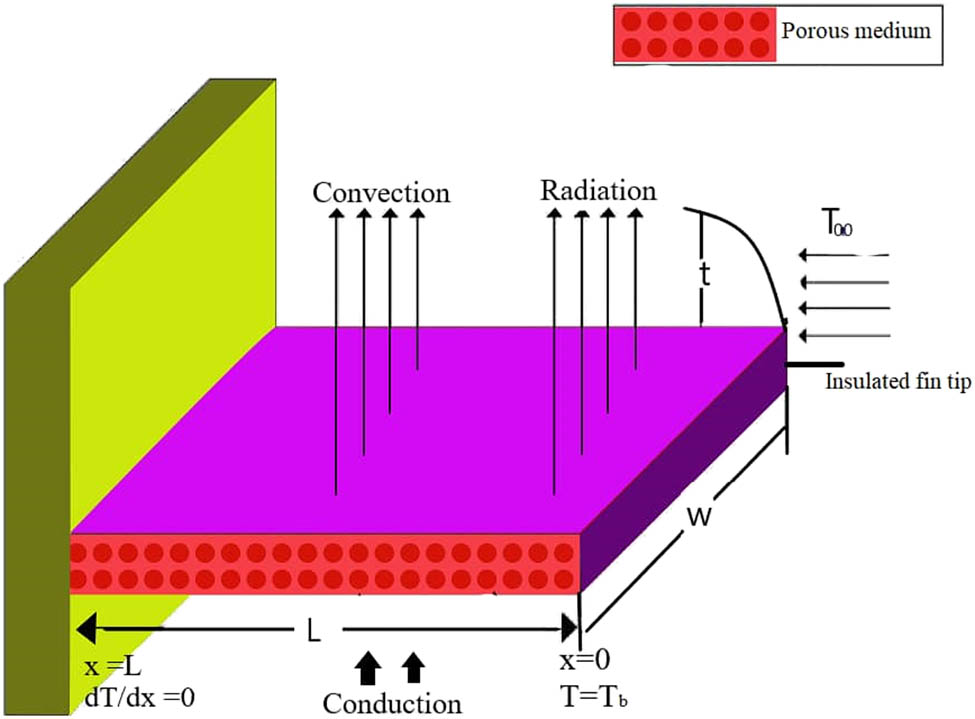
Physical system of the fin.
According to the thermal energy balance in a closed system (see Sobamowo and Kamiyo [22]), the rate of the heat conduction into the element at the base fin
This leads to the following equation:
where
As
From Fourier’s law of heat conduction (see Sobamowo and Kamiyo [22] and Ndlovu and Moitsheki [25]),
Substituting Eq. (2.6) into Eq. (2.5), we obtain
where
To conclude our model formulation, we now set our focus on two variations of the thermal conductivity
2.1 Case 1: Linear variation of thermal conductivity with temperature
Assuming the thermal conductivity to vary linearly (see, Lawal et al. [16]) as
Eq. (2.7) becomes
The associated boundary conditions are given as
Eqs (2.9)–(2.11) are reduced to unitless forms by introducing the following non-dimensional parameters:
After simple manipulations, we obtain
with its associated relevant boundary condition
where
2.2 Case 2: non-linear variation of thermal conductivity with temperature
Assuming the following quadratic variation for the thermal conductivity
It is immediate that Eq. (2.7) can be restated as
The associated boundary conditions are earlier given as in Eqs (2.10) and (2.11). With the aid of non-dimensional parameters in Eq. (2.12), Eq. (2.16) is reduced to non-dimensional form as
with the associated boundary condition
where
3 Numerical procedure
In this section, we present two numerical approximations via Runge–Kutta of Order 4 (RK4) and the spectral local linearization method (SLM) to approximate the solutions of Eqs (2.13) and (2.16) subject to their boundary conditions given in Eqs (2.14)–(2.15) and Eqs (2.18)–(2.19), respectively. It should be noted that although Eqs (2.13) and (2.16) are second-order ordinary differential equations (ODEs), providing a closed-form solution using our elementary functions to the reduced form of the equations is still far-fetched in the literature [21].
The Runge–Kutta technique is a family of methods and widely used for numerically approximating the solution of ODEs. Depending on the level of precision sought, the approach can be implemented in a variety of ways. Among these family of methods, the RK4 strikes an excellent balance between computational expense and precision. RK4 has error of Order-4
The RK4 method is based on the following:
having the value of
where
The SLLM is the result of combining local-linearization method (LLM) with spectral (Chebyshev) collocation (SCCM) technique. The linearization method rests on the generalization of the Newton–Raphson technique developed by Bellman and Kalaba [31] and a detailed description of the use of SCCM can be found in the work of Motsa [32]. The SLLM has been tested over abundance of problems with different boundary and initial conditions. The method has been shown to have high accuracy and speedy convergence rate, see the work of Otegbeye et al. [33] and Tijani et al. [34]. Brief demonstration of the method using Eqs (2.13) and (2.17) follows. First, the linearization for the linear variation of thermal conductivity with temperature is given as
as well as appropriate boundary conditions
and the linearization coefficient is given as
and residual
where
Eqs (3.4)–(3.7) are the local-linearization technique, and we now set our focus on the spectral Chebyshev collocation method. The SLLM concepts are as follows:
We define our physical domain of interest, in this study
Transformation mapping of
We approximate the unknown functions
(3.9)where N stands for the number of collocation points.
We used the Chebyshev differentiation matrix
(3.10)where
where
Eq. (3.11) is subject to the spectral boundary conditions
Remark 3.1
The SLLM procedure for the non-linear variation of thermal conductivity with temperature follows the same steps. The following are the major difference
Linearization coefficient
(3.13)Residual
(3.14)where
Collocation point and substituting derivatives
(3.15)
Remark 3.2
The RK4 and spectral methods are executed on an INTEL CORE i5 PC with 2.3 hertz processing speeds. The solutions are obtained in centiseconds.
3.1 Numerical validation
Table 1 shows the convergence of the RK4 and spectral method for Eqs (2.13) and (2.17). A speedy convergence is observed for both methods. Table 2 shows the validation of our model under limiting conditions. It is worth noting that Gorla and Bakier [21] employed the RK4 method. The results of RK4, SLLM, and Martins-Costa et al. [36] are in close agreement. Comparative analysis is presented in Table 3. The wall temperature gradient is calculated by taking different values of
Convergence analysis of the SLLM and Runge–Kutta (RK4) for linear and non-linear
| Iterations | SLLM | RK4 | ||
|---|---|---|---|---|
| Linear | Non-linear | Linear | Non-linear | |
|
|
|
|
|
|
| 5.0 | 0.2720292 | 0.1965382 | 0.2720292 | 0.1965382 |
| 7.0 | 0.2720292 | 0.1965387 | 0.2720292 | 0.1965387 |
Comparison of wall temperature gradient (
|
|
|
|
Gorla and Bakier [21] | Martins-Costa et al. [36] | SLLM |
|---|---|---|---|---|---|
| 1.0 | 0.10 | 0.01 | 0.6861 | 0.68614 | 0.6861455 |
| 0.1 | 0.7021 | 0.70212 | 0.7021213 | ||
| 0.5 | 0.8389 | 0.83892 | 0.8389215 | ||
| 10.0 | 1.0 | 0.01 | 2.6351 | 2.63499 | 2.6350870 |
| 0.1 | 2.6777 | 2.67758 | 2.6776818 | ||
| 0.5 | 3.0729 | 3.07271 | 3.0728720 | ||
| 100.0 | 10.0 | 0.01 | 8.4178 | 8.41470 | 8.4177470 |
| 0.1 | 8.5496 | 8.54630 | 8.5495417 | ||
| 0.5 | 9.7806 | 9.77565 | 9.7805390 |
Temperature gradient (
| RK4 | SLLM | ||||
|---|---|---|---|---|---|
|
|
|
|
|
|
|
| 1.0 | 1.0 | 0.7812827 | 1.0 | 1.0 | 0.7812827 |
| 2.0 | 0.8639200 | 2.0 | 0.8639200 | ||
| 3.0 | 0.9380826 | 3.0 | 0.9380826 | ||
| 4.0 | 1.0058195 | 4.0 | 1.0058195 | ||
| 1.0 |
|
0.8091528 | 1.0 |
|
0.8091528 |
|
|
0.8056237 |
|
0.8056237 | ||
| 1.0 | 0.7812827 | 1.0 | 0.7812827 | ||
| 2.0 | 0.7538819 | 2.0 | 0.7538819 | ||
4 Results and discussion
This section presents the graphical result depicting the influence of each parameter on the rectangular porous fin. The following values are assumed
unless stated otherwise. Figure 2 shows that an increase in the value of thermal conductivity
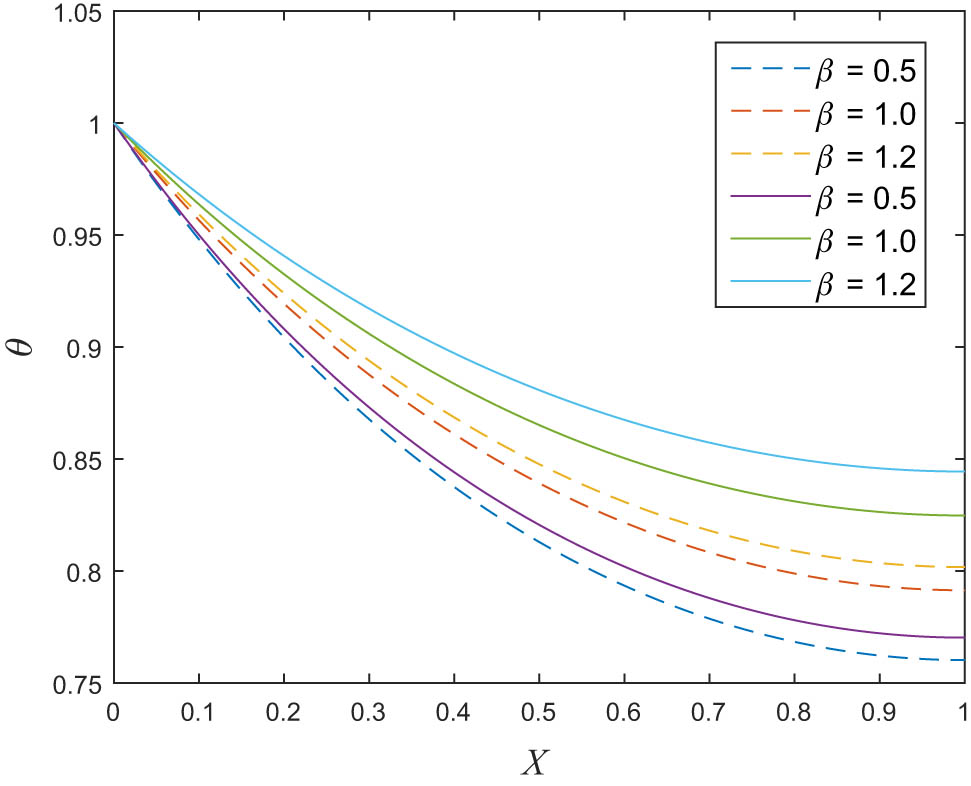
Effect of
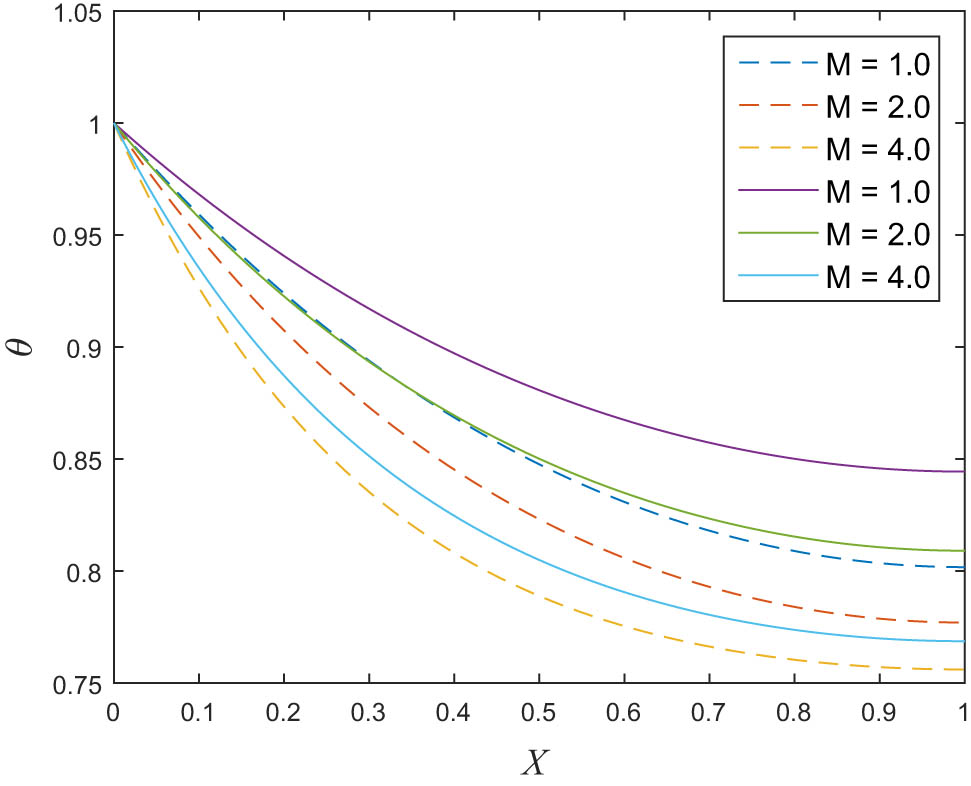
Effect of
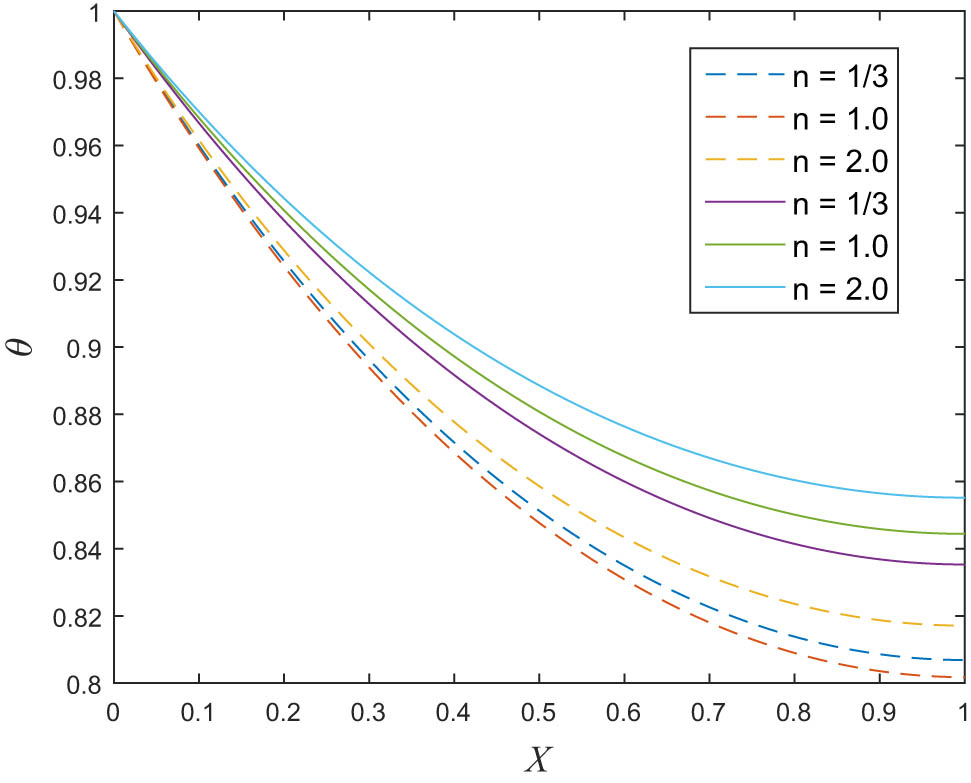
Effect of
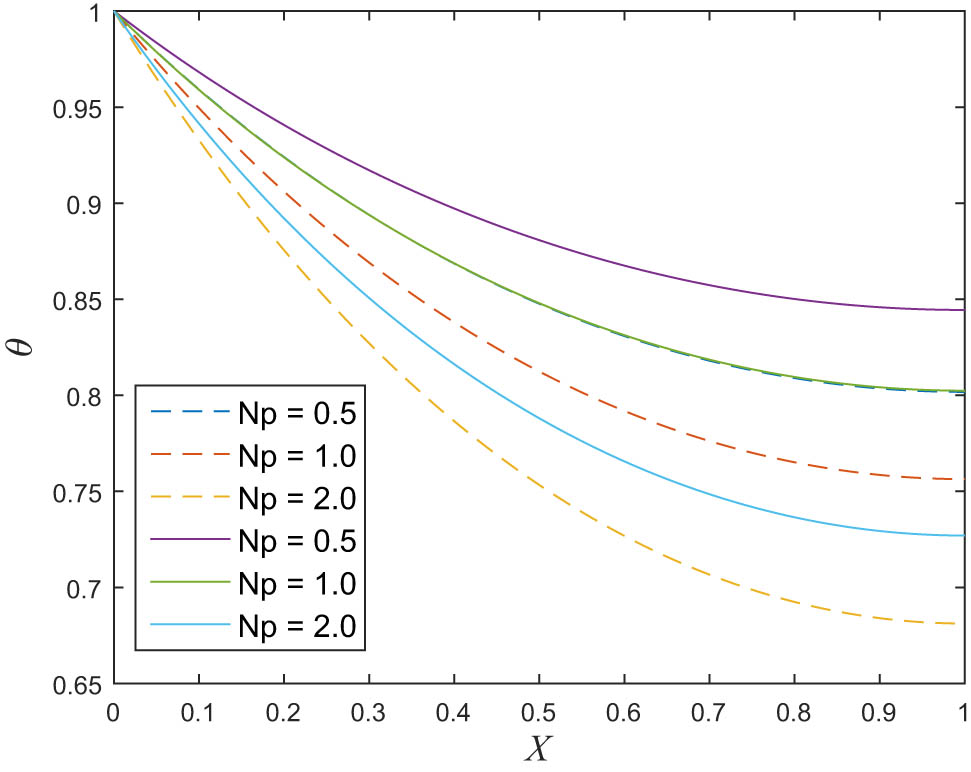
Effect of
The effect of thermal radiation on the temperature of the fin is shown in Figure 6. The temperature of the fin is found to decrease as the amount of thermal radiation increases. As a result, heat is lost to the surrounding fluid. This demonstrates that thermal energy transfer by radiation improves the heat transfer rate. Figure 7 shows that the higher value of the heat transfer rate is recorded when
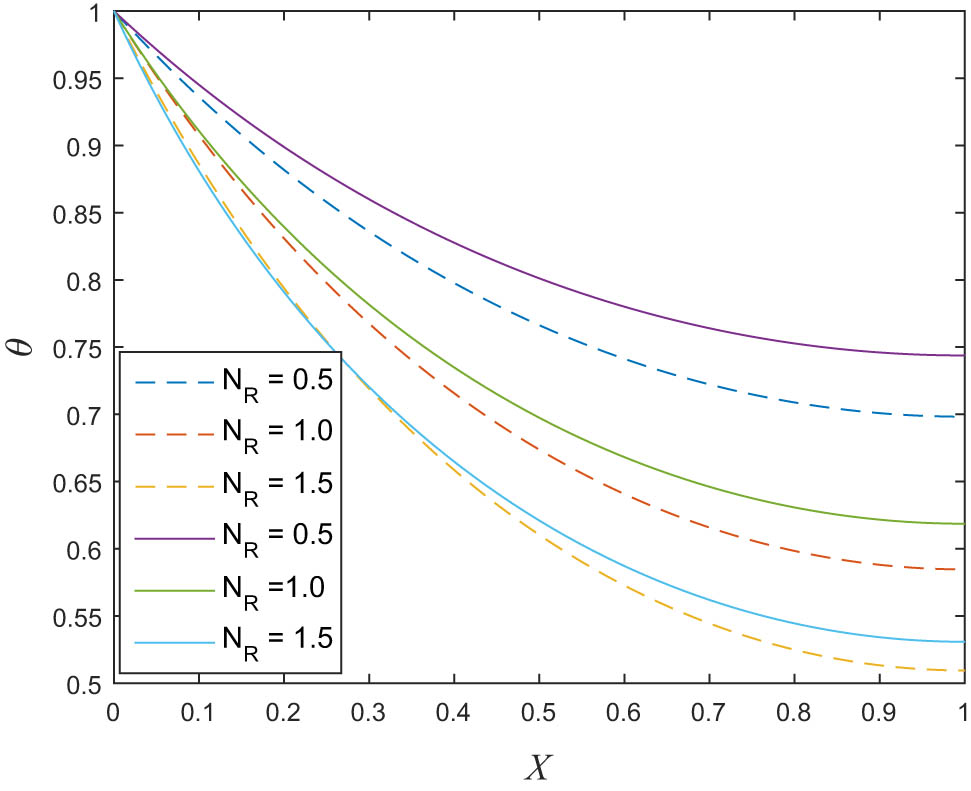
Effect of
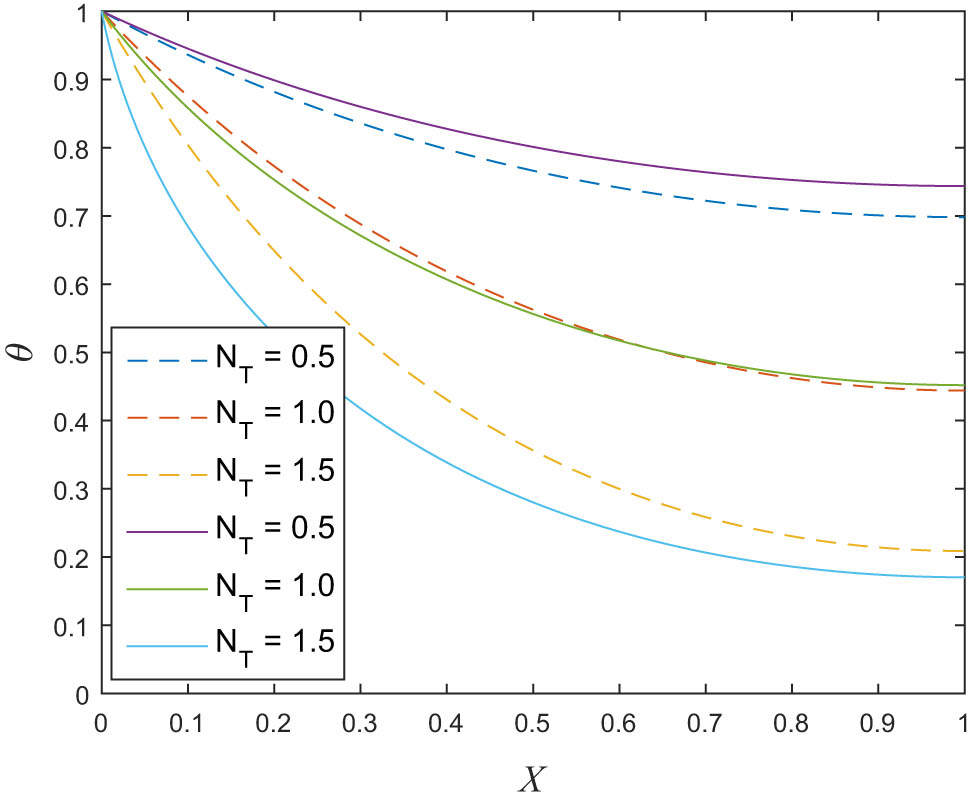
Effect of
Figure 8 depicts the effect of internal heat generation
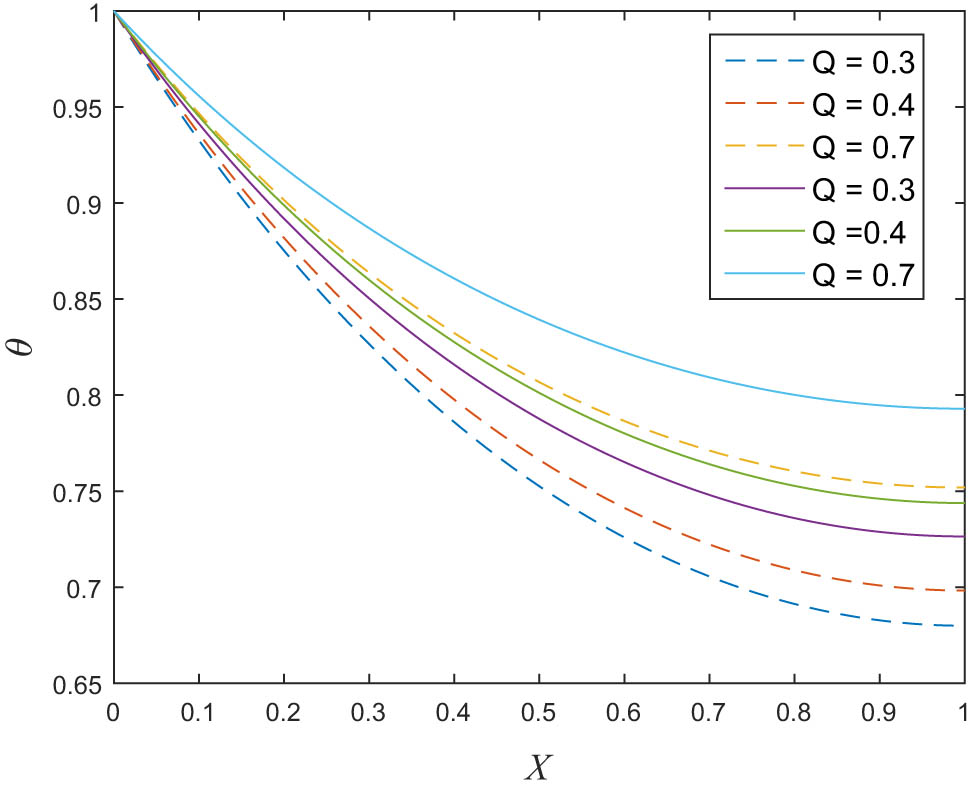
Effect of
5 Conclusion
In this study, the behaviour of rectangular porous fin of finite length with insulated tips has been scientifically investigated. The governing model is composed of effects of thermal radiation, convection, and porosity. The assumption of temperature-dependent thermal conductivity was employed in two forms via linear variation and non-linear variation. The emerging non-linear second-order differential equations were numerically solved using the RK4 and SLLM. The effects of various factors on temperature distribution were also explored, and the results were reported visually and in Tables 1–3. The study here revealed the following
This study supports that the efficiency of a rectangular porous fin depends on the fin thermal conductivity and the multi-boiling heat transfer at the fin surface.
The temperature of the fin for the non-linear variation is higher when compared to the linear variation for any chosen multi-boiling parameter
Slight changes in the ratio of the temperature
The RK4 and SLLM are good techniques for handling problem of rectangular porous fins.
-
Funding information: The authors state no funding involved.
-
Author contributions: All authors have accepted responsibility for the entire content of this manuscript and approved its submission.
-
Conflict of interest: The authors read and approved submission of the manuscript. Besides, declared no conflict of interest.
References
[1] Aziz A. Perturbation solution for convective fin with internal heat generation and temperature-dependent thermal conductivity. Int J Heat Mass Tranf. 1977;20(11):1253–5. 10.1016/0017-9310(77)90135-1Suche in Google Scholar
[2] Chang HC. A decomposition solution for fins with temperature dependent surface heat flux. Int J Heat Mass Tranf. 2005;48(9):1819–24. 10.1016/j.ijheatmasstransfer.2004.07.049Suche in Google Scholar
[3] Cortell R. A numerical analysis to the non-linear fin problem. J Zhejiang Univ Sci A. 2008;9(5):648–53. 10.1631/jzus.A0720024Suche in Google Scholar
[4] Kim S, Huang CH. A series solution of the fin problem with temperature-dependent thermal conductivity. J Zhejiang Univ Sci A. 2006;39(22):4894–901. 10.1088/0022-3727/39/22/023Suche in Google Scholar
[5] Poozesh S, Nabi S, Saber M, Dinarwand S, Fani B. The efficiency of convective-radiative fin with temperature-dependent thermal conductivity by the differential transformation method. J Appl Sci Eng Technol. 2013;6(8):1354–9. 10.19026/rjaset.6.3956Suche in Google Scholar
[6] Akindeinde SO. Parker-Sochacki method for the solution of convective straight fins problem with temperature-dependent thermal conductivity. Int J Nonlinear Sci. 2018;25(2):119–28. Suche in Google Scholar
[7] Najafabadi MF, Rostami HT, Hosseinzadeh KH, Ganji DD. Thermal analysis of a moving fin using the radial basis function approximation. Heat Transf. 2021;50(8):7553–67. 10.1002/htj.22242Suche in Google Scholar
[8] Aziz A, Bouaziz MN. A least squares method for a longitudinal fin with temperature dependent internal heat generation and thermal conductivity. Energ Convers Manage. 2011;52:2876–82. 10.1016/j.enconman.2011.04.003Suche in Google Scholar
[9] Aderogba AA, Fabelurin OO, Akindeinde SO, Adewumi AO, Ogundare BS. Nonstandard finite difference approximation for a generalized Fins problem. Math Comput Simulat. 2020;178:183–91. 10.1016/j.matcom.2020.06.010Suche in Google Scholar
[10] Coskun SB, Atay MT. Fin efficiency analysis of convective straight fin with temperature dependent thermal conductivity using variational iteration method. Appl Therm Eng. 2008;28:2345–52. 10.1016/j.applthermaleng.2008.01.012Suche in Google Scholar
[11] Chowdhury MSM, Hashim I, Abdulaziz O. Comparison of homotopy analysis method and homotopy-perturbation method for purely non-linear fin-type problems. Commun Nonlinear Sci. 2009;14:371–8. 10.1016/j.cnsns.2007.09.005Suche in Google Scholar
[12] Kiwan S, Al-Nimr MA. Using porous fins for heat transfer enhancement. J Heat Transf. 2000;123(4):790–5. 10.1115/1.1371922Suche in Google Scholar
[13] Bhanja D, Kundu B, Mandal PK. Thermal analysis of porous pin fin used for electronic coolings. Proc Eng. 2013;64:956–65. 10.1016/j.proeng.2013.09.172Suche in Google Scholar
[14] Ranjan D. Estimation of parameters in a fin with temperature-dependent thermal conductivity and radiation. Proc Instit Mech Eng. 2016;6(230):472–85. 10.1177/0954408915575386Suche in Google Scholar
[15] Oguntala G, Sobamowo GM, Ahmed Y, Abd-Alhameed R. Application of approximate analytical technique using the homotopy perturbation method to study the inclination effect on the thermal behaviour of porous fin heat sink. Math Comput Appl. 2018;23(4):472–85. 10.3390/mca23040062Suche in Google Scholar
[16] Lawal MO, Kasali KB, Ogunseye HA, Oni MO, Tijani YO, Lawal YT. On the mathematical model of Erying-Powell nanofluid flow with non-linear radiation, variable thermal conductivity and viscosity. Partial Differ Equ Appl Math. 2022;5:100318. 10.1016/j.padiff.2022.100318Suche in Google Scholar
[17] Kiwan S. Effect of radiative losses on the heat transfer from porous fins. Int J Therm Sci. 2007;46:1046–55. 10.1016/j.ijthermalsci.2006.11.013Suche in Google Scholar
[18] Mogaji TS, Oseni FD. Numerical analysis of radiation effect on heat flow through Fin of rectangular profile. Am J Eng Res. 2017;6:36–45. Suche in Google Scholar
[19] Hatami M, Hasanpour A, Ganji DD. Heat transfer study through porous fins (Si3 and AL) with temperature-dependent heat generation. Energ Convers Manage. 2013;74:9–16. 10.1016/j.enconman.2013.04.034Suche in Google Scholar
[20] Hatami M, Ganji DD. Thermal performance of circular convective radiative porous fins with different section shapes and materials. Energ Convers Manage. 2013;76:185–93. 10.1016/j.enconman.2013.07.040Suche in Google Scholar
[21] Gorla RSR, Bakier AY. Thermal analysis of natural convection and radiation in porous fins. Int Commun Heat Mass. 2011;38:638–45. 10.1016/j.icheatmasstransfer.2010.12.024Suche in Google Scholar
[22] Sobamowo GM, Kamiyo OM. Multi-boiling heat transfer analysis of a convective straight fin with temperature-department thermal properties and internal heat generation. J Appl Comput Mech. 2017;3(4):229–39. Suche in Google Scholar
[23] Oguntala G, Abd-Alhameed RA, Sobamowo G. On the effect of magnetic field on thermal performance of convective-radiative field with temperature-dependent thermal conductivity. Karbala Int J Mod Sci. 2018;1(4):1–11. 10.1016/j.kijoms.2017.09.003Suche in Google Scholar
[24] Ma J, Sun Y, Li B. Simulation of Combined conductive, convective and radiative heat transfer in moving irregular porous fins by spectral element method. Int J Therm Sci. 2017;118:475–8710.1016/j.ijthermalsci.2017.05.008Suche in Google Scholar
[25] Ndlovu PL, Moitsheki RJ. Thermal analysis of natural convection and radiation heat transfer in moving porous fins. Front Heat Mass Transf. 2019;12(7):1–11. 10.5098/hmt.12.7Suche in Google Scholar
[26] Hosseinzadeh S, Hosseinzadeh KH, Hasibi A, Ganji DD. Thermal analysis of moving porous fin wetted by hybrid nanofluid with trapezoidal, concave parabolic and convex cross sections. Case Stud Therm Eng. 2022;30(101757):1–17. 10.1016/j.csite.2022.101757Suche in Google Scholar
[27] Mahanthesh B. Flow and heat transport of nanomaterial with quadratic radiative heat flux and aggregation kinematics of nanoparticles. Int Commun Heat Mass. 2021;127(105521):1–9. 10.1016/j.icheatmasstransfer.2021.105521Suche in Google Scholar
[28] Thriveni K, Mahanthesh B. Significance of variable fluid properties on hybrid nanoliquid flow in a micro-annulus with quadratic convection and quadratic thermal radiation:Response surface methodology. Int Commun Heat Mass. 2021;124(105264):1–9. 10.1016/j.icheatmasstransfer.2021.105264Suche in Google Scholar
[29] Mahanthesh B. Quadratic radiation and quadratic Boussinesq approximation on hybrid nanoliquid flow. In: Mahanthesh B, editor. Mathematical Fluid Mechanics: Advances in convective instabilities and incompressible fluid flow. Berlin, Boston: De Gruyter. 2021. pp. 13–54. https://doi.org/10.1515/9783110696080-002.10.1515/9783110696080-002Suche in Google Scholar
[30] Hosseinzadeh KH, Montazer E, Shafii MB, Ganji ARD. Solidification enhancement in triplex thermal energy storage system via triplets fins configuration and hybrid nanoparticles. J Energy Storage. 2021;34:102177. 10.1016/j.est.2020.102177Suche in Google Scholar
[31] Bellman RE, Kalaba RE. Quasi linearization and non-linear boundary-value problems. New York: Elsevier; 1965. 10.1109/TAC.1965.1098135Suche in Google Scholar
[32] Motsa SS. A new spectral local linearization method for non-linear boundary layer flow problems. J Appl Math. 2013;13:423628. 10.1155/2013/423628Suche in Google Scholar
[33] Otegbeye S, Goqo SP, Ansari MDS. Comparative study of some spectral based methods for solving boundary layer flow problems. AIP Confer Proc. 2020;2253:020013. 10.1063/5.0019230Suche in Google Scholar
[34] Tijani YO, Oloniiju SD, Kasali KB, Akolade MT. Nonsimilar solution of a boundary layer flow of a Reiner-Philippoff fluid with non-linear thermal convection. Heat Transf. 2022;51:5659–78. https://doi.org/10.1002/htj.22564. Suche in Google Scholar
[35] Trefethen LN. Spectral methods in MATLAB. Philadelphia: SIAM; 2000. 10.1137/1.9780898719598Suche in Google Scholar
[36] Martins-Costa ML, Sarmento VV, Moraes de Lira A, Saldanha da Gama RM. Temperature distribution in porous fins subjected to convection and radiation, obtained from the minimization of a convex functional. Math Probl Eng. 2020;2020:8613717. 10.1155/2020/8613717Suche in Google Scholar
[37] Koizumi Y, Monde M, Nagai N, Shoji M, Takata Y. Topics on boiling: from fundamentals to applications. Boiling Res Adv. 2017;443–777. 10.1016/B978-0-08-101010-5.00006-3Suche in Google Scholar
© 2022 the author(s), published by De Gruyter
This work is licensed under the Creative Commons Attribution 4.0 International License.
Artikel in diesem Heft
- Research Articles
- Fractal approach to the fluidity of a cement mortar
- Novel results on conformable Bessel functions
- The role of relaxation and retardation phenomenon of Oldroyd-B fluid flow through Stehfest’s and Tzou’s algorithms
- Damage identification of wind turbine blades based on dynamic characteristics
- Improving nonlinear behavior and tensile and compressive strengths of sustainable lightweight concrete using waste glass powder, nanosilica, and recycled polypropylene fiber
- Two-point nonlocal nonlinear fractional boundary value problem with Caputo derivative: Analysis and numerical solution
- Construction of optical solitons of Radhakrishnan–Kundu–Lakshmanan equation in birefringent fibers
- Dynamics and simulations of discretized Caputo-conformable fractional-order Lotka–Volterra models
- Research on facial expression recognition based on an improved fusion algorithm
- N-dimensional quintic B-spline functions for solving n-dimensional partial differential equations
- Solution of two-dimensional fractional diffusion equation by a novel hybrid D(TQ) method
- Investigation of three-dimensional hybrid nanofluid flow affected by nonuniform MHD over exponential stretching/shrinking plate
- Solution for a rotational pendulum system by the Rach–Adomian–Meyers decomposition method
- Study on the technical parameters model of the functional components of cone crushers
- Using Krasnoselskii's theorem to investigate the Cauchy and neutral fractional q-integro-differential equation via numerical technique
- Smear character recognition method of side-end power meter based on PCA image enhancement
- Significance of adding titanium dioxide nanoparticles to an existing distilled water conveying aluminum oxide and zinc oxide nanoparticles: Scrutinization of chemical reactive ternary-hybrid nanofluid due to bioconvection on a convectively heated surface
- An analytical approach for Shehu transform on fractional coupled 1D, 2D and 3D Burgers’ equations
- Exploration of the dynamics of hyperbolic tangent fluid through a tapered asymmetric porous channel
- Bond behavior of recycled coarse aggregate concrete with rebar after freeze–thaw cycles: Finite element nonlinear analysis
- Edge detection using nonlinear structure tensor
- Synchronizing a synchronverter to an unbalanced power grid using sequence component decomposition
- Distinguishability criteria of conformable hybrid linear systems
- A new computational investigation to the new exact solutions of (3 + 1)-dimensional WKdV equations via two novel procedures arising in shallow water magnetohydrodynamics
- A passive verses active exposure of mathematical smoking model: A role for optimal and dynamical control
- A new analytical method to simulate the mutual impact of space-time memory indices embedded in (1 + 2)-physical models
- Exploration of peristaltic pumping of Casson fluid flow through a porous peripheral layer in a channel
- Investigation of optimized ELM using Invasive Weed-optimization and Cuckoo-Search optimization
- Analytical analysis for non-homogeneous two-layer functionally graded material
- Investigation of critical load of structures using modified energy method in nonlinear-geometry solid mechanics problems
- Thermal and multi-boiling analysis of a rectangular porous fin: A spectral approach
- The path planning of collision avoidance for an unmanned ship navigating in waterways based on an artificial neural network
- Shear bond and compressive strength of clay stabilised with lime/cement jet grouting and deep mixing: A case of Norvik, Nynäshamn
- Communication
- Results for the heat transfer of a fin with exponential-law temperature-dependent thermal conductivity and power-law temperature-dependent heat transfer coefficients
- Special Issue: Recent trends and emergence of technology in nonlinear engineering and its applications - Part I
- Research on fault detection and identification methods of nonlinear dynamic process based on ICA
- Multi-objective optimization design of steel structure building energy consumption simulation based on genetic algorithm
- Study on modal parameter identification of engineering structures based on nonlinear characteristics
- On-line monitoring of steel ball stamping by mechatronics cold heading equipment based on PVDF polymer sensing material
- Vibration signal acquisition and computer simulation detection of mechanical equipment failure
- Development of a CPU-GPU heterogeneous platform based on a nonlinear parallel algorithm
- A GA-BP neural network for nonlinear time-series forecasting and its application in cigarette sales forecast
- Analysis of radiation effects of semiconductor devices based on numerical simulation Fermi–Dirac
- Design of motion-assisted training control system based on nonlinear mechanics
- Nonlinear discrete system model of tobacco supply chain information
- Performance degradation detection method of aeroengine fuel metering device
- Research on contour feature extraction method of multiple sports images based on nonlinear mechanics
- Design and implementation of Internet-of-Things software monitoring and early warning system based on nonlinear technology
- Application of nonlinear adaptive technology in GPS positioning trajectory of ship navigation
- Real-time control of laboratory information system based on nonlinear programming
- Software engineering defect detection and classification system based on artificial intelligence
- Vibration signal collection and analysis of mechanical equipment failure based on computer simulation detection
- Fractal analysis of retinal vasculature in relation with retinal diseases – an machine learning approach
- Application of programmable logic control in the nonlinear machine automation control using numerical control technology
- Application of nonlinear recursion equation in network security risk detection
- Study on mechanical maintenance method of ballasted track of high-speed railway based on nonlinear discrete element theory
- Optimal control and nonlinear numerical simulation analysis of tunnel rock deformation parameters
- Nonlinear reliability of urban rail transit network connectivity based on computer aided design and topology
- Optimization of target acquisition and sorting for object-finding multi-manipulator based on open MV vision
- Nonlinear numerical simulation of dynamic response of pile site and pile foundation under earthquake
- Research on stability of hydraulic system based on nonlinear PID control
- Design and simulation of vehicle vibration test based on virtual reality technology
- Nonlinear parameter optimization method for high-resolution monitoring of marine environment
- Mobile app for COVID-19 patient education – Development process using the analysis, design, development, implementation, and evaluation models
- Internet of Things-based smart vehicles design of bio-inspired algorithms using artificial intelligence charging system
- Construction vibration risk assessment of engineering projects based on nonlinear feature algorithm
- Application of third-order nonlinear optical materials in complex crystalline chemical reactions of borates
- Evaluation of LoRa nodes for long-range communication
- Secret information security system in computer network based on Bayesian classification and nonlinear algorithm
- Experimental and simulation research on the difference in motion technology levels based on nonlinear characteristics
- Research on computer 3D image encryption processing based on the nonlinear algorithm
- Outage probability for a multiuser NOMA-based network using energy harvesting relays
Artikel in diesem Heft
- Research Articles
- Fractal approach to the fluidity of a cement mortar
- Novel results on conformable Bessel functions
- The role of relaxation and retardation phenomenon of Oldroyd-B fluid flow through Stehfest’s and Tzou’s algorithms
- Damage identification of wind turbine blades based on dynamic characteristics
- Improving nonlinear behavior and tensile and compressive strengths of sustainable lightweight concrete using waste glass powder, nanosilica, and recycled polypropylene fiber
- Two-point nonlocal nonlinear fractional boundary value problem with Caputo derivative: Analysis and numerical solution
- Construction of optical solitons of Radhakrishnan–Kundu–Lakshmanan equation in birefringent fibers
- Dynamics and simulations of discretized Caputo-conformable fractional-order Lotka–Volterra models
- Research on facial expression recognition based on an improved fusion algorithm
- N-dimensional quintic B-spline functions for solving n-dimensional partial differential equations
- Solution of two-dimensional fractional diffusion equation by a novel hybrid D(TQ) method
- Investigation of three-dimensional hybrid nanofluid flow affected by nonuniform MHD over exponential stretching/shrinking plate
- Solution for a rotational pendulum system by the Rach–Adomian–Meyers decomposition method
- Study on the technical parameters model of the functional components of cone crushers
- Using Krasnoselskii's theorem to investigate the Cauchy and neutral fractional q-integro-differential equation via numerical technique
- Smear character recognition method of side-end power meter based on PCA image enhancement
- Significance of adding titanium dioxide nanoparticles to an existing distilled water conveying aluminum oxide and zinc oxide nanoparticles: Scrutinization of chemical reactive ternary-hybrid nanofluid due to bioconvection on a convectively heated surface
- An analytical approach for Shehu transform on fractional coupled 1D, 2D and 3D Burgers’ equations
- Exploration of the dynamics of hyperbolic tangent fluid through a tapered asymmetric porous channel
- Bond behavior of recycled coarse aggregate concrete with rebar after freeze–thaw cycles: Finite element nonlinear analysis
- Edge detection using nonlinear structure tensor
- Synchronizing a synchronverter to an unbalanced power grid using sequence component decomposition
- Distinguishability criteria of conformable hybrid linear systems
- A new computational investigation to the new exact solutions of (3 + 1)-dimensional WKdV equations via two novel procedures arising in shallow water magnetohydrodynamics
- A passive verses active exposure of mathematical smoking model: A role for optimal and dynamical control
- A new analytical method to simulate the mutual impact of space-time memory indices embedded in (1 + 2)-physical models
- Exploration of peristaltic pumping of Casson fluid flow through a porous peripheral layer in a channel
- Investigation of optimized ELM using Invasive Weed-optimization and Cuckoo-Search optimization
- Analytical analysis for non-homogeneous two-layer functionally graded material
- Investigation of critical load of structures using modified energy method in nonlinear-geometry solid mechanics problems
- Thermal and multi-boiling analysis of a rectangular porous fin: A spectral approach
- The path planning of collision avoidance for an unmanned ship navigating in waterways based on an artificial neural network
- Shear bond and compressive strength of clay stabilised with lime/cement jet grouting and deep mixing: A case of Norvik, Nynäshamn
- Communication
- Results for the heat transfer of a fin with exponential-law temperature-dependent thermal conductivity and power-law temperature-dependent heat transfer coefficients
- Special Issue: Recent trends and emergence of technology in nonlinear engineering and its applications - Part I
- Research on fault detection and identification methods of nonlinear dynamic process based on ICA
- Multi-objective optimization design of steel structure building energy consumption simulation based on genetic algorithm
- Study on modal parameter identification of engineering structures based on nonlinear characteristics
- On-line monitoring of steel ball stamping by mechatronics cold heading equipment based on PVDF polymer sensing material
- Vibration signal acquisition and computer simulation detection of mechanical equipment failure
- Development of a CPU-GPU heterogeneous platform based on a nonlinear parallel algorithm
- A GA-BP neural network for nonlinear time-series forecasting and its application in cigarette sales forecast
- Analysis of radiation effects of semiconductor devices based on numerical simulation Fermi–Dirac
- Design of motion-assisted training control system based on nonlinear mechanics
- Nonlinear discrete system model of tobacco supply chain information
- Performance degradation detection method of aeroengine fuel metering device
- Research on contour feature extraction method of multiple sports images based on nonlinear mechanics
- Design and implementation of Internet-of-Things software monitoring and early warning system based on nonlinear technology
- Application of nonlinear adaptive technology in GPS positioning trajectory of ship navigation
- Real-time control of laboratory information system based on nonlinear programming
- Software engineering defect detection and classification system based on artificial intelligence
- Vibration signal collection and analysis of mechanical equipment failure based on computer simulation detection
- Fractal analysis of retinal vasculature in relation with retinal diseases – an machine learning approach
- Application of programmable logic control in the nonlinear machine automation control using numerical control technology
- Application of nonlinear recursion equation in network security risk detection
- Study on mechanical maintenance method of ballasted track of high-speed railway based on nonlinear discrete element theory
- Optimal control and nonlinear numerical simulation analysis of tunnel rock deformation parameters
- Nonlinear reliability of urban rail transit network connectivity based on computer aided design and topology
- Optimization of target acquisition and sorting for object-finding multi-manipulator based on open MV vision
- Nonlinear numerical simulation of dynamic response of pile site and pile foundation under earthquake
- Research on stability of hydraulic system based on nonlinear PID control
- Design and simulation of vehicle vibration test based on virtual reality technology
- Nonlinear parameter optimization method for high-resolution monitoring of marine environment
- Mobile app for COVID-19 patient education – Development process using the analysis, design, development, implementation, and evaluation models
- Internet of Things-based smart vehicles design of bio-inspired algorithms using artificial intelligence charging system
- Construction vibration risk assessment of engineering projects based on nonlinear feature algorithm
- Application of third-order nonlinear optical materials in complex crystalline chemical reactions of borates
- Evaluation of LoRa nodes for long-range communication
- Secret information security system in computer network based on Bayesian classification and nonlinear algorithm
- Experimental and simulation research on the difference in motion technology levels based on nonlinear characteristics
- Research on computer 3D image encryption processing based on the nonlinear algorithm
- Outage probability for a multiuser NOMA-based network using energy harvesting relays
