Edge detection using nonlinear structure tensor
-
Shuping Yuan
 ,
Yang Chen
,
Yang Chen

Abstract
In order to improve the performance of edge detection for noisy images, a new edge detection method based on nonlinear structure tensor is proposed. First, the tensor product of noisy images is calculated. The tensor product is diffused according to the image gradient, which depends on the tensor product itself. Finally, the eigenvalues and eigenvectors of the diffusion tensor product are calculated, and the edges of the image are detected according to the eigenvalues. The method is compared with other methods. The experimental results show that the average number of edge points detected by method 1, method 2, method 3, and this method are 513.7, 530.0, 509.0, and 719.3, respectively. The average detection time of method 1, method 2, method 3, and this method were 65.3, 54.9, 57.3, and 33.6 s, respectively. When the number of edge detection is the largest, the average detection time of this method is significantly smaller than that of the three comparison methods. Therefore, this method is more suitable for edge detection of noisy images, and the performance of this method is better than that of the comparison method and can improve the performance of edge detection of noisy images.
1 Introduction
Image processing technology in recent years, with the improvement of networked data fields related to textual, is becoming more and more important and effective. The experiment results ensure the quality of image post-processing and analysis. The image edge detection technology is a key step in image processing, and noise in image edge detection is a basic problem in low-level vision [1]. The edge in the image is the basic structure of the image, which contains important information. There are many existing methods of image edge detection, mainly including spatial detection and transform domain detection [2]. Sobel operator, Canny operator, Laplace operator, Robert’s operator, and other traditional classical edge detection algorithms belong to spatial detection. Among them, Sobel operator and canny operator are the most widely used, and the canny operator has theoretically formed a perfect optimal edge detection theory for the first time, which has become the standard edge detection method. Its main feature is that it is very sensitive to noise in the image [3], because edge detection method detects edge according to the discontinuity of gray value and noise also has a discontinuity. The noise will also be detected as edge, which leads to the failure of most edge detection methods when the image is polluted by medium-intensity or high-intensity noise. If it is necessary to detect edges in noisy images, the following two strategies can be adopted: (a) smooth the image first and then detect edges; (b) directly detect the edges in the image and then adjust the edges.
The edge detection method in the spatial domain is used to calculate the image gradient and determine whether the pixel point at this gradient is edge according to whether the gradient amplitude is greater than a threshold value. As edge detection involves directivity, these operators are generally sensitive to noise and have great defects in practical use [4]. Because of its good performance in multi-scale analysis and time-frequency localization, wavelet transform is suitable for detecting local mutation signals and is an effective tool for filtering image noise and edge detection. According to the difference between edge and noise, the separation of noise and edge is achieved by using the mode maximum method. Mathematical morphology is a nonlinear filtering method, which is an interaction between object shape set and structural elements. It is insensitive to edge direction and can suppress noise to a large extent and detect the real edge. For example, Sitohang and Sinaga [5] use the mathematical morphology detector containing multiple structural elements to detect the edge of medical images containing noise so that the medical images can obtain clearer and better continuity of edge map. The edge detection method in the transform domain first transforms the image to the frequency domain and detects the edge according to the local maximum value of the transform domain system. The spatial detection and transform domain detection are based on the discontinuity of pixel gray values in images. Tang et al. [6] proposed a system based on a singular value feature vector, and the gradient operator edge detection algorithm. The calculation of the singular values of the image block first and the Sobel gradient template spread to eight other directions and then according to the stability of the singular values of the image block are determined. The gradient value of image pixels is considered from the aspects of global and local gradient threshold determination. In calculating the global and local gradient threshold value of the original image, the weighted function is used to determine the whole image of the gradient threshold. Then, according to the gradient threshold filtering, image edge pixels are obtained. The image edge information of the original image shows that the algorithm can resist a certain amount of noise interference, and it shows the accuracy and efficiency of edge detection are better than another similar algorithm.
Based on the current research, this article proposes a method to improve the edge detection of noisy images based on nonlinear structure tensors. First, the tensor product of noisy images is calculated, and then, the tensor product is diffused according to the image gradient. It depends on the tensor product, and diffusion equation of the diffusion matrix contains the tensor product through the guidance of anisotropic kernel space adaptive average, rather than through the isotropic Gaussian kernel average and finally calculated diffusion tensor product of eigenvalue and eigenvector [7,8,9,10]. Based on the detection of image edge analysis, it shows that the method of different types and the edge detection results of noise images with different concentrations are superior to other methods. Under the premise of containing noise, the method can better suppress noise, extract image edges and retain more details, and has good robustness to different images [11,12,13]. Therefore, the proposed method is more suitable for edge detection of noisy images, and the performance of the proposed method is better than the comparison method, which is more suitable for subsequent image processing and analysis [13–15]. Nonlinear structural tensor edge detection method with second-order gradient adjustment and nonlinear structural tensor edge detection method is proposed. The experimental analysis shows that the method detects better than other noise images at different types and different concentrations of noise; it can better suppress noise.
2 Related work
There are many studies in the literature that attempts to neglect the blurring effects of orthodox structure tensor through discontinuities. Fleet and Weiss [16] proposed an approach for of structure tensor for the estimation of optic flow by utilizing the local information for adapting Gaussian kernel in data [17]. Although adaptive Gaussian smoothing and nonlinear diffusion filtering are equivalent to less volumes of smoothing, important dissimilarities rise when additional significant smoothing is accomplished [18]. The nonlinear diffusion on the basis of small averaging kernels-based iterative application can examine the kernel structures of highly complex adaptive types. Maronna et al. [19] proposed an orientation estimation approach on the basis of robust statistics. Nurunnabi et al. [20] proposed one more approach for orientation estimation. An adaptive shaped filter is utilized in order to smooth the structure tensor and to detect the corners and edges [21].
To analyze the differences and relation understanding among various adaptive filters, nonlinear diffusion and robust estimation methods are gaining universal attention from various researchers. In one study, the scalar case is analyzed by implementing the nonlinear diffusion and robust estimation methods [22]. In another study, the tensor case is analyzed by implementing nonlinear diffusion and robust estimation methods [23]. Chen et al. [24] proposed an approach to study the noise and vibration and their influence on the optimization of mower blades. Li et al. [25] proposed a model for analyzing the performance of the transmission control protocol model in a wireless network. Their approach significantly improves the uplink bandwidth utilization rate. Zhou et al. [26] introduced a linear programming approach for analyzing the mathematical model of agricultural machinery. The proposed work in this article is comprised of an extended version of the studies discussed at conferences [27,28]. The extension of previous work consists of four major additions. The first addition is structure tensor diffusion through diffusivities considering TV flow. The second addition is that the proposed approach provides proof that implemented scheme reserves the original matrix field of progressive semidefiniteness along with the continuous setting. The third addition is that this study presents an intense comparison of structure tensors in terms of isotropic, anisotropic, and linear diffusion. The fourth addition is the implementation of nonlinear structure tensor for corner detection.
3 Methods
3.1 Linear and nonlinear structural tensors
3.1.1 Linear structural tensors
The linear structural tensor is obtained by performing a Gaussian convolution of the tensor product, as defined in Eq. (1):
where
3.1.2 Nonlinear structural tensor based on tensor gradient diffusion
This article presents a nonlinear partial differential equations (PDE) for tuning the tensor product, which contains the gradient of the tensor as shown in Eq. (2):
Among these,
wherein
3.1.3 Nonlinear structural tensor based on image gradient diffusion
To overcome the shortcomings in the diffusion Eq. (2), a nonlinear PDE is proposed for adjusting the tensor product, which contains the gradient of the image as shown in Eq. (4):
where the function
3.2 Edge detection method based on the guided kernel and nonlinear structural tensors
3.2.1 Guide core
Guided nuclei were used for image de-noising and structural clustering. The guide core is a directed Gaussian core as defined in Eq. (5):
where
wherein
where
3.2.2 The tensor product adjustment method
The tensor product-adjusted diffusion equation presented in this article is shown in Eq. (8):
Among them,
The guide kernel is calculated as shown in Eq. (10):
Comparisons of Eqs. (8) and (4) show that replacing isotropic gaussian filtering with spatially adaptive guide kernel filtering ensures that the tensor product is not blurred to better represent the gradient information of the image. The flow of the edge detection method presented in this article is shown in Figure 1.
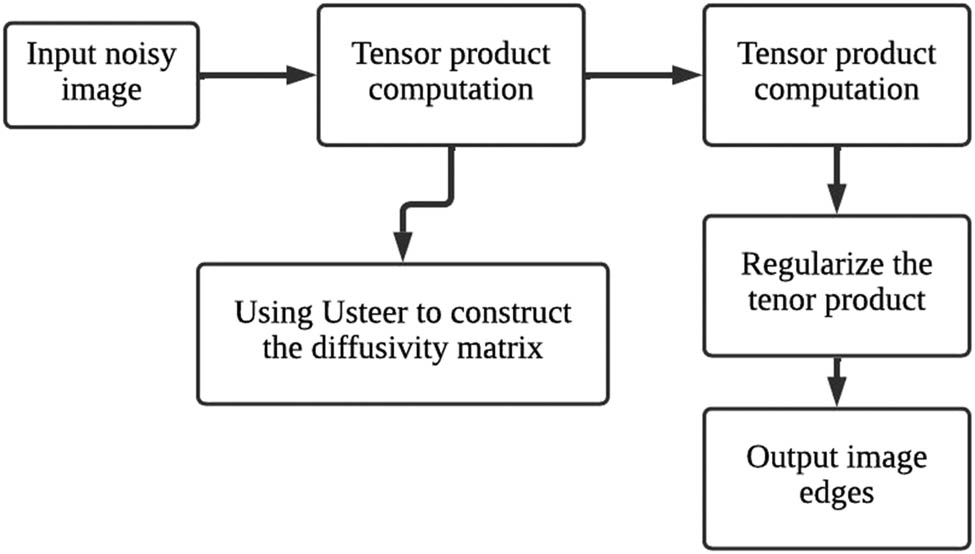
Flowchart of the proposed algorithm.
4 Result analysis
4.1 Edge detection of the noise-containing images
The parameters of this method and other comparison methods are given below. The parameters of this article are set as follows: Gaussian nuclear width

The edge detection results for the noise-containing Lena images: (a) raw image, (b) containing manic image, (c) adjustment method 1, (d) adjustment method 2, (e) adjustment method 3 and (f) proposed method.
In Figure 3, there are some weak edges on the left side of the image, which all edge detection methods cannot detect, indicating that tensor product-based methods cannot detect weak edges in the image. This is evident because the weak edges are regions with gently varying gray values, while tensor product-based methods can only detect rapidly changing strong edges. To further verify the effectiveness of this algorithm, the experiment is designed with the number of edge detection and detection time consumption. The specific experimental results are shown in Table 1.
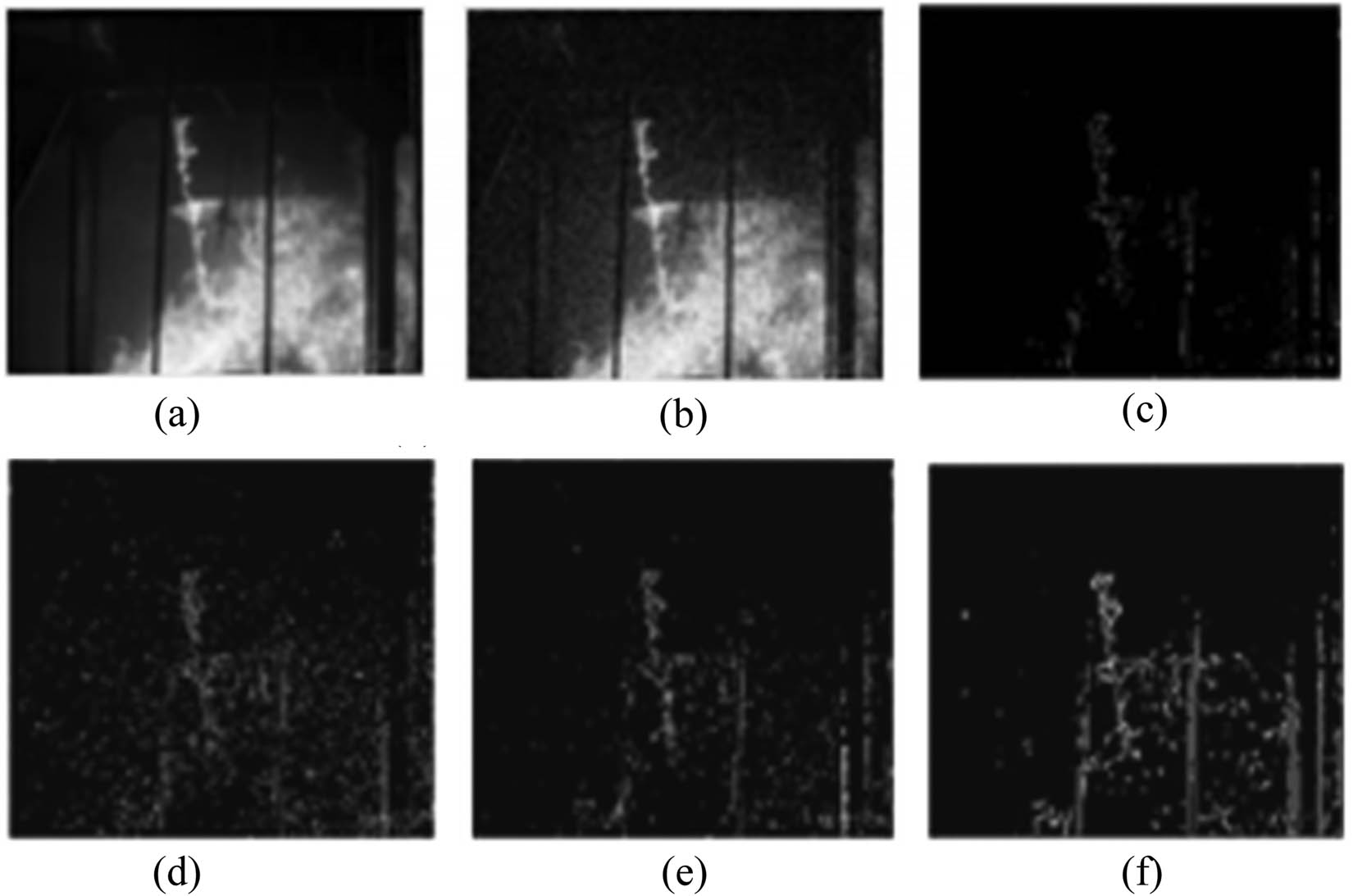
Edge detection results for the noise-containing fire images: (a) raw image, (b) containing manic image, (c) adjustment method 1, (d) adjustment method 2, (e) adjustment method 3, and (f) proposed methods.
Edge detection comparison for different methods
| Index | Algorithm | Picture | Average value | ||
|---|---|---|---|---|---|
| 1 | 2 | 3 | |||
| Number of tests/Individual | Method 1 | 442 | 593 | 506 | 513.7 |
| Method 2 | 495 | 543 | 552 | 530.0 | |
| Method 3 | 452 | 573 | 501 | 509.0 | |
| Proposed method | 645 | 798 | 715 | 719.3 | |
| Detection was time-consuming/s | Method 1 | 63.3 | 65.6 | 67.1 | 65.3 |
| Method 2 | 56.6 | 53.7 | 54.5 | 54.9 | |
| Method 3 | 57.1 | 56.7 | 58.1 | 57.3 | |
| Proposed method | 33.4 | 34.8 | 32.6 | 33.6 | |
As shown in Table 1, the average number of edge points detected by method 1, method 2, method 3, and this method is 513.7, 530.0, 509.0, and 719.3, respectively. The average detection time of method 1, method 2, method 3, and this method was 65.3, 54.9, 57.3, and 33.6 s, respectively. In the case of the largest number of edge detection, the average detection time of the proposed method is significantly less than that of the three comparison methods.
It is shown that the image edge detection method designed in this article based on a nonlinear structure tensor has higher detection efficiency by expanding the detection of image edge information based on eliminating image noise. Peak signal-to-noise ratio of the detection results of the four methods was calculated, and the line graph as shown in Figure 4 was drawn. It is verified that the robustness of the experimental results is better than expected.
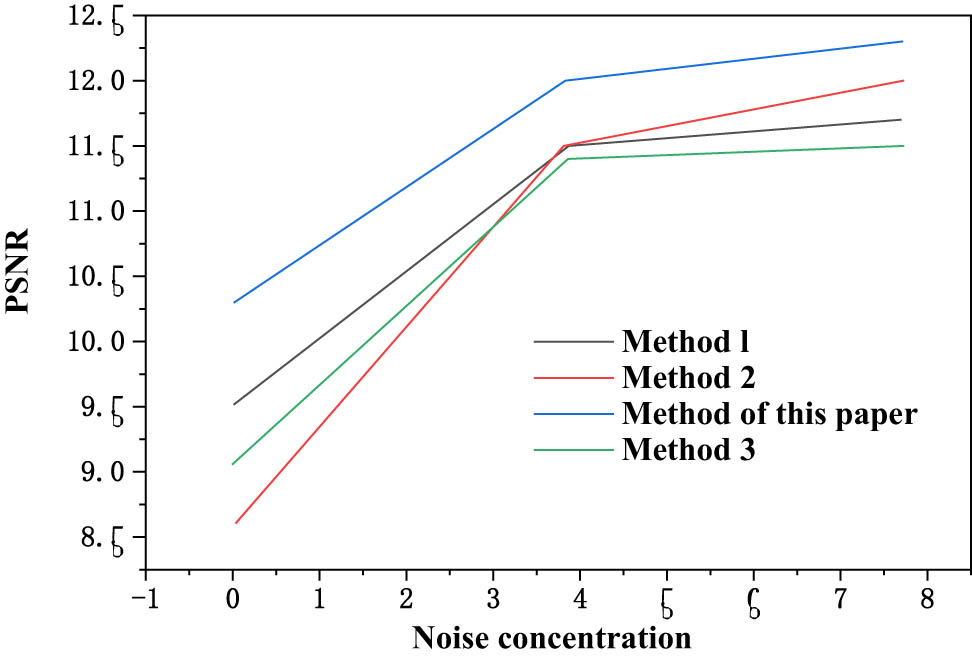
Results of different noise images by different methods.
5 Conclusion
This article presents a new noise-containing image edge detection method to improve the detection effect of noise images. The proposed method is compared with the edge detection method based on linear structural tensor, nonlinear structural tensor edge detection method with second-order gradient adjustment, and nonlinear structural tensor edge detection method. The experimental analysis shows that the method detects better than other noise images at different types and different concentrations. With noise, it can better suppress noise, extract image edges, retain more detailed information, and have good robustness to different images. Therefore, the present method is more suitable for edge detection of noise-containing images, and the proposed method performs better than the existing methods and for the processing and analysis of subsequent images. In the age of information digitalization, image restoration is a new scientific research subject, but its development affects countless man’s hearts. After years of research and practice by many scholars, image restoration technology is developing rapidly in production industry, medical research, and other fields. As various restoration theories have been proposed, the corresponding research results are continuously obtained. However, due to the complex causes of image degradation, relevant theoretical analysis is not established yet. Therefore, some problems need to be further considered and explored when restoring the image. There are various reasons for image degradation, and different degradation factors lead to different resulting images. For different types of degraded images, it is necessary to analyze and confirm the reasons for degraded images, dig out the inherent prior images of Knowledge, and then design a feasible model and algorithm to find the solution for image degradation. This is mainly based on empirical judgment, but there is still a lack of such methods to evaluate degrading categories with theoretical guidance. Future exploration is considered to effectively define the causes of image degradation.
-
Funding information: The authors state no funding involved.
-
Author contributions: All authors have accepted responsibility for the entire content of this manuscript and approved its submission.
-
Conflict of interest: The authors state no conflict of interest.
-
Data availability statement: The datasets and stimuli of this study are available upon reasonable request from the corresponding author.
References
[1] Dhivya R, Prakash R. Edge detection of satellite image using fuzzy logic. Clust Comput. 2019;22(5):11891–8.10.1007/s10586-017-1508-xSuche in Google Scholar
[2] Mustafa ZA, Abrahim BA, Omara A, Mohammed AA, Hassan IA, Mustafa EA. Reduction of speckle noise and image enhancement in ultrasound image using filtering technique and edge detection. J Clin Eng. 2020;45(1):51–65.10.1097/JCE.0000000000000378Suche in Google Scholar
[3] He Y, Ni LM. A novel scheme based on the diffusion to edge detection. IEEE Trans Image Process. 2018;28(4):1613–24.10.1109/TIP.2018.2880568Suche in Google Scholar PubMed
[4] Wang S, Liang S, Peng F. Image edge detection algorithm based on fuzzy set. J Intell Fuzzy Syst. 2020;38(4):3557–66.10.3233/JIFS-179578Suche in Google Scholar
[5] Sitohang B, Sinaga AS. Analisis dan perbandingan metode sobel edge detection dan prewit pada deteksi tepi citra daun srilangka. CSRID J. 2022;13(1):191.10.32672/jnkti.v3i3.2511Suche in Google Scholar
[6] Tang J, Wang Y, Huang C, Liu H, Al-Nabhan N. Image edge detection based on singular value feature vector and gradient operator. Math Biosci Eng. 2020;17(4):3721–35.10.3934/mbe.2020209Suche in Google Scholar PubMed
[7] Lu X, Zhang Y. Human body flexibility fitness test based on image edge detection and feature point extraction. Soft Comput. 2020;24(12):8673–83.10.1007/s00500-020-04869-wSuche in Google Scholar
[8] Shi Y, Huo Z, Qin J, Li Y. Automatic prior shape selection for image edge detection with modified Mumford–Shah model. Comput Math with Appl. 2020;79(6):1644–60.10.1016/j.camwa.2019.09.021Suche in Google Scholar
[9] Sundani D, Widiyanto S, Karyanti Y, Wardani DT. Identification of image edge using quantum canny edge detection algorithm. J ICT Res Appl. 2019;13(2):133–44.10.5614/itbj.ict.res.appl.2019.13.2.4Suche in Google Scholar
[10] Cao Y, Wu D, Duan Y. A new image edge detection algorithm based on improved Canny. J Comput Methods Sci Eng. 2020;20(2):629–42.10.3233/JCM-193963Suche in Google Scholar
[11] Ansari MD, Mishra AR, Ansari FT. New divergence and entropy measures for intuitionistic fuzzy sets on edge detection. Int J Fuzzy Syst. 2018;20(2):474–87.10.1007/s40815-017-0348-4Suche in Google Scholar
[12] Sharma A, Ansari MD, Kumar R. A comparative study of edge detectors in digital image processing. 2017 4th International Conference on Signal Processing, Computing and Control (ISPCC). 2017 Sep 21–23; Solan, India: IEEE; 2018. p. 246–50.10.1109/ISPCC.2017.8269683Suche in Google Scholar
[13] Ansari MD, Mishra AR, Ansari FT, Chawla M. On edge detection based on new intuitionistic fuzzy divergence and entropy measures. 2016 Fourth International Conference on Parallel, Distributed and Grid Computing (PDGC); 2016 Dec 22–24; Waknaghat, India: IEEE; 2017. p. 689–93.10.1109/PDGC.2016.7913210Suche in Google Scholar
[14] Ting L, Khan M, Sharma A, Ansari MD. A secure framework for IoT-based smart climate agriculture system: Toward blockchain and edge computing. J Intell Syst. 2022;31(1):221–36.10.1515/jisys-2022-0012Suche in Google Scholar
[15] Kaur R, Chawla M, Khiva NK, Ansari MD. On contrast enhancement techniques for medical images with edge detection: a comparative analysis. J Telecommun Electron Computer Eng (JTEC). 2017;9(3–6):35–40.Suche in Google Scholar
[16] Fleet D, Weiss Y. Optical flow estimation. Handbook of mathematical models in computer vision. Boston, MA: Springer; 2006. p. 237–57.10.1007/0-387-28831-7_15Suche in Google Scholar
[17] Tu Z, Van Der Aa N, Van Gemeren C, Veltkamp RC. A combined post-filtering method to improve accuracy of variational optical flow estimation. Pattern recognit. 2014;47(5):1926–40.10.1016/j.patcog.2013.11.026Suche in Google Scholar
[18] Nieuwenhuis C, Kondermann D, Garbe CS. Complex Motion Models for Simple Optical Flow Estimation. Joint Pattern Recognition Symposium. Berlin, Heidelberg: Springer; 2010. p. 141–50.10.1007/978-3-642-15986-2_15Suche in Google Scholar
[19] Maronna RA, Martin RD, Yohai VJ, Salibián-Barrera M. Robust statistics: theory and methods (with R). 2nd ed. Hoboken (NJ), USA: John Wiley & Sons; 2019.10.1002/9781119214656Suche in Google Scholar
[20] Nurunnabi A, Belton D, West G. Robust statistical approaches for local planar surface fitting in 3D laser scanning data. ISPRS J Photogrammetry Remote Sens. 2014;96:106–22.10.1016/j.isprsjprs.2014.07.004Suche in Google Scholar
[21] Yu Y, Ma K, Zheng Y, Wang J. A novel structure tensor using nonlocal total variation operator. Advanced multimedia and ubiquitous engineering. Singapore: Springer; 2017. p. 663–9.10.1007/978-981-10-5041-1_106Suche in Google Scholar
[22] Hopkins PF. Anisotropic diffusion in mesh-free numerical magnetohydrodynamics. Mon Not R Astron Soc. 2017;466(3):3387–405.10.1093/mnras/stw3306Suche in Google Scholar
[23] Tournier JD, Mori S, Leemans A. Diffusion tensor imaging and beyond. Magnetic Reson Med. 2011;65(6):1532–56.10.1002/mrm.22924Suche in Google Scholar PubMed PubMed Central
[24] Chen Y, Zhang W, Dong L, Cengiz K, Sharma A. Study on vibration and noise influence for optimization of garden mower. Nonlinear Eng. 2021;10(1):428–35.10.1515/nleng-2021-0034Suche in Google Scholar
[25] Li L, Sharma P, Gheisari M, Sharma A. Research on TCP performance model and transport agent architecture in broadband wireless network. Scalable Computing Pract Exp. 2021;22(2):193–201.10.12694/scpe.v22i2.1893Suche in Google Scholar
[26] Zhou X, Sharma A, Mohindru V. Research on linear programming algorithm for mathematical model of agricultural machinery allocation. Int J Agric Environ Inf Syst (IJAEIS). 2021;12(3):1–12.10.4018/IJAEIS.2021070101Suche in Google Scholar
[27] Prasath VS, Pelapur R, Seetharaman G, Palaniappan K. Multiscale structure tensor for improved feature extraction and image regularization. IEEE Trans Image Process. 2019;28(12):6198–210.10.1109/TIP.2019.2924799Suche in Google Scholar PubMed
[28] Zheng Y, Sun Y, Muhammad K, de Albuquerque VHC. Weighted LIC-based structure tensor with application to image content perception and processing. IEEE Trans Ind Inform. 2020;17(3):2250–60.10.1109/TII.2020.2980577Suche in Google Scholar
© 2022 Shuping Yuan et al., published by De Gruyter
This work is licensed under the Creative Commons Attribution 4.0 International License.
Artikel in diesem Heft
- Research Articles
- Fractal approach to the fluidity of a cement mortar
- Novel results on conformable Bessel functions
- The role of relaxation and retardation phenomenon of Oldroyd-B fluid flow through Stehfest’s and Tzou’s algorithms
- Damage identification of wind turbine blades based on dynamic characteristics
- Improving nonlinear behavior and tensile and compressive strengths of sustainable lightweight concrete using waste glass powder, nanosilica, and recycled polypropylene fiber
- Two-point nonlocal nonlinear fractional boundary value problem with Caputo derivative: Analysis and numerical solution
- Construction of optical solitons of Radhakrishnan–Kundu–Lakshmanan equation in birefringent fibers
- Dynamics and simulations of discretized Caputo-conformable fractional-order Lotka–Volterra models
- Research on facial expression recognition based on an improved fusion algorithm
- N-dimensional quintic B-spline functions for solving n-dimensional partial differential equations
- Solution of two-dimensional fractional diffusion equation by a novel hybrid D(TQ) method
- Investigation of three-dimensional hybrid nanofluid flow affected by nonuniform MHD over exponential stretching/shrinking plate
- Solution for a rotational pendulum system by the Rach–Adomian–Meyers decomposition method
- Study on the technical parameters model of the functional components of cone crushers
- Using Krasnoselskii's theorem to investigate the Cauchy and neutral fractional q-integro-differential equation via numerical technique
- Smear character recognition method of side-end power meter based on PCA image enhancement
- Significance of adding titanium dioxide nanoparticles to an existing distilled water conveying aluminum oxide and zinc oxide nanoparticles: Scrutinization of chemical reactive ternary-hybrid nanofluid due to bioconvection on a convectively heated surface
- An analytical approach for Shehu transform on fractional coupled 1D, 2D and 3D Burgers’ equations
- Exploration of the dynamics of hyperbolic tangent fluid through a tapered asymmetric porous channel
- Bond behavior of recycled coarse aggregate concrete with rebar after freeze–thaw cycles: Finite element nonlinear analysis
- Edge detection using nonlinear structure tensor
- Synchronizing a synchronverter to an unbalanced power grid using sequence component decomposition
- Distinguishability criteria of conformable hybrid linear systems
- A new computational investigation to the new exact solutions of (3 + 1)-dimensional WKdV equations via two novel procedures arising in shallow water magnetohydrodynamics
- A passive verses active exposure of mathematical smoking model: A role for optimal and dynamical control
- A new analytical method to simulate the mutual impact of space-time memory indices embedded in (1 + 2)-physical models
- Exploration of peristaltic pumping of Casson fluid flow through a porous peripheral layer in a channel
- Investigation of optimized ELM using Invasive Weed-optimization and Cuckoo-Search optimization
- Analytical analysis for non-homogeneous two-layer functionally graded material
- Investigation of critical load of structures using modified energy method in nonlinear-geometry solid mechanics problems
- Thermal and multi-boiling analysis of a rectangular porous fin: A spectral approach
- The path planning of collision avoidance for an unmanned ship navigating in waterways based on an artificial neural network
- Shear bond and compressive strength of clay stabilised with lime/cement jet grouting and deep mixing: A case of Norvik, Nynäshamn
- Communication
- Results for the heat transfer of a fin with exponential-law temperature-dependent thermal conductivity and power-law temperature-dependent heat transfer coefficients
- Special Issue: Recent trends and emergence of technology in nonlinear engineering and its applications - Part I
- Research on fault detection and identification methods of nonlinear dynamic process based on ICA
- Multi-objective optimization design of steel structure building energy consumption simulation based on genetic algorithm
- Study on modal parameter identification of engineering structures based on nonlinear characteristics
- On-line monitoring of steel ball stamping by mechatronics cold heading equipment based on PVDF polymer sensing material
- Vibration signal acquisition and computer simulation detection of mechanical equipment failure
- Development of a CPU-GPU heterogeneous platform based on a nonlinear parallel algorithm
- A GA-BP neural network for nonlinear time-series forecasting and its application in cigarette sales forecast
- Analysis of radiation effects of semiconductor devices based on numerical simulation Fermi–Dirac
- Design of motion-assisted training control system based on nonlinear mechanics
- Nonlinear discrete system model of tobacco supply chain information
- Performance degradation detection method of aeroengine fuel metering device
- Research on contour feature extraction method of multiple sports images based on nonlinear mechanics
- Design and implementation of Internet-of-Things software monitoring and early warning system based on nonlinear technology
- Application of nonlinear adaptive technology in GPS positioning trajectory of ship navigation
- Real-time control of laboratory information system based on nonlinear programming
- Software engineering defect detection and classification system based on artificial intelligence
- Vibration signal collection and analysis of mechanical equipment failure based on computer simulation detection
- Fractal analysis of retinal vasculature in relation with retinal diseases – an machine learning approach
- Application of programmable logic control in the nonlinear machine automation control using numerical control technology
- Application of nonlinear recursion equation in network security risk detection
- Study on mechanical maintenance method of ballasted track of high-speed railway based on nonlinear discrete element theory
- Optimal control and nonlinear numerical simulation analysis of tunnel rock deformation parameters
- Nonlinear reliability of urban rail transit network connectivity based on computer aided design and topology
- Optimization of target acquisition and sorting for object-finding multi-manipulator based on open MV vision
- Nonlinear numerical simulation of dynamic response of pile site and pile foundation under earthquake
- Research on stability of hydraulic system based on nonlinear PID control
- Design and simulation of vehicle vibration test based on virtual reality technology
- Nonlinear parameter optimization method for high-resolution monitoring of marine environment
- Mobile app for COVID-19 patient education – Development process using the analysis, design, development, implementation, and evaluation models
- Internet of Things-based smart vehicles design of bio-inspired algorithms using artificial intelligence charging system
- Construction vibration risk assessment of engineering projects based on nonlinear feature algorithm
- Application of third-order nonlinear optical materials in complex crystalline chemical reactions of borates
- Evaluation of LoRa nodes for long-range communication
- Secret information security system in computer network based on Bayesian classification and nonlinear algorithm
- Experimental and simulation research on the difference in motion technology levels based on nonlinear characteristics
- Research on computer 3D image encryption processing based on the nonlinear algorithm
- Outage probability for a multiuser NOMA-based network using energy harvesting relays
Artikel in diesem Heft
- Research Articles
- Fractal approach to the fluidity of a cement mortar
- Novel results on conformable Bessel functions
- The role of relaxation and retardation phenomenon of Oldroyd-B fluid flow through Stehfest’s and Tzou’s algorithms
- Damage identification of wind turbine blades based on dynamic characteristics
- Improving nonlinear behavior and tensile and compressive strengths of sustainable lightweight concrete using waste glass powder, nanosilica, and recycled polypropylene fiber
- Two-point nonlocal nonlinear fractional boundary value problem with Caputo derivative: Analysis and numerical solution
- Construction of optical solitons of Radhakrishnan–Kundu–Lakshmanan equation in birefringent fibers
- Dynamics and simulations of discretized Caputo-conformable fractional-order Lotka–Volterra models
- Research on facial expression recognition based on an improved fusion algorithm
- N-dimensional quintic B-spline functions for solving n-dimensional partial differential equations
- Solution of two-dimensional fractional diffusion equation by a novel hybrid D(TQ) method
- Investigation of three-dimensional hybrid nanofluid flow affected by nonuniform MHD over exponential stretching/shrinking plate
- Solution for a rotational pendulum system by the Rach–Adomian–Meyers decomposition method
- Study on the technical parameters model of the functional components of cone crushers
- Using Krasnoselskii's theorem to investigate the Cauchy and neutral fractional q-integro-differential equation via numerical technique
- Smear character recognition method of side-end power meter based on PCA image enhancement
- Significance of adding titanium dioxide nanoparticles to an existing distilled water conveying aluminum oxide and zinc oxide nanoparticles: Scrutinization of chemical reactive ternary-hybrid nanofluid due to bioconvection on a convectively heated surface
- An analytical approach for Shehu transform on fractional coupled 1D, 2D and 3D Burgers’ equations
- Exploration of the dynamics of hyperbolic tangent fluid through a tapered asymmetric porous channel
- Bond behavior of recycled coarse aggregate concrete with rebar after freeze–thaw cycles: Finite element nonlinear analysis
- Edge detection using nonlinear structure tensor
- Synchronizing a synchronverter to an unbalanced power grid using sequence component decomposition
- Distinguishability criteria of conformable hybrid linear systems
- A new computational investigation to the new exact solutions of (3 + 1)-dimensional WKdV equations via two novel procedures arising in shallow water magnetohydrodynamics
- A passive verses active exposure of mathematical smoking model: A role for optimal and dynamical control
- A new analytical method to simulate the mutual impact of space-time memory indices embedded in (1 + 2)-physical models
- Exploration of peristaltic pumping of Casson fluid flow through a porous peripheral layer in a channel
- Investigation of optimized ELM using Invasive Weed-optimization and Cuckoo-Search optimization
- Analytical analysis for non-homogeneous two-layer functionally graded material
- Investigation of critical load of structures using modified energy method in nonlinear-geometry solid mechanics problems
- Thermal and multi-boiling analysis of a rectangular porous fin: A spectral approach
- The path planning of collision avoidance for an unmanned ship navigating in waterways based on an artificial neural network
- Shear bond and compressive strength of clay stabilised with lime/cement jet grouting and deep mixing: A case of Norvik, Nynäshamn
- Communication
- Results for the heat transfer of a fin with exponential-law temperature-dependent thermal conductivity and power-law temperature-dependent heat transfer coefficients
- Special Issue: Recent trends and emergence of technology in nonlinear engineering and its applications - Part I
- Research on fault detection and identification methods of nonlinear dynamic process based on ICA
- Multi-objective optimization design of steel structure building energy consumption simulation based on genetic algorithm
- Study on modal parameter identification of engineering structures based on nonlinear characteristics
- On-line monitoring of steel ball stamping by mechatronics cold heading equipment based on PVDF polymer sensing material
- Vibration signal acquisition and computer simulation detection of mechanical equipment failure
- Development of a CPU-GPU heterogeneous platform based on a nonlinear parallel algorithm
- A GA-BP neural network for nonlinear time-series forecasting and its application in cigarette sales forecast
- Analysis of radiation effects of semiconductor devices based on numerical simulation Fermi–Dirac
- Design of motion-assisted training control system based on nonlinear mechanics
- Nonlinear discrete system model of tobacco supply chain information
- Performance degradation detection method of aeroengine fuel metering device
- Research on contour feature extraction method of multiple sports images based on nonlinear mechanics
- Design and implementation of Internet-of-Things software monitoring and early warning system based on nonlinear technology
- Application of nonlinear adaptive technology in GPS positioning trajectory of ship navigation
- Real-time control of laboratory information system based on nonlinear programming
- Software engineering defect detection and classification system based on artificial intelligence
- Vibration signal collection and analysis of mechanical equipment failure based on computer simulation detection
- Fractal analysis of retinal vasculature in relation with retinal diseases – an machine learning approach
- Application of programmable logic control in the nonlinear machine automation control using numerical control technology
- Application of nonlinear recursion equation in network security risk detection
- Study on mechanical maintenance method of ballasted track of high-speed railway based on nonlinear discrete element theory
- Optimal control and nonlinear numerical simulation analysis of tunnel rock deformation parameters
- Nonlinear reliability of urban rail transit network connectivity based on computer aided design and topology
- Optimization of target acquisition and sorting for object-finding multi-manipulator based on open MV vision
- Nonlinear numerical simulation of dynamic response of pile site and pile foundation under earthquake
- Research on stability of hydraulic system based on nonlinear PID control
- Design and simulation of vehicle vibration test based on virtual reality technology
- Nonlinear parameter optimization method for high-resolution monitoring of marine environment
- Mobile app for COVID-19 patient education – Development process using the analysis, design, development, implementation, and evaluation models
- Internet of Things-based smart vehicles design of bio-inspired algorithms using artificial intelligence charging system
- Construction vibration risk assessment of engineering projects based on nonlinear feature algorithm
- Application of third-order nonlinear optical materials in complex crystalline chemical reactions of borates
- Evaluation of LoRa nodes for long-range communication
- Secret information security system in computer network based on Bayesian classification and nonlinear algorithm
- Experimental and simulation research on the difference in motion technology levels based on nonlinear characteristics
- Research on computer 3D image encryption processing based on the nonlinear algorithm
- Outage probability for a multiuser NOMA-based network using energy harvesting relays
