Mobile app for COVID-19 patient education – Development process using the analysis, design, development, implementation, and evaluation models
-
Muhammad Thesa Ghozali


Abstract
There are many factors that can lead to the transmission of coronavirus disease 2019 (COVID-19), one of which is the lack of knowledge on the virus and its prevention, notably in Indonesia. This study was focused to design and build an interactive learning app for COVID-19 education. The design of this study was research and development, and in terms of the app development, it utilized the analysis, design, development, implementation, and evaluation model. The project was carried out from July to December 2021, and it involved 25 study participants. The findings of this study confirmed that the educational app consisted of education, a symptom checker, a list of vaccine information links, the latest news, and COVID-19 statistics. The validity assessment showed that the educational app in this study was very appropriate to be utilized as a digital medium for patient education. In addition, it was also confirmed that all the functions of the app worked well, and participants strongly agreed that the educational materials and features of the app were interesting and helped them to learn COVID-19 prevention easily. It could be concluded that the app could be used as a learning medium for patient education. Further studies, however, were needed to prove its effectiveness in the real clinical world.
1 Introduction
Coronavirus disease 2019 (COVID-19) is a new infectious disease caused by a novel strain of severe acute respiratory syndrome coronavirus-2 (SARS-CoV-2). The virus belongs to a large family of respiratory viruses that can cause illness in animals or humans. Since the first outbreak in November 2019 in Wuhan, China, the infectious disease has been moving rapidly into a worldwide pandemic, resulting in serious implications for society [1,2]. The latest report by the World Health Organization (WHO), as of March 20, 2022, showed that over 468 million confirmed cases and just over 6 million deaths have been reported globally. According to the report, compared to the previous week, the number of new cases has continued a decreasing trend [3].
The signs and symptoms of COVID-19 disease range from mild to severe, but include fever (higher than 37.5°C), dry cough, and tiredness, as well as SARS and Middle East respiratory syndrome (MERS) [4,5]. Other symptoms include runny nose, sore throat, stuffy nose, diarrhea, and loss of taste or smell [6]. In a severe condition, pneumonia and shortness of breath may occur with or without chest discomfort. In general, the symptoms will go away without any special treatment [7,8]. However, older people and individuals with certain medical conditions, namely, chronic respiratory disease, diabetes, hypertension, and cardiovascular conditions, need special medical attention since they are more likely to develop serious illness [9,10]. If left untreated, the disease can potentially lead to death due to decreased oxygen levels and other conditions such as heart failure, arrhythmia, myocarditis, and myocardial infarction [11,12,13].
There is no exact cure for COVID-19 disease. According to the WHO, the best way to get rid of and slow down the spread of COVID-19 is to be well informed about the disease [14]. This is why education on the disease, including the disease it causes and how it spreads, plays a key role in the prevention and control of COVID-19 disease. An interactive learning app based on a smartphone application has the potential to be used as a health promotion medium [15]. Unfortunately, the learning app containing education on COVID-19 is still not available in Indonesia. This study was primarily focused on designing and developing an interactive learning app on COVID-19 education, including basic knowledge such as pathophysiology, signs and symptoms, treatment options, and prevention methods, as well as the latest news and current information on the number of new cases, death, and recovery rate in all provinces of Indonesia. Hopefully, this learning app can improve the level of knowledge and awareness about COVID-19 disease among Indonesian millennials.
2 Materials and methods
The type or design of this study was research and development, implemented to create a new product and evaluate its effectiveness [16]. In terms of app development, this study employed the analysis, design, development, implementation, and evaluation (ADDIE) model, which consists of five phases, as the name implies analysis, design, development, implementation, and evaluation [17]. Figure 1 shows the five steps of the ADDIE approach applied in this study.
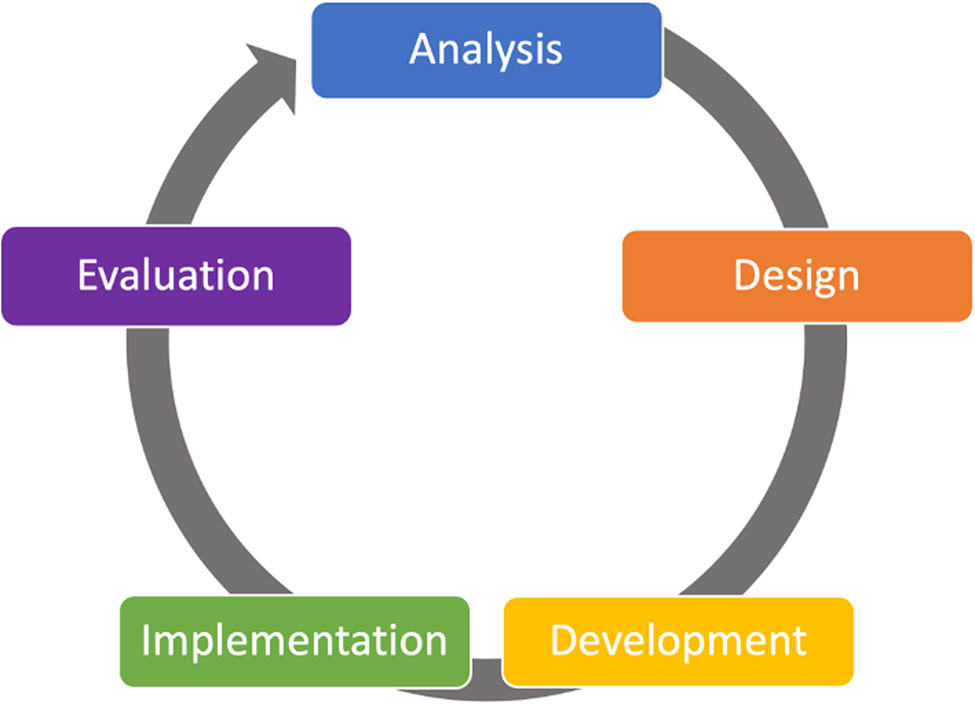
The five steps of the ADDIE approach.
The project, which started from user needs assessment to evaluation of the app, was carried out from July to December 2021 at the Universitas Muhammadiyah Yogyakarta, Bantul, Indonesia. It involved 25 study participants consisting of 10 each of health and non-health students, 3 medical professionals (1 doctor, 1 nurse, and 1 pharmacist), and 2 IT experts from the Universitas Muhammadiyah Yogyakarta. All subjects owned a Google Android smartphone and were able to run apps on it. Meanwhile, the object of the study was Educovid-19, an app that contains educational material on the prevention of COVID-19. The tested aspects were feasibility of the app in terms of suitability or relevance of educational material, organization of the material, evaluation of the material, language used in the material, effects on learning strategies, software engineering, and visual display or user interface. Data collection was carried out by distributing questionnaires.
The research instruments used in this study were qualitative questionnaires for needs analysis, validation of educational material by health professionals, validation of app performance by IT experts, and quantitative questionnaires for usability assessment by students (end-users). The qualitative data were analyzed by recapitulating data for app improvement purposes, while the quantitative data were analyzed using univariate analysis by calculating the frequency distribution and the percentage of application assessment scores.
3 Results
3.1 Participants
The majority of the participants involved in this study were female (n = 15; 60%), aged 15–20 years old (n = 15; 60%), undergraduate (n = 20; 80%), and college students with both health and non-health background (n = 10; 40%). Table 1 shows the demographic of the study participants with various backgrounds (sex, age, level of education, and backgrounds).
Demographic of participants involved in the study (n = 25)
| Respondent characteristics (n = 25) | n (%) |
|---|---|
| Sex | |
| a. Male | 10 (40) |
| b. Female | 15 (60) |
| Age (years) | |
| a. 15–20 | 15 (60) |
| b. 21–25 | 5 (20) |
| c. 26–30 | 0 (0) |
| d. 31–35 | 1 (4) |
| e. 36–40 | 1 (4) |
| f. 41–45 | 1 (4) |
| g. 46–50 | 1 (4) |
| h. 51–55 | 1 (4) |
| Levels of education | |
| a. Undergraduate | 20 (80) |
| b. Graduate | 5 (20) |
| Background | |
| a. Health student | 10 (40) |
| b. Non-health student | 10 (40) |
| c. Doctor | 1 (4) |
| d. Nurse | 1 (4) |
| e. Pharmacy | 1 (4) |
| f. Information technology | 2 (8) |
3.2 Analysis
During this phase, the study participants (students, health professionals, and IT experts) were asked to provide feedback on COVID-19 preventive functions, features, and educational material. The feedback was provided through a questionnaire distributed using a G-form. It was reported that almost all participants (n = 24; 96%) wanted educational material on COVID-19 prevention, followed by other features including COVID-19 statistics (n = 20; 80%), symptom checker (n = 17; 68%), latest news on COVID-19 (n = 15; 60%), vaccine information (n = 14; 56%), and others. The detail of the results of the user needs assessment is shown in Table 2.
Results of user needs assessment
| Required features | Responses, n = 25 (%) |
|---|---|
| Education on COVID-19 prevention | 24 (96) |
| COVID-19 statistics (new cases, death, and recovered) | 20 (80) |
| Symptom checker | 17 (68) |
| Latest news on COVID-19 | 15 (60) |
| Vaccine information | 14 (56) |
| Games | 2 (8) |
| Chatting | 1 (4) |
| Social media | 1 (4) |
| Maps | 1 (4) |
| List of phone numbers | 1 (4) |
| Video call | 1 (4) |
| Online pharmacy | 1 (4) |
According to the results of interviews with study participants, the app should be made simple and quickly accessible, the display or interface should be eye-catching and not too flashy, the educational material should be made simple and easy to understand, multimedia (image or video) should be added to the educational material, and there should be no ads in the application.
3.3 Design
This stage, as the name suggests, was aimed to design a user interface and the function of each app feature. The design approach was carried out using storyboards. The storyboards of the app are shown in Figure 2, while the details of the storyboards are depicted in Table 3.
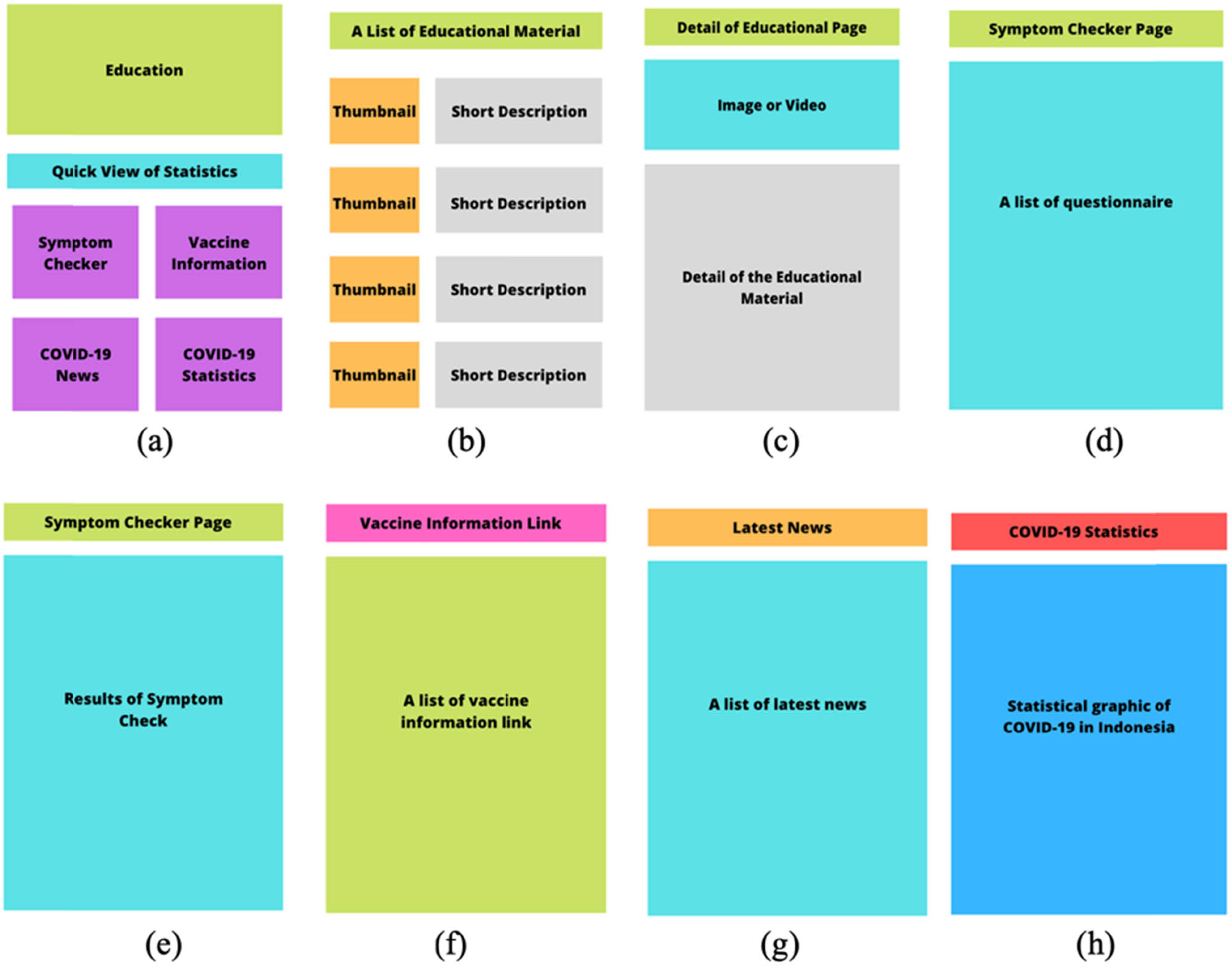
Initial designs of the app, including (a) the main menu containing many features and functions; (b) the list of educational materials; (c) the details of the educational material; (d) the symptom checker page; (e) the results of the symptom checker; (f) the list of vaccine information links; (g) the latest news on COVID-19; and (h) COVID-19 statistics.
Description of the storyboards
| Components | Description |
|---|---|
| Topic of the app | Educational material on COVID-19 prevention |
| Language | Indonesia |
| Systems of the app | The app consists of seven scenes, namely 0–7 |
| Scene 0 was the main menu containing: education, a symptom checker, a list of vaccine information links, the latest news, and the COVID-19 statistics (Figure 2a) | |
| Scene 1 was the list of educational materials (Figure 2b) | |
| Scene 2 was the details of the educational material (Figure 2c) | |
| Scene 3 was the symptom checker page (Figure 2d) | |
| Scene 4 was the results of the symptom checker (Figure 2e) | |
| Scene 5 was the list of vaccine information links (Figure 2f) | |
| Scene 6 was the latest news on COVID-19 (Figure 2g) | |
| Scene 7 was COVID-19 statistics (Figure 2h) |
3.4 Development
During this phase, the storyboards for the educational app were developed to be a prototype. The development process of the app was carried out using Android studio. Figure 3 shows a list of screenshots of the user interface of the app.
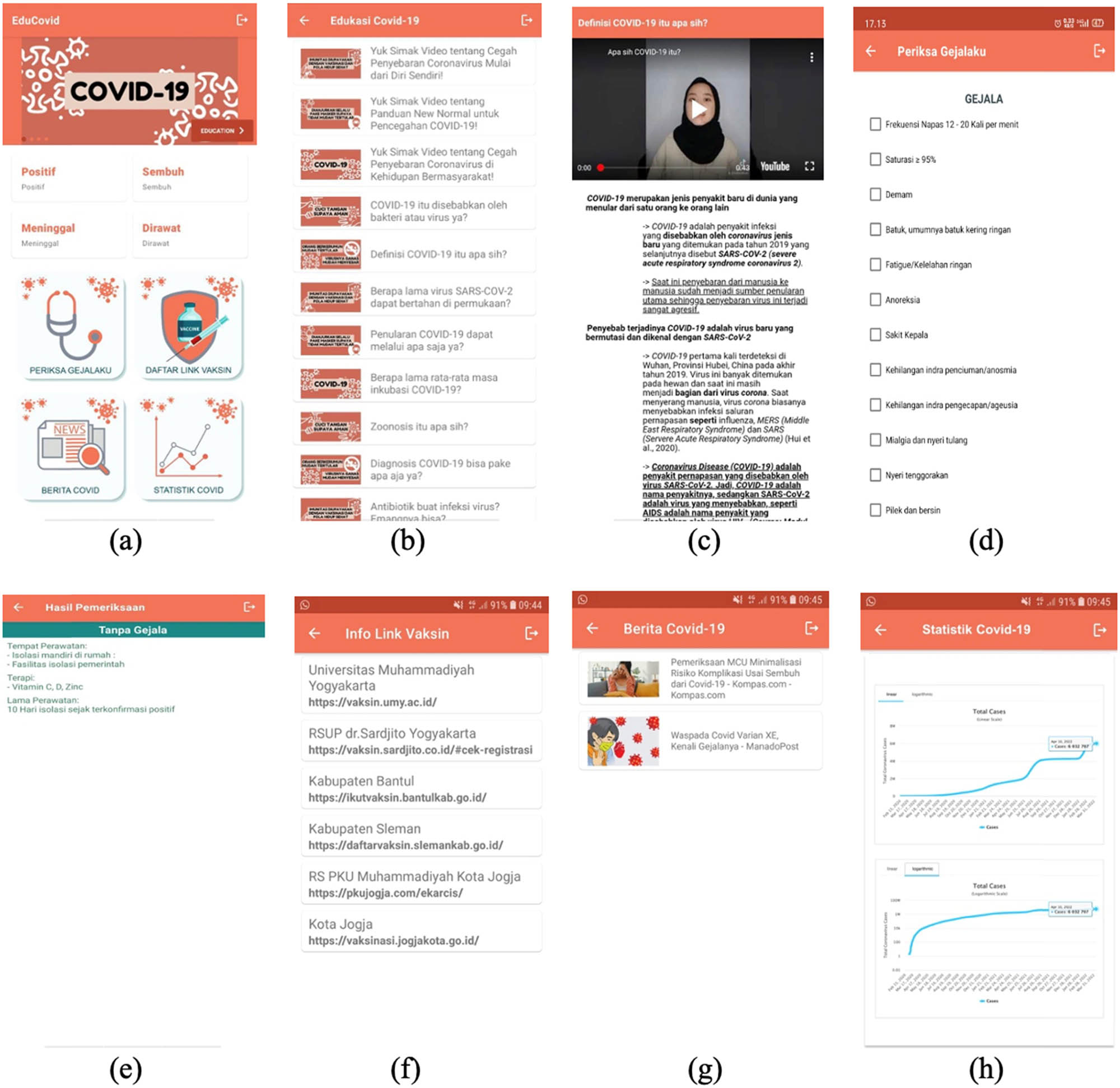
Screenshots of user interface of the Educovid-19 app, including (a) the main menu containing many features and functions; (b) the list of educational materials; (c) the details of the educational material; (d) the symptom checker page; (e) the results of the symptom checker; (f) the list of vaccine information links; (g) the latest news on COVID-19; and (h) COVID-19 statistics.
Figure 3(a) shows a screenshot of the main menu of the app containing many features, including educational materials on COVID-19 prevention, a symptom checker, the latest news on COVID-19, and COVID-19 statistics. Figure 3(b) depicts a list of educational materials on COVID-19 prevention, and Figure 3(c) depicts the details of the educational material page. The page is available in two formats: text and multimedia. All materials were sourced from the Decree of The Minister of Health of The Republic of Indonesia, No. HK.01.07/MENKES/413/2020, regarding COVID-19 prevention and control guidelines.
Figure 3(d) shows features of a symptom checker that included a questionnaire related to COVID-19 symptoms. The questionnaire was sourced from the “guidelines of the treatment of COVID-19 patients based on symptoms” by The Ministry of Health of The Republic of Indonesia. This page was designed like a calculator, and it operates by providing suggestions on the treatment after the questionnaire was fulfilled by patients or users. The results of the test are shown in Figure 3(e). The symptom checker page consists of information including the patients’ place of care, such as self-isolation, health facilities provided by government, field hospital, referral hospital, non-referral hospital, High Care Unit, and Intensive Care Unit. In addition, the page also has many other useful information, including therapy for no-symptom, mild, moderate, and severe, as well as treatment duration.
Figure 3(f) shows a list of vaccine information links, Figure 3(g) shows a screenshot of COVID-19 latest news gathered from many reputable sources, and Figure 3(h) represents the COVID-19 statistics, containing new cases and average numbers of cases in a week. All the data were sourced from Google.
3.5 Implementation
During this phase, the prototype (trial version) of the app was distributed to all study participants to validate the app based on many aspects, ranging from medical professionals to students. The participants from medical professionals (n = 3) were asked to carry out an assessment to validate the prototype based on the aspects of content inside the app, while IT experts (n = 2) were on the aspects of app function, and students (n = 20) were on the aspects of the user. To obtain the validity results of the app, a survey was carried out for 1 week. The details of the results of the assessment are shown in Figures 4–6.
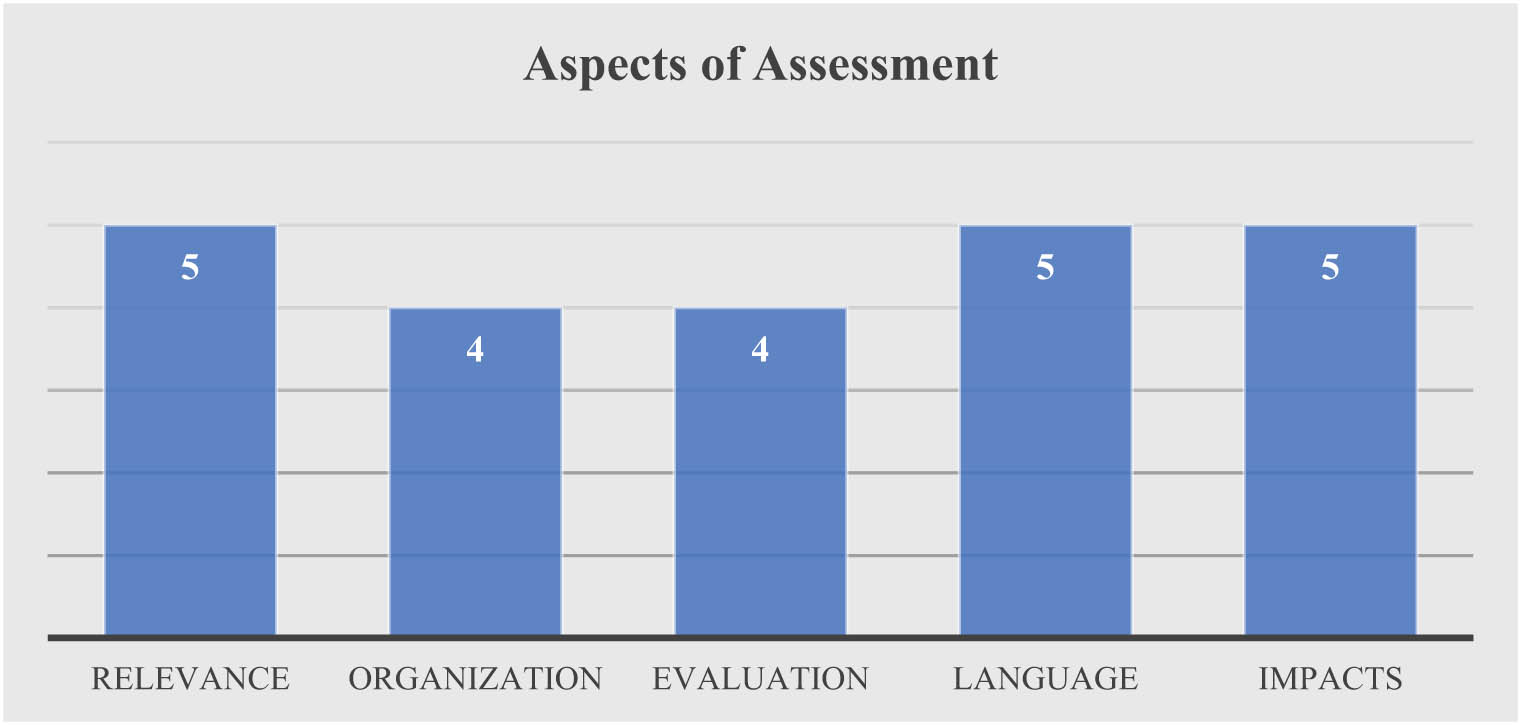
The results of the assessment of the prototype by medical professionals.
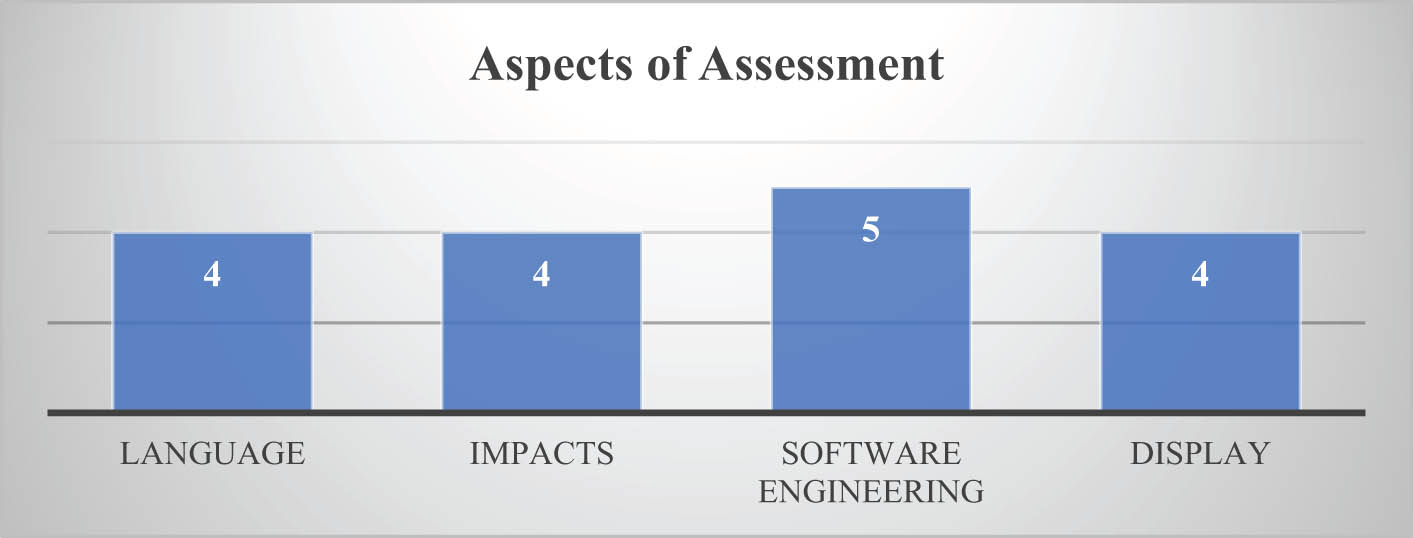
The results of the assessment of the prototype by IT experts.
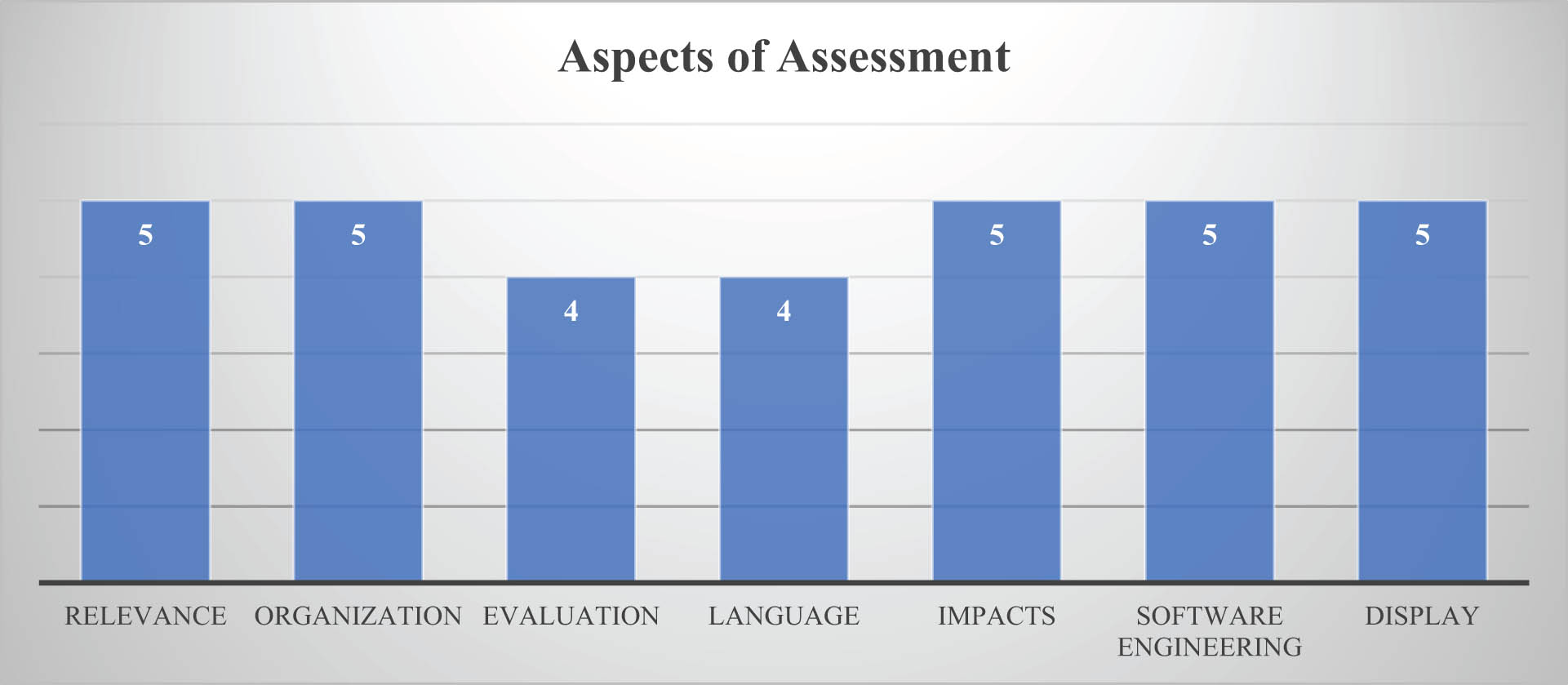
The results of the assessment of the prototype by users.
According to Figure 4, it was reported that the average value of the assessment of the app prototype based on all aspects of material assessment was 4.6 with a percentage value of 92%, indicating that the prototype was very appropriate to be used as an educational app. Similar results were discovered in the aspects of assessment by IT experts (Figure 5), showing that the average value of the assessment of app was 4.25 with a percentage value of 85%, indicating that the prototype was very appropriate to be implemented as an educational app.
The results of the assessment of prototype by users, as shown in Figure 6, found that the average value of the assessment of app prototype based on all aspects of material assessment was 4.7 with a percentage value of 94.2%, indicating that the quality of educational material inside the app and its implementation based on aspects such as the relevance of educational material, the organization of the material, the evaluation of the material, the language used in the material, the effect or impact for the patient education, the software engineering, and the visual display or user interface were very appropriate for use for patient education.
3.6 Evaluation
The evaluation of the educational app was carried out in two ways, namely black-box and user acceptance. The details of both tests are explained subsequently.
3.7 Black-box testing
The test was primarily aimed to determine the functional specifications of the developed software or app by checking whether the output was as expected or not. It was carried out on an ASUS Vivo-Book S14 S430UN – EB732T laptop (Intel Core i7-8550U 1 processor, 6–4.0 GHz), one Samsung Galaxy Tab S4, and one Samsung Galaxy A7 smartphone. The results of the test showed that the educational app could function well. The details of the results of black-box testing are shown in Table 4.
Results of black-box testing of the educational app
| Object | Testing | Input | Output | Result |
|---|---|---|---|---|
| Main menu | Education icon | Clicking the icon | Go to the education page | Valid |
| Symptom checker icon | Clicking the icon | Go to the symptom checker page | Valid | |
| A list of vaccine information link | Clicking the icon | Go to the vaccine information links page | Valid | |
| Latest news icon | Clicking the icon | Go to the latest news page | Valid | |
| COVID-19 statistics icon | Clicking the icon | Go to the COVID-19 statistics page | Valid | |
| Education page | List of educational materials | Clicking the thumbnail | Go to the specific page containing education | Valid |
| Symptom checker page | Questionnaire page | Fulfilling the questionnaire | Go to the page containing the results of the questionnaire | Valid |
| Vaccine information | List of vaccine information links | Clicking the icon | Go to the page containing a list of information links | Valid |
| Vaccine information link | Clicking the link | Go to the page of the targeted link | Valid | |
| Latest news | List of the latest news on COVID-19 | Clicking the thumbnail | Go to the page containing a list of information links | Valid |
| Links of the latest news | Clicking the link | Go to the page of the targeted link | Valid | |
| COVID-19 statistics | Statistical data of COVID-19 in Indonesia | Clicking the thumbnail | Go to the page containing COVID-19 statistics | Valid |
3.8 User acceptance
A user acceptance test was carried out by introducing the features, functions, and methods to run the educational app to all participants, followed up by practicing to run the app directly. The test was conducted at the Muhammadiyah University of Yogyakarta, Bantul, Indonesia, in December 2021 and involved 30 study participants. The participants filled out a questionnaire to provide an assessment of the app. Table 5 shows the details of the results of user acceptance.
Results of the user acceptance
| No. | Question | 1 (%) | 2 (%) | 3 (%) | 4 (%) |
|---|---|---|---|---|---|
| 1 | Is the app display (user interface) interesting enough? | 96 | 4 | 0 | 0 |
| 2 | Is the app interactive to its users? | 92 | 8 | 0 | 0 |
| 3 | Is the app easily installed and easy to run? | 96 | 4 | 0 | 0 |
| 4 | Are you enthusiastic when running this app? | 92 | 8 | 0 | 0 |
| 5 | Are the educational materials in this app in accordance with reliable sources? | 96 | 4 | 0 | 0 |
| 6 | Are the videos on the education page in accordance with reliable sources? | 92 | 8 | 0 | 0 |
| 7 | Does this app make it easier for users to learn how to prevent COVID-19? | 88 | 12 | 0 | 0 |
| 8 | Does this app motivate users to learn COVID-19 prevention? | 84 | 16 | 0 | 0 |
| 9 | Can this app be an alternative media for education in preventing COVID-19? | 80 | 20 | 0 | 0 |
| 10 | Are the educational materials and features in the app interesting? | 92 | 8 | 0 | 0 |
1: strongly agree; 2: agree; 3: disagree; 4: strongly disagree.
4 Discussion
COVID-19 is currently a serious global health issue, with the number of cases increasing every day. According to previous studies, there are many factors that can lead to the transmission of the virus, one of which is the lack of public knowledge about the virus and its prevention [18,19,20], particularly in Indonesia. This is why the study aimed to design and build an educational app that can be used as an alternative digital medium to help patients learn about the prevention of the virus.
This educational app was developed using the ADDIE approach, which consists of several phases, including analysis, design, development, implementation, and evaluation. Based on the validity results of the app, it was determined that the educational app used in this study was very appropriate to be utilized as a digital medium for patient education. The validity assessment of the app was carried out by medical professionals for the relevance of educational content, the organization of the material, the evaluation of the material, the language used in the material, and the effect or impact on patient education, while IT experts assessed the aspects of the language used in the material, the effect or impact for the patient education, the software engineering, and the visual display or user interface, and the students as users covered all aspects ranging from the relevance of the educational content to the visual display or user interface.
In terms of performance, it was confirmed that all features and pages of the app (main menu, education, symptom checker, a list of vaccine information links, the latest news, and the COVID-19 statistics) worked well. The performance of the app was assessed by utilizing black-box testing, which was found in a previous study [21]. Meanwhile, regarding the user assessment, this study used a questionnaire of user acceptance sourced from a previous study [22]. The findings of the user assessment confirmed that almost all participants strongly agree that the user interface of the app was very interesting, the app was interactive to its users, easily installed and easy to run, and enthusiastic when running the app. From the aspects of educational materials, almost all participants strongly agree that the materials (both text and video) were in accordance with a reliable source, namely the Decree of the Minister of Health of the Republic of Indonesia, No. HK.01.07/MENKES/413/2020 regarding COVID-19 prevention and control guidelines. Meanwhile, regarding the aspects of the impact of the app on its users, it was reported that the educational materials and features of the app were interesting and helped participants to learn COVID-19 prevention easily, therefore motivating them to learn the topic. Since the materials and features of the app were useful, the participants strongly agree that the app could be used as an alternative learning medium for patient education and health promotion.
4.1 Strengths and limitations of the study
The strength of this study was all the processes of design, development, and implementation of this educational app involved experts and users of the app (medical professionals, IT experts, and students as users). Therefore, the app has many perspectives from experts or professionals and end-users. In addition, this study was also the first of its kind in Indonesia. However, it should be evaluated in the context of study limitations. First, the study only involved participants with high education background (undergraduate, graduate, master’s, and doctoral degree), aged between 15 and 55 years old, and owning a Google Android OS smartphone; thus, the developed app might not reflect the opinion of those with a lower level of education, under the age of 15 or more than 55 years old, and owning a non-Google Android OS smartphone, such as iOS Apple and Blackberry. Another limitation was that the app was solely built for the Google Android operating system, indicating that other users were unable to use the app. Further studies on the development of the app with Apple iOS or other operating systems were highly required.
Acknowledgment
The authors would like to thank the Department of Pharmaceutical Management, School of Pharmacy, Universitas Muhammadiyah Yogyakarta, editors of the journal, and the reviewers of the manuscript.
-
Funding information: The author states no funding involved.
-
Author contributions: Author has accepted responsibility for the entire content of this manuscript and approved its submission.
-
Conflict of interest: The author states no conflict of interest.
References
[1] Ahmed H, Allaf M, Elghazaly H. COVID-19 and medical education. Lancet Infect Dis. 2020 Jul;20(7):777–8.10.1016/S1473-3099(20)30226-7Search in Google Scholar
[2] Li W, Liao J, Li Q, Baskota M, Wang X, Tang Y, et al. Public health education for parents during the outbreak of COVID-19: A rapid review. Ann Transl Med. 2020 May;8(10):628–8.10.21037/atm-20-3312Search in Google Scholar
[3] Organization WH. COVID-19 weekly epidemiological update, edition 84, 22 March 2022. 2022.Search in Google Scholar
[4] Pan L, Mu M, Yang P, Sun Y, Wang R, Yan J, et al. Clinical characteristics of COVID-19 patients with digestive symptoms in Hubei, China: A descriptive, cross-sectional, multicenter study. Am J Gastroenterol. 2020 May;115(5):766–73.10.14309/ajg.0000000000000620Search in Google Scholar
[5] Struyf T, Deeks JJ, Dinnes J, Takwoingi Y, Davenport C, Leeflang MM, et al. Cochrane COVID-19 Diagnostic Test Accuracy Group. Signs and symptoms to determine if a patient presenting in primary care or hospital outpatient settings has COVID-19 disease. Cochrane Database Syst Rev. 2020 Jul 7 [cited 2022 Apr 2];2022(5). Available from 10.1002/14651858.CD013665.Search in Google Scholar
[6] Abdirizak F, Lewis R, Chowell G. Evaluating the potential impact of targeted vaccination strategies against severe acute respiratory syndrome coronavirus (SARS-CoV) and Middle East respiratory syndrome coronavirus (MERS-CoV) outbreaks in the healthcare setting. Theor Biol Med Model. 2019 Dec;16(1):16.10.1186/s12976-019-0112-6Search in Google Scholar
[7] Ding Q, Lu P, Fan Y, Xia Y, Liu M. The clinical characteristics of pneumonia patients coinfected with 2019 novel coronavirus and influenza virus in Wuhan, China. J Med Virol. 2020 Sep;92(9):1549–55.10.1002/jmv.25781Search in Google Scholar
[8] Chen N, Zhou M, Dong X, Qu J, Gong F, Han Y, et al. Epidemiological and clinical characteristics of 99 cases of 2019 novel coronavirus pneumonia in Wuhan, China: A descriptive study. Lancet. 2020 Feb;395(10223):507–13.10.1016/S0140-6736(20)30211-7Search in Google Scholar
[9] Gyasi RM. Fighting COVID-19: Fear and internal conflict among older adults in Ghana. J Gerontological Soc Work. 2020 Oct 2;63(6–7):688–90.10.4324/9781003138280-46Search in Google Scholar
[10] Brooke J, Jackson D. Older people and COVID‐19: Isolation, risk and ageism. J Clin Nurs. 2020 Jul;29(13–14):2044–6.10.1111/jocn.15274Search in Google Scholar PubMed
[11] Liu PP, Blet A, Smyth D, Li H. The science underlying COVID-19: Implications for the cardiovascular system. Circulation. 2020 Jul 7;142(1):68–78.10.1161/CIRCULATIONAHA.120.047549Search in Google Scholar PubMed
[12] Zeng J-H, Liu Y-X, Yuan J, Wang F-X, Wu W-B, Li J-X, et al. First case of COVID-19 complicated with fulminant myocarditis: A case report and insights. Infection. 2020 Oct;48(5):773–7.10.1007/s15010-020-01424-5Search in Google Scholar PubMed PubMed Central
[13] Sattar Y, Ullah W, Rauf H, Yadav S, Chowdhury M, Connerney M, et al. COVID-19 cardiovascular epidemiology, cellular pathogenesis, clinical manifestations and management. IJC Heart Vasculature. 2020 Aug;29:100589.10.1016/j.ijcha.2020.100589Search in Google Scholar PubMed PubMed Central
[14] Organization WH. Key messages and actions for COVID-19 prevention and control in schools. 2020;1:2.Search in Google Scholar
[15] Ismail SNS, Rangga JU, Rasdi I, Rahman URA, Samah MAA. Mobile apps application to improve safety and health knowledge, attitude and practice among university students. Malays J Med Health Sci. 2018;14:47–55.Search in Google Scholar
[16] Khakim MNL, Afhimma IY, Wijaya KA, Ardiansyah MRI. Infographic development of Blambangan Kingdom for history learning in senior high school. Community empowerment through research, innovation and open access. Milton Park, UK: Routledge; 2021. p. 120–6.10.1201/9781003189206-23Search in Google Scholar
[17] Dick W, Carey L, Carey JO. The systematic design of instruction. Glenview, Illinois: Scott, Foresman and Company; 1978 [cited 2022 Apr 3]; Available from: https://www.semanticscholar.org/paper/The-systematic-design-of-instruction-Dick-Carey/bdee2e8dde217c6a420adf2c90358e1294f2559e.Search in Google Scholar
[18] Kadam AB, Atre SR. Negative impact of social media panic during the COVID-19 outbreak in India. J Travel Med. 2020;27(3):taaa057.10.1093/jtm/taaa057Search in Google Scholar PubMed PubMed Central
[19] Yang K, Liu H, Ma L, Wang S, Tian Y, Zhang F, et al. Knowledge, attitude and practice of residents in the prevention and control of COVID-19: An online questionnaire survey. J Adv Nurs. 2021;77(4):1839–55.10.1111/jan.14718Search in Google Scholar PubMed PubMed Central
[20] Middleton KV. The longer-term impact of COVID-19 on K–12 student learning and assessment. Educ Meas Issues Pract. 2020;39(3):41–4.10.1111/emip.12368Search in Google Scholar
[21] Nidhra S. Black box and white box testing techniques – A literature review. IJESA. 2012 Jun 30;2(2):29–50.10.5121/ijesa.2012.2204Search in Google Scholar
[22] Abu-Dalbouh HM. A questionnaire approach based on the technology acceptance model for mobile tracking on patient progress applications. J Comput Sci. 2013;9(6):763–70.10.3844/jcssp.2013.763.770Search in Google Scholar
© 2022 Muhammad Thesa Ghozali, published by De Gruyter
This work is licensed under the Creative Commons Attribution 4.0 International License.
Articles in the same Issue
- Research Articles
- Fractal approach to the fluidity of a cement mortar
- Novel results on conformable Bessel functions
- The role of relaxation and retardation phenomenon of Oldroyd-B fluid flow through Stehfest’s and Tzou’s algorithms
- Damage identification of wind turbine blades based on dynamic characteristics
- Improving nonlinear behavior and tensile and compressive strengths of sustainable lightweight concrete using waste glass powder, nanosilica, and recycled polypropylene fiber
- Two-point nonlocal nonlinear fractional boundary value problem with Caputo derivative: Analysis and numerical solution
- Construction of optical solitons of Radhakrishnan–Kundu–Lakshmanan equation in birefringent fibers
- Dynamics and simulations of discretized Caputo-conformable fractional-order Lotka–Volterra models
- Research on facial expression recognition based on an improved fusion algorithm
- N-dimensional quintic B-spline functions for solving n-dimensional partial differential equations
- Solution of two-dimensional fractional diffusion equation by a novel hybrid D(TQ) method
- Investigation of three-dimensional hybrid nanofluid flow affected by nonuniform MHD over exponential stretching/shrinking plate
- Solution for a rotational pendulum system by the Rach–Adomian–Meyers decomposition method
- Study on the technical parameters model of the functional components of cone crushers
- Using Krasnoselskii's theorem to investigate the Cauchy and neutral fractional q-integro-differential equation via numerical technique
- Smear character recognition method of side-end power meter based on PCA image enhancement
- Significance of adding titanium dioxide nanoparticles to an existing distilled water conveying aluminum oxide and zinc oxide nanoparticles: Scrutinization of chemical reactive ternary-hybrid nanofluid due to bioconvection on a convectively heated surface
- An analytical approach for Shehu transform on fractional coupled 1D, 2D and 3D Burgers’ equations
- Exploration of the dynamics of hyperbolic tangent fluid through a tapered asymmetric porous channel
- Bond behavior of recycled coarse aggregate concrete with rebar after freeze–thaw cycles: Finite element nonlinear analysis
- Edge detection using nonlinear structure tensor
- Synchronizing a synchronverter to an unbalanced power grid using sequence component decomposition
- Distinguishability criteria of conformable hybrid linear systems
- A new computational investigation to the new exact solutions of (3 + 1)-dimensional WKdV equations via two novel procedures arising in shallow water magnetohydrodynamics
- A passive verses active exposure of mathematical smoking model: A role for optimal and dynamical control
- A new analytical method to simulate the mutual impact of space-time memory indices embedded in (1 + 2)-physical models
- Exploration of peristaltic pumping of Casson fluid flow through a porous peripheral layer in a channel
- Investigation of optimized ELM using Invasive Weed-optimization and Cuckoo-Search optimization
- Analytical analysis for non-homogeneous two-layer functionally graded material
- Investigation of critical load of structures using modified energy method in nonlinear-geometry solid mechanics problems
- Thermal and multi-boiling analysis of a rectangular porous fin: A spectral approach
- The path planning of collision avoidance for an unmanned ship navigating in waterways based on an artificial neural network
- Shear bond and compressive strength of clay stabilised with lime/cement jet grouting and deep mixing: A case of Norvik, Nynäshamn
- Communication
- Results for the heat transfer of a fin with exponential-law temperature-dependent thermal conductivity and power-law temperature-dependent heat transfer coefficients
- Special Issue: Recent trends and emergence of technology in nonlinear engineering and its applications - Part I
- Research on fault detection and identification methods of nonlinear dynamic process based on ICA
- Multi-objective optimization design of steel structure building energy consumption simulation based on genetic algorithm
- Study on modal parameter identification of engineering structures based on nonlinear characteristics
- On-line monitoring of steel ball stamping by mechatronics cold heading equipment based on PVDF polymer sensing material
- Vibration signal acquisition and computer simulation detection of mechanical equipment failure
- Development of a CPU-GPU heterogeneous platform based on a nonlinear parallel algorithm
- A GA-BP neural network for nonlinear time-series forecasting and its application in cigarette sales forecast
- Analysis of radiation effects of semiconductor devices based on numerical simulation Fermi–Dirac
- Design of motion-assisted training control system based on nonlinear mechanics
- Nonlinear discrete system model of tobacco supply chain information
- Performance degradation detection method of aeroengine fuel metering device
- Research on contour feature extraction method of multiple sports images based on nonlinear mechanics
- Design and implementation of Internet-of-Things software monitoring and early warning system based on nonlinear technology
- Application of nonlinear adaptive technology in GPS positioning trajectory of ship navigation
- Real-time control of laboratory information system based on nonlinear programming
- Software engineering defect detection and classification system based on artificial intelligence
- Vibration signal collection and analysis of mechanical equipment failure based on computer simulation detection
- Fractal analysis of retinal vasculature in relation with retinal diseases – an machine learning approach
- Application of programmable logic control in the nonlinear machine automation control using numerical control technology
- Application of nonlinear recursion equation in network security risk detection
- Study on mechanical maintenance method of ballasted track of high-speed railway based on nonlinear discrete element theory
- Optimal control and nonlinear numerical simulation analysis of tunnel rock deformation parameters
- Nonlinear reliability of urban rail transit network connectivity based on computer aided design and topology
- Optimization of target acquisition and sorting for object-finding multi-manipulator based on open MV vision
- Nonlinear numerical simulation of dynamic response of pile site and pile foundation under earthquake
- Research on stability of hydraulic system based on nonlinear PID control
- Design and simulation of vehicle vibration test based on virtual reality technology
- Nonlinear parameter optimization method for high-resolution monitoring of marine environment
- Mobile app for COVID-19 patient education – Development process using the analysis, design, development, implementation, and evaluation models
- Internet of Things-based smart vehicles design of bio-inspired algorithms using artificial intelligence charging system
- Construction vibration risk assessment of engineering projects based on nonlinear feature algorithm
- Application of third-order nonlinear optical materials in complex crystalline chemical reactions of borates
- Evaluation of LoRa nodes for long-range communication
- Secret information security system in computer network based on Bayesian classification and nonlinear algorithm
- Experimental and simulation research on the difference in motion technology levels based on nonlinear characteristics
- Research on computer 3D image encryption processing based on the nonlinear algorithm
- Outage probability for a multiuser NOMA-based network using energy harvesting relays
Articles in the same Issue
- Research Articles
- Fractal approach to the fluidity of a cement mortar
- Novel results on conformable Bessel functions
- The role of relaxation and retardation phenomenon of Oldroyd-B fluid flow through Stehfest’s and Tzou’s algorithms
- Damage identification of wind turbine blades based on dynamic characteristics
- Improving nonlinear behavior and tensile and compressive strengths of sustainable lightweight concrete using waste glass powder, nanosilica, and recycled polypropylene fiber
- Two-point nonlocal nonlinear fractional boundary value problem with Caputo derivative: Analysis and numerical solution
- Construction of optical solitons of Radhakrishnan–Kundu–Lakshmanan equation in birefringent fibers
- Dynamics and simulations of discretized Caputo-conformable fractional-order Lotka–Volterra models
- Research on facial expression recognition based on an improved fusion algorithm
- N-dimensional quintic B-spline functions for solving n-dimensional partial differential equations
- Solution of two-dimensional fractional diffusion equation by a novel hybrid D(TQ) method
- Investigation of three-dimensional hybrid nanofluid flow affected by nonuniform MHD over exponential stretching/shrinking plate
- Solution for a rotational pendulum system by the Rach–Adomian–Meyers decomposition method
- Study on the technical parameters model of the functional components of cone crushers
- Using Krasnoselskii's theorem to investigate the Cauchy and neutral fractional q-integro-differential equation via numerical technique
- Smear character recognition method of side-end power meter based on PCA image enhancement
- Significance of adding titanium dioxide nanoparticles to an existing distilled water conveying aluminum oxide and zinc oxide nanoparticles: Scrutinization of chemical reactive ternary-hybrid nanofluid due to bioconvection on a convectively heated surface
- An analytical approach for Shehu transform on fractional coupled 1D, 2D and 3D Burgers’ equations
- Exploration of the dynamics of hyperbolic tangent fluid through a tapered asymmetric porous channel
- Bond behavior of recycled coarse aggregate concrete with rebar after freeze–thaw cycles: Finite element nonlinear analysis
- Edge detection using nonlinear structure tensor
- Synchronizing a synchronverter to an unbalanced power grid using sequence component decomposition
- Distinguishability criteria of conformable hybrid linear systems
- A new computational investigation to the new exact solutions of (3 + 1)-dimensional WKdV equations via two novel procedures arising in shallow water magnetohydrodynamics
- A passive verses active exposure of mathematical smoking model: A role for optimal and dynamical control
- A new analytical method to simulate the mutual impact of space-time memory indices embedded in (1 + 2)-physical models
- Exploration of peristaltic pumping of Casson fluid flow through a porous peripheral layer in a channel
- Investigation of optimized ELM using Invasive Weed-optimization and Cuckoo-Search optimization
- Analytical analysis for non-homogeneous two-layer functionally graded material
- Investigation of critical load of structures using modified energy method in nonlinear-geometry solid mechanics problems
- Thermal and multi-boiling analysis of a rectangular porous fin: A spectral approach
- The path planning of collision avoidance for an unmanned ship navigating in waterways based on an artificial neural network
- Shear bond and compressive strength of clay stabilised with lime/cement jet grouting and deep mixing: A case of Norvik, Nynäshamn
- Communication
- Results for the heat transfer of a fin with exponential-law temperature-dependent thermal conductivity and power-law temperature-dependent heat transfer coefficients
- Special Issue: Recent trends and emergence of technology in nonlinear engineering and its applications - Part I
- Research on fault detection and identification methods of nonlinear dynamic process based on ICA
- Multi-objective optimization design of steel structure building energy consumption simulation based on genetic algorithm
- Study on modal parameter identification of engineering structures based on nonlinear characteristics
- On-line monitoring of steel ball stamping by mechatronics cold heading equipment based on PVDF polymer sensing material
- Vibration signal acquisition and computer simulation detection of mechanical equipment failure
- Development of a CPU-GPU heterogeneous platform based on a nonlinear parallel algorithm
- A GA-BP neural network for nonlinear time-series forecasting and its application in cigarette sales forecast
- Analysis of radiation effects of semiconductor devices based on numerical simulation Fermi–Dirac
- Design of motion-assisted training control system based on nonlinear mechanics
- Nonlinear discrete system model of tobacco supply chain information
- Performance degradation detection method of aeroengine fuel metering device
- Research on contour feature extraction method of multiple sports images based on nonlinear mechanics
- Design and implementation of Internet-of-Things software monitoring and early warning system based on nonlinear technology
- Application of nonlinear adaptive technology in GPS positioning trajectory of ship navigation
- Real-time control of laboratory information system based on nonlinear programming
- Software engineering defect detection and classification system based on artificial intelligence
- Vibration signal collection and analysis of mechanical equipment failure based on computer simulation detection
- Fractal analysis of retinal vasculature in relation with retinal diseases – an machine learning approach
- Application of programmable logic control in the nonlinear machine automation control using numerical control technology
- Application of nonlinear recursion equation in network security risk detection
- Study on mechanical maintenance method of ballasted track of high-speed railway based on nonlinear discrete element theory
- Optimal control and nonlinear numerical simulation analysis of tunnel rock deformation parameters
- Nonlinear reliability of urban rail transit network connectivity based on computer aided design and topology
- Optimization of target acquisition and sorting for object-finding multi-manipulator based on open MV vision
- Nonlinear numerical simulation of dynamic response of pile site and pile foundation under earthquake
- Research on stability of hydraulic system based on nonlinear PID control
- Design and simulation of vehicle vibration test based on virtual reality technology
- Nonlinear parameter optimization method for high-resolution monitoring of marine environment
- Mobile app for COVID-19 patient education – Development process using the analysis, design, development, implementation, and evaluation models
- Internet of Things-based smart vehicles design of bio-inspired algorithms using artificial intelligence charging system
- Construction vibration risk assessment of engineering projects based on nonlinear feature algorithm
- Application of third-order nonlinear optical materials in complex crystalline chemical reactions of borates
- Evaluation of LoRa nodes for long-range communication
- Secret information security system in computer network based on Bayesian classification and nonlinear algorithm
- Experimental and simulation research on the difference in motion technology levels based on nonlinear characteristics
- Research on computer 3D image encryption processing based on the nonlinear algorithm
- Outage probability for a multiuser NOMA-based network using energy harvesting relays
