Experimental and simulation research on the difference in motion technology levels based on nonlinear characteristics
-
Guiping Liang
 ,
Vidya G. Doddawad
,
Vidya G. Doddawad

Abstract
Wearable and movable lodged health monitoring gadgets, micro-sensors, human system locating gadgets, and other gadgets started to appear as low-power communication mechanisms and microelectronics mechanisms grew in popularity. More people are interested in energy capture technology, which turns the energy created by motion technology into electric energy. To understand the difference in motor skill levels, a nonlinear feature-oriented method was proposed. A bi-stable magnetic-coupled piezoelectric cantilever was designed to detect the horizontal difference of motion technology. The horizontal difference was increased by the acceleration generated by the oscillation of the leg and the impression betwixt the leg and the ground during the movement. Based on the Hamiltonian principle and motion technique signal, a nonlinear dynamic model for energy capture in motion technique is established. According to the shaking features of human leg motion, a moveable nonlinear shaking energy-gaining system was the layout, which realized the dynamic characteristics of straight, nonlinear, mono-stable, and bi-stable. The experimental outcome shows that nonlinearity can effectively detect the difference of motion techniques. The experimental results of different human movement states confirm the benefits of the uncertain bi-stable human power capture mechanism and the effectiveness of the electromechanical combining design established. The nonlinear mono-stable beam moves in the same way as the straight mono-stable beam in the assessment, but owing to its higher stiffness, its frequency concentration range (13.85 Hz) is moved to the right compared to the linear mono-stable beam, and the displacement of the cantilever beam is reduced. If the velocity is 8 km/h, the mean energy of the bi-stable method extends to the utmost value of 23.2 μW. It is proved that the nonlinear method can understand the difference in the level of motion technique effectively.
1 Introduction
Sports technology is a multi-level system that is composed of various technical links and has highly ordered and complex structural characteristics. The quality effect is determined by the coordination degree of each subsystem and each factor in the system, and the overall coordination effect determines the performance of the motion technology. The process of sports technology training is to adjust various factors affecting its quality and coordinate the relationship and connection among various factors guided by the effect of training implementation. The sports technology training system is a very sensitive complex network system that is entangled by various factors and relationships [1]. With fresh ideas and accomplishments, the human species has really upped their game when it comes to constructing durable technology. The ideal fan experience in sports is fully engaged, and everyone has begun to employ several methods to raise the passion and excitement of their most ardent supporters [2,3]. Sports motion analysis investigates athletes’ biomechanics using motion capture software, cameras, and markers. Many sports need complex, detailed moves in addition to quick speeds. It is tough to assess them appropriately in two-dimensional footage. Motion capture software may be used to assess these motions in three dimension [4,5].
With the increasing growth of low-power communication mechanisms and microelectronics mechanisms, wearable and moveable lodged health monitoring gadgets, micro-sensors, human system locating gadgets, and so on began to appear. However, since the number of these gadgets relies on accumulator power and needs to be replaced consistently to maintain long-term use, pursuing dependable energy origin to power these gadgets and reducing their vulnerability to outer batteries have become a main technical requirement for research in this field. Therefore, energy capture technology, which converts the energy generated by motion technology into electric energy, has attracted more and more attention [6]. Wearable athletic equipment is currently available in a range of sizes and styles, with new ones being produced regularly. Devices are being incorporated into the fabric of athletic clothing, fitted into sports gear like balls or bats, and worn by athletes as small devices attached to the body in the form of a belt or skin patch [7,8]. Sensors and equipment used by athletes would have to be practically invisible and weightless, as well as flexible, strong, and impact resistant. At the same time, they must generate precise biometric measurements such as movement, heart rate, respiration, and impact. StretchSense fabric, for example, is developed to suit all of these needs [9,10]. In current years, scholars at home and abroad have read about the energy capture methods of motion technology, such as electromagnetic, thermoelectric, and piezoelectric. Piezoelectric vibration energy capture device has become the distinct of research on human shaking energy capture mechanism because of its features of simple infinitesimal and raised power density. An oscilloscope collects three voltage signals synchronously in motion technology, and the voltage signals are subsequently translated into appropriate acceleration, displacement, and gained voltage signals. More people are interested in energy capture technology, which turns the energy created by motion technology into electric energy. The energy capture techniques of motion technology, such as electromagnetic, thermoelectric, and piezoelectric, have been studied by academics both at home and abroad. Because of its properties of simple infinitesimal and increased power density, the piezoelectric vibration energy capture device has become the focus of research on human shaking energy capture mechanisms.
Movement technical structure is complex, the factors affecting its quality effect for different training stages and different athletes role are different, having a certain difference and variability, which determines the interaction between them on the quality of the movement technology can achieve diversification, namely to different athletes to produce the same result of effect factors cannot; in the same way, the factors that affect the same performance of the same athlete can be different [11]. A motion sensor can detect the movement of an object or a person in relation to its surroundings. A portable motion sensor can gather and store information about a person’s movement, which may later be analyzed. It uses accelerometers and gyroscopes to capture a person’s movements [12,13]. For example, a high jump in the final session of the World athletics championship can also jump over 2.35 m, and pat’s technical index of large differences, the Chinese outstanding high jump athletes also skip the technical index of 2.24 m is also a larger difference; it shows that affecting the quality of the high jump movement technology of the nonlinear interaction between multiple factors makes the performance of the obtained to choose various methods and approaches [14]. Therefore, domestic and foreign researches continue. Cui et al. studied the differences between sitting volleyball technology and sports classes for para-athletes [15]. Sathiyamoorthi et al. studied the comparison of life skills of college PE and non-PE majors from the perspective of socioeconomic status [16]. The purpose of Ferreira Gonzalez et al.’s study was to investigate the differences in inhibitory control and motor adaptation between different types of locomotives (i.e., closed and open skill locomotives) [17]. Gao et al. [18] used magnetic levitation to create a multi-stable vibration energy harvesting device. Only magnetic contact was employed in the fabrication of the harvester, which had a multi-well restoring force potential. Other investigations, on the other hand, used a combination of magnets and piezoelectric cantilevers to build bi-stable and multi-stable energy harvesters [19,20,21]. The use of a third-order polynomial fit to characterize the nonlinear magnetic force, according to Lan and Qin [22], can result in instabilities at small displacements near equilibrium and severe degradation at greater deflections. Quinn et al. [23] looked at the large-amplitude branch of a mono-stable energy harvester’s response and found that the right design might enhance performance significantly. A theoretical analysis for mono-stable energy harvesters was provided by Sebald et al. [24]. The mono-stable harvester was proved to be capable of obtaining maximum harvested power. A bi-stable magnetically coupled piezoelectric cantilever was used to detect a horizontal difference of motion technology. The horizontal difference was enhanced due to the acceleration caused by the leg swing and the impact between the leg and the ground during the action. Using the Hamiltonian principle and motion technique signal, a nonlinear dynamic model for energy capture in motion is built. Experimental findings of diverse human movement states validate the benefits of the nonlinear bi-stable human energy capture mechanism and the efficacy of the electromechanical combining representation created.
The piezo-thermoelastic shell continuum’s shell thermo-electromechanical equations and boundary conditions are derived using Hamilton’s concept. The energy fluctuations over any given time period are assumed to be zero, according to Hamilton’s concept. All energy associated with a piezo-thermoelastic shell continuum exposed to mechanical, thermal, and electric inputs is taken into consideration. Acoustic waves, electrical transmission difficulties, plasma waves, and other spatially extended systems may all be studied using nonlinear dynamics models. A linear chain of discrete oscillators with the nearest neighbor has been used to represent these difficulties. Of course, continuum physics, such as acoustics or fluid mechanics, which employ partial differential equations in space and time, is the limit of such models. When the oscillators’ coupling is nonlinear, a phenomenon occurs.
Based on the current research, this research provides a nonlinear characteristics technique. To detect the horizontal difference of motion technology, a bi-stable magnetic-coupled piezoelectric cantilever was constructed. The acceleration caused by the leg oscillation and the impression between the leg and the ground during movement increased the horizontal difference. A nonlinear dynamic model for energy capture in motion method is developed using the Hamiltonian principle and motion technique signal. According to the vibration features of human leg motion, a moveable nonlinear shaking energy catching system was designed, which realized the dynamic characteristics of straight, nonlinear, mono-stable, and bi-stable. Nonlinearity may efficiently identify the difference in motion approaches, according to the results of the experiments. The benefits of the nonlinear bi-stable human power capture mechanism, and the efficacy of the electromechanical coupling model created is confirmed by the experimental findings of various human movements.
2 Experimental data
2.1 Nonlinear dynamics model
The magnetically coupled piezoelectric cantilever beam structure is designed, in which the rotation angle α, the distance d m and the length h of the cantilever beam are variable and the outer magnet can be disassembled [25]. By adjusting the prior parameters, dissimilar nonlinear repairing forces can be acquired, to obtain the piezoelectric cantilever beam with dissimilar potential wells. Based on the Hamiltonian principle, the variation V I of the Lagrangian function of the piezoelectric cantilever should be constant at 0 at any time t 1 and t 2. That is, Eq. (1)
where δ is the variation sign; E k, E p, and E k are kinetic energy, potential energy, and external excitation energy, respectively. The deformation of the mass block at the end of the cantilever beam is small and can be regarded as the concentrated mass. Then, each quantity in Eq. (1) can be expressed as:
In Eq. (2),V S and V p are the volume of the intermediate layer and the volume of the piezoelectric layer, respectively; ρ s and ρ p are the density of the intermediate layer and the density of the piezoelectric layer, respectively; U is the deflection of the cantilever beam; m t is the concentrated mass at the end; N f and N q are the numbers of forces acting on the cantilever beam and the number of electric quantity, respectively; f i (x i ) is the force acting on x i ; v′ and q j are respectively the voltage and charge acting on the suspension beam; S, T, D, and E represent strain vector, stress vector, electric displacement vector, and electric field intensity vector, respectively. After finishing, the electromechanical coupling model of the magnetic coupled pressure cantilever structure can be obtained as Eq. (3):
where M, C, and θ represent the equivalent mass, equivalent damping, and equivalent electromechanical coupling coefficient, respectively; C
p is the equivalent capacitance of PZT; x(t)is the displacement at the end of the cantilever beam; R is the load resistance; V(t) is the voltage at both ends of R; a(t) is the acceleration of outer excitation; F
r is the nonlinear repairing force of the cantilever beam, which is expressed as
2.2 Experimental design
In the experiment, the metal layer in the middle of the cantilever beam is made of stainless steel with a size of 95 mm × 10 mm × 0.27 mm, and the piezoelectric plate is PZT-51 with a size of 12 mm × 10 mm × 0.6 mm. The two pieces are attached in parallel. All magnets in the device are rubidium iron boron enduring magnets. The size of the magnet at the end of the cantilever beam is 8 mm × 6 mm × 4 mm, the diameter of the external magnet is 25 mm, and the thickness is 5 mm. To acquire the acceleration generated by leg swing and ground impression in the process of motion technology and take it as the external excitation signal a(t) of subsequent simulation, the acceleration sensor is used to collect the acceleration of small leg position in the process of motion. The cantilever ray with dissimilar ability wells is acquired by adjusting the external magnet, and the displacement of the cantilever beam end is measured by the laser displacement sensor, to read about the nonlinear movement characteristics of the piezoelectric cantilever beam in the process of motion technology. The acceleration sensor is fixed to the root of the energy harvesting device, and the displacement sensor is attached with screws. The shaking direction of the piezoelectric cantilever beam is consistent with the swing direction of the leg. In motion technology, three voltage signals are collected synchronously by an oscilloscope, and then, the voltage signals are converted into corresponding acceleration signals, displacement signals, and gained voltage signals. In the experiment, the human body exercised on the treadmill, and the speed VT of the treadmill was adjusted to respectively test the acceleration signal, the energy capture voltage, and the end displacement of the cantilever beam at dissimilar speeds [26].
To study the benefits of bi-stable shaking energy capture mechanism of motion technology, three kinds of cantilever beam structures including linear mono-stable, nonlinear mono-stable, and bi-stable were designed and compared by modifying the position parameters of the outer magnet. The rising repulsive magnetic force will cause the clamped–clamped beam to bend as the cantilever beam approaches the center position (unstable equilibrium position), hence increasing the distance between the two magnets and lowering the potential energy barrier. This is advantageous for achieving the goal of leaping between possible wells. The repulsive magnetic force will diminish, and the clamped–clamped beam will return once the cantilever beam passes through the middle position, maintaining the system’s bi-stable feature. The specific structural parameters are as follows: nonlinear mono-stable beams d m = 58 mm, h = 17 mm, and α = 0°; bi-stable beam d m = 55 mm, d m = 15 mm, and α = 10°. The energy capture device is a linear mono-stable beam after removing the external magnet [12,27].
In the static horizontal position, the relationship between restoring force and displacement under different steady-state conditions was measured with an advanced digital dynamometer and digital displacement kit of measuring bench. The measurement results are shown in Figure 1. By polynomial fitting, the restoring force curve equations of the cantilever beam under different steady-state conditions are obtained as follows: linear mono-stable beam, F
r1
= 24.8x; nonlinear mono-stable beam,
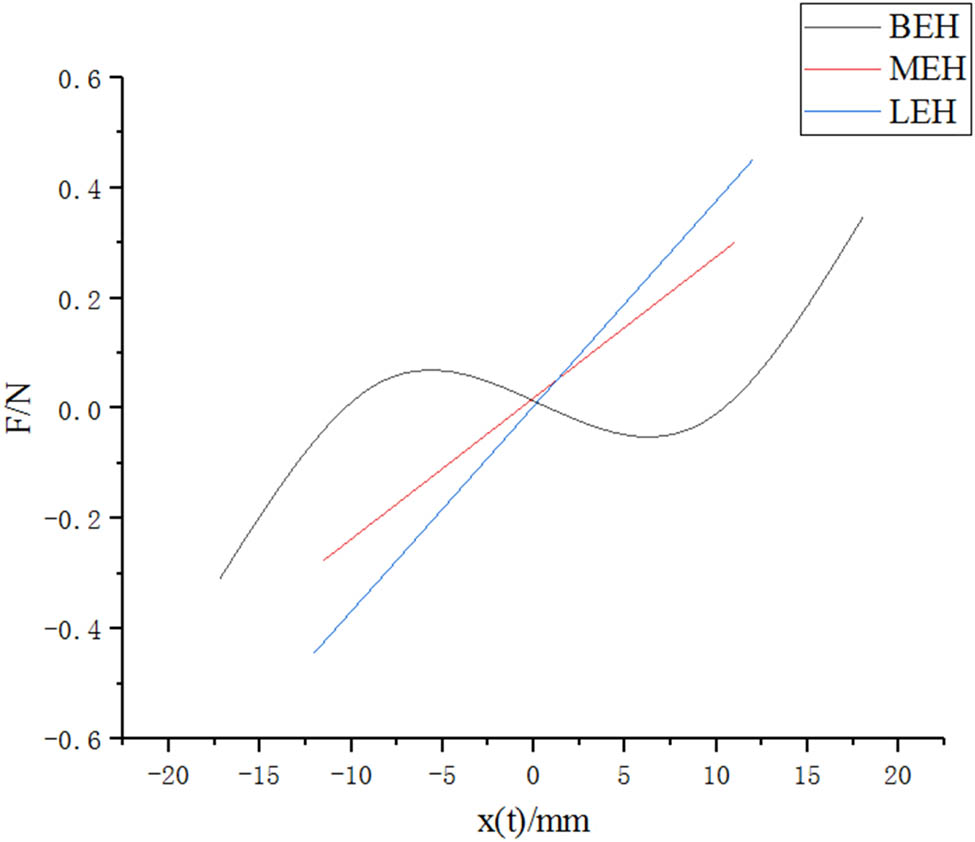
Measurement values of restoring forces of different steady-state cantilevers.
By integrating each restoring force equation, the corresponding potential energy function U(x) can be obtained, as shown in Figure 2.
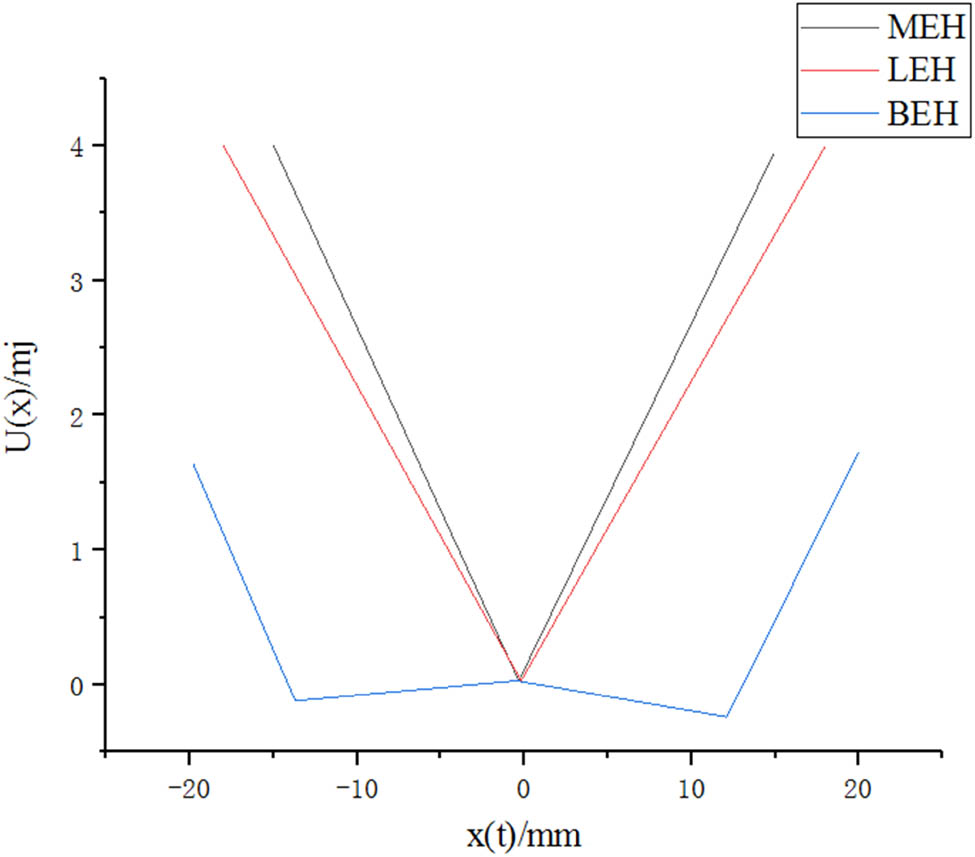
Potential energy curves of different steady-state cantilevers.
2.3 Analysis of sports techniques
To study the movement features of the human body, the vibration data acquisition system designed earlier was used to collect different objects (subject A, male, height 175 cm, and mass 63 kg; Object B, male, 170 cm in height, and 73.5 kg in mass). At different motion speeds, the relationship between real-time acceleration and time change and its spectrum are shown in Figure 3. The measured acceleration signal will be used as the external excitation signal of the simulation timing electric model [28,29].
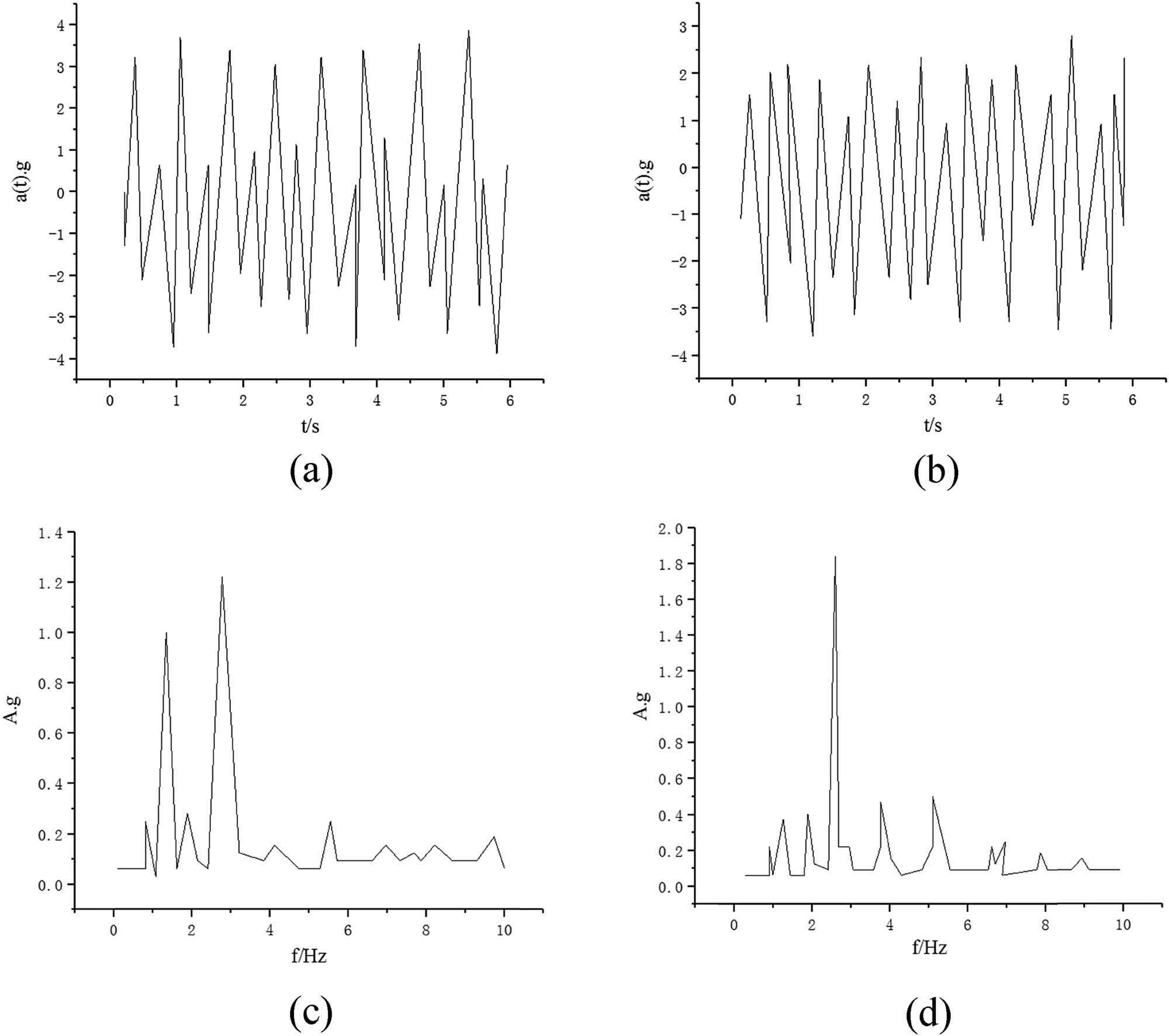
Acceleration signal and its spectrum at different velocities: (a) acceleration signal of A, (b) acceleration signal of B, (c) acceleration frequency of A, and (d) acceleration frequency of B.
As can be seen from Figure 3, the leg acceleration of subjects A and B increase with the increase in movement speed, reaching A maximum of about 4G, showing A certain asymmetry. It can be seen from the spectrum analysis that the acceleration frequency grows with the increase in the motion velocity, and it is mainly concentrated at the frequency of the motion technology and its multiplier. At the speed of 5 km/h, the motion frequencies of subjects A and B are 0.95 and 1 Hz, while at the speed of 8 km/h, the motion frequencies of subjects A and B are 1.4 and 1.3 Hz, showing certain individual differences. The motion spectrum of the human body is mostly focused in the low-frequency region, so it is difficult to design low-frequency piezoelectric cantilever beams in microstructures. The traditional linear piezoelectric cantilever beam mostly acquires the concept of mechanical resonance. In the process of motion technology, the shaking energy band of the leg moves with time, resulting in the capacity of shaking energy catching which is greatly reduced. Therefore, this article designs a nonlinear bi-stable piezoelectric cantilever beam, hoping to understand the level difference of motion technology.
3 Simulation experiment
To confirm the effectiveness of the established nonlinear electro-mechanical coupling model, the acceleration signal collected by subject A when walking at A speed of 5 km/h is used for numerical simulation. Simulation time to model the voltage V(t) and velocity V(t) of the initial value is set to 0; the linear beam and nonlinear mono-stable beam displacement of the initial value is set to 0; the bi-stable beam displacement of the initial value is set to its potential well-steady point of x 0; the output voltage of the beam, the moving parts, voltage frequency spectrum, and phase trajectory is used to analyze them captive to performance. The maximum value and mean square value of absolute voltage in each case are calculated. Considering that the load resistance R is 10 Mω, the maximum voltage and average power of the linear mono-stable beam simulation results are 10.19 V and 1.3 μW. The maximum voltage of the nonlinear mono-stable beam is 8.6 V, and the average power is 0.73 μW, which is lower than that of the linear mono-stable beam. The maximum voltage and average power of the bi-stable beam are 19.5 V and 5.1 μW, respectively. The simulation results show that compared with the linear mono-stable beam, the nonlinear mono-stable beam produces a smaller voltage output. The main reason is that the modulated nonlinear mono-stable beam has a larger stiffness and behaves as a hard characteristic, so its amplitude is smaller under the same excitation signal. The frequency range of the linear mono-stable beam is concentrated at 12.55 Hz, while the frequency range of the nonlinear mono-stable beam is concentrated at 13.95 Hz, which is 1.4 Hz behind the linear mono-stable beam, mainly due to the larger stiffness of the nonlinear mono-stable beam. Compared with the linear and nonlinear mono-stable beam, the bi-stable beam has a better horizontal difference effect, and its power output is increased several times. The introduction of the nonlinear restoring force in the bi-stable system makes the stiffness of the cantilever beam very small, and even negative stiffness appears within a certain range, and the bi-stable system has two stable equilibrium points. After being excited, the end of the cantilever beam will cross the potential well and do a reciprocating motion between the two equilibrium points, which increases the horizontal difference. As can be seen from the voltage spectrum diagram, the frequency range of the cantilever beam is mainly concentrated in the range of 4–8 Hz. Compared with the linear mono-stable beam and the nonlinear mono-stable beam, the frequency of the cantilever beam has an obvious forward shift, which is mainly caused by the nonlinear magnetic force making the stiffness of the cantilever beam smaller.
4 Results and discussion
The genetic characteristics of athletes are generated inside the human body system, which does not change with the change of external conditions. It dominates the evolution and development of athletes’ competitive ability throughout. Therefore, genetic characteristics are the order parameters of competitive ability system evolution. Genetic characteristics can reveal the potential of various innate qualities that affect the human body’s competitive ability and reflect the development level of body shape, physiological function, and sports quality that changes with age. It determines the development level of athletes’ physical ability, skills, tactical ability, sports intelligence, and psychological ability, and thus the selection of sports materials, sports training, sports competition, and sports management of the entire process of competitive sports composition.
According to the characteristics of different events, the characteristics of different athletes and the law of human growth and development, sports selection, sports training, sports competition, and sports management should be carried out on the basis of human genetic characteristics, so that athletes’ competitive potential can be explored systematically and their competitive ability can be continuously developed. When selecting materials for sports, the characteristics of sports items should be fully considered. According to the genetic characteristics, scientific testing and prediction methods should be used to improve the success rate of material selection. During sports training, the training content, training method, training means, and load control should be different due to the different age characteristics, project characteristics, and stage tasks of athletes. The success or failure of sports training, sports direct embodiment, genetic characteristics use the motion indirectly, the process of sports competition, not according to the vested interest force teenager athletes prematurely in adults. This frequently leads to early special or excessive training, as well as drug use, which causes significant harm to the adolescent body and the competition. Sports management is the prerequisite to ensure the successful selection of sports materials, sports training, and sports competition. It is necessary to formulate a feasible management system according to the characteristics of different sports and athletes, especially for young athletes to formulate a complete set of training mechanisms including the cultivation of humanistic quality. The motion of the nonlinear mono-stable beam in the evaluation is the same as that of the straight mono-stable beam, but due to its larger stiffness, its frequency concentration range (13.85 Hz) is moved to the right compared with that of the linear mono-stable beam, and the displacement of the cantilever beam is smaller than that of the linear mono-stable beam. In the process of motion, the bi-stable beam vibrates greatly across and between the potential wells due to the swing of the leg and the influence between the bi-stable beam and the ground, resulting in high voltage. In addition, the bi-stable beam crosses the potential well extra frequently due to the increase in speed, so the power output generated at a larger motion speed is greater.
5 Conclusion
A strategy for nonlinear features is presented in this research. The horizontal difference of motion technology was detected using a bi-stable magnetically linked piezoelectric cantilever. The acceleration created by the leg swing and the collision between the leg and the ground during the movement increased the horizontal difference. A nonlinear dynamic model for energy capture in motion method is developed using the Hamiltonian principle and motion technique signal. A portable nonlinear shaking energy-capturing system was built based on the shaking characteristics of human leg motion, and it realized the dynamic characteristics of straight, nonlinear, mono-stable, and bi-stable. Nonlinearity may efficiently identify the difference in motion approaches, according to the results of the experiments. The benefits of the nonlinear bi-stable human energy capture mechanism and the effectiveness of the electromechanical combining representation established are confirmed by the experimental results of various human movement states. When traveling at 8 km/h, the bi-stable system’s total power reaches a maximum of 23.2 W. It has been demonstrated that the nonlinear approach can effectively interpret the difference in the degree of motion methodology.
Acknowledgments
Authors are thankful to the Guangdong Provincial Department of Education, Soliton of some nonlinear wave equations, Project No: 2017GKTSCX111.
-
Author contributions: All authors have accepted responsibility for the entire content of this manuscript and approved its submission.
-
Conflict of interest: The authors state no conflict of interest.
-
Data availability statement: The data used to support the findings of this study are available from the corresponding author upon request.
References
[1] Hodges NJ, Wyder-Hodge PA, Hetherington S, Baker J, Spering M. Topical review: perceptual-cognitive skills, methods, and skill-based comparisons in interceptive sports. Optometry Vis Sci. 2021;98(7):681–95.10.1097/OPX.0000000000001727Search in Google Scholar PubMed
[2] Rookwood J. Diversifying the fan experience and securitising crowd management: a longitudinal analysis of fan park facilities at 15 football mega events between 2002 and 2019. Managing Sport and Leisure. 2021:1–19.10.1080/23750472.2021.1985596Search in Google Scholar
[3] Caulfield J, Jha AK. Stadiums and digitalization: an exploratory study of digitalization in sports stadiums. J Decis Syst. 2022:1–10. 10.1080/12460125.2022.2073629.Search in Google Scholar
[4] van der Kruk E, Reijne MM. Accuracy of human motion capture systems for sport applications; state-of-the-art review. Eur J Sport Sci. 2018;18(6):806–19. 10.1080/17461391.2018.1463397.Search in Google Scholar PubMed
[5] Bernardina GRD, Monnet T, Pinto HT, de Barros RML, Cerveri P, Silvatti AP. Are action sport cameras accurate enough for 3D motion analysis? A comparison with a commercial motion capture system. J Appl Biomech. 2019;35(1):80–6. 10.1123/jab.2017-0101.Search in Google Scholar PubMed
[6] Jia L, Shen J, Hu K, Zhu T. Experimental study on the effect of heat transfer temperature difference on frosting characteristics of air-cooled heat exchanger. IOP Conf Ser Earth Environ Sci. 2021;791(1):012123.10.1088/1755-1315/791/1/012123Search in Google Scholar
[7] Scataglini S, Moorhead AP, Feletti F. A systematic review of smart clothing in sports: possible applications to extreme sports. Muscles, Ligaments Tendons J. 2022;10(2):333. 10.32098/mltj.02.2020.19.Search in Google Scholar
[8] Vyas S, Bhargava D, Bhola J, Ujjan JA, Eswaran S, Rahmani AW. Critical retrospection of performance of emerging mobile technologies in health data management. J Healthc Eng. 2022;2022:Article ID 8903604, 12 pages. 10.1155/2022/8903604.Search in Google Scholar PubMed PubMed Central
[9] Lokhande MP, Patil DD, Patil LV, Shabaz M. Machine-to-Machine communication for device identification and classification in secure telerobotics surgery. Sec Commun Netw. 2021;2021:1–16. 10.1155/2021/5287514.Search in Google Scholar
[10] Nedoma J, Fajkus M, Martinek R, Nazeran H. Vital sign monitoring and cardiac triggering at 1.5 tesla: A practical solution by an MR-ballistocardiography fiber-optic sensor. Sensors. 2019;19(3):470. 10.3390/s19030470.Search in Google Scholar PubMed PubMed Central
[11] Lappalainen K, Valkealahti S. Experimental study of the maximum power point characteristics of partially shaded photovoltaic strings. Appl Energy. 2021;301(2):117436.10.1016/j.apenergy.2021.117436Search in Google Scholar
[12] Wagner JF. About motion measurement in sports based on gyroscopes and accelerometers—an engineering point of view. Gyroscopy Navig. 2018;9(1):1–18. 10.1134/s2075108718010091.Search in Google Scholar
[13] Wang G. Zhuang L, Song Y, He M, Ma D, Ma L. Exact acceleration of complex real-time model checking based on overlapping cycle. Peer J Comput. 2020;6:e272. 10.7717/peerj-cs.272.Search in Google Scholar PubMed PubMed Central
[14] Rogora D, Nazzari S, Radoman U, Radakovic ZR. Experimental research on the characteristics of radiator batteries of oil immersed power transformers. IEEE Trans Power Delivery. 2020;35(2):725–34.10.1109/TPWRD.2019.2925451Search in Google Scholar
[15] Cui H, Wang Q, Lian Z, Li L. Theoretical model and experimental research on friction and torque characteristics of hydro-viscous drive in mixed friction stage. Chin J Mech Eng. 2019;32(1):80.10.1186/s10033-019-0393-zSearch in Google Scholar
[16] Sathiyamoorthi R, Sankaranarayanan G, Kumaar S, Chiranjeevi T, Kumar DD. Experimental investigation on performance, combustion and emission characteristics of a single cylinder diesel engine fuelled by biodiesel derived from cymbopogon martinii. Renew Energy. 2019;132:394–415.10.1016/j.renene.2018.08.001Search in Google Scholar
[17] Ferreira González D, Göttsche U, Netzband S, Abdel-Maksoud M. Advances on simulation of wave-body interactions under consideration of the nonlinear free water surface. Ship Technol Res. 2020;6870:1–14.10.1080/09377255.2020.1836551Search in Google Scholar
[18] Gao M, Wang Y, Wang Y, Wang P. Experimental investigation of non-linear multi-stable electromagnetic-induction energy harvesting mechanism by magnetic levitation oscillation. Appl Energy. 2018;220:856–75.10.1016/j.apenergy.2018.03.170Search in Google Scholar
[19] Harne RL, Wang KW. A review of the recent research on vibration energy harvesting via bistable systems. Smart Mater Struct. 2013;22(2):023001.10.1088/0964-1726/22/2/023001Search in Google Scholar
[20] Wang G, Liao WH, Yang B, Wang X, Xu W, Li X. Dynamic and energetic characteristics of a bistable piezoelectric vibration energy harvester with an elastic magnifier. Mech Syst Sig Process. 2018;105:427–46.10.1016/j.ymssp.2017.12.025Search in Google Scholar
[21] Ferrari M, Ferrari V, Guizzetti M, Ando B, Baglio S, Trigona C. Improved energy harvesting from wideband vibrations by nonlinear piezoelectric converters. Sens Actuators A. 2010;162(2):425–31.10.1016/j.sna.2010.05.022Search in Google Scholar
[22] Lan C, Qin W. Enhancing ability of harvesting energy from random vibration by decreasing the potential barrier of bistable harvester. Mech Syst Sig Process. 2017;85:71–81.10.1016/j.ymssp.2016.07.047Search in Google Scholar
[23] Quinn DD, Triplett AL, Bergman LA, Vakakis AF. Comparing linear and essentially nonlinear vibration-based energy harvesting. J Vib Acoust. 2011;133:011001.10.1115/SMASIS2008-463Search in Google Scholar
[24] Sebald G, Kuwano H, Guyomar D, Ducharne B. Simulation of a Duffing oscillator for broadband piezoelectric energy harvesting. Smart Mater Struct. 2011;20:075022.10.1088/0964-1726/20/7/075022Search in Google Scholar
[25] Chen C, Huang C, Xu H, Li Z, Wu Z. Experimental and numerical research on motion characteristics of a small caliber bullet in muzzle flows. Binggong Xuebao/Acta Armamentarii. 2019;40(2):265–75.Search in Google Scholar
[26] Wang J, Wen X, Liu K, Jiang M, Wang Z. Experimental study of the motion characteristics of a bubble near a flexible structure with an attached air bubble. Ocean Eng. 2021;235(3):109393.10.1016/j.oceaneng.2021.109393Search in Google Scholar
[27] Huang X, Sharma A, Shabaz M. Biomechanical research for running motion based on dynamic analysis of human multi-rigid body model. Int J Syst Assur Eng Manag. 2021;1–8. 10.1007/s13198-021-01563-4.Search in Google Scholar
[28] Entschew EM. Acceleration through digital communication: Theorizing on a perceived lack of time. Humanist Manag J. 2021;6(2):273–87. 10.1007/s41463-020-00103-9.Search in Google Scholar
[29] He L, Zhang Z, Zhou J, Hu D, Hou Y, Li Q, et al. Research and experimental verification of the characteristics of asymmetric multi-stage fluid guiding body piezoelectric pump. Rev Sci Instrum. 2021;92(7):075004.10.1063/5.0055795Search in Google Scholar PubMed
© 2022 Guiping Liang et al., published by De Gruyter
This work is licensed under the Creative Commons Attribution 4.0 International License.
Articles in the same Issue
- Research Articles
- Fractal approach to the fluidity of a cement mortar
- Novel results on conformable Bessel functions
- The role of relaxation and retardation phenomenon of Oldroyd-B fluid flow through Stehfest’s and Tzou’s algorithms
- Damage identification of wind turbine blades based on dynamic characteristics
- Improving nonlinear behavior and tensile and compressive strengths of sustainable lightweight concrete using waste glass powder, nanosilica, and recycled polypropylene fiber
- Two-point nonlocal nonlinear fractional boundary value problem with Caputo derivative: Analysis and numerical solution
- Construction of optical solitons of Radhakrishnan–Kundu–Lakshmanan equation in birefringent fibers
- Dynamics and simulations of discretized Caputo-conformable fractional-order Lotka–Volterra models
- Research on facial expression recognition based on an improved fusion algorithm
- N-dimensional quintic B-spline functions for solving n-dimensional partial differential equations
- Solution of two-dimensional fractional diffusion equation by a novel hybrid D(TQ) method
- Investigation of three-dimensional hybrid nanofluid flow affected by nonuniform MHD over exponential stretching/shrinking plate
- Solution for a rotational pendulum system by the Rach–Adomian–Meyers decomposition method
- Study on the technical parameters model of the functional components of cone crushers
- Using Krasnoselskii's theorem to investigate the Cauchy and neutral fractional q-integro-differential equation via numerical technique
- Smear character recognition method of side-end power meter based on PCA image enhancement
- Significance of adding titanium dioxide nanoparticles to an existing distilled water conveying aluminum oxide and zinc oxide nanoparticles: Scrutinization of chemical reactive ternary-hybrid nanofluid due to bioconvection on a convectively heated surface
- An analytical approach for Shehu transform on fractional coupled 1D, 2D and 3D Burgers’ equations
- Exploration of the dynamics of hyperbolic tangent fluid through a tapered asymmetric porous channel
- Bond behavior of recycled coarse aggregate concrete with rebar after freeze–thaw cycles: Finite element nonlinear analysis
- Edge detection using nonlinear structure tensor
- Synchronizing a synchronverter to an unbalanced power grid using sequence component decomposition
- Distinguishability criteria of conformable hybrid linear systems
- A new computational investigation to the new exact solutions of (3 + 1)-dimensional WKdV equations via two novel procedures arising in shallow water magnetohydrodynamics
- A passive verses active exposure of mathematical smoking model: A role for optimal and dynamical control
- A new analytical method to simulate the mutual impact of space-time memory indices embedded in (1 + 2)-physical models
- Exploration of peristaltic pumping of Casson fluid flow through a porous peripheral layer in a channel
- Investigation of optimized ELM using Invasive Weed-optimization and Cuckoo-Search optimization
- Analytical analysis for non-homogeneous two-layer functionally graded material
- Investigation of critical load of structures using modified energy method in nonlinear-geometry solid mechanics problems
- Thermal and multi-boiling analysis of a rectangular porous fin: A spectral approach
- The path planning of collision avoidance for an unmanned ship navigating in waterways based on an artificial neural network
- Shear bond and compressive strength of clay stabilised with lime/cement jet grouting and deep mixing: A case of Norvik, Nynäshamn
- Communication
- Results for the heat transfer of a fin with exponential-law temperature-dependent thermal conductivity and power-law temperature-dependent heat transfer coefficients
- Special Issue: Recent trends and emergence of technology in nonlinear engineering and its applications - Part I
- Research on fault detection and identification methods of nonlinear dynamic process based on ICA
- Multi-objective optimization design of steel structure building energy consumption simulation based on genetic algorithm
- Study on modal parameter identification of engineering structures based on nonlinear characteristics
- On-line monitoring of steel ball stamping by mechatronics cold heading equipment based on PVDF polymer sensing material
- Vibration signal acquisition and computer simulation detection of mechanical equipment failure
- Development of a CPU-GPU heterogeneous platform based on a nonlinear parallel algorithm
- A GA-BP neural network for nonlinear time-series forecasting and its application in cigarette sales forecast
- Analysis of radiation effects of semiconductor devices based on numerical simulation Fermi–Dirac
- Design of motion-assisted training control system based on nonlinear mechanics
- Nonlinear discrete system model of tobacco supply chain information
- Performance degradation detection method of aeroengine fuel metering device
- Research on contour feature extraction method of multiple sports images based on nonlinear mechanics
- Design and implementation of Internet-of-Things software monitoring and early warning system based on nonlinear technology
- Application of nonlinear adaptive technology in GPS positioning trajectory of ship navigation
- Real-time control of laboratory information system based on nonlinear programming
- Software engineering defect detection and classification system based on artificial intelligence
- Vibration signal collection and analysis of mechanical equipment failure based on computer simulation detection
- Fractal analysis of retinal vasculature in relation with retinal diseases – an machine learning approach
- Application of programmable logic control in the nonlinear machine automation control using numerical control technology
- Application of nonlinear recursion equation in network security risk detection
- Study on mechanical maintenance method of ballasted track of high-speed railway based on nonlinear discrete element theory
- Optimal control and nonlinear numerical simulation analysis of tunnel rock deformation parameters
- Nonlinear reliability of urban rail transit network connectivity based on computer aided design and topology
- Optimization of target acquisition and sorting for object-finding multi-manipulator based on open MV vision
- Nonlinear numerical simulation of dynamic response of pile site and pile foundation under earthquake
- Research on stability of hydraulic system based on nonlinear PID control
- Design and simulation of vehicle vibration test based on virtual reality technology
- Nonlinear parameter optimization method for high-resolution monitoring of marine environment
- Mobile app for COVID-19 patient education – Development process using the analysis, design, development, implementation, and evaluation models
- Internet of Things-based smart vehicles design of bio-inspired algorithms using artificial intelligence charging system
- Construction vibration risk assessment of engineering projects based on nonlinear feature algorithm
- Application of third-order nonlinear optical materials in complex crystalline chemical reactions of borates
- Evaluation of LoRa nodes for long-range communication
- Secret information security system in computer network based on Bayesian classification and nonlinear algorithm
- Experimental and simulation research on the difference in motion technology levels based on nonlinear characteristics
- Research on computer 3D image encryption processing based on the nonlinear algorithm
- Outage probability for a multiuser NOMA-based network using energy harvesting relays
Articles in the same Issue
- Research Articles
- Fractal approach to the fluidity of a cement mortar
- Novel results on conformable Bessel functions
- The role of relaxation and retardation phenomenon of Oldroyd-B fluid flow through Stehfest’s and Tzou’s algorithms
- Damage identification of wind turbine blades based on dynamic characteristics
- Improving nonlinear behavior and tensile and compressive strengths of sustainable lightweight concrete using waste glass powder, nanosilica, and recycled polypropylene fiber
- Two-point nonlocal nonlinear fractional boundary value problem with Caputo derivative: Analysis and numerical solution
- Construction of optical solitons of Radhakrishnan–Kundu–Lakshmanan equation in birefringent fibers
- Dynamics and simulations of discretized Caputo-conformable fractional-order Lotka–Volterra models
- Research on facial expression recognition based on an improved fusion algorithm
- N-dimensional quintic B-spline functions for solving n-dimensional partial differential equations
- Solution of two-dimensional fractional diffusion equation by a novel hybrid D(TQ) method
- Investigation of three-dimensional hybrid nanofluid flow affected by nonuniform MHD over exponential stretching/shrinking plate
- Solution for a rotational pendulum system by the Rach–Adomian–Meyers decomposition method
- Study on the technical parameters model of the functional components of cone crushers
- Using Krasnoselskii's theorem to investigate the Cauchy and neutral fractional q-integro-differential equation via numerical technique
- Smear character recognition method of side-end power meter based on PCA image enhancement
- Significance of adding titanium dioxide nanoparticles to an existing distilled water conveying aluminum oxide and zinc oxide nanoparticles: Scrutinization of chemical reactive ternary-hybrid nanofluid due to bioconvection on a convectively heated surface
- An analytical approach for Shehu transform on fractional coupled 1D, 2D and 3D Burgers’ equations
- Exploration of the dynamics of hyperbolic tangent fluid through a tapered asymmetric porous channel
- Bond behavior of recycled coarse aggregate concrete with rebar after freeze–thaw cycles: Finite element nonlinear analysis
- Edge detection using nonlinear structure tensor
- Synchronizing a synchronverter to an unbalanced power grid using sequence component decomposition
- Distinguishability criteria of conformable hybrid linear systems
- A new computational investigation to the new exact solutions of (3 + 1)-dimensional WKdV equations via two novel procedures arising in shallow water magnetohydrodynamics
- A passive verses active exposure of mathematical smoking model: A role for optimal and dynamical control
- A new analytical method to simulate the mutual impact of space-time memory indices embedded in (1 + 2)-physical models
- Exploration of peristaltic pumping of Casson fluid flow through a porous peripheral layer in a channel
- Investigation of optimized ELM using Invasive Weed-optimization and Cuckoo-Search optimization
- Analytical analysis for non-homogeneous two-layer functionally graded material
- Investigation of critical load of structures using modified energy method in nonlinear-geometry solid mechanics problems
- Thermal and multi-boiling analysis of a rectangular porous fin: A spectral approach
- The path planning of collision avoidance for an unmanned ship navigating in waterways based on an artificial neural network
- Shear bond and compressive strength of clay stabilised with lime/cement jet grouting and deep mixing: A case of Norvik, Nynäshamn
- Communication
- Results for the heat transfer of a fin with exponential-law temperature-dependent thermal conductivity and power-law temperature-dependent heat transfer coefficients
- Special Issue: Recent trends and emergence of technology in nonlinear engineering and its applications - Part I
- Research on fault detection and identification methods of nonlinear dynamic process based on ICA
- Multi-objective optimization design of steel structure building energy consumption simulation based on genetic algorithm
- Study on modal parameter identification of engineering structures based on nonlinear characteristics
- On-line monitoring of steel ball stamping by mechatronics cold heading equipment based on PVDF polymer sensing material
- Vibration signal acquisition and computer simulation detection of mechanical equipment failure
- Development of a CPU-GPU heterogeneous platform based on a nonlinear parallel algorithm
- A GA-BP neural network for nonlinear time-series forecasting and its application in cigarette sales forecast
- Analysis of radiation effects of semiconductor devices based on numerical simulation Fermi–Dirac
- Design of motion-assisted training control system based on nonlinear mechanics
- Nonlinear discrete system model of tobacco supply chain information
- Performance degradation detection method of aeroengine fuel metering device
- Research on contour feature extraction method of multiple sports images based on nonlinear mechanics
- Design and implementation of Internet-of-Things software monitoring and early warning system based on nonlinear technology
- Application of nonlinear adaptive technology in GPS positioning trajectory of ship navigation
- Real-time control of laboratory information system based on nonlinear programming
- Software engineering defect detection and classification system based on artificial intelligence
- Vibration signal collection and analysis of mechanical equipment failure based on computer simulation detection
- Fractal analysis of retinal vasculature in relation with retinal diseases – an machine learning approach
- Application of programmable logic control in the nonlinear machine automation control using numerical control technology
- Application of nonlinear recursion equation in network security risk detection
- Study on mechanical maintenance method of ballasted track of high-speed railway based on nonlinear discrete element theory
- Optimal control and nonlinear numerical simulation analysis of tunnel rock deformation parameters
- Nonlinear reliability of urban rail transit network connectivity based on computer aided design and topology
- Optimization of target acquisition and sorting for object-finding multi-manipulator based on open MV vision
- Nonlinear numerical simulation of dynamic response of pile site and pile foundation under earthquake
- Research on stability of hydraulic system based on nonlinear PID control
- Design and simulation of vehicle vibration test based on virtual reality technology
- Nonlinear parameter optimization method for high-resolution monitoring of marine environment
- Mobile app for COVID-19 patient education – Development process using the analysis, design, development, implementation, and evaluation models
- Internet of Things-based smart vehicles design of bio-inspired algorithms using artificial intelligence charging system
- Construction vibration risk assessment of engineering projects based on nonlinear feature algorithm
- Application of third-order nonlinear optical materials in complex crystalline chemical reactions of borates
- Evaluation of LoRa nodes for long-range communication
- Secret information security system in computer network based on Bayesian classification and nonlinear algorithm
- Experimental and simulation research on the difference in motion technology levels based on nonlinear characteristics
- Research on computer 3D image encryption processing based on the nonlinear algorithm
- Outage probability for a multiuser NOMA-based network using energy harvesting relays
