Nonlinear numerical simulation of dynamic response of pile site and pile foundation under earthquake
-
 ,
,

Abstract
To study the influence of the nonlinear connection of pile and soil on the dynamic response characteristics of the pile foundation, this article proposes to study the dynamic response of the bridge pile foundation to the slope by combining the centrifugal shaking table test and OPENSEES open source finite element program. This article introduces the pressure-dependent multiyield surface model based on confining pressure. Through the inverse calculation of the similarity ratio of the centrifuge model test, the OPENSEES two-dimensional nonlinear finite element model of the pile group in the slope section can be established. The centrifuge shaking table test is to input the preset seismic wave horizontally at the bottom of the model box. The form of seismic wave is El Centro wave verification of two-dimensional finite element model of the pile group in slope section under earthquake. The reliability of the model is verified by comparing the test and calculated values of dynamic response (residual horizontal displacement and final bending moment) of the pile body under five different peak acceleration seismic wave loading conditions. In the dynamic response experiment of slope pile foundation, in the embedded part below the bedrock surface, the residual horizontal displacement of each pile body is zero. Constrained by the cap beam and tie beam, the displacement of the free section of the pile group at these two positions is basically the same. Through comprehensive analysis, the displacement of P1 and P2 piles is basically the same. The calculated value of the final bending moment of P1 and P2 piles shows the same change trend as the test value, and the test value is slightly larger than the calculated value. The relative errors of the maximum final bending moment of P1 pile under each loading condition are 7.4, 7.8, 12.6, 3.9, and 9.6%, respectively, and the relative errors of P2 pile are 4.6, 3.6, 12.5, 13.6, and 11.5%, respectively. The analysis relative error is caused by the elastic element used in the calculation of the pile body, which is different from the mechanical behavior of the simulated pile body material in the test. Dynamic response of slope site according to the existing centrifuge test results can be seen that the deformation at the slope shoulder of slope site is the most obvious under the earthquake. The inclined interface of soft and hard rock and soil layer will aggravate the dynamic response of the overburden layer on the slope, weakening its ability of seismic energy consumption.
1 Introduction
Most of the reasons for the destructive nature of earthquakes are as follows: during an earthquake, a weak surface called a fault in the crust suddenly ruptures and dislocates, and this rupture and dislocation may sometimes directly lead to the Earth’s surface. Severe damage occurs directly when the ground ruptures through the foundations of houses, structures, or underground pipelines, but such damage can only threaten structures that happen to lie in the ground rupture zone. In recent years, the crustal movement is relatively active and earthquake disasters occur frequently. Earthquakes are still one of the main natural disasters suffered by mankind. Earthquake refers to the phenomenon that the long-term accumulated deformation of rocks in the Earth’s crust is transformed into kinetic energy in a very short time, releasing energy, causing vibration and generating seismic waves [1]. Due to the sudden occurrence of earthquake disasters, the damage caused by earthquakes is often accompanied by serious casualties, secondary disasters such as fires and barrier lakes, as well as the corresponding social impact, in addition to the direct economic and property losses. Previous earthquakes have shown that the causes of building damage caused by earthquakes can be roughly divided into two categories: the first is the damage caused by the vibration of the structure caused by earthquakes; The second type is the damage caused by the failure of foundation [2]. The failure of the foundation and foundation under an earthquake is mostly caused by foundation liquefaction. The liquefaction of the foundation sand caused by the earthquake will make the foundation of the structure lose its bearing capacity and directly endanger the safety of the building. The state of saturated loose sand will change rapidly under the action of ground motion load and lose its original shear strength and bearing capacity, resulting in the destruction of ground and aboveground buildings, which is the so-called liquefaction phenomenon [3]. For many important structures, such as high-rise buildings, bridges, and nuclear power facilities, the seismic design of pile–soil structure system is a very important part. The seismic response analysis of pile–soil structure interaction system involves soil nonlinearity, motion interaction between pile and soil, and dynamic interaction between structure and soil, which has been studied at home and abroad [4,5]. The dynamic damage of buildings is mainly manifested in two forms: damage caused by insufficient strength of the main structure and structural loss of integrity. The strength failure is mainly caused by insufficient shear, bending, and compressive strength of structural load-bearing members, such as wall cracks, cracking or cracking of reinforced concrete members. Before and after the strength failure of structural members, the structure generally enters the elastoplastic deformation stage. At this stage, under the action of strong vibration, the structure will lose its integrity due to insufficient ductility, failure of joint connections, and instability of main load-bearing members, resulting in partial or whole structure collapse.
The type and properties of rock and soil have the most significant influence on macroscopic intensity, and it is also the most deeply studied factor. According to the research, it can be investigated from three aspects: the degree of softness and hardness of the rock, the thickness of the soft soil, and the stratigraphic structure.
Generally speaking, under the same seismic force, the earthquake damage on the rock is the lightest, which is the hard soil, and the soft soil is the heaviest. The influence of the thickness of the soft sediment on the earthquake disaster is also obvious. The rock properties and the thickness of the soft soil will have an impact on the earthquake disaster, and the fundamental reason is the effect of the characteristic period. Because the softer and thicker the soil is, the longer its characteristic period is. Therefore, high-rise buildings and wooden-framed houses with longer natural vibration periods can cause resonance and aggravate earthquake disasters. In addition, the longer the vibration time of the thick layer of soft goods, will also make the earthquake disaster aggravated. If the surface is distributed with saturated fine sand, silt, and silt, the foundation will fail due to vibration liquefaction and seismic subsidence. The stratigraphic structure also has a great influence on earthquake disasters. The general situation is that the structure with the hard bottom and the soft top has the most severe earthquake damage, while the structure with the soft bottom and the hard structure has less damage. When there is a soft soil interlayer in the hard soil, the seismic energy can be reduced. The stratigraphic structure also has a great influence on earthquake disasters. The general situation is that the structure with the hard bottom and the soft structure has the most severe earthquake damage, while the structure with the soft bottom and the hard structure has less damage. When there is a soft soil interlayer in the hard rock, the seismic energy can be reduced. Based on the existing research, this article proposes a method that combines the centrifugal shaking table experiment with the open source finite element software OPENSEES to study the dynamic response of the pile foundation of the inclined bridge.
2 Literature review
Aiming at this research problem, Cao and Wei studied the influence of horizontal and vertical seismic interaction on the dynamic liquefaction site pile bridge based on OPENSEES finite element seismic simulation platform [6]. Beer et al. studied the influence of vertical acceleration on site liquefaction effect through the ICFEP finite element program [7]. Zhang et al. considered the influence of horizontal coupling and analyzed it through the finite difference program FLAC [8]. Feng et al. believe that under the cyclic load of ground motion, which leads to the reduction of its effective stress, the reduction of soil shear capacity or the complete loss of its own shear bearing capacity, and the soil body is in a near-water-like liquid state [9]. Bhaduri and Choudhury calculated the seismic response of the pile–soil bridge structure using two-dimensional (2D) and three-dimensional (3D) finite elements, assuming that the motion between the pile and the soil is correlated and relatively non-slip [10]; Zhang et al. found that the failure of pile foundation is closely related to its slenderness ratio. Through earthquake damage investigation and centrifuge test, the failure mechanism of the pile foundation on the liquefied foundation is explored. The dynamic interaction and inertial interaction of piles on the liquefied foundation are divided into four stages, as shown in Figure 1 [11]. Chen et al. through laboratory model tests, the mechanical properties of passive piles are studied and the final Earth pressure acting on the piles is determined. The ultimate soil pressure of the pile body with two rows of piles and two rows of piles with a spacing of three times and five times the pile width, respectively, (B = 20 mm) is lower than that of a single pile; for single piles and coupled passive piles, and the limit soil pressure along the pile body. The distribution is different [12]. Long et al. contact surface element is widely used in linear and nonlinear finite element calculation of pile–soil interaction because of its clear concept and convenient calculation [13]. Zhang et al. solved the problem of energy loss in pile–soil interaction by introducing the damping term into the Goodman element [14]. Zhang et al. studied the mechanical response characteristics and failure law of the support system and the foundation pit slope during the excavation process of the deep foundation pit and the surrounding loading of the foundation pit based on the model test of the micro-pile support in the deep foundation pit [15] Marinichev and Tkachev discussed the correlation between the support forms such as composite soil nails, cast-in-place piles-anchor rods, and the displacement of the foundation pit slope based on the field monitoring data [16]. Feng et al. took the foundation pit project at the entrance and exit of a station of Dalian Metro Line 1 as the research object and used FLAC 3D simulation technology to simulate the excavation process of unsupported slope and soil nail support. Nail support can effectively limit the plastic deformation, surface settlement, and soil displacement of each part of the soil after the original stress balance is destroyed, so as to ensure the stability of the foundation pit [17]. Gazali studied the deformation response of expansive soil foundation pit slope under different foundation pit supporting structures [18].
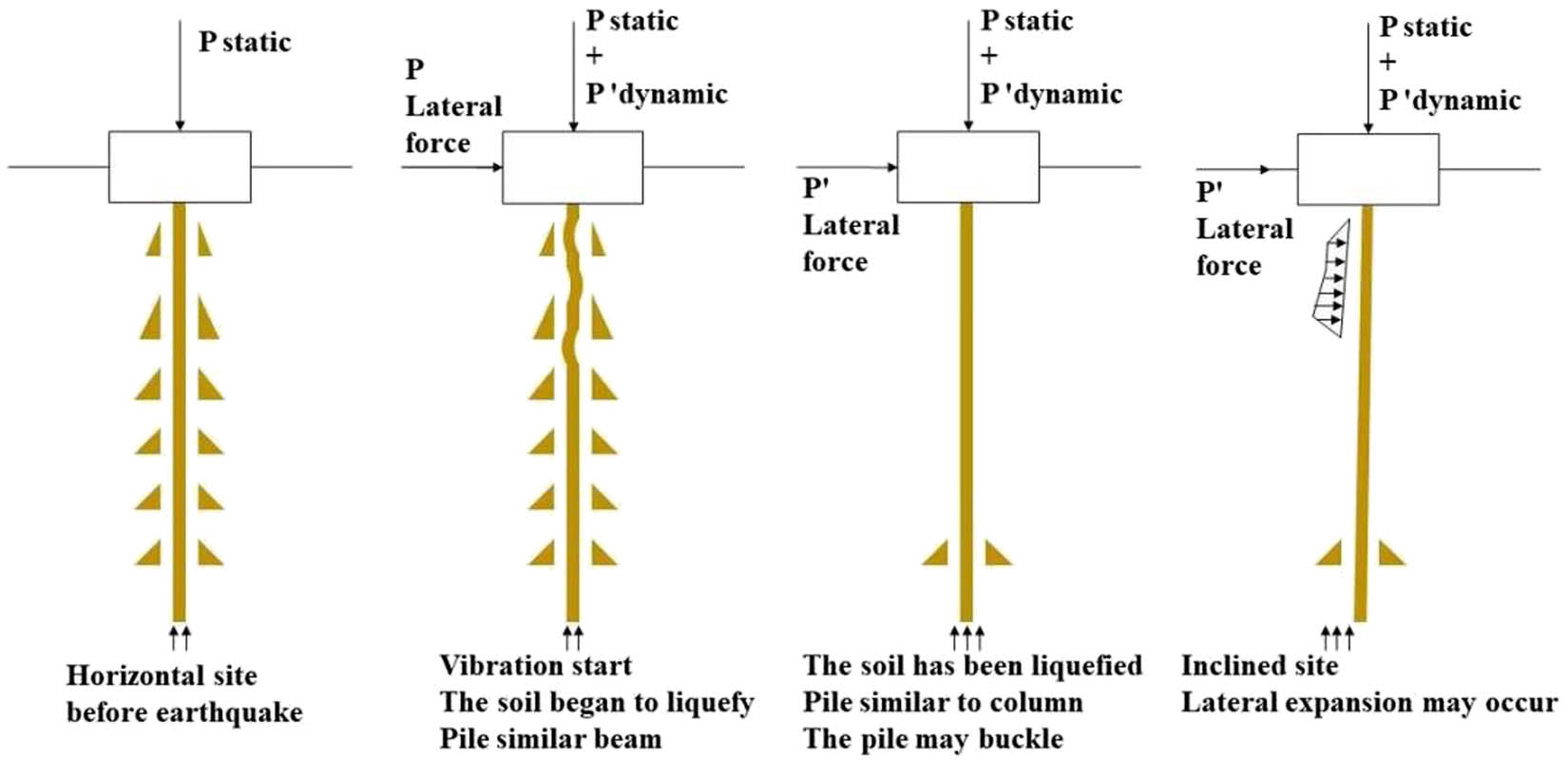
Schematic diagram of pile foundation failure loading time history in Bhattacharya and other liquefaction sites.
Based on the existing research, this article proposes a method that combines the centrifugal shaking table experiment with the open source finite element software OPENSEES to study the dynamic response of the pile foundation of the inclined bridge. The experimental results show that the numerical model can better reflect the measured law; with the increase in the El Centro wave ground acceleration amplitude, the maximum residual horizontal displacement increases nonlinearly. The maximum final bending moment of the pile body appears at the junction of bedrock and soil layer. The shoulder of the slope site is more prone to shear deformation than the top of the slope under earthquake, and the inclined interface of soft and hard rock and soil layer will weaken its ability of seismic energy consumption.
3 Method
3.1 Pile soil constitutive model
3.1.1 Multiple yield surface model
The multi-yield surface model can simulate the elastic-plastic state of soil under dynamic action, and effectively reflect the stress response of soil under variable load conditions under complex stress paths and seismic loads. The pressure-dependent multi-yield (PDMY) surface model based on confining pressure integrated into OPENSEES software can effectively simulate the nonlinear deformation effect of cohesive soil under reciprocating load, reflecting the stress–strain cyclic hysteresis phenomenon. In the PDMY constitutive model, it is assumed that the elastic stage is linearly isotropic, while the plastic stage shows nonlinear anisotropy due to the stress path. The yield function formula is as follows:
when
3.1.2 Pile soil dynamic spring model
The interaction between pile and soil is simulated by a series of dynamic springs. These dynamic springs are expressed by inserting nonlinear uniaxial zero-length elements discretized at the same position of continuous soil and pile body, so as to consider the three-dimensional dynamic stress effect of pile foundation. There are three types of springs: p–y spring simulates the soil resistance of the soil around the pile along the vertical direction of the pile body; T–z spring simulates the vertical resistance caused by friction along the outer surface of the pile body; and Q–z spring simulates the bearing capacity of soil at the pile end.
3.2 Numerical calculation model of slope pile
Through the inverse calculation of the similarity ratio of the centrifuge model test, the OPENSEES two-dimensional finite element model of the pile group in the slope section can be established. The slope of the model is about 27°, which is divided into two layers of rock and soil: sand and bedrock. The thickness of the sand layer is 11.0 m, and the bedrock surface is parallel to the upper surface of the sand layer, with a thickness of 3.25–14.0 m. The pile length of the model pile group foundation is 27.5 m, and the pile spacing is 2.4 m. The sand is simulated by the PDMY model introduced above, and the bedrock and pile body are simulated by the elastic element model. Table 1 lists its parameters.
Material parameters of bedrock and pile foundation
| Density | Modulus elasticity | Poisson’s | Diameter (m) | |
|---|---|---|---|---|
| Bedrock | 2.2 | 3 × 10⁷ | 0.35 | — |
| Pile foundation | 2.1 | 2.85 × 10⁷ | 0.35 | 0.9 |
The lateral boundary of the model takes part of the soil as the free field element, and its thickness is much greater than that of the internal soil element. Then, the periodic boundary conditions are realized by the given displacement equivalent command. The bottom boundary is set to be fixed vertically, and LK viscous boundary is adopted horizontally to simulate the absorption of reflected waves from the bottom boundary by the underlying layer of an elastic body in semi-infinite space. The seismic wave is transmitted from the bottom node in the form of equivalent force P, which is calculated by the recommended formula:
where
where the height Δh of the quadrilateral element is selected according to the wavelength λ min passing through the rock and soil mass. In order to correctly capture the propagation of earthquake in the grid, there must be at least eight units with the shortest wavelength to prevent the relevant higher frequencies from being filtered out. From the spectrum characteristics after seismic wave processing earlier, it is determined that the maximum frequency content (f max) in the selected seismic input is 20 Hz.
The centrifuge shaking table test is to input the preset seismic wave horizontally at the bottom of the model box. The form of seismic wave is the El Centro wave. According to the table accelerometer of the shaking table, the measured peak acceleration of seismic waves in fewer than five loading conditions is 0.1497, 0.2106, 0.3055, 0.4303, and 0.4809 g, respectively. Through one-time integration and baseline calibration, the corresponding seismic wave velocity time history data required in the numerical model can be obtained, and the equivalent effectiveness of input nodes under various numerical calculation conditions can be obtained through Eq. (2) [19].
The reliability of the model is verified by comparing the test and calculated values of dynamic response (residual horizontal displacement and final bending moment) of the pile body under five different peak acceleration seismic wave loading conditions. The test value can calculate the bending moment corresponding to the measuring point by applying the strain value ε measured on the pile body to the simple beam theory and satisfying the relationship (4) [20]. The variation relation m(z) of the bending moment along the pile depth can be obtained by the seventh-degree polynomial fitting 201 of the bending moment value of each measuring point. The displacement data of the pile top can be obtained by the quadratic integration of the acceleration data measured by the pile top accelerometer, and the overall displacement distribution of the pile body can be obtained by the integration [21]
Here, z is the depth coordinate along the pile; h is the distance from the pile in meters to the neutral axis of the pile; and the flexural stiffness of the pile is EI.
4 Results and analysis
4.1 Dynamic response of slope pile foundation
Figures 2 and 3 show the residual horizontal displacement of P1 and P2 piles under different peak acceleration seismic wave loading conditions. The residual horizontal displacement of each pile body is basically zero. Constrained by the cap beam and tie beam, the displacement of the free section of the pile group at these two positions is basically the same. Through comprehensive analysis, it can be concluded that the displacement of P1 and P2 piles is basically the same [22]. The maximum displacement of the pile body appears at the pile top. Compared with the peak acceleration of 0.1497 g, the horizontal displacement of the pile group top increases by 0.39, 1.16, 2.79, and 4.34 times, respectively, under other loading conditions, indicating that the horizontal displacement of the pile top increases nonlinearly under various loading conditions. In the sand layer, compared with the 0.1497 g seismic wave loading condition, the residual horizontal displacement of the pile body at the slope surface under other conditions increases by 1.39, 2.24, 4.28, and 5.89 times, respectively. It shows that under the direct influence of sandy soil sliding under an earthquake, the change of residual displacement of pile body at the slope is greater than that of free section displacement. The influence of slope sliding layer on the residual displacement of pile body should be considered in design [23].
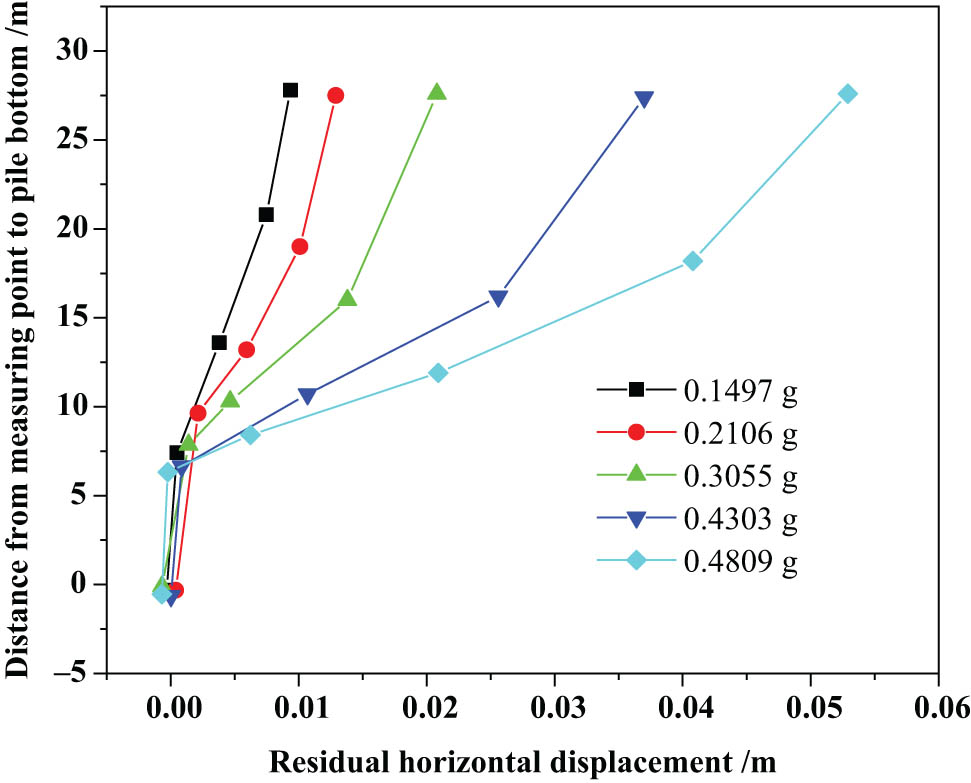
Residual horizontal displacements of P1 pile/M.
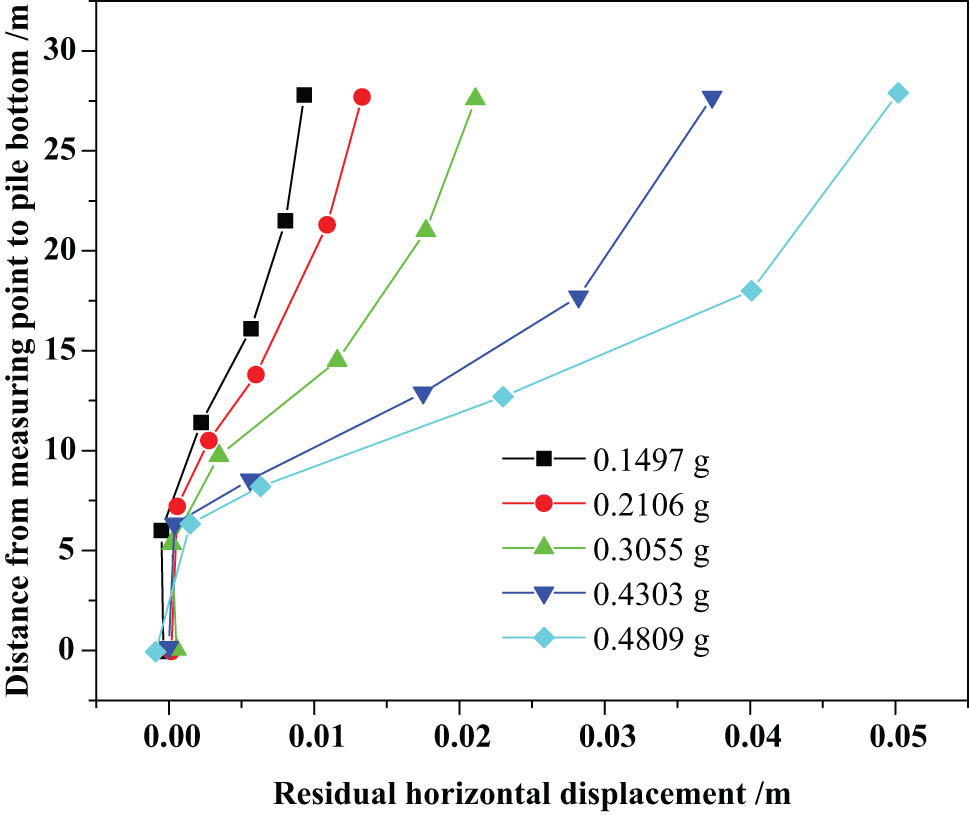
Residual horizontal displacements of P2 pile/M.
Figures 4 and 5 show the distribution of the final bending moment of the buried section of the pile body under different peak acceleration seismic wave loading conditions. It can be seen from the figure that the bending moment of P1 and P2 piles reaches the maximum value of the reverse bending moment in a small range on or below the slope surface. Then, with the decrease in the distance from the measuring point to the pile bottom, the positive bending moment begins to appear after reaching the zero point of the bending moment and then increases to the maximum value of the positive bending moment at the junction of bedrock and sandy soil layer. Finally, it decreases to zero at a certain depth below the bedrock surface, showing an asymmetric “s” shape distribution [24]. This indicates that the slope pile is the most unfavorable section at the interface between bedrock and soil layer, and pile P1 bears more bending moments than pile P2 at this position, which should be considered as the control section in the design.
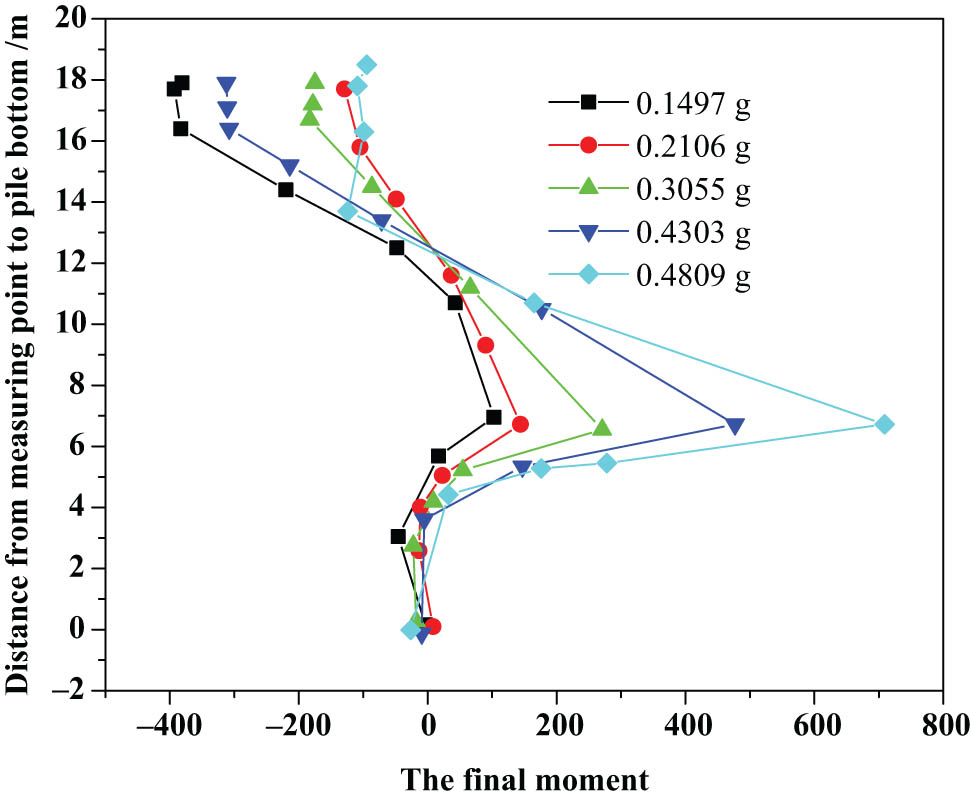
Final bending moment of P1 pile/(kN m).
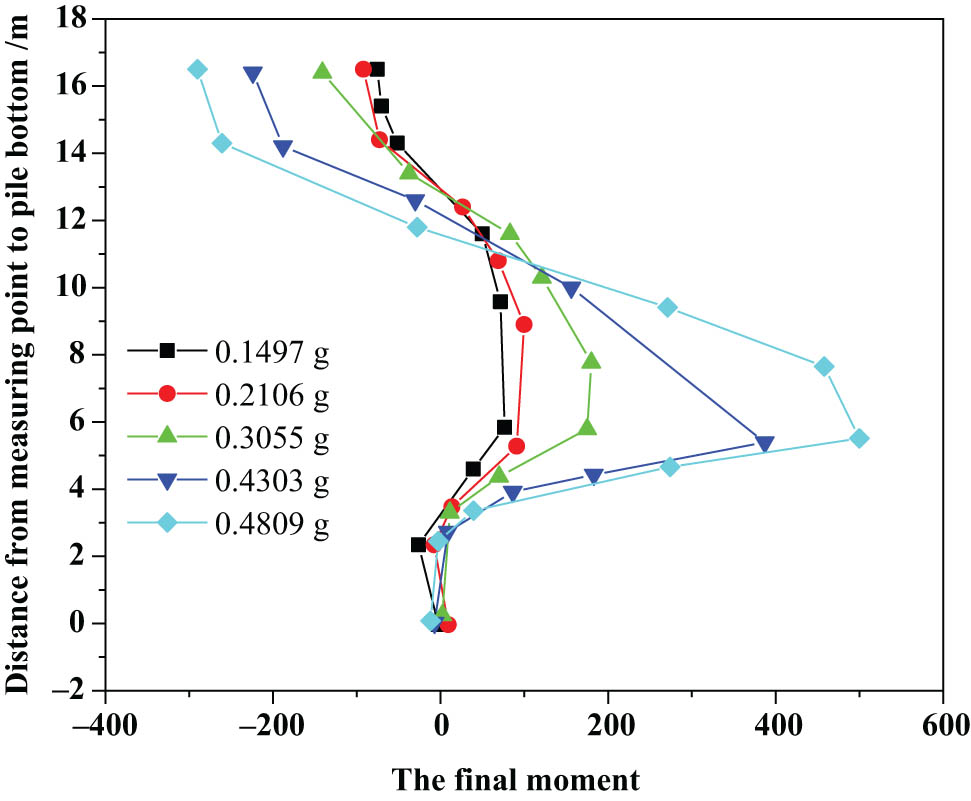
Final bending moment of P2 pile.
The calculated value in Figures 2–5 can be obtained: The distribution of the calculated residual horizontal displacement of P1 and P2 piles is basically the same as the test value. There is little difference in the residual horizontal displacement of the buried section below the slope surface of each pile, but there is a great difference in the residual horizontal displacement of the free section. It is considered that the larger peak acceleration of input seismic waves leads to a larger error value of pile top displacement [25]. The calculated value of the final bending moment of P1 and P2 piles shows the same change trend as the test value, and the test value is slightly larger than the calculated value. The relative errors of the maximum final bending moment of P1 pile under each loading condition are 7.4, 7.8, 12.6, 3.9, and 9.6%, respectively, and the relative errors of P2 pile are 4.6, 3.6, 12.5, 13.6, and 11.5%, respectively. The relative error of analysis is because the elastic element is used in the calculation. Generally speaking, the test value and calculated value of pile dynamic response show the same change trend and law. Although there are some differences in value, the relative error between them is acceptable for using a numerical method to explore the deformation and mechanical characteristics of slope piles and the research on influencing factors [26].
4.2 Discussion
According to the existing centrifuge test results, it can be seen that the deformation at the slope shoulder of the slope site is the most obvious under the earthquake. In order to analyze its dynamic response changes in more detail, combined with the PDMY model used in the numerical model, the dynamic response of the slope site is compared and analyzed at the slope shoulder covered with sandy soil layer on the slope site and the slope top 7.0 m away from the slope shoulder [27]. It can be seen from Figures 6 and 7 that in the shallow soil near the surface with a depth of 0.5 m (0–1.0 m), the shear stress shear strain hysteretic curve shows an obvious slip phenomenon. Compared with the weakened hysteretic circle at the slope top, there is basically no completed hysteretic circle at the slope shoulder, indicating that the shallow soil at the slope site, especially the soil at the slope, basically loses its seismic capacity under the action of earthquake. In the middle soil (1.0–5.0 m) near the depth of 4.5 m, the shear strain decreases greatly compared with the shallow soil, and the hysteretic curve at the top of the slope has an obvious symmetrical hysteretic circle, while the hysteretic curve at the slope shoulder still has a certain slip under the influence of the slope, and the symmetry of the hysteretic circle is not obvious [28]; In the deep soil near the depth of 10.5 m (>5.0 m), the shear strain at the top of the slope is further reduced and the hysteretic circle is fuller, indicating that it has good energy dissipation properties and is conducive to the seismic resistance of the structure. However, the shear strain at the slope shoulder at this depth does not decrease, but increases to a certain extent, indicating that the inclined interface of soft and soil layers will aggravate the dynamic response of the overlying soil layer on the slope and weaken its ability of seismic energy consumption [29,30,31,32,33,34].
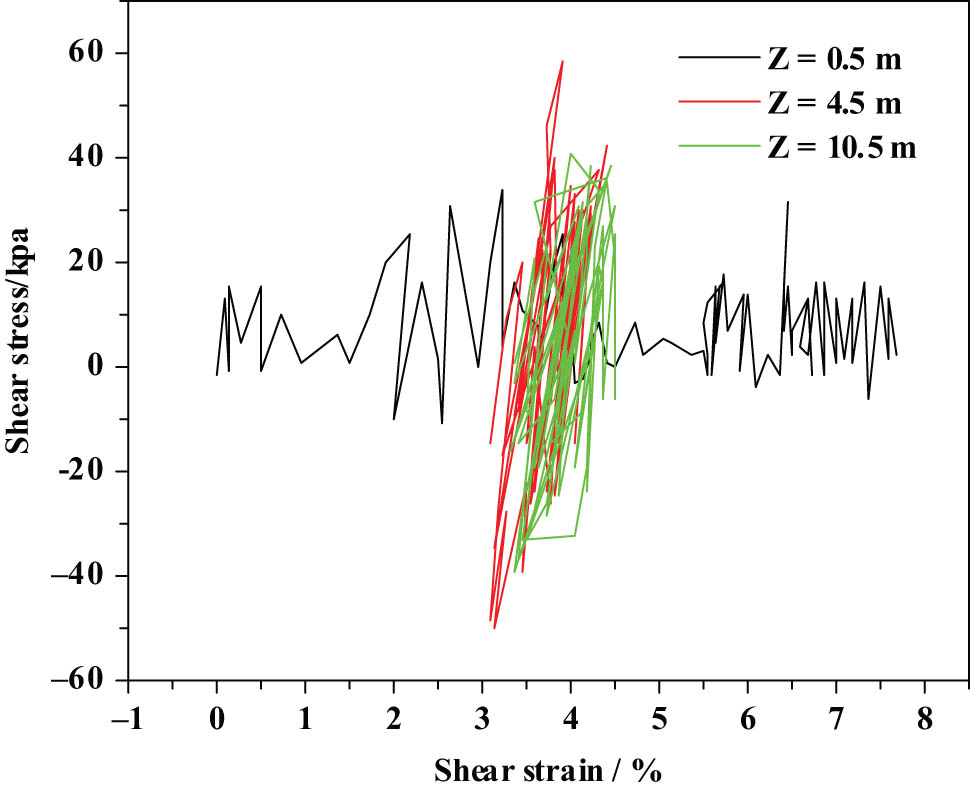
Dynamic response of soil mass at each depth at slope shoulder.
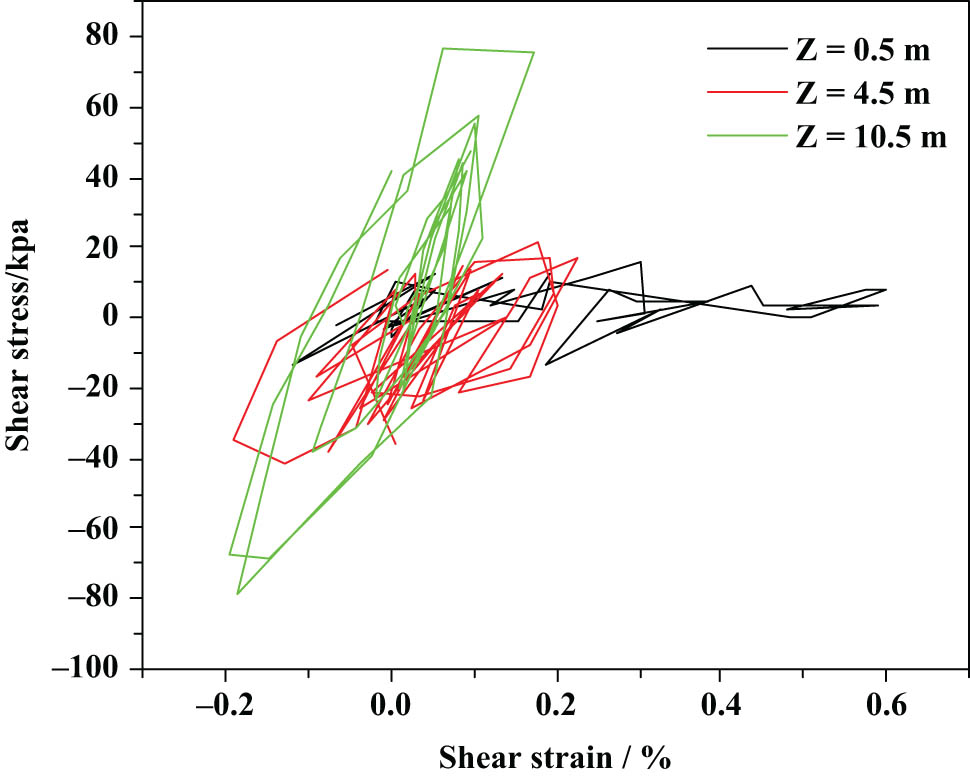
Dynamic response of soil mass at each depth at the top of the slope.
The solution is to demarcate the possible ground rupture zone and not build in this zone. The difficulty encountered in dividing the ground rupture zone is how to determine the location of the seismogenic fault for future earthquakes. The location of these faults is in most cases completely unknown, or only very inaccurate judgments can be made. However, ground-breaking, although it can have serious consequences, is a very local phenomenon. In addition, ground fractures often occur in weak overburden layers, which are not as powerful as bedrock. Even though the structure can be damaged through foundation deformation and cracking, the degree is often relatively light. Because the investigation and research of the rupture surface of the seismogenic fault is quite arduous work and the cost is relatively large, the required cost and the actual effect that may be obtained should be comprehensively considered when dividing the dangerous section of the ground rupture. The geological structure and active fault data are analyzed and judged to make reasonable decisions.
The pile foundation displacement calculated by the elastic foundation beam method is compared with the pile foundation displacement calculated by the numerical analysis method. In the absence of field monitoring data, the two can corroborate each other.
5 Conclusion
In this article, the nonlinear numerical simulation of the dynamic response of pile site and pile foundation under earthquake is proposed. Through the inverse calculation of the similarity ratio of the centrifuge model test, the OPENSEES two-dimensional finite element model of the pile group in the slope section is established. The slope of the model is about 27°, which is divided into two layers of rock and soil: sand and bedrock. The sand is simulated by the PDMY model, and the parameters are taken based on the fitting formula of various sand parameters given in the OPENSEES manual. The maximum final bending moment of the pile body appears at the junction of bedrock and soil layer. The shoulder of the slope site is more prone to shear deformation than the top of slope under earthquake, and the inclined interface of soft and hard rock and soil layer will weaken its ability of seismic energy consumption. Pile foundation is widely used. Compared with the weakened hysteretic circle at the slope top, there is basically no completed hysteretic circle at the slope shoulder, indicating that the shallow soil at the slope site, especially the soil at the slope, basically loses its seismic capacity under the action of an earthquake. Therefore, in order to effectively reduce the seismic damage of pile foundations caused by foundation liquefaction in the future, dynamic characteristics of pile foundation on the liquefied foundation are of great significance to the seismic design, disaster prevention, and reduction of pile group foundation on the liquefiable foundation.
Through the research and analysis of pile–soil interaction under heap load, some conclusions for reference are drawn. However, due to the lack of test and field measurement data, only qualitative analysis can be made. In addition, some simplifications were made when simulating working conditions, but in actual engineering, the interaction between piles and soil is more complicated and cannot reflect the actual situation of the engineering very accurately. Therefore, the pile–soil interaction of passive piles still needs further research and development. The main problems to be solved are as follows:
The properties of internal force, deformation, and pore water pressure of pile foundation and soil at different times under repeated stacking loads are not considered. There is a difference between the deformation and internal force of soil under repeated stacking loads and those under static loads. Under repeated stacking loads, the soil will have irrecoverable residual strains after each stacking load. The internal force and deformation of the pile body will change with the number of repeated stacking.
The rheology under long-term stacking load is not considered. The deformation of soil is affected by time, including creep, relaxation, flow, strain rate effect, and long-term strength effect of soil.
Acknowledgment
Science and technology research project of Education Department of Jiangxi Province in 2020; Dynamic stability analysis of pile net composite foundation under earthquake: project number, GJJ202020; project leader, Wenwen Liang.
-
Author contributions: All authors have accepted responsibility for the entire content of this manuscript and approved its submission.
-
Conflict of interest: Authors state no conflict of interest.
References
[1] Alisawi AT, Collins P, Cashell KA. Nonlinear numerical simulation of physical shaking table test, using three different soil constitutive models. Soil Dyn Earthq Eng. 2021;143(1):106617.10.1016/j.soildyn.2021.106617Search in Google Scholar
[2] Zou D, Sui Y, Chen K. Plastic damage analysis of pile foundation of nuclear power plants under beyond-design basis earthquake excitation. Soil Dyn Earthq Eng. 2020;136(2):106179.10.1016/j.soildyn.2020.106179Search in Google Scholar
[3] Chen B, Du Y, Shi Y, Fan L. Seismic analysis of isolated continuous bridge considering influence of seawater and site condition. Shock Vib. 2021;2021(11):1–17.10.1155/2021/7599715Search in Google Scholar
[4] Wang P, Ding H, Zhang P, Zhao E, Bai J. Dynamic response of saturated sandy foundation and friction pile under seismic action. Int J Saf Sec Eng. 2020;10(4):451–8.10.18280/ijsse.100403Search in Google Scholar
[5] Lima LFDV, Labaki J, Mesquita E, Lima LFDV, Labaki J, Mesquita E. Stationary dynamic response of a circular rigid foundation partially supported by a flexible pile and interacting with a half-space. Lat Am J Solids Struct. 2020;17(8):1–17.10.1590/1679-78255872Search in Google Scholar
[6] Cao Z, Wei Y. Research and design of over – irrigation control system for underwater pouring concrete of pile foundation. IOP Conf Ser Earth Environ Sci. 2021;647(1):012087.10.1088/1755-1315/647/1/012087Search in Google Scholar
[7] Beer M, Kougioumtzoglou IA, Patelli E, Au SK. Encyclopedia of earthquake engineering nonlinear dynamic seismic analysis; Encyclopedia of Earthquake Engineering. 2021. p. 1–47. (Chapter 140-1). 10.1007/978-3-642-36197-5.Search in Google Scholar
[8] Zhang Y, Chen X, Zhang X, Ding M, Liu Z. Nonlinear response of the pile group foundation for lateral loads using pushover analysis. Earthq Struct. 2020;19(4):273–86.Search in Google Scholar
[9] Feng Z, Huo J, Hu H, Zhao R, Song Z. Research on corrosion damage and bearing characteristics of bridge pile foundation concrete under a dry-wet-freeze-thaw cycle. Adv Civ Eng. 2021;2021(6):1–13.10.1155/2021/8884396Search in Google Scholar
[10] Bhaduri A, Choudhury D. Steady-state response of flexible combined pile-raft foundation under dynamic loading. Soil Dyn Earthq Eng. 2021;145(2):106664.10.1016/j.soildyn.2021.106664Search in Google Scholar
[11] Zhang XL, Xue JY, Xu CS, Liu KY. An analysis method for lateral capacity of pile foundation under existing vertical loads. Soil Dyn Earthq Eng. 2021;142(2):106547.10.1016/j.soildyn.2020.106547Search in Google Scholar
[12] Chen W, Huang L, Xu L, Zhao K, Jeng D. Numerical study on the frequency response of offshore monopile foundation to seismic excitation. Comput Geotech. 2021;138(11):104342.10.1016/j.compgeo.2021.104342Search in Google Scholar
[13] Long H, Wang Z, Zhang C, Zhuang H, Peng C. Nonlinear study on the structure-soil-structure interaction of seismic response among high-rise buildings. Eng Struct. 2021;242(3):112550.10.1016/j.engstruct.2021.112550Search in Google Scholar
[14] Zhang S, Li J, Li J, Zhang J. Dynamic response analysis of the integrated station-bridge elevated station under the pile-soil interaction. E3S Web Conf. 2020;165(1):04081.10.1051/e3sconf/202016504081Search in Google Scholar
[15] Zhang G, Cao Z, Liu Y, Chen J. Field test and numerical simulation on the long-term thermal response of phc energy pile in layered foundation. Sensors. 2021;21(11):3873.10.3390/s21113873Search in Google Scholar PubMed PubMed Central
[16] Marinichev MB, Tkachev IG. Regulation of additional settlements of dense urban infrastructure objects during execution of deep excavations and raft-pile foundation of high-rise buildings. J Phys Conf Ser. 2021;1928(1):012039.10.1088/1742-6596/1928/1/012039Search in Google Scholar
[17] Feng Z, Guo S, He J, Huang Z, Dong Y, Jiang D, et al. Study on the influence of karst size on the vertical bearing capacity of pile foundation. IOP Conf Ser Mater Sci Eng. 2020;780(2):022005.10.1088/1757-899X/780/2/022005Search in Google Scholar
[18] Gazali A. Analysis study of soil bearing capacity and settlement of single pile foundation based on n-spt data. IOP Conf Ser Earth Environ Sci. 2021;758(1):012023.10.1088/1755-1315/758/1/012023Search in Google Scholar
[19] Guo Q, Guo B, Zhu Y, Wang H, Meng Z. Pile foundation design and analysis of teaching building in a high school. IOP Conf Ser Earth Environ Sci. 2021;820(1):012019.10.1088/1755-1315/820/1/012019Search in Google Scholar
[20] Zhang Q, Zhang Y, Lin H, Feng L. Numerical investigation on bearing capacity of owt foundation with large diameter monopile under seismic load. Appl Ocean Res. 2021;108(7):102518.10.1016/j.apor.2020.102518Search in Google Scholar
[21] Xu Q, Bao Z, Lu T, Gao H, Song J. Numerical simulation and optimization design of end-suspended pile support for soil-rock composite foundation pit. Adv Civ Eng. 2021;2021(2):1–15.10.1155/2021/5593639Search in Google Scholar
[22] Xu X, Zhang Z, Yao W, Zhao Z. Dynamic stability analysis of pile foundation under wave load. Int J Geomech. 2021;21(4):04021021.10.1061/(ASCE)GM.1943-5622.0001968Search in Google Scholar
[23] Wang X. Research on vertical bearing capacity of pile foundation under wave scouring. Open J Model Simul. 2021;9(2):124–34.10.4236/ojmsi.2021.92008Search in Google Scholar
[24] Han JH, Wang JP, Gu CY. Study on the interaction mechanism between deep displacement of soil and internal force of anchor cable under pile-anchor support system of ultra-deep foundation pit. J Phys Conf Ser. 2021;1904(1):012019.10.1088/1742-6596/1904/1/012019Search in Google Scholar
[25] Abishek RR, Janakiraman S, Aravind M, Raj RS, Raja R. Influence of density of soil and length of pile for an effective pile-rafted foundation system loaded vertically – a numerical validation of Abhirami B et.al. Int J Adv Sci Technol. 2020;29(7):9779–92.Search in Google Scholar
[26] Sharma A, Kumar R. Performance comparison and detailed study of AODV, DSDV, DSR, TORA and OLSR routing protocols in ad hoc networks. 2016 Fourth International Conference on Parallel, Distributed and Grid Computing (PDGC); 2016 Dec 22–24; Waknaghat, India. IEEE; 2017. p. 732–736.10.1109/PDGC.2016.7913218Search in Google Scholar
[27] Raj M, Manimegalai P, Ajay P, Amose J. Lipid data acquisition for devices treatment of coronary diseases health stuff on the internet of medical things. J Phys Conf Ser. 2021;1937:012038.10.1088/1742-6596/1937/1/012038Search in Google Scholar
[28] Liu JQ, Liu X, Chen JY, Li XY, Zhong FC. Plasma-catalytic oxidation of toluene on Fe2O3/sepiolite catalyst in DDBD reactor. J Phys D Appl Phys. 2021;54:475201.10.1088/1361-6463/ac1ec2Search in Google Scholar
[29] Huang R, Yan P, Yang X. Knowledge map visualization of technology hotspots and development trends in China’s textile manufacturing industry. IET Collab Intell Manuf. 2021;3(3):243–51.10.1049/cim2.12024Search in Google Scholar
[30] Yan L, Cengiz K, Sharma A. An improved image processing algorithm for automatic defect inspection in TFT-LCD TCON. Nonlinear Eng. 2021;10(1):293–303.10.1515/nleng-2021-0023Search in Google Scholar
[31] Hillier C, Balyan V. Error detection and correction on-board nanosatellites using hamming codes. J Electr Comput Eng. 2019;2019(6):1–15. 10.1155/2019/3905094.Search in Google Scholar
[32] Babalola OP, Balyan V. Efficient channel coding for dimmable visible light communications system. IEEE Access. 2020;8:215100–6. 10.1109/ACCESS.2020.3041431.Search in Google Scholar
[33] Balyan V, Daniels R. Resource allocation for NOMA based networks using relays: cell centre and cell edge users. Int J Smart Sens Intell Syst. 2020;13(1):18.10.21307/ijssis-2020-031Search in Google Scholar
[34] Balyan V. Outage probability of cognitive radio network utilizing non orthogonal multiple access. 7th International Conference on Signal Processing and Integrated Networks (SPIN); 2020 Feb 27–28; Noida, India. IEEE; 2020. p. 751–5.10.1109/SPIN48934.2020.9071401Search in Google Scholar
© 2022 Wenwen Liang et al., published by De Gruyter
This work is licensed under the Creative Commons Attribution 4.0 International License.
Articles in the same Issue
- Research Articles
- Fractal approach to the fluidity of a cement mortar
- Novel results on conformable Bessel functions
- The role of relaxation and retardation phenomenon of Oldroyd-B fluid flow through Stehfest’s and Tzou’s algorithms
- Damage identification of wind turbine blades based on dynamic characteristics
- Improving nonlinear behavior and tensile and compressive strengths of sustainable lightweight concrete using waste glass powder, nanosilica, and recycled polypropylene fiber
- Two-point nonlocal nonlinear fractional boundary value problem with Caputo derivative: Analysis and numerical solution
- Construction of optical solitons of Radhakrishnan–Kundu–Lakshmanan equation in birefringent fibers
- Dynamics and simulations of discretized Caputo-conformable fractional-order Lotka–Volterra models
- Research on facial expression recognition based on an improved fusion algorithm
- N-dimensional quintic B-spline functions for solving n-dimensional partial differential equations
- Solution of two-dimensional fractional diffusion equation by a novel hybrid D(TQ) method
- Investigation of three-dimensional hybrid nanofluid flow affected by nonuniform MHD over exponential stretching/shrinking plate
- Solution for a rotational pendulum system by the Rach–Adomian–Meyers decomposition method
- Study on the technical parameters model of the functional components of cone crushers
- Using Krasnoselskii's theorem to investigate the Cauchy and neutral fractional q-integro-differential equation via numerical technique
- Smear character recognition method of side-end power meter based on PCA image enhancement
- Significance of adding titanium dioxide nanoparticles to an existing distilled water conveying aluminum oxide and zinc oxide nanoparticles: Scrutinization of chemical reactive ternary-hybrid nanofluid due to bioconvection on a convectively heated surface
- An analytical approach for Shehu transform on fractional coupled 1D, 2D and 3D Burgers’ equations
- Exploration of the dynamics of hyperbolic tangent fluid through a tapered asymmetric porous channel
- Bond behavior of recycled coarse aggregate concrete with rebar after freeze–thaw cycles: Finite element nonlinear analysis
- Edge detection using nonlinear structure tensor
- Synchronizing a synchronverter to an unbalanced power grid using sequence component decomposition
- Distinguishability criteria of conformable hybrid linear systems
- A new computational investigation to the new exact solutions of (3 + 1)-dimensional WKdV equations via two novel procedures arising in shallow water magnetohydrodynamics
- A passive verses active exposure of mathematical smoking model: A role for optimal and dynamical control
- A new analytical method to simulate the mutual impact of space-time memory indices embedded in (1 + 2)-physical models
- Exploration of peristaltic pumping of Casson fluid flow through a porous peripheral layer in a channel
- Investigation of optimized ELM using Invasive Weed-optimization and Cuckoo-Search optimization
- Analytical analysis for non-homogeneous two-layer functionally graded material
- Investigation of critical load of structures using modified energy method in nonlinear-geometry solid mechanics problems
- Thermal and multi-boiling analysis of a rectangular porous fin: A spectral approach
- The path planning of collision avoidance for an unmanned ship navigating in waterways based on an artificial neural network
- Shear bond and compressive strength of clay stabilised with lime/cement jet grouting and deep mixing: A case of Norvik, Nynäshamn
- Communication
- Results for the heat transfer of a fin with exponential-law temperature-dependent thermal conductivity and power-law temperature-dependent heat transfer coefficients
- Special Issue: Recent trends and emergence of technology in nonlinear engineering and its applications - Part I
- Research on fault detection and identification methods of nonlinear dynamic process based on ICA
- Multi-objective optimization design of steel structure building energy consumption simulation based on genetic algorithm
- Study on modal parameter identification of engineering structures based on nonlinear characteristics
- On-line monitoring of steel ball stamping by mechatronics cold heading equipment based on PVDF polymer sensing material
- Vibration signal acquisition and computer simulation detection of mechanical equipment failure
- Development of a CPU-GPU heterogeneous platform based on a nonlinear parallel algorithm
- A GA-BP neural network for nonlinear time-series forecasting and its application in cigarette sales forecast
- Analysis of radiation effects of semiconductor devices based on numerical simulation Fermi–Dirac
- Design of motion-assisted training control system based on nonlinear mechanics
- Nonlinear discrete system model of tobacco supply chain information
- Performance degradation detection method of aeroengine fuel metering device
- Research on contour feature extraction method of multiple sports images based on nonlinear mechanics
- Design and implementation of Internet-of-Things software monitoring and early warning system based on nonlinear technology
- Application of nonlinear adaptive technology in GPS positioning trajectory of ship navigation
- Real-time control of laboratory information system based on nonlinear programming
- Software engineering defect detection and classification system based on artificial intelligence
- Vibration signal collection and analysis of mechanical equipment failure based on computer simulation detection
- Fractal analysis of retinal vasculature in relation with retinal diseases – an machine learning approach
- Application of programmable logic control in the nonlinear machine automation control using numerical control technology
- Application of nonlinear recursion equation in network security risk detection
- Study on mechanical maintenance method of ballasted track of high-speed railway based on nonlinear discrete element theory
- Optimal control and nonlinear numerical simulation analysis of tunnel rock deformation parameters
- Nonlinear reliability of urban rail transit network connectivity based on computer aided design and topology
- Optimization of target acquisition and sorting for object-finding multi-manipulator based on open MV vision
- Nonlinear numerical simulation of dynamic response of pile site and pile foundation under earthquake
- Research on stability of hydraulic system based on nonlinear PID control
- Design and simulation of vehicle vibration test based on virtual reality technology
- Nonlinear parameter optimization method for high-resolution monitoring of marine environment
- Mobile app for COVID-19 patient education – Development process using the analysis, design, development, implementation, and evaluation models
- Internet of Things-based smart vehicles design of bio-inspired algorithms using artificial intelligence charging system
- Construction vibration risk assessment of engineering projects based on nonlinear feature algorithm
- Application of third-order nonlinear optical materials in complex crystalline chemical reactions of borates
- Evaluation of LoRa nodes for long-range communication
- Secret information security system in computer network based on Bayesian classification and nonlinear algorithm
- Experimental and simulation research on the difference in motion technology levels based on nonlinear characteristics
- Research on computer 3D image encryption processing based on the nonlinear algorithm
- Outage probability for a multiuser NOMA-based network using energy harvesting relays
Articles in the same Issue
- Research Articles
- Fractal approach to the fluidity of a cement mortar
- Novel results on conformable Bessel functions
- The role of relaxation and retardation phenomenon of Oldroyd-B fluid flow through Stehfest’s and Tzou’s algorithms
- Damage identification of wind turbine blades based on dynamic characteristics
- Improving nonlinear behavior and tensile and compressive strengths of sustainable lightweight concrete using waste glass powder, nanosilica, and recycled polypropylene fiber
- Two-point nonlocal nonlinear fractional boundary value problem with Caputo derivative: Analysis and numerical solution
- Construction of optical solitons of Radhakrishnan–Kundu–Lakshmanan equation in birefringent fibers
- Dynamics and simulations of discretized Caputo-conformable fractional-order Lotka–Volterra models
- Research on facial expression recognition based on an improved fusion algorithm
- N-dimensional quintic B-spline functions for solving n-dimensional partial differential equations
- Solution of two-dimensional fractional diffusion equation by a novel hybrid D(TQ) method
- Investigation of three-dimensional hybrid nanofluid flow affected by nonuniform MHD over exponential stretching/shrinking plate
- Solution for a rotational pendulum system by the Rach–Adomian–Meyers decomposition method
- Study on the technical parameters model of the functional components of cone crushers
- Using Krasnoselskii's theorem to investigate the Cauchy and neutral fractional q-integro-differential equation via numerical technique
- Smear character recognition method of side-end power meter based on PCA image enhancement
- Significance of adding titanium dioxide nanoparticles to an existing distilled water conveying aluminum oxide and zinc oxide nanoparticles: Scrutinization of chemical reactive ternary-hybrid nanofluid due to bioconvection on a convectively heated surface
- An analytical approach for Shehu transform on fractional coupled 1D, 2D and 3D Burgers’ equations
- Exploration of the dynamics of hyperbolic tangent fluid through a tapered asymmetric porous channel
- Bond behavior of recycled coarse aggregate concrete with rebar after freeze–thaw cycles: Finite element nonlinear analysis
- Edge detection using nonlinear structure tensor
- Synchronizing a synchronverter to an unbalanced power grid using sequence component decomposition
- Distinguishability criteria of conformable hybrid linear systems
- A new computational investigation to the new exact solutions of (3 + 1)-dimensional WKdV equations via two novel procedures arising in shallow water magnetohydrodynamics
- A passive verses active exposure of mathematical smoking model: A role for optimal and dynamical control
- A new analytical method to simulate the mutual impact of space-time memory indices embedded in (1 + 2)-physical models
- Exploration of peristaltic pumping of Casson fluid flow through a porous peripheral layer in a channel
- Investigation of optimized ELM using Invasive Weed-optimization and Cuckoo-Search optimization
- Analytical analysis for non-homogeneous two-layer functionally graded material
- Investigation of critical load of structures using modified energy method in nonlinear-geometry solid mechanics problems
- Thermal and multi-boiling analysis of a rectangular porous fin: A spectral approach
- The path planning of collision avoidance for an unmanned ship navigating in waterways based on an artificial neural network
- Shear bond and compressive strength of clay stabilised with lime/cement jet grouting and deep mixing: A case of Norvik, Nynäshamn
- Communication
- Results for the heat transfer of a fin with exponential-law temperature-dependent thermal conductivity and power-law temperature-dependent heat transfer coefficients
- Special Issue: Recent trends and emergence of technology in nonlinear engineering and its applications - Part I
- Research on fault detection and identification methods of nonlinear dynamic process based on ICA
- Multi-objective optimization design of steel structure building energy consumption simulation based on genetic algorithm
- Study on modal parameter identification of engineering structures based on nonlinear characteristics
- On-line monitoring of steel ball stamping by mechatronics cold heading equipment based on PVDF polymer sensing material
- Vibration signal acquisition and computer simulation detection of mechanical equipment failure
- Development of a CPU-GPU heterogeneous platform based on a nonlinear parallel algorithm
- A GA-BP neural network for nonlinear time-series forecasting and its application in cigarette sales forecast
- Analysis of radiation effects of semiconductor devices based on numerical simulation Fermi–Dirac
- Design of motion-assisted training control system based on nonlinear mechanics
- Nonlinear discrete system model of tobacco supply chain information
- Performance degradation detection method of aeroengine fuel metering device
- Research on contour feature extraction method of multiple sports images based on nonlinear mechanics
- Design and implementation of Internet-of-Things software monitoring and early warning system based on nonlinear technology
- Application of nonlinear adaptive technology in GPS positioning trajectory of ship navigation
- Real-time control of laboratory information system based on nonlinear programming
- Software engineering defect detection and classification system based on artificial intelligence
- Vibration signal collection and analysis of mechanical equipment failure based on computer simulation detection
- Fractal analysis of retinal vasculature in relation with retinal diseases – an machine learning approach
- Application of programmable logic control in the nonlinear machine automation control using numerical control technology
- Application of nonlinear recursion equation in network security risk detection
- Study on mechanical maintenance method of ballasted track of high-speed railway based on nonlinear discrete element theory
- Optimal control and nonlinear numerical simulation analysis of tunnel rock deformation parameters
- Nonlinear reliability of urban rail transit network connectivity based on computer aided design and topology
- Optimization of target acquisition and sorting for object-finding multi-manipulator based on open MV vision
- Nonlinear numerical simulation of dynamic response of pile site and pile foundation under earthquake
- Research on stability of hydraulic system based on nonlinear PID control
- Design and simulation of vehicle vibration test based on virtual reality technology
- Nonlinear parameter optimization method for high-resolution monitoring of marine environment
- Mobile app for COVID-19 patient education – Development process using the analysis, design, development, implementation, and evaluation models
- Internet of Things-based smart vehicles design of bio-inspired algorithms using artificial intelligence charging system
- Construction vibration risk assessment of engineering projects based on nonlinear feature algorithm
- Application of third-order nonlinear optical materials in complex crystalline chemical reactions of borates
- Evaluation of LoRa nodes for long-range communication
- Secret information security system in computer network based on Bayesian classification and nonlinear algorithm
- Experimental and simulation research on the difference in motion technology levels based on nonlinear characteristics
- Research on computer 3D image encryption processing based on the nonlinear algorithm
- Outage probability for a multiuser NOMA-based network using energy harvesting relays
