Evaluation of LoRa nodes for long-range communication
-
Gunjan Gupta


Abstract
The Internet of Things concept can be implemented using Long-range wireless access network protocol. The work in this article is done to implement LoRa terrestrial network which will be connected to a satellite in future. The work mainly studies the number of collisions and the impact of it on the network. The work is simulated and is done to determine the number of LoRa nodes which can successfully transmit at a given time. Different combinations of spreading factor and bandwidth at different duty cycles are used to assess the performance of the network.
1 Introduction
Internet-of-things (IoT)-based networks gained attention in the last few years. This is due to the sensors using battery power which can be easily deployed on roads, offices, agricultural lands, industries, etc., has shown an augmented growth over the past few years [1]. By 2030, it is assumed that the number of connected IoT devices will be more than 50 billion. Therefore, the network is required to be low-cost, scalable, and reliable, and the energy consumption required for communication must be lower. IoT applications currently use ZigBee, Wi-Fi, Bluetooth, and cellular system [2]. Some of the IoT applications require long rate, low rate, and delay-tolerant wireless communication systems at lower cost and lower energy requirements.
Long-range wireless access network (LoRaWAN) [3] is a technology that is built using the LoRa modulation scheme developed by Semtech. Mostly, LoRa radio usage is in the sub-GHz unlicensed spectrum. Using LoRa modulation in sub-GHz can provide coverage in larger areas with minimum change in infrastructure.
Low power wide area network (LPWAN) standards are being developed to provide long-range connectivity to achieve energy efficiency. The LPWANs always have to tradeoff between energy efficiency and data rate. A simple medium access control (MAC) protocol is used in place of complex control of channels with lesser reliability [4].
LoRa is used as a physical layer technology by the LoRaWAN protocol stack. The LoRa networks utilize a star topology in which nodes communicate with gateways using a one-hop LoRa link utilizing grant-free pure ALOHA protocol as the MAC mechanism; this allows multiple nodes to uplink event reports without a handshake. There are five communication parameters that can be used to improve communication performance: transmit power, spreading factor (SF), coding rate (CR), carrier frequency (CF), and bandwidth (BW). These properties of LoRa have attracted the attention of researchers and individuals in the industry, leading to significant technological developments.
Even with such a large number of characteristics, LoRaWAN can become unreliable with the increase in the number of users [5,6]. To address this, work is being done on diversity based on an independent implementation of radio channels. For example, time diversity in the form of independent [7] or encrypted [8] message replication is used for LoRaWAN. These methods also have their disadvantages. For example, performance is improved using message replication with higher network utilization and power consumption. The reliability is affected by interference. The LoRa network suffers from two types of interference namely Co-Spreading Factor (Co-SF) interference and another inter-SF. Often specific use of a different combination of CF, CR, BW, and SF ranging from 7 to 12 forms orthogonal channels and which are not supposed to interfere with other transmissions. In actuality, the different SFs form quasi-orthogonal channels and interfere with each other [5]. Co-SF interference pin down as the main interference which severely impacts network performance. Co-SF interference emerges using the same SF multiple nodes and starts uplink simultaneously using almost the same transmitted power. This leads to packet error and an increase in time on air of the packet which deteriorates the network performance considerably. The performance of the LoRa network in the presence of co-SF along with inter-SF aggregated effect with inputs from work in literature, the study is performed by refs. [6,9,10]. The study concludes that in an interference-limited scenario, Co-SF severely affects the coverage probability which is further aggravated by inter-SF interference due to imperfect orthogonality. In order to address the interference issues, non-orthogonal multiple access (NOMA), and successive interference cancellation (SIC) [MINE] needs to be implemented. In NOMA, multiple users are served with the same frequency, time, and code at different power levels. The benefits come in the form of improved spectrum utilization with efficiency, better reliability, massive connectivity, and less latency.
2 Previous work
Several studies in the literature are working [5,6] to address the following questions: Can LoRa scale? Other companies are doing analysis of LoRa networks with different antenna combinations. Work is also done to analyze the use of SIC in these conditions. In addition, research is carried out on LoRa’s ability to decode one of the multiple signals received at the same time when the signal-to-interference wave ratio is above a certain threshold. Using these results, the authors in ref. [11] recovered the desired signal and identify the interfering signals using SIC with LoRa with the help of simulations. The results clearly prove utilizing SIC with LoRa improves network performance. The authors in ref. [12] proposed two algorithms which perform SIC at the symbol level. The authors in refs [13,14] use chirp and preamble features of LoRa to distinguish desired and interfering signals. Both of these works do not be able to use a finite number of standard operations to assess the network performance. To address this, the work is done by ref. [15], taking into effect only one interfering signal with the desired signal. The work concluded that the use of SIC considerably improves the network performance as the same setting is able to serve more number of nodes.
3 LoRa
In order to improve the performance of LoRa networks, different modulation parameters can be customized: a) SF, b) Code rate (CR), and c) BW. The SF Several parameters are available for the customization of the LoRa modulation: (i) BW; (ii) SF; (iii) code rate (CR). SF is defined as a number of chips per symbol and
R c is the chip rate and R s is the symbol rate.
For a constant BW, the chirp rate varies with SF. If the BW of LoRa is constant, the chirp rate differs according to the SF. Chirp orthogonality prevents interference among different SFs when the same channel is used by different transmitters with different SFs.
The sensitivity of the LoRa transmitter is defined as:
where SNR is the signal-to-noise ratio [16] and NF is the noise floor which is inversely proportional to SF and is constant for a hardware combination. As SF increases and BW decreases, the sensitivity decreases which increases the device range of communication.
3.1 LoRaWAN
A star topology-based MAC protocol is used by LoRaWAN over the LoRa physical layer. In LoRaWAN, three device types are defined namely Class A, Class B, and Class C; their utilization is application specific. The LoRaWAN constitutes a LoRa gateway, and multiple LoRa nodes are also named end-devices. For optimized battery life, the LoRa gateway and LoRa nodes use simple protocols in single-hop communication. The gateway assigns the transmission power, SF, and the channel to be used for communication with LoRa node(s). In LoRAWAN, an adaptive data rate (ADR) can be used to optimize time on air, data rate, and energy consumption. When ADR is used, the frequency band is divided into eight equal channels of 125 kHz by the gateway, and then, it starts listening for the frames in uplink in channels. For every channel, the network server checks SNR margin with respect to SF, and an SF is selected for the LoRa nodes.
A gateway can support many channels and data rates, which enables LoRaWAN to support a massive number of LoRa nodes. An indoor network has many communication complications which leads to poor coverage. Also, network scalability is restricted due to single-hop star topology; therefore, a multi-hop network should replace with additional gateways or relays.
4 Results and simulations
In this study, LoRaSim simulator [17] has been remodeled for the proposed scenarios. The mathematical model of LoRa is used for making the [17], which can observe the number of collisions appearing in the network [18]. The sensitivity of LoRa receivers is taken from [19,20]. In the present time, most of the work on scalability on LoRa is for commercial purposes and works in ideal conditions. Therefore, the models that are close to real-time conditions to analyze the performance parameters. In this study, parameters considered are close to real time environment different combinations of SF and duty cycle are considered.
Figure 1 shows the total number of LoRa packets transmitted are compared when the number of nodes is increased. The duty cycle used is 1%, SF used is 11, and the channel BW used is 125 kHz. For 20 nodes, more than 2,000 packets are transmitted and almost 1,000 packet increases with an increase of 10 nodes.
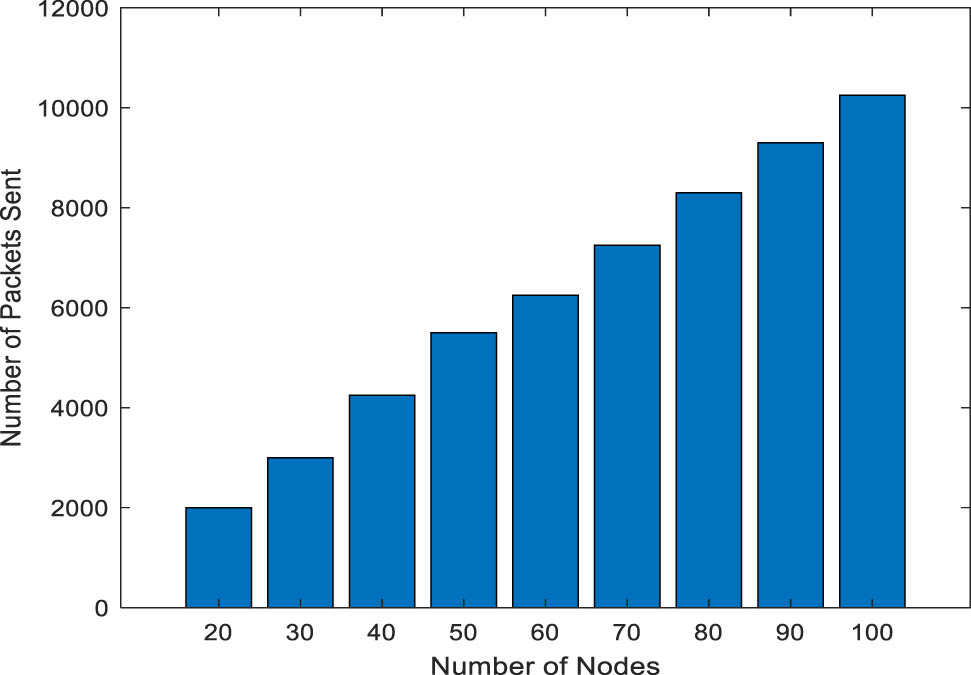
Number of packets sent from different number of nodes.
When fair access is not implemented and a lower duty cycle of 1% is used, with SF = 8, the same channel can be used to send a packet of 10bytes in every 12 s.
In Figure 2, the number of collisions in transmitted packets are compared for different combinations of SF and Channel BW when the number of nodes increases. Increasing the SF while keeping the BW constant leads to a higher number of collisions, e.g., for a 250 kHz channel BW, increasing SF from 11 to 12 almost doubles the number of collisions for 100 nodes due to the increased time on air which directly influences the number of collisions.
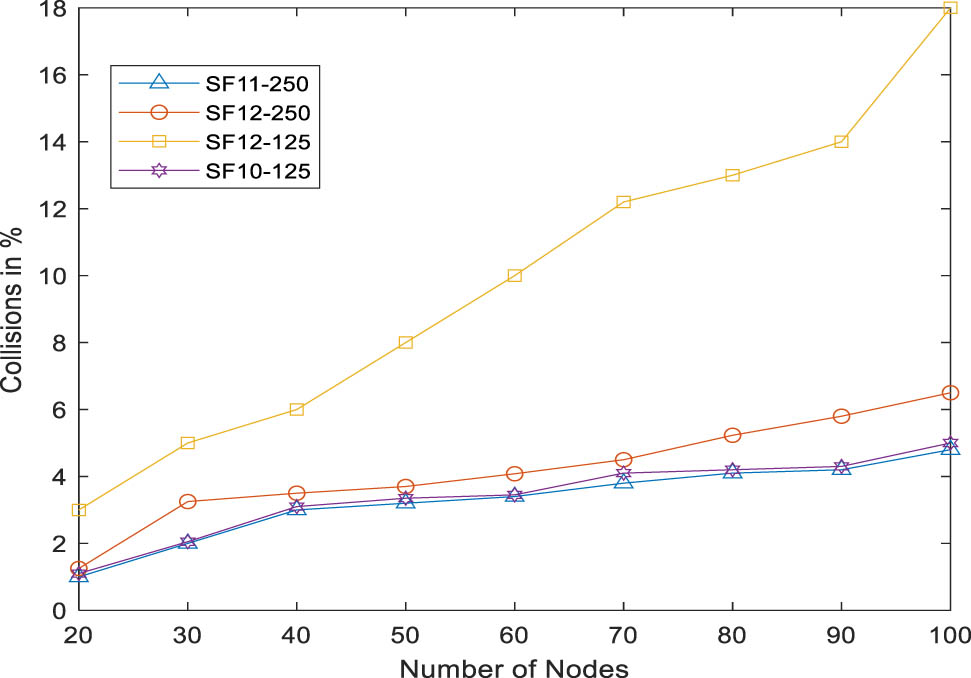
Percentage of collisions for different combinations of SF and bandwidth.
In Figure 3, the number of packets transmitted are compared with the increase in the number of nodes, when the duty cycle is 0.25, 0.50, and 0.75%. When the number of nodes are 500, packets transmitted are 10,000, 20,000, and 40,000, respectively, for 0.25, 0.5, and 0.75% duty cycle, respectively. With an increase in the duty cycle, the number of collisions increases which reduces the number of packets received.
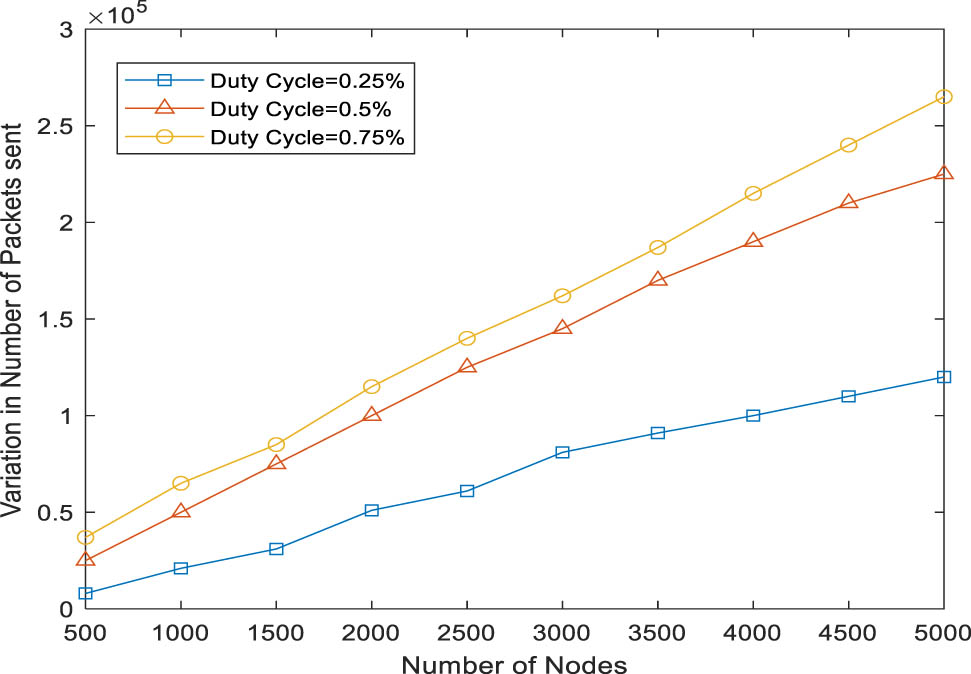
Variation in the number of packets sent for different duty cycles.
In Figure 4, the throughput of the network is compared with the increase in the number of nodes for duty cycle of 0.25%. The throughput is a representation of the number of packets transmitted successfully. An increase in the number of nodes leads to an increase in the number of collisions which decreases the throughput of the network.
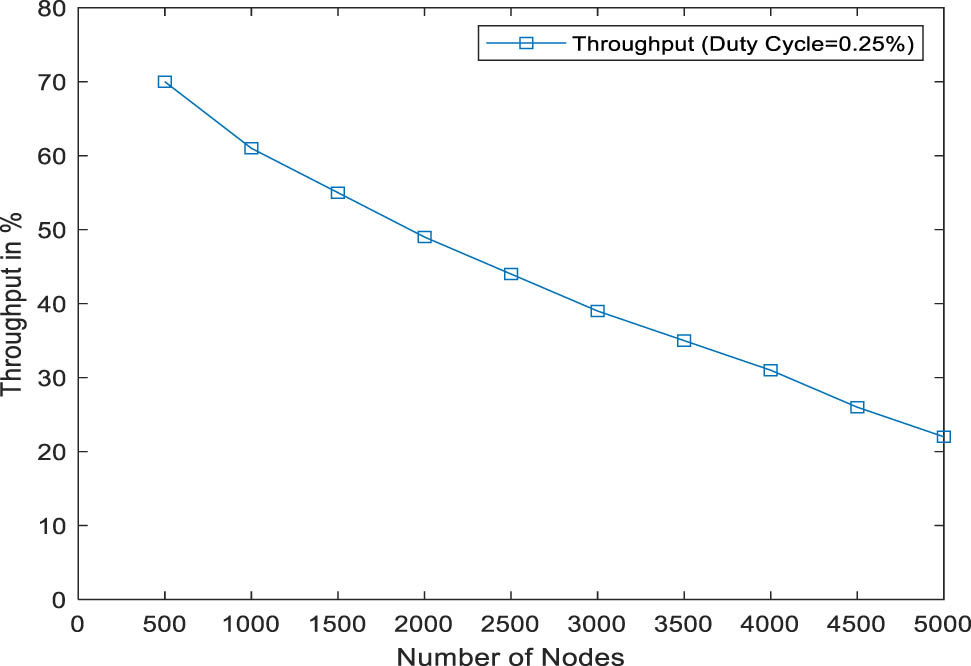
Throughput of the network in presence of different nodes with duty cycle of 0.25%.
5 Conclusion
The main purpose of this article is to analyze the performance of the LoRa network on the basis of the number of collisions occurring when the number of nodes transmitting is increasing. When a large SF is used by the LoRa node, the time on air increases which increases the probability of collision, a solution to this is using larger BW which leads to an increase in cost; therefore, a tradeoff is required between these two. The work compares these two parameters while keeping the duty cycle constant, the result clearly shows that SF11-250 performs better; sometimes we need a higher SF value for long-distance communications. Therefore, a larger SF and higher BW is recommended. In the future, this work will be integrated with a Satellite network where a VDES (VHF-data exchange system) will be used for exchanging information between terrestrial (LoRa) network and Satellite network.
-
Funding information: The author states no funding involved.
-
Conflict of interest: Authors state no conflict of interest.
-
Author contributions: All authors have accepted responsibility for the entire content of this manuscript and approved its submission.
References
[1] Centenaro M, Vangelista L, Zanella A, Zorzi M. Long-range communications in unlicensed bands: The rising stars in the IoT and smart city scenarios. IEEE Wirel Commun. 2016;23(5):60–7.10.1109/MWC.2016.7721743Search in Google Scholar
[2] Akpakwu GA, Silva BJ, Hancke GP, Abu-Mahfouz AM. A Survey on 5G Networks for the Internet of Things: Communication Technologies and Challenges. IEEE Access. 2017;6:3619–47.10.1109/ACCESS.2017.2779844Search in Google Scholar
[3] Hauser V, Hegr T. LoRaWAN TM specification. United States: LoRa Alliance; 2016.Search in Google Scholar
[4] Ayoub W, Samhat AE, Nouvel F, Mroue M, Prévotet JC. Internet of mobile things: Overview of LoRaWAN, DASH7, and NB-IoT in LPWANs standards and supported mobility. IEEE Commun Surv Tutor. 2019;21(2):1561–81.10.1109/COMST.2018.2877382Search in Google Scholar
[5] Georgiou O, Raza U. Low power wide area network analysis: Can LoRa scale? IEEE Wirel Commun Lett. 2017;6(2):162–5.10.1109/LWC.2016.2647247Search in Google Scholar
[6] Mahmood A, Sisinni E, Guntupalli L, Rondon R, Hassan SA, Gidlund M. Scalability analysis of a LoRa network under imperfect orthogonality. IEEE Trans Ind Inform. 2019;6(2):162–5.10.1109/TII.2018.2864681Search in Google Scholar
[7] Hoeller A, Souza RD, Alcaraz López OL, Alves H, De Noronha Neto M, Brante G. Analysis and performance optimization of LoRa networks with time and antenna diversity. IEEE Access. 2018;6:32820–9.10.1109/ACCESS.2018.2839064Search in Google Scholar
[8] Montejo-Sanchez S, Azurdia-Meza CA, Souza RD, Fernandez EMG, Soto I, Hoeller A. Coded redundant message transmission schemes for low-power wide area IoT applications. IEEE Wirel Commun Lett. 2019;8(2):584–7.10.1109/LWC.2018.2880959Search in Google Scholar
[9] Croce D, Gucciardo M, Mangione S, Santaromita G, Tinnirello I. Impact of LoRa imperfect orthogonality: Analysis of link-level performance. IEEE Commun Lett. 2018;22(4):796–9.10.1109/LCOMM.2018.2797057Search in Google Scholar
[10] Bankov D, Khorov E, Lyakhov A. Mathematical model of LoRaWAN channel access with capture effect. IEEE International Symposium on Personal, Indoor and Mobile Radio Communications (PIMRC); 2017 Oct 8–13; Montreal (QC), Canada. IEEE, 2018. p. 1–5.10.1109/PIMRC.2017.8292748Search in Google Scholar
[11] Noreen U, Clavier L, Bounceur A. LoRa-like CSS-based PHY layer, capture effect and serial interference cancellation. 24th European Wireless; 2018 May 2–4; Catania, Italy. IEEE, 2018. p. 1–6.Search in Google Scholar
[12] El Rachkidy N, Guitton A, Kaneko M. Decoding Superposed LoRa Signals. 2018 Oct 1–4; Chicago (IL), USA. IEEE, 2019. p. 184–90.10.1109/LCN.2018.8638253Search in Google Scholar
[13] Laporte-Fauret B, Ben Temim MA, Ferre G, Dallet D, Minger B, Fuche L. An enhanced LoRa-Like receiver for the simultaneous reception of two interfering signals. IEEE International Symposium on Personal, Indoor and Mobile Radio Communications; 2019 Sep 8–11; Istanbul, Turkey. IEEE, 2019. p. 1–6.10.1109/PIMRC.2019.8904258Search in Google Scholar
[14] Xia X, Zheng Y, Gu T. FTrack: Parallel decoding for LoRa transmissions. IEEE/ACM Trans Netw. 2020;28(6):2573–86.10.1145/3356250.3360024Search in Google Scholar
[15] De Souza Sant’Ana JM, Hoeller A, Souza RD, Alves H, Montejo-Sanchez S. LoRa performance analysis with superposed signal decoding. IEEE Wirel Commun Lett. 2020;9(11):1865–8.10.1109/LWC.2020.3006588Search in Google Scholar
[16] LoRa Alliance Technical Commitee. LoRaWAN 1.1 specification. LoRaWAN. 2017;1.1:101. https://lora-alliance.org/resource-hub/lorawantm-specification-v11.Search in Google Scholar
[17] Bor M, Roedig U, Voigt T, Alonso JM. Do LoRa low-power wide-area networks scale? MSWiM '16: - Proceedings of the 19th ACM International Conference on Modeling, Analysis and Simulation of Wireless and Mobile Systems; 2016 Nov 13–17; New York (NY), USA. ACM, 2016. p. 59–67.10.1145/2988287.2989163Search in Google Scholar
[18] Voigt T, Bor M, Roedig U. Mitigating inter-network interference in LoRa networks. EWSN ’17: Proceedings of the 2017 International Conference on Embedded Wireless Systems and Networks. 2017 Feb 20-22; Uppsala, Sweden. Junction Publishing, 2017. p. 323–8.Search in Google Scholar
[19] Ortega AC, Sutil FS. Performance optimization LoRa network by artificial bee colony algorithm to determination of the load profiles in dwellings. Energies. 2020;13:517.10.3390/en13030517Search in Google Scholar
[20] Gupta G, Zyl RV. Energy harvested end nodes and performance improvement of LoRa networks. Int J Smart Sens Intell Syst. 2021;14(1):1–15.10.21307/ijssis-2021-002Search in Google Scholar
© 2022 Gunjan Gupta et al., published by De Gruyter
This work is licensed under the Creative Commons Attribution 4.0 International License.
Articles in the same Issue
- Research Articles
- Fractal approach to the fluidity of a cement mortar
- Novel results on conformable Bessel functions
- The role of relaxation and retardation phenomenon of Oldroyd-B fluid flow through Stehfest’s and Tzou’s algorithms
- Damage identification of wind turbine blades based on dynamic characteristics
- Improving nonlinear behavior and tensile and compressive strengths of sustainable lightweight concrete using waste glass powder, nanosilica, and recycled polypropylene fiber
- Two-point nonlocal nonlinear fractional boundary value problem with Caputo derivative: Analysis and numerical solution
- Construction of optical solitons of Radhakrishnan–Kundu–Lakshmanan equation in birefringent fibers
- Dynamics and simulations of discretized Caputo-conformable fractional-order Lotka–Volterra models
- Research on facial expression recognition based on an improved fusion algorithm
- N-dimensional quintic B-spline functions for solving n-dimensional partial differential equations
- Solution of two-dimensional fractional diffusion equation by a novel hybrid D(TQ) method
- Investigation of three-dimensional hybrid nanofluid flow affected by nonuniform MHD over exponential stretching/shrinking plate
- Solution for a rotational pendulum system by the Rach–Adomian–Meyers decomposition method
- Study on the technical parameters model of the functional components of cone crushers
- Using Krasnoselskii's theorem to investigate the Cauchy and neutral fractional q-integro-differential equation via numerical technique
- Smear character recognition method of side-end power meter based on PCA image enhancement
- Significance of adding titanium dioxide nanoparticles to an existing distilled water conveying aluminum oxide and zinc oxide nanoparticles: Scrutinization of chemical reactive ternary-hybrid nanofluid due to bioconvection on a convectively heated surface
- An analytical approach for Shehu transform on fractional coupled 1D, 2D and 3D Burgers’ equations
- Exploration of the dynamics of hyperbolic tangent fluid through a tapered asymmetric porous channel
- Bond behavior of recycled coarse aggregate concrete with rebar after freeze–thaw cycles: Finite element nonlinear analysis
- Edge detection using nonlinear structure tensor
- Synchronizing a synchronverter to an unbalanced power grid using sequence component decomposition
- Distinguishability criteria of conformable hybrid linear systems
- A new computational investigation to the new exact solutions of (3 + 1)-dimensional WKdV equations via two novel procedures arising in shallow water magnetohydrodynamics
- A passive verses active exposure of mathematical smoking model: A role for optimal and dynamical control
- A new analytical method to simulate the mutual impact of space-time memory indices embedded in (1 + 2)-physical models
- Exploration of peristaltic pumping of Casson fluid flow through a porous peripheral layer in a channel
- Investigation of optimized ELM using Invasive Weed-optimization and Cuckoo-Search optimization
- Analytical analysis for non-homogeneous two-layer functionally graded material
- Investigation of critical load of structures using modified energy method in nonlinear-geometry solid mechanics problems
- Thermal and multi-boiling analysis of a rectangular porous fin: A spectral approach
- The path planning of collision avoidance for an unmanned ship navigating in waterways based on an artificial neural network
- Shear bond and compressive strength of clay stabilised with lime/cement jet grouting and deep mixing: A case of Norvik, Nynäshamn
- Communication
- Results for the heat transfer of a fin with exponential-law temperature-dependent thermal conductivity and power-law temperature-dependent heat transfer coefficients
- Special Issue: Recent trends and emergence of technology in nonlinear engineering and its applications - Part I
- Research on fault detection and identification methods of nonlinear dynamic process based on ICA
- Multi-objective optimization design of steel structure building energy consumption simulation based on genetic algorithm
- Study on modal parameter identification of engineering structures based on nonlinear characteristics
- On-line monitoring of steel ball stamping by mechatronics cold heading equipment based on PVDF polymer sensing material
- Vibration signal acquisition and computer simulation detection of mechanical equipment failure
- Development of a CPU-GPU heterogeneous platform based on a nonlinear parallel algorithm
- A GA-BP neural network for nonlinear time-series forecasting and its application in cigarette sales forecast
- Analysis of radiation effects of semiconductor devices based on numerical simulation Fermi–Dirac
- Design of motion-assisted training control system based on nonlinear mechanics
- Nonlinear discrete system model of tobacco supply chain information
- Performance degradation detection method of aeroengine fuel metering device
- Research on contour feature extraction method of multiple sports images based on nonlinear mechanics
- Design and implementation of Internet-of-Things software monitoring and early warning system based on nonlinear technology
- Application of nonlinear adaptive technology in GPS positioning trajectory of ship navigation
- Real-time control of laboratory information system based on nonlinear programming
- Software engineering defect detection and classification system based on artificial intelligence
- Vibration signal collection and analysis of mechanical equipment failure based on computer simulation detection
- Fractal analysis of retinal vasculature in relation with retinal diseases – an machine learning approach
- Application of programmable logic control in the nonlinear machine automation control using numerical control technology
- Application of nonlinear recursion equation in network security risk detection
- Study on mechanical maintenance method of ballasted track of high-speed railway based on nonlinear discrete element theory
- Optimal control and nonlinear numerical simulation analysis of tunnel rock deformation parameters
- Nonlinear reliability of urban rail transit network connectivity based on computer aided design and topology
- Optimization of target acquisition and sorting for object-finding multi-manipulator based on open MV vision
- Nonlinear numerical simulation of dynamic response of pile site and pile foundation under earthquake
- Research on stability of hydraulic system based on nonlinear PID control
- Design and simulation of vehicle vibration test based on virtual reality technology
- Nonlinear parameter optimization method for high-resolution monitoring of marine environment
- Mobile app for COVID-19 patient education – Development process using the analysis, design, development, implementation, and evaluation models
- Internet of Things-based smart vehicles design of bio-inspired algorithms using artificial intelligence charging system
- Construction vibration risk assessment of engineering projects based on nonlinear feature algorithm
- Application of third-order nonlinear optical materials in complex crystalline chemical reactions of borates
- Evaluation of LoRa nodes for long-range communication
- Secret information security system in computer network based on Bayesian classification and nonlinear algorithm
- Experimental and simulation research on the difference in motion technology levels based on nonlinear characteristics
- Research on computer 3D image encryption processing based on the nonlinear algorithm
- Outage probability for a multiuser NOMA-based network using energy harvesting relays
Articles in the same Issue
- Research Articles
- Fractal approach to the fluidity of a cement mortar
- Novel results on conformable Bessel functions
- The role of relaxation and retardation phenomenon of Oldroyd-B fluid flow through Stehfest’s and Tzou’s algorithms
- Damage identification of wind turbine blades based on dynamic characteristics
- Improving nonlinear behavior and tensile and compressive strengths of sustainable lightweight concrete using waste glass powder, nanosilica, and recycled polypropylene fiber
- Two-point nonlocal nonlinear fractional boundary value problem with Caputo derivative: Analysis and numerical solution
- Construction of optical solitons of Radhakrishnan–Kundu–Lakshmanan equation in birefringent fibers
- Dynamics and simulations of discretized Caputo-conformable fractional-order Lotka–Volterra models
- Research on facial expression recognition based on an improved fusion algorithm
- N-dimensional quintic B-spline functions for solving n-dimensional partial differential equations
- Solution of two-dimensional fractional diffusion equation by a novel hybrid D(TQ) method
- Investigation of three-dimensional hybrid nanofluid flow affected by nonuniform MHD over exponential stretching/shrinking plate
- Solution for a rotational pendulum system by the Rach–Adomian–Meyers decomposition method
- Study on the technical parameters model of the functional components of cone crushers
- Using Krasnoselskii's theorem to investigate the Cauchy and neutral fractional q-integro-differential equation via numerical technique
- Smear character recognition method of side-end power meter based on PCA image enhancement
- Significance of adding titanium dioxide nanoparticles to an existing distilled water conveying aluminum oxide and zinc oxide nanoparticles: Scrutinization of chemical reactive ternary-hybrid nanofluid due to bioconvection on a convectively heated surface
- An analytical approach for Shehu transform on fractional coupled 1D, 2D and 3D Burgers’ equations
- Exploration of the dynamics of hyperbolic tangent fluid through a tapered asymmetric porous channel
- Bond behavior of recycled coarse aggregate concrete with rebar after freeze–thaw cycles: Finite element nonlinear analysis
- Edge detection using nonlinear structure tensor
- Synchronizing a synchronverter to an unbalanced power grid using sequence component decomposition
- Distinguishability criteria of conformable hybrid linear systems
- A new computational investigation to the new exact solutions of (3 + 1)-dimensional WKdV equations via two novel procedures arising in shallow water magnetohydrodynamics
- A passive verses active exposure of mathematical smoking model: A role for optimal and dynamical control
- A new analytical method to simulate the mutual impact of space-time memory indices embedded in (1 + 2)-physical models
- Exploration of peristaltic pumping of Casson fluid flow through a porous peripheral layer in a channel
- Investigation of optimized ELM using Invasive Weed-optimization and Cuckoo-Search optimization
- Analytical analysis for non-homogeneous two-layer functionally graded material
- Investigation of critical load of structures using modified energy method in nonlinear-geometry solid mechanics problems
- Thermal and multi-boiling analysis of a rectangular porous fin: A spectral approach
- The path planning of collision avoidance for an unmanned ship navigating in waterways based on an artificial neural network
- Shear bond and compressive strength of clay stabilised with lime/cement jet grouting and deep mixing: A case of Norvik, Nynäshamn
- Communication
- Results for the heat transfer of a fin with exponential-law temperature-dependent thermal conductivity and power-law temperature-dependent heat transfer coefficients
- Special Issue: Recent trends and emergence of technology in nonlinear engineering and its applications - Part I
- Research on fault detection and identification methods of nonlinear dynamic process based on ICA
- Multi-objective optimization design of steel structure building energy consumption simulation based on genetic algorithm
- Study on modal parameter identification of engineering structures based on nonlinear characteristics
- On-line monitoring of steel ball stamping by mechatronics cold heading equipment based on PVDF polymer sensing material
- Vibration signal acquisition and computer simulation detection of mechanical equipment failure
- Development of a CPU-GPU heterogeneous platform based on a nonlinear parallel algorithm
- A GA-BP neural network for nonlinear time-series forecasting and its application in cigarette sales forecast
- Analysis of radiation effects of semiconductor devices based on numerical simulation Fermi–Dirac
- Design of motion-assisted training control system based on nonlinear mechanics
- Nonlinear discrete system model of tobacco supply chain information
- Performance degradation detection method of aeroengine fuel metering device
- Research on contour feature extraction method of multiple sports images based on nonlinear mechanics
- Design and implementation of Internet-of-Things software monitoring and early warning system based on nonlinear technology
- Application of nonlinear adaptive technology in GPS positioning trajectory of ship navigation
- Real-time control of laboratory information system based on nonlinear programming
- Software engineering defect detection and classification system based on artificial intelligence
- Vibration signal collection and analysis of mechanical equipment failure based on computer simulation detection
- Fractal analysis of retinal vasculature in relation with retinal diseases – an machine learning approach
- Application of programmable logic control in the nonlinear machine automation control using numerical control technology
- Application of nonlinear recursion equation in network security risk detection
- Study on mechanical maintenance method of ballasted track of high-speed railway based on nonlinear discrete element theory
- Optimal control and nonlinear numerical simulation analysis of tunnel rock deformation parameters
- Nonlinear reliability of urban rail transit network connectivity based on computer aided design and topology
- Optimization of target acquisition and sorting for object-finding multi-manipulator based on open MV vision
- Nonlinear numerical simulation of dynamic response of pile site and pile foundation under earthquake
- Research on stability of hydraulic system based on nonlinear PID control
- Design and simulation of vehicle vibration test based on virtual reality technology
- Nonlinear parameter optimization method for high-resolution monitoring of marine environment
- Mobile app for COVID-19 patient education – Development process using the analysis, design, development, implementation, and evaluation models
- Internet of Things-based smart vehicles design of bio-inspired algorithms using artificial intelligence charging system
- Construction vibration risk assessment of engineering projects based on nonlinear feature algorithm
- Application of third-order nonlinear optical materials in complex crystalline chemical reactions of borates
- Evaluation of LoRa nodes for long-range communication
- Secret information security system in computer network based on Bayesian classification and nonlinear algorithm
- Experimental and simulation research on the difference in motion technology levels based on nonlinear characteristics
- Research on computer 3D image encryption processing based on the nonlinear algorithm
- Outage probability for a multiuser NOMA-based network using energy harvesting relays
