Performance degradation detection method of aeroengine fuel metering device
-
Xue Jin
 and
Wei Li
and
Wei Li

Abstract
In order to realize the safety status monitoring and health management of aeroengine fuel system, a performance degradation detection method of aeroengine fuel metering device was proposed. Aiming at the internal leakage, external leakage, static friction increase, dynamic friction increase, differential pressure controller degradation, and other common performance degradation modes of fuel metering devices, a residual life estimation method based on random forest support vector regression (RF-SVR) was proposed. The SVR model optimized by RF feature selection is used to estimate the remaining life of components. The simulation results show that the mean square error of remaining useful life (RUL) estimation is less than 1.8, the average percentage error is less than 3%, and it has high prediction accuracy. Therefore, the evaluation and verification of the internal leakage health indicators proposed in this article screen out the health indicators that are sensitive to changes in performance degradation parameters but insensitive to changes in environmental and structural parameters and provide decision-making reference for onsite maintenance of engine fuel metering devices.
1 Introduction
Modern aeroengines require accurate control of fuel flow in order to give full play to the engine performance potential and ensure its safety. A fuel metering device is one of the key accessories of aeroengine as an actuator to realize accurate fuel supply for the engine [1]. In the civil aviation engine industry, it is very important to improve the availability of products. Figure 1 shows the oil supply device of the aviation engine fuel system. The human and material resources wasted by engine component failure and emergency maintenance caused by failure have brought serious economic losses to the operation of Airlines [2]. Especially when the passenger plane stops at an airport lacking maintenance equipment and personnel, the long delay of the flight and the cost of manpower and material resources scheduling will increase exponentially. Therefore, the research and development of civil turbofan engine Prognostics and health management system has become an important task for civil engine manufacturers [3].
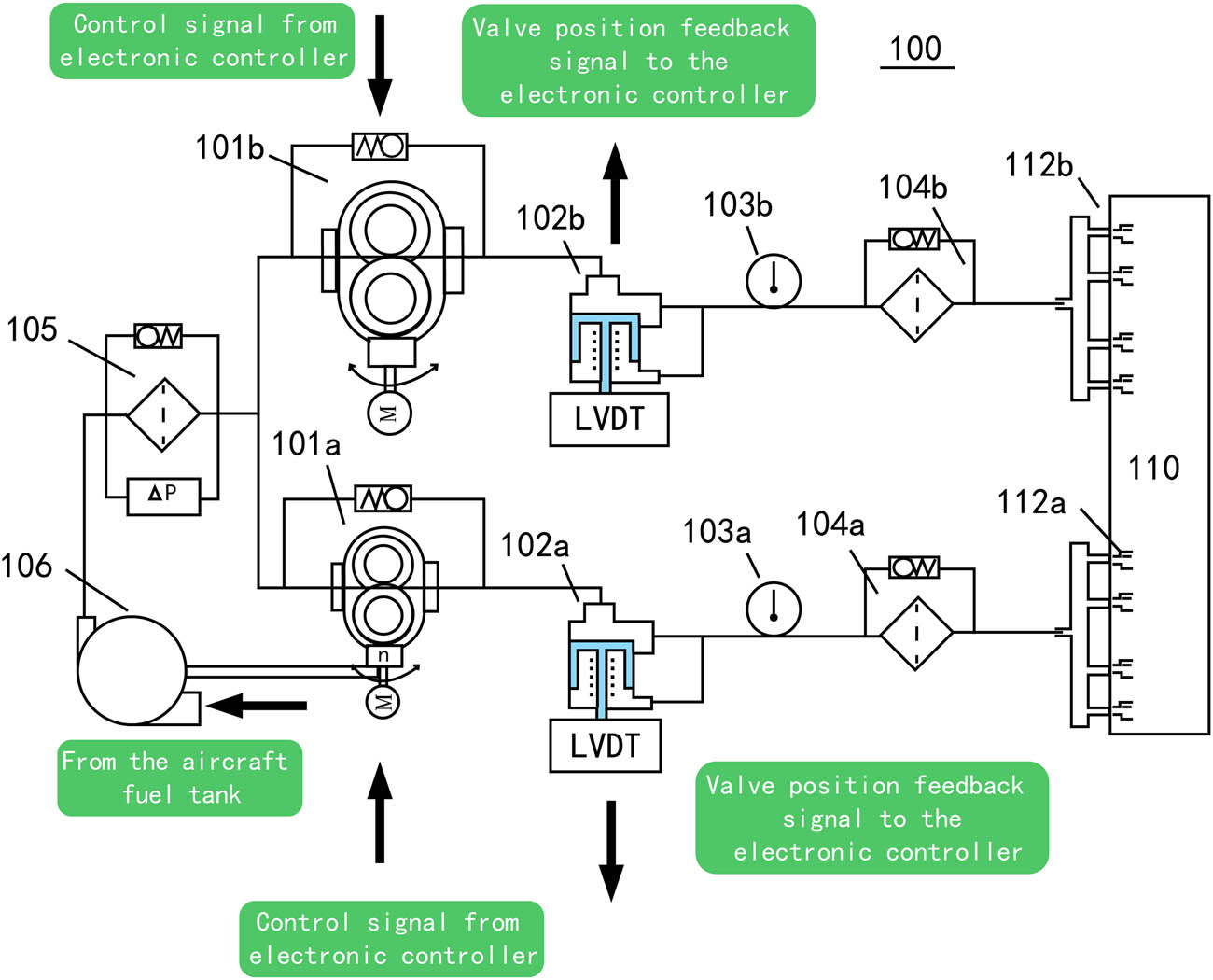
Fuel supply device of aeroengine fuel system.
As the core component of aeroengine control system, the performance of aeroengine fuel system directly affects the normal operation of the engine and even affects the safety and reliability of aircraft operation [4]. At the same time, modern aeroengines require accurate control of fuel flow to give full play to the performance potential of aeroengines. As the core component of the engine fuel system, the fuel metering device undertakes the important task of providing accurate metering fuel and servo fuel for the engine. The fuel metering device operates under the impact of high temperature and high-pressure fuel, with a poor working environment, prone to performance degradation and failure, resulting in flight mission delay, unnecessary economic losses, and even engine out of control during operation, endangering flight safety and causing casualties [5,6]. Therefore, the research on the health management of aeroengine fuel metering device is of great significance.
On this basis, based on the research on the health management of civil turbofan engine fuel systems, taking the fuel metering device as an example, this article carries out the research on health management technology from the aspects of performance degradation mode analysis, health index selection, performance degradation detection, residual life estimation, and so on, The performance degradation detection method based on Mahalanobis distance and the remaining service life estimation method based on RF-SVR are proposed. The effectiveness of the method is verified by simulation based on the fuel system model of the engine. Considering the environmental uncertainty, this method puts forward a health index with high sensitivity to performance degradation. At the same time, the remaining service life of the metering device can be predicted based on the health index data, so as to realize the predictive maintenance of the fuel system, improve the safety of flight operation, and reduce the operation cost of civil aviation flights.
2 Literature review
China is vast, and the climate temperature difference between the north and the south and the four seasons changes greatly. The change in oil temperature will cause the change in fuel density, viscosity, flow coefficient, and mechanical coupling characteristics and then cause the change of component characteristics such as constant pressure differential valve and even metering flow in the metering device. There is little disclosure on the research on the health management technology of aeroengine fuel systems. Rudreshaiah et al. established the mathematical model of the engine fuel system and used the difference between the calculated value of the model and the feedback value of the sensor to compare the difference with the threshold to realize the fault diagnosis of various components of the fuel system. This method strongly depends on the system model, is limited by the accuracy of the model, and has poor robustness [7]. Hopkinson proposed to judge whether the metering device and its sensor have fault based on the fuel metering device model and locate the fault based on the engine inverse model, which realizes the isolation of fuel metering device fault and linear variable differential transformer (LVDT) sensor fault, but this method does not consider the impact of environmental uncertainty on the system. Depending on the fixed mathematical model of fuel metering devices, misdiagnosis and missed diagnosis easily occur [8]. Shao et al. proposed to design the fault residual generator of the main fuel metering device based on the Kalman filter and simulated and verified the actuator stuck, electrohydraulic servo valve stuck, and drift faults, which effectively reduced the fault false alarm rate and missing alarm rate, but this method is powerless for the diagnosis of wear, leakage, and other performance degradation of the metering device [9]. Kiran made detailed work on failure mode analysis and health index selection of main fuel pump, fuel metering device, and other components of civil turbofan engine fuel system, constructed fuel system agent model based on SVR Kriging method, and verified the health index system considering environmental and structural uncertainty [10]. Fernandez Garcia and coauthors analyzed the common failure modes of the components of the fuel metering device of the civil turbofan engine, proposed the corresponding health indicators for the typical internal leakage performance degradation of the metering device, constructed the agent model based on the SVR Kriging method, and verified the proposed health indicators considering the environmental and structural uncertainty, The effectiveness of the health index is verified, but no reliable health index is proposed for the performance degradation mode of increasing static and dynamic friction of the metering device [11]. Dan et al. studied the characteristics of the metering device and the law affected by the fuel temperature to avoid abnormal engine fuel control or even failure of the metering device caused by too high or too low oil temperature [12]. Singh et al. believe that computer digital simulation technology has low cost and short cycle and has become a very important means in the process of design and development [13]. Keenan et al. provide a complete platform for system engineering design, which can establish the model of complex multidisciplinary systems on the same platform, and carry out simulation calculation and in-depth analysis on this basis [14]. Margalit et al. can use this software to build the simulation model of the whole fuel metering device, simulate the working process of the device under various typical working conditions, analyze the simulation results, and then provide the basis for the structure and parameter optimization of the device [15]. Hamedi et al. proposed that the engine fuel metering device test system designed and constructed based on the existing flight/propulsion integrated control simulation platform can simulate various typical working conditions such as speed change and various pressure changes during aeroengine operation and can measure and collect various test data [16].
3 Research methods
3.1 Analysis of performance decline mode
Fuel metering unit (FMU) is the core component of the aeroengine fuel system. It undertakes the important task of supplying fuel to engine combustion chamber and has a direct impact on the performance of aeroengine. Therefore, this article takes the fuel metering device as an example to carry out research on health management [17]. FMU is composed of an electrohydraulic servo valve, metering valve, and differential pressure control assembly. The differential pressure control assembly can ensure that the differential pressure before and after the oil outlet hole of the fuel metering valve remains unchanged so that the fuel flow at the outlet of the metering valve is only determined by the opening area of the metering valve, so as to realize the accurate control of fuel flow output. The FMU control structure is shown in Figure 2.
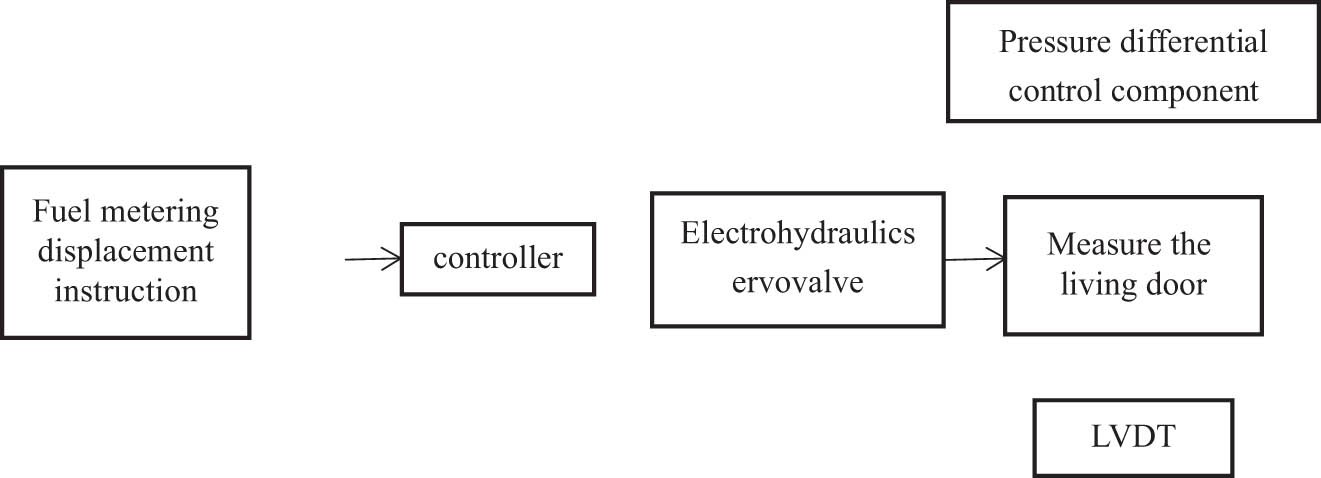
FMU control structure.
3.2 Selection of health indicators
FMU is an electrohydraulic actuator composed of an electrohydraulic servo valve, metering valve, and differential pressure control components. Generally, the flow gain curve of electrohydraulic servo valve can directly reflect the performance change of electrohydraulic actuator, but in the aviation engine fuel system, the electrohydraulic servo valve is not equipped with a flow sensor. It is impossible to directly monitor the performance change of an electrohydraulic actuator from a measurable signal [18]. To solve this problem, a performance monitoring method based on the current velocity curve is proposed in this article. In practical engineering, the following positive proportional relationship is observed between the actuating speed of the metering valve of the electrohydraulic actuator and the output flow of the electrohydraulic servo valve, as shown in formula (1):
where Q is the output flow of the electrohydraulic servo valve, V is the actuating speed of the metering valve, and S is the action area between servo oil and metering valve. Since the FMU is not equipped with a speed sensor, the actuating speed of the metering valve can be obtained by differential operation of the displacement signal output by the LVDT sensor. Therefore, the flow change of the electrohydraulic servo valve can be indirectly reflected by monitoring its speed change, so as to reflect the performance change of the FMU. In order to obtain the operation data close to the real working condition, based on the AMESim matlab joint simulation method and considering the uncertainty of environmental parameters and model parameters, as shown in Table 1, Monte Carlo simulation is carried out to obtain the current velocity data, which is smoothed and piecewise linear fitted to obtain the current velocity gain curve.
Model uncertainty parameters
| Parameter | Uncertainty distribution (μ, σ) |
|---|---|
| Fuel temperature/°C | (40, 15) |
| Equivalent mass/kg | (1.15, 0.06) |
| Natural frequency of servo valve/Hz | (30, 0.5) |
| Metering valve diameter/mm | (35, 0.5) |
| Friction factor/(n/(M/s)) | (100, 1.5) |
3.3 Performance degradation detection method based on Mahalanobis distance
3.3.1 Global exception parameter construction
In order to detect the performance degradation of fuel system components, it is necessary to construct the component global anomaly parameter (G Z ) according to the component health index. First, based on Monte Carlo simulation, the health index data of each component of the fuel system under health state are obtained, and its Gaussian distribution parameters are calculated, as shown in formula (2):
where
where H i is the ith extracted health index value and Z i is the abnormal parameter value corresponding to the index. The abnormal parameter value is calculated corresponding to each health index to the abnormal parameter vector Z corresponding to the component, as shown in formula (4):
By calculating the Mahalanobis distance between the abnormal parameter vector in the current state and the abnormal parameter vector sample set in the healthy state, the global abnormal parameter G Z is obtained.
3.3.2 Selection of detection threshold
After obtaining the global abnormal parameters of the fuel system components, their values are compared with the threshold value T. When the global abnormal parameter value exceeds the limit, it is considered that the performance of the components has deteriorated. In this process, the selection of the threshold value is particularly important. It is usually calculated based on the following formula, as shown in formula (5):
where u is the mean value of the global abnormal parameters of the components in the healthy state, s is its standard deviation, and the size of the coefficient A is determined in combination with the actual data and engineering needs.
3.4 FMU performance degradation detection
Due to space limitations, this study mainly considers two performance degradation modes of internal leakage and external leakage of the metering valve. The global abnormal parameter G Z of FMU is obtained based on the Monte Carlo simulation method. In the healthy state, the distribution of internal leakage and external leakage of the metering valve is analyzed according to its global abnormal parameter distribution. When A takes different values, the performance of the missing alarm rate and false alarm rate of the performance degradation detection algorithm is shown in Table 2. In order to maximize the performance of the detection algorithm, the detection threshold coefficient of FMU is taken as 3.
FMU performance degradation detection
| A | Internal leakage | Leakage | A | Internal leakage | Leakage | ||||
|---|---|---|---|---|---|---|---|---|---|
| False alarm rate (%) | Missing alarm rate (%) | False alarm rate (%) | Missing alarm rate (%) | False alarm rate (%) | Missing alarm rate (%) | False alarm rate (%) | Missing alarm rate (%) | ||
| 0 | 42.14 | 0.07 | 41.88 | 0.03 | 3 | 1.05 | 0.24 | 0.86 | 0.41 |
| 1 | 14.42 | 0.06 | 14.15 | 0.02 | 4 | 0.12 | 7.68 | 0.10 | 7.24 |
| 2 | 3.17 | 0.10 | 3.23 | 0.11 | 5 | 0.03 | 34.66 | 0.03 | 50.04 |
3.5 Estimation of remaining service life
3.5.1 Random forest (RF)
RF is a pattern recognition algorithm based on the classification tree proposed by Breiman. It improves the prediction accuracy of the model by summarizing a large number of classification trees. RF model is essentially a classifier composed of a large number of decision trees, which are mutually independent and identically distributed random vectors. Finally, all decision tree results vote to obtain the output results of RF [19,20]. The specific implementation process of RF is as follows:
Based on the boost resampling method, the RF extracts 63.2% of the samples from the original training sample set each time to generate a sub-sample set, and each sub-sample set corresponds to a classification tree. The remaining unselected samples are out-of-bag data (OOB). OOB error data are used to evaluate the classification accuracy of the classifier.
Based on a single sub-sample set, a single classification tree is generated. At each node of the tree, m (m < m) eigenvectors are randomly selected from the M eigenvectors of the sample, usually
In the test stage, the RF model summarizes the classification results of each classification tree based on the voting principle.
3.5.2 Support vector regression (SVR)
SVR is a generalization of support vector machine in regression [21,22]. SVR maps the feature vector of the original sample set from low-dimensional space to high-dimensional space and performs regression analysis on the sample set based on high-dimensional space. The regression function is shown in formula (6):
where w is the weight vector, φ is the mapping implicit function, x is the eigenvector in the original space, and b is the offset. In order to solve w and b, the minimization function is established, as shown in formula (7):
where C is the penalty coefficient, N is the number of training samples, x i is the eigenvector of the ith training sample, f(x i ) is the predicted value of the ith sample, and y i is the real value of the ith training sample.
4 Result analysis
4.1 Simulation of performance degradation law
FMU is essentially a hydraulic actuator, and its performance degradation law is assumed as a function related to actuation distance and flight time during simulation verification, as shown in formula (8):
where D is the performance degradation percentage of FMU,
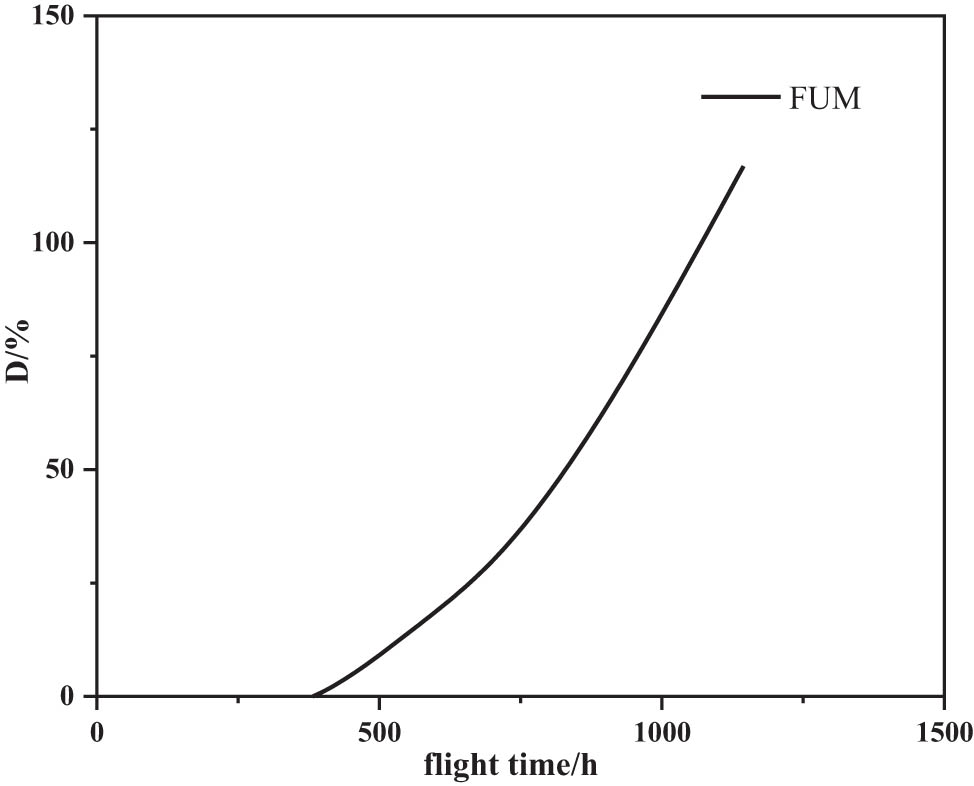
FMU performance degradation curve.
4.1.1 Remaining useful life (RUL) estimation simulation verification
Taking the two performance degradation modes of internal leakage and external leakage of FMU as examples, this article takes the abnormal parameter vector in the two cases as the training set to train the RF model and establish the classifier. Monte Carlo sampling is carried out based on the fuel system model to obtain the health data of the fuel metering device in the random health state, test the performance of the classifier as a test data set, and evaluate it based on the sensitivity and specificity of its main performance indicators [23]. Eight health index parameters are selected for FMU. Here, the RF feature selection algorithm is used to reduce the dimension of FMU health index, eliminate redundant features, and obtain the importance scores of each health index under the two performance degradation modes of internal leakage and external leakage, as shown in Figures 4 and 5.
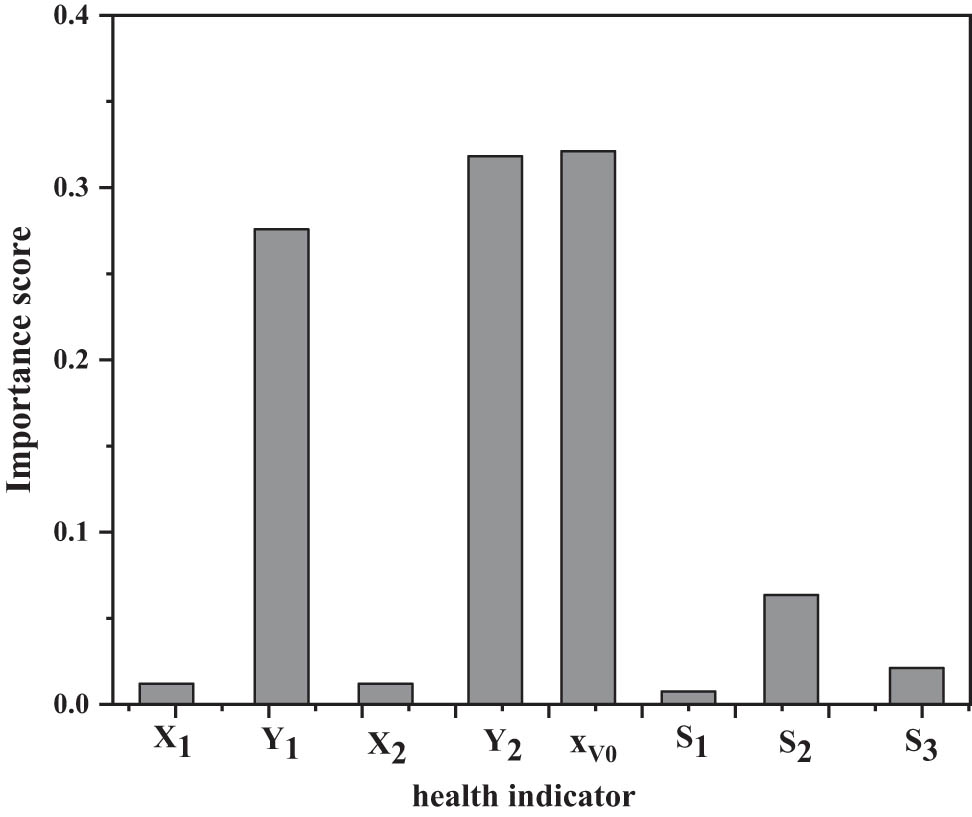
Importance score of internal leakage health indicators.
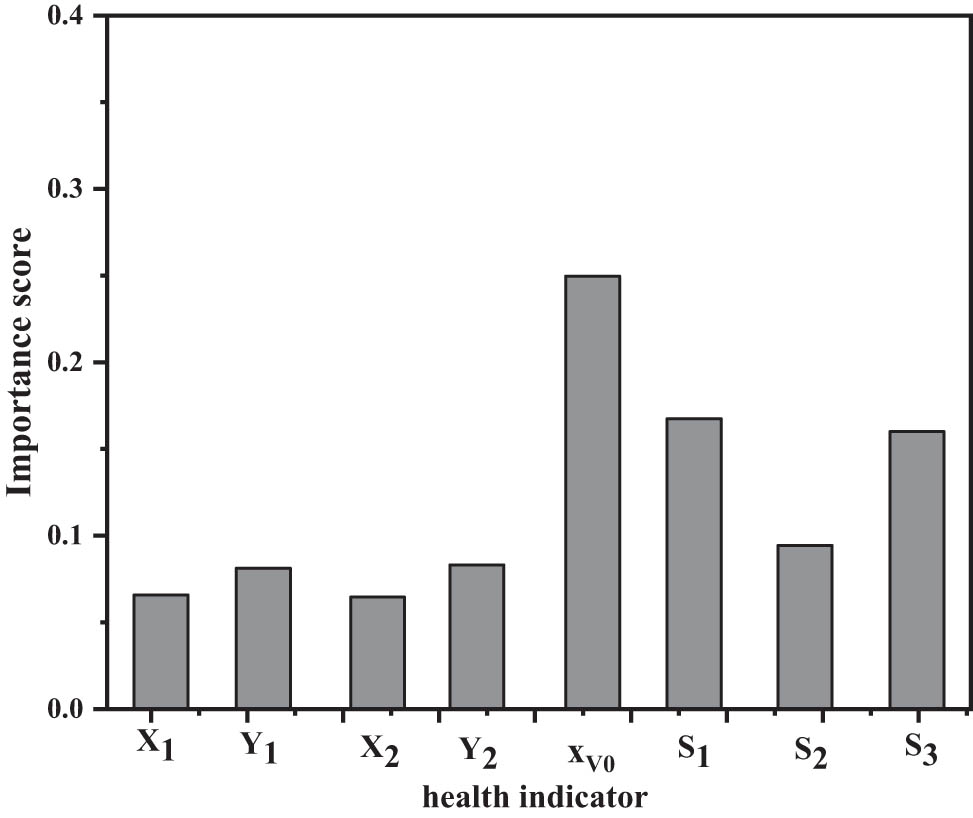
Importance score of external leakage health indicators.
According to the importance score, select Y 1, Y 2, X V0 as the training sample set to train the internal leakage SVR model, and select S 1, S 3, X V0 as the training sample set to train the external leakage SVR model [24]. The penalty parameter C and kernel function parameter g of the SVR model are obtained by small-scale traversal optimization. Based on the performance degradation law in this article, the component health data corresponding to flight time are generated, and its remaining service life is predicted based on the SVR model [25].
According to the analysis of Figures 6 and 7, the estimated mean square error of the RF-SVR regression model is less than 1.8, and the average absolute percentage error is less than 3%. This method can accurately estimate the performance degradation and remaining service life of fuel metering devices according to the health data and give early warning when the remaining life is less than 30% of the whole life cycle and about 400H. This method can accurately estimate the performance degradation and remaining service life of fuel metering devices according to the health data, give early warning when the remaining life is less than 30% of the whole life cycle and about 400H, and prompt the engine maintenance personnel to repair it.
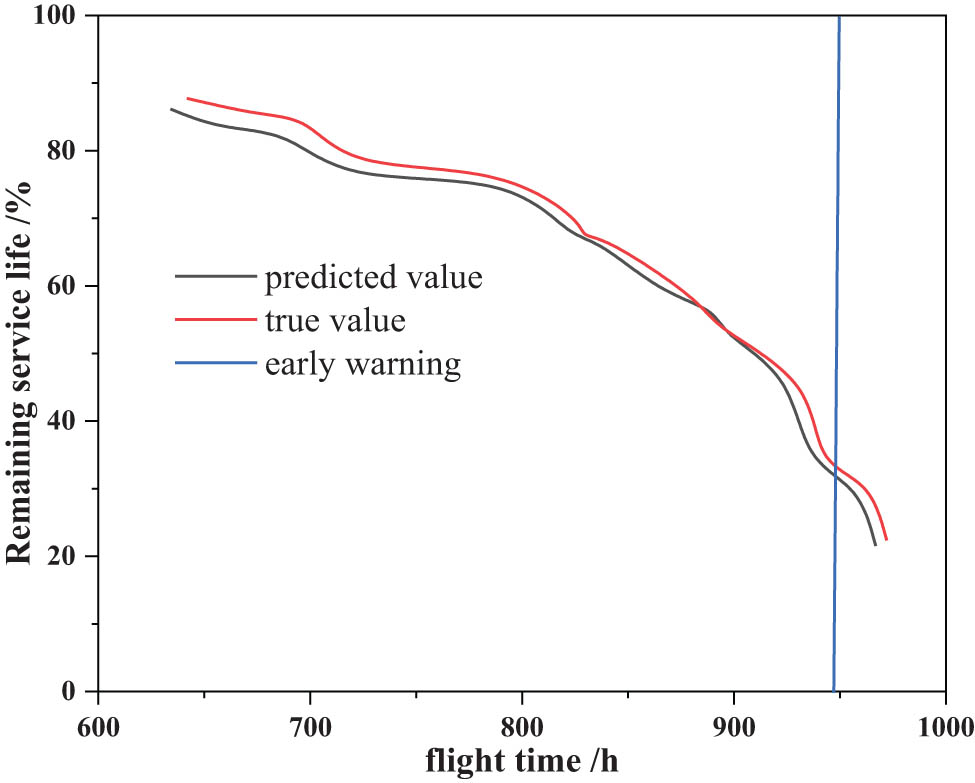
Comparison between predicted value and real value under internal leakage.
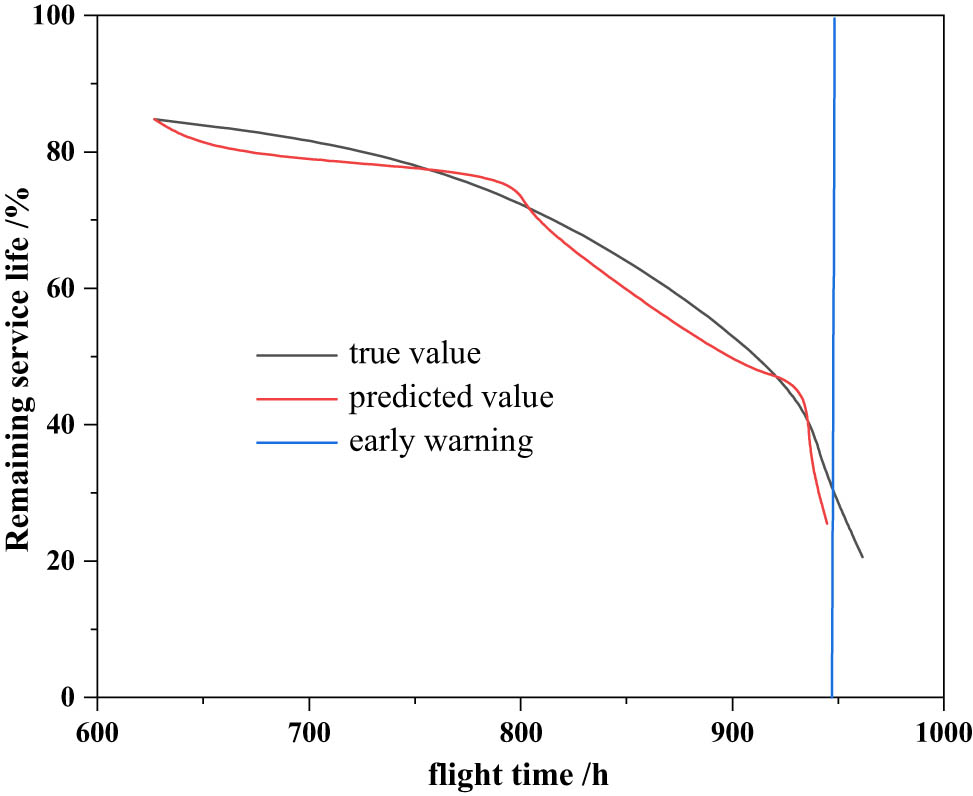
Comparison between predicted value and real value under external leakage.
5 Conclusion
Through simulation and test, this article studies the performance degradation detection of aeroengine fuel metering device, analyzes the influence of fuel temperature on metering characteristics, and obtains the following conclusions: the regression features of SVR model are selected based on RF, the redundant features are eliminated, and the estimation accuracy of SVR model is improved. It is verified based on the simulation data of the mechanical and hydraulic model of the fuel system. The mean square error of RUL estimation is less than 1.8, and the average percentage error is less than 3%. It has high prediction accuracy and has important reference significance for the predictive maintenance of the fuel system.
-
Funding information: The authors state no funding involved.
-
Author contributions: All authors have accepted responsibility for the entire content of this manuscript and approved its submission.
-
Conflict of interest: The authors state no conflict of interest.
References
[1] Yw A, Yan SA, Mc A, Wx A. Predictive control of air-fuel ratio in aircraft engine on fuel-powered unmanned aerial vehicle using fuzzy-rbf neural network. J Frankl Inst. 2020;357(13):8342–63.10.1016/j.jfranklin.2020.03.016Search in Google Scholar
[2] Pham PX, Vo DQ, Jazar RN. Development of fuel metering techniques for spark ignition engines. Fuel. 2017;206:701–15.10.1016/j.fuel.2017.06.043Search in Google Scholar
[3] Maini P, Sundar K, Singh M, Rathinam S, Sujit PB. Cooperative aerial–ground vehicle route planning with fuel constraints for coverage applications. IEEE Trans Aerosp ElectrSyst. 2019;55(6):3016–28.10.1109/TAES.2019.2917578Search in Google Scholar
[4] Pan ZF, An L, Wen CY. Recent advances in fuel cells based propulsion systems for unmanned aerial vehicles. Appl Energy. 2019;240:473–85.10.1016/j.apenergy.2019.02.079Search in Google Scholar
[5] Lu Y, Zuo Z, Zhao C, Zhang F, Du M. Study on dynamic characteristics and control algorithm design for fuel metering valve of high-pressure pump. IFAC-PapersOnLine. 2018;51(31):930–5.10.1016/j.ifacol.2018.10.061Search in Google Scholar
[6] Morajkar PP, Abdrabou MK, Salkar AV, Raj A, Anjum DH. Nanostructural disorder and reactivity comparison of flame soot and engine soot using diesel and jatropha biodiesel/diesel blend as fuels. Energy Fuels. 2020;34(10):12960–71.10.1021/acs.energyfuels.0c02063Search in Google Scholar
[7] Rudreshaiah OB, Venkatesh YK, Ramappa S. Terminalia bellirica: a new biodiesel for diesel engine: a comparative experimental investigation. Environ Sci Pollut Res. 2020;27(13):14432–40.10.1007/s11356-019-06940-ySearch in Google Scholar PubMed
[8] Hopkinson J. Sir Frank Whittle – Britain’s Jet Engine Pioneer – visit to Midlands Aircraft Museum. Manag Serv. 2019;63(1):6. https://www.zhangqiaokeyan.com/academic-journal-foreign_other_thesis/0204112738223.html.Search in Google Scholar
[9] Shao S, Cheng J, Zhang B, Ma N, Zhang D, Wang Y, et al. Effects of a DOC+DPF system on emission characteristics of China Π engineering vehicle diesel engine and influence factors of trapping efficiency of PM for DOC + DPF system. Energy Sources A: Recovery Util Environ Eff. 2019;41(1–6):527–41.10.1080/15567036.2018.1520337Search in Google Scholar
[10] Kiran S. Human resource development: fuelling the growth engine of north western railway. Indian Railw. 2019;63(4):22–2.Search in Google Scholar
[11] Fernandez-Garcia ME, Larrey-Ruiz J, Sancho-Gomez JL. Reducing the noise introduced by the engine of a moving autonomous vehicle for recording underwater sounds. Appl Acoust. 2019;155:250–9.10.1016/j.apacoust.2019.06.006Search in Google Scholar
[12] Dan A. Engine oil field trials evaluate fuel economy in real-world conditions. Fleet Equip. 2019;45(8):14.Search in Google Scholar
[13] Singh A, Ahuja H, Bhadoria VS, Singh S. Control implementation of squirrel cage induction generator based wind energy conversion system. J Sci Ind Res. 2020;79(4):306–11.10.1063/5.0043408Search in Google Scholar
[14] Keenan M, Pickett R, Tronconi E, Nova I, Kinnunen N, Suvanto M, et al. The catalytic challenges of implementing a euro vi heavy duty emissions control system for a dedicated lean operating natural gas engine. Top Catal. 2019;62(1):273–81.10.1007/s11244-018-1127-7Search in Google Scholar
[15] Margalit B, Metzger BD, Sironi L. Constraints on the engines of fast radio bursts. Mon Not R Astron Soc. 2020;494(4):4627–44.10.1093/mnras/staa1036Search in Google Scholar
[16] Hamedi MR, Doustdar O, Tsolakis A, Hartland J. Thermal energy storage system for efficient diesel exhaust aftertreatment at low temperatures. Appl Energy. 2019;235:874–87.10.1016/j.apenergy.2018.11.008Search in Google Scholar
[17] Fediushko D. Russia re-engines Tu-95MS bombers. Jane’s Def Wkly. 2019;56(20):15. https://www.zhangqiaokeyan.com/academic-journal-foreign_other_thesis/0204113008297.html.Search in Google Scholar
[18] Taillard ÉD, Helsgaun K. POPMUSIC for the travelling salesman problem . Eur J Operational Res. 2019;272(2):420–9.10.1016/j.ejor.2018.06.039Search in Google Scholar
[19] Ororbia ME, Chhabra JPS, Warn GP, Miller SW, Yukish MA, Qiu T. Increasing the discriminatory power of bounding models using problem-specific knowledge when viewing design as a sequential decision process. Struct Multidiscip Optim. 2020;62(2):709–28.10.1007/s00158-020-02528-0Search in Google Scholar
[20] Kadam-Halani PK, Lee DD, Sammel MD, Arya LA, Andy UU. The quality of health information available on the internet for patients with fecal incontinence. Female Pelvic Med Reconstr Surg. 2019;25(2):120–4.10.1097/SPV.0000000000000658Search in Google Scholar PubMed
[21] Edward J. Bobit. Professional fleet manager of the year award. Automot Fleet. 2019. https://www.zhangqiaokeyan.com/academic-journal-foreign_other_thesis/0204113046439.html.Search in Google Scholar
[22] Jagirdar VV, Trikande MW. Terrain accessibility prediction for a new multi-axle armoured wheeled vehicle. Def Sci J. 2019;69(2):195–200. 10.14429/dsj.69.12076Search in Google Scholar
[23] Yuan Y, Zhang T, Lin Z, Zhang J. An investigation into factors determining the metering performance of a fuel control unit in an aero engine. Flow Meas Instrum. 2019;71(2020):101672–55.10.1016/j.flowmeasinst.2019.101672Search in Google Scholar
[24] Korzhnev VN, Mileshin VI, Pankov SV. Computational and experimental studies of aerodynamics of fans for advanced turbofan engines. TSAGI Sci J. 2019;50(3):219–37.10.1615/TsAGISciJ.2019031102Search in Google Scholar
[25] Dogra J, Jain S, Sharma A, Kumar R, Sood M. Brain tumor detection from MR images employing fuzzy graph cut technique. Recent Adv Comp Sci Commun. 2020;13(3):362–9.10.2174/2213275912666181207152633Search in Google Scholar
© 2022 Xue Jin and Wei Li, published by De Gruyter
This work is licensed under the Creative Commons Attribution 4.0 International License.
Articles in the same Issue
- Research Articles
- Fractal approach to the fluidity of a cement mortar
- Novel results on conformable Bessel functions
- The role of relaxation and retardation phenomenon of Oldroyd-B fluid flow through Stehfest’s and Tzou’s algorithms
- Damage identification of wind turbine blades based on dynamic characteristics
- Improving nonlinear behavior and tensile and compressive strengths of sustainable lightweight concrete using waste glass powder, nanosilica, and recycled polypropylene fiber
- Two-point nonlocal nonlinear fractional boundary value problem with Caputo derivative: Analysis and numerical solution
- Construction of optical solitons of Radhakrishnan–Kundu–Lakshmanan equation in birefringent fibers
- Dynamics and simulations of discretized Caputo-conformable fractional-order Lotka–Volterra models
- Research on facial expression recognition based on an improved fusion algorithm
- N-dimensional quintic B-spline functions for solving n-dimensional partial differential equations
- Solution of two-dimensional fractional diffusion equation by a novel hybrid D(TQ) method
- Investigation of three-dimensional hybrid nanofluid flow affected by nonuniform MHD over exponential stretching/shrinking plate
- Solution for a rotational pendulum system by the Rach–Adomian–Meyers decomposition method
- Study on the technical parameters model of the functional components of cone crushers
- Using Krasnoselskii's theorem to investigate the Cauchy and neutral fractional q-integro-differential equation via numerical technique
- Smear character recognition method of side-end power meter based on PCA image enhancement
- Significance of adding titanium dioxide nanoparticles to an existing distilled water conveying aluminum oxide and zinc oxide nanoparticles: Scrutinization of chemical reactive ternary-hybrid nanofluid due to bioconvection on a convectively heated surface
- An analytical approach for Shehu transform on fractional coupled 1D, 2D and 3D Burgers’ equations
- Exploration of the dynamics of hyperbolic tangent fluid through a tapered asymmetric porous channel
- Bond behavior of recycled coarse aggregate concrete with rebar after freeze–thaw cycles: Finite element nonlinear analysis
- Edge detection using nonlinear structure tensor
- Synchronizing a synchronverter to an unbalanced power grid using sequence component decomposition
- Distinguishability criteria of conformable hybrid linear systems
- A new computational investigation to the new exact solutions of (3 + 1)-dimensional WKdV equations via two novel procedures arising in shallow water magnetohydrodynamics
- A passive verses active exposure of mathematical smoking model: A role for optimal and dynamical control
- A new analytical method to simulate the mutual impact of space-time memory indices embedded in (1 + 2)-physical models
- Exploration of peristaltic pumping of Casson fluid flow through a porous peripheral layer in a channel
- Investigation of optimized ELM using Invasive Weed-optimization and Cuckoo-Search optimization
- Analytical analysis for non-homogeneous two-layer functionally graded material
- Investigation of critical load of structures using modified energy method in nonlinear-geometry solid mechanics problems
- Thermal and multi-boiling analysis of a rectangular porous fin: A spectral approach
- The path planning of collision avoidance for an unmanned ship navigating in waterways based on an artificial neural network
- Shear bond and compressive strength of clay stabilised with lime/cement jet grouting and deep mixing: A case of Norvik, Nynäshamn
- Communication
- Results for the heat transfer of a fin with exponential-law temperature-dependent thermal conductivity and power-law temperature-dependent heat transfer coefficients
- Special Issue: Recent trends and emergence of technology in nonlinear engineering and its applications - Part I
- Research on fault detection and identification methods of nonlinear dynamic process based on ICA
- Multi-objective optimization design of steel structure building energy consumption simulation based on genetic algorithm
- Study on modal parameter identification of engineering structures based on nonlinear characteristics
- On-line monitoring of steel ball stamping by mechatronics cold heading equipment based on PVDF polymer sensing material
- Vibration signal acquisition and computer simulation detection of mechanical equipment failure
- Development of a CPU-GPU heterogeneous platform based on a nonlinear parallel algorithm
- A GA-BP neural network for nonlinear time-series forecasting and its application in cigarette sales forecast
- Analysis of radiation effects of semiconductor devices based on numerical simulation Fermi–Dirac
- Design of motion-assisted training control system based on nonlinear mechanics
- Nonlinear discrete system model of tobacco supply chain information
- Performance degradation detection method of aeroengine fuel metering device
- Research on contour feature extraction method of multiple sports images based on nonlinear mechanics
- Design and implementation of Internet-of-Things software monitoring and early warning system based on nonlinear technology
- Application of nonlinear adaptive technology in GPS positioning trajectory of ship navigation
- Real-time control of laboratory information system based on nonlinear programming
- Software engineering defect detection and classification system based on artificial intelligence
- Vibration signal collection and analysis of mechanical equipment failure based on computer simulation detection
- Fractal analysis of retinal vasculature in relation with retinal diseases – an machine learning approach
- Application of programmable logic control in the nonlinear machine automation control using numerical control technology
- Application of nonlinear recursion equation in network security risk detection
- Study on mechanical maintenance method of ballasted track of high-speed railway based on nonlinear discrete element theory
- Optimal control and nonlinear numerical simulation analysis of tunnel rock deformation parameters
- Nonlinear reliability of urban rail transit network connectivity based on computer aided design and topology
- Optimization of target acquisition and sorting for object-finding multi-manipulator based on open MV vision
- Nonlinear numerical simulation of dynamic response of pile site and pile foundation under earthquake
- Research on stability of hydraulic system based on nonlinear PID control
- Design and simulation of vehicle vibration test based on virtual reality technology
- Nonlinear parameter optimization method for high-resolution monitoring of marine environment
- Mobile app for COVID-19 patient education – Development process using the analysis, design, development, implementation, and evaluation models
- Internet of Things-based smart vehicles design of bio-inspired algorithms using artificial intelligence charging system
- Construction vibration risk assessment of engineering projects based on nonlinear feature algorithm
- Application of third-order nonlinear optical materials in complex crystalline chemical reactions of borates
- Evaluation of LoRa nodes for long-range communication
- Secret information security system in computer network based on Bayesian classification and nonlinear algorithm
- Experimental and simulation research on the difference in motion technology levels based on nonlinear characteristics
- Research on computer 3D image encryption processing based on the nonlinear algorithm
- Outage probability for a multiuser NOMA-based network using energy harvesting relays
Articles in the same Issue
- Research Articles
- Fractal approach to the fluidity of a cement mortar
- Novel results on conformable Bessel functions
- The role of relaxation and retardation phenomenon of Oldroyd-B fluid flow through Stehfest’s and Tzou’s algorithms
- Damage identification of wind turbine blades based on dynamic characteristics
- Improving nonlinear behavior and tensile and compressive strengths of sustainable lightweight concrete using waste glass powder, nanosilica, and recycled polypropylene fiber
- Two-point nonlocal nonlinear fractional boundary value problem with Caputo derivative: Analysis and numerical solution
- Construction of optical solitons of Radhakrishnan–Kundu–Lakshmanan equation in birefringent fibers
- Dynamics and simulations of discretized Caputo-conformable fractional-order Lotka–Volterra models
- Research on facial expression recognition based on an improved fusion algorithm
- N-dimensional quintic B-spline functions for solving n-dimensional partial differential equations
- Solution of two-dimensional fractional diffusion equation by a novel hybrid D(TQ) method
- Investigation of three-dimensional hybrid nanofluid flow affected by nonuniform MHD over exponential stretching/shrinking plate
- Solution for a rotational pendulum system by the Rach–Adomian–Meyers decomposition method
- Study on the technical parameters model of the functional components of cone crushers
- Using Krasnoselskii's theorem to investigate the Cauchy and neutral fractional q-integro-differential equation via numerical technique
- Smear character recognition method of side-end power meter based on PCA image enhancement
- Significance of adding titanium dioxide nanoparticles to an existing distilled water conveying aluminum oxide and zinc oxide nanoparticles: Scrutinization of chemical reactive ternary-hybrid nanofluid due to bioconvection on a convectively heated surface
- An analytical approach for Shehu transform on fractional coupled 1D, 2D and 3D Burgers’ equations
- Exploration of the dynamics of hyperbolic tangent fluid through a tapered asymmetric porous channel
- Bond behavior of recycled coarse aggregate concrete with rebar after freeze–thaw cycles: Finite element nonlinear analysis
- Edge detection using nonlinear structure tensor
- Synchronizing a synchronverter to an unbalanced power grid using sequence component decomposition
- Distinguishability criteria of conformable hybrid linear systems
- A new computational investigation to the new exact solutions of (3 + 1)-dimensional WKdV equations via two novel procedures arising in shallow water magnetohydrodynamics
- A passive verses active exposure of mathematical smoking model: A role for optimal and dynamical control
- A new analytical method to simulate the mutual impact of space-time memory indices embedded in (1 + 2)-physical models
- Exploration of peristaltic pumping of Casson fluid flow through a porous peripheral layer in a channel
- Investigation of optimized ELM using Invasive Weed-optimization and Cuckoo-Search optimization
- Analytical analysis for non-homogeneous two-layer functionally graded material
- Investigation of critical load of structures using modified energy method in nonlinear-geometry solid mechanics problems
- Thermal and multi-boiling analysis of a rectangular porous fin: A spectral approach
- The path planning of collision avoidance for an unmanned ship navigating in waterways based on an artificial neural network
- Shear bond and compressive strength of clay stabilised with lime/cement jet grouting and deep mixing: A case of Norvik, Nynäshamn
- Communication
- Results for the heat transfer of a fin with exponential-law temperature-dependent thermal conductivity and power-law temperature-dependent heat transfer coefficients
- Special Issue: Recent trends and emergence of technology in nonlinear engineering and its applications - Part I
- Research on fault detection and identification methods of nonlinear dynamic process based on ICA
- Multi-objective optimization design of steel structure building energy consumption simulation based on genetic algorithm
- Study on modal parameter identification of engineering structures based on nonlinear characteristics
- On-line monitoring of steel ball stamping by mechatronics cold heading equipment based on PVDF polymer sensing material
- Vibration signal acquisition and computer simulation detection of mechanical equipment failure
- Development of a CPU-GPU heterogeneous platform based on a nonlinear parallel algorithm
- A GA-BP neural network for nonlinear time-series forecasting and its application in cigarette sales forecast
- Analysis of radiation effects of semiconductor devices based on numerical simulation Fermi–Dirac
- Design of motion-assisted training control system based on nonlinear mechanics
- Nonlinear discrete system model of tobacco supply chain information
- Performance degradation detection method of aeroengine fuel metering device
- Research on contour feature extraction method of multiple sports images based on nonlinear mechanics
- Design and implementation of Internet-of-Things software monitoring and early warning system based on nonlinear technology
- Application of nonlinear adaptive technology in GPS positioning trajectory of ship navigation
- Real-time control of laboratory information system based on nonlinear programming
- Software engineering defect detection and classification system based on artificial intelligence
- Vibration signal collection and analysis of mechanical equipment failure based on computer simulation detection
- Fractal analysis of retinal vasculature in relation with retinal diseases – an machine learning approach
- Application of programmable logic control in the nonlinear machine automation control using numerical control technology
- Application of nonlinear recursion equation in network security risk detection
- Study on mechanical maintenance method of ballasted track of high-speed railway based on nonlinear discrete element theory
- Optimal control and nonlinear numerical simulation analysis of tunnel rock deformation parameters
- Nonlinear reliability of urban rail transit network connectivity based on computer aided design and topology
- Optimization of target acquisition and sorting for object-finding multi-manipulator based on open MV vision
- Nonlinear numerical simulation of dynamic response of pile site and pile foundation under earthquake
- Research on stability of hydraulic system based on nonlinear PID control
- Design and simulation of vehicle vibration test based on virtual reality technology
- Nonlinear parameter optimization method for high-resolution monitoring of marine environment
- Mobile app for COVID-19 patient education – Development process using the analysis, design, development, implementation, and evaluation models
- Internet of Things-based smart vehicles design of bio-inspired algorithms using artificial intelligence charging system
- Construction vibration risk assessment of engineering projects based on nonlinear feature algorithm
- Application of third-order nonlinear optical materials in complex crystalline chemical reactions of borates
- Evaluation of LoRa nodes for long-range communication
- Secret information security system in computer network based on Bayesian classification and nonlinear algorithm
- Experimental and simulation research on the difference in motion technology levels based on nonlinear characteristics
- Research on computer 3D image encryption processing based on the nonlinear algorithm
- Outage probability for a multiuser NOMA-based network using energy harvesting relays
