Research on computer 3D image encryption processing based on the nonlinear algorithm
-
Longlong Bian
 ,
Harish Kumar
,
Harish Kumar

Abstract
This article uses the nonlinear digital chaos theory algorithm to generate the corresponding encryption system initial parameters, by analysing the correlation degree of image elements from the angles of horizontal, vertical, and diagonal direction, in order to study computer three-dimensional (3D) image encryption processing. The correlation degree of the cypher text obtained by the nonlinear algorithm is weak in the image's adjacent pixels, and the adjacent pixels are not related at all, horizontal angle: 0.915989, vertical angle: 0.968184, diagonal angle: 0.913533. The nonlinear algorithm distributes the image's statistical features into the random cypher text. By applying permutations and replacements in 3D space, the proposed approach improves performance parameters and widens key space in comparison to previous image cryptography investigations. The important qualities of such a secure system are its simplicity and efficacy. Simulations and analysis show that the proposed method can produce a large key space while also surviving standard cipher attacks. Because of its powerful cryptographic properties, it is suited for image applications. The nonlinear algorithm has very high sensitivity to the secret key and plaintext, as well as better statistical performance, higher security, and higher efficiency in the operation of the algorithm.
1 Introduction
With the rapid development of modern network technology, information security is becoming more and more important. In the field of communication, as multimedia data, digital images need to be encrypted in order to effectively avoid illegal reception and tampering. Scrambling technology is the most important encryption method. The formal title for the scrambling procedure, which utilizes a function to modify the scope of data to be protected before it is delivered, is encryption. Because advanced encryption techniques are based on intricate numerical methods, reversing the scrambled data is extremely difficult, if not impossible. Encryption was used to meet the group’s need for confidentiality. Data encryption, on the other hand, successfully solves the issue of integrity. Encryption and data scrambling are also significant components of methods that guarantee security while performing a system, networking, or communication task.
This research offered an in-depth evaluation of existing image encryption algorithms. Picture encryption approaches were revealed to require a high level of confusion, zero connection with the input images, minimal computing complexity, and great cryptanalysis resistance. The evaluation parameters were also utilized to examine the advantages and disadvantages of various picture encryption algorithms. At present, the commonly used scrambling techniques include the Arnold transformation, the space-filling, self-avoiding, simple, and self-similar (FASS) curve algorithm, Gray transformation, Conway life game rules, affine modulus transformation, trigonometric function transformation, and so on. Curves are created by connecting polygons etched onto tiles with additional line segments. Conditions are enforced to guarantee that the resulting curve is fundamentally space-filling, inner, simple (single-stroke), and self-similar. FASS curves are the term used to describe such curves. Their tiling link is used to explain the development of standard space-filling curves as well as to generate innovative FASS curves. The chaotic system does not require the addition of any random factors to realize inherent random changes, resulting in chaotic phenomena. Image encryption using a nonlinear chaotic algorithm is simple and effective. Safety is strong [1].
Photographic encryption has been shown to be a practical method of conveying sensitive information, resulting in a variety of procedures. Even so, researchers continue to be drawn to it as the usage of images in all types of digital communication has surged. Image encryption converts a plain image into an encrypted image by using a secret key. The decryption technique uses the secret key to transform the cipher image into the original image. Decryption is similar to encryption, except that it operates in the other direction. Secret keys are particularly significant in encryption. Because the security of the encryption strategy is mainly reliant on it, two types of keys are used: private and public keys [2,3]. Picture encryption is based on the revolutionary idea of utilizing logic to collectively work on and change the sequential or random pixel bits of a picture, resulting in a whole set of new pixels that are comparable to the original bits. As a result, a new method of transmitting information has arisen. Using the Cipher Block Chaining (CBC) approach, which embeds plain text in the encrypted image and makes data transfer incredibly safe, can add another layer of complexity for the malevolent attacker [1,4]. This research provides a revolutionary approach for image encryption that is both fast and secure. Because digital images are frequently stored as two-dimensional (2D) arrays, a higher-dimensional chaotic map is generated, which is used to shuffle the positions (and, if desired, gray values) of pixels in the image in order to swiftly de-correlate connections between pixels. Meanwhile, a pixel diffusion mechanism is employed to obfuscate the relationship between the cryptographic and plain image. Because three-dimensional (3D) image encryption processing based on nonlinear algorithms is found to be a potential option for permutation, it is enlarged to a 3D iteration and then used for this purpose, taking advantage of the digital chaos theory’s exceptional mixing qualities and sensitivity to initial circumstances and configurations.
The proposed encryption method is evaluated on three publicly accessible test images, and the results demonstrate that our technique is effective not just against statistical attacks but also against chosen plaintext attacks. The aforementioned section is the introduction to the manuscript. Section 2 includes the literature survey for the work done in the field by various researchers. Section 3 is the research methodology, while Section 4 contains the research results. The conclusion, along with the future scope, is mentioned in Section 5.
2 Literature review
With the continuous development of computer technology, the Internet has become one of the main ways for people to spread information. As people pay more and more attention to the security of information data, the security of multimedia information data in various networks needs to be improved urgently. The data stored by computers are characterized by huge amounts of data and close correlation of data. In data encryption, the traditional encryption method is difficult to meet the increasing demand for information data efficiently. On the other hand, encryption algorithms such as data encryption standard (DES), international data encryption algorithm (IDEA), and advanced encryption standard are not sensitive to plain text, for example, when there is only a small pixel-level difference between two plain text images, using these algorithms, it is difficult to make the cipher text of two computer-designed images change greatly [5]. Data encryption converts data into a code that can only be read by persons who have a secret key (officially known as a decryption key) or password. Ciphertext refers to encrypted data, whereas plaintext refers to data that have not been encrypted. Encryption is currently one of the most common and effective data protection solutions in use by businesses. Asymmetric encryption, often known as public-key encryption, and symmetric encryption are the two basic methods of data encryption [6,7].
In digital images, they are usually presented in the form of a 2D matrix. There are many algorithms for image encryption using Arnold transformation technology. Scrambling processing is performed by using an image data matrix. The technology is mature, and the gray value of the original image 2D matrix can be transformed by transforming the gray value or RGB color value of the corresponding point in the image position. The other is knight parade transformation technology, which can complete the parade matrix generation by traversing the checkerboard squares according to the "Japanese" walking rules of chess, thereby achieving the scrambling target [8]. Data scrambling is the practice of deleting or obfuscating sensitive data and is generally employed by database administrators who want to safeguard the database’s secrecy. Because this method is irreversible, the original data cannot be retrieved from the mangled data [9,10]. The method follows the principle that the distance between two points in each step is short, and the original image can be associated with the corresponding matrix of row and column values in the presentation of a specific algorithm; write down the gray value of the image; the gray value in the initial position is moved to the second position; and then the gray value in the second position is moved to the third position; and so on, forming a moving process for N × M matrix values. Although the algorithm is simple, it does not completely disturb the image. Cryptography is introduced to complete the encryption of image data [11]. Common ones are the DES key algorithm, IDEA key algorithm, CAST-256 key algorithm, and so on. The technology for the image-hiding encryption algorithm is to hide the encrypted image in another image carrier based on the visual redundancy of the image. In this method, the gray value of each pixel in the hidden image is changed and converted into a binary number [12]. The basic method is to carry out the binary conversion on the encrypted image and then carry out the binary conversion on the carrier image. Second, the binary numbers of the encrypted image are replaced by two with the last two bits of every eight binary numbers of the carrier image; finally, the carrier image is converted from binary to decimal to form an encrypted image. This technology can hide the original image and is integrated into the carrier image to improve the security of the original image [13]. Chaotic algorithms can be divided into three types: continuous, nonlinear, and fractional order. A continuous chaotic system takes the continuity of time as its characteristic and introduces differential equations to realize the mapping. Chaotic systems exhibit ergodicity, sensitivity to starting conditions, and random-like behavior. These traits are critical in the process of disseminating incorrect information. Chaos-based encryption has provided an innovative and efficient solution to the vexing problem of image encryption that is speedy and secure [14,15]. Nonlinear systems, also known as hyperchaotic systems, are based on 3D or four-dimensional dynamic systems; complex nonlinear dynamic behaviors are generated by means of positive Lyapunov exponents. The algorithm has the characteristics of local disorder and global stability. The fractional order chaotic algorithm is the opposite to the integer order algorithm. For example, the Chua chaotic circuit still has chaotic phenomena when its order is as low as 2.7, the Lorenz chaotic system is as low as 2.97, the Chen chaotic system is as low as 2.4, and the hyperchaotic system is as low as 3.8 and, in accordance with the chaotic characteristics of nature. In this article, the nonlinear chaotic map is used for encryption [16]. In this way, M external character strings are used, which are mapped into M parameter values one by one, and a sufficient key stream is generated according to the size of the image. In addition, the cipher text feedback algorithm is added to the algorithm, and multiple rounds of exclusive OR encryption are performed on the image to be encrypted [17].
Experiments show that the algorithm has faster encryption speed and a larger key space, which can guarantee the attack based on differential characteristics and greatly improve the complexity of plain text and cipher text head system, thus greatly improving the difficulty of plain text attack.
3 Research methods
3.1 Piecewise linear chaotic mapping
The simplest chaotic map is the piecewise linear chaotic mapping (PLCM), and the fixed-point technique may be used to materialize it with limited precision. It offers a certain advantage in terms of implementation and speed, and therefore it piques the attention of researchers. Because the number of segments in the PLCM in use is so small, chaotic maps must be iterated for many hours for cryptosystems to be secure and take advantage of the chaotic feature. As a result, encryption speed falls as a result. We also do not have the option of choosing between information obtained in connection and encryption speed. PLCM, the encryption system using this map, has the characteristics of a statistical principle. The definition of its four-segment linear chaotic map is as follows (1):
In the above formula, y 0 is the initial value of the state, where y n ∈ [0, 1]; P is the control parameter of the encryption system, p ∈ (0, 0.5]. Its basic characteristics are as follows:
The system is chaotic, and the information output by the system has certain ergodicity, mixing, and other characteristics in the defined interval;
The distribution characteristics are uniform and will not change;
Its output sequence autocorrelation function is δ-like [18].
3.2 Algorithm description of cryptographic scheme
The core idea of the algorithm is to generate the corresponding chaotic sequence from the external input key, change the chaotic sequence into a key sequence that can be used for image encryption, and then encrypt the image with multiple rounds of pixel value substitution [19]. The specific flow of the algorithm is as follows:
Algorithm 1
Chaotic sequence used for image encryption
| 1 | Transform the image to be encrypted into a one-dimensional (1D) sequence p, p = {(si) = 1.2 M × N}, where m × n is the size of the image. |
| 2 | Process k j to obtain the initial state value and initial parameter value. |
| 3 | Replacing the key sequence Key(i) with the image pixel value. |
| 4 | Generation of the remainder key is completed by using the mth mapping in PLCM using y j (0) and y j (0). |
| 5 | In this article, according to the requirement of calculation accuracy, n is taken as 6, that is, n = 6. |
| 6 | The pixel value of the encrypted image is subjected to multiple rounds of alternative encryption. |
| 7 | Encryption of p(i) is completed by using plaintext value p(i) and current Key(i), cipher text value C(I − 1), and previous Key(i − 1) of the previous pixel of the image. |
| 8 | In the k round, the cipher text encrypted in the previous round is regarded as the plain text encrypted in this round, and then the encryption is completed in the same way as in the first round. |
| 9 | At this time, the encryption calculation is completed by using the value of the first point, Key (1), and the value C(S) after the last pixel encryption in the previous round. |
Transform the image to be encrypted into a 1D sequence p, p = {(si) = 1.2 M × N}, where m × n is the size of the image.
Generate the initial value and parameter p required by the system. There are m external keys input, i.e., keys K = k 1, k 2, k 3…k m , where k j is the ASCII code value corresponding to the visible characters in the key string. That is, the following two formulas are used to process k j to obtain the initial state value and initial parameter value of the corresponding k j :
(2)Replacing the key sequence Key(i) with the image pixel value.
Based on the calculation of the total number of pixels in the corresponding image, the total number of keys needed by all PLCM is calculated as follows:
(3)When the formula is not divisible, the generation of the remainder key is completed by using the mth mapping in PLCM using y j (0) and y j (0) calculated in the previous step, a chaotic sequence with a length of H is generated by completing H iterations of the formula. All chaotic sequences obtained are as follows:
(4)Then, the chaotic real number in the sequence is transformed by the following method to obtain a key sequence with the integer value {Key(i) \ = 1, 2, S}:
(5)In the above formula, the value of n is a positive integer, and the specific value and the actual calculation accuracy shall prevail. In this article, according to the requirement of calculation accuracy, n is taken as 6, that is, n = 6.
The pixel value of the encrypted image is subjected to multiple rounds of alternative encryption: in the first round, the first point of the plain text pixel of the image is subjected to separate encryption processing, and it is converted to any point of the image in the 1D sequence.
Encryption of p(i) is completed by using plaintext value p(i) and current Key(i), cipher text value C(i − 1), and previous Key(i − 1) of the previous pixel of the image. This encryption method is a form of encryption using the feedback of cipher text. In the k round, the cipher text encrypted in the previous round is regarded as the plain text encrypted in this round, and then the encryption is completed in the same way as in the first round. Here, the processing mode of the first point of the image pixel sequence is slightly different from that of the first round.
At this time, the encryption calculation is completed by using the value of the first point, Key(1), and the value C(S) after the last pixel encryption in the previous round. The 1D pixel sequence in the original image is P(i), and the sequence corresponding to the image is represented by C(i) after encryption. This alternative encryption method can use the following expression of flow according to code:
The first round:
where K = (k > 1), and
where C(S) represents the value of the last pixel in the last round of image encryption during encryption. When using this kind of multi-round encryption, it usually has a good effect after three rounds. Generally speaking, the more rounds, the better the encryption effect will be.
The obtained matrix is transformed into a 2D matrix, and the corresponding cipher text image can be obtained. The decryption process is similar to the encryption process, which is the reverse operation of encryption. After the key stream sequence is generated by PLCM; the decryption work can be completed by the decryption formula. When decrypting, first decrypt the encrypted sequence in the last step of the encryption process, then decrypt the penultimate step, and so on, until the decryption is completed.
Therefore, it can be known that the pixels in each round of decryption start from the pixel at the end of the image and then are decrypted to the first pixel in the image. The range of the plain text value p(i), the key Key(i), and the cipher text value C(i) of the image pixel point is [0,255], and the decryption method of the (k − 1)th round obtained from the encryption sequence of the (k)th round can be deduced from the above formula, specifically as follows:
Then, the plain text sequence before encryption of the first round is obtained from the cipher text sequence of the second round. The decryption of this part is as follows:
After that decryption is finished, the obtained sequence P is converted into an m × n matrix, and the image version corresponding to the original image can be obtained at this time. The initial external key used in decryption is consistent with that used in encryption, and the decrypted image is consistent with the original image.
4 Research results
4.1 Experimental simulation and result analysis
In the experiment, the image used is an image with a size of 256 × 256 and a picture gray value of 8 bits. In the experiment, the system parameters are set as follows: initial iteration value x0 = 0.27, control parameters p = 0.24, L = 1,000, x2 = 178, α = 112, and β = 10.
The experimental environment of this article is MATLAB7.0.
4.2 Analysis of anti-attack of selected plain text and selected cipher text
When the image is encrypted, its control parameters and initial values will change according to the scrambled sequence t and the gray value of the image. Therefore, the parameter values mentioned above are determined by the scrambling sequence and the gray value of the pixel. For different image encryptions, the key sequence streams used are also different, so when performing partial decryption, the corresponding key stream is needed, otherwise it is difficult to decrypt correctly. Moreover, to decipher, it is necessary to analyze the scrambling sequence T, system parameters α and β, and the key stream used for encryption. Because it is necessary to decipher the scrambled sequence when deciphering, the algorithm in this article has a good effect on resisting plaintext attacks and is proved as follows:
Let the cipher text to be deciphered be C = {C1, C2, C3,…, CM × N}.
In the first round of decryption, according to the above formula, the values of parameters α and β are needed to decrypt the gray value of pixels in the image. However, the key stream d can only be obtained by using the initial value. The initial value of the system is determined by the parameters α and β, so the pixel gray value cannot be decoded by direct operation, and the exhaustive attack can only be used.
In the second round of decryption, as in the first round, the decipherer cannot decipher the pixel gray value by direct operation but can only decipher it by an exhaustive method.
When scrambling, the decipherer can recover the cipher text only on the premise of possessing the scrambling sequence T, and the scrambling sequence T needs a series of parameters, but these parameters are all keys, so the deciphering can only be done by exhaustive methods.
To sum up, when deciphering cipher text, it can only be done in an exhaustive way, so the encryption algorithm in this article plays a very good role in resisting attacks.
4.3 Correlation of adjacent pixels
In an image, if the correlation between adjacent pixels is very large, it can be explained that the redundancy of the image is greater, and the possibility of obtaining the original image from the cipher text is lower. Therefore, for the encryption algorithm, the correlation of the original data should be considered, even if this correlation is no longer shown in the cipher text, so that the correlation between image contents is concealed. The correlation between image elements is an important parameter, so it is necessary to deal with the correlation between cipher text and plain text so that the head system between them no longer shows some regularity.
Randomly select 1,000 pairs of horizontally, vertically, and diagonally adjacent point pairs. See Table 1 and Figure 1 for related statistics before encryption and Table 2 for related statistics after encryption. It can be seen that the correlation between adjacent pixels of the image before encryption is very strong, while the correlation between pixels of the cipher text image is very weak, which can be regarded as independent of each other, indicating that the encryption algorithm of Scheme II has good statistical characteristics.
Statistical experimental analysis table of image correlation before encryption
| Horizontal correlation | Vertical correlation | Oblique diagonal correlation | |
|---|---|---|---|
| Lena | 0.9598 | 0.9262 | 0.8953 |
| Tank | 0.9242 | 0.9726 | 0.9061 |
| Plane | 0.9165 | 0.8755 | 0.8583 |
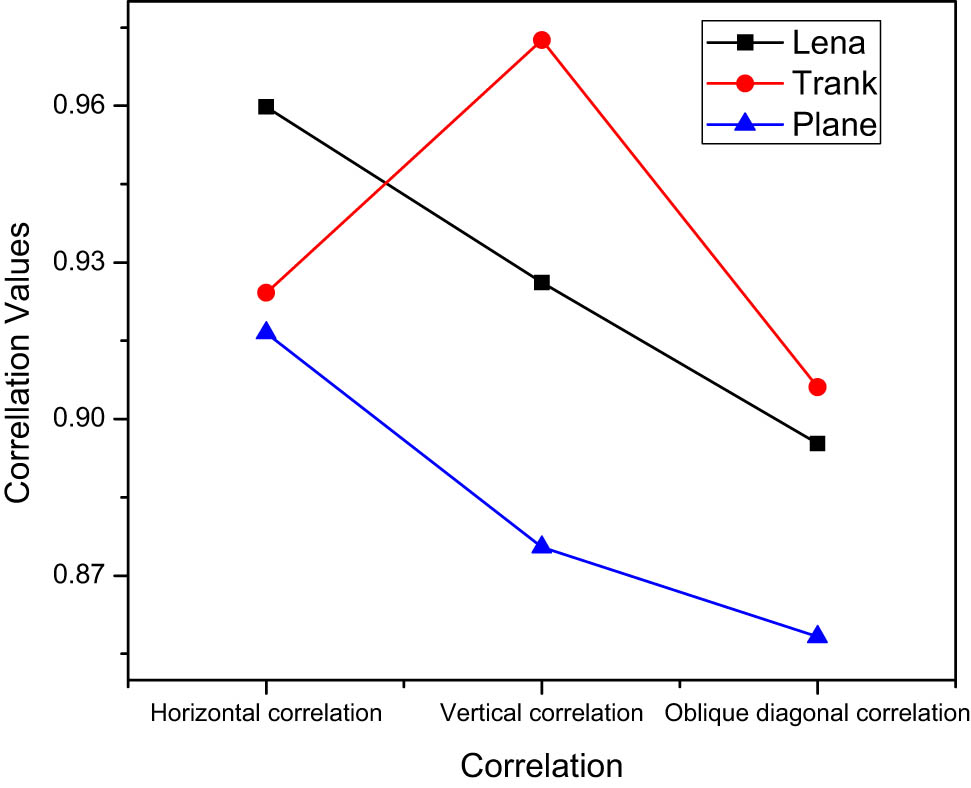
Correlation between adjacent pixels of the image before encryption.
Statistical experimental analysis table of image correlation after encryption
| Horizontal correlation | Vertical correlation | Oblique diagonal correlation | |
|---|---|---|---|
| Lena | 0.0162 | −0.0214 | 0.0170 |
| Tank | 0.0435 | −0.0303 | 0.0277 |
| Plane | 0.0130 | −0.0168 | −0.0588 |
Table 3 states the time spent on encryption and decryption. Three images of various pixel sizes have been taken and their encryption and decryption times were considered. In this article, Akhshani’s method is used to analyze the correlation of image elements. Table 4 is the comparison of the correlation between image elements analyzed from horizontal, vertical, and diagonal angles under different algorithms. From the data in the table, it can be seen that the cipher text obtained by this algorithm has a weak correlation in the adjacent pixels of the image, and the adjacent pixels are basically irrelevant. Therefore, we can know that the algorithm in this article spreads the statistical features in the image to the random cipher text. Therefore, the algorithm in this article has higher security.
Statistics of time spent on encryption and decryption
| Encrypted image name | Size | Encryption time | Decryption time |
|---|---|---|---|
| Tank | 512 × 512 | 12.0940 | 12 |
| Lena | 256 × 256 | 3 | 3.0160 |
| Plane | 128 × 128 | 1.0310 | 0.7500 |
Correlation results between the algorithm in this article and the neighboring pixels of several classical encryption algorithms
| Horizontal direction | Vertical direction | Diagonal direction | |
|---|---|---|---|
| Proclaimed in writing | 0.915989 | 0.968184 | 0.913533 |
| Proposed algorithm | −0.0000165 | 0.0003232 | −0.0000231 |
| Literature [3] | −0.098451 | 0.059551 | −0.069791 |
| Literature [5] | −0.000959 | 0.004818 | −0.000299 |
| Literature [8] | 0.002391 | −0.003722 | 0.000255 |
| Literature [11] | 0.004922 | 0.003428 | 0.00425 |
According to the data in the table, the cipher text generated by this technique has little correlation with the neighboring pixels of the picture, and the adjacent pixels are essentially unimportant. As a result, we may conclude that the technique in this study distributes statistical information in the picture to random cipher text. As a result, the method in this work is more secure.
5 Conclusion
This algorithm introduces a cipher text feedback mechanism, which improves the sensitivity of the encryption algorithm to plain text and key. According to the security level, the number of encryption rounds can be adjusted, and the algorithm has high operational efficiency. This effect is due to the introduction of a feedback mechanism into the algorithm in this article, which makes the encryption algorithm improve. The important qualities of such a secure system are its simplicity and efficacy. Simulations and analysis show that the proposed method can produce a large key space while also surviving standard cipher attacks. Because of its powerful cryptographic properties, it is suited for image applications. The scrambling sequence and the gray value of the pixel define the aforementioned parameter values. It can be observed that the correlation between adjacent pixels in the picture before encryption is quite strong. However, the correlation between pixels of the cipher text image is very small, demonstrating that the Scheme II encryption technique has good statistical properties. The ability to resist attacks and the security of the system are improved. Future research areas for image encryption algorithms were investigated. Researchers revealed that the image encryption methods are still in the early stages of development. This article asks scholars to investigate the issues presented by image encryption schemes. It will also help them choose an appropriate approach for generating new encryption models in line with an application, saving them time.
-
Funding information: The authors state no funding involved.
-
Author contributions: All authors have accepted responsibility for the entire content of this manuscript and approved its submission.
-
Conflict of interest: The authors state no conflict of interest.
-
Data availability statement: Data available from the corresponding author upon request.
References
[1] Pan H, Lei Y, Jian C. Research on digital image encryption algorithm based on double logistic chaotic map. J Image Video Process. 2018;142.10.1186/s13640-018-0386-3Search in Google Scholar
[2] Broumandnia A. The 3D modular chaotic map to digital color image encryption. Future Gener Comput Syst. 2019;99:489–99.10.1016/j.future.2019.04.005Search in Google Scholar
[3] Broumandnia A. Image encryption algorithm based on the finite fields in chaotic maps. J Inf Secur Appl. 2020;54:102553.10.1016/j.jisa.2020.102553Search in Google Scholar
[4] Noor S, Hammood DA, Al-Naji A, Chahl J. A fast text-to-image encryption-decryption algorithm for secure network communication. Computers. 2022;11(3):1–16.10.3390/computers11030039Search in Google Scholar
[5] Lin X, Wang J, Lin C. Research on 3D reconstruction in binocular stereo vision based on feature point matching method. Pap Asia. 2019;2(1):21–5.10.1109/ICISCAE51034.2020.9236889Search in Google Scholar
[6] Braeken A. Public key versus symmetric key cryptography in client–server authentication protocols. Int J Inf Secur. 2022;21:103–14.10.1007/s10207-021-00543-wSearch in Google Scholar
[7] Lozupone V. Analyze encryption and public key infrastructure (PKI). Int J Inf Manage. 2018;38(1):42–4.10.1016/j.ijinfomgt.2017.08.004Search in Google Scholar
[8] Zhang J, Huang Z, Li X, Wu M, Dong Y. Quantum image encryption based on quantum image decomposition. Int J Theor Phys. 2021;60:2930–42.10.1007/s10773-021-04862-5Search in Google Scholar
[9] Iqbal N, Hanif M, Abbas S, Khan MA, Ul Rehman Z. Dynamic 3D scrambled image based RGB image encryption scheme using hyperchaotic system and DNA encoding. J Inf Secur Appl. 2021;58:102809. 10.1016/j.jisa.2021.102809.Search in Google Scholar
[10] Batool SI, Waseem HM. A novel image encryption scheme based on Arnold scrambling and Lucas series. Multimed Tools Appl. 2019;78:27611–37.10.1007/s11042-019-07881-xSearch in Google Scholar
[11] Wang H, Nie D, Tuo X, Zhong Y. Research on crack monitoring at the trailing edge of landslides based on image processing. Landslides. 2020;17(4):985–1007.10.1007/s10346-019-01335-zSearch in Google Scholar
[12] Xi E, Zhang J. Research on image deblurring processing technology based on genetic algorithm. J Phys Conf Ser. 2021;1852(2):022042.10.1088/1742-6596/1852/2/022042Search in Google Scholar
[13] Wang X, Zhao H, Wang M. A new image encryption algorithm with nonlinear-diffusion based on multiple coupled map lattices. Opt Laser Technol. 2019;115:42–57.10.1016/j.optlastec.2019.02.009Search in Google Scholar
[14] El-Khamy SE, Korany NO, El-Sherif MH. Chaos-based image hiding scheme between silent intervals of high quality audio signals using feature extraction and image bits spreading. 2018 35th National Radio Science Conference (NRSC); 2018 Mar 20–22; Cairo, Egypt. IEEE, 2018. p. 266–73. 10.1109/NRSC.2018.8354372.Search in Google Scholar
[15] Abdelfattah M, Hegazy SF, Areed NFF, Obayya SSA. Compact optical asymmetric cryptosystem based on unequal modulus decomposition of multiple color images. Opt Lasers Eng. 2020;129:106063.10.1016/j.optlaseng.2020.106063Search in Google Scholar
[16] Liang X, Tan X, Tao L, Hu B. Image hybrid encryption based on matrix nonlinear operation and generalized Arnold transformation. Int J Pattern Recognit Artif Intell. 2018;33(6):1954022.1–1954022.17.10.1142/S0218001419540223Search in Google Scholar
[17] Wang W, Wanga X, Luo X, Yuan M. Finite-time projective synchronization of memristor-based bam neural networks and applications in image encryption. IEEE Access. 2018;6:56457–76.10.1109/ACCESS.2018.2872745Search in Google Scholar
[18] Li X, Wang Y, Li Q, Wang QH, Li J, Kim ST, et al. Optical 3D object security and reconstruction using pixel-evaluated integral imaging algorithm. Opt Express. 2019;27(15):20720–33.10.1364/OE.27.020720Search in Google Scholar PubMed
[19] Zhang X, Wang X. Multiple-image encryption algorithm based on mixed image element and chaos. Comp Electr Eng. 2017;S0045790616311582.10.1016/j.compeleceng.2016.12.025Search in Google Scholar
© 2022 Longlong Bian et al., published by De Gruyter
This work is licensed under the Creative Commons Attribution 4.0 International License.
Articles in the same Issue
- Research Articles
- Fractal approach to the fluidity of a cement mortar
- Novel results on conformable Bessel functions
- The role of relaxation and retardation phenomenon of Oldroyd-B fluid flow through Stehfest’s and Tzou’s algorithms
- Damage identification of wind turbine blades based on dynamic characteristics
- Improving nonlinear behavior and tensile and compressive strengths of sustainable lightweight concrete using waste glass powder, nanosilica, and recycled polypropylene fiber
- Two-point nonlocal nonlinear fractional boundary value problem with Caputo derivative: Analysis and numerical solution
- Construction of optical solitons of Radhakrishnan–Kundu–Lakshmanan equation in birefringent fibers
- Dynamics and simulations of discretized Caputo-conformable fractional-order Lotka–Volterra models
- Research on facial expression recognition based on an improved fusion algorithm
- N-dimensional quintic B-spline functions for solving n-dimensional partial differential equations
- Solution of two-dimensional fractional diffusion equation by a novel hybrid D(TQ) method
- Investigation of three-dimensional hybrid nanofluid flow affected by nonuniform MHD over exponential stretching/shrinking plate
- Solution for a rotational pendulum system by the Rach–Adomian–Meyers decomposition method
- Study on the technical parameters model of the functional components of cone crushers
- Using Krasnoselskii's theorem to investigate the Cauchy and neutral fractional q-integro-differential equation via numerical technique
- Smear character recognition method of side-end power meter based on PCA image enhancement
- Significance of adding titanium dioxide nanoparticles to an existing distilled water conveying aluminum oxide and zinc oxide nanoparticles: Scrutinization of chemical reactive ternary-hybrid nanofluid due to bioconvection on a convectively heated surface
- An analytical approach for Shehu transform on fractional coupled 1D, 2D and 3D Burgers’ equations
- Exploration of the dynamics of hyperbolic tangent fluid through a tapered asymmetric porous channel
- Bond behavior of recycled coarse aggregate concrete with rebar after freeze–thaw cycles: Finite element nonlinear analysis
- Edge detection using nonlinear structure tensor
- Synchronizing a synchronverter to an unbalanced power grid using sequence component decomposition
- Distinguishability criteria of conformable hybrid linear systems
- A new computational investigation to the new exact solutions of (3 + 1)-dimensional WKdV equations via two novel procedures arising in shallow water magnetohydrodynamics
- A passive verses active exposure of mathematical smoking model: A role for optimal and dynamical control
- A new analytical method to simulate the mutual impact of space-time memory indices embedded in (1 + 2)-physical models
- Exploration of peristaltic pumping of Casson fluid flow through a porous peripheral layer in a channel
- Investigation of optimized ELM using Invasive Weed-optimization and Cuckoo-Search optimization
- Analytical analysis for non-homogeneous two-layer functionally graded material
- Investigation of critical load of structures using modified energy method in nonlinear-geometry solid mechanics problems
- Thermal and multi-boiling analysis of a rectangular porous fin: A spectral approach
- The path planning of collision avoidance for an unmanned ship navigating in waterways based on an artificial neural network
- Shear bond and compressive strength of clay stabilised with lime/cement jet grouting and deep mixing: A case of Norvik, Nynäshamn
- Communication
- Results for the heat transfer of a fin with exponential-law temperature-dependent thermal conductivity and power-law temperature-dependent heat transfer coefficients
- Special Issue: Recent trends and emergence of technology in nonlinear engineering and its applications - Part I
- Research on fault detection and identification methods of nonlinear dynamic process based on ICA
- Multi-objective optimization design of steel structure building energy consumption simulation based on genetic algorithm
- Study on modal parameter identification of engineering structures based on nonlinear characteristics
- On-line monitoring of steel ball stamping by mechatronics cold heading equipment based on PVDF polymer sensing material
- Vibration signal acquisition and computer simulation detection of mechanical equipment failure
- Development of a CPU-GPU heterogeneous platform based on a nonlinear parallel algorithm
- A GA-BP neural network for nonlinear time-series forecasting and its application in cigarette sales forecast
- Analysis of radiation effects of semiconductor devices based on numerical simulation Fermi–Dirac
- Design of motion-assisted training control system based on nonlinear mechanics
- Nonlinear discrete system model of tobacco supply chain information
- Performance degradation detection method of aeroengine fuel metering device
- Research on contour feature extraction method of multiple sports images based on nonlinear mechanics
- Design and implementation of Internet-of-Things software monitoring and early warning system based on nonlinear technology
- Application of nonlinear adaptive technology in GPS positioning trajectory of ship navigation
- Real-time control of laboratory information system based on nonlinear programming
- Software engineering defect detection and classification system based on artificial intelligence
- Vibration signal collection and analysis of mechanical equipment failure based on computer simulation detection
- Fractal analysis of retinal vasculature in relation with retinal diseases – an machine learning approach
- Application of programmable logic control in the nonlinear machine automation control using numerical control technology
- Application of nonlinear recursion equation in network security risk detection
- Study on mechanical maintenance method of ballasted track of high-speed railway based on nonlinear discrete element theory
- Optimal control and nonlinear numerical simulation analysis of tunnel rock deformation parameters
- Nonlinear reliability of urban rail transit network connectivity based on computer aided design and topology
- Optimization of target acquisition and sorting for object-finding multi-manipulator based on open MV vision
- Nonlinear numerical simulation of dynamic response of pile site and pile foundation under earthquake
- Research on stability of hydraulic system based on nonlinear PID control
- Design and simulation of vehicle vibration test based on virtual reality technology
- Nonlinear parameter optimization method for high-resolution monitoring of marine environment
- Mobile app for COVID-19 patient education – Development process using the analysis, design, development, implementation, and evaluation models
- Internet of Things-based smart vehicles design of bio-inspired algorithms using artificial intelligence charging system
- Construction vibration risk assessment of engineering projects based on nonlinear feature algorithm
- Application of third-order nonlinear optical materials in complex crystalline chemical reactions of borates
- Evaluation of LoRa nodes for long-range communication
- Secret information security system in computer network based on Bayesian classification and nonlinear algorithm
- Experimental and simulation research on the difference in motion technology levels based on nonlinear characteristics
- Research on computer 3D image encryption processing based on the nonlinear algorithm
- Outage probability for a multiuser NOMA-based network using energy harvesting relays
Articles in the same Issue
- Research Articles
- Fractal approach to the fluidity of a cement mortar
- Novel results on conformable Bessel functions
- The role of relaxation and retardation phenomenon of Oldroyd-B fluid flow through Stehfest’s and Tzou’s algorithms
- Damage identification of wind turbine blades based on dynamic characteristics
- Improving nonlinear behavior and tensile and compressive strengths of sustainable lightweight concrete using waste glass powder, nanosilica, and recycled polypropylene fiber
- Two-point nonlocal nonlinear fractional boundary value problem with Caputo derivative: Analysis and numerical solution
- Construction of optical solitons of Radhakrishnan–Kundu–Lakshmanan equation in birefringent fibers
- Dynamics and simulations of discretized Caputo-conformable fractional-order Lotka–Volterra models
- Research on facial expression recognition based on an improved fusion algorithm
- N-dimensional quintic B-spline functions for solving n-dimensional partial differential equations
- Solution of two-dimensional fractional diffusion equation by a novel hybrid D(TQ) method
- Investigation of three-dimensional hybrid nanofluid flow affected by nonuniform MHD over exponential stretching/shrinking plate
- Solution for a rotational pendulum system by the Rach–Adomian–Meyers decomposition method
- Study on the technical parameters model of the functional components of cone crushers
- Using Krasnoselskii's theorem to investigate the Cauchy and neutral fractional q-integro-differential equation via numerical technique
- Smear character recognition method of side-end power meter based on PCA image enhancement
- Significance of adding titanium dioxide nanoparticles to an existing distilled water conveying aluminum oxide and zinc oxide nanoparticles: Scrutinization of chemical reactive ternary-hybrid nanofluid due to bioconvection on a convectively heated surface
- An analytical approach for Shehu transform on fractional coupled 1D, 2D and 3D Burgers’ equations
- Exploration of the dynamics of hyperbolic tangent fluid through a tapered asymmetric porous channel
- Bond behavior of recycled coarse aggregate concrete with rebar after freeze–thaw cycles: Finite element nonlinear analysis
- Edge detection using nonlinear structure tensor
- Synchronizing a synchronverter to an unbalanced power grid using sequence component decomposition
- Distinguishability criteria of conformable hybrid linear systems
- A new computational investigation to the new exact solutions of (3 + 1)-dimensional WKdV equations via two novel procedures arising in shallow water magnetohydrodynamics
- A passive verses active exposure of mathematical smoking model: A role for optimal and dynamical control
- A new analytical method to simulate the mutual impact of space-time memory indices embedded in (1 + 2)-physical models
- Exploration of peristaltic pumping of Casson fluid flow through a porous peripheral layer in a channel
- Investigation of optimized ELM using Invasive Weed-optimization and Cuckoo-Search optimization
- Analytical analysis for non-homogeneous two-layer functionally graded material
- Investigation of critical load of structures using modified energy method in nonlinear-geometry solid mechanics problems
- Thermal and multi-boiling analysis of a rectangular porous fin: A spectral approach
- The path planning of collision avoidance for an unmanned ship navigating in waterways based on an artificial neural network
- Shear bond and compressive strength of clay stabilised with lime/cement jet grouting and deep mixing: A case of Norvik, Nynäshamn
- Communication
- Results for the heat transfer of a fin with exponential-law temperature-dependent thermal conductivity and power-law temperature-dependent heat transfer coefficients
- Special Issue: Recent trends and emergence of technology in nonlinear engineering and its applications - Part I
- Research on fault detection and identification methods of nonlinear dynamic process based on ICA
- Multi-objective optimization design of steel structure building energy consumption simulation based on genetic algorithm
- Study on modal parameter identification of engineering structures based on nonlinear characteristics
- On-line monitoring of steel ball stamping by mechatronics cold heading equipment based on PVDF polymer sensing material
- Vibration signal acquisition and computer simulation detection of mechanical equipment failure
- Development of a CPU-GPU heterogeneous platform based on a nonlinear parallel algorithm
- A GA-BP neural network for nonlinear time-series forecasting and its application in cigarette sales forecast
- Analysis of radiation effects of semiconductor devices based on numerical simulation Fermi–Dirac
- Design of motion-assisted training control system based on nonlinear mechanics
- Nonlinear discrete system model of tobacco supply chain information
- Performance degradation detection method of aeroengine fuel metering device
- Research on contour feature extraction method of multiple sports images based on nonlinear mechanics
- Design and implementation of Internet-of-Things software monitoring and early warning system based on nonlinear technology
- Application of nonlinear adaptive technology in GPS positioning trajectory of ship navigation
- Real-time control of laboratory information system based on nonlinear programming
- Software engineering defect detection and classification system based on artificial intelligence
- Vibration signal collection and analysis of mechanical equipment failure based on computer simulation detection
- Fractal analysis of retinal vasculature in relation with retinal diseases – an machine learning approach
- Application of programmable logic control in the nonlinear machine automation control using numerical control technology
- Application of nonlinear recursion equation in network security risk detection
- Study on mechanical maintenance method of ballasted track of high-speed railway based on nonlinear discrete element theory
- Optimal control and nonlinear numerical simulation analysis of tunnel rock deformation parameters
- Nonlinear reliability of urban rail transit network connectivity based on computer aided design and topology
- Optimization of target acquisition and sorting for object-finding multi-manipulator based on open MV vision
- Nonlinear numerical simulation of dynamic response of pile site and pile foundation under earthquake
- Research on stability of hydraulic system based on nonlinear PID control
- Design and simulation of vehicle vibration test based on virtual reality technology
- Nonlinear parameter optimization method for high-resolution monitoring of marine environment
- Mobile app for COVID-19 patient education – Development process using the analysis, design, development, implementation, and evaluation models
- Internet of Things-based smart vehicles design of bio-inspired algorithms using artificial intelligence charging system
- Construction vibration risk assessment of engineering projects based on nonlinear feature algorithm
- Application of third-order nonlinear optical materials in complex crystalline chemical reactions of borates
- Evaluation of LoRa nodes for long-range communication
- Secret information security system in computer network based on Bayesian classification and nonlinear algorithm
- Experimental and simulation research on the difference in motion technology levels based on nonlinear characteristics
- Research on computer 3D image encryption processing based on the nonlinear algorithm
- Outage probability for a multiuser NOMA-based network using energy harvesting relays
