Study on modal parameter identification of engineering structures based on nonlinear characteristics
-
Wei Guo


Abstract
To study the nonlinear characteristics of the modal recognition of civil engineering parameters, a method of nonlinear recognition of the parameters of characteristics based on LMD is proposed. The LMD method is applied to decompose the acceleration response signals of the disturbing structure of the building, to obtain the PF components, the instantaneous frequency, and the instantaneous amplitude of each PF component, to determine the modal natural frequency and damping coefficient. To determine the modal parameter based on the LMD, the calculation and analysis results are presented as follows: the frequency of the components fluctuates between the fifth and sixth models, which shows that the components contain the reaction of the fifth and sixth design modes. This is because these two modes (3.101 Hz and 3.147 Hz) are very close to each other, which makes it difficult to distinguish between the responses of these two modes by the LMD method. The frequency of the components is always stable (the first 2.5 s), which indicates that during this period the responses of modes 5e and 6e do not dampen, and the ratio between them in the PF1 components does not differ much. The component frequency curve shows an interesting phenomenon. Starting from about 3.8 s, the frequency curve gradually approaches the first mode, and only the frequency of the first mode is about 6 s, which indicates that the response of the first mode still exists and makes up a significant proportion. Modular response, caused by the damping, is only detected in the first half of the 10 s response, after which it is verified from the nonlinear characteristics of the LMD parameter recognition method that half of the third-order modal response on the scale is very low and almost equal to zero, and despite problems with dense frequency separation mode in the LMD method, the frequency responses of its PF components may reflect the mode combination phenomenon and reflect the duration of each mode throughout the response.
1 Introduction
Civil engineering structure is an important part of national infrastructure, which directly affects people’s life and safety. With the rapid development of China’s economy, the construction and transportation industries have made great progress. It is worth noting that the working conditions of many structures are worrying, with damage, aging, and even collapse happening from time to time [1]. Due to the rapid development of civil engineering structure construction, its construction quality and design technology are often not satisfactory, which increases the hidden danger of accidents to civil buildings in China. The traditional structural analysis theory is mainly through the strength, stability, and other aspects of the study to ensure the reliability of the structural design. The static load test is carried out on civil structures, especially Bridges, to understand their actual working state under the test load and to determine the strength, stiffness, construction quality of the structure, and whether the structure meets the design and use requirements [2]. Currently, the relevant theory has reached a fairly mature level. However, the safety and the reliability of the structure cannot be guaranteed only by the accurate static design and static load test of the structure because the working environment of civil engineering structure determines that it must bear a large number of dynamic loads, such as wind load, ground vibration load, and so on, and the bridge structure also bears the impact load of water flow and traffic load [4,5,6,7,8,9,10,11,12]. Therefore, the static characteristics of the structure cannot fully and accurately reflect the characteristics of the structure. Although the dynamic response signal analysis and processing of civil engineering structures is not the ultimate goal, it is an important step in the process of damage identification [13,14,15,16,17,18,19,20,21], as well as in the process of the difficulty for bridge structures, as environmental excitation power test operation is simple and does not require the use of large measurement equipment. Moreover, there is no damage to the structure [22,23,24,25,26,27]. The basic principle of detecting structural damage in civil engineering based on modal parameter identification is that various structural damages can cause changes in the mass and stiffness of the entire civil engineering system. These changes in mass and stiffness will cause changes in modal parameters. Therefore, through the changes in modal parameters, the overall structural problems of the civil engineering system can be known, and then, the damage can be detected and analyzed. Therefore, great attention has been paid to using dynamic response test data under environmental excitation to identify the modal parameters of the structure [28,29,30]. Although the modal parameter identification theories of large structures are rapidly developing, there are some deficiencies in these theories. For example, for the commonly used feature system implementation method and random subspace method, the determination of system order and the construction of matrix directly affect the accuracy of the identification results. In addition, the identification accuracy of the damping ratio is poor in the application of the multinumerical modal parameter identification methods. At the same time, these methods only provide the best estimate of the modal parameters of the structure, but cannot intuitively obtain the uncertainty of the identified modal parameters from the perspective of mathematics. In the recent years, the Bayesian theory applied in modal parameter identification, the finite element model modification, and the state evaluation of structures has made it possible to calculate the posterior uncertainty of the best estimate of modal parameters from a mathematical perspective [31,32,33]. Therefore, it is of great practical significance to analyze the parameter identification method based on the Bayesian theory that has obvious advantages, and to compare this method with the widely used modal parameter identification method, so as to grasp its key and advantages. Through the method of the modal parameter identification, the structural damage identification of civil engineering is studied. First, it is necessary to set the extraction method of modal parameters, to establish the state equation of the damaged part of civil engineering, and to obtain the extraction model of modal parameters through the discrete time state model. Then, the detection method of civil engineering structural damage is designed, the characteristic parameters of the relative change of the mode shape before and after the structural damage are defined, the damaged part of the building in the civil engineering is determined, and the structural damage severity of the civil engineering building is judged according to the damage index. The inspection report for damage to civil engineering structures is presented.
2 Literature review
Meng proposed that the essence of the state analysis is a coordinate transformation, whose purpose is to put the response vector described in the original physical coordinate system into the “modal coordinate system” to describe [34]. Astroza et al. proposed that the experimental modal analysis, also known as the experimental process of modal analysis, is an experimental modeling process and belongs to the inverse problem of the structural dynamics. In the inverse process of the theoretical modal analysis, first, the time history of excitation and response is measured experimentally, and the frequency response function (transfer function) or impulse response function is obtained by using digital signal processing technology, and the nonparametric model of the system is obtained. Second, the modal parameters of the system are obtained by the method of parameter identification. Finally, if necessary, further the physical parameters of the system are determined [35]. Deng et al. believe that the theoretical modal analysis is actually a theoretical modeling process, which belongs to the positive problem of structural dynamics. It mainly uses the finite element method to discrete the vibration structure, establishes the mathematical model of the system eigenvalue problem, and uses various numerical methods to solve the system eigenvalue and eigenvector, that is, the modal parameters of the system. By mode superposition, the dynamic response of the structure under the known external load can be analyzed [36]. Based on the current research, this article proposes a nonlinear characteristic parameter identification method based on LMD. By studying the identification of nonlinear characteristic parameters, the establishment of the analysis model and the finite element, and the identification of modal parameters based on LMD, the results of calculation and analysis are as follows: The frequency of the components fluctuates between the frequencies of the fifth and sixth modes, indicating that the components contain the responses of the fifth and sixth modes of the structure. The reason is that the frequencies of the two modes (3.101 and 3.147 Hz) are very close, which makes the responses of the two modes difficult to be separated by the LMD method. The frequency of the component is always stable (the first 2.5 s), indicating that the response of the 5th and 6th modes is not consumed by damping during this period, and the difference in the proportion of the two in the PF1 component is not significant. The frequency curve of the component shows an interesting phenomenon. From about 3.8 s, the frequency curve gradually approaches the first mode, and only the frequency of the first mode exists at about 6 s. This indicates that the response of the first mode always exists and accounts for a large proportion. The response of the third mode only exists in the first half of the entire 10 s response due to the effect of damping, and the response of the third mode in the latter half is very small, almost zero, which verifies the effectiveness of lMD-based structure dynamic detection and analysis method [37].
3 Methods
3.1 Identification of nonlinear characteristic parameters
The transient response of structure displacement is given in formula (1).
where n i = c i /(2m i ), c i is the ith mode damping, m i is the ith order mode mass, and the transient response of acceleration can be obtained after two derivatives, as shown in formula (2).
where θ i = φ i + π. Then, the instantaneous amplitude and frequency of a certain mode of the transient response of acceleration are shown in formulas (3) and (4).
Take the logarithm of both sides of formula (3), as shown in formula (5).
where n i is the slope of the fitting line of the natural logarithm of the amplitude, and the damping is shown in formula (6).
The relation between undamped natural frequency
Because of
The damping ratio and the natural frequency of the ith-order mode can be obtained from formulas (1)–(8), and the vibration response of the N-order mode is separated by the LMD method.
After the vibration signal is decomposed, the instantaneous amplitude function and the instantaneous frequency function are obtained, as shown in formulas (9) and (10), respectively.
Take the logarithm of both sides of formula (9), and the result is shown in formula (11).
The natural logarithm curve of instantaneous frequency and instantaneous amplitude can be obtained by formulas (10) and (11), and the modal natural frequency and damping ratio can be identified after fitting.
3.2 Model establishment and finite element analysis
3.2.1 Model establishment
The general finite element software SAP2000 was used to establish the three-dimensional multilayer structure model, and the materials of the model were C45 concrete, longitudinal reinforcement HRB400, and stirrup HPB300. To fit the reality, the structure design and reinforcement are based on the calculation results of PKPM2010, and two damping forms, Rayleigh damping and nonlinear damper, are considered in the SAP2000 model. An arbitrary directional disturbance is applied to the structure, and then, the time–history analysis technique (direct integration method) of SAP2000 is used to analyze the dynamic response of the structure [38]. The dynamic time–history response of the structure is extracted after checking the analysis results to ensure the accuracy of the modeling and results. Here, only one degree of freedom of one node is selected for the analysis. After comparison, it is found that the degree of freedom of other nodes is very similar to this, so there is no too much demonstration here. Figures 1–3 shows the time–history curve of displacement, velocity, and acceleration of structure 4# node in the X-axis direction, in which the sampling time is 10 s, the sampling frequency is 200 Hz, and there are a total of 2001 points.
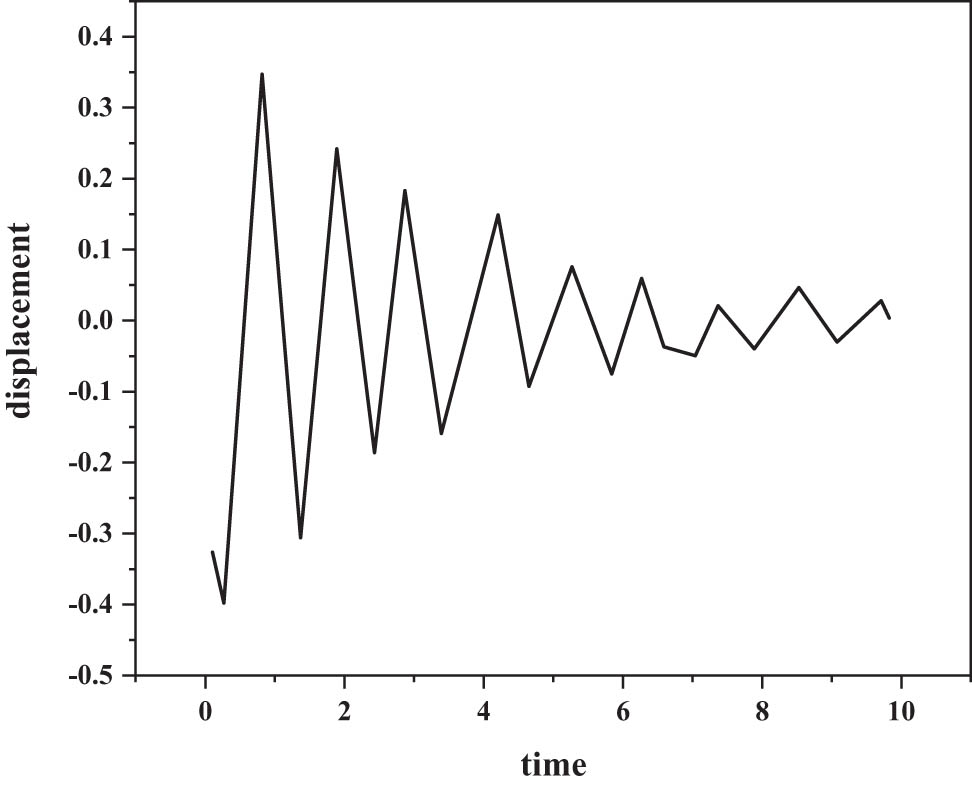
Offset time history.
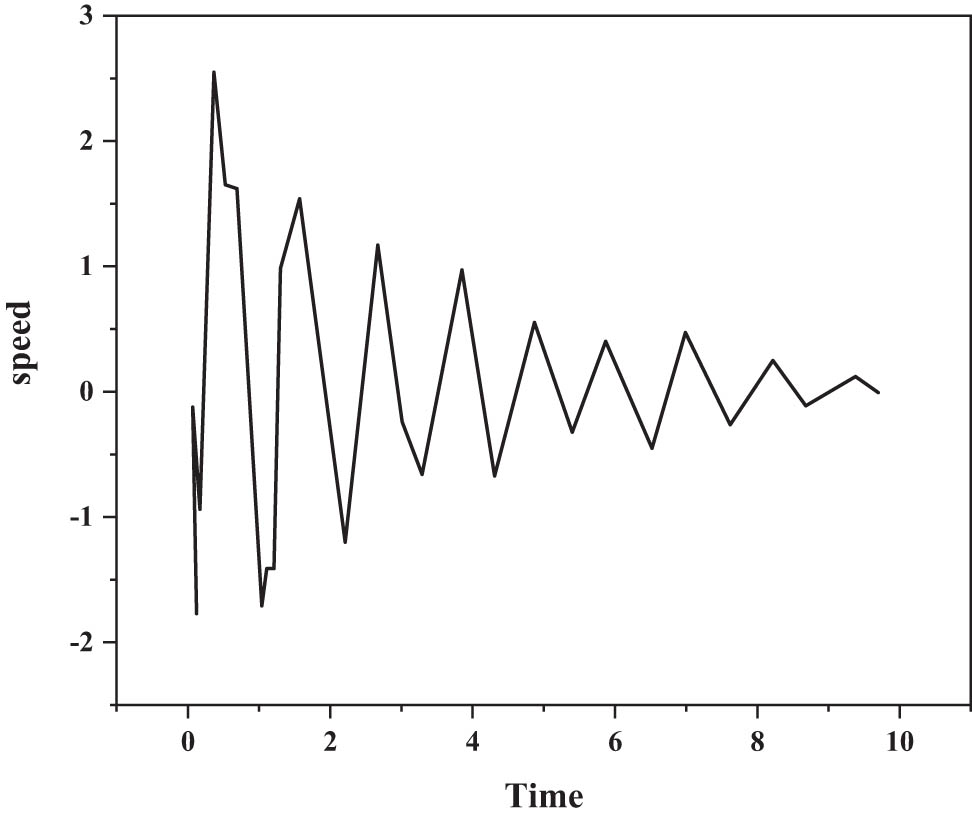
Historical ramp time curve.
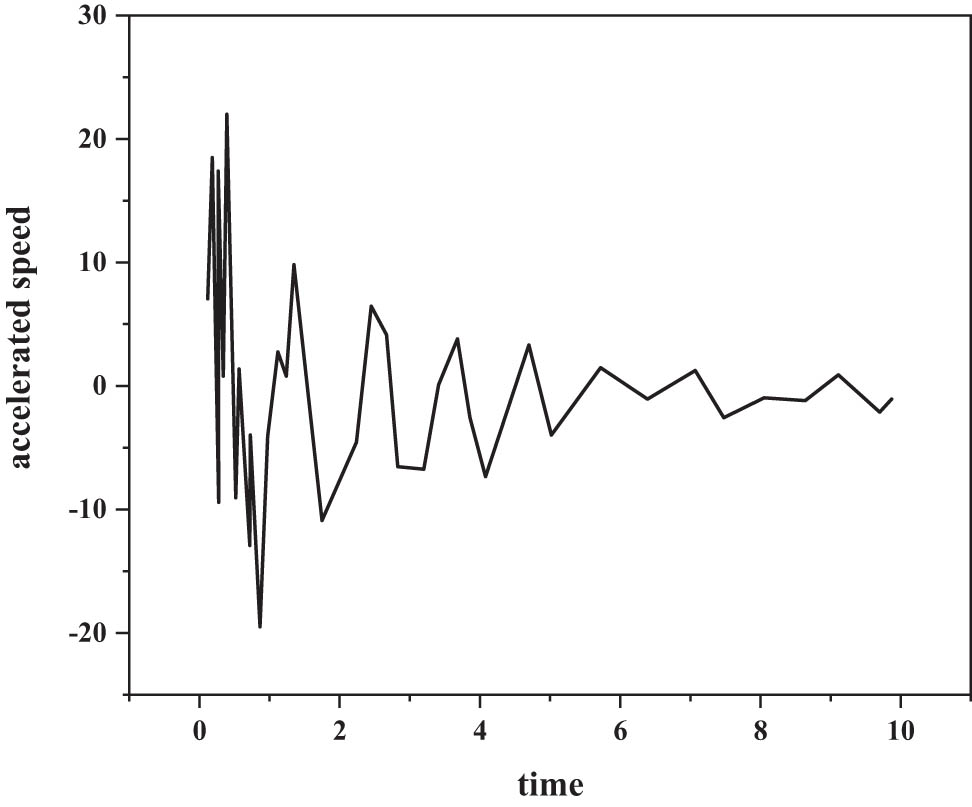
Historical acceleration time curve.
3.2.2 Time–history response curve and comparative analysis
Figures 1–3 show the displacement, velocity, and acceleration time history curve analysis. In Figure 1, the displacement time–history curve of 0 seconds before curve has a different frequency combination of signs, but the slight change is difficult to use the adaptive algorithm, and in terms of its overall, the displacement time–history curve of the waveform only reflects the basic structure of a modal vibration response. In Figure 2, there is a significant combination of waveforms in the first second of the velocity time–history curve. Theoretically, such waveforms with obvious combination signs can be separated, indicating that the velocity time–history curve reflects the characteristics of the multimodal response combination. The first 2 s of the acceleration time–history curve in Figure 3 shows very significant characteristics of waveform combination, which is very conducive to waveform separation and can obtain more accurate solutions.
From Figures 1–3, it can be seen that the displacement time–history curve only reflects subtle signs of waveform combination and basically only reflects the vibration characteristics of the low-frequency mode of the structure, and it cannot understand the part of the high-frequency mode of the structure. The shape of the acceleration time history curve shows the characteristics of the multimodal combination. This waveform combination not only shows the part of the low-frequency mode of the structure but also fully contains the response information of the high-frequency mode of the structure, which provides effective material for understanding the vibration response characteristics of the structure. The morphology of the velocity time–history curve is between the two, showing the characteristics of the multimode combination, but its combination morphology is not as significant as that of the acceleration time–history curve, resulting in the modal separation effect of the velocity time–history curve is weaker than that of the acceleration time–history curve, especially in the calculation accuracy of high-frequency modes.
4 Results and analysis
4.1 Modal parameter identification based on LMD
4.1.1 Decomposition of acceleration time–history curve
In Figures 1–3, by comparing and analysing the time– history curve of shape and characteristics of selecting the best acceleration time– history curve of calculation and analysis as an original signal, the endpoint effect uses the following method to deal with: consider the left endpoint effect, the original signal of the 1 s data according to the zero point vertical axis image processing and image part don’t show. Considering the end effect on the right of subsequent data processing, the actual sampling time is 3.5 s, and the data in the last 1 s are not shown. The components and allowances of each order PF obtained by decomposition are shown in Figures 4 and 5. Finally, the time–history curve of acceleration is decomposed into the time–history response of two modes, and the proportion of allowance is small and can be ignored. By analysing the working condition of modal SAP2000, one can get this nonlinear structure modal (linear) of each order natural frequency of vibration, which can produce response in 4 # node X axis component of (due to order 7 and above the high frequency of the modal participation is low, the response end quickly, almost did not reflect in the response curve, so temporary not consider) 1, 3, 5, and 6 order modal. The frequencies are 0.901, 1.065, 3.101, and 3.147 Hz. Among them, the first and fifth modes are translational, and the third and sixth modes are rotational. Although the modal information does not fully and accurately show the nonlinear characteristics of the structure, it is accurate.
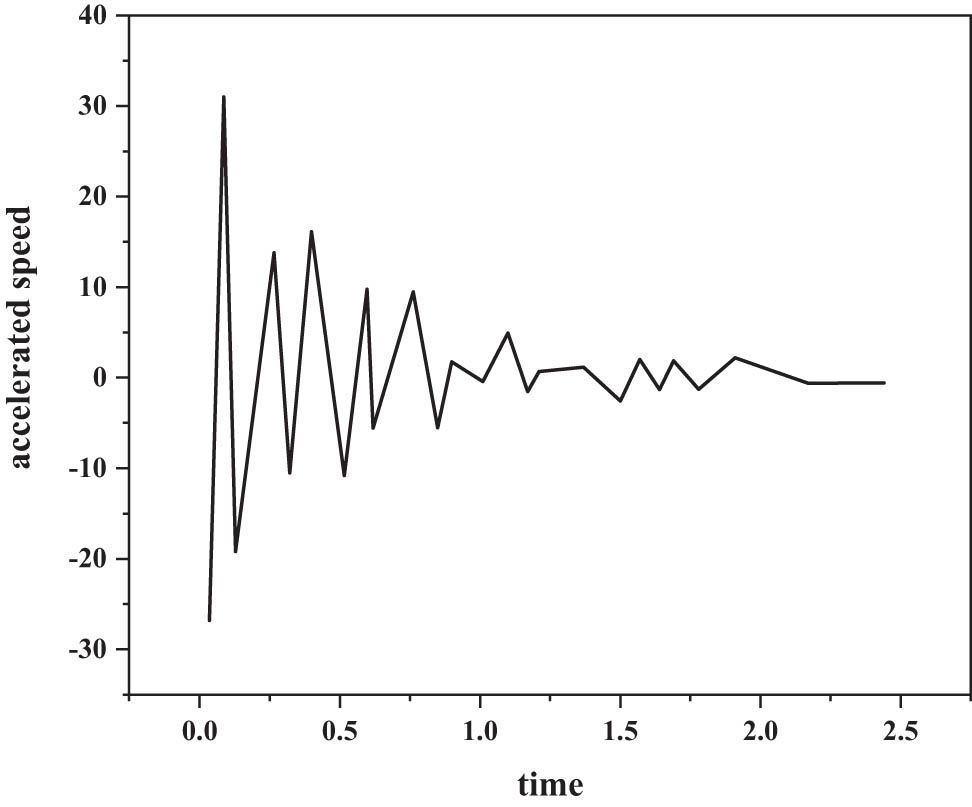
The
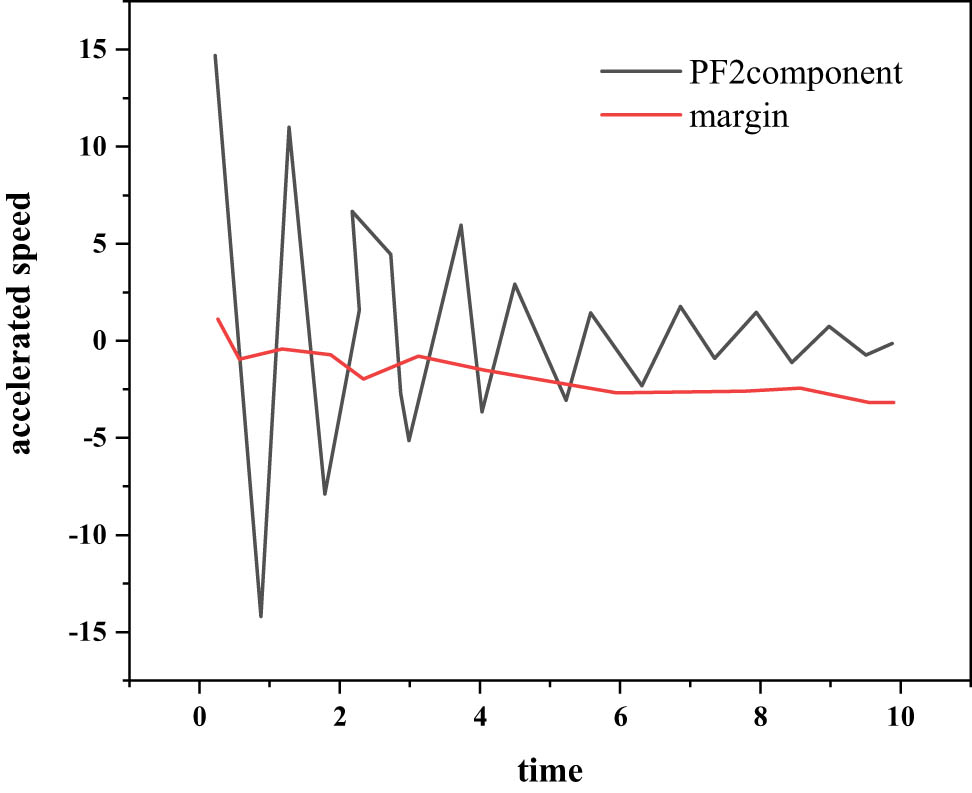
The
The frequency characteristics of each PF component are analyzed and compared with the linear modal frequency, as shown in Figures 6 and 7.
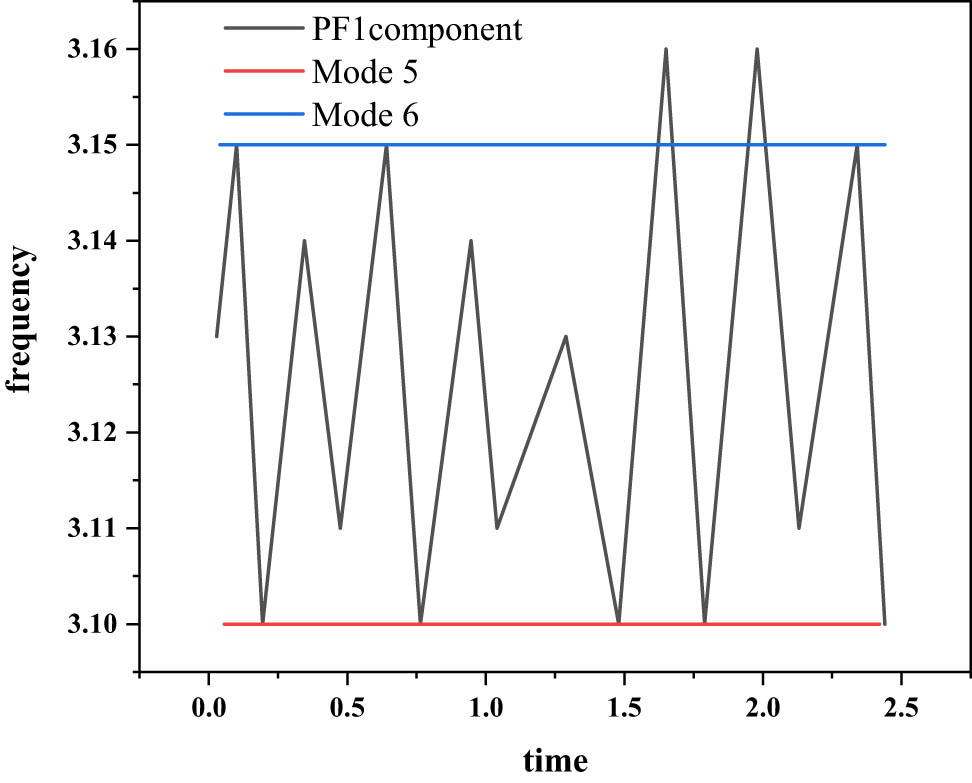
Frequency and contrast elements without damping.
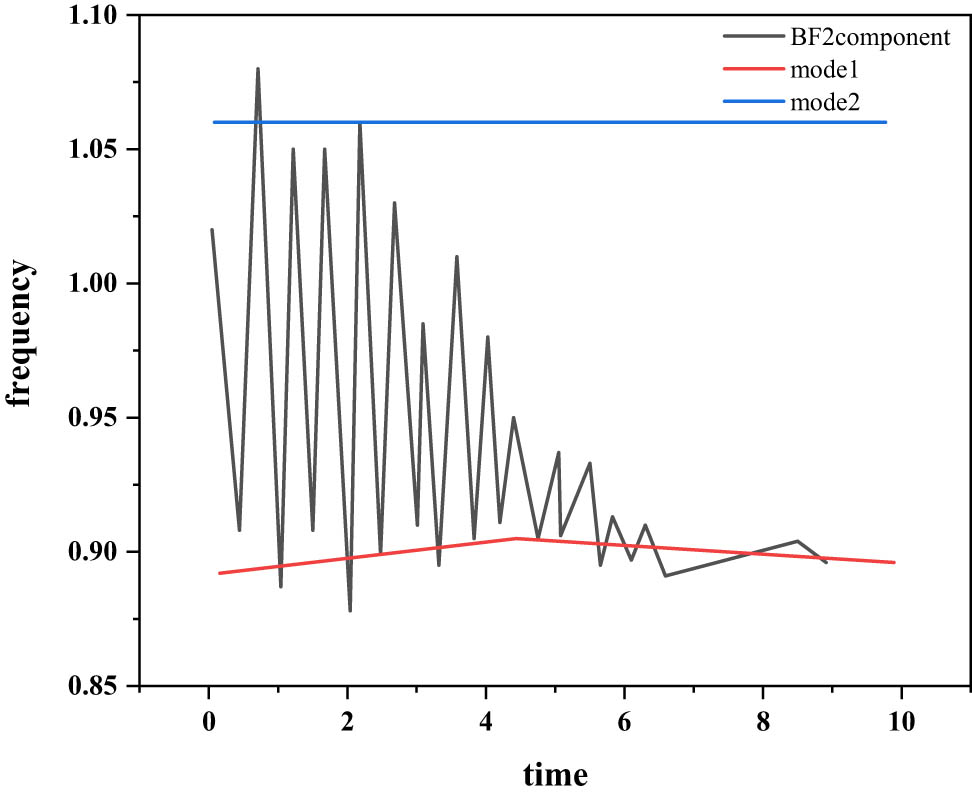
Component without damping frequency and contrast map.
4.1.2 Analyze the aforementioned two graphs
As shown in Figure 6, the frequency of component
5 Conclusion
A nonlinear characteristic parameter identification method based on LMD is proposed. By studying the identification of nonlinear characteristic parameters, the establishment of the analysis model and finite element, and the identification of modal parameters based on LMD, the results of calculation and analysis are as follows: The frequency of component
-
Funding information: The authors state no funding involved.
-
Author contributions: All authors have accepted responsibility for the entire content of this manuscript and approved its submission.
-
Conflict of interest: Authors state no conflict of interest.
References
[1] Li Z, Fu J, Liang Q, Mao H, He Y. Modal identification of civil structures via covariance-driven stochastic subspace method. Math Biosci Eng. 2019;16(5):5709–28.10.3934/mbe.2019285Suche in Google Scholar PubMed
[2] Chen J, Xu B, Zhang X. A vibration feature extraction method based on time-domain dimensional parameters and mahalanobis distance. Math Probl Eng. 2021;8:1–12.10.1155/2021/2498178Suche in Google Scholar
[3] Bartkowski P, Zalewski R, Chodkiewicz P. Parameter identification of bouc-wen model for vacuum packed particles based on genetic algorithm. Arch Civ Mech Eng. 2019;19(2):322–33.10.1016/j.acme.2018.11.002Suche in Google Scholar
[4] Amhoud EM, Chafii M, Nimr A, Fettweis G. OFDM with index modulation in orbital angular momentum multiplexed free space optical links. 2021 IEEE 93rd Vehicular Technology Conference (VTC2021-Spring); 2021 Apr 25–28; Helsinki, Finland: IEEE; 2021. p. 1–5. 10.1109/VTC2021-Spring51267.2021.9448928.Suche in Google Scholar
[5] Gill HS, Singh T, Kaur B, Gaba GS, Masud M, Baz M. A metaheuristic approach to secure multimedia big data for IoT-based smart city applications. Wirel Commun Mob Comput. 2021;2021:1–10.10.1155/2021/7147940Suche in Google Scholar
[6] Kumar A, Sehgal VK, Dhiman G, Vimal S, Sharma A, Park S. Mobile networks-on-chip mapping algorithms for optimization of latency and energy consumption. Mob Netw Appl. 2021;1–15. 10.1007/s11036-021-01827-0.Suche in Google Scholar
[7] Boguszewicz C, Boguszewicz M, Iqbal Z, Khan S, Gaba G, Suresh A et al. The fourth industrial revolution-cyberspace mental. Wellbeing: Harnessing Science & Technology for Humanity; 2021.Suche in Google Scholar
[8] Amhoud E, Othman GR, Jaouën Y. Concatenation of space-time coding and FEC for few-mode fiber systems. IEEE Photonics Technol Lett. 2017;29(7):603–6. 10.1109/LPT.2017.2675919.Suche in Google Scholar
[9] Amhoud EM, Othman GR, Bigot L, Song M, Andresen ER, Labroille G, et al. Experimental demonstration of space-time coding for MDL mitigation in few-mode fiber transmission systems. 2017 European Conference on Optical Communication (ECOC); 2017 Sep 17-21; Gothenburg, Sweden. IEEE; 2017. p. 1–3. 10.1109/ECOC.2017.8345841.Suche in Google Scholar
[10] Gaba GS. Privacy-Preserving Authentication and Key Exchange Mechanisms in Internet of Things Applications [dissertation]. Punjab: Lovely Professional University; 2021.Suche in Google Scholar
[11] Choudhary K, Gaba GS. Artificial intelligence and machine learning aided blockchain systems to address security vulnerabilities and threats in the industrial Internet of things. Intell Wirel Commun. 2021;329–61. 10.1049/pbte094e_ch13.Suche in Google Scholar
[12] Zerhouni K, Amhoud EM, Chafii M. Filtered multicarrier waveforms classification: a deep learning-based approach. IEEE Access. 2021;9:69426–38.10.1109/ACCESS.2021.3078252Suche in Google Scholar
[13] Gaba GS, Kumar G, Monga H, Kim TH, Liyanage M, Kumar P. Robust and lightweight key exchange (LKE) protocol for industry 4.0. IEEE Access. 2020;8:132808–24.10.1109/ACCESS.2020.3010302Suche in Google Scholar
[14] Sharma A, Kumar N. Third eye: an intelligent and secure route planning scheme for critical services provisions in internet of vehicles environment. IEEE Syst J. 2021;1–12. 10.1109/JSYST.2021.3052072.Suche in Google Scholar
[15] Kumar P, Gaba GS. Biometric‐based robust access control model for industrial internet of things applications. IoT Sec Adv Authen. 2020;133–42. 10.1002/9781119527978.ch7.Suche in Google Scholar
[16] Hedabou M. Cryptography for addressing cloud computing security, privacy and trust issues. book on computer and cyber security: principles, algorithm, applications and perspective. USA: CRC Press, Francis and Taylor Publisher; 2018.10.1201/9780429424878-11Suche in Google Scholar
[17] Iggaramen Z, Hedabou M. FADETPM: novel approach of file assured deletion based on trusted platform module. Lecture Notes in Networks and Systems. 3rd International Conference of Cloud Computing Technologies and Applications (CloudTech); 2017 Oct 24–26; Rabat, Morocco. IEEE; 2017. p. 1–4. 10.1109/CloudTech.2017.8284727.Suche in Google Scholar
[18] Azougaghe A, Hedabou M, Belkasmi M. An electronic voting system based on homomorphic encryption and prime numbers. In International Conference on Information Assurance and Security. 2015 Dec 14–16; Marrakech, Morocco. IEEE; 2015. p. 140–5.10.1109/ISIAS.2015.7492759Suche in Google Scholar
[19] Bentajer A, Hedabou M. AN IBE-based design for assured deletion in cloud storage. J Cryptologia. 2019;141:559–64. Springer-Verlag; 2019.10.1080/01611194.2018.1549123Suche in Google Scholar
[20] Gaba GS, Kumar G, Monga H, Kim TH, Kumar P. Robust and lightweight mutual authentication scheme in distributed smart environments. IEEE Access. 2020;8:69722–33.10.1109/ACCESS.2020.2986480Suche in Google Scholar
[21] Hedabou M. Some ways to secure elliptic curves cryptosystems. J Adv Cliford Algebras. 2008;18:677–88.10.1007/s00006-008-0093-8Suche in Google Scholar
[22] Gaba GS, Kumar G, Kim TH, Monga H, Kumar P. Secure device-to-device communications for 5g enabled internet of things applications. Comput Commun. 2021;169:114–28.10.1016/j.comcom.2021.01.010Suche in Google Scholar
[23] Sharma A, Podoplelova E, Shapovalov G, Tselykh A, Tselykh A. Sustainable smart cities: convergence of artificial intelligence and blockchain. Sustainability. 2021;13(23):13076–4967.10.3390/su132313076Suche in Google Scholar
[24] Bentajer A, Hedabou M, Abouelmehdi K, Elfezazi S. CS-IBE: a data confidentiality system in public cloud storage system. Procedia Comput Sci. 2018;141:559–64. 10.1016/j.procs.2018.10.126Suche in Google Scholar
[25] Azougaghe A, Hedabou M, Oualhaj O, Belkasmi M, Kobbane A. Many-to-one matching game towards secure virtual machine migrating in cloud computing. International Conference on Advanced Communication System and Information Security. 2016 Oct 17–19; Marrakech, Morocco: IEEE; 2016. p. 1–7.10.1109/ACOSIS.2016.7843922Suche in Google Scholar
[26] Masud M, Gaba GS, Choudhary K, Hossain MS, Alhamid MF, Muhammad G. Lightweight and anonymity-preserving user authentication scheme for IoT-based healthcare. IEEE Internet Things J. 2021;9(4);2649–56.10.1109/JIOT.2021.3080461Suche in Google Scholar
[27] Sharma A, Singh PK, Sharma A, Kumar R. An efficient architecture for the accurate detection and monitoring of an event through the sky. Computer Commun. 2019;148:115–28.10.1016/j.comcom.2019.09.009Suche in Google Scholar
[28] Masud M, Gaba GS, Choudhary K, Alroobaea R, Hossain MS. A robust and lightweight secure access scheme for cloud based E-healthcare services. Peer-to-Peer Netw Appl. 2021;14(5):3043–57.10.1007/s12083-021-01162-xSuche in Google Scholar PubMed PubMed Central
[29] Hedabou M, Frobenius A. Map approach for an efficient and secure multiplication on koblitz curves. Int J Netw Security. 2006;3(2):233–7.Suche in Google Scholar
[30] Sharma A, Georgi M, Tregubenko M, Tselykh A, Tselykh A. Enabling smart agriculture by implementing artificial intelligence and embedded sensing. Computers Ind Eng. 2022;165:107936.10.1016/j.cie.2022.107936Suche in Google Scholar
[31] Boukhriss H, Hedabou M, Azougaghe A. New technique of localization a targeted virtual machine in a Cloud Platform. In Proceedings of the 5th International Workshop on Codes, Cryptography and Communication Systems. 2014 Nov 27-28; El Jadida, Morocco. IEEE; 2014. p. 124–7.10.1109/WCCCS.2014.7107907Suche in Google Scholar
[32] Trong DN, Chinh CN, Quoc VD, Quoc TT. Study the effects of factors on the structure and phase transition of bulk ag by molecular dynamics method. Int J Comput Mater Sci Eng. 2020;9(3):68–73.10.1142/S2047684120500165Suche in Google Scholar
[33] Zong Y, Chen J, Tao S, Wang C, Xiahou J. Moving window differential evolution independent component analysis-based operational modal analysis for slow linear time-varying structures. Sci Program. 2020;23:1–9.10.1155/2020/8879086Suche in Google Scholar
[34] Meng X. Study on engineering characteristics and deformation of yima loess landslide for yinchuan-xi’an high railway. Acta Geologica Sin (Engl Ed). 2019;93(z2):360–1.Suche in Google Scholar
[35] Astroza R, Conte JP, Restrepo JI, Ebrahimian H, Hutchinson TC. Seismic response analysis and modal identification of a full-scale five-story base-isolated building tested on the nees@ucsd shake table. Eng Struct. 2021;238(9):1–16.10.1016/j.engstruct.2021.112087Suche in Google Scholar
[36] Deng YF, Tian XL, Li X. Study on nonlinear characteristics of freak-wave forces with different wave steepness. China Ocean Eng. 2019;33(5):608–17.10.1007/s13344-019-0059-8Suche in Google Scholar
[37] Sun L, Xu Y. Modal parameter identification and finite element model updating of a long-span aqueduct structure based on ambient excitation. J Vibroengineering. 2020;22(3):896–908.10.21595/jve.2020.21271Suche in Google Scholar
[38] Xiang CS, Li LY, Zhou Y, Yuan Z. Damage identification method of beam structure based on modal curvature utility information entropy. Adv Civ Eng. 2020;5:1–20.10.1155/2020/8892686Suche in Google Scholar
[39] Zhang N, Chen F, Zhu Y, Peng H, Li Y. A study on the calculation of platform sizes of urban rail hub stations based on passenger behavior characteristics. Math Probl Eng. 2020;7:1–14.10.1155/2020/3689760Suche in Google Scholar
[40] Chang M, Kim JK, Lee J. Hierarchical neural network for damage detection using modal parameters. Struct Eng Mech. 2019;70(4):457–66.Suche in Google Scholar
[41] Nguyen V, Cvitanic T, Melkote S. Data-driven modeling of the modal properties of a 6-dof industrial robot and its application to robotic milling. J Manuf Sci Eng. 2019;141(12):1–24.10.1115/1.4045175Suche in Google Scholar
[42] Xin Y, Hao H, Li J, Wang ZC, Wan HP, Ren WX. Bayesian based nonlinear model updating using instantaneous characteristics of structural dynamic responses. Eng Struct. 2019;183(MAR.15):459–74.10.1016/j.engstruct.2019.01.043Suche in Google Scholar
[43] Li X. Identification of concrete modal parameters based on numerical simulation. Int Core J Eng. 2019;5(10):210–4.Suche in Google Scholar
[44] Rubaiee S, Yildirim MB. An energy-aware multiobjective ant colony algorithm to minimize total completion time and energy cost on a single-machine preemptive scheduling. Comput Ind Eng. 2019;127:240–52.10.1016/j.cie.2018.12.020Suche in Google Scholar
[45] Zuo X, Zhou Y, Chenbo MA, Fang H. Dynamic identification of wear state based on nonlinear parameters. Fractals. 2019;27(5):1885–91.10.1142/S0218348X19500750Suche in Google Scholar
[46] Ali A, Ilyas SU, Danish M, Abdulrahman A, Maqsood K, Ahmed A, et al. Multi-objective optimization of thermophysical properties of f–Al2O3 nano-dispersions in heat transfer oil. SN Appl Sci. 2021;3:230.10.1007/s42452-021-04256-6Suche in Google Scholar
[47] Ijaz H, Danish M, Asad M, Rubaiee S. A three-dimensional finite element-approach to investigate the optimum cutting parameters in machining AA2024. Mech Ind J. 2020;21:615.10.1051/meca/2020087Suche in Google Scholar
© 2022 Wei Guo et al., published by De Gruyter
This work is licensed under the Creative Commons Attribution 4.0 International License.
Artikel in diesem Heft
- Research Articles
- Fractal approach to the fluidity of a cement mortar
- Novel results on conformable Bessel functions
- The role of relaxation and retardation phenomenon of Oldroyd-B fluid flow through Stehfest’s and Tzou’s algorithms
- Damage identification of wind turbine blades based on dynamic characteristics
- Improving nonlinear behavior and tensile and compressive strengths of sustainable lightweight concrete using waste glass powder, nanosilica, and recycled polypropylene fiber
- Two-point nonlocal nonlinear fractional boundary value problem with Caputo derivative: Analysis and numerical solution
- Construction of optical solitons of Radhakrishnan–Kundu–Lakshmanan equation in birefringent fibers
- Dynamics and simulations of discretized Caputo-conformable fractional-order Lotka–Volterra models
- Research on facial expression recognition based on an improved fusion algorithm
- N-dimensional quintic B-spline functions for solving n-dimensional partial differential equations
- Solution of two-dimensional fractional diffusion equation by a novel hybrid D(TQ) method
- Investigation of three-dimensional hybrid nanofluid flow affected by nonuniform MHD over exponential stretching/shrinking plate
- Solution for a rotational pendulum system by the Rach–Adomian–Meyers decomposition method
- Study on the technical parameters model of the functional components of cone crushers
- Using Krasnoselskii's theorem to investigate the Cauchy and neutral fractional q-integro-differential equation via numerical technique
- Smear character recognition method of side-end power meter based on PCA image enhancement
- Significance of adding titanium dioxide nanoparticles to an existing distilled water conveying aluminum oxide and zinc oxide nanoparticles: Scrutinization of chemical reactive ternary-hybrid nanofluid due to bioconvection on a convectively heated surface
- An analytical approach for Shehu transform on fractional coupled 1D, 2D and 3D Burgers’ equations
- Exploration of the dynamics of hyperbolic tangent fluid through a tapered asymmetric porous channel
- Bond behavior of recycled coarse aggregate concrete with rebar after freeze–thaw cycles: Finite element nonlinear analysis
- Edge detection using nonlinear structure tensor
- Synchronizing a synchronverter to an unbalanced power grid using sequence component decomposition
- Distinguishability criteria of conformable hybrid linear systems
- A new computational investigation to the new exact solutions of (3 + 1)-dimensional WKdV equations via two novel procedures arising in shallow water magnetohydrodynamics
- A passive verses active exposure of mathematical smoking model: A role for optimal and dynamical control
- A new analytical method to simulate the mutual impact of space-time memory indices embedded in (1 + 2)-physical models
- Exploration of peristaltic pumping of Casson fluid flow through a porous peripheral layer in a channel
- Investigation of optimized ELM using Invasive Weed-optimization and Cuckoo-Search optimization
- Analytical analysis for non-homogeneous two-layer functionally graded material
- Investigation of critical load of structures using modified energy method in nonlinear-geometry solid mechanics problems
- Thermal and multi-boiling analysis of a rectangular porous fin: A spectral approach
- The path planning of collision avoidance for an unmanned ship navigating in waterways based on an artificial neural network
- Shear bond and compressive strength of clay stabilised with lime/cement jet grouting and deep mixing: A case of Norvik, Nynäshamn
- Communication
- Results for the heat transfer of a fin with exponential-law temperature-dependent thermal conductivity and power-law temperature-dependent heat transfer coefficients
- Special Issue: Recent trends and emergence of technology in nonlinear engineering and its applications - Part I
- Research on fault detection and identification methods of nonlinear dynamic process based on ICA
- Multi-objective optimization design of steel structure building energy consumption simulation based on genetic algorithm
- Study on modal parameter identification of engineering structures based on nonlinear characteristics
- On-line monitoring of steel ball stamping by mechatronics cold heading equipment based on PVDF polymer sensing material
- Vibration signal acquisition and computer simulation detection of mechanical equipment failure
- Development of a CPU-GPU heterogeneous platform based on a nonlinear parallel algorithm
- A GA-BP neural network for nonlinear time-series forecasting and its application in cigarette sales forecast
- Analysis of radiation effects of semiconductor devices based on numerical simulation Fermi–Dirac
- Design of motion-assisted training control system based on nonlinear mechanics
- Nonlinear discrete system model of tobacco supply chain information
- Performance degradation detection method of aeroengine fuel metering device
- Research on contour feature extraction method of multiple sports images based on nonlinear mechanics
- Design and implementation of Internet-of-Things software monitoring and early warning system based on nonlinear technology
- Application of nonlinear adaptive technology in GPS positioning trajectory of ship navigation
- Real-time control of laboratory information system based on nonlinear programming
- Software engineering defect detection and classification system based on artificial intelligence
- Vibration signal collection and analysis of mechanical equipment failure based on computer simulation detection
- Fractal analysis of retinal vasculature in relation with retinal diseases – an machine learning approach
- Application of programmable logic control in the nonlinear machine automation control using numerical control technology
- Application of nonlinear recursion equation in network security risk detection
- Study on mechanical maintenance method of ballasted track of high-speed railway based on nonlinear discrete element theory
- Optimal control and nonlinear numerical simulation analysis of tunnel rock deformation parameters
- Nonlinear reliability of urban rail transit network connectivity based on computer aided design and topology
- Optimization of target acquisition and sorting for object-finding multi-manipulator based on open MV vision
- Nonlinear numerical simulation of dynamic response of pile site and pile foundation under earthquake
- Research on stability of hydraulic system based on nonlinear PID control
- Design and simulation of vehicle vibration test based on virtual reality technology
- Nonlinear parameter optimization method for high-resolution monitoring of marine environment
- Mobile app for COVID-19 patient education – Development process using the analysis, design, development, implementation, and evaluation models
- Internet of Things-based smart vehicles design of bio-inspired algorithms using artificial intelligence charging system
- Construction vibration risk assessment of engineering projects based on nonlinear feature algorithm
- Application of third-order nonlinear optical materials in complex crystalline chemical reactions of borates
- Evaluation of LoRa nodes for long-range communication
- Secret information security system in computer network based on Bayesian classification and nonlinear algorithm
- Experimental and simulation research on the difference in motion technology levels based on nonlinear characteristics
- Research on computer 3D image encryption processing based on the nonlinear algorithm
- Outage probability for a multiuser NOMA-based network using energy harvesting relays
Artikel in diesem Heft
- Research Articles
- Fractal approach to the fluidity of a cement mortar
- Novel results on conformable Bessel functions
- The role of relaxation and retardation phenomenon of Oldroyd-B fluid flow through Stehfest’s and Tzou’s algorithms
- Damage identification of wind turbine blades based on dynamic characteristics
- Improving nonlinear behavior and tensile and compressive strengths of sustainable lightweight concrete using waste glass powder, nanosilica, and recycled polypropylene fiber
- Two-point nonlocal nonlinear fractional boundary value problem with Caputo derivative: Analysis and numerical solution
- Construction of optical solitons of Radhakrishnan–Kundu–Lakshmanan equation in birefringent fibers
- Dynamics and simulations of discretized Caputo-conformable fractional-order Lotka–Volterra models
- Research on facial expression recognition based on an improved fusion algorithm
- N-dimensional quintic B-spline functions for solving n-dimensional partial differential equations
- Solution of two-dimensional fractional diffusion equation by a novel hybrid D(TQ) method
- Investigation of three-dimensional hybrid nanofluid flow affected by nonuniform MHD over exponential stretching/shrinking plate
- Solution for a rotational pendulum system by the Rach–Adomian–Meyers decomposition method
- Study on the technical parameters model of the functional components of cone crushers
- Using Krasnoselskii's theorem to investigate the Cauchy and neutral fractional q-integro-differential equation via numerical technique
- Smear character recognition method of side-end power meter based on PCA image enhancement
- Significance of adding titanium dioxide nanoparticles to an existing distilled water conveying aluminum oxide and zinc oxide nanoparticles: Scrutinization of chemical reactive ternary-hybrid nanofluid due to bioconvection on a convectively heated surface
- An analytical approach for Shehu transform on fractional coupled 1D, 2D and 3D Burgers’ equations
- Exploration of the dynamics of hyperbolic tangent fluid through a tapered asymmetric porous channel
- Bond behavior of recycled coarse aggregate concrete with rebar after freeze–thaw cycles: Finite element nonlinear analysis
- Edge detection using nonlinear structure tensor
- Synchronizing a synchronverter to an unbalanced power grid using sequence component decomposition
- Distinguishability criteria of conformable hybrid linear systems
- A new computational investigation to the new exact solutions of (3 + 1)-dimensional WKdV equations via two novel procedures arising in shallow water magnetohydrodynamics
- A passive verses active exposure of mathematical smoking model: A role for optimal and dynamical control
- A new analytical method to simulate the mutual impact of space-time memory indices embedded in (1 + 2)-physical models
- Exploration of peristaltic pumping of Casson fluid flow through a porous peripheral layer in a channel
- Investigation of optimized ELM using Invasive Weed-optimization and Cuckoo-Search optimization
- Analytical analysis for non-homogeneous two-layer functionally graded material
- Investigation of critical load of structures using modified energy method in nonlinear-geometry solid mechanics problems
- Thermal and multi-boiling analysis of a rectangular porous fin: A spectral approach
- The path planning of collision avoidance for an unmanned ship navigating in waterways based on an artificial neural network
- Shear bond and compressive strength of clay stabilised with lime/cement jet grouting and deep mixing: A case of Norvik, Nynäshamn
- Communication
- Results for the heat transfer of a fin with exponential-law temperature-dependent thermal conductivity and power-law temperature-dependent heat transfer coefficients
- Special Issue: Recent trends and emergence of technology in nonlinear engineering and its applications - Part I
- Research on fault detection and identification methods of nonlinear dynamic process based on ICA
- Multi-objective optimization design of steel structure building energy consumption simulation based on genetic algorithm
- Study on modal parameter identification of engineering structures based on nonlinear characteristics
- On-line monitoring of steel ball stamping by mechatronics cold heading equipment based on PVDF polymer sensing material
- Vibration signal acquisition and computer simulation detection of mechanical equipment failure
- Development of a CPU-GPU heterogeneous platform based on a nonlinear parallel algorithm
- A GA-BP neural network for nonlinear time-series forecasting and its application in cigarette sales forecast
- Analysis of radiation effects of semiconductor devices based on numerical simulation Fermi–Dirac
- Design of motion-assisted training control system based on nonlinear mechanics
- Nonlinear discrete system model of tobacco supply chain information
- Performance degradation detection method of aeroengine fuel metering device
- Research on contour feature extraction method of multiple sports images based on nonlinear mechanics
- Design and implementation of Internet-of-Things software monitoring and early warning system based on nonlinear technology
- Application of nonlinear adaptive technology in GPS positioning trajectory of ship navigation
- Real-time control of laboratory information system based on nonlinear programming
- Software engineering defect detection and classification system based on artificial intelligence
- Vibration signal collection and analysis of mechanical equipment failure based on computer simulation detection
- Fractal analysis of retinal vasculature in relation with retinal diseases – an machine learning approach
- Application of programmable logic control in the nonlinear machine automation control using numerical control technology
- Application of nonlinear recursion equation in network security risk detection
- Study on mechanical maintenance method of ballasted track of high-speed railway based on nonlinear discrete element theory
- Optimal control and nonlinear numerical simulation analysis of tunnel rock deformation parameters
- Nonlinear reliability of urban rail transit network connectivity based on computer aided design and topology
- Optimization of target acquisition and sorting for object-finding multi-manipulator based on open MV vision
- Nonlinear numerical simulation of dynamic response of pile site and pile foundation under earthquake
- Research on stability of hydraulic system based on nonlinear PID control
- Design and simulation of vehicle vibration test based on virtual reality technology
- Nonlinear parameter optimization method for high-resolution monitoring of marine environment
- Mobile app for COVID-19 patient education – Development process using the analysis, design, development, implementation, and evaluation models
- Internet of Things-based smart vehicles design of bio-inspired algorithms using artificial intelligence charging system
- Construction vibration risk assessment of engineering projects based on nonlinear feature algorithm
- Application of third-order nonlinear optical materials in complex crystalline chemical reactions of borates
- Evaluation of LoRa nodes for long-range communication
- Secret information security system in computer network based on Bayesian classification and nonlinear algorithm
- Experimental and simulation research on the difference in motion technology levels based on nonlinear characteristics
- Research on computer 3D image encryption processing based on the nonlinear algorithm
- Outage probability for a multiuser NOMA-based network using energy harvesting relays
