Fractal approach to the fluidity of a cement mortar
-
Chun-Hui He


Abstract
The fluidity of a cement mortar is a key factor for 3-D printing technology and cement-based materials. This paper introduces the measurement of the fluidity according China’s national standard, and a mathematical model is established to reveal main factors affecting the measure accuracy. The result shows the fluidity reveals mainly the rheological property of the mortar, but it is also affected by other measuring conditions, e.g., the vibration properties of the measuring table.
1 Introduction
The cement mortar’s fluidity is a basic property for various applications in the 3D printing technology [1–3] and the architecture engineering [4–8]. The fluidity plays an important role in the three-dimensional printing technology, Zhang et al. improved the fluidity by adding lubricant and toughening agent in the printing paste [1]; He et al. showed that the fluidity affected the bond stress–slip relationship of 3-D printed subjects [2]; Zuo and Liu revealed the fluidity affected the mechanical and electrical properties of printed composites [3]. Cement is the dominant building material, and its fluidity is a hot topic for fast constructing of a high building with a short period. Feng et al. studied the effect of polycarboxylate superplasticizers on cement mortar’s fluidity [4]; Espinoza-Moreno et al. found that addition of graphite powder in the mortar could change the fluidity [5]; many other searchers also found the addition of superplasticizer or nanoparticles, or inorganic pigments could improve the fluidity [6–10].
The fluidity will greatly affect the printing or building process and the product’s mechanical, thermal, permeable, electronic properties and the vibration strength as well. He et al. found the microstructure of a concrete can be used for vibration attenuation and vibration absorption [11].
The fluidity is generally measured on a jump table with a given frequency and a given amplitude. A fresh mortar with a truncated conical shape is put on the jump table for vibration in a given period, then the final diameter of the expanded mortar is measured to characterize the fluidity. There are many factors affecting the fluidity, mainly, the contents of mortar’s components, the friction between the table and mortar, vibrating properties, and mortar’s rheological property.
2 Rheological modelling
The rheological property is the main factor affecting mortar’s fluidity. The rheological property depends only the mortar fluid’s properties; while the fluidity is affected by many other factors like vibrating parameters and the table’s surface property. There are many rheological models, for examples, the Bingham model [12], The Herschel-Bulkley model [13], Zuo’s fractal model [14, 15].
Bingham model [12]:
where τ 0, μ, and ε are, respectively, the yield strength, the viscosity, and the strain.
The Herschel-Bulkley model [13]:
where n is an index.
Kelvin model [16]:
The power-law model [17]:
Fractal Maxwell rheological model [18]:
Here d/dxa is the fractal derivative [19, 20]
Fractal rheological model [14, 15]:
Fractional Bingham model [21]:
Here dα/dtα is the fractional derivative. There are many fractional modifications of the rheological model, for example, the fractional Kelvin-Voigt model [22]. There are many definitions on fractional derivatives [23–30], and most of which are meaningless and cannot be used for practical applications, He’s fractional derivative [31, 32] and the two-scale fractal derivative [33–35] have physical understanding and have potential applications in studying mortar’s properties. Additionally, according to the dimensional analysis, n in Eqs. (2) and (4) has to equal to one.
3 Theoretical model for mortar’s expansion under vibration
Though the mortar’s fluidity test has been widely used in fabrication of various functional cements, no theoretical analysis was carried out to elucidate the effect of vibrating properties and mortar’s properties on the fluidity. Figure 1 shows the deformation of a mortar in the vibrating table.
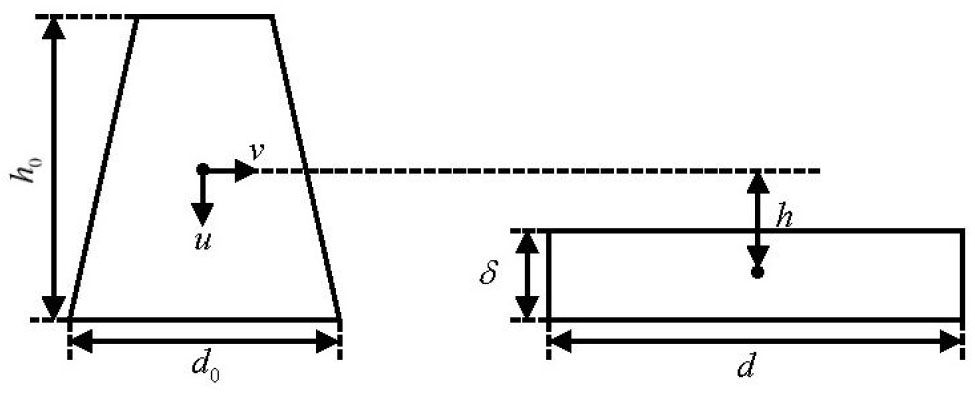
Deformation of a mortar in the vibrating table
We assume that the test table’s vibration can be described as:
where ω and A are, respectively, the frequency and amplitude of the vibrating table. Its velocity is:
The mortar’s kinetic energy is:
Its average kinetic energy during the quarter cycle is:
The mass conservation law of the mortar during the vibration process requires:
where d and δ are, respectively, the diameter and the height of the mortar under vibration, V 0 is the mortar’s volume. Eq. (12) is obtained under the assumption that the solvent involved in the mortar is not evaporated, so the density of the mortar keeps unchanged.
The energy conservation law reads:
where 4̅ is the kinetic energy in a vibrating cycle, n is the total vibrating times in the given period, m is the mortar’s mass, h is given as:
h 0 is the original height of the mortar before vibration. Wf and Wμ are, respectively, dissipation works due to the friction and viscosity:
For simplicity, we adopt the coulomb friction for the friction between the mortar and the table, it can be expressed as:
where k is the friction coefficient. So, the friction dissipation work is:
According to Zuo’s fractal rheological model [14], we have:
where τ0 is the viscous force when ω = 0, ζ is Zou’s rheological coefficient, α is the mortar’s fractal-related parameter. After a simple calculation, Eq. (19) becomes:
Now Eq. (13) becomes:
In view of Eq. (12), the fluidity of a cement mortar can be expressed as:
Eq. (22) reveals that the fluidity depends upon the vibration property, mortar’s geometry, friction, and rheological property. In Eq. (22) Zou’s rheological coefficient is determined experimentally, that makes Eq. (22) inconvenient for practical applications. Here is suggested another approach to find the fluidity equation by the fractal modification of the rheological model.
4 Fractal fluidity model
Fractal theory is a useful tool to analysis of various functional concretes, Tang et al. gave a complete review on fractal approach to cement-based materials [36], and it is Yu-ting Zuo who was the first scientist to apply the fractal theory to study the fluidity, and a fractal rheological model was successfully suggested [5, 6]. Here we apply the basic ideas of the two-scale fractal theory [34] to study the main factors affecting the expanded mortar’s diameter.
The average expanding velocity per cycle of the mortar vibrating in the horizontal direction is:
Where:
In Eq. (23), we assume that the mortar expands (d/2 – d 0/2)/n each cycle. Eq. (23) becomes:
According to the definition of fractal derivative, the radial viscous force can be calculated as:
The fractal derivative has the following properties [35]:
and
Eq. (26) can be approximated as:
Similarly, the axial viscous force is:
The dissipation works in radial and axial directions are, respectively, as:
So, Eq. (23) can be updated as:
where h can be calculated as:
Finally, we obtain the following fluidity equation:
For given test conditions, all parameters except α in Eq. (33) can be determined experimentally, so the fluidity experiment can be used to determine the value of α in Zuo’s fractal rheological model [15].
5 Conclusion
This paper studies the experiment for measuring the fluidity of a cement mortar, the theoretical analysis shows that the measured fluidity depends upon not only the mortar’s rheological property, but also measuring conditions. When all measuring conditions are fixed, the fluidity experiment can be used for determination of the fractal dimension of α in Zuo’s fractal rheological model [15], an inexplicit formulation for calculation of the fractal order is given Eq. (35), it can be solved by Newton’s iteration method or Chun-Hui He’s iteration algorithm.
Acknowledgement
The authors would like to acknowledge the National Key Research and Development Program of China (2019YFC1907105), National Natural Science Foundation of China (51878546, 52178251), the Excellent Youth Science Foundation Project of Shaanxi Province (2020JC-46), the Innovative Talent Promotion Plan of Shaanxi Province (2018KJXX-056), the Key Research and Development Projects of Shaanxi Province (2018ZDCXL-SF-03-03-02), the Science and Technology Innovation Base of Shaanxi Province (2017KTPT-19) and Key Research and Development Project of Shaanxi Province (No. 2020SF-367) for financial support.
-
Author contributions: All authors have accepted responsibility for the entire content of this manuscript and approved its submission.
-
Conflict of interest: The authors state no conflict of interest.
References
[1] [1] Zhang QF, Cai HZ, Zhang AD, Lin XN, Yi WM, Zhang JB. Effects of Lubricant and Toughening Agent on the Fluidity and Toughness of Poplar Powder-Reinforced Polylactic Acid 3D Printing Materials. Polymers (Basel). 2018;10(9):932.10.3390/polym10090932Search in Google Scholar
[2] [2] He CH, Liu SH, Liu C, Mohammad-Sedighi H. A novel bond stres–sslip model for 3-D printed concretes. Discrete Cont Dyn S. 2021. https://doi.org/10.3934/dcdss.2021161.10.3934/dcdss.2021161Search in Google Scholar
[3] [3] Zuo YT, Liu HJ. Fractal approach to mechanical and electrical properties of graphene/sic composites. Facta Univ Ser Mech. 2021;19(2):271–84.10.22190/FUME201212003ZSearch in Google Scholar
[4] [4] Feng H, Feng ZJ, Wang WS, Deng ZL, Zheng BC. Impact of polycarboxylate superplasticizers (PCEs) with novelmolecular structures on fluidity, rheological behavior and adsorption properties of cement mortar. Constr Build Mater. 2021;292:123285.10.1016/j.conbuildmat.2021.123285Search in Google Scholar
[5] [5] Espinoza-Moreno CA, Rodriguez-Rodriguez M, Pellegrini-Cervantes MJ, Barrios-Durstewitz CP, Núñez-Jaquez RE, Peinado-Guevara HJ, et al. Electrical percolation and fluidity of conductive recycled mortar cement: graphite powder: recycled sand with addition of industrial waste carbon fiber. Carbon Lett. 2020;31(4):707–20.10.1007/s42823-020-00188-0Search in Google Scholar
[6] [6] Yang L, Yilmaz E, Li JW, Liu H, Jiang HQ. Effect of superplasticizer type and dosage on fluidity and strength behavior of cemented tailings backfill with different solid contents. Constr Build Mater. 2018;187:290–8.10.1016/j.conbuildmat.2018.07.155Search in Google Scholar
[7] [7] Zhang G, Li GX, Li YC. Effects of superplasticizers and retarders on the fluidity and strength of sulphoaluminate cement. Constr Build Mater. 2016;126:44–54.10.1016/j.conbuildmat.2016.09.019Search in Google Scholar
[8] [8] Chandra S, Björnström J. Influence of cement and superplasticizers type and dosage on the fluidity of cement mortars—part I. Cement Concr Res. 2002;32(10):1605–11.10.1016/S0008-8846(02)00839-6Search in Google Scholar
[9] [9] Liu JT, Li QH, Xu SL. Influence of nanoparticles on fluidity and mechanical properties of cement mortar. Constr Build Mater. 2015;101:892–901.10.1016/j.conbuildmat.2015.10.149Search in Google Scholar
[10] [10] Lee HS, Lee JY, Yu MY. Influence of inorganic pigments on the fluidity of cement mortars. Cement Concr Res. 2005;35(4):703–10.10.1016/j.cemconres.2004.06.010Search in Google Scholar
[11] [11] He CH, Liu C, He JH, Gepreel KA. Low frequency property of a fractal vibration model for a concrete beam. Fractals. 2021;29(5):150117.10.1142/S0218348X21501176Search in Google Scholar
[12] [12] Ferec J, Bertevas E, Khoo BC, Ausias G, Phan-Thien N. A rheological constitutive model for semiconcentrated rod suspensions in Bingham fluids. Phys Fluids. 2017;29(7):073103.10.1063/1.4995436Search in Google Scholar
[13] [13] Guneyisi E, Gesoglu M, Naji N, Ipek S. Evaluation of the rheological behavior of fresh self-compacting rubberized concrete by using the Herschel-Bulkley and modified Bingham models. Arch Civ Mech Eng. 2016;16(1):9–19.10.1016/j.acme.2015.09.003Search in Google Scholar
[14] [14] Zuo YT. Effect of SiC particles on viscosity of 3D print paste: A fractal rheological model and experimental verification. Therm Sci. 2021;25(3):2403–7.10.2298/TSCI200710131ZSearch in Google Scholar
[15] [15] Zuo YT, Liu HJ. A fractal rheological model for sic paste using a fractal derivative. J Appl Comput Mech. 2021;7:13–8.Search in Google Scholar
[16] [16] Bratu PP, Vasile O, Spanu GC. The Analysis of Insulation Systems Based on Hooke – Voigt Kelvin Dynamic Rheological Model. J Vib Eng Tech. 2017;5(3):255–61.Search in Google Scholar
[17] [17] Saasen A, Ytrehus JD. Rheological properties of drilling fluids: use of dimensionless shear rates in Herschel-Bulkley and powerlaw models. Appl Rheol. 2018;28(5):54515.Search in Google Scholar
[18] [18] Liang YH, Wang KJ. A new fractal viscoelastic element: Promise and Applications to Maxwell-Rheological Model. Therm Sci. 2021;25(2):1221–7.10.2298/TSCI200301015LSearch in Google Scholar
[19] [19] Anjum N, He CH, He JH. Two-scale fractal theory for the population dynamics. Fractals. 2021;29(7):2150182.10.1142/S0218348X21501826Search in Google Scholar
[20] [20] He JH. Seeing with a Single Scale is Always Unbelieving: From magic to two-scale fractal. Therm Sci. 2021;25(2 Part B 2B):1217–9.10.2298/TSCI2102217HSearch in Google Scholar
[21] [21] Yin D, Zhang W, Cheng C, Li Y. Fractional time-dependent Bingham model for muddy clay. J Non-Newton Fluid. 2012;187–188:32–5.10.1016/j.jnnfm.2012.09.003Search in Google Scholar
[22] [22] Zhang X, Li Z, Wang X, Yu J. The fractional Kelvin-Voigt model for circumferential guided waves in a viscoelastic FGM hollow cylinder. Appl Math Model. 2021;89:299–313.10.1016/j.apm.2020.06.077Search in Google Scholar
[23] [23] Tian Y, Liu J. Direct algebraic method for solving fractional Fokas equation. Therm Sci. 2021;25(3):2235–44.10.2298/TSCI200306111TSearch in Google Scholar
[24] [24] Tian Y, Wan JX. Exact solutions of space-time fractional 2+1 dimensional breaking soliton equation. Therm Sci. 2021;25(2):1229–35.10.2298/TSCI200421016TSearch in Google Scholar
[25] [25] Tian Y, Liu J. A modified exp-function method for fractional partial differential equations. Therm Sci. 2021;25(2):1237–41.10.2298/TSCI200428017TSearch in Google Scholar
[26] [26] Wang KJ. On new abundant exact traveling wave solutions to the local fractional Gardner equation defined on Cantor sets. Math Methods Appl Sci. 2021.10.1002/mma.7897Search in Google Scholar
[27] [27] Wang KJ. Generalized variational principle and periodic wave solution to the modified equal width-Burgers equation in nonlinear dispersion media. Phys Lett A. 2021;419:127723.10.1016/j.physleta.2021.127723Search in Google Scholar
[28] [28] Wang KJ, Zhang PL. Investigation of the periodic solution of the time-space fractional Sasa-Satsuma equation arising in the monomode optical fibers. Europhys Lett. 2021. https://doi.org/10.1209/0295-5075/ac2a62.10.1209/0295-5075/ac2a62Search in Google Scholar
[29] [29] Han C, Wang YL, Li ZY. Numerical solutions of space fractional variable-coefficient KdV-modified KdV equation by Fourier spectral method. Fractals. 2021.10.1142/S0218348X21502467Search in Google Scholar
[30] [30] Dan DD, Zhang W, Wang YL, Ban TT. Using piecewise reproducing kernel method and Legendre polynomial for solving a class of the time variable fractional order advection-reaction-diffusion equation. Therm Sci. 2021;25 2B:1261–8.10.2298/TSCI200302021DSearch in Google Scholar
[31] [31] He JH. A Tutorial Review on Fractal Spacetime and Fractional Calculus. Int J Theor Phys. 2014;53(11):3698–718.10.1007/s10773-014-2123-8Search in Google Scholar
[32] [32] Deng SX, Ge XX. Approximate analytical solution for phifour equation with He’s fractal derivative. Therm Sci. 2021;25(3):2369–75.10.2298/TSCI191231127DSearch in Google Scholar
[33] [33] Feng GQ. He’s frequency formula to fractal undamped Duffing equation. J Low Freq Noise V A. 2021;40(4):1671-1676. https://doi.org/10.1177/1461348421992608.10.1177/1461348421992608Search in Google Scholar
[34] [34] He JH, Hou WF, He CH, Saeed T, Hayat T. Variational approach to fractal solitary waves. Fractals. 2021;29(7):2150199.10.1142/S0218348X21501991Search in Google Scholar
[35] [35] He JH, El-Dib YO. A tutorial introduction to the two-scale fractal calculus and its application to the fractal Zhiber-Shabat oscillator. Fractals. 2021.10.1142/S0218348X21502686Search in Google Scholar
[36] [36] Tang SW, Huang JS, Duan L, Yu P, Chen E. A review on fractal footprint of cement-based materials. Powder Technol. 2020;370:237–50.10.1016/j.powtec.2020.05.065Search in Google Scholar
© 2022 C.-H. He and C. Liu, published by De Gruyter.
This work is licensed under the Creative Commons Attribution-NonCommercial-NoDerivatives 4.0 International License.
Articles in the same Issue
- Research Articles
- Fractal approach to the fluidity of a cement mortar
- Novel results on conformable Bessel functions
- The role of relaxation and retardation phenomenon of Oldroyd-B fluid flow through Stehfest’s and Tzou’s algorithms
- Damage identification of wind turbine blades based on dynamic characteristics
- Improving nonlinear behavior and tensile and compressive strengths of sustainable lightweight concrete using waste glass powder, nanosilica, and recycled polypropylene fiber
- Two-point nonlocal nonlinear fractional boundary value problem with Caputo derivative: Analysis and numerical solution
- Construction of optical solitons of Radhakrishnan–Kundu–Lakshmanan equation in birefringent fibers
- Dynamics and simulations of discretized Caputo-conformable fractional-order Lotka–Volterra models
- Research on facial expression recognition based on an improved fusion algorithm
- N-dimensional quintic B-spline functions for solving n-dimensional partial differential equations
- Solution of two-dimensional fractional diffusion equation by a novel hybrid D(TQ) method
- Investigation of three-dimensional hybrid nanofluid flow affected by nonuniform MHD over exponential stretching/shrinking plate
- Solution for a rotational pendulum system by the Rach–Adomian–Meyers decomposition method
- Study on the technical parameters model of the functional components of cone crushers
- Using Krasnoselskii's theorem to investigate the Cauchy and neutral fractional q-integro-differential equation via numerical technique
- Smear character recognition method of side-end power meter based on PCA image enhancement
- Significance of adding titanium dioxide nanoparticles to an existing distilled water conveying aluminum oxide and zinc oxide nanoparticles: Scrutinization of chemical reactive ternary-hybrid nanofluid due to bioconvection on a convectively heated surface
- An analytical approach for Shehu transform on fractional coupled 1D, 2D and 3D Burgers’ equations
- Exploration of the dynamics of hyperbolic tangent fluid through a tapered asymmetric porous channel
- Bond behavior of recycled coarse aggregate concrete with rebar after freeze–thaw cycles: Finite element nonlinear analysis
- Edge detection using nonlinear structure tensor
- Synchronizing a synchronverter to an unbalanced power grid using sequence component decomposition
- Distinguishability criteria of conformable hybrid linear systems
- A new computational investigation to the new exact solutions of (3 + 1)-dimensional WKdV equations via two novel procedures arising in shallow water magnetohydrodynamics
- A passive verses active exposure of mathematical smoking model: A role for optimal and dynamical control
- A new analytical method to simulate the mutual impact of space-time memory indices embedded in (1 + 2)-physical models
- Exploration of peristaltic pumping of Casson fluid flow through a porous peripheral layer in a channel
- Investigation of optimized ELM using Invasive Weed-optimization and Cuckoo-Search optimization
- Analytical analysis for non-homogeneous two-layer functionally graded material
- Investigation of critical load of structures using modified energy method in nonlinear-geometry solid mechanics problems
- Thermal and multi-boiling analysis of a rectangular porous fin: A spectral approach
- The path planning of collision avoidance for an unmanned ship navigating in waterways based on an artificial neural network
- Shear bond and compressive strength of clay stabilised with lime/cement jet grouting and deep mixing: A case of Norvik, Nynäshamn
- Communication
- Results for the heat transfer of a fin with exponential-law temperature-dependent thermal conductivity and power-law temperature-dependent heat transfer coefficients
- Special Issue: Recent trends and emergence of technology in nonlinear engineering and its applications - Part I
- Research on fault detection and identification methods of nonlinear dynamic process based on ICA
- Multi-objective optimization design of steel structure building energy consumption simulation based on genetic algorithm
- Study on modal parameter identification of engineering structures based on nonlinear characteristics
- On-line monitoring of steel ball stamping by mechatronics cold heading equipment based on PVDF polymer sensing material
- Vibration signal acquisition and computer simulation detection of mechanical equipment failure
- Development of a CPU-GPU heterogeneous platform based on a nonlinear parallel algorithm
- A GA-BP neural network for nonlinear time-series forecasting and its application in cigarette sales forecast
- Analysis of radiation effects of semiconductor devices based on numerical simulation Fermi–Dirac
- Design of motion-assisted training control system based on nonlinear mechanics
- Nonlinear discrete system model of tobacco supply chain information
- Performance degradation detection method of aeroengine fuel metering device
- Research on contour feature extraction method of multiple sports images based on nonlinear mechanics
- Design and implementation of Internet-of-Things software monitoring and early warning system based on nonlinear technology
- Application of nonlinear adaptive technology in GPS positioning trajectory of ship navigation
- Real-time control of laboratory information system based on nonlinear programming
- Software engineering defect detection and classification system based on artificial intelligence
- Vibration signal collection and analysis of mechanical equipment failure based on computer simulation detection
- Fractal analysis of retinal vasculature in relation with retinal diseases – an machine learning approach
- Application of programmable logic control in the nonlinear machine automation control using numerical control technology
- Application of nonlinear recursion equation in network security risk detection
- Study on mechanical maintenance method of ballasted track of high-speed railway based on nonlinear discrete element theory
- Optimal control and nonlinear numerical simulation analysis of tunnel rock deformation parameters
- Nonlinear reliability of urban rail transit network connectivity based on computer aided design and topology
- Optimization of target acquisition and sorting for object-finding multi-manipulator based on open MV vision
- Nonlinear numerical simulation of dynamic response of pile site and pile foundation under earthquake
- Research on stability of hydraulic system based on nonlinear PID control
- Design and simulation of vehicle vibration test based on virtual reality technology
- Nonlinear parameter optimization method for high-resolution monitoring of marine environment
- Mobile app for COVID-19 patient education – Development process using the analysis, design, development, implementation, and evaluation models
- Internet of Things-based smart vehicles design of bio-inspired algorithms using artificial intelligence charging system
- Construction vibration risk assessment of engineering projects based on nonlinear feature algorithm
- Application of third-order nonlinear optical materials in complex crystalline chemical reactions of borates
- Evaluation of LoRa nodes for long-range communication
- Secret information security system in computer network based on Bayesian classification and nonlinear algorithm
- Experimental and simulation research on the difference in motion technology levels based on nonlinear characteristics
- Research on computer 3D image encryption processing based on the nonlinear algorithm
- Outage probability for a multiuser NOMA-based network using energy harvesting relays
Articles in the same Issue
- Research Articles
- Fractal approach to the fluidity of a cement mortar
- Novel results on conformable Bessel functions
- The role of relaxation and retardation phenomenon of Oldroyd-B fluid flow through Stehfest’s and Tzou’s algorithms
- Damage identification of wind turbine blades based on dynamic characteristics
- Improving nonlinear behavior and tensile and compressive strengths of sustainable lightweight concrete using waste glass powder, nanosilica, and recycled polypropylene fiber
- Two-point nonlocal nonlinear fractional boundary value problem with Caputo derivative: Analysis and numerical solution
- Construction of optical solitons of Radhakrishnan–Kundu–Lakshmanan equation in birefringent fibers
- Dynamics and simulations of discretized Caputo-conformable fractional-order Lotka–Volterra models
- Research on facial expression recognition based on an improved fusion algorithm
- N-dimensional quintic B-spline functions for solving n-dimensional partial differential equations
- Solution of two-dimensional fractional diffusion equation by a novel hybrid D(TQ) method
- Investigation of three-dimensional hybrid nanofluid flow affected by nonuniform MHD over exponential stretching/shrinking plate
- Solution for a rotational pendulum system by the Rach–Adomian–Meyers decomposition method
- Study on the technical parameters model of the functional components of cone crushers
- Using Krasnoselskii's theorem to investigate the Cauchy and neutral fractional q-integro-differential equation via numerical technique
- Smear character recognition method of side-end power meter based on PCA image enhancement
- Significance of adding titanium dioxide nanoparticles to an existing distilled water conveying aluminum oxide and zinc oxide nanoparticles: Scrutinization of chemical reactive ternary-hybrid nanofluid due to bioconvection on a convectively heated surface
- An analytical approach for Shehu transform on fractional coupled 1D, 2D and 3D Burgers’ equations
- Exploration of the dynamics of hyperbolic tangent fluid through a tapered asymmetric porous channel
- Bond behavior of recycled coarse aggregate concrete with rebar after freeze–thaw cycles: Finite element nonlinear analysis
- Edge detection using nonlinear structure tensor
- Synchronizing a synchronverter to an unbalanced power grid using sequence component decomposition
- Distinguishability criteria of conformable hybrid linear systems
- A new computational investigation to the new exact solutions of (3 + 1)-dimensional WKdV equations via two novel procedures arising in shallow water magnetohydrodynamics
- A passive verses active exposure of mathematical smoking model: A role for optimal and dynamical control
- A new analytical method to simulate the mutual impact of space-time memory indices embedded in (1 + 2)-physical models
- Exploration of peristaltic pumping of Casson fluid flow through a porous peripheral layer in a channel
- Investigation of optimized ELM using Invasive Weed-optimization and Cuckoo-Search optimization
- Analytical analysis for non-homogeneous two-layer functionally graded material
- Investigation of critical load of structures using modified energy method in nonlinear-geometry solid mechanics problems
- Thermal and multi-boiling analysis of a rectangular porous fin: A spectral approach
- The path planning of collision avoidance for an unmanned ship navigating in waterways based on an artificial neural network
- Shear bond and compressive strength of clay stabilised with lime/cement jet grouting and deep mixing: A case of Norvik, Nynäshamn
- Communication
- Results for the heat transfer of a fin with exponential-law temperature-dependent thermal conductivity and power-law temperature-dependent heat transfer coefficients
- Special Issue: Recent trends and emergence of technology in nonlinear engineering and its applications - Part I
- Research on fault detection and identification methods of nonlinear dynamic process based on ICA
- Multi-objective optimization design of steel structure building energy consumption simulation based on genetic algorithm
- Study on modal parameter identification of engineering structures based on nonlinear characteristics
- On-line monitoring of steel ball stamping by mechatronics cold heading equipment based on PVDF polymer sensing material
- Vibration signal acquisition and computer simulation detection of mechanical equipment failure
- Development of a CPU-GPU heterogeneous platform based on a nonlinear parallel algorithm
- A GA-BP neural network for nonlinear time-series forecasting and its application in cigarette sales forecast
- Analysis of radiation effects of semiconductor devices based on numerical simulation Fermi–Dirac
- Design of motion-assisted training control system based on nonlinear mechanics
- Nonlinear discrete system model of tobacco supply chain information
- Performance degradation detection method of aeroengine fuel metering device
- Research on contour feature extraction method of multiple sports images based on nonlinear mechanics
- Design and implementation of Internet-of-Things software monitoring and early warning system based on nonlinear technology
- Application of nonlinear adaptive technology in GPS positioning trajectory of ship navigation
- Real-time control of laboratory information system based on nonlinear programming
- Software engineering defect detection and classification system based on artificial intelligence
- Vibration signal collection and analysis of mechanical equipment failure based on computer simulation detection
- Fractal analysis of retinal vasculature in relation with retinal diseases – an machine learning approach
- Application of programmable logic control in the nonlinear machine automation control using numerical control technology
- Application of nonlinear recursion equation in network security risk detection
- Study on mechanical maintenance method of ballasted track of high-speed railway based on nonlinear discrete element theory
- Optimal control and nonlinear numerical simulation analysis of tunnel rock deformation parameters
- Nonlinear reliability of urban rail transit network connectivity based on computer aided design and topology
- Optimization of target acquisition and sorting for object-finding multi-manipulator based on open MV vision
- Nonlinear numerical simulation of dynamic response of pile site and pile foundation under earthquake
- Research on stability of hydraulic system based on nonlinear PID control
- Design and simulation of vehicle vibration test based on virtual reality technology
- Nonlinear parameter optimization method for high-resolution monitoring of marine environment
- Mobile app for COVID-19 patient education – Development process using the analysis, design, development, implementation, and evaluation models
- Internet of Things-based smart vehicles design of bio-inspired algorithms using artificial intelligence charging system
- Construction vibration risk assessment of engineering projects based on nonlinear feature algorithm
- Application of third-order nonlinear optical materials in complex crystalline chemical reactions of borates
- Evaluation of LoRa nodes for long-range communication
- Secret information security system in computer network based on Bayesian classification and nonlinear algorithm
- Experimental and simulation research on the difference in motion technology levels based on nonlinear characteristics
- Research on computer 3D image encryption processing based on the nonlinear algorithm
- Outage probability for a multiuser NOMA-based network using energy harvesting relays
