Software engineering defect detection and classification system based on artificial intelligence
-
Hong Wang


Abstract
With the increasing reliance on automatic software-based applications, it is important to automate the classification of software defects and ensure software reliability. An automatic software defect classification system based on an expert system is proposed in this article. In this method, DACS first determines the category of software defects through the selection of typical features, then reduces the spatial knowledge base searched by the inference engine and selects the characteristics of a certain type of defect. Make a selection, determine the name of the defect, and finally select different causes and prevention methods for the defect as needed. The DACS structure was built, and the experiment showed that the AI system took 15 s to complete, whereas the traditional mechanism took 48 s; the accuracy of the AI was 99%, whereas the accuracy of the traditional mechanism was only 68%. According to the aforementioned experimental results, the recognition accuracy of the proposed research scheme is higher than that of the traditional mechanism. Hence, the time required to solve the problem of software engineering defect detection and classification is less than that of the traditional mechanism.
1 Introduction
Humans have been committed to making computer technology increasingly intelligent. It is a comprehensive discipline involving computers, control, linguistics, neurology, psychology, and philosophy. At the same time, artificial intelligence (AI) is also a subject with strong vitality. It tries to change human thinking and living habits, extend and liberate human intelligence, and will also lead mankind to a new era of scientific and technological development [1]. The development of AI also faces multiple problems, such as the core problem of AI: what is the difference between AI and “human nature”? What is the direction of AI? The conclusions drawn from a particular topic or only one aspect of AI research are worth discussing [2]. Only by using the dialectical materialist worldview and methodology, as well as computer expertise, can we break through the bottleneck and identify and solve various problems in the development of artificial intelligence technology [3]. After one-sided emotional negation, artificial intelligence ethics research has become increasingly scientific and mature in recent years. At present, with the rapid development of computer science and technology, as well as the ubiquitous use of software, the probability of errors or defects in the software development process is increasing. Any software model has a variety of software defects, and the automatic classification of software defects is particularly important to ensure their reliability. It is likely that the use of AI products will cause fear, but it is our human responsibility not to let that scene happen. We set a unique identification code for each intelligent robot to track its every move in real time. If the robot has any action or other behavior that the programmer does not set in any link, we should control it the first time to prevent it from causing harm to humans. At the same time, it can also prevent people with ulterior motives from copying artificial intelligence, just like the Shanzhai phones we have experienced. A mobile phone full of rogue software is designed to steal a user’s private information and cause personal and property losses. As AI robots become more integrated into human life, more experts commit to the ethics of AI. Especially since 2005, some research papers and monographs on “robot ethics” have shown a steep rise in trend year by year [4]. The research on artificial intelligence ethics mainly focuses on AI safety, moral status, and environmental ethics. The mature field at this time is the harm brought by artificial intelligence to the environment because environmental problems are already apparent in our daily lives [5].
1.1 Literature review
On the premise of respecting the development of human scientific and technological civilization at the present stage, the thinking scope of intelligence philosophy is further reduced to ethical thinking; the development direction and prospects of artificial intelligence are judged with a more systematic ethical basis; and the ethical basis is used to give solutions [6]. The emergence of artificial intelligence technology is to imitate human intelligence, so ethical issues should be discussed as the most important problem in the development of artificial intelligence technology. It is advocated that, under any circumstances, scientific development research should be carried out on the premise of scientific development [7]. I believe that this is also the most needed in the process of AI development, as well as integrating AI technology and ethical issues as much as possible [8]. There have been many works and conclusions on the Marxist concept of science and technology, ethics, and philosophy of artificial intelligence. Through the worship of literature, I found that due to my limited academic ability, I could not fully understand the content of the literature, and there was no way to integrate all the views of the academic circle. Therefore, the research on the problems in the article is not comprehensive enough and lacks discussion depth too. At present, scientific research into artificial intelligence technology is still in its initial stages, and the specific form of artificial intelligence has not been finalized. Therefore, the final research on how to deal with ethical dilemmas is basically at a relatively shallow institutional level [9]. The expert system (expert system) is a branch of artificial intelligence. The expert system refers to the process of reasoning and judging data and problems entered by users based on knowledge in a knowledge database. The knowledge base is provided by experts, which contains specialized knowledge and experience, and for complex problems, expert systems rely on the theory of knowledge acquisition and knowledge representation. The expert system is designed to simulate the decision process of human experts [10]. To address this research question, Huang et al. have proposed an AI-based defect detection and classification method, with real-time detection of the advantages and disadvantages of magnetic core products and classification [11]. Yang et al. have proposed the “Three Laws of Robot,” which once became the default research and development principle in academia. Although philosophers have proposed their internal host and object contradiction in recent years, the “law” marks the beginning of human reflection on the philosophy of artificial intelligence [12]. Fan et al. argue that AI is a branch of computer science that attempts to understand the substance of intelligence and produce a new intelligent machine that can respond in ways similar to human intelligence, and research in the field includes robotics, language recognition, image recognition, natural language processing, and expert systems [13]. Since the birth of artificial intelligence, theory and technology have become increasingly mature, and the application field has been constantly expanding. It can be revealed that the technological products brought by artificial intelligence in the future will be the “containers” of human wisdom and are bound to carry the development and progress of human science and technology.
1.2 Article contribution
Based on the current research, this article proposes AI-based software engineering defect detection and classification system research. The article first introduces the software defect classification, then builds the structure of DACS and creates a software defect database with SQLServer that includes two tables: the control and data flow-type defect table; the structured and non-functional defect table. This article proposed that the software defect classification can be done by using the problem information of the software tester during the test to analyze the wrong classification information. The conclusion is observed based on existing and known data and knowledge, gradually through positive logic. Experimental results show that the proposed AI system outperforms the traditional mechanism's accuracy. The proposed DACS method first determines the category to which software defects belong by selecting typical characteristics and then reduces the space of the reasoning machine search knowledge base. The proposed method then selects the name of the defect from among the characteristics of a certain kind of defect. It finally selects the different causes and prevention methods for a certain defect according to its needs [14]. It is shown in Figure 1.

Expert system.
1.3 Article organization
The rest of this article is structured as follows: an overview of the software defect classification is presented in Section 2, followed by results and analysis in Section 3. Section 4 presents the article’s conclusion.
2 Method
2.1 Overview of the software defect classification
With the rapid development of software engineering, especially in the process of software development, defects are not only limited to programs and code but also have a more or less impact on software quality in the software development process and the management structure of the organization. Researchers began to focus on the impact of software processes on software defects. There is a need to classify software flaws in order to analyze the causes of software defects and then improve the software process. This also prevents software defects from improving the quality of software and the software capability maturity of the organization [15,16]. Software classification should meet the following requirements: accurate classification of software defects; no overlap between the classification of software defects; and a classification system that includes all existing defect types; classification should be organically combined with the life cycle of software and classifying software defects from the perspective of software process [17,18]. The complete process of artificial intelligence-based classification is depicted in Figure 2.
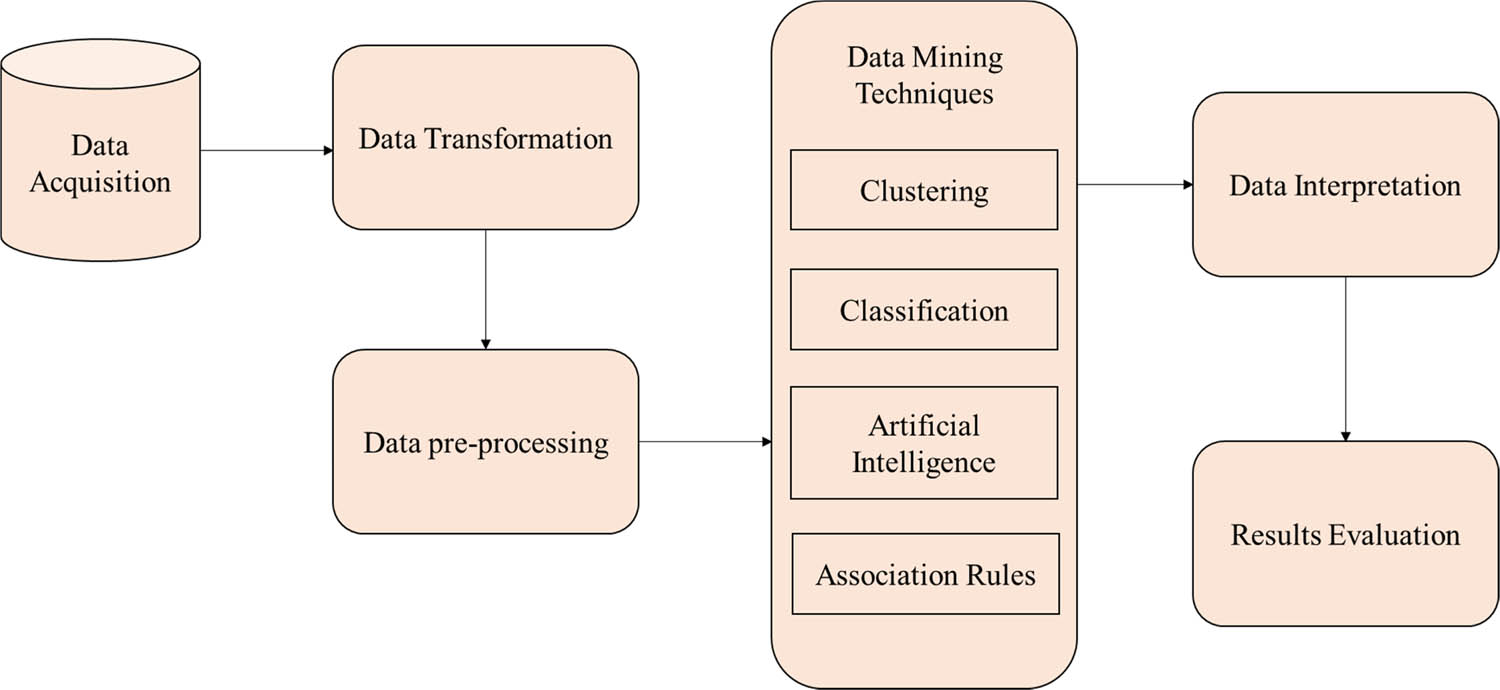
Artificial intelligence-based classification process.
2.2 Structure of the DACS
The basic idea of human experts in conducting software defect classification is to use the problem information of the software tester during the test to analyze the wrong classification information [19,20]. DACS simulates the basic idea of human problem-solving experts and consists of several modules of the user interface, knowledge base, reasoning machine, and interpreter. Its structure is shown in Figure 3.
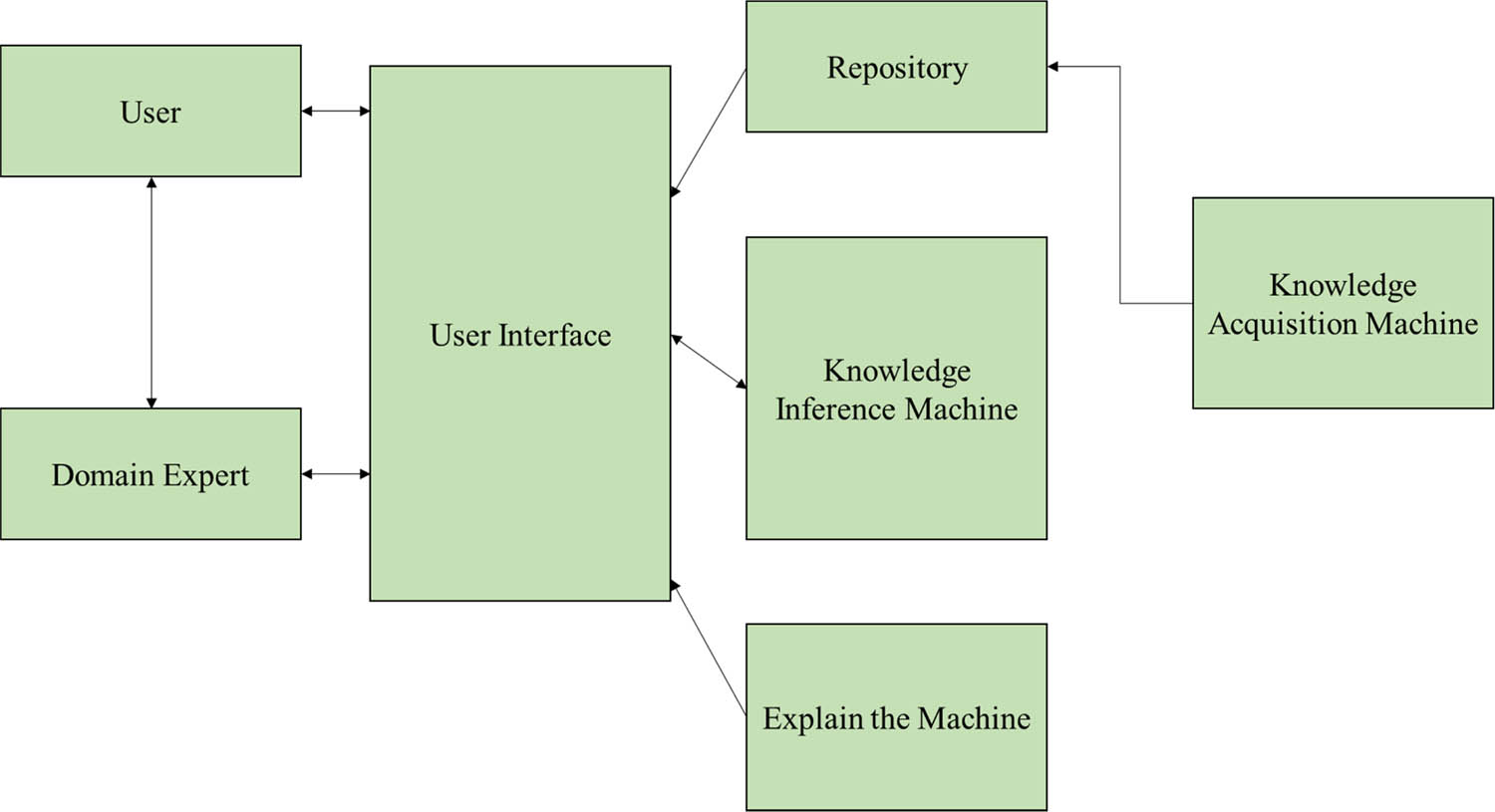
Structure of the DCAS.
3 Results and analysis
3.1 Knowledge base
The knowledge base is used to store expert-level domain knowledge, which contains a large number of facts and rules in a certain field, and all problems also rely on the knowledge base. There are two main types of knowledge in the knowledge base: one is factual knowledge, which is common knowledge; the other is enlightening knowledge, which is the summary of the personal experience of experts in the field. The knowledge in DACS’s knowledge base is derived from the orthogonal defect classification developed by IBM (Orthogonal Defects Classification [ODC]). The SQL server database system makes it easy to save, manage, and query data and to establish a software defect database. This database includes two tables: the control and data flow-type defect table; and the structured and non-functional defect table.
The control and data flow types include the following four types of defects:
Initialization and assignment class refers to the initial value being incorrect or having no initial value.
Inspection class refers to the error caused by missing or incorrect parameters or in the verification condition statement of the data.
Algorithm and method class refers to the efficiency or correctness of the algorithm that affects the software development.
Timing class refers to the error or wrong resource serialization technology.
Structured and non-functional classes include functional and object classes; I/0 interface classes; and associated classes. The fields in each table have the same data type as well, for query convenience. For example, the table structure of the control and data flow class defect table is shown in Table 1.
Table structure of control and data flow class defects
| Field | Data type | Length |
|---|---|---|
| Number | C | 6 |
| Type | C | 10 |
| Characteristic | C | 20 |
| Source | M | 4 |
| Preventive | M | 4 |
The tree structure is shown in Table 2. This tree structure ensures the system can determine large branches during inference, such as whether the defect belongs to control and data flow or structured and non-functional categories. Then determine small branches, such as initialization and assignment, tests, algorithms, and methods. Therefore, after dividing the knowledge organization structure into multiple branches, there is no need to generate rules matching each branch, which greatly reduces the difficulty of searching the knowledge base [21,22].
Software defects library
| The control and data flow-type defect | Structured and nonfunctional defects | |||||
|---|---|---|---|---|---|---|
| Algorithms and methods | Initialization and assignment classes | Inspection class | Time series class | Functions and object classes | I/0 interface class | Affiliate class |
Figure 4 depicts the different phases of software development along with the percentage of defects involved in each phase. The expected percentage to overcome these defects is also depicted in Figure 4.

Different phases of software development.
3.2 Knowledge reasoning machine
The reasoning machine is driven by internal procedures and is the institution of the expert system-solving process. The inference strategy is mainly associated with the forward reasoning strategy, the reverse reasoning strategy, the mixed reasoning strategy, the conflict resolution strategy, the two-way reasoning strategy, and the meta-control strategy. The system uses a positive reasoning method. Positive reasoning has also become data-driven. Its basic idea is to understand the existing and known data and knowledge by gradually reasoning through positive logic. DACS first determines the category of software defects they belong to through the selection of typical characteristics, which reduces the space of reasoning machine search knowledge base. Then, he selects among the characteristics of a certain kind of defect, determines the name of the defect, and finally selects the different causes and prevention methods of a certain defect according to his needs. For each user’s selection of the defect feature, there will be an interpreter exporting the category or name information of the defect to the user.
3.3 User interface and interpreter
The user interface may be used to receive information from the user or send information to the user, and the user interface can serve as both a user input interface and a user output interface to transmit the information to the inference machine, which is another key component of the expert system. When the reasoner returns the useful information drawn from the knowledge base, the user interface retransmits the resulting information to the user in the appropriate form. The user interface provides communication for users and systems, including using keyboards and screens as input and output devices; questions and answers that support users and expert systems; identifying cognitive differences between users and expert systems; and providing a flexible and friendly interface for users. The responsibility of the interpreter is to explain the operation process and results of the system to the user and explain the conclusions given by the reasoning machine, its performance increases the trust and transparency of the expert system, improves the user acceptance of the conclusions obtained, and thus improves the user experience. The function of the knowledge acquisition machine converts the common sense knowledge in a certain field and the experiential knowledge of the field expert into a form that the computer can be recognized and utilized to edit the knowledge in the knowledge base. In different expert systems, there is no difference in knowledge acquisition functions and implementation methods. Some systems edit knowledge into the knowledge base through knowledge editing software, and some systems have learning functions. In the process of system operation, self-summary obtains new knowledge. The DACS system uses the experience of software testers and orthogonal defect classification by IBM as an important source of the knowledge base. This article uses the traditional manual inspection and the same software to record the time and results, respectively. The results are shown in Figure 5.

Test results in terms of accuracy and time elapsed.
From the experimentation, it is revealed that DACS first determines the category to which software defects belong through the selection of typical characteristics, reducing the space of the reasoning machine search knowledge base. The selection among the characteristics of a certain kind of defect is done along with the determination of the name of the defect, thereby selecting the different causes and prevention methods of a certain defect according to the needs. The experimental results show that the AI system takes 15 s with 99% AI accuracy, whereas the traditional mechanism takes 48 s with only 68% accuracy.
4 Conclusions
This article proposes research on software engineering defect detection and classification system. It first introduces the software defect classification, creates the structure of DACS, and establishes a software defect database with SQLServer, which includes two tables: the control and data flow-type defect table; the structured and non-functional defect table. The basic idea of human experts in conducting software defect classification is to use the problem information provided by the software tester during the test to analyze the wrong classification information. The conclusion is based on existing and known data and knowledge, gradually through positive logic. Experimental results show that the AI system takes 15 s with 99% AI accuracy, whereas the traditional mechanism takes 48 s with only 68% accuracy. DACS first determines the category to which the software defects belong through the selection of typical characteristics, reduces the space of reasoning machine search knowledge base, then selects among the characteristics of a certain kind of defect, determines the name of the defect, and thereby selects the different causes and prevention methods of a certain defect according to the needs. The future scope of this article is to study deeply the software engineering defect detection and classification system under other artificial intelligence.
Acknowledgment
This research was supported by S&T Program of Hebei, Research on the innovation of fault tolerance and error correction mechanism in scientific research activities in Colleges and Universities, Project No: 215576157D.
-
Author contributions: All authors have accepted responsibility for the entire content of this manuscript and approved its submission.
-
Conflict of interest: The authors state no conflict of interest.
References
[1] Fadhil JA, Wei KT, Na KS. Artificial intelligence for software engineering: an initial review on software bug detection and prediction. J Comput Sci. 2020;1612:1709–17.10.3844/jcssp.2020.1709.1717Search in Google Scholar
[2] Sharma K, Chaurasia BK. Trust based location finding mechanism in VANET using DST. Gwalior, India: Fifth International Conference on Communication Systems & Network Technologies; 2015 Apr 4-6; Gwalior, India. IEEE; 2015. p. 763–6.10.1109/CSNT.2015.160Search in Google Scholar
[3] Zong H, Zhang Z, Yang J, Lei J, Zhang X. Artificial intelligence based Chinese clinical trials eligibility criteria classification. Sheng Wu Yi Xue Gong Cheng Xue Za Zhi. 2021;38(1):105–10 (in Chinese).Search in Google Scholar
[4] Jayakumar J, Nagaraj B, Chacko S, Ajay P. Conceptual implementation of artificial intelligent based e-mobility controller in smart city environment. Wirel Commun Mob Comput. 2021;2021:1–8.10.1155/2021/5325116Search in Google Scholar
[5] Shehab M, Abualigah L, Jarrah MI, Alomari OA, Daoud MS. Artificial intelligence in software engineering and inverse: review. Int J Comput Integr Manuf. 2020;1:1–16.10.1080/0951192X.2020.1780320Search in Google Scholar
[6] Xin L, Jianqi L, Jiayao C, Fangchuan Z, Chengyu M. Study on treatment of printing and dyeing waste gas in the atmosphere with Ce-Mn/GF catalyst. Arab J Sci. 2021;14(8):1–6.10.1007/s12517-021-07074-7Search in Google Scholar
[7] Mudita, Gupta D. The aspects of artificial intelligence in software engineering. J Comput Theor Nanosci. 2020;17(9):4635–42.10.1166/jctn.2020.9291Search in Google Scholar
[8] Balla D, Novák TJ, Kiss E, Mester T, Zichar M. Classification and geovisualization process of soil data using a web-based spatial information system. Open Agric. 2020;5(1):638–55.10.1515/opag-2020-0054Search in Google Scholar
[9] Huang R, Zhang S, Zhang W, Yang X. Progress of zinc oxide-based nanocomposites in the textile industry. IET Collab Intell Manuf. 2021;3(3):281–9.10.1049/cim2.12029Search in Google Scholar
[10] Rajeswari J, Raja J, Jayashri S. Gradient contouring and texture modelling based CAD system for improved TB classification. Autom Softw Eng. 2022;29(1):1–12.10.1007/s10515-021-00304-ySearch in Google Scholar
[11] Huang R, Yan P, Yang X. Knowledge map visualization of technology hotspots and development trends in China’s textile manufacturing industry. IET Collab Intell Manuf. 2021;3(3):243–51.10.1049/cim2.12024Search in Google Scholar
[12] Yang M, Kumar P, Bhola J, Shabaz M. Development of image recognition software based on artificial intelligence algorithm for the efficient sorting of apple fruit. Int J Syst Assur Eng Manag. 2021;13(Suppl 1):322–30.10.1007/s13198-021-01415-1Search in Google Scholar
[13] Fan M, Sharma A. Design and implementation of construction cost prediction model based on SVM and LSSVM in Industries 4.0. Int J Intell Comput Cybernetics. 2021;14:145–57. (ahead-of-print).10.1108/IJICC-10-2020-0142Search in Google Scholar
[14] Xin L, Chengyu M, Chongyang Y. Power station flue gas desulfurization system based on automatic online monitoring platform. J Digital Inf Manag. 2015;13(6):480–8.Search in Google Scholar
[15] Veselov G, Tselykh A, Sharma A. Introduction to the Special Issue: Futuristic trends and emergence of technology in biomedical, nonlinear dynamics and control engineering. J Vibroengineering. 2021;23(6):1315–7.10.21595/jve.2021.22226Search in Google Scholar
[16] Wu F, Zhu C, Xu J, Bhatt MW, Sharma A. Research on image text recognition based on canny edge detection algorithm and k-means algorithm. Int J Syst Assur Eng Manag. 2022;13:72–80.10.1007/s13198-021-01262-0Search in Google Scholar
[17] Jia Z, Sharma A. Review on engine vibration fault analysis based on data mining. J Vibroengineering. 2021;23(6):1433–45.10.21595/jve.2021.21928Search in Google Scholar
[18] Chen Y, Zhang W, Dong L, Cengiz K, Sharma A. Study on vibration and noise influence for optimization of garden mower. Nonlinear Eng. 2021;10(1):428–35.10.1515/nleng-2021-0034Search in Google Scholar
[19] Dong J, Sharma A, Sharma P. Mathematical model analysis of axisymmetric nozzle performance prediction for complex system based on numerical simulation. Int J Syst Assur Eng Manag. 2021;2021:1884–2023.10.1007/s13198-021-01117-8Search in Google Scholar
[20] Shabaz M, Sharma A, Al Ajrawi S, Estrela VV. Multimedia-based emerging technologies and data analytics for neuroscience as a service (NaaS). Neurosci Inform. 2022;2(3):100067.10.1016/j.neuri.2022.100067Search in Google Scholar
[21] Bradha M, Balakrishnan N, Suvitha A, Arumanayagam T, Rekha M, Vivek P, Ajay P, et al. Experimental, computational analysis of Butein and Lanceoletin for natural dye-sensitized solar cells and stabilizing efficiency by IoT. Environ Dev Sustain. 2021;24:8807–22.10.1007/s10668-021-01810-5Search in Google Scholar
[22] Zhou Y, Sharma A, Shabaz M. Feature recognition of state signal of electromechanical integration railway turnout over health parameters using CMOS area array technology. J Eng. 2022;14:918462.10.1049/tje2.12154Search in Google Scholar
© 2022 Hong Wang and Limin Yuan, published by De Gruyter
This work is licensed under the Creative Commons Attribution 4.0 International License.
Articles in the same Issue
- Research Articles
- Fractal approach to the fluidity of a cement mortar
- Novel results on conformable Bessel functions
- The role of relaxation and retardation phenomenon of Oldroyd-B fluid flow through Stehfest’s and Tzou’s algorithms
- Damage identification of wind turbine blades based on dynamic characteristics
- Improving nonlinear behavior and tensile and compressive strengths of sustainable lightweight concrete using waste glass powder, nanosilica, and recycled polypropylene fiber
- Two-point nonlocal nonlinear fractional boundary value problem with Caputo derivative: Analysis and numerical solution
- Construction of optical solitons of Radhakrishnan–Kundu–Lakshmanan equation in birefringent fibers
- Dynamics and simulations of discretized Caputo-conformable fractional-order Lotka–Volterra models
- Research on facial expression recognition based on an improved fusion algorithm
- N-dimensional quintic B-spline functions for solving n-dimensional partial differential equations
- Solution of two-dimensional fractional diffusion equation by a novel hybrid D(TQ) method
- Investigation of three-dimensional hybrid nanofluid flow affected by nonuniform MHD over exponential stretching/shrinking plate
- Solution for a rotational pendulum system by the Rach–Adomian–Meyers decomposition method
- Study on the technical parameters model of the functional components of cone crushers
- Using Krasnoselskii's theorem to investigate the Cauchy and neutral fractional q-integro-differential equation via numerical technique
- Smear character recognition method of side-end power meter based on PCA image enhancement
- Significance of adding titanium dioxide nanoparticles to an existing distilled water conveying aluminum oxide and zinc oxide nanoparticles: Scrutinization of chemical reactive ternary-hybrid nanofluid due to bioconvection on a convectively heated surface
- An analytical approach for Shehu transform on fractional coupled 1D, 2D and 3D Burgers’ equations
- Exploration of the dynamics of hyperbolic tangent fluid through a tapered asymmetric porous channel
- Bond behavior of recycled coarse aggregate concrete with rebar after freeze–thaw cycles: Finite element nonlinear analysis
- Edge detection using nonlinear structure tensor
- Synchronizing a synchronverter to an unbalanced power grid using sequence component decomposition
- Distinguishability criteria of conformable hybrid linear systems
- A new computational investigation to the new exact solutions of (3 + 1)-dimensional WKdV equations via two novel procedures arising in shallow water magnetohydrodynamics
- A passive verses active exposure of mathematical smoking model: A role for optimal and dynamical control
- A new analytical method to simulate the mutual impact of space-time memory indices embedded in (1 + 2)-physical models
- Exploration of peristaltic pumping of Casson fluid flow through a porous peripheral layer in a channel
- Investigation of optimized ELM using Invasive Weed-optimization and Cuckoo-Search optimization
- Analytical analysis for non-homogeneous two-layer functionally graded material
- Investigation of critical load of structures using modified energy method in nonlinear-geometry solid mechanics problems
- Thermal and multi-boiling analysis of a rectangular porous fin: A spectral approach
- The path planning of collision avoidance for an unmanned ship navigating in waterways based on an artificial neural network
- Shear bond and compressive strength of clay stabilised with lime/cement jet grouting and deep mixing: A case of Norvik, Nynäshamn
- Communication
- Results for the heat transfer of a fin with exponential-law temperature-dependent thermal conductivity and power-law temperature-dependent heat transfer coefficients
- Special Issue: Recent trends and emergence of technology in nonlinear engineering and its applications - Part I
- Research on fault detection and identification methods of nonlinear dynamic process based on ICA
- Multi-objective optimization design of steel structure building energy consumption simulation based on genetic algorithm
- Study on modal parameter identification of engineering structures based on nonlinear characteristics
- On-line monitoring of steel ball stamping by mechatronics cold heading equipment based on PVDF polymer sensing material
- Vibration signal acquisition and computer simulation detection of mechanical equipment failure
- Development of a CPU-GPU heterogeneous platform based on a nonlinear parallel algorithm
- A GA-BP neural network for nonlinear time-series forecasting and its application in cigarette sales forecast
- Analysis of radiation effects of semiconductor devices based on numerical simulation Fermi–Dirac
- Design of motion-assisted training control system based on nonlinear mechanics
- Nonlinear discrete system model of tobacco supply chain information
- Performance degradation detection method of aeroengine fuel metering device
- Research on contour feature extraction method of multiple sports images based on nonlinear mechanics
- Design and implementation of Internet-of-Things software monitoring and early warning system based on nonlinear technology
- Application of nonlinear adaptive technology in GPS positioning trajectory of ship navigation
- Real-time control of laboratory information system based on nonlinear programming
- Software engineering defect detection and classification system based on artificial intelligence
- Vibration signal collection and analysis of mechanical equipment failure based on computer simulation detection
- Fractal analysis of retinal vasculature in relation with retinal diseases – an machine learning approach
- Application of programmable logic control in the nonlinear machine automation control using numerical control technology
- Application of nonlinear recursion equation in network security risk detection
- Study on mechanical maintenance method of ballasted track of high-speed railway based on nonlinear discrete element theory
- Optimal control and nonlinear numerical simulation analysis of tunnel rock deformation parameters
- Nonlinear reliability of urban rail transit network connectivity based on computer aided design and topology
- Optimization of target acquisition and sorting for object-finding multi-manipulator based on open MV vision
- Nonlinear numerical simulation of dynamic response of pile site and pile foundation under earthquake
- Research on stability of hydraulic system based on nonlinear PID control
- Design and simulation of vehicle vibration test based on virtual reality technology
- Nonlinear parameter optimization method for high-resolution monitoring of marine environment
- Mobile app for COVID-19 patient education – Development process using the analysis, design, development, implementation, and evaluation models
- Internet of Things-based smart vehicles design of bio-inspired algorithms using artificial intelligence charging system
- Construction vibration risk assessment of engineering projects based on nonlinear feature algorithm
- Application of third-order nonlinear optical materials in complex crystalline chemical reactions of borates
- Evaluation of LoRa nodes for long-range communication
- Secret information security system in computer network based on Bayesian classification and nonlinear algorithm
- Experimental and simulation research on the difference in motion technology levels based on nonlinear characteristics
- Research on computer 3D image encryption processing based on the nonlinear algorithm
- Outage probability for a multiuser NOMA-based network using energy harvesting relays
Articles in the same Issue
- Research Articles
- Fractal approach to the fluidity of a cement mortar
- Novel results on conformable Bessel functions
- The role of relaxation and retardation phenomenon of Oldroyd-B fluid flow through Stehfest’s and Tzou’s algorithms
- Damage identification of wind turbine blades based on dynamic characteristics
- Improving nonlinear behavior and tensile and compressive strengths of sustainable lightweight concrete using waste glass powder, nanosilica, and recycled polypropylene fiber
- Two-point nonlocal nonlinear fractional boundary value problem with Caputo derivative: Analysis and numerical solution
- Construction of optical solitons of Radhakrishnan–Kundu–Lakshmanan equation in birefringent fibers
- Dynamics and simulations of discretized Caputo-conformable fractional-order Lotka–Volterra models
- Research on facial expression recognition based on an improved fusion algorithm
- N-dimensional quintic B-spline functions for solving n-dimensional partial differential equations
- Solution of two-dimensional fractional diffusion equation by a novel hybrid D(TQ) method
- Investigation of three-dimensional hybrid nanofluid flow affected by nonuniform MHD over exponential stretching/shrinking plate
- Solution for a rotational pendulum system by the Rach–Adomian–Meyers decomposition method
- Study on the technical parameters model of the functional components of cone crushers
- Using Krasnoselskii's theorem to investigate the Cauchy and neutral fractional q-integro-differential equation via numerical technique
- Smear character recognition method of side-end power meter based on PCA image enhancement
- Significance of adding titanium dioxide nanoparticles to an existing distilled water conveying aluminum oxide and zinc oxide nanoparticles: Scrutinization of chemical reactive ternary-hybrid nanofluid due to bioconvection on a convectively heated surface
- An analytical approach for Shehu transform on fractional coupled 1D, 2D and 3D Burgers’ equations
- Exploration of the dynamics of hyperbolic tangent fluid through a tapered asymmetric porous channel
- Bond behavior of recycled coarse aggregate concrete with rebar after freeze–thaw cycles: Finite element nonlinear analysis
- Edge detection using nonlinear structure tensor
- Synchronizing a synchronverter to an unbalanced power grid using sequence component decomposition
- Distinguishability criteria of conformable hybrid linear systems
- A new computational investigation to the new exact solutions of (3 + 1)-dimensional WKdV equations via two novel procedures arising in shallow water magnetohydrodynamics
- A passive verses active exposure of mathematical smoking model: A role for optimal and dynamical control
- A new analytical method to simulate the mutual impact of space-time memory indices embedded in (1 + 2)-physical models
- Exploration of peristaltic pumping of Casson fluid flow through a porous peripheral layer in a channel
- Investigation of optimized ELM using Invasive Weed-optimization and Cuckoo-Search optimization
- Analytical analysis for non-homogeneous two-layer functionally graded material
- Investigation of critical load of structures using modified energy method in nonlinear-geometry solid mechanics problems
- Thermal and multi-boiling analysis of a rectangular porous fin: A spectral approach
- The path planning of collision avoidance for an unmanned ship navigating in waterways based on an artificial neural network
- Shear bond and compressive strength of clay stabilised with lime/cement jet grouting and deep mixing: A case of Norvik, Nynäshamn
- Communication
- Results for the heat transfer of a fin with exponential-law temperature-dependent thermal conductivity and power-law temperature-dependent heat transfer coefficients
- Special Issue: Recent trends and emergence of technology in nonlinear engineering and its applications - Part I
- Research on fault detection and identification methods of nonlinear dynamic process based on ICA
- Multi-objective optimization design of steel structure building energy consumption simulation based on genetic algorithm
- Study on modal parameter identification of engineering structures based on nonlinear characteristics
- On-line monitoring of steel ball stamping by mechatronics cold heading equipment based on PVDF polymer sensing material
- Vibration signal acquisition and computer simulation detection of mechanical equipment failure
- Development of a CPU-GPU heterogeneous platform based on a nonlinear parallel algorithm
- A GA-BP neural network for nonlinear time-series forecasting and its application in cigarette sales forecast
- Analysis of radiation effects of semiconductor devices based on numerical simulation Fermi–Dirac
- Design of motion-assisted training control system based on nonlinear mechanics
- Nonlinear discrete system model of tobacco supply chain information
- Performance degradation detection method of aeroengine fuel metering device
- Research on contour feature extraction method of multiple sports images based on nonlinear mechanics
- Design and implementation of Internet-of-Things software monitoring and early warning system based on nonlinear technology
- Application of nonlinear adaptive technology in GPS positioning trajectory of ship navigation
- Real-time control of laboratory information system based on nonlinear programming
- Software engineering defect detection and classification system based on artificial intelligence
- Vibration signal collection and analysis of mechanical equipment failure based on computer simulation detection
- Fractal analysis of retinal vasculature in relation with retinal diseases – an machine learning approach
- Application of programmable logic control in the nonlinear machine automation control using numerical control technology
- Application of nonlinear recursion equation in network security risk detection
- Study on mechanical maintenance method of ballasted track of high-speed railway based on nonlinear discrete element theory
- Optimal control and nonlinear numerical simulation analysis of tunnel rock deformation parameters
- Nonlinear reliability of urban rail transit network connectivity based on computer aided design and topology
- Optimization of target acquisition and sorting for object-finding multi-manipulator based on open MV vision
- Nonlinear numerical simulation of dynamic response of pile site and pile foundation under earthquake
- Research on stability of hydraulic system based on nonlinear PID control
- Design and simulation of vehicle vibration test based on virtual reality technology
- Nonlinear parameter optimization method for high-resolution monitoring of marine environment
- Mobile app for COVID-19 patient education – Development process using the analysis, design, development, implementation, and evaluation models
- Internet of Things-based smart vehicles design of bio-inspired algorithms using artificial intelligence charging system
- Construction vibration risk assessment of engineering projects based on nonlinear feature algorithm
- Application of third-order nonlinear optical materials in complex crystalline chemical reactions of borates
- Evaluation of LoRa nodes for long-range communication
- Secret information security system in computer network based on Bayesian classification and nonlinear algorithm
- Experimental and simulation research on the difference in motion technology levels based on nonlinear characteristics
- Research on computer 3D image encryption processing based on the nonlinear algorithm
- Outage probability for a multiuser NOMA-based network using energy harvesting relays
