Antidiabetic, antioxidant and cytotoxicity activities of ortho- and para-substituted Schiff bases derived from metformin hydrochloride: Validation by molecular docking and in silico ADME studies
-
Inas Al-Qadsy
 ,
Abdel-Basit Al-Odayni
,
Abdel-Basit Al-Odayni

Abstract
This work evaluates the in vitro antioxidant and antidiabetic activities of two metformin hydrochloride-based Schiff bases. Moreover, the 3-(4,5-dimethylthiazol-2-yl)-2,5-diphenyl tetrazolium bromide (MTT) assay was used to examine the in vitro cytotoxic effects of HL1 and HL2 on the A549 lung cancer cell line. The two Schiff bases that have been previously synthesized by using two effective, green techniques, namely stirring and microwave-assisted, are N,N-dimethyl-N′-[(Z)-(2-nitrophenyl) methylidene] imidodicarbonimidic diamide and N,N-dimethyl-N′-[(Z)-(4-nitrophenyl) methylidene] imidodicarbonimidic diamide, indicated by HL1 and HL2, respectively. Studies of antidiabetic efficacy using alpha-amylase revealed that HL2 has a higher inhibition than HL1, but the results on sucrase enzyme showed that HL1 had the highest inhibitory action, whereas the outcome of the antioxidant test with the 2,2-diphenyl-1-picrylhydrazyl assay demonstrated that HL2 was the most effective antioxidant, followed by ascorbic acid and HL1. In the MTT assay, HL1 had the best result, with an IC50 value of 57.13 µg/mL compared to HL2 with an IC50 value of 76.83 µg/mL. It was observed that HL1 was the most effective against the human lung cancer cell line A459. The findings were supported by computational and pharmacokinetic studies (SwissADME). Based on empirical and computational studies, we suggest that HL1 and HL2 are promising candidates as antioxidants and antidiabetics after being examined in vivo.
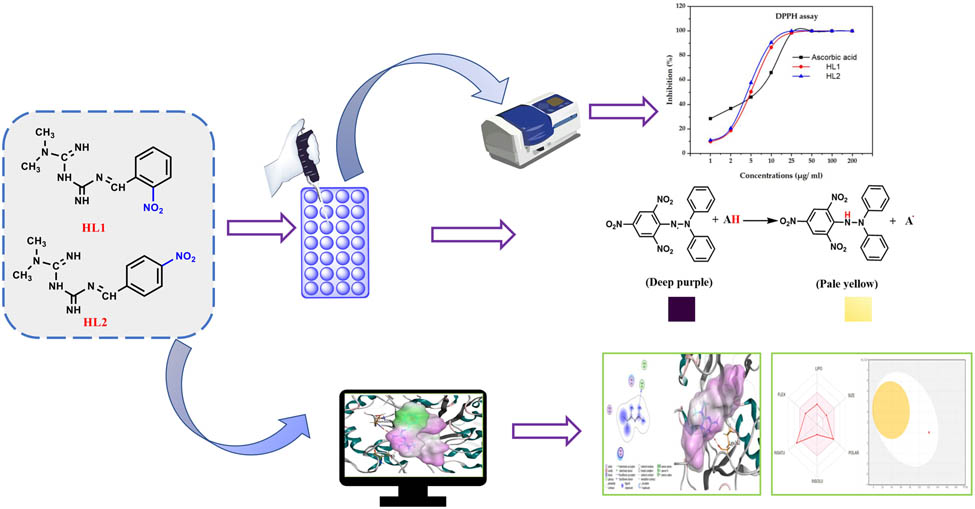
Graphical abstract
1 Introduction
Important organic compounds known as “Schiff bases” have a carbon–nitrogen double bond, with the nitrogen atom attached to either an aryl or an alkyl group. They form when an amine condenses with a carbonyl substance, generally an aldehyde or a ketone.
They have a variety of biological effects, such as antidiabetic, antioxidant, and antitumor abilities, and they are desirable candidates for drug development and additional pharmacological and medicinal chemistry research due to their adaptability and prospective therapeutic applications [1–5].
Hyperglycemia is caused by abnormalities in insulin secretion, action, or both that characterize diabetes mellitus (DM). According to the World Health Organization, there are two types of DM: type (I) insulin-dependent diabetes mellitus and type (II) noninsulin-dependent diabetes mellitus (NIDDM). A complete lack of insulin secretion is the root cause of type (I), while a combination of insulin resistance and an insufficient compensatory insulin-secretory response causes type (II) diabetes [6,7,8]. Diabetes affects 371 million people worldwide, with 90% of people developing type (II) diabetes as a result of their lifestyle, genetic tampering in (agriculture and dietary products) and a lack of physical exercise. The most prominent symptoms are increased thirst, hunger, polyuria, blurred vision, and weight loss. Over time, DM can lead to cardiovascular disease (five million people died in 2011), sexual dysfunction, neuropathy, nephropathy (which can lead to renal failure), cancer, and stroke [9–14].
Type (I) diabetes requires insulin injections to compensate for lack of insulin production and affects the remaining 10% of people, whereas type (II) diabetes is treated with oral medications such as biguanides, sulfonylureas, tolbutamide, glinides, α-glucosidase inhibitors, thiazolidinediones, phenformin, troglitazone, repaglinide, and rosiglitazone [9,13,15,16].
Researchers are focusing on developing diabetes treatments such as lifestyle changes, diet modifications, weight management, regular exercise, herbal therapy, and traditional drugs (oral and injectable) to delay carbohydrate absorption [9,17,18,19,20,21,22,23,24].
Even though metformin is the most extensively used oral antidiabetic medication and has significant advantages over other treatments, 20–30% of the patients experience gastrointestinal side effects, and 5% cannot tolerate it. Metformin, which is derived from the medicinally named plant Galega officinalis and was historically used to treat diabetes in medieval Europe, is still the only ethical medicine licensed for the treatment of NIDDM patients [22,25,26].
Furthermore, the emergence of diabetes problems has been linked to oxidative stress and free radical overproduction. Atom or molecule fragments with one or more unpaired electrons in atomic or molecular orbitals are called free radicals, which are often unstable, so they assault the nearest stable molecule as soon as possible to collect the electron that it requires to gain stability [27]. The two types of free radicals that are most frequently produced in the human body are reactive oxygen species (ROS) and reactive nitrogen species. Both endogenous and exogenous sources produce free radicals, exogenous sources such as pollution, alcohol, tobacco smoke, heavy metals, transition metals, industrial solvents, pesticides, certain drugs like halothane, paracetamol, and radiation, as well as endogenous sources such as mitochondria, peroxisomes, endoplasmic reticulum, phagocytic cells, and so on [28,29,30,31,32].
Oxidative stress is caused by high concentrations of reactive free radical species, which can damage nucleic acids, lipids, proteins, and cell structure. It can also lead to many diseases, such as lung disease, liver disease, cirrhosis, heart disease, atherosclerosis, diabetes, rheumatoid arthritis, and Parkinson’s disease. So, free radical production and antioxidant defenses need to be in balance for an organism to function properly [29–37].
Antioxidants are substances found in small amounts in the body compared to free radicals. Enzymatic and non-enzymatic antioxidants are two types of antioxidants that scavenge unpaired electrons, prevent the generation of free radicals, stop chain reactions, and dampen the energy of executed molecules [27,31].
Natural and synthetic antioxidants are two types of antioxidants that stabilize free radicals and suppress them. Natural antioxidants are composed of minerals, vitamins, and phytochemicals. Minerals are essential for enzymatic processes, and vitamins are essential for redox reaction regulation. Phytochemicals suppress free radical reactivity by stabilizing free radicals. Synthetic antioxidants are phenolic compounds that interact with free radicals to suppress free radical chain reactions. Plant and fungi extracts contain antioxidant compounds such as flavones, isoflavones, flavonoids, anthocyanins, coumarins, lignans, catechins, and isocatechins [27,31,38].
It is also fascinating to note that metformin has been linked to a variety of biological processes, including weight loss, anti-aging, and anticancer action [39,40].
Since 10 years ago, increasing evidence has emerged suggesting that biguanide medications like metformin may be helpful in the prevention and treatment of a variety of cancers, such as prostate cancer [41]. Individuals with DM in particular have a higher chance of developing cancer, and metformin has been discovered to significantly inhibit a number of malignancies [42,43].
Previously, two novel Schiff bases HL1 and HL2, were successfully synthesized via an eco-friendly methodology and characterized using elemental analysis, differential scanning calorimetry, fourier-transform infrared spectroscopy, UV–Vis spectroscopy, 1H NMR spectroscopy, 13C NMR spectroscopy, and mass spectroscopy. The antibacterial activity of both metformin derivatives was evaluated using the agar well diffusion method against a range of gram-positive and gram-negative pathogens [6].
Our current work focuses on evaluating the in vitro cytotoxic, antidiabetic, and antioxidant tests of metformin derivatives (HL1 and HL2). The inhibition of α-amylase and sucrase enzymes by Schiff bases HL1 and HL2 was used to measure the level of antidiabetic activity. In contrast, the 2,2-diphenyl-1-picrylhydrazyl (DPPH) test was used to measure the antioxidant activity of metformin derivatives while assessing their cytotoxic effects on the A549 lung cancer cell line using the 3-(4,5-dimethylthiazol-2-yl)-2,5-diphenyl tetrazolium bromide (MTT) test. Molecular docking studies were carried out to investigate the possible binding mechanisms of HL1 and HL2 with their target proteins in order to support their antioxidant and antidiabetic effects. Additionally, absorption, distribution, metabolism, and excretion (ADME) is used for predicting the medicinal chemistry and drug-like characteristics of metformin derivatives.
2 Materials and methods
2.1 Synthesis of metformin Schiff bases HL1 and HL2
Earlier, our study was done on the synthesis of the metformin-based Schiff bases HL1 and HL2, utilizing both conventional and green techniques. In the traditional procedure, equimolar quantities of metformin-HCl and (ortho)para-substituted benzaldehyde were refluxed in methanolic basic medium. In the environmentally friendly procedures, equimolar solutions of metformin and nitro-substituted benzaldehydes were dissolved in a basic aqueous medium and either refluxed under microwave irradiation (Method I) or stirred at room temperature using a magnetic stirrer (Method II) [6].
2.2 Biological tests
2.2.1 Antioxidant
The antioxidant efficacy of HL1 and HL2 was measured using the DPPH test.
2.2.1.1 Procedure
In vitro, antioxidant efficiency was assessed by the DPPH assay with few adjustments [32]. About 0.05 mL of HL1 and HL2 dissolved in methanol were diluted to 1.0 mL using ethanol to attain concentrations of 1–200 μg/mL and were added with DPPH (final concentration: 200 μM, in 95% ethanol). The control contains dimethyl sulfoxide (DMSO) and ethanol in similar amounts. Triplicate aliquots were used for each test. The reference standard (positive control) applied was ascorbic acid. A decrease in the absorbance of the test compounds was detected at 515 nm after 20 min using UV–vis spectroscopy (Shimadzu UV-1800, Tokyo, Japan), and the following formula was used for calculating the % inhibition:
The sample absorbance is the measurement of the DPPH solution with compounds, whereas the control absorbance is the measurement of the DPPH solution without compounds.
2.2.2 Antidiabetic
In vitro, the antidiabetic activity of HL1 and HL2 was estimated by how well they blocked the actions of the enzymes alpha-amylase and sucrase.
2.2.2.1 Procedure for the alpha-amylase inhibition assay
The alpha-amylase inhibition assay was carried out according to the protocol outlined by Puneeth and Sharada [44]. The alpha-amylase enzyme (1 unit/mL) from Bacillus species was dissolved using 0.1 M phosphate-buffered saline (pH 6.9). The enzyme solution was pre-incubated with the various concentrations of HL1 and HL2 (50, 100, and 200 μg) for 10 min at 37°C. The enzymatic reaction was allowed to occur for 30 min at 37°C after the starch solution (0.1%) was added to the incubation medium to start the reaction. By adding 3,5-dinitrosalicylic acid (DNS reagent) to the reaction mixture, the reaction was stopped. The tubes were then placed in a boiling water bath for 10 min. By adding a 40% sodium potassium tartrate solution and allowing it to cool to room temperature, the color was stabilized. At 540 nm, the optical density was determined. A positive control was used, which was metformin. The following formula was used to determine the compounds’ % activity:
2.2.2.2 Procedure for the sucrase inhibition assay
The inhibitory studies of HL1 and HL2 on sucrase enzyme were performed based on the procedure given by Sharath Chandra et al. [45] with a few changes. In brief, HL1 and HL2 were pre-incubated with enzyme solution at various concentrations (50, 100, and 200 μM) in maleate buffer (0.1 M, pH 6) for 10 min at 37°C. Sucrose solution (60 mM) was added to start the reaction and incubated for 30 min at 37°C. After incubation, the reaction was stopped by placing the reaction mixture in a water bath for 10 min. The amount of glucose liberated in the reaction mixture was estimated using the glucose oxidase–peroxidase method (GOD–POD strategy).
2.2.2.3 Estimation of glucose by the GOD–POD method
The glucose generated in the mixture of reaction was calculated by the GOD–POD test kit instructions [45]. In short, 50 μL of the incubated medium was added to a 96-well ELISA plate. Each well received 200 μL of the GOD-POD color reagent and then will be incubated for 30 min at 37°C in the dark for the development of color. At 505 nm the optical density was determined. Metformin was used as a positive control. The following formula was used to calculate each compound’s % activity:
2.2.3 Cytotoxicity assay
Ligands HL1 and HL2 were examined for in vitro cytotoxicity against the A549 lung cancer cell line obtained from the DSMZ Leibniz Institute (German Collection of Microorganisms and Cell Cultures Braunschweig, Germany). The cell viability assay was performed by the MTT method, which was provided by Invitrogen, Waltham, MA, USA. The solvent used for preparation (DMSO, acidified isopropanol) obtained from Sigma, St. Louis, MO, USA, UV–vis analysis Nuaire, Plymouth, MN, USA.
The 3-(4,5-dimethylthiazol-2-yl)-2,5-diphenyl tetrazolium bromide (MTT) test was used to measure cell viability as already mentioned [46,47,48].
The cytotoxic activity of the synthesized compounds (HL1 and HL2) was evaluated in vitro using the MTT assay. In brief, the A549 lung cancer cell line was grown for 24 h at 37°C after being plated at a density of 5 × 10⁴ cells per well in a 24-well plate. Following that, the cells were subjected to various concentrations (100, 50, 25, and 12.5 μg/mL) of each substance. About 100 µL of MTT (5 mg/mL in phosphate-buffered saline) was added to each well after 48 h of incubation. After a further 4 h at 37°C incubation of the plates, the formazan crystals were dissolved in 1 mL of acidified isopropanol. The cell viability was calculated at 570 nm using the following formula:
The dose–response curve was used to get the inhibitory concentration (IC50) value.
2.2.4 Statistical analysis
Mean ± standard error is used to display experimental data. Statistical analyses were carried out by one-way ANOVA using SPSS ver. 20.0 software.
2.3 Software program
2.3.1 Molecular docking using molecular operating environment (MOE)
By using a protein data bank (http://www.rcsb.org/pdb, accessed on 30 August 2022), the X-ray crystal structures of water-forming NAD (P) H oxidase (PDB ID: 2CDU, 1.80 Å resolution) and human pancreatic α-amylase (PDB ID: 1B2Y with a resolution of 3.20 Å) were retrieved [49,50]. For docking, the MOE was utilized for preparing the protein structures. First, the Sequence Editor window of MOE was used to remove undesirable atoms, molecules, chains, and ligands (2CDU: H2O molecules, co-crystallized ligands ADP and FAD were removed [51]; 1B2Y: H2O molecules, ion metals, and the PCA ligand were removed). Second, polar hydrogen atoms were added. Third, energy was minimized using Amber12.EHT with an RMS of 0.1 kcal/mol/A2. Fourth, missing atoms were corrected and typed (2CDU: 6,943 atoms; 1B2Y: 7,763 atoms). Fifth, the site finder module of MOE was utilized to identify protein’s active site (2CDU: the largest pocket contains 229 amino acids, IB2Y: the ligand pocket contains 129 amino acids). ChemDraw was used to draw the ligands’ 2D structures, while MOE software (protonation, partial charges, and energy minimization) was utilized to prepare 3D structures. At last, the database file of ligands was created and saved for further docking [52,53].
In order to locate and analyze the interaction between ligand and protein, docking was conducted with certain settings (Rescoring function1 and rescoring function 2: London dG, placement: Triangle matcher, retain:2 and Refinement: force field). After that, the compound that had the best overall characteristics in terms of energy, H-bond count, and location was selected as the one to be visualized [54,55].
2.3.2 SwissADME
SwissADME is a free web application on a website (http://www.swissadme.ch/, accessed on 20 July 2022). ADME supports the development of new drugs by precisely predicting the medicinal chemistry, drug-like properties, solubility, lipophilicity (LIPO), physicochemical properties, and pharmacokinetic parameters of small molecules [56].
SwissADME also exhibited the structure and bioavailability radar using canonical SMILES. The first part showed the chemical structure in two dimensions. The second part is the bioavailability radar, which allows for a rapid peek at how much the target compounds resemble medicines. For each feature anticipated to be orally accessible, the optimum physicochemical environment is illustrated by the pink area as LIPO: −0.7 < XLOGP3 < +5.0, SIZE (Molecular weight (MW)) 150 g/mol < MW < 500 g/mol, POLAR (Polarity) 20Å2 < Molecular polar surface area (TPSA) < 130 Å2, INSOLU (Insolubility) −6 < Log S(ESOL) < 0, INSATU (Insaturation) 0.25 < FractionCsp3 < 1 and FLEX (Flexibility) 0 < RP (Number of rotatable bonds) < 9 are the six physicochemical qualities that are taken into consideration [57].
3 Results and discussion
HL1 and HL2 in Scheme 1 represent the Schiff bases derived from metformin hydrochloride and substituted (ortho)para-nitrobenzaldehyde, and they have been effectively synthesized utilizing conventional and microwave-assisted techniques earlier published [6].

Chemical structures of Schiff bases HL1 and HL2.
The DPPH test was used to examine the antioxidant activity of HL1 and HL2. Besides that, the alpha-amylase and sucrase enzymes were inhibited to assess the antidiabetic activity of metformin derivatives, and the result is supported by a docking study and SwissADME prediction.
3.1 In vitro study
3.1.1 Antioxidant
The scavenging activity of the free radical DPPH was investigated with minor modifications [58] by the spectrophotometric method.
The scavenging mechanism of free radical DPPH is the reduction process, as depicted in Figure 1. The stable free radical DPPH has the color purple, but when either HL1 or HL2 is added, DPPH gets a proton and turns yellow [59].

Mechanism of reduction DPPH to DPPHH using HL1 and HL2(AH).
Table 1 and Figure 2 include the results of HL1 and HL2’s antioxidant activity. Both exhibited significant antioxidant activity. HL2 had the strongest antioxidant action and then ascorbic acid and HL1, with IC50 values of 4.89, 5.24, and 5.35 µg/mL, respectively.
Antioxidant activity of HL1, HL2 and ascorbic acid
| Compounds and standard | IC50 (µg/mL) ± standard error |
|---|---|
| HL1 | 5.35 ± 0.23 |
| HL2 | 4.89 ± 0.34 |
| Ascorbic acid | 5.24 ± 1.38 |
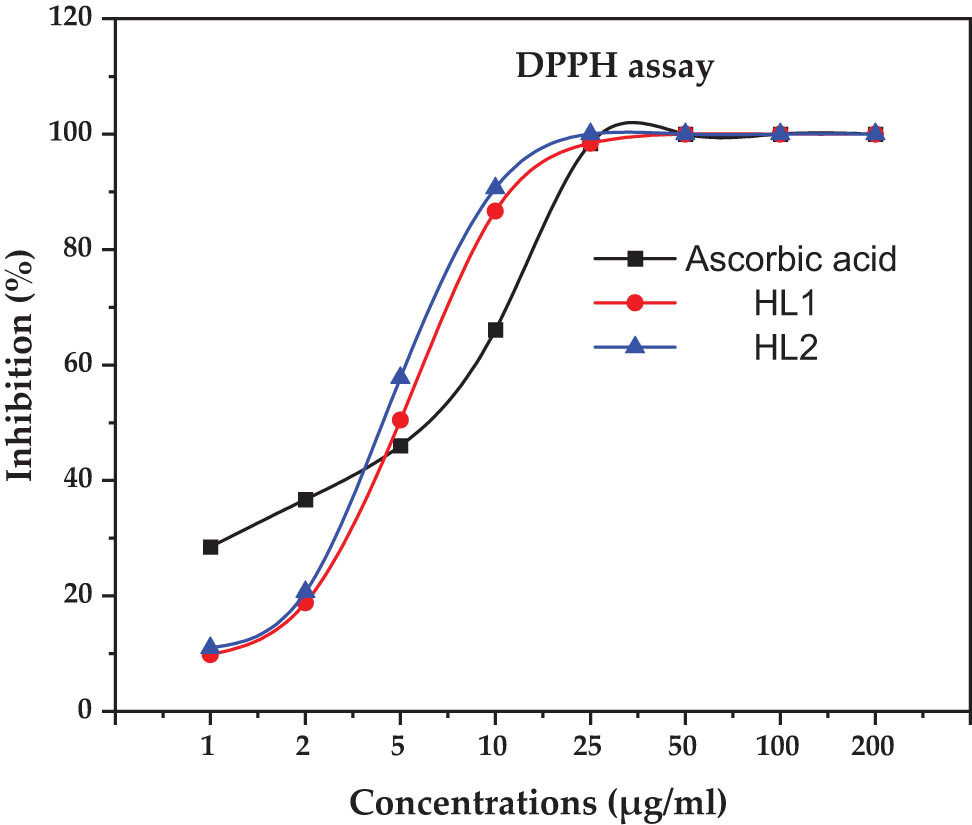
Scavenging activity (DPPH assay) of HL1, HL2, and ascorbic acid.
3.1.2 Antidiabetic
3.1.2.1 Alpha-amylase inhibition activity
The alpha-amylase inhibitory activity results and IC50 are presented in Figure 3 and Table 2 for HL1, HL2, and standard metformin. HL1 and HL2 inhibited α-amylase most effectively when compared to regular metformin. HL2 has the greatest level of inhibitory activity with an IC50 of 76.1 µg/mL, followed by HL1 with an IC50 of 99.3 µg/mL. Metformin had very little potency against α-amylase with an IC50 of 272.6 µg/mL.

Percentage of inhibition activity of HL1, HL2, and metformin on α-amylase enzyme.
IC50 of HL1, HL2 and standard metformin
| Compounds and standard | IC50 (µg/mL) ± standard error |
|---|---|
| HL1 | 99.3 ± 14.1 |
| HL2 | 76.1 ± 14.6 |
| Metformin | 272.6 ± 27.2 |
3.1.2.2 Sucrase inhibition activity
Table 3 and Figure 4 show that both HL1 and HL2 and standard metformin can stop sucrase enzymes from working. According to the observations, HL1 showed the maximum inhibition activity with an IC50 of 89.3 µg/mL, followed by HL2 and metformin with an IC50 of 93.3 and 492.4 µg/mL, respectively. Standard metformin displayed a relatively low level of sucrase enzyme inhibitory action.
IC50 of HL1, HL2, and standard metformin
| Compounds and standard | IC50 (µg/mL) ± standard error |
|---|---|
| HL1 | 89.3 ± 15.5 |
| HL2 | 93.3 ± 14.7 |
| Metformin | 492.4 ± 16.4 |

Percentage of inhibition activity of HL1, HL2, and metformin on sucrase enzyme.
3.1.3 MTT assay
Through the use of the MTT assay, cytotoxicity was identified. This assay based on the reduction of the calorimetrically measurable yellow tetrazolium salt 3-[4,5-dimethylthiazol-2-yl]-2,5-diphenyl tetrazolium bromide (MTT) into the purple formazan. This mechanism occurs in the mitochondria of metabolically active cells and indirectly measures cellular metabolic activity.
The cytotoxicity activity of HL1 and HL2 against the A549 lung cancer cell line is represented in Table 4 and Figure 5. To assess the cytotoxicity of Schiff bases, the lung cancer cell line A549 has been used. The MTT assay was performed to check each compound’s cytotoxicity after 48 h of treatment with various concentrations. Results obtained indicated that at concentrations of 12.5, 25, 50, and 100 μg/mL, HL1 showed inhibition activity against the A549 lung cancer cell line at 93.42, 68.24, 56.23, and 13.49%, respectively. IC50 of HL1 was 57.13 μg/mL, but HL2 has inhibition activities of 87.59, 76.19, 65.47, and 37.38%, respectively. Actually, compound HL2 demonstrated a less potent cytotoxic effect on cell line A549 lung cancer (IC50 = 76.83) [60,61].
IC50 of HL1 and HL2 on A549 lung cancer cell line
| Compounds | A549 IC50 (µg/mL) |
|---|---|
| HL1 | 57.13 ± 1.3 |
| HL2 | 76.83 ± 2.3 |
Note: All IC50 values are described as mean ± SEM (n = 3).

Cytotoxic activity of HL1 and HL2 against A549 lung cancer cell line.
3.2 Theoretical study
3.2.1 Docking study
Molecular docking studies are routinely utilized in the pharmaceutical industry to assess the efficacy of new drug candidates. The binding mode in which bioactive compounds (also known as ligands) interact with their target proteins provides a useful way to categorize these compounds.
3.2.1.1 Antioxidant
The findings of our experiments indicate that our compounds have a significant potential for exhibiting antioxidant activity. To corroborate these findings, we carried out a molecular docking analysis to gain a deeper comprehension of one of the potential mechanisms underlying these findings. Then, due to its essential function in the production of ROS, we chose the NADPH enzyme (PDB code: 2CDU). According to the research that has been done, this enzyme is a significant contributor to the production of superoxide anion (O2 ‒), which is the precursor to the vast majority of other ROS. Because of this, chemicals that are capable of inhibiting the NADPH oxidase (NOX) contribute significantly to the overall equilibrium of oxidative stress. The result indicates that HL2 was the highest effective antioxidant. With a docking score of −6.49 kcal/mol, it outperformed both ascorbic acid (−5.04 kcal/mol) and HL1 (−4.9 kcal/mol), as shown in Table 5 and Figures 6–8. At the protein’s active site, it made two hydrogen bonds with amino acid residues ASP282 and CSX42 at distances of 2.94 and 4.23 Å, respectively (Figure 7). Furthermore, it formed two ionic interactions with ASP282 at 3.33 and 2.94 Å, respectively. HL1 formed one hydrogen bond with the amino acid residue ASP282 at a distance of 3.30 and two ionic bond contacts with ASP282 at distances of 3.46 and 3.30 Å. However, it does not interact with the important amino acid CSX42, as shown in Figure 6.
Docking results of HL1, HL2, and ascorbic acid with 2CDU
| Ligand | Ligand–protein interactions | Type of bond/bond length (Å) | Docking score (kcal/mol) |
|---|---|---|---|
| HL1 | Lig-NH-H—O-ASP282 | H-donor/3.30 | −4.9 |
| Lig—ASP282 | Ionic/3.46 | ||
| Lig—ASP282 | Ionic/3.30 | ||
| HL2 | Lig-NH-H—O-ASP282 | H-donor/2.94 | −6.49 |
| Lig-NH-H—S-CSX42 | H-donor/4.23 | ||
| Lig—ASP282 | Ionic/3.33 | ||
| Lig—ASP282 | Ionic/2.94 | ||
| Ascorbic acid | Lig-O-H—O-SER41 | H-donor/2.98 | −5.04 |
| Lig-O-H—O-THR112 | H-donor/3.07 | ||
| Lig-O—H-ASP282 | H-acceptor/3.20 |

2D and 3D of HL1 at the active site of NAD (P) H oxidase (PDB ID: 2CDU).

2D and 3D of HL2 at the active site of NAD (P) H oxidase (PDB ID: 2CDU).

2D and 3D of ascorbic acid at the active site of NAD (P) H oxidase (PDB ID: 2CDU).
3.2.1.2 Antidiabetic activity
The examined compounds demonstrated a more significant association between in vitro activity and in silico study results, according to the docking results of these compounds against human pancreatic alpha-amylase (PDB ID: 1B2Y). The findings of the docking analysis showed that the metformin derivatives (Hl1 and HL2) have higher negative docking scores (−5.41 and −5.47 kcal/mol) than metformin (−4.95 kcal/mol), which suggests that these two derivatives have strong affinities and excellent interactions (hydrogen bonds) within the active binding site of 1B2Y.
Three hydrogen bond interactions (red dashes) were formed between HL1 and amino acid residues SER145, ASN105, and ASP147 at distances of 3.17, 3.36, and 2.85 Å respectively, as shown in the 2D and 3D representations of HL1 in Figure 9. It also interacted with the amino acid residue ASP147 via an ionic interaction at a distance of 3.34 Å. HL2, on the other hand, formed two hydrogen bonds and two ionic interactions (Figure 10, Table 6). It formed two hydrogen bond interactions with amino acid residues SER145 and ASN105 at distances of 3.33 and 3.05 Å, respectively, and two ionic bond interactions with amino acid residue ASP147 at distances of 3.33 and 3.90 Å. The standard drug (metformin) formed only one hydrogen bond with amino acid LEU162 at a distance of 3.28 Å as shown in Figure 11.

2D and 3D of HL1 at the active site of α-amylase (PDB: 1B2Y).

2D and 3D of HL2 at the active site of α-amylase (PDB: 1B2Y).
Docking results of HL1, HL2, and metformin with 1B2Y
| Ligand | Ligand–protein interactions | Type of bond/bond length (Å) | Docking score (kcal/mol) |
|---|---|---|---|
| HL1 | Lig-NH-H—O-SER145 | H-donor/3.17 | −5.41 |
| Lig-NH-H—O-ASN105 | H-donor/3.36 | ||
| Lig-NH-H—O-ASP147 | H-donor/2.85 | ||
| Lig-N—O-ASP147 | Ionic/3.34 | ||
| HL2 | Lig-NH-H—O-SER145 | H-donor/3.33 | −5.47 |
| Lig-NH-H—O-ASN105 | H-donor/3.05 | ||
| Lig-N—O-ASP147 | Ionic/3.33 | ||
| Lig-N—O-ASP147 | Ionic/3.90 | ||
| Metformin | Lig-NH-H—O-LEU162 | H-donor/3.28 | −4.95 |

2D and 3D of metformin at the active site of α-amylase (PDB: 1B2Y).
3.2.2 SwissADME
According to the SwissADME program’s predictions, the novel metformin derivatives can be taken orally after being tested in clinical settings for their antidiabetic and antioxidant abilities, where a high level of antidiabetic and antioxidant activity is shown by the in vitro findings.
The five criteria laid out by Lipinski, upon which the SwissADME program is based are MWs in the range (150–500) g/mol, hydrogen bond acceptors (HBA) must be less than 10, hydrogen bond donors (HBD) should be less than 5, TPSA which is between 20 and 130 Å2, and lastly, high LIPO needed of XLOGP3 g(LogP < 5). In contrast, the proposed compounds are considered unsuitable for drug-likeness if they violate more than two of Lipinski’s five rules. Table 7 displays ADME predictions for HL1 and HL2, as well as metformin and ascorbic acid, and demonstrates that HL1 and HL2, which adhered to Lipinski’s five criteria, also possess the chemical and physical qualities necessary for oral bioavailability [62].
SwissADME predictions for HL1, HL2, metformin, and ascorbic acid
| Properties | HL1 | HL2 | Metformin | Ascorbic acid | |
|---|---|---|---|---|---|
| Physicochemical | MW (<500 Da) | 262.27 g/mol | 262.27 g/mol | 165.62 g/mol | 176.12 g/mol |
| RP < 9 | 6 | 6 | 3 | 2 | |
| HBA (<10) | 5 | 5 | 2 | 6 | |
| HBD (<5) | 3 | 3 | 4 | 4 | |
| TPSA | 121.15 Å2 | 121.15 Å2 | 88.99 Å2 | 107.22 Å2 | |
| ABS% | 68.48 | 68.48 | 79.23 | 73.13 | |
| Fraction Csp3 | 0.18 | 0.18 | 0.50 | 0.50 | |
| Pharmacokinetics | XLOGP3 (LogP < 5) | 1.07 | 1.07 | −0.26 | −1.64 |
| GIA | High | High | High | High | |
| BBBP | No | No | No | No | |
| PgPS | No | No | No | No | |
| CYP1A2 inhibition | No | No | No | No | |
| CYP2C19 inhibition | No | No | No | No | |
| CYP2C9 inhibition | No | No | No | No | |
| CYP2D6 inhibition | No | No | No | No | |
| CYP3A4 inhibition | No | No | No | No | |
| Log Kp (cm/s) | −7.14 cm/s | −7.14 cm/s | −7.49 cm/s | −8.54 cm/s | |
| Druglikeness | LV | 0 | 0 | 0 | 0 |
| BS | 0.55 | 0.55 | 0.55 | 0.56 | |
| Medicinal chemistry | LLV | Yes | Yes | 1 | 1 |
| SA | 3.04 | 2.80 | 3.11 | 3.47 |
MW: molecular weight, RP: number of rotatable bonds, HBA: number of hydrogen bond acceptors (O and N atoms), HBD: number of hydrogen bond donors (OH and NH groups), TPSA: molecular polar surface area, %ABS = 109 − (0.3345 × TPSA), Csp3: the fraction of carbon bond saturation (Csp3), XLOGP3 (LogP < 5): lipophilicity parameter, GIA = gastrointestinal absorption, BBBP = blood–brain barrier permeation, PgPS = P-glycoprotein substrate, Log Kp: skin permeability parameter, CYP1A2, CYP3A4, CYP2C9, CYP2C19, and CYP2D6: the five main cytochrome p450 (CYP) enzyme isoforms, which biotransform more than 50–90% of pharmaceutical compounds, LV: number of “Rule of five” violations, BS: bioavailability score, LLV: lead likeness violations, SA: synthetic accessibility.
HL1 and HL2 have molecular weights of 262.27 g/mol, which are within the permitted limit; the number of rotatable bonds of the derivatives of metformin is equal to 6, indicating good structural flexibility; there are 5 (HBA) and 3 (HBD), both acceptors and donors falling inside the required range, TPSA has gained increased importance in medicinal chemistry. When the TPSA value is greater than 60 Å2 and less than 130 Å2, it can be used to accurately predict intestinal absorption; when it is less than 60 Å2, it shows excellent blood–brain barrier permeability. Metformin derivatives have TPSA values of 121.15 Å2, which means they will be more readily absorbed in the gastrointestinal tract, which has a 68.48% absorption rate, but the absorbance of the standard drugs is higher. In order for a new synthetic molecule to meet Lipinski’s rules, it must have adequate oral and intestinal absorption, which is necessary for it to be drug-like, and the value of Log p must be less than 5. The values of XLOGP3 for the Schiff bases fall within the ideal range for LIPO and the examined HL1 and HL2 have drug-like properties that can be easily determined using bioavailability radars; these parameters are indicated by the pink region through the ideal range for each feature (LIPO, size, solubility, polarity, flexibility, and saturation) as well as standard drugs as displayed in Figures 12–15. Moreover, the range of synthetic accessibility was 2.80 to 3.04; consequently, there is a good chance of synthesizing all of them.

Structure, bioavailability radar, and the Boiled-Egg graph of HL1 based on SwissADME.

Structure, bioavailability radar, and the Boiled-Egg graph of HL2 based on SwissADME.

Structure, bioavailability radar, and the Boiled-Egg graph of metformin based on SwissADME.

Structure, bioavailability radar, and the Boiled-Egg graph of ascorbic acid based on SwissADME.
Oral medication must be able to penetrate either the intestinal or brain barrier; thus, both of them are the most crucial ADMET features, assigned by BBB and GI in Table 7, and illustrated by the BOILED-Egg. According to the ADME prediction, molecules in the white region have a higher chance of being absorbed by the GI tract, but those in the yellow zone are more likely to penetrate the brain. Metformin derivatives were not expected to permeate the brain and had a high intestinal absorption rate, as evidenced by their placement inside the white region in Figures 12 and 13, and the basic function of P-glycoprotein (P-gp) is to protect the body from toxic substances by maintaining the BBB and removing medications from the kidneys and liver into urine and bile, since metformin derivatives have no effect on the permeability of gp, in addition, the data in Table 7 reveal that the metformin derivative has no effect on the excretion or functionality of the five CYP enzymes confirming that the new drug will be properly metabolized and will not accumulate. Also, derivatives of metformin showed skin permeability values of −7.14 cm/s, which are within the acceptable range of Log Kp for drug candidates [56,57,63].
4 Conclusions
Experiments done in vitro on the alpha-amylase enzyme, the sucrase enzyme, and the DPPH scavenging radical for antidiabetic and antioxidant purposes showed excellent results that were in line with theoretical studies. HL2 displayed superior inhibitory activity on the alpha-amylase enzyme, while HL1 showed a more powerful effect on the sucrase enzyme. By contrast, the DPPH assay revealed that maximum antioxidant activity was shown by HL2, followed by ascorbic acid and HL1, using the DPPH assay. The A549 lung cancer cell line was the subject of our investigation, which demonstrated that both HL1 and HL2 have anticancer potential. However, HL1 had superior activity. The anticancer effect against other cancer cell lines will need to be investigated further, though. Furthermore, the molecular docking study demonstrated that HL1 and HL2 interacted strongly at the active sites of the targeted proteins 2CDU and 1B2Y, with HL2 being the most potent α-amylase enzyme inhibitor and the best antioxidant. In contrast, the ADME predictions of metformin derivatives suggest that these compounds have good bioavailability and adhere to Lipinski’s five principles. As was previously stated and is evident from all outcomes, metformin derivatives are a strong option for therapeutic usage, but additional studies are required to support these findings, first on rats and then subsequently on human patients.
Acknowledgments
The authors extend their appreciation to the Researchers Supporting Project number (RSPD2023R755), King Saud University, Riyadh, Saudi Arabia.
-
Funding information: The work was financially supported by Researchers Supporting Project number (RSPD2023R755), King Saud University, Riyadh, Saudi Arabia.
-
Author contributions: Abdel-Basit Al-Odayni – conceptualization; Waseem Sharaf Saeed and Ahmad Al-Owais – data curation; Inas Al-Qadsy, Lena Al-Faqeeh, and Abdelhabib Semlali – formal analysis; Waseem Sharaf Saeed – funding acquisition; Inas Al-Qadsy and Ali Alrabie – investigation; Inas Al-Qadsy and Lena Al-Faqeeh – methodology; Mazahar Farooqui – project administration; Abdel-Basit Al-Odayni and Ahmad Al-Owais – resources; Inas Al-Qadsy and Ali Alrabie – software; Mazahar Farooqui – upervision; Abdelhabib Semlali – validation; Waseem Sharaf Saeed, Arwa Al-Adhreai and Mazahar Farooqui – visualization; Inas Al-Qadsy – writing – original draft; Inas Al-Qadsy, Waseem Sharaf Saeed, Abdelhabib Semlali and Mazahar Farooqui – writing – review & editing.
-
Conflict of interest: The authors declare no conflict of interest.
-
Ethical approval: The conducted research is not related to either human or animal use.
-
Data availability statement: All data generated or analyzed during this study are included in this published article.
References
[1] Morsy NM, Hassan AS, Hafez TS, Mahran MR, Sadawe IA, Gbaj AM. Synthesis, antitumor activity, enzyme assay, DNA binding and molecular docking of Bis-Schiff bases of pyrazoles. J Iran Chem Soc. 2021;18:47–59.10.1007/s13738-020-02004-ySearch in Google Scholar
[2] Mukhtar SS, Hassan AS, Morsy NM, Hafez TS, Hassaneen HM, Saleh FM. Overview on synthesis, reactions, applications, and biological activities of Schiff bases. Egypt J Chem. 2021;64(11):6541–54.10.21608/ejchem.2021.79736.3920Search in Google Scholar
[3] Omidi S, Kakanejadifard A. A review on biological activities of Schiff base, hydrazone, and oxime derivatives of curcumin. RSC Adv. 2020;10(50):30186–202.10.1039/D0RA05720GSearch in Google Scholar
[4] Yakan H, Omer H-H, Buruk O, Çakmak Ş, Marah S, Veyisoğlu A, et al. Synthesis, structure elucidation, biological activity, enzyme inhibition and molecular docking studies of new Schiff bases based on 5-nitroisatin-thiocarbohydrazone. J Mol Structure. 2023;1277:134799.10.1016/j.molstruc.2022.134799Search in Google Scholar
[5] Kansız S, Dege N, editors. Characterization and structural investigations of Schiff based pentafluorinated derivative compound. International Conference on Frontiers in Academic Research; 2023.Search in Google Scholar
[6] Al-Qadsy I, Saeed WS, Al-Odayni A-B, Ahmed Saleh Al-Faqeeh L, Alghamdi AA, Farooqui M. Novel metformin-based Schiff bases: synthesis, characterization, and antibacterial evaluation. Materials. 2020;13(3):514.10.3390/ma13030514Search in Google Scholar PubMed PubMed Central
[7] Association AD. Diagnosis and classification of diabetes mellitus. Diabetes care. 2005;28(1):S37.10.2337/diacare.28.suppl_1.S37Search in Google Scholar PubMed
[8] Fröde T, Medeiros Y. Animal models to test drugs with potential antidiabetic activity. J Ethnopharmacol. 2008;115(2):173–83.10.1016/j.jep.2007.10.038Search in Google Scholar PubMed
[9] Al-Faqeeh LAS, Naser R, Kagne S, Khan SW. Activity of mushrooms against diabetic and inflammation: A review. GSC Biol Pharm Sci. 2021;14(2):37–44.10.30574/gscbps.2021.14.2.0035Search in Google Scholar
[10] Keerthana G, Kalaivani M, Sumathy A. In-vitro alpha amylase inhibitory and anti-oxidant activities of ethanolic leaf extract of Croton bonplandianum. Asian J Pharm Clin Res. 2013;6(4):32–6.Search in Google Scholar
[11] Li W, Zheng H, Bukuru J, De, Kimpe N. Natural medicines used in the traditional Chinese medical system for therapy of diabetes mellitus. J Ethnopharmacol. 2004;92(1):1–21.10.1016/j.jep.2003.12.031Search in Google Scholar PubMed
[12] Ravi B, Renitta RE, Prabha ML, Issac R, Naidu S. Evaluation of antidiabetic potential of oyster mushroom (Pleurotus ostreatus) in alloxan-induced diabetic mice. Immunopharmacol Immunotoxicol. 2013;35(1):101–9.10.3109/08923973.2012.710635Search in Google Scholar PubMed
[13] Tasyurek HM, Altunbas HA, Balci MK, Sanlioglu S. Incretins: their physiology and application in the treatment of diabetes mellitus. Diabetes/Metab Res Rev. 2014;30(5):354–71.10.1002/dmrr.2501Search in Google Scholar PubMed
[14] Warraich HJ, Rana JS. Diabetic dyslipidemia: epidemiology and prevention of cardiovascular disease and implications of newer therapies. Curr Cardiol Rep. 2018;20:1–7.10.1007/s11886-018-1068-6Search in Google Scholar PubMed
[15] Mishra SB, Vijayakumjar M, Ojha SK, Verma A. Antidiabetic effect of Jatropha curcas L. leaves extract in normal and alloxan-induced diabetic rats. Int J Ph Sci. 2010;2(1):482–7.Search in Google Scholar
[16] Milani E, Nikfar S, Khorasani R, Zamani MJ, Abdollahi M. Reduction of diabetes-induced oxidative stress by phosphodiesterase inhibitors in rats. Comp Biochem Physiol Part C: Toxicol & Pharmacology. 2005;140(2):251–5.10.1016/j.cca.2005.02.010Search in Google Scholar PubMed
[17] Khan RMM, Chua ZJY, Tan JC, Yang Y, Liao Z, Zhao Y. From pre-diabetes to diabetes: diagnosis, treatments and translational research. Medicina. 2019;55(9):546.10.3390/medicina55090546Search in Google Scholar PubMed PubMed Central
[18] Singh SK, Rai PK, Jaiswal D, Watal G. Evidence-based critical evaluation of glycemic potential of Cynodon dactylon. Evidence-Based Complementary Alternative Med. 2008;5:415–20.10.1093/ecam/nem044Search in Google Scholar PubMed PubMed Central
[19] Malviya N, Jain S, Malviya S. Antidiabetic potential of medicinal plants. Acta Pol Pharm. 2010;67(2):113–8.Search in Google Scholar
[20] Etxeberria U, de la Garza AL, Campión J, Martínez JA, Milagro FI. Antidiabetic effects of natural plant extracts via inhibition of carbohydrate hydrolysis enzymes with emphasis on pancreatic alpha amylase. Expert Opin Ther Targets. 2012;16(3):269–97.10.1517/14728222.2012.664134Search in Google Scholar PubMed
[21] Eddouks M, Maghrani M, Lemhadri A, Ouahidi M-L, Jouad H. Ethnopharmacological survey of medicinal plants used for the treatment of diabetes mellitus, hypertension and cardiac diseases in the south-east region of Morocco (Tafilalet). J Ethnopharmacol. 2002;82(2–3):97–103.10.1016/S0378-8741(02)00164-2Search in Google Scholar
[22] Shukia R, Sharma S, Puri D, Prabhu K, Murthy P. Medicinal plants for treatment of diabetes mellitus. Indian J Clin Biochem. 2000;15:169–77.10.1007/BF02867556Search in Google Scholar PubMed PubMed Central
[23] Chang CH, Lin JW, Wu LC, Lai MS, Chuang LM, Arnold Chan K. Association of thiazolidinediones with liver cancer and colorectal cancer in type 2 diabetes mellitus. Hepatology. 2012;55(5):1462–72.10.1002/hep.25509Search in Google Scholar PubMed
[24] Hassan AS, Morsy NM, Aboulthana WM, Ragab A. Exploring novel derivatives of isatin-based Schiff bases as multi-target agents: design, synthesis, in vitro biological evaluation, and in silico ADMET analysis with molecular modeling simulations. RSC Adv. 2023;13(14):9281–303.10.1039/D3RA00297GSearch in Google Scholar PubMed PubMed Central
[25] Dujic T, Causevic A, Bego T, Malenica M, Velija‐Asimi Z, Pearson E, et al. Organic cation transporter 1 variants and gastrointestinal side effects of metformin in patients with Type 2 diabetes. Diabet Med. 2016;33(4):511–4.10.1111/dme.13040Search in Google Scholar PubMed PubMed Central
[26] Bouchoucha M, Uzzan B, Cohen R. Metformin and digestive disorders. Diabetes & Metab. 2011;37(2):90–6.10.1016/j.diabet.2010.11.002Search in Google Scholar PubMed
[27] Al-Faqeeh LAS, Naser R, Kagne S, Khan SW. Nutritional values, ethno-medicinal uses and antioxidant activity of mushrooms: A review. Eur J Biomed. 2021;8:292–300.Search in Google Scholar
[28] Lushchak VI. Free radicals, reactive oxygen species, oxidative stress and its classification. Chemico-Biological Interact. 2014;224:164–75.10.1016/j.cbi.2014.10.016Search in Google Scholar PubMed
[29] Ferreira IC, Barros L, Abreu R. Antioxidants in wild mushrooms. Curr Medicinal Chem. 2009;16(12):1543–60.10.2174/092986709787909587Search in Google Scholar PubMed
[30] Phaniendra A, Jestadi DB, Periyasamy L. Free radicals: properties, sources, targets, and their implication in various diseases. Indian J Clin Biochem. 2015;30:11–26.10.1007/s12291-014-0446-0Search in Google Scholar PubMed PubMed Central
[31] Qazi MA, Molvi KI. Free radicals and their management. Am J Pharm Health Res. 2018;6(4):1–10.10.46624/ajphr.2018.v6.i4.001Search in Google Scholar
[32] Blokhina O, Virolainen E, Fagerstedt KV. Antioxidants, oxidative damage and oxygen deprivation stress: a review. Ann botany. 2003;91(2):179–94.10.1093/aob/mcf118Search in Google Scholar PubMed PubMed Central
[33] Ridnour LA, Thomas DD, Mancardi D, Espey MG, Miranda KM, Paolocci N, et al. The chemistry of nitrosative stress induced by nitric oxide and reactive nitrogen oxide species. Putting Perspective on Stressful Biological Situations; 2004.10.1515/BC.2004.001Search in Google Scholar PubMed
[34] Kozarski M, Klaus A, Jakovljevic D, Todorovic N, Vunduk J, Petrović P, et al. Antioxidants of edible mushrooms. Molecules. 2015;20(10):19489–525.10.3390/molecules201019489Search in Google Scholar PubMed PubMed Central
[35] Rai M, Biswas G, Mandal S, Acharya K. Free radicals and human diseases. Herbal drugs: A modern approach to understand them better. India: New Central Book Agency; 2011.Search in Google Scholar
[36] Valko M, Leibfritz D, Moncol J, Cronin MT, Mazur M, Telser J. Free radicals and antioxidants in normal physiological functions and human disease. Int J Biochem Cell Biol. 2007;39(1):44–84.10.1016/j.biocel.2006.07.001Search in Google Scholar PubMed
[37] Halliwell B. Biochemistry of oxidative stress. Biochem Soc Trans. 2007;35(5):1147–50.10.1042/BST0351147Search in Google Scholar PubMed
[38] Demir S, Cakmak S, Dege N, Kutuk H, Odabasoglu M, Kepekci RA. A novel 3-acetoxy-2-methyl-N-(4-methoxyphenyl) benzamide: Molecular structural describe, antioxidant activity with use X-ray diffractions and DFT calculations. J Mol Structure. 2015;1100:582–91.10.1016/j.molstruc.2015.08.014Search in Google Scholar
[39] Wang Y-W, He S-J, Feng X, Cheng J, Luo Y-T, Tian L, et al. Metformin: a review of its potential indications. Drug Design, Dev Ther. 2017;2421–9.10.2147/DDDT.S141675Search in Google Scholar PubMed PubMed Central
[40] Shurrab NT, Arafa E-SA. Metformin: A review of its therapeutic efficacy and adverse effects. Obes Meicine. 2020;17:100186.10.1016/j.obmed.2020.100186Search in Google Scholar
[41] Gronich N, Rennert G. Beyond aspirin – cancer prevention with statins, metformin and bisphosphonates. Nat Rev Clin Oncol. 2013;10(11):625–42.10.1038/nrclinonc.2013.169Search in Google Scholar PubMed
[42] Samuel VP, Dahiya R, Singh Y, Gupta G, Sah SK, Gubbiyappa SK, et al. Metformin: a salutary candidate for colorectal cancer treatment in patients with diabetes. J Environ Pathology, Toxicol Oncol. 2019;38(2):133–41.10.1615/JEnvironPatholToxicolOncol.2019029388Search in Google Scholar PubMed
[43] Yu H, Zhong X, Gao P, Shi J, Wu Z, Guo Z, et al. The potential effect of metformin on cancer: an umbrella review. Front Endocrinol. 2019;10:617.10.3389/fendo.2019.00617Search in Google Scholar PubMed PubMed Central
[44] Puneeth HR, Sharada AC. Antidiabetic effects of a series of curcumin pyrazoles in-vitro. Asian J Pharm. Clin Res. 2015;8(6):146–9.Search in Google Scholar
[45] Sharath Chandra SPSK, Puneeth HR, Sharada AC. Comparative evaluation of 6-fluoro-3-(piperidin-4-yl) benzo[d] isoxazole derivatives and atypical antipsychotics for their anti-diabetic properties. Int J Bioassays. 2015;4(06):3964–7.10.22270/jddt.v4i6.1002Search in Google Scholar
[46] Nasr FA, Shahat AA, Alqahtani AS, Ahmed MZ, Qamar W, Al-Mishari AA, et al. Centaurea bruguierana inhibits cell proliferation, causes cell cycle arrest, and induces apoptosis in human MCF-7 breast carcinoma cells. Mol Biol Rep. 2020;47:6043–51.10.1007/s11033-020-05679-xSearch in Google Scholar PubMed
[47] Edziri H, Mastouri M, Mahjoub MA, Mighri Z, Mahjoub A, Verschaeve L. Antibacterial, antifungal and cytotoxic activities of two flavonoids from Retama raetam flowers. Molecules. 2012;17(6):7284–93.10.3390/molecules17067284Search in Google Scholar PubMed PubMed Central
[48] Sherif AY, Harisa GI, Shahba AA, Alanazi FK, Qamar W. Optimization of gefitinib-loaded nanostructured lipid carrier as a biomedical tool in the treatment of metastatic lung cancer. Molecules. 2023;28(1):448.10.3390/molecules28010448Search in Google Scholar PubMed PubMed Central
[49] Costa JD, Ramos RD, Costa KD, Brasil DD, Silva CH, Ferreira EF, et al. An in silico study of the antioxidant ability for two caffeine analogs using molecular docking and quantum chemical methods. Molecules. 2018;23(11):2801.10.3390/molecules23112801Search in Google Scholar PubMed PubMed Central
[50] Settu R, Selvaraj D, Padikasan IA. GCMS profiling and in silico screening of alpha-amylase inhibitors in traditional pigmented rice varieties (Oryza sativa Linn) of Tamil Nadu. Food Biosci. 2021;42:101154.10.1016/j.fbio.2021.101154Search in Google Scholar
[51] Majumdar M, Singh V, Misra TK, Roy DN. In silico studies on structural inhibition of SARS-CoV-2 main protease Mpro by major secondary metabolites of Andrographis paniculata and Cinchona officinalis. Biologia. 2022;77(5):1373–89.10.1007/s11756-022-01012-ySearch in Google Scholar PubMed PubMed Central
[52] Alrabie A, Al-Dhreai A, Al-Qadsy I, Pradhan V, Farooqui M. Phytochemical Screening, GC-MS analysis, Molecular docking study and evaluation of antioxidant and antimicrobial activity of Sapindus emarginatus seed kernel. RJPT. 2022;15(5):2117–21.10.52711/0974-360X.2022.00351Search in Google Scholar
[53] Tamer Ö, Mahmoody H, Feyzioğlu KF, Kılınç O, Avci D, Orun O, et al. Synthesis of the first mixed ligand Mn (II) and Cd (II) complexes of 4‐methoxy‐pyridine‐2‐carboxylic acid, molecular docking studies and investigation of their anti‐tumor effects in vitro. Appl Organomet Chem. 2020;34(3):e5416.10.1002/aoc.5416Search in Google Scholar
[54] Alrabie A, Al-Rabie NA, Al Saeedy M, Al Adhreai A, Al-Qadsy I, Farooqui M. Martynia annua safety and efficacy: heavy metal profile, in silico and in vitro approaches on antibacterial and antidiabetic activities. Nat Product Res. 2022;1–7.10.1080/14786419.2022.2097227Search in Google Scholar PubMed
[55] Kansız S, Tolan A, Azam M, Dege N, Alam M, Sert Y, et al. Acesulfame based Co (II) complex: Synthesis, structural investigations, solvatochromism, Hirshfeld surface analysis and molecular docking studies. Polyhedron. 2022;218:115762.10.1016/j.poly.2022.115762Search in Google Scholar
[56] Ranjith D, Ravikumar C. SwissADME predictions of pharmacokinetics and drug-likeness properties of small molecules present in Ipomoea mauritiana Jacq. J Pharmacognosy Phytochemistry. 2019;8(5):2063–73.Search in Google Scholar
[57] Sravika N, Priya S, Divya N, Jyotsna PMS, Anusha P, Kudumula N, et al. Swiss ADME properties screening of the phytochemical compounds present in Bauhinia acuminata. J Pharmacogn Phytochem. 2021;10(4):411–9.10.22271/phyto.2021.v10.i4e.14193Search in Google Scholar
[58] Sreejayan N, Rao M. Free radical scavenging activity of curcuminoids. Arzneimittel-forschung. 1996;46(2):169–71.Search in Google Scholar
[59] Sánchez-Moreno C. Methods used to evaluate the free radical scavenging activity in foods and biological systems. Food Sci Technol Int. 2002;8(3):121–37.10.1177/1082013202008003770Search in Google Scholar
[60] Alqahtani AS, Ghorab MM, Nasr FA, Ahmed MZ, Al-Mishari AA, Attia SM. The antiproliferative and apoptotic effects of a novel quinazoline carrying substituted-sulfonamides: in vitro and molecular docking study. Molecules. 2022;27(3):981.10.3390/molecules27030981Search in Google Scholar PubMed PubMed Central
[61] Hanif A, Ibrahim AH, Ismail S, Al-Rawi SS, Ahmad JN, Hameed M, et al. Cytotoxicity against A549 human lung cancer cell line via the mitochondrial membrane potential and nuclear condensation effects of nepeta paulsenii briq., a perennial herb. Molecules. 2023;28(6):2812.10.3390/molecules28062812Search in Google Scholar PubMed PubMed Central
[62] Arwa A-A, ALSaeedy M, Alrabie A, Al-Qadsy I, Dawbaa S, Alaizeri ZM, et al. Design and synthesis of novel enantiopure Bis (5-Isoxazolidine) derivatives: insights into their antioxidant and antimicrobial potential via in silico drug-likeness, pharmacokinetic, medicinal chemistry properties, and molecular docking studies. Heliyon. 2022;8(6):e09746.10.1016/j.heliyon.2022.e09746Search in Google Scholar PubMed PubMed Central
[63] Daina A, Michielin O, Zoete V. SwissADME: A free web tool to evaluate pharmacokinetics, drug-likeness and medicinal chemistry friendliness of small molecules. Sci Rep. 2017;7(1):42717.10.1038/srep42717Search in Google Scholar PubMed PubMed Central
© 2023 the author(s), published by De Gruyter
This work is licensed under the Creative Commons Attribution 4.0 International License.
Articles in the same Issue
- Characteristics, source, and health risk assessment of aerosol polyaromatic hydrocarbons in the rural and urban regions of western Saudi Arabia
- Regular Articles
- A network-based correlation research between element electronegativity and node importance
- Pomegranate attenuates kidney injury in cyclosporine-induced nephrotoxicity in rats by suppressing oxidative stress
- Ab initio study of fundamental properties of XInO3 (X = K, Rb, Cs) perovskites
- Responses of feldspathic sandstone and sand-reconstituted soil C and N to freeze–thaw cycles
- Robust fractional control based on high gain observers design (RNFC) for a Spirulina maxima culture interfaced with an advanced oxidation process
- Study on arsenic speciation and redistribution mechanism in Lonicera japonica plants via synchrotron techniques
- Optimization of machining Nilo 36 superalloy parameters in turning operation
- Vacuum impregnation pre-treatment: A novel method for incorporating mono- and divalent cations into potato strips to reduce the acrylamide formation in French fries
- Characterization of effective constituents in Acanthopanax senticosus fruit for blood deficiency syndrome based on the chinmedomics strategy
- Comparative analysis of the metabolites in Pinellia ternata from two producing regions using ultra-high-performance liquid chromatography–electrospray ionization–tandem mass spectrometry
- The assessment of environmental parameter along the desalination plants in the Kingdom of Saudi Arabia
- Effects of harpin and carbendazim on antioxidant accumulation in young jujube leaves
- The effects of in ovo injected with sodium borate on hatching performance and small intestine morphology in broiler chicks
- Optimization of cutting forces and surface roughness via ANOVA and grey relational analysis in machining of In718
- Essential oils of Origanum compactum Benth: Chemical characterization, in vitro, in silico, antioxidant, and antibacterial activities
- Translocation of tungsten(vi) oxide/gadolinium(iii) fluoride in tellurite glasses towards improvement of gamma-ray attenuation features in high-density glass shields
- Mechanical properties, elastic moduli, and gamma ray attenuation competencies of some TeO2–WO3–GdF3 glasses: Tailoring WO3–GdF3 substitution toward optimum behavioral state range
- Comparison between the CIDR or sponge with hormone injection to induce estrus synchronization for twining and sex preselection in Naimi sheep
- Exergetic performance analyses of three different cogeneration plants
- Psoralea corylifolia (babchi) seeds enhance proliferation of normal human cultured melanocytes: GC–MS profiling and biological investigation
- A novel electrochemical micro-titration method for quantitative evaluation of the DPPH free radical scavenging capacity of caffeic acid
- Comparative study between supported bimetallic catalysts for nitrate remediation in water
- Persicaline, an alkaloid from Salvadora persica, inhibits proliferation and induces apoptosis and cell-cycle arrest in MCF-7 cells
- Determination of nicotine content in locally produced smokeless tobacco (Shammah) samples from Jazan region of Saudi Arabia using a convenient HPLC-MS/MS method
- Changes in oxidative stress markers in pediatric burn injury over a 1-week period
- Integrated geophysical techniques applied for petroleum basins structural characterization in the central part of the Western Desert, Egypt
- The impact of chemical modifications on gamma-ray attenuation properties of some WO3-reinforced tellurite glasses
- Microwave and Cs+-assisted chemo selective reaction protocol for synthesizing 2-styryl quinoline biorelevant molecules
- Structural, physical, and radiation absorption properties of a significant nuclear power plant component: A comparison between REX-734 and 316L SS austenitic stainless steels
- Effect of Moringa oleifera on serum YKL-40 level: In vivo rat periodontitis model
- Investigating the impact of CO2 emissions on the COVID-19 pandemic by generalized linear mixed model approach with inverse Gaussian and gamma distributions
- Influence of WO3 content on gamma rays attenuation characteristics of phosphate glasses at low energy range
- Study on CO2 absorption performance of ternary DES formed based on DEA as promoting factor
- Performance analyses of detonation engine cogeneration cycles
- Sterols from Centaurea pumilio L. with cell proliferative activity: In vitro and in silico studies
- Untargeted metabolomics revealing changes in aroma substances in flue-cured tobacco
- Effect of pumpkin enriched with calcium lactate on iron status in an animal model of postmenopausal osteoporosis
- Energy consumption, mechanical and metallographic properties of cryogenically treated tool steels
- Optimization of ultra-high pressure-assisted extraction of total phenols from Eucommia ulmoides leaves by response surface methodology
- Harpin enhances antioxidant nutrient accumulation and decreases enzymatic browning in stored soybean sprouts
- Physicochemical and biological properties of carvacrol
- Radix puerariae in the treatment of diabetic nephropathy: A network pharmacology analysis and experimental validation
- Anti-Alzheimer, antioxidants, glucose-6-phosphate dehydrogenase effects of Taverniera glabra mediated ZnO and Fe2O3 nanoparticles in alloxan-induced diabetic rats
- Experimental study on photocatalytic CO2 reduction performance of ZnS/CdS-TiO2 nanotube array thin films
- Epoxy-reinforced heavy metal oxides for gamma ray shielding purposes
- Black mulberry (Morus nigra L.) fruits: As a medicinal plant rich in human health-promoting compounds
- Promising antioxidant and antimicrobial effects of essential oils extracted from fruits of Juniperus thurifera: In vitro and in silico investigations
- Chloramine-T-induced oxidation of Rizatriptan Benzoate: An integral chemical and spectroscopic study of products, mechanisms and kinetics
- Study on antioxidant and antimicrobial potential of chemically profiled essential oils extracted from Juniperus phoenicea (L.) by use of in vitro and in silico approaches
- Screening and characterization of fungal taxol-producing endophytic fungi for evaluation of antimicrobial and anticancer activities
- Mineral composition, principal polyphenolic components, and evaluation of the anti-inflammatory, analgesic, and antioxidant properties of Cytisus villosus Pourr leaf extracts
- In vitro antiproliferative efficacy of Annona muricata seed and fruit extracts on several cancer cell lines
- An experimental study for chemical characterization of artificial anterior cruciate ligament with coated chitosan as biomaterial
- Prevalence of residual risks of the transfusion-transmitted infections in Riyadh hospitals: A two-year retrospective study
- Computational and experimental investigation of antibacterial and antifungal properties of Nicotiana tabacum extracts
- Reinforcement of cementitious mortars with hemp fibers and shives
- X-ray shielding properties of bismuth-borate glass doped with rare earth ions
- Green supported silver nanoparticles over modified reduced graphene oxide: Investigation of its antioxidant and anti-ovarian cancer effects
- Orthogonal synthesis of a versatile building block for dual functionalization of targeting vectors
- Thymbra spicata leaf extract driven biogenic synthesis of Au/Fe3O4 nanocomposite and its bio-application in the treatment of different types of leukemia
- The role of Ag2O incorporation in nuclear radiation shielding behaviors of the Li2O–Pb3O4–SiO2 glass system: A multi-step characterization study
- A stimuli-responsive in situ spray hydrogel co-loaded with naringenin and gentamicin for chronic wounds
- Assessment of the impact of γ-irradiation on the piperine content and microbial quality of black pepper
- Antioxidant, sensory, and functional properties of low-alcoholic IPA beer with Pinus sylvestris L. shoots addition fermented using unconventional yeast
- Screening and optimization of extracellular pectinase produced by Bacillus thuringiensis SH7
- Determination of polyphenols in Chinese jujube using ultra-performance liquid chromatography–mass spectrometry
- Synergistic effects of harpin and NaCl in determining soybean sprout quality under non-sterile conditions
- Field evaluation of different eco-friendly alternative control methods against Panonychus citri [Acari: Tetranychidae] spider mite and its predators in citrus orchards
- Exploring the antimicrobial potential of biologically synthesized zero valent iron nanoparticles
- NaCl regulates goldfish growth and survival at three food supply levels under hypoxia
- An exploration of the physical, optical, mechanical, and radiation shielding properties of PbO–MgO–ZnO–B2O3 glasses
- A novel statistical modeling of air pollution and the COVID-19 pandemic mortality data by Poisson, geometric, and negative binomial regression models with fixed and random effects
- Treatment activity of the injectable hydrogels loaded with dexamethasone In(iii) complex on glioma by inhibiting the VEGF signaling pathway
- An alternative approach for the excess lifetime cancer risk and prediction of radiological parameters
- Panax ginseng leaf aqueous extract mediated green synthesis of AgNPs under ultrasound condition and investigation of its anti-lung adenocarcinoma effects
- Study of hydrolysis and production of instant ginger (Zingiber officinale) tea
- Novel green synthesis of zinc oxide nanoparticles using Salvia rosmarinus extract for treatment of human lung cancer
- Evaluation of second trimester plasma lipoxin A4, VEGFR-1, IL-6, and TNF-α levels in pregnant women with gestational diabetes mellitus
- Antidiabetic, antioxidant and cytotoxicity activities of ortho- and para-substituted Schiff bases derived from metformin hydrochloride: Validation by molecular docking and in silico ADME studies
- Antioxidant, antidiabetic, antiglaucoma, and anticholinergic effects of Tayfi grape (Vitis vinifera): A phytochemical screening by LC-MS/MS analysis
- Identification of genetic polymorphisms in the stearoyl CoA desaturase gene and its association with milk quality traits in Najdi sheep
- Cold-acclimation effect on cadmium absorption and biosynthesis of polyphenolics, and free proline and photosynthetic pigments in Spirogyra aequinoctialis
- Analysis of secondary metabolites in Xinjiang Morus nigra leaves using different extraction methods with UPLC-Q/TOF-MS/MS technology
- Nanoarchitectonics and performance evaluation of a Fe3O4-stabilized Pickering emulsion-type differential pressure plugging agent
- Investigating pyrolysis characteristics of Shengdong coal through Py-GC/MS
- Extraction, phytochemical characterization, and antifungal activity of Salvia rosmarinus extract
- Introducing a novel and natural antibiotic for the treatment of oral pathogens: Abelmoschus esculentus green-formulated silver nanoparticles
- Optimization of gallic acid-enriched ultrasonic-assisted extraction from mango peels
- Effect of gamma rays irradiation in the structure, optical, and electrical properties of samarium doped bismuth titanate ceramics
- Combinatory in silico investigation for potential inhibitors from Curcuma sahuynhensis Škorničk. & N.S. Lý volatile phytoconstituents against influenza A hemagglutinin, SARS-CoV-2 main protease, and Omicron-variant spike protein
- Physical, mechanical, and gamma ray shielding properties of the Bi2O3–BaO–B2O3–ZnO–As2O3–MgO–Na2O glass system
- Twofold interpenetrated 3D Cd(ii) complex: Crystal structure and luminescent property
- Study on the microstructure and soil quality variation of composite soil with soft rock and sand
- Ancient spring waters still emerging and accessible in the Roman Forum area: Chemical–physical and microbiological characterization
- Extraction and characterization of type I collagen from scales of Mexican Biajaiba fish
- Finding small molecular compounds to decrease trimethylamine oxide levels in atherosclerosis by virtual screening
- Prefatory in silico studies and in vitro insecticidal effect of Nigella sativa (L.) essential oil and its active compound (carvacrol) against the Callosobruchus maculatus adults (Fab), a major pest of chickpea
- Polymerized methyl imidazole silver bromide (CH3C6H5AgBr)6: Synthesis, crystal structures, and catalytic activity
- Using calcined waste fish bones as a green solid catalyst for biodiesel production from date seed oil
- Influence of the addition of WO3 on TeO2–Na2O glass systems in view of the feature of mechanical, optical, and photon attenuation
- Naringin ameliorates 5-fluorouracil elicited neurotoxicity by curtailing oxidative stress and iNOS/NF-ĸB/caspase-3 pathway
- GC-MS profile of extracts of an endophytic fungus Alternaria and evaluation of its anticancer and antibacterial potentialities
- Green synthesis, chemical characterization, and antioxidant and anti-colorectal cancer effects of vanadium nanoparticles
- Determination of caffeine content in coffee drinks prepared in some coffee shops in the local market in Jeddah City, Saudi Arabia
- A new 3D supramolecular Cu(ii) framework: Crystal structure and photocatalytic characteristics
- Bordeaux mixture accelerates ripening, delays senescence, and promotes metabolite accumulation in jujube fruit
- Important application value of injectable hydrogels loaded with omeprazole Schiff base complex in the treatment of pancreatitis
- Color tunable benzothiadiazole-based small molecules for lightening applications
- Investigation of structural, dielectric, impedance, and mechanical properties of hydroxyapatite-modified barium titanate composites for biomedical applications
- Metal gel particles loaded with epidermal cell growth factor promote skin wound repair mechanism by regulating miRNA
- In vitro exploration of Hypsizygus ulmarius (Bull.) mushroom fruiting bodies: Potential antidiabetic and anti-inflammatory agent
- Alteration in the molecular structure of the adenine base exposed to gamma irradiation: An ESR study
- Comprehensive study of optical, thermal, and gamma-ray shielding properties of Bi2O3–ZnO–PbO–B2O3 glasses
- Lewis acids as co-catalysts in Pd-based catalyzed systems of the octene-1 hydroethoxycarbonylation reaction
- Synthesis, Hirshfeld surface analysis, thermal, and selective α-glucosidase inhibitory studies of Schiff base transition metal complexes
- Protective properties of AgNPs green-synthesized by Abelmoschus esculentus on retinal damage on the virtue of its anti-inflammatory and antioxidant effects in diabetic rat
- Effects of green decorated AgNPs on lignin-modified magnetic nanoparticles mediated by Cydonia on cecal ligation and puncture-induced sepsis
- Treatment of gastric cancer by green mediated silver nanoparticles using Pistacia atlantica bark aqueous extract
- Preparation of newly developed porcelain ceramics containing WO3 nanoparticles for radiation shielding applications
- Utilization of computational methods for the identification of new natural inhibitors of human neutrophil elastase in inflammation therapy
- Some anticancer agents as effective glutathione S-transferase (GST) inhibitors
- Clay-based bricks’ rich illite mineral for gamma-ray shielding applications: An experimental evaluation of the effect of pressure rates on gamma-ray attenuation parameters
- Stability kinetics of orevactaene pigments produced by Epicoccum nigrum in solid-state fermentation
- Treatment of denture stomatitis using iron nanoparticles green-synthesized by Silybum marianum extract
- Characterization and antioxidant potential of white mustard (Brassica hirta) leaf extract and stabilization of sunflower oil
- Characteristics of Langmuir monomolecular monolayers formed by the novel oil blends
- Strategies for optimizing the single GdSrFeO4 phase synthesis
- Oleic acid and linoleic acid nanosomes boost immunity and provoke cell death via the upregulation of beta-defensin-4 at genetic and epigenetic levels
- Unraveling the therapeutic potential of Bombax ceiba roots: A comprehensive study of chemical composition, heavy metal content, antibacterial activity, and in silico analysis
- Green synthesis of AgNPs using plant extract and investigation of its anti-human colorectal cancer application
- The adsorption of naproxen on adsorbents obtained from pepper stalk extract by green synthesis
- Treatment of gastric cancer by silver nanoparticles encapsulated by chitosan polymers mediated by Pistacia atlantica extract under ultrasound condition
- In vitro protective and anti-inflammatory effects of Capparis spinosa and its flavonoids profile
- Wear and corrosion behavior of TiC and WC coatings deposited on high-speed steels by electro-spark deposition
- Therapeutic effects of green-formulated gold nanoparticles by Origanum majorana on spinal cord injury in rats
- Melanin antibacterial activity of two new strains, SN1 and SN2, of Exophiala phaeomuriformis against five human pathogens
- Evaluation of the analgesic and anesthetic properties of silver nanoparticles supported over biodegradable acacia gum-modified magnetic nanoparticles
- Review Articles
- Role and mechanism of fruit waste polyphenols in diabetes management
- A comprehensive review of non-alkaloidal metabolites from the subfamily Amaryllidoideae (Amaryllidaceae)
- Discovery of the chemical constituents, structural characteristics, and pharmacological functions of Chinese caterpillar fungus
- Eco-friendly green approach of nickel oxide nanoparticles for biomedical applications
- Advances in the pharmaceutical research of curcumin for oral administration
- Rapid Communication
- Determination of the contents of bioactive compounds in St. John’s wort (Hypericum perforatum): Comparison of commercial and wild samples
- Retraction
- Retraction of “Two mixed-ligand coordination polymers based on 2,5-thiophenedicarboxylic acid and flexible N-donor ligands: The protective effect on periodontitis via reducing the release of IL-1β and TNF-α”
- Topical Issue on Phytochemicals, biological and toxicological analysis of aromatic medicinal plants
- Anti-plasmodial potential of selected medicinal plants and a compound Atropine isolated from Eucalyptus obliqua
- Anthocyanin extract from black rice attenuates chronic inflammation in DSS-induced colitis mouse model by modulating the gut microbiota
- Evaluation of antibiofilm and cytotoxicity effect of Rumex vesicarius methanol extract
- Chemical compositions of Litsea umbellata and inhibition activities
- Green synthesis, characterization of silver nanoparticles using Rhynchosia capitata leaf extract and their biological activities
- GC-MS analysis and antibacterial activities of some plants belonging to the genus Euphorbia on selected bacterial isolates
- The abrogative effect of propolis on acrylamide-induced toxicity in male albino rats: Histological study
- A phytoconstituent 6-aminoflavone ameliorates lipopolysaccharide-induced oxidative stress mediated synapse and memory dysfunction via p-Akt/NF-kB pathway in albino mice
- Anti-diabetic potentials of Sorbaria tomentosa Lindl. Rehder: Phytochemistry (GC-MS analysis), α-amylase, α-glucosidase inhibitory, in vivo hypoglycemic, and biochemical analysis
- Assessment of cytotoxic and apoptotic activities of the Cassia angustifolia aqueous extract against SW480 colon cancer
- Biochemical analysis, antioxidant, and antibacterial efficacy of the bee propolis extract (Hymenoptera: Apis mellifera) against Staphylococcus aureus-induced infection in BALB/c mice: In vitro and in vivo study
- Assessment of essential elements and heavy metals in Saudi Arabian rice samples underwent various processing methods
- Two new compounds from leaves of Capparis dongvanensis (Sy, B. H. Quang & D. V. Hai) and inhibition activities
- Hydroxyquinoline sulfanilamide ameliorates STZ-induced hyperglycemia-mediated amyleoid beta burden and memory impairment in adult mice
- An automated reading of semi-quantitative hemagglutination results in microplates: Micro-assay for plant lectins
- Inductively coupled plasma mass spectrometry assessment of essential and toxic trace elements in traditional spices consumed by the population of the Middle Eastern region in their recipes
- Phytochemical analysis and anticancer activity of the Pithecellobium dulce seed extract in colorectal cancer cells
- Impact of climatic disturbances on the chemical compositions and metabolites of Salvia officinalis
- Physicochemical characterization, antioxidant and antifungal activities of essential oils of Urginea maritima and Allium sativum
- Phytochemical analysis and antifungal efficiency of Origanum majorana extracts against some phytopathogenic fungi causing tomato damping-off diseases
- Special Issue on 4th IC3PE
- Graphene quantum dots: A comprehensive overview
- Studies on the intercalation of calcium–aluminium layered double hydroxide-MCPA and its controlled release mechanism as a potential green herbicide
- Synergetic effect of adsorption and photocatalysis by zinc ferrite-anchored graphitic carbon nitride nanosheet for the removal of ciprofloxacin under visible light irradiation
- Exploring anticancer activity of the Indonesian guava leaf (Psidium guajava L.) fraction on various human cancer cell lines in an in vitro cell-based approach
- The comparison of gold extraction methods from the rock using thiourea and thiosulfate
- Special Issue on Marine environmental sciences and significance of the multidisciplinary approaches
- Sorption of alkylphenols and estrogens on microplastics in marine conditions
- Cytotoxic ketosteroids from the Red Sea soft coral Dendronephthya sp.
- Antibacterial and biofilm prevention metabolites from Acanthophora spicifera
- Characteristics, source, and health risk assessment of aerosol polyaromatic hydrocarbons in the rural and urban regions of western Saudi Arabia
- Special Issue on Advanced Nanomaterials for Energy, Environmental and Biological Applications - Part II
- Green synthesis, characterization, and evaluation of antibacterial activities of cobalt nanoparticles produced by marine fungal species Periconia prolifica
- Combustion-mediated sol–gel preparation of cobalt-doped ZnO nanohybrids for the degradation of acid red and antibacterial performance
- Perinatal supplementation with selenium nanoparticles modified with ascorbic acid improves hepatotoxicity in rat gestational diabetes
- Evaluation and chemical characterization of bioactive secondary metabolites from endophytic fungi associated with the ethnomedicinal plant Bergenia ciliata
- Enhancing photovoltaic efficiency with SQI-Br and SQI-I sensitizers: A comparative analysis
- Nanostructured p-PbS/p-CuO sulfide/oxide bilayer heterojunction as a promising photoelectrode for hydrogen gas generation
Articles in the same Issue
- Characteristics, source, and health risk assessment of aerosol polyaromatic hydrocarbons in the rural and urban regions of western Saudi Arabia
- Regular Articles
- A network-based correlation research between element electronegativity and node importance
- Pomegranate attenuates kidney injury in cyclosporine-induced nephrotoxicity in rats by suppressing oxidative stress
- Ab initio study of fundamental properties of XInO3 (X = K, Rb, Cs) perovskites
- Responses of feldspathic sandstone and sand-reconstituted soil C and N to freeze–thaw cycles
- Robust fractional control based on high gain observers design (RNFC) for a Spirulina maxima culture interfaced with an advanced oxidation process
- Study on arsenic speciation and redistribution mechanism in Lonicera japonica plants via synchrotron techniques
- Optimization of machining Nilo 36 superalloy parameters in turning operation
- Vacuum impregnation pre-treatment: A novel method for incorporating mono- and divalent cations into potato strips to reduce the acrylamide formation in French fries
- Characterization of effective constituents in Acanthopanax senticosus fruit for blood deficiency syndrome based on the chinmedomics strategy
- Comparative analysis of the metabolites in Pinellia ternata from two producing regions using ultra-high-performance liquid chromatography–electrospray ionization–tandem mass spectrometry
- The assessment of environmental parameter along the desalination plants in the Kingdom of Saudi Arabia
- Effects of harpin and carbendazim on antioxidant accumulation in young jujube leaves
- The effects of in ovo injected with sodium borate on hatching performance and small intestine morphology in broiler chicks
- Optimization of cutting forces and surface roughness via ANOVA and grey relational analysis in machining of In718
- Essential oils of Origanum compactum Benth: Chemical characterization, in vitro, in silico, antioxidant, and antibacterial activities
- Translocation of tungsten(vi) oxide/gadolinium(iii) fluoride in tellurite glasses towards improvement of gamma-ray attenuation features in high-density glass shields
- Mechanical properties, elastic moduli, and gamma ray attenuation competencies of some TeO2–WO3–GdF3 glasses: Tailoring WO3–GdF3 substitution toward optimum behavioral state range
- Comparison between the CIDR or sponge with hormone injection to induce estrus synchronization for twining and sex preselection in Naimi sheep
- Exergetic performance analyses of three different cogeneration plants
- Psoralea corylifolia (babchi) seeds enhance proliferation of normal human cultured melanocytes: GC–MS profiling and biological investigation
- A novel electrochemical micro-titration method for quantitative evaluation of the DPPH free radical scavenging capacity of caffeic acid
- Comparative study between supported bimetallic catalysts for nitrate remediation in water
- Persicaline, an alkaloid from Salvadora persica, inhibits proliferation and induces apoptosis and cell-cycle arrest in MCF-7 cells
- Determination of nicotine content in locally produced smokeless tobacco (Shammah) samples from Jazan region of Saudi Arabia using a convenient HPLC-MS/MS method
- Changes in oxidative stress markers in pediatric burn injury over a 1-week period
- Integrated geophysical techniques applied for petroleum basins structural characterization in the central part of the Western Desert, Egypt
- The impact of chemical modifications on gamma-ray attenuation properties of some WO3-reinforced tellurite glasses
- Microwave and Cs+-assisted chemo selective reaction protocol for synthesizing 2-styryl quinoline biorelevant molecules
- Structural, physical, and radiation absorption properties of a significant nuclear power plant component: A comparison between REX-734 and 316L SS austenitic stainless steels
- Effect of Moringa oleifera on serum YKL-40 level: In vivo rat periodontitis model
- Investigating the impact of CO2 emissions on the COVID-19 pandemic by generalized linear mixed model approach with inverse Gaussian and gamma distributions
- Influence of WO3 content on gamma rays attenuation characteristics of phosphate glasses at low energy range
- Study on CO2 absorption performance of ternary DES formed based on DEA as promoting factor
- Performance analyses of detonation engine cogeneration cycles
- Sterols from Centaurea pumilio L. with cell proliferative activity: In vitro and in silico studies
- Untargeted metabolomics revealing changes in aroma substances in flue-cured tobacco
- Effect of pumpkin enriched with calcium lactate on iron status in an animal model of postmenopausal osteoporosis
- Energy consumption, mechanical and metallographic properties of cryogenically treated tool steels
- Optimization of ultra-high pressure-assisted extraction of total phenols from Eucommia ulmoides leaves by response surface methodology
- Harpin enhances antioxidant nutrient accumulation and decreases enzymatic browning in stored soybean sprouts
- Physicochemical and biological properties of carvacrol
- Radix puerariae in the treatment of diabetic nephropathy: A network pharmacology analysis and experimental validation
- Anti-Alzheimer, antioxidants, glucose-6-phosphate dehydrogenase effects of Taverniera glabra mediated ZnO and Fe2O3 nanoparticles in alloxan-induced diabetic rats
- Experimental study on photocatalytic CO2 reduction performance of ZnS/CdS-TiO2 nanotube array thin films
- Epoxy-reinforced heavy metal oxides for gamma ray shielding purposes
- Black mulberry (Morus nigra L.) fruits: As a medicinal plant rich in human health-promoting compounds
- Promising antioxidant and antimicrobial effects of essential oils extracted from fruits of Juniperus thurifera: In vitro and in silico investigations
- Chloramine-T-induced oxidation of Rizatriptan Benzoate: An integral chemical and spectroscopic study of products, mechanisms and kinetics
- Study on antioxidant and antimicrobial potential of chemically profiled essential oils extracted from Juniperus phoenicea (L.) by use of in vitro and in silico approaches
- Screening and characterization of fungal taxol-producing endophytic fungi for evaluation of antimicrobial and anticancer activities
- Mineral composition, principal polyphenolic components, and evaluation of the anti-inflammatory, analgesic, and antioxidant properties of Cytisus villosus Pourr leaf extracts
- In vitro antiproliferative efficacy of Annona muricata seed and fruit extracts on several cancer cell lines
- An experimental study for chemical characterization of artificial anterior cruciate ligament with coated chitosan as biomaterial
- Prevalence of residual risks of the transfusion-transmitted infections in Riyadh hospitals: A two-year retrospective study
- Computational and experimental investigation of antibacterial and antifungal properties of Nicotiana tabacum extracts
- Reinforcement of cementitious mortars with hemp fibers and shives
- X-ray shielding properties of bismuth-borate glass doped with rare earth ions
- Green supported silver nanoparticles over modified reduced graphene oxide: Investigation of its antioxidant and anti-ovarian cancer effects
- Orthogonal synthesis of a versatile building block for dual functionalization of targeting vectors
- Thymbra spicata leaf extract driven biogenic synthesis of Au/Fe3O4 nanocomposite and its bio-application in the treatment of different types of leukemia
- The role of Ag2O incorporation in nuclear radiation shielding behaviors of the Li2O–Pb3O4–SiO2 glass system: A multi-step characterization study
- A stimuli-responsive in situ spray hydrogel co-loaded with naringenin and gentamicin for chronic wounds
- Assessment of the impact of γ-irradiation on the piperine content and microbial quality of black pepper
- Antioxidant, sensory, and functional properties of low-alcoholic IPA beer with Pinus sylvestris L. shoots addition fermented using unconventional yeast
- Screening and optimization of extracellular pectinase produced by Bacillus thuringiensis SH7
- Determination of polyphenols in Chinese jujube using ultra-performance liquid chromatography–mass spectrometry
- Synergistic effects of harpin and NaCl in determining soybean sprout quality under non-sterile conditions
- Field evaluation of different eco-friendly alternative control methods against Panonychus citri [Acari: Tetranychidae] spider mite and its predators in citrus orchards
- Exploring the antimicrobial potential of biologically synthesized zero valent iron nanoparticles
- NaCl regulates goldfish growth and survival at three food supply levels under hypoxia
- An exploration of the physical, optical, mechanical, and radiation shielding properties of PbO–MgO–ZnO–B2O3 glasses
- A novel statistical modeling of air pollution and the COVID-19 pandemic mortality data by Poisson, geometric, and negative binomial regression models with fixed and random effects
- Treatment activity of the injectable hydrogels loaded with dexamethasone In(iii) complex on glioma by inhibiting the VEGF signaling pathway
- An alternative approach for the excess lifetime cancer risk and prediction of radiological parameters
- Panax ginseng leaf aqueous extract mediated green synthesis of AgNPs under ultrasound condition and investigation of its anti-lung adenocarcinoma effects
- Study of hydrolysis and production of instant ginger (Zingiber officinale) tea
- Novel green synthesis of zinc oxide nanoparticles using Salvia rosmarinus extract for treatment of human lung cancer
- Evaluation of second trimester plasma lipoxin A4, VEGFR-1, IL-6, and TNF-α levels in pregnant women with gestational diabetes mellitus
- Antidiabetic, antioxidant and cytotoxicity activities of ortho- and para-substituted Schiff bases derived from metformin hydrochloride: Validation by molecular docking and in silico ADME studies
- Antioxidant, antidiabetic, antiglaucoma, and anticholinergic effects of Tayfi grape (Vitis vinifera): A phytochemical screening by LC-MS/MS analysis
- Identification of genetic polymorphisms in the stearoyl CoA desaturase gene and its association with milk quality traits in Najdi sheep
- Cold-acclimation effect on cadmium absorption and biosynthesis of polyphenolics, and free proline and photosynthetic pigments in Spirogyra aequinoctialis
- Analysis of secondary metabolites in Xinjiang Morus nigra leaves using different extraction methods with UPLC-Q/TOF-MS/MS technology
- Nanoarchitectonics and performance evaluation of a Fe3O4-stabilized Pickering emulsion-type differential pressure plugging agent
- Investigating pyrolysis characteristics of Shengdong coal through Py-GC/MS
- Extraction, phytochemical characterization, and antifungal activity of Salvia rosmarinus extract
- Introducing a novel and natural antibiotic for the treatment of oral pathogens: Abelmoschus esculentus green-formulated silver nanoparticles
- Optimization of gallic acid-enriched ultrasonic-assisted extraction from mango peels
- Effect of gamma rays irradiation in the structure, optical, and electrical properties of samarium doped bismuth titanate ceramics
- Combinatory in silico investigation for potential inhibitors from Curcuma sahuynhensis Škorničk. & N.S. Lý volatile phytoconstituents against influenza A hemagglutinin, SARS-CoV-2 main protease, and Omicron-variant spike protein
- Physical, mechanical, and gamma ray shielding properties of the Bi2O3–BaO–B2O3–ZnO–As2O3–MgO–Na2O glass system
- Twofold interpenetrated 3D Cd(ii) complex: Crystal structure and luminescent property
- Study on the microstructure and soil quality variation of composite soil with soft rock and sand
- Ancient spring waters still emerging and accessible in the Roman Forum area: Chemical–physical and microbiological characterization
- Extraction and characterization of type I collagen from scales of Mexican Biajaiba fish
- Finding small molecular compounds to decrease trimethylamine oxide levels in atherosclerosis by virtual screening
- Prefatory in silico studies and in vitro insecticidal effect of Nigella sativa (L.) essential oil and its active compound (carvacrol) against the Callosobruchus maculatus adults (Fab), a major pest of chickpea
- Polymerized methyl imidazole silver bromide (CH3C6H5AgBr)6: Synthesis, crystal structures, and catalytic activity
- Using calcined waste fish bones as a green solid catalyst for biodiesel production from date seed oil
- Influence of the addition of WO3 on TeO2–Na2O glass systems in view of the feature of mechanical, optical, and photon attenuation
- Naringin ameliorates 5-fluorouracil elicited neurotoxicity by curtailing oxidative stress and iNOS/NF-ĸB/caspase-3 pathway
- GC-MS profile of extracts of an endophytic fungus Alternaria and evaluation of its anticancer and antibacterial potentialities
- Green synthesis, chemical characterization, and antioxidant and anti-colorectal cancer effects of vanadium nanoparticles
- Determination of caffeine content in coffee drinks prepared in some coffee shops in the local market in Jeddah City, Saudi Arabia
- A new 3D supramolecular Cu(ii) framework: Crystal structure and photocatalytic characteristics
- Bordeaux mixture accelerates ripening, delays senescence, and promotes metabolite accumulation in jujube fruit
- Important application value of injectable hydrogels loaded with omeprazole Schiff base complex in the treatment of pancreatitis
- Color tunable benzothiadiazole-based small molecules for lightening applications
- Investigation of structural, dielectric, impedance, and mechanical properties of hydroxyapatite-modified barium titanate composites for biomedical applications
- Metal gel particles loaded with epidermal cell growth factor promote skin wound repair mechanism by regulating miRNA
- In vitro exploration of Hypsizygus ulmarius (Bull.) mushroom fruiting bodies: Potential antidiabetic and anti-inflammatory agent
- Alteration in the molecular structure of the adenine base exposed to gamma irradiation: An ESR study
- Comprehensive study of optical, thermal, and gamma-ray shielding properties of Bi2O3–ZnO–PbO–B2O3 glasses
- Lewis acids as co-catalysts in Pd-based catalyzed systems of the octene-1 hydroethoxycarbonylation reaction
- Synthesis, Hirshfeld surface analysis, thermal, and selective α-glucosidase inhibitory studies of Schiff base transition metal complexes
- Protective properties of AgNPs green-synthesized by Abelmoschus esculentus on retinal damage on the virtue of its anti-inflammatory and antioxidant effects in diabetic rat
- Effects of green decorated AgNPs on lignin-modified magnetic nanoparticles mediated by Cydonia on cecal ligation and puncture-induced sepsis
- Treatment of gastric cancer by green mediated silver nanoparticles using Pistacia atlantica bark aqueous extract
- Preparation of newly developed porcelain ceramics containing WO3 nanoparticles for radiation shielding applications
- Utilization of computational methods for the identification of new natural inhibitors of human neutrophil elastase in inflammation therapy
- Some anticancer agents as effective glutathione S-transferase (GST) inhibitors
- Clay-based bricks’ rich illite mineral for gamma-ray shielding applications: An experimental evaluation of the effect of pressure rates on gamma-ray attenuation parameters
- Stability kinetics of orevactaene pigments produced by Epicoccum nigrum in solid-state fermentation
- Treatment of denture stomatitis using iron nanoparticles green-synthesized by Silybum marianum extract
- Characterization and antioxidant potential of white mustard (Brassica hirta) leaf extract and stabilization of sunflower oil
- Characteristics of Langmuir monomolecular monolayers formed by the novel oil blends
- Strategies for optimizing the single GdSrFeO4 phase synthesis
- Oleic acid and linoleic acid nanosomes boost immunity and provoke cell death via the upregulation of beta-defensin-4 at genetic and epigenetic levels
- Unraveling the therapeutic potential of Bombax ceiba roots: A comprehensive study of chemical composition, heavy metal content, antibacterial activity, and in silico analysis
- Green synthesis of AgNPs using plant extract and investigation of its anti-human colorectal cancer application
- The adsorption of naproxen on adsorbents obtained from pepper stalk extract by green synthesis
- Treatment of gastric cancer by silver nanoparticles encapsulated by chitosan polymers mediated by Pistacia atlantica extract under ultrasound condition
- In vitro protective and anti-inflammatory effects of Capparis spinosa and its flavonoids profile
- Wear and corrosion behavior of TiC and WC coatings deposited on high-speed steels by electro-spark deposition
- Therapeutic effects of green-formulated gold nanoparticles by Origanum majorana on spinal cord injury in rats
- Melanin antibacterial activity of two new strains, SN1 and SN2, of Exophiala phaeomuriformis against five human pathogens
- Evaluation of the analgesic and anesthetic properties of silver nanoparticles supported over biodegradable acacia gum-modified magnetic nanoparticles
- Review Articles
- Role and mechanism of fruit waste polyphenols in diabetes management
- A comprehensive review of non-alkaloidal metabolites from the subfamily Amaryllidoideae (Amaryllidaceae)
- Discovery of the chemical constituents, structural characteristics, and pharmacological functions of Chinese caterpillar fungus
- Eco-friendly green approach of nickel oxide nanoparticles for biomedical applications
- Advances in the pharmaceutical research of curcumin for oral administration
- Rapid Communication
- Determination of the contents of bioactive compounds in St. John’s wort (Hypericum perforatum): Comparison of commercial and wild samples
- Retraction
- Retraction of “Two mixed-ligand coordination polymers based on 2,5-thiophenedicarboxylic acid and flexible N-donor ligands: The protective effect on periodontitis via reducing the release of IL-1β and TNF-α”
- Topical Issue on Phytochemicals, biological and toxicological analysis of aromatic medicinal plants
- Anti-plasmodial potential of selected medicinal plants and a compound Atropine isolated from Eucalyptus obliqua
- Anthocyanin extract from black rice attenuates chronic inflammation in DSS-induced colitis mouse model by modulating the gut microbiota
- Evaluation of antibiofilm and cytotoxicity effect of Rumex vesicarius methanol extract
- Chemical compositions of Litsea umbellata and inhibition activities
- Green synthesis, characterization of silver nanoparticles using Rhynchosia capitata leaf extract and their biological activities
- GC-MS analysis and antibacterial activities of some plants belonging to the genus Euphorbia on selected bacterial isolates
- The abrogative effect of propolis on acrylamide-induced toxicity in male albino rats: Histological study
- A phytoconstituent 6-aminoflavone ameliorates lipopolysaccharide-induced oxidative stress mediated synapse and memory dysfunction via p-Akt/NF-kB pathway in albino mice
- Anti-diabetic potentials of Sorbaria tomentosa Lindl. Rehder: Phytochemistry (GC-MS analysis), α-amylase, α-glucosidase inhibitory, in vivo hypoglycemic, and biochemical analysis
- Assessment of cytotoxic and apoptotic activities of the Cassia angustifolia aqueous extract against SW480 colon cancer
- Biochemical analysis, antioxidant, and antibacterial efficacy of the bee propolis extract (Hymenoptera: Apis mellifera) against Staphylococcus aureus-induced infection in BALB/c mice: In vitro and in vivo study
- Assessment of essential elements and heavy metals in Saudi Arabian rice samples underwent various processing methods
- Two new compounds from leaves of Capparis dongvanensis (Sy, B. H. Quang & D. V. Hai) and inhibition activities
- Hydroxyquinoline sulfanilamide ameliorates STZ-induced hyperglycemia-mediated amyleoid beta burden and memory impairment in adult mice
- An automated reading of semi-quantitative hemagglutination results in microplates: Micro-assay for plant lectins
- Inductively coupled plasma mass spectrometry assessment of essential and toxic trace elements in traditional spices consumed by the population of the Middle Eastern region in their recipes
- Phytochemical analysis and anticancer activity of the Pithecellobium dulce seed extract in colorectal cancer cells
- Impact of climatic disturbances on the chemical compositions and metabolites of Salvia officinalis
- Physicochemical characterization, antioxidant and antifungal activities of essential oils of Urginea maritima and Allium sativum
- Phytochemical analysis and antifungal efficiency of Origanum majorana extracts against some phytopathogenic fungi causing tomato damping-off diseases
- Special Issue on 4th IC3PE
- Graphene quantum dots: A comprehensive overview
- Studies on the intercalation of calcium–aluminium layered double hydroxide-MCPA and its controlled release mechanism as a potential green herbicide
- Synergetic effect of adsorption and photocatalysis by zinc ferrite-anchored graphitic carbon nitride nanosheet for the removal of ciprofloxacin under visible light irradiation
- Exploring anticancer activity of the Indonesian guava leaf (Psidium guajava L.) fraction on various human cancer cell lines in an in vitro cell-based approach
- The comparison of gold extraction methods from the rock using thiourea and thiosulfate
- Special Issue on Marine environmental sciences and significance of the multidisciplinary approaches
- Sorption of alkylphenols and estrogens on microplastics in marine conditions
- Cytotoxic ketosteroids from the Red Sea soft coral Dendronephthya sp.
- Antibacterial and biofilm prevention metabolites from Acanthophora spicifera
- Characteristics, source, and health risk assessment of aerosol polyaromatic hydrocarbons in the rural and urban regions of western Saudi Arabia
- Special Issue on Advanced Nanomaterials for Energy, Environmental and Biological Applications - Part II
- Green synthesis, characterization, and evaluation of antibacterial activities of cobalt nanoparticles produced by marine fungal species Periconia prolifica
- Combustion-mediated sol–gel preparation of cobalt-doped ZnO nanohybrids for the degradation of acid red and antibacterial performance
- Perinatal supplementation with selenium nanoparticles modified with ascorbic acid improves hepatotoxicity in rat gestational diabetes
- Evaluation and chemical characterization of bioactive secondary metabolites from endophytic fungi associated with the ethnomedicinal plant Bergenia ciliata
- Enhancing photovoltaic efficiency with SQI-Br and SQI-I sensitizers: A comparative analysis
- Nanostructured p-PbS/p-CuO sulfide/oxide bilayer heterojunction as a promising photoelectrode for hydrogen gas generation
