
Biodiesel Production by Lipids From Indonesian strain of Microalgae Chlorella vulgaris
-
Purkan Purkan
 ,
Ersalina Nidianti
,
Ersalina Nidianti

Abstract
The fatty acid methyl ester (FAME) production from Chlorella vulgaris has been studied by sequential investigation such as microalgae culturing, lipid extraction, and lipid conversion to FAME. The C. vulgaris could grow well in the BG-11 medium and had a doubling time 3.7 days for its growth using inocula 16% (v/v). The optimum of dry cell biomass as 11.6 g/L was obtained after the microalgae culture harvested for 6 days. Lipid extraction from the biomass was carried out in various solvents and ultrasonication power, resulted lipid as 31% (w/w) when extracted with a mixed solvent of n-hexane-ethanol in ratio 1:1 and ultrasonication treatment at power 25 kHz/270W for 30 min. The lipid then converted to FAME through transesterification reaction with methanol using H2SO4 catalyst at 45ºC for 2 h, and resulted FAME with area 32.26% in GC-MS analysis. The area was corresponded to FAME output as 13.68% (w/w). Fatty acid profiles of FAME obtained from GC-MS analysis showed the major peaks of fatty acids found in Chlorella vulgaris were palmitic acid (C16:0), stearic acid (C18:0) and margaric acid (C17:0), and nonadecanoic acid (C19:0). Optimization of the transesterification reaction will be developed in future to improve the FAME product.
1 Introduction
Depletion of petroleum energy resources or fuel oil as a result of high fuel consumption becomes a major issue in many countries. To overcome this problem many countries develop biofuels, one of which is biodiesel as renewable energy. It is also classified as a safety energy, because it has no aromatic compounds, easily degraded, and free of SOx component. Biodiesel is more specifically defined as the monoalkyl esters of long-chain fatty acids derived from the chemical reaction (transesterification) of renewable feedstocks, such as vegetable oil or animal fats, and alcohol with or without a catalyst [1].
Biodiesel has a significant energy similar to petroleum-derived diesel oil, therefore it has more potential to substitute the diesel. Because the cost raw of material needs 75% of the total cost on biodiesel production [2], the choice of an appropriate resource is the most important thing to ensure a low production cost biodiesel. Microalgae has been suggested as a good candidate for fuel production because of their advantages of higher photosynthetic efficiency, higher biomass production and faster for growth than other energy crops [3]. Microalgal cells have a high oil content, so it is a suitable to be developed as a material source in the biodiesel production. The composition of various fatty acids in microalgae makes the biodiesel that has different characteristics [2]. In addition, the use of microalgae does not compete with food [3].
Indonesia has a high biodiversity of microalgae scattered in terrestrial and marine waters, however the potency of microalge has not yet explored optimally. Microalgae consist of various species such as diatom microalgae (Bacillariophyceae), green microalgae (Chlorophyceae), gold microalgae (Chrysophyceae), and blue microalgae (Cyanophyceae) [1]. Microalgal cultivation is essential for the provision of sustainable feedstock sources in biodiesel production. Microalgal cultures can be performed in a bioreactor containing a liquid medium with additinal supply of air and irradiation. The cost of cultivation is also relatively cheap, since it does not require much fertilizer and nutrients.
The main components of triglycerides in microalgae can be converted to biodiesel or fatty acid methyl ester (FAME) through the transesterification reaction with methanol by using acid, base or enzyme catalysts. The reaction can be run in two ways, i.e., ex-situ and in-situ transesterification [4,5]. In the ex-situ method, the biodiesel is prepared through two stages, started by lipid extraction then followed by a transesterification reaction. While in the in-situ method, both lipid extraction and transesterification steps are performed in one process.
One of key parameters required for FAME production with ex-situ process is the high availability of lipid. Solvent extraction is used to obtain lipid from microalgae due to its simplicity and relatively inexpensive process which has almost no investment for equipment [6,7]. Various solvents such as hexane, methanol, chloroform, and combination of them are usually used in the extraction [8]. The efficiency on lipid extraction is highly dependent on the polarity of the solvent and the ease of solvent access to the lipid storage in the cell parts. In addition to the solvent extraction, some methods which facilitate the cell disruption are usually combined to enhance the lipid yield by some pre-treatments such as microwaves, sonication, bead-heating and supercritical extraction with CO2 [9,10]. The most efficient method for extracting compounds from several species of microalgae including C. vulgaris has not yet been settled.
The superiority of the sonication method in lipid extraction has been widely reported in several references, which can reduce on the sample extraction times [23, 24, 25]. The sonication can disrupt microbial cells through a cavitation effect, because it produce high-energy microscopic bubbles along with mechanical pressure and shear [23]. Moreover, It has increased lipid extraction from vegetal tissue through the action of accelerating rehydration or swelling of plant cells accompanied by tissue matrix fragmentation, accompanied by mass transfer and penetration of the solvent into the cell and the release of cell contents into the solvent [23,24]. Based on this principle, then the ultrasonication is applied to assist the lipid extraction from Indonesia strain of Chlorella vulgaris microalgae as an effort to get a high yield of lipids. The comparison of lipid from the microalgae is also still unknown, so it is very interesting to be studied.
This paper reports the FAME production from microalgae C. vulgaris isolated from Indonesia which performed by ex-situ process including the cultivation and harvesting of the microalgae, lipid extraction and its conversion to biofuels.
2 Methods
2.1 Sample and chemicals
Chlorella vulgaris used in this research is obtained from Balai Perikanan Budidaya Air Payau (BPBAP), Situbondo, East Java, Indonesia. All chemicals for solvents and reagents were obtained from commercial sources and had a specification in analytical grade.
2.2 Cultivation of microalgae
C. vulgaris was cultured in the BG-11 medium [11] in the fotobioreactor system (1 L) equipped by a light source from three lamps (each 40 Watt). The culture was incubated under aerated CO2 at room temperature. An inocula of 16% (v/v) was used in the cultivation. The cell density of culture was measured by spectrophotometry at 540 nm to determine the growth curve.
2.3 Lipid extraction
Lipid extraction was performed by using the Bligh and Dyer method [12]. The 5 g of dry biomass of C. vulgaris was dissolved respectively in 30 mL methanol, 30 mL mixed solvent of chloroform: methanol in ratio of 2:1, and 30 mL n-hexane. Every work was further subjected with an ultrasonic wave by using ultrasonicator (JY 92-IIDN) at 25kHz/270W for 30 min, then refluxed at room temperature for 2 h. After centrifuging at 6000 rpm for 10 min, the solvent phase was taken and evaporated in the rotary evaporator under vacuum at 60oC. This work was repeated for three times to get the entire lipid. The effects of solvents polarities on lipid extraction was also investigated in this study. Yield of lipid was calculated based on the equation:
2.4 Transesterification
The ex-situ transesterification was performed according to the Zhang method [13]. Lipids and methanol in molar ratio of 1:6 was mixed, then added 1% (w/w) concentrated sulfuric acid. The reaction was run at 45oC for 2 h. After cooling, the filtrate was evaporated in a rotary vacuum evaporator at 60℃ with 90 rpm. The filtrate was collected and added 10 mL n-hexane. The mixture was centrifuged at 8000 g for 20 min. Two layers which formed after centrifugation was shaken out for 20 min in the separation funnel. The botton layer containing hydrophilic phase was removed, whereas the top layer containing organic phase was taken and washed with 10 mL of hot water. After addition of anhydrous sodium sulfate, the organic phase evaporated in a rotary vacuum evaporator at 45℃ with a speed of 30 rpm. A solution containing FAME was collected and its weight was measured.
2.5 Gas Chromatography-Mass Spectrophotometry (GC-MS) Analysis
Sample was dissolved in n-hexane, then 1 mL of this injected into an Agilent GC-MS 5977 instrument using HP-5MS column with length 30 m, diameter 0.25 mm, and film thickness of 0.25 μm. Injection and detector temperature were maintained at 250oC. Initial column temperature was set at 100oC for 5 min, then increased to 300 oC with gradient of 20oC/min. The MS Source and Quard of the instrument were 230 oC and 150 oC, respectively, then set at low mass of 30 and high mass of 550 for sample measurement. Methyl heptadecanoate was used as standard for this analysis. The conversion of biodiesel resulting from the transesterification process is determined by the equation:
Where, ΣA parameter constitutes as a total peak area of the methyl ester (C14:0-C24:1); As as a peak area of standard solution; Cs as a concentration of standard solution; Vs = volume of the standard solution and m as mass of samples [14].
Ethical approval: The conducted research is not related to either human or animal use.
3 Results and Discussion
3.1 The growth of Chlorella vulgaris
The C. vulgaris was cultured to observe its growth profile. The growth of microalgae in BG-11 medium with an inoculum showed typical pattern with 4 phases consisting of adaptation, logarithmic, stationary and death phases (Figure1). The adaptation phase was occured at day 0-1 marked by no significant growth, because the microalgae need initial adaptation to new environment. The logarithmic phase was occurred at day 1 – 5 that indicated by a significant increase in the growth of C. vulgaris. In this phase, the microalgal cells uptake the excessive nutrients in the medium to support their growth to obtain the energy, so the number of cells was increased up to (0,79x10%/ml) logarithmically. At days 5, the growth of C. vulgaris enterned to the stationary phase, characterized by stagnant growth. In this phase, the cell number of growth and death is balance. The C. vulgaris showed doubling time for it growth at 3.7 days, after determined based on the growth curve. Characteristics and morphological feature of the local strain of C. vulgaris have demonstrated its close similarity with genus Chlorella vulgaris . The individual cells of the strain are green colour, unicellular, spherical in shape its shows the Figure 2. Preparation of C. vulgaris biomass for lipid extraction was performed by using inoculum of 16% (v/v) followed by culturing for 5 days. A dry biomass of 11.6 g/L was obtained after draying overnight at 50ºC.
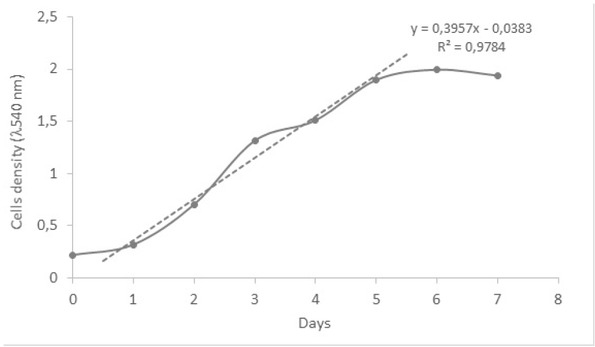
The growth curve of Chlorella vulgaris in BG-11 medium. The curve showed a doubling time for cell growth on 3.7 days.
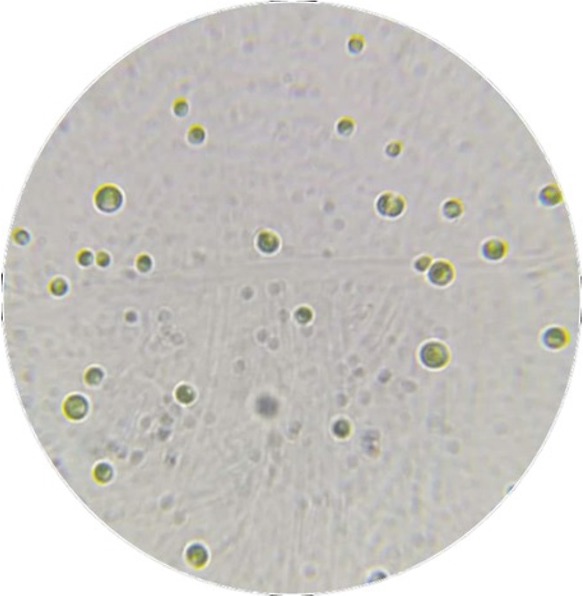
Microscopy picture of C. vulgaris.
3.2 Lipid extraction from C. vulgaris
The lipid from C. vulgaris biomass was extracted by using several solvents both polar and non-polar as well as their mixtures. The effect of ultrasonication power and polarity of solvents on lipid extraction was investigated in this study. Lipid extraction without assisted by ultrasonication using solvents of methanol, n-hexane, and a mixture chloroform with methanol in ratio 1: 2 resulted in lipid yield as 15%, 24% and 19% (w/w) respectively, whereas those with additional ultrasonication resulted in 17%, 29% and 22% (w/w) (Figure 3). The work was performed by assisting of ultrasonication at power 25kHz/270W. The solvent of n-hexane extracted lipid higher than the methanol, and a mixture chloroform with methanol. It seems that n-hexane has a role to disrupt the existing hydrophobic interactions between non-polar and neutral lipid compounds. Hexane has a higher selectivity for non polar lipid than methanol and chloroform. It can partitions preferentially to the center of the lipid bilayer with a favorable entropy change, so this consistent with the hydrophobic effect [25, 27]. Similar result was obtained by Krishna et al. [28]. The applying of ultrasonication treatment which was initially setted at power 25kHz/270W also enhanced the lipid yield (Figure 3). The ultrasound-assisted extraction can increase the extraction efficiency through cavitation and some mechanical effects. Cavitation can disrupt microalgae cells then facilitate the lipid becoming easy to contact with organic solvent. Another mechanical effect caused by ultrasound may also be the agitation of the solvent used for extraction, thus increasing the contact surface area between the solvent and targeted compounds by permitting greater penetration of solvent into the cells [28]. Because of the cavitation role is affected by the solvent factor as solvent viscosity and surface tension [26], so the choice of precise solvent is needed. Compared to without ultrasonication, ultrasound-assisted extraction increased lipid yield as 2%, 5% and 3% in the solvent of methanol, n-hexane and a mixture chloroform with methanol respectively. The rise of lipid yield in n-hexane is higher than other two solvents. The n-hexane might support well the cavitation role of ultrasound so it could disrupt the microalgae cells optimally.
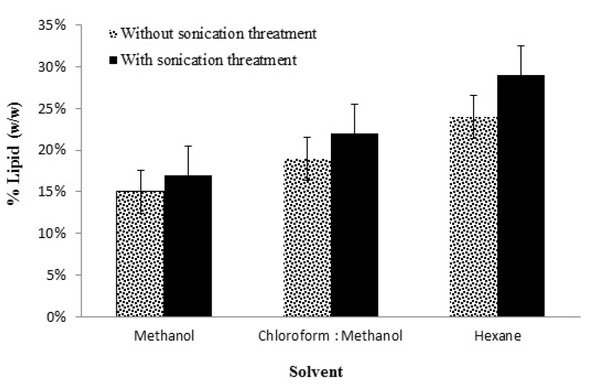
The yield of lipid extraction on various solvents with and no ultrasonication treatment.
Since the presence of lipids in cells is enclosed by polar phospholipid layers of cell membrane, the splitting of the layer is required to release the non-polar lipids [13]. Based on this principle, the lipid extraction in the study was also conducted by using a mixed solvent of n-hexane - ethanol and n-hexane - methanol in various ultrasonication power. The highest lipid yield achieved when the ultrasonication-assisted cell disruption of microalgae was done at power 25kHz/270W (Figure 4). Although an increase in the power ultrasonicator can improve the cavitation process so the cell is easy to lysis, but if the power used is excessive, it can cause bubbles that actually reduce lipid yield.
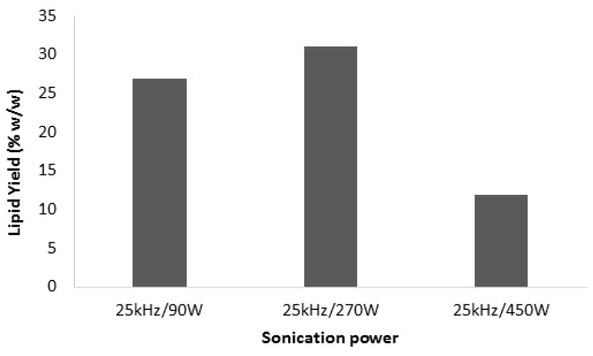
The yield of lipid extraction with binary solvent of n-hexane-ethanol in various ultrasonication power.
Lipid extraction with a mixed solvent of n-hexane - methanol and n-hexane - ethanol in ratio of 1: 1 resulted in lipid yields of 25% and 31% (w/w), respectively (Figure 5). For this result showed that an increase in lipids extraction yields was obtained when non-polar and polar solvent mixtures were used. The use of polar and non-polar solvent combinations is enabled so that all lipids in both neutral and polar lipids can be extracted properly. The non-polar organic solvents is inadequate used to disrupt the membrane–lipid–protein associations, due to weak interactions to the complex. However, polar organic solvents can break the lipid–protein associations by forming hydrogen bonds with the polar lipids in the complex [29]. Ethanol has a polarity index lower that ethanol [25], so the mixing of ethanol into n-hexane produce a mixed solvent with a lower polarity index than if n-hexane is mixed with methanol. However the polarity of mixed solvent of n-hexane – ethanol that formed might facilitate an optimal cavitation role for C. vulgaris cells disruptio, in turn it could extract lipid higher than n-hexane - methanol mixed solvent.
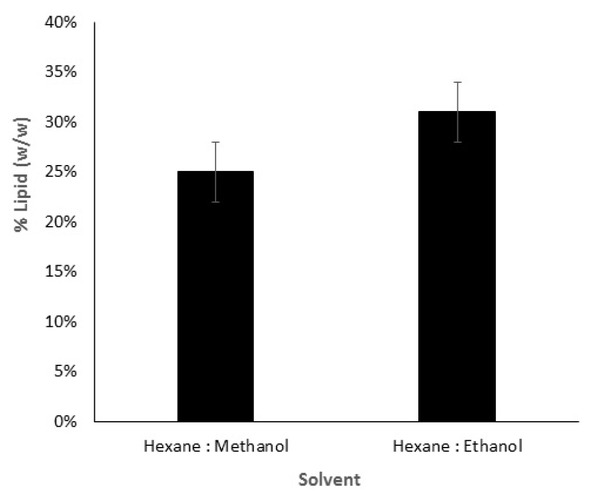
The yield of lipid extraction with binary solvents.
The lipid product for the extraction was analyzed by GC-MS to search the fatty acids component, and resulted pentadecylic acid, palmitic acid, heptadecanoic acid, stearic acid, margaric acid and nonadecylic acid as component of the lipid (Table 1).
FAME composition of Chlorella vulgaris.
| No | FAME | RT (min) | Formula | Area % | |
|---|---|---|---|---|---|
| 1 | Butylated Hydroxytoluene | 9.788 | C15H24O | 1.29 | |
| 2 | 1,2,4-Triazol-4-amine, N-(2-thienylmethyl)- | 11.082 | C7H8N4S | 4.97 | |
| 3 | Pentadecanoic acid, methyl ester | 11.67 | C16H32O2 | 0.59 | |
| 4 | Hexadecanoic acid, methyl ester | 12.204 | C17H34O2 | 1.55 | |
| 5 | 8-Octadecenal | 12.596 | C18H34O | 1.36 | |
| 6 | Heptadecanoic acid, methyl ester* | 12.768 | C17H34O2 | 67.74 | |
| 7 | Heptadecanoic acid, methyl ester | 12.791 | C17H34O2 | 16.16 | |
| 8 | Methyl stearate | 13.183 | C19H38O2 | 1.37 | |
| 9 | Nonadecanoic acid, methyl ester | 13.634 | C20H40O2 | 3.96 | |
| 10 | Phenol, 2,2’-methylenebis[6-(1,1-dimethylethyl)-4-methyl- | 14.548 | C23H32O2 | 1.01 | |
| Total : FAME Sample | 32.26 | ||||
| Total : FAME Sample + Standard | 100 | ||||
3.3 Lipid conversion to fatty acid methyl ester (FAME)
The production of fatty acid methyl ester (FAME) is conducted by mixing lipid with methanol in transesterification reaction using H2SO4 catalyst. The glyceride that presented in the lipid is transformed to glycerol and methyl esters. Because of the transesterification is included in the reversible reaction, so the excessive of methanol is needed to shift the reaction toward the FAME product [16]. Methanol was chosen as a reactant in the study because it is classifed as a cheap material, having a low boiling point and its excess in the glycerol phase easily to be separated [15].
Fatty acid profiles analyzed by GC-MS showed 32.26% FAMEs yield (Table 1). The area is corresponded to FAME rendement as 13.68% (w/w). GC-MS chromatogram of FAMEs produced from ex-situ transesterification of Chlorella vulgaris . The major peaks of fatty acids found in Chlorella vulgaris were palmitic acid (C16:0), stearic acid (C18:0) and margaric acid (C17:0), and nonadecanoic acid (C19:0). For fuel properties, the length of carbon chain and the number of double bonds are important, in which C16:1 and C18:1 are the ideal biofuel feedstock [17, 18]. Five common feedstocks includes C16:0 (palmitic acid), C18:0 (stearic acid), C18:1 (oleic acid), C18:2 (linoleic acid) and C18:3 (linolenic acid) which were suitable for biodiesel production [19,20]. Fatty acids conversion to fatty acid methyl esters (FAMEs) can be economically applied at remote biomass production facilities for servicing production site and community energy and transport fuel needs [21].
The GC-MS chromatogram gave an unique retention time and ion fragmentation profile for every FAME. A chromatogram data corresponded to the retention time of 12.2 min showed fragmentation profile with the highest of molecular ions m/z at 270 (Figure 6 and 7). The fragment of m/z 270 might represent to the C17H34O2+ ion for methyl hexadecanoic. Abdulloh et al [16]. described the m/z 74 fragment is derived from C3H6O2+ ion yielded by the β-breakdown from C17H34O2+ ion through McLafferty rearrangement [16]. The m/z 239 fragment represents the C16H31O+ which a methoxy group was lost, whereas the m/z 43 fragment was produced by the release of a radical from C12H24COOCH3 molecule. The molecular ion with m/z 87, 101, 115, 129, 143, 157, 171, 185, 199, 213 and 227 emerged due to the CH2CH2 fragmentation respectively, known as ion fragmentation pattern of the series CnH2n-1O2+. This similiar mechanism was also reported for methyl palmitate [22]. The result showed the FAME could be produced well by ex-situ transesterification of lipid extracted from C. vulgaris. Optimizing the condition for the reaction will be perfected in future to improve the biodiesel yield.
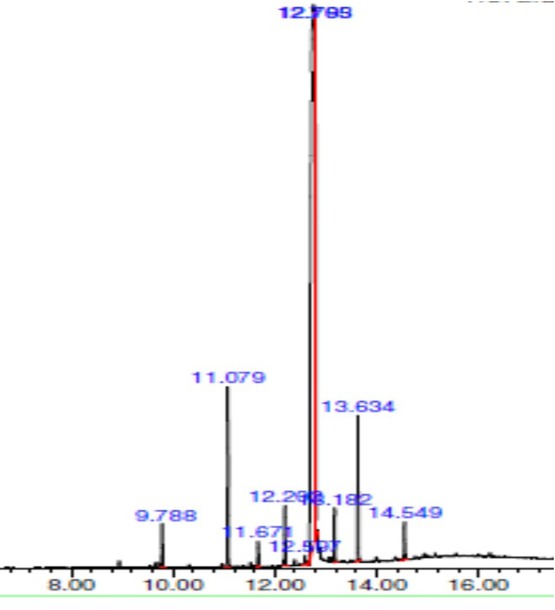
GC-MS chromatogram of FAMEs produced from ex-situ transesterification of Chlorella vulgaris. FAME products represented on retention time of 9.788; 11.082; 11.671; 12.204; 12.596; 12.791; 13.183; 13.634 and 14.548 min.
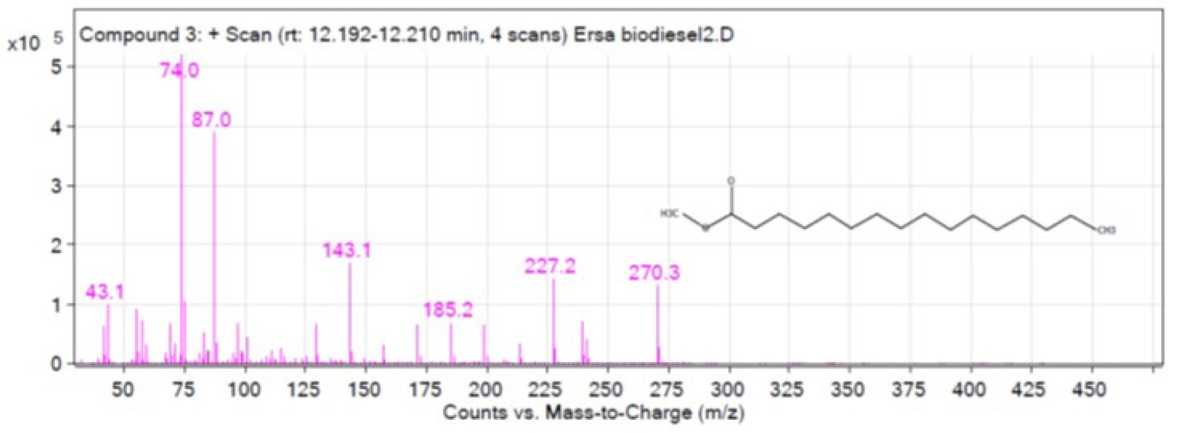
The MS spectrum of hexadecanoid methyl ester fragmentation.
4 Conclusion
The C. vulgaris could grow well in the BG-11 medium and showed the doubling time at 3.7 days for its growth using inocula 16% (v/v). The microalgae growth resulted dry cell biomass as 11,6 g/L after cultured for 6 days. The lipid as 31% (w/w) could be resulted after the biomass extracted by a mixed solvent of n-hexane-ethanol in ratio 1:1 and ultrasonication treatment at power 25 kHz/270W for 30 min. The lipid could be converted to FAME in the transesterification reaction with methanol using H2SO4 catalyst at 45ºC for 2 h, and appeared FAME with area 32.26% in GC-MS analysis that corresponded to FAME rendement as 13.68% (w/w). Fatty acid profiles analyzed by GC-MS showed the major peaks of fatty acids found in Chlorella vulgaris were palmitic acid (C16:0), stearic acid (C18:0) and margaric acid (C17:0), and nonadecanoic acid (C19:0). Optimization of the transesterification reaction will be developed in future to improve the FAME product.
Acknowledgement
This reseach was supported by funding of Ministry of Research and Techonology, Republic of Indonesia, Contract Number: 004/SP2H/LT/DRPM/IV/2017.
Conflict of interest: Authors state no conflict of interest.
References
[1] Amini S., Susilowati R., Produksi biodiesel dari mikroalga Botryococcus braunii, Squalen, 2010, 5(1), 23-32.10.15578/squalen.v5i1.43Suche in Google Scholar
[2] Pratoomyot J., Srivilas P., Noiraksar T., Fatty acids composition of 10 microalgal species. J. Sci. Technol, 2015, 26(6), 1179-1187.Suche in Google Scholar
[3] Dong T., Wang J. Miao C., Zheng Y., Chen S., Biore source Tec hnology Two-step in situ biodiesel production from microalgae with high free fatty acid content, Bioresour. Technol, 2013,136, 8–15.10.1016/j.biortech.2013.02.105Suche in Google Scholar
[4] Milano J., Ong H.C., Masjuki H., Chong W.T., Lam M.K., Loh P.K., Vellayan V., Microalgae Biofuels as an Alternative to Fossil Fuel for Power Generation. Renewable and Sustainable Energy Reviews, 2016, 5, 180–197.10.1016/j.rser.2015.12.150Suche in Google Scholar
[5] Koberg M., Cohen M., Ben-Amotz A., Gedanken A.. Biodiesel production directly from the microalgae biomass of Nannochloropsis by microwave and ultrasound radiation. Bioresource Technology, 2011, 102, 4265-4269.10.1016/j.biortech.2010.12.004Suche in Google Scholar
[6] Letellier M, Budzinski H. Microwave Assisted Extraction of Organic Compounds. Analusis, 1999, 27, 259.10.1051/analusis:1999116Suche in Google Scholar
[7] Widjaja A., Chao-Chang C., Yi-Hsu J., Study of increasing lipid production from fresh water microalgae Chlorella vulgaris, Journal of the Taiwan Institute of Chemical Engineers, 2009,40,13–20.10.1016/j.jtice.2008.07.007Suche in Google Scholar
[8] Mubarak M., Shaija A., Suchithra T.V., A Review on the Extraction of Lipid from Microalgae for Biodiesel Production. Algal Res, 2015, 7, 117–123.10.1016/j.algal.2014.10.008Suche in Google Scholar
[9] Byreddy A.R., Gupta A., Barrow C.J., Puri M. Comparison of Cell Disruption Methods for Improving Lipid Extraction from Thraustochytrid Strains. Mar. Drugs, 2015, 13(8), 5111–5127.10.3390/md13085111Suche in Google Scholar
[10] Mendes R.L., Nobre B.P., Cardoso M.T., Pereira A.P., Palavra A.F., Supercritical Carbon Dioxide Extraction of Compounds with Pharmaceutical Importance from Microalgae. Inorg. Chim. Acta, 2003, 356, 328.10.1016/S0020-1693(03)00363-3Suche in Google Scholar
[11] Stanier R.Y., Kunisawa R., Mandel M., Cohen-Bazire G., Purification and properties of unicellular blue-green algae (Order Chroococcales). Bacteriol. Rev., 1971, 35, 171-205.10.1128/br.35.2.171-205.1971Suche in Google Scholar PubMed PubMed Central
[12] Bligh E.G., Dyer W.J., A Rapid Method of Total Lipid Extraction and Purification. Can. J. Biochem. Physiol, 1959, 37, 911.10.1139/y59-099Suche in Google Scholar
[13] Zhang X.L., Yan S., Tyagi R.D., Drogui P., Surampalli R.Y., Ultrasonication Assisted Lipid Extraction from Oleaginous Microorganisms. Bioresource Technology., 2014, 158, 253–261.10.1016/j.biortech.2014.01.132Suche in Google Scholar PubMed
[14] Ruppel T., Huybrighs T., Fatty Acid Methyl Esters in B100 Biodiesel by Gas Chromatography (Modified EN 14103). www.Perkinelmer.com.html Retrieved on May 25, 2016.Suche in Google Scholar
[15] Park J.Y., Park M.S., Lee Y.C., Yang J.W., Review Advances in Direct Transesterification of Algal Oils from Wet Biomass, Bioresource Technology, 2015, 184, 267–275.10.1016/j.biortech.2014.10.089Suche in Google Scholar PubMed
[16] Abdulloh A., Maryam S., Aminah N.S., Triyono T., Trisunaryanti W., Mudasir M., Prasetyoko D., Modification of Turen’s Bentonite with AlCl3 for Esterification of Palmitic Acid, Bulletin of Chemical Reaction Engineering & Catalysis, 2014, 9(1), 66-73.10.9767/bcrec.9.1.5513.66-73Suche in Google Scholar
[17] Knothe G., Designer biodiesel: optimizing fatty ester composition to improve fuel properties. Energy Fuels, 2008, 22(2), 1358–1364.10.1021/ef700639eSuche in Google Scholar
[18] Kumar M., Sundaram S., Gnansounou E., Christian Larroche C., Thakur I.S., Carbon dioxide capture, storage and production of biofuel and biomaterials by bacteria: a review. Bioresour, 2017,Technol. http://dx.doi.org/10.1016/j.biortech.2017.09.05010.1016/j.biortech.2017.09.050Suche in Google Scholar PubMed
[19] Knothe G., Analyzing biodiesel: standards and other methods. J. Am. Oil Chem. Soc, 2006, 83, 823–833.10.1007/s11746-006-5033-ySuche in Google Scholar
[20] Singh J., Thakur I.S., Evaluation of cyanobacterial endolithic Leptolyngbyasp. ISTCY101, for integrated wastewater treatment and biodiesel production: a toxicological perspective, Algal Res, 2015, 11, 294–303.10.1016/j.algal.2015.07.010Suche in Google Scholar
[21] Selvarajan R., Felfoldi T., Tauber T., Sanniyasi E., Sibanda T., Tekere M., Screening and evaluation of some green algal strains (Chlorophyceae) isolated from freshwater and soda lakes for biofuel production. Energies, 2015, 8, 7502–7521.10.3390/en8077502Suche in Google Scholar
[22] Soerya D.M., Desi S.H., Analisis Spektrofotometer Infra Merah dan Kromatografi Gas-Spektrometri Massa Kandungan Senyawa Non polar Ekstrak Biji Kakao (Theobroma cacao Linn.) Fermentasi. J. Al-chemy, 2003, 2, 57 – 66.Suche in Google Scholar
[23] Jae-Yon L., Chan Y., So-Young J., Chi-Yong A., Hee-Mock O., Comparison of several methods for effective lipid extraction from microalgae. Bioresource Technology, 2010, 101, S75–S7710.1016/j.biortech.2009.03.058Suche in Google Scholar PubMed
[24] Adam H.M., Ameer Y.T., Hamid I., Ken D.S., The application of ultrasound energy to increase lipid extraction throughput of solid matrix samples (flaxseed). PLEFA, 2009, 81, 417–42310.1016/j.plefa.2009.07.003Suche in Google Scholar PubMed
[25] Suzana F.D., Dina G.V., Jose M.F., Abreu, Comparison between ethanol and hexane for oil extraction from Quercus suber L. Fruits. Fasc, 2003, 54(4), 378-383.10.3989/gya.2003.v54.i4.225Suche in Google Scholar
[26] Ali F., Reinert L., Jean-Marc L., Duclaux L., Fabrice M., Shaukat S., Syed S.S., Effect of sonication conditions: solvent, time, temperature and reactor type on the preparation of micron sized vermiculite particles, https://hal-insu.archives-ouvertes.fr/insu-00876251; Submitted on 24 Oct 2013.Suche in Google Scholar
[27] MacCallum J.L, Tieleman D.P., Computer simulation of the distribution of hexane in a lipid bilayer: spatially resolved free energy, entropy, and enthalpy profiles. J Am Chem Soc, 2006, 128(1), 125-3010.1021/ja0535099Suche in Google Scholar PubMed
[28] Krishna B.G., Akshaya K., Sahoo, Rahul C. R., Effect of ultrasonic treatment on extraction and fatty acid profile of flaxseed oil. OCL, 2015, 22(6), D606.10.1051/ocl/2015038Suche in Google Scholar
[29] Pamela Hidalgo, Gustavo Ciudad, Rodrigo Navia, Evaluation of different solvent mixtures in esterifiable lipids extraction from microalgae Botryococcus braunii, for biodiesel production, Bioresource Technology, 2016, 201, 360–364.10.1016/j.biortech.2015.11.031Suche in Google Scholar PubMed
© 2019 Purkan Purkan et al., published by De Gruyter
This work is licensed under the Creative Commons Attribution 4.0 Public License.
Artikel in diesem Heft
- Regular Articles
- Research on correlation of compositions with oestrogenic activity of Cistanche based on LC/Q-TOF-MS/MS technology
- Efficacy of Pyrus elaeagnifolia subsp. elaeagnifolia in acetic acid–induced colitis model
- Anti-inflammatory and antinociceptive features of Bryonia alba L.: As a possible alternative in treating rheumatism
- High efficiency liposome fusion induced by reducing undesired membrane peptides interaction
- Prediction of the Blood-Brain Barrier Permeability Using RP-18 Thin Layer Chromatography
- Phytic Acid Extracted from Rice Bran as a Growth Promoter for Euglena gracilis
- Development of a validated spectrofluorimetric method for assay of sotalol hydrochloride in tablets and human plasma: application for stability-indicating studies
- Topological Indices of Hyaluronic Acid-Paclitaxel Conjugates’ Molecular Structure in Cancer Treatment
- Thermodynamic properties of the bubble growth process in a pool boiling of water-ethanol mixture two-component system
- Critical Roles of the PI3K-Akt-mTOR Signaling Pathway in Apoptosis and Autophagy of Astrocytes Induced by Methamphetamine
- Characteristics of Stable Hydrogen and Oxygen Isotopes of Soil Moisture under Different Land Use in Dry Hot Valley of Yuanmou
- Specific, highly sensitive and simple spectrofluorimetric method for quantification of daclatasvir in HCV human plasma patients and in tablets dosage form
- Chromium-modified cobalt molybdenum nitrides as catalysts for ammonia synthesis
- Langerhans cell-like dendritic cells treated with ginsenoside Rh2 regulate the differentiation of Th1 and Th2 cells in vivo
- Identification of Powdery Mildew Blumeria graminis f. sp. tritici Resistance Genes in Selected Wheat Varieties and Development of Multiplex PCR
- Computational Analysis of new Degree-based descriptors of oxide networks
- The Use Of Chemical Composition And Additives To Classify Petrol And Diesel Using Gas Chromatography–Mass Spectrometry And Chemometric Analysis: A Uk Study
- Minimal Energy Tree with 4 Branched Vertices
- Jatropha seed oil derived poly(esteramide-urethane)/ fumed silica nanocomposite coatings for corrosion protection
- Calculating topological indices of certain OTIS interconnection networks
- Energy storage analysis of R125 in UIO-66 and MOF-5 nanoparticles: A molecular simulation study
- Velvet Antler compounds targeting major cell signaling pathways in osteosarcoma - a new insight into mediating the process of invasion and metastasis in OS
- Effects of Azadirachta Indica Leaf Extract, Capping Agents, on the Synthesis of Pure And Cu Doped ZnO-Nanoparticles: A Green Approach and Microbial Activity
- Aqueous Micro-hydration of Na+(H2O)n=1-7 Clusters: DFT Study
- A proposed image-based detection of methamidophos pesticide using peroxyoxalate chemiluminescence system
- Phytochemical screening and estrogenic activity of total glycosides of Cistanche deserticola
- Biological evaluation of a series of benzothiazole derivatives as mosquitocidal agents
- Chemical pretreatments of Trapa bispinosa's peel (TBP) biosorbent to enhance adsorption capacity for Pb(ll)
- Dynamic Changes in MMP1 and TIMP1 in the Antifibrotic Process of Dahuang Zhechong Pill in Rats with Liver Fibrosis
- The Optimization and Production of Ginkgolide B Lipid Microemulsion
- Photodynamic Therapy Enhanced the Antitumor Effects of Berberine on HeLa Cells
- Chiral and Achiral Enantiomeric Separation of (±)-Alprenolol
- Correlation of Water Fluoride with Body Fluids, Dental Fluorosis and FT4, FT3 –TSH Disruption among Children in an Endemic Fluorosis area in Pakistan
- A one-step incubation ELISA kit for rapid determination of dibutyl phthalate in water, beverage and liquor
- Free Radical Scavenging Activity of Essential Oil of Eugenia caryophylata from Amboina Island and Derivatives of Eugenol
- Effects of Blue and Red Light On Growth And Nitrate Metabolism In Pakchoi
- miRNA-199a-5p functions as a tumor suppressor in prolactinomas
- Solar photodegradation of carbamazepine from aqueous solutions using a compound parabolic concentrator equipped with a sun tracking system
- Influence of sub-inhibitory concentration of selected plant essential oils on the physical and biochemical properties of Pseudomonas orientalis
- Preparation and spectroscopic studies of Fe(II), Ru(II), Pd(II) and Zn(II) complexes of Schiff base containing terephthalaldehyde and their transfer hydrogenation and Suzuki-Miyaura coupling reaction
- Complex formation in a liquid-liquid extraction-chromogenic system for vanadium(IV)
- Synthesis, characterization (IR, 1H, 13C & 31P NMR), fungicidal, herbicidal and molecular docking evaluation of steroid phosphorus compounds
- Analysis and Biological Evaluation of Arisaema Amuremse Maxim Essential Oil
- A preliminary assessment of potential ecological risk and soil contamination by heavy metals around a cement factory, western Saudi Arabia
- Anti- inflammatory effect of Prunus tomentosa Thunb total flavones in LPS-induced RAW264.7 cells
- Collaborative Influence of Elevated CO2 Concentration and High Temperature on Potato Biomass Accumulation and Characteristics
- Methods of extraction, physicochemical properties of alginates and their applications in biomedical field – a review
- Characteristics of liposomes derived from egg yolk
- Preparation of ternary ZnO/Ag/cellulose and its enhanced photocatalytic degradation property on phenol and benzene in VOCs
- Influence of Human Serum Albumin Glycation on the Binding Affinities for Natural Flavonoids
- Synthesis and antioxidant activity of 2-methylthio-pyrido[3,2-e][1,2,4] triazolo[1,5-a]pyrimidines
- Comparative study on the antioxidant activities of ten common flower teas from China
- Molecular Properties of Symmetrical Networks Using Topological Polynomials
- Synthesis of Co3O4 Nano Aggregates by Co-precipitation Method and its Catalytic and Fuel Additive Applications
- Phytochemical analysis, Antioxidant and Antiprotoscolices potential of ethanol extracts of selected plants species against Echinococcus granulosus: In-vitro study
- Silver nanoparticles enhanced fluorescence for sensitive determination of fluoroquinolones in water solutions
- Simultaneous Quantification of the New Psychoactive Substances 3-FMC, 3-FPM, 4-CEC, and 4-BMC in Human Blood using GC-MS
- Biodiesel Production by Lipids From Indonesian strain of Microalgae Chlorella vulgaris
- Miscibility studies of polystyrene/polyvinyl chloride blend in presence of organoclay
- Antibacterial Activities of Transition Metal complexes of Mesocyclic Amidine 1,4-diazacycloheptane (DACH)
- Novel 1,8-Naphthyridine Derivatives: Design, Synthesis and in vitro screening of their cytotoxic activity against MCF7 cell line
- Investigation of Stress Corrosion Cracking Behaviour of Mg-Al-Zn Alloys in Different pH Environments by SSRT Method
- Various Combinations of Flame Retardants for Poly (vinyl chloride)
- Phenolic compounds and biological activities of rye (Secale cereale L.) grains
- Oxidative degradation of gentamicin present in water by an electro-Fenton process and biodegradability improvement
- Optimizing Suitable Conditions for the Removal of Ammonium Nitrogen by a Microbe Isolated from Chicken Manure
- Anti-inflammatory, antipyretic, analgesic, and antioxidant activities of Haloxylon salicornicum aqueous fraction
- The anti-corrosion behaviour of Satureja montana L. extract on iron in NaCl solution
- Interleukin-4, hemopexin, and lipoprotein-associated phospholipase A2 are significantly increased in patients with unstable carotid plaque
- A comparative study of the crystal structures of 2-(4-(2-(4-(3-chlorophenyl)pipera -zinyl)ethyl) benzyl)isoindoline-1,3-dione by synchrotron radiation X-ray powder diffraction and single-crystal X-ray diffraction
- Conceptual DFT as a Novel Chemoinformatics Tool for Studying the Chemical Reactivity Properties of the Amatoxin Family of Fungal Peptides
- Occurrence of Aflatoxin M1 in Milk-based Mithae samples from Pakistan
- Kinetics of Iron Removal From Ti-Extraction Blast Furnace Slag by Chlorination Calcination
- Increasing the activity of DNAzyme based on the telomeric sequence: 2’-OMe-RNA and LNA modifications
- Exploring the optoelectronic properties of a chromene-appended pyrimidone derivative for photovoltaic applications
- Effect of He Qi San on DNA Methylation in Type 2 Diabetes Mellitus Patients with Phlegm-blood Stasis Syndrome
- Cyclodextrin potentiometric sensors based on selective recognition sites for procainamide: Comparative and theoretical study
- Greener synthesis of dimethyl carbonate from carbon dioxide and methanol using a tunable ionic liquid catalyst
- Nonisothermal Cold Crystallization Kinetics of Poly(lactic acid)/Bacterial Poly(hydroxyoctanoate) (PHO)/Talc
- Enhanced adsorption of sulfonamide antibiotics in water by modified biochar derived from bagasse
- Study on the Mechanism of Shugan Xiaozhi Fang on Cells with Non-alcoholic Fatty Liver Disease
- Comparative Effects of Salt and Alkali Stress on Antioxidant System in Cotton (Gossypium Hirsutum L.) Leaves
- Optimization of chromatographic systems for analysis of selected psychotropic drugs and their metabolites in serum and saliva by HPLC in order to monitor therapeutic drugs
- Electrocatalytic Properties of Ni-Doped BaFe12O19 for Oxygen Evolution in Alkaline Solution
- Study on the removal of high contents of ammonium from piggery wastewater by clinoptilolite and the corresponding mechanisms
- Phytochemistry and toxicological assessment of Bryonia dioica roots used in north-African alternative medicine
- The essential oil composition of selected Hemerocallis cultivars and their biological activity
- Mechanical Properties of Carbon Fiber Reinforced Nanocrystalline Nickel Composite Electroforming Deposit
- Anti-c-myc efficacy block EGFL7 induced prolactinoma tumorigenesis
- Topical Issue on Applications of Mathematics in Chemistry
- Zagreb Connection Number Index of Nanotubes and Regular Hexagonal Lattice
- The Sanskruti index of trees and unicyclic graphs
-
Valency-based molecular descriptors of Bakelite network
- Computing Topological Indices for Para-Line Graphs of Anthracene
- Zagreb Polynomials and redefined Zagreb indices of Dendrimers and Polyomino Chains
- Topological Descriptor of 2-Dimensional Silicon Carbons and Their Applications
- Topological invariants for the line graphs of some classes of graphs
- Words for maximal Subgroups of Fi24‘
- Generators of Maximal Subgroups of Harada-Norton and some Linear Groups
- Special Issue on POKOCHA 2018
- Influence of Production Parameters on the Content of Polyphenolic Compounds in Extruded Porridge Enriched with Chokeberry Fruit (Aronia melanocarpa (Michx.) Elliott)
- Effects of Supercritical Carbon Dioxide Extraction (SC-CO2) on the content of tiliroside in the extracts from Tilia L. flowers
- Impact of xanthan gum addition on phenolic acids composition and selected properties of new gluten-free maize-field bean pasta
- Impact of storage temperature and time on Moldavian dragonhead oil – spectroscopic and chemometric analysis
- The effect of selected substances on the stability of standard solutions in voltammetric analysis of ascorbic acid in fruit juices
- Determination of the content of Pb, Cd, Cu, Zn in dairy products from various regions of Poland
- Special Issue on IC3PE 2018 Conference
- The Photocatalytic Activity of Zns-TiO2 on a Carbon Fiber Prepared by Chemical Bath Deposition
- N-octyl chitosan derivatives as amphiphilic carrier agents for herbicide formulations
- Kinetics and Mechanistic Study of Hydrolysis of Adenosine Monophosphate Disodium Salt (AMPNa2) in Acidic and Alkaline Media
- Antimalarial Activity of Andrographis Paniculata Ness‘s N-hexane Extract and Its Major Compounds
- Special Issue on ABB2018 Conference
- Special Issue on ICCESEN 2017
- Theoretical Diagnostics of Second and Third-order Hyperpolarizabilities of Several Acid Derivatives
- Determination of Gamma Rays Efficiency Against Rhizoctonia solani in Potatoes
- Studies On Compatibilization Of Recycled Polyethylene/Thermoplastic Starch Blends By Using Different Compatibilizer
- Liquid−Liquid Extraction of Linalool from Methyl Eugenol with 1-Ethyl-3-methylimidazolium Hydrogen Sulfate [EMIM][HSO4] Ionic Liquid
- Synthesis of Graphene Oxide Through Ultrasonic Assisted Electrochemical Exfoliation
- Special Issue on ISCMP 2018
- Synthesis and antiproliferative evaluation of some 1,4-naphthoquinone derivatives against human cervical cancer cells
- The influence of the grafted aryl groups on the solvation properties of the graphyne and graphdiyne - a MD study
- Electrochemical modification of platinum and glassy carbon surfaces with pyridine layers and their use as complexing agents for copper (II) ions
- Effect of Electrospinning Process on Total Antioxidant Activity of Electrospun Nanofibers Containing Grape Seed Extract
- Effect Of Thermal Treatment Of Trepel At Temperature Range 800-1200˚C
- Topical Issue on Agriculture
- The effect of Cladophora glomerata exudates on the amino acid composition of Cladophora fracta and Rhizoclonium sp.
- Influence of the Static Magnetic Field and Algal Extract on the Germination of Soybean Seeds
- The use of UV-induced fluorescence for the assessment of homogeneity of granular mixtures
- The use of microorganisms as bio-fertilizers in the cultivation of white lupine
- Lyophilized apples on flax oil and ethyl esters of flax oil - stability and antioxidant evaluation
- Production of phosphorus biofertilizer based on the renewable materials in large laboratory scale
- Human health risk assessment of potential toxic elements in paddy soil and rice (Oryza sativa) from Ugbawka fields, Enugu, Nigeria
- Recovery of phosphates(V) from wastewaters of different chemical composition
- Special Issue on the 4th Green Chemistry 2018
- Dead zone for hydrogenation of propylene reaction carried out on commercial catalyst pellets
- Improved thermally stable oligoetherols from 6-aminouracil, ethylene carbonate and boric acid
- The role of a chemical loop in removal of hazardous contaminants from coke oven wastewater during its treatment
- Combating paraben pollution in surface waters with a variety of photocatalyzed systems: Looking for the most efficient technology
- Special Issue on Chemistry Today for Tomorrow 2019
- Applying Discriminant and Cluster Analyses to Separate Allergenic from Non-allergenic Proteins
- Chemometric Expertise Of Clinical Monitoring Data Of Prolactinoma Patients
- Chemomertic Risk Assessment of Soil Pollution
- New composite sorbent for speciation analysis of soluble chromium in textiles
- Photocatalytic activity of NiFe2O4 and Zn0.5Ni0.5Fe2O4 modified by Eu(III) and Tb(III) for decomposition of Malachite Green
- Photophysical and antibacterial activity of light-activated quaternary eosin Y
- Spectral properties and biological activity of La(III) and Nd(III) Monensinates
- Special Issue on Monitoring, Risk Assessment and Sustainable Management for the Exposure to Environmental Toxins
- Soil organic carbon mineralization in relation to microbial dynamics in subtropical red soils dominated by differently sized aggregates
- A potential reusable fluorescent aptasensor based on magnetic nanoparticles for ochratoxin A analysis
- Special Issue on 13th JCC 2018
- Fluorescence study of 5-nitroisatin Schiff base immobilized on SBA-15 for sensing Fe3+
- Thermal and Morphology Properties of Cellulose Nanofiber from TEMPO-oxidized Lower part of Empty Fruit Bunches (LEFB)
- Encapsulation of Vitamin C in Sesame Liposomes: Computational and Experimental Studies
- A comparative study of the utilization of synthetic foaming agent and aluminum powder as pore-forming agents in lightweight geopolymer synthesis
- Synthesis of high surface area mesoporous silica SBA-15 by adjusting hydrothermal treatment time and the amount of polyvinyl alcohol
- Review of large-pore mesostructured cellular foam (MCF) silica and its applications
- Ion Exchange of Benzoate in Ni-Al-Benzoate Layered Double Hydroxide by Amoxicillin
- Synthesis And Characterization Of CoMo/Mordenite Catalyst For Hydrotreatment Of Lignin Compound Models
- Production of Biodiesel from Nyamplung (Calophyllum inophyllum L.) using Microwave with CaO Catalyst from Eggshell Waste: Optimization of Transesterification Process Parameters
- The Study of the Optical Properties of C60 Fullerene in Different Organic Solvents
- Composite Material Consisting of HKUST-1 and Indonesian Activated Natural Zeolite and its Application in CO2 Capture
- Topical Issue on Environmental Chemistry
- Ionic liquids modified cobalt/ZSM-5 as a highly efficient catalyst for enhancing the selectivity towards KA oil in the aerobic oxidation of cyclohexane
- Application of Thermal Resistant Gemini Surfactants in Highly Thixotropic Water-in-oil Drilling Fluid System
- Screening Study on Rheological Behavior and Phase Transition Point of Polymer-containing Fluids produced under the Oil Freezing Point Temperature
- The Chemical Softening Effect and Mechanism of Low Rank Coal Soaked in Alkaline Solution
- The Influence Of NO/O2 On The NOx Storage Properties Over A Pt-Ba-Ce/γ-Al2O3 Catalyst
- Special Issue on the International conference CosCI 2018
- Design of SiO2/TiO2 that Synergistically Increases The Hydrophobicity of Methyltrimethoxysilane Coated Glass
- Antidiabetes and Antioxidant agents from Clausena excavata root as medicinal plant of Myanmar
- Development of a Gold Immunochromatographic Assay Method Using Candida Biofilm Antigen as a Bioreceptor for Candidiasis in Rats
- Special Issue on Applied Biochemistry and Biotechnology 2019
- Adsorption of copper ions on Magnolia officinalis residues after solid-phase fermentation with Phanerochaete chrysosporium
- Erratum
- Erratum to: Sand Dune Characterization For Preparing Metallurgical Grade Silicon
Artikel in diesem Heft
- Regular Articles
- Research on correlation of compositions with oestrogenic activity of Cistanche based on LC/Q-TOF-MS/MS technology
- Efficacy of Pyrus elaeagnifolia subsp. elaeagnifolia in acetic acid–induced colitis model
- Anti-inflammatory and antinociceptive features of Bryonia alba L.: As a possible alternative in treating rheumatism
- High efficiency liposome fusion induced by reducing undesired membrane peptides interaction
- Prediction of the Blood-Brain Barrier Permeability Using RP-18 Thin Layer Chromatography
- Phytic Acid Extracted from Rice Bran as a Growth Promoter for Euglena gracilis
- Development of a validated spectrofluorimetric method for assay of sotalol hydrochloride in tablets and human plasma: application for stability-indicating studies
- Topological Indices of Hyaluronic Acid-Paclitaxel Conjugates’ Molecular Structure in Cancer Treatment
- Thermodynamic properties of the bubble growth process in a pool boiling of water-ethanol mixture two-component system
- Critical Roles of the PI3K-Akt-mTOR Signaling Pathway in Apoptosis and Autophagy of Astrocytes Induced by Methamphetamine
- Characteristics of Stable Hydrogen and Oxygen Isotopes of Soil Moisture under Different Land Use in Dry Hot Valley of Yuanmou
- Specific, highly sensitive and simple spectrofluorimetric method for quantification of daclatasvir in HCV human plasma patients and in tablets dosage form
- Chromium-modified cobalt molybdenum nitrides as catalysts for ammonia synthesis
- Langerhans cell-like dendritic cells treated with ginsenoside Rh2 regulate the differentiation of Th1 and Th2 cells in vivo
- Identification of Powdery Mildew Blumeria graminis f. sp. tritici Resistance Genes in Selected Wheat Varieties and Development of Multiplex PCR
- Computational Analysis of new Degree-based descriptors of oxide networks
- The Use Of Chemical Composition And Additives To Classify Petrol And Diesel Using Gas Chromatography–Mass Spectrometry And Chemometric Analysis: A Uk Study
- Minimal Energy Tree with 4 Branched Vertices
- Jatropha seed oil derived poly(esteramide-urethane)/ fumed silica nanocomposite coatings for corrosion protection
- Calculating topological indices of certain OTIS interconnection networks
- Energy storage analysis of R125 in UIO-66 and MOF-5 nanoparticles: A molecular simulation study
- Velvet Antler compounds targeting major cell signaling pathways in osteosarcoma - a new insight into mediating the process of invasion and metastasis in OS
- Effects of Azadirachta Indica Leaf Extract, Capping Agents, on the Synthesis of Pure And Cu Doped ZnO-Nanoparticles: A Green Approach and Microbial Activity
- Aqueous Micro-hydration of Na+(H2O)n=1-7 Clusters: DFT Study
- A proposed image-based detection of methamidophos pesticide using peroxyoxalate chemiluminescence system
- Phytochemical screening and estrogenic activity of total glycosides of Cistanche deserticola
- Biological evaluation of a series of benzothiazole derivatives as mosquitocidal agents
- Chemical pretreatments of Trapa bispinosa's peel (TBP) biosorbent to enhance adsorption capacity for Pb(ll)
- Dynamic Changes in MMP1 and TIMP1 in the Antifibrotic Process of Dahuang Zhechong Pill in Rats with Liver Fibrosis
- The Optimization and Production of Ginkgolide B Lipid Microemulsion
- Photodynamic Therapy Enhanced the Antitumor Effects of Berberine on HeLa Cells
- Chiral and Achiral Enantiomeric Separation of (±)-Alprenolol
- Correlation of Water Fluoride with Body Fluids, Dental Fluorosis and FT4, FT3 –TSH Disruption among Children in an Endemic Fluorosis area in Pakistan
- A one-step incubation ELISA kit for rapid determination of dibutyl phthalate in water, beverage and liquor
- Free Radical Scavenging Activity of Essential Oil of Eugenia caryophylata from Amboina Island and Derivatives of Eugenol
- Effects of Blue and Red Light On Growth And Nitrate Metabolism In Pakchoi
- miRNA-199a-5p functions as a tumor suppressor in prolactinomas
- Solar photodegradation of carbamazepine from aqueous solutions using a compound parabolic concentrator equipped with a sun tracking system
- Influence of sub-inhibitory concentration of selected plant essential oils on the physical and biochemical properties of Pseudomonas orientalis
- Preparation and spectroscopic studies of Fe(II), Ru(II), Pd(II) and Zn(II) complexes of Schiff base containing terephthalaldehyde and their transfer hydrogenation and Suzuki-Miyaura coupling reaction
- Complex formation in a liquid-liquid extraction-chromogenic system for vanadium(IV)
- Synthesis, characterization (IR, 1H, 13C & 31P NMR), fungicidal, herbicidal and molecular docking evaluation of steroid phosphorus compounds
- Analysis and Biological Evaluation of Arisaema Amuremse Maxim Essential Oil
- A preliminary assessment of potential ecological risk and soil contamination by heavy metals around a cement factory, western Saudi Arabia
- Anti- inflammatory effect of Prunus tomentosa Thunb total flavones in LPS-induced RAW264.7 cells
- Collaborative Influence of Elevated CO2 Concentration and High Temperature on Potato Biomass Accumulation and Characteristics
- Methods of extraction, physicochemical properties of alginates and their applications in biomedical field – a review
- Characteristics of liposomes derived from egg yolk
- Preparation of ternary ZnO/Ag/cellulose and its enhanced photocatalytic degradation property on phenol and benzene in VOCs
- Influence of Human Serum Albumin Glycation on the Binding Affinities for Natural Flavonoids
- Synthesis and antioxidant activity of 2-methylthio-pyrido[3,2-e][1,2,4] triazolo[1,5-a]pyrimidines
- Comparative study on the antioxidant activities of ten common flower teas from China
- Molecular Properties of Symmetrical Networks Using Topological Polynomials
- Synthesis of Co3O4 Nano Aggregates by Co-precipitation Method and its Catalytic and Fuel Additive Applications
- Phytochemical analysis, Antioxidant and Antiprotoscolices potential of ethanol extracts of selected plants species against Echinococcus granulosus: In-vitro study
- Silver nanoparticles enhanced fluorescence for sensitive determination of fluoroquinolones in water solutions
- Simultaneous Quantification of the New Psychoactive Substances 3-FMC, 3-FPM, 4-CEC, and 4-BMC in Human Blood using GC-MS
- Biodiesel Production by Lipids From Indonesian strain of Microalgae Chlorella vulgaris
- Miscibility studies of polystyrene/polyvinyl chloride blend in presence of organoclay
- Antibacterial Activities of Transition Metal complexes of Mesocyclic Amidine 1,4-diazacycloheptane (DACH)
- Novel 1,8-Naphthyridine Derivatives: Design, Synthesis and in vitro screening of their cytotoxic activity against MCF7 cell line
- Investigation of Stress Corrosion Cracking Behaviour of Mg-Al-Zn Alloys in Different pH Environments by SSRT Method
- Various Combinations of Flame Retardants for Poly (vinyl chloride)
- Phenolic compounds and biological activities of rye (Secale cereale L.) grains
- Oxidative degradation of gentamicin present in water by an electro-Fenton process and biodegradability improvement
- Optimizing Suitable Conditions for the Removal of Ammonium Nitrogen by a Microbe Isolated from Chicken Manure
- Anti-inflammatory, antipyretic, analgesic, and antioxidant activities of Haloxylon salicornicum aqueous fraction
- The anti-corrosion behaviour of Satureja montana L. extract on iron in NaCl solution
- Interleukin-4, hemopexin, and lipoprotein-associated phospholipase A2 are significantly increased in patients with unstable carotid plaque
- A comparative study of the crystal structures of 2-(4-(2-(4-(3-chlorophenyl)pipera -zinyl)ethyl) benzyl)isoindoline-1,3-dione by synchrotron radiation X-ray powder diffraction and single-crystal X-ray diffraction
- Conceptual DFT as a Novel Chemoinformatics Tool for Studying the Chemical Reactivity Properties of the Amatoxin Family of Fungal Peptides
- Occurrence of Aflatoxin M1 in Milk-based Mithae samples from Pakistan
- Kinetics of Iron Removal From Ti-Extraction Blast Furnace Slag by Chlorination Calcination
- Increasing the activity of DNAzyme based on the telomeric sequence: 2’-OMe-RNA and LNA modifications
- Exploring the optoelectronic properties of a chromene-appended pyrimidone derivative for photovoltaic applications
- Effect of He Qi San on DNA Methylation in Type 2 Diabetes Mellitus Patients with Phlegm-blood Stasis Syndrome
- Cyclodextrin potentiometric sensors based on selective recognition sites for procainamide: Comparative and theoretical study
- Greener synthesis of dimethyl carbonate from carbon dioxide and methanol using a tunable ionic liquid catalyst
- Nonisothermal Cold Crystallization Kinetics of Poly(lactic acid)/Bacterial Poly(hydroxyoctanoate) (PHO)/Talc
- Enhanced adsorption of sulfonamide antibiotics in water by modified biochar derived from bagasse
- Study on the Mechanism of Shugan Xiaozhi Fang on Cells with Non-alcoholic Fatty Liver Disease
- Comparative Effects of Salt and Alkali Stress on Antioxidant System in Cotton (Gossypium Hirsutum L.) Leaves
- Optimization of chromatographic systems for analysis of selected psychotropic drugs and their metabolites in serum and saliva by HPLC in order to monitor therapeutic drugs
- Electrocatalytic Properties of Ni-Doped BaFe12O19 for Oxygen Evolution in Alkaline Solution
- Study on the removal of high contents of ammonium from piggery wastewater by clinoptilolite and the corresponding mechanisms
- Phytochemistry and toxicological assessment of Bryonia dioica roots used in north-African alternative medicine
- The essential oil composition of selected Hemerocallis cultivars and their biological activity
- Mechanical Properties of Carbon Fiber Reinforced Nanocrystalline Nickel Composite Electroforming Deposit
- Anti-c-myc efficacy block EGFL7 induced prolactinoma tumorigenesis
- Topical Issue on Applications of Mathematics in Chemistry
- Zagreb Connection Number Index of Nanotubes and Regular Hexagonal Lattice
- The Sanskruti index of trees and unicyclic graphs
-
Valency-based molecular descriptors of Bakelite network
- Computing Topological Indices for Para-Line Graphs of Anthracene
- Zagreb Polynomials and redefined Zagreb indices of Dendrimers and Polyomino Chains
- Topological Descriptor of 2-Dimensional Silicon Carbons and Their Applications
- Topological invariants for the line graphs of some classes of graphs
- Words for maximal Subgroups of Fi24‘
- Generators of Maximal Subgroups of Harada-Norton and some Linear Groups
- Special Issue on POKOCHA 2018
- Influence of Production Parameters on the Content of Polyphenolic Compounds in Extruded Porridge Enriched with Chokeberry Fruit (Aronia melanocarpa (Michx.) Elliott)
- Effects of Supercritical Carbon Dioxide Extraction (SC-CO2) on the content of tiliroside in the extracts from Tilia L. flowers
- Impact of xanthan gum addition on phenolic acids composition and selected properties of new gluten-free maize-field bean pasta
- Impact of storage temperature and time on Moldavian dragonhead oil – spectroscopic and chemometric analysis
- The effect of selected substances on the stability of standard solutions in voltammetric analysis of ascorbic acid in fruit juices
- Determination of the content of Pb, Cd, Cu, Zn in dairy products from various regions of Poland
- Special Issue on IC3PE 2018 Conference
- The Photocatalytic Activity of Zns-TiO2 on a Carbon Fiber Prepared by Chemical Bath Deposition
- N-octyl chitosan derivatives as amphiphilic carrier agents for herbicide formulations
- Kinetics and Mechanistic Study of Hydrolysis of Adenosine Monophosphate Disodium Salt (AMPNa2) in Acidic and Alkaline Media
- Antimalarial Activity of Andrographis Paniculata Ness‘s N-hexane Extract and Its Major Compounds
- Special Issue on ABB2018 Conference
- Special Issue on ICCESEN 2017
- Theoretical Diagnostics of Second and Third-order Hyperpolarizabilities of Several Acid Derivatives
- Determination of Gamma Rays Efficiency Against Rhizoctonia solani in Potatoes
- Studies On Compatibilization Of Recycled Polyethylene/Thermoplastic Starch Blends By Using Different Compatibilizer
- Liquid−Liquid Extraction of Linalool from Methyl Eugenol with 1-Ethyl-3-methylimidazolium Hydrogen Sulfate [EMIM][HSO4] Ionic Liquid
- Synthesis of Graphene Oxide Through Ultrasonic Assisted Electrochemical Exfoliation
- Special Issue on ISCMP 2018
- Synthesis and antiproliferative evaluation of some 1,4-naphthoquinone derivatives against human cervical cancer cells
- The influence of the grafted aryl groups on the solvation properties of the graphyne and graphdiyne - a MD study
- Electrochemical modification of platinum and glassy carbon surfaces with pyridine layers and their use as complexing agents for copper (II) ions
- Effect of Electrospinning Process on Total Antioxidant Activity of Electrospun Nanofibers Containing Grape Seed Extract
- Effect Of Thermal Treatment Of Trepel At Temperature Range 800-1200˚C
- Topical Issue on Agriculture
- The effect of Cladophora glomerata exudates on the amino acid composition of Cladophora fracta and Rhizoclonium sp.
- Influence of the Static Magnetic Field and Algal Extract on the Germination of Soybean Seeds
- The use of UV-induced fluorescence for the assessment of homogeneity of granular mixtures
- The use of microorganisms as bio-fertilizers in the cultivation of white lupine
- Lyophilized apples on flax oil and ethyl esters of flax oil - stability and antioxidant evaluation
- Production of phosphorus biofertilizer based on the renewable materials in large laboratory scale
- Human health risk assessment of potential toxic elements in paddy soil and rice (Oryza sativa) from Ugbawka fields, Enugu, Nigeria
- Recovery of phosphates(V) from wastewaters of different chemical composition
- Special Issue on the 4th Green Chemistry 2018
- Dead zone for hydrogenation of propylene reaction carried out on commercial catalyst pellets
- Improved thermally stable oligoetherols from 6-aminouracil, ethylene carbonate and boric acid
- The role of a chemical loop in removal of hazardous contaminants from coke oven wastewater during its treatment
- Combating paraben pollution in surface waters with a variety of photocatalyzed systems: Looking for the most efficient technology
- Special Issue on Chemistry Today for Tomorrow 2019
- Applying Discriminant and Cluster Analyses to Separate Allergenic from Non-allergenic Proteins
- Chemometric Expertise Of Clinical Monitoring Data Of Prolactinoma Patients
- Chemomertic Risk Assessment of Soil Pollution
- New composite sorbent for speciation analysis of soluble chromium in textiles
- Photocatalytic activity of NiFe2O4 and Zn0.5Ni0.5Fe2O4 modified by Eu(III) and Tb(III) for decomposition of Malachite Green
- Photophysical and antibacterial activity of light-activated quaternary eosin Y
- Spectral properties and biological activity of La(III) and Nd(III) Monensinates
- Special Issue on Monitoring, Risk Assessment and Sustainable Management for the Exposure to Environmental Toxins
- Soil organic carbon mineralization in relation to microbial dynamics in subtropical red soils dominated by differently sized aggregates
- A potential reusable fluorescent aptasensor based on magnetic nanoparticles for ochratoxin A analysis
- Special Issue on 13th JCC 2018
- Fluorescence study of 5-nitroisatin Schiff base immobilized on SBA-15 for sensing Fe3+
- Thermal and Morphology Properties of Cellulose Nanofiber from TEMPO-oxidized Lower part of Empty Fruit Bunches (LEFB)
- Encapsulation of Vitamin C in Sesame Liposomes: Computational and Experimental Studies
- A comparative study of the utilization of synthetic foaming agent and aluminum powder as pore-forming agents in lightweight geopolymer synthesis
- Synthesis of high surface area mesoporous silica SBA-15 by adjusting hydrothermal treatment time and the amount of polyvinyl alcohol
- Review of large-pore mesostructured cellular foam (MCF) silica and its applications
- Ion Exchange of Benzoate in Ni-Al-Benzoate Layered Double Hydroxide by Amoxicillin
- Synthesis And Characterization Of CoMo/Mordenite Catalyst For Hydrotreatment Of Lignin Compound Models
- Production of Biodiesel from Nyamplung (Calophyllum inophyllum L.) using Microwave with CaO Catalyst from Eggshell Waste: Optimization of Transesterification Process Parameters
- The Study of the Optical Properties of C60 Fullerene in Different Organic Solvents
- Composite Material Consisting of HKUST-1 and Indonesian Activated Natural Zeolite and its Application in CO2 Capture
- Topical Issue on Environmental Chemistry
- Ionic liquids modified cobalt/ZSM-5 as a highly efficient catalyst for enhancing the selectivity towards KA oil in the aerobic oxidation of cyclohexane
- Application of Thermal Resistant Gemini Surfactants in Highly Thixotropic Water-in-oil Drilling Fluid System
- Screening Study on Rheological Behavior and Phase Transition Point of Polymer-containing Fluids produced under the Oil Freezing Point Temperature
- The Chemical Softening Effect and Mechanism of Low Rank Coal Soaked in Alkaline Solution
- The Influence Of NO/O2 On The NOx Storage Properties Over A Pt-Ba-Ce/γ-Al2O3 Catalyst
- Special Issue on the International conference CosCI 2018
- Design of SiO2/TiO2 that Synergistically Increases The Hydrophobicity of Methyltrimethoxysilane Coated Glass
- Antidiabetes and Antioxidant agents from Clausena excavata root as medicinal plant of Myanmar
- Development of a Gold Immunochromatographic Assay Method Using Candida Biofilm Antigen as a Bioreceptor for Candidiasis in Rats
- Special Issue on Applied Biochemistry and Biotechnology 2019
- Adsorption of copper ions on Magnolia officinalis residues after solid-phase fermentation with Phanerochaete chrysosporium
- Erratum
- Erratum to: Sand Dune Characterization For Preparing Metallurgical Grade Silicon
