Voltage regulation and power-saving method of asynchronous motor based on fuzzy control theory
-
Chunjing Guo


Abstract
The load rate of asynchronous motors is low, the operation efficiency is low, and the waste of electric energy is very serious. Therefore, a voltage regulation and electricity saving method for asynchronous motors based on fuzzy control theory is proposed. According to the principle of voltage regulation and power saving of asynchronous motor, the stator current and its variation of are selected as input variables, the deviation of current variation is selected as output variable, and a two-dimensional fuzzy control algorithm model is constructed. Fuzzy control theory is used for voltage regulation and power saving of asynchronous motors. The simulation results show that the proposed method is based on fuzzy control theory for voltage regulation and electricity saving of asynchronous motors; after the voltage regulation and electricity saving control, the phase current of the motor is lower, and the active power and reactive power of the motor are reduced. The power factor of the motor is higher, and the power-saving effect is remarkable.
1 Introduction
Asynchronous motors are widely used in industry, agriculture, transportation, national defense and military, and daily life due to their simple structure, convenient manufacturing, low price, sturdiness and durability, reliable operation, little maintenance and can be used in harsh environments. Most of the current industrial drives are powered by asynchronous motors, including fans, water pumps, oil pumps, and compressors, which consume huge amounts of electricity, especially in the petrochemical industry. More than 80% of the total power consumption. These asynchronous motors are generally selected according to the design to meet high load operation, but in actual use, most of them often run under light load or even under no load. Therefore, the phenomenon of “big horse-drawn carts” is almost common. For example, belt conveyors, scrapers, draw works, compressors, machine tools, and other equipment commonly used in coal mines have large changes in motor load during most of the operating time, and the ratio of average output power to maximum output power is generally 0.3–0.4, and some are even lower, the load rate of the motor is low, the efficiency is not high, and the waste of electric energy is very serious [1,2,3]. According to statistics, a single improvement of the asynchronous motor production process can save only 3.3% of the annual energy consumption of the motor. The power-saving transformation of the asynchronous motor drive system can save 88 billion kW·h per year, which allows the motor to reduce energy consumption by 15.5%. This electric energy is equivalent to the power supply capacity of 12.1 million kW power stations, and the corresponding annual CO2 emission can be reduced by 5.62 million tons. Therefore, it is imperative to control the voltage and power saving of asynchronous motors [4,5].
At present, although there are many voltage-regulating and power-saving control strategies for asynchronous motors, there are still many problems. For example, the most suitable application occasions are ambiguous, their power-saving space and power-saving effects cannot be verified, and node control requires relation. The investment cost of the installation equipment has not been considered in conjunction with the actual situation. In particular, there are still few research studies on the voltage regulation and power saving of asynchronous motors, and asynchronous motors are an important part of the industrial scale, representing an important direction of the development of motor technology. With the increase in industrial production of large-scale motor manufacturing and as it develops toward higher power, asynchronous motors have become the prime mover that consumes the most power in a single machine for industrial equipment. Therefore, it is of great significance to study the voltage regulation and power saving of asynchronous motors. Literature [6] proposed a dynamic balance-voltage regulation comprehensive power-saving control method suitable for periodic potential energy load motor systems. First, the balance real-time dynamic adjustment method is used to reduce the peak power of the system, and on this basis, to meet the maximum load demand of the system as a limit Conditions, minimum energy consumption is the goal, the system efficiency is improved through multi-stage voltage regulation and power-saving methods, and the corresponding prototype is developed based on the proposed power-saving method, and the experimental verification is carried out on the 37 kW standard well experimental platform of the oil field. The results show that the proposed comprehensive and the power-saving control method has an average power-saving effect of more than 10% under different operating conditions, which has well verified its versatility and practicability. Literature [7] proposed a step-down and power-saving technology for asynchronous motors based on linear active disturbance rejection control (LADRC). First, the light-load operation of the motor and the principle of voltage regulation and power saving was analyzed; the optimal voltage value under different load rates was derived. Principle and then the design of a linear active disturbance rejection controller were obtained. When the load changes, the voltage-regulating circuit is used to change the motor input voltage so that it can track the optimal voltage to save power. Finally, through simulation analysis, the results show that the linear active disturbance rejection controller is better than the traditional. The proportional integral derivative control has a better tracking effect and response speed. However, after the above two methods of voltage regulation and power-saving control, the phase current of the motor is higher, which increases the active power and reactive power of the motor, and the power factor of the motor is lower, resulting in insignificant power-saving effect.
In view of the problems of the above methods, this article proposes a method for voltage regulation and power saving of asynchronous motors based on fuzzy control theory. The effectiveness of this method is verified using simulation experiments, which solve the problems of traditional methods and lay a foundation for my country’s industrial production motor manufacturing industry.
2 A method of voltage regulation and power saving of asynchronous motor based on fuzzy control theory
In order to realize voltage regulation and power saving of asynchronous motor, the fuzzy control theory is first analyzed, and the stator current and its change of asynchronous motor are selected as input variables, and the deviation of current change is selected as output variable, and a two-dimensional fuzzy control algorithm model is established. The fuzzy control theory is used to regulate the voltage of the asynchronous motor and save power.
2.1 Fuzzy control theory
Fuzzy control belongs to intelligent control. It is an automatic control method that is summarized by expert experience, describes control strategy with control language, and uses a computer to realize it [8]. In 1965, Professor Zadeh from the United States combined multi-valued logic with classical sets and used numbers or functions to express fuzzy concepts. He established the fuzzy set theory for the first time and pioneered the study of fuzzy control. Fuzzy control converts knowledge or theories in life into mathematical functions, so that machines can recognize, process, and use. Fuzzy control is not established using a mathematical model of the control system, but through “fuzzy rules” converted from expert experience since it was established, it has been widely used in industrial control and other industries [9,10,11]. The value of fuzzy control is mainly reflected in two aspects:
Fuzzy control proposes a new mechanism to realize the control law based on knowledge (rule) and even semantic description.
Fuzzy control proposes an easier design method for nonlinear controllers, especially when the controlled device (object or process) contains uncertainties and is difficult to deal with by conventional linear control theory, fuzzy control is more effective. A typical fuzzy control system is shown in Figure 1, including input interface (A/D), fuzzy controller, output interface (D/A), actuator, controlled object, and detection device (sensor). The biggest difference in the control system is that the fuzzy controller replaces the traditional controller.
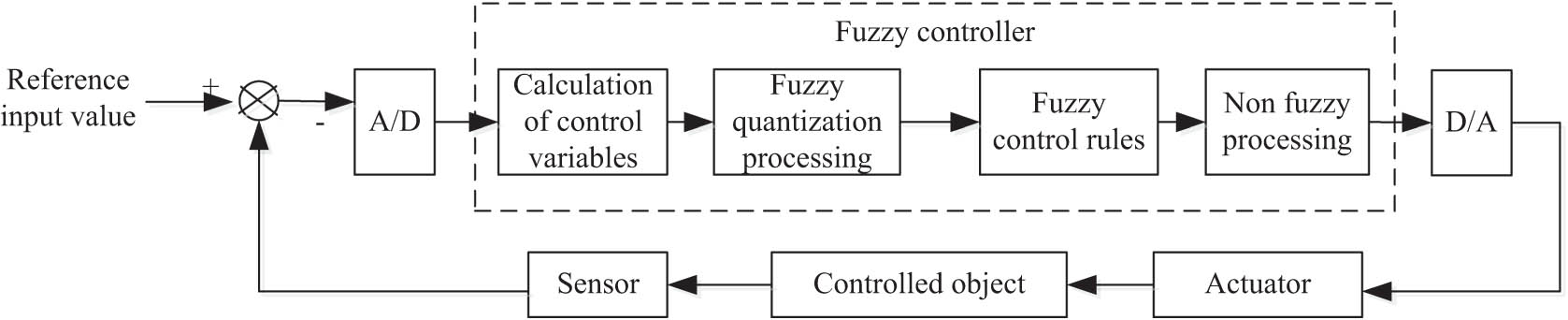
Block diagram of the fuzzy control system.
The fuzzy controller is mainly composed of three parts: input fuzzification, fuzzy inference, and output inverse fuzzification. The input to the fuzzy controller is an accurate quantity. It needs to be fuzzified before fuzzy inference can be carried out. The fuzzy quantity obtained after fuzzy inference is a fuzzy quantity. Similarly, it needs to be de-fuzzified to obtain an accurate quantity and to output [12,13].
The voltage regulation and power-saving control of asynchronous motors is a nonlinear control problem. If traditional control methods are used, the mathematical model of the system must be established first, and then, an ideal control model should be designed according to the nonlinear control theory and motor characteristics [14,15,16]. However, many factors affect the voltage regulation and power saving of asynchronous motors, which causes great inconvenience to the control [17]. The fuzzy control theory is based on the knowledge and experience of experts and does not require precise mathematical models of the controlled system. It is especially suitable for the control of complex systems with the strong coupling of variables, time-varying parameters, and nonlinear models. Therefore, the use of fuzzy control theory in this article can avoid the influence of various non-linear factors and realize the effective voltage regulation and power-saving control of asynchronous motors [18,19,20,21].
2.2 Principle of voltage regulation and energy saving of asynchronous motor
Figure 2 is the Γ equivalent circuit of an asynchronous motor, where U is the input voltage; I
1 is the stator current; R
1,
X
1 is the resistance and leakage reactance of the stator winding; R
m
, X
m
is the excitation resistance and leakage reactance;
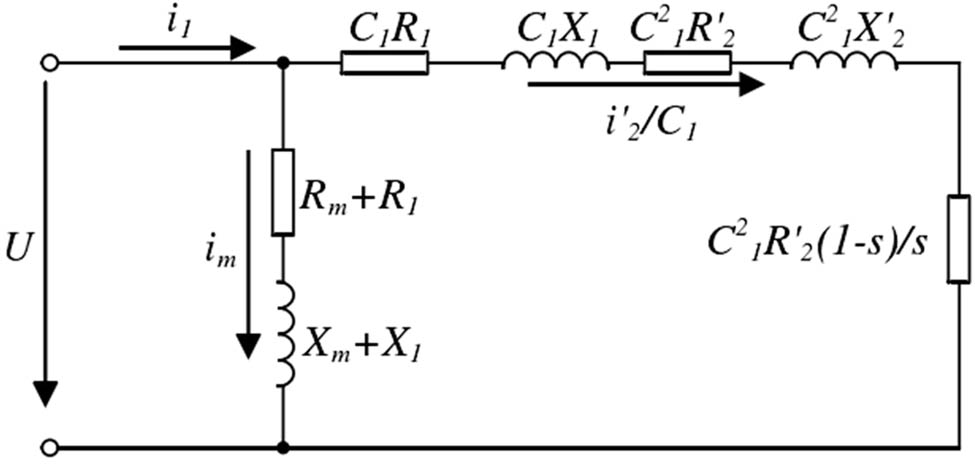
Γ-type equivalent circuit of the asynchronous motor.
According to Figure 2 of the equivalent circuit, when the input voltage of the asynchronous motor is constant, the active power on resistors R 1 and R m has nothing to do with the change of the load and is proportional to the square of the voltage. This loss is the constant part of the stator copper loss and iron loss, and its magnitude is as follows:
The active power on
where T e is the electromagnetic torque of the motor, and Ω1 is the synchronous mechanical angular velocity of the motor. According to formula (2), we can obtain:
Since the slip ratio s is very small, the polynomial containing s 2 in formula (4) can be ignored, and the formula for the slip ratio s can be obtained as follows:
The loss on resistance
Then, the total loss of the asynchronous motor is the sum of the loss on the resistance R
1, R
m
that is not related to the load change and the loss on the resistance C
1
R
1 and
When the load changes periodically, if the speed change is not large, the influence of the speed change can be ignored, and the electromagnetic torque T e of the motor and the load torque T L are always equal. Therefore, the total loss can be expressed as:
According to Eq. (8), if the parameters of the asynchronous motor are unchanged, the total loss is a function of load torque and input voltage, which is:
If you want to make the asynchronous motor under the corresponding load torque, by adjusting the input voltage to minimize the total loss of the motor, the total loss is derived from the input voltage:
The optimal voltage U′ can be found to be:
where g is the equivalent conductance of the constant loss branch, and the expression is as follows:
When the load torque is T L and the input voltage is U′, the total loss of the asynchronous motor is the smallest. At this time, the minimum value of the total loss is expressed as:
From the above analysis, it can be seen that if the load torque of the periodically changing load at any time is known, the optimal voltage value U′ corresponding to the load at this time can be obtained according to formula (13), so as to minimize the loss of the motor. This is the principle of voltage regulation and power saving of asynchronous motors.
2.3 Asynchronous motor voltage regulation and power-saving control
According to the principle of voltage regulation and power saving of asynchronous motor, this article uses fuzzy control theory to control the voltage and power saving of asynchronous motor. In order to ensure a good voltage regulation and power-saving effect of the asynchronous motor, the stator current I 1 and its change ΔI E of the asynchronous motor are selected as input variables in the design of the fuzzy control algorithm. The stator current I 1 of the asynchronous motor is [28]:
where P is the actual output current of the motor; P N is the rated output current of the motor.
The variation ΔI E of the stator current of the asynchronous motor is as follows:
The current variation deviation is selected as the output variable, and the output of the fuzzy controller is selected as Δα, which constitutes a two-dimensional fuzzy control algorithm model as shown in Figure 3.

Fuzzy control algorithm model of voltage regulation.
It can be seen from the fuzzy control algorithm model of voltage regulation, without loss of generality, the values of the membership function are positive (PB), positive (PM), positive (PS), zero (ZE), negative (NS), negative (NM), and negative (NB). The stator currents I 1, ΔI E , and Δα of the asynchronous motor are selected, which have 3, 5, and 7 subsets, respectively, and their membership functions are shown in Figure 4.
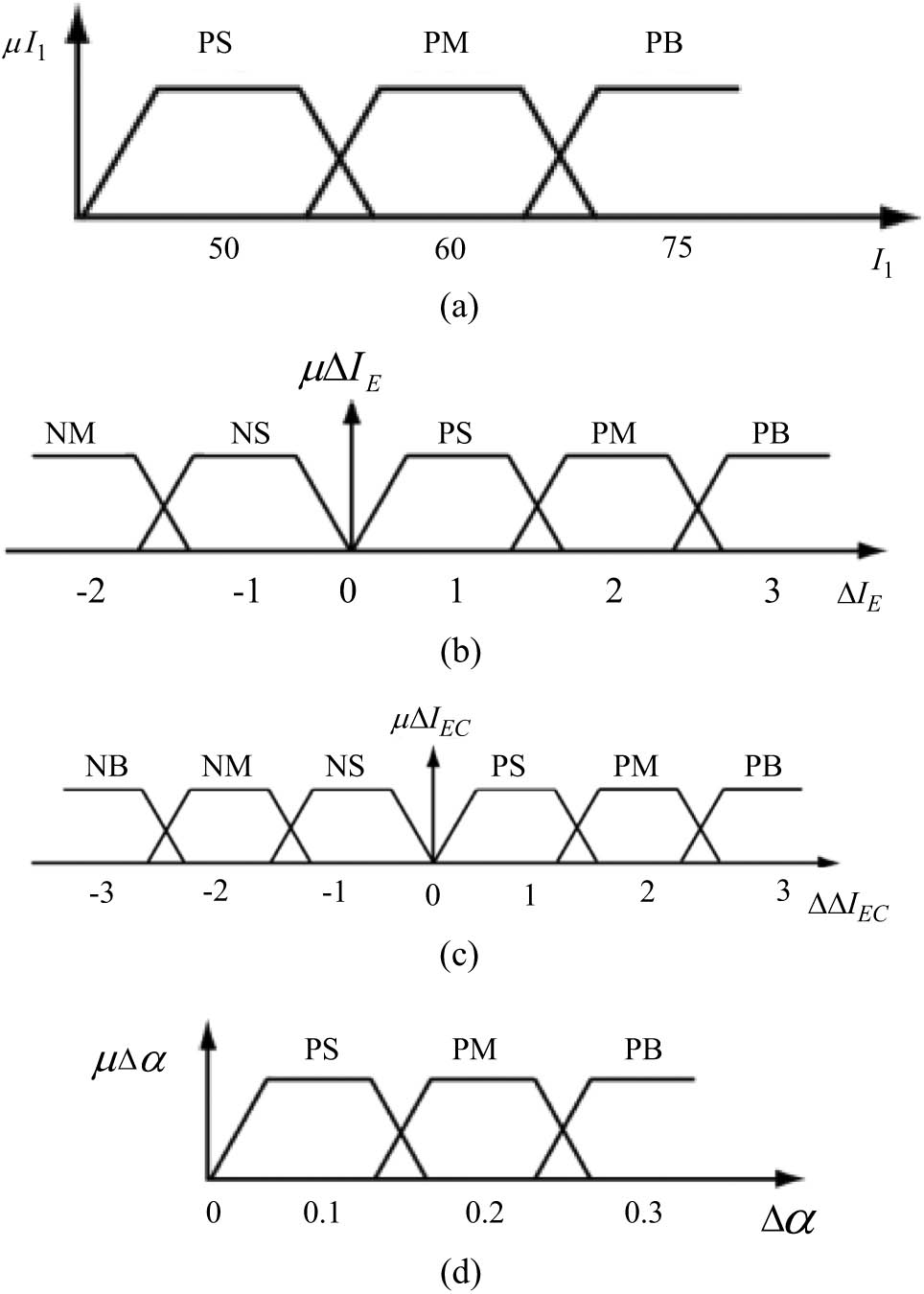
Membership function of fuzzy quantity: (a) the stator current membership function, (b) membership function of stator current variation, (c) membership function of stator current variation deviation, and (d) membership function of thyristor firing angle increment.
The current load status of the motor and whether it can run with power saving is determined by I 1. And Δα is determined by ΔI E and ΔI EC , and its membership function is shown in Figure 4(d). Through the relationship between the control quantity and the target quantity, the rule base of Δα can be determined, and the corresponding target quantity can be obtained accordingly, as shown in Table 1.
Fuzzy control rule of firing angle increment
| ΔI EC | ΔI E | |||||
|---|---|---|---|---|---|---|
| NM | NS | ZE | PS | PM | PB | |
| NB | PB | PB | PS | PS | PM | PB |
| NM | PB | PB | PS | PS | PM | PB |
| NS | PB | PB | PS | PS | PB | PB |
| ZE | PB | PB | PS | PS | PB | PB |
| PS | PB | PM | PS | PS | PB | PB |
| PM | PB | PM | PS | PS | PB | PB |
| PB | PB | PM | PS | PS | PB | PB |
According to motor I 1, judge whether the motor can enter the power-saving operation state. If so, adjust Δα according to Table 1. According to the closed-loop quantity, it can track the changes of the system in real time and make timely responses. Once the current change is detected from negative to positive, it means that the input current has reached the minimum value, and α will no longer change at this time, achieving the purpose of saving power [29].
To sum up, the flowchart of the induction motor voltage regulation and power-saving control algorithm is shown in Figure 5.

Flowchart of the induction motor voltage regulation and power-saving control algorithm.
3 Simulation experiment analysis
In order to verify the performance of the asynchronous motor voltage-saving and power-saving method proposed in this article based on fuzzy control theory, Matlab simulation software is used to simulate the voltage-saving and power-saving control device with a 0.75 kW small asynchronous motor.
Set the total simulation time to 20 s, set the load to the rated load (6,000 N m) at the beginning, and set the load to 20% of the rated load (1,200 N m) after the 2 s, respectively. The motor rotor circuit is short-circuited during the simulation. Under periodic load, compare the data before the motor power-saving control with the data after the power-saving control to observe the power-saving effect. The comparison of power-saving data is shown in Table 2.
Comparison of power-saving data
| A phase average current (A) | B phase average current (A) | C phase average current (A) | Average active power (kW) | Average reactive power (kVA) | Average apparent power (kVA) | |
|---|---|---|---|---|---|---|
| Before energy-saving control | 24.2132 | 24.0701 | 23.8661 | 4.3462 | 14.909 | 15.867 |
| After energy-saving control | 10.8311 | 10.5349 | 10.4132 | 3.9594 | 4.0029 | 6.4117 |
From the comparison data, it can be seen that after adopting voltage regulation and power-saving control on the motor, the average phase current is reduced by about 56.25%, the active power is reduced by about 8.9%, and the reactive power is reduced by about 73.15%. The power-saving effect is obvious and is shown in Figure 6.
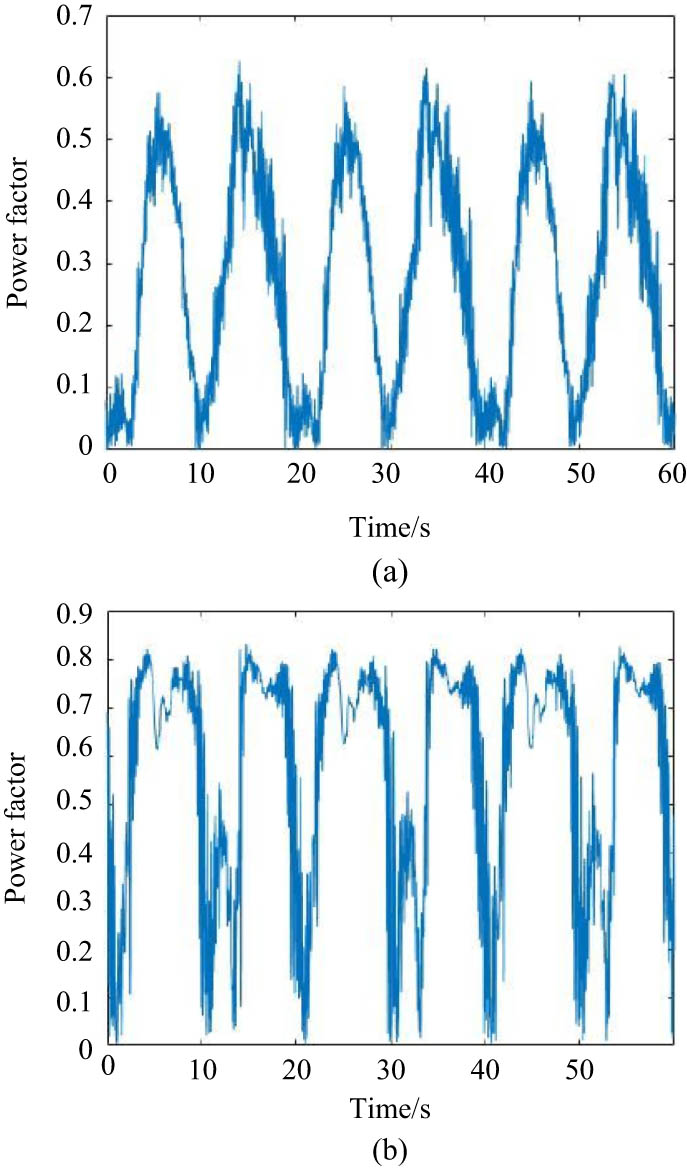
Motor power factor before and after power-saving control: (a) power factor of the motor under periodic load before power-saving control and (b) power factor of the motor under periodic load after power-saving control.
The experimental results show that through voltage regulation and power-saving control, the phase current of the motor can be significantly reduced, the active power and reactive power of the motor can be reduced, and the power factor of the motor can be improved. For the asynchronous motor under periodic load, adopting the voltage regulation and power-saving control method designed in this article will have great economic and social benefits. The method in this article adjusts the voltage of the asynchronous motor by establishing a two-dimensional fuzzy control algorithm model, and the control accuracy is high, so the phase current of the motor is low, and the power factor of the motor is improved.
In order to verify the reliability of the method, this article additionally selects 25% rated load (1,500 N m) and 15% rated load (900 N m) for simulation. When 15% load and 25% load are obtained, the asynchronous motor is in the voltage regulation, and the stator voltage waveform under power-saving control is shown in Figure 7.
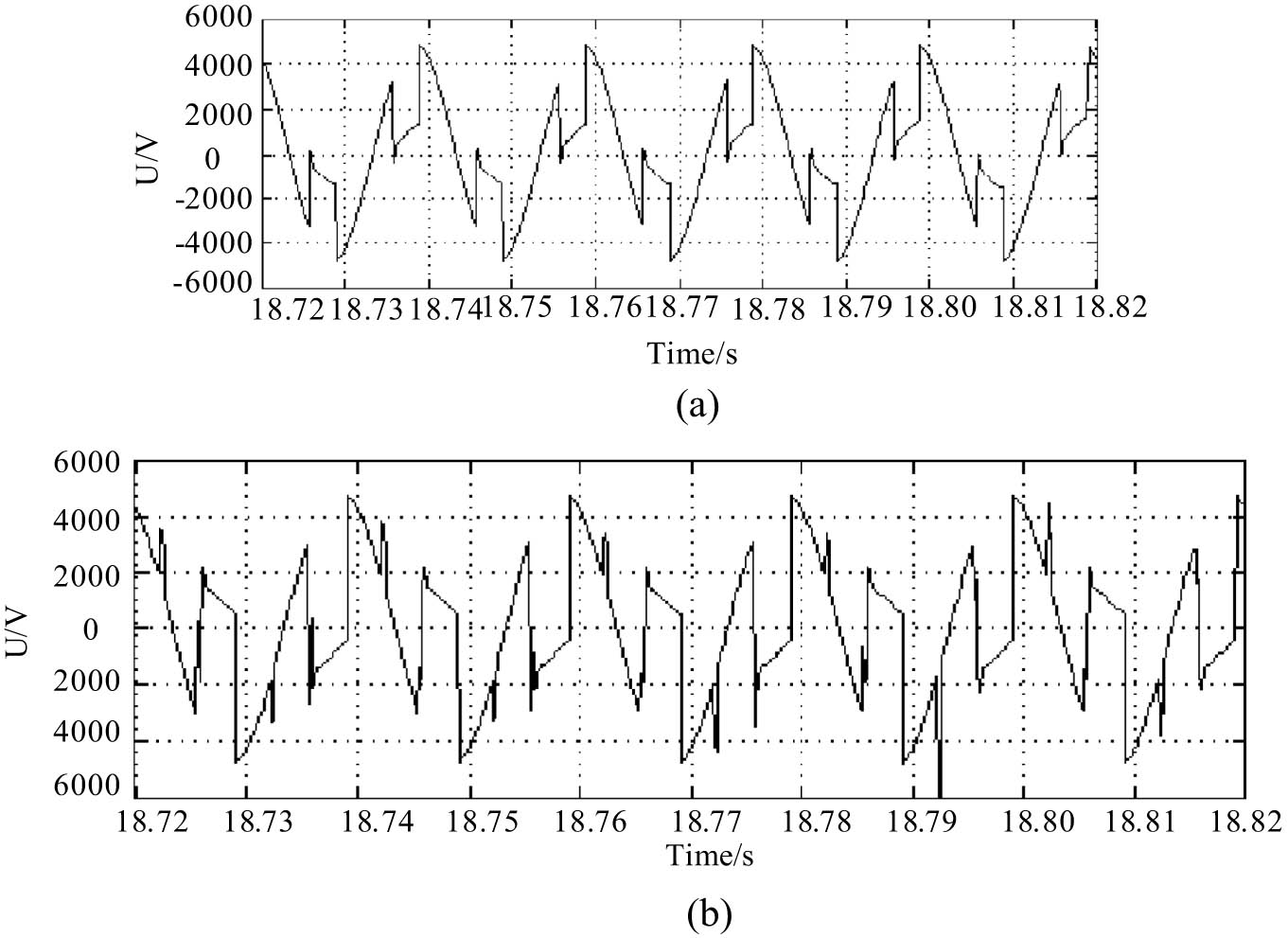
Stator voltage waveform: (a) stator voltage waveform at 25% motor load and (b) stator voltage waveform diagram at 15% motor load.
According to Figure 7, the stator voltage drops deeper at 15% load than at 25% load, indicating that the asynchronous motor has a general power-saving effect in voltage regulation and power-saving control. By selecting the stator current of the asynchronous motor and its variation as the input variable, and the deviation of the current variation as the output variable, a two-dimensional fuzzy control algorithm model is established for the voltage regulation and power saving of the asynchronous motor, and a better power-saving effect is achieved. In summary, the proposed method can reduce the iron loss of the motor, reduce the total loss, improve the efficiency of the motor, and realize the purpose of voltage regulation and power saving of the motor.
4 Conclusion
When the voltage of the motor drops to a certain level, if the voltage drops again, the current of the motor will increase again, so the copper consumption of the motor will increase and the efficiency will decrease. In addition, reducing the voltage too much will cause the electromagnetic torque of the motor to drop, resulting in the phenomenon of stalling without moving the load. Therefore, in order to achieve the best power-saving effect, the best voltage regulation coefficient must be selected according to the motor load factor (or load rate). The thyristor voltage regulation circuit is usually used to adjust the motor stator voltage, but because there is no accurate mathematical model to follow between the motor load factor and the thyristor conduction angle, it is difficult to obtain the best voltage regulation effect of the thyristor. Therefore, this article proposes a voltage regulation and power-saving method for asynchronous motors based on fuzzy control theory. The experimental results show that after voltage regulation and power-saving control, the phase current of the motor is reduced, and the active power and reactive power of the motor are reduced. The power factor of the motor is high, and the power-saving effect is remarkable.
-
Funding information: The authors state no funding is involved.
-
Author contributions: All authors have accepted responsibility for the entire content of this manuscript and approved its submission.
-
Conflict of interest: The authors state there is no conflict of interest.
-
Data availability statement: The datasets generated during and/or analyzed during the current study are available from the corresponding author on reasonable request.
References
[1] Abbasi H, Ghanbari M, Ebrahimi R, Jannati M. IRFOC of induction motor drives under open-phase fault using balanced and unbalanced transformation matrices. IEEE Trans Ind Electron. 2021;68(10):9160–73.10.1109/TIE.2020.3026278Suche in Google Scholar
[2] Wang Y, Eldeeb HH, Zhao H, Mohammed OA. Sectional variable frequency and voltage regulation control strategy for energy saving in beam pumping motor systems. IEEE Access. 2019;7(99):92456–64.10.1109/ACCESS.2019.2927525Suche in Google Scholar
[3] Faranda R, Hafezi H. Reassessment of voltage variation for load power and energy demand management. Int J Elect Power Energ Syst. 2019;106(3):320–6.10.1016/j.ijepes.2018.10.012Suche in Google Scholar
[4] Peng F. Discussion on variable pole speed regulation and application of three-phase asynchronous motor. Enterpr Technol Develop (Acad Ed). 2019;38(1):50–2.Suche in Google Scholar
[5] Elkholy MM, Abd-Elkader F. Optimal energy saving of doubly fed induction motor based on scalar rotor voltage control and water cycle algorithm. COMPEL. 2019;38(2):793–814.10.1108/COMPEL-05-2018-0225Suche in Google Scholar
[6] Wang YL, Xu GR, Cao YY, Wang M, Xu YM, Zhao HS. Energy saving control method combing dynamic balance adjustment and voltage regulation for motor systems with cyclic and potential load conditions. Proceedings of the CSEE, 2020;655(20):348–356.Suche in Google Scholar
[7] You S, Wang H, Bi S, Zhou J, Qin L, Qiu X, et al. Energy saving technology of asynchronous motor based on LADRC. J Power Syst Autom. 2018;30(2):43–8.Suche in Google Scholar
[8] Novozhilov AN, Isupova NA, Novozhilov TA. Calculation of inductive resistances of asynchronous motor windings at rotor eccentricity. Russ Elect Eng. 2020;91(5):326–9.10.3103/S1068371220050089Suche in Google Scholar
[9] Ryumin EV, Enikeeva ER. Modeling the dynamic characteristics of a high voltage asynchronous electric motor. IOP Conf Series Mater Sci Eng. 2020;734(1):5, 012176.10.1088/1757-899X/734/1/012176Suche in Google Scholar
[10] Hu Y, Luo A, Wang J, Wang F. Voltage regulation and power management for wireless flow sensor node self-powered by energy harvester with enhanced reliability. IEEE Access. 2019;7:154836–43.10.1109/ACCESS.2019.2948973Suche in Google Scholar
[11] Zheng JY. Water system regulation and water system energy saving control in HVAC. Constr Technol Dev. 2019;46(3):149–50.Suche in Google Scholar
[12] Hsu YC, Lin JY, Chen C. Area-saving and high-efficiency RGB LED driver with adaptive driving voltage and energy-saving technique. Energy. 2018;11(6):1422–30.10.3390/en11061422Suche in Google Scholar
[13] Marmouh S, Boutoubat M. Performance and power quality improvement based on DC-bus voltage regulation of a stand-alone hybrid energy system. Elect Power Syst Res. 2018;163:73–84.10.1016/j.epsr.2018.06.004Suche in Google Scholar
[14] Lanbaran NM, Celik E, Yiider M. Evaluation of investment opportunities with interval-valued fuzzy topsis method. Appl Math Nonlinear Sci. 2020;5:461–74.10.2478/amns.2020.1.00044Suche in Google Scholar
[15] Aahin R, Yacl O. Fractional calculus of the extended hypergeometric function. Appl Math Nonlinear Sci. 2020;5:369–84.10.2478/amns.2020.1.00035Suche in Google Scholar
[16] Simos TE, Tsitouras C. Explicit, ninth order, two step methods for solving inhomogeneous linear problems X”(T) = Lambda X(T) Plus F(T). Appl Numer Math. 2020;153:344–51.10.1016/j.apnum.2020.03.003Suche in Google Scholar
[17] Wang YY, Chen JZ, Hou XL. Analysis of new energy-saving technologies for high and low voltage distribution networks in enterprises. Appl Integr Circ. 2019;36(5):75–6.Suche in Google Scholar
[18] Medvedeva MA, Simos TE, Tsitouras C. Sixth-order, p-stable, numerov-type methods for use at moderate accuracies. Math Methods Appl Sci. 2021;44:6923–30.10.1002/mma.7233Suche in Google Scholar
[19] Yang C, Gao F, Dong M. Energy efficiency modeling of integrated energy system in coastal areas. J Coast Res. 2020;103:995.10.2112/SI103-207.1Suche in Google Scholar
[20] Zuo X, Dong M, Gao F, Tian S. The modeling of the electric heating and cooling system of the integrated energy system in the coastal area. J Coast Res. 2020;103:1022.10.2112/SI103-213.1Suche in Google Scholar
[21] Liu S, Liu C, Huang Y, Xiao Y. Direct modulation pattern control for dual three-phase PMSM drive system. IEEE Trans Ind Electr (1982). 2022;69(1):110–20.10.1109/TIE.2021.3053880Suche in Google Scholar
[22] Pu YL, Yu J, Lu L. Energy-efficient strategy for work node by DRAM voltage regulation in storm. J Commun. 2018;39(10):97–117.Suche in Google Scholar
[23] Merhy G, Nait-Sidi-Moh A, Moubayed N. Control, regulation and optimization of bidirectional energy flows for electric vehicles’ charging and discharging. Sustain Cities Soc. 2020;57:102129.10.1016/j.scs.2020.102129Suche in Google Scholar
[24] Salleh SF, Roslan ME, Mohd Isa A, Basri Nair MF, Salleh SS. The impact of minimum energy performance standards (MEPS) regulation on electricity saving in Malaysia. IOP Conf Series Mater Sci Eng. 2018;341:012022–5.10.1088/1757-899X/341/1/012022Suche in Google Scholar
[25] van Hamersvelt RW, Eijsvoogel NG, Mihl C, de Jong PA, Schilham A, Buls N, et al. Contrast agent concentration optimization in CTA using low tube voltage and dual-energy CT in multiple vendors: a phantom study. Int J Cardiovasc Imag. 2018;34(8):1–11.10.1007/s10554-018-1329-xSuche in Google Scholar PubMed
[26] Volkov VA. Energy-saving tachograms of acceleration (deceleration) of a frequency-regulated asynchronous engine. Nauk Visnyk Natsionalnoho Hirnychoho Universytetu. 2019;4:84–92.10.29202/nvngu/2019-4/11Suche in Google Scholar
[27] Xu E, Wang S, Liu X, Huang J. Research on permanent magnet synchronous motor drive system of electric vehicle based on fuzzy control. IOP Conf Series Earth Environ Sci. 2019;267(4):42031.10.1088/1755-1315/267/4/042031Suche in Google Scholar
[28] Elsherif F, Chong E, Kim JH. Energy-efficient base station control framework for 5g cellular networks based on Markov decision process. IEEE Trans Veh Technol. 2019;68(9):9267–79.10.1109/TVT.2019.2931304Suche in Google Scholar
[29] Zhou H, Xu C, Lu C, Jiang X, Zhang Z, Wang J, et al. Investigation of transient magnetoelectric response of magnetostrictive/piezoelectric composite applicable for lightning current sensing. Sensors Actuators A Phys. 2021;329:112789.10.1016/j.sna.2021.112789Suche in Google Scholar
© 2022 Chunjing Guo, published by De Gruyter
This work is licensed under the Creative Commons Attribution 4.0 International License.
Artikel in diesem Heft
- Regular Articles
- Test influence of screen thickness on double-N six-light-screen sky screen target
- Analysis on the speed properties of the shock wave in light curtain
- Abundant accurate analytical and semi-analytical solutions of the positive Gardner–Kadomtsev–Petviashvili equation
- Measured distribution of cloud chamber tracks from radioactive decay: A new empirical approach to investigating the quantum measurement problem
- Nuclear radiation detection based on the convolutional neural network under public surveillance scenarios
- Effect of process parameters on density and mechanical behaviour of a selective laser melted 17-4PH stainless steel alloy
- Performance evaluation of self-mixing interferometer with the ceramic type piezoelectric accelerometers
- Effect of geometry error on the non-Newtonian flow in the ceramic microchannel molded by SLA
- Numerical investigation of ozone decomposition by self-excited oscillation cavitation jet
- Modeling electrostatic potential in FDSOI MOSFETS: An approach based on homotopy perturbations
- Modeling analysis of microenvironment of 3D cell mechanics based on machine vision
- Numerical solution for two-dimensional partial differential equations using SM’s method
- Multiple velocity composition in the standard synchronization
- Electroosmotic flow for Eyring fluid with Navier slip boundary condition under high zeta potential in a parallel microchannel
- Soliton solutions of Calogero–Degasperis–Fokas dynamical equation via modified mathematical methods
- Performance evaluation of a high-performance offshore cementing wastes accelerating agent
- Sapphire irradiation by phosphorus as an approach to improve its optical properties
- A physical model for calculating cementing quality based on the XGboost algorithm
- Experimental investigation and numerical analysis of stress concentration distribution at the typical slots for stiffeners
- An analytical model for solute transport from blood to tissue
- Finite-size effects in one-dimensional Bose–Einstein condensation of photons
- Drying kinetics of Pleurotus eryngii slices during hot air drying
- Computer-aided measurement technology for Cu2ZnSnS4 thin-film solar cell characteristics
- QCD phase diagram in a finite volume in the PNJL model
- Study on abundant analytical solutions of the new coupled Konno–Oono equation in the magnetic field
- Experimental analysis of a laser beam propagating in angular turbulence
- Numerical investigation of heat transfer in the nanofluids under the impact of length and radius of carbon nanotubes
- Multiple rogue wave solutions of a generalized (3+1)-dimensional variable-coefficient Kadomtsev--Petviashvili equation
- Optical properties and thermal stability of the H+-implanted Dy3+/Tm3+-codoped GeS2–Ga2S3–PbI2 chalcohalide glass waveguide
- Nonlinear dynamics for different nonautonomous wave structure solutions
- Numerical analysis of bioconvection-MHD flow of Williamson nanofluid with gyrotactic microbes and thermal radiation: New iterative method
- Modeling extreme value data with an upside down bathtub-shaped failure rate model
- Abundant optical soliton structures to the Fokas system arising in monomode optical fibers
- Analysis of the partially ionized kerosene oil-based ternary nanofluid flow over a convectively heated rotating surface
- Multiple-scale analysis of the parametric-driven sine-Gordon equation with phase shifts
- Magnetofluid unsteady electroosmotic flow of Jeffrey fluid at high zeta potential in parallel microchannels
- Effect of plasma-activated water on microbial quality and physicochemical properties of fresh beef
- The finite element modeling of the impacting process of hard particles on pump components
- Analysis of respiratory mechanics models with different kernels
- Extended warranty decision model of failure dependence wind turbine system based on cost-effectiveness analysis
- Breather wave and double-periodic soliton solutions for a (2+1)-dimensional generalized Hirota–Satsuma–Ito equation
- First-principle calculation of electronic structure and optical properties of (P, Ga, P–Ga) doped graphene
- Numerical simulation of nanofluid flow between two parallel disks using 3-stage Lobatto III-A formula
- Optimization method for detection a flying bullet
- Angle error control model of laser profilometer contact measurement
- Numerical study on flue gas–liquid flow with side-entering mixing
- Travelling waves solutions of the KP equation in weakly dispersive media
- Characterization of damage morphology of structural SiO2 film induced by nanosecond pulsed laser
- A study of generalized hypergeometric Matrix functions via two-parameter Mittag–Leffler matrix function
- Study of the length and influencing factors of air plasma ignition time
- Analysis of parametric effects in the wave profile of the variant Boussinesq equation through two analytical approaches
- The nonlinear vibration and dispersive wave systems with extended homoclinic breather wave solutions
- Generalized notion of integral inequalities of variables
- The seasonal variation in the polarization (Ex/Ey) of the characteristic wave in ionosphere plasma
- Impact of COVID 19 on the demand for an inventory model under preservation technology and advance payment facility
- Approximate solution of linear integral equations by Taylor ordering method: Applied mathematical approach
- Exploring the new optical solitons to the time-fractional integrable generalized (2+1)-dimensional nonlinear Schrödinger system via three different methods
- Irreversibility analysis in time-dependent Darcy–Forchheimer flow of viscous fluid with diffusion-thermo and thermo-diffusion effects
- Double diffusion in a combined cavity occupied by a nanofluid and heterogeneous porous media
- NTIM solution of the fractional order parabolic partial differential equations
- Jointly Rayleigh lifetime products in the presence of competing risks model
- Abundant exact solutions of higher-order dispersion variable coefficient KdV equation
- Laser cutting tobacco slice experiment: Effects of cutting power and cutting speed
- Performance evaluation of common-aperture visible and long-wave infrared imaging system based on a comprehensive resolution
- Diesel engine small-sample transfer learning fault diagnosis algorithm based on STFT time–frequency image and hyperparameter autonomous optimization deep convolutional network improved by PSO–GWO–BPNN surrogate model
- Analyses of electrokinetic energy conversion for periodic electromagnetohydrodynamic (EMHD) nanofluid through the rectangular microchannel under the Hall effects
- Propagation properties of cosh-Airy beams in an inhomogeneous medium with Gaussian PT-symmetric potentials
- Dynamics investigation on a Kadomtsev–Petviashvili equation with variable coefficients
- Study on fine characterization and reconstruction modeling of porous media based on spatially-resolved nuclear magnetic resonance technology
- Optimal block replacement policy for two-dimensional products considering imperfect maintenance with improved Salp swarm algorithm
- A hybrid forecasting model based on the group method of data handling and wavelet decomposition for monthly rivers streamflow data sets
- Hybrid pencil beam model based on photon characteristic line algorithm for lung radiotherapy in small fields
- Surface waves on a coated incompressible elastic half-space
- Radiation dose measurement on bone scintigraphy and planning clinical management
- Lie symmetry analysis for generalized short pulse equation
- Spectroscopic characteristics and dissociation of nitrogen trifluoride under external electric fields: Theoretical study
- Cross electromagnetic nanofluid flow examination with infinite shear rate viscosity and melting heat through Skan-Falkner wedge
- Convection heat–mass transfer of generalized Maxwell fluid with radiation effect, exponential heating, and chemical reaction using fractional Caputo–Fabrizio derivatives
- Weak nonlinear analysis of nanofluid convection with g-jitter using the Ginzburg--Landau model
- Strip waveguides in Yb3+-doped silicate glass formed by combination of He+ ion implantation and precise ultrashort pulse laser ablation
- Best selected forecasting models for COVID-19 pandemic
- Research on attenuation motion test at oblique incidence based on double-N six-light-screen system
- Review Articles
- Progress in epitaxial growth of stanene
- Review and validation of photovoltaic solar simulation tools/software based on case study
- Brief Report
- The Debye–Scherrer technique – rapid detection for applications
- Rapid Communication
- Radial oscillations of an electron in a Coulomb attracting field
- Special Issue on Novel Numerical and Analytical Techniques for Fractional Nonlinear Schrodinger Type - Part II
- The exact solutions of the stochastic fractional-space Allen–Cahn equation
- Propagation of some new traveling wave patterns of the double dispersive equation
- A new modified technique to study the dynamics of fractional hyperbolic-telegraph equations
- An orthotropic thermo-viscoelastic infinite medium with a cylindrical cavity of temperature dependent properties via MGT thermoelasticity
- Modeling of hepatitis B epidemic model with fractional operator
- Special Issue on Transport phenomena and thermal analysis in micro/nano-scale structure surfaces - Part III
- Investigation of effective thermal conductivity of SiC foam ceramics with various pore densities
- Nonlocal magneto-thermoelastic infinite half-space due to a periodically varying heat flow under Caputo–Fabrizio fractional derivative heat equation
- The flow and heat transfer characteristics of DPF porous media with different structures based on LBM
- Homotopy analysis method with application to thin-film flow of couple stress fluid through a vertical cylinder
- Special Issue on Advanced Topics on the Modelling and Assessment of Complicated Physical Phenomena - Part II
- Asymptotic analysis of hepatitis B epidemic model using Caputo Fabrizio fractional operator
- Influence of chemical reaction on MHD Newtonian fluid flow on vertical plate in porous medium in conjunction with thermal radiation
- Structure of analytical ion-acoustic solitary wave solutions for the dynamical system of nonlinear wave propagation
- Evaluation of ESBL resistance dynamics in Escherichia coli isolates by mathematical modeling
- On theoretical analysis of nonlinear fractional order partial Benney equations under nonsingular kernel
- The solutions of nonlinear fractional partial differential equations by using a novel technique
- Modelling and graphing the Wi-Fi wave field using the shape function
- Generalized invexity and duality in multiobjective variational problems involving non-singular fractional derivative
- Impact of the convergent geometric profile on boundary layer separation in the supersonic over-expanded nozzle
- Variable stepsize construction of a two-step optimized hybrid block method with relative stability
- Thermal transport with nanoparticles of fractional Oldroyd-B fluid under the effects of magnetic field, radiations, and viscous dissipation: Entropy generation; via finite difference method
- Special Issue on Advanced Energy Materials - Part I
- Voltage regulation and power-saving method of asynchronous motor based on fuzzy control theory
- The structure design of mobile charging piles
- Analysis and modeling of pitaya slices in a heat pump drying system
- Design of pulse laser high-precision ranging algorithm under low signal-to-noise ratio
- Special Issue on Geological Modeling and Geospatial Data Analysis
- Determination of luminescent characteristics of organometallic complex in land and coal mining
- InSAR terrain mapping error sources based on satellite interferometry
Artikel in diesem Heft
- Regular Articles
- Test influence of screen thickness on double-N six-light-screen sky screen target
- Analysis on the speed properties of the shock wave in light curtain
- Abundant accurate analytical and semi-analytical solutions of the positive Gardner–Kadomtsev–Petviashvili equation
- Measured distribution of cloud chamber tracks from radioactive decay: A new empirical approach to investigating the quantum measurement problem
- Nuclear radiation detection based on the convolutional neural network under public surveillance scenarios
- Effect of process parameters on density and mechanical behaviour of a selective laser melted 17-4PH stainless steel alloy
- Performance evaluation of self-mixing interferometer with the ceramic type piezoelectric accelerometers
- Effect of geometry error on the non-Newtonian flow in the ceramic microchannel molded by SLA
- Numerical investigation of ozone decomposition by self-excited oscillation cavitation jet
- Modeling electrostatic potential in FDSOI MOSFETS: An approach based on homotopy perturbations
- Modeling analysis of microenvironment of 3D cell mechanics based on machine vision
- Numerical solution for two-dimensional partial differential equations using SM’s method
- Multiple velocity composition in the standard synchronization
- Electroosmotic flow for Eyring fluid with Navier slip boundary condition under high zeta potential in a parallel microchannel
- Soliton solutions of Calogero–Degasperis–Fokas dynamical equation via modified mathematical methods
- Performance evaluation of a high-performance offshore cementing wastes accelerating agent
- Sapphire irradiation by phosphorus as an approach to improve its optical properties
- A physical model for calculating cementing quality based on the XGboost algorithm
- Experimental investigation and numerical analysis of stress concentration distribution at the typical slots for stiffeners
- An analytical model for solute transport from blood to tissue
- Finite-size effects in one-dimensional Bose–Einstein condensation of photons
- Drying kinetics of Pleurotus eryngii slices during hot air drying
- Computer-aided measurement technology for Cu2ZnSnS4 thin-film solar cell characteristics
- QCD phase diagram in a finite volume in the PNJL model
- Study on abundant analytical solutions of the new coupled Konno–Oono equation in the magnetic field
- Experimental analysis of a laser beam propagating in angular turbulence
- Numerical investigation of heat transfer in the nanofluids under the impact of length and radius of carbon nanotubes
- Multiple rogue wave solutions of a generalized (3+1)-dimensional variable-coefficient Kadomtsev--Petviashvili equation
- Optical properties and thermal stability of the H+-implanted Dy3+/Tm3+-codoped GeS2–Ga2S3–PbI2 chalcohalide glass waveguide
- Nonlinear dynamics for different nonautonomous wave structure solutions
- Numerical analysis of bioconvection-MHD flow of Williamson nanofluid with gyrotactic microbes and thermal radiation: New iterative method
- Modeling extreme value data with an upside down bathtub-shaped failure rate model
- Abundant optical soliton structures to the Fokas system arising in monomode optical fibers
- Analysis of the partially ionized kerosene oil-based ternary nanofluid flow over a convectively heated rotating surface
- Multiple-scale analysis of the parametric-driven sine-Gordon equation with phase shifts
- Magnetofluid unsteady electroosmotic flow of Jeffrey fluid at high zeta potential in parallel microchannels
- Effect of plasma-activated water on microbial quality and physicochemical properties of fresh beef
- The finite element modeling of the impacting process of hard particles on pump components
- Analysis of respiratory mechanics models with different kernels
- Extended warranty decision model of failure dependence wind turbine system based on cost-effectiveness analysis
- Breather wave and double-periodic soliton solutions for a (2+1)-dimensional generalized Hirota–Satsuma–Ito equation
- First-principle calculation of electronic structure and optical properties of (P, Ga, P–Ga) doped graphene
- Numerical simulation of nanofluid flow between two parallel disks using 3-stage Lobatto III-A formula
- Optimization method for detection a flying bullet
- Angle error control model of laser profilometer contact measurement
- Numerical study on flue gas–liquid flow with side-entering mixing
- Travelling waves solutions of the KP equation in weakly dispersive media
- Characterization of damage morphology of structural SiO2 film induced by nanosecond pulsed laser
- A study of generalized hypergeometric Matrix functions via two-parameter Mittag–Leffler matrix function
- Study of the length and influencing factors of air plasma ignition time
- Analysis of parametric effects in the wave profile of the variant Boussinesq equation through two analytical approaches
- The nonlinear vibration and dispersive wave systems with extended homoclinic breather wave solutions
- Generalized notion of integral inequalities of variables
- The seasonal variation in the polarization (Ex/Ey) of the characteristic wave in ionosphere plasma
- Impact of COVID 19 on the demand for an inventory model under preservation technology and advance payment facility
- Approximate solution of linear integral equations by Taylor ordering method: Applied mathematical approach
- Exploring the new optical solitons to the time-fractional integrable generalized (2+1)-dimensional nonlinear Schrödinger system via three different methods
- Irreversibility analysis in time-dependent Darcy–Forchheimer flow of viscous fluid with diffusion-thermo and thermo-diffusion effects
- Double diffusion in a combined cavity occupied by a nanofluid and heterogeneous porous media
- NTIM solution of the fractional order parabolic partial differential equations
- Jointly Rayleigh lifetime products in the presence of competing risks model
- Abundant exact solutions of higher-order dispersion variable coefficient KdV equation
- Laser cutting tobacco slice experiment: Effects of cutting power and cutting speed
- Performance evaluation of common-aperture visible and long-wave infrared imaging system based on a comprehensive resolution
- Diesel engine small-sample transfer learning fault diagnosis algorithm based on STFT time–frequency image and hyperparameter autonomous optimization deep convolutional network improved by PSO–GWO–BPNN surrogate model
- Analyses of electrokinetic energy conversion for periodic electromagnetohydrodynamic (EMHD) nanofluid through the rectangular microchannel under the Hall effects
- Propagation properties of cosh-Airy beams in an inhomogeneous medium with Gaussian PT-symmetric potentials
- Dynamics investigation on a Kadomtsev–Petviashvili equation with variable coefficients
- Study on fine characterization and reconstruction modeling of porous media based on spatially-resolved nuclear magnetic resonance technology
- Optimal block replacement policy for two-dimensional products considering imperfect maintenance with improved Salp swarm algorithm
- A hybrid forecasting model based on the group method of data handling and wavelet decomposition for monthly rivers streamflow data sets
- Hybrid pencil beam model based on photon characteristic line algorithm for lung radiotherapy in small fields
- Surface waves on a coated incompressible elastic half-space
- Radiation dose measurement on bone scintigraphy and planning clinical management
- Lie symmetry analysis for generalized short pulse equation
- Spectroscopic characteristics and dissociation of nitrogen trifluoride under external electric fields: Theoretical study
- Cross electromagnetic nanofluid flow examination with infinite shear rate viscosity and melting heat through Skan-Falkner wedge
- Convection heat–mass transfer of generalized Maxwell fluid with radiation effect, exponential heating, and chemical reaction using fractional Caputo–Fabrizio derivatives
- Weak nonlinear analysis of nanofluid convection with g-jitter using the Ginzburg--Landau model
- Strip waveguides in Yb3+-doped silicate glass formed by combination of He+ ion implantation and precise ultrashort pulse laser ablation
- Best selected forecasting models for COVID-19 pandemic
- Research on attenuation motion test at oblique incidence based on double-N six-light-screen system
- Review Articles
- Progress in epitaxial growth of stanene
- Review and validation of photovoltaic solar simulation tools/software based on case study
- Brief Report
- The Debye–Scherrer technique – rapid detection for applications
- Rapid Communication
- Radial oscillations of an electron in a Coulomb attracting field
- Special Issue on Novel Numerical and Analytical Techniques for Fractional Nonlinear Schrodinger Type - Part II
- The exact solutions of the stochastic fractional-space Allen–Cahn equation
- Propagation of some new traveling wave patterns of the double dispersive equation
- A new modified technique to study the dynamics of fractional hyperbolic-telegraph equations
- An orthotropic thermo-viscoelastic infinite medium with a cylindrical cavity of temperature dependent properties via MGT thermoelasticity
- Modeling of hepatitis B epidemic model with fractional operator
- Special Issue on Transport phenomena and thermal analysis in micro/nano-scale structure surfaces - Part III
- Investigation of effective thermal conductivity of SiC foam ceramics with various pore densities
- Nonlocal magneto-thermoelastic infinite half-space due to a periodically varying heat flow under Caputo–Fabrizio fractional derivative heat equation
- The flow and heat transfer characteristics of DPF porous media with different structures based on LBM
- Homotopy analysis method with application to thin-film flow of couple stress fluid through a vertical cylinder
- Special Issue on Advanced Topics on the Modelling and Assessment of Complicated Physical Phenomena - Part II
- Asymptotic analysis of hepatitis B epidemic model using Caputo Fabrizio fractional operator
- Influence of chemical reaction on MHD Newtonian fluid flow on vertical plate in porous medium in conjunction with thermal radiation
- Structure of analytical ion-acoustic solitary wave solutions for the dynamical system of nonlinear wave propagation
- Evaluation of ESBL resistance dynamics in Escherichia coli isolates by mathematical modeling
- On theoretical analysis of nonlinear fractional order partial Benney equations under nonsingular kernel
- The solutions of nonlinear fractional partial differential equations by using a novel technique
- Modelling and graphing the Wi-Fi wave field using the shape function
- Generalized invexity and duality in multiobjective variational problems involving non-singular fractional derivative
- Impact of the convergent geometric profile on boundary layer separation in the supersonic over-expanded nozzle
- Variable stepsize construction of a two-step optimized hybrid block method with relative stability
- Thermal transport with nanoparticles of fractional Oldroyd-B fluid under the effects of magnetic field, radiations, and viscous dissipation: Entropy generation; via finite difference method
- Special Issue on Advanced Energy Materials - Part I
- Voltage regulation and power-saving method of asynchronous motor based on fuzzy control theory
- The structure design of mobile charging piles
- Analysis and modeling of pitaya slices in a heat pump drying system
- Design of pulse laser high-precision ranging algorithm under low signal-to-noise ratio
- Special Issue on Geological Modeling and Geospatial Data Analysis
- Determination of luminescent characteristics of organometallic complex in land and coal mining
- InSAR terrain mapping error sources based on satellite interferometry
