Irreversibility analysis in time-dependent Darcy–Forchheimer flow of viscous fluid with diffusion-thermo and thermo-diffusion effects
-
 ,
,

Abstract
In this article, we analyze the entropy analysis in unsteady hydromagnetic flow of a viscous fluid over a stretching surface. The energy attribute is scrutinized through dissipation, heat source/sink, and radiation. Furthermore, diffusion-thermo and thermo-diffusion behaviors are analyzed. The physical description of the entropy rate is discussed through the second law of thermodynamics. Additionally, a binary chemical reaction is considered. Partial differential equations are transformed into ordinary ones by adequate variables. Here, we used an optimal homotopy analysis method (OHAM) to develop a convergent solution. The influence of flow variables on velocity, Bejan number, thermal field, concentration, and entropy rate is examined through graphs. The physical performance of drag force, Sherwood number, and temperature gradient versus influential variables is studied. A similar effect holds for velocity through variation of porosity and magnetic variables. An increment in thermal field and entropy rate is noted through radiation. A reverse trend holds for the Bejan number and thermal field through a magnetic variable. An augmentation in the Soret number enhances the concentration. An amplification in drag force is noted through the Forchheimer number. Higher estimation of radiation corresponds to a rise in the heat transfer rate.
Nomenclature
- ρ
-
density
- μ
-
dynamic viscosity
- σ
-
electrical conductivity
- ν
-
kinematic viscosity
- λ
-
porosity variable
- γ
-
reaction variable
- α 1
-
temperature difference variable
- α 2
-
concentration difference variable
- τ w
-
shear stress
- A
-
unsteady variable
- Be
-
Bejan number
- Br
-
Brinkman number
- C
-
concentration
- C ∞
-
ambient concentration
- C b
-
drag force
- C fx
-
drag force
- C s
-
concentration susceptibility
- C w
-
wall concentration
- Du
-
Dufour number
- Ec
-
Eckert number
- F
-
inertia coefficient
- Fr
-
Forchheimer number
- g
-
gravitational acceleration
- j w
-
mass flux
- K
-
porous medium permeability
- k r
-
reaction rate
- K T
-
thermal diffusion ratio
- L
-
diffusion variable
- k*
-
mean absorption coefficient
- N G
-
entropy rate
- Nu x
-
Nusselt number
- Pr
-
Prandtl number
- q w
-
heat flux
- Rd
-
radiation variable
- Sc
-
Schmidt number
- Sh x
-
Sherwood number
- Sr
-
Soret number
- σ*
-
Stephan–Boltzman constant
- T
-
temperature
- T ∞
-
ambient temperature
- T m
-
mean fluid temperature
- T w
-
wall temperature
- u, v
-
velocity components
- x, y
-
Cartesian coordinates
1 Introduction
The Dufour effect (thermo-diffusion) is the mechanism in which heat transfer occurs under a concentration gradient (mass). In contrast, the Soret effect (diffusion-thermo) is the process in which solutal transfer occurs under a temperature gradient. Thermo-diffusion and diffusion-thermo play a substantial role when there is high density difference in the liquid flow region. These effects are effective in combined solutal and thermal transport in the binary system for transitional nuclear weight gases. Consequently, in the modern area, various engineers, scientists, and researchers have concentrated their attention on Dufour (thermo-diffusion) and Soret (diffusion-thermo) effect problems because of their widespread applications in different fields such as nuclear waste repositories, drag reduction, energy storage units, heat insulation, plasma actuators, catalytic reactors, geothermal systems, energy systems, drying technology, and many others. The heat transfer effect in hydromagnetic non-Darcian convective flow of a viscous liquid subjected to a porous medium with thermo-diffusion and diffusion-thermo effects was discussed by Mahdy [1]. The unsteady hydromagnetic flow of viscous liquid with Soret and Dufour effects toward a stretchable surface was discussed by Raveendra et al. [2]. Khan et al. [3] conducted the entropy analysis of viscous liquid flow with Dufour and Soret effects over a rotating cone. Reddy and Chamkha [4] studied the variable heat source/sink in time-dependent viscous liquid flow subjected to a permeable surface with diffusion-thermo and diffusion-thermo effects. Also, useful studies in this field can be found in refs. [5–13].
Radiation has a considerable impact on the heat transit phenomenon in electrically driven flows over any surface. Radiation is regarded as a decisive parameter in controlling the heat transfer rate used by processes involving high temperatures. On the other hand, because of its comprehensive applications, the Joule heating effect, which occurs due to interactions between fluid particles, has maintained prominence. Due to its resistive heating property, Joule heating is utilized in nuclear engineering, electrical appliances, iron soldering, glycol vaporizing, and many more applications. In the manufacturing industry, the flow of radiation heat transfer is critical for the design of reliable machinery, gas turbines, nuclear power plants, and a variety of propulsion technologies, such as, satellites, aircraft, and space vehicles. Mahanthesh et al. [14] worked on radiation analysis of a hybrid Al2O3–H2O nanoliquid by a vertical plate. The forced convective hydromagnetic flow of hybrid nanomaterials with the radiation effect was illuminated by Sulochana et al. [15]. Numerous researchers [16,17,18,19,20,21,22,23,24,25,26,27,28,29,30] elaborated, in their studies, on the significance of radiation and its effect on fluid flow.
Nowadays, the essential concern of engineers and researchers is to determine the mechanism that can manage the consumption of good energy. It is a well-known fact that all thermal devices work on the thermodynamics principle and produce an irreversibility phenomenon. Entropy minimization is necessary to enhance efficiency of thermodynamical systems such as refrigerators, power plants, thermal storage devices, environmental control of aircraft, heat exchanger design, and electronic device cooling systems. Irreversibility analysis problems have gained more consideration due to astonishing applications in power collectors, fuel cells, slider bearings, geothermal processes, engineering phenomena, geothermal energy systems, and advanced nanotechnology. Entropy generation occurs through the Joule–Thomson effect, fluid friction, thermal flux, Joule heating, molecular vibration, mass flux, radiation, and many other effects. Bejan [31,32] discussed theoretical work on entropy problems in fluid flow with thermal transportation. Khan et al. [33] performed the entropy and melting analysis for the hydromagnetic flow of nanoliquid with radiation over a stretchable surface. Irreversibility analysis of the Darcy–Forchheimer flow of CNT-based nanomaterials with Lorentz force over a porous surface was studied by Seth et al. [34]. Entropy analysis of the hydromagnetic flow of a power-law fluid with Dufour and Soret behaviors in a permeable cavity was highlighted by Kefayati [35]. Some important studies in this field are highlighted in refs. [35–45].
The above-mentioned evaluations indicate that no effort has been made to investigate the effect of entropy on time-dependent Darcy–Forchheimer flow of a viscous fluid with Lorentz force over a permeable surface. Yet, in recent times, numerous researchers have scrutinized the Soret and Dufour effects in viscous liquid with entropy rate over a permeable surface. Here, the prime objective of this work is to address the aspects of irreversibility analysis of Darcy–Forchheimer flow of a viscous fluid over a stretching permeable surface. Heat communication is discussed with dissipation heat source/sink and radiation. Furthermore, Soret and Dufour behaviors are also addressed. The physical description of irreversibility analysis is given. The first-order reaction is considered. Ordinary differential systems are obtained through adequate variables. Here, we used the optimal homotopy analysis method (OHAM) to construct a convergent solution [46,47]. Significant impacts of sundry variables on entropy rate, velocity field, thermal field, Bejan number, and concentration are graphically discussed. The influence of flow variables on drag force, concentration gradient and Nusselt number are studied. A comparison study with published studies is highlighted in Table 1, which shows an excellent agreement.
2 Methodology
Consider time-dependent hydromagnetic Darcy–Forchheimer flow of a viscous fluid over a permeable surface. Dissipation, heat source/sink, and radiation are considered in the heat expression. Thermo-diffusion and diffusion-thermo effects are also addressed. The physical feature of entropy analysis is discussed through the second law of thermodynamics. The first-order reaction rate is also taken into account. The magnetic force of strength (B
0) is incorporated. Let us suppose that
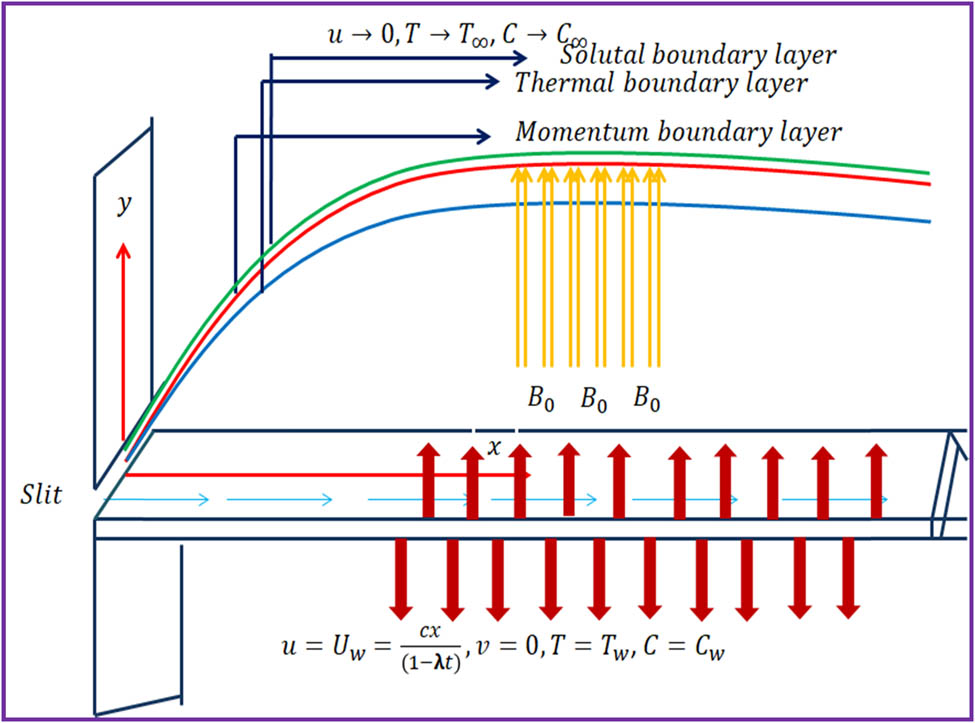
Flow diagram.
The governing equation satisfies
For t > 0, we have
Considering
one obtains
Here, dimensionless variables are
2.1 Entropy generation
Entropy generation is defined as [33,34,35,36,37,38,39]
One can find
The Bejan number (Be) is mathematically written as follows:
or
in which dimensionless parameters are
2.2 Quantities of interest
2.2.1 Surface drag force
Surface drag force is defined by
τ w shear stress satisfy
We have
2.2.2 Heat transfer rate
Mathematically
and q w heat flux is given by
one can find
2.2.3 Mass transfer rate
Mathematically
and j w mass flux is
or
2.3 Solutions
Linear operators and initial guesses for OHAM satisfy
with
here a i (i = 0, 2, 3, …, 6) signify the arbitrary constants.
Suppose that ħ f , ħ θ , and ħ ϕ are auxiliary variables and q ∈ [0, 1] the embedding variable.
2.3.1 Zeroth-order deformation problems
It is given by
Linear operators are defined as
2.3.2 M-th order deformation problems
M-th order problems satisfy
2.4 Convergence analysis
Initially, Liao [44] gives the concept of residual errors
The total squared residual error is given by [45]
here,
Figure 2 is drafted to analyze the total squared residual error. Computational results for an individual averaged squared residual error are demonstrated in Table 2.

Total residual error.
Numerical outcomes for individual averaged squared residual errors
| m |
|
|
|
|---|---|---|---|
| 2 | 0.0000928964 | 0.000319415 | 0.000174965 |
| 4 | 4.09845 × 10⁻⁸ | 8.06756 × 10⁻⁷ | 8.02567 × 10⁻⁷ |
| 8 | 1.01823 × 10⁻¹⁰ | 4.68889 × 10⁻⁹ | 1.07665 × 10⁻⁹ |
| 10 | 1.40314 × 10⁻¹¹ | 1.21154 × 10⁻¹⁰ | 1.00124 × 10⁻⁹ |
| 14 | 1.66145 × 10⁻¹³ | 5.69654 × 10⁻¹¹ | 2.72124 × 10⁻¹⁰ |
| 18 | 2.07356 × 10⁻¹⁴ | 9.94564 × 10⁻¹² | 3.87564 × 10⁻¹¹ |
Here, the obtained results indicate an excellent agreement.
3 Discussion
The physical impact of influential variables on the velocity field, entropy rate, thermal field, concentration, and Bejan number is scrutinized. The influence of flow variables on physical quantities is graphically studied.
3.1 Velocity
The The influence of velocity on the variation of the porosity variable is shown in Figure 3. A manifestation in the porosity variable augments the viscous force, which enhances resistance in the flow region. Thus, the velocity diminishes. The physical feature of the velocity against the Forchheimer number is examined in Figure 4. Here, the velocity decreases with a higher Forchheimer number. An increase in the magnetic variable rises the Lorentz force, which improves disturbance to liquid flow, and consequently, declines the velocity (Figure 5). Figure 6 presents the influence of the unsteadiness variable on velocity. One can find that velocity is the decaying function of (A).

f′(η) via λ.

f′(η) via Fr.

f′(η) via M.

f′(η) via A.
3.2 Temperature
Prominent effects of influential variables like Rd, Du, M, and Ec on the thermal field are demonstrated in Figures 7–10. The impact of thermal field on radiation is portrayed in Figure 7. In fact, radiation is the combined effect of heat and thermal radiation transfer rates. Thus, an increase in radiation augments temperature. The prominent effect of M on the thermal field is drafted in Figure 8. Physically, an amplification in magnetic variable produces more resistance, which rises collision between liquid particles. Thus, an improvement in temperature is seen. A physical description of temperature versus Dufour number is disclosed in Figure 9. Clearly, temperature boosts up for a higher Dufour number. The thermal field performance against the Eckert number is shown in Figure 10. An increase in Eckert's number increases the kinetic energy, which enhances temperature.

θ(η) via Rd.

θ(η) via M.

θ(η) via Du.

θ(η) via Ec.
3.3 Concentration
Variation of flow variables like Sc, γ, and Sr on concentration are displayed in Figures 11–13. The influence of the Schmidt number on ϕ(η) is shown in Figure 11. A reduction occurs in mass diffusivity with the Schmidt number, which declines the concentration. Higher approximation of reaction variables diminishes the concentration (Figure 12). The prominent variation in the concentration against the Soret number is disclosed in Figure 13. An increase in the Soret number corresponds to a decline in the concentration.

ϕ(η) via Sc.

ϕ(η) via γ.

ϕ(η) via Sr.
3.4 Entropy optimization and Bejan number
The influence of radiation on Be and N G is shown in Figures 14 and 15. An intensification in both Bejan number and entropy rate is noticed with radiation. In fact, an increment in radiation increases the emission of radiation, which enhances disordering in the thermal system. Therefore, the entropy rate enhances. Figures 16 and 17 sketch the influence of the porosity variable on (Be) and (N G ). A reverse trend holds for the Bejan number and entropy rate through the porosity variable. Figures 18 and 19 interpret the Brinkman number effect on Be and N G . An opposite effect is noted for (Be) and (N G ) versus the Brinkman number. An increase in the Brinkman number increases viscous force, which improves collision between liquid particles. Thus, the entropy rate enhaces.

N G via Rd.

Be via Rd.

N G via λ.

Be via λ.

N G via Br.

Be via Br.
3.5 Physical quantities
The influence of sundry variables on drag force, gradient of temperature, and Sherwood number is studied.
3.5.1 Skin friction
The influence of porosity and magnetic variables on drag force is demonstrated in Figure 20. An increment in drag force is seen with variations in magnetic and porosity variables.

C fx via M and λ.
3.5.2 Nusselt number
Figures 21 and 22 elucidate the performance of the Nusselt number via involved variables. An increase in heat transfer rate is observed under magnetic and radiation effects. A reverse trend holds for the temperature gradient with the Prandtl number and Brinkman numbers.

Nu x via Rd and M.

Nu x via Br and Pr.
3.5.3 Sherwood number
Figure 23 shows the effect of Soret and Schmidt numbers on the Sherwood number. An improvement in the mass transfer rate is seen with Sr and Sc.
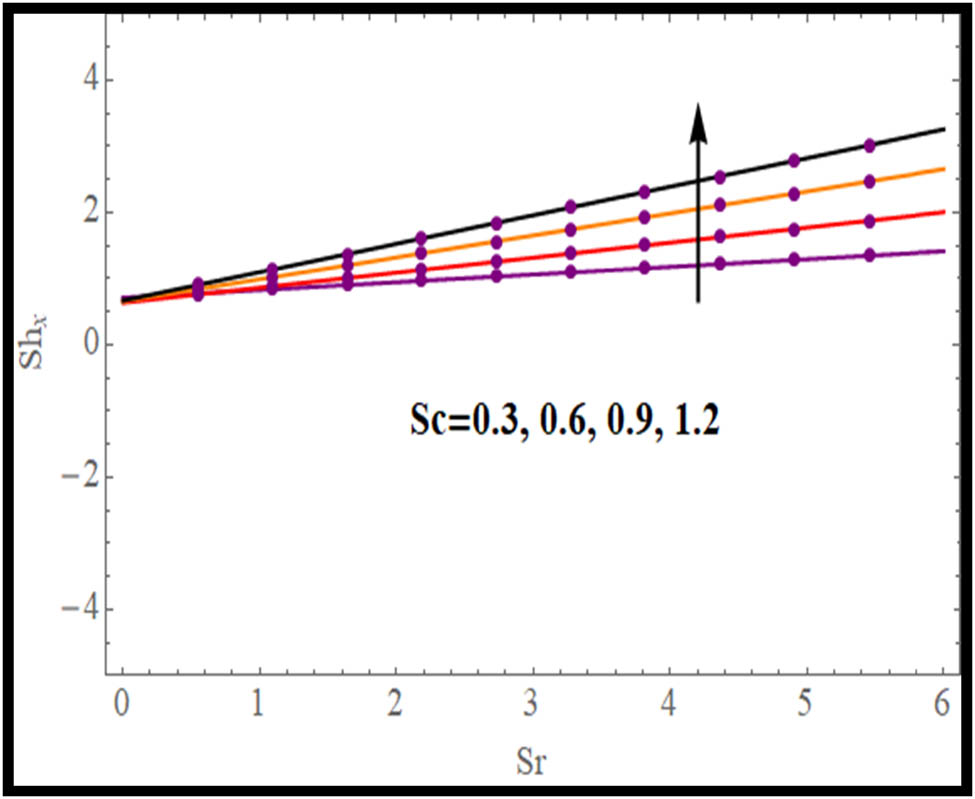
Sh x via (Sr) and (Sc).
4 Conclusions
The main points of the present study are listed below:
A reduction occurs in the velocity profile via unsteadiness and porosity variables.
The velocity profile decreases with the Forchheimer number.
An opposite effect on thermal field and velocity is noted through the magnetic variable.
An increase in the thermal field is seen through radiation.
A higher Dufour number boosts up the thermal field.
An increment in the Eckert number improves the thermal field.
Concentration reduces with the Schmidt number.
A reduction in the concentration occurs for reaction variables.
An increase in the Soret number decreases the concentration.
Higher radiation improves Bejan number.
An augmentation in entropy rate is noticed through porosity variable.
An opposite effect on the Bejan number and entropy rate is noted through the Brinkman number.
An increase in drag force is noticed through magnetic variable.
Higher radiation increases the heat transfer rate.
Mass transfer rate increases with a higher Soret number.
Acknowledgments
The authors are grateful to Deanship of Scientific Research (DSR) at King Abdulaziz University (KAU), Jeddah, Saudi Arabia for funding this project, under grant no. (RG-4-130-43).
-
Funding information: The Deanship of Scientific Research (DSR) at King Abdulaziz University (KAU), Jeddah, Saudi Arabia has funded this project, under grant no. (RG-4-130-43).
-
Author contributions: All authors have accepted responsibility for the entire content of this manuscript and approved its submission.
-
Conflict of interest: The authors state no conflict of interest.
References
[1] Mahdy A. MHD non-Darcian free convection from a vertical wavy surface embedded in porous media in the presence of Soret and Dufour effect. Int Commun Heat Mass Tran. 2009;36:1067–74.10.1016/j.icheatmasstransfer.2009.07.004Search in Google Scholar
[2] Raveendra PH, Veena, Pravin VK. Mixed convective heat and mass transfer MHD flow past an unsteady stretching sheet with internal heat generation, viscous dissipation, internal mass diffusion including Soret and Dufour effects. Int J Advan Rese Eng Techno. 2017;8:17–33.Search in Google Scholar
[3] Khan SA, Hayat T, Khan MI, Alsaedi A. Salient features of Dufour and Soret effect in radiative MHD flow of viscous fluid by a rotating cone with entropy generation. Int J Hydrogen Energy. 2020;45:14552–64.10.1016/j.ijhydene.2020.03.123Search in Google Scholar
[4] Reddy PS, Chamkha AJ. Soret and Dufour effects on unsteady MHD heat and mass transfer from a permeable stretching sheet with thermophoresis and non-uniform heat generation/absorption. J App Fluid Mech. 2016;9:2443–55.10.18869/acadpub.jafm.68.236.25171Search in Google Scholar
[5] Hayat T, Nasir T, Khan MI, Alsaedi A. Numerical investigation of MHD flow with Soret and Dufour effect. Resul Phys. 2018;8:1017–102.10.1016/j.rinp.2018.01.006Search in Google Scholar
[6] Mahabaleshwar US, Nagaraju KR, Kumar PNV, Nadagoud MN, Bennacer R, Sheremet MA. Effects of Dufour and Soret mechanisms on MHD mixed convective-radiative non-Newtonian liquid flow and heat transfer over a porous sheet. Ther Sci Eng Prog. 2019;16:100459. 10.1016/j.tsep.2019.100459.Search in Google Scholar
[7] Kafoussias NG, Williams EW. Thermal-diffusion and diffusion-thermo effects on mixed free-forced convective and mass transfer boundary layer flow with temperature dependent viscosity. Int J Eng Sci. 1995;33:1369–84.10.1016/0020-7225(94)00132-4Search in Google Scholar
[8] Hayat T, Khan SA, Khan MI, Alsaedi A. Irreversibility characterization and investigation of mixed convective reactive flow over a rotating cone. Comp Meth Prog Biomed. 2020;185:105168. 10.1016/j.cmpb.2019.105168.Search in Google Scholar PubMed
[9] Mudhaf AFA, Rashad AM, Ahmed SE, Chamkha AJ, Kabeir SMME. Soret and Dufour effects on unsteady double diffusive natural convection in porous trapezoidal enclosures. Int J Mech Sci. 2018;140:172–8.10.1016/j.ijmecsci.2018.02.049Search in Google Scholar
[10] Eldabe N, Zeid MA. Thermal diffusion and diffusion thermo effects on the viscous fluid flow with heat and mass transfer through porous medium over a shrinking sheet. J Appl Math. 2013;2013(2013):1–11. 10.1155/2013/584534.Search in Google Scholar
[11] Hayat T, Aslam N, Alsaedi A, Rafiq M. Numerical analysis for endoscope and Soret and Dufour effects on peristalsis of Prandtl fluid. Result Phys. 2017;7:2855–64.10.1016/j.rinp.2017.07.058Search in Google Scholar
[12] Cho QR, Chan CL. Numerical study of double-diffusive convection in a vertical cavity with Soret and Dufour effects by lattice Boltzmann method on GPU. Int J Heat Mass Tran. 2016;93:538–53.10.1016/j.ijheatmasstransfer.2015.10.031Search in Google Scholar
[13] Hayat T, Ullah I, Muhammad T, Alsaedi A. Radiative three-dimensional flow with Soret and Dufour effects. Int J Mech Sci. 2017;133:829–37.10.1016/j.ijmecsci.2017.09.015Search in Google Scholar
[14] Mahanthesh B, Mackolil J, Radhika M, Al-Kouz W, Siddabasappa. Significance of quadratic thermal radiation and quadratic convection on boundary layer two-phase flow of a dusty nanoliquid past a vertical plate. Int Communi Heat Mass Trans. 2021;120:105029. 10.1016/j.icheatmasstransfer.2020.105029.Search in Google Scholar
[15] Sulochana C, Samrat SP, Sandeep N. Boundary layer analysis of an incessant moving needle in MHD radiative nanofluid with joule heating. Int J Mech Sci. 2017;128:326–31.10.1016/j.ijmecsci.2017.05.006Search in Google Scholar
[16] Thriveni K, Mahanthesh B. Significance of variable fluid properties on hybrid nanoliquid flow in a micro-annulus with quadratic convection and quadratic thermal radiation: Response surface methodology. Int Commun Heat Mass Trans. 2021;124:105264. 10.1016/j.icheatmasstransfer.2021.105264.Search in Google Scholar
[17] Hayat T, Tamoor M, Khan MI, Alsaedi A. Numerical simulation for nonlinear radiative flow by convective cylinder. Resul Phy. 2016;6:1031–5.10.1016/j.rinp.2016.11.026Search in Google Scholar
[18] Prakash J, Tripathi D. Electroosmotic flow of Williamson ionic nanoliquids in a tapered microfluidic channel in presence of thermal radiation and peristalsis. J Mol Liq. 2018;256:352–71.10.1016/j.molliq.2018.02.043Search in Google Scholar
[19] Mebarek-Oudina F, Bessaih R, Mahanthesh B, Chamkha AJ, Raza J. Magneto-thermal-convection stability in an inclined cylindrical annulus filled with a molten metal. Int J Numer Meth Heat Fluid Flow. 2020;31:1172–89. 10.1108/HFF-05-2020-0321.Search in Google Scholar
[20] Mehrez Z, Cafsi AE. Heat exchange enhancement of ferrofluid flow into rectangular channel in the presence of a magnetic field. Appl Math Comput. 2021;391:125634. 10.1016/j.amc.2020.125634.Search in Google Scholar
[21] Gholinia M, Hoseini ME, Gholinia S. A numerical investigation of free convection MHD flow of Walters-B nanofluid over an inclined stretching sheet under the impact of Joule heating. Therm Sci Eng Prog. 2019;11:272–82.10.1016/j.tsep.2019.04.006Search in Google Scholar
[22] Hayat T, Aslam N, Khan MI, Khan MI, Alsaedi A. Physical significance of heat generation/absorption and Soret effects on peristalsis flow of pseudoplastic fluid in an inclined channel. J Mol Liq. 2019;275:599–615.10.1016/j.molliq.2018.11.055Search in Google Scholar
[23] Reddy RCS, Reddy PS. A comparative analysis of unsteady and steady Buongiorno’s Williamson nanoliquid flow over a wedge with slip effects. Chin J Chemi Eng. 2020;28:1767–77.10.1016/j.cjche.2020.04.016Search in Google Scholar
[24] Ramana Reddy JV, Sugunamma V, Sandeep N. Simultaneous impacts of Joule heating and variable heat source/sink on MHD 3D flow of Carreau-nanoliquids with temperature dependent viscosity. Nonlinear Eng. 2019;8:356–67.10.1515/nleng-2017-0132Search in Google Scholar
[25] Mehrez Z, Cafsi AE. Thermodynamic analysis of Al2O3 – water nanofluid flow in an open cavity under pulsating inlet condition. Int J App Computat Math. 2017;3:489–510.10.1007/s40819-017-0366-9Search in Google Scholar
[26] Mehreza Z, Cafsi AE. Forced convection Fe3O4/water nanofluid flow through a horizontal channel under the influence of a non-uniform magnetic field. Eur Phys J Plus. 2021;136:451. 10.1140/epjp/s13360-021-01410-2.Search in Google Scholar
[27] Hayat T, Khan SA, Khan MI, Alsaedi A. Theoretical investigation of Ree – Eyring nanofluid flow with entropy optimization and Arrhenius activation energy between two rotating disks. Comp Method Progr Biomed. 2019;177:57–68.10.1016/j.cmpb.2019.05.012Search in Google Scholar
[28] Farooq M, Javed M, Khan MI, Anjum A, Hayat T. Melting heat transfer and double stratification in stagnation flow of viscous nanofluid. Resul Phy. 2017;7:2296–301.10.1016/j.rinp.2017.06.053Search in Google Scholar
[29] Khan SA, Saeed T, Khan MI, Hayat T, Khan MI, Alsaedi A. Entropy optimized CNTs based Darcy–Forchheimer nanomaterial flow between two stretchable rotating disks. Int J Hydrogen Energy. 2019;44:31579–92.10.1016/j.ijhydene.2019.10.053Search in Google Scholar
[30] Khan SA, Hayat T, Alsaedi A. Entropy optimization in passive and active flow of liquid hydrogen based nanoliquid transport by a curved stretching sheet. Int Commun Heat Mass Trans. 2020;119:104890. 10.1016/j.icheatmasstransfer.2020.104890.Search in Google Scholar
[31] Bejan A. Second law analysis in heat transfer. Energy Int J. 1980;5:721–32.10.1016/0360-5442(80)90091-2Search in Google Scholar
[32] Bejan A. A study of entropy generation in fundamentsl convective heat transfer. ASME J Heat Tran. 1979;101:718–25.10.1115/1.3451063Search in Google Scholar
[33] Khan SA, Hayat T, Alsaedi A, Ahmad B. Melting heat transportation in radiative flow of nanomaterials with irreversibility analysis. Renew Sustain Energy Rev. 2021;140:110739. 10.1016/j.rser.2021.110739.Search in Google Scholar
[34] Seth GS, Kumar R, Bhattacharyya A. Entropy generation of dissipative flow of carbon nanotubes in rotating frame with Darcy–Forchheimer porous medium: A numerical study. J Mol Liq. 2018;268:637–46.10.1016/j.molliq.2018.07.071Search in Google Scholar
[35] Kefayati GR. Simulation of double diffusive natural convection and entropy generation of power-law fluids in an inclined porous cavity with Soret and Dufour effects (Part II: Entropy generation). Int J Heat Mass Tran. 2016;94:582–624.10.1016/j.ijheatmasstransfer.2015.11.043Search in Google Scholar
[36] Mehrez Z, Cafsi AE, Belghith A, Quéré PL. Effect of heated wall position on heat transfer and entropy generation of Cu – water nanofluid flow in an open cavity. Canadian J Phy. 2015;93:1615–29. 10.1139/cjp-2014-0388.Search in Google Scholar
[37] Mehrez Z, Cafsi AE, Belghith A, Quéré PL. MHD effects on heat transfer and entropy generation of nanofluid flow in an open cavity. J Magnet Magnet Mater. 2015;374:214–24.10.1016/j.jmmm.2014.08.010Search in Google Scholar
[38] Mondal P, Mahapatra TR. MHD double-diffusive mixed convection and entropy generation of nanofluid in a trapezoidal cavity. Int J Mech Sci. 2021;208:106665. 10.1016/j.ijmecsci.2021.106665.Search in Google Scholar
[39] Qayyum S, Hayat T, Khan MI, Khan MI, Alsaedi A. Optimization of entropy generation and dissipative nonlinear radiative Von Karman’s swirling flow with Soret and Dufour effects. J Mol Liq. 2018;262:261–74.10.1016/j.molliq.2018.04.010Search in Google Scholar
[40] Yousofvand R, Derakhshan S, Ghasemi K, Siavashi M. MHD transverse mixed convection and entropy generation study of electromagnetic pump including a nanofluid using 3D LBM simulation. Int J Mech Sci. 2017;133:73–90.10.1016/j.ijmecsci.2017.08.034Search in Google Scholar
[41] Mliki B, Abbassi MA. Entropy generation of MHD natural convection heat transfer in a heated incinerator using hybrid-nanoliquid. Propul Power Res. 2021;10:143–54.10.1016/j.jppr.2021.01.002Search in Google Scholar
[42] Khan MI, Qayyum S, Hayat T, Khan MI, Alsaedi A. Entropy optimization in flow of Williamson nanofluid in the presence of chemical reaction and Joule heating. Int J Heat Mass Trans. 2019;133:959–67.10.1016/j.ijheatmasstransfer.2018.12.168Search in Google Scholar
[43] Marzougui S, Mebarek-Oudina F, Aissa A, Magherbi M, Shah Z, Ramesh K. Entropy generation on magneto-convective flow of copper-water nanofluid in a cavity with chamfers. J Ther Anal Calori. 2020;143:2203–14. 10.1007/s10973-020-09662-3.Search in Google Scholar
[44] Liao SJ. An optimal homotopy-analysis approach for strongly nonlinear differential equations. Commun Nonlinear Sci Numer Simul. 2010;15:2003–16.10.1016/j.cnsns.2009.09.002Search in Google Scholar
[45] Hayat T, Khan SA, Khan MI, Alsaedi A. Optimizing the theoretical analysis of entropy generation in the flow of second grade nanofluid. Phy Scripta. 2019;94:085001. 10.1088/1402-4896/ab0f65.Search in Google Scholar
[46] Wang CY. Free convection on a vertical stretching surface. J Appl Math Mech (ZAMM). 1989;69:418–20.10.1002/zamm.19890691115Search in Google Scholar
[47] Gorla RSR, Sidawi I. Free convection on a vertical stretching surface with suction and blowing. Appl Sci Res. 1994;52:247–57.10.1007/BF00853952Search in Google Scholar
© 2022 Yun-Jie Xu et al., published by De Gruyter
This work is licensed under the Creative Commons Attribution 4.0 International License.
Articles in the same Issue
- Regular Articles
- Test influence of screen thickness on double-N six-light-screen sky screen target
- Analysis on the speed properties of the shock wave in light curtain
- Abundant accurate analytical and semi-analytical solutions of the positive Gardner–Kadomtsev–Petviashvili equation
- Measured distribution of cloud chamber tracks from radioactive decay: A new empirical approach to investigating the quantum measurement problem
- Nuclear radiation detection based on the convolutional neural network under public surveillance scenarios
- Effect of process parameters on density and mechanical behaviour of a selective laser melted 17-4PH stainless steel alloy
- Performance evaluation of self-mixing interferometer with the ceramic type piezoelectric accelerometers
- Effect of geometry error on the non-Newtonian flow in the ceramic microchannel molded by SLA
- Numerical investigation of ozone decomposition by self-excited oscillation cavitation jet
- Modeling electrostatic potential in FDSOI MOSFETS: An approach based on homotopy perturbations
- Modeling analysis of microenvironment of 3D cell mechanics based on machine vision
- Numerical solution for two-dimensional partial differential equations using SM’s method
- Multiple velocity composition in the standard synchronization
- Electroosmotic flow for Eyring fluid with Navier slip boundary condition under high zeta potential in a parallel microchannel
- Soliton solutions of Calogero–Degasperis–Fokas dynamical equation via modified mathematical methods
- Performance evaluation of a high-performance offshore cementing wastes accelerating agent
- Sapphire irradiation by phosphorus as an approach to improve its optical properties
- A physical model for calculating cementing quality based on the XGboost algorithm
- Experimental investigation and numerical analysis of stress concentration distribution at the typical slots for stiffeners
- An analytical model for solute transport from blood to tissue
- Finite-size effects in one-dimensional Bose–Einstein condensation of photons
- Drying kinetics of Pleurotus eryngii slices during hot air drying
- Computer-aided measurement technology for Cu2ZnSnS4 thin-film solar cell characteristics
- QCD phase diagram in a finite volume in the PNJL model
- Study on abundant analytical solutions of the new coupled Konno–Oono equation in the magnetic field
- Experimental analysis of a laser beam propagating in angular turbulence
- Numerical investigation of heat transfer in the nanofluids under the impact of length and radius of carbon nanotubes
- Multiple rogue wave solutions of a generalized (3+1)-dimensional variable-coefficient Kadomtsev--Petviashvili equation
- Optical properties and thermal stability of the H+-implanted Dy3+/Tm3+-codoped GeS2–Ga2S3–PbI2 chalcohalide glass waveguide
- Nonlinear dynamics for different nonautonomous wave structure solutions
- Numerical analysis of bioconvection-MHD flow of Williamson nanofluid with gyrotactic microbes and thermal radiation: New iterative method
- Modeling extreme value data with an upside down bathtub-shaped failure rate model
- Abundant optical soliton structures to the Fokas system arising in monomode optical fibers
- Analysis of the partially ionized kerosene oil-based ternary nanofluid flow over a convectively heated rotating surface
- Multiple-scale analysis of the parametric-driven sine-Gordon equation with phase shifts
- Magnetofluid unsteady electroosmotic flow of Jeffrey fluid at high zeta potential in parallel microchannels
- Effect of plasma-activated water on microbial quality and physicochemical properties of fresh beef
- The finite element modeling of the impacting process of hard particles on pump components
- Analysis of respiratory mechanics models with different kernels
- Extended warranty decision model of failure dependence wind turbine system based on cost-effectiveness analysis
- Breather wave and double-periodic soliton solutions for a (2+1)-dimensional generalized Hirota–Satsuma–Ito equation
- First-principle calculation of electronic structure and optical properties of (P, Ga, P–Ga) doped graphene
- Numerical simulation of nanofluid flow between two parallel disks using 3-stage Lobatto III-A formula
- Optimization method for detection a flying bullet
- Angle error control model of laser profilometer contact measurement
- Numerical study on flue gas–liquid flow with side-entering mixing
- Travelling waves solutions of the KP equation in weakly dispersive media
- Characterization of damage morphology of structural SiO2 film induced by nanosecond pulsed laser
- A study of generalized hypergeometric Matrix functions via two-parameter Mittag–Leffler matrix function
- Study of the length and influencing factors of air plasma ignition time
- Analysis of parametric effects in the wave profile of the variant Boussinesq equation through two analytical approaches
- The nonlinear vibration and dispersive wave systems with extended homoclinic breather wave solutions
- Generalized notion of integral inequalities of variables
- The seasonal variation in the polarization (Ex/Ey) of the characteristic wave in ionosphere plasma
- Impact of COVID 19 on the demand for an inventory model under preservation technology and advance payment facility
- Approximate solution of linear integral equations by Taylor ordering method: Applied mathematical approach
- Exploring the new optical solitons to the time-fractional integrable generalized (2+1)-dimensional nonlinear Schrödinger system via three different methods
- Irreversibility analysis in time-dependent Darcy–Forchheimer flow of viscous fluid with diffusion-thermo and thermo-diffusion effects
- Double diffusion in a combined cavity occupied by a nanofluid and heterogeneous porous media
- NTIM solution of the fractional order parabolic partial differential equations
- Jointly Rayleigh lifetime products in the presence of competing risks model
- Abundant exact solutions of higher-order dispersion variable coefficient KdV equation
- Laser cutting tobacco slice experiment: Effects of cutting power and cutting speed
- Performance evaluation of common-aperture visible and long-wave infrared imaging system based on a comprehensive resolution
- Diesel engine small-sample transfer learning fault diagnosis algorithm based on STFT time–frequency image and hyperparameter autonomous optimization deep convolutional network improved by PSO–GWO–BPNN surrogate model
- Analyses of electrokinetic energy conversion for periodic electromagnetohydrodynamic (EMHD) nanofluid through the rectangular microchannel under the Hall effects
- Propagation properties of cosh-Airy beams in an inhomogeneous medium with Gaussian PT-symmetric potentials
- Dynamics investigation on a Kadomtsev–Petviashvili equation with variable coefficients
- Study on fine characterization and reconstruction modeling of porous media based on spatially-resolved nuclear magnetic resonance technology
- Optimal block replacement policy for two-dimensional products considering imperfect maintenance with improved Salp swarm algorithm
- A hybrid forecasting model based on the group method of data handling and wavelet decomposition for monthly rivers streamflow data sets
- Hybrid pencil beam model based on photon characteristic line algorithm for lung radiotherapy in small fields
- Surface waves on a coated incompressible elastic half-space
- Radiation dose measurement on bone scintigraphy and planning clinical management
- Lie symmetry analysis for generalized short pulse equation
- Spectroscopic characteristics and dissociation of nitrogen trifluoride under external electric fields: Theoretical study
- Cross electromagnetic nanofluid flow examination with infinite shear rate viscosity and melting heat through Skan-Falkner wedge
- Convection heat–mass transfer of generalized Maxwell fluid with radiation effect, exponential heating, and chemical reaction using fractional Caputo–Fabrizio derivatives
- Weak nonlinear analysis of nanofluid convection with g-jitter using the Ginzburg--Landau model
- Strip waveguides in Yb3+-doped silicate glass formed by combination of He+ ion implantation and precise ultrashort pulse laser ablation
- Best selected forecasting models for COVID-19 pandemic
- Research on attenuation motion test at oblique incidence based on double-N six-light-screen system
- Review Articles
- Progress in epitaxial growth of stanene
- Review and validation of photovoltaic solar simulation tools/software based on case study
- Brief Report
- The Debye–Scherrer technique – rapid detection for applications
- Rapid Communication
- Radial oscillations of an electron in a Coulomb attracting field
- Special Issue on Novel Numerical and Analytical Techniques for Fractional Nonlinear Schrodinger Type - Part II
- The exact solutions of the stochastic fractional-space Allen–Cahn equation
- Propagation of some new traveling wave patterns of the double dispersive equation
- A new modified technique to study the dynamics of fractional hyperbolic-telegraph equations
- An orthotropic thermo-viscoelastic infinite medium with a cylindrical cavity of temperature dependent properties via MGT thermoelasticity
- Modeling of hepatitis B epidemic model with fractional operator
- Special Issue on Transport phenomena and thermal analysis in micro/nano-scale structure surfaces - Part III
- Investigation of effective thermal conductivity of SiC foam ceramics with various pore densities
- Nonlocal magneto-thermoelastic infinite half-space due to a periodically varying heat flow under Caputo–Fabrizio fractional derivative heat equation
- The flow and heat transfer characteristics of DPF porous media with different structures based on LBM
- Homotopy analysis method with application to thin-film flow of couple stress fluid through a vertical cylinder
- Special Issue on Advanced Topics on the Modelling and Assessment of Complicated Physical Phenomena - Part II
- Asymptotic analysis of hepatitis B epidemic model using Caputo Fabrizio fractional operator
- Influence of chemical reaction on MHD Newtonian fluid flow on vertical plate in porous medium in conjunction with thermal radiation
- Structure of analytical ion-acoustic solitary wave solutions for the dynamical system of nonlinear wave propagation
- Evaluation of ESBL resistance dynamics in Escherichia coli isolates by mathematical modeling
- On theoretical analysis of nonlinear fractional order partial Benney equations under nonsingular kernel
- The solutions of nonlinear fractional partial differential equations by using a novel technique
- Modelling and graphing the Wi-Fi wave field using the shape function
- Generalized invexity and duality in multiobjective variational problems involving non-singular fractional derivative
- Impact of the convergent geometric profile on boundary layer separation in the supersonic over-expanded nozzle
- Variable stepsize construction of a two-step optimized hybrid block method with relative stability
- Thermal transport with nanoparticles of fractional Oldroyd-B fluid under the effects of magnetic field, radiations, and viscous dissipation: Entropy generation; via finite difference method
- Special Issue on Advanced Energy Materials - Part I
- Voltage regulation and power-saving method of asynchronous motor based on fuzzy control theory
- The structure design of mobile charging piles
- Analysis and modeling of pitaya slices in a heat pump drying system
- Design of pulse laser high-precision ranging algorithm under low signal-to-noise ratio
- Special Issue on Geological Modeling and Geospatial Data Analysis
- Determination of luminescent characteristics of organometallic complex in land and coal mining
- InSAR terrain mapping error sources based on satellite interferometry
Articles in the same Issue
- Regular Articles
- Test influence of screen thickness on double-N six-light-screen sky screen target
- Analysis on the speed properties of the shock wave in light curtain
- Abundant accurate analytical and semi-analytical solutions of the positive Gardner–Kadomtsev–Petviashvili equation
- Measured distribution of cloud chamber tracks from radioactive decay: A new empirical approach to investigating the quantum measurement problem
- Nuclear radiation detection based on the convolutional neural network under public surveillance scenarios
- Effect of process parameters on density and mechanical behaviour of a selective laser melted 17-4PH stainless steel alloy
- Performance evaluation of self-mixing interferometer with the ceramic type piezoelectric accelerometers
- Effect of geometry error on the non-Newtonian flow in the ceramic microchannel molded by SLA
- Numerical investigation of ozone decomposition by self-excited oscillation cavitation jet
- Modeling electrostatic potential in FDSOI MOSFETS: An approach based on homotopy perturbations
- Modeling analysis of microenvironment of 3D cell mechanics based on machine vision
- Numerical solution for two-dimensional partial differential equations using SM’s method
- Multiple velocity composition in the standard synchronization
- Electroosmotic flow for Eyring fluid with Navier slip boundary condition under high zeta potential in a parallel microchannel
- Soliton solutions of Calogero–Degasperis–Fokas dynamical equation via modified mathematical methods
- Performance evaluation of a high-performance offshore cementing wastes accelerating agent
- Sapphire irradiation by phosphorus as an approach to improve its optical properties
- A physical model for calculating cementing quality based on the XGboost algorithm
- Experimental investigation and numerical analysis of stress concentration distribution at the typical slots for stiffeners
- An analytical model for solute transport from blood to tissue
- Finite-size effects in one-dimensional Bose–Einstein condensation of photons
- Drying kinetics of Pleurotus eryngii slices during hot air drying
- Computer-aided measurement technology for Cu2ZnSnS4 thin-film solar cell characteristics
- QCD phase diagram in a finite volume in the PNJL model
- Study on abundant analytical solutions of the new coupled Konno–Oono equation in the magnetic field
- Experimental analysis of a laser beam propagating in angular turbulence
- Numerical investigation of heat transfer in the nanofluids under the impact of length and radius of carbon nanotubes
- Multiple rogue wave solutions of a generalized (3+1)-dimensional variable-coefficient Kadomtsev--Petviashvili equation
- Optical properties and thermal stability of the H+-implanted Dy3+/Tm3+-codoped GeS2–Ga2S3–PbI2 chalcohalide glass waveguide
- Nonlinear dynamics for different nonautonomous wave structure solutions
- Numerical analysis of bioconvection-MHD flow of Williamson nanofluid with gyrotactic microbes and thermal radiation: New iterative method
- Modeling extreme value data with an upside down bathtub-shaped failure rate model
- Abundant optical soliton structures to the Fokas system arising in monomode optical fibers
- Analysis of the partially ionized kerosene oil-based ternary nanofluid flow over a convectively heated rotating surface
- Multiple-scale analysis of the parametric-driven sine-Gordon equation with phase shifts
- Magnetofluid unsteady electroosmotic flow of Jeffrey fluid at high zeta potential in parallel microchannels
- Effect of plasma-activated water on microbial quality and physicochemical properties of fresh beef
- The finite element modeling of the impacting process of hard particles on pump components
- Analysis of respiratory mechanics models with different kernels
- Extended warranty decision model of failure dependence wind turbine system based on cost-effectiveness analysis
- Breather wave and double-periodic soliton solutions for a (2+1)-dimensional generalized Hirota–Satsuma–Ito equation
- First-principle calculation of electronic structure and optical properties of (P, Ga, P–Ga) doped graphene
- Numerical simulation of nanofluid flow between two parallel disks using 3-stage Lobatto III-A formula
- Optimization method for detection a flying bullet
- Angle error control model of laser profilometer contact measurement
- Numerical study on flue gas–liquid flow with side-entering mixing
- Travelling waves solutions of the KP equation in weakly dispersive media
- Characterization of damage morphology of structural SiO2 film induced by nanosecond pulsed laser
- A study of generalized hypergeometric Matrix functions via two-parameter Mittag–Leffler matrix function
- Study of the length and influencing factors of air plasma ignition time
- Analysis of parametric effects in the wave profile of the variant Boussinesq equation through two analytical approaches
- The nonlinear vibration and dispersive wave systems with extended homoclinic breather wave solutions
- Generalized notion of integral inequalities of variables
- The seasonal variation in the polarization (Ex/Ey) of the characteristic wave in ionosphere plasma
- Impact of COVID 19 on the demand for an inventory model under preservation technology and advance payment facility
- Approximate solution of linear integral equations by Taylor ordering method: Applied mathematical approach
- Exploring the new optical solitons to the time-fractional integrable generalized (2+1)-dimensional nonlinear Schrödinger system via three different methods
- Irreversibility analysis in time-dependent Darcy–Forchheimer flow of viscous fluid with diffusion-thermo and thermo-diffusion effects
- Double diffusion in a combined cavity occupied by a nanofluid and heterogeneous porous media
- NTIM solution of the fractional order parabolic partial differential equations
- Jointly Rayleigh lifetime products in the presence of competing risks model
- Abundant exact solutions of higher-order dispersion variable coefficient KdV equation
- Laser cutting tobacco slice experiment: Effects of cutting power and cutting speed
- Performance evaluation of common-aperture visible and long-wave infrared imaging system based on a comprehensive resolution
- Diesel engine small-sample transfer learning fault diagnosis algorithm based on STFT time–frequency image and hyperparameter autonomous optimization deep convolutional network improved by PSO–GWO–BPNN surrogate model
- Analyses of electrokinetic energy conversion for periodic electromagnetohydrodynamic (EMHD) nanofluid through the rectangular microchannel under the Hall effects
- Propagation properties of cosh-Airy beams in an inhomogeneous medium with Gaussian PT-symmetric potentials
- Dynamics investigation on a Kadomtsev–Petviashvili equation with variable coefficients
- Study on fine characterization and reconstruction modeling of porous media based on spatially-resolved nuclear magnetic resonance technology
- Optimal block replacement policy for two-dimensional products considering imperfect maintenance with improved Salp swarm algorithm
- A hybrid forecasting model based on the group method of data handling and wavelet decomposition for monthly rivers streamflow data sets
- Hybrid pencil beam model based on photon characteristic line algorithm for lung radiotherapy in small fields
- Surface waves on a coated incompressible elastic half-space
- Radiation dose measurement on bone scintigraphy and planning clinical management
- Lie symmetry analysis for generalized short pulse equation
- Spectroscopic characteristics and dissociation of nitrogen trifluoride under external electric fields: Theoretical study
- Cross electromagnetic nanofluid flow examination with infinite shear rate viscosity and melting heat through Skan-Falkner wedge
- Convection heat–mass transfer of generalized Maxwell fluid with radiation effect, exponential heating, and chemical reaction using fractional Caputo–Fabrizio derivatives
- Weak nonlinear analysis of nanofluid convection with g-jitter using the Ginzburg--Landau model
- Strip waveguides in Yb3+-doped silicate glass formed by combination of He+ ion implantation and precise ultrashort pulse laser ablation
- Best selected forecasting models for COVID-19 pandemic
- Research on attenuation motion test at oblique incidence based on double-N six-light-screen system
- Review Articles
- Progress in epitaxial growth of stanene
- Review and validation of photovoltaic solar simulation tools/software based on case study
- Brief Report
- The Debye–Scherrer technique – rapid detection for applications
- Rapid Communication
- Radial oscillations of an electron in a Coulomb attracting field
- Special Issue on Novel Numerical and Analytical Techniques for Fractional Nonlinear Schrodinger Type - Part II
- The exact solutions of the stochastic fractional-space Allen–Cahn equation
- Propagation of some new traveling wave patterns of the double dispersive equation
- A new modified technique to study the dynamics of fractional hyperbolic-telegraph equations
- An orthotropic thermo-viscoelastic infinite medium with a cylindrical cavity of temperature dependent properties via MGT thermoelasticity
- Modeling of hepatitis B epidemic model with fractional operator
- Special Issue on Transport phenomena and thermal analysis in micro/nano-scale structure surfaces - Part III
- Investigation of effective thermal conductivity of SiC foam ceramics with various pore densities
- Nonlocal magneto-thermoelastic infinite half-space due to a periodically varying heat flow under Caputo–Fabrizio fractional derivative heat equation
- The flow and heat transfer characteristics of DPF porous media with different structures based on LBM
- Homotopy analysis method with application to thin-film flow of couple stress fluid through a vertical cylinder
- Special Issue on Advanced Topics on the Modelling and Assessment of Complicated Physical Phenomena - Part II
- Asymptotic analysis of hepatitis B epidemic model using Caputo Fabrizio fractional operator
- Influence of chemical reaction on MHD Newtonian fluid flow on vertical plate in porous medium in conjunction with thermal radiation
- Structure of analytical ion-acoustic solitary wave solutions for the dynamical system of nonlinear wave propagation
- Evaluation of ESBL resistance dynamics in Escherichia coli isolates by mathematical modeling
- On theoretical analysis of nonlinear fractional order partial Benney equations under nonsingular kernel
- The solutions of nonlinear fractional partial differential equations by using a novel technique
- Modelling and graphing the Wi-Fi wave field using the shape function
- Generalized invexity and duality in multiobjective variational problems involving non-singular fractional derivative
- Impact of the convergent geometric profile on boundary layer separation in the supersonic over-expanded nozzle
- Variable stepsize construction of a two-step optimized hybrid block method with relative stability
- Thermal transport with nanoparticles of fractional Oldroyd-B fluid under the effects of magnetic field, radiations, and viscous dissipation: Entropy generation; via finite difference method
- Special Issue on Advanced Energy Materials - Part I
- Voltage regulation and power-saving method of asynchronous motor based on fuzzy control theory
- The structure design of mobile charging piles
- Analysis and modeling of pitaya slices in a heat pump drying system
- Design of pulse laser high-precision ranging algorithm under low signal-to-noise ratio
- Special Issue on Geological Modeling and Geospatial Data Analysis
- Determination of luminescent characteristics of organometallic complex in land and coal mining
- InSAR terrain mapping error sources based on satellite interferometry
