Surface waves on a coated incompressible elastic half-space


Abstract
Recently, Khajiyeva et al. (2018) studied the dynamics of surface wave propagation in a pre-stressed incompressible half-space when accompanied by both vertical and tangential loads. In this study, however, we extend the work of Khajiyeva et al. to include the presence of a coating layer above the half-space, upon which the loads are acted. Moreover, we prescribe sufficient perfect continuity conditions between the two layers, resulting in an inhomogeneous composite structure. Furthermore, related effective boundary conditions within the long-wave assumption are acquired for the model through the application of the asymptotic approximation method. Finally, approximate uncoupled pseudo-differential equations are derived on the surface, thereby admitting all the results of Khajiyeva et al. as limiting cases of concern.
1 Introduction
Propagation of waves in assorted structural arrangements has been expansively investigated since long ago owing to its immense happening in a variety of science and technological applications. In this regard, one can easily find some pertinent areas of real applications that involve the production and examination of elastic waves, such areas include seismology, materials science, earthquake, fluid dynamics, elastodynamics, biomechanics, geophysics, and geology [1,2, 3,4] to state a few. More so, there exist other fields from modern-day engineering that hugely enjoy massive contributions from the governing phenomena, including, for instance, structural engineering, transportation engineering, aeronautical engineering, and metallurgical engineering, just to mention a few [5,6, 7,8]. Structure-wise, various studies have been reported with regard to the propagation of different wave forms in disparate structural bodies and shapes, comprising singled-layered media [9,10,11], composite structures [12,13, 14,15], and the generalized multilayered bodies [16,17, 18,19,20, 21,22]. Besides, the case of the propagation of waves in singled-layered media is actually the classical consideration of different situations. One would read the book of Achenbach [23] for dissimilar scenarios about the propagation of waves in different elastic solids. Dutta [24] examined the longitudinal vibration of elastic disturbance associated with linear excitation by parameters. Bhattacharyya and Bera [25] made use of the legendary Adomian’s method to examine the propagation of waves in single elastic bars with linear and random material constituents. Moreover, Ahmad and Zaman [26] examined the case of a propagating wave in an isotropic nonhomogeneous single rod via exact and asymptotic methods. We also recall the latest work of Alzaidi et al. [27] for the study of the influence of non-integer temporal variation on the propagation of waves on an inhomogeneous finite elastic substrate.
Equally, for composites and multilayered structures, including coated media, there exist ample related examinations in both the past and recent works of the literature, with regard to the propagation and dispersion of elastic waves in such media. Moreover, such structural formations are realized in the present-day designs and inventions; take a look at the wings of an aeroplane, photovoltaic solar panels, metamaterials, multilayered petitioning timbers, nano-indentation tests, and laminated glazing glasses to refer to a few, see ref. [28] and references therein. Thus, upon putting more weights behind the coated media, since their applications are numerous, as we further recall some of their significance in seismic protection, rail transportation, and highway engineering, refer refs [29,30,31]. More so, their fundamental impacts are to protect material surfaces from external agents such as chemicals, thereby causing the whole structure to deteriorate [32]; read also about their relevance in the design and construction of biomaterials, such as implantations [33,34].
Nevertheless, stating some of the latest findings with regard to the dynamics of waves in coated media, Mubaraki et al. [35] examined the influence of certain external excitations, including rotation, and the gravitational and magnetic field forces on the vibration of surface waves on a viscoelastic-coated half-plane. Mubaraki et al. [36] determined the approximate explicit equations for the propagation of elastic waves on an elastic half-plane endowed with a thin-coating strip; read also ref. [37] for the study of Rayleigh waves’ effect on the propagation of surface waves on such media amidst the influence of prescribed stresses and gravity. In addition, a doubly coated inhomogeneous half-space was equally examined in ref. [38] with regard to the implication of rotation in the media, and on the other hand, the impact of the material inhomogeneity in the half-space; adequate approximate effective boundary conditions were constructed, which successfully approximated the derived secular equation with high precision. Additionally, the recent works of Manna et al. [39,40] on the propagation of Love-type wave on coated extended medium within the setting of orthotropic and anisotropic materials, respectively, are quite relevant in this arena; read also the study of Selim and Althobaiti [41] about the vibration of waves in supported walled carbon nanotubes by utilizing the wave-based method.
However, the present study aims at extending the recent work of Khajiyeva et al. [42] for the determination of approximate equations of motion with regard to the propagation of surface waves in a pre-stressed incompressible half-space, by incorporating a single coating layer with sufficient perfect continuity conditions in-between. Additionally, the present inhomogeneous composite structure is further assumed to be exerted by vertical and tangential loads from the other end of the coating. Furthermore, the related effective boundary conditions within the long-wave will be acquired for the model through the application of the asymptotic approximation method [37]. More so, the resulting approximate uncoupled pseudo-differential equations will be derived on the surface, thereby generalizing the results of Khajiyeva et al. [42], as all their results serve as limiting cases of the current study; for more relevant and recent considerations on the propagation of waves on coated and other related media, comprising the methodology of hyperbolic-elliptic types of Rayleigh waves, the consideration of surface waves in a coated half-space with Dirichlet-type boundary conditions, the extension to arbitrary anisotropy, and others; read refs [43,44,45, 46,47,48, 49,50] and references therein. Besides, the present study will be useful in the construction of medical biomaterials, which improves the quality of lives, in particular, in addition to its usefulness in addition to its usefulness in the modeling and analysis of coated media in modern technological inventions; see the frontier references cited in refs [1,2,3, 4,5,6, 7,8] and in refs [33,34] as an instance.
Finally, we organize the present article as follows: Section 2 gives the formulation of the governing problem. Section 3 derived the related appropriate effective boundary conditions; while Section 4 derives the asymptotic approximation for the propagation of surface waves by acquiring the resulting pseudo-differential equations. Finally, Section 5 gives some concluding notes and future perspectives.
2 Problem formulation
Consider a homogeneous, incompressible elastic coating of constant thickness
where
A Cartesian coordinate system
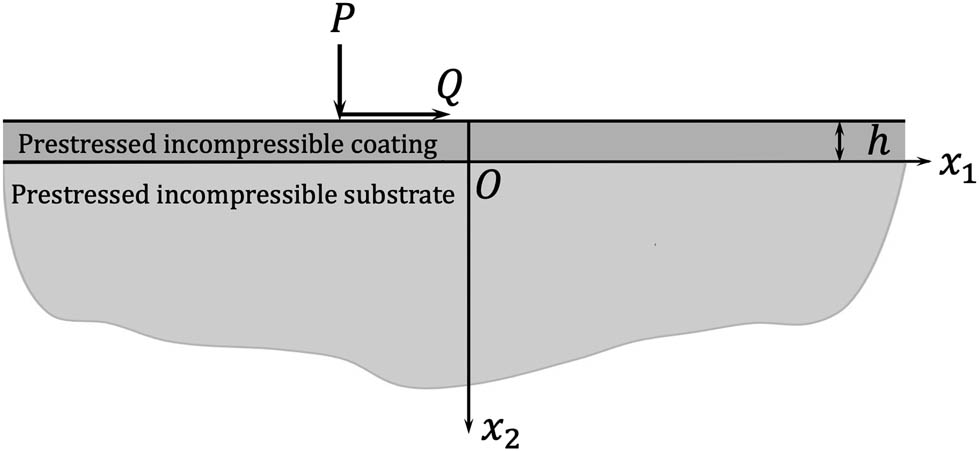
The tangential and vertical loads acting on a half-plane coated by a pre-stressed incompressible elastic layer.
In addition, the linearized measures of incremental tractions, associated with a surface having outward unit normals along
where
with
Here and below, the comma indicates the differentiation with respect to the appropriate variables.
Then, the two coupled non-trivial equations of motion are thus given by
in which
and
while perfect continuity conditions involving all the displacements and stresses
where
3 Effective boundary conditions
The derivation of effective boundary conditions goes by first introducing a small asymptotic parameter
where
along with the following dimensionless quantities:
where
In addition, the equations of motion expressed in Eq. (5) can now be rewritten as:
along with the transformed incompressibility equation as follows:
where
Furthermore, the prescribed boundary conditions in Eqs. (6) and (7) are transformed based on the above development to the following dimensionless forms:
Next, the components of displacements
Therefore, at
such that the above system admits the following solution:
Going further to order
associated with
More so, the displacement components
and
Also, the pressure
The next order
subject to
The solution of this system may be obtained as follows:
and
wherein
Hence, the incremental tractions
Finally, upon returning to the original dimensional variables, the effective boundary conditions at the interface
where
4 Asymptotic formulation for surface waves
Here, having successfully determined the effective boundary conditions in Eq. (28), we now proceed further to derive a pseudo-differential equation for the vertical and longitudinal displacements of the substrate, thereby generalizing the forgoing results to case of the pre-stressed incompressible elastic half-plane, and extending the hyperbolic-elliptic equation in the study of Khajiyeva et al. [42]. To begin with, we follow the consideration in the study of Dowaikh and Ogden [51] by considering the displacement components – via the Cauchy–Riemann identities, to be of the following forms:
where
Then, upon eliminating
where
and satisfying
such that the obtained traction boundary conditions in Eq. (28) are also expressed at the interface
Now, let us introduce the slow-time perturbation scheme, by introducing the following dimensionless variables:
where
Then Eq. (31) is re-cast in terms of a single fourth order partial differential equation (PDE) as follows:
subject to
where
Let us now expand the displacements
then, at the leading order, Eq. (34) becomes
this PDE is elliptic, hence, it can be represented in operator form as
where
For each
where
where
then, the classical Rayleigh wave equation follows as a solvability condition
with the relation between the potentials, given as
where
At the next order, the general solution of the potential function
with
where
More so, at the next order, the boundary conditions given in Eq. (35) at
Therefore, upon inserting Eqs (39) and (43) into conditions (44), and thereafter making use of the Cauchy–Riemann identities, we arrive at
where
Next, plugging the relation determined in Eq. (42) into (45), we obtain at
where
Furthermore, upon combining the previous equations, we have at
Moreover, from the solvability condition given in Eq. (41), the first term in Eq. (47) vanishes, therefore, we deduce
where
and
In addition, Eq. (48) is rearranged in terms of the original variables
where the elliptic equation for the potential
over the interior, along with the boundary condition on the surface of the substrate (
and
Next, Eqs (52) and (53) may be expressed in the form of a pseudo-differential equations on the surface as follows:
and
Note that, for instance, the case of tangential loading of Eq. (52) may be reduced to linear isotropic elasticity as
where in the absence of deformation
where
with
Finally, in the case of no coating, Eqs. (54) and (55) coincide with the recent results reported by Khajiyeva et al. [42] for the dynamics of surface waves in a pre-stressed incompressible half-space. Thus, as the present investigation extended the results of the above-mentioned reference, various directions could be taken to extend the study of Khajiyeva et al. [42]; at the same time, it also serves as a benchmark reference for comparative examination.
5 Conclusion
As a concluding note, the present study analyzed a plane inhomogeneous dynamic problem with regard to a coated pre-stressed incompressible half-space. Sufficient perfect continuity conditions are prescribed between the coating layer and the half-space, while the other end surface of the coating is being excited by both the vertical and tangential loads. Moreover, we acquired the related effective boundary conditions within the long-wave assumption via the application of the asymptotic approximation method. In addition, the uncoupled pseudo-differential equations are approximately revealed on the surface; these approximate equations serve as the overall postulate for the propagation of surface waves in the governing coated structure. More conceivably, all the results presented recently by Khajiyeva et al. [42] could be obtained easily from the presented results as limiting cases of concern upon ignoring the presence and effect of the coating layer. Finally, the present examination can be extended to multiply-coated structures amidst the presence of external forces; in addition, the case of a generalized anisotropic medium can equally be considered as an interesting case of universal concern. Besides, this study is useful in the construction of medical biomaterials – including implants/implantation, which improves the quality of lives, as a particular case of great concern, in addition to its usefulness in the modeling and analysis of coated media.
-
Funding information: This research was supported by Taif University Researchers Sup porting Project number (TURSP-2020/305), Taif University, Taif, Saudi Arabia.
-
Author contributions: The author has accepted responsibility for the entire content of this manuscript and approved its submission.
-
Conflict of interest: The author states no conflict of interest.
References
[1] Kaplunov JD, Kossovich LY, Nolde EV. Dynamics of thin walled elastic bodies. San Diego, CA, USA: Academic Press; 1998. Search in Google Scholar
[2] Andrianov IV, Awrejcewicz J, Danishevs’kyy VV, Ivankov OA. Asymptotic methods in the theory of plates with mixed boundary conditions. Hoboken, NJ, USA: John Wiley & Sons, Ltd; 2014. 10.1002/9781118725184Search in Google Scholar
[3] Ewing WM, Jardetzky WS, Press F, Beiser A. Elastic waves in layered media. Phy Today; 1957;10(12):27. 10.1063/1.3060203Search in Google Scholar
[4] Daniel IM, Ishai O, Daniel IM, Daniel I. Engineering mechanics of composite materials. New York, NY, USA: Oxford University Press; 2006. Search in Google Scholar
[5] Padture NP, Gell M, Jordan EH. Thermal barrier coatings for gas-turbine engine application. Science. 2002;296:280–4. 10.1126/science.1068609Search in Google Scholar PubMed
[6] Palermo A, Krodel S, Marzani A, Daraio C. Engineered metabarrier as shield from seismic surface waves. Sci Rep. 2016;6:1–10. 10.1038/srep39356Search in Google Scholar PubMed PubMed Central
[7] Cho YS. Non-destructive testing of high strength concrete using spectral analysis of surface waves. NDT Int. 2003;36:229–35. 10.1016/S0963-8695(02)00067-1Search in Google Scholar
[8] Krylov VV. Noise and vibration from high-speed trains. London, UK: Thomas Telford; 2001. 10.1680/navfht.29637Search in Google Scholar
[9] Yigit G, Sahin A, Bayram M. Modelling of vibration for functionally graded beams. Open Math. 2016;14:661–71. 10.1515/math-2016-0057Search in Google Scholar
[10] Althobaiti S, Hawwa MA. Flexural edge waves in a thick piezoelectric film resting on a Winkler foundation. Crystals. 2022;12(5):640. 10.3390/cryst12050640Search in Google Scholar
[11] Erbas B, Kaplunov J, Nobili A, Kilic G. Dispersion of elastic waves in a layer interacting with a Winkler foundation. J Acoust Soc Am. 2018;144:2918–25. 10.1121/1.5079640Search in Google Scholar PubMed
[12] Mandi A, Kundu S, Chandra P, Pati P. An analytic study on the dispersion of Love wave propagation in double layers lying over inhomogeneous half-space. J Solid Mech. 2019:11:570–80. Search in Google Scholar
[13] Abd-Alla AM, Abo-Dahab SM, Khan A. Rotational effects on magneto-thermoelastic Stoneley, Love, and Rayleigh waves in fibre-reinforced anisotropic general viscoelastic media of higher order. Comp Math Continua. 2017;53:49–72. 10.12989/sem.2017.61.2.221Search in Google Scholar
[14] Alam P, Kundu S. Influences of heterogeneities and initial stresses on the propagation of love-type waves in a transversely isotropic layer over an inhomogeneous half-space. J Solid Mech. 2017:9:783–93. Search in Google Scholar
[15] Althobaiti S, Mubaraki A, Nuruddeen RI, Gomez-Aguilar JF. Wave propagation in an elastic coaxial hollow cylinder when exposed to thermal heating and external load. Results Phys. 2022;38:105582. 10.1016/j.rinp.2022.105582Search in Google Scholar
[16] Nuruddeen RI, Nawaz R, Zia ZQM. Effects of thermal stress, magnetic field and rotation on the dispersion of elastic waves in an inhomogeneous five-layered plate with alternating components. Sci Prog. 2020;103:0036850420940469. 10.1177/0036850420940469Search in Google Scholar PubMed
[17] Kaplunov J, Prikazchikov DA, Prikazchikov LA, Sergushova O. The lowest vibration spectra of multi-component structures with contrast material properties. J Sound Vib. 2019;445:132–47. 10.1016/j.jsv.2019.01.013Search in Google Scholar
[18] Wang YZ, Li MF, Kishimoto K. Thermal effects on vibration properties of double-layered nanoplates at small scales. Composites B Eng. 2011;42:1311–7. 10.1016/j.compositesb.2011.01.001Search in Google Scholar
[19] Kundu S, Kumari A. Torsional wave propagation in an initially stressed anisotropic heterogeneous crustal layer lying over a viscoelastic half-space. Procedia Eng. 2017;173:980–7. 10.1016/j.proeng.2016.12.166Search in Google Scholar
[20] Kaplunov J, Prikazchikova L, Alkinidri M. Antiplane shear of an asymmetric sandwich plate. Contin Mech Thermodyn. 2021;33:1247–62. 10.1007/s00161-021-00969-6Search in Google Scholar
[21] Vinson J. The Behavior of Sandwich Structures of Isotropic and Composite Materials. London, UK: Routledge; 2018. 10.1201/9780203737101Search in Google Scholar
[22] Asif M, Nawaz R, Nuruddeen RI. Dispersion of elastic waves in an inhomogenous multilayered plate over a Winkler elastic foundation with imperfect interfacial conditions. Phys Scr. 2021;96:125026. 10.1088/1402-4896/ac36a1Search in Google Scholar
[23] Achenbach JD. Wave propagation in elastic solids, eight impression. Amsterdam, Netherlands: Elsevier; 1999. Search in Google Scholar
[24] Dutta AN. Longitudinal propagation of elastic disturbance for linear vibrations of elastic parameters. Indian J Theor Phys. 1965;4:43–60. Search in Google Scholar
[25] Bhattacharyya RK, Bera RK. Application of Adomian method on the solution of the elastic wave propagation in elastic bars of finite length with randomly and linearly varying Young’s modulus. Appl Math Let. 2004;17:703–9. 10.1016/S0893-9659(04)90108-5Search in Google Scholar
[26] Ahmad F, Zaman FD. Exact and asymptotic solutions of the elastic wave propagation problem in a rod. Int J Pure Appl Math. 2006;27:123–7. Search in Google Scholar
[27] Alzaidi ASM, Mubaraki AM, Nuruddeen RI. Effect of fractional temporal variation on the vibration of waves on elastic substrates with spatial non-homogeneity. AIMS Math. 2022;7:13746–62. 10.3934/math.2022757Search in Google Scholar
[28] Kaplunov J, Prikazchikov D, Prikazchikova L. Dispersion of elastic waves in a strongly inhomogeneous three-layered plate. Int J Solids Struct. 2017;113:169–79. 10.1016/j.ijsolstr.2017.01.042Search in Google Scholar
[29] Dai HH, Kaplunov J, Prikachikov DA. A long-wave model for the surface wave in a coated half-space. Proc R Soc A Math Phy Eng Sci. 2010;466:3097–116. doi: 10.1098/rsta.2019.0111. 10.1098/rspa.2010.0125Search in Google Scholar
[30] Vinh PC, Linh NTK. An approximate secular equation of Rayleigh waves propagating in an orthotropic elastic half-space coated by a thin orthotropic elastic layer. Wave Motion. 2012;49:681–9. 10.1016/j.wavemoti.2012.04.005Search in Google Scholar
[31] Vinh PC, Anh VTN, Thanh VP. Rayleigh waves in an isotropic elastic half-space coated by a thin isotropic elastic layer with smooth contact. Wave Motion. 2014;51:496–504. 10.1016/j.wavemoti.2013.11.008Search in Google Scholar
[32] Mubaraki A. Asymptotic models for surface waves in coated elastic solids. Ph.D. Thesis. Keele, UK, Keel University; 2021. Search in Google Scholar
[33] Tiainen VM. Amorphous carbon as a bio-mechanical coating-mechanical properties and biological applications. Diamond Rel Mat. 2001;10:153–60. 10.1016/S0925-9635(00)00462-3Search in Google Scholar
[34] Li M, Liu Q, Jia Z, Xu X, Cheng Y, Zheng Y, et al. Graphene oxide/hydroxyapatite composite coatings fabricated by electrophoretic nanotechnology for biological applications. Carbon. 2014;67:185–97. 10.1016/j.carbon.2013.09.080Search in Google Scholar
[35] Mubaraki A, Althobaiti S, Nuruddeen RI. Propagation of surface waves in a rotating coated viscoelastic half-space under the influence of magnetic field and gravitational forces. Fractal Fract. 2021;5:1–16. 10.3390/fractalfract5040250Search in Google Scholar
[36] Mubaraki A, Prikazchikov D, Kudaibergenov A. Explicit model for surface waves on an elastic half-space coated by a thin vertically inhomogeneous layer. Dyn Syst Theo Appl. 2019:267–75. 10.1007/978-3-030-77306-9_23Search in Google Scholar
[37] Mubariki A, Prikazchikov D. On Rayleigh wave field induced by surface stresses under the effect of gravity. Math Mech Solids 2020;27:1–12. doi: 10.1177/0812865221080550. 10.1177/10812865221080550Search in Google Scholar
[38] Mubaraki AM, Helmi MM, Nuruddeen RI. Surface wave propagation in a rotating doubly coated nonhomogeneous half space with application. Symmetry. 2022;14:1000. 10.3390/sym14051000Search in Google Scholar
[39] Manna S, Halder T, Althobaiti SN. Dispersion of Love-type wave and its limitation in a nonlocal elastic model of nonhomogeneous layer upon an orthotropic extended medium. Soil Dyn Earthquake Eng. 2022;153:107117. 10.1016/j.soildyn.2021.107117Search in Google Scholar
[40] Manna S, Pramanik D, Althobaiti SN. Love-type surface wave propagation due to interior impulsive point source in a homogenous-coated anisotropic poroelastic layer over a non-homogenous extended substance. Waves Random Complex Media. 2022;1–37. 10.1080/17455030.2022.2081737Search in Google Scholar
[41] Selim MM, Althobaiti S. Wave-based method for longitudinal vibration analysis for irregular single-walled carbon nanotube with elastic-support boundary conditions. Alexandria Eng J. 2022;61:12129–38. 10.1016/j.aej.2022.06.001Search in Google Scholar
[42] Khajiyeva LA, Prikazchikov DA, Prikazchikova LA. Hyperbolic-elliptic model for surface wave in pre-stressed incompressible elastic half-space. Mech Res Comm. 2018;92:49–53. doi: 10.1016/j.mecherescom.2018.07.006. 10.1016/j.mechrescom.2018.07.006Search in Google Scholar
[43] Kaplunov J, Prikazchikov DA. Asymptotic theory for Rayleigh and Rayleigh-type waves. Adv Appl Mech. 2017;50:1–106. 10.1016/bs.aams.2017.01.001Search in Google Scholar
[44] Kaplunov J, Prikazchikov D, Sultanova L. Rayleigh-type waves on a coated elastic half-space with a clamped surface. Phil Transc Royal Soc A. 2019;377:20190111. 10.1098/rsta.2019.0111Search in Google Scholar PubMed
[45] Fu Y, Kaplunov J, Prikazchikov D. Reduced model for the surface dynamics of a generally anisotropic elastic half-space. Proc Royal Soc A. 2020;476:20190590. 10.1098/rspa.2019.0590Search in Google Scholar
[46] Singh AK, Pal MK, Negi A, Mistri KC. Analytical study on dynamic response due to a moving load on distinctly characterized orthotropic half-spaces under different physical conditions with comparative approach. Arab J Sci Eng. 2019;44:4863–83. doi: 10.1007/s13369-018-3577-4. 10.1007/s13369-018-3577-4Search in Google Scholar
[47] Pal MK, Singh AK. On the characteristics of reflected waves in Rotating Functionally graded initially stressed piezoelectric-orthotropic half-space. Waves Random Complex Media. 2021;1–15. doi: 10.1080/17455030.2021.1892239. 10.1080/17455030.2021.1892239Search in Google Scholar
[48] Pal MK, Singh AK. Analysis of reflection and transmission phenomenon at distinct bonding interfaces in a rotating pre-stressed functionally graded piezoelectric-orthotropic structure. Appl Math Comput. 2021;15:126398. doi: 10.1016/j.amc.2021.126398. 10.1016/j.amc.2021.126398Search in Google Scholar
[49] Mubaraki AM, Althobaiti S, Nuruddeen RI. Heat and wave interactions in a thermoelastic coaxial solid cylinder driven by laser heating sources. Case Stud Thermal Eng. 2022;38:102338. doi: 10.1016/j.csite.2022.102338. 10.1016/j.csite.2022.102338Search in Google Scholar
[50] Sahin O, Ege N. Surface displacement field of a coated elastic half-space under the influence of a moving distributional load. Anadolu Universitesi Bilim Ve Teknoloji Dergisi-B Teorik Bilimler. 2017;5:77–90. 10.20290/aubtdb.282613Search in Google Scholar
[51] Dowaikh MA, Ogden RW. On surface waves and deformation in a pre-stressed incompressible elastic solid. IMA J Appl Math. 1990;44:261–84. 10.1093/imamat/44.3.261Search in Google Scholar
© 2022 Saad Althobaiti, published by De Gruyter
This work is licensed under the Creative Commons Attribution 4.0 International License.
Articles in the same Issue
- Regular Articles
- Test influence of screen thickness on double-N six-light-screen sky screen target
- Analysis on the speed properties of the shock wave in light curtain
- Abundant accurate analytical and semi-analytical solutions of the positive Gardner–Kadomtsev–Petviashvili equation
- Measured distribution of cloud chamber tracks from radioactive decay: A new empirical approach to investigating the quantum measurement problem
- Nuclear radiation detection based on the convolutional neural network under public surveillance scenarios
- Effect of process parameters on density and mechanical behaviour of a selective laser melted 17-4PH stainless steel alloy
- Performance evaluation of self-mixing interferometer with the ceramic type piezoelectric accelerometers
- Effect of geometry error on the non-Newtonian flow in the ceramic microchannel molded by SLA
- Numerical investigation of ozone decomposition by self-excited oscillation cavitation jet
- Modeling electrostatic potential in FDSOI MOSFETS: An approach based on homotopy perturbations
- Modeling analysis of microenvironment of 3D cell mechanics based on machine vision
- Numerical solution for two-dimensional partial differential equations using SM’s method
- Multiple velocity composition in the standard synchronization
- Electroosmotic flow for Eyring fluid with Navier slip boundary condition under high zeta potential in a parallel microchannel
- Soliton solutions of Calogero–Degasperis–Fokas dynamical equation via modified mathematical methods
- Performance evaluation of a high-performance offshore cementing wastes accelerating agent
- Sapphire irradiation by phosphorus as an approach to improve its optical properties
- A physical model for calculating cementing quality based on the XGboost algorithm
- Experimental investigation and numerical analysis of stress concentration distribution at the typical slots for stiffeners
- An analytical model for solute transport from blood to tissue
- Finite-size effects in one-dimensional Bose–Einstein condensation of photons
- Drying kinetics of Pleurotus eryngii slices during hot air drying
- Computer-aided measurement technology for Cu2ZnSnS4 thin-film solar cell characteristics
- QCD phase diagram in a finite volume in the PNJL model
- Study on abundant analytical solutions of the new coupled Konno–Oono equation in the magnetic field
- Experimental analysis of a laser beam propagating in angular turbulence
- Numerical investigation of heat transfer in the nanofluids under the impact of length and radius of carbon nanotubes
- Multiple rogue wave solutions of a generalized (3+1)-dimensional variable-coefficient Kadomtsev--Petviashvili equation
- Optical properties and thermal stability of the H+-implanted Dy3+/Tm3+-codoped GeS2–Ga2S3–PbI2 chalcohalide glass waveguide
- Nonlinear dynamics for different nonautonomous wave structure solutions
- Numerical analysis of bioconvection-MHD flow of Williamson nanofluid with gyrotactic microbes and thermal radiation: New iterative method
- Modeling extreme value data with an upside down bathtub-shaped failure rate model
- Abundant optical soliton structures to the Fokas system arising in monomode optical fibers
- Analysis of the partially ionized kerosene oil-based ternary nanofluid flow over a convectively heated rotating surface
- Multiple-scale analysis of the parametric-driven sine-Gordon equation with phase shifts
- Magnetofluid unsteady electroosmotic flow of Jeffrey fluid at high zeta potential in parallel microchannels
- Effect of plasma-activated water on microbial quality and physicochemical properties of fresh beef
- The finite element modeling of the impacting process of hard particles on pump components
- Analysis of respiratory mechanics models with different kernels
- Extended warranty decision model of failure dependence wind turbine system based on cost-effectiveness analysis
- Breather wave and double-periodic soliton solutions for a (2+1)-dimensional generalized Hirota–Satsuma–Ito equation
- First-principle calculation of electronic structure and optical properties of (P, Ga, P–Ga) doped graphene
- Numerical simulation of nanofluid flow between two parallel disks using 3-stage Lobatto III-A formula
- Optimization method for detection a flying bullet
- Angle error control model of laser profilometer contact measurement
- Numerical study on flue gas–liquid flow with side-entering mixing
- Travelling waves solutions of the KP equation in weakly dispersive media
- Characterization of damage morphology of structural SiO2 film induced by nanosecond pulsed laser
- A study of generalized hypergeometric Matrix functions via two-parameter Mittag–Leffler matrix function
- Study of the length and influencing factors of air plasma ignition time
- Analysis of parametric effects in the wave profile of the variant Boussinesq equation through two analytical approaches
- The nonlinear vibration and dispersive wave systems with extended homoclinic breather wave solutions
- Generalized notion of integral inequalities of variables
- The seasonal variation in the polarization (Ex/Ey) of the characteristic wave in ionosphere plasma
- Impact of COVID 19 on the demand for an inventory model under preservation technology and advance payment facility
- Approximate solution of linear integral equations by Taylor ordering method: Applied mathematical approach
- Exploring the new optical solitons to the time-fractional integrable generalized (2+1)-dimensional nonlinear Schrödinger system via three different methods
- Irreversibility analysis in time-dependent Darcy–Forchheimer flow of viscous fluid with diffusion-thermo and thermo-diffusion effects
- Double diffusion in a combined cavity occupied by a nanofluid and heterogeneous porous media
- NTIM solution of the fractional order parabolic partial differential equations
- Jointly Rayleigh lifetime products in the presence of competing risks model
- Abundant exact solutions of higher-order dispersion variable coefficient KdV equation
- Laser cutting tobacco slice experiment: Effects of cutting power and cutting speed
- Performance evaluation of common-aperture visible and long-wave infrared imaging system based on a comprehensive resolution
- Diesel engine small-sample transfer learning fault diagnosis algorithm based on STFT time–frequency image and hyperparameter autonomous optimization deep convolutional network improved by PSO–GWO–BPNN surrogate model
- Analyses of electrokinetic energy conversion for periodic electromagnetohydrodynamic (EMHD) nanofluid through the rectangular microchannel under the Hall effects
- Propagation properties of cosh-Airy beams in an inhomogeneous medium with Gaussian PT-symmetric potentials
- Dynamics investigation on a Kadomtsev–Petviashvili equation with variable coefficients
- Study on fine characterization and reconstruction modeling of porous media based on spatially-resolved nuclear magnetic resonance technology
- Optimal block replacement policy for two-dimensional products considering imperfect maintenance with improved Salp swarm algorithm
- A hybrid forecasting model based on the group method of data handling and wavelet decomposition for monthly rivers streamflow data sets
- Hybrid pencil beam model based on photon characteristic line algorithm for lung radiotherapy in small fields
- Surface waves on a coated incompressible elastic half-space
- Radiation dose measurement on bone scintigraphy and planning clinical management
- Lie symmetry analysis for generalized short pulse equation
- Spectroscopic characteristics and dissociation of nitrogen trifluoride under external electric fields: Theoretical study
- Cross electromagnetic nanofluid flow examination with infinite shear rate viscosity and melting heat through Skan-Falkner wedge
- Convection heat–mass transfer of generalized Maxwell fluid with radiation effect, exponential heating, and chemical reaction using fractional Caputo–Fabrizio derivatives
- Weak nonlinear analysis of nanofluid convection with g-jitter using the Ginzburg--Landau model
- Strip waveguides in Yb3+-doped silicate glass formed by combination of He+ ion implantation and precise ultrashort pulse laser ablation
- Best selected forecasting models for COVID-19 pandemic
- Research on attenuation motion test at oblique incidence based on double-N six-light-screen system
- Review Articles
- Progress in epitaxial growth of stanene
- Review and validation of photovoltaic solar simulation tools/software based on case study
- Brief Report
- The Debye–Scherrer technique – rapid detection for applications
- Rapid Communication
- Radial oscillations of an electron in a Coulomb attracting field
- Special Issue on Novel Numerical and Analytical Techniques for Fractional Nonlinear Schrodinger Type - Part II
- The exact solutions of the stochastic fractional-space Allen–Cahn equation
- Propagation of some new traveling wave patterns of the double dispersive equation
- A new modified technique to study the dynamics of fractional hyperbolic-telegraph equations
- An orthotropic thermo-viscoelastic infinite medium with a cylindrical cavity of temperature dependent properties via MGT thermoelasticity
- Modeling of hepatitis B epidemic model with fractional operator
- Special Issue on Transport phenomena and thermal analysis in micro/nano-scale structure surfaces - Part III
- Investigation of effective thermal conductivity of SiC foam ceramics with various pore densities
- Nonlocal magneto-thermoelastic infinite half-space due to a periodically varying heat flow under Caputo–Fabrizio fractional derivative heat equation
- The flow and heat transfer characteristics of DPF porous media with different structures based on LBM
- Homotopy analysis method with application to thin-film flow of couple stress fluid through a vertical cylinder
- Special Issue on Advanced Topics on the Modelling and Assessment of Complicated Physical Phenomena - Part II
- Asymptotic analysis of hepatitis B epidemic model using Caputo Fabrizio fractional operator
- Influence of chemical reaction on MHD Newtonian fluid flow on vertical plate in porous medium in conjunction with thermal radiation
- Structure of analytical ion-acoustic solitary wave solutions for the dynamical system of nonlinear wave propagation
- Evaluation of ESBL resistance dynamics in Escherichia coli isolates by mathematical modeling
- On theoretical analysis of nonlinear fractional order partial Benney equations under nonsingular kernel
- The solutions of nonlinear fractional partial differential equations by using a novel technique
- Modelling and graphing the Wi-Fi wave field using the shape function
- Generalized invexity and duality in multiobjective variational problems involving non-singular fractional derivative
- Impact of the convergent geometric profile on boundary layer separation in the supersonic over-expanded nozzle
- Variable stepsize construction of a two-step optimized hybrid block method with relative stability
- Thermal transport with nanoparticles of fractional Oldroyd-B fluid under the effects of magnetic field, radiations, and viscous dissipation: Entropy generation; via finite difference method
- Special Issue on Advanced Energy Materials - Part I
- Voltage regulation and power-saving method of asynchronous motor based on fuzzy control theory
- The structure design of mobile charging piles
- Analysis and modeling of pitaya slices in a heat pump drying system
- Design of pulse laser high-precision ranging algorithm under low signal-to-noise ratio
- Special Issue on Geological Modeling and Geospatial Data Analysis
- Determination of luminescent characteristics of organometallic complex in land and coal mining
- InSAR terrain mapping error sources based on satellite interferometry
Articles in the same Issue
- Regular Articles
- Test influence of screen thickness on double-N six-light-screen sky screen target
- Analysis on the speed properties of the shock wave in light curtain
- Abundant accurate analytical and semi-analytical solutions of the positive Gardner–Kadomtsev–Petviashvili equation
- Measured distribution of cloud chamber tracks from radioactive decay: A new empirical approach to investigating the quantum measurement problem
- Nuclear radiation detection based on the convolutional neural network under public surveillance scenarios
- Effect of process parameters on density and mechanical behaviour of a selective laser melted 17-4PH stainless steel alloy
- Performance evaluation of self-mixing interferometer with the ceramic type piezoelectric accelerometers
- Effect of geometry error on the non-Newtonian flow in the ceramic microchannel molded by SLA
- Numerical investigation of ozone decomposition by self-excited oscillation cavitation jet
- Modeling electrostatic potential in FDSOI MOSFETS: An approach based on homotopy perturbations
- Modeling analysis of microenvironment of 3D cell mechanics based on machine vision
- Numerical solution for two-dimensional partial differential equations using SM’s method
- Multiple velocity composition in the standard synchronization
- Electroosmotic flow for Eyring fluid with Navier slip boundary condition under high zeta potential in a parallel microchannel
- Soliton solutions of Calogero–Degasperis–Fokas dynamical equation via modified mathematical methods
- Performance evaluation of a high-performance offshore cementing wastes accelerating agent
- Sapphire irradiation by phosphorus as an approach to improve its optical properties
- A physical model for calculating cementing quality based on the XGboost algorithm
- Experimental investigation and numerical analysis of stress concentration distribution at the typical slots for stiffeners
- An analytical model for solute transport from blood to tissue
- Finite-size effects in one-dimensional Bose–Einstein condensation of photons
- Drying kinetics of Pleurotus eryngii slices during hot air drying
- Computer-aided measurement technology for Cu2ZnSnS4 thin-film solar cell characteristics
- QCD phase diagram in a finite volume in the PNJL model
- Study on abundant analytical solutions of the new coupled Konno–Oono equation in the magnetic field
- Experimental analysis of a laser beam propagating in angular turbulence
- Numerical investigation of heat transfer in the nanofluids under the impact of length and radius of carbon nanotubes
- Multiple rogue wave solutions of a generalized (3+1)-dimensional variable-coefficient Kadomtsev--Petviashvili equation
- Optical properties and thermal stability of the H+-implanted Dy3+/Tm3+-codoped GeS2–Ga2S3–PbI2 chalcohalide glass waveguide
- Nonlinear dynamics for different nonautonomous wave structure solutions
- Numerical analysis of bioconvection-MHD flow of Williamson nanofluid with gyrotactic microbes and thermal radiation: New iterative method
- Modeling extreme value data with an upside down bathtub-shaped failure rate model
- Abundant optical soliton structures to the Fokas system arising in monomode optical fibers
- Analysis of the partially ionized kerosene oil-based ternary nanofluid flow over a convectively heated rotating surface
- Multiple-scale analysis of the parametric-driven sine-Gordon equation with phase shifts
- Magnetofluid unsteady electroosmotic flow of Jeffrey fluid at high zeta potential in parallel microchannels
- Effect of plasma-activated water on microbial quality and physicochemical properties of fresh beef
- The finite element modeling of the impacting process of hard particles on pump components
- Analysis of respiratory mechanics models with different kernels
- Extended warranty decision model of failure dependence wind turbine system based on cost-effectiveness analysis
- Breather wave and double-periodic soliton solutions for a (2+1)-dimensional generalized Hirota–Satsuma–Ito equation
- First-principle calculation of electronic structure and optical properties of (P, Ga, P–Ga) doped graphene
- Numerical simulation of nanofluid flow between two parallel disks using 3-stage Lobatto III-A formula
- Optimization method for detection a flying bullet
- Angle error control model of laser profilometer contact measurement
- Numerical study on flue gas–liquid flow with side-entering mixing
- Travelling waves solutions of the KP equation in weakly dispersive media
- Characterization of damage morphology of structural SiO2 film induced by nanosecond pulsed laser
- A study of generalized hypergeometric Matrix functions via two-parameter Mittag–Leffler matrix function
- Study of the length and influencing factors of air plasma ignition time
- Analysis of parametric effects in the wave profile of the variant Boussinesq equation through two analytical approaches
- The nonlinear vibration and dispersive wave systems with extended homoclinic breather wave solutions
- Generalized notion of integral inequalities of variables
- The seasonal variation in the polarization (Ex/Ey) of the characteristic wave in ionosphere plasma
- Impact of COVID 19 on the demand for an inventory model under preservation technology and advance payment facility
- Approximate solution of linear integral equations by Taylor ordering method: Applied mathematical approach
- Exploring the new optical solitons to the time-fractional integrable generalized (2+1)-dimensional nonlinear Schrödinger system via three different methods
- Irreversibility analysis in time-dependent Darcy–Forchheimer flow of viscous fluid with diffusion-thermo and thermo-diffusion effects
- Double diffusion in a combined cavity occupied by a nanofluid and heterogeneous porous media
- NTIM solution of the fractional order parabolic partial differential equations
- Jointly Rayleigh lifetime products in the presence of competing risks model
- Abundant exact solutions of higher-order dispersion variable coefficient KdV equation
- Laser cutting tobacco slice experiment: Effects of cutting power and cutting speed
- Performance evaluation of common-aperture visible and long-wave infrared imaging system based on a comprehensive resolution
- Diesel engine small-sample transfer learning fault diagnosis algorithm based on STFT time–frequency image and hyperparameter autonomous optimization deep convolutional network improved by PSO–GWO–BPNN surrogate model
- Analyses of electrokinetic energy conversion for periodic electromagnetohydrodynamic (EMHD) nanofluid through the rectangular microchannel under the Hall effects
- Propagation properties of cosh-Airy beams in an inhomogeneous medium with Gaussian PT-symmetric potentials
- Dynamics investigation on a Kadomtsev–Petviashvili equation with variable coefficients
- Study on fine characterization and reconstruction modeling of porous media based on spatially-resolved nuclear magnetic resonance technology
- Optimal block replacement policy for two-dimensional products considering imperfect maintenance with improved Salp swarm algorithm
- A hybrid forecasting model based on the group method of data handling and wavelet decomposition for monthly rivers streamflow data sets
- Hybrid pencil beam model based on photon characteristic line algorithm for lung radiotherapy in small fields
- Surface waves on a coated incompressible elastic half-space
- Radiation dose measurement on bone scintigraphy and planning clinical management
- Lie symmetry analysis for generalized short pulse equation
- Spectroscopic characteristics and dissociation of nitrogen trifluoride under external electric fields: Theoretical study
- Cross electromagnetic nanofluid flow examination with infinite shear rate viscosity and melting heat through Skan-Falkner wedge
- Convection heat–mass transfer of generalized Maxwell fluid with radiation effect, exponential heating, and chemical reaction using fractional Caputo–Fabrizio derivatives
- Weak nonlinear analysis of nanofluid convection with g-jitter using the Ginzburg--Landau model
- Strip waveguides in Yb3+-doped silicate glass formed by combination of He+ ion implantation and precise ultrashort pulse laser ablation
- Best selected forecasting models for COVID-19 pandemic
- Research on attenuation motion test at oblique incidence based on double-N six-light-screen system
- Review Articles
- Progress in epitaxial growth of stanene
- Review and validation of photovoltaic solar simulation tools/software based on case study
- Brief Report
- The Debye–Scherrer technique – rapid detection for applications
- Rapid Communication
- Radial oscillations of an electron in a Coulomb attracting field
- Special Issue on Novel Numerical and Analytical Techniques for Fractional Nonlinear Schrodinger Type - Part II
- The exact solutions of the stochastic fractional-space Allen–Cahn equation
- Propagation of some new traveling wave patterns of the double dispersive equation
- A new modified technique to study the dynamics of fractional hyperbolic-telegraph equations
- An orthotropic thermo-viscoelastic infinite medium with a cylindrical cavity of temperature dependent properties via MGT thermoelasticity
- Modeling of hepatitis B epidemic model with fractional operator
- Special Issue on Transport phenomena and thermal analysis in micro/nano-scale structure surfaces - Part III
- Investigation of effective thermal conductivity of SiC foam ceramics with various pore densities
- Nonlocal magneto-thermoelastic infinite half-space due to a periodically varying heat flow under Caputo–Fabrizio fractional derivative heat equation
- The flow and heat transfer characteristics of DPF porous media with different structures based on LBM
- Homotopy analysis method with application to thin-film flow of couple stress fluid through a vertical cylinder
- Special Issue on Advanced Topics on the Modelling and Assessment of Complicated Physical Phenomena - Part II
- Asymptotic analysis of hepatitis B epidemic model using Caputo Fabrizio fractional operator
- Influence of chemical reaction on MHD Newtonian fluid flow on vertical plate in porous medium in conjunction with thermal radiation
- Structure of analytical ion-acoustic solitary wave solutions for the dynamical system of nonlinear wave propagation
- Evaluation of ESBL resistance dynamics in Escherichia coli isolates by mathematical modeling
- On theoretical analysis of nonlinear fractional order partial Benney equations under nonsingular kernel
- The solutions of nonlinear fractional partial differential equations by using a novel technique
- Modelling and graphing the Wi-Fi wave field using the shape function
- Generalized invexity and duality in multiobjective variational problems involving non-singular fractional derivative
- Impact of the convergent geometric profile on boundary layer separation in the supersonic over-expanded nozzle
- Variable stepsize construction of a two-step optimized hybrid block method with relative stability
- Thermal transport with nanoparticles of fractional Oldroyd-B fluid under the effects of magnetic field, radiations, and viscous dissipation: Entropy generation; via finite difference method
- Special Issue on Advanced Energy Materials - Part I
- Voltage regulation and power-saving method of asynchronous motor based on fuzzy control theory
- The structure design of mobile charging piles
- Analysis and modeling of pitaya slices in a heat pump drying system
- Design of pulse laser high-precision ranging algorithm under low signal-to-noise ratio
- Special Issue on Geological Modeling and Geospatial Data Analysis
- Determination of luminescent characteristics of organometallic complex in land and coal mining
- InSAR terrain mapping error sources based on satellite interferometry
