Performance evaluation of a high-performance offshore cementing wastes accelerating agent
-
Haiou Hou
 and
Biao Wang
and
Biao Wang

Abstract
This article reports a quick-setting agent named AS-G1. In the current offshore oil exploitation, there are usually wastes mixed with the drilling fluid, completion fluid, cement slurry, etc. To protect the marine environment, offshore construction workers need to weakly solidify these wastes so that they can be transported to land for disposal. The accelerating agent can reduce the fluidity of offshore cementing wastes and achieve the effect of solidifying wastes. Compare the time for the three cement slurries to lose fluidity with the addition of accelerating agents. Evaluate the setting time of cement slurry under the action of the accelerating agent after adding two drilling fluids. The solidification effect of this kind of accelerating agent on cementing waste is verified. It can be applied to waste treatment in oil fields.
1 Introduction
In the 21st century, environmental protection is an increasingly important issue [1,2]. Recently, to protect the environment, a number of laws and regulations have been enacted [3,4,5], and offshore oilfield operations require full waste recovery [6]. Among them, the Bohai Oilfield and Western South China Sea oilfields have the highest environmental protection production requirements [7]. Wastes such as drilling fluid and cement slurry generated during mining must be transported back to the land for disposal [8]. In 2020, there will be 511 wells drilled in Bohai Oilfield each year. A single well will produce about 600 m3 of completion/workover fluid and cementing fluid waste, and a total of about 300,000 m3 of waste fluid will be produced. China National Offshore Oil Corporation has packaged the full recovery of drilling/completion/workover/cementing fluid waste into the service contract [9]. However, there is no mature process plan for how to transport the waste with a lot of water content back to the mainland [10]. The shortcomings of cementing fluid waste treatment technology will seriously affect the subsequent business development and even lead to the risk of contract suspension [11,12,13]. Only after completing the relevant technical research, we can continue to extract oil at sea [14]. With the increasingly severe environmental protection situation, to implement a zero-emission policy in marine operations, it is urgently necessary to study technologies suitable for offshore cementing fluid waste treatment [15,16,17].
In the 1960s, with more and more large-volume and super-volume buildings, scholars began to use slow-setting water-reducing agents in concrete projects [18,19]. After the 1960s, some organic or inorganic retarders, such as zinc salts, hemicellulose, and water reducers, have been widely used and have achieved good results. Among them, calcium lignosulfonate and molasses water reducers are the most commonly used. At the same time, research has been conducted on the inadaptability of wood calcium and molasses water-reducing agent to some cement varieties, and the retarding mechanism has been discussed. Relatively speaking, the research on retarders is relatively monotonous and slow. It can be roughly divided into inorganic retarders and organic retarders [20,21,22,23,24,25].
Currently, the overall treatment of cementing waste in offshore oilfields cannot meet the requirements of offshore oilfields, does not meet the requirements for environmental protection at this stage, and does not meet the requirements of relevant national laws and regulations. Therefore, there is an urgent need for simple operation, small footprint, and environmentally friendly treatment agents. Therefore, this article reports a quick-setting agent named AL-G1 and evaluates its performance. The accelerating agent can reduce the fluidity of offshore cementing wastes and achieve the effect of solidifying wastes. When the waste with more water content loses its mobility, it can be more conveniently transported to the land for subsequent treatment. The time for the three cement slurries to lose fluidity with the addition of accelerating agents is compared. Evaluate the setting time of cement slurry under the action of the accelerating agent after adding two drilling fluids. The solidification effect of this kind of accelerating agent on cementing waste is verified. It can be applied to waste treatment in oil fields [26].
2 Method
We aim to solidify the waste with high water content at the sea, so that it can be transported to the land. If the intensity of these wastes is too high, they are difficult to handle on the ocean. Therefore, we synthesized an accelerating agent named AL-G1 that can weakly solidify the waste. The vision of this accelerator for future applications is to turn waste fluidity into 0. Therefore, our experimental steps are as follows.
We purchased a metal cylinder with an inner diameter of 30 mm and a height of 50 mm and a flat glass with an area of 300 mm × 300 mm. This metal cylinder is called the mold. We placed the object to be tested in a metal mold, which is placed horizontally at the center of the glass plate. After placing for 1 s, 1 h, 2 h, 3 h, and 4 h, the metal mold is lifted vertically upward. The fluidity and free water after 10 s are recorded.
3 The weak curing performance before and after three kinds of pure cement slurry accelerating agents
3.1 Three basic formulas of pure cement slurries
The three pure cement slurries are surface cementing early-strength cement slurry C1, surface cementing soil moving (bentonite) cement slurry C2, and PC-LET 6 K low-density cement slurry C3, and their basic formulations are presented in Table 1. The density of cement slurry C1 is 1.58 g/cm3, and the density of C2 and C3 is 1.50 g/cm3.
Basic formula of three kinds of pure cement slurries
| Type of grout | Drug name | Dosage/g | Wt/% |
|---|---|---|---|
| Surface cementing early strength cement slurry C1 | Water | 86 | — |
| PC-A90L | 2.4 | 2.4 | |
| PC-X60L | 1 | 1 | |
| PC-A90S | 3.6 | 3.6 | |
| Cement | 100 | — | |
| Surface cementing bentonite cement slurry C2 | Water | 106.7 | — |
| PC-H21L | 1 | 1 | |
| PC-X60L | 1 | 1 | |
| PC-P50 | 4.5 | 4.5 | |
| Cement | 10.0 | — | |
| PC-LET 6 K low-density cement slurry C3 | Water | 69.1 | — |
| PC-G81L | 7.9 | 7.9 | |
| PC-H21L | 0.7 | 0.7 | |
| PC-F41L | 0.35 | 0.35 | |
| PC-X60L | 0.7 | 0.7 | |
| PC-GS12S | 2.1 | 2.1 | |
| Cement | 100 | — |
3.2 Evaluation of weak curing performance of three kinds of pure cement slurries
300 mL of the prepared pure cement slurry is taken, in which the density of surface cementing early. y-Strength cement slurry C1 is 1.54 g/cm3, the density of surface cementing cement slurry C2 is 1.49 g/cm3, and the density of PC-LET 6 K low-density cement slurry C3 and C2 is 1.48 g/cm3. The weight reduction material in PC-LET 6 K low-density cement slurry C3 is 42.5 g/100 g cement, and the weak curing performance and free water of the three pure cement slurries are evaluated.
As shown in Figures 1–3, surface cementing early-strength cement slurry C1 can lose its fluidity within 4 h, but the free water is relatively large. The surface cementing bentonite cement slurry C2 still has a certain fluidity and a certain amount of free water after 4 h. PC-LET 6 K low-density cement slurry C3 can lose its fluidity in 4 h without free water.
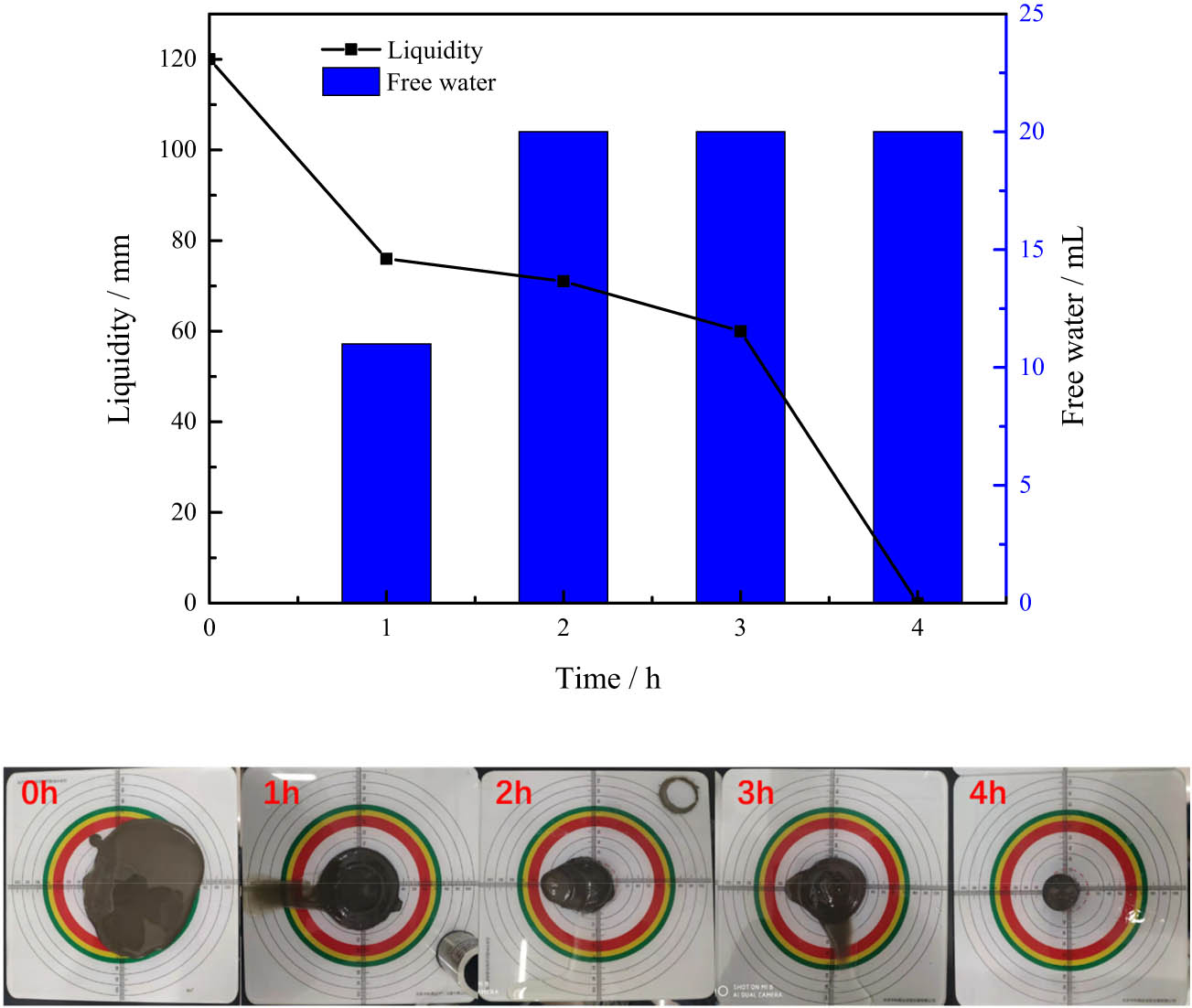
The weak curing performance of surface cementing early-strength cement slurry C1.
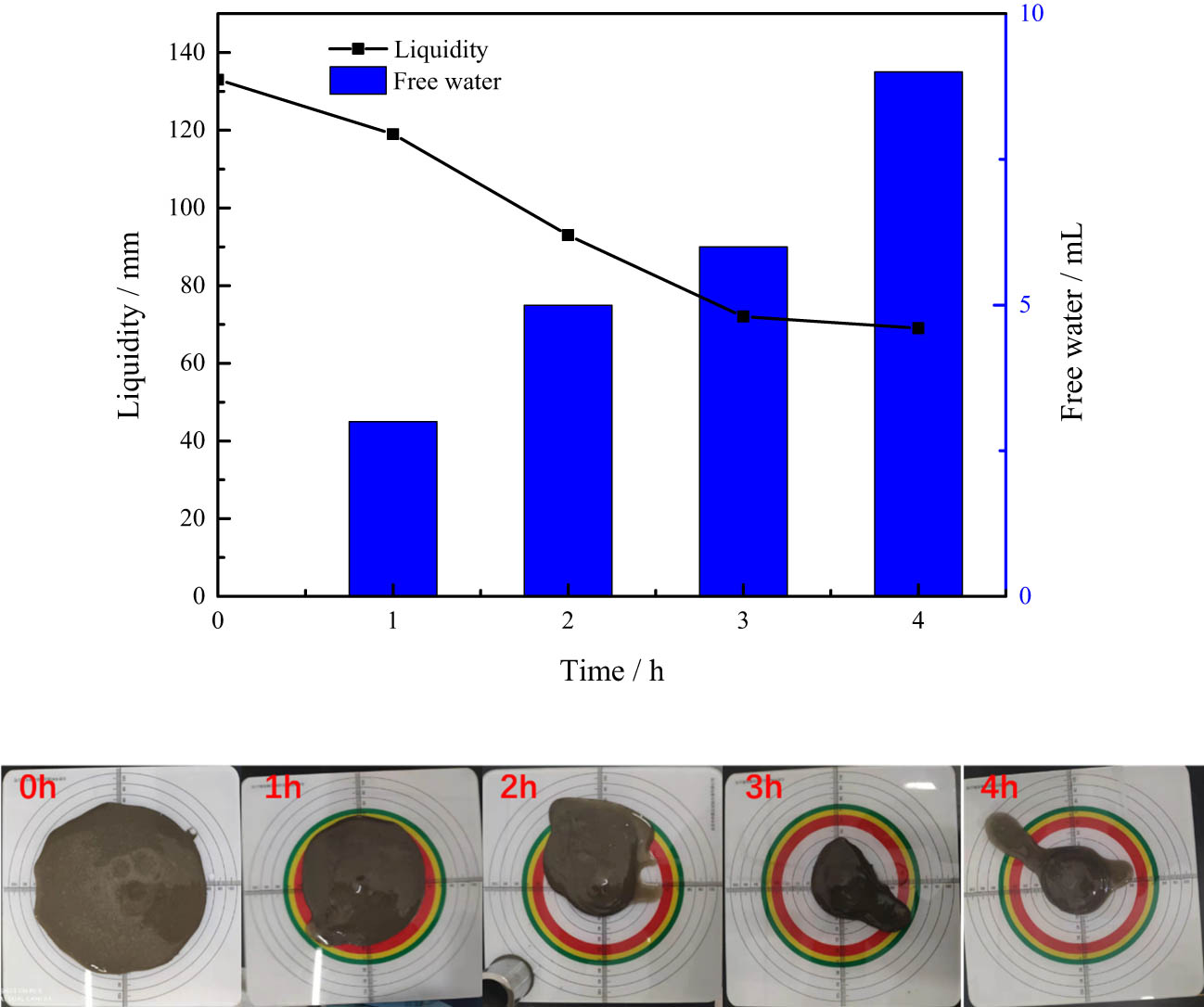
The weak curing performance of surface cementing Bentonite cement slurry C2.
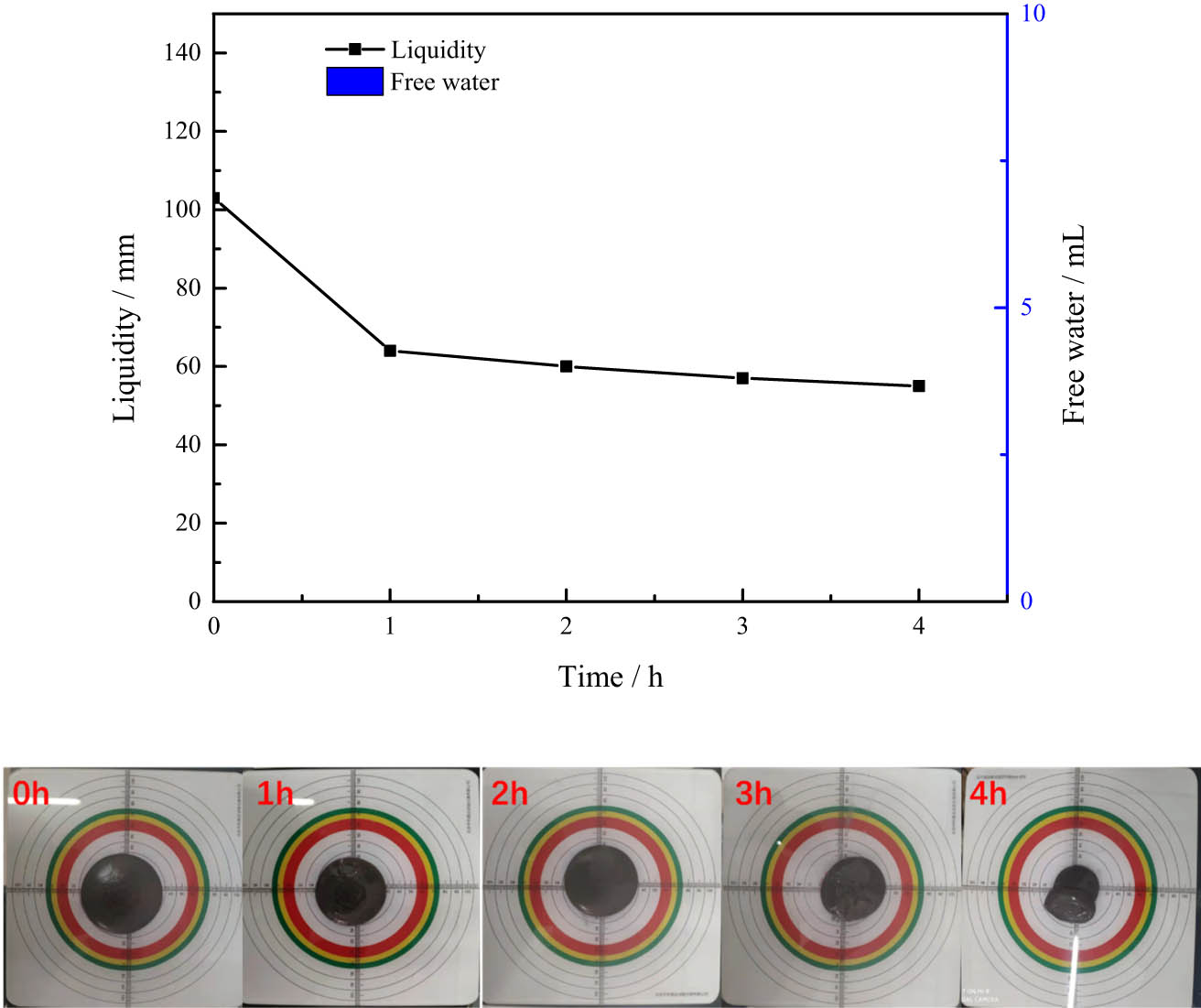
The weak curing performance of PC-LET 6 K low-density cement slurry C3.
3.3 Evaluation of weak curing performance of three kinds of pure cement slurries + accelerating agent.
The three pure cement slurries after adding 1% accelerating agent are evaluated. As shown in Figures 4–6, after surface cementing early-strength cement slurry C1 + 1% accelerating agent, it loses its fluidity within 2 h and the free water is less than 3%. After surface cementing early-strength (cementing Bentonite) cement slurry C2 + 1% accelerating agent, it loses its fluidity within 1 h, and the free water is less than 3%. After surface cementing early-strength (PC-LET 6 K low-density) cement slurry C3 + 1% accelerating agent, it loses its fluidity within 4 h, and the free water is less than 3%.
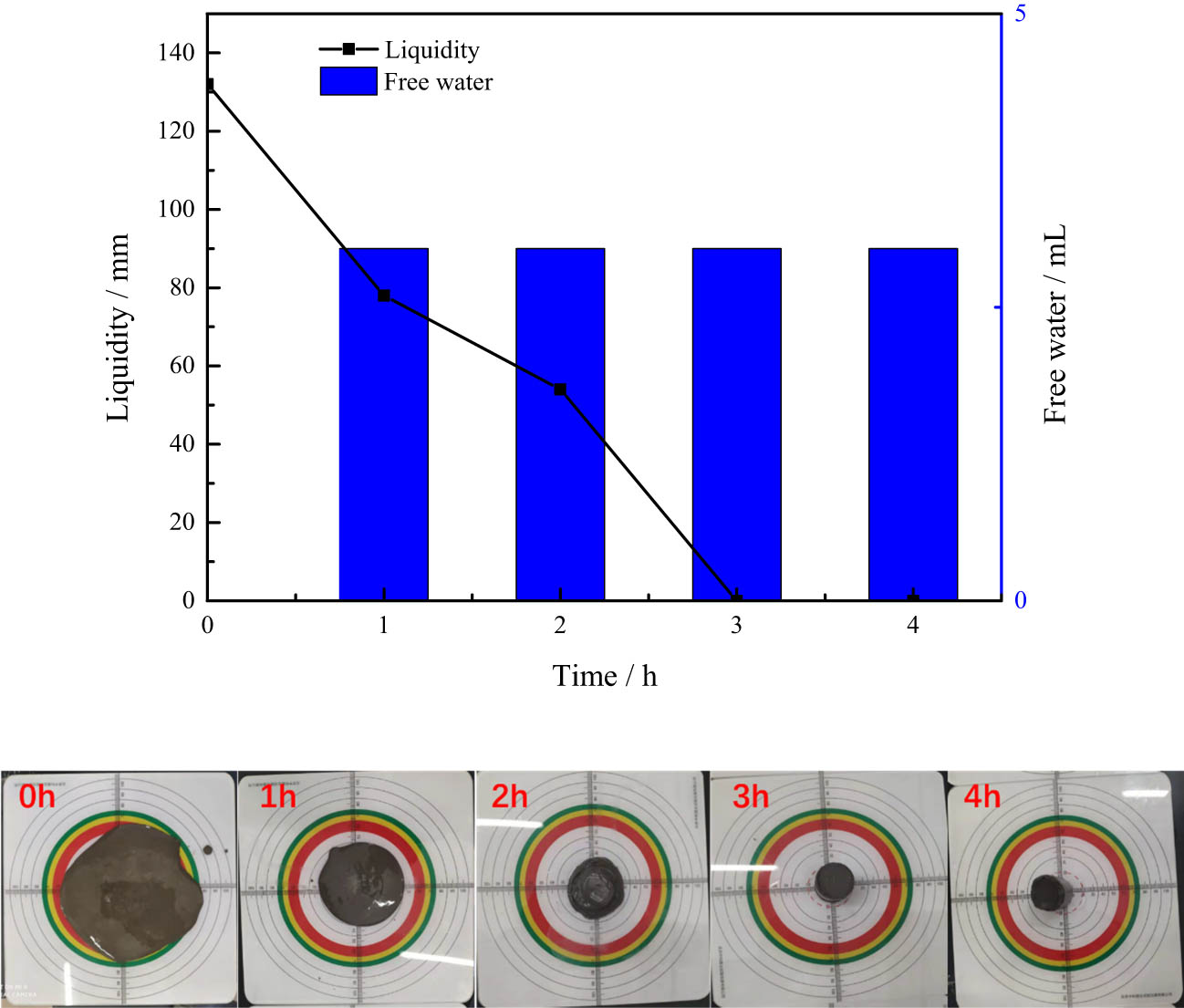
The weak curing performance of surface cementing early strength cement slurry C1 + 1% accelerating agent.

The weak curing performance of surface cementing early-strength (cementing bentonite) cement slurry C2 + 3% accelerating agent.

The weak curing performance of surface cementing early strength (PC-LET 6 K low-density) cement slurry C3 + 1% accelerating agent.
4 Evaluation of weak solidification performance of PEM drilling fluid to cementing fluid waste
4.1 Preparation of cementing fluid waste solution
Preparation of simulated cementing fluid waste solution: the ratio of isolation fluid + flushing fluid mixture is fixed, three types of cement slurry is changed, the ratio of PEM drilling fluid is changed, and three different cementing fluid waste solutions are prepared, see Table 2.
Preparation formula of simulated cementing fluid waste solution
| Formula system | The added volume ratio of different cementing fluid wastes | |||
|---|---|---|---|---|
| Isolation fluid (A) + flushing fluid (B)/% | Type of grout | Grout/% | PEM drilling fluid (D2)/% | |
| 21-1 | 25 | C1 | 50 | 25 |
| 21-4 | 14.3 | 28.6 | 57.1 | |
| 22-1 | 25 | C2 | 50 | 25 |
| 22-4 | 14.3 | 28.6 | 57.1 | |
| 23-1 | 25 | C3 | 50 | 25 |
| 23-4 | 14.3 | 28.6 | 57.1 | |
4.2 The effect of PEM drilling fluid addition on the weak curing performance of surface cementing early-strength cement slurry C1
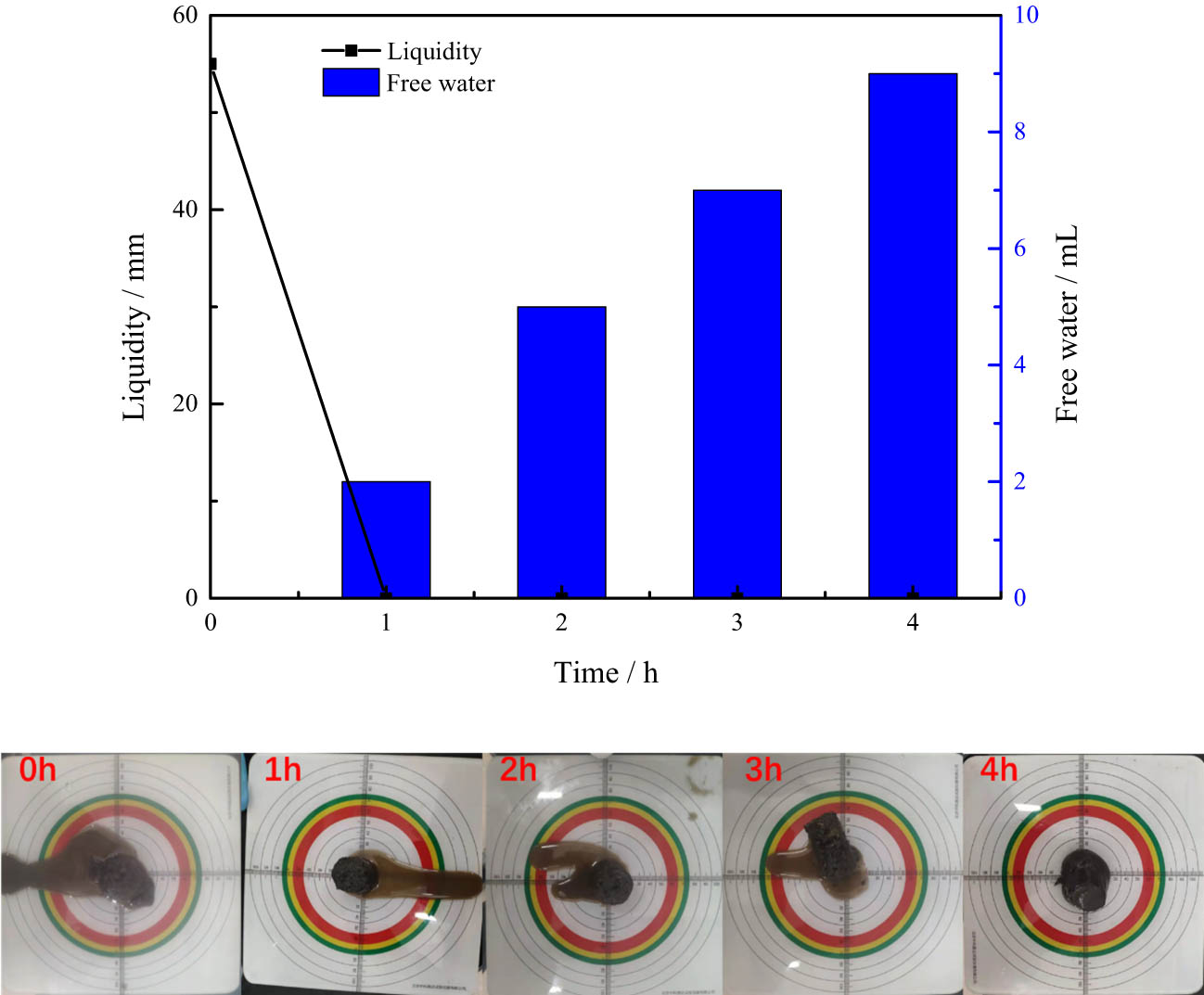
Choose the surface cementing early-strength mixing system 21-1 (1:2:1) and system 21-4 (1:2:4) with large differences. Aluminum sulfate (AS-G1) is selected as the accelerating agent, and the dosage is 5%, and its weak curing performance and free water are evaluated, see Figures 7 and 8. After adding 5% quick-setting agent to the system 21-1, its fluidity will be lost within 1 h, and the free water will be less than 3%. After the system 21-4 + 5% quick-setting agent, the fluidity will be lost within 2 h, and the free water will be less than 3%.
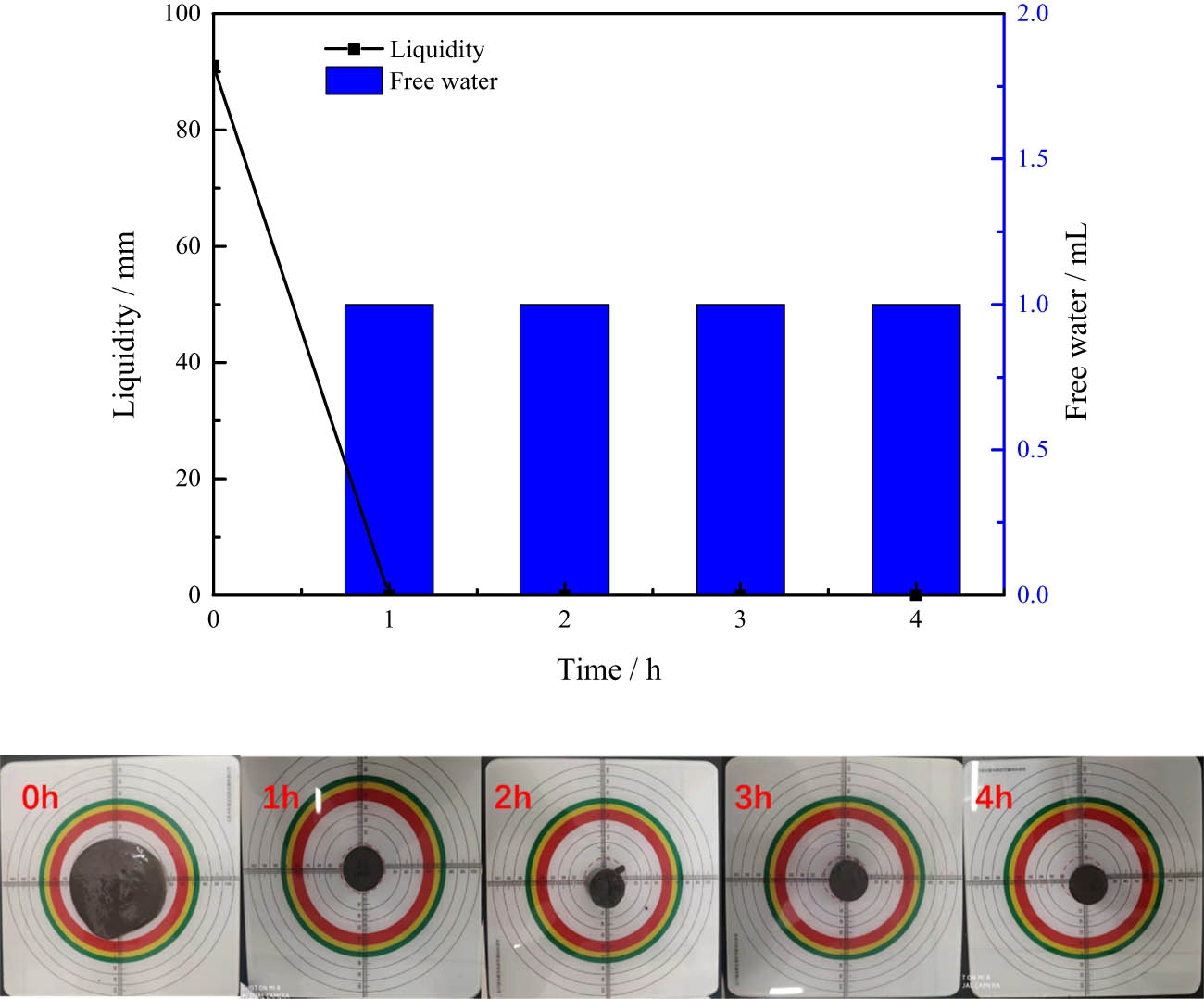
The weak curing performance of system 21-1 mixed slurry.
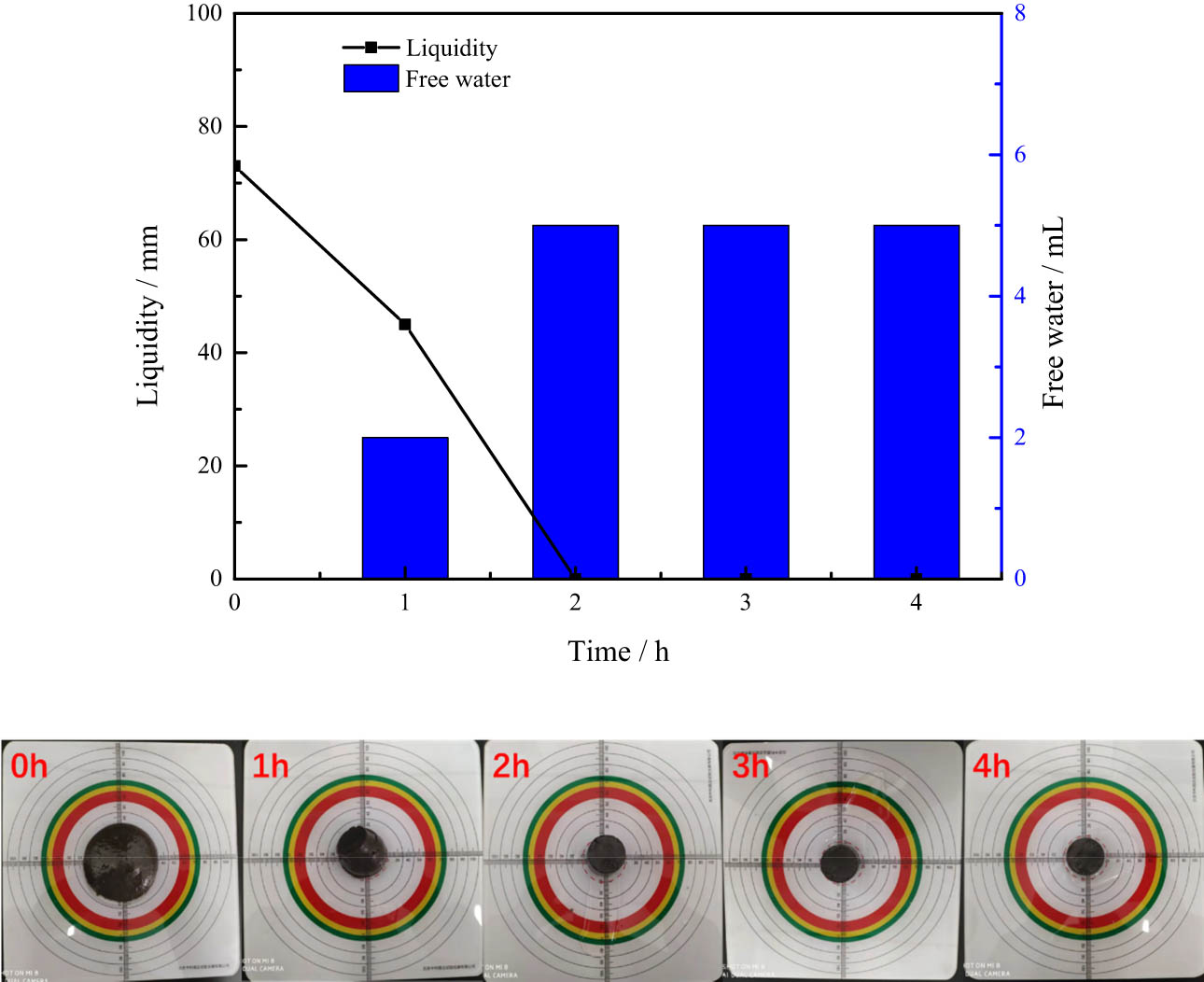
The weak curing performance of system 21-4 mixed slurry.
4.3 Influence of PEM drilling fluid addition on C2 weak solidification performance of surface cementing mud
The surface cementing bentonite slurry system 22-1 (1:2:1) and system 22-4 (1:2:4) with large differences are chosen. Aluminum sulfate (AS-G1) is selected as the accelerating agent, 3% of aluminum sulfate is used, and its weak curing performance and amount of free water are evaluated. As shown in Figures 9 and 10, after the addition of the accelerating agent, the system 22-1 gelled quickly and the slurry lost fluidity. Surprisingly, the system 22-4 did not gel.

The weak curing performance of system 22-1.
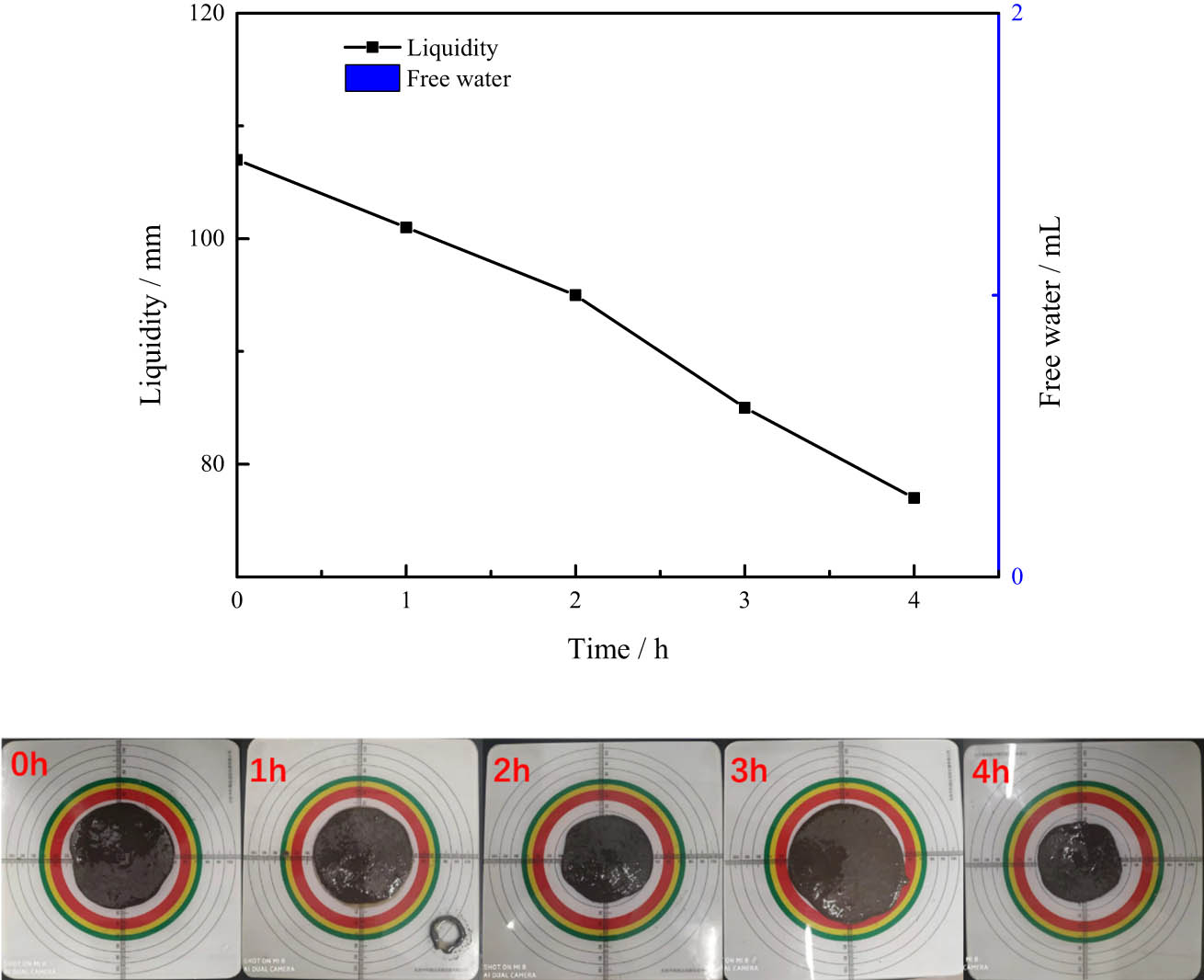
The weak curing performance of system 22-4 mixed slurry.
4.4 Influence of PEM drilling fluid addition on C3 weak solidification performance of low-density cement slurry
The PC-LET 6 K low-density cement slurry system 23-1 (1:2:1) and system 23-4 (1:2:4) with large differences are chosen. Aluminum sulfate (AS-G1) is selected as the accelerating agent and added to the system 23-1 The amount is 4%, and the additional amount of the system 23-4 is 3%. The weak curing performance and free water are evaluated. Figure 11 shows that the system 23-1 started to solidify after 2 h, and there was not much free water. In Figure 12, the system 23-4 solidified within 1 h, but the free water continued to increase.
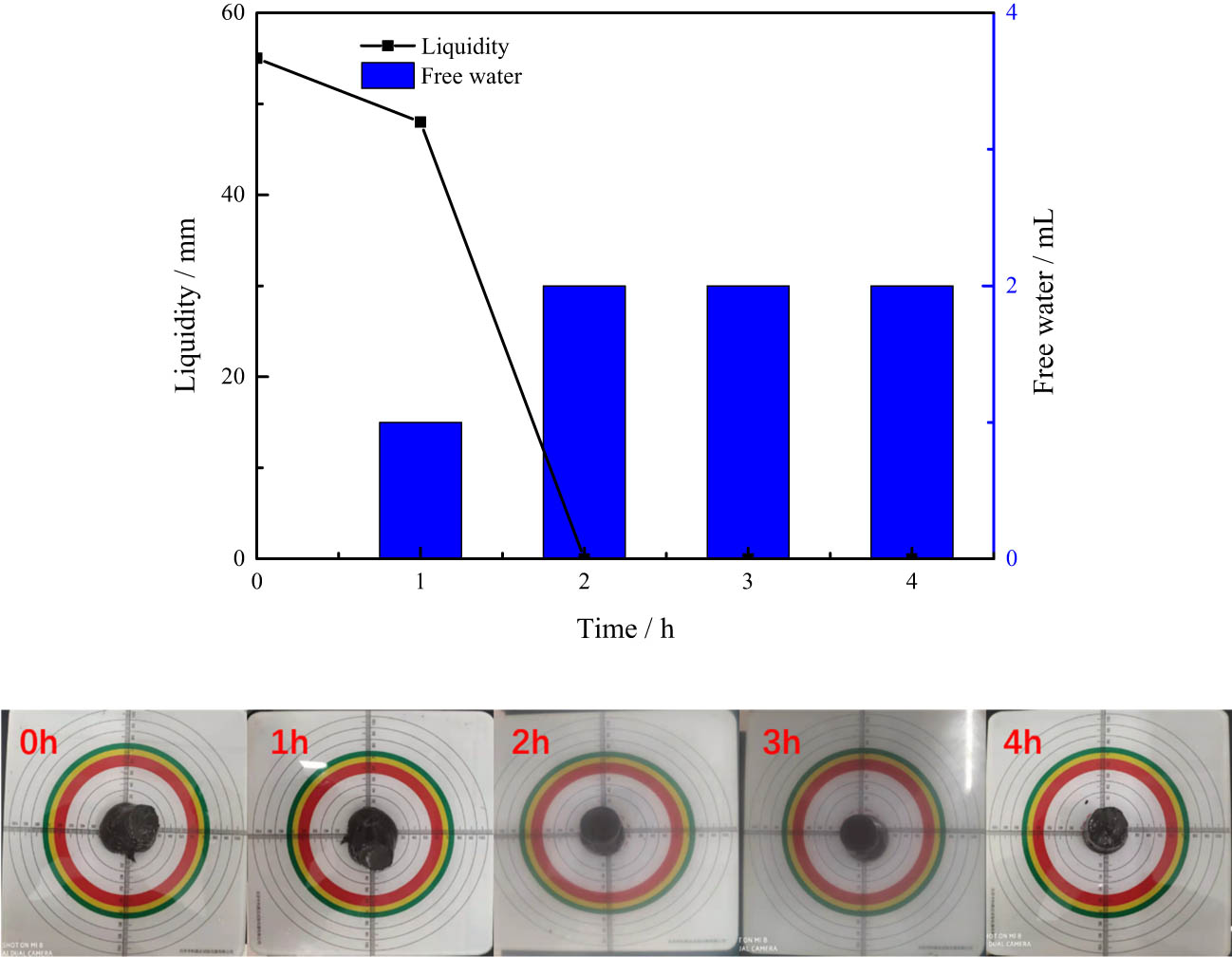
The weak curing performance of cement slurry C3 and system 23-1.
The weak curing performance of cement slurry C3, system 23-4 mixed slurry.
5 Evaluation of the weak solidification performance of PEC drilling fluid for cementing fluid waste
5.1 Preparation of cementing fluid waste solution
The preparation of simulated cementing fluid waste solution: the ratio of isolating fluid + flushing fluid mixture is fixed, the three types of cement slurry are changed, the ratio of PEC drilling fluid is changed, and three different cementing fluid waste solutions are prepared (Table 3).
Preparation formula of simulated cementing fluid waste solution
| Formula system | The added volume ratio of different cementing fluid wastes | |||
|---|---|---|---|---|
| Isolation fluid (A) + flushing fluid (B)/% | Type of grout | Grout/% | PEC drilling fluid D3 | |
| 31-1 | 25 | C1 | 50 | 25 |
| 31-4 | 14.3 | 28.6 | 57.1 | |
| 32-1 | 25 | C2 | 50 | 25 |
| 32-4 | 14.3 | 28.6 | 57.1 | |
| 33-1 | 25 | C3 | 50 | 25 |
| 33-4 | 14.3 | 28.6 | 57.1 | |
5.2 The effect of PEC drilling fluid addition on the weak curing performance of surface cementing early-strength cement slurry C1
The surface cementing early-strength mixing system 31-1 (1:2:1) and system 31-4 (1:2:4) with large differences are chosen, aluminum sulfate (AS-G1) is selected as the accelerating agent, system 31-1 (1:2:1) dosage is 5%, system 31-4 (1:2:4) dosage is 4%, its weak curing performance and free water are evaluated. As shown in Figures 13 and 14, both system 31-1 and system 31-4 lose their fluidity in 1 h, and there is no free water overflow.
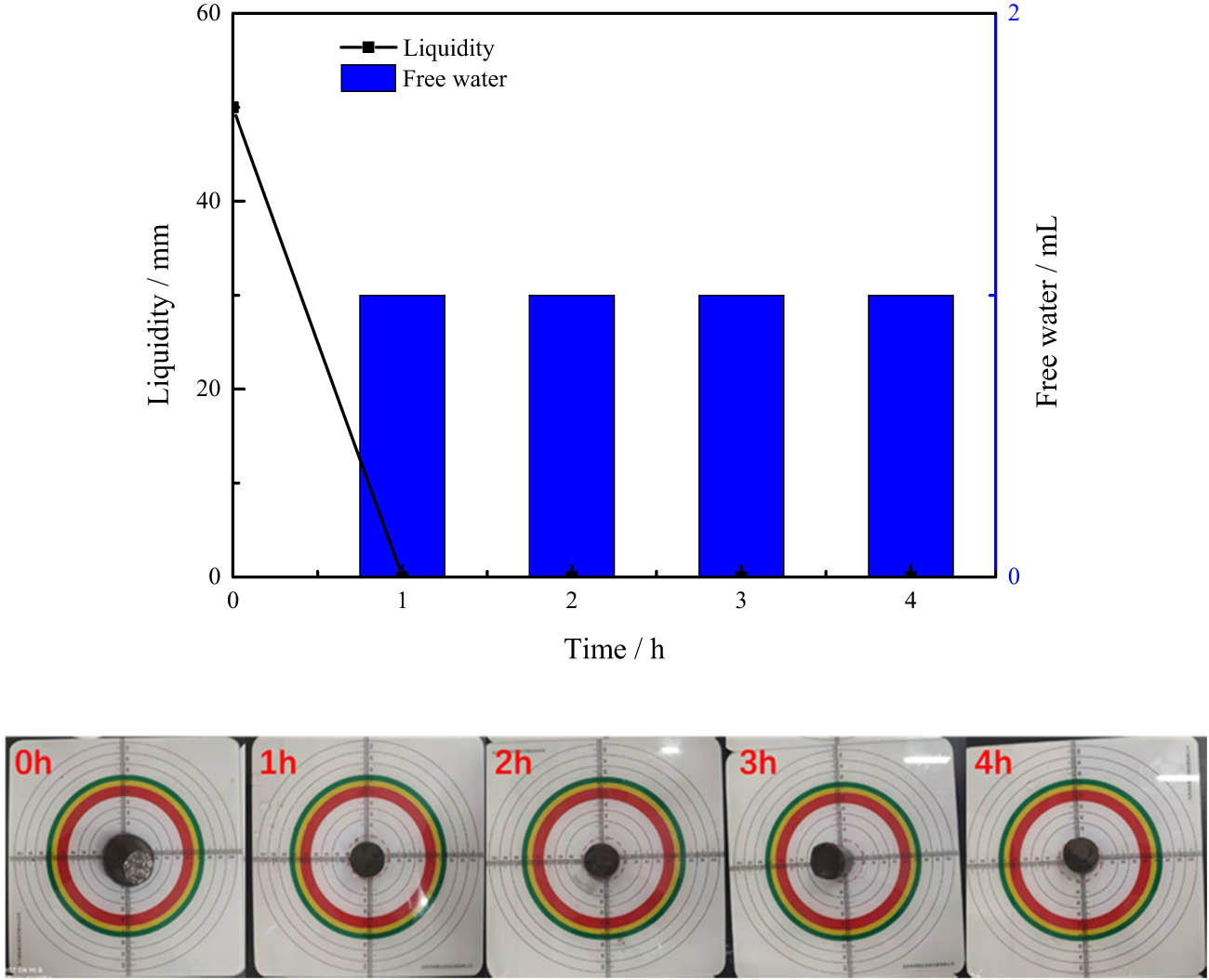
The weak curing performance of system 31-1 mixed slurry.

The weak curing performance of system 31-4 mixed slurry.
5.3 The effect of PEC drilling fluid addition on the C2 weak curing performance of surface cementing early-strength cement slurry
The surface cementing early-strength mixing system 32-1 (1:2:1) and system 32-4 (1:2:4) with large differences are chosen, AL-G1 is selected as the accelerating agent, system 32-1 (1:2:1) dosage is 3%, system 32-4 (1:2:4) dosage is 4%, and its weak curing performance and free water are evaluated. Figure 15 shows that the system 32-1 loses its fluidity within 1 h, and the free water remains unchanged at 6 mL. Figure 16 shows that the curing effect of system 32-4 is very bad, and it fails to cure within 4 h.
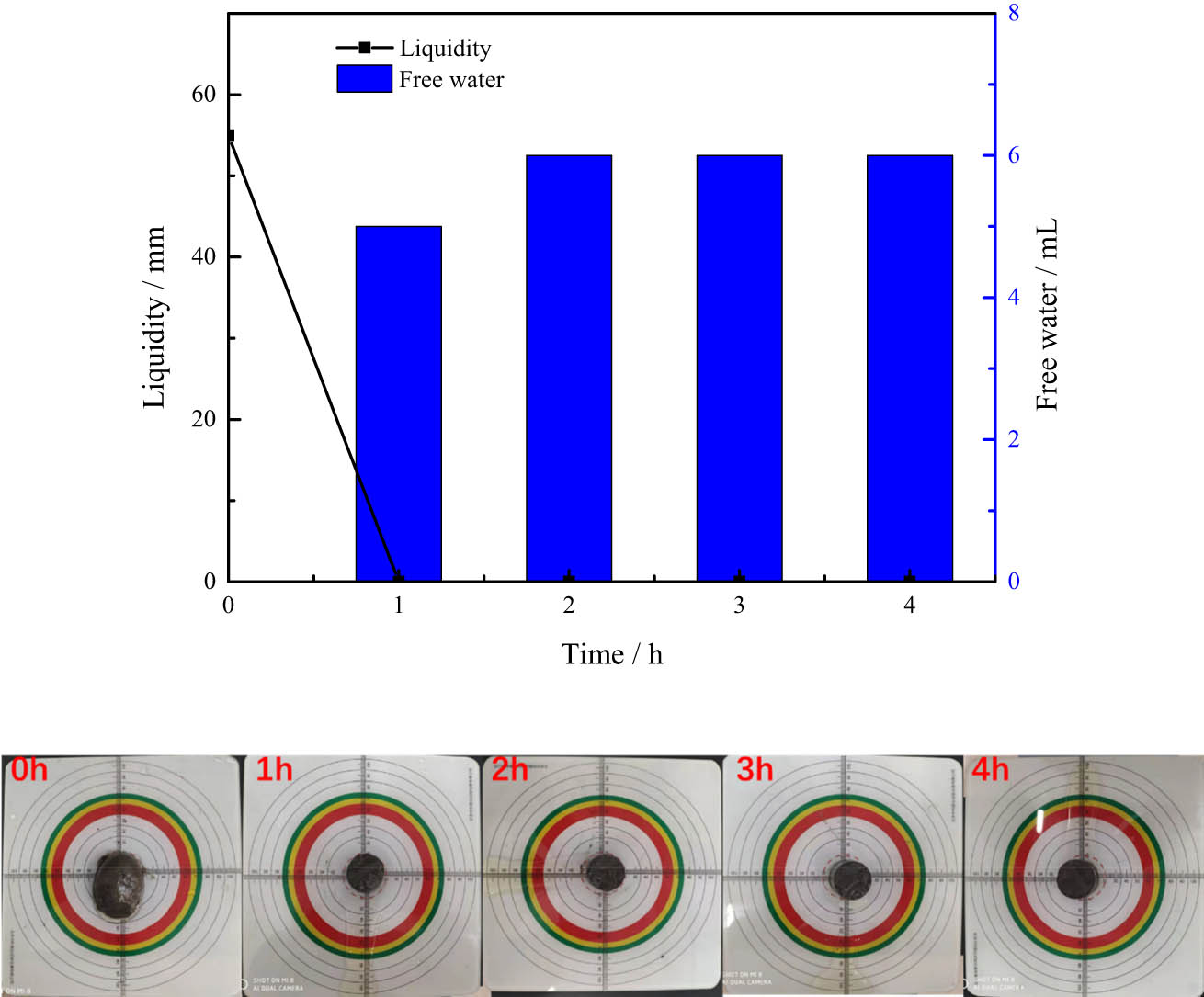
The weak curing performance of system 32-1.
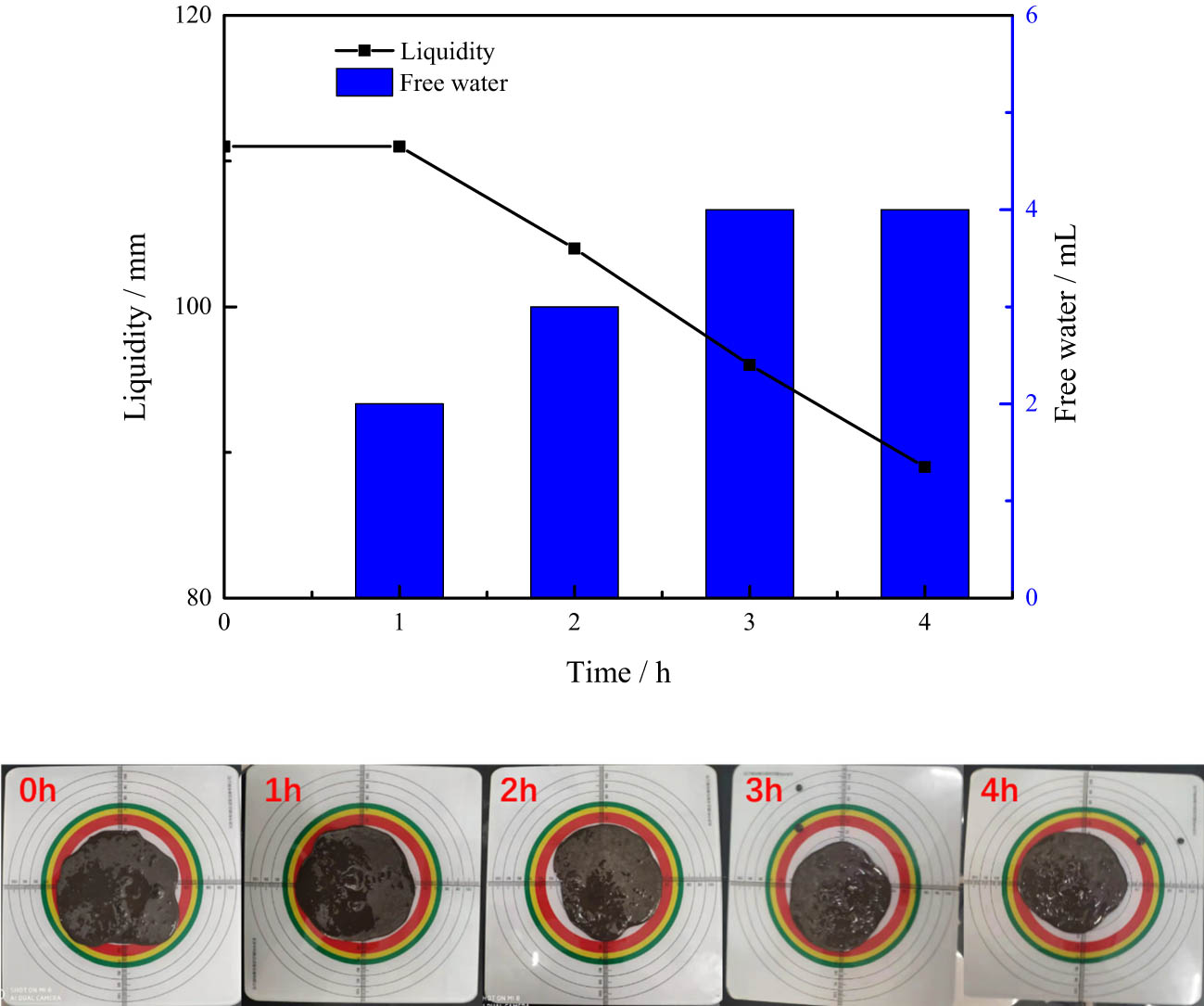
The weak curing performance of system 32-4 mixed slurry.
5.4 The effect of PEC drilling fluid addition on the C3 weak curing performance of surface cementing early-strength cement slurry
The surface cementing early-strength mixing system 33-1 (1:2:1) and system 33-4 (1:2:4) with large differences are chosen. Aluminum sulfate (AS-G1) is selected as the accelerating agent, system 33-1 (1:2:1) dosage is 3%, system 33-4 (1:2:4) dosage is 4%, and its weak curing performance and free water are evaluated. In Figure 17, we have an exciting result: system 33-1 has no free water, and it can be cured within 2 h. In Figure 18, the result of system 34-4 is still very good, and although there is a small amount of flowing water, it still loses fluidity within 2 h.
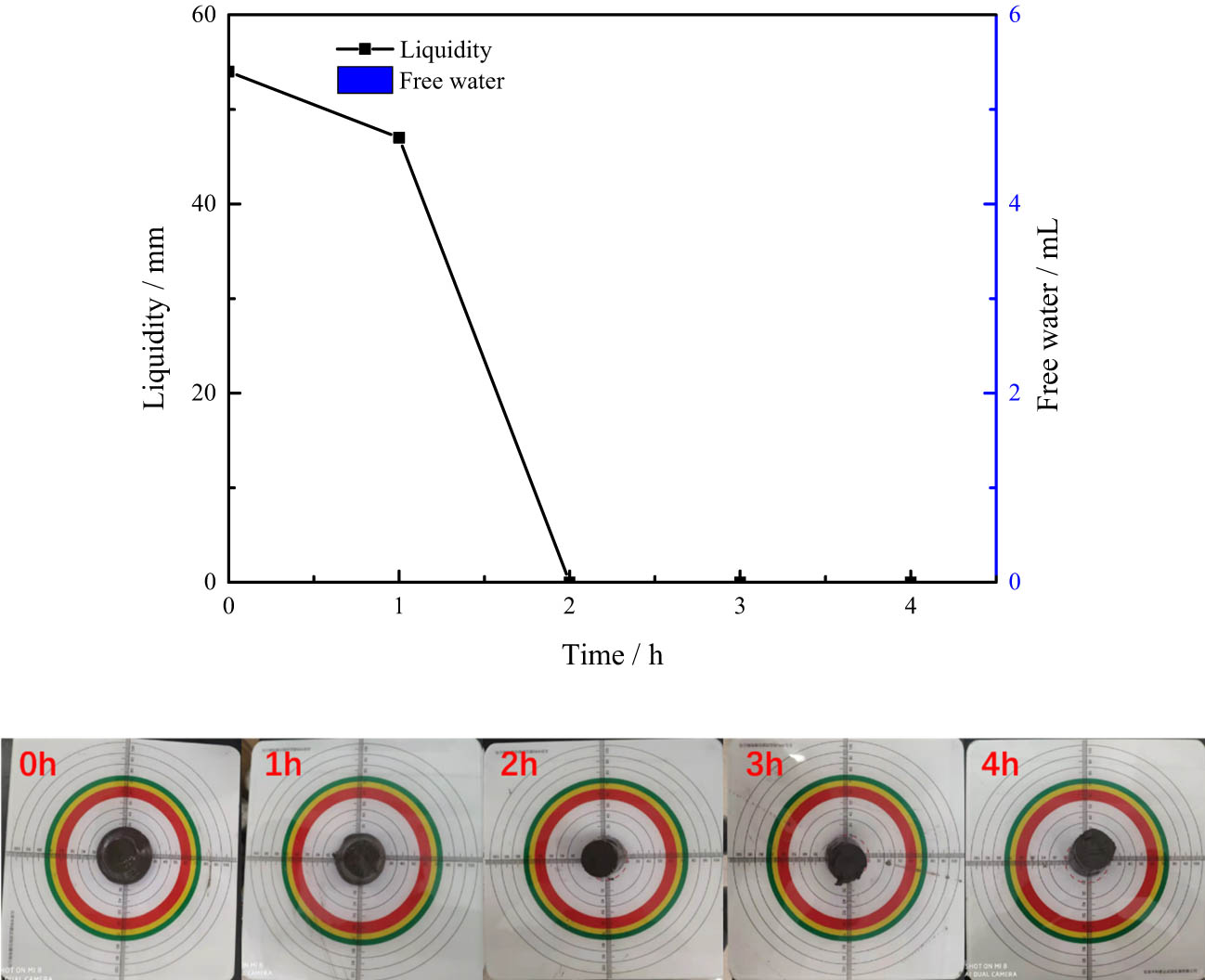
The weak curing performance of system 33-1.

The weak curing performance of system 33-4 mixed slurry.
6 Conclusion
Accelerating agent AS-G1 has the best effect on cement slurry C2. 1 h after the cement slurry was added with 1% accelerating agent, the cement slurry lost its fluidity, and there was no free water in the cement slurry C2. Accelerating agents also have good effects on cement slurries C1 and C3 and can make the cement slurry lose fluidity after 3 h. After adding PEM and PEC drilling fluids, the setting effect of accelerating agents on cement slurry C1 and C3 is still very good. However, the effect on C2 is extremely poor, and the curing effect is not achieved. In general, the coagulant AS-G1 is effectively used in the waste solidification treatment in offshore oil extraction. Waste treated with AS-G1 is transported to the land by ship for subsequent processing. This report provides new solutions for the solidification of cementing waste in the future.
-
Funding information: The project was supported by Heilongjiang Province Natural Science Foundation of “Study on flocculation of oilfield wastewater with magnetic nano-materials Fe3O4@SiO2-NH2”. Fund No.: LH2020E014.
-
Author contributions: All authors have accepted responsibility for the entire content of this manuscript and approved its submission.
-
Conflict of interest: The authors state no conflict of interest.
References
[1] Tyson GW, Chapman J, Hugenholtz P, Allen EE, Ram RJ, Richardson PM, et al. Community structure and metabolism through reconstruction of microbial genomes from the environment. Nature. 2004;428(6978):37–43.10.1038/nature02340Search in Google Scholar PubMed
[2] Deweerdt S. The environmental concerns driving another inhaler makeover. Nature. 2020;581(7807):S14–7.10.1038/d41586-020-01377-7Search in Google Scholar
[3] Abraham RE, Alghazwi M, Liang Q, Zhang W. Advances on marine-derived natural radioprotection compounds: historic development and future perspective. Marine Life Science & Technology. 2021;3(4):1–14.10.1007/s42995-021-00095-xSearch in Google Scholar
[4] Susilo YO, Maat K. The influence of built environment to the trends in commuting journeys in the netherlands. Transportation. 2007;34(5):589–609.10.1007/s11116-007-9129-5Search in Google Scholar
[5] Hillebrecht C. International criminal accountability and the domestic politics of resistance: case studies from kenya and lebanon. Law Soc Rev. 2020;54(2):453–86.10.1111/lasr.12469Search in Google Scholar
[6] Krishnan S, Zulkapli NS, Kamyab H, Taib SM, Othman N. Current technologies for recovery of metals from industrial wastes: an overview. Environ Technol Inno. 2021;22(1–3):101525.10.1016/j.eti.2021.101525Search in Google Scholar
[7] Wang Q, Wei L, Wang W. Review: challenges and prospects for milk production in China after the 2008 milk scandal. Appl Anim Behav Sci. 2021;37(2):166–75.10.15232/aas.2020-02074Search in Google Scholar
[8] Titus A, Bjørnarlundb B, Arildsaasen C. Effect of particle number density on rheological properties and barite sag in oil-based drilling fluids. J Petrol Sci Eng. 2021;206:108908.10.1016/j.petrol.2021.108908Search in Google Scholar
[9] Zhang J, Liu X, Li Y, Chang X, Zhang J, Chen G. Study of COD removal from the waste drilling fluid and its application chad oilfield. J Water Chem Techno. 2021;43(1):60–7.10.3103/S1063455X21010148Search in Google Scholar
[10] Ulvi A. The effect of the distribution and numbers of ground control points on the precision of producing orthophoto maps with an unmanned aerial vehicle. J Asian Archit Build. 2021;20(6):806–17.10.1080/13467581.2021.1973479Search in Google Scholar
[11] Cai X, Cai H, Shang C, Du C. Two-stage pyrolysis/gasification and plasma conversion technology for the utilization of solid waste. IEEE T Plasma Sci. 2021;49(1):191–213.10.1109/TPS.2020.3044534Search in Google Scholar
[12] Huynh P, Ogawa Y, Kawai K, Bui PT. Evaluation of the cementing efficiency factor of low-calcium fly ash for the chloride-penetration resistance of concretes: A simple approach. Constr Build Mater. 2021;270:121858.10.1016/j.conbuildmat.2020.121858Search in Google Scholar
[13] Zhou X, Li X, Xu J, Cheng Y, Cao F. Latanoprost-loaded cyclodextrin microaggregate suspension eye drops for enhanced bioavailability and stability. Eur J Pharm Sci. 2021;160(10108):105758.10.1016/j.ejps.2021.105758Search in Google Scholar PubMed
[14] Munna K, Durga P, Ram SS. Performance enhancement of imc-pid controller design for stable and unstable second-order time delay processes. J Cent South Univ. 2020;27(1):88–100.10.1007/s11771-020-4280-7Search in Google Scholar
[15] Fuzik K, Kutina I, Nikolaiev I, Veselov Y. Implementation of graded approach in ensuring safety in management of emergency and legacy radioactive waste in ukraine. J Radiol Prot. 2021;41(3):S269–83.10.1088/1361-6498/ac0d61Search in Google Scholar PubMed
[16] Katzenstein W, Fertig R, Apt R. The variability of interconnected wind plants. Energy Policy. 2010;38(8):4400–10.10.1016/j.enpol.2010.03.069Search in Google Scholar
[17] Stehlik P. Efficient waste processing and waste to energy: challenge for the future. Clean Technol Envir. 2009;11(1):7–9.10.1007/s10098-008-0185-0Search in Google Scholar
[18] Nishibayashi S. The properties of concrete with water-reducing admixture, the effects of reduction in cement content. J Soc of Mater Sci Jpn. 1969;18(188):434–41.10.2472/jsms.18.434Search in Google Scholar
[19] Chen JH, Chen CS. Object recognition based on image sequences by using inter-feature-line consistencies. Pattern Recogn. 2004;37(9):1913–23.10.1016/j.patcog.2003.12.003Search in Google Scholar
[20] Kasai J. Influence of calcium 2-ketogluconate on portland cement, plaser of paris and lime. Inorg Mater. 1967;1967:181–2.Search in Google Scholar
[21] Han QH, Yang YZ, Zhang JR, Yu J, Hou DS, Dong BQ, et al. Insights into the interfacial strengthening mechanism of waste rubber/cement paste using polyvinyl alcohol: experimental and molecular dynamics study - sciencedirect. Cement Concrete Comp. 2020;114:103791.10.1016/j.cemconcomp.2020.103791Search in Google Scholar
[22] Demont L, Ducoulombier N, Mesnil R, Caron JF. Flow-based pultrusion of continuous fibers for cement-based composite material and additive manufacturing: rheological and technological requirements. Compos Struct. 2021;262(13):113564.10.1016/j.compstruct.2021.113564Search in Google Scholar
[23] Mechtcherine V, Buswell R, Kloft H, Bos FP, Neef T. Integrating reinforcement in digital fabrication with concrete: a review and classification framework. Cement Concrete Comp. 2021;119:103964.10.1016/j.cemconcomp.2021.103964Search in Google Scholar
[24] Guvalov A, Abbasova S. Influence of rheological active additives on the properties of self-compacting concrete. J Wuhan Univ Technol. 2021;36(3):381–6.10.1007/s11595-021-2420-zSearch in Google Scholar
[25] Yang H, Usman M, Hanif A. Suitability of liquid crystal display (LCD) glass waste as supplementary cementing material (SCM): assessment based on strength, porosity, and durability. J Build Eng. 2021;42:102793.10.1016/j.jobe.2021.102793Search in Google Scholar
[26] Ene R, Marinca V, Marinca V. Thin film flow of an Oldroyd 6-constant fluid over a moving belt: an analytic approximate solution. Open Phys. 2016;14(1):44–64.10.1515/phys-2016-0005Search in Google Scholar
© 2022 Haiou Hou et al., published by De Gruyter
This work is licensed under the Creative Commons Attribution 4.0 International License.
Articles in the same Issue
- Regular Articles
- Test influence of screen thickness on double-N six-light-screen sky screen target
- Analysis on the speed properties of the shock wave in light curtain
- Abundant accurate analytical and semi-analytical solutions of the positive Gardner–Kadomtsev–Petviashvili equation
- Measured distribution of cloud chamber tracks from radioactive decay: A new empirical approach to investigating the quantum measurement problem
- Nuclear radiation detection based on the convolutional neural network under public surveillance scenarios
- Effect of process parameters on density and mechanical behaviour of a selective laser melted 17-4PH stainless steel alloy
- Performance evaluation of self-mixing interferometer with the ceramic type piezoelectric accelerometers
- Effect of geometry error on the non-Newtonian flow in the ceramic microchannel molded by SLA
- Numerical investigation of ozone decomposition by self-excited oscillation cavitation jet
- Modeling electrostatic potential in FDSOI MOSFETS: An approach based on homotopy perturbations
- Modeling analysis of microenvironment of 3D cell mechanics based on machine vision
- Numerical solution for two-dimensional partial differential equations using SM’s method
- Multiple velocity composition in the standard synchronization
- Electroosmotic flow for Eyring fluid with Navier slip boundary condition under high zeta potential in a parallel microchannel
- Soliton solutions of Calogero–Degasperis–Fokas dynamical equation via modified mathematical methods
- Performance evaluation of a high-performance offshore cementing wastes accelerating agent
- Sapphire irradiation by phosphorus as an approach to improve its optical properties
- A physical model for calculating cementing quality based on the XGboost algorithm
- Experimental investigation and numerical analysis of stress concentration distribution at the typical slots for stiffeners
- An analytical model for solute transport from blood to tissue
- Finite-size effects in one-dimensional Bose–Einstein condensation of photons
- Drying kinetics of Pleurotus eryngii slices during hot air drying
- Computer-aided measurement technology for Cu2ZnSnS4 thin-film solar cell characteristics
- QCD phase diagram in a finite volume in the PNJL model
- Study on abundant analytical solutions of the new coupled Konno–Oono equation in the magnetic field
- Experimental analysis of a laser beam propagating in angular turbulence
- Numerical investigation of heat transfer in the nanofluids under the impact of length and radius of carbon nanotubes
- Multiple rogue wave solutions of a generalized (3+1)-dimensional variable-coefficient Kadomtsev--Petviashvili equation
- Optical properties and thermal stability of the H+-implanted Dy3+/Tm3+-codoped GeS2–Ga2S3–PbI2 chalcohalide glass waveguide
- Nonlinear dynamics for different nonautonomous wave structure solutions
- Numerical analysis of bioconvection-MHD flow of Williamson nanofluid with gyrotactic microbes and thermal radiation: New iterative method
- Modeling extreme value data with an upside down bathtub-shaped failure rate model
- Abundant optical soliton structures to the Fokas system arising in monomode optical fibers
- Analysis of the partially ionized kerosene oil-based ternary nanofluid flow over a convectively heated rotating surface
- Multiple-scale analysis of the parametric-driven sine-Gordon equation with phase shifts
- Magnetofluid unsteady electroosmotic flow of Jeffrey fluid at high zeta potential in parallel microchannels
- Effect of plasma-activated water on microbial quality and physicochemical properties of fresh beef
- The finite element modeling of the impacting process of hard particles on pump components
- Analysis of respiratory mechanics models with different kernels
- Extended warranty decision model of failure dependence wind turbine system based on cost-effectiveness analysis
- Breather wave and double-periodic soliton solutions for a (2+1)-dimensional generalized Hirota–Satsuma–Ito equation
- First-principle calculation of electronic structure and optical properties of (P, Ga, P–Ga) doped graphene
- Numerical simulation of nanofluid flow between two parallel disks using 3-stage Lobatto III-A formula
- Optimization method for detection a flying bullet
- Angle error control model of laser profilometer contact measurement
- Numerical study on flue gas–liquid flow with side-entering mixing
- Travelling waves solutions of the KP equation in weakly dispersive media
- Characterization of damage morphology of structural SiO2 film induced by nanosecond pulsed laser
- A study of generalized hypergeometric Matrix functions via two-parameter Mittag–Leffler matrix function
- Study of the length and influencing factors of air plasma ignition time
- Analysis of parametric effects in the wave profile of the variant Boussinesq equation through two analytical approaches
- The nonlinear vibration and dispersive wave systems with extended homoclinic breather wave solutions
- Generalized notion of integral inequalities of variables
- The seasonal variation in the polarization (Ex/Ey) of the characteristic wave in ionosphere plasma
- Impact of COVID 19 on the demand for an inventory model under preservation technology and advance payment facility
- Approximate solution of linear integral equations by Taylor ordering method: Applied mathematical approach
- Exploring the new optical solitons to the time-fractional integrable generalized (2+1)-dimensional nonlinear Schrödinger system via three different methods
- Irreversibility analysis in time-dependent Darcy–Forchheimer flow of viscous fluid with diffusion-thermo and thermo-diffusion effects
- Double diffusion in a combined cavity occupied by a nanofluid and heterogeneous porous media
- NTIM solution of the fractional order parabolic partial differential equations
- Jointly Rayleigh lifetime products in the presence of competing risks model
- Abundant exact solutions of higher-order dispersion variable coefficient KdV equation
- Laser cutting tobacco slice experiment: Effects of cutting power and cutting speed
- Performance evaluation of common-aperture visible and long-wave infrared imaging system based on a comprehensive resolution
- Diesel engine small-sample transfer learning fault diagnosis algorithm based on STFT time–frequency image and hyperparameter autonomous optimization deep convolutional network improved by PSO–GWO–BPNN surrogate model
- Analyses of electrokinetic energy conversion for periodic electromagnetohydrodynamic (EMHD) nanofluid through the rectangular microchannel under the Hall effects
- Propagation properties of cosh-Airy beams in an inhomogeneous medium with Gaussian PT-symmetric potentials
- Dynamics investigation on a Kadomtsev–Petviashvili equation with variable coefficients
- Study on fine characterization and reconstruction modeling of porous media based on spatially-resolved nuclear magnetic resonance technology
- Optimal block replacement policy for two-dimensional products considering imperfect maintenance with improved Salp swarm algorithm
- A hybrid forecasting model based on the group method of data handling and wavelet decomposition for monthly rivers streamflow data sets
- Hybrid pencil beam model based on photon characteristic line algorithm for lung radiotherapy in small fields
- Surface waves on a coated incompressible elastic half-space
- Radiation dose measurement on bone scintigraphy and planning clinical management
- Lie symmetry analysis for generalized short pulse equation
- Spectroscopic characteristics and dissociation of nitrogen trifluoride under external electric fields: Theoretical study
- Cross electromagnetic nanofluid flow examination with infinite shear rate viscosity and melting heat through Skan-Falkner wedge
- Convection heat–mass transfer of generalized Maxwell fluid with radiation effect, exponential heating, and chemical reaction using fractional Caputo–Fabrizio derivatives
- Weak nonlinear analysis of nanofluid convection with g-jitter using the Ginzburg--Landau model
- Strip waveguides in Yb3+-doped silicate glass formed by combination of He+ ion implantation and precise ultrashort pulse laser ablation
- Best selected forecasting models for COVID-19 pandemic
- Research on attenuation motion test at oblique incidence based on double-N six-light-screen system
- Review Articles
- Progress in epitaxial growth of stanene
- Review and validation of photovoltaic solar simulation tools/software based on case study
- Brief Report
- The Debye–Scherrer technique – rapid detection for applications
- Rapid Communication
- Radial oscillations of an electron in a Coulomb attracting field
- Special Issue on Novel Numerical and Analytical Techniques for Fractional Nonlinear Schrodinger Type - Part II
- The exact solutions of the stochastic fractional-space Allen–Cahn equation
- Propagation of some new traveling wave patterns of the double dispersive equation
- A new modified technique to study the dynamics of fractional hyperbolic-telegraph equations
- An orthotropic thermo-viscoelastic infinite medium with a cylindrical cavity of temperature dependent properties via MGT thermoelasticity
- Modeling of hepatitis B epidemic model with fractional operator
- Special Issue on Transport phenomena and thermal analysis in micro/nano-scale structure surfaces - Part III
- Investigation of effective thermal conductivity of SiC foam ceramics with various pore densities
- Nonlocal magneto-thermoelastic infinite half-space due to a periodically varying heat flow under Caputo–Fabrizio fractional derivative heat equation
- The flow and heat transfer characteristics of DPF porous media with different structures based on LBM
- Homotopy analysis method with application to thin-film flow of couple stress fluid through a vertical cylinder
- Special Issue on Advanced Topics on the Modelling and Assessment of Complicated Physical Phenomena - Part II
- Asymptotic analysis of hepatitis B epidemic model using Caputo Fabrizio fractional operator
- Influence of chemical reaction on MHD Newtonian fluid flow on vertical plate in porous medium in conjunction with thermal radiation
- Structure of analytical ion-acoustic solitary wave solutions for the dynamical system of nonlinear wave propagation
- Evaluation of ESBL resistance dynamics in Escherichia coli isolates by mathematical modeling
- On theoretical analysis of nonlinear fractional order partial Benney equations under nonsingular kernel
- The solutions of nonlinear fractional partial differential equations by using a novel technique
- Modelling and graphing the Wi-Fi wave field using the shape function
- Generalized invexity and duality in multiobjective variational problems involving non-singular fractional derivative
- Impact of the convergent geometric profile on boundary layer separation in the supersonic over-expanded nozzle
- Variable stepsize construction of a two-step optimized hybrid block method with relative stability
- Thermal transport with nanoparticles of fractional Oldroyd-B fluid under the effects of magnetic field, radiations, and viscous dissipation: Entropy generation; via finite difference method
- Special Issue on Advanced Energy Materials - Part I
- Voltage regulation and power-saving method of asynchronous motor based on fuzzy control theory
- The structure design of mobile charging piles
- Analysis and modeling of pitaya slices in a heat pump drying system
- Design of pulse laser high-precision ranging algorithm under low signal-to-noise ratio
- Special Issue on Geological Modeling and Geospatial Data Analysis
- Determination of luminescent characteristics of organometallic complex in land and coal mining
- InSAR terrain mapping error sources based on satellite interferometry
Articles in the same Issue
- Regular Articles
- Test influence of screen thickness on double-N six-light-screen sky screen target
- Analysis on the speed properties of the shock wave in light curtain
- Abundant accurate analytical and semi-analytical solutions of the positive Gardner–Kadomtsev–Petviashvili equation
- Measured distribution of cloud chamber tracks from radioactive decay: A new empirical approach to investigating the quantum measurement problem
- Nuclear radiation detection based on the convolutional neural network under public surveillance scenarios
- Effect of process parameters on density and mechanical behaviour of a selective laser melted 17-4PH stainless steel alloy
- Performance evaluation of self-mixing interferometer with the ceramic type piezoelectric accelerometers
- Effect of geometry error on the non-Newtonian flow in the ceramic microchannel molded by SLA
- Numerical investigation of ozone decomposition by self-excited oscillation cavitation jet
- Modeling electrostatic potential in FDSOI MOSFETS: An approach based on homotopy perturbations
- Modeling analysis of microenvironment of 3D cell mechanics based on machine vision
- Numerical solution for two-dimensional partial differential equations using SM’s method
- Multiple velocity composition in the standard synchronization
- Electroosmotic flow for Eyring fluid with Navier slip boundary condition under high zeta potential in a parallel microchannel
- Soliton solutions of Calogero–Degasperis–Fokas dynamical equation via modified mathematical methods
- Performance evaluation of a high-performance offshore cementing wastes accelerating agent
- Sapphire irradiation by phosphorus as an approach to improve its optical properties
- A physical model for calculating cementing quality based on the XGboost algorithm
- Experimental investigation and numerical analysis of stress concentration distribution at the typical slots for stiffeners
- An analytical model for solute transport from blood to tissue
- Finite-size effects in one-dimensional Bose–Einstein condensation of photons
- Drying kinetics of Pleurotus eryngii slices during hot air drying
- Computer-aided measurement technology for Cu2ZnSnS4 thin-film solar cell characteristics
- QCD phase diagram in a finite volume in the PNJL model
- Study on abundant analytical solutions of the new coupled Konno–Oono equation in the magnetic field
- Experimental analysis of a laser beam propagating in angular turbulence
- Numerical investigation of heat transfer in the nanofluids under the impact of length and radius of carbon nanotubes
- Multiple rogue wave solutions of a generalized (3+1)-dimensional variable-coefficient Kadomtsev--Petviashvili equation
- Optical properties and thermal stability of the H+-implanted Dy3+/Tm3+-codoped GeS2–Ga2S3–PbI2 chalcohalide glass waveguide
- Nonlinear dynamics for different nonautonomous wave structure solutions
- Numerical analysis of bioconvection-MHD flow of Williamson nanofluid with gyrotactic microbes and thermal radiation: New iterative method
- Modeling extreme value data with an upside down bathtub-shaped failure rate model
- Abundant optical soliton structures to the Fokas system arising in monomode optical fibers
- Analysis of the partially ionized kerosene oil-based ternary nanofluid flow over a convectively heated rotating surface
- Multiple-scale analysis of the parametric-driven sine-Gordon equation with phase shifts
- Magnetofluid unsteady electroosmotic flow of Jeffrey fluid at high zeta potential in parallel microchannels
- Effect of plasma-activated water on microbial quality and physicochemical properties of fresh beef
- The finite element modeling of the impacting process of hard particles on pump components
- Analysis of respiratory mechanics models with different kernels
- Extended warranty decision model of failure dependence wind turbine system based on cost-effectiveness analysis
- Breather wave and double-periodic soliton solutions for a (2+1)-dimensional generalized Hirota–Satsuma–Ito equation
- First-principle calculation of electronic structure and optical properties of (P, Ga, P–Ga) doped graphene
- Numerical simulation of nanofluid flow between two parallel disks using 3-stage Lobatto III-A formula
- Optimization method for detection a flying bullet
- Angle error control model of laser profilometer contact measurement
- Numerical study on flue gas–liquid flow with side-entering mixing
- Travelling waves solutions of the KP equation in weakly dispersive media
- Characterization of damage morphology of structural SiO2 film induced by nanosecond pulsed laser
- A study of generalized hypergeometric Matrix functions via two-parameter Mittag–Leffler matrix function
- Study of the length and influencing factors of air plasma ignition time
- Analysis of parametric effects in the wave profile of the variant Boussinesq equation through two analytical approaches
- The nonlinear vibration and dispersive wave systems with extended homoclinic breather wave solutions
- Generalized notion of integral inequalities of variables
- The seasonal variation in the polarization (Ex/Ey) of the characteristic wave in ionosphere plasma
- Impact of COVID 19 on the demand for an inventory model under preservation technology and advance payment facility
- Approximate solution of linear integral equations by Taylor ordering method: Applied mathematical approach
- Exploring the new optical solitons to the time-fractional integrable generalized (2+1)-dimensional nonlinear Schrödinger system via three different methods
- Irreversibility analysis in time-dependent Darcy–Forchheimer flow of viscous fluid with diffusion-thermo and thermo-diffusion effects
- Double diffusion in a combined cavity occupied by a nanofluid and heterogeneous porous media
- NTIM solution of the fractional order parabolic partial differential equations
- Jointly Rayleigh lifetime products in the presence of competing risks model
- Abundant exact solutions of higher-order dispersion variable coefficient KdV equation
- Laser cutting tobacco slice experiment: Effects of cutting power and cutting speed
- Performance evaluation of common-aperture visible and long-wave infrared imaging system based on a comprehensive resolution
- Diesel engine small-sample transfer learning fault diagnosis algorithm based on STFT time–frequency image and hyperparameter autonomous optimization deep convolutional network improved by PSO–GWO–BPNN surrogate model
- Analyses of electrokinetic energy conversion for periodic electromagnetohydrodynamic (EMHD) nanofluid through the rectangular microchannel under the Hall effects
- Propagation properties of cosh-Airy beams in an inhomogeneous medium with Gaussian PT-symmetric potentials
- Dynamics investigation on a Kadomtsev–Petviashvili equation with variable coefficients
- Study on fine characterization and reconstruction modeling of porous media based on spatially-resolved nuclear magnetic resonance technology
- Optimal block replacement policy for two-dimensional products considering imperfect maintenance with improved Salp swarm algorithm
- A hybrid forecasting model based on the group method of data handling and wavelet decomposition for monthly rivers streamflow data sets
- Hybrid pencil beam model based on photon characteristic line algorithm for lung radiotherapy in small fields
- Surface waves on a coated incompressible elastic half-space
- Radiation dose measurement on bone scintigraphy and planning clinical management
- Lie symmetry analysis for generalized short pulse equation
- Spectroscopic characteristics and dissociation of nitrogen trifluoride under external electric fields: Theoretical study
- Cross electromagnetic nanofluid flow examination with infinite shear rate viscosity and melting heat through Skan-Falkner wedge
- Convection heat–mass transfer of generalized Maxwell fluid with radiation effect, exponential heating, and chemical reaction using fractional Caputo–Fabrizio derivatives
- Weak nonlinear analysis of nanofluid convection with g-jitter using the Ginzburg--Landau model
- Strip waveguides in Yb3+-doped silicate glass formed by combination of He+ ion implantation and precise ultrashort pulse laser ablation
- Best selected forecasting models for COVID-19 pandemic
- Research on attenuation motion test at oblique incidence based on double-N six-light-screen system
- Review Articles
- Progress in epitaxial growth of stanene
- Review and validation of photovoltaic solar simulation tools/software based on case study
- Brief Report
- The Debye–Scherrer technique – rapid detection for applications
- Rapid Communication
- Radial oscillations of an electron in a Coulomb attracting field
- Special Issue on Novel Numerical and Analytical Techniques for Fractional Nonlinear Schrodinger Type - Part II
- The exact solutions of the stochastic fractional-space Allen–Cahn equation
- Propagation of some new traveling wave patterns of the double dispersive equation
- A new modified technique to study the dynamics of fractional hyperbolic-telegraph equations
- An orthotropic thermo-viscoelastic infinite medium with a cylindrical cavity of temperature dependent properties via MGT thermoelasticity
- Modeling of hepatitis B epidemic model with fractional operator
- Special Issue on Transport phenomena and thermal analysis in micro/nano-scale structure surfaces - Part III
- Investigation of effective thermal conductivity of SiC foam ceramics with various pore densities
- Nonlocal magneto-thermoelastic infinite half-space due to a periodically varying heat flow under Caputo–Fabrizio fractional derivative heat equation
- The flow and heat transfer characteristics of DPF porous media with different structures based on LBM
- Homotopy analysis method with application to thin-film flow of couple stress fluid through a vertical cylinder
- Special Issue on Advanced Topics on the Modelling and Assessment of Complicated Physical Phenomena - Part II
- Asymptotic analysis of hepatitis B epidemic model using Caputo Fabrizio fractional operator
- Influence of chemical reaction on MHD Newtonian fluid flow on vertical plate in porous medium in conjunction with thermal radiation
- Structure of analytical ion-acoustic solitary wave solutions for the dynamical system of nonlinear wave propagation
- Evaluation of ESBL resistance dynamics in Escherichia coli isolates by mathematical modeling
- On theoretical analysis of nonlinear fractional order partial Benney equations under nonsingular kernel
- The solutions of nonlinear fractional partial differential equations by using a novel technique
- Modelling and graphing the Wi-Fi wave field using the shape function
- Generalized invexity and duality in multiobjective variational problems involving non-singular fractional derivative
- Impact of the convergent geometric profile on boundary layer separation in the supersonic over-expanded nozzle
- Variable stepsize construction of a two-step optimized hybrid block method with relative stability
- Thermal transport with nanoparticles of fractional Oldroyd-B fluid under the effects of magnetic field, radiations, and viscous dissipation: Entropy generation; via finite difference method
- Special Issue on Advanced Energy Materials - Part I
- Voltage regulation and power-saving method of asynchronous motor based on fuzzy control theory
- The structure design of mobile charging piles
- Analysis and modeling of pitaya slices in a heat pump drying system
- Design of pulse laser high-precision ranging algorithm under low signal-to-noise ratio
- Special Issue on Geological Modeling and Geospatial Data Analysis
- Determination of luminescent characteristics of organometallic complex in land and coal mining
- InSAR terrain mapping error sources based on satellite interferometry
