Antifungal and repellent activities of the essential oils from three aromatic herbs from western Himalaya
-
Iris Stappen
 ,
Nurhayat Tabanca
,
Nurhayat Tabanca

Abstract
In this investigation we examined the essential oils of three aromatic plants, Zanthoxylum armatum, Juniperus communis, and Dysphania ambrosioides, which are used by the local population of the western Himalayan region for medicinal purposes. These plants were studied for their antifungal, larvicidal and biting deterrent activities. Additionally, chemical compositions of the oils were determined by GC-MS and their odor evaluated. The main compounds were 2-undecanone (47.7%) and 1,8-cineol (20.5%) from Z. armatum and α-pinene (43.2%) and limonene (34.7%) from J. communis. p-Cymene (36.3%) and ascardiole (31.2%) were found as the main components of D. ambrosioides essential oil. Antifungal activity was evaluated against three Colletotrichum species. Dyspania ambrosioides oil showed the best activity against these strawberry anthracnose causing fungi. It also demonstrated biting deterrent activity against Aedes aegypti similar to DEET as positive control, whereas Z. armatum and J. communis were less effective against Colletotrichum and mosquitoes.
1 Introduction
The Himalayan region is known for its rich and great variety of medicinal plants. Western Himalaya refers to the western half of the Himalayan Mountain region, stretching from northeastern Afghanistan, southern Tajikistan, through Kashmir to central Nepal. The Eastern Himalayas extend from the Kaligandaki Valley in central Nepal to northwest Yunnan in China, including Bhutan, North-East (Sikkim) India, southeastern Tibet, and parts of northern Myanmar. This region is widely considered one of the most important biodiversity hotspots in the world [1,2,3,4,5]. These mountain regions are comprised of high altitude ecosystems (3,000 - 4,000 M), steep slopes into deep mountain valleys and thus create numerous river/stream systems (Yarlung-Tsangpo, Brahmaputra, and Mekong) with mild summer temperatures and high rainfall from monsoons [6].
Sikkim, for example, is the least populous and second smallest among the Indian states. As part of the Eastern Himalayans region, Sikkim is notable for its biodiversity, including alpine and subtropical climates. The Kingdom of Sikkim was founded on the Silk Road by the Namgyal dynasty in the 17th century. It is inhabited by native mountain tribes living across the Indian, Tibetan, Bhutan, and Chinese borders. The human inhabitants of these regions live in extremely isolated areas where trees, plants and herbs are an important source for drugs used against various diseases, insects, and aliments. Plants form the most basic components of their daily life from meals, medicines, mouth and teeth treatments, cosmetics and physical ornamentation to each tribe’s traditional ‘alcoholic drink’ which is used for pain relief [7].
While other various plant components form the basis for plant defense (mechanical, physical, chemical), the biological activities of a plant may often be attributed to compounds within the essential oil profile. Depending on the plant species, the plant parts (leaves, stems, flowers) of which the essential oil was extracted, and the equipment used for analyses, up to 400 chemicals or even more can be identified within individual oils [8]. Terpenes, mainly mono- and sesquiterpenes, make up the largest group of chemicals from these multi-component mixtures. Natural products, especially essential oils, are important sources to discover potent new lead fungicides. A number of plant essential oils such as rosemary (Rosmarinus officinalis) oil (Sporan™) and thyme (Thymus vulgaris) oil (Promax™) are marketed as fungicides for organic farmers [9].
Due to global warming insects transporting infectious pathogens like Malaria or yellow fever are appreciably spreading to the northern hemisphere. Besides killing the adult mosquitoes using insecticides, larviciding is another approach to reduce mosquito densities by dispatching the larvae before they emerge into adult individuals. In the last decades customers generally tended to favor natural products over synthetic insecticides and repellents which might possess toxic side effects or trigger allergies when applied onto the skin. That is why the repellent and larvicidal activity of terpenes called attention to essential oils as potent pest management agents [10].
In our previous studies we screened essential oils of medicinal plants typical for the western Himalayas, either from wild growing sources [e.g. 11] or from cultures [e.g. 12,13], for their biological impact. In the present manuscript we focused on the essential oils of three herbs:
Zanthoxylum armatum DC. (Syn.: Zanthoxylum bungeanum DC., Rutaceae) is an erect, thorny shrub or small tree that grows in the hot valleys of subtropical Himalaya from Jammu to Butan ascending to 2,200 m of altitude. In the Khasi hills in the north-east it can be found at lower altitudes between 700 and 1000 m. The seeds, leaves and bark are highly aromatic. The natives use the soft twigs as toothbrush for the plant’s toothache relieving activity and against insects due to its repellent impact [14]. The essential oil of the fruits further exhibits antiseptic and disinfectant as well as antimicrobial and anthelmintic properties [15].
Juniperus communis L. (Cupressaceae) is a large shrub or small tree native to Europe, South Asia and North America. In India it grows in temperate or subarctic zones in western Himalaya at altitudes between 2,600 to 4,500 m. Juniperus communis is a well-known and well described medicinal plant that possesses a wide range of pharmacological activities and thus has been used in traditional as well as academic medicine for centuries. The native population in India considers the plant as sacred and uses its needles for incense. The essential oil of the fruits exhibits carminative, stimulant and diuretic properties [16]. Furthermore its antimicrobial and antioxidant impact have been studied. The chemical composition of the essential oils from leaves and berries derived from plants from various countries all over Europe and Asia has been characterized. However, depending on the plants’ origin their composition varied distinctively: Although α-pinene was the main component in most European leave oils, sabinene was dominated in several samples from India, Iran and Morocco [17].
Dysphania ambrosioides (L.) Mosyakin & Clemants (Syn.: Cheopodium ambrosioides L., Amaranthaceae) is an annual herb native to Mexico but it also grows in tropical and subtropical parts in India. Because of its anthelmintic activity it is known as “wormseed”. Cattle generally do not graze this plant due to its strong pungent aroma. The Indian native population uses it for its anthelmintic activity but also the activities against influenza and pneumonia. The essential oil is often rich in ascaridole, a bicyclic monoterpene-peroxide, but several chemotypes containing other monoterpenes as main components have been described in the literature. Further, the essential oil exhibits antifungal, antioxidant, antiviral, antimicrobial and insecticidal activities [18].
In continuation of our investigations on plants typical for the Himalayan region, the main purpose of the present study was to describe the chemical composition of the essential oils of Z. armatum, J. communis, and D. ambrosioides collected from wild and evaluate these samples for their antifungal, larvicidal as well as repellent activity.
2 Experimental Procedures
2.1 Plant material and isolation
Leaves and inflorescence of Z. armatum as well as D. ambrosioides were collected from wild at the area of Palampur in the Kangra district at an altitude of 1,300 m during July and August 2010. Leaves of J. communis were collected from Lahaul valley of Himalchal Pradesh at an altitude of 2,800 m during the same time period.
The voucher specimens (Z. armatum PLP 1224, J. communis PLP 4820, D. ambrosioides PLP 1216) were deposited in the herbarium-PLP of the institute of Himalayan Bioresource Technology, Palampur. All samples were identified by Brij Lal, taxonomist of the Biodiversity division of IHBT, Palampur.
Plant materials of Z. armatum (2.021 kg) and D. ambrosioides (1.350 kg) as well as the fresh green needle-like leaves of J. communis (1.562 kg) were air dried separately in the shade at 25°C. In a glass Clevenger type apparatus of 5 kg capacity plant material was hydrodistilled until total recovery of essential oils. Juniperus leaves were chopped before hydrodistillation. Z. armatum yielded in 0.4% (fresh wt. basis) of yellow oil. For D. ambrosioides 0.1% (fresh wt. basis) of light yellow oil was obtained, and 1.2% (fresh wt. basis) of colorless oil from J. communis was collected. All oil samples were dried by anhydrous sodium sulphate, filtered, and stored at 4°C until analyses.
2.2 Essential oil analysis
GC-FID and GC-MS analyses were performed in one run and one GC with the help of a MS-FID-splitter consisting of a quartz Y-splitter and a short (ca. 20 cm) 0.1 mm ID fused silica restrictor column as an inlet to the GC-MS interface and a ca. 1 m X 0.25 mm deactivated fused silica column serving as a transfer line to the FID detector. The restriction column limits the flow into the MS vacuum and prevents entering combustion gases from the FID which is operated at atmospheric pressure. The flow in the analytical column must be greater than the inflow to the MS detector which is limited to about 1 mL/min by means of the restriction line. The GC column flow must be held constant otherwise the FID-MS split ratio changes with temperature. The following instrumentation was used:
A Thermo Fisher Scientific Trace GC with a split/splitless injector heated at 250°C and connected to a 50 m X 0.25 mm X 1.0 μm SE-54 (95% Polydimethyl-, 1% Polydivinyl-, 4% Polydiphenylsiloxan) capillary column (made and tested for deactivation and separation efficency in our lab [19]), a FID detector operated at 250°C. 0.1 μL essential oil samples were injected neat with a 0.5 μL plunger-in-needle syringe at a split ratio of 1:100.
For substance identification a Thermo Scientific Automass Solo Mass Spectrometer was used with the GC-MS interface heating at 250°C, ion source 230°C, EI mode at 70 eV, filament 500 μA, scan range 40 - 500 amu. The following oven temperature program was used: 60°C for 1 min. then heated to 230°C at a rate of 3°C/Min, 230°C isotherm for 12.3 min. The carrier gas was helium 5.0, with a constant flow rate of 1.5 mL/min.
Thermo Xcalibur 2.2 software was used for identifying the compounds by correlating mass spectra to databases of NIST 08 [20], Wiley 8th ed. [21], Adams library [22], MassFinder terpenoids library [23] and our own library. Retention indices are determined with the use of the measured retention times of a series of n-alkanes that elute over the whole span of the chromatogram and calculated according to the method of van den Dool and Kratz [24].
Quantification was performed using normalized peak area calculations of the FID chromatogram without (by first approximation) relative FID-response factors.
2.3 Olfactory evaluation
For olfactory evaluation, one droplet of each essential oil was applied onto commercially available paper blotters. The samples were examined by a panel consisting of two aroma-chemists and a professional perfumer over 90 min to control for odor progression. Odor descriptions were compared to our own database of referenced aroma compounds.
2.4 Fungal pathogen production and inoculum
Isolates of Colletotrichum acutatum Simmonds, C. fragariae Brooks, and C. gloeosporioides (Penz.) Penz. and Sacc. were obtained from B. J. Smith, USDA, ARS, Poplarville, MS and isolated from strawberry (Fragaria x ananassa Duchesne). Conidia of each fungal species are harvested from 7-10 day-old cultures by flooding plates with 5 mL of sterile distilled water and dislodging conidia by softly brushing the colonies. Conidial suspensions are then filtered to remove mycelia then conidia concentrations are determined photometrically from a standard curve based on the percent of transmittance (%T) at 625 nm and manual hemocytometer counts. Conidial stock suspensions are adjusted with sterile distilled water to a concentration of 1.0 X 10⁶ conidia/mL [13].
2.5 Direct Bioautography
Matrix bioautography was used to screen for Z. armatum, J. communis and D. ambrosioides essential oils. All essential oils were diluted in acetone and spots at 80 and 160 μg/spot were applied onto thin-layer chromatography (TLC) plates. Essential oils were diluted in acetone. Each TLC plate was subsequently sprayed with a spore suspension (105 spores/mL) of these three Colletotrichum and incubated in a moisture chamber for four days at 26°C with a 12 h photoperiod. Bioautography experiments were performed twice and technical grade commercial fungicides benomyl, cyprodinil, azoxystrobin, and captan (Chem Service, Inc., West Chester, PA) were used as fungicide standards at 2 mM in 2 μL of 95% ethanol.
2.6 Mosquito Bioassays
Insects
Aedes aegypti larvae and adults used in these studies were from the laboratory colonies maintained at the Mosquito and Fly Research Unit at the Center for Medical, Agricultural and Veterinary Entomology, USDA-ARS, Gainesville, Florida. For biting deterrence bioassays, eggs were hatched and the insects were reared to the adult stage in the laboratory and maintained at 27 ± 2°C and 60 ± 10% RH with a photoperiod regimen of 12:12 h (L:D). 8-13 day-old adult females were used. For larval bioassays, the eggs were hatched and the larvae were maintained at the above temperature.
Mosquito Biting Bioassays
Experiments were conducted by using a six-celled in vitro Klun and Debboun (K&D) module bioassay system developed by Klun et al. [25] for quantitative evaluation of biting deterrence of candidate compounds. The assay system consisted of a six well reservoir with each of the 3 X 4 cm wells containing 6 mL of blood. Further procedures were performed as described by Ali et al. [26].
The temperature of the solution in the reservoirs was maintained at 37°C by continuously passing the warm water through the reservoir using a circulatory bath. The reservoirs were covered with a layer of collagen membrane (Devro, Sandy Run, SC). The test compounds were randomly applied to six 4 X 5 cm areas of organdy cloth and positioned over the membrane-covered CPDA-1+ATP solution with a Teflon separator placed between the treated cloth and the six-celled module to prevent the contamination of the module. A six celled K&D module containing five female mosquitoes per cell was positioned over cloth treatments covering the six CPDA-1 + ATP solution membrane wells, and trap doors were opened to expose the treatments to these females. The number of mosquitoes biting through cloth treatments in each cell was recorded after a 3 min exposure and mosquitoes were prodded back into the cells to check the actual feeding. Mosquitoes were squashed and the presence of green fluorescent tracer dye (or not) in the gut was used as an indicator of feeding. A replicate consisted of six treatments: four test compounds, DEET (a standard biting deterrent) and ethanol treated organdy as solvent control applied randomly. Five replications with five females per treatment were conducted using newly treated organdy and a new batch of females in each replication.
Larval Bioassays
Bioassays were conducted to test the essential oils of D. ambrosioides, Z. armatum and J. communis for their larvicidal activity against Ae. aegypti by using the bioassay system described by Ali and coworkers [27]. Eggs were hatched and larvae were held overnight in the hatching cup in a temperature-controlled room. Five one day-old Ae. aegypti larvae were added in a droplet of water to each well of 24-well plates (BD Labware, Franklin Lakes, NJ) by use of a disposable 22.5 cm Pasteur pipette. Fifty microliters of larval diet (2% slurry of 3:2 Beef Liver powder (Now Foods, Bloomingdale, Illinois) and Brewer’s yeast (Lewis Laboratories Ltd., Westport, CT) was added to each well by using a Finnpipette stepper (Thermo Fisher, Vantaa, Finland). All chemicals tested were diluted in dimethyl sulfoxide (DMSO). Eleven microliters of the test chemical was added to the labeled wells, while 11 μL of DMSO was added to control treatments. After the treatment application, the plates were swirled in clock-wise and counter clockwise motions, front and back, and side to side five times to ensure even mixing of the chemicals. Larval mortality was recorded 24 h post treatment. Larvae that showed no movement in the well after manual disturbance of water were recorded as dead. A series of concentrations ranging between 125 and 31.25 ppm were used in each treatment to obtain a range of mortality.
Statistical Analyses
For statistical analyses, proportion not biting (PNB) was calculated using the following formula:
Data on the PNB values were then analyzed using the ANOVA procedure of SAS (version 9.2; SAS Institute Cary, NC).
Ethical approval
The conducted research is not related to either human or animals use.
3 Results and Discussion
The essential oils were analyzed using simultaneous GC-FID and GC-MS. A total of 59 compounds, accounting for 96.8%, were identified for Z. armatum oil. It possessed a high amount of 2-undecanone (47.7%) and 1,8-cineol (20.5%) followed by α-pinene (6.0%) and 2-tridecanone (4.7%) (Table 1). This is in accordance with the literature on Z. armatum leaf essential oil from India [28]. In general very little on leaf oil has been published in the literature, most of the research has been done on seed oil with linalool and limonene as major components from India [10,29] and borneol and isobornyl acetate form samples from Pakistan [30]. The odor of Z. armatum oil can be described as spicy refreshing odor with a touch of citrus and some terpeny notes. Its heart note is soft spicy with cypress and woody connotations, the fond note herbal-balsamic. In an older investigation Z. armatum leaf oil collected at 1,200 m altitude from an area near Palampur in 1992, close to the region our plants were collected, was described by Weyerstahl and coworkers. The authors found linalool (18.8%), 2-undecanone (17.0%), 1,8-cineole (15.7%) and β-phellandrene (12.7%) as main constituents. 2-Tridecanone, another characteristic component of Z. armatum leaf oil, appeared in a ratio of 2.0%. The odor was described as green and fruity with a dominant tropical note as well as sweaty-animalic undertones [31]. This odor-description as well as the high amount of linalool is in contrast to our findings. Since this discrepancy can rather not be due to altitudinal or regional growth differences of the plants, one could assume that a climatic influence might be the cause [32,33]. Even more that almost 20 years lie between these two investigations.
Constituents identified in the essential oil of Zanthoxylum armatum analysed by GC-MS-FID.
| compounds | RI[#] | %Area (FID) |
|---|---|---|
| (E)-2-hexenal | 850 | tr. |
| (Z)-3-hexenol hexanol | 853 | 0.2 |
| hexanol | 864 | 0.1 |
| α-thujene | 933 | 0.1 |
| α-pinene | 942 | 6.0 |
| camphene | 958 | 0.1 |
| sabinene | 980 | 2.3 |
| β-pinene | 986 | 0.3 |
| myrcene | 992 | 1.4 |
| dehydro-1,8-cineol | 996 | tr. |
| α-phellandrene | 1011 | 0.1 |
| α-terpinene | 1023 | 0.1 |
| p-cymene | 1030 | 0.1 |
| limonene | 1037 | 4.7 |
| 1,8-cineol | 1040 | 20.5 |
| (E)-β-ocimene | 1049 | 0.6 |
| γ-terpinene | 1064 | 0.2 |
| cis-sabinene hydrate | 1073 | 0.1 |
| 2-nonanone | 1090 | 0.2 |
| terpinolene | 1095 | 0.2 |
| linalool | 1101 | 0.9 |
| nonanal | 1103 | 0.1 |
| trans-sabinene hydrate | 1105 | 0.1 |
| 4,8-dimethyl-1,3,7-nonatriene (isomere 1) | 1117 | tr. |
| p-mentha-1,3,8-triene | 1124 | tr. |
| cis-p-menth-2-en-1-ol | 1129 | 0.1 |
| trans-p-menth-2-en-1-ol | 1147 | 0.1 |
| citronellal | 1154 | tr. |
| camphor | 1156 | 0.1 |
| δ-terpineol | 1175 | 0.1 |
| terpinen-4-ol | 1187 | 0.5 |
| 2-decanone | 1191 | 0.1 |
| cryptone | 1195 | tr. |
| α-terpineol | 1199 | 0.4 |
| pinocampheol | 1205 | tr. |
| trans-piperitol | 1215 | tr. |
| cis-3-hexenyl 2-methylbutanoate | 1231 | 0.1 |
| linalyl acetate | 1255 | 0.1 |
| piperitone | 1263 | 0.6 |
| cis-chrysanthenyl acetate | 1268 | 0.1 |
| 2-undecanone | 1296 | 47.7 |
| 2-undecanol | 1300 | 0.6 |
| α-terpinyl acetate | 1356 | 0.1 |
| geranyl acetate | 1380 | tr. |
| 2-dodecanone | 1393 | 0.1 |
| β-bourbonene | 1405 | 0.1 |
| (E)-β-caryophyllene | 1442 | 1.5 |
| α-humulene | 1476 | 0.3 |
| 2-tridecanone | 1495 | 4.7 |
| germacrene D | 1502 | 0.4 |
| (E,E)-α-farnesene | 1509 | 0.2 |
| bicyclogermacrene | 1517 | 0.1 |
| γ-cadinene | 1532 | tr. |
| δ-cadinene | 1538 | tr. |
| (E)-nerolidol | 1567 | 0.1 |
| caryophyllene oxide | 1608 | 0.2 |
| humulene epoxide II | 1634 | 0.1 |
| α-muurol | 1660 | 0.2 |
| τ-muurol | 1674 | 0.1 |
| sum | 96.8 |
The complex mixture of J. communis essential oil consisted mainly of monoterpene hydrocarbons with α-pinene (43.2%) and limonene (34.7%) as dominant constituents out of a total of 79 components (97.9%) (Table 2). Although Dahmane and coworkers [34] as well as Kumar and colleagues [35] also detected mainly monoterpenoids in their oils from Algeria and India, respectively, these oils differed in the ratio of the main compounds. Here again, most of available publication described the oil of Juniper berries, just little research was done on the needles/leaves. Olfactory evaluation of J. communis essential oil resulted in a fresh and terpeny odor with a touch of gin as a top note, a soft spicy and herbaceous heart note and a balsamic fond odor with a tender woody touch.
Constituents identified in the essential oil of Juniperus communis analysed by GC-MS-FID.
| compounds | RI[#] | %Area (FID) |
|---|---|---|
| octane | 800 | tr. |
| (E)-2-hexenal | 848 | tr. |
| tricyclene | 931 | 0.1 |
| α-pinene | 943 | 43.2 |
| α-fenchene | 955 | 0.1 |
| camphene | 958 | 0.3 |
| verbenene | 968 | 0.1 |
| sabinene | 980 | 0.4 |
| β-pinene | 986 | 2.8 |
| myrcene | 992 | 3.0 |
| ethyl hexanoate | 995 | tr. |
| δ-2-carene | 1008 | 0.5 |
| α-phellandrene | 1011 | 0.1 |
| δ-3-carene | 1018 | 0.4 |
| α-terpinene | 1023 | tr. |
| p-cymene | 1030 | 0.2 |
| limonene | 1038 | 34.7 |
| γ-terpinene | 1065 | 0.1 |
| cis-sabinene hydrate | 1074 | tr. |
| terpinolene | 1096 | 0.5 |
| linalool | 1101 | 0.1 |
| trans-sabinen hydrate | 1106 | tr. |
| α-pinene oxide | 1110 | tr. |
| trans-p-mentha-2,8-dien-1-ol | 1128 | 0.1 |
| cis-p-menth-2-en-1-ol | 1131 | 0.1 |
| cis-p-mentha-2,8-dien-1-ol | 1142 | 0.1 |
| trans-limonene oxide | 1146 | tr. |
| trans-pinocarveol | 1152 | 0.1 |
| trans-verbenol | 1155 | 0.1 |
| camphene hydrate | 1163 | tr. |
| borneol | 1179 | tr. |
| terpinen-4-ol | 1189 | 0.3 |
| p-cymen-8-ol | 1192 | 0.1 |
| cryptone | 1197 | tr. |
| α-terpineol | 1201 | 0.4 |
| myrtenol | 1208 | tr. |
| trans-carveol | 1211 | tr. |
| citronellol | 1230 | 0.2 |
| thymol methyl ether | 1240 | 0.1 |
| neral | 1247 | 0.1 |
| carvone | 1255 | tr. |
| linalyl acetate | 1258 | tr. |
| methyl citronellate | 1262 | 0.5 |
| piperitone | 1267 | tr. |
| geranial | 1275 | 0.1 |
| 2-undecanone | 1296 | 0.1 |
| bornyl acetate | 1298 | 0.4 |
| isobornyl acetate | 1301 | tr. |
| dihydrocarvyl acetate | 1309 | 0.2 |
| methyl geranate | 1328 | 0.2 |
| myrtenyl acetate | 1337 | 0.1 |
| citronellyl acetate | 1355 | 0.1 |
| α-terpinyl acetate | 1361 | 1.3 |
| γ-terpinyl acetate | 1365 | tr. |
| α-cubebene | 1369 | tr. |
| geranyl acetate | 1386 | 0.1 |
| α-copaene | 1399 | tr. |
| β-elemene | 1412 | 0.6 |
| sibirene | 1428 | 0.1 |
| (E)-γ-caryophyllene | 1448 | 0.1 |
| g-elemene | 1454 | tr. |
| (E)-γ-farnesene | 1466 | tr. |
| α-humulene | 1483 | 0.1 |
| germacrene D | 1509 | 0.2 |
| β-selinene | 1516 | 0.2 |
| α-muurolene | 1523 | 0.4 |
| b-bisabolene | 1526 | 0.5 |
| γ-cadinene | 1540 | 0.4 |
| d-cadinene | 1546 | 1.3 |
| (E)-γ-bisabolene | 1550 | 0.1 |
| (E)-α-bisabolene | 1557 | 0.1 |
| α-cadinene | 1562 | 0.1 |
| elemol | 1571 | tr. |
| (E)-nerolidol | 1574 | 0.3 |
| 4α-hydroxygermacra-1(10),5-diene | 1604 | 0.4 |
| 1-epi-cubenol | 1655 | 0.1 |
| τ-muurol + τ-cadinol | 1667 | 0.4 |
| α-cadinol | 1680 | 0.4 |
| α-bisabolol | 1703 | 0.4 |
| sum | 97.9 |
For D. ambrosioides essential oil, 16 compounds, comprising 82.9% of the oil, were identified. p-Cymene (36.3%) and ascaridole (31.2%) were most prominent (Table 3). The oil exhibited a terpeny, slightly metallic and harsh top note, reminding of myrcene, and a herbal camphorous, rather disgusting heart note. Its fond note was unpleasant, somewhat dusty-minty. A study on D. ambrosioides (Chenopodium ambrosioides) essential leaf oil derived from the same area in Palampur in 1993 showed high concentration of a-terpinene (65%) and p-cymene (29.4%). Interestingly the ratio of ascaridole was very low (0.7%) which is rather unusual since this monoterpenoid is the lead-component of this oil and responsible for its anthelmintic activity [36]. The reason for this could again be climatic issues. Despite local variation our findings are in accordance with literature on oil samples from Brasil derived from cultivated plants in Lavaras [37]. However, they differ significantly from samples collected from wild in Sao Paolo which, besides p-cymene (14.5%), included cis-piperitone oxide (35.2%) and trans-isoascaridole (14.1%) as main components [18].
Constituents identified in the essential oil of Dysphania ambrosioides analysed by GC-MS-FID.
| compounds | RI[#] | %Area (FID) |
|---|---|---|
| hexanol | 863 | tr. |
| santene | 907 | 0.1 |
| p-cymene | 1033 | 36.3 |
| limonene | 1038 | 0.3 |
| γ-terpinene | 1067 | 0.1 |
| p-cymenene | 1097 | 0.1 |
| 4-hydroxy-4-methylcyclohex-2-enone | 1129 | 4.0 |
| p-cymen-8-ol | 1194 | 1.0 |
| α-terpineol | 1202 | 0.1 |
| iso-ascaridole | 1235 | 2.4 |
| ascaridole | 1256 | 31.2 |
| piperitone epoxide isomere 1 | 1266 | 0.7 |
| piperitone epoxide isomere 2 | 1270 | 1.0 |
| ascaridol glycol isomere 1 | 1282 | 2.4 |
| ascaridol glycol isomere 2 | 1300 | 3.2 |
| carvacrol | 1308 | 0.2 |
| sum | 82.9 |
In bioautography assays, D. ambrosioides essential oil showed the best antifungal activity with fungal growth inhibition zones from 6.5 to 8.0 mm and 11.0 to 14.5 mm using two concentrations of 80 and 160 μg/spot against Colletoirichum species. Antifungal activity was evident by the presence of clear zones with a dark background where fungal mycelia or reproductive stroma were not present on the TLC plate. At the highest tested concentration (160 μg/spot), the zone inhibitions were almost close to commercial fungicide captan (1.2 μg/spot) against all three Colletoirichum species (Table 4). Data published by a French research group confirmed this high antifungal activity using different screening methods on several essential oils against cellulolytic mold strains: D. ambrosioides showed the best results [38]. The other two essential oils, Z. armatum and J. communis, showed moderate antifungal activity. In our previous antifungal studies, essential oils rich in non-oxygenated monoterpenes such as α-/β-pinenes, p-cymene, limonene, myrcene and the oxygenated monoterpene 1,8-cineole were not active in bioautography bioassays against Colletotrichum species [39,40,41,42,43]. The low antifungal results of Z. armatum and J. communis oils in the present investigation are another prove of the rather inefficient antifungal impact of oils comprising these terpenoids as main components. However, the essential oil of D. ambrosioides was the most antifungal active oil tested. This high antifungal impact might be due to the oil’s high amount of ascaridole: It is a bicyclic monoterpene with a rather unusual bridging peroxide functional group, and has long been the only known natural peroxide, first described in 1908. Salimena and coworkers noted high antifungal activity of D. ambrosioides oil against spore germination of Botrytis cinerea (Syn. Botrytinia fuckeliana), a plant pathogen mainly affecting roses. The authors also pointed out that, besides thymol and carvacrol, also ascaridole has a high antifungal impact which has repeatedly been reported in the literature [37]. Other authors also demonstrated its antifungal activity against fungus Sclerotium rolfsii [44] as well as its potent allelopathic effect on Amaranthus hypochondriacus [45].
Antifungal activity of three Himalayan essential oils against Colletotrichum test species using direct bioautography.
| Mean fungal growth inhibition[§] (mm) ± SD | ||||
|---|---|---|---|---|
| Essential oils | ||||
| Dysphania ambrosioides | Juniperus | communis | Zanthoxylum armatum | |
| Fungal plant pathogens | 80 μg/spot | |||
| C. acutatum | 6.5±0 | 2.5±0.71 | 4.0±0.71 | |
| C. fragariae | 8.0±0 | 3.0±0.71 | 3.0±0.71 | |
| C. gloeosporoides | 7.5±0.71 | 2.5±0.71 | 3.5±0.71 | |
| 160 μg/spot | ||||
| C. acutatum | 11±1.41 | 3.5±0.71 | 5.5±0.71 | |
| C. fragariae | 14.5±0.71 | 4.0±0.71 | 4.0±0.71 | |
| C. gloeosporoides | 13.5±0.71 | 3.5±0.71 | 5.0±0.71 | |
| Technical grade fungicides standards | ||||
| Benomyl | Captan | Cyprodinil | Azoxystrobin | |
| Fungicide standard | 1.16 μg/spot | 1.2 μg/spot | 0.9 μg/spot | 1.61 μg/spot |
| C. acutatum | Diffuse inhibitory zone | 12.4±1.67 | Diffuse inhibitory zone | Diffuse inhibitory zone |
| C. fragariae | 22.0±1.58 | 15.4±2.07 | Dz | 26.0±2.23 |
| C. gloeosporoides | Diffuse inhibitory zone | 12.2±1.78 | Diffuse inhibitory zone | Diffuse inhibitory zone |
Acetone was used as a solvent control and had 0 fungal growth inhibition.
Dz: Diffuse zone
Biting deterrent activity of the essential oils of D. ambrosioides, Z. armatum, and J. communis is given in Fig. 1. Dysphania ambrosioides essential oil showed highest biting deterrence with PNB value of 0.8 which was similar to DEET with PNB value of 0.88 followed by Z. armatum and J. communis demonstrating PNB values of 0.48 and 0.52, respectively. Bigoga et al. [46] reported 100% repellency of C. ambrosioides essential oil against Anopheles gambiae females at a dose of 200 ppm for four hours for both seed and leaf essential oils. These findings indicated that C. ambrosioides possesses mosquito larvicidal and repellent potential that might be further exploited in combating mosquito vectored diseases through anti-vector interventions.
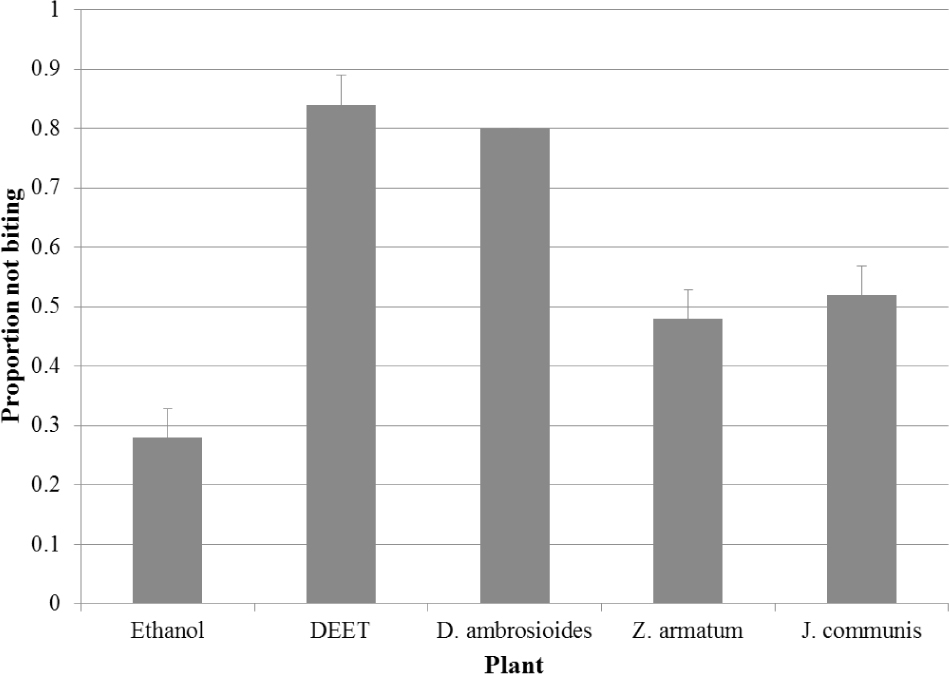
Proportion not biting values (+ SEM) of D. ambrosioides, Z. armatum and J. communis essential oils at 10 μg/cm2 against female of Ae. aegypti. DEET at 25 nmol/cm2 was used as positive control. Ethanol was used as solvent control.
Data on the toxicity of Z. armatum, J. communis and D. ambrosioide essential oils against one day-old larvae of Ae. aegypti at 24 h post treatment is given in Figure 2. Mortality in DMSO, which was used as solvent control, was 0%. All the three essential oils gave 100% mortality at the dose of 125 ppm. Mortality at 62.5 ppm was 100, 90 and 80%, in the essential oils of Z. armatum, J. communis and D. ambrosioides, respectively, whereas only Z. armatum and J. communis essential oils gave 100 and 40% mortality, respectively, at the dose of 31.25 ppm. Massebo and colleagues reported LD50 values of 17.5 and 9.1 ppm of C. ambrosioides essential oil against 4th instar larvae of An. arabiensis and Ae. aegypti, respectively [47]. Bigoga et al. reported 100% larval mortality at 200 ppm and 300 ppm for the essential oils from seeds and leaves, respectively [46]. Rajkumar and Jebanesan reported 50% mortality of 3rd instar Culex quinquefasciatus larvae at a dose of 7.12 ppm whereas mortality was 100% at 25 ppm. The extract also affected the egg laying of the mosquitoes [48]. Tiwary and coworkers reported larvicidal activity of Z. armatum essential oil against 3rd instar larvae of Cx. quinquefasciatus (LC50 = 49 ppm), Ae. aegypti (LC50 = 54 ppm) and An. stephensi (LC50 = 58 ppm) [10]. These data corroborate the above findings against Ae. Aegypti.
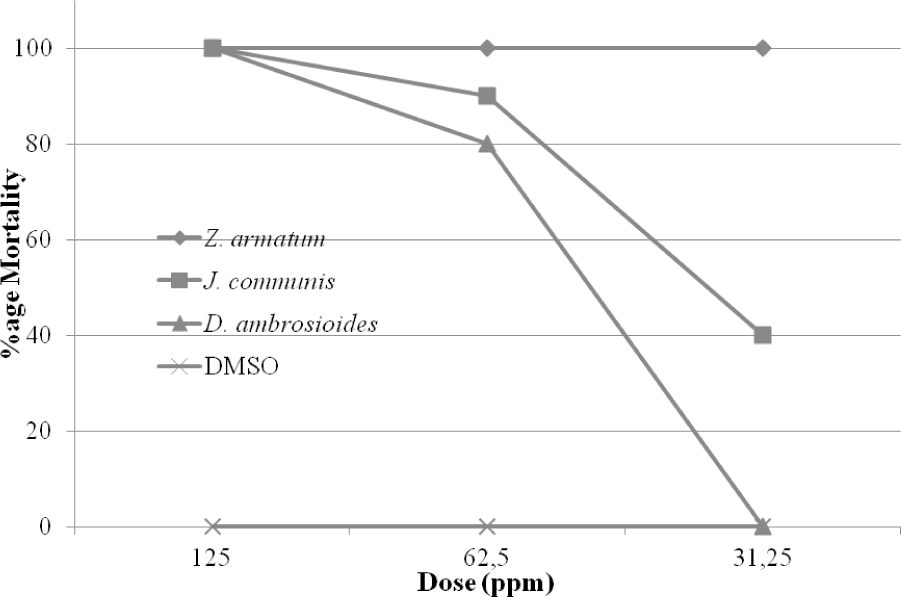
Percent mortality at various dosages of the essential oils of D. ambrosioides, Z. armatum and J. communis against 1-d old Aedes aegypti. In this bioassay, permethrin was used at a dose of 0.025 ppm as positive control which gave 100% larval mortality.
4 Conclusion
From all three essential oils being discussed in this study, only Z. armatum gave 100% mortality against Ae. Aegypti larvae at all concentrations tested, and therefore can be considered as potent natural insecticide. Ascaridole rich C. ambrosioides demonstrated the highest antifungal activity against three Colletotrichum species. Additionally, C. ambrosioides essential oil showed potential repellent activity against Ae. aegypti and ascaridole, again, might be the responsible repellent compound against these mosquitoes [49]. There is no study that reports antifungal activity of this monoterpenoid against Colletotrichum species. Therefore, D. ambrosioides essential oil should further be studied using 1D-TLC bioautography and the active antifungal compounds should be easily detectable directly on the TLC surface and further structurally identified. Although it has been stated that the whole essential oil usually is more active than its single components [50], isolated ascaridole should be tested on its biological activity in a follow up investigation.
Acknowledgements
This study was supported in part by USDA/ARS grant No. 58-6066-6-043. We thank Ms. J.L. Robertson and Ms. R. Pace for their help in antifungal bioassays and Dr. James J. Becnel, Mosquito and Fly Research Unit, Center for Medical, Agricultural and Veterinary Entomology (CMAVE), USDA-ARS, Gainesville, Florida, USA for supplying Ae. aegypti eggs. Authors Vijay K Kaul, Brij Lal and Vikas Jaitak are thankful to the Director CSIR-IHBT Palampur for providing necessary facilities to carry out plant survey/collection of plant materials as well as for hydrodistillation and analytical work.
Conflict of interest: The authors declare no conflict of interest.
References
[1] Chettri N., Sharma E., Reconciling the Mountain Biodiversity Conservation and HumanWellbeing: Drivers of Biodiversity Loss and New Approaches in the Hindu-Kush Himalayas, Proc. Indian Nat. Sci. Acad., 2016, 82, 1-20.10.16943/ptinsa/2016/v82i1/48378Suche in Google Scholar
[2] Ernebjerg, B., Larsen O. J., Beimashan and Biluoshan, Yunnan, China Revisited, J. American Rhodo. Soc., 2014, 68, 115-123.Suche in Google Scholar
[3] Sharma E., Chettri N., Oli K.P., Mountain biodiversity conservation and management: a paradigm shift in policies and practices in the Hindu Kush-Himalayas, Ecol. Res., 2010, 25, 909–923.10.1007/s11284-010-0747-6Suche in Google Scholar
[4] Ernebjerg B., Larsen O.J., Scandinavian Biluoxueshan and Baima Shan Expedition, J. American Rhodo. Soc., 2011, 65, 3-9.Suche in Google Scholar
[5] Kandel P., Gurung J., Chettri N., Ning W., Sharma E., Biodiversity research trends and gap analysis from a transboundary landscape, Eastern Himalayas, J. Asia-Pacific Biodiv., 2016, 9, 1-10.10.1016/j.japb.2015.11.002Suche in Google Scholar
[6] Hren M.T., Chamberlain C.P. G.E. Hilley G.E., Blisniuk P.M., Bookhagen B., Major ion chemistry of the Yarlung Tsangpo-Brahmaputra river: Chemical weathering, erosion, and CO2 consumption in the southern Tibetan plateau and eastern syntaxis of the Himalaya, Geochim. Cosmochim. Acta, 2007, 71, 2907-2935. https://doi.org/10.1016/j.gca.2007.03.02110.1016/j.gca.2007.03.021Suche in Google Scholar
[7] Lewis W.H., Elvin-Lewis M.P.F., Medical Botany, Plants Affecting Human Health. John Wiley and Sons, Hoboken NJ, 2003, pp.812.Suche in Google Scholar
[8] De Groot A.C., Schmidt E., Essential oils, contact allergy and chemical composition, Taylor & Francis Group, Boca Raton, 2016.10.1097/DER.0000000000000197Suche in Google Scholar PubMed
[9] Dayan F.E., Cantrell C.L., Duke, S.O., Natural products in crop protection, Bioorg. Med. Chem., 2009, 17, 4022-4034.10.1016/j.bmc.2009.01.046Suche in Google Scholar PubMed
[10] Tiwary M., Kaik S.N., Tewary D.K., Mittal P.K., Yadav S., Chemical composition and larvicidal activities of the essential oil of Zanthoxylum armatum DC (Ruraceae) against three mosquito vectors, J. Vect. Borne Dis., 2007, 44, 198-204.Suche in Google Scholar
[11] Stappen I., Tabanca N., Ali A., Wedge D.E., Wanner J., Kaul V.K., Lal B., Jaitak V., Gochev V.K., Schmidt E., Jirovetz L., Chemical composition and biological activity of essential oils from wild growing aromatic plants species of Skimmia laureola and Juniperus macropoda from western Himalaya, Nat. Prod. Comm., 2015, 10(6), 1071-1074.10.1177/1934578X1501000669Suche in Google Scholar
[12] Stappen I., Ali A., Tabanca N., Khan I.A., Wanner J., Gochev V.K., Singh B., Lal B., Jaitak V., Kaul V.K., Schmidt E., Jirovetz L., Antimicrobial and repellent activity of the essential oils of two Lamiaceae cultivated in Western Himalaya, Curr. Bioact. Comp., 2015, 11, 23-30.10.2174/157340721101150804143954Suche in Google Scholar
[13] Stappen I., Tabanca N., Ali A., Wedge D.E., Wanner J., Gochev V.K., Jaitak V., Lal B., Kaul V.K., Schmidt E., Jirovetz L., Biological activity of Bunium persicum essential oil from western Himalaya, Planta Med. Int. Open, 2017, e52-e58.10.1055/s-0043-106857Suche in Google Scholar
[14] Lal B, Singh K.N., Indigenous herbal remedies sued to cure skin disorders by the natives of Lahaul-Spiti in Himachal Pradesh, IJTK, 2008, 7(2), 237-241.Suche in Google Scholar
[15] Singh G., Kapoor I.P.S., Singh P., de Heluani C.S., de Lampasona M.P., Catalan C.A.N., Chemistry and antioxidant properties of essential oil and oleoresins extracted from the seeds of tomer (Zanthoxylum armatum DC), Int. J. Food Prop., 2013, 16, 288-300.10.1080/10942912.2010.551311Suche in Google Scholar
[16] Bais S., Gill N.S., Shandil S., A phytopharmacological review on a medicinal plant: Juniperus communis, Hindawi Publishing Corporation, Int. Schol. Res. Not., 2014, Article ID 634723, 1-6. http://dx.doi.org/10.1155/2014/63472310.1155/2014/634723Suche in Google Scholar
[17] Dahmane D., Dob T., Chelghoum C., Essential oil composition and enantiomeric distribution of some monoterpenoid components of Juniperus communis L. from Algeria, J. Ess. Oil Res., 2016, 28(4), 348-356.10.1080/10412905.2015.1133458Suche in Google Scholar
[18] Soares M.H., Dias H.J., Vieira T.M., de Souza M.G.M., Cruz A.F.F., Badoco F.R., Nicolella H.D., Cunha W.R., Groppo M., Martins C.H.G., Tavares D.E., Magalhaes L.G., Crotti A.E.M., Chemical composition, antibacterial, schistosomicidal and cytotoxic activities of the essential oil of Dysphania ambrosioides (L.) Mosyakin & Clematis (Chenopodiaceae), Chem. & Biodivers., 2017. 10.1002/cbdv.210700149.Suche in Google Scholar
[19] Grob K., Making and manipulating capillary columns for gas chromatography, Dr. Alfred Huethig Verlag, Heidelberg, 1986, ISBN 3-7785-1312-5.Suche in Google Scholar
[20] The NIST 08 Mass Spectrometer database, Scientific Instrument Services Inc., New Jersey, http://www.sisweb.com/software/ms/nist.htm.Suche in Google Scholar
[21] Wiley Registry™ of Mass Spectral Data, 8th Edition, Scientific Instrument Services Inc., New Jersey, http://www.sisweb.com/software/ms/wiley.htm.Suche in Google Scholar
[22] Adams R.P., Identification of essential oil components by gas chromatography/mass spectrometry, 4th Ed., Allured Publishing Corp., Carol Stream, Illinois, USA, 2007.Suche in Google Scholar
[23] König W.A., Joulain D., Hochmuth D.H., GC/MS Library: Terpenoids and related constituents of essential oils. http://www.massfinder.com.Suche in Google Scholar
[24] Van Den Dool H., Kratz, P.D., A generalization of the retention index system including linear temperature programmed gas-liquid partition chromatography, J. Chromatogr., 1963, 11, 463-471.10.1016/S0021-9673(01)80947-XSuche in Google Scholar
[25] Klun J.A., Kramer M., Debboun M., A new in vitro bioassay system for discovery of novel human-use mosquito repellents, J. Am. Mosq. Control Assoc., 2005, 21, 64-70.10.2987/8756-971X(2005)21[64:ANIVBS]2.0.CO;2Suche in Google Scholar
[26] Ali A., Cantrell C. L., Bernier U. R., Duke S. O., Schneider J. C., Khan I., Aedes aegypti (Diptera: Culicidae) biting deterrence: structure-activity relationship of saturated and unsaturated fatty acids. J. Med. Entomol., 2012, 49, 1370-1378.10.1603/ME12026Suche in Google Scholar
[27] Ali A., Tabanca N., Kurkcuoglu M., Duran A., Blyhthe E. K., Khan I.A., Baser K.H.C., Chemical composition, larvicidal and biting deterrent activity of essential oils of two subspecies of Tanacetum argenteum (Lam.) Willd and individual constituents against Aedes aegypti (L) (Diptera: Culicidae), J. Med. Entomol., 2014, 51, 824-830.10.1603/ME13249Suche in Google Scholar
[28] Bisht D., Chanotiya C.S., 2-Undecanone rich leaf essential oil from Zanthoxylum armatum, Nat. Prod. Commun., 2011, 6(1), 111-114.10.1177/1934578X1100600126Suche in Google Scholar
[29] Singh G., Kapoor I.P.S., Singh P., De Heluani C.S., de Lampasona M.P., Catalan C.A.N., Chemistry and antioxidant properties of essential oil and oleoresins extracted from the seeds of tomer (Zanthoxylum armatum DC), Int. J. Food Prop., 2013, 16, 288-300.10.1080/10942912.2010.551311Suche in Google Scholar
[30] Waheed A., Mahmud S., Akhtar M., Nazir T., Studies on the components of essential oil from Zanthoxylum armatum by GC-MS, Am. J. Anal. Chem., 2011, 2, 258-261.10.4236/ajac.2011.22031Suche in Google Scholar
[31] Weyerstahl P., Marschall H., Splittgerber U., Son P.T., Giang P.M., Kaul V.K., Constituents of the essential oil from the fruits of Zanthoxylum rhetsoides Drake from Vietnam and from the aerial parts of Zanthosylum alatum Roxb. from India, Flav. Frag. J., 1999, 14, 225-229.10.1002/(SICI)1099-1026(199907/08)14:4<225::AID-FFJ818>3.0.CO;2-1Suche in Google Scholar
[32] Shams M., Ramezani M., Esfahan S.Z., Esfahan E.Z., H.N., Dursun A., Yildirim E., Effects of climatic factors on the quality of essential oil and dry matter yield of coriander (Coriandrum sativum L.), Ind. J. Sci. Technol., 2016, 9(6), 1-4.10.17485/ijst/2016/v9i6/61301Suche in Google Scholar
[33] Kindlovits S., Radacsi P., Sarosi S., Inotai K., Nagy E., Nemeth E., Effect of weather conditions on the morphology, production and chemical composition of two cultivated medicinal and aromatic species, Eu. J. Hort. Sci, 2014, 79(2), 76-83.10.1079/ejhs.2014/4258551Suche in Google Scholar
[34] Dahmane D., Dob T., Chelghoum C., Essential oil composition and enantiomeric distribution of some monoterpenoid components of Juniperus communis L. from Algeria, J. Ess. Oil Res., 2016, 28(4), 348-356. 10.1080/10412905.2015.1133458Suche in Google Scholar
[35] Kumar A., Yadav L.B.S, Ahmad J., Dubey N., Puri S., Chemical composition of commercial Juniperus communis L. leaf oil, J. Ess. Oil-Bear. Plants, 2997, 19(4), 310-313.10.1080/0972060X.2007.10643560Suche in Google Scholar
[36] Jirovetz L., Buchbauer G., Fleischhacker W., Analysisof the essential oil of the leaves of the medicinal plant Chenopodium ambrosioides var. anthelmincitum (L.) A. Gray from India, Sci. Pharm., 2000, 68, 123-128.10.3797/scipharm.aut-00-11Suche in Google Scholar
[37] Salimena J.P., Monteiro R.P., de Souza E.P., de Souza T.J., Extraction on essential oil from inflorescences of Dysphania ambrosioides and its activity against Botrytis cinerea, J. Med. Plants Res., 2015, 9(39), 1006-1012.10.5897/JMPR2015.5743Suche in Google Scholar
[38] Delespaul Qu., de Billerbeck V.G., Roques C.G., Michel G., Marquier-Vinuales C., Bessière J.-M., The antifungal activity of essential oils as determined by different screening methods, J. Essent. Oil Res., 2000, 12, 256-266.10.1080/10412905.2000.9699510Suche in Google Scholar
[39] Ozek G., Suleimen Y., Tabanca N., Doudkin R., Gorovoy P.G., Goger F., Wedge D.E., Ali A., Khan I.A., Baser K.H.C., Chemical diversity and biological activity of the volatiles of five Artemisia species from far east Russia, Rec. Nat. Prod., 2014, 8(3), 242-261.Suche in Google Scholar
[40] Tabanca N., Gao Z., Demirci B., Techen N., Wedge D.E., Ali A., Sampson B.J., Werle C., Bernier U.R., Khan I.A., Baser K.H.C., Molecular and phytochemical investigation of Angelica dahurica and Angelicapubescentis essential oils and their biological activity against Aedes aegypti, Stephanitis pyrioides, and Colletotrichum species, J. Agric. Food Chem., 2014, 62, 8848–8857.10.1021/jf5024752Suche in Google Scholar
[41] Sakhanokho H.F., Sampson B.J., Tabanca N., Wedge D.E., Demirci B., Baser K.H., Bernier U.R., Tsikolia M., Agramonte N.M., Becnel J.J., Chen J., Rajasekaran K., Spiers J.M., Chemical composition, antifungal and insecticidal activities of Hedychium essential oils, Molecules, 2013, 18, 4308-4327.10.3390/molecules18044308Suche in Google Scholar
[42] Ali A., Tabanca N., Demirci B., Baser K.H., Ellis J., Gray S., Lackey B.R., Murphy C., Khan I.A., Wedge D.E., Composition, mosquito larvicidal, biting deterrent and antifungal activity of essential oils of different plant parts of Cupressus arizonica var. glabra (‘Carolina Sapphire’), Nat. Prod. Commun., 2013, 8, 257-60.10.1177/1934578X1300800232Suche in Google Scholar
[43] Tabanca N., Demirci B., Gurbuz I., Demirci F., Becnel J.J., Wedge D.E., Baser K.H.C., Essential oil composition of five collections of Achillea biebersteinii from central Turkey and their antifungal and insecticidal activity, Nat. Prod. Commun., 2011, 6, 701-706.10.1177/1934578X1100600526Suche in Google Scholar
[44] Pare P.W., Zajicek J., Ferracini V.L., Melo I.S., Antifungal terpenoids from Chenopodium ambrosioides, Biochem. Syst. Ecol., 1993, 21, 649-653.10.1016/0305-1978(93)90068-3Suche in Google Scholar
[45] Jiménez-Osornio F.J., Kumamoto J., Wasser C., Allelopathic activity of Chenopodium ambrosioides L., Biochem. Syst. Ecol., 1996, 24, 195-205.10.1016/0305-1978(96)00002-6Suche in Google Scholar
[46] Bigoga J.D., Saahkem P.A., Ndindeng S.A., Ngondi J.L., Nyegue M. Oben J.E., Leke R.G.F., Larvicidal and repellent potential of Chenopodium ambrosioides Linn essential oil against Anopheles gambiae Giles (Diptera: Culicidae), The Open Entomol. J., 2013, 7, 16-22.10.2174/1874407901307010016Suche in Google Scholar
[47] Massebo, F., Tadesse M., Bekele T., Balkew M. and Gebre-Michael T., Evaluation on larvicidal effects of essential oils of some local plants against Anopheles arabiensis Patton and Aedes aegypti Linnaeus (Diptera, Culicidae) in Ethiopia, African J. Biotech., 2009, 8(17), 4183-4188.Suche in Google Scholar
[48] Rajkumar S., Jebanesan A., Bioactivity of Chenopodium ambrosioides L.(Family: Chenopodiaceae) against the filariasis vector Culexquinquefasciatus say (Diptera: Culicidae), Can. J. Pure and Appl. Sci., 2008, 2, 129-132.Suche in Google Scholar
[49] Gillij Y.G., Gleiser R.M., Zygadlo J.A., Mosquito repellent activity of essential oils of aromatic plants growing in Argentina, Biores. Techn., 2008, 99, 2507–2515.10.1016/j.biortech.2007.04.066Suche in Google Scholar PubMed
[50] Filipowicz N., Kaminsik M., Kurlenda J., Asztemborska M.A., Ochocka J.R., Antibacterial and antifungal activity of juniper berry oil and its selected components. Phytother. Res., 2003, 17, 227-231.10.1002/ptr.1110Suche in Google Scholar PubMed
© 2018 Iris Stappen et al., published by De Gruyter
This work is licensed under the Creative Commons Attribution-NonCommercial-NoDerivatives 4.0 License.
Artikel in diesem Heft
- Regular Articles
- The effect of CuO modification for a TiO2 nanotube confined CeO2 catalyst on the catalytic combustion of butane
- The preparation and antibacterial activity of cellulose/ZnO composite: a review
- Linde Type A and nano magnetite/NaA zeolites: cytotoxicity and doxorubicin loading efficiency
- Performance and thermal decomposition analysis of foaming agent NPL-10 for use in heavy oil recovery by steam injection
- Spectroscopic (FT-IR, FT-Raman, UV, 1H and 13C NMR) insights, electronic profiling and DFT computations on ({(E)-[3-(1H-imidazol-1-yl)-1-phenylpropylidene] amino}oxy)(4-nitrophenyl)methanone, an imidazole-bearing anti-Candida agent
- A Simplistic Preliminary Assessment of Ginstling-Brounstein Model for Solid Spherical Particles in the Context of a Diffusion-Controlled Synthesis
- M-Polynomials And Topological Indices Of Zigzag And Rhombic Benzenoid Systems
- Photochemical Transformation of some 3-benzyloxy-2-(benzo[b]thiophen-2-yl)-4Hchromen-4-ones: A Remote Substituent Effect
- Dynamic Changes of Secondary Metabolites and Antioxidant Activity of Ligustrum lucidum During Fruit Growth
- Studies on the flammability of polypropylene/ammonium polyphosphate and montmorillonite by using the cone calorimeter test
- DSC, FT-IR, NIR, NIR-PCA and NIR-ANOVA for determination of chemical stability of diuretic drugs: impact of excipients
- Antioxidant and Hepatoprotective Effects of Methanolic Extracts of Zilla spinosa and Hammada elegans Against Carbon Tetrachlorideinduced Hepatotoxicity in Rats
- Prunus cerasifera Ehrh. fabricated ZnO nano falcates and its photocatalytic and dose dependent in vitro bio-activity
- Organic biocides hosted in layered double hydroxides: enhancing antimicrobial activity
- Experimental study on the regulation of the cholinergic pathway in renal macrophages by microRNA-132 to alleviate inflammatory response
- Synthesis, characterization, in-vitro antimicrobial properties, molecular docking and DFT studies of 3-{(E)-[(4,6-dimethylpyrimidin-2-yl)imino]methyl} naphthalen-2-ol and Heteroleptic Mn(II), Co(II), Ni(II) and Zn(II) complexes
- M-Polynomials and Topological Indices of Dominating David Derived Networks
- Human Health Risk Assessment of Trace Metals in Surface Water Due to Leachate from the Municipal Dumpsite by Pollution Index: A Case Study from Ndawuse River, Abuja, Nigeria
- Analysis of Bowel Diseases from Blood Serum by Autofluorescence and Atomic Force Microscopy Techniques
- Hydrographic parameters and distribution of dissolved Cu, Ni, Zn and nutrients near Jeddah desalination plant
- Relationships between diatoms and environmental variables in industrial water biotopes of Trzuskawica S.A. (Poland)
- Optimum Conversion of Major Ginsenoside Rb1 to Minor Ginsenoside Rg3(S) by Pulsed Electric Field-Assisted Acid Hydrolysis Treatment
- Antioxidant, Anti-microbial Properties and Chemical Composition of Cumin Essential Oils Extracted by Three Methods
- Regulatory mechanism of ulinastatin on autophagy of macrophages and renal tubular epithelial cells
- Investigation of the sustained-release mechanism of hydroxypropyl methyl cellulose skeleton type Acipimox tablets
- Bio-accumulation of Polycyclic Aromatic Hydrocarbons in the Grey Mangrove (Avicennia marina) along Arabian Gulf, Saudi Coast
- Dynamic Change of Secondary Metabolites and spectrum-effect relationship of Malus halliana Koehne flowers during blooming
- Lipids constituents from Gardenia aqualla Stapf & Hutch
- Effect of using microwaves for catalysts preparation on the catalytic acetalization of glycerol with furfural to obtain fuel additives
- Effect of Humic Acid on the Degradation of Methylene Blue by Peroxymonosulfate
- Serum containing drugs of Gua Lou Xie Bai decoction (GLXB-D) can inhibit TGF-β1-Induced Epithelial to Mesenchymal Transition (EMT) in A549 Cells
- Antiulcer Activity of Different Extracts of Anvillea garcinii and Isolation of Two New Secondary Metabolites
- Analysis of Metabolites in Cabernet Sauvignon and Shiraz Dry Red Wines from Shanxi by 1H NMR Spectroscopy Combined with Pattern Recognition Analysis
- Can water temperature impact litter decomposition under pollution of copper and zinc mixture
- Released from ZrO2/SiO2 coating resveratrol inhibits senescence and oxidative stress of human adipose-derived stem cells (ASC)
- Validated thin-layer chromatographic method for alternative and simultaneous determination of two anti-gout agents in their fixed dose combinations
- Fast removal of pollutants from vehicle emissions during cold-start stage
- Review Article
- Catalytic activities of heterogeneous catalysts obtained by copolymerization of metal-containing 2-(acetoacetoxy)ethyl methacrylate
- Antibiotic Residue in the Aquatic Environment: Status in Africa
- Regular Articles
- Mercury fractionation in gypsum using temperature desorption and mass spectrometric detection
- Phytosynthetic Ag doped ZnO nanoparticles: Semiconducting green remediators
- Epithelial–Mesenchymal Transition Induced by SMAD4 Activation in Invasive Growth Hormone-Secreting Adenomas
- Physicochemical properties of stabilized sewage sludge admixtures by modified steel slag
- In Vitro Cytotoxic and Antiproliferative Activity of Cydonia oblonga flower petals, leaf and fruit pellet ethanolic extracts. Docking simulation of the active flavonoids on anti-apoptotic protein Bcl-2
- Synthesis and Characterization of Pd exchanged MMT Clay for Mizoroki-Heck Reaction
- A new selective, and sensitive method for the determination of lixivaptan, a vasopressin 2 (V2)-receptor antagonist, in mouse plasma and its application in a pharmacokinetic study
- Anti-EGFL7 antibodies inhibit rat prolactinoma MMQ cells proliferation and PRL secretion
- Density functional theory calculations, vibration spectral analysis and molecular docking of the antimicrobial agent 6-(1,3-benzodioxol-5-ylmethyl)-5-ethyl-2-{[2-(morpholin-4-yl)ethyl] sulfanyl}pyrimidin-4(3H)-one
- Effect of Nano Zeolite on the Transformation of Cadmium Speciation and Its Uptake by Tobacco in Cadmium-contaminated Soil
- Effects and Mechanisms of Jinniu Capsule on Methamphetamine-Induced Conditioned Place Preference in Rats
- Calculating the Degree-based Topological Indices of Dendrimers
- Efficient optimization and mineralization of UV absorbers: A comparative investigation with Fenton and UV/H2O2
- Metabolites of Tryptophane and Phenylalanine as Markers of Small Bowel Ischemia-Reperfusion Injury
- Adsorption and determination of polycyclic aromatic hydrocarbons in water through the aggregation of graphene oxide
- The role of NR2C2 in the prolactinomas
- Chromium removal from industrial wastewater using Phyllostachys pubescens biomass loaded Cu-S nanospheres
- Hydrotalcite Anchored Ruthenium Catalyst for CO2 Hydrogenation Reaction
- Preparation of Calcium Fluoride using Phosphogypsum by Orthogonal Experiment
- The mechanism of antibacterial activity of corylifolinin against three clinical bacteria from Psoralen corylifolia L
- 2-formyl-3,6-bis(hydroxymethyl)phenyl benzoate in Electrochemical Dry Cell
- Electro-photocatalytic degradation of amoxicillin using calcium titanate
- Effect of Malus halliana Koehne Polysaccharides on Functional Constipation
- Structural Properties and Nonlinear Optical Responses of Halogenated Compounds: A DFT Investigation on Molecular Modelling
- DMFDMA catalyzed synthesis of 2-((Dimethylamino)methylene)-3,4-dihydro-9-arylacridin-1(2H)-ones and their derivatives: in-vitro antifungal, antibacterial and antioxidant evaluations
- Production of Methanol as a Fuel Energy from CO2 Present in Polluted Seawater - A Photocatalytic Outlook
- Study of different extraction methods on finger print and fatty acid of raw beef fat using fourier transform infrared and gas chromatography-mass spectrometry
- Determination of trace fluoroquinolones in water solutions and in medicinal preparations by conventional and synchronous fluorescence spectrometry
- Extraction and determination of flavonoids in Carthamus tinctorius
- Therapeutic Application of Zinc and Vanadium Complexes against Diabetes Mellitus a Coronary Disease: A review
- Study of calcined eggshell as potential catalyst for biodiesel formation using used cooking oil
- Manganese oxalates - structure-based Insights
- Topological Indices of H-Naphtalenic Nanosheet
- Long-Term Dissolution of Glass Fibers in Water Described by Dissolving Cylinder Zero-Order Kinetic Model: Mass Loss and Radius Reduction
- Topological study of the para-line graphs of certain pentacene via topological indices
- A brief insight into the prediction of water vapor transmissibility in highly impermeable hybrid nanocomposites based on bromobutyl/epichlorohydrin rubber blends
- Comparative sulfite assay by voltammetry using Pt electrodes, photometry and titrimetry: Application to cider, vinegar and sugar analysis
- MicroRNA delivery mediated by PEGylated polyethylenimine for prostate cancer therapy
- Reversible Fluorescent Turn-on Sensors for Fe3+ based on a Receptor Composed of Tri-oxygen Atoms of Amide Groups in Water
- Sonocatalytic degradation of methyl orange in aqueous solution using Fe-doped TiO2 nanoparticles under mechanical agitation
- Hydrotalcite Anchored Ruthenium Catalyst for CO2 Hydrogenation Reaction
- Production and Analysis of Recycled Ammonium Perrhenate from CMSX-4 superalloys
- Topical Issue on Agriculture
- New phosphorus biofertilizers from renewable raw materials in the aspect of cadmium and lead contents in soil and plants
- Survey of content of cadmium, calcium, chromium, copper, iron, lead, magnesium, manganese, mercury, sodium and zinc in chamomile and green tea leaves by electrothermal or flame atomizer atomic absorption spectrometry
- Biogas digestate – benefits and risks for soil fertility and crop quality – an evaluation of grain maize response
- A numerical analysis of heat transfer in a cross-current heat exchanger with controlled and newly designed air flows
- Freshwater green macroalgae as a biosorbent of Cr(III) ions
- The main influencing factors of soil mechanical characteristics of the gravity erosion environment in the dry-hot valley of Jinsha river
- Free amino acids in Viola tricolor in relation to different habitat conditions
- The influence of filler amount on selected properties of new experimental resin dental composite
- Effect of poultry wastewater irrigation on nitrogen, phosphorus and carbon contents in farmland soil
- Response of spring wheat to NPK and S fertilization. The content and uptake of macronutrients and the value of ionic ratios
- The Effect of Macroalgal Extracts and Near Infrared Radiation on Germination of Soybean Seedlings: Preliminary Research Results
- Content of Zn, Cd and Pb in purple moor-grass in soils heavily contaminated with heavy metals around a zinc and lead ore tailing landfill
- Topical Issue on Research for Natural Bioactive Products
- Synthesis of (±)-3,4-dimethoxybenzyl-4-methyloctanoate as a novel internal standard for capsinoid determination by HPLC-ESI-MS/MS(QTOF)
- Repellent activity of monoterpenoid esters with neurotransmitter amino acids against yellow fever mosquito, Aedes aegypti
- Effect of Flammulina velutipes (golden needle mushroom, eno-kitake) polysaccharides on constipation
- Bioassay-directed fractionation of a blood coagulation factor Xa inhibitor, betulinic acid from Lycopus lucidus
- Antifungal and repellent activities of the essential oils from three aromatic herbs from western Himalaya
- Chemical composition and microbiological evaluation of essential oil from Hyssopus officinalis L. with white and pink flowers
- Bioassay-guided isolation and identification of Aedes aegypti larvicidal and biting deterrent compounds from Veratrum lobelianum
- α-Terpineol, a natural monoterpene: A review of its biological properties
- Utility of essential oils for development of host-based lures for Xyleborus glabratus (Coleoptera: Curculionidae: Scolytinae), vector of laurel wilt
- Phenolic composition and antioxidant potential of different organs of Kazakh Crataegus almaatensis Pojark: A comparison with the European Crataegus oxyacantha L. flowers
- Isolation of eudesmane type sesquiterpene ketone from Prangos heyniae H.Duman & M.F.Watson essential oil and mosquitocidal activity of the essential oils
- Comparative analysis of the polyphenols profiles and the antioxidant and cytotoxicity properties of various blue honeysuckle varieties
- Special Issue on ICCESEN 2017
- Modelling world energy security data from multinomial distribution by generalized linear model under different cumulative link functions
- Pine Cone and Boron Compounds Effect as Reinforcement on Mechanical and Flammability Properties of Polyester Composites
- Artificial Neural Network Modelling for Prediction of SNR Effected by Probe Properties on Ultrasonic Inspection of Austenitic Stainless Steel Weldments
- Calculation and 3D analyses of ERR in the band crack front contained in a rectangular plate made of multilayered material
- Improvement of fuel properties of biodiesel with bioadditive ethyl levulinate
- Properties of AlSi9Cu3 metal matrix micro and nano composites produced via stir casting
- Investigation of Antibacterial Properties of Ag Doped TiO2 Nanofibers Prepared by Electrospinning Process
- Modeling of Total Phenolic contents in Various Tea samples by Experimental Design Methods
- Nickel doping effect on the structural and optical properties of indium sulfide thin films by SILAR
- The effect mechanism of Ginnalin A as a homeopathic agent on various cancer cell lines
- Excitation functions of proton induced reactions of some radioisotopes used in medicine
- Oxide ionic conductivity and microstructures of Pr and Sm co-doped CeO2-based systems
- Rapid Synthesis of Metallic Reinforced in Situ Intermetallic Composites in Ti-Al-Nb System via Resistive Sintering
- Oxidation Behavior of NiCr/YSZ Thermal Barrier Coatings (TBCs)
- Clustering Analysis of Normal Strength Concretes Produced with Different Aggregate Types
- Magnetic Nano-Sized Solid Acid Catalyst Bearing Sulfonic Acid Groups for Biodiesel Synthesis
- The biological activities of Arabis alpina L. subsp. brevifolia (DC.) Cullen against food pathogens
- Humidity properties of Schiff base polymers
- Free Vibration Analysis of Fiber Metal Laminated Straight Beam
- Comparative study of in vitro antioxidant, acetylcholinesterase and butyrylcholinesterase activity of alfalfa (Medicago sativa L.) collected during different growth stages
- Isothermal Oxidation Behavior of Gadolinium Zirconate (Gd2Zr2O7) Thermal Barrier Coatings (TBCs) produced by Electron Beam Physical Vapor Deposition (EB-PVD) technique
- Optimization of Adsorption Parameters for Ultra-Fine Calcite Using a Box-Behnken Experimental Design
- The Microstructural Investigation of Vermiculite-Infiltrated Electron Beam Physical Vapor Deposition Thermal Barrier Coatings
- Modelling Porosity Permeability of Ceramic Tiles using Fuzzy Taguchi Method
- Experimental and theoretical study of a novel naphthoquinone Schiff base
- Physicochemical properties of heat treated sille stone for ceramic industry
- Sand Dune Characterization for Preparing Metallurgical Grade Silicon
- Catalytic Applications of Large Pore Sulfonic Acid-Functionalized SBA-15 Mesoporous Silica for Esterification
- One-photon Absorption Characterizations, Dipole Polarizabilities and Second Hyperpolarizabilities of Chlorophyll a and Crocin
- The Optical and Crystallite Characterization of Bilayer TiO2 Films Coated on Different ITO layers
- Topical Issue on Bond Activation
- Metal-mediated reactions towards the synthesis of a novel deaminolysed bisurea, dicarbamolyamine
- The structure of ortho-(trifluoromethyl)phenol in comparison to its homologues – A combined experimental and theoretical study
- Heterogeneous catalysis with encapsulated haem and other synthetic porphyrins: Harnessing the power of porphyrins for oxidation reactions
- Recent Advances on Mechanistic Studies on C–H Activation Catalyzed by Base Metals
- Reactions of the organoplatinum complex [Pt(cod) (neoSi)Cl] (neoSi = trimethylsilylmethyl) with the non-coordinating anions SbF6– and BPh4–
- Erratum
- Investigation on Two Compounds of O, O’-dithiophosphate Derivatives as Corrosion Inhibitors for Q235 Steel in Hydrochloric Acid Solution
Artikel in diesem Heft
- Regular Articles
- The effect of CuO modification for a TiO2 nanotube confined CeO2 catalyst on the catalytic combustion of butane
- The preparation and antibacterial activity of cellulose/ZnO composite: a review
- Linde Type A and nano magnetite/NaA zeolites: cytotoxicity and doxorubicin loading efficiency
- Performance and thermal decomposition analysis of foaming agent NPL-10 for use in heavy oil recovery by steam injection
- Spectroscopic (FT-IR, FT-Raman, UV, 1H and 13C NMR) insights, electronic profiling and DFT computations on ({(E)-[3-(1H-imidazol-1-yl)-1-phenylpropylidene] amino}oxy)(4-nitrophenyl)methanone, an imidazole-bearing anti-Candida agent
- A Simplistic Preliminary Assessment of Ginstling-Brounstein Model for Solid Spherical Particles in the Context of a Diffusion-Controlled Synthesis
- M-Polynomials And Topological Indices Of Zigzag And Rhombic Benzenoid Systems
- Photochemical Transformation of some 3-benzyloxy-2-(benzo[b]thiophen-2-yl)-4Hchromen-4-ones: A Remote Substituent Effect
- Dynamic Changes of Secondary Metabolites and Antioxidant Activity of Ligustrum lucidum During Fruit Growth
- Studies on the flammability of polypropylene/ammonium polyphosphate and montmorillonite by using the cone calorimeter test
- DSC, FT-IR, NIR, NIR-PCA and NIR-ANOVA for determination of chemical stability of diuretic drugs: impact of excipients
- Antioxidant and Hepatoprotective Effects of Methanolic Extracts of Zilla spinosa and Hammada elegans Against Carbon Tetrachlorideinduced Hepatotoxicity in Rats
- Prunus cerasifera Ehrh. fabricated ZnO nano falcates and its photocatalytic and dose dependent in vitro bio-activity
- Organic biocides hosted in layered double hydroxides: enhancing antimicrobial activity
- Experimental study on the regulation of the cholinergic pathway in renal macrophages by microRNA-132 to alleviate inflammatory response
- Synthesis, characterization, in-vitro antimicrobial properties, molecular docking and DFT studies of 3-{(E)-[(4,6-dimethylpyrimidin-2-yl)imino]methyl} naphthalen-2-ol and Heteroleptic Mn(II), Co(II), Ni(II) and Zn(II) complexes
- M-Polynomials and Topological Indices of Dominating David Derived Networks
- Human Health Risk Assessment of Trace Metals in Surface Water Due to Leachate from the Municipal Dumpsite by Pollution Index: A Case Study from Ndawuse River, Abuja, Nigeria
- Analysis of Bowel Diseases from Blood Serum by Autofluorescence and Atomic Force Microscopy Techniques
- Hydrographic parameters and distribution of dissolved Cu, Ni, Zn and nutrients near Jeddah desalination plant
- Relationships between diatoms and environmental variables in industrial water biotopes of Trzuskawica S.A. (Poland)
- Optimum Conversion of Major Ginsenoside Rb1 to Minor Ginsenoside Rg3(S) by Pulsed Electric Field-Assisted Acid Hydrolysis Treatment
- Antioxidant, Anti-microbial Properties and Chemical Composition of Cumin Essential Oils Extracted by Three Methods
- Regulatory mechanism of ulinastatin on autophagy of macrophages and renal tubular epithelial cells
- Investigation of the sustained-release mechanism of hydroxypropyl methyl cellulose skeleton type Acipimox tablets
- Bio-accumulation of Polycyclic Aromatic Hydrocarbons in the Grey Mangrove (Avicennia marina) along Arabian Gulf, Saudi Coast
- Dynamic Change of Secondary Metabolites and spectrum-effect relationship of Malus halliana Koehne flowers during blooming
- Lipids constituents from Gardenia aqualla Stapf & Hutch
- Effect of using microwaves for catalysts preparation on the catalytic acetalization of glycerol with furfural to obtain fuel additives
- Effect of Humic Acid on the Degradation of Methylene Blue by Peroxymonosulfate
- Serum containing drugs of Gua Lou Xie Bai decoction (GLXB-D) can inhibit TGF-β1-Induced Epithelial to Mesenchymal Transition (EMT) in A549 Cells
- Antiulcer Activity of Different Extracts of Anvillea garcinii and Isolation of Two New Secondary Metabolites
- Analysis of Metabolites in Cabernet Sauvignon and Shiraz Dry Red Wines from Shanxi by 1H NMR Spectroscopy Combined with Pattern Recognition Analysis
- Can water temperature impact litter decomposition under pollution of copper and zinc mixture
- Released from ZrO2/SiO2 coating resveratrol inhibits senescence and oxidative stress of human adipose-derived stem cells (ASC)
- Validated thin-layer chromatographic method for alternative and simultaneous determination of two anti-gout agents in their fixed dose combinations
- Fast removal of pollutants from vehicle emissions during cold-start stage
- Review Article
- Catalytic activities of heterogeneous catalysts obtained by copolymerization of metal-containing 2-(acetoacetoxy)ethyl methacrylate
- Antibiotic Residue in the Aquatic Environment: Status in Africa
- Regular Articles
- Mercury fractionation in gypsum using temperature desorption and mass spectrometric detection
- Phytosynthetic Ag doped ZnO nanoparticles: Semiconducting green remediators
- Epithelial–Mesenchymal Transition Induced by SMAD4 Activation in Invasive Growth Hormone-Secreting Adenomas
- Physicochemical properties of stabilized sewage sludge admixtures by modified steel slag
- In Vitro Cytotoxic and Antiproliferative Activity of Cydonia oblonga flower petals, leaf and fruit pellet ethanolic extracts. Docking simulation of the active flavonoids on anti-apoptotic protein Bcl-2
- Synthesis and Characterization of Pd exchanged MMT Clay for Mizoroki-Heck Reaction
- A new selective, and sensitive method for the determination of lixivaptan, a vasopressin 2 (V2)-receptor antagonist, in mouse plasma and its application in a pharmacokinetic study
- Anti-EGFL7 antibodies inhibit rat prolactinoma MMQ cells proliferation and PRL secretion
- Density functional theory calculations, vibration spectral analysis and molecular docking of the antimicrobial agent 6-(1,3-benzodioxol-5-ylmethyl)-5-ethyl-2-{[2-(morpholin-4-yl)ethyl] sulfanyl}pyrimidin-4(3H)-one
- Effect of Nano Zeolite on the Transformation of Cadmium Speciation and Its Uptake by Tobacco in Cadmium-contaminated Soil
- Effects and Mechanisms of Jinniu Capsule on Methamphetamine-Induced Conditioned Place Preference in Rats
- Calculating the Degree-based Topological Indices of Dendrimers
- Efficient optimization and mineralization of UV absorbers: A comparative investigation with Fenton and UV/H2O2
- Metabolites of Tryptophane and Phenylalanine as Markers of Small Bowel Ischemia-Reperfusion Injury
- Adsorption and determination of polycyclic aromatic hydrocarbons in water through the aggregation of graphene oxide
- The role of NR2C2 in the prolactinomas
- Chromium removal from industrial wastewater using Phyllostachys pubescens biomass loaded Cu-S nanospheres
- Hydrotalcite Anchored Ruthenium Catalyst for CO2 Hydrogenation Reaction
- Preparation of Calcium Fluoride using Phosphogypsum by Orthogonal Experiment
- The mechanism of antibacterial activity of corylifolinin against three clinical bacteria from Psoralen corylifolia L
- 2-formyl-3,6-bis(hydroxymethyl)phenyl benzoate in Electrochemical Dry Cell
- Electro-photocatalytic degradation of amoxicillin using calcium titanate
- Effect of Malus halliana Koehne Polysaccharides on Functional Constipation
- Structural Properties and Nonlinear Optical Responses of Halogenated Compounds: A DFT Investigation on Molecular Modelling
- DMFDMA catalyzed synthesis of 2-((Dimethylamino)methylene)-3,4-dihydro-9-arylacridin-1(2H)-ones and their derivatives: in-vitro antifungal, antibacterial and antioxidant evaluations
- Production of Methanol as a Fuel Energy from CO2 Present in Polluted Seawater - A Photocatalytic Outlook
- Study of different extraction methods on finger print and fatty acid of raw beef fat using fourier transform infrared and gas chromatography-mass spectrometry
- Determination of trace fluoroquinolones in water solutions and in medicinal preparations by conventional and synchronous fluorescence spectrometry
- Extraction and determination of flavonoids in Carthamus tinctorius
- Therapeutic Application of Zinc and Vanadium Complexes against Diabetes Mellitus a Coronary Disease: A review
- Study of calcined eggshell as potential catalyst for biodiesel formation using used cooking oil
- Manganese oxalates - structure-based Insights
- Topological Indices of H-Naphtalenic Nanosheet
- Long-Term Dissolution of Glass Fibers in Water Described by Dissolving Cylinder Zero-Order Kinetic Model: Mass Loss and Radius Reduction
- Topological study of the para-line graphs of certain pentacene via topological indices
- A brief insight into the prediction of water vapor transmissibility in highly impermeable hybrid nanocomposites based on bromobutyl/epichlorohydrin rubber blends
- Comparative sulfite assay by voltammetry using Pt electrodes, photometry and titrimetry: Application to cider, vinegar and sugar analysis
- MicroRNA delivery mediated by PEGylated polyethylenimine for prostate cancer therapy
- Reversible Fluorescent Turn-on Sensors for Fe3+ based on a Receptor Composed of Tri-oxygen Atoms of Amide Groups in Water
- Sonocatalytic degradation of methyl orange in aqueous solution using Fe-doped TiO2 nanoparticles under mechanical agitation
- Hydrotalcite Anchored Ruthenium Catalyst for CO2 Hydrogenation Reaction
- Production and Analysis of Recycled Ammonium Perrhenate from CMSX-4 superalloys
- Topical Issue on Agriculture
- New phosphorus biofertilizers from renewable raw materials in the aspect of cadmium and lead contents in soil and plants
- Survey of content of cadmium, calcium, chromium, copper, iron, lead, magnesium, manganese, mercury, sodium and zinc in chamomile and green tea leaves by electrothermal or flame atomizer atomic absorption spectrometry
- Biogas digestate – benefits and risks for soil fertility and crop quality – an evaluation of grain maize response
- A numerical analysis of heat transfer in a cross-current heat exchanger with controlled and newly designed air flows
- Freshwater green macroalgae as a biosorbent of Cr(III) ions
- The main influencing factors of soil mechanical characteristics of the gravity erosion environment in the dry-hot valley of Jinsha river
- Free amino acids in Viola tricolor in relation to different habitat conditions
- The influence of filler amount on selected properties of new experimental resin dental composite
- Effect of poultry wastewater irrigation on nitrogen, phosphorus and carbon contents in farmland soil
- Response of spring wheat to NPK and S fertilization. The content and uptake of macronutrients and the value of ionic ratios
- The Effect of Macroalgal Extracts and Near Infrared Radiation on Germination of Soybean Seedlings: Preliminary Research Results
- Content of Zn, Cd and Pb in purple moor-grass in soils heavily contaminated with heavy metals around a zinc and lead ore tailing landfill
- Topical Issue on Research for Natural Bioactive Products
- Synthesis of (±)-3,4-dimethoxybenzyl-4-methyloctanoate as a novel internal standard for capsinoid determination by HPLC-ESI-MS/MS(QTOF)
- Repellent activity of monoterpenoid esters with neurotransmitter amino acids against yellow fever mosquito, Aedes aegypti
- Effect of Flammulina velutipes (golden needle mushroom, eno-kitake) polysaccharides on constipation
- Bioassay-directed fractionation of a blood coagulation factor Xa inhibitor, betulinic acid from Lycopus lucidus
- Antifungal and repellent activities of the essential oils from three aromatic herbs from western Himalaya
- Chemical composition and microbiological evaluation of essential oil from Hyssopus officinalis L. with white and pink flowers
- Bioassay-guided isolation and identification of Aedes aegypti larvicidal and biting deterrent compounds from Veratrum lobelianum
- α-Terpineol, a natural monoterpene: A review of its biological properties
- Utility of essential oils for development of host-based lures for Xyleborus glabratus (Coleoptera: Curculionidae: Scolytinae), vector of laurel wilt
- Phenolic composition and antioxidant potential of different organs of Kazakh Crataegus almaatensis Pojark: A comparison with the European Crataegus oxyacantha L. flowers
- Isolation of eudesmane type sesquiterpene ketone from Prangos heyniae H.Duman & M.F.Watson essential oil and mosquitocidal activity of the essential oils
- Comparative analysis of the polyphenols profiles and the antioxidant and cytotoxicity properties of various blue honeysuckle varieties
- Special Issue on ICCESEN 2017
- Modelling world energy security data from multinomial distribution by generalized linear model under different cumulative link functions
- Pine Cone and Boron Compounds Effect as Reinforcement on Mechanical and Flammability Properties of Polyester Composites
- Artificial Neural Network Modelling for Prediction of SNR Effected by Probe Properties on Ultrasonic Inspection of Austenitic Stainless Steel Weldments
- Calculation and 3D analyses of ERR in the band crack front contained in a rectangular plate made of multilayered material
- Improvement of fuel properties of biodiesel with bioadditive ethyl levulinate
- Properties of AlSi9Cu3 metal matrix micro and nano composites produced via stir casting
- Investigation of Antibacterial Properties of Ag Doped TiO2 Nanofibers Prepared by Electrospinning Process
- Modeling of Total Phenolic contents in Various Tea samples by Experimental Design Methods
- Nickel doping effect on the structural and optical properties of indium sulfide thin films by SILAR
- The effect mechanism of Ginnalin A as a homeopathic agent on various cancer cell lines
- Excitation functions of proton induced reactions of some radioisotopes used in medicine
- Oxide ionic conductivity and microstructures of Pr and Sm co-doped CeO2-based systems
- Rapid Synthesis of Metallic Reinforced in Situ Intermetallic Composites in Ti-Al-Nb System via Resistive Sintering
- Oxidation Behavior of NiCr/YSZ Thermal Barrier Coatings (TBCs)
- Clustering Analysis of Normal Strength Concretes Produced with Different Aggregate Types
- Magnetic Nano-Sized Solid Acid Catalyst Bearing Sulfonic Acid Groups for Biodiesel Synthesis
- The biological activities of Arabis alpina L. subsp. brevifolia (DC.) Cullen against food pathogens
- Humidity properties of Schiff base polymers
- Free Vibration Analysis of Fiber Metal Laminated Straight Beam
- Comparative study of in vitro antioxidant, acetylcholinesterase and butyrylcholinesterase activity of alfalfa (Medicago sativa L.) collected during different growth stages
- Isothermal Oxidation Behavior of Gadolinium Zirconate (Gd2Zr2O7) Thermal Barrier Coatings (TBCs) produced by Electron Beam Physical Vapor Deposition (EB-PVD) technique
- Optimization of Adsorption Parameters for Ultra-Fine Calcite Using a Box-Behnken Experimental Design
- The Microstructural Investigation of Vermiculite-Infiltrated Electron Beam Physical Vapor Deposition Thermal Barrier Coatings
- Modelling Porosity Permeability of Ceramic Tiles using Fuzzy Taguchi Method
- Experimental and theoretical study of a novel naphthoquinone Schiff base
- Physicochemical properties of heat treated sille stone for ceramic industry
- Sand Dune Characterization for Preparing Metallurgical Grade Silicon
- Catalytic Applications of Large Pore Sulfonic Acid-Functionalized SBA-15 Mesoporous Silica for Esterification
- One-photon Absorption Characterizations, Dipole Polarizabilities and Second Hyperpolarizabilities of Chlorophyll a and Crocin
- The Optical and Crystallite Characterization of Bilayer TiO2 Films Coated on Different ITO layers
- Topical Issue on Bond Activation
- Metal-mediated reactions towards the synthesis of a novel deaminolysed bisurea, dicarbamolyamine
- The structure of ortho-(trifluoromethyl)phenol in comparison to its homologues – A combined experimental and theoretical study
- Heterogeneous catalysis with encapsulated haem and other synthetic porphyrins: Harnessing the power of porphyrins for oxidation reactions
- Recent Advances on Mechanistic Studies on C–H Activation Catalyzed by Base Metals
- Reactions of the organoplatinum complex [Pt(cod) (neoSi)Cl] (neoSi = trimethylsilylmethyl) with the non-coordinating anions SbF6– and BPh4–
- Erratum
- Investigation on Two Compounds of O, O’-dithiophosphate Derivatives as Corrosion Inhibitors for Q235 Steel in Hydrochloric Acid Solution
