Lipids constituents from Gardenia aqualla Stapf & Hutch
-
Jean Noël Nyemb
 ,
Larissa Mekontso Magnibou
,
Larissa Mekontso Magnibou

Abstract
Gardenia aqualla a plant of the Rubiaceae family is being used extensively in Africa, particularly in Cameroon as an herbal medicine. Therefore it is necessary to have knowledge of the constituents of the plant of our native species. Thus, the aim of the present study was to investigate chemical constituents of this herbal medicine. Nine compounds, including one alkane, n-Nonacosane (1), two aliphatic alcohols n-heptatriacontanol (2) and n-Docosanol(3), one fatty ester, Heptadecyl heptacosanoate (4), two sugars, D-mannitol (5) and D-mannitol acetate (6), and a mixture of three phytosterols, β-sitosterol (7), stigmasterol (8) and fucosterol (9), have been isolated and purified from the stem barks of Gardenia aqualla Stapf & Hutch. Their structures were elucidated using spectroscopic analyses, including 1D and 2D NMR and ESI-MS. The fatty acid ester, heptadecyl heptacosanoate (4) is reported here for the first time. All the isolated compounds were tested for their antimicrobial activities against four Gram negative bacteria (Salmonella Typhimurium ATCC6539, Pseudomonas aeruginosa ATCC9721, Escherichia coli, and S. Typhi) and four yeasts (Candida albicans ATCC9002, Candida parapsilosis ATCC22019, Candida krusei and C. albicans).
1 Introduction
In Africa, much like elsewhere in the whole world, plants have always been an important source of natural products with very high therapeutic values. Many people are still interested in using natural products from plants for curative and preventive medicine. Thus, it has been estimated that over 60% of the world population and 80% of the population of developing countries still directly rely on medicinal plants, for their primary health care needs [1]. Hostettmann et al. [2] stated that in some African countries, up to 90% of the population still depended exclusively on medicinal plants as a source of medicines. Nowadays, people are still very interested in medicinal plants. Thus, with this growing interest in the field of medicinal plants, there is a great need to produce databases that would contain as much information as possible about the secondary metabolites produced by plants and their importance in today’s world. About 15% of the known angiosperm species in tropical regions have been examined for their pharmacological properties [3]. Therefore, there are most definitely a large number of plant-derived medicines and other useful compounds that have yet to be discovered and characterized around the world.
Cameroon has a very rich and diverse flora estimated in 2003 at 8,620 known plants species [4], that a large majority of population are using some of them as medicines for their primary healthcare. However, in the Cameroonian pharmacopoeia, there is still a serious lack of information on the uses and the phytochemical content of a large number of plants and spices traditionally employed in the treatment of several ailments. Gardenia aqualla Stapf & Hutch (Rubiaceae) is among those medicinal plants extensively used in Cameroon and not well documented.
Known as “Dingale” in Fufulde in the Adamawa Region of Cameroon, Gardenia aqualla is a bushy shrub or a small tree that grows up to 3 m high and belongs to the Sudanese to Sudano-Guinean savannahs on shady lowlands and alluvial terraces [5]. It is widely distributed from Senegal to Cameroon and as far as Sudan, scattered, locally common. Medicinally, the plant is used in the treatment of several ailments such as leprosy, oral and ear infections [6], dysmenorrhea [7], jaundice, ulcers [8], diabete [9], syphilis [10], cancer [11].
As the plant is being used extensively in our country as an herbal medicine, it is necessary to have knowledge of the constituents of the plant of our native species. Previous phytochemical investigation on this species revealed the presence of steroids, triterpenes and flavonoids in the petroleum ether extract of the stem barks while the methanolic extract was found to contain anthraquinones, carbohydrates, cardiac glycosides, flavonoids, saponins, steroids, tannins and triterpenes [12]. To the best of our knowledge, currently no compound has been isolated from this plant species. The present study aims therefore to investigate chemical constituents of this herbal medicine.
2 Experimental Procedures
2.1 Plant material
The Stem barks of G. aqualla Stapf & Hutch were collected at Dang in the District of Ngaoundere III, Region of Adamawa Cameroon. A voucher is deposited at National Herbarium of Cameroon in Yaounde under number 36894/HNC.
2.2 Extraction and isolation
The ground dried stem barks (1.00 kg) were consecutively extracted with Hexane, EtOAc and MeOH to give 6.74 g, 9.42 g and 83.83 g of extracts respectively. A portion (50.0 g) of the MeOH extract was fractionated by silica gel column chromatography using a gradient elution with successively Hexane-EtOAc (1:0→0:1) and EtOAc-MeOH (1:0→0:1). 510 sub-fractions of 300 mL were collected and according to their chromatographic profiles on TLC, they were grouped into six fractions G1-G6. From the main column seven compounds were obtained, compound 1 at Hexane-EtOAc (9:1) from the assembly of sub-fractions 17-53, compound 2 at Hexane-EtOAc (1:1) from the assembly of sub-fractions 242-253, compound 5 at Hexane-EtOAc (1:9) from the assembly of sub-fractions 321-366 and compound 6 at EtOAc-MeOH (9:1) from the assembly of sub-fractions 400-402. Fraction G3 (1.96 g) was further purified on CC of silica gel using a gradient polarity of hexane-EtOAc (1:0→6:4) leading to compound 3 from the sub-fractions 17-18, compound 4 from the sub-fractions 21-22, and from the assembly of sub-fractions 25-28 compounds 7, 8 and 9 were obtained as a mixture. All these last five compounds were obtained at the same polarity (Hexane-EtOAc (9:1)). Nonacosane (1): white solid, m.p. 50–51°C. TOF-MS-ESI+: [M+H]+ at m/z = 409.3, [M+K]+ at m/z = 447.3, and [2M+K+H]+ at m/z = 856.5 for C29H60. 1H NMR (CDCl3): δ 0.91 (6H, t, J = 7.0 Hz, 3H-1, 3H-29), 1.59 (4H, m, 2H-2, 2H-28) and 1.20-1.39 [(CH2)n, brs]. 13C NMR (CDCl3): δ 14.1 (C-1, C-29), 22.7 (C-2, C-28), 31.9 (C-3, C-27), and 29.4–29.7 (C-4–C-26) [13].
Heptatriacontanol (2): white solid, m.p. 88–89°C. TOF-MS-ESI+: [M+H]+ at m/z = 537.3, for C37H76O. 1H NMR (CDCl3): δ 3.65 (2H, m, 2H-1), 1.60 (2H, m, 2H-2), 1.20-1.39 [(CH2)n, brs] and 0.89 (3H, t, J = 7.5 Hz, 3H-37). 13C NMR (CDCl3): δ 63.1 (C-1), 32.8 (C-2), 25.7 (C-3), 29.4-29.7 (C-4-C-34), 31.9 (C-35), 22.7 (C-36) and 14.1 (C-37). [14]
Docosanol (3): white solid, m.p. 58–59°C. TOF-MS-ESI+: [M+6NH4++6H]+ at m/z = 440.2 and [M+4NH4++3H]+ at m/z = 401.4, for C22H46O. 1H NMR (CDCl3): δ 3.67 (2H, t, J = 6.6 Hz, 2H-1), 1.59 (2H, m, 2H-2), 1.29 [(CH2)n, brs] and 0.91 (3H, t, J = 7.0 Hz, 3H-22). 13C NMR (CDCl3): δ 63.1 (C-1), 32.8 (C-2), 25.7 (C-3), 29.4–29.7 (C-4–C-19), 31.9 (C-20), 22.7 (C-21) and 14.1 (C-22). [15]
Heptadecyl heptacosanoate (4): white solid, m.p. 65–66°C. TOF-MS-ESI+: [M+2NH4++H]+m/z = 685.3 for C44H88O2. 1H NMR (CDCl3): δ 0.81 (6H, t, J = 7.0 Hz, 3H-27, 3H-17′), 1.20-1.33 [(CH2)n, brs], 1.54 (4H, m, 2H-3, 2H-2′), 2.22 (2H, t, J = 7.5 Hz, 2H-2), 4.00 (2H, t, J = 6.7 Hz, 2H-1′). 13C NMR (CDCl3): δ 174.0 (C-1), 64.4 (C-1′), 34.4 (C-2), 31.9 (C-25 and C-15′), 29.2-29.7 (C-4–C-24 and C-4′–C14′), 28.7 (C-2′), 26.0 (C-3′), 25.1 (C-3), 22.7 (C-26 and C-16′) and 14.1 (C-27 and C-17′).
D-mannitol (5): white solid, m.p. 168–169°C. TOF-MS-ESI+: [2M+Na]+ at m/z = 387.2 for C6H14O6. 1H NMR (DMSO-d6): δ 4.41 (2H, d, J = 5.5 Hz, HO-2 and 5), 4.33 (2H, t, J = 5.7 Hz, HO-1 and 6), 4.13 (2H, d, J = 7.1 Hz, HO-3 and 4), 3.62 (2H, ddd, J = 10.8, 5.7, 3.5 Hz, H-1a and 6a), 3.56 (2H, t, J = 7.5 Hz, H-3 and 4), 3.47 (2H, m, H-2 and 5) and 3.39 (2H, m, H-1b and 6b). 13C NMR (DMSO-d6): δ 63.8 (C-1 and 6), 71.3 (C-2 and 5) and 69.7 (C-3 and 4). [16]
D-mannitol acetate (6): white solid, m.p. 123–124°C. TOF-MS-ESI+: [M+Na]+ at m/z = 247.1 and [M+Na]+ at m/z = 471.1 for C8H16O71H NMR (DMSO-d6): δ 4.75 (1H, d, J = 5.6 Hz, HO-2), 4.41 (1H, d, J = 5.5 Hz, HO-5), 4.33 (1H, t, J = 5.7 Hz, HO-6), 4.28 (2H, ov, H-1a and HO-3), 4.14 (2H, d, J = 7.1 Hz, HO-4), 3.96 (1H, m, H-1b), 3.68 (1H, m, H-2), 3.62 (1H, m, H-6a), 3.54 (2H, m, H-3 and 4), 3.47 (1H, m, H-5) and 3.40 (1H, m, H-6b), 2.03 (3H, s, OCOCH3). 13C NMR (DMSO-d6): δ 20.8 (-OCOCH3), 63.8 (C-6), 67.0 (C-1), 68.2 (C-2), 69.3 (C-3), 69.4 (C-4), 71.2 (C-5) and 170.5 (-OCOCH3).
β-sitosterol (7): white solid. 1H-NMR (CDCl3), δ: 5.35 (1H, d, J = 5.1 Hz, H-6), 3.53 (1H, ddd, J = 15.9, 11.0, 4.6 Hz, H-3), 1.04 (3H, s, H-19), 1.01 (3H, d, J = 7.0 Hz, H3-27), 0.95 (3H, d, J = 6.6 Hz, H3-26), 0.88 (3H, d, J = 1.8 Hz, H3-21), 0.85 (3H, ov, H3-29) and 0.71 (3H, s, H3-18). 13C-NMR (CDCl3 ): δ 37.3 (CH2, C-1), 31.9 (CH2, C-2), 71.8 (CH, C-3), 42.4 (CH2, C-4), 140.8 (C-5), 121.7 (CH, C-6), 31.7 (CH2, C-7), 31.9 (CH, C-8), 50.2 (CH, C-9), 36.6 (C, C-10), 21.1 (CH2, C-11), 39.8 (CH2, C-12), 42.3 (CH, C-13), 56.8 (CH, C-14), 24.3 (CH2, C-15), 28.2 (CH2, C-16), 56.1 (CH, C-17), 11.9 (CH3, C-18), 19.0 (CH3, C-19), 36.2 (CH2, C-20), 18.8 (CH3, C-21), 34.0 (CH2, C-22), 26.3 (CH2, C-23), 45.9 (CH, C-24), 29.3 (CH, C-25), 19.4 (CH3, C-26), 19.8 (CH3, C-27), 23.1 (CH2, C-28), 12.0 (CH3, C-29). [17]
Stigmasterol (8): white solid. 1H NMR (CDCl3), δ: 5.38 (1H, m, H-6), 5.14 (1H, ov, H-22), 5.05 (1H, dd, J = 15.2, 8.7 Hz, H-23), 3.56 (1H, ddd, J = 15.8, 11.0, 4.5 Hz, H-3), 1.04 (3H, s, H-19), 1.01 (3H, d, J = 7.0 Hz, H3-27), 0.95 (3H, d, J = 6.6 Hz, H3-26), 0.88 (3H, d, J = 1.8 Hz, H3-21), 0.85 (3H, ov, H3-29) and 0.71 (3H, s, H3-18). 13C NMR (CDCl3) δ: 37.2 (CH2, C-1), 31.9 (CH2, C-2), 71.8 (CH, C-3), 42.3 (CH2, C-4), 140.8 (C, C-5), 121.7 (CH, C-6), 31.7 (CH2, C-7), 31.9 (CH, C-8), 50.2 (CH, C-9), 36.5 (C, C-10), 21.1 (CH2, C-11), 39.8 (CH2, C-12), 42.3 (C, C-13), 56.8 (CH, C-14), 24.3 (CH2,C-15), 28.2 (CH2, C-16), 56.1 (CH, C-17), 12.1 (CH3, C-18), 19.0 (CH3, C-19), 40.5 (CH2, C-20), 18.8 (CH3, C-21), 138.4 (CH, C-22), 129.3 (CH, C-23), 51.2 (CH, C-24), 45.9 (CH, C-25), 19.4 (CH3, C-26), 19.8 (CH3,C-27), 24.3 (CH2, C-28), 12.3 (CH3, C-29). [18]
Fucosterol (9): white solid. 1H NMR (CDCl3), δ: 5.38 (1H, m, H-6), 5.17 (1H, ov, H-28), 3.56 (1H, ddd, J = 15.8, 11.0, 4.5 Hz, H-3), 1.57 (3H, ov, H-29), 1.04 (3H, s, H-19), 1.01 (3H, d, J = 7.0 Hz, H3-27), 0.95 (3H, d, J = 6.6 Hz, H3-26), 0.88 (3H, d, J = 1.8 Hz, H3-21) and 0.71 (3H, s, H3-18). 13C NMR (CDCl3) δ: 37.2 (CH2, C-1), 31.9 (CH2, C-2), 71.8 (CH, C-3), 42.3 (CH2, C-4), 140.8 (C, C-5), 121.7 (CH, C-6), 31.7 (CH2, C-7), 31.9 (CH, C-8), 50.2 (CH, C-9), 36.5 (C, C-10), 21.1 (CH2, C-11), 39.8 (CH2, C-12), 42.3 (C, C-13), 56.8 (CH, C-14), 24.3 (CH2,C-15), 28.2 (CH2, C-16), 56.1 (CH, C-17), 11.8 (CH3, C-18), 19.3 (CH3, C-19), 36.5 (CH2, C-20), 18.8 (CH3, C-21), 36.1 (CH, C-22), 26.1 (CH, C-23), 145.9 (CH, C-24), 34.0 (CH, C-25), 21.1 (CH3, C-26), 21.1 (CH3,C-27), 116.4 (CH2, C-28), 12.8 (CH3, C-29). [19]
2.3 Antimicrobial assays
Antibacterial and anticandidal activities of isolated compounds were performed against four bacterial strains (Salmonella Typhimurium ATCC6539, Pseudomonas aeruginosa ATCC9721, Escherichia coli, and S. Typhi isolate) and four strains of yeast (Candida albicans ATCC9002, Candida parapsilosis ATCC22019, Candida krusei and Candida albicans isolate). Minimum inhibitory concentrations (MICs), minimum bactericidal concentrations (MBCs) and minimum fungicidal concentrations (MFCs) were determined by the broth microdilution method as previously described by Nyemb et al. [20] and Dzoyem et al. [21] respectively for antibacterial and antifungal activities. Ciprofloxacin was used as standard drug for antibacterial assay, while ketoconazole was used as positive control for the antifungal assay. All the experiments were carried out in triplicate.
Ethical approval: The conducted research is not related to either human or animals use.
3 Results and Discussion
Compound 4 was obtained as a white powder. Its molecular formula was found to be C44H88O2 on the basis of its TOF-MS-ESI+ spectra that showed pseudo-molecular ion peak [M+2NH4++H]+ at m/z = 685.3. The 1H NMR had peaks characteristics of aliphatic esters [22,23,24]. The spectrum revealed the presence of a signal of two protons triplet at δH 4.00 (2H, t, J = 6.7 Hz) probably due to the 2H-1′ deshielded by the proximity of the ester function fixed on the same carbon C-1′, a broad signal between δH 1.20 and 1.33 was attributed to the hydrocarbon chain (CH2)n, this signal showed an integration of 74 protons corresponding to 37 methylene groups. A triplet of six protons at δH 0.81 (6H, t, J = 7.0 Hz) corresponding to two terminal methyl groups was also visible. The 1H NMR spectra also displayed a signal of two protons triplet at δH 2.22 (2H, t, J = 7.5 Hz) attributed to the methylene protons adjacent to the carbonyl group of the ester function. The 13C NMR spectral data indicated characteristic signals of a fatty ester among which a signal of a carbonyl ester function at δC 174.0 attributable to the C-1, a signal of a methylene carbon at δC 64.3 (C-1′) deshielded by the proximity of the ester function, a signal at δC 14.1 corresponding to the terminal methyl groups (C-27 and C-17′). The remaining methylene carbons appeared between δC 22.7 and 31.9 were assigned accordingly. The COSY spectra of compound 4 revealed one spin system associated with the alkane long chain. Thus, the methyls at δH 0.81 (6H, t, J = 7.0 Hz) correlated with a set of protons at δH 1.20 which in turn correlated with the methylene protons at δH 1.54 (m). The correlations of the methylene at δH 1.54 with the ones at δH 2.22 (2H, t, δH = 7.5 Hz) and 4.00 (2H, t, J = 6.7 Hz) respectively were also visible (Figure 2). From the HMBC spectra of compound 4, long range correlations were unambiguously detected between the protons 2H-1′ at δH 4.00 and carbons C-2′ (δC 28.4), C-3′ (δC26.0) and C-1 (δC 174.0) ; methylene protons 2H-2′ (δH 1.54) and carbons C-1′ (δC 64.3), C-3′ (δC 26.0), C-4′ (δC 29.1) and C-1 (δC 174.0). Another set of long range correlations was observed between the methylene at δH 2.22 (2H-2) and C-1 (δC 174.0), C-3 (δC 25.1) and C-4 (δC 29.2) (Figure 2). On the basis of above discussion the structure of compound 4 was elucidated as heptadecyl heptacosanoate. The mass spectral fragmentation was also consistent with the proposed structure. The prominent ion fragments arising at m/z 393.3 [M-C17H35O●]+ and 409.2 [M-C17H35O2●]+ (Figure 3) suggested that heptacosanoic acid was esterified with heptadecanol. The fragment ion arising at m/z 315.2 [C19H38O2+NH4+−H]+ correspond to the loss of hexacosene (C26H52) through a Mc Lafferty rearrangement. Further loss of 113 uma (C8H17●) by this fragment led to the base peak at m/z 185.0.
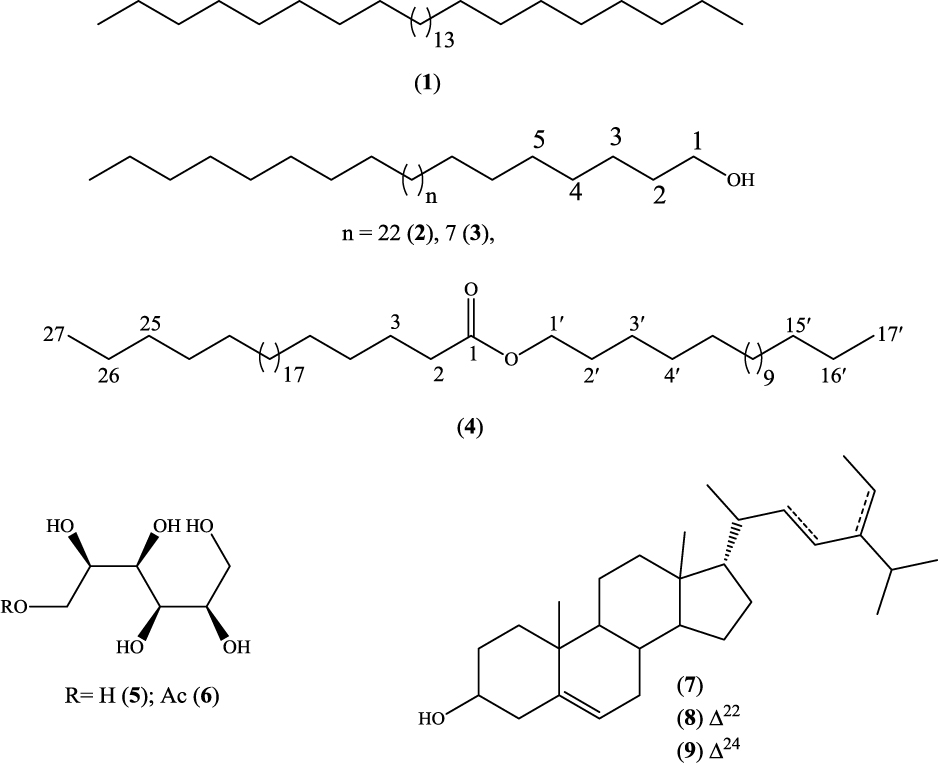
Isolated compounds from G. aqualla stem barks.
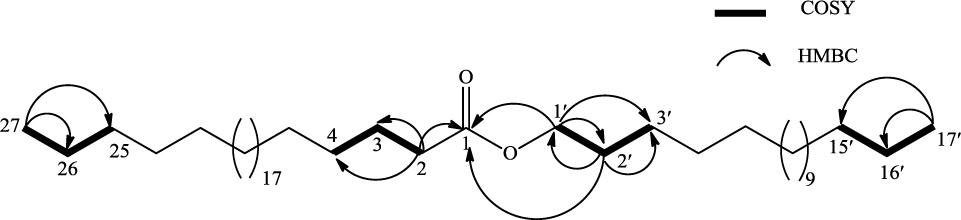
Important COSY and HMBC correlations of compound 4.
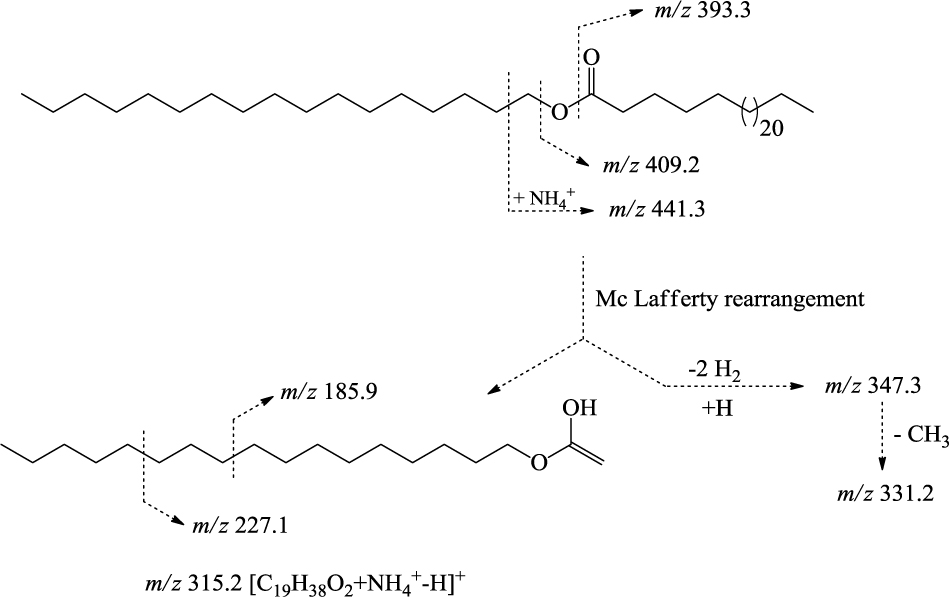
Important fragmentation of compound 4.
Nonacosane (1), heptatriacontanol (2), Docosanol (3), D-mannitol (5), D-mannitol acetate (6), and a mixture of β-sitosterol (7), stigmasterol (8) and fucosterol (9) in a ratio of 3:1:2 (estimated from the relative intensities of protons H-22 and H-23 of stigmasterol (8), H-28 of fucosterol (9) and H-6 in 1H-NMR signals), were also isolated and characterized from spectral analysis and comparison with the literature [13,14,15,16,17,18,19].
The antibacterial and anticandidal activities of compounds which were in sufficient amount were investigated using the broth microdilution method. This microdilution method has been adopted because it is less expensive, less cumbersome than the macrodilution method and it yields reproducible results. Bacterial growth could be assessed either visually by grading turbidity or spectrophotomerrically by measuring optical density. The MICs and MFCs of all the tested compounds were determined (Table l). “The tested compounds showed variable antimicrobial activity with MICs values ranging from 32 to 128 μg/mL. D-mannitol (5) and D-mannitol acetate (6) presented the highest antibacterial activities depending on the bacteria strains, while they were inactive (> 128 μg/mL) against all tested yeast strains. These two compounds had the same activities (MIC = 32 μg/mL) against the isolate strains of E. coli and S. typhi. This activity has decreased for D-mannitol acetate (6) against S. typhi ATCC6539 (MIC = 128 μg/mL), and increased against P. aeruginosa ATCC972. The highest antifungal activity (MIC = 128 μg/mL) was recorded for docosanol (3) and the mixture of phytosterols β-sitosterol (7), stigmasterol (8) and fucosterol (9) against all the tested yeast except for C. parapsilosis which was not sensitive to the mixture of phytosterols.
MICs, MBCs and MFCs of some isolated compounds.
| Tested compounds and MIC, MBC and MFC values (μg/mL) | |||||||||||||
|---|---|---|---|---|---|---|---|---|---|---|---|---|---|
| Microorganism | 3 | 4 | 5 | 6 | 7+8+9 | Ciprofloxacin | |||||||
| Bacteria | MIC | MBC | MIC | MBC | MIC | MBC | MIC | MBC | MIC | MBC | MIC | MBC | |
| E. coli | Isolate | 128 | - | 128 | - | 64 | 128 | 64 | - | 128 | - | 0.5 | 0.5 |
| ATCC6539 | - | - | 128 | - | 32 | 128 | 128 | - | 128 | 128 | 0.5 | 1 | |
| S. typhi | Isolate | 128 | - | 128 | - | 32 | 32 | 32 | - | - | - | 0.5 | 0.5 |
| P. aeruginosa | ATCC9721 | 128 | 128 | 128 | 128 | 128 | 128 | 64 | 128 | - | - | 0.5 | 1 |
| Yeasts | MIC | MFC | MIC | MFC | MIC | MFC | MIC | MFC | MIC | MFC | ketoconazole | ||
| C. parapsilosis | ATCC22019 | 128 | - | - | - | - | - | - | - | - | - | 2 | 16 |
| ATCC9002 | 128 | - | - | - | - | - | - | - | 128 | - | 0.5 | 64 | |
| C. albicans | Isolate | 128 | - | - | - | - | - | - | - | 128 | - | 0.25 | 64 |
| C. krusei | Isolate | 128 | - | - | - | - | - | - | - | 128 | - | 2 | 64 |
(-): >128 μg/mL. E. coli: Escherichia coli; S. typhi: Salmonella Typhimurium; P. aeruginosa: Pseudomonas aeruginosa; C. parapsilosis: Candida parapsilosis; C. albicans: Candida albican; C. krusei: Candida krusei
4 Conclusion
This study conducted on the stem barks of Gardenia aqualla, is a part of our research on the bioactive constituents of the medicinal plant of Cameroon pharmacopeae. G. aqualla is a medicinal plant growing in the Sudano-Guinean savannahs of the country. From the MeOH extract of the plant stem barks, nine compounds were isolated and their structures were elucidated by extensive NMR spectroscopy and Mass Spectrometry. This is the first report on the isolation of compounds from this plant species and to the best of our knowledge, compound 4 is reported here for the first time from plant kingdom, while compounds 1, 2, 3, 6 and 9, are reported here for the first time from the genus Gardenia.
Acknowledgments
This work was supported by the International Foundation of Science (IFS) Grant No. F/5776-1 awarded to Mr JNN.
Conflict of interest: Authors state no conflict of interest.
References
[1] Shrestha P.M., and Dhillion S.S. Medicinal plant diversity and use in the highlands of Dolakha district, Nepal. J. Ethnopharmacol., 2003, 86, 81-96.10.1016/S0378-8741(03)00051-5Search in Google Scholar
[2] Hostettmann K., Marston A., Ndjoko K., Wolfender J.-L., 2000. The potential of African plants as a source of drugs. Curr. Org. Chem., 2000, 4, 973-1010.10.2174/1385272003375923Search in Google Scholar
[3] Misganaw T., Alemayehu Y., and Negera A. Assessment of Antibacterial Activities and Phytochemical Screening of Leaf and Fruit of Solanum marginatum. J. Biol. Chem. Res., 2015, 32(2), 966-971.Search in Google Scholar
[4] Kuete V., and EfferthT., 2010. Cameroonian medicinal plants: pharmacology and derived natural products. Front. Pharmacol., 1, 1-19.10.3389/fphar.2010.00123Search in Google Scholar
[5] Arbonnier M., Arbres, arbustes et lianes des zones sèches ďAfrique de ľOuest. Editions Quae/MNHN, France, 2009.Search in Google Scholar
[6] Burkill H.M., Useful plants of West Tropical Africa. Edinburgh: Royal Botanic Garden, 1985.Search in Google Scholar
[7] Jiofack T., Ayissi L., Fokunang C., Guedje N., Kemeuze V., Ethnobotany and phytomedicine of the upper Nyong valley forest in Cameroon, Afr. J. Pharm. Pharmacol., 2009, 3(4), 144–150.Search in Google Scholar
[8] Oluranti A.C., Michael U.O., Jane U.-O.C., Ayembe N.A., Ethno botanical studies of medicinal plants used in the management of Peptic ulcer disease in Sokoto State, North Western Nigeria, Int. Res. J. Pharm. Pharmacol., 2012, 2(9), 225-230.Search in Google Scholar
[9] Awede B., Houetchegnon P., Djego J.G., Djrolo F., Gbenou J., Laleye A., Effects of Lophira lanceolata and of Three Species of Gardenia Leaves Aqueous Extracts on Blood Glucose and Lipids in Wistar Rat, J. Physiol. Pharm. Adv., 2015, 5(10), 757-765.10.5455/jppa.20151019010527Search in Google Scholar
[10] Nethengwe M.F., Opoku A.R., Dludla P.V., Madida K.T., Shonhai A., Smith P., et al., Larvicidal, antipyretic and antiplasmodial activity of some Zulu medicinal plants, J. Med. Plant. Res., 2012, 6(7), 1255-1262.10.5897/JMPR11.1319Search in Google Scholar
[11] Simo T.R., Telefo B.F., Nyemb J.N., Yemele D.M., Njina S.N., Goka S.M.C., et al., Anticancer and antioxidant activities of methanol extracts and fractions of some Cameroonian medicinal plants. APJTM., 2014, 7, S442-S447.10.1016/S1995-7645(14)60272-8Search in Google Scholar
[12] Njinga N.S., Sule M.I., Pateh U.U., Hassan H.S., Usman M.A., Bilkisu A., et al., Phytochemical and antimicrobial activity of stem-bark of Gardenia aqualla Stapf and Hutch (Rubeacea), J. Med. Plants Res., 2014, 8(27), 942-946.10.5897/JMPR2013.5207Search in Google Scholar
[13] Tripathi S.K., Asthana R.K., Ali A., Isolation and characterization of 5-ethylhentriacontane and Nonacosane from Salvia plebeian. Asian J. Chem., 2006, 18, 1554-1556.Search in Google Scholar
[14] Gohar A.A., Heptatriacontanol and phenolic compounds from Halochris hispida. OJBS, 2001, 1(9), 843-845.10.3923/jbs.2001.843.845Search in Google Scholar
[15] De Almeida B.C., Araújo B.Q., Barros E.D.S., Freitas S.D.L., Maciel D.S.A., Ferreira A.J.S., et al., Dammarane Triterpenoids from Carnauba, Copernicia prunifera (Miller) H. E. Moore (Arecaceae), Wax. J. Braz. Chem. Soc., 2017, 28(8), 1371-1376.10.21577/0103-5053.20160308Search in Google Scholar
[16] Branco A., Santos J.D.G., Pimentel M.M.A.M., Osuna J.T.A., Lima L.S., David J.M., D-Mannitol from Agave sisalana biomass waste. Ind. Crops and Prod., 2010, 32, 507–510.10.1016/j.indcrop.2010.06.025Search in Google Scholar
[17] Sheng Z., Dai H., Pan S., Wang H., Hu Y., Ma W., Isolation and Characterization of an α-Glucosidase Inhibitor from Musa spp. (Baxijiao) Flowers. Molecules, 2014, 19, 10563-10573.10.3390/molecules190710563Search in Google Scholar
[18] Ahmed Y., Rahman S., Akhtar P., Islam F., Rahman M., Yaakob Z., Isolation of steroids from n-hexane extract of the leaves of Saurauia roxburghii. IFRJ, 2013, 20(5), 2939-2943.Search in Google Scholar
[19] Majik M.S., Adel H., Shirodkar D., Tilvi S., Furtado J. Isolation of Stigmast-5,24-dien-3-ol from marine brown algae Sargassum tenerrimum and its antipredatory activity. RSC Adv., 2015, (5), 51008-51011.10.1039/C5RA07489DSearch in Google Scholar
[20] Nyemb J.N., Tchinda T.A., Talla E., Nanga E.B., Ngoudjou T.D., Henoumont C., et al., Vitellaroside, a new cerebroside from Vitellaria paradoxa (Sapotaceae) and its bioactivities, Nat. Prod. Chem. Res., 2018, 6, 306. 10.4172/2329-6836.1000306.Search in Google Scholar
[21] Dzoyem J.P., Tchuenguem T.R., Kuiate J.R., Teke N.G., Kechia FA., Kuete V., In Vitro and in vivo antifungal activities of selected Cameroonian dietary spices, BMC Complementary and Alternative Medicine, 2014, 14(58), 1-8.10.1186/1472-6882-14-58Search in Google Scholar
[22] Gupta M.M., Verma R.K. Lipid Constituents of Cissus Quadrangularis, Phytochem., 1991, 30(3), 875-878.10.1016/0031-9422(91)85270-ASearch in Google Scholar
[23] Najib S., Ahamad J., Ali M., Mir S.R., Isolation and characterization of fatty acid esters from the seeds of Cichorium intybus, AJPCT, 2014, 2(4), 469-473.Search in Google Scholar
[24] Talla E., Daouda D., Nyemb J.N., Sophie L., Vander E.L., Dabole B., et al., Two new compounds from stem barks of Vepris heterophylla (Engl.) R. Let. (Rutaceae), J. Chem. Pharm. Res., 2015, 7(7), 553-557.Search in Google Scholar
© 2018 Jean Noël Nyemb et al., published by De Gruyter
This work is licensed under the Creative Commons Attribution-NonCommercial-NoDerivatives 4.0 License.
Articles in the same Issue
- Regular Articles
- The effect of CuO modification for a TiO2 nanotube confined CeO2 catalyst on the catalytic combustion of butane
- The preparation and antibacterial activity of cellulose/ZnO composite: a review
- Linde Type A and nano magnetite/NaA zeolites: cytotoxicity and doxorubicin loading efficiency
- Performance and thermal decomposition analysis of foaming agent NPL-10 for use in heavy oil recovery by steam injection
- Spectroscopic (FT-IR, FT-Raman, UV, 1H and 13C NMR) insights, electronic profiling and DFT computations on ({(E)-[3-(1H-imidazol-1-yl)-1-phenylpropylidene] amino}oxy)(4-nitrophenyl)methanone, an imidazole-bearing anti-Candida agent
- A Simplistic Preliminary Assessment of Ginstling-Brounstein Model for Solid Spherical Particles in the Context of a Diffusion-Controlled Synthesis
- M-Polynomials And Topological Indices Of Zigzag And Rhombic Benzenoid Systems
- Photochemical Transformation of some 3-benzyloxy-2-(benzo[b]thiophen-2-yl)-4Hchromen-4-ones: A Remote Substituent Effect
- Dynamic Changes of Secondary Metabolites and Antioxidant Activity of Ligustrum lucidum During Fruit Growth
- Studies on the flammability of polypropylene/ammonium polyphosphate and montmorillonite by using the cone calorimeter test
- DSC, FT-IR, NIR, NIR-PCA and NIR-ANOVA for determination of chemical stability of diuretic drugs: impact of excipients
- Antioxidant and Hepatoprotective Effects of Methanolic Extracts of Zilla spinosa and Hammada elegans Against Carbon Tetrachlorideinduced Hepatotoxicity in Rats
- Prunus cerasifera Ehrh. fabricated ZnO nano falcates and its photocatalytic and dose dependent in vitro bio-activity
- Organic biocides hosted in layered double hydroxides: enhancing antimicrobial activity
- Experimental study on the regulation of the cholinergic pathway in renal macrophages by microRNA-132 to alleviate inflammatory response
- Synthesis, characterization, in-vitro antimicrobial properties, molecular docking and DFT studies of 3-{(E)-[(4,6-dimethylpyrimidin-2-yl)imino]methyl} naphthalen-2-ol and Heteroleptic Mn(II), Co(II), Ni(II) and Zn(II) complexes
- M-Polynomials and Topological Indices of Dominating David Derived Networks
- Human Health Risk Assessment of Trace Metals in Surface Water Due to Leachate from the Municipal Dumpsite by Pollution Index: A Case Study from Ndawuse River, Abuja, Nigeria
- Analysis of Bowel Diseases from Blood Serum by Autofluorescence and Atomic Force Microscopy Techniques
- Hydrographic parameters and distribution of dissolved Cu, Ni, Zn and nutrients near Jeddah desalination plant
- Relationships between diatoms and environmental variables in industrial water biotopes of Trzuskawica S.A. (Poland)
- Optimum Conversion of Major Ginsenoside Rb1 to Minor Ginsenoside Rg3(S) by Pulsed Electric Field-Assisted Acid Hydrolysis Treatment
- Antioxidant, Anti-microbial Properties and Chemical Composition of Cumin Essential Oils Extracted by Three Methods
- Regulatory mechanism of ulinastatin on autophagy of macrophages and renal tubular epithelial cells
- Investigation of the sustained-release mechanism of hydroxypropyl methyl cellulose skeleton type Acipimox tablets
- Bio-accumulation of Polycyclic Aromatic Hydrocarbons in the Grey Mangrove (Avicennia marina) along Arabian Gulf, Saudi Coast
- Dynamic Change of Secondary Metabolites and spectrum-effect relationship of Malus halliana Koehne flowers during blooming
- Lipids constituents from Gardenia aqualla Stapf & Hutch
- Effect of using microwaves for catalysts preparation on the catalytic acetalization of glycerol with furfural to obtain fuel additives
- Effect of Humic Acid on the Degradation of Methylene Blue by Peroxymonosulfate
- Serum containing drugs of Gua Lou Xie Bai decoction (GLXB-D) can inhibit TGF-β1-Induced Epithelial to Mesenchymal Transition (EMT) in A549 Cells
- Antiulcer Activity of Different Extracts of Anvillea garcinii and Isolation of Two New Secondary Metabolites
- Analysis of Metabolites in Cabernet Sauvignon and Shiraz Dry Red Wines from Shanxi by 1H NMR Spectroscopy Combined with Pattern Recognition Analysis
- Can water temperature impact litter decomposition under pollution of copper and zinc mixture
- Released from ZrO2/SiO2 coating resveratrol inhibits senescence and oxidative stress of human adipose-derived stem cells (ASC)
- Validated thin-layer chromatographic method for alternative and simultaneous determination of two anti-gout agents in their fixed dose combinations
- Fast removal of pollutants from vehicle emissions during cold-start stage
- Review Article
- Catalytic activities of heterogeneous catalysts obtained by copolymerization of metal-containing 2-(acetoacetoxy)ethyl methacrylate
- Antibiotic Residue in the Aquatic Environment: Status in Africa
- Regular Articles
- Mercury fractionation in gypsum using temperature desorption and mass spectrometric detection
- Phytosynthetic Ag doped ZnO nanoparticles: Semiconducting green remediators
- Epithelial–Mesenchymal Transition Induced by SMAD4 Activation in Invasive Growth Hormone-Secreting Adenomas
- Physicochemical properties of stabilized sewage sludge admixtures by modified steel slag
- In Vitro Cytotoxic and Antiproliferative Activity of Cydonia oblonga flower petals, leaf and fruit pellet ethanolic extracts. Docking simulation of the active flavonoids on anti-apoptotic protein Bcl-2
- Synthesis and Characterization of Pd exchanged MMT Clay for Mizoroki-Heck Reaction
- A new selective, and sensitive method for the determination of lixivaptan, a vasopressin 2 (V2)-receptor antagonist, in mouse plasma and its application in a pharmacokinetic study
- Anti-EGFL7 antibodies inhibit rat prolactinoma MMQ cells proliferation and PRL secretion
- Density functional theory calculations, vibration spectral analysis and molecular docking of the antimicrobial agent 6-(1,3-benzodioxol-5-ylmethyl)-5-ethyl-2-{[2-(morpholin-4-yl)ethyl] sulfanyl}pyrimidin-4(3H)-one
- Effect of Nano Zeolite on the Transformation of Cadmium Speciation and Its Uptake by Tobacco in Cadmium-contaminated Soil
- Effects and Mechanisms of Jinniu Capsule on Methamphetamine-Induced Conditioned Place Preference in Rats
- Calculating the Degree-based Topological Indices of Dendrimers
- Efficient optimization and mineralization of UV absorbers: A comparative investigation with Fenton and UV/H2O2
- Metabolites of Tryptophane and Phenylalanine as Markers of Small Bowel Ischemia-Reperfusion Injury
- Adsorption and determination of polycyclic aromatic hydrocarbons in water through the aggregation of graphene oxide
- The role of NR2C2 in the prolactinomas
- Chromium removal from industrial wastewater using Phyllostachys pubescens biomass loaded Cu-S nanospheres
- Hydrotalcite Anchored Ruthenium Catalyst for CO2 Hydrogenation Reaction
- Preparation of Calcium Fluoride using Phosphogypsum by Orthogonal Experiment
- The mechanism of antibacterial activity of corylifolinin against three clinical bacteria from Psoralen corylifolia L
- 2-formyl-3,6-bis(hydroxymethyl)phenyl benzoate in Electrochemical Dry Cell
- Electro-photocatalytic degradation of amoxicillin using calcium titanate
- Effect of Malus halliana Koehne Polysaccharides on Functional Constipation
- Structural Properties and Nonlinear Optical Responses of Halogenated Compounds: A DFT Investigation on Molecular Modelling
- DMFDMA catalyzed synthesis of 2-((Dimethylamino)methylene)-3,4-dihydro-9-arylacridin-1(2H)-ones and their derivatives: in-vitro antifungal, antibacterial and antioxidant evaluations
- Production of Methanol as a Fuel Energy from CO2 Present in Polluted Seawater - A Photocatalytic Outlook
- Study of different extraction methods on finger print and fatty acid of raw beef fat using fourier transform infrared and gas chromatography-mass spectrometry
- Determination of trace fluoroquinolones in water solutions and in medicinal preparations by conventional and synchronous fluorescence spectrometry
- Extraction and determination of flavonoids in Carthamus tinctorius
- Therapeutic Application of Zinc and Vanadium Complexes against Diabetes Mellitus a Coronary Disease: A review
- Study of calcined eggshell as potential catalyst for biodiesel formation using used cooking oil
- Manganese oxalates - structure-based Insights
- Topological Indices of H-Naphtalenic Nanosheet
- Long-Term Dissolution of Glass Fibers in Water Described by Dissolving Cylinder Zero-Order Kinetic Model: Mass Loss and Radius Reduction
- Topological study of the para-line graphs of certain pentacene via topological indices
- A brief insight into the prediction of water vapor transmissibility in highly impermeable hybrid nanocomposites based on bromobutyl/epichlorohydrin rubber blends
- Comparative sulfite assay by voltammetry using Pt electrodes, photometry and titrimetry: Application to cider, vinegar and sugar analysis
- MicroRNA delivery mediated by PEGylated polyethylenimine for prostate cancer therapy
- Reversible Fluorescent Turn-on Sensors for Fe3+ based on a Receptor Composed of Tri-oxygen Atoms of Amide Groups in Water
- Sonocatalytic degradation of methyl orange in aqueous solution using Fe-doped TiO2 nanoparticles under mechanical agitation
- Hydrotalcite Anchored Ruthenium Catalyst for CO2 Hydrogenation Reaction
- Production and Analysis of Recycled Ammonium Perrhenate from CMSX-4 superalloys
- Topical Issue on Agriculture
- New phosphorus biofertilizers from renewable raw materials in the aspect of cadmium and lead contents in soil and plants
- Survey of content of cadmium, calcium, chromium, copper, iron, lead, magnesium, manganese, mercury, sodium and zinc in chamomile and green tea leaves by electrothermal or flame atomizer atomic absorption spectrometry
- Biogas digestate – benefits and risks for soil fertility and crop quality – an evaluation of grain maize response
- A numerical analysis of heat transfer in a cross-current heat exchanger with controlled and newly designed air flows
- Freshwater green macroalgae as a biosorbent of Cr(III) ions
- The main influencing factors of soil mechanical characteristics of the gravity erosion environment in the dry-hot valley of Jinsha river
- Free amino acids in Viola tricolor in relation to different habitat conditions
- The influence of filler amount on selected properties of new experimental resin dental composite
- Effect of poultry wastewater irrigation on nitrogen, phosphorus and carbon contents in farmland soil
- Response of spring wheat to NPK and S fertilization. The content and uptake of macronutrients and the value of ionic ratios
- The Effect of Macroalgal Extracts and Near Infrared Radiation on Germination of Soybean Seedlings: Preliminary Research Results
- Content of Zn, Cd and Pb in purple moor-grass in soils heavily contaminated with heavy metals around a zinc and lead ore tailing landfill
- Topical Issue on Research for Natural Bioactive Products
- Synthesis of (±)-3,4-dimethoxybenzyl-4-methyloctanoate as a novel internal standard for capsinoid determination by HPLC-ESI-MS/MS(QTOF)
- Repellent activity of monoterpenoid esters with neurotransmitter amino acids against yellow fever mosquito, Aedes aegypti
- Effect of Flammulina velutipes (golden needle mushroom, eno-kitake) polysaccharides on constipation
- Bioassay-directed fractionation of a blood coagulation factor Xa inhibitor, betulinic acid from Lycopus lucidus
- Antifungal and repellent activities of the essential oils from three aromatic herbs from western Himalaya
- Chemical composition and microbiological evaluation of essential oil from Hyssopus officinalis L. with white and pink flowers
- Bioassay-guided isolation and identification of Aedes aegypti larvicidal and biting deterrent compounds from Veratrum lobelianum
- α-Terpineol, a natural monoterpene: A review of its biological properties
- Utility of essential oils for development of host-based lures for Xyleborus glabratus (Coleoptera: Curculionidae: Scolytinae), vector of laurel wilt
- Phenolic composition and antioxidant potential of different organs of Kazakh Crataegus almaatensis Pojark: A comparison with the European Crataegus oxyacantha L. flowers
- Isolation of eudesmane type sesquiterpene ketone from Prangos heyniae H.Duman & M.F.Watson essential oil and mosquitocidal activity of the essential oils
- Comparative analysis of the polyphenols profiles and the antioxidant and cytotoxicity properties of various blue honeysuckle varieties
- Special Issue on ICCESEN 2017
- Modelling world energy security data from multinomial distribution by generalized linear model under different cumulative link functions
- Pine Cone and Boron Compounds Effect as Reinforcement on Mechanical and Flammability Properties of Polyester Composites
- Artificial Neural Network Modelling for Prediction of SNR Effected by Probe Properties on Ultrasonic Inspection of Austenitic Stainless Steel Weldments
- Calculation and 3D analyses of ERR in the band crack front contained in a rectangular plate made of multilayered material
- Improvement of fuel properties of biodiesel with bioadditive ethyl levulinate
- Properties of AlSi9Cu3 metal matrix micro and nano composites produced via stir casting
- Investigation of Antibacterial Properties of Ag Doped TiO2 Nanofibers Prepared by Electrospinning Process
- Modeling of Total Phenolic contents in Various Tea samples by Experimental Design Methods
- Nickel doping effect on the structural and optical properties of indium sulfide thin films by SILAR
- The effect mechanism of Ginnalin A as a homeopathic agent on various cancer cell lines
- Excitation functions of proton induced reactions of some radioisotopes used in medicine
- Oxide ionic conductivity and microstructures of Pr and Sm co-doped CeO2-based systems
- Rapid Synthesis of Metallic Reinforced in Situ Intermetallic Composites in Ti-Al-Nb System via Resistive Sintering
- Oxidation Behavior of NiCr/YSZ Thermal Barrier Coatings (TBCs)
- Clustering Analysis of Normal Strength Concretes Produced with Different Aggregate Types
- Magnetic Nano-Sized Solid Acid Catalyst Bearing Sulfonic Acid Groups for Biodiesel Synthesis
- The biological activities of Arabis alpina L. subsp. brevifolia (DC.) Cullen against food pathogens
- Humidity properties of Schiff base polymers
- Free Vibration Analysis of Fiber Metal Laminated Straight Beam
- Comparative study of in vitro antioxidant, acetylcholinesterase and butyrylcholinesterase activity of alfalfa (Medicago sativa L.) collected during different growth stages
- Isothermal Oxidation Behavior of Gadolinium Zirconate (Gd2Zr2O7) Thermal Barrier Coatings (TBCs) produced by Electron Beam Physical Vapor Deposition (EB-PVD) technique
- Optimization of Adsorption Parameters for Ultra-Fine Calcite Using a Box-Behnken Experimental Design
- The Microstructural Investigation of Vermiculite-Infiltrated Electron Beam Physical Vapor Deposition Thermal Barrier Coatings
- Modelling Porosity Permeability of Ceramic Tiles using Fuzzy Taguchi Method
- Experimental and theoretical study of a novel naphthoquinone Schiff base
- Physicochemical properties of heat treated sille stone for ceramic industry
- Sand Dune Characterization for Preparing Metallurgical Grade Silicon
- Catalytic Applications of Large Pore Sulfonic Acid-Functionalized SBA-15 Mesoporous Silica for Esterification
- One-photon Absorption Characterizations, Dipole Polarizabilities and Second Hyperpolarizabilities of Chlorophyll a and Crocin
- The Optical and Crystallite Characterization of Bilayer TiO2 Films Coated on Different ITO layers
- Topical Issue on Bond Activation
- Metal-mediated reactions towards the synthesis of a novel deaminolysed bisurea, dicarbamolyamine
- The structure of ortho-(trifluoromethyl)phenol in comparison to its homologues – A combined experimental and theoretical study
- Heterogeneous catalysis with encapsulated haem and other synthetic porphyrins: Harnessing the power of porphyrins for oxidation reactions
- Recent Advances on Mechanistic Studies on C–H Activation Catalyzed by Base Metals
- Reactions of the organoplatinum complex [Pt(cod) (neoSi)Cl] (neoSi = trimethylsilylmethyl) with the non-coordinating anions SbF6– and BPh4–
- Erratum
- Investigation on Two Compounds of O, O’-dithiophosphate Derivatives as Corrosion Inhibitors for Q235 Steel in Hydrochloric Acid Solution
Articles in the same Issue
- Regular Articles
- The effect of CuO modification for a TiO2 nanotube confined CeO2 catalyst on the catalytic combustion of butane
- The preparation and antibacterial activity of cellulose/ZnO composite: a review
- Linde Type A and nano magnetite/NaA zeolites: cytotoxicity and doxorubicin loading efficiency
- Performance and thermal decomposition analysis of foaming agent NPL-10 for use in heavy oil recovery by steam injection
- Spectroscopic (FT-IR, FT-Raman, UV, 1H and 13C NMR) insights, electronic profiling and DFT computations on ({(E)-[3-(1H-imidazol-1-yl)-1-phenylpropylidene] amino}oxy)(4-nitrophenyl)methanone, an imidazole-bearing anti-Candida agent
- A Simplistic Preliminary Assessment of Ginstling-Brounstein Model for Solid Spherical Particles in the Context of a Diffusion-Controlled Synthesis
- M-Polynomials And Topological Indices Of Zigzag And Rhombic Benzenoid Systems
- Photochemical Transformation of some 3-benzyloxy-2-(benzo[b]thiophen-2-yl)-4Hchromen-4-ones: A Remote Substituent Effect
- Dynamic Changes of Secondary Metabolites and Antioxidant Activity of Ligustrum lucidum During Fruit Growth
- Studies on the flammability of polypropylene/ammonium polyphosphate and montmorillonite by using the cone calorimeter test
- DSC, FT-IR, NIR, NIR-PCA and NIR-ANOVA for determination of chemical stability of diuretic drugs: impact of excipients
- Antioxidant and Hepatoprotective Effects of Methanolic Extracts of Zilla spinosa and Hammada elegans Against Carbon Tetrachlorideinduced Hepatotoxicity in Rats
- Prunus cerasifera Ehrh. fabricated ZnO nano falcates and its photocatalytic and dose dependent in vitro bio-activity
- Organic biocides hosted in layered double hydroxides: enhancing antimicrobial activity
- Experimental study on the regulation of the cholinergic pathway in renal macrophages by microRNA-132 to alleviate inflammatory response
- Synthesis, characterization, in-vitro antimicrobial properties, molecular docking and DFT studies of 3-{(E)-[(4,6-dimethylpyrimidin-2-yl)imino]methyl} naphthalen-2-ol and Heteroleptic Mn(II), Co(II), Ni(II) and Zn(II) complexes
- M-Polynomials and Topological Indices of Dominating David Derived Networks
- Human Health Risk Assessment of Trace Metals in Surface Water Due to Leachate from the Municipal Dumpsite by Pollution Index: A Case Study from Ndawuse River, Abuja, Nigeria
- Analysis of Bowel Diseases from Blood Serum by Autofluorescence and Atomic Force Microscopy Techniques
- Hydrographic parameters and distribution of dissolved Cu, Ni, Zn and nutrients near Jeddah desalination plant
- Relationships between diatoms and environmental variables in industrial water biotopes of Trzuskawica S.A. (Poland)
- Optimum Conversion of Major Ginsenoside Rb1 to Minor Ginsenoside Rg3(S) by Pulsed Electric Field-Assisted Acid Hydrolysis Treatment
- Antioxidant, Anti-microbial Properties and Chemical Composition of Cumin Essential Oils Extracted by Three Methods
- Regulatory mechanism of ulinastatin on autophagy of macrophages and renal tubular epithelial cells
- Investigation of the sustained-release mechanism of hydroxypropyl methyl cellulose skeleton type Acipimox tablets
- Bio-accumulation of Polycyclic Aromatic Hydrocarbons in the Grey Mangrove (Avicennia marina) along Arabian Gulf, Saudi Coast
- Dynamic Change of Secondary Metabolites and spectrum-effect relationship of Malus halliana Koehne flowers during blooming
- Lipids constituents from Gardenia aqualla Stapf & Hutch
- Effect of using microwaves for catalysts preparation on the catalytic acetalization of glycerol with furfural to obtain fuel additives
- Effect of Humic Acid on the Degradation of Methylene Blue by Peroxymonosulfate
- Serum containing drugs of Gua Lou Xie Bai decoction (GLXB-D) can inhibit TGF-β1-Induced Epithelial to Mesenchymal Transition (EMT) in A549 Cells
- Antiulcer Activity of Different Extracts of Anvillea garcinii and Isolation of Two New Secondary Metabolites
- Analysis of Metabolites in Cabernet Sauvignon and Shiraz Dry Red Wines from Shanxi by 1H NMR Spectroscopy Combined with Pattern Recognition Analysis
- Can water temperature impact litter decomposition under pollution of copper and zinc mixture
- Released from ZrO2/SiO2 coating resveratrol inhibits senescence and oxidative stress of human adipose-derived stem cells (ASC)
- Validated thin-layer chromatographic method for alternative and simultaneous determination of two anti-gout agents in their fixed dose combinations
- Fast removal of pollutants from vehicle emissions during cold-start stage
- Review Article
- Catalytic activities of heterogeneous catalysts obtained by copolymerization of metal-containing 2-(acetoacetoxy)ethyl methacrylate
- Antibiotic Residue in the Aquatic Environment: Status in Africa
- Regular Articles
- Mercury fractionation in gypsum using temperature desorption and mass spectrometric detection
- Phytosynthetic Ag doped ZnO nanoparticles: Semiconducting green remediators
- Epithelial–Mesenchymal Transition Induced by SMAD4 Activation in Invasive Growth Hormone-Secreting Adenomas
- Physicochemical properties of stabilized sewage sludge admixtures by modified steel slag
- In Vitro Cytotoxic and Antiproliferative Activity of Cydonia oblonga flower petals, leaf and fruit pellet ethanolic extracts. Docking simulation of the active flavonoids on anti-apoptotic protein Bcl-2
- Synthesis and Characterization of Pd exchanged MMT Clay for Mizoroki-Heck Reaction
- A new selective, and sensitive method for the determination of lixivaptan, a vasopressin 2 (V2)-receptor antagonist, in mouse plasma and its application in a pharmacokinetic study
- Anti-EGFL7 antibodies inhibit rat prolactinoma MMQ cells proliferation and PRL secretion
- Density functional theory calculations, vibration spectral analysis and molecular docking of the antimicrobial agent 6-(1,3-benzodioxol-5-ylmethyl)-5-ethyl-2-{[2-(morpholin-4-yl)ethyl] sulfanyl}pyrimidin-4(3H)-one
- Effect of Nano Zeolite on the Transformation of Cadmium Speciation and Its Uptake by Tobacco in Cadmium-contaminated Soil
- Effects and Mechanisms of Jinniu Capsule on Methamphetamine-Induced Conditioned Place Preference in Rats
- Calculating the Degree-based Topological Indices of Dendrimers
- Efficient optimization and mineralization of UV absorbers: A comparative investigation with Fenton and UV/H2O2
- Metabolites of Tryptophane and Phenylalanine as Markers of Small Bowel Ischemia-Reperfusion Injury
- Adsorption and determination of polycyclic aromatic hydrocarbons in water through the aggregation of graphene oxide
- The role of NR2C2 in the prolactinomas
- Chromium removal from industrial wastewater using Phyllostachys pubescens biomass loaded Cu-S nanospheres
- Hydrotalcite Anchored Ruthenium Catalyst for CO2 Hydrogenation Reaction
- Preparation of Calcium Fluoride using Phosphogypsum by Orthogonal Experiment
- The mechanism of antibacterial activity of corylifolinin against three clinical bacteria from Psoralen corylifolia L
- 2-formyl-3,6-bis(hydroxymethyl)phenyl benzoate in Electrochemical Dry Cell
- Electro-photocatalytic degradation of amoxicillin using calcium titanate
- Effect of Malus halliana Koehne Polysaccharides on Functional Constipation
- Structural Properties and Nonlinear Optical Responses of Halogenated Compounds: A DFT Investigation on Molecular Modelling
- DMFDMA catalyzed synthesis of 2-((Dimethylamino)methylene)-3,4-dihydro-9-arylacridin-1(2H)-ones and their derivatives: in-vitro antifungal, antibacterial and antioxidant evaluations
- Production of Methanol as a Fuel Energy from CO2 Present in Polluted Seawater - A Photocatalytic Outlook
- Study of different extraction methods on finger print and fatty acid of raw beef fat using fourier transform infrared and gas chromatography-mass spectrometry
- Determination of trace fluoroquinolones in water solutions and in medicinal preparations by conventional and synchronous fluorescence spectrometry
- Extraction and determination of flavonoids in Carthamus tinctorius
- Therapeutic Application of Zinc and Vanadium Complexes against Diabetes Mellitus a Coronary Disease: A review
- Study of calcined eggshell as potential catalyst for biodiesel formation using used cooking oil
- Manganese oxalates - structure-based Insights
- Topological Indices of H-Naphtalenic Nanosheet
- Long-Term Dissolution of Glass Fibers in Water Described by Dissolving Cylinder Zero-Order Kinetic Model: Mass Loss and Radius Reduction
- Topological study of the para-line graphs of certain pentacene via topological indices
- A brief insight into the prediction of water vapor transmissibility in highly impermeable hybrid nanocomposites based on bromobutyl/epichlorohydrin rubber blends
- Comparative sulfite assay by voltammetry using Pt electrodes, photometry and titrimetry: Application to cider, vinegar and sugar analysis
- MicroRNA delivery mediated by PEGylated polyethylenimine for prostate cancer therapy
- Reversible Fluorescent Turn-on Sensors for Fe3+ based on a Receptor Composed of Tri-oxygen Atoms of Amide Groups in Water
- Sonocatalytic degradation of methyl orange in aqueous solution using Fe-doped TiO2 nanoparticles under mechanical agitation
- Hydrotalcite Anchored Ruthenium Catalyst for CO2 Hydrogenation Reaction
- Production and Analysis of Recycled Ammonium Perrhenate from CMSX-4 superalloys
- Topical Issue on Agriculture
- New phosphorus biofertilizers from renewable raw materials in the aspect of cadmium and lead contents in soil and plants
- Survey of content of cadmium, calcium, chromium, copper, iron, lead, magnesium, manganese, mercury, sodium and zinc in chamomile and green tea leaves by electrothermal or flame atomizer atomic absorption spectrometry
- Biogas digestate – benefits and risks for soil fertility and crop quality – an evaluation of grain maize response
- A numerical analysis of heat transfer in a cross-current heat exchanger with controlled and newly designed air flows
- Freshwater green macroalgae as a biosorbent of Cr(III) ions
- The main influencing factors of soil mechanical characteristics of the gravity erosion environment in the dry-hot valley of Jinsha river
- Free amino acids in Viola tricolor in relation to different habitat conditions
- The influence of filler amount on selected properties of new experimental resin dental composite
- Effect of poultry wastewater irrigation on nitrogen, phosphorus and carbon contents in farmland soil
- Response of spring wheat to NPK and S fertilization. The content and uptake of macronutrients and the value of ionic ratios
- The Effect of Macroalgal Extracts and Near Infrared Radiation on Germination of Soybean Seedlings: Preliminary Research Results
- Content of Zn, Cd and Pb in purple moor-grass in soils heavily contaminated with heavy metals around a zinc and lead ore tailing landfill
- Topical Issue on Research for Natural Bioactive Products
- Synthesis of (±)-3,4-dimethoxybenzyl-4-methyloctanoate as a novel internal standard for capsinoid determination by HPLC-ESI-MS/MS(QTOF)
- Repellent activity of monoterpenoid esters with neurotransmitter amino acids against yellow fever mosquito, Aedes aegypti
- Effect of Flammulina velutipes (golden needle mushroom, eno-kitake) polysaccharides on constipation
- Bioassay-directed fractionation of a blood coagulation factor Xa inhibitor, betulinic acid from Lycopus lucidus
- Antifungal and repellent activities of the essential oils from three aromatic herbs from western Himalaya
- Chemical composition and microbiological evaluation of essential oil from Hyssopus officinalis L. with white and pink flowers
- Bioassay-guided isolation and identification of Aedes aegypti larvicidal and biting deterrent compounds from Veratrum lobelianum
- α-Terpineol, a natural monoterpene: A review of its biological properties
- Utility of essential oils for development of host-based lures for Xyleborus glabratus (Coleoptera: Curculionidae: Scolytinae), vector of laurel wilt
- Phenolic composition and antioxidant potential of different organs of Kazakh Crataegus almaatensis Pojark: A comparison with the European Crataegus oxyacantha L. flowers
- Isolation of eudesmane type sesquiterpene ketone from Prangos heyniae H.Duman & M.F.Watson essential oil and mosquitocidal activity of the essential oils
- Comparative analysis of the polyphenols profiles and the antioxidant and cytotoxicity properties of various blue honeysuckle varieties
- Special Issue on ICCESEN 2017
- Modelling world energy security data from multinomial distribution by generalized linear model under different cumulative link functions
- Pine Cone and Boron Compounds Effect as Reinforcement on Mechanical and Flammability Properties of Polyester Composites
- Artificial Neural Network Modelling for Prediction of SNR Effected by Probe Properties on Ultrasonic Inspection of Austenitic Stainless Steel Weldments
- Calculation and 3D analyses of ERR in the band crack front contained in a rectangular plate made of multilayered material
- Improvement of fuel properties of biodiesel with bioadditive ethyl levulinate
- Properties of AlSi9Cu3 metal matrix micro and nano composites produced via stir casting
- Investigation of Antibacterial Properties of Ag Doped TiO2 Nanofibers Prepared by Electrospinning Process
- Modeling of Total Phenolic contents in Various Tea samples by Experimental Design Methods
- Nickel doping effect on the structural and optical properties of indium sulfide thin films by SILAR
- The effect mechanism of Ginnalin A as a homeopathic agent on various cancer cell lines
- Excitation functions of proton induced reactions of some radioisotopes used in medicine
- Oxide ionic conductivity and microstructures of Pr and Sm co-doped CeO2-based systems
- Rapid Synthesis of Metallic Reinforced in Situ Intermetallic Composites in Ti-Al-Nb System via Resistive Sintering
- Oxidation Behavior of NiCr/YSZ Thermal Barrier Coatings (TBCs)
- Clustering Analysis of Normal Strength Concretes Produced with Different Aggregate Types
- Magnetic Nano-Sized Solid Acid Catalyst Bearing Sulfonic Acid Groups for Biodiesel Synthesis
- The biological activities of Arabis alpina L. subsp. brevifolia (DC.) Cullen against food pathogens
- Humidity properties of Schiff base polymers
- Free Vibration Analysis of Fiber Metal Laminated Straight Beam
- Comparative study of in vitro antioxidant, acetylcholinesterase and butyrylcholinesterase activity of alfalfa (Medicago sativa L.) collected during different growth stages
- Isothermal Oxidation Behavior of Gadolinium Zirconate (Gd2Zr2O7) Thermal Barrier Coatings (TBCs) produced by Electron Beam Physical Vapor Deposition (EB-PVD) technique
- Optimization of Adsorption Parameters for Ultra-Fine Calcite Using a Box-Behnken Experimental Design
- The Microstructural Investigation of Vermiculite-Infiltrated Electron Beam Physical Vapor Deposition Thermal Barrier Coatings
- Modelling Porosity Permeability of Ceramic Tiles using Fuzzy Taguchi Method
- Experimental and theoretical study of a novel naphthoquinone Schiff base
- Physicochemical properties of heat treated sille stone for ceramic industry
- Sand Dune Characterization for Preparing Metallurgical Grade Silicon
- Catalytic Applications of Large Pore Sulfonic Acid-Functionalized SBA-15 Mesoporous Silica for Esterification
- One-photon Absorption Characterizations, Dipole Polarizabilities and Second Hyperpolarizabilities of Chlorophyll a and Crocin
- The Optical and Crystallite Characterization of Bilayer TiO2 Films Coated on Different ITO layers
- Topical Issue on Bond Activation
- Metal-mediated reactions towards the synthesis of a novel deaminolysed bisurea, dicarbamolyamine
- The structure of ortho-(trifluoromethyl)phenol in comparison to its homologues – A combined experimental and theoretical study
- Heterogeneous catalysis with encapsulated haem and other synthetic porphyrins: Harnessing the power of porphyrins for oxidation reactions
- Recent Advances on Mechanistic Studies on C–H Activation Catalyzed by Base Metals
- Reactions of the organoplatinum complex [Pt(cod) (neoSi)Cl] (neoSi = trimethylsilylmethyl) with the non-coordinating anions SbF6– and BPh4–
- Erratum
- Investigation on Two Compounds of O, O’-dithiophosphate Derivatives as Corrosion Inhibitors for Q235 Steel in Hydrochloric Acid Solution
