The causal effects of childhood sunburn occasions on melanoma: A univariable and multivariable Mendelian randomization study
-
Wei Sun


Abstract
Observational studies have shown an association between childhood sunburn occasions (CSOs) and melanoma in situ (MIS). However, these studies have shown contradictory results. Here, we used a two-sample Mendelian randomization (MR) method to make a causal inference between CSOs and melanoma at the genetic level. Based on the publicly available genome-wide association study summary data, including childhood sunburn (n = 346,955) and MIS (n = 218,792), the inverse-variance weighted (IVW) method of the random effects model was used, supplemented by the MR-Egger method, the weighted median method, and the weighted mode method. IVW results showed a 2.58-fold increased risk of melanoma development for each standard deviation increase in CSOs (odds ratio [OR] = 3.58; 95% confidence interval [CI]: 1.68–7.64; P = 1.00 × 10⁻³), with the MR-Egger (OR = 4.76, 95% CI: 1.65–13.75, P = 5.60 × 10⁻³), weighted median (OR = 4.89, 95% CI: 1.62–14.76, P = 4.90 × 10⁻³), and weighted mode (OR = 6.26, 95% CI: 2.49–15.77, P = 3.00 × 10⁻⁴) supporting the results. Furthermore, both the funnel plot and the MR-Egger intercepts showed the absence of directional pleiotropy between childhood sunburn and MIS. Our study confirmed that CSOs increase the risk of melanoma development.
1 Introduction
The global burden of cancer is currently high, posing a great public health challenge. Additionally, the incidence and mortality of melanoma, a highly aggressive and fatal malignant tumor, are increasing every year, with the age of onset tending to be younger [1]. Therefore, it is crucial to obtain an in-depth understanding of melanoma’s etiology and risk factors and accordingly establish a reasonable and comprehensive hierarchical prevention and management system.
Melanoma is a result of the interaction of genetic and environmental factors [2]. In recent years, an increase in outdoor activities (e.g., surfing, sunbathing, camping, and cycling) and the popularity of the bodybuilding culture have led to an overload of ultraviolet light on the human body [3–5]. Moreover, prolonged exposure to intense light and inadequate sun protection measures (e.g., applying sunscreen, wearing protective clothing, and seeking shade) often cause acute skin damage, namely sunburn [6].
Researchers have previously evaluated the association between childhood sunburn occasions (CSOs) and melanoma using case–control or cohort studies; however, the findings have been controversial. For example, a cohort study from Norway found that childhood sunburn increased the risk of developing melanoma [7]. Another study, by Olsen et al. [8], indicated that having more than 50 sunburn experiences during childhood or adolescence can significantly increase the risk of melanoma development. However, in a multicenter case-control study initiated in seven European countries, researchers found that the risk of melanoma development was associated with the frequency of sunburns but not related to the age during the sunburn occasions [9]. This difference in findings may be due to the vulnerability of observational epidemiological studies to potential confounders, reverse causality, and measurement error [10–12]. Therefore, clarifying the real relationship between CSOs and melanoma is important for the better prevention and control of melanoma. Randomized controlled trials (RCTs) are regarded as the “gold standard” for causal inference. The randomized grouping of study subjects increases comparability between groups and effectively addresses selection bias and confounding issues. Nevertheless, RCTs are difficult to conduct in many medical studies owing to their high cost, cumbersome implementation, and poor subject compliance, in addition to the inappropriate use of placebo, inappropriate selection of control group measures, or exposure of subjects to certain harmful or pathogenic risk factors, which are contrary to medical ethics [13]. Therefore, there is an urgent need for a novel and robust epidemiological research tool that can both emulate the RCT in accurately inferring the causal relationship between sunburn and melanoma in childhood and overcome the drawbacks of observational studies.
With the recent advances in multi-omics technologies and the accumulation of data from genome-wide association studies (GWAS), Mendelian randomization (MR) has become a widely used tool for causal inference studies of diseases [14,15]. The MR method uses genetic variants that are strongly associated with exposure factors as instrumental variables (IVs) and the risk of developing complex diseases as outcomes to infer causal effects between exposure factors and outcomes [16,17]. Since gamete formation follows Mendel’s second law of inheritance, which states that “parental alleles are randomly assigned to offspring,” genetic variation is not influenced by traditional confounding factors such as other population-specific factors, environmental exposures, and socioeconomic status. Moreover, as genetic variation is inherited from parents and remains constant after birth, its association with outcomes has event sequence rationality. Therefore, MR can not only effectively avoid the interference of potential confounding factors and reverse causation but also save time, human, and material resources to a great extent and be more cost-effective [18–21]. In the field of oncology, MR analysis is mainly used for etiological studies, including but not limited to the influence of environment, traits, etc., on the occurrence, development, and regression of tumors, providing new ideas for the treatment and prognosis of tumors. Thus, MR is an ideal method to explore the causal relationship between CSOs and melanoma.
Interestingly, previous MR studies have suggested a possible causal relationship between childhood sunburn and melanoma, but they both have strengths and limitations [22–24]. The current study assessed the causal effect of CSOs and melanoma risk at the genetic level using the two-sample MR (TSMR) method based on large GWAS summary data.
2 Materials and methods
2.1 Research design
The TSMR research design is shown in Figure 1. To obtain unbiased estimates, single-nucleotide polymorphism (SNP) loci as IVs were considered to satisfy three core assumptions [25, 26]: (1) IVs are strongly correlated with exposure factors (relevance assumption); (2) IVs are independent of any confounding factors affecting the “risk of outbreak-outcome” (independent assumption); and (3) IVs can have effects on outcomes only through exposure factors and not through other pathways (exclusion restriction assumption).

Overview and assumptions of the MR study design.
2.2 Data sources of CSOs
The exposure-related GWAS and CSOs were obtained from the UK Biobank. Since its establishment in 2006, the database has recruited 500,000 participants across the United Kingdom and obtained genetic, life environment, and health data based on a large population sample through various forms of biological sample collection and questionnaires [27, 28]. Furthermore, the data related to CSOs were collected from participants who filled out their questionnaires using Touchscreen. Participants were asked, “Before the age of 15, how many times did you suffer sunburn that was painful for at least 2 days or caused blistering?” The participant was excluded if the answer was <0 or >999; if the answer was >20, then the participant was included after the response was confirmed a second time; other options were “−1” or “−3,” representing “do not know” or “unwilling to answer,” respectively. Finally, 346,955 participants of European origin were included.
2.3 Melanoma data sources
GWAS summary-level genetic data for melanoma were obtained from the FinnGen Alliance R5 release (https://r5.finngen.fi). The phenotype of “melanoma in situ (MIS)” was selected for this study, and this dataset included 218,792 Finnish individuals, including 393 cases and 218,399 controls, after removing excess heterozygosity (±4 standard deviation [SD]), high genotype deletions (>5%), gender ambiguity, and individuals of non-Finnish ancestry. All genetic association effect sizes were calculated by logistic regression and adjusted for age, sex, ten principal genetic components, and genotyping batches [29].
2.4 IV screening and validation
In this study, the SNP loci associated with CSOs were screened according to the following criteria: (i) the association of SNP loci with CSOs reached a whole-genome significance level, namely P < 5.0 × 10⁻⁸, satisfying the core assumption (1); (ii) the linkage disequilibrium (LD) coefficient R 2 was set to 0.001, and the width of the LD region was 10,000 kb, and the SNP loci with LD were removed to ensure that each locus was independent of each other; and (iii) the F-statistic was calculated for each SNP locus, excluding weak IVs (F < 10) [25]. The F-statistic was calculated using the following equation:
Since R 2 is not directly available, it was calculated with the help of the following equation:
In the above equations, N is the number of samples in the exposed data set, K is the number of SNPs, MAF is the minor allele frequency, β is the effective value of SNP on exposure, and SD is the standard deviation.
Initially, 62 CSOs associated with SNP loci were screened. The rsid, effect allele, reference allele, MAF,the effect value of the loci associated with CSOs, standard error, and P-value of the above loci were extracted. Then, the basic information of the above CSO-associated SNP loci and the effect values, standard errors, and P-values of the SNP loci associated with melanoma were extracted from the melanoma database. To satisfy assumption (3), if the association of an SNP locus with melanoma reached P < 5.0 × 10⁻⁸, the SNP locus was not included in the analysis as an IV. In addition, SNP loci with missing allelic information and those that were themselves palindromic sequences were excluded. Finally, 59 SNPs were included as IVs for subsequent analysis.
2.5 Univariate MR analysis
To assess the causal effect between CSOs and melanoma, inverse variance weighted (IVW) was used as the subject analysis method. When all SNPs are valid IVs, the overall bias of IVW is zero. If invalid instruments are present, biased estimates are obtained [25]. Therefore, to avoid biased results due to multi-effectiveness, we also used the weighted median, weighted mode, MR-Egger method, and MR Pleiotropy RESidual Sum and Outlier (MR-PRESSO) to conduct sensitivity analysis on the causality of IVW estimates and to compare the variability of the results obtained by the various methods to assess the robustness of the study results with regard to the assumption of multiplicity [30–32]. The estimates obtained using the different methods were consistent, suggesting that the potential bias introduced by the pleiotropic IVs was effectively corrected, further indicating that the conclusions drawn by the IVW method are reliable and robust.
2.6 Sensitivity analysis
To avoid the confounding effect of pleiotropism on causal associations, the following sensitivity analysis methods were used. First, Cochran’s Q test was used to test the heterogeneity of SNP loci [31]. A P > 0.05 was considered to suggest that there is no heterogeneity; in other words, the core assumptions (2) and (3) are satisfied, at which point the individual SNP locus is proportionally associated with the strength of CSOs and melanoma. Second, the MR-Egger intercept test and MR-PRESSO method were used to assess the horizontal pleiotropy of the SNPs included in the analysis [33, 34]. When using the MR-Egger intercept test, if the intercept was not significant (P > 0.05), it was considered to indicate that the SNPs included in the analysis are not pleiotropic; that is, they satisfy the core assumption (3). In contrast, the MR-PRESSO method can both detect the horizontal pleiotropy of SNPs included in the analysis and identify and reject outliers and thus correct for horizontal pleiotropy. Third, the SNP loci associated with confounding factors were excluded using the online webpage PhenoScannerv2 (http://www.phenoscanner.medschl.cam.ac.uk) to query the disease or phenotype associated with each SNP locus [35]. If an SNP locus was associated with possible confounding factors, it was excluded, and MR analysis was performed again to verify the core assumption (2). Fourth, a leave-one-out analysis was conducted wherein SNPs were removed one by one, and the causal effects were recalculated by the IVW method using the remaining SNPs. Forest plots were drawn to judge the degree of influence of individual SNPs on the causal effect estimation [36]. If the result changed significantly after eliminating an SNP, it suggested that the SNP is a potential outlier and is considered for elimination. Finally, a Funnel plot was used for a visual check of symmetry to determine whether there were obvious outliers.
2.7 Multivariate MR analysis
Multivariate MR analysis is an extension of univariate MR analysis. It integrates SNP associated with multiple exposures into the model so that the direct effect of a given exposure on the outcome can be assessed after controlling for other exposures [37]. Previous studies have shown that telomere length [38], body mass index (BMI) [39], and years of education [40] are associated with melanoma development. To test whether potential risk factors influenced the findings, we broadened the exposure factors included in the study to include telomere length, BMI, and years of education.
2.8 Statistical software
This study used the R package of R-4.1.0 software (“TwoSampleMR,” “MRPRESSO,” “dplyr,” and “forestplot”) for analysis and plotting. Bilateral P < 0.05 was considered a statistically significant difference.
-
Ethical approval: The manuscript does not contain clinical studies or patient data. Our study is based on the large-scale GWAS datasets, and not the individual-level data, and no additional ethical approval was applicable.
3 Results
3.1 Tool variable details
After rigorous screening and validation, we finally included 59 SNPs as IVs. The Manhattan plots of these 59 SNPs are shown in Figure 2. Table 1 shows the basic information of these SNPs, including their location on the chromosome, effect allele, other alleles, the effect allele frequency, P-values associated with CSOs, and the F statistic. The F statistic for each SNP was greater than 10, suggesting that weak IVs did not influence this study.

Manhattan plot of 59 SNPs identified as IVs from exposure dataset.
Characteristic of SNPs extracted from exposure (childhood sunburn occasions) GWAS statistical summary data
| SNP | Chromosome: Position | EA | OA | EAF | F-statistic | Association with exposure | |
|---|---|---|---|---|---|---|---|
| SE | P-value | ||||||
| rs4272574 | 1:73661205 | T | C | 0.478288 | 25.54824371 | 0.00212901 | 8.4004 × 10⁻¹³ |
| rs1308048 | 1:66888542 | C | T | 0.419538 | 43.06382755 | 0.00216433 | 5.30029 × 10⁻²¹ |
| rs6689641 | 1:110720400 | G | A | 0.542588 | 24.30509747 | 0.00213425 | 2.60016 × 10⁻¹² |
| rs10168349 | 2:46360907 | C | G | 0.335704 | 26.39488164 | 0.00225444 | 1.39991 × 10⁻¹⁴ |
| rs1260326 | 2:27730940 | C | T | 0.603989 | 15.90840137 | 0.00217252 | 8.10009 × 10⁻⁹ |
| rs72821630 | 2:63696212 | T | C | 0.251407 | 14.12595433 | 0.00245522 | 8.99995 × 10⁻¹⁰ |
| rs4670813 | 2:38317710 | A | G | 0.470775 | 17.396246 | 0.00214417 | 3.50002 × 10⁻⁹ |
| rs10202908 | 2:169378292 | T | C | 0.674884 | 13.51532079 | 0.00227125 | 2.90001 × 10⁻⁸ |
| rs9835772 | 3:85766025 | T | A | 0.243745 | 18.85371494 | 0.00247742 | 8.60003 × 10⁻¹³ |
| rs537894 | 3:138348595 | A | G | 0.548976 | 16.92221943 | 0.00217696 | 0.000000005 |
| rs9821675 | 3:49902544 | G | A | 0.50527 | 16.04236262 | 0.00212501 | 0.000000015 |
| rs9867857 | 3:156491160 | T | C | 0.48916 | 20.34205035 | 0.00213562 | 1.79999 × 10⁻¹⁰ |
| rs9832130 | 3:189194752 | A | G | 0.58068 | 17.05000098 | 0.00216232 | 3.29997 × 10⁻⁹ |
| rs9858244 | 3:85787399 | A | G | 0.214182 | 17.91747205 | 0.00259673 | 2.99985 × 10⁻¹³ |
| rs16891982 | 5:33951693 | G | C | 0.970879 | 77.04680338 | 0.00620874 | 1 × 10−200 |
| rs11739906 | 5:59019359 | C | A | 0.327463 | 14.6190973 | 0.00226464 | 8.40001 × 10⁻⁹ |
| rs251468 | 5:149194485 | T | C | 0.248353 | 48.49518624 | 0.00247434 | 4.40048 × 10⁻³⁰ |
| rs6882046 | 5:87968864 | G | A | 0.26793 | 13.77104938 | 0.00242202 | 3.09999 × 10⁻⁹ |
| rs9328259 | 6:508972 | A | C | 0.718185 | 51.54674607 | 0.00237012 | 1.59993 × 10⁻²⁹ |
| rs1233578 | 6:28712247 | G | A | 0.176418 | 15.85660412 | 0.00278697 | 1.50003 × 10⁻¹³ |
| rs7768317 | 6:41922220 | T | C | 0.248878 | 17.84587021 | 0.00246523 | 4.90004 × 10⁻¹² |
| rs4335021 | 6:32386619 | C | T | 0.59972 | 14.28623501 | 0.00216154 | 4.90004 × 10⁻⁸ |
| rs12203592 | 6:396321 | T | C | 0.21907 | 1261.727892 | 0.00252627 | 1 × 10−200 |
| rs511515 | 6:33541507 | G | A | 0.70089 | 32.34252089 | 0.00232118 | 1.59993 × 10⁻¹⁸ |
| rs11242899 | 6:460302 | A | G | 0.266333 | 40.28577146 | 0.0024111 | 3.19963 × 10⁻²⁴ |
| rs4240559 | 6:98437775 | C | T | 0.557906 | 31.4415833 | 0.00214258 | 1.39991 × 10⁻¹⁵ |
| rs41563 | 7:104852654 | A | G | 0.349781 | 16.65217657 | 0.00223217 | 1.40001 × 10⁻⁹ |
| rs849138 | 7:28177338 | A | G | 0.507025 | 17.36330987 | 0.00213095 | 3.79997 × 10⁻⁹ |
| rs1989483 | 7:16942661 | G | A | 0.389054 | 15.48272013 | 0.00218968 | 0.000000012 |
| rs4840542 | 8:10944809 | T | G | 0.505804 | 37.65079257 | 0.00213294 | 4.00037 × 10⁻¹⁸ |
| rs2737217 | 8:116630311 | G | A | 0.563309 | 68.47860306 | 0.00215785 | 4.10015 × 10⁻³² |
| rs10810636 | 9:16799109 | G | A | 0.760343 | 44.33563678 | 0.00249423 | 2.80027 × 10⁻²⁸ |
| rs12350739 | 9:16885017 | A | G | 0.606787 | 125.1419914 | 0.00219034 | 5.79963 × 10−59 |
| rs57994353 | 9:139356987 | C | T | 0.299074 | 12.5853042 | 0.00232272 | 4.30002 × 10⁻⁸ |
| rs1326798 | 9:12722227 | G | C | 0.620628 | 14.29109844 | 0.00219225 | 3.59998 × 10⁻⁸ |
| rs35563099 | 10:119572403 | T | C | 0.164009 | 31.0795069 | 0.00291491 | 1.80011 × 10⁻²⁶ |
| rs10788627 | 10:82203069 | C | T | 0.474528 | 15.89573196 | 0.00212884 | 0.000000016 |
| rs1126809 | 11:89017961 | A | G | 0.302839 | 537.2338934 | 0.00231469 | 1 × 10−200 |
| rs4578351 | 11:16587580 | C | T | 0.222048 | 21.90329715 | 0.00257235 | 1.69981 × 10⁻¹⁵ |
| rs150527451 | 11:68817897 | A | G | 0.106417 | 10.87251081 | 0.00347045 | 4.00037 × 10⁻¹⁴ |
| rs1437635 | 11:16358722 | A | C | 0.166029 | 14.4360852 | 0.00286686 | 5.19996 × 10⁻¹³ |
| rs10896139 | 11:66650060 | T | C | 0.270905 | 12.69585036 | 0.00240498 | 1.40001 × 10⁻⁸ |
| rs3213737 | 12:96379806 | A | G | 0.576 | 39.62292854 | 0.00215925 | 2.70023 × 10−49 |
| rs1278766 | 13:113534382 | C | T | 0.545712 | 11.4384389 | 0.00213886 | 3.90032 × 10⁻¹⁹ |
| rs61981034 | 14:97377089 | A | G | 0.257954 | 16.09645343 | 0.00243789 | 4.60002 × 10⁻⁸ |
| rs3759579 | 14:103851272 | G | A | 0.588839 | 13.65440978 | 0.00215924 | 8.10009 × 10⁻⁹ |
| rs10873552 | 14:105433129 | G | A | 0.657663 | 12.28285202 | 0.00224357 | 3.69999 × 10⁻⁸ |
| rs11070811 | 15:31394082 | T | C | 0.183157 | 199.4755056 | 0.00274862 | 1.5 × 10⁻¹⁰ |
| rs12913832 | 15:28365618 | G | A | 0.775275 | 19.28728164 | 0.00253089 | 1.9011 × 10−126 |
| rs10220751 | 15:47923520 | G | T | 0.404814 | 69.33004087 | 0.00216389 | 2.5 × 10⁻¹⁰ |
| rs11648436 | 16:14008674 | T | C | 0.356354 | 17.37390139 | 0.00221874 | 9.8992 × 10⁻³⁵ |
| rs141817469 | 16:89927151 | T | C | 0.035108 | 571.313217 | 0.00581987 | 1 × 10−57 |
| rs1805007 | 16:89986117 | T | C | 0.100947 | 159.1503835 | 0.00350312 | 1 × 10−200 |
| rs1805008 | 16:89986144 | T | C | 0.086593 | 31.32564681 | 0.00376737 | 1 × 10−200 |
| rs112089506 | 16:90149171 | T | C | 0.081196 | 20.68388188 | 0.00400897 | 1.39991 × 10−47 |
| rs1548714 | 17:26280204 | C | A | 0.811733 | 10.76256226 | 0.00272296 | 2.99999 × 10⁻⁹ |
| rs784235 | 18:53423144 | G | A | 0.81909 | 10.42600087 | 0.0027625 | 2.99999 × 10⁻⁹ |
| rs6059655 | 20:32665748 | G | A | 0.897978 | 231.9945654 | 0.00357982 | 1 × 10−200 |
| rs6007506 | 22:45622014 | T | C | 0.337443 | 54.04116263 | 0.00225726 | 4.10015 × 10⁻²⁸ |
SNP: single nucleotide polymorphism; EA: effect allele; OA: other allele; EAF: effect allele frequency.
3.2 Analysis of the causal effect of CSOs on melanoma
When using the 59 SNPs as IVs, the random-effect IVW results showed a significant causal association between CSOs and melanoma occurrence (odds ratio [OR] = 3.58; 95% confidence interval [CI]: 1.68–7.64; P = 1.00 × 10⁻³). The causal association between CSOs and melanoma remained consistent across the remaining three supplements and was statistically significant. The MR-Egger (OR = 4.76, 95% CI: 1.65–13.75, P = 5.60 × 10⁻³), weighted median (OR = 4.89, 95% CI: 1.62–14.76, P = 4.90 × 10⁻³), and weighted mode (OR = 6.26, 95% CI: 2.49–15.77, P = 3.00 × 10⁻⁴) were as indicated. Additionally, MR-PRESSO did not identify significant outlier IVs, indicating the presence of no horizontal pleiotropy in this study. Figure 3 provides details of the five MR methods. The scatter plot, shown in Figure 4, demonstrates the predicted effect of IVs on CSOs and melanoma, with the increasing slope of the plot indicating a positive correlation between CSOs and the risk of melanoma occurrence.
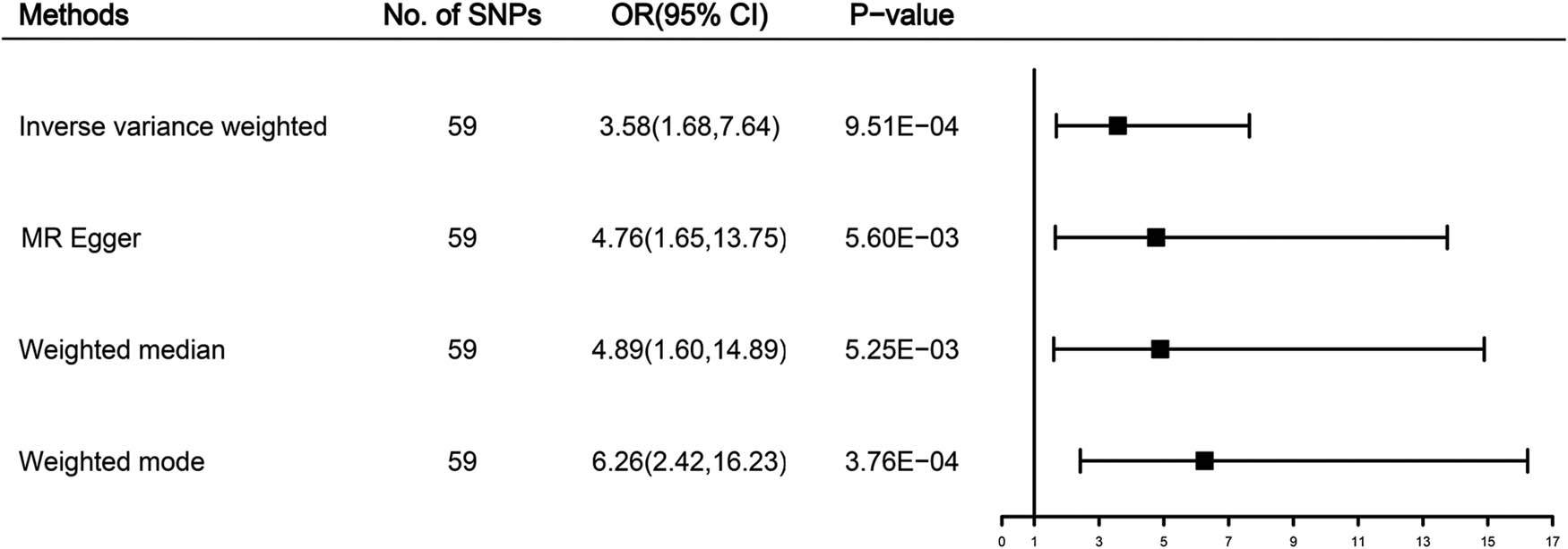
Forest plot of two-sample MR estimation of the association between childhood sunburn occasions and melanoma risk. Presented OR and CI correspond to the effects of childhood sunburn on melanoma. The results of univariable MR analyses using various analysis methods (IVW, MR-Egger, weighted median, and weighted mode) are presented for comparison. Total SNP indicates the number of genetic variants used as instruments for MR analysis.
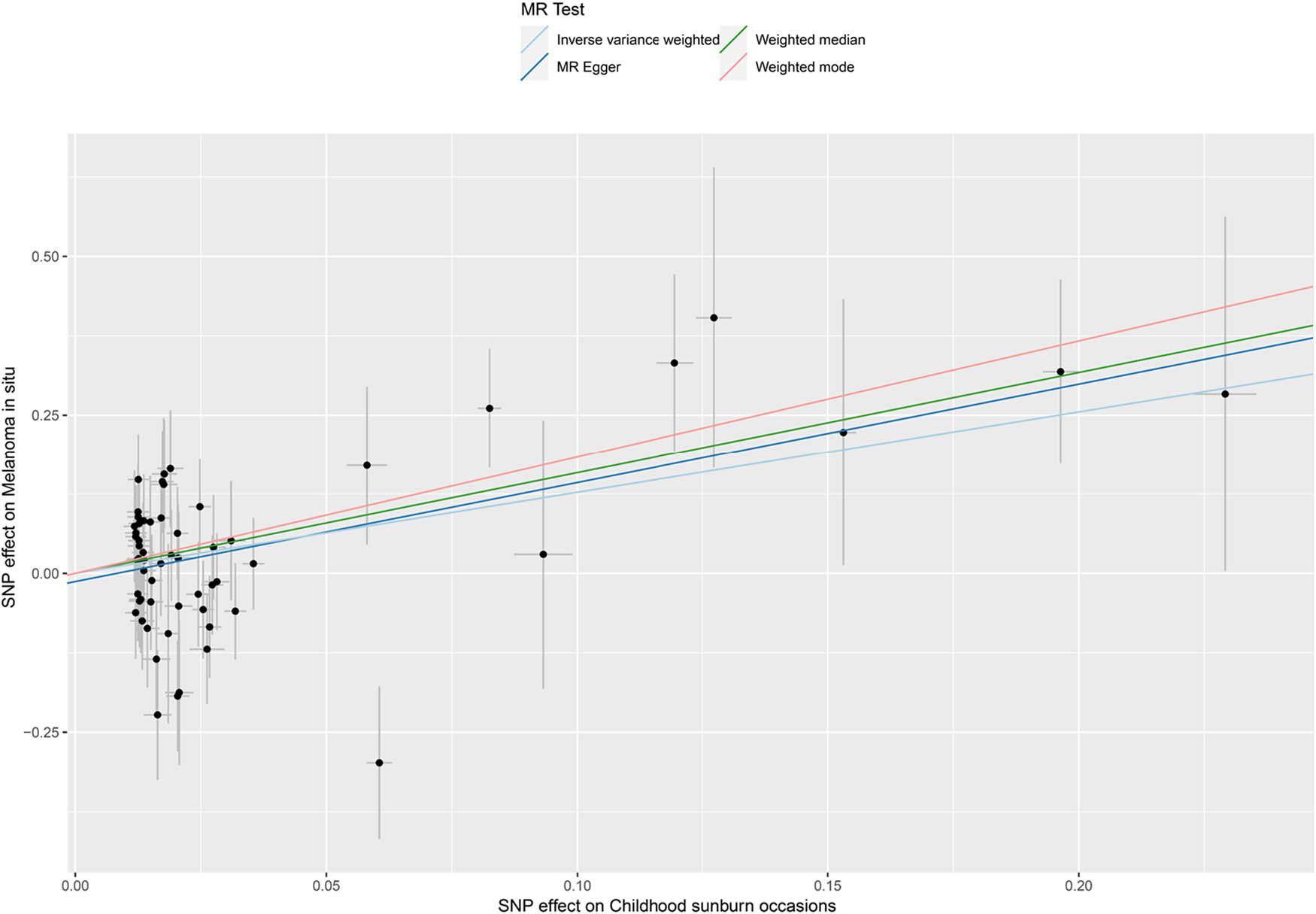
Scatter plot of SNPs associated with childhood sunburn occasions and risk on MIS. The slope of the straight line indicates the magnitude of the causal association. The light blue line represents IVW, the light green line represents weighted median, the dark blue line represents MR‐Egger, and the light pink line represents weighted mode.
3.3 Sensitivity analysis
There was no heterogeneity found in the conducted Q test for heterogeneity (P = 0.113). The MR-Egger regression method intercept significantly deviated from 0 (P = 0.457), suggesting the absence of horizontal pleiotropy in the IVs. The P-value for the MR-PRESSO global test was 0.15, indicating the absence of horizontal pleiotropy in the study. Furthermore, we found no SNP locus associated with confounding factors for outcome in the PhenoScannerv2 query for phenotypes or diseases associated with the SNPs included in the analysis, which were associated with phenotypes or diseases such as height, BMI, hip circumference, and years of education. The forest plot based on the LIA results shows good consistency (Figure 5). The funnel plot (Figure 6) provides the distribution and intensity of each SNP in CSOs and melanoma with good symmetry, and no significant outlier SNPs were found. These results suggest that the study results are unlikely to be influenced by potential bias.

Leave-one-out analysis results of SNPs associated with childhood sunburn occasions and risk on MIS.

Funnel plot of relationship between the causal effect of childhood sunburn occasions on MIS and reciprocal of the SD of the causal estimation using a single SNP as an instrument.
3.4 Multivariate MR analysis
The results of the multivariate MR analysis are shown in Figure 7. After adjusting for telomere length (OR = 3.80, 95% CI: 1.96–7.36, P = 7.85 × 10⁻⁵), BMI (OR = 3.87, 95% CI: 2.01–7.42, P = 4.82 × 10⁻⁵), years of education (OR = 3.66. 95% CI: 1.92–7.75, P = 1.49 × 10⁻⁴), and after all confounding factors (OR = 4.00, 95% CI: 2.07–7.74, P = 3.87 × 10⁻⁵), the causal association between CSOs and melanoma remained statistically significant.
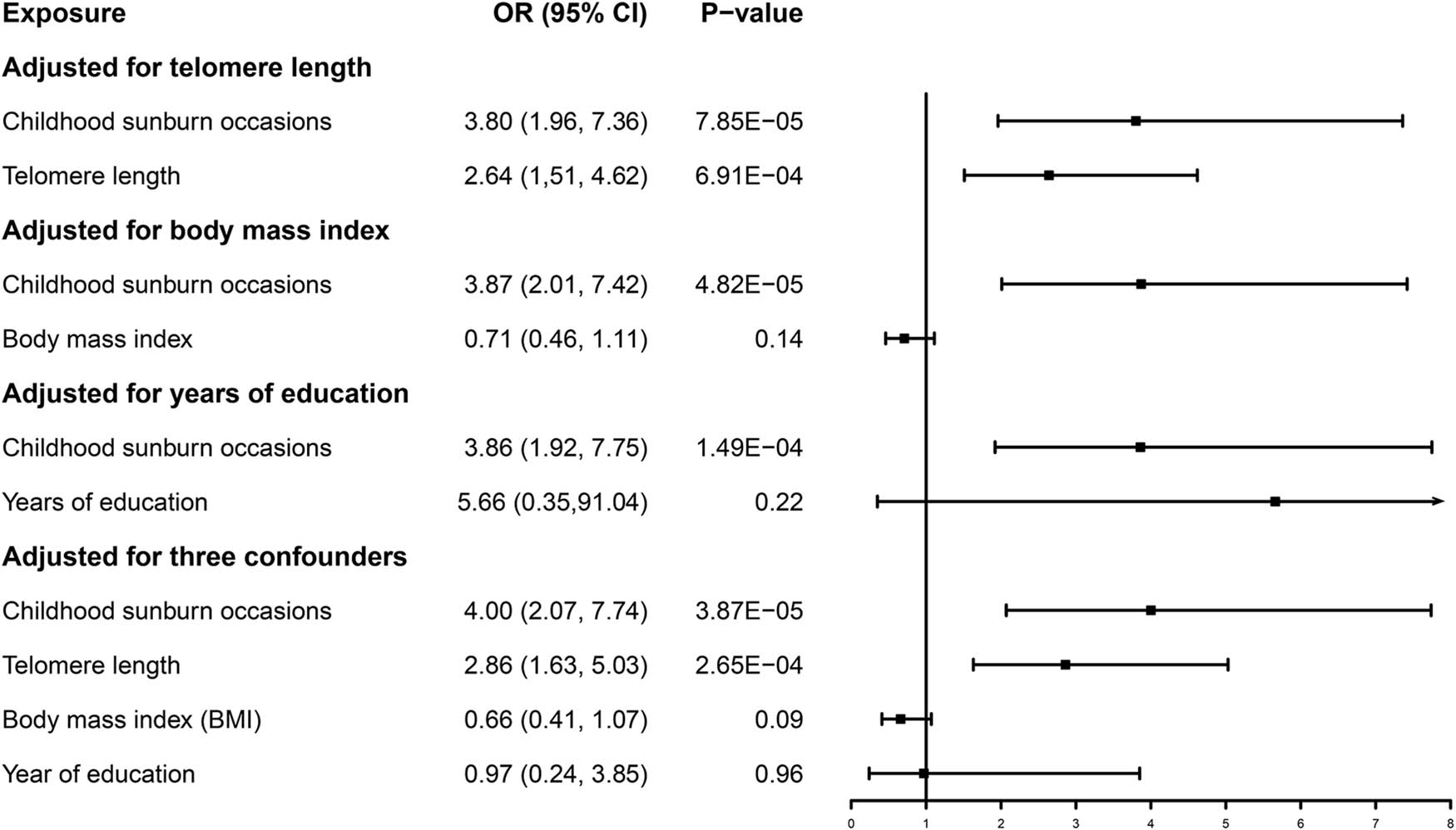
Forest plot of multivariable MR in MIS. Adjusted for telomere length, years of education, and BMI. Presented OR and CI correspond to the effects of childhood sunburn with melanoma risk.
4 Discussion
Currently, the high mortality rates associated with cancer have surpassed those associated with chronic diseases, such as cardiovascular diseases, with cancer being the leading cause of death in many countries. Melanoma, as a highly aggressive, metastatic, and poor prognosis malignant tumor, has a significantly increasing trend of morbidity and mortality despite remarkable improvements in the existing diagnosis and treatment technology. Hence, melanoma remains a great challenge to improving public health. In the era of precision medicine, the early identification of high-risk exposed populations, an in-depth understanding of melanoma risk factors and pathogenesis, and specific measures for intervention targets can effectively reduce the burden of melanoma disease.
In recent years, with the steady and orderly development of large-scale GWAS and the development of MR application model specifications, MR has made a great contribution to disease association studies. It is widely used to explore risk factors, intermediate mechanisms, and bidirectional causality among complex diseases. Furthermore, it is expected to become an important link between traditional observational studies and RCTs in the causal evidence chain. At this stage, the application of MR provides new ideas for the study of melanoma pathogenesis. It has an irreplaceable position in melanoma research. However, due to the limitations of the race of the subjects and the number of gene types, the application of MR in melanoma at this stage is limited and only stays in the etiological research, lacking pathophysiological and related translational research, which is difficult to be used for clinical practice. However, the use of MR to guide etiological research is in the ascendant, and the combination of genome-wide association analysis with multi-omics analysis represented by proteomics and metabolomics to identify disease-causing genes and potential targets for intervention may become a new way of thinking for the application of MR in melanoma.
The current study explores the causal association between CSOs and melanoma from a genetic perspective based on UK Biobank and FinnGen summary data using the TSMR approach. The results of the study showed that for every 1 SD increase in CSOs, the risk of melanoma increases by 2.58-fold in the European population. Additionally, the causal association between CSOs and melanoma remained statistically significant after controlling for confounding factors (telomere length, BMI, and years of education). This result is generally consistent with previous epidemiological studies. Chang et al. [41] included 15 case–control studies with a total of 12,916 participants to assess the risk of sunburn and melanoma development. The results showed that sunburn during childhood significantly increased the incidence of melanoma (OR = 1.5, 95% CI: 1.3–1.7). Recently, a large cohort study from Norway reported that sunburn in childhood increased the risk of melanoma [7]. Furthermore, Olsen et al. [8] conducted a prospective population-based cohort study that sought to assess the strength of the association between individual UV exposure and melanoma. A total of 15,375 participants without melanoma at baseline were included in the study, and 420 melanoma events (173 invasives, 247 in situ) occurred during a 4.4-year (median) follow-up period. The study showed that more than 50 sunburn experiences in childhood or adolescence significantly increased the risk of melanoma development.
As previously stated, an MR study with a rigorous design and valid core assumptions can provide reliable evidence of causal associations. First, to avoid population stratification bias, the sample resources used in this study were drawn from European populations. Additionally, 59 SNPs that were strongly associated with CSOs and independent of each other were finally included as IVs after a rigorous screening step. Meanwhile, the F-statistic of each SNP was greater than 10, indicating the absence of weak IVs. Second, two methods – MR-Egger regression and MR-PRESSO global test – were used to assess the horizontal multi-effectiveness of the IVs. Moreover, we used multiple statistical models, and the LIA method was used to conduct a sensitivity analysis of the main findings. These statistical methods further validated that the IVs included in the study were reasonably valid and that the study results were robust and reliable. Moreover, taking the potential confounding factors (such as telomere length, BMI, and year of education) into consideration, the genetic predisposition to childhood sunburn was still an independent risk for melanoma. Telomere length, BMI, and years of education were chosen as confounders because of the large number of studies suggesting that these factors influence tumorigenesis and development.
This is the MR study to make causal inferences about the risk of childhood sunburn events and melanoma. As always, our findings support a causal effect of childhood sunburn on the risk of melanoma development, which provides a vital public health message that raising awareness of sun protection in children and adopting necessary sun protection behaviors play a crucial role in preventing melanoma development.
5 Limitations
Although we achieved secondary mining of biological information in the database through innovative statistical methods, it is worth discussing the limitations of both the MR method and the GWAS database in practical applications. First, the information related to CSOs was obtained through self-reported questionnaires rather than from objective measures and hence may be subject to recall bias. Therefore, the study results need to be interpreted with caution. Second, our study population was limited to individuals of European ancestry, which effectively controlled for population stratification bias. However, whether the findings can be extrapolated to other ethnic groups, which may show differences in genetic background and lifestyle, remains to be tested. Third, it is difficult to exclude the effect of genetic pleiotropy; that is, genetic variants can affect the outcome through pathways other than “genetic variation-exposure factor-outcome.” Fourth, because we used summary data, we could not explore the non-linear effects of CSOs and melanoma [37]. In addition, this study is only a statistical result and cannot further explore the biological mechanisms between CSOs and melanoma.
6 Conclusion
At the genetic level, using a two-sample MR method, this study confirmed that CSOs increase the risk of melanoma development. In conclusion, avoiding UV damage, avoiding childhood sunburn, and taking precautions are key.
Abbreviations
- CSOs
-
childhood sunburn occasions
- RCT
-
randomized controlled trial
- GWAS
-
genome-wide association study
- MR
-
Mendelian randomization
- IV
-
instrumental variable
- TSMR
-
two-sample Mendelian randomization
- SNP
-
single nucleotide polymorphism
- SD
-
standard deviation
- IVW
-
inverse variance weighted
- MR-PRESSO
-
Mendelian randomization pleiotropy residual sum and outlier
- BMI
-
body mass index
- EAF
-
effect allele frequency
- OR
-
odds ratio
- CI
-
confidence interval
Acknowledgements
Not applicable.
-
Funding information: This work was supported by Changshu Health Commission Science and Technology Plan Sponsored Projects and Changshu Science and Technology Development Plan (Medical and Health) Guidance Projects (CSWS202304), and Funding from Young Talent Development Plan of Changzhou Health Commission (CZQM2020066).
-
Author contributions: All authors participated in the study design, analysis of the data, interpretation of the results, and review of the manuscript. H.H.S. put forward the idea of the article and wrote the manuscript. C.Y. provided financial support. W.S. revised the manuscript. All authors have read the final version of the manuscript and agreed to publication.
-
Conflict of interest: The authors declare that they have no competing interests.
-
Data availability statement: All analyses were conducted using publicly available data. The data that support this study are openly available in UK Biobank at https://www.ukbiobank.ac.uk/ and FinnGen at https://www.finngen.fi/en.
References
[1] Siegel RL, Miller KD, Wagle NS, Jemal A. Cancer statistics, 2023. CA Cancer J Clin. 2023;73(1):17–48.10.3322/caac.21763Search in Google Scholar PubMed
[2] Strashilov S, Yordanov A. Aetiology and pathogenesis of cutaneous melanoma: current concepts and advances. Int J Mol Sci. 2021;22(12):6395.10.3390/ijms22126395Search in Google Scholar PubMed PubMed Central
[3] Moldovan HR, Wittlich M, John SM, Brans R, Tiplica GS, Salavastru C, et al. Exposure to solar UV radiation in outdoor construction workers using personal dosimetry. Environ Res. 2020;181:108967.10.1016/j.envres.2019.108967Search in Google Scholar PubMed
[4] Gao Y, Arron ST, Linos E, Polcari I, Mansh MD. Indoor tanning, sunless tanning, and sun-protection behaviors among sexual minority men. JAMA Dermatol. 2018;154(4):477–9.10.1001/jamadermatol.2018.0003Search in Google Scholar PubMed PubMed Central
[5] Kaskel P, Lange U, Sander S, Huber MA, Utikal J, Leiter U, et al. Ultraviolet exposure and risk of melanoma and basal cell carcinoma in Ulm and Dresden, Germany. J Eur Acad Dermatol Venereol. 2015;29(1):134–42.10.1111/jdv.12488Search in Google Scholar PubMed
[6] Tsai J, Chien AL. Photoprotection for Skin of Color. Am J Clin Dermatol. 2022;23(2):195–205.10.1007/s40257-021-00670-zSearch in Google Scholar PubMed PubMed Central
[7] Lergenmuller S, Rueegg CS, Perrier F, Robsahm TE, Green AC, Lund E, et al. Lifetime sunburn trajectories and associated risks of cutaneous melanoma and squamous cell carcinoma among a cohort of norwegian women. JAMA Dermatol. 2022;158(12):1367–77.10.1001/jamadermatol.2022.4053Search in Google Scholar PubMed PubMed Central
[8] Olsen CM, Pandeya N, Law MH, MacGregor S, Iles MM, Thompson BS, et al. Does polygenic risk influence associations between sun exposure and melanoma? A prospective cohort analysis. Br J Dermatol. 2020;183(2):303–10.10.1111/bjd.18703Search in Google Scholar PubMed
[9] Pfahlberg A, Kolmel KF, Gefeller O, Febim Study G. Timing of excessive ultraviolet radiation and melanoma: epidemiology does not support the existence of a critical period of high susceptibility to solar ultraviolet radiation- induced melanoma. Br J Dermatol. 2001;144(3):471–5.10.1046/j.1365-2133.2001.04070.xSearch in Google Scholar PubMed
[10] Glicksberg BS, Johnson KW, Dudley JT. The next generation of precision medicine: observational studies, electronic health records, biobanks and continuous monitoring. Hum Mol Genet. 2018;27(R1):R56–62.10.1093/hmg/ddy114Search in Google Scholar PubMed
[11] Sattar N, Preiss D. Reverse causality in cardiovascular epidemiological research: more common than imagined? Circulation. 2017;135(24):2369–72.10.1161/CIRCULATIONAHA.117.028307Search in Google Scholar PubMed
[12] Lawlor DA, Davey Smith G, Kundu D, Bruckdorfer KR, Ebrahim S. Those confounded vitamins: what can we learn from the differences between observational versus randomised trial evidence? Lancet. 2004;363(9422):1724–7.10.1016/S0140-6736(04)16260-0Search in Google Scholar PubMed
[13] Zabor EC, Kaizer AM, Hobbs BP. Randomized controlled trials. Chest. 2020;158(1S):S79–87.10.1016/j.chest.2020.03.013Search in Google Scholar PubMed PubMed Central
[14] Gala H, Tomlinson I. The use of Mendelian randomisation to identify causal cancer risk factors: promise and limitations. J Pathol. 2020;250(5):541–54.10.1002/path.5421Search in Google Scholar PubMed
[15] Zuber V, Grinberg NF, Gill D, Manipur I, Slob EAW, Patel A, et al. Combining evidence from Mendelian randomization and colocalization: Review and comparison of approaches. Am J Hum Genet. 2022;109(5):767–82.10.1016/j.ajhg.2022.04.001Search in Google Scholar PubMed PubMed Central
[16] Davey Smith G, Hemani G. Mendelian randomization: genetic anchors for causal inference in epidemiological studies. Hum Mol Genet. 2014;23(R1):R89–98.10.1093/hmg/ddu328Search in Google Scholar PubMed PubMed Central
[17] Davies NM, Holmes MV, Davey Smith G. Reading Mendelian randomisation studies: a guide, glossary, and checklist for clinicians. BMJ. 2018;362:k601.10.1136/bmj.k601Search in Google Scholar PubMed PubMed Central
[18] Thanassoulis G, O’Donnell CJ. Mendelian randomization: nature’s randomized trial in the post-genome era. JAMA. 2009;301(22):2386–8.10.1001/jama.2009.812Search in Google Scholar PubMed PubMed Central
[19] Smith GD, Ebrahim S. ‘Mendelian randomization’: can genetic epidemiology contribute to understanding environmental determinants of disease? Int J Epidemiol. 2003;32(1):1–22.10.1093/ije/dyg070Search in Google Scholar PubMed
[20] Tin A, Kottgen A. Mendelian randomization analysis as a tool to gain insights into causes of diseases: A Primer. J Am Soc Nephrol. 2021;32(10):2400–7.10.1681/ASN.2020121760Search in Google Scholar PubMed PubMed Central
[21] Spiga F, Gibson M, Dawson S, Tilling K, Davey Smith G, Munafo MR, et al. Tools for assessing quality and risk of bias in Mendelian randomization studies: a systematic review. Int J Epidemiol. 2023;52(1):227–49.10.1093/ije/dyac149Search in Google Scholar PubMed PubMed Central
[22] Zhong S, Lan L, Wen Y. Evaluating the effect of childhood sunburn on the risk of cutaneous melanoma through Mendelian randomization. Cancer Sci. 2023;114(12):4706–16.10.1111/cas.15974Search in Google Scholar PubMed PubMed Central
[23] Li Y, Wu J, Cao Z. Childhood sunburn and risk of melanoma and non-melanoma skin cancer: a Mendelian randomization study. Environ Sci Pollut Res Int. 2023;30(58):122011–23.10.1007/s11356-023-30535-3Search in Google Scholar PubMed PubMed Central
[24] Liu M, Lan Y, Zhang H, Wu M, Zhang X, Leng L, et al. Analysing the causal relationship between potentially protective and risk factors and cutaneous melanoma: A Mendelian randomization study. J Eur Acad Dermatol Venereol. 2024;38(1):102–11.10.1111/jdv.19484Search in Google Scholar PubMed
[25] Burgess S, Butterworth A, Thompson SG. Mendelian randomization analysis with multiple genetic variants using summarized data. Genet Epidemiol. 2013;37(7):658–65.10.1002/gepi.21758Search in Google Scholar PubMed PubMed Central
[26] Skrivankova VW, Richmond RC, Woolf BAR, Yarmolinsky J, Davies NM, Swanson SA, et al. Strengthening the reporting of observational studies in epidemiology using mendelian randomization: The STROBE-MR Statement. JAMA. 2021;326(16):1614–21.10.1001/jama.2021.18236Search in Google Scholar PubMed
[27] Mullard A. The UK Biobank at 20. Nat Rev Drug Discovery. 2022;21(9):628–9.10.1038/d41573-022-00137-8Search in Google Scholar PubMed
[28] Bycroft C, Freeman C, Petkova D, Band G, Elliott LT, Sharp K, et al. The UK Biobank resource with deep phenotyping and genomic data. Nature. 2018;562(7726):203–9.10.1038/s41586-018-0579-zSearch in Google Scholar PubMed PubMed Central
[29] Kurki MI, Karjalainen J, Palta P, Sipila TP, Kristiansson K, Donner KM, et al. FinnGen provides genetic insights from a well-phenotyped isolated population. Nature. 2023;613(7944):508–18.10.1038/s41586-022-05473-8Search in Google Scholar PubMed PubMed Central
[30] Bowden J, Davey Smith G, Haycock PC, Burgess S. Consistent estimation in mendelian randomization with some invalid instruments using a weighted median estimator. Genet Epidemiol. 2016;40(4):304–14.10.1002/gepi.21965Search in Google Scholar PubMed PubMed Central
[31] Bowden J, Del Greco MF, Minelli C, Davey Smith G, Sheehan NA, Thompson JR. Assessing the suitability of summary data for two-sample Mendelian randomization analyses using MR-Egger regression: the role of the I2 statistic. Int J Epidemiol. 2016;45(6):1961–74.10.1093/ije/dyw220Search in Google Scholar PubMed PubMed Central
[32] Verbanck M, Chen CY, Neale B, Do R. Detection of widespread horizontal pleiotropy in causal relationships inferred from Mendelian randomization between complex traits and diseases. Nat Genet. 2018;50(5):693–8.10.1038/s41588-018-0099-7Search in Google Scholar PubMed PubMed Central
[33] Burgess S, Thompson SG. Erratum to: Interpreting findings from mendelian randomization using the MR-Egger method. Eur J Epidemiol. 2017;32(5):391–2.10.1007/s10654-017-0276-5Search in Google Scholar PubMed PubMed Central
[34] Verbanck M, Chen CY, Neale B, Do R. Publisher correction: detection of widespread horizontal pleiotropy in causal relationships inferred from Mendelian randomization between complex traits and diseases. Nat Genet. 2018;50(8):1196.10.1038/s41588-018-0164-2Search in Google Scholar PubMed
[35] Staley JR, Blackshaw J, Kamat MA, Ellis S, Surendran P, Sun BB, et al. PhenoScanner: a database of human genotype-phenotype associations. Bioinformatics. 2016;32(20):3207–9.10.1093/bioinformatics/btw373Search in Google Scholar PubMed PubMed Central
[36] Hemani G, Zheng J, Elsworth B, Wade KH, Haberland V, Baird D, et al. The MR-Base platform supports systematic causal inference across the human phenome. Elife. 2018;7:e34408.10.7554/eLife.34408Search in Google Scholar PubMed PubMed Central
[37] Burgess S, Thompson SG. Multivariable mendelian randomization: the use of pleiotropic genetic variants to estimate causal effects. Am J Epidemiol. 2015;181(4):251–60.10.1093/aje/kwu283Search in Google Scholar PubMed PubMed Central
[38] Telomeres Mendelian Randomization C, Haycock PC, Burgess S, Nounu A, Zheng J, Okoli GN, et al. Association between telomere length and risk of cancer and non-neoplastic diseases: a mendelian randomization study. JAMA Oncol. 2017;3(5):636–51.10.1001/jamaoncol.2016.5945Search in Google Scholar PubMed PubMed Central
[39] Lauby-Secretan B, Scoccianti C, Loomis D, Grosse Y, Bianchini F, Straif K, et al. Body fatness and cancer--viewpoint of the IARC working group. N Engl J Med. 2016;375(8):794–8.10.1056/NEJMsr1606602Search in Google Scholar PubMed PubMed Central
[40] Eriksson H, Lyth J, Mansson-Brahme E, Frohm-Nilsson M, Ingvar C, Lindholm C, et al. Low level of education is associated with later stage at diagnosis and reduced survival in cutaneous malignant melanoma: a nationwide population-based study in Sweden. Eur J Cancer. 2013;49(12):2705–16.10.1016/j.ejca.2013.03.013Search in Google Scholar PubMed
[41] Chang YM, Barrett JH, Bishop DT, Armstrong BK, Bataille V, Bergman W, et al. Sun exposure and melanoma risk at different latitudes: a pooled analysis of 5700 cases and 7216 controls. Int J Epidemiol. 2009;38(3):814–30.10.1093/ije/dyp166Search in Google Scholar PubMed PubMed Central
© 2024 the author(s), published by De Gruyter
This work is licensed under the Creative Commons Attribution 4.0 International License.
Articles in the same Issue
- Research Articles
- EDNRB inhibits the growth and migration of prostate cancer cells by activating the cGMP-PKG pathway
- STK11 (LKB1) mutation suppresses ferroptosis in lung adenocarcinoma by facilitating monounsaturated fatty acid synthesis
- Association of SOX6 gene polymorphisms with Kashin-Beck disease risk in the Chinese Han population
- The pyroptosis-related signature predicts prognosis and influences the tumor immune microenvironment in dedifferentiated liposarcoma
- METTL3 attenuates ferroptosis sensitivity in lung cancer via modulating TFRC
- Identification and validation of molecular subtypes and prognostic signature for stage I and stage II gastric cancer based on neutrophil extracellular traps
- Novel lumbar plexus block versus femoral nerve block for analgesia and motor recovery after total knee arthroplasty
- Correlation between ABCB1 and OLIG2 polymorphisms and the severity and prognosis of patients with cerebral infarction
- Study on the radiotherapy effect and serum neutral granulocyte lymphocyte ratio and inflammatory factor expression of nasopharyngeal carcinoma
- Transcriptome analysis of effects of Tecrl deficiency on cardiometabolic and calcium regulation in cardiac tissue
- Aflatoxin B1 induces infertility, fetal deformities, and potential therapies
- Serum levels of HMW adiponectin and its receptors are associated with cytokine levels and clinical characteristics in chronic obstructive pulmonary disease
- METTL3-mediated methylation of CYP2C19 mRNA may aggravate clopidogrel resistance in ischemic stroke patients
- Understand how machine learning impact lung cancer research from 2010 to 2021: A bibliometric analysis
- Pressure ulcers in German hospitals: Analysis of reimbursement and length of stay
- Metformin plus L-carnitine enhances brown/beige adipose tissue activity via Nrf2/HO-1 signaling to reduce lipid accumulation and inflammation in murine obesity
- Downregulation of carbonic anhydrase IX expression in mouse xenograft nasopharyngeal carcinoma model via doxorubicin nanobubble combined with ultrasound
- Feasibility of 3-dimensional printed models in simulated training and teaching of transcatheter aortic valve replacement
- miR-335-3p improves type II diabetes mellitus by IGF-1 regulating macrophage polarization
- The analyses of human MCPH1 DNA repair machinery and genetic variations
- Activation of Piezo1 increases the sensitivity of breast cancer to hyperthermia therapy
- Comprehensive analysis based on the disulfidptosis-related genes identifies hub genes and immune infiltration for pancreatic adenocarcinoma
- Changes of serum CA125 and PGE2 before and after high-intensity focused ultrasound combined with GnRH-a in treatment of patients with adenomyosis
- The clinical value of the hepatic venous pressure gradient in patients undergoing hepatic resection for hepatocellular carcinoma with or without liver cirrhosis
- Development and validation of a novel model to predict pulmonary embolism in cardiology suspected patients: A 10-year retrospective analysis
- Downregulation of lncRNA XLOC_032768 in diabetic patients predicts the occurrence of diabetic nephropathy
- Circ_0051428 targeting miR-885-3p/MMP2 axis enhances the malignancy of cervical cancer
- Effectiveness of ginkgo diterpene lactone meglumine on cognitive function in patients with acute ischemic stroke
- The construction of a novel prognostic prediction model for glioma based on GWAS-identified prognostic-related risk loci
- Evaluating the impact of childhood BMI on the risk of coronavirus disease 2019: A Mendelian randomization study
- Lactate dehydrogenase to albumin ratio is associated with in-hospital mortality in patients with acute heart failure: Data from the MIMIC-III database
- CD36-mediated podocyte lipotoxicity promotes foot process effacement
- Efficacy of etonogestrel subcutaneous implants versus the levonorgestrel-releasing intrauterine system in the conservative treatment of adenomyosis
- FLRT2 mediates chondrogenesis of nasal septal cartilage and mandibular condyle cartilage
- Challenges in treating primary immune thrombocytopenia patients undergoing COVID-19 vaccination: A retrospective study
- Let-7 family regulates HaCaT cell proliferation and apoptosis via the ΔNp63/PI3K/AKT pathway
- Phospholipid transfer protein ameliorates sepsis-induced cardiac dysfunction through NLRP3 inflammasome inhibition
- Postoperative cognitive dysfunction in elderly patients with colorectal cancer: A randomized controlled study comparing goal-directed and conventional fluid therapy
- Long-pulsed ultrasound-mediated microbubble thrombolysis in a rat model of microvascular obstruction
- High SEC61A1 expression predicts poor outcome of acute myeloid leukemia
- Comparison of polymerase chain reaction and next-generation sequencing with conventional urine culture for the diagnosis of urinary tract infections: A meta-analysis
- Secreted frizzled-related protein 5 protects against renal fibrosis by inhibiting Wnt/β-catenin pathway
- Pan-cancer and single-cell analysis of actin cytoskeleton genes related to disulfidptosis
- Overexpression of miR-532-5p restrains oxidative stress response of chondrocytes in nontraumatic osteonecrosis of the femoral head by inhibiting ABL1
- Autologous liver transplantation for unresectable hepatobiliary malignancies in enhanced recovery after surgery model
- Clinical analysis of incomplete rupture of the uterus secondary to previous cesarean section
- Abnormal sleep duration is associated with sarcopenia in older Chinese people: A large retrospective cross-sectional study
- No genetic causality between obesity and benign paroxysmal vertigo: A two-sample Mendelian randomization study
- Identification and validation of autophagy-related genes in SSc
- Long non-coding RNA SRA1 suppresses radiotherapy resistance in esophageal squamous cell carcinoma by modulating glycolytic reprogramming
- Evaluation of quality of life in patients with schizophrenia: An inpatient social welfare institution-based cross-sectional study
- The possible role of oxidative stress marker glutathione in the assessment of cognitive impairment in multiple sclerosis
- Compilation of a self-management assessment scale for postoperative patients with aortic dissection
- Left atrial appendage closure in conjunction with radiofrequency ablation: Effects on left atrial functioning in patients with paroxysmal atrial fibrillation
- Effect of anterior femoral cortical notch grade on postoperative function and complications during TKA surgery: A multicenter, retrospective study
- Clinical characteristics and assessment of risk factors in patients with influenza A-induced severe pneumonia after the prevalence of SARS-CoV-2
- Analgesia nociception index is an indicator of laparoscopic trocar insertion-induced transient nociceptive stimuli
- High STAT4 expression correlates with poor prognosis in acute myeloid leukemia and facilitates disease progression by upregulating VEGFA expression
- Factors influencing cardiovascular system-related post-COVID-19 sequelae: A single-center cohort study
- HOXD10 regulates intestinal permeability and inhibits inflammation of dextran sulfate sodium-induced ulcerative colitis through the inactivation of the Rho/ROCK/MMPs axis
- Mesenchymal stem cell-derived exosomal miR-26a induces ferroptosis, suppresses hepatic stellate cell activation, and ameliorates liver fibrosis by modulating SLC7A11
- Endovascular thrombectomy versus intravenous thrombolysis for primary distal, medium vessel occlusion in acute ischemic stroke
- ANO6 (TMEM16F) inhibits gastrointestinal stromal tumor growth and induces ferroptosis
- Prognostic value of EIF5A2 in solid tumors: A meta-analysis and bioinformatics analysis
- The role of enhanced expression of Cx43 in patients with ulcerative colitis
- Choosing a COVID-19 vaccination site might be driven by anxiety and body vigilance
- Role of ICAM-1 in triple-negative breast cancer
- Cost-effectiveness of ambroxol in the treatment of Gaucher disease type 2
- HLA-DRB5 promotes immune thrombocytopenia via activating CD8+ T cells
- Efficacy and factors of myofascial release therapy combined with electrical and magnetic stimulation in the treatment of chronic pelvic pain syndrome
- Efficacy of tacrolimus monotherapy in primary membranous nephropathy
- Mechanisms of Tripterygium wilfordii Hook F on treating rheumatoid arthritis explored by network pharmacology analysis and molecular docking
- FBXO45 levels regulated ferroptosis renal tubular epithelial cells in a model of diabetic nephropathy by PLK1
- Optimizing anesthesia strategies to NSCLC patients in VATS procedures: Insights from drug requirements and patient recovery patterns
- Alpha-lipoic acid upregulates the PPARγ/NRF2/GPX4 signal pathway to inhibit ferroptosis in the pathogenesis of unexplained recurrent pregnancy loss
- Correlation between fat-soluble vitamin levels and inflammatory factors in paediatric community-acquired pneumonia: A prospective study
- CD1d affects the proliferation, migration, and apoptosis of human papillary thyroid carcinoma TPC-1 cells via regulating MAPK/NF-κB signaling pathway
- miR-let-7a inhibits sympathetic nerve remodeling after myocardial infarction by downregulating the expression of nerve growth factor
- Immune response analysis of solid organ transplantation recipients inoculated with inactivated COVID-19 vaccine: A retrospective analysis
- The H2Valdien derivatives regulate the epithelial–mesenchymal transition of hepatoma carcinoma cells through the Hedgehog signaling pathway
- Clinical efficacy of dexamethasone combined with isoniazid in the treatment of tuberculous meningitis and its effect on peripheral blood T cell subsets
- Comparison of short-segment and long-segment fixation in treatment of degenerative scoliosis and analysis of factors associated with adjacent spondylolisthesis
- Lycopene inhibits pyroptosis of endothelial progenitor cells induced by ox-LDL through the AMPK/mTOR/NLRP3 pathway
- Methylation regulation for FUNDC1 stability in childhood leukemia was up-regulated and facilitates metastasis and reduces ferroptosis of leukemia through mitochondrial damage by FBXL2
- Correlation of single-fiber electromyography studies and functional status in patients with amyotrophic lateral sclerosis
- Risk factors of postoperative airway obstruction complications in children with oral floor mass
- Expression levels and clinical significance of serum miR-19a/CCL20 in patients with acute cerebral infarction
- Physical activity and mental health trends in Korean adolescents: Analyzing the impact of the COVID-19 pandemic from 2018 to 2022
- Evaluating anemia in HIV-infected patients using chest CT
- Ponticulus posticus and skeletal malocclusion: A pilot study in a Southern Italian pre-orthodontic court
- Causal association of circulating immune cells and lymphoma: A Mendelian randomization study
- Assessment of the renal function and fibrosis indexes of conventional western medicine with Chinese medicine for dredging collaterals on treating renal fibrosis: A systematic review and meta-analysis
- Comprehensive landscape of integrator complex subunits and their association with prognosis and tumor microenvironment in gastric cancer
- New target-HMGCR inhibitors for the treatment of primary sclerosing cholangitis: A drug Mendelian randomization study
- Population pharmacokinetics of meropenem in critically ill patients
- Comparison of the ability of newly inflammatory markers to predict complicated appendicitis
- Comparative morphology of the cruciate ligaments: A radiological study
- Immune landscape of hepatocellular carcinoma: The central role of TP53-inducible glycolysis and apoptosis regulator
- Serum SIRT3 levels in epilepsy patients and its association with clinical outcomes and severity: A prospective observational study
- SHP-1 mediates cigarette smoke extract-induced epithelial–mesenchymal transformation and inflammation in 16HBE cells
- Acute hyper-hypoxia accelerates the development of depression in mice via the IL-6/PGC1α/MFN2 signaling pathway
- The GJB3 correlates with the prognosis, immune cell infiltration, and therapeutic responses in lung adenocarcinoma
- Physical fitness and blood parameters outcomes of breast cancer survivor in a low-intensity circuit resistance exercise program
- Exploring anesthetic-induced gene expression changes and immune cell dynamics in atrial tissue post-coronary artery bypass graft surgery
- Empagliflozin improves aortic injury in obese mice by regulating fatty acid metabolism
- Analysis of the risk factors of the radiation-induced encephalopathy in nasopharyngeal carcinoma: A retrospective cohort study
- Reproductive outcomes in women with BRCA 1/2 germline mutations: A retrospective observational study and literature review
- Evaluation of upper airway ultrasonographic measurements in predicting difficult intubation: A cross-section of the Turkish population
- Prognostic and diagnostic value of circulating IGFBP2 in pancreatic cancer
- Postural stability after operative reconstruction of the AFTL in chronic ankle instability comparing three different surgical techniques
- Research trends related to emergence agitation in the post-anaesthesia care unit from 2001 to 2023: A bibliometric analysis
- Frequency and clinicopathological correlation of gastrointestinal polyps: A six-year single center experience
- ACSL4 mediates inflammatory bowel disease and contributes to LPS-induced intestinal epithelial cell dysfunction by activating ferroptosis and inflammation
- Affibody-based molecular probe 99mTc-(HE)3ZHER2:V2 for non-invasive HER2 detection in ovarian and breast cancer xenografts
- Effectiveness of nutritional support for clinical outcomes in gastric cancer patients: A meta-analysis of randomized controlled trials
- The relationship between IFN-γ, IL-10, IL-6 cytokines, and severity of the condition with serum zinc and Fe in children infected with Mycoplasma pneumoniae
- Paraquat disrupts the blood–brain barrier by increasing IL-6 expression and oxidative stress through the activation of PI3K/AKT signaling pathway
- Sleep quality associate with the increased prevalence of cognitive impairment in coronary artery disease patients: A retrospective case–control study
- Dioscin protects against chronic prostatitis through the TLR4/NF-κB pathway
- Association of polymorphisms in FBN1, MYH11, and TGF-β signaling-related genes with susceptibility of sporadic thoracic aortic aneurysm and dissection in the Zhejiang Han population
- Application value of multi-parameter magnetic resonance image-transrectal ultrasound cognitive fusion in prostate biopsy
- Laboratory variables‐based artificial neural network models for predicting fatty liver disease: A retrospective study
- Decreased BIRC5-206 promotes epithelial–mesenchymal transition in nasopharyngeal carcinoma through sponging miR-145-5p
- Sepsis induces the cardiomyocyte apoptosis and cardiac dysfunction through activation of YAP1/Serpine1/caspase-3 pathway
- Assessment of iron metabolism and iron deficiency in incident patients on incident continuous ambulatory peritoneal dialysis
- Tibial periosteum flap combined with autologous bone grafting in the treatment of Gustilo-IIIB/IIIC open tibial fractures
- The application of intravenous general anesthesia under nasopharyngeal airway assisted ventilation undergoing ureteroscopic holmium laser lithotripsy: A prospective, single-center, controlled trial
- Long intergenic noncoding RNA for IGF2BP2 stability suppresses gastric cancer cell apoptosis by inhibiting the maturation of microRNA-34a
- Role of FOXM1 and AURKB in regulating keratinocyte function in psoriasis
- Parental control attitudes over their pre-school children’s diet
- The role of auto-HSCT in extranodal natural killer/T cell lymphoma
- Significance of negative cervical cytology and positive HPV in the diagnosis of cervical lesions by colposcopy
- Echinacoside inhibits PASMCs calcium overload to prevent hypoxic pulmonary artery remodeling by regulating TRPC1/4/6 and calmodulin
- ADAR1 plays a protective role in proximal tubular cells under high glucose conditions by attenuating the PI3K/AKT/mTOR signaling pathway
- The risk of cancer among insulin glargine users in Lithuania: A retrospective population-based study
- The unusual location of primary hydatid cyst: A case series study
- Intraoperative changes in electrophysiological monitoring can be used to predict clinical outcomes in patients with spinal cavernous malformation
- Obesity and risk of placenta accreta spectrum: A meta-analysis
- Shikonin alleviates asthma phenotypes in mice via an airway epithelial STAT3-dependent mechanism
- NSUN6 and HTR7 disturbed the stability of carotid atherosclerotic plaques by regulating the immune responses of macrophages
- The effect of COVID-19 lockdown on admission rates in Maternity Hospital
- Temporal muscle thickness is not a prognostic predictor in patients with high-grade glioma, an experience at two centers in China
- Luteolin alleviates cerebral ischemia/reperfusion injury by regulating cell pyroptosis
- Therapeutic role of respiratory exercise in patients with tuberculous pleurisy
- Effects of CFTR-ENaC on spinal cord edema after spinal cord injury
- Irisin-regulated lncRNAs and their potential regulatory functions in chondrogenic differentiation of human mesenchymal stem cells
- DMD mutations in pediatric patients with phenotypes of Duchenne/Becker muscular dystrophy
- Combination of C-reactive protein and fibrinogen-to-albumin ratio as a novel predictor of all-cause mortality in heart failure patients
- Significant role and the underly mechanism of cullin-1 in chronic obstructive pulmonary disease
- Ferroptosis-related prognostic model of mantle cell lymphoma
- Observation of choking reaction and other related indexes in elderly painless fiberoptic bronchoscopy with transnasal high-flow humidification oxygen therapy
- A bibliometric analysis of Prader-Willi syndrome from 2002 to 2022
- The causal effects of childhood sunburn occasions on melanoma: A univariable and multivariable Mendelian randomization study
- Oxidative stress regulates glycogen synthase kinase-3 in lymphocytes of diabetes mellitus patients complicated with cerebral infarction
- Role of COX6C and NDUFB3 in septic shock and stroke
- Trends in disease burden of type 2 diabetes, stroke, and hypertensive heart disease attributable to high BMI in China: 1990–2019
- Purinergic P2X7 receptor mediates hyperoxia-induced injury in pulmonary microvascular endothelial cells via NLRP3-mediated pyroptotic pathway
- Investigating the role of oviductal mucosa–endometrial co-culture in modulating factors relevant to embryo implantation
- Analgesic effect of external oblique intercostal block in laparoscopic cholecystectomy: A retrospective study
- Elevated serum miR-142-5p correlates with ischemic lesions and both NSE and S100β in ischemic stroke patients
- Correlation between the mechanism of arteriopathy in IgA nephropathy and blood stasis syndrome: A cohort study
- Risk factors for progressive kyphosis after percutaneous kyphoplasty in osteoporotic vertebral compression fracture
- Predictive role of neuron-specific enolase and S100-β in early neurological deterioration and unfavorable prognosis in patients with ischemic stroke
- The potential risk factors of postoperative cognitive dysfunction for endovascular therapy in acute ischemic stroke with general anesthesia
- Fluoxetine inhibited RANKL-induced osteoclastic differentiation in vitro
- Detection of serum FOXM1 and IGF2 in patients with ARDS and their correlation with disease and prognosis
- Rhein promotes skin wound healing by activating the PI3K/AKT signaling pathway
- Differences in mortality risk by levels of physical activity among persons with disabilities in South Korea
- Review Articles
- Cutaneous signs of selected cardiovascular disorders: A narrative review
- XRCC1 and hOGG1 polymorphisms and endometrial carcinoma: A meta-analysis
- A narrative review on adverse drug reactions of COVID-19 treatments on the kidney
- Emerging role and function of SPDL1 in human health and diseases
- Adverse reactions of piperacillin: A literature review of case reports
- Molecular mechanism and intervention measures of microvascular complications in diabetes
- Regulation of mesenchymal stem cell differentiation by autophagy
- Molecular landscape of borderline ovarian tumours: A systematic review
- Advances in synthetic lethality modalities for glioblastoma multiforme
- Investigating hormesis, aging, and neurodegeneration: From bench to clinics
- Frankincense: A neuronutrient to approach Parkinson’s disease treatment
- Sox9: A potential regulator of cancer stem cells in osteosarcoma
- Early detection of cardiovascular risk markers through non-invasive ultrasound methodologies in periodontitis patients
- Advanced neuroimaging and criminal interrogation in lie detection
- Maternal factors for neural tube defects in offspring: An umbrella review
- The chemoprotective hormetic effects of rosmarinic acid
- CBD’s potential impact on Parkinson’s disease: An updated overview
- Progress in cytokine research for ARDS: A comprehensive review
- Utilizing reactive oxygen species-scavenging nanoparticles for targeting oxidative stress in the treatment of ischemic stroke: A review
- NRXN1-related disorders, attempt to better define clinical assessment
- Lidocaine infusion for the treatment of complex regional pain syndrome: Case series and literature review
- Trends and future directions of autophagy in osteosarcoma: A bibliometric analysis
- Iron in ventricular remodeling and aneurysms post-myocardial infarction
- Case Reports
- Sirolimus potentiated angioedema: A case report and review of the literature
- Identification of mixed anaerobic infections after inguinal hernia repair based on metagenomic next-generation sequencing: A case report
- Successful treatment with bortezomib in combination with dexamethasone in a middle-aged male with idiopathic multicentric Castleman’s disease: A case report
- Complete heart block associated with hepatitis A infection in a female child with fatal outcome
- Elevation of D-dimer in eosinophilic gastrointestinal diseases in the absence of venous thrombosis: A case series and literature review
- Four years of natural progressive course: A rare case report of juvenile Xp11.2 translocations renal cell carcinoma with TFE3 gene fusion
- Advancing prenatal diagnosis: Echocardiographic detection of Scimitar syndrome in China – A case series
- Outcomes and complications of hemodialysis in patients with renal cancer following bilateral nephrectomy
- Anti-HMGCR myopathy mimicking facioscapulohumeral muscular dystrophy
- Recurrent opportunistic infections in a HIV-negative patient with combined C6 and NFKB1 mutations: A case report, pedigree analysis, and literature review
- Letter to the Editor
- Letter to the Editor: Total parenteral nutrition-induced Wernicke’s encephalopathy after oncologic gastrointestinal surgery
- Erratum
- Erratum to “Bladder-embedded ectopic intrauterine device with calculus”
- Retraction
- Retraction of “XRCC1 and hOGG1 polymorphisms and endometrial carcinoma: A meta-analysis”
- Corrigendum
- Corrigendum to “Investigating hormesis, aging, and neurodegeneration: From bench to clinics”
- Corrigendum to “Frankincense: A neuronutrient to approach Parkinson’s disease treatment”
- Special Issue The evolving saga of RNAs from bench to bedside - Part II
- Machine-learning-based prediction of a diagnostic model using autophagy-related genes based on RNA sequencing for patients with papillary thyroid carcinoma
- Unlocking the future of hepatocellular carcinoma treatment: A comprehensive analysis of disulfidptosis-related lncRNAs for prognosis and drug screening
- Elevated mRNA level indicates FSIP1 promotes EMT and gastric cancer progression by regulating fibroblasts in tumor microenvironment
- Special Issue Advancements in oncology: bridging clinical and experimental research - Part I
- Ultrasound-guided transperineal vs transrectal prostate biopsy: A meta-analysis of diagnostic accuracy and complication rates
- Assessment of diagnostic value of unilateral systematic biopsy combined with targeted biopsy in detecting clinically significant prostate cancer
- SENP7 inhibits glioblastoma metastasis and invasion by dissociating SUMO2/3 binding to specific target proteins
- MARK1 suppress malignant progression of hepatocellular carcinoma and improves sorafenib resistance through negatively regulating POTEE
- Analysis of postoperative complications in bladder cancer patients
- Carboplatin combined with arsenic trioxide versus carboplatin combined with docetaxel treatment for LACC: A randomized, open-label, phase II clinical study
- Special Issue Exploring the biological mechanism of human diseases based on MultiOmics Technology - Part I
- Comprehensive pan-cancer investigation of carnosine dipeptidase 1 and its prospective prognostic significance in hepatocellular carcinoma
- Identification of signatures associated with microsatellite instability and immune characteristics to predict the prognostic risk of colon cancer
- Single-cell analysis identified key macrophage subpopulations associated with atherosclerosis
Articles in the same Issue
- Research Articles
- EDNRB inhibits the growth and migration of prostate cancer cells by activating the cGMP-PKG pathway
- STK11 (LKB1) mutation suppresses ferroptosis in lung adenocarcinoma by facilitating monounsaturated fatty acid synthesis
- Association of SOX6 gene polymorphisms with Kashin-Beck disease risk in the Chinese Han population
- The pyroptosis-related signature predicts prognosis and influences the tumor immune microenvironment in dedifferentiated liposarcoma
- METTL3 attenuates ferroptosis sensitivity in lung cancer via modulating TFRC
- Identification and validation of molecular subtypes and prognostic signature for stage I and stage II gastric cancer based on neutrophil extracellular traps
- Novel lumbar plexus block versus femoral nerve block for analgesia and motor recovery after total knee arthroplasty
- Correlation between ABCB1 and OLIG2 polymorphisms and the severity and prognosis of patients with cerebral infarction
- Study on the radiotherapy effect and serum neutral granulocyte lymphocyte ratio and inflammatory factor expression of nasopharyngeal carcinoma
- Transcriptome analysis of effects of Tecrl deficiency on cardiometabolic and calcium regulation in cardiac tissue
- Aflatoxin B1 induces infertility, fetal deformities, and potential therapies
- Serum levels of HMW adiponectin and its receptors are associated with cytokine levels and clinical characteristics in chronic obstructive pulmonary disease
- METTL3-mediated methylation of CYP2C19 mRNA may aggravate clopidogrel resistance in ischemic stroke patients
- Understand how machine learning impact lung cancer research from 2010 to 2021: A bibliometric analysis
- Pressure ulcers in German hospitals: Analysis of reimbursement and length of stay
- Metformin plus L-carnitine enhances brown/beige adipose tissue activity via Nrf2/HO-1 signaling to reduce lipid accumulation and inflammation in murine obesity
- Downregulation of carbonic anhydrase IX expression in mouse xenograft nasopharyngeal carcinoma model via doxorubicin nanobubble combined with ultrasound
- Feasibility of 3-dimensional printed models in simulated training and teaching of transcatheter aortic valve replacement
- miR-335-3p improves type II diabetes mellitus by IGF-1 regulating macrophage polarization
- The analyses of human MCPH1 DNA repair machinery and genetic variations
- Activation of Piezo1 increases the sensitivity of breast cancer to hyperthermia therapy
- Comprehensive analysis based on the disulfidptosis-related genes identifies hub genes and immune infiltration for pancreatic adenocarcinoma
- Changes of serum CA125 and PGE2 before and after high-intensity focused ultrasound combined with GnRH-a in treatment of patients with adenomyosis
- The clinical value of the hepatic venous pressure gradient in patients undergoing hepatic resection for hepatocellular carcinoma with or without liver cirrhosis
- Development and validation of a novel model to predict pulmonary embolism in cardiology suspected patients: A 10-year retrospective analysis
- Downregulation of lncRNA XLOC_032768 in diabetic patients predicts the occurrence of diabetic nephropathy
- Circ_0051428 targeting miR-885-3p/MMP2 axis enhances the malignancy of cervical cancer
- Effectiveness of ginkgo diterpene lactone meglumine on cognitive function in patients with acute ischemic stroke
- The construction of a novel prognostic prediction model for glioma based on GWAS-identified prognostic-related risk loci
- Evaluating the impact of childhood BMI on the risk of coronavirus disease 2019: A Mendelian randomization study
- Lactate dehydrogenase to albumin ratio is associated with in-hospital mortality in patients with acute heart failure: Data from the MIMIC-III database
- CD36-mediated podocyte lipotoxicity promotes foot process effacement
- Efficacy of etonogestrel subcutaneous implants versus the levonorgestrel-releasing intrauterine system in the conservative treatment of adenomyosis
- FLRT2 mediates chondrogenesis of nasal septal cartilage and mandibular condyle cartilage
- Challenges in treating primary immune thrombocytopenia patients undergoing COVID-19 vaccination: A retrospective study
- Let-7 family regulates HaCaT cell proliferation and apoptosis via the ΔNp63/PI3K/AKT pathway
- Phospholipid transfer protein ameliorates sepsis-induced cardiac dysfunction through NLRP3 inflammasome inhibition
- Postoperative cognitive dysfunction in elderly patients with colorectal cancer: A randomized controlled study comparing goal-directed and conventional fluid therapy
- Long-pulsed ultrasound-mediated microbubble thrombolysis in a rat model of microvascular obstruction
- High SEC61A1 expression predicts poor outcome of acute myeloid leukemia
- Comparison of polymerase chain reaction and next-generation sequencing with conventional urine culture for the diagnosis of urinary tract infections: A meta-analysis
- Secreted frizzled-related protein 5 protects against renal fibrosis by inhibiting Wnt/β-catenin pathway
- Pan-cancer and single-cell analysis of actin cytoskeleton genes related to disulfidptosis
- Overexpression of miR-532-5p restrains oxidative stress response of chondrocytes in nontraumatic osteonecrosis of the femoral head by inhibiting ABL1
- Autologous liver transplantation for unresectable hepatobiliary malignancies in enhanced recovery after surgery model
- Clinical analysis of incomplete rupture of the uterus secondary to previous cesarean section
- Abnormal sleep duration is associated with sarcopenia in older Chinese people: A large retrospective cross-sectional study
- No genetic causality between obesity and benign paroxysmal vertigo: A two-sample Mendelian randomization study
- Identification and validation of autophagy-related genes in SSc
- Long non-coding RNA SRA1 suppresses radiotherapy resistance in esophageal squamous cell carcinoma by modulating glycolytic reprogramming
- Evaluation of quality of life in patients with schizophrenia: An inpatient social welfare institution-based cross-sectional study
- The possible role of oxidative stress marker glutathione in the assessment of cognitive impairment in multiple sclerosis
- Compilation of a self-management assessment scale for postoperative patients with aortic dissection
- Left atrial appendage closure in conjunction with radiofrequency ablation: Effects on left atrial functioning in patients with paroxysmal atrial fibrillation
- Effect of anterior femoral cortical notch grade on postoperative function and complications during TKA surgery: A multicenter, retrospective study
- Clinical characteristics and assessment of risk factors in patients with influenza A-induced severe pneumonia after the prevalence of SARS-CoV-2
- Analgesia nociception index is an indicator of laparoscopic trocar insertion-induced transient nociceptive stimuli
- High STAT4 expression correlates with poor prognosis in acute myeloid leukemia and facilitates disease progression by upregulating VEGFA expression
- Factors influencing cardiovascular system-related post-COVID-19 sequelae: A single-center cohort study
- HOXD10 regulates intestinal permeability and inhibits inflammation of dextran sulfate sodium-induced ulcerative colitis through the inactivation of the Rho/ROCK/MMPs axis
- Mesenchymal stem cell-derived exosomal miR-26a induces ferroptosis, suppresses hepatic stellate cell activation, and ameliorates liver fibrosis by modulating SLC7A11
- Endovascular thrombectomy versus intravenous thrombolysis for primary distal, medium vessel occlusion in acute ischemic stroke
- ANO6 (TMEM16F) inhibits gastrointestinal stromal tumor growth and induces ferroptosis
- Prognostic value of EIF5A2 in solid tumors: A meta-analysis and bioinformatics analysis
- The role of enhanced expression of Cx43 in patients with ulcerative colitis
- Choosing a COVID-19 vaccination site might be driven by anxiety and body vigilance
- Role of ICAM-1 in triple-negative breast cancer
- Cost-effectiveness of ambroxol in the treatment of Gaucher disease type 2
- HLA-DRB5 promotes immune thrombocytopenia via activating CD8+ T cells
- Efficacy and factors of myofascial release therapy combined with electrical and magnetic stimulation in the treatment of chronic pelvic pain syndrome
- Efficacy of tacrolimus monotherapy in primary membranous nephropathy
- Mechanisms of Tripterygium wilfordii Hook F on treating rheumatoid arthritis explored by network pharmacology analysis and molecular docking
- FBXO45 levels regulated ferroptosis renal tubular epithelial cells in a model of diabetic nephropathy by PLK1
- Optimizing anesthesia strategies to NSCLC patients in VATS procedures: Insights from drug requirements and patient recovery patterns
- Alpha-lipoic acid upregulates the PPARγ/NRF2/GPX4 signal pathway to inhibit ferroptosis in the pathogenesis of unexplained recurrent pregnancy loss
- Correlation between fat-soluble vitamin levels and inflammatory factors in paediatric community-acquired pneumonia: A prospective study
- CD1d affects the proliferation, migration, and apoptosis of human papillary thyroid carcinoma TPC-1 cells via regulating MAPK/NF-κB signaling pathway
- miR-let-7a inhibits sympathetic nerve remodeling after myocardial infarction by downregulating the expression of nerve growth factor
- Immune response analysis of solid organ transplantation recipients inoculated with inactivated COVID-19 vaccine: A retrospective analysis
- The H2Valdien derivatives regulate the epithelial–mesenchymal transition of hepatoma carcinoma cells through the Hedgehog signaling pathway
- Clinical efficacy of dexamethasone combined with isoniazid in the treatment of tuberculous meningitis and its effect on peripheral blood T cell subsets
- Comparison of short-segment and long-segment fixation in treatment of degenerative scoliosis and analysis of factors associated with adjacent spondylolisthesis
- Lycopene inhibits pyroptosis of endothelial progenitor cells induced by ox-LDL through the AMPK/mTOR/NLRP3 pathway
- Methylation regulation for FUNDC1 stability in childhood leukemia was up-regulated and facilitates metastasis and reduces ferroptosis of leukemia through mitochondrial damage by FBXL2
- Correlation of single-fiber electromyography studies and functional status in patients with amyotrophic lateral sclerosis
- Risk factors of postoperative airway obstruction complications in children with oral floor mass
- Expression levels and clinical significance of serum miR-19a/CCL20 in patients with acute cerebral infarction
- Physical activity and mental health trends in Korean adolescents: Analyzing the impact of the COVID-19 pandemic from 2018 to 2022
- Evaluating anemia in HIV-infected patients using chest CT
- Ponticulus posticus and skeletal malocclusion: A pilot study in a Southern Italian pre-orthodontic court
- Causal association of circulating immune cells and lymphoma: A Mendelian randomization study
- Assessment of the renal function and fibrosis indexes of conventional western medicine with Chinese medicine for dredging collaterals on treating renal fibrosis: A systematic review and meta-analysis
- Comprehensive landscape of integrator complex subunits and their association with prognosis and tumor microenvironment in gastric cancer
- New target-HMGCR inhibitors for the treatment of primary sclerosing cholangitis: A drug Mendelian randomization study
- Population pharmacokinetics of meropenem in critically ill patients
- Comparison of the ability of newly inflammatory markers to predict complicated appendicitis
- Comparative morphology of the cruciate ligaments: A radiological study
- Immune landscape of hepatocellular carcinoma: The central role of TP53-inducible glycolysis and apoptosis regulator
- Serum SIRT3 levels in epilepsy patients and its association with clinical outcomes and severity: A prospective observational study
- SHP-1 mediates cigarette smoke extract-induced epithelial–mesenchymal transformation and inflammation in 16HBE cells
- Acute hyper-hypoxia accelerates the development of depression in mice via the IL-6/PGC1α/MFN2 signaling pathway
- The GJB3 correlates with the prognosis, immune cell infiltration, and therapeutic responses in lung adenocarcinoma
- Physical fitness and blood parameters outcomes of breast cancer survivor in a low-intensity circuit resistance exercise program
- Exploring anesthetic-induced gene expression changes and immune cell dynamics in atrial tissue post-coronary artery bypass graft surgery
- Empagliflozin improves aortic injury in obese mice by regulating fatty acid metabolism
- Analysis of the risk factors of the radiation-induced encephalopathy in nasopharyngeal carcinoma: A retrospective cohort study
- Reproductive outcomes in women with BRCA 1/2 germline mutations: A retrospective observational study and literature review
- Evaluation of upper airway ultrasonographic measurements in predicting difficult intubation: A cross-section of the Turkish population
- Prognostic and diagnostic value of circulating IGFBP2 in pancreatic cancer
- Postural stability after operative reconstruction of the AFTL in chronic ankle instability comparing three different surgical techniques
- Research trends related to emergence agitation in the post-anaesthesia care unit from 2001 to 2023: A bibliometric analysis
- Frequency and clinicopathological correlation of gastrointestinal polyps: A six-year single center experience
- ACSL4 mediates inflammatory bowel disease and contributes to LPS-induced intestinal epithelial cell dysfunction by activating ferroptosis and inflammation
- Affibody-based molecular probe 99mTc-(HE)3ZHER2:V2 for non-invasive HER2 detection in ovarian and breast cancer xenografts
- Effectiveness of nutritional support for clinical outcomes in gastric cancer patients: A meta-analysis of randomized controlled trials
- The relationship between IFN-γ, IL-10, IL-6 cytokines, and severity of the condition with serum zinc and Fe in children infected with Mycoplasma pneumoniae
- Paraquat disrupts the blood–brain barrier by increasing IL-6 expression and oxidative stress through the activation of PI3K/AKT signaling pathway
- Sleep quality associate with the increased prevalence of cognitive impairment in coronary artery disease patients: A retrospective case–control study
- Dioscin protects against chronic prostatitis through the TLR4/NF-κB pathway
- Association of polymorphisms in FBN1, MYH11, and TGF-β signaling-related genes with susceptibility of sporadic thoracic aortic aneurysm and dissection in the Zhejiang Han population
- Application value of multi-parameter magnetic resonance image-transrectal ultrasound cognitive fusion in prostate biopsy
- Laboratory variables‐based artificial neural network models for predicting fatty liver disease: A retrospective study
- Decreased BIRC5-206 promotes epithelial–mesenchymal transition in nasopharyngeal carcinoma through sponging miR-145-5p
- Sepsis induces the cardiomyocyte apoptosis and cardiac dysfunction through activation of YAP1/Serpine1/caspase-3 pathway
- Assessment of iron metabolism and iron deficiency in incident patients on incident continuous ambulatory peritoneal dialysis
- Tibial periosteum flap combined with autologous bone grafting in the treatment of Gustilo-IIIB/IIIC open tibial fractures
- The application of intravenous general anesthesia under nasopharyngeal airway assisted ventilation undergoing ureteroscopic holmium laser lithotripsy: A prospective, single-center, controlled trial
- Long intergenic noncoding RNA for IGF2BP2 stability suppresses gastric cancer cell apoptosis by inhibiting the maturation of microRNA-34a
- Role of FOXM1 and AURKB in regulating keratinocyte function in psoriasis
- Parental control attitudes over their pre-school children’s diet
- The role of auto-HSCT in extranodal natural killer/T cell lymphoma
- Significance of negative cervical cytology and positive HPV in the diagnosis of cervical lesions by colposcopy
- Echinacoside inhibits PASMCs calcium overload to prevent hypoxic pulmonary artery remodeling by regulating TRPC1/4/6 and calmodulin
- ADAR1 plays a protective role in proximal tubular cells under high glucose conditions by attenuating the PI3K/AKT/mTOR signaling pathway
- The risk of cancer among insulin glargine users in Lithuania: A retrospective population-based study
- The unusual location of primary hydatid cyst: A case series study
- Intraoperative changes in electrophysiological monitoring can be used to predict clinical outcomes in patients with spinal cavernous malformation
- Obesity and risk of placenta accreta spectrum: A meta-analysis
- Shikonin alleviates asthma phenotypes in mice via an airway epithelial STAT3-dependent mechanism
- NSUN6 and HTR7 disturbed the stability of carotid atherosclerotic plaques by regulating the immune responses of macrophages
- The effect of COVID-19 lockdown on admission rates in Maternity Hospital
- Temporal muscle thickness is not a prognostic predictor in patients with high-grade glioma, an experience at two centers in China
- Luteolin alleviates cerebral ischemia/reperfusion injury by regulating cell pyroptosis
- Therapeutic role of respiratory exercise in patients with tuberculous pleurisy
- Effects of CFTR-ENaC on spinal cord edema after spinal cord injury
- Irisin-regulated lncRNAs and their potential regulatory functions in chondrogenic differentiation of human mesenchymal stem cells
- DMD mutations in pediatric patients with phenotypes of Duchenne/Becker muscular dystrophy
- Combination of C-reactive protein and fibrinogen-to-albumin ratio as a novel predictor of all-cause mortality in heart failure patients
- Significant role and the underly mechanism of cullin-1 in chronic obstructive pulmonary disease
- Ferroptosis-related prognostic model of mantle cell lymphoma
- Observation of choking reaction and other related indexes in elderly painless fiberoptic bronchoscopy with transnasal high-flow humidification oxygen therapy
- A bibliometric analysis of Prader-Willi syndrome from 2002 to 2022
- The causal effects of childhood sunburn occasions on melanoma: A univariable and multivariable Mendelian randomization study
- Oxidative stress regulates glycogen synthase kinase-3 in lymphocytes of diabetes mellitus patients complicated with cerebral infarction
- Role of COX6C and NDUFB3 in septic shock and stroke
- Trends in disease burden of type 2 diabetes, stroke, and hypertensive heart disease attributable to high BMI in China: 1990–2019
- Purinergic P2X7 receptor mediates hyperoxia-induced injury in pulmonary microvascular endothelial cells via NLRP3-mediated pyroptotic pathway
- Investigating the role of oviductal mucosa–endometrial co-culture in modulating factors relevant to embryo implantation
- Analgesic effect of external oblique intercostal block in laparoscopic cholecystectomy: A retrospective study
- Elevated serum miR-142-5p correlates with ischemic lesions and both NSE and S100β in ischemic stroke patients
- Correlation between the mechanism of arteriopathy in IgA nephropathy and blood stasis syndrome: A cohort study
- Risk factors for progressive kyphosis after percutaneous kyphoplasty in osteoporotic vertebral compression fracture
- Predictive role of neuron-specific enolase and S100-β in early neurological deterioration and unfavorable prognosis in patients with ischemic stroke
- The potential risk factors of postoperative cognitive dysfunction for endovascular therapy in acute ischemic stroke with general anesthesia
- Fluoxetine inhibited RANKL-induced osteoclastic differentiation in vitro
- Detection of serum FOXM1 and IGF2 in patients with ARDS and their correlation with disease and prognosis
- Rhein promotes skin wound healing by activating the PI3K/AKT signaling pathway
- Differences in mortality risk by levels of physical activity among persons with disabilities in South Korea
- Review Articles
- Cutaneous signs of selected cardiovascular disorders: A narrative review
- XRCC1 and hOGG1 polymorphisms and endometrial carcinoma: A meta-analysis
- A narrative review on adverse drug reactions of COVID-19 treatments on the kidney
- Emerging role and function of SPDL1 in human health and diseases
- Adverse reactions of piperacillin: A literature review of case reports
- Molecular mechanism and intervention measures of microvascular complications in diabetes
- Regulation of mesenchymal stem cell differentiation by autophagy
- Molecular landscape of borderline ovarian tumours: A systematic review
- Advances in synthetic lethality modalities for glioblastoma multiforme
- Investigating hormesis, aging, and neurodegeneration: From bench to clinics
- Frankincense: A neuronutrient to approach Parkinson’s disease treatment
- Sox9: A potential regulator of cancer stem cells in osteosarcoma
- Early detection of cardiovascular risk markers through non-invasive ultrasound methodologies in periodontitis patients
- Advanced neuroimaging and criminal interrogation in lie detection
- Maternal factors for neural tube defects in offspring: An umbrella review
- The chemoprotective hormetic effects of rosmarinic acid
- CBD’s potential impact on Parkinson’s disease: An updated overview
- Progress in cytokine research for ARDS: A comprehensive review
- Utilizing reactive oxygen species-scavenging nanoparticles for targeting oxidative stress in the treatment of ischemic stroke: A review
- NRXN1-related disorders, attempt to better define clinical assessment
- Lidocaine infusion for the treatment of complex regional pain syndrome: Case series and literature review
- Trends and future directions of autophagy in osteosarcoma: A bibliometric analysis
- Iron in ventricular remodeling and aneurysms post-myocardial infarction
- Case Reports
- Sirolimus potentiated angioedema: A case report and review of the literature
- Identification of mixed anaerobic infections after inguinal hernia repair based on metagenomic next-generation sequencing: A case report
- Successful treatment with bortezomib in combination with dexamethasone in a middle-aged male with idiopathic multicentric Castleman’s disease: A case report
- Complete heart block associated with hepatitis A infection in a female child with fatal outcome
- Elevation of D-dimer in eosinophilic gastrointestinal diseases in the absence of venous thrombosis: A case series and literature review
- Four years of natural progressive course: A rare case report of juvenile Xp11.2 translocations renal cell carcinoma with TFE3 gene fusion
- Advancing prenatal diagnosis: Echocardiographic detection of Scimitar syndrome in China – A case series
- Outcomes and complications of hemodialysis in patients with renal cancer following bilateral nephrectomy
- Anti-HMGCR myopathy mimicking facioscapulohumeral muscular dystrophy
- Recurrent opportunistic infections in a HIV-negative patient with combined C6 and NFKB1 mutations: A case report, pedigree analysis, and literature review
- Letter to the Editor
- Letter to the Editor: Total parenteral nutrition-induced Wernicke’s encephalopathy after oncologic gastrointestinal surgery
- Erratum
- Erratum to “Bladder-embedded ectopic intrauterine device with calculus”
- Retraction
- Retraction of “XRCC1 and hOGG1 polymorphisms and endometrial carcinoma: A meta-analysis”
- Corrigendum
- Corrigendum to “Investigating hormesis, aging, and neurodegeneration: From bench to clinics”
- Corrigendum to “Frankincense: A neuronutrient to approach Parkinson’s disease treatment”
- Special Issue The evolving saga of RNAs from bench to bedside - Part II
- Machine-learning-based prediction of a diagnostic model using autophagy-related genes based on RNA sequencing for patients with papillary thyroid carcinoma
- Unlocking the future of hepatocellular carcinoma treatment: A comprehensive analysis of disulfidptosis-related lncRNAs for prognosis and drug screening
- Elevated mRNA level indicates FSIP1 promotes EMT and gastric cancer progression by regulating fibroblasts in tumor microenvironment
- Special Issue Advancements in oncology: bridging clinical and experimental research - Part I
- Ultrasound-guided transperineal vs transrectal prostate biopsy: A meta-analysis of diagnostic accuracy and complication rates
- Assessment of diagnostic value of unilateral systematic biopsy combined with targeted biopsy in detecting clinically significant prostate cancer
- SENP7 inhibits glioblastoma metastasis and invasion by dissociating SUMO2/3 binding to specific target proteins
- MARK1 suppress malignant progression of hepatocellular carcinoma and improves sorafenib resistance through negatively regulating POTEE
- Analysis of postoperative complications in bladder cancer patients
- Carboplatin combined with arsenic trioxide versus carboplatin combined with docetaxel treatment for LACC: A randomized, open-label, phase II clinical study
- Special Issue Exploring the biological mechanism of human diseases based on MultiOmics Technology - Part I
- Comprehensive pan-cancer investigation of carnosine dipeptidase 1 and its prospective prognostic significance in hepatocellular carcinoma
- Identification of signatures associated with microsatellite instability and immune characteristics to predict the prognostic risk of colon cancer
- Single-cell analysis identified key macrophage subpopulations associated with atherosclerosis
