The construction of a novel prognostic prediction model for glioma based on GWAS-identified prognostic-related risk loci
-
Jie Wei


Abstract
Backgrounds
Glioma is a highly malignant brain tumor with a grim prognosis. Genetic factors play a role in glioma development. While some susceptibility loci associated with glioma have been identified, the risk loci associated with prognosis have received less attention. This study aims to identify risk loci associated with glioma prognosis and establish a prognostic prediction model for glioma patients in the Chinese Han population.
Methods
A genome-wide association study (GWAS) was conducted to identify risk loci in 484 adult patients with glioma. Cox regression analysis was performed to assess the association between GWAS-risk loci and overall survival as well as progression-free survival in glioma. The prognostic model was constructed using LASSO Cox regression analysis and multivariate Cox regression analysis. The nomogram model was constructed based on the single nucleotide polymorphism (SNP) classifier and clinical indicators, enabling the prediction of survival rates at 1-year, 2-year, and 3-year intervals. Additionally, the receiver operator characteristic (ROC) curve was employed to evaluate the prediction value of the nomogram. Finally, functional enrichment and tumor-infiltrating immune analyses were conducted to examine the biological functions of the associated genes.
Results
Our study found suggestive evidence that a total of 57 SNPs were correlated with glioma prognosis (p < 5 × 10⁻⁵). Subsequently, we identified 25 SNPs with the most significant impact on glioma prognosis and developed a prognostic model based on these SNPs. The 25 SNP-based classifier and clinical factors (including age, gender, surgery, and chemotherapy) were identified as independent prognostic risk factors. Subsequently, we constructed a prognostic nomogram based on independent prognostic factors to predict individualized survival. ROC analyses further showed that the prediction accuracy of the nomogram (AUC = 0.956) comprising the 25 SNP-based classifier and clinical factors was significantly superior to that of each individual variable.
Conclusion
We identified a SNP classifier and clinical indicators that can predict the prognosis of glioma patients and established a prognostic prediction model in the Chinese Han population. This study offers valuable insights for clinical practice, enabling improved evaluation of patients’ prognosis and informing treatment options.
1 Introduction
Glioma is the most prevalent primary intracranial tumor, comprising approximately 81% of malignant brain tumors [1]. A nationwide population-based study revealed that the global incidence of glioma is 4.67–5.73 cases per 100,000 individuals [2]. Despite its relatively low incidence, glioma’s poor prognosis and survival rate impose a significant economic burden on patients and society [3]. Currently, the standard treatment for glioma involves surgical resection followed by adjuvant chemotherapy and radiotherapy. Patients with glioma still have a very poor prognosis, are prone to relapse, and experience short survival times after treatment, primarily due to the diffuse invasion of the tumor, the vulnerability of the central nervous system, and the impact of various treatments on their function [4]. According to the fifth edition of the WHO Classification of Tumors of Central Nervous System in 2021 (WHO CNS5), gliomas are typically classified into adult-type diffuse gliomas (grades 2, 3, and 4), childhood-type diffuse low-grade gliomas (grade 1), childhood-type diffuse high-grade gliomas (grade 4), localized astrocytomas (grades 2, 3, and 4), glial neurons, and neuronal tumors [5]. In 2016, the WHO included molecular genetic features in the classification of glioma. When there is a discrepancy between the classification results based on histological and molecular genetic features, the genotype is considered more significant than the histological phenotype, emphasizing the importance of molecular genetics in glioma [6]. Some patients diagnosed with low-grade glioma [1] experience slow disease progression, while others may progress to high-grade glioma [4]. Studies have confirmed that the patients with high-grade glioma treated with multimodal strategies have a median survival time of 14–16 months, and the 5-year survival rate of approximately 5% [7,8]. Therefore, it is crucial to discover more reliable biomarkers for glioma prognosis.
Genomic research, such as genome-wide association study (GWAS), plays a vital role in elucidating the pathogenesis of cancers and identifying prognostic markers [9,10]. Previous studies have identified certain genetic variants, such as single nucleotide polymorphisms (SNPs) that are associated with the risk and prognosis of glioma. For instance, GWAS discovered that rs688755 of the CYP4F12 gene was linked to an elevated risk of glioma [11]. Atkins et al. identified 31 susceptibility genes for glioma according to a transcriptome-wide association study [12]. Guo et al. reported that genetic variants could impact the susceptibility and prognosis of glioma [13]. Zhang et al. showed that MAML2 genetic variants were associated with the risk and prognosis of glioma [14]. Besides, a case–control study revealed that rs2531995 and rs879620 could significantly increase death risk in patients with high-grade glioma, and rs2230742 and rs2531992 were related to a worse prognosis in glioma [15]. However, majority of these studies concentrate on the correlation between specific loci and the risk or prognosis of glioma, and these findings have not been implemented in clinical prediction models. Prediction model has a critical role in clinical practice to assess prognosis and determine treatment methods. Therefore, it is important to construct prognostic prediction model for glioma based on prognosis-related SNPs.
In this study, we conducted a GWAS to identify the risk loci associated with glioma prognosis in a cohort of 484 patients. Additionally, we developed a prognostic model for glioma using an SNP-based classifier. Furthermore, to facilitate the clinical application of the prognostic model, we established a prognostic scoring system based on nomogram to predict the 1-year, 2-year, and 3-year survival time of patients. An overview of the workflow is depicted in Figure 1.

Flowchart of the construction of SNP-related prognostic signature.
2 Materials and methods
2.1 Study population
This study randomly enrolled 484 adult patients with glioma from Xi’an Chest Hospital. Additionally, all participants have been long-term residents of Shaanxi Province, China, and they belong to an unrelated Han population. Patients were newly diagnosed with glioma through neuropathological examination and confirmed by two neuropathologists based on the criteria established by the World Health Organization (WHO). Moreover, the inclusion criteria for patients were as follows: [1] age >18 years old, [2] no family history of any tumors, including glioma, [3] absence of severe infectious diseases, [4] no history of neurological diseases, [5] no history of malignancies and underlying disease, and [6] no prior chemotherapy or radiotherapy before surgery. In addition, the research objective of our study was clearly communicated, and informed consent was obtained from each participant prior to the commencement of the study. The clinical data of all subjects were collected through medical records, questionnaires, and follow-up procedures, encompassing information such as age, gender, WHO grade, surgery, radiotherapy, and chemotherapy strategies, as well as survival condition (survival or death). The follow-up information for all patients was collected by telephone interviews. Patients were followed up for more than 4 years. The study endpoint, overall survival (OS), was defined as the period from surgery to either death or the last follow-up.
-
Ethics approval: All procedures performed in studies involving human participants were in accordance with the ethical standards of the Xi’an Chest Hospital and Helsinki’s Declaration, and informed consent was obtained from all individual participants included in the study.
-
Consent for participate: Informed written consent was obtained from all participants.
2.2 Identification of prognostic-related SNPs with GWAS analysis
Genomic DNA was extracted from whole-blood samples of the patients using a genomic DNA purification kit (GoldMag, Xi’an, China). The quality and concentration of the genomic DNA were assessed using the Nano Drop2000 spectrophotometer, and only the high-quality DNA was utilized for subsequent analysis. Genotyping was performed using the Axiom™Precision Medicine Diversity Array (Thermo Fisher Scientific Inc., Waltham, MA, USA). Genotype calling was conducted using the Affymetrix Gene Titan (Affymetrix, Inc., Santa Clara, CA, USA). Following genotyping, a total of 9,706,824 SNPs were obtained. Prior to imputation, genetic loci exhibiting insertion–deletion (Indel), duplication, copy number variation, and sex chromosome abnormalities were excluded. The quality control (QC) for the remaining loci included the following criteria: sample call rate >95%, minor allele frequency (MAF) >0.05, marker call rate >90%, and Hardy–Weinberg equilibrium (HWE) >5 × 10⁻⁶. Additionally, principal component analysis (PCA) was conducted to assess population stratification using PLINK 1.9 software [16]. The detailed steps for imputation and QC of these genetic loci were as follows: [1] Imputation was performed using IMPUTE2 software [17] with the 1,000 Genomes Project Phase 3 reference panel [2]. SNPs with a sample call rate <95%, marker call rate <85%, HWE <1 × 10⁻⁶, MAF <0.05, and allele = 2 were excluded. In the end, a total of 3,638,855 SNPs were obtained. Next, we performed univariate Cox regression analysis to identify SNPs associated with OS and progression-free survival (PFS). We used the “CMplot” package in R (version 4.1.1) to construct quantile–quantile (Q–Q) and Manhattan plots to screen for candidate SNPs with Cox-p values less than 5 × 10⁻⁵ that were associated with OS and PFS [18]. After comparing and overlapping the results, the SNPs associated with glioma prognosis were identified.
2.3 Construction of a prognostic prediction model based on SNPs related to glioma prognosis
The SNPs related to prognosis were used to construct the prognostic model. Initially, the least absolute shrinkage and selection operator (LASSO) model, implemented using the “glmnet” package of R software (version 4.1.1) [19], was employed to select the most significant SNPs associated with prognosis. The regression coefficient (β) was obtained from the multivariate Cox regression analysis. The risk score (RS) of each patient was calculated by combining the number of risk alleles for the candidate SNPs with their respective regression coefficients. The RS was calculated using the formula: RS = β1G1 + β2G2 + β3G3 + … + βnGn, where βn represents the regression coefficient of SNP n in LASSO Cox regression analysis, n is the number of SNP, and G is the number of risk alleles for the SNPs. The prognostic model was constructed using the above SNPs, and the cut-off value of the model was determined by analyzing the median RS among all participants. Subsequently, all patients were classified into low-risk (RS < cut-off value) and high-risk groups (RS > cut-off value). Second, a univariate and multivariate Cox regression analyses using “survival” package in R (version 4.1.1) [20] were used for exploratory independent prognostic analysis based on SNP classifier (high risk vs low risk groups) and clinical indicators. Cox regression forest plots were generated using an online database Sangerbox (http://sangerbox.com/AllTools? tool_id = 9730908). Subsequently, Kaplan–Meier survival curves and log-rank tests were performed using the “survminer” package in R (version 4.1.1) [21] to evaluate the survival rates of clinical indicators, as well as the low-risk and high-risk groups, stratified by the SNP classifier.
2.4 Establishing a nomogram of the prognostic model based on multiple independent prognostic indicators
A nomogram, incorporating various independent prognostic indicators such as the SNP classifier and clinical indicators, can be utilized to predict patient prognosis. Additionally, a calibration curve was performed to evaluate the clinical applicability of this scoring system by predicting the 1-year, 2-year, and 3-year OS rates. Furthermore, a time-dependent receiver operating characteristic (ROC) curve was constructed to evaluate the diagnostic performance of the nomogram. The area under the curve (AUC) represents the 1-year, 2-year, and 3-year OS probabilities, providing an estimation of the accuracy between the observed and predicted survival probabilities.
2.5 Identification of genes related to 25 SNPs in the high- and low-risk groups
RNA sequencing (FPKM) data of 644 glioma patients, including 144 GBM and 500 LGG patients, were downloaded from the TCGA database (https://portal.gdc.cancer.gov/) [22]. Subsequently, the expression data of 25 SNP-related genes (33 genes) were extracted, resulting in the retrieval of 24 genes. The “limma” package in R software (version 4.1.1) [23] is utilized to merge data sets, and the removeBatchEffect () function was applied to correct batch effects by adjusting for gene expression levels. Multivariate Cox regression was performed by combining the combined data set with the survival data, and the RS model was constructed using the gene with a p < 0.05 and their respective coefficients. The RS for each patient was calculated using the following formula: RS = β1G1 + β2G2 + β3G3 + … + βnGn, where n represents the number of prognostic genes, Gn is the expression value of gene n, and βn is the regression coefficient of gene n in multivariate Cox regression analysis. Based on the median RS, the samples were divided into a high-risk group and a low-risk group, and a corresponding heat map was generated.
2.6 Functional enrichment and tumor-infiltrating immune analysis
The “clusterProfiler” package of R software (version 4.1.1) [24] was used to conduct gene ontology (GO) and Kyoto encyclopedia of genes and genome (KEGG) analyses on the basis of 25 SNPs-related genes. Additionally, the “estimate” package in R (version 4.1.1) was utilized to perform CIBERSORT analysis [25]. The scores of infiltrating immune cells were calculated, and the immune-related pathways in the high- and low-risk groups were evaluated.
2.7 Statistical analysis
The clinical data of the study participants were analyzed using SPSS version 25.0. The association between SNPs identified from GWAS results and glioma prognosis was determined using univariate Cox regression models, which calculated hazard ratios (HR) and 95% confidence interval (CI). A Cox-p value less than 5 × 10⁻⁵ indicated a suggestively significant association with prognosis. The potential functions of candidate SNPs were predicted using the RegulomeDB online tool (https://regulome.stanford.edu/regulome-search/) [26]. p-Values <0.05 with two-sided tests were considered statistically significant.
3 Results
3.1 Patients’ characteristics
Table 1 presents the distribution of clinical characteristics among the 484 patients with glioma included in this study, comprising 212 men and 272 women. Among the subjects, 223 (46.07%) glioma patients were aged <40 years, while 261 (53.93%) patients aged ≥40 years. Approximately 62.4% of the patients were classified as being in tumor stage I and II. Surgical treatment was administered to all patients following diagnosis. Out of all patients, 331 patients (68.39%) underwent gross total resection (GTR), while 153 (31.61%) patients underwent near-total resection (NTR) or subtotal resection (STR). Throughout the follow-up period, 432 (89.26%) patients experienced mortality.
Basic characteristics of the patients with glioma
| Variables | N (484) |
|---|---|
| Age (years) | |
| <40 | 223 (46.07%) |
| ≥40 | 261 (53.93%) |
| Gender | |
| Male | 212 (43.7%) |
| Female | 272 (56.3%) |
| Grade | |
| Ⅰ | 34 (7.0%) |
| Ⅱ | 268 (55.4%) |
| Ⅲ | 127 (26.2%) |
| Ⅳ | 55 (11.4%) |
| Histological subtype | |
| Glioblastoma | 31 (6.4%) |
| Astrocytoma | 301 (62.2%) |
| Oligodendroglioma | 13 (2.7%) |
| Oligodendrocytes astrocytoma | 69 (14.3%) |
| Ependymoma | 33 (6.8%) |
| Others | 22 (4.5%) |
| Surgery | |
| NTR/STR | 153 (31.61%) |
| GTR | 331 (68.39%) |
| Radiotherapy | |
| No | 51 (10.54%) |
| Conformal radiotherapy | 124 (25.62%) |
| Gamma knife | 309 (63.84%) |
| Chemotherapy | |
| No | 293 (60.54%) |
| Yes | 191 (39.46%) |
| Score | |
| Low risk | 242 (50.00%) |
| High risk | 242 (50.00%) |
| Survival status | |
| Survival | 52 (10.74%) |
| Death | 432 (89.26%) |
NTR, near-total resection; STR, subtotal resection; GTR, gross total resection.
3.2 Risk loci associated with glioma prognosis identified through GWAS
Figure S1 displays the results of PCA analysis, indicating that our research population is homogeneous and devoid of racial stratification. Following imputation and QC, a Q–Q plot of GWAS p-values exhibited that the inflation factor (λ) was 1.02 for glioma-OS (Figure 2a) and 1.03 for glioma-PFS (Figure 2b), respectively, indicating that the test statistics followed null expectations and did not exceed the expected small p-values. As shown in Figure 2c and d, the Manhattan plot showed the suggestive SNPs on the chromosome location for glioma-OS (Figure 2c) and glioma-PFS (Figure 2d). As shown in Table S1, a total of 106 SNPs were suggestive associated with OS in glioma (p < 5 × 10⁻⁵). Table S2 shows that 115 SNPs were related to PFS in glioma (p < 5 × 10⁻⁵). After analyzing the overlaps, we observed that 57 candidate SNPs with p values <5 × 10⁻⁵ were suggestive identified to be correlated with the prognosis of glioma (Table S3).

Q–Q plots (a) and (b) and Manhattan plots (c) and (d) of the genome-wide association study. The red line in (c) and (d) indicates the genome-wide suggestive significant threshold of p = 5 × 10⁻⁵.
3.3 Construction of the prognosis prediction model for glioma
GWAS analysis identified 57 SNPs associated with glioma prognosis. We further performed LASSO regression analysis on these 57 SNPs to find out the SNPs with the greatest impact on glioma prognosis. A risk signature was constructed based on the optimal value of λ using 25 SNPs as shown in Figure 3a and b. The details of the 25 SNPs are shown in Table 2. The results of RegulomeDB suggested a potential association between these SNPs and the regulation of TF binding, any motif, DNase peak, and Motif hit. The following SNPs were associated with a better prognosis in glioma patients: rs10839 and rs9662128 in HPCAL4, rs10797484 in KCNK1/SLC35F3, rs1023793 in C3orf67/FHIT, rs3780471 in TRIM14, rs10745588 in LOC101928617/CLLU1OS, rs4133291 in MIR4318/MIR924HG, and rs56407818, rs55849754, and rs7247294 in LOC100420587/LINC00906 (all HR < 1, p < 0.05). The following SNPs were significantly associated with an increased risk of death in glioma: rs62171206 in GALNT13, rs13126958 in CCDC149, rs72968021 in DCHS2, rs245041 in LINC02056, rs4235645 in NUDT12/RAB9BP1, rs17521861 in GALNT17, rs76970177 in SEMA3C/LOC105369146, rs7137657 in LINC02408/DYRK2, rs78518801 in CCDC169-SOHLH2/SOHLH2, rs117293024 in KCNH5, rs76608343 in GINS3, rs4888508 in CNTNAP4, rs12940675 in RAI1, rs6136889 in PDYN-AS1/STK35, and rs147068033 in D21S2088E/LINC01689 (all HR >1, p < 0.05). Patients with genotypes from the 25 SNPs were divided into two groups based on the median RS: those with RS <0.3507 were classified as low-risk, while those with RS >0.3507 were classified as high risk (Figure 3c). Additionally, Figure 3d illustrates the survival status of glioma patients. The dot plot showed that low-risk patients had a longer survival time, while high-risk patients had a shorter survival time. Univariate and multivariate Cox regression analysis were conducted to investigate the relationship between the SNP-based classifier and clinical characteristics (gender, age, grade, surgery, radiotherapy, and chemotherapy) with the OS of glioma patients. Table 3 and Figure 4a and b demonstrates that gender, age, surgery, chemotherapy, and the SNP classifier were identified as independent risk factors for the prognosis of glioma. Furthermore, Figure 4c reveals a significant association between the 25 SNPs and the prognosis of glioma. Kaplan–Meier survival analysis demonstrated that patients aged <40 years had significantly better OS compared to those aged ≥40 years (p = 0.001, Figure 5a). Male patients exhibited significantly better OS compared to female patients (p = 0.002, Figure 5b). Patients who received chemotherapy showed improved OS (p = 0.0005, Figure 5c). Patients who underwent GTR surgery had significantly better OS compared to those who underwent NTR/STR surgery (p < 0.0001, Figure 5d). Additionally, patients in the high-risk group had significantly worse OS compared to the low-risk group (p < 0.0001, Figure 5e). Stratification by high- and low-risk groups revealed that patients aged <40 years, males, those who received chemotherapy, and those underwent GTR surgery had better OS in the low-risk group, while no significant differences were observed in the high-risk group (Figure 5f–m).

Construction of the glioma prognostic model based on the OS-related SNPs. (a) LASSO coefficient profiles of the 25 OS-related SNPs. (b) Selection of the tuning parameter (λ) according to cross-validation curve in the LASSO model. (c) Distribution of RS for glioma. (d) Survival status of patients according to low-risk and high-risk groups.
Association of genetic loci with prognosis of glioma by LASSO analysis
| SNPs | Gene | Chr | BP | Functional consequence | Potential functions | HR (95% CI) | p |
|---|---|---|---|---|---|---|---|
| rs10839 | HPCAL4 | 1 | 39679146 | 3ʹ-UTR | TF binding or DNase peak | 0.73 (0.63–0.85) | 4.26 × 10⁻⁵ |
| rs9662128 | HPCAL4 | 1 | 39684484 | Synonymous | TF binding, any motif, DNase peak | 0.72 (0.62–0.84) | 3.56 × 10⁻⁵ |
| rs10797484 | KCNK1; SLC35F3 | 1 | 233791256 | — | TF binding, DNase peak | 0.74 (0.64–0.85) | 3.66 × 10⁻⁵ |
| rs62171206 | GALNT13 | 2 | 154257864 | Intronic | TF binding or DNase peak | 1.77 (1.37–2.29) | 1.15 × 10⁻⁵ |
| rs1023793 | C3orf67; FHIT | 3 | 59341735 | Intronic | TF binding or DNase peak | 0.72 (0.62–0.83) | 1.55 × 10⁻⁵ |
| rs13126958 | CCDC149 | 4 | 24976807 | Intronic | TF binding, DNase peak | 1.48 (1.26–1.74) | 1.87 × 10⁻⁶ |
| rs72968021 | DCHS2 | 4 | 154373450 | Intronic | Other | 2.11 (1.57–2.84) | 7.43 × 10⁻⁷ |
| rs245041 | LINC02056 | 5 | 72640578 | Intronic | Motif hit | 1.33 (1.16–1.51) | 3.33 × 10⁻⁵ |
| rs4235645 | NUDT12; RAB9BP1 | 5 | 104799715 | — | Motif hit | 1.38 (1.18–1.62) | 4.90 × 10⁻⁵ |
| rs17521861 | GALNT17 | 7 | 71244666 | Intronic | TF binding or DNase peak | 1.50 (1.26–1.79) | 5.52 × 10⁻⁶ |
| rs76970177 | SEMA3C; LOC105369146 | 7 | 81364751 | — | TF binding or DNase peak | 1.48 (1.24–1.77) | 1.42 × 10⁻⁵ |
| rs3780471 | TRIM14 | 9 | 98085269 | Intronic | TF binding, DNase peak | 0.65 (0.54–0.79) | 2.09 × 10⁻⁵ |
| rs7137657 | LINC02408; DYRK2 | 12 | 67605696 | — | Motif hit | 1.68 (1.32–2.12) | 1.79 × 10⁻⁵ |
| rs10745588 | LOC101928617; CLLU1OS | 12 | 92250325 | — | Other | 0.69 (0.59–0.81) | 6.83 × 10⁻⁶ |
| rs78518801 | CCDC169–SOHLH2; SOHLH2 | 13 | 36188063 | Intronic | TF binding or DNase peak | 1.86 (1.43–2.41) | 2.94 × 10⁻⁶ |
| rs117293024 | KCNH5 | 14 | 62952042 | Intronic | Motif hit | 1.77 (1.36–2.32) | 2.87 × 10⁻⁵ |
| rs76608343 | GINS3 | 16 | 58395747 | Intronic | TF binding or DNase peak | 1.37 (1.18–1.58) | 2.70 × 10⁻⁵ |
| rs4888508 | CNTNAP4 | 16 | 76438786 | Intronic | TF binding, DNase peak | 1.36 (1.18–1.56) | 1.58 × 10⁻⁵ |
| rs12940675 | RAI1 | 17 | 17747900 | Intronic | TF binding, DNase peak | 1.76 (1.36–2.28) | 1.96 × 10⁻⁵ |
| rs4133291 | MIR4318; MIR924HG | 18 | 38898280 | — | TF binding or DNase peak | 0.75 (0.66–0.86) | 2.62 × 10⁻⁵ |
| rs56407818 | LOC100420587; LINC00906 | 19 | 28788472 | — | TF binding or DNase peak | 0.65 (0.53–0.79) | 2.30 × 10⁻⁵ |
| rs55849754 | LOC100420587; LINC00906 | 19 | 28788758 | — | TF binding or DNase peak | 0.65 (0.53–0.79) | 2.30 × 10⁻⁵ |
| rs7247294 | LOC100420587; LINC00906 | 19 | 28789022 | — | Other | 0.65 (0.54–0.79) | 2.08 × 10⁻⁵ |
| rs6136889 | PDYN-AS1; STK35 | 20 | 2064746 | — | TF binding, DNase peak | 1.69 (1.35–2.13) | 6.64 × 10⁻⁶ |
| rs147068033 | D21S2088E; LINC01689 | 21 | 23637454 | — | Motif hit | 1.37 (1.19–1.59) | 1.94 × 10⁻⁵ |
SNP: single nucleotide polymorphism, Chr: chromosome, BP: biological position, OS: overall survival, PFS: progression-free survival, HR: hazard ratio, CI: confidence interval.
Univariate and multivariate analysis of prognostic factors and OS of glioma patients
| Variables | Univariate analysis | Multivariate analysis | ||
|---|---|---|---|---|
| HR (95% CI) | p | HR (95% CI) | p | |
| Gender (female vs male) | 1.34 (1.11–1.63) | 0.002 | 1.33 (1.1–1.62) | 0.003 |
| Age (≥40 vs <40) | 1.39 (1.15–1.69) | 0.001 | 1.25 (1.02–1.53) | 0.029 |
| Grade (III–IV vs I–II) | 1.10 (0.90–1.33) | 0.347 | 1.12 (0.91–1.36) | 0.282 |
| Surgery (GTR vs NTR/STR) | 0.58 (0.47–0.71) | 0.000 | 0.66 (0.53–0.82) | <0.001 |
| Radiotherapy (gamma knife vs no/conformal radiotherapy) | 1.13 (0.98–1.31) | 0.087 | 1.05 (0.91–1.22) | 0.472 |
| Chemotherapy (yes vs no) | 0.71 (0.58–0.87) | 0.001 | 0.73 (0.59–0.89) | 0.002 |
| SNP-based classifier (high risk vs low risk) | 3.64 (2.96–4.48) | 0.000 | 3.34 (2.7–4.12) | <0.001 |

Prognosis value of SNP-based classifier in glioma. (a) Univariate analysis of SNP-based classifier and clinical features in glioma. (b) Multivariate analysis of SNP-based classifier and clinical features in glioma. (c) Association analysis between the 25 SNPs and glioma prognosis.
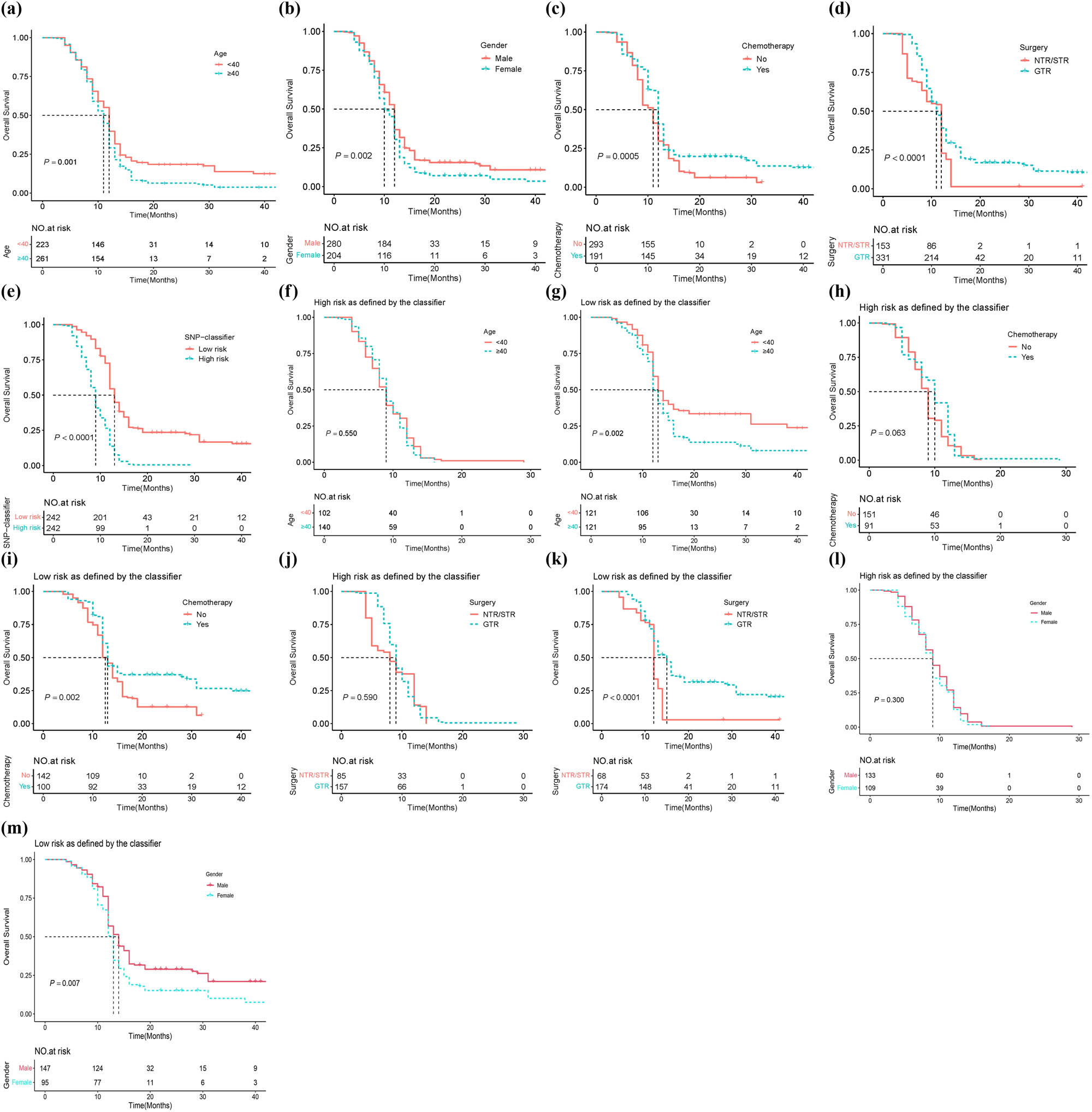
Kaplan–Meier OS analysis of glioma based on prognostic risk factors. (a)–(m) Survival analysis of the signature in patients stratified by age, gender, chemotherapy, surgery, and SNP classifier, high risk as defined by the classifier (age, chemotherapy, surgery, and gender), and low risk as defined by the classifier (age, chemotherapy, surgery, and gender).
3.4 Establishment of a nomogram of the prognostic model that included the independent prognostic factors
To facilitate the clinical application of our findings, we developed a prognostic scoring system using a nomogram based on the above results, aiming at predicting the survival time of patients at 1-year, 2-year, and 3-year. Subsequently, we identified five independent prognostic factors: age, gender, surgery, and chemotherapy. These factors were then used to construct a nomogram that estimated the OS probabilities at 1-year, 2-year, and 3-year. Figure 6a demonstrates that each prognostic parameter was assigned a score, and the sum of these scores was used to estimate the probability of 1-year, 2-year, and 3-year OS. Calibration plots were used to assess the predictive performance of the nomogram, and the results indicated a close agreement between the predicted OS and the actual 1, 2, and 3-year OS in glioma (Figure 6b). Furthermore, we constructed a ROC curve to evaluate the predictive performance of the prognostic model. As shown in Figure 7a–f, the nomogram (combining the SNP classifier with age, gender, surgery, and chemotherapy) exhibited a significantly higher predictive value for the 1-year (AUC = 0.783), 2-year (AUC = 0.927), and 3-year (AUC = 0.956) OS of patients compared to individual factors. Furthermore, we generated a heatmap to visualize the expression patterns of the 24 genes in the TCGA cohort. The results revealed significant differences in the distribution of 19 genes between the low- and high-risk subgroups (p < 0.05) (Figure 8a).

Nomogram was used to predict OS at 1, 2, and 3 years. (a) Total points and the predicted 1, 2, and 3 years OS were obtained by adding up the points of each multivariate regression variable. (b) Calibration curve. The diagonal represents the ideal fit of predicted survival and actual survival.

Assessment of the prognostic prediction ability of the prognostic models. (a) ROC curves for predicting the 1-year survival, 2-year survival, and 3- year survival in nomogram model comprised of SNP-based classifier and clinical features. (b) ROC curves for predicting the 1-year survival, 2-year survival, and 3- year survival in SNP-based classifier model. (c)–(f) ROC curves for predicting the 3-year survival in age, gender, surgery, and chemotherapy.

Functional and immune analysis for the two risk groups. (a) SNP-related prognostic genes heatmap in the TCGA cohort. (b) and (c) Go and KEGG analysis. (d) Enrichment scores of immune cells and immune-related pathways for the two risk groups in the TCGA cohort (* p < 0.05 and *** p < 0.001).
3.5 Functional analyses of the risk model
To investigate the potential biological functions and pathways associated with the RS, we conducted GO enrichment and KEGG pathway analyses using the SNPs-related prognostic genes between the low- and high-risk groups. We identified a total of 24 genes that were differentially expressed between the low-risk and high-risk groups. Specifically, seven genes were upregulated in the high-risk group, while 12 genes were downregulated. Subsequently, we conducted GO and KEGG analyses based on these genes. As shown in Figure 8b, the top three GO enrichment items in biological process (BP), cellular component, and molecular function groups were nucleotide catabolic process, nucleoside phosphate catabolic process, intrinsic apoptotic signaling pathway by p53 class mediator, synaptic membrane, peroxisomal matrix, microbody lumen, nucleotide diphosphatase activity, polypeptide N-acetylgalactosaminyltransferase activity, and acetylgalactosaminyltransferase activity. KEEG enrichment analysis showed that SNPs-related prognostic genes significantly enriched in mucin/other type O-glycan biosynthesis, Hippo signaling pathway, and nicotinate and nicotinamide metabolism (Figure 8c). The results showed that these genes were significantly enriched in immune-related pathways, such as the intrinsic apoptotic signaling pathway by p53 class mediator and Hippo signaling pathway.
3.6 Association of RS and the immune microenvironment
We conducted additional analyses to compare the differences in tumor‑infiltrating immune cells and immune-related pathways between the high- and low-risk populations in the TCGA cohorts (Figure 8d). The CIBERSORT analysis revealed that significantly higher ratios of eosinophils, monocytes, and gamma/delta T cells were in low-risk populations. The high-risk populations exhibited higher levels of neutrophils, macrophages (M0, M1, M2), and CD8+ T cells compared to the low-risk populations. Conversely, the high-risk populations showed significant upregulation of immune-related pathways, including naive B cells, resting of NK cells, activated CD4+ T cells memory, and T cells (tregs). In contrast, the low-risk populations exhibited upregulation of activation mast cells and naive CD4+ T cells.
4 Discussion
Compelling evidence suggests that molecular diagnostics have become a crucial foundation for comprehending the genetics and molecular biology of glioma, thereby aiding in the individualized treatment of glioma patients [27,28]. Recently, mounting evidence indicates the involvement of that genetic factors in glioma development, highlighting the impact of SNPs on glioma susceptibility and prognosis [29–31]. However, the prognostic value of SNPs related to prognosis in glioma has not been evaluated. In this study, we identified SNPs related to prognosis in glioma patients using GWAS analysis and constructed a prognostic model through LASSO regression analysis. Additionally, we calculated the RS using 25 SNPs, and the clinical features were found to be independent prognostic biomarkers for glioma. Furthermore, we developed a nomogram for the prognostic prediction model based on the independent prognostic factors that can predict the 1-year, 2-year, and 3-year survival rates of glioma patients. ROC curves further confirmed the superior predictive ability of the prognostic prediction model for glioma prognosis.
The RS is widely utilized for constructing significant signatures in a prognostic model [32]. In this study, we developed a prognostic model based on 25 SNPs, and glioma patients were classified into low-risk and high-risk groups by calculating the median RS derived from these SNPs. Consistent with previous findings, patients with low-RSs exhibited extended OS [33,34]. Additionally, both univariate and multivariate Cox regression analyses revealed that the SNP classifier, age, gender, surgery, and chemotherapy were independent prognostic risk factors for glioma. Nomogram are widely utilized in clinical research due to their intuitive visual presentation [35,36]. In this study, we developed a nomogram incorporating gender, age, surgery, chemotherapy, and the SNP classifier, enabling more precise prediction of individualized survival. Age and gender are risk factors for glioma incidence. The incidence of astrocytoma (including glioblastoma and diffuse or anaplastic astrocytoma) increases with age, peaking between 75 and 84 years old [37]. At all ages, the incidence of males is 40–50% higher than that of females [38]. Moreover, age and gender are considered significant factors associated with glioma prognosis [39]. The risk of prognosis increases with age, such as the poor prognosis is observed among the elderly and infirm who may not tolerate chemical or surgical treatment [40]. Females have an independent association with improved prognosis compared to males among glioma patients [41]. Additionally, surgery and chemotherapy also affect the prognosis of patients. For example, a study has demonstrated that patients with glioma who underwent surgical resection had longer survival compared to those who did not receive surgical resection [42]. Chemotherapy is a crucial adjuvant therapy, and the choice of treatment regimens and duration can impact the prognosis. Stupp et al. evaluated the efficacy of radiotherapy combined with chemotherapy in glioma treatment and observed a significant prolongation of OS time for patients [43]. SNPs are common genetic variations that can serve as indicators of genetic differences among individuals and help identify gene regions that impact prognosis. Several studies have identified SNPs associated with glioma prognosis, including variations in gene regions affecting DNA repair [22,44]. Therefore, the integration of age, gender, surgery, chemotherapy, and SNPs into the prognostic model can enhance its predictive accuracy and individualization. ROC curves were subsequently utilized to assess the diagnostic value of the nomogram for 1 (AUC = 0.783), 2 (AUC = 0.927), and 3 years (AUC = 0.956) survival rates among glioma patients. Our model exhibited significantly higher predictive accuracy compared to currently available gene-related signatures. For instance, Bingxiang et al. demonstrated a prognostic model for glioma constructed using nine prognostic-related genes that had a 3-year AUC of only 0.75 [45]. Yu et al. revealed that a prognostic model for glioma based on a 16-genes signature had an AUC of 0.86 at 3 years [46]. Additionally, Chao et al. developed a glioma prognostic model using seven pyroptosis-related genes and observed that an AUC of 0.713 at 3 years [47]. These existing prognostic models were constructed based on certain public databases and lack validation. Furthermore, our prognostic prediction model was developed based on experimental results obtained from GWAS analysis.
A glioma prognostic model for glioma was established using 25 SNPs, including rs10839 and rs9662128 in HPCAL4, rs10797484 in KCNK1/SLC35F3, rs1023793 in C3orf67/FHIT, rs3780471 in TRIM14, rs10745588 in LOC101928617/CLLU1OS, rs4133291 in MIR4318/MIR924HG, rs56407818, rs55849754, and rs7247294 in LOC100420587/LINC00906, rs62171206 in GALNT13, rs13126958 in CCDC149, rs72968021 in DCHS2, rs245041 in LINC02056, rs4235645 in NUDT12/RAB9BP1, rs17521861 in GALNT17, rs76970177 in SEMA3C/LOC105369146, rs7137657 in LINC02408/DYRK2, rs78518801 in CCDC169-SOHLH2/SOHLH2, rs117293024 in KCNH5, rs76608343 in GINS3, rs4888508 in CNTNAP4, rs12940675 in RAI1, rs6136889 in PDYN-AS1/STK35, and rs147068033 in D21S2088E/LINC01689. RegulomeDB is a tool for exploring annotations of variants on haplotype blocks, including candidate regulatory SNPs at disease-associated loci. According to RegulomeDB, we found evidence suggesting that these SNPs may be associated with TF binding, any motif, DNase peak, and Motif hit, potentially implicating their involvement in the regulation of these factors and their impact on glioma prognosis. Bi et al. conducted a study utilizing single-cell ATAC-seq and Hi-C to investigate the dynamic changes in chromatin organization during mouse terminal erythropoiesis [48]. They discovered that erythroid precursor cells undergo a transition from an open to a closed chromatin architecture, which coincides with the activation of erythroid genes. SNP loci might reside in chromatin structural regulatory regions, such as chromatin junction points or open regions. Nucleotide substitutions in SNPs can potentially influence the structure and function of these regions, consequently impacting gene expression regulation. This suggests a potential avenue for further exploration – whether disease-associated SNPs can also modulate disease genes by affecting 3D chromatin conformation. SNPs located in architectural regions, such as chromatin loops or anchors, have the potential to perturb structure and function due to nucleotide substitutions. Investigating the involvement of chromatin remodeling in the observed SNP associations from disease studies would be of great value.
The HPCAL4 gene, which functions as a neural calcium sensor, has been recognized as a key molecule in glioblastoma [49]. Yu et al. discovered that HPCAL4 could serve as a prognostic biomarker for glioblastoma [46]. Moreover, HPCAL4 is involved in the organization and maintenance of extracellular matrix, an essential component of the tumor microenvironment that plays a crucial role in tumor growth, infiltration and metastasis, including glioma [50,51]. KCNK1 belongs to the inwardly rectifying K(+) channel family, which helps establish the membrane potential at the K(+) balance potential [52]. By regulating cell membrane potential, KCNK1 influences BP such as cell proliferation and apoptosis [53]. Moreover, multiple studies have demonstrated the association of KCNK1 with the development and prognosis of various cancers, including glioma, through its regulation of tumor cell proliferation and survival [54]. SLC35F3, a gene associated with the nervous system, has been linked to hypertension [55] and bipolar disorder [56]. C3orf67 is a newly discovered long noncoding RNA that plays a significant role in glioma prognosis [57]. FHIT functions as a tumor suppressor, and changes in its gene expression alteration are implicated in the development of glioblastoma [58]. TRIM14 is linked to a therapeutic approach for glioma. Studies have revealed that TRIM14 can enhance chemoresistance, malignancy, and invasion of glioma cells by modulating the Wnt/β-catenin signaling pathway [59], p38/MAPK pathway [60], and zinc finger E-box binding homeobox 2 [61]. CLLU1OS has been identified as a prognostic marker for prostate adenocarcinoma [62]. GALNT13 exhibits particularly high expression in neuronal cells and may play an important role in glioma development [63]. Furthermore, a study demonstrated a strong correlation between GALNT13 expression and poor clinical outcomes at diagnosis in human neuroblastoma [64]. CCDC149 has recently been identified as a genetic susceptibility gene for thyroid carcinoma [65]. DCHS2 may contribute to the occurrence of Alzheimer’s disease [66] and colorectal cancer [67]. Additionally, An et al. demonstrated that the unconventional DCHS2 gene carries frameshift mutations that could deactivate cell adhesion-related functions, potentially serving as a characteristic of gastric and colorectal cancers with high microsatellite instability [68]. NUDT12, which is involved in cellular energetics, serves as a critical prognostic biomarker in glioma progression [69]. GALNT17 encodes the N-acetylgalactosaminyltransferase protein and plays a significant role in cell signaling, neurite outgrowth, neurotransmitter activity, and neurite sensing. A recent study has suggested the involvement of GALNT17 in brain development [70]. SEMA3C is closely related to glioma progression, and several studies have demonstrated that its high expression promotes glioma malignancy and is indicative of a poor prognosis [71,72]. LINC02408 serves as a prognostic signature for ovarian cancer [73] and breast cancer [74], as well as a diagnostic marker for thyroid cancer [75]. DYRK2 is expressed in human tumors and can suppress glioma cell migration, affecting E-cadherin and vimentin expression in the PI3K/AKT/GSK3β signaling pathway. It has the potential to be a therapeutic target [76]. KCNH5 is widely expressed in the human brain, and mutations in this gene contribute to abnormal brain development, potentially playing a role in glioma development [77]. GINS3 exhibits high expression in numerous tumor tissues, including glioma, and is associated with the development and prognosis of human cancers [78–80]. CNTNAP4 may serve as a prognostic biomarker for hepatocellular carcinoma [81], prostate cancer [82], and breast cancer [83]. RAI1 may counteract viral infection by regulating immune reactions in astrocytoma cells [84]. STK35 can influence the chemoresistance of colorectal cancer by promoting glycolysis and inhibiting apoptosis through the regulation of the AKT pathway [85]. Additionally, it was observed that STK35 modulates apoptosis and proliferation in osteosarcoma [86]. In summary, these genes are closely related to the occurrence and prognosis of glioma through their influence on specific BPs. Consequently, constructing glioma prognostic models using prognosis-related SNPs holds significant biological significance and potential effectiveness.
Functional analyses revealed significant enrichment of these genes in immune-related pathways, including the intrinsic apoptotic signaling pathway by p53 class mediator and the Hippo signaling pathway. Additionally, we examined the disparities in immune-related pathways and immune cell infiltration between the high- and low-risk groups. Our study suggests that the immune microenvironment may play a role in enhancing glioma prognosis, but further verification is required.
Our study has several limitations. First, our prognostic prediction model is derived from the Han population and requires validation in other ethnic populations. Second, the molecular mechanism underlying the association between the 25 key SNPs and glioma prognosis are still unclear, necessitating further molecular experiments to elucidate the biological mechanisms. Despite these limitations, our study is the first to develop a prognostic model for glioma based on GWAS-identified SNPs, offering significant value in enhancing prognosis and guiding targeted therapy.
In conclusion, we identified 25 SNPs significantly associated with glioma prognosis. Moreover, our study demonstrated that the SNP classifier, along with age, gender, surgery, and chemotherapy, serve as independent prognostic factors for glioma. Subsequently, we developed a nomogram using these independent prognostic factors to predict the 1-year, 2-year, and 3-year survival rates of glioma patients. This model will assist clinicians in accurately evaluating patient prognosis and guide follow-up and treatment decisions.
Acknowledgements
The authors thank all participants and volunteers in this study.
-
Funding information: This study was supported by Xi’an Science and Technology Program (No. 21YXYJ0074), Key R&D Plan of Shaanxi Province (No. 2022SF-582), and Scientific Research Project of Xi’an Health Commission (No. 2021ms04).
-
Author contributions: M.J.H conceived, designed the work, and revised the manuscript. J.W. analyzed the data and wrote the manuscript. J.H. performed the experiment. Y.J.L. and W.Q.Z. collected and organized the data. X.Y.M. and T.W. performed bioinformatic analysis. B.L. and T.B.J. revised the language quality. All authors read and approved the final manuscript.
-
Conflict of interest: All authors declare that they have no competing interests.
-
Data availability statement: The data that support the findings of this study are available from the corresponding author upon reasonable request.
References
[1] Reni M, Mazza E, Zanon S, Gatta G, Vecht CJ. Central nervous system gliomas. Crit Rev Oncol/Hematol. 2017;113:213–34.10.1016/j.critrevonc.2017.03.021Search in Google Scholar PubMed
[2] Darlix A, Zouaoui S, Rigau V, Bessaoud F, Figarella-Branger D, Mathieu-Daudé H, et al. Epidemiology for primary brain tumors: a nationwide population-based study. J Neuro-Oncol. 2017;131(3):525–46.10.1007/s11060-016-2318-3Search in Google Scholar PubMed
[3] Hanly PA, Sharp L. The cost of lost productivity due to premature cancer-related mortality: an economic measure of the cancer burden. BMC Cancer. 2014;14:224.10.1186/1471-2407-14-224Search in Google Scholar PubMed PubMed Central
[4] Louis DN, Perry A, Reifenberger G, von Deimling A, Figarella-Branger D, Cavenee WK, et al. The 2016 World Health Organization classification of tumors of the central nervous system: a summary. Acta Neuropathol. 2016;131(6):803–20.10.1007/s00401-016-1545-1Search in Google Scholar PubMed
[5] Louis DN, Perry A, Wesseling P, Brat DJ, Cree IA, Figarella-Branger D, et al. The 2021 WHO classification of tumors of the central nervous system: a summary. Neuro-Oncology. 2021;23(8):1231–51.10.1093/neuonc/noab106Search in Google Scholar PubMed PubMed Central
[6] Komori T. The 2016 WHO classification of tumours of the central nervous system: the major points of revision. Neurol Medico-Chirurgica. 2017;57(7):301–11.10.2176/nmc.ra.2017-0010Search in Google Scholar PubMed PubMed Central
[7] Brown TJ, Brennan MC, Li M, Church EW, Brandmeir NJ, Rakszawski KL, et al. Association of the extent of resection with survival in glioblastoma: a systematic review and meta-analysis. JAMA Oncol. 2016;2(11):1460–9.10.1001/jamaoncol.2016.1373Search in Google Scholar PubMed PubMed Central
[8] Nassiri F, Taslimi S, Wang JZ, Badhiwala JH, Dalcourt T, Ijad N, et al. Determining the optimal adjuvant therapy for improving survival in elderly patients with glioblastoma: a systematic review and network meta-analysis. Clin Cancer Res. 2020;26(11):2664–72.10.1158/1078-0432.CCR-19-3359Search in Google Scholar PubMed
[9] Lindström S, Wang L, Feng H, Majumdar A, Huo S, Macdonald J, et al. Genome-wide analyses characterize shared heritability among cancers and identify novel cancer susceptibility regions. J Natl Cancer Inst. 2023;115(6):712–32.10.1093/jnci/djad043Search in Google Scholar PubMed PubMed Central
[10] Shan J, Mahfoudh W, Dsouza SP, Hassen E, Bouaouina N, Abdelhak S, et al. Genome-Wide Association Studies (GWAS) breast cancer susceptibility loci in Arabs: susceptibility and prognostic implications in Tunisians. Breast Cancer Res Treat. 2012;135(3):715–24.10.1007/s10549-012-2202-6Search in Google Scholar PubMed PubMed Central
[11] Li N, Shi H, Hou P, Gao L, Shi Y, Mi W, et al. Genetic variants of CYP4F12 gene are associated with glioma susceptibility. Int J Cancer. 2021;149(11):1910–5.10.1002/ijc.33755Search in Google Scholar PubMed
[12] Atkins I, Kinnersley B, Ostrom QT, Labreche K, Il’yasova D, Armstrong GN, et al. Transcriptome-wide association study identifies new candidate susceptibility genes for glioma. Cancer Res. 2019;79(8):2065–71.10.1158/0008-5472.CAN-18-2888Search in Google Scholar PubMed PubMed Central
[13] Guo X, Zhang M, Li Q, Zhao J, Wang B, Wang J, et al. Evaluation of genetic variants in MIR3142HG in susceptibility to and prognosis of glioma. Am J Clin Oncol. 2020;43(1):1–8.10.1097/COC.0000000000000587Search in Google Scholar PubMed
[14] Zhang M, Zhao Y, Zhao J, Huang T, Guo X, Ma X, et al. Effects of the MAML2 genetic variants in glioma susceptibility and prognosis. Biosci Rep. 2019;39(10):1–9.10.1042/BSR20192091Search in Google Scholar PubMed PubMed Central
[15] Zhang G, Xi M, Li Y, Wang L, Gao L, Zhang L, et al. The ADCY9 genetic variants are associated with glioma susceptibility and patient prognosis. Genomics 2021;113(2):706–16.10.1016/j.ygeno.2020.12.019Search in Google Scholar PubMed
[16] Marees AT, de Kluiver H, Stringer S, Vorspan F, Curis E, Marie-Claire C, et al. A tutorial on conducting genome-wide association studies: quality control and statistical analysis. Int J Methods Psychiatr Res. 2018;27(2):e1608.10.1002/mpr.1608Search in Google Scholar PubMed PubMed Central
[17] Howie BN, Donnelly P, Marchini J. A flexible and accurate genotype imputation method for the next generation of genome-wide association studies. PLoS Genet. 2009;5(6):e1000529.10.1371/journal.pgen.1000529Search in Google Scholar PubMed PubMed Central
[18] Shen R, Olshen AB, Ladanyi M. Integrative clustering of multiple genomic data types using a joint latent variable model with application to breast and lung cancer subtype analysis. Bioinformatics. 2009;25(22):2906–12.10.1093/bioinformatics/btp543Search in Google Scholar PubMed PubMed Central
[19] Friedman J, Hastie T, Tibshirani R. Regularization paths for generalized linear models via coordinate descent. J Stat Softw. 2010;33(1):1–22.10.18637/jss.v033.i01Search in Google Scholar
[20] Lin H, Zelterman D. Modeling survival data: extending the cox model. Technometrics 2000;44(1):85–6.10.1198/tech.2002.s656Search in Google Scholar
[21] Liaw A, Wiener M. Classification and regression by randomForest. R N. 2002;23(23):18–22.Search in Google Scholar
[22] Brennan CW, Verhaak RG, McKenna A, Campos B, Noushmehr H, Salama SR, et al. The somatic genomic landscape of glioblastoma. Cell 2013;155(2):462–77.10.1016/j.cell.2013.09.034Search in Google Scholar PubMed PubMed Central
[23] Ritchie ME, Phipson B, Wu D, Hu Y, Law CW, Shi W, et al. Limma powers differential expression analyses for RNA-sequencing and microarray studies. Nucleic Acids Res. 2015;43(7):e47.10.1093/nar/gkv007Search in Google Scholar PubMed PubMed Central
[24] Yu G, Wang LG, Han Y, He QY. Clusterprofiler: an R package for comparing biological themes among gene clusters. Omics 2012;16(5):284–7.10.1089/omi.2011.0118Search in Google Scholar PubMed PubMed Central
[25] Newman AM, Steen CB, Liu CL, Gentles AJ, Chaudhuri AA, Scherer F, et al. Determining cell type abundance and expression from bulk tissues with digital cytometry. Nat Biotechnol. 2019;37(7):773–82.10.1038/s41587-019-0114-2Search in Google Scholar PubMed PubMed Central
[26] Boyle AP, Hong EL, Hariharan M, Cheng Y, Schaub MA, Kasowski M, et al. Annotation of functional variation in personal genomes using RegulomeDB. Genome Res. 2012;22(9):1790–7.10.1101/gr.137323.112Search in Google Scholar PubMed PubMed Central
[27] Wu F, Liu YW, Li GZ, Zhai Y, Feng YM, Ma WP, et al. Metabolic expression profiling stratifies diffuse lower-grade glioma into three distinct tumour subtypes. Br J Cancer. 2021;125(2):255–64.10.1038/s41416-021-01418-6Search in Google Scholar PubMed PubMed Central
[28] Baumert BG, Hegi ME, van den Bent MJ, von Deimling A, Gorlia T, Hoang-Xuan K, et al. Temozolomide chemotherapy versus radiotherapy in high-risk low-grade glioma (EORTC 22033-26033): a randomised, open-label, phase 3 intergroup study. Lancet Oncol. 2016;17(11):1521–32.10.1016/S1470-2045(16)30313-8Search in Google Scholar PubMed PubMed Central
[29] Pandith AA, Wani ZA, Qasim I, Afroze D, Manzoor U, Amin I, et al. Association of strong risk of hTERT gene polymorphic variants to malignant glioma and its prognostic implications with respect to different histological types and survival of glioma cases. J Gene Med. 2020;22(11):e3260.10.1002/jgm.3260Search in Google Scholar PubMed
[30] Ding X, Zhao Y, Yuan H, Zhang Y, Gao Y. Role of PVT1 polymorphisms in the glioma susceptibility and prognosis. Eur J Cancer Prev. 2021;30(5):400–8.10.1097/CEJ.0000000000000636Search in Google Scholar PubMed
[31] Bu L, Hameed NUF, Luo C, Hong P, Zhou X, Wang S, et al. Germline ALK variations are associated with a poor prognosis in glioma and IDH-wildtype glioblastoma. J Neuro-Oncol. 2021;152(1):27–36.10.1007/s11060-020-03676-5Search in Google Scholar PubMed
[32] Wu F, Zhao Z, Chai RC, Liu YQ, Li GZ, Jiang HY, et al. Prognostic power of a lipid metabolism gene panel for diffuse gliomas. J Cell Mol Med. 2019;23(11):7741–8.10.1111/jcmm.14647Search in Google Scholar PubMed PubMed Central
[33] Wu P, Shi J, Sun W, Zhang H. Identification and validation of a pyroptosis-related prognostic signature for thyroid cancer. Cancer Cell Int. 2021;21(1):523.10.1186/s12935-021-02231-0Search in Google Scholar PubMed PubMed Central
[34] Zhang G, Sun J, Zhang X. A novel cuproptosis-related LncRNA signature to predict prognosis in hepatocellular carcinoma. Sci Rep. 2022;12(1):11325.10.1038/s41598-022-15251-1Search in Google Scholar PubMed PubMed Central
[35] Ding R, Zhou X, Huang D, Wang Y, Li X, Yan L, et al. Nomogram for predicting advanced liver fibrosis and cirrhosis in patients with chronic liver disease. BMC Gastroenterol. 2021;21(1):190.10.1186/s12876-021-01774-wSearch in Google Scholar PubMed PubMed Central
[36] Wu J, Zhang H, Li L, Hu M, Chen L, Xu B, et al. A nomogram for predicting overall survival in patients with low-grade endometrial stromal sarcoma: a population-based analysis. Cancer Commun. 2020;40(7):301–12.10.1002/cac2.12067Search in Google Scholar PubMed PubMed Central
[37] Ostrom QT, Gittleman H, Truitt G, Boscia A, Kruchko C, Barnholtz-Sloan JS. CBTRUS statistical report: primary brain and other central nervous system tumors diagnosed in the United States in 2011–2015. Neuro-Oncol. 2018;20(Suppl_4):iv1–iv86.10.1093/neuonc/noy131Search in Google Scholar PubMed PubMed Central
[38] Ostrom QT, Kinnersley B, Wrensch MR, Eckel-Passow JE, Armstrong G, Rice T, et al. Sex-specific glioma genome-wide association study identifies new risk locus at 3p21.31 in females, and finds sex-differences in risk at 8q24.21. Sci Rep. 2018;8(1):7352.10.1038/s41598-018-24580-zSearch in Google Scholar PubMed PubMed Central
[39] Ozyigit G, Onal C, Gurkaynak M, Soylemezoglu F, Zorlu F. Postoperative radiotherapy and chemotherapy in the management of oligodendroglioma: single institutional review of 88 patients. J Neuro-Oncol. 2005;75(2):189–93.10.1007/s11060-005-2057-3Search in Google Scholar PubMed
[40] Lv S, Dai C, Liu Y, Shi R, Tang Z, Han M, et al. The impact of survivin on prognosis and clinicopathology of glioma patients: a systematic meta-analysis. Mol Neurobiol. 2015;51(3):1462–7.10.1007/s12035-014-8823-5Search in Google Scholar PubMed
[41] Tewari S, Tom MC, Park DYJ, Wei W, Chao ST, Yu JS, et al. Sex-specific differences in low-grade glioma presentation and outcome. Int J Radiat Oncol, Biol, Phys. 2022;114(2):283–92.10.1016/j.ijrobp.2022.05.036Search in Google Scholar PubMed
[42] Li Y, Beeraka NM, Guo W, Lei Y, Hu Q, Guo L, et al. Prognosis of patients with brainstem glioblastoma based on “age, surgery and radiotherapy”: a SEER database analysis. Technol Cancer Res Treat. 2022;21:15330338221082760.10.1177/15330338221082760Search in Google Scholar PubMed PubMed Central
[43] Stupp R, Mason WP, van den Bent MJ, Weller M, Fisher B, Taphoorn MJ, et al. Radiotherapy plus concomitant and adjuvant temozolomide for glioblastoma. N Engl J Med. 2005;352(10):987–96.10.1056/NEJMoa043330Search in Google Scholar PubMed
[44] Ceccarelli M, Barthel FP, Malta TM, Sabedot TS, Salama SR, Murray BA, et al. Molecular profiling reveals biologically discrete subsets and pathways of progression in diffuse glioma. Cell 2016;164(3):550–63.10.1016/j.cell.2015.12.028Search in Google Scholar PubMed PubMed Central
[45] Bingxiang X, Panxing W, Lu F, Xiuyou Y, Chao D. A prognostic model for brain glioma patients based on 9 signature glycolytic genes. BioMed Res Int. 2021;2021:6680066.10.1155/2021/6680066Search in Google Scholar PubMed PubMed Central
[46] Yu Z, Du M, Lu L. A novel 16-genes signature scoring system as prognostic model to evaluate survival risk in patients with glioblastoma. Biomedicines 2022;10(2):1–18.10.3390/biomedicines10020317Search in Google Scholar PubMed PubMed Central
[47] Chao B, Jiang F, Bai H, Meng P, Wang L, Wang F. Predicting the prognosis of glioma by pyroptosis-related signature. J Cell Mol Med. 2022;26(1):133–43.10.1111/jcmm.17061Search in Google Scholar PubMed PubMed Central
[48] Bi H, Hou Y, Wang J, Xia Z, Wang D, Liu Y, et al. Chromatin reconstruction during mouse terminal erythropoiesis. iScience. 2022;25(12):105554.10.1016/j.isci.2022.105554Search in Google Scholar PubMed PubMed Central
[49] Yang J, Yang Q. Identification of core genes and screening of potential targets in glioblastoma multiforme by integrated bioinformatic analysis. Front Oncol. 2020;10:615976.10.3389/fonc.2020.615976Search in Google Scholar PubMed PubMed Central
[50] Cong Z, Yuan F, Wang H, Cai X, Zhu J, Tang T, et al. BTB domain and CNC homolog 1 promotes glioma invasion mainly through regulating extracellular matrix and increases ferroptosis sensitivity. Biochim Biophys Acta Mol Basis Dis. 2022;1868(12):166554.10.1016/j.bbadis.2022.166554Search in Google Scholar PubMed
[51] Ferrer VP, Moura Neto V, Mentlein R. Glioma infiltration and extracellular matrix: key players and modulators. Glia 2018;66(8):1542–65.10.1002/glia.23309Search in Google Scholar PubMed
[52] Yeon JT, Kim KJ, Chun SW, Lee HI, Lim JY, Son YJ, et al. KCNK1 inhibits osteoclastogenesis by blocking the Ca2+ oscillation and JNK-NFATc1 signaling axis. J Cell Sci. 2015;128(18):3411–9.10.1242/jcs.170738Search in Google Scholar PubMed
[53] Şterbuleac D. Molecular determinants of chemical modulation of two-pore domain potassium channels. Chem Biol Drug Des. 2019;94(3):1596–614.10.1111/cbdd.13571Search in Google Scholar PubMed
[54] Beitzinger M, Hofmann L, Oswald C, Beinoraviciute-Kellner R, Sauer M, Griesmann H, et al. p73 poses a barrier to malignant transformation by limiting anchorage-independent growth. EMBO J. 2008;27(5):792–803.10.1038/emboj.2008.13Search in Google Scholar PubMed PubMed Central
[55] Seo JY, Choi JH. Genetic variations in thiamin transferase SLC35F3 and the risk of hypertension in Koreans. Clin Nutr Res. 2021;10(2):140–9.10.7762/cnr.2021.10.2.140Search in Google Scholar PubMed PubMed Central
[56] Ho AM, Coombes BJ, Nguyen TTL, Liu D, McElroy SL, Singh B, et al. Mood-stabilizing antiepileptic treatment response in bipolar disorder: a genome-wide association study. Clin Pharmacol Ther. 2020;108(6):1233–42.10.1002/cpt.1982Search in Google Scholar PubMed PubMed Central
[57] Zou H, Li C, Wanggou S, Li X. Survival risk prediction models of gliomas based on IDH and 1p/19q. J Cancer. 2020;11(15):4297–307.10.7150/jca.43805Search in Google Scholar PubMed PubMed Central
[58] Cecener G, Tunca B, Egeli U, Bekar A, Guler G, Tolunay S, et al. FHIT gene sequence variants and reduced Fhit protein expression in glioblastoma multiforme. Cell Mol Neurobiol. 2010;30(2):301–7.10.1007/s10571-009-9452-9Search in Google Scholar PubMed
[59] Tan Z, Song L, Wu W, Zhou Y, Zhu J, Wu G, et al. Correction: TRIM14 promotes chemoresistance in gliomas by activating Wnt/β-catenin signaling via stabilizing Dvl2. Oncogene 2018;37(40):5476.10.1038/s41388-018-0467-xSearch in Google Scholar PubMed
[60] Kuo YY, Ho KH, Shih CM, Chen PH, Liu AJ, Chen KC. Piperlongumine-inhibited TRIM14 signaling sensitizes glioblastoma cells to temozolomide treatment. Life Sci. 2022;309:121023.10.1016/j.lfs.2022.121023Search in Google Scholar PubMed
[61] Feng S, Cai X, Li Y, Jian X, Zhang L, Li B. Tripartite motif-containing 14 (TRIM14) promotes epithelial-mesenchymal transition via ZEB2 in glioblastoma cells. J Exp Clin Cancer Res. 2019;38(1):57.10.1186/s13046-019-1070-xSearch in Google Scholar PubMed PubMed Central
[62] Sun X, Wang L, Li H, Jin C, Yu Y, Hou L, et al. Identification of microenvironment related potential biomarkers of biochemical recurrence at 3 years after prostatectomy in prostate adenocarcinoma. Aging 2021;13(12):16024–42.10.18632/aging.203121Search in Google Scholar PubMed PubMed Central
[63] Ducray F, Idbaih A, de Reyniès A, Bièche I, Thillet J, Mokhtari K, et al. Anaplastic oligodendrogliomas with 1p19q codeletion have a proneural gene expression profile. Mol Cancer. 2008;7:41.10.1186/1476-4598-7-41Search in Google Scholar PubMed PubMed Central
[64] Berois N, Blanc E, Ripoche H, Mergui X, Trajtenberg F, Cantais S, et al. ppGalNAc-T13: a new molecular marker of bone marrow involvement in neuroblastoma. Clin Chem. 2006;52(9):1701–12.10.1373/clinchem.2006.067975Search in Google Scholar PubMed
[65] Lee H, Krishnan V, Wirth LJ, Nucera C, Sadow PM, Venturina M, et al. Case report of CCDC149-ALK fusion: a novel genetic alteration and a clinically relevant target in metastatic papillary thyroid carcinoma. Thyroid. 2022;32(12):1580–5.10.1089/thy.2022.0389Search in Google Scholar PubMed PubMed Central
[66] Vieira RN, Ávila R, de Paula JJ, Cintra MT, de Souza RP, Nicolato R, et al. Association between DCHS2 gene and mild cognitive impairment and Alzheimer’s disease in an elderly Brazilian sample. Int J Geriatr Psychiatry. 2016;31(12):1337–44.10.1002/gps.4440Search in Google Scholar PubMed
[67] He Y, Dai X, Chen Y, Huang S. Comprehensive analysis of genomic and expression data identified potential markers for predicting prognosis and immune response in CRC. Genet Res. 2022;2022:1831211.10.1155/2022/1831211Search in Google Scholar PubMed PubMed Central
[68] An CH, Je EM, Yoo NJ, Lee SH. Frameshift mutations of cadherin genes DCHS2, CDH10 and CDH24 genes in gastric and colorectal cancers with high microsatellite instability. Pathology Oncology Research. 2015;21(1):181–5.10.1007/s12253-014-9804-8Search in Google Scholar PubMed
[69] Zhao J, Wang L, Kong D, Hu G, Wei B. Construction of novel DNA methylation-based prognostic model to predict survival in glioblastoma. J Comput Biol. 2020;27(5):718–28.10.1089/cmb.2019.0125Search in Google Scholar PubMed
[70] Chen CY, Seward CH, Song Y, Inamdar M, Leddy AM, Zhang H, et al. Galnt17 loss-of-function leads to developmental delay and abnormal coordination, activity, and social interactions with cerebellar vermis pathology. Dev Biol. 2022;490:155–71.10.1016/j.ydbio.2022.08.002Search in Google Scholar PubMed PubMed Central
[71] Zhang H, Ma H, Zhang W, Duan D, Zhu G, Cao W, et al. Increased expression of Sema3C indicates a poor prognosis and is regulated by miR-142-5p in Glioma. Biol Pharm Bull. 2020;43(4):639–48.10.1248/bpb.b19-00818Search in Google Scholar PubMed
[72] Vaitkienė P, Skiriutė D, Steponaitis G, Skauminas K, Tamašauskas A, Kazlauskas A. High level of Sema3C is associated with glioma malignancy. Diagn Pathol. 2015;10:58.10.1186/s13000-015-0298-9Search in Google Scholar PubMed PubMed Central
[73] Zhang Y, Zhou H, Zhang M, Xing L, Yang C, Xia B, et al. Integrated analysis of a competing endogenous RNA network reveals an 11-lncRNA prognostic signature in ovarian cancer. Aging 2020;12(24):25153–71.10.18632/aging.104116Search in Google Scholar PubMed PubMed Central
[74] Luo Y, Zhang Y, Wu YX, Li HB, Shen D, Che YQ. Development of a novel five-lncRNA prognostic signature for predicting overall survival in elderly patients with breast cancer. J Clin Lab Anal. 2022;36(1):e24172.10.1002/jcla.24172Search in Google Scholar PubMed PubMed Central
[75] Kim D, Yu J, Kim J, Hwang YA, Kim JK, Ku CR, et al. Use of long non-coding RNAs for the molecular diagnosis of papillary thyroid cancer. Front Oncol. 2022;12:924409.10.3389/fonc.2022.924409Search in Google Scholar PubMed PubMed Central
[76] Shen Y, Zhang L, Wang D, Bao Y, Liu C, Xu Z, et al. Regulation of glioma cells migration by DYRK2. Neurochem Res. 2017;42(11):3093–102.10.1007/s11064-017-2345-2Search in Google Scholar PubMed
[77] Veeramah KR, Johnstone L, Karafet TM, Wolf D, Sprissler R, Salogiannis J, et al. Exome sequencing reveals new causal mutations in children with epileptic encephalopathies. Epilepsia 2013;54(7):1270–81.10.1111/epi.12201Search in Google Scholar PubMed PubMed Central
[78] Bu F, Zhu X, Yi X, Luo C, Lin K, Zhu J, et al. Expression profile of GINS complex predicts the prognosis of pancreatic cancer patients. OncoTargets Ther. 2020;13:11433–44.10.2147/OTT.S275649Search in Google Scholar PubMed PubMed Central
[79] Li H, Cao Y, Ma J, Luo L, Ma B. Expression and prognosis analysis of GINS subunits in human breast cancer. Medicine 2021;100(11):e24827.10.1097/MD.0000000000024827Search in Google Scholar PubMed PubMed Central
[80] Shan DD, Zheng QX, Chen Z. Go-Ichi-Ni-San 2: a potential biomarker and therapeutic target in human cancers. World J Gastrointest Oncol. 2022;14(10):1892–902.10.4251/wjgo.v14.i10.1892Search in Google Scholar PubMed PubMed Central
[81] Wang XK, Liao XW, Huang R, Huang JL, Chen ZJ, Zhou X, et al. Clinical significance of long non-coding RNA DUXAP8 and its protein coding genes in hepatocellular carcinoma. J Cancer. 2020;11(20):6140–56.10.7150/jca.47902Search in Google Scholar PubMed PubMed Central
[82] Chattopadhyay I, Wang J, Qin M, Gao L, Holtz R, Vessella RL, et al. Src promotes castration-recurrent prostate cancer through androgen receptor-dependent canonical and non-canonical transcriptional signatures. Oncotarget 2017;8(6):10324–47.10.18632/oncotarget.14401Search in Google Scholar PubMed PubMed Central
[83] Nordgard SH, Johansen FE, Alnaes GI, Bucher E, Syvänen AC, Naume B, et al. Genome-wide analysis identifies 16q deletion associated with survival, molecular subtypes, mRNA expression, and germline haplotypes in breast cancer patients. Genes, Chromosomes Cancer. 2008;47(8):680–96.10.1002/gcc.20569Search in Google Scholar PubMed
[84] Yoshida H, Imaizumi T, Lee SJ, Tanji K, Sakaki H, Matsumiya T, et al. Retinoic acid-inducible gene-I mediates RANTES/CCL5 expression in U373MG human astrocytoma cells stimulated with double-stranded RNA. Neurosci Res. 2007;58(2):199–206.10.1016/j.neures.2007.02.017Search in Google Scholar PubMed
[85] Yang H, Zhu J, Wang G, Liu H, Zhou Y, Qian J. STK35 is ubiquitinated by NEDD4L and promotes glycolysis and inhibits apoptosis through regulating the AKT signaling pathway, influencing chemoresistance of colorectal cancer. Front Cell Dev Biol. 2020;8:582695.10.3389/fcell.2020.582695Search in Google Scholar PubMed PubMed Central
[86] Wu Z, Liu J, Hu S, Zhu Y, Li S. Serine/threonine kinase 35, a target gene of STAT3, regulates the proliferation and apoptosis of osteosarcoma cells. Cell Physiol Biochem. 2018;45(2):808–18.10.1159/000487172Search in Google Scholar PubMed
© 2024 the author(s), published by De Gruyter
This work is licensed under the Creative Commons Attribution 4.0 International License.
Articles in the same Issue
- Research Articles
- EDNRB inhibits the growth and migration of prostate cancer cells by activating the cGMP-PKG pathway
- STK11 (LKB1) mutation suppresses ferroptosis in lung adenocarcinoma by facilitating monounsaturated fatty acid synthesis
- Association of SOX6 gene polymorphisms with Kashin-Beck disease risk in the Chinese Han population
- The pyroptosis-related signature predicts prognosis and influences the tumor immune microenvironment in dedifferentiated liposarcoma
- METTL3 attenuates ferroptosis sensitivity in lung cancer via modulating TFRC
- Identification and validation of molecular subtypes and prognostic signature for stage I and stage II gastric cancer based on neutrophil extracellular traps
- Novel lumbar plexus block versus femoral nerve block for analgesia and motor recovery after total knee arthroplasty
- Correlation between ABCB1 and OLIG2 polymorphisms and the severity and prognosis of patients with cerebral infarction
- Study on the radiotherapy effect and serum neutral granulocyte lymphocyte ratio and inflammatory factor expression of nasopharyngeal carcinoma
- Transcriptome analysis of effects of Tecrl deficiency on cardiometabolic and calcium regulation in cardiac tissue
- Aflatoxin B1 induces infertility, fetal deformities, and potential therapies
- Serum levels of HMW adiponectin and its receptors are associated with cytokine levels and clinical characteristics in chronic obstructive pulmonary disease
- METTL3-mediated methylation of CYP2C19 mRNA may aggravate clopidogrel resistance in ischemic stroke patients
- Understand how machine learning impact lung cancer research from 2010 to 2021: A bibliometric analysis
- Pressure ulcers in German hospitals: Analysis of reimbursement and length of stay
- Metformin plus L-carnitine enhances brown/beige adipose tissue activity via Nrf2/HO-1 signaling to reduce lipid accumulation and inflammation in murine obesity
- Downregulation of carbonic anhydrase IX expression in mouse xenograft nasopharyngeal carcinoma model via doxorubicin nanobubble combined with ultrasound
- Feasibility of 3-dimensional printed models in simulated training and teaching of transcatheter aortic valve replacement
- miR-335-3p improves type II diabetes mellitus by IGF-1 regulating macrophage polarization
- The analyses of human MCPH1 DNA repair machinery and genetic variations
- Activation of Piezo1 increases the sensitivity of breast cancer to hyperthermia therapy
- Comprehensive analysis based on the disulfidptosis-related genes identifies hub genes and immune infiltration for pancreatic adenocarcinoma
- Changes of serum CA125 and PGE2 before and after high-intensity focused ultrasound combined with GnRH-a in treatment of patients with adenomyosis
- The clinical value of the hepatic venous pressure gradient in patients undergoing hepatic resection for hepatocellular carcinoma with or without liver cirrhosis
- Development and validation of a novel model to predict pulmonary embolism in cardiology suspected patients: A 10-year retrospective analysis
- Downregulation of lncRNA XLOC_032768 in diabetic patients predicts the occurrence of diabetic nephropathy
- Circ_0051428 targeting miR-885-3p/MMP2 axis enhances the malignancy of cervical cancer
- Effectiveness of ginkgo diterpene lactone meglumine on cognitive function in patients with acute ischemic stroke
- The construction of a novel prognostic prediction model for glioma based on GWAS-identified prognostic-related risk loci
- Evaluating the impact of childhood BMI on the risk of coronavirus disease 2019: A Mendelian randomization study
- Lactate dehydrogenase to albumin ratio is associated with in-hospital mortality in patients with acute heart failure: Data from the MIMIC-III database
- CD36-mediated podocyte lipotoxicity promotes foot process effacement
- Efficacy of etonogestrel subcutaneous implants versus the levonorgestrel-releasing intrauterine system in the conservative treatment of adenomyosis
- FLRT2 mediates chondrogenesis of nasal septal cartilage and mandibular condyle cartilage
- Challenges in treating primary immune thrombocytopenia patients undergoing COVID-19 vaccination: A retrospective study
- Let-7 family regulates HaCaT cell proliferation and apoptosis via the ΔNp63/PI3K/AKT pathway
- Phospholipid transfer protein ameliorates sepsis-induced cardiac dysfunction through NLRP3 inflammasome inhibition
- Postoperative cognitive dysfunction in elderly patients with colorectal cancer: A randomized controlled study comparing goal-directed and conventional fluid therapy
- Long-pulsed ultrasound-mediated microbubble thrombolysis in a rat model of microvascular obstruction
- High SEC61A1 expression predicts poor outcome of acute myeloid leukemia
- Comparison of polymerase chain reaction and next-generation sequencing with conventional urine culture for the diagnosis of urinary tract infections: A meta-analysis
- Secreted frizzled-related protein 5 protects against renal fibrosis by inhibiting Wnt/β-catenin pathway
- Pan-cancer and single-cell analysis of actin cytoskeleton genes related to disulfidptosis
- Overexpression of miR-532-5p restrains oxidative stress response of chondrocytes in nontraumatic osteonecrosis of the femoral head by inhibiting ABL1
- Autologous liver transplantation for unresectable hepatobiliary malignancies in enhanced recovery after surgery model
- Clinical analysis of incomplete rupture of the uterus secondary to previous cesarean section
- Abnormal sleep duration is associated with sarcopenia in older Chinese people: A large retrospective cross-sectional study
- No genetic causality between obesity and benign paroxysmal vertigo: A two-sample Mendelian randomization study
- Identification and validation of autophagy-related genes in SSc
- Long non-coding RNA SRA1 suppresses radiotherapy resistance in esophageal squamous cell carcinoma by modulating glycolytic reprogramming
- Evaluation of quality of life in patients with schizophrenia: An inpatient social welfare institution-based cross-sectional study
- The possible role of oxidative stress marker glutathione in the assessment of cognitive impairment in multiple sclerosis
- Compilation of a self-management assessment scale for postoperative patients with aortic dissection
- Left atrial appendage closure in conjunction with radiofrequency ablation: Effects on left atrial functioning in patients with paroxysmal atrial fibrillation
- Effect of anterior femoral cortical notch grade on postoperative function and complications during TKA surgery: A multicenter, retrospective study
- Clinical characteristics and assessment of risk factors in patients with influenza A-induced severe pneumonia after the prevalence of SARS-CoV-2
- Analgesia nociception index is an indicator of laparoscopic trocar insertion-induced transient nociceptive stimuli
- High STAT4 expression correlates with poor prognosis in acute myeloid leukemia and facilitates disease progression by upregulating VEGFA expression
- Factors influencing cardiovascular system-related post-COVID-19 sequelae: A single-center cohort study
- HOXD10 regulates intestinal permeability and inhibits inflammation of dextran sulfate sodium-induced ulcerative colitis through the inactivation of the Rho/ROCK/MMPs axis
- Mesenchymal stem cell-derived exosomal miR-26a induces ferroptosis, suppresses hepatic stellate cell activation, and ameliorates liver fibrosis by modulating SLC7A11
- Endovascular thrombectomy versus intravenous thrombolysis for primary distal, medium vessel occlusion in acute ischemic stroke
- ANO6 (TMEM16F) inhibits gastrointestinal stromal tumor growth and induces ferroptosis
- Prognostic value of EIF5A2 in solid tumors: A meta-analysis and bioinformatics analysis
- The role of enhanced expression of Cx43 in patients with ulcerative colitis
- Choosing a COVID-19 vaccination site might be driven by anxiety and body vigilance
- Role of ICAM-1 in triple-negative breast cancer
- Cost-effectiveness of ambroxol in the treatment of Gaucher disease type 2
- HLA-DRB5 promotes immune thrombocytopenia via activating CD8+ T cells
- Efficacy and factors of myofascial release therapy combined with electrical and magnetic stimulation in the treatment of chronic pelvic pain syndrome
- Efficacy of tacrolimus monotherapy in primary membranous nephropathy
- Mechanisms of Tripterygium wilfordii Hook F on treating rheumatoid arthritis explored by network pharmacology analysis and molecular docking
- FBXO45 levels regulated ferroptosis renal tubular epithelial cells in a model of diabetic nephropathy by PLK1
- Optimizing anesthesia strategies to NSCLC patients in VATS procedures: Insights from drug requirements and patient recovery patterns
- Alpha-lipoic acid upregulates the PPARγ/NRF2/GPX4 signal pathway to inhibit ferroptosis in the pathogenesis of unexplained recurrent pregnancy loss
- Correlation between fat-soluble vitamin levels and inflammatory factors in paediatric community-acquired pneumonia: A prospective study
- CD1d affects the proliferation, migration, and apoptosis of human papillary thyroid carcinoma TPC-1 cells via regulating MAPK/NF-κB signaling pathway
- miR-let-7a inhibits sympathetic nerve remodeling after myocardial infarction by downregulating the expression of nerve growth factor
- Immune response analysis of solid organ transplantation recipients inoculated with inactivated COVID-19 vaccine: A retrospective analysis
- The H2Valdien derivatives regulate the epithelial–mesenchymal transition of hepatoma carcinoma cells through the Hedgehog signaling pathway
- Clinical efficacy of dexamethasone combined with isoniazid in the treatment of tuberculous meningitis and its effect on peripheral blood T cell subsets
- Comparison of short-segment and long-segment fixation in treatment of degenerative scoliosis and analysis of factors associated with adjacent spondylolisthesis
- Lycopene inhibits pyroptosis of endothelial progenitor cells induced by ox-LDL through the AMPK/mTOR/NLRP3 pathway
- Methylation regulation for FUNDC1 stability in childhood leukemia was up-regulated and facilitates metastasis and reduces ferroptosis of leukemia through mitochondrial damage by FBXL2
- Correlation of single-fiber electromyography studies and functional status in patients with amyotrophic lateral sclerosis
- Risk factors of postoperative airway obstruction complications in children with oral floor mass
- Expression levels and clinical significance of serum miR-19a/CCL20 in patients with acute cerebral infarction
- Physical activity and mental health trends in Korean adolescents: Analyzing the impact of the COVID-19 pandemic from 2018 to 2022
- Evaluating anemia in HIV-infected patients using chest CT
- Ponticulus posticus and skeletal malocclusion: A pilot study in a Southern Italian pre-orthodontic court
- Causal association of circulating immune cells and lymphoma: A Mendelian randomization study
- Assessment of the renal function and fibrosis indexes of conventional western medicine with Chinese medicine for dredging collaterals on treating renal fibrosis: A systematic review and meta-analysis
- Comprehensive landscape of integrator complex subunits and their association with prognosis and tumor microenvironment in gastric cancer
- New target-HMGCR inhibitors for the treatment of primary sclerosing cholangitis: A drug Mendelian randomization study
- Population pharmacokinetics of meropenem in critically ill patients
- Comparison of the ability of newly inflammatory markers to predict complicated appendicitis
- Comparative morphology of the cruciate ligaments: A radiological study
- Immune landscape of hepatocellular carcinoma: The central role of TP53-inducible glycolysis and apoptosis regulator
- Serum SIRT3 levels in epilepsy patients and its association with clinical outcomes and severity: A prospective observational study
- SHP-1 mediates cigarette smoke extract-induced epithelial–mesenchymal transformation and inflammation in 16HBE cells
- Acute hyper-hypoxia accelerates the development of depression in mice via the IL-6/PGC1α/MFN2 signaling pathway
- The GJB3 correlates with the prognosis, immune cell infiltration, and therapeutic responses in lung adenocarcinoma
- Physical fitness and blood parameters outcomes of breast cancer survivor in a low-intensity circuit resistance exercise program
- Exploring anesthetic-induced gene expression changes and immune cell dynamics in atrial tissue post-coronary artery bypass graft surgery
- Empagliflozin improves aortic injury in obese mice by regulating fatty acid metabolism
- Analysis of the risk factors of the radiation-induced encephalopathy in nasopharyngeal carcinoma: A retrospective cohort study
- Reproductive outcomes in women with BRCA 1/2 germline mutations: A retrospective observational study and literature review
- Evaluation of upper airway ultrasonographic measurements in predicting difficult intubation: A cross-section of the Turkish population
- Prognostic and diagnostic value of circulating IGFBP2 in pancreatic cancer
- Postural stability after operative reconstruction of the AFTL in chronic ankle instability comparing three different surgical techniques
- Research trends related to emergence agitation in the post-anaesthesia care unit from 2001 to 2023: A bibliometric analysis
- Frequency and clinicopathological correlation of gastrointestinal polyps: A six-year single center experience
- ACSL4 mediates inflammatory bowel disease and contributes to LPS-induced intestinal epithelial cell dysfunction by activating ferroptosis and inflammation
- Affibody-based molecular probe 99mTc-(HE)3ZHER2:V2 for non-invasive HER2 detection in ovarian and breast cancer xenografts
- Effectiveness of nutritional support for clinical outcomes in gastric cancer patients: A meta-analysis of randomized controlled trials
- The relationship between IFN-γ, IL-10, IL-6 cytokines, and severity of the condition with serum zinc and Fe in children infected with Mycoplasma pneumoniae
- Paraquat disrupts the blood–brain barrier by increasing IL-6 expression and oxidative stress through the activation of PI3K/AKT signaling pathway
- Sleep quality associate with the increased prevalence of cognitive impairment in coronary artery disease patients: A retrospective case–control study
- Dioscin protects against chronic prostatitis through the TLR4/NF-κB pathway
- Association of polymorphisms in FBN1, MYH11, and TGF-β signaling-related genes with susceptibility of sporadic thoracic aortic aneurysm and dissection in the Zhejiang Han population
- Application value of multi-parameter magnetic resonance image-transrectal ultrasound cognitive fusion in prostate biopsy
- Laboratory variables‐based artificial neural network models for predicting fatty liver disease: A retrospective study
- Decreased BIRC5-206 promotes epithelial–mesenchymal transition in nasopharyngeal carcinoma through sponging miR-145-5p
- Sepsis induces the cardiomyocyte apoptosis and cardiac dysfunction through activation of YAP1/Serpine1/caspase-3 pathway
- Assessment of iron metabolism and iron deficiency in incident patients on incident continuous ambulatory peritoneal dialysis
- Tibial periosteum flap combined with autologous bone grafting in the treatment of Gustilo-IIIB/IIIC open tibial fractures
- The application of intravenous general anesthesia under nasopharyngeal airway assisted ventilation undergoing ureteroscopic holmium laser lithotripsy: A prospective, single-center, controlled trial
- Long intergenic noncoding RNA for IGF2BP2 stability suppresses gastric cancer cell apoptosis by inhibiting the maturation of microRNA-34a
- Role of FOXM1 and AURKB in regulating keratinocyte function in psoriasis
- Parental control attitudes over their pre-school children’s diet
- The role of auto-HSCT in extranodal natural killer/T cell lymphoma
- Significance of negative cervical cytology and positive HPV in the diagnosis of cervical lesions by colposcopy
- Echinacoside inhibits PASMCs calcium overload to prevent hypoxic pulmonary artery remodeling by regulating TRPC1/4/6 and calmodulin
- ADAR1 plays a protective role in proximal tubular cells under high glucose conditions by attenuating the PI3K/AKT/mTOR signaling pathway
- The risk of cancer among insulin glargine users in Lithuania: A retrospective population-based study
- The unusual location of primary hydatid cyst: A case series study
- Intraoperative changes in electrophysiological monitoring can be used to predict clinical outcomes in patients with spinal cavernous malformation
- Obesity and risk of placenta accreta spectrum: A meta-analysis
- Shikonin alleviates asthma phenotypes in mice via an airway epithelial STAT3-dependent mechanism
- NSUN6 and HTR7 disturbed the stability of carotid atherosclerotic plaques by regulating the immune responses of macrophages
- The effect of COVID-19 lockdown on admission rates in Maternity Hospital
- Temporal muscle thickness is not a prognostic predictor in patients with high-grade glioma, an experience at two centers in China
- Luteolin alleviates cerebral ischemia/reperfusion injury by regulating cell pyroptosis
- Therapeutic role of respiratory exercise in patients with tuberculous pleurisy
- Effects of CFTR-ENaC on spinal cord edema after spinal cord injury
- Irisin-regulated lncRNAs and their potential regulatory functions in chondrogenic differentiation of human mesenchymal stem cells
- DMD mutations in pediatric patients with phenotypes of Duchenne/Becker muscular dystrophy
- Combination of C-reactive protein and fibrinogen-to-albumin ratio as a novel predictor of all-cause mortality in heart failure patients
- Significant role and the underly mechanism of cullin-1 in chronic obstructive pulmonary disease
- Ferroptosis-related prognostic model of mantle cell lymphoma
- Observation of choking reaction and other related indexes in elderly painless fiberoptic bronchoscopy with transnasal high-flow humidification oxygen therapy
- A bibliometric analysis of Prader-Willi syndrome from 2002 to 2022
- The causal effects of childhood sunburn occasions on melanoma: A univariable and multivariable Mendelian randomization study
- Oxidative stress regulates glycogen synthase kinase-3 in lymphocytes of diabetes mellitus patients complicated with cerebral infarction
- Role of COX6C and NDUFB3 in septic shock and stroke
- Trends in disease burden of type 2 diabetes, stroke, and hypertensive heart disease attributable to high BMI in China: 1990–2019
- Purinergic P2X7 receptor mediates hyperoxia-induced injury in pulmonary microvascular endothelial cells via NLRP3-mediated pyroptotic pathway
- Investigating the role of oviductal mucosa–endometrial co-culture in modulating factors relevant to embryo implantation
- Analgesic effect of external oblique intercostal block in laparoscopic cholecystectomy: A retrospective study
- Elevated serum miR-142-5p correlates with ischemic lesions and both NSE and S100β in ischemic stroke patients
- Correlation between the mechanism of arteriopathy in IgA nephropathy and blood stasis syndrome: A cohort study
- Risk factors for progressive kyphosis after percutaneous kyphoplasty in osteoporotic vertebral compression fracture
- Predictive role of neuron-specific enolase and S100-β in early neurological deterioration and unfavorable prognosis in patients with ischemic stroke
- The potential risk factors of postoperative cognitive dysfunction for endovascular therapy in acute ischemic stroke with general anesthesia
- Fluoxetine inhibited RANKL-induced osteoclastic differentiation in vitro
- Detection of serum FOXM1 and IGF2 in patients with ARDS and their correlation with disease and prognosis
- Rhein promotes skin wound healing by activating the PI3K/AKT signaling pathway
- Differences in mortality risk by levels of physical activity among persons with disabilities in South Korea
- Review Articles
- Cutaneous signs of selected cardiovascular disorders: A narrative review
- XRCC1 and hOGG1 polymorphisms and endometrial carcinoma: A meta-analysis
- A narrative review on adverse drug reactions of COVID-19 treatments on the kidney
- Emerging role and function of SPDL1 in human health and diseases
- Adverse reactions of piperacillin: A literature review of case reports
- Molecular mechanism and intervention measures of microvascular complications in diabetes
- Regulation of mesenchymal stem cell differentiation by autophagy
- Molecular landscape of borderline ovarian tumours: A systematic review
- Advances in synthetic lethality modalities for glioblastoma multiforme
- Investigating hormesis, aging, and neurodegeneration: From bench to clinics
- Frankincense: A neuronutrient to approach Parkinson’s disease treatment
- Sox9: A potential regulator of cancer stem cells in osteosarcoma
- Early detection of cardiovascular risk markers through non-invasive ultrasound methodologies in periodontitis patients
- Advanced neuroimaging and criminal interrogation in lie detection
- Maternal factors for neural tube defects in offspring: An umbrella review
- The chemoprotective hormetic effects of rosmarinic acid
- CBD’s potential impact on Parkinson’s disease: An updated overview
- Progress in cytokine research for ARDS: A comprehensive review
- Utilizing reactive oxygen species-scavenging nanoparticles for targeting oxidative stress in the treatment of ischemic stroke: A review
- NRXN1-related disorders, attempt to better define clinical assessment
- Lidocaine infusion for the treatment of complex regional pain syndrome: Case series and literature review
- Trends and future directions of autophagy in osteosarcoma: A bibliometric analysis
- Iron in ventricular remodeling and aneurysms post-myocardial infarction
- Case Reports
- Sirolimus potentiated angioedema: A case report and review of the literature
- Identification of mixed anaerobic infections after inguinal hernia repair based on metagenomic next-generation sequencing: A case report
- Successful treatment with bortezomib in combination with dexamethasone in a middle-aged male with idiopathic multicentric Castleman’s disease: A case report
- Complete heart block associated with hepatitis A infection in a female child with fatal outcome
- Elevation of D-dimer in eosinophilic gastrointestinal diseases in the absence of venous thrombosis: A case series and literature review
- Four years of natural progressive course: A rare case report of juvenile Xp11.2 translocations renal cell carcinoma with TFE3 gene fusion
- Advancing prenatal diagnosis: Echocardiographic detection of Scimitar syndrome in China – A case series
- Outcomes and complications of hemodialysis in patients with renal cancer following bilateral nephrectomy
- Anti-HMGCR myopathy mimicking facioscapulohumeral muscular dystrophy
- Recurrent opportunistic infections in a HIV-negative patient with combined C6 and NFKB1 mutations: A case report, pedigree analysis, and literature review
- Letter to the Editor
- Letter to the Editor: Total parenteral nutrition-induced Wernicke’s encephalopathy after oncologic gastrointestinal surgery
- Erratum
- Erratum to “Bladder-embedded ectopic intrauterine device with calculus”
- Retraction
- Retraction of “XRCC1 and hOGG1 polymorphisms and endometrial carcinoma: A meta-analysis”
- Corrigendum
- Corrigendum to “Investigating hormesis, aging, and neurodegeneration: From bench to clinics”
- Corrigendum to “Frankincense: A neuronutrient to approach Parkinson’s disease treatment”
- Special Issue The evolving saga of RNAs from bench to bedside - Part II
- Machine-learning-based prediction of a diagnostic model using autophagy-related genes based on RNA sequencing for patients with papillary thyroid carcinoma
- Unlocking the future of hepatocellular carcinoma treatment: A comprehensive analysis of disulfidptosis-related lncRNAs for prognosis and drug screening
- Elevated mRNA level indicates FSIP1 promotes EMT and gastric cancer progression by regulating fibroblasts in tumor microenvironment
- Special Issue Advancements in oncology: bridging clinical and experimental research - Part I
- Ultrasound-guided transperineal vs transrectal prostate biopsy: A meta-analysis of diagnostic accuracy and complication rates
- Assessment of diagnostic value of unilateral systematic biopsy combined with targeted biopsy in detecting clinically significant prostate cancer
- SENP7 inhibits glioblastoma metastasis and invasion by dissociating SUMO2/3 binding to specific target proteins
- MARK1 suppress malignant progression of hepatocellular carcinoma and improves sorafenib resistance through negatively regulating POTEE
- Analysis of postoperative complications in bladder cancer patients
- Carboplatin combined with arsenic trioxide versus carboplatin combined with docetaxel treatment for LACC: A randomized, open-label, phase II clinical study
- Special Issue Exploring the biological mechanism of human diseases based on MultiOmics Technology - Part I
- Comprehensive pan-cancer investigation of carnosine dipeptidase 1 and its prospective prognostic significance in hepatocellular carcinoma
- Identification of signatures associated with microsatellite instability and immune characteristics to predict the prognostic risk of colon cancer
- Single-cell analysis identified key macrophage subpopulations associated with atherosclerosis
Articles in the same Issue
- Research Articles
- EDNRB inhibits the growth and migration of prostate cancer cells by activating the cGMP-PKG pathway
- STK11 (LKB1) mutation suppresses ferroptosis in lung adenocarcinoma by facilitating monounsaturated fatty acid synthesis
- Association of SOX6 gene polymorphisms with Kashin-Beck disease risk in the Chinese Han population
- The pyroptosis-related signature predicts prognosis and influences the tumor immune microenvironment in dedifferentiated liposarcoma
- METTL3 attenuates ferroptosis sensitivity in lung cancer via modulating TFRC
- Identification and validation of molecular subtypes and prognostic signature for stage I and stage II gastric cancer based on neutrophil extracellular traps
- Novel lumbar plexus block versus femoral nerve block for analgesia and motor recovery after total knee arthroplasty
- Correlation between ABCB1 and OLIG2 polymorphisms and the severity and prognosis of patients with cerebral infarction
- Study on the radiotherapy effect and serum neutral granulocyte lymphocyte ratio and inflammatory factor expression of nasopharyngeal carcinoma
- Transcriptome analysis of effects of Tecrl deficiency on cardiometabolic and calcium regulation in cardiac tissue
- Aflatoxin B1 induces infertility, fetal deformities, and potential therapies
- Serum levels of HMW adiponectin and its receptors are associated with cytokine levels and clinical characteristics in chronic obstructive pulmonary disease
- METTL3-mediated methylation of CYP2C19 mRNA may aggravate clopidogrel resistance in ischemic stroke patients
- Understand how machine learning impact lung cancer research from 2010 to 2021: A bibliometric analysis
- Pressure ulcers in German hospitals: Analysis of reimbursement and length of stay
- Metformin plus L-carnitine enhances brown/beige adipose tissue activity via Nrf2/HO-1 signaling to reduce lipid accumulation and inflammation in murine obesity
- Downregulation of carbonic anhydrase IX expression in mouse xenograft nasopharyngeal carcinoma model via doxorubicin nanobubble combined with ultrasound
- Feasibility of 3-dimensional printed models in simulated training and teaching of transcatheter aortic valve replacement
- miR-335-3p improves type II diabetes mellitus by IGF-1 regulating macrophage polarization
- The analyses of human MCPH1 DNA repair machinery and genetic variations
- Activation of Piezo1 increases the sensitivity of breast cancer to hyperthermia therapy
- Comprehensive analysis based on the disulfidptosis-related genes identifies hub genes and immune infiltration for pancreatic adenocarcinoma
- Changes of serum CA125 and PGE2 before and after high-intensity focused ultrasound combined with GnRH-a in treatment of patients with adenomyosis
- The clinical value of the hepatic venous pressure gradient in patients undergoing hepatic resection for hepatocellular carcinoma with or without liver cirrhosis
- Development and validation of a novel model to predict pulmonary embolism in cardiology suspected patients: A 10-year retrospective analysis
- Downregulation of lncRNA XLOC_032768 in diabetic patients predicts the occurrence of diabetic nephropathy
- Circ_0051428 targeting miR-885-3p/MMP2 axis enhances the malignancy of cervical cancer
- Effectiveness of ginkgo diterpene lactone meglumine on cognitive function in patients with acute ischemic stroke
- The construction of a novel prognostic prediction model for glioma based on GWAS-identified prognostic-related risk loci
- Evaluating the impact of childhood BMI on the risk of coronavirus disease 2019: A Mendelian randomization study
- Lactate dehydrogenase to albumin ratio is associated with in-hospital mortality in patients with acute heart failure: Data from the MIMIC-III database
- CD36-mediated podocyte lipotoxicity promotes foot process effacement
- Efficacy of etonogestrel subcutaneous implants versus the levonorgestrel-releasing intrauterine system in the conservative treatment of adenomyosis
- FLRT2 mediates chondrogenesis of nasal septal cartilage and mandibular condyle cartilage
- Challenges in treating primary immune thrombocytopenia patients undergoing COVID-19 vaccination: A retrospective study
- Let-7 family regulates HaCaT cell proliferation and apoptosis via the ΔNp63/PI3K/AKT pathway
- Phospholipid transfer protein ameliorates sepsis-induced cardiac dysfunction through NLRP3 inflammasome inhibition
- Postoperative cognitive dysfunction in elderly patients with colorectal cancer: A randomized controlled study comparing goal-directed and conventional fluid therapy
- Long-pulsed ultrasound-mediated microbubble thrombolysis in a rat model of microvascular obstruction
- High SEC61A1 expression predicts poor outcome of acute myeloid leukemia
- Comparison of polymerase chain reaction and next-generation sequencing with conventional urine culture for the diagnosis of urinary tract infections: A meta-analysis
- Secreted frizzled-related protein 5 protects against renal fibrosis by inhibiting Wnt/β-catenin pathway
- Pan-cancer and single-cell analysis of actin cytoskeleton genes related to disulfidptosis
- Overexpression of miR-532-5p restrains oxidative stress response of chondrocytes in nontraumatic osteonecrosis of the femoral head by inhibiting ABL1
- Autologous liver transplantation for unresectable hepatobiliary malignancies in enhanced recovery after surgery model
- Clinical analysis of incomplete rupture of the uterus secondary to previous cesarean section
- Abnormal sleep duration is associated with sarcopenia in older Chinese people: A large retrospective cross-sectional study
- No genetic causality between obesity and benign paroxysmal vertigo: A two-sample Mendelian randomization study
- Identification and validation of autophagy-related genes in SSc
- Long non-coding RNA SRA1 suppresses radiotherapy resistance in esophageal squamous cell carcinoma by modulating glycolytic reprogramming
- Evaluation of quality of life in patients with schizophrenia: An inpatient social welfare institution-based cross-sectional study
- The possible role of oxidative stress marker glutathione in the assessment of cognitive impairment in multiple sclerosis
- Compilation of a self-management assessment scale for postoperative patients with aortic dissection
- Left atrial appendage closure in conjunction with radiofrequency ablation: Effects on left atrial functioning in patients with paroxysmal atrial fibrillation
- Effect of anterior femoral cortical notch grade on postoperative function and complications during TKA surgery: A multicenter, retrospective study
- Clinical characteristics and assessment of risk factors in patients with influenza A-induced severe pneumonia after the prevalence of SARS-CoV-2
- Analgesia nociception index is an indicator of laparoscopic trocar insertion-induced transient nociceptive stimuli
- High STAT4 expression correlates with poor prognosis in acute myeloid leukemia and facilitates disease progression by upregulating VEGFA expression
- Factors influencing cardiovascular system-related post-COVID-19 sequelae: A single-center cohort study
- HOXD10 regulates intestinal permeability and inhibits inflammation of dextran sulfate sodium-induced ulcerative colitis through the inactivation of the Rho/ROCK/MMPs axis
- Mesenchymal stem cell-derived exosomal miR-26a induces ferroptosis, suppresses hepatic stellate cell activation, and ameliorates liver fibrosis by modulating SLC7A11
- Endovascular thrombectomy versus intravenous thrombolysis for primary distal, medium vessel occlusion in acute ischemic stroke
- ANO6 (TMEM16F) inhibits gastrointestinal stromal tumor growth and induces ferroptosis
- Prognostic value of EIF5A2 in solid tumors: A meta-analysis and bioinformatics analysis
- The role of enhanced expression of Cx43 in patients with ulcerative colitis
- Choosing a COVID-19 vaccination site might be driven by anxiety and body vigilance
- Role of ICAM-1 in triple-negative breast cancer
- Cost-effectiveness of ambroxol in the treatment of Gaucher disease type 2
- HLA-DRB5 promotes immune thrombocytopenia via activating CD8+ T cells
- Efficacy and factors of myofascial release therapy combined with electrical and magnetic stimulation in the treatment of chronic pelvic pain syndrome
- Efficacy of tacrolimus monotherapy in primary membranous nephropathy
- Mechanisms of Tripterygium wilfordii Hook F on treating rheumatoid arthritis explored by network pharmacology analysis and molecular docking
- FBXO45 levels regulated ferroptosis renal tubular epithelial cells in a model of diabetic nephropathy by PLK1
- Optimizing anesthesia strategies to NSCLC patients in VATS procedures: Insights from drug requirements and patient recovery patterns
- Alpha-lipoic acid upregulates the PPARγ/NRF2/GPX4 signal pathway to inhibit ferroptosis in the pathogenesis of unexplained recurrent pregnancy loss
- Correlation between fat-soluble vitamin levels and inflammatory factors in paediatric community-acquired pneumonia: A prospective study
- CD1d affects the proliferation, migration, and apoptosis of human papillary thyroid carcinoma TPC-1 cells via regulating MAPK/NF-κB signaling pathway
- miR-let-7a inhibits sympathetic nerve remodeling after myocardial infarction by downregulating the expression of nerve growth factor
- Immune response analysis of solid organ transplantation recipients inoculated with inactivated COVID-19 vaccine: A retrospective analysis
- The H2Valdien derivatives regulate the epithelial–mesenchymal transition of hepatoma carcinoma cells through the Hedgehog signaling pathway
- Clinical efficacy of dexamethasone combined with isoniazid in the treatment of tuberculous meningitis and its effect on peripheral blood T cell subsets
- Comparison of short-segment and long-segment fixation in treatment of degenerative scoliosis and analysis of factors associated with adjacent spondylolisthesis
- Lycopene inhibits pyroptosis of endothelial progenitor cells induced by ox-LDL through the AMPK/mTOR/NLRP3 pathway
- Methylation regulation for FUNDC1 stability in childhood leukemia was up-regulated and facilitates metastasis and reduces ferroptosis of leukemia through mitochondrial damage by FBXL2
- Correlation of single-fiber electromyography studies and functional status in patients with amyotrophic lateral sclerosis
- Risk factors of postoperative airway obstruction complications in children with oral floor mass
- Expression levels and clinical significance of serum miR-19a/CCL20 in patients with acute cerebral infarction
- Physical activity and mental health trends in Korean adolescents: Analyzing the impact of the COVID-19 pandemic from 2018 to 2022
- Evaluating anemia in HIV-infected patients using chest CT
- Ponticulus posticus and skeletal malocclusion: A pilot study in a Southern Italian pre-orthodontic court
- Causal association of circulating immune cells and lymphoma: A Mendelian randomization study
- Assessment of the renal function and fibrosis indexes of conventional western medicine with Chinese medicine for dredging collaterals on treating renal fibrosis: A systematic review and meta-analysis
- Comprehensive landscape of integrator complex subunits and their association with prognosis and tumor microenvironment in gastric cancer
- New target-HMGCR inhibitors for the treatment of primary sclerosing cholangitis: A drug Mendelian randomization study
- Population pharmacokinetics of meropenem in critically ill patients
- Comparison of the ability of newly inflammatory markers to predict complicated appendicitis
- Comparative morphology of the cruciate ligaments: A radiological study
- Immune landscape of hepatocellular carcinoma: The central role of TP53-inducible glycolysis and apoptosis regulator
- Serum SIRT3 levels in epilepsy patients and its association with clinical outcomes and severity: A prospective observational study
- SHP-1 mediates cigarette smoke extract-induced epithelial–mesenchymal transformation and inflammation in 16HBE cells
- Acute hyper-hypoxia accelerates the development of depression in mice via the IL-6/PGC1α/MFN2 signaling pathway
- The GJB3 correlates with the prognosis, immune cell infiltration, and therapeutic responses in lung adenocarcinoma
- Physical fitness and blood parameters outcomes of breast cancer survivor in a low-intensity circuit resistance exercise program
- Exploring anesthetic-induced gene expression changes and immune cell dynamics in atrial tissue post-coronary artery bypass graft surgery
- Empagliflozin improves aortic injury in obese mice by regulating fatty acid metabolism
- Analysis of the risk factors of the radiation-induced encephalopathy in nasopharyngeal carcinoma: A retrospective cohort study
- Reproductive outcomes in women with BRCA 1/2 germline mutations: A retrospective observational study and literature review
- Evaluation of upper airway ultrasonographic measurements in predicting difficult intubation: A cross-section of the Turkish population
- Prognostic and diagnostic value of circulating IGFBP2 in pancreatic cancer
- Postural stability after operative reconstruction of the AFTL in chronic ankle instability comparing three different surgical techniques
- Research trends related to emergence agitation in the post-anaesthesia care unit from 2001 to 2023: A bibliometric analysis
- Frequency and clinicopathological correlation of gastrointestinal polyps: A six-year single center experience
- ACSL4 mediates inflammatory bowel disease and contributes to LPS-induced intestinal epithelial cell dysfunction by activating ferroptosis and inflammation
- Affibody-based molecular probe 99mTc-(HE)3ZHER2:V2 for non-invasive HER2 detection in ovarian and breast cancer xenografts
- Effectiveness of nutritional support for clinical outcomes in gastric cancer patients: A meta-analysis of randomized controlled trials
- The relationship between IFN-γ, IL-10, IL-6 cytokines, and severity of the condition with serum zinc and Fe in children infected with Mycoplasma pneumoniae
- Paraquat disrupts the blood–brain barrier by increasing IL-6 expression and oxidative stress through the activation of PI3K/AKT signaling pathway
- Sleep quality associate with the increased prevalence of cognitive impairment in coronary artery disease patients: A retrospective case–control study
- Dioscin protects against chronic prostatitis through the TLR4/NF-κB pathway
- Association of polymorphisms in FBN1, MYH11, and TGF-β signaling-related genes with susceptibility of sporadic thoracic aortic aneurysm and dissection in the Zhejiang Han population
- Application value of multi-parameter magnetic resonance image-transrectal ultrasound cognitive fusion in prostate biopsy
- Laboratory variables‐based artificial neural network models for predicting fatty liver disease: A retrospective study
- Decreased BIRC5-206 promotes epithelial–mesenchymal transition in nasopharyngeal carcinoma through sponging miR-145-5p
- Sepsis induces the cardiomyocyte apoptosis and cardiac dysfunction through activation of YAP1/Serpine1/caspase-3 pathway
- Assessment of iron metabolism and iron deficiency in incident patients on incident continuous ambulatory peritoneal dialysis
- Tibial periosteum flap combined with autologous bone grafting in the treatment of Gustilo-IIIB/IIIC open tibial fractures
- The application of intravenous general anesthesia under nasopharyngeal airway assisted ventilation undergoing ureteroscopic holmium laser lithotripsy: A prospective, single-center, controlled trial
- Long intergenic noncoding RNA for IGF2BP2 stability suppresses gastric cancer cell apoptosis by inhibiting the maturation of microRNA-34a
- Role of FOXM1 and AURKB in regulating keratinocyte function in psoriasis
- Parental control attitudes over their pre-school children’s diet
- The role of auto-HSCT in extranodal natural killer/T cell lymphoma
- Significance of negative cervical cytology and positive HPV in the diagnosis of cervical lesions by colposcopy
- Echinacoside inhibits PASMCs calcium overload to prevent hypoxic pulmonary artery remodeling by regulating TRPC1/4/6 and calmodulin
- ADAR1 plays a protective role in proximal tubular cells under high glucose conditions by attenuating the PI3K/AKT/mTOR signaling pathway
- The risk of cancer among insulin glargine users in Lithuania: A retrospective population-based study
- The unusual location of primary hydatid cyst: A case series study
- Intraoperative changes in electrophysiological monitoring can be used to predict clinical outcomes in patients with spinal cavernous malformation
- Obesity and risk of placenta accreta spectrum: A meta-analysis
- Shikonin alleviates asthma phenotypes in mice via an airway epithelial STAT3-dependent mechanism
- NSUN6 and HTR7 disturbed the stability of carotid atherosclerotic plaques by regulating the immune responses of macrophages
- The effect of COVID-19 lockdown on admission rates in Maternity Hospital
- Temporal muscle thickness is not a prognostic predictor in patients with high-grade glioma, an experience at two centers in China
- Luteolin alleviates cerebral ischemia/reperfusion injury by regulating cell pyroptosis
- Therapeutic role of respiratory exercise in patients with tuberculous pleurisy
- Effects of CFTR-ENaC on spinal cord edema after spinal cord injury
- Irisin-regulated lncRNAs and their potential regulatory functions in chondrogenic differentiation of human mesenchymal stem cells
- DMD mutations in pediatric patients with phenotypes of Duchenne/Becker muscular dystrophy
- Combination of C-reactive protein and fibrinogen-to-albumin ratio as a novel predictor of all-cause mortality in heart failure patients
- Significant role and the underly mechanism of cullin-1 in chronic obstructive pulmonary disease
- Ferroptosis-related prognostic model of mantle cell lymphoma
- Observation of choking reaction and other related indexes in elderly painless fiberoptic bronchoscopy with transnasal high-flow humidification oxygen therapy
- A bibliometric analysis of Prader-Willi syndrome from 2002 to 2022
- The causal effects of childhood sunburn occasions on melanoma: A univariable and multivariable Mendelian randomization study
- Oxidative stress regulates glycogen synthase kinase-3 in lymphocytes of diabetes mellitus patients complicated with cerebral infarction
- Role of COX6C and NDUFB3 in septic shock and stroke
- Trends in disease burden of type 2 diabetes, stroke, and hypertensive heart disease attributable to high BMI in China: 1990–2019
- Purinergic P2X7 receptor mediates hyperoxia-induced injury in pulmonary microvascular endothelial cells via NLRP3-mediated pyroptotic pathway
- Investigating the role of oviductal mucosa–endometrial co-culture in modulating factors relevant to embryo implantation
- Analgesic effect of external oblique intercostal block in laparoscopic cholecystectomy: A retrospective study
- Elevated serum miR-142-5p correlates with ischemic lesions and both NSE and S100β in ischemic stroke patients
- Correlation between the mechanism of arteriopathy in IgA nephropathy and blood stasis syndrome: A cohort study
- Risk factors for progressive kyphosis after percutaneous kyphoplasty in osteoporotic vertebral compression fracture
- Predictive role of neuron-specific enolase and S100-β in early neurological deterioration and unfavorable prognosis in patients with ischemic stroke
- The potential risk factors of postoperative cognitive dysfunction for endovascular therapy in acute ischemic stroke with general anesthesia
- Fluoxetine inhibited RANKL-induced osteoclastic differentiation in vitro
- Detection of serum FOXM1 and IGF2 in patients with ARDS and their correlation with disease and prognosis
- Rhein promotes skin wound healing by activating the PI3K/AKT signaling pathway
- Differences in mortality risk by levels of physical activity among persons with disabilities in South Korea
- Review Articles
- Cutaneous signs of selected cardiovascular disorders: A narrative review
- XRCC1 and hOGG1 polymorphisms and endometrial carcinoma: A meta-analysis
- A narrative review on adverse drug reactions of COVID-19 treatments on the kidney
- Emerging role and function of SPDL1 in human health and diseases
- Adverse reactions of piperacillin: A literature review of case reports
- Molecular mechanism and intervention measures of microvascular complications in diabetes
- Regulation of mesenchymal stem cell differentiation by autophagy
- Molecular landscape of borderline ovarian tumours: A systematic review
- Advances in synthetic lethality modalities for glioblastoma multiforme
- Investigating hormesis, aging, and neurodegeneration: From bench to clinics
- Frankincense: A neuronutrient to approach Parkinson’s disease treatment
- Sox9: A potential regulator of cancer stem cells in osteosarcoma
- Early detection of cardiovascular risk markers through non-invasive ultrasound methodologies in periodontitis patients
- Advanced neuroimaging and criminal interrogation in lie detection
- Maternal factors for neural tube defects in offspring: An umbrella review
- The chemoprotective hormetic effects of rosmarinic acid
- CBD’s potential impact on Parkinson’s disease: An updated overview
- Progress in cytokine research for ARDS: A comprehensive review
- Utilizing reactive oxygen species-scavenging nanoparticles for targeting oxidative stress in the treatment of ischemic stroke: A review
- NRXN1-related disorders, attempt to better define clinical assessment
- Lidocaine infusion for the treatment of complex regional pain syndrome: Case series and literature review
- Trends and future directions of autophagy in osteosarcoma: A bibliometric analysis
- Iron in ventricular remodeling and aneurysms post-myocardial infarction
- Case Reports
- Sirolimus potentiated angioedema: A case report and review of the literature
- Identification of mixed anaerobic infections after inguinal hernia repair based on metagenomic next-generation sequencing: A case report
- Successful treatment with bortezomib in combination with dexamethasone in a middle-aged male with idiopathic multicentric Castleman’s disease: A case report
- Complete heart block associated with hepatitis A infection in a female child with fatal outcome
- Elevation of D-dimer in eosinophilic gastrointestinal diseases in the absence of venous thrombosis: A case series and literature review
- Four years of natural progressive course: A rare case report of juvenile Xp11.2 translocations renal cell carcinoma with TFE3 gene fusion
- Advancing prenatal diagnosis: Echocardiographic detection of Scimitar syndrome in China – A case series
- Outcomes and complications of hemodialysis in patients with renal cancer following bilateral nephrectomy
- Anti-HMGCR myopathy mimicking facioscapulohumeral muscular dystrophy
- Recurrent opportunistic infections in a HIV-negative patient with combined C6 and NFKB1 mutations: A case report, pedigree analysis, and literature review
- Letter to the Editor
- Letter to the Editor: Total parenteral nutrition-induced Wernicke’s encephalopathy after oncologic gastrointestinal surgery
- Erratum
- Erratum to “Bladder-embedded ectopic intrauterine device with calculus”
- Retraction
- Retraction of “XRCC1 and hOGG1 polymorphisms and endometrial carcinoma: A meta-analysis”
- Corrigendum
- Corrigendum to “Investigating hormesis, aging, and neurodegeneration: From bench to clinics”
- Corrigendum to “Frankincense: A neuronutrient to approach Parkinson’s disease treatment”
- Special Issue The evolving saga of RNAs from bench to bedside - Part II
- Machine-learning-based prediction of a diagnostic model using autophagy-related genes based on RNA sequencing for patients with papillary thyroid carcinoma
- Unlocking the future of hepatocellular carcinoma treatment: A comprehensive analysis of disulfidptosis-related lncRNAs for prognosis and drug screening
- Elevated mRNA level indicates FSIP1 promotes EMT and gastric cancer progression by regulating fibroblasts in tumor microenvironment
- Special Issue Advancements in oncology: bridging clinical and experimental research - Part I
- Ultrasound-guided transperineal vs transrectal prostate biopsy: A meta-analysis of diagnostic accuracy and complication rates
- Assessment of diagnostic value of unilateral systematic biopsy combined with targeted biopsy in detecting clinically significant prostate cancer
- SENP7 inhibits glioblastoma metastasis and invasion by dissociating SUMO2/3 binding to specific target proteins
- MARK1 suppress malignant progression of hepatocellular carcinoma and improves sorafenib resistance through negatively regulating POTEE
- Analysis of postoperative complications in bladder cancer patients
- Carboplatin combined with arsenic trioxide versus carboplatin combined with docetaxel treatment for LACC: A randomized, open-label, phase II clinical study
- Special Issue Exploring the biological mechanism of human diseases based on MultiOmics Technology - Part I
- Comprehensive pan-cancer investigation of carnosine dipeptidase 1 and its prospective prognostic significance in hepatocellular carcinoma
- Identification of signatures associated with microsatellite instability and immune characteristics to predict the prognostic risk of colon cancer
- Single-cell analysis identified key macrophage subpopulations associated with atherosclerosis
