Association of SOX6 gene polymorphisms with Kashin-Beck disease risk in the Chinese Han population
-
Na He


Abstract
Kashin-Beck disease (KBD) is an endemic osteochondropathy. A specific gene called SRY-box transcription factor 6 (SOX6) is important for forming cartilage. This study aims to explore the potential correlation between SOX6 single nucleotide polymorphisms (SNPs) and KBD risk for the first time. In the case–control study, 735 unrelated Chinese Han individuals were enrolled. The four mutation sites of the SOX6 gene (rs4539287 G/A, rs3203295 C/A, rs7928675 C/A, and rs10832681 A/G) were screened and genotyped on the Agena MassARRAY platform. The correlation between SOX6 SNPs and KBD risk was explored based on logistic regression analysis. The interaction between SNP and SNP was analyzed based on the multi-factor dimensionality reduction (MDR) method. Overall analysis revealed a remarkable correlation between rs7928675 and rs10832681 and the reduction of KBD risk (p < 0.05). Subgroup analyses further indicated that these two SNPs have a significant protective effect on KBD risk among participants aged ≤65 years, males, and non-smokers (p < 0.05). MDR displayed a marked interaction between rs3203295 and rs10832681. Our study revealed that SOX6 rs7928675 and rs10832681 are markedly correlated with a reduced risk of KBD in the Chinese Han population, providing a new direction for the prevention, diagnosis, and treatment of KBD.
1 Introduction
Kashin-Beck disease (KBD) is an endemic, chronic, degenerative osteoarthropathy that is common in children and adolescents, characterized by joint pain, swelling, and stiffness, and it can lead to chondrocyte necrosis, joint deformities, and joint functional damage in severe cases [1,2]. KBD is quite common worldwide and mainly distributed in the low-selenium (Se) zone of China, which runs from northeast to southwest [3,4]. According to China Health and Family Planning Statistical Yearbook 2016, KBD may pose a threat to over 1.16 million individuals residing in 337 counties across 13 provinces of China [5]. Previous studies have suggested that KBD is caused by a combination of genetic and environmental factors [6]. Related studies further revealed a certain correlation between some susceptibility gene variants and the KBD risk, which may be closely related to the occurrence and development of KBD [6–8]. Zhang et al. found a significant correlation between the ABI3BP variants (CNV452, rs9850273, and rs7613610) and KBD risk based on a genome-wide copy number variation study and association analysis involving 2,743 Chinese Han adults [9]. Wu et al. conducted an association analysis of genetic association, messenger ribonucleic acid (mRNA), and protein expression of the ATG4C gene in KBD patients. The study revealed that ATG4C was a novel autophagy-related susceptibility gene of KBD, and its genetic variants (rs11208030, rs4409690, rs12097658, and rs6587988) were significantly associated with KBD risk [10]. Yu et al. evaluated the correlation between selenoprotein gene polymorphism and KBD risk as of January 2021 through meta-analysis. The study found that only DIO2 (rs225014), SEPS1 (−105G > A), and Sep15 (rs5859) gene polymorphisms were significantly associated with KBD risk, while GPX1 (rs1050450, rs1800668, rs3811699), DIO2 (rs225014, rs1352815, rs1388382), TrxR2 (rs1139793, rs5746841), glutathione peroxidase 4 (GPX4) (rs713041, rs4807542), and selenoprotein P (SEPP1) (rs757925191g/a) did not show statistical significance with KBD risk [11]. As of now, the pathogenesis of KBD remains elusive and the genetic risk of KBD explained by reported susceptibility genes is relatively limited. Therefore, continuing to develop more genetic variation sites related to KBD will be crucial for the prevention, diagnosis, and precise treatment of KBD.
SRY-box transcription factor 6 (SOX6), located on chromosome 11, encodes a protein that is a transcriptional activator required for proper development of the central nervous system, cartilage formation, and maintenance of heart and skeletal muscle cells [12,13]. It was reported that SOX6 is necessary for effective cartilage formation, as its inactivation can affect the differentiation of chondrocytes and neuronal cells, resulting in mild bone defects and bone-related disorders like Tolchin-Le Caignec syndrome, osteoporosis, and osteochondroma [14,15]. Recent studies have revealed that SOX6 variants can cause neurological syndromes related to hyperactivity disorder, cranial osteoporosis, and osteochondroma [16]. Meanwhile, SOX6 is a multi-effector gene in osteoporosis, and there is a latent interaction between its multiple genetic mutations and the risk of osteoporosis [17,18]. However, the occurrence of KBD disease is closely related to chondrocyte destruction, but there are currently no reports on the potential relationship between SOX6 polymorphism and KBD risk.
In this research, we conducted a case–control study on 352 KBD patients and 383 normal individuals in the Chinese Han population, and for the first time evaluated the correlation between SOX6 single nucleotide polymorphisms (SNPs) (rs4539287, rs3203295, rs7928675, and rs10832681) and the risk of KBD, providing a novel biomarker for the prevention, diagnosis, and treatment of KBD in the future.
2 Materials and methods
2.1 Study participants
This case–control study enrolled 352 KBD patients and 383 normal individuals from the People’s Hospital of Changwu County. Among them, all patients were diagnosed with KBD through clinical and radiological examination of the skeletal system, and patients with primary osteoarthritis, rheumatoid arthritis, and a family history of joint diseases were excluded. The control group was randomly selected and underwent radiation testing, with no KBD, no osteoarthritis, and no family history of cancer. Prior to the experiment, all subjects were aware of this research purpose and process.
-
Ethics approval and consent to participate: The study was approved by the ethics committees of the People’s Hospital of Changwu County (ethics committee registration number: 2022-A03).
2.2 DNA extraction and genotyping of SNPs
Screen and genotype four SNPs of the SOX6 gene as candidate mutation sites, including rs4539287, rs3203295, rs7928675, and rs10832681. The screening process involves three key steps: (1) obtaining the polymorphism data of the SOX6 gene from the 1,000 genome project database, (2) using Haploview v 4.2 to screen SNPs, the filtering threshold is Hardy–Weinberg equilibrium (HWE) >0.01 and minor allele frequency (MAF) >0.05, and (3) combining primer design and random selection to further screen SNPs.
Under fasting conditions, we collected fresh venous blood (5 mL) from all subjects and used the DNA extraction kits (GoldMag Biotechnology) to extract genomic DNA. Then, the Nanodrop 2000 spectrophotometer (Thermo, USA) was used to determine DNA concentration and purity. Afterward, four candidate SNPs were genotyped on the Agena MassARRAY platform (Agena Bioscience, USA) and the data were processed using Agena Typer v 4.0 software, with the primer sequence information displayed in Table S1.
2.3 Statistical analysis
Using G*Power v 3.1.9.7 to calculate sample size through independent samples t-test. Based on SPSS v 25.0 (SPSS Inc., Chicago, IL, USA), the basic characteristics of the case group and control group were analyzed using independent samples t-test or chi-squared test. In the control group, the chi-square test analyzed the genotype frequency distribution of candidate SNPs, with p > 0.05 indicating that the genotype frequency conformed to HWE.
In overall and subgroup analyses, combined with genetic models (co-dominant, dominant, recessive, and additive models), logistic regression analysis was used to calculate odds ratios (ORs) and corresponding 95% confidence intervals (CIs) to further explore the correlation between candidate SNPs and KBD risk. Among them, we adjusted the ORs and 95% CIs through confounding factors. Subsequently, these positive results were verified through false positive report probability (FPRP) analysis. Among them, the FPRP value was less than 0.2 indicating that the correlation between SOX6 SNPs and KBD risk was worth noting. We also explored the interaction between SNP and SNP based on the multi-factor dimensionality reduction (MDR) method. Figure 1 displays the detailed research process.

Flowchart of this study.
3 Results
3.1 Information about sample characteristics
This research involved 735 subjects, including 352 KBD patients (183 males and 169 females), with an average age of 65.32 ± 8.49 years; 383 healthy individuals (201 males and 182 females), with an average age of 64.19 ± 7.64 years. Among KBD patients, 195 patients (55.4%) experienced disease progression for more than 38 years, while 157 patients (44.6%) experienced disease progression for 38 years or less. Statistical analysis showed that there was no marked difference in age (p = 0.060), gender (p = 0.894), BMI (p = 0.692), and smoking (p = 0.974) between the case group and the control group, except for drinking (p = 0.024). More detailed information regarding the sample features is shown in Table 1.
Sample characteristics information
| Characteristics | Case n = 352 | Control n = 383 | p | |
|---|---|---|---|---|
| Age (years) | Mean ± SD | 65.32 ± 8.49 | 64.19 ± 7.64 | 0.060 a |
| >65 | 166 (47.2%) | 149 (38.9%) | ||
| ≤65 | 186 (52.8%) | 234 (61.1%) | ||
| Gender | Male | 183 (52%) | 201 (52.5%) | 0.894 b |
| Female | 169 (48%) | 182 (47.5%) | ||
| BMI | ≥24 | 133 (37.8%) | 173 (45.2%) | 0.692 a |
| <24 | 219 (62.2%) | 210 (54.8%) | ||
| Smoking | Yes | 120 (34.1%) | 131 (34.2%) | 0.974 b |
| No | 232 (65.9%) | 252 (65.8%) | ||
| Drinking | Yes | 44 (12.5%) | 71 (18.5%) | 0.024b |
| No | 308 (87.5%) | 312 (81.5%) | ||
| Course of disease (years) | >38 | 195 (55.4%) | — | − |
| ≤38 | 157 (44.6%) | − | ||
| Number of affected joints | >5 | 220 (62.5%) | − | − |
| ≤5 | 132 (37.5%) | − | ||
| Grade | 2 vs 1 | 167 (47.4%) | 69 (19.6%) | − |
| 3 vs 1 | 116 (33%) | 69 (19.6%) | ||
| 3 vs 2 | 116 (33%) | 167 (47.4%) | ||
| Hypertension | Non-hypertension | 222 (63.1%) | − | − |
| Hypertension | 130 (36.9%) | − | ||
| Diabetes | Non-diabetes | 332 (94.3%) | − | − |
| Diabetes | 20 (5.7%) | − | ||
Notes: aIndependent samples t-test; bChi-squared test; p < 0.05 indicates statistical significance. Abbreviation: SD, standard deviation. Bold indicates no significant difference between cases and controls.
3.2 Information about SOX6 SNPs
The basic information of four candidate SNPs (rs4539287 G/A, rs3203295 C/A, rs7928675 C/A, rs10832681 A/G) is shown in Table 2. These SNPs are classified as untranslated regions (UTR) variants. The chi-square test demonstrated that these SNPs all comply with HWE (p > 0.05). The allele model analysis revealed that the minimum allele C of rs7928675 (OR = 0.78, 95% CI 0.64–0.97, p = 0.022) and the minimum allele A of rs10832681 (OR = 0.79, 95% CI 0.64–0.97, p = 0.028) could markedly reduce the KBD risk. In addition, the genotype frequency and allele frequency of the four candidate SNPs in the case group and control group are shown in Figure 2a–h and Table S2.
Basic information of four candidate SNPs of SOX6
| Gene | SNP ID | Function annotation | Chr: position | Alleles (A/B) | MAF | HWE (p value) | OR (95% CI) | p a | |
|---|---|---|---|---|---|---|---|---|---|
| Cases | Controls | ||||||||
| SOX6 | rs4539287 | 3′-UTR variant, 2KB upstream variant | 11: 15,971,511 | G/A | 0.304 | 0.304 | 0.718 | 1.00 (0.80–1.25) | 0.993 |
| SOX6 | rs3203295 | 5′-UTR variant, intron variant 2KB upstream variant | 11: 16,740,086 | C/A | 0.419 | 0.371 | 0.188 | 1.22 (0.99–1.51) | 0.058 |
| SOX6 | rs7928675 | 5′-UTR variant, intron variant, 2KB upstream variant | 11: 16,740,259 | C/A | 0.396 | 0.456 | 1.000 | 0.78 (0.64–0.97) | 0.022* |
| SOX6 | rs10832681 | 3′-UTR variant | 11: 16,778,008 | A/G | 0.358 | 0.414 | 0.058 | 0.79 (0.64–0.97) | 0.028* |
Notes: aChi-squared test; Bold and *p < 0.05 indicates statistical significance.
Abbreviations: SNP, single nucleotide polymorphisms; alleles (A/B), minor/major allele; MAF, minor allele frequency; HWE, Hardy–Weinberg equilibrium; OR, odds ratio; 95% CI, 95% confidence interval.
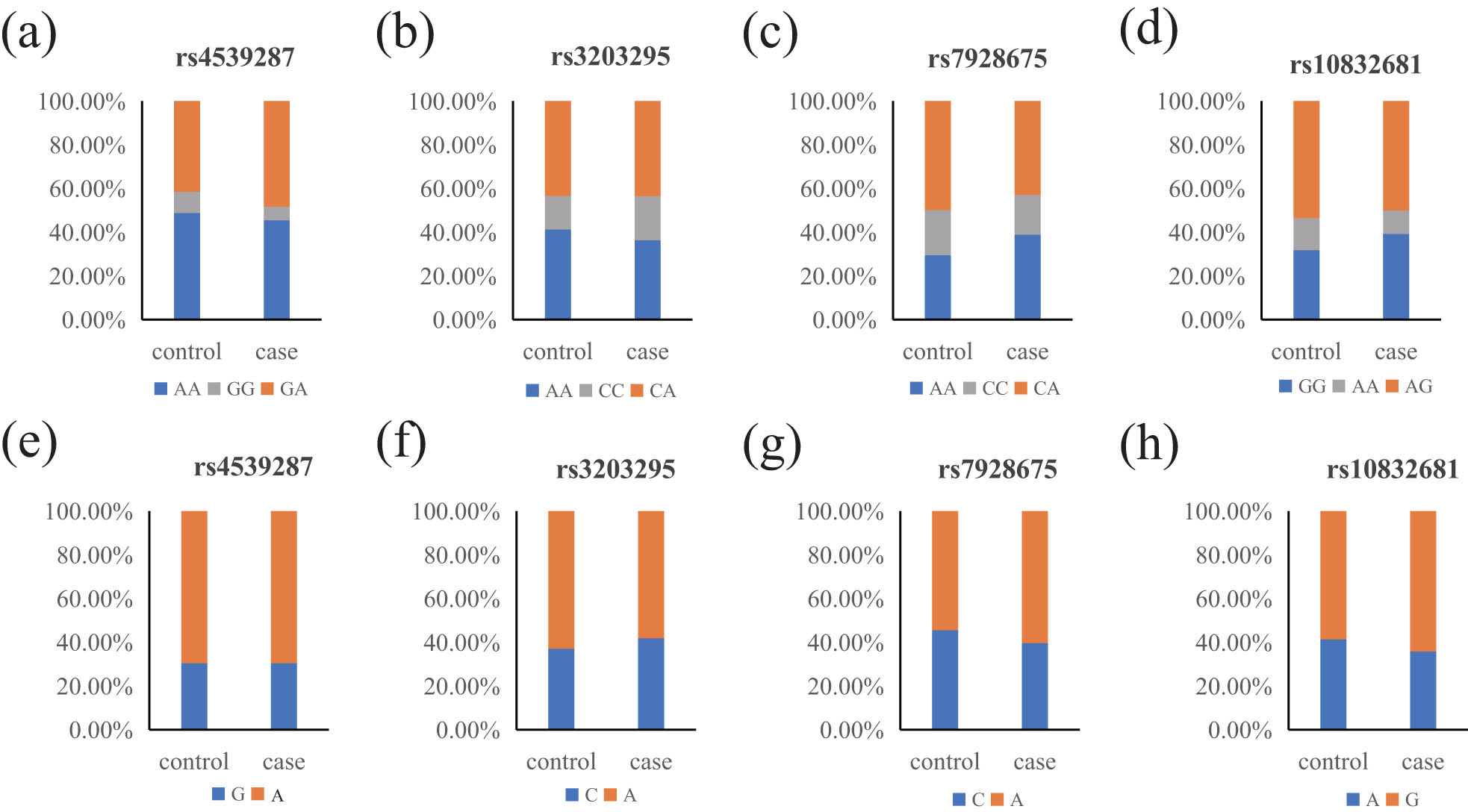
Genotype frequency and allele frequency of SOX6 SNPs in KBD case and healthy control: (a) genotype frequency of rs4539287 between the two groups, (b) genotype frequency of rs3203295 between the two groups, (c) genotype frequency of rs7928675 between the two groups, (d) genotype frequency of rs10832681 between the two groups, (e) allele frequency of rs4539287 between the two groups, (f) allele frequency of rs3203295 between the two groups, (g) allele frequency of rs7928675 between the two groups, and (h) allele frequency of rs10832681 between the two groups.
3.3 Association between SOX6 SNPs and KBD risk (overall analysis)
Based on logistic regression analysis, this study conducted an overall correlation analysis between SOX6 SNPs and KBD risk. The results revealed that (Figure 3) rs7928675 and rs10832681 were markedly correlated with a reduction in KBD risk. Specifically, rs7928675 markedly reduced the risk of KBD under homozygous (OR = 0.66, 95% CI 0.43–1.00, p = 0.049), heterozygote (OR = 0.63, 95% CI 0.45–0.87, p = 0.006), additive (OR = 0.78, 95% CI 0.64–0.96, p = 0.020), and dominant (OR = 0.64, 95% CI 0.47–0.87, p = 0.004) models. Similarly, rs10832681 also markedly reduced the risk of KBD under homozygous (OR = 0.57, 95% CI 0.35–0.93, p = 0.023), additive (OR = 0.75, 95% CI 0.60–0.94, p = 0.013), and dominant (OR = 0.71, 95% CI 0.52–0.96, p = 0.027) models. However, there was no significant correlation between rs4539287 and rs3203295 and KBD risk.
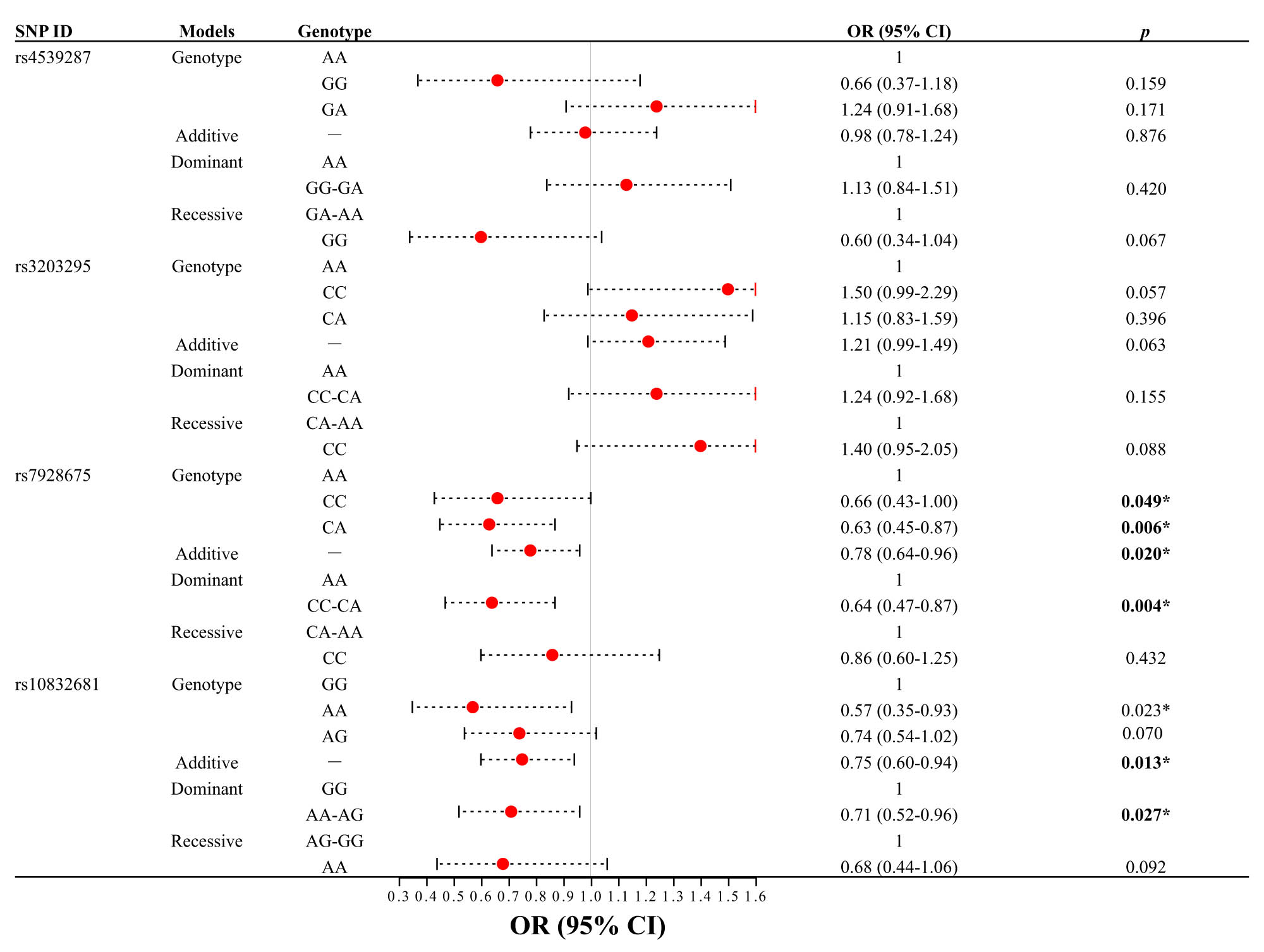
Association between four candidate SNPs of SOX6 and KBD risk (overall analysis). *p < 0.05 indicates statistical significance.
3.4 Association between SOX6 SNPs and KBD risk (subgroup analysis)
In order to thoroughly explore the correlation between SOX6 SNPs and KBD risk, this study performed subgroup analyses of age, gender, BMI, and smoking for all participants, as well as subgroup analyses of the course of disease, number of affected joints, grade (Ⅰ–Ⅲ), hypertensive complications, and diabetes complications for participants for KBD patients. The significant results of the subgroup association analysis between SOX6 SNPs and KBD risk are shown in Figure 4.
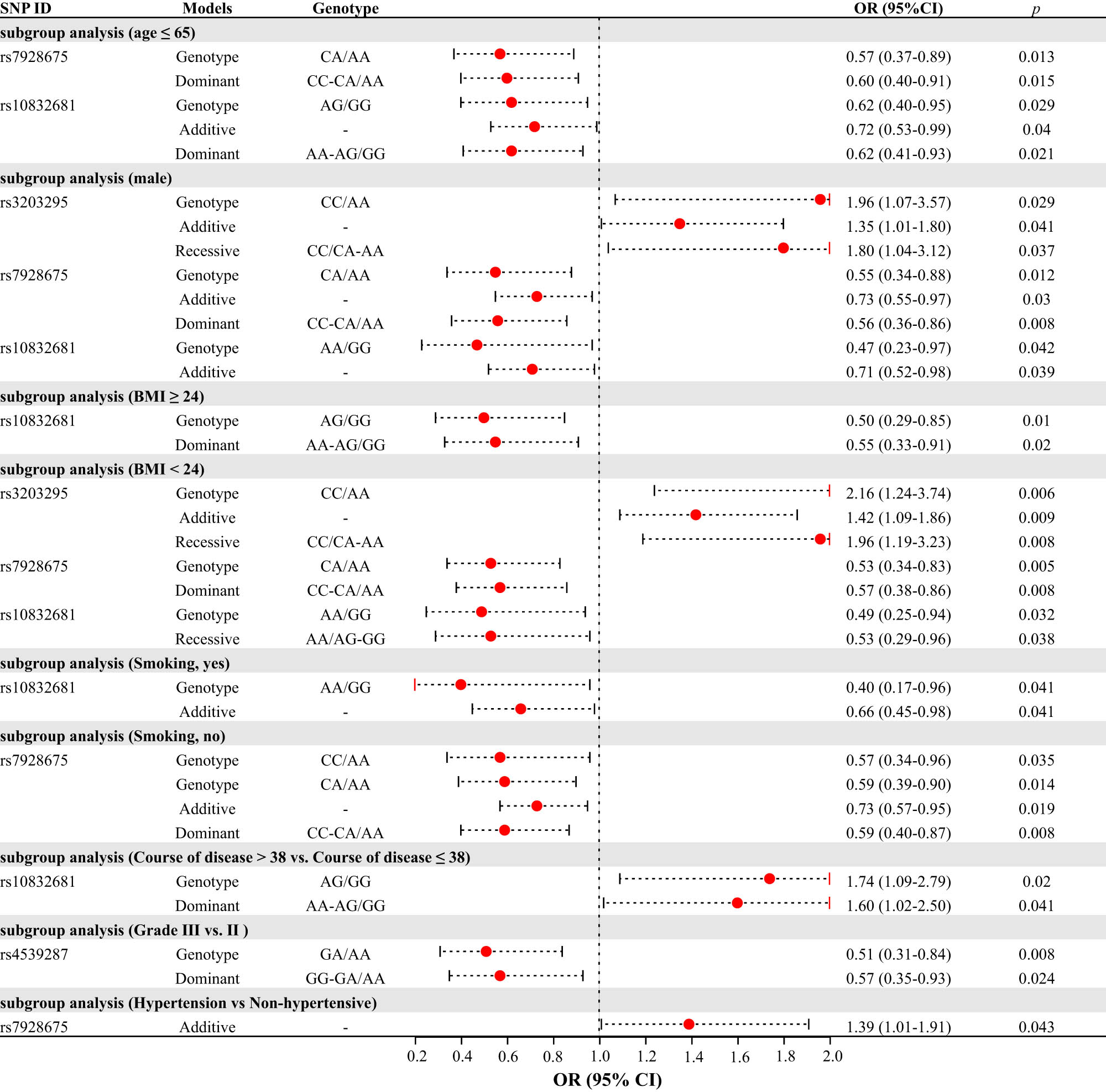
Association between four candidate SNPs of SOX6 and KBD risk (subgroup analysis). Only significant results were shown. p < 0.05 indicates statistical significance.
Age-stratified analysis revealed that there was no correlation between SOX6 SNPs and KBD risk in participants >65 years old (Table S3). However, for those aged 65 years or younger, rs7928675 under the heterozygote (OR = 0.57, 95% CI 0.37–0.89, p = 0.013) and dominant (OR = 0.60, 95% CI 0.40–0.91, p = 0.015) models, and rs10832681 under the heterozygote (OR = 0.62, 95% CI 0.40–0.95, p = 0.029), additive (OR = 0.72, 95% CI 0.53–0.99, p = 0.040), and dominant (OR = 0.62, 95% CI 0.41–0.93, p = 0.021) models could markedly reduce KBD risk.
Gender-stratified analysis showed that there was no marked correlation between SOX6 SNPs and the risk of KBD among female participants (Table S4). However, for male participants, rs7928675 under the heterozygous (OR = 0.55, 95% CI 0.34–0.88, p = 0.012), additive (OR = 0.73, 95% CI 0.55–0.97, p = 0.030), dominant (OR = 0.56, 95% CI 0.36–0.86, p = 0.008), and rs10832681 under the homozygous (OR = 0.47, 95% CI 0.23–0.97, p = 0.042) and additive (OR = 0.71, 95% CI 0.52–0.98, p = 0.039) models could markedly decrease KBD risk. In addition, rs3203295 showed a significant increase in KBD risk in male participants under the homozygous (OR = 1.96, 95% CI 1.07–3.57, p = 0.029), additive (OR = 1.35, 95% CI 1.01–1.80, p = 0.041), and received (OR = 1.80, 95% CI 1.04–3.12, p = 0.037) models.
BMI-stratified analysis showed that rs10832681 (Table S5) was related to a decreased KBD risk in participants with a BMI of 24 or higher under the heterozygote (OR = 0.50, 95% CI 0.29–0.85, p = 0.010) and dominant (OR = 0.55, 95% CI 0.33–0.91, p = 0.020) models. In those with BMI below 24, except for rs4539287, there was a certain correlation between the other three SOX6 SNPs and KBD risk. Of these three, rs3203295 could markedly increase the risk of KBD under the homozygous (OR = 2.16, 95% CI 1.24–3.74, p = 0.006), additive (OR = 1.42, 95% CI 1.09–1.86, p = 0.009), and recessive (OR = 1.96, 95% CI 1.19–3.23, p = 0.008) models. While rs7928675 under the heterozygote (OR = 0.53, 95% CI 0.34–0.83, p = 0.005) and dominant (OR = 0.57, 95% CI 0.38–0.86, p = 0.008) models, and rs10832681 under the homozygous (OR = 0.49, 95% CI 0.25–0.94, p = 0.032) and recessive (OR = 0.53, 95% CI 0.29–0.96, p = 0.038) models could markedly reduce the risk of KBD.
Smoking-stratified analysis found that (Table S6) rs7928675 markedly reduced the risk of KBD in non-smokers under the homozygous (OR = 0.57, 95% CI 0.34–0.96, p = 0.035), heterozygote (OR = 0.59, 95% CI 0.39–0.90, p = 0.014), additive (OR = 0.73, 95% CI 0.57–0.95, p = 0.019), and dominant (OR = 0.59, 95% CI 0.40–0.87, p = 0.008) models. And rs10832681 could markedly reduce the KBD risk in smokers under the homozygous (OR = 0.40, 95% CI 0.17–0.96, p = 0.041) and additive (OR = 0.66, 95% CI 0.45–0.98, p = 0.041) models.
The course of disease stratified analysis revealed that (Table S7) only rs10832681 markedly increased the disease risk in KBD patients with the course of disease longer than 38 years.
The number of affected joints stratified analysis showed that (Table S8) the correlation between SOX6 SNPs and KBD risk was not related to the number of damaged joints in patients.
Based on the severity of joint lesions, this study classified KBD patients into Ⅰ–Ⅲ grades and investigated the correlation between SOX6 SNPs and KBD risk among different grades. The results showed that (Table S9), with grade Ⅱ as the control group, rs4539287 could markedly decrease the KBD risk in grade Ⅲ patients under the heterozygote (OR = 0.51, 95% CI 0.31–0.84, p = 0.008) and dominant (OR = 0.57, 95% CI 0.35–0.93, p = 0.024) models.
Hypertensive and diabetes complications stratified analyses showed that (Tables S10 and S11) the link between SOX6 SNPs and the KBD risk was not markedly impacted by whether or not the patient had hypertension or diabetes. Only rs7928675 had a marked effect on increasing the KBD risk in hypertensive patients under the additive (OR = 0.76, 95% CI 0.59–0.97, p = 0.025) model.
3.5 FPRP analysis
Based on the FPRP analysis, we proceeded to conduct a reliability analysis on the positive results mentioned above (Table S12). In the overall analysis and subgroup analysis of males, BMI < 24, and non-smoking, the link between rs10832681 and KBD risk under the homozygous model should not be a concern. In the overall analysis and subgroup analysis of non-smoking, the link between rs7928675 and KBD risk under the homozygous model should not be of concern. Additionally, the correlation between rs3203295 and KBD risk under homozygous and recessive models in males should not be of concern. It is noteworthy that other positive results had FPRP values less than 0.2, showing a significant correlation between SOX6 SNPs and KBD risk, which warrants further in-depth analysis.
3.6 SNP–SNP interaction analysis
This study evaluated the correlation between SNP–SNP in SOX6 polymorphism using the MDR method. The results revealed a significant interaction between rs3203295 and rs10832681 (Figure 5a and b). Meanwhile, the 4-site combination model, which includes rs4539287, rs3203295, rs7928675, and rs10832681, was the most effective model for predicting KBD risk, with a testing balanced accuracy of 0.5355 and cross-validation consistency (CVC) of 10/10 (Table 3).
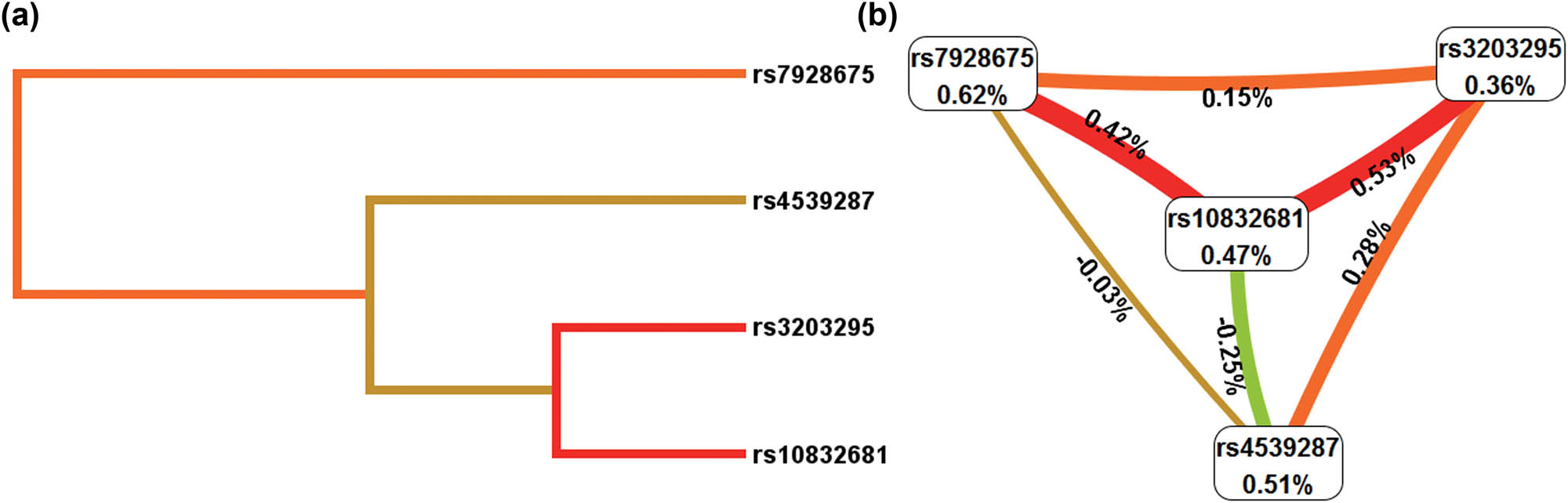
Dendrogram (a) and circle graph (b) of SNP–SNP interaction among SOX6 SNPs by MDR method. The numerical values on the lines represent the strength of the interaction.
SNP–SNP interactions in KBD risk based on MDR analysis
| Models | Training Bal. Acc | Testing Bal. Acc | OR (95% CI) | p | CVC |
|---|---|---|---|---|---|
| rs7928675 | 0.5456 | 0.5014 | 1.48 (1.08–2.02) | 0.014 | 7/10 |
| rs4539287, rs3203295 | 0.5677 | 0.5071 | 1.66 (1.23–2.25) | 0.001 | 6/10 |
| rs4539287, rs3203295, rs7928675 | 0.6002 | 0.5185 | 2.19 (1.62–2.97) | <0.0001 | 7/10 |
| rs4539287, rs3203295, rs7928675, rs10832681 | 0.6302 | 0.5355 | 2.96 (2.16–4.06) | <0.0001 | 10/10 |
Abbreviations: MDR, multifactor dimensionality reduction; Bal. Acc, balanced accuracy; CVC, cross-validation consistency.
4 Discussion
This study aims to analyze the potential correlation between four specific SOX6 SNPs (rs4539287, rs3203295, rs7928675, and rs10832681) and KBD risk among 735 participants, to screen for more genetic variations related to the occurrence and progression of KBD. Overall analysis revealed a significant correlation between rs7928675 and rs10832681 and a decrease in KBD risk. Further subgroup analyses indicated that these two SNPs also have a significant protective effect on KBD risk among participants who are aged 65 years or younger, males, and non-smokers.
The SOX6 gene plays a crucial role as a transcription factor in the development and formation of cartilage [19]. Yang et al. conducted a fine-mapping association analysis and found that there are numerous SOX6 SNPs related to hip bone mineral density in both Chinese and Caucasian populations, emphasizing the importance of SOX6 gene variants in affecting changes in bone mineral density [20]. A cross-sectional study by Correa-Rodríguez et al. revealed that SOX6 rs7117858 can affect the fat free mass and quantitative ultra sound characteristics of young people, indicating the significance of SOX6 variants in obesity and osteoporosis-related phenotypes during early adulthood [17]. Furthermore, a case–control study by Wu et al. revealed a relationship between SOX6 mutations and adolescent idiopathic scoliosis in the Han Chinese population [21]. These studies suggested a potential connection between SOX6 gene variants and bone-related diseases, providing important theoretical support for the first in-depth exploration of the link between SOX6 SNPs and KBD risk in this study.
KBD is more common in children and adolescents, particularly those between the ages of 5–15 years [22]. Through subgroup analysis, it has been observed that rs7928675 and rs10832681 significantly reduced the risk of KBD in younger individuals (age ≤65 years), suggesting that these SNPs may be key in KBD among young people. Meanwhile, this study also found that these SNPs have a certain protective effect in males, and non-smokers, suggesting that gender may be crucial in the association between SOX6 SNPs and KBD risk and that the adverse effects of smoking on the development of KBD may interfere with the protective effect of these SNPs. It is essential to note that although these findings provide insight into the link between SOX6 SNPs and KBD risk, more research is still necessary to verify the potential connection between factors such as gender, smoking, and KBD.
Genetic mutations can occur in coding and non-coding regions of the genome. Previous research has shown that both of them can impact gene expression, potentially leading to the development of diseases [23]. Du et al. pointed out that the polymorphism of GPx4 and the decrease in its mRNA expression level may be related to the development of KBD in the Chinese population [24]. Similarly, when Sun et al. investigated the correlation between the SEPP1 variant and the risk of KBD, they also tested the expression of SEPP1 gene mRNA in patients to analyze the potential link between SEPP1 SNPs and the pathogenesis of KBD [25]. In this study, we found that rs7928675 and rs10832681 located in the non-coding region of the SOX6 were significantly associated with a reduction in KBD risk. Previous studies have reported that SOX6 plays an important role in cartilage formation and bone development, and its inactivation may affect the differentiation of chondrocytes and neuronal cells, leading to the occurrence of bone-related diseases [14,15]. Considering that both rs7928675 and rs10832681 are located in non-coding regions, it may affect the binding ability of SOX6 regulatory elements or the role of regulatory factors, which may lead to changes in the expression level of SOX6. Therefore, we speculated that the specific alleles of these two SNPs may enhance the interaction between SOX6 regulatory elements and transcription factors, thereby increasing the expression of SOX6 and reducing the risk of KBD. However, this hypothesis needs to be further validated through experimental methods such as gene expression analysis and chromatin conformation.
It is undeniable that this study has some limitations. First, the sample size was relatively small and the majority of participants are local residents of Changwu County, with only a small number from other cities or provinces, indicating an uneven geographical distribution of the participants in this study. Considering that participants from this specific region may have specific genetic polymorphisms, in future related studies, we will expand the sample size and include participants from different regions to further validate the association between SOX6 SNPs and KBD risk in the Chinese Han population. Second, due to significant differences between the case group and the control group in drinking, this study did not conduct a drinking-standardized analysis regarding the association between SOX6 SNPs and KBD risk. In subsequent studies, we will further expand the sample size to ensure that the case group matches the control group, and then proceed with the drinking-standardized analysis of the correlation between SOX6 SNPs and KBD risk to obtain reliable results related to drinking. Additionally, this study found a marked correlation between the two candidate SNPs of SOX6 and the reduction of KBD risk, which needs to be further validated through relevant experiments.
5 Conclusions
This study revealed a significant correlation between SOX6 variants (rs7928675 and rs10832681) and a reduction in the KBD risk among the Chinese Han population, providing a new direction for the prevention, diagnosis, and treatment of KBD.
Abbreviations
- CIs
-
confidence intervals
- CVC
-
cross-validation consistency
- FFM
-
fat free mass
- FPRP
-
false positive report probability
- GPx4
-
glutathione peroxidase 4
- HWE
-
Hardy–Weinberg equilibrium
- KBD
-
Kashin-Beck disease
- MAF
-
minor allele frequency
- MDR
-
multi-factor dimensionality reduction
- ORs
-
odds ratios
- QUS
-
quantitative ultra sound
- Se
-
selenium
- SEPP1
-
selenoprotein P
- SNPs
-
single nucleotide polymorphisms
- SOX6
-
SRY-box transcription factor 6
- TOLCAS
-
Tolchin-Le Caignec syndrome
Acknowledgement
The authors appreciate the support of all participants for this study.
-
Funding information: This work is supported by the Science and Technology Research and Development Plan of Xianyang City (grant number 2019k02-118).
-
Author contributions: Y.F.J. and N.H. contributed to the conception and design of the work. A.W.H. and K.Z. contributed to drafting the work and revising it critically for important intellectual content. Z.F.Z. and S.L.W. contributed equally to analysis and interpretation of data for the work. N.H. and Y.F.J wrote the first draft of the manuscript and all authors contributed to the review, approval of the final manuscript, and agreed to be accountable for all aspects of the work.
-
Conflict of interest: The author claimed that there are no conflicts of interest.
-
Data availability statement: The raw data for this study can be obtained from the corresponding authors according to reasonable requirements.
References
[1] Shao Q, Yang H. Severe deformity in long-term Kaschin–Beck disease. Rheumatology. 2022;61(4):1732. 10.1093/rheumatology/keab486.Search in Google Scholar PubMed
[2] Cao J, Li S, Shi Z, Yue Y, Sun J, Chen J, et al. Articular cartilage metabolism in patients with Kashin–Beck disease: an endemic osteoarthropathy in China. Osteoarthr Cartil. 2008;16(6):680–8. 10.1016/j.joca.2007.09.002.Search in Google Scholar PubMed
[3] Tan J, Zhu W, Wang W, Li R, Hou S, Wang D, et al. Selenium in soil and endemic diseases in China. Sci Total Environ. 2002;284(1–3):227–35.10.1016/S0048-9697(01)00889-0Search in Google Scholar PubMed
[4] Lv Y, Yu T, Yang Z, Zhao W, Zhang M, Wang Q. Constraint on selenium bioavailability caused by its geochemical behavior in typical Kaschin–Beck disease areas in Aba, Sichuan Province of China. Sci Total Environ. 2014;493:737–49. 10.1016/j.scitotenv.2014.06.050.Search in Google Scholar PubMed
[5] Commission NHaFP. China health and family planning statistical yearbook 2016. China: Beijing Union Medical University Press; 2016.Search in Google Scholar
[6] Shi X, Lv A, Ma J, Zhang F, Wen Y, Zhang Z, et al. Investigation of MMP-1 genetic polymorphisms and protein expression and their effects on the risk of Kashin-Beck disease in the northwest Chinese Han population. J Orthopaedic Surg Res. 2016;11(1):64. 10.1186/s13018-016-0398-6.Search in Google Scholar PubMed PubMed Central
[7] Bai Y, Shi X, Zhang F, Lv A, Wen Y, Guo X. COL9A1 gene polymorphism is associated with Kashin-Beck disease in a Northwest Chinese Han population. PLoS One. 2015;10(3):e0120365. 10.1371/journal.pone.0120365.Search in Google Scholar PubMed PubMed Central
[8] He X, Bai M, Liu M, Wang L, He Y, Rong H, et al. Genetic variants in the ITPR2 gene are associated with Kashin‐Beck disease in Tibetan. Mol Genet Genomic Med. 2019;7(7):e00715. 10.1002/mgg3.715.Search in Google Scholar PubMed PubMed Central
[9] Zhang F, Guo X, Zhang Y, Wen Y, Wang W, Wang S, et al. Genome-wide copy number variation study and gene expression analysis identify ABI3BP as a susceptibility gene for Kashin-Beck disease. Hum Genet. 2014;133(6):793–9.10.1007/s00439-014-1418-4Search in Google Scholar PubMed
[10] Wu C, Wen Y, Guo X, Yang T, Shen H, Chen X, et al. Genetic association, mRNA and protein expression analysis identify ATG4C as a susceptibility gene for Kashin–Beck disease. Osteoarthr Cartil. 2017;25(2):281–6. 10.1016/j.joca.2016.09.019.Search in Google Scholar PubMed
[11] Yu FF, Sun L, Zhou GY, Ping ZG, Guo X, Ba Y. Meta-analysis of association studies of selenoprotein gene polymorphism and Kashin-Beck disease: an updated systematic review. Biol Trace Elem Res. 2022;200:543–50.10.1007/s12011-021-02705-2Search in Google Scholar PubMed
[12] Akiyama H, Chaboissier M, Martin JF, Schedl A, de Crombrugghe B. The transcription factor Sox9 has essential roles in successive steps of the chondrocyte differentiation pathway and is required for expression of Sox5 and Sox6. Genes Dev. 2002;16(21):2813–28. 10.1101/gad.1017802.Search in Google Scholar PubMed PubMed Central
[13] Liu C, Lefebvre V. The transcription factors SOX9 and SOX5/SOX6 cooperate genome-wide through super-enhancers to drive chondrogenesis. Nucleic Acids Res. 2015;43(17):8183–203. 10.1093/nar/gkv688.Search in Google Scholar PubMed PubMed Central
[14] Smits P, Li P, Mandel J, Zhang Z, Deng JM, Behringer RR, et al. The transcription factors L-Sox5 and Sox6 are essential for cartilage formation. Dev Cell. 2001;1(2):277–90.10.1016/S1534-5807(01)00003-XSearch in Google Scholar PubMed
[15] Dy P, Smits P, Silvester A, Penzo-Méndez A, Dumitriu B, Han Y, et al. Synovial joint morphogenesis requires the chondrogenic action of Sox5 and Sox6 in growth plate and articular cartilage. Dev Biol. 2010;341(2):346–59. 10.1016/j.ydbio.2010.02.024.Search in Google Scholar PubMed PubMed Central
[16] Tolchin D, Yeager JP, Prasad P, Dorrani N, Russi AS, Martinez-Agosto JA, et al. De dovo SOX6 variants cause a neurodevelopmental syndrome associated with ADHD, craniosynostosis, and osteochondromas. Am J Hum Genet. 2020;106(6):830–45. 10.1016/j.ajhg.2020.04.015.Search in Google Scholar PubMed PubMed Central
[17] Correa-Rodríguez M, Schmidt-RioValle J, Rueda-Medina B. SOX6 rs7117858 polymorphism is associated with osteoporosis and obesity-related phenotypes. Eur J Clin Investig. 2018;48(10):e13011. 10.1111/eci.13011.Search in Google Scholar PubMed
[18] Hsu T, Tantoh DM, Chou Y, Hsu S, Ho C, Lung C, et al. Association between osteoporosis and menopause in relation to SOX6 rs297325 variant in Taiwanese women. Menopause. 2020;27(8):887–92. 10.1097/gme.0000000000001544.Search in Google Scholar
[19] Nishimura R, Hata K, Takahata Y, Murakami T, Nakamura E, Yagi H. Regulation of cartilage development and diseases by transcription factors. J Bone Metab. 2017;24(3):147–53. 10.11005/jbm.2017.24.3.147.Search in Google Scholar PubMed PubMed Central
[20] Yang TL, Guo Y, Liu YJ, Shen H, Liu YZ, Lei SF, et al. Genetic variants in the SOX6 gene are associated with bone mineral density in both Caucasian and Chinese populations. Osteoporos Int. 2011;23(2):781–7. 10.1007/s00198-011-1626-x.Search in Google Scholar PubMed PubMed Central
[21] Wu Z, Wang Y, Dai Z, Qiu Y, Xu L, Zhu Z. Genetic variants of ABO and SOX6 are associated with adolescent idiopathic scoliosis in Chinese Han Population. Spine. 2019;44(18):E1063–7. 10.1097/brs.0000000000003062.Search in Google Scholar
[22] Sun LY, Meng FG, Li Q, Zhao ZJ, He CZ, Wang SP, et al. Effects of the consumption of rice from non-KBD areas and selenium supplementation on the prevention and treatment of paediatric Kaschin–Beck disease: an epidemiological intervention trial in the Qinghai Province. Osteoarthr Cartil. 2014;22(12):2033–40. 10.1016/j.joca.2014.09.013.Search in Google Scholar PubMed
[23] Shastry BS. SNPs: impact on gene function and phenotype. Methods Mol Biol. 2009;578:3–22. 10.1007/978-1-60327-411-1_1.Search in Google Scholar PubMed
[24] Du XH, Dai XX, Xia SR, Zou XZ, Sun WY, Mo XY, et al. SNP and mRNA expression for glutathione peroxidase 4 in Kashin-Beck disease. Br J Nutr. 2011;107(2):164–9. 10.1017/s0007114511002704.Search in Google Scholar
[25] Sun W, Wang X, Zou XZ, Song R, Du X, Hu J, et al. Selenoprotein P gene r25191g/a polymorphism and quantification of selenoprotein P mRNA level in patients with Kashin-Beck disease. Br J Nutr. 2010;104(9):1283–7. 10.1017/s0007114510002199.Search in Google Scholar PubMed
© 2024 the author(s), published by De Gruyter
This work is licensed under the Creative Commons Attribution 4.0 International License.
Articles in the same Issue
- Research Articles
- EDNRB inhibits the growth and migration of prostate cancer cells by activating the cGMP-PKG pathway
- STK11 (LKB1) mutation suppresses ferroptosis in lung adenocarcinoma by facilitating monounsaturated fatty acid synthesis
- Association of SOX6 gene polymorphisms with Kashin-Beck disease risk in the Chinese Han population
- The pyroptosis-related signature predicts prognosis and influences the tumor immune microenvironment in dedifferentiated liposarcoma
- METTL3 attenuates ferroptosis sensitivity in lung cancer via modulating TFRC
- Identification and validation of molecular subtypes and prognostic signature for stage I and stage II gastric cancer based on neutrophil extracellular traps
- Novel lumbar plexus block versus femoral nerve block for analgesia and motor recovery after total knee arthroplasty
- Correlation between ABCB1 and OLIG2 polymorphisms and the severity and prognosis of patients with cerebral infarction
- Study on the radiotherapy effect and serum neutral granulocyte lymphocyte ratio and inflammatory factor expression of nasopharyngeal carcinoma
- Transcriptome analysis of effects of Tecrl deficiency on cardiometabolic and calcium regulation in cardiac tissue
- Aflatoxin B1 induces infertility, fetal deformities, and potential therapies
- Serum levels of HMW adiponectin and its receptors are associated with cytokine levels and clinical characteristics in chronic obstructive pulmonary disease
- METTL3-mediated methylation of CYP2C19 mRNA may aggravate clopidogrel resistance in ischemic stroke patients
- Understand how machine learning impact lung cancer research from 2010 to 2021: A bibliometric analysis
- Pressure ulcers in German hospitals: Analysis of reimbursement and length of stay
- Metformin plus L-carnitine enhances brown/beige adipose tissue activity via Nrf2/HO-1 signaling to reduce lipid accumulation and inflammation in murine obesity
- Downregulation of carbonic anhydrase IX expression in mouse xenograft nasopharyngeal carcinoma model via doxorubicin nanobubble combined with ultrasound
- Feasibility of 3-dimensional printed models in simulated training and teaching of transcatheter aortic valve replacement
- miR-335-3p improves type II diabetes mellitus by IGF-1 regulating macrophage polarization
- The analyses of human MCPH1 DNA repair machinery and genetic variations
- Activation of Piezo1 increases the sensitivity of breast cancer to hyperthermia therapy
- Comprehensive analysis based on the disulfidptosis-related genes identifies hub genes and immune infiltration for pancreatic adenocarcinoma
- Changes of serum CA125 and PGE2 before and after high-intensity focused ultrasound combined with GnRH-a in treatment of patients with adenomyosis
- The clinical value of the hepatic venous pressure gradient in patients undergoing hepatic resection for hepatocellular carcinoma with or without liver cirrhosis
- Development and validation of a novel model to predict pulmonary embolism in cardiology suspected patients: A 10-year retrospective analysis
- Downregulation of lncRNA XLOC_032768 in diabetic patients predicts the occurrence of diabetic nephropathy
- Circ_0051428 targeting miR-885-3p/MMP2 axis enhances the malignancy of cervical cancer
- Effectiveness of ginkgo diterpene lactone meglumine on cognitive function in patients with acute ischemic stroke
- The construction of a novel prognostic prediction model for glioma based on GWAS-identified prognostic-related risk loci
- Evaluating the impact of childhood BMI on the risk of coronavirus disease 2019: A Mendelian randomization study
- Lactate dehydrogenase to albumin ratio is associated with in-hospital mortality in patients with acute heart failure: Data from the MIMIC-III database
- CD36-mediated podocyte lipotoxicity promotes foot process effacement
- Efficacy of etonogestrel subcutaneous implants versus the levonorgestrel-releasing intrauterine system in the conservative treatment of adenomyosis
- FLRT2 mediates chondrogenesis of nasal septal cartilage and mandibular condyle cartilage
- Challenges in treating primary immune thrombocytopenia patients undergoing COVID-19 vaccination: A retrospective study
- Let-7 family regulates HaCaT cell proliferation and apoptosis via the ΔNp63/PI3K/AKT pathway
- Phospholipid transfer protein ameliorates sepsis-induced cardiac dysfunction through NLRP3 inflammasome inhibition
- Postoperative cognitive dysfunction in elderly patients with colorectal cancer: A randomized controlled study comparing goal-directed and conventional fluid therapy
- Long-pulsed ultrasound-mediated microbubble thrombolysis in a rat model of microvascular obstruction
- High SEC61A1 expression predicts poor outcome of acute myeloid leukemia
- Comparison of polymerase chain reaction and next-generation sequencing with conventional urine culture for the diagnosis of urinary tract infections: A meta-analysis
- Secreted frizzled-related protein 5 protects against renal fibrosis by inhibiting Wnt/β-catenin pathway
- Pan-cancer and single-cell analysis of actin cytoskeleton genes related to disulfidptosis
- Overexpression of miR-532-5p restrains oxidative stress response of chondrocytes in nontraumatic osteonecrosis of the femoral head by inhibiting ABL1
- Autologous liver transplantation for unresectable hepatobiliary malignancies in enhanced recovery after surgery model
- Clinical analysis of incomplete rupture of the uterus secondary to previous cesarean section
- Abnormal sleep duration is associated with sarcopenia in older Chinese people: A large retrospective cross-sectional study
- No genetic causality between obesity and benign paroxysmal vertigo: A two-sample Mendelian randomization study
- Identification and validation of autophagy-related genes in SSc
- Long non-coding RNA SRA1 suppresses radiotherapy resistance in esophageal squamous cell carcinoma by modulating glycolytic reprogramming
- Evaluation of quality of life in patients with schizophrenia: An inpatient social welfare institution-based cross-sectional study
- The possible role of oxidative stress marker glutathione in the assessment of cognitive impairment in multiple sclerosis
- Compilation of a self-management assessment scale for postoperative patients with aortic dissection
- Left atrial appendage closure in conjunction with radiofrequency ablation: Effects on left atrial functioning in patients with paroxysmal atrial fibrillation
- Effect of anterior femoral cortical notch grade on postoperative function and complications during TKA surgery: A multicenter, retrospective study
- Clinical characteristics and assessment of risk factors in patients with influenza A-induced severe pneumonia after the prevalence of SARS-CoV-2
- Analgesia nociception index is an indicator of laparoscopic trocar insertion-induced transient nociceptive stimuli
- High STAT4 expression correlates with poor prognosis in acute myeloid leukemia and facilitates disease progression by upregulating VEGFA expression
- Factors influencing cardiovascular system-related post-COVID-19 sequelae: A single-center cohort study
- HOXD10 regulates intestinal permeability and inhibits inflammation of dextran sulfate sodium-induced ulcerative colitis through the inactivation of the Rho/ROCK/MMPs axis
- Mesenchymal stem cell-derived exosomal miR-26a induces ferroptosis, suppresses hepatic stellate cell activation, and ameliorates liver fibrosis by modulating SLC7A11
- Endovascular thrombectomy versus intravenous thrombolysis for primary distal, medium vessel occlusion in acute ischemic stroke
- ANO6 (TMEM16F) inhibits gastrointestinal stromal tumor growth and induces ferroptosis
- Prognostic value of EIF5A2 in solid tumors: A meta-analysis and bioinformatics analysis
- The role of enhanced expression of Cx43 in patients with ulcerative colitis
- Choosing a COVID-19 vaccination site might be driven by anxiety and body vigilance
- Role of ICAM-1 in triple-negative breast cancer
- Cost-effectiveness of ambroxol in the treatment of Gaucher disease type 2
- HLA-DRB5 promotes immune thrombocytopenia via activating CD8+ T cells
- Efficacy and factors of myofascial release therapy combined with electrical and magnetic stimulation in the treatment of chronic pelvic pain syndrome
- Efficacy of tacrolimus monotherapy in primary membranous nephropathy
- Mechanisms of Tripterygium wilfordii Hook F on treating rheumatoid arthritis explored by network pharmacology analysis and molecular docking
- FBXO45 levels regulated ferroptosis renal tubular epithelial cells in a model of diabetic nephropathy by PLK1
- Optimizing anesthesia strategies to NSCLC patients in VATS procedures: Insights from drug requirements and patient recovery patterns
- Alpha-lipoic acid upregulates the PPARγ/NRF2/GPX4 signal pathway to inhibit ferroptosis in the pathogenesis of unexplained recurrent pregnancy loss
- Correlation between fat-soluble vitamin levels and inflammatory factors in paediatric community-acquired pneumonia: A prospective study
- CD1d affects the proliferation, migration, and apoptosis of human papillary thyroid carcinoma TPC-1 cells via regulating MAPK/NF-κB signaling pathway
- miR-let-7a inhibits sympathetic nerve remodeling after myocardial infarction by downregulating the expression of nerve growth factor
- Immune response analysis of solid organ transplantation recipients inoculated with inactivated COVID-19 vaccine: A retrospective analysis
- The H2Valdien derivatives regulate the epithelial–mesenchymal transition of hepatoma carcinoma cells through the Hedgehog signaling pathway
- Clinical efficacy of dexamethasone combined with isoniazid in the treatment of tuberculous meningitis and its effect on peripheral blood T cell subsets
- Comparison of short-segment and long-segment fixation in treatment of degenerative scoliosis and analysis of factors associated with adjacent spondylolisthesis
- Lycopene inhibits pyroptosis of endothelial progenitor cells induced by ox-LDL through the AMPK/mTOR/NLRP3 pathway
- Methylation regulation for FUNDC1 stability in childhood leukemia was up-regulated and facilitates metastasis and reduces ferroptosis of leukemia through mitochondrial damage by FBXL2
- Correlation of single-fiber electromyography studies and functional status in patients with amyotrophic lateral sclerosis
- Risk factors of postoperative airway obstruction complications in children with oral floor mass
- Expression levels and clinical significance of serum miR-19a/CCL20 in patients with acute cerebral infarction
- Physical activity and mental health trends in Korean adolescents: Analyzing the impact of the COVID-19 pandemic from 2018 to 2022
- Evaluating anemia in HIV-infected patients using chest CT
- Ponticulus posticus and skeletal malocclusion: A pilot study in a Southern Italian pre-orthodontic court
- Causal association of circulating immune cells and lymphoma: A Mendelian randomization study
- Assessment of the renal function and fibrosis indexes of conventional western medicine with Chinese medicine for dredging collaterals on treating renal fibrosis: A systematic review and meta-analysis
- Comprehensive landscape of integrator complex subunits and their association with prognosis and tumor microenvironment in gastric cancer
- New target-HMGCR inhibitors for the treatment of primary sclerosing cholangitis: A drug Mendelian randomization study
- Population pharmacokinetics of meropenem in critically ill patients
- Comparison of the ability of newly inflammatory markers to predict complicated appendicitis
- Comparative morphology of the cruciate ligaments: A radiological study
- Immune landscape of hepatocellular carcinoma: The central role of TP53-inducible glycolysis and apoptosis regulator
- Serum SIRT3 levels in epilepsy patients and its association with clinical outcomes and severity: A prospective observational study
- SHP-1 mediates cigarette smoke extract-induced epithelial–mesenchymal transformation and inflammation in 16HBE cells
- Acute hyper-hypoxia accelerates the development of depression in mice via the IL-6/PGC1α/MFN2 signaling pathway
- The GJB3 correlates with the prognosis, immune cell infiltration, and therapeutic responses in lung adenocarcinoma
- Physical fitness and blood parameters outcomes of breast cancer survivor in a low-intensity circuit resistance exercise program
- Exploring anesthetic-induced gene expression changes and immune cell dynamics in atrial tissue post-coronary artery bypass graft surgery
- Empagliflozin improves aortic injury in obese mice by regulating fatty acid metabolism
- Analysis of the risk factors of the radiation-induced encephalopathy in nasopharyngeal carcinoma: A retrospective cohort study
- Reproductive outcomes in women with BRCA 1/2 germline mutations: A retrospective observational study and literature review
- Evaluation of upper airway ultrasonographic measurements in predicting difficult intubation: A cross-section of the Turkish population
- Prognostic and diagnostic value of circulating IGFBP2 in pancreatic cancer
- Postural stability after operative reconstruction of the AFTL in chronic ankle instability comparing three different surgical techniques
- Research trends related to emergence agitation in the post-anaesthesia care unit from 2001 to 2023: A bibliometric analysis
- Frequency and clinicopathological correlation of gastrointestinal polyps: A six-year single center experience
- ACSL4 mediates inflammatory bowel disease and contributes to LPS-induced intestinal epithelial cell dysfunction by activating ferroptosis and inflammation
- Affibody-based molecular probe 99mTc-(HE)3ZHER2:V2 for non-invasive HER2 detection in ovarian and breast cancer xenografts
- Effectiveness of nutritional support for clinical outcomes in gastric cancer patients: A meta-analysis of randomized controlled trials
- The relationship between IFN-γ, IL-10, IL-6 cytokines, and severity of the condition with serum zinc and Fe in children infected with Mycoplasma pneumoniae
- Paraquat disrupts the blood–brain barrier by increasing IL-6 expression and oxidative stress through the activation of PI3K/AKT signaling pathway
- Sleep quality associate with the increased prevalence of cognitive impairment in coronary artery disease patients: A retrospective case–control study
- Dioscin protects against chronic prostatitis through the TLR4/NF-κB pathway
- Association of polymorphisms in FBN1, MYH11, and TGF-β signaling-related genes with susceptibility of sporadic thoracic aortic aneurysm and dissection in the Zhejiang Han population
- Application value of multi-parameter magnetic resonance image-transrectal ultrasound cognitive fusion in prostate biopsy
- Laboratory variables‐based artificial neural network models for predicting fatty liver disease: A retrospective study
- Decreased BIRC5-206 promotes epithelial–mesenchymal transition in nasopharyngeal carcinoma through sponging miR-145-5p
- Sepsis induces the cardiomyocyte apoptosis and cardiac dysfunction through activation of YAP1/Serpine1/caspase-3 pathway
- Assessment of iron metabolism and iron deficiency in incident patients on incident continuous ambulatory peritoneal dialysis
- Tibial periosteum flap combined with autologous bone grafting in the treatment of Gustilo-IIIB/IIIC open tibial fractures
- The application of intravenous general anesthesia under nasopharyngeal airway assisted ventilation undergoing ureteroscopic holmium laser lithotripsy: A prospective, single-center, controlled trial
- Long intergenic noncoding RNA for IGF2BP2 stability suppresses gastric cancer cell apoptosis by inhibiting the maturation of microRNA-34a
- Role of FOXM1 and AURKB in regulating keratinocyte function in psoriasis
- Parental control attitudes over their pre-school children’s diet
- The role of auto-HSCT in extranodal natural killer/T cell lymphoma
- Significance of negative cervical cytology and positive HPV in the diagnosis of cervical lesions by colposcopy
- Echinacoside inhibits PASMCs calcium overload to prevent hypoxic pulmonary artery remodeling by regulating TRPC1/4/6 and calmodulin
- ADAR1 plays a protective role in proximal tubular cells under high glucose conditions by attenuating the PI3K/AKT/mTOR signaling pathway
- The risk of cancer among insulin glargine users in Lithuania: A retrospective population-based study
- The unusual location of primary hydatid cyst: A case series study
- Intraoperative changes in electrophysiological monitoring can be used to predict clinical outcomes in patients with spinal cavernous malformation
- Obesity and risk of placenta accreta spectrum: A meta-analysis
- Shikonin alleviates asthma phenotypes in mice via an airway epithelial STAT3-dependent mechanism
- NSUN6 and HTR7 disturbed the stability of carotid atherosclerotic plaques by regulating the immune responses of macrophages
- The effect of COVID-19 lockdown on admission rates in Maternity Hospital
- Temporal muscle thickness is not a prognostic predictor in patients with high-grade glioma, an experience at two centers in China
- Luteolin alleviates cerebral ischemia/reperfusion injury by regulating cell pyroptosis
- Therapeutic role of respiratory exercise in patients with tuberculous pleurisy
- Effects of CFTR-ENaC on spinal cord edema after spinal cord injury
- Irisin-regulated lncRNAs and their potential regulatory functions in chondrogenic differentiation of human mesenchymal stem cells
- DMD mutations in pediatric patients with phenotypes of Duchenne/Becker muscular dystrophy
- Combination of C-reactive protein and fibrinogen-to-albumin ratio as a novel predictor of all-cause mortality in heart failure patients
- Significant role and the underly mechanism of cullin-1 in chronic obstructive pulmonary disease
- Ferroptosis-related prognostic model of mantle cell lymphoma
- Observation of choking reaction and other related indexes in elderly painless fiberoptic bronchoscopy with transnasal high-flow humidification oxygen therapy
- A bibliometric analysis of Prader-Willi syndrome from 2002 to 2022
- The causal effects of childhood sunburn occasions on melanoma: A univariable and multivariable Mendelian randomization study
- Oxidative stress regulates glycogen synthase kinase-3 in lymphocytes of diabetes mellitus patients complicated with cerebral infarction
- Role of COX6C and NDUFB3 in septic shock and stroke
- Trends in disease burden of type 2 diabetes, stroke, and hypertensive heart disease attributable to high BMI in China: 1990–2019
- Purinergic P2X7 receptor mediates hyperoxia-induced injury in pulmonary microvascular endothelial cells via NLRP3-mediated pyroptotic pathway
- Investigating the role of oviductal mucosa–endometrial co-culture in modulating factors relevant to embryo implantation
- Analgesic effect of external oblique intercostal block in laparoscopic cholecystectomy: A retrospective study
- Elevated serum miR-142-5p correlates with ischemic lesions and both NSE and S100β in ischemic stroke patients
- Correlation between the mechanism of arteriopathy in IgA nephropathy and blood stasis syndrome: A cohort study
- Risk factors for progressive kyphosis after percutaneous kyphoplasty in osteoporotic vertebral compression fracture
- Predictive role of neuron-specific enolase and S100-β in early neurological deterioration and unfavorable prognosis in patients with ischemic stroke
- The potential risk factors of postoperative cognitive dysfunction for endovascular therapy in acute ischemic stroke with general anesthesia
- Fluoxetine inhibited RANKL-induced osteoclastic differentiation in vitro
- Detection of serum FOXM1 and IGF2 in patients with ARDS and their correlation with disease and prognosis
- Rhein promotes skin wound healing by activating the PI3K/AKT signaling pathway
- Differences in mortality risk by levels of physical activity among persons with disabilities in South Korea
- Review Articles
- Cutaneous signs of selected cardiovascular disorders: A narrative review
- XRCC1 and hOGG1 polymorphisms and endometrial carcinoma: A meta-analysis
- A narrative review on adverse drug reactions of COVID-19 treatments on the kidney
- Emerging role and function of SPDL1 in human health and diseases
- Adverse reactions of piperacillin: A literature review of case reports
- Molecular mechanism and intervention measures of microvascular complications in diabetes
- Regulation of mesenchymal stem cell differentiation by autophagy
- Molecular landscape of borderline ovarian tumours: A systematic review
- Advances in synthetic lethality modalities for glioblastoma multiforme
- Investigating hormesis, aging, and neurodegeneration: From bench to clinics
- Frankincense: A neuronutrient to approach Parkinson’s disease treatment
- Sox9: A potential regulator of cancer stem cells in osteosarcoma
- Early detection of cardiovascular risk markers through non-invasive ultrasound methodologies in periodontitis patients
- Advanced neuroimaging and criminal interrogation in lie detection
- Maternal factors for neural tube defects in offspring: An umbrella review
- The chemoprotective hormetic effects of rosmarinic acid
- CBD’s potential impact on Parkinson’s disease: An updated overview
- Progress in cytokine research for ARDS: A comprehensive review
- Utilizing reactive oxygen species-scavenging nanoparticles for targeting oxidative stress in the treatment of ischemic stroke: A review
- NRXN1-related disorders, attempt to better define clinical assessment
- Lidocaine infusion for the treatment of complex regional pain syndrome: Case series and literature review
- Trends and future directions of autophagy in osteosarcoma: A bibliometric analysis
- Iron in ventricular remodeling and aneurysms post-myocardial infarction
- Case Reports
- Sirolimus potentiated angioedema: A case report and review of the literature
- Identification of mixed anaerobic infections after inguinal hernia repair based on metagenomic next-generation sequencing: A case report
- Successful treatment with bortezomib in combination with dexamethasone in a middle-aged male with idiopathic multicentric Castleman’s disease: A case report
- Complete heart block associated with hepatitis A infection in a female child with fatal outcome
- Elevation of D-dimer in eosinophilic gastrointestinal diseases in the absence of venous thrombosis: A case series and literature review
- Four years of natural progressive course: A rare case report of juvenile Xp11.2 translocations renal cell carcinoma with TFE3 gene fusion
- Advancing prenatal diagnosis: Echocardiographic detection of Scimitar syndrome in China – A case series
- Outcomes and complications of hemodialysis in patients with renal cancer following bilateral nephrectomy
- Anti-HMGCR myopathy mimicking facioscapulohumeral muscular dystrophy
- Recurrent opportunistic infections in a HIV-negative patient with combined C6 and NFKB1 mutations: A case report, pedigree analysis, and literature review
- Letter to the Editor
- Letter to the Editor: Total parenteral nutrition-induced Wernicke’s encephalopathy after oncologic gastrointestinal surgery
- Erratum
- Erratum to “Bladder-embedded ectopic intrauterine device with calculus”
- Retraction
- Retraction of “XRCC1 and hOGG1 polymorphisms and endometrial carcinoma: A meta-analysis”
- Corrigendum
- Corrigendum to “Investigating hormesis, aging, and neurodegeneration: From bench to clinics”
- Corrigendum to “Frankincense: A neuronutrient to approach Parkinson’s disease treatment”
- Special Issue The evolving saga of RNAs from bench to bedside - Part II
- Machine-learning-based prediction of a diagnostic model using autophagy-related genes based on RNA sequencing for patients with papillary thyroid carcinoma
- Unlocking the future of hepatocellular carcinoma treatment: A comprehensive analysis of disulfidptosis-related lncRNAs for prognosis and drug screening
- Elevated mRNA level indicates FSIP1 promotes EMT and gastric cancer progression by regulating fibroblasts in tumor microenvironment
- Special Issue Advancements in oncology: bridging clinical and experimental research - Part I
- Ultrasound-guided transperineal vs transrectal prostate biopsy: A meta-analysis of diagnostic accuracy and complication rates
- Assessment of diagnostic value of unilateral systematic biopsy combined with targeted biopsy in detecting clinically significant prostate cancer
- SENP7 inhibits glioblastoma metastasis and invasion by dissociating SUMO2/3 binding to specific target proteins
- MARK1 suppress malignant progression of hepatocellular carcinoma and improves sorafenib resistance through negatively regulating POTEE
- Analysis of postoperative complications in bladder cancer patients
- Carboplatin combined with arsenic trioxide versus carboplatin combined with docetaxel treatment for LACC: A randomized, open-label, phase II clinical study
- Special Issue Exploring the biological mechanism of human diseases based on MultiOmics Technology - Part I
- Comprehensive pan-cancer investigation of carnosine dipeptidase 1 and its prospective prognostic significance in hepatocellular carcinoma
- Identification of signatures associated with microsatellite instability and immune characteristics to predict the prognostic risk of colon cancer
- Single-cell analysis identified key macrophage subpopulations associated with atherosclerosis
Articles in the same Issue
- Research Articles
- EDNRB inhibits the growth and migration of prostate cancer cells by activating the cGMP-PKG pathway
- STK11 (LKB1) mutation suppresses ferroptosis in lung adenocarcinoma by facilitating monounsaturated fatty acid synthesis
- Association of SOX6 gene polymorphisms with Kashin-Beck disease risk in the Chinese Han population
- The pyroptosis-related signature predicts prognosis and influences the tumor immune microenvironment in dedifferentiated liposarcoma
- METTL3 attenuates ferroptosis sensitivity in lung cancer via modulating TFRC
- Identification and validation of molecular subtypes and prognostic signature for stage I and stage II gastric cancer based on neutrophil extracellular traps
- Novel lumbar plexus block versus femoral nerve block for analgesia and motor recovery after total knee arthroplasty
- Correlation between ABCB1 and OLIG2 polymorphisms and the severity and prognosis of patients with cerebral infarction
- Study on the radiotherapy effect and serum neutral granulocyte lymphocyte ratio and inflammatory factor expression of nasopharyngeal carcinoma
- Transcriptome analysis of effects of Tecrl deficiency on cardiometabolic and calcium regulation in cardiac tissue
- Aflatoxin B1 induces infertility, fetal deformities, and potential therapies
- Serum levels of HMW adiponectin and its receptors are associated with cytokine levels and clinical characteristics in chronic obstructive pulmonary disease
- METTL3-mediated methylation of CYP2C19 mRNA may aggravate clopidogrel resistance in ischemic stroke patients
- Understand how machine learning impact lung cancer research from 2010 to 2021: A bibliometric analysis
- Pressure ulcers in German hospitals: Analysis of reimbursement and length of stay
- Metformin plus L-carnitine enhances brown/beige adipose tissue activity via Nrf2/HO-1 signaling to reduce lipid accumulation and inflammation in murine obesity
- Downregulation of carbonic anhydrase IX expression in mouse xenograft nasopharyngeal carcinoma model via doxorubicin nanobubble combined with ultrasound
- Feasibility of 3-dimensional printed models in simulated training and teaching of transcatheter aortic valve replacement
- miR-335-3p improves type II diabetes mellitus by IGF-1 regulating macrophage polarization
- The analyses of human MCPH1 DNA repair machinery and genetic variations
- Activation of Piezo1 increases the sensitivity of breast cancer to hyperthermia therapy
- Comprehensive analysis based on the disulfidptosis-related genes identifies hub genes and immune infiltration for pancreatic adenocarcinoma
- Changes of serum CA125 and PGE2 before and after high-intensity focused ultrasound combined with GnRH-a in treatment of patients with adenomyosis
- The clinical value of the hepatic venous pressure gradient in patients undergoing hepatic resection for hepatocellular carcinoma with or without liver cirrhosis
- Development and validation of a novel model to predict pulmonary embolism in cardiology suspected patients: A 10-year retrospective analysis
- Downregulation of lncRNA XLOC_032768 in diabetic patients predicts the occurrence of diabetic nephropathy
- Circ_0051428 targeting miR-885-3p/MMP2 axis enhances the malignancy of cervical cancer
- Effectiveness of ginkgo diterpene lactone meglumine on cognitive function in patients with acute ischemic stroke
- The construction of a novel prognostic prediction model for glioma based on GWAS-identified prognostic-related risk loci
- Evaluating the impact of childhood BMI on the risk of coronavirus disease 2019: A Mendelian randomization study
- Lactate dehydrogenase to albumin ratio is associated with in-hospital mortality in patients with acute heart failure: Data from the MIMIC-III database
- CD36-mediated podocyte lipotoxicity promotes foot process effacement
- Efficacy of etonogestrel subcutaneous implants versus the levonorgestrel-releasing intrauterine system in the conservative treatment of adenomyosis
- FLRT2 mediates chondrogenesis of nasal septal cartilage and mandibular condyle cartilage
- Challenges in treating primary immune thrombocytopenia patients undergoing COVID-19 vaccination: A retrospective study
- Let-7 family regulates HaCaT cell proliferation and apoptosis via the ΔNp63/PI3K/AKT pathway
- Phospholipid transfer protein ameliorates sepsis-induced cardiac dysfunction through NLRP3 inflammasome inhibition
- Postoperative cognitive dysfunction in elderly patients with colorectal cancer: A randomized controlled study comparing goal-directed and conventional fluid therapy
- Long-pulsed ultrasound-mediated microbubble thrombolysis in a rat model of microvascular obstruction
- High SEC61A1 expression predicts poor outcome of acute myeloid leukemia
- Comparison of polymerase chain reaction and next-generation sequencing with conventional urine culture for the diagnosis of urinary tract infections: A meta-analysis
- Secreted frizzled-related protein 5 protects against renal fibrosis by inhibiting Wnt/β-catenin pathway
- Pan-cancer and single-cell analysis of actin cytoskeleton genes related to disulfidptosis
- Overexpression of miR-532-5p restrains oxidative stress response of chondrocytes in nontraumatic osteonecrosis of the femoral head by inhibiting ABL1
- Autologous liver transplantation for unresectable hepatobiliary malignancies in enhanced recovery after surgery model
- Clinical analysis of incomplete rupture of the uterus secondary to previous cesarean section
- Abnormal sleep duration is associated with sarcopenia in older Chinese people: A large retrospective cross-sectional study
- No genetic causality between obesity and benign paroxysmal vertigo: A two-sample Mendelian randomization study
- Identification and validation of autophagy-related genes in SSc
- Long non-coding RNA SRA1 suppresses radiotherapy resistance in esophageal squamous cell carcinoma by modulating glycolytic reprogramming
- Evaluation of quality of life in patients with schizophrenia: An inpatient social welfare institution-based cross-sectional study
- The possible role of oxidative stress marker glutathione in the assessment of cognitive impairment in multiple sclerosis
- Compilation of a self-management assessment scale for postoperative patients with aortic dissection
- Left atrial appendage closure in conjunction with radiofrequency ablation: Effects on left atrial functioning in patients with paroxysmal atrial fibrillation
- Effect of anterior femoral cortical notch grade on postoperative function and complications during TKA surgery: A multicenter, retrospective study
- Clinical characteristics and assessment of risk factors in patients with influenza A-induced severe pneumonia after the prevalence of SARS-CoV-2
- Analgesia nociception index is an indicator of laparoscopic trocar insertion-induced transient nociceptive stimuli
- High STAT4 expression correlates with poor prognosis in acute myeloid leukemia and facilitates disease progression by upregulating VEGFA expression
- Factors influencing cardiovascular system-related post-COVID-19 sequelae: A single-center cohort study
- HOXD10 regulates intestinal permeability and inhibits inflammation of dextran sulfate sodium-induced ulcerative colitis through the inactivation of the Rho/ROCK/MMPs axis
- Mesenchymal stem cell-derived exosomal miR-26a induces ferroptosis, suppresses hepatic stellate cell activation, and ameliorates liver fibrosis by modulating SLC7A11
- Endovascular thrombectomy versus intravenous thrombolysis for primary distal, medium vessel occlusion in acute ischemic stroke
- ANO6 (TMEM16F) inhibits gastrointestinal stromal tumor growth and induces ferroptosis
- Prognostic value of EIF5A2 in solid tumors: A meta-analysis and bioinformatics analysis
- The role of enhanced expression of Cx43 in patients with ulcerative colitis
- Choosing a COVID-19 vaccination site might be driven by anxiety and body vigilance
- Role of ICAM-1 in triple-negative breast cancer
- Cost-effectiveness of ambroxol in the treatment of Gaucher disease type 2
- HLA-DRB5 promotes immune thrombocytopenia via activating CD8+ T cells
- Efficacy and factors of myofascial release therapy combined with electrical and magnetic stimulation in the treatment of chronic pelvic pain syndrome
- Efficacy of tacrolimus monotherapy in primary membranous nephropathy
- Mechanisms of Tripterygium wilfordii Hook F on treating rheumatoid arthritis explored by network pharmacology analysis and molecular docking
- FBXO45 levels regulated ferroptosis renal tubular epithelial cells in a model of diabetic nephropathy by PLK1
- Optimizing anesthesia strategies to NSCLC patients in VATS procedures: Insights from drug requirements and patient recovery patterns
- Alpha-lipoic acid upregulates the PPARγ/NRF2/GPX4 signal pathway to inhibit ferroptosis in the pathogenesis of unexplained recurrent pregnancy loss
- Correlation between fat-soluble vitamin levels and inflammatory factors in paediatric community-acquired pneumonia: A prospective study
- CD1d affects the proliferation, migration, and apoptosis of human papillary thyroid carcinoma TPC-1 cells via regulating MAPK/NF-κB signaling pathway
- miR-let-7a inhibits sympathetic nerve remodeling after myocardial infarction by downregulating the expression of nerve growth factor
- Immune response analysis of solid organ transplantation recipients inoculated with inactivated COVID-19 vaccine: A retrospective analysis
- The H2Valdien derivatives regulate the epithelial–mesenchymal transition of hepatoma carcinoma cells through the Hedgehog signaling pathway
- Clinical efficacy of dexamethasone combined with isoniazid in the treatment of tuberculous meningitis and its effect on peripheral blood T cell subsets
- Comparison of short-segment and long-segment fixation in treatment of degenerative scoliosis and analysis of factors associated with adjacent spondylolisthesis
- Lycopene inhibits pyroptosis of endothelial progenitor cells induced by ox-LDL through the AMPK/mTOR/NLRP3 pathway
- Methylation regulation for FUNDC1 stability in childhood leukemia was up-regulated and facilitates metastasis and reduces ferroptosis of leukemia through mitochondrial damage by FBXL2
- Correlation of single-fiber electromyography studies and functional status in patients with amyotrophic lateral sclerosis
- Risk factors of postoperative airway obstruction complications in children with oral floor mass
- Expression levels and clinical significance of serum miR-19a/CCL20 in patients with acute cerebral infarction
- Physical activity and mental health trends in Korean adolescents: Analyzing the impact of the COVID-19 pandemic from 2018 to 2022
- Evaluating anemia in HIV-infected patients using chest CT
- Ponticulus posticus and skeletal malocclusion: A pilot study in a Southern Italian pre-orthodontic court
- Causal association of circulating immune cells and lymphoma: A Mendelian randomization study
- Assessment of the renal function and fibrosis indexes of conventional western medicine with Chinese medicine for dredging collaterals on treating renal fibrosis: A systematic review and meta-analysis
- Comprehensive landscape of integrator complex subunits and their association with prognosis and tumor microenvironment in gastric cancer
- New target-HMGCR inhibitors for the treatment of primary sclerosing cholangitis: A drug Mendelian randomization study
- Population pharmacokinetics of meropenem in critically ill patients
- Comparison of the ability of newly inflammatory markers to predict complicated appendicitis
- Comparative morphology of the cruciate ligaments: A radiological study
- Immune landscape of hepatocellular carcinoma: The central role of TP53-inducible glycolysis and apoptosis regulator
- Serum SIRT3 levels in epilepsy patients and its association with clinical outcomes and severity: A prospective observational study
- SHP-1 mediates cigarette smoke extract-induced epithelial–mesenchymal transformation and inflammation in 16HBE cells
- Acute hyper-hypoxia accelerates the development of depression in mice via the IL-6/PGC1α/MFN2 signaling pathway
- The GJB3 correlates with the prognosis, immune cell infiltration, and therapeutic responses in lung adenocarcinoma
- Physical fitness and blood parameters outcomes of breast cancer survivor in a low-intensity circuit resistance exercise program
- Exploring anesthetic-induced gene expression changes and immune cell dynamics in atrial tissue post-coronary artery bypass graft surgery
- Empagliflozin improves aortic injury in obese mice by regulating fatty acid metabolism
- Analysis of the risk factors of the radiation-induced encephalopathy in nasopharyngeal carcinoma: A retrospective cohort study
- Reproductive outcomes in women with BRCA 1/2 germline mutations: A retrospective observational study and literature review
- Evaluation of upper airway ultrasonographic measurements in predicting difficult intubation: A cross-section of the Turkish population
- Prognostic and diagnostic value of circulating IGFBP2 in pancreatic cancer
- Postural stability after operative reconstruction of the AFTL in chronic ankle instability comparing three different surgical techniques
- Research trends related to emergence agitation in the post-anaesthesia care unit from 2001 to 2023: A bibliometric analysis
- Frequency and clinicopathological correlation of gastrointestinal polyps: A six-year single center experience
- ACSL4 mediates inflammatory bowel disease and contributes to LPS-induced intestinal epithelial cell dysfunction by activating ferroptosis and inflammation
- Affibody-based molecular probe 99mTc-(HE)3ZHER2:V2 for non-invasive HER2 detection in ovarian and breast cancer xenografts
- Effectiveness of nutritional support for clinical outcomes in gastric cancer patients: A meta-analysis of randomized controlled trials
- The relationship between IFN-γ, IL-10, IL-6 cytokines, and severity of the condition with serum zinc and Fe in children infected with Mycoplasma pneumoniae
- Paraquat disrupts the blood–brain barrier by increasing IL-6 expression and oxidative stress through the activation of PI3K/AKT signaling pathway
- Sleep quality associate with the increased prevalence of cognitive impairment in coronary artery disease patients: A retrospective case–control study
- Dioscin protects against chronic prostatitis through the TLR4/NF-κB pathway
- Association of polymorphisms in FBN1, MYH11, and TGF-β signaling-related genes with susceptibility of sporadic thoracic aortic aneurysm and dissection in the Zhejiang Han population
- Application value of multi-parameter magnetic resonance image-transrectal ultrasound cognitive fusion in prostate biopsy
- Laboratory variables‐based artificial neural network models for predicting fatty liver disease: A retrospective study
- Decreased BIRC5-206 promotes epithelial–mesenchymal transition in nasopharyngeal carcinoma through sponging miR-145-5p
- Sepsis induces the cardiomyocyte apoptosis and cardiac dysfunction through activation of YAP1/Serpine1/caspase-3 pathway
- Assessment of iron metabolism and iron deficiency in incident patients on incident continuous ambulatory peritoneal dialysis
- Tibial periosteum flap combined with autologous bone grafting in the treatment of Gustilo-IIIB/IIIC open tibial fractures
- The application of intravenous general anesthesia under nasopharyngeal airway assisted ventilation undergoing ureteroscopic holmium laser lithotripsy: A prospective, single-center, controlled trial
- Long intergenic noncoding RNA for IGF2BP2 stability suppresses gastric cancer cell apoptosis by inhibiting the maturation of microRNA-34a
- Role of FOXM1 and AURKB in regulating keratinocyte function in psoriasis
- Parental control attitudes over their pre-school children’s diet
- The role of auto-HSCT in extranodal natural killer/T cell lymphoma
- Significance of negative cervical cytology and positive HPV in the diagnosis of cervical lesions by colposcopy
- Echinacoside inhibits PASMCs calcium overload to prevent hypoxic pulmonary artery remodeling by regulating TRPC1/4/6 and calmodulin
- ADAR1 plays a protective role in proximal tubular cells under high glucose conditions by attenuating the PI3K/AKT/mTOR signaling pathway
- The risk of cancer among insulin glargine users in Lithuania: A retrospective population-based study
- The unusual location of primary hydatid cyst: A case series study
- Intraoperative changes in electrophysiological monitoring can be used to predict clinical outcomes in patients with spinal cavernous malformation
- Obesity and risk of placenta accreta spectrum: A meta-analysis
- Shikonin alleviates asthma phenotypes in mice via an airway epithelial STAT3-dependent mechanism
- NSUN6 and HTR7 disturbed the stability of carotid atherosclerotic plaques by regulating the immune responses of macrophages
- The effect of COVID-19 lockdown on admission rates in Maternity Hospital
- Temporal muscle thickness is not a prognostic predictor in patients with high-grade glioma, an experience at two centers in China
- Luteolin alleviates cerebral ischemia/reperfusion injury by regulating cell pyroptosis
- Therapeutic role of respiratory exercise in patients with tuberculous pleurisy
- Effects of CFTR-ENaC on spinal cord edema after spinal cord injury
- Irisin-regulated lncRNAs and their potential regulatory functions in chondrogenic differentiation of human mesenchymal stem cells
- DMD mutations in pediatric patients with phenotypes of Duchenne/Becker muscular dystrophy
- Combination of C-reactive protein and fibrinogen-to-albumin ratio as a novel predictor of all-cause mortality in heart failure patients
- Significant role and the underly mechanism of cullin-1 in chronic obstructive pulmonary disease
- Ferroptosis-related prognostic model of mantle cell lymphoma
- Observation of choking reaction and other related indexes in elderly painless fiberoptic bronchoscopy with transnasal high-flow humidification oxygen therapy
- A bibliometric analysis of Prader-Willi syndrome from 2002 to 2022
- The causal effects of childhood sunburn occasions on melanoma: A univariable and multivariable Mendelian randomization study
- Oxidative stress regulates glycogen synthase kinase-3 in lymphocytes of diabetes mellitus patients complicated with cerebral infarction
- Role of COX6C and NDUFB3 in septic shock and stroke
- Trends in disease burden of type 2 diabetes, stroke, and hypertensive heart disease attributable to high BMI in China: 1990–2019
- Purinergic P2X7 receptor mediates hyperoxia-induced injury in pulmonary microvascular endothelial cells via NLRP3-mediated pyroptotic pathway
- Investigating the role of oviductal mucosa–endometrial co-culture in modulating factors relevant to embryo implantation
- Analgesic effect of external oblique intercostal block in laparoscopic cholecystectomy: A retrospective study
- Elevated serum miR-142-5p correlates with ischemic lesions and both NSE and S100β in ischemic stroke patients
- Correlation between the mechanism of arteriopathy in IgA nephropathy and blood stasis syndrome: A cohort study
- Risk factors for progressive kyphosis after percutaneous kyphoplasty in osteoporotic vertebral compression fracture
- Predictive role of neuron-specific enolase and S100-β in early neurological deterioration and unfavorable prognosis in patients with ischemic stroke
- The potential risk factors of postoperative cognitive dysfunction for endovascular therapy in acute ischemic stroke with general anesthesia
- Fluoxetine inhibited RANKL-induced osteoclastic differentiation in vitro
- Detection of serum FOXM1 and IGF2 in patients with ARDS and their correlation with disease and prognosis
- Rhein promotes skin wound healing by activating the PI3K/AKT signaling pathway
- Differences in mortality risk by levels of physical activity among persons with disabilities in South Korea
- Review Articles
- Cutaneous signs of selected cardiovascular disorders: A narrative review
- XRCC1 and hOGG1 polymorphisms and endometrial carcinoma: A meta-analysis
- A narrative review on adverse drug reactions of COVID-19 treatments on the kidney
- Emerging role and function of SPDL1 in human health and diseases
- Adverse reactions of piperacillin: A literature review of case reports
- Molecular mechanism and intervention measures of microvascular complications in diabetes
- Regulation of mesenchymal stem cell differentiation by autophagy
- Molecular landscape of borderline ovarian tumours: A systematic review
- Advances in synthetic lethality modalities for glioblastoma multiforme
- Investigating hormesis, aging, and neurodegeneration: From bench to clinics
- Frankincense: A neuronutrient to approach Parkinson’s disease treatment
- Sox9: A potential regulator of cancer stem cells in osteosarcoma
- Early detection of cardiovascular risk markers through non-invasive ultrasound methodologies in periodontitis patients
- Advanced neuroimaging and criminal interrogation in lie detection
- Maternal factors for neural tube defects in offspring: An umbrella review
- The chemoprotective hormetic effects of rosmarinic acid
- CBD’s potential impact on Parkinson’s disease: An updated overview
- Progress in cytokine research for ARDS: A comprehensive review
- Utilizing reactive oxygen species-scavenging nanoparticles for targeting oxidative stress in the treatment of ischemic stroke: A review
- NRXN1-related disorders, attempt to better define clinical assessment
- Lidocaine infusion for the treatment of complex regional pain syndrome: Case series and literature review
- Trends and future directions of autophagy in osteosarcoma: A bibliometric analysis
- Iron in ventricular remodeling and aneurysms post-myocardial infarction
- Case Reports
- Sirolimus potentiated angioedema: A case report and review of the literature
- Identification of mixed anaerobic infections after inguinal hernia repair based on metagenomic next-generation sequencing: A case report
- Successful treatment with bortezomib in combination with dexamethasone in a middle-aged male with idiopathic multicentric Castleman’s disease: A case report
- Complete heart block associated with hepatitis A infection in a female child with fatal outcome
- Elevation of D-dimer in eosinophilic gastrointestinal diseases in the absence of venous thrombosis: A case series and literature review
- Four years of natural progressive course: A rare case report of juvenile Xp11.2 translocations renal cell carcinoma with TFE3 gene fusion
- Advancing prenatal diagnosis: Echocardiographic detection of Scimitar syndrome in China – A case series
- Outcomes and complications of hemodialysis in patients with renal cancer following bilateral nephrectomy
- Anti-HMGCR myopathy mimicking facioscapulohumeral muscular dystrophy
- Recurrent opportunistic infections in a HIV-negative patient with combined C6 and NFKB1 mutations: A case report, pedigree analysis, and literature review
- Letter to the Editor
- Letter to the Editor: Total parenteral nutrition-induced Wernicke’s encephalopathy after oncologic gastrointestinal surgery
- Erratum
- Erratum to “Bladder-embedded ectopic intrauterine device with calculus”
- Retraction
- Retraction of “XRCC1 and hOGG1 polymorphisms and endometrial carcinoma: A meta-analysis”
- Corrigendum
- Corrigendum to “Investigating hormesis, aging, and neurodegeneration: From bench to clinics”
- Corrigendum to “Frankincense: A neuronutrient to approach Parkinson’s disease treatment”
- Special Issue The evolving saga of RNAs from bench to bedside - Part II
- Machine-learning-based prediction of a diagnostic model using autophagy-related genes based on RNA sequencing for patients with papillary thyroid carcinoma
- Unlocking the future of hepatocellular carcinoma treatment: A comprehensive analysis of disulfidptosis-related lncRNAs for prognosis and drug screening
- Elevated mRNA level indicates FSIP1 promotes EMT and gastric cancer progression by regulating fibroblasts in tumor microenvironment
- Special Issue Advancements in oncology: bridging clinical and experimental research - Part I
- Ultrasound-guided transperineal vs transrectal prostate biopsy: A meta-analysis of diagnostic accuracy and complication rates
- Assessment of diagnostic value of unilateral systematic biopsy combined with targeted biopsy in detecting clinically significant prostate cancer
- SENP7 inhibits glioblastoma metastasis and invasion by dissociating SUMO2/3 binding to specific target proteins
- MARK1 suppress malignant progression of hepatocellular carcinoma and improves sorafenib resistance through negatively regulating POTEE
- Analysis of postoperative complications in bladder cancer patients
- Carboplatin combined with arsenic trioxide versus carboplatin combined with docetaxel treatment for LACC: A randomized, open-label, phase II clinical study
- Special Issue Exploring the biological mechanism of human diseases based on MultiOmics Technology - Part I
- Comprehensive pan-cancer investigation of carnosine dipeptidase 1 and its prospective prognostic significance in hepatocellular carcinoma
- Identification of signatures associated with microsatellite instability and immune characteristics to predict the prognostic risk of colon cancer
- Single-cell analysis identified key macrophage subpopulations associated with atherosclerosis
