Optimization-based control strategy for a large-scale polyhydroxyalkanoates production in a fed-batch bioreactor using a coupled PDE–ODE system
-
Atthasit Tawai
 ,
Malinee Sriariyanun
,
Malinee Sriariyanun

Abstract
Control strategy development for fed-batch bioreactor (FBBR) plays an important role in the improvement of polyhydroxyalkanoate (PHA) production. To develop a feeding strategy for PHA production in a large-scale FBBR, an optimization-based control scheme that considers nutrient dispersion is proposed in this work. A coupled partial differential equations and ordinary differential equation model is proposed to describe the axial-dispersed nutrient and well-dispersed microbial dynamics with process constraints. An analytical model predictive control (AMPC) method that applies integrated variables of nutrients is employed to develop the real-time control system. The control objective is to regulate the PHA concentration at the updated set points by adjusting the nutrient feed rates; a process disturbance is introduced to evaluate the control robustness. Simulation experiments of a fed-batch operation are conducted to investigate the performance of the developed controller; the controlled output is designed to track the updated set points corresponding to the biomass concentration. Results of closed-loop and regulatory systems showed that the proposed control strategy could provide more productivity (33–38%) compared to the applied PI controller. The performance test demonstrates that the developed control system could apply the biomass concentration for updating set points, provide the optimal control actions that promote PHB accumulation and handle the disturbance effectively.
Nomenclature
- A, B
-
constant matrices
- D
-
differential operator
- F N
-
feed rate of nitrogen source (L·h−1)
- F S
-
feed rate of substrate (L·h−1)
- h
-
nonlinear functions
- H
-
medium height (cm)
- k 1, k 2, k 3, k 4, k 5
-
kinetic constants
- K sr
-
saturation constant
- N
-
nitrogen concentration (g·L−1)
- N f
-
inlet concentration of nitrogen source (g·L−1)
- n k
-
dimensionless exponent
- Pe
-
Peclet number
- S
-
substrate concentration (g·L−1)
- S f
-
inlet concentration of substrate (g·L−1)
- S m
-
carbon/nitrogen ratio for
- t
-
time (h)
- u
-
vector of manipulated input
- V
-
working volume (L)
- W N, W C
-
weighting factors
- X
-
total biomass concentration (g·L−1)
- y
-
output variables
- y sp
-
output set points
- z
-
spatial coordinates
Greek letters
-
-
tuning parameter
-
-
error dynamic parameter
-
-
tuning parameter
-
-
maximum growth rate (h−1)
-
-
compensated output set point
- ξ p
-
state variables depending on spatial coordinate and time
- ξ o
-
state variables depending time
-
-
lumped variable of PDE subsystem
-
-
mean residence time (h)
Subscript
- lb
-
lower bound
- sp
-
set point
- ub
-
upper bound
Superscript
- –
-
measured variable
- ∼
-
lumped variable
- ^
-
estimated state
1 Introduction
Polyhydroxyalkanoates (PHAs) are intracellular-storage biopolymers synthesized by a wide range of microorganisms, which present biodegradable thermoplastic properties. The biopolymers in the family of PHAs, such as polyhydroxybutyrate (PHB) and polyhydroxyvalerate (PHV), present many beneficial properties for such applications as medical uses and food packaging [1,2,3,4]. Although biodegradable polymers have been considered as a potential solution to handle the plastic waste problem, the large-scale production of biopolymers is limited because of the high production cost – which is about 4–10 times higher than that of petrochemical-based polymers [5]. PHAs are energy-storage polymers of microbial cells; PHA accumulation can be promoted under unfavorable growth conditions [6,7]. Since cell growth and polymer accumulation involve influencing factors, the process design of optimal operation for the effective production of PHAs is one of the major challenges.
The process operation of fed-batch fermentation is determined by the mechanism of PHA synthesis. There are two main stages for PHA production: microbial growth with adequate nutrients and PHA accumulation with nutrient limitation [8,9]. Because cell growth and polymer production could be inhibited by a high substrate concentration, fed-batch fermentation has been applied to improve PHA productivity [10]. Literature works have proposed prescribed feeding policies to enhance PHA production in a fed-batch bioreactor (FBBR) [11,12,13]. The feeding rates of limiting nutrients were optimized and implemented to improve the PHB productivity in fed-batch cultivation [11]. This work indicated that model-based optimization could be particularly suitable for the provision of complicated limiting nutrient conditions for PHB production. Khanna and Srivastava developed a mathematical model to optimize an FBBR; two different nutrient-feeding strategies are selected offline and are conducted for a fed-batch operation [12]. The experimental results showed that the fed-batch operation could increase the PHB productivity by 2.6 times compared to the batch. The developed policies were based on experimental implementations; the obtained results demonstrated a considerable increase in PHA productivity with regard to other previous works. To contemplate the uncertain kinetics and unknown perturbations that are inevitable in online operations, process models have been developed and applied in model-based fed-batch cultivation [14,15,16]. However, the mathematical models developed by assuming fully dispersed broth in FBBR may be absent in the effect of dispersion in large-scale production. A dispersion model of a large fed-batch bioreactor was proposed for PHB production by Ralstonia eutropha [17]. In this study, experiments were conducted to validate the developed kinetic model, and the results showed the potential for improving the PHB production in large-scale bioreactors by considering the dispersion effect.
During the last decades, some control strategies have been proposed to improve the control performance and closed-loop robustness of FBBR for PHA production [17,18,19,20,21]. A dynamic optimization technique was applied to develop optimal feed rate profiles of carbon and nitrogen sources that can improve PHB productivity in a fed-batch bioreactor [18]. The adaptive control schemes that applied the constraint discrete-time optimal control algorithm were developed for PHB production [19]. Recently, there have been control strategies proposed based on input/output (I/O) linearization and real-time optimization to develop advanced feeding strategies for fed-batch fermentation [21,22]. Srisuddee et al. proposed a control method based on the I/O linearization technique for a fed-batch bioreactor described by an ODE model [20]. Ochoa et al. applied a soft-sensor prediction block based on previous work to develop the real-time optimization and control for a fed-batch production of PHAs in a large-scale bioreactor [21,22].
However, in large-scale production, the feed substrate and nitrogen source with high concentrations in a fed-batch bioreactor are placed on the upper surface of the broth while the microbial cells are well dispersed in the agitated broth. During the process operation, the changing of substrate and nitrogen concentration in the broth affects the carbon-to-nitrogen (C/N) ratio that could promote the cell and polymer productions. Though some studies have shown the effects of nutrient dispersion on the PHA production in large-scale bioreactors, most of the control strategies have been developed based on fully dispersed behavior. Therefore, the performance of traditional controllers that assume full dispersion of nutrients may be limited by the complex interaction between the dispersed nutrients and microbial cells [23,24,25,26]. Thus, this work aims to develop an alternative optimization-based control strategy that considers the axial dispersion of the substrate and nitrogen source coupled with the well dispersion of biomass. The control objective is to control the PHA concentration at the updated set points by adjusting the substrate and nitrogen feed rates; a process disturbance is introduced to evaluate the control robustness. To investigate closed-loop responses, the dynamics of substrate and nitrogen-source concentrations are considered as distributed variables and can be described by PDEs, while that of the well-dispersed biomass and PHA concentrations are modeled by ODEs. The control strategy is based on the analytical model predictive control (AMPC) method that applies a coupled PDEs–ODEs model for a fed-batch bioreactor. The AMPC method has presented the advantage of optimal manipulation to prevent an aggressive control action for the continuous reactor system described by PDEs–ODEs model in some previous studies [27]. For the fed-batch reactor, the optimal control action could promote polymer production and avoid the effect of substrate inhibition that reduces microbial growth simultaneously. A large-scale fed-batch bioreactor for PHB production is considered a case study in this work. The developed AMPC-based controller is combined with a nonlinear state estimator and integrator to estimate the unmeasured variables and handle process disturbances. The main contributions of this work, beyond the novelty of the problem formulation, lie in integrating the dispersion effects of concentrated substrates of the controller, compensating unknown perturbations that are inevitable in the real-time operation, and providing control actions that optimize the nutrient feed rates to enhance the biomass and PHA production.
2 Materials and methods
2.1 Problem formulation
Consider the system of a mathematical model for a fed-batch bioreactor used for large-scale polyhydroxyalkanoates production in Eq. 1. Dynamics of the state variables are described by a coupled parabolic partial differential equations and ordinary differential equation (PDE–ODE) system as follows:
where
with the following initial and boundary conditions:
where
2.2 Control system design
Considering the polymer production in the fed-batch bioreactor, the agitated cells with intracellular PHAs consume the dispersed substrate and nitrogen source in the broth. To illustrate the effects of nutrient dispersion in the fed-batch bioreactor, an open-loop simulation of PHA production is conducted. A set of constant nutrient feed rates is applied; the substrate and nitrogen concentrations are considered distributed variables. The open-loop profile of substrate concentration along the axial distance (dispersed broths) for 5, 10, 15, and 20 h is shown in Figure 1. More details of the mathematical model and operating conditions are given in the next sections.

Spatial dispersion of substrate concentration.
The concentrated substrate is fed to the bioreactor and is consumed by the microbial cells. The figure illustrates that a large-scale fed-batch operation intensifies the lack of homogeneity of the broths; the agitated cells at different positions in the bioreactor are affected by nutrient dispersion [17]. For the coupled PDE–ODE system, the dynamic behaviors of the states
where u is the vector of the manipulated inputs. An analytical model predictive control strategy based on I/O linearization, which has been successfully applied to continuous reactor systems, is modified to formulate the optimization problem for the fed-batch bioreactor in this work [27,28,29,30]. The nonlinear optimization is established to provide the optimal control actions by minimizing the squared error between the existing state and the updated target in each time step. The constraint optimization problem can be formulated as the following equation; then, it is solved for the manipulated input at each time step (
subject to
where D is the differential operator (i.e.,
subject to:
The solutions from the optimization problem are obtained by applying the distributed process model, and the cell growth and polymer accumulation can be employed to provide the optimal control actions for the fed-batch bioreactor.
2.3 Mathematical model of a fed-batch bioreactor for PHB production
Among the family of PHAs, PHB is an important biodegradable polymer that presents beneficial properties and can be synthesized by various microorganisms. With the mechanical properties (e.g., tensile strength, flexural modulus) that are similar to polypropylene, the PHB market is predicted to reach $98 million by 2024 [31]. In this work, a fed-batch bioreactor of PHB production is considered a case study (see Figure 2 for a schematic diagram of the fed-batch bioreactor).
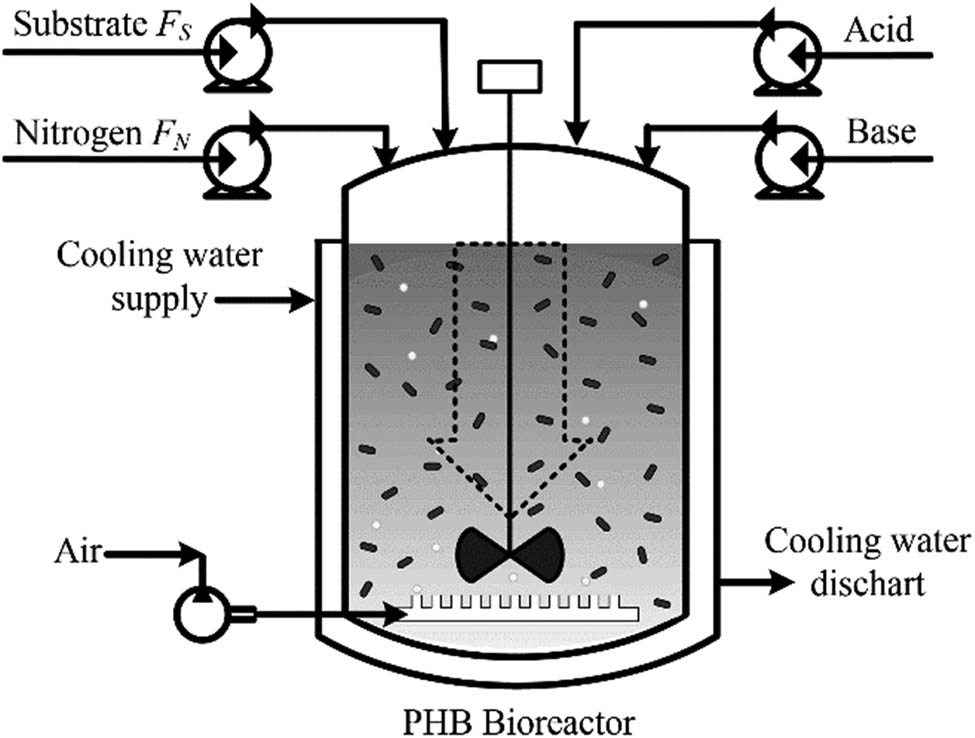
Schematic diagram of a typically PHB fed-batch bioreactor.
In this example, the fermentation is operated in the fed-batch bioreactor for 30 h. The prepared inoculum (Cupriavidus necator) is supplied into a 500 L bioreactor. The culture medium is composed of 75 vol% of sugarcane vinasses and 25 vol% of molasses [22,32]. The process is initially performed in batch operation for 2 h; microbial cells are well dispersed in the agitated medium. Then, the process is performed in a fed-batch operation, where the substrate (molasses) and nitrogen source are fed to the bioreactor to manipulate the PHB production. In recent years, some research articles have proposed the online monitoring of substrate, biomass, and PHB by using sensors, gas chromatography, infrared spectroscopy, or estimated by a reliable measurement [19,21,33,34]. Thus, the substrate, biomass and PHB concentrations, and working volume are assumed to be measurable in real-time during the operation. However, the nitrogen concentration cannot be measured online [22]; therefore, a nonlinear state estimation is applied in this work. A nonlinear first-principles model for the fed-batch bioreactor is developed, with additional simplified assumptions considered in the one-dimensional PHB bioreactor model:
The biomass and PHB concentrations in the bioreactor are assumed to a follow fully dispersed behavior.
The dispersion of substrate and nitrogen sources is considered to be one-dimensional.
The microorganisms consume substrate and nitrogen sources to produce biomass and PHB. By-product production is neglected.
The temperature, pH, and dissolved oxygen of the bioreactor are effectively regulated in a range [22]; the impact of these factors on microbial growth can be ignored.
The substrate concentration, total biomass concentration, PHB concentration, and working volume are measurable in real time during the operation.
The governing equations of the fed-batch bioreactor for PHB production are composed of dynamic behaviors of the substrate concentration, nitrogen concentration, biomass concentration, PHB concentration, and working volume.
2.3.1 Mass balance of the distributed variables
The process model for fed-batch fermentation was reformulated in previous work to include dispersion terms of nutrients with Pe = 20 [25,26]. The previous studies showed a significant effect of axial dispersion on the kinetics of PHB formation; more details and equations are available in the literature. The conservation of substrate and nitrogen sources is distributed along the liquid level of the fed-batch bioreactor. The dynamics of substrate and nitrogen concentrations can be described as follows:
with the boundary and initial conditions:
where S(z, t) denotes substrate concentration, N(z, t) denotes nitrogen concentration, X(t) denotes total biomass concentration, V(t) denotes the working volume,
2.3.2 Mass balance of the lumped variables
In general, the process is initially operated in batch operation, and the inoculated cells are well dispersed in the agitated medium. After the process is performed in fed-batch operation, concentrated substrate and nitrogen source are fed to the bioreactor, which results in a complex interaction between the dispersed nutrients and microorganisms. The dynamics of the total biomass concentration, accumulated PHB concentration, and working volume can be written as follows:
where
with the initial conditions:
where
Parameters of the fed-batch bioreactor for PHB production
| Symbol | Parameter | Value |
|---|---|---|
|
|
Axial dispersion coefficient | 0.437 h−1 |
| S m | Carbon/nitrogen ratio for
|
0.3 g N/g S |
| K sr | Saturation constant | 0.0697 |
| n k | Dimensionless exponent | 1.490 |
| Pe | Peclet number | 20 |
| k 1 | Kinetic constant | 1.831 |
| k 2 | Kinetic constant | 0.067 |
| k 3 | Kinetic constant | 0.6511 |
| k 4 | Kinetic constant | 0.300 |
| k 5 | Kinetic constant | 0.008 |
2.4 Formulation of the control system
Since the growth and PHB accumulation of microbial cells depending on the dispersed carbon and nitrogen source, the control objective of this example process is to regulate the PHB concentration (P) at the updated set points by manipulating the feed rates of the nitrogen source
where
subject to:
where
2.5 The control approach
For the control application, real-time state estimation for the unmeasurable variables is required for providing the state feedback variables. In this work, the unmeasurable state and the state derivatives are estimated by applying a finite-based, nonlinear state estimator, and the process model of Eqs. 5 and 6. A schematic diagram of the proposed control structure is shown in Figure 3.

Schematic diagram of the developed control system for the fed-batch bioreactor.
The experimental simulation of the example process is conducted by computing software such as MATLAB and COMSOL Multiphysics. A compact equation of the nonlinear state estimator can be written as follows:
where the vectors of estimated states are
where
subject to:
Implementation of the developed control system requires feedback measurements from the available sensors and state estimator. To avoid a high substrate concentration caused by substrate accumulation, the input constraints of the feed streams need to be specified.
3 Results and discussion
The process behaviors of the fed-batch bioreactor are simulated by applying the coupled PDE–ODE system in Eqs. 5 and 6. In the simulation, the initial conditions are applied:

PHB concentration response of the closed-loop system.

Substrate and nitrogen concentration profiles corresponding to the closed-loop system of Figure 4.

Biomass concentration profile corresponding to the closed-loop system of Figure 4.

Profile of substrate and nitrogen-source feed rates corresponding to the closed-loop system of Figure 4.
At the beginning of the fed-batch operation, the proposed controller increases the feed rates of substrate and nitrogen sources to support the growth of microorganisms. An increase in microbial growth, itself resulting from the adequate substrate and nitrogen source, increases the cells for polymer accumulation, which increases the PHB concentration [8]. Then, the control actions are optimally adjusted to minimize the error between the response of the PHB concentration and the updated set points. As shown in Figure 4, the PHB accumulation increases rapidly after the bioreactor is regulated with a low-nitrogen supply condition. The lack of a nitrogen source decreases the intracellular enzyme for cell growth, and the substrate is consumed for the enhancement of PHB production [9]. The different results corresponding to cultivations carried out with the various types of cultures and substrates are reported in previous research works. For the experimental studies reporting PHA production by C. necator from a vinasses–molasses mixture, cultivation in lab- and pilot-scale bioreactors have been performed in some works. Cultivations were carried out in a 5-L bioreactor using vinasse with nitrogen and mineral salts [38]. The PHB content (26% of total biomass) was reported as the best value when compared to the application of pure vinasse and vinasse with nitrogen. García et al. reported a value of productivity for PHA production (0.27 g·L−1·h−1) from fermentation in a 5-L bioreactor using vinasses–molasses mixture [21]. An extended study was conducted in a 500-L bioreactor using similar substrates [22]. The feeding policy for fed-batch operation is developed based on a lumped model; a soft sensor is applied for substrate prediction. Among their developed control strategies, the best value reported for productivity (0.364 g·L−1·h−1) was obtained in the fermentation that applied the productivity and profitability-oriented optimization. To compare the control performance of the proposed system with similar substrates, cultures, and conditions in this work, the modified PI controller is applied with the updated set points [39,40]. The PHB concentration, content of PHB (% of total biomass), substrate concentration, and nitrogen concentration are shown in Figures 8–11, respectively.

PHB concentration of the closed-loop system.

PHB content of total biomass.

Substrate concentration of the closed-loop system.

Nitrogen concentration of the closed-loop system.
As shown in the figures, the proposed control strategy achieved higher performance than the applied PI controller. The PHB concentrations at the end of the operation obtained from the proposed controller and modified PI controller are 11.27 and 8.45 g·L−1, while the PHB contents (% of total biomass) are 40.12% and 34.70%, respectively. As explained above, the changing of substrate and nitrogen concentration in the broth during the operation could selectively promote cell and polymer productions. The proposed controller applied the integrated variables of substrate and nitrogen concentrations to update the set points and provide the optimal control actions to promote PHB accumulation. Additionally, the low final substrate and nitrogen-source concentrations shown in Figures 10 and 11 demonstrate that the proposed feeding strategy has the ability to utilize the nutrients effectively. The developed control strategy is evaluated for a regulatory problem to investigate the control robustness. The regulatory test is conducted by using the same initial conditions as the open-loop simulation. An unmeasured step disturbance is introduced by decreasing the feed nitrogen concentration by 10% after 12 h [37]. The responses of the performance test are shown in Figures 12 and 13, where it can be seen that the developed control scheme successfully rejects the effect of the disturbance and compensates for the reduced feed nitrogen concentration. The PHB concentration and productivity of the performance test are shown in Figures 14 and 15, respectively.

Substrate and nitrogen concentration profiles under performance test.

Profile of substrate and nitrogen-source feed rates under performance test.

PHB concentration under regulatory test.

PHB Productivity of the closed-loop and regulatory system.
The fed-batch operation with a change in nutrient feed concentration could lead to inconsistency in the polymer production rate (unfortunately, there is no report of the investigation for the PHA production by vinasses/molasses) [37]. Though the disturbance affects PHA production, the proposed strategy updates the trajectory path for set point tracking while the first-order integrator compensates for the error, quickly rejects the disturbance, and improves the process responses. It can be seen from the results that are shown in Figure 15 that the proposed control system could provide more productivity (33–38%) compared to the applied PI controller. From the results, it is clear that the proposed control strategy that considers nutrient dispersion has the ability to enhance PHB production and improve the performance of the fed-batch bioreactor.
4 Conclusions
This article has proposed an optimization-based control strategy to enhance PHA production in the fed-batch bioreactor described by a coupled PDEs–ODEs model. The AMPC-based controller is combined with a nonlinear state estimator and integrator to estimate the unmeasured variables and handle process disturbances; the constrained optimization problem of the controller applies the set point trajectory corresponding to the biomass concentration. In simulation experiments, a change in feed concentration was introduced to investigate control robustness. The results showed that the developed control scheme successfully provides the optimal control actions that enhance the polymer production and follow the updated set point. Control performance of the control strategy under a regulatory test demonstrated the capability to handle the process disturbance and provide adequate control actions efficiently. Additionally, further applications of the control strategy to industrial-scale PHA processes with a greater dispersion effect are expected to obtain better control performance and improve process efficiency.
-
Funding information: This work was supported by the Sirindhorn International Thai-German Graduate School of Engineering, King Mongkut’s University of Technology North Bangkok (Contract no. KMUTNB-63-KNOW-30). Support from these sources is gratefully acknowledged.
-
Author contributions: Atthasit Tawai: writing – original draft; Malinee Sriariyanun: writing – review and editing; Chanin Panjapornpon: formal analysis.
-
Conflict of interest: The authors state no conflict of interest.
References
[1] Mozumder MSI, De Wever H, Volcke EI, Garcia-Gonzalez L. A robust fed-batch feeding strategy independent of the carbon source for optimal polyhydroxybutyrate production. Process Biochem. 2014;49(3):365–73. 10.1016/j.procbio.2013.12.004.Search in Google Scholar
[2] Reddy CSK, Ghai R, Kalia V. Polyhydroxyalkanoates: An overview. Bioresour Technol. 2003;87(2):137–46. 10.1016/S0960-8524(02)00212-2.Search in Google Scholar
[3] Bucci DZ, Tavares LBB, Sell I. PHB packaging for the storage of food products. Polym Test. 2005;24(5):564–71. 10.1016/j.polymertesting.2005.02.008.Search in Google Scholar
[4] EL Shafey AM. Green synthesis of metal and metal oxide nanoparticles from plant leaf extracts and their applications: A review. Green Process Synth. 2020;9(1):304–39. 10.1515/gps-2020-0031.Search in Google Scholar
[5] Kosseva MR, Rusbandi E. Trends in the biomanufacture of polyhydroxyalkanoates with focus on downstream processing. Int J Biol Macromol. 2018;107:62–778. 10.1016/j.ijbiomac.2017.09.054.Search in Google Scholar PubMed
[6] Anderson AJ, Dawes E. Occurrence, metabolism, metabolic role, and industrial uses of bacterial polyhydroxyalkanoates. Microbiol Rev. 1990;54(4):450–72.10.1128/mr.54.4.450-472.1990Search in Google Scholar PubMed PubMed Central
[7] Braunegg G, Lefebvre G, Genser KF. Polyhydroxyalkanoates, biopolyesters from renewable resources: physiological and engineering aspects. J Biotechnol. 1998;65(2–3):127–61. 10.1128/mr.54.4.450-472.1990.Search in Google Scholar
[8] Fang F, Sheng GP, Yu HQ. A novel integrated approach to the enhanced production of polyhydrobutyrate with mixed culture in activated sludge. Ind Eng Chem Res. 2010;49(16):7478–83. 10.1021/ie100297y.Search in Google Scholar
[9] Steinbüchel A, Lütke-Eversloh T. Metabolic engineering and pathway construction for biotechnological production of relevant polyhydroxyalkanoates in microorganisms. Biochem Eng J. 2003;16(2):81–96. 10.1016/S1369-703X(03)00036-6.Search in Google Scholar
[10] Grothe E, Chisti Y. Poly (β-hydroxybutyric acid) thermoplastic production by Alcaligenes latus: behavior of fed-batch cultures. Bioprocess Eng. 2000;22(5):441–9. 10.1007/s004490050757.Search in Google Scholar
[11] Patwardhan PR, Srivastava AK. Model-based fed-batch cultivation of R. eutropha for enhanced biopolymer production. Biochem Eng J. 2004;20(1):21–8. 10.1016/j.bej.2004.04.001.Search in Google Scholar
[12] Khanna S, Srivastava AK. Optimization of nutrient feed concentration and addition time for production of poly (β-hydroxybutyrate). Enzyme Microb Technol. 2006;39(5):1145–51. 10.1016/j.enzmictec.2006.02.023.Search in Google Scholar
[13] Khanna S, Srivastava AK. Computer simulated fed-batch cultivation for over production of PHB: a comparison of simultaneous and alternate feeding of carbon and nitrogen. Biochem Eng J. 2006;27(3):197–203. 10.1016/j.bej.2005.08.006.Search in Google Scholar
[14] Asenjo JA, Suk I. Kinetics and models for the bioconversion of methane into an intracellular polymer, poly-beta-hydroxybutyrate (PHB). Biotechnol Bioeng Symp. 1985;15:225.Search in Google Scholar
[15] Mulchandani A, Luong JHT, Groom C. Substrate inhibition kinetics for microbial growth and synthesis of poly-β-hydroxybutyric acid by Alcaligenes eutrophus ATCC 17697. Appl Microbiol Biotechnol. 1989;30(1):11–7. 10.1007/BF00255990.Search in Google Scholar
[16] Shahhosseini S. Simulation and optimisation of PHB production in fed-batch culture of Ralstonia eutropha. Process Biochem. 2004;39(8):963–9. 10.1016/S0032-9592(03)00209-7.Search in Google Scholar
[17] Patnaik PR. Dispersion optimization to enhance PHB production in fed-batch cultures of Ralstonia eutropha. Bioresour Technol. 2006;97(16):1994–2001. 10.1016/j.biortech.2005.09.027.Search in Google Scholar PubMed
[18] López JA, Bucalá V, Villar MA. Application of dynamic optimization techniques for poly (β-hydroxybutyrate) production in a fed-batch bioreactor. Ind Eng Chem Res. 2010;49(4):1762–9. 10.1021/ie9006547.Search in Google Scholar
[19] Wu W, Lai SY, Jang MF, Chou YS. Optimal adaptive control schemes for PHB production in fed-batch fermentation of Ralstonia eutropha. J Process Control. 2013;23(8):1159–68. 10.1016/j.jprocont.2013.07.006.Search in Google Scholar
[20] Srisuddee S, Malinee S, Tawai A, Panjapornpo C, Wijayanti H. Enhancement of PHB production process in a fed-batch bioreactor using input-output linearization technique with optimal setpoints. Appl Sci Eng Prog. 2021;14(2):196–205. 10.14416/j.asep.2021.02.003.Search in Google Scholar
[21] García C, Alcaraz W, Acosta-Cárdenas A, Ochoa S. Application of process system engineering tools to the fed-batch production of poly (3-hydroxybutyrate-co-3-hydroxyvalerate) from a vinasses–molasses mixture. Bioprocess Biosyst Eng. 2019;42(6):1023–37. 10.14416/j.asep.2021.02.003.Search in Google Scholar
[22] Ochoa S, García C, Alcaraz W. Real‐time optimization and control for polyhydroxybutyrate fed‐batch production at pilot plant scale. J Chem Technol Biotechnol. 2020;95(12):3221–31. 10.1002/jctb.6500.Search in Google Scholar
[23] Hewitt CJ, Nienow AW. The scale‐up of microbial batch and fed‐batch fermentation processes. Adv Appl Microbiol. 2007;62:105–35. 10.1016/S0065-2164(07)62005-X.Search in Google Scholar PubMed
[24] Blanch HW, Clark DS. Biochemical engineering. Now York: Marel Dekkar. Inc; 1996.10.1201/9780429258732Search in Google Scholar
[25] Froment GF, Bischoff KB, De Wilde J. Chemical reactor analysis and design. New York: Wiley; 1990.Search in Google Scholar
[26] Patnaik PR. Neural network designs for poly-β-hydroxybutyrate production optimization under simulated industrial conditions. Biotechnol Lett. 2005;27(6):409–15. 10.1007/s10529-005-1775-0.Search in Google Scholar PubMed
[27] Tawai A, Panjapornpon C, Dittanet P. Control of ethylene dichloride cracking furnace using an analytical model predictive control strategy for a coupled partial differential equation/ordinary differential equation system. Ind Eng Chem Res. 2016;55(38):10121–31. 10.1021/acs.iecr.6b00916.Search in Google Scholar
[28] Panjapornpon C, Soroush M, Seider WD. Model-based controller design for unstable, non-minimum-phase, nonlinear processes. Ind Eng Chem Res. 2006;45(8):2758–68. 10.1021/ie050724p.Search in Google Scholar
[29] Soroush M, Kravaris C. A continuous-time formulation of nonlinear model predictive control. Int J Control. 1996;63(1):121–46. 10.1080/00207179608921835.Search in Google Scholar
[30] Panjapornpon C, Kajornrungsilp I, Rochpuang C. Input/output linearizing controller with Taylor series expansion for a nonminimum phase process by hardware‐in‐the‐loop approach. Asia-Pac J Chem Eng. 2020;15(3):2440. 10.1002/apj.2440.Search in Google Scholar
[31] Lee J, Park HJ, Moon M, Lee JS, Min K. Recent progress and challenges in microbial polyhydroxybutyrate (PHB) production from CO2 as a sustainable feedstock: A state-of-the-art review. Bioresour Technol. 2021;339:125616.10.1016/j.biortech.2021.125616Search in Google Scholar PubMed
[32] Acosta-Cárdenas A, Alcaraz-Zapata W, Cardona-Betancur M. Sugarcane molasses and vinasse as a substrate for polyhydroxyalkanoates (PHA) production. Dyna. 2018;85(206):220–5. 10.15446/dyna.v85n206.68279.Search in Google Scholar
[33] Kiviharju K, Salonen K, Moilanen U, Meskanen E, Leisola M, Eerikäinen T. On-line biomass measurements in bioreactor cultivations: Comparison study of two on-line probes. J Ind Microbiol Biotechnol. 2007;34(8):561–6. 10.1016/j.biortech.2021.125616.Search in Google Scholar PubMed
[34] Landgrebe D, Haake C, Höpfner T, Beutel S, Hitzmann B, Scheper T, et al. On-line infrared spectroscopy for bioprocess monitoring. Appl Microbiol Biotechnol. 2010;88(1):11–22. 10.1007/s00253-010-2743-8.Search in Google Scholar PubMed
[35] Johnson K, Kleerebezem R, van Loosdrecht MC. Influence of the C/N ratio on the performance of polyhydroxybutyrate (PHB) producing sequencing batch reactors at short SRTs. Water Res. 2010;44(7):2141–52. 10.1016/j.watres.2009.12.031.Search in Google Scholar PubMed
[36] Tawai A, Panjapornpon C. Input–output linearizing control strategy for an ethylene dichloride cracking furnace using a coupled PDE-ODE model. Ind Eng Chem Res. 2016;55(3):683–91. 10.1021/acs.iecr.5b03759.Search in Google Scholar
[37] Rivero CP, Sun C, Theodoropoulos C, Webb C. Building a predictive model for PHB production from glycerol. Biochem Eng J. 2016;116:113–21. 10.1016/j.bej.2016.04.016.Search in Google Scholar
[38] Zanfonato K, Schmidt M, Quines LK, Gai CS, Schmidell W, Aragão GMFD. Can vinasse be used as carbon source for poly (3-hydroxybutyrate) production by Cupriavidus necator DSM 545? Braz J Chem Eng. 2018;35:901–8. 10.1590/0104-6632.20180353s20170265.Search in Google Scholar
[39] Mears L, Stocks SM, Sin G, Gernaey KV. A review of control strategies for manipulating the feed rate in fed-batch fermentation processes. J Biotechnol. 2017;245:34–46. 10.1016/j.jbiotec.2017.01.008.Search in Google Scholar PubMed
[40] Kumar V, Nigam KDP. Process intensification in green synthesis. Green Process Synth. 2012;1(2012):79–107. 10.1515/greenps-2011-0003.Search in Google Scholar
© 2023 the author(s), published by De Gruyter
This work is licensed under the Creative Commons Attribution 4.0 International License.
Articles in the same Issue
- Research Articles
- Value-added utilization of coal fly ash and recycled polyvinyl chloride in door or window sub-frame composites
- High removal efficiency of volatile phenol from coking wastewater using coal gasification slag via optimized adsorption and multi-grade batch process
- Evolution of surface morphology and properties of diamond films by hydrogen plasma etching
- Removal efficiency of dibenzofuran using CuZn-zeolitic imidazole frameworks as a catalyst and adsorbent
- Rapid and efficient microwave-assisted extraction of Caesalpinia sappan Linn. heartwood and subsequent synthesis of gold nanoparticles
- The catalytic characteristics of 2-methylnaphthalene acylation with AlCl3 immobilized on Hβ as Lewis acid catalyst
- Biodegradation of synthetic PVP biofilms using natural materials and nanoparticles
- Rutin-loaded selenium nanoparticles modulated the redox status, inflammatory, and apoptotic pathways associated with pentylenetetrazole-induced epilepsy in mice
- Optimization of apigenin nanoparticles prepared by planetary ball milling: In vitro and in vivo studies
- Synthesis and characterization of silver nanoparticles using Origanum onites leaves: Cytotoxic, apoptotic, and necrotic effects on Capan-1, L929, and Caco-2 cell lines
- Exergy analysis of a conceptual CO2 capture process with an amine-based DES
- Construction of fluorescence system of felodipine–tetracyanovinyl–2,2′-bipyridine complex
- Excellent photocatalytic degradation of rhodamine B over Bi2O3 supported on Zn-MOF nanocomposites under visible light
- Optimization-based control strategy for a large-scale polyhydroxyalkanoates production in a fed-batch bioreactor using a coupled PDE–ODE system
- Effectiveness of pH and amount of Artemia urumiana extract on physical, chemical, and biological attributes of UV-fabricated biogold nanoparticles
- Geranium leaf-mediated synthesis of silver nanoparticles and their transcriptomic effects on Candida albicans
- Synthesis, characterization, anticancer, anti-inflammatory activities, and docking studies of 3,5-disubstituted thiadiazine-2-thiones
- Synthesis and stability of phospholipid-encapsulated nano-selenium
- Putative anti-proliferative effect of Indian mustard (Brassica juncea) seed and its nano-formulation
- Enrichment of low-grade phosphorites by the selective leaching method
- Electrochemical analysis of the dissolution of gold in a copper–ethylenediamine–thiosulfate system
- Characterisation of carbonate lake sediments as a potential filler for polymer composites
- Evaluation of nano-selenium biofortification characteristics of alfalfa (Medicago sativa L.)
- Quality of oil extracted by cold press from Nigella sativa seeds incorporated with rosemary extracts and pretreated by microwaves
- Heteropolyacid-loaded MOF-derived mesoporous zirconia catalyst for chemical degradation of rhodamine B
- Recovery of critical metals from carbonatite-type mineral wastes: Geochemical modeling investigation of (bio)hydrometallurgical leaching of REEs
- Photocatalytic properties of ZnFe-mixed oxides synthesized via a simple route for water remediation
- Attenuation of di(2-ethylhexyl)phthalate-induced hepatic and renal toxicity by naringin nanoparticles in a rat model
- Novel in situ synthesis of quaternary core–shell metallic sulfide nanocomposites for degradation of organic dyes and hydrogen production
- Microfluidic steam-based synthesis of luminescent carbon quantum dots as sensing probes for nitrite detection
- Transformation of eggshell waste to egg white protein solution, calcium chloride dihydrate, and eggshell membrane powder
- Preparation of Zr-MOFs for the adsorption of doxycycline hydrochloride from wastewater
- Green nanoarchitectonics of the silver nanocrystal potential for treating malaria and their cytotoxic effects on the kidney Vero cell line
- Carbon emissions analysis of producing modified asphalt with natural asphalt
- An efficient and green synthesis of 2-phenylquinazolin-4(3H)-ones via t-BuONa-mediated oxidative condensation of 2-aminobenzamides and benzyl alcohols under solvent- and transition metal-free conditions
- Chitosan nanoparticles loaded with mesosulfuron methyl and mesosulfuron methyl + florasulam + MCPA isooctyl to manage weeds of wheat (Triticum aestivum L.)
- Synergism between lignite and high-sulfur petroleum coke in CO2 gasification
- Facile aqueous synthesis of ZnCuInS/ZnS–ZnS QDs with enhanced photoluminescence lifetime for selective detection of Cu(ii) ions
- Rapid synthesis of copper nanoparticles using Nepeta cataria leaves: An eco-friendly management of disease-causing vectors and bacterial pathogens
- Study on the photoelectrocatalytic activity of reduced TiO2 nanotube films for removal of methyl orange
- Development of a fuzzy logic model for the prediction of spark-ignition engine performance and emission for gasoline–ethanol blends
- Micro-impact-induced mechano-chemical synthesis of organic precursors from FeC/FeN and carbonates/nitrates in water and its extension to nucleobases
- Green synthesis of strontium-doped tin dioxide (SrSnO2) nanoparticles using the Mahonia bealei leaf extract and evaluation of their anticancer and antimicrobial activities
- A study on the larvicidal and adulticidal potential of Cladostepus spongiosus macroalgae and green-fabricated silver nanoparticles against mosquito vectors
- Catalysts based on nickel salt heteropolytungstates for selective oxidation of diphenyl sulfide
- Powerful antibacterial nanocomposites from Corallina officinalis-mediated nanometals and chitosan nanoparticles against fish-borne pathogens
- Removal behavior of Zn and alkalis from blast furnace dust in pre-reduction sinter process
- Environmentally friendly synthesis and computational studies of novel class of acridinedione integrated spirothiopyrrolizidines/indolizidines
- The mechanisms of inhibition and lubrication of clean fracturing flowback fluids in water-based drilling fluids
- Adsorption/desorption performance of cellulose membrane for Pb(ii)
- A one-pot, multicomponent tandem synthesis of fused polycyclic pyrrolo[3,2-c]quinolinone/pyrrolizino[2,3-c]quinolinone hybrid heterocycles via environmentally benign solid state melt reaction
- Green synthesis of silver nanoparticles using durian rind extract and optical characteristics of surface plasmon resonance-based optical sensor for the detection of hydrogen peroxide
- Electrochemical analysis of copper-EDTA-ammonia-gold thiosulfate dissolution system
- Characterization of bio-oil production by microwave pyrolysis from cashew nut shells and Cassia fistula pods
- Green synthesis methods and characterization of bacterial cellulose/silver nanoparticle composites
- Photocatalytic research performance of zinc oxide/graphite phase carbon nitride catalyst and its application in environment
- Effect of phytogenic iron nanoparticles on the bio-fortification of wheat varieties
- In vitro anti-cancer and antimicrobial effects of manganese oxide nanoparticles synthesized using the Glycyrrhiza uralensis leaf extract on breast cancer cell lines
- Preparation of Pd/Ce(F)-MCM-48 catalysts and their catalytic performance of n-heptane isomerization
- Green “one-pot” fluorescent bis-indolizine synthesis with whole-cell plant biocatalysis
- Silica-titania mesoporous silicas of MCM-41 type as effective catalysts and photocatalysts for selective oxidation of diphenyl sulfide by H2O2
- Biosynthesis of zinc oxide nanoparticles from molted feathers of Pavo cristatus and their antibiofilm and anticancer activities
- Clean preparation of rutile from Ti-containing mixed molten slag by CO2 oxidation
- Synthesis and characterization of Pluronic F-127-coated titanium dioxide nanoparticles synthesized from extracts of Atractylodes macrocephala leaf for antioxidant, antimicrobial, and anticancer properties
- Effect of pretreatment with alkali on the anaerobic digestion characteristics of kitchen waste and analysis of microbial diversity
- Ameliorated antimicrobial, antioxidant, and anticancer properties by Plectranthus vettiveroides root extract-mediated green synthesis of chitosan nanoparticles
- Microwave-accelerated pretreatment technique in green extraction of oil and bioactive compounds from camelina seeds: Effectiveness and characterization
- Studies on the extraction performance of phorate by aptamer-functionalized magnetic nanoparticles in plasma samples
- Investigation of structural properties and antibacterial activity of AgO nanoparticle extract from Solanum nigrum/Mentha leaf extracts by green synthesis method
- Green fabrication of chitosan from marine crustaceans and mushroom waste: Toward sustainable resource utilization
- Synthesis, characterization, and evaluation of nanoparticles of clodinofop propargyl and fenoxaprop-P-ethyl on weed control, growth, and yield of wheat (Triticum aestivum L.)
- The enhanced adsorption properties of phosphorus from aqueous solutions using lanthanum modified synthetic zeolites
- Separation of graphene oxides of different sizes by multi-layer dialysis and anti-friction and lubrication performance
- Visible-light-assisted base-catalyzed, one-pot synthesis of highly functionalized cinnolines
- The experimental study on the air oxidation of 5-hydroxymethylfurfural to 2,5-furandicarboxylic acid with Co–Mn–Br system
- Highly efficient removal of tetracycline and methyl violet 2B from aqueous solution using the bimetallic FeZn-ZIFs catalyst
- A thermo-tolerant cellulase enzyme produced by Bacillus amyloliquefaciens M7, an insight into synthesis, optimization, characterization, and bio-polishing activity
- Exploration of ketone derivatives of succinimide for their antidiabetic potential: In vitro and in vivo approaches
- Ultrasound-assisted green synthesis and in silico study of 6-(4-(butylamino)-6-(diethylamino)-1,3,5-triazin-2-yl)oxypyridazine derivatives
- A study of the anticancer potential of Pluronic F-127 encapsulated Fe2O3 nanoparticles derived from Berberis vulgaris extract
- Biogenic synthesis of silver nanoparticles using Consolida orientalis flowers: Identification, catalytic degradation, and biological effect
- Initial assessment of the presence of plastic waste in some coastal mangrove forests in Vietnam
- Adsorption synergy electrocatalytic degradation of phenol by active oxygen-containing species generated in Co-coal based cathode and graphite anode
- Antibacterial, antifungal, antioxidant, and cytotoxicity activities of the aqueous extract of Syzygium aromaticum-mediated synthesized novel silver nanoparticles
- Synthesis of a silica matrix with ZnO nanoparticles for the fabrication of a recyclable photodegradation system to eliminate methylene blue dye
- Natural polymer fillers instead of dye and pigments: Pumice and scoria in PDMS fluid and elastomer composites
- Study on the preparation of glycerylphosphorylcholine by transesterification under supported sodium methoxide
- Wireless network handheld terminal-based green ecological sustainable design evaluation system: Improved data communication and reduced packet loss rate
- The optimization of hydrogel strength from cassava starch using oxidized sucrose as a crosslinking agent
- Green synthesis of silver nanoparticles using Saccharum officinarum leaf extract for antiviral paint
- Study on the reliability of nano-silver-coated tin solder joints for flip chips
- Environmentally sustainable analytical quality by design aided RP-HPLC method for the estimation of brilliant blue in commercial food samples employing a green-ultrasound-assisted extraction technique
- Anticancer and antimicrobial potential of zinc/sodium alginate/polyethylene glycol/d-pinitol nanocomposites against osteosarcoma MG-63 cells
- Nanoporous carbon@CoFe2O4 nanocomposite as a green absorbent for the adsorptive removal of Hg(ii) from aqueous solutions
- Characterization of silver sulfide nanoparticles from actinobacterial strain (M10A62) and its toxicity against lepidopteran and dipterans insect species
- Phyto-fabrication and characterization of silver nanoparticles using Withania somnifera: Investigating antioxidant potential
- Effect of e-waste nanofillers on the mechanical, thermal, and wear properties of epoxy-blend sisal woven fiber-reinforced composites
- Magnesium nanohydroxide (2D brucite) as a host matrix for thymol and carvacrol: Synthesis, characterization, and inhibition of foodborne pathogens
- Synergistic inhibitive effect of a hybrid zinc oxide-benzalkonium chloride composite on the corrosion of carbon steel in a sulfuric acidic solution
- Review Articles
- Role and the importance of green approach in biosynthesis of nanopropolis and effectiveness of propolis in the treatment of COVID-19 pandemic
- Gum tragacanth-mediated synthesis of metal nanoparticles, characterization, and their applications as a bactericide, catalyst, antioxidant, and peroxidase mimic
- Green-processed nano-biocomposite (ZnO–TiO2): Potential candidates for biomedical applications
- Reaction mechanisms in microwave-assisted lignin depolymerisation in hydrogen-donating solvents
- Recent progress on non-noble metal catalysts for the deoxydehydration of biomass-derived oxygenates
- Rapid Communication
- Phosphorus removal by iron–carbon microelectrolysis: A new way to achieve phosphorus recovery
- Special Issue: Biomolecules-derived synthesis of nanomaterials for environmental and biological applications (Guest Editors: Arpita Roy and Fernanda Maria Policarpo Tonelli)
- Biomolecules-derived synthesis of nanomaterials for environmental and biological applications
- Nano-encapsulated tanshinone IIA in PLGA-PEG-COOH inhibits apoptosis and inflammation in cerebral ischemia/reperfusion injury
- Green fabrication of silver nanoparticles using Melia azedarach ripened fruit extract, their characterization, and biological properties
- Green-synthesized nanoparticles and their therapeutic applications: A review
- Antioxidant, antibacterial, and cytotoxicity potential of synthesized silver nanoparticles from the Cassia alata leaf aqueous extract
- Green synthesis of silver nanoparticles using Callisia fragrans leaf extract and its anticancer activity against MCF-7, HepG2, KB, LU-1, and MKN-7 cell lines
- Algae-based green AgNPs, AuNPs, and FeNPs as potential nanoremediators
- Green synthesis of Kickxia elatine-induced silver nanoparticles and their role as anti-acetylcholinesterase in the treatment of Alzheimer’s disease
- Phytocrystallization of silver nanoparticles using Cassia alata flower extract for effective control of fungal skin pathogens
- Antibacterial wound dressing with hydrogel from chitosan and polyvinyl alcohol from the red cabbage extract loaded with silver nanoparticles
- Leveraging of mycogenic copper oxide nanostructures for disease management of Alternaria blight of Brassica juncea
- Nanoscale molecular reactions in microbiological medicines in modern medical applications
- Synthesis and characterization of ZnO/β-cyclodextrin/nicotinic acid nanocomposite and its biological and environmental application
- Green synthesis of silver nanoparticles via Taxus wallichiana Zucc. plant-derived Taxol: Novel utilization as anticancer, antioxidation, anti-inflammation, and antiurolithic potential
- Recyclability and catalytic characteristics of copper oxide nanoparticles derived from bougainvillea plant flower extract for biomedical application
- Phytofabrication, characterization, and evaluation of novel bioinspired selenium–iron (Se–Fe) nanocomposites using Allium sativum extract for bio-potential applications
- Erratum
- Erratum to “Synthesis, characterization, and evaluation of nanoparticles of clodinofop propargyl and fenoxaprop-P-ethyl on weed control, growth, and yield of wheat (Triticum aestivum L.)”
Articles in the same Issue
- Research Articles
- Value-added utilization of coal fly ash and recycled polyvinyl chloride in door or window sub-frame composites
- High removal efficiency of volatile phenol from coking wastewater using coal gasification slag via optimized adsorption and multi-grade batch process
- Evolution of surface morphology and properties of diamond films by hydrogen plasma etching
- Removal efficiency of dibenzofuran using CuZn-zeolitic imidazole frameworks as a catalyst and adsorbent
- Rapid and efficient microwave-assisted extraction of Caesalpinia sappan Linn. heartwood and subsequent synthesis of gold nanoparticles
- The catalytic characteristics of 2-methylnaphthalene acylation with AlCl3 immobilized on Hβ as Lewis acid catalyst
- Biodegradation of synthetic PVP biofilms using natural materials and nanoparticles
- Rutin-loaded selenium nanoparticles modulated the redox status, inflammatory, and apoptotic pathways associated with pentylenetetrazole-induced epilepsy in mice
- Optimization of apigenin nanoparticles prepared by planetary ball milling: In vitro and in vivo studies
- Synthesis and characterization of silver nanoparticles using Origanum onites leaves: Cytotoxic, apoptotic, and necrotic effects on Capan-1, L929, and Caco-2 cell lines
- Exergy analysis of a conceptual CO2 capture process with an amine-based DES
- Construction of fluorescence system of felodipine–tetracyanovinyl–2,2′-bipyridine complex
- Excellent photocatalytic degradation of rhodamine B over Bi2O3 supported on Zn-MOF nanocomposites under visible light
- Optimization-based control strategy for a large-scale polyhydroxyalkanoates production in a fed-batch bioreactor using a coupled PDE–ODE system
- Effectiveness of pH and amount of Artemia urumiana extract on physical, chemical, and biological attributes of UV-fabricated biogold nanoparticles
- Geranium leaf-mediated synthesis of silver nanoparticles and their transcriptomic effects on Candida albicans
- Synthesis, characterization, anticancer, anti-inflammatory activities, and docking studies of 3,5-disubstituted thiadiazine-2-thiones
- Synthesis and stability of phospholipid-encapsulated nano-selenium
- Putative anti-proliferative effect of Indian mustard (Brassica juncea) seed and its nano-formulation
- Enrichment of low-grade phosphorites by the selective leaching method
- Electrochemical analysis of the dissolution of gold in a copper–ethylenediamine–thiosulfate system
- Characterisation of carbonate lake sediments as a potential filler for polymer composites
- Evaluation of nano-selenium biofortification characteristics of alfalfa (Medicago sativa L.)
- Quality of oil extracted by cold press from Nigella sativa seeds incorporated with rosemary extracts and pretreated by microwaves
- Heteropolyacid-loaded MOF-derived mesoporous zirconia catalyst for chemical degradation of rhodamine B
- Recovery of critical metals from carbonatite-type mineral wastes: Geochemical modeling investigation of (bio)hydrometallurgical leaching of REEs
- Photocatalytic properties of ZnFe-mixed oxides synthesized via a simple route for water remediation
- Attenuation of di(2-ethylhexyl)phthalate-induced hepatic and renal toxicity by naringin nanoparticles in a rat model
- Novel in situ synthesis of quaternary core–shell metallic sulfide nanocomposites for degradation of organic dyes and hydrogen production
- Microfluidic steam-based synthesis of luminescent carbon quantum dots as sensing probes for nitrite detection
- Transformation of eggshell waste to egg white protein solution, calcium chloride dihydrate, and eggshell membrane powder
- Preparation of Zr-MOFs for the adsorption of doxycycline hydrochloride from wastewater
- Green nanoarchitectonics of the silver nanocrystal potential for treating malaria and their cytotoxic effects on the kidney Vero cell line
- Carbon emissions analysis of producing modified asphalt with natural asphalt
- An efficient and green synthesis of 2-phenylquinazolin-4(3H)-ones via t-BuONa-mediated oxidative condensation of 2-aminobenzamides and benzyl alcohols under solvent- and transition metal-free conditions
- Chitosan nanoparticles loaded with mesosulfuron methyl and mesosulfuron methyl + florasulam + MCPA isooctyl to manage weeds of wheat (Triticum aestivum L.)
- Synergism between lignite and high-sulfur petroleum coke in CO2 gasification
- Facile aqueous synthesis of ZnCuInS/ZnS–ZnS QDs with enhanced photoluminescence lifetime for selective detection of Cu(ii) ions
- Rapid synthesis of copper nanoparticles using Nepeta cataria leaves: An eco-friendly management of disease-causing vectors and bacterial pathogens
- Study on the photoelectrocatalytic activity of reduced TiO2 nanotube films for removal of methyl orange
- Development of a fuzzy logic model for the prediction of spark-ignition engine performance and emission for gasoline–ethanol blends
- Micro-impact-induced mechano-chemical synthesis of organic precursors from FeC/FeN and carbonates/nitrates in water and its extension to nucleobases
- Green synthesis of strontium-doped tin dioxide (SrSnO2) nanoparticles using the Mahonia bealei leaf extract and evaluation of their anticancer and antimicrobial activities
- A study on the larvicidal and adulticidal potential of Cladostepus spongiosus macroalgae and green-fabricated silver nanoparticles against mosquito vectors
- Catalysts based on nickel salt heteropolytungstates for selective oxidation of diphenyl sulfide
- Powerful antibacterial nanocomposites from Corallina officinalis-mediated nanometals and chitosan nanoparticles against fish-borne pathogens
- Removal behavior of Zn and alkalis from blast furnace dust in pre-reduction sinter process
- Environmentally friendly synthesis and computational studies of novel class of acridinedione integrated spirothiopyrrolizidines/indolizidines
- The mechanisms of inhibition and lubrication of clean fracturing flowback fluids in water-based drilling fluids
- Adsorption/desorption performance of cellulose membrane for Pb(ii)
- A one-pot, multicomponent tandem synthesis of fused polycyclic pyrrolo[3,2-c]quinolinone/pyrrolizino[2,3-c]quinolinone hybrid heterocycles via environmentally benign solid state melt reaction
- Green synthesis of silver nanoparticles using durian rind extract and optical characteristics of surface plasmon resonance-based optical sensor for the detection of hydrogen peroxide
- Electrochemical analysis of copper-EDTA-ammonia-gold thiosulfate dissolution system
- Characterization of bio-oil production by microwave pyrolysis from cashew nut shells and Cassia fistula pods
- Green synthesis methods and characterization of bacterial cellulose/silver nanoparticle composites
- Photocatalytic research performance of zinc oxide/graphite phase carbon nitride catalyst and its application in environment
- Effect of phytogenic iron nanoparticles on the bio-fortification of wheat varieties
- In vitro anti-cancer and antimicrobial effects of manganese oxide nanoparticles synthesized using the Glycyrrhiza uralensis leaf extract on breast cancer cell lines
- Preparation of Pd/Ce(F)-MCM-48 catalysts and their catalytic performance of n-heptane isomerization
- Green “one-pot” fluorescent bis-indolizine synthesis with whole-cell plant biocatalysis
- Silica-titania mesoporous silicas of MCM-41 type as effective catalysts and photocatalysts for selective oxidation of diphenyl sulfide by H2O2
- Biosynthesis of zinc oxide nanoparticles from molted feathers of Pavo cristatus and their antibiofilm and anticancer activities
- Clean preparation of rutile from Ti-containing mixed molten slag by CO2 oxidation
- Synthesis and characterization of Pluronic F-127-coated titanium dioxide nanoparticles synthesized from extracts of Atractylodes macrocephala leaf for antioxidant, antimicrobial, and anticancer properties
- Effect of pretreatment with alkali on the anaerobic digestion characteristics of kitchen waste and analysis of microbial diversity
- Ameliorated antimicrobial, antioxidant, and anticancer properties by Plectranthus vettiveroides root extract-mediated green synthesis of chitosan nanoparticles
- Microwave-accelerated pretreatment technique in green extraction of oil and bioactive compounds from camelina seeds: Effectiveness and characterization
- Studies on the extraction performance of phorate by aptamer-functionalized magnetic nanoparticles in plasma samples
- Investigation of structural properties and antibacterial activity of AgO nanoparticle extract from Solanum nigrum/Mentha leaf extracts by green synthesis method
- Green fabrication of chitosan from marine crustaceans and mushroom waste: Toward sustainable resource utilization
- Synthesis, characterization, and evaluation of nanoparticles of clodinofop propargyl and fenoxaprop-P-ethyl on weed control, growth, and yield of wheat (Triticum aestivum L.)
- The enhanced adsorption properties of phosphorus from aqueous solutions using lanthanum modified synthetic zeolites
- Separation of graphene oxides of different sizes by multi-layer dialysis and anti-friction and lubrication performance
- Visible-light-assisted base-catalyzed, one-pot synthesis of highly functionalized cinnolines
- The experimental study on the air oxidation of 5-hydroxymethylfurfural to 2,5-furandicarboxylic acid with Co–Mn–Br system
- Highly efficient removal of tetracycline and methyl violet 2B from aqueous solution using the bimetallic FeZn-ZIFs catalyst
- A thermo-tolerant cellulase enzyme produced by Bacillus amyloliquefaciens M7, an insight into synthesis, optimization, characterization, and bio-polishing activity
- Exploration of ketone derivatives of succinimide for their antidiabetic potential: In vitro and in vivo approaches
- Ultrasound-assisted green synthesis and in silico study of 6-(4-(butylamino)-6-(diethylamino)-1,3,5-triazin-2-yl)oxypyridazine derivatives
- A study of the anticancer potential of Pluronic F-127 encapsulated Fe2O3 nanoparticles derived from Berberis vulgaris extract
- Biogenic synthesis of silver nanoparticles using Consolida orientalis flowers: Identification, catalytic degradation, and biological effect
- Initial assessment of the presence of plastic waste in some coastal mangrove forests in Vietnam
- Adsorption synergy electrocatalytic degradation of phenol by active oxygen-containing species generated in Co-coal based cathode and graphite anode
- Antibacterial, antifungal, antioxidant, and cytotoxicity activities of the aqueous extract of Syzygium aromaticum-mediated synthesized novel silver nanoparticles
- Synthesis of a silica matrix with ZnO nanoparticles for the fabrication of a recyclable photodegradation system to eliminate methylene blue dye
- Natural polymer fillers instead of dye and pigments: Pumice and scoria in PDMS fluid and elastomer composites
- Study on the preparation of glycerylphosphorylcholine by transesterification under supported sodium methoxide
- Wireless network handheld terminal-based green ecological sustainable design evaluation system: Improved data communication and reduced packet loss rate
- The optimization of hydrogel strength from cassava starch using oxidized sucrose as a crosslinking agent
- Green synthesis of silver nanoparticles using Saccharum officinarum leaf extract for antiviral paint
- Study on the reliability of nano-silver-coated tin solder joints for flip chips
- Environmentally sustainable analytical quality by design aided RP-HPLC method for the estimation of brilliant blue in commercial food samples employing a green-ultrasound-assisted extraction technique
- Anticancer and antimicrobial potential of zinc/sodium alginate/polyethylene glycol/d-pinitol nanocomposites against osteosarcoma MG-63 cells
- Nanoporous carbon@CoFe2O4 nanocomposite as a green absorbent for the adsorptive removal of Hg(ii) from aqueous solutions
- Characterization of silver sulfide nanoparticles from actinobacterial strain (M10A62) and its toxicity against lepidopteran and dipterans insect species
- Phyto-fabrication and characterization of silver nanoparticles using Withania somnifera: Investigating antioxidant potential
- Effect of e-waste nanofillers on the mechanical, thermal, and wear properties of epoxy-blend sisal woven fiber-reinforced composites
- Magnesium nanohydroxide (2D brucite) as a host matrix for thymol and carvacrol: Synthesis, characterization, and inhibition of foodborne pathogens
- Synergistic inhibitive effect of a hybrid zinc oxide-benzalkonium chloride composite on the corrosion of carbon steel in a sulfuric acidic solution
- Review Articles
- Role and the importance of green approach in biosynthesis of nanopropolis and effectiveness of propolis in the treatment of COVID-19 pandemic
- Gum tragacanth-mediated synthesis of metal nanoparticles, characterization, and their applications as a bactericide, catalyst, antioxidant, and peroxidase mimic
- Green-processed nano-biocomposite (ZnO–TiO2): Potential candidates for biomedical applications
- Reaction mechanisms in microwave-assisted lignin depolymerisation in hydrogen-donating solvents
- Recent progress on non-noble metal catalysts for the deoxydehydration of biomass-derived oxygenates
- Rapid Communication
- Phosphorus removal by iron–carbon microelectrolysis: A new way to achieve phosphorus recovery
- Special Issue: Biomolecules-derived synthesis of nanomaterials for environmental and biological applications (Guest Editors: Arpita Roy and Fernanda Maria Policarpo Tonelli)
- Biomolecules-derived synthesis of nanomaterials for environmental and biological applications
- Nano-encapsulated tanshinone IIA in PLGA-PEG-COOH inhibits apoptosis and inflammation in cerebral ischemia/reperfusion injury
- Green fabrication of silver nanoparticles using Melia azedarach ripened fruit extract, their characterization, and biological properties
- Green-synthesized nanoparticles and their therapeutic applications: A review
- Antioxidant, antibacterial, and cytotoxicity potential of synthesized silver nanoparticles from the Cassia alata leaf aqueous extract
- Green synthesis of silver nanoparticles using Callisia fragrans leaf extract and its anticancer activity against MCF-7, HepG2, KB, LU-1, and MKN-7 cell lines
- Algae-based green AgNPs, AuNPs, and FeNPs as potential nanoremediators
- Green synthesis of Kickxia elatine-induced silver nanoparticles and their role as anti-acetylcholinesterase in the treatment of Alzheimer’s disease
- Phytocrystallization of silver nanoparticles using Cassia alata flower extract for effective control of fungal skin pathogens
- Antibacterial wound dressing with hydrogel from chitosan and polyvinyl alcohol from the red cabbage extract loaded with silver nanoparticles
- Leveraging of mycogenic copper oxide nanostructures for disease management of Alternaria blight of Brassica juncea
- Nanoscale molecular reactions in microbiological medicines in modern medical applications
- Synthesis and characterization of ZnO/β-cyclodextrin/nicotinic acid nanocomposite and its biological and environmental application
- Green synthesis of silver nanoparticles via Taxus wallichiana Zucc. plant-derived Taxol: Novel utilization as anticancer, antioxidation, anti-inflammation, and antiurolithic potential
- Recyclability and catalytic characteristics of copper oxide nanoparticles derived from bougainvillea plant flower extract for biomedical application
- Phytofabrication, characterization, and evaluation of novel bioinspired selenium–iron (Se–Fe) nanocomposites using Allium sativum extract for bio-potential applications
- Erratum
- Erratum to “Synthesis, characterization, and evaluation of nanoparticles of clodinofop propargyl and fenoxaprop-P-ethyl on weed control, growth, and yield of wheat (Triticum aestivum L.)”
