Design of a Tri-band Reconfigurable Antenna Using Metamaterials for IoT Applications
-
Abdullah Hasan Ali
 and
Jamal Mohammed Rasool
and
Jamal Mohammed Rasool

Abstract
This study investigates using a complementary six double hexagonal split ring resonator with a central rectangle-based metamaterial to develop a frequency-reconfigurable antenna. The antenna is used for wireless communication and is printed on an FR-4 dielectric with dimensions of (30 × 30 × 1.6) mm³, ε r = 4.3, and a tangent loss (tan (σ)) of 0.025. the antenna is initially designed to operate at three frequencies (2.4, 3.6, and 3.7 GHz). Another frequency was added to the set after adding metamaterial to the substrate. The antenna size has been reduced by 16.67% to get the new dimensions of (25 × 25 × 1.6) mm³. The proposed antenna maintains a voltage standing waves ratio below 1.331 in all resonant frequencies, demonstrating its reliability and efficiency. Additionally, the proposed antenna exhibits a radiation efficiency ranging from 70 to 78.37%. The antenna operates in two modes: Mode 1 at 3.6 and 3.7 GHz, and Mode 2, a double-band mode, at 2.4 and 4.9 GHz. The proposed antenna offers many benefits, including its simple construction, minimal return loss, and frequency switching with the help of a positive intrinsic negative diode (SMP1340-079LF). The Results demonstrate that metamaterials reduce antenna size and increase operating frequencies.
1 Introduction
Due to the proliferation of portable electronic devices like cell phones, GPS receivers, Smartwatches, and wireless Internet access points, there is a pressing need to miniaturize and integrate several functions into communication equipment. In addition to being able to operate over various frequency bands and perform different jobs, this progress necessitates mobile devices to have as few components as possible. Amplifiers are one example of such parts. The peculiar characteristics of antennas, such as negative magnetic permeability and electrical permittivity, need their tiny size, compact design, and compatibility with many mobile communication systems’ frequencies in today’s intelligent gadgets. The discovery of metamaterial, a groundbreaking artificial substance, has revolutionized wireless communication and electronics [1,2]. A single wireless device that has to function under many communication services and frequencies is an ideal candidate for a frequency reconfigurable antenna (FRA). Frequency reconfigurability is a crucial feature of modern wireless systems, allowing for handling several wireless standards and developing compact, inexpensive, and user-friendly wireless devices [3]. It would be ideal if a small antenna system could operate in many frequency bands simultaneously and have a larger bandwidth [4]. A reconfigurable antenna (RA) may change its polarization, operating frequency, and beam pattern to fit different applications. Changing the status of electrical, optical, mechanical, or physical switches allows for dynamic tuning. Metamaterials have been the focus of much FRA research and development in recent years. Connecting various low-power wireless devices that can exchange data with each other is what the Internet of Things (IoT) is all about. Retransmitting missed packets for big data sets and increasing communication channels increases power consumption and decreases network efficiency because of packet collisions. New technology is driving the use of broader frequency bands to provide faster data transfer rates. In order to facilitate the development of communication links between wireless gadgets, the antennas mounted on IoT devices are vital.
It is possible to alter the antenna’s operating frequency, polarization, and emission patterns by electrical reconfiguration of the surface currents. Many techniques change the antenna’s surface current configuration, such as digitally adjusting capacitors, shorting pins, and biasing diodes. Due to the high number of inter-device communication links needed by technologies such as the IoT, FRAs can operate at several operating frequencies [5,6,7,8,9,10,11,12,13]. This resonance may enable the antenna to be miniaturized as the antenna structure’s actual length does not affect it – the geometry of the proposed RA. By changing the state of the switch, a positive intrinsic negative (PIN) diode may redirect the antenna to operate in three separate frequency bands.
Integrating metamaterials with RAs introduces a significant innovation in wireless communications. Metamaterials, with their unique electromagnetic properties, enhance the performance of RAs in several ways. They improve frequency range, increase radiation efficiency, reduce size and weight, and offer precise directional response. This combination leverages the flexibility of RAs and the advanced properties of metamaterials, leading to more efficient and adaptable communication systems.
The proposed antenna design presents a solution to the challenges faced in wireless communication systems, representing a significant advancement in antenna technology. This antenna offers flexibility and adaptability compared to designs by utilizing ring resonators for regulating frequencies. This feature allows for tuning resonance frequencies, ensuring performance across a wide spectrum of operating frequencies. Additionally, integrating RF switches enhances the antenna’s adaptability by enabling switching between bandwidths and resonance frequencies. In today’s changing communication landscape, wireless systems must adapt to evolving conditions and communication quickly, underscoring the importance of this dynamic tuning capability.
This design offers increased efficiency, reduced size, flexibility, and performance, marking a substantial advancement in antenna technology because it has the potential to completely change the way antennas are developed and used in wireless communication systems. The conventional approach to frequency reconfiguration makes use of pin diodes. To accomplish frequency reconfiguration, the metasurfaces must be loaded into the antenna [14]. This method has the built-in benefit of protecting communication equipment and antennas from heat-related damage. The gadget is damaged when the antenna’s reconfiguration diode overheats. Antenna size, cost, and structural complexity are all reduced by metamaterial loading [15,16].
We will address previous literature on this topic. Waladi et al. [17] showed a printed star-triangular fractal microstrip-fed monopole antenna with a semi-elliptical ground plane for super-wideband (SWB) applications. Unlike SWB and fractal antennas, this one is small. At 2.1, 2.45, 3.2, and 3.5 GHz, the antenna has a voltage standing waves ratio (VSWR) of less than 2. Singhal and Singh [18] demonstrate an extremely wideband performing star-star fractal antenna that was fed by a microstrip line and included a semi-elliptical ground plane with notch loading. A bandwidth ratio of 11.31:1 can be attained for VSWR values less than 2. Ali et al. [19] demonstrated a metamaterial and slot-based fractal antenna for multiband operation 3.5, 5.01, 3.2, and 5.77. The antenna has an L-shaped slot, a Sierpinski triangle (fractal), and a metamaterial circular split ring resonator (SRR) ground plane. Saikia et al. [20] suggested a simple, frequency-reconfigurable microstrip patch antenna for multiband applications. A 1.8 mm gap separates two patches on the same FR4 substrate. Connecting the patches with three RF pin diodes may change the antenna’s resonance frequencies. It has a set radiation pattern and can operate at 2.4, 4.26, 4.32, and 4.58 GHz with acceptable return loss. Al-Khaylani et al. [21] described a novel reconfigurable sub-6 GHz microstrip patch antenna that operates at 3.9 and 4.9 GHz. The antenna comprises a metamaterial (MTM) array and a corresponding circuit printed around a strip line. Thenkumari et al. [22] demonstrated a frequency-reconfigurable planar monopole antenna using an FR4 substrate that works at 2.4, 3.5, 4.7, and 5.8 GHz with a radiation efficiency of 73–79% and a VSWR of less than 1.5. Rasool and Abd [23] created a wireless FRA and a complementary four-SRR metamaterial. The antenna works at 3.02, 2.34, 5.06, 6.44, and 4. 2 GHz.The small antenna is ideal for IOT.
Antenna size and limited frequency ranges are major challenges in antenna design. This research aims to solve these issues by using metamaterials. Metamaterials have unique electromagnetic properties, allowing smaller antenna designs and operation at additional frequencies. In antenna design and performance, metamaterials offer a unique opportunity to utilize advanced materials for manufacturing reconfigurable antennas. These antennas can effectively modify their radiation behavior. Our recent research reflects efforts to study and analyze the impact of metamaterials on antenna performance, focusing on increasing available frequencies and reducing antenna size. This work aims to enhance our understanding of metamaterial technology and develop antennas capable of efficiently meeting modern communication needs with improved performance. The article is structured as follows: Section 2 covers the methods and geometry that went into designing the proposed switchable multiband antenna. This research concludes after Sections 3 and 4, which describe the simulated analysis.
2 Materials and methods
2.1 Design of the metasurface unit cell
A double hexagonal split ring resonator with a central rectangle (HSRRWCR) unit cell was designed for a single negative metamaterial operating at 6.2 GHz. The FR-4 substrate with a 1.6 mm thickness was used to build the unit cell, with 4.3 permittivity, and a copper cladding with a 0.035 mm thickness. The unit cell exhibits a relative permeability (μ r) of 38 and a relative permittivity ) of −22 at the same frequency. When the unit cell is positioned in the center, it determines the properties of the medium. Figure 1 illustrates the schematic representation of the proposed HSRRWCR unit cell architecture and its corresponding electrical circuit. The dimensions of the suggested metasurface unit cell are provided in Table 1. Figure 2 represents the metasurface unit cell input reflection coefficient (S21).
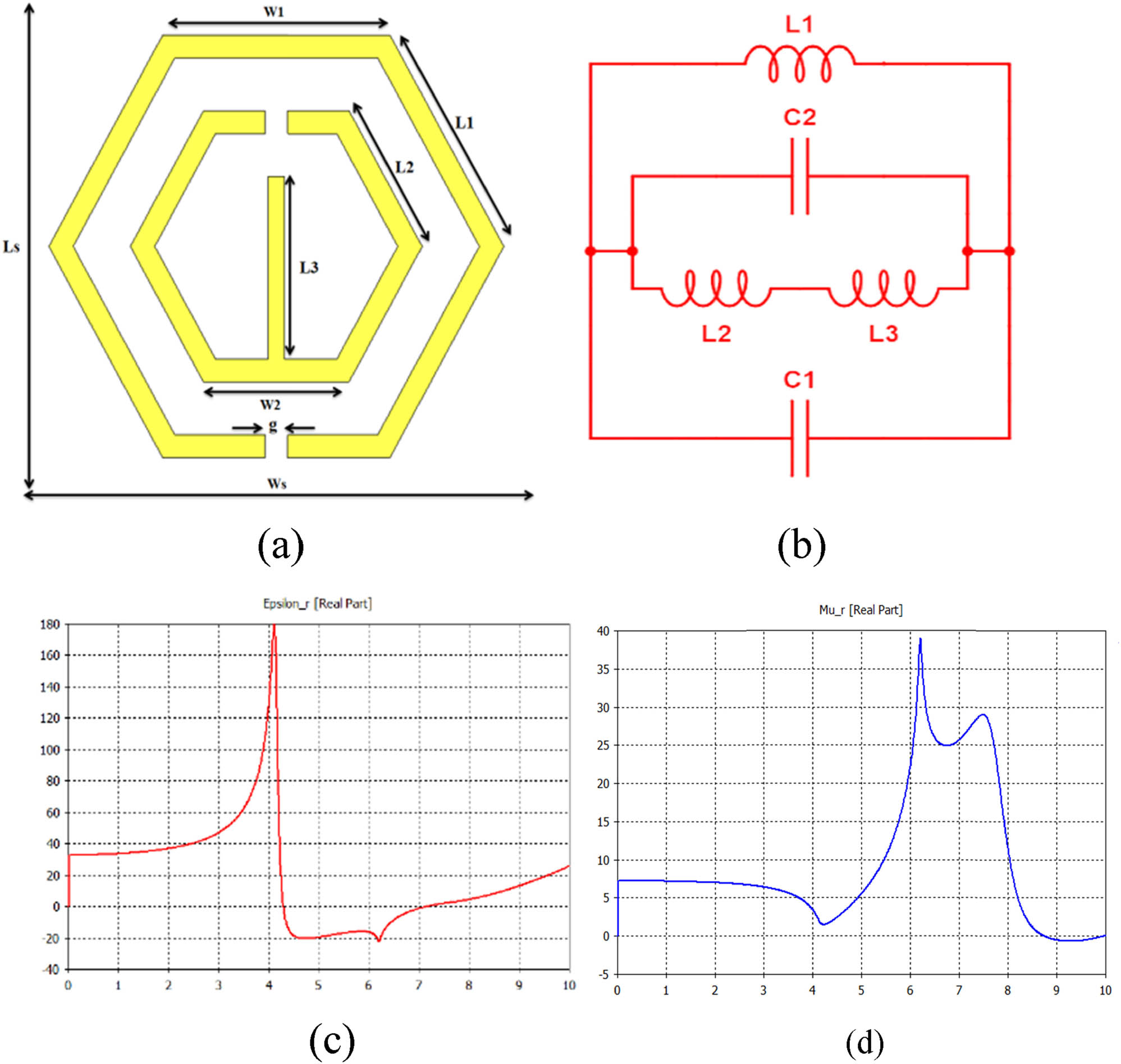
(a) Schematic geometrical figure of an HSRRWCR, (b) equivalent L–C circuit of the HSRRWCR, (c) relative permittivity
The dimensions of the metasurface unit cell
| Parameters | Value (mm) | Parameters | Value (mm) |
|---|---|---|---|
| ws | 6.53 | Ls | 6.32 |
| W1 | 3.26 | L1 | 3.26 |
| W2 | 2.1 | L2 | 2.1 |
| g | 0.33 | L3 | 2.45 |
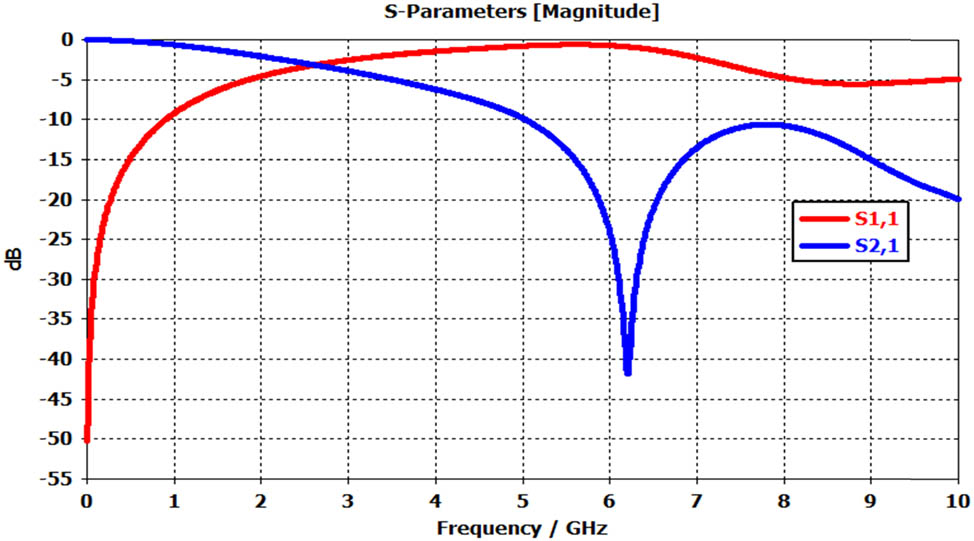
Characterization of S-parameters.
2.2 Proposed antenna design
Everything from the theory and design of the metamaterial-based RA to its fundamental geometry and switching mechanics is addressed here. In order to make the antenna work in three different frequency bands, lumped element switches were installed. PIN diodes are used to rebuild the measurement setup circuit. Improved operating efficiency in the distant field is a direct outcome of using a partial ground plane.
2.3 Structural geometry
The RA allows operation at various frequencies due to its design and shape. When the antenna is exposed to an electromagnetic signal, a flow of electric current occurs inside it due to its interaction. This current changes the electric field surrounding the antenna, emitting electromagnetic waves at specific frequencies. It can also operate using control devices (pin diode) at other frequencies. One example of a multiband FRA is the 5G, WiFi, and fixed mobile communication applications, As seen in Figure 3. The base of the antenna is a flame-retardant (FR-4) dielectric with the (FR-4) radiating element printed on it (r = 4.3, tan = 0.025, h = 1.6 mm). Standard copper cladding, measuring 0.035 mm thickness, composes the antenna. A 50-ohm microstrip line of 3.14 mm in width excites the antenna. The planned device is stimulated by the waveguide port originally meant for the feed line. A single 1 mm wide slot.may be used to include a lumped element switch into the radiating structure, as seen in Figure 3. The specified dimensions of this suggested antenna are (30 × 30 × 1.6) mm3. Table 2 provides the antenna dimensions.
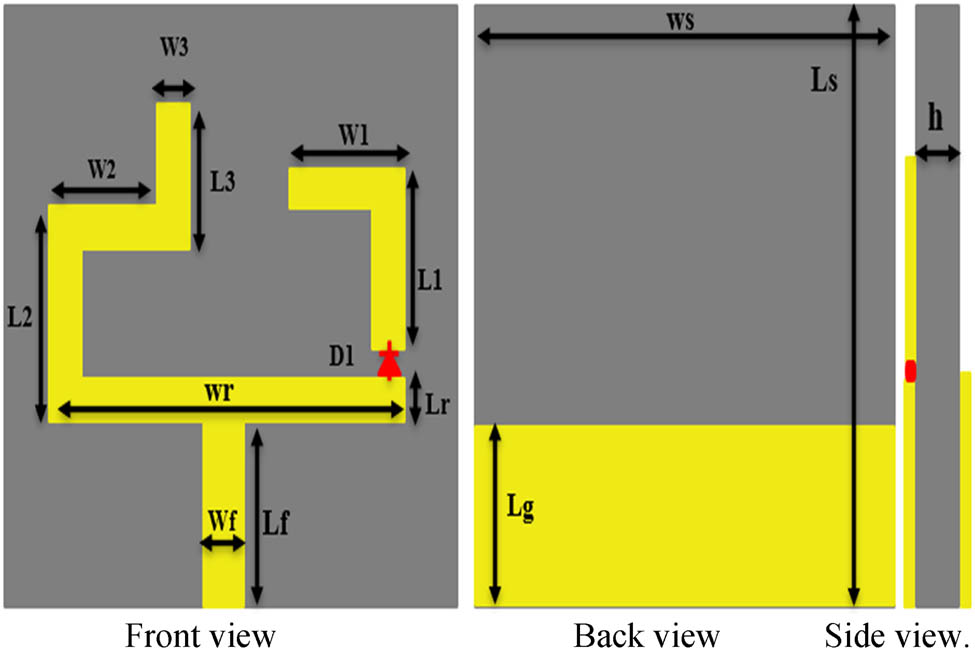
The geometry of the suggested antenna.
The dimensions of the planned antenna
| Parameters | Value (mm) | Parameters | Value (mm) |
|---|---|---|---|
| Ls | 30 | Ws | 30 |
| Lg | 9 | Wf | 3.14 |
| Lf | 8.94 | Wr | 23 |
| Lr | 2 | W1 | 9.85 |
| L1 | 8.1 | W2 | 7.8 |
| L2 | 9.75 | W3 | 2 |
| L3 | 8.2 | h | 1.6 |
Theoretically, effective resonant lengths at required frequencies are computed using the transmission line model [24]. For the selected operating frequency f, the effective permittivity εeff and effective resonant length Lf are determined by
The variables in the equations are defined as follows: The symbol C denotes the velocity of light in a vacuum, whereas
3 Result and discussion
The suggested design has been evaluated using computer simulation technology (CST) Microwave Studio 2022. The radiating framework will be activated through a waveguide port. Performance metrics such as S-parameters, gain, and surface current plots can be acquired under conditions in the CST microwave studio.
3.1 Reconfigurability
The suggested antenna design can achieve frequency reconfiguration by alternating between the PIN diode’s ON and OFF states. This results in the creation of open- and short-circuit behavior between the radiating patches. The antenna can function in two distinct modes with unique resonant frequencies. The antenna produced two bands, one at 3.6 GHz and the other at 3.7 GHz in MODE 1 (D1 is ON). Also, in MODE 2 (D1 is OFF), the antenna exhibits single-band behavior with a 2.4 GHz frequency range. Figure 4 illustrates the schematic representation of the S-parameter for two modes, and Table 3 provides a comprehensive overview of the different modes and their corresponding resonant bands for PIN diodes.
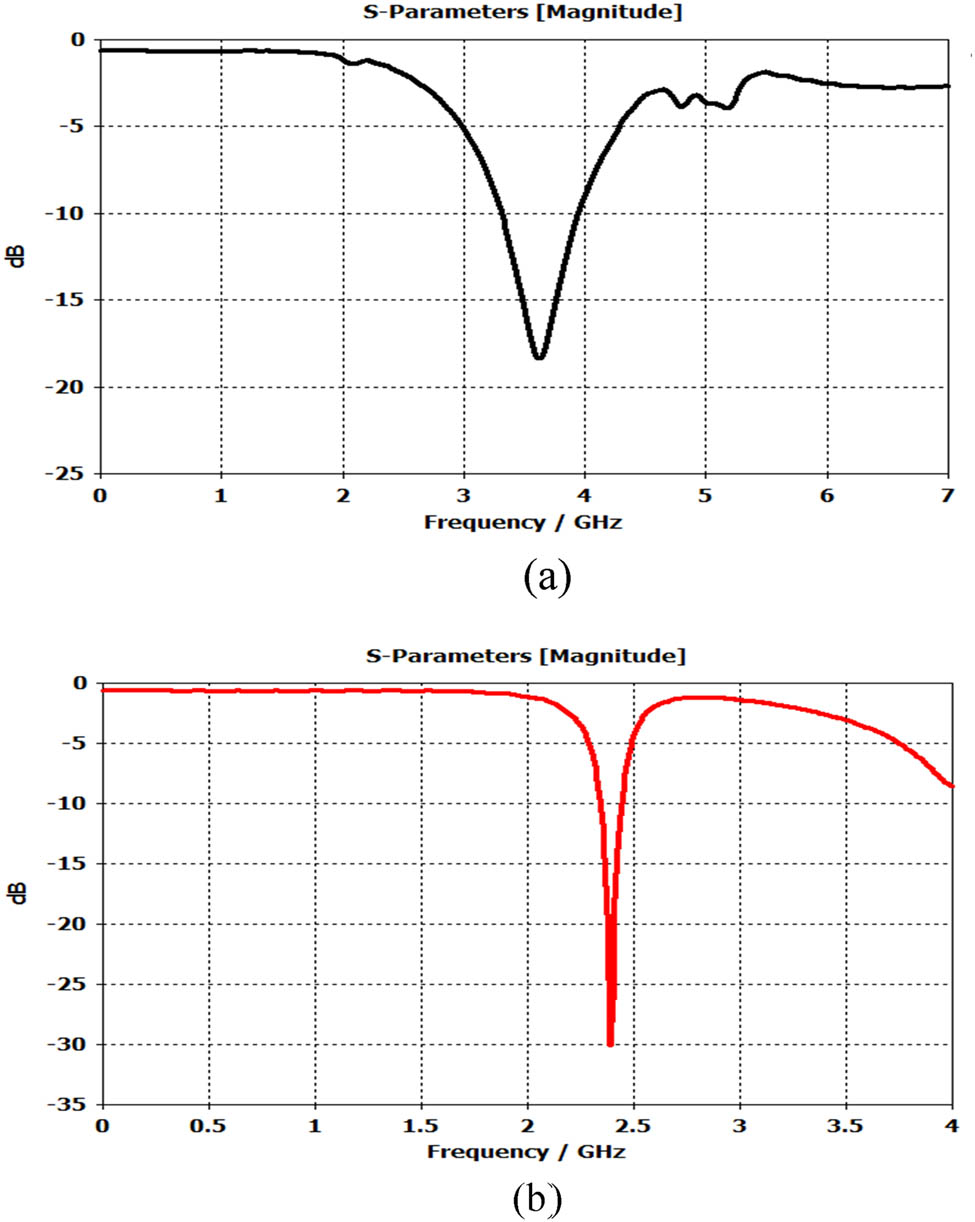
(a) S11 for MODE 1 and (b) S11 for MODE 2.
Frequencies and modes of antenna
| MODES | D1 | Frequency band (GHz) | S11 (dB) |
|---|---|---|---|
| 1 | ON | 3.6 and 3.7 | −17, −18 |
| 2 | OFF | 2.4 | −30 |
3.2 Switching techniques
The one-PIN diodes (SMP1340-079LF) are often used for switching since their RF behavior is similar to a variable resistor. Its typical operating frequency range is 10 MHz to 10 GHz. Adding PIN diodes alters the operating frequency by changing the effective resonant length of the antenna. Both open-circuit and short-circuit behavior may be seen in the PIN diodes. The forward and reverse modes of PIN diode switches are shown in Figure 5 as comparable circuits. It operates when a DC voltage is applied, with the anode connected to the negative terminal and the cathode to the positive terminal. The intrinsic layer’s depletion layer narrows, and current flows when a positive voltage is provided across the P and N regions. However, the depletion layer expands under reverse bias, cutting off current flow. The intrinsic layer allows a PIN diode to function as a variable resistor and is, hence, its defining characteristic. Under the “ON” condition, the circuit only has an inductor and a little resistor (RL). A high-value resistor (“RH”), an inductor, and a capacitor (“C”) are linked in parallel. A Skyworks SMP1340-079LF PIN diode with the following specifications: L = 0.7 nH, RL = 0.85 Ohm, and C = 0.21 pF is used in this study.

A PIN diode’s equivalent circuits and its CST model.
3.3 Antenna design with metamaterial
The antenna’s operating frequency significantly changed after integrating metamaterial into the antenna’s substrate, comprising six unit cells. After integrating metamaterial, a scaling process was conducted to reduce the antenna’s dimensions, enabling it to operate at the frequencies above before the addition. Consequently, the antenna’s size was adjusted to (25 × 25 × 1.6) mm³. The proposed antenna is shown in Figure 6, and Table 4 provides the antenna dimensions.

The geometry of the suggested antenna with metamaterials.
The new dimensions of the antennae with metamaterial
| Parameters | Value (mm) | Parameters | Value (mm) |
|---|---|---|---|
| Ls | 25 | Ws | 25 |
| Lg | 6.8 | Wf | 2.62 |
| Lf | 7.45 | Wr | 20.85 |
| Lr | 1.67 | W1 | 8.2 |
| L1 | 6.75 | W2 | 6.5 |
| L2 | 8.13 | W3 | 1.67 |
| L3 | 6.84 | h | 1.6 |
| R1 | 5.85 | R2 | 5.27 |
3.4 Bandwidth and S-parameter
The S-parameter characteristics of the recommended antenna across all operational modes are depicted in Figure 7. In MODE 1 (when D1 is ON), the antenna under consideration exhibits resonance at specific frequencies 3.6 and 3.7 GHz, with a bandwidth of 630 MHz (3.31–3.94 GHz) and with S-parameters of −17 and −18 dB, respectively, at MODE 2 with switch (D1) in the OFF state. The antenna operates in two bands: 2.4 GHz with a bandwidth of 100 MHz (2.34–2.44 GHz) and 4.9 GHz with a bandwidth of 268 MHz (4.832–5.1 GHz), with S-parameters of −30 and −24 dB, for the respective bands, at the operating frequencies. Figure 7 shows the comparison between the results obtained using CST and ADS software.

S11 for all antenna operating modes.
The antenna demonstrates excellent impedance matching, with a VSWR consistently below 1.331 for all resonant bands. This is further illustrated in Figure 8. where the VSWR remains below 2 across all usable frequency bands.
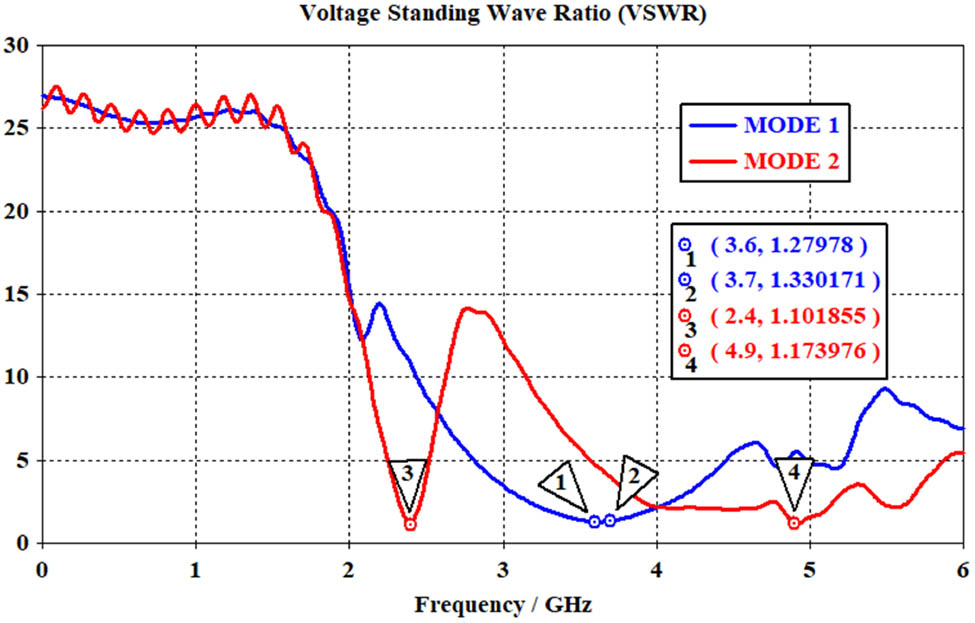
VSWR of the suggested antenna in various modes of operation.
3.5 Far-field radiation pattern
The radiation pattern of an antenna is a graphical representation of its directivity in the azimuth and elevation planes. Figure 9 depicts the projected radiation pattern of the suggested antenna in the H and E planes within the operating frequency ranges. Figure 9(a) shows the radiation pattern of the antenna at 2.4 GHz, Figure 9(b) shows the radiation pattern at 4.9 GHz, Figure 9(c) shows the pattern at 3.6 GHz, and Figure 9(d) shows the pattern at 3.7 GHz. The antenna’s radiation properties in the H-plane are omnidirectional for most frequency ranges. The E-plane is distorted in Figure 10. With a gain of 2.03 dBi and radiation efficiency of 80.8% at 3.6 GHz and 2.02 dBi radiation efficiency of 80% at 3.7 GHz in MODE 1, as illustrated in Figure 10(a). In Figure 10(b), the dual-band 2.4 and 4.9 GHz illustration at a gain of 2.249, 1.82 dBi, and 82.3% and 72.6% efficiency correspondingly for MODE 2 operation. Figure 10 displays gain and radiation efficiency charts at resonant frequencies.

The radiation pattern in the E-plane and H-plane: (a) 2.4 GHz, (b) 4.9 GHz, (c) 3.6 GHz, and (d) 3.7 GHz.

Gain and efficiency pattern at frequencies: (a) MODE 1 (3.6 GHz, 3.7 GHz) and (b) MODE2 (2.4 GHz, 4.9 GHz).
3.6 Surface currents
The current distribution on the surface of the antenna is shown in Figure 11. It clearly shows how the current is dispersed on the surface of the antenna in mode 1. There are two cases of frequencies, namely 3.6 and 3.7 GHz. These results clearly show that the current distribution is uniform on the antenna’s ground plane and approximately uniform across the entire antenna patch, extending to the various unit cells, as shown in Figure 11(a) and (b). At mode 2, the current distribution is at 2.4 GHz and occurs in different antenna regions. However, at a frequency of 4.9 GHz, the current distribution is uniform across the entire patch and all unit cells depicted in Figure 11(c) and (d).
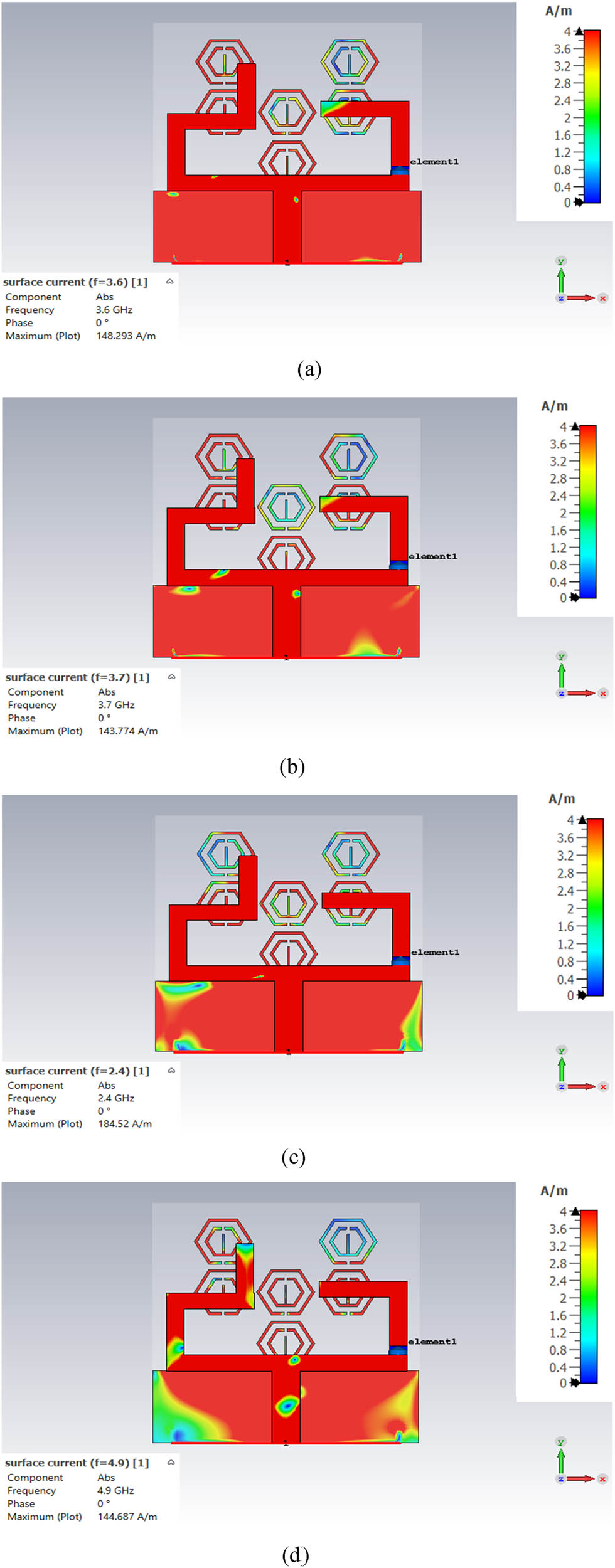
Distribution of current: (a) at 3.6 GHz, (b) at 3.7 GHz, (c) at 2.4 GHz, and (d) at 4.9 GHz.
4 The effects of antenna miniaturization on performance
Reducing an antenna’s size by 16.67% can have a range of positive effects on its performance. It can increase the antenna’s overall efficiency. It can radiate more power for the same amount of input power. It can improve the antenna’s radiation pattern, help focus the signal, and reduce interference. Additionally, reducing the antenna’s size can improve its gain, which is its ability to receive and transmit signals effectively. Another benefit is the potential to integrate multiple antennas into a device, which can improve frequency diversity and system efficiency while reducing interference with other components. Improvements in parameters like S11 and VSWR can indicate better antenna matching with the transmission and reception system, leading to overall performance enhancements. Finally, Table 5 presents a comparison between the proposed antenna design and earlier designs, with a focus on its improvements.
The proposed antenna is contrasted with previously published research
| Previous work | Frequency/GHz antenna | Dimensions (mm2) | Gain (dB) |
|---|---|---|---|
| [17] | 2.1, 2.45, 3.2, 3.5 | 37 × 35 | 2.2 |
| [18] | 2, 3.4, 2.4, 3.1 | 37 × 35 | 1.98 |
| [19] | 3.5, 5.01, 3.2, 5.77 | 30 × 24.8 | 1.75 |
| [20] | 2.4, 4.26, 4, 32, 4.58 | 60 × 60 | 2.77 |
| [21] | 3.9, 4.9 | 62 × 40 | 3.5 |
| [22] | 2.4, 3.5, 4.7, 5.8 | 35 × 35 | — |
| [23] | 3.02, 2.34, 5.06, 4.2, 6.44 | 38 × 21 | — |
| This work | 2.4, 3.6, 3.7, 4.9 | 25 × 25 | 2.1 |
5 Conclusion and future work
There is a growing tendency in scientific research to reduce the size of antennas while operating at lower frequencies. This approach aims to take advantage of this circumstance in the context of the IoT. Thus, they devised a fusion of a RA and metamaterial to accomplish this objective. The efficiency and size of antennas remain significant concerns in all IoT applications. The recommended antenna operates within a frequency range exceeding 2 GHz and has a compact size that facilitates long-range communications. The proposed antenna has a total volume of (25 × 25 × 1.6) mm³. The PIN diode was strategically placed at specific locations in the antenna to achieve resonance at frequencies of 2.4, 3.6, 3.7, and 4.9 GHz while ensuring that the reflection coefficient values remained below (−10 dB). This led to a behavior characterized by reconfigurability. In summary, adding metamaterials to antenna design provides an innovative and effective solution for enhancing antenna performance and expanding its applications in various fields such as communications, radar, remote sensing, and more. Future research should focus on improving efficiency, expanding frequency range, integrating AI for autonomous control, reducing electromagnetic interference, miniaturizing the antenna, and enhancing manufacturing techniques. There is also a need to explore medical and environmental applications for these antennas.
-
Funding information: Authors state no funding involved.
-
Author contributions: All authors have accepted responsibility for the entire content of this manuscript and consented to its submission to the journal, reviewed all the results and approved the final version of the manuscript. Conceptualization, A.H.A. and J.M.R.; methodology, A.H.A.; software, A.H.A. and J.M.R.; validation, A.H.A. and J.M.R.; formal analysis, A.H.A. and J.M.R.; investigation, A.H.A. and J.M.R.; resources, A.H.A. and J.M.R.; data curation, A.H.A. and J.M.R.; writing – original draft preparation, A.H.A. and J.M.R.; writing – review and editing, A.H.A. and J.M.R.; visualization, A.H.A. and J.M.R.; practical testing, A.H.A; supervision, J.M.R. All authors have read and agreed to the published version of the manuscript.
-
Conflict of interest: Authors state no conflict of interest.
-
Data availability statement: Most datasets generated and analyzed in this study are comprised in this submitted manuscript. The other datasets are available on reasonable request from the corresponding author with the attached information.
References
[1] Wong VL, Lias K. Metamaterial applicator for hyperthermia cancer treatment procedure: overview study. In 3rd International Conference for Innovation in Biomedical Engineering and Life Sciences: Proceedings of ICIBEL 2019, December 6-7, 2019, Kuala Lumpur, Malaysia 2021; Springer International Publishing. p. 86–92.10.1007/978-3-030-65092-6_10Search in Google Scholar
[2] Van Yem V, Lan NN. Gain and bandwidth enhacement of array antenna using novel metamaterial structure. J Commun. 2018 Mar;13(3):101–7.10.12720/jcm.13.3.101-107Search in Google Scholar
[3] Abd AK, Rasool JM. Octa-band reconfigurable monopole antenna frequency diversity 5G wireless. Int J Electr Comput Eng (IJECE). 2023 Apr;13(2):1606–17.10.11591/ijece.v13i2.pp1606-1617Search in Google Scholar
[4] Colaco J, Lohani R. Design and implementation of microstrip circular patch antenna for 5G applications. In 2020 International Conference on Electrical, Communication, and Computer Engineering (ICECCE) 2020 Jun 12; IEEE. p. 1–4.10.1109/ICECCE49384.2020.9179263Search in Google Scholar
[5] Sharma BL, Mathur D, Sharma MK. SIW-cavity based frequency reconfigurable antenna for IoT, WLAN, and 5G applications. Frequenz. 2023 Aug;77(7–8):413–24.10.1515/freq-2022-0173Search in Google Scholar
[6] Abdulhussein AJ, Farhan MJ, Ali GM. Design and implementation of a frequency reconfigurable antenna using PIN switch for sub-6 GHz applications. Open Eng. 2023 Nov;13(1):20220453.10.1515/eng-2022-0453Search in Google Scholar
[7] Abd AK, Rasool JM. Low-profile frequency-reconfigurable antenna for 5G applications. TELKOMNIKA (Telecommun Comput Electron Control). 2023 Jun;21(3):486–95.10.12928/telkomnika.v21i3.24028Search in Google Scholar
[8] Abd AK, Rasool JM, Rahman ZA, Al-Yasir YI. Design and analysis of novel reconfigurable monopole antenna using DIP switch and covering 5G-sub-6-GHz and C-band applications. Electronics. 2022 Oct;11(20):3368.10.3390/electronics11203368Search in Google Scholar
[9] Abd AK, Rasool JM. A frequency reconfigurable monopole antenna diversity for 5G wireless communication and IoT applications. In2022 8th International Conference on Contemporary Information Technology and Mathematics (ICCITM) 2022 Aug 31; IEEE. p. 243–8.10.1109/ICCITM56309.2022.10031886Search in Google Scholar
[10] Ijaz B, Khan MS, Asif SM, Anagnostou DE, Braaten BD. Metamaterial-inspired series-fed frequency reconfigurable array with zero-phase CRLH interconnects. Microw Opt Technol Lett. 2018 Jan;60(1):140–6.10.1002/mop.30933Search in Google Scholar
[11] Saeed SM, Balanis CA, Birtcher CR, Durgun AC, Shaman HN. Wearable flexible reconfigurable antenna integrated with artificial magnetic conductor. IEEE Antennas Wirel Propag Lett. 2017 Jun;16:2396–9.10.1109/LAWP.2017.2720558Search in Google Scholar
[12] Ali AH, Rasool JM, Abd AK, Islam MS, Ouda M, Alawad MA, et al. A compact dual-band reconfigurable antenna with metamaterial for IoT applications. Sci Rep. 2025;15(1):21039.10.1038/s41598-025-05174-ySearch in Google Scholar PubMed PubMed Central
[13] Yang W, Che W, Jin H, Feng W, Xue Q. A polarization-reconfigurable dipole antenna using polarization rotation AMC structure. IEEE Trans Antennas Propag. 2015 Oct;63(12):5305–15.10.1109/TAP.2015.2490250Search in Google Scholar
[14] Hussain M, Awan WA, Alzaidi MS, Hussain N, Ali EM, Falcone F. Metamaterials and their application in the performance enhancement of reconfigurable antennas: A review. Micromachines. 2023 Jan;14(2):349.10.3390/mi14020349Search in Google Scholar PubMed PubMed Central
[15] Al-Omari M, Attia H, Qureshi KK, Sheikh SI. Design of frequency-reconfigurable antenna on dielectric and magnetic metamaterial composite substrate. IEEE Antennas Wirel Propag Lett. 2022 Dec;22(4):943–7.10.1109/LAWP.2022.3230827Search in Google Scholar
[16] Latif SI, Sharma SK. Metamaterials in reconfigurable antennas. Multifunct Antennas Arrays Wirel Commun Syst. 2021 Apr;321–40.10.1002/9781119535096.ch9Search in Google Scholar
[17] Waladi V, Mohammadi N, Zehforoosh Y, Habashi A, Nourinia J. A novel modified star-triangular fractal (MSTF) monopole antenna for super-wideband applications. IEEE Antennas Wirel Propag Lett. 2013 May;12:651–4.10.1109/LAWP.2013.2262571Search in Google Scholar
[18] Singhal S, Singh AK. Modified star-star fractal (MSSF) super-wideband antenna. Microw Opt Technol Lett. 2017 Mar;59(3):624–30.10.1002/mop.30357Search in Google Scholar
[19] Ali T, Aw MS, Biradar RC. A fractal quad-band antenna loaded with L-shaped slot and metamaterial for wireless applications. Int J Microw Wirel Technol. 2018 Sep;10(7):826–34.10.1017/S1759078718000272Search in Google Scholar
[20] Saikia B, Dutta P, Borah K. Design of a frequency reconfigurable microstrip patch antenna for multiband applications. InProceedings of the 5th International Conference on Computers & Management Skills (ICCM 2019)| North Eastern Regional Institute of Science & Technology (NERIST), Nirjuli, Arunachal Pradesh, India; 2020.Search in Google Scholar
[21] Al-Khaylani HH, Elwi TA, Ibrahim AA. A novel miniaturized reconfigurable microstrip antenna based printed metamaterial circuitries for 5G applications. Prog Electromagn Res. 2022 Mar;120:1.10.2528/PIERC22021503Search in Google Scholar
[22] Thenkumari K, Sankaran KS, Mathana JM. Design and implementation of Frequency reconfigurable antenna for Wi-Fi applications. Eng Sci. 2023 Apr;23:876.Search in Google Scholar
[23] Rasool JM, Abd AK. A reconfigurable antenna for IoT applications with enhanced performance by adding metamaterial. J Commun. 2024;19(4):198–203.10.12720/jcm.19.4.198-203Search in Google Scholar
[24] Balanis CA. Antenna theory: analysis and design. Hoboken, New Jersey: John wiley & sons; 2016 Feb.Search in Google Scholar
© 2025 the author(s), published by De Gruyter
This work is licensed under the Creative Commons Attribution 4.0 International License.
Articles in the same Issue
- Research Articles
- Modification of polymers to synthesize thermo-salt-resistant stabilizers of drilling fluids
- Study of the electronic stopping power of proton in different materials according to the Bohr and Bethe theories
- AI-driven UAV system for autonomous vehicle tracking and license plate recognition
- Enhancement of the output power of a small horizontal axis wind turbine based on the optimization approach
- Design of a vertically stacked double Luneburg lens-based beam-scanning antenna at 60 GHz
- Synergistic effect of nano-silica, steel slag, and waste glass on the microstructure, electrical resistivity, and strength of ultra-high-performance concrete
- Expert evaluation of attachments (caps) for orthopaedic equipment dedicated to pedestrian road users
- Performance and rheological characteristics of hot mix asphalt modified with melamine nanopowder polymer
- Second-order design of GNSS networks with different constraints using particle swarm optimization and genetic algorithms
- Impact of including a slab effect into a 2D RC frame on the seismic fragility assessment: A comparative study
- Analytical and numerical analysis of heat transfer from radial extended surface
- Comprehensive investigation of corrosion resistance of magnesium–titanium, aluminum, and aluminum–vanadium alloys in dilute electrolytes under zero-applied potential conditions
- Performance analysis of a novel design of an engine piston for a single cylinder
- Modeling performance of different sustainable self-compacting concrete pavement types utilizing various sample geometries
- The behavior of minors and road safety – case study of Poland
- The role of universities in efforts to increase the added value of recycled bucket tooth products through product design methods
- Adopting activated carbons on the PET depolymerization for purifying r-TPA
- Urban transportation challenges: Analysis and the mitigation strategies for road accidents, noise pollution and environmental impacts
- Enhancing the wear resistance and coefficient of friction of composite marine journal bearings utilizing nano-WC particles
- Sustainable bio-nanocomposite from lignocellulose nanofibers and HDPE for knee biomechanics: A tribological and mechanical properties study
- Effects of staggered transverse zigzag baffles and Al2O3–Cu hybrid nanofluid flow in a channel on thermofluid flow characteristics
- Mathematical modelling of Darcy–Forchheimer MHD Williamson nanofluid flow above a stretching/shrinking surface with slip conditions
- Energy efficiency and length modification of stilling basins with variable Baffle and chute block designs: A case study of the Fewa hydroelectric project
- Renewable-integrated power conversion architecture for urban heavy rail systems using bidirectional VSC and MPPT-controlled PV arrays as an auxiliary power source
- Exploitation of landfill gas vs refuse-derived fuel with landfill gas for electrical power generation in Basrah City/South of Iraq
- Two-phase numerical simulations of motile microorganisms in a 3D non-Newtonian nanofluid flow induced by chemical processes
- Sustainable cocoon waste epoxy composite solutions: Novel approach based on the deformation model using finite element analysis to determine Poisson’s ratio
- Impact and abrasion behavior of roller compacted concrete reinforced with different types of fibers
- Architectural design and its impact on daylighting in Gayo highland traditional mosques
- Structural and functional enhancement of Ni–Ti–Cu shape memory alloys via combined powder metallurgy techniques
- Design of an operational matrix method based on Haar wavelets and evolutionary algorithm for time-fractional advection–diffusion equations
- Design and optimization of a modified straight-tapered Vivaldi antenna using ANN for GPR system
- Analysis of operations of the antiresonance vibration mill of a circular trajectory of chamber vibrations
- Functions of changes in the mechanical properties of reinforcing steel under corrosive conditions
- Enhanced PAPR reduction in NOMA systems using modified SLM and PTS techniques for power-efficient 5G and beyond networks
- Hybrid mechanics-informed machine learning models for predicting mechanical failure in graphene sponge: a low-data strategy for mechanical engineering applications
- Design of shafts of a two-piece chain conveyor as a part of a modification of a mobile working machine
- Review Articles
- A modified adhesion evaluation method between asphalt and aggregate based on a pull off test and image processing
- Architectural practice process and artificial intelligence – an evolving practice
- 10.1515/eng-2025-0148
- Special Issue: 51st KKBN - Part II
- The influence of storing mineral wool on its thermal conductivity in an open space
- Use of nondestructive test methods to determine the thickness and compressive strength of unilaterally accessible concrete components of building
- Use of modeling, BIM technology, and virtual reality in nondestructive testing and inventory, using the example of the Trzonolinowiec
- Tunable terahertz metasurface based on a modified Jerusalem cross for thin dielectric film evaluation
- Integration of SEM and acoustic emission methods in non-destructive evaluation of fiber–cement boards exposed to high temperatures
- Non-destructive method of characterizing nitrided layers in the 42CrMo4 steel using the amplitude-frequency technique of eddy currents
- Evaluation of braze welded joints using the ultrasonic method
- Analysis of the potential use of the passive magnetic method for detecting defects in welded joints made of X2CrNiMo17-12-2 steel
- Analysis of the possibility of applying a residual magnetic field for lack of fusion detection in welded joints of S235JR steel
- Eddy current methodology in the non-direct measurement of martensite during plastic deformation of SS316L
- Methodology for diagnosing hydraulic oil in production machines with the additional use of microfiltration
- Special Issue: IETAS 2024 - Part II
- Enhancing communication with elderly and stroke patients based on sign-gesture translation via audio-visual avatars
- Optimizing wireless charging for electric vehicles via a novel coil design and artificial intelligence techniques
- Evaluation of moisture damage for warm mix asphalt (WMA) containing reclaimed asphalt pavement (RAP)
- Comparative CFD case study on forced convection: Analysis of constant vs variable air properties in channel flow
- Evaluating sustainable indicators for urban street network: Al-Najaf network as a case study
- Node failure in self-organized sensor networks
- Comprehensive assessment of side friction impacts on urban traffic flow: A case study of Hilla City, Iraq
- Design a system to transfer alternating electric current using six channels of laser as an embedding and transmitting source
- Security and surveillance application in 3D modeling of a smart city: Kirkuk city as a case study
- Modified biochar derived from sewage sludge for purification of lead-contaminated water
- The future of space colonisation: Architectural considerations
- Design of a Tri-band Reconfigurable Antenna Using Metamaterials for IoT Applications
- Special Issue: AESMT-7 - Part II
- Experimental study on behavior of hybrid columns by using SIFCON under eccentric load
- Special Issue: ICESTA-2024 and ICCEEAS-2024
- A selective recovery of zinc and manganese from the spent primary battery black mass as zinc hydroxide and manganese carbonate
- Special Issue: REMO 2025 and BUDIN 2025
- Predictive modeling coupled with wireless sensor networks for sustainable marine ecosystem management using real-time remote monitoring of water quality
- Management strategies for refurbishment projects: A case study of an industrial heritage building
- Structural evaluation of historical masonry walls utilizing non-destructive techniques – Comprehensive analysis
Articles in the same Issue
- Research Articles
- Modification of polymers to synthesize thermo-salt-resistant stabilizers of drilling fluids
- Study of the electronic stopping power of proton in different materials according to the Bohr and Bethe theories
- AI-driven UAV system for autonomous vehicle tracking and license plate recognition
- Enhancement of the output power of a small horizontal axis wind turbine based on the optimization approach
- Design of a vertically stacked double Luneburg lens-based beam-scanning antenna at 60 GHz
- Synergistic effect of nano-silica, steel slag, and waste glass on the microstructure, electrical resistivity, and strength of ultra-high-performance concrete
- Expert evaluation of attachments (caps) for orthopaedic equipment dedicated to pedestrian road users
- Performance and rheological characteristics of hot mix asphalt modified with melamine nanopowder polymer
- Second-order design of GNSS networks with different constraints using particle swarm optimization and genetic algorithms
- Impact of including a slab effect into a 2D RC frame on the seismic fragility assessment: A comparative study
- Analytical and numerical analysis of heat transfer from radial extended surface
- Comprehensive investigation of corrosion resistance of magnesium–titanium, aluminum, and aluminum–vanadium alloys in dilute electrolytes under zero-applied potential conditions
- Performance analysis of a novel design of an engine piston for a single cylinder
- Modeling performance of different sustainable self-compacting concrete pavement types utilizing various sample geometries
- The behavior of minors and road safety – case study of Poland
- The role of universities in efforts to increase the added value of recycled bucket tooth products through product design methods
- Adopting activated carbons on the PET depolymerization for purifying r-TPA
- Urban transportation challenges: Analysis and the mitigation strategies for road accidents, noise pollution and environmental impacts
- Enhancing the wear resistance and coefficient of friction of composite marine journal bearings utilizing nano-WC particles
- Sustainable bio-nanocomposite from lignocellulose nanofibers and HDPE for knee biomechanics: A tribological and mechanical properties study
- Effects of staggered transverse zigzag baffles and Al2O3–Cu hybrid nanofluid flow in a channel on thermofluid flow characteristics
- Mathematical modelling of Darcy–Forchheimer MHD Williamson nanofluid flow above a stretching/shrinking surface with slip conditions
- Energy efficiency and length modification of stilling basins with variable Baffle and chute block designs: A case study of the Fewa hydroelectric project
- Renewable-integrated power conversion architecture for urban heavy rail systems using bidirectional VSC and MPPT-controlled PV arrays as an auxiliary power source
- Exploitation of landfill gas vs refuse-derived fuel with landfill gas for electrical power generation in Basrah City/South of Iraq
- Two-phase numerical simulations of motile microorganisms in a 3D non-Newtonian nanofluid flow induced by chemical processes
- Sustainable cocoon waste epoxy composite solutions: Novel approach based on the deformation model using finite element analysis to determine Poisson’s ratio
- Impact and abrasion behavior of roller compacted concrete reinforced with different types of fibers
- Architectural design and its impact on daylighting in Gayo highland traditional mosques
- Structural and functional enhancement of Ni–Ti–Cu shape memory alloys via combined powder metallurgy techniques
- Design of an operational matrix method based on Haar wavelets and evolutionary algorithm for time-fractional advection–diffusion equations
- Design and optimization of a modified straight-tapered Vivaldi antenna using ANN for GPR system
- Analysis of operations of the antiresonance vibration mill of a circular trajectory of chamber vibrations
- Functions of changes in the mechanical properties of reinforcing steel under corrosive conditions
- Enhanced PAPR reduction in NOMA systems using modified SLM and PTS techniques for power-efficient 5G and beyond networks
- Hybrid mechanics-informed machine learning models for predicting mechanical failure in graphene sponge: a low-data strategy for mechanical engineering applications
- Design of shafts of a two-piece chain conveyor as a part of a modification of a mobile working machine
- Review Articles
- A modified adhesion evaluation method between asphalt and aggregate based on a pull off test and image processing
- Architectural practice process and artificial intelligence – an evolving practice
- 10.1515/eng-2025-0148
- Special Issue: 51st KKBN - Part II
- The influence of storing mineral wool on its thermal conductivity in an open space
- Use of nondestructive test methods to determine the thickness and compressive strength of unilaterally accessible concrete components of building
- Use of modeling, BIM technology, and virtual reality in nondestructive testing and inventory, using the example of the Trzonolinowiec
- Tunable terahertz metasurface based on a modified Jerusalem cross for thin dielectric film evaluation
- Integration of SEM and acoustic emission methods in non-destructive evaluation of fiber–cement boards exposed to high temperatures
- Non-destructive method of characterizing nitrided layers in the 42CrMo4 steel using the amplitude-frequency technique of eddy currents
- Evaluation of braze welded joints using the ultrasonic method
- Analysis of the potential use of the passive magnetic method for detecting defects in welded joints made of X2CrNiMo17-12-2 steel
- Analysis of the possibility of applying a residual magnetic field for lack of fusion detection in welded joints of S235JR steel
- Eddy current methodology in the non-direct measurement of martensite during plastic deformation of SS316L
- Methodology for diagnosing hydraulic oil in production machines with the additional use of microfiltration
- Special Issue: IETAS 2024 - Part II
- Enhancing communication with elderly and stroke patients based on sign-gesture translation via audio-visual avatars
- Optimizing wireless charging for electric vehicles via a novel coil design and artificial intelligence techniques
- Evaluation of moisture damage for warm mix asphalt (WMA) containing reclaimed asphalt pavement (RAP)
- Comparative CFD case study on forced convection: Analysis of constant vs variable air properties in channel flow
- Evaluating sustainable indicators for urban street network: Al-Najaf network as a case study
- Node failure in self-organized sensor networks
- Comprehensive assessment of side friction impacts on urban traffic flow: A case study of Hilla City, Iraq
- Design a system to transfer alternating electric current using six channels of laser as an embedding and transmitting source
- Security and surveillance application in 3D modeling of a smart city: Kirkuk city as a case study
- Modified biochar derived from sewage sludge for purification of lead-contaminated water
- The future of space colonisation: Architectural considerations
- Design of a Tri-band Reconfigurable Antenna Using Metamaterials for IoT Applications
- Special Issue: AESMT-7 - Part II
- Experimental study on behavior of hybrid columns by using SIFCON under eccentric load
- Special Issue: ICESTA-2024 and ICCEEAS-2024
- A selective recovery of zinc and manganese from the spent primary battery black mass as zinc hydroxide and manganese carbonate
- Special Issue: REMO 2025 and BUDIN 2025
- Predictive modeling coupled with wireless sensor networks for sustainable marine ecosystem management using real-time remote monitoring of water quality
- Management strategies for refurbishment projects: A case study of an industrial heritage building
- Structural evaluation of historical masonry walls utilizing non-destructive techniques – Comprehensive analysis
