Exploring temperature-resilient recycled aggregate concrete with waste rubber: An experimental and multi-objective optimization analysis
-
 ,
and
,
and

Abstract
For low-carbon sustainability, recycled rubber particles (RPs) and recycled aggregate (RA) could be used to make rubber-modified recycled aggregate concrete (RRAC). The characteristics (compressive strength and peak strain) of RRAC with various amounts of RA and RPs after heating at various temperatures were studied in this work. The results show that high temperatures significantly decreased the uniaxial compressive strength (UCS), whereas the addition of RA (e.g., 50%) and RPs (e.g., 5%) can mitigate the negative effect caused by high temperatures. The peak strain can also be improved by increasing the replacement ratios of RA and RP. Support vector regression (SVR) models were trained using a total of 120 groups of UCS and peak strain experimental datasets, and an SVR-based multi-objective optimization model was proposed. The excellent correlation coefficients (0.9772 for UCS and 0.9412 for peak strain) found to illustrate the remarkable accuracy of the SVR models. The Pareto fronts of a tri-objective mixture optimization design (UCS, strain, and cost) were successfully generated as the decision reference at varying temperature conditions. A sensitivity analysis was performed to rank the importance of the input variables where temperature was found as the most important one. In addition, the replacement ratio of RA is more important compared with that of the RP for both the UCS and strain datasets. Among the mechanical properties of concrete, compressive strength and peak strain are two key properties. This study provides guidance for the study of RRAC constitutive models under high temperatures.
1 Introduction
Nowadays, the demolition of buildings and transportation infrastructure, such as bridges and sidewalks, produces a large amount of construction waste [1,2,3,4]. The discarded Portland cement concrete can be crushed into small pieces, divided into different sizes, and reused as a new concrete aggregate. One type of aggregate is known as recycled aggregate (RA). Unlike ordinary concrete that uses entirely natural aggregate (NA), concrete made entirely or partially from RA is known as recycled aggregate concrete (RAC). However, RAs have some disadvantages, as the voids and microcracks of the old mortar cover the surface [5,6,7]. These defects weaken the mechanical properties of RAC. Recent research has proposed a series of environmentally friendly methods for recycling waste rubber tires in engineering projects [8,9,10]. One effective approach for treating waste tires is to use rubber particles (RPs) as a replacement material for fine aggregates in concrete. Studies have shown that the mechanical properties of rubber concrete and ordinary concrete differ. RPs can enhance the deformation capacity of concrete [11]. Therefore, some disadvantages of RAC, which is a soft material, can be overcome by using RPs as part of the fine aggregate, known as rubber-modified recycled aggregate concrete (RRAC) [12,13].
Fire is one of the most damaging environmental situations that may occur in a concrete structure [14,15,16]. Typically, fire generates a high-temperature differential in the concrete. The temperature differential in concrete results in chemical and physical processes such as dehydration of the cement slurry, aggregate breakdown, mass loss, deformation, and strength loss, all of which have a detrimental effect on the mechanical and thermal characteristics of the concrete. When concrete is subjected to extreme heat, its mechanical characteristics deteriorate. It begins to degrade at temperatures between 200 and 300°C and continues to degrade as the temperature increases, lowering the structure’s strength and stiffness. Aggregates usually account for 70% of the volume of concrete. Therefore, the thermal properties of concrete largely depend on the type of aggregate because the responses of different aggregates to high temperatures differ significantly. Many studies have reported that the difference between the mechanical properties of RAC and natural aggregate concrete (NAC) at ambient temperatures increases with the increase in the RA replacement rate, particularly at a replacement rate of above 50% [17,18,19].
Therefore, the particularity of RAs also leads to different thermal properties of RAC compared with NAC. Research has been conducted to evaluate the residual mechanical properties of RAC subjected to elevated temperatures, which showed that the old mortar attached to the RAs reduced the elastic modulus and compressive strength of the RAC. When the temperature exceeds 600°C, the effect of temperature on the degradation of RAC at 100% RA replacement rate is higher than that of NAC [20,21,22]. Therefore, it is necessary to develop a method to reduce the thermal degradation of RAC, particularly at a high RA replacement rate. Pliya et al. [23] found that the ease of spalling of NAC at high temperatures, which reflects the thermal strain of NAC, is greater than that of RAC.
Additionally, RRAC has attracted considerable attention due to the toughening impact of RPs on concrete [24,25,26]. RRAC is a sustainable material derived from debris that also possesses exceptional mechanical qualities. Compressive and flexural behaviors are feasible in structural engineering [27,28,29]. Liu et al. [12] found that RPs can effectively improve the fatigue performance of RAC. Chen et al. [30] investigated the deformation capacity of RRAC, which is higher than that of RAC. Previous studies investigated the thermomechanical properties of RRAC and discovered that adding RPs can help minimize RAC spalling [31,32,33]. This is because many interior pores assist in the discharge of internal steam via overflowing RPs following high-temperature heating.
Many specimens containing varying amounts of RPs and RA are usually prepared and tested to quantify the effects of RPs and RA on the mechanical properties of RRAC. However, this lab-based approach requires considerable time and effort for sample preparation and data analysis. Numerous high-tech technologies have emerged mainly due to the development of artificial intelligence [34,35,36,37,38,39]. Machine learning (ML) models with reliable prediction performance and generalization, such as random forest (RF), artificial neural network (ANN), and support vector regression (SVR) can be established based on existing experimental data [40,41,42,43]. SVR has been widely used for data mining due to its good noise resistance, reliable generalization performance, and quick training speed compared to other ML models, as reported by many experts [44,45,46]. It can solve linear or non-linear problems by mapping to the higher-dimensional space. Therefore, this study attempted to predict experimental data using an SVR model. However, the performance of SVR is highly dependent on hyperparameters. We used the beetle antennae search (BAS) algorithm to automatically tune the hyperparameters of SVR instead of conventional optimization strategies [47,48]. Furthermore, compared with other optimization algorithms, such as the genetic algorithm [19] and the firefly algorithm [49], BAS yields a higher adjustment efficiency [50].
Among the mechanical properties of concrete, the compressive strength and the strain corresponding to the peak stress (peak strain) are two key properties. The reason is that the constitutive model of concrete is related to these two factors, and high-strength concrete with high deformation ability is also one of the goals pursued by concrete materials. Therefore, the two primary characteristics of RRAC studied in this research are uniaxial compressive strength (UCS) and peak strain. Apart from ML predictions of the UCS and strain, a multi-objective optimization (MOO) model is proposed to optimize the mixture design using a metaheuristic algorithm [51,52]. MOO has been verified as a feasible approach for the material mixture design [19,53,54]. For instance, Zhang et al. [55] used a multi-objective particle swarm optimization technique to effectively optimize the strength, slump, and cost of plastic concrete. The single-objective optimization design is rarely considered because it does not meet complicated design requirements in practice. Therefore, by using the SVR-BAS-based MOO model (MOBAS-SVR), three objectives (i.e., UCS, peak strain, and cost) can be optimized simultaneously by introducing a Pareto front. The goal of this study is to optimize three parameters (UCS, peak strain, and cost) of RRAC concurrently utilizing MOBAS-SVR after heating at various temperatures. RRAC was used to produce 120 specimens with the provided goal values.
The rest of the article is organized as follows. Section 2 summarizes the RRAC’s general mix composition. Section 3 summarizes the approach for MOO, including data description, objective functions, hyperparameter tuning, and multi-objective and variable sensitivity analysis (SA). The experimental results are presented in Section 4. In Section 5, the modeling results based on the methods described in Section 3 are analyzed. The main conclusions drawn based on the findings of this study are presented in Section 6.
2 Materials and methods
2.1 Raw materials and mix proportions
In the experiments, Shijing Brand ordinary Portland cement was used. The nominal strengths of the cement were chosen to be P.O. 32.5R and P.O. 42.5R. Medium sand with particle sizes ranging from 0 to 5 mm, a fineness modulus of 2.52, and an apparent density of 2679 kg·m−3 were used. RAs were created from crushed concrete waste on a construction site in Shenzhen and treated by Shenzhen Lvfa Pengcheng Environmental Technology Co., Ltd. Specifically, the discarded concrete blocks and stone materials in construction and demolition wastes were crushed, washed, and screened to continuous grading. Before producing the concrete mixes, RAs were washed again and the saturated surface dryness conditions were ensured. The percentage of sediment content, elongated particles, and impurities were 0.88, 9.3, and 1.0, which were satisfied with the requirements of the codes. RAs were added to the RAC by replacing an equal amount of NA. Figure 1 depicts the grading curves of the NA and RA. All coarse aggregates were classified as Grade II aggregates. The particle size and apparent density of RPs were 0.86 mm (20-mesh size) and 1,020 kg·m−3, respectively. Running water was used in all experiments.

Gradation of NAs and RAs.
For the 42.5 MPa cement mixture, RA was used to replace 0, 25, 50, 75, and 100% of the volume of NA. RPs were used instead of 0, 5, 10, and 15% of the volume of sand. It was also necessary to use a polycarboxylic acid water-reducing admixture at a concentration of 3.88 kg·m−3. Because of the use of P.O. 32.5R cement, only 50% of the NA was replaced with RA, and no more than 0, 10, and 25% of the volume of sand were replaced with RPs when using P.O. 32.5R concrete. Comparing P.O. 42.5R and P.O. 32.5R, the water-to-cement ratios were comparable at 0.45 and 0.43 for both materials.
2.2 Experimental program and specimen preparation
After 24 h of specimen pouring, the molds were removed. The cylinder was then cured for 28 days at a constant temperature of 20 ± 2°C and a relative humidity of 95% under standard conditions (diameter and height of 150 and 300 mm, respectively). The high-temperature treatment was carried out in a box-type electric furnace with a temperature control accuracy of 1°C. The gap between the cylinder and the furnace wall was also maintained at or above 20 mm in order to ensure that the sample surface was heated consistently throughout the process. The thermal rate was fixed to 5°C·min‒1 [56]. The temperature was held constant for 60 min after achieving the desired temperature (T = 200, 300, 400, 500, or 600°C), and then the heating was turned off. Next, the specimen was removed from the furnace, cooled at room temperature, and prepared for a uniaxial compression test. In addition, each mix proportion had a group of unheated specimens (T = 25°C). The heating curve of the RRAC is shown in Figure 2.

Heating curves of RRAC.
2.3 Compression test setup
As illustrated in Figure 3, after heating the specimens, a gypsum-leveling layer was applied to the two end surfaces of each cylinder before compression in line with ASTM C617 [57]. Compression tests were conducted using a hydraulic servo universal testing machine in accordance with ASTM C39 [58] and C469 [59]. The loading speed was set at 0.18 mm·min−1 over the course of the test. To determine the longitudinal deformation of the cylinder, two linear variable differential transformers were employed in conjunction with each other. To capture the synchronous displacement and force data, a strain acquisition device with a 1 Hz acquisition frequency was also employed. The UCS and peak strain were then calculated by averaging three specimens from each group.

Sketch of the uniaxial compression test.
3 MOO methodology
Figure 4 depicts the flowchart for the MOO mixing design of RRAC utilizing MOBAS-SVR. To begin, two SVR models were trained to predict the UCS and peak strain values using the BAS method and fivefold cross-validation (CV). Second, an objective function of the mixture expanse was established to evaluate the cost of each group based on the unit price and density of the raw materials. Third, by applying an MOO function using the weighted sum approach, the UCS, peak strain, and cost were considered as objectives. Finally, non-dominated optimum solutions based on the Pareto front were developed.

Flowchart of the concrete optimization design based on the MOBAS-SVR system.
3.1 Data description
The input datasets were constructed using the experimental findings of 120 sample groups. The water content, cement content, RA, NA, sand, RPs, water reducer (WR), cement grade (G), and temperature (T) are all input variables. UCS and peak strain of RRACs are output variables. Table 1 lists the variables and their associated minimum, maximum, median, and standard deviation.
Statistical details of the input and output variables based on the UCS dataset
| Variables | Minimum | Maximum | Mean | Median | SD | Variation coefficient |
|---|---|---|---|---|---|---|
| W (kg·m−3) | 185 | 216 | 211.35 | 216 | 11.07 | 0.052 |
| C (kg·m−3) | 430 | 485 | 476.75 | 485 | 19.64 | 0.041 |
| RA (kg·m−3) | 0 | 1,194 | 651.50 | 618 | 316.28 | 0.485 |
| NA (kg·m−3) | 0 | 1,194 | 498.00 | 597 | 334.20 | 0.671 |
| Sand (kg·m−3) | 451 | 547 | 500.45 | 502 | 27.84 | 0.056 |
| RPs (kg·m−3) | 0 | 49 | 17.40 | 21 | 13.44 | 0.773 |
| WR (kg·m−3) | 0 | 3.88 | 3.30 | 3.88 | 1.39 | 0.420 |
| G (MPa) | 32.5 | 42.5 | 41.00 | 42.5 | 3.57 | 0.087 |
| T (°C) | 25 | 600 | 337.50 | 350 | 190.26 | 0.564 |
| UCS (MPa) | 4.2 | 58.75 | 35.38 | 35.09 | 12.58 | 0.355 |
| Strain (%) | 0.12 | 1.19 | 0.48 | 0.42 | 0.23 | 0.475 |
3.2 Objective function: BAS-SVR-based model
3.2.1 SVR
SVR is a classic implementation of support vector machines in regression problems, and it is also a common regression method. It can handle nonlinear problems by transforming data from the space where the sample is located to a high-dimensional space, which is realized using the kernel function [60]. The data are expressed in the form of (
where
where e is the maximum tolerance error, indicating that the function will not be penalized if the training points are within the e-tube range. The problem is described as follows, with the least structural risk taken into account:
Slack variables (
where
Figure 5 depicts the basic principles of nonlinear SVR by combining images with text and formula labeling. Thereafter, the prime problem should be converted to a dual problem by adopting positive Lagrange multipliers (
![Figure 5
SVR machine [61].](/document/doi/10.1515/rams-2023-0347/asset/graphic/j_rams-2023-0347_fig_005.jpg)
SVR machine [61].
Eq. (7) [62] should satisfy the Karush–Kuhn–Tuck (KKT) conditions for both the dual and original points when the constraint equations are significantly at odds with one another and the target equation is differentiable. Optimal solutions meet the KKT criteria, which state that the product of the dual variable and a constraint is zero, which is expressed in Eq. (8):
Solving the above equations, the final Langrage dual problem is obtained as follows:
From Eq. (8), the weight factor
3.2.2 BAS
It is the goal of BAS, a meta-heuristic method, to discover the optimal hyperparameters for ML models. Like other bionic algorithms, it is based on the behavior of long-horned beetles [63]. Through its two antennae, a beetle can detect the concentration of odor and travel to the side with the highest concentration. In the BAS method, the variables x l and x r denote the left- and right-side antenna locations, respectively. The position of the antenna at the ith moment can be expressed as given in Eq. (11).
where b is a randomly generated vector that represents the random moving direction of the beetle. The random function and dimension, rand and k, respectively, are introduced such that the vector b can be expressed as given in Eq. (12):
The position vector of the beetle is expressed in Eq. (13), where the step size is

Pseudocode for BAS.
3.3 Hyperparameter tuning
3.3.1 Cross-fold validation
There are two basic hyperparameters that need to be tuned in the SVR model: the Gaussian kernel parameter

Five-fold cross-validation.
3.3.2 Performance evaluation
Choosing appropriate evaluation indicators is key to comprehensively and accurately evaluating the performance of the model. In this study, the correlation coefficient (R), the mean absolute percentage error (MAPE), the mean absolute error (MAE), and RMSE were used as the evaluation indicators of the SVR model. These indicators are defined as follows [64]:
where
3.4 MOO
3.4.1 Objective function establishment
The BAS-SVR model was selected as the objective function for UCS and strain. The cost objective function involves polynomial calculations as
In Eq. (20),
The unit cost of each variable of RRAC
| Variables | Notation | Unit price ($·kg−1) | Unit weight (kg·m−3) |
|---|---|---|---|
| OPC |
|
0.057 | 3,000 |
| Water |
|
0.001 | 1,000 |
| RA |
|
0.003 | 2,500 |
| NA |
|
0.0065 | 2,700 |
| Sand |
|
0.009 | 2,600 |
| RP |
|
0.27 | 1,300 |
| WR |
|
1.2 | 1,350 |
| OPC strength |
|
0 | 0 |
| Temperature |
|
0 | 0 |
3.4.2 Constraints
This research imposed limits on the MOO issue, including material range constraints, concrete volume constraints, and ratio constraints.
Range constraints
The data range can be set for the UCS and strain datasets of RRCA, as expressed in the following equation:
(21)where
Volume constraints
The amount of the solid should be equal to 1 m3, expressed as follows:
(22)where
Ratio constraints
To optimize the RRCA mixture, it is necessary to establish a correlation among dissimilar raw materials by determining the ratio constraints. The input variables that depend on the framework dataset are listed in Table 3.
Constraints of RRCA input variables
| Variables | Expressions | Lower bound | Upper bound |
|---|---|---|---|
| NA |
|
0 | 1,194 |
| Sand |
|
488 | 536 |
| RA ratio |
|
0.5 | 1 |
| RP ratio |
|
0 | 0.09 |
3.4.3 Construction of MOBAS–SVR
The MOBAS-SVR model was established based on the objective functions of UCS, strain, and cost, and the weighted summation method was applied. Finally, the objectives (
where the weights are calculated as
Therefore, the above function can be expressed as follows:
Because there are multiple objectives in the MOO problem that need to be optimized, the Pareto optimal front is proposed to provide a non-dominated solution, as detailed in the next paragraphs. This stipulates that the conditions of other objective functions cannot be enhanced without deteriorating the other functions [65].
If
If for each
![Figure 8
Pareto line model with feasible points [65].](/document/doi/10.1515/rams-2023-0347/asset/graphic/j_rams-2023-0347_fig_008.jpg)
Pareto line model with feasible points [65].

Pseudocode of MOBAS-SVR.
3.4.4 Decision-making for MOO designs
As mentioned above, although the Pareto front can cope with the MOO problem, it cannot be used for decision-making because the final optimal mixing ratio cannot be obtained. Therefore, a multi-criteria decision technique is proposed, which is based on the technique for order preference by similarity to the ideal solution (TOPSIS). According to the Pareto front with ideal points (positive and negative), solutions that are close to the positive ideal point and far from the negative ideal point and are suitable for TOPSIS. The ideal point (positive) is the solution when the value of the composite function is maximized, whereas the ideal point (negative) is the solution when the value of the object function is minimized. Finally, the best solution is required to obtain the highest
where
3.5 Variable importance measure
A method based on SA is proposed to investigate the relationship between the input and output more deeply and accurately. When the input value changes within its value range, it can reflect its effect on the recommended SVR output. The structure of the input and output variables must be determined. Next, all the input variables were evaluated, while the remaining variables were unchanged. SA can be divided into two forms: global and local analyses. The limitation of local SA is that it cannot be used to determine the uncertainty of the model. Global sensitivity analysis (GSA) can be used to evaluate input variables to improve them concurrently. Consequently, in this research, GSA was used to rank multiple variables. GSA modeling depicts the importance of variables in the form of bar graphs, with the lowest range being 0% and the highest being 100% [66]. The gradient metric used to estimate the change in the outcome of the output and the relative importance expression are given in the following equations [66]:
where
4 Experimental results
The test data (UCS and peak strain) from the experimental work described in Section 2.3 are shown in Figure 10. A total of 120 datasets were collected from the experimental training works. The results show that the UCS was significantly weakened by temperature, as shown in Figure 10a. With an increase in the RA replacement rate, the residual UCS of RAC was higher than that of the UCS with a 0% RA replacement rate after high-temperature heating (P.O. 42.5R). Specifically, the maximum UCS can be observed for RRAC with a 50% RA replacement rate and 5% RP content, which only decreased by 11.43% (200°C), 21.20% (300°C), 30.96% (400°C), 38.47% (500°C), and 45.97% (600°C) compared with compression without heating. For RRAC with 0% RA replacement and 5% RP content, the decrease in UCS reached 36.92% (200°C), 39.96% (300°C), 43.02% (400°C), 52.47% (500°C), and 61.92% (600°C). The results were similar when cement with a grading of P.O. 32.5R was used. The decrease in the UCS of the specimens after heating was still smaller than that of the specimen with 0% RA replacement rate. The reason is that RAs with higher porosity can enhance UCS at high temperatures because the thermal expansion coefficient of RA is closer to that of mortar compared with NA [67]. This result is consistent with those obtained in previous studies [31,32].

Plots of the 120 experimental datasets used in this study: (a) UCS and (b) peak strain.
The test results indicate that, on the one hand, the number of internal cracks increased after exposure to more than 400°C and the hydrates (such as C–S–H gels) in the concrete decomposed, resulting in an increase in the internal pressure and spalling at the surface of the specimens [31,32], as shown in Figure 11a. Finally, spalling significantly decreased the UCS of all the specimens. On the other hand, when the RP content is small, the presence of RPs inhibits the development of internal cracks in RRAC. However, with an increase in the RP content, many pores are formed due to rubber melting, leading to higher porosity in the sample, as shown in Figure 11b. Meanwhile, the internal structure becomes too loose, thereby decreasing the UCS. Therefore, in terms of the UCS, an excessive RA replacement rate and RP content are not recommended.

(a) Spalling on the surface of specimens at elevated temperatures. (b) Melted RPs escaping through pores.
With an increase in the RA replacement rate at room temperature, the peak strain was higher than that of NAC owing to the higher porosity of Ras, as shown in Figure 10b, which is consistent with the results reported in previous studies on RAC tested at room temperature [17]. At elevated temperatures, the effect of the target temperature on the peak strain was obvious. For instance, for RRAC with a 50% RA replacement rate and 10% RP content, the peak strain increased by 27% (200°C), 59% (300°C), 95% (400°C), 177% (500°C), and 259% (600°C) compared with the results obtained at room temperature. Furthermore, the effect of the RP content on the peak strain of RRAC is larger than that of the RA replacement rate. Because RPs are a type of soft material, the deformation capacity of RRAC was effectively enhanced at room temperature, which is consistent with other results. Considering a target temperature of 600°C as an example, at RP contents of 5, 10, and 15%, the peak strain of RRAC (P.O. 42.5R, 100% RA replacement rate) increased by 1.5, 10.0, and 17.4%, respectively, compared with the values for the specimen without RPs. This is because after heating at this temperature, RPs and calcium hydroxide were completely decomposed, which increased the porosity and enhanced the deformation (peak strain) of the specimen at the same load. Because of the difference in the mechanical properties of RRAC and ordinary concrete at elevated temperatures, it is necessary to optimize the thermal properties of RRAC.
5 Modeling results
5.1 Hyperparameter tuning
As mentioned earlier, the hyperparameters (

Fivefold CV for tuning hyperparameters on the (a) UCS dataset and (b) strain dataset.

Normalized RMSE versus iteration in the optimal fold for (a) UCS dataset and (b) strain dataset.
5.2 Performance of BAS-SVR
Figure 14 illustrates the prediction performance of the trained SVR models for UCS and strain. The solid black line denotes a curve that fits perfectly. The closer a point is near this line, the less variance there is between expected and actual values. The majority of dots are clustered toward the diagonal, showing the model’s excellent prediction accuracy.
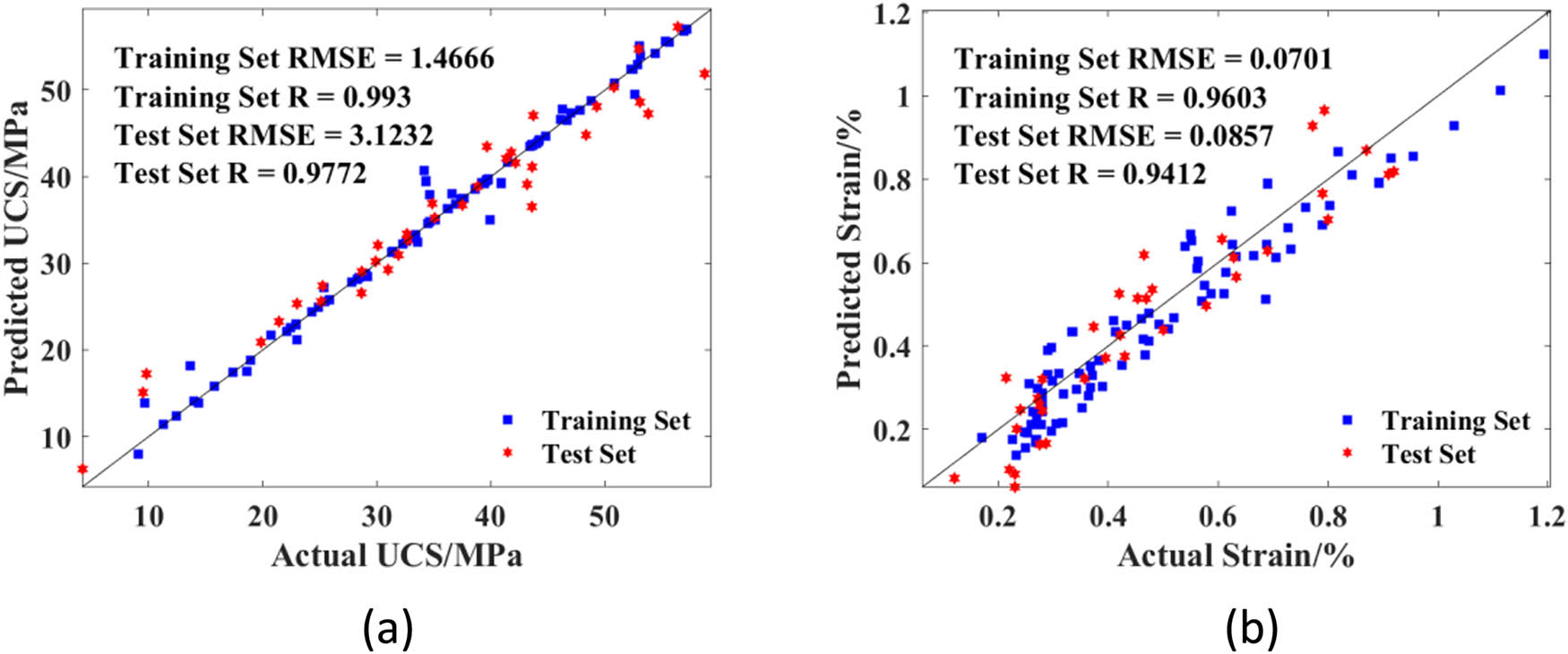
Actual versus predicted values for (a) UCS and (b) strain.
Table 4 lists the evaluation index values of UCS and strain including the RMSE, R, MAE, and MAPE. The R values for the UCS and strain datasets are 0.9772 and 0.9412, respectively, indicating a strong correlation between the predicted and actual results. Meanwhile, the RMSE, MAE, and MAPE values are low, indicating the low prediction error of the established BAS-SVR models. In addition, the RMSE and R values for the training set and test set are similar. This result indicates that there are no over-fitting or under-fitting problems. As a result, the SVR models with BAS-tuned hyperparameters demonstrated strong prediction ability for both the UCS and strain datasets.
Evaluation of BAS-SVR for UCS and strain datasets
| Test category | Evaluation index | |||
|---|---|---|---|---|
| RMSE | R | MAE | MAPE | |
| UCS (SVR) | 3.1232 MPa | 0.9772 | 2.3040 MPa | 0.0987 |
| UCS (ANN) | 2.6521 MPa | 0.9751 | 1.8131 MPa | 0.0620 |
| UCS (RF) | 3.8492 MPa | 0.9672 | 2.9862 MPa | 0.1250 |
| Strain (SVR) | 0.0857% | 0.9412 | 0.0705% | 0.1889 |
| Strain (ANN) | 0.0890% | 0.0892 | 0.0560% | 0.1680 |
| Strain (RF) | 0.0890% | 0.0893 | 0.0580% | 0.1530 |
To verify the accuracy of the established SVR model, the RF and ANN algorithms are also established as comparative models [40,41]. Table 4 also shows the specific evaluation indices, where SVR is observed to have the highest accuracy compared to RF and ANN. Figure 15 illustrates the integration of standard deviation, RMSE, and R-value in polar coordinates. The “actual” point represents the information of the raw data, and the closest position of the model to this point indicates the best prediction performance. Therefore, the SVR model is the most suitable for predicting UCS and strain in this study.
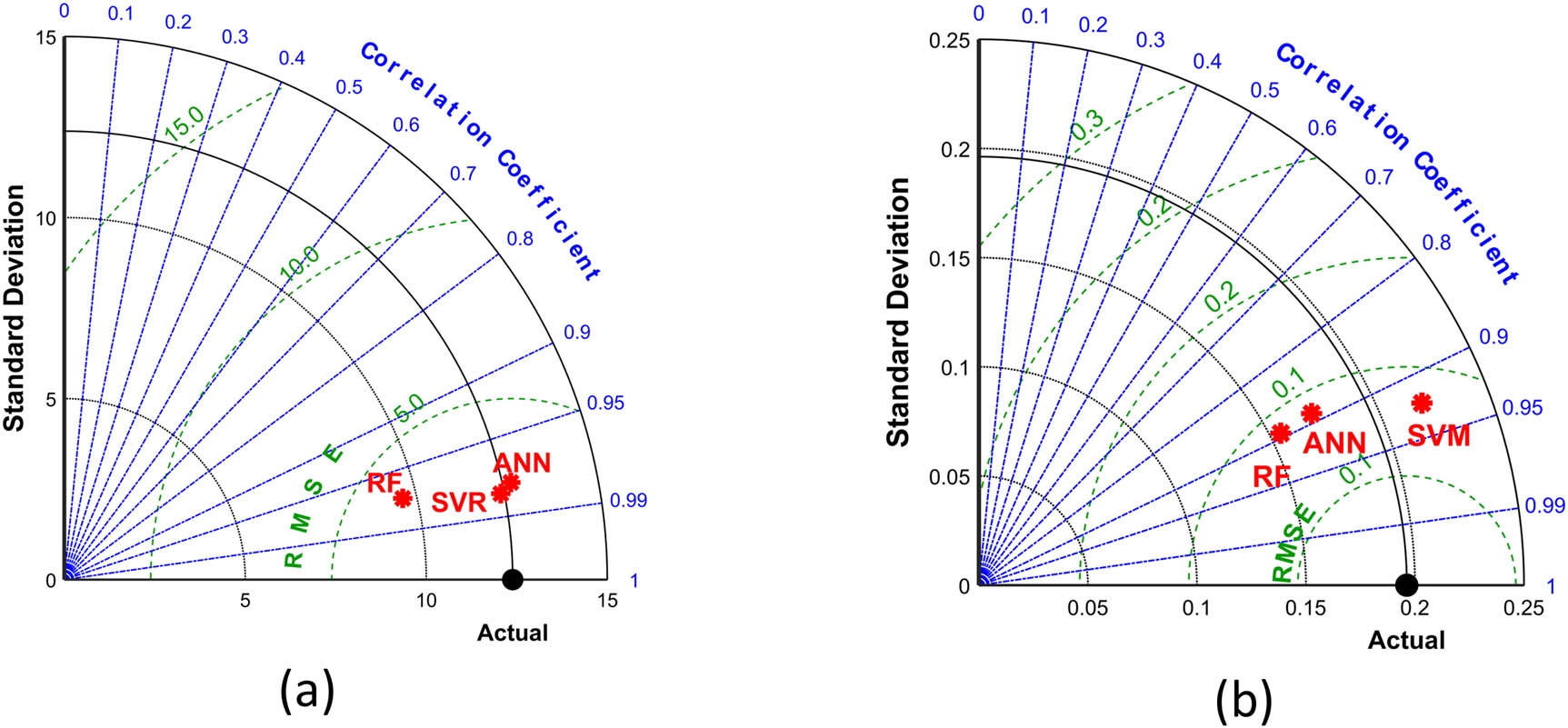
Taylor diagrams of RF, ANN, and SVR for predicting (a) UCS and (b) strain.
5.3 RRAC mixture optimization
The goal of this study is to minimize the cost and maximize the UCS and strain under given constraints. Figure 16 shows the Pareto front of MOBAS-SVR obtained at different temperatures (25, 200, 300, 400, 500, and 600°C). Tables 5 and 6 list the typical mixture design of four points (A, B, C, and D) corresponding to the conditions of the largest TOPSIS, highest UCS, maximum strain, and lowest cost, respectively. When a single UCS, strain, or cost is considered separately, points B, C, and D can be used as the optimal solution for single-objective optimization. Multiple goals can be effectively integrated to obtain a more suitable solution using the TOPSIS decision-making method.

Pareto front based on cost, UCS, and strain of RRAC at different temperatures: (a) T = 25°C, (b) T = 200°C, (c) T = 300°C, (d) T = 400°C, (e) T = 500°C, and (f) T = 600°C.
Mixture proportions of Pareto solutions (T = 25°C)
| Mixture | A (final point) | B | C | D |
|---|---|---|---|---|
| W (kg·m−3) | 214.7 | 215.7 | 208.7 | 208.4 |
| C (kg·m−3) | 476.6 | 465.5 | 485.0 | 448.7 |
| G (MPa) | 42.5 | 42.5 | 42.5 | 42.5 |
| RA (kg·m−3) | 96.1 | 606.2 | 45.2 | 994.2 |
| NA (kg·m−3) | 1023.2 | 481.6 | 1094.7 | 120.7 |
| Sand (kg·m−3) | 537.6 | 507.9 | 534.0 | 519.2 |
| RPs (kg·m−3) | 0.0 | 10.9 | 0.0 | 0.0 |
| WR (kg·m−3) | 3.3 | 3.4 | 0.0 | 0.0 |
| UCS (MPa) | 48.9 | 53.2 | 36.8 | 37.8 |
| Strain (%) | 0.47 | 0.19 | 0.49 | 0.42 |
| Cost ($·m−3) | 43.1 | 43.3 | 40.0 | 34.2 |
| TOPSIS score | 1.00 | 0.46 | 0.74 | 0.66 |
Mixture proportions of Pareto solutions (T = 400°C)
| Mixture | A (final point) | B | C | D |
|---|---|---|---|---|
| W (kg·m−3) | 207.8 | 211.5 | 194.6 | 201.6 |
| C (kg·m−3) | 444.4 | 430.0 | 434.1 | 473.1 |
| G (MPa) | 42.5 | 42.5 | 42.5 | 42.5 |
| RA (kg·m−3) | 0.2 | 435.9 | 571.8 | 941.5 |
| NA (kg·m−3) | 1194.0 | 717.8 | 597.5 | 180.1 |
| Sand (kg·m−3) | 479.9 | 526.3 | 502.6 | 514.1 |
| RPs (kg·m−3) | 15.5 | 0.6 | 18.3 | 0.0 |
| WR (kg·m−3) | 2.5 | 2.7 | 0.0 | 0.0 |
| UCS (MPa) | 30.4 | 32.4 | 16.2 | 19.3 |
| Strain (%) | 0.70 | 0.55 | 0.71 | 0.63 |
| Cost ($·m−3) | 44.8 | 38.8 | 40.0 | 35.8 |
| TOPSIS score | 1.00 | 0.38 | 0.75 | 0.49 |
At room temperature (T = 25°C, Table 5), Point B maximizes UCS at 53.2 MPa but it yields a smaller strain (0.19%) than the other points. Conversely, Point C yields the largest strain of 0.49%; however, the UCS (36.8 MPa) at this point is smaller than any other Pareto point. In addition, Point D yields the minimum cost of 34.2$·m−3, with relatively low values of UCS (37.8 MPa) and strain (0.42%). Point A is considered the most suitable solution that achieved the best tradeoff between the UCS, strain, and cost because it has the highest TOPSIS score (1), UCS of 48.9 MPa, a strain of 0.47%, and cost of 43.1$·m−3. Similarly, the MOO mixture design can be evaluated at other temperatures. As the temperature increases, the compressive strength gradually decreases, whereas the peak strain increases, which is consistent with experimental results. In conclusion, the final choice is based on the decision- maker’s choice to achieve a tradeoff between these three objectives. Under the condition that no specific requirements are presented, the solution of comprehensive consideration (TOPSIS = 1) can be prioritized.
5.4 Variable importance analysis
An SA was performed to evaluate the importance of the input variables for the results presented in terms of the importance ratio, which reflects the estimated influence of variables on UCS and peak strain, as shown in Figure 17. The input variable that had the highest impact on UCS is temperature, accounting for 61.07%, followed by the RA ratio with an importance ratio of 25.91%, the RP ratio with an importance ratio of 10.71%, and the OPC grade with an importance ratio of 2.31%.

Evaluation of the importance of input variables for the UCS and peak strain of RRAC.
Among the input variables of strain, temperature had the highest influence on the result, accounting for 74.29%, followed by the RA ratio with an importance ratio of 12.65%, the RP ratio with an importance ratio of 9.55%, and the OPC grade with an importance ratio of 3.51%.
6 Conclusion
In this study, the UCS and peak strain of RRAC were investigated to evaluate the effects of RPs, RA, and temperature. A MOBAS-SVR model was successfully established based on the experimental outcomes, simultaneously optimizing three objectives and developing the corresponding mixture design at varying temperatures. A variable SA was also performed. The following conclusions are drawn based on the findings of this study:
The UCS was weakened after exposure to high temperatures (more than 400℃). The combination of 50% RA and 5% RPs achieved the maximum UCS of RRAC compared with other combination ratios of RA and RPs. The peak strain is positively related to RA owing to its higher porosity than that of NA. Similarly, RPs increase the peak strain owing to their soft properties.
The BAS algorithm successfully adjusted the hyperparameters of the SVR models on both the UCS and peak strain datasets. The R values were 0.9772 and 0.9412, respectively, indicating the relatively high accuracy of the established BAS-SVR models.
The MOO problem was successfully addressed by introducing the MOBAS-SVR model, and the UCS, peak strain, and cost were optimized simultaneously. The Pareto fronts obtained in this study at varying temperatures provide valuable design solutions for decision-makers. The preferable non-dominated solution can be determined using the TOPSIS method.
According to the variable SA, temperature is the dominant variable among all the input variables. In addition, the RA replacement ratio is more important compared with the RP replacement ratio for both the UCS and strain datasets.
To enhance the predictive accuracy and versatility of RRAC’s properties, future efforts will focus on broadening the dataset to include more input variables such as cement ingredient, aggregate grading, and RA or rubber category. Additionally, exploring advanced or updated ML and MOO models will be a priority for modeling RRAC’s properties.
Acknowledgments
The authors would like to acknowledge the China Postdoctoral Science Foundation, Natural Science Foundation of Guangxi Province, Guangdong Basic and Applied Basic Research Foundation, and the Guangxi Key Laboratory of Disaster Prevention and Engineering Safety for providing the financial resources to carry out the work.
-
Funding information: This research was funded by the China Postdoctoral Science Foundation (2021M690765), Natural Science Foundation of Guangxi Province (2021GXNSFAA220045), Guangdong Basic and Applied Basic Research Foundation (2022A1515010008, 2023A1515010870), and the Systematic Project of Guangxi Key Laboratory of Disaster Prevention and Engineering Safety (2021ZDK007).
-
Author contributions: All authors have accepted responsibility for the entire content of this manuscript and approved its submission.
-
Conflict of interest: The authors state no conflict of interest.
Reference
[1] Liu, J. K., Y. Q. Yi, and X. T. Wang. Exploring factors influencing construction waste reduction: A structural equation modeling approach. Journal of Cleaner Production, Vol. 276, 2020, id. 123185.10.1016/j.jclepro.2020.123185Search in Google Scholar
[2] Mai, G., L. Li, X. Chen, Z. Xiong, J. Liang, X. Zou, et al. Fatigue performance of basalt fibre-reinforced polymer bar-reinforced sea sand concrete slabs. Journal of Materials Research and Technology, Vol. 22, 2023, pp. 706–727.10.1016/j.jmrt.2022.11.135Search in Google Scholar
[3] Liu, K., X. Zhao, Y. Kou, Y. Yu, and T. Xie. Compressive Stress–Strain Relationship and Its Variability of Self-Compacting Concrete Incorporating Recycled Aggregate. Journal of Materials in Civil Engineering, Vol. 35, No. 4, 2023, id. 04023001.10.1061/(ASCE)MT.1943-5533.0004675Search in Google Scholar
[4] Sun, J., S. Lin, G. Zhang, Y. Sun, J. Zhang, C. Chen, et al. The effect of graphite and slag on electrical and mechanical properties of electrically conductive cementitious composites. Construction and Building Materials, Vol. 281, 2021, id. 122606.10.1016/j.conbuildmat.2021.122606Search in Google Scholar
[5] Kim, Y., A. Hanif, M. Usman, and W. Park. Influence of bonded mortar of recycled concrete aggregates on interfacial characteristics - Porosity assessment based on pore segmentation from backscattered electron image analysis. Construction and Building Materials, Vol. 212, 2019, pp. 149–163.10.1016/j.conbuildmat.2019.03.265Search in Google Scholar
[6] Wang, M., X. Yang, and W. Wang. Establishing a 3D aggregates database from X-ray CT scans of bulk concrete. Construction and Building Materials, Vol. 315, 2022, id. 125740.10.1016/j.conbuildmat.2021.125740Search in Google Scholar
[7] Tang, Y., Z. Huang, Z. Chen, M. Chen, H. Zhou, H. Zhang, et al. Novel visual crack width measurement based on backbone double-scale features for improved detection automation. Engineering Structures, Vol. 274, 2023, id. 115158.10.1016/j.engstruct.2022.115158Search in Google Scholar
[8] Shen, Y. N., J. T. Huang, X. B. Ma, F. Hao, and J. F. Lv. Experimental study on the free shrinkage of lightweight polymer concrete incorporating waste rubber powder and ceramsite. Composite Structures, Vol. 242, 2020, id. 12.10.1016/j.compstruct.2020.112152Search in Google Scholar
[9] Huang, H., M. Huang, W. Zhang, M. Guo, and B. Liu. Progressive collapse of multistory 3D reinforced concrete frame structures after the loss of an edge column. Structure and Infrastructure Engineering, Vol. 18, No. 2, 2022, pp. 249–265.10.1080/15732479.2020.1841245Search in Google Scholar
[10] Huang, H., Y. Yuan, W. Zhang, and M. Li. Seismic behavior of a replaceable artificial controllable plastic hinge for precast concrete beam-column joint. Engineering Structures, Vol. 245, 2021.10.1016/j.engstruct.2021.112848Search in Google Scholar
[11] Feng, W., Z. Chen, Y. Tang, F. Liu, F. Yang, Y. Yang, et al. Fracture characteristics of sustainable crumb rubber concrete under a wide range of loading rates. Construction and Building Materials, Vol. 359, 2022, id. 129474.10.1016/j.conbuildmat.2022.129474Search in Google Scholar
[12] Liu, F., L. Y. Meng, G. F. Ning, and L. J. Li. Fatigue performance of rubber-modified recycled aggregate concrete (RRAC) for pavement. Construction and Building Materials, Vol. 95, 2015, pp. 207–217.10.1016/j.conbuildmat.2015.07.042Search in Google Scholar
[13] Oliveira Santos, B., J. Valença, J. P. Costeira, and E. Julio. Domain adversarial training for classification of cracking in images of concrete surfaces. AI in Civil Engineering, Vol. 1, No. 1, 2022, id. 8.10.1007/s43503-022-00008-6Search in Google Scholar
[14] Babalola, O. E., P. O. Awoyera, D. H. Le, and L. M. B. Romero. A review of residual strength properties of normal and high strength concrete exposed to elevated temperatures: Impact of materials modification on behaviour of concrete composite. Construction and Building Materials, Vol. 296, 2021, id. 20.10.1016/j.conbuildmat.2021.123448Search in Google Scholar
[15] Sun, L., C. Wang, C. Zhang, Z. Yang, C. Li, and P. Qiao. Experimental investigation on the bond performance of sea sand coral concrete with FRP bar reinforcement for marine environments. Advances in Structural Engineering, Vol. 26, No. 3, 2023, pp. 533–546.10.1177/13694332221131153Search in Google Scholar
[16] Shi, T., Y. Liu, X. Zhao, J. Wang, Z. Zhao, D. J. Corr, et al. Study on mechanical properties of the interfacial transition zone in carbon nanofiber-reinforced cement mortar based on the PeakForce tapping mode of atomic force microscope. Journal of Building Engineering, Vol. 61, 2022, id. 105248.10.1016/j.jobe.2022.105248Search in Google Scholar
[17] Laneyrie, C., A.-L. Beaucour, M. F. Green, R. L. Hebert, B. Ledesert, and A. Noumowe. Influence of recycled coarse aggregates on normal and high performance concrete subjected to elevated temperatures. Construction and Building Materials, Vol. 111, 2016, pp. 368–378.10.1016/j.conbuildmat.2016.02.056Search in Google Scholar
[18] Huang, H., M. Li, Y. Yuan, and H. Bai. Theoretical analysis on the lateral drift of precast concrete frame with replaceable artificial controllable plastic hinges. Journal of Building Engineering, Vol. 62, 2022, id. 105386.10.1016/j.jobe.2022.105386Search in Google Scholar
[19] Sun, J., Y. Wang, K. Li, X. Yao, B. Zhu, J. Wang, et al. Molecular interfacial properties and engineering performance of conductive fillers in cementitious composites. Journal of Materials Research and Technology, 2022.10.1016/j.jmrt.2022.05.061Search in Google Scholar
[20] Xie, J. H., Z. Zhang, Z. Y. Lu, and M. W. Sun. Coupling effects of silica fume and steel-fiber on the compressive behaviour of recycled aggregate concrete after exposure to elevated temperature. Construction and Building Materials, Vol. 184, 2018, pp. 752–764.10.1016/j.conbuildmat.2018.07.035Search in Google Scholar
[21] Fang, B., Z. Hu, T. Shi, Y. Liu, X. Wang, D. Yang, et al. Research progress on the properties and applications of magnesium phosphate cement. Ceramics International, Vol. 49, 2022, pp. 4001–4016.10.1016/j.ceramint.2022.11.078Search in Google Scholar
[22] Cao, B., S. Fan, J. Zhao, S. Tian, Z. Zheng, Y. Yan, et al. Large-scale many-objective deployment optimization of edge servers. IEEE Transactions on Intelligent Transportation Systems, Vol. 22, No. 6, 2021, pp. 3841–3849.10.1109/TITS.2021.3059455Search in Google Scholar
[23] Pliya, P., H. Hajiloo, S. Romagnosi, D. Cree, S. Sarhat, and M. F. Green. The compressive behaviour of natural and recycled aggregate concrete during and after exposure to elevated temperatures. Journal of Building Engineering, Vol. 38, 2021, id. 10.10.1016/j.jobe.2021.102214Search in Google Scholar
[24] Li, Y., X. B. Yang, P. Lou, R. J. Wang, Y. L. Li, and Z. Si. Sulfate attack resistance of recycled aggregate concrete with NaOH-solution-treated crumb rubber. Construction and Building Materials, Vol. 287, 2021, id. 15.10.1016/j.conbuildmat.2021.123044Search in Google Scholar
[25] Fakhri, M., F. Yousefian, E. Amoosoltani, M. R. M. Aliha, and F. Berto. Combined effects of recycled crumb rubber and silica fume on mechanical properties and mode I fracture toughness of self-compacting concrete. Fatigue & Fracture of Engineering Materials & Structures, Vol. 44, No. 10, 2021, pp. 2659–2673.10.1111/ffe.13521Search in Google Scholar
[26] Sun, J., Y. Wang, S. Liu, A. Dehghani, X. Xiang, J. Wei, et al. Mechanical, chemical and hydrothermal activation for waste glass reinforced cement. Construction and Building Materials, Vol. 301, 2021, id. 124361.10.1016/j.conbuildmat.2021.124361Search in Google Scholar
[27] Tamanna, K., M. Tiznobaik, N. Banthia, and M. S. Alam. Mechanical properties of rubberized concrete containing recycled concrete aggregate. Aci Materials Journal, Vol. 117, No. 3, 2020, pp. 169–180.10.14359/51722409Search in Google Scholar
[28] Shi, T., Y. Liu, Z. Hu, M. Cen, C. Zeng, J. Xu, et al. Deformation performance and fracture toughness of carbon nanofiber-modified cement-based materials. ACI Materials Journal, Vol. 119, No. 5, 2022, pp. 118–127.10.14359/51735976Search in Google Scholar
[29] Sun, Y., R. Bi, J. Sun, J. Zhang, R. Taherdangkoo, J. Huang, et al. Stability of roadway along hard roof goaf by stress relief technique in deep mines: A theoretical, numerical and field study. Geomechanics and geophysics for geo-energy and geo-resources, Vol. 8, No. 2, 2022, id. 45.10.1007/s40948-022-00356-8Search in Google Scholar
[30] Chen, A. J., X. Y. Han, M. Chen, X. Y. Wang, Z. H. Wang, and T. T. Guo. Mechanical and stress-strain behavior of basalt fiber reinforced rubberized recycled coarse aggregate concrete. Construction and Building Materials, Vol. 260, 2020, id. 11.10.1016/j.conbuildmat.2020.119888Search in Google Scholar
[31] Tang, Y. C., W. H. Feng, W. X. Feng, J. M. Chen, D. J. Bao, and L. J. Li. Compressive properties of rubber-modified recycled aggregate concrete subjected to elevated temperatures. Construction and Building Materials, Vol. 268, 2021, id. 121181.10.1016/j.conbuildmat.2020.121181Search in Google Scholar
[32] Tang, Y. C., W. H. Feng, Z. Chen, Y. M. Nong, M. H. Yao, and J. H. Liu. Experimental and theoretical investigation on the thermo-mechanical properties of recycled aggregate concrete containing recycled rubber. Frontiers in Materials, Vol. 8, 2021, id. 655097.10.3389/fmats.2021.655097Search in Google Scholar
[33] Feng, W., Y. Wang, J. Sun, Y. Tang, D. Wu, Z. Jiang, et al. Prediction of thermo-mechanical properties of rubber-modified recycled aggregate concrete. Construction and Building Materials, Vol. 318, 2022, id. 125970.10.1016/j.conbuildmat.2021.125970Search in Google Scholar
[34] Chen, R., C. Zhou, and LL. Cheng. Computer-vision-guided semi-autonomous concrete crack repair for infrastructure maintenance using a robotic arm. AI in Civil Engineering, Vol. 1, No. 1, 2022, id. 9.10.1007/s43503-022-00007-7Search in Google Scholar
[35] Lee, S. and M. J. Skibniewski. Automated monitoring and warning solution for concrete placement and vibration workmanship quality issues. AI in Civil Engineering, Vol. 1, No. 1, 2022, id. 4.10.1007/s43503-022-00003-xSearch in Google Scholar
[36] Tang, Y., Y. Wang, D. Wu, Z. Liu, H. Zhang, M. Zhu, et al. An experimental investigation and machine learning-based prediction for seismic performance of steel tubular column filled with recycled aggregate concrete. Reviews on Advanced Materials Science, Vol. 61, No. 1, 2022, pp. 849–872.10.1515/rams-2022-0274Search in Google Scholar
[37] Sun, J., F. Aslani, J. Wei, and X. Wang. Electromagnetic absorption of copper fiber oriented composite using 3D printing. Construction and Building Materials, Vol. 300, 2021, id. 124026.10.1016/j.conbuildmat.2021.124026Search in Google Scholar
[38] Alexander, Q. G., V. Hoskere, Y. Narazaki, A. Maxwell, and B. F. Spencer. Fusion of thermal and RGB images for automated deep learning based crack detection in civil infrastructure. AI in Civil Engineering, Vol. 1, No. 1, 2022, p. 3.10.1007/s43503-022-00002-ySearch in Google Scholar
[39] Huang, B., J. Wang, G. Piukovics, N. Zabihi, J. Ye, M. Saafi, et al. Hybrid cement composite-based sensor for in-situ chloride monitoring in concrete structures. Sensors and Actuators B: Chemical, Vol. 385, 2023, id. 133638.10.1016/j.snb.2023.133638Search in Google Scholar
[40] Açikgenç, M., M. Ulaş, and K. E. Alyamaç. Using an artificial neural network to predict mix compositions of steel fiber-reinforced concrete. Arabian Journal for Science and Engineering, Vol. 40, No. 2, 2015, pp. 407–419.10.1007/s13369-014-1549-xSearch in Google Scholar
[41] Sun, J., Y. Ma, J. Li, J. Zhang, Z. Ren, and X. Wang. Machine learning-aided design and prediction of cementitious composites containing graphite and slag powder. Journal of Building Engineering, Vol. 43, 2021, id. 102544.10.1016/j.jobe.2021.102544Search in Google Scholar
[42] Sun, J., J. Wang, Z. Zhu, R. He, C. Peng, C. Zhang, et al. Mechanical performance prediction for sustainable high-strength concrete using bio-inspired neural network. Buildings, Vol. 12, No. 1, 2022, id. 65.10.3390/buildings12010065Search in Google Scholar
[43] Zhang, J., Y. Sun, G. Li, Y. Wang, J. Sun, and J. Li. Machine-learning-assisted shear strength prediction of reinforced concrete beams with and without stirrups. Engineering with Computers, Vol. 38, 2020, pp. 1293–1307.10.1007/s00366-020-01076-xSearch in Google Scholar
[44] Burges, C. J. A tutorial on support vector machines for pattern recognition. Data Mining and Knowledge Discovery, Vol. 2, No. 2, 1998, pp. 121–167.10.1023/A:1009715923555Search in Google Scholar
[45] Li, H., B. Xu, G. Lu, C. Du, and N. Huang. Multi-objective optimization of PEM fuel cell by coupled significant variables recognition, surrogate models and a multi-objective genetic algorithm. Energy Conversion and Management, Vol. 236, 2021, id. 114063.10.1016/j.enconman.2021.114063Search in Google Scholar
[46] Han, Y., S. Shao, B. Fang, T. Shi, B. Zhang, X. Wang, et al. Chloride ion penetration resistance of matrix and interfacial transition zone of multi-walled carbon nanotube-reinforced concrete. Journal of Building Engineering, Vol. 72, 2023.10.1016/j.jobe.2023.106587Search in Google Scholar
[47] Duan, K., S. S. Keerthi, and A. N. Poo. Evaluation of simple performance measures for tuning SVM hyperparameters. Neurocomputing, Vol. 51, 2003, pp. 41–59.10.1016/S0925-2312(02)00601-XSearch in Google Scholar
[48] Huang, Y., W. Zhang, and X. Liu. Assessment of diagonal macrocrack-induced debonding mechanisms in FRP-strengthened RC beams. Journal of Composites for Construction, Vol. 26, No. 5, 2022, id. 04022056.10.1061/(ASCE)CC.1943-5614.0001255Search in Google Scholar
[49] Chou, J.-S., N.-T. Ngo, and A.-D. Pham. Shear strength prediction in reinforced concrete deep beams using nature-inspired metaheuristic support vector regression. Journal of Computing in Civil Engineering, Vol. 30, No. 1, 2016, id. 04015002.10.1061/(ASCE)CP.1943-5487.0000466Search in Google Scholar
[50] Jiang, X. and S. Li, BAS: beetle antennae search algorithm for optimization problems. arXiv preprint arXiv:1710.10724, 2017.10.5430/ijrc.v1n1p1Search in Google Scholar
[51] Yang, X.-S. Engineering optimization: an introduction with metaheuristic applications, John Wiley & Sons, 2010.10.1002/9780470640425Search in Google Scholar
[52] Zhang, J., Y. Huang, G. Ma, and B. Nener, Multi-objective beetle antennae search algorithm. arXiv preprint arXiv:2002.10090, 2020.Search in Google Scholar
[53] Zhang, G., C. Chen, K. Li, F. Xiao, J. Sun, Y. Wang, et al. Multi-objective optimisation design for GFRP tendon reinforced cemented soil. Construction and Building Materials, Vol. 320, 2022, id. 126297.10.1016/j.conbuildmat.2021.126297Search in Google Scholar
[54] Sun, J., X. Wang, J. Zhang, F. Xiao, Y. Sun, Z. Ren, et al. Multi-objective optimisation of a graphite-slag conductive composite applying a BAS-SVR based model. Journal of Building Engineering, Vol. 44, 2021, id. 103223.10.1016/j.jobe.2021.103223Search in Google Scholar
[55] Zhang, J., Y. Huang, Y. Wang, and G. Ma. Multi-objective optimization of concrete mixture proportions using machine learning and metaheuristic algorithms. Construction and Building Materials, Vol. 253, 2020, id. 119208.10.1016/j.conbuildmat.2020.119208Search in Google Scholar
[56] Li, L. J., W. F. Xie, F. Liu, Y. C. Guo, and J. Deng. Fire performance of high-strength concrete reinforced with recycled rubber particles. Magazine of Concrete Research, Vol. 63, No. 3, 2011, pp. 187–195.10.1680/macr.8.00140Search in Google Scholar
[57] ASTM-International. ASTM C617: Standard practice for capping cylindrical concrete specimens, West Conshohocken, PA, USA, 2015.Search in Google Scholar
[58] ASTM-International. ASTM C39: Standard test method for compressive strength of cylindrical concrete specimens, West Conshohocken, PA, USA, 2020.Search in Google Scholar
[59] ASTM-International. ASTM C469: standard test method for static modulus of elasticity and Poisson’s ratio of concrete in compression, West Conshohocken, PA, USA, 2014.Search in Google Scholar
[60] Smola, A. and B. Schölkopf. A tutorial on support vector regression. Statistics and Computing, Vol. 14, No. 3, 2004, pp. 199–222.10.1023/B:STCO.0000035301.49549.88Search in Google Scholar
[61] Lahiri, S. and K. Ghanta. The support vector regression with the parameter tuning assisted by a differential evolution technique: Study of the critical velocity of a slurry flow in a pipeline. Chemical Industry and Chemical Engineering Quarterly, Vol. 14, No. 3, 2008, pp. 191–203.10.2298/CICEQ0803191LSearch in Google Scholar
[62] Boyd, S., L. Vandenberghe. Convex Optimization., Cambridge University Press, 2004.10.1017/CBO9780511804441Search in Google Scholar
[63] Wang, J. and H. Chen, BSAS: Beetle swarm antennae search algorithm for optimization problems. arXiv preprint arXiv:1807.10470.2018.Search in Google Scholar
[64] Chou, J. S. and C. F. Tsai. Concrete compressive strength analysis using a combined classification and regression technique. Automation in Construction, Vol. 24, 2012, pp. 52–60.10.1016/j.autcon.2012.02.001Search in Google Scholar
[65] Klammer, M., J. N. Dybowski, D. Hoffmann, and C. Schaab. Pareto optimization identifies diverse set of phosphorylation signatures predicting response to treatment with dasatinib. PLOS ONE, Vol. 10, No. 6, 2015, id. e0128542.10.1371/journal.pone.0128542Search in Google Scholar PubMed PubMed Central
[66] Cortez, P. and M. J. Embrechts. Using sensitivity analysis and visualization techniques to open black box data mining models. Information Sciences, Vol. 225, 2013, pp. 1–17.10.1016/j.ins.2012.10.039Search in Google Scholar
[67] Sarhat, S. R. and E. G. Sherwood. Residual mechanical response of recycled aggregate concrete after exposure to elevated temperatures. Journal of Materials in Civil Engineering, Vol. 25, No. 11, 2013, pp. 1721–1730.10.1061/(ASCE)MT.1943-5533.0000719Search in Google Scholar
© 2023 the author(s), published by De Gruyter
This work is licensed under the Creative Commons Attribution 4.0 International License.
Articles in the same Issue
- Review Articles
- Progress in preparation and ablation resistance of ultra-high-temperature ceramics modified C/C composites for extreme environment
- Solar lighting systems applied in photocatalysis to treat pollutants – A review
- Technological advances in three-dimensional skin tissue engineering
- Hybrid magnesium matrix composites: A review of reinforcement philosophies, mechanical and tribological characteristics
- Application prospect of calcium peroxide nanoparticles in biomedical field
- Research progress on basalt fiber-based functionalized composites
- Evaluation of the properties and applications of FRP bars and anchors: A review
- A critical review on mechanical, durability, and microstructural properties of industrial by-product-based geopolymer composites
- Multifunctional engineered cementitious composites modified with nanomaterials and their applications: An overview
- Role of bioglass derivatives in tissue regeneration and repair: A review
- Research progress on properties of cement-based composites incorporating graphene oxide
- Properties of ultra-high performance concrete and conventional concrete with coal bottom ash as aggregate replacement and nanoadditives: A review
- A scientometric review of the literature on the incorporation of steel fibers in ultra-high-performance concrete with research mapping knowledge
- Weldability of high nitrogen steels: A review
- Application of waste recycle tire steel fibers as a construction material in concrete
- Wear properties of graphene-reinforced aluminium metal matrix composite: A review
- Experimental investigations of electrodeposited Zn–Ni, Zn–Co, and Ni–Cr–Co–based novel coatings on AA7075 substrate to ameliorate the mechanical, abrasion, morphological, and corrosion properties for automotive applications
- Research evolution on self-healing asphalt: A scientometric review for knowledge mapping
- Recent developments in the mechanical properties of hybrid fiber metal laminates in the automotive industry: A review
- A review of microscopic characterization and related properties of fiber-incorporated cement-based materials
- Comparison and review of classical and machine learning-based constitutive models for polymers used in aeronautical thermoplastic composites
- Gold nanoparticle-based strategies against SARS-CoV-2: A review
- Poly-ferric sulphate as superior coagulant: A review on preparation methods and properties
- A review on ceramic waste-based concrete: A step toward sustainable concrete
- Modification of the structure and properties of oxide layers on aluminium alloys: A review
- A review of magnetically driven swimming microrobots: Material selection, structure design, control method, and applications
- Polyimide–nickel nanocomposites fabrication, properties, and applications: A review
- Design and analysis of timber-concrete-based civil structures and its applications: A brief review
- Effect of fiber treatment on physical and mechanical properties of natural fiber-reinforced composites: A review
- Blending and functionalisation modification of 3D printed polylactic acid for fused deposition modeling
- A critical review on functionally graded ceramic materials for cutting tools: Current trends and future prospects
- Heme iron as potential iron fortifier for food application – characterization by material techniques
- An overview of the research trends on fiber-reinforced shotcrete for construction applications
- High-entropy alloys: A review of their performance as promising materials for hydrogen and molten salt storage
- Effect of the axial compression ratio on the seismic behavior of resilient concrete walls with concealed column stirrups
- Research Articles
- Effect of fiber orientation and elevated temperature on the mechanical properties of unidirectional continuous kenaf reinforced PLA composites
- Optimizing the ECAP processing parameters of pure Cu through experimental, finite element, and response surface approaches
- Study on the solidification property and mechanism of soft soil based on the industrial waste residue
- Preparation and photocatalytic degradation of Sulfamethoxazole by g-C3N4 nano composite samples
- Impact of thermal modification on color and chemical changes of African padauk, merbau, mahogany, and iroko wood species
- The evaluation of the mechanical properties of glass, kenaf, and honeycomb fiber-reinforced composite
- Evaluation of a novel steel box-soft body combination for bridge protection against ship collision
- Study on the uniaxial compression constitutive relationship of modified yellow mud from minority dwelling in western Sichuan, China
- Ultrasonic longitudinal torsion-assisted biotic bone drilling: An experimental study
- Green synthesis, characterizations, and antibacterial activity of silver nanoparticles from Themeda quadrivalvis, in conjugation with macrolide antibiotics against respiratory pathogens
- Performance analysis of WEDM during the machining of Inconel 690 miniature gear using RSM and ANN modeling approaches
- Biosynthesis of Ag/bentonite, ZnO/bentonite, and Ag/ZnO/bentonite nanocomposites by aqueous leaf extract of Hagenia abyssinica for antibacterial activities
- Eco-friendly MoS2/waste coconut oil nanofluid for machining of magnesium implants
- Silica and kaolin reinforced aluminum matrix composite for heat storage
- Optimal design of glazed hollow bead thermal insulation mortar containing fly ash and slag based on response surface methodology
- Hemp seed oil nanoemulsion with Sapindus saponins as a potential carrier for iron supplement and vitamin D
- A numerical study on thin film flow and heat transfer enhancement for copper nanoparticles dispersed in ethylene glycol
- Research on complex multimodal vibration characteristics of offshore platform
- Applicability of fractal models for characterising pore structure of hybrid basalt–polypropylene fibre-reinforced concrete
- Influence of sodium silicate to precursor ratio on mechanical properties and durability of the metakaolin/fly ash alkali-activated sustainable mortar using manufactured sand
- An experimental study of bending resistance of multi-size PFRC beams
- Characterization, biocompatibility, and optimization of electrospun SF/PCL composite nanofiber films
- Morphological classification method and data-driven estimation of the joint roughness coefficient by consideration of two-order asperity
- Prediction and simulation of mechanical properties of borophene-reinforced epoxy nanocomposites using molecular dynamics and FEA
- Nanoemulsions of essential oils stabilized with saponins exhibiting antibacterial and antioxidative properties
- Fabrication and performance analysis of sustainable municipal solid waste incineration fly ash alkali-activated acoustic barriers
- Electrostatic-spinning construction of HCNTs@Ti3C2T x MXenes hybrid aerogel microspheres for tunable microwave absorption
- Investigation of the mechanical properties, surface quality, and energy efficiency of a fused filament fabrication for PA6
- Experimental study on mechanical properties of coal gangue base geopolymer recycled aggregate concrete reinforced by steel fiber and nano-Al2O3
- Hybrid bio-fiber/bio-ceramic composite materials: Mechanical performance, thermal stability, and morphological analysis
- Experimental study on recycled steel fiber-reinforced concrete under repeated impact
- Effect of rare earth Nd on the microstructural transformation and mechanical properties of 7xxx series aluminum alloys
- Color match evaluation using instrumental method for three single-shade resin composites before and after in-office bleaching
- Exploring temperature-resilient recycled aggregate concrete with waste rubber: An experimental and multi-objective optimization analysis
- Study on aging mechanism of SBS/SBR compound-modified asphalt based on molecular dynamics
- Evolution of the pore structure of pumice aggregate concrete and the effect on compressive strength
- Effect of alkaline treatment time of fibers and microcrystalline cellulose addition on mechanical properties of unsaturated polyester composites reinforced by cantala fibers
- Optimization of eggshell particles to produce eco-friendly green fillers with bamboo reinforcement in organic friction materials
- An effective approach to improve microstructure and tribological properties of cold sprayed Al alloys
- Luminescence and temperature-sensing properties of Li+, Na+, or K+, Tm3+, and Yb3+ co-doped Bi2WO6 phosphors
- Effect of molybdenum tailings aggregate on mechanical properties of engineered cementitious composites and stirrup-confined ECC stub columns
- Experimental study on the seismic performance of short shear walls comprising cold-formed steel and high-strength reinforced concrete with concealed bracing
- Failure criteria and microstructure evolution mechanism of the alkali–silica reaction of concrete
- Mechanical, fracture-deformation, and tribology behavior of fillers-reinforced sisal fiber composites for lightweight automotive applications
- UV aging behavior evolution characterization of HALS-modified asphalt based on micro-morphological features
- Preparation of VO2/graphene/SiC film by water vapor oxidation
- A semi-empirical model for predicting carbonation depth of RAC under two-dimensional conditions
- Comparison of the physical properties of different polyimide nanocomposite films containing organoclays varying in alkyl chain lengths
- Effects of freeze–thaw cycles on micro and meso-structural characteristics and mechanical properties of porous asphalt mixtures
- Flexural performance of a new type of slightly curved arc HRB400 steel bars reinforced one-way concrete slabs
- Alkali-activated binder based on red mud with class F fly ash and ground granulated blast-furnace slag under ambient temperature
- Facile synthesis of g-C3N4 nanosheets for effective degradation of organic pollutants via ball milling
- DEM study on the loading rate effect of marble under different confining pressures
- Conductive and self-cleaning composite membranes from corn husk nanofiber embedded with inorganic fillers (TiO2, CaO, and eggshell) by sol–gel and casting processes for smart membrane applications
- Laser re-melting of modified multimodal Cr3C2–NiCr coatings by HVOF: Effect on the microstructure and anticorrosion properties
- Damage constitutive model of jointed rock mass considering structural features and load effect
- Thermosetting polymer composites: Manufacturing and properties study
- CSG compressive strength prediction based on LSTM and interpretable machine learning
- Axial compression behavior and stress–strain relationship of slurry-wrapping treatment recycled aggregate concrete-filled steel tube short columns
- Space-time evolution characteristics of loaded gas-bearing coal fractures based on industrial μCT
- Dual-biprism-based single-camera high-speed 3D-digital image correlation for deformation measurement on sandwich structures under low velocity impact
- Effects of cold deformation modes on microstructure uniformity and mechanical properties of large 2219 Al–Cu alloy rings
- Basalt fiber as natural reinforcement to improve the performance of ecological grouting slurry for the conservation of earthen sites
- Interaction of micro-fluid structure in a pressure-driven duct flow with a nearby placed current-carrying wire: A numerical investigation
- A simulation modeling methodology considering random multiple shots for shot peening process
- Optimization and characterization of composite modified asphalt with pyrolytic carbon black and chicken feather fiber
- Synthesis, characterization, and application of the novel nanomagnet adsorbent for the removal of Cr(vi) ions
- Multi-perspective structural integrity-based computational investigations on airframe of Gyrodyne-configured multi-rotor UAV through coupled CFD and FEA approaches for various lightweight sandwich composites and alloys
- Influence of PVA fibers on the durability of cementitious composites under the wet–heat–salt coupling environment
- Compressive behavior of BFRP-confined ceramsite concrete: An experimental study and stress–strain model
- Interval models for uncertainty analysis and degradation prediction of the mechanical properties of rubber
- Preparation of PVDF-HFP/CB/Ni nanocomposite films for piezoelectric energy harvesting
- Frost resistance and life prediction of recycled brick aggregate concrete with waste polypropylene fiber
- Synthetic leathers as a possible source of chemicals and odorous substances in indoor environment
- Mechanical properties of seawater volcanic scoria aggregate concrete-filled circular GFRP and stainless steel tubes under axial compression
- Effect of curved anchor impellers on power consumption and hydrodynamic parameters of yield stress fluids (Bingham–Papanastasiou model) in stirred tanks
- All-dielectric tunable zero-refractive index metamaterials based on phase change materials
- Influence of ultrasonication time on the various properties of alkaline-treated mango seed waste filler reinforced PVA biocomposite
- Research on key casting process of high-grade CNC machine tool bed nodular cast iron
- Latest research progress of SiCp/Al composite for electronic packaging
- Special Issue on 3D and 4D Printing of Advanced Functional Materials - Part I
- Molecular dynamics simulation on electrohydrodynamic atomization: Stable dripping mode by pre-load voltage
- Research progress of metal-based additive manufacturing in medical implants
Articles in the same Issue
- Review Articles
- Progress in preparation and ablation resistance of ultra-high-temperature ceramics modified C/C composites for extreme environment
- Solar lighting systems applied in photocatalysis to treat pollutants – A review
- Technological advances in three-dimensional skin tissue engineering
- Hybrid magnesium matrix composites: A review of reinforcement philosophies, mechanical and tribological characteristics
- Application prospect of calcium peroxide nanoparticles in biomedical field
- Research progress on basalt fiber-based functionalized composites
- Evaluation of the properties and applications of FRP bars and anchors: A review
- A critical review on mechanical, durability, and microstructural properties of industrial by-product-based geopolymer composites
- Multifunctional engineered cementitious composites modified with nanomaterials and their applications: An overview
- Role of bioglass derivatives in tissue regeneration and repair: A review
- Research progress on properties of cement-based composites incorporating graphene oxide
- Properties of ultra-high performance concrete and conventional concrete with coal bottom ash as aggregate replacement and nanoadditives: A review
- A scientometric review of the literature on the incorporation of steel fibers in ultra-high-performance concrete with research mapping knowledge
- Weldability of high nitrogen steels: A review
- Application of waste recycle tire steel fibers as a construction material in concrete
- Wear properties of graphene-reinforced aluminium metal matrix composite: A review
- Experimental investigations of electrodeposited Zn–Ni, Zn–Co, and Ni–Cr–Co–based novel coatings on AA7075 substrate to ameliorate the mechanical, abrasion, morphological, and corrosion properties for automotive applications
- Research evolution on self-healing asphalt: A scientometric review for knowledge mapping
- Recent developments in the mechanical properties of hybrid fiber metal laminates in the automotive industry: A review
- A review of microscopic characterization and related properties of fiber-incorporated cement-based materials
- Comparison and review of classical and machine learning-based constitutive models for polymers used in aeronautical thermoplastic composites
- Gold nanoparticle-based strategies against SARS-CoV-2: A review
- Poly-ferric sulphate as superior coagulant: A review on preparation methods and properties
- A review on ceramic waste-based concrete: A step toward sustainable concrete
- Modification of the structure and properties of oxide layers on aluminium alloys: A review
- A review of magnetically driven swimming microrobots: Material selection, structure design, control method, and applications
- Polyimide–nickel nanocomposites fabrication, properties, and applications: A review
- Design and analysis of timber-concrete-based civil structures and its applications: A brief review
- Effect of fiber treatment on physical and mechanical properties of natural fiber-reinforced composites: A review
- Blending and functionalisation modification of 3D printed polylactic acid for fused deposition modeling
- A critical review on functionally graded ceramic materials for cutting tools: Current trends and future prospects
- Heme iron as potential iron fortifier for food application – characterization by material techniques
- An overview of the research trends on fiber-reinforced shotcrete for construction applications
- High-entropy alloys: A review of their performance as promising materials for hydrogen and molten salt storage
- Effect of the axial compression ratio on the seismic behavior of resilient concrete walls with concealed column stirrups
- Research Articles
- Effect of fiber orientation and elevated temperature on the mechanical properties of unidirectional continuous kenaf reinforced PLA composites
- Optimizing the ECAP processing parameters of pure Cu through experimental, finite element, and response surface approaches
- Study on the solidification property and mechanism of soft soil based on the industrial waste residue
- Preparation and photocatalytic degradation of Sulfamethoxazole by g-C3N4 nano composite samples
- Impact of thermal modification on color and chemical changes of African padauk, merbau, mahogany, and iroko wood species
- The evaluation of the mechanical properties of glass, kenaf, and honeycomb fiber-reinforced composite
- Evaluation of a novel steel box-soft body combination for bridge protection against ship collision
- Study on the uniaxial compression constitutive relationship of modified yellow mud from minority dwelling in western Sichuan, China
- Ultrasonic longitudinal torsion-assisted biotic bone drilling: An experimental study
- Green synthesis, characterizations, and antibacterial activity of silver nanoparticles from Themeda quadrivalvis, in conjugation with macrolide antibiotics against respiratory pathogens
- Performance analysis of WEDM during the machining of Inconel 690 miniature gear using RSM and ANN modeling approaches
- Biosynthesis of Ag/bentonite, ZnO/bentonite, and Ag/ZnO/bentonite nanocomposites by aqueous leaf extract of Hagenia abyssinica for antibacterial activities
- Eco-friendly MoS2/waste coconut oil nanofluid for machining of magnesium implants
- Silica and kaolin reinforced aluminum matrix composite for heat storage
- Optimal design of glazed hollow bead thermal insulation mortar containing fly ash and slag based on response surface methodology
- Hemp seed oil nanoemulsion with Sapindus saponins as a potential carrier for iron supplement and vitamin D
- A numerical study on thin film flow and heat transfer enhancement for copper nanoparticles dispersed in ethylene glycol
- Research on complex multimodal vibration characteristics of offshore platform
- Applicability of fractal models for characterising pore structure of hybrid basalt–polypropylene fibre-reinforced concrete
- Influence of sodium silicate to precursor ratio on mechanical properties and durability of the metakaolin/fly ash alkali-activated sustainable mortar using manufactured sand
- An experimental study of bending resistance of multi-size PFRC beams
- Characterization, biocompatibility, and optimization of electrospun SF/PCL composite nanofiber films
- Morphological classification method and data-driven estimation of the joint roughness coefficient by consideration of two-order asperity
- Prediction and simulation of mechanical properties of borophene-reinforced epoxy nanocomposites using molecular dynamics and FEA
- Nanoemulsions of essential oils stabilized with saponins exhibiting antibacterial and antioxidative properties
- Fabrication and performance analysis of sustainable municipal solid waste incineration fly ash alkali-activated acoustic barriers
- Electrostatic-spinning construction of HCNTs@Ti3C2T x MXenes hybrid aerogel microspheres for tunable microwave absorption
- Investigation of the mechanical properties, surface quality, and energy efficiency of a fused filament fabrication for PA6
- Experimental study on mechanical properties of coal gangue base geopolymer recycled aggregate concrete reinforced by steel fiber and nano-Al2O3
- Hybrid bio-fiber/bio-ceramic composite materials: Mechanical performance, thermal stability, and morphological analysis
- Experimental study on recycled steel fiber-reinforced concrete under repeated impact
- Effect of rare earth Nd on the microstructural transformation and mechanical properties of 7xxx series aluminum alloys
- Color match evaluation using instrumental method for three single-shade resin composites before and after in-office bleaching
- Exploring temperature-resilient recycled aggregate concrete with waste rubber: An experimental and multi-objective optimization analysis
- Study on aging mechanism of SBS/SBR compound-modified asphalt based on molecular dynamics
- Evolution of the pore structure of pumice aggregate concrete and the effect on compressive strength
- Effect of alkaline treatment time of fibers and microcrystalline cellulose addition on mechanical properties of unsaturated polyester composites reinforced by cantala fibers
- Optimization of eggshell particles to produce eco-friendly green fillers with bamboo reinforcement in organic friction materials
- An effective approach to improve microstructure and tribological properties of cold sprayed Al alloys
- Luminescence and temperature-sensing properties of Li+, Na+, or K+, Tm3+, and Yb3+ co-doped Bi2WO6 phosphors
- Effect of molybdenum tailings aggregate on mechanical properties of engineered cementitious composites and stirrup-confined ECC stub columns
- Experimental study on the seismic performance of short shear walls comprising cold-formed steel and high-strength reinforced concrete with concealed bracing
- Failure criteria and microstructure evolution mechanism of the alkali–silica reaction of concrete
- Mechanical, fracture-deformation, and tribology behavior of fillers-reinforced sisal fiber composites for lightweight automotive applications
- UV aging behavior evolution characterization of HALS-modified asphalt based on micro-morphological features
- Preparation of VO2/graphene/SiC film by water vapor oxidation
- A semi-empirical model for predicting carbonation depth of RAC under two-dimensional conditions
- Comparison of the physical properties of different polyimide nanocomposite films containing organoclays varying in alkyl chain lengths
- Effects of freeze–thaw cycles on micro and meso-structural characteristics and mechanical properties of porous asphalt mixtures
- Flexural performance of a new type of slightly curved arc HRB400 steel bars reinforced one-way concrete slabs
- Alkali-activated binder based on red mud with class F fly ash and ground granulated blast-furnace slag under ambient temperature
- Facile synthesis of g-C3N4 nanosheets for effective degradation of organic pollutants via ball milling
- DEM study on the loading rate effect of marble under different confining pressures
- Conductive and self-cleaning composite membranes from corn husk nanofiber embedded with inorganic fillers (TiO2, CaO, and eggshell) by sol–gel and casting processes for smart membrane applications
- Laser re-melting of modified multimodal Cr3C2–NiCr coatings by HVOF: Effect on the microstructure and anticorrosion properties
- Damage constitutive model of jointed rock mass considering structural features and load effect
- Thermosetting polymer composites: Manufacturing and properties study
- CSG compressive strength prediction based on LSTM and interpretable machine learning
- Axial compression behavior and stress–strain relationship of slurry-wrapping treatment recycled aggregate concrete-filled steel tube short columns
- Space-time evolution characteristics of loaded gas-bearing coal fractures based on industrial μCT
- Dual-biprism-based single-camera high-speed 3D-digital image correlation for deformation measurement on sandwich structures under low velocity impact
- Effects of cold deformation modes on microstructure uniformity and mechanical properties of large 2219 Al–Cu alloy rings
- Basalt fiber as natural reinforcement to improve the performance of ecological grouting slurry for the conservation of earthen sites
- Interaction of micro-fluid structure in a pressure-driven duct flow with a nearby placed current-carrying wire: A numerical investigation
- A simulation modeling methodology considering random multiple shots for shot peening process
- Optimization and characterization of composite modified asphalt with pyrolytic carbon black and chicken feather fiber
- Synthesis, characterization, and application of the novel nanomagnet adsorbent for the removal of Cr(vi) ions
- Multi-perspective structural integrity-based computational investigations on airframe of Gyrodyne-configured multi-rotor UAV through coupled CFD and FEA approaches for various lightweight sandwich composites and alloys
- Influence of PVA fibers on the durability of cementitious composites under the wet–heat–salt coupling environment
- Compressive behavior of BFRP-confined ceramsite concrete: An experimental study and stress–strain model
- Interval models for uncertainty analysis and degradation prediction of the mechanical properties of rubber
- Preparation of PVDF-HFP/CB/Ni nanocomposite films for piezoelectric energy harvesting
- Frost resistance and life prediction of recycled brick aggregate concrete with waste polypropylene fiber
- Synthetic leathers as a possible source of chemicals and odorous substances in indoor environment
- Mechanical properties of seawater volcanic scoria aggregate concrete-filled circular GFRP and stainless steel tubes under axial compression
- Effect of curved anchor impellers on power consumption and hydrodynamic parameters of yield stress fluids (Bingham–Papanastasiou model) in stirred tanks
- All-dielectric tunable zero-refractive index metamaterials based on phase change materials
- Influence of ultrasonication time on the various properties of alkaline-treated mango seed waste filler reinforced PVA biocomposite
- Research on key casting process of high-grade CNC machine tool bed nodular cast iron
- Latest research progress of SiCp/Al composite for electronic packaging
- Special Issue on 3D and 4D Printing of Advanced Functional Materials - Part I
- Molecular dynamics simulation on electrohydrodynamic atomization: Stable dripping mode by pre-load voltage
- Research progress of metal-based additive manufacturing in medical implants
